EP0836336B1 - Coverage of redirected calls - Google Patents
Coverage of redirected calls Download PDFInfo
- Publication number
- EP0836336B1 EP0836336B1 EP97306134A EP97306134A EP0836336B1 EP 0836336 B1 EP0836336 B1 EP 0836336B1 EP 97306134 A EP97306134 A EP 97306134A EP 97306134 A EP97306134 A EP 97306134A EP 0836336 B1 EP0836336 B1 EP 0836336B1
- Authority
- EP
- European Patent Office
- Prior art keywords
- call
- point
- switch
- remote
- determining
- Prior art date
- Legal status (The legal status is an assumption and is not a legal conclusion. Google has not performed a legal analysis and makes no representation as to the accuracy of the status listed.)
- Expired - Lifetime
Links
- 238000012545 processing Methods 0.000 claims description 24
- 230000004044 response Effects 0.000 claims description 14
- 238000000034 method Methods 0.000 claims description 12
- 230000011664 signaling Effects 0.000 claims description 9
- 238000012544 monitoring process Methods 0.000 claims 1
- 230000015654 memory Effects 0.000 description 5
- 230000006870 function Effects 0.000 description 4
- 108091006146 Channels Proteins 0.000 description 3
- 238000012986 modification Methods 0.000 description 3
- 230000004048 modification Effects 0.000 description 3
- 238000001514 detection method Methods 0.000 description 2
- 238000010586 diagram Methods 0.000 description 2
- 230000000694 effects Effects 0.000 description 2
- 230000003213 activating effect Effects 0.000 description 1
- 238000013459 approach Methods 0.000 description 1
- 230000000295 complement effect Effects 0.000 description 1
- 230000003467 diminishing effect Effects 0.000 description 1
- 238000005516 engineering process Methods 0.000 description 1
Images



Classifications
-
- H—ELECTRICITY
- H04—ELECTRIC COMMUNICATION TECHNIQUE
- H04Q—SELECTING
- H04Q3/00—Selecting arrangements
- H04Q3/58—Arrangements providing connection between main exchange and sub-exchange or satellite
- H04Q3/62—Arrangements providing connection between main exchange and sub-exchange or satellite for connecting to private branch exchanges
-
- H—ELECTRICITY
- H04—ELECTRIC COMMUNICATION TECHNIQUE
- H04M—TELEPHONIC COMMUNICATION
- H04M3/00—Automatic or semi-automatic exchanges
- H04M3/42—Systems providing special services or facilities to subscribers
- H04M3/54—Arrangements for diverting calls for one subscriber to another predetermined subscriber
-
- H—ELECTRICITY
- H04—ELECTRIC COMMUNICATION TECHNIQUE
- H04M—TELEPHONIC COMMUNICATION
- H04M7/00—Arrangements for interconnection between switching centres
-
- H—ELECTRICITY
- H04—ELECTRIC COMMUNICATION TECHNIQUE
- H04Q—SELECTING
- H04Q2213/00—Indexing scheme relating to selecting arrangements in general and for multiplex systems
- H04Q2213/13103—Memory
-
- H—ELECTRICITY
- H04—ELECTRIC COMMUNICATION TECHNIQUE
- H04Q—SELECTING
- H04Q2213/00—Indexing scheme relating to selecting arrangements in general and for multiplex systems
- H04Q2213/13106—Microprocessor, CPU
-
- H—ELECTRICITY
- H04—ELECTRIC COMMUNICATION TECHNIQUE
- H04Q—SELECTING
- H04Q2213/00—Indexing scheme relating to selecting arrangements in general and for multiplex systems
- H04Q2213/13167—Redundant apparatus
-
- H—ELECTRICITY
- H04—ELECTRIC COMMUNICATION TECHNIQUE
- H04Q—SELECTING
- H04Q2213/00—Indexing scheme relating to selecting arrangements in general and for multiplex systems
- H04Q2213/13176—Common channel signaling, CCS7
-
- H—ELECTRICITY
- H04—ELECTRIC COMMUNICATION TECHNIQUE
- H04Q—SELECTING
- H04Q2213/00—Indexing scheme relating to selecting arrangements in general and for multiplex systems
- H04Q2213/13209—ISDN
-
- H—ELECTRICITY
- H04—ELECTRIC COMMUNICATION TECHNIQUE
- H04Q—SELECTING
- H04Q2213/00—Indexing scheme relating to selecting arrangements in general and for multiplex systems
- H04Q2213/13213—Counting, timing circuits
-
- H—ELECTRICITY
- H04—ELECTRIC COMMUNICATION TECHNIQUE
- H04Q—SELECTING
- H04Q2213/00—Indexing scheme relating to selecting arrangements in general and for multiplex systems
- H04Q2213/1322—PBX
-
- H—ELECTRICITY
- H04—ELECTRIC COMMUNICATION TECHNIQUE
- H04Q—SELECTING
- H04Q2213/00—Indexing scheme relating to selecting arrangements in general and for multiplex systems
- H04Q2213/13224—Off-net subscriber, dial in to/out from network, teleworking
-
- H—ELECTRICITY
- H04—ELECTRIC COMMUNICATION TECHNIQUE
- H04Q—SELECTING
- H04Q2213/00—Indexing scheme relating to selecting arrangements in general and for multiplex systems
- H04Q2213/13246—Instant speaker's algorithm [ISA]
-
- H—ELECTRICITY
- H04—ELECTRIC COMMUNICATION TECHNIQUE
- H04Q—SELECTING
- H04Q2213/00—Indexing scheme relating to selecting arrangements in general and for multiplex systems
- H04Q2213/13282—Call forward, follow-me, call diversion
-
- H—ELECTRICITY
- H04—ELECTRIC COMMUNICATION TECHNIQUE
- H04Q—SELECTING
- H04Q2213/00—Indexing scheme relating to selecting arrangements in general and for multiplex systems
- H04Q2213/13344—Overflow
-
- H—ELECTRICITY
- H04—ELECTRIC COMMUNICATION TECHNIQUE
- H04Q—SELECTING
- H04Q2213/00—Indexing scheme relating to selecting arrangements in general and for multiplex systems
- H04Q2213/13384—Inter-PBX traffic, PBX networks, e.g. corporate networks
Definitions
- This invention relates to call redirection and, more specifically, to the control of calls forwarded to a covering end-point beyond the direct reach of the first switch to which the call was initially directed, e.g., a call forwarded over the public telecommunications network.
- Call redirection which includes call forwarding and call coverage from one end-point to another, is a common feature of many telecommunications switches, particularly private branch exchanges (PBXs).
- PBXs private branch exchanges
- An illustrative implementation of a call coverage feature is described in U. S. Patent No. 4,436,962.
- routing nodes e.g., switches
- the call coverage feature has been a specific focus of some of these efforts, as illustrated by U. S. Patent Nos. 5,313,459 and 5,369,695, for example.
- Another example is described in US 5,521,970.
- Call redirection typically provides a covered end-point with the option of specifying a sequence of alternative end-points (also called covering end-points) to which the call may be directed if it cannot successfully be completed to the first or any subsequent covering end-point in the list of covering end-points stored in memory, i.e., the coverage path.
- the coverage path specifies a covering end-point that is served by another switch, such as an end-point reached by using the public switched network, the switch to which the call was initially directed (hereinafter, the principal's switch), normally relinquishes control of the call to the other switch.
- the principal's switch redirects a call for coverage to a covering remote end-point but the end-point is unable to accept the call, the principal's switch is not able to regain control of the call and redirect it to the next covering end-point specified in the coverage path. This is especially true when the covering switch is in the public telecommunications network or when the switches do not have a cooperating protocol in place.
- the first switch sends a data message to the covering switch identifying the call as a network coverage call
- the second switch determines whether it has a call-covering end-point available to receive the call, signals that fact to the first switch and simultaneously rings the call-covering end-point. If the call covering end-point was not available at the end-point, the first switch resumes control of the call.
- a method of providing for continued redirection of telephone calls when the call covering end-point is located beyond the direct reach of the first switch serving the principal terminal to which the call was initially directed comprising the steps of:
- FIG. 1 shows a telecommunications network illustratively including private branch exchanges (PBXs) 10 and 20, such as the Lucent Technologies, Inc., G3 PBXs interconnected by a network 9 which, illustratively, may include a public communications network having central office switches, a hybrid network, a data network, or any other telecommunications network that comprises a plurality of nodes that can terminate the call at any remote end-point.
- a POTS telephone 50 is one form of such an end-point.
- each PBX 10 and 20 serves its own complement of telephone set terminals or communications end-points, 11- 12 and 21-22, respectively.
- Each PBX 10 and 20 is connected to network 9 by a plurality of user communications links 15 and 25 which may be telephony trunks or ISDN bearer channels.
- Each PBX 10, 20 includes a processor 13, 23 which controls the operation of the PBX 10, 20, and a memory 14,24 which stores control programs and data for use by processor 13, 23.
- Each coverage path includes a sequence of entries 99, each of which identifies a different end-point or terminal to which incoming calls destined for the associated end-point or terminal may be redirected.
- Included among the control programs stored in each of the memories 14 and 24 are call redirection functions 130. Except for the functions 130, the telecommunications network shown in FIG. 1 is conventional. Hence, only the functions 130 will be described in any detail.
- PBX 10 determines whether the covering terminal is a remote terminal served by a "cooperating" switch i.e., one that has been configured to effect network call redirection and with which it can exchange data messages concerning the existence of a network coverage call and the availability of a call covering end-point, as described in the above-mentioned D. W. Herrick et al patent. If so, the call may be routed to the remote terminal as therein described.
- a "cooperating" switch i.e., one that has been configured to effect network call redirection and with which it can exchange data messages concerning the existence of a network coverage call and the availability of a call covering end-point, as described in the above-mentioned D. W. Herrick et al patent. If so, the call may be routed to the remote terminal as therein described.
- PBX 10 determines at step 204 that the covering terminal is a terminal that is not served by a "cooperating" switch --PBX 20 in this illustrative example -- PBX 10 at step 2001 proceeds to determine whether the covering switch is an "off-net" switch, e.g., part of the public switched network. If the covering point is not "off-net” it may be handled conventionally. Briefly, as described in the Herrick, et al patent at steps 205 through 207, a check is made at step 205 to determine if there was a previous covering end-point for the call. If so, the previous connection is taken down at step 206 and the call is completed conventionally.
- PBX 10 determines at step 2001 that the covering terminal is a remote terminal that is "off-net" it may be reachable by any type of voice frequency or ISDN trunk and with no requirement for the exchange of data messages between the switches, then, in step 2002, the call is extended to the remote location by seizing, in step 2003, an off-net trunk.
- step 2004, a determination is made whether the "redirection of calls off-net" feature is activated in memory 14 of switch 10. If so, a simulated bridged appearance is maintained at step 2005 so that the principal station 11 may pick up the call at any time, and processing continues at entry point "A".
- step 3001 a determination is made whether the off-net trunk seized in step 2003 to the covering switch is an ISDN trunk. If the trunk is an ISDN trunk, processing continues at entry point "F”. If the trunk is not an ISDN trunk, the digits of the covering end-point are outpulsed in step 3002 and the principal's switch 10 determines whether a call classifier 77, Fig. 1, is available in step 3003. If a call classifier is not available, processing continues at entry point "B".
- a call classifier is a device at the first switch 10 which listens to the call progress tones from the far end which appear on the connection and which informs processor 13 of voice energy or progress tones that appears on the connection.
- call classifier 77 If call classifier 77 is available, it is attached to the off-net trunk at step 3004 and a timer is started at step 3005 to mark the time the switch 10 will await an answer. If answer does not occur within a predetermined time, the "don't answer" time, the call will be moved to the next point in the coverage path.
- the wait interval elapses during which the call classifier may inform processor 13 in step 3008 as to the call progress tones detected: the detection of ringback tone in step 3010, the appearance of voice energy in step 3012, or the detection of some other tone in step 3013. If ringback tone is detected in step 3010 and the "don't answer" timer has not yet expired in step 3007, the wait interval continues.
- step 3007 If the wait interval determined by the "don't answer” timer has expired in step 3007, processing continues at entry point "C". However, if voice frequency energy is detected in step 3012, before the "don't answer” timer has expired, processing continues at entry point "D”. Otherwise call classifier 77 has detected some other call progress tone at step 3013 and will treat the offnet coverage point as busy at entry point "E".
- Step 4001 Processing at entry point "F” is reached if the off-net trunk seized in step 2003 is determined to be an ISDN trunk.
- the call is handled as an ISDN call and at step 4002 a timer is set for the appearance of an "ISDN end-to-end" signal which indicates that the entire path to the covering end-point consists only of ISDN trunks so that ISDN end-to-end signaling is possible.
- step 4003 a don't answer timer is set and a wait interval ensues at step 4004. At this point there are four possibilities.
- the third possibility is considered at step 4009 in which the ISDN message received indicates that there is an ISDN end-to-end connection to the covering end-point so that ISDN messages can be relied upon to indicate whether the called party is ringing, when the call is answered, if busy tone is encountered, etc.
- ISDN signaling may be relied upon as a call classifier and processing continues at entry point "J", see Fig. 3.
- the fourth possibility is considered at step 4010 in which the "don't answer" timer expires and processing continues at entry point "C".
- step 5001 If, at step 5001, it had been determined that there was a further coverage point for the call then, at step 5010 a determination is made whether that coverage point is remote. If the coverage point is remote, the call classifier is released at step 5011, the off-net trunk is released at step 5012 and processing continues at entry point "G". If the coverage point is local then, at step 5020, a determination is made whether the next coverage point is available. If not, processing returns to step 5001. If a local coverage point is available then, at step 5021 the call classifier is released, at step 5022 the off-net trunk is released, and processing continues conventionally, at step 5023.
- Entry point "D", Fig. 6, is reached when the call has been answered.
- the principal may still pick up the call since the simulated bridged appearance is maintained. Any single party to the call may drop off after the principal bridges on and the call will still be held. The call will be ended when only a single party remains on the call.
- the timing for "don't answer" is canceled, the call classifier is released at step 6002 and at step 6003, the call is held until one party hangs up.
- Entry point "E", Fig. 7, is reached from step 3013, Fig. 3, when the call classifier detects a call progress tone other than ringing, which results in treating the call as if the covering point is busy.
- step 7001 a determination is made whether there is another coverage point for the call. If there is no further coverage point then, in step 7002, the call is left at the present off-net coverage point, the call classifier is released at step 7003, the "don't answer" timing is canceled at step 7004 and the call is dropped when the calling party hangs up.
- step 7001 if it has been determined that there is a further coverage point for the call, a determination is made in step 7010 whether that point is remote. If the coverage point is remote, the call classifier is released in step 7011, the off-net trunk is released in step 7012 and processing continues at entry point "G". If, in step 7010 it has been determined that the further coverage point is local, then processing continues to handle the call as for local call redirection. In step 7020 a determination is made whether a local call coverage point available and, if not, processing continues at step 7001 described previously. If a local coverage point is available, the call classifier is released at step 7021, the off net trunk is released at step 7022 and processing continues as for local call redirection, at step 7023.
- the covered call can be transferred by the covering party to the covered terminal, or the covering party can conference in the covered terminal and then either remain on the call or drop out.
- the covering party can conference in the covered terminal and then either remain on the call or drop out.
Landscapes
- Engineering & Computer Science (AREA)
- Physics & Mathematics (AREA)
- Astronomy & Astrophysics (AREA)
- General Physics & Mathematics (AREA)
- Computer Networks & Wireless Communication (AREA)
- Signal Processing (AREA)
- Telephonic Communication Services (AREA)
- Exchange Systems With Centralized Control (AREA)
Description
- This invention relates to call redirection and, more specifically, to the control of calls forwarded to a covering end-point beyond the direct reach of the first switch to which the call was initially directed, e.g., a call forwarded over the public telecommunications network.
- Call redirection, which includes call forwarding and call coverage from one end-point to another, is a common feature of many telecommunications switches, particularly private branch exchanges (PBXs). An illustrative implementation of a call coverage feature is described in U. S. Patent No. 4,436,962. Over time, efforts have been made to extend features across entire networks of routing nodes (e.g., switches) to make features that work with intra-node calls also work with inter-node calls. This is illustrated, for example, in U. S. Patent No. 4,488,004. The call coverage feature has been a specific focus of some of these efforts, as illustrated by U. S. Patent Nos. 5,313,459 and 5,369,695, for example. Another example is described in US 5,521,970.
- Call redirection typically provides a covered end-point with the option of specifying a sequence of alternative end-points (also called covering end-points) to which the call may be directed if it cannot successfully be completed to the first or any subsequent covering end-point in the list of covering end-points stored in memory, i.e., the coverage path. However, when the coverage path specifies a covering end-point that is served by another switch, such as an end-point reached by using the public switched network, the switch to which the call was initially directed (hereinafter, the principal's switch), normally relinquishes control of the call to the other switch. Therefore, if the principal's switch redirects a call for coverage to a covering remote end-point but the end-point is unable to accept the call, the principal's switch is not able to regain control of the call and redirect it to the next covering end-point specified in the coverage path. This is especially true when the covering switch is in the public telecommunications network or when the switches do not have a cooperating protocol in place.
- Heretofore it has been appreciated that if there is a common channel signaling network linking the switches it may be employed to allow the subsequent covering switch to inform the previous (e.g., covered) switch whether or not the call can be completed and, if not, the first switch may resume call coverage.
- Another approach is disclosed in the copending application of D. W. Herrick et al, United States patent No. 5,521,970 in which the switch originally handling the call determines whether the covering switch to which the call would be redirected is a "cooperating switch", i.e., one which has been configured to effect network call coverage like the original switch and with which it can exchange signaling control information, sometimes hereinafter referred to as "DCS". If the covering switch is not a "cooperating" switch, the first switch relinquishes control to the covering switch. If the covering switch is a "cooperating" switch, the first switch sends a data message to the covering switch identifying the call as a network coverage call, the second switch determines whether it has a call-covering end-point available to receive the call, signals that fact to the first switch and simultaneously rings the call-covering end-point. If the call covering end-point was not available at the end-point, the first switch resumes control of the call.
- While the ability to immediately complete the call to the covering end-point in the above-identified Herrick et al patent avoided the problem of the covering end-point becoming unavailable, it would be extremely advantageous if call coverage could be performed "off-net", i.e., when the call covering end-point is located beyond the direct reach of the first switch to which the call was initially directed, without requiring a signaling channel between the two switches handling the call. In addition, it would be helpful if a call could be extended using any type of available voice-frequency or ISDN type trunk path linking the switches.
- A method of providing for continued redirection of telephone calls when the call covering end-point is located beyond the direct reach of the first switch serving the principal terminal to which the call was initially directed (i.e., an off-net call), comprising the steps of:
- (a) determining at the principal's switch, in response to the invocation of call redirection for a call, that the covering end-point is served by a remote switch and extending the call to the remote switch serving the call-covering end-point;
- (b) determining at the principal's switch whether ringback tone is followed by the appearance of voice frequency energy within a predetermined time interval; and
- (c) completing the call to the call-covering remote end-point when voice frequency energy appears within said predetermined time interval and further processing the call at the first switch when said voice frequency energy fails to appear within said predetermined time interval. Advantageously, a simulated bridged appearance is maintained at the principal's switch so the principal may answer the redirected call by activating a call appearance button at his terminal.
-
- The foregoing and other advantages and features of the invention will become more apparent from the following description of an illustrative embodiment of the invention taken together with the drawing in which:
- FIG. 1 is a block diagram of an example of a telecommunications network that includes an illustrative embodiment of the invention;
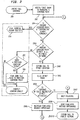
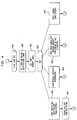
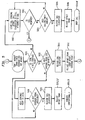
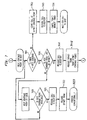
- FIGS. 2-7 are a flow diagram of a network call redirection procedure of the invention.
-
- FIG. 1 shows a telecommunications network illustratively including private branch exchanges (PBXs) 10 and 20, such as the Lucent Technologies, Inc., G3 PBXs interconnected by a
network 9 which, illustratively, may include a public communications network having central office switches, a hybrid network, a data network, or any other telecommunications network that comprises a plurality of nodes that can terminate the call at any remote end-point. Illustratively, aPOTS telephone 50 is one form of such an end-point. - As shown in FIG. 1, each
PBX PBX network 9 by a plurality ofuser communications links processor PBX memory processor - Included among the control data stored in
memory entries 99, each of which identifies a different end-point or terminal to which incoming calls destined for the associated end-point or terminal may be redirected. Included among the control programs stored in each of thememories redirection functions 130. Except for thefunctions 130, the telecommunications network shown in FIG. 1 is conventional. Hence, only thefunctions 130 will be described in any detail. - The operations carried out by
PBXs functions 130 are diagramed in FIGS. 2-7. For purposes of illustration, assume that PBX 10 has received an incoming call for a terminal such asterminal 11 which has call redirection activated.Terminal 11 is sometimes referred to herein as the principal or principal's terminal and, accordingly,switch 10 may be referred to as the principal's switch. If the call cannot be completed to or is not answered byterminal 11, call redirection for the call is invoked byPBX 10 atstep 200 to determine where this call should be redirected. Redirection will be dictated bycoverage path 110 that is associated - coveredterminal 11. PBX 10 accesses thefirst entry 99 in thatcoverage path 110 to determine the end-point - the covering terminal to which the call should be redirected, atstep 202. - At
step 204PBX 10 determines whether the covering terminal is a remote terminal served by a "cooperating" switch i.e., one that has been configured to effect network call redirection and with which it can exchange data messages concerning the existence of a network coverage call and the availability of a call covering end-point, as described in the above-mentioned D. W. Herrick et al patent. If so, the call may be routed to the remote terminal as therein described. - If PBX 10 determines at
step 204 that the covering terminal is a terminal that is not served by a "cooperating" switch --PBX 20 in this illustrative example --PBX 10 atstep 2001 proceeds to determine whether the covering switch is an "off-net" switch, e.g., part of the public switched network. If the covering point is not "off-net" it may be handled conventionally. Briefly, as described in the Herrick, et al patent atsteps 205 through 207, a check is made atstep 205 to determine if there was a previous covering end-point for the call. If so, the previous connection is taken down atstep 206 and the call is completed conventionally. - If PBX 10 determines at
step 2001 that the covering terminal is a remote terminal that is "off-net" it may be reachable by any type of voice frequency or ISDN trunk and with no requirement for the exchange of data messages between the switches, then, instep 2002, the call is extended to the remote location by seizing, instep 2003, an off-net trunk. Instep 2004, a determination is made whether the "redirection of calls off-net" feature is activated inmemory 14 ofswitch 10. If so, a simulated bridged appearance is maintained atstep 2005 so that theprincipal station 11 may pick up the call at any time, and processing continues at entry point "A". - If redirection of off-net calls is not activated, then the connection to the principal station is dropped at
step 2007, the simulated bridged appearance is dropped atstep 2008 and the call is extended to the covering terminal over the public switched network in the conventional manner, atstep 2009, i.e., control over the call is lost. - At entry point "A",
step 3001, a determination is made whether the off-net trunk seized instep 2003 to the covering switch is an ISDN trunk. If the trunk is an ISDN trunk, processing continues at entry point "F". If the trunk is not an ISDN trunk, the digits of the covering end-point are outpulsed instep 3002 and the principal'sswitch 10 determines whether acall classifier 77, Fig. 1, is available instep 3003. If a call classifier is not available, processing continues at entry point "B". A call classifier is a device at thefirst switch 10 which listens to the call progress tones from the far end which appear on the connection and which informsprocessor 13 of voice energy or progress tones that appears on the connection. Ifcall classifier 77 is available, it is attached to the off-net trunk atstep 3004 and a timer is started atstep 3005 to mark the time theswitch 10 will await an answer. If answer does not occur within a predetermined time, the "don't answer" time, the call will be moved to the next point in the coverage path. Duringstep 3006 the wait interval elapses during which the call classifier may informprocessor 13 instep 3008 as to the call progress tones detected: the detection of ringback tone instep 3010, the appearance of voice energy instep 3012, or the detection of some other tone instep 3013. If ringback tone is detected instep 3010 and the "don't answer" timer has not yet expired instep 3007, the wait interval continues. If the wait interval determined by the "don't answer" timer has expired instep 3007, processing continues at entry point "C". However, if voice frequency energy is detected instep 3012, before the "don't answer" timer has expired, processing continues at entry point "D". Otherwise callclassifier 77 has detected some other call progress tone atstep 3013 and will treat the offnet coverage point as busy at entry point "E". - Processing at entry point "F" is reached if the off-net trunk seized in
step 2003 is determined to be an ISDN trunk. Atstep 4001, the call is handled as an ISDN call and at step 4002 a timer is set for the appearance of an "ISDN end-to-end" signal which indicates that the entire path to the covering end-point consists only of ISDN trunks so that ISDN end-to-end signaling is possible. In step 4003 a don't answer timer is set and a wait interval ensues at step 4004. At this point there are four possibilities. The first possibility is considered atstep 4006 where the timer set instep 4002 has expired without the ISDN "end-to-end" notification being received so that instep 4007 it is assumed that the call will not be an ISDN "end-to-end" connection and processing continues at entry point "H". The second possibility is that atstep 4008 an ISDN message is received that indicates that some non-ISDN trunks are present in the connection to the covering end-point, i.e., an ISDN "interworking" message, so that processing continues at entry point "H" just as if no ISDN end-to-end path were available. The third possibility is considered atstep 4009 in which the ISDN message received indicates that there is an ISDN end-to-end connection to the covering end-point so that ISDN messages can be relied upon to indicate whether the called party is ringing, when the call is answered, if busy tone is encountered, etc. Essentially, upon the receipt of the ISDN end-to-end message atstep 4009, ISDN signaling may be relied upon as a call classifier and processing continues at entry point "J", see Fig. 3. The fourth possibility is considered atstep 4010 in which the "don't answer" timer expires and processing continues at entry point "C". - At entry point "C", Fig. 5, is reached when the "don't answer" timer has expired in
step 3007, Fig. 3 orstep 4010, Fig. 4. At step 5001 a determination is made whether there is a next coverage point for the call. If there is no further coverage point, atstep 5002 the call is left ringing at the off-net location while the call classifier is maintained on the call at the first switch. The call classifier continues to monitor the connection awaiting answer atstep 5003. If the call classifier detects that the call is answered, processing continues at entry point "D", Fig. 6. If the call is not answered, the call classifier atstep 5004 continues to monitor until the calling party hangs up and, atstep 5005, the call classifier is released and, atstep 5006, the off-net trunk is released and the call is dropped, atstep 5008. - If, at
step 5001, it had been determined that there was a further coverage point for the call then, at step 5010 a determination is made whether that coverage point is remote. If the coverage point is remote, the call classifier is released atstep 5011, the off-net trunk is released atstep 5012 and processing continues at entry point "G". If the coverage point is local then, atstep 5020, a determination is made whether the next coverage point is available. If not, processing returns to step 5001. If a local coverage point is available then, atstep 5021 the call classifier is released, atstep 5022 the off-net trunk is released, and processing continues conventionally, atstep 5023. - Entry point "D", Fig. 6, is reached when the call has been answered. When the call is answered the principal may still pick up the call since the simulated bridged appearance is maintained. Any single party to the call may drop off after the principal bridges on and the call will still be held. The call will be ended when only a single party remains on the call. At
step 6001, the timing for "don't answer" is canceled, the call classifier is released atstep 6002 and atstep 6003, the call is held until one party hangs up. - Entry point "E", Fig. 7, is reached from
step 3013, Fig. 3, when the call classifier detects a call progress tone other than ringing, which results in treating the call as if the covering point is busy. In step 7001 a determination is made whether there is another coverage point for the call. If there is no further coverage point then, instep 7002, the call is left at the present off-net coverage point, the call classifier is released atstep 7003, the "don't answer" timing is canceled atstep 7004 and the call is dropped when the calling party hangs up. - In
step 7001 if it has been determined that there is a further coverage point for the call, a determination is made instep 7010 whether that point is remote. If the coverage point is remote, the call classifier is released instep 7011, the off-net trunk is released instep 7012 and processing continues at entry point "G". If, instep 7010 it has been determined that the further coverage point is local, then processing continues to handle the call as for local call redirection. In step 7020 a determination is made whether a local call coverage point available and, if not, processing continues atstep 7001 described previously. If a local coverage point is available, the call classifier is released atstep 7021, the off net trunk is released atstep 7022 and processing continues as for local call redirection, atstep 7023. - Of course, various changes and modifications to the illustrative embodiment described above will be apparent to those skilled in the art. For example, the covered call can be transferred by the covering party to the covered terminal, or the covering party can conference in the covered terminal and then either remain on the call or drop out. Such changes and modifications can be made within the scope of the invention and without diminishing its attendant advantages. It is therefore intended that such changes and modifications be covered by the following claims.
Claims (11)
- A remote call-redirection method comprising the steps of:(a) determining (2001) at a first switch (10), in response to the invocation (200) of call-redirection for a call, whether a call-covering end-point (22) for said call is served by a remote switch (20):(b) in response to determining that said end-point is so served, extending (2002) the call to the remote switch serving the call-covering end-point, CHARACTERISED BY the further steps of(c) determining (3012) at said first switch for said extended call whether voice frequency energy appears on said call within a predetermined time interval;(d) in response to the appearance of said voice frequency energy within said predetermined interval, completing (6001-6003) call-coverage of said call at said call-covering end-point; and(e) further processing (7005-7022) said call at said first switch when said voice frequency energy fails to appear within said predetermined time interval, including releasing (7012, 7022) said remote switch and determining (7001) at said first switch whether another coverage end-point exists for said call.
- A remote call-redirection method according to claim 1 wherein said processing of said call includes determining (7001, 7010) whether a further call-covering end-point for said call served by a different remote switch exists and repeating steps (c) through (e) for said call through said different remote switch.
- A remote call-redirection method according to claim 1, wherein during a first interval of said predetermined time interval the continuance of ringback tone is monitored (3007, 3010) and wherein said remote switch is released (5006, 5012, 5022) when said ringback tone continues beyond said first interval,
- A remote call-redirection method according to claim I wherein said step (c) is performed by connecting (3004) a call classifier (77) to the call at said first switch.
- A remote call-redirection method according to claim 1 wherein a simulated bridged appearance for the extended call is maintained (2005) at said first switch.
- A remote call-redirection method according to claim 1, comprising:determining (3001), incident to said extending of said call to said remote switch in step (b) whether an Integrated Services Digital Network, abbreviated ISDN, trunk is present and, if so, timing (4002) for the appearance of an ISDN end-to-end notification;in response to the timely receipt (4009) of said ISDN end-to-end notification and, in lieu of steps (c) and (d), processing (3012, 6001-6003) said call in accordance with ISDN trunk signaling messages thereafter received to complete the call to said call-covering end-point when one of said ISDN trunk signaling message indicates called party answer and, in response to others of said ISDN trunk signaling messages, performing step (e).
- A remote call-redirection method according to claim 6 comprising:in response (4002, 4048) to the non-receipt of said ISDN end-toend notification within a predetermined interval, performing steps (c) through (e).
- The method of claim 1 wherein said further processing includes:in response to determining that there is not an alternative call-covering end-point for the call, said first switch relinquishes (7002) control of the call to the remote switch; andin response to determining that there is an alternative call-covering end-point for the call, disconnecting (7012, 7022) the call from the remote switch and extending said call to said alternative call-covering end-point.
- The method of claim 1 wherein:step (a) comprises
in response to the first switch invoking (200) call coverage for the call which is connected to the first switch (10) and destined for a destination end-point (11) served by the first switch, the first switch identifying (202) the call-covering end-point for the call from a coverage path (110) of the destination end-point;step (c) comprises
monitoring (310-313) call progress tones provided by the remote switch throughout the predetermined time interval;step (d) comprises
allowing (3002, 4001) said remote switch to complete the connection to the call-covering end-point; andstep (e) comprises
taking down (7012, 7022) a connection of the call to the remote switch and further identifying (7001, 7010) an alternative call-covering end-point for the call. - The method of claim 9 further comprising the steps of:in response to either (a) the first switch not receiving signaling from the remote switch within a predetermined time, or (b) the call not being answered at the alerted call-covering end-point, the first switch determining (5001, 7001) from the coverage path of the destination endpoint whether there is an alternative call-covering end-point for the call;in response to determining that there is not an alternative call-covering end-point for the call, the first switch relinquishing (5002, 7002) control of the call to the remote switch; andin response to determining that there is an alternative call-covering end-point for the call, the first switch disconnecting (5012, 5022, 7012, 7022) the call from the remote switch and attempting to cover the call to the alternative call-covering end-point.
- A call-coverage switch (10), comprising:(a) means (13: 2001)for determining in response to the invocation (200) of call-coverage for a call whether a call-covering end-point (22) for said call is served by a remote switch (20);(b) means (13:2002) responsive to said determining that said end-point is so served for extending the call to the remote switch serving the call-covering end-point, CHARACTERISED BY(c) means (13:3012) including a call classifier (77) adapted for connection to said call, for determining whether voice frequency energy appears on said call within a predetermined time interval;(d) means (13:6001-6003) responsive to the appearance of said voice frequency energy within said predetermined interval for completing call-coverage of said call at said call-covering end-point; and(e) means (13: 7001-7022)for further processing said call when said voice frequency energy fails to appear within said predetermined time interval, including releasing (7012, 7022) said remote switch and determining (7001) whether another coverage end-point exists for said call.
Applications Claiming Priority (4)
| Application Number | Priority Date | Filing Date | Title |
|---|---|---|---|
| US2464996P | 1996-08-22 | 1996-08-22 | |
| US24649P | 1996-08-22 | ||
| US08/748,034 US5867568A (en) | 1996-08-22 | 1996-11-12 | Coverage of redirected calls |
| US748034 | 1996-11-12 |
Publications (3)
| Publication Number | Publication Date |
|---|---|
| EP0836336A2 EP0836336A2 (en) | 1998-04-15 |
| EP0836336A3 EP0836336A3 (en) | 2000-05-10 |
| EP0836336B1 true EP0836336B1 (en) | 2005-08-03 |
Family
ID=26698708
Family Applications (1)
| Application Number | Title | Priority Date | Filing Date |
|---|---|---|---|
| EP97306134A Expired - Lifetime EP0836336B1 (en) | 1996-08-22 | 1997-08-12 | Coverage of redirected calls |
Country Status (5)
| Country | Link |
|---|---|
| US (1) | US5867568A (en) |
| EP (1) | EP0836336B1 (en) |
| JP (1) | JPH1093719A (en) |
| AU (1) | AU3427097A (en) |
| DE (1) | DE69733871T2 (en) |
Families Citing this family (17)
| Publication number | Priority date | Publication date | Assignee | Title |
|---|---|---|---|---|
| DE19640266A1 (en) * | 1996-09-30 | 1998-04-02 | Siemens Ag | Communication system consisting of at least two private branch exchanges with team function |
| JP2001508962A (en) * | 1996-12-13 | 2001-07-03 | ブリティッシュ・テレコミュニケーションズ・パブリック・リミテッド・カンパニー | Communications system |
| JP3649842B2 (en) * | 1997-02-26 | 2005-05-18 | 富士通株式会社 | PBX network |
| US6041116A (en) * | 1997-05-05 | 2000-03-21 | Aspect Telecommunications Corporation | Method and apparatus for controlling outbound calls |
| US6023505A (en) * | 1997-07-11 | 2000-02-08 | Bellsouth Intellectual Property Corporation | System and method for providing a busy signal to a communication |
| US6252954B1 (en) * | 1998-11-20 | 2001-06-26 | Bellsouth Intellectual Property Corporation | System and method for delaying the ringing of a line |
| US6363143B1 (en) * | 1999-01-19 | 2002-03-26 | Avaya Technology Corp. | Graphical and schedule-based definition of a call-coverage path |
| US6931112B1 (en) * | 2000-06-12 | 2005-08-16 | Aspect Communications Corporation | User invoked directed outdial method and apparatus |
| US6674853B1 (en) * | 2000-11-22 | 2004-01-06 | Avaya Technology Corp. | Integration of remote access and service |
| US20030083875A1 (en) * | 2001-10-23 | 2003-05-01 | Brown Micheal Kenneth | Unified call classifier for processing speech and tones as a single information stream |
| US20030086541A1 (en) * | 2001-10-23 | 2003-05-08 | Brown Michael Kenneth | Call classifier using automatic speech recognition to separately process speech and tones |
| US20030088403A1 (en) * | 2001-10-23 | 2003-05-08 | Chan Norman C | Call classification by automatic recognition of speech |
| US20030081756A1 (en) * | 2001-10-23 | 2003-05-01 | Chan Norman C. | Multi-detector call classifier |
| US7054435B2 (en) | 2002-04-05 | 2006-05-30 | Avaya Technology Corp. | Apparatus and method for determining a minimal time bound for performing tone detection |
| US7761323B2 (en) | 2003-10-08 | 2010-07-20 | Aspect Software, Inc. | Method and system for scheduling a customer service callback |
| US8503640B1 (en) | 2004-09-01 | 2013-08-06 | Shoretel, Inc. | Extension monitoring in a distributed telephony system |
| US8424236B2 (en) * | 2009-05-11 | 2013-04-23 | Ben Huang | Multi-layered grip for use with fishing poles |
Family Cites Families (6)
| Publication number | Priority date | Publication date | Assignee | Title |
|---|---|---|---|---|
| US4150257A (en) * | 1977-10-31 | 1979-04-17 | Bell Telephone Laboratories, Incorporated | Communication system call coverage arrangements |
| US4926462A (en) * | 1988-02-24 | 1990-05-15 | Vmx/Opcom | Interface to and operation of a voice messaging system |
| US5416834A (en) * | 1991-12-30 | 1995-05-16 | At&T Corp. | Redirection of calls by a communication terminal |
| US5369695A (en) * | 1992-01-06 | 1994-11-29 | At&T Corp. | Method of redirecting a telephone call to an alternate destination |
| US5313459A (en) * | 1992-10-08 | 1994-05-17 | Newton Communications, Inc. | Private branch exchange system and methods for operating same |
| US5521970A (en) * | 1995-03-29 | 1996-05-28 | At&T Corp. | Arrangement for extending call-coverage across a network of nodes |
-
1996
- 1996-11-12 US US08/748,034 patent/US5867568A/en not_active Expired - Lifetime
-
1997
- 1997-08-12 DE DE69733871T patent/DE69733871T2/en not_active Expired - Lifetime
- 1997-08-12 EP EP97306134A patent/EP0836336B1/en not_active Expired - Lifetime
- 1997-08-18 AU AU34270/97A patent/AU3427097A/en not_active Abandoned
- 1997-08-22 JP JP9226179A patent/JPH1093719A/en active Pending
Also Published As
| Publication number | Publication date |
|---|---|
| DE69733871D1 (en) | 2005-09-08 |
| AU3427097A (en) | 1998-02-26 |
| EP0836336A2 (en) | 1998-04-15 |
| DE69733871T2 (en) | 2006-02-09 |
| US5867568A (en) | 1999-02-02 |
| JPH1093719A (en) | 1998-04-10 |
| EP0836336A3 (en) | 2000-05-10 |
Similar Documents
| Publication | Publication Date | Title |
|---|---|---|
| CA1252864A (en) | Discretionary call forwarding | |
| EP0550975B1 (en) | A method of redirecting a telephone call to an alternate destination | |
| US5867568A (en) | Coverage of redirected calls | |
| US5502757A (en) | Location dependent service for a wireless telephone | |
| US5099509A (en) | Integration of voice store and forward facility | |
| AU678349B2 (en) | A method of establishing a connection and a system for practicing the method | |
| US4445211A (en) | Arrangement for multiple custom calling | |
| JPH07273902A (en) | Independently switched voice and data calling using simultaneous voice and data modems | |
| US6671366B1 (en) | Method of connecting calls | |
| CA2167236C (en) | Arrangement for extending call-coverage across a network of nodes | |
| US5249219A (en) | Integration of voice store and forward facility | |
| US6072866A (en) | Path replacement scheme | |
| US4446553A (en) | Arrangement for multiple custom calling | |
| JP2708152B2 (en) | Dial tone detection method with detection notification function | |
| CA2212311C (en) | Coverage of redirected calls | |
| US5963633A (en) | System and method for branching a telephone call | |
| AU683392B2 (en) | Call setup and service invocation in telecommunications networks | |
| JPH08331262A (en) | Multi-party connection method between stations | |
| CA1186039A (en) | Arrangement for multiple custom calling | |
| EP0748133A2 (en) | Establishing inter-exchange telecommunication calls | |
| JPH04175047A (en) | Returned call on busy service control system | |
| JPS6387064A (en) | Exclusive line camp-on system | |
| JPH11122362A (en) | Camp-on service method and dial method in party busy case | |
| JPH01191597A (en) | Communication system | |
| JPH0370294A (en) | Incoming subaddress dial system |
Legal Events
| Date | Code | Title | Description |
|---|---|---|---|
| PUAI | Public reference made under article 153(3) epc to a published international application that has entered the european phase |
Free format text: ORIGINAL CODE: 0009012 |
|
| AK | Designated contracting states |
Kind code of ref document: A2 Designated state(s): DE ES FR GB |
|
| AX | Request for extension of the european patent |
Free format text: AL;LT;LV;RO;SI |
|
| PUAL | Search report despatched |
Free format text: ORIGINAL CODE: 0009013 |
|
| AK | Designated contracting states |
Kind code of ref document: A3 Designated state(s): AT BE CH DE DK ES FI FR GB GR IE IT LI LU MC NL PT SE |
|
| AX | Request for extension of the european patent |
Free format text: AL;LT;LV;RO;SI |
|
| 17P | Request for examination filed |
Effective date: 20000511 |
|
| AKX | Designation fees paid |
Free format text: DE ES FR |
|
| RBV | Designated contracting states (corrected) |
Designated state(s): DE ES FR GB |
|
| 17Q | First examination report despatched |
Effective date: 20040730 |
|
| GRAP | Despatch of communication of intention to grant a patent |
Free format text: ORIGINAL CODE: EPIDOSNIGR1 |
|
| GRAS | Grant fee paid |
Free format text: ORIGINAL CODE: EPIDOSNIGR3 |
|
| GRAA | (expected) grant |
Free format text: ORIGINAL CODE: 0009210 |
|
| AK | Designated contracting states |
Kind code of ref document: B1 Designated state(s): DE ES FR GB |
|
| REG | Reference to a national code |
Ref country code: GB Ref legal event code: FG4D |
|
| REF | Corresponds to: |
Ref document number: 69733871 Country of ref document: DE Date of ref document: 20050908 Kind code of ref document: P |
|
| PG25 | Lapsed in a contracting state [announced via postgrant information from national office to epo] |
Ref country code: ES Free format text: LAPSE BECAUSE OF FAILURE TO SUBMIT A TRANSLATION OF THE DESCRIPTION OR TO PAY THE FEE WITHIN THE PRESCRIBED TIME-LIMIT Effective date: 20051114 |
|
| ET | Fr: translation filed | ||
| PLBE | No opposition filed within time limit |
Free format text: ORIGINAL CODE: 0009261 |
|
| STAA | Information on the status of an ep patent application or granted ep patent |
Free format text: STATUS: NO OPPOSITION FILED WITHIN TIME LIMIT |
|
| 26N | No opposition filed |
Effective date: 20060504 |
|
| PGFP | Annual fee paid to national office [announced via postgrant information from national office to epo] |
Ref country code: FR Payment date: 20120823 Year of fee payment: 16 |
|
| REG | Reference to a national code |
Ref country code: FR Ref legal event code: ST Effective date: 20140430 |
|
| PG25 | Lapsed in a contracting state [announced via postgrant information from national office to epo] |
Ref country code: FR Free format text: LAPSE BECAUSE OF NON-PAYMENT OF DUE FEES Effective date: 20130902 |
|
| PGFP | Annual fee paid to national office [announced via postgrant information from national office to epo] |
Ref country code: DE Payment date: 20160822 Year of fee payment: 20 Ref country code: GB Payment date: 20160819 Year of fee payment: 20 |
|
| REG | Reference to a national code |
Ref country code: DE Ref legal event code: R071 Ref document number: 69733871 Country of ref document: DE |
|
| REG | Reference to a national code |
Ref country code: GB Ref legal event code: PE20 Expiry date: 20170811 |
|
| PG25 | Lapsed in a contracting state [announced via postgrant information from national office to epo] |
Ref country code: GB Free format text: LAPSE BECAUSE OF EXPIRATION OF PROTECTION Effective date: 20170811 |