EP0835859A1 - Process for producing valproic acid - Google Patents
Process for producing valproic acid Download PDFInfo
- Publication number
- EP0835859A1 EP0835859A1 EP97830497A EP97830497A EP0835859A1 EP 0835859 A1 EP0835859 A1 EP 0835859A1 EP 97830497 A EP97830497 A EP 97830497A EP 97830497 A EP97830497 A EP 97830497A EP 0835859 A1 EP0835859 A1 EP 0835859A1
- Authority
- EP
- European Patent Office
- Prior art keywords
- carbon atoms
- phase
- bromide
- halogenide
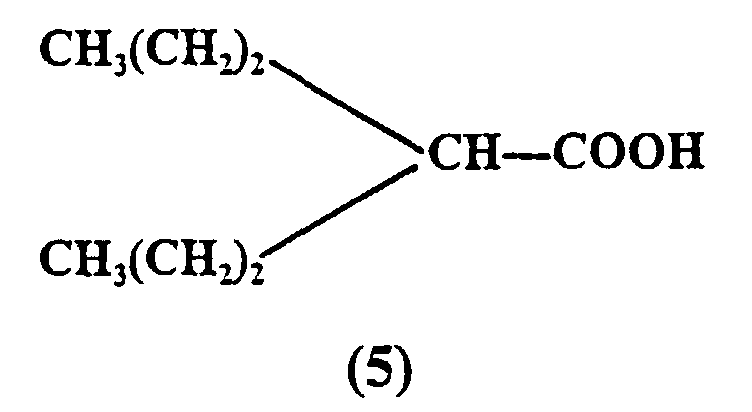
- valproic acid
- Prior art date
- Legal status (The legal status is an assumption and is not a legal conclusion. Google has not performed a legal analysis and makes no representation as to the accuracy of the status listed.)
- Granted
Links
Classifications
-
- C—CHEMISTRY; METALLURGY
- C07—ORGANIC CHEMISTRY
- C07C—ACYCLIC OR CARBOCYCLIC COMPOUNDS
- C07C51/00—Preparation of carboxylic acids or their salts, halides or anhydrides
- C07C51/41—Preparation of salts of carboxylic acids
- C07C51/412—Preparation of salts of carboxylic acids by conversion of the acids, their salts, esters or anhydrides with the same carboxylic acid part
-
- C—CHEMISTRY; METALLURGY
- C07—ORGANIC CHEMISTRY
- C07C—ACYCLIC OR CARBOCYCLIC COMPOUNDS
- C07C51/00—Preparation of carboxylic acids or their salts, halides or anhydrides
- C07C51/02—Preparation of carboxylic acids or their salts, halides or anhydrides from salts of carboxylic acids
-
- C—CHEMISTRY; METALLURGY
- C07—ORGANIC CHEMISTRY
- C07C—ACYCLIC OR CARBOCYCLIC COMPOUNDS
- C07C67/00—Preparation of carboxylic acid esters
- C07C67/30—Preparation of carboxylic acid esters by modifying the acid moiety of the ester, such modification not being an introduction of an ester group
- C07C67/333—Preparation of carboxylic acid esters by modifying the acid moiety of the ester, such modification not being an introduction of an ester group by isomerisation; by change of size of the carbon skeleton
- C07C67/343—Preparation of carboxylic acid esters by modifying the acid moiety of the ester, such modification not being an introduction of an ester group by isomerisation; by change of size of the carbon skeleton by increase in the number of carbon atoms
Definitions
- the present invention relates to an improved process for the preparation of valproic acid.
- Valproic acid (2-propylpentanoic acid; di-n-propylacetic acid) and its sodium and magnesium salts have long since been utilized in therapy as anti-epileptic and anticonvulsant drugs.
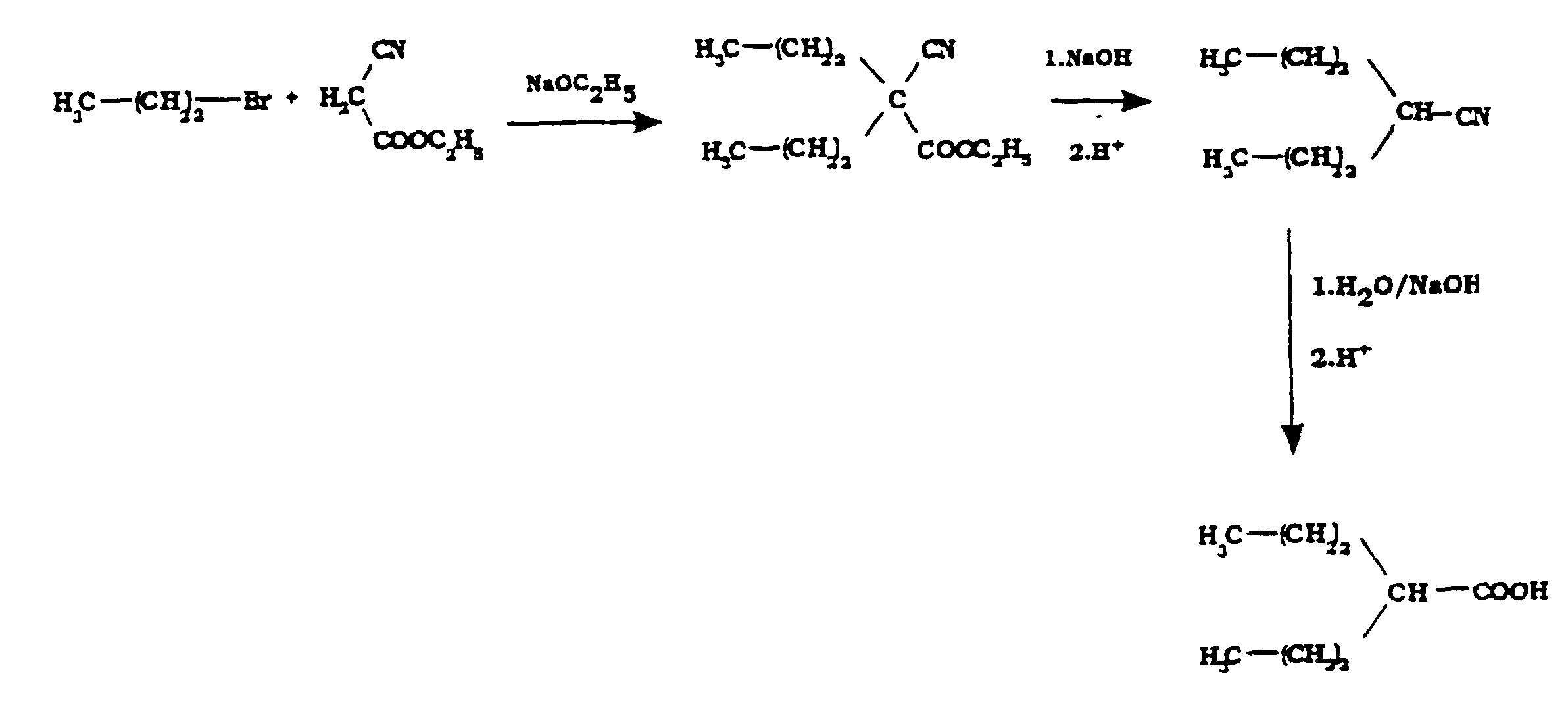
- the conventional process which is still used for the preparation of valproic acid substantially comprises dialkylating ethyl cyanacetate with propyl bromide in the presence of sodium ethoxide thus obtaining ethyl ⁇ , ⁇ -dipropyl cyanacetate which is converted, in a basic enviroment, to dipropyl acetonitrile which by alkaline hydrolysis gives valproic acid.
- reaction scheme of this process is the following:
- the process comprises the following steps:
- R is preferably an alkoxy group having 2-3 carbon atoms and R' is an alkyl group having 1-2 carbon atoms.
- a particularly preferred ester (1) is the ethyl ester of acetoacetic acid.
- the propyl halogenide (2) is preferably propyl bromide.
- Suitable phase-transfer catalysts Q + X - wherein Q + is quatemary ammonium or phosphonium and X - is any suitable anion shall be apparent to the average-skilled expert in organic synthesis.
- suitable Q + X - catalysts are: tetrabutylammonium bromide, tetrabutylammonium bisulphate, benzyltriethylammonium chloride, benzyltributylammonium bromide, tetrabutylphosphonium bromide and benzyltriphenylphosphonium chloride.
- a particularly preferred Q + X - is tetrabutylammonium bromide (TBABr).
- step (b) it is economically advantageous to recover the catalyst which can thus be reutilized.
- Catalyst recovery is achieved by extracting the reaction mixture with an organic solvent, preferably a halogen-containing solvent, such as e.g. dichloethane, chloroform or methylene chloride; concentrating the organic phase thus obtained which is taken up with a precipitating organic solvent, such as e.g. toluene or ethyl acetate, thus obtaining a precipitate consisting of the catalyst which, following filtration, is wholly recovered.
- an organic solvent preferably a halogen-containing solvent, such as e.g. dichloethane, chloroform or methylene chloride
- a precipitating organic solvent such as e.g. toluene or ethyl acetate
- the organic phase was washed three times with water, then the pooled waters were acidified and extracted with ethyl acetate. The organic phase was dehydrated and concentrated to dryness yielding 0.9 g of valproic acid.
- the catalyst was recovered by concentrating the organic phase (CH 2 Cl 2 ) and diluting with ethyl acetate thus obtaining the formation of a white precipitate consisting of the catalyst which was filtered off.
- G.C. Control: (end product) Rt 13.78
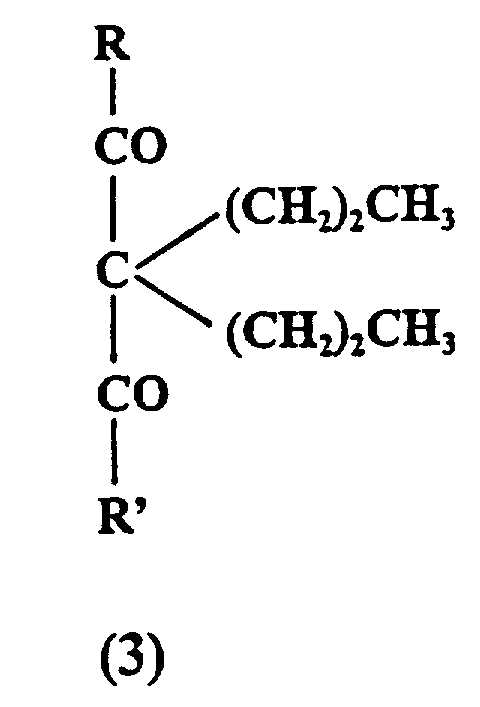
- the conversion of the dialkyl-beta-ketoester (3) to the salt (4) is not carried out according to the conventional method, i.e. in the presence of sodium methoxide or ethoxide and methanol or ethanol, but in the presence of a base (e.g. NaOH) and a phase-transfer catalyst (e.g. TBABr) which, unlike the alkaline alkoxide, is in practice wholly recovered.
- a base e.g. NaOH
- a phase-transfer catalyst e.g. TBABr
- Claisen's inverse reaction according to the invention lends itself to "fit" with the hydrolysis reaction of compound (3), so that both reactions are in practice carried out in a single step.
Landscapes
- Chemical & Material Sciences (AREA)
- Organic Chemistry (AREA)
- Engineering & Computer Science (AREA)
- Oil, Petroleum & Natural Gas (AREA)
- Organic Low-Molecular-Weight Compounds And Preparation Thereof (AREA)
- Acyclic And Carbocyclic Compounds In Medicinal Compositions (AREA)
- Low-Molecular Organic Synthesis Reactions Using Catalysts (AREA)
- Catalysts (AREA)
Abstract
Description



tetrabutylammonium bromide, tetrabutylammonium bisulphate, benzyltriethylammonium chloride, benzyltributylammonium bromide, tetrabutylphosphonium bromide and benzyltriphenylphosphonium chloride.
G.C. Control: (end product) Rt = 13.78
- G.C.:
- (column: nucol 0.53 mm X 30 m, program temp. 50°C for 3 min. 50°C/min. till 170°C, 20 min. at 170°C, injec temp. 190°C, detector temp. 190°C, carrier gas: helium)
- H1NMR(CDCl3):
- δ 0.8 (6H,t,-CH2CH2 CH 3); 1.25(4H,m,-CH2 CH 2CH3); 1.5(4H,m,-CH 2CH2CH3); 2.25(1H,m,-CH(CH2CH2CH3)2); 10.9(1H,s.b.-COOH)
Claims (6)
- An improved process for producing valproic acid according to the following reaction scheme:wherein:
 which comprises the following steps:R is an alkoxy group having 2-5 carbon atoms;R' is an alkyl group having 1-4 carbon atoms, andQ+ X- indicates a phase-transfer catalyst wherein Q+ is quaternary ammonium or phosphonium and X- is any suitable anion, preferably a halogenide anion,(a) dialkylating a beta-ketoester (1) having formulawherein:
 R is an alkanoyl group having 2-5 carbon atoms; andR' is an alkyl group having 1-4 carbon atoms with a propyl halogenide (2) having formula(i) an aqueous phase comprising a base, preferably NaOH, and a phase-transfer catalyst Q+X- wherein Q+ is quatemarry ammonium or phosphonium and X- is any suitable an ion, preferably halogenide, and(ii) an organic phase comprising the beta-ketoester (1) and the propyl halogenide (2), wherein the (2):(1) molar ratio is from 5:1 to 15:1, preferably 10:1, at 60-80°C (inner temp.) for at least 25 hours, thus obtaining, following removal of (2) excess, a biphasic reaction mixture whose organic phase is comprised of the dialkyl-beta-ketoester (3)
 (b) reacting the mixture obtained in step (a) which comprises the dialkylester (3), in the presence of an alkali, preferably NaOH, at 70-90 °C, preferably 80°C, for at least 20 hours, thus obtaining an aqueous phase comprising the salt (4)
 (c) acidifying the aqueous phase comprising the salt (4) of step (b) at pH 1-3, thus obtaining valproic acid (5)
- The process of claim 1, wherein in the ester (1) R is an alkoxy group having 2-3 carbon atoms and R' is an alkyl group having 1-2 carbon atoms.
- The process of claim 2, wherein the ester (1) is the ethyl ester of acetoacetic acid.
- The process of any one of claim 1, 2 or 3 wherein the propyl halogenide (2) is propyl bromide.
- The process of any one of claims 1, 2, 3 or 4 wherein the phase-transfer catalyst Q+X- is selected from the group comprising tetrabytylammoniwn bromide, tetrabutylammonium bisulphate, benzyltriethylammonium chloride, benzyltributylammonium bromide, tetrabutylphosphonium bromide and benzyltriphenylphosphonium chloride.
- The process of claim 5, wherein Q+X- is tetrabutylammonium bromide (TBABr).
Applications Claiming Priority (2)
| Application Number | Priority Date | Filing Date | Title |
|---|---|---|---|
| IT96RM000688A IT1285801B1 (en) | 1996-10-10 | 1996-10-10 | IMPROVED PROCEDURE FOR THE PREPARATION OF VALPROIC ACID |
| ITRM960688 | 1996-10-10 |
Publications (2)
| Publication Number | Publication Date |
|---|---|
| EP0835859A1 true EP0835859A1 (en) | 1998-04-15 |
| EP0835859B1 EP0835859B1 (en) | 2000-05-03 |
Family
ID=11404463
Family Applications (1)
| Application Number | Title | Priority Date | Filing Date |
|---|---|---|---|
| EP97830497A Expired - Lifetime EP0835859B1 (en) | 1996-10-10 | 1997-10-03 | Process for producing valproic acid |
Country Status (14)
| Country | Link |
|---|---|
| US (1) | US5856569A (en) |
| EP (1) | EP0835859B1 (en) |
| JP (1) | JP3983350B2 (en) |
| KR (1) | KR19980032744A (en) |
| AT (1) | ATE192426T1 (en) |
| CA (1) | CA2217836C (en) |
| DE (1) | DE69701843T2 (en) |
| DK (1) | DK0835859T3 (en) |
| ES (1) | ES2146453T3 (en) |
| GR (1) | GR3034122T3 (en) |
| IT (1) | IT1285801B1 (en) |
| PT (1) | PT835859E (en) |
| TW (1) | TW380134B (en) |
| ZA (1) | ZA979046B (en) |
Cited By (1)
| Publication number | Priority date | Publication date | Assignee | Title |
|---|---|---|---|---|
| WO2018109152A1 (en) | 2016-12-16 | 2018-06-21 | Idorsia Pharmaceuticals Ltd | Pharmaceutical combination comprising a t-type calcium channel blocker |
Families Citing this family (8)
| Publication number | Priority date | Publication date | Assignee | Title |
|---|---|---|---|---|
| NZ540288A (en) | 2002-11-22 | 2009-06-26 | Univ Johns Hopkins | Target for therapy of cognitive impairment |
| EP3260118B1 (en) | 2008-10-16 | 2021-03-24 | The Johns Hopkins University | Methods and compositions for improving cognitive function |
| US20110212928A1 (en) * | 2010-02-09 | 2011-09-01 | The Johns Hopkins University | Methods and compositions for improving cognitive function |
| CN103183612A (en) * | 2011-12-30 | 2013-07-03 | 北大方正集团有限公司 | Dipropylmalonic acid diester preparation method |
| WO2014078568A1 (en) | 2012-11-14 | 2014-05-22 | The Johns Hopkins University | Methods and compositions for treating schizophrenia |
| WO2014144663A1 (en) | 2013-03-15 | 2014-09-18 | The Johns Hopkins University | Methods and compositions for improving cognitive function |
| EP2968220B1 (en) | 2013-03-15 | 2021-05-05 | Agenebio, Inc. | Methods and compositions for improving cognitive function |
| NZ738682A (en) | 2015-05-22 | 2022-01-28 | Agenebio Inc | Extended release pharmaceutical compositions of levetiracetam |
Citations (3)
| Publication number | Priority date | Publication date | Assignee | Title |
|---|---|---|---|---|
| AT365554B (en) * | 1979-04-02 | 1982-01-25 | Gerot Pharmazeutika | METHOD FOR PRODUCING DI-N-PROPYLMALONIC ACID |
| FR2589469A1 (en) * | 1985-10-30 | 1987-05-07 | Nippon Synthetic Chem Ind | PROCESS FOR THE PREPARATION OF VALPROIC ACID |
| JPS63122646A (en) * | 1986-11-11 | 1988-05-26 | Nippon Synthetic Chem Ind Co Ltd:The | Manufacturing method of valproic acid |
Family Cites Families (5)
| Publication number | Priority date | Publication date | Assignee | Title |
|---|---|---|---|---|
| FR2442M (en) * | 1962-10-17 | 1964-04-06 | Henry Eugene | Dipropylacetic acid and its derivatives as new central nervous system depressants. |
| US4155929A (en) * | 1977-05-25 | 1979-05-22 | Labaz | Process for the preparation of an acetonitrile derivative |
| US5101070A (en) * | 1985-10-30 | 1992-03-31 | Nippon Gohsei Kagaku Kogyo Kabushiki Kaisha | Process for preparing valproic acid |
| US5344975A (en) * | 1993-09-03 | 1994-09-06 | Wyckoff Chemical Company, Inc. | Process for production of lower alkanoic acids |
| US5672746A (en) * | 1994-08-30 | 1997-09-30 | American Biogenetic Sciences, Inc. | Antiproliferative and neurotrophic molecules |
-
1996
- 1996-10-10 IT IT96RM000688A patent/IT1285801B1/en active IP Right Grant
-
1997
- 1997-10-01 TW TW086114307A patent/TW380134B/en not_active IP Right Cessation
- 1997-10-01 US US08/941,722 patent/US5856569A/en not_active Expired - Fee Related
- 1997-10-03 AT AT97830497T patent/ATE192426T1/en not_active IP Right Cessation
- 1997-10-03 DE DE69701843T patent/DE69701843T2/en not_active Expired - Fee Related
- 1997-10-03 DK DK97830497T patent/DK0835859T3/en active
- 1997-10-03 EP EP97830497A patent/EP0835859B1/en not_active Expired - Lifetime
- 1997-10-03 ES ES97830497T patent/ES2146453T3/en not_active Expired - Lifetime
- 1997-10-03 PT PT97830497T patent/PT835859E/en unknown
- 1997-10-09 JP JP27714997A patent/JP3983350B2/en not_active Expired - Lifetime
- 1997-10-09 ZA ZA9709046A patent/ZA979046B/en unknown
- 1997-10-09 CA CA002217836A patent/CA2217836C/en not_active Expired - Fee Related
- 1997-10-10 KR KR1019970052171A patent/KR19980032744A/en not_active Ceased
-
2000
- 2000-08-03 GR GR20000401817T patent/GR3034122T3/en not_active IP Right Cessation
Patent Citations (3)
| Publication number | Priority date | Publication date | Assignee | Title |
|---|---|---|---|---|
| AT365554B (en) * | 1979-04-02 | 1982-01-25 | Gerot Pharmazeutika | METHOD FOR PRODUCING DI-N-PROPYLMALONIC ACID |
| FR2589469A1 (en) * | 1985-10-30 | 1987-05-07 | Nippon Synthetic Chem Ind | PROCESS FOR THE PREPARATION OF VALPROIC ACID |
| JPS63122646A (en) * | 1986-11-11 | 1988-05-26 | Nippon Synthetic Chem Ind Co Ltd:The | Manufacturing method of valproic acid |
Non-Patent Citations (1)
| Title |
|---|
| DATABASE WPI Section Ch Week 8827, Derwent World Patents Index; Class B05, AN 88-186130, XP002056048 * |
Cited By (2)
| Publication number | Priority date | Publication date | Assignee | Title |
|---|---|---|---|---|
| WO2018109152A1 (en) | 2016-12-16 | 2018-06-21 | Idorsia Pharmaceuticals Ltd | Pharmaceutical combination comprising a t-type calcium channel blocker |
| US11213517B2 (en) | 2016-12-16 | 2022-01-04 | Idorsia Pharmaceuticals Ltd | Pharmaceutical combination comprising a T-type calcium channel blocker |
Also Published As
| Publication number | Publication date |
|---|---|
| PT835859E (en) | 2000-09-29 |
| TW380134B (en) | 2000-01-21 |
| US5856569A (en) | 1999-01-05 |
| DE69701843T2 (en) | 2000-10-26 |
| DK0835859T3 (en) | 2000-09-04 |
| MX9707714A (en) | 1998-06-30 |
| JPH10130197A (en) | 1998-05-19 |
| ZA979046B (en) | 1998-04-23 |
| JP3983350B2 (en) | 2007-09-26 |
| IT1285801B1 (en) | 1998-06-24 |
| CA2217836C (en) | 2007-01-09 |
| ITRM960688A1 (en) | 1998-04-10 |
| EP0835859B1 (en) | 2000-05-03 |
| CA2217836A1 (en) | 1998-04-10 |
| ATE192426T1 (en) | 2000-05-15 |
| KR19980032744A (en) | 1998-07-25 |
| DE69701843D1 (en) | 2000-06-08 |
| GR3034122T3 (en) | 2000-11-30 |
| ES2146453T3 (en) | 2000-08-01 |
Similar Documents
| Publication | Publication Date | Title |
|---|---|---|
| CA1077057A (en) | Process for the preparation of acetic acid derivatives | |
| EP0835859B1 (en) | Process for producing valproic acid | |
| CN114763328B (en) | A kind of preparation method and application of 2-cyano-2-valproic acid | |
| US4625053A (en) | Process for preparing optically active 2-(4-hydroxy-phenoxy) propionic acid compounds | |
| JPH0764789B2 (en) | Manufacturing method of methacrylic acid ester | |
| EP2181989A2 (en) | Process for the preparation of olopatadine | |
| EP0055630B1 (en) | Method for the preparation of fluorophthalamic compounds | |
| US4590295A (en) | Process for the manufacture of p-hydroxyphenyl-acetic acid | |
| MXPA97007714A (en) | Improved procedure for the production of valproic acid | |
| JP3907787B2 (en) | Method for producing benzoic acid derivative | |
| EP0658541B1 (en) | Process for producing carboxylic acid derivative | |
| KR100606626B1 (en) | Process for preparing cyanoacetic esters | |
| JP2000095730A (en) | Production of halogenated phenylmalonic ester | |
| JP5000031B2 (en) | Method for producing aromatic-o-dialdehyde compound | |
| WO1995001952A1 (en) | Process for synthesizing o-substituted oxime compounds and conversion to the corresponding o-substituted hydroxylamine | |
| EP1174413A2 (en) | Process for production of carboxylic acid aryl esters | |
| US6770781B1 (en) | Process for the preparation of alpha-arylalkanoic acids | |
| KR20010040542A (en) | Improved method for making mixed high purity (meth)acrylic anhydrides | |
| JP4185182B2 (en) | Method for producing imidazole derivative | |
| JP3293676B2 (en) | Process for producing halomaleic acid and halofumarate esters | |
| JP2522931B2 (en) | Quaternary ammonium salt | |
| JPH0641437B2 (en) | Method for producing malonic acid derivative | |
| EP0055629A1 (en) | Process for preparing fluoroanthranilic compounds | |
| JPH0124782B2 (en) | ||
| KR820000785B1 (en) | Process for preparing 1-(tetrahydro-2-furanyl)-5-fluorouracil |
Legal Events
| Date | Code | Title | Description |
|---|---|---|---|
| PUAI | Public reference made under article 153(3) epc to a published international application that has entered the european phase |
Free format text: ORIGINAL CODE: 0009012 |
|
| AK | Designated contracting states |
Kind code of ref document: A1 Designated state(s): AT BE CH DE DK ES FI FR GB GR IE IT LI LU MC NL PT SE |
|
| AX | Request for extension of the european patent |
Free format text: AL;LT;LV;RO;SI |
|
| 17P | Request for examination filed |
Effective date: 19980708 |
|
| AKX | Designation fees paid |
Free format text: AT BE CH DE DK ES FI FR GB GR IE IT LI LU MC NL PT SE |
|
| RBV | Designated contracting states (corrected) |
Designated state(s): AT BE CH DE DK ES FI FR GB GR IE IT LI LU MC NL PT SE |
|
| GRAG | Despatch of communication of intention to grant |
Free format text: ORIGINAL CODE: EPIDOS AGRA |
|
| 17Q | First examination report despatched |
Effective date: 19990806 |
|
| GRAG | Despatch of communication of intention to grant |
Free format text: ORIGINAL CODE: EPIDOS AGRA |
|
| GRAH | Despatch of communication of intention to grant a patent |
Free format text: ORIGINAL CODE: EPIDOS IGRA |
|
| GRAH | Despatch of communication of intention to grant a patent |
Free format text: ORIGINAL CODE: EPIDOS IGRA |
|
| GRAA | (expected) grant |
Free format text: ORIGINAL CODE: 0009210 |
|
| AK | Designated contracting states |
Kind code of ref document: B1 Designated state(s): AT BE CH DE DK ES FI FR GB GR IE IT LI LU MC NL PT SE |
|
| REF | Corresponds to: |
Ref document number: 192426 Country of ref document: AT Date of ref document: 20000515 Kind code of ref document: T |
|
| REG | Reference to a national code |
Ref country code: CH Ref legal event code: EP |
|
| REG | Reference to a national code |
Ref country code: IE Ref legal event code: FG4D |
|
| REF | Corresponds to: |
Ref document number: 69701843 Country of ref document: DE Date of ref document: 20000608 |
|
| REG | Reference to a national code |
Ref country code: CH Ref legal event code: NV Representative=s name: KEMIA S.A. |
|
| ET | Fr: translation filed | ||
| ITF | It: translation for a ep patent filed | ||
| REG | Reference to a national code |
Ref country code: ES Ref legal event code: FG2A Ref document number: 2146453 Country of ref document: ES Kind code of ref document: T3 |
|
| REG | Reference to a national code |
Ref country code: DK Ref legal event code: T3 |
|
| REG | Reference to a national code |
Ref country code: PT Ref legal event code: SC4A Free format text: AVAILABILITY OF NATIONAL TRANSLATION Effective date: 20000623 |
|
| PLBE | No opposition filed within time limit |
Free format text: ORIGINAL CODE: 0009261 |
|
| STAA | Information on the status of an ep patent application or granted ep patent |
Free format text: STATUS: NO OPPOSITION FILED WITHIN TIME LIMIT |
|
| 26N | No opposition filed | ||
| REG | Reference to a national code |
Ref country code: GB Ref legal event code: IF02 |
|
| PGFP | Annual fee paid to national office [announced via postgrant information from national office to epo] |
Ref country code: NL Payment date: 20061024 Year of fee payment: 10 |
|
| PGFP | Annual fee paid to national office [announced via postgrant information from national office to epo] |
Ref country code: GB Payment date: 20061025 Year of fee payment: 10 |
|
| PGFP | Annual fee paid to national office [announced via postgrant information from national office to epo] |
Ref country code: IE Payment date: 20061026 Year of fee payment: 10 Ref country code: ES Payment date: 20061026 Year of fee payment: 10 |
|
| PGFP | Annual fee paid to national office [announced via postgrant information from national office to epo] |
Ref country code: SE Payment date: 20061027 Year of fee payment: 10 Ref country code: CH Payment date: 20061027 Year of fee payment: 10 |
|
| PGFP | Annual fee paid to national office [announced via postgrant information from national office to epo] |
Ref country code: GR Payment date: 20061030 Year of fee payment: 10 Ref country code: FI Payment date: 20061030 Year of fee payment: 10 Ref country code: DK Payment date: 20061030 Year of fee payment: 10 |
|
| PGFP | Annual fee paid to national office [announced via postgrant information from national office to epo] |
Ref country code: LU Payment date: 20061107 Year of fee payment: 10 |
|
| PGFP | Annual fee paid to national office [announced via postgrant information from national office to epo] |
Ref country code: DE Payment date: 20061130 Year of fee payment: 10 |
|
| REG | Reference to a national code |
Ref country code: CH Ref legal event code: PFA Owner name: SIGMA-TAU INDUSTRIE FARMACEUTICHE RIUNITE S.P.A. Free format text: SIGMA-TAU INDUSTRIE FARMACEUTICHE RIUNITE S.P.A.#VIALE SHAKESPEARE, 47#00144 ROMA (IT) -TRANSFER TO- SIGMA-TAU INDUSTRIE FARMACEUTICHE RIUNITE S.P.A.#VIALE SHAKESPEARE, 47#00144 ROMA (IT) |
|
| PGFP | Annual fee paid to national office [announced via postgrant information from national office to epo] |
Ref country code: MC Payment date: 20070919 Year of fee payment: 11 |
|
| PGFP | Annual fee paid to national office [announced via postgrant information from national office to epo] |
Ref country code: AT Payment date: 20070919 Year of fee payment: 11 Ref country code: IT Payment date: 20071029 Year of fee payment: 11 |
|
| PGFP | Annual fee paid to national office [announced via postgrant information from national office to epo] |
Ref country code: BE Payment date: 20071107 Year of fee payment: 11 |
|
| PGFP | Annual fee paid to national office [announced via postgrant information from national office to epo] |
Ref country code: FR Payment date: 20071017 Year of fee payment: 11 |
|
| REG | Reference to a national code |
Ref country code: DK Ref legal event code: EBP |
|
| EUG | Se: european patent has lapsed | ||
| GBPC | Gb: european patent ceased through non-payment of renewal fee |
Effective date: 20071003 |
|
| REG | Reference to a national code |
Ref country code: CH Ref legal event code: PL |
|
| NLV4 | Nl: lapsed or anulled due to non-payment of the annual fee |
Effective date: 20080501 |
|
| PG25 | Lapsed in a contracting state [announced via postgrant information from national office to epo] |
Ref country code: LI Free format text: LAPSE BECAUSE OF NON-PAYMENT OF DUE FEES Effective date: 20071031 Ref country code: FI Free format text: LAPSE BECAUSE OF NON-PAYMENT OF DUE FEES Effective date: 20071003 Ref country code: DE Free format text: LAPSE BECAUSE OF NON-PAYMENT OF DUE FEES Effective date: 20080501 Ref country code: CH Free format text: LAPSE BECAUSE OF NON-PAYMENT OF DUE FEES Effective date: 20071031 |
|
| PG25 | Lapsed in a contracting state [announced via postgrant information from national office to epo] |
Ref country code: SE Free format text: LAPSE BECAUSE OF NON-PAYMENT OF DUE FEES Effective date: 20071004 Ref country code: NL Free format text: LAPSE BECAUSE OF NON-PAYMENT OF DUE FEES Effective date: 20080501 Ref country code: IE Free format text: LAPSE BECAUSE OF NON-PAYMENT OF DUE FEES Effective date: 20071003 Ref country code: DK Free format text: LAPSE BECAUSE OF NON-PAYMENT OF DUE FEES Effective date: 20071031 |
|
| PG25 | Lapsed in a contracting state [announced via postgrant information from national office to epo] |
Ref country code: GB Free format text: LAPSE BECAUSE OF NON-PAYMENT OF DUE FEES Effective date: 20071003 |
|
| REG | Reference to a national code |
Ref country code: ES Ref legal event code: FD2A Effective date: 20071004 |
|
| REG | Reference to a national code |
Ref country code: PT Ref legal event code: MM4A Free format text: LAPSE DUE TO NON-PAYMENT OF FEES Effective date: 20090403 |
|
| BERE | Be: lapsed |
Owner name: *SIGMA-TAU INDUSTRIE FARMACEUTICHE RIUNITE S.P.A. Effective date: 20081031 |
|
| PG25 | Lapsed in a contracting state [announced via postgrant information from national office to epo] |
Ref country code: ES Free format text: LAPSE BECAUSE OF NON-PAYMENT OF DUE FEES Effective date: 20071004 |
|
| PG25 | Lapsed in a contracting state [announced via postgrant information from national office to epo] |
Ref country code: MC Free format text: LAPSE BECAUSE OF NON-PAYMENT OF DUE FEES Effective date: 20081031 Ref country code: GR Free format text: LAPSE BECAUSE OF NON-PAYMENT OF DUE FEES Effective date: 20080505 |
|
| REG | Reference to a national code |
Ref country code: FR Ref legal event code: ST Effective date: 20090630 |
|
| PG25 | Lapsed in a contracting state [announced via postgrant information from national office to epo] |
Ref country code: PT Free format text: LAPSE BECAUSE OF NON-PAYMENT OF DUE FEES Effective date: 20090403 Ref country code: LU Free format text: LAPSE BECAUSE OF NON-PAYMENT OF DUE FEES Effective date: 20071003 Ref country code: IT Free format text: LAPSE BECAUSE OF NON-PAYMENT OF DUE FEES Effective date: 20081003 Ref country code: AT Free format text: LAPSE BECAUSE OF NON-PAYMENT OF DUE FEES Effective date: 20081003 |
|
| PG25 | Lapsed in a contracting state [announced via postgrant information from national office to epo] |
Ref country code: BE Free format text: LAPSE BECAUSE OF NON-PAYMENT OF DUE FEES Effective date: 20081031 |
|
| PG25 | Lapsed in a contracting state [announced via postgrant information from national office to epo] |
Ref country code: FR Free format text: LAPSE BECAUSE OF NON-PAYMENT OF DUE FEES Effective date: 20081031 |
|
| PGFP | Annual fee paid to national office [announced via postgrant information from national office to epo] |
Ref country code: PT Payment date: 20070920 Year of fee payment: 11 |