EP0834946A2 - Valve regulated type lead-acid battery and producing method thereof - Google Patents
Valve regulated type lead-acid battery and producing method thereof Download PDFInfo
- Publication number
- EP0834946A2 EP0834946A2 EP97117173A EP97117173A EP0834946A2 EP 0834946 A2 EP0834946 A2 EP 0834946A2 EP 97117173 A EP97117173 A EP 97117173A EP 97117173 A EP97117173 A EP 97117173A EP 0834946 A2 EP0834946 A2 EP 0834946A2
- Authority
- EP
- European Patent Office
- Prior art keywords
- antimony
- active material
- positive
- positive active
- valve regulated
- Prior art date
- Legal status (The legal status is an assumption and is not a legal conclusion. Google has not performed a legal analysis and makes no representation as to the accuracy of the status listed.)
- Granted
Links
Images

Classifications
-
- H—ELECTRICITY
- H01—ELECTRIC ELEMENTS
- H01M—PROCESSES OR MEANS, e.g. BATTERIES, FOR THE DIRECT CONVERSION OF CHEMICAL ENERGY INTO ELECTRICAL ENERGY
- H01M4/00—Electrodes
- H01M4/02—Electrodes composed of, or comprising, active material
- H01M4/14—Electrodes for lead-acid accumulators
- H01M4/16—Processes of manufacture
- H01M4/20—Processes of manufacture of pasted electrodes
-
- H—ELECTRICITY
- H01—ELECTRIC ELEMENTS
- H01M—PROCESSES OR MEANS, e.g. BATTERIES, FOR THE DIRECT CONVERSION OF CHEMICAL ENERGY INTO ELECTRICAL ENERGY
- H01M10/00—Secondary cells; Manufacture thereof
- H01M10/06—Lead-acid accumulators
- H01M10/12—Construction or manufacture
-
- H—ELECTRICITY
- H01—ELECTRIC ELEMENTS
- H01M—PROCESSES OR MEANS, e.g. BATTERIES, FOR THE DIRECT CONVERSION OF CHEMICAL ENERGY INTO ELECTRICAL ENERGY
- H01M4/00—Electrodes
- H01M4/02—Electrodes composed of, or comprising, active material
- H01M4/36—Selection of substances as active materials, active masses, active liquids
- H01M4/48—Selection of substances as active materials, active masses, active liquids of inorganic oxides or hydroxides
- H01M4/56—Selection of substances as active materials, active masses, active liquids of inorganic oxides or hydroxides of lead
-
- Y—GENERAL TAGGING OF NEW TECHNOLOGICAL DEVELOPMENTS; GENERAL TAGGING OF CROSS-SECTIONAL TECHNOLOGIES SPANNING OVER SEVERAL SECTIONS OF THE IPC; TECHNICAL SUBJECTS COVERED BY FORMER USPC CROSS-REFERENCE ART COLLECTIONS [XRACs] AND DIGESTS
- Y02—TECHNOLOGIES OR APPLICATIONS FOR MITIGATION OR ADAPTATION AGAINST CLIMATE CHANGE
- Y02E—REDUCTION OF GREENHOUSE GAS [GHG] EMISSIONS, RELATED TO ENERGY GENERATION, TRANSMISSION OR DISTRIBUTION
- Y02E60/00—Enabling technologies; Technologies with a potential or indirect contribution to GHG emissions mitigation
- Y02E60/10—Energy storage using batteries
-
- Y—GENERAL TAGGING OF NEW TECHNOLOGICAL DEVELOPMENTS; GENERAL TAGGING OF CROSS-SECTIONAL TECHNOLOGIES SPANNING OVER SEVERAL SECTIONS OF THE IPC; TECHNICAL SUBJECTS COVERED BY FORMER USPC CROSS-REFERENCE ART COLLECTIONS [XRACs] AND DIGESTS
- Y02—TECHNOLOGIES OR APPLICATIONS FOR MITIGATION OR ADAPTATION AGAINST CLIMATE CHANGE
- Y02P—CLIMATE CHANGE MITIGATION TECHNOLOGIES IN THE PRODUCTION OR PROCESSING OF GOODS
- Y02P70/00—Climate change mitigation technologies in the production process for final industrial or consumer products
- Y02P70/50—Manufacturing or production processes characterised by the final manufactured product
Definitions
- the present invention relates to an improvement in endurance performance of a valve regulated type lead-acid battery using a Pb-Ca type alloy as a positive electrode grid.
- valve regulated type storage batteries which are a starved type battery with a fine glass mat separator abutting on positive and negative plates and being currently most widely used; a gel type battery having an electrolyte gelled with colloidal silica which has been used from long ago in Europe and its vicinity; and a recently developed granular silica type battery in which granular silica is filled between and in the surroundings of the electrode plates, and the silica is impregnated with an electrolyte.
- a valve regulated type lead-acid battery according to the present invention comprises a positive electrode including a positive grid comprising Pb-Ca alloy and a positive active material containing Sb in the range of 0.005 % to 1.0 % both inclusive per weight of the positive active material; wherein a density of the positive active material is not lower than 3.75 g/cc after formation.
- Antimony is added to a positive active material of a valve regulated type lead-acid battery using a Pb-Ca type alloy as a positive electrode grid so that 0.005 to 1.0 % by weight of antimony is present in the positive active material, and the positive active material is provided to make its density not lower than 3.75 g/cc after formation.
- arsenic is added together with antimony to the positive active material so that 0.005 to 0.1 % by weight of arsenic is present in the positive active material.
- an addition method which uses lead powder produced from an alloy containing a predetermined amount of Sb and a predetermined amount of As is equivalent to that of a conventional addition method which uses lead powder produced from pure lead so that Sb and As are added to the lead powder while being mixed into paste
- Sb and As used at that time may be metals or chemical compounds such as oxides, sulfates or the like.
- the lead powder may be produced by means of a ball mill or may be produced by a so-called BARTON method in which a predetermined lead alloy is melted to produce lead powder.
- the positive active material is produced so that antimony added thereto is present so as to be dispersed evenly in the positive active material.
- the addition method is carried out so that antimony sulfate, antimony trioxide or metal antimony finely pulverized and dispersed in dilute sulfuric acid or water in advance under application of an ultrasonic wave in a range of from 1 kHz to 100 kHz, is added to positive electrode paste when the paste is being mixed.
- valve regulated type lead-acid battery having the above characteristic is produced by a container formation method so that the time from electrolyte filling to the start of container formation is not longer than 2 hours, most preferably not longer than 30 minutes.
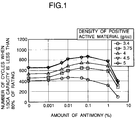
- An antimony sulfate solution in which antimony sulfate was solved in dilute sulfuric acid of the specific gravity of 1.40 used for paste mixing was added to the active material by amounts of 0.001 %, 0.005 %, 0.01 %, 0.05 %, 0.1 %, 1 % and 3 % per weight of the active material to thereby prepare paste.
- a grid formed of an Pb alloy containing 0.1 % of Ca and 1.5 % of Sn was filled with the thus prepared paste so that a positive plate with a thickness of 2.4 mm was produced. That is, in this occasion, the aforementioned seven amounts of antimony were added to five kinds of pastes different in active material density (active material density: 3.4, 3.75. 4.0, 4.5 and 5.0 g/cc after formation) so that 35 kinds, in total, of positive plates were produced.
- batteries using conventional standard electrode plates without addition of any antimony sulfate were also produced. After these batteries were subjected to predetermined electrolyte filling by an ordinary method, container formation was carried out to complete these batteries. After measuring 1/3 CA discharge initial capacity, an endurance test was carried out. The endurance test was performed at 40°C in the general condition in which each battery was discharged by 80 % of the rating with a current of 1/3 CA and then charged with a constant current of 1/5CA and then with a constant voltage of 2.4V.
- the initial capacity was proportional to the active material density but there was no difference due to the amount of Sb added.
- the endurance performance was improved remarkably when the amount of Sb added was in a range of from 0.005 % to 1 %, particularly when the positive active material density was not lower than 3.75 g/cc.
- other batteries with the same configuration were taken apart into pieces so that the amount of antimony precipitated on the negative plates was analyzed. As seen in the results shown in Fig. 2, the amount of antimony precipitated on the negative plates was large when positive plates having the active material density not higher than 3.75 g/cc were used.
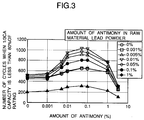
- Pb-Sb-As alloys different in the amount of Sb and the amount of As were prepared.
- lead powder was prepared by means of a ball mill.
- the amount of Sb was selected to form the seven values of 0.001 %, 0.005 %, 0.01 %, 0.05 %, 0.1 %, 1 % and 3 % per weight of the positive active material and the amount of As was selected to form the six values of 0.001 %, 0.005 %, 0.01 %, 0.05 %, 0.1 % and 1 % per weight of the positive active material. These values were used in combination to prepare the alloys.
- paste was prepared so that the positive active material density was 3.75 g/cc after formation.
- a grid formed of a Pb alloy containing 0.1 % of Ca and 1.5 % of Sn was filled with the paste so that a positive plate with a thickness of 2.4 mm was produced.
- About 63 Ah (3 hR)-12 V starved type valve regulated type batteries were produced by an ordinary producing method such that each of the batteries was constituted by ten positive plates thus prepared, eleven 1.7 mm-thick paste type negative plates, and fine glass mat separators.
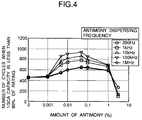
- Antimony sulfate which was put into dilute sulfuric acid of the specific gravity of 1.40 used for paste mixing and which was pulverized and dispersed by means of an ultrasonic wave with frequencies of (1) 200 Hz, (2) 1 kHz, (3) 10 kHz, (4) 100 kHz and (5) 1 MHz, was added to the positive active material by amounts of 0.001 %, 0.005 %, 0.01 %, 0.05 %, 0.1 %, 1 % and 3 % per weight of the latter to thereby prepare paste having the positive active material density of 3.75 g/cc after formation.
- a grid formed of a Pb alloy containing 0.1 % of Ca and 1.5 % of Sn was filled with the paste to thereby prepare a 2.4 mm-thick positive plate.
- About 63 Ah (3 hR)-12 V starved type valve regulated type batteries were produced by an ordinary producing method such that each of the batteries was constituted by ten positive plates thus prepared, eleven 1.7 mm-thick paste type negative plates, and fine glass mat separators.
- batteries using conventional standard positive plates without use of any antimony sulfate were also produced. After these batteries were subjected to predetermined electrolyte filling and charged by an ordinary method, these batteries were subjected to the following test.
- the endurance test was performed at 40°C in the general condition in which each battery was discharged by 80 % of the rating with a current of 1/3 CA and then charged by 110 % of the discharge capacity with a constant current of 1/10CA.
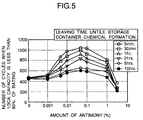
- Antimony sulfate was put into dilute sulfuric acid of the specific gravity of 1.40 used for paste mixing and was pulverized and dispersed under application of an ultrasonic wave with a frequency of about 50 kHz. Then, this antimony sulfate solution was added to the positive active material by amounts of 0.001 %, 0.005 %, 0.01 %, 0.05 %, 0.1 %, 1 % and 3 % per weight of the latter to thereby prepare paste having the positive active material density of 3.75 g/cc after formation. A grid formed of an Pb alloy containing 0.1 % of Ca and 1.5 % of Sn was filled with the thus prepared paste to thereby produce a 2.4 mm-thick positive plate.
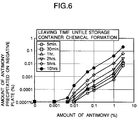
- batteries using conventional standard electrode plates without addition of any antimony sulfate were also produced. 5 minutes, 30 minutes, 1 hour, 2 hours, 5 hours and 10 hours after these batteries were subjected to predetermined electrolyte filling by an ordinary method, container formation was performed with 7 A for 64 hours. After the 1/3 CA discharging capacity was then measured at 30°C, the endurance test was carried out. The endurance test was performed at 40°C in the general condition in which each battery was discharged by 80 % of the rating with a current of 1/3 CA and then charged with a constant voltage and a constant current of 1/5CA and then with a constant voltage of 2.4V.
- the amount of precipitated antimony was small when the amount of antimony was as described above and the leaving time was up to 2 hours. It was apparent from the results of this experiment that, when 0.01 % or more of antimony was precipitated on the negative plates at the time of the completion of container formation, the antimony had a bad influence on the endurance performance.
- antimony has properties of adsorbing PbO 2 but hardly absorbing PbSO 4 and antimony reacts strongly with PbO in the electrode plates at the time of electrolyte filling before formation to generate an excessive large amount of lead sulfate in the ordinary charging/discharging in the electrode plates to thereby bring a tendency that antimony is dissolved easily at the time of leaving as it is after electrolyte filling.
- antimony when container formation is started, antimony is further moved toward the positive grid because antimony is present as an anionic complex in the electrolyte. As a result, it is considered that antimony is hardly dissolved any more at the time of container formation.
- 0.005 to 1 % of antimony is added to a positive active material and the density of the positive active material is selected to be not lower than 3.75 g/cc. Accordingly, the endurance performance of a valve regulated type lead-acid battery is improved remarkably. Further, when 0.005 to 0.1 % of arsenic is added, together with antimony, to the positive active material, the endurance performance is improved more remarkably.
- a valve regulated type lead-acid battery using positive plates in which antimony or an antimony compound is added to the positive active material after the antimony or antimony compound is pulverized and dispersed in a liquid by means of an ultrasonic wave, or in which antimony or an antimony compound is added to the active material by starting container formation within 2 hours after electrolyte filling, can be put into practice. From this point of view, the industrial value of the present invention is very large.
Landscapes
- Chemical & Material Sciences (AREA)
- Engineering & Computer Science (AREA)
- Manufacturing & Machinery (AREA)
- Chemical Kinetics & Catalysis (AREA)
- Electrochemistry (AREA)
- General Chemical & Material Sciences (AREA)
- Inorganic Chemistry (AREA)
- Battery Electrode And Active Subsutance (AREA)
- Secondary Cells (AREA)
- Cell Electrode Carriers And Collectors (AREA)
Abstract
Description
Claims (6)
- A valve regulated type lead-acid battery comprising: a positive plate including a positive grid comprising Pb-Ca alloy and a positive active material containing Sb in the range of 0.005 % to 1.0 % both inclusive per weight of said positive active material;
wherein a density of said positive active material is not lower than 3.75 g/cc after formation. - A valve regulated type lead-acid battery according to claim 1, wherein said positive active material further containing As in the range of 0.005 % to 0.1 % both inclusive per weight of said positive active material.
- A valve regulated type lead-acid battery according to claim 2, wherein lead powder produced from a Pb-Sb-As alloy containing Sb and As is used as a raw material for said positive active material.
- A method for producing a valve regulated type lead-acid battery according to claim 1 or 2, comprising the steps of:pulverizing at least one of antimony sulfate, antimony trioxide and metal antimony to disperse in dilute sulfuric acid or water by applying an ultrasonic wave; andadding said pulverized and dispersed at least one of antimony sulfate, antimony trioxide and metal antimony to positive electrode paste while said paste is being mixed.
- A method for producing a sealed lead-acid batter according to claim 4, a frequency of said ultrasonic wave is in a range of 1 kHz to 100 kHz.
- A method for producing a valve regulated type lead-acid battery according to any one of claims 1 to 5, further comprising the steps of:injecting electrolyte into said battery; andsubjecting a container formation;
wherein the time from finish of injecting electrolyte to start of container formation is selected to be not longer than 2 hours.
Applications Claiming Priority (12)
| Application Number | Priority Date | Filing Date | Title |
|---|---|---|---|
| JP281901/96 | 1996-10-02 | ||
| JP8281901A JPH10106572A (en) | 1996-10-02 | 1996-10-02 | Sealed lead-acid battery |
| JP28190396 | 1996-10-02 | ||
| JP8281903A JPH10106574A (en) | 1996-10-02 | 1996-10-02 | Sealed lead-acid battery |
| JP28190196 | 1996-10-02 | ||
| JP281903/96 | 1996-10-02 | ||
| JP28298296 | 1996-10-03 | ||
| JP282982/96 | 1996-10-03 | ||
| JP282983/96 | 1996-10-03 | ||
| JP8282983A JPH10112310A (en) | 1996-10-03 | 1996-10-03 | Manufacturing method of sealed lead-acid battery |
| JP28298396 | 1996-10-03 | ||
| JP8282982A JPH10112311A (en) | 1996-10-03 | 1996-10-03 | Manufacturing method of sealed lead-acid battery |
Publications (3)
| Publication Number | Publication Date |
|---|---|
| EP0834946A2 true EP0834946A2 (en) | 1998-04-08 |
| EP0834946A3 EP0834946A3 (en) | 2000-07-19 |
| EP0834946B1 EP0834946B1 (en) | 2002-09-11 |
Family
ID=27479255
Family Applications (1)
| Application Number | Title | Priority Date | Filing Date |
|---|---|---|---|
| EP97117173A Expired - Lifetime EP0834946B1 (en) | 1996-10-02 | 1997-10-02 | Valve regulated type lead-acid battery and producing method thereof |
Country Status (4)
| Country | Link |
|---|---|
| US (1) | US6284411B1 (en) |
| EP (1) | EP0834946B1 (en) |
| CN (1) | CN1104748C (en) |
| DE (1) | DE69715336T2 (en) |
Families Citing this family (8)
| Publication number | Priority date | Publication date | Assignee | Title |
|---|---|---|---|---|
| KR101068378B1 (en) * | 2004-04-28 | 2011-09-28 | 파나소닉 주식회사 | Lead acid battery |
| CN103035956B (en) * | 2011-10-06 | 2017-06-30 | 株式会社杰士汤浅国际 | Lead accumulator |
| JP7098874B2 (en) * | 2016-02-02 | 2022-07-12 | 株式会社Gsユアサ | Manufacturing method of lead-acid battery and positive electrode plate for lead-acid battery |
| US20170222214A1 (en) * | 2016-02-02 | 2017-08-03 | Gs Yuasa International, Ltd. | Positive electrode plate for lead-acid battery, lead-acid battery and method of manufacturing positive electrode plate for lead-acid battery |
| US10511022B2 (en) | 2016-04-27 | 2019-12-17 | Rsr Technologies, Inc. | Lead-based alloy and related processes and products |
| CN111416126B (en) * | 2020-03-27 | 2021-04-13 | 天能电池集团股份有限公司 | Preparation method of lead-calcium alloy positive plate |
| JP7761662B2 (en) * | 2021-03-08 | 2025-10-28 | テクノロジカル インスティチュート オブ ザ フィリピン | Method and system for acoustically assisting battery operation |
| CN115032063A (en) * | 2022-02-23 | 2022-09-09 | 中船双瑞(洛阳)特种装备股份有限公司 | Device and method for testing hydrogen embrittlement sensitivity of material for simulating stress state of gas cylinder |
Family Cites Families (22)
| Publication number | Priority date | Publication date | Assignee | Title |
|---|---|---|---|---|
| US3723182A (en) | 1971-10-27 | 1973-03-27 | Esb Inc | Lead acid storage battery wherein a positive plate comprises antimonydispersed throughout the active material |
| US3933524A (en) * | 1972-05-24 | 1976-01-20 | General Motors Corporation | Antimony plating of lead-acid storage batteries grids |
| SE397155B (en) * | 1976-02-27 | 1977-10-17 | Tudor Ab | GRAY FOR POSITIVE ELECTROD TO ELECTRIC LEAD ACCUMULATOR |
| JPS54114729A (en) | 1978-02-28 | 1979-09-07 | Shin Kobe Electric Machinery | Lead storage battery |
| CH627027A5 (en) * | 1978-03-06 | 1981-12-15 | Leclanche Sa | |
| DE2937541B2 (en) | 1979-09-17 | 1981-04-23 | M.A.N.- Roland Druckmaschinen AG, 6050 Offenbach | Resilient hold-down devices arranged on a printing machine above the feed table of a sheet feeder |
| JPS58209865A (en) | 1982-05-31 | 1983-12-06 | Shin Kobe Electric Mach Co Ltd | Manufacture of lead-acid battery |
| JPS61126551A (en) | 1984-11-26 | 1986-06-14 | Canon Inc | Production of mask structural body for x-ray lithography |
| JPS61142666A (en) | 1984-12-14 | 1986-06-30 | Shin Kobe Electric Mach Co Ltd | Manufacture of positive plate for lead storage battery |
| JPH01200558A (en) | 1988-02-03 | 1989-08-11 | Matsushita Electric Ind Co Ltd | sealed lead acid battery |
| US4906540A (en) * | 1989-06-15 | 1990-03-06 | Matsushita Electric Industrial Co., Ltd. | Lead-acid battery having a grid base of a lead-calcium alloy and a layer of lead-antimony-stannum alloy roll-bonded to the grid base |
| JPH03165464A (en) * | 1989-11-22 | 1991-07-17 | Matsushita Electric Ind Co Ltd | lead acid battery |
| DE69115078T2 (en) | 1990-02-15 | 1996-05-09 | Japan Storage Battery Co Ltd | Closed lead acid battery. |
| JP2913485B2 (en) | 1990-03-27 | 1999-06-28 | 日本電池株式会社 | Sealed lead-acid battery |
| US5434025A (en) * | 1991-03-26 | 1995-07-18 | Gnb Battery Technologies Inc. | Battery grids and plates and lead-acid batteries made using such grids and plates |
| US5227260A (en) * | 1991-11-04 | 1993-07-13 | Globe-Union, Inc. | Sealed lead acid battery using modular frame construction |
| JP3182856B2 (en) * | 1992-04-09 | 2001-07-03 | 松下電器産業株式会社 | Manufacturing method of electrode plate for lead-acid battery |
| DE4217338C2 (en) * | 1992-05-26 | 1994-09-01 | Hoechst Ag | Electrochemical process for the reduction of oxalic acid to glyoxylic acid |
| US5352549A (en) * | 1992-08-19 | 1994-10-04 | Gnb Battery Technologies Inc. | Lead oxide composition for use in lead-acid batteries |
| US5411821A (en) * | 1993-06-10 | 1995-05-02 | Derafe, Ltd. | Integral battery electrode structure for lead/acid batteries |
| US5650242A (en) * | 1996-01-11 | 1997-07-22 | Gnb Technologies, Inc. | Antimony-arsenic-tin-selenium lead-based strap alloys for lead-acid batteries |
| US5820639A (en) * | 1996-09-20 | 1998-10-13 | Bolder Technologies Corporation | Method of manufacturing lead acid cell paste having tin compounds |
-
1997
- 1997-10-02 EP EP97117173A patent/EP0834946B1/en not_active Expired - Lifetime
- 1997-10-02 US US08/943,011 patent/US6284411B1/en not_active Expired - Fee Related
- 1997-10-02 DE DE69715336T patent/DE69715336T2/en not_active Expired - Fee Related
- 1997-10-05 CN CN97118952A patent/CN1104748C/en not_active Expired - Fee Related
Also Published As
| Publication number | Publication date |
|---|---|
| EP0834946A3 (en) | 2000-07-19 |
| CN1104748C (en) | 2003-04-02 |
| CN1180248A (en) | 1998-04-29 |
| DE69715336D1 (en) | 2002-10-17 |
| DE69715336T2 (en) | 2003-01-02 |
| US6284411B1 (en) | 2001-09-04 |
| EP0834946B1 (en) | 2002-09-11 |
Similar Documents
| Publication | Publication Date | Title |
|---|---|---|
| US5820639A (en) | Method of manufacturing lead acid cell paste having tin compounds | |
| JP2003051306A (en) | Negative electrode for lead-acid battery | |
| EP0834946B1 (en) | Valve regulated type lead-acid battery and producing method thereof | |
| JP4224729B2 (en) | Sealed lead-acid battery and method for manufacturing the same | |
| US4594301A (en) | Lead-accumulator and active materials used therein | |
| JP3178015B2 (en) | Positive electrode plate for lead storage battery and method for producing the same | |
| JP2952680B2 (en) | Sealed lead-acid battery | |
| JP2004079198A (en) | Lead storage battery | |
| JPH10106572A (en) | Sealed lead-acid battery | |
| JPH10112310A (en) | Manufacturing method of sealed lead-acid battery | |
| JP2808685B2 (en) | Lead storage battery | |
| JPH088103B2 (en) | Lead-acid battery electrode plate manufacturing method | |
| JPH10112311A (en) | Manufacturing method of sealed lead-acid battery | |
| JPH08298133A (en) | Sealed lead acid battery | |
| JPH1040906A (en) | Negative electrode plate for sealed lead-acid battery | |
| JPH10106576A (en) | Sealed lead-acid battery | |
| JPS61161660A (en) | Lead-acid battery | |
| JPH0193058A (en) | Lead-acid battery | |
| JPH11162455A (en) | Lead storage battery | |
| JPH10106574A (en) | Sealed lead-acid battery | |
| JPH01197966A (en) | lead acid battery | |
| JPH10106573A (en) | Sealed lead-acid battery | |
| JPH11135117A (en) | Lead-acid battery | |
| JPH10144318A (en) | Sealed lead-acid battery | |
| JPH10106571A (en) | Sealed lead-acid battery |
Legal Events
| Date | Code | Title | Description |
|---|---|---|---|
| PUAI | Public reference made under article 153(3) epc to a published international application that has entered the european phase |
Free format text: ORIGINAL CODE: 0009012 |
|
| AK | Designated contracting states |
Kind code of ref document: A2 Designated state(s): DE FR IT |
|
| AX | Request for extension of the european patent |
Free format text: AL;LT;LV;RO;SI |
|
| PUAL | Search report despatched |
Free format text: ORIGINAL CODE: 0009013 |
|
| AK | Designated contracting states |
Kind code of ref document: A3 Designated state(s): AT BE CH DE DK ES FI FR GB GR IE IT LI LU MC NL PT SE |
|
| AX | Request for extension of the european patent |
Free format text: AL;LT;LV;RO;SI |
|
| 17P | Request for examination filed |
Effective date: 20000928 |
|
| AKX | Designation fees paid |
Free format text: DE FR IT |
|
| 17Q | First examination report despatched |
Effective date: 20010404 |
|
| GRAG | Despatch of communication of intention to grant |
Free format text: ORIGINAL CODE: EPIDOS AGRA |
|
| GRAG | Despatch of communication of intention to grant |
Free format text: ORIGINAL CODE: EPIDOS AGRA |
|
| GRAG | Despatch of communication of intention to grant |
Free format text: ORIGINAL CODE: EPIDOS AGRA |
|
| GRAH | Despatch of communication of intention to grant a patent |
Free format text: ORIGINAL CODE: EPIDOS IGRA |
|
| GRAH | Despatch of communication of intention to grant a patent |
Free format text: ORIGINAL CODE: EPIDOS IGRA |
|
| GRAA | (expected) grant |
Free format text: ORIGINAL CODE: 0009210 |
|
| AK | Designated contracting states |
Kind code of ref document: B1 Designated state(s): DE FR IT |
|
| REF | Corresponds to: |
Ref document number: 69715336 Country of ref document: DE Date of ref document: 20021017 |
|
| PGFP | Annual fee paid to national office [announced via postgrant information from national office to epo] |
Ref country code: FR Payment date: 20021018 Year of fee payment: 6 |
|
| ET | Fr: translation filed | ||
| PLBE | No opposition filed within time limit |
Free format text: ORIGINAL CODE: 0009261 |
|
| STAA | Information on the status of an ep patent application or granted ep patent |
Free format text: STATUS: NO OPPOSITION FILED WITHIN TIME LIMIT |
|
| 26N | No opposition filed |
Effective date: 20030612 |
|
| PGFP | Annual fee paid to national office [announced via postgrant information from national office to epo] |
Ref country code: DE Payment date: 20040930 Year of fee payment: 8 |
|
| PG25 | Lapsed in a contracting state [announced via postgrant information from national office to epo] |
Ref country code: FR Free format text: LAPSE BECAUSE OF NON-PAYMENT OF DUE FEES Effective date: 20041029 |
|
| REG | Reference to a national code |
Ref country code: FR Ref legal event code: ST |
|
| PG25 | Lapsed in a contracting state [announced via postgrant information from national office to epo] |
Ref country code: IT Free format text: LAPSE BECAUSE OF NON-PAYMENT OF DUE FEES Effective date: 20051002 |
|
| PG25 | Lapsed in a contracting state [announced via postgrant information from national office to epo] |
Ref country code: DE Free format text: LAPSE BECAUSE OF NON-PAYMENT OF DUE FEES Effective date: 20060503 |
|
| PG25 | Lapsed in a contracting state [announced via postgrant information from national office to epo] |
Ref country code: FR Free format text: LAPSE BECAUSE OF NON-PAYMENT OF DUE FEES Effective date: 20031031 |