EP0832149B1 - Star-shaped branched polyamide - Google Patents
Star-shaped branched polyamide Download PDFInfo
- Publication number
- EP0832149B1 EP0832149B1 EP96913746A EP96913746A EP0832149B1 EP 0832149 B1 EP0832149 B1 EP 0832149B1 EP 96913746 A EP96913746 A EP 96913746A EP 96913746 A EP96913746 A EP 96913746A EP 0832149 B1 EP0832149 B1 EP 0832149B1
- Authority
- EP
- European Patent Office
- Prior art keywords
- polyamide
- star
- shaped branched
- polymerisation
- shaped
- Prior art date
- Legal status (The legal status is an assumption and is not a legal conclusion. Google has not performed a legal analysis and makes no representation as to the accuracy of the status listed.)
- Expired - Lifetime
Links
- 239000004952 Polyamide Substances 0.000 title claims description 88
- 229920002647 polyamide Polymers 0.000 title claims description 88
- 238000000034 method Methods 0.000 claims description 23
- JBKVHLHDHHXQEQ-UHFFFAOYSA-N epsilon-caprolactam Chemical group O=C1CCCCCN1 JBKVHLHDHHXQEQ-UHFFFAOYSA-N 0.000 claims description 18
- 125000000524 functional group Chemical group 0.000 claims description 14
- 150000001412 amines Chemical class 0.000 claims description 12
- 150000001875 compounds Chemical class 0.000 claims description 12
- 239000000203 mixture Substances 0.000 claims description 12
- 125000004432 carbon atom Chemical group C* 0.000 claims description 11
- 239000000178 monomer Substances 0.000 claims description 11
- 125000003178 carboxy group Chemical group [H]OC(*)=O 0.000 claims description 10
- 239000003054 catalyst Substances 0.000 claims description 10
- 238000002360 preparation method Methods 0.000 claims description 10
- XLYOFNOQVPJJNP-UHFFFAOYSA-N water Substances O XLYOFNOQVPJJNP-UHFFFAOYSA-N 0.000 claims description 10
- 125000002015 acyclic group Chemical group 0.000 claims description 8
- 150000002391 heterocyclic compounds Chemical class 0.000 claims description 7
- 150000001260 acyclic compounds Chemical class 0.000 claims description 6
- 229910052799 carbon Inorganic materials 0.000 claims description 6
- 150000003951 lactams Chemical class 0.000 claims description 6
- SLXKOJJOQWFEFD-UHFFFAOYSA-N 6-aminohexanoic acid Chemical compound NCCCCCC(O)=O SLXKOJJOQWFEFD-UHFFFAOYSA-N 0.000 claims description 5
- 229960002684 aminocaproic acid Drugs 0.000 claims description 5
- 239000007790 solid phase Substances 0.000 claims description 4
- HWWHQRSEHDDWPO-UHFFFAOYSA-N 2,4,6-triaminohexanoic acid;1,3,5-triazine Chemical group C1=NC=NC=N1.NCCC(N)CC(N)C(O)=O HWWHQRSEHDDWPO-UHFFFAOYSA-N 0.000 claims description 3
- HMJBXEZHJUYJQY-UHFFFAOYSA-N 4-(aminomethyl)octane-1,8-diamine Chemical group NCCCCC(CN)CCCN HMJBXEZHJUYJQY-UHFFFAOYSA-N 0.000 claims description 3
- 238000002844 melting Methods 0.000 claims description 3
- 230000008018 melting Effects 0.000 claims description 3
- 150000001335 aliphatic alkanes Chemical class 0.000 claims description 2
- 239000012298 atmosphere Substances 0.000 claims description 2
- 239000011261 inert gas Substances 0.000 claims description 2
- JYEUMXHLPRZUAT-UHFFFAOYSA-N 1,2,3-triazine Chemical compound C1=CN=NN=C1 JYEUMXHLPRZUAT-UHFFFAOYSA-N 0.000 claims 2
- 150000007974 melamines Chemical class 0.000 claims 1
- 239000000155 melt Substances 0.000 description 11
- 239000000047 product Substances 0.000 description 6
- 238000004132 cross linking Methods 0.000 description 5
- 239000003999 initiator Substances 0.000 description 5
- IJGRMHOSHXDMSA-UHFFFAOYSA-N Atomic nitrogen Chemical compound N#N IJGRMHOSHXDMSA-UHFFFAOYSA-N 0.000 description 4
- 230000015572 biosynthetic process Effects 0.000 description 4
- 239000000412 dendrimer Substances 0.000 description 4
- 229920000736 dendritic polymer Polymers 0.000 description 4
- 238000002474 experimental method Methods 0.000 description 4
- 239000000243 solution Substances 0.000 description 4
- OKTJSMMVPCPJKN-UHFFFAOYSA-N Carbon Chemical compound [C] OKTJSMMVPCPJKN-UHFFFAOYSA-N 0.000 description 3
- 229920002292 Nylon 6 Polymers 0.000 description 3
- HEMHJVSKTPXQMS-UHFFFAOYSA-M Sodium hydroxide Chemical compound [OH-].[Na+] HEMHJVSKTPXQMS-UHFFFAOYSA-M 0.000 description 3
- 125000004429 atom Chemical group 0.000 description 3
- 238000006243 chemical reaction Methods 0.000 description 3
- 238000000354 decomposition reaction Methods 0.000 description 3
- 230000001419 dependent effect Effects 0.000 description 3
- 230000000977 initiatory effect Effects 0.000 description 3
- 229910052757 nitrogen Inorganic materials 0.000 description 3
- 229920000642 polymer Polymers 0.000 description 3
- 238000003756 stirring Methods 0.000 description 3
- KDCGOANMDULRCW-UHFFFAOYSA-N 7H-purine Chemical compound N1=CNC2=NC=NC2=C1 KDCGOANMDULRCW-UHFFFAOYSA-N 0.000 description 2
- 229920002873 Polyethylenimine Polymers 0.000 description 2
- JUJWROOIHBZHMG-UHFFFAOYSA-N Pyridine Chemical compound C1=CC=NC=C1 JUJWROOIHBZHMG-UHFFFAOYSA-N 0.000 description 2
- YTPLMLYBLZKORZ-UHFFFAOYSA-N Thiophene Chemical compound C=1C=CSC=1 YTPLMLYBLZKORZ-UHFFFAOYSA-N 0.000 description 2
- 150000007824 aliphatic compounds Chemical class 0.000 description 2
- 125000001931 aliphatic group Chemical group 0.000 description 2
- 150000001338 aliphatic hydrocarbons Chemical class 0.000 description 2
- 239000007795 chemical reaction product Substances 0.000 description 2
- 230000000052 comparative effect Effects 0.000 description 2
- JHIVVAPYMSGYDF-UHFFFAOYSA-N cyclohexanone Chemical compound O=C1CCCCC1 JHIVVAPYMSGYDF-UHFFFAOYSA-N 0.000 description 2
- 125000005842 heteroatom Chemical group 0.000 description 2
- -1 heterocyclic ring compound Chemical class 0.000 description 2
- 229920006017 homo-polyamide Polymers 0.000 description 2
- 150000003840 hydrochlorides Chemical class 0.000 description 2
- 230000003301 hydrolyzing effect Effects 0.000 description 2
- 230000001788 irregular Effects 0.000 description 2
- BDAGIHXWWSANSR-UHFFFAOYSA-N methanoic acid Natural products OC=O BDAGIHXWWSANSR-UHFFFAOYSA-N 0.000 description 2
- 239000011541 reaction mixture Substances 0.000 description 2
- 230000035484 reaction time Effects 0.000 description 2
- 238000007151 ring opening polymerisation reaction Methods 0.000 description 2
- 238000010008 shearing Methods 0.000 description 2
- 150000000182 1,3,5-triazines Chemical class 0.000 description 1
- OEDVLMOQTFMJCV-UHFFFAOYSA-N 2,3,5,6-tetraethylpyrazine Chemical compound CCC1=NC(CC)=C(CC)N=C1CC OEDVLMOQTFMJCV-UHFFFAOYSA-N 0.000 description 1
- OSWFIVFLDKOXQC-UHFFFAOYSA-N 4-(3-methoxyphenyl)aniline Chemical compound COC1=CC=CC(C=2C=CC(N)=CC=2)=C1 OSWFIVFLDKOXQC-UHFFFAOYSA-N 0.000 description 1
- 229920000877 Melamine resin Polymers 0.000 description 1
- 229920001007 Nylon 4 Polymers 0.000 description 1
- NINIDFKCEFEMDL-UHFFFAOYSA-N Sulfur Chemical compound [S] NINIDFKCEFEMDL-UHFFFAOYSA-N 0.000 description 1
- QAOWNCQODCNURD-UHFFFAOYSA-N Sulfuric acid Chemical compound OS(O)(=O)=O QAOWNCQODCNURD-UHFFFAOYSA-N 0.000 description 1
- 239000005864 Sulphur Substances 0.000 description 1
- 239000002253 acid Substances 0.000 description 1
- 239000003377 acid catalyst Substances 0.000 description 1
- 150000001336 alkenes Chemical class 0.000 description 1
- 150000001408 amides Chemical class 0.000 description 1
- 125000003277 amino group Chemical group 0.000 description 1
- QVGXLLKOCUKJST-UHFFFAOYSA-N atomic oxygen Chemical compound [O] QVGXLLKOCUKJST-UHFFFAOYSA-N 0.000 description 1
- 238000009835 boiling Methods 0.000 description 1
- 238000005251 capillar electrophoresis Methods 0.000 description 1
- 150000001721 carbon Chemical group 0.000 description 1
- 150000001732 carboxylic acid derivatives Chemical group 0.000 description 1
- 239000003795 chemical substances by application Substances 0.000 description 1
- 238000011109 contamination Methods 0.000 description 1
- 238000001816 cooling Methods 0.000 description 1
- MGNCLNQXLYJVJD-UHFFFAOYSA-N cyanuric chloride Chemical compound ClC1=NC(Cl)=NC(Cl)=N1 MGNCLNQXLYJVJD-UHFFFAOYSA-N 0.000 description 1
- 150000002148 esters Chemical class 0.000 description 1
- 125000002534 ethynyl group Chemical class [H]C#C* 0.000 description 1
- 238000001914 filtration Methods 0.000 description 1
- 235000019253 formic acid Nutrition 0.000 description 1
- 150000002240 furans Chemical class 0.000 description 1
- 239000011521 glass Substances 0.000 description 1
- 238000010438 heat treatment Methods 0.000 description 1
- 125000000623 heterocyclic group Chemical group 0.000 description 1
- 239000005457 ice water Substances 0.000 description 1
- 238000001746 injection moulding Methods 0.000 description 1
- 238000009434 installation Methods 0.000 description 1
- 238000005259 measurement Methods 0.000 description 1
- JDSHMPZPIAZGSV-UHFFFAOYSA-N melamine Chemical compound NC1=NC(N)=NC(N)=N1 JDSHMPZPIAZGSV-UHFFFAOYSA-N 0.000 description 1
- 238000002156 mixing Methods 0.000 description 1
- RKAMHGJXNXYFDK-UHFFFAOYSA-N n'-(2-aminoethyl)-n'-[2-[bis[2-[bis(2-aminoethyl)amino]ethyl]amino]ethyl]ethane-1,2-diamine Chemical compound NCCN(CCN)CCN(CCN(CCN)CCN)CCN(CCN)CCN RKAMHGJXNXYFDK-UHFFFAOYSA-N 0.000 description 1
- 239000012299 nitrogen atmosphere Substances 0.000 description 1
- 229910052760 oxygen Inorganic materials 0.000 description 1
- 239000001301 oxygen Substances 0.000 description 1
- 239000012071 phase Substances 0.000 description 1
- 229920000333 poly(propyleneimine) Polymers 0.000 description 1
- 238000006068 polycondensation reaction Methods 0.000 description 1
- 239000000843 powder Substances 0.000 description 1
- 239000002244 precipitate Substances 0.000 description 1
- 238000012545 processing Methods 0.000 description 1
- 150000003216 pyrazines Chemical class 0.000 description 1
- UMJSCPRVCHMLSP-UHFFFAOYSA-N pyridine Natural products COC1=CC=CN=C1 UMJSCPRVCHMLSP-UHFFFAOYSA-N 0.000 description 1
- 150000003233 pyrroles Chemical class 0.000 description 1
- 230000009257 reactivity Effects 0.000 description 1
- 238000010992 reflux Methods 0.000 description 1
- 229920006395 saturated elastomer Polymers 0.000 description 1
- 238000007655 standard test method Methods 0.000 description 1
- 239000001117 sulphuric acid Substances 0.000 description 1
- 235000011149 sulphuric acid Nutrition 0.000 description 1
- 239000000725 suspension Substances 0.000 description 1
- 238000012360 testing method Methods 0.000 description 1
- 229930192474 thiophene Natural products 0.000 description 1
- MBYLVOKEDDQJDY-UHFFFAOYSA-N tris(2-aminoethyl)amine Chemical compound NCCN(CCN)CCN MBYLVOKEDDQJDY-UHFFFAOYSA-N 0.000 description 1
Images

Definitions
- the invention relates to a star-shaped branched polyamide with at least 3 polyamide branches choosen from the group of AB-type monomers, that is formed from a multifunctional core bearing only one type of functional groups chosen from the group of amine and carboxyl groups, and a process for the preparation thereof.
- star-shaped branched polyamides are known from J.R. Schaefgen and P.J. Flory, J. Am. Chem. Soc. 70 , 2709-18 (1948), which describes star-shaped branched polyamides whose branches are formed in the polymerisation of ⁇ -caprolactam and cyclohexanone tetraproprionic acid. Examples of star-shaped branched polyamides whose branches are initiated by amine groups are described in J.M. Warakomski, Chem. Mater. 1992 , 4, 1000-1004 (1992).
- a star-shaped branched polyamide is obtained in the polymerisation of ⁇ -caprolactam on tris(2-aminoethyl)amine, N,N-bis(2-aminoethyl)-N',N'-bis[2-[bis(2-aminoethyl)amino]ethyl]-1,2-ethanediamine and the polyethylene imine dendrimer of the following generation.
- Warakomski's amine polymerisation initiators present the drawback of slow polymerisation initiation.
- the aim of the invention is to provide a star-shaped branched polyamide which (a) can be obtained using the usual polymerisation processes for linear polyamides, which (b) can be obtained with a high degree of polymerisation which (c) shows no significant decomposition or crosslinking at the temperature at which the polymerisation process takes place and which (d) also shows a good stability with respect to processing in the melt.
- star-shaped branched polyamide according to the invention can be produced, without further investments, in existing polymerisation installations for the corresponding linear polyamide, an application in which use can be made of the low melt viscosity characteristic of star-shaped branched polyamides for, for example, injection-moulding thin-walled objects, has now come within reach.
- Suitable polyamides are polyamides which can be obtained through polycondensation of ⁇ , ⁇ -amino acids or through ring-opening polymerisation of lactams. Examples are polyamide-4, polyamide-6, polyamide-8, etcetera.
- Acyclic compounds are compounds having an open-chain molecular structure instead of a ring structure.
- Examples of such acyclic compounds are aliphatic hydrocarbons that are characterised by a straight or branched arrangement of the carbon atoms constituting the chain. Aliphatic hydrocarbons can be split up into alkanes, alkenes and acetylenes, which are saturated, unsaturated having a double bond, and unsaturated having a triple bond, respectively.
- the chains may be branched or crosslinked. Examples of such branched or crosslinked compounds are branched aliphatic compounds, for example 4-aminomethyl-1,8-octanediamine.
- branched or crosslinked compounds contain atoms other than carbon, chain branching occurs at the C atoms only.
- chain branching occurs at the C atoms only.
- the length of the main chain may then vary within a wide range, for example between 2 and 40 carbon atoms, and the length of the side chains may vary between 1 and 20 carbon atoms; preferably the main chain is chosen to be not longer than 20 carbon atoms and the side chains are not longer than 10 carbon atoms.
- the distance between the carbon atoms in the main chain to which branches are bound is preferably at least 2 carbon atoms.
- the amine or carboxyl group is preferably terminally bound to the aliphatic chains.
- the acyclic groups to which the initiator group is bound are preferably identical.
- the length of the acyclic chain to which the initiator group is bound is preferably chosen to be between 1 and 10 (carbon) atoms. If the chain is too short, there will be a risk of steric hindering, as a result of which it will not be possible for polyamide chains to be formed onto all the functional groups, whereas too long chains involve the risk of entanglement, which may hinder the formation of a regular star-shaped structure owing to shielding, among other factors.
- Heterocyclic compounds are compounds having a closed ring structure where one or more of the ring's atoms is an element other than carbon, for example sulphur, nitrogen or oxygen. Examples are pyridine, pyrroles, furans, thiophene and purine.
- the heteroatoms present in the ring affect the distribution of the electrons, as a result of which initiator groups bound to carbon atoms in the ring that are at different distances from heteroatoms have a different reactivity, which may result in irregular polymerisation initiation and the formation of irregular star-shaped branched polyamides.
- heterocyclic ring compounds showing point symmetry are particular suitable.
- examples of such compounds are 1,3,5-triazines and 1,4 diazines, for example melamine and compounds derived therefrom and 2,3,5,6-tetraethylpyrazine, 1,4-piperazines and tetrathiaphulvalenes.
- 1,3,5-triazines and 1,4 diazines for example melamine and compounds derived therefrom and 2,3,5,6-tetraethylpyrazine, 1,4-piperazines and tetrathiaphulvalenes.
- there is no limit to the number of functional groups bound via acyclic chains per heterocyclic ring compound but 3-10 groups per heterocyclic ring compound is preferred.
- the length of the acyclic chain to which the functional group is preferably terminally bound is preferably 1-10 atoms.
- the terminal functional group is preferably a carboxyl group.
- one type of functional group is present per core molecule.
- the presence of - or the possibility of - the formation of different functional groups must preferably be avoided because of the implied possibility of crosslinking.
- the core molecule should be smaller than the polyamide branches. Preferably its molecular weight should be less than 2000, more preferably less than about 700.
- the polyamide branches can be polymerised by the process usually used for the preparation of polyamides from ⁇ , ⁇ -amino acids or through hydrolytic ring-opening polymerisation of lactams, for example ⁇ -caprolactam or laurylolactam. These processes are described for example in Kunststoff-Handbuch Band VI, pp. 168-202, Carl Hanser Vorlag, Kunststoff (1966). Instead of the usual chain length regulators, the multifunctional core of the invention is now added.
- the monomer : multifunctional core molar ratio is chosen so that the desired chain length is obtained at almost complete polymerisation. This ratio is therefore partly dependent on the number of functional groups per core molecule. In general, this molar ratio will be between 10n and 250n, n being the number of functional groups per core molecule.
- the star-shaped polyamide can for example also be synthesised using the process described by Flory c.s. The process according to the invention is however preferred.
- the polymerisation is carried out in the presence of water (0.5-30 mol.%, relative to the monomer) and optionally a catalyst, at atmospheric or elevated pressure, 0,1-3 MPa, at a temperature between 220 and 280°C, after which the polymerisation is continued in the solid phase in a second reaction step, at reduced pressure and/or in an inert gas atmosphere, at a temperature between about 160°C and about 10°C below the melting temperature of the reaction product obtained in the first step, until a desired degree of polymerisation is obtained.
- water 0.5-30 mol.%, relative to the monomer
- a catalyst at atmospheric or elevated pressure, 0,1-3 MPa, at a temperature between 220 and 280°C
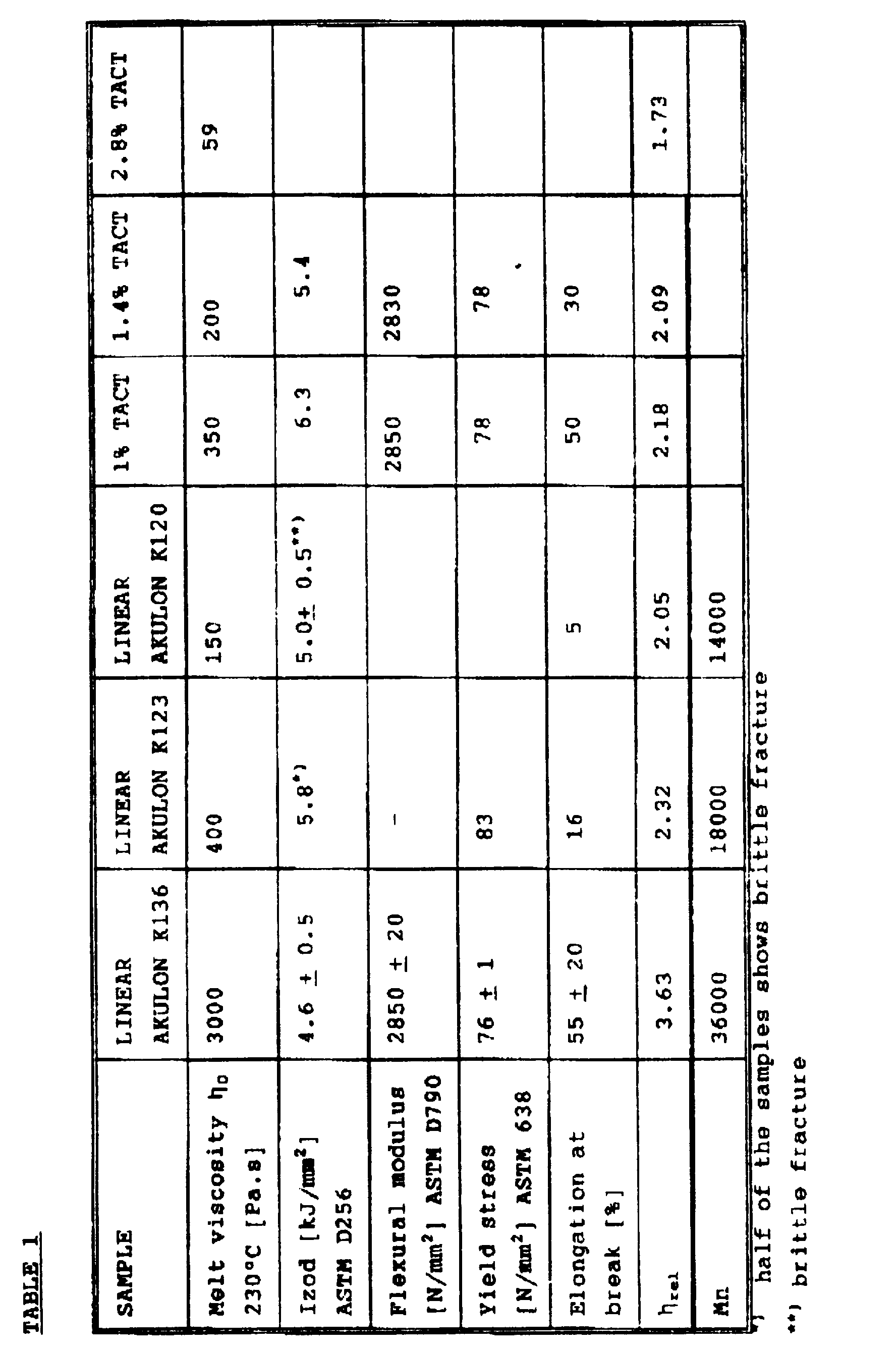
- the reaction product obtained in the first step is already very tough and strong even after a relatively short polymerisation time, its toughness and strength corresponding to those of the corresponding linear polyamide obtained after longer polymerisation - this in contrast to the brittle product that is obtained with the process according to Flory c.s.
- Postcondensation in the solid phase results in a white product with polyamide branches that may have a very high molecular weight. High' is understood to mean Mn ⁇ 5000, preferably ⁇ 7000, or even more preferably ⁇ 10,000.
- the temperature of the first polymerisation step is generally chosen to be between about 220 and 280°C.
- the reaction temperature is between about 230 and 275°, more preferably between about 240 and 270°C.
- the pressure in the reactor is generally atmospheric, but may optionally be set to a value between 0.1 and 3 MPa (1-30 bar).
- the amount of water present at the beginning of the polymerisation is not critical; usually between 0.5 and 30 mol.% water is chosen, relative to the amount of monomer. An amount of between 5 and 15 mol.% is preferred.
- the presence of the catalyst contributes to a short reaction time, as required to realise a desired degree of polymerisation.
- the catalysts usually used for hydrolytic polymerisation are suitable in this case too.
- the polymerisation of caprolactam in particular aminocaproic acid is preferable.
- the amount of catalyst to be used for the polymerisation may vary within a wide range, for example between 0.05 and 3 mol.%, relative to the monomer, preferably between 0.1 and 2 mol.%. If the acid catalyst simultaneously serves as a chain-terminating agent, the amount of catalyst to be used will be partly dependent on the desired molecular weight of the polyamide branches.
- the product obtained after the first step in the polymerisation process is a composition comprising a mixture of star-shaped branched polyamide and linear polyamide.
- the degree of polymerisation of the polyamide branches of the star-shaped branched polyamide is about the same as that of the linear polyamides in the composition if the catalyst and the functional groups of the core molecule are identical and the reaction time is sufficient.
- this composition has mechanical properties that correspond to those of a linear polyamide with a significantly higher degree of polymerisation. For example, a polyamide composition with ductile fracture properties is obtained already after a polymerisation time after which the corresponding linear polyamide still shows brittle fracture behaviour.
- the invention therefore also relates to a tough polyamide composition essentially consisting of
- the invention relates to a tough polyamide composition
- a tough polyamide composition comprising a) a linear polyamide with a degree of polymerisation that is insufficient for obtaining ductile fracture behaviour b) a star-shaped branched polyamide according to the invention with a degree of polymerisation that is at least about the same as that of the linear polyamide. It is also possible to obtain such tough polyamide compositions by mixing a linear polyamide and a star-shaped branched polyamide in the melt. The degree of polymerisation of the star-shaped branched polyamide may then in principle be chosen independently of that of the linear polyamide. The process according to the invention is however strongly preferable.
- the star-shaped branched polyamide according to the invention has a high thermal stability that manifests itself in for example a white polymer.
- Polyamides of the kind described by Warakomski show a yellowish brown discolouration.
- the star-shaped branched polyamide according to the invention can easily be polymerised to a high molecular weight and will retain this high molecular weight even after long heating in the melt, without any increase in the melt viscosity - this in contrast to the star-shaped branched polyamides described by Flory c.s., which then show decomposition and crosslinking.
- amine or carboxyl groups those groups are understood to include groups that can yield amine and/or carboxyl groups under the polymerisation conditions, for example esters and amides.
- the melt viscosity was determined and also the intrinsic viscosity; the melt viscosity as a so-called zero viscosity at 230°, that is, the dynamic melt viscosity at 0 shearing force using a Rheometrix 800 parallel plate apparatus; the solution viscosity as a relative viscosity, ⁇ rel , measured on a solution of 1 gram in 100 ml of 85% formic acid.
- the melt viscosity shows Newtonian behaviour and is dependent on the shear rate to a small extent only. Only at branch lengths of 200 monomeric units does the melt viscosity start to increase at low shearing forces.
- the star-shaped branched polyamide according to the invention shows a high melt stability. In 1 hour at 230°C no changes were found to occur in the melt viscosity (see Figure 1).
- Figure 1 shows the meltviscosity ( ⁇ *) and the phase angle ( ⁇ ) as a function of rotation velocity in the dynamic melt viscosity measurement at 5, 11, 15, 32 and 35 minutes in the melt at 230°C.
- Example Ib was repeated, only 4-aminomethyl-1,8-octanediamine* (AMOD) was used instead of (TACT).
- Table 3 shows the results of the experiments. Branch length before postcondensation after postcondensation ⁇ 0 [Pa.s] ⁇ rel ⁇ 0 ⁇ rel 50 34.0 1.66 66 1.74 100 371 2.02 1300 2.36 200 864 2.17 11240 2.96 These results are very similar to those of Table 2.
- dendrimers were used as cores instead of (TACT).
- the dendrimers were the amine-terminated polypropylene imines of the first, second and third generation, having 4 and 8 amine terminal groups, respectively.
- DAB(PPA) 4 1,4-diaminobutane-N,N'-tetra-1-propylamine and DAB(PPA) 8 .
Landscapes
- Polyamides (AREA)
Description
Postcondensation in the solid phase results in a white product with polyamide branches that may have a very high molecular weight. High' is understood to mean Mn ≥ 5000, preferably ≥ 7000, or even more preferably ≥ 10,000. The temperature of the first polymerisation step is generally chosen to be between about 220 and 280°C. Preferably the reaction temperature is between about 230 and 275°, more preferably between about 240 and 270°C.
It is also possible to obtain such tough polyamide compositions by mixing a linear polyamide and a star-shaped branched polyamide in the melt. The degree of polymerisation of the star-shaped branched polyamide may then in principle be chosen independently of that of the linear polyamide. The process according to the invention is however strongly preferable.
| branch length (calculated) [monomeric units] | before postcondensation | after postcondensation | ||
| η0 [Pa.s] ηrel | η0 | [Pa.s] | ηrel | |
| 50 | 61.3 | 1.73 | 120 | 1.77 |
| 100 | 196 | 2.09 | 1540 | 2.40 |
| 200 | 759 | 2.18 | 11900 | 2.98 |
| Branch length | before postcondensation | after postcondensation | ||
| η0 [Pa.s] | ηrel | Δ0 | Δrel | |
| 50 | 34.0 | 1.66 | 66 | 1.74 |
| 100 | 371 | 2.02 | 1300 | 2.36 |
| 200 | 864 | 2.17 | 11240 | 2.96 |
| Core wt. [%] | η0 [Pa.s] | ηrel | Tensile strength (N/mm2) | Elongation at break [%] |
| DAB(PPA)4, 0.7 | 6.7 | 1.50 | 57±5 | 4.6±0.5 |
| DAB(PPA)4, 0.35 | 7.1 | 1.46 | 51±3 | 4.2±0.2 |
| DAB(PPA)4, 0.18 | 9.8 | 1.51 | 39±6 | 3.2±0.5 |
| DAB(PPA)8. 0.70 | 2.9 | 1.39 | 41±3 | 3.5±0.4 |
| DAB(PPA)8, 0.35 | 3.85 | 1.40 | 56±2 | 4.5±0.5 |
| DAB(PPA)8, 0.18 | 13 | 1.53 | 46±2 | 3.6±0.5 |
Claims (20)
- Star-shaped branched polyamide with at least 3 polyamide branches, choosen from the group of AB-type monomers, that is formed from a multifunctional core bearing only one type of functional groups chosen from the group of amine and carboxyl groups, characterised in that the amine or carboxyl groups are bound(1) to an acyclic compound in which branching occurs, if it is branched, at a carbon atom or(2) via an acyclic chain to a heterocyclic compound.
- Star-shaped branched polyamide according to Claim 1, characterised in that the acyclic compound is a branched alkane.
- Star-shaped branched polyamide according to Claim 1, characterised in that the heterocyclic compound shows pointsymmetry.
- Star-shaped branched polyamide according to Claim 1, characterised in that the heterocyclic compound is a triazine.
- Star-shaped branched polyamide according to Claim 4, characterised in that the triazine is a melamine derivative.
- Star-shaped branched polyamide according to Claim 1, characterised in that the acyclic chain bound to the heterocyclic compound is derived from aminocaproic acid.
- Star-shaped branched polyamide according to Claim 6, characterised in that the multifunctional core is 2,4,6-trisaminocaproic acid-1,3,5-triazine.
- Star-shaped branched polyamide according to Claim 2, characterised in that the multifunctional core is 4-aminomethyl-1,8-octanediamine.
- Polyamide composition essentially consisting ofa. a linear polyamideb. a star-shaped branched polyamide according to any one of Claims 1-8.
- Polyamide composition according to Claim 9, characterised in thata. the linear polyamide is a polyamide with a degree of polymerisation that is insufficient for it to show ductile fracture behaviour, andb. the polyamide branches of the star-shaped branched polyamide have a degree of polymerisation that is at least the same as that of the linear polyamide.
- Process for the preparation of the polyamide composition according to Claim 9 or Claim 10, through polymerisation of a lactam in the presence of a multifunctional core compound, in the presence of water and optionally a catalyst, at a temperature between 220 and 280 °C and at atmospheric or elevated pressure.
- Process according to Claim 11, characterised in thata. the amount of multifunctional core compound relative to the monomer is 1: (10-250).n, where n is the number of functional groups per core moleculeb. the water content is between 0.5 and 30 mol.%, relative to the monomerc. the pressure is between 0.1 and 3.0 MPa.
- Process according to Claim 11 or Claim 12, characterised in that the catalyst is the α,ω-amino acid corresponding to the lactam.
- Process according to Claim 11, characterised in that the lactam is ε-caprolactam.
- Process according to Claim 14, characterised in that the catalyst is aminocaproic acid.
- Process according to any one of Claims 11-15, characterised in that the amount of catalyst is 0.05-3 mol.%, relative to the monomer.
- Process for the preparation of a star-shaped melt stable branched polyamide, through postcondensation in the solid phase under a vacuum or in an inert gas atmosphere, at a temperature between about 160°C and 10°C below the melting temperature of the product obtainable with the preparation method according to any one of Claims 11-16.
- Process according to any one of Claims 11-17, characterised in that the functional groups of the core compound are chosen from the group of amine or carboxyl groups, the amine or carboxyl groups being bound(1) to an acyclic compound in which branching occurs, if it is branched, at a carbon atom or(2) via an acyclic chain to a heterocyclic compound showing point symmetry.
- Product obtained by using the star-shaped branched polyamide according to any one of Claims 1-8.
- Product obtained by using the polyamide composition according to any one of Claims 9-10.
Priority Applications (1)
| Application Number | Priority Date | Filing Date | Title |
|---|---|---|---|
| EP96913746A EP0832149B1 (en) | 1995-05-03 | 1996-05-02 | Star-shaped branched polyamide |
Applications Claiming Priority (6)
| Application Number | Priority Date | Filing Date | Title |
|---|---|---|---|
| EP95201141A EP0682057A1 (en) | 1994-05-09 | 1995-05-03 | Process for improvement of the processing characteristics of a polymer composition and polymer compositions obtained therefrom |
| EP95201141 | 1995-05-03 | ||
| BE9500757A BE1009554A3 (en) | 1995-05-03 | 1995-09-18 | Star shaped branched polyamide |
| BE9500757 | 1995-09-18 | ||
| PCT/NL1996/000188 WO1996035739A1 (en) | 1995-05-03 | 1996-05-02 | Star-shaped branched polyamide |
| EP96913746A EP0832149B1 (en) | 1995-05-03 | 1996-05-02 | Star-shaped branched polyamide |
Publications (2)
| Publication Number | Publication Date |
|---|---|
| EP0832149A1 EP0832149A1 (en) | 1998-04-01 |
| EP0832149B1 true EP0832149B1 (en) | 2000-07-19 |
Family
ID=27159844
Family Applications (1)
| Application Number | Title | Priority Date | Filing Date |
|---|---|---|---|
| EP96913746A Expired - Lifetime EP0832149B1 (en) | 1995-05-03 | 1996-05-02 | Star-shaped branched polyamide |
Country Status (1)
| Country | Link |
|---|---|
| EP (1) | EP0832149B1 (en) |
Cited By (11)
| Publication number | Priority date | Publication date | Assignee | Title |
|---|---|---|---|---|
| DE10251294A1 (en) * | 2002-11-04 | 2004-05-19 | Ems-Chemie Ag | Polyamide molding composition for producing high gloss, rigid articles, useful particularly as automobile components, is mixture of semicrystalline linear, amorphous and branched graft polyamides, plus filler |
| US7323241B2 (en) * | 2001-10-01 | 2008-01-29 | Rhodia Industrial Yarns Ag | Composite materials comprising a reinforcing material and a star polyamide as a thermoplastic matrix, the precursor compound article of said materials and the products obtained using same |
| US7892455B2 (en) | 2002-11-29 | 2011-02-22 | Rhodia Engineering Plastics S.R.L. | Electrically-conductive composition based on a polyamide matrix |
| US8980996B2 (en) | 2009-06-30 | 2015-03-17 | Rhodia Operations | Modified polyamide composition comprising at least one phenolic compound |
| US9012544B2 (en) | 2010-06-22 | 2015-04-21 | Rhodia Operations | Polyamide composition for surface-mounted components |
| US9321192B2 (en) | 2010-12-10 | 2016-04-26 | Rhodia Operations | Production of an article by selective fusion of polymer powder layers |
| US9624373B2 (en) | 2010-04-13 | 2017-04-18 | Rhodia Operations | Thermoplastic composition based on polyamide, polyketone and novolac resin |
| US9732222B2 (en) | 2009-07-03 | 2017-08-15 | Rhodia Operations | Modified polyamide composition |
| US9765217B2 (en) | 2011-08-26 | 2017-09-19 | Rhodia Operations | Fire-retardant composition of an alloy of polyamide and polyester resins |
| US9969883B2 (en) | 2009-12-16 | 2018-05-15 | Rhodia Operations | Polyamide composition with low thermal conductivity |
| US10513581B2 (en) | 2010-05-28 | 2019-12-24 | Rhodia Operations | Sulfonate-modified polyamide having improved barrier properties |
Families Citing this family (17)
| Publication number | Priority date | Publication date | Assignee | Title |
|---|---|---|---|---|
| FR2939075B1 (en) | 2008-12-01 | 2010-12-17 | Rhodia Operations | REALIZATION OF ARTICLE BY SELECTIVE FUSION OF POLYMER POWDER LAYERS |
| FR2944288B1 (en) | 2009-04-10 | 2012-08-17 | Rhodia Operations | POLYAMIDE MATERIAL HAVING HIGH FLUID BARRIER PROPERTIES |
| BRPI1010218B1 (en) | 2009-07-03 | 2020-10-13 | Performance Polyamides, Sas | sulfonate-functionalized polyamide, functionalized polyamide preparation process, thermoplastic polymer composition and article |
| FR2951452B1 (en) | 2009-10-16 | 2012-07-27 | Rhodia Operations | POLYAMIDE-BASED FLAME RETARDANT ARTICLE COMPRISING AN INTUMESCENT COATING |
| FR2951451B1 (en) | 2009-10-20 | 2012-10-19 | Rhodia Operations | MODIFIED POLYAMIDE COMPOSITION COMPRISING AT LEAST ONE PHENOLIC COMPOUND |
| FR2953755B1 (en) | 2009-12-14 | 2012-01-20 | Rhodia Operations | PROCESS FOR MANUFACTURING COMPOSITE ARTICLES BASED ON POLYAMIDE |
| FR2959995A1 (en) | 2010-05-17 | 2011-11-18 | Rhodia Operations | COMPOSITE POLYAMIDE ARTICLE |
| FR2969160B1 (en) | 2010-12-16 | 2014-04-18 | Rhodia Operations | POLYAMIDE-POLYOLEFIN COPOLYMER |
| FR2969162B1 (en) | 2010-12-21 | 2014-04-18 | Rhodia Operations | POLYAMIDE-BASED FLAME RETARDANT COMPRISING A PLASMA TREATMENT COATING |
| FR2973047A1 (en) | 2011-03-23 | 2012-09-28 | Rhodia Operations | METHOD FOR MANUFACTURING IMPREGNATED ETOFFS FOR COMPOSITE ARTICLES |
| FR2988394B1 (en) | 2012-03-26 | 2015-12-11 | Rhodia Operations | FLUIDIFYING AGENT AND PROCESS USING THE SAME |
| FR2993270B1 (en) | 2012-07-12 | 2015-08-07 | Rhodia Operations | CHEMICAL FOAMING PROCESS IN THE PRESENCE OF REINFORCING LOADS |
| WO2014121842A1 (en) | 2013-02-08 | 2014-08-14 | Rhodia Operations | Composition of an alloy made of polyamide and polyester resins |
| FR3006318A1 (en) | 2013-06-03 | 2014-12-05 | Rhodia Operations | CHARGES AS AN AGENT FOR REDUCING THE DETERIORATION OF BARRIER PROPERTIES |
| EP2848652A1 (en) | 2013-09-17 | 2015-03-18 | Rhodia Operations | Polyamide based composition containing polyketone and rubber |
| FR3030548B1 (en) | 2014-12-22 | 2018-03-30 | Rhodia Operations | HIGHLY FLUIDITE THERMOPLASTIC COMPOSITION |
| CN109476850B (en) | 2016-07-13 | 2022-04-26 | 高性能聚酰胺有限公司 | Method for increasing the resistance of polyamide compositions to halogen-containing oxidants |
-
1996
- 1996-05-02 EP EP96913746A patent/EP0832149B1/en not_active Expired - Lifetime
Cited By (13)
| Publication number | Priority date | Publication date | Assignee | Title |
|---|---|---|---|---|
| US7323241B2 (en) * | 2001-10-01 | 2008-01-29 | Rhodia Industrial Yarns Ag | Composite materials comprising a reinforcing material and a star polyamide as a thermoplastic matrix, the precursor compound article of said materials and the products obtained using same |
| DE10251294B4 (en) * | 2002-11-04 | 2007-05-16 | Ems Chemie Ag | Polyamide molding compound and its use |
| DE10251294A1 (en) * | 2002-11-04 | 2004-05-19 | Ems-Chemie Ag | Polyamide molding composition for producing high gloss, rigid articles, useful particularly as automobile components, is mixture of semicrystalline linear, amorphous and branched graft polyamides, plus filler |
| US7892455B2 (en) | 2002-11-29 | 2011-02-22 | Rhodia Engineering Plastics S.R.L. | Electrically-conductive composition based on a polyamide matrix |
| US8980996B2 (en) | 2009-06-30 | 2015-03-17 | Rhodia Operations | Modified polyamide composition comprising at least one phenolic compound |
| US9732222B2 (en) | 2009-07-03 | 2017-08-15 | Rhodia Operations | Modified polyamide composition |
| US9969883B2 (en) | 2009-12-16 | 2018-05-15 | Rhodia Operations | Polyamide composition with low thermal conductivity |
| US9624373B2 (en) | 2010-04-13 | 2017-04-18 | Rhodia Operations | Thermoplastic composition based on polyamide, polyketone and novolac resin |
| US10513581B2 (en) | 2010-05-28 | 2019-12-24 | Rhodia Operations | Sulfonate-modified polyamide having improved barrier properties |
| US9012544B2 (en) | 2010-06-22 | 2015-04-21 | Rhodia Operations | Polyamide composition for surface-mounted components |
| US9321192B2 (en) | 2010-12-10 | 2016-04-26 | Rhodia Operations | Production of an article by selective fusion of polymer powder layers |
| EP2649112B1 (en) | 2010-12-10 | 2018-03-21 | Rhodia Operations | Production of an article by selective fusion of polymer powder layers |
| US9765217B2 (en) | 2011-08-26 | 2017-09-19 | Rhodia Operations | Fire-retardant composition of an alloy of polyamide and polyester resins |
Also Published As
| Publication number | Publication date |
|---|---|
| EP0832149A1 (en) | 1998-04-01 |
Similar Documents
| Publication | Publication Date | Title |
|---|---|---|
| US6060580A (en) | Star-shaped branched polyamide | |
| EP0832149A1 (en) | Star-shaped branched polyamide | |
| US4460762A (en) | Preparation of high molecular polytetramethylene adipamide | |
| US6194538B1 (en) | Process for producing polyamides from aminonitriles | |
| NL8001763A (en) | PREPARATION OF POLYTETRAMETHYLENE ADIPAMIDE. | |
| JPH08512070A (en) | Continuous production method of low molecular weight polyamide | |
| CZ288902B6 (en) | Process for preparing pre-condensates of partially crystalline or amorphous, thermoplastically treatable partially aromatic polyamides, alternatively copolyamides | |
| CN107849242A (en) | The preparation of polyamide containing 2,5 pairs of (amino methyl) furans | |
| CN111448238B (en) | Process for the preparation of polyamides by coordination anionic ring-opening polymerization and polyamides prepared thereby | |
| US6680364B1 (en) | Water dispersible polyamides with ethylenically unsaturated ends | |
| JPS63286430A (en) | Alpha-amino-epsilon caplolactam reformed polyamide of dicarboxylic acid/diamine | |
| EP1250377B1 (en) | Process for the preparation of a polyamide | |
| CN1189174A (en) | star branched polyamide | |
| JP2004503648A (en) | Modified polyamides, compositions based on these polyamides and polymer compounds useful for obtaining them | |
| US5723569A (en) | Random copolymerized polyamide resin and process for preparing the same | |
| US6228976B1 (en) | Method of manufacturing polyamides | |
| JPH02115227A (en) | High-molecular weight (co)polyamide and preparation thereof | |
| BE1009554A3 (en) | Star shaped branched polyamide | |
| US8268955B2 (en) | Polyamides | |
| KR100965013B1 (en) | Inherently crosslinkable polyamide | |
| CN118946636A (en) | Nylon composition | |
| KR100255829B1 (en) | Strong non-ionic base catalyzed ring opening polymerization of lactams | |
| JP2793023B2 (en) | Thermoplastically processable graft polymer and method for producing the same | |
| JP7036812B2 (en) | New Methods for the Synthesis of Aliphatic-Aromatic Statistics Copolyamides and Obtained Aliphatic-Aromatic Statistics Copolyamides | |
| EP0114452B1 (en) | Process for the preparation of a polyamide |
Legal Events
| Date | Code | Title | Description |
|---|---|---|---|
| PUAI | Public reference made under article 153(3) epc to a published international application that has entered the european phase |
Free format text: ORIGINAL CODE: 0009012 |
|
| 17P | Request for examination filed |
Effective date: 19971112 |
|
| AK | Designated contracting states |
Kind code of ref document: A1 Designated state(s): CH DE FR GB IT LI NL |
|
| 17Q | First examination report despatched |
Effective date: 19980323 |
|
| GRAG | Despatch of communication of intention to grant |
Free format text: ORIGINAL CODE: EPIDOS AGRA |
|
| GRAG | Despatch of communication of intention to grant |
Free format text: ORIGINAL CODE: EPIDOS AGRA |
|
| GRAH | Despatch of communication of intention to grant a patent |
Free format text: ORIGINAL CODE: EPIDOS IGRA |
|
| GRAH | Despatch of communication of intention to grant a patent |
Free format text: ORIGINAL CODE: EPIDOS IGRA |
|
| GRAA | (expected) grant |
Free format text: ORIGINAL CODE: 0009210 |
|
| AK | Designated contracting states |
Kind code of ref document: B1 Designated state(s): CH DE FR GB IT LI NL |
|
| REG | Reference to a national code |
Ref country code: CH Ref legal event code: EP |
|
| REF | Corresponds to: |
Ref document number: 69609417 Country of ref document: DE Date of ref document: 20000824 |
|
| ITF | It: translation for a ep patent filed | ||
| ET | Fr: translation filed | ||
| PGFP | Annual fee paid to national office [announced via postgrant information from national office to epo] |
Ref country code: FR Payment date: 20010418 Year of fee payment: 6 |
|
| PGFP | Annual fee paid to national office [announced via postgrant information from national office to epo] |
Ref country code: NL Payment date: 20010419 Year of fee payment: 6 Ref country code: DE Payment date: 20010419 Year of fee payment: 6 |
|
| PGFP | Annual fee paid to national office [announced via postgrant information from national office to epo] |
Ref country code: GB Payment date: 20010420 Year of fee payment: 6 Ref country code: CH Payment date: 20010420 Year of fee payment: 6 |
|
| PLBE | No opposition filed within time limit |
Free format text: ORIGINAL CODE: 0009261 |
|
| STAA | Information on the status of an ep patent application or granted ep patent |
Free format text: STATUS: NO OPPOSITION FILED WITHIN TIME LIMIT |
|
| 26N | No opposition filed | ||
| REG | Reference to a national code |
Ref country code: GB Ref legal event code: IF02 |
|
| PG25 | Lapsed in a contracting state [announced via postgrant information from national office to epo] |
Ref country code: GB Free format text: LAPSE BECAUSE OF NON-PAYMENT OF DUE FEES Effective date: 20020502 |
|
| PG25 | Lapsed in a contracting state [announced via postgrant information from national office to epo] |
Ref country code: LI Free format text: LAPSE BECAUSE OF NON-PAYMENT OF DUE FEES Effective date: 20020531 Ref country code: CH Free format text: LAPSE BECAUSE OF NON-PAYMENT OF DUE FEES Effective date: 20020531 |
|
| PG25 | Lapsed in a contracting state [announced via postgrant information from national office to epo] |
Ref country code: NL Free format text: LAPSE BECAUSE OF NON-PAYMENT OF DUE FEES Effective date: 20021201 |
|
| PG25 | Lapsed in a contracting state [announced via postgrant information from national office to epo] |
Ref country code: DE Free format text: LAPSE BECAUSE OF NON-PAYMENT OF DUE FEES Effective date: 20021203 |
|
| GBPC | Gb: european patent ceased through non-payment of renewal fee |
Effective date: 20020502 |
|
| REG | Reference to a national code |
Ref country code: CH Ref legal event code: PL |
|
| PG25 | Lapsed in a contracting state [announced via postgrant information from national office to epo] |
Ref country code: FR Free format text: LAPSE BECAUSE OF NON-PAYMENT OF DUE FEES Effective date: 20030131 |
|
| NLV4 | Nl: lapsed or anulled due to non-payment of the annual fee |
Effective date: 20021201 |
|
| REG | Reference to a national code |
Ref country code: FR Ref legal event code: ST |
|
| PG25 | Lapsed in a contracting state [announced via postgrant information from national office to epo] |
Ref country code: IT Free format text: LAPSE BECAUSE OF NON-PAYMENT OF DUE FEES;WARNING: LAPSES OF ITALIAN PATENTS WITH EFFECTIVE DATE BEFORE 2007 MAY HAVE OCCURRED AT ANY TIME BEFORE 2007. THE CORRECT EFFECTIVE DATE MAY BE DIFFERENT FROM THE ONE RECORDED. Effective date: 20050502 |