EP0831094B1 - Fused polycyclic heterocycle derivatives - Google Patents
Fused polycyclic heterocycle derivatives Download PDFInfo
- Publication number
- EP0831094B1 EP0831094B1 EP96920027A EP96920027A EP0831094B1 EP 0831094 B1 EP0831094 B1 EP 0831094B1 EP 96920027 A EP96920027 A EP 96920027A EP 96920027 A EP96920027 A EP 96920027A EP 0831094 B1 EP0831094 B1 EP 0831094B1
- Authority
- EP
- European Patent Office
- Prior art keywords
- ring
- compound
- optionally
- pharmacologically acceptable
- optionally substituted
- Prior art date
- Legal status (The legal status is an assumption and is not a legal conclusion. Google has not performed a legal analysis and makes no representation as to the accuracy of the status listed.)
- Expired - Lifetime
Links
- 125000004585 polycyclic heterocycle group Chemical group 0.000 title claims abstract description 9
- 150000001875 compounds Chemical class 0.000 claims abstract description 205
- 238000000034 method Methods 0.000 claims abstract description 47
- 125000003118 aryl group Chemical group 0.000 claims abstract description 25
- -1 amidino, guanidino Chemical group 0.000 claims abstract description 21
- 150000003839 salts Chemical class 0.000 claims abstract description 19
- 125000002619 bicyclic group Chemical group 0.000 claims abstract description 15
- 125000002950 monocyclic group Chemical group 0.000 claims abstract description 14
- KAESVJOAVNADME-UHFFFAOYSA-N 1H-pyrrole Natural products C=1C=CNC=1 KAESVJOAVNADME-UHFFFAOYSA-N 0.000 claims abstract description 12
- 125000002924 primary amino group Chemical group [H]N([H])* 0.000 claims abstract description 12
- UOSQFVCDJBZRKS-UHFFFAOYSA-N 4h-1,4-oxazine Chemical group N1C=COC=C1 UOSQFVCDJBZRKS-UHFFFAOYSA-N 0.000 claims abstract description 6
- ZOXMLSDKXHNVOQ-UHFFFAOYSA-N 4h-1,4-thiazine Chemical group N1C=CSC=C1 ZOXMLSDKXHNVOQ-UHFFFAOYSA-N 0.000 claims abstract description 6
- GCNTZFIIOFTKIY-UHFFFAOYSA-N 4-hydroxypyridine Chemical group OC1=CC=NC=C1 GCNTZFIIOFTKIY-UHFFFAOYSA-N 0.000 claims abstract description 5
- 125000000168 pyrrolyl group Chemical group 0.000 claims abstract description 4
- 239000000203 mixture Substances 0.000 claims description 91
- 238000004519 manufacturing process Methods 0.000 claims description 89
- 125000001424 substituent group Chemical group 0.000 claims description 21
- 206010028980 Neoplasm Diseases 0.000 claims description 12
- UHOVQNZJYSORNB-UHFFFAOYSA-N monobenzene Natural products C1=CC=CC=C1 UHOVQNZJYSORNB-UHFFFAOYSA-N 0.000 claims description 11
- 125000005843 halogen group Chemical group 0.000 claims description 8
- 125000004169 (C1-C6) alkyl group Chemical group 0.000 claims description 7
- 125000002887 hydroxy group Chemical group [H]O* 0.000 claims description 7
- 125000000449 nitro group Chemical group [O-][N+](*)=O 0.000 claims description 7
- SIKJAQJRHWYJAI-UHFFFAOYSA-N Indole Chemical compound C1=CC=C2NC=CC2=C1 SIKJAQJRHWYJAI-UHFFFAOYSA-N 0.000 claims description 6
- 125000004191 (C1-C6) alkoxy group Chemical group 0.000 claims description 4
- UFWIBTONFRDIAS-UHFFFAOYSA-N Naphthalene Chemical compound C1=CC=CC2=CC=CC=C21 UFWIBTONFRDIAS-UHFFFAOYSA-N 0.000 claims description 4
- SMWDFEZZVXVKRB-UHFFFAOYSA-N Quinoline Chemical compound N1=CC=CC2=CC=CC=C21 SMWDFEZZVXVKRB-UHFFFAOYSA-N 0.000 claims description 4
- 239000004480 active ingredient Substances 0.000 claims description 4
- AWJUIBRHMBBTKR-UHFFFAOYSA-N isoquinoline Chemical compound C1=NC=CC2=CC=CC=C21 AWJUIBRHMBBTKR-UHFFFAOYSA-N 0.000 claims description 4
- 125000004043 oxo group Chemical group O=* 0.000 claims description 4
- 125000003917 carbamoyl group Chemical group [H]N([H])C(*)=O 0.000 claims description 3
- 125000004093 cyano group Chemical group *C#N 0.000 claims description 3
- PZOUSPYUWWUPPK-UHFFFAOYSA-N indole Natural products CC1=CC=CC2=C1C=CN2 PZOUSPYUWWUPPK-UHFFFAOYSA-N 0.000 claims description 3
- RKJUIXBNRJVNHR-UHFFFAOYSA-N indolenine Natural products C1=CC=C2CC=NC2=C1 RKJUIXBNRJVNHR-UHFFFAOYSA-N 0.000 claims description 3
- 125000006823 (C1-C6) acyl group Chemical group 0.000 claims description 2
- 125000003161 (C1-C6) alkylene group Chemical group 0.000 claims description 2
- 239000002246 antineoplastic agent Substances 0.000 claims description 2
- 239000000969 carrier Substances 0.000 claims description 2
- 125000001997 phenyl group Chemical group [H]C1=C([H])C([H])=C(*)C([H])=C1[H] 0.000 claims 5
- PQNFLJBBNBOBRQ-UHFFFAOYSA-N indane Chemical class C1=CC=C2CCCC2=C1 PQNFLJBBNBOBRQ-UHFFFAOYSA-N 0.000 claims 4
- FCEHBMOGCRZNNI-UHFFFAOYSA-N 1-benzothiophene Chemical compound C1=CC=C2SC=CC2=C1 FCEHBMOGCRZNNI-UHFFFAOYSA-N 0.000 claims 2
- YBYIRNPNPLQARY-UHFFFAOYSA-N 1H-indene Chemical compound C1=CC=C2CC=CC2=C1 YBYIRNPNPLQARY-UHFFFAOYSA-N 0.000 claims 2
- CXWXQJXEFPUFDZ-UHFFFAOYSA-N tetraline Natural products C1=CC=C2CCCCC2=C1 CXWXQJXEFPUFDZ-UHFFFAOYSA-N 0.000 claims 2
- LSNYJLGMVHJXPD-FHFMTJEOSA-N (5z,7z,9z)-benzo[8]annulene Chemical compound C/1=C/C=C\C=C/C2=CC=CC=C2\1 LSNYJLGMVHJXPD-FHFMTJEOSA-N 0.000 claims 1
- DCTDBKRLYIDBRN-UHFFFAOYSA-N 1,3,3a,4-tetrahydro-2-benzofuran Chemical class C1=CCC2COCC2=C1 DCTDBKRLYIDBRN-UHFFFAOYSA-N 0.000 claims 1
- FTNJQNQLEGKTGD-UHFFFAOYSA-N 1,3-benzodioxole Chemical compound C1=CC=C2OCOC2=C1 FTNJQNQLEGKTGD-UHFFFAOYSA-N 0.000 claims 1
- MFJCPDOGFAYSTF-UHFFFAOYSA-N 1H-isochromene Chemical compound C1=CC=C2COC=CC2=C1 MFJCPDOGFAYSTF-UHFFFAOYSA-N 0.000 claims 1
- WGSMVIHKBMAWRN-UHFFFAOYSA-N 2,3,3a,4-tetrahydro-1-benzofuran Chemical class C1C=CC=C2OCCC21 WGSMVIHKBMAWRN-UHFFFAOYSA-N 0.000 claims 1
- UXGVMFHEKMGWMA-UHFFFAOYSA-N 2-benzofuran Chemical compound C1=CC=CC2=COC=C21 UXGVMFHEKMGWMA-UHFFFAOYSA-N 0.000 claims 1
- VHMICKWLTGFITH-UHFFFAOYSA-N 2H-isoindole Chemical compound C1=CC=CC2=CNC=C21 VHMICKWLTGFITH-UHFFFAOYSA-N 0.000 claims 1
- JCIDEANDDNSHQC-UHFFFAOYSA-N 4H-chromene Chemical compound C1=CC=C2CC=COC2=C1 JCIDEANDDNSHQC-UHFFFAOYSA-N 0.000 claims 1
- HEOQXHNKRXRCTO-UHFFFAOYSA-N 6,7,8,9-tetrahydro-5h-benzo[7]annulene Chemical compound C1CCCCC2=CC=CC=C21 HEOQXHNKRXRCTO-UHFFFAOYSA-N 0.000 claims 1
- RFRXIWQYSOIBDI-UHFFFAOYSA-N benzarone Chemical compound CCC=1OC2=CC=CC=C2C=1C(=O)C1=CC=C(O)C=C1 RFRXIWQYSOIBDI-UHFFFAOYSA-N 0.000 claims 1
- VZWXIQHBIQLMPN-UHFFFAOYSA-N chromane Chemical class C1=CC=C2CCCOC2=C1 VZWXIQHBIQLMPN-UHFFFAOYSA-N 0.000 claims 1
- HEBMCVBCEDMUOF-UHFFFAOYSA-N isochromane Chemical class C1=CC=C2COCCC2=C1 HEBMCVBCEDMUOF-UHFFFAOYSA-N 0.000 claims 1
- 125000006239 protecting group Chemical group 0.000 claims 1
- 125000005329 tetralinyl group Chemical class C1(CCCC2=CC=CC=C12)* 0.000 claims 1
- 230000000259 anti-tumor effect Effects 0.000 abstract description 13
- 125000000217 alkyl group Chemical group 0.000 abstract description 9
- 125000002947 alkylene group Chemical group 0.000 abstract description 2
- IAZDPXIOMUYVGZ-WFGJKAKNSA-N Dimethyl sulfoxide Chemical compound [2H]C([2H])([2H])S(=O)C([2H])([2H])[2H] IAZDPXIOMUYVGZ-WFGJKAKNSA-N 0.000 description 134
- LFQSCWFLJHTTHZ-UHFFFAOYSA-N Ethanol Chemical compound CCO LFQSCWFLJHTTHZ-UHFFFAOYSA-N 0.000 description 90
- 238000005160 1H NMR spectroscopy Methods 0.000 description 83
- VEXZGXHMUGYJMC-UHFFFAOYSA-N Hydrochloric acid Chemical compound Cl VEXZGXHMUGYJMC-UHFFFAOYSA-N 0.000 description 77
- XEKOWRVHYACXOJ-UHFFFAOYSA-N Ethyl acetate Chemical compound CCOC(C)=O XEKOWRVHYACXOJ-UHFFFAOYSA-N 0.000 description 60
- XLYOFNOQVPJJNP-UHFFFAOYSA-N water Substances O XLYOFNOQVPJJNP-UHFFFAOYSA-N 0.000 description 58
- 229910001868 water Inorganic materials 0.000 description 57
- ZMXDDKWLCZADIW-UHFFFAOYSA-N N,N-Dimethylformamide Chemical compound CN(C)C=O ZMXDDKWLCZADIW-UHFFFAOYSA-N 0.000 description 51
- OKKJLVBELUTLKV-UHFFFAOYSA-N Methanol Chemical compound OC OKKJLVBELUTLKV-UHFFFAOYSA-N 0.000 description 45
- QTBSBXVTEAMEQO-UHFFFAOYSA-N Acetic acid Chemical compound CC(O)=O QTBSBXVTEAMEQO-UHFFFAOYSA-N 0.000 description 38
- WYURNTSHIVDZCO-UHFFFAOYSA-N Tetrahydrofuran Chemical compound C1CCOC1 WYURNTSHIVDZCO-UHFFFAOYSA-N 0.000 description 38
- CSNNHWWHGAXBCP-UHFFFAOYSA-L Magnesium sulfate Chemical compound [Mg+2].[O-][S+2]([O-])([O-])[O-] CSNNHWWHGAXBCP-UHFFFAOYSA-L 0.000 description 34
- 238000000921 elemental analysis Methods 0.000 description 34
- 239000007864 aqueous solution Substances 0.000 description 33
- 238000003756 stirring Methods 0.000 description 31
- 235000019441 ethanol Nutrition 0.000 description 30
- 238000001914 filtration Methods 0.000 description 29
- UIIMBOGNXHQVGW-UHFFFAOYSA-M Sodium bicarbonate Chemical compound [Na+].OC([O-])=O UIIMBOGNXHQVGW-UHFFFAOYSA-M 0.000 description 28
- HEDRZPFGACZZDS-MICDWDOJSA-N Trichloro(2H)methane Chemical compound [2H]C(Cl)(Cl)Cl HEDRZPFGACZZDS-MICDWDOJSA-N 0.000 description 28
- YMWUJEATGCHHMB-UHFFFAOYSA-N Dichloromethane Chemical compound ClCCl YMWUJEATGCHHMB-UHFFFAOYSA-N 0.000 description 27
- 238000010992 reflux Methods 0.000 description 27
- 239000002244 precipitate Substances 0.000 description 26
- 239000000243 solution Substances 0.000 description 25
- FAPWRFPIFSIZLT-UHFFFAOYSA-M Sodium chloride Chemical compound [Na+].[Cl-] FAPWRFPIFSIZLT-UHFFFAOYSA-M 0.000 description 24
- HEMHJVSKTPXQMS-UHFFFAOYSA-M Sodium hydroxide Chemical compound [OH-].[Na+] HEMHJVSKTPXQMS-UHFFFAOYSA-M 0.000 description 24
- 238000004949 mass spectrometry Methods 0.000 description 24
- 239000012044 organic layer Substances 0.000 description 23
- YLQBMQCUIZJEEH-UHFFFAOYSA-N Furan Chemical compound C=1C=COC=1 YLQBMQCUIZJEEH-UHFFFAOYSA-N 0.000 description 21
- VLKZOEOYAKHREP-UHFFFAOYSA-N n-Hexane Chemical compound CCCCCC VLKZOEOYAKHREP-UHFFFAOYSA-N 0.000 description 18
- 229920006395 saturated elastomer Polymers 0.000 description 17
- 125000001495 ethyl group Chemical group [H]C([H])([H])C([H])([H])* 0.000 description 16
- 239000000047 product Substances 0.000 description 16
- 239000011541 reaction mixture Substances 0.000 description 16
- ZGNNOFKURIXXRF-UHFFFAOYSA-N 2-hydrazinylbenzoic acid;hydron;chloride Chemical compound Cl.NNC1=CC=CC=C1C(O)=O ZGNNOFKURIXXRF-UHFFFAOYSA-N 0.000 description 15
- ZMANZCXQSJIPKH-UHFFFAOYSA-N Triethylamine Chemical compound CCN(CC)CC ZMANZCXQSJIPKH-UHFFFAOYSA-N 0.000 description 15
- JUJWROOIHBZHMG-UHFFFAOYSA-N Pyridine Chemical compound C1=CC=NC=C1 JUJWROOIHBZHMG-UHFFFAOYSA-N 0.000 description 14
- 229910052943 magnesium sulfate Inorganic materials 0.000 description 14
- 235000019341 magnesium sulphate Nutrition 0.000 description 14
- 238000010898 silica gel chromatography Methods 0.000 description 14
- 235000017557 sodium bicarbonate Nutrition 0.000 description 14
- 229910000030 sodium bicarbonate Inorganic materials 0.000 description 14
- 229960000583 acetic acid Drugs 0.000 description 13
- PFKFTWBEEFSNDU-UHFFFAOYSA-N carbonyldiimidazole Chemical compound C1=CN=CN1C(=O)N1C=CN=C1 PFKFTWBEEFSNDU-UHFFFAOYSA-N 0.000 description 13
- UKVIEHSSVKSQBA-UHFFFAOYSA-N methane;palladium Chemical compound C.[Pd] UKVIEHSSVKSQBA-UHFFFAOYSA-N 0.000 description 13
- CSCPPACGZOOCGX-UHFFFAOYSA-N Acetone Chemical compound CC(C)=O CSCPPACGZOOCGX-UHFFFAOYSA-N 0.000 description 12
- 239000011780 sodium chloride Substances 0.000 description 12
- HEDRZPFGACZZDS-UHFFFAOYSA-N Chloroform Chemical compound ClC(Cl)Cl HEDRZPFGACZZDS-UHFFFAOYSA-N 0.000 description 11
- KCKZIWSINLBROE-UHFFFAOYSA-N 3,4-dihydro-1h-naphthalen-2-one Chemical compound C1=CC=C2CC(=O)CCC2=C1 KCKZIWSINLBROE-UHFFFAOYSA-N 0.000 description 10
- 239000000725 suspension Substances 0.000 description 10
- 238000001816 cooling Methods 0.000 description 9
- 239000012458 free base Substances 0.000 description 9
- 230000002401 inhibitory effect Effects 0.000 description 9
- 239000002904 solvent Substances 0.000 description 9
- HZNVUJQVZSTENZ-UHFFFAOYSA-N 2,3-dichloro-5,6-dicyano-1,4-benzoquinone Chemical compound ClC1=C(Cl)C(=O)C(C#N)=C(C#N)C1=O HZNVUJQVZSTENZ-UHFFFAOYSA-N 0.000 description 8
- UORVGPXVDQYIDP-UHFFFAOYSA-N borane Chemical compound B UORVGPXVDQYIDP-UHFFFAOYSA-N 0.000 description 8
- 239000003795 chemical substances by application Substances 0.000 description 8
- RIFGWPKJUGCATF-UHFFFAOYSA-N ethyl chloroformate Chemical compound CCOC(Cl)=O RIFGWPKJUGCATF-UHFFFAOYSA-N 0.000 description 8
- BWHMMNNQKKPAPP-UHFFFAOYSA-L potassium carbonate Chemical compound [K+].[K+].[O-]C([O-])=O BWHMMNNQKKPAPP-UHFFFAOYSA-L 0.000 description 8
- 241001465754 Metazoa Species 0.000 description 7
- KEAYESYHFKHZAL-UHFFFAOYSA-N Sodium Chemical compound [Na] KEAYESYHFKHZAL-UHFFFAOYSA-N 0.000 description 7
- 210000004027 cell Anatomy 0.000 description 7
- XLYOFNOQVPJJNP-ZSJDYOACSA-N heavy water Substances [2H]O[2H] XLYOFNOQVPJJNP-ZSJDYOACSA-N 0.000 description 7
- DILRJUIACXKSQE-UHFFFAOYSA-N n',n'-dimethylethane-1,2-diamine Chemical compound CN(C)CCN DILRJUIACXKSQE-UHFFFAOYSA-N 0.000 description 7
- UMJSCPRVCHMLSP-UHFFFAOYSA-N pyridine Natural products COC1=CC=CN=C1 UMJSCPRVCHMLSP-UHFFFAOYSA-N 0.000 description 7
- 239000012312 sodium hydride Substances 0.000 description 7
- 229910000104 sodium hydride Inorganic materials 0.000 description 7
- WFDIJRYMOXRFFG-UHFFFAOYSA-N Acetic anhydride Chemical compound CC(=O)OC(C)=O WFDIJRYMOXRFFG-UHFFFAOYSA-N 0.000 description 6
- WEVYAHXRMPXWCK-UHFFFAOYSA-N Acetonitrile Chemical compound CC#N WEVYAHXRMPXWCK-UHFFFAOYSA-N 0.000 description 6
- 0 CC=C([C@]1c2cccc(C(OC)=O)c2NC1*)OCC(O)=O Chemical compound CC=C([C@]1c2cccc(C(OC)=O)c2NC1*)OCC(O)=O 0.000 description 6
- VYPSYNLAJGMNEJ-UHFFFAOYSA-N Silicium dioxide Chemical compound O=[Si]=O VYPSYNLAJGMNEJ-UHFFFAOYSA-N 0.000 description 6
- 238000006243 chemical reaction Methods 0.000 description 6
- USIUVYZYUHIAEV-UHFFFAOYSA-N diphenyl ether Chemical compound C=1C=CC=CC=1OC1=CC=CC=C1 USIUVYZYUHIAEV-UHFFFAOYSA-N 0.000 description 6
- 239000012299 nitrogen atmosphere Substances 0.000 description 6
- VHUUQVKOLVNVRT-UHFFFAOYSA-N Ammonium hydroxide Chemical compound [NH4+].[OH-] VHUUQVKOLVNVRT-UHFFFAOYSA-N 0.000 description 5
- WQZGKKKJIJFFOK-GASJEMHNSA-N Glucose Natural products OC[C@H]1OC(O)[C@H](O)[C@@H](O)[C@@H]1O WQZGKKKJIJFFOK-GASJEMHNSA-N 0.000 description 5
- PMZURENOXWZQFD-UHFFFAOYSA-L Sodium Sulfate Chemical compound [Na+].[Na+].[O-]S([O-])(=O)=O PMZURENOXWZQFD-UHFFFAOYSA-L 0.000 description 5
- QGZKDVFQNNGYKY-UHFFFAOYSA-N ammonia Natural products N QGZKDVFQNNGYKY-UHFFFAOYSA-N 0.000 description 5
- 239000003054 catalyst Substances 0.000 description 5
- 239000013078 crystal Substances 0.000 description 5
- 239000008103 glucose Substances 0.000 description 5
- 238000010438 heat treatment Methods 0.000 description 5
- 239000000843 powder Substances 0.000 description 5
- 238000002054 transplantation Methods 0.000 description 5
- CURLTUGMZLYLDI-UHFFFAOYSA-N Carbon dioxide Chemical compound O=C=O CURLTUGMZLYLDI-UHFFFAOYSA-N 0.000 description 4
- OKKJLVBELUTLKV-MZCSYVLQSA-N Deuterated methanol Chemical compound [2H]OC([2H])([2H])[2H] OKKJLVBELUTLKV-MZCSYVLQSA-N 0.000 description 4
- IAZDPXIOMUYVGZ-UHFFFAOYSA-N Dimethylsulphoxide Chemical compound CS(C)=O IAZDPXIOMUYVGZ-UHFFFAOYSA-N 0.000 description 4
- OFOBLEOULBTSOW-UHFFFAOYSA-N Malonic acid Chemical compound OC(=O)CC(O)=O OFOBLEOULBTSOW-UHFFFAOYSA-N 0.000 description 4
- ISWSIDIOOBJBQZ-UHFFFAOYSA-N Phenol Chemical compound OC1=CC=CC=C1 ISWSIDIOOBJBQZ-UHFFFAOYSA-N 0.000 description 4
- 125000003545 alkoxy group Chemical group 0.000 description 4
- VSCWAEJMTAWNJL-UHFFFAOYSA-K aluminium trichloride Chemical compound Cl[Al](Cl)Cl VSCWAEJMTAWNJL-UHFFFAOYSA-K 0.000 description 4
- 229910000085 borane Inorganic materials 0.000 description 4
- 238000010531 catalytic reduction reaction Methods 0.000 description 4
- 150000002148 esters Chemical class 0.000 description 4
- 239000000706 filtrate Substances 0.000 description 4
- 125000000623 heterocyclic group Chemical group 0.000 description 4
- 230000005917 in vivo anti-tumor Effects 0.000 description 4
- 238000011534 incubation Methods 0.000 description 4
- 229910000027 potassium carbonate Inorganic materials 0.000 description 4
- 229910052938 sodium sulfate Inorganic materials 0.000 description 4
- 235000011152 sodium sulphate Nutrition 0.000 description 4
- 239000007858 starting material Substances 0.000 description 4
- 229910052717 sulfur Inorganic materials 0.000 description 4
- 125000004434 sulfur atom Chemical group 0.000 description 4
- JIAARYAFYJHUJI-UHFFFAOYSA-L zinc dichloride Chemical compound [Cl-].[Cl-].[Zn+2] JIAARYAFYJHUJI-UHFFFAOYSA-L 0.000 description 4
- UPALIKSFLSVKIS-UHFFFAOYSA-N 5-amino-2-[2-(dimethylamino)ethyl]benzo[de]isoquinoline-1,3-dione Chemical compound NC1=CC(C(N(CCN(C)C)C2=O)=O)=C3C2=CC=CC3=C1 UPALIKSFLSVKIS-UHFFFAOYSA-N 0.000 description 3
- 108091003079 Bovine Serum Albumin Proteins 0.000 description 3
- UFHFLCQGNIYNRP-UHFFFAOYSA-N Hydrogen Chemical compound [H][H] UFHFLCQGNIYNRP-UHFFFAOYSA-N 0.000 description 3
- KFZMGEQAYNKOFK-UHFFFAOYSA-N Isopropanol Chemical compound CC(C)O KFZMGEQAYNKOFK-UHFFFAOYSA-N 0.000 description 3
- 239000012980 RPMI-1640 medium Substances 0.000 description 3
- YXFVVABEGXRONW-UHFFFAOYSA-N Toluene Chemical compound CC1=CC=CC=C1 YXFVVABEGXRONW-UHFFFAOYSA-N 0.000 description 3
- 238000002835 absorbance Methods 0.000 description 3
- 239000002253 acid Substances 0.000 description 3
- 125000002252 acyl group Chemical group 0.000 description 3
- 229960004701 amonafide Drugs 0.000 description 3
- 239000000460 chlorine Substances 0.000 description 3
- 239000012894 fetal calf serum Substances 0.000 description 3
- 229910052739 hydrogen Inorganic materials 0.000 description 3
- 239000001257 hydrogen Substances 0.000 description 3
- 125000002496 methyl group Chemical group [H]C([H])([H])* 0.000 description 3
- 238000002360 preparation method Methods 0.000 description 3
- 238000012746 preparative thin layer chromatography Methods 0.000 description 3
- FVAUCKIRQBBSSJ-UHFFFAOYSA-M sodium iodide Chemical compound [Na+].[I-] FVAUCKIRQBBSSJ-UHFFFAOYSA-M 0.000 description 3
- 239000000126 substance Substances 0.000 description 3
- 230000002194 synthesizing effect Effects 0.000 description 3
- XHLHPRDBBAGVEG-UHFFFAOYSA-N 1-tetralone Chemical compound C1=CC=C2C(=O)CCCC2=C1 XHLHPRDBBAGVEG-UHFFFAOYSA-N 0.000 description 2
- IWDCIFLCZOWXPA-UHFFFAOYSA-N 10-nitro-7h-benzo[h]phenothiazine-8-carboxylic acid Chemical compound C1=CC2=CC=CC=C2C(S2)=C1NC1=C2C=C([N+]([O-])=O)C=C1C(=O)O IWDCIFLCZOWXPA-UHFFFAOYSA-N 0.000 description 2
- XAFHAHUENFLOMV-UHFFFAOYSA-N 2-(1h-benzo[g]indol-7-yl)aniline Chemical compound NC1=CC=CC=C1C1=CC=C(C2=C(C=CN2)C=C2)C2=C1 XAFHAHUENFLOMV-UHFFFAOYSA-N 0.000 description 2
- WRXNJTBODVGDRY-UHFFFAOYSA-N 2-pyrrolidin-1-ylethanamine Chemical compound NCCN1CCCC1 WRXNJTBODVGDRY-UHFFFAOYSA-N 0.000 description 2
- BMYNFMYTOJXKLE-UHFFFAOYSA-N 3-azaniumyl-2-hydroxypropanoate Chemical compound NCC(O)C(O)=O BMYNFMYTOJXKLE-UHFFFAOYSA-N 0.000 description 2
- CFKMVGJGLGKFKI-UHFFFAOYSA-N 4-chloro-m-cresol Chemical compound CC1=CC(O)=CC=C1Cl CFKMVGJGLGKFKI-UHFFFAOYSA-N 0.000 description 2
- VGVHNLRUAMRIEW-UHFFFAOYSA-N 4-methylcyclohexan-1-one Chemical compound CC1CCC(=O)CC1 VGVHNLRUAMRIEW-UHFFFAOYSA-N 0.000 description 2
- JEWSKETYZWKYJV-UHFFFAOYSA-N C1CCC(O)C2=CC=C(N3C=4C(C(=O)N(C3=O)CCN(C)C)=CC=CC=43)C3=C21 Chemical compound C1CCC(O)C2=CC=C(N3C=4C(C(=O)N(C3=O)CCN(C)C)=CC=CC=43)C3=C21 JEWSKETYZWKYJV-UHFFFAOYSA-N 0.000 description 2
- MYMOFIZGZYHOMD-UHFFFAOYSA-N Dioxygen Chemical compound O=O MYMOFIZGZYHOMD-UHFFFAOYSA-N 0.000 description 2
- 235000010643 Leucaena leucocephala Nutrition 0.000 description 2
- 240000007472 Leucaena leucocephala Species 0.000 description 2
- JGFZNNIVVJXRND-UHFFFAOYSA-N N,N-Diisopropylethylamine (DIPEA) Chemical compound CCN(C(C)C)C(C)C JGFZNNIVVJXRND-UHFFFAOYSA-N 0.000 description 2
- PCLIMKBDDGJMGD-UHFFFAOYSA-N N-bromosuccinimide Chemical compound BrN1C(=O)CCC1=O PCLIMKBDDGJMGD-UHFFFAOYSA-N 0.000 description 2
- NQRYJNQNLNOLGT-UHFFFAOYSA-N Piperidine Chemical compound C1CCNCC1 NQRYJNQNLNOLGT-UHFFFAOYSA-N 0.000 description 2
- 229920001213 Polysorbate 20 Polymers 0.000 description 2
- KYQCOXFCLRTKLS-UHFFFAOYSA-N Pyrazine Chemical compound C1=CN=CC=N1 KYQCOXFCLRTKLS-UHFFFAOYSA-N 0.000 description 2
- CZPWVGJYEJSRLH-UHFFFAOYSA-N Pyrimidine Chemical compound C1=CN=CN=C1 CZPWVGJYEJSRLH-UHFFFAOYSA-N 0.000 description 2
- VMHLLURERBWHNL-UHFFFAOYSA-M Sodium acetate Chemical compound [Na+].CC([O-])=O VMHLLURERBWHNL-UHFFFAOYSA-M 0.000 description 2
- PXIPVTKHYLBLMZ-UHFFFAOYSA-N Sodium azide Chemical compound [Na+].[N-]=[N+]=[N-] PXIPVTKHYLBLMZ-UHFFFAOYSA-N 0.000 description 2
- QAOWNCQODCNURD-UHFFFAOYSA-N Sulfuric acid Chemical compound OS(O)(=O)=O QAOWNCQODCNURD-UHFFFAOYSA-N 0.000 description 2
- YTPLMLYBLZKORZ-UHFFFAOYSA-N Thiophene Chemical compound C=1C=CSC=1 YTPLMLYBLZKORZ-UHFFFAOYSA-N 0.000 description 2
- ISAKRJDGNUQOIC-UHFFFAOYSA-N Uracil Chemical group O=C1C=CNC(=O)N1 ISAKRJDGNUQOIC-UHFFFAOYSA-N 0.000 description 2
- 239000003513 alkali Substances 0.000 description 2
- 125000003277 amino group Chemical group 0.000 description 2
- MWPLVEDNUUSJAV-UHFFFAOYSA-N anthracene Chemical compound C1=CC=CC2=CC3=CC=CC=C3C=C21 MWPLVEDNUUSJAV-UHFFFAOYSA-N 0.000 description 2
- 239000012298 atmosphere Substances 0.000 description 2
- 239000011230 binding agent Substances 0.000 description 2
- 239000001569 carbon dioxide Substances 0.000 description 2
- 229910002092 carbon dioxide Inorganic materials 0.000 description 2
- 239000004359 castor oil Substances 0.000 description 2
- 235000019438 castor oil Nutrition 0.000 description 2
- 229960001777 castor oil Drugs 0.000 description 2
- 239000003086 colorant Substances 0.000 description 2
- 238000007796 conventional method Methods 0.000 description 2
- 125000004122 cyclic group Chemical group 0.000 description 2
- JHIVVAPYMSGYDF-UHFFFAOYSA-N cyclohexanone Chemical compound O=C1CCCCC1 JHIVVAPYMSGYDF-UHFFFAOYSA-N 0.000 description 2
- 239000003814 drug Substances 0.000 description 2
- NUVBSKCKDOMJSU-UHFFFAOYSA-N ethylparaben Chemical compound CCOC(=O)C1=CC=C(O)C=C1 NUVBSKCKDOMJSU-UHFFFAOYSA-N 0.000 description 2
- 238000002474 experimental method Methods 0.000 description 2
- 238000000605 extraction Methods 0.000 description 2
- 239000000945 filler Substances 0.000 description 2
- ZEMPKEQAKRGZGQ-XOQCFJPHSA-N glycerol triricinoleate Natural products CCCCCC[C@@H](O)CC=CCCCCCCCC(=O)OC[C@@H](COC(=O)CCCCCCCC=CC[C@@H](O)CCCCCC)OC(=O)CCCCCCCC=CC[C@H](O)CCCCCC ZEMPKEQAKRGZGQ-XOQCFJPHSA-N 0.000 description 2
- 239000008187 granular material Substances 0.000 description 2
- 239000001963 growth medium Substances 0.000 description 2
- 238000005984 hydrogenation reaction Methods 0.000 description 2
- 230000003301 hydrolyzing effect Effects 0.000 description 2
- 239000005457 ice water Substances 0.000 description 2
- 230000005918 in vitro anti-tumor Effects 0.000 description 2
- 238000001727 in vivo Methods 0.000 description 2
- INQOMBQAUSQDDS-UHFFFAOYSA-N iodomethane Chemical compound IC INQOMBQAUSQDDS-UHFFFAOYSA-N 0.000 description 2
- 125000001449 isopropyl group Chemical group [H]C([H])([H])C([H])(*)C([H])([H])[H] 0.000 description 2
- 231100000053 low toxicity Toxicity 0.000 description 2
- 239000000314 lubricant Substances 0.000 description 2
- HQKMJHAJHXVSDF-UHFFFAOYSA-L magnesium stearate Chemical compound [Mg+2].CCCCCCCCCCCCCCCCCC([O-])=O.CCCCCCCCCCCCCCCCCC([O-])=O HQKMJHAJHXVSDF-UHFFFAOYSA-L 0.000 description 2
- BDAGIHXWWSANSR-UHFFFAOYSA-N methanoic acid Natural products OC=O BDAGIHXWWSANSR-UHFFFAOYSA-N 0.000 description 2
- RJQRHZYXGHSNKQ-UHFFFAOYSA-N methyl 2-chloro-3,5-dinitrobenzoate Chemical compound COC(=O)C1=CC([N+]([O-])=O)=CC([N+]([O-])=O)=C1Cl RJQRHZYXGHSNKQ-UHFFFAOYSA-N 0.000 description 2
- 229920000609 methyl cellulose Polymers 0.000 description 2
- 239000001923 methylcellulose Substances 0.000 description 2
- 235000010981 methylcellulose Nutrition 0.000 description 2
- 125000000740 n-pentyl group Chemical group [H]C([H])([H])C([H])([H])C([H])([H])C([H])([H])C([H])([H])* 0.000 description 2
- 125000004123 n-propyl group Chemical group [H]C([H])([H])C([H])([H])C([H])([H])* 0.000 description 2
- 229910052757 nitrogen Inorganic materials 0.000 description 2
- IJGRMHOSHXDMSA-UHFFFAOYSA-N nitrogen Substances N#N IJGRMHOSHXDMSA-UHFFFAOYSA-N 0.000 description 2
- 125000004433 nitrogen atom Chemical group N* 0.000 description 2
- 230000003287 optical effect Effects 0.000 description 2
- 229910052760 oxygen Inorganic materials 0.000 description 2
- 239000001301 oxygen Substances 0.000 description 2
- 229960003742 phenol Drugs 0.000 description 2
- XHXFXVLFKHQFAL-UHFFFAOYSA-N phosphoryl trichloride Chemical compound ClP(Cl)(Cl)=O XHXFXVLFKHQFAL-UHFFFAOYSA-N 0.000 description 2
- 239000000256 polyoxyethylene sorbitan monolaurate Substances 0.000 description 2
- 235000010486 polyoxyethylene sorbitan monolaurate Nutrition 0.000 description 2
- 239000000244 polyoxyethylene sorbitan monooleate Substances 0.000 description 2
- 235000010482 polyoxyethylene sorbitan monooleate Nutrition 0.000 description 2
- 229920000053 polysorbate 80 Polymers 0.000 description 2
- 229940068968 polysorbate 80 Drugs 0.000 description 2
- 239000003755 preservative agent Substances 0.000 description 2
- 230000035755 proliferation Effects 0.000 description 2
- 238000006722 reduction reaction Methods 0.000 description 2
- BOLDJAUMGUJJKM-LSDHHAIUSA-N renifolin D Natural products CC(=C)[C@@H]1Cc2c(O)c(O)ccc2[C@H]1CC(=O)c3ccc(O)cc3O BOLDJAUMGUJJKM-LSDHHAIUSA-N 0.000 description 2
- 239000000377 silicon dioxide Substances 0.000 description 2
- 239000001632 sodium acetate Substances 0.000 description 2
- 235000017281 sodium acetate Nutrition 0.000 description 2
- DAEPDZWVDSPTHF-UHFFFAOYSA-M sodium pyruvate Chemical compound [Na+].CC(=O)C([O-])=O DAEPDZWVDSPTHF-UHFFFAOYSA-M 0.000 description 2
- GEHJYWRUCIMESM-UHFFFAOYSA-L sodium sulfite Chemical compound [Na+].[Na+].[O-]S([O-])=O GEHJYWRUCIMESM-UHFFFAOYSA-L 0.000 description 2
- 239000007787 solid Substances 0.000 description 2
- 239000003381 stabilizer Substances 0.000 description 2
- UCSJYZPVAKXKNQ-HZYVHMACSA-N streptomycin Chemical compound CN[C@H]1[C@H](O)[C@@H](O)[C@H](CO)O[C@H]1O[C@@H]1[C@](C=O)(O)[C@H](C)O[C@H]1O[C@@H]1[C@@H](NC(N)=N)[C@H](O)[C@@H](NC(N)=N)[C@H](O)[C@H]1O UCSJYZPVAKXKNQ-HZYVHMACSA-N 0.000 description 2
- 230000004083 survival effect Effects 0.000 description 2
- 239000000375 suspending agent Substances 0.000 description 2
- VZGDMQKNWNREIO-UHFFFAOYSA-N tetrachloromethane Chemical compound ClC(Cl)(Cl)Cl VZGDMQKNWNREIO-UHFFFAOYSA-N 0.000 description 2
- 238000004809 thin layer chromatography Methods 0.000 description 2
- FYSNRJHAOHDILO-UHFFFAOYSA-N thionyl chloride Chemical compound ClS(Cl)=O FYSNRJHAOHDILO-UHFFFAOYSA-N 0.000 description 2
- VZCYOOQTPOCHFL-UHFFFAOYSA-N trans-butenedioic acid Natural products OC(=O)C=CC(O)=O VZCYOOQTPOCHFL-UHFFFAOYSA-N 0.000 description 2
- 239000011592 zinc chloride Substances 0.000 description 2
- 235000005074 zinc chloride Nutrition 0.000 description 2
- DTGKSKDOIYIVQL-NQMVMOMDSA-N (+)-Borneol Natural products C1C[C@]2(C)[C@H](O)C[C@@H]1C2(C)C DTGKSKDOIYIVQL-NQMVMOMDSA-N 0.000 description 1
- NOOLISFMXDJSKH-UTLUCORTSA-N (+)-Neomenthol Chemical compound CC(C)[C@@H]1CC[C@@H](C)C[C@@H]1O NOOLISFMXDJSKH-UTLUCORTSA-N 0.000 description 1
- DTGKSKDOIYIVQL-WEDXCCLWSA-N (+)-borneol Chemical compound C1C[C@@]2(C)[C@@H](O)C[C@@H]1C2(C)C DTGKSKDOIYIVQL-WEDXCCLWSA-N 0.000 description 1
- LNAZSHAWQACDHT-XIYTZBAFSA-N (2r,3r,4s,5r,6s)-4,5-dimethoxy-2-(methoxymethyl)-3-[(2s,3r,4s,5r,6r)-3,4,5-trimethoxy-6-(methoxymethyl)oxan-2-yl]oxy-6-[(2r,3r,4s,5r,6r)-4,5,6-trimethoxy-2-(methoxymethyl)oxan-3-yl]oxyoxane Chemical compound CO[C@@H]1[C@@H](OC)[C@H](OC)[C@@H](COC)O[C@H]1O[C@H]1[C@H](OC)[C@@H](OC)[C@H](O[C@H]2[C@@H]([C@@H](OC)[C@H](OC)O[C@@H]2COC)OC)O[C@@H]1COC LNAZSHAWQACDHT-XIYTZBAFSA-N 0.000 description 1
- 125000005919 1,2,2-trimethylpropyl group Chemical group 0.000 description 1
- 125000005918 1,2-dimethylbutyl group Chemical group 0.000 description 1
- MTYMOEPBFREKIA-UHFFFAOYSA-N 1,3-diazatetracyclo[7.6.1.05,16.010,15]hexadeca-2,4,9(16),10,12,14-hexaene-6,8-dione hydrochloride Chemical compound Cl.C1=NC=C2C(CC(C=3C=4C=CC=CC4N1C23)=O)=O MTYMOEPBFREKIA-UHFFFAOYSA-N 0.000 description 1
- RYHBNJHYFVUHQT-UHFFFAOYSA-N 1,4-Dioxane Chemical compound C1COCCO1 RYHBNJHYFVUHQT-UHFFFAOYSA-N 0.000 description 1
- LMDZBCPBFSXMTL-UHFFFAOYSA-N 1-Ethyl-3-(3-dimethylaminopropyl)carbodiimide Substances CCN=C=NCCCN(C)C LMDZBCPBFSXMTL-UHFFFAOYSA-N 0.000 description 1
- ASOKPJOREAFHNY-UHFFFAOYSA-N 1-Hydroxybenzotriazole Chemical compound C1=CC=C2N(O)N=NC2=C1 ASOKPJOREAFHNY-UHFFFAOYSA-N 0.000 description 1
- 125000006218 1-ethylbutyl group Chemical group [H]C([H])([H])C([H])([H])C([H])([H])C([H])(*)C([H])([H])C([H])([H])[H] 0.000 description 1
- RUFPHBVGCFYCNW-UHFFFAOYSA-N 1-naphthylamine Chemical group C1=CC=C2C(N)=CC=CC2=C1 RUFPHBVGCFYCNW-UHFFFAOYSA-N 0.000 description 1
- TVWBFEJYNXHVJO-UHFFFAOYSA-N 11-[2-(dimethylamino)ethyl]-11,13-diazapentacyclo[11.7.1.02,7.09,21.014,19]henicosa-1(21),2,4,6,8,14,16,18-octaene-10,12,20-trione hydrochloride Chemical compound Cl.O=C1N(CCN(C)C)C(=O)N2C3=CC=CC=C3C(=O)C3=C2C1=CC1=CC=CC=C13 TVWBFEJYNXHVJO-UHFFFAOYSA-N 0.000 description 1
- HVLCJUZDIAFDTR-UHFFFAOYSA-N 13-[2-(dimethylamino)ethyl]-11,13-diazapentacyclo[9.7.1.02,10.03,8.015,19]nonadeca-1(19),2(10),3,5,7,15,17-heptaene-12,14-dione hydrochloride Chemical compound Cl.C12=CC=CC=C2CC2=C1C1=C3N2C(=O)N(CCN(C)C)C(=O)C3=CC=C1 HVLCJUZDIAFDTR-UHFFFAOYSA-N 0.000 description 1
- LPQXOTAINNWURN-UHFFFAOYSA-N 13-[2-(dimethylamino)ethyl]-4,6-dioxa-11,13-diazapentacyclo[9.7.1.02,10.03,7.015,19]nonadeca-1(19),2(10),3(7),8,15,17-hexaene-12,14-dione hydrochloride Chemical compound Cl.C12=C3OCOC3=CC=C2N2C3=C1C=CC=C3C(=O)N(CCN(C)C)C2=O LPQXOTAINNWURN-UHFFFAOYSA-N 0.000 description 1
- KAFGVZXFJDZFDC-UHFFFAOYSA-N 13-[2-(dimethylamino)ethyl]-4-oxa-11,13-diazapentacyclo[9.7.1.02,10.03,7.015,19]nonadeca-1(19),2(10),3(7),8,15,17-hexaene-6,12,14-trione hydrochloride Chemical compound Cl.C12=C3OCC(=O)C3=CC=C2N2C3=C1C=CC=C3C(=O)N(CCN(C)C)C2=O KAFGVZXFJDZFDC-UHFFFAOYSA-N 0.000 description 1
- MHDWZEPPWWRDHX-UHFFFAOYSA-N 13-[2-(dimethylamino)ethyl]-6-hydroxy-4-oxa-11,13-diazapentacyclo[9.7.1.02,10.03,7.015,19]nonadeca-1(19),2(10),3(7),8,15,17-hexaene-12,14-dione Chemical compound C12=C3OCC(O)C3=CC=C2N2C3=C1C=CC=C3C(=O)N(CCN(C)C)C2=O MHDWZEPPWWRDHX-UHFFFAOYSA-N 0.000 description 1
- FRAQYIOXTGCGII-UHFFFAOYSA-N 14-(2-pyrrolidin-1-ylethyl)-12,14-diazapentacyclo[10.7.1.02,11.03,8.016,20]icosa-1(20),2(11),3,5,7,9,16,18-octaene-13,15-dione hydrochloride Chemical compound Cl.O=C1N(C=23)C4=CC=C5C=CC=CC5=C4C3=CC=CC=2C(=O)N1CCN1CCCC1 FRAQYIOXTGCGII-UHFFFAOYSA-N 0.000 description 1
- BUXHNXXLOVJXPA-UHFFFAOYSA-N 14-(2-pyrrolidin-1-ylethyl)-7,12,14-triazapentacyclo[10.7.1.02,11.03,8.016,20]icosa-1(20),2(11),3(8),4,6,9,16,18-octaene-13,15-dione dihydrochloride Chemical compound Cl.Cl.O=C1N(C=23)C4=CC=C5N=CC=CC5=C4C3=CC=CC=2C(=O)N1CCN1CCCC1 BUXHNXXLOVJXPA-UHFFFAOYSA-N 0.000 description 1
- SDQIZRFMRHEYML-UHFFFAOYSA-N 14-[2-(dimethylamino)ethyl]-12,14-diazapentacyclo[10.7.1.02,11.03,8.016,20]icosa-1(20),2(11),3,5,7,9,16,18-octaene-13,15-dione hydrochloride Chemical compound Cl.C1=CC=C2C(C=3C=CC=C4C(=O)N(C(N5C4=3)=O)CCN(C)C)=C5C=CC2=C1 SDQIZRFMRHEYML-UHFFFAOYSA-N 0.000 description 1
- BNXPWVLTJOCFFU-UHFFFAOYSA-N 14-[2-(dimethylamino)ethyl]-13,15-dioxo-12,14-diazapentacyclo[10.7.1.02,11.03,8.016,20]icosa-1(20),2(11),3(8),4,6,9,16,18-octaene-6-carbonitrile hydrochloride Chemical compound Cl.N#CC1=CC=C2C(C=3C=CC=C4C(=O)N(C(N5C4=3)=O)CCN(C)C)=C5C=CC2=C1 BNXPWVLTJOCFFU-UHFFFAOYSA-N 0.000 description 1
- HDQZIVOQHJGVDJ-UHFFFAOYSA-N 14-[2-(dimethylamino)ethyl]-18-methoxy-12,14-diazapentacyclo[10.7.1.02,11.03,8.016,20]icosa-1(20),2(11),3,5,7,9,16,18-octaene-13,15-dione hydrochloride Chemical compound Cl.C1=CC2=CC=CC=C2C2=C1N1C3=C2C=C(OC)C=C3C(=O)N(CCN(C)C)C1=O HDQZIVOQHJGVDJ-UHFFFAOYSA-N 0.000 description 1
- SBVLPRSPZIVFJX-UHFFFAOYSA-N 14-[2-(dimethylamino)ethyl]-18-methyl-12,14-diazapentacyclo[10.7.1.02,11.03,8.016,20]icosa-1(20),2(11),3,5,7,9,16,18-octaene-13,15-dione hydrochloride Chemical compound Cl.C1=CC=C2C(C=3C=C(C)C=C4C(=O)N(C(N5C4=3)=O)CCN(C)C)=C5C=CC2=C1 SBVLPRSPZIVFJX-UHFFFAOYSA-N 0.000 description 1
- UJPMEDNHCLLBSS-UHFFFAOYSA-N 14-[2-(dimethylamino)ethyl]-18-nitro-12,14-diazapentacyclo[10.7.1.02,11.03,8.016,20]icosa-1(20),2(11),3,5,7,9,16,18-octaene-13,15-dione hydrochloride Chemical compound Cl.C1=CC=C2C(C=3C=C(C=C4C(=O)N(C(N5C4=3)=O)CCN(C)C)[N+]([O-])=O)=C5C=CC2=C1 UJPMEDNHCLLBSS-UHFFFAOYSA-N 0.000 description 1
- PMCSIQQHZIIFRF-UHFFFAOYSA-N 14-[2-(dimethylamino)ethyl]-19-fluoro-7,12,14-triazapentacyclo[10.7.1.02,11.03,8.016,20]icosa-1(19),2(11),3(8),4,6,9,16(20),17-octaene-13,15-dione dihydrochloride Chemical compound Cl.Cl.C1=CC=C2C(C=3C(F)=CC=C4C(=O)N(C(N5C4=3)=O)CCN(C)C)=C5C=CC2=N1 PMCSIQQHZIIFRF-UHFFFAOYSA-N 0.000 description 1
- MPCQJLDWZBLYAW-UHFFFAOYSA-N 14-[2-(dimethylamino)ethyl]-4-methoxy-12,14-diazapentacyclo[10.7.1.02,11.03,8.016,20]icosa-1(20),2(11),3(8),4,6,9,16,18-octaene-13,15-dione hydrochloride Chemical compound Cl.C12=C3C(OC)=CC=CC3=CC=C1N1C(=O)N(CCN(C)C)C(=O)C3=C1C2=CC=C3 MPCQJLDWZBLYAW-UHFFFAOYSA-N 0.000 description 1
- OLAJESXKHQUGOA-UHFFFAOYSA-N 14-[2-(dimethylamino)ethyl]-4-oxa-12,14-diazapentacyclo[10.7.1.02,11.03,8.016,20]icosa-1(20),2(11),3(8),5,9,16,18-heptaene-7,13,15-trione hydrochloride Chemical compound Cl.C1=CC(C(C=CO2)=O)=C2C2=C1N1C3=C2C=CC=C3C(=O)N(CCN(C)C)C1=O OLAJESXKHQUGOA-UHFFFAOYSA-N 0.000 description 1
- UXSHAKMSFLWARX-UHFFFAOYSA-N 14-[2-(dimethylamino)ethyl]-4-oxa-12,14-diazapentacyclo[10.7.1.02,11.03,8.016,20]icosa-1(20),2(11),3(8),9,16,18-hexaene-7,13,15-trione hydrochloride Chemical compound Cl.O1CCC(=O)C2=CC=C(N3C=4C(C(=O)N(C3=O)CCN(C)C)=CC=CC=43)C3=C21 UXSHAKMSFLWARX-UHFFFAOYSA-N 0.000 description 1
- JNZRHNOUZJESCZ-UHFFFAOYSA-N 14-[2-(dimethylamino)ethyl]-5,12,14-triazapentacyclo[10.7.1.02,11.03,8.016,20]icosa-1(20),2(11),3(8),4,6,9,16,18-octaene-13,15-dione dihydrochloride Chemical compound Cl.Cl.C1=NC=C2C(C=3C=CC=C4C(=O)N(C(N5C4=3)=O)CCN(C)C)=C5C=CC2=C1 JNZRHNOUZJESCZ-UHFFFAOYSA-N 0.000 description 1
- QCCFTPHNUMFSEV-UHFFFAOYSA-N 14-[2-(dimethylamino)ethyl]-5,12,14-triazapentacyclo[10.7.1.02,11.03,8.016,20]icosa-1(20),2(11),3(8),6,9,16,18-heptaene-4,13,15-trione hydrochloride Chemical compound Cl.C1=CNC(=O)C2=C1C=CC1=C2C2=C3N1C(=O)N(CCN(C)C)C(=O)C3=CC=C2 QCCFTPHNUMFSEV-UHFFFAOYSA-N 0.000 description 1
- RWBOCASTLKYBJB-UHFFFAOYSA-N 14-[2-(dimethylamino)ethyl]-5-methoxy-12,14-diazapentacyclo[10.7.1.02,11.03,8.016,20]icosa-1(20),2(11),3(8),4,6,9,16,18-octaene-13,15-dione hydrochloride Chemical compound Cl.C=12C3=CC(OC)=CC=C3C=CC=1N1C(=O)N(CCN(C)C)C(=O)C3=C1C2=CC=C3 RWBOCASTLKYBJB-UHFFFAOYSA-N 0.000 description 1
- XWNSGVLZSXBBGN-UHFFFAOYSA-N 14-[2-(dimethylamino)ethyl]-6,12,14-triazapentacyclo[10.7.1.02,11.03,8.016,20]icosa-1(20),2(11),3(8),9,16,18-hexaene-7,13,15-trione hydrochloride Chemical compound Cl.C1CNC(=O)C2=CC=C(N3C=4C(C(=O)N(C3=O)CCN(C)C)=CC=CC=43)C3=C21 XWNSGVLZSXBBGN-UHFFFAOYSA-N 0.000 description 1
- QZZKJEFUSCDHDF-UHFFFAOYSA-N 14-[2-(dimethylamino)ethyl]-6,6-dimethyl-12,14-diazapentacyclo[10.7.1.02,11.03,8.016,20]icosa-1(20),2(11),3(8),9,16,18-hexaene-7,13,15-trione hydrochloride Chemical compound Cl.C1CC(C)(C)C(=O)C2=CC=C(N3C=4C(C(=O)N(C3=O)CCN(C)C)=CC=CC=43)C3=C21 QZZKJEFUSCDHDF-UHFFFAOYSA-N 0.000 description 1
- KAIBRKABMYWVAE-UHFFFAOYSA-N 14-[2-(dimethylamino)ethyl]-6-(1-hydroxyethyl)-12,14-diazapentacyclo[10.7.1.02,11.03,8.016,20]icosa-1(20),2(11),3(8),4,6,9,16,18-octaene-13,15-dione hydrochloride Chemical compound Cl.C1=CC2=CC(C(O)C)=CC=C2C2=C1N1C(=O)N(CCN(C)C)C(=O)C3=C1C2=CC=C3 KAIBRKABMYWVAE-UHFFFAOYSA-N 0.000 description 1
- NTQYGYVGRIETNB-UHFFFAOYSA-N 14-[2-(dimethylamino)ethyl]-6-hydroxy-12,14-diazapentacyclo[10.7.1.02,11.03,8.016,20]icosa-1(20),2(11),3(8),4,6,9,16,18-octaene-13,15-dione hydrochloride Chemical compound Cl.OC1=CC=C2C(C=3C=CC=C4C(=O)N(C(N5C4=3)=O)CCN(C)C)=C5C=CC2=C1 NTQYGYVGRIETNB-UHFFFAOYSA-N 0.000 description 1
- VLIZACFPUHSVQI-UHFFFAOYSA-N 14-[2-(dimethylamino)ethyl]-6-methoxy-12,14-diazapentacyclo[10.7.1.02,11.03,8.016,20]icosa-1(20),2(11),3(8),4,6,9,16,18-octaene-13,15-dione hydrochloride Chemical compound Cl.C1=CC2=CC(OC)=CC=C2C2=C1N1C(=O)N(CCN(C)C)C(=O)C3=C1C2=CC=C3 VLIZACFPUHSVQI-UHFFFAOYSA-N 0.000 description 1
- YIIDWMCPBLYHLT-UHFFFAOYSA-N 14-[2-(dimethylamino)ethyl]-6-methyl-7,12,14-triazapentacyclo[10.7.1.02,11.03,8.016,20]icosa-1(20),2(11),3(8),4,6,9,16,18-octaene-13,15-dione dihydrochloride Chemical compound Cl.Cl.CC1=CC=C2C(C=3C=CC=C4C(=O)N(C(N5C4=3)=O)CCN(C)C)=C5C=CC2=N1 YIIDWMCPBLYHLT-UHFFFAOYSA-N 0.000 description 1
- GLDVIXGNPJVQKK-UHFFFAOYSA-N 14-[2-(dimethylamino)ethyl]-6-oxa-12,14-diazapentacyclo[10.7.1.02,11.03,8.016,20]icosa-1(20),2(11),3(8),9,16,18-hexaene-7,13,15-trione hydrochloride Chemical compound Cl.C1COC(=O)C2=CC=C(N3C=4C(C(=O)N(C3=O)CCN(C)C)=CC=CC=43)C3=C21 GLDVIXGNPJVQKK-UHFFFAOYSA-N 0.000 description 1
- NGEJSWPZONTWBV-UHFFFAOYSA-N 14-[2-(dimethylamino)ethyl]-7,12,14-triazapentacyclo[10.7.1.02,11.03,8.016,20]icosa-1(20),2(11),3(8),4,6,9,16,18-octaene-13,15-dione dihydrochloride Chemical compound Cl.Cl.C1=CC=C2C(C=3C=CC=C4C(=O)N(C(N5C4=3)=O)CCN(C)C)=C5C=CC2=N1 NGEJSWPZONTWBV-UHFFFAOYSA-N 0.000 description 1
- UOECWTUJFIGORN-UHFFFAOYSA-N 14-[2-(dimethylamino)ethyl]-7-methoxy-12,14-diazapentacyclo[10.7.1.02,11.03,8.016,20]icosa-1(20),2(11),3(8),4,6,9,16,18-octaene-13,15-dione hydrochloride Chemical compound Cl.C=1C=C2C(OC)=CC=CC2=C2C=1N1C(=O)N(CCN(C)C)C(=O)C3=C1C2=CC=C3 UOECWTUJFIGORN-UHFFFAOYSA-N 0.000 description 1
- CZSUPHJNYXDFRZ-UHFFFAOYSA-N 14-[2-(methylamino)ethyl]-12,14-diazapentacyclo[10.7.1.02,11.03,8.016,20]icosa-1(20),2(11),3(8),9,16,18-hexaene-7,13,15-trione hydrochloride Chemical compound Cl.C1CCC(=O)C2=CC=C(N3C=4C(C(=O)N(C3=O)CCNC)=CC=CC=43)C3=C21 CZSUPHJNYXDFRZ-UHFFFAOYSA-N 0.000 description 1
- KXVNUGBQFBZHHQ-UHFFFAOYSA-N 14-[2-[2-(dimethylamino)ethyl-methylamino]ethyl]-12,14-diazapentacyclo[10.7.1.02,11.03,8.016,20]icosa-1(20),2(11),3,5,7,9,16,18-octaene-13,15-dione dihydrochloride Chemical compound Cl.Cl.C1=CC=C2C(C=3C=CC=C4C(=O)N(C(N5C4=3)=O)CCN(C)CCN(C)C)=C5C=CC2=C1 KXVNUGBQFBZHHQ-UHFFFAOYSA-N 0.000 description 1
- ZLCNFLXQILEXPK-UHFFFAOYSA-N 14-[3-(dimethylamino)propyl]-12,14-diazapentacyclo[10.7.1.02,11.03,8.016,20]icosa-1(20),2(11),3,5,7,9,16,18-octaene-13,15-dione hydrochloride Chemical compound Cl.C1=CC=C2C(C=3C=CC=C4C(=O)N(C(N5C4=3)=O)CCCN(C)C)=C5C=CC2=C1 ZLCNFLXQILEXPK-UHFFFAOYSA-N 0.000 description 1
- ZBAYWUMKGSAGFU-UHFFFAOYSA-N 14-[4-(dimethylamino)butyl]-12,14-diazapentacyclo[10.7.1.02,11.03,8.016,20]icosa-1(20),2(11),3,5,7,9,16,18-octaene-13,15-dione hydrochloride Chemical compound Cl.C1=CC=C2C(C=3C=CC=C4C(=O)N(C(N5C4=3)=O)CCCCN(C)C)=C5C=CC2=C1 ZBAYWUMKGSAGFU-UHFFFAOYSA-N 0.000 description 1
- CENCJCSKWYWLNE-UHFFFAOYSA-N 15-amino-19-[2-(dimethylamino)ethyl]-12-oxa-1,19-diazapentacyclo[11.7.1.02,11.04,9.017,21]henicosa-2,4,6,8,10,13,15,17(21)-octaene-18,20-dione dihydrochloride Chemical compound Cl.Cl.C1=CC=C2C=C(N3C=4C(C(=O)N(C3=O)CCN(C)C)=CC(N)=CC=4O3)C3=CC2=C1 CENCJCSKWYWLNE-UHFFFAOYSA-N 0.000 description 1
- WAXOUKLLSYVNQJ-UHFFFAOYSA-N 17-[2-(dimethylamino)ethyl]-6-oxa-1,17-diazapentacyclo[9.7.1.02,10.03,7.015,19]nonadeca-2(10),3(7),4,8,11(19),12,14-heptaene-16,18-dione hydrochloride Chemical compound Cl.C12=CC=C3OC=CC3=C2N2C3=C1C=CC=C3C(=O)N(CCN(C)C)C2=O WAXOUKLLSYVNQJ-UHFFFAOYSA-N 0.000 description 1
- HGVHDXOYYCJFTM-UHFFFAOYSA-N 17-[2-(dimethylamino)ethyl]-6-thia-1,17-diazapentacyclo[9.7.1.02,10.03,7.015,19]nonadeca-2(10),3(7),4,8,11(19),12,14-heptaene-16,18-dione hydrochloride Chemical compound Cl.C12=CC=C3SC=CC3=C2N2C3=C1C=CC=C3C(=O)N(CCN(C)C)C2=O HGVHDXOYYCJFTM-UHFFFAOYSA-N 0.000 description 1
- KDOZQLKFZQYUSH-UHFFFAOYSA-N 18-[2-(dimethylamino)ethyl]-1,18-diazapentacyclo[10.7.1.02,11.03,8.016,20]icosa-2(11),3,5,7,9,12(20),13,15-octaene-17,19-dione hydrochloride Chemical compound Cl.C1=CC=CC2=C(N3C=4C(C(=O)N(C3=O)CCN(C)C)=CC=CC=43)C3=CC=C21 KDOZQLKFZQYUSH-UHFFFAOYSA-N 0.000 description 1
- NDACHMVZXDOPDL-UHFFFAOYSA-N 18-[2-(dimethylamino)ethyl]-1,18-diazapentacyclo[10.7.1.02,11.04,9.016,20]icosa-2,4,6,8,10,12(20),13,15-octaene-17,19-dione hydrochloride Chemical compound Cl.C1=CC=C2C=C(N3C=4C(C(=O)N(C3=O)CCN(C)C)=CC=CC=43)C3=CC2=C1 NDACHMVZXDOPDL-UHFFFAOYSA-N 0.000 description 1
- PNWNTXRGVQXRDL-UHFFFAOYSA-N 18-[2-(dimethylamino)ethyl]-7-methoxy-1,18-diazapentacyclo[10.7.1.02,11.03,8.016,20]icosa-2(11),3(8),4,6,9,12(20),13,15-octaene-17,19-dione hydrochloride Chemical compound Cl.C12=CC=C3C(OC)=CC=CC3=C1N1C(=O)N(CCN(C)C)C(=O)C3=C1C2=CC=C3 PNWNTXRGVQXRDL-UHFFFAOYSA-N 0.000 description 1
- CTJIAJPONZJQQF-UHFFFAOYSA-N 18-amino-14-[2-(dimethylamino)ethyl]-12,14-diazapentacyclo[10.7.1.02,11.03,8.016,20]icosa-1(20),2(11),3,5,7,9,16,18-octaene-13,15-dione dihydrochloride Chemical compound Cl.Cl.C1=CC=C2C(C=3C=C(N)C=C4C(=O)N(C(N5C4=3)=O)CCN(C)C)=C5C=CC2=C1 CTJIAJPONZJQQF-UHFFFAOYSA-N 0.000 description 1
- VKBBPGVWALDGKI-UHFFFAOYSA-N 18-chloro-14-[2-(dimethylamino)ethyl]-12,14-diazapentacyclo[10.7.1.02,11.03,8.016,20]icosa-1(20),2(11),3,5,7,9,16,18-octaene-13,15-dione hydrochloride Chemical compound Cl.C1=CC=C2C(C=3C=C(Cl)C=C4C(=O)N(C(N5C4=3)=O)CCN(C)C)=C5C=CC2=C1 VKBBPGVWALDGKI-UHFFFAOYSA-N 0.000 description 1
- GPFYLIPEUPJSGE-UHFFFAOYSA-N 19-[2-(dimethylamino)ethyl]-15-nitro-12-oxa-1,19-diazapentacyclo[11.7.1.02,11.04,9.017,21]henicosa-2,4,6,8,10,13,15,17(21)-octaene-18,20-dione hydrochloride Chemical compound Cl.C1=CC=C2C=C(N3C=4C(C(=O)N(C3=O)CCN(C)C)=CC(=CC=4O3)[N+]([O-])=O)C3=CC2=C1 GPFYLIPEUPJSGE-UHFFFAOYSA-N 0.000 description 1
- KLIATIONFZFDMB-UHFFFAOYSA-N 19-[2-(dimethylamino)ethyl]-15-nitro-12-thia-1,19-diazapentacyclo[11.7.1.02,11.05,10.017,21]henicosa-2(11),3,5,7,9,13,15,17(21)-octaene-18,20-dione hydrochloride Chemical compound Cl.C1=CC=CC2=CC=C(N3C=4C(C(=O)N(C3=O)CCN(C)C)=CC(=CC=4S3)[N+]([O-])=O)C3=C21 KLIATIONFZFDMB-UHFFFAOYSA-N 0.000 description 1
- KLWNDGKLGLTRLF-UHFFFAOYSA-N 2,3,4,5,7,8-hexahydronaphthalene-1,6-dione Chemical compound C1C(=O)CCC2=C1CCCC2=O KLWNDGKLGLTRLF-UHFFFAOYSA-N 0.000 description 1
- XKLNOVWDVMWTOB-UHFFFAOYSA-N 2,3,4,9-tetrahydro-1h-carbazole Chemical compound N1C2=CC=CC=C2C2=C1CCCC2 XKLNOVWDVMWTOB-UHFFFAOYSA-N 0.000 description 1
- NHBKXEKEPDILRR-UHFFFAOYSA-N 2,3-bis(butanoylsulfanyl)propyl butanoate Chemical compound CCCC(=O)OCC(SC(=O)CCC)CSC(=O)CCC NHBKXEKEPDILRR-UHFFFAOYSA-N 0.000 description 1
- OZAIFHULBGXAKX-UHFFFAOYSA-N 2-(2-cyanopropan-2-yldiazenyl)-2-methylpropanenitrile Chemical compound N#CC(C)(C)N=NC(C)(C)C#N OZAIFHULBGXAKX-UHFFFAOYSA-N 0.000 description 1
- PFURPHRKGDQJMN-UHFFFAOYSA-N 2-(2-nitrophenyl)acetaldehyde Chemical compound [O-][N+](=O)C1=CC=CC=C1CC=O PFURPHRKGDQJMN-UHFFFAOYSA-N 0.000 description 1
- HPWFHSMAAVJOJZ-UHFFFAOYSA-N 2-[(8-methoxycarbonyl-9h-carbazol-4-yl)oxy]acetic acid Chemical compound N1C2=CC=CC(OCC(O)=O)=C2C2=C1C(C(=O)OC)=CC=C2 HPWFHSMAAVJOJZ-UHFFFAOYSA-N 0.000 description 1
- NGNBDVOYPDDBFK-UHFFFAOYSA-N 2-[2,4-di(pentan-2-yl)phenoxy]acetyl chloride Chemical compound CCCC(C)C1=CC=C(OCC(Cl)=O)C(C(C)CCC)=C1 NGNBDVOYPDDBFK-UHFFFAOYSA-N 0.000 description 1
- VQXMPKHOHNOZPA-UHFFFAOYSA-N 2-amino-2h-naphthalene-1-thione Chemical compound C1=CC=C2C(=S)C(N)C=CC2=C1 VQXMPKHOHNOZPA-UHFFFAOYSA-N 0.000 description 1
- 125000006176 2-ethylbutyl group Chemical group [H]C([H])([H])C([H])([H])C([H])(C([H])([H])*)C([H])([H])C([H])([H])[H] 0.000 description 1
- NUWUMNXJFGJOKY-UHFFFAOYSA-N 2-hydrazinyl-5-methoxybenzoic acid;hydrochloride Chemical compound Cl.COC1=CC=C(NN)C(C(O)=O)=C1 NUWUMNXJFGJOKY-UHFFFAOYSA-N 0.000 description 1
- UIDMJCBFBMLIQB-UHFFFAOYSA-N 2-hydrazinyl-5-methylbenzoic acid;hydrochloride Chemical compound Cl.CC1=CC=C(NN)C(C(O)=O)=C1 UIDMJCBFBMLIQB-UHFFFAOYSA-N 0.000 description 1
- YOHRLDNFBRTUNQ-UHFFFAOYSA-N 2-hydrazinyl-5-nitrobenzoic acid Chemical compound NNC1=CC=C([N+]([O-])=O)C=C1C(O)=O YOHRLDNFBRTUNQ-UHFFFAOYSA-N 0.000 description 1
- 125000004493 2-methylbut-1-yl group Chemical group CC(C*)CC 0.000 description 1
- 125000005916 2-methylpentyl group Chemical group 0.000 description 1
- QTWJRLJHJPIABL-UHFFFAOYSA-N 2-methylphenol;3-methylphenol;4-methylphenol Chemical compound CC1=CC=C(O)C=C1.CC1=CC=CC(O)=C1.CC1=CC=CC=C1O QTWJRLJHJPIABL-UHFFFAOYSA-N 0.000 description 1
- TYEYBOSBBBHJIV-UHFFFAOYSA-M 2-oxobutanoate Chemical compound CCC(=O)C([O-])=O TYEYBOSBBBHJIV-UHFFFAOYSA-M 0.000 description 1
- YWKBHKXSROHACO-UHFFFAOYSA-N 3,4,6,7-tetrahydro-2h-indene-1,5-dione Chemical compound C1CC(=O)CC2=C1C(=O)CC2 YWKBHKXSROHACO-UHFFFAOYSA-N 0.000 description 1
- AZKSAVLVSZKNRD-UHFFFAOYSA-M 3-(4,5-dimethylthiazol-2-yl)-2,5-diphenyltetrazolium bromide Chemical compound [Br-].S1C(C)=C(C)N=C1[N+]1=NC(C=2C=CC=CC=2)=NN1C1=CC=CC=C1 AZKSAVLVSZKNRD-UHFFFAOYSA-M 0.000 description 1
- CAXWFHZACKIRFQ-UHFFFAOYSA-N 3-(8-methoxycarbonyl-9h-carbazol-3-yl)prop-2-enoic acid Chemical compound N1C2=CC=C(C=CC(O)=O)C=C2C2=C1C(C(=O)OC)=CC=C2 CAXWFHZACKIRFQ-UHFFFAOYSA-N 0.000 description 1
- FPQQSJJWHUJYPU-UHFFFAOYSA-N 3-(dimethylamino)propyliminomethylidene-ethylazanium;chloride Chemical compound Cl.CCN=C=NCCCN(C)C FPQQSJJWHUJYPU-UHFFFAOYSA-N 0.000 description 1
- QTUNVWRULORCMX-UHFFFAOYSA-N 3-[(4-methylphenyl)sulfonylamino]-6,7-dihydro-5h-benzo[g]carbazole-8-carboxylic acid Chemical compound C1=CC(C)=CC=C1S(=O)(=O)NC1=CC=C(C=2C3=CC=CC(=C3NC=2CC2)C(O)=O)C2=C1 QTUNVWRULORCMX-UHFFFAOYSA-N 0.000 description 1
- LEAILKPSIJXRIT-UHFFFAOYSA-N 3-[(4-methylphenyl)sulfonylamino]-7h-benzo[g]carbazole-8-carboxylic acid Chemical compound C1=CC(C)=CC=C1S(=O)(=O)NC1=CC=C(C=2C3=CC=CC(=C3NC=2C=C2)C(O)=O)C2=C1 LEAILKPSIJXRIT-UHFFFAOYSA-N 0.000 description 1
- IIHIRLCLWHEQSR-UHFFFAOYSA-N 3-acetyl-7h-benzo[g]carbazole-8-carboxylic acid Chemical compound N1C2=C(C(O)=O)C=CC=C2C2=C1C=CC1=CC(C(=O)C)=CC=C12 IIHIRLCLWHEQSR-UHFFFAOYSA-N 0.000 description 1
- WDJRCNQRWGMOLO-UHFFFAOYSA-N 3-acetyl-n-[2-(dimethylamino)ethyl]-7h-benzo[g]carbazole-8-carboxamide Chemical compound N1C2=CC=C3C=C(C(C)=O)C=CC3=C2C2=C1C(C(=O)NCCN(C)C)=CC=C2 WDJRCNQRWGMOLO-UHFFFAOYSA-N 0.000 description 1
- ZHVPTERSBUMMHK-UHFFFAOYSA-N 3-aminonaphthalen-2-ol Chemical compound C1=CC=C2C=C(O)C(N)=CC2=C1 ZHVPTERSBUMMHK-UHFFFAOYSA-N 0.000 description 1
- 125000003542 3-methylbutan-2-yl group Chemical group [H]C([H])([H])C([H])(*)C([H])(C([H])([H])[H])C([H])([H])[H] 0.000 description 1
- 125000005917 3-methylpentyl group Chemical group 0.000 description 1
- SZZMNMZAGMDXGL-UHFFFAOYSA-N 3-nitro-12h-benzo[i]phenoxazine-1-carboxylic acid Chemical compound C1=CC=C2C=C(NC=3C(C(=O)O)=CC(=CC=3O3)[N+]([O-])=O)C3=CC2=C1 SZZMNMZAGMDXGL-UHFFFAOYSA-N 0.000 description 1
- ZDWDNSOVQKJOJO-UHFFFAOYSA-N 3-oxo-2,6-dihydro-1h-cyclopenta[g]carbazole-7-carboxylic acid Chemical compound N1C2=CC=C3C(=O)CCC3=C2C2=C1C(C(=O)O)=CC=C2 ZDWDNSOVQKJOJO-UHFFFAOYSA-N 0.000 description 1
- RJRVSYYDCJSTNC-UHFFFAOYSA-N 3-oxo-6h-furo[2,3-g]carbazole-7-carboxylic acid Chemical compound N1C2=CC=C3C(=O)COC3=C2C2=C1C(C(=O)O)=CC=C2 RJRVSYYDCJSTNC-UHFFFAOYSA-N 0.000 description 1
- OSWFIVFLDKOXQC-UHFFFAOYSA-N 4-(3-methoxyphenyl)aniline Chemical compound COC1=CC=CC(C=2C=CC(N)=CC=2)=C1 OSWFIVFLDKOXQC-UHFFFAOYSA-N 0.000 description 1
- WGYQLXYSCCBNRU-UHFFFAOYSA-N 4-methyl-n-(6-oxo-7,8-dihydro-5h-naphthalen-2-yl)benzenesulfonamide Chemical compound C1=CC(C)=CC=C1S(=O)(=O)NC1=CC=C(CC(=O)CC2)C2=C1 WGYQLXYSCCBNRU-UHFFFAOYSA-N 0.000 description 1
- IPCBBWXDGDLJKU-UHFFFAOYSA-N 4-oxo-1,2,3,7-tetrahydrobenzo[g]carbazole-8-carboxylic acid Chemical compound N1C2=CC=C3C(=O)CCCC3=C2C2=C1C(C(=O)O)=CC=C2 IPCBBWXDGDLJKU-UHFFFAOYSA-N 0.000 description 1
- NFOUBHZEOYYWHK-UHFFFAOYSA-N 5-[2-(dimethylamino)ethyl]-11-(4-methylbenzenesulfonamido)-4h-benzo[c]pyrimido[5,6,1-jk]carbazole-4,6(5h)-dione hydrochloride Chemical compound Cl.C=12N3C(=O)N(CCN(C)C)C(=O)C2=CC=CC=1C(C1=CC=2)=C3C=CC1=CC=2NS(=O)(=O)C1=CC=C(C)C=C1 NFOUBHZEOYYWHK-UHFFFAOYSA-N 0.000 description 1
- XCRANKQWSKKZLD-UHFFFAOYSA-N 5-chloro-2-hydrazinylbenzoic acid;hydrochloride Chemical compound Cl.NNC1=CC=C(Cl)C=C1C(O)=O XCRANKQWSKKZLD-UHFFFAOYSA-N 0.000 description 1
- ODBBFAXMSFCFJL-UHFFFAOYSA-N 5-methoxy-2,3,4,7-tetrahydroinden-1-one Chemical compound C1C(OC)=CCC2=C1CCC2=O ODBBFAXMSFCFJL-UHFFFAOYSA-N 0.000 description 1
- MDAIAXRTLTVEOU-UHFFFAOYSA-N 5-methoxy-3,4-dihydro-1h-naphthalen-2-one Chemical compound C1C(=O)CCC2=C1C=CC=C2OC MDAIAXRTLTVEOU-UHFFFAOYSA-N 0.000 description 1
- BRCPWISABURVIH-UHFFFAOYSA-N 5-methoxy-3,4-dihydro-2h-naphthalen-1-one Chemical compound O=C1CCCC2=C1C=CC=C2OC BRCPWISABURVIH-UHFFFAOYSA-N 0.000 description 1
- DXWQOYPYNPSVRL-UHFFFAOYSA-N 6,7-dihydro-5h-1-benzofuran-4-one Chemical compound O=C1CCCC2=C1C=CO2 DXWQOYPYNPSVRL-UHFFFAOYSA-N 0.000 description 1
- GJEKNELSXNSYAQ-UHFFFAOYSA-N 6,7-dihydro-5h-1-benzothiophen-4-one Chemical compound O=C1CCCC2=C1C=CS2 GJEKNELSXNSYAQ-UHFFFAOYSA-N 0.000 description 1
- OSJHAGBKYJHDKF-UHFFFAOYSA-N 6-acetyl-14-[2-(dimethylamino)ethyl]-12,14-diazapentacyclo[10.7.1.02,11.03,8.016,20]icosa-1(20),2(11),3(8),4,6,9,16,18-octaene-13,15-dione hydrochloride Chemical compound Cl.CC(=O)C1=CC=C2C(C=3C=CC=C4C(=O)N(C(N5C4=3)=O)CCN(C)C)=C5C=CC2=C1 OSJHAGBKYJHDKF-UHFFFAOYSA-N 0.000 description 1
- WQTKSEQBEATXEI-UHFFFAOYSA-N 6-amino-14-[2-(dimethylamino)ethyl]-12,14-diazapentacyclo[10.7.1.02,11.03,8.016,20]icosa-1(20),2(11),3(8),4,6,9,16,18-octaene-13,15-dione dihydrochloride Chemical compound Cl.Cl.NC1=CC=C2C(C=3C=CC=C4C(=O)N(C(N5C4=3)=O)CCN(C)C)=C5C=CC2=C1 WQTKSEQBEATXEI-UHFFFAOYSA-N 0.000 description 1
- CPVSKVYCSVUWCM-UHFFFAOYSA-N 6-bromo-14-[2-(dimethylamino)ethyl]-12,14-diazapentacyclo[10.7.1.02,11.03,8.016,20]icosa-1(20),2(11),3(8),4,6,9,16,18-octaene-13,15-dione hydrochloride Chemical compound Cl.BrC1=CC=C2C(C=3C=CC=C4C(=O)N(C(N5C4=3)=O)CCN(C)C)=C5C=CC2=C1 CPVSKVYCSVUWCM-UHFFFAOYSA-N 0.000 description 1
- BYHKDUFPSJWJDI-UHFFFAOYSA-N 6-bromo-3,4-dihydro-1h-naphthalen-2-one Chemical compound C1C(=O)CCC2=CC(Br)=CC=C21 BYHKDUFPSJWJDI-UHFFFAOYSA-N 0.000 description 1
- MQSBXCLEGDHMFL-UHFFFAOYSA-N 6-methoxy-3,4,5,8-tetrahydro-2h-naphthalen-1-one Chemical compound C1C(OC)=CCC2=C1CCCC2=O MQSBXCLEGDHMFL-UHFFFAOYSA-N 0.000 description 1
- YDECTAHOPWOBON-UHFFFAOYSA-N 6-methyl-6,7,8,9-tetrahydro-5h-carbazole-1-carboxylic acid Chemical compound N1C2=C(C(O)=O)C=CC=C2C2=C1CCC(C)C2 YDECTAHOPWOBON-UHFFFAOYSA-N 0.000 description 1
- XQBCFTQMNUNZKY-UHFFFAOYSA-N 7-(2-nitrophenyl)-1h-benzo[g]indole Chemical compound [O-][N+](=O)C1=CC=CC=C1C1=CC=C(C2=C(C=CN2)C=C2)C2=C1 XQBCFTQMNUNZKY-UHFFFAOYSA-N 0.000 description 1
- GAOGJRGJZAGQMJ-UHFFFAOYSA-N 7h-pyrido[3,4-g]carbazole-8-carboxylic acid Chemical compound N1C2=CC=C3C=CN=CC3=C2C2=C1C(C(=O)O)=CC=C2 GAOGJRGJZAGQMJ-UHFFFAOYSA-N 0.000 description 1
- QTBSBXVTEAMEQO-UHFFFAOYSA-M Acetate Chemical compound CC([O-])=O QTBSBXVTEAMEQO-UHFFFAOYSA-M 0.000 description 1
- 241000416162 Astragalus gummifer Species 0.000 description 1
- 206010051779 Bone marrow toxicity Diseases 0.000 description 1
- 206010006187 Breast cancer Diseases 0.000 description 1
- 208000026310 Breast neoplasm Diseases 0.000 description 1
- WOESQAUADLLXFK-UHFFFAOYSA-N CC(CC1=C)=Cc2c1[nH]c1c2cccc1C(OC)=O Chemical compound CC(CC1=C)=Cc2c1[nH]c1c2cccc1C(OC)=O WOESQAUADLLXFK-UHFFFAOYSA-N 0.000 description 1
- 244000080208 Canella winterana Species 0.000 description 1
- 235000008499 Canella winterana Nutrition 0.000 description 1
- ZAMOUSCENKQFHK-UHFFFAOYSA-N Chlorine atom Chemical compound [Cl] ZAMOUSCENKQFHK-UHFFFAOYSA-N 0.000 description 1
- KRKNYBCHXYNGOX-UHFFFAOYSA-K Citrate Chemical compound [O-]C(=O)CC(O)(CC([O-])=O)C([O-])=O KRKNYBCHXYNGOX-UHFFFAOYSA-K 0.000 description 1
- LNCIZRLRBGZHSV-UHFFFAOYSA-N Cl.C1CCC(=O)C2=CC=C(N3C=4C(C(=O)N(C3=O)CCN(C)C)=CC=CC=43)C3=C21 Chemical compound Cl.C1CCC(=O)C2=CC=C(N3C=4C(C(=O)N(C3=O)CCN(C)C)=CC=CC=43)C3=C21 LNCIZRLRBGZHSV-UHFFFAOYSA-N 0.000 description 1
- VTINNRXFPSAOCN-UHFFFAOYSA-N Cl.O=C1CCCC2=C1C=CC1=C2C2=CC=CC(C3=O)=C2N1C(=O)N3CCN1CCCC1 Chemical compound Cl.O=C1CCCC2=C1C=CC1=C2C2=CC=CC(C3=O)=C2N1C(=O)N3CCN1CCCC1 VTINNRXFPSAOCN-UHFFFAOYSA-N 0.000 description 1
- 229920002261 Corn starch Polymers 0.000 description 1
- FBPFZTCFMRRESA-FSIIMWSLSA-N D-Glucitol Natural products OC[C@H](O)[C@H](O)[C@@H](O)[C@H](O)CO FBPFZTCFMRRESA-FSIIMWSLSA-N 0.000 description 1
- FBPFZTCFMRRESA-JGWLITMVSA-N D-glucitol Chemical compound OC[C@H](O)[C@@H](O)[C@H](O)[C@H](O)CO FBPFZTCFMRRESA-JGWLITMVSA-N 0.000 description 1
- NOOLISFMXDJSKH-UHFFFAOYSA-N DL-menthol Natural products CC(C)C1CCC(C)CC1O NOOLISFMXDJSKH-UHFFFAOYSA-N 0.000 description 1
- QOSSAOTZNIDXMA-UHFFFAOYSA-N Dicylcohexylcarbodiimide Chemical compound C1CCCCC1N=C=NC1CCCCC1 QOSSAOTZNIDXMA-UHFFFAOYSA-N 0.000 description 1
- ZAFNJMIOTHYJRJ-UHFFFAOYSA-N Diisopropyl ether Chemical compound CC(C)OC(C)C ZAFNJMIOTHYJRJ-UHFFFAOYSA-N 0.000 description 1
- 240000005636 Dryobalanops aromatica Species 0.000 description 1
- 239000001856 Ethyl cellulose Substances 0.000 description 1
- ZZSNKZQZMQGXPY-UHFFFAOYSA-N Ethyl cellulose Chemical compound CCOCC1OC(OC)C(OCC)C(OCC)C1OC1C(O)C(O)C(OC)C(CO)O1 ZZSNKZQZMQGXPY-UHFFFAOYSA-N 0.000 description 1
- LYCAIKOWRPUZTN-UHFFFAOYSA-N Ethylene glycol Chemical compound OCCO LYCAIKOWRPUZTN-UHFFFAOYSA-N 0.000 description 1
- PXGOKWXKJXAPGV-UHFFFAOYSA-N Fluorine Chemical compound FF PXGOKWXKJXAPGV-UHFFFAOYSA-N 0.000 description 1
- VZCYOOQTPOCHFL-OWOJBTEDSA-N Fumaric acid Chemical compound OC(=O)\C=C\C(O)=O VZCYOOQTPOCHFL-OWOJBTEDSA-N 0.000 description 1
- 108010010803 Gelatin Proteins 0.000 description 1
- CPELXLSAUQHCOX-UHFFFAOYSA-N Hydrogen bromide Chemical compound Br CPELXLSAUQHCOX-UHFFFAOYSA-N 0.000 description 1
- 239000004354 Hydroxyethyl cellulose Substances 0.000 description 1
- 229920000663 Hydroxyethyl cellulose Polymers 0.000 description 1
- 229920002153 Hydroxypropyl cellulose Polymers 0.000 description 1
- 208000005045 Interdigitating dendritic cell sarcoma Diseases 0.000 description 1
- JVTAAEKCZFNVCJ-UHFFFAOYSA-M Lactate Chemical compound CC(O)C([O-])=O JVTAAEKCZFNVCJ-UHFFFAOYSA-M 0.000 description 1
- GUBGYTABKSRVRQ-QKKXKWKRSA-N Lactose Natural products OC[C@H]1O[C@@H](O[C@H]2[C@H](O)[C@@H](O)C(O)O[C@@H]2CO)[C@H](O)[C@@H](O)[C@H]1O GUBGYTABKSRVRQ-QKKXKWKRSA-N 0.000 description 1
- AFVFQIVMOAPDHO-UHFFFAOYSA-N Methanesulfonic acid Chemical compound CS(O)(=O)=O AFVFQIVMOAPDHO-UHFFFAOYSA-N 0.000 description 1
- ALPHNTDRBQRLMH-UHFFFAOYSA-N N-[14-[2-(dimethylamino)ethyl]-13,15-dioxo-12,14-diazapentacyclo[10.7.1.02,11.03,8.016,20]icosa-1(20),2(11),3(8),4,6,9,16,18-octaen-6-yl]acetamide hydrochloride Chemical compound Cl.CC(=O)NC1=CC=C2C(C=3C=CC=C4C(=O)N(C(N5C4=3)=O)CCN(C)C)=C5C=CC2=C1 ALPHNTDRBQRLMH-UHFFFAOYSA-N 0.000 description 1
- 208000015914 Non-Hodgkin lymphomas Diseases 0.000 description 1
- CTQNGGLPUBDAKN-UHFFFAOYSA-N O-Xylene Chemical compound CC1=CC=CC=C1C CTQNGGLPUBDAKN-UHFFFAOYSA-N 0.000 description 1
- HXMVSNWLAZGWTR-UHFFFAOYSA-N OC(c(cccc12)c1[nH]c1c2c(cccc2)c2cc1)=O Chemical compound OC(c(cccc12)c1[nH]c1c2c(cccc2)c2cc1)=O HXMVSNWLAZGWTR-UHFFFAOYSA-N 0.000 description 1
- 229930182555 Penicillin Natural products 0.000 description 1
- JGSARLDLIJGVTE-MBNYWOFBSA-N Penicillin G Chemical compound N([C@H]1[C@H]2SC([C@@H](N2C1=O)C(O)=O)(C)C)C(=O)CC1=CC=CC=C1 JGSARLDLIJGVTE-MBNYWOFBSA-N 0.000 description 1
- PCNDJXKNXGMECE-UHFFFAOYSA-N Phenazine Natural products C1=CC=CC2=NC3=CC=CC=C3N=C21 PCNDJXKNXGMECE-UHFFFAOYSA-N 0.000 description 1
- YGYAWVDWMABLBF-UHFFFAOYSA-N Phosgene Chemical compound ClC(Cl)=O YGYAWVDWMABLBF-UHFFFAOYSA-N 0.000 description 1
- 229920003171 Poly (ethylene oxide) Polymers 0.000 description 1
- 239000004372 Polyvinyl alcohol Substances 0.000 description 1
- 229930006000 Sucrose Natural products 0.000 description 1
- CZMRCDWAGMRECN-UGDNZRGBSA-N Sucrose Chemical compound O[C@H]1[C@H](O)[C@@H](CO)O[C@@]1(CO)O[C@@H]1[C@H](O)[C@@H](O)[C@H](O)[C@@H](CO)O1 CZMRCDWAGMRECN-UGDNZRGBSA-N 0.000 description 1
- QAOWNCQODCNURD-UHFFFAOYSA-L Sulfate Chemical compound [O-]S([O-])(=O)=O QAOWNCQODCNURD-UHFFFAOYSA-L 0.000 description 1
- 244000299461 Theobroma cacao Species 0.000 description 1
- 235000009470 Theobroma cacao Nutrition 0.000 description 1
- FZWLAAWBMGSTSO-UHFFFAOYSA-N Thiazole Chemical compound C1=CSC=N1 FZWLAAWBMGSTSO-UHFFFAOYSA-N 0.000 description 1
- 229920001615 Tragacanth Polymers 0.000 description 1
- DFPAKSUCGFBDDF-ZQBYOMGUSA-N [14c]-nicotinamide Chemical compound N[14C](=O)C1=CC=CN=C1 DFPAKSUCGFBDDF-ZQBYOMGUSA-N 0.000 description 1
- DPXJVFZANSGRMM-UHFFFAOYSA-N acetic acid;2,3,4,5,6-pentahydroxyhexanal;sodium Chemical compound [Na].CC(O)=O.OCC(O)C(O)C(O)C(O)C=O DPXJVFZANSGRMM-UHFFFAOYSA-N 0.000 description 1
- 125000002777 acetyl group Chemical group [H]C([H])([H])C(*)=O 0.000 description 1
- 150000008065 acid anhydrides Chemical class 0.000 description 1
- 239000003377 acid catalyst Substances 0.000 description 1
- 150000007513 acids Chemical class 0.000 description 1
- YKIOKAURTKXMSB-UHFFFAOYSA-N adams's catalyst Chemical compound O=[Pt]=O YKIOKAURTKXMSB-UHFFFAOYSA-N 0.000 description 1
- BHELZAPQIKSEDF-UHFFFAOYSA-N allyl bromide Chemical compound BrCC=C BHELZAPQIKSEDF-UHFFFAOYSA-N 0.000 description 1
- 239000000010 aprotic solvent Substances 0.000 description 1
- 159000000032 aromatic acids Chemical class 0.000 description 1
- 150000001540 azides Chemical class 0.000 description 1
- CWNBRNSIRVKSDC-UHFFFAOYSA-N azonafide Chemical compound C1=CC=C2C(C(N(CCN(C)C)C3=O)=O)=C4C3=CC=CC4=CC2=C1 CWNBRNSIRVKSDC-UHFFFAOYSA-N 0.000 description 1
- 239000002585 base Substances 0.000 description 1
- WPYMKLBDIGXBTP-UHFFFAOYSA-N benzoic acid Chemical compound OC(=O)C1=CC=CC=C1 WPYMKLBDIGXBTP-UHFFFAOYSA-N 0.000 description 1
- JHVLLYQQQYIWKX-UHFFFAOYSA-N benzyl 2-bromoacetate Chemical compound BrCC(=O)OCC1=CC=CC=C1 JHVLLYQQQYIWKX-UHFFFAOYSA-N 0.000 description 1
- WQZGKKKJIJFFOK-VFUOTHLCSA-N beta-D-glucose Chemical compound OC[C@H]1O[C@@H](O)[C@H](O)[C@@H](O)[C@@H]1O WQZGKKKJIJFFOK-VFUOTHLCSA-N 0.000 description 1
- 230000037396 body weight Effects 0.000 description 1
- 231100000366 bone marrow toxicity Toxicity 0.000 description 1
- 125000001246 bromo group Chemical group Br* 0.000 description 1
- 239000000872 buffer Substances 0.000 description 1
- 125000004063 butyryl group Chemical group O=C([*])C([H])([H])C([H])([H])C([H])([H])[H] 0.000 description 1
- WYJQDQCFFQJZCK-UHFFFAOYSA-N c1nc(cccn2)c2[O-]1 Chemical compound c1nc(cccn2)c2[O-]1 WYJQDQCFFQJZCK-UHFFFAOYSA-N 0.000 description 1
- 229960000846 camphor Drugs 0.000 description 1
- 239000002775 capsule Substances 0.000 description 1
- 229910052799 carbon Inorganic materials 0.000 description 1
- 125000004432 carbon atom Chemical group C* 0.000 description 1
- QYKRDDCDQPHRTK-UHFFFAOYSA-N carbon dioxide;ethoxyethane Chemical compound O=C=O.CCOCC QYKRDDCDQPHRTK-UHFFFAOYSA-N 0.000 description 1
- 125000002915 carbonyl group Chemical group [*:2]C([*:1])=O 0.000 description 1
- 239000001768 carboxy methyl cellulose Substances 0.000 description 1
- 239000001913 cellulose Substances 0.000 description 1
- 229920002678 cellulose Polymers 0.000 description 1
- 239000003153 chemical reaction reagent Substances 0.000 description 1
- 239000003638 chemical reducing agent Substances 0.000 description 1
- 229910052801 chlorine Inorganic materials 0.000 description 1
- 229960002242 chlorocresol Drugs 0.000 description 1
- 229940017545 cinnamon bark Drugs 0.000 description 1
- 239000008120 corn starch Substances 0.000 description 1
- 229930003836 cresol Natural products 0.000 description 1
- 229940013361 cresol Drugs 0.000 description 1
- 150000003997 cyclic ketones Chemical class 0.000 description 1
- 238000000354 decomposition reaction Methods 0.000 description 1
- 235000014113 dietary fatty acids Nutrition 0.000 description 1
- 238000010790 dilution Methods 0.000 description 1
- 239000012895 dilution Substances 0.000 description 1
- 125000002147 dimethylamino group Chemical group [H]C([H])([H])N(*)C([H])([H])[H] 0.000 description 1
- IUNMPGNGSSIWFP-UHFFFAOYSA-N dimethylaminopropylamine Chemical compound CN(C)CCCN IUNMPGNGSSIWFP-UHFFFAOYSA-N 0.000 description 1
- 229910001873 dinitrogen Inorganic materials 0.000 description 1
- 230000008034 disappearance Effects 0.000 description 1
- 229940079593 drug Drugs 0.000 description 1
- 230000000694 effects Effects 0.000 description 1
- DZGCGKFAPXFTNM-UHFFFAOYSA-N ethanol;hydron;chloride Chemical compound Cl.CCO DZGCGKFAPXFTNM-UHFFFAOYSA-N 0.000 description 1
- BEFDCLMNVWHSGT-UHFFFAOYSA-N ethenylcyclopentane Chemical compound C=CC1CCCC1 BEFDCLMNVWHSGT-UHFFFAOYSA-N 0.000 description 1
- 125000001301 ethoxy group Chemical group [H]C([H])([H])C([H])([H])O* 0.000 description 1
- JQRDHSJDEQWPRF-UHFFFAOYSA-N ethyl 13h-benz[6,7]indolo[2,3-c]quinoline-12-carboxylate Chemical compound N1=C2C=NC3=CC=CC=C3C2=C2C1=C1C=CC=CC1=C(C(=O)OCC)C2 JQRDHSJDEQWPRF-UHFFFAOYSA-N 0.000 description 1
- RLGHVQKWIDEURQ-UHFFFAOYSA-N ethyl N-[14-[2-(dimethylamino)ethyl]-13,15-dioxo-12,14-diazapentacyclo[10.7.1.02,11.03,8.016,20]icosa-1(20),2(11),3(8),4,6,9,16,18-octaen-6-yl]-N-(4-methylphenyl)sulfonylcarbamate Chemical compound C=1C=C2C=3C4=CC=CC(C(N(CCN(C)C)C5=O)=O)=C4N5C=3C=CC2=CC=1N(C(=O)OCC)S(=O)(=O)C1=CC=C(C)C=C1 RLGHVQKWIDEURQ-UHFFFAOYSA-N 0.000 description 1
- 235000019325 ethyl cellulose Nutrition 0.000 description 1
- 229920001249 ethyl cellulose Polymers 0.000 description 1
- DNJIEGIFACGWOD-UHFFFAOYSA-N ethyl mercaptane Natural products CCS DNJIEGIFACGWOD-UHFFFAOYSA-N 0.000 description 1
- 239000004403 ethyl p-hydroxybenzoate Substances 0.000 description 1
- 235000010228 ethyl p-hydroxybenzoate Nutrition 0.000 description 1
- 239000000194 fatty acid Substances 0.000 description 1
- 229930195729 fatty acid Natural products 0.000 description 1
- 229910052731 fluorine Inorganic materials 0.000 description 1
- 239000011737 fluorine Substances 0.000 description 1
- 235000019253 formic acid Nutrition 0.000 description 1
- 125000002485 formyl group Chemical group [H]C(*)=O 0.000 description 1
- 239000008273 gelatin Substances 0.000 description 1
- 229920000159 gelatin Polymers 0.000 description 1
- 235000019322 gelatine Nutrition 0.000 description 1
- 235000011852 gelatine desserts Nutrition 0.000 description 1
- 239000012362 glacial acetic acid Substances 0.000 description 1
- 239000012456 homogeneous solution Substances 0.000 description 1
- 150000004677 hydrates Chemical class 0.000 description 1
- 125000004435 hydrogen atom Chemical group [H]* 0.000 description 1
- FYSSYOCJFZSKNW-UHFFFAOYSA-N hydron;naphthalen-1-ylhydrazine;chloride Chemical compound [Cl-].C1=CC=C2C(N[NH3+])=CC=CC2=C1 FYSSYOCJFZSKNW-UHFFFAOYSA-N 0.000 description 1
- 235000019447 hydroxyethyl cellulose Nutrition 0.000 description 1
- 239000001863 hydroxypropyl cellulose Substances 0.000 description 1
- 235000010977 hydroxypropyl cellulose Nutrition 0.000 description 1
- 239000001866 hydroxypropyl methyl cellulose Substances 0.000 description 1
- 235000010979 hydroxypropyl methyl cellulose Nutrition 0.000 description 1
- 229920003088 hydroxypropyl methyl cellulose Polymers 0.000 description 1
- UFVKGYZPFZQRLF-UHFFFAOYSA-N hydroxypropyl methyl cellulose Chemical compound OC1C(O)C(OC)OC(CO)C1OC1C(O)C(O)C(OC2C(C(O)C(OC3C(C(O)C(O)C(CO)O3)O)C(CO)O2)O)C(CO)O1 UFVKGYZPFZQRLF-UHFFFAOYSA-N 0.000 description 1
- UMJJFEIKYGFCAT-UHFFFAOYSA-N indan-2-one Chemical compound C1=CC=C2CC(=O)CC2=C1 UMJJFEIKYGFCAT-UHFFFAOYSA-N 0.000 description 1
- 239000007924 injection Substances 0.000 description 1
- 238000002347 injection Methods 0.000 description 1
- 239000007927 intramuscular injection Substances 0.000 description 1
- 238000010255 intramuscular injection Methods 0.000 description 1
- 238000010253 intravenous injection Methods 0.000 description 1
- 125000000959 isobutyl group Chemical group [H]C([H])([H])C([H])(C([H])([H])[H])C([H])([H])* 0.000 description 1
- 125000004491 isohexyl group Chemical group C(CCC(C)C)* 0.000 description 1
- 125000001972 isopentyl group Chemical group [H]C([H])([H])C([H])(C([H])([H])[H])C([H])([H])C([H])([H])* 0.000 description 1
- 239000008101 lactose Substances 0.000 description 1
- 229960003511 macrogol Drugs 0.000 description 1
- 235000019359 magnesium stearate Nutrition 0.000 description 1
- VZCYOOQTPOCHFL-UPHRSURJSA-N maleic acid Chemical compound OC(=O)\C=C/C(O)=O VZCYOOQTPOCHFL-UPHRSURJSA-N 0.000 description 1
- 239000001525 mentha piperita l. herb oil Substances 0.000 description 1
- 229940041616 menthol Drugs 0.000 description 1
- 125000000956 methoxy group Chemical group [H]C([H])([H])O* 0.000 description 1
- IHBAUBVGOOEEDU-UHFFFAOYSA-N methyl 1-chloro-7h-pyrido[3,4-g]carbazole-8-carboxylate Chemical compound N1C2=CC=C3C=CN=C(Cl)C3=C2C2=C1C(C(=O)OC)=CC=C2 IHBAUBVGOOEEDU-UHFFFAOYSA-N 0.000 description 1
- HVXAELPXOBMWGV-UHFFFAOYSA-N methyl 1-oxo-2,7-dihydropyrido[3,4-g]carbazole-8-carboxylate Chemical compound N1C2=CC=C3C=CNC(=O)C3=C2C2=C1C(C(=O)OC)=CC=C2 HVXAELPXOBMWGV-UHFFFAOYSA-N 0.000 description 1
- CCQCQOUFMIFAKU-UHFFFAOYSA-N methyl 5-hydroxy-9h-carbazole-1-carboxylate Chemical compound N1C2=CC=CC(O)=C2C2=C1C(C(=O)OC)=CC=C2 CCQCQOUFMIFAKU-UHFFFAOYSA-N 0.000 description 1
- JHWJLFOJEMWNIR-UHFFFAOYSA-N methyl 5-oxo-6,7,8,9-tetrahydrocarbazole-1-carboxylate Chemical compound N1C=2C(C(=O)OC)=CC=CC=2C2=C1CCCC2=O JHWJLFOJEMWNIR-UHFFFAOYSA-N 0.000 description 1
- UUQGGRYGFAPQAL-UHFFFAOYSA-N methyl 6,7,8,9-tetrahydro-5h-carbazole-1-carboxylate Chemical compound C1CCCC2=C1C(C=CC=C1C(=O)OC)=C1N2 UUQGGRYGFAPQAL-UHFFFAOYSA-N 0.000 description 1
- CSKPIZAGVGHFDI-UHFFFAOYSA-N methyl 6-formyl-9h-carbazole-1-carboxylate Chemical compound N1C2=CC=C(C=O)C=C2C2=C1C(C(=O)OC)=CC=C2 CSKPIZAGVGHFDI-UHFFFAOYSA-N 0.000 description 1
- DGUSLEVGFQVOFK-UHFFFAOYSA-N methyl 6-methyl-6,7,8,9-tetrahydro-5h-carbazole-1-carboxylate Chemical compound C1C(C)CCC2=C1C(C=CC=C1C(=O)OC)=C1N2 DGUSLEVGFQVOFK-UHFFFAOYSA-N 0.000 description 1
- TYZIOSWHGXIUAE-UHFFFAOYSA-N methyl 6-methyl-9h-carbazole-1-carboxylate Chemical compound C12=CC(C)=CC=C2NC2=C1C=CC=C2C(=O)OC TYZIOSWHGXIUAE-UHFFFAOYSA-N 0.000 description 1
- XMJHPCRAQCTCFT-UHFFFAOYSA-N methyl chloroformate Chemical compound COC(Cl)=O XMJHPCRAQCTCFT-UHFFFAOYSA-N 0.000 description 1
- MQWCXKGKQLNYQG-UHFFFAOYSA-N methyl cyclohexan-4-ol Natural products CC1CCC(O)CC1 MQWCXKGKQLNYQG-UHFFFAOYSA-N 0.000 description 1
- 239000004292 methyl p-hydroxybenzoate Substances 0.000 description 1
- 235000010270 methyl p-hydroxybenzoate Nutrition 0.000 description 1
- LXCFILQKKLGQFO-UHFFFAOYSA-N methylparaben Chemical compound COC(=O)C1=CC=C(O)C=C1 LXCFILQKKLGQFO-UHFFFAOYSA-N 0.000 description 1
- 229960002216 methylparaben Drugs 0.000 description 1
- GCOWZPRIMFGIDQ-UHFFFAOYSA-N n',n'-dimethylbutane-1,4-diamine Chemical compound CN(C)CCCCN GCOWZPRIMFGIDQ-UHFFFAOYSA-N 0.000 description 1
- VMGAPWLDMVPYIA-HIDZBRGKSA-N n'-amino-n-iminomethanimidamide Chemical compound N\N=C\N=N VMGAPWLDMVPYIA-HIDZBRGKSA-N 0.000 description 1
- KFIGICHILYTCJF-UHFFFAOYSA-N n'-methylethane-1,2-diamine Chemical compound CNCCN KFIGICHILYTCJF-UHFFFAOYSA-N 0.000 description 1
- PXOPREXHMQQMMP-UHFFFAOYSA-N n-[2-(dimethylamino)ethyl]-10-nitro-7h-benzo[h]phenothiazine-8-carboxamide Chemical compound C1=CC2=CC=CC=C2C(S2)=C1NC1=C2C=C([N+]([O-])=O)C=C1C(=O)NCCN(C)C PXOPREXHMQQMMP-UHFFFAOYSA-N 0.000 description 1
- VANRFICLZIQFHE-UHFFFAOYSA-N n-[2-(dimethylamino)ethyl]-3-[(4-methylphenyl)sulfonylamino]-7h-benzo[g]carbazole-8-carboxamide Chemical compound CN(C)CCNC(=O)C1=CC=CC(C2=C3C=C4)=C1NC2=CC=C3C=C4NS(=O)(=O)C1=CC=C(C)C=C1 VANRFICLZIQFHE-UHFFFAOYSA-N 0.000 description 1
- CZYVQGORKNAMRH-UHFFFAOYSA-N n-[2-(dimethylamino)ethyl]-3-oxo-2,6-dihydro-1h-cyclopenta[g]carbazole-7-carboxamide Chemical compound N1C2=CC=C3C(=O)CCC3=C2C2=C1C(C(=O)NCCN(C)C)=CC=C2 CZYVQGORKNAMRH-UHFFFAOYSA-N 0.000 description 1
- HNDULXNKBSXGII-UHFFFAOYSA-N n-[2-(dimethylamino)ethyl]-3-oxo-6h-furo[2,3-g]carbazole-7-carboxamide Chemical compound N1C2=CC=C3C(=O)COC3=C2C2=C1C(C(=O)NCCN(C)C)=CC=C2 HNDULXNKBSXGII-UHFFFAOYSA-N 0.000 description 1
- INFJOQUJPOGGIX-UHFFFAOYSA-N n-[2-(dimethylamino)ethyl]-4-oxo-1,2,3,7-tetrahydrobenzo[g]carbazole-8-carboxamide Chemical compound N1C2=CC=C3C(=O)CCCC3=C2C2=C1C(C(=O)NCCN(C)C)=CC=C2 INFJOQUJPOGGIX-UHFFFAOYSA-N 0.000 description 1
- PZLCZQCKSWDHNM-UHFFFAOYSA-N n-[2-(dimethylamino)ethyl]-7h-pyrido[3,4-g]carbazole-8-carboxamide Chemical compound N1C2=CC=C3C=CN=CC3=C2C2=C1C(C(=O)NCCN(C)C)=CC=C2 PZLCZQCKSWDHNM-UHFFFAOYSA-N 0.000 description 1
- HJSORMRCDOSAFE-UHFFFAOYSA-N n-[2-(methylamino)ethyl]-4-oxo-1,2,3,7-tetrahydrobenzo[g]carbazole-8-carboxamide Chemical compound N1C2=CC=C3C(=O)CCCC3=C2C2=C1C(C(=O)NCCNC)=CC=C2 HJSORMRCDOSAFE-UHFFFAOYSA-N 0.000 description 1
- 125000004108 n-butyl group Chemical group [H]C([H])([H])C([H])([H])C([H])([H])C([H])([H])* 0.000 description 1
- 125000001280 n-hexyl group Chemical group C(CCCCC)* 0.000 description 1
- 125000001971 neopentyl group Chemical group [H]C([*])([H])C(C([H])([H])[H])(C([H])([H])[H])C([H])([H])[H] 0.000 description 1
- 230000007935 neutral effect Effects 0.000 description 1
- QJGQUHMNIGDVPM-UHFFFAOYSA-N nitrogen group Chemical group [N] QJGQUHMNIGDVPM-UHFFFAOYSA-N 0.000 description 1
- 125000006574 non-aromatic ring group Chemical group 0.000 description 1
- 238000011580 nude mouse model Methods 0.000 description 1
- 125000004430 oxygen atom Chemical group O* 0.000 description 1
- 229940049954 penicillin Drugs 0.000 description 1
- 235000019477 peppermint oil Nutrition 0.000 description 1
- 230000000144 pharmacologic effect Effects 0.000 description 1
- FAIAAWCVCHQXDN-UHFFFAOYSA-N phosphorus trichloride Chemical compound ClP(Cl)Cl FAIAAWCVCHQXDN-UHFFFAOYSA-N 0.000 description 1
- 229920002451 polyvinyl alcohol Polymers 0.000 description 1
- 235000019422 polyvinyl alcohol Nutrition 0.000 description 1
- 230000003389 potentiating effect Effects 0.000 description 1
- 125000001501 propionyl group Chemical group O=C([*])C([H])([H])C([H])([H])[H] 0.000 description 1
- PBMFSQRYOILNGV-UHFFFAOYSA-N pyridazine Chemical compound C1=CC=NN=C1 PBMFSQRYOILNGV-UHFFFAOYSA-N 0.000 description 1
- JWVCLYRUEFBMGU-UHFFFAOYSA-N quinazoline Chemical compound N1=CN=CC2=CC=CC=C21 JWVCLYRUEFBMGU-UHFFFAOYSA-N 0.000 description 1
- 238000001953 recrystallisation Methods 0.000 description 1
- 230000001105 regulatory effect Effects 0.000 description 1
- 208000029922 reticulum cell sarcoma Diseases 0.000 description 1
- QBERHIJABFXGRZ-UHFFFAOYSA-M rhodium;triphenylphosphane;chloride Chemical compound [Cl-].[Rh].C1=CC=CC=C1P(C=1C=CC=CC=1)C1=CC=CC=C1.C1=CC=CC=C1P(C=1C=CC=CC=1)C1=CC=CC=C1.C1=CC=CC=C1P(C=1C=CC=CC=1)C1=CC=CC=C1 QBERHIJABFXGRZ-UHFFFAOYSA-M 0.000 description 1
- 125000002914 sec-butyl group Chemical group [H]C([H])([H])C([H])([H])C([H])(*)C([H])([H])[H] 0.000 description 1
- 125000003548 sec-pentyl group Chemical group [H]C([H])([H])C([H])([H])C([H])([H])C([H])(*)C([H])([H])[H] 0.000 description 1
- 230000035945 sensitivity Effects 0.000 description 1
- 238000013207 serial dilution Methods 0.000 description 1
- 235000012239 silicon dioxide Nutrition 0.000 description 1
- 235000019812 sodium carboxymethyl cellulose Nutrition 0.000 description 1
- 229920001027 sodium carboxymethylcellulose Polymers 0.000 description 1
- BEOOHQFXGBMRKU-UHFFFAOYSA-N sodium cyanoborohydride Chemical compound [Na+].[B-]C#N BEOOHQFXGBMRKU-UHFFFAOYSA-N 0.000 description 1
- HRZFUMHJMZEROT-UHFFFAOYSA-L sodium disulfite Chemical compound [Na+].[Na+].[O-]S(=O)S([O-])(=O)=O HRZFUMHJMZEROT-UHFFFAOYSA-L 0.000 description 1
- 235000009518 sodium iodide Nutrition 0.000 description 1
- 229940054269 sodium pyruvate Drugs 0.000 description 1
- 235000010265 sodium sulphite Nutrition 0.000 description 1
- 239000004334 sorbic acid Substances 0.000 description 1
- 235000010199 sorbic acid Nutrition 0.000 description 1
- 229940075582 sorbic acid Drugs 0.000 description 1
- 239000000600 sorbitol Substances 0.000 description 1
- 229960005322 streptomycin Drugs 0.000 description 1
- 239000007929 subcutaneous injection Substances 0.000 description 1
- 238000010254 subcutaneous injection Methods 0.000 description 1
- KDYFGRWQOYBRFD-UHFFFAOYSA-L succinate(2-) Chemical compound [O-]C(=O)CCC([O-])=O KDYFGRWQOYBRFD-UHFFFAOYSA-L 0.000 description 1
- 239000005720 sucrose Substances 0.000 description 1
- 239000006228 supernatant Substances 0.000 description 1
- 208000024891 symptom Diseases 0.000 description 1
- 239000000454 talc Substances 0.000 description 1
- 229910052623 talc Inorganic materials 0.000 description 1
- 125000004213 tert-butoxy group Chemical group [H]C([H])([H])C(O*)(C([H])([H])[H])C([H])([H])[H] 0.000 description 1
- 125000000999 tert-butyl group Chemical group [H]C([H])([H])C(*)(C([H])([H])[H])C([H])([H])[H] 0.000 description 1
- 125000001973 tert-pentyl group Chemical group [H]C([H])([H])C([H])([H])C(*)(C([H])([H])[H])C([H])([H])[H] 0.000 description 1
- UGNWTBMOAKPKBL-UHFFFAOYSA-N tetrachloro-1,4-benzoquinone Chemical compound ClC1=C(Cl)C(=O)C(Cl)=C(Cl)C1=O UGNWTBMOAKPKBL-UHFFFAOYSA-N 0.000 description 1
- 229930192474 thiophene Natural products 0.000 description 1
- JOXIMZWYDAKGHI-UHFFFAOYSA-N toluene-4-sulfonic acid Chemical compound CC1=CC=C(S(O)(=O)=O)C=C1 JOXIMZWYDAKGHI-UHFFFAOYSA-N 0.000 description 1
- 239000000196 tragacanth Substances 0.000 description 1
- 235000010487 tragacanth Nutrition 0.000 description 1
- 229940116362 tragacanth Drugs 0.000 description 1
- IMFACGCPASFAPR-UHFFFAOYSA-N tributylamine Chemical compound CCCCN(CCCC)CCCC IMFACGCPASFAPR-UHFFFAOYSA-N 0.000 description 1
- 125000003774 valeryl group Chemical group O=C([*])C([H])([H])C([H])([H])C([H])([H])C([H])([H])[H] 0.000 description 1
- 239000008096 xylene Substances 0.000 description 1
- DGVVWUTYPXICAM-UHFFFAOYSA-N β‐Mercaptoethanol Chemical compound OCCS DGVVWUTYPXICAM-UHFFFAOYSA-N 0.000 description 1
Classifications
-
- C—CHEMISTRY; METALLURGY
- C07—ORGANIC CHEMISTRY
- C07D—HETEROCYCLIC COMPOUNDS
- C07D471/00—Heterocyclic compounds containing nitrogen atoms as the only ring hetero atoms in the condensed system, at least one ring being a six-membered ring with one nitrogen atom, not provided for by groups C07D451/00 - C07D463/00
- C07D471/02—Heterocyclic compounds containing nitrogen atoms as the only ring hetero atoms in the condensed system, at least one ring being a six-membered ring with one nitrogen atom, not provided for by groups C07D451/00 - C07D463/00 in which the condensed system contains two hetero rings
- C07D471/06—Peri-condensed systems
-
- A—HUMAN NECESSITIES
- A61—MEDICAL OR VETERINARY SCIENCE; HYGIENE
- A61K—PREPARATIONS FOR MEDICAL, DENTAL OR TOILETRY PURPOSES
- A61K31/00—Medicinal preparations containing organic active ingredients
- A61K31/33—Heterocyclic compounds
- A61K31/395—Heterocyclic compounds having nitrogen as a ring hetero atom, e.g. guanethidine or rifamycins
- A61K31/495—Heterocyclic compounds having nitrogen as a ring hetero atom, e.g. guanethidine or rifamycins having six-membered rings with two or more nitrogen atoms as the only ring heteroatoms, e.g. piperazine or tetrazines
-
- C—CHEMISTRY; METALLURGY
- C07—ORGANIC CHEMISTRY
- C07D—HETEROCYCLIC COMPOUNDS
- C07D471/00—Heterocyclic compounds containing nitrogen atoms as the only ring hetero atoms in the condensed system, at least one ring being a six-membered ring with one nitrogen atom, not provided for by groups C07D451/00 - C07D463/00
- C07D471/12—Heterocyclic compounds containing nitrogen atoms as the only ring hetero atoms in the condensed system, at least one ring being a six-membered ring with one nitrogen atom, not provided for by groups C07D451/00 - C07D463/00 in which the condensed system contains three hetero rings
- C07D471/16—Peri-condensed systems
-
- C—CHEMISTRY; METALLURGY
- C07—ORGANIC CHEMISTRY
- C07D—HETEROCYCLIC COMPOUNDS
- C07D487/00—Heterocyclic compounds containing nitrogen atoms as the only ring hetero atoms in the condensed system, not provided for by groups C07D451/00 - C07D477/00
- C07D487/02—Heterocyclic compounds containing nitrogen atoms as the only ring hetero atoms in the condensed system, not provided for by groups C07D451/00 - C07D477/00 in which the condensed system contains two hetero rings
- C07D487/06—Peri-condensed systems
-
- C—CHEMISTRY; METALLURGY
- C07—ORGANIC CHEMISTRY
- C07D—HETEROCYCLIC COMPOUNDS
- C07D513/00—Heterocyclic compounds containing in the condensed system at least one hetero ring having nitrogen and sulfur atoms as the only ring hetero atoms, not provided for in groups C07D463/00, C07D477/00 or C07D499/00 - C07D507/00
- C07D513/02—Heterocyclic compounds containing in the condensed system at least one hetero ring having nitrogen and sulfur atoms as the only ring hetero atoms, not provided for in groups C07D463/00, C07D477/00 or C07D499/00 - C07D507/00 in which the condensed system contains two hetero rings
- C07D513/06—Peri-condensed systems
Definitions
- This invention relates to novel fused polycyclic heterocycle derivatives, a process for producing the same and medicinal compositions containing the same as the active ingredient.
- a tricyclic compound amonafide [5-amino-2-[2-(dimethylamino)ethyl]-1H-benz[de]isoquinoline-1,3(2H)-dione] is the most famous fused polycyclic heterocycle antitumor compound having a cyclic imido moiety in its molecule.
- amonafide showed a strong bone marrow toxicity and a poor efficacy in clinical tests carried out hitherto [Drugs Fut., 17 , 832 (1992)].
- azonafide [2-[2'-(dimethylamino)ethyl]-1,2-dihydro-3H-dibenz(deh)-isoquinoline-1,3-dione] obtained by converting the aminonaphthalene moiety of amonafide into anthracene to thereby enhance the antitumor activity in preclinical tests (WO9200281).
- the present invention aims at providing novel compounds or novel fused pentacyclic and hexacyclic heterocycle derivatives having low toxicity and excellent antitumor activity.
- the present invention also aims at providing a process for producing these compounds and medicinal compositions containing as the active ingredient these compounds.
- the present inventors have conducted extensive studies in order to develop excellent antitumor substances. As a result, they have successfully found out that novel fused pentacyclic and hexacyclic heterocycle compounds having a uracil structure in the molecule have excellent antitumor activity and low toxicity, thus completing the present invention.
- the present invention relates to a compound represented by the following general formula (I) or pharmacologically acceptable salts thereof: wherein ring A represents an optionally substituted monocyclic aromatic ring or a dicyclic fused ring in which at least one of the rings is an aromatic ring; ring B represents pyrrole, 4H-1,4-oxazine, 4H-1,4-thiazine or 4(1H)-pyridone; ring C represents an optionally substituted, monocyclic or dicyclic fused aromatic ring; and Y represents a group represented by the formula -e-f (wherein e represents an C 1 -C 6 alkylene; and f represents amidino, guanidino or amino optionally substituted by optionally hydroxylated or optionally C 1 -C 6 -alkylaminated C 1 -C 6 alkyl; provided that the cases where the rings A and C are both optionally substituted monocyclic aromatic rings are excluded, wherein optionally substituted in
- the present invention relates to a medical composition
- a medical composition comprising a fused polycyclic heterocycle as derivative described above in a pharmacologically efficacious dose or pharmacologically acceptable salts thereof and pharmacologically acceptable carriers.
- the present invention relates to the use of a fused polycyclic heterocycle derivative as described above in a pharmacologically efficacious dose for the manufacture of a medicinal composition for preventing or treating tumors.
- the term "monocyclic aromatic ring” means an aromatic 5- or 6-membered ring optionally containing at least one oxygen or sulfur atom.
- the term "dicyclic fused ring in which at least one of the rings is an aromatic ring” means a dicyclic fused ring in which each of the rings is a 5- to 8-membered ring optionally containing at least one nitrogen, oxygen or sulfur atom and at least one of the rings is an aromatic ring. It may have one to three substituents on the rings.
- ring A examples include benzene, pyridine, pyrazine, pyrimidine, pyridazine, furan, thiophene, pyrrole, thiazole and the following dicyclic fused rings which may be partly hydrogenated and oxidized at a sulfur atom, if contained therein. These rings may be fused to the ring B at an arbitrary position allowable chemically.
- Each of the above rings may have 1 to 3 substituents. When it has two or more substituents, these substituents may be the same or different.
- substituents include hydroxy, oxo, cyano, halogeno, nitro optionally hydroxylated or lower-alkylaminated lower alkyl, lower alkoxy, lower acyl, optionally lower-alkylated carbamoyl and optionally lower-alkylated, lower-acylated, arylsulfonylated or lower-alkylsulfonylated amino.
- ring C means a monocyclic or dicyclic aromatic hydrocarbon or an aromatic heteroring containing one or two nitrogen atoms. It may have one to three substituents on the ring(s).
- ring C examples include benzene, pyridine, pyrimidine, naphthalene, quinoline, isoquinoline, indole and quinazoline. These rings may be fused to the ring B at an arbitrary position allowable chemically.
- the above-mentioned rings may each have 1 to 3 substituents. When it has two or more substituents, these substituents may be the same or different. Examples of the substituents include halogeno, hydroxy, lower alkyl, lower alkoxy, nitro and optionally lower-alkylated or lower-acylated amino.
- lower alkyl group as used in the definition of the substituents of the rings A and C and in the definition of Y in the above general formula (I) means a linear or branched C 1-6 alkyl group. Examples thereof include methyl, ethyl, n-propyl, isopropyl, n-butyl, isobutyl, sec-butyl, tert-butyl, n-pentyl (amyl), isopentyl, neopentyl, tert-pentyl, 1-methylbutyl, 2-methylbutyl, 1,2-dimethylpropyl, n-hexyl, isohexyl, 1-methylpentyl, 2-methylpentyl, 3-methylpentyl, 1,1-dimethylbutyl, 1,2-dimethylbutyl, 2,2-dimethylbutyl, 1,3-dimethylbutyl, 2,3-dimethylbutyl, 3,3-dimethyl
- lower alkylene as used in the definition of e in Y means a residue obtained by eliminating one hydrogen atom from the lower alkyl group as defined above.
- these alkyl groups may be bonded together to form a 5-or 6-membered ring.
- the lower alkoxy group in the definition of the substituents optionally carried by the rings A and C means those derived from the above-mentioned lower alkyl groups such as methoxy, ethoxy, n-propoxy, isopropoxy, n-butoxy, isobutoxy and tert-butoxy groups.
- methoxy and ethoxy groups may be cited as the most desirable ones.
- the halogen atom is exemplified by fluorine, chlorine and bromine atoms.
- lower acyl group examples include those having 1 to 6 carbon atoms such as formyl, acetyl, propionyl, butyryl, isobutyryl and valeryl groups.
- arylsulfonylated or lower-alkylsulfonylated amino as used in the definition of the substituent optionally carried by the ring A means, for example, an amino group optionally p-toluenesulfonylated, methylsulfonylated or ethylsulfonylated.
- Fused polycyclic heterocycle derivatives represented by the above general formula (I) sometimes form salts with acids.
- the salts of the compounds (I) are also included in the scope of the present invention.
- the acid salts include inorganic acid salts such as hydrochloride, hydrobromide, sulfate, etc. and organic acid salts such as acetate, lactate, succinate, fumarate, maleate, citrate, benzoate, methanesulfonate, p-toluenesulfonate, etc.
- the present invention also involves hydrates of these compounds and optical isomers thereof, if any.
- the compounds of the present invention show potent antitumor activity
- compounds which show antitumor activity when metabolized for example, oxidized, reduced, hydrolyzed or conjugated in vivo are also involved therein.
- the present invention involves compounds capable of forming the compounds of the present invention when metabolized, for example, oxidized, reduced or hydrolyzed in vivo .
- the compounds (I) of the present invention can be produced by various processes. Now typical examples of these production processes will be described.
- the reduction may be effected by using a method commonly employed for reducing carbonyl groups.
- a method commonly employed for reducing carbonyl groups include catalytic reduction with the use of a catalyst such as palladium-carbon and reduction with a borane/pyridine complex or sodium borocyanohydride.
- the starting compounds (II) involve known compounds and novel ones.
- the novel compounds can be produced by applying or combining processes for synthesizing known compounds which have been already reported.
- the ring Ac represents an optionally substituted non-aromatic monocyclic ring or a dicyclic fused ring in which both of the rings are non-aromatic ones
- the ring Ad represents a ring formed by entirely or partly dehydrogenating the ring Ac
- the ring Ca, e and fa are each as defined above.
- the compound represented by the general formula (IX) can be produced by applying, for example, Fischer's method for synthesizing indole or Borsche's method for synthesizing tetrahydrocarbazole [Org. Syn. IV , 884 (1963)]. Namely, it can be obtained by heating a cyclic ketone represented by the formula (VII) and an o-hydrazino aromatic carboxylic acid in acetic acid or formic acid or in a neutral solvent such as ethanol in the presence of an acid catalyst such as hydrochloric acid, sulfuric acid or zinc chloride.
- an acid catalyst such as hydrochloric acid, sulfuric acid or zinc chloride.
- the ring Ac in the compound (IX) is an optionally substituted dicyclic fused ring in which only one of the rings is an aromatic ring, it may be fused with a compound represented by the general formula (VI) to thereby give the aimed compound (IIa).
- the compound (X) can be produced by partly or entirely dehydrogenating the non-aromatic ring in the compound (IX) with a dehydrogenating agent.
- a dehydrogenating agent use can be made of, for example, 2,3-dichloro-5,6-dicyano-1,4-benzoquinone, chloranil or palladium-carbon.
- the reaction may be usually effected at room temperature or under heating.
- the aimed compound (IIa) can be produced by fusing the compound (X) thus obtained to the compound (VI).
- the fusing may be carried out by, for example, the acid chloride method, the active ester method or the mixed acid anhydride method or by using fusing agents such as 1,3-dicyclohexylcarbodiimide, N,N'-carbonyldimidazole or diphenylphosporyl azide.
- ring Ae means an optionally substituted monocyclic aromatic ring or a dicyclic fused ring in which at least the ring carrying the substituent -G-H is an aromatic ring;
- G represents an oxygen atom or a sulfur atom;
- K and L represent each a leaving group;
- R represents a lower alkyl group; and the ring Ca, e and fa are each as defined above.
- the compound represented by the general formula (XIII) can be produced by reacting the compound of the general formula (XI) with the compound of the general formula (XII). Nitro and halogeno may be cited respectively as preferable examples of the leaving groups K and L in the compound (XII). The reaction may be effected by heating these compounds optionally in the presence of a base such as triethylamine, sodium acetate or sodium hydroxide.
- the aimed compound (IIb) can be produced by hydrolyzing an ester of the compound (XIII) with an alkali into the compound (XIV) and then fusing this compound to the compound (VI) in the same manner as the one of the production process (I).
- the compound of the present invention When the compound of the present invention is to be used as a medicine, it may be orally or parenterally administered.
- the dose is not particularly restricted but varies depending on the severity of the symptom, the age, sex, body weight and sensitivity of the patient, the method, time and intervals of the administration, the properties, type and active ingredients of the medicinal preparation, etc., it may be usually administered to an adult in a daily dose of from 1 to 3,000 mg, preferably about from 10 to 2,000 mg and still preferably from 20 to 1,000 mg, in one to three portions per day.
- the principal agent is mixed with fillers and, if necessary, binders, disintegrating agents, lubricants, coloring agents, corrigents, etc. and the obtained mixture is processed into tablets, coated tablets, granules, fine subtillaes, dusts, capsules, etc. in a conventional manner.
- fillers use can be made of, for example, lactose, corn starch, sucrose, glucose, sorbitol, crystalline cellulose and silicon dioxide.
- binders use can be made of, for example, polyvinyl alcohol, ethylcellulose, methylcellulose, acacia, hydroxypropylcellulose and hydroxypropylmethylcellulose.
- lubricants use can be made of, for example, magnesium stearate, talc and silica.
- coloring agents use can be made of pharmaceutically acceptable ones.
- corrigents use can be made of, for example, cocoa powder, menthol, aromatic acids, peppermint oil, Borneo camphor and powdered cinnamon bark. Needless to say, these tablets or granules may be coated with sugar, gelatin, etc., if needed.
- the principal agent is mixed with, if needed, pH regulating agents, buffers, suspending agents, solubilizing agents, stabilizers, isotonizing agents, preservatives, etc. and the obtained mixture is processed into intravenous, subcutaneous or intramuscular injections in a conventional manner. Then these preparations may be freeze-dried in a conventional manner, if necessary.
- suspending agents use can be made of, for example, methylcellulose, Polysorbate 80, hydroxyethylcellulose, acacia, powdered tragacanth, sodium carboxymethylcellulose and polyoxyethylene sorbitan monolaurate.
- solubilizing agents use can be made of, for example, polyoxyethylene hardened castor oil, Polysorbate 80, nicotinamide, polyoxyethylene sorbitan monolaurate, macrogol and castor oil fatty acid ethyl esters.
- the stabilizers use can be made of, for example, sodium sulfite and sodium metasulfite.
- the preservatives use can be made of, for example, methyl parahydroxybenzoate, ethyl parahydroxybenzoate, sorbic acid, phenol, cresol and chlorocresol.
- P388 cells suspended in RPMI1640 medium (manufactured by Sanko Junyaku) containing 10% of fetal calf serum, (100 U/ml) of penicillin, 100 ⁇ g/ml of streptomycin, 5 ⁇ 10 -5 M of mercaptoethanol and 1 mM of sodium pyruvate were pipetted into a 96-well U-bottomed microplate at a ratio of 1.25 ⁇ 10 3 cells (0.1 ml) per well and incubated in a incubator containing 5% of carbon dioxide at 37°C for a day.
- RPMI1640 medium manufactured by Sanko Junyaku
- a compound of the present invention was dissolved in dimethyl sulfoxide to give a concentration of 10 -2 M and then diluted with the 10% fetal calf serum-containing RPMI1640 culture medium to give a concentration of 10 -4 or 10 -5 M. By taking this concentration as the maximal level, threefold serial dilution was effected with the use of the 10% fetal calf serum-containing RPMI1640 culture medium. Then these dilutions were added to the P388 incubation plate as described above at a ratio of 0.1 ml per well followed by incubation in an incubator containing 5% of carbon dioxide at 37°C for 3 days.
- inhibitory ratio (%) C-T C X 100 wherein T means the absorbance of a well containing the test compound; and C means the absorbance of a well containing no test compound.
- Table 1 summarizes the IC 50 data thus obtained.
- Compound(Ex.) IC 50 ( ⁇ M) Compound(Ex.) IC 50 ( ⁇ M) 1 0.29 31 0.11 2 0.070 32 0.41 3 0.026 33 0.056 4 0.030 34 0.45 5 0.0048 35 0.063 6 0.0017 36 0.014 7 0.031 37 0.38 8 0.34 38 0.11 9 0.0067 39 0.0077 10 0.0085 40 0.22 11 0.042 41 0.32 12 0.062 42 0.049 14 0.074 43 0.066 15 0.14 44 0.36 16 0.11 45 0.16 17 0.034 46 0.077 18 0.076 47 0.25 19 0.22 48 0.35 20 0.57 49 0.030 22 0.29 50 0.0071 23 0.081 51 0.29 24 0.32 52 0.15 25 0.028 53 0.30 26 0.23 54 0.080 27 0.49 55 0.011 28 0.070 56 0.015 29 0.071 57 0.031 30 0.032 58 0.155
- M5076 cells (1 ⁇ 10 6 /animal) were subcutaneously transplanted into the side part of each BDF1 mouse (aged 6 to 7 weeks, female).
- a compound of the present invention was dissolved in a 5% solution of glucose. From the next day of the transplantation, the solution of the compound was intraperitoneally administered to the animals once a day in accordance with each schedule. On the other hand, a 5% solution of glucose was administered to the control group. The control group had 10 animals, while each test group had 5 animals.
- inhibitory ratio (%) C-T C X 100 wherein T means the average tumor weight of the test group; and C means the average tumor weight of the control group.
- Table 2 shows the results of this experiment. in vivo Antitumor test on M5076 Compd. (Ex. No.) Dose (mg/kg/day) Administration Day (days after transplantation) Proliferation inhibitory ratio (%) Survival rate on the judgement day (21th day) 1 50 d1,2,3,4 95.2 100 2 25 d9 91.4 100 3 25 d9 90.0 100 4 25 d9 89.2 100 12.5 d1,8,15 100 100 8 30 d1,8,15 99.9 100 12 50 d1,2,3,4 93.9 100 20 12.5 d1,2,3,4 70.8 100 26 50 d1,2,3,4 97.4 100 33 50 d9 74.9 100 35 25 d9 78.7 100 52 50 d1,2,3,4 70.6 100
- MX-1 human mammary cancer
- MX-1 tumor pieces (about 1 mm 3 ) were subcutaneously transplanted into the side part of each nude mouse (BALB/C ⁇ nu/nu, 6 to 7 weeks, female).
- a compound of the present invention was dissolved in a 5% solution of glucose.
- the solution of the compound was intraperitoneally administered to the animals once a day in accordance with each schedule.
- a 5% solution of glucose was administered to the control group.
- the control group had 10 animals, while each test group had 5 animals.
- inhibitory ratio (%) C-T C X 100 wherein T means the average tumor weight of the test group; and C means the average tumor weight of the control group.
- Table 3 shows the results of this experiment. in vivo Antitumor test on MX-1 Compd. (Ex. No.) Dose (mg/kg/day) Administration schedule Proliferation inhibitory ratio (%) Survival rate on the judgement day (22th day) 1 25 q4d x 4 48.0 100 2 25 q7d x 3 63.3 100 3 20 q7d x 3 55.7 100 4 15 q7d x 3 98.4 100 7 15 q7d x 3 73.2 100 8 25 q7d x 3 94.0 100 10 10 q7d x 3 59.7 100 11 30 q7d x 3 82.5 100
- the compounds of the present invention have excellent antitumor effects and thus are useful as an antitumor agent.
- the title compound was obtained by reacting 2,3,4,7-tetrahydro-1H-indene-1,5(6H)-dione, which had been synthesized from 2,3,4,7-tetrahydro-5-methoxy-1H-inden-1-one by the same method as the one of Production Example 6, in the same manner as the one of Production Example 7.
- the precipitate was recovered by filtration, washed successively with water and ethanol and dried to thereby give 26.5 g of a powder.
- the whole powder was dissolved in a mixture of tetrahydrofuran (350 ml) with methanol (250 ml) and then 750 ml of a degassed 0.2 N aqueous solution of sodium hydroxide was added thereto in a nitrogen atmosphere. After hydrolyzing the ester at 50°C, 20 ml of conc. hydrochloric acid was added thereto. Then it was extracted with a mixture of ethyl acetate with tetrahydrofuran and the organic layer was taken up, washed with water, dried over magnesium sulfate and concentrated.
- the title compound was obtained by reacting 5,6-dihydro-3-(4-methylbenzenesulfonamido)-7H-benzo[c]carbazole-8-carboxylic acid, which had been obtained by heating under reflux 6-(4-methylbenzenesulfonamido)-2-tetralone and 2-hydrazinobenzoic acid hydrochloride in xylene, in the same manner as the one of Production Example 2.
- Example 5 The compound of Example 5 was resolved with an optical resolution column [Chiralcel OD, mfd. by Daicel; eluted with n-hexane/2-propanol (7 : 3 - 6 : 4)]. The fraction eluted earlier was concentrated to dryness to thereby give the title compound. M.p.
- the title compound was obtained by reacting the compound of Production Example 7 with 1-(2-aminoethyl) pyrrolidine by the same methods as those of Production Example 8 and Example 4. M.p.: being colored from about 235°C on and gradually decomposed from about 260°C on.
- Example 22 The compound of Example 22 was heated under reflux in 47% hydrobromic acid. Then the reaction mixture was catalytically reduced at room temperature with the use of palladium-carbon as the catalyst. The obtained product was converted into the hydrochloride by a conventional method to thereby give the title compound.
- Example 37 The compound of Example 37 was hydrogenated in the presence of a palladium-carbon catalyst at an ordinary temperature under atmospheric pressure to thereby give the title compound.
- the compound of Production Example 24 was treated in the same manner as the one of Production Example 3 to thereby give N-[2-(dimethylamino)ethyl]-3-(4-methylbenzenesulfonamido)-7H-benzo[c]carbazole-8-carboxamide. Then this product was reacted with sodium hydride and ethyl chloroformate in dimethylformamide under ice-cooling to thereby give 5-[2-(dimethylamino)ethyl]-11-(N-etoxycarbonyl-4-methylbenzenesulfonamido)-4H-benzo[c]pyrimido[5,6,1-jk]carbazole-4,6(5H)-dione.
- this product was treated with a 1 N aqueous solution of sodium hydroxide in a mixture of methanol with tetrahydrofuran (1 : 1) and then converted into the hydrochloride in a conventional manner followed by recrystallization from ethanol to thereby give the title compound.
Landscapes
- Chemical & Material Sciences (AREA)
- Organic Chemistry (AREA)
- Health & Medical Sciences (AREA)
- Life Sciences & Earth Sciences (AREA)
- Pharmacology & Pharmacy (AREA)
- Epidemiology (AREA)
- Medicinal Chemistry (AREA)
- Animal Behavior & Ethology (AREA)
- General Health & Medical Sciences (AREA)
- Public Health (AREA)
- Veterinary Medicine (AREA)
- Pharmaceuticals Containing Other Organic And Inorganic Compounds (AREA)
- Heterocyclic Carbon Compounds Containing A Hetero Ring Having Oxygen Or Sulfur (AREA)
- Nitrogen And Oxygen Or Sulfur-Condensed Heterocyclic Ring Systems (AREA)
- Nitrogen Condensed Heterocyclic Rings (AREA)
Abstract
Description
- This invention relates to novel fused polycyclic heterocycle derivatives, a process for producing the same and medicinal compositions containing the same as the active ingredient.
- A tricyclic compound amonafide [5-amino-2-[2-(dimethylamino)ethyl]-1H-benz[de]isoquinoline-1,3(2H)-dione] is the most famous fused polycyclic heterocycle antitumor compound having a cyclic imido moietyin its molecule. However, it is reported that amonafide showed a strong bone marrow toxicity and a poor efficacy in clinical tests carried out hitherto [Drugs Fut., 17, 832 (1992)]. As a tetracyclic compound, there is reported azonafide [2-[2'-(dimethylamino)ethyl]-1,2-dihydro-3H-dibenz(deh)-isoquinoline-1,3-dione] obtained by converting the aminonaphthalene moiety of amonafide into anthracene to thereby enhance the antitumor activity in preclinical tests (WO9200281).

- As fused tetracyclic heterocycle antitumor substances having a uracil structure wherein a nitrogen atom has been introduced into a cyclic imido moiety, there have been known 2-[2-(dimethylamino)ethyl]pyrimid[5,6,1-de]acridine-1,3,7-trione [Farmaco, 47, 1035 (1992)] and 2,3-dihydro-2-[2-(dimethylamino)ethyl]-1H,7H-naphthylidino[3,2,1-ij]quinazoline-1,3,7(2H)-trione [J. Med. Chem., 37, 593 (1994)]. However each of these compounds showed only a weak antitumor activity in preclinical tests. There has been reported neither pentacyclic nor hexacyclic fused heterocycle antitumor substances of this type.
- The present invention aims at providing novel compounds or novel fused pentacyclic and hexacyclic heterocycle derivatives having low toxicity and excellent antitumor activity. The present invention also aims at providing a process for producing these compounds and medicinal compositions containing as the active ingredient these compounds.
- To achieve the above-mentioned objects, the present inventors have conducted extensive studies in order to develop excellent antitumor substances. As a result, they have successfully found out that novel fused pentacyclic and hexacyclic heterocycle compounds having a uracil structure in the molecule have excellent antitumor activity and low toxicity, thus completing the present invention.
- That is, the present invention relates to a compound represented by the following general formula (I) or pharmacologically acceptable salts thereof:wherein

ring A represents an optionally substituted monocyclic aromatic ring or a dicyclic fused ring in which at least one of the rings is an aromatic ring;
ring B represents pyrrole, 4H-1,4-oxazine, 4H-1,4-thiazine or 4(1H)-pyridone;
ring C represents an optionally substituted, monocyclic or dicyclic fused aromatic ring; and
Y represents a group represented by the formula -e-f (wherein e represents an C1-C6 alkylene; and f represents amidino, guanidino or amino optionally substituted by optionally hydroxylated or optionally C1-C6-alkylaminated C1-C6 alkyl; provided that the cases where the rings A and C are both optionally substituted monocyclic aromatic rings are excluded,
wherein optionally substituted in the case of ring A means 1 to 3 substituents selected from the group consisting of hydroxy, oxo, cyano, halogeno, nitro optionally hydroxylated or C1-C6-alkylaminated C1-C6 alkyl, C1-C6 alkoxy, C1-C6 acyl, optionally C1-C6-alkylated carbamoyl and optionally C1-C6 alkylated, C1-C6-acylated, arylsulfonylated or C1-C6-alkylsulfonylated amino, and wherein optionally substituted in the case of ring C means 1 to 3 substituents selected from the groups consisting of include halogeno, hydroxy, C1-C6 alkyl, C1-C6 alkoxy, nitro and C1-C6-alkylated or C1-C6-acylated amino. - Further, the present invention relates to a medical composition comprising a fused polycyclic heterocycle as derivative described above in a pharmacologically efficacious dose or pharmacologically acceptable salts thereof and pharmacologically acceptable carriers.
- Further, the present invention relates to the use of a fused polycyclic heterocycle derivative as described above in a pharmacologically efficacious dose for the manufacture of a medicinal composition for preventing or treating tumors.
- In the definition of the ring A in the above general formula (I), the term "monocyclic aromatic ring" means an aromatic 5- or 6-membered ring optionally containing at least one oxygen or sulfur atom. The term "dicyclic fused ring in which at least one of the rings is an aromatic ring" means a dicyclic fused ring in which each of the rings is a 5- to 8-membered ring optionally containing at least one nitrogen, oxygen or sulfur atom and at least one of the rings is an aromatic ring. It may have one to three substituents on the rings.
- Examples of the ring A include benzene, pyridine, pyrazine, pyrimidine, pyridazine, furan, thiophene, pyrrole, thiazole and the following dicyclic fused rings which may be partly hydrogenated and oxidized at a sulfur atom, if contained therein. These rings may be fused to the ring B at an arbitrary position allowable chemically.


















- Each of the above rings may have 1 to 3 substituents. When it has two or more substituents, these substituents may be the same or different. Examples of the substituents include hydroxy, oxo, cyano, halogeno, nitro optionally hydroxylated or lower-alkylaminated lower alkyl, lower alkoxy, lower acyl, optionally lower-alkylated carbamoyl and optionally lower-alkylated, lower-acylated, arylsulfonylated or lower-alkylsulfonylated amino.
- The term "monocyclic or dicyclic fused aromatic ring" as used in the definition of the ring C means a monocyclic or dicyclic aromatic hydrocarbon or an aromatic heteroring containing one or two nitrogen atoms. It may have one to three substituents on the ring(s).
- Examples of the ring C include benzene, pyridine, pyrimidine, naphthalene, quinoline, isoquinoline, indole and quinazoline. These rings may be fused to the ring B at an arbitrary position allowable chemically.
- The above-mentioned rings may each have 1 to 3 substituents. When it has two or more substituents, these substituents may be the same or different. Examples of the substituents include halogeno, hydroxy, lower alkyl, lower alkoxy, nitro and optionally lower-alkylated or lower-acylated amino.
- The term "lower alkyl group" as used in the definition of the substituents of the rings A and C and in the definition of Y in the above general formula (I) means a linear or branched C1-6 alkyl group. Examples thereof include methyl, ethyl, n-propyl, isopropyl, n-butyl, isobutyl, sec-butyl, tert-butyl, n-pentyl (amyl), isopentyl, neopentyl, tert-pentyl, 1-methylbutyl, 2-methylbutyl, 1,2-dimethylpropyl, n-hexyl, isohexyl, 1-methylpentyl, 2-methylpentyl, 3-methylpentyl, 1,1-dimethylbutyl, 1,2-dimethylbutyl, 2,2-dimethylbutyl, 1,3-dimethylbutyl, 2,3-dimethylbutyl, 3,3-dimethylbutyl, 1-ethylbutyl, 2-ethylbutyl, 1,1,2-trimethylpropyl, 1,2,2-trimethylpropyl, 1-ethyl-1-methylpropyl and 1-ethyl-2-methylpropyl groups. Among these groups, methyl, ethyl, n-propyl and isopropyl groups may be cited as preferable ones and methyl and ethyl groups are the most desirable ones among all.
- The term "lower alkylene" as used in the definition of e in Y means a residue obtained by eliminating one hydrogen atom from the lower alkyl group as defined above. When an amino group is substituted by two lower alkyl groups in the definition of the substituents optionally carried by the rings A and C and f in Y, these alkyl groups may be bonded together to form a 5-or 6-membered ring.
- The lower alkoxy group in the definition of the substituents optionally carried by the rings A and C means those derived from the above-mentioned lower alkyl groups such as methoxy, ethoxy, n-propoxy, isopropoxy, n-butoxy, isobutoxy and tert-butoxy groups. Among these lower alkoxy groups, methoxy and ethoxy groups may be cited as the most desirable ones. The halogen atom is exemplified by fluorine, chlorine and bromine atoms.
- Examples of the lower acyl group include those having 1 to 6 carbon atoms such as formyl, acetyl, propionyl, butyryl, isobutyryl and valeryl groups.
- The term "arylsulfonylated or lower-alkylsulfonylated amino" as used in the definition of the substituent optionally carried by the ring A means, for example, an amino group optionally p-toluenesulfonylated, methylsulfonylated or ethylsulfonylated.
- Fused polycyclic heterocycle derivatives represented by the above general formula (I) sometimes form salts with acids. The salts of the compounds (I) are also included in the scope of the present invention. Examples of the acid salts include inorganic acid salts such as hydrochloride, hydrobromide, sulfate, etc. and organic acid salts such as acetate, lactate, succinate, fumarate, maleate, citrate, benzoate, methanesulfonate, p-toluenesulfonate, etc.
- Needless to say, the present invention also involves hydrates of these compounds and optical isomers thereof, if any. Although the compounds of the present invention show potent antitumor activity, compounds which show antitumor activity when metabolized, for example, oxidized, reduced, hydrolyzed or conjugated in vivo are also involved therein. Moreover, the present invention involves compounds capable of forming the compounds of the present invention when metabolized, for example, oxidized, reduced or hydrolyzed in vivo.
- The compounds (I) of the present invention can be produced by various processes. Now typical examples of these production processes will be described.
- 1) A compound of the general formula (I) can be
produced by reacting a compound represented by the following
general formula (II):
wherein the rings Aa and Ca respectively represent optionally protected rings A and C; the ring Ba represents 4H-1,4-oxazine, 4H-1,4-thiazine, 4(1H)-pyridone or pyrrole; fa means optionally protected f; and e has the same meaning as the one defined above,

with a compound represented by the following general formula (III):wherein D and E are the same or different and each represents a leaving group. This reaction is usually effected by dissolving the compound (II) in an aprotic solvent such as dimethylformamide, tetrahydrofuran or dioxane, adding 2 to 3 equivalents of sodium hydride thereto and then adding the compound (III).Examples of the compound (III) include phosgene, ethyl chlorocarbonate and N,N'-carbonyldiimidazole. This reaction is carried out usually in a temperature range of from -50 to 150°C.When the product thus obtained is protected at the amino or hydroxyl group, etc., it may be deblocked by a conventional method such as a treatment with an acid or an alkali or catalytic reduction to thereby give the aimed compound (I).
- 2) A compound (I) can be produced by reacting a
compound represented by the general formula (IV):
 wherein the ring Ab represents a dicyclic fused ring in
which at least one of the rings is an aromatic ring and
which has a lower acyl or oxo group optionally together
with optionally protected substituent(s); the ring Bb
represents pyrrole, 4H-1,4-oxazine or 4H-1,4-thiazine;
the ring Cb represents a monocyclic aromatic ring
optionally having optionally protected substituent(s);
and Y is as defined above,
wherein the ring Ab represents a dicyclic fused ring in
which at least one of the rings is an aromatic ring and
which has a lower acyl or oxo group optionally together
with optionally protected substituent(s); the ring Bb
represents pyrrole, 4H-1,4-oxazine or 4H-1,4-thiazine;
the ring Cb represents a monocyclic aromatic ring
optionally having optionally protected substituent(s);
and Y is as defined above, -
- The reduction may be effected by using a method commonly employed for reducing carbonyl groups. Preferable examples of such a method include catalytic reduction with the use of a catalyst such as palladium-carbon and reduction with a borane/pyridine complex or sodium borocyanohydride.
- Next, a process for producing the starting compounds (II) to be used in the present invention will be described. The starting compounds (II) involve known compounds and novel ones. The novel compounds can be produced by applying or combining processes for synthesizing known compounds which have been already reported.wherein the ring Ac represents an optionally substituted non-aromatic monocyclic ring or a dicyclic fused ring in which both of the rings are non-aromatic ones; the ring Ad represents a ring formed by entirely or partly dehydrogenating the ring Ac; and the ring Ca, e and fa are each as defined above.
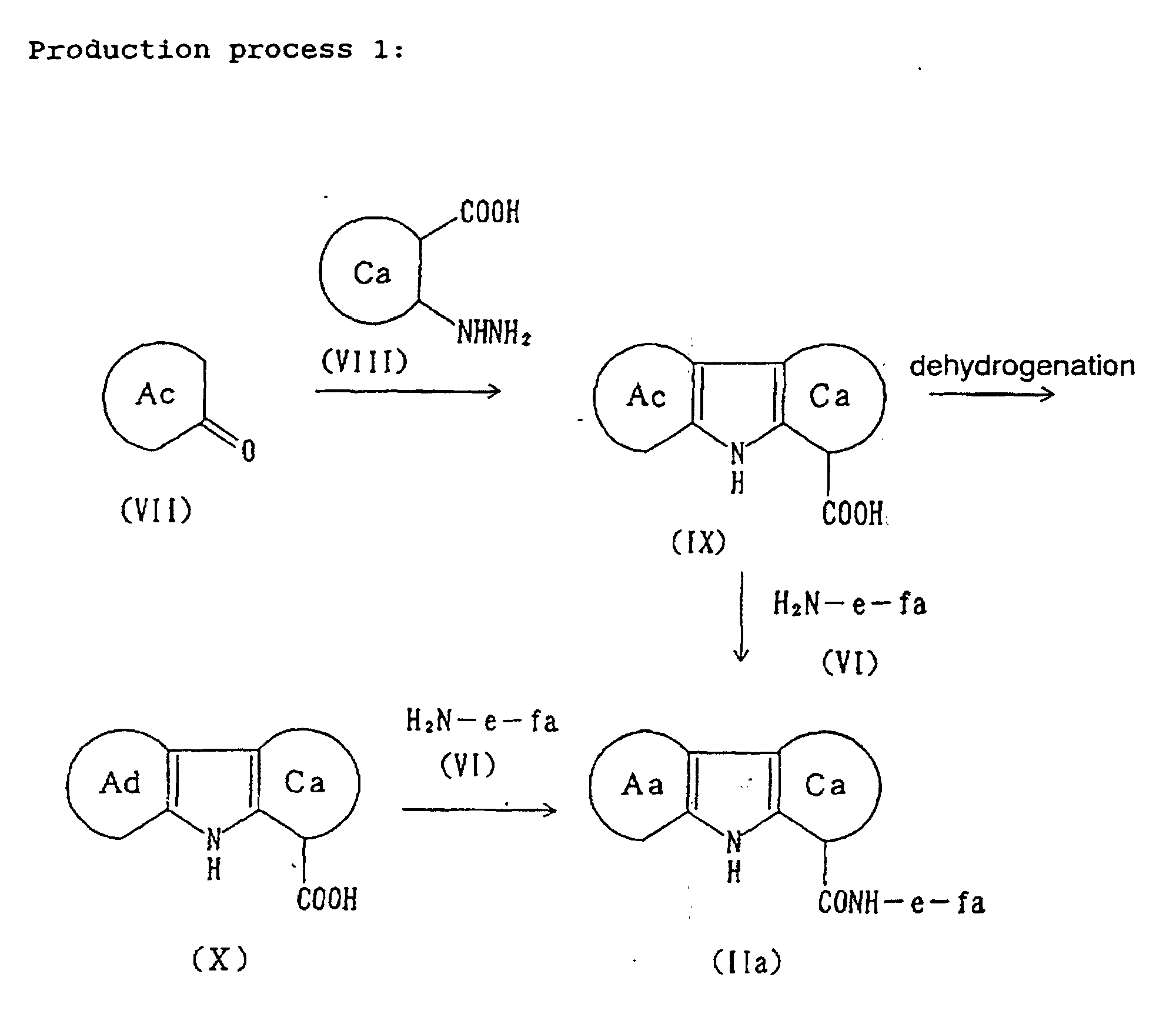
- The compound represented by the general formula (IX) can be produced by applying, for example, Fischer's method for synthesizing indole or Borsche's method for synthesizing tetrahydrocarbazole [Org. Syn. IV, 884 (1963)]. Namely, it can be obtained by heating a cyclic ketone represented by the formula (VII) and an o-hydrazino aromatic carboxylic acid in acetic acid or formic acid or in a neutral solvent such as ethanol in the presence of an acid catalyst such as hydrochloric acid, sulfuric acid or zinc chloride. When the ring Ac in the compound (IX) is an optionally substituted dicyclic fused ring in which only one of the rings is an aromatic ring, it may be fused with a compound represented by the general formula (VI) to thereby give the aimed compound (IIa). The compound (X) can be produced by partly or entirely dehydrogenating the non-aromatic ring in the compound (IX) with a dehydrogenating agent. As the dehydrogenating agent, use can be made of, for example, 2,3-dichloro-5,6-dicyano-1,4-benzoquinone, chloranil or palladium-carbon. The reaction may be usually effected at room temperature or under heating. When the ring Ac is a dicyclic fused ring in which both of the rings are non-aromatic ones, it is also possible to selectively dehydrogenate one of these rings by appropriately selecting the type and amount of the reagent, reaction conditions, etc. The aimed compound (IIa) can be produced by fusing the compound (X) thus obtained to the compound (VI). The fusing may be carried out by, for example, the acid chloride method, the active ester method or the mixed acid anhydride method or by using fusing agents such as 1,3-dicyclohexylcarbodiimide, N,N'-carbonyldimidazole or diphenylphosporyl azide.wherein the ring Ae means an optionally substituted monocyclic aromatic ring or a dicyclic fused ring in which at least the ring carrying the substituent -G-H is an aromatic ring; G represents an oxygen atom or a sulfur atom; K and L represent each a leaving group; R represents a lower alkyl group; and the ring Ca, e and fa are each as defined above.

- The compound represented by the general formula (XIII) can be produced by reacting the compound of the general formula (XI) with the compound of the general formula (XII). Nitro and halogeno may be cited respectively as preferable examples of the leaving groups K and L in the compound (XII). The reaction may be effected by heating these compounds optionally in the presence of a base such as triethylamine, sodium acetate or sodium hydroxide. The aimed compound (IIb) can be produced by hydrolyzing an ester of the compound (XIII) with an alkali into the compound (XIV) and then fusing this compound to the compound (VI) in the same manner as the one of the production process (I).
- When the compound of the present invention is to be used as a medicine, it may be orally or parenterally administered. Although the dose is not particularly restricted but varies depending on the severity of the symptom, the age, sex, body weight and sensitivity of the patient, the method, time and intervals of the administration, the properties, type and active ingredients of the medicinal preparation, etc., it may be usually administered to an adult in a daily dose of from 1 to 3,000 mg, preferably about from 10 to 2,000 mg and still preferably from 20 to 1,000 mg, in one to three portions per day.
- To prepare a solid preparation for oral administration, the principal agent is mixed with fillers and, if necessary, binders, disintegrating agents, lubricants, coloring agents, corrigents, etc. and the obtained mixture is processed into tablets, coated tablets, granules, fine subtillaes, dusts, capsules, etc. in a conventional manner.
- As the fillers, use can be made of, for example, lactose, corn starch, sucrose, glucose, sorbitol, crystalline cellulose and silicon dioxide. As the binders, use can be made of, for example, polyvinyl alcohol, ethylcellulose, methylcellulose, acacia, hydroxypropylcellulose and hydroxypropylmethylcellulose. As the lubricants, use can be made of, for example, magnesium stearate, talc and silica. As the coloring agents, use can be made of pharmaceutically acceptable ones. As the corrigents, use can be made of, for example, cocoa powder, menthol, aromatic acids, peppermint oil, Borneo camphor and powdered cinnamon bark. Needless to say, these tablets or granules may be coated with sugar, gelatin, etc., if needed.
- To prepare injections, the principal agent is mixed with, if needed, pH regulating agents, buffers, suspending agents, solubilizing agents, stabilizers, isotonizing agents, preservatives, etc. and the obtained mixture is processed into intravenous, subcutaneous or intramuscular injections in a conventional manner. Then these preparations may be freeze-dried in a conventional manner, if necessary.
- As the suspending agents, use can be made of, for example, methylcellulose, Polysorbate 80, hydroxyethylcellulose, acacia, powdered tragacanth, sodium carboxymethylcellulose and polyoxyethylene sorbitan monolaurate.
- As the solubilizing agents, use can be made of, for example, polyoxyethylene hardened castor oil, Polysorbate 80, nicotinamide, polyoxyethylene sorbitan monolaurate, macrogol and castor oil fatty acid ethyl esters.
- As the stabilizers, use can be made of, for example, sodium sulfite and sodium metasulfite. As the preservatives, use can be made of, for example, methyl parahydroxybenzoate, ethyl parahydroxybenzoate, sorbic acid, phenol, cresol and chlorocresol.
- Next, pharmacological experimental examples will be given to illustrate the effects of the compounds of the present invention.
- P388 cells suspended in RPMI1640 medium (manufactured by Sanko Junyaku) containing 10% of fetal calf serum, (100 U/ml) of penicillin, 100 µg/ml of streptomycin, 5 × 10⁻⁵M of mercaptoethanol and 1 mM of sodium pyruvate were pipetted into a 96-well U-bottomed microplate at a ratio of 1.25 × 10³ cells (0.1 ml) per well and incubated in a incubator containing 5% of carbon dioxide at 37°C for a day.
- A compound of the present invention was dissolved in dimethyl sulfoxide to give a concentration of 10-2 M and then diluted with the 10% fetal calf serum-containing RPMI1640 culture medium to give a concentration of 10-4 or 10-5 M. By taking this concentration as the maximal level, threefold serial dilution was effected with the use of the 10% fetal calf serum-containing RPMI1640 culture medium. Then these dilutions were added to the P388 incubation plate as described above at a ratio of 0.1 ml per well followed by incubation in an incubator containing 5% of carbon dioxide at 37°C for 3 days.
- After the completion of the incubation, 0.05 ml/well of a 3.3 mg/ml solution of MTT [3-(4,5-dimethylthiazol-2-yl)-2,5-diphenyltetrazolium bromide] was added thereto and the incubation was continued for additional 2 hours. The microplate was centrifuged and the supernatant was aspirated off from each well. Then the formazan thus formed was dissolved in 0.1 ml of dimethyl sulfoxide and the absorbance thereof at 540 nm measured with a microplate reader was taken as an indication of the viable cell count. In accordance with the following formula, the inhibitory ratio was calculated and the 50% inhibitory concentration (IC50) of the test compound was determined:
- Table 1 summarizes the IC50 data thus obtained.
in vitro Antitumor test on P388 cells Compound(Ex.) IC50(µM) Compound(Ex.) IC50(µM) 1 0.29 31 0.11 2 0.070 32 0.41 3 0.026 33 0.056 4 0.030 34 0.45 5 0.0048 35 0.063 6 0.0017 36 0.014 7 0.031 37 0.38 8 0.34 38 0.11 9 0.0067 39 0.0077 10 0.0085 40 0.22 11 0.042 41 0.32 12 0.062 42 0.049 14 0.074 43 0.066 15 0.14 44 0.36 16 0.11 45 0.16 17 0.034 46 0.077 18 0.076 47 0.25 19 0.22 48 0.35 20 0.57 49 0.030 22 0.29 50 0.0071 23 0.081 51 0.29 24 0.32 52 0.15 25 0.028 53 0.30 26 0.23 54 0.080 27 0.49 55 0.011 28 0.070 56 0.015 29 0.071 57 0.031 30 0.032 58 0.155 - M5076 cells (1 × 10⁶/animal) were subcutaneously transplanted into the side part of each BDF1 mouse (aged 6 to 7 weeks, female). A compound of the present invention was dissolved in a 5% solution of glucose. From the next day of the transplantation, the solution of the compound was intraperitoneally administered to the animals once a day in accordance with each schedule. On the other hand, a 5% solution of glucose was administered to the control group. The control group had 10 animals, while each test group had 5 animals.
- On the 21st day after the transplantation, tumors were taken out and weighed. The tumor multiplication inhibitory ratio of each test group to the control group was determined in accordance with the following formula:
- Table 2 shows the results of this experiment.
in vivo Antitumor test on M5076 Compd. (Ex. No.) Dose (mg/kg/day) Administration Day (days after transplantation) Proliferation inhibitory ratio (%) Survival rate on the judgement day (21th day) 1 50 d1,2,3,4 95.2 100 2 25 d9 91.4 100 3 25 d9 90.0 100 4 25 d9 89.2 100 12.5 d1,8,15 100 100 8 30 d1,8,15 99.9 100 12 50 d1,2,3,4 93.9 100 20 12.5 d1,2,3,4 70.8 100 26 50 d1,2,3,4 97.4 100 33 50 d9 74.9 100 35 25 d9 78.7 100 52 50 d1,2,3,4 70.6 100 - MX-1 tumor pieces (about 1 mm3) were subcutaneously transplanted into the side part of each nude mouse (BALB/C·nu/nu, 6 to 7 weeks, female). A compound of the present invention was dissolved in a 5% solution of glucose. When the tumor volume reached 50 mm3 (on the about 10th day after the transplantation), the solution of the compound was intraperitoneally administered to the animals once a day in accordance with each schedule. On the other hand, a 5% solution of glucose was administered to the control group. The control group had 10 animals, while each test group had 5 animals.
- On the 22nd day after the transplantation, tumors were taken out and weighed. The tumor multiplication inhibitory ratio of each test group to the control group was determined in accordance with the following formula:
- Table 3 shows the results of this experiment.
in vivo Antitumor test on MX-1 Compd. (Ex. No.) Dose (mg/kg/day) Administration schedule Proliferation inhibitory ratio (%) Survival rate on the judgement day (22th day) 1 25 q4d x 4 48.0 100 2 25 q7d x 3 63.3 100 3 20 q7d x 3 55.7 100 4 15 q7d x 3 98.4 100 7 15 q7d x 3 73.2 100 8 25 q7d x 3 94.0 100 10 10 q7d x 3 59.7 100 11 30 q7d x 3 82.5 100 - As these experimental data clearly show, the compounds of the present invention have excellent antitumor effects and thus are useful as an antitumor agent.
- Now, Production Examples showing the production of the starting compounds employed in the present invention and Examples relating to typical examples of the compounds of the present invention will be given. However, it is to be understood that the present invention is not restricted thereto.
-
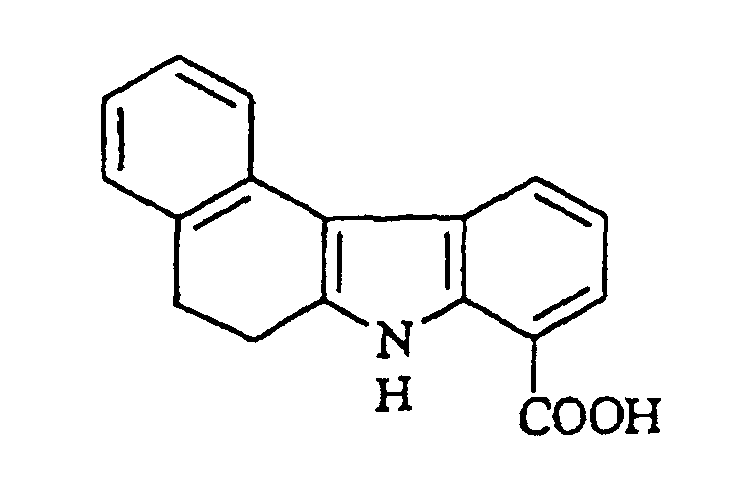
- A solution of 5.00 g (34.2 mmol) of β-tetralone in acetic acid (10 ml) was dropped into a suspension of 7.05 g (37.4 mmol) of 2-hydrazinobenzoic acid hydrochloride in acetic acid (40 ml) at 80°C and the obtained mixture was heated under reflux for 3 hours and 45 minutes. After bringing back to room temperature, water was added thereto and the precipitate thus formed was taken up by filtration, washed with water, dried and recrystallized from ethanol to thereby give 5.2 g of the title compound.
1H-NMR(DMSO-d6) δ(ppm);2.91-3.06(m,4H),7.03(t, J=7.6Hz,1H),7.17(t,J=7.6Hz,1H),7.20-7.27(m,2H),7.72 (d,J=7.6Hz,1H),7.76(d,J=7.6Hz,1H),8.19(d,J=7.6Hz, 1H),11.29(s,1H) -

- 3.29 g (14.3 mmol) of 2,3-dichloro-5,6-dicyano-1,4-benzoquinone was added to a suspension of 2.97 g (11.3 mmol) of the compound of Production Example 1 in benzene (200 ml) at room temperature and the obtained mixture was stirred for 50 minutes and then heated under reflux for 3 hours and 20 minutes. After bringing back to room temperature, the precipitate thus formed was taken up by filtration and recrystallized from ethanol to thereby give 2.76 g of the title compound.
1H-NMR(DMSO-d6) δ(ppm) ;7.39(t,J=7.3Hz,1H),7.48(t, J=7.3Hz,1H),7.70(t,J=7.3Hz,1H),7.93(d,J=8.7Hz,1H), 8.00-8.07(m,3H),8.79(d,J=7.3Hz,1H), 8.87(d,J=7.3Hz, 1H),11.82(s,1H),13.22(br-s,1H) -
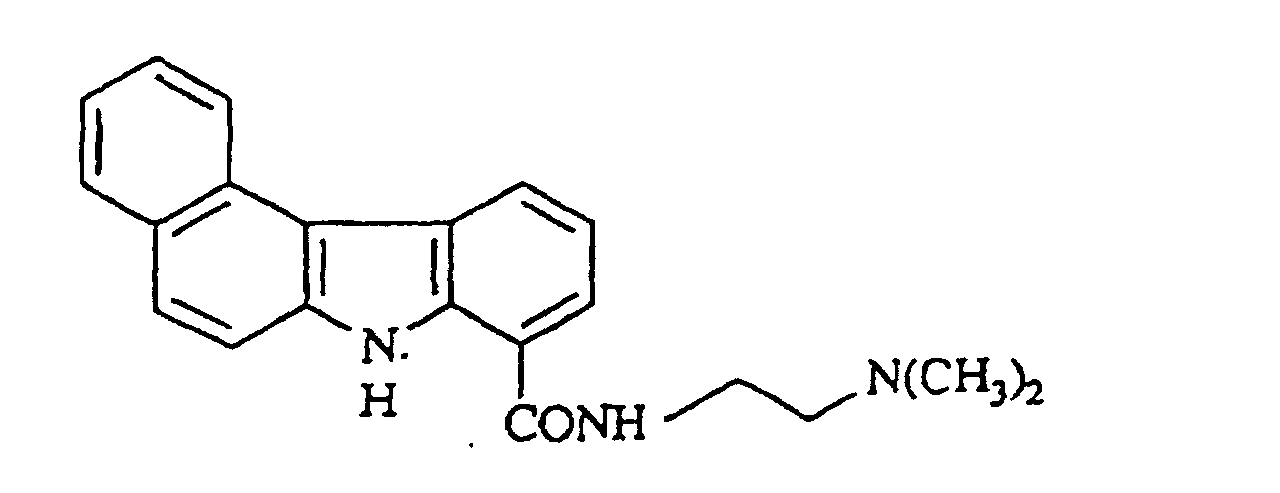
- 2.52 g (15.5 mmol) of N,N'-carbonyldiimidazole was added to a solution of 1.89 g (7.25 mmol) of the compound of Production Example 2 in dimethylformamide (60 ml) at room temperature and the obtained mixture was stirred for 45 minutes. Then 5.0 ml (45.5 mmol) of N,N-dimethylethylenediamine was added thereto and the resulting mixture was stirred for 2 hours and 40 minutes. After concentrating, it was extracted by adding water and ethyl acetate. The organic layer was taken up, washed with water, dried over sodium sulfate and concentrated to dryness to thereby give 2.47 g of the title compound.
1H-NMR(DMSO-d6) δ(ppm) ;2.33(s,6H),2.60(t,J=5.7Hz, 2H),3.63(q,J=5.7Hz,2H),7.16(br-s,1H),7.38(t, J=7.5Hz,1H),7.46-7.50(m,1H),7.65-7.73(m,3H),7.89(d, J=9.0Hz,1H),8.01(d,J=8.2Hz,1H),8.69(d,J=7.5Hz,1H), 8.74(d,J=8.2Hz,1H),20.94(br-s,1H) -
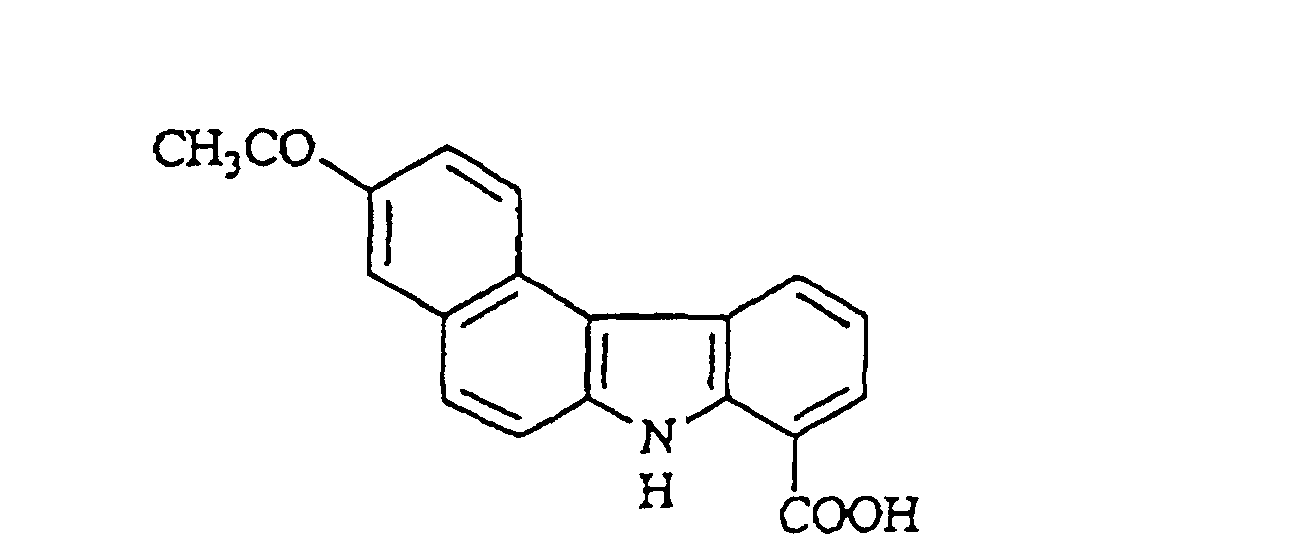
- 1.17 ml (12.4 mmol) of acetic anhydride was added to a suspension of 5.1 g (38 mmol) of aluminum chloride in dichloromethane (300 ml) at 0°C and the obtained mixture was stirred for 20 minutes. Next, 2.16 g (8.28 mmol) of the compound of Production Example 2 was added thereto and the obtained mixture was stirred at the same temperature for 4 hours and 30 minutes. Then the reaction mixture was poured into ice-water and extracted with a mixture of chloroform with ethanol. The organic layer was taken up and concentrated. The residue was purified by silica gel column chromatography to thereby give 1.45 g of the title compound.
1H-NMR(DMSO-d6) δ(ppm) ;2.72(s,3H),7.44(t,J=7.6Hz, 1H),8.07(d,J=7.6Hz,1H),8.11(d,J=9.1Hz,1H),8.14(d, J=9.1Hz,1H),8.18(dd,J=1.9,8.8Hz,1H),8.79(d,J=1.9Hz,1 H),8.87(d,J=8.8Hz,1H),8.91(d,J=7.6Hz,1H),12.01(s, 1H) -

- 291 mg (1.80 mmol) of N,N'-carbonyldiimidazole was added to a solution of 247 mg (0.815 mmol) of the compound of Production Example 4 in dimethylformamide (7 ml) under ice-cooling. After bringing back to room temperature, the obtained mixture was stirred for about 2 hours. Next, 0.45 ml (4.1 mmol) of N,N-dimethylethylenediamine was added thereto and the reaction mixture was brought back to room temperature and stirred at room temperature for about 12 hours. After extracting by adding water and chloroform, the organic layer was taken up, dried over sodium sulfate and concentrated to dryness. Then the residue was purified by silica gel column chromatography to thereby give 140 mg of the title compound.
1H-NMR(DMSO-d6) δ(ppm) ;2.29(s,6H),2.53-2.61(m,2H), 2.74(s,3H),3.52(q,J=5.9Hz,2H),7.43(t,J=7.1Hz,1H), 7.97(d,J=7.1Hz,1H),8.10(d,J=8.7Hz,1H), 8.14(d, J=8.7Hz,1H),8.20(dd,J=1.8,8.5Hz,1H),8.72(t,J=5.9Hz,1 H),8.79-8.83 (m,2H),8.88(d,J=8.5Hz,1H),12.17(s,1H) -

- 6.8 g (38.2 mmol) of 1,2,3,4,5,8-hexahydro-1-oxo-6-methoxynaphthalene was dissolved in 50 ml of tetrahydrofuran and 5 ml of 1 N hydrochloric acid was added thereto. After stirring at room temperature for 1 hour, ethyl acetate was added thereto. Then the reaction mixture was washed with a saturated aqueous solution of sodium chloride and dried over magnesium sulfate. After concentrating, a small amount of a mixture of n-hexane with ethyl acetate (1 : 1) was added thereto and the obtained mixture was cooled in a dry ice-ether bath. The precipitate thus formed was recovered by filtration and washed with a small amount of n-hexane to thereby give 4.8 g of the title compound.
1H-NMR(CDCl3) δ(ppm) ;2.01-2.11(m,2H),2.30-2.37 (m,2H),2.45-2.51(m,4H),2.68-2.76(m,2H),3.05(s,2H) -
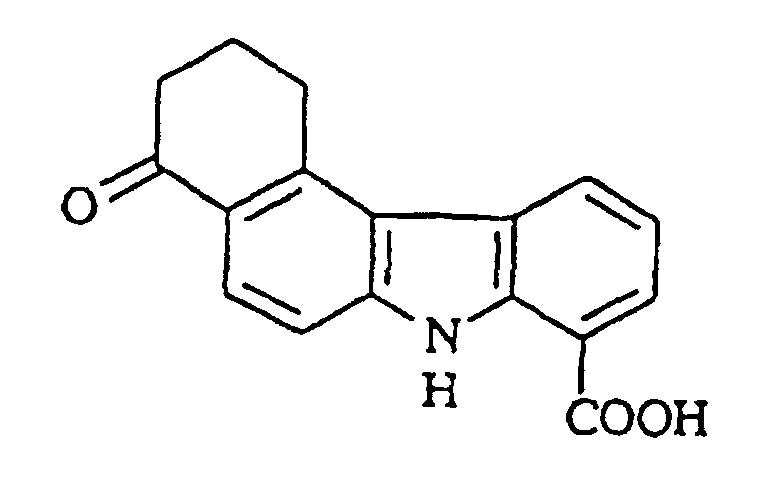
- 5.4 g (28.6 mmol) of 2-hydrazinobenzoic acid hydrochloride and 4.7 g (34.3 mmol) of zinc chloride were added to 300 ml of glacial acetic acid. Under stirring at about 85°C, 4.7 g (28.6 mmol) of the compound of Production Example 6 was added thereto over about 5 minutes. Then the obtained mixture was stirred at the same temperature for about 2 hours, brought back to room temperature and the precipitate was recovered by filtration. After concentrating the filtrate, water was added thereto and the precipitate thus formed was recovered by filtration. These precipitates were combined, dried and then dissolved in about 500 ml of dimethylformamide. Under stirring at room temperature, a solution of 6.5 g (28.6 mmol) of 2,3-dichloro-5,6-dicyano-1,4-benzoquinone in tetrahydrofuran (20 ml) was added thereto and the obtained mixture was stirred for about 30 minutes. After concentrating, about 50 ml of ethanol was added and the precipitate thus formed was recovered by filtration to thereby give 3.4 g of the title compound. 1H-NMR(DMSO-d6) δ(ppm) ;2.17-2.29(m,2H),2.63-2.70 (m,2H),3.55(t,J=6.0Hz,2H),7.36(t,J=7.6Hz,1H),7.73(d, J=8.8Hz,1H),8.03(d,J=8.8Hz,1H),8.06(dd,J=0.8,7.6Hz, 1H),8.48(dd,J=0.8,7.6Hz,1H),11.83(s,1H),13.33 (br-s,1H)
-

- 3.4 g (12.2 mmol) of the compound of Production Example 7 was added to 120 ml of dimethylformamide and stirred. Next, a solution of 3.0 g (18.5 mmol) of N,N'-carbonyldiimidazole in dimethylformamide (30 ml) was added thereto. After stirring at room temperature for 1 hour, 3.2 g (36.3 mmol) of N,N-dimethylethylenediamine was added thereto. After stirring at the same temperature for additional 1 hour, the reaction mixture was concentrated and ethyl acetate was added thereto. Then it was washed successively with dilute aqueous ammonia and an aqueous solution of sodium chloride, dried over magnesium sulfate and concentrated to dryness to thereby give 4.3 g of the title compound.
FAB mass spectrometry m/z: 350 ([M+H]+).
1H-NMR(CDCl3) δ(ppm) ; 2.30-2.40(m+s,2H+6H),2.62(t, J=6.0Hz,2H),2.74-2.79(m,2H),3.56-3.66(m,4H),7.21 (br-s,1H),7.32(t,J=8.0Hz;1H),7.41(d,J= 8.4Hz,1H), 7.70(dd,J=0.8,8.0Hz,1H),8.25(d,J=8.4Hz,1H),8.33(dd,J =0.8,8.0Hz,1H),10.91(br-s,1H) -

- The title compound was obtained by reacting 2,3,4,7-tetrahydro-1H-indene-1,5(6H)-dione, which had been synthesized from 2,3,4,7-tetrahydro-5-methoxy-1H-inden-1-one by the same method as the one of Production Example 6, in the same manner as the one of Production Example 7.
FAB mass spectrometry m/z: 266 ([M+H]+).
1H-NMR(DMSO-d6) δ (ppm) ; 2.70-2.82(m,2H),3.52-3.62 (m,2H),7.41(t,J=7.6Hz,1H),7.70(d,J=8.4Hz,1H),7.81(d, J=8.4Hz,1H),8.09(dd,J=0.8,7.6Hz,1H), 8.39(d,J=7.6Hz, 1H),11.95(s,1H),13.37(br-s,1H) -

- The title compound was obtained from the compound of Production Example 9 by the same method as the one of Production Example 8.
FAB mass spectrometry m/z: 336 ([M+H]+).
1H-NMR(CDCl3) δ(ppm) ;2.34(s,6H),2.61(t,J=6.0Hz,2H), 2.85-2.91(m,2H),3.58-3.66(m,4H),7.18(br-s,1H),7.36 (t,J=7.6Hz,1H),7.49(d,J=8.4Hz,1H),7.71(d,J=7.6Hz, 1H),7.88(d,J=8.4Hz,1H),8.22(d,J=7.6Hz,1H),10.95 (br-s,1H) -

- A solution of 28 ml (0.270 mol) of cyclohexanone in acetic acid (100 ml) was dropped into a suspension of 52 g (0.276 mol) of 2-hydrazinobenzoic acid hydrochloride in acetic acid (500 ml) at 100°C and the obtained mixture was heated under reflux for 6 hours. After bringing back to room temperature, 1 l of water was added thereto and the precipitate thus formed was taken up by filtration, washed with water and dried to thereby give 43 g of a powder. This powder was then dissolved in 500 ml of acetone. After adding 37.5 ml (0.602 mol) of methyl iodide and 41.4 g (0.300 mol) of anhydrous potassium carbonate thereto, the reaction mixture was heated under reflux for 2 hours. After bringing back to room temperature, the insoluble matters were filtered off. After concentrating the filtrate, water was added thereto and the precipitate thus formed was recovered by filtration to thereby give 45.7 g of the title compound.
1H-NMR(CDCl3) δ(ppm) ;1.85-1.97(m,4H),2.70-2.74 (m,2H), 2.76-2.80(m,2H),3.97(s,3H),7.09 (t,J=7.6Hz,1H),7.65-7.68(m,1H),7.79(dd,J=1.1,7.6Hz, 1H),9.39(br-s,1H) -

- 45.7 g (0.199 mol) of the compound of Production Example 11 was dissolved in a mixture of tetrahydrofuran (500 ml) with water (50 ml). Into the obtained solution was dropped a solution of 90.8 g (0.400 mol) of 2,3-dichloro-5,6-dicyano-1,4-benzoquinone in tetrahydrofuran (200 ml) in a nitrogen atmosphere under ice-cooling. After stirring at room temperature for 3 hours, 1 l of an aqueous solution of potassium carbonate was added thereto followed by extraction with ethyl acetate. Then the organic layer was taken up, washed with water, dried over magnesium sulfate and concentrated. The residue was recrystallized from ethanol to thereby give 39.7 g of the title compound.
1H-NMR(DMSO-d6) δ(ppm) ;2.10-2.17(m,2H),2.44-2.48 (m,2H),3.07(t,J=6.2Hz,2H),3.96(s,3H),7.28(t,J=7.7Hz, 1H),7.81(dd,J=1.3,7.7Hz,1H),8.25(dd,J=1.3,7.7Hz,1H), 11.79(br-s,1H) -

- 39.1 g (0.161 mol) of the compound of Production Example 12 was suspended in diphenyl ether (150 ml). After adding 10 g of 10% palladium-carbon, the obtained mixture was heated under reflux in a nitrogen atmosphere for 3 hours. After allowing to cool, the crystals thus precipitated and the palladium-carbon were recovered by filtration and washed with hexane. Then the recovered mixture was dissolved in hot tetrahydrofuran and the palladium-carbon was filtered off. After concentrating, the residue was recrystallized from ethanol to thereby give 34.7 g of the title compound.
1H-NMR(CDCl3) δ(ppm) ;4.03(s,3H),5.54(s,1H),6.62 (dd,J=0.6,7.9Hz,1H),7.10(dd,J=0.6,7.9Hz,1H),7.27(t,J =7.9Hz,1H),7.30(t,J=7.9Hz,1H),8.05(dd,J=1.2,7.9Hz, 1H),8.46-8.50(m,1H),9.93(br-s,1H) -
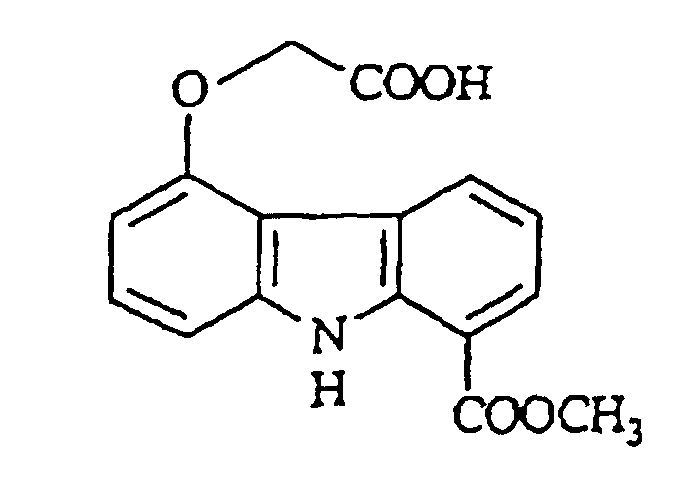
- 34.8 g (0.144 mol) of the compound of Production Example 13 was dissolved in acetone (550 ml). After adding 68.5 ml (0.432 mol) of benzyl bromoacetate, 64.8 g (0.432 mol) of sodium iodide and 29.8 g (0.216 mol) of anhydrous potassium carbonate thereto, the obtained mixture was heated under reflux for 60 hours. After allowing to cool, the precipitate thus formed was filtered off followed by concentration. Then it was extracted by adding ethyl acetate and water and the organic layer was taken up, washed with water, dried over magnesium sulfate and concentrated. To the obtained residue was added n-hexane so as to solidify the same. Then it was recovered by filtration and recrystallized from ethanol to thereby give 40.7 g of benzyl ester of the title compound. This product was suspended in a mixture of tetrahydrofuran (600 ml) and methanol (500 ml). Next, 12 g of 10% palladium-carbon was added thereto and the product was hydrogenated under atmospheric pressure at an ordinary temperature to thereby give 29.4 g of the title compound.
1H-NMR(CD3OD) δ(ppm) ;4.02(s,3H),4.90(s,2H),6.67 (dd,J=0.6,8.0Hz,1H),7.23(t,J=7.7Hz,1H),7.26(dd, J=0.6,8.0Hz,1H),7.35(t,J=8.0Hz,1H),8.02(dd,J=1.1, 7.7Hz,1H),8.63(dd,J=1.1,7.7Hz,1H),10.87(br-s,1H) -
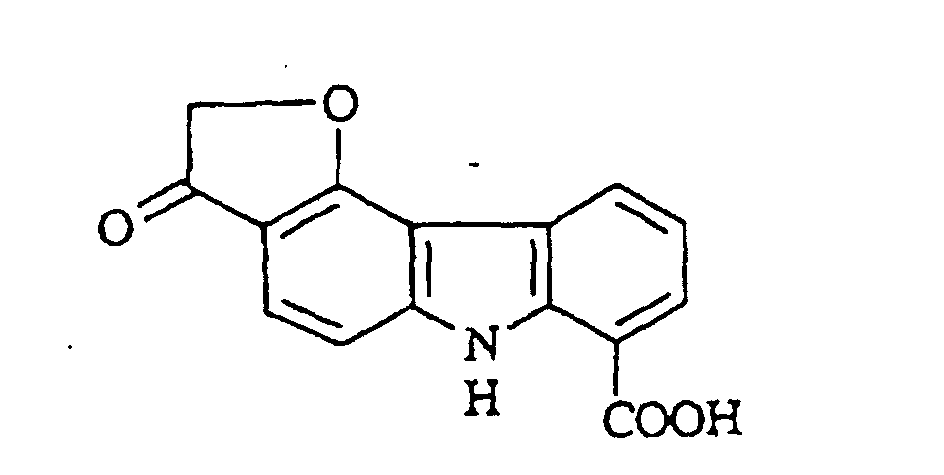
- 29.4 g (0.098 mol) of the compound of Production Example 14 was suspended in toluene (500 ml). After adding 36 ml (0.494 mol) of thionyl chloride, the obtained mixture was heated under reflux until it became homogeneous. After concentrating, it was dissolved by adding 500 ml of dichloromethane thereto and 32.1 g (0.240 mol) of aluminum chloride was added in portions thereto while stirring under ice-cooling. Then it was brought back to room temperature and stirred overnight and then ice-water was added thereto under ice-cooling. After stirring at room temperature, it was concentrated and dilute hydrochloric acid was added thereto. The precipitate was recovered by filtration, washed successively with water and ethanol and dried to thereby give 26.5 g of a powder. The whole powder was dissolved in a mixture of tetrahydrofuran (350 ml) with methanol (250 ml) and then 750 ml of a degassed 0.2 N aqueous solution of sodium hydroxide was added thereto in a nitrogen atmosphere. After hydrolyzing the ester at 50°C, 20 ml of conc. hydrochloric acid was added thereto. Then it was extracted with a mixture of ethyl acetate with tetrahydrofuran and the organic layer was taken up, washed with water, dried over magnesium sulfate and concentrated. The residue was purified by silica gel column chromatography to thereby give 11.4 g of the title compound.
1H-NMR(DMSO-d6) δ(ppm) ;5.00(s,2H),7.41(t,J=7.7Hz, 1H),7.56(d,J=8.5Hz, 1H),7.63(d,J=8.5Hz,1H),8.07 (dd,J=1.3,7.7Hz,1H),8.29-8.32(m,1H),12.10(br-s,1H) -

- Starting with 0.5 g (1.79 mmol) of the compound of Production Example 7 and 0.53 g (7.15 mmol) of N-methylethylenediamine, 0.49 g of N-[2-(methylamino)ethyl]-4-oxo-1,2,3,4-tetrahydro-7H-benzo[c]carbazole-8-carboxamide was obtained by the same method as the one of Production Example 8. 0.49 g (1.46 mmol) of this product, 0.25 g (1.74 mmol) of allyl bromide and 0.23 g (1.78 mmol) of N,N-diisopropylethylamine were dissolved in tetrahydrofuran (30 ml) and stirred at 55°C for about 5 hours. After allowing to cool, it was diluted with ethyl acetate, washed successively with dilute aqueous ammonia and an aqueous solution of sodium chloride, dried over magnesium sulfate and concentrated. The residue was purified by preparative thin layer chromatography to thereby give 0.24 g of the title compound.
1H-NMR(CDCl3) δ(ppm) ; 2.28-2.40(m+s,2H+3H),2.70 (t,J=6.0Hz,2H),2.73-2.80(m,2H),3.11-3.17(m,2H), 3.56-3.68(m,4H),5.17-5.29(m,2H),5.82-5.97(m,1H), 7.24(br-s,1H),7.33(t,J=7.6Hz,1H),7.42(d,J=8.4Hz, 1H),7.67(dd,0.8,7.6Hz,1H),8.25(d,J=8.4Hz,1H),8.33 (dd,J=0.8,7.6Hz,1H),10.88(br-s,1H) -

- Starting with 0.24 g (0.64 mmol) of the compound of Production Example 16, 0.23 g of the title compound was obtained by the same method as the one of Example 2 while omitting the procedure relating to the hydrochloride.
1H-NMR(CDCl3)δ(ppm) ; 2.32-2.42(m+s,2H+3H),2.73-2.84(m,4H),3.10-3.15(m,2H),3.53(t,J=6.4Hz,2H),4.35 (t,J=7.2Hz,2H),5.08-5.22(m,2H),5.74-5.90(m,1H),7.63 (t,J=7.6Hz,1H),8.19(dd,J=0.8,7.6Hz,1H),8.32(dd, J=0.8,7.6Hz,1H),8.35(d,J=8.4Hz,1H),8.51(d,J=8.4Hz, 1H) -
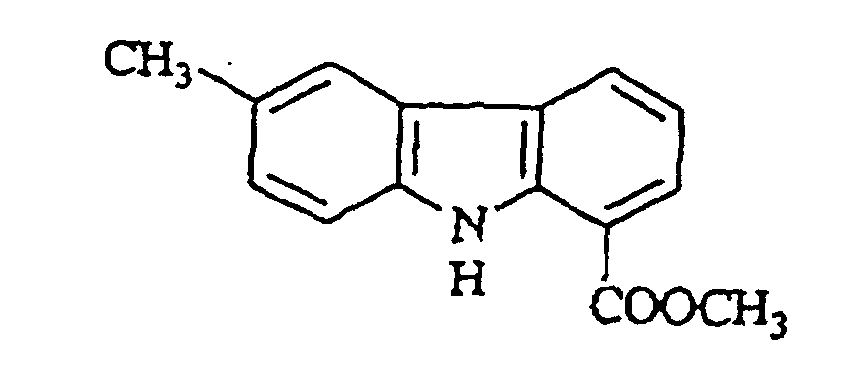
- A suspension of 2.0 g (10.6 mmol) of 2-hydrazinobenzoic acid hydrochloride in acetic acid (20 ml) was slowly boiled under stirring and 1.2 ml (9.8 mmol) of 4-methylcyclohexanone was dropped thereinto. The obtained mixture was heated under reflux for 8 hours and then allowed to cool. After adding water, the precipitate thus formed was recovered by filtration, washed with water and dried to thereby give 1.96 g of 6-methyl-5,6,7,8-tetrahydro-9H-carbazole-1-carboxylic acid. This product was dissolved in acetone (50 ml) and 2.1 ml (34 mmol) of methyl iodide and 2.35 g (17 mmol) of anhydrous potassium carbonate were added thereto. The reaction mixture was heated under reflux under stirring for 2 hours, then allowed to cool and extracted with water and ethyl acetate. The organic layer was taken up, washed with water, dried over magnesium sulfate and concentrated to dryness. Thus 1.49 g of methyl 6-methyl-5,6,7,8-tetrahydro-9H-carbazole-1-carboxylate was obtained. This product was suspended in diphenyl ether (10 ml) and 890 mg of 10% palladium-carbon was added thereto. The obtained mixture was heated under reflux under stirring in a nitrogen atmosphere for 1 hour. After allowing to cool, it was dissolved by adding tetrahydrofuran. Then the catalyst was filtered off and the filtrate was concentrated. After adding n-hexane, the crystals thus formed were recovered by filtration to thereby give 1.26 g of the title compound.
1H-NMR(CDCl3) δ(ppm) ;2.54(s,3H),4.02(s,3H),7.22 (t,J=7.8Hz,1H),7.27-7.31(m,1H),7.41(d,J=8.2Hz,1H), 7.87-7.90(m,1H),8.05(dd,J=1.1,7.8Hz,1H),8.21-8.25 (m,1H),9.82(br-s,1H) -

- 1.8 g (10 mmol) of N-bromosuccinimide and 220 mg (1.3 mmol) of α,α'-azobisisobutyronitrile were added to a solution of 1.2 g (5 mmol) of the compound of Production Example 18 in carbon tetrachloride (100 ml) and the obtained mixture was heated under reflux under stirring for 1 hour. After allowing to cool, the mixture was concentrated and the residue was purified by silica gel column chromatography to thereby give 1.13 g of the title compound.
1H-NMR(CDCl3) δ(ppm) ;4.05(s,3H),7.36(t,J=7.8Hz,1H), 7.62(d,J=8.4Hz, 1H),8.03(dd,J=1.6,8.4Hz,1H),8.14 (dd,J=1.2,7.8Hz,1H),8.32-8.36(m,1H),8.62-8.64 (m,1H),10.12(s,1H),10.23(br-s,1H) -

- 2.6 g (25 mmol) of malonic acid and 0.3 ml of piperidine were added to a solution of 2.0 g (7.9 mmol) of the compound of Production Example 19 in pyridine (80 ml) and the obtained mixture was stirred in a bath at 80°C for 1 hour. Then 2.6 g (25 mmol) of malonic acid was added thereto under heating and stirring over 1 hour and the obtained mixture was heated under reflux for additional 1 hour. After allowing to cool, the reaction mixture was poured into conc. hydrochloric acid-ice and the precipitate thus formed was recovered by filtration, washed with water and dried to thereby give 1.8 g of 3-(1-methoxycarbonyl-9H-carbazol-6-yl)acrylic acid. The obtained compound was dissolved in acetone (70 ml) and 2 ml of triethylamine was added thereto. Under ice-cooling and stirring, 0.64 ml (6.7 mmol) of ethyl chloroformate was dropped thereinto and then the reaction mixture was stirred at the same temperature for 1 hour. Next, a solution of 870 mg (12 mmol) of sodium azide (90%) in 20 ml of water was dropped thereinto under ice-cooling and stirring. The reaction mixture was stirred at the same temperature for 1 hour and then poured into ice. The precipitate thus formed was recovered by filtration. This precipitate was added together with 3 ml of tributylamine to diphenyl ether (20 ml) and heated to 260°C. After allowing to cool, hexane was added thereto and the precipitate thus formed was recovered by filtration and washed successively with n-hexane and ethanol to thereby give 1.39 g of the title compound.
1H-NMR(DMSO-d6) δ(ppm) ;4.01(s,3H),6.73(d,J=7.0Hz, 1H),7.18-7.24(m,1H),7.31(t,J=7.9Hz,1H),7.77 (d,J=8.5Hz,1H),8.08(dd,J=1.3,7.9Hz,1H),8.22 (d,J=8.5Hz,1H),10.13(dd,J=1.3,7.9Hz,1H),11.36-11.42(m,1H),11.93(br-s,1H) -
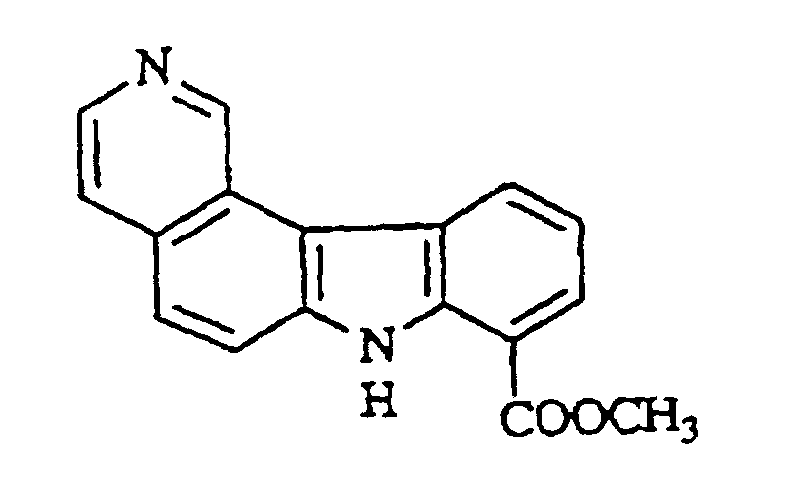
- 10 ml of phosphorus oxychloride was added to 1.19 g (4 mmol) of the compound of Production Example 20 and the obtained mixture was heated under reflux. 3 hours thereafter, the reaction mixture was poured into ice and neutralized with sodium bicarbonate. Then it was extracted with dichloromethane. The organic layer was taken up, washed with water, dried over magnesium sulfate and concentrated. The residue was purified by silica gel column chromatography to thereby give 390 mg of methyl 1-chloro-7H-pyrido[4,3-c]carbazole-8-carboxylate. This product was dissolved in a mixture of tetrahydrofuran with methanol and 1 ml of triethylamine was added thereto. Then hydrogenation was effected in the presence of palladium-carbon under atmospheric pressure at an ordinary temperature to thereby give 300 mg of the title compound.
1H-NMR(DMSO-d6) δ(ppm) ;4.04(s,3H),7.48(t,J=7.7Hz, 1H),8.00(d,J=5.4Hz,1H),8.02(d,J=8.8Hz,1H),8.14(d, J=7.7Hz,1H),8.28(d,J=8.8Hz,1H),8.58(d,J=5.4Hz,1H), 9.06(d,J=7.7Hz,1H),10.22(s,1H),12.11(br-s,1H) -
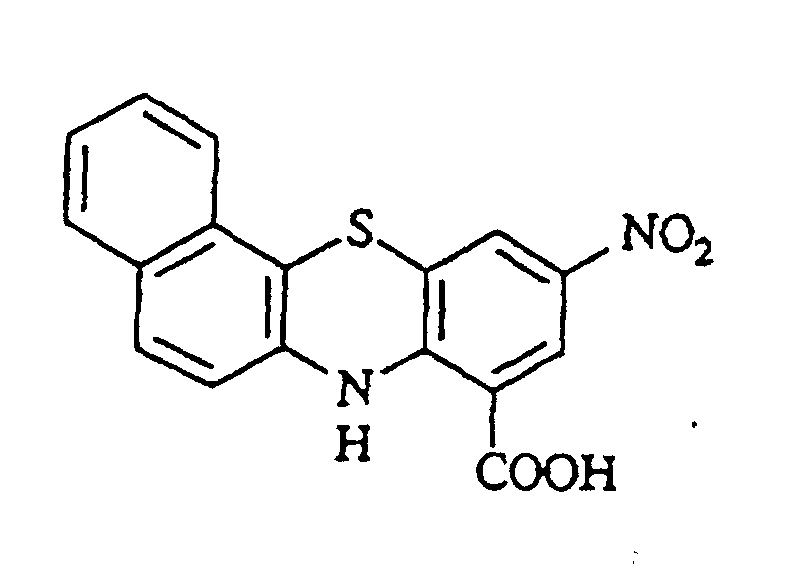
- 5 ml of a 2 N aqueous solution of sodium hydroxide was added to a solution of 1.7 g (9.73 mmol) of 2-amino-1-naphthalenethione in ethanol (30 ml) and the obtained mixture was heated under reflux. To this mixture was added 2.54 g (9.76 mmol) of methyl 2-chloro-3,5-dinitrobenzoate and the obtained mixture was heated under reflux for 1 hour. To this mixture were added 10 ml of a 2 N aqueous solution of sodium hydroxide and 40 ml of ethanol and the obtained mixture was heated under reflux for additional 10 hours. Then it was brought back to room temperature and concentrated. After adding water, 1 N hydrochloric acid was slowly added thereto under stirring to thereby regulate the pH value to about 1. The precipitate was recovered by filtration and washed successively with ethanol and methanol to thereby give 1.14 g of the title compound.
1H-NMR(DMSO-d6) δ(ppm) ;7.04(d,J=8.4Hz,1H),7.40 (t, J=8.4Hz 1H), 7.55(t, J=8.4Hz, 1H), 7.64(d, J=8.4Hz, 1H), 7.68(d, J=8.4Hz, 1H), 7.82 (d, J=8.4Hz, 1H), 7.90 (s, 1H), 8.35(s, 1H), 11.37(br-s, 1H) -
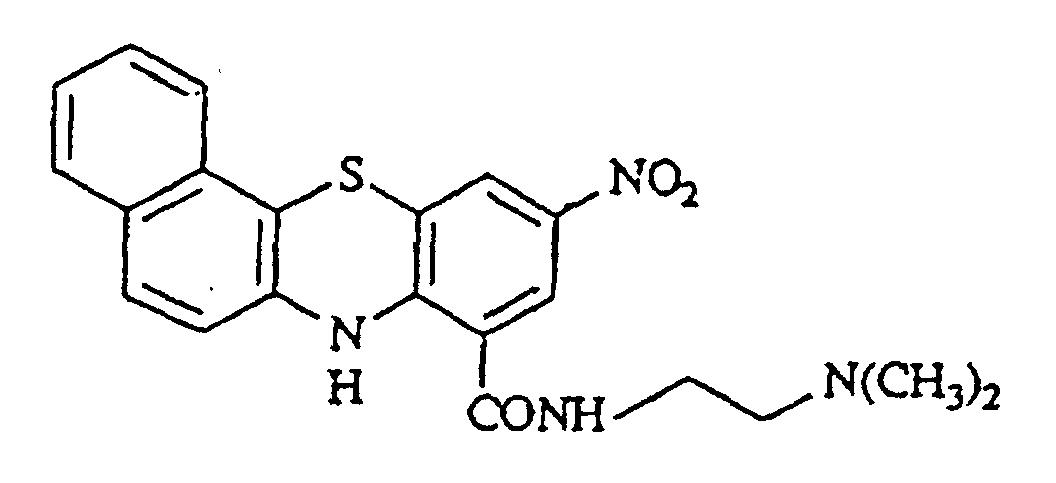
- 10 ml of phosphorus trichloride and 2 ml of dimethylformamide were successively added to a suspension of 1.82 g (5.39 mmol) of the compound of Production Example 22 in chloroform (60 ml) at 0°C. Then it was slowly brought back to room temperature and stirred overnight. After completely distilling off the solvent from the mixture under reduced pressure, 30 ml of dichloromethane was added to the residue. While stirring at 0°C, a solution of 5 ml of N,N-dimethylethylenediamine in dichloromethane (30 ml) was dropped into the mixture. Then the reaction mixture was slowly brought back to room temperature and stirred at room temperature for 7 hours. Next, water and a saturated aqueous solution of sodium hydrogencarbonate were added thereto and the obtained mixture was stirred and filtered through celite to thereby eliminate the insoluble matters therefrom. The organic layer was taken up, washed successively with water and a saturated aqueous solution of sodium chloride, dried over anhydrous magnesium sulfate, concentrated to dryness and recrystallized from ethanol to thereby give 956 mg of the title compound.
1H-NMR(DMSO-d6) δ(ppm) ;
2.20(s,6H),2.45(t,J=6.0Hz,2H),3.37(t,J=6.0Hz,2H), 7.06(d,J=8.4Hz,1H),7.41(t,J=8.4Hz,1H),7.56(t, J=8.4Hz,1H),7.66(t,J=8.4Hz,1H),7.69(d,J=8.4Hz,1H), 7.83(d,J=8.4Hz,1H),7.93(br-s,1H),8.39(d,J=2.9Hz, 1H),9.50(br-s,1H) -

- The title compound was obtained by reacting 5,6-dihydro-3-(4-methylbenzenesulfonamido)-7H-benzo[c]carbazole-8-carboxylic acid, which had been obtained by heating under reflux 6-(4-methylbenzenesulfonamido)-2-tetralone and 2-hydrazinobenzoic acid hydrochloride in xylene, in the same manner as the one of Production Example 2.
1H-NMR(DMSO-d6) δ(ppm) ;2.26(s,3H),7.29(d, J=8.0Hz,2H),7.35(dt,J=2.0,7.6Hz,1H),7.46(d,J=8.8Hz,1 H),7.66(d,J=6.8Hz,2H),7.71(s,1H),7.79(d,J=9.2Hz, 1H),7.96(dd,J=2.0,9.2Hz,1H),8.01(d,J=8.8Hz,1H),8.66( d,J=8.8Hz,1H),8.79(d,J=8.0Hz,1H),10.33(s,1H),11.76(s, 1H) -

- A suspension of 4.24 g (22.5 mmol) of 1-naphthylhydrazine hydrochloride in acetic acid (35 ml) was slowly boiled and a solution of 3.4 g (20.6 mmol) of 2-nitrophenylacetaldehyde in acetic acid (15 ml) was dropped thereinto under stirring. After the completion of the dropping, the obtained mixture was heated under reflux for 1 hour. Then 20 ml of a mixture of 1 N hydrochloric acid with acetic acid was further added thereto and the obtained mixture was heated under reflux for additional 1 hour. After distilling off the solvent, the residue was dissolved by adding ethyl acetate thereto. The organic layer was washed successively with an aqueous solution of sodium hydrogencarbonate, water and a saturated aqueous solution of sodium chloride and dried over anhydrous magnesium sulfate. After distilling off the solvent, the residue was purified by silica gel column chromatography to thereby give 1.91 g (yield: 32%) of 7-(2-nitrophenyl)benz[g]indole. Then the obtained product was dissolved in ethyl acetate (60 ml) and 200 mg of platinum (IV) oxide was added thereto. Then catalytic reduction was effected under atmospheric pressure in a hydrogen atmosphere at room temperature to thereby give 1.7 g (yield: 99%) of 7-(2-aminophenyl)benz[g]indole.
- Subsequently, 20 ml of ethanol was added to 540 mg (2.1 mmol) of 7-(2-aminophenyl)benz[g]indole and 260 mg (2.5 mmol) of ethyl glyoxylate (polymeric) and the obtained mixture was heated under reflux for 8 hours. After distilling off the solvent, the residue was purified by silica gel column chromatography to thereby give 380 mg (yield: 53%) of the title compound.
1H-NMR(CDCl3) δ(ppm);1.64(t,J=7.1Hz,3H),4.74(q, J=7.1Hz,2H),7.63-7.77(m,3H),7.79(d,J=8.6Hz,1H), 7.79-7.85(m,1H),8.06(dd,J=1.3,7.7Hz,1H),8.35 (dd,J=0.7,8.1Hz,1H),8.45(dd,J=1.3,8.4Hz,1H),8.54(d,J =8.6Hz,1H),8.79(dd,J=1.1,8.2Hz,1H),10.98(br-s,1H) -

- 457 mg (10.5 mmol) of sodium hydride (55% oily) was added to a solution of 1.44 g of the compound of Production Example 3 in dimethylformamide (50 ml) at room temperature and the obtained mixture was stirred for 50 minutes. Then 1 ml (10.5 mmol) of ethyl chloroformate was added thereto at 0°C and the obtained mixture was stirred at the same temperature for 2 hours and then at room temperature for 6 hours. After adding water, the precipitate was recovered by filtration, washed with water and dried. Then it was dissolved in a mixture of dichloromethane with methanol and the insoluble matters were filtered off. After concentrating, ethanol and conc. hydrochloric acid were successively added thereto. The hydrochloride thus formed was recovered by filtration and recrystallized from ethanol to thereby give 1.24 g of the title compound.
M.p.: 254 - 255°C (recrystallized from ethanol).
FAB mass spectrometry m/z: 358 ([M+H]+)
1H-NMR(DMSO-d6) δ(ppm) ;2.90(d,J=5.5Hz,6H),3.49 (q,J=5.5Hz,2H),4.42(t,J=5.5Hz,2H),7.67(t,J=8.0Hz,1H), 7.78(t,J=8.0Hz,1H),7.83(t,J=8.0Hz,1H),8.14(d, J=8.0Hz,1H),8.19(d,J=8.0Hz,1H),8.23(d,J=8.8Hz,1H), 8.62(d,J=8.0Hz,1H),8.86(d,J=8.0Hz,1H),9.02(d, J=8.0Hz,1H),9.70(br-s,1H)Elemental analysis: as C22H19N3O2·HCl·H2O C H N calcd. 64.15 5.38 10.20 found 64.38 5.05 10.22 -
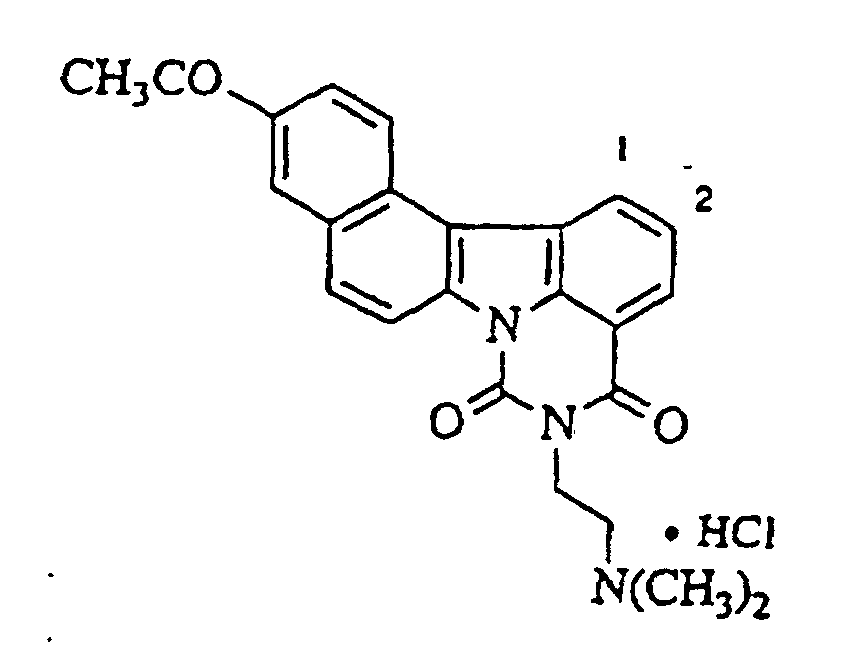
- 13.2 mg (0.549 mmol) of sodium hydride was added to a solution of 105 mg (0.282 mmol) of the compound of Production Example 5 in dimethylformamide (2.5 ml) at 0°C and the obtained mixture was stirred at the same temperature for 1 hour and 10 minutes and then at room temperature for 1 hour. Then 53.6 µl (0.564 mmol) of ethyl chloroformate was added thereto at 0°C and the obtained mixture was stirred at the same temperature for 1 hour and 20 minutes. After extracting by adding water and chloroform, the organic layer was taken up, dried over sodium sulfate and concentrated. The residue was purified by silica gel column chromatography and converted into its hydrochloride by using 1 N hydrochloric acid (ethanol) to thereby give 106 mg of the title compound.
M.p.: being colored from about 240°C on and decomposed at about 250 - 254°C.
FAB mass spectrometry m/z: 400 ([M+H]+)
1H-NMR(DMSO-d6) δ(ppm) ;2.78(s,3H),2.92(s,6H),3.48-3.54(m,2H),4.44(t,J=5.6Hz,2H),7.80(t,J=7.5Hz,1H), 8.16(d,J=7.5Hz,1H),8.24(dd,J=2.3,9.4Hz,1H),8.40(d, J=8.9Hz,1H),8.68(d,J=8.9Hz,1H),8.87-8.91(m,2H), 9.01(d,J=7.5Hz,1H),9.88(br-s,1H)Elemental analysis: as C24H21N3O3·HCl·H2O C H N Calcd. 63.50 5.33 9.26 found 63.42 5.04 9.16 -
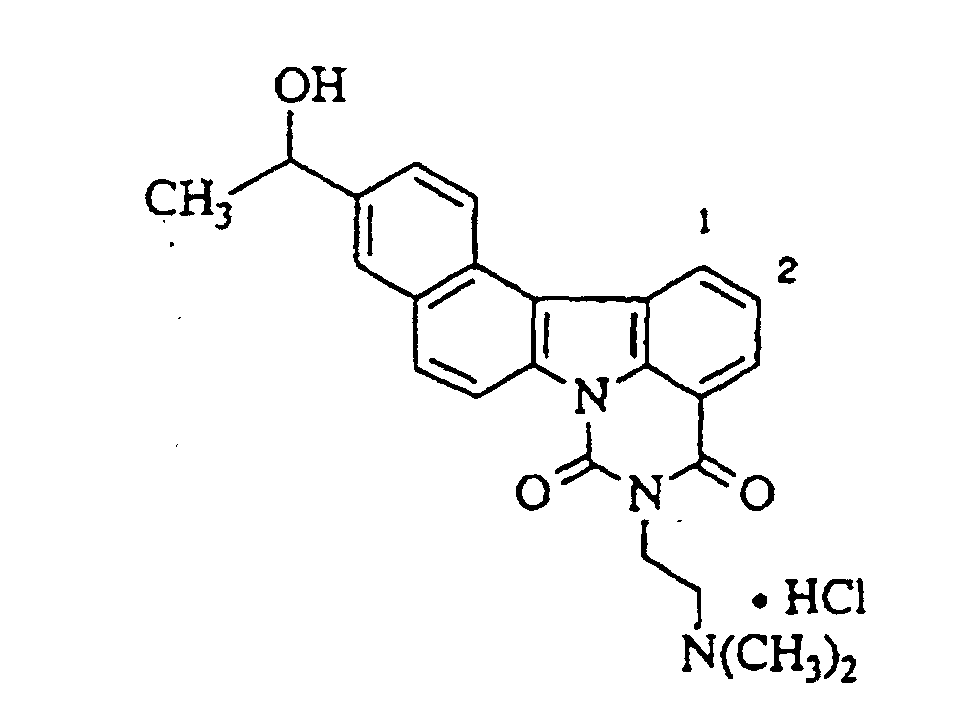
- 21 µl (0.168 mmol) of a borane/pyridine complex (about 8 M) was added to a suspension of 84 mg (0.211 mmol) of a compound prepared by converting the compound of Example 2 into its free base in acetic acid (1.5 ml) and the obtained mixture was stirred at 70°C for 3 hours. Then it was acidified by adding 1 N hydrochloric acid thereto at room temperature, stirred for 1 minute and neutralized with a saturated aqueous solution of sodium bicarbonate. Next, it was extracted by adding thereto a mixture of dichloromethane with ethanol. The organic layer was taken up, washed with water, dried over sodium sulfate and concentrated. The residue was purified by preparative thin layer chromatography and converted into its hydrochloride by using 1 N hydrochloric acid to thereby give 44 mg of the title compound.
M.p. ; 247 ∼ 248 °C (decomposition) (recrystallized from ethanol)
FAB MASS SPECTROMETRY m/z:402 ([M+H]+ )
1H-NMR(DMSO-d6) δ(ppm) ;1.50(d,J=5.0Hz,3H),2.92 (s,6H),3.49(t,J=5.7Hz, 2H),4.43(t,J=5.7Hz,2H),4.95-5.05(m,1H),5.45(d,J=4.2Hz,1H),7.77(t,J=8.4Hz,1H), 7.84(d,J=8.4Hz,1H),8.08-8.15(m,2H),8.21(d,J=8.4Hz, 1H),8.59(dd,J=1.4,8.4Hz,1H),8.81(d,J=8.4Hz,1H),8.99( d,J=7.6Hz,1H),9.90(br-s,1H)Elemental analysis : as C24H24N3O3Cl C H N Calcd. 65.82 5.52 9.60 found 65.49 5.53 9.49 -
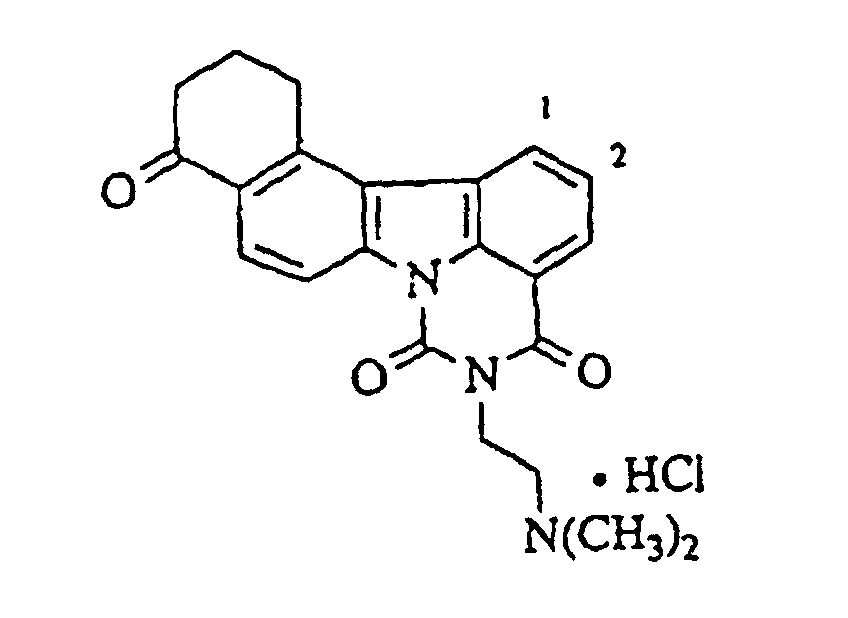
- A solution of 4.9 g (14 mmol) of the compound of Production Example 8 in dimethylformamide (70 ml) was dropped into a suspension of 0.9 g (37.5 mmol) of sodium hydride in dimethylformamide (30 ml) at room temperature and the obtained mixture was stirred at the same temperature for 2 hours. Then 2.5 g (23 mmol) of ethyl chloroformate was added thereto under ice-cooling and stirring. 15 minutes thereafter, ethyl acetate was added thereto and the obtained mixture was washed successively with dilute aqueous ammonia and an aqueous solution of sodium chloride and dried over magnesium sulfate. After concentrating, methanol was added thereto and crystals were recovered by filtration. Then these crystals were suspended in methanol and acidified by adding 1 N hydrochloric acid thereto under stirring. After stirring at room temperature and concentrating, ethanol was added thereto and the precipitate thus formed was recovered by filtration to thereby give 4.3 g of the title compound.
M.p.: being colored from about 250°C on, gradually decomposed from about 260°C on and rapidly decomposed at about 273 - 275°C.
FAB MASS SPECTROMETRY m/z:376 ([M+H]+ )
1H-NMR(DMSO-d6) δ(ppm) ;2.22-2.36(m,2H),2.72-2.80(m,2H),2.92(s,6H), 3.44-3.54(m,2H),3.54-3.60(m,2H),4.38-4.46(m,2H),7.75(t,J=7.6Hz,1H),8.17 (dd,J=0.8.7.6Hz,1H),8.25(d,J=8.8Hz,1H),8.41(d,J=8.8H z,1H),8.61(dd,J=0.8,7.6Hz,1H),9.52(br-s,1H)Elemental analysis : as C22H21N3O3·HCl·1H2O C H N Calcd. 61.47 5.63 9.77 found 61.47 5.57 9.77 -

- 0.5 g (1.2 mmol) of the compound of Example 4 was dissolved in a mixture of water (50 ml) with methanol (25 ml) and 1.2 ml of 1 N hydrochloric acid was added thereto. Next, hydrogenation was effected in the presence of palladium-carbon under a hydrogen pressure of about 4.5 kg/cm2. After confirming the completion of the reaction by thin layer chromatography, the catalyst was filtered off and the residue was concentrated to about 2/3. After adding 50 ml of water and 5 ml of conc. aqueous ammonia thereto, the obtained mixture was extracted with ethyl acetate. The organic layer was taken up, washed with an aqueous solution of sodium chloride, dried over magnesium sulfate and concentrated. The residue was purified by silica gel column chromatography to thereby give 0.35 g of the title compound.
FAB MASS SPECTROMETRY m/z:378 ([M+H]+ )
1H-NMR(CDCl3) δ(ppm) ;1.92-2.30(m,4H),2.37(s,6H), 2.70(t,J=6.8Hz,2H),3.06-3.32(m,2H),4.32(t,J=6.8Hz, 2H),4.95(br-t,J=4.8Hz,1H),7.52(t,J=7.6Hz,1H),7.67 (d,J=8.4Hz,1H),8.09(dd,J=0.8,7.6Hz,1H),8.15(dd, J=0.8,7.6Hz, 1H),8.33(d,J=8.4Hz,1H)Elemental analysis : as C22H23N3O3·1H2O C H N Calcd. 66.82 6.37 10.63 found 67.10 6.03 10.34 -

- The compound of Example 5 was resolved with an optical resolution column [Chiralcel OD, mfd. by Daicel; eluted with n-hexane/2-propanol (7 : 3 - 6 : 4)]. The fraction eluted earlier was concentrated to dryness to thereby give the title compound.
M.p. ; 160 ∼162 °C
FAB MASS SPECTROMETRY m/z:378 ([M+H]+ )
1H-NMR(CDCl3) δ(ppm) ;1.90-2.30(m,4H),2.43(s,6H), 2.77(t,J=6.4Hz,2H),3.04-3.31(m,2H),4.34(t,J=6.8Hz, 2H),4.95(br-t,J=4.8Hz,1H),7.51(t,J=7.6Hz,1H),7.68 (d,J=8.4Hz,1H),8.08(d,J=7.6Hz,1H),8.13(d,J=7.6Hz, 1H),8.32(d,J=8.4Hz,1H)Elemental analysis : as C22H23N3O3·0.75H2O C H N Calcd. 67.59 6.32 10.75 found 67.34 5.93 10.48 -

- The title compound was obtained from the compound of Production Example 10 by the same method as the one of Example 2.
M.p.: being colored from about 255°C on and gradually decomposed from about 265°C on.
FAB MASS SPECTROMETRY m/z:362 ([M+H]+ )
1H-NMR(DMSO-d6) δ(ppm) ;2.83-2.94(m,8H),3.45 (br-s,2H),3.64(br-t,J=6.0Hz,2H),4.42(br-t,J=6.0Hz, 2H),7.79(t,J=7.6Hz,1H),7.97(d,J=8.4Hz,1H),8.19(dd, J=0.8,7.6Hz,1H),8.49(d,J=8.4Hz,1H),8.55(dd,J=0.8, 7.6Hz,1H), 9.44(br-s,1H)Elemental analysis : as C21H19N3O3·HCl·0.75H2O C H N Calcd. 61.31 5.27 10.21 found 61.17 5.04 10.16 -

- 590 mg (2.2 mmol) of the compound of Production Example 5 was dissolved in dimethylformamide (20 ml). After adding 720 mg (4.4 mmol) of N,N'-carbonyldiimidazole thereto, the obtained mixture was stirred at room temperature for 30 minutes. Then 0.97 ml (8.8 mmol) of N,N-dimethylethylenediamine was further added thereto and the obtained mixture was stirred overnight followed by concentration. Water was added to the residue and the obtained mixture was extracted with a mixture of ethyl acetate with tetrahydrofuran. The organic layer was taken up, washed successively with a saturated aqueous solution of sodium bicarbonate and water and dried over magnesium sulfate. After concentrating, the residue was purified by silica gel column chromatography to thereby give 250 mg of 2,3-dihydro-N-[2-(dimethylamino)ethyl]-3-oxo-6H-furo[3,2-c]carbazole-7-carboxamide. This product was dissolved in dimethylformamide (10 ml). After adding 60 mg (1.5 mmol) of sodium hydride (oily 60%) thereto, the mixture was stirred in a nitrogen atmosphere for 30 minutes. After adding 0.145 ml (1.5 mmol) of ethyl chlorformate thereto under ice-cooling, the obtained mixture was stirred for 30 minutes and then acidified by adding 1 N hydrochloric acid thereto. After concentrating, a saturated aqueous solution of sodium bicarbonate was added thereto and the obtained mixture was extracted with a mixture of ethyl acetate with tetrahydrofuran. The organic layer was taken up, washed with water, dried over magnesium sulfate, concentrated and purified by silica gel column chromatography. Then it was suspended in ethanol (20 ml). After adding thereto 1 ml of 1 N hydrochloric acid and stirring, crystals were recovered by filtration to thereby give 175 ml of the title compound.
M.p.: being colored from about 240°C on and decomposed at about 270 - 273°C.
FAB MASS SPECTROMETRY m/z:364 ([M+H]+ )
1H-NMR(DMSO-d6) δ (ppm) ;2.89(br-s,6H),3.42-3.50(m,2H),4.39-4.45(m,2H),5.14(s,2H),7.78(t, J=7.7Hz,1H),7.95(d,J=8.4Hz,1H),8.17(dd,J=0.8,7.7Hz,1 H),8.22(d,J=8.4Hz,1H),8.43(dd,J=0.8,7.7Hz,1H),9.62(b r-s,1H)Elemental analysis : as C20H17N3O4·HCl·0.15H2O C H N Calcd. 59.68 4.58 10.44 found 59.64 4.49 10.33 -

- 105.5 mg (0.29 mmol) of the compound of Example 8 was dissolved in acetic acid (1 ml). Then 36 µl of an 8 M borane/pyridine complex was added thereto under stirring at room temperature. The obtained mixture was stirred for 4.5 hours. After adding 30 µl of an 8 M borane/pyridine complex thereto, the obtained mixture was further stirred overnight and concentrated. Then it was extracted by adding thereto water, a saturated aqueous solution of sodium hydrogencarbonate and chloroform. The organic layer was dried over anhydrous sodium sulfate and concentrated. The residue was purified by silica gel column chromatography. The product thus obtained was recrystallized from ethanol/diisopropyl ether to thereby give 22.6 mg of the title compound.
1H-NMR(DMSO-d6) δ(ppm) ; 2.24(s,6H),2.56(t,J=6.8Hz,2H),4.15(t,J=6.8Hz,2H), 4.56(dd,J=2.8,10.0Hz,1H),4.84(dd,J=6.8,10.0Hz,1H), 5.43-5.49(m,1H),5.80(d,J=5.6Hz,1H),7.61-7.67(m,2H), 7.97(d,J=8.4Hz,1H),8.02(dd,J=0.8,7.6Hz,1H),8.22(dd,J =0.8,7.6Hz,1H) -

- 0.23 g (0.57 mmol) of the compound of Production Example 17 and 95 mg (0.1 mmol) of tris(triphenylphosphine)rhodium chloride (95 mg; 0.1 mmol) were dissolved in 20 ml of a mixture of acetonitrile with water (84 : 16). Then the obtained mixture was heated in a nitrogen atmosphere to thereby distill off the solvent, while dropping a mixture of acetonitrile with water (84 : 16) thereinto so as to maintain the volume of the mixture at a constant level. After continuing this operation for about 3 hours, the disappearance of the starting compounds was confirmed by thin layer chromatography. Then the reaction mixture was concentrated to about 1/4 and extracted with ethyl acetate. The organic layer was taken up, washed successively with dilute aqueous ammonia and an aqueous solution of sodium chloride, dried over magnesium sulfate and concentrated. The residue was purified by preparative thin layer chromatography and then converted into its hydrochloride by the same method as that of Example 4 to thereby give 0.1 g of the title compound.
M.p.: being colored from about 250°C on, gradually decomposed from about 260°C on and rapidly decomposed at about 267 - 269°C.
FAB MASS SPECTROMETRY m/z:362 ([M+H]+ )
1H-NMR(DMSO-d6 · D2O) δ(ppm) ;2.24-2.34(m,2H),2.59 (s,3H),2.76(br-t,J=6.0Hz,2H),3.31(br-t,J=5.2Hz,2H), 3.56(br-t,J=6.0Hz,2H),4.36(br-t,J=5.2Hz,2H),7.75 (t,J=8.0Hz,1H),8.16(d,J=8.0Hz,1H),8.24(d,J=8.8Hz, 1H),8.39(d,J=8.8Hz,1H),8.59(d,J=8.0Hz,1H)Elemental analysis : as C21H19N3O3·HCl·0.2H2O C H N calcd. 62.83 5.12 10.47 found 62.78 5.09 10.36 -
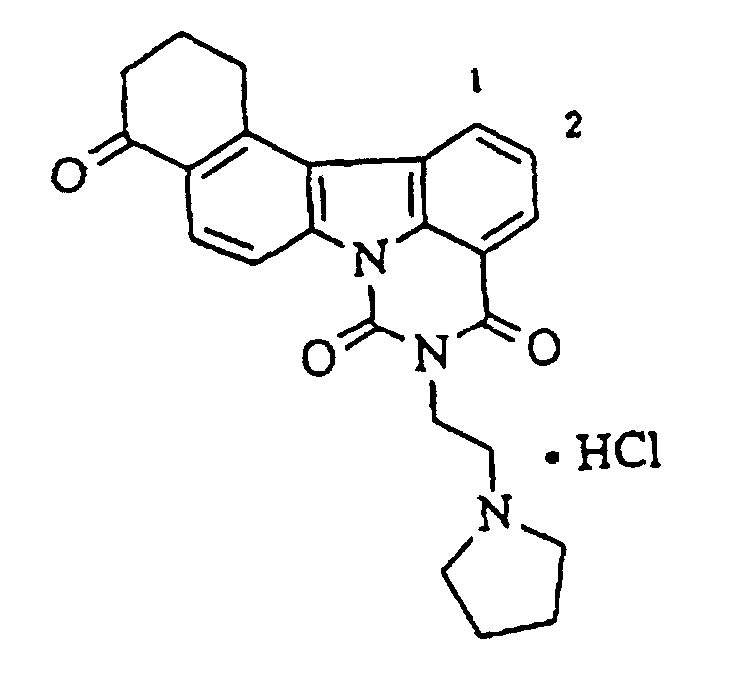
- The title compound was obtained by reacting the compound of Production Example 7 with 1-(2-aminoethyl) pyrrolidine by the same methods as those of Production Example 8 and Example 4.
M.p.: being colored from about 235°C on and gradually decomposed from about 260°C on.
FAB MASS SPECTROMETRY m/z:402 ([M+H]+ )
1H-NMR(DMSO-d6) δ(ppm) ;1.86(br-s,2H),2.01 (br-s,2H),2.23-2.32(m,2H), 2.71-2.79(m,2H),3.15 (br-s,2H),3.46-3.74(br-t+m,J=6.0Hz,4H+2H),4.40 (br-t,J=5.2Hz,2H),7.73(t,J=8.0Hz,1H),8.15(d,J=8.0Hz, 1H),8.23(d,J=8.8Hz,1H),8.39(d,J=8.8Hz,1H),8.57 (d,J=8.0Hz,1H),10.10(br-s,1H)Elemental analysis : as C24H23N3O3·HCl·1.5H2O C H N calcd. 62.00 5.85 9.04 found 62.27 5.49 9.03 -

- The title compound was obtained by reacting the compound of Production Example 2 with 1-(2-aminoethyl)pyrrolidine by the same methods as those of Production Example 3 and Example 1.
FAB MASS SPECTROMETRY m/z:384 ([M+H]+ )
1H-NMR(DMSO-d6) δ(ppm) ;1.78-1.92(m,2H),1.94-2.06 (m,2H),3.08-3.22(m,2H),3.56(t,J=5.6Hz,2H),3.60-3.70 (m,2H),4.41(t,J=5.6Hz,2H),7.66(t,J=7.6Hz,1H),7.75(t, J=8.0Hz,1H),7.81(t,J=8.0Hz,1H),8.11(d,J=7.6Hz,1H), 8.18(d,J=8.0Hz,1H),8.21(d,J=9.2Hz,1H),8.60(d, J=9.2Hz,1H),8.83(d,J=8.0Hz,1H),8.98(d,J=7.6Hz,1H), 10.29(br-s,1H)Elemental analysis : as C24H21N3O3·HCl·H2O C H N Calcd. 65.83 5.52 9.60 found 66.04 5.57 9.53 -
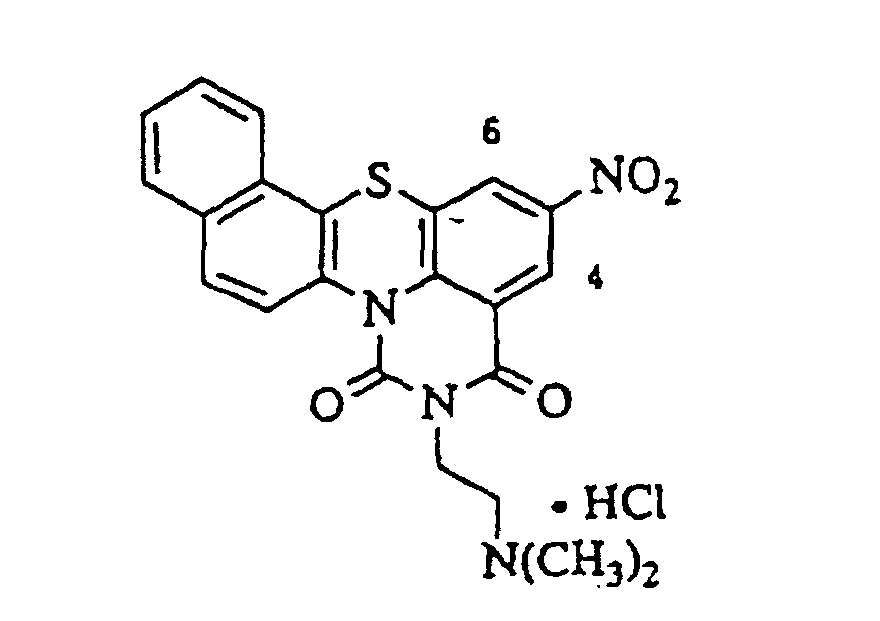
- A solution of 200 mg (0.49 mmol) of the compound of Production Example 23 in tetrahydrofuran (15 ml) was stirred at room temperature and 0.5 ml of triethylamine and 200 µl (2.09 mmol) of ethyl chloroformate were successively added thereto. After stirring at room temperature overnight, the reaction mixture was concentrated and extracted by adding thereto water, a saturated aqueous solution of sodium hydrogencarbonate and dichloromethane. The organic layer was washed successively with water and a saturated aqueous solution of sodium chloride, dried over anhydrous magnesium sulfate and concentrated to dryness. The residue was recrystallized from ethanol to thereby give 104 mg of the free base of the title compound. Next, this product was suspended in methanol and conc. hydrochloric acid was added thereto under stirring. Then the obtained mixture was concentrated to dryness to thereby give the title compound.
1H-NMR(DMSO-d6) δ(ppm) ;2.90(s,6H),3.49(br-s,2H),4.38 (t,J=5.6Hz,2H),7.66(t,J=7.6Hz,1H),7.73(t,J=7.6Hz, 1H),7.82(d,J=9.2Hz,1H),7.96(d,J=8.8Hz,1H),8.03(d, J=8.0Hz,1H),8.09(d,J=8.4Hz,1H),8.49-8.52(m,1H), 8.59-8.62(m,1H),9.72(br-s,1H) -

- The title compound was obtained by starting with 4-oxo-4,5,6,7-tetrahydro-benzo[b]thiophene and 2-hydrazinobenzoic acid hydrochloride and repeating the procedures of Production Examples 1, 2 and 3 and Example 2.
1H-NMR(DMSO-d6) δ(ppm) ;2.92(br-s,6H),3.44-3.57 (m,2H),4.44-4.51(m,2H),7.74(t,J=7.6Hz,1H),7.98(d, J=5.6Hz,1H),8.13(dd,J=0.8,7.6Hz,1H),8.26(d,J=8.4Hz,1 H),8.36(d,J=8.4Hz,1H),8.65(dd,J=0.8,7.6Hz,1H),8.84(d, J=5.6Hz,1H),9.53(br-s,1H) -
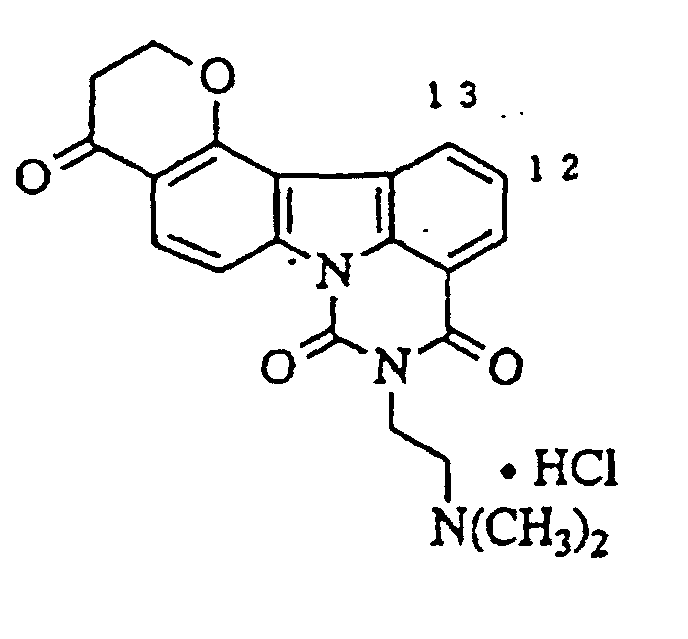
- The title compound was obtained by the same procedure as that of Example 2.
FAB MASS SPECTROMETRY m/z:378 ([M+H]+ )
1H-NMR(DMSO-d6) δ(ppm) ;2.88(s,6H),2.99(t,J=6.4Hz, 2H),3.46(br-s,2H),4.40(br-t,J=5.6Hz,2H),4.89(t, J=6.4Hz,2H),7.73(t,J=7.6Hz,1H),8.06(d,J=8.4Hz,1H), 8.09(d,J=8.4Hz,1H),8.12(d,J=7.6Hz,1H)),8.42(d, J=7.6Hz,1H),9.68(br-s,1H)Elemental analysis : as C21H19N3O4·HCl·1.25H2O C H N Calcd. 57.80 5.20 9.63 Found 57.99 5.07 9.69 -
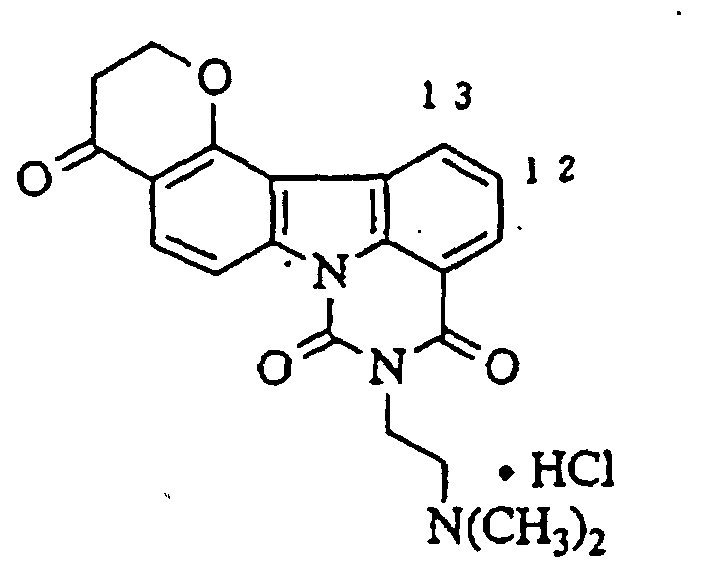
- The title compound was obtained by the same procedure as that of Example 2.
FAB MASS SPECTROMETRY m/z:376 ([M+H]+ )
1H-NMR(DMSO-d6) δ(ppm) ;2.89(s,6H),3.46(br-s,2H),4.43 (br-t,J=5.6Hz,2H),6.55(d,J=6.0Hz,1H),7.83(t, J=7.6Hz,1H),8.23(dd,J=0.8,7.6Hz,1H),8.34(d,J=8.8Hz,1 H),8.48(d,J=8.8Hz,1H),8.54(d,J=6.0Hz,1H)),8.65(dd,J= 0.8,7.6Hz,1H),9.52(br-s,1H) -

- The title compound was obtained by starting with 4-oxo-4,5,6,7-tetrahydrobenzo[b]furane and 2-hydrazinobenzoic acid hydrochloride and repeating the procedures of Production Examples 1, 2 and 3 and Example 2.
1H-NMR(DMSO-d6) δ(ppm) ;2.91(br-s,6H),3.40-3.55 (m,2H),4.41-4.51(m,2H),7.72(t,J=7.6Hz,1H),7.83(d, J=2.0Hz,1H),7.88(d,J=8.4Hz,1H),8.09(d,J=7.6Hz,1H), 8.20(d,J=2.0Hz,1H),8.32(d,J=8.4Hz,1H)),8.61(d, J=7.6Hz,1H),9.46(br-s,1H) -

- The title compound was obtained by starting with α-tetralone and 2-hydrazinobenzoic acid hydrochloride and repeating the procedures of Production Examples 1, 2 and 3 and Example 2.
1H-NMR(DMSO-d6) δ(ppm) ;2.89(s,6H),3.49(br-s,2H), 4.49(t,J=5.5Hz,2H),7.64-7.71(m,2H),7.74(t, J=8.0Hz,1H),8.11-8.18(m,3H),8.44(d,J=8.3Hz,1H), 8.66(d,J=8.0Hz,1H),9.59(br-s,1H),9.76(d,J=8.3Hz,1H)Elemental analysis : as C22H19N3O2·HCl·0.2H2O C H N Calcd. 66.48 5.17 10.57 found 66.47 5.20 10.51 -

- The title compound was obtained by reacting the compound of Production Example 2 with N,N-dimethyl-1,3-propanediamine in the same manner as those of Production Example 3 and Example 1.
FAB MASS SPECTROMETRY m/z:372 ([M+H]+ )
1H-NMR(DMSO-d6) δ(ppm) ;2.03-2.13(m,2H),2.74(s,6H), 3.19(t,J=8.0Hz,2H),4.12(t,J=6.0Hz,2H),7.65(t, J=7.2Hz,1H),7.75(t,J=8.0Hz,1H),7.81(t,J=7.6Hz,1H), 8.10(d,J=7.6Hz,1H),8.16(d,J=8.0Hz,1H),8.19(d, J=9.6Hz,1H),8.58(d,J=9.6Hz,1H),8.80(t,J=8.4Hz,1H), 8.94(d,J=8.0Hz,1H),9.69(br-s,1H)Elemental analysis : as C23H21N3O2·HCl·0.3H2O C H N Calcd. 66.84 5.51 10.17 found 66.75 5.45 10.03 -
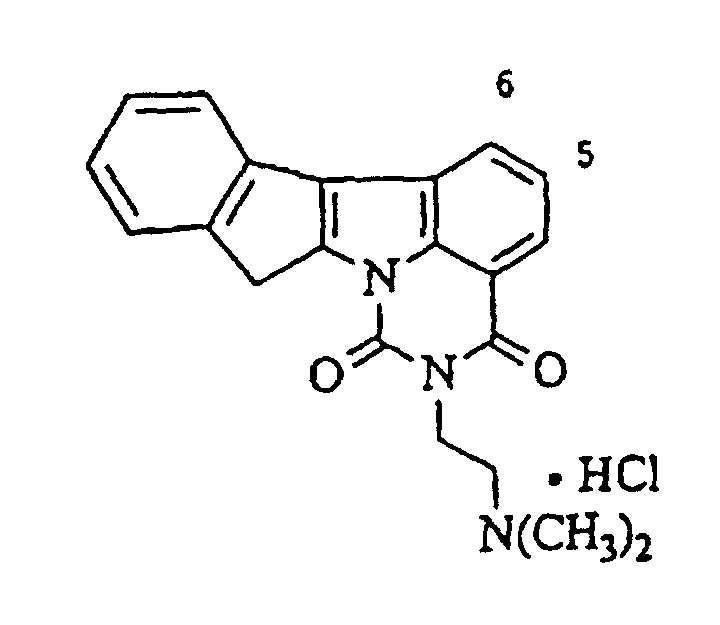
- The title compound was obtained by starting with 2-indanone and 2-hydrazinobenzoic acid hydrochloride and repeating the procedures of Production Examples 1 and 3 and Example 2.
1H-NMR(CD3OD) δ(ppm) ; 3.02(s,6H),3.53(t,J=5.8Hz,2H),4.10(s,2H),4.50(t, J=5.8Hz,2H),7.28(dt,J=1.2,7.6Hz,1H),7.41(dt,J=1.0, 7.6Hz,1H),7.56-7.59(m,1H),7.62(t,J=7.7Hz,1H),7.76-7.79(m,1H),8.02(dd,J=0.8,7.7Hz,1H),8.25(dd,J=0.8, 7.7Hz,1H) -
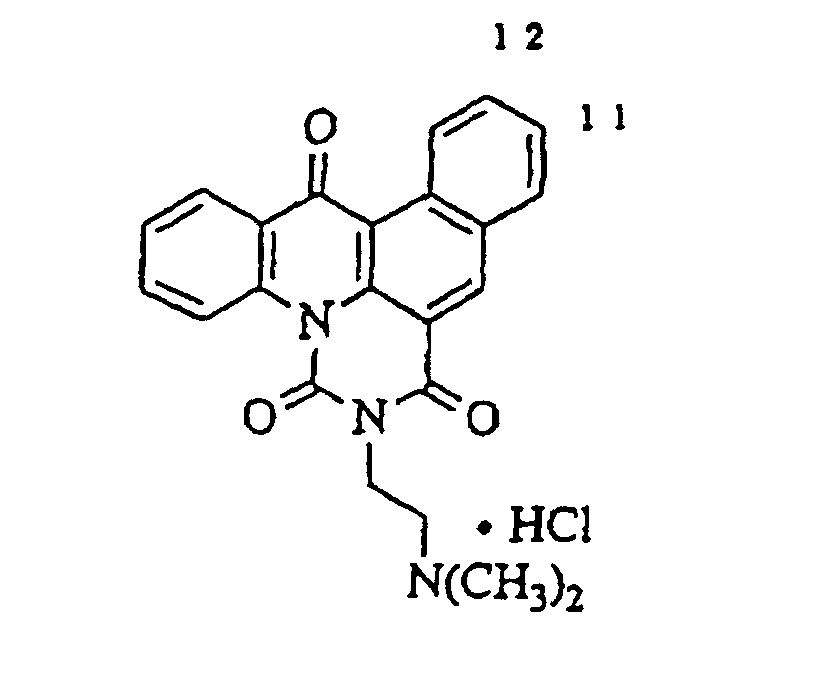
- The title compound was obtained by the same procedure as that of Example 2.
1H-NMR(DMSO-d6) δ(ppm) ;2.91(br-s,6H),3.50-3.56 (m,2H),4.49(t,J=5.7Hz,2H),7.64-7.69(m,1H),7.77-7.82(m,1H),7.87-7.92(m,1H),7.98-8.03(m,1H),8.37-8.40(m,1H),8.43-8.46(m,1H),8.63(dd,J=0.5,8.8Hz,1H), 9.26(s,1H),9.81(dd,J=0.7,8.6Hz,1H),10.04(br-s,1H) -
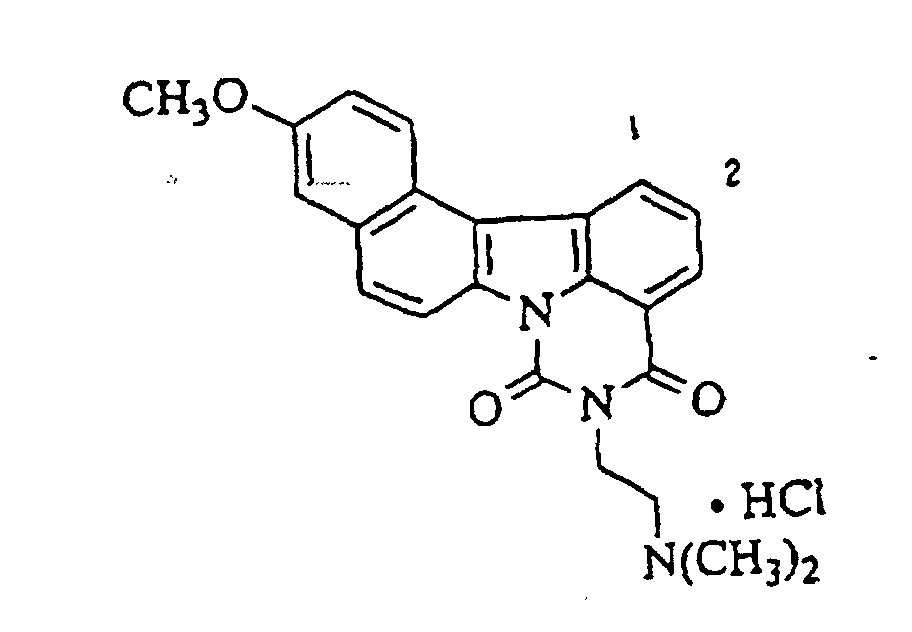
- The title compound was obtained by starting with 6-methoxy-β-tetralone and 2-hydrazinobenzoic acid hydrochloride and repeating the procedures of Production Examples 24 and 3 and Example 2.
1H-NMR(DMSO-d6) δ(ppm) ;2.93(d,J=4.6Hz,6H),3.47-3.54(m,2H),3.94(s,3H),4.39-4.45(m,2H),7.46(dd, J=2.2,9.0Hz,1H),7.62(d,J=2.2Hz,1H),7.78(t,J=8.4Hz, 1H),8.14(d,J=8.4Hz,1H),8.16(d,J=9.0Hz,1H),8.59(d, J=9.0Hz,1H),8.78(d,J=9.0Hz,1H),9.01(d,J=8.4Hz,1H), 9.16(br-s,1H)Elemental analysis : as C23H21N3O3·HCl·1.5H2O C H N Calcd. 61.26 5.59 9.32 found 61.08 5.46 9.40 -
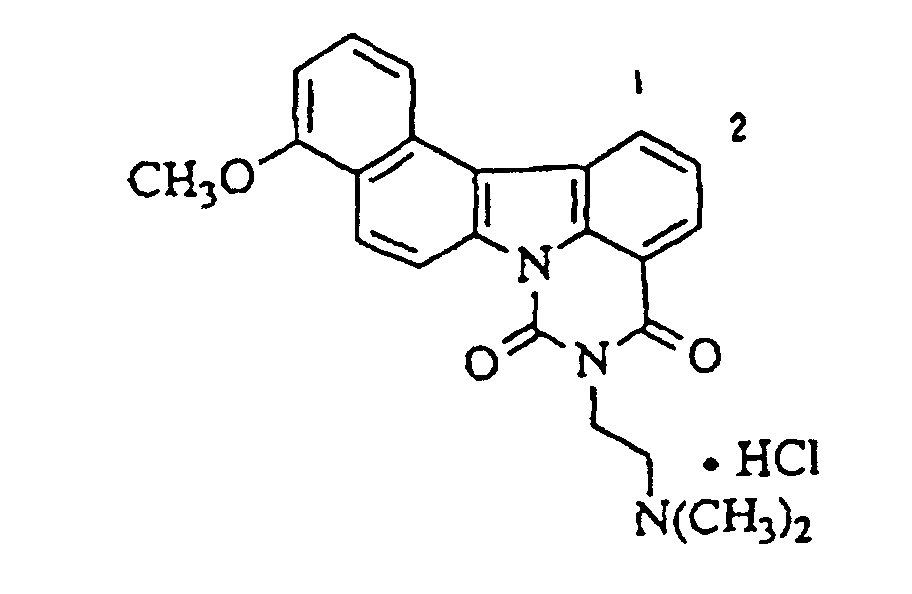
- The title compound was obtained by starting with 5-methoxy-β-tetralone and 2-hydrazinobenzoic acid hydrochloride and repeating the procedures of Production Examples 1, 2 and 3 and Example 2.
1H-NMR(DMSO-d6) δ(ppm) ;2.89(s,6H),3.44-3.51(m,2H), 4.04(s,3H),4.40(t,J=6.2Hz,2H),7.12(d,J=8.2Hz,1H), 7.72(t,J=8.5Hz,1H),7.73(dt,J=3.4,8.2Hz,1H),8.09(d, J=8.5Hz,1H),8.32(d,J=8.5Hz,1H),8.41(d,J=8.5Hz,1H), 8.52(dd,J=1.0,8.5Hz,1H),8.88(d,J=8.5Hz,1H),9.93(br-s,1H)Elemental analysis : as C23H21N3O3·HCl·1.3H2O C H N Calcd. 61.76 5.54 9.40 found 61.89 5.32 9.45 -
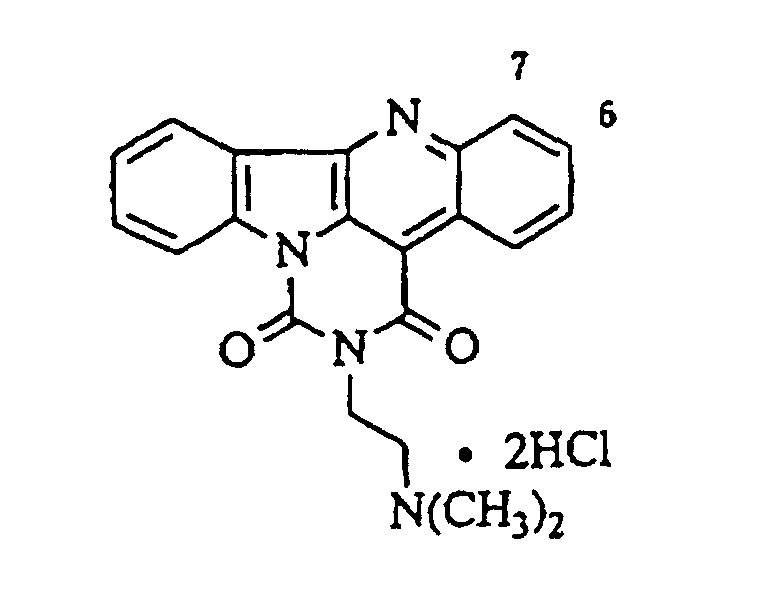
- The title compound was obtained by the same procedure as that of Example 2.
1H-NMR(DMSO-d6) δ(ppm) ;2.90(s,6H),3.47-3.55(m,2H), 4.48(t,J=6.3Hz,2H),7.67(t,J=7.8Hz,1H),7.86-7.95 (m,3H),8.36-8.44(m,3H),9.24-9.29(m,1H),10.41 (br-s,1H) -

- The title compound was obtained by the same procedure as that of Example 2.
1H-NMR(DMSO-d6) δ(ppm) ; 2.89(s,6H),3.47(t,J=6.0Hz,2H),3.64(t,J=6.0Hz,2H), 4.38(t,J=6.0Hz,2H),4.68(t,J=6.0Hz,2H),7.73(t, J=7.6Hz,1H),8.15(t,J=7.6Hz,1H),8.27(d,J=8.8Hz,1H), 8.44(d,J=8.8Hz,1H),8.55(d,J=7.6Hz,1H),9.82(br-s,1H) -
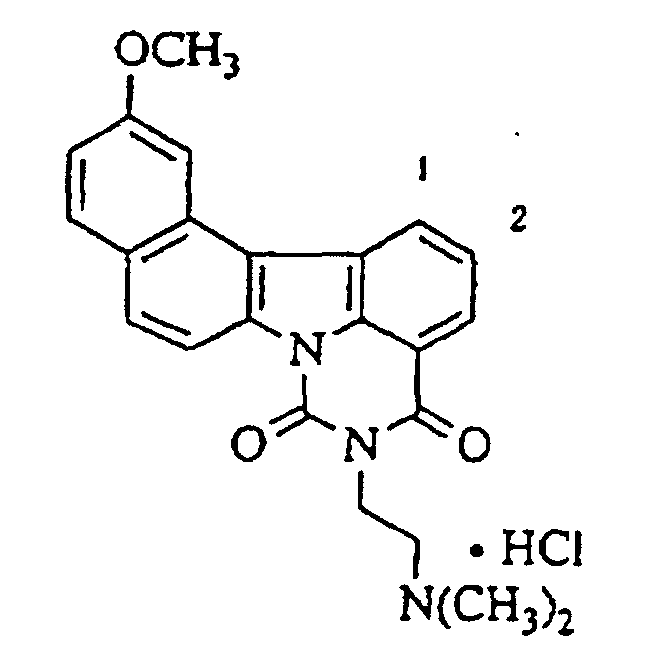
- The title compound was obtained by starting with 7-methoxy-β-tetralone and 2-hydrazinobenzoic acid hydrochloride and repeating the procedures of Production Examples 1, 2 and 3 and Example 2.
1H-NMR(DMSO-d6) δ(ppm) ;2.85(br-s,6H),3.35-3.46 (m,2H),4.08(s,3H),4.39(br-s,2H),7.32(dd,J=2.2, 8.8Hz,1H),7.79(t,J=7.8Hz,1H),7.99(d,J=1.7Hz,1H), 8.09-8.19(m,3H),8.48(d,J=8.8Hz,1H),8.97 (d,J=7.8Hz,1H),9.25(br-s,1H) -

- 304 mg (1.91 mmol) of 3-amino-2-naphthol, 477 mg (1.81 mmol) of methyl 2-chloro-3,5-dinitrobenzoate and 178 mg (2.17 mmol) of sodium acetate were suspended in a mixture of water (5 ml) with ethanol (10 ml) and heated under reflux for 7 hours. After adding 3 ml of a 2 N aqueous solution of sodium hydroxide thereto, the reaction mixture was heated under reflux for additional 2.5 hours and then brought back to room temperature. After adding 10 ml of 1 N hydrochloric acid thereto, the precipitate thus formed was recovered by filtration and washed successively with water, 1 N hydrochloric acid and ethanol to thereby give 430 mg of 3-nitro-12H-benzo[b]phenoxazine-1-carboxylic acid. Then this product was treated by the same methods as those of Production Example 23 and Example 13 to thereby give the title compound.
1H-NMR(DMSO-d6) δ(ppm) ;2.89(s,6H),3.45(t,J=5.2Hz, 2H),4.40(t,J=5.2Hz,2H),7.47(t,J=8.0Hz,1H),7.52(t,J=8. 0Hz,1H),7.69(s,1H),7.86(d,J=6.8Hz,1H),7.88(d, J=8.0Hz,1H),8.19(d,J=2.4Hz,1H),8.34(d,J=2.4Hz,1H), 9.05(s,1H),9.82(br-s,1H) -
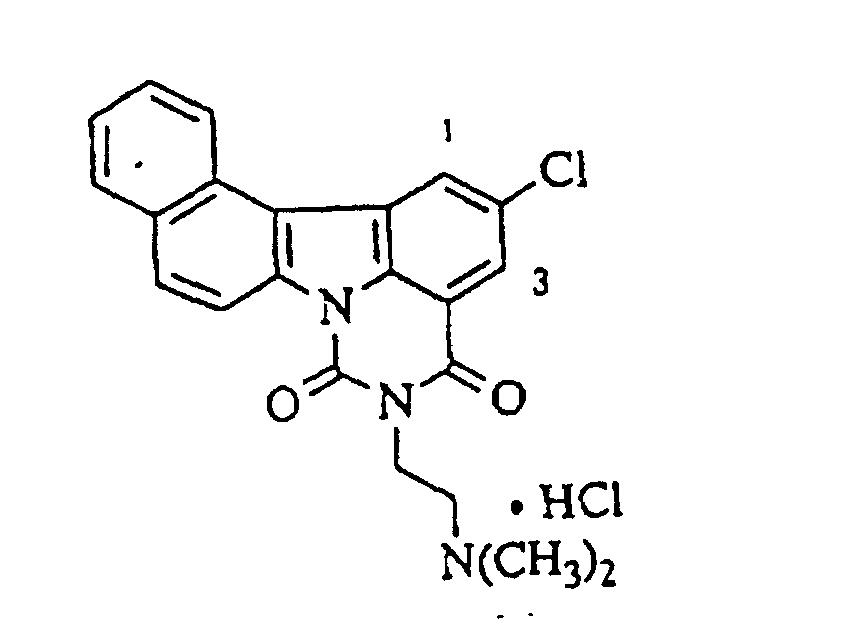
- The title compound was obtained by starting with β-tetralone and 5-chloro-2-hydrazinobenzoic acid hydrochloride and repeating the procedures of Production Examples 1, 2 and 3 and Example 2.
1H-NMR(DMSO-d6) δ(ppm) ; 2.89(br-s,6H),3.39-3.53(m,2H), 4.38-4.48(m,2H),7.68-7.75(m,1H),7.81-7.89(m,1H),8.13(d,J=1.6Hz,1H),8.22(d,J=8.4Hz,1H), 8.31(d,J=8.8Hz,1H),8.63(d,J=8.8Hz,1H),8.94(d, J=8.4Hz,1H),9.14(d,J=1.6Hz,1H),9.46(br-s,1H)Elemental analysis : as C22H18N3O2Cl·HCl·1.75H2O C H N Calcd. 57.46 4.93 9.14 found 57.65 4.57 8.76 -

- The title compound was obtained by saponifying an ester of the compound of Production Example 20 and then repeating the procedures of Production Example 3 and Example 2.
1H-NMR(DMSO-d6) δ(ppm) ;2.90(br-s,6H),3.43-3.53 (m,2H),4.40-4.46(m,2H),6.80-6.83(m,1H),7.34-7.38
(m,1H),7.73(t,J=7.9Hz,1H),8.01(d,J=8.9Hz,1H),8.18 (dd,J=0.9,7.9Hz,1H),8.89(d,J=8.9Hz,1H),9.52 (br-s,1H),9.91(dd,J=0.9,7.9Hz,1H),11.67-11.71(m,1H)Elemental analysis : as C21H18N4O3·HCl·1.3H2O C H N Calcd. 58.08 5.01 12.90 found 57.94 4.78 12.72 -

- The title compound was obtained by the same method as the one of Production Example 2.
FAB MASS SPECTROMETRY m/z;359 ([M+H]+ )
1H-NMR(DMSO-d6+D2O) δ(ppm) ; 2.94(s,6H),3.54 (br-t,J=5.6Hz,2H),4.47(br-t,J=5.6Hz,2H), 7.89(t,J=7.6Hz,1H),7.91-7.99(m,2H),8.30-8.37
(m,2H),8.89-8.95(m,1H),9.16(d,J=7.6Hz,1H), 9.97(s,1H)Elemental analysis : as C21H18N4O2·2HCl·0.5H2O C H N Calcd. 57.28 4.81 12.72 found 57.28 4.97 12.60 -
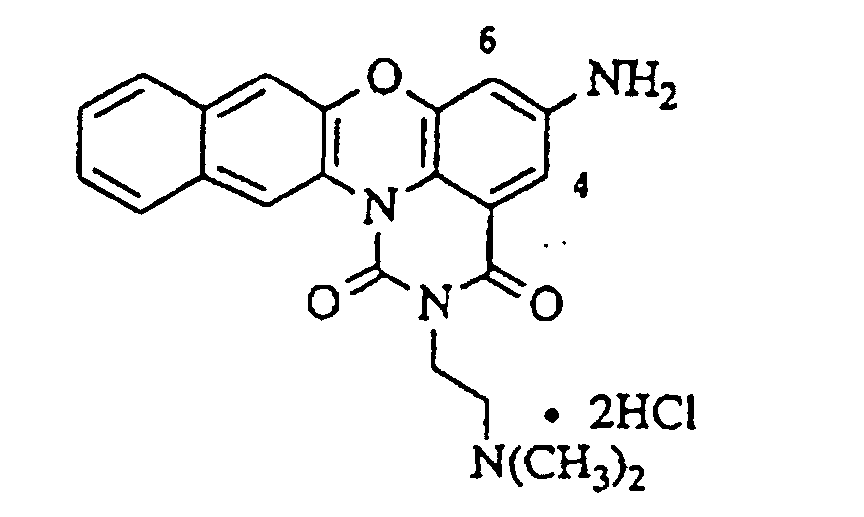
- 268 mg (0.641 mmol) of the free base of the compound of Example 27 was dissolved in acetic acid (10 ml) and 10% palladium-carbon was added thereto. Then catalytic reduction was effected at room temperature in a hydrogen atmosphere. After filtering off the palladium-carbon through celite, the filtrate was concentrated. Next, water and a saturated aqueous solution of sodium hydrogencarbonate were added thereto and the obtained mixture was stirred at room temperature. The precipitate was recovered by filtration, washed with water and suspended in methanol. After adding conc. hydrochloric acid thereto, the obtained mixture was stirred at room temperature. Thus it turned into a homogeneous solution and then a precipitate was formed. The precipitate was recovered by filtration to thereby give 179 mg of the title compound.
1H-NMR(DMSO-d6) δ(ppm) ; 2.89(s,6H),3.43(t,J=5.6Hz,2H),4.34(t,J=5.6Hz,2H), 6.76(s,1H),6.96(s,1H),7.38-7.48(m,2H),7.59(s,1H), 7.79(d,J=8.0Hz,1H),7.81(d,J=8.0Hz,1H),9.15(s,1H), 9.65(br-s,1H) -
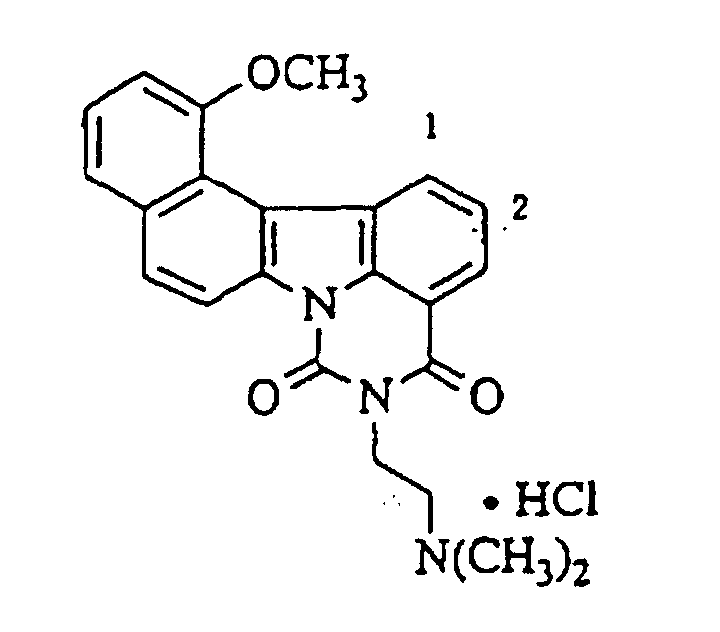
- The title compound was obtained by starting with 8-methoxy-β-tetralone and 2-hydrazinobenzoic acid hydrochloride and repeating the procedures of Production Examples 1, 2 and 3 and Example 2.
1H-NMR(DMSO-d6) δ(ppm) ; 2.91(br-s,6H),3.40-3.53 (m,2H),4.23(s,3H),4.40-4.49(m,2H),7.33(d,J=7.6Hz, 1H),7.61(t,J=8.0Hz,1H),7.72-7.79(m,2H),8.15(d, J=8.0Hz,1H),8.23(d,J=8.8Hz,1H),8.82(d,J=8.8Hz,1H), 9.09(d,J=8.0Hz,1H),9.35(br-s,1H)Elemental analysis : C23H21N3O3·HCl·0.65H2O C H N Calcd. 63.42 5.39 9.65 found 63.31 5.14 9.68 -

- 300 mg (1.1 mmol) of the compound of Production Example 21 was dissolved in a mixture of tetrahydrofuran (10 ml) with methanol (10 ml). After adding 5 ml of 1 N sodium hydroxide thereto, the obtained mixture was heated under reflux for 1 hour. Then 7H-pyrido[4,3-c]carbazole-8-carboxylic acid isolated in a conventional manner was dissolved in dimethylformamide (40 ml) and 360 mg (2.2 mmol) of N,N'-carbonyldiimidazole was added thereto. After stirring at room temperature for 30 minutes, 0.48 ml (4.4 mmol) of N,N-dimethylethylenediamine was added thereto and the obtained mixture was stirred overnight. After concentrating, it was extracted by adding water and ethyl acetate. The organic layer was taken up, washed successively with a saturated aqueous solution of sodium bicarbonate and water and dried over magnesium sulfate. After concentrating, the residue was purified by silica gel column chromatography to thereby give 250 mg of N-[2-(dimethylamino)ethyl]-7H-pyrido[4,3-c]carbazole-8-carboxamide. Then this product was reacted and treated in the same manner as the one of Example 2 to thereby give 110 mg of the title compound.
M.p.: being colored from about 270°C on and decomposed at 279°C.
1H-NMR(DMSO-d6) δ(ppm) ; 2.89-2.93(m,6H),3.49-3.54 (m,2H),4.46(t,J=6.0Hz,2H),7.85(t,J=7.6Hz,1H),8.25(d, J=7.6Hz,1H),8.40-8.44(m,2H),8.79(d,J=6.4Hz,1H),9.04 (d,J=9.2Hz,1H),9.23(d,J=7.6Hz,1H),10.10(br-s,1H), 10.44(s,1H)Elemental analysis : C21H18N4O2·2HCl·2H2O C H N Calcd. 53.97 5.18 11.99 Found 54.11 4.99 11.99 -
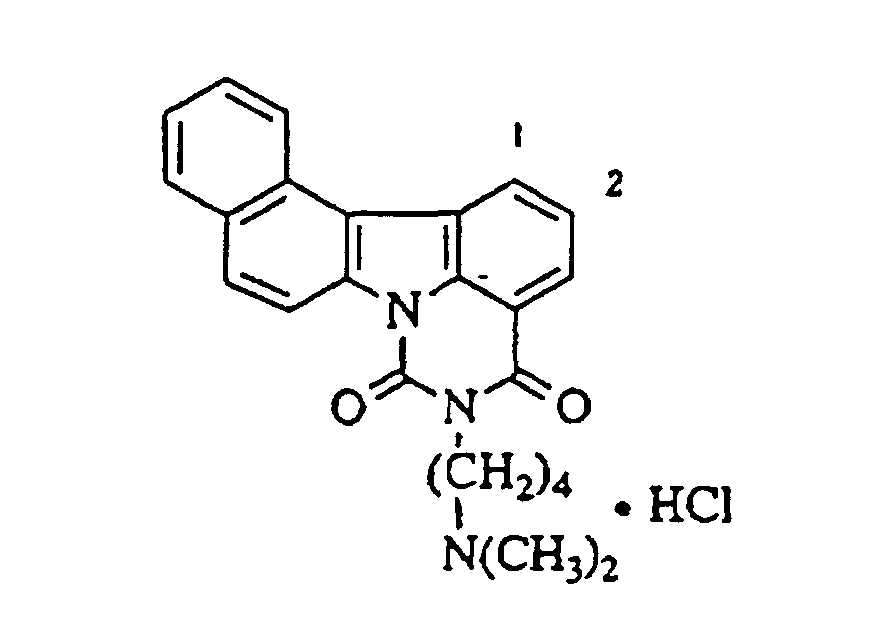
- The title compound was obtained by reacting the compound of Production Example 2 with N,N-dimethyl-1,4-butanediamine by the same methods as those of Production Example 3 and Example 1.
FAB MASS SPECTROMETRY m/z;386 ([M+H]+ )
1H-NMR(DMSO-d6) δ(ppm) ;1.68-1.85(m,4H),2.74(s,6H), 3.09(br-t,J=6.4Hz,2H),4.10(br-t,J=6.4Hz,2H),7.64-7.70(m,1H),7.75(t,J=7.6Hz,1H),7.79-7.85(m,1H),8.11 (d,J=7.6Hz,1H),8.16-8.24(m,2H),8.62(d,J=8.8Hz,1H), 8.83(d,J=8.4Hz,1H),8.97(d,J=7.6Hz,1H),9.99(br-s,1H)Elemental analysis : as C24H23N3O2 · HCl · 0.5H2O C H N Calcd. 66.89 5.85 9.75 found 66.54 5.71 9.66 -
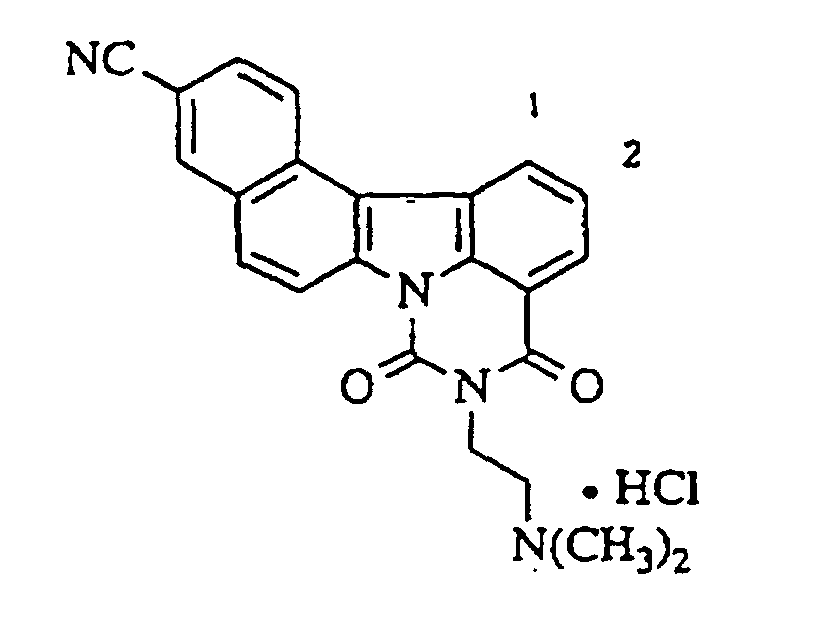
- The title compound was obtained in the same manner as the one of Example 2.
1H-NMR(DMSO-d6) δ(ppm) ;2.93(s,6H),3.48-3.55(m,2H), 4.46(t,J=5.6Hz,2H),7.83(t,J=8.2Hz,1H),8.10(dd,J=1.3, 8.9Hz,1H),8.21(d,J=8.2Hz,1H),8.38(d,J=8.9Hz,1H), 8.79(d,J=8.9Hz,1H),8.88(d,J=1.3Hz,1H),9.04(d, J=8.9Hz,1H),9.10(d,J=8.2Hz,1H) -

- The title compound was obtained in the same manner as the one of Example 2.
1H-NMR(DMSO-d6) δ(ppm) ;2.92(s,3H),2.93(s,3H),3.46-3.58(m,2H),4.41-4.51(m,2H),7.82(t,J=8.0Hz,1H),7.92 (dd,J=4.8,8.4Hz,1H),8.21(d,J=8.0Hz,1H),8.40(d, J=9.2Hz,1H),8.92(d,J=9.2Hz,1H),9.10(d,J=8.0Hz,1H), 9.14(dd,J=0.8,4.8Hz,1H),9.47(dd,J=0.8,8.4Hz,1H), 9.86(br-s,1H)Elemental analysis : as C21H18N4O2·2HCl·0.75H2O C H N Calcd. 56.70 4.87 12.59 found 56.78 4.82 12.36 -

- The title compound was obtained by starting with β-tetralone and 5-nitro-2-hydrazinobenzoic acid and repeating the procedures of Production Examples 1, 2 and 3 and Example 2.
1H-NMR(DMSO-d6) δ(ppm) ;2.89(s,6H),3.44-3.52(m,2H), 4.45(t,J=5.2Hz,2H),7.73(t,J=8.1Hz,1H),7.90(t, J=8.1Hz,1H),8.23(d,J=8.1Hz,1H),8.35(d,J=9.2Hz,1H), 8.63(d,J=9.2Hz,1H),8.80(d,J=1.8Hz,1H),8.94(d, J=8.1Hz,1H),9.64(d,J=1.8Hz,1H),9.75(br-s,1H) -
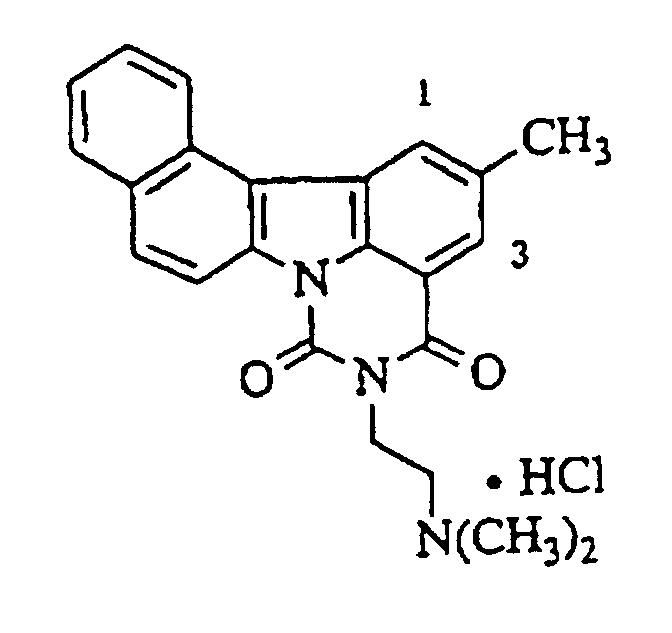
- The title compound was obtained by starting with β-tetralone and 2-hydrazino-5-methylbenzoic acid hydrochloride and repeating the procedures of Production Examples 1, 2 and 3 and Example 2.
1H-NMR(DMSO-d6) δ(ppm) ;2.71(s,3H),2.90(br-s,6H), 3.38-3.55(m,2H), 4.39-4.46(m,2H),7.66-7.72(m, 1H),7.81-7.88(m,1H),7.97-8.00(m,1H),8.18-8.23 (m,1H),8.22-8.27(m,1H),8.63(d,J=9.2Hz,1H),8.88-8.95(m,2H)Elemental analysis : as C23H21N3O2·HCl·1.5H2O C H N Calcd. 63.52 5.79 9.66 Found 63.63 5.48 9.70 -
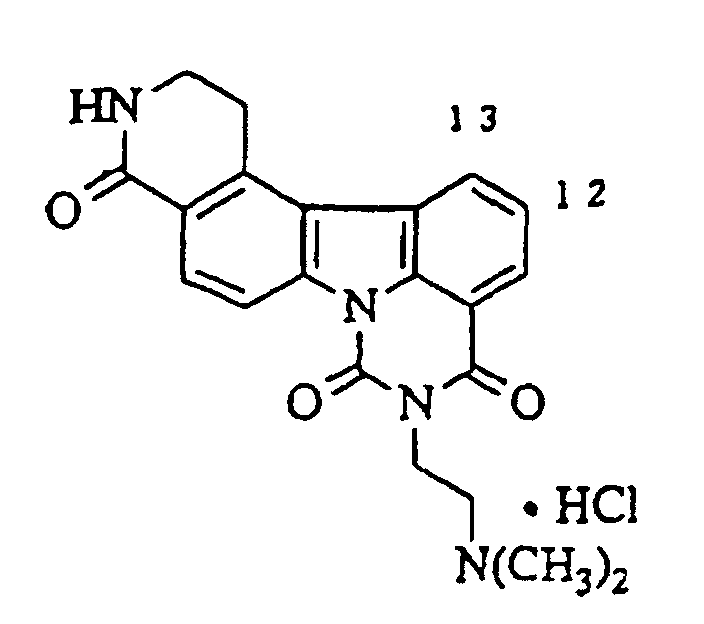
- The title compound was obtained in the same manner as the one of Example 2.
1H-NMR(DMSO-d6) δ(ppm) ;2.88(br-s,6H),3.37-3.52(m,2H),3.50-3.64(m,4H),4.36-4.44(m,2H),7.73 (t,J=7.6Hz,1H),8.11(br-s,1H),8.15(dd,J=0.8,7.6Hz, 1H),8.22(d,J=8.4Hz,1H),8.40(d,J=8.4Hz,1H),8.57(dd, J=0.8,7.6Hz,1H)Elemental analysis : as C21H20N4O3·HCl·H2O C H N Calcd. 58.54 5.38 13.00 found 58.50 5.49 12.77 -
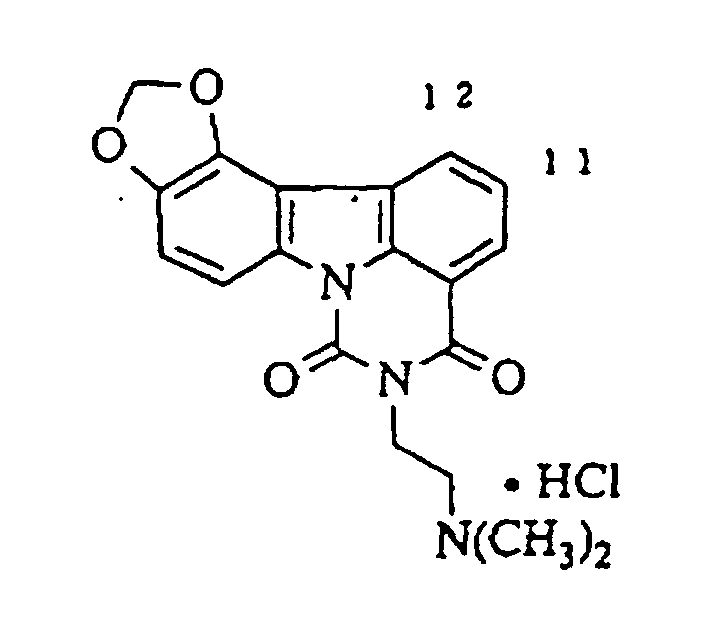
- The title compound was obtained in the same manner as the one of Example 2.
1H-NMR(DMSO-d6) δ(ppm) ;2.90(br-s,6H),3.42-3.49 (m,2H),4.36-4.42(m,2H),6.35(s,2H),7.29(d,J=8.4Hz, 1H),7.68(t,J=7.7Hz,1H),7.89(d,J=8.4Hz,1H),8.10(dd, J=0.8,7.7Hz,1H),8.27(dd,J=0.8,7.7Hz,1H),9.35 (br-s,1H) -
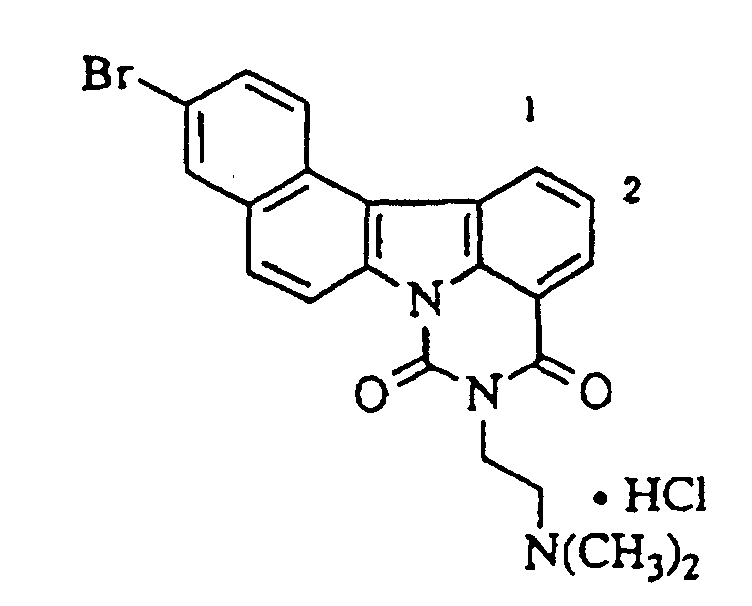
- The title compound was obtained by starting with 6-bromo-β-tetralone and 2-hydrazinobenzoic acid hydrochloride and repeating the procedures of Production Examples 1, 2 and 3 and Example 2.
FAB MASS SPECTROMETRY m/z; 436 ([M+H]+ ),438 ([M+2+H]+ )
1H-NMR(DMSO-d6) δ(ppm) ; 2.90(s,6H),3.48(br-s,2H),4.42 (t,J=5.6Hz,2H),7.77(t,J=7.6Hz,1H),7.89(dd,J=2.0, 8.8Hz,1H),8.14(d,J=7.2Hz,1H),8.20(d,J=8.8Hz,1H), 8.47(d,J=2.0Hz,1H),8.63(d,J=8.8Hz,1H),8.79(d, J=9.2Hz,1H),8.97(d,J=8.0Hz,1H),9.74(br-s,1H)Elemental analysis : as C22H18N3O2Br·HCl·0.6H2O C H N Calcd. 54.64 4.21 8.69 found 54.36 3.94 8.56 -

- The title compound was obtained in the same manner as the one of Example 2.
FAB MASS SPECTROMETRY m/z;358 ([M+H]+ )
1H-NMR(DMSO-d6) δ(ppm) ;2.90(br-s,6H),3.39-3.53 (m,2H),4.37-4.48(m,2H),7.60-7.70(m,2H),7.73(t, J=7.6Hz,1H),8.13(dd,J=0.8,7.6Hz,1H),8.16-8.20 (m,1H),8.21-8.26(m,1H),8.66(dd,J=0.8,7.6Hz,1H),8.86 (s,1H),8.93(s,1H)Elemental analysis : as C22H19N3O2·HCl C H N Calcd. 67.09 5.12 10.67 found 66.94 5.22 10.65 -
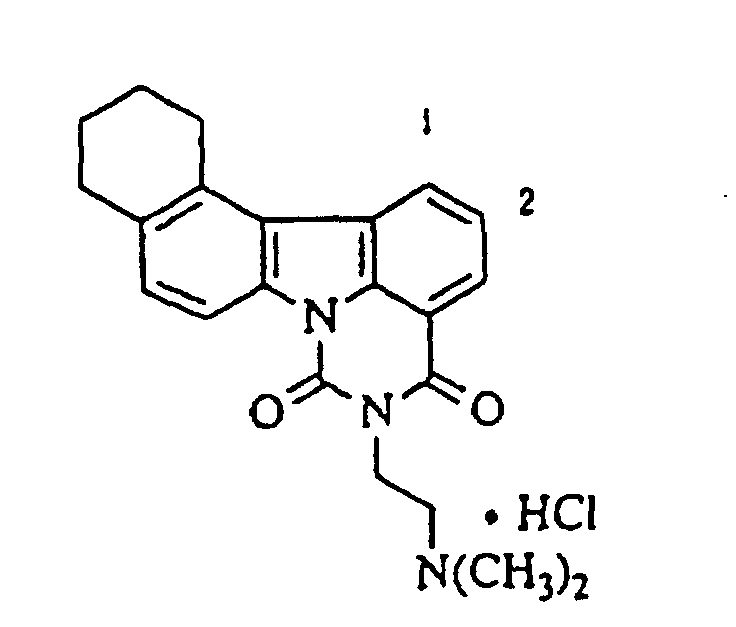
- The title compound was obtained from the compound of Example 4 in the same manner as the one of Example 5.
FAB MASS SPECTROMETRY m/z;362 ([M+H]+ )
1H-NMR(DMSO-d6) δ(ppm) ;1,79-2.01(m,4H),2.89(s,6H), 2.90(br-t,J=6.0Hz,2H),3.24(br-t,J=6.0Hz,2H),3.46 (br-t,J=5.6Hz,2H),4.39(br-t,J=6.0Hz,2H),7.38(d, J=8.8Hz,1H),7.65(t,J=8.0Hz,1H),8.06(d,J=8.0Hz,1H), 8.13(d,J=8.8Hz,1H),8.41(dd,J=0.8,8.0Hz,1H),9.74 (br-s,1H)Elemental analysis : as C22H23N3O2·HCl·0.75H2O C H N Calcd. 64.23 6.25 10.21 found 64.35 6.20 10.15 -

- The title compound was obtained in the same manner as the one of Example 2.
1H-NMR(DMSO-d6) δ(ppm) ;1.20(s,6H),2.13(t,J=6.1Hz, 2H),2.88(s,6H),3.43(br-s,2H),3.52(t,J=6.1Hz,2H), 4.38(t,J=5.7Hz,2H),7.71(t,J=7.4Hz,1H), 8.11(d, J=7.4Hz,1H),8.20(d,J=8.8Hz,1H),8.35(d,J=8.8Hz,1H), 8.54(d,J=7.4Hz,1H),10.08(br-s,1H)Elemental analysis : as C24H25N3O3·HCl·H2O C H N Calcd. 62.94 6.16 9.18 found 63.06 6.27 9.14 -
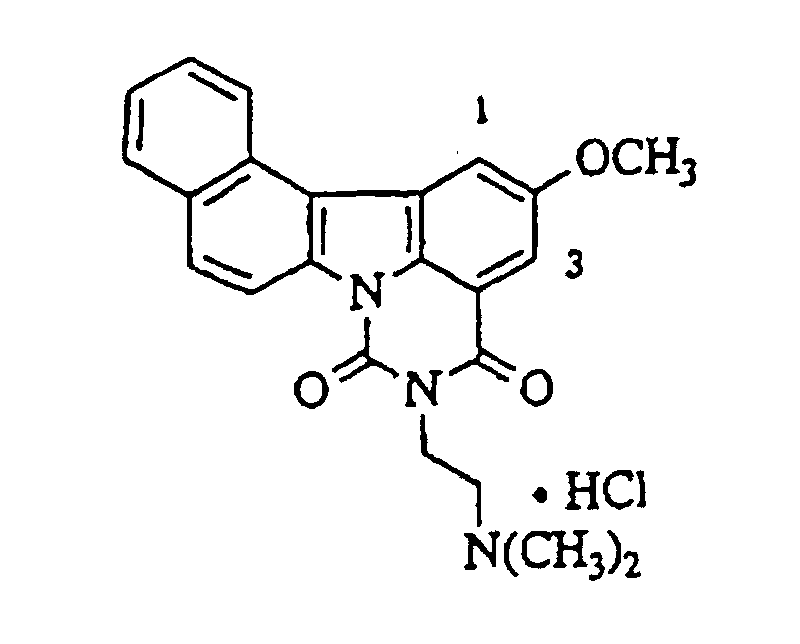
- The title compound was obtained by starting with β-tetralone and 2-hydrazino-5-methoxybenzoic acid hydrochloride and repeating the procedures of Production Examples 1, 2 and 3 and Example 2.
1H-NMR(DMSO-d6) δ(ppm) ;2.89(br-s,6H),3.40-3.52(m, 2H),4.03(s,3H),4.40(t,J=6.0Hz,2H),7.60(d,J=2.4Hz, 1H),7.63-7.70(m,1H),7.76-7.85(m,1H),8.17(dd,J=0.4, 8.4Hz,1H),8.21(d,J=8.8Hz,1H),8.49(d,J=2.4Hz,1H), 8.57(d,J=8.8Hz,1H),8.84(dd,J=0.4,8.4Hz,1H),9.57 (br-s,1H)Elemental analysis : as C23H21N3O3·HCl·H2O C H N Calcd. 62.51 5.47 9.51 Found 62.44 5.22 9.48 -
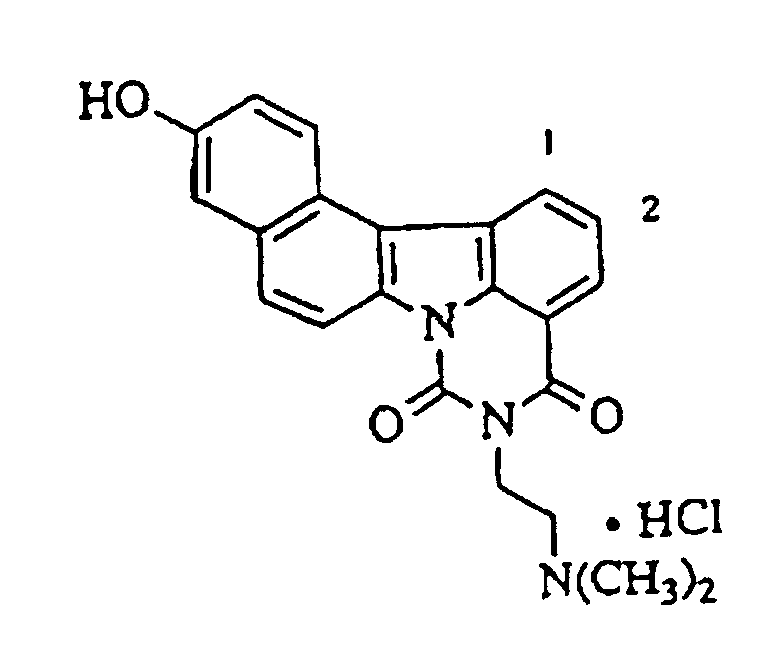
- The compound of Example 22 was heated under reflux in 47% hydrobromic acid. Then the reaction mixture was catalytically reduced at room temperature with the use of palladium-carbon as the catalyst. The obtained product was converted into the hydrochloride by a conventional method to thereby give the title compound.
1H-NMR(DMSO-d6) δ(ppm) ;2.92(d,J=5.5Hz,6H),3.48 (q,J=5.5Hz,2H),4.41(t,J=5.5Hz,2H),7.36-7.42(m,2H), 7.73(t,J=8.1Hz,1H),8.00(d,J=9.4Hz,1H),8.11(d, J=8.1Hz,1H),8.49(d,J=8.1Hz,1H),8.71(d,J=9.4Hz,1H), 8.94(d,J=8.1Hz,1H),9.60(br-s,1H),10.01(br-s,1H) -
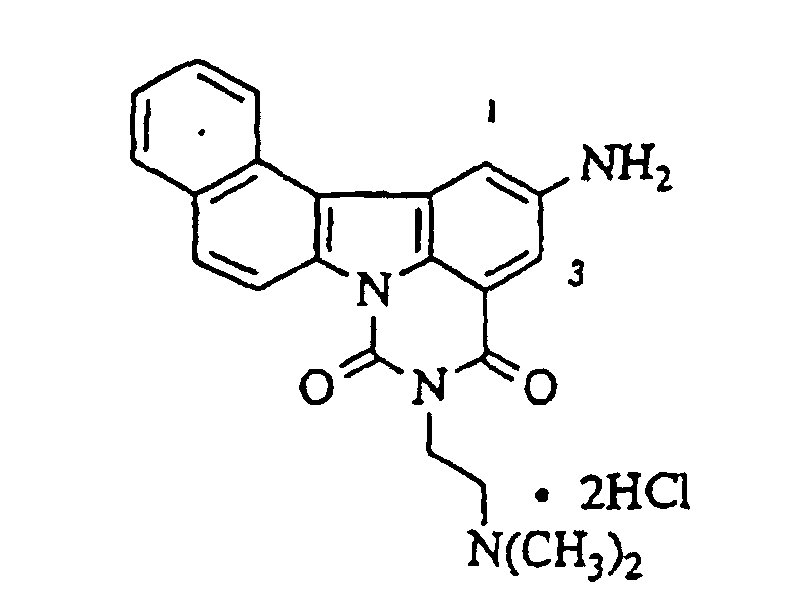
- The compound of Example 37 was hydrogenated in the presence of a palladium-carbon catalyst at an ordinary temperature under atmospheric pressure to thereby give the title compound.
1H-NMR(DMSO-d6) δ(ppm) ;2.89(d,J=4.1Hz,6H),3.44-3.51(m,2H),4.40(t,J=5.8Hz,2H),7.67(t,J=8.2Hz,1H),7.7 7(s,1H),7.84(t,J=8.2Hz,1H),8.19(d,J=8.2Hz,1H),8.22(d, J=9.3Hz,1H),8.57(d,J=9.3Hz,1H),8.61(d,J=8.2Hz, 1H),8.63(s,1H),9.94(br-s,1H) -

- The compound of Production Example 24 was treated in the same manner as the one of Production Example 3 to thereby give N-[2-(dimethylamino)ethyl]-3-(4-methylbenzenesulfonamido)-7H-benzo[c]carbazole-8-carboxamide. Then this product was reacted with sodium hydride and ethyl chloroformate in dimethylformamide under ice-cooling to thereby give 5-[2-(dimethylamino)ethyl]-11-(N-etoxycarbonyl-4-methylbenzenesulfonamido)-4H-benzo[c]pyrimido[5,6,1-jk]carbazole-4,6(5H)-dione. Next, this product was treated with a 1 N aqueous solution of sodium hydroxide in a mixture of methanol with tetrahydrofuran (1 : 1) and then converted into the hydrochloride in a conventional manner followed by recrystallization from ethanol to thereby give the title compound.
1H-NMR(DMSO-d6) δ(ppm) ;2.28(s,3H),2.90(s,6H),3.48 (br-s,2H),4.41(t,J=5.6Hz,2H),7.33(d,J=9.2Hz,2H), 7.60(d,J=8.8Hz,1H),7.70-7.78(m,3H),7.82(s,1H),8.09 (d,J=9.2Hz,1H),8.12(d,J=8.0Hz,1H),8.54(d,J=8.4Hz, 1H),8.76(d,J=8.4Hz,1H),8.94(d,J=8.4Hz,1H),9.56 (br-s,1H),10.68(s,1H) -
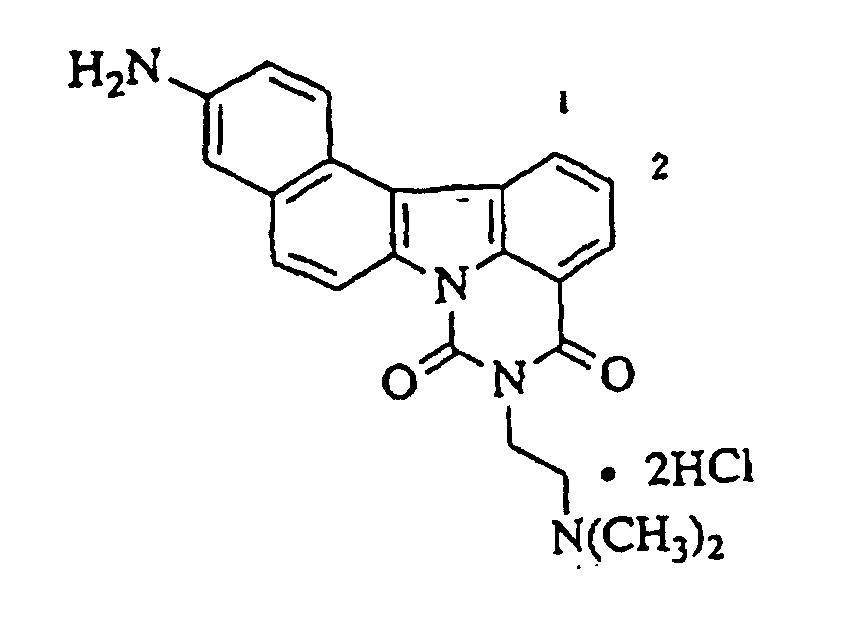
- 341 mg (0.648 mmol) of the free base of the compound of Example 48 and 419 mg (4.45 mmol) of phenol were heated under reflux in 47% hydrobromic acid (15 ml) for 9 hours and 30 minutes and then brought back to room temperature. The reaction mixture was then made basic by adding a saturated aqueous solution of sodium hydrogencarbonate thereto. Next, the obtained mixture was extracted by adding ethyl acetate and tetrahydrofuran thereto. The organic layer was washed successively with water and a saturated aqueous solution of sodium chloride and dried over anhydrous magnesium sulfate. The organic layer was concentrated and the obtained residue was recrystallized from ethanol to thereby give 141 mg of the free base of the title compound. Then this free base was converted into the hydrochloride in a conventional manner to thereby give the title compound.
(free base) 1H-NMR(DMSO-d6) δ (ppm) ;2.22(s,6H),2.55 (t,J=6.8Hz,2H),4.14(t,J=6.8Hz,2H),5.50-5.53(m,2H), 7.06(d,J=2.0Hz,1H),7.22(dd,J=2.4,9.2Hz,1H),7.67(t, J=8.0Hz,1H),7.79(d,J=9.2Hz,1H),8.03(d,J=8.0Hz,1H), 8.38(d,J=8.8Hz,1H),8.52(d,J=9.2Hz,1H),8.84(d, J=7.6Hz,1H) -
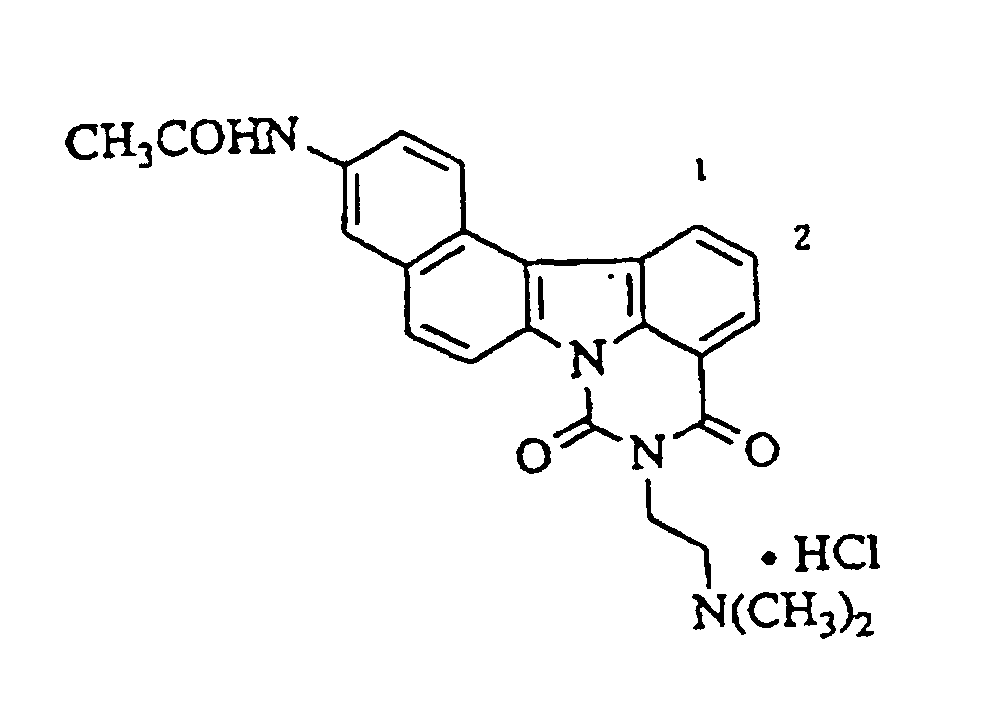
- 4 ml of triethylamine and 2 ml of acetic anhydride were successively added to a suspension of 141 mg (0.379 mmol) of the free base of the compound of Example 49 in dichloromethane (20 ml) under stirring at room temperature and stirring was continued for 16 hours. After concentrating, 30 ml of methanol was added to the residue. Next, the obtained mixture was made basic by adding an aqueous solution of sodium hydrogencarbonate thereto. The precipitate was recovered by filtration and washed with water. The solid matter thus obtained was suspended in ethanol and conc. hydrochloric acid was added thereto under stirring at room temperature. After further adding methanol and dichlromethane thereto, stirring was continued. After concentrating, ethanol was added thereto and the obtained mixture was heated under reflux and then brought back to room temperature. The precipitate was recovered by filtration to thereby give 148 mg of the title compound.
FAB MASS SPECTROMETRY m/z;415 ([M+H]+ )
1H-NMR(DMSO-d6) δ(ppm) ;2.13(s,3H),2.90(s,3H),2.91 (s,3H),3.44-3.52(m,2H),4.42(t,J=5.6Hz,2H),7.76(t, J=8.0Hz,1H),7.89(dd,J=1.6,9.2Hz,1H),8.06-8.14(m, 2H),8.52(d,J=1.6Hz,1H),8.54(d,J=9.2Hz,1H),8.79(d, J=8.8Hz,1H),8.98(d,J=8.0Hz,1H),9.60(br-s,1H),10.35 (s,1H)Elemental analysis : as C24H22N4O3·HCl·0.6H2O C H N Calcd. 62.43 5.28 12.13 found 62.54 5.03 11.82 -

- The title compound was obtained in the same manner as the one of Example 2.
(free base) 1H-NMR(CDCl3) δ(ppm) ;2.20(s,6H),2.42 (t,J=7.2Hz,2H),2.45(s,3H),2.63(t,J=7.2Hz,2H),2.81(t, J=7.2Hz,2H),4.35(t,J=7.2Hz,2H),7.59(t,J=7.8Hz,1H), 7.64(t,J=7.8Hz,1H),7.74(t,J=7.8Hz,1H),8.01(d, J=9.2Hz,1H),8.03(d,J=7.8Hz,1H),8.14(d,J=7.8Hz,1H), 8.56-8.61(m,2H),8.66(d,J=9.2Hz,1H)Elemental analysis : as C25H26N4O2·2HCl·0.8H2O C H N Calcd. 59.83 5.78 11.17 found 59.83 6.02 11.16 -

- The title compound was obtained in the same manner as the one of Example 2.
1H-NMR(DMSO-d6) δ(ppm) ;2.93(s,3H),3.14-3.67(m,4H), 3.71-3.80(m,2H), 4.40-4.49(m,2H),5.33-5.39(m,1H), 7.64-7.70(m,1H),7.73-7.86(m,2H),8.10-8.26(m,3H), 8.59-8.65(m,1H),8.83-8.89(m,1H),9.00-9.04(m,1H), 9.60(br-s,1H)Elemental analysis : as C23H21N3O3·HCl·1.1H2O C H N Calcd. 62.26 5.25 9.47 Found 62.08 5.55 9.47 -
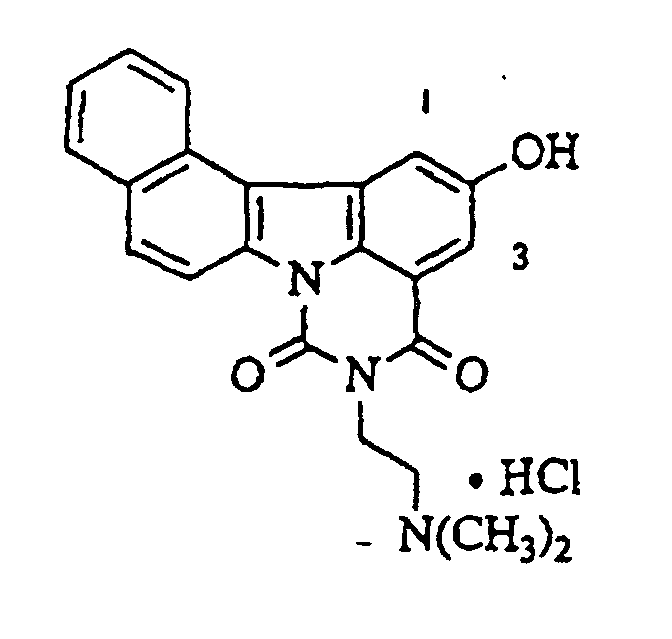
- The title compound was obtained by treating the compound of Example 45 in the same manner as the one of Example 46.
1H-NMR(DMSO-d6) δ(ppm) ;2.89(br-s,6H),3.39-3.54 (m,2H),4.32-4.46(m,2H),7.53-7.56(m,1H),7.65-7.71 (m,1H),7.81-7.87(m,1H),8.19(d,J=8.0Hz,1H),8.23(d, J=8.8Hz,1H),8.35-8.39(m,1H),8.60(d,J=8.8Hz,1H),8.73 (d,J=8.0Hz,1H),9.29-9.39(br,1H),10.25(s,1H)Elemental analysis : as C22H19N3O3·HCl·H2O C H N Calcd. 61.76 5.18 9.82 found 61.92 4.90 9.84 -
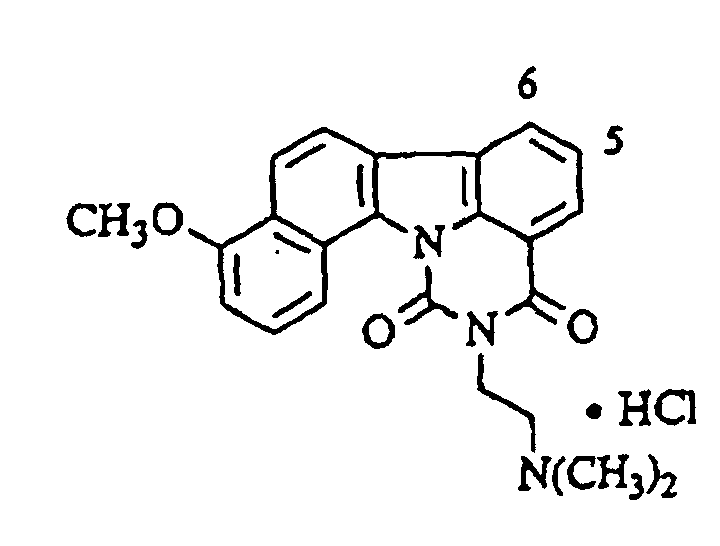
- The title compound was obtained by starting with 5-methoxy-1-tetralone and 2-hydrazinobenzoic acid hydrochloride and repeating the procedure of Example 18.
1H-NMR(DMSO-d6) δ(ppm) ;2.92(s,6H),3.46-3.55(m,2H), 4.02(s,3H),4.42-4.46(m,2H),7.16(d,J=7.1Hz,1H),7.60 (t,J=7.1Hz,1H),7.73(t,J=7.1Hz,1H),8.12(d,J=7.1Hz, 1H),8.34-8.44(m,2H),8.63(d,J=7.1Hz,1H),9.28(d, J=9.2Hz,1H),9.78(br-s,1H) -

- The title compound was obtained in the same manner as the one of Example 36.
1H-NMR(DMSO-d6+D2O) δ(ppm) ;1.84-1.94(m,2H),2.01-2.13 (m,2H),3.13-3.25(m,2H),3.57-3.64(m,2H),3.65-3.74(m, 2H),4.43-4.49(m,2H),7.85(t,J=7.6Hz,1H),7.94(dd, J=4.4,8.4Hz,1H),8.23(d,J=7.6Hz,1H),8.37(d,J=9.2Hz, 1H),8.92(d,J=9.2Hz,1H),9.05(d,J=7.6Hz,1H),9.12(dd, J=1.6,4.4Hz,1H),9.40-9.45(m,1H) -

- The title compound was obtained in the same manner as the one of Example 36.
1H-NMR(DMSO-d6) δ(ppm) ;2.92(s,3H),2.93(s,3H),3.47-3.55(m,2H),4.41-4.47(m,2H),7.69(dd,J=8.4,12.0Hz, 1H),7.93(dd,J=4.4,8.4Hz,1H),8.29(dd,J=4.4,8.4Hz,1H), 8.45(d,J=9.2Hz,1H),8.97(d,J=9.2Hz,1H),9.10-9.14 (m,1H),9.25-9.31(m,1H) -
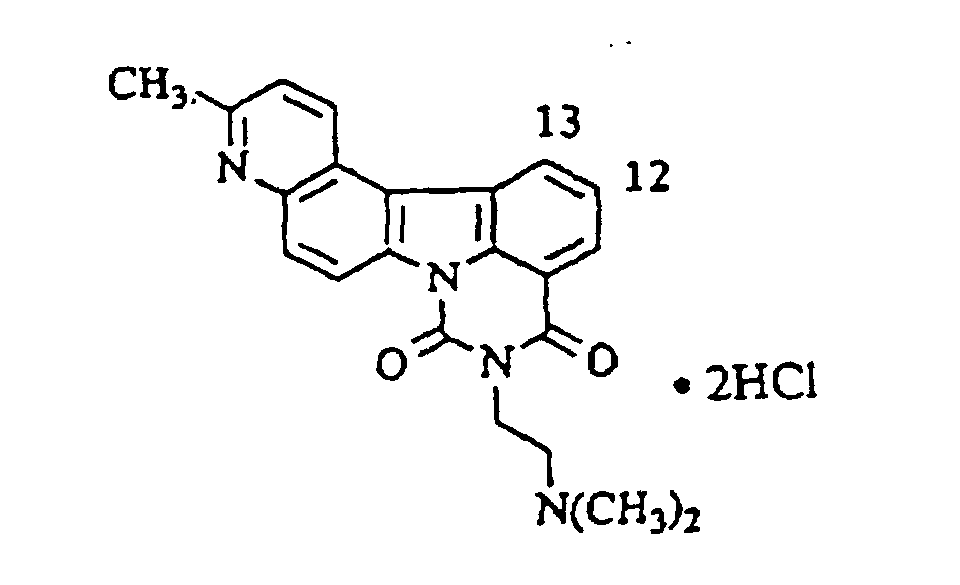
- The title compound was obtained in the same manner as the one of Example 36.
1H-NMR(DMSO-d6+D2O) δ(ppm) ;2.93(s,3H),2.95(s,6H), 3.51-3.57(m,2H),4.44-4.50(m,2H),7.86(t,J=8.0Hz,1H), 7.98(d,J=8.8Hz,1H),8.25(d,J=8.0Hz, 1H),8.39(d, J=9.2Hz,1H),8.98(d,J=9.2Hz,1H),9.09(d,J=8.0Hz,1H), 9.55(d,J=8.8Hz,1H) -

- 1.06 g (3.1 mmol) of the compound of Production Example 25 was dissolved in a mixture of methanol (20 ml) with tetrahydrofuran (20 ml). After adding a 1 N aqueous solution of sodium hydroxide (10 ml) thereto, the obtained mixture was heated under reflux for 1 hour and then allowed to cool. Next, a 1 N aqueous solution of hydrochloric acid (10 ml) was added thereto and the solvent was distilled off. To the residue was added N,N-dimethylformamide (50 ml). Further 770 mg (4 mmol) of 1-ethyl-3-(3-dimethylaminopropyl)carbodiimide hydrochloride, 540 mg (4 mmol) of 1-hydroxybenzotriazole and 0.4 ml (3.7 mmol) of N,N-dimethylethylenediamine were added thereto and the obtained mixture was stirred at room temperature overnight. Then an aqueous solution of sodium hydrogencarbonate was added thereto and the mixture was extracted with ethyl acetate. The organic layer was washed with water and a saturated aqueous solution of sodium chloride, dried over anhydrous magnesium sulfate and then concentrated. The precipitate thus formed was washed with ethanol and recovered by filtration to thereby give 660 mg of an intermediate (yield: 55%).
- 100 mg (0.26 mmol) of this intermediate was dissolved in N,N-dimethylformamide (20 ml) and 22 mg (0.55 mmol) of sodium hydride (oily 60%) was added thereto under a nitrogen gas stream. After stirring the obtained mixture for 1 hour, 0.046 ml (0.6 mmol) of methyl chloroformate was added thereto at room temperature. Then the mixture was immediately acidified with 1 N hydrochloric acid and then made weakly alkaline with a saturated aqueous solution of sodium hydrogencarbonate followed by extraction with ethyl acetate. The organic layer was washed with a saturated aqueous solution of sodium chloride, dried over anhydrous magnesium sulfate and then concentrated to dryness. The residue was purified by silica gel column chromatography to thereby give 25 mg of the title compound (yield: 24%).
FAB MASS SPECTROMETRY m/z;409 ([M+H]+ )
1H-NMR(CDCl3) δ(ppm) ;2.39(s,6H),2.80(t,J=6.7Hz,2H), 4.51(t,J=6.7Hz,2H),7.66-7.78(m,2H),7.85-7.93(m,2H), 8.01-8.07(m,2H),8.51(d,J=8.6Hz,1H),8.57-8.63(m,1H), 8.73-8.79(m,1H),9.74(dd,J=0.7,8.6Hz,1H)
with a carbonyl-reducing agent.
Claims (13)
- A compound represented by the following general formula (I) or pharmacologically acceptable salts thereof:wherein

ring A represents an optionally substituted monocyclic aromatic ring or a dicyclic fused ring in which at least one of the rings is an aromatic ring;
ring B represents pyrrole, 4H-1,4-oxazine, 4H-1,4-thiazine or 4(1H)-pyridone;
ring C represents an optionally substituted, monocyclic or dicyclic fused aromatic ring; and
Y represents a group represented by the formula -e-f (wherein e represents C1-C6 alkylene; and f represents amidino, guanidino or amino optionally substituted by optionally hydroxylated or optionally C1-C6-alkylaminated C1-C6 alkyl;
provided that the cases where the rings A and C are both optionally substituted monocyclic aromatic rings are excluded,
wherein optionally substituted in the case of ring A means 1 to 3 substituents selected from the group consisting of hydroxy, oxo, cyano, halogeno, nitro optionally hydroxylated or C1-C6-alkylaminated C1-C6 alkyl, C1-C6 alkoxy, C1-C6 acyl, optionally C1-C6-alkylated carbamoyl and optionally C1-C6-alkylated, C1-C6-acylated, arylsulfonylated or C1-C6-alkylsulfonylated amino, and wherein optionally substituted in the case of ring C means 1 to 3 substituents selected from the groups consisting of include halogeno, hydroxy, C1-C6 alkyl, C1-C6 alkoxy, nitro and C1-C6-alkylated or C1-C6-acylated amino. - The compound as set forth in Claim 1 wherein the ring A is a naphthalene, indene, benzocycloheptene or benzocyclooctene which is optionally substituted and optionally hydrogenated in one ring, or pharmacologically acceptable salts thereof.
- The compound as set forth in Claim 1 wherein the ring A is a quinoline, isoquinoline, 4H-1-benzopyran, 1H-2-benzopyran, 1,3-benzodioxole, benzofuran, isobenzofuran, benzothiophene, indole or isoindole which is optionally substituted and optionally hydrogenated in one ring and fused to the ring B at the benzene ring moiety thereof, or pharmacologically acceptable salts thereof.
- The compound as set forth in Claim 1 wherein the ring A is an optionally substituted tetralin or indan and fused to the ring B at the benzene ring moiety thereof, or pharmacologically acceptable salts thereof.
- The compound as set forth in Claim 1 wherein the ring A is an oxo-substituted tetralin or indan and fused to the ring B at the benzene ring moiety thereof, or pharmacologically acceptable salts thereof.
- The compound as set forth in Claim 1 wherein the ring A is an optionally substituted chroman, isochroman, tetrahydrobenzofuran or tetrahydroisobenzofuran and fused to the ring B at the benzene ring moiety thereof, or pharmacologically acceptable salts thereof.
- The compound as set forth in Claim 1 wherein the ring B is a pyrrole, or pharmacologically acceptable salts thereof.
- The compound as set forth in Claim 1 wherein the ring C is an optionally substituted benzene, or pharmacologically acceptable salts thereof.
- The compound as claimed in any of Claims 1 to 8 wherein f in the definition of Y is a C1-6 alkyl-substituted amino, or pharmacologically acceptable salts thereof.
- A process for producing a compound as set forth in Claim 1 or pharmacologically acceptable salts thereof characterized by reacting a compound represented by the following general formula (II):wherein the rings Aa and Ca respectively represent an optionally protected rings A and C as described in Claim 1; the ring Ba represents a pyrrole, 4H-1,4-oxazine, 4H-1,4-thiazine or 4(1H)-pyridone; fa represents an optionally protected f as described in Claim 1; and e has the same meaning as defined in Claim 1,

with a compound represented by the following general formula (III):wherein D and E are the same or different and each represents a leaving group,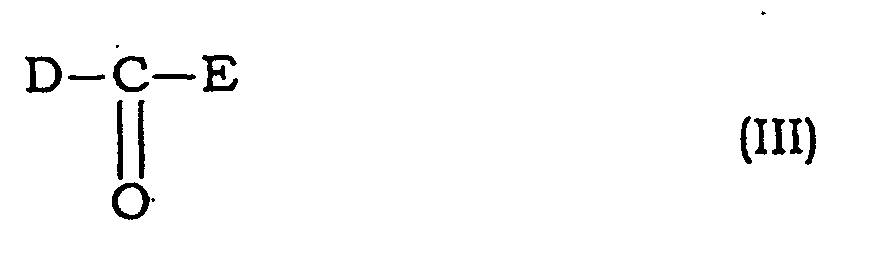
and eliminating the protecting group(s), if any, from the product thus obtained. - An antitumor agent containing as the active ingredient a fused polycyclic heterocycle derivative as claimed in any of Claims 1 to 9 or pharmacologically acceptable salts thereof.
- A medicinal composition comprising a pharmacologically efficacious dose of the fused polycyclic heterocycle derivative as claimed in any of Claims 1 to 9 or pharmacologically acceptable salts thereof and pharmacologically acceptable carriers.
- Use of a compound as claimed in any of the claims 1 to 9 or pharmacologically acceptable salts thereof in a pharmacologically efficacious dose for the manufacture of a medicinal composition for preventing or treating tumors.
Applications Claiming Priority (7)
| Application Number | Priority Date | Filing Date | Title |
|---|---|---|---|
| JP133992/95 | 1995-05-31 | ||
| JP13399295 | 1995-05-31 | ||
| JP13399295 | 1995-05-31 | ||
| JP30919595 | 1995-11-28 | ||
| JP30919595 | 1995-11-28 | ||
| JP309195/95 | 1995-11-28 | ||
| PCT/JP1996/001487 WO1996038446A1 (en) | 1995-05-31 | 1996-05-31 | Fused polycyclic heterocycle derivatives |
Publications (3)
| Publication Number | Publication Date |
|---|---|
| EP0831094A1 EP0831094A1 (en) | 1998-03-25 |
| EP0831094A4 EP0831094A4 (en) | 2001-11-21 |
| EP0831094B1 true EP0831094B1 (en) | 2004-12-08 |
Family
ID=26468199
Family Applications (1)
| Application Number | Title | Priority Date | Filing Date |
|---|---|---|---|
| EP96920027A Expired - Lifetime EP0831094B1 (en) | 1995-05-31 | 1996-05-31 | Fused polycyclic heterocycle derivatives |
Country Status (12)
| Country | Link |
|---|---|
| US (1) | US5952335A (en) |
| EP (1) | EP0831094B1 (en) |
| KR (1) | KR100399704B1 (en) |
| CN (1) | CN1067686C (en) |
| AT (1) | ATE284401T1 (en) |
| AU (1) | AU703111B2 (en) |
| DE (1) | DE69634004T2 (en) |
| ES (1) | ES2229272T3 (en) |
| HU (1) | HUP9802672A3 (en) |
| MX (1) | MX9709254A (en) |
| NO (1) | NO310149B1 (en) |
| NZ (1) | NZ308657A (en) |
Families Citing this family (6)
| Publication number | Priority date | Publication date | Assignee | Title |
|---|---|---|---|---|
| DE10164564B4 (en) * | 2001-12-14 | 2007-05-16 | Zentaris Gmbh | Tetrahydrocarbazole derivatives as ligands for G-protein coupled receptors (GPCR) |
| WO2004063156A1 (en) * | 2003-01-08 | 2004-07-29 | Biovitrum Ab | Novel indole derivates as fabp-4 inhibitors |
| AU2005249593A1 (en) * | 2004-06-04 | 2005-12-15 | Chemgenex Pharmaceuticals Inc. | Methods of treating cellular proliferative disease using naphthalimide and PARP-1 inhibitors |
| US20120283282A1 (en) * | 2009-06-18 | 2012-11-08 | Arleen Rifkind | Photoproducts of Tryptophan, Their Synthesis and Uses Thereof |
| CN104098506A (en) * | 2014-07-15 | 2014-10-15 | 华东理工大学 | Preparation method and application of benzo[c] carbazole amide compound |
| CN107141295A (en) * | 2017-05-27 | 2017-09-08 | 重庆文理学院 | A kind of simple synthesis of uracil derivative |
Family Cites Families (2)
| Publication number | Priority date | Publication date | Assignee | Title |
|---|---|---|---|---|
| US3962438A (en) * | 1975-01-07 | 1976-06-08 | Smithkline Corporation | Anti-arthritic 1H-pyrimido-(5,4,3-kl)phenothiazine-1,3(2H)-diones and 1-thiones |
| AU643539B2 (en) * | 1990-06-26 | 1993-11-18 | Research Corporation Technologies, Inc. | 1,2-dihydro-3H-dibenzisoquinoline-1,3-dione anticancer agents |
-
1996
- 1996-05-31 EP EP96920027A patent/EP0831094B1/en not_active Expired - Lifetime
- 1996-05-31 ES ES96920027T patent/ES2229272T3/en not_active Expired - Lifetime
- 1996-05-31 AT AT96920027T patent/ATE284401T1/en not_active IP Right Cessation
- 1996-05-31 CN CN96194291A patent/CN1067686C/en not_active Expired - Fee Related
- 1996-05-31 MX MX9709254A patent/MX9709254A/en not_active IP Right Cessation
- 1996-05-31 HU HU9802672A patent/HUP9802672A3/en unknown
- 1996-05-31 DE DE69634004T patent/DE69634004T2/en not_active Expired - Lifetime
- 1996-05-31 KR KR1019970708665A patent/KR100399704B1/en not_active Expired - Fee Related
- 1996-05-31 NZ NZ308657A patent/NZ308657A/en not_active IP Right Cessation
- 1996-05-31 US US08/952,778 patent/US5952335A/en not_active Expired - Lifetime
- 1996-05-31 AU AU58454/96A patent/AU703111B2/en not_active Ceased
-
1997
- 1997-11-28 NO NO19975493A patent/NO310149B1/en not_active IP Right Cessation
Also Published As
| Publication number | Publication date |
|---|---|
| CN1185781A (en) | 1998-06-24 |
| CN1067686C (en) | 2001-06-27 |
| KR100399704B1 (en) | 2003-12-18 |
| HUP9802672A2 (en) | 1999-04-28 |
| EP0831094A1 (en) | 1998-03-25 |
| AU703111B2 (en) | 1999-03-18 |
| NO310149B1 (en) | 2001-05-28 |
| MX9709254A (en) | 1998-03-31 |
| US5952335A (en) | 1999-09-14 |
| EP0831094A4 (en) | 2001-11-21 |
| ATE284401T1 (en) | 2004-12-15 |
| NO975493D0 (en) | 1997-11-28 |
| DE69634004D1 (en) | 2005-01-13 |
| NZ308657A (en) | 1999-10-28 |
| HUP9802672A3 (en) | 2000-04-28 |
| NO975493L (en) | 1998-01-29 |
| KR19990022186A (en) | 1999-03-25 |
| DE69634004T2 (en) | 2005-11-10 |
| ES2229272T3 (en) | 2005-04-16 |
| AU5845496A (en) | 1996-12-18 |
Similar Documents
| Publication | Publication Date | Title |
|---|---|---|
| EP1483265B1 (en) | Purine derivatives as kinase inhibitors | |
| JP4776842B2 (en) | Isomeric condensed pyrrolocarbazoles and isoindolones | |
| US7671079B2 (en) | Sulfonyltetrahydro-3H-benzo(e)indole-8-amine compounds as 5-hydroxytryptamine-6 ligands | |
| WO2001042247A1 (en) | Fused heterotricyclic compounds, process for preparing the compounds and drugs containing the same | |
| AU4376897A (en) | Novel indole-2,3-dione-3-oxime derivatives | |
| CA2220509C (en) | Fused polycyclic heterocycle derivatives | |
| FR2912145A1 (en) | NOVEL TRICYCLIC DERIVATIVES, PROCESS FOR THEIR PREPARATION AND PHARMACEUTICAL COMPOSITIONS CONTAINING THEM | |
| US7022694B2 (en) | Indoles and indolines having 5-HT activity | |
| US5952335A (en) | Fused polycyclic heterocycle derivatives | |
| KR100243514B1 (en) | Pyrroloazepine derivative | |
| CZ194499A3 (en) | Benzopyranopyrrole and benzopyranopyridine alpha-1 adrenergic compounds | |
| TW462964B (en) | Guanidine derivatives for the treatment and prevention of disorders caused by inhibiting hyperactivity of Na/H exchange transport system and process for producing the same | |
| WO2022171198A1 (en) | Influenza virus inhibitor and use thereof | |
| DE60010934T2 (en) | Medicines suitable for the treatment of proliferative diseases | |
| JP3992306B2 (en) | Fused polycyclic heterocyclic derivatives | |
| EP0491814B1 (en) | Tetracyclic imidazoquinazoline derivatives, preparation and pharmaceutical compositions | |
| EP2303880A2 (en) | Novel tricyclic derivatives, process for the preparation thereof and pharmaceutical compositions containing same | |
| US6458792B1 (en) | Compounds | |
| EP0575442B1 (en) | Tetracyclic imidazoquinazoline derivatives, process for their preparation and pharmaceutical compositions containing them | |
| JP3818549B2 (en) | Fused tetracyclic heterocyclic derivatives | |
| US6656948B2 (en) | Cytotoxic compounds: derivatives of the pyrido[2,3,4-kl]acridine ring system | |
| KR930001407B1 (en) | Novel isoindole derivatives and salts thereof, preparation method thereof and tumor therapeutic agent comprising the same | |
| JP3027599B2 (en) | Novel isoindole derivatives and their salts | |
| JPWO2001044186A1 (en) | Substituted Guanidine Derivatives |
Legal Events
| Date | Code | Title | Description |
|---|---|---|---|
| PUAI | Public reference made under article 153(3) epc to a published international application that has entered the european phase |
Free format text: ORIGINAL CODE: 0009012 |
|
| 17P | Request for examination filed |
Effective date: 19971118 |
|
| AK | Designated contracting states |
Kind code of ref document: A1 Designated state(s): AT BE CH DE DK ES FI FR GB GR IE IT LI LU NL PT SE |
|
| RIC1 | Information provided on ipc code assigned before grant |
Free format text: 7C 07D 471/06 A, 7C 07D 471/16 B, 7C 07D 487/06 B, 7C 07D 491/16 B, 7C 07D 495/16 B, 7C 07D 498/06 B, 7C 07D 513/06 B, 7A 61K 31/495 B, 7A 61K 31/535 B, 7A 61K 31/54 B, 7C 07D 487/16 B |
|
| A4 | Supplementary search report drawn up and despatched |
Effective date: 20011008 |
|
| AK | Designated contracting states |
Kind code of ref document: A4 Designated state(s): AT BE CH DE DK ES FI FR GB GR IE IT LI LU NL PT SE |
|
| 17Q | First examination report despatched |
Effective date: 20030121 |
|
| GRAP | Despatch of communication of intention to grant a patent |
Free format text: ORIGINAL CODE: EPIDOSNIGR1 |
|
| GRAS | Grant fee paid |
Free format text: ORIGINAL CODE: EPIDOSNIGR3 |
|
| GRAA | (expected) grant |
Free format text: ORIGINAL CODE: 0009210 |
|
| AK | Designated contracting states |
Kind code of ref document: B1 Designated state(s): AT BE CH DE DK ES FI FR GB GR IE IT LI LU NL PT SE |
|
| PG25 | Lapsed in a contracting state [announced via postgrant information from national office to epo] |
Ref country code: NL Free format text: LAPSE BECAUSE OF FAILURE TO SUBMIT A TRANSLATION OF THE DESCRIPTION OR TO PAY THE FEE WITHIN THE PRESCRIBED TIME-LIMIT Effective date: 20041208 Ref country code: LI Free format text: LAPSE BECAUSE OF FAILURE TO SUBMIT A TRANSLATION OF THE DESCRIPTION OR TO PAY THE FEE WITHIN THE PRESCRIBED TIME-LIMIT Effective date: 20041208 Ref country code: FI Free format text: LAPSE BECAUSE OF FAILURE TO SUBMIT A TRANSLATION OF THE DESCRIPTION OR TO PAY THE FEE WITHIN THE PRESCRIBED TIME-LIMIT Effective date: 20041208 Ref country code: CH Free format text: LAPSE BECAUSE OF FAILURE TO SUBMIT A TRANSLATION OF THE DESCRIPTION OR TO PAY THE FEE WITHIN THE PRESCRIBED TIME-LIMIT Effective date: 20041208 Ref country code: BE Free format text: LAPSE BECAUSE OF FAILURE TO SUBMIT A TRANSLATION OF THE DESCRIPTION OR TO PAY THE FEE WITHIN THE PRESCRIBED TIME-LIMIT Effective date: 20041208 Ref country code: AT Free format text: LAPSE BECAUSE OF FAILURE TO SUBMIT A TRANSLATION OF THE DESCRIPTION OR TO PAY THE FEE WITHIN THE PRESCRIBED TIME-LIMIT Effective date: 20041208 |
|
| REG | Reference to a national code |
Ref country code: GB Ref legal event code: FG4D |
|
| REG | Reference to a national code |
Ref country code: CH Ref legal event code: EP |
|
| REG | Reference to a national code |
Ref country code: IE Ref legal event code: FG4D |
|
| REF | Corresponds to: |
Ref document number: 69634004 Country of ref document: DE Date of ref document: 20050113 Kind code of ref document: P |
|
| PG25 | Lapsed in a contracting state [announced via postgrant information from national office to epo] |
Ref country code: SE Free format text: LAPSE BECAUSE OF FAILURE TO SUBMIT A TRANSLATION OF THE DESCRIPTION OR TO PAY THE FEE WITHIN THE PRESCRIBED TIME-LIMIT Effective date: 20050308 Ref country code: GR Free format text: LAPSE BECAUSE OF FAILURE TO SUBMIT A TRANSLATION OF THE DESCRIPTION OR TO PAY THE FEE WITHIN THE PRESCRIBED TIME-LIMIT Effective date: 20050308 Ref country code: DK Free format text: LAPSE BECAUSE OF FAILURE TO SUBMIT A TRANSLATION OF THE DESCRIPTION OR TO PAY THE FEE WITHIN THE PRESCRIBED TIME-LIMIT Effective date: 20050308 |
|
| REG | Reference to a national code |
Ref country code: ES Ref legal event code: FG2A Ref document number: 2229272 Country of ref document: ES Kind code of ref document: T3 |
|
| PG25 | Lapsed in a contracting state [announced via postgrant information from national office to epo] |
Ref country code: IT Free format text: LAPSE BECAUSE OF NON-PAYMENT OF DUE FEES Effective date: 20050531 Ref country code: IE Free format text: LAPSE BECAUSE OF NON-PAYMENT OF DUE FEES Effective date: 20050531 |
|
| NLV1 | Nl: lapsed or annulled due to failure to fulfill the requirements of art. 29p and 29m of the patents act | ||
| REG | Reference to a national code |
Ref country code: CH Ref legal event code: PL |
|
| PLBE | No opposition filed within time limit |
Free format text: ORIGINAL CODE: 0009261 |
|
| STAA | Information on the status of an ep patent application or granted ep patent |
Free format text: STATUS: NO OPPOSITION FILED WITHIN TIME LIMIT |
|
| ET | Fr: translation filed | ||
| 26N | No opposition filed |
Effective date: 20050909 |
|
| REG | Reference to a national code |
Ref country code: IE Ref legal event code: MM4A |
|
| PG25 | Lapsed in a contracting state [announced via postgrant information from national office to epo] |
Ref country code: PT Free format text: LAPSE BECAUSE OF NON-PAYMENT OF DUE FEES Effective date: 20050508 |
|
| REG | Reference to a national code |
Ref country code: GB Ref legal event code: 732E |
|
| REG | Reference to a national code |
Ref country code: FR Ref legal event code: TP |
|
| PGFP | Annual fee paid to national office [announced via postgrant information from national office to epo] |
Ref country code: FR Payment date: 20100611 Year of fee payment: 15 Ref country code: ES Payment date: 20100525 Year of fee payment: 15 |
|
| PGFP | Annual fee paid to national office [announced via postgrant information from national office to epo] |
Ref country code: DE Payment date: 20100521 Year of fee payment: 15 |
|
| PGFP | Annual fee paid to national office [announced via postgrant information from national office to epo] |
Ref country code: GB Payment date: 20100519 Year of fee payment: 15 |
|
| PGFP | Annual fee paid to national office [announced via postgrant information from national office to epo] |
Ref country code: IT Payment date: 20100522 Year of fee payment: 15 |
|
| PGRI | Patent reinstated in contracting state [announced from national office to epo] |
Ref country code: IT Effective date: 20110616 |
|
| REG | Reference to a national code |
Ref country code: DE Ref legal event code: R119 Ref document number: 69634004 Country of ref document: DE |
|
| REG | Reference to a national code |
Ref country code: DE Ref legal event code: R119 Ref document number: 69634004 Country of ref document: DE |
|
| GBPC | Gb: european patent ceased through non-payment of renewal fee |
Effective date: 20110531 |
|
| REG | Reference to a national code |
Ref country code: FR Ref legal event code: ST Effective date: 20120131 |
|
| PGRI | Patent reinstated in contracting state [announced from national office to epo] |
Ref country code: IT Effective date: 20110616 |
|
| PG25 | Lapsed in a contracting state [announced via postgrant information from national office to epo] |
Ref country code: FR Free format text: LAPSE BECAUSE OF NON-PAYMENT OF DUE FEES Effective date: 20110531 |
|
| PG25 | Lapsed in a contracting state [announced via postgrant information from national office to epo] |
Ref country code: GB Free format text: LAPSE BECAUSE OF NON-PAYMENT OF DUE FEES Effective date: 20110531 |
|
| REG | Reference to a national code |
Ref country code: ES Ref legal event code: FD2A Effective date: 20121116 |
|
| PG25 | Lapsed in a contracting state [announced via postgrant information from national office to epo] |
Ref country code: ES Free format text: LAPSE BECAUSE OF NON-PAYMENT OF DUE FEES Effective date: 20110601 |
|
| PG25 | Lapsed in a contracting state [announced via postgrant information from national office to epo] |
Ref country code: DE Free format text: LAPSE BECAUSE OF NON-PAYMENT OF DUE FEES Effective date: 20111130 |