EP0830709B1 - Electrolyte materials containing highly dissociated metal ion salts - Google Patents
Electrolyte materials containing highly dissociated metal ion salts Download PDFInfo
- Publication number
- EP0830709B1 EP0830709B1 EP96910529A EP96910529A EP0830709B1 EP 0830709 B1 EP0830709 B1 EP 0830709B1 EP 96910529 A EP96910529 A EP 96910529A EP 96910529 A EP96910529 A EP 96910529A EP 0830709 B1 EP0830709 B1 EP 0830709B1
- Authority
- EP
- European Patent Office
- Prior art keywords
- polyelectrolyte
- metal ion
- group
- anion
- aromatic moiety
- Prior art date
- Legal status (The legal status is an assumption and is not a legal conclusion. Google has not performed a legal analysis and makes no representation as to the accuracy of the status listed.)
- Expired - Lifetime
Links
- 150000003839 salts Chemical class 0.000 title claims abstract description 30
- 229910021645 metal ion Inorganic materials 0.000 title claims abstract description 15
- 239000002001 electrolyte material Substances 0.000 title 1
- 229920000642 polymer Polymers 0.000 claims abstract description 28
- 150000001450 anions Chemical class 0.000 claims abstract description 17
- 150000001768 cations Chemical class 0.000 claims abstract description 13
- 239000011244 liquid electrolyte Substances 0.000 claims abstract description 4
- -1 3-substituted phenol Chemical class 0.000 claims description 23
- WYURNTSHIVDZCO-UHFFFAOYSA-N Tetrahydrofuran Chemical compound C1CCOC1 WYURNTSHIVDZCO-UHFFFAOYSA-N 0.000 claims description 20
- RTZKZFJDLAIYFH-UHFFFAOYSA-N Diethyl ether Chemical compound CCOCC RTZKZFJDLAIYFH-UHFFFAOYSA-N 0.000 claims description 17
- KAESVJOAVNADME-UHFFFAOYSA-N Pyrrole Chemical compound C=1C=CNC=1 KAESVJOAVNADME-UHFFFAOYSA-N 0.000 claims description 15
- 125000003118 aryl group Chemical group 0.000 claims description 14
- 229920000867 polyelectrolyte Polymers 0.000 claims description 13
- 229910052744 lithium Inorganic materials 0.000 claims description 11
- 125000000129 anionic group Chemical group 0.000 claims description 10
- 229920001296 polysiloxane Polymers 0.000 claims description 7
- WEVYAHXRMPXWCK-UHFFFAOYSA-N Acetonitrile Chemical compound CC#N WEVYAHXRMPXWCK-UHFFFAOYSA-N 0.000 claims description 6
- ZMXDDKWLCZADIW-UHFFFAOYSA-N N,N-Dimethylformamide Chemical compound CN(C)C=O ZMXDDKWLCZADIW-UHFFFAOYSA-N 0.000 claims description 6
- JFDZBHWFFUWGJE-UHFFFAOYSA-N benzonitrile Chemical compound N#CC1=CC=CC=C1 JFDZBHWFFUWGJE-UHFFFAOYSA-N 0.000 claims description 6
- PAYRUJLWNCNPSJ-UHFFFAOYSA-N Aniline Chemical compound NC1=CC=CC=C1 PAYRUJLWNCNPSJ-UHFFFAOYSA-N 0.000 claims description 5
- 125000006575 electron-withdrawing group Chemical group 0.000 claims description 5
- YEJRWHAVMIAJKC-UHFFFAOYSA-N 4-Butyrolactone Chemical compound O=C1CCCO1 YEJRWHAVMIAJKC-UHFFFAOYSA-N 0.000 claims description 4
- 230000015572 biosynthetic process Effects 0.000 claims description 4
- HBBGRARXTFLTSG-UHFFFAOYSA-N Lithium ion Chemical compound [Li+] HBBGRARXTFLTSG-UHFFFAOYSA-N 0.000 claims description 3
- 229910001416 lithium ion Inorganic materials 0.000 claims description 3
- TZIHFWKZFHZASV-UHFFFAOYSA-N methyl formate Chemical compound COC=O TZIHFWKZFHZASV-UHFFFAOYSA-N 0.000 claims description 3
- 229910052700 potassium Inorganic materials 0.000 claims description 3
- RUOJZAUFBMNUDX-UHFFFAOYSA-N propylene carbonate Chemical compound CC1COC(=O)O1 RUOJZAUFBMNUDX-UHFFFAOYSA-N 0.000 claims description 3
- 229910052708 sodium Inorganic materials 0.000 claims description 3
- 239000011734 sodium Substances 0.000 claims description 3
- RYHBNJHYFVUHQT-UHFFFAOYSA-N 1,4-Dioxane Chemical compound C1COCCO1 RYHBNJHYFVUHQT-UHFFFAOYSA-N 0.000 claims description 2
- XTHFKEDIFFGKHM-UHFFFAOYSA-N Dimethoxyethane Chemical compound COCCOC XTHFKEDIFFGKHM-UHFFFAOYSA-N 0.000 claims description 2
- KMTRUDSVKNLOMY-UHFFFAOYSA-N Ethylene carbonate Chemical compound O=C1OCCO1 KMTRUDSVKNLOMY-UHFFFAOYSA-N 0.000 claims description 2
- SUAKHGWARZSWIH-UHFFFAOYSA-N N,N‐diethylformamide Chemical compound CCN(CC)C=O SUAKHGWARZSWIH-UHFFFAOYSA-N 0.000 claims description 2
- SECXISVLQFMRJM-UHFFFAOYSA-N N-Methylpyrrolidone Chemical compound CN1CCCC1=O SECXISVLQFMRJM-UHFFFAOYSA-N 0.000 claims description 2
- XBDQKXXYIPTUBI-UHFFFAOYSA-M Propionate Chemical compound CCC([O-])=O XBDQKXXYIPTUBI-UHFFFAOYSA-M 0.000 claims description 2
- 229930188620 butyrolactone Natural products 0.000 claims description 2
- 229920001577 copolymer Polymers 0.000 claims description 2
- 229960004132 diethyl ether Drugs 0.000 claims description 2
- WBJINCZRORDGAQ-UHFFFAOYSA-N formic acid ethyl ester Natural products CCOC=O WBJINCZRORDGAQ-UHFFFAOYSA-N 0.000 claims description 2
- 229920002627 poly(phosphazenes) Polymers 0.000 claims description 2
- HXJUTPCZVOIRIF-UHFFFAOYSA-N sulfolane Chemical compound O=S1(=O)CCCC1 HXJUTPCZVOIRIF-UHFFFAOYSA-N 0.000 claims description 2
- YLQBMQCUIZJEEH-UHFFFAOYSA-N tetrahydrofuran Natural products C=1C=COC=1 YLQBMQCUIZJEEH-UHFFFAOYSA-N 0.000 claims description 2
- 229910052751 metal Inorganic materials 0.000 claims 5
- 239000002184 metal Substances 0.000 claims 5
- ZLMJMSJWJFRBEC-UHFFFAOYSA-N Potassium Chemical compound [K] ZLMJMSJWJFRBEC-UHFFFAOYSA-N 0.000 claims 2
- 229920005570 flexible polymer Polymers 0.000 claims 2
- SVRNCBGWUMMBQB-UHFFFAOYSA-N hydroxyphenazine Natural products C1=CC=C2N=C3C(O)=CC=CC3=NC2=C1 SVRNCBGWUMMBQB-UHFFFAOYSA-N 0.000 claims 2
- 239000003880 polar aprotic solvent Substances 0.000 claims 2
- 229920000570 polyether Polymers 0.000 claims 2
- 239000011591 potassium Substances 0.000 claims 2
- MUVQKFGNPGZBII-UHFFFAOYSA-N 1-anthrol Chemical compound C1=CC=C2C=C3C(O)=CC=CC3=CC2=C1 MUVQKFGNPGZBII-UHFFFAOYSA-N 0.000 claims 1
- KJCVRFUGPWSIIH-UHFFFAOYSA-N 1-naphthol Chemical compound C1=CC=C2C(O)=CC=CC2=C1 KJCVRFUGPWSIIH-UHFFFAOYSA-N 0.000 claims 1
- GTBXZWADMKOZQJ-UHFFFAOYSA-N 1-phenanthrol Chemical compound C1=CC2=CC=CC=C2C2=C1C(O)=CC=C2 GTBXZWADMKOZQJ-UHFFFAOYSA-N 0.000 claims 1
- FBKKYZMTAAQTJO-UHFFFAOYSA-N 1h-1,10-phenanthrolin-2-one Chemical compound C1=CC=NC2=C(NC(=O)C=C3)C3=CC=C21 FBKKYZMTAAQTJO-UHFFFAOYSA-N 0.000 claims 1
- ADGXKCMKCZOQJV-UHFFFAOYSA-N 4,5-bis(4-fluorophenyl)-2-(trifluoromethylsulfonyl)-1h-imidazole Chemical compound C1=CC(F)=CC=C1C1=C(C=2C=CC(F)=CC=2)NC(S(=O)(=O)C(F)(F)F)=N1 ADGXKCMKCZOQJV-UHFFFAOYSA-N 0.000 claims 1
- VQSDURHEQILWSF-UHFFFAOYSA-N 4,5-bis(4-methoxyphenyl)-2-(trifluoromethylsulfonyl)-1h-imidazole Chemical compound C1=CC(OC)=CC=C1C1=C(C=2C=CC(OC)=CC=2)NC(S(=O)(=O)C(F)(F)F)=N1 VQSDURHEQILWSF-UHFFFAOYSA-N 0.000 claims 1
- OYPRJOBELJOOCE-UHFFFAOYSA-N Calcium Chemical compound [Ca] OYPRJOBELJOOCE-UHFFFAOYSA-N 0.000 claims 1
- DGAQECJNVWCQMB-PUAWFVPOSA-M Ilexoside XXIX Chemical compound C[C@@H]1CC[C@@]2(CC[C@@]3(C(=CC[C@H]4[C@]3(CC[C@@H]5[C@@]4(CC[C@@H](C5(C)C)OS(=O)(=O)[O-])C)C)[C@@H]2[C@]1(C)O)C)C(=O)O[C@H]6[C@@H]([C@H]([C@@H]([C@H](O6)CO)O)O)O.[Na+] DGAQECJNVWCQMB-PUAWFVPOSA-M 0.000 claims 1
- 239000004721 Polyphenylene oxide Substances 0.000 claims 1
- 239000003513 alkali Substances 0.000 claims 1
- 229910052784 alkaline earth metal Inorganic materials 0.000 claims 1
- LLEMOWNGBBNAJR-UHFFFAOYSA-N biphenyl-2-ol Chemical group OC1=CC=CC=C1C1=CC=CC=C1 LLEMOWNGBBNAJR-UHFFFAOYSA-N 0.000 claims 1
- 229910052791 calcium Inorganic materials 0.000 claims 1
- 239000011575 calcium Substances 0.000 claims 1
- 159000000007 calcium salts Chemical class 0.000 claims 1
- 229910052761 rare earth metal Inorganic materials 0.000 claims 1
- 159000000000 sodium salts Chemical class 0.000 claims 1
- 229910052723 transition metal Inorganic materials 0.000 claims 1
- 239000002904 solvent Substances 0.000 abstract description 14
- 238000010494 dissociation reaction Methods 0.000 abstract description 9
- 230000005593 dissociations Effects 0.000 abstract description 9
- 239000007788 liquid Substances 0.000 abstract description 8
- 239000003792 electrolyte Substances 0.000 abstract description 7
- 239000007784 solid electrolyte Substances 0.000 abstract description 6
- HEDRZPFGACZZDS-MICDWDOJSA-N Trichloro(2H)methane Chemical compound [2H]C(Cl)(Cl)Cl HEDRZPFGACZZDS-MICDWDOJSA-N 0.000 description 14
- 229910003002 lithium salt Inorganic materials 0.000 description 14
- 159000000002 lithium salts Chemical class 0.000 description 13
- ISWSIDIOOBJBQZ-UHFFFAOYSA-N Phenol Chemical compound OC1=CC=CC=C1 ISWSIDIOOBJBQZ-UHFFFAOYSA-N 0.000 description 12
- 238000002360 preparation method Methods 0.000 description 12
- 239000000243 solution Substances 0.000 description 11
- HEDRZPFGACZZDS-UHFFFAOYSA-N Chloroform Chemical compound ClC(Cl)Cl HEDRZPFGACZZDS-UHFFFAOYSA-N 0.000 description 10
- 150000001875 compounds Chemical class 0.000 description 10
- WMFOQBRAJBCJND-UHFFFAOYSA-M Lithium hydroxide Chemical compound [Li+].[OH-] WMFOQBRAJBCJND-UHFFFAOYSA-M 0.000 description 9
- 239000000203 mixture Substances 0.000 description 9
- WHXSMMKQMYFTQS-UHFFFAOYSA-N Lithium Chemical group [Li] WHXSMMKQMYFTQS-UHFFFAOYSA-N 0.000 description 8
- XJRJBVSFBVKPAJ-UHFFFAOYSA-N 2,5-bis(trifluoromethylsulfanyl)-1h-pyrrole Chemical compound FC(F)(F)SC1=CC=C(SC(F)(F)F)N1 XJRJBVSFBVKPAJ-UHFFFAOYSA-N 0.000 description 7
- 238000000034 method Methods 0.000 description 7
- UHOVQNZJYSORNB-UHFFFAOYSA-N Benzene Chemical compound C1=CC=CC=C1 UHOVQNZJYSORNB-UHFFFAOYSA-N 0.000 description 6
- CURLTUGMZLYLDI-UHFFFAOYSA-N Carbon dioxide Chemical compound O=C=O CURLTUGMZLYLDI-UHFFFAOYSA-N 0.000 description 6
- VEXZGXHMUGYJMC-UHFFFAOYSA-N Hydrochloric acid Chemical compound Cl VEXZGXHMUGYJMC-UHFFFAOYSA-N 0.000 description 6
- OKKJLVBELUTLKV-UHFFFAOYSA-N Methanol Chemical compound OC OKKJLVBELUTLKV-UHFFFAOYSA-N 0.000 description 6
- 235000011089 carbon dioxide Nutrition 0.000 description 6
- 239000013078 crystal Substances 0.000 description 6
- XLYOFNOQVPJJNP-UHFFFAOYSA-N water Substances O XLYOFNOQVPJJNP-UHFFFAOYSA-N 0.000 description 6
- OTICSORGUXBZSC-UHFFFAOYSA-N 2,4-bis(trifluoromethylsulfanyl)-1h-pyrrole Chemical compound FC(F)(F)SC1=CNC(SC(F)(F)F)=C1 OTICSORGUXBZSC-UHFFFAOYSA-N 0.000 description 5
- 150000002500 ions Chemical class 0.000 description 5
- 239000005518 polymer electrolyte Substances 0.000 description 5
- 125000001889 triflyl group Chemical group FC(F)(F)S(*)(=O)=O 0.000 description 5
- IJGRMHOSHXDMSA-UHFFFAOYSA-N Atomic nitrogen Chemical compound N#N IJGRMHOSHXDMSA-UHFFFAOYSA-N 0.000 description 4
- JUJWROOIHBZHMG-UHFFFAOYSA-N Pyridine Chemical compound C1=CC=NC=C1 JUJWROOIHBZHMG-UHFFFAOYSA-N 0.000 description 4
- 238000002484 cyclic voltammetry Methods 0.000 description 4
- 230000009477 glass transition Effects 0.000 description 4
- 239000007787 solid Substances 0.000 description 4
- RQYLOOVORNJDQX-UHFFFAOYSA-N trifluoromethyl thiohypochlorite Chemical compound FC(F)(F)SCl RQYLOOVORNJDQX-UHFFFAOYSA-N 0.000 description 4
- IAYPIBMASNFSPL-UHFFFAOYSA-N Ethylene oxide Chemical group C1CO1 IAYPIBMASNFSPL-UHFFFAOYSA-N 0.000 description 3
- MHAJPDPJQMAIIY-UHFFFAOYSA-N Hydrogen peroxide Chemical compound OO MHAJPDPJQMAIIY-UHFFFAOYSA-N 0.000 description 3
- 230000000694 effects Effects 0.000 description 3
- ISWSIDIOOBJBQZ-UHFFFAOYSA-M phenolate Chemical compound [O-]C1=CC=CC=C1 ISWSIDIOOBJBQZ-UHFFFAOYSA-M 0.000 description 3
- 239000002243 precursor Substances 0.000 description 3
- 239000011541 reaction mixture Substances 0.000 description 3
- SOKVQCYEDUGTEI-UHFFFAOYSA-N 4-(4-bromobutyl)phenol Chemical compound OC1=CC=C(CCCCBr)C=C1 SOKVQCYEDUGTEI-UHFFFAOYSA-N 0.000 description 2
- IASAQPIHQGKXPN-UHFFFAOYSA-N 4-but-3-enyl-2,6-bis(trifluoromethylsulfonyl)phenol Chemical compound OC1=C(S(=O)(=O)C(F)(F)F)C=C(CCC=C)C=C1S(=O)(=O)C(F)(F)F IASAQPIHQGKXPN-UHFFFAOYSA-N 0.000 description 2
- QTBSBXVTEAMEQO-UHFFFAOYSA-N Acetic acid Chemical compound CC(O)=O QTBSBXVTEAMEQO-UHFFFAOYSA-N 0.000 description 2
- XEEYBQQBJWHFJM-UHFFFAOYSA-N Iron Chemical compound [Fe] XEEYBQQBJWHFJM-UHFFFAOYSA-N 0.000 description 2
- 229910013406 LiN(SO2CF3)2 Inorganic materials 0.000 description 2
- CDBYLPFSWZWCQE-UHFFFAOYSA-L Sodium Carbonate Chemical compound [Na+].[Na+].[O-]C([O-])=O CDBYLPFSWZWCQE-UHFFFAOYSA-L 0.000 description 2
- CSCPPACGZOOCGX-UHFFFAOYSA-N acetone Substances CC(C)=O CSCPPACGZOOCGX-UHFFFAOYSA-N 0.000 description 2
- 125000002091 cationic group Chemical group 0.000 description 2
- 238000010668 complexation reaction Methods 0.000 description 2
- 125000000524 functional group Chemical group 0.000 description 2
- 229910021397 glassy carbon Inorganic materials 0.000 description 2
- 125000001841 imino group Chemical group [H]N=* 0.000 description 2
- MHCFAGZWMAWTNR-UHFFFAOYSA-M lithium perchlorate Chemical compound [Li+].[O-]Cl(=O)(=O)=O MHCFAGZWMAWTNR-UHFFFAOYSA-M 0.000 description 2
- 229910001486 lithium perchlorate Inorganic materials 0.000 description 2
- QSZMZKBZAYQGRS-UHFFFAOYSA-N lithium;bis(trifluoromethylsulfonyl)azanide Chemical compound [Li+].FC(F)(F)S(=O)(=O)[N-]S(=O)(=O)C(F)(F)F QSZMZKBZAYQGRS-UHFFFAOYSA-N 0.000 description 2
- 238000012986 modification Methods 0.000 description 2
- 230000004048 modification Effects 0.000 description 2
- 229910052757 nitrogen Inorganic materials 0.000 description 2
- 150000002989 phenols Chemical class 0.000 description 2
- 230000010287 polarization Effects 0.000 description 2
- UMJSCPRVCHMLSP-UHFFFAOYSA-N pyridine Natural products COC1=CC=CN=C1 UMJSCPRVCHMLSP-UHFFFAOYSA-N 0.000 description 2
- 238000000926 separation method Methods 0.000 description 2
- 239000000126 substance Substances 0.000 description 2
- HHVIBTZHLRERCL-UHFFFAOYSA-N sulfonyldimethane Chemical compound CS(C)(=O)=O HHVIBTZHLRERCL-UHFFFAOYSA-N 0.000 description 2
- 238000003786 synthesis reaction Methods 0.000 description 2
- 0 *c1c(*)c(*)cc(S(c2cc(*)c(*)c(*)c2)(=O)=O)c1 Chemical compound *c1c(*)c(*)cc(S(c2cc(*)c(*)c(*)c2)(=O)=O)c1 0.000 description 1
- YACKNYVQXXJZHV-UHFFFAOYSA-N 2,4,6-tris(trifluoromethylsulfanyl)phenol Chemical compound OC1=C(SC(F)(F)F)C=C(SC(F)(F)F)C=C1SC(F)(F)F YACKNYVQXXJZHV-UHFFFAOYSA-N 0.000 description 1
- QRNTZRNZCLWNHQ-UHFFFAOYSA-N 2,4,6-tris(trifluoromethylsulfonyl)phenol Chemical compound OC1=C(S(=O)(=O)C(F)(F)F)C=C(S(=O)(=O)C(F)(F)F)C=C1S(=O)(=O)C(F)(F)F QRNTZRNZCLWNHQ-UHFFFAOYSA-N 0.000 description 1
- NOAVEGHMFLPUQZ-UHFFFAOYSA-N 2,4-bis(trifluoromethylsulfonyl)-1h-pyrrole Chemical compound FC(F)(F)S(=O)(=O)C1=CNC(S(=O)(=O)C(F)(F)F)=C1 NOAVEGHMFLPUQZ-UHFFFAOYSA-N 0.000 description 1
- WSQHBYXNBAMGOW-UHFFFAOYSA-N 2,5-bis(trifluoromethylsulfonyl)-1h-pyrrole Chemical compound FC(F)(F)S(=O)(=O)C1=CC=C(S(=O)(=O)C(F)(F)F)N1 WSQHBYXNBAMGOW-UHFFFAOYSA-N 0.000 description 1
- ACJYKRLNNITCMO-UHFFFAOYSA-N 2-(trifluoromethylsulfonyl)-1h-pyrrole Chemical compound FC(F)(F)S(=O)(=O)C1=CC=CN1 ACJYKRLNNITCMO-UHFFFAOYSA-N 0.000 description 1
- FASUFOTUSHAIHG-UHFFFAOYSA-N 3-methoxyprop-1-ene Chemical compound COCC=C FASUFOTUSHAIHG-UHFFFAOYSA-N 0.000 description 1
- GSYLAWJLHREWIZ-UHFFFAOYSA-N 4-(4-bromobutyl)-2,6-bis(trifluoromethylsulfonyl)phenol Chemical compound OC1=C(S(=O)(=O)C(F)(F)F)C=C(CCCCBr)C=C1S(=O)(=O)C(F)(F)F GSYLAWJLHREWIZ-UHFFFAOYSA-N 0.000 description 1
- WCMLRSZJUIKVCW-UHFFFAOYSA-N 4-(trifluoromethyl)benzenethiol Chemical compound FC(F)(F)C1=CC=C(S)C=C1 WCMLRSZJUIKVCW-UHFFFAOYSA-N 0.000 description 1
- FGVZAVSVXFMGIK-UHFFFAOYSA-N 4-(trifluoromethylsulfonyl)phenol Chemical compound OC1=CC=C(S(=O)(=O)C(F)(F)F)C=C1 FGVZAVSVXFMGIK-UHFFFAOYSA-N 0.000 description 1
- XVMSFILGAMDHEY-UHFFFAOYSA-N 6-(4-aminophenyl)sulfonylpyridin-3-amine Chemical compound C1=CC(N)=CC=C1S(=O)(=O)C1=CC=C(N)C=N1 XVMSFILGAMDHEY-UHFFFAOYSA-N 0.000 description 1
- 229910000552 LiCF3SO3 Inorganic materials 0.000 description 1
- 229910001290 LiPF6 Inorganic materials 0.000 description 1
- 229920003171 Poly (ethylene oxide) Polymers 0.000 description 1
- 229960000583 acetic acid Drugs 0.000 description 1
- 239000002253 acid Substances 0.000 description 1
- 238000000627 alternating current impedance spectroscopy Methods 0.000 description 1
- 238000009835 boiling Methods 0.000 description 1
- 238000006243 chemical reaction Methods 0.000 description 1
- 239000012043 crude product Substances 0.000 description 1
- 230000002939 deleterious effect Effects 0.000 description 1
- KPUWHANPEXNPJT-UHFFFAOYSA-N disiloxane Chemical class [SiH3]O[SiH3] KPUWHANPEXNPJT-UHFFFAOYSA-N 0.000 description 1
- 238000001035 drying Methods 0.000 description 1
- 238000001704 evaporation Methods 0.000 description 1
- 230000008020 evaporation Effects 0.000 description 1
- 239000012362 glacial acetic acid Substances 0.000 description 1
- 229910052736 halogen Inorganic materials 0.000 description 1
- 150000002367 halogens Chemical class 0.000 description 1
- 150000003949 imides Chemical class 0.000 description 1
- 239000002198 insoluble material Substances 0.000 description 1
- 239000010416 ion conductor Substances 0.000 description 1
- 239000012263 liquid product Substances 0.000 description 1
- 150000002642 lithium compounds Chemical class 0.000 description 1
- 229910001540 lithium hexafluoroarsenate(V) Inorganic materials 0.000 description 1
- 229910001496 lithium tetrafluoroborate Inorganic materials 0.000 description 1
- LZWQNOHZMQIFBX-UHFFFAOYSA-N lithium;2-methylpropan-2-olate Chemical compound [Li+].CC(C)(C)[O-] LZWQNOHZMQIFBX-UHFFFAOYSA-N 0.000 description 1
- SXNFNYCWOCJKIN-UHFFFAOYSA-M lithium;4-(trifluoromethylsulfonyl)phenolate Chemical compound [Li+].[O-]C1=CC=C(S(=O)(=O)C(F)(F)F)C=C1 SXNFNYCWOCJKIN-UHFFFAOYSA-M 0.000 description 1
- 230000008018 melting Effects 0.000 description 1
- 238000002844 melting Methods 0.000 description 1
- 125000005525 methide group Chemical class 0.000 description 1
- 125000002496 methyl group Chemical group [H]C([H])([H])* 0.000 description 1
- 230000005012 migration Effects 0.000 description 1
- 238000013508 migration Methods 0.000 description 1
- 238000006386 neutralization reaction Methods 0.000 description 1
- 239000005486 organic electrolyte Substances 0.000 description 1
- 230000003647 oxidation Effects 0.000 description 1
- 238000007254 oxidation reaction Methods 0.000 description 1
- 229940031826 phenolate Drugs 0.000 description 1
- 125000001997 phenyl group Chemical group [H]C1=C([H])C([H])=C(*)C([H])=C1[H] 0.000 description 1
- 238000006116 polymerization reaction Methods 0.000 description 1
- 229920001843 polymethylhydrosiloxane Polymers 0.000 description 1
- LPNYRYFBWFDTMA-UHFFFAOYSA-N potassium tert-butoxide Chemical compound [K+].CC(C)(C)[O-] LPNYRYFBWFDTMA-UHFFFAOYSA-N 0.000 description 1
- 125000002924 primary amino group Chemical group [H]N([H])* 0.000 description 1
- 239000000047 product Substances 0.000 description 1
- QQONPFPTGQHPMA-UHFFFAOYSA-N propylene Natural products CC=C QQONPFPTGQHPMA-UHFFFAOYSA-N 0.000 description 1
- 125000004805 propylene group Chemical group [H]C([H])([H])C([H])([*:1])C([H])([H])[*:2] 0.000 description 1
- 150000003233 pyrroles Chemical class 0.000 description 1
- 229910000029 sodium carbonate Inorganic materials 0.000 description 1
- 239000012265 solid product Substances 0.000 description 1
- 238000003756 stirring Methods 0.000 description 1
- ITMCEJHCFYSIIV-UHFFFAOYSA-N triflic acid Chemical compound OS(=O)(=O)C(F)(F)F ITMCEJHCFYSIIV-UHFFFAOYSA-N 0.000 description 1
- 238000005292 vacuum distillation Methods 0.000 description 1
- 125000000391 vinyl group Chemical group [H]C([*])=C([H])[H] 0.000 description 1
- 229920002554 vinyl polymer Polymers 0.000 description 1
- 238000010792 warming Methods 0.000 description 1
- 238000005406 washing Methods 0.000 description 1
Images


Classifications
-
- H—ELECTRICITY
- H01—ELECTRIC ELEMENTS
- H01M—PROCESSES OR MEANS, e.g. BATTERIES, FOR THE DIRECT CONVERSION OF CHEMICAL ENERGY INTO ELECTRICAL ENERGY
- H01M10/00—Secondary cells; Manufacture thereof
- H01M10/05—Accumulators with non-aqueous electrolyte
- H01M10/056—Accumulators with non-aqueous electrolyte characterised by the materials used as electrolytes, e.g. mixed inorganic/organic electrolytes
- H01M10/0564—Accumulators with non-aqueous electrolyte characterised by the materials used as electrolytes, e.g. mixed inorganic/organic electrolytes the electrolyte being constituted of organic materials only
- H01M10/0566—Liquid materials
- H01M10/0568—Liquid materials characterised by the solutes
-
- C—CHEMISTRY; METALLURGY
- C07—ORGANIC CHEMISTRY
- C07C—ACYCLIC OR CARBOCYCLIC COMPOUNDS
- C07C317/00—Sulfones; Sulfoxides
- C07C317/16—Sulfones; Sulfoxides having sulfone or sulfoxide groups and singly-bound oxygen atoms bound to the same carbon skeleton
- C07C317/22—Sulfones; Sulfoxides having sulfone or sulfoxide groups and singly-bound oxygen atoms bound to the same carbon skeleton with sulfone or sulfoxide groups bound to carbon atoms of six-membered aromatic rings of the carbon skeleton
-
- C—CHEMISTRY; METALLURGY
- C07—ORGANIC CHEMISTRY
- C07D—HETEROCYCLIC COMPOUNDS
- C07D207/00—Heterocyclic compounds containing five-membered rings not condensed with other rings, with one nitrogen atom as the only ring hetero atom
- C07D207/02—Heterocyclic compounds containing five-membered rings not condensed with other rings, with one nitrogen atom as the only ring hetero atom with only hydrogen or carbon atoms directly attached to the ring nitrogen atom
- C07D207/30—Heterocyclic compounds containing five-membered rings not condensed with other rings, with one nitrogen atom as the only ring hetero atom with only hydrogen or carbon atoms directly attached to the ring nitrogen atom having two double bonds between ring members or between ring members and non-ring members
- C07D207/34—Heterocyclic compounds containing five-membered rings not condensed with other rings, with one nitrogen atom as the only ring hetero atom with only hydrogen or carbon atoms directly attached to the ring nitrogen atom having two double bonds between ring members or between ring members and non-ring members with hetero atoms or with carbon atoms having three bonds to hetero atoms with at the most one bond to halogen, e.g. ester or nitrile radicals, directly attached to ring carbon atoms
- C07D207/36—Oxygen or sulfur atoms
-
- H—ELECTRICITY
- H01—ELECTRIC ELEMENTS
- H01B—CABLES; CONDUCTORS; INSULATORS; SELECTION OF MATERIALS FOR THEIR CONDUCTIVE, INSULATING OR DIELECTRIC PROPERTIES
- H01B1/00—Conductors or conductive bodies characterised by the conductive materials; Selection of materials as conductors
- H01B1/06—Conductors or conductive bodies characterised by the conductive materials; Selection of materials as conductors mainly consisting of other non-metallic substances
- H01B1/12—Conductors or conductive bodies characterised by the conductive materials; Selection of materials as conductors mainly consisting of other non-metallic substances organic substances
- H01B1/122—Ionic conductors
-
- H—ELECTRICITY
- H01—ELECTRIC ELEMENTS
- H01M—PROCESSES OR MEANS, e.g. BATTERIES, FOR THE DIRECT CONVERSION OF CHEMICAL ENERGY INTO ELECTRICAL ENERGY
- H01M10/00—Secondary cells; Manufacture thereof
- H01M10/05—Accumulators with non-aqueous electrolyte
- H01M10/052—Li-accumulators
-
- H—ELECTRICITY
- H01—ELECTRIC ELEMENTS
- H01M—PROCESSES OR MEANS, e.g. BATTERIES, FOR THE DIRECT CONVERSION OF CHEMICAL ENERGY INTO ELECTRICAL ENERGY
- H01M10/00—Secondary cells; Manufacture thereof
- H01M10/05—Accumulators with non-aqueous electrolyte
- H01M10/056—Accumulators with non-aqueous electrolyte characterised by the materials used as electrolytes, e.g. mixed inorganic/organic electrolytes
- H01M10/0564—Accumulators with non-aqueous electrolyte characterised by the materials used as electrolytes, e.g. mixed inorganic/organic electrolytes the electrolyte being constituted of organic materials only
- H01M10/0565—Polymeric materials, e.g. gel-type or solid-type
-
- Y—GENERAL TAGGING OF NEW TECHNOLOGICAL DEVELOPMENTS; GENERAL TAGGING OF CROSS-SECTIONAL TECHNOLOGIES SPANNING OVER SEVERAL SECTIONS OF THE IPC; TECHNICAL SUBJECTS COVERED BY FORMER USPC CROSS-REFERENCE ART COLLECTIONS [XRACs] AND DIGESTS
- Y02—TECHNOLOGIES OR APPLICATIONS FOR MITIGATION OR ADAPTATION AGAINST CLIMATE CHANGE
- Y02E—REDUCTION OF GREENHOUSE GAS [GHG] EMISSIONS, RELATED TO ENERGY GENERATION, TRANSMISSION OR DISTRIBUTION
- Y02E60/00—Enabling technologies; Technologies with a potential or indirect contribution to GHG emissions mitigation
- Y02E60/10—Energy storage using batteries
Definitions
- the present invention relates to metal ion salts which can be used in electrolytes for producing electrochemical devices, including both primary and secondary batteries, photoelectrochemical cells and electrochromic displays.
- the salts have a low energy of dissociation and may be dissolved in a suitable polymer to produce a polymer solid electrolyte or in a polar aprotic liquid solvent to produce a liquid electrolyte.
- the anion of the salts may be covalently attached to polymer backbones to produce polymer solid electrolytes with exclusive cation conductivity.
- the ion conductivity of electrolytes is related to the ability of the anion and the cation to dissociate.
- a low level of ionic dissociation leads to extensive ion pairing and ion clustering and lower conductivity. This effect is most pronounced in polymer electrolytes, because polymers have lower dielectric constants and lower degree of ion complexation than polar aprotic liquid solvents typically used to produce liquid organic electrolytes.
- the electrolyte In addition to facile ionic dissociation, the electrolyte must have a high degree of thermal, chemical and electrochemical stability.
- Lithium salts that have been used to produce electrolytes for electrochemical devices have generally been selected from LiClO 4 , LiBF 4 , LiAsF 6 , LiPF 6 , and LiSO 2 CF 3 . Many of these salts are unstable or produce polymer electrolytes with relatively low conductivity.
- U.S. Patent 5,162,177 and U.S. Patent 4,505,997 describe a new class of lithium imide salts of the structure LiN(SO 2 CF 3 ) 2 .
- the delocalized anionic charge facilitates dissociation of the ion pair leading to high ionic conductivity both in liquid and polymer solid media.
- Another object of the invention is to provide a relatively broad class of polymer solid electrolytes, which, when incorporated into a secondary solid state battery, lead to low polarization and high power output.
- Still another object is to provide a class of low lattice energy lithium salts which are easily dissociable and are thermally, chemically and electrochemically stable.
- aromatic anions containing an active functional group may be covalently attached to a wide variety of polymer backbones and polymer precursors to produce polyelectrolytes with exclusive cation conductivity.
- the polymer backbone consists of a polysiloxane with oligo(ethylene oxide) side chains for complexation of lithium ions which results in salt dissociation.
- Figure 1 shows a cyclic voltammogram of Li[pyrrole(SO 2 CF 3 ) 2 ] (A) and Li[phenol(SO 2 CF 3 ) 3 ] (B) in propylene carbonate with a glassy carbon working electrode.
- the scan rate was 50 mV/sec.
- Figure 2 shows the conductivity as a function of temperature for a polymer electrolyte consisting of Li[phenol(SO 2 CF 3 ) 3 ] in a branched polysiloxane with oligo(ethylene oxide) side chains.
- the metal ion salts of the present invention are based on mononuclear or condensed aromatic moieties to which have been covalently attached one or more electron withdrawing groups of the formula SO 2 CF 3 and one or more hydroxy, amino, or imino groups capable to salt formation and conjugated with SO 2 CF 3 substituent through aromatic ⁇ -electron system.
- the anionic charge of the such conjugated ionized hydroxy, amino, or imino group is delocalized over the whole ⁇ -electronic structure of the aromatic moiety. This delocalization effect is the key to the low lattice energy of the salts and the facile dissociation of the cation from the anion.
- the delocalized nature of the anionic charge results in facile dissociation of lithium salts resulting in high ionic conductivity.
- M is a metal ion, such as Li, Na, K.
- the pyrrole anions are preferably 2,5 and 3,5 substituted pyrroles.
- the substituted phenols are preferably 2,6 and 2,4,6 substituted phenols.
- the lithium salts are produced by neutralization with lithium hydroxide. Other lithium compounds, such as lithium-t-butoxide may also be used.
- the electrochemical stability window of the lithium salts of the present invention was measured in propylene carbonate using cyclic voltammetry.
- a glassy carbon working electrode and a lithium reference electrode were used.
- the cyclic voltammogram of Li-bis(trifluoromethylsulfonyl)pyrrole (A) and Li-2,4,6-tris(trifluoromethylsulfonyl)phenol (B) are shown in Figure 1.
- the scan rate was 50 mV/sec.
- the cyclic voltammograms show that the electrochemical stability window is close to 5 volts vs. lithium, which is adequate for secondary lithium battery applications.
- the lithium salts may be dissolved in an aprotic polar liquid solvent, selected from propylene or ethylene carbonate, butyrolactone, acetonitrile, benzonitrile, dimethylformamide, diethylformamide, N-methylpyrrolidone, sulfolane, dimethylsulfone, tetramethyl sulfone, diethylether, dimethoxyethane, tetrahydrofuran, dioxane and methyl and ethyl formate.
- an aprotic polar liquid solvent selected from propylene or ethylene carbonate, butyrolactone, acetonitrile, benzonitrile, dimethylformamide, diethylformamide, N-methylpyrrolidone, sulfolane, dimethylsulfone, tetramethyl sulfone, diethylether, dimethoxyethane, tetrahydrofuran, dioxane and methyl and
- the conductivities of the lithium salts were measured in THF in order to compare the degree of dissociation.
- the conductivities of 0.1 M THF solutions of various lithium salts are listed in Table 1.
- the tri-substituted phenolate showed the highest conductivity which is expected due to its extensive anionic charge delocalization.
- Table 1 shows that the salts of the present invention provides higher conductivities than lithium salts previously studied for secondary lithium batteries, while at the same time allowing covalent attachment to polymer backbones. Conductivities of lithium salts in 1M THF.
- Figure 2 shows the conductivity as a function of temperature between 25 °C and 100 °C for Li[phenol(SO 2 CF 3 )] in a branched polysiloxane with oligo(ethylene oxide) side chains.
- the polymer electrolyte was cast from a THF solution and was dried in vacuum at 60 °C for 24 hours.
- the ratio of oxygens to lithium was 20: 1.
- the conductivity was measured with ac impedance spectroscopy. The conductivity is almost a factor of ten higher than a corresponding polymer electrolyte with LiSO 2 CF 3 salt, demonstrating the enhanced charge separation due to anion charge delocalization.
- the polyelectrolytes of this invention may be prepared by attaching the anionic moiety, containing an active functional group, directly to the polymer backbone followed by an exchange of the proton in the phenolic OH, the pyrrole NH or the aniline NH 2 with lithium.
- the polyelectrolyte may be prepared by first reacting of such phenol, pyrrole or aniline compound with a polymer precursor, followed by polymerization of the modified precursor and subsequent change of the OH or NH to OLi and NLi.
- Polymers with glass transition temperatures in the range from -50°C to -150°C are preferred. Low glass transition temperatures allows local segmental motion of the polymer which is necessary for high ionic conductivity. Most preferred are polymers selected from polysiloxanes and polyphosphazenes, which have glass transition temperatures lower than -110°C.
- Other useful polymer backbones are poly(ethylene oxide) and siloxane-alkylene oxide copolymers. Suitable polymeric systems characterized as having a flexible backbone and a low glass transition temperature are exemplified by the structural formulae shown below.
- polymeric systems shown above are intended to be illustrative and are not to be construed as limiting the types of systems contemplated by the present invention.
- Example 2 The same oxidation method as in Example 2 was used. The crude solid product was extracted with hot benzene. Needle crystals were obtained with a m.p. of 170 - 171 °C. The yield was 62%. NMR(CDCl 3 ): ⁇ 8.9(s) ppm. IR (KBr): 3418.1, 1626.5, 1427.6, 1356.8, 1212.2, 1160, 1064.7, 866.6, 782.5 cm -1 .
- Method A Condensed 24 g of trifluoromethanesulfenyl chloride was placed in a pressured bottle in dry ice, and 2.34 g of pyrrole in 10 ml of anhydrous ether and 1 ml of trifluoromethanesulfonic acid were added. After stirring for 4 hours, the reaction mixture was removed from the dry ice bath and the mixture allowed to react at room temperature for 5 days. The mixture was then washed with water and diluted sodium carbonate. After removal of the ether by vacuum distillation with a column, 2,5-bis(trifluoromethylthio)pyrrole (6) was collected with a b.p.
- Method B 25 g of trifluoromethanesulfenyl chloride was condensed in a pressured bottle in dry ice and 2.34 g of pyrrole in 40 ml of anhydrous chloroform, 12.1 g of pyridine and 0.8 g of iron powder were added. The mixture was then stirred at room temperature for 3 days. It was then filtered to remove insoluble materials. The mixture was washed with water, diluted hydrochloric acid and water again. After evaporation of the solvent, the residue was distilled under vacuum, giving 4.2 g of 2,5-bis(trifluoromethylthio)pyrrole and 3.5 g 2,4-bis(trifluoromethylthio)pyrrole. The total yield was 82 %.
- Example 7 The same procedure as in Example 7 was used. After the reaction was completed, the mixture was stored in a refrigerator overnight. The resulting needle crystals were washed with water. The m.p. was 146 - 147 °C. NMR (d-acetone): ⁇ 7.3 (s) ppm. IR (KBr): 3278.7, 3138.6, 3050, 2950, 2870, 1517, 1382.7, 1204.3, 1140.2, 1085.9, 937.5, 803.5, 769.1 cm -1 .
Landscapes
- Chemical & Material Sciences (AREA)
- Organic Chemistry (AREA)
- Chemical Kinetics & Catalysis (AREA)
- General Chemical & Material Sciences (AREA)
- Physics & Mathematics (AREA)
- Electrochemistry (AREA)
- Engineering & Computer Science (AREA)
- Manufacturing & Machinery (AREA)
- General Physics & Mathematics (AREA)
- Inorganic Chemistry (AREA)
- Condensed Matter Physics & Semiconductors (AREA)
- Dispersion Chemistry (AREA)
- Spectroscopy & Molecular Physics (AREA)
- Secondary Cells (AREA)
- Pyrrole Compounds (AREA)
- Organic Low-Molecular-Weight Compounds And Preparation Thereof (AREA)
- Compositions Of Macromolecular Compounds (AREA)
- Polyoxymethylene Polymers And Polymers With Carbon-To-Carbon Bonds (AREA)
Abstract
Description
- This invention was made with government support under Contract No. DE-AC02-76CH00016, between the U.S. Department of Energy and Associated Universities, Inc. The government has certain rights in the invention.
- The present invention relates to metal ion salts which can be used in electrolytes for producing electrochemical devices, including both primary and secondary batteries, photoelectrochemical cells and electrochromic displays. The salts have a low energy of dissociation and may be dissolved in a suitable polymer to produce a polymer solid electrolyte or in a polar aprotic liquid solvent to produce a liquid electrolyte. The anion of the salts may be covalently attached to polymer backbones to produce polymer solid electrolytes with exclusive cation conductivity.
- The ion conductivity of electrolytes is related to the ability of the anion and the cation to dissociate. A low level of ionic dissociation leads to extensive ion pairing and ion clustering and lower conductivity. This effect is most pronounced in polymer electrolytes, because polymers have lower dielectric constants and lower degree of ion complexation than polar aprotic liquid solvents typically used to produce liquid organic electrolytes.
- In addition to facile ionic dissociation, the electrolyte must have a high degree of thermal, chemical and electrochemical stability.
- Lithium salts that have been used to produce electrolytes for electrochemical devices have generally been selected from LiClO4, LiBF4, LiAsF6, LiPF6, and LiSO2CF3. Many of these salts are unstable or produce polymer electrolytes with relatively low conductivity.
- U.S. Patent 5,162,177 and U.S. Patent 4,505,997 describe a new class of lithium imide salts of the structure LiN(SO2CF3)2. The delocalized anionic charge facilitates dissociation of the ion pair leading to high ionic conductivity both in liquid and polymer solid media. L.A. Dominey in Extended Abstracts of the Annual Automotive Technology Development Contractors' Coordination Meeting, Vol. 2, Dearborn, Michigan, November 2-5, 1992, describes a methide analogue lithium salt with the composition LiC(SO2CF3)3 with similar properties to the imide salts.
- None of the above described salts allow covalent attachment to polymer backbones to produce polymeric ion conductors with exclusive cationic conductivity. Exclusive cationic conductivity is advantageous for electrolytes in electrochemical devices, such as batteries, as the deleterious opposing voltages produced by the countermoving anionic charges are thereby eliminated. This leads to higher currents and higher power of the devices. In contrast to the imide and methide salts described above, the lithium salts of the present invention allow covalent attachment to polymer backbones.
- It is apparent that in applications using polymer solid electrolytes, for example, a secondary lithium battery, it would be preferable to have no anion migration. Countertmoving anions lead to polarization of the cell and reduced power output. Accordingly, it is a primary object of the present invention to provide a class of lithium salts which allow covalent attachment of the anions to polymer backbones to produce polyelectrolytes with exclusive cation conductivity.
- Another object of the invention is to provide a relatively broad class of polymer solid electrolytes, which, when incorporated into a secondary solid state battery, lead to low polarization and high power output.
- Still another object is to provide a class of low lattice energy lithium salts which are easily dissociable and are thermally, chemically and electrochemically stable.
- These and other objects of the invention are achieved by the synthesis of metal ion salts where the anion is an aromatic moiety with one or more electron withdrawing groups of the formula SO2CF3 covalently attached. The effect of the electron withdrawing groups is to provide a highly delocalized anionic charge which facilitates the separation of the anion and the cation. Possible methods for covalent attechment of SO2CF3 groups to aromatic moeties were disclosed by Stevenson et al. in U.S.
Patent 2, 938, 042 and Stahly in U.S.Patent 4, 837, 327. - The aromatic anions containing an active functional group (vinyl, halogen, amino and others) may be covalently attached to a wide variety of polymer backbones and polymer precursors to produce polyelectrolytes with exclusive cation conductivity. In one preferred embodiment, the polymer backbone consists of a polysiloxane with oligo(ethylene oxide) side chains for complexation of lithium ions which results in salt dissociation.
- Figure 1 shows a cyclic voltammogram of Li[pyrrole(SO2CF3)2] (A) and Li[phenol(SO2CF3)3] (B) in propylene carbonate with a glassy carbon working electrode. The scan rate was 50 mV/sec.
- Figure 2 shows the conductivity as a function of temperature for a polymer electrolyte consisting of Li[phenol(SO2CF3)3] in a branched polysiloxane with oligo(ethylene oxide) side chains.
- The metal ion salts of the present invention are based on mononuclear or condensed aromatic moieties to which have been covalently attached one or more electron withdrawing groups of the formula SO2CF3 and one or more hydroxy, amino, or imino groups capable to salt formation and conjugated with SO2CF3 substituent through aromatic π-electron system. The anionic charge of the such conjugated ionized hydroxy, amino, or imino group is delocalized over the whole π-electronic structure of the aromatic moiety. This delocalization effect is the key to the low lattice energy of the salts and the facile dissociation of the cation from the anion. In particular, the delocalized nature of the anionic charge results in facile dissociation of lithium salts resulting in high ionic conductivity. The chemical structure of several representative examples of the metal ion salts are shown below, where M is a metal ion, such as Li, Na, K.
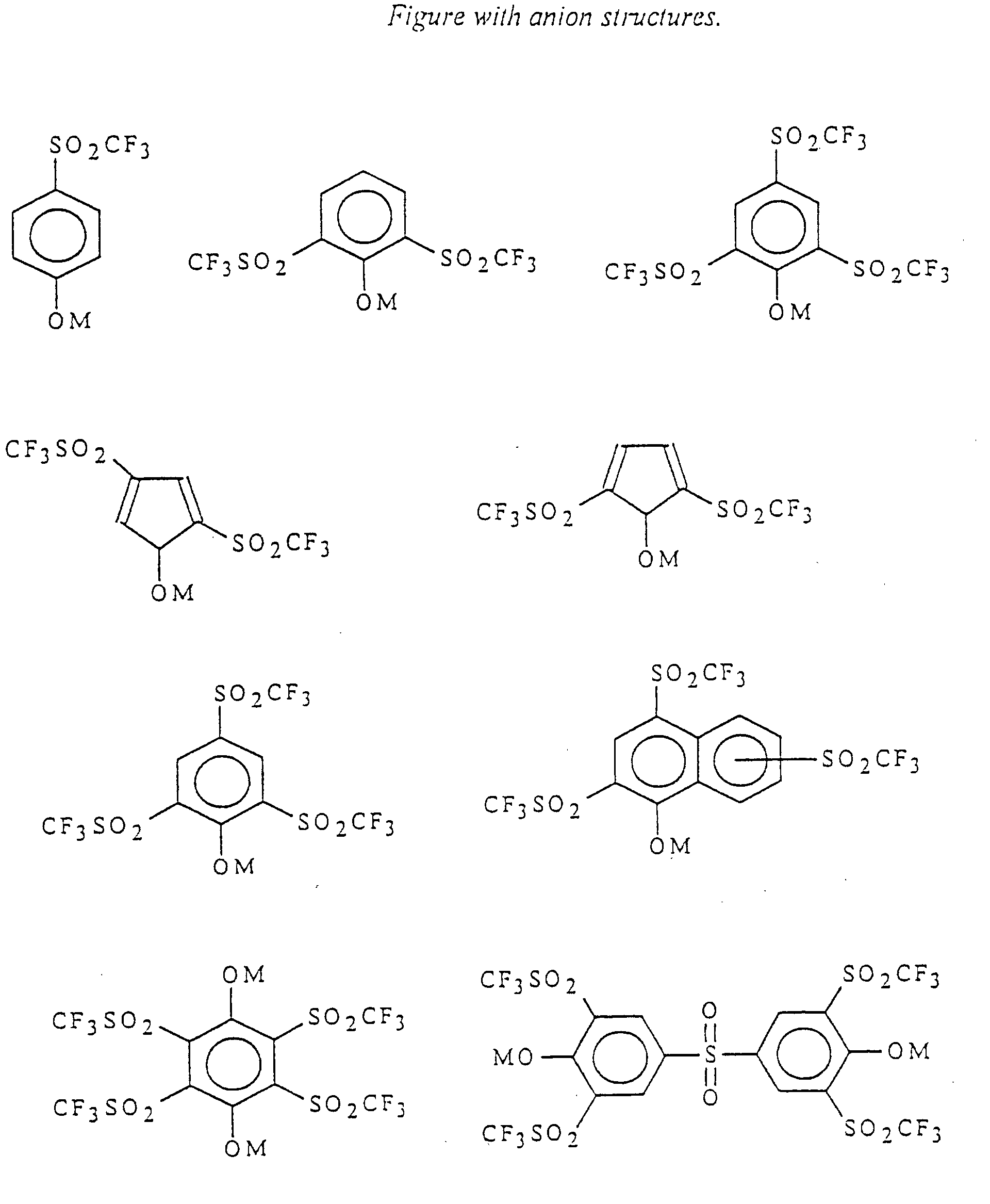
- The pyrrole anions are preferably 2,5 and 3,5 substituted pyrroles. The substituted phenols are preferably 2,6 and 2,4,6 substituted phenols. The lithium salts are produced by neutralization with lithium hydroxide. Other lithium compounds, such as lithium-t-butoxide may also be used.
- The electrochemical stability window of the lithium salts of the present invention was measured in propylene carbonate using cyclic voltammetry. A glassy carbon working electrode and a lithium reference electrode were used. The cyclic voltammogram of Li-bis(trifluoromethylsulfonyl)pyrrole (A) and Li-2,4,6-tris(trifluoromethylsulfonyl)phenol (B) are shown in Figure 1. The scan rate was 50 mV/sec. The cyclic voltammograms show that the electrochemical stability window is close to 5 volts vs. lithium, which is adequate for secondary lithium battery applications.
- In order to produce a high conductivity electrolyte suitable for secondary lithium batteries, the lithium salts may be dissolved in an aprotic polar liquid solvent, selected from propylene or ethylene carbonate, butyrolactone, acetonitrile, benzonitrile, dimethylformamide, diethylformamide, N-methylpyrrolidone, sulfolane, dimethylsulfone, tetramethyl sulfone, diethylether, dimethoxyethane, tetrahydrofuran, dioxane and methyl and ethyl formate.
- The conductivities of the lithium salts were measured in THF in order to compare the degree of dissociation. The conductivities of 0.1 M THF solutions of various lithium salts are listed in Table 1. The tri-substituted phenolate showed the highest conductivity which is expected due to its extensive anionic charge delocalization. Table 1 shows that the salts of the present invention provides higher conductivities than lithium salts previously studied for secondary lithium batteries, while at the same time allowing covalent attachment to polymer backbones.
Conductivities of lithium salts in 1M THF. Salt Conductivity (S/cm) at 25'C LiCF3SO3 2.9x 10⁻⁵ LiN(SO2CF3)2 6.4x 10⁻⁴ LiClO4 1.7 x 10⁻⁴ Li[phenol(SO2CF3)] 4.5 x 10⁻⁵ Li[phenol(SO2CF3)3] 1.1 x 10⁻³ Li[pyrrole(SO2CF3)2] 9.4 x 10⁻⁴ - Figure 2 shows the conductivity as a function of temperature between 25 °C and 100 °C for Li[phenol(SO2CF3)] in a branched polysiloxane with oligo(ethylene oxide) side chains. The polymer electrolyte was cast from a THF solution and was dried in vacuum at 60 °C for 24 hours. The ratio of oxygens to lithium was 20: 1. The conductivity was measured with ac impedance spectroscopy. The conductivity is almost a factor of ten higher than a corresponding polymer electrolyte with LiSO2CF3 salt, demonstrating the enhanced charge separation due to anion charge delocalization.
- The polyelectrolytes of this invention may be prepared by attaching the anionic moiety, containing an active functional group, directly to the polymer backbone followed by an exchange of the proton in the phenolic OH, the pyrrole NH or the aniline NH2 with lithium. In one alternative, the polyelectrolyte may be prepared by first reacting of such phenol, pyrrole or aniline compound with a polymer precursor, followed by polymerization of the modified precursor and subsequent change of the OH or NH to OLi and NLi.
- Polymers with glass transition temperatures in the range from -50°C to -150°C are preferred. Low glass transition temperatures allows local segmental motion of the polymer which is necessary for high ionic conductivity. Most preferred are polymers selected from polysiloxanes and polyphosphazenes, which have glass transition temperatures lower than -110°C. Other useful polymer backbones are poly(ethylene oxide) and siloxane-alkylene oxide copolymers. Suitable polymeric systems characterized as having a flexible backbone and a low glass transition temperature are exemplified by the structural formulae shown below.
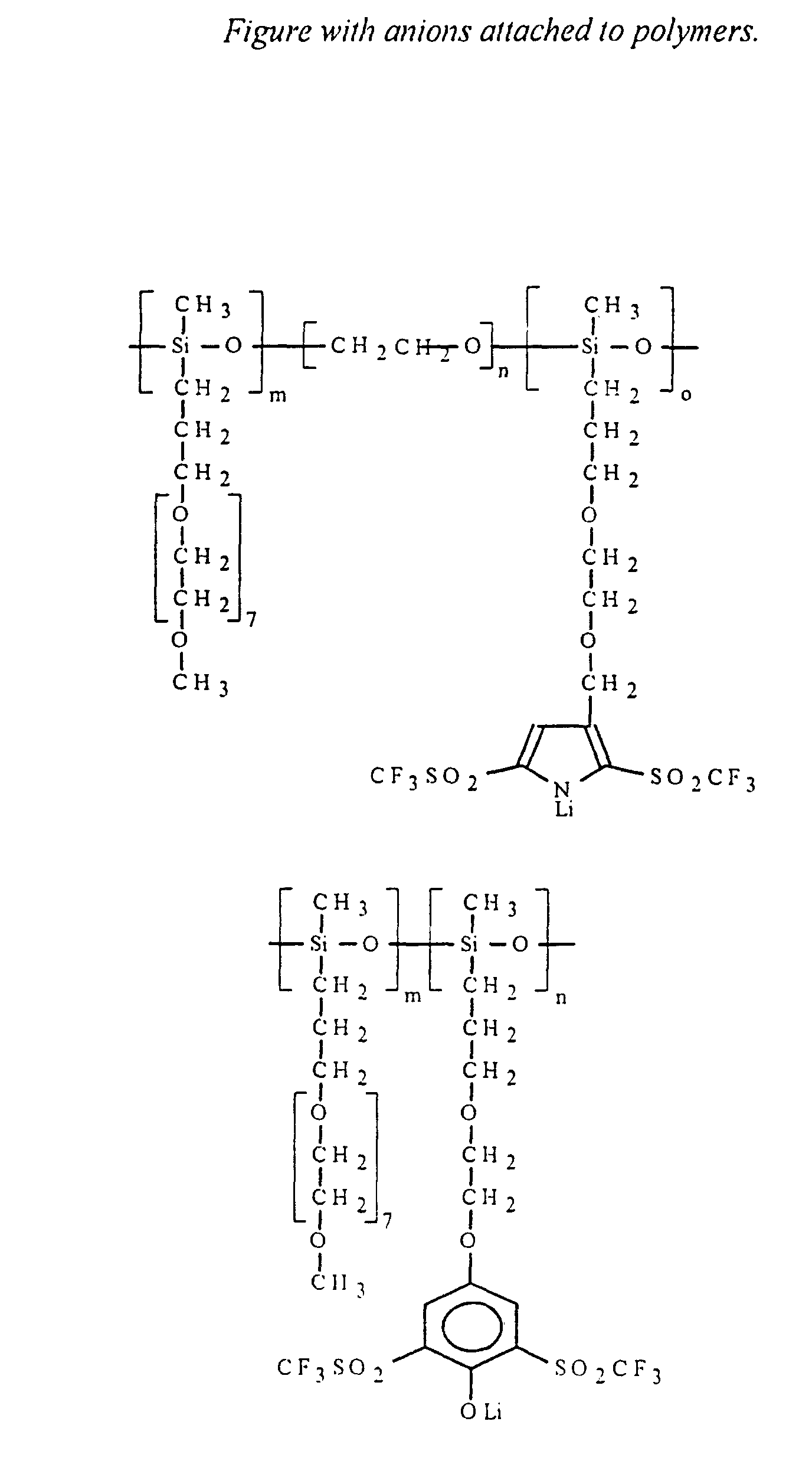
- The polymeric systems shown above are intended to be illustrative and are not to be construed as limiting the types of systems contemplated by the present invention.
- The manner in which the lithium salts of the present invention are prepared can be understood more fully by reference to the following illustrative examples.
- 7.33 g of phenol and 6 g of pyridine in 30 ml anhydrous chloroform was cooled with a dry ice bath, followed by addition in portions of 11.7 g of trifluoromethanesulfenyl chloride in 15 ml chloroform. After completion, the yellow solution was stirred at room temperature overnight. The reaction mixture was then washed with water and diluted with hydrochloric acid. After the solvent was evaporated, the residue was distilled under vacuum. The fraction was collected at 66-67 °C/2mm. The yield was 6 g. NMR: (CDCl3), δ 7.25 (AB pattern of phenyl ring) ppm. IR (neat): 3366.4, 1585.8, 1496.8, 1446.3, 1258.7, 1117.8, 833.9, 755.5 cm-1.
- Compound (1) from Example 1 (3.8 g in 4 ml of glacial acetic acid) was refluxed with 5.4 g of 30% hydrogen peroxide for 7 hours. The solvent was then evaporated and the residue distilled with a Kugelrohr and the boiling point was 140 °C/0.1 mm. The solution was then cooled and crystals were formed in the liquid. The melting point if the crystal solid was 108-110°C. NMR: (CDCl3), δ 7.5 (AB pattern) ppm. IR (KBr): 3440.4, 1587.6, 1501.8, 1441.7, 1347.2, 1295.7, 1192.3, 1116.3, 1058.5, 821.8, 746.7 cm-1,.
- Compound (2) from Example 2, in anhydrous methanol, was neutralized with equivalent amount of lithium hydroxide. The solvent was then removed, and the residue dissolved in a small amount of anhydrous THF. Ether was subsequently added and the solution stored in a refrigerator. The precipitated crystals were filtered and washed with ether.
- Condensed 32.5 g of trifluoromethylsulphenyl chloride was placed in a pressured bottle in a dry ice bath. 60 ml of chilled chloroform was added under nitrogen, followed by the addition of 5.6 g of phenol in 16 g of pyridine and 0.8 g of iron powder. The mixture was stirred in a closed bottle at room temperature for two days. The solution was then washed with water and diluted with hydrochloric acid. After removal of the solvent, the crude product was distilled with a column. The yield was 10 g. The b.p. was 51 °C/0.1 mm. NMR (CDCl3), δ 8.1 (s) ppm.
- The same oxidation method as in Example 2 was used. The crude solid product was extracted with hot benzene. Needle crystals were obtained with a m.p. of 170 - 171 °C. The yield was 62%. NMR(CDCl3): δ 8.9(s) ppm. IR (KBr): 3418.1, 1626.5, 1427.6, 1356.8, 1212.2, 1160, 1064.7, 866.6, 782.5 cm-1.
- Method A: Condensed 24 g of trifluoromethanesulfenyl chloride was placed in a pressured bottle in dry ice, and 2.34 g of pyrrole in 10 ml of anhydrous ether and 1 ml of trifluoromethanesulfonic acid were added. After stirring for 4 hours, the reaction mixture was removed from the dry ice bath and the mixture allowed to react at room temperature for 5 days. The mixture was then washed with water and diluted sodium carbonate. After removal of the ether by vacuum distillation with a column, 2,5-bis(trifluoromethylthio)pyrrole (6) was collected with a b.p. of 58°C/12 mm, and 2,4-bis(trifluoromethylthio)pyrrole (7) with a b.p. of 75°C,/
l 2 mm. The yields were 21 % and 28%, respectively. NMR (CDCl3): compound 6: δ 6.7 (d) ppm. Compound 7: δ 6.9 (s, 1H), 7.3 (s, 1H) ppm. IR (neat): Compound 6: 3468.8, 3138.6, 1609.6, 1522, 1397.4, 1109.7, 1043.5, 936.2, 788.5, 755.7 cm-1. Compound 7: 3471.2, 3137, 1609.6, 1532, 1415.3, 1106.9, 950.7, 832.5, 755.9 cm-1. - Method B: 25 g of trifluoromethanesulfenyl chloride was condensed in a pressured bottle in dry ice and 2.34 g of pyrrole in 40 ml of anhydrous chloroform, 12.1 g of pyridine and 0.8 g of iron powder were added. The mixture was then stirred at room temperature for 3 days. It was then filtered to remove insoluble materials. The mixture was washed with water, diluted hydrochloric acid and water again. After evaporation of the solvent, the residue was distilled under vacuum, giving 4.2 g of 2,5-bis(trifluoromethylthio)pyrrole and 3.5
g 2,4-bis(trifluoromethylthio)pyrrole. The total yield was 82 %. - The same procedure as in the synthesis oftris(trifluorosulfonyl)phenol (Example 4) was used. After removal of the solvent, the residue was recrystallized from chloroform to give plate crystals with a m.p. of 124 - 126 °. NMR (d-acetone): δ 7.75 (s, 1H). IR (KBr): 3296.8, 3134.2, 3048.1, 2963.6, 1528.5, 1445, 1368.6, 1205.9, 1124, 1064.5, 949.4, 852.2, 713.7 cm-1.
- The same procedure as in Example 7 was used. After the reaction was completed, the mixture was stored in a refrigerator overnight. The resulting needle crystals were washed with water. The m.p. was 146 - 147 °C. NMR (d-acetone): δ 7.3 (s) ppm. IR (KBr): 3278.7, 3138.6, 3050, 2950, 2870, 1517, 1382.7, 1204.3, 1140.2, 1085.9, 937.5, 803.5, 769.1 cm-1.
- The same method as for compound (5) was used starting from 4-(4-bromobutyl)-phenol (10) instead of phenol. After solvent removal colorless liquid was obtained. NMR (CDCl3): δ 1.4 (m, 4H), 2.8 (t, 2H), 3.5 (t, 2H), 7.2 (s, 1H), 8.1 (s, 2H) ppm.
- 24.6 g of potassium t-butoxide was dissolved in 200 ml of anhydrous THF under nitrogen. The solution was cooled with a dry ice bath to keep the inside temperature at -30°C. 4.9 g of compound (10) in 20 ml of THF was dropped into the solution and the mixture was stirred for 1 hour followed by warming to the room temperature. Then the reaction mixture was poused into ice, acidified with diluted hydrochloric acid and extracted with ether. After washing, drying and the solvent removal 3.5 g of liquid product was collected. MNR (CDCl3): δ 2.8 (m, 2H), 3.5 (t, 2H), 4.7-5.0 (m, 2H), 5.5-6.2 m, 1H), 7.2 (s, 1H), 8.1 (s, 2H) ppm.
- 4.1 g of compound (11) was dissolved in 20 ml of anhydrous methanol and the solution was neutralized with equivalent amount of lithium hydroxide. The solvent was then removed, and the residue was washed with ether and benzene to give white solid.
- 0.3 g of polymethylhydrosiloxane, 0.63 g of compound (12) and 1.33 g of heptaethyleneglicol allylmethylether were mixed in 20 ml of anhydrous THF. several drops of chloroplatinic acid solution was added and the solution was heated at 60°C for 24 hours. After the mixture was decolorized, the removal of solvent gave the desired product.
- While particular embodiments of the invention have been described, it will be understood, of course, that the invention is not limited thereto, and that many obvious modifications and variations thereof can be made, and that such modifications and variations are intended to fall within the scope of the appended claims.
Claims (15)
- A metal ion salt comprising an anion and one or more metal cations;wherein said anion has a mononuclear or condensed aromatic moiety comprising an aromatic π-electron system;wherein one or more electron withdrawing groups of the formula -SO2CF3 are covalently attached to said aromatic moiety;wherein said anion has one or more anionic groups capable of salt formation with said one or more metal cations; said one or more anionic groups selected from the group consisting of:an O- group, which is covalently attached to said aromatic moiety;an NH- group, which is covalently attached to said aromatic moiety; andan N- group, which is a part of said aromatic moiety;wherein said one or more anionic groups are conjugated with said one or more electron withdrawing groups through said aromatic π-electron system; said salt being neither the calcium, potassium nor sodium salt of 4,5-bis-(4-methoxyphenyl)-2-(trifluoromethylsulfonyl)-1H-imidazole, nor the sodium, potassium nor calcium salt of 4,5 bis (4-fluorophenyl)-2-trifluoromethylsulfonyl-1H-imidazole.
- A metal ion salt according to claim 1,
wherein said anion has a second mononuclear or condensed aromatic moiety bonded to said mononuclear or condensed aromatic moiety by an -SO2- group. - A metal ion salt according to claim 1, wherein said anion is SO2CF3-substituted phenol, hydroxybiphenyl, aniline, pyrrole, hydroxynaphthalene, hydroxyanthracene, hydroxyphenanthrene, hydroxyphenanthroline, hydroxyphenazine, or any combination of these bonded together by an -SO2- group.
- A metal ion salt according to claim 1, wherein said one or more metal cations are selected from the group consisting of: alkali cations, alkaline earth metal cations, transition metal cations, and rare earth metal cations.
- A metal ion salt according to claim 1, wherein said salt is selected from salts having the following formulae, wherein M is Li, Na, or K:

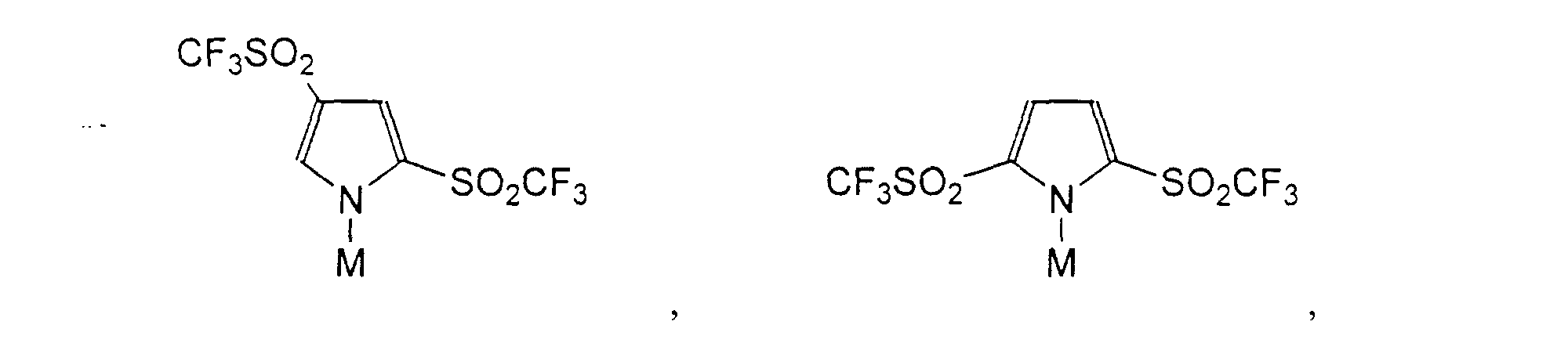
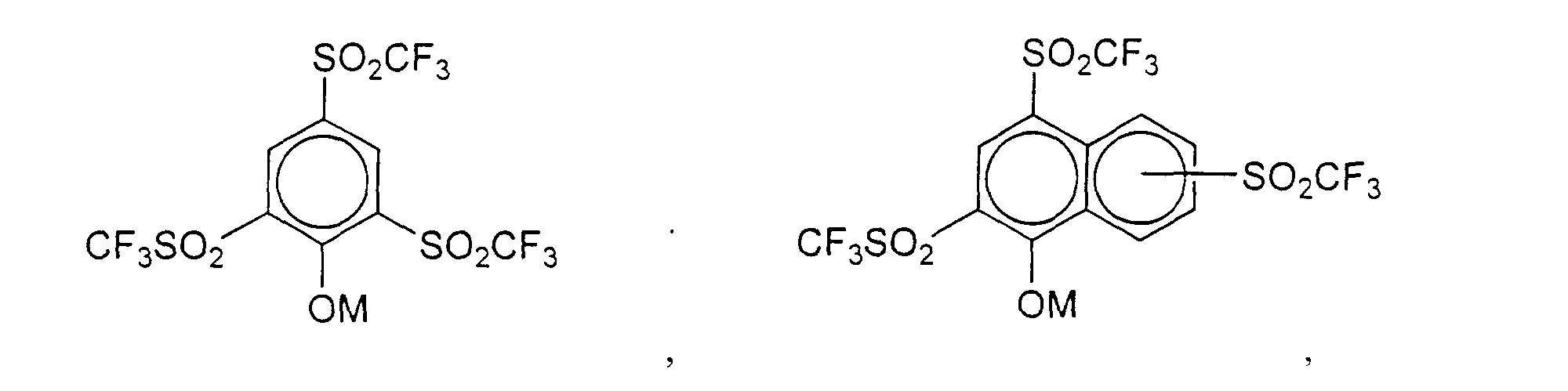
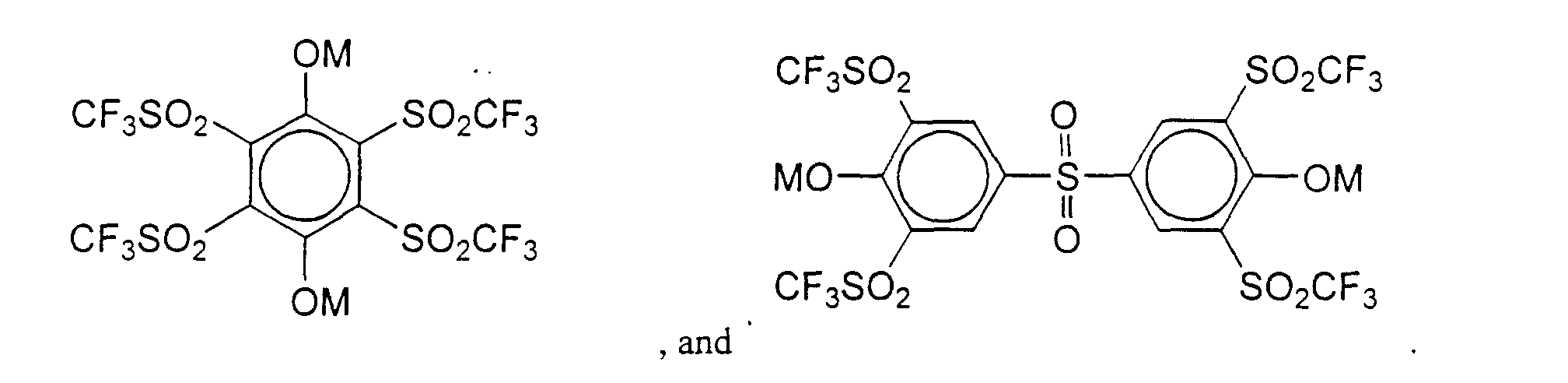
- A polyelectrolyte comprising a flexible polymer backbone to which is covalently attached anions of a metal ion salt according to any one of claims 1 to 5.
- A polyelectrolyte according to claim 6, wherein said polymer backbone is selected from the group consisting of: polysiloxane, polyphosphazene, polyether and co-polymers of polysiloxane and polyethers.
- A polyelectrolyte according to claim 6, wherein said polymer backbone is a polysiloxane.
- A polyelectrolyte according to claim 6, wherein said wherein said polyelectrolyte is selected from polyelectrolyte having the following formulae, wherein n, m, and o are positive integers:and


- An electrochemical cell comprising a positive electrode, a negative electrode and a liquid electrolyte; said liquid electrolyte comprising a polar aprotic solvent and a metal ion salt according to any one of claims 1 to 5.
- An electrochemical cell according to claim 10, wherein said polar aprotic solvent is selected from the group consisting of: propylene carbonate, ethylene carbonate, butyrolactone, acetonitrile, benzonitrile, dimethylformamide, diethylformamide, N-methylpyrrolidone, sulfolane, dimethylsufone, tetramethylsulfone, diethylether, dimethoxyethane, tetrahydrofuran, dioxane, methyl formate, and ethyl formate.
- An electrochemical cell according to claim 10, wherein said metal cation is lithium ion.
- An electrochemical cell comprising a positive electrode, a negative electrode, and a polyelectrolyte; said polyelectrolyte having a flexible polymer backbone to which is covalently attached anions of a metal ion salt according to any one of claims 1 to 5.
- An electrochemical cell according to claim 13, wherein said metal cation is lithium ion.
- An electrochemical cell according to claim 13, wherein said polyelectrolyte is solvent-free.
Applications Claiming Priority (3)
| Application Number | Priority Date | Filing Date | Title |
|---|---|---|---|
| US08/406,293 US5538812A (en) | 1994-02-04 | 1995-03-17 | Electrolyte materials containing highly dissociated metal ion salts |
| US406293 | 1995-03-17 | ||
| PCT/US1996/003984 WO1996029753A1 (en) | 1995-03-17 | 1996-03-15 | Electrolyte materials containing highly dissociated metal ion salts |
Publications (3)
| Publication Number | Publication Date |
|---|---|
| EP0830709A1 EP0830709A1 (en) | 1998-03-25 |
| EP0830709A4 EP0830709A4 (en) | 1998-05-20 |
| EP0830709B1 true EP0830709B1 (en) | 2001-07-04 |
Family
ID=23607337
Family Applications (1)
| Application Number | Title | Priority Date | Filing Date |
|---|---|---|---|
| EP96910529A Expired - Lifetime EP0830709B1 (en) | 1995-03-17 | 1996-03-15 | Electrolyte materials containing highly dissociated metal ion salts |
Country Status (6)
| Country | Link |
|---|---|
| US (1) | US5538812A (en) |
| EP (1) | EP0830709B1 (en) |
| JP (1) | JPH11502819A (en) |
| AU (1) | AU5370296A (en) |
| DE (1) | DE69613698T2 (en) |
| WO (1) | WO1996029753A1 (en) |
Cited By (1)
| Publication number | Priority date | Publication date | Assignee | Title |
|---|---|---|---|---|
| KR101351698B1 (en) | 2007-06-26 | 2014-02-11 | 삼성에스디아이 주식회사 | High molecular solid electrolyte and a lithium rechargeable battery employing the same |
Families Citing this family (113)
| Publication number | Priority date | Publication date | Assignee | Title |
|---|---|---|---|---|
| DE69710787T2 (en) | 1996-05-22 | 2002-11-21 | Moltech Corp., Tucson | COMPOSITE CATHODES, ELECTROCHEMICAL CELLS WITH COMPOSITE CATHODES AND METHOD FOR THE PRODUCTION THEREOF |
| JP4823401B2 (en) * | 1996-12-30 | 2011-11-24 | イドロ―ケベック | Perfluorinated amide salts and their use as ion-conducting substances |
| WO1999005100A1 (en) * | 1997-07-25 | 1999-02-04 | Acep Inc | Ionic compounds with delocalized anionic charge, their use as components of ionic conductors or catalyst |
| FR2767969B1 (en) * | 1997-08-29 | 1999-10-15 | Alsthom Cge Alcatel | LITHIUM RECHARGEABLE GENERATOR WITH ORGANIC ELECTROLYTE AND CARBON ANODE |
| WO1999028292A1 (en) * | 1997-12-01 | 1999-06-10 | Acep Inc. | Perfluorynated sulphone salts, and their uses as ionic conduction materials |
| US6194099B1 (en) | 1997-12-19 | 2001-02-27 | Moltech Corporation | Electrochemical cells with carbon nanofibers and electroactive sulfur compounds |
| US6110619A (en) * | 1997-12-19 | 2000-08-29 | Moltech Corporation | Electrochemical cells with cationic polymers and electroactive sulfur compounds |
| US6153337A (en) | 1997-12-19 | 2000-11-28 | Moltech Corporation | Separators for electrochemical cells |
| US6210831B1 (en) * | 1997-12-19 | 2001-04-03 | Moltech Corporation | Cathodes comprising electroactive sulfur materials and secondary batteries using same |
| US6201100B1 (en) | 1997-12-19 | 2001-03-13 | Moltech Corporation | Electroactive, energy-storing, highly crosslinked, polysulfide-containing organic polymers and methods for making same |
| US6124062A (en) * | 1998-01-26 | 2000-09-26 | Sony Corporation | Non-aqueous electrolytic solution, and non-aqueous electrolyte cell comprising it |
| CA2283670C (en) * | 1998-02-03 | 2011-06-07 | Acep Inc. | Materials useful as electrolytic solutes |
| EP1095420A1 (en) | 1998-06-08 | 2001-05-02 | Moltech Corporation | Multifunctional reactive monomers for safety protection of nonaqueous electrochemical cells |
| US6248883B1 (en) | 1998-07-31 | 2001-06-19 | Moltech Corporation | Methods of purifying lithium salts |
| US6350545B2 (en) * | 1998-08-25 | 2002-02-26 | 3M Innovative Properties Company | Sulfonylimide compounds |
| US6194098B1 (en) | 1998-12-17 | 2001-02-27 | Moltech Corporation | Protective coating for separators for electrochemical cells |
| US6277514B1 (en) | 1998-12-17 | 2001-08-21 | Moltech Corporation | Protective coating for separators for electrochemical cells |
| US6190426B1 (en) | 1998-12-17 | 2001-02-20 | Moltech Corporation | Methods of preparing prismatic cells |
| US6302928B1 (en) | 1998-12-17 | 2001-10-16 | Moltech Corporation | Electrochemical cells with high volumetric density of electroactive sulfur-containing materials in cathode active layers |
| AU4982600A (en) | 1999-05-04 | 2000-11-17 | Moltech Corporation | Electroactive polymers of high sulfur content for use in electrochemical cells |
| JP2001052746A (en) | 1999-08-06 | 2001-02-23 | Matsushita Electric Ind Co Ltd | Polymer solid electrolyte and lithium secondary battery using the same |
| US6362915B1 (en) | 1999-10-26 | 2002-03-26 | Xerox Corporation | Bichromal beads having crystalline materials therein |
| US6335818B1 (en) | 1999-10-26 | 2002-01-01 | Xerox Corporation | Bichromal beads having electrolytes therein |
| US6496298B1 (en) | 1999-10-26 | 2002-12-17 | Xerox Corporation | Bichromal beads having charge adjuvants therein |
| WO2001036206A1 (en) | 1999-11-12 | 2001-05-25 | Fargo Electronics, Inc. | Thermal printhead compensation |
| US20070221265A1 (en) | 2006-03-22 | 2007-09-27 | Sion Power Corporation | Rechargeable lithium/water, lithium/air batteries |
| JP5106732B2 (en) | 1999-11-23 | 2012-12-26 | シオン・パワー・コーポレーション | Lithium negative electrode for electrochemical cells |
| US7247408B2 (en) | 1999-11-23 | 2007-07-24 | Sion Power Corporation | Lithium anodes for electrochemical cells |
| US6797428B1 (en) | 1999-11-23 | 2004-09-28 | Moltech Corporation | Lithium anodes for electrochemical cells |
| US6733924B1 (en) | 1999-11-23 | 2004-05-11 | Moltech Corporation | Lithium anodes for electrochemical cells |
| US20110165471A9 (en) * | 1999-11-23 | 2011-07-07 | Sion Power Corporation | Protection of anodes for electrochemical cells |
| US7066971B1 (en) | 1999-11-23 | 2006-06-27 | Sion Power Corporation | Methods of preparing electrochemical cells |
| US6329789B1 (en) | 1999-12-21 | 2001-12-11 | Moltech Corporation | Methods of charging lithium-sulfur batteries |
| US6344293B1 (en) | 2000-04-18 | 2002-02-05 | Moltech Corporation | Lithium electrochemical cells with enhanced cycle life |
| US7150944B2 (en) * | 2000-05-03 | 2006-12-19 | Samsung Sdi Co., Ltd. | Non-aqueous electrolyte compositions and lithium secondary batteries made thereof |
| US6488721B1 (en) | 2000-06-09 | 2002-12-03 | Moltech Corporation | Methods of preparing electrochemical cells |
| US6436583B1 (en) | 2000-08-04 | 2002-08-20 | Moltech Corporation | Storage life enhancement in lithium-sulfur batteries |
| US6403263B1 (en) | 2000-09-20 | 2002-06-11 | Moltech Corporation | Cathode current collector for electrochemical cells |
| US6566006B1 (en) | 2000-09-20 | 2003-05-20 | Moltech Corporation | Sulfur-containing cathode |
| US6544688B1 (en) | 2000-09-20 | 2003-04-08 | Moltech Corporation | Cathode current collector for electrochemical cells |
| US6706449B2 (en) | 2000-12-21 | 2004-03-16 | Moltech Corporation | Lithium anodes for electrochemical cells |
| US20050019656A1 (en) * | 2002-03-22 | 2005-01-27 | Yoon Sang Young | Method for fabricating composite electrodes |
| US7695860B2 (en) * | 2002-03-22 | 2010-04-13 | Quallion Llc | Nonaqueous liquid electrolyte |
| US7498102B2 (en) * | 2002-03-22 | 2009-03-03 | Bookeun Oh | Nonaqueous liquid electrolyte |
| US20030180624A1 (en) * | 2002-03-22 | 2003-09-25 | Bookeun Oh | Solid polymer electrolyte and method of preparation |
| AU2003223327A1 (en) * | 2002-03-22 | 2003-10-13 | Quallion Llc | Polymer electrolyte for electrochemical cell |
| US7226702B2 (en) | 2002-03-22 | 2007-06-05 | Quallion Llc | Solid polymer electrolyte and method of preparation |
| US6887619B2 (en) | 2002-04-22 | 2005-05-03 | Quallion Llc | Cross-linked polysiloxanes |
| US7256218B2 (en) * | 2002-11-22 | 2007-08-14 | Jacobus Pharmaceutical Company, Inc. | Biguanide and dihydrotriazine derivatives |
| US7588859B1 (en) | 2004-02-11 | 2009-09-15 | Bookeun Oh | Electrolyte for use in electrochemical devices |
| US8076031B1 (en) | 2003-09-10 | 2011-12-13 | West Robert C | Electrochemical device having electrolyte including disiloxane |
| US8076032B1 (en) | 2004-02-04 | 2011-12-13 | West Robert C | Electrolyte including silane for use in electrochemical devices |
| US20070065728A1 (en) | 2003-03-20 | 2007-03-22 | Zhengcheng Zhang | Battery having electrolyte with mixed solvent |
| US7718321B2 (en) * | 2004-02-04 | 2010-05-18 | Quallion Llc | Battery having electrolyte including organoborate salt |
| US7473491B1 (en) | 2003-09-15 | 2009-01-06 | Quallion Llc | Electrolyte for electrochemical cell |
| US10297827B2 (en) | 2004-01-06 | 2019-05-21 | Sion Power Corporation | Electrochemical cell, components thereof, and methods of making and using same |
| US10629947B2 (en) | 2008-08-05 | 2020-04-21 | Sion Power Corporation | Electrochemical cell |
| US7358012B2 (en) | 2004-01-06 | 2008-04-15 | Sion Power Corporation | Electrolytes for lithium sulfur cells |
| US8828610B2 (en) * | 2004-01-06 | 2014-09-09 | Sion Power Corporation | Electrolytes for lithium sulfur cells |
| US9786954B2 (en) | 2004-02-04 | 2017-10-10 | Robert C. West | Electrolyte including silane for use in electrochemical devices |
| US8765295B2 (en) | 2004-02-04 | 2014-07-01 | Robert C. West | Electrolyte including silane for use in electrochemical devices |
| US8153307B1 (en) | 2004-02-11 | 2012-04-10 | Quallion Llc | Battery including electrolyte with mixed solvent |
| JP4438956B2 (en) * | 2005-04-04 | 2010-03-24 | 信越化学工業株式会社 | Non-aqueous electrolyte and secondary battery using the same |
| US20060288547A1 (en) * | 2005-06-23 | 2006-12-28 | 3M Innovative Properties Company | Zoned stretching of a web |
| CN101601150B (en) * | 2006-12-04 | 2015-02-18 | 赛昂能源有限公司 | Separation of electrolytes |
| US9105938B2 (en) | 2008-08-05 | 2015-08-11 | Sion Power Corporation | Application of force in electrochemical cells |
| WO2009089018A2 (en) | 2008-01-08 | 2009-07-16 | Sion Power Corporation | Porous electrodes and associated methods |
| JP2011501383A (en) | 2007-10-26 | 2011-01-06 | サイオン パワー コーポレイション | Battery electrode primer |
| EP2409349A4 (en) * | 2009-03-19 | 2013-05-01 | Sion Power Corp | Cathode for lithium battery |
| WO2011028251A2 (en) | 2009-08-24 | 2011-03-10 | Sion Power Corporation | Release system for electrochemical cells |
| WO2011031297A2 (en) * | 2009-08-28 | 2011-03-17 | Sion Power Corporation | Electrochemical cells comprising porous structures comprising sulfur |
| US20110206992A1 (en) * | 2009-08-28 | 2011-08-25 | Sion Power Corporation | Porous structures for energy storage devices |
| CN103201885A (en) | 2010-06-17 | 2013-07-10 | L·F·纳扎尔 | Multicomponent electrodes for rechargeable batteries |
| KR20130105838A (en) | 2010-08-24 | 2013-09-26 | 바스프 에스이 | Electrolyte materials for use in electrochemical cells |
| US8735002B2 (en) | 2011-09-07 | 2014-05-27 | Sion Power Corporation | Lithium sulfur electrochemical cell including insoluble nitrogen-containing compound |
| EP2721665B1 (en) | 2011-06-17 | 2021-10-27 | Sion Power Corporation | Plating technique for electrode |
| CN103947027B (en) | 2011-10-13 | 2016-12-21 | 赛昂能源有限公司 | Electrode structure and manufacture method thereof |
| US9077041B2 (en) | 2012-02-14 | 2015-07-07 | Sion Power Corporation | Electrode structure for electrochemical cell |
| DE102012102162A1 (en) * | 2012-03-14 | 2013-09-19 | Westfälische Wilhelms-Universität Münster Körperschaft des öffentlichen Rechts | Ion-conducting polymeric compound for electrochemical cells |
| US9005311B2 (en) | 2012-11-02 | 2015-04-14 | Sion Power Corporation | Electrode active surface pretreatment |
| US9577289B2 (en) | 2012-12-17 | 2017-02-21 | Sion Power Corporation | Lithium-ion electrochemical cell, components thereof, and methods of making and using same |
| KR101991149B1 (en) | 2012-12-19 | 2019-06-19 | 시온 파워 코퍼레이션 | Electrode structure and method for making same |
| WO2014110131A1 (en) | 2013-01-08 | 2014-07-17 | Sion Power Corporation | Conductivity control in electrochemical cells |
| US9531009B2 (en) | 2013-01-08 | 2016-12-27 | Sion Power Corporation | Passivation of electrodes in electrochemical cells |
| CN105190953A (en) | 2013-03-05 | 2015-12-23 | 赛昂能源有限公司 | Electrochemical cells comprising fibril materials, such as fibril cellulose materials |
| EP2973789B1 (en) | 2013-03-15 | 2019-05-08 | Sion Power Corporation | Protected electrode structures and methods |
| WO2014140198A1 (en) | 2013-03-15 | 2014-09-18 | Basf Se | Protected electrode structures |
| US12261284B2 (en) | 2013-03-15 | 2025-03-25 | Sion Power Corporation | Protective structures for electrodes |
| CN105190969B (en) | 2013-03-15 | 2019-01-18 | 赛昂能源有限公司 | Protective structure for electrodes |
| WO2015003123A1 (en) | 2013-07-03 | 2015-01-08 | Sion Power Corporation | Ceramic/polymer matrix for electrode protection in electrochemical cells, including rechargeable lithium batteries |
| EP3031096B1 (en) | 2013-08-08 | 2019-06-05 | Sion Power Corporation | Self-healing electrode protection in electrochemical cells |
| EP2911221B1 (en) | 2014-02-19 | 2025-04-23 | Sion Power Corporation | Electrode protection using a composite comprising an electrolyte-inhibiting ion conductor |
| KR102316170B1 (en) | 2014-02-19 | 2021-10-21 | 시온 파워 코퍼레이션 | Electrode protection using a composite comprising an electrolyte-inhibiting ion conductor |
| US10490796B2 (en) | 2014-02-19 | 2019-11-26 | Sion Power Corporation | Electrode protection using electrolyte-inhibiting ion conductor |
| KR102622781B1 (en) | 2014-05-01 | 2024-01-08 | 시온 파워 코퍼레이션 | Electrode fabrication methods and associated articles |
| EP3192112A4 (en) | 2014-09-09 | 2018-04-11 | Sion Power Corporation | Protective layers in lithium-ion electrochemical cells and associated electrodes and methods |
| KR102493741B1 (en) | 2014-10-23 | 2023-01-30 | 시온 파워 코퍼레이션 | Ion-conductive composite for electrochemical cells |
| WO2016187510A1 (en) | 2015-05-20 | 2016-11-24 | Sion Power Corporation | Protective layers for electrodes |
| CN117558971A (en) | 2015-11-24 | 2024-02-13 | 锡安能量公司 | Ion conducting compounds and related uses |
| JP7049269B2 (en) | 2016-05-20 | 2022-04-06 | シオン・パワー・コーポレーション | Protective layer for electrodes and electrochemical battery |
| US10991925B2 (en) | 2016-06-21 | 2021-04-27 | Sion Power Corporation | Coatings for components of electrochemical cells |
| WO2018119392A1 (en) | 2016-12-23 | 2018-06-28 | Sion Power Corporation | Protective layers comprising metals for electrochemical cells |
| US10720648B2 (en) | 2017-03-17 | 2020-07-21 | Sion Power Corporation | Electrode edge protection in electrochemical cells |
| KR102833170B1 (en) | 2017-05-24 | 2025-07-10 | 시온 파워 코퍼레이션 | Ionically conductive compounds and related uses |
| KR102609863B1 (en) | 2017-06-09 | 2023-12-04 | 시온 파워 코퍼레이션 | In-situ whole house |
| WO2020139802A2 (en) | 2018-12-27 | 2020-07-02 | Sion Power Corporation | Electrochemical devices and related articles, components, configurations, and methods |
| US11637353B2 (en) | 2018-12-27 | 2023-04-25 | Sion Power Corporation | Electrodes, heaters, sensors, and associated articles and methods |
| US11322804B2 (en) | 2018-12-27 | 2022-05-03 | Sion Power Corporation | Isolatable electrodes and associated articles and methods |
| US11710828B2 (en) | 2019-05-22 | 2023-07-25 | Sion Power Corporation | Electrochemical devices including porous layers |
| WO2020237015A1 (en) | 2019-05-22 | 2020-11-26 | Sion Power Corporation | Electrically coupled electrodes, and associated articles and methods |
| EP4208906A1 (en) | 2020-09-04 | 2023-07-12 | Sion Power Corporation | Electrically conductive release layer |
| KR20230167411A (en) | 2021-04-08 | 2023-12-08 | 시온 파워 코퍼레이션 | Electrolyte for lithium batteries |
| JP7374974B2 (en) | 2021-11-24 | 2023-11-07 | 住友化学株式会社 | Polymer and its manufacturing method, electrolyte composition, and battery |
Family Cites Families (13)
| Publication number | Priority date | Publication date | Assignee | Title |
|---|---|---|---|---|
| US2938042A (en) * | 1956-02-03 | 1960-05-24 | Boots Pure Drug Co Ltd | Acyclic and aromatic sulphonylphenyl isothiocyanates |
| US3481785A (en) * | 1966-03-28 | 1969-12-02 | Shinichi Ikari | Lead storage battery containing a sulfonic acid substituted naphthalene/formaldehyde condensation product |
| US3689567A (en) * | 1966-08-01 | 1972-09-05 | Tsung Ying Shen | Benzyl methyl sulfones and process for preparing same |
| US3927100A (en) * | 1971-12-20 | 1975-12-16 | Abbott Lab | Process for producing amino phenyl iodomethyl sulfones |
| US4190666A (en) * | 1975-08-11 | 1980-02-26 | E. I. Du Pont De Nemours And Company | Anti-inflammatory 4,5-diarly-2-(substituted-thio)imidazoles and their corresponding sulfoxides and sulfones |
| GB1569397A (en) * | 1976-04-07 | 1980-06-11 | Exxon Research Engineering Co | Metal-halogen electrochemical cell |
| FR2527602A1 (en) * | 1982-06-01 | 1983-12-02 | Anvar | BIS PERHALOGENOACYL- OR SULFONYL- IMIDURES OF ALKALI METALS, THEIR SOLID SOLUTIONS WITH PLASTIC MATERIALS AND THEIR APPLICATION TO THE CONSTITUTION OF CONDUCTIVE ELEMENTS FOR ELECTROCHEMICAL GENERATORS |
| US4402962A (en) * | 1982-06-30 | 1983-09-06 | E. I. Du Pont De Nemours And Company | Analgesic mixture of nalbuphine and 4,5-bis(4-methoxyphenyl)-2-(trifluoromethylsulfonyl)-1H-imidazole |
| US5162177A (en) * | 1986-10-30 | 1992-11-10 | Hydro-Quebec | Ion conductive material composed of a salt in solution in a liquid electrolyte |
| FR2606218A1 (en) * | 1986-10-30 | 1988-05-06 | Elf Aquitaine | NEW IONIC CONDUCTION MATERIAL |
| US4837327A (en) * | 1987-07-13 | 1989-06-06 | Ethyl Corporation | Process for nucleophilic fluoroalkylation of aldehydes |
| US5273840A (en) * | 1990-08-01 | 1993-12-28 | Covalent Associates Incorporated | Methide salts, formulations, electrolytes and batteries formed therefrom |
| FR2673769B1 (en) * | 1991-03-07 | 1993-06-18 | Centre Nat Rech Scient | POLYMERIC MATERIALS WITH ION CONDUCTION. |
-
1995
- 1995-03-17 US US08/406,293 patent/US5538812A/en not_active Expired - Fee Related
-
1996
- 1996-03-15 EP EP96910529A patent/EP0830709B1/en not_active Expired - Lifetime
- 1996-03-15 WO PCT/US1996/003984 patent/WO1996029753A1/en not_active Ceased
- 1996-03-15 JP JP8528648A patent/JPH11502819A/en active Pending
- 1996-03-15 AU AU53702/96A patent/AU5370296A/en not_active Abandoned
- 1996-03-15 DE DE69613698T patent/DE69613698T2/en not_active Expired - Fee Related
Cited By (1)
| Publication number | Priority date | Publication date | Assignee | Title |
|---|---|---|---|---|
| KR101351698B1 (en) | 2007-06-26 | 2014-02-11 | 삼성에스디아이 주식회사 | High molecular solid electrolyte and a lithium rechargeable battery employing the same |
Also Published As
| Publication number | Publication date |
|---|---|
| WO1996029753A1 (en) | 1996-09-26 |
| DE69613698T2 (en) | 2001-10-25 |
| EP0830709A1 (en) | 1998-03-25 |
| DE69613698D1 (en) | 2001-08-09 |
| JPH11502819A (en) | 1999-03-09 |
| EP0830709A4 (en) | 1998-05-20 |
| AU5370296A (en) | 1996-10-08 |
| US5538812A (en) | 1996-07-23 |
Similar Documents
| Publication | Publication Date | Title |
|---|---|---|
| EP0830709B1 (en) | Electrolyte materials containing highly dissociated metal ion salts | |
| WO1996029753A9 (en) | Electrolyte materials containing highly dissociated metal ion salts | |
| Feng et al. | Single lithium-ion conducting polymer electrolytes based on poly [(4-styrenesulfonyl)(trifluoromethanesulfonyl) imide] anions | |
| EP0796511B1 (en) | Single-ion conducting solid polymer electrolytes | |
| US6245465B1 (en) | Non-aqueous electrolyte solvents for secondary cells | |
| US5731104A (en) | Batteries, conductive compositions, and conductive films containing organic liquid electrolytes and plasticizers | |
| US5514493A (en) | Perfluoroalkylsulfonates, sulfonimides, and sulfonyl methides, and electrolytes containing them | |
| US9991559B2 (en) | Functionalized ionic liquid electrolytes for lithium ion batteries | |
| US5273840A (en) | Methide salts, formulations, electrolytes and batteries formed therefrom | |
| US5446134A (en) | Bis(perfluorosulfonyl)methane salts, and a process for preparing same | |
| US6534220B2 (en) | High-boiling electrolyte solvent | |
| CA2325505A1 (en) | Electrolytes containing mixed fluorocarbon/hydrocarbon imide and methide salts | |
| KR20010067251A (en) | Fluorinated sulfonamides as low-flammability solvents for use in electrochemical cells | |
| Xu et al. | Preparation and characterization of novel “polyMOB” polyanionic solid electrolytes with weak coulomb traps | |
| KR20010062269A (en) | Alkylspiroborate salts for use in electrochemical cells | |
| JPH02223160A (en) | All-solid lithium secondary battery | |
| JPH1154151A (en) | Substrate for ion conductor and ion conductor | |
| Grewal et al. | Solvated Ionic‐Liquid Incorporated Soft Flexible Cross‐Linked Network Polymer Electrolytes for Safer Lithium Ion Secondary Batteries | |
| Xu et al. | Anion-trapping and polyanion electrolytes based on acid-in-chain borate polymers | |
| JP4100616B2 (en) | Ion conductive materials composed of low molecular weight compounds with hydrogen bonding sites | |
| US20200165197A1 (en) | Sulfonamide macromolecules useful as single-ion conducting polymer electrolyte | |
| US20070009805A1 (en) | Polymer electrolyte | |
| US11613520B2 (en) | Electrolytes for electrochemical generator | |
| JPH0556384B2 (en) | ||
| JP2002179800A (en) | Ion conductive polymer and ionic conductor |
Legal Events
| Date | Code | Title | Description |
|---|---|---|---|
| PUAI | Public reference made under article 153(3) epc to a published international application that has entered the european phase |
Free format text: ORIGINAL CODE: 0009012 |
|
| 17P | Request for examination filed |
Effective date: 19970926 |
|
| AK | Designated contracting states |
Kind code of ref document: A1 Designated state(s): DE FR GB IT |
|
| A4 | Supplementary search report drawn up and despatched |
Effective date: 19980403 |
|
| AK | Designated contracting states |
Kind code of ref document: A4 Designated state(s): DE FR GB IT |
|
| 17Q | First examination report despatched |
Effective date: 19990312 |
|
| GRAG | Despatch of communication of intention to grant |
Free format text: ORIGINAL CODE: EPIDOS AGRA |
|
| GRAG | Despatch of communication of intention to grant |
Free format text: ORIGINAL CODE: EPIDOS AGRA |
|
| GRAG | Despatch of communication of intention to grant |
Free format text: ORIGINAL CODE: EPIDOS AGRA |
|
| GRAH | Despatch of communication of intention to grant a patent |
Free format text: ORIGINAL CODE: EPIDOS IGRA |
|
| GRAH | Despatch of communication of intention to grant a patent |
Free format text: ORIGINAL CODE: EPIDOS IGRA |
|
| GRAA | (expected) grant |
Free format text: ORIGINAL CODE: 0009210 |
|
| AK | Designated contracting states |
Kind code of ref document: B1 Designated state(s): DE FR GB IT |
|
| PG25 | Lapsed in a contracting state [announced via postgrant information from national office to epo] |
Ref country code: IT Free format text: LAPSE BECAUSE OF FAILURE TO SUBMIT A TRANSLATION OF THE DESCRIPTION OR TO PAY THE FEE WITHIN THE PRE;WARNING: LAPSES OF ITALIAN PATENTS WITH EFFECTIVE DATE BEFORE 2007 MAY HAVE OCCURRED AT ANY TIME BEFORE 2007. THE CORRECT EFFECTIVE DATE MAY BE DIFFERENT FROM THE ONE RECORDED.SCRIBED TIME-LIMIT Effective date: 20010704 |
|
| REF | Corresponds to: |
Ref document number: 69613698 Country of ref document: DE Date of ref document: 20010809 |
|
| ET | Fr: translation filed | ||
| REG | Reference to a national code |
Ref country code: GB Ref legal event code: IF02 |
|
| PG25 | Lapsed in a contracting state [announced via postgrant information from national office to epo] |
Ref country code: GB Free format text: LAPSE BECAUSE OF NON-PAYMENT OF DUE FEES Effective date: 20020315 |
|
| PLBE | No opposition filed within time limit |
Free format text: ORIGINAL CODE: 0009261 |
|
| STAA | Information on the status of an ep patent application or granted ep patent |
Free format text: STATUS: NO OPPOSITION FILED WITHIN TIME LIMIT |
|
| 26N | No opposition filed | ||
| PG25 | Lapsed in a contracting state [announced via postgrant information from national office to epo] |
Ref country code: DE Free format text: LAPSE BECAUSE OF NON-PAYMENT OF DUE FEES Effective date: 20021001 |
|
| GBPC | Gb: european patent ceased through non-payment of renewal fee |
Effective date: 20020315 |
|
| PG25 | Lapsed in a contracting state [announced via postgrant information from national office to epo] |
Ref country code: FR Free format text: LAPSE BECAUSE OF NON-PAYMENT OF DUE FEES Effective date: 20021129 |
|
| REG | Reference to a national code |
Ref country code: FR Ref legal event code: ST |