EP0828749B1 - Methods for the synthesis of organophosphorus derivatives - Google Patents
Methods for the synthesis of organophosphorus derivatives Download PDFInfo
- Publication number
- EP0828749B1 EP0828749B1 EP96917829A EP96917829A EP0828749B1 EP 0828749 B1 EP0828749 B1 EP 0828749B1 EP 96917829 A EP96917829 A EP 96917829A EP 96917829 A EP96917829 A EP 96917829A EP 0828749 B1 EP0828749 B1 EP 0828749B1
- Authority
- EP
- European Patent Office
- Prior art keywords
- moiety
- nucleoside
- formula
- reacting
- protecting group
- Prior art date
- Legal status (The legal status is an assumption and is not a legal conclusion. Google has not performed a legal analysis and makes no representation as to the accuracy of the status listed.)
- Expired - Lifetime
Links
- 238000000034 method Methods 0.000 title claims abstract description 78
- 230000015572 biosynthetic process Effects 0.000 title claims abstract description 64
- 238000003786 synthesis reaction Methods 0.000 title claims abstract description 62
- 239000002777 nucleoside Substances 0.000 claims description 320
- 150000003833 nucleoside derivatives Chemical class 0.000 claims description 271
- 239000000543 intermediate Substances 0.000 claims description 105
- GQHTUMJGOHRCHB-UHFFFAOYSA-N 2,3,4,6,7,8,9,10-octahydropyrimido[1,2-a]azepine Chemical compound C1CCCCN2CCCN=C21 GQHTUMJGOHRCHB-UHFFFAOYSA-N 0.000 claims description 88
- 230000001052 transient effect Effects 0.000 claims description 76
- 125000006239 protecting group Chemical group 0.000 claims description 68
- 125000003835 nucleoside group Chemical group 0.000 claims description 48
- 125000003118 aryl group Chemical group 0.000 claims description 43
- CURLTUGMZLYLDI-UHFFFAOYSA-N Carbon dioxide Chemical compound O=C=O CURLTUGMZLYLDI-UHFFFAOYSA-N 0.000 claims description 41
- 239000012190 activator Substances 0.000 claims description 41
- 125000000217 alkyl group Chemical group 0.000 claims description 41
- 239000000203 mixture Substances 0.000 claims description 41
- 239000002253 acid Substances 0.000 claims description 40
- 229910052739 hydrogen Inorganic materials 0.000 claims description 40
- 239000003960 organic solvent Substances 0.000 claims description 39
- 229910000104 sodium hydride Inorganic materials 0.000 claims description 39
- KEAYESYHFKHZAL-UHFFFAOYSA-N Sodium Chemical compound [Na] KEAYESYHFKHZAL-UHFFFAOYSA-N 0.000 claims description 38
- 239000002168 alkylating agent Substances 0.000 claims description 38
- 229940100198 alkylating agent Drugs 0.000 claims description 38
- 125000003710 aryl alkyl group Chemical group 0.000 claims description 38
- 229910003002 lithium salt Inorganic materials 0.000 claims description 38
- 159000000002 lithium salts Chemical class 0.000 claims description 38
- 239000012312 sodium hydride Substances 0.000 claims description 38
- MHAJPDPJQMAIIY-UHFFFAOYSA-N Hydrogen peroxide Chemical compound OO MHAJPDPJQMAIIY-UHFFFAOYSA-N 0.000 claims description 36
- 125000003342 alkenyl group Chemical group 0.000 claims description 36
- 125000000022 2-aminoethyl group Chemical group [H]C([*])([H])C([H])([H])N([H])[H] 0.000 claims description 35
- 125000003545 alkoxy group Chemical group 0.000 claims description 35
- 125000000304 alkynyl group Chemical group 0.000 claims description 35
- 125000004202 aminomethyl group Chemical group [H]N([H])C([H])([H])* 0.000 claims description 35
- 230000008878 coupling Effects 0.000 claims description 35
- 238000010168 coupling process Methods 0.000 claims description 35
- 238000005859 coupling reaction Methods 0.000 claims description 35
- 125000001188 haloalkyl group Chemical group 0.000 claims description 35
- 125000002252 acyl group Chemical group 0.000 claims description 34
- 125000002877 alkyl aryl group Chemical group 0.000 claims description 34
- 125000001181 organosilyl group Chemical group [SiH3]* 0.000 claims description 34
- QGJOPFRUJISHPQ-UHFFFAOYSA-N Carbon disulfide Chemical compound S=C=S QGJOPFRUJISHPQ-UHFFFAOYSA-N 0.000 claims description 29
- 125000004432 carbon atom Chemical group C* 0.000 claims description 26
- 229910002092 carbon dioxide Inorganic materials 0.000 claims description 21
- 239000001569 carbon dioxide Substances 0.000 claims description 20
- 150000007513 acids Chemical class 0.000 claims description 19
- 239000012425 OXONE® Substances 0.000 claims description 18
- OKBMCNHOEMXPTM-UHFFFAOYSA-M potassium peroxymonosulfate Chemical compound [K+].OOS([O-])(=O)=O OKBMCNHOEMXPTM-UHFFFAOYSA-M 0.000 claims description 18
- JNZSJDBNBJWXMZ-UHFFFAOYSA-N carbon diselenide Chemical compound [Se]=C=[Se] JNZSJDBNBJWXMZ-UHFFFAOYSA-N 0.000 claims description 9
- WEVYAHXRMPXWCK-UHFFFAOYSA-N Acetonitrile Chemical group CC#N WEVYAHXRMPXWCK-UHFFFAOYSA-N 0.000 claims description 6
- 239000000010 aprotic solvent Substances 0.000 claims description 2
- HEDRZPFGACZZDS-MICDWDOJSA-N Trichloro(2H)methane Chemical compound [2H]C(Cl)(Cl)Cl HEDRZPFGACZZDS-MICDWDOJSA-N 0.000 description 30
- HEDRZPFGACZZDS-UHFFFAOYSA-N Chloroform Chemical compound ClC(Cl)Cl HEDRZPFGACZZDS-UHFFFAOYSA-N 0.000 description 22
- 150000001875 compounds Chemical class 0.000 description 22
- 108091034117 Oligonucleotide Proteins 0.000 description 21
- 238000004679 31P NMR spectroscopy Methods 0.000 description 16
- JLCPHMBAVCMARE-UHFFFAOYSA-N [3-[[3-[[3-[[3-[[3-[[3-[[3-[[3-[[3-[[3-[[3-[[5-(2-amino-6-oxo-1H-purin-9-yl)-3-[[3-[[3-[[3-[[3-[[3-[[5-(2-amino-6-oxo-1H-purin-9-yl)-3-[[5-(2-amino-6-oxo-1H-purin-9-yl)-3-hydroxyoxolan-2-yl]methoxy-hydroxyphosphoryl]oxyoxolan-2-yl]methoxy-hydroxyphosphoryl]oxy-5-(5-methyl-2,4-dioxopyrimidin-1-yl)oxolan-2-yl]methoxy-hydroxyphosphoryl]oxy-5-(6-aminopurin-9-yl)oxolan-2-yl]methoxy-hydroxyphosphoryl]oxy-5-(6-aminopurin-9-yl)oxolan-2-yl]methoxy-hydroxyphosphoryl]oxy-5-(6-aminopurin-9-yl)oxolan-2-yl]methoxy-hydroxyphosphoryl]oxy-5-(6-aminopurin-9-yl)oxolan-2-yl]methoxy-hydroxyphosphoryl]oxyoxolan-2-yl]methoxy-hydroxyphosphoryl]oxy-5-(5-methyl-2,4-dioxopyrimidin-1-yl)oxolan-2-yl]methoxy-hydroxyphosphoryl]oxy-5-(4-amino-2-oxopyrimidin-1-yl)oxolan-2-yl]methoxy-hydroxyphosphoryl]oxy-5-(5-methyl-2,4-dioxopyrimidin-1-yl)oxolan-2-yl]methoxy-hydroxyphosphoryl]oxy-5-(5-methyl-2,4-dioxopyrimidin-1-yl)oxolan-2-yl]methoxy-hydroxyphosphoryl]oxy-5-(6-aminopurin-9-yl)oxolan-2-yl]methoxy-hydroxyphosphoryl]oxy-5-(6-aminopurin-9-yl)oxolan-2-yl]methoxy-hydroxyphosphoryl]oxy-5-(4-amino-2-oxopyrimidin-1-yl)oxolan-2-yl]methoxy-hydroxyphosphoryl]oxy-5-(4-amino-2-oxopyrimidin-1-yl)oxolan-2-yl]methoxy-hydroxyphosphoryl]oxy-5-(4-amino-2-oxopyrimidin-1-yl)oxolan-2-yl]methoxy-hydroxyphosphoryl]oxy-5-(6-aminopurin-9-yl)oxolan-2-yl]methoxy-hydroxyphosphoryl]oxy-5-(4-amino-2-oxopyrimidin-1-yl)oxolan-2-yl]methyl [5-(6-aminopurin-9-yl)-2-(hydroxymethyl)oxolan-3-yl] hydrogen phosphate Polymers Cc1cn(C2CC(OP(O)(=O)OCC3OC(CC3OP(O)(=O)OCC3OC(CC3O)n3cnc4c3nc(N)[nH]c4=O)n3cnc4c3nc(N)[nH]c4=O)C(COP(O)(=O)OC3CC(OC3COP(O)(=O)OC3CC(OC3COP(O)(=O)OC3CC(OC3COP(O)(=O)OC3CC(OC3COP(O)(=O)OC3CC(OC3COP(O)(=O)OC3CC(OC3COP(O)(=O)OC3CC(OC3COP(O)(=O)OC3CC(OC3COP(O)(=O)OC3CC(OC3COP(O)(=O)OC3CC(OC3COP(O)(=O)OC3CC(OC3COP(O)(=O)OC3CC(OC3COP(O)(=O)OC3CC(OC3COP(O)(=O)OC3CC(OC3COP(O)(=O)OC3CC(OC3COP(O)(=O)OC3CC(OC3COP(O)(=O)OC3CC(OC3CO)n3cnc4c(N)ncnc34)n3ccc(N)nc3=O)n3cnc4c(N)ncnc34)n3ccc(N)nc3=O)n3ccc(N)nc3=O)n3ccc(N)nc3=O)n3cnc4c(N)ncnc34)n3cnc4c(N)ncnc34)n3cc(C)c(=O)[nH]c3=O)n3cc(C)c(=O)[nH]c3=O)n3ccc(N)nc3=O)n3cc(C)c(=O)[nH]c3=O)n3cnc4c3nc(N)[nH]c4=O)n3cnc4c(N)ncnc34)n3cnc4c(N)ncnc34)n3cnc4c(N)ncnc34)n3cnc4c(N)ncnc34)O2)c(=O)[nH]c1=O JLCPHMBAVCMARE-UHFFFAOYSA-N 0.000 description 16
- 0 BC(C1*)OC(CO)C1O Chemical compound BC(C1*)OC(CO)C1O 0.000 description 15
- 238000006243 chemical reaction Methods 0.000 description 15
- 230000004048 modification Effects 0.000 description 14
- 238000012986 modification Methods 0.000 description 14
- 101710163270 Nuclease Proteins 0.000 description 10
- 239000000243 solution Substances 0.000 description 10
- 239000000126 substance Substances 0.000 description 10
- 229940104230 thymidine Drugs 0.000 description 10
- 108091032973 (ribonucleotides)n+m Proteins 0.000 description 9
- LFQSCWFLJHTTHZ-UHFFFAOYSA-N Ethanol Chemical compound CCO LFQSCWFLJHTTHZ-UHFFFAOYSA-N 0.000 description 9
- 238000009396 hybridization Methods 0.000 description 9
- 229910052698 phosphorus Inorganic materials 0.000 description 9
- 230000000692 anti-sense effect Effects 0.000 description 8
- OPTASPLRGRRNAP-UHFFFAOYSA-N cytosine Chemical compound NC=1C=CNC(=O)N=1 OPTASPLRGRRNAP-UHFFFAOYSA-N 0.000 description 8
- 239000003814 drug Substances 0.000 description 8
- UYTPUPDQBNUYGX-UHFFFAOYSA-N guanine Chemical compound O=C1NC(N)=NC2=C1N=CN2 UYTPUPDQBNUYGX-UHFFFAOYSA-N 0.000 description 8
- 108090000623 proteins and genes Proteins 0.000 description 8
- 201000010099 disease Diseases 0.000 description 7
- 208000037265 diseases, disorders, signs and symptoms Diseases 0.000 description 7
- 125000004437 phosphorous atom Chemical group 0.000 description 7
- 102000004169 proteins and genes Human genes 0.000 description 7
- IMNFDUFMRHMDMM-UHFFFAOYSA-N N-Heptane Chemical compound CCCCCCC IMNFDUFMRHMDMM-UHFFFAOYSA-N 0.000 description 6
- VYPSYNLAJGMNEJ-UHFFFAOYSA-N Silicium dioxide Chemical compound O=[Si]=O VYPSYNLAJGMNEJ-UHFFFAOYSA-N 0.000 description 6
- ISAKRJDGNUQOIC-UHFFFAOYSA-N Uracil Chemical compound O=C1C=CNC(=O)N1 ISAKRJDGNUQOIC-UHFFFAOYSA-N 0.000 description 6
- -1 alkyl triesters Chemical class 0.000 description 6
- 239000000074 antisense oligonucleotide Substances 0.000 description 6
- 238000012230 antisense oligonucleotides Methods 0.000 description 6
- 230000000694 effects Effects 0.000 description 6
- 238000003818 flash chromatography Methods 0.000 description 6
- 239000000741 silica gel Substances 0.000 description 6
- 229910002027 silica gel Inorganic materials 0.000 description 6
- 239000012043 crude product Substances 0.000 description 5
- 239000003480 eluent Substances 0.000 description 5
- 239000006260 foam Substances 0.000 description 5
- 235000000346 sugar Nutrition 0.000 description 5
- 229930024421 Adenine Natural products 0.000 description 4
- GFFGJBXGBJISGV-UHFFFAOYSA-N Adenine Chemical compound NC1=NC=NC2=C1N=CN2 GFFGJBXGBJISGV-UHFFFAOYSA-N 0.000 description 4
- JUJWROOIHBZHMG-UHFFFAOYSA-N Pyridine Chemical compound C1=CC=NC=C1 JUJWROOIHBZHMG-UHFFFAOYSA-N 0.000 description 4
- UIIMBOGNXHQVGW-UHFFFAOYSA-M Sodium bicarbonate Chemical compound [Na+].OC([O-])=O UIIMBOGNXHQVGW-UHFFFAOYSA-M 0.000 description 4
- 229960000643 adenine Drugs 0.000 description 4
- UHOVQNZJYSORNB-MZWXYZOWSA-N benzene-d6 Chemical compound [2H]C1=C([2H])C([2H])=C([2H])C([2H])=C1[2H] UHOVQNZJYSORNB-MZWXYZOWSA-N 0.000 description 4
- 239000003153 chemical reaction reagent Substances 0.000 description 4
- 229940104302 cytosine Drugs 0.000 description 4
- 239000000284 extract Substances 0.000 description 4
- 238000004992 fast atom bombardment mass spectroscopy Methods 0.000 description 4
- YACKEPLHDIMKIO-UHFFFAOYSA-N methylphosphonic acid Chemical class CP(O)(O)=O YACKEPLHDIMKIO-UHFFFAOYSA-N 0.000 description 4
- FUWGSUOSJRCEIV-UHFFFAOYSA-N phosphonothioic O,O-acid Chemical compound OP(O)=S FUWGSUOSJRCEIV-UHFFFAOYSA-N 0.000 description 4
- 239000011541 reaction mixture Substances 0.000 description 4
- 238000011160 research Methods 0.000 description 4
- RWQNBRDOKXIBIV-UHFFFAOYSA-N thymine Chemical group CC1=CNC(=O)NC1=O RWQNBRDOKXIBIV-UHFFFAOYSA-N 0.000 description 4
- 108020000948 Antisense Oligonucleotides Proteins 0.000 description 3
- OKKJLVBELUTLKV-UHFFFAOYSA-N Methanol Chemical compound OC OKKJLVBELUTLKV-UHFFFAOYSA-N 0.000 description 3
- 239000007832 Na2SO4 Substances 0.000 description 3
- OAICVXFJPJFONN-UHFFFAOYSA-N Phosphorus Chemical group [P] OAICVXFJPJFONN-UHFFFAOYSA-N 0.000 description 3
- PMZURENOXWZQFD-UHFFFAOYSA-L Sodium Sulfate Chemical compound [Na+].[Na+].[O-]S([O-])(=O)=O PMZURENOXWZQFD-UHFFFAOYSA-L 0.000 description 3
- ZMANZCXQSJIPKH-UHFFFAOYSA-N Triethylamine Chemical compound CCN(CC)CC ZMANZCXQSJIPKH-UHFFFAOYSA-N 0.000 description 3
- AGEZXYOZHKGVCM-UHFFFAOYSA-N benzyl bromide Chemical compound BrCC1=CC=CC=C1 AGEZXYOZHKGVCM-UHFFFAOYSA-N 0.000 description 3
- 125000002837 carbocyclic group Chemical group 0.000 description 3
- 229910052799 carbon Inorganic materials 0.000 description 3
- 210000004027 cell Anatomy 0.000 description 3
- 230000014509 gene expression Effects 0.000 description 3
- 230000003993 interaction Effects 0.000 description 3
- 238000004519 manufacturing process Methods 0.000 description 3
- 239000002773 nucleotide Substances 0.000 description 3
- 125000003729 nucleotide group Chemical group 0.000 description 3
- FHHJDRFHHWUPDG-UHFFFAOYSA-L peroxysulfate(2-) Chemical compound [O-]OS([O-])(=O)=O FHHJDRFHHWUPDG-UHFFFAOYSA-L 0.000 description 3
- 125000001997 phenyl group Chemical group [H]C1=C([H])C([H])=C(*)C([H])=C1[H] 0.000 description 3
- 125000006413 ring segment Chemical group 0.000 description 3
- 238000000926 separation method Methods 0.000 description 3
- 229910052938 sodium sulfate Inorganic materials 0.000 description 3
- 238000001308 synthesis method Methods 0.000 description 3
- 229940035893 uracil Drugs 0.000 description 3
- 238000005160 1H NMR spectroscopy Methods 0.000 description 2
- PAYRUJLWNCNPSJ-UHFFFAOYSA-N Aniline Chemical compound NC1=CC=CC=C1 PAYRUJLWNCNPSJ-UHFFFAOYSA-N 0.000 description 2
- IJGRMHOSHXDMSA-UHFFFAOYSA-N Atomic nitrogen Chemical compound N#N IJGRMHOSHXDMSA-UHFFFAOYSA-N 0.000 description 2
- YMWUJEATGCHHMB-UHFFFAOYSA-N Dichloromethane Chemical compound ClCCl YMWUJEATGCHHMB-UHFFFAOYSA-N 0.000 description 2
- 241001465754 Metazoa Species 0.000 description 2
- VZCSNGSUQUDOQE-UHFFFAOYSA-N OP(O)=[Se] Chemical compound OP(O)=[Se] VZCSNGSUQUDOQE-UHFFFAOYSA-N 0.000 description 2
- PYMYPHUHKUWMLA-LMVFSUKVSA-N Ribose Natural products OC[C@@H](O)[C@@H](O)[C@@H](O)C=O PYMYPHUHKUWMLA-LMVFSUKVSA-N 0.000 description 2
- NINIDFKCEFEMDL-UHFFFAOYSA-N Sulfur Chemical compound [S] NINIDFKCEFEMDL-UHFFFAOYSA-N 0.000 description 2
- RYYWUUFWQRZTIU-UHFFFAOYSA-N Thiophosphoric acid Chemical class OP(O)(S)=O RYYWUUFWQRZTIU-UHFFFAOYSA-N 0.000 description 2
- IQFYYKKMVGJFEH-XLPZGREQSA-N Thymidine Chemical compound O=C1NC(=O)C(C)=CN1[C@@H]1O[C@H](CO)[C@@H](O)C1 IQFYYKKMVGJFEH-XLPZGREQSA-N 0.000 description 2
- 125000001931 aliphatic group Chemical group 0.000 description 2
- HMFHBZSHGGEWLO-UHFFFAOYSA-N alpha-D-Furanose-Ribose Natural products OCC1OC(O)C(O)C1O HMFHBZSHGGEWLO-UHFFFAOYSA-N 0.000 description 2
- 239000003795 chemical substances by application Substances 0.000 description 2
- 125000000753 cycloalkyl group Chemical group 0.000 description 2
- 125000000113 cyclohexyl group Chemical group [H]C1([H])C([H])([H])C([H])([H])C([H])(*)C([H])([H])C1([H])[H] 0.000 description 2
- CDPKWOKGVUHZFR-UHFFFAOYSA-N dichloro(methyl)phosphane Chemical compound CP(Cl)Cl CDPKWOKGVUHZFR-UHFFFAOYSA-N 0.000 description 2
- 230000006870 function Effects 0.000 description 2
- 125000005842 heteroatom Chemical group 0.000 description 2
- 229920001519 homopolymer Polymers 0.000 description 2
- 239000001257 hydrogen Substances 0.000 description 2
- KWGKDLIKAYFUFQ-UHFFFAOYSA-M lithium chloride Chemical compound [Li+].[Cl-] KWGKDLIKAYFUFQ-UHFFFAOYSA-M 0.000 description 2
- 210000004962 mammalian cell Anatomy 0.000 description 2
- 239000012528 membrane Substances 0.000 description 2
- 108020004999 messenger RNA Proteins 0.000 description 2
- 125000001624 naphthyl group Chemical group 0.000 description 2
- 108020004707 nucleic acids Proteins 0.000 description 2
- 150000007523 nucleic acids Chemical class 0.000 description 2
- 102000039446 nucleic acids Human genes 0.000 description 2
- 230000003647 oxidation Effects 0.000 description 2
- 238000007254 oxidation reaction Methods 0.000 description 2
- UEZVMMHDMIWARA-UHFFFAOYSA-M phosphonate Chemical compound [O-]P(=O)=O UEZVMMHDMIWARA-UHFFFAOYSA-M 0.000 description 2
- 239000011574 phosphorus Substances 0.000 description 2
- 238000002360 preparation method Methods 0.000 description 2
- 230000008569 process Effects 0.000 description 2
- 239000000047 product Substances 0.000 description 2
- 238000000746 purification Methods 0.000 description 2
- UMJSCPRVCHMLSP-UHFFFAOYSA-N pyridine Natural products COC1=CC=CN=C1 UMJSCPRVCHMLSP-UHFFFAOYSA-N 0.000 description 2
- 239000000376 reactant Substances 0.000 description 2
- 229910000030 sodium bicarbonate Inorganic materials 0.000 description 2
- 239000007787 solid Substances 0.000 description 2
- 239000002904 solvent Substances 0.000 description 2
- 230000000707 stereoselective effect Effects 0.000 description 2
- 229940124597 therapeutic agent Drugs 0.000 description 2
- 230000001225 therapeutic effect Effects 0.000 description 2
- 229940113082 thymine Drugs 0.000 description 2
- LJIOTBMDLVHTBO-CUYJMHBOSA-N (2s)-2-amino-n-[(1r,2r)-1-cyano-2-[4-[4-(4-methylpiperazin-1-yl)sulfonylphenyl]phenyl]cyclopropyl]butanamide Chemical compound CC[C@H](N)C(=O)N[C@]1(C#N)C[C@@H]1C1=CC=C(C=2C=CC(=CC=2)S(=O)(=O)N2CCN(C)CC2)C=C1 LJIOTBMDLVHTBO-CUYJMHBOSA-N 0.000 description 1
- MFDHAVFJDSRPKC-YXINZVNLSA-N 1-[(2r,3r,4r,5r)-5-[[bis(4-methoxyphenyl)-phenylmethoxy]methyl]-4-hydroxy-3-methoxyoxolan-2-yl]pyrimidine-2,4-dione Chemical compound C([C@@H]1[C@@H](O)[C@H]([C@@H](O1)N1C(NC(=O)C=C1)=O)OC)OC(C=1C=CC(OC)=CC=1)(C=1C=CC(OC)=CC=1)C1=CC=CC=C1 MFDHAVFJDSRPKC-YXINZVNLSA-N 0.000 description 1
- ASJSAQIRZKANQN-CRCLSJGQSA-N 2-deoxy-D-ribose Chemical group OC[C@@H](O)[C@@H](O)CC=O ASJSAQIRZKANQN-CRCLSJGQSA-N 0.000 description 1
- MGGVALXERJRIRO-UHFFFAOYSA-N 4-[2-(2,3-dihydro-1H-inden-2-ylamino)pyrimidin-5-yl]-2-[2-oxo-2-(2,4,6,7-tetrahydrotriazolo[4,5-c]pyridin-5-yl)ethyl]-1H-pyrazol-5-one Chemical compound C1C(CC2=CC=CC=C12)NC1=NC=C(C=N1)C=1C(=NN(C=1)CC(=O)N1CC2=C(CC1)NN=N2)O MGGVALXERJRIRO-UHFFFAOYSA-N 0.000 description 1
- DWRXFEITVBNRMK-UHFFFAOYSA-N Beta-D-1-Arabinofuranosylthymine Natural products O=C1NC(=O)C(C)=CN1C1C(O)C(O)C(CO)O1 DWRXFEITVBNRMK-UHFFFAOYSA-N 0.000 description 1
- QUMCIHKVKQYNPA-RUZDIDTESA-N C1(CCCCC1)CN1[C@@H](C=2N(C=3C=NC(=NC1=3)NC1=C(C=C(C(=O)NC3CCN(CC3)C)C=C1)OC)C(=NN=2)C)CC Chemical compound C1(CCCCC1)CN1[C@@H](C=2N(C=3C=NC(=NC1=3)NC1=C(C=C(C(=O)NC3CCN(CC3)C)C=C1)OC)C(=NN=2)C)CC QUMCIHKVKQYNPA-RUZDIDTESA-N 0.000 description 1
- QCMYYKRYFNMIEC-UHFFFAOYSA-N COP(O)=O Chemical class COP(O)=O QCMYYKRYFNMIEC-UHFFFAOYSA-N 0.000 description 1
- HCQSGWRNFKMMAX-UHFFFAOYSA-N CP(O)(O)=O.CP(O)(O)=O.CP(O)(O)=O.P.P Chemical group CP(O)(O)=O.CP(O)(O)=O.CP(O)(O)=O.P.P HCQSGWRNFKMMAX-UHFFFAOYSA-N 0.000 description 1
- KXDHJXZQYSOELW-UHFFFAOYSA-M Carbamate Chemical compound NC([O-])=O KXDHJXZQYSOELW-UHFFFAOYSA-M 0.000 description 1
- 108090000790 Enzymes Proteins 0.000 description 1
- 102000004190 Enzymes Human genes 0.000 description 1
- 108090000371 Esterases Proteins 0.000 description 1
- UFHFLCQGNIYNRP-UHFFFAOYSA-N Hydrogen Chemical compound [H][H] UFHFLCQGNIYNRP-UHFFFAOYSA-N 0.000 description 1
- 241000699673 Mesocricetus auratus Species 0.000 description 1
- WXJXBKBJAKPJRN-UHFFFAOYSA-N Methanephosphonothioic acid Chemical class CP(O)(O)=S WXJXBKBJAKPJRN-UHFFFAOYSA-N 0.000 description 1
- 241001074085 Scophthalmus aquosus Species 0.000 description 1
- ZOAVRYIVMQXJQF-BAJUWEDNSA-N [(2R,3S,5R)-5-(6-amino-6-benzoyl-2-oxo-1H-pyrimidin-3-yl)-2-(hydroxymethyl)oxolan-3-yl] acetate Chemical compound O1[C@H](CO)[C@@H](OC(=O)C)C[C@@H]1N1C(=O)NC(N)(C(=O)C=2C=CC=CC=2)C=C1 ZOAVRYIVMQXJQF-BAJUWEDNSA-N 0.000 description 1
- 125000002947 alkylene group Chemical group 0.000 description 1
- 230000004075 alteration Effects 0.000 description 1
- 230000000840 anti-viral effect Effects 0.000 description 1
- 238000013459 approach Methods 0.000 description 1
- 239000007864 aqueous solution Substances 0.000 description 1
- 125000004429 atom Chemical group 0.000 description 1
- QVGXLLKOCUKJST-UHFFFAOYSA-N atomic oxygen Chemical compound [O] QVGXLLKOCUKJST-UHFFFAOYSA-N 0.000 description 1
- 125000001797 benzyl group Chemical group [H]C1=C([H])C([H])=C(C([H])=C1[H])C([H])([H])* 0.000 description 1
- IQFYYKKMVGJFEH-UHFFFAOYSA-N beta-L-thymidine Natural products O=C1NC(=O)C(C)=CN1C1OC(CO)C(O)C1 IQFYYKKMVGJFEH-UHFFFAOYSA-N 0.000 description 1
- 125000005841 biaryl group Chemical group 0.000 description 1
- 150000005347 biaryls Chemical group 0.000 description 1
- 230000004071 biological effect Effects 0.000 description 1
- 210000000170 cell membrane Anatomy 0.000 description 1
- 230000001413 cellular effect Effects 0.000 description 1
- 230000000295 complement effect Effects 0.000 description 1
- 238000009833 condensation Methods 0.000 description 1
- 230000005494 condensation Effects 0.000 description 1
- 125000006165 cyclic alkyl group Chemical group 0.000 description 1
- 125000004122 cyclic group Chemical group 0.000 description 1
- 125000004210 cyclohexylmethyl group Chemical group [H]C([H])(*)C1([H])C([H])([H])C([H])([H])C([H])([H])C([H])([H])C1([H])[H] 0.000 description 1
- 230000007812 deficiency Effects 0.000 description 1
- LWNLXVXSCCLRRZ-UHFFFAOYSA-N dichlorophosphane Chemical compound ClPCl LWNLXVXSCCLRRZ-UHFFFAOYSA-N 0.000 description 1
- 239000000539 dimer Substances 0.000 description 1
- 230000009088 enzymatic function Effects 0.000 description 1
- 150000002148 esters Chemical class 0.000 description 1
- 238000002474 experimental method Methods 0.000 description 1
- 210000002950 fibroblast Anatomy 0.000 description 1
- 239000012634 fragment Substances 0.000 description 1
- 125000002541 furyl group Chemical group 0.000 description 1
- 125000002883 imidazolyl group Chemical group 0.000 description 1
- 230000002779 inactivation Effects 0.000 description 1
- 239000003112 inhibitor Substances 0.000 description 1
- 230000005764 inhibitory process Effects 0.000 description 1
- 238000003780 insertion Methods 0.000 description 1
- 230000037431 insertion Effects 0.000 description 1
- 150000002634 lipophilic molecules Chemical class 0.000 description 1
- 239000011159 matrix material Substances 0.000 description 1
- 230000007246 mechanism Effects 0.000 description 1
- 230000001404 mediated effect Effects 0.000 description 1
- 230000008018 melting Effects 0.000 description 1
- 238000002844 melting Methods 0.000 description 1
- 239000002207 metabolite Substances 0.000 description 1
- 125000001570 methylene group Chemical group [H]C([H])([*:1])[*:2] 0.000 description 1
- 230000000813 microbial effect Effects 0.000 description 1
- 125000002950 monocyclic group Chemical group 0.000 description 1
- 125000004573 morpholin-4-yl group Chemical group N1(CCOCC1)* 0.000 description 1
- 229910052757 nitrogen Inorganic materials 0.000 description 1
- QJGQUHMNIGDVPM-UHFFFAOYSA-N nitrogen group Chemical group [N] QJGQUHMNIGDVPM-UHFFFAOYSA-N 0.000 description 1
- 125000001263 nucleosidyl group Chemical group 0.000 description 1
- 229910052760 oxygen Inorganic materials 0.000 description 1
- 239000001301 oxygen Substances 0.000 description 1
- 230000000144 pharmacologic effect Effects 0.000 description 1
- 239000008363 phosphate buffer Substances 0.000 description 1
- 125000002467 phosphate group Chemical group [H]OP(=O)(O[H])O[*] 0.000 description 1
- 150000003017 phosphorus Chemical class 0.000 description 1
- 230000003389 potentiating effect Effects 0.000 description 1
- 125000003373 pyrazinyl group Chemical group 0.000 description 1
- 150000003230 pyrimidines Chemical class 0.000 description 1
- 125000000714 pyrimidinyl group Chemical group 0.000 description 1
- 150000003254 radicals Chemical class 0.000 description 1
- 230000035484 reaction time Effects 0.000 description 1
- 125000000548 ribosyl group Chemical group C1([C@H](O)[C@H](O)[C@H](O1)CO)* 0.000 description 1
- 238000002390 rotary evaporation Methods 0.000 description 1
- 229920006395 saturated elastomer Polymers 0.000 description 1
- 239000002002 slurry Substances 0.000 description 1
- AKHNMLFCWUSKQB-UHFFFAOYSA-L sodium thiosulfate Chemical compound [Na+].[Na+].[O-]S([O-])(=O)=S AKHNMLFCWUSKQB-UHFFFAOYSA-L 0.000 description 1
- 241000894007 species Species 0.000 description 1
- 238000003756 stirring Methods 0.000 description 1
- 125000001424 substituent group Chemical group 0.000 description 1
- 239000000758 substrate Substances 0.000 description 1
- 150000008163 sugars Chemical class 0.000 description 1
- 229910052717 sulfur Inorganic materials 0.000 description 1
- 239000011593 sulfur Substances 0.000 description 1
- 230000002194 synthesizing effect Effects 0.000 description 1
- 238000002560 therapeutic procedure Methods 0.000 description 1
- 125000001544 thienyl group Chemical group 0.000 description 1
- JQSHBVHOMNKWFT-DTORHVGOSA-N varenicline Chemical compound C12=CC3=NC=CN=C3C=C2[C@H]2C[C@@H]1CNC2 JQSHBVHOMNKWFT-DTORHVGOSA-N 0.000 description 1
- XLYOFNOQVPJJNP-UHFFFAOYSA-N water Substances O XLYOFNOQVPJJNP-UHFFFAOYSA-N 0.000 description 1
Images




Classifications
-
- C—CHEMISTRY; METALLURGY
- C07—ORGANIC CHEMISTRY
- C07H—SUGARS; DERIVATIVES THEREOF; NUCLEOSIDES; NUCLEOTIDES; NUCLEIC ACIDS
- C07H19/00—Compounds containing a hetero ring sharing one ring hetero atom with a saccharide radical; Nucleosides; Mononucleotides; Anhydro-derivatives thereof
- C07H19/02—Compounds containing a hetero ring sharing one ring hetero atom with a saccharide radical; Nucleosides; Mononucleotides; Anhydro-derivatives thereof sharing nitrogen
- C07H19/04—Heterocyclic radicals containing only nitrogen atoms as ring hetero atom
- C07H19/06—Pyrimidine radicals
- C07H19/10—Pyrimidine radicals with the saccharide radical esterified by phosphoric or polyphosphoric acids
-
- C—CHEMISTRY; METALLURGY
- C07—ORGANIC CHEMISTRY
- C07H—SUGARS; DERIVATIVES THEREOF; NUCLEOSIDES; NUCLEOTIDES; NUCLEIC ACIDS
- C07H19/00—Compounds containing a hetero ring sharing one ring hetero atom with a saccharide radical; Nucleosides; Mononucleotides; Anhydro-derivatives thereof
- C07H19/02—Compounds containing a hetero ring sharing one ring hetero atom with a saccharide radical; Nucleosides; Mononucleotides; Anhydro-derivatives thereof sharing nitrogen
- C07H19/04—Heterocyclic radicals containing only nitrogen atoms as ring hetero atom
-
- C—CHEMISTRY; METALLURGY
- C07—ORGANIC CHEMISTRY
- C07H—SUGARS; DERIVATIVES THEREOF; NUCLEOSIDES; NUCLEOTIDES; NUCLEIC ACIDS
- C07H19/00—Compounds containing a hetero ring sharing one ring hetero atom with a saccharide radical; Nucleosides; Mononucleotides; Anhydro-derivatives thereof
- C07H19/02—Compounds containing a hetero ring sharing one ring hetero atom with a saccharide radical; Nucleosides; Mononucleotides; Anhydro-derivatives thereof sharing nitrogen
- C07H19/04—Heterocyclic radicals containing only nitrogen atoms as ring hetero atom
- C07H19/16—Purine radicals
- C07H19/20—Purine radicals with the saccharide radical esterified by phosphoric or polyphosphoric acids
-
- C—CHEMISTRY; METALLURGY
- C07—ORGANIC CHEMISTRY
- C07H—SUGARS; DERIVATIVES THEREOF; NUCLEOSIDES; NUCLEOTIDES; NUCLEIC ACIDS
- C07H21/00—Compounds containing two or more mononucleotide units having separate phosphate or polyphosphate groups linked by saccharide radicals of nucleoside groups, e.g. nucleic acids
- C07H21/02—Compounds containing two or more mononucleotide units having separate phosphate or polyphosphate groups linked by saccharide radicals of nucleoside groups, e.g. nucleic acids with ribosyl as saccharide radical
Definitions
- the present invention relates generally to methods of synthesis for organophosphorus mono - and di - nucleoside derivatives.
- oligonucleotides and oligonucleotide analogs like other therapeutics, depends on a number of factors that influence the effective concentration of these agents at specific intercellular targets.
- One important factor for oligonucleotides is the stability of the species in the presence of nucleases. It is unlikely that unmodified oligonucleotides will be useful therapeutic agents because they are rapidly degraded by nucleases. Modifications of oligonucleotides to render them resistant to nucleases therefore are greatly desired.
- oligonucleotides Modifications of oligonucleotides to enhance nuclease resistance have generally taken place on the phosphorus atom of the sugar-phosphate backbone. Phosphorothioates, methyl phosphonates, phophoramidates, and phosphorotriesters have been reported to confer various levels of nuclease resistance. However, phosphate-modified oligonucleotides of this type generally have suffered from inferior hybridization properties (Cohen, J.S., ed. Oligonucleotides: Antisense Inhibitors of Gene Expression, CRC Press, Inc. Boca Raton FL, 1989)
- Another key factor is the ability of antisense compounds to traverse the plasma membrane of specific cells involved in the disease process.
- Cellular membranes consist of lipid-protein bilayers that are freely permeable to small, nonionic, lipophilic compounds yet inherently impermeable to most natural metabolites and therapeutic agents (Wilson, D.B. Ann. Rev. Biochem. 47:933, 1978)
- the biological and antiviral effects of natural and modified oligonucleotides in cultured mammalian cells have been well documented. Thus, it appears that these agents can penetrate membranes to reach their intercellular targets.
- Modified oligonucleotides and oligonucleotide analogs may be less readily internalized than their natural counterparts. As a result, the activity of many previously available antisense oligonucleotides have not been sufficient for practical therapeutic, research or diagnostic purposes. Two other deficiencies recognized by the prior art are that many of the previously designed oligonucleotide antisense therapeutics hybridize less efficiently to intercellular RNA and lack the defined chemical or enzyme-mediated event to terminate essential RNA function.
- Modifications to enhance the effectiveness of the antisense oligonucleotides and overcome these problems have taken many forms. These modifications include base ring modifications, sugar moiety modifications, and sugar-phosphate backbone modifications. Prior sugar-phosphate backbone modifications, particularly on the phosphorus atom, have effected various levels of resistance to nucleases. However, while the ability of an antisense oligonucleotide to bind to specific DNA or RNA with fidelity is fundamental to antisense methodology, modified phosphorus oligonucleotides have generally suffered from inferior hybridization properties.
- oligomers having chiral centers Another key factor are the sterochemical effects of that arise in oligomers having chiral centers.
- an oligomer with a length of n nucleosides will constitute a mixture of 2 n-1 isomers in successive non-stereospecific chain synthesis.
- Rp and Sp homochiral chains whose absolute configuration at all internucleotide methanephosphonate phosphorus atoms is either Rp or Sp, and non-stereoregular chains show different physicochemical properties as well as different capabilities of forming adducts with oligonucleotides of complementary sequence.
- phosphorothioate analogs of nucleotides have shown substantial stereoselectivity differences between Oligo-Rp and Oligo-Sp oligonucleotides in resistance to nucleases activity (Potter, Biochemistry, 22:1369, 1983; Bryant et al., Biochemistry, 18 :2825, 1979).
- the Oligonucleotide compounds with predetermined configuration at the phosphorus atom were prepared by the stereocontrolled process between the 5'-hydroxyl nucleoside group activated by means of the Grignard's reagent, and the diastereomerically pure nucleoside p-nitrophenylmethanephosphonate (Lesnikowski et al., Nucl. Acids Res., 18:2109, 1990; Lesnikowski et al., Nucleosides & Nucleotides, 10:773, 1991; Lesnikowski, Nucl. Acids Res., 16:11675, 1988).
- This method requires long reaction time, and has been verified only in the case of the synthesis of tetramer homothymidine fragments and heteromeric hexamers.
- organophosphorus derivative dinucleosides utilizing monomeric organophosphorus derivatives.
- the aprotic organic solvent is acetonitrile, and the activator be 1,8-diazabicyclo[5.4.0]undec-7-ene.
- alkyl refers to saturated aliphatic groups including straight-chain, branched-chain and cyclic groups. Suitable alkyl groups include cyclohexyl and cyclohexylmethyl. “Lower alkyl” refers to alkyl groups of 1 to 6 carbon atoms.
- aryl refers to aromatic groups which have at least one ring having a conjugated pi electron system and includes carbocyclic aryl, heterocyclic aryl and biaryl groups, all of which may be optionally substituted.
- Carbocyclic aryl refers to aromatic groups wherein the ring atoms on the aromatic ring are carbon atoms.
- Carbocyclic aryl groups include monocyclic carbocyclic aryl groups and naphthyl groups, all of which may be optionally substituted.
- Suitable carboxyclic aryl grouyps include phenyl and naphthyl.
- aromatic heterocycle refers to aromatic groups having from 1 to 3 heteroatoms as ring atoms in the aromatic ring and the remainder of the ring atoms are carbon atoms.
- Suitable heteroatoms include oxygen, sulfur, and nitrogen
- suitable heterocyclic aryls include furanyl, thienyl, poyridyl, pyrroilyl, pyrimidyl, pyrazinyl, imidazolyl, and the like.
- biasing refers to phenyl substituted by carbocyclic or heterocyclic aryl as defined herein, ortho, meta or para to the point of attachment of the phenyl ring, advantageously para.
- lower referred to herein in connection with organic radicals or compounds defines such with up to and including 6, preferably up to and including 4 and advantageously one or two carbon atoms.
- Such groups may be straight chain or branched chain.
- alkoxy refers to -OR wherein R is alkyl.
- aralkyl refers to an alkyl group substituted with an aryl group. Suitable aralkyl groups include benzyl, picolyl, and the like, all of which may be optionally substituted.
- cycloalkyl refers to a cyclic alkyl group. Suitable cycloalkyl groups include cyclohexyl.
- alkenyl refers to an unsaturated aliphatic group having at least one double bond.
- alkylene refers to a divalent straing chain or branched chain saturated aliphatic radical.
- nucleoside base refers to adenine, guanine, cytosine, thymidine, uracil as well as analogs and modified forms of naturally-occurring bases, including the pyrimidine-analogs such as pseudoisocytosine and pseudouracil, and other modified bases such as 8-substituted purines.
- Z-substituted refers to a reagent or reactant which contains the Z substituent wherein Z is defined as aralkyl moiety, a haloalkyl moiety, an alkenyl moiety, an alkynyl moiety, or an alkaryl moiety of 1 to about 20 carbon atoms, an aminomethyl, or an aminoethyl and the reagent or reactant is that specified, for example, dichlorophosphine, phosphonothioic acid, phosphonoselenoic acid, phosphonoanilidoselenoate, or phosphonoanilidothioate.
- nucleoside use in the terms “mononucleoside”, “dinucleoside”, and oligonucleoside refers to a subunit of a nucleic acid which comprises a 5-carbon sugar and a nitrogen-containing base.
- the term includes not only those nucleosidyl units having adenine, guanine, cytosine, thimidine and uracil, as their bases but also analogs and modified forms of naturally-occurring bases, including the pyrimidine analogs such as pseudoisocytosine and pseudouracil, and other modified bases such as 8-substituted purines.
- the 5-carbon sugar is ribose; in DNA the 5-carbon sugar is deoxyribose.
- nucleoside also includes other analogs of such subunits, including those which have modified sugars such as 2'-O-alkyl ribose for example.
- mono means one and refers to a single nucleoside
- di means two and refers to a compound comprising two nucleosides
- oligo means many and refers to a compound with multiple nucleosides.
- organophosporus derivatives of this invention can be used in preparing oligonucleotides useful for diagnostics, therapeutics, as research reagents and for us in kits.
- Chirally pure organophosphorus derivatives may be used in synthesizing oligonucleosides of preselected chirality, either enriched for R P configuration, S F configuration or a mixture thereof.
- organophosphorus dinucleoside derivatives of the present invention of a defined chirality at the phosphonate may be coupled together using an automated DNA synthesizer.
- the dimer synthons have coupling groups which allow them to be coupled together to give a chirally enriched phosphonate oligomer (see Examples 5 to 13).
- oligonucleosides of any nucleoside base sequence may be synthesized by linking together the appropriate dinucleosides. Dinucleosides are added to the growing oligonucleoside chain until an oligonucleoside having the desired number of nucleosides is obtained. The resulting oligonucleoside has a defined chirality at every other linkage.
- oligonucleotides thus produced may form duplexes or triple helix complexes or other forms of stable association with transcribed regions of nucleic acids, they may be used to interfere or inhibit or alter expression of a particular gene or target sequence in a living cell, allowing selective inactivation or inhibition or alteration of expression.
- the target sequence may be RNA, such as a pre-mRNA or an mRNA or DNA.
- this invention is directed to methods for the synthesis of organophosphorus mononucleoside and dinucleoside derivatives.
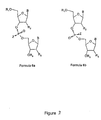
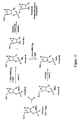
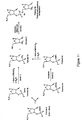
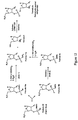
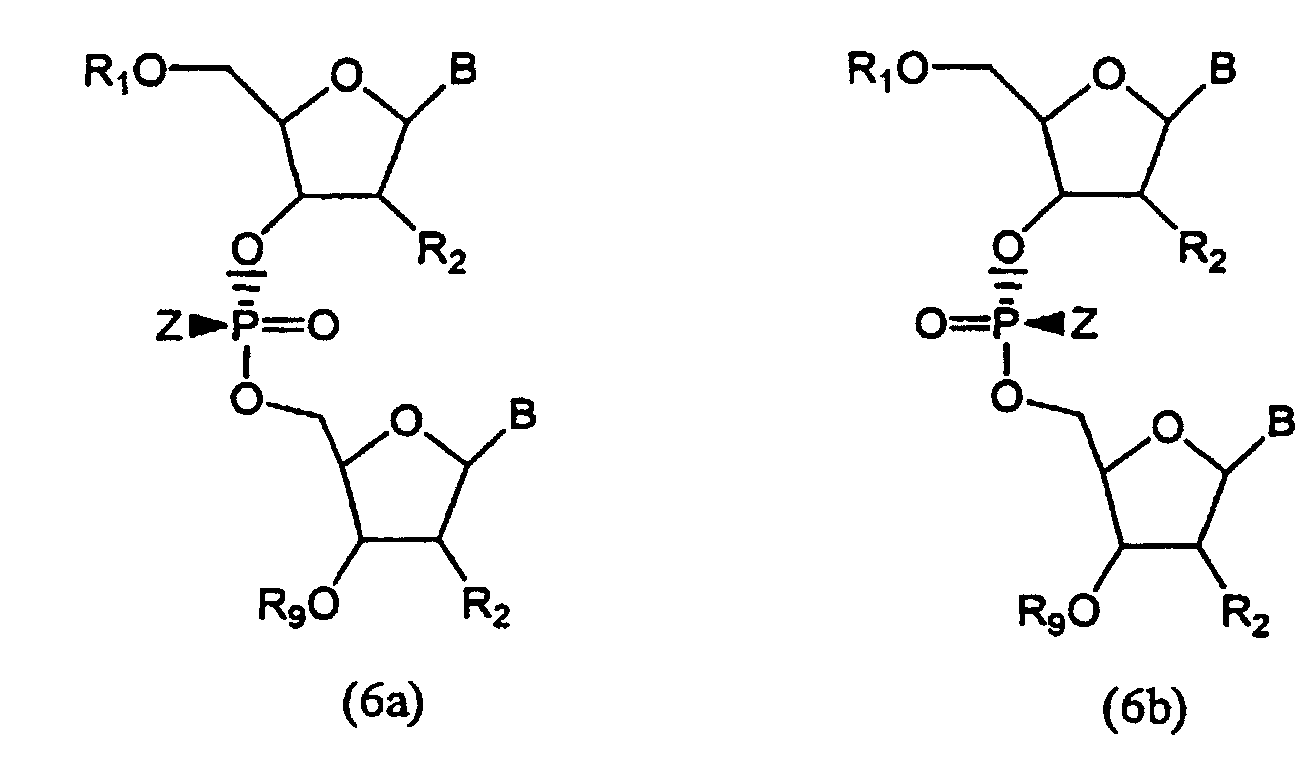
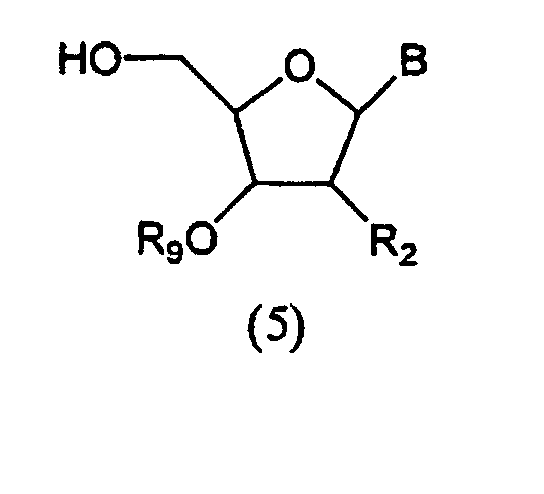
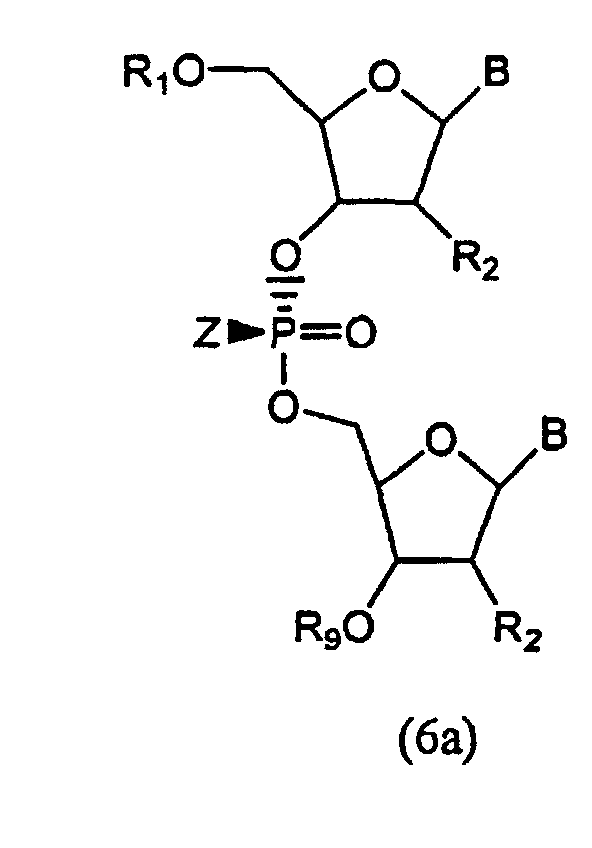
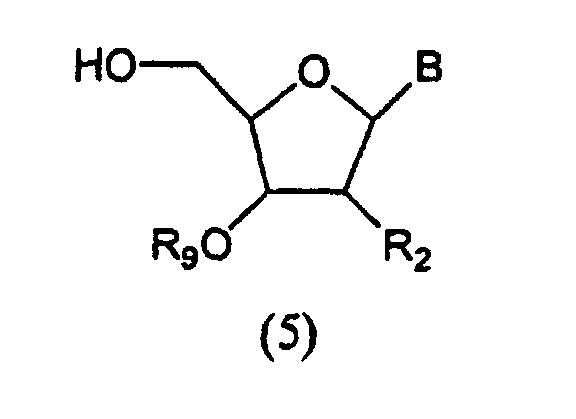
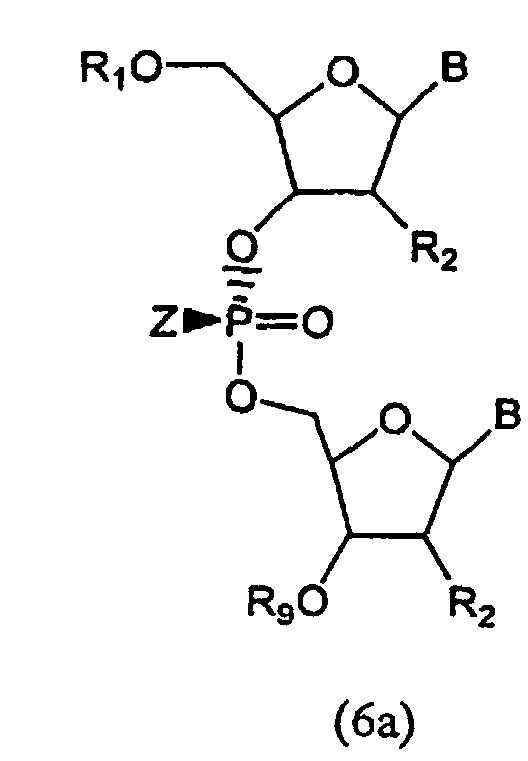
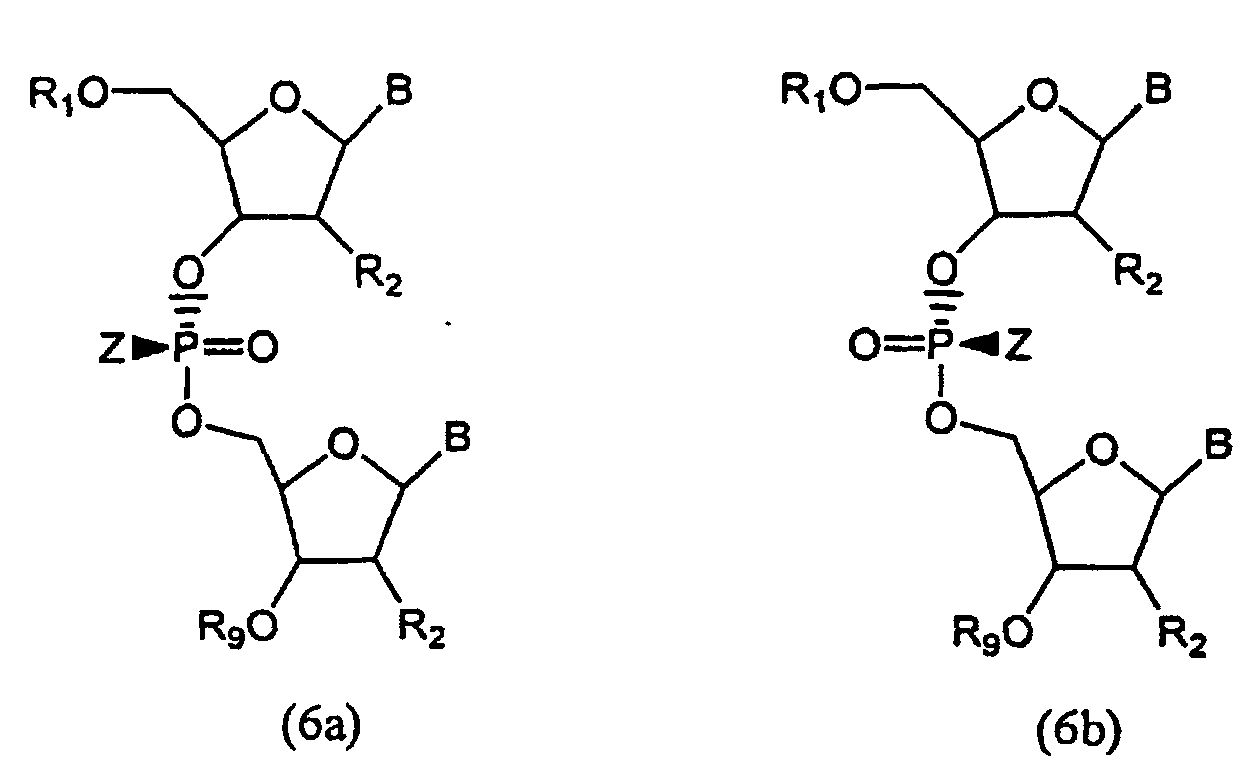
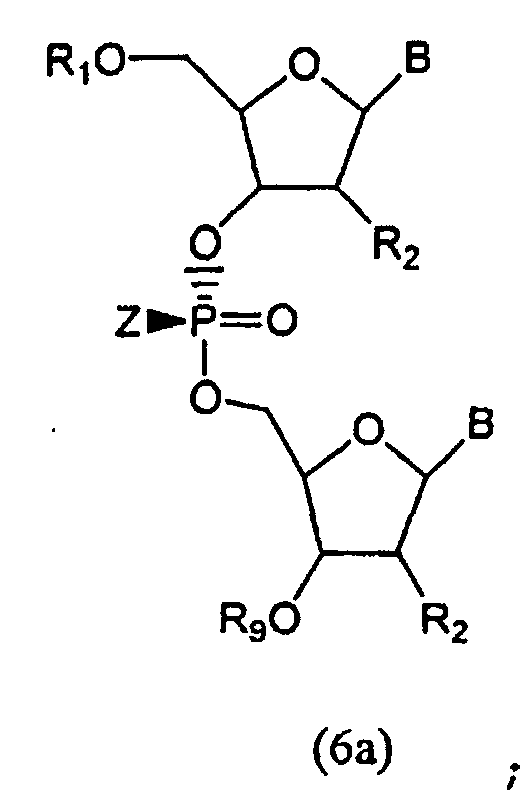
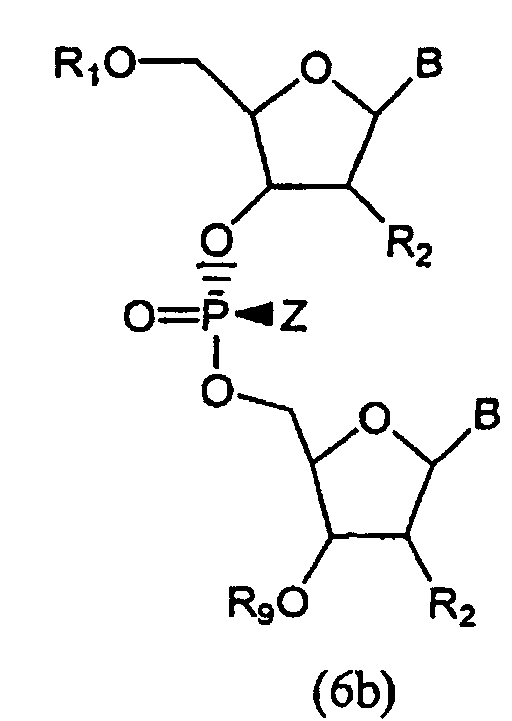
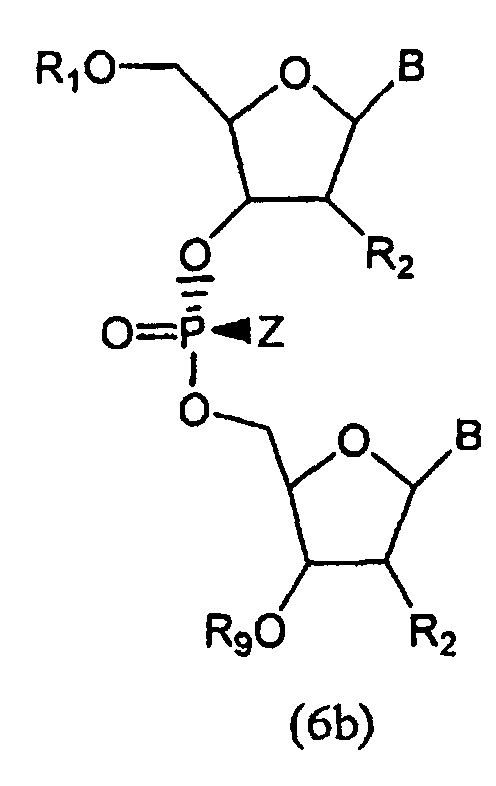
- One synthesis method for the preparation of dinucleotides of formulas (6a) and (6b) comprises the steps;
- Another method for the synthesis of diastereomeric mixtures of P-chiral dinucleotides for preparing dinucleotides of formulas (6a) and (6b) comprises the steps;
- Another method for the synthesis of diastereomeric mixtures of P-chiral dinucleotides for preparing dinucleotides of formulas (6a) and (6b) comprises the steps;
- Still another method for the synthesis of dinucleotides of formulas (6a) and (6b) comprises the steps;
- R 1 is a protecting group
- R 2 is H, OH, or alkoxy moiety of 1 to about 10 carbon atoms
- R 9 is an acyl protecting group, a coupling group, or a silyl protecting group
- Z is an alkyl moiety, an aralkyl moiety, a haloalkyl moiety, an alkenyl moiety, an alkynyl moiety or an atoms, an aminomethyl, or an aminoethyl
- B is an N-protected nucleoside base comprises the steps;
- Still another method for the synthesis of P-chiral dinucleosides of formulas (6a) and (6b) wherein R 1 is a protecting group; R 2 is H, OH, or alkoxy moiety of 1 to about 10 carbon atoms; R 9 is an acyl protecting group, a coupling group, or a silyl protecting group; Z is an alkyl moiety, an aralkyl moiety, a haloalkyl moiety, an alkenyl moiety, an alkynyl moiety or an alkaryl moiety, or an aryl moiety of 1 to about 20 carbon atoms, an aminomethyl, or an aminoethyl; and B is an N-protected nucleoside base comprises the steps;
- a variety of synthesis methods are provided for the synthesis of chirally pure dinucleosides.
- One method for the synthesis of a chirally pure dinucleotide (6a) wherein R 1 is a protecting group; R 2 is H, OH, or alkoxy moiety of 1 to about 10 carbon atoms; R 9 is an acyl protecting group, a coupling group, or a silyl protecting group; Z is an alkyl moiety, an aralkyl moiety, a haloalkyl moiety, an alkenyl moiety, an alkynyl moiety, an alkaryl moiety, or an aryl moiety of 1 to about 20 .carbon atoms, an aminomethyl, or an aminoethyl; and B is an N-protected nucleoside base comprises the steps;
- R 1 is a protecting group
- R 2 is H, OH, or alkoxy moiety of 1 to about 10 carbon atoms
- R 9 is an acyl protecting group, a coupling group, or a silyl protecting group
- Z is an alkyl moiety, an aralkyl moiety, a haloalkyl moiety, an alkenyl moiety, an alkynyl moiety, an alkaryl moiety, or an aryl moiety of 1 to about 20 carbon atoms, an aminomethyl, or an aminoethyl
- B is an N-protected nucleoside base comprises the steps;
- Still another method for the synthesis of a chirally pure dinucleotide (6a) wherein R 1 is a protecting group; R 2 is H or alkoxy moiety of 1 to about 10 carbon atoms; R 9 is an acyl protecting group, a coupling group, or a silyl protecting group; Z is an alkyl moiety, an aralkyl moiety, a haloalkyl moiety, an alkenyl moiety, an alkynyl moiety, an alkaryl moiety, or an aryl moiety of 1 to about 20 carbon atoms, an aminomethyl, or an aminoethyl; and (e) B is an N-protected nucleoside base comprises the steps;
- R 1 is a protecting group
- R 2 is H or alkoxy moiety of 1 to about 10 carbon atoms
- R 9 is an acyl protecting group, a coupling group, or a silyl protecting group
- Z is an alkyl moiety, an aralkyl moiety, a haloalkyl moiety, an alkenyl moiety, an alkynyl moiety, an alkaryl moiety, or an aryl moiety of 1 to about 20 carbon atoms, an aminomethyl, or an aminoethyl
- B is an N-protected nucleoside base comprises the steps;
- a method for the synthesis of chirally pure dinucleotide (6b) wherein R 1 is a protecting group; R 2 is H or alkoxy moiety of 1 to about 10 carbon atoms; R 9 is an acyl protecting group, a coupling group, or a silyl protecting group; Z is an alkyl moiety, an aralkyl moiety, a haloalkyl moiety, an alkenyl moiety, an alkynyl moiety, an alkaryl moiety, or an aryl moiety of 1 to about 20 carbon atoms, an aminomethyl or an aminoethyl; and (e) B is an N-protected nucleoside base comprises the steps:
- R 1 is a protecting group
- R 2 is H or alkoxy moiety of 1 to about 10 carbon atoms
- R 9 is an acyl protecting group, a coupling group, or a silyl protecting group
- Z is an alkyl moiety, an aralkyl moiety, a haloalkyl moiety, an alkenyl moiety, an alkynyl moiety, an alkaryl moiety, or an aryl moiety of 1 to about 20 carbon atoms, an aminomethyl, or an aminoethyl
- B is an N-protected nucleoside base comprises the steps;
- R 1 is a protecting group
- R 2 is H or alkoxy moiety of 1 to about 10 carbon atoms
- R 9 is an acyl protecting group, a coupling group, or a silyl protecting group
- Z is an alkyl moiety, an aralkyl moiety, a haloalkyl moiety, an alkenyl moiety, an alkynyl moiety, an alkaryl moiety, or an aryl moiety of 1 to about 20 carbon atoms, an aminomethyl, or an aminoethyl
- B is an N-protected nucleoside base comprises the steps;
- R 1 is a protecting group
- R 2 is H or alkoxy moiety of 1 to about 10 carbon atoms
- R 9 is an acyl protecting group, a coupling group, or a silyl protecting group
- Z is an alkyl moiety, an aralkyl moiety, a haloalkyl moiety, an alkenyl moiety, an alkynyl moiety, an alkaryl moiety, or an aryl moiety of 1 to about 20 carbon atoms, an aminomethyl, or an aminoethyl
- B is an N-protected nucleoside base comprises the steps;
- the aprotic solvent used in the synthesis methods is acetonuitrile and the activator is 1,8-diazabicyclo[5.4.0]undec-7-ene.
- the crude product was purification by flash chromatography on silica gel using 0-5% ethanol in chloroform as eluent.
- substrate 8 was reacted as a mixture of diastereomers
- the purification process was combined with the separation process to provide pure diastereomers of 7a (SLOW), and 7b (FAST).
Landscapes
- Chemical & Material Sciences (AREA)
- Organic Chemistry (AREA)
- Molecular Biology (AREA)
- Life Sciences & Earth Sciences (AREA)
- Health & Medical Sciences (AREA)
- Biochemistry (AREA)
- Engineering & Computer Science (AREA)
- Genetics & Genomics (AREA)
- General Health & Medical Sciences (AREA)
- Biotechnology (AREA)
- Saccharide Compounds (AREA)
- Compositions Of Macromolecular Compounds (AREA)
- Pharmaceuticals Containing Other Organic And Inorganic Compounds (AREA)
- Luminescent Compositions (AREA)
Abstract
Description

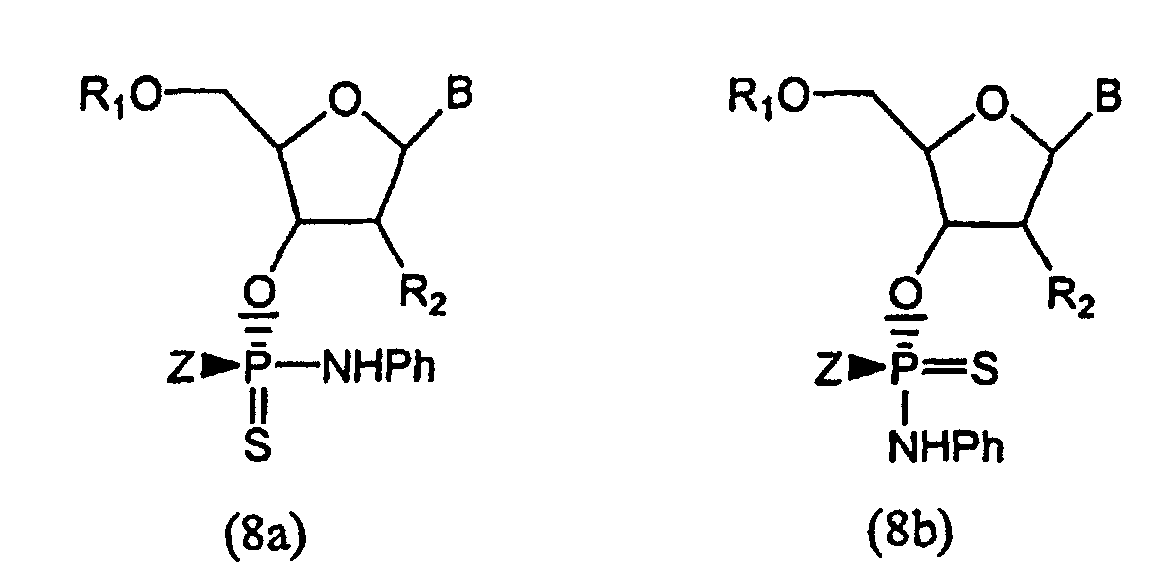
- (a) reacting nucleosides of formulas (8a) and (8b)
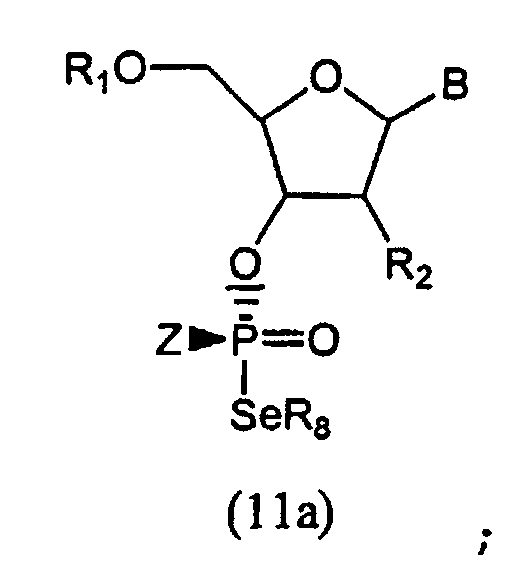
with sodium hydride or 1, 8-diazabicyclo[5.4.0]undec-7-ene and carbon dioxide to form transient nucleosides 3'-O-(Z-substituted)phosphonothioic acids;
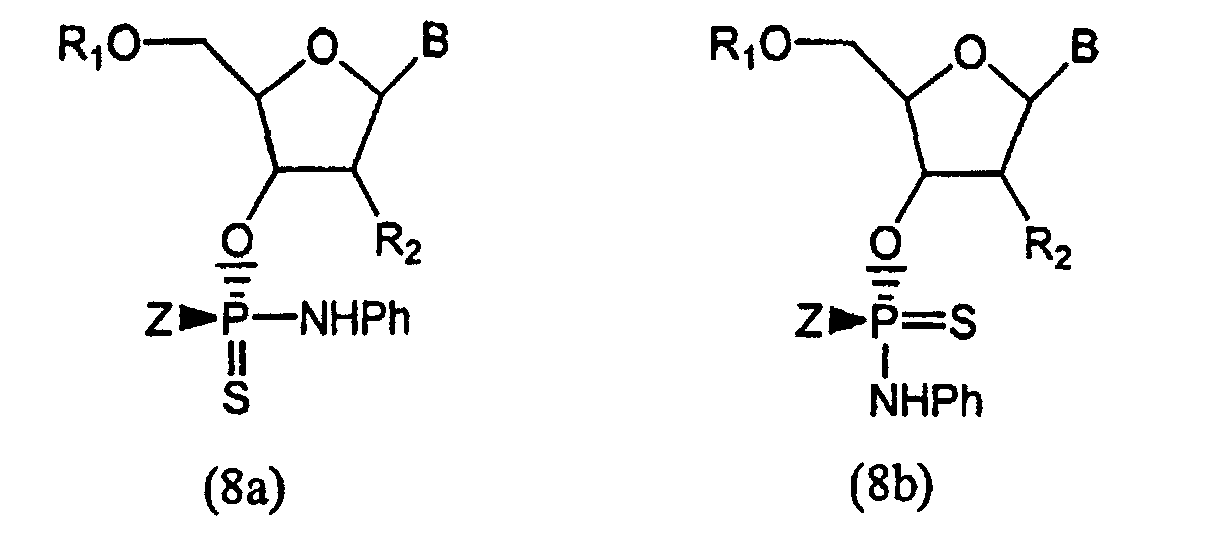
- (b) reacting the transient nucleosides with an
alkylating agent of the formula R8W, wherein R8 is
CH2C6H4R7, wherein R7 is H, Cl, or NO2, and W is Cl,
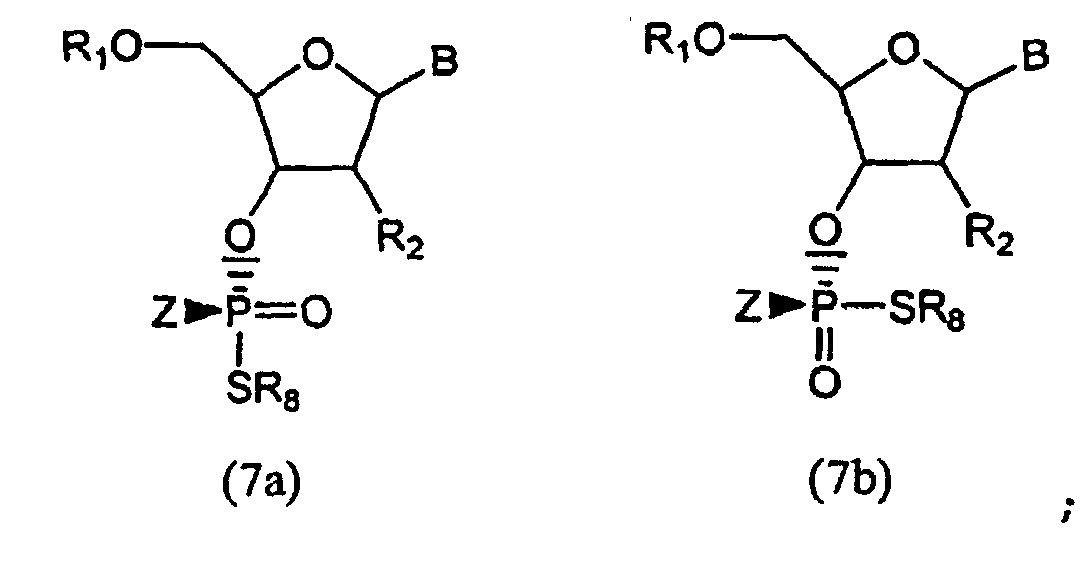
Br, or I, to form alkylated nucleoside
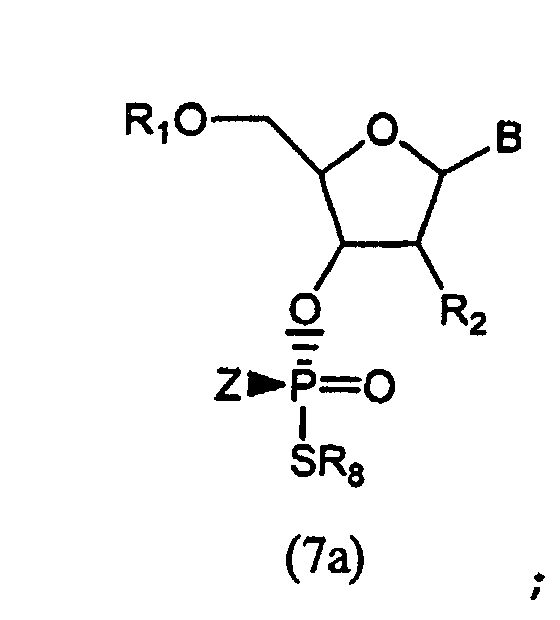
intermediates of formulas (7a) and (7b)
and

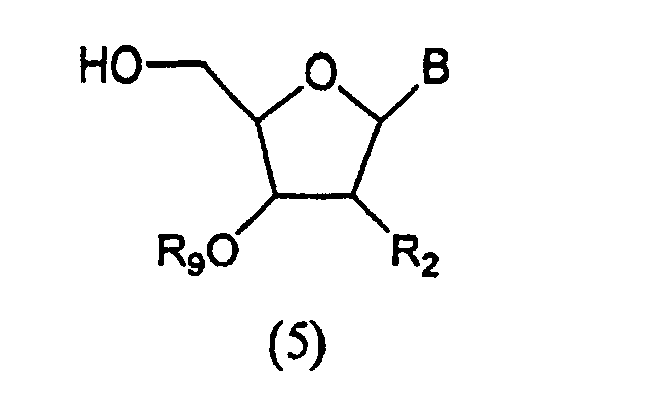
- (c) reacting the alkylated nucleoside intermediates
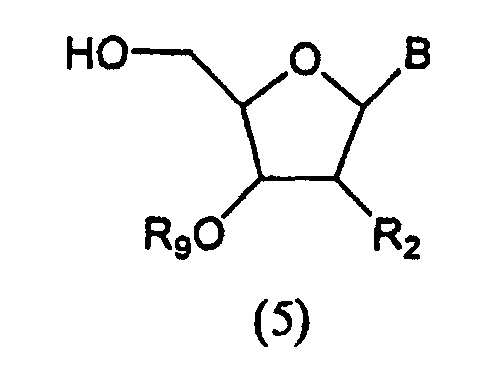
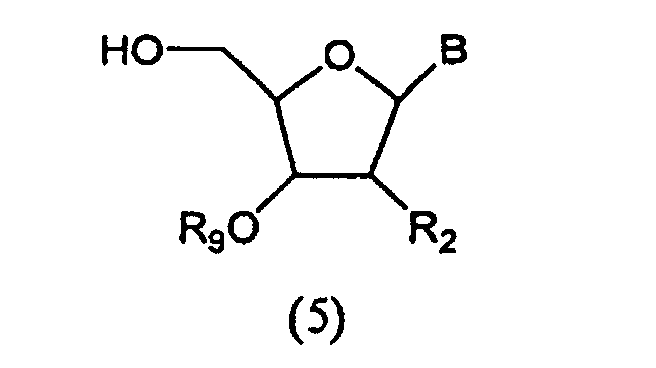
with a nucleoside of formula (5)
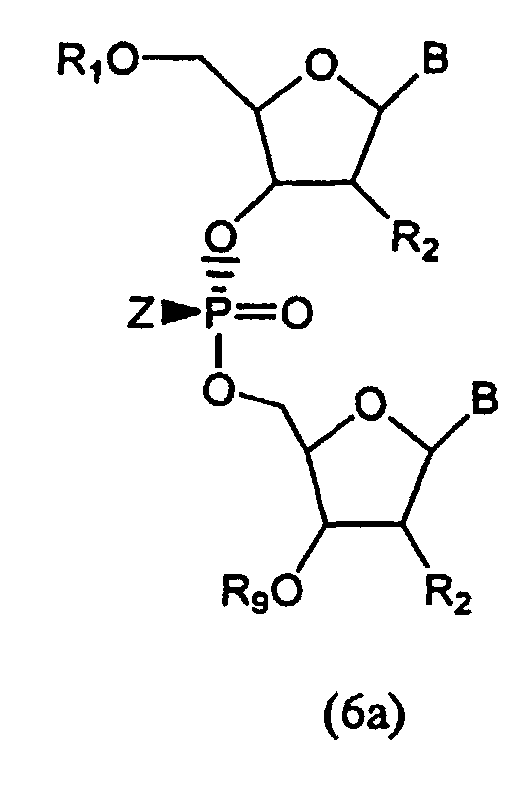
in presence of an activator and a lithium salt in an aprotic organic solvent to form the diastereomeric mixture of P-chiral dinucleosides of formulas (6a) and (6b).


- (a) reacting nucleosides of formulas (10a) and (10b)
with sodium hydride or 1, 8-diazabicyclo[5.4.0]undec-7-ene and carbon dioxide to form transient nucleosides 3'-O-(Z-substituted)phosphonoselenoic acids;

- (b) reacting the transient nucleosides with an
alkylating agent of the formula R8W, wherein R8 is
CH2C6H4R7, wherein R7 is H, Cl, or NO2, and W is Cl,
Br, or I, to form alkylated nucleoside
intermediates of formulas (11a) and (11b)
and

- (c) reacting the alkylated nucleoside intermediates
with a nucleoside of formula (5)
in presence of an activator and a lithium salt in an aprotic organic solvent to form the diastereomeric mixture of P-chiral dinucleosides of formulas (6a) and (6b).
- (a) reacting nucleosides of formulas (8a) and (8b)
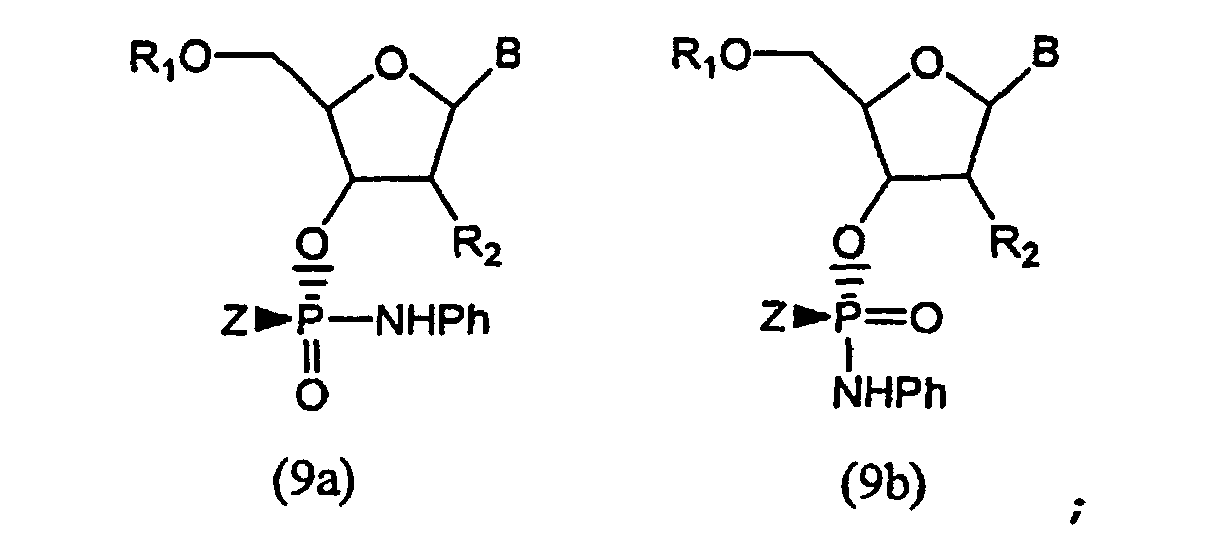
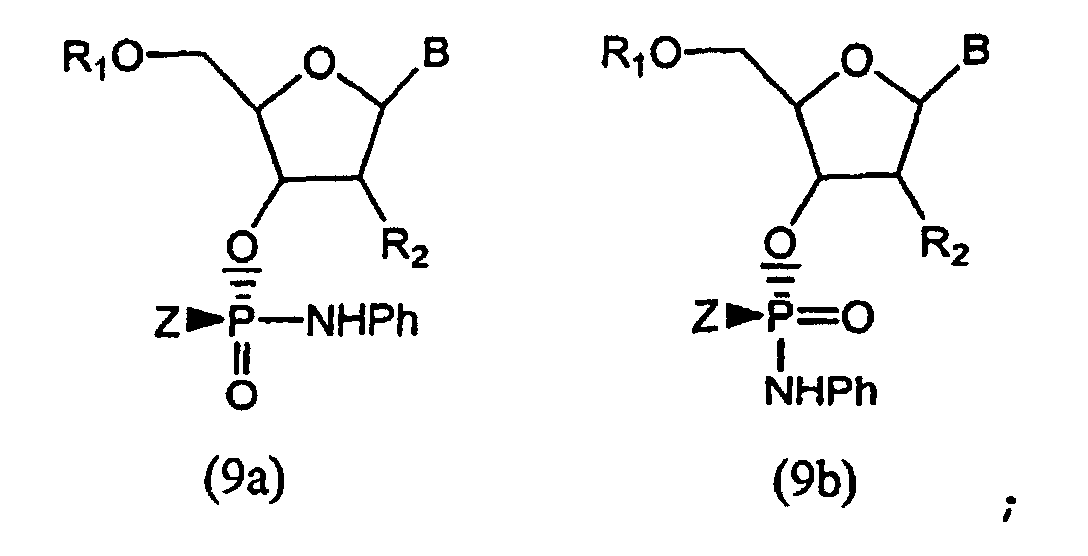
with potassium peroxymonosulfate or hydrogen peroxide to form nucleoside intermediates of formulas (9a) and (9b)
- (b) reacting the nucleoside intermediates with sodium hydride or 1, 8-diazabicyclo[5.4.0]undec-7-ene and carbon disulfide to form transient nucleosides 3'-O-(Z-substituted)phosphonothioic acids;
- (c) reacting the transient nucleosides with an
alkylating agent of the formula R8W, wherein R8 is
CH2C6H4R7, wherein R7 is H, Cl, or NO2, and W is Cl,
Br, or I, to form alkylated nucleoside
intermediates of formulas (7a) and (7b)
and

- (d reacting the alkylated nucleoside intermediates
with a nucleoside of formula (5)
in presence of an activator and a lithium salt in an aprotic organic solvent to form the diastereomeric mixture of P-chiral dinucleosides of formulas (6a) and (6b).

- (a) reacting nucleosides of formula (10a) and (10b)
with potassium peroxymonosulfate or hydrogen peroxide to form nucleoside intermediates of formulas (9a) and (9b)


- (b) reacting the nucleoside intermediates with sodium hydride or DBU and carbon diselenide to form transient nucleosides 3'-O-(Z-substituted)phosphonoselenoic acids;
- (c) reacting the transient nucleosides with an
alkylating agent of the formula R8W, wherein R8 is
CH2C6H4R7, wherein R7 is H, Cl, or NO2, and W is Cl,
Br, or I, to form alkylated nucleoside
intermediates of formulas (11a) and (11b)
and

- (d) reacting the alkylated nucleoside intermediates
with a nucleoside of formula (5)
in presence of an activator and a lithium salt in an aprotic organic solvent to form the diastereomeric mixture of P-chiral dinucleosides of formulas (6a) and (6b).

- (a) reacting a nucleoside of formula (8a)
with sodium hydride or 1, 8-diazabicyclo[5.4.0]undec-7-ene and carbon dioxide to form a transient nucleoside 3'-O-(Z-substituted)phosphonothioic acid;

- (b) reacting the transient nucleoside with an
alkylating agent of the formula R8W, wherein R8 is
CH2C6H4R7, wherein R7 is H, Cl, or NO2, and W is Cl,
Br, or I, to form an alkylated nucleoside
intermediate of formula (7a)
and
- (c) reacting the alkylated nucleoside intermediate
with a nucleoside of formula (5)
in presence of an activator and a lithium salt in an aprotic organic solvent to form the chirally pure dinucleoside of formula (6a).


- (a) reacting a nucleoside of formula (10a)
with sodium hydride or 1, 8-diazabicyclo[5.4.0]undec-7-ene and carbon dioxide to form a transient nucleoside 3'-O-(Z-substituted)phosphonoselenoic acid;

- (b) reacting the transient nucleoside with an
alkylating agent of the formula R8W, wherein R8 is
CH2C6H4R7, wherein R7 is H, Cl, or NO2, and W is Cl,
Br, or I, to form an alkylated nucleoside
intermediate of formula (11a)
and

- (c) reacting the alkylated nucleoside intermediate
with a nucleoside of formula (5)
in presence of an activator and a lithium salt in an aprotic organic solvent to form the chirally pure dinucleoside of formula (6a).
- (a) reacting a nucleoside of formula (8b)
with potassium peroxymonosulfate or hydrogen peroxide to form a nucleoside intermediate of formula (9b)


- (b) reacting the nucleoside intermediate with sodium hydride or DBU and carbon disulfide to form a transient nucleoside 3'-O-(Z-substituted)phosphonothioic acid;
- (c) reacting the transient nucleoside with an
alkylating agent of the formula R8W, wherein R8 is
CH2C6H4R7, wherein R7 is H, Cl, or NO2, and W is Cl,
Br, or I, to form an alkylated nucleoside
intermediate of formula (7a)
and

- (d) reacting the alkylated nucleoside intermediate
with a nucleoside of formula (5)
in presence of an activator and a lithium salt in an aprotic organic solvent to form the chirally pure dinucleoside of formula (6a).
- (a) reacting a nucleoside of formula (10b)
with potassium peroxymonosulfate or hydrogen peroxide to form a nucleoside intermediate of formula (9b)

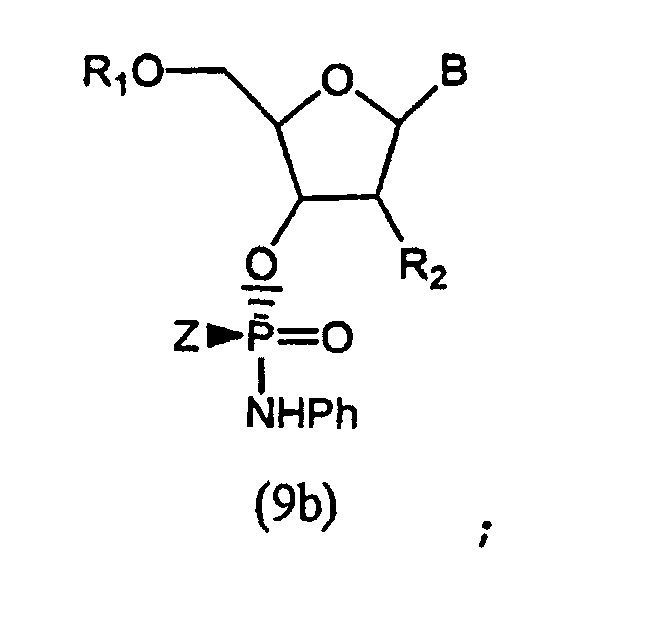
- (b) reacting the nucleoside intermediate with sodium hydride or 1, 8-diazabicyclo[5.4.0]undec-7-ene and carbon diselenide to form a transient nucleoside 3'-O-(Z-substituted)phosphonoselenoic acid;
- (c) reacting the transient nucleoside with an
alkylating agent of the formula R8W, wherein R8 is
CH2C6H4R7, wherein R7 is H, Cl, or NO2, and W is Cl,
Br, or I, to form alkylated nucleoside
intermediate of formula (11a)
and

- (d) reacting the alkylated nucleoside intermediate
with a nucleoside of formula (5)
in presence of an activator and a lithium salt in an aprotic organic solvent to form the chirally pure dinucleoside of formula (6a).

- (a) reacting a nucleoside of formula (8b)
with sodium hydride or 1, 8-diazabicyclo[5.4.0]undec-7-ene and carbon dioxide to form a transient nucleoside 3'-O-(Z-substituted)phosphonothioic acid;
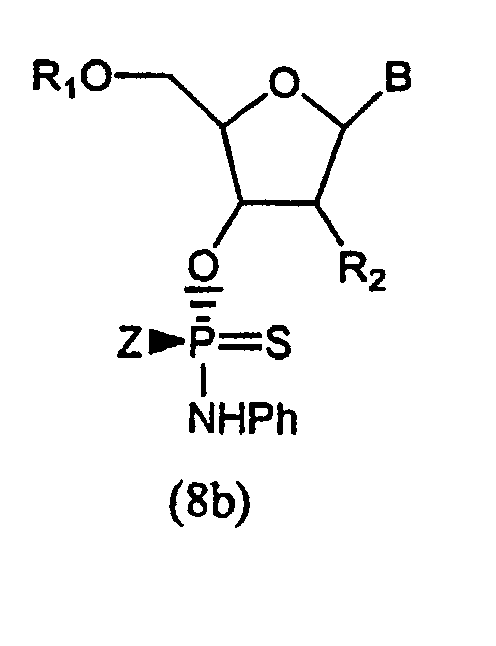
- (b) reacting the transient nucleoside with an
alkylating agent of the formula R8W, wherein R8 is
CH2C6H4R7, wherein R7 is H, Cl, or NO2, and W is Cl,
Br, or I, to form an alkylated nucleoside
intermediate of formula (7b)
and

- (c) reacting the alkylated nucleoside intermediate
with a nucleoside of formula (5)
in presence of an activator and a lithium salt in an aprotic organic solvent to form the chirally pure dinucleoside of formula (6b).


- (a) reacting a nucleoside of formula (10b)
with sodium hydride or 1, 8-diazabicyclo[5.4.0]undec-7-ene and carbon dioxide to form a transient nucleoside 3'-O-(Z-substituted)phosphonoselenoic acid;
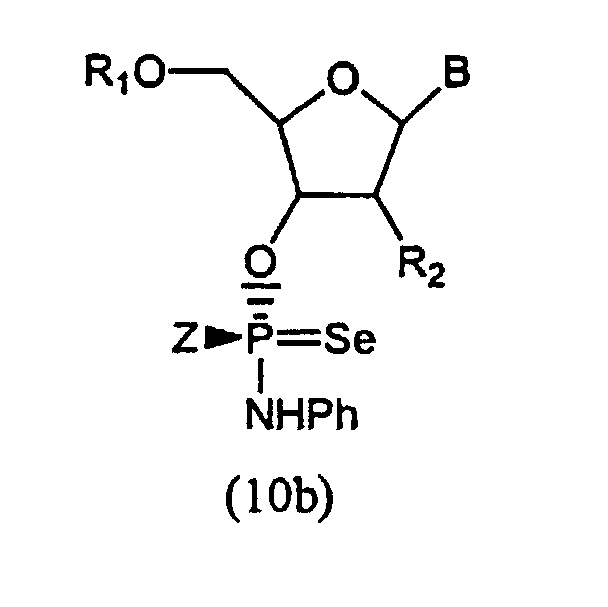
- (b) reacting the transient nucleoside with an
alkylating agent of the formula R8W, wherein R8 is
CH2C6H4R7, wherein R7 is H, Cl, or NO2, and W is Cl,
Br, or I, to form an alkylated nucleoside
intermediate of formula (11b)
and
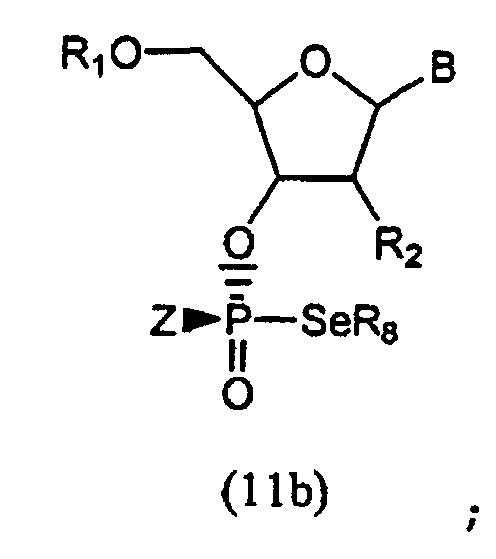
- (c) reacting the alkylated nucleoside intermediate
with a nucleoside of formula (5)
in presence of an activator and a lithium salt in an aprotic organic solvent to form the chirally pure dinucleoside of formula (6b).


- (a) reacting a nucleoside of formula (8a)
with potassium peroxymonosulfate or hydrogen peroxide to form a nucleoside intermediate of formula (9a)


- (b) reacting the nucleoside intermediate with sodium hydride or DBU and carbon disulfide to form a transient nucleoside 3'-O-(Z-substituted)phosphonothioic acid;
- (c) reacting the transient nucleoside with an
alkylating agent of the formula R8W, wherein R8 is
CH2C6H4R7, wherein R7 is H, Cl, or NO2, and W is Cl,
Br, or I, to form an alkylated nucleoside
intermediate of formula (7b)
and

- (d) reacting the alkylated nucleoside intermediate
with a nucleoside of formula (5)
in presence of an activator and a lithium salt in an aprotic organic solvent to form the chirally pure dinucleoside of formula (6b).
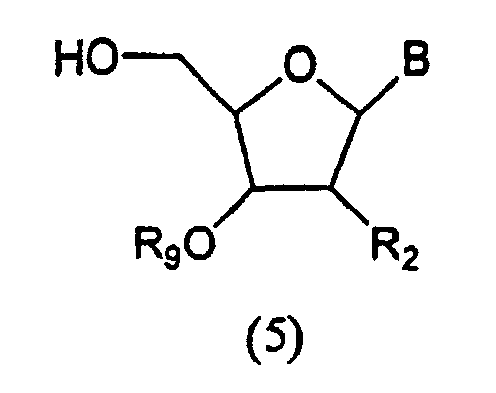

- (a) reacting a nucleoside of formula (10a)
with potassium peroxymonosulfate or hydrogen peroxide to form a nucleoside intermediate of formula (9a)

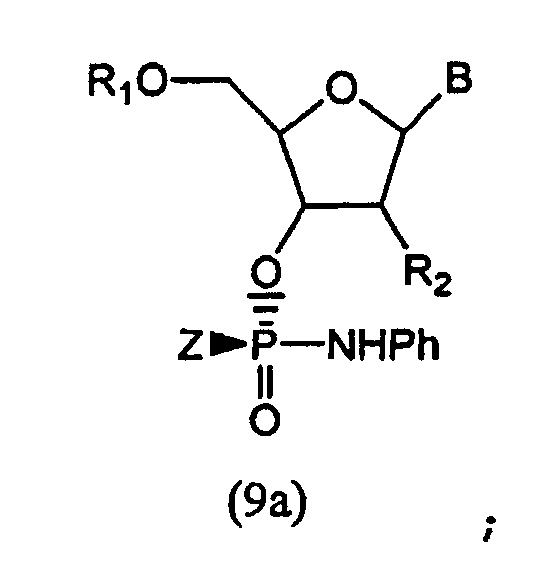
- (b) reacting the nucleoside intermediate with sodium hydride or 1, 8-diazabicyclo[5.4.0]undec-7-ene and carbon diselenide to form a transient nucleoside 3'-O-(Z-substituted)phosphonoselenoic acid;
- (c) reacting the transient nucleoside with an
alkylating agent of the formula R8W, wherein R8 is
CH2C6H4R7, wherein R7 is H, Cl, or NO2, and W is Cl,
Br, or I, to form an alkylated nucleoside
intermediate of formula (11b)
and

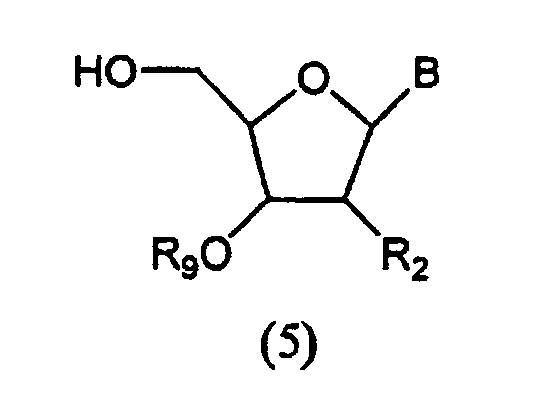
- (d) reacting the alkylated nucleoside intermediate
with a nucleoside of formula (5)
in presence of an activator and a lithium salt in an aprotic organic solvent to form the chirally pure nucleoside of formula (6b).
| Example/8 | Diastereomer | 31P NMR (δ) |
| II; B = Thymine | FAST | 79.44 |
| SLOW | 79.58 | |
| III; B = Cytosine | FAST | 79.38 |
| SLOW | 79.74 | |
| IV; B = Adenine | FAST | 79.21 |
| SLOW | 79.60 | |
| V; B = Guanine | FAST | 79.65 |
| SLOW | 79.72 | |
| Vl; B = Uracil | FAST | 81.38 |
| SLOW | 81.96 |
MS (FAB-) m/e 1067 [(M-H)-].
Claims (14)
- A method for the synthesis of a diastereomeric mixture of P-chiral dinucleosides of formulas (6a) and (6b)wherein
 comprising the steps of:R1 is a protecting group;R2 is H or alkoxy moiety of 1 to 10 carbons;R9 is an acyl protecting group, a coupling group, or a silyl protecting group;Z is an alkyl moiety, an aralkyl moiety, a haloalkyl moiety, an alkenyl moiety, an alkynyl moiety, an alkaryl moiety, an aryl moiety of 1 to 20 carbons, an aminomethyl, or an aminoethyl;B is an N-protected nucleoside base;(a) reacting nucleosides of formulas (8a) and (8b)with sodium hydride or 1, 8-diazabicyclo[5.4.0]undec-7-ene and carbon dioxide to form transient nucleosides 3'-O-(Z-substituted)phosphonothioic acids;
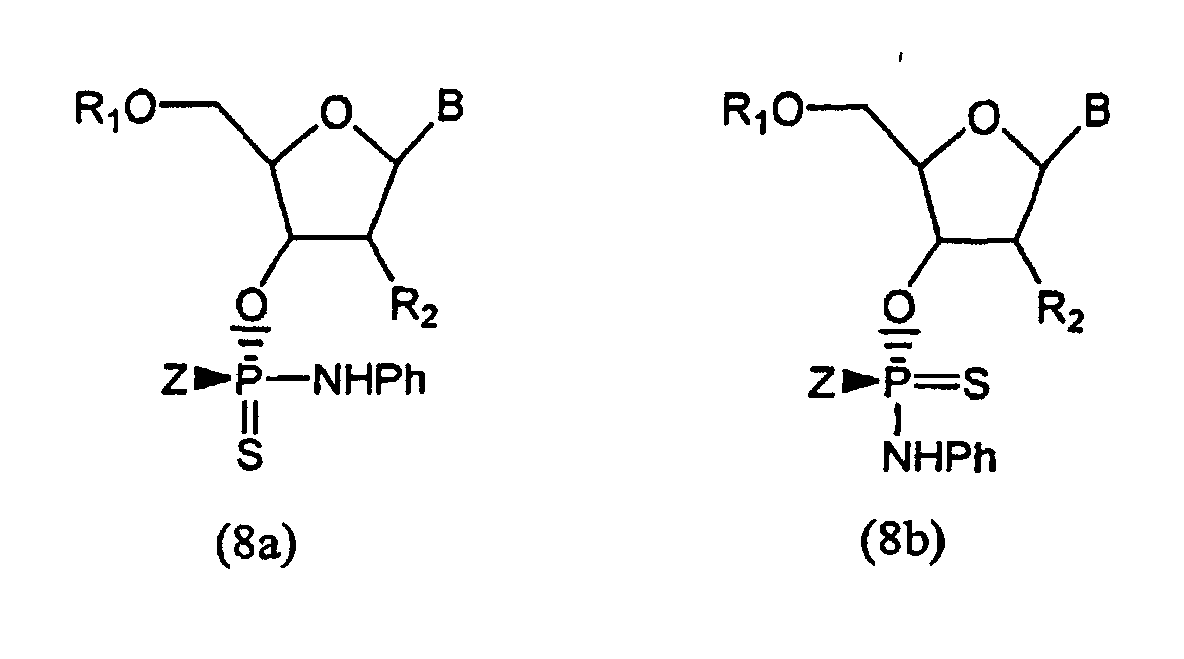 (b) reacting the transient nucleosides with an alkylating agent of the formula R8W, wherein R8 is CH2C6H4R7, wherein R7 is H, Cl, or NO2, and W is Cl, Br, or I, to form alkylated nucleoside intermediates of formulas (7a) and (7b)and
 (c) reacting the alkylated nucleoside intermediates with a nucleoside of formula (5)in presence of an activator and a lithium salt in an aprotic organic solvent to form the diastereomeric mixture of P-chiral dinucleosides of formulas (6a) and (6b).
- A method for the synthesis of a diastereomeric mixture of P-chiral dinucleosides of formulas (6a) and (6b)wherein
 comprising the steps of:R1 is a protecting group;R2 is H or alkoxy moiety of 1 to 10 carbons;R9 is an acyl protecting group, a coupling group, or a silyl protecting group;Z is an alkyl moiety, an aralkyl moiety, a haloalkyl moiety, an alkenyl moiety, an alkynyl moiety, an alkaryl moiety, an aryl moiety of 1 to 20 carbons, an aminomethyl, or an aminoethyl;B is an N-protected nucleoside base;(a) reacting nucleosides of formulas (10a) and (10b)with sodium hydride or 1, 8-diazabicyclo[5.4.0]undec-7-ene and carbon dioxide to form transient nucleosides 3'-O-(Z-substituted)phosphonoselenoic acids;
 (b) reacting the transient nucleosides with an alkylating agent of the formula R8W, wherein R8 is CH2C6H4R7, wherein R7 is H, Cl, or NO2, and W is Cl, Br, or I, to form alkylated nucleoside intermediates of formulas (11a) and (11b)and
 (c) reacting the alkylated nucleoside intermediates with a nucleoside of formula (5)in presence of an activator and a lithium salt in an aprotic organic solvent to form the diastereomeric mixture of P-chiral dinucleosides of formulas (6a) and (6b).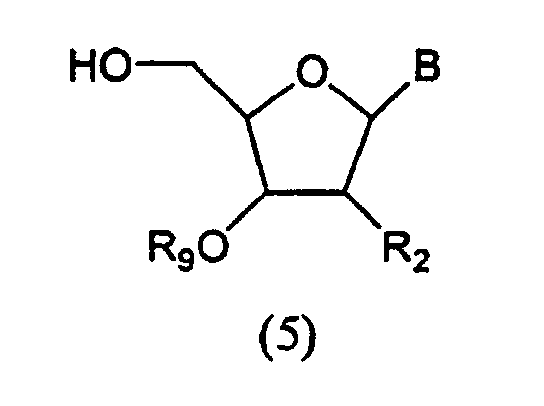
- A method for the synthesis of a diastereomeric mixture of P-chiral dinucleosides of formulas (6a) and (6b)wherein
 comprising the steps of:R1 is a protecting group;R2 is H, OH, or alkoxy moiety of 1 to 10 carbons;R9 is an acyl protecting group, a coupling group, or a silyl protecting group;Z is an alkyl moiety, an aralkyl moiety, a haloalkyl moiety, an alkenyl moiety, an alkynyl moiety, an alkaryl moiety, an aryl moiety of 1 to 20 carbons, an aminomethyl, or an aminoethyl;B is an N-protected nucleoside base;(a) reacting nucleosides of formulas (8a) and (8b)with potassium peroxymonosulfate or hydrogen peroxide to form nucleoside intermediates of formulas (9a) and (9b)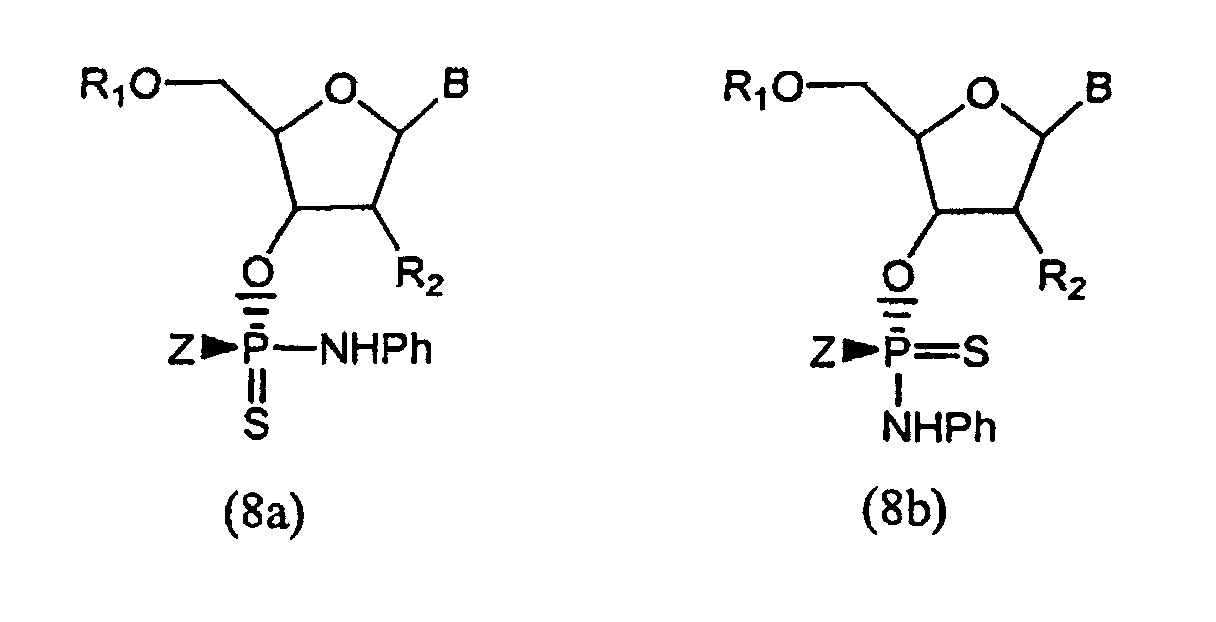
 (b) reacting the nucleoside intermediates with sodium hydride or 1, 8-diazabicyclo[5.4.0]undec-7-ene and carbon disulfide to form transient nucleosides 3'-O-(Z-substituted)phosphonothioic acids;(c) reacting the transient nucleosides with an alkylating agent of the formula R8W, wherein R8 is CH2C6H4R7, wherein R7 is H, Cl, or NO2, and W is Cl, Br, or I, to form alkylated nucleoside intermediates of formulas (7a) and (7b)and
 (d reacting the alkylated nucleoside intermediates with a nucleoside of formula (5)in presence of an activator and a lithium salt in an aprotic organic solvent to form the diastereomeric mixture of P-chiral dinucleosides of formulas (6a) and (6b).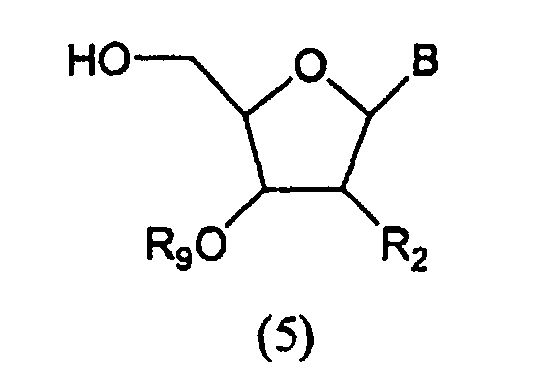
- A method for the synthesis of a diastereomeric mixture of P-chiral dinucleosides of formulas (6a) and (6b)wherein
 comprising the steps of:R1 is a protecting group;R2 is H, OH, or alkoxy moiety of 1 to 10 carbons;R9 is an acyl protecting group, a coupling group, or a silyl protecting group;Z is an alkyl moiety, an aralkyl moiety, a haloalkyl moiety, an alkenyl moiety, an alkynyl moiety, an alkaryl moiety, an aryl moiety of 1 to 20 carbons, an aminomethyl, or an aminoethyl;B is an N-protected nucleoside base;(a) reacting nucleosides of formula (10a) and (10b)with potassium peroxymonosulfate or hydrogen peroxide to form nucleoside intermediates of formulas (9a) and (9b)
 (b) reacting the nucleoside intermediates with sodium hydride or DBU and carbon diselenide to form transient nucleosides 3'-O-(Z-substituted)phosphonoselenoic acids;(c) reacting the transient nucleosides with an alkylating agent of the formula R8W, wherein R8 is CH2C6H4R7, wherein R7 is H, Cl, or NO2, and W is Cl, Br, or I, to form alkylated nucleoside intermediates of formulas (11a) and (11b)and
 (d) reacting the alkylated nucleoside intermediates with a nucleoside of formula (5)in presence of an activator and a lithium salt in an aprotic organic solvent to form the diastereomeric mixture of P-chiral dinucleosides of formulas (6a) and (6b).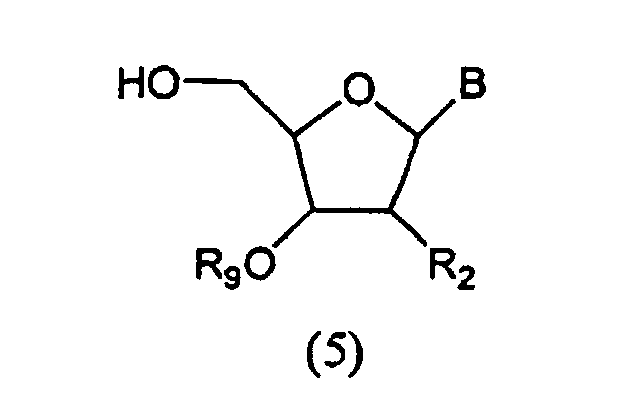
- A method for the synthesis of a chirally pure dinucleoside of formula (6a)wherein
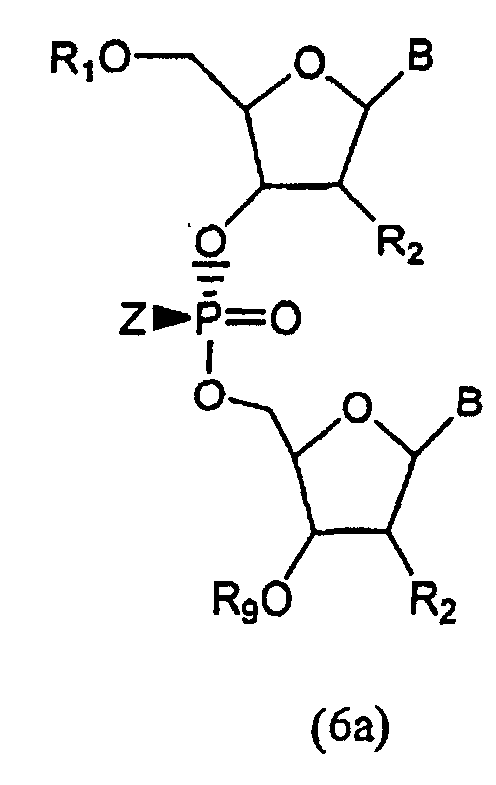 comprising the steps of:R1 is a protecting group;R2 is H, OH, or alkoxy moiety of 1 to 10 carbon atoms;R9 is an acyl protecting group, a coupling group, or a silyl protecting group;Z is an alkyl moiety, an aralkyl moiety, a haloalkyl moiety, an alkenyl moiety, an alkynyl moiety, an alkaryl moiety, an aryl moiety of 1 to 20 carbons, an aminomethyl, or an aminoethyl;B is an N-protected nucleoside base;(a) reacting a nucleoside of formula (8a)with sodium hydride or 1, 8-diazabicyclo[5.4.0]undec-7-ene and carbon dioxide to form a transient nucleoside 3'-O-(Z-substituted)phosphonothioic acid;
 (b) reacting the transient nucleoside with an alkylating agent of the formula R8W, wherein R8 is CH2C6H4R7, wherein R7 is H, Cl, or NO2, and W is Cl, Br, or I, to form an alkylated nucleoside intermediate of formula (7a)and
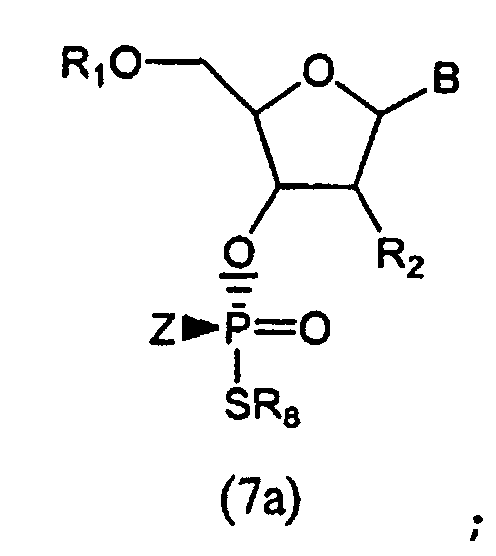 (c) reacting the alkylated nucleoside intermediate with a nucleoside of formula (5)in presence of an activator and a lithium salt in an aprotic organic solvent to form the chirally pure dinucleoside of formula (6a).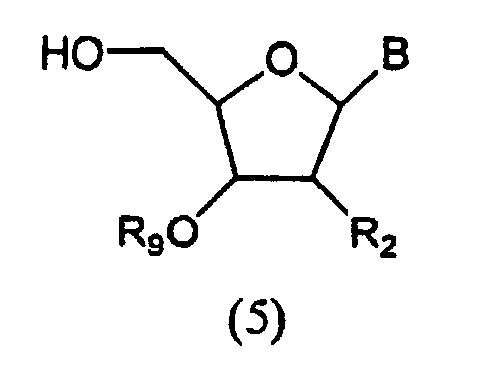
- A method for the synthesis of a chirally pure dinucleoside of formula (6a)wherein
 comprising the steps of:R1 is a protecting group;R2 is H, OH, or alkoxy moiety of 1 to 10 carbons;R9 is an acyl protecting group, a coupling group, or a silyl protecting group;Z is an alkyl moiety, an aralkyl moiety, a haloalkyl moiety, an alkenyl moiety, an alkynyl moiety, an alkaryl moiety, an aryl moiety of 1 to 20 carbons, an aminomethyl, or an aminoethyl;B is an N-protected nucleoside base;(a) reacting a nucleoside of formula (10a)with sodium hydride or 1, 8-diazabicyclo[5.4.0]undec-7-ene and carbon dioxide to form a transient nucleoside 3'-O-(Z-substituted)phosphonoselenoic acid;
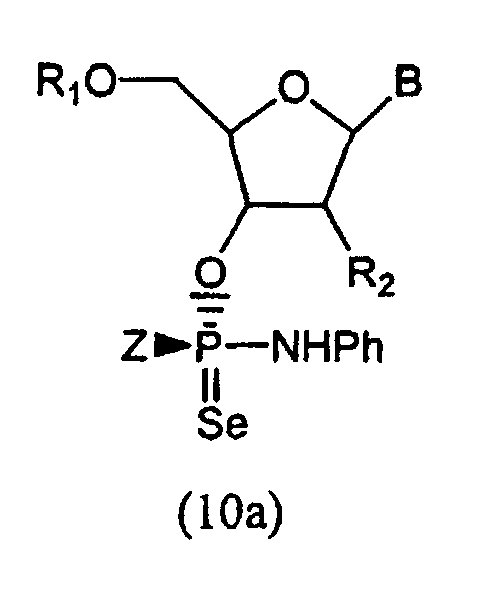 (b) reacting the transient nucleoside with an alkylating agent of the formula R8W, wherein R8 is CH2C6H4R7, wherein R7 is H, Cl, or NO2, and W is Cl, Br, or I, to form an alkylated nucleoside intermediate of formula (11a)and
 (c) reacting the alkylated nucleoside intermediate with a nucleoside of formula (5)in presence of an activator and a lithium salt in an aprotic organic solvent to form the chirally pure dinucleoside of formula (6a).
- A method for the synthesis of a chirally pure dinucleoside of formula (6a)wherein
 comprising the steps of:R1 is a protecting group;R2 is H or alkoxy moiety of 1 to 10 carbons;R9 is an acyl protecting group, a coupling group, or a silyl protecting group;Z is an alkyl moiety, an aralkyl moiety, a haloalkyl moiety, an alkenyl moiety, an alkynyl moiety, an alkaryl moiety, an aryl moiety of 1 to 20 carbons, an aminomethyl, or an aminoethyl;B is an N-protected nucleoside base;(a) reacting a nucleoside of formula (8b)with potassium peroxymonosulfate or hydrogen peroxide to form a nucleoside intermediate of formula (9b)
 (b) reacting the nucleoside intermediate with sodium hydride or DBU and carbon disulfide to form a transient nucleoside 3'-O-(Z-substituted)phosphonothioic acid;(c) reacting the transient nucleoside with an alkylating agent of the formula R8W, wherein R8 is CH2C6H4R7, wherein R7 is H, Cl, or NO2, and W is Cl, Br, or I, to form an alkylated nucleoside intermediate of formula (7a)and
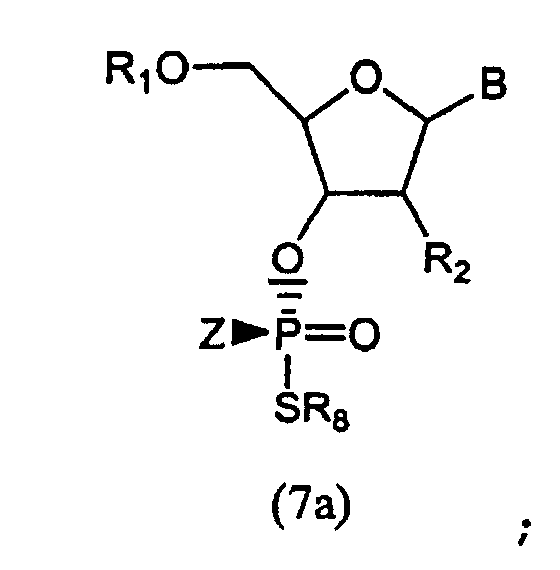 (d) reacting the alkylated nucleoside intermediate with a nucleoside of formula (5)in presence of an activator and a lithium salt in an aprotic organic solvent to form the chirally pure dinucleoside of formula (6a).
- A method for the synthesis of a chirally pure dinucleoside of formula (6a)wherein
 comprising the steps of:R1 is a protecting group;R2 is H or alkoxy moiety of 1 to 10 carbons;R9 is an acyl protecting group, a coupling group, or a silyl protecting group;Z is an alkyl moiety, an aralkyl moiety, a haloalkyl moiety, an alkenyl moiety, an alkynyl moiety, an alkaryl moiety, an aryl moiety of 1 to 20 carbons, an aminomethyl, or an aminoethyl;B is an N-protected nucleoside base;(a) reacting a nucleoside of formula (10b)with potassium peroxymonosulfate or hydrogen peroxide to form a nucleoside intermediate of formula (9b)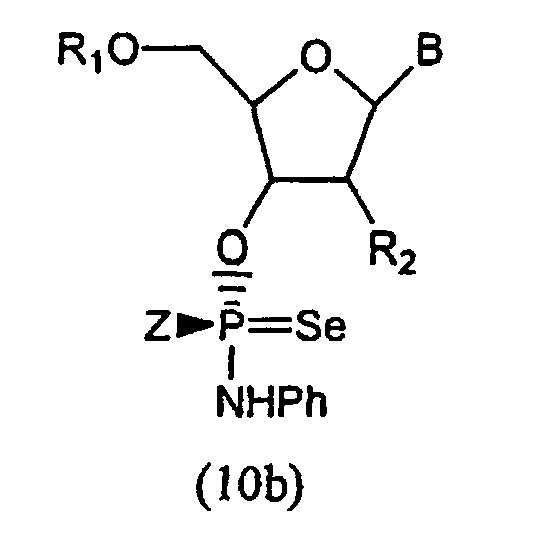
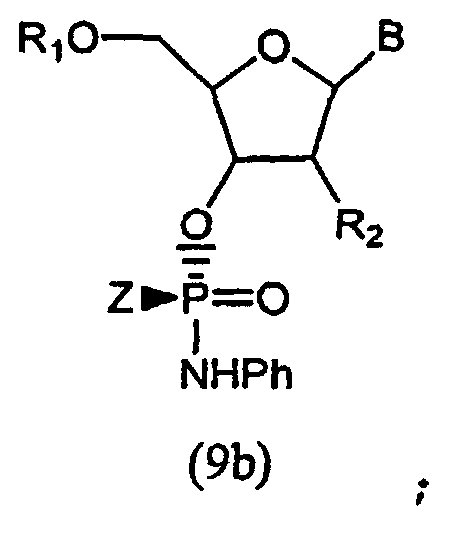 (b) reacting the nucleoside intermediate with sodium hydride or 1, 8-diazabicyclo[5.4.0]undec-7-ene and carbon diselenide to form a transient nucleoside 3'-O-(Z-substituted)phosphonoselenoic acid;(c) reacting the transient nucleoside with an alkylating agent of the formula R8W, wherein R8 is CH2C6H4R7, wherein R7 is H, Cl, or NO2, and W is Cl, Br, or I, to form alkylated nucleoside intermediate of formula (11a)and
 (d) reacting the alkylated nucleoside intermediate with a nucleoside of formula (5)in presence of an activator and a lithium salt in an aprotic organic solvent to form the chirally pure dinucleoside of formula (6a).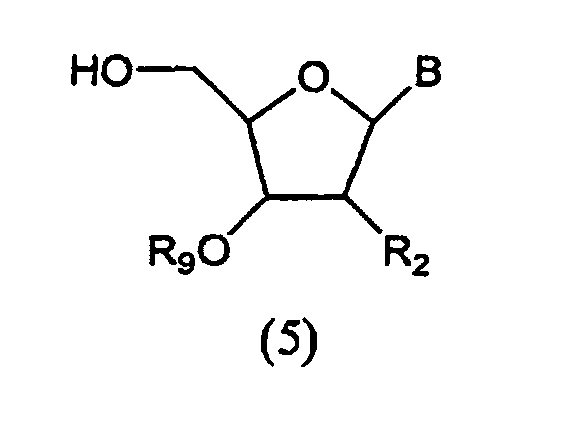
- A method for the synthesis of a chirally pure dinucleoside of formula (6b)wherein
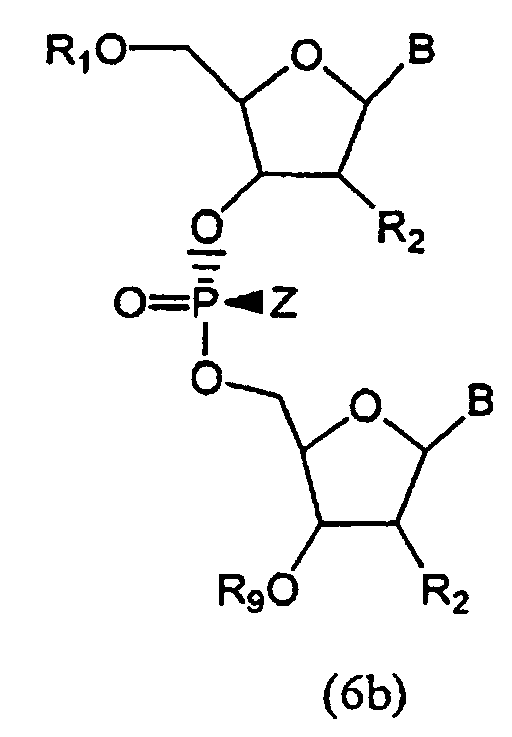 comprising the steps of:R1 is a protecting group;R2 is H or alkoxy moiety of 1 to 10 carbons;R9 is an acyl protecting group, a coupling group, or a silyl protecting group;Z is an alkyl moiety, an aralkyl moiety, a haloalkyl moiety, an alkenyl moiety, an alkynyl moiety, an alkaryl moiety, an aryl moiety of 1 to 20 carbons, an aminomethyl, or an aminoethyl;B is an N-protected nucleoside base;(a) reacting a nucleoside of formula (8b)with sodium hydride or 1, 8-diazabicyclo[5.4.0]undec-7-ene and carbon dioxide to form a transient nucleoside 3'-O-(Z-substituted)phosphonothioic acid;
 (b) reacting the transient nucleoside with an alkylating agent of the formula R8W, wherein R8 is CH2C6H4R7, wherein R7 is H, Cl, or NO2, and W is Cl, Br, or I, to form an alkylated nucleoside intermediate of formula (7b)and
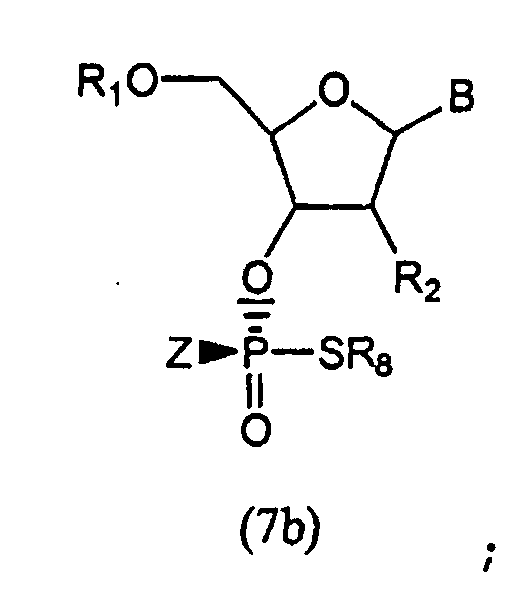 (c) reacting the alkylated nucleoside intermediate with a nucleoside of formula (5)in presence of an activator and a lithium salt in an aprotic organic solvent to form the chirally pure dinucleoside of formula (6b).
- A method for the synthesis of a chirally pure dinucleoside of formula (6b)wherein
 comprising the steps of:R1 is a protecting group;R2 is H or alkoxy moiety of 1 to 10 carbons;R9 is an acyl protecting group, a coupling group, or a silyl protecting group;Z is an alkyl moiety, an aralkyl moiety, a haloalkyl moiety, an alkenyl moiety, an alkynyl moiety, an alkaryl moiety, an aryl moiety of 1 to 20 carbons, an aminomethyl, or an aminoethyl;B is an N-protected nucleoside base;(a) reacting a nucleoside of formula (10b)with sodium hydride or 1, 8-diazabicyclo[5.4.0]undec-7-ene and carbon dioxide to form a transient nucleoside 3'-O-(Z-substituted)phosphonoselenoic acid;
 (b) reacting the transient nucleoside with an alkylating agent of the formula R8W, wherein R8 is CH2C6H4R7, wherein R7 is H, Cl, or NO2, and W is Cl, Br, or I, to form an alkylated nucleoside intermediate of formula (11b)and
 (c) reacting the alkylated nucleoside intermediate with a nucleoside of formula (5)in presence of an activator and a lithium salt in an aprotic organic solvent to form the chirally pure dinucleoside of formula (6b).
- A method for the synthesis of a chirally pure dinucleoside of formula (6b)wherein
 comprising the steps of:R1 is a protecting group;R2 is H or alkoxy moiety of 1 to 10 carbons;R9 is an acyl protecting group, a coupling group, or a silyl protecting group;Z is an alkyl moiety, an aralkyl moiety, a haloalkyl moiety, an alkenyl moiety, an alkynyl moiety, an alkaryl moiety, an aryl moiety of 1 to 20 carbons, an aminomethyl, or an aminoethyl;B is an N-protected nucleoside base;(a) reacting a nucleoside of formula (8a)with potassium peroxymonosulfate or hydrogen peroxide to form a nucleoside intermediate of formula (9a)
 (b) reacting the nucleoside intermediate with sodium hydride or DBU and carbon disulfide to form a transient nucleoside 3'-O-(Z-substituted)phosphonothioic acid;(c) reacting the transient nucleoside with an alkylating agent of the formula R8W, wherein R8 is CH2C6H4R7, wherein R7 is H, Cl, or NO2, and W is Cl, Br, or I, to form an alkylated nucleoside intermediate of formula (7b)and
 (d) reacting the alkylated nucleoside intermediate with a nucleoside of formula (5)in presence of an activator and a lithium salt in an aprotic organic solvent to form the chirally pure dinucleoside of formula (6b).
- A method for the synthesis of a chirally pure dinucleoside of formula (6b)wherein
 comprising the steps of:R1 is a protecting group;R2 is H or alkoxy moiety of 1 to 10 carbons;R9 is an acyl protecting group, a coupling group, or a silyl protecting group;Z is an alkyl moiety, an aralkyl moiety, a haloalkyl moiety, an alkenyl moiety, an alkynyl moiety, an alkaryl moiety, an aryl moiety of 1 to 20 carbons, an aminomethyl, or an aminoethyl;B is an N-protected nucleoside base;(a) reacting a nucleoside of formula (10a)with potassium peroxymonosulfate or hydrogen peroxide to form a nucleoside intermediate of formula (9a)
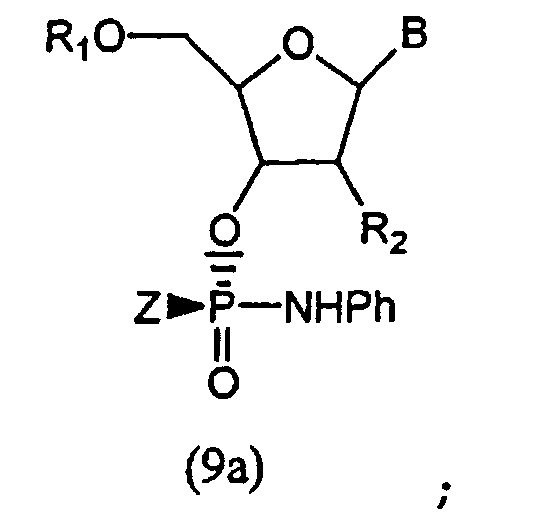 (b) reacting the nucleoside intermediate with sodium hydride or 1, 8-diazabicyclo[5.4.0]undec-7-ene and carbon diselenide to form a transient nucleoside 3'-O-(Z-substituted)phosphonoselenoic acid;(c) reacting the transient nucleoside with an alkylating agent of the formula R8W, wherein R8 is CH2C6H4R7, wherein R7 is H, Cl, or NO2, and W is Cl, Br, or I, to form an alkylated nucleoside intermediate of formula (11b)and
 (d) reacting the alkylated nucleoside intermediate with a nucleoside of formula (5)in presence of an activator and a lithium salt in an aprotic organic solvent to form the chirally pure nucleoside of formula (6b).
- A method according to any of Claims 3 to 12 wherein the aprotic solvent is acetonitrile.
- A method according to any of Claims 3 to 12 wherein the activator is 1, 8-diazabicyclo[5.4.0]undec-7-ene.
Priority Applications (1)
| Application Number | Priority Date | Filing Date | Title |
|---|---|---|---|
| EP03001247A EP1323727A3 (en) | 1995-05-26 | 1996-05-24 | Composition and methods for the synthesis of organophosphorus derivatives |
Applications Claiming Priority (7)
| Application Number | Priority Date | Filing Date | Title |
|---|---|---|---|
| PL30880395 | 1995-05-26 | ||
| PL30880395A PL181682B1 (en) | 1995-05-26 | 1995-05-26 | A method of producing modified P-chiral nucleotide analogues |
| PL31024895A PL181746B1 (en) | 1995-09-01 | 1995-09-01 | A method of producing modified P-chiral nucleotide analogues |
| PL31024895 | 1995-09-01 | ||
| PL96312934A PL184377B1 (en) | 1996-02-26 | 1996-02-26 | Novel phosphoro-organic derivatives and method of obtaining them |
| PL31293496 | 1996-02-26 | ||
| PCT/US1996/007639 WO1996037503A1 (en) | 1995-05-26 | 1996-05-24 | Compositions and methods for the synthesis of organophosphorus derivatives |
Related Child Applications (1)
| Application Number | Title | Priority Date | Filing Date |
|---|---|---|---|
| EP03001247A Division EP1323727A3 (en) | 1995-05-26 | 1996-05-24 | Composition and methods for the synthesis of organophosphorus derivatives |
Publications (3)
| Publication Number | Publication Date |
|---|---|
| EP0828749A1 EP0828749A1 (en) | 1998-03-18 |
| EP0828749A4 EP0828749A4 (en) | 1998-11-04 |
| EP0828749B1 true EP0828749B1 (en) | 2003-07-16 |
Family
ID=27354078
Family Applications (2)
| Application Number | Title | Priority Date | Filing Date |
|---|---|---|---|
| EP03001247A Withdrawn EP1323727A3 (en) | 1995-05-26 | 1996-05-24 | Composition and methods for the synthesis of organophosphorus derivatives |
| EP96917829A Expired - Lifetime EP0828749B1 (en) | 1995-05-26 | 1996-05-24 | Methods for the synthesis of organophosphorus derivatives |
Family Applications Before (1)
| Application Number | Title | Priority Date | Filing Date |
|---|---|---|---|
| EP03001247A Withdrawn EP1323727A3 (en) | 1995-05-26 | 1996-05-24 | Composition and methods for the synthesis of organophosphorus derivatives |
Country Status (10)
| Country | Link |
|---|---|
| EP (2) | EP1323727A3 (en) |
| JP (1) | JP2002500617A (en) |
| AT (1) | ATE245161T1 (en) |
| AU (1) | AU707369B2 (en) |
| CA (1) | CA2222048A1 (en) |
| DE (1) | DE69629112T2 (en) |
| DK (1) | DK0828749T3 (en) |
| ES (1) | ES2202447T3 (en) |
| PT (1) | PT828749E (en) |
| WO (1) | WO1996037503A1 (en) |
Families Citing this family (5)
| Publication number | Priority date | Publication date | Assignee | Title |
|---|---|---|---|---|
| US5852188A (en) | 1990-01-11 | 1998-12-22 | Isis Pharmaceuticals, Inc. | Oligonucleotides having chiral phosphorus linkages |
| ATE221127T1 (en) | 1991-10-15 | 2002-08-15 | Isis Pharmaceuticals Inc | OLIGONUCLEOTIDES BONDED VIA CHIRAL PHOSPHORATOMS |
| PL184612B1 (en) * | 1997-04-25 | 2002-11-29 | Pan | Method of obtaining p-chiral analoques of nucleotides |
| CN1291994C (en) | 2000-07-21 | 2006-12-27 | 吉里德科学公司 | Nucleotide phosphonate analog prodrug and its screening and preparation method |
| JPWO2024228396A1 (en) * | 2023-05-01 | 2024-11-07 |
Family Cites Families (2)
| Publication number | Priority date | Publication date | Assignee | Title |
|---|---|---|---|---|
| DE3332068A1 (en) * | 1983-09-06 | 1985-03-21 | Hoechst Ag, 6230 Frankfurt | METHOD FOR PRODUCING NUCLEOSIDALKYL, ARALKYL AND ARYLPHOSPHONITES AND PHOSPHONATES |
| DK0850248T3 (en) * | 1995-09-01 | 2002-11-04 | Polska Akad Nauk Centrum | Compositions and Methods for the Synthesis of Organophosphorus Derivatives |
-
1996
- 1996-05-24 JP JP53589596A patent/JP2002500617A/en not_active Ceased
- 1996-05-24 CA CA002222048A patent/CA2222048A1/en not_active Abandoned
- 1996-05-24 EP EP03001247A patent/EP1323727A3/en not_active Withdrawn
- 1996-05-24 ES ES96917829T patent/ES2202447T3/en not_active Expired - Lifetime
- 1996-05-24 DE DE69629112T patent/DE69629112T2/en not_active Expired - Fee Related
- 1996-05-24 PT PT96917829T patent/PT828749E/en unknown
- 1996-05-24 DK DK96917829T patent/DK0828749T3/en active
- 1996-05-24 WO PCT/US1996/007639 patent/WO1996037503A1/en not_active Ceased
- 1996-05-24 EP EP96917829A patent/EP0828749B1/en not_active Expired - Lifetime
- 1996-05-24 AU AU60240/96A patent/AU707369B2/en not_active Ceased
- 1996-05-24 AT AT96917829T patent/ATE245161T1/en not_active IP Right Cessation
Also Published As
| Publication number | Publication date |
|---|---|
| DE69629112T2 (en) | 2004-04-22 |
| EP0828749A4 (en) | 1998-11-04 |
| ES2202447T3 (en) | 2004-04-01 |
| EP1323727A3 (en) | 2003-09-10 |
| ATE245161T1 (en) | 2003-08-15 |
| JP2002500617A (en) | 2002-01-08 |
| AU6024096A (en) | 1996-12-11 |
| DK0828749T3 (en) | 2003-10-27 |
| EP0828749A1 (en) | 1998-03-18 |
| PT828749E (en) | 2003-11-28 |
| DE69629112D1 (en) | 2003-08-21 |
| EP1323727A2 (en) | 2003-07-02 |
| WO1996037503A1 (en) | 1996-11-28 |
| AU707369B2 (en) | 1999-07-08 |
| CA2222048A1 (en) | 1996-11-28 |
Similar Documents
| Publication | Publication Date | Title |
|---|---|---|
| US5856465A (en) | Compositions and methods for the synthesis of chirally pure organophosphorus nucleoside derivatives | |
| US5936080A (en) | Compositions and methods for the synthesis of organophosphorus derivatives | |
| US5955591A (en) | Phosphotriester oligonucleotides, amidites and method of preparation | |
| US5644048A (en) | Process for preparing phosphorothioate oligonucleotides | |
| US5210264A (en) | S-(2,4-dichlorobenzyl)-β-cyanoethyl phosphorothioate diester | |
| EP1013661B1 (en) | 2'-O,4'-C-methylene bicyclonucleosides | |
| US5602244A (en) | Polynucleotide phosphorodithioate compounds | |
| HUT64555A (en) | A method for linking nucleosides with syloxane bridge | |
| EP0378615A1 (en) | Nucleoside and polynucleotide thiophosphoramidite and phosphorodithioate compounds and processes | |
| EP0290583B1 (en) | $g(a) OLIGONUCLEOTIDES | |
| EP0885237B1 (en) | Oligonucleotide analogues | |
| US5789576A (en) | Methylphosphonate dimer synthesis | |
| EP0977769B1 (en) | A process for the synthesis of modified p-chiral nucleotide analogues | |
| WO1990012022A1 (en) | Polynucleotide phosphorodithioates as therapeutic agents for retroviral infections | |
| US20040033967A1 (en) | Alkylated hexitol nucleoside analogues and oligomers thereof | |
| AU707369B2 (en) | Compositions and methods for the synthesis of organophosphorus derivatives | |
| EP0850248B1 (en) | Compositions and methods for the synthesis of organophosphorus derivatives | |
| Li et al. | Synthesis of a dinucleoside 3′-S-phosphorothiolate containing 2′-deoxy-3′-thioadenosine | |
| KR20060129026A (en) | Liquid phase synthesis method of ribonucleic acid compound and oligonucleic acid compound | |
| JP7818760B2 (en) | Method for producing nucleoside derivatives | |
| HK1056565A (en) | Composition and methods for the synthesis of organophosphorus derivatives | |
| WO1995031470A2 (en) | Antisense inhibitors of gene expression | |
| US20030078414A1 (en) | Oligonucleotides having alkylphosphonate linkages and methods for their preparation | |
| IL110600A (en) | Nucleoside and polynucleotide phosphorodithioate compounds and their production | |
| FR2612930A1 (en) | OLIGONUCLEOTIDE PROBES A |
Legal Events
| Date | Code | Title | Description |
|---|---|---|---|
| PUAI | Public reference made under article 153(3) epc to a published international application that has entered the european phase |
Free format text: ORIGINAL CODE: 0009012 |
|
| 17P | Request for examination filed |
Effective date: 19971203 |
|
| AK | Designated contracting states |
Kind code of ref document: A1 Designated state(s): AT BE CH DE DK ES FI FR GB GR IE IT LI LU MC NL PT SE |
|
| A4 | Supplementary search report drawn up and despatched |
Effective date: 19980922 |
|
| AK | Designated contracting states |
Kind code of ref document: A4 Designated state(s): AT BE CH DE DK ES FI FR GB GR IE IT LI LU MC NL PT SE |
|
| 17Q | First examination report despatched |
Effective date: 20010320 |
|
| RTI1 | Title (correction) |
Free format text: METHODS FOR THE SYNTHESIS OF ORGANOPHOSPHORUS DERIVATIVES |
|
| RTI1 | Title (correction) |
Free format text: METHODS FOR THE SYNTHESIS OF ORGANOPHOSPHORUS DERIVATIVES |
|
| GRAG | Despatch of communication of intention to grant |
Free format text: ORIGINAL CODE: EPIDOS AGRA |
|
| GRAG | Despatch of communication of intention to grant |
Free format text: ORIGINAL CODE: EPIDOS AGRA |
|
| GRAH | Despatch of communication of intention to grant a patent |
Free format text: ORIGINAL CODE: EPIDOS IGRA |
|
| GRAH | Despatch of communication of intention to grant a patent |
Free format text: ORIGINAL CODE: EPIDOS IGRA |
|
| GRAA | (expected) grant |
Free format text: ORIGINAL CODE: 0009210 |
|
| AK | Designated contracting states |
Designated state(s): AT BE CH DE DK ES FI FR GB GR IE IT LI LU MC NL PT SE |
|
| REG | Reference to a national code |
Ref country code: GB Ref legal event code: FG4D |
|
| REG | Reference to a national code |
Ref country code: CH Ref legal event code: EP |
|
| REG | Reference to a national code |
Ref country code: IE Ref legal event code: FG4D |
|
| REF | Corresponds to: |
Ref document number: 69629112 Country of ref document: DE Date of ref document: 20030821 Kind code of ref document: P |
|
| REG | Reference to a national code |
Ref country code: CH Ref legal event code: NV Representative=s name: ARNOLD & SIEDSMA AG |
|
| REG | Reference to a national code |
Ref country code: SE Ref legal event code: TRGR |
|
| REG | Reference to a national code |
Ref country code: GR Ref legal event code: EP Ref document number: 20030404097 Country of ref document: GR |
|
| REG | Reference to a national code |
Ref country code: ES Ref legal event code: FG2A Ref document number: 2202447 Country of ref document: ES Kind code of ref document: T3 |
|
| ET | Fr: translation filed | ||
| PLBE | No opposition filed within time limit |
Free format text: ORIGINAL CODE: 0009261 |
|
| STAA | Information on the status of an ep patent application or granted ep patent |
Free format text: STATUS: NO OPPOSITION FILED WITHIN TIME LIMIT |
|
| 26N | No opposition filed |
Effective date: 20040419 |
|
| PGFP | Annual fee paid to national office [announced via postgrant information from national office to epo] |
Ref country code: GR Payment date: 20060413 Year of fee payment: 11 |
|
| PGFP | Annual fee paid to national office [announced via postgrant information from national office to epo] |
Ref country code: MC Payment date: 20060426 Year of fee payment: 11 |
|
| PGFP | Annual fee paid to national office [announced via postgrant information from national office to epo] |
Ref country code: NL Payment date: 20060503 Year of fee payment: 11 |
|
| PGFP | Annual fee paid to national office [announced via postgrant information from national office to epo] |
Ref country code: SE Payment date: 20060505 Year of fee payment: 11 |
|
| PGFP | Annual fee paid to national office [announced via postgrant information from national office to epo] |
Ref country code: AT Payment date: 20060511 Year of fee payment: 11 |
|
| PGFP | Annual fee paid to national office [announced via postgrant information from national office to epo] |
Ref country code: FI Payment date: 20060512 Year of fee payment: 11 |
|
| PGFP | Annual fee paid to national office [announced via postgrant information from national office to epo] |
Ref country code: IE Payment date: 20060515 Year of fee payment: 11 Ref country code: FR Payment date: 20060515 Year of fee payment: 11 |
|
| PGFP | Annual fee paid to national office [announced via postgrant information from national office to epo] |
Ref country code: DK Payment date: 20060516 Year of fee payment: 11 |
|
| PGFP | Annual fee paid to national office [announced via postgrant information from national office to epo] |
Ref country code: DE Payment date: 20060518 Year of fee payment: 11 |
|
| PGFP | Annual fee paid to national office [announced via postgrant information from national office to epo] |
Ref country code: PT Payment date: 20060523 Year of fee payment: 11 |
|
| PGFP | Annual fee paid to national office [announced via postgrant information from national office to epo] |
Ref country code: GB Payment date: 20060524 Year of fee payment: 11 |
|
| PGFP | Annual fee paid to national office [announced via postgrant information from national office to epo] |
Ref country code: CH Payment date: 20060530 Year of fee payment: 11 |
|
| PGFP | Annual fee paid to national office [announced via postgrant information from national office to epo] |
Ref country code: IT Payment date: 20060531 Year of fee payment: 11 |
|
| PGFP | Annual fee paid to national office [announced via postgrant information from national office to epo] |
Ref country code: LU Payment date: 20060601 Year of fee payment: 11 |
|
| PGFP | Annual fee paid to national office [announced via postgrant information from national office to epo] |
Ref country code: ES Payment date: 20060621 Year of fee payment: 11 |
|
| PGFP | Annual fee paid to national office [announced via postgrant information from national office to epo] |
Ref country code: BE Payment date: 20060711 Year of fee payment: 11 |
|
| REG | Reference to a national code |
Ref country code: PT Ref legal event code: MM4A Free format text: LAPSE DUE TO NON-PAYMENT OF FEES Effective date: 20071126 |
|
| BERE | Be: lapsed |
Owner name: *OLSKA AKADEMIA NAUK Effective date: 20070531 Owner name: *GENTA INC. Effective date: 20070531 |
|
| EUG | Se: european patent has lapsed | ||
| REG | Reference to a national code |
Ref country code: CH Ref legal event code: PL |
|
| REG | Reference to a national code |
Ref country code: DK Ref legal event code: EBP |
|
| GBPC | Gb: european patent ceased through non-payment of renewal fee |
Effective date: 20070524 |
|
| PG25 | Lapsed in a contracting state [announced via postgrant information from national office to epo] |
Ref country code: PT Free format text: LAPSE BECAUSE OF NON-PAYMENT OF DUE FEES Effective date: 20071126 Ref country code: NL Free format text: LAPSE BECAUSE OF NON-PAYMENT OF DUE FEES Effective date: 20071201 Ref country code: MC Free format text: LAPSE BECAUSE OF NON-PAYMENT OF DUE FEES Effective date: 20070531 Ref country code: FI Free format text: LAPSE BECAUSE OF NON-PAYMENT OF DUE FEES Effective date: 20070524 |
|
| NLV4 | Nl: lapsed or anulled due to non-payment of the annual fee |
Effective date: 20071201 |
|
| REG | Reference to a national code |
Ref country code: IE Ref legal event code: MM4A |
|
| PG25 | Lapsed in a contracting state [announced via postgrant information from national office to epo] |
Ref country code: CH Free format text: LAPSE BECAUSE OF NON-PAYMENT OF DUE FEES Effective date: 20070531 Ref country code: LI Free format text: LAPSE BECAUSE OF NON-PAYMENT OF DUE FEES Effective date: 20070531 Ref country code: AT Free format text: LAPSE BECAUSE OF NON-PAYMENT OF DUE FEES Effective date: 20070524 |
|
| REG | Reference to a national code |
Ref country code: FR Ref legal event code: ST Effective date: 20080131 |
|
| PG25 | Lapsed in a contracting state [announced via postgrant information from national office to epo] |
Ref country code: BE Free format text: LAPSE BECAUSE OF NON-PAYMENT OF DUE FEES Effective date: 20070531 |
|
| PG25 | Lapsed in a contracting state [announced via postgrant information from national office to epo] |
Ref country code: DK Free format text: LAPSE BECAUSE OF NON-PAYMENT OF DUE FEES Effective date: 20070531 Ref country code: DE Free format text: LAPSE BECAUSE OF NON-PAYMENT OF DUE FEES Effective date: 20071201 |
|
| PG25 | Lapsed in a contracting state [announced via postgrant information from national office to epo] |
Ref country code: IE Free format text: LAPSE BECAUSE OF NON-PAYMENT OF DUE FEES Effective date: 20070524 Ref country code: GB Free format text: LAPSE BECAUSE OF NON-PAYMENT OF DUE FEES Effective date: 20070524 |
|
| PG25 | Lapsed in a contracting state [announced via postgrant information from national office to epo] |
Ref country code: SE Free format text: LAPSE BECAUSE OF NON-PAYMENT OF DUE FEES Effective date: 20070525 |
|
| PG25 | Lapsed in a contracting state [announced via postgrant information from national office to epo] |
Ref country code: FR Free format text: LAPSE BECAUSE OF NON-PAYMENT OF DUE FEES Effective date: 20070531 |
|
| REG | Reference to a national code |
Ref country code: ES Ref legal event code: FD2A Effective date: 20070525 |
|
| PG25 | Lapsed in a contracting state [announced via postgrant information from national office to epo] |
Ref country code: GR Free format text: LAPSE BECAUSE OF NON-PAYMENT OF DUE FEES Effective date: 20071204 Ref country code: ES Free format text: LAPSE BECAUSE OF NON-PAYMENT OF DUE FEES Effective date: 20070525 |
|
| PG25 | Lapsed in a contracting state [announced via postgrant information from national office to epo] |
Ref country code: LU Free format text: LAPSE BECAUSE OF NON-PAYMENT OF DUE FEES Effective date: 20070524 |
|
| PG25 | Lapsed in a contracting state [announced via postgrant information from national office to epo] |
Ref country code: IT Free format text: LAPSE BECAUSE OF NON-PAYMENT OF DUE FEES Effective date: 20070524 |