EP0827993A2 - Electrical components and method for the fabrication thereof - Google Patents
Electrical components and method for the fabrication thereof Download PDFInfo
- Publication number
- EP0827993A2 EP0827993A2 EP97306862A EP97306862A EP0827993A2 EP 0827993 A2 EP0827993 A2 EP 0827993A2 EP 97306862 A EP97306862 A EP 97306862A EP 97306862 A EP97306862 A EP 97306862A EP 0827993 A2 EP0827993 A2 EP 0827993A2
- Authority
- EP
- European Patent Office
- Prior art keywords
- component
- primer
- components
- cured
- cured silicone
- Prior art date
- Legal status (The legal status is an assumption and is not a legal conclusion. Google has not performed a legal analysis and makes no representation as to the accuracy of the status listed.)
- Granted
Links
Images


Classifications
-
- H—ELECTRICITY
- H10—SEMICONDUCTOR DEVICES; ELECTRIC SOLID-STATE DEVICES NOT OTHERWISE PROVIDED FOR
- H10W—GENERIC PACKAGES, INTERCONNECTIONS, CONNECTORS OR OTHER CONSTRUCTIONAL DETAILS OF DEVICES COVERED BY CLASS H10
- H10W74/00—Encapsulations, e.g. protective coatings
- H10W74/10—Encapsulations, e.g. protective coatings characterised by their shape or disposition
- H10W74/111—Encapsulations, e.g. protective coatings characterised by their shape or disposition the semiconductor body being completely enclosed
- H10W74/127—Encapsulations, e.g. protective coatings characterised by their shape or disposition the semiconductor body being completely enclosed characterised by arrangements for sealing or adhesion
-
- C—CHEMISTRY; METALLURGY
- C09—DYES; PAINTS; POLISHES; NATURAL RESINS; ADHESIVES; COMPOSITIONS NOT OTHERWISE PROVIDED FOR; APPLICATIONS OF MATERIALS NOT OTHERWISE PROVIDED FOR
- C09D—COATING COMPOSITIONS, e.g. PAINTS, VARNISHES OR LACQUERS; FILLING PASTES; CHEMICAL PAINT OR INK REMOVERS; INKS; CORRECTING FLUIDS; WOODSTAINS; PASTES OR SOLIDS FOR COLOURING OR PRINTING; USE OF MATERIALS THEREFOR
- C09D183/00—Coating compositions based on macromolecular compounds obtained by reactions forming in the main chain of the macromolecule a linkage containing silicon, with or without sulfur, nitrogen, oxygen, or carbon only; Coating compositions based on derivatives of such polymers
- C09D183/04—Polysiloxanes
-
- C—CHEMISTRY; METALLURGY
- C09—DYES; PAINTS; POLISHES; NATURAL RESINS; ADHESIVES; COMPOSITIONS NOT OTHERWISE PROVIDED FOR; APPLICATIONS OF MATERIALS NOT OTHERWISE PROVIDED FOR
- C09D—COATING COMPOSITIONS, e.g. PAINTS, VARNISHES OR LACQUERS; FILLING PASTES; CHEMICAL PAINT OR INK REMOVERS; INKS; CORRECTING FLUIDS; WOODSTAINS; PASTES OR SOLIDS FOR COLOURING OR PRINTING; USE OF MATERIALS THEREFOR
- C09D183/00—Coating compositions based on macromolecular compounds obtained by reactions forming in the main chain of the macromolecule a linkage containing silicon, with or without sulfur, nitrogen, oxygen, or carbon only; Coating compositions based on derivatives of such polymers
- C09D183/04—Polysiloxanes
- C09D183/06—Polysiloxanes containing silicon bound to oxygen-containing groups
-
- H—ELECTRICITY
- H10—SEMICONDUCTOR DEVICES; ELECTRIC SOLID-STATE DEVICES NOT OTHERWISE PROVIDED FOR
- H10W—GENERIC PACKAGES, INTERCONNECTIONS, CONNECTORS OR OTHER CONSTRUCTIONAL DETAILS OF DEVICES COVERED BY CLASS H10
- H10W72/00—Interconnections or connectors in packages
- H10W72/851—Dispositions of multiple connectors or interconnections
- H10W72/874—On different surfaces
- H10W72/884—Die-attach connectors and bond wires
-
- H—ELECTRICITY
- H10—SEMICONDUCTOR DEVICES; ELECTRIC SOLID-STATE DEVICES NOT OTHERWISE PROVIDED FOR
- H10W—GENERIC PACKAGES, INTERCONNECTIONS, CONNECTORS OR OTHER CONSTRUCTIONAL DETAILS OF DEVICES COVERED BY CLASS H10
- H10W90/00—Package configurations
- H10W90/701—Package configurations characterised by the relative positions of pads or connectors relative to package parts
- H10W90/731—Package configurations characterised by the relative positions of pads or connectors relative to package parts of die-attach connectors
- H10W90/734—Package configurations characterised by the relative positions of pads or connectors relative to package parts of die-attach connectors between a chip and a stacked insulating package substrate, interposer or RDL
-
- H—ELECTRICITY
- H10—SEMICONDUCTOR DEVICES; ELECTRIC SOLID-STATE DEVICES NOT OTHERWISE PROVIDED FOR
- H10W—GENERIC PACKAGES, INTERCONNECTIONS, CONNECTORS OR OTHER CONSTRUCTIONAL DETAILS OF DEVICES COVERED BY CLASS H10
- H10W90/00—Package configurations
- H10W90/701—Package configurations characterised by the relative positions of pads or connectors relative to package parts
- H10W90/751—Package configurations characterised by the relative positions of pads or connectors relative to package parts of bond wires
- H10W90/754—Package configurations characterised by the relative positions of pads or connectors relative to package parts of bond wires between a chip and a stacked insulating package substrate, interposer or RDL
Definitions
- This invention relates to electrical components and methods for their fabrication. More particularly, the invention relates to highly, reliable electrical components in which cured silicone coated on an electrical element has been thoroughly monolithically adhered with cured resin sealant coated on the cured silicone. The invention also relates to a highly productive method for fabricating the electrical camponents.
- Electrical elements e.g., integrated circuits, hybrid integrated circuits. semiconductor chips, transistors, diodes, capacitors, resistors, etc.
- the sealant protects the element from external stresses (flexural stresses, impact, etc.), prevents water infiltration, and improve moistures resistance.
- the electrical element may also be coated with cured silicone to protect it from internal stresses originating from the expansion and shrinkage of the cured resin sealant.
- the cured silicone does not bond or adhere to the over-coated cured resin sealant, which results in unacceptable reliability for the resin-sealed electrical component.
- an object of the present invention is to provide highly reliable electrical components with the cured silicone coating the electrical element thoroughly bonded into a monolithic mass with the cured resin sealant coated on the cured silicone.
- a further object of this invention is to provide a highly productive method for the fabrication of the electrical components.
- the primer of the present invention is selected from:
- the fabrication method for electrical components of the present invention comprises:
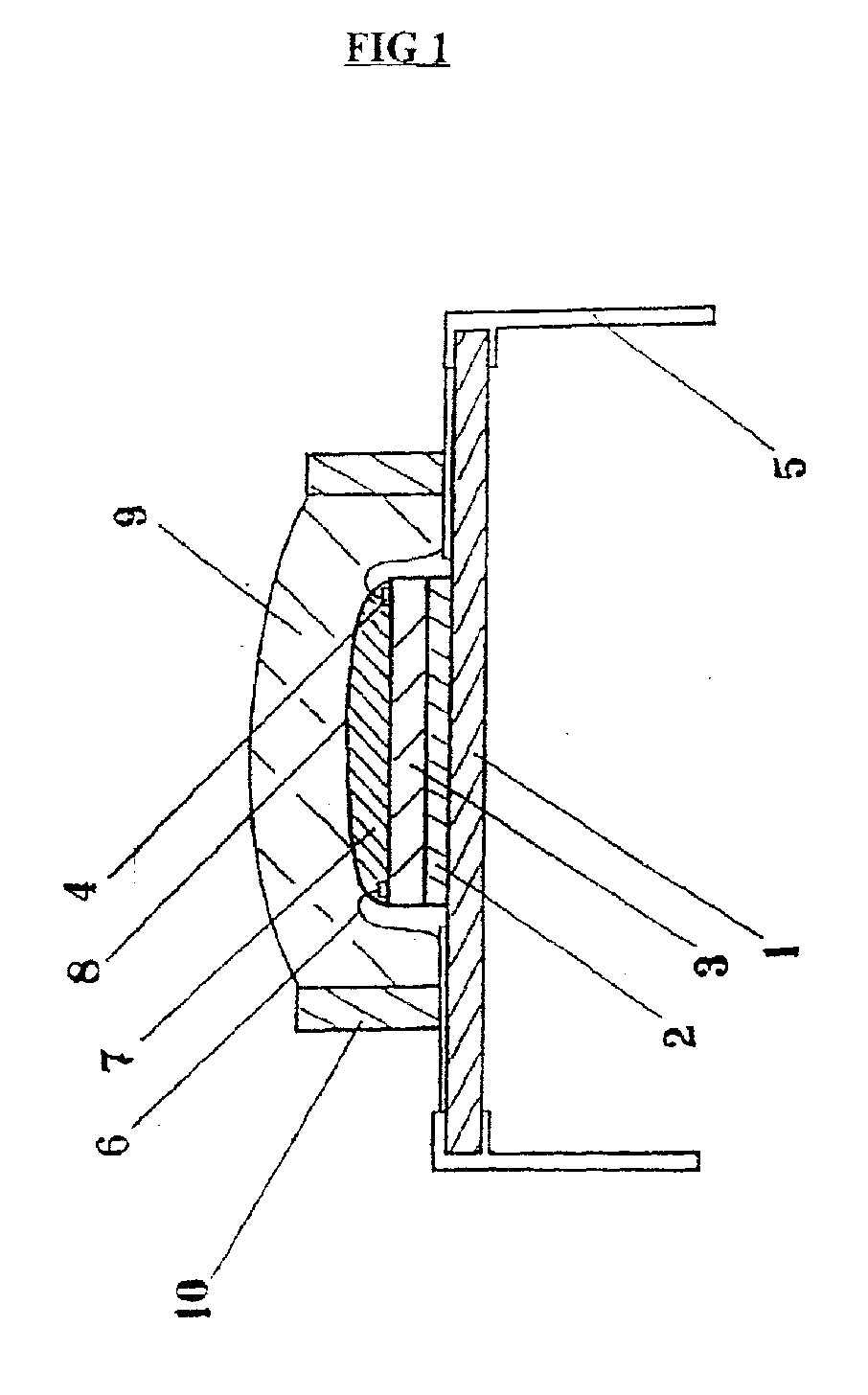
- Figure 1 contains a cross section of a semiconductor device provided as an electrical component according to the present invention.
- Figure 2 contains an oblique view with partial cut-away of a capacitor provided as an electrical component according to the present invention.
- the electrical components of the present invention have the cured silicone coated on an electrical element thoroughly adhered into a monolith with the cured resin sealant over-coated on the cured silicone.
- the cured silicone under consideration is not critical and may take the form, for example, of a gel, rubber, or hard resin.
- the compositions giving this cured silicone can be, for example, addition reaction-curing silicone compositions or condensation reaction-curing silicone compositions. Addition reaction-curing silicone compositions are preferred, while addition reaction-curing silicone compositions that generate silicone rubbers are particularly preferred.
- Addition reaction-curing siiicone compositions of this type are exemplified by compositions comprising organopolysiloxane having at least 2 alkenyl groups per molecule. organopolysiloxane having at least 2 silicon-bonded hydrogen atoms per molecule, and platinum catalyst.
- Cured resin sealants generally are relativeiy poorly adhesive to the cured products.
- the sealants are particularly poorly adhesive to the silicone rubbers afforded by the cure of addition reaction-curing silicone compositions comprising organopolysiloxane, having at least 2 alkenyl groups per molecule.
- organopolysiloxane having at least two silicon-bonded hydrogen atoms per molecule, and platinum catalyst.
- these addition reaction-cured silicones are still preferably used as the cured silicone because, in an electrical component of the present invention, they become thoroughly adhered into a monolithic mass with the cured resin sealant over-coated on the cured silicone.
- Adherence between the cured silicone coating and cured resin sealant is improved by this invention by treating the surface of the coating with a primer.
- the primer of the present invention is selected from:
- Silanol-functional organopolysiloxane (A) contains the silanol group, i.e., the silicon-bonded hydroxyl group. Particularly preferred is organopolysiloxane that contains at least 2 silanol groups per molecule.
- the molecular chain structure of component (A) can be, for example, straight, partially branched straight, branched, cyclic, or network. Straight-chain molecular structures are preferred.
- the silicon-bonded organic groups in component (A) are exemplified by substituted and unsubstituted monovalent hydrocarbon groups, e.g., by alkyl groups such as methyl, ethyl, propyl, butyl, pentyl, hexyl, heptyl, and so forth: alkenyl groups such as vinyl, allyl, butenyl, pentenyl, hexenyl, heptenyl, and so forth; aryl groups such as phenyl, tolyl, xylyl, naphthyl, and so forth; aralkyl groups such as benzyl, phenelhyl, and so forth; and halogenated alkyl groups such as chloromethyl, 3-chloropropyl, 3,3,3-trifluoropropyl, and so forth. Methyl, vinyl, and phenyl are particularly preferred.
- Component (A) is specifically exemplified by silanol-endblocked dimethylpolysiloxanes, silanol-endblocked dimethylsiloxane-methylvinylsiloxane copolymers, and silanol-endblocked dimethylsiloxane-methylphenylsiloxane copolymers.
- the viscosity of component (A) at 25°C is, for example, preferably from I to 500 mPa s, more preferably from 1 to 200 mPa s, and particularly preferably from 1 to 100 mPa s because such values afford substantial effects from the primer treatment.
- Epoxy-functional organoalkoxysilane (B) contains the epoxy group and is exemplified by organoalkoxysilane with the general formula R 1 Si(OR 4 ) 3 .
- R 1 represents epoxy-functional monovalent organic groups, for example. glycidoxyalkyl groups such as 3-glycidoxypropyl, 4-glycidoxybutyl, and so forth; epoxycyclohexylalkyl groups such as 2-(3,4-epoxycylohexyl)ethyl, 3-(3,4-epoxycyclohexyl)propyl, and so forth; and oxiranylalkyl groups such as 4-oxiranylbutyl, 8-oxiranyloctyl, and so forth.
- R 4 formula represents alkyl groups of 1 to 4 carbon atoms, for example. methyl, ethyl, propyl, and butyl, wherein methyl is specifically preferred.
- Component (B) is specifically exemplified by
- Components (A) and (B) may simply be mixed or may be subjected to condensation and equilibration reactions.
- the component (A): component (B) mixing ratio or reaction ratio is preferably from 1 : 99 to 99 : 1 by weight.
- Organopolysiloxane (C) is represented by the following average unit formula: (R 1 SiO 3/2 ) a (R 2 2 SiO 2/2 ) b (R 2 3 SiO 1/2 ) c (R 3 O 1/2 ) d where R 1 ; R 2 , R 3 , a, b, c, and d are defined above. Glycidoxyalkyl groups, such as 3-glycidoxypropyl and so forth, are specifically preferred for R 1 .
- R 2 is exemplified by substituted and unsubstituted monovalent hydrocarbon groups as exemplified by alkyl such as methyl, ethyl, propyl, butyl, and so forth; alkenyl such as vinyl, allyl, butenyl, pentenyl, hexenyl, and so forth; aryl such as phenyl, tolyl, xylyl, and so forth; aralkyl such as benzyl, phenethyl, and so forth; and halogenated alkyl groups such as 3,3,3-trifluoropropyl and so forth. Methyl, vinyl, and phenyl are specifically preferred for R 2 .
- R 3 is exemplified by methyl, ethyl, propyl, and butyl.
- the viscosity of component (C) at 25°C is, for example, preferably from 1 to 500 mPa s, more preferably from 1 to 200 mPa s, and particularly preferably from 1 to 100 mPa s because such values afford substantial effects from the primer treatment.
- Component (C) can be synthesized, for example. by an equilibration polymerization in the presence of a polymerization catalyst, e.g., potassium hydroxide, etc., between epoxy-functional alkoxysilane and straight chain-to-cyclic diorganosiloxane.
- a polymerization catalyst e.g., potassium hydroxide, etc.
- the primer treated cured silicone is sealed with a cured resin sealant.
- the resin sealant is not critical and can be. for example. the cured product from curable epoxy, phenolic, polyphenylene sulfide, polyetheramide, and polyimide resins. Curable epoxy resins are particularly preferred.
- the curable epoxy resins are exemplified by the glycidyl ether epoxy resins, for example, bisphenol A-type, bisphenol F-type, biphenyl, phenol novolac. ortho-cresol novolac, brominated, and so forth; alicyclic epoxy resins; glycidyl ester epoxy resins; glycidyl amine epoxy resins; and heterocyclic epoxy resins.
- the cure mechanisms in these curable epoxy resins can be, for example, heat-curing, UV-curing, or moisture curing, wherein heat-curing mechanisms are specifically preferred.
- the curable epoxy resin can be a liquid at room temperature or can be a solid having a softening point of at least room temperature, curable epoxy resins that are liquid at room temperature are preferred for their good handling properties.
- the electrical component of the present invention can be, for example, a transistor, diode; capacitor, or resistor or a semiconductor device that contains an electrical element such as a semiconductor element (e.g., integrated circuit, hybrid integrated circuit, computer chip, and so forth), transistor, diode, capacitor, resistor, and so forth.
- semiconductor element e.g., integrated circuit, hybrid integrated circuit, computer chip, and so forth
- Semiconductor devices and capacitors are specifically preferred for the electrical component.
- An example of a semiconductor device is provided in Figure 1, while Figure 2 contains an example of a capacitor.
- a semiconductor element 3 is mounted in this semiconductor device on a circuit substrate 1 through an interposed adhesive 2.
- the upper edges of this semiconductor element 3 are provided with bonding pads 4, while outer leads 5 are provided at the edges of the circuit substrate 1.
- the bonding pads 4 are electrically connected to the circuit substrate 1 by bonding wires 6.
- the semiconductor element 3 is coated with cured silicone 7, and a primer-treated layer 8, of the composition described above, has been formed on the surface of this cured silicone 7.
- Cured resin sealant 9 is coated over the cured silicone.
- a frame or dam 10 is provided around the periphery of the semiconductor element 3.
- the cured silicone 7 is thoroughly bonded into a monolith with the over-coated cured resin sealant 9 through the interposed primer-treated layer 8 formed on the surface of the cured silicone 7.
- the capacitor, Figure 2 contains Al-vapor-deposited (metallized) polyester film 11 in either a roiled or layered configuration, and electrodes 12 are provided by coating both ends with flame-coated metal. These electrodes 12 are electrically connected with outer leads 13.
- the capacitor is coated with cured silicone 14, while a primer-treated layer 15, of the composition described above, has been formed on the surface of this cured silicone 14.
- Cured resin sealant 16 is coated over the cured silicone.
- the cured silicone 14 is thoroughly bonded into a monolith with the over-coated cured resin sealant 16 through the interposed primer-treated layer 15 formed on the surface of the cured silicone 14.
- the method for fabricating the electrical components of the present invention is described in detail as follows.
- the semiconductor device 3 Before fabricating the semiconductor device of Figure 1, first the semiconductor device 3 must be mounted on the circuit substrate 1 using interposed adhesive 2 and the bonding pads 4 on the upper edges of this semiconductor device 3 must be electrically connected with the circuit substrate 1 by bonding wires 6.
- a dam or frame 10 is preferably provided around the periphery of the semiconductor element 3 in order to inhibit outflow of the resin sealant.
- the capacitor of Figure 2 Before fabricating the capacitor of Figure 2 as the electrical component, first the Al-vapor-deposited (metallized) polyester film 11 must be rolled up or laminated, the electrodes 12 must be formed by coating both ends with flame-coated metal, and the outer leads 13 must be electrically connected to the electrodes 12.
- the method for coating the cured silicone onto electrical elements such as a transistor, diode, capacitor, resistor, semiconductor element (e.g., integrated circuits, hybrid integrated circuits, computer chips, and so forth), and so forth is not critical. Coating can be effected with the silicone compositions described previously.
- the fabrication method of the present invention commences with primer treatment of the surface of cured silicone coated on an electrical element such as those described above.
- Primer treatment can be by application of the primer described above by spraying, brush application, dipping, and so forth.
- the primer is preferably used in this operation diluted with organic solvent or with organopolysiloxane or alkoxysilane with a viscosity at 25°C no greater than 50 mPa s.
- the organic solvent is exemplified by hydrocarbon solvents such as toluene, xylene, hexane, heptane, etc.; ketone solvents such as acetone, methyl ethyl ketone. etc.; alcohol solvents such as methyl alcohol, ethyl alcohol, isopropyl alcohol, etc.; and also by chlorinated hydrocarbon solvents and fluorinated hydrocarbon solvents.
- alkoxysilane or organopolysiloxane Dilution with alkoxysilane or organopolysiloxane is particularly preferred.
- the alkoxysilane is exemplified by methyltrimethoxysilane, vinyltrilnethoxysilane, and so forth
- the organopolysiloxane is exemplified by straight-chain siloxanes such as hexamethyldisiloxane, trimethylsilyl-endblocked dimethylpolysiloxanes, and so forth, and by cyclic siloxanes such as octamethylcyclotetrasiloxane, tetramethyltetravinylcyclotetrasiloxane, and so forth.
- the primer can then be dried, for example, by air-drying at ambient temperature or by heating to no more than 200°C as a function of the particular requirements.
- the primer-treated cured silicone is subsequently coated with the resin sealant described previously.
- the treated cured silicone can be coated with the resin sealant by, for example, transfer molding, injection molding, potting, casting, application by dipping, application by dripping as from a dispenser, spray coating, brush application, and so forth.
- heat-curing resins can be heated to 50 °C to 250 °C; UV-curing resins can be exposed to UV radiation from a light source; and moisture-curable resins can be held at room temperature.
- the resin can be heated, for example, using an oven, hot plate, heat lamp, and the like.
- Electrical components of the present invention have excellent reliability because the cured silicone coating the electrical element is well bonded into a monolithic mass with the cured resin sealant over-coated on the cured silicone.
- the method of the present invention for fabricating these electrical components is highly productive and workable.
- the viscosity values reported in the examples were measured at 25°C. The following procedures were used to evaluate the adherence of the cured resin sealant to the cured silicone and to evaluate the reliability of the electrical components (semiconductor device, capacitor).
- curable epoxy resin composition 100 weight parts epoxy resin, with epoxy equivalent weight of 165, whose main component was a bisphenol F-type epoxy resin, 120 weight parts tetraalkyltetrahydrophthalic anhydride curing agent with molecular weight of 234, and 1 weight part 1-isobutyl-2-methylimidazole cure accelerator.
- This resin sealant was used in the evaluations.
- the curable silicone composition described above was coated on an aluminum plate and cured by heating for 5 minutes in a forced convection oven at 100°C. The surface of the resulting cured silicone was then treated with the primer by spraying followed by drying for 3 minutes in the forced convention oven at 100°C. The resin sealant described above was coated on the resulting cured product and was itself cured by heating for 4 hours in the forced convection oven at 120°C. The adherence of the cured resin sealant to the cured silicone was inspected and scored on he following scale.
- the semiconductor device shown in Figure 1 was fabricated as follows.
- a semiconductor element 3 bearing an aluminum interconnect pattern on its surface was mounted on an alumina ceramic circuit substrate 1 using an adhesive 2.
- the bonding pads 4 on the upper edges of this semiconductor element 3 were then electrically connected to the circuit substrate 1 using gold bonding wires 6.
- the curable silicone composition prepared above was applied from a dispenser onto the surface of the semiconductor element 3 and the cured silicone product 7 was then produced by heating for five minutes in a forced convection oven at 100°C.
- the surface of the cured product 7 was thereafter treated with the primer by spraying and then drying by heating for 3 minutes in a forced convection oven at 100°C.
- the above-specified resin sealant was then applied from a dispenser onto the cured product 7.
- the capacitor shown in Figure 2 was fabricated as follows. Al-vapor-deposited (metallized) polyester film 11 was roiled up, electrodes 12 were provided by coating both ends with flame-coated metal, and outer leads 13 were electrically connected to the electrodes 12. This assembly was dipped in the curable silicone composition specified above and then heated for five minutes in a forced convection oven at 100°C to give the cured silicone 14. The surface of this cured product 14 was treated with primer by spraying and then drying for three minutes in a forced convection oven at 100°C. The cured product 14 was then dipped in the resin sealant specified above followed by heating in a forced convection oven at 120°C for four hours to give a capacitor with cured resin sealant 16 formed on cured silicone 14. Twenty capacitors were fabricated using this procedure.
- a primer was prepared by diluting 5 weight parts of the organopolysiloxane synthesized in Reference Example 1 in 95 weight parts trimethylsiloxy-endblocked dimethylpolysiloxane with a viscosity of 0.6 mPa s. This primer was used for evaluation of the adherence by the cured resin sealant to the cured silicone and evaluation of the electrical component reliability (semiconductor device, capacitor). The results from the evaluations are reported in fable 1.
- This primer was used for evaluation of the adherence by the cured resin sealant to the cured silicone and evaluation of the electrical component reliability (semiconductor device, capacitor). The results from the evaluations are reported in Table 1.
- Example 1 The adherence by the cured resin sealant to the cured silicone and the electrical component reliability (semiconductor device, capacitor) were evaluated as in Example 1, but in this case omitting the primer treatment that was carried out in Example 1. The results from the evaluations are reported in Table 1.
- a dilution was prepared of 5 weight parts 3-glycidoxypropyltrimethoxysilane in 95 weight parts trimethylsiloxy-endblocked dimethylpolysiloxane with a viscosity of 0.6 mPa s. This dilution was submitted to evaluation of the adherence by the cured resin sealant to the cured silicone and evaluation of the electrical component reliability (semiconductor device, capacitor). The results from the evaluations are reported in Table 1.
- This dilution was submitted to evaluation of the adherence by the cured resin sealant to the cured silicone and evaluation of the electrical component reliability (semiconductor device, capacitor). The results from the evaluations are reported in Table 1.
Landscapes
- Chemical & Material Sciences (AREA)
- Chemical Kinetics & Catalysis (AREA)
- Life Sciences & Earth Sciences (AREA)
- Engineering & Computer Science (AREA)
- Materials Engineering (AREA)
- Wood Science & Technology (AREA)
- Organic Chemistry (AREA)
- Structures Or Materials For Encapsulating Or Coating Semiconductor Devices Or Solid State Devices (AREA)
- Paints Or Removers (AREA)
- Fixed Capacitors And Capacitor Manufacturing Machines (AREA)
Abstract
Description
- + :
- strong adherence
- Δ :
- partial de-bonding
- x :
- complete de-bonding


Claims (20)
- A primer for adhering a cured resin sealant to a cured silicone coating on an electrical element, wherein the primer is selected from:where component (A) is a silanol-functional organopolysiloxane; component (B) is an epoxy-functional organoalkoxysilane: and component (C) is an organopolysiloxane with the average unit formula:(i) a mixture of components (A) and (B),(ii) a reaction mixture of components (A) and (B),(iii) component (C),(iv) component (C) and a mixture of components (A) and (B), and(v) component (C) and a reaction mixture of components (A) and (B),
- The primer according to claim 1, wherein the silanol-functional polysiloxane (A) has a straight chain structure.
- The primer according to claim 1, wherein component (A) is a silanol-endblocked organopolysiloxane selected from dimethylpolysiloxanes, dimethylsiloxane-methylvinylsiloxane copolymers, and dimethylysiloxane-methylphenylsiloxane copolymers.
- The primer according to any of claims 1 to 3, wherein component (B) has the general formula:
- The primer according to claim 4, wherein R1 is a glycidoxyalkyl group.
- The primer according to claim 4 or 5, wherein R4 is a methyl group.
- The primer according to claim 4, wherein component (B) is 3-glycidoxypropyltrimethoxysilane.
- The primer according to any of claims 1 to 7, wherein the reaction mixture of components (A) and (B) is selected from condensation and equilibration reactions.
- The primer according to any of claims 1 to 8, wherein the weight ratio of component (A) to component (B) ranges from 1:99 to 99:1.
- The primer according to any of claims 1 to 9, wherein R1 in component (C) is a glycidoxyalkyl group.
- The primer according to claim 10. wherein R1 is 3-glycidoxypropyl group.
- The primer according to any of claims 1 to 11, wherein each instance of R2 in component (C) is independently selected from methyl, vinyl and phenyl.
- The method for fabricating electrical components having a surface of cured silicone thereon, comprising:(1) treating the surface of the cured silicone with a primer selected from:where component (A) is a silanol-functional organopolysiloxane; component (B) is an epoxy-functional organoalkoxysilane; and component (C) is an organopolysiloxane with the average unit formula:(i) a mixture of components (A) and (B),(ii) a reaction mixture of components (A) and (B),(iii) component (C),(iv) component (C) and a mixture of components (A) and (B), and(v) component (C) and a reaction mixture of components (A) and (B),(2) sealing the treated cured silicone with cured resin sealant.
- An electrical component fabricated by the method of claim 13, wherein said electrical component is selected from transistors, diodes, capacitors, resistors, and semiconductor devices that contain an electrical element.
- The method according to claim 13, wherein the cured silicone is the cured product of an addition reaction-cured silicone composition.
- The method according to claim 13 or 15 wherein the cured resin sealant is the cured product of a curable epoxy resin composition.
- The method according to claim 13, 15 or 16, further comprising diluting the primer of step (1) with an organic solvent before treating the cured silicone coating.
- The method according to claim 17, wherein the primer of step (1) is diluted with an organic solvent selected from organopolysiloxanes and alkoxysilanes with viscosity no greater than 50 mPa s at 25°C.
- The method according to claim 18 wherein the solvent is an alkoxysilane selected from methyltrimethoxysilane and vinyltrimethoxysilane.
- The method according to claim 18 wherein the solvent is trimethylsiloxy-endblocked polydimethylsiloxane.
Applications Claiming Priority (3)
| Application Number | Priority Date | Filing Date | Title |
|---|---|---|---|
| JP25390196A JP3527369B2 (en) | 1996-09-04 | 1996-09-04 | Electric component and method of manufacturing the same |
| JP25390196 | 1996-09-04 | ||
| JP253901/96 | 1996-09-04 |
Publications (3)
| Publication Number | Publication Date |
|---|---|
| EP0827993A2 true EP0827993A2 (en) | 1998-03-11 |
| EP0827993A3 EP0827993A3 (en) | 1998-07-01 |
| EP0827993B1 EP0827993B1 (en) | 1999-11-24 |
Family
ID=17257662
Family Applications (1)
| Application Number | Title | Priority Date | Filing Date |
|---|---|---|---|
| EP97306862A Expired - Lifetime EP0827993B1 (en) | 1996-09-04 | 1997-09-04 | Electrical components and method for the fabrication thereof |
Country Status (4)
| Country | Link |
|---|---|
| US (2) | US5958515A (en) |
| EP (1) | EP0827993B1 (en) |
| JP (1) | JP3527369B2 (en) |
| DE (1) | DE69700827T2 (en) |
Cited By (1)
| Publication number | Priority date | Publication date | Assignee | Title |
|---|---|---|---|---|
| EP3275955A4 (en) * | 2015-02-26 | 2018-08-01 | Dow Corning Toray Co., Ltd. | Primer composition, bonding method, and electric/electronic component |
Families Citing this family (9)
| Publication number | Priority date | Publication date | Assignee | Title |
|---|---|---|---|---|
| FI105406B (en) * | 1999-07-05 | 2000-08-15 | Nor Maali Oy | Composition for use in painter's paints |
| DE10126607A1 (en) | 2001-05-31 | 2002-12-05 | Richard Markoll | Portable applicator for pulsed signal therapy |
| CN100523046C (en) * | 2004-03-03 | 2009-08-05 | 日立化成工业株式会社 | Epoxy resin molding material for sealing and electronic device |
| DE102004028350A1 (en) * | 2004-06-11 | 2006-01-12 | Marquardt Gmbh | Activation and/or curing of UV curable molding materials, in particular on electrical components is effected by UV radiation from LED |
| JP5446078B2 (en) * | 2006-08-22 | 2014-03-19 | 三菱化学株式会社 | SEMICONDUCTOR DEVICE MEMBER, SEMICONDUCTOR DEVICE MEMBER FORMING METHOD AND SEMICONDUCTOR DEVICE MEMBER MANUFACTURING METHOD, SEMICONDUCTOR LIGHT EMITTING DEVICE USING THE SAME, SEMICONDUCTOR DEVICE MEMBER FORMING SOLUTION, AND PHOSPHOR COMPOSITION |
| CN104620372B (en) | 2012-12-28 | 2017-10-24 | 富士电机株式会社 | Semiconductor device |
| US9470395B2 (en) | 2013-03-15 | 2016-10-18 | Abl Ip Holding Llc | Optic for a light source |
| US10807329B2 (en) | 2013-05-10 | 2020-10-20 | Abl Ip Holding Llc | Silicone optics |
| CN107057068A (en) * | 2017-02-23 | 2017-08-18 | 深圳市新纶科技股份有限公司 | A kind of end epoxy silicon oil and preparation method thereof and its as adhesion promoters purposes |
Family Cites Families (16)
| Publication number | Priority date | Publication date | Assignee | Title |
|---|---|---|---|---|
| JPS5287454A (en) * | 1976-01-16 | 1977-07-21 | Toray Silicone Co Ltd | Organopolysiloxane resin composition |
| JPS5445361A (en) * | 1977-09-16 | 1979-04-10 | Toshiba Silicone | Polyorganosiloxane composition |
| US4645551A (en) * | 1984-08-31 | 1987-02-24 | Motorola, Inc. | Method of making an octocoupler |
| GB2208650B (en) * | 1987-08-15 | 1991-09-04 | Dow Corning Sa | Curable organopolysiloxane compositions |
| JP2604178B2 (en) * | 1987-10-06 | 1997-04-30 | 東レ・ダウコーニング・シリコーン株式会社 | Resin-sealed optical coupling semiconductor device and method of manufacturing the same |
| JP2701045B2 (en) * | 1988-07-15 | 1998-01-21 | 東レ・ダウコーニング・シリコーン株式会社 | Resin-sealed semiconductor device and method of manufacturing the same |
| JP2701072B2 (en) * | 1989-06-20 | 1998-01-21 | 東レ・ダウコーニング・シリコーン株式会社 | Resin-sealed optical coupling semiconductor device and method of manufacturing the same |
| JPH0768495B2 (en) * | 1989-08-15 | 1995-07-26 | 信越化学工業株式会社 | Method for manufacturing integrally molded product with silicone rubber bonded |
| CA2064989A1 (en) * | 1991-04-23 | 1992-10-24 | Dawn M. Houghtaling | One part solventless conformal coatings |
| US5213617A (en) * | 1991-06-13 | 1993-05-25 | Dow Corning Corporation | Primer for silicone substrates |
| JPH06145525A (en) * | 1992-11-05 | 1994-05-24 | Toray Dow Corning Silicone Co Ltd | Curable organopolysiloxane composition |
| EP0620242B1 (en) * | 1993-04-15 | 1998-08-19 | Dow Corning Toray Silicone Company, Limited | Epoxy group-containing silicone resin and compositions based thereon |
| GB9424580D0 (en) * | 1994-12-06 | 1995-01-25 | Dow Corning Sa | Curable coating compositions |
| JP3592825B2 (en) * | 1996-02-07 | 2004-11-24 | 東レ・ダウコーニング・シリコーン株式会社 | Curable epoxy resin composition and electronic component |
| JPH1025417A (en) * | 1996-07-08 | 1998-01-27 | Toray Dow Corning Silicone Co Ltd | Curable liquid composition, cured product thereof, and electronic component |
| JPH1036510A (en) * | 1996-07-26 | 1998-02-10 | Toray Dow Corning Silicone Co Ltd | Electric component and method of manufacturing the same |
-
1996
- 1996-09-04 JP JP25390196A patent/JP3527369B2/en not_active Expired - Fee Related
-
1997
- 1997-09-03 US US08/923,074 patent/US5958515A/en not_active Expired - Fee Related
- 1997-09-04 EP EP97306862A patent/EP0827993B1/en not_active Expired - Lifetime
- 1997-09-04 DE DE69700827T patent/DE69700827T2/en not_active Expired - Fee Related
-
1999
- 1999-05-21 US US09/316,217 patent/US6040395A/en not_active Expired - Fee Related
Cited By (2)
| Publication number | Priority date | Publication date | Assignee | Title |
|---|---|---|---|---|
| EP3275955A4 (en) * | 2015-02-26 | 2018-08-01 | Dow Corning Toray Co., Ltd. | Primer composition, bonding method, and electric/electronic component |
| US10479910B2 (en) | 2015-02-26 | 2019-11-19 | Dow Toray Co., Ltd. | Primer composition, adhering method, and electric/electronic part |
Also Published As
| Publication number | Publication date |
|---|---|
| JPH1079454A (en) | 1998-03-24 |
| US5958515A (en) | 1999-09-28 |
| DE69700827T2 (en) | 2000-06-29 |
| EP0827993A3 (en) | 1998-07-01 |
| EP0827993B1 (en) | 1999-11-24 |
| US6040395A (en) | 2000-03-21 |
| DE69700827D1 (en) | 1999-12-30 |
| JP3527369B2 (en) | 2004-05-17 |
Similar Documents
| Publication | Publication Date | Title |
|---|---|---|
| US6235862B1 (en) | Adhesive silicone sheet, method for the preparation thereof and semiconductor devices | |
| US6379792B1 (en) | Silicone adhesive sheet and method for manufacturing | |
| US5958176A (en) | Electrical parts and method for manufacturing the same | |
| US5804631A (en) | Curable organosiloxane compositions and semiconductor devices | |
| EP1432774B1 (en) | Adhesive sheet of cross-linked silicone, method of manufacturing thereof and device comprising the sheet | |
| EP0789057B1 (en) | Curable epoxy resin compositions and electronic components | |
| US6551676B1 (en) | Silicone-based adhesive sheet method for manufacturing same and semiconductor device | |
| US5561329A (en) | Compositions for protecting semiconductor elements and semiconductor devices | |
| EP1067162B1 (en) | Adhesive and semiconductor devices | |
| US5958515A (en) | Electrical components and method for the fabrication thereof | |
| EP1067163B1 (en) | Adhesive and semiconductor devices | |
| US5872194A (en) | Curable liquid-form composition, cured product of the same, and electronic part | |
| JP2000080335A (en) | Silicone adhesive sheet, method for producing the same, and semiconductor device | |
| KR20050014845A (en) | Thermoconductive curable liquid polymer composition and semiconductor device produced with the use of this composition |
Legal Events
| Date | Code | Title | Description |
|---|---|---|---|
| PUAI | Public reference made under article 153(3) epc to a published international application that has entered the european phase |
Free format text: ORIGINAL CODE: 0009012 |
|
| AK | Designated contracting states |
Kind code of ref document: A2 Designated state(s): DE FR GB IT NL |
|
| PUAL | Search report despatched |
Free format text: ORIGINAL CODE: 0009013 |
|
| RHK1 | Main classification (correction) |
Ipc: H01L 23/00 |
|
| AK | Designated contracting states |
Kind code of ref document: A3 Designated state(s): AT BE CH DE DK ES FI FR GB GR IE IT LI LU MC NL PT SE |
|
| 17P | Request for examination filed |
Effective date: 19980729 |
|
| 17Q | First examination report despatched |
Effective date: 19980825 |
|
| GRAG | Despatch of communication of intention to grant |
Free format text: ORIGINAL CODE: EPIDOS AGRA |
|
| AKX | Designation fees paid |
Free format text: DE FR GB IT NL |
|
| RBV | Designated contracting states (corrected) |
Designated state(s): DE FR GB IT NL |
|
| GRAG | Despatch of communication of intention to grant |
Free format text: ORIGINAL CODE: EPIDOS AGRA |
|
| GRAH | Despatch of communication of intention to grant a patent |
Free format text: ORIGINAL CODE: EPIDOS IGRA |
|
| GRAH | Despatch of communication of intention to grant a patent |
Free format text: ORIGINAL CODE: EPIDOS IGRA |
|
| GRAA | (expected) grant |
Free format text: ORIGINAL CODE: 0009210 |
|
| AK | Designated contracting states |
Kind code of ref document: B1 Designated state(s): DE FR GB IT NL |
|
| REF | Corresponds to: |
Ref document number: 69700827 Country of ref document: DE Date of ref document: 19991230 |
|
| ITF | It: translation for a ep patent filed | ||
| ET | Fr: translation filed | ||
| PLBE | No opposition filed within time limit |
Free format text: ORIGINAL CODE: 0009261 |
|
| STAA | Information on the status of an ep patent application or granted ep patent |
Free format text: STATUS: NO OPPOSITION FILED WITHIN TIME LIMIT |
|
| 26N | No opposition filed | ||
| PGFP | Annual fee paid to national office [announced via postgrant information from national office to epo] |
Ref country code: GB Payment date: 20010803 Year of fee payment: 5 |
|
| PGFP | Annual fee paid to national office [announced via postgrant information from national office to epo] |
Ref country code: DE Payment date: 20010806 Year of fee payment: 5 |
|
| PGFP | Annual fee paid to national office [announced via postgrant information from national office to epo] |
Ref country code: FR Payment date: 20010807 Year of fee payment: 5 |
|
| PGFP | Annual fee paid to national office [announced via postgrant information from national office to epo] |
Ref country code: NL Payment date: 20010821 Year of fee payment: 5 |
|
| REG | Reference to a national code |
Ref country code: GB Ref legal event code: IF02 |
|
| PG25 | Lapsed in a contracting state [announced via postgrant information from national office to epo] |
Ref country code: GB Free format text: LAPSE BECAUSE OF NON-PAYMENT OF DUE FEES Effective date: 20020904 |
|
| PG25 | Lapsed in a contracting state [announced via postgrant information from national office to epo] |
Ref country code: NL Free format text: LAPSE BECAUSE OF NON-PAYMENT OF DUE FEES Effective date: 20030401 Ref country code: DE Free format text: LAPSE BECAUSE OF NON-PAYMENT OF DUE FEES Effective date: 20030401 |
|
| GBPC | Gb: european patent ceased through non-payment of renewal fee |
Effective date: 20020904 |
|
| PG25 | Lapsed in a contracting state [announced via postgrant information from national office to epo] |
Ref country code: FR Free format text: LAPSE BECAUSE OF NON-PAYMENT OF DUE FEES Effective date: 20030603 |
|
| REG | Reference to a national code |
Ref country code: FR Ref legal event code: ST |
|
| PG25 | Lapsed in a contracting state [announced via postgrant information from national office to epo] |
Ref country code: IT Free format text: LAPSE BECAUSE OF NON-PAYMENT OF DUE FEES Effective date: 20050904 |