EP0827507B1 - Protease inhibiting succinic acid derivatives - Google Patents
Protease inhibiting succinic acid derivatives Download PDFInfo
- Publication number
- EP0827507B1 EP0827507B1 EP96907231A EP96907231A EP0827507B1 EP 0827507 B1 EP0827507 B1 EP 0827507B1 EP 96907231 A EP96907231 A EP 96907231A EP 96907231 A EP96907231 A EP 96907231A EP 0827507 B1 EP0827507 B1 EP 0827507B1
- Authority
- EP
- European Patent Office
- Prior art keywords
- phenyl
- amino
- asn
- compound
- quinolylcarbonyl
- Prior art date
- Legal status (The legal status is an assumption and is not a legal conclusion. Google has not performed a legal analysis and makes no representation as to the accuracy of the status listed.)
- Expired - Lifetime
Links
Classifications
-
- C—CHEMISTRY; METALLURGY
- C07—ORGANIC CHEMISTRY
- C07K—PEPTIDES
- C07K5/00—Peptides containing up to four amino acids in a fully defined sequence; Derivatives thereof
- C07K5/04—Peptides containing up to four amino acids in a fully defined sequence; Derivatives thereof containing only normal peptide links
- C07K5/06—Dipeptides
- C07K5/06139—Dipeptides with the first amino acid being heterocyclic
-
- A—HUMAN NECESSITIES
- A61—MEDICAL OR VETERINARY SCIENCE; HYGIENE
- A61P—SPECIFIC THERAPEUTIC ACTIVITY OF CHEMICAL COMPOUNDS OR MEDICINAL PREPARATIONS
- A61P31/00—Antiinfectives, i.e. antibiotics, antiseptics, chemotherapeutics
- A61P31/12—Antivirals
-
- A—HUMAN NECESSITIES
- A61—MEDICAL OR VETERINARY SCIENCE; HYGIENE
- A61P—SPECIFIC THERAPEUTIC ACTIVITY OF CHEMICAL COMPOUNDS OR MEDICINAL PREPARATIONS
- A61P37/00—Drugs for immunological or allergic disorders
- A61P37/02—Immunomodulators
- A61P37/04—Immunostimulants
-
- C—CHEMISTRY; METALLURGY
- C07—ORGANIC CHEMISTRY
- C07C—ACYCLIC OR CARBOCYCLIC COMPOUNDS
- C07C233/00—Carboxylic acid amides
- C07C233/01—Carboxylic acid amides having carbon atoms of carboxamide groups bound to hydrogen atoms or to acyclic carbon atoms
- C07C233/34—Carboxylic acid amides having carbon atoms of carboxamide groups bound to hydrogen atoms or to acyclic carbon atoms having the nitrogen atom of at least one of the carboxamide groups bound to a carbon atom of a hydrocarbon radical substituted by amino groups
- C07C233/35—Carboxylic acid amides having carbon atoms of carboxamide groups bound to hydrogen atoms or to acyclic carbon atoms having the nitrogen atom of at least one of the carboxamide groups bound to a carbon atom of a hydrocarbon radical substituted by amino groups with the substituted hydrocarbon radical bound to the nitrogen atom of the carboxamide group by an acyclic carbon atom
- C07C233/36—Carboxylic acid amides having carbon atoms of carboxamide groups bound to hydrogen atoms or to acyclic carbon atoms having the nitrogen atom of at least one of the carboxamide groups bound to a carbon atom of a hydrocarbon radical substituted by amino groups with the substituted hydrocarbon radical bound to the nitrogen atom of the carboxamide group by an acyclic carbon atom having the carbon atom of the carboxamide group bound to a hydrogen atom or to a carbon atom of an acyclic saturated carbon skeleton
-
- C—CHEMISTRY; METALLURGY
- C07—ORGANIC CHEMISTRY
- C07C—ACYCLIC OR CARBOCYCLIC COMPOUNDS
- C07C233/00—Carboxylic acid amides
- C07C233/64—Carboxylic acid amides having carbon atoms of carboxamide groups bound to carbon atoms of six-membered aromatic rings
- C07C233/77—Carboxylic acid amides having carbon atoms of carboxamide groups bound to carbon atoms of six-membered aromatic rings having the nitrogen atom of at least one of the carboxamide groups bound to a carbon atom of a hydrocarbon radical substituted by amino groups
- C07C233/78—Carboxylic acid amides having carbon atoms of carboxamide groups bound to carbon atoms of six-membered aromatic rings having the nitrogen atom of at least one of the carboxamide groups bound to a carbon atom of a hydrocarbon radical substituted by amino groups with the substituted hydrocarbon radical bound to the nitrogen atom of the carboxamide group by an acyclic carbon atom
-
- C—CHEMISTRY; METALLURGY
- C07—ORGANIC CHEMISTRY
- C07C—ACYCLIC OR CARBOCYCLIC COMPOUNDS
- C07C235/00—Carboxylic acid amides, the carbon skeleton of the acid part being further substituted by oxygen atoms
- C07C235/02—Carboxylic acid amides, the carbon skeleton of the acid part being further substituted by oxygen atoms having carbon atoms of carboxamide groups bound to acyclic carbon atoms and singly-bound oxygen atoms bound to the same carbon skeleton
- C07C235/04—Carboxylic acid amides, the carbon skeleton of the acid part being further substituted by oxygen atoms having carbon atoms of carboxamide groups bound to acyclic carbon atoms and singly-bound oxygen atoms bound to the same carbon skeleton the carbon skeleton being acyclic and saturated
- C07C235/18—Carboxylic acid amides, the carbon skeleton of the acid part being further substituted by oxygen atoms having carbon atoms of carboxamide groups bound to acyclic carbon atoms and singly-bound oxygen atoms bound to the same carbon skeleton the carbon skeleton being acyclic and saturated having at least one of the singly-bound oxygen atoms further bound to a carbon atom of a six-membered aromatic ring, e.g. phenoxyacetamides
- C07C235/20—Carboxylic acid amides, the carbon skeleton of the acid part being further substituted by oxygen atoms having carbon atoms of carboxamide groups bound to acyclic carbon atoms and singly-bound oxygen atoms bound to the same carbon skeleton the carbon skeleton being acyclic and saturated having at least one of the singly-bound oxygen atoms further bound to a carbon atom of a six-membered aromatic ring, e.g. phenoxyacetamides having the nitrogen atoms of the carboxamide groups bound to hydrogen atoms or to acyclic carbon atoms
-
- C—CHEMISTRY; METALLURGY
- C07—ORGANIC CHEMISTRY
- C07C—ACYCLIC OR CARBOCYCLIC COMPOUNDS
- C07C237/00—Carboxylic acid amides, the carbon skeleton of the acid part being further substituted by amino groups
- C07C237/02—Carboxylic acid amides, the carbon skeleton of the acid part being further substituted by amino groups having the carbon atoms of the carboxamide groups bound to acyclic carbon atoms of the carbon skeleton
- C07C237/22—Carboxylic acid amides, the carbon skeleton of the acid part being further substituted by amino groups having the carbon atoms of the carboxamide groups bound to acyclic carbon atoms of the carbon skeleton having nitrogen atoms of amino groups bound to the carbon skeleton of the acid part, further acylated
-
- C—CHEMISTRY; METALLURGY
- C07—ORGANIC CHEMISTRY
- C07C—ACYCLIC OR CARBOCYCLIC COMPOUNDS
- C07C237/00—Carboxylic acid amides, the carbon skeleton of the acid part being further substituted by amino groups
- C07C237/28—Carboxylic acid amides, the carbon skeleton of the acid part being further substituted by amino groups having the carbon atom of at least one of the carboxamide groups bound to a carbon atom of a non-condensed six-membered aromatic ring of the carbon skeleton
- C07C237/34—Carboxylic acid amides, the carbon skeleton of the acid part being further substituted by amino groups having the carbon atom of at least one of the carboxamide groups bound to a carbon atom of a non-condensed six-membered aromatic ring of the carbon skeleton having the nitrogen atom of the carboxamide group bound to an acyclic carbon atom of a hydrocarbon radical substituted by nitrogen atoms not being part of nitro or nitroso groups
-
- C—CHEMISTRY; METALLURGY
- C07—ORGANIC CHEMISTRY
- C07C—ACYCLIC OR CARBOCYCLIC COMPOUNDS
- C07C271/00—Derivatives of carbamic acids, i.e. compounds containing any of the groups, the nitrogen atom not being part of nitro or nitroso groups
- C07C271/06—Esters of carbamic acids
- C07C271/08—Esters of carbamic acids having oxygen atoms of carbamate groups bound to acyclic carbon atoms
- C07C271/10—Esters of carbamic acids having oxygen atoms of carbamate groups bound to acyclic carbon atoms with the nitrogen atoms of the carbamate groups bound to hydrogen atoms or to acyclic carbon atoms
- C07C271/22—Esters of carbamic acids having oxygen atoms of carbamate groups bound to acyclic carbon atoms with the nitrogen atoms of the carbamate groups bound to hydrogen atoms or to acyclic carbon atoms to carbon atoms of hydrocarbon radicals substituted by carboxyl groups
Definitions
- This invention relates to compounds exhibiting activity against particular retroviruses, to processes for producing the compounds, to pharmaceutical preparations thereof, and to a method of using the compounds to combat infections caused by the retroviruses.
- HIV-1 human immunodeficiency virus type 1
- AIDS acquired immune deficiency syndrome
- HIV human immunodeficiency virus
- AZT zidovudine
- DDI didanosine
- HIV protease This enzyme converts viral RNA to double-stranded deoxyribonucleic acid (DNA) and as such is an essential enzyme for HIV replication.
- DNA double-stranded deoxyribonucleic acid
- HIV protease an HIV-encoded enzyme known as HIV protease.
- This enzyme like the reverse transcriptase, is encoded by the pol gene and is essential for HIV growth. It is responsible for effecting certain cleavages within the gag (p55) or gag-pol (p160) proteins to release structural proteins, e.g. p17 and p24, and enzymes, including itself, found in mature infectious virions. Thus, inhibitors of HIV protease can block the HIV life cycle.
- HIV protease inhibitors The increased attention given to HIV protease over the last few years is reflected in the increase in reports of the discovery of agents which block the enzyme. See, for example, the recent review on HIV protease inhibitors by S. Thaisrivongs, Annual Reports In Medicinal Chemistry, 29 , 133 (1994). As noted in the latter review several potent series of HIV protease inhibitors have been realized by the placement of a hydroxyethylamine transition state analog (TSA) in a peptide having the p17/p24 substrate cleavage site sequence.
- TSA hydroxyethylamine transition state analog
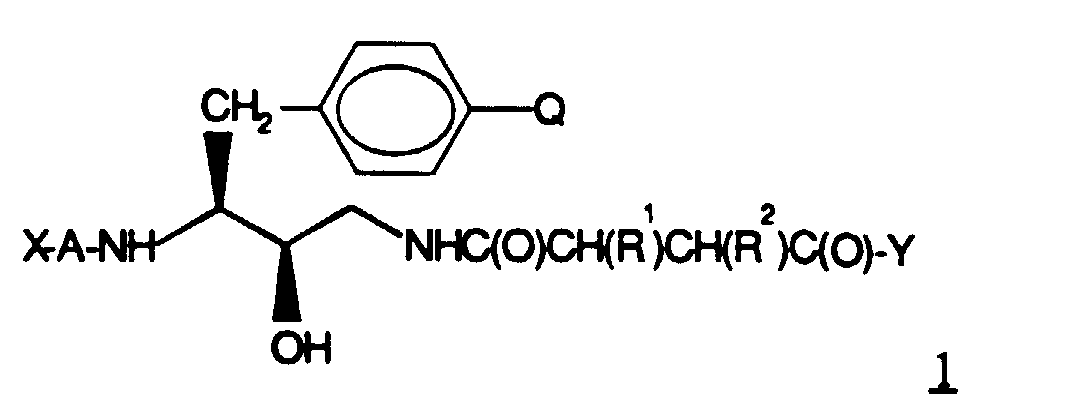
- the present application discloses succinic acid derivatives having an hydroxyethylamine TSA incorporated therein.
- the derivatives are potent inhibitors of HIV protease.
- a capacity to inhibit HIV induced cytopathogenic effects in human cells has been demonstrated for the compounds.
- Such properties together with the attributes of a relatively selective action and an apparent lack of toxicity, render the compounds useful as agents for combating HIV infections.
- a most preferred group is represented by formula 1 wherein X is tert-butoxycarbonyl, benzyloxycarbonyl, (2-phenylethoxy)carbonyl, acetyl, benzoyl, (2,4-dichlorophenyl)carbonyl, (2,3,6-trichlorophenyl)carbonyl, (2-methylphenyl)carbonyl, (2,5-dimethylphenyl)carbonyl, (2,6-dimethylphenyl)carbonyl, (3-amino-2-methylphenyl) carbonyl, phenoxymethylcarbonyl, 2-quinolylcarbonyl, 3-quinolylcarbonyl, 4-quinolylcarbonyl, 6-quinolylcarbonyl, 8-quinolylcarbonyl, 4-methoxy-2-quinolylcarbonyl, 1-isoquinolylcarbonyl, 3-isoquinolylcarbonyl, 2-quinoxalinylcarbonyl, 1-methyl-2-indolylcarbonyl, 2,3
- Another most preferred group of compounds is represented by formula 1 wherein X is (2-methylphenoxy)acetyl, (2,4-dimethylphenoxy)acetyl, (2,6-dimethylphenoxy)acetyl or (2,4,6-trimethylphenoxy)acetyl, A is absent, R 1 is 1,1-dimethylethyl, R 2 is hydrogen, Q is hydrogen or hydroxy, and Y is as defined in the last instance; and the asymmetric carbon atom bearing R 1 has the ( R ) configuration.
- a more specific group of preferred compounds are represented by formula 1 wherein X is benzyloxycarbonyl, 2-quinolylcarbonyl or 2-quinoxalinylcarbonyl, A is Val, Tbg, Asn or Thr, R 1 is 1,1-dimethylethyl, R 2 is hydrogen, Q is hydrogen or hydroxy, Y is 1-ethylpropylamino or (2,6-dimethylphenyl)amino, and the asymmetric carbon atom bearing R 1 has the (R) configuration.
- the asymmetric carbon atom bearing R 5 has the (S) configuration.
- compositions for treating HIV infections in a human comprising a compound of formula 1, or a therapeutically acceptable acid addition salt thereof, and a pharmaceutically acceptable carrier.
- the scope of the invention includes as well a method for treating HIV infections in a human comprising administering thereto an effective amount of the compound of formula 1, or a therapeutically acceptable acid addition salt thereof.
- Also included within the scope is a method for protecting human cells against HIV pathogenesis comprising treating said cells with an anti-HIV effective amount of a compound of formula 1, or a therapeutically acceptable acid addition salt thereof.
- residue with reference to an amino acid means a radical derived from the corresponding ⁇ -amino acid by eliminating the hydroxyl of the carboxy group and one hydrogen of the ⁇ -amino group.
- lower alkyl as used herein, either alone or in combination with a radical, means straight chain alkyl radicals containing one to six carbon atoms and branched chain alkyl radicals containing three to six carbon atoms and includes methyl, ethyl, propyl, butyl, hexyl, 1-methylethyl, 1-methylpropyl, 2-methylpropyl, 1-ethylpropyl and 1,1-dimethyl-ethyl (also known as tert-butyl).
- lower cycloalkyl as used herein, either alone or in combination with a radical, means saturated cyclic hydrocarbon radical containing from three to six carbon atoms and includes cyclopropyl, cyclobutyl, cyclopentyl and cyclohexyl.
- lower alkoxy as used herein means straight chain alkoxy radical containing one to six carbon atoms and branched chain alkoxy radicals containing three to four carbon atoms and includes methoxy, ethoxy, propoxy, hexoxy, 1-methylethoxy, butoxy and 1,1-dimethylethoxy.
- the latter radical is known commonly as tert-butyloxy.
- (1-8C)alkoxy means alkoxy radicals containing one to eight carbon atoms and includes, for example, methoxy, propoxy, isopropoxy, 1-ethylpropoxy and 1-propylbutoxy.
- amino as used herein means an amino radical of formula -NH 2 .
- lower alkylamino as used herein means alkylamino radicals containing one to six carbon atoms and includes methylamino, ethylamino, propylamino, 1-methylethylamino and 2-methylbutylamino.
- (1-8C)alkylamino as used herein means alkylamino radicals containing one to eight carbon atoms and includes, for example, methylamino, propylamino, 1-ethylpropylamino and 1-propylbutylamino.
- halo as used herein means a halo radical selected from bromo, chloro, fluoro or iodo.
- 1,2-cyclohexandiyl means a divalent cyclohexane radical derived by the removal of two hydrogen atoms, each from adjoining carbon atoms, of the radical. In the present instance, the two carbon atoms are those bearing R 1 and R 2 .
- Het as used herein means a monovalent radical derived by removal of a hydrogen atom from a five- or six-membered monocyclic, or a nine- or ten-membered bicyclic, saturated or unsaturated heterocycle containing from one to two heteroatoms selected from nitrogen, oxygen and sulfur.
- the heterocycle may bear one or two substituents; for example, lower alkyl, lower alkoxy, halo, amino or lower alkylamino.
- heterocycles and optionally substituted heterocycles include pyrrolidine, tetrahydrofuran, thiazolidine, pyrrole, 1 H -imidazole, 1-methyl-1 H -imidazole, pyrazole, furan, thiophene, oxazole, isoxazole, thiazole, 2-methylthiazole, 2-aminothiazole, 2-(methylamino)thiazole, piperidine, 1,4-dioxane, 4-morpholine, pyridine, pyrimidine, 2,4-dimethylpyrimidine, indole, 1-methylindole, 2,3-dihydroindole, quinoline, 4-methoxyquinoline, isoquinoline, quinoxaline and 1,2,3,4-tetrahydroisoquinoline.
- pharmaceutically acceptable carrier means a non-toxic, generally inert vehicle for the active ingredient, which does not adversely affect the ingredient.
- an effective amount means a predetermined amount of the compound of this invention sufficient to be effective against HIV in vivo.
- the compounds of formula 1 are composed of four or five structural units or fragments.
- the two terminal units are an acyl residue (the N-terminus) and either an alkylamino, alkoxy or arylamino residue (the C-terminus).
- the central units are an amino acid or derived amino acid residue which may be present or absent (see radical A of formula 1), and two non-peptidic fragments (i.e. a 1,3( S )-diamino-4-phenyl-2( R )-butanol residue and a succinyl residue).
- the fragments are linked together by amide bonds, or by an ester linkage in the instance wherein the C-terminus is an alkoxy residue.
- This feature in effect allows the compound to be prepared conveniently by methods commonly used in peptide synthesis involving the stepwise coupling of appropriate fragments. Such methods are described in general text books; for example, “Annual Reports In Organic Synthesis - 1990", K. Turnbull et al., Eds., Academic Press, Inc., San Diego, CA, USA, 1990 (and the preceding annual reports), “Vogel's Textbook Of Practical Organic Chemistry", B.S. Furniss et al., Eds, Longman Group Limited, Essex, UK, 1986, and "The Peptides: Analysis, Synthesis, Biology", E. Grass et al., Eds, Academic Press, New York, NY, USA, 1979-1987, Volumes 1 to 9.
- the compound of formula 1 can be prepared by a process comprising the sequential stepwise coupling of the appropriate fragments, namely the amino acid or derived amino acid residue which may be present or absent, and the non-peptidic fragments of the compound (including the N-terminal acyl and C-terminal amino or oxy residues), which if required are suitably protected to eliminate competitive reactive sites, and eliminating any protective groups, if present, at the completion of the stepwise coupling to obtain the compound of formula 1.
- a common feature of the aforementioned process is the protection of the reactive side chain groups of the various amino acid residues or derived amino acid residues (or, if required, non-peptidic fragments) with suitable protective groups which will prevent a chemical reaction from occurring at that site until the protective group is ultimately removed. Also common is the protection of an ⁇ -amino group of a fragment by an ⁇ -amino protective group while the free carboxy group of that fragment is coupled with a free ⁇ -amino group of a second fragment; the ⁇ -amino protective group being one which can be selectively removed to allow a subsequent coupling step to take place at that ⁇ -amino group.
- coupling agents to promote the dehydrative coupling of a free carboxyl of one reactant with a free amino group of the other reactant is well known; for example, see "The Peptides: Analysis, Synthesis, Biology", Volumes 1 to 8, noted hereinbefore.
- suitable coupling agents are 1,1'-carbonyldiimidazole or N,N'-dicyclohexylcarbodiimide.
- Other examples are 1-hydroxybenzotriazole in the presence of N,N'-dicyclohexylcarbodiimide or N-ethyl-N'- [(3-dimethylamino)propyl]carbodiimide.
- a very practical and useful coupling agent is the commercially available (benzotriazol-1-yloxy)tris-(dimethylamino)-phosphonium hexafluorophosphate, either by itself or in the presence of 1-hydroxybenzotriazole.
- Still another very practical and useful coupling agent is the commercially available 2-(1H-benzotriazol-1-yl)-N,N, N', N'-tetramethyluronium tetrafluoroborate.
- the coupling reaction is conducted in an inert solvent, e.g. methylene dichloride, acetonitrile or dimethylformamide.
- an excess of an organic amine e.g. diisopropylethylamine or N-methylmorpholine, is added to maintain the reaction mixture at a pH of about eight.
- the reaction temperature usually ranges from -20° to about 30°C and reaction time from two to 18 hours.
- the requisite starting material of formula 2 is prepared by lithium aluminum hydride reduction of 3( S )-(dibenzylamino)-2( R )-hydroxy-4-phenylbutanenitrile; the latter compound has been described previously by M.T. Reetz et al., Tetrahedron Lett., 29 , 3295 (1988).
- the starting materials of formula 3 can be prepared by known methods from known starting materials. For example, the reaction of an appropriately substituted succinic anhydride (corresponding to the succinyl portion of compound 3) with the appropriate amine or alcohol (corresponding to the Y portion of compound 3) at low temperature (-40 to 20 °C) in pyridine solution readily affords the desired succinamoyl derivative or succinic acid monoester of formula 3.
- Methods for preparing chirally pure substituted succinic anhydrides have been described by T. Polonaki, J. Chem. Soc. Perkin Trans. I, 629 (1988). For still other methods for preparing succinic anhydrides, see Comprehensive Organic Chemistry, D. Barton and W. D.
- acyl portion i.e. the X radical of formula 1
- appropriate requisite acid starting materials including those incorporating Het, are well known or can be prepared by known methods; for example, see Comprehensive Organic Chemistry, ibid, Vol. 2, pp. 593-622.
- the compound of formula 1 of this invention can be obtained in the form of a therapeutically acceptable acid addition salt.
- a therapeutically acceptable acid addition salt examples include those with organic acids, e.g. acetic, lactic, succinic, benzoic, salicylic, methanesulfonic or p-toluenesulfonic acid, as well as polymeric acids such as tannic acid or carboxymethyl cellulose, and also salts with inorganic acids such as hydrohalic acids, e.g. hydrochloric acid, or sulfuric acid, or phosphoric acid.
- a particular acid addition salt is converted into another acid addition salt, such as a non-toxic, pharmaceutically acceptable salt, by treatment with the appropriate ion exchange resin in the manner described by R.A. Boissonnas et al., Helv. Chim. Acta, 43 , 1849 (1960).
- the therapeutically acceptable salts of the peptides of formula 1 are biologically fully equivalent to the peptides themselves and are included within the scope of this invention.
- HIV protease inhibiting properties and the cell protective effect against HIV pathogenesis of the compounds of formula 1, or a therapeutically acceptable salt thereof, can be demonstrated by biochemical, microbiological and biological procedures.
- a particular useful procedure for demonstrating the HIV protease inhibiting properties of the compounds of formula 1 or their therapeutically acceptable salts is the "Recombinant HIV Protease HPLC Assay".
- the procedure is based on the capacity of the test compound to inhibit enzymatic cleavage by HIV protease of a decapeptide (the substrate) having an amino acid sequence which includes a known HIV protease cleavage site of a HIV polyprotein; see H.G. Krausslich et al., Proc. Natl. Acad. Sci. USA, 86 , 807 (1989). Details of this assay together with the results obtained for exemplified compounds of formula 1 are described in the examples hereinafter.
- the capacity of the compounds of formula 1 or their therapeutically acceptable salts to protect cells against HIV infection can be demonstrated by microbiological procedures for evaluating the inhibitory effect of a test compound on the cytopathogenicity of HIV in human T4 cell lines. Typical of such procedures are those described by S. Harada and N. Yamamoto, Jpn. J. Cancer Res. (Gann), 76 , 432 (1985), and S. Harada et al., Science, 229 , 563 (1985). An assay based on the latter procedures is described in the examples hereinafter.
- the peptide can be administered orally, topically or parenterally, in a vehicle comprising one or more pharmaceutically acceptable carriers, the proportion of which is determined by the solubility and chemical nature of the compound, the chosen route of administration and standard biological practice.
- a vehicle comprising one or more pharmaceutically acceptable carriers, the proportion of which is determined by the solubility and chemical nature of the compound, the chosen route of administration and standard biological practice.
- the compound or a therapeutically acceptable salt thereof can be formulated in unit dosage forms such as capsules or tablets each containing a predetermined amount of the active ingredient, ranging from about 5 to 150 mg, in a pharmaceutically acceptable carrier.
- the compound can be formulated in a pharmaceutically acceptable vehicle containing 0.01 to 2 percent, preferably 0.05 to 1 percent, of the active agent.
- Such formulations can be in the form of a cream, lotion, sublingual tablet, or preferably a transdermal patch or buccal patch.
- the compound of formula 1 is administered by either intravenous, subcutaneous or intramuscular injection, in compositions with pharmaceutically acceptable vehicles or carriers.
- a sterile aqueous vehicle which may also contain other solutes such as buffers or preservatives as well as sufficient quantities of pharmaceutically acceptable salts or of glucose to make the solution isotonic.
- Suitable vehicles or carriers for the above noted formulations can be found in standard pharmaceutical texts, e.g in "Remington's Pharmaceutical Sciences", 18th ed., Mack Publishing Company, Easton, Penn., 1990.
- the dosage of the compound will vary with the form of administration and the particular active agent chosen. Furthermore, it will vary with the particular host under treatment. Generally, treatment is initiated with small dosages substantially less than the optimum dose of the peptide. Thereafter, the dosage is increased by small increments until the optimum effect under the circumstances is reached. In general, the compound is most desirably administered at a concentration level that will generally afford antivirally effective results without causing any harmful or deleterious side effects.
- the compound or a therapeutically acceptable salt is administered in the range of 0.5 to 15 mg per kilogram of body weight per day, with a preferred range of 0.5 to 5 mg per kilogram.
- the compound of formula 1 is administered at a dosage of 1 ⁇ g to 100 ⁇ g per kilogram of body weight per day, although the aforementioned variations will occur.
- formulations disclosed hereinabove are effective and relatively safe medications for treating HIV infections, the possible concurrent administration of these formulations with other antiviral medications or agents to obtain beneficial results is not excluded.
- antiviral medications or agents include soluble CD4, zidovudine, didanosine, nevirapine, sequinavir, 2',3'-dideoxycytidine, trisodium phosphonoformate, ribavarin, acyclovir or antiviral interferons (e.g. ⁇ -interferon or interleukin-2).
- the (2,6-dimethylphenoxy)acetic acid used in this example, was prepared as follows: 2,6-Dimethylphenol (500 g, 4.09 mol) , ethyl bromoacetate (480 mL, 4.30 mol)and anhydrous K 2 CO 3 (690 g, 5.0 mol) were suspended in acetone (2 L) and the mixture was stirred for 56 h at room temperature, and then heated at reflux for 24 h. 1N NaOH (1 L) was added and the heating was continued for another 4 h. Thereafter, solid NaOH (150 g, 3.75 mol) was added and the heating was continued for an additional 48 h. After cooling to room temperature, the acetone was removed under reduced pressure.
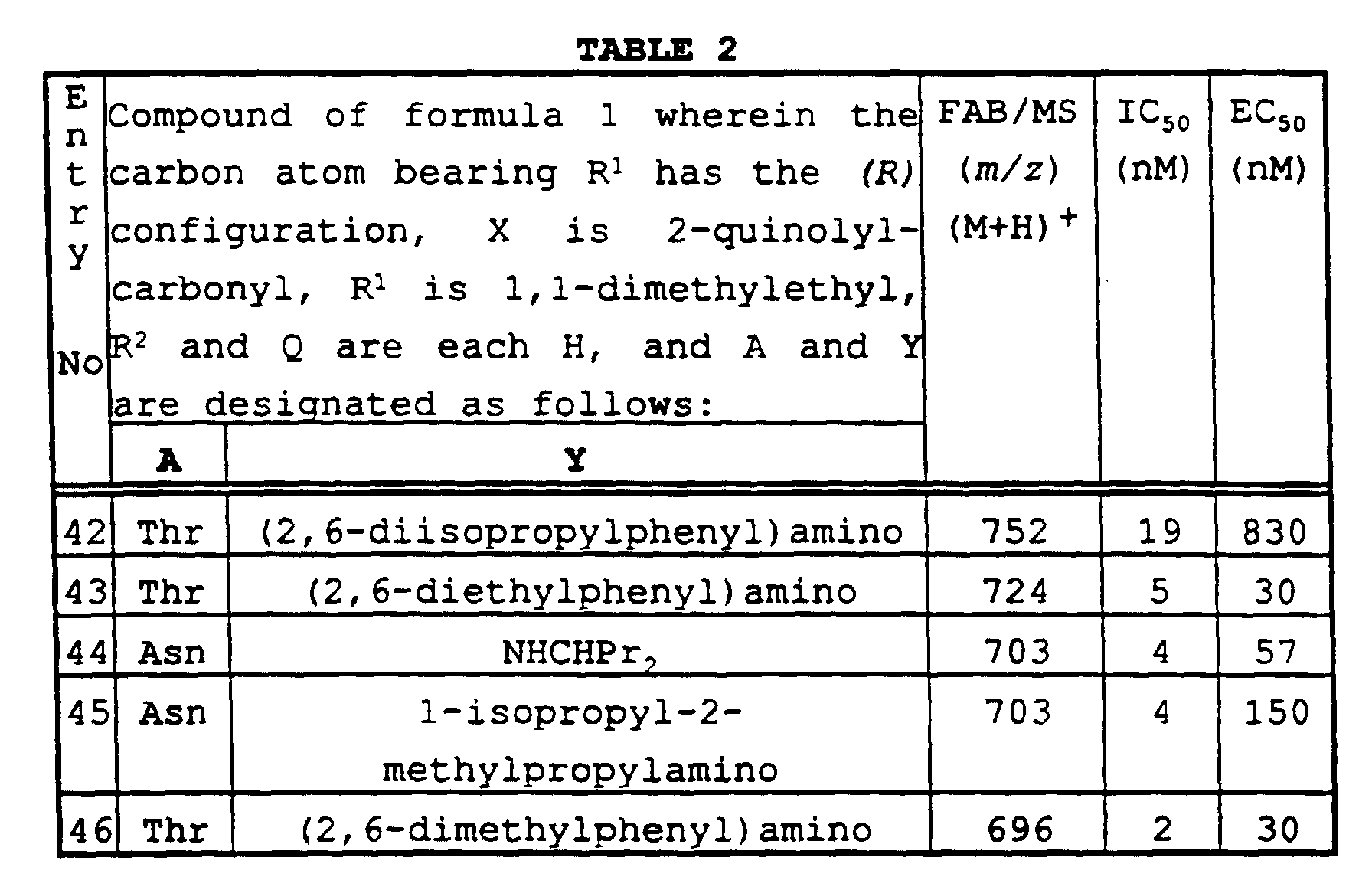
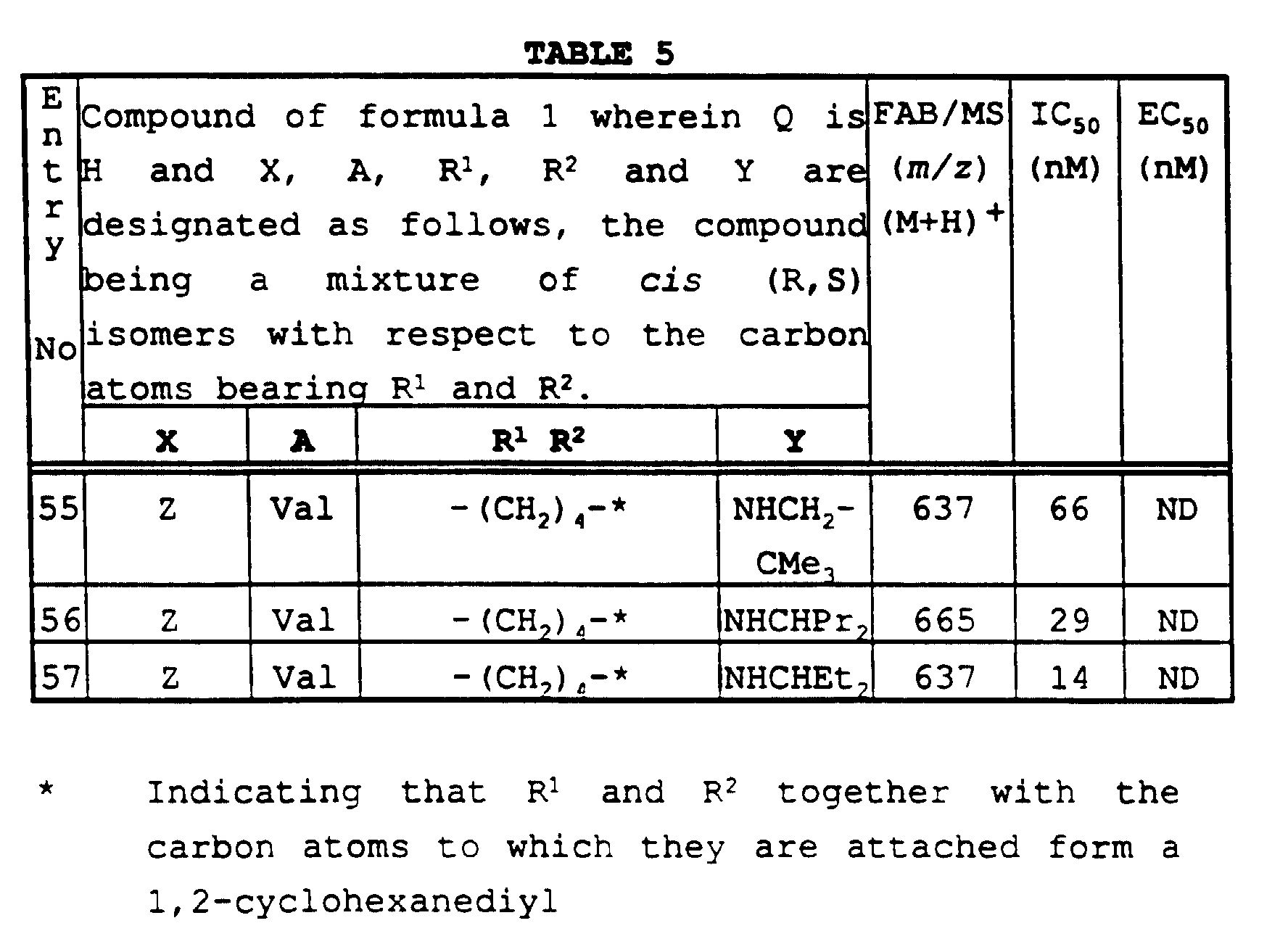
- Tables 1 to 8 list the results obtained for exemplified compounds of formula 1 when tested in the recombinant HIV protease HPLC assay described by P.C. Anderson, S. Rakhit and C. Yoakim in the European patent application 443 560, published August 28, 1991.
- the results from this assay are reported as IC 50 's and represent the concentration of the test compound which causes a 50% inhibition of HIV protease.
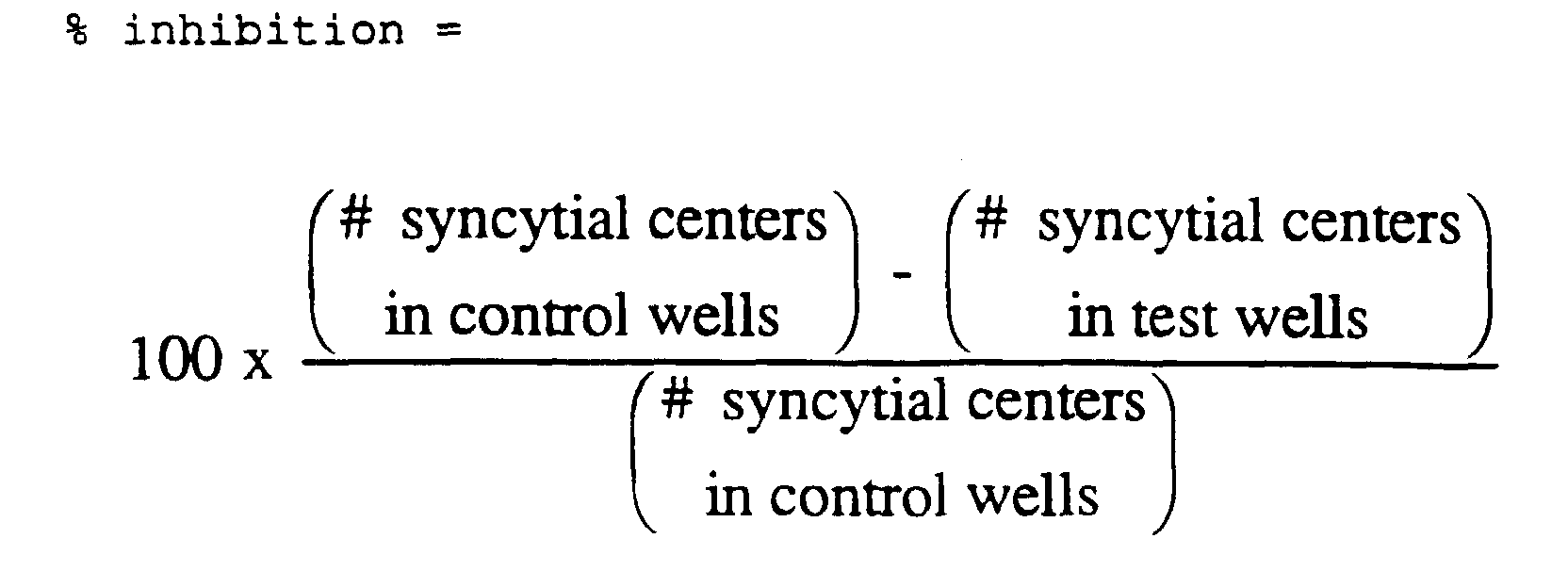
- Tables 1 to 8 list the results for exemplified compounds of formula 1 when assayed for antiviral (anti-HIV) effects according to the following protocol which is based on a cell culture assay previously described by Harada et al., supra. Transformed cells are used because of the rapidity with which HIV will replicate in the cells.
- the concentration of the test compound which causes a 50% inhibition of syncytia formation i.e. the EC 50 , is determined by using the technique of serial dilution of the working solution at step 3 and graphically plotting the observed percent inhibition of syncytia formation against the various concentrations of the test compound.
- Still other compounds are:
Landscapes
- Chemical & Material Sciences (AREA)
- Organic Chemistry (AREA)
- Health & Medical Sciences (AREA)
- Life Sciences & Earth Sciences (AREA)
- Medicinal Chemistry (AREA)
- General Health & Medical Sciences (AREA)
- Immunology (AREA)
- Biochemistry (AREA)
- Proteomics, Peptides & Aminoacids (AREA)
- Nuclear Medicine, Radiotherapy & Molecular Imaging (AREA)
- Chemical Kinetics & Catalysis (AREA)
- Pharmacology & Pharmacy (AREA)
- Animal Behavior & Ethology (AREA)
- General Chemical & Material Sciences (AREA)
- Public Health (AREA)
- Veterinary Medicine (AREA)
- Molecular Biology (AREA)
- Biophysics (AREA)
- Genetics & Genomics (AREA)
- Communicable Diseases (AREA)
- Oncology (AREA)
- Virology (AREA)
- Engineering & Computer Science (AREA)
- Bioinformatics & Cheminformatics (AREA)
- Acyclic And Carbocyclic Compounds In Medicinal Compositions (AREA)
- Pharmaceuticals Containing Other Organic And Inorganic Compounds (AREA)
- Organic Low-Molecular-Weight Compounds And Preparation Thereof (AREA)
- Enzymes And Modification Thereof (AREA)
- Preparation Of Compounds By Using Micro-Organisms (AREA)
- Peptides Or Proteins (AREA)
- Quinoline Compounds (AREA)
- Other In-Based Heterocyclic Compounds (AREA)
- Indole Compounds (AREA)
Abstract
Description
| Boc | 1,1-dimethylethoxycarbonyl or tert-butoxycarbonyl |
| Z | benzyloxycarbonyl |
| Ph | phenyl |
| N-Me-Val | N-methylvalyl residue |
| Tbg | 2 (S)-amino-3, 3-dimethyl-butanoic acid residue |
| Asp (cyPn) | (S)-α-amino-1-carboxycyclopentaneacetic acid residue |
| βMeAsp | 2 (S)-amino-3(R)methylbutanedioic acid residue (i.e. the residue of 3(R)-methyl-L-aspartic acid) |
| βMeAsp(OBzl) | O4-benzyl derivative (ester) of βMeAsp |
| βCN-Ala | 2-(S)-amino-3-cyanopropanoic acid residue |





| Entry No | Compound of formula 1 | FAB/MS (m/z) (M+H)+ | IC50 (nM) | EC50 (nM) |
| 58 | 3(R)-tert-butyl-4-{2(R)-hydroxy-4-phenyl-3(S)-{[N-(2-quinolylcarbonyl) threonyl]amino}butylamino}-4-oxobutyric acid isopropyl ester | 635 | 46 | ND |
| 59 | 3(R)-tert-butyl-4-{2(R)-hydroxy-4-phenyl-3 (S)-{[N-(2-quinolylcarbonyl)asparaginyl]amino}butylamino}-4-oxobutyric acid 1-ethylpropyl ester | 676 | 7 | 570 |
| 60 | N4-{3(S)-{[N-benzyloxycarbonyl)-tert-butylglycyl]amino}-2 (R)-hydroxy-4-phenylbutyl}-N1-(1-ethylpropyl)-3(S)-tert-butylbutanediamide | 653 | 29 | ND |
| 61 | N4-{3(S)-{[N-benzyloxycarbonyl)valyl]amino}-2 (R)-hydroxy-4-phenylbutyl}-N1-(1-ethylpropyl)-2(R)-tert-butylbutanediamide | 639 | 13 | ND |
| 62 | N1-(1-ethylpropyl)-N4-{3(S)-{[N-(2-quinolylcarbonyl)threonyl]amino}-2(R)-hydroxy-4-(4-hydroxyphenyl)butyl}-3(R)-tert-butylbutanediamide | 678 | 61 | ND |
| 63 | N1-(1-ethylpropyl)-N4-{3(S)-{{(2,6-dimethylphenoxy)acetyl}amino}-2(R)-hydroxy-4-(4-hydroxyphenyl)butyl}-3(R)-tert-butylbutanediamide | 584 | 3.1 | 110 |


Claims (11)
- A compound of formula 1wherein
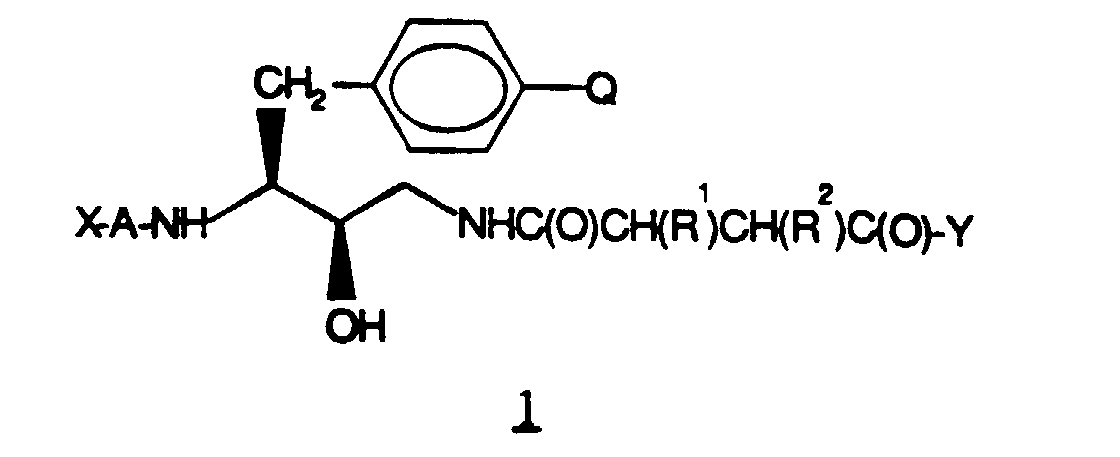 X is R3OC(O), R3C(O) or R3NHC(O) wherein R3 is(i) lower alkyl,(ii) lower cycloalkyl,(iii) phenyl; phenyl monosubstituted with halo, hydroxy, amino, lower alkyl or lower alkoxy; or phenyl disubstituted or trisubstituted with the same or different substituent selected from the group consisting of halo, amino and lower alkyl;(iv) phenyl(lower)alkyl or phenyl(lower)alkyl wherein the aromatic portion thereof is monosubstituted with halo, hydroxy, lower alkyl or lower alkoxy,(v) phenyl(lower)alkenyl,(vi) 1-naphthyl or 2-naphthyl,(vii) Het or Het-(lower alkyl) wherein Het represents a five- or six-membered monocyclic, or a nine- or ten-membered bicyclic, radical containing one or two heteroatoms selected from nitrogen, oxygen and sulfur, the heterocyclic radical being either unsubstituted or having one or two of the same or different substituents selected from the group consisting of halo, hydroxy, amino, lower alkyl or lower alkoxy; orX is R3ANHCH2C(O) wherein R3A is lower alkyl or phenyl, or X is R3BOCH2C(O) wherein R3B is phenyl, phenyl monosubstituted with halo or lower alkyl, or phenyl disubstituted or trisubstituted with the same or different substituent selected from the group of halo and lower alkyl;A is absent or A is a divalent radical NR4CHR5C(O) wherein R4 is hydrogen or lower alkyl, R5 is lower alkyl, 1-carboxycyclobut-1-yl, 1-carboxycyclopent-1-yl, or lower alkyl monosubtituted with carboxy, carbamyl, (lower alkoxy)carbonyl, benzyloxycarbonyl, hydroxy, cyano or benzyloxy, and the carbon atom bearing R5 has the (S) configuration.R1 is lower alkyl and R2 is hydrogen, or R1 is hydrogen and R2 is lower alkyl, or R1 and R2 together with the carbon atoms to which they are attached form a 1,2-cyclohexanediyl;Q is hydrogen, hydroxy, halo or lower alkoxy; andY is (1-8C)alkylamino, (1-8C)alkoxy, phenylamino or phenylamino having one or two of the same or different substituents on the phenyl portion thereof selected from the group consisting of lower alkyl, lower alkoxy, hydroxy, halo, amino or lower alkylamino; or a therapeutically acceptable acid addition salt thereof.
 - A compound as claimed in claim 1 whereinX is(i) R3OC(O) wherein R3 is lower alkyl, lower cycloalkyl, phenyl, phenyl(lower alkyl) or phenyl(lower)alkyl wherein position 4 of the phenyl portion is substituted with halo, lower alkyl or lower alkoxy;(ii) R3C(O) wherein R3 is lower alkyl; lower cycloalkyl; phenyl; phenyl monosubstituted with halo, hydroxy, lower alkyl or lower alkoxy; phenyl disubstituted or trisubstituted with the same or different substituent selected from the group consisting of chloro, fluoro, amino or methyl; phenyl (lower)alkyl; phenyl (lower)alkyl monosubstituted at position 4 of the phenyl portion with halo, hydroxy, lower alkyl or lower alkoxy; phenyl(lower)alkenyl; 1-naphthyl; 2-naphthyl; Het, Het-CH2 or Het-CH2CH2 wherein Het is as defined hereinabove; or (phenylamino)methyl; or(iii) R3NHC(O) wherein R3 is lower alkyl; lower cycloalkyl; phenyl; phenyl monosubstituted with halo, lower alkyl or lower alkoxy; benzyl or benzyl monosubstituted at position 4 of the phenyl portion with halo, lower alkyl or lower alkoxy; orX is R3ANHCH2C(O) wherein R3A is lower alkyl or phenyl, or X is R3BOCH2C(O) wherein R3B is phenyl or phenyl mono-, di- or trisubstituted with lower alkyl or halo at a position or positions selected from the group consisting of positions 2, 4 and 6;A is absent or the divalent radical NR4CHR5C(O) wherein R4 is hydrogen or methyl and R5 is as defined hereinabove;R1 is 1-methylethyl, 1,1-dimethylethyl, 1,1-dimethylpropyl, 2,2, dimethylpropyl, 3-methylbutyl, 3,3-dimethylbutyl, 4-methylpentyl, 4,4-dimethylpentyl and R2 is hydrogen, or R1 is hydrogen and R2 is 1-methylethyl, 1,1-dimethylethyl, 1,1-dimethylpropyl, 2,2-dimethylpropyl, 3-methylbutyl, 3,3-dimethylbutyl, 4-methylpentyl or 4,4-dimethylpentyl, or R1 and R2 together with the carbon atoms to which they are attached form a 1,2-cyclohexanediyl; andQ and Y are as defined in claim 1; or a therapeutically acceptable acid addition salt thereof.
- A compound as claimed in claim 2 whereinX is(i) R3OC(O) wherein R3 is isopropyl, tert-butyl, benzyl or 2-phenylethyl;(ii) R3C(O) wherein R3 is methyl, ethyl, propyl, cyclopropyl, cyclohexyl, phenyl, 4-chlorophenyl, 2-fluorophenyl, 2,4-dichlorophenyl, 2, 6-dichlorophenyl, 2,3,6-trichlorophenyl, 2-methylphenyl, 4-methylphenyl, 2,4-dimethylphenyl, 2,5-dimethylphenyl, 2,6-dimethylphenyl, 3-amino-2-methylphenyl, benzyl, (4-fluorophenyl)methyl, (4-methoxyphenyl)methyl, 2-phenylethyl, 3-phenylpropyl, 4-phenylbutyl, 5-phenylpentyl, 2-(4-fluorophenyl)ethyl, 2-(4-hydroxyphenyl)butyl, (4-methylphenyl)butyl, 3-(4-methoxyphenyl)propyl, 1-oxo-3-phenyl-2-propenyl, 1-naphthyl, 2-naphthyl, 2-furyl, 2-thienyl, 2-pyridinyl, 4-pyridinyl, 4-thiazolyl, 4-isoxazolyl, 2-quinolyl, 3-quinolyl, 4-quinolyl, 6-quinolyl, 8-quinolyl, 4-methoxy-2-quinolyl, 1-isoquinolyl, 3-isoquinolyl, 2-quinoxalinyl, 1-methyl-2-indolyl, 2,3-dihydroindol-2(R or S)-yl, 1,2,3,4-tetrahydroisoquinol-3(R or S)-yl, 2-pyridinylmethyl, 2-morpholinoethyl, 2-piperidinoethyl, 3-(4-thiazolyl)propyl, or (phenylamino)methyl;(iii) R3NHC(O) wherein R3 is lower alkyl, benzyl or benzyl monosubstituted on the aromatic portion thereof with fluoro, methyl or methoxy;X is R3ANHCH2C(O) wherein R3A is methyl or phenyl, or X is R3BOCH2C(O) wherein R3B is phenyl, 2-methylphenyl, 2, 4-dimethylphenyl, 2, 6-dimethylphenyl, 2,4,6-trimethylphenyl, 4-chlorophenyl or 4-fluorophenyl;A is absent or NR4CHR5C(O) wherein R4 is hydrogen or methyl and R5 is 1-methylethyl, 1,1-dimethylethyl, 1-methylpropyl, 2-methylpropyl, 1-carboxycyclopent-1-yl, CH2C(O)OH, (R)-CH(CH3)C(O)OH, CH2CH2C(O)OH, CH2C(O)NH2, CH2CH2C(O)NH2, CH2C(O)OMe, (R)-CH(CH3)C(O)OBzl, CH2OH, CH(OH)CH3 or CH2CN;R1 is 1,1-dimethylethyl, 2,2-dimethylpropyl, 1-methylbutyl, 3,3-dimethylbutyl or 4,4-dimethylpentyl and R2 is hydrogen, or R1 is hydrogen and R2 is tert-butyl, 2,2-dimethylpropyl, 1-methylbutyl, 3,3-dimethylbutyl or 4,4-dimethylpentyl; Q is hydrogen, hydroxy or methoxy; and Y is isopropylamino, tert-butylamino, 1-methylpropylamino, 2-methylpropylamino, 1-ethylpropylamino, 1-isopropyl-2-methylpropylamino, 1-ethylbutylamino, 1-propylbutylamino, isopropoxy, 1-ethylpropoxy, phenylamino or phenylamino having one or two of the same or different substituents selected from the group consisting of methyl, ethyl, propyl, isopropyl, hydroxy, fluoro or chloro; or a therapeutically acceptable acid addition salt thereof.
- A compound as claimed in claim 3 wherein X is tert-butoxycarbonyl, benzyloxycarbonyl, (2-phenylethoxy) carbonyl, acetyl, benzoyl, (2,4-dichlorophenyl)carbonyl, (2,3,6-trichlorophenyl) carbonyl, (2-methylphenyl)carbonyl, (2,5-dimethylphenyl)carbonyl, (2,6-dimethylphenyl)carbonyl, (3-amino-2-methylphenyl)carbonyl, phenoxymethylcarbonyl, 2-quinolylcarbonyl, 3-quinolylcarbonyl, 4-quinolylcarbonyl, 6-quinolylcarbonyl, 8-quinolylcarbonyl, 4-methoxy-2-quinolylcarbonyl, 1-isoquinolylcarbonyl, 3-isoquinolylcarbonyl, 2-quinoxalinylcarbonyl, 1-methyl-2-indolylcarbonyl, 2, 3-dihydroindol-2 (R or S)-ylcarbonyl, 1,2,3,4-tetrahydroisoquinol-3 (R or S)-ylcarbonyl, 1-oxo-3-piperidinopropyl, (phenylamino)methylcarbonyl or (benzylamino)carbonyl; A is Val, N-MeVal, Tbg, Ile, Leu, Asp(cyPn), Asp, βMeAsp, Glu, Asn, Gln, βMeAsp(OBzl), Ser, Thr or βCN-Ala; R1 is 1,1-dimethylethyl; R2 is hydrogen; Q is hydrogen or hydroxy; Y is 1-ethylpropylamino, 1-isopropyl-2-methylpropylamino, 1-propylbutylamino, isopropoxy, 1-ethylpropoxy, phenylamino, (2,6-dimethylphenyl)amino, (2,6-diethylphenyl)amino or (2,6-diisopropylphenyl)amino; and the asymmetric carbon atom bearing R1 has the (R) configuration.
- A compound as claimed in claim 3 wherein X is (2-methylphenoxy)acetyl, (2,4-dimethylphenoxy)acetyl, (2,6-dimethylphenoxy)acetyl or (2,4,6-trimethylphenoxy)acetyl, A is absent, R1 is 1,1-dimethylethyl, R2 is hydrogen, Q is hydrogen or hydroxy, and Y is as defined in the last instance; and the asymmetric carbon atom bearing R1 has the (R) configuration.
- A compound as claimed in claim 1 wherein X is benzyloxycarbonyl, 2-quinolylcarbonyl or 2-quinoxyalinylcarbonyl, A is Val, Tbg, Asn or Thr, R1 is 1,1-dimethylethyl, R2 is hydrogen, Q is hydrogen or hydroxy, Y is 1-ethylpropylamine or (2,6-dimethylphenyl)amino, and the asymmetric carbon atom bearing R1 has the (R) configuration.
- A compound of claim 1 selected from the group consisting of:(i) a compound of formula 1 wherein the carbon atom bearing R1 has the (R) configuration, R1 is 1,1-dimethylethyl, R2 and Q are each H, Y is NHCHEt2 and X and A are defined by one of the following combinations thereof:
COMBINATION (X and A) X A Boc Tbg Boc Asp 1-oxo-3-piperidinopropyl Asn Boc βMeAsp(Bzl) 1,2,3,4-tetrahydroisoquinol-3 (R or S)-ylcarbonyl Asn 2-quinolylcarbonyl Ser 1-isoquinolylcarbonyl Asn Z Gln PhCH2CH2C(O) Asn 8-quinolylcarbonyl Asn (1-methyl-2-indolyl)carbonyl Asn PhCH2CH2CH2CH2C(O) Asn Z N-MeVal PhCH2NHC(O) Asn 4-quinolylcarbonyl Asn Boc βMeAsp PhCH=CHC(O) Asn 3-isoquinolylcarbonyl Asn PhNHCH2C(O) Asn Z Asn PhCH2CH2CH2C(O) Asn 2-quinolylcarbonyl βMeAsp 2-quinolylcarbonyl Thr 1,2,3,4-tetrahydroisoquinol-3 (R or S)-ylcarbonyl Asn (4-methoxy-2-quinolyl)carbonyl Asn 2-quinoxalinylcarbonyl Thr 2-quinolylcarbonyl Tbg CH3C(O) Val 2-quinolylcarbonyl Val 2,3-dihydroindol-2(R or S)-ylcarbonyl Asn 2-quinoxalinylcarbonyl Val Z Val 2-quinolylcarbonyl Asp(cyPn) Z Tbg 2-quinolylcarbonyl Asn 2-quinoxalinylcarbonyl Asn 2-quinolylcarbonyl βCN-Ala 6-quinolylcarbonyl Asn 3-quinolylcarbonyl Asn PhCH2CH2OC(O) Asn PhOCH2C(O) Thr (ii) a compound of formula 1 wherein the carbon atom bearing R1 has the (R) configuration, X is 2-quinolylcarbonyl, R1 is 1,1-dimethylethyl, R2 and Q are each H, and A and Y are defined by one of the following combinations thereof:COMBINATION (A and Y) A Y Thr (2,6-diisopropylphenyl)amino Thr (2,6-diethylphenyl)amino Asn NHCHPr2 Asn 1-isopropyl-2-methylpropylamino Thr (2,6-dimethylphenyl)amino (iii) a compound of formula 1 wherein R2 and Q are each hydrogen and X, A, R1 and Y are defined by one of the following combinations thereof, the compound being either a (R) or (S) diastereoisomer with respect to the asymmetric carbon atom bearing R1:COMBINATION (X, A, R1 and Y) X A R1 Y Z Asn (CH3)3C OCHEt2 Z Asn (CH3)2CH NHCHEt2 Z Asn (CH3)3C NHCHEt2 2-quinolylcarbonyl Asn (CH3)2CH NHCHEt2 Z Val (CH3)3C NHCMe3 2-quinolylcarbonyl Asn (CH3)3C NHCHEt2 Z Tbg (CH3)3C NHCHEt2 (iv) a compound of formula 1 wherein X is Z, A is Val, R1 is H, R2 is (CH3)3CCH2, Q is H and Y is NHCHEt2, the compound being either a (R) or (S) diastereoisomer with respect to the asymmetric carbon atom bearing R2;(v) a compound of formula 1 wherein X is Z, A is Val, R1 and R2 together with the carbon atoms to which they are attached form a 1,2-cyclohexanediyl, Q is H and Y is NHCH2CMe3, NHCHPr2 or NHCHEt2 the compound being a cis isomer with respect to the carbon atoms bearing R1 and R2;(vi) 3 (R)-tert-butyl-4-{2(R)-hydroxy-4-phenyl-3(S)-{[N-(2-quinolylcarbonyl)threonyl]-amino}butylamino)-4-oxobutyric acid isopropyl ester;(vii) 3 (R)-tert-butyl-4-{2(R)-hydroxy-4-phenyl-3(S)-{[N-2-quinolylcarbonyl)asparaginyl]amino}butylamino}-4-oxobutyric acid 1-ethylpropyl ester;(viii) N4-{3(S)-{[N(benzyloxycarbonyl)-tert-butylglycyl]amino}-2(R)-hydroxy-4-phenylbutyl}-N1-(1-ethylpropyl)-3(S)-tert-butylbutanediamide;(ix) N4-{3(S)-{[N(benzyloxycarbonyl)valyl]amino)-2(R)-hydroxy-4-phenylbutyl}-N1-(1-ethylpropyl)-2(R)-tert-butylbutanediamide;(x) N1-(1-ethylpropyl)-N4-{3(S)-{[N-(2-quinolylcarbonyl) threonyl] amino}-2 (R)-hydroxy-4-(4-hydroxyphenyl)butyl}-3(R)-tert-butylbutanediamide;(xi) N1-(1-ethylpropyl)-N4-{3(S)-{{(2,6-dimethylphenoxy) acetyl}-amino}-2(R)-hydroxy-4-(4-hydroxyphenyl)butyl}-3(R)-tert-butylbutanediamide;(xii) a compound of formula 1 wherein the carbon atom bearing R1 has the (R) configuration, A is absent, R1 is tert-Bu, R2 and Q each are hydrogen, Y is NHCHEt2 and X is (1-methyl-2-indolyl)carbonyl, (4-chlorophenyl)carbonyl, (2,4-dichlorophenyl)carbonyl), (2,3,6-trichlorophenyl) carbonyl, (2-methylphenyl)carbonyl, (3-amino-2-methylphenyl)carbonyl, (2,4,6-trimethylphenoxy)acetyl or (2,6-dimethylphenoxy)acetyl; and(xiii) a compound of formula 1 wherein the carbon atom bearing R1 has the (R) configuration, A is absent, R1 is tert-Bu, R2 and Q each are hydrogen, Y is (2,6-dimethylphenyl)amino and X is benzyloxycarbonyl, (2,6-dimethylphenoxy)acetyl or (2,5-dimethylphenyl)carbonyl. - A pharmaceutical composition comprising a compound as recited in claim 1, or a therapeutically acceptable acid addition salt thereof, and a pharmaceutically acceptable carrier.
- The use of a compound as defined in anyone of claim 1 to 7, or a therapeutically acceptable acid addition salt thereof for the preparation of a composition for treating HIV infections in a human.
- The use of a compound as defined in anyone of claim 1 to 7, or a therapeutically acceptable acid addition salt thereof for the preparation of a composition for protecting human cells against HIV pathogenesis.
- A process for preparing a compound of formula 1 as defined in claim 1, or a therapeutically acceptable acid addition salt thereof, the compound having four or five structural fragments (namely an N-terminal acyl residue; an amino acid or derived amino acid residue which may be present or absent; a 1,3(S)-diamino-4-phenyl-2 (R)-butanol residue; a succinyl residue and either a C-terminal alkylamino, arylamino, alkoxy or aryloxy residue) linked by amide bonds, or by an ester bond in the instance of the C-termini alkoxy or aryloxy residues, the process comprising:to obtain the compound of claim 1;a) sequential stepwise coupling the fragments in which(i) reactive side chain groups of the fragments, if present, are protected with suitable protective groups which will prevent a chemical reaction from occurring at that site until the protective group is ultimately removed; and(ii) an α-amino group of a fragment is protected by an α-amino protective group while the free carboxy group of that fragment is coupled with a free α-amino group of a second fragment; the α-amino protecting group being one which can be selectively removed to allow a subsequent coupling step to take place at that α-amino group; and, if required,b) eliminating any protective groups at the completion of the coupling;
and, if desired, converting the compound into a therapeutically acceptable acid addition salt.
Applications Claiming Priority (3)
| Application Number | Priority Date | Filing Date | Title |
|---|---|---|---|
| US416239 | 1995-04-04 | ||
| US08/416,239 US5545640A (en) | 1995-04-04 | 1995-04-04 | Protease inhibiting succinic acid derivatives |
| PCT/CA1996/000181 WO1996031527A1 (en) | 1995-04-04 | 1996-03-27 | Protease inhibiting succinic acid derivatives |
Publications (2)
| Publication Number | Publication Date |
|---|---|
| EP0827507A1 EP0827507A1 (en) | 1998-03-11 |
| EP0827507B1 true EP0827507B1 (en) | 1999-06-16 |
Family
ID=23649155
Family Applications (1)
| Application Number | Title | Priority Date | Filing Date |
|---|---|---|---|
| EP96907231A Expired - Lifetime EP0827507B1 (en) | 1995-04-04 | 1996-03-27 | Protease inhibiting succinic acid derivatives |
Country Status (8)
| Country | Link |
|---|---|
| US (1) | US5545640A (en) |
| EP (1) | EP0827507B1 (en) |
| JP (1) | JP3911293B2 (en) |
| AT (1) | ATE181335T1 (en) |
| AU (1) | AU5097896A (en) |
| DE (1) | DE69602940T2 (en) |
| MX (1) | MX9707568A (en) |
| WO (1) | WO1996031527A1 (en) |
Families Citing this family (20)
| Publication number | Priority date | Publication date | Assignee | Title |
|---|---|---|---|---|
| US5723580A (en) * | 1995-09-14 | 1998-03-03 | Cephalon, Inc. | Ketomethylene group-containing aldehyde cysteine and serine protease inhibitors |
| US5827877A (en) * | 1995-09-14 | 1998-10-27 | Cephalon, Inc. | Ketomethylene group-containing cysteine and serine protease inhibitors |
| WO1997010231A1 (en) * | 1995-09-14 | 1997-03-20 | Cephalon, Inc. | Ketomethylene group-containing cysteine and serine protease inhibitors |
| US6900238B1 (en) | 1995-12-07 | 2005-05-31 | The Scripps Research Institute | HIV protease inhibitors |
| US6576231B2 (en) * | 1997-09-12 | 2003-06-10 | Schering Ag | Methods for treating HIV-Infected Patients by the Administration of GM-CSF and a protease inhibitor |
| US6017723A (en) * | 1998-03-27 | 2000-01-25 | Long Island Jewish Medical Center | Method for isolating inhibitors of protease activity |
| JP2003528071A (en) * | 2000-03-23 | 2003-09-24 | エラン ファーマスーティカルズ インコーポレイテッド | Compositions and methods for treating Alzheimer's disease |
| US6992081B2 (en) | 2000-03-23 | 2006-01-31 | Elan Pharmaceuticals, Inc. | Compounds to treat Alzheimer's disease |
| EP1666452A2 (en) | 2000-06-30 | 2006-06-07 | Elan Pharmaceuticals, Inc. | Compounds to treat Alzheimer's disease |
| US6846813B2 (en) | 2000-06-30 | 2005-01-25 | Pharmacia & Upjohn Company | Compounds to treat alzheimer's disease |
| JP2004502665A (en) * | 2000-06-30 | 2004-01-29 | イーラン ファーマスーティカルズ、インコーポレイテッド | Compounds treating Alzheimer's disease |
| PE20020276A1 (en) | 2000-06-30 | 2002-04-06 | Elan Pharm Inc | SUBSTITUTE AMINE COMPOUNDS AS ß-SECRETASE INHIBITORS FOR THE TREATMENT OF ALZHEIMER |
| US20030096864A1 (en) * | 2000-06-30 | 2003-05-22 | Fang Lawrence Y. | Compounds to treat alzheimer's disease |
| WO2002100832A1 (en) * | 2001-06-13 | 2002-12-19 | Genesoft Pharmaceuticals, Inc. | Isoquinoline compounds having antiinfective activity |
| WO2003002122A1 (en) * | 2001-06-27 | 2003-01-09 | Elan Pharmaceuticals, Inc. | Beta-hydroxyamine derivatives useful in treatment of alzheimer's disease |
| AU2003258022A1 (en) | 2002-08-02 | 2004-02-23 | Genesoft Pharmaceuticals, Inc. | Biaryl compounds having anti-infective activity |
| WO2004039318A2 (en) * | 2002-10-25 | 2004-05-13 | Genesoft Pharmaceuticals, Inc. | Anti-infective biaryl compounds |
| GB0228410D0 (en) * | 2002-12-05 | 2003-01-08 | Glaxo Group Ltd | Novel Compounds |
| CA2508769A1 (en) | 2002-12-10 | 2004-06-24 | Oscient Pharmaceuticals Corporation | Antibacterial compounds having a (pyrrole carboxamide)-(benzamide)-(imidazole carboxamide) motif |
| JP2011518188A (en) * | 2008-04-18 | 2011-06-23 | ユニバーシティ オブ コネチカット | Compounds for lysosome regulation and methods of use |
Family Cites Families (5)
| Publication number | Priority date | Publication date | Assignee | Title |
|---|---|---|---|---|
| CA2006443A1 (en) * | 1988-12-23 | 1990-06-23 | Stephen A. Smith | Compounds |
| EP0411751A1 (en) * | 1989-06-06 | 1991-02-06 | Beecham Group p.l.c. | Renin inhibitory peptides |
| EP0416740A3 (en) * | 1989-08-08 | 1991-08-28 | Beecham Group P.L.C. | Novel compounds with renin-inhibiting activity |
| EP0554400B1 (en) * | 1990-11-19 | 1997-07-23 | Monsanto Company | Retroviral protease inhibitors |
| US5559256A (en) * | 1992-07-20 | 1996-09-24 | E. R. Squibb & Sons, Inc. | Aminediol protease inhibitors |
-
1995
- 1995-04-04 US US08/416,239 patent/US5545640A/en not_active Expired - Lifetime
-
1996
- 1996-03-27 MX MX9707568A patent/MX9707568A/en unknown
- 1996-03-27 EP EP96907231A patent/EP0827507B1/en not_active Expired - Lifetime
- 1996-03-27 JP JP52980996A patent/JP3911293B2/en not_active Expired - Fee Related
- 1996-03-27 WO PCT/CA1996/000181 patent/WO1996031527A1/en not_active Ceased
- 1996-03-27 AT AT96907231T patent/ATE181335T1/en not_active IP Right Cessation
- 1996-03-27 DE DE69602940T patent/DE69602940T2/en not_active Expired - Lifetime
- 1996-03-27 AU AU50978/96A patent/AU5097896A/en not_active Abandoned
Also Published As
| Publication number | Publication date |
|---|---|
| EP0827507A1 (en) | 1998-03-11 |
| DE69602940T2 (en) | 1999-12-16 |
| US5545640A (en) | 1996-08-13 |
| DE69602940D1 (en) | 1999-07-22 |
| ATE181335T1 (en) | 1999-07-15 |
| WO1996031527A1 (en) | 1996-10-10 |
| AU5097896A (en) | 1996-10-23 |
| JPH11503422A (en) | 1999-03-26 |
| JP3911293B2 (en) | 2007-05-09 |
| MX9707568A (en) | 1997-12-31 |
Similar Documents
| Publication | Publication Date | Title |
|---|---|---|
| US5545640A (en) | Protease inhibiting succinic acid derivatives | |
| DE69034202T2 (en) | Intermediates for the preparation of non-peptidic retroviral protease inhibiting compounds | |
| EP0560268B1 (en) | Substituted pipecolinic acid derivatives as HIV protease inhibitors | |
| KR100352048B1 (en) | Stilbene derivatives and pharmaceutical compositions containing them | |
| US6613764B1 (en) | Aspartic protease inhibitors | |
| EP0665215A1 (en) | 1,4-Diamino-2,3-dihydroxybutanes | |
| KR20010024743A (en) | Substituted cyclopentane and cyclopentene compounds useful as neuraminidase inhibitors | |
| DE60221508T2 (en) | Amino acid derivatives as HIV protease inhibitors | |
| WO2001010845A1 (en) | Novel diketopiperazines | |
| JPH06502859A (en) | Retroviral protease inhibitors | |
| EP1431290A1 (en) | Novel nitrogenous compound and use thereof | |
| DE4331135A1 (en) | New antiviral valine-containing pseudopeptides | |
| JP2012528160A (en) | HIV protease inhibitor | |
| DE4331134A1 (en) | New antiviral pseudopeptides | |
| DE69300169T2 (en) | Substituted pyrrolidine derivatives as HIV protease inhibitors. | |
| JPH04334349A (en) | Retroviral protease inhibitor derived from 3-chloro-2-chloromethyl-1-propene | |
| CS276179B6 (en) | Process for preparing compounds with nootropic activity | |
| KR101055236B1 (en) | Alpha-ketoamide derivatives, and methods of making and using the same | |
| EP0611776A2 (en) | New pseudopeptides with antiviral activity | |
| CA2217030C (en) | Protease inhibiting succinic acid derivatives | |
| EP0333000B1 (en) | Peptides with inhibitory activity of enzymatic systems, process for their preparation and pharmaceutical compositions containing them | |
| EP0459465A2 (en) | HIV-protease inhibitors and process for their preparation | |
| GB2182938A (en) | Proline derivatives | |
| AU8205491A (en) | 1,4-diamino-2,3-dihydroxybutanes | |
| DE4307438A1 (en) | New antiviral pseudopeptides |
Legal Events
| Date | Code | Title | Description |
|---|---|---|---|
| PUAI | Public reference made under article 153(3) epc to a published international application that has entered the european phase |
Free format text: ORIGINAL CODE: 0009012 |
|
| 17P | Request for examination filed |
Effective date: 19971104 |
|
| AK | Designated contracting states |
Kind code of ref document: A1 Designated state(s): AT BE CH DE DK ES FI FR GB GR IE IT LI LU MC NL PT SE |
|
| 17Q | First examination report despatched |
Effective date: 19980311 |
|
| GRAG | Despatch of communication of intention to grant |
Free format text: ORIGINAL CODE: EPIDOS AGRA |
|
| GRAG | Despatch of communication of intention to grant |
Free format text: ORIGINAL CODE: EPIDOS AGRA |
|
| GRAH | Despatch of communication of intention to grant a patent |
Free format text: ORIGINAL CODE: EPIDOS IGRA |
|
| GRAH | Despatch of communication of intention to grant a patent |
Free format text: ORIGINAL CODE: EPIDOS IGRA |
|
| GRAA | (expected) grant |
Free format text: ORIGINAL CODE: 0009210 |
|
| AK | Designated contracting states |
Kind code of ref document: B1 Designated state(s): AT BE CH DE DK ES FI FR GB GR IE IT LI LU MC NL PT SE |
|
| PG25 | Lapsed in a contracting state [announced via postgrant information from national office to epo] |
Ref country code: SE Free format text: THE PATENT HAS BEEN ANNULLED BY A DECISION OF A NATIONAL AUTHORITY Effective date: 19990616 Ref country code: NL Free format text: LAPSE BECAUSE OF FAILURE TO SUBMIT A TRANSLATION OF THE DESCRIPTION OR TO PAY THE FEE WITHIN THE PRESCRIBED TIME-LIMIT Effective date: 19990616 Ref country code: GR Free format text: LAPSE BECAUSE OF NON-PAYMENT OF DUE FEES Effective date: 19990616 Ref country code: FI Free format text: LAPSE BECAUSE OF NON-PAYMENT OF DUE FEES Effective date: 19990616 Ref country code: ES Free format text: THE PATENT HAS BEEN ANNULLED BY A DECISION OF A NATIONAL AUTHORITY Effective date: 19990616 Ref country code: BE Free format text: LAPSE BECAUSE OF FAILURE TO SUBMIT A TRANSLATION OF THE DESCRIPTION OR TO PAY THE FEE WITHIN THE PRESCRIBED TIME-LIMIT Effective date: 19990616 Ref country code: AT Free format text: LAPSE BECAUSE OF FAILURE TO SUBMIT A TRANSLATION OF THE DESCRIPTION OR TO PAY THE FEE WITHIN THE PRESCRIBED TIME-LIMIT Effective date: 19990616 |
|
| REF | Corresponds to: |
Ref document number: 181335 Country of ref document: AT Date of ref document: 19990715 Kind code of ref document: T |
|
| REG | Reference to a national code |
Ref country code: CH Ref legal event code: EP |
|
| REF | Corresponds to: |
Ref document number: 69602940 Country of ref document: DE Date of ref document: 19990722 |
|
| REG | Reference to a national code |
Ref country code: CH Ref legal event code: NV Representative=s name: SCHMAUDER & PARTNER AG PATENTANWALTSBUERO |
|
| REG | Reference to a national code |
Ref country code: IE Ref legal event code: FG4D |
|
| ITF | It: translation for a ep patent filed | ||
| PG25 | Lapsed in a contracting state [announced via postgrant information from national office to epo] |
Ref country code: PT Free format text: LAPSE BECAUSE OF FAILURE TO SUBMIT A TRANSLATION OF THE DESCRIPTION OR TO PAY THE FEE WITHIN THE PRESCRIBED TIME-LIMIT Effective date: 19990916 Ref country code: DK Free format text: LAPSE BECAUSE OF FAILURE TO SUBMIT A TRANSLATION OF THE DESCRIPTION OR TO PAY THE FEE WITHIN THE PRESCRIBED TIME-LIMIT Effective date: 19990916 |
|
| NLV1 | Nl: lapsed or annulled due to failure to fulfill the requirements of art. 29p and 29m of the patents act | ||
| PG25 | Lapsed in a contracting state [announced via postgrant information from national office to epo] |
Ref country code: LU Free format text: LAPSE BECAUSE OF NON-PAYMENT OF DUE FEES Effective date: 20000327 Ref country code: IE Free format text: LAPSE BECAUSE OF NON-PAYMENT OF DUE FEES Effective date: 20000327 |
|
| PLBE | No opposition filed within time limit |
Free format text: ORIGINAL CODE: 0009261 |
|
| STAA | Information on the status of an ep patent application or granted ep patent |
Free format text: STATUS: NO OPPOSITION FILED WITHIN TIME LIMIT |
|
| 26N | No opposition filed | ||
| PG25 | Lapsed in a contracting state [announced via postgrant information from national office to epo] |
Ref country code: MC Free format text: LAPSE BECAUSE OF NON-PAYMENT OF DUE FEES Effective date: 20000930 |
|
| REG | Reference to a national code |
Ref country code: IE Ref legal event code: MM4A |
|
| REG | Reference to a national code |
Ref country code: GB Ref legal event code: IF02 |
|
| REG | Reference to a national code |
Ref country code: CH Ref legal event code: PCAR Free format text: SCHMAUDER & PARTNER AG PATENT- UND MARKENANWAELTE VSP;ZWAENGIWEG 7;8038 ZUERICH (CH) |
|
| PGFP | Annual fee paid to national office [announced via postgrant information from national office to epo] |
Ref country code: CH Payment date: 20100325 Year of fee payment: 15 |
|
| PGFP | Annual fee paid to national office [announced via postgrant information from national office to epo] |
Ref country code: FR Payment date: 20100402 Year of fee payment: 15 |
|
| PGFP | Annual fee paid to national office [announced via postgrant information from national office to epo] |
Ref country code: GB Payment date: 20100322 Year of fee payment: 15 |
|
| PGFP | Annual fee paid to national office [announced via postgrant information from national office to epo] |
Ref country code: IT Payment date: 20100326 Year of fee payment: 15 Ref country code: DE Payment date: 20100324 Year of fee payment: 15 |
|
| REG | Reference to a national code |
Ref country code: CH Ref legal event code: PL |
|
| GBPC | Gb: european patent ceased through non-payment of renewal fee |
Effective date: 20110327 |
|
| REG | Reference to a national code |
Ref country code: FR Ref legal event code: ST Effective date: 20111130 |
|
| PG25 | Lapsed in a contracting state [announced via postgrant information from national office to epo] |
Ref country code: DE Free format text: LAPSE BECAUSE OF NON-PAYMENT OF DUE FEES Effective date: 20111001 Ref country code: CH Free format text: LAPSE BECAUSE OF NON-PAYMENT OF DUE FEES Effective date: 20110331 Ref country code: LI Free format text: LAPSE BECAUSE OF NON-PAYMENT OF DUE FEES Effective date: 20110331 Ref country code: FR Free format text: LAPSE BECAUSE OF NON-PAYMENT OF DUE FEES Effective date: 20110331 |
|
| PG25 | Lapsed in a contracting state [announced via postgrant information from national office to epo] |
Ref country code: IT Free format text: LAPSE BECAUSE OF NON-PAYMENT OF DUE FEES Effective date: 20110327 Ref country code: GB Free format text: LAPSE BECAUSE OF NON-PAYMENT OF DUE FEES Effective date: 20110327 |
|
| REG | Reference to a national code |
Ref country code: DE Ref legal event code: R119 Ref document number: 69602940 Country of ref document: DE Effective date: 20111001 |