EP0822607A1 - Rechargeable alkaline electrochemical cell - Google Patents
Rechargeable alkaline electrochemical cell Download PDFInfo
- Publication number
- EP0822607A1 EP0822607A1 EP96309072A EP96309072A EP0822607A1 EP 0822607 A1 EP0822607 A1 EP 0822607A1 EP 96309072 A EP96309072 A EP 96309072A EP 96309072 A EP96309072 A EP 96309072A EP 0822607 A1 EP0822607 A1 EP 0822607A1
- Authority
- EP
- European Patent Office
- Prior art keywords
- ppm
- weight
- cell
- anode
- zinc
- Prior art date
- Legal status (The legal status is an assumption and is not a legal conclusion. Google has not performed a legal analysis and makes no representation as to the accuracy of the status listed.)
- Ceased
Links
- 239000000203 mixture Substances 0.000 claims abstract description 92
- HCHKCACWOHOZIP-UHFFFAOYSA-N Zinc Chemical compound [Zn] HCHKCACWOHOZIP-UHFFFAOYSA-N 0.000 claims abstract description 68
- 239000011701 zinc Substances 0.000 claims abstract description 68
- 229910052725 zinc Inorganic materials 0.000 claims abstract description 67
- 229910052797 bismuth Inorganic materials 0.000 claims abstract description 39
- JCXGWMGPZLAOME-UHFFFAOYSA-N bismuth atom Chemical compound [Bi] JCXGWMGPZLAOME-UHFFFAOYSA-N 0.000 claims abstract description 39
- 229910052738 indium Inorganic materials 0.000 claims abstract description 26
- APFVFJFRJDLVQX-UHFFFAOYSA-N indium atom Chemical compound [In] APFVFJFRJDLVQX-UHFFFAOYSA-N 0.000 claims abstract description 26
- 229910052782 aluminium Inorganic materials 0.000 claims abstract description 24
- XAGFODPZIPBFFR-UHFFFAOYSA-N aluminium Chemical compound [Al] XAGFODPZIPBFFR-UHFFFAOYSA-N 0.000 claims abstract description 24
- OYPRJOBELJOOCE-UHFFFAOYSA-N Calcium Chemical compound [Ca] OYPRJOBELJOOCE-UHFFFAOYSA-N 0.000 claims abstract description 18
- 229910052791 calcium Inorganic materials 0.000 claims abstract description 18
- 239000011575 calcium Substances 0.000 claims abstract description 18
- NUJOXMJBOLGQSY-UHFFFAOYSA-N manganese dioxide Chemical compound O=[Mn]=O NUJOXMJBOLGQSY-UHFFFAOYSA-N 0.000 claims description 30
- 239000003792 electrolyte Substances 0.000 claims description 15
- 239000003349 gelling agent Substances 0.000 claims description 4
- QSHDDOUJBYECFT-UHFFFAOYSA-N mercury Chemical compound [Hg] QSHDDOUJBYECFT-UHFFFAOYSA-N 0.000 claims description 4
- 229910052753 mercury Inorganic materials 0.000 claims description 4
- 239000000463 material Substances 0.000 abstract description 15
- 238000005275 alloying Methods 0.000 abstract description 12
- 238000013022 venting Methods 0.000 abstract description 3
- 239000007789 gas Substances 0.000 description 39
- 238000012360 testing method Methods 0.000 description 19
- 229910001297 Zn alloy Inorganic materials 0.000 description 16
- KWYUFKZDYYNOTN-UHFFFAOYSA-M Potassium hydroxide Chemical compound [OH-].[K+] KWYUFKZDYYNOTN-UHFFFAOYSA-M 0.000 description 15
- 229910045601 alloy Inorganic materials 0.000 description 9
- 239000000956 alloy Substances 0.000 description 9
- 238000006243 chemical reaction Methods 0.000 description 6
- SZKTYYIADWRVSA-UHFFFAOYSA-N zinc manganese(2+) oxygen(2-) Chemical compound [O--].[O--].[Mn++].[Zn++] SZKTYYIADWRVSA-UHFFFAOYSA-N 0.000 description 6
- 239000000654 additive Substances 0.000 description 5
- 230000000052 comparative effect Effects 0.000 description 5
- 230000009467 reduction Effects 0.000 description 5
- PXHVJJICTQNCMI-UHFFFAOYSA-N Nickel Chemical compound [Ni] PXHVJJICTQNCMI-UHFFFAOYSA-N 0.000 description 4
- XLYOFNOQVPJJNP-UHFFFAOYSA-N water Substances O XLYOFNOQVPJJNP-UHFFFAOYSA-N 0.000 description 4
- OKTJSMMVPCPJKN-UHFFFAOYSA-N Carbon Chemical compound [C] OKTJSMMVPCPJKN-UHFFFAOYSA-N 0.000 description 3
- 229920000298 Cellophane Polymers 0.000 description 3
- 229920001131 Pulp (paper) Polymers 0.000 description 3
- XLOMVQKBTHCTTD-UHFFFAOYSA-N Zinc monoxide Chemical compound [Zn]=O XLOMVQKBTHCTTD-UHFFFAOYSA-N 0.000 description 3
- 239000010405 anode material Substances 0.000 description 3
- 238000005260 corrosion Methods 0.000 description 3
- 230000007797 corrosion Effects 0.000 description 3
- 239000003112 inhibitor Substances 0.000 description 3
- 238000000034 method Methods 0.000 description 3
- 238000012986 modification Methods 0.000 description 3
- 230000004048 modification Effects 0.000 description 3
- -1 polyethylene Polymers 0.000 description 3
- 229920001059 synthetic polymer Polymers 0.000 description 3
- 229910000831 Steel Inorganic materials 0.000 description 2
- 230000000996 additive effect Effects 0.000 description 2
- 230000004075 alteration Effects 0.000 description 2
- 229910052799 carbon Inorganic materials 0.000 description 2
- 239000010406 cathode material Substances 0.000 description 2
- 230000010261 cell growth Effects 0.000 description 2
- 239000007795 chemical reaction product Substances 0.000 description 2
- 239000011248 coating agent Substances 0.000 description 2
- 238000000576 coating method Methods 0.000 description 2
- 230000001627 detrimental effect Effects 0.000 description 2
- 238000011161 development Methods 0.000 description 2
- 238000007599 discharging Methods 0.000 description 2
- 239000012777 electrically insulating material Substances 0.000 description 2
- 230000002427 irreversible effect Effects 0.000 description 2
- 238000000465 moulding Methods 0.000 description 2
- 229910052759 nickel Inorganic materials 0.000 description 2
- 229920001343 polytetrafluoroethylene Polymers 0.000 description 2
- 239000004810 polytetrafluoroethylene Substances 0.000 description 2
- 230000008569 process Effects 0.000 description 2
- 230000002441 reversible effect Effects 0.000 description 2
- 239000010959 steel Substances 0.000 description 2
- 239000000126 substance Substances 0.000 description 2
- 229960001296 zinc oxide Drugs 0.000 description 2
- 229910000967 As alloy Inorganic materials 0.000 description 1
- 239000004698 Polyethylene Substances 0.000 description 1
- GOPYZMJAIPBUGX-UHFFFAOYSA-N [O-2].[O-2].[Mn+4] Chemical compound [O-2].[O-2].[Mn+4] GOPYZMJAIPBUGX-UHFFFAOYSA-N 0.000 description 1
- 238000013459 approach Methods 0.000 description 1
- 239000011230 binding agent Substances 0.000 description 1
- 239000006182 cathode active material Substances 0.000 description 1
- 238000010276 construction Methods 0.000 description 1
- 238000002788 crimping Methods 0.000 description 1
- 238000006073 displacement reaction Methods 0.000 description 1
- 238000005516 engineering process Methods 0.000 description 1
- 239000012530 fluid Substances 0.000 description 1
- 229910002804 graphite Inorganic materials 0.000 description 1
- 239000010439 graphite Substances 0.000 description 1
- 239000012535 impurity Substances 0.000 description 1
- 238000010348 incorporation Methods 0.000 description 1
- 150000002697 manganese compounds Chemical class 0.000 description 1
- 238000004519 manufacturing process Methods 0.000 description 1
- 229910052751 metal Inorganic materials 0.000 description 1
- 239000002184 metal Substances 0.000 description 1
- 239000000615 nonconductor Substances 0.000 description 1
- 230000003647 oxidation Effects 0.000 description 1
- 238000007254 oxidation reaction Methods 0.000 description 1
- 239000002245 particle Substances 0.000 description 1
- 239000008188 pellet Substances 0.000 description 1
- 239000012466 permeate Substances 0.000 description 1
- 229920002492 poly(sulfone) Polymers 0.000 description 1
- 229920000573 polyethylene Polymers 0.000 description 1
- 239000000843 powder Substances 0.000 description 1
- 239000000047 product Substances 0.000 description 1
- 239000000376 reactant Substances 0.000 description 1
- 230000008707 rearrangement Effects 0.000 description 1
- 238000005215 recombination Methods 0.000 description 1
- 230000006798 recombination Effects 0.000 description 1
- 230000027756 respiratory electron transport chain Effects 0.000 description 1
- 238000010517 secondary reaction Methods 0.000 description 1
- 239000007787 solid Substances 0.000 description 1
- 239000011787 zinc oxide Substances 0.000 description 1
Images

Classifications
-
- H—ELECTRICITY
- H01—ELECTRIC ELEMENTS
- H01M—PROCESSES OR MEANS, e.g. BATTERIES, FOR THE DIRECT CONVERSION OF CHEMICAL ENERGY INTO ELECTRICAL ENERGY
- H01M4/00—Electrodes
- H01M4/02—Electrodes composed of, or comprising, active material
- H01M4/36—Selection of substances as active materials, active masses, active liquids
- H01M4/38—Selection of substances as active materials, active masses, active liquids of elements or alloys
- H01M4/42—Alloys based on zinc
-
- H—ELECTRICITY
- H01—ELECTRIC ELEMENTS
- H01M—PROCESSES OR MEANS, e.g. BATTERIES, FOR THE DIRECT CONVERSION OF CHEMICAL ENERGY INTO ELECTRICAL ENERGY
- H01M10/00—Secondary cells; Manufacture thereof
- H01M10/24—Alkaline accumulators
-
- Y—GENERAL TAGGING OF NEW TECHNOLOGICAL DEVELOPMENTS; GENERAL TAGGING OF CROSS-SECTIONAL TECHNOLOGIES SPANNING OVER SEVERAL SECTIONS OF THE IPC; TECHNICAL SUBJECTS COVERED BY FORMER USPC CROSS-REFERENCE ART COLLECTIONS [XRACs] AND DIGESTS
- Y02—TECHNOLOGIES OR APPLICATIONS FOR MITIGATION OR ADAPTATION AGAINST CLIMATE CHANGE
- Y02E—REDUCTION OF GREENHOUSE GAS [GHG] EMISSIONS, RELATED TO ENERGY GENERATION, TRANSMISSION OR DISTRIBUTION
- Y02E60/00—Enabling technologies; Technologies with a potential or indirect contribution to GHG emissions mitigation
- Y02E60/10—Energy storage using batteries
Definitions
- This invention relates to rechargeable, and thus secondary, alkaline manganese dioxide electrochemical cells having zinc anodes.
- this invention relates to anode compositions for mercury-free rechargeable alkaline manganese dioxide cells.
- the anode compositions of the invention include an improved zinc alloy containing no bismuth or reduced levels of bismuth, and typically including indium, and optionally aluminum, calcium, and/or lead.
- alkaline primary electrochemical cells it is known that using bismuth as an additive in the zinc anode mix improves the performance of the cell.
- technology known from development and manufacture of primary cells is commonly used where applicable.
- the cell In rechargeable alkaline cells, the cell is recharged after use, and is thus subject to numerous discharge/recharge use cycles during its use life. As a cell progresses through the sequential discharge/recharge cycles, the cell has a tendency to generate additional gas during each cycle. Such gas may be generated during the recharge portion of the use cycle as well as during the discharge portion of the use cycle. Thus, chemical compositions which are acceptable for use in a single-discharge cell, such as a primary cell, may, over a multiplicity of use cycles, generate so much gas as to be unacceptable for use in a multiple-cycle, namely rechargeable, cell.
- the first avenue is to make provision for minimizing or reducing the amount of gas generated in the cell.
- the second avenue is to make provision for recombining portions of the gas so produced, back into solid state in the cell. In general, it is desired that such gas not be vented.
- This invention is directed toward minimizing or reducing the amount of gas generated.
- cells of the invention can also include provision for recombining such gas as may be produced.
- This invention is directed toward providing improved novel rechargeable alkaline electrochemical cells which exhibit reduced gas generation.
- the zinc alloy used in the anode composition assists in suppressing gas generation in the cell. Accordingly, the cell can physically undergo multiple discharge/recharge use cycles with a reduced amount of gas pressure being built up in the cell and thereby reduced incidence of venting and/or leakage from the cell.
- manganese dioxide as an active cathode material in a rechargeable alkaline secondary cell is optimized if the discharge capacity is limited to about one electron-reduction of manganese dioxide. If the reduction proceeds beyond the one electron transfer, that portion of the manganese compound, which so proceeds, may not be susceptible to being recharged.
- the quantity of zinc supplied in the anode has a pre-determined oxidation capacity preferably equal to or less than the corresponding reduction capacity of the active manganese dioxide in the cathode at the single electron limit.
- Respective reaction "rate" capacities are, of course, separate and distinct parameters, not in general addressed here.
- Such further drains can be quite abusive to the cell in that irreversible and undesirable reactions occur as the cell is further drained, especially as the voltage approaches zero, or is forced into a negative state, even where the cell is zinc-limited to the single electron discharge capacity of the cathode.
- a particularly undesirable, but typical, reaction in such situations is generation of more than the usual amount of gas when such overdischarge occurs.
- the exhausted cell can be subjected to reverse polarity (also referred to herein as Series Reversal) if the cell remains connected to the load and in series with the cell still having some ampere-hour capacity left. Namely, the one or more cells which are still active force current to pass through the exhausted cell, thus creating the reverse polarity.
- reverse polarity also referred to herein as Series Reversal
- Reversing polarity in a primary (disposable) cell under such conditions is of lesser consequence to the cell because the polarity reversal occurs after the cell has been fully discharged and therefore after its useful life has been exhausted.
- Reversing polarity in a secondary (rechargeable) cell has real consequences because, after the zinc has been depleted in a secondary cell, the above-mentioned detrimental and potentially irreversible electrochemical changes can occur in the cell.
- the mere fact that a secondary cell has been fully discharged does not mean that its use life has been exhausted. Rather, the cell will typically be recharged, and discharged to produce useful work again, and again, through a number of use cycles.
- gas may be generated in a secondary cell during recharging of the cell.
- generation of gas during recharge is undesirable, and is preferably avoided, suppressed, or reversed.
- This invention is directed primarily toward avoiding or suppressing generation of gas during the recharge portion of the use cycle.
- a rechargeable cell Since a rechargeable cell is intended to be cycled through several, preferably many, discharge/recharge use cycles during its useful life, gas generated during second and subsequent cycles can accumulate with gas generated during earlier cycles, whereby the additive amount of gas can greatly reduce the useful life of the cell, for example by causing venting of the cell, or leakage of material from the cell, before the use life of the cell has been depleted.
- it is important to minimize, preferably eliminate or avoid generation of gas in the cell. The greater the degree of success in suppressing gas generation in the cell, the greater the prospect for extended cell life and a greater number of useful discharge-charge cycles.
- a preferred embodiment of the invention is a secondary alkaline zinc-manganese dioxide cell having a zinc alloy in the anode mix, wherein the zinc alloy is devoid of bismuth or has a reduced level of bismuth.
- the invention can be embodied in a secondary alkaline zinc-manganese dioxide cell having a zinc alloy in the anode mix, wherein the zinc alloy includes indium, and optionally calcium and/or lead and/or aluminum.
- a rechargeable alkaline electrochemical cell comprises a manganese dioxide cathode, a zinc anode, an alkaline electrolyte, and a separator electrically separating the anode and the cathode.
- the anode includes a particulate zinc composition which is devoid of bismuth or contains up to 100 parts per million (ppm) by weight bismuth, and may contain about 200 ppm to about 1000 ppm by weight alloying indium, zero up to about 1000 ppm by weight alloying lead, zero up to about 150 ppm by weight alloying aluminum, and zero up to about 190 ppm calcium.
- the concentration of indium in the particulate zinc composition is preferred to be about 400 ppm by weight to about 600 ppm by weight.
- the concentration of lead in the particulate zinc composition is preferred to be about 400 ppm by weight to about 700 ppm by weight, with a more preferred concentration being about 450 ppm by weight to about 550 ppm by weight.
- typical concentration of aluminum is about 50 ppm by weight to about 110 ppm by weight, preferably about 50 ppm to about 90 ppm.
- typical concentration of calcium is about 110 ppm to about 190 ppm.
- a mercury-free rechargeable alkaline electrochemical cell comprising a manganese dioxide cathode, a zinc anode, a separator electrically separating the anode and the cathode, and an alkaline electrolyte.
- the anode includes particulate zinc alloy having zero to about 100 ppm bismuth, and which contains about 200 ppm by weight to about 1000 ppm by weight indium.
- a third family of embodiments comprehends zinc-based anode mixes as described above.
- bismuth concentration in the particulate zinc composition is no more than about 100 ppm.
- a rechargeable alkaline cell 10 of the invention includes an anode 12, including an electroactive anode mix comprised primarily of zinc, a cathode 14 including an electroactive cathode mix comprised primarily of manganese dioxide, and an aqueous alkaline electrolyte.
- the anode, cathode, and electrolyte are housed in a container 16 for the cell, which also serves as the cathode current collector.
- Cathode cap 17 is secured to container 16 and serves as the cathode terminal.
- An anode current collector 18 is in intimate physical contact with the anode mix.
- a separator 20 is physically located between the anode and the cathode and insulates the anode and cathode from direct physical contact with each other.
- cells of the invention contain a reduced level of bismuth and may contain no chemically reactive, or catalytically active, amounts of bismuth. Such gas generation is of no concern in primary cells because primary cells are, by definition, not recharged.
- the cathode mix generally comprises an admixture of electrolytic manganese dioxide, together with about 5% to about 15% by weight graphite.
- the cathode mix can also comprise inorganic or organic binder materials such as polyethylene, polytetrafluoroethylene (PTFE), polysulfone, or the like.
- the cathode mix typically includes a limited amount of water and/or electrolyte to facilitate pressure molding of the cathode mass, particularly for molding cylindrical cathode pellet rings.
- the formed cathode rings generally include a limited amount of alkaline electrolyte as a pre-wet to facilitate passage of electrical current to, through, and from the cathode. All other conventionally-known cathode mix additives are also contemplated for use in the invention.
- the invention contemplates any cathode having conventionally known composition and structure.
- the electroactive cathode material can be fabricated in the form of an extruded sleeve, or as a plurality of molded rings as shown in FIGURE 1. Molded rings are preferred.
- a first layer of the separator 20 can be, for example, cellophane, a regenerated cellulosic product.
- a second layer of the separator is generally wettable by the electrolyte, thereby to establish good electrical contact between the anode and the cathode.
- typical composition for the second, wettable, layer is a nonwoven layer of woodpulp and synthetic polymers.
- the electrolyte permeates the anode mix, the cathode mix, and separator 20, providing electrochemical, but not physical, contact between the anode and the cathode, through the separator.
- a preferred electrolyte is a mixture of primarily potassium hydroxide in water. Preferred concentration of the potassium hydroxide is about 30% to about 45%. Typical amounts of conventional additives such as zinc oxide can be included in the electrolyte composition as desired.
- Anode current collector 18 includes an elongated shank 22, and a head 24 on one end of the shank. Head 24 is in intimate electrical contact with anode terminal 26.
- the anode mix comprises generally a particulate zinc alloy, an organic corrosion inhibitor, a gelling agent, and potassium hydroxide as the alkaline electrolyte.
- Other conventionally known components for use in the anode mix may generally be used.
- the anode mix of the invention employs novel zinc compositions as the electroactive anode material.
- the zinc compositions are devoid of bismuth, or include reduced levels of bismuth.
- the zinc composition includes indium as an alloying material, and may in addition include lead and/or aluminum and/or calcium.
- indium may be used alone in an amount of about 200 ppm by weight to about 1000 ppm by weight in the zinc alloy.
- preferred amounts of indium are about 250 ppm by weight to about 700 ppm by weight in the zinc alloy.
- Such composition of zinc, with the reduced level of bismuth avoids or suppresses gas generation as compared to an alloy comprising indium and lead in combination with about 500 ppm bismuth.
- the particulate zinc composition can, and preferably does, include aluminum and/or calcium as alloying components in addition to the indium, the aluminum and calcium being further instrumental in suppressing gas generation.
- the aluminum, where used, is present in an amount of about 40 ppm by weight to about 150 ppm by weight, preferably about 50 ppm by weight to about 110 ppm by weight.
- the calcium, where used, is present in an amount of about 110 ppm by weight to about 190 ppm by weight.
- the particulate zinc composition can, in addition, include lead.
- these embodiments comprise indium, aluminum, calcium, and lead, as alloying additives in the zinc.
- the indium is present in an amount of about 200 ppm by weight to about 1000 ppm by weight, preferably about 250 ppm by weight to about 600 ppm by weight.
- the aluminum is present in an amount of about 40 ppm by weight to about 150 ppm by weight, preferably about 50 ppm by weight to about 110 ppm by weight.
- the lead is present in an amount of about 200 ppm by weight to about 1000 ppm by weight, preferably about 400 ppm by weight to about 700 ppm by weight.
- the calcium is present preferably in an amount of about 110 ppm by weight to about 190 ppm by weight.
- the balance of the alloy is typically zinc. While specific alloying materials, and amounts of such materials, have been described, other materials, and other amounts of materials, may be used in the alloy in addition to or in place of the materials described, for the purpose of managing gas in the cell as well as for other purposes.
- the metal component of the anode mix can be pure battery-grade zinc, without any alloying material.
- the important factor is the absence of bismuth, or at least the reduced level of bismuth, in the zinc composition, and preferably in the anode mix.
- none of the embodiments of the invention include conventionally-known concentrations of bismuth such as 500 ppm by weight bismuth in the particulate zinc composition. Rather, bismuth is either absent from the particulate zinc used in the anode mix or is present in significantly reduced amount such as 100 ppm or less. Accordingly, the anode mixes of the invention, and the cells made therewith, contain the above reduced amounts of bismuth, if any. Reduction of the bismuth reduces or eliminates the bismuth contribution to generation of gas during recharge of the cell, whereby the overall amount of gas generated during recharge is reduced.
- anode mixes of the invention preferably contain no mercury.
- cells of the invention preferably are devoid of mercury.
- a preferred range of particulate zinc compositions of the invention is Indium 400-600 ppm Aluminum 50-90 ppm Lead 450-550 ppm Bismuth 0-100 ppm Calcium 110-190 ppm
- Typical particulate zinc compositions of the invention are shown in the following Table 1 as Alloys I-VIII.
- Typical zinc alloys for mercury-free alkaline zinc/manganese dioxide cells of the prior art include significantly greater levels of bismuth.
- Exemplary such alloys are shown in Table 1 as Comparative Alloys IX, X, and XI. All numbers shown in Table 1 are parts per million (ppm). Except for impurities, the balance of the alloy compositions shown in Table 1 are zinc. EXAMPLE NO.
- the particulate zinc is generally employed as a powder having particle sizes typically used in zinc-manganese dioxide alkaline cells.
- a preferred embodiment of the cell 10 is assembled as follows.
- the desired number of manganese dioxide cathode rings are inserted into the cathode container.
- Three manganese dioxide cathode rings are shown in FIGURE 1.
- the cathode rings in the cathode container define, in combination, an empty central cavity for receiving the anode material thereinto.
- An appropriate separator 20 is inserted into the central cavity and expanded outwardly against the cathode rings.
- An electrical insulator disc or functionally similar electrically insulating material is applied at the bottom of separator 20 to electrically seal off the bottom of the anode cavity, preventing anode material placed therein from by-passing separator 20 and thereby shorting to the cathode rings or the cathode container.
- a mass of such electrically insulating material is shown at 41 in FIGURE 1.
- anode mix and electrolyte are then placed in the opening defined inside the separator.
- the combination of anode mix, cathode material, and separator then generally fill the cathode can, allowing head space for collection and recombination of gases generated during normal operation of the cell.
- the anode current collector assembly is then emplaced in the can, driving the shank 22 of current collector 18 into the zinc anode mix. This brings the shank into electrical contact with the zinc anode mix.
- the zinc anode mix is generally a gel consistency, sufficiently fluid to establish and maintain good electrical contact with current collector 18.
- the container 16 is then crimped at groove 36 adjacent seal body 30; and the distal end of the cathode container is crimped inwardly at 38. This urges the annular distal end of the container, and the annular distal edge of seal body 30 against the outer circumferential edge of anode terminal 26, and indirectly against the outer circumferential edge of washer 34. This crimping completes the closure of the cell, including the incorporation of the anode current collector assembly into the cell, thereby forming a desirably tight closure and seal of the cell.
- the cathode cap 17, including the contact nubbin, is secured to the closed bottom of the cathode container, as convenient.
- FIGURE 1 illustrates a finished cell as just described. As seen therein, central axis 42 of the anode current collector assembly serves as the central axis of the cell.
- the inventors anticipate that the benefits accruing to the novel cells of the invention relate to an unexplained reduction in the amount of gas generated when the cell is recharged, if the anode zinc contains no bismuth or the reduced amount of bismuth, and especially if the anode mix contains small amounts of indium and optionally aluminum, lead, or calcium.
- Examples 1-4 size "D" alkaline zinc-manganese dioxide cells were made.
- Examples 1, 2, and 3 cells were made with zinc alloy of Compositions I, II, and III, respectively of the invention.
- the separators each had a first cellophane layer and a second nonwoven layer of a combination of woodpulp and synthetic polymers.
- the cathode containers were nickel-plated steel, with carbon coating on the nickel.
- the above cells were subjected to two series of severe drain tests, in order to demonstrate the benefits of the anode composition in rechargeable alkaline cells.
- individual cells were placed on a discharge/recharge cycle comprising loading, and thereby discharging, each cell at 2.2 ohms for 24 hours, followed by 24 hours of recharge. Recharging was accomplished using a conventional charging process. Then the cycle was repeated. After six repetitions of the discharge/recharge cycle, increase in height was measured on each cell, to obtain a measure of cell expansion caused by generation of gas in the cell.
- the cell expansion data in Table 2 represent increases in height of the cells, in inches, (and in mm).
- the cells were also inspected for leakage.
- the results of the first series of tests are represented in Table 2 following as the "24x24" test.
- the average increase in height is shown in Table 2 for cells of Examples 1-3 and Comparative Example 4. Greater increase in height represents greater gas pressure in the cell, and corresponds with a greater amount of gas in the cell.
- the cells leaking test results shown in Table 2 indicate the number of cells leaking upon completion of the test series, followed by the number of cells tested for the respective cell type.
- Test Type EXAMPLE NUMBER 1 2 3 Comp 4 24X24 Cells Leaking 0/8 0/8 0/8 2/8 Ave Expansion .0156 (0.40mm) .0133 (0.34mm) .0133 (0.34mm) .0295 (0.75mm) Series Reversal Leakage 0/24 0/24 0/24 5/24
- Example 5 size "AAA" alkaline zinc-manganese dioxide cells were made.
- cells were made with zinc alloy of Composition I. Additional materials in the anode composition, in addition to the zinc alloy, were small amounts of organic corrosion inhibitor, and a gelling agent, plus aqueous KOH.
- the separators each had a first cellophane layer and a second nonwoven layer of a combination of woodpulp and synthetic polymers.
- the cathode containers were nickel-plated steel, with carbon coating on the nickel as in EXAMPLES 1-4.
- the cells were evaluated in a series of tests. The results of those tests are illustrated in Table 3 following. "Uses” indicate the particular number of discharge/recharge use cycles the cell has completed. For the "gas” test, the cells were opened under water and the gas displacement measured in the water, in milliliters.
- Table 3 shows that cells of Example 5 of the invention have output capacities generally similar to those of the conventional cells, as illustrated by a variety of tests, while tolerating the abusive 24X24 test and the Series Reversal Test without cell leakages.
- the conventional cells by contrast, show leakages under the abuse testing conditions.
- cells of the invention have improved tolerance for abusive treatment while providing general usage capacities similar to those of conventional cells.
- charge As used herein, “recharge,” “charge,” “recharging,” “charging” and the like refer to known charge processes for recharging rechargeable consumer-size cells of e.g. "D,” “C,” “AA,” and “AAA” sizes.
Landscapes
- Chemical & Material Sciences (AREA)
- Chemical Kinetics & Catalysis (AREA)
- Electrochemistry (AREA)
- General Chemical & Material Sciences (AREA)
- Battery Electrode And Active Subsutance (AREA)
Abstract
Rechargeable zinc alkaline electrochemical cells (10)
comprise a particulate zinc composition in the anode (12) which
is devoid of bismuth or has reduced levels of bismuth, and
preferably comprises indium and/or other components as alloying
material. The particulate zinc composition may also contain
aluminum and/or lead and/or calcium. Preferred quantities of the
alloying materials in the zinc particulate are about 200 ppm to
about 1000 ppm indium, about 200 ppm to about 1000 ppm lead,
about 40 ppm to about 150 ppm aluminum, and about 110 ppm to
about 190 ppm calcium. Cells embodying such anode compositions
exhibit reduced gas generation at recharge, and reduced incidence
of leakage and/or venting incident to electrically abusive uses.
Description
This invention relates to rechargeable, and thus secondary,
alkaline manganese dioxide electrochemical cells having zinc
anodes. In particular, this invention relates to anode
compositions for mercury-free rechargeable alkaline manganese
dioxide cells. The anode compositions of the invention include an
improved zinc alloy containing no bismuth or reduced levels of
bismuth, and typically including indium, and optionally aluminum,
calcium, and/or lead.
In alkaline primary electrochemical cells, it is known that
using bismuth as an additive in the zinc anode mix improves the
performance of the cell. In the development of alkaline secondary
cells, technology known from development and manufacture of
primary cells is commonly used where applicable. Thus, prior to
this invention, it was common to use an amount of bismuth in the
zinc anode mix of secondary alkaline cells similar to the amount
of bismuth commonly used in primary cells.
It is known that secondary reactions in alkaline cells having
zinc anodes and manganese dioxide cathodes generate unwanted
gaseous reaction products. However, it can be difficult to
identify reactants responsible for such gas generation, or to
control or eliminate such reactions.
Where sufficient gas is produced, such gaseous reaction
products can be detrimental to the integrity of the cell. Namely,
excess gas pressure in the cell can result in rupture of the cell,
which may be accompanied by leakage of electrolyte or of other
chemicals out of the cell. Such leakage of contents out of the
cell is unacceptable to both cell users and cell manufacturers.
In rechargeable alkaline cells, the cell is recharged after
use, and is thus subject to numerous discharge/recharge use cycles
during its use life. As a cell progresses through the sequential
discharge/recharge cycles, the cell has a tendency to generate
additional gas during each cycle. Such gas may be generated
during the recharge portion of the use cycle as well as during the
discharge portion of the use cycle. Thus, chemical compositions
which are acceptable for use in a single-discharge cell, such as
a primary cell, may, over a multiplicity of use cycles, generate
so much gas as to be unacceptable for use in a multiple-cycle,
namely rechargeable, cell.
There are two general avenues for managing the amount of gas
in an electrochemical cell. The first avenue is to make provision
for minimizing or reducing the amount of gas generated in the
cell. The second avenue is to make provision for recombining
portions of the gas so produced, back into solid state in the
cell. In general, it is desired that such gas not be vented.
This invention is directed toward minimizing or reducing the
amount of gas generated. Of course, cells of the invention can
also include provision for recombining such gas as may be
produced.
This invention is directed toward providing improved novel
rechargeable alkaline electrochemical cells which exhibit reduced
gas generation. In cells of the invention, the zinc alloy used in
the anode composition assists in suppressing gas generation in the
cell. Accordingly, the cell can physically undergo multiple
discharge/recharge use cycles with a reduced amount of gas
pressure being built up in the cell and thereby reduced incidence
of venting and/or leakage from the cell.
It is known that use of manganese dioxide as an active
cathode material in a rechargeable alkaline secondary cell is
optimized if the discharge capacity is limited to about one
electron-reduction of manganese dioxide. If the reduction
proceeds beyond the one electron transfer, that portion of the
manganese compound, which so proceeds, may not be susceptible to
being recharged.
If such a rechargeable cell were provided with a zinc anode
having an electrochemical capacity equal to or higher than
approximately the one electron discharge capacity of the manganese
dioxide cathode, then discharge of the cell would generally have
to be terminated at or near the end of the one-electron reduction,
in order to preserve efficient rechargeability of the cell.
To overcome the problems discussed above, the practice of
"zinc limitation" is now known. Using zinc limitation, the
quantity of zinc supplied in the anode has a pre-determined
oxidation capacity preferably equal to or less than the
corresponding reduction capacity of the active manganese dioxide
in the cathode at the single electron limit. Respective reaction
"rate" capacities are, of course, separate and distinct
parameters, not in general addressed here.
When closed circuit voltage in a rechargeable alkaline cell
declines below a useful end point voltage of more or less about
0.9 volt, its utility to the user declines noticeably. However,
it is not uncommon for the user to, intentionally or otherwise,
drain the cell even further.
Thus, when the useful zinc reaction capacity is exhausted,
even though there may be active manganese dioxide left in the
cathode, the cell cannot be discharged further, of its own power
to produce useful work, because the reaction capacity of the zinc
anode has been depleted. The voltage of a single such cell
eventually declines to approximately zero if it remains connected
to a load.
Such further drains can be quite abusive to the cell in that
irreversible and undesirable reactions occur as the cell is
further drained, especially as the voltage approaches zero, or is
forced into a negative state, even where the cell is zinc-limited
to the single electron discharge capacity of the cathode. A
particularly undesirable, but typical, reaction in such situations
is generation of more than the usual amount of gas when such
overdischarge occurs.
If the discharge-exhausted cell is connected in series with
at least one additional cell which still has some ampere-hour
capacity left, then the exhausted cell can be subjected to reverse
polarity (also referred to herein as Series Reversal) if the cell
remains connected to the load and in series with the cell still
having some ampere-hour capacity left. Namely, the one or more
cells which are still active force current to pass through the
exhausted cell, thus creating the reverse polarity.
Reversing polarity in a primary (disposable) cell under such
conditions is of lesser consequence to the cell because the
polarity reversal occurs after the cell has been fully discharged
and therefore after its useful life has been exhausted. Reversing
polarity in a secondary (rechargeable) cell, however, has real
consequences because, after the zinc has been depleted in a
secondary cell, the above-mentioned detrimental and potentially
irreversible electrochemical changes can occur in the cell. The
mere fact that a secondary cell has been fully discharged does not
mean that its use life has been exhausted. Rather, the cell will
typically be recharged, and discharged to produce useful work
again, and again, through a number of use cycles.
Similar to the discharge portion of the use cycle, gas may be
generated in a secondary cell during recharging of the cell. As
with the discharge phase of the cycle, such generation of gas
during recharge is undesirable, and is preferably avoided,
suppressed, or reversed. This invention is directed primarily
toward avoiding or suppressing generation of gas during the
recharge portion of the use cycle.
Since a rechargeable cell is intended to be cycled through
several, preferably many, discharge/recharge use cycles during its
useful life, gas generated during second and subsequent cycles can
accumulate with gas generated during earlier cycles, whereby the
additive amount of gas can greatly reduce the useful life of the
cell, for example by causing venting of the cell, or leakage of
material from the cell, before the use life of the cell has been
depleted. Thus, in a rechargeable cell, it is important to
minimize, preferably eliminate or avoid generation of gas in the
cell. The greater the degree of success in suppressing gas
generation in the cell, the greater the prospect for
extended cell life and a greater number of useful
discharge-charge cycles.
It is an object of this invention to provide a
secondary alkaline zinc-manganese dioxide cell having a
novel anode composition, and wherein the cell has reduced
tendency to generate gas, especially under abusive
conditions.
A preferred embodiment of the invention is a secondary
alkaline zinc-manganese dioxide cell having a zinc alloy in
the anode mix, wherein the zinc alloy is devoid of bismuth
or has a reduced level of bismuth.
The invention can be embodied in a secondary alkaline
zinc-manganese dioxide cell having a zinc alloy in the
anode mix, wherein the zinc alloy includes indium, and
optionally calcium and/or lead and/or aluminum.
Some of the objects are obtained in a first family of
embodiments wherein a rechargeable alkaline electrochemical cell
comprises a manganese dioxide cathode, a zinc anode, an alkaline
electrolyte, and a separator electrically separating the anode and
the cathode. The anode includes a particulate zinc composition
which is devoid of bismuth or contains up to 100 parts per million
(ppm) by weight bismuth, and may contain about 200 ppm to about
1000 ppm by weight alloying indium, zero up to about 1000 ppm by
weight alloying lead, zero up to about 150 ppm by weight alloying
aluminum, and zero up to about 190 ppm calcium.
In some embodiments, the concentration of indium in the
particulate zinc composition is preferred to be about 400 ppm by
weight to about 600 ppm by weight.
In some embodiments, the concentration of lead in the
particulate zinc composition is preferred to be about 400 ppm by
weight to about 700 ppm by weight, with a more preferred
concentration being about 450 ppm by weight to about 550 ppm by
weight.
Where aluminum is used, typical concentration of aluminum is
about 50 ppm by weight to about 110 ppm by weight, preferably
about 50 ppm to about 90 ppm.
Where calcium is used, typical concentration of calcium is
about 110 ppm to about 190 ppm.
Other objects of the invention are obtained in a mercury-free
rechargeable alkaline electrochemical cell comprising a manganese
dioxide cathode, a zinc anode, a separator electrically separating
the anode and the cathode, and an alkaline electrolyte. The anode
includes particulate zinc alloy having zero to about 100 ppm
bismuth, and which contains about 200 ppm by weight to about 1000
ppm by weight indium.
A third family of embodiments comprehends zinc-based anode
mixes as described above.
In all embodiments, bismuth concentration in the particulate
zinc composition is no more than about 100 ppm.
The invention will now be described by way of example
with reference to the accompanying drawing, in which:
The invention is not limited in its application to the
details of construction and the arrangement of the components set
forth in the following description or illustrated in the drawing.
The invention is capable of being embodied,
practiced or carried out in various ways. Also, it is to be
understood that the terminology and phraseology employed herein is
for purpose of description and illustration and should not be
regarded as limiting. Like reference numerals are used to
indicate like components.
Referring to FIGURE 1, a rechargeable alkaline cell 10 of the
invention includes an anode 12, including an electroactive anode
mix comprised primarily of zinc, a cathode 14 including an
electroactive cathode mix comprised primarily of manganese
dioxide, and an aqueous alkaline electrolyte. The anode, cathode,
and electrolyte are housed in a container 16 for the cell, which
also serves as the cathode current collector. Cathode cap 17 is
secured to container 16 and serves as the cathode terminal. An
anode current collector 18 is in intimate physical contact with
the anode mix. A separator 20 is physically located between the
anode and the cathode and insulates the anode and cathode from
direct physical contact with each other.
The inventors herein have surprisingly discovered that use of
bismuth in the zinc alloy which is used in the anode mix
contributes to generation of gas in the cell as the cell is being
recharged, along with corresponding increased incidence of leakage
from such cells. Such leakage is, of course, not acceptable to
either the manufacturer of the cell, or the user of the cell.
Accordingly, cells of the invention contain a reduced level of
bismuth and may contain no chemically reactive, or catalytically
active, amounts of bismuth. Such gas generation is of no concern
in primary cells because primary cells are, by definition, not
recharged.
The cathode mix generally comprises an admixture of
electrolytic manganese dioxide, together with about 5% to about
15% by weight graphite. The cathode mix can also comprise
inorganic or organic binder materials such as polyethylene,
polytetrafluoroethylene (PTFE), polysulfone, or the like. In
addition, the cathode mix typically includes a limited amount of
water and/or electrolyte to facilitate pressure molding of the
cathode mass, particularly for molding cylindrical cathode pellet
rings. The formed cathode rings generally include a limited
amount of alkaline electrolyte as a pre-wet to facilitate passage
of electrical current to, through, and from the cathode. All
other conventionally-known cathode mix additives are also
contemplated for use in the invention. Thus, the invention
contemplates any cathode having conventionally known composition
and structure.
For use in cylindrical cells, the electroactive cathode
material can be fabricated in the form of an extruded sleeve, or
as a plurality of molded rings as shown in FIGURE 1. Molded rings
are preferred.
A first layer of the separator 20 can be, for example, cellophane, a regenerated
cellulosic product. A second layer of the separator is generally wettable
by the electrolyte, thereby to establish good electrical contact
between the anode and the cathode. Without limitation, typical
composition for the second, wettable, layer is a nonwoven layer of
woodpulp and synthetic polymers. In the alkaline cell, the
electrolyte permeates the anode mix, the cathode mix, and
separator 20, providing electrochemical, but not physical, contact
between the anode and the cathode, through the separator.
A preferred electrolyte is a mixture of primarily potassium
hydroxide in water. Preferred concentration of the potassium
hydroxide is about 30% to about 45%. Typical amounts of
conventional additives such as zinc oxide can be included in the
electrolyte composition as desired.
Anode current collector 18 includes an elongated shank 22,
and a head 24 on one end of the shank. Head 24 is in intimate
electrical contact with anode terminal 26.
The anode mix comprises generally a particulate zinc alloy,
an organic corrosion inhibitor, a gelling agent, and potassium
hydroxide as the alkaline electrolyte. Other conventionally known
components for use in the anode mix may generally be used.
The anode mix of the invention employs novel zinc
compositions as the electroactive anode material. In that regard,
the zinc compositions are devoid of bismuth, or include reduced
levels of bismuth. In a first family of embodiments, the zinc
composition includes indium as an alloying material, and may in
addition include lead and/or aluminum and/or calcium. In general,
indium may be used alone in an amount of about 200 ppm by weight
to about 1000 ppm by weight in the zinc alloy. When the indium is
used alone, namely without lead, calcium, or aluminum, but still
with the reduced amount of bismuth, preferred amounts of indium
are about 250 ppm by weight to about 700 ppm by weight in the zinc
alloy. Such composition of zinc, with the reduced level of
bismuth, avoids or suppresses gas generation as compared to an
alloy comprising indium and lead in combination with about 500 ppm
bismuth.
In a second family of embodiments, the particulate zinc
composition can, and preferably does, include aluminum and/or
calcium as alloying components in addition to the indium, the
aluminum and calcium being further instrumental in suppressing gas
generation. The aluminum, where used, is present in an amount of
about 40 ppm by weight to about 150 ppm by weight, preferably
about 50 ppm by weight to about 110 ppm by weight. The calcium,
where used, is present in an amount of about 110 ppm by weight to
about 190 ppm by weight.
In some embodiments, the particulate zinc composition can, in
addition, include lead. Thus, these embodiments comprise indium,
aluminum, calcium, and lead, as alloying additives in the zinc.
In these embodiments, the indium is present in an amount of about
200 ppm by weight to about 1000 ppm by weight, preferably about
250 ppm by weight to about 600 ppm by weight. The aluminum is
present in an amount of about 40 ppm by weight to about 150 ppm by
weight, preferably about 50 ppm by weight to about 110 ppm by
weight. The lead is present in an amount of about 200 ppm by
weight to about 1000 ppm by weight, preferably about 400 ppm by
weight to about 700 ppm by weight. The calcium is present
preferably in an amount of about 110 ppm by weight to about 190
ppm by weight.
After consideration of the above alloying materials, the
balance of the alloy is typically zinc. While specific alloying
materials, and amounts of such materials, have been described,
other materials, and other amounts of materials, may be used in
the alloy in addition to or in place of the materials described,
for the purpose of managing gas in the cell as well as for other
purposes.
While the zinc composition has been generally discussed in
terms of an alloy, and while use of one or more alloying materials
is generally preferred, the metal component of the anode mix can
be pure battery-grade zinc, without any alloying material. The
important factor is the absence of bismuth, or at least the
reduced level of bismuth, in the zinc composition, and preferably
in the anode mix.
None of the embodiments of the invention include
conventionally-known concentrations of bismuth such as 500 ppm by
weight bismuth in the particulate zinc composition. Rather,
bismuth is either absent from the particulate zinc used in the
anode mix or is present in significantly reduced amount such as
100 ppm or less. Accordingly, the anode mixes of the invention,
and the cells made therewith, contain the above reduced amounts
of bismuth, if any. Reduction of the bismuth reduces or
eliminates the bismuth contribution to generation of gas during
recharge of the cell, whereby the overall amount of gas generated
during recharge is reduced.
Similarly, anode mixes of the invention preferably contain no
mercury. Correspondingly, cells of the invention preferably are
devoid of mercury.
A preferred range of particulate zinc compositions of the
invention is
| Indium | 400-600 ppm |
| Aluminum | 50-90 ppm |
| Lead | 450-550 ppm |
| Bismuth | 0-100 ppm |
| Calcium | 110-190 ppm |
Typical particulate zinc compositions of the invention are
shown in the following Table 1 as Alloys I-VIII. Typical zinc
alloys for mercury-free alkaline zinc/manganese dioxide cells of
the prior art include significantly greater levels of bismuth.
Exemplary such alloys are shown in Table 1 as Comparative Alloys
IX, X, and XI. All numbers shown in Table 1 are parts per million
(ppm). Except for impurities, the balance of the alloy
compositions shown in Table 1 are zinc.
| EXAMPLE NO. | COMPONENT | ||||
| Indium | Aluminum | Lead | Bismuth | Calcium | |
| Ex I | 500 | 70 | 500 | -0- | -0- |
| Ex II | 500 | 70 | -0- | -0- | -0- |
| Ex III | 500 | -0- | -0- | -0- | -0- |
| Ex IV | 530 | 90 | 480 | 85 | 125 |
| Ex V | 470 | 80 | 450 | -0- | 125 |
| Ex VI | 480 | 70 | 440 | 40 | 120 |
| Ex VII | 570 | 70 | 500 | 60 | 150 |
| Ex VIII | 510 | 70 | 520 | -0- | 190 |
| Comp Ex IX | 500 | -0- | 500 | 500 | -0- |
| Comp Ex X | 500 | -0- | -0- | 500 | 150 |
| Comp Ex XI | 500 | 70 | -0- | 250 | 150 |
The particulate zinc is generally employed as a powder having
particle sizes typically used in zinc-manganese
dioxide alkaline cells.
Referring again to FIGURE 1, a preferred embodiment of the
cell 10 is assembled as follows. The desired number of manganese
dioxide cathode rings are inserted into the cathode container.
Three manganese dioxide cathode rings are shown in FIGURE 1. The
cathode rings in the cathode container define, in combination, an
empty central cavity for receiving the anode material thereinto.
An appropriate separator 20 is inserted into the central cavity
and expanded outwardly against the cathode rings. An electrical
insulator disc or functionally similar electrically insulating
material is applied at the bottom of separator 20 to electrically
seal off the bottom of the anode cavity, preventing anode material
placed therein from by-passing separator 20 and thereby shorting
to the cathode rings or the cathode container. A mass of such
electrically insulating material is shown at 41 in FIGURE 1.
Appropriate amounts of zinc anode mix and electrolyte are
then placed in the opening defined inside the separator. The
combination of anode mix, cathode material, and separator then
generally fill the cathode can, allowing head space for collection
and recombination of gases generated during normal operation of
the cell.
The anode current collector assembly is then emplaced in the
can, driving the shank 22 of current collector 18 into the zinc
anode mix. This brings the shank into electrical contact with the
zinc anode mix. The zinc anode mix is generally a gel
consistency, sufficiently fluid to establish and maintain good
electrical contact with current collector 18.
The container 16 is then crimped at groove 36 adjacent seal
body 30; and the distal end of the cathode container is crimped
inwardly at 38. This urges the annular distal end of the
container, and the annular distal edge of seal body 30 against the
outer circumferential edge of anode terminal 26, and indirectly
against the outer circumferential edge of washer 34. This
crimping completes the closure of the cell, including the
incorporation of the anode current collector assembly into the
cell, thereby forming a desirably tight closure and seal of the
cell.
The cathode cap 17, including the contact nubbin, is secured
to the closed bottom of the cathode container, as convenient.
FIGURE 1 illustrates a finished cell as just described. As
seen therein, central axis 42 of the anode current collector
assembly serves as the central axis of the cell.
While choosing to not be bound by theory, the inventors
anticipate that the benefits accruing to the novel cells of the
invention relate to an unexplained reduction in the amount of gas
generated when the cell is recharged, if the anode zinc contains
no bismuth or the reduced amount of bismuth, and especially if the
anode mix contains small amounts of indium and optionally
aluminum, lead, or calcium.
For Examples 1-4, size "D" alkaline zinc-manganese dioxide
cells were made. For Examples 1, 2, and 3, cells were made with
zinc alloy of Compositions I, II, and III, respectively of the
invention. Additional materials in the anode compositions, in
addition to the zinc alloys, included small amounts of organic
corrosion inhibitor and a gelling agent, plus aqueous KOH. The
separators each had a first cellophane layer and a second nonwoven
layer of a combination of woodpulp and synthetic polymers. The
cathode containers were nickel-plated steel, with carbon coating
on the nickel.
Corresponding size "D" control cells were made, as
Comparative Example 4, with conventional anode compositions,
namely the conventional alloy of Composition IX.
The above cells were subjected to two series of severe drain
tests, in order to demonstrate the benefits of the anode
composition in rechargeable alkaline cells. In the first series
of tests, individual cells were placed on a discharge/recharge
cycle comprising loading, and thereby discharging, each cell at
2.2 ohms for 24 hours, followed by 24 hours of recharge.
Recharging was accomplished using a conventional charging process.
Then the cycle was repeated. After six repetitions of the
discharge/recharge cycle, increase in height was measured on each
cell, to obtain a measure of cell expansion caused by generation
of gas in the cell. The cell expansion data in Table 2 represent
increases in height of the cells, in inches, (and in mm).
The cells were also inspected for leakage. The results of
the first series of tests are represented in Table 2 following as
the "24x24" test. The average increase in height is shown in
Table 2 for cells of Examples 1-3 and Comparative Example 4.
Greater increase in height represents greater gas pressure in the
cell, and corresponds with a greater amount of gas in the cell.
The cells leaking test results shown in Table 2 indicate the
number of cells leaking upon completion of the test series,
followed by the number of cells tested for the respective cell
type.
For each test in the Series Reversal tests, 3 cells were
placed on a discharge/recharge use cycle comprising loading, and
thus discharging, 3 cells in series at 2.2 ohms, each cell, for 24
hours. Eight sets, of three cells each, were tested for both
Examples 1-3 and Comparative Example 4. The cells were then
individually recharged for 24 hours. Then the cycle was repeated.
After five repetitions of the discharge/recharge cycle, the cells
were inspected for leakage. The results of this series of tests
are represented in Table 2 following as the "Series Reversal"
test. Again, the cells leaking test results indicate the number
of cells leaking, followed by the number of cells tested for the
respective cell type.
| Test Type | EXAMPLE NUMBER | |||
| 1 | 2 | 3 | Comp 4 | |
| 24X24 | ||||
| Cells Leaking | 0/8 | 0/8 | 0/8 | 2/8 |
| Ave Expansion | .0156 (0.40mm) | .0133 (0.34mm) | .0133 (0.34mm) | .0295 (0.75mm) |
| Series Reversal | ||||
| Leakage | 0/24 | 0/24 | 0/24 | 5/24 |
For Examples 5-6, size "AAA" alkaline zinc-manganese dioxide
cells were made. For Example 5, cells were made with zinc alloy
of Composition I. Additional materials in the anode composition,
in addition to the zinc alloy, were small amounts of organic
corrosion inhibitor, and a gelling agent, plus aqueous KOH. The
separators each had a first cellophane layer and a second nonwoven
layer of a combination of woodpulp and synthetic polymers. The
cathode containers were nickel-plated steel, with carbon coating
on the nickel as in EXAMPLES 1-4.
Corresponding size "AAA" control cells were made, as
Comparative Example 6, with conventional anode compositions,
namely the conventional alloy of Composition IX.
The cells were evaluated in a series of tests. The results
of those tests are illustrated in Table 3 following. "Uses"
indicate the particular number of discharge/recharge use cycles
the cell has completed. For the "gas" test, the cells were opened
under water and the gas displacement measured in the water, in
milliliters.
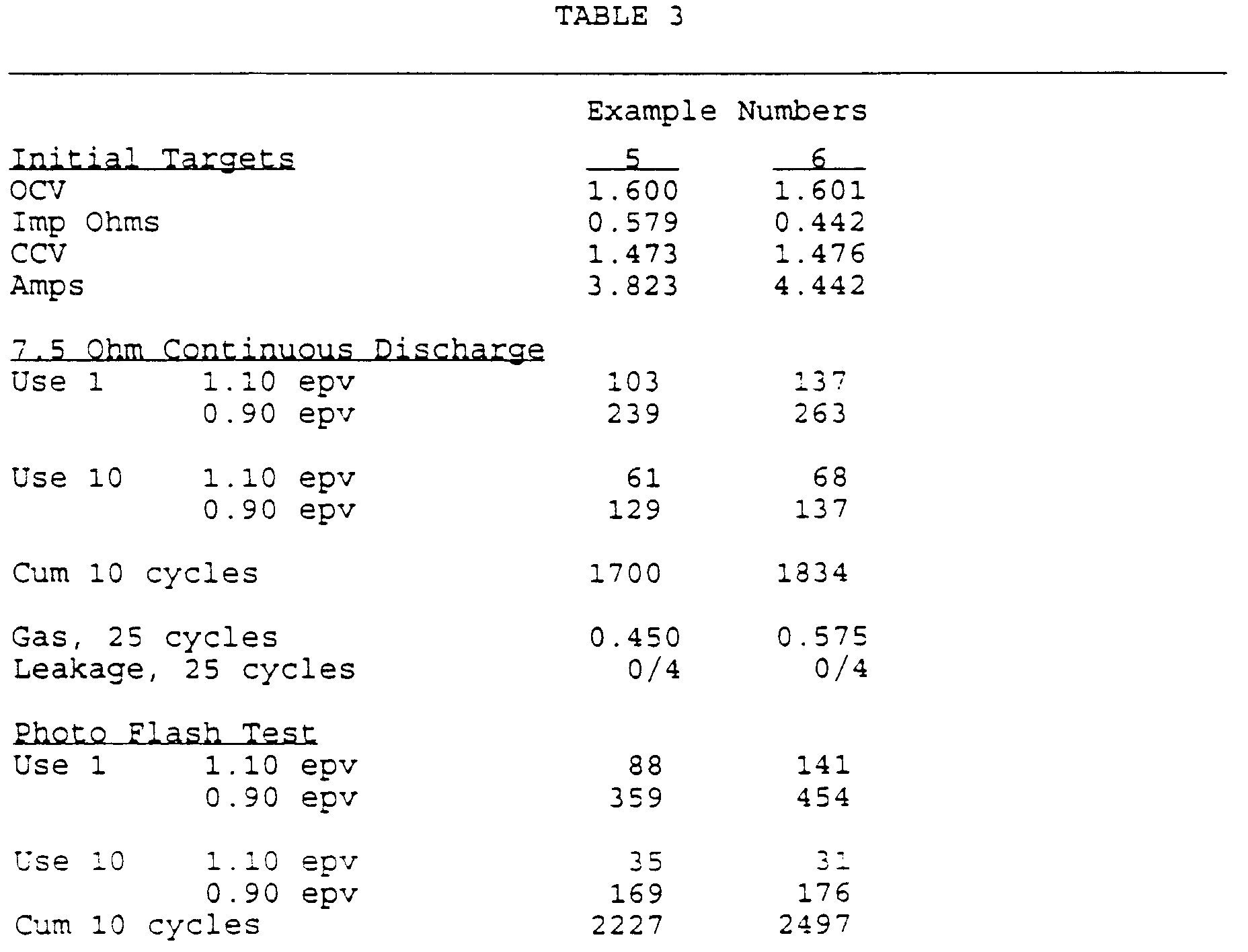
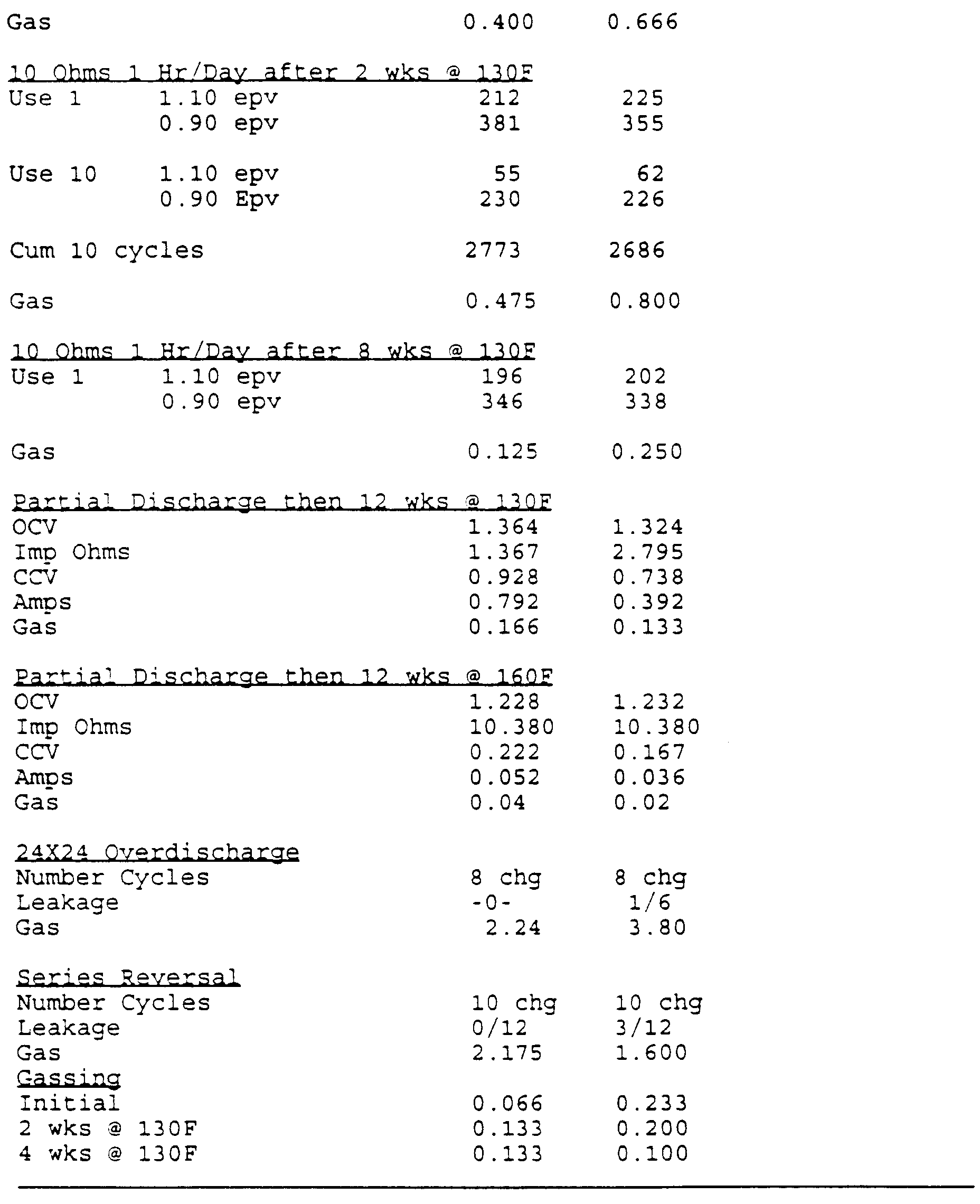
Table 3 shows that cells of Example 5 of the invention have
output capacities generally similar to those of the conventional
cells, as illustrated by a variety of tests, while tolerating the
abusive 24X24 test and the Series Reversal Test without cell
leakages. The conventional cells, by contrast, show leakages
under the abuse testing conditions. Thus, cells of the invention
have improved tolerance for abusive treatment while providing
general usage capacities similar to those of conventional cells.
As used herein, "recharge," "charge," "recharging,"
"charging" and the like refer to known charge processes for
recharging rechargeable consumer-size cells of e.g. "D," "C,"
"AA," and "AAA" sizes.
Those skilled in the art will now see that certain
modifications can be made to the articles, apparatus, and methods
herein disclosed with respect to the illustrated embodiments,
without departing from the spirit of the instant invention. And
while the invention has been described above with respect to the
preferred embodiments, it will be understood that the invention is
adapted to numerous rearrangements, modifications, and
alterations, and all such arrangements, modifications, and
alterations are intended to be within the scope of the appended
claims.
Claims (16)
- A rechargeable alkaline electrochemical cell (10), comprising:(a) a manganese dioxide cathode (14);(b) a zinc anode (12), said zinc anode comprising a zinc anode mix, said zinc anode mix comprising a particulate zinc composition having zero up to about 100 ppm by weight bismuth;(c) an alkaline electrolyte; and(d) a separator (20) electrically separating said zinc anode and said cathode.
- A rechargeable alkaline electrochemical cell as in Claim 1, said particulate zinc composition comprising about 200 ppm by weight to about 1000 ppm by weight indium, preferably about 400 ppm by weight to about 600 ppm by weight indium.
- A rechargeable alkaline electrochemical cell as in Claim 2, said particulate zinc composition further comprising about 40 ppm by weight to about 150 ppm by weight aluminum.
- A rechargeable alkaline electrochemical cell as in Claim 2 or Claim 3, said particulate zinc composition comprising about 200 ppm by weight to about 1000 ppm by weight lead, preferably about 400 ppm by weight to about 700 ppm by weight lead.
- A rechargeable alkaline electrochemical cell as in Claim 2, said particulate zinc composition further comprising about 200 ppm by weight to about 1000 ppm by weight lead and about 40 ppm by weight to about 150 ppm by weight aluminum.
- A rechargeable alkaline electrochemical cell as in Claim 1, said particulate zinc composition comprising about 400 ppm by weight to about 600 ppm by weight indium and further comprising about 400 ppm by weight to about 700 ppm by weight lead and about 50 ppm by weight to about 110 ppm by weight aluminum.
- A rechargeable alkaline electrochemical cell as in Claim 1, said electrochemical cell being devoid of mercury and/or said zinc anode mix being devoid of bismuth, e.g. said particulate zinc composition being devoid of bismuth.
- A rechargeable alkaline electrochemical cell as in Claim 1, said particulate zinc composition comprising about 450 ppm by weight to about 550 ppm by weight lead, about 400 ppm by weight to about 600 ppm by weight indium, about 50 ppm by weight to about 90 ppm by weight aluminum, and about 110 ppm by weight to about 190 ppm by weight calcium.
- An anode mix for use in a rechargeable alkaline cell, said anode mix comprising:(a) a particulate zinc composition having zero up to about 100 ppm by weight bismuth;(b) a gelling agent; and(c) an alkaline electrolyte.
- An anode mix as in Claim 9, said particulate zinc composition comprising about 200 ppm by weight to about 1000 ppm by weight indium preferaby about 250 ppm by weight to about 700 ppm by weight indium, more preferably about 400 ppm by weight to about 600 ppm by weight indium.
- An anode mix as in Claim 9 or Claim 10, said particulate zinc composition further comprising about 40 ppm by weight to about 150 ppm by weight aluminum.
- An anode mix as in Claim 9, 10 or 11, said particulate zinc composition further comprising about 200 ppm by weight to about 1000 ppm by weight lead, preferably about 400 ppm by weight to about 700 ppm by weight lead.
- An anode mix as in Claim 10, said particulate zinc composition further comprising about 200 ppm by weight to about 1000 ppm by weight lead and about 40 ppm by weight to about 150 ppm by weight aluminum.
- An anode mix as in Claim 9, said particulate zinc composition comprising about 250 ppm by weight to about 700 ppm by weight indium, and further comprising about 400 ppm by weight to about 700 ppm by weight lead and about 50 ppm by weight to about 110 ppm by weight aluminum.
- An anode mix as in Claim 9, said electrochemical cell being devoid of mercury, and/or said anode mix being devoid of bismuth, e.g. said particulate zinc composition being devoid of bismuth.
- An anode mix as in Claim 9, said particulate zinc composition comprising about 450 ppm by weight to about 550 ppm by weight lead, about 400 ppm by weight to about 600 ppm by weight indium, about 50 ppm by weight to about 90 ppm by weight aluminum, and about 110 ppm by weight to about 190 ppm by weight calcium.
Applications Claiming Priority (2)
| Application Number | Priority Date | Filing Date | Title |
|---|---|---|---|
| US69011696A | 1996-07-31 | 1996-07-31 | |
| US690116 | 1996-07-31 |
Publications (1)
| Publication Number | Publication Date |
|---|---|
| EP0822607A1 true EP0822607A1 (en) | 1998-02-04 |
Family
ID=24771166
Family Applications (1)
| Application Number | Title | Priority Date | Filing Date |
|---|---|---|---|
| EP96309072A Ceased EP0822607A1 (en) | 1996-07-31 | 1996-12-12 | Rechargeable alkaline electrochemical cell |
Country Status (1)
| Country | Link |
|---|---|
| EP (1) | EP0822607A1 (en) |
Cited By (1)
| Publication number | Priority date | Publication date | Assignee | Title |
|---|---|---|---|---|
| CN101465440A (en) * | 2008-11-10 | 2009-06-24 | 胡文斌 | Physical rechargeable alkaline zinc-manganese accumulator |
Citations (5)
| Publication number | Priority date | Publication date | Assignee | Title |
|---|---|---|---|---|
| EP0427315A2 (en) * | 1989-11-10 | 1991-05-15 | n.v. UNION MINIERE s.a. | Zinc powder for alkaline batteries |
| EP0510239A1 (en) * | 1991-04-22 | 1992-10-28 | Matsushita Electric Industrial Co., Ltd. | Zinc-alkaline batteries |
| JPH07262985A (en) * | 1994-03-17 | 1995-10-13 | Dowa Mining Co Ltd | Non-amalgamated zinc alloy powder for alkaline battery and non-amalgamated alkaline battery using the powder |
| WO1995031011A1 (en) * | 1994-05-06 | 1995-11-16 | Battery Technologies Inc. | Sealed rechargeable cells containing mercury-free zinc anodes, and a method of manufacture |
| WO1997017737A1 (en) * | 1995-11-06 | 1997-05-15 | Battery Technologies Inc. | Rechargeable alkaline cells containing zinc anodes without added mercury |
-
1996
- 1996-12-12 EP EP96309072A patent/EP0822607A1/en not_active Ceased
Patent Citations (5)
| Publication number | Priority date | Publication date | Assignee | Title |
|---|---|---|---|---|
| EP0427315A2 (en) * | 1989-11-10 | 1991-05-15 | n.v. UNION MINIERE s.a. | Zinc powder for alkaline batteries |
| EP0510239A1 (en) * | 1991-04-22 | 1992-10-28 | Matsushita Electric Industrial Co., Ltd. | Zinc-alkaline batteries |
| JPH07262985A (en) * | 1994-03-17 | 1995-10-13 | Dowa Mining Co Ltd | Non-amalgamated zinc alloy powder for alkaline battery and non-amalgamated alkaline battery using the powder |
| WO1995031011A1 (en) * | 1994-05-06 | 1995-11-16 | Battery Technologies Inc. | Sealed rechargeable cells containing mercury-free zinc anodes, and a method of manufacture |
| WO1997017737A1 (en) * | 1995-11-06 | 1997-05-15 | Battery Technologies Inc. | Rechargeable alkaline cells containing zinc anodes without added mercury |
Non-Patent Citations (2)
| Title |
|---|
| DANIEL-IVAD J ET AL: "MERCURY- AND LEAD-FREE ZN/MNO2 CELLS", EXTENDED ABSTRACTS, vol. 95/2, 1 January 1995 (1995-01-01), pages 50/51, XP000553823 * |
| DATABASE WPI Section Ch Week 9551, Derwent World Patents Index; Class L03, AN 95-396691, XP002046191 * |
Cited By (2)
| Publication number | Priority date | Publication date | Assignee | Title |
|---|---|---|---|---|
| CN101465440A (en) * | 2008-11-10 | 2009-06-24 | 胡文斌 | Physical rechargeable alkaline zinc-manganese accumulator |
| CN101465440B (en) * | 2008-11-10 | 2013-09-25 | 胡文斌 | Physical rechargeable alkaline zinc-manganese accumulator |
Similar Documents
| Publication | Publication Date | Title |
|---|---|---|
| US5424145A (en) | High capacity rechargeable cell having manganese dioxide electrode | |
| KR100194186B1 (en) | Manganese dioxide cathode for rechargeable battery and battery containing same | |
| US5466543A (en) | Nickel positive electrode for use in alkaline storage battery and nickel-hydrogen storage battery using the same | |
| US5340666A (en) | Rechargeable alkaline manganese cell having improved capacity and improved energy density | |
| US20020068220A1 (en) | Electrochemical cell and negative electrode therefor | |
| JP2001015106A (en) | Alkaline battery | |
| IL109274A (en) | Primary alkaline electrochemical cell | |
| US5607796A (en) | Rechargeable alkaline electrochemical cell | |
| US7314681B2 (en) | Cylindrical alkaline cells with increased discharge performance | |
| CN101317287B (en) | Rechargeable alkaline manganese batteries with reduced capacity fade and improved cycle life | |
| US3288642A (en) | Rechargeable dry cell having gelled electrolyte | |
| EP0671775B1 (en) | A mechanically-rechargeable battery | |
| US7338632B2 (en) | Hydrogen-storing alloy electrode and secondary cell using the same | |
| JP4243449B2 (en) | Alkaline primary battery | |
| EP0822607A1 (en) | Rechargeable alkaline electrochemical cell | |
| WO1998031063A1 (en) | Alkaline storage battery and method for charging battery | |
| US6596436B1 (en) | Nickel positive electrode plate for alkaline storage batteries and method for producing the same | |
| EP0800221B1 (en) | Alkaline storage battery and method for manufacturing positive electrode plate therefor | |
| CA2188120A1 (en) | Rechargeable alkaline electrochemical cell | |
| US20050287438A1 (en) | Alkaline electrochemical cell with improved lifetime | |
| JP3802703B2 (en) | Nickel metal hydride battery | |
| JP2001357872A (en) | Nickel hydride rechargeable battery | |
| US6200700B1 (en) | Alkaline secondary battery | |
| EP0801432B1 (en) | Rechargeable alkaline electrochemical cell | |
| CA2187984C (en) | Rechargeable alkaline electrochemical cell |
Legal Events
| Date | Code | Title | Description |
|---|---|---|---|
| PUAI | Public reference made under article 153(3) epc to a published international application that has entered the european phase |
Free format text: ORIGINAL CODE: 0009012 |
|
| AK | Designated contracting states |
Kind code of ref document: A1 Designated state(s): DE FR GB |
|
| 17P | Request for examination filed |
Effective date: 19980717 |
|
| AKX | Designation fees paid |
Free format text: DE FR GB |
|
| RBV | Designated contracting states (corrected) |
Designated state(s): DE FR GB |
|
| 17Q | First examination report despatched |
Effective date: 19990702 |
|
| GRAG | Despatch of communication of intention to grant |
Free format text: ORIGINAL CODE: EPIDOS AGRA |
|
| STAA | Information on the status of an ep patent application or granted ep patent |
Free format text: STATUS: THE APPLICATION HAS BEEN REFUSED |
|
| 18R | Application refused |
Effective date: 20011118 |