EP0821811B2 - Photothermographic elements with spectral sensitizing dyes - Google Patents
Photothermographic elements with spectral sensitizing dyes Download PDFInfo
- Publication number
- EP0821811B2 EP0821811B2 EP96907151A EP96907151A EP0821811B2 EP 0821811 B2 EP0821811 B2 EP 0821811B2 EP 96907151 A EP96907151 A EP 96907151A EP 96907151 A EP96907151 A EP 96907151A EP 0821811 B2 EP0821811 B2 EP 0821811B2
- Authority
- EP
- European Patent Office
- Prior art keywords
- silver
- dye
- photothermographic
- photosensitive
- photothermographic element
- Prior art date
- Legal status (The legal status is an assumption and is not a legal conclusion. Google has not performed a legal analysis and makes no representation as to the accuracy of the status listed.)
- Expired - Lifetime
Links
- 230000001235 sensitizing effect Effects 0.000 title claims description 32
- 239000000975 dye Substances 0.000 title description 140
- 230000003595 spectral effect Effects 0.000 title description 13
- 229910052709 silver Inorganic materials 0.000 claims description 169
- 239000004332 silver Substances 0.000 claims description 169
- -1 silver halide Chemical class 0.000 claims description 123
- BQCADISMDOOEFD-UHFFFAOYSA-N Silver Chemical compound [Ag] BQCADISMDOOEFD-UHFFFAOYSA-N 0.000 claims description 92
- 239000000839 emulsion Substances 0.000 claims description 60
- 150000001875 compounds Chemical class 0.000 claims description 57
- GGCZERPQGJTIQP-UHFFFAOYSA-N sodium;9,10-dioxoanthracene-2-sulfonic acid Chemical compound [Na+].C1=CC=C2C(=O)C3=CC(S(=O)(=O)O)=CC=C3C(=O)C2=C1 GGCZERPQGJTIQP-UHFFFAOYSA-N 0.000 claims description 36
- 239000011230 binding agent Substances 0.000 claims description 28
- 239000003638 chemical reducing agent Substances 0.000 claims description 27
- 125000004432 carbon atom Chemical group C* 0.000 claims description 25
- 239000000203 mixture Substances 0.000 claims description 20
- 125000004001 thioalkyl group Chemical group 0.000 claims description 20
- 125000000217 alkyl group Chemical group 0.000 claims description 18
- 125000001424 substituent group Chemical group 0.000 claims description 13
- 150000001450 anions Chemical class 0.000 claims description 10
- 125000001434 methanylylidene group Chemical group [H]C#[*] 0.000 claims description 9
- 229920002554 vinyl polymer Polymers 0.000 claims description 9
- ISWSIDIOOBJBQZ-UHFFFAOYSA-N Phenol Chemical compound OC1=CC=CC=C1 ISWSIDIOOBJBQZ-UHFFFAOYSA-N 0.000 claims description 8
- AQRYNYUOKMNDDV-UHFFFAOYSA-M silver behenate Chemical compound [Ag+].CCCCCCCCCCCCCCCCCCCCCC([O-])=O AQRYNYUOKMNDDV-UHFFFAOYSA-M 0.000 claims description 8
- 235000014113 dietary fatty acids Nutrition 0.000 claims description 7
- 125000001495 ethyl group Chemical group [H]C([H])([H])C([H])([H])* 0.000 claims description 7
- 239000000194 fatty acid Substances 0.000 claims description 7
- 229930195729 fatty acid Natural products 0.000 claims description 7
- 229920006217 cellulose acetate butyrate Polymers 0.000 claims description 6
- 125000001072 heteroaryl group Chemical group 0.000 claims description 6
- 150000004665 fatty acids Chemical class 0.000 claims description 5
- 230000002209 hydrophobic effect Effects 0.000 claims description 5
- 229920002037 poly(vinyl butyral) polymer Polymers 0.000 claims description 5
- ZPANWZBSGMDWON-UHFFFAOYSA-N 1-[(2-hydroxynaphthalen-1-yl)methyl]naphthalen-2-ol Chemical class C1=CC=C2C(CC3=C4C=CC=CC4=CC=C3O)=C(O)C=CC2=C1 ZPANWZBSGMDWON-UHFFFAOYSA-N 0.000 claims description 4
- MQCPOLNSJCWPGT-UHFFFAOYSA-N 2,2'-Bisphenol F Chemical class OC1=CC=CC=C1CC1=CC=CC=C1O MQCPOLNSJCWPGT-UHFFFAOYSA-N 0.000 claims description 4
- 125000004122 cyclic group Chemical group 0.000 claims description 4
- 229920005989 resin Polymers 0.000 claims description 4
- 239000011347 resin Substances 0.000 claims description 4
- JKFYKCYQEWQPTM-UHFFFAOYSA-N 2-azaniumyl-2-(4-fluorophenyl)acetate Chemical compound OC(=O)C(N)C1=CC=C(F)C=C1 JKFYKCYQEWQPTM-UHFFFAOYSA-N 0.000 claims description 3
- 229910021612 Silver iodide Inorganic materials 0.000 claims description 3
- 229920002301 cellulose acetate Polymers 0.000 claims description 3
- 150000004780 naphthols Chemical class 0.000 claims description 3
- 150000002989 phenols Chemical class 0.000 claims description 3
- ADZWSOLPGZMUMY-UHFFFAOYSA-M silver bromide Chemical group [Ag]Br ADZWSOLPGZMUMY-UHFFFAOYSA-M 0.000 claims description 3
- ZUNKMNLKJXRCDM-UHFFFAOYSA-N silver bromoiodide Chemical compound [Ag].IBr ZUNKMNLKJXRCDM-UHFFFAOYSA-N 0.000 claims description 3
- 229940045105 silver iodide Drugs 0.000 claims description 3
- 125000000391 vinyl group Chemical group [H]C([*])=C([H])[H] 0.000 claims description 3
- 229910021607 Silver chloride Inorganic materials 0.000 claims description 2
- SJOOOZPMQAWAOP-UHFFFAOYSA-N [Ag].BrCl Chemical compound [Ag].BrCl SJOOOZPMQAWAOP-UHFFFAOYSA-N 0.000 claims description 2
- HKZLPVFGJNLROG-UHFFFAOYSA-M silver monochloride Chemical compound [Cl-].[Ag+] HKZLPVFGJNLROG-UHFFFAOYSA-M 0.000 claims description 2
- PXQLVRUNWNTZOS-UHFFFAOYSA-N sulfanyl Chemical compound [SH] PXQLVRUNWNTZOS-UHFFFAOYSA-N 0.000 claims description 2
- 125000001712 tetrahydronaphthyl group Chemical group C1(CCCC2=CC=CC=C12)* 0.000 claims description 2
- 125000002837 carbocyclic group Chemical group 0.000 claims 1
- 150000001732 carboxylic acid derivatives Chemical class 0.000 claims 1
- 239000010410 layer Substances 0.000 description 65
- 238000000034 method Methods 0.000 description 30
- 239000000243 solution Substances 0.000 description 28
- IOJUPLGTWVMSFF-UHFFFAOYSA-N benzothiazole Chemical compound C1=CC=C2SC=NC2=C1 IOJUPLGTWVMSFF-UHFFFAOYSA-N 0.000 description 24
- 239000000463 material Substances 0.000 description 20
- 230000000052 comparative effect Effects 0.000 description 19
- 125000004055 thiomethyl group Chemical group [H]SC([H])([H])* 0.000 description 19
- 238000003384 imaging method Methods 0.000 description 18
- 230000035945 sensitivity Effects 0.000 description 16
- XLYOFNOQVPJJNP-UHFFFAOYSA-N water Substances O XLYOFNOQVPJJNP-UHFFFAOYSA-N 0.000 description 15
- 239000011248 coating agent Substances 0.000 description 14
- 238000000576 coating method Methods 0.000 description 14
- 238000011161 development Methods 0.000 description 14
- 230000018109 developmental process Effects 0.000 description 14
- 230000008569 process Effects 0.000 description 14
- 150000003378 silver Chemical class 0.000 description 14
- SQGYOTSLMSWVJD-UHFFFAOYSA-N silver(1+) nitrate Chemical compound [Ag+].[O-]N(=O)=O SQGYOTSLMSWVJD-UHFFFAOYSA-N 0.000 description 13
- OKKJLVBELUTLKV-UHFFFAOYSA-N Methanol Chemical compound OC OKKJLVBELUTLKV-UHFFFAOYSA-N 0.000 description 12
- 239000006185 dispersion Substances 0.000 description 12
- CWIYBOJLSWJGKV-UHFFFAOYSA-N 5-methyl-1,3-dihydrobenzimidazole-2-thione Chemical compound CC1=CC=C2NC(S)=NC2=C1 CWIYBOJLSWJGKV-UHFFFAOYSA-N 0.000 description 11
- 238000010438 heat treatment Methods 0.000 description 11
- 150000003839 salts Chemical class 0.000 description 11
- 238000001228 spectrum Methods 0.000 description 11
- 239000004615 ingredient Substances 0.000 description 10
- IOLCXVTUBQKXJR-UHFFFAOYSA-M potassium bromide Chemical compound [K+].[Br-] IOLCXVTUBQKXJR-UHFFFAOYSA-M 0.000 description 10
- 238000002360 preparation method Methods 0.000 description 10
- ANRHNWWPFJCPAZ-UHFFFAOYSA-M thionine Chemical class [Cl-].C1=CC(N)=CC2=[S+]C3=CC(N)=CC=C3N=C21 ANRHNWWPFJCPAZ-UHFFFAOYSA-M 0.000 description 10
- 239000000344 soap Substances 0.000 description 9
- 229910001868 water Inorganic materials 0.000 description 9
- CIWBSHSKHKDKBQ-JLAZNSOCSA-N Ascorbic acid Chemical compound OC[C@H](O)[C@H]1OC(=O)C(O)=C1O CIWBSHSKHKDKBQ-JLAZNSOCSA-N 0.000 description 8
- UKMSUNONTOPOIO-UHFFFAOYSA-N docosanoic acid Chemical compound CCCCCCCCCCCCCCCCCCCCCC(O)=O UKMSUNONTOPOIO-UHFFFAOYSA-N 0.000 description 8
- 230000015572 biosynthetic process Effects 0.000 description 7
- 230000003197 catalytic effect Effects 0.000 description 7
- 238000009472 formulation Methods 0.000 description 7
- 150000004820 halides Chemical class 0.000 description 7
- 229920000642 polymer Polymers 0.000 description 7
- 230000005855 radiation Effects 0.000 description 7
- ZWEHNKRNPOVVGH-UHFFFAOYSA-N 2-Butanone Chemical compound CCC(C)=O ZWEHNKRNPOVVGH-UHFFFAOYSA-N 0.000 description 6
- 108010010803 Gelatin Proteins 0.000 description 6
- QIGBRXMKCJKVMJ-UHFFFAOYSA-N Hydroquinone Chemical compound OC1=CC=C(O)C=C1 QIGBRXMKCJKVMJ-UHFFFAOYSA-N 0.000 description 6
- 230000008901 benefit Effects 0.000 description 6
- YCIMNLLNPGFGHC-UHFFFAOYSA-N catechol Chemical compound OC1=CC=CC=C1O YCIMNLLNPGFGHC-UHFFFAOYSA-N 0.000 description 6
- 238000010276 construction Methods 0.000 description 6
- 239000008367 deionised water Substances 0.000 description 6
- 229910021641 deionized water Inorganic materials 0.000 description 6
- 229920000159 gelatin Polymers 0.000 description 6
- 239000008273 gelatin Substances 0.000 description 6
- 235000019322 gelatine Nutrition 0.000 description 6
- 235000011852 gelatine desserts Nutrition 0.000 description 6
- 125000002887 hydroxy group Chemical group [H]O* 0.000 description 6
- 230000006872 improvement Effects 0.000 description 6
- 230000001965 increasing effect Effects 0.000 description 6
- 238000012545 processing Methods 0.000 description 6
- 238000011160 research Methods 0.000 description 6
- 238000003756 stirring Methods 0.000 description 6
- 238000006467 substitution reaction Methods 0.000 description 6
- 0 CCN1c(cc(cc2)SC)c2SC1=CC(CCC1C=C2)=CC1=CC2=Cc1[n+](CC)c2cc(*)ccc2[s]1 Chemical compound CCN1c(cc(cc2)SC)c2SC1=CC(CCC1C=C2)=CC1=CC2=Cc1[n+](CC)c2cc(*)ccc2[s]1 0.000 description 5
- 206010070834 Sensitisation Diseases 0.000 description 5
- FOIXSVOLVBLSDH-UHFFFAOYSA-N Silver ion Chemical compound [Ag+] FOIXSVOLVBLSDH-UHFFFAOYSA-N 0.000 description 5
- 125000003545 alkoxy group Chemical group 0.000 description 5
- 125000005157 alkyl carboxy group Chemical group 0.000 description 5
- 239000011258 core-shell material Substances 0.000 description 5
- 238000001035 drying Methods 0.000 description 5
- 230000000694 effects Effects 0.000 description 5
- 229910052741 iridium Inorganic materials 0.000 description 5
- GKOZUEZYRPOHIO-UHFFFAOYSA-N iridium atom Chemical compound [Ir] GKOZUEZYRPOHIO-UHFFFAOYSA-N 0.000 description 5
- 238000004519 manufacturing process Methods 0.000 description 5
- NSBNSZAXNUGWDJ-UHFFFAOYSA-O monopyridin-1-ium tribromide Chemical compound Br[Br-]Br.C1=CC=[NH+]C=C1 NSBNSZAXNUGWDJ-UHFFFAOYSA-O 0.000 description 5
- 125000001997 phenyl group Chemical group [H]C1=C([H])C([H])=C(*)C([H])=C1[H] 0.000 description 5
- 229920000139 polyethylene terephthalate Polymers 0.000 description 5
- 239000005020 polyethylene terephthalate Substances 0.000 description 5
- 230000009467 reduction Effects 0.000 description 5
- 230000002829 reductive effect Effects 0.000 description 5
- 230000008313 sensitization Effects 0.000 description 5
- 231100000489 sensitizer Toxicity 0.000 description 5
- 239000003381 stabilizer Substances 0.000 description 5
- YXIWHUQXZSMYRE-UHFFFAOYSA-N 1,3-benzothiazole-2-thiol Chemical compound C1=CC=C2SC(S)=NC2=C1 YXIWHUQXZSMYRE-UHFFFAOYSA-N 0.000 description 4
- 235000021357 Behenic acid Nutrition 0.000 description 4
- NVXLIZQNSVLKPO-UHFFFAOYSA-N Glucosereductone Chemical compound O=CC(O)C=O NVXLIZQNSVLKPO-UHFFFAOYSA-N 0.000 description 4
- KDLHZDBZIXYQEI-UHFFFAOYSA-N Palladium Chemical compound [Pd] KDLHZDBZIXYQEI-UHFFFAOYSA-N 0.000 description 4
- VYPSYNLAJGMNEJ-UHFFFAOYSA-N Silicium dioxide Chemical compound O=[Si]=O VYPSYNLAJGMNEJ-UHFFFAOYSA-N 0.000 description 4
- 239000002253 acid Substances 0.000 description 4
- 150000007933 aliphatic carboxylic acids Chemical class 0.000 description 4
- 235000010323 ascorbic acid Nutrition 0.000 description 4
- 229960005070 ascorbic acid Drugs 0.000 description 4
- 239000011668 ascorbic acid Substances 0.000 description 4
- 229940116226 behenic acid Drugs 0.000 description 4
- 238000006243 chemical reaction Methods 0.000 description 4
- 239000003795 chemical substances by application Substances 0.000 description 4
- 229920001577 copolymer Polymers 0.000 description 4
- 125000004435 hydrogen atom Chemical group [H]* 0.000 description 4
- 238000011065 in-situ storage Methods 0.000 description 4
- FBSFWRHWHYMIOG-UHFFFAOYSA-N methyl 3,4,5-trihydroxybenzoate Chemical compound COC(=O)C1=CC(O)=C(O)C(O)=C1 FBSFWRHWHYMIOG-UHFFFAOYSA-N 0.000 description 4
- 150000002894 organic compounds Chemical class 0.000 description 4
- BASFCYQUMIYNBI-UHFFFAOYSA-N platinum Chemical compound [Pt] BASFCYQUMIYNBI-UHFFFAOYSA-N 0.000 description 4
- NLKNQRATVPKPDG-UHFFFAOYSA-M potassium iodide Chemical compound [K+].[I-] NLKNQRATVPKPDG-UHFFFAOYSA-M 0.000 description 4
- WQGWDDDVZFFDIG-UHFFFAOYSA-N pyrogallol Chemical compound OC1=CC=CC(O)=C1O WQGWDDDVZFFDIG-UHFFFAOYSA-N 0.000 description 4
- 239000000126 substance Substances 0.000 description 4
- YHMYGUUIMTVXNW-UHFFFAOYSA-N 1,3-dihydrobenzimidazole-2-thione Chemical compound C1=CC=C2NC(S)=NC2=C1 YHMYGUUIMTVXNW-UHFFFAOYSA-N 0.000 description 3
- RPWDFMGIRPZGTI-UHFFFAOYSA-N 2-[1-(2-hydroxy-3,5-dimethylphenyl)-3,5,5-trimethylhexyl]-4,6-dimethylphenol Chemical compound C=1C(C)=CC(C)=C(O)C=1C(CC(C)CC(C)(C)C)C1=CC(C)=CC(C)=C1O RPWDFMGIRPZGTI-UHFFFAOYSA-N 0.000 description 3
- FLFWJIBUZQARMD-UHFFFAOYSA-N 2-mercapto-1,3-benzoxazole Chemical compound C1=CC=C2OC(S)=NC2=C1 FLFWJIBUZQARMD-UHFFFAOYSA-N 0.000 description 3
- 150000000996 L-ascorbic acids Chemical class 0.000 description 3
- PCNDJXKNXGMECE-UHFFFAOYSA-N Phenazine Natural products C1=CC=CC2=NC3=CC=CC=C3N=C21 PCNDJXKNXGMECE-UHFFFAOYSA-N 0.000 description 3
- HEMHJVSKTPXQMS-UHFFFAOYSA-M Sodium hydroxide Chemical compound [OH-].[Na+] HEMHJVSKTPXQMS-UHFFFAOYSA-M 0.000 description 3
- GWEVSGVZZGPLCZ-UHFFFAOYSA-N Titan oxide Chemical compound O=[Ti]=O GWEVSGVZZGPLCZ-UHFFFAOYSA-N 0.000 description 3
- YXFVVABEGXRONW-UHFFFAOYSA-N Toluene Chemical compound CC1=CC=CC=C1 YXFVVABEGXRONW-UHFFFAOYSA-N 0.000 description 3
- 238000002835 absorbance Methods 0.000 description 3
- 125000002777 acetyl group Chemical class [H]C([H])([H])C(*)=O 0.000 description 3
- 239000000654 additive Substances 0.000 description 3
- 125000003118 aryl group Chemical group 0.000 description 3
- 230000004888 barrier function Effects 0.000 description 3
- 229910052794 bromium Inorganic materials 0.000 description 3
- 230000008859 change Effects 0.000 description 3
- 229910052801 chlorine Inorganic materials 0.000 description 3
- 238000011066 ex-situ storage Methods 0.000 description 3
- 229910052736 halogen Inorganic materials 0.000 description 3
- 150000002367 halogens Chemical class 0.000 description 3
- 229910052739 hydrogen Inorganic materials 0.000 description 3
- 239000001257 hydrogen Substances 0.000 description 3
- RAXXELZNTBOGNW-UHFFFAOYSA-N imidazole Natural products C1=CNC=N1 RAXXELZNTBOGNW-UHFFFAOYSA-N 0.000 description 3
- 229910052751 metal Chemical class 0.000 description 3
- 239000002184 metal Chemical class 0.000 description 3
- 238000002156 mixing Methods 0.000 description 3
- 229920000728 polyester Polymers 0.000 description 3
- 238000003860 storage Methods 0.000 description 3
- 229920001897 terpolymer Polymers 0.000 description 3
- 238000012360 testing method Methods 0.000 description 3
- GDIYMWAMJKRXRE-UHFFFAOYSA-N (2z)-2-[(2e)-2-[2-chloro-3-[(z)-2-(1,3,3-trimethylindol-1-ium-2-yl)ethenyl]cyclohex-2-en-1-ylidene]ethylidene]-1,3,3-trimethylindole Chemical compound CC1(C)C2=CC=CC=C2N(C)C1=CC=C1C(Cl)=C(C=CC=2C(C3=CC=CC=C3[N+]=2C)(C)C)CCC1 GDIYMWAMJKRXRE-UHFFFAOYSA-N 0.000 description 2
- UHKAJLSKXBADFT-UHFFFAOYSA-N 1,3-indandione Chemical class C1=CC=C2C(=O)CC(=O)C2=C1 UHKAJLSKXBADFT-UHFFFAOYSA-N 0.000 description 2
- 150000005208 1,4-dihydroxybenzenes Chemical class 0.000 description 2
- KJCVRFUGPWSIIH-UHFFFAOYSA-N 1-naphthol Chemical compound C1=CC=C2C(O)=CC=CC2=C1 KJCVRFUGPWSIIH-UHFFFAOYSA-N 0.000 description 2
- AFBBKYQYNPNMAT-UHFFFAOYSA-N 1h-1,2,4-triazol-1-ium-3-thiolate Chemical compound SC=1N=CNN=1 AFBBKYQYNPNMAT-UHFFFAOYSA-N 0.000 description 2
- AVRPFRMDMNDIDH-UHFFFAOYSA-N 1h-quinazolin-2-one Chemical compound C1=CC=CC2=NC(O)=NC=C21 AVRPFRMDMNDIDH-UHFFFAOYSA-N 0.000 description 2
- SULYEHHGGXARJS-UHFFFAOYSA-N 2',4'-dihydroxyacetophenone Chemical compound CC(=O)C1=CC=C(O)C=C1O SULYEHHGGXARJS-UHFFFAOYSA-N 0.000 description 2
- KGRVJHAUYBGFFP-UHFFFAOYSA-N 2,2'-Methylenebis(4-methyl-6-tert-butylphenol) Chemical compound CC(C)(C)C1=CC(C)=CC(CC=2C(=C(C=C(C)C=2)C(C)(C)C)O)=C1O KGRVJHAUYBGFFP-UHFFFAOYSA-N 0.000 description 2
- ICKWICRCANNIBI-UHFFFAOYSA-N 2,4-di-tert-butylphenol Chemical compound CC(C)(C)C1=CC=C(O)C(C(C)(C)C)=C1 ICKWICRCANNIBI-UHFFFAOYSA-N 0.000 description 2
- NXXYKOUNUYWIHA-UHFFFAOYSA-N 2,6-Dimethylphenol Chemical compound CC1=CC=CC(C)=C1O NXXYKOUNUYWIHA-UHFFFAOYSA-N 0.000 description 2
- 229940054266 2-mercaptobenzothiazole Drugs 0.000 description 2
- BKZXZGWHTRCFPX-UHFFFAOYSA-N 2-tert-butyl-6-methylphenol Chemical compound CC1=CC=CC(C(C)(C)C)=C1O BKZXZGWHTRCFPX-UHFFFAOYSA-N 0.000 description 2
- CWJJAFQCTXFSTA-UHFFFAOYSA-N 4-methylphthalic acid Chemical compound CC1=CC=C(C(O)=O)C(C(O)=O)=C1 CWJJAFQCTXFSTA-UHFFFAOYSA-N 0.000 description 2
- KDCGOANMDULRCW-UHFFFAOYSA-N 7H-purine Chemical compound N1=CNC2=NC=NC2=C1 KDCGOANMDULRCW-UHFFFAOYSA-N 0.000 description 2
- IJGRMHOSHXDMSA-UHFFFAOYSA-N Atomic nitrogen Chemical compound N#N IJGRMHOSHXDMSA-UHFFFAOYSA-N 0.000 description 2
- 229930185605 Bisphenol Natural products 0.000 description 2
- 239000004215 Carbon black (E152) Substances 0.000 description 2
- OAKJQQAXSVQMHS-UHFFFAOYSA-N Hydrazine Chemical compound NN OAKJQQAXSVQMHS-UHFFFAOYSA-N 0.000 description 2
- MHAJPDPJQMAIIY-UHFFFAOYSA-N Hydrogen peroxide Chemical compound OO MHAJPDPJQMAIIY-UHFFFAOYSA-N 0.000 description 2
- XEEYBQQBJWHFJM-UHFFFAOYSA-N Iron Chemical compound [Fe] XEEYBQQBJWHFJM-UHFFFAOYSA-N 0.000 description 2
- GRYLNZFGIOXLOG-UHFFFAOYSA-N Nitric acid Chemical compound O[N+]([O-])=O GRYLNZFGIOXLOG-UHFFFAOYSA-N 0.000 description 2
- KYQCOXFCLRTKLS-UHFFFAOYSA-N Pyrazine Chemical compound C1=CN=CC=N1 KYQCOXFCLRTKLS-UHFFFAOYSA-N 0.000 description 2
- JUJWROOIHBZHMG-UHFFFAOYSA-N Pyridine Chemical compound C1=CC=NC=C1 JUJWROOIHBZHMG-UHFFFAOYSA-N 0.000 description 2
- SMWDFEZZVXVKRB-UHFFFAOYSA-N Quinoline Chemical compound N1=CC=CC2=CC=CC=C21 SMWDFEZZVXVKRB-UHFFFAOYSA-N 0.000 description 2
- BUGBHKTXTAQXES-UHFFFAOYSA-N Selenium Chemical compound [Se] BUGBHKTXTAQXES-UHFFFAOYSA-N 0.000 description 2
- 229920002472 Starch Polymers 0.000 description 2
- NINIDFKCEFEMDL-UHFFFAOYSA-N Sulfur Chemical compound [S] NINIDFKCEFEMDL-UHFFFAOYSA-N 0.000 description 2
- 241001061127 Thione Species 0.000 description 2
- XLOMVQKBTHCTTD-UHFFFAOYSA-N Zinc monoxide Chemical compound [Zn]=O XLOMVQKBTHCTTD-UHFFFAOYSA-N 0.000 description 2
- ROOXNKNUYICQNP-UHFFFAOYSA-N ammonium persulfate Chemical compound [NH4+].[NH4+].[O-]S(=O)(=O)OOS([O-])(=O)=O ROOXNKNUYICQNP-UHFFFAOYSA-N 0.000 description 2
- 239000007864 aqueous solution Substances 0.000 description 2
- 239000011324 bead Substances 0.000 description 2
- WPYMKLBDIGXBTP-UHFFFAOYSA-N benzoic acid Chemical compound OC(=O)C1=CC=CC=C1 WPYMKLBDIGXBTP-UHFFFAOYSA-N 0.000 description 2
- XSCHRSMBECNVNS-UHFFFAOYSA-N benzopyrazine Natural products N1=CC=NC2=CC=CC=C21 XSCHRSMBECNVNS-UHFFFAOYSA-N 0.000 description 2
- IISBACLAFKSPIT-UHFFFAOYSA-N bisphenol A Chemical compound C=1C=C(O)C=CC=1C(C)(C)C1=CC=C(O)C=C1 IISBACLAFKSPIT-UHFFFAOYSA-N 0.000 description 2
- 229910001622 calcium bromide Inorganic materials 0.000 description 2
- WGEFECGEFUFIQW-UHFFFAOYSA-L calcium dibromide Chemical compound [Ca+2].[Br-].[Br-] WGEFECGEFUFIQW-UHFFFAOYSA-L 0.000 description 2
- 125000003178 carboxy group Chemical group [H]OC(*)=O 0.000 description 2
- 125000004181 carboxyalkyl group Chemical group 0.000 description 2
- 239000003054 catalyst Substances 0.000 description 2
- 229920002678 cellulose Polymers 0.000 description 2
- QZXCCPZJCKEPSA-UHFFFAOYSA-N chlorfenac Chemical compound OC(=O)CC1=C(Cl)C=CC(Cl)=C1Cl QZXCCPZJCKEPSA-UHFFFAOYSA-N 0.000 description 2
- 125000000113 cyclohexyl group Chemical group [H]C1([H])C([H])([H])C([H])([H])C([H])(*)C([H])([H])C1([H])[H] 0.000 description 2
- 229940093915 gynecological organic acid Drugs 0.000 description 2
- 125000005843 halogen group Chemical group 0.000 description 2
- 229930195733 hydrocarbon Natural products 0.000 description 2
- 150000002460 imidazoles Chemical class 0.000 description 2
- 230000001976 improved effect Effects 0.000 description 2
- 238000010348 incorporation Methods 0.000 description 2
- 238000005304 joining Methods 0.000 description 2
- 238000005259 measurement Methods 0.000 description 2
- BQPIGGFYSBELGY-UHFFFAOYSA-N mercury(2+) Chemical class [Hg+2] BQPIGGFYSBELGY-UHFFFAOYSA-N 0.000 description 2
- DZVCFNFOPIZQKX-LTHRDKTGSA-M merocyanine Chemical compound [Na+].O=C1N(CCCC)C(=O)N(CCCC)C(=O)C1=C\C=C\C=C/1N(CCCS([O-])(=O)=O)C2=CC=CC=C2O\1 DZVCFNFOPIZQKX-LTHRDKTGSA-M 0.000 description 2
- VNWKTOKETHGBQD-UHFFFAOYSA-N methane Chemical compound C VNWKTOKETHGBQD-UHFFFAOYSA-N 0.000 description 2
- IBKQQKPQRYUGBJ-UHFFFAOYSA-N methyl gallate Natural products CC(=O)C1=CC(O)=C(O)C(O)=C1 IBKQQKPQRYUGBJ-UHFFFAOYSA-N 0.000 description 2
- 125000002496 methyl group Chemical group [H]C([H])([H])* 0.000 description 2
- KFPBEVFQCXRYIR-UHFFFAOYSA-N n-(3,5-dichloro-4-hydroxyphenyl)benzenesulfonamide Chemical compound C1=C(Cl)C(O)=C(Cl)C=C1NS(=O)(=O)C1=CC=CC=C1 KFPBEVFQCXRYIR-UHFFFAOYSA-N 0.000 description 2
- WHZPMLXZOSFAKY-UHFFFAOYSA-N n-(4-hydroxyphenyl)benzenesulfonamide Chemical compound C1=CC(O)=CC=C1NS(=O)(=O)C1=CC=CC=C1 WHZPMLXZOSFAKY-UHFFFAOYSA-N 0.000 description 2
- 229910017604 nitric acid Inorganic materials 0.000 description 2
- 229910052757 nitrogen Inorganic materials 0.000 description 2
- 150000007524 organic acids Chemical class 0.000 description 2
- 235000005985 organic acids Nutrition 0.000 description 2
- 229910052763 palladium Inorganic materials 0.000 description 2
- IJAPPYDYQCXOEF-UHFFFAOYSA-N phthalazin-1(2H)-one Chemical class C1=CC=C2C(=O)NN=CC2=C1 IJAPPYDYQCXOEF-UHFFFAOYSA-N 0.000 description 2
- LFSXCDWNBUNEEM-UHFFFAOYSA-N phthalazine Chemical compound C1=NN=CC2=CC=CC=C21 LFSXCDWNBUNEEM-UHFFFAOYSA-N 0.000 description 2
- XNGIFLGASWRNHJ-UHFFFAOYSA-N phthalic acid Chemical compound OC(=O)C1=CC=CC=C1C(O)=O XNGIFLGASWRNHJ-UHFFFAOYSA-N 0.000 description 2
- 229910052697 platinum Inorganic materials 0.000 description 2
- 229920003207 poly(ethylene-2,6-naphthalate) Polymers 0.000 description 2
- 229920006267 polyester film Polymers 0.000 description 2
- 239000011112 polyethylene naphthalate Substances 0.000 description 2
- 229920002689 polyvinyl acetate Polymers 0.000 description 2
- 239000011118 polyvinyl acetate Substances 0.000 description 2
- 229920002451 polyvinyl alcohol Polymers 0.000 description 2
- 235000019422 polyvinyl alcohol Nutrition 0.000 description 2
- 239000004800 polyvinyl chloride Substances 0.000 description 2
- 229920000915 polyvinyl chloride Polymers 0.000 description 2
- 239000002243 precursor Substances 0.000 description 2
- 230000037452 priming Effects 0.000 description 2
- 125000001436 propyl group Chemical group [H]C([*])([H])C([H])([H])C([H])([H])[H] 0.000 description 2
- 229940079877 pyrogallol Drugs 0.000 description 2
- 229910052711 selenium Inorganic materials 0.000 description 2
- 239000011669 selenium Substances 0.000 description 2
- 239000004065 semiconductor Substances 0.000 description 2
- 239000000377 silicon dioxide Substances 0.000 description 2
- 229910001961 silver nitrate Inorganic materials 0.000 description 2
- 239000002356 single layer Substances 0.000 description 2
- 239000007787 solid Substances 0.000 description 2
- 239000008107 starch Substances 0.000 description 2
- 235000019698 starch Nutrition 0.000 description 2
- 125000004079 stearyl group Chemical group [H]C([*])([H])C([H])([H])C([H])([H])C([H])([H])C([H])([H])C([H])([H])C([H])([H])C([H])([H])C([H])([H])C([H])([H])C([H])([H])C([H])([H])C([H])([H])C([H])([H])C([H])([H])C([H])([H])C([H])([H])C([H])([H])[H] 0.000 description 2
- KZNICNPSHKQLFF-UHFFFAOYSA-N succinimide Chemical compound O=C1CCC(=O)N1 KZNICNPSHKQLFF-UHFFFAOYSA-N 0.000 description 2
- 229910052717 sulfur Inorganic materials 0.000 description 2
- 239000011593 sulfur Substances 0.000 description 2
- 238000003786 synthesis reaction Methods 0.000 description 2
- 229920001059 synthetic polymer Polymers 0.000 description 2
- PORWMNRCUJJQNO-UHFFFAOYSA-N tellurium atom Chemical compound [Te] PORWMNRCUJJQNO-UHFFFAOYSA-N 0.000 description 2
- 125000000999 tert-butyl group Chemical group [H]C([H])([H])C(*)(C([H])([H])[H])C([H])([H])[H] 0.000 description 2
- AUHHYELHRWCWEZ-UHFFFAOYSA-N tetrachlorophthalic anhydride Chemical compound ClC1=C(Cl)C(Cl)=C2C(=O)OC(=O)C2=C1Cl AUHHYELHRWCWEZ-UHFFFAOYSA-N 0.000 description 2
- CWERGRDVMFNCDR-UHFFFAOYSA-N thioglycolic acid Chemical compound OC(=O)CS CWERGRDVMFNCDR-UHFFFAOYSA-N 0.000 description 2
- UMGDCJDMYOKAJW-UHFFFAOYSA-N thiourea Chemical class NC(N)=S UMGDCJDMYOKAJW-UHFFFAOYSA-N 0.000 description 2
- 235000010215 titanium dioxide Nutrition 0.000 description 2
- QNRATNLHPGXHMA-XZHTYLCXSA-N (r)-(6-ethoxyquinolin-4-yl)-[(2s,4s,5r)-5-ethyl-1-azabicyclo[2.2.2]octan-2-yl]methanol;hydrochloride Chemical compound Cl.C([C@H]([C@H](C1)CC)C2)CN1[C@@H]2[C@H](O)C1=CC=NC2=CC=C(OCC)C=C21 QNRATNLHPGXHMA-XZHTYLCXSA-N 0.000 description 1
- JYEUMXHLPRZUAT-UHFFFAOYSA-N 1,2,3-triazine Chemical compound C1=CN=NN=C1 JYEUMXHLPRZUAT-UHFFFAOYSA-N 0.000 description 1
- 150000000178 1,2,4-triazoles Chemical class 0.000 description 1
- XBYRMPXUBGMOJC-UHFFFAOYSA-N 1,2-dihydropyrazol-3-one Chemical class OC=1C=CNN=1 XBYRMPXUBGMOJC-UHFFFAOYSA-N 0.000 description 1
- BIGYLAKFCGVRAN-UHFFFAOYSA-N 1,3,4-thiadiazolidine-2,5-dithione Chemical compound S=C1NNC(=S)S1 BIGYLAKFCGVRAN-UHFFFAOYSA-N 0.000 description 1
- AIGNCQCMONAWOL-UHFFFAOYSA-N 1,3-benzoselenazole Chemical compound C1=CC=C2[se]C=NC2=C1 AIGNCQCMONAWOL-UHFFFAOYSA-N 0.000 description 1
- WKKIRKUKAAAUNL-UHFFFAOYSA-N 1,3-benzotellurazole Chemical compound C1=CC=C2[Te]C=NC2=C1 WKKIRKUKAAAUNL-UHFFFAOYSA-N 0.000 description 1
- BCMCBBGGLRIHSE-UHFFFAOYSA-N 1,3-benzoxazole Chemical compound C1=CC=C2OC=NC2=C1 BCMCBBGGLRIHSE-UHFFFAOYSA-N 0.000 description 1
- 150000000183 1,3-benzoxazoles Chemical class 0.000 description 1
- OXFSTTJBVAAALW-UHFFFAOYSA-N 1,3-dihydroimidazole-2-thione Chemical compound SC1=NC=CN1 OXFSTTJBVAAALW-UHFFFAOYSA-N 0.000 description 1
- 150000005207 1,3-dihydroxybenzenes Chemical class 0.000 description 1
- ZDWVOYRAWVKGHA-UHFFFAOYSA-N 1,3-thiazole-4-thiol Chemical class SC1=CSC=N1 ZDWVOYRAWVKGHA-UHFFFAOYSA-N 0.000 description 1
- ZOBPZXTWZATXDG-UHFFFAOYSA-N 1,3-thiazolidine-2,4-dione Chemical compound O=C1CSC(=O)N1 ZOBPZXTWZATXDG-UHFFFAOYSA-N 0.000 description 1
- YNGDWRXWKFWCJY-UHFFFAOYSA-N 1,4-Dihydropyridine Chemical class C1C=CNC=C1 YNGDWRXWKFWCJY-UHFFFAOYSA-N 0.000 description 1
- ZRHUHDUEXWHZMA-UHFFFAOYSA-N 1,4-dihydropyrazol-5-one Chemical class O=C1CC=NN1 ZRHUHDUEXWHZMA-UHFFFAOYSA-N 0.000 description 1
- PJDDFKGDNUTITH-UHFFFAOYSA-N 1,5-bis(2-chlorophenyl)-1,2,5,6-tetrahydro-[1,2,4]triazolo[1,2-a][1,2,4]triazole-3,7-dithione Chemical compound SC1=NC(C=2C(=CC=CC=2)Cl)N(C(=N2)S)N1C2C1=CC=CC=C1Cl PJDDFKGDNUTITH-UHFFFAOYSA-N 0.000 description 1
- LRGBKQAXMKYMHJ-UHFFFAOYSA-N 1,5-diphenyl-1,2,5,6-tetrahydro-[1,2,4]triazolo[1,2-a][1,2,4]triazole-3,7-dithione Chemical compound S=C1NC(C=2C=CC=CC=2)N(C(N2)=S)N1C2C1=CC=CC=C1 LRGBKQAXMKYMHJ-UHFFFAOYSA-N 0.000 description 1
- WFYLHMAYBQLBEM-UHFFFAOYSA-N 1-phenyl-1,2,4-triazolidine-3,5-dione Chemical compound O=C1NC(=O)NN1C1=CC=CC=C1 WFYLHMAYBQLBEM-UHFFFAOYSA-N 0.000 description 1
- WJFKNYWRSNBZNX-UHFFFAOYSA-N 10H-phenothiazine Chemical compound C1=CC=C2NC3=CC=CC=C3SC2=C1 WJFKNYWRSNBZNX-UHFFFAOYSA-N 0.000 description 1
- HYZJCKYKOHLVJF-UHFFFAOYSA-N 1H-benzimidazole Chemical compound C1=CC=C2NC=NC2=C1 HYZJCKYKOHLVJF-UHFFFAOYSA-N 0.000 description 1
- KJUGUADJHNHALS-UHFFFAOYSA-N 1H-tetrazole Substances C=1N=NNN=1 KJUGUADJHNHALS-UHFFFAOYSA-N 0.000 description 1
- USYCQABRSUEURP-UHFFFAOYSA-N 1h-benzo[f]benzimidazole Chemical compound C1=CC=C2C=C(NC=N3)C3=CC2=C1 USYCQABRSUEURP-UHFFFAOYSA-N 0.000 description 1
- ZEQIWKHCJWRNTH-UHFFFAOYSA-N 1h-pyrimidine-2,4-dithione Chemical compound S=C1C=CNC(=S)N1 ZEQIWKHCJWRNTH-UHFFFAOYSA-N 0.000 description 1
- KXZSVYHFYHTNBI-UHFFFAOYSA-N 1h-quinoline-2-thione Chemical compound C1=CC=CC2=NC(S)=CC=C21 KXZSVYHFYHTNBI-UHFFFAOYSA-N 0.000 description 1
- HAZJTCQWIDBCCE-UHFFFAOYSA-N 1h-triazine-6-thione Chemical compound SC1=CC=NN=N1 HAZJTCQWIDBCCE-UHFFFAOYSA-N 0.000 description 1
- LVUQDNJRAHUUSB-UHFFFAOYSA-N 2,3,5,6-tetrachloro-1h-pyridine-4-thione Chemical compound SC1=C(Cl)C(Cl)=NC(Cl)=C1Cl LVUQDNJRAHUUSB-UHFFFAOYSA-N 0.000 description 1
- YTQQIHUQLOZOJI-UHFFFAOYSA-N 2,3-dihydro-1,2-thiazole Chemical compound C1NSC=C1 YTQQIHUQLOZOJI-UHFFFAOYSA-N 0.000 description 1
- KGLPWQKSKUVKMJ-UHFFFAOYSA-N 2,3-dihydrophthalazine-1,4-dione Chemical compound C1=CC=C2C(=O)NNC(=O)C2=C1 KGLPWQKSKUVKMJ-UHFFFAOYSA-N 0.000 description 1
- VZYDKJOUEPFKMW-UHFFFAOYSA-N 2,3-dihydroxybenzenesulfonic acid Chemical class OC1=CC=CC(S(O)(=O)=O)=C1O VZYDKJOUEPFKMW-UHFFFAOYSA-N 0.000 description 1
- ZXDDPOHVAMWLBH-UHFFFAOYSA-N 2,4-Dihydroxybenzophenone Chemical compound OC1=CC(O)=CC=C1C(=O)C1=CC=CC=C1 ZXDDPOHVAMWLBH-UHFFFAOYSA-N 0.000 description 1
- GDGDLBOVIAWEAD-UHFFFAOYSA-N 2,4-ditert-butyl-6-(3,5-ditert-butyl-2-hydroxyphenyl)phenol Chemical group CC(C)(C)C1=CC(C(C)(C)C)=CC(C=2C(=C(C=C(C=2)C(C)(C)C)C(C)(C)C)O)=C1O GDGDLBOVIAWEAD-UHFFFAOYSA-N 0.000 description 1
- ZKEGGSPWBGCPNF-UHFFFAOYSA-N 2,5-dihydroxy-5-methyl-3-(piperidin-1-ylamino)cyclopent-2-en-1-one Chemical compound O=C1C(C)(O)CC(NN2CCCCC2)=C1O ZKEGGSPWBGCPNF-UHFFFAOYSA-N 0.000 description 1
- DKCPKDPYUFEZCP-UHFFFAOYSA-N 2,6-di-tert-butylphenol Chemical compound CC(C)(C)C1=CC=CC(C(C)(C)C)=C1O DKCPKDPYUFEZCP-UHFFFAOYSA-N 0.000 description 1
- HOLHYSJJBXSLMV-UHFFFAOYSA-N 2,6-dichlorophenol Chemical compound OC1=C(Cl)C=CC=C1Cl HOLHYSJJBXSLMV-UHFFFAOYSA-N 0.000 description 1
- GSOYMOAPJZYXTB-UHFFFAOYSA-N 2,6-ditert-butyl-4-(3,5-ditert-butyl-4-hydroxyphenyl)phenol Chemical group CC(C)(C)C1=C(O)C(C(C)(C)C)=CC(C=2C=C(C(O)=C(C=2)C(C)(C)C)C(C)(C)C)=C1 GSOYMOAPJZYXTB-UHFFFAOYSA-N 0.000 description 1
- QAQJMLQRFWZOBN-UHFFFAOYSA-N 2-(3,4-dihydroxy-5-oxo-2,5-dihydrofuran-2-yl)-2-hydroxyethyl hexadecanoate Chemical compound CCCCCCCCCCCCCCCC(=O)OCC(O)C1OC(=O)C(O)=C1O QAQJMLQRFWZOBN-UHFFFAOYSA-N 0.000 description 1
- BVSAODQLFFRZOR-UHFFFAOYSA-N 2-(3-tert-butyl-2-hydroxy-5-methylphenyl)-6-hexyl-4-methylphenol Chemical compound CCCCCCC1=CC(C)=CC(C=2C(=C(C=C(C)C=2)C(C)(C)C)O)=C1O BVSAODQLFFRZOR-UHFFFAOYSA-N 0.000 description 1
- YWECCEXWKFHHQJ-UHFFFAOYSA-N 2-(4-chlorobenzoyl)benzoic acid Chemical compound OC(=O)C1=CC=CC=C1C(=O)C1=CC=C(Cl)C=C1 YWECCEXWKFHHQJ-UHFFFAOYSA-N 0.000 description 1
- FVQQWSSTYVBNST-UHFFFAOYSA-N 2-(4-methyl-2-sulfanylidene-1,3-thiazol-3-yl)acetic acid Chemical compound CC1=CSC(=S)N1CC(O)=O FVQQWSSTYVBNST-UHFFFAOYSA-N 0.000 description 1
- SFQKQCJHZOQEPB-UHFFFAOYSA-N 2-[(1-hydroxy-2-methyl-1h-naphthalen-2-yl)methyl]-2-methyl-1h-naphthalen-1-ol;methane Chemical compound C.C1=CC2=CC=CC=C2C(O)C1(C)CC1(C)C(O)C2=CC=CC=C2C=C1 SFQKQCJHZOQEPB-UHFFFAOYSA-N 0.000 description 1
- RSQZJBAYJAPBKJ-UHFFFAOYSA-N 2-[(dimethylamino)methyl]benzo[f]isoindole-1,3-dione Chemical compound C1=CC=C2C=C(C(N(CN(C)C)C3=O)=O)C3=CC2=C1 RSQZJBAYJAPBKJ-UHFFFAOYSA-N 0.000 description 1
- DKFPBXQCCCIWLC-UHFFFAOYSA-N 2-cyano-2-phenylacetic acid Chemical class OC(=O)C(C#N)C1=CC=CC=C1 DKFPBXQCCCIWLC-UHFFFAOYSA-N 0.000 description 1
- NEAQRZUHTPSBBM-UHFFFAOYSA-N 2-hydroxy-3,3-dimethyl-7-nitro-4h-isoquinolin-1-one Chemical class C1=C([N+]([O-])=O)C=C2C(=O)N(O)C(C)(C)CC2=C1 NEAQRZUHTPSBBM-UHFFFAOYSA-N 0.000 description 1
- KTWCUGUUDHJVIH-UHFFFAOYSA-N 2-hydroxybenzo[de]isoquinoline-1,3-dione Chemical compound C1=CC(C(N(O)C2=O)=O)=C3C2=CC=CC3=C1 KTWCUGUUDHJVIH-UHFFFAOYSA-N 0.000 description 1
- CFMZSMGAMPBRBE-UHFFFAOYSA-N 2-hydroxyisoindole-1,3-dione Chemical compound C1=CC=C2C(=O)N(O)C(=O)C2=C1 CFMZSMGAMPBRBE-UHFFFAOYSA-N 0.000 description 1
- SRJCJJKWVSSELL-UHFFFAOYSA-N 2-methylnaphthalen-1-ol Chemical compound C1=CC=CC2=C(O)C(C)=CC=C21 SRJCJJKWVSSELL-UHFFFAOYSA-N 0.000 description 1
- UIQPERPLCCTBGX-UHFFFAOYSA-N 2-phenylacetic acid;silver Chemical compound [Ag].OC(=O)CC1=CC=CC=C1 UIQPERPLCCTBGX-UHFFFAOYSA-N 0.000 description 1
- SCNKFUNWPYDBQX-UHFFFAOYSA-N 2-sulfanyl-3h-thiadiazol-5-amine Chemical compound NC1=CNN(S)S1 SCNKFUNWPYDBQX-UHFFFAOYSA-N 0.000 description 1
- PUPFOFVEHDNUJU-UHFFFAOYSA-N 2-sulfanylidene-1h-quinazolin-4-one Chemical compound C1=CC=C2C(=O)NC(S)=NC2=C1 PUPFOFVEHDNUJU-UHFFFAOYSA-N 0.000 description 1
- JUTMXSWUPIDAEQ-UHFFFAOYSA-N 2-tert-butyl-6-(3-tert-butyl-2-hydroxyphenyl)-4,4-dimethylcyclohexa-1,5-dien-1-ol Chemical group CC1(C)CC(C(C)(C)C)=C(O)C(C=2C(=C(C=CC=2)C(C)(C)C)O)=C1 JUTMXSWUPIDAEQ-UHFFFAOYSA-N 0.000 description 1
- NRRVCIIGWYRXMH-UHFFFAOYSA-N 2-tert-butyl-6-(3-tert-butyl-5-chloro-2-hydroxyphenyl)-4-chlorophenol Chemical group CC(C)(C)C1=CC(Cl)=CC(C=2C(=C(C=C(Cl)C=2)C(C)(C)C)O)=C1O NRRVCIIGWYRXMH-UHFFFAOYSA-N 0.000 description 1
- CMLFRMDBDNHMRA-UHFFFAOYSA-N 2h-1,2-benzoxazine Chemical compound C1=CC=C2C=CNOC2=C1 CMLFRMDBDNHMRA-UHFFFAOYSA-N 0.000 description 1
- YMTYZTXUZLQUSF-UHFFFAOYSA-N 3,3'-Dimethylbisphenol A Chemical compound C1=C(O)C(C)=CC(C(C)(C)C=2C=C(C)C(O)=CC=2)=C1 YMTYZTXUZLQUSF-UHFFFAOYSA-N 0.000 description 1
- WZHHYIOUKQNLQM-UHFFFAOYSA-N 3,4,5,6-tetrachlorophthalic acid Chemical compound OC(=O)C1=C(Cl)C(Cl)=C(Cl)C(Cl)=C1C(O)=O WZHHYIOUKQNLQM-UHFFFAOYSA-N 0.000 description 1
- QGTQPTZBBLHLBV-UHFFFAOYSA-N 3,4-diphenyl-1h-1,2,4-triazole-5-thione Chemical compound C=1C=CC=CC=1N1C(=S)NN=C1C1=CC=CC=C1 QGTQPTZBBLHLBV-UHFFFAOYSA-N 0.000 description 1
- AKRDSDDYNMVKCX-UHFFFAOYSA-N 3,5-dimethylpyrazole-1-carboxamide Chemical compound CC=1C=C(C)N(C(N)=O)N=1 AKRDSDDYNMVKCX-UHFFFAOYSA-N 0.000 description 1
- KZFMGQGVVIBTIH-UHFFFAOYSA-N 3-(4-methyl-2-sulfanylidene-1,3-thiazol-3-yl)propanoic acid Chemical compound CC1=CSC(=S)N1CCC(O)=O KZFMGQGVVIBTIH-UHFFFAOYSA-N 0.000 description 1
- UAVKJJWZLWPSMK-UHFFFAOYSA-N 3-ethyl-1h-benzimidazole-2-thione Chemical compound C1=CC=C2NC(=S)N(CC)C2=C1 UAVKJJWZLWPSMK-UHFFFAOYSA-N 0.000 description 1
- OXRSFHYBIRFJSF-UHFFFAOYSA-N 3-phenyl-1,4-dihydropyrazol-5-one Chemical compound N1C(=O)CC(C=2C=CC=CC=2)=N1 OXRSFHYBIRFJSF-UHFFFAOYSA-N 0.000 description 1
- QEQVCPKISCKMOQ-UHFFFAOYSA-N 3h-benzo[f][1,2]benzoxazine Chemical class C1=CC=CC2=C(C=CNO3)C3=CC=C21 QEQVCPKISCKMOQ-UHFFFAOYSA-N 0.000 description 1
- QCAWOHUJKPKOMD-UHFFFAOYSA-N 4,6-diamino-1h-pyrimidine-2-thione Chemical compound NC1=CC(N)=NC(S)=N1 QCAWOHUJKPKOMD-UHFFFAOYSA-N 0.000 description 1
- YGYPMFPGZQPETF-UHFFFAOYSA-N 4-(4-hydroxy-3,5-dimethylphenyl)-2,6-dimethylphenol Chemical group CC1=C(O)C(C)=CC(C=2C=C(C)C(O)=C(C)C=2)=C1 YGYPMFPGZQPETF-UHFFFAOYSA-N 0.000 description 1
- BOTGCZBEERTTDQ-UHFFFAOYSA-N 4-Methoxy-1-naphthol Chemical compound C1=CC=C2C(OC)=CC=C(O)C2=C1 BOTGCZBEERTTDQ-UHFFFAOYSA-N 0.000 description 1
- FKYNOIQBWUANOM-UHFFFAOYSA-N 4-[(dimethylamino)methyl]isoindole-1,3-dione Chemical compound CN(C)CC1=CC=CC2=C1C(=O)NC2=O FKYNOIQBWUANOM-UHFFFAOYSA-N 0.000 description 1
- ODJUOZPKKHIEOZ-UHFFFAOYSA-N 4-[2-(4-hydroxy-3,5-dimethylphenyl)propan-2-yl]-2,6-dimethylphenol Chemical compound CC1=C(O)C(C)=CC(C(C)(C)C=2C=C(C)C(O)=C(C)C=2)=C1 ODJUOZPKKHIEOZ-UHFFFAOYSA-N 0.000 description 1
- YARKTHNUMGKMGS-UHFFFAOYSA-N 4-[[(4-hydroxy-3,5-dimethoxyphenyl)methylidenehydrazinylidene]methyl]-2,6-dimethoxyphenol Chemical compound COc1cc(C=NN=Cc2cc(OC)c(O)c(OC)c2)cc(OC)c1O YARKTHNUMGKMGS-UHFFFAOYSA-N 0.000 description 1
- LVSPDZAGCBEQAV-UHFFFAOYSA-N 4-chloronaphthalen-1-ol Chemical compound C1=CC=C2C(O)=CC=C(Cl)C2=C1 LVSPDZAGCBEQAV-UHFFFAOYSA-N 0.000 description 1
- MLCZOHLVCQVKPI-UHFFFAOYSA-N 4-methyl-2h-benzotriazole;silver Chemical compound [Ag].CC1=CC=CC2=C1N=NN2 MLCZOHLVCQVKPI-UHFFFAOYSA-N 0.000 description 1
- ZSUDUDXOEGHEJR-UHFFFAOYSA-N 4-methylnaphthalen-1-ol Chemical compound C1=CC=C2C(C)=CC=C(O)C2=C1 ZSUDUDXOEGHEJR-UHFFFAOYSA-N 0.000 description 1
- KXFRSVCWEHBKQT-UHFFFAOYSA-N 4-naphthalen-1-yl-2h-phthalazin-1-one Chemical compound C12=CC=CC=C2C(=O)NN=C1C1=CC=CC2=CC=CC=C12 KXFRSVCWEHBKQT-UHFFFAOYSA-N 0.000 description 1
- SLBQXWXKPNIVSQ-UHFFFAOYSA-N 4-nitrophthalic acid Chemical compound OC(=O)C1=CC=C([N+]([O-])=O)C=C1C(O)=O SLBQXWXKPNIVSQ-UHFFFAOYSA-N 0.000 description 1
- PUGUFBAPNSPHHY-UHFFFAOYSA-N 4-phenyl-1h-1,2,4-triazole-5-thione Chemical compound SC1=NN=CN1C1=CC=CC=C1 PUGUFBAPNSPHHY-UHFFFAOYSA-N 0.000 description 1
- ADWVAVYROMEPCK-UHFFFAOYSA-N 4-phenyl-3h-1,3-oxazole-2-thione Chemical compound O1C(S)=NC(C=2C=CC=CC=2)=C1 ADWVAVYROMEPCK-UHFFFAOYSA-N 0.000 description 1
- CFIUCOKDVARZGF-UHFFFAOYSA-N 5,7-dimethoxy-2h-phthalazin-1-one Chemical compound C1=NNC(=O)C2=CC(OC)=CC(OC)=C21 CFIUCOKDVARZGF-UHFFFAOYSA-N 0.000 description 1
- WZUUZPAYWFIBDF-UHFFFAOYSA-N 5-amino-1,2-dihydro-1,2,4-triazole-3-thione Chemical compound NC1=NNC(S)=N1 WZUUZPAYWFIBDF-UHFFFAOYSA-N 0.000 description 1
- GDGIVSREGUOIJZ-UHFFFAOYSA-N 5-amino-3h-1,3,4-thiadiazole-2-thione Chemical compound NC1=NN=C(S)S1 GDGIVSREGUOIJZ-UHFFFAOYSA-N 0.000 description 1
- AFQMMWNCTDMSBG-UHFFFAOYSA-N 5-chloro-2h-benzotriazole;silver Chemical compound [Ag].ClC1=CC=C2NN=NC2=C1 AFQMMWNCTDMSBG-UHFFFAOYSA-N 0.000 description 1
- JRLMMJNORORYPO-UHFFFAOYSA-N 5-phenyl-1,2-dihydro-1,2,4-triazole-3-thione Chemical compound N1C(S)=NC(C=2C=CC=CC=2)=N1 JRLMMJNORORYPO-UHFFFAOYSA-N 0.000 description 1
- BWYGMIYEADAIGW-UHFFFAOYSA-N 6-amino-2-sulfanylidene-1h-pyrimidin-4-one;hydrate Chemical compound O.NC1=CC(=O)NC(=S)N1 BWYGMIYEADAIGW-UHFFFAOYSA-N 0.000 description 1
- SSPYSWLZOPCOLO-UHFFFAOYSA-N 6-azauracil Chemical compound O=C1C=NNC(=O)N1 SSPYSWLZOPCOLO-UHFFFAOYSA-N 0.000 description 1
- OORIFUHRGQKYEV-UHFFFAOYSA-N 6-bromo-1-(6-bromo-2-hydroxynaphthalen-1-yl)naphthalen-2-ol Chemical group BrC1=CC=C2C(C3=C4C=CC(Br)=CC4=CC=C3O)=C(O)C=CC2=C1 OORIFUHRGQKYEV-UHFFFAOYSA-N 0.000 description 1
- XDECIMXTYLBMFQ-UHFFFAOYSA-N 6-chloro-2h-phthalazin-1-one Chemical compound C1=NNC(=O)C=2C1=CC(Cl)=CC=2 XDECIMXTYLBMFQ-UHFFFAOYSA-N 0.000 description 1
- HOASVNMVYBSLSU-UHFFFAOYSA-N 6-ethoxy-3h-1,3-benzothiazole-2-thione Chemical compound CCOC1=CC=C2N=C(S)SC2=C1 HOASVNMVYBSLSU-UHFFFAOYSA-N 0.000 description 1
- UQJLPBLXSJWAKG-UHFFFAOYSA-N 6-methyl-1h-pyrimidin-3-ium-2-thione;chloride Chemical compound Cl.CC1=CC=NC(=S)N1 UQJLPBLXSJWAKG-UHFFFAOYSA-N 0.000 description 1
- SBAMYDGWXQMALO-UHFFFAOYSA-N 6-nitro-1,3-benzoxazine-2,4-dione Chemical compound O1C(=O)NC(=O)C2=CC([N+](=O)[O-])=CC=C21 SBAMYDGWXQMALO-UHFFFAOYSA-N 0.000 description 1
- VABISHCLVYMGAU-UHFFFAOYSA-N 7,9-dihydropurine-8-thione Chemical compound N1=CN=C2NC(S)=NC2=C1 VABISHCLVYMGAU-UHFFFAOYSA-N 0.000 description 1
- DBWDEWRMEKXOFI-UHFFFAOYSA-N 7-(trifluoromethyl)-1h-quinoline-4-thione Chemical compound SC1=CC=NC2=CC(C(F)(F)F)=CC=C21 DBWDEWRMEKXOFI-UHFFFAOYSA-N 0.000 description 1
- SCMXOMQMBQOGHU-UHFFFAOYSA-N 7-tert-butyl-2,2-dimethyl-3,4-dihydrochromen-6-ol Chemical compound O1C(C)(C)CCC2=C1C=C(C(C)(C)C)C(O)=C2 SCMXOMQMBQOGHU-UHFFFAOYSA-N 0.000 description 1
- GFRDROUPIRHZFD-UHFFFAOYSA-N 8-methyl-1,3-benzoxazine-2,4-dione Chemical compound O1C(=O)NC(=O)C2=C1C(C)=CC=C2 GFRDROUPIRHZFD-UHFFFAOYSA-N 0.000 description 1
- QGZKDVFQNNGYKY-UHFFFAOYSA-O Ammonium Chemical compound [NH4+] QGZKDVFQNNGYKY-UHFFFAOYSA-O 0.000 description 1
- LITUBCVUXPBCGA-WMZHIEFXSA-N Ascorbyl stearate Chemical compound CCCCCCCCCCCCCCCCCC(=O)OC[C@H](O)[C@H]1OC(=O)C(O)=C1O LITUBCVUXPBCGA-WMZHIEFXSA-N 0.000 description 1
- 239000004261 Ascorbyl stearate Substances 0.000 description 1
- NLZUEZXRPGMBCV-UHFFFAOYSA-N Butylhydroxytoluene Chemical compound CC1=CC(C(C)(C)C)=C(O)C(C(C)(C)C)=C1 NLZUEZXRPGMBCV-UHFFFAOYSA-N 0.000 description 1
- BKGOEKOJWMSNRX-UHFFFAOYSA-L C(C1(C)C(C)(C)C(C(=O)[O-])CC1)(=O)[O-].[Ag+2] Chemical compound C(C1(C)C(C)(C)C(C(=O)[O-])CC1)(=O)[O-].[Ag+2] BKGOEKOJWMSNRX-UHFFFAOYSA-L 0.000 description 1
- SOPOWMHJZSPMBC-UHFFFAOYSA-L C(C1=CC=C(C(=O)[O-])C=C1)(=O)[O-].[Ag+2] Chemical compound C(C1=CC=C(C(=O)[O-])C=C1)(=O)[O-].[Ag+2] SOPOWMHJZSPMBC-UHFFFAOYSA-L 0.000 description 1
- AXVCDCGTJGNMKM-UHFFFAOYSA-L C(C=1C(C(=O)[O-])=CC=CC1)(=O)[O-].[Ag+2] Chemical compound C(C=1C(C(=O)[O-])=CC=CC1)(=O)[O-].[Ag+2] AXVCDCGTJGNMKM-UHFFFAOYSA-L 0.000 description 1
- OKTJSMMVPCPJKN-UHFFFAOYSA-N Carbon Chemical compound [C] OKTJSMMVPCPJKN-UHFFFAOYSA-N 0.000 description 1
- 229920001353 Dextrin Polymers 0.000 description 1
- 239000004375 Dextrin Substances 0.000 description 1
- FEWJPZIEWOKRBE-JCYAYHJZSA-N Dextrotartaric acid Chemical compound OC(=O)[C@H](O)[C@@H](O)C(O)=O FEWJPZIEWOKRBE-JCYAYHJZSA-N 0.000 description 1
- RWSOTUBLDIXVET-UHFFFAOYSA-N Dihydrogen sulfide Chemical class S RWSOTUBLDIXVET-UHFFFAOYSA-N 0.000 description 1
- 229920000084 Gum arabic Polymers 0.000 description 1
- 239000005057 Hexamethylene diisocyanate Substances 0.000 description 1
- AVXURJPOCDRRFD-UHFFFAOYSA-N Hydroxylamine Chemical compound ON AVXURJPOCDRRFD-UHFFFAOYSA-N 0.000 description 1
- 239000011786 L-ascorbyl-6-palmitate Substances 0.000 description 1
- 235000000072 L-ascorbyl-6-palmitate Nutrition 0.000 description 1
- OYHQOLUKZRVURQ-HZJYTTRNSA-N Linoleic acid Chemical compound CCCCC\C=C/C\C=C/CCCCCCCC(O)=O OYHQOLUKZRVURQ-HZJYTTRNSA-N 0.000 description 1
- ZCQWOFVYLHDMMC-UHFFFAOYSA-N Oxazole Chemical compound C1=COC=N1 ZCQWOFVYLHDMMC-UHFFFAOYSA-N 0.000 description 1
- 239000004698 Polyethylene Substances 0.000 description 1
- 239000004743 Polypropylene Substances 0.000 description 1
- 239000004793 Polystyrene Substances 0.000 description 1
- 239000004372 Polyvinyl alcohol Substances 0.000 description 1
- 239000004373 Pullulan Substances 0.000 description 1
- 229920001218 Pullulan Polymers 0.000 description 1
- WTKZEGDFNFYCGP-UHFFFAOYSA-N Pyrazole Chemical compound C=1C=NNC=1 WTKZEGDFNFYCGP-UHFFFAOYSA-N 0.000 description 1
- CZPWVGJYEJSRLH-UHFFFAOYSA-N Pyrimidine Chemical compound C1=CN=CN=C1 CZPWVGJYEJSRLH-UHFFFAOYSA-N 0.000 description 1
- KJTLSVCANCCWHF-UHFFFAOYSA-N Ruthenium Chemical compound [Ru] KJTLSVCANCCWHF-UHFFFAOYSA-N 0.000 description 1
- 241000978776 Senegalia senegal Species 0.000 description 1
- 229920002125 Sokalan® Polymers 0.000 description 1
- 229920002253 Tannate Polymers 0.000 description 1
- DTQVDTLACAAQTR-UHFFFAOYSA-M Trifluoroacetate Chemical compound [O-]C(=O)C(F)(F)F DTQVDTLACAAQTR-UHFFFAOYSA-M 0.000 description 1
- ISAKRJDGNUQOIC-UHFFFAOYSA-N Uracil Chemical compound O=C1C=CNC(=O)N1 ISAKRJDGNUQOIC-UHFFFAOYSA-N 0.000 description 1
- VXJUUVKQTUQXIB-UHFFFAOYSA-N [Ag+2].[C-]#[C-] Chemical class [Ag+2].[C-]#[C-] VXJUUVKQTUQXIB-UHFFFAOYSA-N 0.000 description 1
- JXFDPVZHNNCRKT-TYYBGVCCSA-L [Ag+2].[O-]C(=O)\C=C\C([O-])=O Chemical compound [Ag+2].[O-]C(=O)\C=C\C([O-])=O JXFDPVZHNNCRKT-TYYBGVCCSA-L 0.000 description 1
- 239000000205 acacia gum Substances 0.000 description 1
- 235000010489 acacia gum Nutrition 0.000 description 1
- DHKHKXVYLBGOIT-UHFFFAOYSA-N acetaldehyde Diethyl Acetal Natural products CCOC(C)OCC DHKHKXVYLBGOIT-UHFFFAOYSA-N 0.000 description 1
- 150000000475 acetylene derivatives Chemical class 0.000 description 1
- 150000007513 acids Chemical class 0.000 description 1
- 230000009471 action Effects 0.000 description 1
- 239000004480 active ingredient Substances 0.000 description 1
- 239000002671 adjuvant Substances 0.000 description 1
- 230000032683 aging Effects 0.000 description 1
- 238000007754 air knife coating Methods 0.000 description 1
- 150000001299 aldehydes Chemical class 0.000 description 1
- 229910052783 alkali metal Inorganic materials 0.000 description 1
- 150000001340 alkali metals Chemical group 0.000 description 1
- 150000001408 amides Chemical class 0.000 description 1
- 229910001870 ammonium persulfate Inorganic materials 0.000 description 1
- 235000019395 ammonium persulphate Nutrition 0.000 description 1
- 230000003466 anti-cipated effect Effects 0.000 description 1
- 235000019276 ascorbyl stearate Nutrition 0.000 description 1
- QVGXLLKOCUKJST-UHFFFAOYSA-N atomic oxygen Chemical compound [O] QVGXLLKOCUKJST-UHFFFAOYSA-N 0.000 description 1
- VDEUYMSGMPQMIK-UHFFFAOYSA-N benzhydroxamic acid Chemical compound ONC(=O)C1=CC=CC=C1 VDEUYMSGMPQMIK-UHFFFAOYSA-N 0.000 description 1
- XJHABGPPCLHLLV-UHFFFAOYSA-N benzo[de]isoquinoline-1,3-dione Chemical class C1=CC(C(=O)NC2=O)=C3C2=CC=CC3=C1 XJHABGPPCLHLLV-UHFFFAOYSA-N 0.000 description 1
- KXNQKOAQSGJCQU-UHFFFAOYSA-N benzo[e][1,3]benzothiazole Chemical compound C1=CC=C2C(N=CS3)=C3C=CC2=C1 KXNQKOAQSGJCQU-UHFFFAOYSA-N 0.000 description 1
- WMUIZUWOEIQJEH-UHFFFAOYSA-N benzo[e][1,3]benzoxazole Chemical compound C1=CC=C2C(N=CO3)=C3C=CC2=C1 WMUIZUWOEIQJEH-UHFFFAOYSA-N 0.000 description 1
- QRUDEWIWKLJBPS-UHFFFAOYSA-N benzotriazole Chemical class C1=CC=C2N[N][N]C2=C1 QRUDEWIWKLJBPS-UHFFFAOYSA-N 0.000 description 1
- 239000012964 benzotriazole Substances 0.000 description 1
- 230000000903 blocking effect Effects 0.000 description 1
- RFAZFSACZIVZDV-UHFFFAOYSA-N butan-2-one Chemical group CCC(C)=O.CCC(C)=O RFAZFSACZIVZDV-UHFFFAOYSA-N 0.000 description 1
- 239000000298 carbocyanine Substances 0.000 description 1
- 229910052799 carbon Inorganic materials 0.000 description 1
- 150000001735 carboxylic acids Chemical class 0.000 description 1
- OAYRYNVEFFWSHK-UHFFFAOYSA-N carsalam Chemical compound C1=CC=C2OC(=O)NC(=O)C2=C1 OAYRYNVEFFWSHK-UHFFFAOYSA-N 0.000 description 1
- 239000001913 cellulose Substances 0.000 description 1
- 239000013626 chemical specie Substances 0.000 description 1
- 150000001805 chlorine compounds Chemical class 0.000 description 1
- 229910001914 chlorine tetroxide Inorganic materials 0.000 description 1
- 238000000975 co-precipitation Methods 0.000 description 1
- 230000015271 coagulation Effects 0.000 description 1
- 238000005345 coagulation Methods 0.000 description 1
- 150000001868 cobalt Chemical class 0.000 description 1
- 230000001427 coherent effect Effects 0.000 description 1
- 239000000084 colloidal system Substances 0.000 description 1
- 230000000295 complement effect Effects 0.000 description 1
- 238000001816 cooling Methods 0.000 description 1
- 239000013078 crystal Substances 0.000 description 1
- 238000007766 curtain coating Methods 0.000 description 1
- OPTASPLRGRRNAP-UHFFFAOYSA-N cytosine Chemical compound NC=1C=CNC(=O)N=1 OPTASPLRGRRNAP-UHFFFAOYSA-N 0.000 description 1
- 230000003111 delayed effect Effects 0.000 description 1
- 230000008021 deposition Effects 0.000 description 1
- 235000019425 dextrin Nutrition 0.000 description 1
- 150000008049 diazo compounds Chemical class 0.000 description 1
- AFZSMODLJJCVPP-UHFFFAOYSA-N dibenzothiazol-2-yl disulfide Chemical compound C1=CC=C2SC(SSC=3SC4=CC=CC=C4N=3)=NC2=C1 AFZSMODLJJCVPP-UHFFFAOYSA-N 0.000 description 1
- DOVUCQDMJHKBFO-UHFFFAOYSA-N diethyl 2,6-dimethoxy-1,4-dihydropyridine-3,5-dicarboxylate Chemical compound CCOC(=O)C1=C(OC)NC(OC)=C(C(=O)OCC)C1 DOVUCQDMJHKBFO-UHFFFAOYSA-N 0.000 description 1
- 150000002009 diols Chemical class 0.000 description 1
- 238000003618 dip coating Methods 0.000 description 1
- 238000009826 distribution Methods 0.000 description 1
- QELUYTUMUWHWMC-UHFFFAOYSA-N edaravone Chemical compound O=C1CC(C)=NN1C1=CC=CC=C1 QELUYTUMUWHWMC-UHFFFAOYSA-N 0.000 description 1
- 230000005611 electricity Effects 0.000 description 1
- 230000005670 electromagnetic radiation Effects 0.000 description 1
- 238000005516 engineering process Methods 0.000 description 1
- 239000003623 enhancer Substances 0.000 description 1
- 150000002148 esters Chemical class 0.000 description 1
- ZEUUVJSRINKECZ-UHFFFAOYSA-N ethanedithioic acid Chemical compound CC(S)=S ZEUUVJSRINKECZ-UHFFFAOYSA-N 0.000 description 1
- 125000001033 ether group Chemical group 0.000 description 1
- AEOCXXJPGCBFJA-UHFFFAOYSA-N ethionamide Chemical compound CCC1=CC(C(N)=S)=CC=N1 AEOCXXJPGCBFJA-UHFFFAOYSA-N 0.000 description 1
- SXIRJEDGTAKGKU-UHFFFAOYSA-N ethyl phenylcyanoacetate Chemical compound CCOC(=O)C(C#N)C1=CC=CC=C1 SXIRJEDGTAKGKU-UHFFFAOYSA-N 0.000 description 1
- 238000007765 extrusion coating Methods 0.000 description 1
- 229910052731 fluorine Inorganic materials 0.000 description 1
- 230000006870 function Effects 0.000 description 1
- LNTHITQWFMADLM-UHFFFAOYSA-M gallate Chemical compound OC1=CC(C([O-])=O)=CC(O)=C1O LNTHITQWFMADLM-UHFFFAOYSA-M 0.000 description 1
- 239000011521 glass Substances 0.000 description 1
- 150000004676 glycans Chemical class 0.000 description 1
- 150000002343 gold Chemical class 0.000 description 1
- PCHJSUWPFVWCPO-UHFFFAOYSA-N gold Chemical compound [Au] PCHJSUWPFVWCPO-UHFFFAOYSA-N 0.000 description 1
- 229910052737 gold Inorganic materials 0.000 description 1
- 239000010931 gold Substances 0.000 description 1
- 125000001188 haloalkyl group Chemical group 0.000 description 1
- 150000002390 heteroarenes Chemical class 0.000 description 1
- RRAMGCGOFNQTLD-UHFFFAOYSA-N hexamethylene diisocyanate Chemical compound O=C=NCCCCCCN=C=O RRAMGCGOFNQTLD-UHFFFAOYSA-N 0.000 description 1
- 235000010299 hexamethylene tetramine Nutrition 0.000 description 1
- 239000004312 hexamethylene tetramine Substances 0.000 description 1
- VKYKSIONXSXAKP-UHFFFAOYSA-N hexamethylenetetramine Chemical compound C1N(C2)CN3CN1CN2C3 VKYKSIONXSXAKP-UHFFFAOYSA-N 0.000 description 1
- 238000000265 homogenisation Methods 0.000 description 1
- 229940042795 hydrazides for tuberculosis treatment Drugs 0.000 description 1
- 125000002768 hydroxyalkyl group Chemical group 0.000 description 1
- 125000001841 imino group Chemical group [H]N=* 0.000 description 1
- 230000001939 inductive effect Effects 0.000 description 1
- 229940079865 intestinal antiinfectives imidazole derivative Drugs 0.000 description 1
- 229910052740 iodine Inorganic materials 0.000 description 1
- 229920000831 ionic polymer Polymers 0.000 description 1
- 150000002503 iridium Chemical class 0.000 description 1
- 229910052742 iron Inorganic materials 0.000 description 1
- 150000002576 ketones Chemical class 0.000 description 1
- 239000004816 latex Substances 0.000 description 1
- 229920000126 latex Polymers 0.000 description 1
- 238000002386 leaching Methods 0.000 description 1
- 230000000670 limiting effect Effects 0.000 description 1
- 229940049918 linoleate Drugs 0.000 description 1
- 239000007788 liquid Substances 0.000 description 1
- 239000000314 lubricant Substances 0.000 description 1
- GPSDUZXPYCFOSQ-UHFFFAOYSA-M m-toluate Chemical compound CC1=CC=CC(C([O-])=O)=C1 GPSDUZXPYCFOSQ-UHFFFAOYSA-M 0.000 description 1
- 239000006224 matting agent Substances 0.000 description 1
- 150000002730 mercury Chemical class 0.000 description 1
- BRMYZIKAHFEUFJ-UHFFFAOYSA-L mercury diacetate Chemical compound CC(=O)O[Hg]OC(C)=O BRMYZIKAHFEUFJ-UHFFFAOYSA-L 0.000 description 1
- NGYIMTKLQULBOO-UHFFFAOYSA-L mercury dibromide Chemical compound Br[Hg]Br NGYIMTKLQULBOO-UHFFFAOYSA-L 0.000 description 1
- 238000005649 metathesis reaction Methods 0.000 description 1
- WREDNSAXDZCLCP-UHFFFAOYSA-N methanedithioic acid Chemical compound SC=S WREDNSAXDZCLCP-UHFFFAOYSA-N 0.000 description 1
- 125000000956 methoxy group Chemical group [H]C([H])([H])O* 0.000 description 1
- 239000003607 modifier Substances 0.000 description 1
- ZHFBNFIXRMDULI-UHFFFAOYSA-N n,n-bis(2-ethoxyethyl)hydroxylamine Chemical compound CCOCCN(O)CCOCC ZHFBNFIXRMDULI-UHFFFAOYSA-N 0.000 description 1
- WPGGNTDTBCRPCE-UHFFFAOYSA-N n-(1,3-benzothiazol-2-yl)-2-hydroxybutanamide Chemical compound C1=CC=C2SC(NC(=O)C(O)CC)=NC2=C1 WPGGNTDTBCRPCE-UHFFFAOYSA-N 0.000 description 1
- BWJFEONZAZSPSG-UHFFFAOYSA-N n-amino-n-(4-methylphenyl)formamide Chemical compound CC1=CC=C(N(N)C=O)C=C1 BWJFEONZAZSPSG-UHFFFAOYSA-N 0.000 description 1
- 239000005445 natural material Substances 0.000 description 1
- 229920005615 natural polymer Polymers 0.000 description 1
- 239000000025 natural resin Substances 0.000 description 1
- 150000002823 nitrates Chemical class 0.000 description 1
- 125000004971 nitroalkyl group Chemical group 0.000 description 1
- 125000004433 nitrogen atom Chemical group N* 0.000 description 1
- 239000003960 organic solvent Substances 0.000 description 1
- 230000001590 oxidative effect Effects 0.000 description 1
- 150000002923 oximes Chemical class 0.000 description 1
- 229910052760 oxygen Inorganic materials 0.000 description 1
- 239000001301 oxygen Substances 0.000 description 1
- KLAKIAVEMQMVBT-UHFFFAOYSA-N p-hydroxy-phenacyl alcohol Natural products OCC(=O)C1=CC=C(O)C=C1 KLAKIAVEMQMVBT-UHFFFAOYSA-N 0.000 description 1
- 230000036961 partial effect Effects 0.000 description 1
- 239000002245 particle Substances 0.000 description 1
- VLTRZXGMWDSKGL-UHFFFAOYSA-M perchlorate Chemical compound [O-]Cl(=O)(=O)=O VLTRZXGMWDSKGL-UHFFFAOYSA-M 0.000 description 1
- 150000002978 peroxides Chemical class 0.000 description 1
- JRKICGRDRMAZLK-UHFFFAOYSA-L persulfate group Chemical group S(=O)(=O)([O-])OOS(=O)(=O)[O-] JRKICGRDRMAZLK-UHFFFAOYSA-L 0.000 description 1
- CMCWWLVWPDLCRM-UHFFFAOYSA-N phenidone Chemical compound N1C(=O)CCN1C1=CC=CC=C1 CMCWWLVWPDLCRM-UHFFFAOYSA-N 0.000 description 1
- NFBAXHOPROOJAW-UHFFFAOYSA-N phenindione Chemical compound O=C1C2=CC=CC=C2C(=O)C1C1=CC=CC=C1 NFBAXHOPROOJAW-UHFFFAOYSA-N 0.000 description 1
- 229950000688 phenothiazine Drugs 0.000 description 1
- 239000011941 photocatalyst Substances 0.000 description 1
- 229920002120 photoresistant polymer Polymers 0.000 description 1
- 150000003021 phthalic acid derivatives Chemical class 0.000 description 1
- DOIRQSBPFJWKBE-UHFFFAOYSA-N phthalic acid di-n-butyl ester Natural products CCCCOC(=O)C1=CC=CC=C1C(=O)OCCCC DOIRQSBPFJWKBE-UHFFFAOYSA-N 0.000 description 1
- XKJCHHZQLQNZHY-UHFFFAOYSA-N phthalimide Chemical compound C1=CC=C2C(=O)NC(=O)C2=C1 XKJCHHZQLQNZHY-UHFFFAOYSA-N 0.000 description 1
- 239000004014 plasticizer Substances 0.000 description 1
- 229920003229 poly(methyl methacrylate) Polymers 0.000 description 1
- 229920001467 poly(styrenesulfonates) Polymers 0.000 description 1
- 229920002401 polyacrylamide Polymers 0.000 description 1
- 229920002239 polyacrylonitrile Polymers 0.000 description 1
- 239000004417 polycarbonate Substances 0.000 description 1
- 229920000515 polycarbonate Polymers 0.000 description 1
- 229920006289 polycarbonate film Polymers 0.000 description 1
- 229920000573 polyethylene Polymers 0.000 description 1
- 229920005596 polymer binder Polymers 0.000 description 1
- 239000002491 polymer binding agent Substances 0.000 description 1
- 229920000098 polyolefin Polymers 0.000 description 1
- 229920001155 polypropylene Polymers 0.000 description 1
- 229920001282 polysaccharide Polymers 0.000 description 1
- 239000005017 polysaccharide Substances 0.000 description 1
- 229920002223 polystyrene Polymers 0.000 description 1
- 229920000036 polyvinylpyrrolidone Polymers 0.000 description 1
- 239000001267 polyvinylpyrrolidone Substances 0.000 description 1
- 235000013855 polyvinylpyrrolidone Nutrition 0.000 description 1
- 238000012805 post-processing Methods 0.000 description 1
- 238000001556 precipitation Methods 0.000 description 1
- 238000007639 printing Methods 0.000 description 1
- 230000001737 promoting effect Effects 0.000 description 1
- 230000001681 protective effect Effects 0.000 description 1
- 108090000623 proteins and genes Proteins 0.000 description 1
- 102000004169 proteins and genes Human genes 0.000 description 1
- 235000019423 pullulan Nutrition 0.000 description 1
- 150000003217 pyrazoles Chemical class 0.000 description 1
- NDGRWYRVNANFNB-UHFFFAOYSA-N pyrazolidin-3-one Chemical class O=C1CCNN1 NDGRWYRVNANFNB-UHFFFAOYSA-N 0.000 description 1
- PBMFSQRYOILNGV-UHFFFAOYSA-N pyridazine Chemical compound C1=CC=NN=C1 PBMFSQRYOILNGV-UHFFFAOYSA-N 0.000 description 1
- UMJSCPRVCHMLSP-UHFFFAOYSA-N pyridine Natural products COC1=CC=CN=C1 UMJSCPRVCHMLSP-UHFFFAOYSA-N 0.000 description 1
- HBCQSNAFLVXVAY-UHFFFAOYSA-N pyrimidine-2-thiol Chemical compound SC1=NC=CC=N1 HBCQSNAFLVXVAY-UHFFFAOYSA-N 0.000 description 1
- 150000003230 pyrimidines Chemical class 0.000 description 1
- QEIQICVPDMCDHG-UHFFFAOYSA-N pyrrolo[2,3-d]triazole Chemical class N1=NC2=CC=NC2=N1 QEIQICVPDMCDHG-UHFFFAOYSA-N 0.000 description 1
- 150000008515 quinazolinediones Chemical class 0.000 description 1
- 239000002994 raw material Substances 0.000 description 1
- 239000012260 resinous material Substances 0.000 description 1
- 230000004044 response Effects 0.000 description 1
- 150000003283 rhodium Chemical class 0.000 description 1
- 229910052703 rhodium Inorganic materials 0.000 description 1
- 239000010948 rhodium Substances 0.000 description 1
- MHOVAHRLVXNVSD-UHFFFAOYSA-N rhodium atom Chemical compound [Rh] MHOVAHRLVXNVSD-UHFFFAOYSA-N 0.000 description 1
- MMRXYMKDBFSWJR-UHFFFAOYSA-K rhodium(3+);tribromide Chemical compound [Br-].[Br-].[Br-].[Rh+3] MMRXYMKDBFSWJR-UHFFFAOYSA-K 0.000 description 1
- VXNYVYJABGOSBX-UHFFFAOYSA-N rhodium(3+);trinitrate Chemical compound [Rh+3].[O-][N+]([O-])=O.[O-][N+]([O-])=O.[O-][N+]([O-])=O VXNYVYJABGOSBX-UHFFFAOYSA-N 0.000 description 1
- 229910052707 ruthenium Inorganic materials 0.000 description 1
- 238000004626 scanning electron microscopy Methods 0.000 description 1
- 229920002050 silicone resin Polymers 0.000 description 1
- IZXSLAZMYLIILP-ODZAUARKSA-M silver (Z)-4-hydroxy-4-oxobut-2-enoate Chemical compound [Ag+].OC(=O)\C=C/C([O-])=O IZXSLAZMYLIILP-ODZAUARKSA-M 0.000 description 1
- NBYLLBXLDOPANK-UHFFFAOYSA-M silver 2-carboxyphenolate hydrate Chemical compound C1=CC=C(C(=C1)C(=O)O)[O-].O.[Ag+] NBYLLBXLDOPANK-UHFFFAOYSA-M 0.000 description 1
- 229940100890 silver compound Drugs 0.000 description 1
- 150000003379 silver compounds Chemical class 0.000 description 1
- YRSQDSCQMOUOKO-KVVVOXFISA-M silver;(z)-octadec-9-enoate Chemical compound [Ag+].CCCCCCCC\C=C/CCCCCCCC([O-])=O YRSQDSCQMOUOKO-KVVVOXFISA-M 0.000 description 1
- RUVFQTANUKYORF-UHFFFAOYSA-M silver;2,4-dichlorobenzoate Chemical compound [Ag+].[O-]C(=O)C1=CC=C(Cl)C=C1Cl RUVFQTANUKYORF-UHFFFAOYSA-M 0.000 description 1
- OEVSPXPUUSCCIH-UHFFFAOYSA-M silver;2-acetamidobenzoate Chemical compound [Ag+].CC(=O)NC1=CC=CC=C1C([O-])=O OEVSPXPUUSCCIH-UHFFFAOYSA-M 0.000 description 1
- JRTHUBNDKBQVKY-UHFFFAOYSA-M silver;2-methylbenzoate Chemical compound [Ag+].CC1=CC=CC=C1C([O-])=O JRTHUBNDKBQVKY-UHFFFAOYSA-M 0.000 description 1
- OXOZKDHFGLELEO-UHFFFAOYSA-M silver;3-carboxy-5-hydroxyphenolate Chemical compound [Ag+].OC1=CC(O)=CC(C([O-])=O)=C1 OXOZKDHFGLELEO-UHFFFAOYSA-M 0.000 description 1
- UCLXRBMHJWLGSO-UHFFFAOYSA-M silver;4-methylbenzoate Chemical compound [Ag+].CC1=CC=C(C([O-])=O)C=C1 UCLXRBMHJWLGSO-UHFFFAOYSA-M 0.000 description 1
- RDZTZLBPUKUEIM-UHFFFAOYSA-M silver;4-phenylbenzoate Chemical compound [Ag+].C1=CC(C(=O)[O-])=CC=C1C1=CC=CC=C1 RDZTZLBPUKUEIM-UHFFFAOYSA-M 0.000 description 1
- CLDWGXZGFUNWKB-UHFFFAOYSA-M silver;benzoate Chemical compound [Ag+].[O-]C(=O)C1=CC=CC=C1 CLDWGXZGFUNWKB-UHFFFAOYSA-M 0.000 description 1
- JKOCEVIXVMBKJA-UHFFFAOYSA-M silver;butanoate Chemical compound [Ag+].CCCC([O-])=O JKOCEVIXVMBKJA-UHFFFAOYSA-M 0.000 description 1
- OIZSSBDNMBMYFL-UHFFFAOYSA-M silver;decanoate Chemical compound [Ag+].CCCCCCCCCC([O-])=O OIZSSBDNMBMYFL-UHFFFAOYSA-M 0.000 description 1
- GXBIBRDOPVAJRX-UHFFFAOYSA-M silver;furan-2-carboxylate Chemical compound [Ag+].[O-]C(=O)C1=CC=CO1 GXBIBRDOPVAJRX-UHFFFAOYSA-M 0.000 description 1
- LTYHQUJGIQUHMS-UHFFFAOYSA-M silver;hexadecanoate Chemical compound [Ag+].CCCCCCCCCCCCCCCC([O-])=O LTYHQUJGIQUHMS-UHFFFAOYSA-M 0.000 description 1
- SUGXYMLKALUNIU-UHFFFAOYSA-N silver;imidazol-3-ide Chemical class [Ag+].C1=C[N-]C=N1 SUGXYMLKALUNIU-UHFFFAOYSA-N 0.000 description 1
- ORYURPRSXLUCSS-UHFFFAOYSA-M silver;octadecanoate Chemical compound [Ag+].CCCCCCCCCCCCCCCCCC([O-])=O ORYURPRSXLUCSS-UHFFFAOYSA-M 0.000 description 1
- OHGHHPYRRURLHR-UHFFFAOYSA-M silver;tetradecanoate Chemical compound [Ag+].CCCCCCCCCCCCCC([O-])=O OHGHHPYRRURLHR-UHFFFAOYSA-M 0.000 description 1
- 159000000000 sodium salts Chemical class 0.000 description 1
- 239000002904 solvent Substances 0.000 description 1
- 230000003068 static effect Effects 0.000 description 1
- 239000000758 substrate Substances 0.000 description 1
- 229960002317 succinimide Drugs 0.000 description 1
- 150000005846 sugar alcohols Polymers 0.000 description 1
- 125000004964 sulfoalkyl group Chemical group 0.000 description 1
- 239000000725 suspension Substances 0.000 description 1
- 229920003002 synthetic resin Polymers 0.000 description 1
- 239000000057 synthetic resin Substances 0.000 description 1
- 238000010345 tape casting Methods 0.000 description 1
- 229910052714 tellurium Inorganic materials 0.000 description 1
- 150000003536 tetrazoles Chemical class 0.000 description 1
- VLLMWSRANPNYQX-UHFFFAOYSA-N thiadiazole Chemical compound C1=CSN=N1.C1=CSN=N1 VLLMWSRANPNYQX-UHFFFAOYSA-N 0.000 description 1
- 125000000101 thioether group Chemical group 0.000 description 1
- ZEMGGZBWXRYJHK-UHFFFAOYSA-N thiouracil Chemical compound O=C1C=CNC(=S)N1 ZEMGGZBWXRYJHK-UHFFFAOYSA-N 0.000 description 1
- 229950000329 thiouracil Drugs 0.000 description 1
- 239000004408 titanium dioxide Substances 0.000 description 1
- JOXIMZWYDAKGHI-UHFFFAOYSA-M toluene-4-sulfonate Chemical compound CC1=CC=C(S([O-])(=O)=O)C=C1 JOXIMZWYDAKGHI-UHFFFAOYSA-M 0.000 description 1
- 150000003852 triazoles Chemical class 0.000 description 1
- OTOHACXAQUCHJO-UHFFFAOYSA-H tripotassium;hexachlororhodium(3-) Chemical compound [Cl-].[Cl-].[Cl-].[Cl-].[Cl-].[Cl-].[K+].[K+].[K+].[Rh+3] OTOHACXAQUCHJO-UHFFFAOYSA-H 0.000 description 1
- INDZTCRIYSRWOH-UHFFFAOYSA-N undec-10-enyl carbamimidothioate;hydroiodide Chemical compound I.NC(=N)SCCCCCCCCCC=C INDZTCRIYSRWOH-UHFFFAOYSA-N 0.000 description 1
- 229920006163 vinyl copolymer Polymers 0.000 description 1
- 239000011787 zinc oxide Substances 0.000 description 1
- 235000014692 zinc oxide Nutrition 0.000 description 1
Classifications
-
- G—PHYSICS
- G03—PHOTOGRAPHY; CINEMATOGRAPHY; ANALOGOUS TECHNIQUES USING WAVES OTHER THAN OPTICAL WAVES; ELECTROGRAPHY; HOLOGRAPHY
- G03C—PHOTOSENSITIVE MATERIALS FOR PHOTOGRAPHIC PURPOSES; PHOTOGRAPHIC PROCESSES, e.g. CINE, X-RAY, COLOUR, STEREO-PHOTOGRAPHIC PROCESSES; AUXILIARY PROCESSES IN PHOTOGRAPHY
- G03C1/00—Photosensitive materials
- G03C1/494—Silver salt compositions other than silver halide emulsions; Photothermographic systems ; Thermographic systems using noble metal compounds
- G03C1/498—Photothermographic systems, e.g. dry silver
-
- C—CHEMISTRY; METALLURGY
- C09—DYES; PAINTS; POLISHES; NATURAL RESINS; ADHESIVES; COMPOSITIONS NOT OTHERWISE PROVIDED FOR; APPLICATIONS OF MATERIALS NOT OTHERWISE PROVIDED FOR
- C09B—ORGANIC DYES OR CLOSELY-RELATED COMPOUNDS FOR PRODUCING DYES, e.g. PIGMENTS; MORDANTS; LAKES
- C09B23/00—Methine or polymethine dyes, e.g. cyanine dyes
- C09B23/0066—Methine or polymethine dyes, e.g. cyanine dyes the polymethine chain being part of a carbocyclic ring,(e.g. benzene, naphtalene, cyclohexene, cyclobutenene-quadratic acid)
-
- C—CHEMISTRY; METALLURGY
- C09—DYES; PAINTS; POLISHES; NATURAL RESINS; ADHESIVES; COMPOSITIONS NOT OTHERWISE PROVIDED FOR; APPLICATIONS OF MATERIALS NOT OTHERWISE PROVIDED FOR
- C09B—ORGANIC DYES OR CLOSELY-RELATED COMPOUNDS FOR PRODUCING DYES, e.g. PIGMENTS; MORDANTS; LAKES
- C09B23/00—Methine or polymethine dyes, e.g. cyanine dyes
- C09B23/02—Methine or polymethine dyes, e.g. cyanine dyes the polymethine chain containing an odd number of >CH- or >C[alkyl]- groups
- C09B23/08—Methine or polymethine dyes, e.g. cyanine dyes the polymethine chain containing an odd number of >CH- or >C[alkyl]- groups more than three >CH- groups, e.g. polycarbocyanines
- C09B23/086—Methine or polymethine dyes, e.g. cyanine dyes the polymethine chain containing an odd number of >CH- or >C[alkyl]- groups more than three >CH- groups, e.g. polycarbocyanines more than five >CH- groups
-
- C—CHEMISTRY; METALLURGY
- C09—DYES; PAINTS; POLISHES; NATURAL RESINS; ADHESIVES; COMPOSITIONS NOT OTHERWISE PROVIDED FOR; APPLICATIONS OF MATERIALS NOT OTHERWISE PROVIDED FOR
- C09B—ORGANIC DYES OR CLOSELY-RELATED COMPOUNDS FOR PRODUCING DYES, e.g. PIGMENTS; MORDANTS; LAKES
- C09B57/00—Other synthetic dyes of known constitution
- C09B57/007—Squaraine dyes
-
- G—PHYSICS
- G03—PHOTOGRAPHY; CINEMATOGRAPHY; ANALOGOUS TECHNIQUES USING WAVES OTHER THAN OPTICAL WAVES; ELECTROGRAPHY; HOLOGRAPHY
- G03C—PHOTOSENSITIVE MATERIALS FOR PHOTOGRAPHIC PURPOSES; PHOTOGRAPHIC PROCESSES, e.g. CINE, X-RAY, COLOUR, STEREO-PHOTOGRAPHIC PROCESSES; AUXILIARY PROCESSES IN PHOTOGRAPHY
- G03C1/00—Photosensitive materials
- G03C1/005—Silver halide emulsions; Preparation thereof; Physical treatment thereof; Incorporation of additives therein
- G03C1/06—Silver halide emulsions; Preparation thereof; Physical treatment thereof; Incorporation of additives therein with non-macromolecular additives
- G03C1/08—Sensitivity-increasing substances
- G03C1/10—Organic substances
- G03C1/12—Methine and polymethine dyes
- G03C1/127—Methine and polymethine dyes the polymethine chain forming part of a carbocyclic ring
-
- G—PHYSICS
- G03—PHOTOGRAPHY; CINEMATOGRAPHY; ANALOGOUS TECHNIQUES USING WAVES OTHER THAN OPTICAL WAVES; ELECTROGRAPHY; HOLOGRAPHY
- G03C—PHOTOSENSITIVE MATERIALS FOR PHOTOGRAPHIC PURPOSES; PHOTOGRAPHIC PROCESSES, e.g. CINE, X-RAY, COLOUR, STEREO-PHOTOGRAPHIC PROCESSES; AUXILIARY PROCESSES IN PHOTOGRAPHY
- G03C1/00—Photosensitive materials
- G03C1/494—Silver salt compositions other than silver halide emulsions; Photothermographic systems ; Thermographic systems using noble metal compounds
- G03C1/498—Photothermographic systems, e.g. dry silver
- G03C1/49836—Additives
- G03C1/49845—Active additives, e.g. toners, stabilisers, sensitisers
- G03C1/49854—Dyes or precursors of dyes
-
- G—PHYSICS
- G03—PHOTOGRAPHY; CINEMATOGRAPHY; ANALOGOUS TECHNIQUES USING WAVES OTHER THAN OPTICAL WAVES; ELECTROGRAPHY; HOLOGRAPHY
- G03C—PHOTOSENSITIVE MATERIALS FOR PHOTOGRAPHIC PURPOSES; PHOTOGRAPHIC PROCESSES, e.g. CINE, X-RAY, COLOUR, STEREO-PHOTOGRAPHIC PROCESSES; AUXILIARY PROCESSES IN PHOTOGRAPHY
- G03C1/00—Photosensitive materials
- G03C1/005—Silver halide emulsions; Preparation thereof; Physical treatment thereof; Incorporation of additives therein
- G03C1/06—Silver halide emulsions; Preparation thereof; Physical treatment thereof; Incorporation of additives therein with non-macromolecular additives
- G03C1/08—Sensitivity-increasing substances
- G03C1/28—Sensitivity-increasing substances together with supersensitising substances
-
- G—PHYSICS
- G03—PHOTOGRAPHY; CINEMATOGRAPHY; ANALOGOUS TECHNIQUES USING WAVES OTHER THAN OPTICAL WAVES; ELECTROGRAPHY; HOLOGRAPHY
- G03C—PHOTOSENSITIVE MATERIALS FOR PHOTOGRAPHIC PURPOSES; PHOTOGRAPHIC PROCESSES, e.g. CINE, X-RAY, COLOUR, STEREO-PHOTOGRAPHIC PROCESSES; AUXILIARY PROCESSES IN PHOTOGRAPHY
- G03C5/00—Photographic processes or agents therefor; Regeneration of such processing agents
- G03C5/16—X-ray, infrared, or ultraviolet ray processes
- G03C5/164—Infrared processes
Definitions
- This invention relates to rigidized and non-rigidized thioalkyl substituted cyanine dyes and their use as spectral sensitizing dyes in photothermographic imaging elements.
- Silver halide-containing, photothermographic imaging materials i.e., heat-developable photographic elements
- These elements are also known as "dry silver" compositions or emulsions and generally comprise a support having coated thereon: (a) a photosensitive compound that generates silver atoms when irradiated; (b) a non-photosensitive, reducible silver source; (c) a reducing agent (i.e., a developer) for silver ion, for example the silver ion in the non-photosensitive, reducible silver source; and (d) a binder.
- a photosensitive compound that generates silver atoms when irradiated
- a non-photosensitive, reducible silver source i.e., a non-photosensitive, reducible silver source
- a reducing agent i.e., a developer
- the photosensitive compound is generally photographic silver halide which must be in catalytic proximity to the non-photosensitive, reducible silver source. Catalytic proximity requires an intimate physical association of these two materials so that when silver atoms (also known as silver specks, clusters, or nuclei) are generated by irradiation or light exposure of the photographic silver halide, those nuclei are able to catalyze the reduction of the reducible silver source. It has long been understood that silver atoms (Ag°) are a catalyst for the reduction of silver ions, and that the photosensitive silver halide can be placed into catalytic proximity with the non-photosensitive, reducible silver source in a number of different fashions.
- the silver halide may be made "in situ, " for example by adding a halogen-containing source to the reducible silver source to achieve partial metathesis (see, for example, U.S. Patent No. 3,457,075); or by coprecipitation of silver halide and the reducible silver source (see, for example, U.S. Patent No. 3,839,049).
- the silver halide may also be made "ex situ” and added to the organic silver salt.
- the addition of silver halide grains to photothermographic materials is described in Research Disclosure, June 1978, Item No. 17029. It is also reported in the art that when silver halide is made ex situ, one has the possibility of controlling the composition and size of the grains much more precisely, so that one can impart more specific properties to the photothermographic element and can do so much more consistently than with the in situ technique.
- the non-photosensitive, reducible silver source is a compound that contains silver ions.
- the preferred non-photosensitive reducible silver source is a silver salt of a long chain aliphatic carboxylic acid having from 10 to 30 carbon atoms.
- the silver salt of behenic acid or mixtures of acids of similar molecular weight are generally used. Salts of other organic acids or other organic compounds, such as silver imidazolates, have been proposed.
- U. S. Patent No. 4,260,677 discloses the use of complexes of inorganic or organic silver salts as non-photosensitive, reducible silver sources.
- the reducing agent for the organic silver salt may be any compound, preferably any organic compound, that can reduce silver ion to metallic silver.
- the non-photosensitive reducible silver source e.g., silver behenate
- the reducing agent for silver ion is reduced by the reducing agent for silver ion. This produces a negative black-and-white image of elemental silver.
- Another method of increasing the maximum image density in photographic and photothermographic emulsions without increasing the amount of silver in the emulsion layer is by incorporating dye-forming or dye-releasing compounds in the emulsion.
- the dye-forming or dye-releasing compound Upon imaging, the dye-forming or dye-releasing compound is oxidized, and a dye and a reduced silver image are simultaneously formed in the exposed region. In this way, a dye-enhanced black-and-white silver image can be produced.
- Dye enhanced black-and-white silver image forming elements and processes are described in U.S. Patent No. 5,185,231.
- Photothermographic elements differ significantly from conventional silver halide photographic elements which require wet-processing.
- photothermographic imaging elements a visible image is created by heat as a result of the reaction of a developer incorporated within the element. Heat is essential for development and temperatures of over 100°C are routinely required.
- conventional wet-processed photographic imaging elements require processing in aqueous processing baths to provide a visible image (e.g., developing and fixing baths) and development is usually performed at a more moderate temperature (e.g., 30°-50°C).
- photothermographic elements only a small amount of silver halide is used to capture light and a different form of silver (e.g., silver behenate) is used to generate the image with heat.
- the silver halide serves as a catalyst for the development of the non-photosensitive, reducible silver source.
- conventional wet-processed black-and-white photographic elements use only one form of silver (e.g., silver halide) which, upon development, is itself converted to the silver image.
- photothermographic elements require an amount of silver halide per unit area that is as little as one-hundredth of that used in conventional wet-processed silver halide.
- Photothermographic systems employ a light-insensitive silversalt, such as silver behenate, which participates with the developer in developing the latent image.
- photographic systems do not employ a light-insensitive silver salt directly in the image-forming process.
- the image in photothermographic elements is produced primarily by reduction of the light-insensitive silver source (silver behenate) while the image in photographic black-and-white elements is produced primarily by the silver halide.
- photothermographic elements all of the "chemistry" of the system is incorporated within the element itself.
- photothermographic elements incorporate a developer (i.e., a reducing agent for the non-photosensitive reducible source of silver) within the element while conventional photographic elements do not.
- a developer i.e., a reducing agent for the non-photosensitive reducible source of silver
- conventional photographic elements do not.
- the incorporation of the developer into photothermographic elements can lead to increased formation of "fog" upon coating of photothermographic emulsions.
- Even in so-called instant photography the developer chemistry is physically separated from the photosensitive silver halide until development is desired. Much effort has gone into the preparation and manufacture of photothermographic elements to minimize formation of fog upon coating, storage, and post-processing aging.
- the unexposed silver halide inherently remains after development and the element must be stabilized against further development.
- the silver halide is removed from photographic elements after development to prevent further imaging (i.e., the fixing step).
- the binder is capable of wide variation and a number of binders are useful in preparing these elements.
- photographic elements are limited almost exclusively to hydrophilic colloidal binders such as gelatin.
- photothermographic elements require thermal processing, they pose different considerations and present distinctly different problems in manufacture and use.
- additives e.g., stabilizers, antifoggants, speed enhancers, sensitizers, supersensitizers, etc.
- additives e.g., stabilizers, antifoggants, speed enhancers, sensitizers, supersensitizers, etc.
- additives which have one effect in conventional silver halide photography may behave quite differently in photo-thermographic-elements where the underlying chemistry is so much more complex. For example, it is not uncommon for an antifoggant for a silver halide system to produce various types of fog when incorporated into photothermographic elements.
- cyanine and related dyes are well known for their ability to impart spectral sensitivity to a gelatino silver halide element.
- the wavelength of peak sensitivity is a function of the dye's wavelength of peak light absorbance. While many such dyes provide some spectral sensitization in photothermographic formulations, the dye sensitization is often very inefficient and it is not possible to translate the performance of a dye in gelatino silver halide elements to photothermographic elements.
- the emulsion making procedures and chemical environment of photothermographic elements are very harsh compared to those of gelatino silver halide elements.
- sensitizing dyes which perform well in gelatino silver halide elements are often inefficient in photothermographic formulations.
- merocyanine dyes are superior to cyanine dyes in photothermographic formulations as disclosed, for example, in British Patent No 1,325,312 and U.S. Patent No. 3,719,495.
- spectral sensitizing dyes for photothermographic elements which absorb in the 780-850 nm wavelength range, dyes which have improved shelf-life stability, sensitivity, contrast and low Dmin are still needed for photothermography.
- British Patent No. 425,417 discloses photographic elements spectrally sensitized with carbocyanine dyes, including benzothiazole heptamethine dyes substituted with various groups, including alkoxy and thioalkyl (e.g., dyes 6 and 7 of B.P. 425.417). These dyes are disclosed for use in photographic systems.
- EP-A-0 530 827 refers to an image-forming process in a sliver halide photosensitive material by imagewise exposing it to a semiconductor laser or LD of the longitudinal single mode.
- the photosensitive layer has a y value of at least 1.5 and optionally, a dynamic range of up to 2.0 as expressed In logE unit.
- the emission value during exposure is in such a range that the ⁇ log(spectral sensitivity) of the photosensitive layer per nm is within ⁇ 0.015 and/or in a range of ⁇ 10 nm from the maximum spectral sensitivity wavelength of the photosensitive layer.
- EP-A-0 616 014 refers to heptamethine cyanine dye characterized in that both nitrogen atoms of the cyanine chromophore bear a 5-carboxyalkyl substituent comprising an alkyl chain of at least five carbon atoms.
- the present invention provides dry processable heat-developable, photothermographic elements which are capable of providing high photospeed; stable high density images of high resolution and good sharpness.
- the dry processable heat developable photothermographic element comprises a support bearing at least one photosensitive, image-forming layer comprising.
- the spectrally sensitizing compound has the formula: wherein:
- spectrally sensitizing compound has the formula: wherein:
- the structural formula described above may have additional substituents such as carboxy, sulfoxy, alkyl, alkoxy, etc. as generally known in the cyanine dye art.
- the rigidized, thioalkyl substituted cyanine dyes having the formula I, II, or III have been found to possess unexpected and particularly advantageous properties for both the spectral sensitization and manufacture of photothermographic imaging elements. Specifically, such dyes provide the elements of this invention with high photospeed (i. e., sensitivity), excellent contrast, improved Dmin, and low fog. Additional, in the manufacture of photothermographic elements, the use of these dyes extends the pot-life of coating emulsions, so that there is less sensitometric change in the emulsions upon delayed coating.
- the speed, Dmin, fog, and contrast provided by the thioalkyl-substituted dyes having the formula I, II, or III are superior to the speed and contrast provided by non-rigidized dyes and rigidized dyes of similar structure but lacking the thioalkyl group. This is particularly true of these dyes when used in combination with supersensitizing compounds.
- the photothermographic element used in this invention is heat developed, preferably at a temperature of from about 80°C to about 250°C (176°F to 482°F) for a duration of from about 1 second to about 2 minutes, in a substantially water-free condition after, or simultaneously with, imagewise exposure, a black-and-white silver image is obtained.
- the reducing agent for the non-photosensitive silver source may be any conventional photographic developer such as methyl gallate, hydroquinone, substituted-hydroquinones, catechol, pyrogallol, ascorbic acid, and ascorbic acid derivatives. However, it is preferred that the reducing agent be a hindered phenol developer. Further, the reducing agent may optionally comprise a compound capable of being oxidized to form or release a dye. Preferably the dye-forming material is a leuco dye.
- the present invention also provides a process for the formation of a visible image by first exposing to electromagnetic radiation and thereafter heating the inventive photothermographic element described earlier herein.
- the photothermographic elements of this invention may be used to prepare black-and-white, monochrome, or full color images.
- the photothermographic element of this invention can be used, for example, in conventional black-and-white or color photothermography, in electronically generated black-and-white or color hardcopy recording, in the graphic arts area (e.g., phototypesetting), in digital proofing, and in digital radiographic imaging.
- the element of this invention provides high photospeeds, provides strongly absorbing black-and-white or color images, and provides a dry and rapid process.
- Heating in a substantially water-free condition means heating at a temperature of 80° to 250°C.
- substantially water-free condition means that the reaction system is approximately in equilibrium with water in the air, and water for inducing or promoting the reaction is not particularly or positively supplied from the exterior to the element. Such a condition is described in T. H. James, The Theory of the Photographic Process, Fourth Edition, Macmillan 1977, page 374.
- group and “moiety” are used to differentiate between those chemical species that may be substituted and those which may not be so substituted.
- group or “aryl group”
- substituent includes the use of additional substituents beyond the literal definition of the basic group.
- substituent is used to describe a substituent, only the unsubstituted group is intended to be included.
- alkyl group is intended to include not only pure hydrocarbon alkyl chains, such as methyl, ethyl, propyl, t -butyl, cyclohexyl, iso -octyl, octadecyl and the like, but also alkyl chains bearing substituents known in the art, such as hydroxyl, alkoxy, phenyl, halogen atoms (F, Cl, Br, and I), cyano, nitro, amino, carboxy, etc.
- alkyl group includes ether groups (e.g., CH 3 CH 2 CH 2 -O-CH 2 -), haloalkyls, nitroalkyls, carboxyalkyls, hydroxyalkyls, sulfoalkyls, etc.
- the phrase "alkyl moiety" is limited to the inclusion of only pure hydrocarbon alkyl chains, such as methyl, ethyl, propyl, t -butyl, cyclohexyl, iso -octyl, octadecyl, and the like.
- Substituents that react with active ingredients, such as very strongly electrophilic or oxidizing substituents would of course be excluded by the ordinarily skilled artisan as not being inert or harmless.
- the dyes having the formula I, II, or III are particularly effective sensitizers for photothermographic elements, give surprisingly better sensitivity to red and near infrared radiation, and exhibit superior Dmin and fog levels when compared with other cyanine dyes of similar structure.
- the stability provided for by the use of these dyes also surprisingly extends to pot-life stability.
- the compounds of the invention were found to give at least two times the sensitivity than that obtained using similar compounds not possessing the at least one thioalkyl group.
- the dyes are particularly useful for sensitizing photothermographic elements in the region 720 to 900 nm, and more particularly 780 to 850 nm, thereby providing photothermographic elements which are well matched to sources emitting in that region, e.g., an infrared emitting diode (IRED).
- IRED infrared emitting diode
- the preferred dyes are heptamethine cyanine dyes and are well known and described in the literature, as compounds and as near infrared spectral sensitisers for conventional photographic silver halide emulsions, e.g., Hamer, Cyanine Dyes and Related Compounds, Interscience 1964.
- the synthesis of heptmethine cyanines is described, e.g., by Fischer and Hamer, J.Chem.Soc. 1933, 189.
- the existence and synthesis of dyes according to the present invention are also referenced in U.S. Patent Nos. 5,108,662 and 4,975,221 described above; and Research Disclosure, September 1978, item 17363.
- infrared-absorbing dyes usually requires the presence of a long chain (e.g., a heptamethine chain) within the chromophoric system.
- a long chain e.g., a heptamethine chain
- dye stability As the chain length is increased, there is a concomitant decrease in dye stability.
- the compounds having the formula I, II, or III may be incorporated into the photothermographic emulsions as spectral sensitizers in a conventional manner.
- concentration of the compounds having the formula I, II, or III will be in the range 2x10 -8 to 4x10 -2 moles of sensitizing dye per mole of silver in the emulsion.
- Highly surprising in the practice of the present invention is the finding that smaller amounts can provide high degrees of sensitivity almost equivalent to the sensitivity provided by increased amounts.
- the preferred range of practice for the present invention would be a narrow range of preferably 2x10 -5 to 1x10 -3 moles of sensitizing dye per mole of silver, and most preferably 5x10 -5 to 8x10 -4 moles of sensitizing dye per mole of silver in the emulsion.
- the present invention includes a photosensitive silver halide.
- the photosensitive silver halide can be any photosensitive silver halide, such as silver bromide, silver iodide, silver chloride, silver bromoiodide, silver chlorobromoiodide, silver chlorobromide, etc.
- the photosensitive silver halide can be added to the emulsion layer in any fashion so long as it is placed in catalytic proximity to the organic silver compound which serves as a source of reducible silver.
- the silver halide may be in any form which is photosensitive including, but not limited to cubic, octahedral, rhombic dodecahedral, orthorhombic, tetrahedral, other polyhedral habits, etc., and may have epitaxial growth of crystals thereon.
- the silver halide grains may have a uniform ratio of halide throughout; they may have a graded halide content, with a continuously varying ratio of, for example, silver bromide and silver iodide; or they may be of the core-shell-type, having a discrete core of one halide ratio, and a discrete shell of another halide ratio.
- Core-shell silver halide grains useful in photothermographic elements and methods of preparing these materials are described in U.S. Patent No. 5,382,504.
- a core-shell silver halide grain having an iridium doped core is particularly preferred. Iridium doped core-shell grains of this type are described in U.S. Patent Application Serial number 08/239,984 (filed May 9, 1994).
- the silver halide may be prepared ex situ, (i.e., be pre-formed) and mixed with the organic silver salt in a binder prior to use to prepare a coating solution.
- the silver halide may be pre-formed by any means, e.g., in accordance with U.S. Patent No. 3,839,049. For example, it is effective to blend the silver halide and organic silver salt using a homogenizer for a long period of time. Materials of this type are often referred to as "pre-formed emulsions.” Methods of preparing these silver halide and organic silver salts and manners of blending them are described in Research Disclosure , June 1978, item 17029; U.S. Patent Nos. 3,700,458 and 4,076,539; and Japanese Patent Application Nos. 13224/74, 42529/76, and 17216/75.
- pre-formed silver halide grains of less than 0.10 ⁇ m in an infrared sensitized, photothermographic element.
- the number average particle size of the grains is between 0.01 and 0.09 ⁇ m.
- iridium doped silver halide grains and iridium doped core-shell silver halide grains as disclosed in U.S. Patent Application Serial Nos. 08/072,153, and 08/239,984 described above.
- Pre-formed silver halide emulsions when used in the element of this invention can be unwashed or washed to remove soluble salts.
- the soluble salts can be removed by chill-setting and leaching or the emulsion can be coagulation washed, e.g., by the procedures described in U.S. Patent Nos. 2,618,556; 2,614,928; 2,565,418; 3,241,969; and 2,489,341.
- the light sensitive silver halide used in the present invention can be employed in a range of about 0.005 mole to about 0.5 mole; preferably, from about 0.01 mole to about 0.15 mole per mole; and more preferably, from 0.03 mole to 0,12 mole per mole of non-photosensitive reducible silver salt, or in other parameters from 0.5 to 15% by weight of the emulsion (light sensitive layer), preferably from 1 to 10% by weight of said emulsion layer.
- the silver halide used in the present invention may be chemically sensitized in a manner similar to that used to sensitize conventional wet-processed silver halide photographic materials, or state-of-the-art heat-developable photothermographic elements.
- a chemical sensitizing agent such as a compound containing sulfur, selenium, tellurium, etc., or a compound containing gold, platinum, palladium, ruthenium, rhodium, iridium, etc., a reducing agent such as a tin halide, etc., or a combination thereof.
- a chemical sensitizing agent such as a compound containing sulfur, selenium, tellurium, etc., or a compound containing gold, platinum, palladium, ruthenium, rhodium, iridium, etc., a reducing agent such as a tin halide, etc., or a combination thereof.
- Suitable chemical sensitization procedures are also disclosed in Shepard, U.S. Patent No. 1,623,499; Waller, U.S. Patent No. 2,399,083; McVeigh, U.S. Patent No. 3,297,447; and Dunn, U.S. Patent No. 3,297,4
- supersensitizers Any supersensitizer can be used which increases the sensitivity.
- preferred infrared supersensitizers are described in EP-A-559, 228 and include heteroaromatic mercapto compounds or heteroaromatic disulfide compounds of the formula: Ar - S - M Ar - S - S - Ar wherein: M represents a hydrogen atom or an alkali metal atom.
- Ar represents a heteroaromatic ring or fused heteroaromatic ring containing one or more of nitrogen, sulfur, oxygen, selenium or tellurium atoms.
- the heteroaromatic ring is benzimidazole, naphthimidazole, benzothiazole, naphthothiazole, benzoxazole, naphthoxazole, benzoselenazole, benzotellurazole, imidazole, oxazole, pyrazole, triazole, thiadiazole, tetrazole, triazine, pyrimidine, pyridazine, pyrazine, pyridine, purine, quinoline or quinazolinone.
- other heteroaromatic rings are envisioned under the breadth of this invention.
- the heteroaromatic ring may also carry substituents with examples of preferred substituents being selected from the group consisting of halogen (e.g., Br and Cl), hydroxy, amino, carboxy, alkyl (e.g., of 1 or more carbon atoms, preferably 1 to 4 carbon atoms) and alkoxy (e.g., of 1 or more carbon atoms, preferably of 1 to 4 carbon atoms.
- substituents e.g., Br and Cl
- hydroxy, amino, carboxy e.g., of 1 or more carbon atoms, preferably 1 to 4 carbon atoms
- alkyl e.g., of 1 or more carbon atoms, preferably 1 to 4 carbon atoms
- alkoxy e.g., of 1 or more carbon atoms, preferably of 1 to 4 carbon atoms.
- Preferred supersensitizers are mercapto-substituted benzimidazoles, benzoxazoles, and benzothiazoles, such as 5-methyl-2-mercaptobenzimidazole, 2-mercaptobenzimidazole, 2-mercaptobenzoxazole, 2-mercaptobenzothiazole, and 2-mercapto-5-methylbenzimidazole.
- mercapto-substituted, heteroaromatic compounds which may be used as supersensitizers include: 6-ethoxy-2-mercapto-benzothiazole, 2,2'-dithiobis-(benzothiazole), 3-mercapto-1,2,4-triazole, 4,5-diphenyl-2-imadazolethiol, 2-mercaptoimidazole, 1-ethyl-2-mercapto-benzimidazole, 2-mercaptoquinoline, 8-mercaptopurine, 2-mercapto-4(3H)-quinazolinone, 7-trifluoromethyl-4-quinolinethiol, 2,3,5,6-tetrachloro-4-pyridinethiol, 4-amino-6-hydroxy-2-mercaptopyrimidine monohydrate, 2-amino-5-mercapto-1,3,4-thiadiazole, 3-amino-5-mercapto-1,2,4-triazole, 4-hydroxy-2-mercaptopyrimidine, 2-mercap
- Most preferred supersensitizers are 2-mercaptobenzimidazole, 2-mercapto-5-methylbenzimidazole, 2-mercaptobenzothiazole, and 2-mercaptobenzoxazole.
- the supersensitizers are used in general amount of at least 0.001 moles of sensitizer per mole of silver in the emulsion layer. Usually the range is between 0.001 and 1.0 moles of the compound per mole of silver and preferably between 0.01 and 0.3 moles of compound per mole of silver.
- the present invention includes a non-photosensitive reducible silver source.
- the non-photosensitive reducible silver source that can be used in the present invention can be any compound that contains a source of reducible silver ions.
- it is a silver salt which is comparatively stable to light and forms a silver image when heated to 80°C or higher in the presence of an exposed photocatalyst (such as silver halide) and a reducing agent.
- Silver salts of organic acids are preferred.
- the chains typically contain 10 to 30, preferably 15 to 28, carbon atoms.
- Suitable organic silver salts include silver salts of organic compounds having a carboxyl group. Examples thereof include a silver salt of an aliphatic carboxylic acid and a silver salt of an aromatic carboxylic acid.
- Preferred examples of the silver salts of aliphatic carboxylic acids include silver behenate, silver stearate, silver oleate, silver laureate, silver caprate, silver myristate, silver palmitate, silver maleate, silver fumarate, silver tartarate, silver furoate, silver linoleate, silver butyrate, silver camphorate, and mixtures thereof, etc.
- Silver salts that can be substituted with a halogen atom or a hydroxyl group also can be effectively used.
- Preferred examples of the silver salts of aromatic carboxylic acid and other carboxyl group-containing compounds include: silver benzoate, a silver-substituted benzoate, such as silver 3,5-dihydroxybenzoate, silver o-methyl-benzoate, silver m-methylbenzoate, silver p-methylbenzoate, silver 2,4-dichloro-benzoate, silver acetamidobenzoate, silver p-phenylbenzoate, etc.; silver gallate; silver tannate; silver phthalate; silver terephthalate; silver salicylate; silver phenylacetate; silver pyromellilate; a silver salt of 3-carboxymethyl-4-methyl-4-thiazoline-2-thione or the like as described in U.S. Patent No. 3,785,830; and a silver salt of an aliphatic carboxylic acid containing
- Silver salts of compounds containing mercapto or thione groups and derivatives thereof can also be used.
- Preferred examples of these compounds include: a silver salt of 3-mercapto-4-phenyl-1,2,4-triazole; a silver salt of 2-mercaptobenzimidazole; a sliver salt of 2-mercapto-5-aminothiadiazole; a silver salt of 2-(2-ethylglycolamido)benzothiazole; a silver salt of thioglycolic acid, such as a silver salt of a S-alkylthioglycolic acid (wherein the alkyl group has from 12 to 22 carbon atoms); a silver salt of a dithiocarboxylic acid such as a silver salt of dithioacetic acid; a silver salt of thioamide; a silver salt of5-carboxylic-1-methyl-2-phenyl-4-thiopyridine; a silver salt of mercaptotriazine; a silver
- Patent No. 4,123,274 for example, a silver salt of a 1 ,2,4-mercaptothiazole derivative, such as a silver salt of 3-amino-5-benzylthio-1,2,4-thiazole; and a silver salt of a thione compound, such as a silver salt of 3-(2-carboxyethyl)-4-methyl-4-thiazoline-2-thione as disclosed in U.S. Patent No. 3,201,678.
- a silver salt of a compound containing an imino group can be used.
- Preferred examples of these compounds include: silver salts of benzotriazole and substituted derivatives thereof, for example, silver methylbenzotriazole and silver 5-chlorobenzotriazole, etc.; silver salts of 1,2,4-triazoles or 1- H -tetrazoles as described in U.S. Patent No. 4,220,709; and silver salts of imidazoles and imidazole derivatives.
- Silver salts of acetylenes can also be used.
- Silver acetylides are described in U.S. Patent Nos. 4,761,361 and 4,775,613.
- a preferred example of a silver half soap is an equimolar blend of silver behenate and behenic acid, which analyzes for about 14.5 % by weight solids of silver in the blend and which is prepared by precipitation from an aqueous solution of the sodium salt of commercial behenic acid.
- Transparent sheet elements made on transparent film backing require a transparent coating.
- a silver behenate full soap containing not more than about 15 % of free behenic acid and analyzing about 22 % silver, can be used.
- the silver halide and the non-photosensitive reducible silver source that form a starting point of development should be in catalytic proximity, i.e., reactive association.
- Catalytic proximity or “reactive association” means that they should be in the same layer, in adjacent layers, or in layers separated from each other by an intermediate layer having a thickness of less than 1 micrometer (1 ⁇ m). It is preferred that the silver halide and the non-photosensitive reducible silver source be present in the same layer.
- the source of reducible silver generally constitutes about 5 to about 70 % by weight of the emulsion layer. It is preferably present at a level of about 10 to about 50 % by weight of the emulsion layer.
- the reducing agent for the organic silver salt may be any compound, preferably organic compound, that can reduce silver ion to metallic silver.
- Conventional photographic developers such as phenidone, hydroquinones, and catechol are useful, but hindered bisphenol reducing agents are preferred.
- amidoximes such as phenylamidoxime, 2-thienylamidoxime and p-phenoxy-phenylamidoxime
- azines such as 4-hydroxy-3,5-dimethoxy-benzaldehydeazine
- a combination of aliphatic carboxylic acid aryl hydrazides and ascorbic acid such as 2,2'-bis (hydroxymethyl)propionyl-, ⁇ -phenylhydrazide in combination with ascorbic acid
- a combination of polyhydroxybenzene and hydroxylamine a reductone and/or a hydrazine, such as a combination of hydroquinone and bis(ethoxyethyl) hydroxylamine, piperidinohexose reductone, or formyl-4-methylphenylhydrazine
- hydroxamic acids such as phenylhydroxamic acid, p -hydroxyphenylhydroxamic acid, and
- Hindered bisphenol developers are compounds that contain only one hydroxy group on a given phenyl ring and have at least one additional substituent located ortho to the hydroxy group. They differ from traditional photographic developers which contain two hydroxy groups on the same phenyl ring (such as is found in hydroquinones). Hindered phenol developers may contain more than one hydroxy group as long as they are located on different phenyl rings.
- Hindered phenol developers include, for example, binaphthols (i.e., dihydroxybinaphthyls), biphenols (i.e., dihydroxybiphenyls), bis(hydroxynaphthyl)methanes, bis(hydroxy-phenyl)methanes, hindered phenols, and naphthols.
- Non-limiting representative bis- o -naphthols such as by 2,2'-dihydroxyl-1-binaphthyl, 6,6'-dibromo-2,2'-dihydroxy-1,1'-binaphthyl, and bis(2-hydroxy-1-naphthyl)methane.
- 2,2'-dihydroxyl-1-binaphthyl 6,6'-dibromo-2,2'-dihydroxy-1,1'-binaphthyl
- bis(2-hydroxy-1-naphthyl)methane for additional compounds see U.S. Patent No. 5,262,295 at column 6, lines 12-13, incorporated herein by reference.
- Non-limiting representative biphenols include 2,2'-dihydroxy-3,3'-di- t -butyl-5,5-dimethylbiphenyl; 2,2'-dihydroxy-3,3',5,5'-tetra- t -butylbiphenyl; 2,2'-dihydroxy-3,3'-di- t -butyl-5,5'-dichlorobiphenyl; 2-(2-hydroxy-3- t -butyl-5-methylphenyl)-4-methyl-6-n-hexylphenol; 4,4'-dihydroxy-3,3',5,5'-tetra- t -butylbiphenyl; and 4,4'-dihydroxy-3,3',5,5'-tetramethylbiphenyl.
- Non-limiting representative bis(hydroxynaphthyl)methanes include 2,2'-methylene-bis(2-methyl-1-naphthol) methane.
- 2,2'-methylene-bis(2-methyl-1-naphthol) methane For additional compounds see U.S. Patent No. 5,262,295 at column 6, lines 14-16, incorporated herein by reference.
- Non-limiting representative bis(hydroxyphenyl)methanes include bis(2-hydroxy-3- t -butyl-5-methylphenyl) methane (CAO-5); 1,1 -bis(2-hydroxy-3,5-dimethylphenyl)-3,5,5-trimethylhexane (PermanaxTM or NonoxTM); 1,1'-bis (3,5-tetra-t-butyl-4-hydroxy)methane; 2,2-bis(4-hydroxy-3-methylphenyl)-propane; 4,4-ethylidene-bis(2-t-butyl-6-methylphenol); and 2,2-bis(3,5-dimethyl-4-hydroxyphenyl)propane.
- U.S. Patent No. 5,262,295 at column 5 line 63 to column 6, line 8 incorporated herein by reference.
- Non-limiting representative hindered phenols include 2,6-di-t-butylphenol; 2,6-di- t -butyl-4-methylphenol; 2,4-di-t-butylphenol; 2,6-dichlorophenol; 2,6-dimethylphenol; and 2-t-butyl-6-methylphenol.
- Non-limiting representative hindered naphthols include 1-naphthol; 4-methyl-1-naphthol; 4-methoxy-1-naphthol; 4-chloro-1-naphthol; and 2-methyl-1-naphthol.
- the reducing agent should be present as 1 to 10% by weight of the imaging layer. In multilayer elements, if the reducing agent is added to a layer other than an emulsion layer, slightly higher proportions, of from about 2 to 15%, tend to be more desirable.
- the photosensitive silver halide, the non-photosensitive reducible source of silver, the reducing agent, and any other addenda used in the present invention are generally added to at least one binder.
- the binder(s) that can be used in the present invention can be employed individually or in combination with one another. It is preferred that the binder be selected from polymeric materials, such as, for example, natural and synthetic resins that are sufficiently polar to hold the other ingredients in solution or suspension.
- a typical hydrophilic binder is a transparent ortranslucent hydrophilic colloid.
- hydrophilic binders include: a natural substance, for example, a protein such as gelatin, a gelatin derivative, a cellulose derivative, etc.; a polysaccharide such as starch, gum arabic, pullulan, dextrin, etc.; and a synthetic polymer, for example, a water-soluble polyvinyl compound such as polyvinyl alcohol, polyvinyl pyrrolidone, acrylamide polymer, etc.
- a hydrophilic binder is a dispersed vinyl compound in latex form which is used for the purpose of increasing dimensional stability of a photographic element.
- hydrophobic binders examples include polyvinyl acetals, polyvinyl chloride, polyvinyl acetate, cellulose acetate, polyolefins, polyesters, polystyrene, polyacrylonitrile, polycarbonates, methacrylate copolymers, maleic anhydride ester copolymers, butadiene-styrene copolymers, and the like. Copolymers, e.g., terpolymers, are also included in the definition of polymers.
- the polyvinyl acetals, such as polyvinyl butyral and.polyvinyl formal, and vinyl copolymers such as polyvinyl acetate and polyvinyl chloride are particularly preferred.
- the binder can be hydrophilic or hydrophobic, preferably it is hydrophobic in the silver containing layer(s).
- these polymers may be used in combination of two or more thereof.
- the binders are preferably used at a level of about 30-90 % by weight of the emulsion layer, and more preferably at a level of about 45-85 % by weight. Where the proportions and activities of the reducing agent for the non-photosensitive reducible source of silver require a particular developing time and temperature, the binder should be able to withstand those conditions. Generally, it is preferred that the binder not decompose or lose its structural integrity at 250° F (121°C) for 60 seconds, and more preferred that it not decompose or lose its structural integrity at 350° F (177°C) for 60 seconds.
- the polymer binder is used in an amount sufficient to carry the components dispersed therein, that is, within the effective range of the action as the binder.
- the effective range can be appropriately determined by one skilled in the art.
- the formulation for the photothermographic emulsion layer can be prepared by dissolving and dispersing the binder, the photosensitive silver halide, the non-photosensitive reducible source of silver, the reducing agent for the non-photosensitive reducible silver source, and optional additives, in an inert organic solvent, such as, for example, toluene, 2-butanone, ortetrahydrofuran.
- an inert organic solvent such as, for example, toluene, 2-butanone, ortetrahydrofuran.
- Toners or derivatives thereof which improve the image, is highly desirable, but is not essential to the element. Toners can be present in an amount of about 0.01-10 % by weight of the emulsion layer, preferably about 0.1 - 10 % by weight. Toners are well known compounds in the photothermographic art, as shown in U.S. Patent Nos. 3,080,254; 3,847,612; and 4,123,282.
- toners include: phthalimide and N-hydroxyphthalimide; cyclic imides, such as succinimide, pyrazoline-5-ones, quinazolinone, 1-phenylurazole, 3-phenyl-2-pyrazoline-5-one, and 2,4-thiazolidinedione; naphthalimides, such as N-hydroxy-1,8-naphthalimide; cobalt complexes, such as cobaltic hexamine trifluoroacetate; mercaptans such as 3-mercapto-1,2,4-triazole, 2,4-dimercapto-pyrimidine, 3-mercapto-4,5-diphenyl-1,2,4-triazole and 2,5-dimercapto-1,3,4-thiadiazole; N-(aminomethyl)aryldicarboximides, such as (N,N-dimethyl-aminomethyl)phthalimide, and N-(dimethylaminomethyl)naphthalene-2,3-dicar
- the photothermographic elements used in this invention can be further protected against the production of fog and can be further stabilized against loss of sensitivity during storage. While not necessary for the practice of the invention, it may be advantageous to add mercury (II) salts to the emulsion layer(s) as an antifoggant.
- Preferred mercury (II) salts for this purpose are mercuric acetate and mercuric bromide.
- Suitable antifoggants and stabilizers which can be used alone or in combination include the thiazolium salts described in U.S. Patent Nos. 2,131,038 and U.S. Patent No. 2,694,716; the azaindenes described in U.S. Patent Nos. 2,886,437; the triazaindolizines described in U.S. Patent No. 2,444,605; the mercury salts described in U.S. Patent No. 2,728,663; the urazoles described in U.S. Patent No. 3,287,135; the sulfocatechols described in U.S. Patent No. 3,235,652; the oximes described in British Patent No.
- Stabilizer precursor compounds capable of releasing stabilizers upon application of heat during development can also be use in combination with the stabilizers of this invention. Such precursor compounds are described in, for example, U.S. Patent Nos. 5,158,866, 5,175,081, 5,298,390, and 5,300,420.
- Photothermographic elements of the invention can contain plasticizers and lubricants such as polyalcohols and diols of the type described in U.S. Patent No. 2,960,404; fatty acids or esters, such as those described in U.S. Patent Nos. 2,588,765 and 3,121,060; and silicone resins, such as those described in British Patent No. 955,061.
- plasticizers and lubricants such as polyalcohols and diols of the type described in U.S. Patent No. 2,960,404; fatty acids or esters, such as those described in U.S. Patent Nos. 2,588,765 and 3,121,060; and silicone resins, such as those described in British Patent No. 955,061.
- Photothermographic elements containing emulsion layers described herein may contain matting agents such as starch, titanium dioxide, zinc oxide, silica, and polymeric beads including beads of the type described in U.S. Patent Nos. 2,992,101 and 2,701,245.
- matting agents such as starch, titanium dioxide, zinc oxide, silica, and polymeric beads including beads of the type described in U.S. Patent Nos. 2,992,101 and 2,701,245.
- Emulsions in accordance with this invention may be used in photothermographic elements which contain antistatic or conducting layers, such as layers that comprise soluble salts, e.g., chlorides, nitrates, etc., evaporated metal layers, ionic polymers such as those described in U.S. Patent Nos. 2,861,056, and 3,206,312 or insoluble inorganic salts such as those described in U.S. Patent No. 3,428,451.
- antistatic or conducting layers such as layers that comprise soluble salts, e.g., chlorides, nitrates, etc., evaporated metal layers, ionic polymers such as those described in U.S. Patent Nos. 2,861,056, and 3,206,312 or insoluble inorganic salts such as those described in U.S. Patent No. 3,428,451.
- the photothermographic elements of this invention may also contain electroconductive under-layers to reduce static electricity effects and improve transport through processing equipment. Such layers are described in U.S. Patent No. 5,310,640.
- the photothermographic elements of this invention may be constructed of one or more layers on a support.
- Single layer elements should contain the silver halide, the non-photosensitive, reducible silver source, the reducing agent for the non-photosensitive reducible silver source, the binder as well as optional materials such as toners, acutance dyes, coating aids, and other adjuvants.
- Two-layer constructions should contain silver halide and non-photosensitive, reducible silver source in one emulsion layer (usually the layer adjacent to the support) and some of the other ingredients in the second layer or both layers.
- Two layer constructions comprising a single emulsion layer coating containing all the ingredients and a protective topcoat are also envisioned.
- Multicolor photothermographic dry silver elements can contain sets of these bilayers for each color or they can contain all ingredients within a single layer, as described in U.S. Patent No. 4,708,928.
- Barrier layers preferably comprising a polymeric material, can also be present in the photothermographic element of the present invention.
- Polymers for the barrier layer can be selected from natural and synthetic polymers such as gelatin, polyvinyl alcohols, polyacrylic acids, sulfonated polystyrene, and the like.
- the polymers can optionally be blended with barrier aids such as silica.
- Photothermographic emulsions used in this invention can be coated by various coating procedures including wire wound rod coating, dip coating, air knife coating, curtain coating, or extrusion coating using hoppers of the type described in U.S. Patent No. 2,681,294. If desired, two or more layers can be coated simultaneously by the procedures described in U.S. Patent Nos. 2,761,791; 5,340,613; and British Patent No. 837,095.
- Typical wet thickness of the emulsion layer can be about 10-150 micrometers ( ⁇ m), and the layer can be dried in forced air at a temperature of about 20-100°C.
- the thickness of the layer be selected to provide maximum image densities greater than 0.2, and, more preferably, in the range 0.5 to 4.5, as measured by a MacBeth Color Densitometer Model TD 504 using the color filter complementary to the dye color.
- Photothermographic elements according to the present invention can contain acutance dyes and antihalation dyes.
- the dyes may be incorporated into the photothermographic emulsion layer as acutance dyes according to known techniques.
- the dyes may also be incorporated into antihalation layers according to known techniques as an antihalation backing layer, an antihalation underlayer or as an overcoat. It is preferred that the photothermographic elements of this invention contain an antihalation coating on the support opposite to the side on which the emulsion and topcoat layers are coated.
- Antihalation and acutance dyes useful in the present invention are described in U.S. Patent Nos. 5,135,842; 5,226,452; 5,314,795, and 5,380,635.
- the latent image obtained after exposure can be developed by heating the element at a moderately elevated temperature of, from about 80°C to about 250°C (176°F to 482° F), preferably from about 100°C to about 200°C (212°F to 392°F), for a sufficient period of time, generally about 1 second to about 2 minutes.
- a black-and-white element a black-and-white silver image is obtained.
- a dye image is obtained simultaneously with the formation of a black-and-white silver image. Heating may be carried out by the typical heating means such as an oven, a hot plate, an iron, a hot roller, a heat generator using carbon or titanium white, or the like.
- the imaged element may be subjected to a first heating step at a temperature and for a time sufficient to intensify and improve the stability of the latent image but insufficient to produce a visible image and later subjected to a second heating step at a temperature and for a time sufficient to produce the visible image.
- a first heating step at a temperature and for a time sufficient to intensify and improve the stability of the latent image but insufficient to produce a visible image
- a second heating step at a temperature and for a time sufficient to produce the visible image.
- Photothermographic emulsions used in the invention can be coated on a wide variety of supports.
- the support, or substrate can be selected from a wide range of materials depending on the imaging requirement.
- Supports may be transparent or at least translucent.
- Typical supports include polyester film, subbed polyester film (e.g.,polyethylene terephthalate or polyethylene naphthalate), cellulose acetate film, cellulose ester film, polyvinyl acetal film, polyolefinic film (e.g., polyethylene or polypropylene or blends thereof), polycarbonate film and related or resinous materials, as well as glass, paper, and the like.
- a flexible support is employed, especially a polymeric film support, which can be partially acetylated or coated, particularly with a polymeric subbing or priming agent.
- Preferred polymeric materials for the support include polymers having good heat stability, such as polyesters. Particularly preferred polyesters are polyethylene terephthalate and polyethylene naphthalate.
- a support with a backside resistive heating layer can also be used photothermographic imaging systems such as shown in U.S. Patent No. 4,374,921.
- the possibility of low absorbance of the photothermographic element in the range of 350-450 nm in non-imaged areas facilitates the use of the photothermographic elements of the present invention in a process where there is a subsequent exposure of an ultraviolet or short wavelength visible radiation sensitive imageable medium.
- imaging the photothermographic element with coherent radiation and subsequent development affords a visible image.
- the developed photothermographic element absorbs ultraviolet or short wavelength visible radiation in the areas where there is a visible image and transmits ultraviolet or short wavelength visible radiation where there is no visible image.
- the developed element may then be used as a mask and placed between an ultraviolet or short wavelength visible radiation energy source and an ultraviolet or short wavelength visible radiation photosensitive imageable medium such as, for example, a photopolymer, diazo compound, or photoresist. This process is particularly useful where the imageable medium comprises a printing plate and the photothermographic element serves as an images-etting film.
- AcryloidTM A-21 is a poly(methyl methacrylate) polymer available from Rohm and Haas, Philadelphia, PA.
- ButvarTM B-79 is a poly(vinyl butyral) resins available from Monsanto Company, St. Louis, MO.
- CAB 171-15S and CAB 381-20 are cellulose acetate butyrate polymers available from Eastman Chemical Co., Kingsport, TN.
- CBBA is 2-(4-chlorobenzoyl)benzoic acid.
- MEK is methyl ethyl ketone (2-butanone).
- MMBI 5-methyl-2-mercaptobenzimidazole. It is a supersensitizer.
- 4-MPA is 4-methylphthalic acid.
- PET is polyethylene terephthalate.
- PHZ is phthalazine
- PHP is pyridinium hydrobromide perbromide.
- TCPAN is tetrachlorophthalic anhydride.
- TCPA is tetrachlorophthalic acid.
- THDI is DesmodurTM N-100, a biuretized hexamethylenediisocyanate available from Miles Chemical Corporation.
- Antifoggant 1 (AF-1) has the following structure
- Antihalation Dye-1 (AH Dye-1) has the following structure. The preparation of this compound is described in Example 1f of U.S. Patent No. 5,380,635.
- Vinyl Sulfone-1 (VS-1) is described in European Laid Open Patent Application No. 0 600 589 A2 and has the following structure.
- Dyes 1 to 4 are dyes of this invention.
- Dye-C-1 through Dye-C-4 are comparative dyes.
- Solution B the second halide solution
- Solution D which contained potassium bromide and iridium salt (2 x 10 -5 mole Ir/mole halide)
- Solution C was replaced with Solution E.
- Solution B was prepared at 25°C as follows: KBr 27.4 g KI 3.3 g deionized Water 275.0 g
- Solution C was prepared at 25°C as follows: AgNO 3 42.5g deionized Water 364.0 g
- Solutions B and C were jetted into Solution A over 9.5 minutes.
- Solution D was prepared at 25°C as follows: KBr 179.g K 2 IrCl 6 0.010g Deionized Water 812. g
- Solution E was prepared at 25°C as follows: AgNO 3 127.g deionized Water 1090.g
- the emulsion was washed with water and then desalted.
- the average grain size was 0.045 ⁇ m as determined by Scanning Electron Microscopy (SEM).
- a silver halide/silver organic salt dispersion was prepared as described below. This material is also referred to as a silver soap dispersion or emulsion.
- a pre-formed silver fatty acid salt homogenate was prepared by homogenizing 209 g of the pre-formed soap, prepared above, in solvent and ButvarTM B-79 poly(vinyl butyral) according to the following procedure.
- a topcoat solution was prepared by mixing the following materials at room temperature: Material Amount 2-butanone 512.0 g methanol 61.0 g CAB 171-15S 48.0 g 4-MPA 2.08 g FT-A as a 16% solids solution in 2-butanone 3.3 g Acryloid A-21 resin 1.9 g Vinyl Sulfone-1 (VS-1) 0.5 g The samples were then coated out under infrared safelights. The photothermographic emulsion and and topcoat formulationswere coated onto a 7 mil (176 ⁇ m) blue tinted polyethylene terephthalate support provided with an antihalation back coating containing AH Dye-1 in CAB 381-20 resin. A dual-knife coater was used.
- Knife #1 was raised to a clearance corresponding to the thickness of the support plus the desired wet thickness of the emulsion layer (layer #1). Knife #2 was raised to a height equal to the desired thickness of the support plus the desired wet thickness the emulsion layer (layer #1) plus the desired wet thickness of the topcoat layer (layer #2).
- the photothermographic emulsion layer was coated at a wet thickness of 3.7 mil (94 ⁇ m) above the support.
- the topcoat was coated over the photothermographic emulsion layer at a wet thickness of 5.3 mil (135 ⁇ m) above the support.
- the photothermographic element was dried for four minutes at 175°F (79.4°C).
- the coated and dried photothermographic elements were cut into 1.5 inch by 8 inch strips (3.8 cm x 20.3 cm) and exposed with a laser sensitometer incorporating a 809 nm, 150mW laser diode. After exposure, the film strips were processed by heating at 255°F (124°C) for 15 seconds to give an image.
- Sensitometric results include Dmin, D-hi, Speed-2, Speed-3, Average Contrast-1, Average Contrast-3, and Dmax.
- Dmin is the density of the non-exposed areas after development. It is the average of eight lowest density values on the exposed side of the fiducial mark.
- Dhi is the density value corresponding to an exposure at 1.40 Log E greater than the exposure corresponding to 0.20 above Dmin. E is the exposure in ergs/cm 2 .
- Speed-2 is the Log 1/E + 4 needed to a achieve a density of 1.00 above Dmin.
- E is the exposure in ergs/cm 2 .
- Speed-3 is the Log 1/E + 4 needed to achieve a density of 2.90 above Dmin.
- E is the exposure in ergs/cm 2 .
- Speed-3 is important in evaluating the exposure response of a photothermographic element to high intensity light sources.
- AC-1 Average Contrast 1 is the slope of the line joining the density points 0.60 and 2.00 above Dmin.
- AC-3 (Average Contrast 3) is the slope of the line joining the density points 2.40 and 2.90 above Dmin.
- Dmax is the highest density value on the exposed side of the fiducial mark.
- Example 1 compares Dye-2 with Dye-C-4 and demonstrates that photothermographic emulsions containing sensitizing dyes incorporating a thiomethyl group (CH 3 S-) on the benzothiazole ring affords photothermographic elements having higher speed, higher contrast, and lower Dmin than a similar dye lacking a thiomethyl group (CH 3 S-) on the benzothiazole ring.
- Dye-2 represents a dye of this invention.
- Dye C-4 represents a comparative dye.
- ⁇ represents the improvement of the dye of this invention over the comparative dye (C-4).
- Example 2 compares Dye-1 and Dye-4 with Dye-C-2 and demonstrates that photothermographic emulsions containing sensitizing dyes incorporating both a thiomethyl goup (CH 3 S-) on the benzothiazole ring and having a rigidized chain affords photothermographic elements having higher speed, highercontrast, and lower Dmin than a similar dye having a rigidized chain but lacking a thiomethyl group (CH 3 S-) on the benzothiazole ring.
- Dye-1 and Dye-4 represent dyes of this invention.
- Dye C-2 represents a comparative dye.
- ⁇ represents the improvement of the respective dye of this invention over the comparative dye (C-2).
- Example 3 compares Dye-1 with Dye-C-3 and demonstrates that photothermographic emulsions containing sensitizing dyes incorporating both a thiomethyl goup (CH 3 S-) on the benzothiazole ring and having a rigidized chain affords photothermographic elements having higher speed, higher contrast, and lower Dmin than a similar dye having a rigidized chain and an alkylcarboxy group, but lacking a thiomethyl group (CH 3 S-) on the benzothiazole ring.
- Dye-1 represents a dye of this invention.
- Dye-C-3 represents a comparative dye.
- ⁇ represents the improvement of the dye of this invention over the comparative dye.
- Examples 4 and 5 again compare Dye-1 with Dye-C-3 and demonstrate that photothermographic emulsions containing sensitizing dyes incorporating both a thiomethyl goup (CH 3 S-) on the benzothiazole ring and having a rigidized chain affords photothermographic elements having higher speed, higher contrast (AC-1 only), and lower Dmin -even when used at 1/10 the molar level (1/10 X) when compared to a similar dye having a rigidized chain and an alkylcarboxy group, but lacking a thiomethyl group (CH 3 S-) on the benzothiazole ring.
- Dye-1 represents a dye of this invention.
- Dye C-3 represents a comparative dye.
- Example 6 compares Dye-3 with Dye-C-3 and again demonstrates that photothermographic emulsions containing sensitizing dyes incorporating two thiomethyl goups (CH 3 S-) on each benzothiazole ring and having a rigidized chain affords photothermographic elements having higher speed, higher contrast, and lower Dmin than a similar dye having a rigidized chain and an alkylcarboxy group, but lacking a thiomethyl group (CH 3 S-) on the benzothiazole ring.
- Dye-3 represents a dye of this invention.
- Dye-C-3 represents a comparative dye.
- ⁇ represents the improvement of the dye of this invention over the comparative dye.
- Example 7 compares Dye-1 with Dye-C-3 and demonstrates that photothermographic emulsions containing sensitizing dyes incorporating thiomethyl goups (CH 3 S-) on each benzothiazole ring and having a rigidized chain affords photothermographic elements having longer storage stability (pot life) compared to a similar dye having a rigidized chain and an alkylcarboxy group, but lacking a thiomethyl group (CH 3 S-) on the benzothiazole ring.
- Dye-1 represents a dye of this invention.
- Dye-C-3 represents a comparative dye.
- ⁇ represents the change in properties for the dye of this invention and the comparative dye (C-3).
- Example 8 again compares Dye-1 with Dye-C-3 and demonstrates that photothermographic emulsions containing sensitizing dyes incorporating thiomethyl goups (CH 3 S-) on each benzothiazole ring and having a rigidized chain affords photothermographic elements capable of sustaining hotter drying conditions compared to a similar dye having a rigidized chain and an alkylcarboxy group, but lacking a thiomethyl group (CH 3 S-) on the benzothiazole ring.
- Dye-1 represents a dye of this invention.
- Dye-C-3 represents a comparative dye.
- ⁇ represents the change in properties for the dye of this invention and the comparative dye (C-3).
- Level Compound Conditions Dmin Dhi Speed-2 Speed-3 AC-1 AC-3 1X Dye-C-3 175°F/4 min drying - std 0.227 3.68 1.81 1.30 5.18 2.12 1X Dye-C-3 205°F/4 min drying 0.220 --- 1.43 --- 2.82 --- ⁇ -0.007 -0.38 -2.36 1/10X Dye-1 175°F/4 min drying - std 0.212 3.85 1.86 1.54 5.63 5.14 1/10X Dye-1 205°F/4 min drying 0.209 --- 1.63 1.05 4.18 1.94 ⁇ -0.003 -0.23 -0.49 -1.45 -3.20
- Example 9 provides an additional comparison between thioalkyl and alkoxy substitution on the benzothiazole ring and further demonstrates the unique advantages provided by thioalkyl substitution. It also demonstrates the additonal improvement provided by incorporation of a supersensitizer along with the dyes containing a thioalkyl group into the photothermographic element.
- Photothermographic elements were prepared, coated, and dried as described earlier. Four dyes were compared.
- Samples 9-1 to 9-10 were prepared for comparison.
- Sample 9-1 contains Dye C-3 at the 1X level along with 5-methyl-2-mercaptobenzimidazole as a supersensitizer.
- Sample 9-2 contains Dye 1 at the 1X level along with 5-methyl-2-mercaptobenzimidazole as a supersensitizer.
- Sample 9-3 contains Dye 1 at the 1/10 X level along with 5-methyl-2-mercaptobenzimidazole as a supersensitizer.
- Sample 9-4 contains Dye C-2 at the 1X level along with 5-methyl-2-mercaptobenzimidazole as a supersensitizer.
- Sample 9-5 contains Dye C-2 at the 1/10X level along with 5-methyl-2-mercaptobenzimidazole as a supersensitizer.
- Sample 9-6 contains Dye C-1 at the 1 X level along with 5-methyl-2-mercaptobenzimidazole as a supersensitizer.
- Sample 9-7 contains Dye 1 at the 1/10X level along with 5-methyl-2-mercaptobenzimidazole as a supersensitizer.
- Sample 9-8 contains Dye 1 at the 1X level with no supersensitizer.
- Sample 9-9 contains Dye C-2 at the 1X level with no supersensitizer.
- Sample 9-10 contains Dye C-1 at the 1X level with no supersensitizer.
- Samples 9-9, and 9-10 demonstrate that under the imaging and processing conditions described above, dyes not incorporating a thioalkyl group on the benzothiazole ring provide photothermographic elements with photospeeds too slow to measure, even with the 150mW laser diode used in the examples.
Landscapes
- Chemical & Material Sciences (AREA)
- Physics & Mathematics (AREA)
- Organic Chemistry (AREA)
- Engineering & Computer Science (AREA)
- Materials Engineering (AREA)
- General Physics & Mathematics (AREA)
- Spectroscopy & Molecular Physics (AREA)
- Chemical Kinetics & Catalysis (AREA)
- Non-Silver Salt Photosensitive Materials And Non-Silver Salt Photography (AREA)
Description
- This invention relates to rigidized and non-rigidized thioalkyl substituted cyanine dyes and their use as spectral sensitizing dyes in photothermographic imaging elements.
- Silver halide-containing, photothermographic imaging materials (i.e., heat-developable photographic elements) processed with heat, and without liquid development, have been known in the art for many years. These elements are also known as "dry silver" compositions or emulsions and generally comprise a support having coated thereon: (a) a photosensitive compound that generates silver atoms when irradiated; (b) a non-photosensitive, reducible silver source; (c) a reducing agent (i.e., a developer) for silver ion, for example the silver ion in the non-photosensitive, reducible silver source; and (d) a binder.
- The photosensitive compound is generally photographic silver halide which must be in catalytic proximity to the non-photosensitive, reducible silver source. Catalytic proximity requires an intimate physical association of these two materials so that when silver atoms (also known as silver specks, clusters, or nuclei) are generated by irradiation or light exposure of the photographic silver halide, those nuclei are able to catalyze the reduction of the reducible silver source. It has long been understood that silver atoms (Ag°) are a catalyst for the reduction of silver ions, and that the photosensitive silver halide can be placed into catalytic proximity with the non-photosensitive, reducible silver source in a number of different fashions. The silver halide may be made "in situ, " for example by adding a halogen-containing source to the reducible silver source to achieve partial metathesis (see, for example, U.S. Patent No. 3,457,075); or by coprecipitation of silver halide and the reducible silver source (see, for example, U.S. Patent No. 3,839,049). The silver halide may also be made "ex situ" and added to the organic silver salt. The addition of silver halide grains to photothermographic materials is described in Research Disclosure, June 1978, Item No. 17029. It is also reported in the art that when silver halide is made ex situ, one has the possibility of controlling the composition and size of the grains much more precisely, so that one can impart more specific properties to the photothermographic element and can do so much more consistently than with the in situ technique.
- The non-photosensitive, reducible silver source is a compound that contains silver ions. Typically, the preferred non-photosensitive reducible silver source is a silver salt of a long chain aliphatic carboxylic acid having from 10 to 30 carbon atoms. The silver salt of behenic acid or mixtures of acids of similar molecular weight are generally used. Salts of other organic acids or other organic compounds, such as silver imidazolates, have been proposed. U. S. Patent No. 4,260,677 discloses the use of complexes of inorganic or organic silver salts as non-photosensitive, reducible silver sources.
- In both photographic and photothermographic emulsions, exposure of the photographic silver halide to light produces small clusters of silver atoms (Ag°). The imagewise distribution of these clusters is known in the art as a latent image. This latent image is generally not visible by ordinary means. Thus, the photosensitive emulsion must be further processed to produce a visible image. This is accomplished by the reduction of silver ions which are in catalytic ' proximity to silver halide grains bearing the clusters of silver atoms, (i.e., the latent image). This produces a black and white image. In photographic elements, the silver halide is reduced to form the black-and-white image. In photothermographic elements, the light-insensitive silver source is reduced to form the visible black-and-white image while much of the silver halide remains as silver halide and is not reduced.
- In photothermographic elements the reducing agent for the organic silver salt, often referred to as a "developer," may be any compound, preferably any organic compound, that can reduce silver ion to metallic silver. At elevated temperatures, in the presence of the latent image, the non-photosensitive reducible silver source (e.g., silver behenate) is reduced by the reducing agent for silver ion. This produces a negative black-and-white image of elemental silver.
- While conventional photographic developers such as methyl gallate, hydroquinone, substituted-hydroquinones, catechol, pyrogallol, ascorbic acid, and ascorbic acid derivatives are useful, they tend to result in very reactive photothermographic formulations and fog during preparation and coating of photothermographic elements. As a result, hindered phenol developers (i.e., reducing agents) have traditionally been preferred.
- As the visible image in black-and-white photothermographic elements is usually produced entirely by elemental silver (Ag°), one cannot readily decrease the amount of silver in the emulsion without reducing the maximum image density. However, reduction of the amount of silver is often desirable to reduce the cost of raw materials used in the emulsion and/or to enhance performance. For example, toning agents may be incorporated to improve the color of the silver image of the photothermographic elements as described in U.S. Patent Nos. 3,846,136; 3,994,732; and 4,021,249.
- Another method of increasing the maximum image density in photographic and photothermographic emulsions without increasing the amount of silver in the emulsion layer is by incorporating dye-forming or dye-releasing compounds in the emulsion. Upon imaging, the dye-forming or dye-releasing compound is oxidized, and a dye and a reduced silver image are simultaneously formed in the exposed region. In this way, a dye-enhanced black-and-white silver image can be produced. Dye enhanced black-and-white silver image forming elements and processes are described in U.S. Patent No. 5,185,231.
- The imaging arts have long recognized that the field of photothermography is clearly distinct from that of photography. Photothermographic elements differ significantly from conventional silver halide photographic elements which require wet-processing.
- In photothermographic imaging elements, a visible image is created by heat as a result of the reaction of a developer incorporated within the element. Heat is essential for development and temperatures of over 100°C are routinely required. In contrast, conventional wet-processed photographic imaging elements require processing in aqueous processing baths to provide a visible image (e.g., developing and fixing baths) and development is usually performed at a more moderate temperature (e.g., 30°-50°C).
- In photothermographic elements only a small amount of silver halide is used to capture light and a different form of silver (e.g., silver behenate) is used to generate the image with heat. Thus, the silver halide serves as a catalyst for the development of the non-photosensitive, reducible silver source. In contrast, conventional wet-processed black-and-white photographic elements use only one form of silver (e.g., silver halide) which, upon development, is itself converted to the silver image. Additionally, photothermographic elements require an amount of silver halide per unit area that is as little as one-hundredth of that used in conventional wet-processed silver halide.
- Photothermographic systems employ a light-insensitive silversalt, such as silver behenate, which participates with the developer in developing the latent image. In contrast, photographic systems do not employ a light-insensitive silver salt directly in the image-forming process. As a result, the image in photothermographic elements is produced primarily by reduction of the light-insensitive silver source (silver behenate) while the image in photographic black-and-white elements is produced primarily by the silver halide.
- In photothermographic elements, all of the "chemistry" of the system is incorporated within the element itself. For example, photothermographic elements incorporate a developer (i.e., a reducing agent for the non-photosensitive reducible source of silver) within the element while conventional photographic elements do not. The incorporation of the developer into photothermographic elements can lead to increased formation of "fog" upon coating of photothermographic emulsions. Even in so-called instant photography, the developer chemistry is physically separated from the photosensitive silver halide until development is desired. Much effort has gone into the preparation and manufacture of photothermographic elements to minimize formation of fog upon coating, storage, and post-processing aging.
- Similarly, in photothermographic elements, the unexposed silver halide inherently remains after development and the element must be stabilized against further development. In contrast, the silver halide is removed from photographic elements after development to prevent further imaging (i.e., the fixing step).
- In photothermographic elements the binder is capable of wide variation and a number of binders are useful in preparing these elements. In contrast, photographic elements are limited almost exclusively to hydrophilic colloidal binders such as gelatin.
- Because photothermographic elements require thermal processing, they pose different considerations and present distinctly different problems in manufacture and use. In addition, the effects of additives (e.g., stabilizers, antifoggants, speed enhancers, sensitizers, supersensitizers, etc.) which are intended to have a direct effect upon the imaging process can vary depending upon whether they have been incorporated in a photothermographic element or incorporated in a photographic element.
- Because of these and other differences, additives which have one effect in conventional silver halide photography may behave quite differently in photo-thermographic-elements where the underlying chemistry is so much more complex. For example, it is not uncommon for an antifoggant for a silver halide system to produce various types of fog when incorporated into photothermographic elements.
- Distinctions between photothermographic and photographic elements are described in Imaging Processes and Materials (Neblette's Eighth Edition) ; J. Sturge et al. Ed; Van Nostrand Reinhold: New York, 1989; Chapter 9 and in Unconventional Imaging Processes; E. Brinckman et al, Ed; The Focal Press: London and New York: 1978; pp. 74-75.
- Many cyanine and related dyes are well known for their ability to impart spectral sensitivity to a gelatino silver halide element. The wavelength of peak sensitivity is a function of the dye's wavelength of peak light absorbance. While many such dyes provide some spectral sensitization in photothermographic formulations, the dye sensitization is often very inefficient and it is not possible to translate the performance of a dye in gelatino silver halide elements to photothermographic elements. The emulsion making procedures and chemical environment of photothermographic elements are very harsh compared to those of gelatino silver halide elements. The presence of large surface areas of fatty acids and fatty acid salts restricts the surface deposition of sensitizing dyes onto silver halide surfaces and may remove sensitizing dye from the surface of the silver halide grains. The large variations in pressure, temperature, pH and solvency encountered in the preparation of photothermographic formulation aggravate the problem. Thus sensitizing dyes which perform well in gelatino silver halide elements are often inefficient in photothermographic formulations. In general, it has been found that merocyanine dyes are superior to cyanine dyes in photothermographic formulations as disclosed, for example, in British Patent No 1,325,312 and U.S. Patent No. 3,719,495.
- Attempts to sensitize at the far red end of spectrum have produced somewhat variable results. In particular, the use of cyanine dyes to impart sensitivity in photothermographic elements in the far red and near infrared has given results quite inconsistent with the performance of such dyes in conventional gelatino silver halide elements. The art therefore leads the skilled technician towards modifying merocyanines to attain desired performance levels. There are however very few merocyanines capable of absorbing at more than 750 nm and also there is uncertainty as to whether dyes which absorb at such wavelengths will also sensitize photothermographic elements.
- The recent commercial avallability of relatively high powered semiconductor light sources, and particularly laser diodes which emit In the red and near-infrared region of the electromagnetic spectrum, as sources for output of electronically stored image data onto photosensitive film or paper is becoming increasingly widespread. This has led to a need for high quality imaging articles which are sensitive in the near infrared region and has created a need to sensitize photothermographic elements to match such exposure sources. In particular, it is necessary to match sources emitting in the wavelength range from 780 to 850 nm, which is towards the extreme end of sensitizing dye art. Such articles find particular utility in laser scanning.
- Although spectral sensitizing dyes for photothermographic elements are now known which absorb in the 780-850 nm wavelength range, dyes which have improved shelf-life stability, sensitivity, contrast and low Dmin are still needed for photothermography.
- U.S. Patent Nos. 5,108,662 and 4,975,221; and J. R. Lenhard et al., J. Phys. Chem. 1993, 97, 8269-8280 describe photographic elements which are spectrally sensitized to the infrared with heptamethine spectral sensitizing dyes of various structures. Both of these patents show heptamethine dyes which may include at least one thioalkyl group (e.g., thiomethyl) substituted on one of the aromatic rings in the dye molecule structure. Typically, one or more thiomethyl substituents is present on the 5-position of the fused phenyl rings on the dyes. Neither patent specifically mentions photothermographic elements, but both reference U.S. Patent No. 4,619,892 which describes multilayer infrared sensitive photographic elements and also mentions color photothermographic multilayer infrared sensitive elements.
- British Patent No. 425,417 discloses photographic elements spectrally sensitized with carbocyanine dyes, including benzothiazole heptamethine dyes substituted with various groups, including alkoxy and thioalkyl (e.g., dyes 6 and 7 of B.P. 425.417). These dyes are disclosed for use in photographic systems.
- EP-A-0 530 827 refers to an image-forming process in a sliver halide photosensitive material by imagewise exposing it to a semiconductor laser or LD of the longitudinal single mode. The photosensitive layer has a y value of at least 1.5 and optionally, a dynamic range of up to 2.0 as expressed In logE unit. The emission value during exposure is in such a range that the Δlog(spectral sensitivity) of the photosensitive layer per nm is within ± 0.015 and/or in a range of ± 10 nm from the maximum spectral sensitivity wavelength of the photosensitive layer.
- EP-A-0 616 014 refers to heptamethine cyanine dye characterized in that both nitrogen atoms of the cyanine chromophore bear a 5-carboxyalkyl substituent comprising an alkyl chain of at least five carbon atoms.
- The present invention provides dry processable heat-developable, photothermographic elements which are capable of providing high photospeed; stable high density images of high resolution and good sharpness.
- The dry processable heat developable photothermographic element comprises a support bearing at least one photosensitive, image-forming layer comprising.
- (a) a photosensitive silver halide;
- (b) a non-photosensitive, reducible silver source;
- (c) a reducing agent for silver ions;
- (d) a binder, and
- (e) a spectrally sensitizing amount of a compound of the formula:

- Z is S:
- R1 and R2 represent an alkyl group of from 1 to 20 carbon atoms other than carboxy-substituted alkyl; preferably an alkyl group of from 1 to 8 carbon atoms, and most preferably an ethyl group;
- X and Y are thioalkyl groups of from 1 to 20 carbon atoms;
- n = 0 to 4;
- m = 0 to 4;
- the sum of m plus n equals at least 1, preferably 1, 2, 3, or 4;
- D1 to D7 each independently represents a methine group and adjacent methine groups selected from D2, D3,
- D4, D5 and D6 may form cyclic groups;
- p=0 or 1 ; and
- A- is an anion.
- Preferably, the spectrally sensitizing compound has the formula:

wherein: - X is independently a thioalkyl group of from 1 to 20 carbon atoms;
- D1 to D7 each independently represents a methine group and adjacent methine groups selected from D2, D3, D4,
- D5 and D6 may form cyclic groups;
- n is in dependently 0, 1 or 2 with the total of all n's being at least 1, and preferably 1, 2, 3, or 4;
- R1 and R2 represent an alkyl group of from 1 to 20 carbon atoms other than carboxy-substituted alkyl; preferably an alkyl group of from 1 to 8 carbon atoms, and most preferably an ethyl group; and
- A- is an anion. Any anion is useful with conventional anions used in dye chemistry, such as, but not limited to, I,
- Br, Cl, ClO4, paratoluenesulfonate, PECHS, acid anions, solubility affecting anions (e.g., perfluorinated alkylsulfonyl methides and amides), and the like as known in the art.
- Most preferably the spectrally sensitizing compound has the formula:

wherein: - X is independently a thioalkyl group of from 1 to 20 carbon atoms;
- n is independently 0, 1 or 2 with the total of all n's being at least 1;
- R1 and R2 represent an alkyl group of from 1 to 20 carbon atoms other than carboxy-substituted alkyl; preferably an alkyl group of from 1 to 8 carbon atoms, and most preferably an ethyl group; and
- A- is an anion.
- The structural formula described above may have additional substituents such as carboxy, sulfoxy, alkyl, alkoxy, etc. as generally known in the cyanine dye art.
- The rigidized, thioalkyl substituted cyanine dyes having the formula I, II, or III have been found to possess unexpected and particularly advantageous properties for both the spectral sensitization and manufacture of photothermographic imaging elements. Specifically, such dyes provide the elements of this invention with high photospeed (i. e., sensitivity), excellent contrast, improved Dmin, and low fog. Additional, in the manufacture of photothermographic elements, the use of these dyes extends the pot-life of coating emulsions, so that there is less sensitometric change in the emulsions upon delayed coating. Surprisingly, the speed, Dmin, fog, and contrast provided by the thioalkyl-substituted dyes having the formula I, II, or III are superior to the speed and contrast provided by non-rigidized dyes and rigidized dyes of similar structure but lacking the thioalkyl group. This is particularly true of these dyes when used in combination with supersensitizing compounds.
- When the photothermographic element used in this invention is heat developed, preferably at a temperature of from about 80°C to about 250°C (176°F to 482°F) for a duration of from about 1 second to about 2 minutes, in a substantially water-free condition after, or simultaneously with, imagewise exposure, a black-and-white silver image is obtained.
- The reducing agent for the non-photosensitive silver source may be any conventional photographic developer such as methyl gallate, hydroquinone, substituted-hydroquinones, catechol, pyrogallol, ascorbic acid, and ascorbic acid derivatives. However, it is preferred that the reducing agent be a hindered phenol developer. Further, the reducing agent may optionally comprise a compound capable of being oxidized to form or release a dye. Preferably the dye-forming material is a leuco dye.
- The present invention also provides a process for the formation of a visible image by first exposing to electromagnetic radiation and thereafter heating the inventive photothermographic element described earlier herein.
- The photothermographic elements of this invention may be used to prepare black-and-white, monochrome, or full color images. The photothermographic element of this invention can be used, for example, in conventional black-and-white or color photothermography, in electronically generated black-and-white or color hardcopy recording, in the graphic arts area (e.g., phototypesetting), in digital proofing, and in digital radiographic imaging. The element of this invention provides high photospeeds, provides strongly absorbing black-and-white or color images, and provides a dry and rapid process.
- Heating in a substantially water-free condition as used herein, means heating at a temperature of 80° to 250°C. The term "substantially water-free condition" means that the reaction system is approximately in equilibrium with water in the air, and water for inducing or promoting the reaction is not particularly or positively supplied from the exterior to the element. Such a condition is described in T. H. James, The Theory of the Photographic Process, Fourth Edition, Macmillan 1977, page 374.
- As used herein:
- "photothermographic element" means a construction comprising at least one photothermographic emulsion layer and any supports, topcoat layers, image-receiving layers, blocking layers, antihalation layers, subbing or priming layers, etc;
- "emulsion layer" means a layer of a photothermographic element that contains the non-photosensitive, reducible silver source and the photosensitive silver halide;
- "ultraviolet region of the spectrum" means that region of the spectrum less than or equal to about 400 nm, preferably from about 100 nm to about 400 nm. More preferably, the ultraviolet region of the spectrum is the region between about 190 nm and about 400 nm;
- "short wavelength visible region of the spectrum" means that region of the spectrum from about 400 nm to about 450 nm;
- "infrared region of the spectrum" means from about 750 nm to about 1400 nm; "visible region of the spectrum" means from about 400 nm to about 750 nm; and "red region of the spectrum" means from about 640 nm to about 750 nm. Preferably the red region of the spectrum is from about 650 nm to about 700 nm.
- As is well understood in this area, substitution is not only tolerated, but is often advisable and substitution is anticipated on the thioalkyl-substituted sensitizing dye compounds used in the present invention.
- When a general structure is referred to as "a general formula" it does not specifically allow for such broader substitution of the structure, but only such conventional substitution as would be recognized as equivalents or benefit specific (e.g., shifts wavelengths of absorbance, changes solubility, stabilizes the molecule, etc.) by one of ordinary skill in the art.
- As a means of simplifying the discussion and recitation of certain substituent groups, the terms "group" and "moiety" are used to differentiate between those chemical species that may be substituted and those which may not be so substituted. Thus, when the term "group," or "aryl group," is used to describe a substituent, that substituent includes the use of additional substituents beyond the literal definition of the basic group. Where the term "moiety" is used to describe a substituent, only the unsubstituted group is intended to be included. For example, the phrase, "alkyl group" is intended to include not only pure hydrocarbon alkyl chains, such as methyl, ethyl, propyl, t-butyl, cyclohexyl, iso-octyl, octadecyl and the like, but also alkyl chains bearing substituents known in the art, such as hydroxyl, alkoxy, phenyl, halogen atoms (F, Cl, Br, and I), cyano, nitro, amino, carboxy, etc. For example, alkyl group includes ether groups (e.g., CH3 CH2 CH2-O-CH2-), haloalkyls, nitroalkyls, carboxyalkyls, hydroxyalkyls, sulfoalkyls, etc. On the other hand, the phrase "alkyl moiety" is limited to the inclusion of only pure hydrocarbon alkyl chains, such as methyl, ethyl, propyl, t-butyl, cyclohexyl, iso-octyl, octadecyl, and the like. Substituents that react with active ingredients, such as very strongly electrophilic or oxidizing substituents, would of course be excluded by the ordinarily skilled artisan as not being inert or harmless.
- Other aspects, advantages, and benefits of the present invention are apparent from the detailed description, examples, and claims.
- The dyes having the formula I, II, or III are particularly effective sensitizers for photothermographic elements, give surprisingly better sensitivity to red and near infrared radiation, and exhibit superior Dmin and fog levels when compared with other cyanine dyes of similar structure. The stability provided for by the use of these dyes also surprisingly extends to pot-life stability. In many cases, the compounds of the invention were found to give at least two times the sensitivity than that obtained using similar compounds not possessing the at least one thioalkyl group. The dyes are particularly useful for sensitizing photothermographic elements in the region 720 to 900 nm, and more particularly 780 to 850 nm, thereby providing photothermographic elements which are well matched to sources emitting in that region, e.g., an infrared emitting diode (IRED).
- The preferred dyes are heptamethine cyanine dyes and are well known and described in the literature, as compounds and as near infrared spectral sensitisers for conventional photographic silver halide emulsions, e.g., Hamer, Cyanine Dyes and Related Compounds, Interscience 1964. The synthesis of heptmethine cyanines is described, e.g., by Fischer and Hamer, J.Chem.Soc. 1933, 189. The existence and synthesis of dyes according to the present invention are also referenced in U.S. Patent Nos. 5,108,662 and 4,975,221 described above; and Research Disclosure, September 1978, item 17363.
- The preparation of infrared-absorbing dyes usually requires the presence of a long chain (e.g., a heptamethine chain) within the chromophoric system. However, as the chain length is increased, there is a concomitant decrease in dye stability.
- Rigidization by incorporating a tetrahydronaphthyl group into the polymethine chain of a cyanine dye having two benzothiazole groups was found to increase spectral sensitivity and shelf-life in the coated film as compared to nonrigidized dyes similarly stored. Surprisingly, the addition of a thioalkyl group to at least one of the of the two aromatic groups (e.g., benzothiazole groups) has been found to produce further increases in sensitivity as well as improvements in contrast, Dmin, fog, and extended pot-life as compared to dyes which lack these features. The compounds having the formula I, II, or III describe such dyes. As is demonstrated in the Examples below, this technology has been successfully applied by the present inventors to photothermographic elements.
- The compounds having the formula I, II, or III may be incorporated into the photothermographic emulsions as spectral sensitizers in a conventional manner. Generally the concentration of the compounds having the formula I, II, or III will be in the range 2x10⁻⁸ to 4x10⁻² moles of sensitizing dye per mole of silver in the emulsion. Highly surprising in the practice of the present invention is the finding that smaller amounts can provide high degrees of sensitivity almost equivalent to the sensitivity provided by increased amounts. This is particularly unexpected, and again indicative of the differences between photography and photothermography since at least one of the references described above which show the use of thioalkyl substituted infrared sensitizing dyes in photographic constructions at high levels of the dye lowers spectral sensitization in the infrared. The preferred range of practice for the present invention would be a narrow range of preferably 2x10⁻⁵ to 1x10⁻³ moles of sensitizing dye per mole of silver, and most preferably 5x10⁻⁵ to 8x10⁻⁴ moles of sensitizing dye per mole of silver in the emulsion.
- Representative spectrally sensitizing compounds (Dyes 1, 2, 3, and 4) useful in the present invention are shown below. These representations are exemplary and are not intended to be limiting.


- As noted above, the present invention includes a photosensitive silver halide. The photosensitive silver halide can be any photosensitive silver halide, such as silver bromide, silver iodide, silver chloride, silver bromoiodide, silver chlorobromoiodide, silver chlorobromide, etc. The photosensitive silver halide can be added to the emulsion layer in any fashion so long as it is placed in catalytic proximity to the organic silver compound which serves as a source of reducible silver.
- The silver halide may be in any form which is photosensitive including, but not limited to cubic, octahedral, rhombic dodecahedral, orthorhombic, tetrahedral, other polyhedral habits, etc., and may have epitaxial growth of crystals thereon.
- The silver halide grains may have a uniform ratio of halide throughout; they may have a graded halide content, with a continuously varying ratio of, for example, silver bromide and silver iodide; or they may be of the core-shell-type, having a discrete core of one halide ratio, and a discrete shell of another halide ratio. Core-shell silver halide grains useful in photothermographic elements and methods of preparing these materials are described in U.S. Patent No. 5,382,504. A core-shell silver halide grain having an iridium doped core is particularly preferred. Iridium doped core-shell grains of this type are described in U.S. Patent Application Serial number 08/239,984 (filed May 9, 1994).
- The silver halide may be prepared ex situ, (i.e., be pre-formed) and mixed with the organic silver salt in a binder prior to use to prepare a coating solution. The silver halide may be pre-formed by any means, e.g., in accordance with U.S. Patent No. 3,839,049. For example, it is effective to blend the silver halide and organic silver salt using a homogenizer for a long period of time. Materials of this type are often referred to as "pre-formed emulsions." Methods of preparing these silver halide and organic silver salts and manners of blending them are described in Research Disclosure, June 1978, item 17029; U.S. Patent Nos. 3,700,458 and 4,076,539; and Japanese Patent Application Nos. 13224/74, 42529/76, and 17216/75.
- It is desirable in the practice of this invention to use pre-formed silver halide grains of less than 0.10 µm in an infrared sensitized, photothermographic element. Preferably the number average particle size of the grains is between 0.01 and 0.09 µm. It is also preferred to use iridium doped silver halide grains and iridium doped core-shell silver halide grains as disclosed in U.S. Patent Application Serial Nos. 08/072,153, and 08/239,984 described above.
- Pre-formed silver halide emulsions when used in the element of this invention can be unwashed or washed to remove soluble salts. In the latter case, the soluble salts can be removed by chill-setting and leaching or the emulsion can be coagulation washed, e.g., by the procedures described in U.S. Patent Nos. 2,618,556; 2,614,928; 2,565,418; 3,241,969; and 2,489,341.
- It is also effective to use an in situ process, i.e., a process in which a halogen-containing compound is added to an organic silver salt to partially convert the silver of the organic silver salt to silver halide.
- The light sensitive silver halide used in the present invention can be employed in a range of about 0.005 mole to about 0.5 mole; preferably, from about 0.01 mole to about 0.15 mole per mole; and more preferably, from 0.03 mole to 0,12 mole per mole of non-photosensitive reducible silver salt, or in other parameters from 0.5 to 15% by weight of the emulsion (light sensitive layer), preferably from 1 to 10% by weight of said emulsion layer.
- The silver halide used in the present invention may be chemically sensitized in a manner similar to that used to sensitize conventional wet-processed silver halide photographic materials, or state-of-the-art heat-developable photothermographic elements.
- For example, it may be chemically sensitized with a chemical sensitizing agent, such as a compound containing sulfur, selenium, tellurium, etc., or a compound containing gold, platinum, palladium, ruthenium, rhodium, iridium, etc., a reducing agent such as a tin halide, etc., or a combination thereof. The details of these procedures are described in T.H. James, The Theory of the Photographic Process, Fourth Edition, Chapter 5, pp. 149 to 169. Suitable chemical sensitization procedures are also disclosed in Shepard, U.S. Patent No. 1,623,499; Waller, U.S. Patent No. 2,399,083; McVeigh, U.S. Patent No. 3,297,447; and Dunn, U.S. Patent No. 3,297,446.
- To get the speed of the photothermographic elements up to maximum levels and further enhance sensitivity, it is often desirable to use supersensitizers. Any supersensitizer can be used which increases the sensitivity. For example, preferred infrared supersensitizers are described in EP-A-559, 228 and include heteroaromatic mercapto compounds or heteroaromatic disulfide compounds of the formula:


wherein: M represents a hydrogen atom or an alkali metal atom. - In the above noted supersensitizers, Ar represents a heteroaromatic ring or fused heteroaromatic ring containing one or more of nitrogen, sulfur, oxygen, selenium or tellurium atoms. Preferably, the heteroaromatic ring is benzimidazole, naphthimidazole, benzothiazole, naphthothiazole, benzoxazole, naphthoxazole, benzoselenazole, benzotellurazole, imidazole, oxazole, pyrazole, triazole, thiadiazole, tetrazole, triazine, pyrimidine, pyridazine, pyrazine, pyridine, purine, quinoline or quinazolinone. However, other heteroaromatic rings are envisioned under the breadth of this invention.
- The heteroaromatic ring may also carry substituents with examples of preferred substituents being selected from the group consisting of halogen (e.g., Br and Cl), hydroxy, amino, carboxy, alkyl (e.g., of 1 or more carbon atoms, preferably 1 to 4 carbon atoms) and alkoxy (e.g., of 1 or more carbon atoms, preferably of 1 to 4 carbon atoms.
- Preferred supersensitizers are mercapto-substituted benzimidazoles, benzoxazoles, and benzothiazoles, such as 5-methyl-2-mercaptobenzimidazole, 2-mercaptobenzimidazole, 2-mercaptobenzoxazole, 2-mercaptobenzothiazole, and 2-mercapto-5-methylbenzimidazole. Other mercapto-substituted, heteroaromatic compounds which may be used as supersensitizers include: 6-ethoxy-2-mercapto-benzothiazole, 2,2'-dithiobis-(benzothiazole), 3-mercapto-1,2,4-triazole, 4,5-diphenyl-2-imadazolethiol, 2-mercaptoimidazole, 1-ethyl-2-mercapto-benzimidazole, 2-mercaptoquinoline, 8-mercaptopurine, 2-mercapto-4(3H)-quinazolinone, 7-trifluoromethyl-4-quinolinethiol, 2,3,5,6-tetrachloro-4-pyridinethiol, 4-amino-6-hydroxy-2-mercaptopyrimidine monohydrate, 2-amino-5-mercapto-1,3,4-thiadiazole, 3-amino-5-mercapto-1,2,4-triazole, 4-hydroxy-2-mercaptopyrimidine, 2-mercaptopyrimidine, 4,6-diamino-2-mercaptopyrimidine, 2-mercapto-4-methylpyrimidine hydrochloride, 3-mercapto-5-phenyl-1,2,4-triazole, 2-mercapto-4-phenyloxazole.
- Most preferred supersensitizers are 2-mercaptobenzimidazole, 2-mercapto-5-methylbenzimidazole, 2-mercaptobenzothiazole, and 2-mercaptobenzoxazole.
- The supersensitizers are used in general amount of at least 0.001 moles of sensitizer per mole of silver in the emulsion layer. Usually the range is between 0.001 and 1.0 moles of the compound per mole of silver and preferably between 0.01 and 0.3 moles of compound per mole of silver.
- The present invention includes a non-photosensitive reducible silver source. The non-photosensitive reducible silver source that can be used in the present invention can be any compound that contains a source of reducible silver ions. Preferably, it is a silver salt which is comparatively stable to light and forms a silver image when heated to 80°C or higher in the presence of an exposed photocatalyst (such as silver halide) and a reducing agent.
- Silver salts of organic acids, particularly silver salts of long chain fatty carboxylic acids, are preferred. The chains typically contain 10 to 30, preferably 15 to 28, carbon atoms. Suitable organic silver salts include silver salts of organic compounds having a carboxyl group. Examples thereof include a silver salt of an aliphatic carboxylic acid and a silver salt of an aromatic carboxylic acid. Preferred examples of the silver salts of aliphatic carboxylic acids include silver behenate, silver stearate, silver oleate, silver laureate, silver caprate, silver myristate, silver palmitate, silver maleate, silver fumarate, silver tartarate, silver furoate, silver linoleate, silver butyrate, silver camphorate, and mixtures thereof, etc. Silver salts that can be substituted with a halogen atom or a hydroxyl group also can be effectively used. Preferred examples of the silver salts of aromatic carboxylic acid and other carboxyl group-containing compounds include: silver benzoate, a silver-substituted benzoate, such as silver 3,5-dihydroxybenzoate, silver o-methyl-benzoate, silver m-methylbenzoate, silver p-methylbenzoate, silver 2,4-dichloro-benzoate, silver acetamidobenzoate, silver p-phenylbenzoate, etc.; silver gallate; silver tannate; silver phthalate; silver terephthalate; silver salicylate; silver phenylacetate; silver pyromellilate; a silver salt of 3-carboxymethyl-4-methyl-4-thiazoline-2-thione or the like as described in U.S. Patent No. 3,785,830; and a silver salt of an aliphatic carboxylic acid containing a thioether group as described in U.S. Patent No. 3,330,663.
- Silver salts of compounds containing mercapto or thione groups and derivatives thereof can also be used. Preferred examples of these compounds include: a silver salt of 3-mercapto-4-phenyl-1,2,4-triazole; a silver salt of 2-mercaptobenzimidazole; a sliver salt of 2-mercapto-5-aminothiadiazole; a silver salt of 2-(2-ethylglycolamido)benzothiazole; a silver salt of thioglycolic acid, such as a silver salt of a S-alkylthioglycolic acid (wherein the alkyl group has from 12 to 22 carbon atoms); a silver salt of a dithiocarboxylic acid such as a silver salt of dithioacetic acid; a silver salt of thioamide; a silver salt of5-carboxylic-1-methyl-2-phenyl-4-thiopyridine; a silver salt of mercaptotriazine; a silver salt of 2-mercaptobenzoxazole; a silver salt as described in U.S. Patent No. 4,123,274, for example, a silver salt of a 1 ,2,4-mercaptothiazole derivative, such as a silver salt of 3-amino-5-benzylthio-1,2,4-thiazole; and a silver salt of a thione compound, such as a silver salt of 3-(2-carboxyethyl)-4-methyl-4-thiazoline-2-thione as disclosed in U.S. Patent No. 3,201,678.
- Furthermore, a silver salt of a compound containing an imino group can be used. Preferred examples of these compounds include: silver salts of benzotriazole and substituted derivatives thereof, for example, silver methylbenzotriazole and silver 5-chlorobenzotriazole, etc.; silver salts of 1,2,4-triazoles or 1-H-tetrazoles as described in U.S. Patent No. 4,220,709; and silver salts of imidazoles and imidazole derivatives.
- Silver salts of acetylenes can also be used. Silver acetylides are described in U.S. Patent Nos. 4,761,361 and 4,775,613.
- It is also found convenient to use silver half soaps. A preferred example of a silver half soap is an equimolar blend of silver behenate and behenic acid, which analyzes for about 14.5 % by weight solids of silver in the blend and which is prepared by precipitation from an aqueous solution of the sodium salt of commercial behenic acid.
- Transparent sheet elements made on transparent film backing require a transparent coating. For this purpose a silver behenate full soap, containing not more than about 15 % of free behenic acid and analyzing about 22 % silver, can be used.
- The method used for making silver soap emulsions is well known in the art and is disclosed in Research Disclosure, April 1983, item 22812, Research Disclosure, October 1983, item 23419, and U.S. Patent No. 3,985,565.
- The silver halide and the non-photosensitive reducible silver source that form a starting point of development should be in catalytic proximity, i.e., reactive association. "Catalytic proximity" or "reactive association" means that they should be in the same layer, in adjacent layers, or in layers separated from each other by an intermediate layer having a thickness of less than 1 micrometer (1 µm). It is preferred that the silver halide and the non-photosensitive reducible silver source be present in the same layer.
- The source of reducible silver generally constitutes about 5 to about 70 % by weight of the emulsion layer. It is preferably present at a level of about 10 to about 50 % by weight of the emulsion layer.
- When used in black-and-white photothermographic elements, the reducing agent for the organic silver salt may be any compound, preferably organic compound, that can reduce silver ion to metallic silver. Conventional photographic developers such as phenidone, hydroquinones, and catechol are useful, but hindered bisphenol reducing agents are preferred.
- A wide range of reducing agents has been disclosed in dry silver systems including amidoximes, such as phenylamidoxime, 2-thienylamidoxime and p-phenoxy-phenylamidoxime; azines, such as 4-hydroxy-3,5-dimethoxy-benzaldehydeazine; a combination of aliphatic carboxylic acid aryl hydrazides and ascorbic acid, such as 2,2'-bis (hydroxymethyl)propionyl-,β-phenylhydrazide in combination with ascorbic acid; a combination of polyhydroxybenzene and hydroxylamine; a reductone and/or a hydrazine, such as a combination of hydroquinone and bis(ethoxyethyl) hydroxylamine, piperidinohexose reductone, or formyl-4-methylphenylhydrazine; hydroxamic acids, such as phenylhydroxamic acid, p-hydroxyphenylhydroxamic acid, and o-alaninehydroxamic acid; a combination of azines and sulfonamidophenols, such as phenothiazine with p-benzenesulfonamidophenol or 2,6-dichloro-4-benzenesulfonamidophenol; α-cyanophenylacetic acid derivatives, such as ethyl α-cyano-2-methylphenyl-acetate, ethyl α-cyano-phenylacetate; a combination of bis-o-naphthol and a 1,3-dihydroxybenzene derivative, such as 2,4-dihydroxybenzophenone or 2,4-dihydroxyacetophenone; 5-pyrazolones such as 3-methyl-1-phenyl-5-pyrazolone; reductones, such as dimethylaminohexose reductone, anhydro-dihydroaminohexose reductone, and anhydrodihydro-piperidone-hexose reductone; sulfonamidophemol reducing agents, such as 2,6-dichloro-4-benzene-sulfonamidophenol and p-benzenesulfonamidophenol; indane-1,3-diones, such as 2-phenylindane-1,3-dione; chromans, such as 2,2-dimethyl-7-t-butyl-6-hydroxy-chroman; 1,4-dihydropyridines, such as 2,6-dimethoxy-3,5-dicarbethoxy-1,4-dihydropyridine; ascorbic acid derivatives, such as 1-ascorbylpalmitate, ascorbylstearate; unsaturated aldehydes and ketones; certain 1,3-indanediones, and 3-pyrazolidones (phenidones).
- Hindered bisphenol developers are compounds that contain only one hydroxy group on a given phenyl ring and have at least one additional substituent located ortho to the hydroxy group. They differ from traditional photographic developers which contain two hydroxy groups on the same phenyl ring (such as is found in hydroquinones). Hindered phenol developers may contain more than one hydroxy group as long as they are located on different phenyl rings. Hindered phenol developers include, for example, binaphthols (i.e., dihydroxybinaphthyls), biphenols (i.e., dihydroxybiphenyls), bis(hydroxynaphthyl)methanes, bis(hydroxy-phenyl)methanes, hindered phenols, and naphthols.
- Non-limiting representative bis-o-naphthols, such as by 2,2'-dihydroxyl-1-binaphthyl, 6,6'-dibromo-2,2'-dihydroxy-1,1'-binaphthyl, and bis(2-hydroxy-1-naphthyl)methane. For additional compounds see U.S. Patent No. 5,262,295 at column 6, lines 12-13, incorporated herein by reference.
- Non-limiting representative biphenols include 2,2'-dihydroxy-3,3'-di-t-butyl-5,5-dimethylbiphenyl; 2,2'-dihydroxy-3,3',5,5'-tetra-t-butylbiphenyl; 2,2'-dihydroxy-3,3'-di-t-butyl-5,5'-dichlorobiphenyl; 2-(2-hydroxy-3-t-butyl-5-methylphenyl)-4-methyl-6-n-hexylphenol; 4,4'-dihydroxy-3,3',5,5'-tetra-t-butylbiphenyl; and 4,4'-dihydroxy-3,3',5,5'-tetramethylbiphenyl. For additional compounds see U.S. Patent No. 5,262,295 at column 4, lines 17-47, incorporated herein by reference.
- Non-limiting representative bis(hydroxynaphthyl)methanes include 2,2'-methylene-bis(2-methyl-1-naphthol) methane. For additional compounds see U.S. Patent No. 5,262,295 at column 6, lines 14-16, incorporated herein by reference.
- Non-limiting representative bis(hydroxyphenyl)methanes include bis(2-hydroxy-3-t-butyl-5-methylphenyl) methane (CAO-5); 1,1 -bis(2-hydroxy-3,5-dimethylphenyl)-3,5,5-trimethylhexane (Permanax™ or Nonox™); 1,1'-bis (3,5-tetra-t-butyl-4-hydroxy)methane; 2,2-bis(4-hydroxy-3-methylphenyl)-propane; 4,4-ethylidene-bis(2-t-butyl-6-methylphenol); and 2,2-bis(3,5-dimethyl-4-hydroxyphenyl)propane. For additional compounds see U.S. Patent No. 5,262,295 at column 5 line 63 to column 6, line 8 incorporated herein by reference.
- Non-limiting representative hindered phenols include 2,6-di-t-butylphenol; 2,6-di-t-butyl-4-methylphenol; 2,4-di-t-butylphenol; 2,6-dichlorophenol; 2,6-dimethylphenol; and 2-t-butyl-6-methylphenol.
- Non-limiting representative hindered naphthols include 1-naphthol; 4-methyl-1-naphthol; 4-methoxy-1-naphthol; 4-chloro-1-naphthol; and 2-methyl-1-naphthol. For additional compounds see U.S. Patent No. 5,262,295 at column 6, lines 17-20, incorporated herein by reference.
- The reducing agent should be present as 1 to 10% by weight of the imaging layer. In multilayer elements, if the reducing agent is added to a layer other than an emulsion layer, slightly higher proportions, of from about 2 to 15%, tend to be more desirable.
- The photosensitive silver halide, the non-photosensitive reducible source of silver, the reducing agent, and any other addenda used in the present invention are generally added to at least one binder. The binder(s) that can be used in the present invention can be employed individually or in combination with one another. It is preferred that the binder be selected from polymeric materials, such as, for example, natural and synthetic resins that are sufficiently polar to hold the other ingredients in solution or suspension.
- A typical hydrophilic binder is a transparent ortranslucent hydrophilic colloid. Examples of hydrophilic binders include: a natural substance, for example, a protein such as gelatin, a gelatin derivative, a cellulose derivative, etc.; a polysaccharide such as starch, gum arabic, pullulan, dextrin, etc.; and a synthetic polymer, for example, a water-soluble polyvinyl compound such as polyvinyl alcohol, polyvinyl pyrrolidone, acrylamide polymer, etc. Another example of a hydrophilic binder is a dispersed vinyl compound in latex form which is used for the purpose of increasing dimensional stability of a photographic element.
- Examples of typical hydrophobic binders are polyvinyl acetals, polyvinyl chloride, polyvinyl acetate, cellulose acetate, polyolefins, polyesters, polystyrene, polyacrylonitrile, polycarbonates, methacrylate copolymers, maleic anhydride ester copolymers, butadiene-styrene copolymers, and the like. Copolymers, e.g., terpolymers, are also included in the definition of polymers. The polyvinyl acetals, such as polyvinyl butyral and.polyvinyl formal, and vinyl copolymers such as polyvinyl acetate and polyvinyl chloride are particularly preferred.
- Although the binder can be hydrophilic or hydrophobic, preferably it is hydrophobic in the silver containing layer(s). Optionally, these polymers may be used in combination of two or more thereof.
- The binders are preferably used at a level of about 30-90 % by weight of the emulsion layer, and more preferably at a level of about 45-85 % by weight. Where the proportions and activities of the reducing agent for the non-photosensitive reducible source of silver require a particular developing time and temperature, the binder should be able to withstand those conditions. Generally, it is preferred that the binder not decompose or lose its structural integrity at 250° F (121°C) for 60 seconds, and more preferred that it not decompose or lose its structural integrity at 350° F (177°C) for 60 seconds.
- The polymer binder is used in an amount sufficient to carry the components dispersed therein, that is, within the effective range of the action as the binder. The effective range can be appropriately determined by one skilled in the art.
- The formulation for the photothermographic emulsion layer can be prepared by dissolving and dispersing the binder, the photosensitive silver halide, the non-photosensitive reducible source of silver, the reducing agent for the non-photosensitive reducible silver source, and optional additives, in an inert organic solvent, such as, for example, toluene, 2-butanone, ortetrahydrofuran.
- The use of "toners" or derivatives thereof which improve the image, is highly desirable, but is not essential to the element. Toners can be present in an amount of about 0.01-10 % by weight of the emulsion layer, preferably about 0.1 - 10 % by weight. Toners are well known compounds in the photothermographic art, as shown in U.S. Patent Nos. 3,080,254; 3,847,612; and 4,123,282.
- Examples of toners include: phthalimide and N-hydroxyphthalimide; cyclic imides, such as succinimide, pyrazoline-5-ones, quinazolinone, 1-phenylurazole, 3-phenyl-2-pyrazoline-5-one, and 2,4-thiazolidinedione; naphthalimides, such as N-hydroxy-1,8-naphthalimide; cobalt complexes, such as cobaltic hexamine trifluoroacetate; mercaptans such as 3-mercapto-1,2,4-triazole, 2,4-dimercapto-pyrimidine, 3-mercapto-4,5-diphenyl-1,2,4-triazole and 2,5-dimercapto-1,3,4-thiadiazole; N-(aminomethyl)aryldicarboximides, such as (N,N-dimethyl-aminomethyl)phthalimide, and N-(dimethylaminomethyl)naphthalene-2,3-dicarboximide; a combination of blocked pyrazoles, isothiuronium derivatives, and certain photobleach agents, such as a combination of N,N'-hexamethylene-bis(1-carbamoyl-3,5-dimethylpyrazole), 1,8-(3,6-diazaoctane)bis(isothiuronium)-trifluoroacetate, and 2-(tribromomethylsulfonyl benzothiazole); merocyanine dyes such as 3-ethyl-5-[(3-ethyl-2-benzothiazolinylidene)-1-methyl-ethylidene]-2-thio-2,4-o-azolidinedione; phthalazinone, phthalazinone derivatives, or metal salts or these derivatives, such as 4-(1-naphthyl)phthalazinone, 6-chlorophthalazinone, 5,7-dimethoxyphthalazinone, and 2,3-dihydro-1,4-phthalazinedione; a combination of phthalazine plus one or more phthalic acid derivatives, such as phthalic acid, 4-methylphthalic acid, 4-nitrophthalic acid, and tetrachlorophthalic anhydride, quinazolinediones, benzoxazine or naphthoxazine derivatives; rhodium complexes functioning not only as tone modifiers but also as sources of halide ion for silver halide formation in situ, such as ammonium hexachlororhodate (III), rhodium bromide, rhodium nitrate, and potassium hexachlororhodate (III); inorganic peroxides and persulfates, such as ammonium peroxydisulfate and hydrogen peroxide; benzoxazine-2,4-diones, such as 1,3-benzoxazine-2,4-dione, 8-methyl-1,3-benzoxazine-2,4-dione, and 6-nitro-1,3-benzoxazine-2,4-dione; pyrimidines and asym-triazines, such as 2,4-dihydroxypyrimidine, 2-hydroxy-4-amino-pyrimidine, and azauracil; and tetraazapentalene derivatives, such as 3,6-dimercapto-1,4-diphenyl-1H,4H-2,3a,5,6a-tetraazapentalene and 1,4-di-(o-chlorophenyl)-3,6-dimercapto-1H,4H-2,3a,5,6a-tetraazapentalene.
- The photothermographic elements used in this invention can be further protected against the production of fog and can be further stabilized against loss of sensitivity during storage. While not necessary for the practice of the invention, it may be advantageous to add mercury (II) salts to the emulsion layer(s) as an antifoggant. Preferred mercury (II) salts for this purpose are mercuric acetate and mercuric bromide.
- Other suitable antifoggants and stabilizers, which can be used alone or in combination include the thiazolium salts described in U.S. Patent Nos. 2,131,038 and U.S. Patent No. 2,694,716; the azaindenes described in U.S. Patent Nos. 2,886,437; the triazaindolizines described in U.S. Patent No. 2,444,605; the mercury salts described in U.S. Patent No. 2,728,663; the urazoles described in U.S. Patent No. 3,287,135; the sulfocatechols described in U.S. Patent No. 3,235,652; the oximes described in British Patent No. 623,448; the polyvalent metal salts described in U.S. Patent No. 2,839,405; the thiuronium salts described in U.S. Patent No. 3,220,839; and palladium, platinum and gold salts described in U.S. Patent Nos. 2,566,263 and 2,597,915. Stabilizer precursor compounds capable of releasing stabilizers upon application of heat during development can also be use in combination with the stabilizers of this invention. Such precursor compounds are described in, for example, U.S. Patent Nos. 5,158,866, 5,175,081, 5,298,390, and 5,300,420.
- Photothermographic elements of the invention can contain plasticizers and lubricants such as polyalcohols and diols of the type described in U.S. Patent No. 2,960,404; fatty acids or esters, such as those described in U.S. Patent Nos. 2,588,765 and 3,121,060; and silicone resins, such as those described in British Patent No. 955,061.
- Photothermographic elements containing emulsion layers described herein may contain matting agents such as starch, titanium dioxide, zinc oxide, silica, and polymeric beads including beads of the type described in U.S. Patent Nos. 2,992,101 and 2,701,245.
- Emulsions in accordance with this invention may be used in photothermographic elements which contain antistatic or conducting layers, such as layers that comprise soluble salts, e.g., chlorides, nitrates, etc., evaporated metal layers, ionic polymers such as those described in U.S. Patent Nos. 2,861,056, and 3,206,312 or insoluble inorganic salts such as those described in U.S. Patent No. 3,428,451.
- The photothermographic elements of this invention may also contain electroconductive under-layers to reduce static electricity effects and improve transport through processing equipment. Such layers are described in U.S. Patent No. 5,310,640.
- The photothermographic elements of this invention may be constructed of one or more layers on a support. Single layer elements should contain the silver halide, the non-photosensitive, reducible silver source, the reducing agent for the non-photosensitive reducible silver source, the binder as well as optional materials such as toners, acutance dyes, coating aids, and other adjuvants.
- Two-layer constructions should contain silver halide and non-photosensitive, reducible silver source in one emulsion layer (usually the layer adjacent to the support) and some of the other ingredients in the second layer or both layers. Two layer constructions comprising a single emulsion layer coating containing all the ingredients and a protective topcoat are also envisioned.
- Multicolor photothermographic dry silver elements can contain sets of these bilayers for each color or they can contain all ingredients within a single layer, as described in U.S. Patent No. 4,708,928.
- Barrier layers, preferably comprising a polymeric material, can also be present in the photothermographic element of the present invention. Polymers for the barrier layer can be selected from natural and synthetic polymers such as gelatin, polyvinyl alcohols, polyacrylic acids, sulfonated polystyrene, and the like. The polymers can optionally be blended with barrier aids such as silica.
- Photothermographic emulsions used in this invention can be coated by various coating procedures including wire wound rod coating, dip coating, air knife coating, curtain coating, or extrusion coating using hoppers of the type described in U.S. Patent No. 2,681,294. If desired, two or more layers can be coated simultaneously by the procedures described in U.S. Patent Nos. 2,761,791; 5,340,613; and British Patent No. 837,095. Typical wet thickness of the emulsion layer can be about 10-150 micrometers (µm), and the layer can be dried in forced air at a temperature of about 20-100°C. It is preferred that the thickness of the layer be selected to provide maximum image densities greater than 0.2, and, more preferably, in the range 0.5 to 4.5, as measured by a MacBeth Color Densitometer Model TD 504 using the color filter complementary to the dye color.
- Photothermographic elements according to the present invention can contain acutance dyes and antihalation dyes. The dyes may be incorporated into the photothermographic emulsion layer as acutance dyes according to known techniques. The dyes may also be incorporated into antihalation layers according to known techniques as an antihalation backing layer, an antihalation underlayer or as an overcoat. It is preferred that the photothermographic elements of this invention contain an antihalation coating on the support opposite to the side on which the emulsion and topcoat layers are coated. Antihalation and acutance dyes useful in the present invention are described in U.S. Patent Nos. 5,135,842; 5,226,452; 5,314,795, and 5,380,635.
- Development conditions will vary, depending on the construction used, but will typically involve heating the photothermographic element in a substantially water-free condition after, or simultaneously with, imagewise exposure at a suitably elevated temperature. Thus, the latent image obtained after exposure can be developed by heating the element at a moderately elevated temperature of, from about 80°C to about 250°C (176°F to 482° F), preferably from about 100°C to about 200°C (212°F to 392°F), for a sufficient period of time, generally about 1 second to about 2 minutes. When used in a black-and-white element, a black-and-white silver image is obtained. When used in a monochrome or full-color element, a dye image is obtained simultaneously with the formation of a black-and-white silver image. Heating may be carried out by the typical heating means such as an oven, a hot plate, an iron, a hot roller, a heat generator using carbon or titanium white, or the like.
- If desired, the imaged element may be subjected to a first heating step at a temperature and for a time sufficient to intensify and improve the stability of the latent image but insufficient to produce a visible image and later subjected to a second heating step at a temperature and for a time sufficient to produce the visible image. Such a method and its advantages are described in U.S. Patent No. 5,279,928.
- Photothermographic emulsions used in the invention can be coated on a wide variety of supports. The support, or substrate, can be selected from a wide range of materials depending on the imaging requirement. Supports may be transparent or at least translucent. Typical supports include polyester film, subbed polyester film (e.g.,polyethylene terephthalate or polyethylene naphthalate), cellulose acetate film, cellulose ester film, polyvinyl acetal film, polyolefinic film (e.g., polyethylene or polypropylene or blends thereof), polycarbonate film and related or resinous materials, as well as glass, paper, and the like. Typically, a flexible support is employed, especially a polymeric film support, which can be partially acetylated or coated, particularly with a polymeric subbing or priming agent. Preferred polymeric materials for the support include polymers having good heat stability, such as polyesters. Particularly preferred polyesters are polyethylene terephthalate and polyethylene naphthalate.
- A support with a backside resistive heating layer can also be used photothermographic imaging systems such as shown in U.S. Patent No. 4,374,921.
- The possibility of low absorbance of the photothermographic element in the range of 350-450 nm in non-imaged areas facilitates the use of the photothermographic elements of the present invention in a process where there is a subsequent exposure of an ultraviolet or short wavelength visible radiation sensitive imageable medium. For example, imaging the photothermographic element with coherent radiation and subsequent development affords a visible image. The developed photothermographic element absorbs ultraviolet or short wavelength visible radiation in the areas where there is a visible image and transmits ultraviolet or short wavelength visible radiation where there is no visible image. The developed element may then be used as a mask and placed between an ultraviolet or short wavelength visible radiation energy source and an ultraviolet or short wavelength visible radiation photosensitive imageable medium such as, for example, a photopolymer, diazo compound, or photoresist. This process is particularly useful where the imageable medium comprises a printing plate and the photothermographic element serves as an images-etting film.
- Objects and advantages of this invention will now be illustrated by the following examples, but the particular materials and amounts thereof recited in these examples, as well as other conditions and details, should not be construed to unduly limit this invention.
- All materials used in the following examples are readily available from standard commercial sources, such as Aldrich Chemical Co. (Milwaukee, WI). All percentages are by weight unless otherwise indicated. The following additional terms and materials were used.
- Acryloid™ A-21 is a poly(methyl methacrylate) polymer available from Rohm and Haas, Philadelphia, PA.
- Butvar™ B-79 is a poly(vinyl butyral) resins available from Monsanto Company, St. Louis, MO.
- CAB 171-15S and CAB 381-20 are cellulose acetate butyrate polymers available from Eastman Chemical Co., Kingsport, TN.
- CBBA is 2-(4-chlorobenzoyl)benzoic acid.
- MEK is methyl ethyl ketone (2-butanone).
- MMBI is 5-methyl-2-mercaptobenzimidazole. It is a supersensitizer.
- 4-MPA is 4-methylphthalic acid.
- Nonox™ is 1,1-bis (2-hydroxy-3, 5-dimethylphenyl)-3, 5,5-trimethylhexane [CAS RN=7292-14-0] and is available from St. Jean PhotoChemicals, Inc., Quebec. It is a hindered phenol reducing agent (i.e., a developer) for the non-photosensitive reducible source of silver. It is also known as Permanax™ WSO.
- PET is polyethylene terephthalate.
- PHZ is phthalazine.
- PHP is pyridinium hydrobromide perbromide.
- TCPAN is tetrachlorophthalic anhydride.
- TCPA is tetrachlorophthalic acid.
- THDI is Desmodur™ N-100, a biuretized hexamethylenediisocyanate available from Miles Chemical Corporation.
- Antifoggant 1 (AF-1) has the following structure

- Fluorinated Terpolymer A (FT-A) has the following random polymer structure, where m=7, n=2 and p=1. The preparation of fluorinated terpolymer A is described in U.S. Patent No. 5,380,644.

- Antihalation Dye-1 (AH Dye-1) has the following structure. The preparation of this compound is described in Example 1f of U.S. Patent No. 5,380,635.

- Vinyl Sulfone-1 (VS-1) is described in European Laid Open Patent Application No. 0 600 589 A2 and has the following structure.

- The following dyes were used. Dyes 1 to 4 are dyes of this invention. Dye-C-1 through Dye-C-4 are comparative dyes.
- The following comparative dyes were evaluated:
- Dye-C-1 is a rigidized comparative dye which contains a methoxy (CH3O-) group in place of the thiomethyl (CH3S-) group.
- Dye-C-2 is a rigidized comparative dye which contains a Hydrogen (H-) group in place of the thiomethyl (CH3S-) group.
- Dye-C-3 is a rigidized comparative dye which contains a carboxyalkyl group in place of the ethyl group and a
- Hydrogen (H-) group in place of the thiomethyl (CH3S-) group.
- Dye-C-4 is a comparative dye which contains a non-rigidized chain and a Hydrogen (H-) group in place of the thiomethyl (CH3S-) group.


- To a first solution (Solution A) having 30 g of phthalated gelatin dissolved in 1500 mL of deionized water, held at 34°C, were simultaneously added; a second solution (Solution B) containing potassium bromide, and potassium iodide, and a third solution (Solution C) which was an aqueous solution containing 1.4 to 1.8 moles silver nitrate per liter. pAg was held at a constant value by means of a pAg feedback control loop as described in Research Disclosure No. 17643, U.S. Patent Nos. 3,415,650; 3,782,954; and 3,B21,002. After a certain percentage of the total delivered silver nitrate was added, the second halide solution (Solution B), was replaced with Solution D which contained potassium bromide and iridium salt (2 x 10⁻⁵ mole Ir/mole halide) and Solution C was replaced with Solution E.
- For illustration, the procedure for the preparation of 1 mole of emulsion is shown below.
- Solution A was prepared at 32°C as follows: ;
gelatin 30 g deionized Water 1500 mL 0.1 M KBr 6 mL adjust to pH = 5.0 with 3N HNO3 - Solution B was prepared at 25°C as follows:
KBr 27.4 g KI 3.3 g deionized Water 275.0 g - Solution C was prepared at 25°C as follows:
AgNO3 42.5g deionized Water 364.0 g - Solutions B and C were jetted into Solution A over 9.5 minutes.
- Solution D was prepared at 25°C as follows:
KBr 179.g K2IrCl6 0.010g Deionized Water 812. g - Solution E was prepared at 25°C as follows:
AgNO3 127.g deionized Water 1090.g - Solutions D and E were jetted into Solution A over 28.5 minutes.
- The emulsion was washed with water and then desalted. The average grain size was 0.045 µm as determined by Scanning Electron Microscopy (SEM).
- A silver halide/silver organic salt dispersion was prepared as described below. This material is also referred to as a silver soap dispersion or emulsion.
-
- 1. Pre-formed silver halide emulsion 0.10 mole at 700 g/mole in 1.25 liter H2O at 42°C.
- 2. 89.18 g of NaOH in 1.50 liter H2O
- 3. 364.8 g of AgNO3 in 2.5 liter H2O
- 4. 118 g of Humko Type 9718 fatty acid (available from Witco. Co., Memphis, TN)
- 5. 570 g of Humko Type 9022 fatty acid (available from Witco. Co., Memphis, TN)
- 6. 19 mL of conc. HNO3 in 50 mL H2O
-
- 1. Dissolve ingredients #4 and #5 at 80°C in 13 liter of H2O and mix for 15 minutes.
- 2. Add ingredient #2 to Step 1 at 80°C and mix for 5 minutes to form a dispersion.
- 3. Add ingredient #6 to the dispersion at 80°C, cooling the dispersion to 55 °C and stirring for 25 minutes.
- 4. Add ingredient #1 to the dispersion at 55°C and mix for 5 minutes.
- 5. Add ingredient #3 to the dispersion at 55°C and mix for 10 minutes.
- 6. Wash until wash water has a resistivity of 20,000 ohm/cm2.
- 7. Dry at 45 °C for 72 hours.
- A pre-formed silver fatty acid salt homogenate was prepared by homogenizing 209 g of the pre-formed soap, prepared above, in solvent and Butvar™ B-79 poly(vinyl butyral) according to the following procedure.
- 1. Add 209 g of pre-formed soap to 780 g of 2-butanone, and 11 g of Butvar™ B-79.
- 2. Mix the dispersion for 10 minutes and hold overnight at 45°F.
- 3. Homogenize at 6000 psi.
- 4. Homogenize again at 6000 psi.
- 507 g of pre-formed soap homogenate was stirred for 15 minutes at 55°F and 3.9 mL of a pyridinium hydrobromide perbromide (PHP) solution (prepared by dissolving 1.35 g of PHP in 12 g of methanol) was added. Stirring for 2 hours was followed by addition of 5.2 mL of a calcium bromide solution (prepared by dissolving 1.0 g of CaBr2 in 8.00 g of methanol). Stirring was maintained for 30 minutes after which 117 g of Butvar™ B-79 poly(vinyl butyral) was added. After stirring for an additional 30 minutes, 27.3 g of Permanax™ WSO was added, and the dispersion allowed to stir for another 15 minutes. Then 2.73 g of antifoggant AF-1 was added followed by 15 minutes of stirring. This was followed by addition of 1.39 g of THDI in 12.3 g of 2-butanone and the dispersion stirred for an additional 15 minutes followed by heating at 70°F for 15 minutes.
- From this dispersion, 100 g was taken for each test sample. To each of these samples was added a solution containing;
- a) 0.0061 to 0.010 g of sensitizing dye for the 1 molar test level (herein referred to as 1X) or 0.0008 to 0.001 g of sensitizing dye for the 1/10 molar test level (herein referred to as 1/10X). The amounts varied so as to maintain equivalent mole levels among the various dyes;
- b) 0.47 g of CBBA; and
- c) 0.043 g of MMBI in 2.6 g of methanol.
- A topcoat solution was prepared by mixing the following materials at room temperature:
Material Amount 2-butanone 512.0 g methanol 61.0 g CAB 171-15S 48.0 g 4-MPA 2.08 g FT-A as a 16% solids solution in 2-butanone 3.3 g Acryloid A-21 resin 1.9 g Vinyl Sulfone-1 (VS-1) 0.5 g - The photothermographic emulsion layer was coated at a wet thickness of 3.7 mil (94 µm) above the support. The topcoat was coated over the photothermographic emulsion layer at a wet thickness of 5.3 mil (135 µm) above the support. The photothermographic element was dried for four minutes at 175°F (79.4°C).
- The coated and dried photothermographic elements were cut into 1.5 inch by 8 inch strips (3.8 cm x 20.3 cm) and exposed with a laser sensitometer incorporating a 809 nm, 150mW laser diode. After exposure, the film strips were processed by heating at 255°F (124°C) for 15 seconds to give an image.
- The images obtained were then evaluated on a custom-built, computer-scanned densitometer and are believed to be comparable to measurements obtainable from commercially available densitometers. Sensitometric results include Dmin, D-hi, Speed-2, Speed-3, Average Contrast-1, Average Contrast-3, and Dmax.
- Dmin is the density of the non-exposed areas after development. It is the average of eight lowest density values on the exposed side of the fiducial mark.
- Dhi is the density value corresponding to an exposure at 1.40 Log E greater than the exposure corresponding to 0.20 above Dmin. E is the exposure in ergs/cm2.
- Speed-2 is the Log 1/E + 4 needed to a achieve a density of 1.00 above Dmin. E is the exposure in ergs/cm2.
- Speed-3 is the Log 1/E + 4 needed to achieve a density of 2.90 above Dmin. E is the exposure in ergs/cm2. Speed-3 is important in evaluating the exposure response of a photothermographic element to high intensity light sources.
- AC-1 (Average Contrast 1) is the slope of the line joining the density points 0.60 and 2.00 above Dmin.
- AC-3 (Average Contrast 3) is the slope of the line joining the density points 2.40 and 2.90 above Dmin.
- Dmax is the highest density value on the exposed side of the fiducial mark.
- Example 1 compares Dye-2 with Dye-C-4 and demonstrates that photothermographic emulsions containing sensitizing dyes incorporating a thiomethyl group (CH3S-) on the benzothiazole ring affords photothermographic elements having higher speed, higher contrast, and lower Dmin than a similar dye lacking a thiomethyl group (CH3S-) on the benzothiazole ring. Dye-2 represents a dye of this invention. Dye C-4 represents a comparative dye. Δ represents the improvement of the dye of this invention over the comparative dye (C-4).
Level Compound Dmin Dhi Speed-2 Speed-3 AC-1 AC-3 1X Dye-C-4 0.252 --- 1.27 0.75 4.73 2.14 1X Dye-2 0.229 --- 1.46 1.07 5.37 3.19 Δ -0.023 0.19 0.32 0.64 1.05 - Example 2 compares Dye-1 and Dye-4 with Dye-C-2 and demonstrates that photothermographic emulsions containing sensitizing dyes incorporating both a thiomethyl goup (CH3S-) on the benzothiazole ring and having a rigidized chain affords photothermographic elements having higher speed, highercontrast, and lower Dmin than a similar dye having a rigidized chain but lacking a thiomethyl group (CH3S-) on the benzothiazole ring. Dye-1 and Dye-4 represent dyes of this invention. Dye C-2 represents a comparative dye. Δ represents the improvement of the respective dye of this invention over the comparative dye (C-2).
Level Compound Dmin Dhi Speed-2 Speed 3 AC-1 AC-3 1X Dye-C-2 0.274 --- 1.39 0.86 4.33 2.41 1X Dye-1 0.247 --- 1.96 1.57 6.11 3.00 Δ -0.027 0.57 0.71 1.78 0.59 1X Dye-4 0.231 3.69 1.89 1.37 5.58 2.22* *worse value than the comparison dye. - Example 3 compares Dye-1 with Dye-C-3 and demonstrates that photothermographic emulsions containing sensitizing dyes incorporating both a thiomethyl goup (CH3S-) on the benzothiazole ring and having a rigidized chain affords photothermographic elements having higher speed, higher contrast, and lower Dmin than a similar dye having a rigidized chain and an alkylcarboxy group, but lacking a thiomethyl group (CH3S-) on the benzothiazole ring. Dye-1 represents a dye of this invention. Dye-C-3 represents a comparative dye. Δ represents the improvement of the dye of this invention over the comparative dye.
Level Compound Dmin Dhi Speed-2 Speed-3 AC-1 AC-3 1X Dye-C-3 0.275 3.58 1.83 1.20 4.41 1.74 1X Dye-1 0.247 3.65 2.02 1.52 5.80 2.14 Δ -0.028 0.19 0.32 1.39 0.40 - Examples 4 and 5 again compare Dye-1 with Dye-C-3 and demonstrate that photothermographic emulsions containing sensitizing dyes incorporating both a thiomethyl goup (CH3S-) on the benzothiazole ring and having a rigidized chain affords photothermographic elements having higher speed, higher contrast (AC-1 only), and lower Dmin -even when used at 1/10 the molar level (1/10 X) when compared to a similar dye having a rigidized chain and an alkylcarboxy group, but lacking a thiomethyl group (CH3S-) on the benzothiazole ring. Dye-1 represents a dye of this invention. Dye C-3 represents a comparative dye.
-
Level Compound Dmin Dhi Speed-2 Speed-3 AC-1 AC-3 1X Dye-C-3 0.256 3.61 1.89 1.29 4.63 1.98 1X Dye-1 0.241 3.75 2.10 1.62 5.67 2.41 1/10X Dye-1 0.235 3.51 2.05 1.45 5.56 1.74 -
Level Compound Dmin Dhi Speed-2 Speed-3 AC-1 AC-3 1/10X Dye-C-3 0.233 --- 1.55 1.01 4.57 2.24 1X Dye-C-3 0.260 3.63 1.85 1.30 4.92 2.14 1/10X Dye-1 0.228 3.85 1.98 1.56 6.17 3.03 - Example 6 compares Dye-3 with Dye-C-3 and again demonstrates that photothermographic emulsions containing sensitizing dyes incorporating two thiomethyl goups (CH3S-) on each benzothiazole ring and having a rigidized chain affords photothermographic elements having higher speed, higher contrast, and lower Dmin than a similar dye having a rigidized chain and an alkylcarboxy group, but lacking a thiomethyl group (CH3S-) on the benzothiazole ring. Dye-3 represents a dye of this invention. Dye-C-3 represents a comparative dye. Δ represents the improvement of the dye of this invention over the comparative dye.
Level Compound Dmin Dhi Speed-2 Speed-3 AC-1 AC-3 1X Dye-C-3 0.275 3.58 1.83 1.20 4.41 1.74 1X Dye-3 0.261 3.60 1.89 1.35 5.28 2.03 Δ -0.014 0.06 0.15 0.87 0.29 - Example 7 compares Dye-1 with Dye-C-3 and demonstrates that photothermographic emulsions containing sensitizing dyes incorporating thiomethyl goups (CH3S-) on each benzothiazole ring and having a rigidized chain affords photothermographic elements having longer storage stability (pot life) compared to a similar dye having a rigidized chain and an alkylcarboxy group, but lacking a thiomethyl group (CH3S-) on the benzothiazole ring. Again higherspeed, higher contrast, and lower Dmin was obtained incorporating the dyes of this invention. Dye-1 represents a dye of this invention. Dye-C-3 represents a comparative dye. Δ represents the change in properties for the dye of this invention and the comparative dye (C-3).
Level Compound Conditions Dmin Dhi Speed-2 Speed-3 AC-1 AC-3 1X Dye-C-3 initial sensitometry 2.38 3.45 1.73 1.13 4.00 1.79 1X Dye-C-3 25 hr pot life at 55°F 2.92 3.61 1.75 1.21 4.53 2.01 Δ 0.054 0.02 0.08 0.53 0.22 1X Dye-1 initial sensitometry 0.230 3.67 1.94 1.50 5.13 2.77 1X Dye-1 25 hr pot life at 55°F 0.244 3.88 1.98 1.62 5.51 3.93 Δ 0.014 0.04 0.12 0.38 1.16 - Example 8 again compares Dye-1 with Dye-C-3 and demonstrates that photothermographic emulsions containing sensitizing dyes incorporating thiomethyl goups (CH3S-) on each benzothiazole ring and having a rigidized chain affords photothermographic elements capable of sustaining hotter drying conditions compared to a similar dye having a rigidized chain and an alkylcarboxy group, but lacking a thiomethyl group (CH3S-) on the benzothiazole ring. Again higher speed, higher contrast, and lower Dmin was obtained incorporating the dyes of this invention. Dye-1 represents a dye of this invention. Dye-C-3 represents a comparative dye. Δ represents the change in properties for the dye of this invention and the comparative dye (C-3).
Level Compound Conditions Dmin Dhi Speed-2 Speed-3 AC-1 AC-3 1X Dye-C-3 175°F/4 min drying - std 0.227 3.68 1.81 1.30 5.18 2.12 1X Dye-C-3 205°F/4 min drying 0.220 --- 1.43 --- 2.82 --- Δ -0.007 -0.38 -2.36 1/10X Dye-1 175°F/4 min drying - std 0.212 3.85 1.86 1.54 5.63 5.14 1/10X Dye-1 205°F/4 min drying 0.209 --- 1.63 1.05 4.18 1.94 Δ -0.003 -0.23 -0.49 -1.45 -3.20 - Example 9 provides an additional comparison between thioalkyl and alkoxy substitution on the benzothiazole ring and further demonstrates the unique advantages provided by thioalkyl substitution. It also demonstrates the additonal improvement provided by incorporation of a supersensitizer along with the dyes containing a thioalkyl group into the photothermographic element.
- Photothermographic elements were prepared, coated, and dried as described earlier. Four dyes were compared.
- Samples 9-1 to 9-10 were prepared for comparison.
- Sample 9-1 contains Dye C-3 at the 1X level along with 5-methyl-2-mercaptobenzimidazole as a supersensitizer.
- Sample 9-2 contains Dye 1 at the 1X level along with 5-methyl-2-mercaptobenzimidazole as a supersensitizer.
- Sample 9-3 contains Dye 1 at the 1/10 X level along with 5-methyl-2-mercaptobenzimidazole as a supersensitizer.
- Sample 9-4 contains Dye C-2 at the 1X level along with 5-methyl-2-mercaptobenzimidazole as a supersensitizer.
- Sample 9-5 contains Dye C-2 at the 1/10X level along with 5-methyl-2-mercaptobenzimidazole as a supersensitizer.
- Sample 9-6 contains Dye C-1 at the 1 X level along with 5-methyl-2-mercaptobenzimidazole as a supersensitizer.
- Sample 9-7 contains Dye 1 at the 1/10X level along with 5-methyl-2-mercaptobenzimidazole as a supersensitizer.
- Sample 9-8 contains Dye 1 at the 1X level with no supersensitizer.
- Sample 9-9 contains Dye C-2 at the 1X level with no supersensitizer.
- Sample 9-10 contains Dye C-1 at the 1X level with no supersensitizer.
- The data, shown below, demonstrates the that lower amounts of dyes of this invention (1/10X) work well when compared to larger amounts of dyes of an analogous structure but lacking the thioalkyl groups.
- Samples 9-9, and 9-10 demonstrate that under the imaging and processing conditions described above, dyes not incorporating a thioalkyl group on the benzothiazole ring provide photothermographic elements with photospeeds too slow to measure, even with the 150mW laser diode used in the examples.
Sample Dye Dmin Dhi Speed-2 Speed-3 AC-1 AC-3 Dmax 9-1 Dye-C-3 1X 0.245 3.91 1.76 1.28 4.88 2.80 3.97 9-2 Dye 1 1X 0.240 3.39 1.92 1.53 6.01 3.04 4.02 9-3 Dye-1 1/10X 0.221 3.91 1.84 1.43 5.49 3.04 3.97 9-4 Dye-C-2 1X 0.242 * 1.06 * 4.42 * 2.95 9-5 Dye-C-2 1/10X 0.225 * 0.84 * * * 1.96 9-6 Dye-C-1 1X 0.247 * 1.34 0.79 4.20 2.16 3.35 9-7 Dye-C-1 1/10X 0.230 * 1.19 9 * 4.08 * 3.15 9-8 Dye-1 1X 0.233 * 1.39 0.87 4.97 2.22 3.49 9-9 C-2 1X @ @ @ @ @ @ @ 9-10 C-1 1X @ @ @ @ @ @ @ *Value too low to measure. @Photospeed too slow to measure.
Claims (23)
- A dry processable heat developable photothermographic element comprising a support bearing at least one photosensitive, image-forming layer comprising:(a) a photosensitive silver halide;(b) a non-photosensitive, reducible silver source;(c) a reducing agent for silver ions;(d) a binder; and(e) a spectrally sensitizing amount of a compound of the formula:
 Z is S;R1 and R2 represent an alkyl group of from 1 to 20 carbon atoms other than carboxysubstituted alkyl;X and Y are thioalkyl groups of from 1 to 20 carbon atoms;n=0 to 4;m = 0 to 4;the sum of m plus n is at least 1;D1 to D7 each independently represents a methine group and adjacent methine groups selected from D2, D3,D4, D5 and D6 may form cyclic groups;p=0 or 1; andA- is an anion.
 - The element of claim 1 wherein said compound is a dye of one of the following formulae:


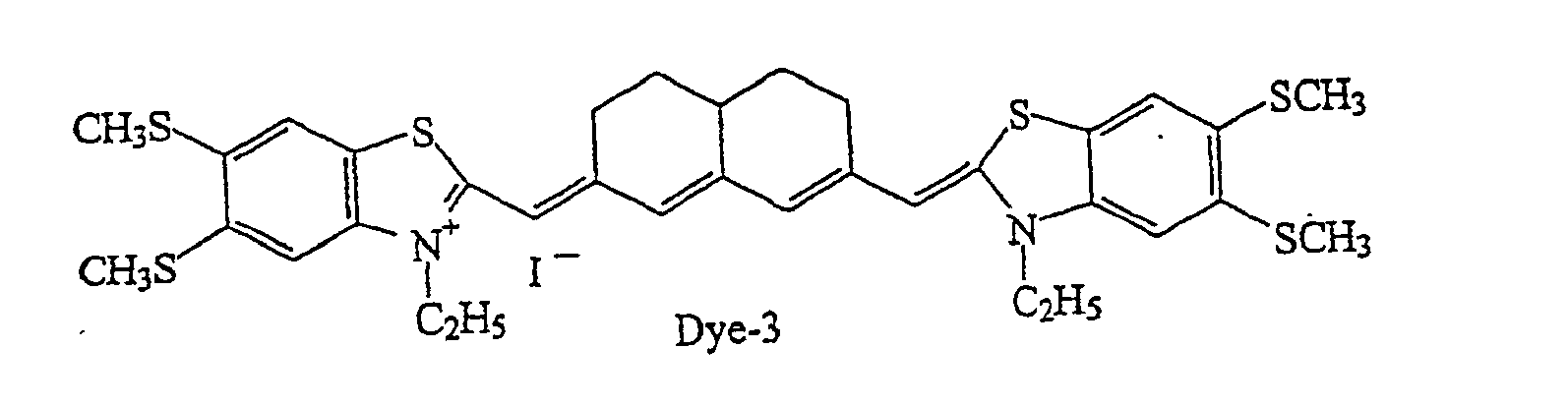

- A dry processable heat developable phothermographic element comprising a support bearing at least one photo sensitive, image-forming layer compnsing:(a) a photosensitive silver halide;(b) a non-photosensitive, reducible silver source;(c) a reducing agent for silver ions;(d) a binder; and(e) a spectrally sensitizing amount of a compound of the formula:
 X is independently a thioalkyl group of from 1 to 20 carbon atoms;D1 to D7 each independently represents a methine group and adjacent methine groups selected from D2, D3, D4, D5 and D6 may form cyclic groups;n is independently 0, 1 or 2 with the total of all n's being at least 1;R1 and R2 represent an alkyl group of from 1 to 20 carbon atoms other than carboxy-substituted alkyl; andA- is an anion.
 - The element of Claim 3, wherein at least two adjacent methine groups selected from D2, D3, D4, D5, and D6 form a carbocylic ring structure.
- The element of Claim 3, wherein said carbocyclic ring structure comprises a tetrahydronaphthyl group.
- A dry processable heat developable, photothermographic element comprising a support bearing at least one photosensitive, image-forming layer comprising:(a) a photosensitive silver halide;(b) a non-photosensitive, reducible silver source;(c) a reducing agent for silver ions;(d) a binder; and(e) a spectrally sensitizing amount of a compound of the formula:
 X is independently a thioalkyl group of from 1 to 20 carbon atoms;n is independently 0, 1 or 2 with the total of all n's being at least 1;
R1 and R2 represent an alkyl group of from 1 to 20 carbon atoms other than carboxy-substituted alkyl; andA- is an anion. - The photothermographic element according to Claim 6 wherein the silver halide is silver bromide, silver chloride, silver iodide, silver chlorobromide, silver bromoiodide, silver chlorobromoiodide, or mixtures thereof.
- The photothermographic element of claim 6 wherein reducible silver source comprises a silver salt of a fatty acid.
- The photothermographic element according to Claim 8 wherein said non-photosensitive, reducible source of silver comprises a silver salt of a C1 to C30 carboxylic acid.
- The photothermographic element according to Claim 9 wherein said non-photosensitive silver source comprises silver behenate.
- The photothermographic element of claim 6 wherein said binder is a hydrophobic polymeric binder.
- The photothermographic element of claim 11 wherein said binder is selected from the group consisting of polyvinylbutyral, cellulose acetate butyrate, cellulose acetate proprionate, and vinyl resins.
- The photothermographic element of Claim 6 wherein said binder is hydrophobic and each n is 1 or 2.
- The photothermographic element according to claim 6 wherein said reducing agent is a hindered phenol.
- The photothermographic element of claim 14 wherein said hindered phenol is selected from the group consisting of binaphthols, biphenols, bis(hydroxy-naphthyl)methanes, bis(hydroxyphenyl)methanes, hindered phenols, and naphthols.
- The photothermographic element of claim 15 wherein said hindered phenol is a bis(hydroxyphenyl)methane.
- The photothermographic element of claim 6 wherein groups R1 and R2 have from 1 to 8 carbon atoms.
- The photothermographic element of claim 17 wherein R1 and R2 represent ethyl groups.
- The photothermographic element of claim 6 wherein each X substituent independently comprises a thioalkyl group of 1 to 20 carbon atoms and each n is 1 or 2.
- The photothermographic element of claim 6 wherein the concentration of said spectrally sensitizing compound is in the range 2x10⁻⁸ to 4x10⁻² moles of dye per mole of silver in said emulsion layer.
- The photothermographic element of claims 1, 3 or 6 having a supersensitizer in the image forming layer.
- The photothermographic element of claim 1, 3 or 6 having a super sensitizer in each image forming layer, wherein said supersensitizer is selected from the group consisting of heteroaromatic mercapto or disulfide compound, mercapto-substituted benzimidazole, mercapto-substituted benzoxazoles, and mercapto-substituted benzothiazoles.
- The photothermographic element of claim 22 wherein each n is 1 or 2.
Applications Claiming Priority (3)
| Application Number | Priority Date | Filing Date | Title |
|---|---|---|---|
| US425860 | 1995-04-20 | ||
| US08425860 US5541054B1 (en) | 1995-04-20 | 1995-04-20 | Spectral sensitizing dyes for photothermographic elements |
| PCT/US1996/002802 WO1996033442A1 (en) | 1995-04-20 | 1996-02-29 | Spectral sensitizing dyes for photothermographic elements |
Publications (3)
| Publication Number | Publication Date |
|---|---|
| EP0821811A1 EP0821811A1 (en) | 1998-02-04 |
| EP0821811B1 EP0821811B1 (en) | 2002-06-19 |
| EP0821811B2 true EP0821811B2 (en) | 2006-01-25 |
Family
ID=23688336
Family Applications (1)
| Application Number | Title | Priority Date | Filing Date |
|---|---|---|---|
| EP96907151A Expired - Lifetime EP0821811B2 (en) | 1995-04-20 | 1996-02-29 | Photothermographic elements with spectral sensitizing dyes |
Country Status (7)
| Country | Link |
|---|---|
| US (1) | US5541054B1 (en) |
| EP (1) | EP0821811B2 (en) |
| JP (1) | JP3720369B2 (en) |
| KR (1) | KR19990007902A (en) |
| AU (1) | AU5090696A (en) |
| DE (1) | DE69621924T3 (en) |
| WO (1) | WO1996033442A1 (en) |
Families Citing this family (36)
| Publication number | Priority date | Publication date | Assignee | Title |
|---|---|---|---|---|
| US5763153A (en) * | 1995-10-09 | 1998-06-09 | Fuji Photo Film Co. Ltd | Photothermographic material |
| US6992188B1 (en) | 1995-12-08 | 2006-01-31 | Pfizer, Inc. | Substituted heterocyclic derivatives |
| DE19636235A1 (en) * | 1996-09-06 | 1998-03-19 | Agfa Gevaert Ag | Method and device for recording information on thermally developable photographic material |
| US6027870A (en) * | 1996-04-15 | 2000-02-22 | Fuji Photo Film Co., Ltd. | Photothermographic material |
| US6245499B1 (en) * | 1996-04-30 | 2001-06-12 | Fuji Photo Film Co., Ltd. | Photothermographic material |
| US5672332A (en) * | 1996-05-13 | 1997-09-30 | Mallinckrodt Medical, Inc. | Delta 1,2 bicyclo 4,4,0! functional dyes for contrast enhancement in optical imaging |
| US6074814A (en) * | 1996-07-24 | 2000-06-13 | Agfa-Gevaert | Photothermographic material comprising an infra-red sensitizer |
| US5958667A (en) * | 1996-07-24 | 1999-09-28 | Agfa-Gevaert | Photothermographic recording material comprising IR-sensitizing dyes |
| US5851755A (en) * | 1996-07-24 | 1998-12-22 | Agfa-Gevaert | Photothermographic material comprising at least one dye absorbing electromagnetic radiation in the wavelength range 700 to 1100NM |
| US5876915A (en) * | 1996-07-24 | 1999-03-02 | Agfa-Gevaert | Photothermographic recording material comprising sensitizing dyes and a recording process therefor |
| EP0821270A1 (en) * | 1996-07-24 | 1998-01-28 | Agfa-Gevaert N.V. | Photothermographic material comprising an infra-red sensitizer |
| EP0836116B1 (en) * | 1996-09-06 | 2001-11-28 | Agfa-Gevaert N.V. | A sensitivity-increasing recording process for a photosensitive thermally developable photographic material |
| JP3679207B2 (en) * | 1996-09-12 | 2005-08-03 | 富士写真フイルム株式会社 | Silver halide photographic material |
| JP3681840B2 (en) * | 1996-10-15 | 2005-08-10 | 富士写真フイルム株式会社 | Photothermographic material |
| US6143488A (en) * | 1996-12-30 | 2000-11-07 | Agfa-Gevaert | Photothermographic recording material coatable from an aqueous medium |
| EP0851284B1 (en) * | 1996-12-30 | 2005-06-22 | Agfa-Gevaert | Photothermographic recording material coatable from an aqueous medium |
| US5861195A (en) | 1997-01-21 | 1999-01-19 | Minnesota Mining And Manufacturing Company | Method for coating a plurality of fluid layers onto a substrate |
| AU5799298A (en) | 1997-03-31 | 1998-10-22 | Imation Corp. | Method for applying a coating onto a moving web |
| US5891615A (en) * | 1997-04-08 | 1999-04-06 | Imation Corp. | Chemical sensitization of photothermographic silver halide emulsions |
| US5939249A (en) * | 1997-06-24 | 1999-08-17 | Imation Corp. | Photothermographic element with iridium and copper doped silver halide grains |
| US6153372A (en) * | 1997-10-03 | 2000-11-28 | Fuji Photo Film Co., Ltd. | Photothermographic element |
| BR9917047A (en) * | 1998-12-14 | 2002-07-30 | Fujisawa Pharmaceutical Co | Piperazine compound, method for preparing it, pharmaceutical composition containing it and its use |
| US6630283B1 (en) | 2000-09-07 | 2003-10-07 | 3M Innovative Properties Company | Photothermographic and photographic elements having a transparent support having antihalation properties and properties for reducing woodgrain |
| US6582892B2 (en) | 2001-06-29 | 2003-06-24 | Eastman Kodak Company | Heat-stabilized IR-sensitive thermally developable imaging materials |
| US6730461B2 (en) | 2001-10-26 | 2004-05-04 | Eastman Kodak Company | Thermally developable imaging materials with reduced mottle providing improved image uniformity |
| US6689547B2 (en) | 2001-12-05 | 2004-02-10 | Eastman Kodak Company | Thermally developable imaging materials with improved image uniformity |
| US7014989B1 (en) | 2005-04-18 | 2006-03-21 | Eastman Kodak Company | Photothermographic materials containing 4-substituted urazoles |
| US7468241B1 (en) | 2007-09-21 | 2008-12-23 | Carestream Health, Inc. | Processing latitude stabilizers for photothermographic materials |
| US7524621B2 (en) | 2007-09-21 | 2009-04-28 | Carestream Health, Inc. | Method of preparing silver carboxylate soaps |
| US7622247B2 (en) | 2008-01-14 | 2009-11-24 | Carestream Health, Inc. | Protective overcoats for thermally developable materials |
| US8653445B2 (en) | 2011-10-11 | 2014-02-18 | Eastman Kodak Company | Method for viewing invisible indicia |
| US20130087740A1 (en) * | 2011-10-11 | 2013-04-11 | Thomas J. Widzinski | Infrared fluorescent composition having polyvinyl acetal binder |
| US9335623B2 (en) | 2014-03-24 | 2016-05-10 | Carestream Health, Inc. | Thermally developable imaging materials |
| US9523915B2 (en) | 2014-11-04 | 2016-12-20 | Carestream Health, Inc. | Image forming materials, preparations, and compositions |
| US9746770B2 (en) | 2015-06-02 | 2017-08-29 | Carestream Health, Inc. | Thermally developable imaging materials and methods |
| WO2017123444A1 (en) | 2016-01-15 | 2017-07-20 | Carestream Health, Inc. | Method of preparing silver carboxylate soaps |
Citations (13)
| Publication number | Priority date | Publication date | Assignee | Title |
|---|---|---|---|---|
| GB1325312A (en) † | 1969-10-03 | 1973-08-01 | Minnesota Mining & Mfg | Photo-sensitive compositions |
| JPS58145936A (en) † | 1982-02-25 | 1983-08-31 | Asahi Chem Ind Co Ltd | Thermodevelopable photosensitive material |
| US4461828A (en) † | 1983-05-13 | 1984-07-24 | Minnesota Mining And Manufacturing Company | Spectral sensitization of photothermographic elements |
| US4835096A (en) † | 1986-04-30 | 1989-05-30 | Minnesota Mining And Manufacturing Company | Sensitizers for photothermographic media |
| EP0452853A1 (en) † | 1990-04-16 | 1991-10-23 | Fuji Photo Film Co., Ltd. | Heat-developable color-sensitive material |
| US5082763A (en) † | 1988-08-05 | 1992-01-21 | Fuji Photo Film Co., Ltd. | Heat developable photosensitive material |
| JPH0519432A (en) † | 1991-07-12 | 1993-01-29 | Fuji Photo Film Co Ltd | Heat developable color photosensitive material |
| JPH0545776A (en) † | 1991-08-20 | 1993-02-26 | Konica Corp | Silver halide photographic sensitive material |
| EP0530827A2 (en) † | 1991-09-06 | 1993-03-10 | Fuji Photo Film Co., Ltd. | Image forming process |
| EP0559228A1 (en) † | 1992-03-06 | 1993-09-08 | Minnesota Mining And Manufacturing Company | Photothermographic elements |
| US5387502A (en) † | 1991-09-11 | 1995-02-07 | Fuji Photo Film Co., Ltd. | Silver halide photographic material |
| US5441866A (en) † | 1994-02-28 | 1995-08-15 | Minnesota Mining And Manufacturing Company | Sensitizers for photothermographic elements |
| WO1998045754A2 (en) † | 1997-04-08 | 1998-10-15 | Eastman Kodak Company | Chemical sensitization of photothermographic silver halide emulsions |
Family Cites Families (5)
| Publication number | Priority date | Publication date | Assignee | Title |
|---|---|---|---|---|
| US2734900A (en) * | 1953-12-28 | 1956-02-14 | Chxgh | |
| US5108882A (en) * | 1989-09-26 | 1992-04-28 | Eastman Kodak Company | Infrared-sensitive photographic element containing at least two photosensitive layers |
| US4975362A (en) * | 1989-09-26 | 1990-12-04 | Eastman Kodak Company | Infrared sensitizing dye for photographic element |
| JPH063763A (en) * | 1992-06-22 | 1994-01-14 | Canon Inc | Dry silver salt photoreceptor and image forming method |
| GB9305324D0 (en) * | 1993-03-16 | 1993-05-05 | Minnesota Mining & Mfg | Photothemographic imaging materials and sensitisers therefor |
-
1995
- 1995-04-20 US US08425860 patent/US5541054B1/en not_active Expired - Lifetime
-
1996
- 1996-02-29 DE DE69621924T patent/DE69621924T3/en not_active Expired - Lifetime
- 1996-02-29 KR KR1019970707425A patent/KR19990007902A/en not_active Withdrawn
- 1996-02-29 AU AU50906/96A patent/AU5090696A/en not_active Abandoned
- 1996-02-29 EP EP96907151A patent/EP0821811B2/en not_active Expired - Lifetime
- 1996-02-29 JP JP53171396A patent/JP3720369B2/en not_active Expired - Lifetime
- 1996-02-29 WO PCT/US1996/002802 patent/WO1996033442A1/en not_active Ceased
Patent Citations (13)
| Publication number | Priority date | Publication date | Assignee | Title |
|---|---|---|---|---|
| GB1325312A (en) † | 1969-10-03 | 1973-08-01 | Minnesota Mining & Mfg | Photo-sensitive compositions |
| JPS58145936A (en) † | 1982-02-25 | 1983-08-31 | Asahi Chem Ind Co Ltd | Thermodevelopable photosensitive material |
| US4461828A (en) † | 1983-05-13 | 1984-07-24 | Minnesota Mining And Manufacturing Company | Spectral sensitization of photothermographic elements |
| US4835096A (en) † | 1986-04-30 | 1989-05-30 | Minnesota Mining And Manufacturing Company | Sensitizers for photothermographic media |
| US5082763A (en) † | 1988-08-05 | 1992-01-21 | Fuji Photo Film Co., Ltd. | Heat developable photosensitive material |
| EP0452853A1 (en) † | 1990-04-16 | 1991-10-23 | Fuji Photo Film Co., Ltd. | Heat-developable color-sensitive material |
| JPH0519432A (en) † | 1991-07-12 | 1993-01-29 | Fuji Photo Film Co Ltd | Heat developable color photosensitive material |
| JPH0545776A (en) † | 1991-08-20 | 1993-02-26 | Konica Corp | Silver halide photographic sensitive material |
| EP0530827A2 (en) † | 1991-09-06 | 1993-03-10 | Fuji Photo Film Co., Ltd. | Image forming process |
| US5387502A (en) † | 1991-09-11 | 1995-02-07 | Fuji Photo Film Co., Ltd. | Silver halide photographic material |
| EP0559228A1 (en) † | 1992-03-06 | 1993-09-08 | Minnesota Mining And Manufacturing Company | Photothermographic elements |
| US5441866A (en) † | 1994-02-28 | 1995-08-15 | Minnesota Mining And Manufacturing Company | Sensitizers for photothermographic elements |
| WO1998045754A2 (en) † | 1997-04-08 | 1998-10-15 | Eastman Kodak Company | Chemical sensitization of photothermographic silver halide emulsions |
Non-Patent Citations (3)
| Title |
|---|
| Handbook of Imaging Materials, C-2, p. 43 to 60 † |
| Imaging Processes and Materials, Neblette's 8. Edition, C-9, P. 279-291 † |
| Research Disclosure 15248 (Leubner), Dec. 1976, p. 61, 62 † |
Also Published As
| Publication number | Publication date |
|---|---|
| DE69621924T3 (en) | 2006-07-27 |
| KR19990007902A (en) | 1999-01-25 |
| JPH11504127A (en) | 1999-04-06 |
| AU5090696A (en) | 1996-11-07 |
| US5541054B1 (en) | 1998-11-17 |
| US5541054A (en) | 1996-07-30 |
| JP3720369B2 (en) | 2005-11-24 |
| EP0821811A1 (en) | 1998-02-04 |
| DE69621924D1 (en) | 2002-07-25 |
| EP0821811B1 (en) | 2002-06-19 |
| DE69621924T2 (en) | 2003-01-02 |
| WO1996033442A1 (en) | 1996-10-24 |
Similar Documents
| Publication | Publication Date | Title |
|---|---|---|
| EP0821811B1 (en) | Photothermographic elements with spectral sensitizing dyes | |
| US5496695A (en) | Hydrazide compounds useful as co-developers for black-and-white photothermographic elements | |
| EP0914628B1 (en) | Black-and-white photothermographic and thermographic elements containing substituted propenenitrile compounds as antifoggants | |
| EP0852025B1 (en) | Black-and-white photothermographic and thermographic elements comprising n-acyl-hydrazine compounds as contrast enhancers | |
| EP0886806B1 (en) | 2-substituted malondialdehyde compounds as co-developers for black-and-white photothermographic and thermographic elements | |
| EP0852027B1 (en) | Black-and-white photothermographic and thermographic elements comprising amine compounds as contrast enhancers | |
| EP0974073B1 (en) | Chemical sensitization of photothermographic silver halide emulsions | |
| US5464738A (en) | Sulfonyl hydrazide developers for photothermographic and thermographic elements | |
| US5441866A (en) | Sensitizers for photothermographic elements | |
| US6171767B1 (en) | 1-sulfonyl-1H-benzotriazole compounds as print stabilizers in photothermographic elements | |
| WO1997043690A1 (en) | Black-and-white photothermographic and thermographic elements comprising 3-heteroaromatic-substituted acrylonitrile compounds as co-developers | |
| EP0993626B1 (en) | Photothermographic element with iridium and copper doped silver halide grains | |
| US6083681A (en) | Stabilizer compounds for photothermographic elements | |
| US6387605B1 (en) | Co-developers for black-and-white photothermographic elements | |
| EP1273967A2 (en) | Heat-stabilized IR-sensitive thermally developable imaging materials |
Legal Events
| Date | Code | Title | Description |
|---|---|---|---|
| PUAI | Public reference made under article 153(3) epc to a published international application that has entered the european phase |
Free format text: ORIGINAL CODE: 0009012 |
|
| 17P | Request for examination filed |
Effective date: 19971015 |
|
| AK | Designated contracting states |
Kind code of ref document: A1 Designated state(s): BE DE FR GB |
|
| 17Q | First examination report despatched |
Effective date: 19981008 |
|
| RAP1 | Party data changed (applicant data changed or rights of an application transferred) |
Owner name: EASTMAN KODAK COMPANY (A NEW JERSEY CORPORATION) |
|
| GRAG | Despatch of communication of intention to grant |
Free format text: ORIGINAL CODE: EPIDOS AGRA |
|
| RTI1 | Title (correction) |
Free format text: PHOTOTHERMOGRAPHIC ELEMENTS WITH SPECTRAL SENSITIZING DYES |
|
| GRAG | Despatch of communication of intention to grant |
Free format text: ORIGINAL CODE: EPIDOS AGRA |
|
| GRAH | Despatch of communication of intention to grant a patent |
Free format text: ORIGINAL CODE: EPIDOS IGRA |
|
| RBV | Designated contracting states (corrected) |
Designated state(s): BE DE FR GB |
|
| GRAH | Despatch of communication of intention to grant a patent |
Free format text: ORIGINAL CODE: EPIDOS IGRA |
|
| GRAA | (expected) grant |
Free format text: ORIGINAL CODE: 0009210 |
|
| AK | Designated contracting states |
Kind code of ref document: B1 Designated state(s): BE DE FR GB |
|
| REG | Reference to a national code |
Ref country code: GB Ref legal event code: FG4D |
|
| REF | Corresponds to: |
Ref document number: 69621924 Country of ref document: DE Date of ref document: 20020725 |
|
| ET | Fr: translation filed | ||
| PLBI | Opposition filed |
Free format text: ORIGINAL CODE: 0009260 |
|
| 26 | Opposition filed |
Opponent name: AGFA-GEVAERT N.V. Effective date: 20030310 |
|
| PLBF | Reply of patent proprietor to notice(s) of opposition |
Free format text: ORIGINAL CODE: EPIDOS OBSO |
|
| PLAX | Notice of opposition and request to file observation + time limit sent |
Free format text: ORIGINAL CODE: EPIDOSNOBS2 |
|
| PLBB | Reply of patent proprietor to notice(s) of opposition received |
Free format text: ORIGINAL CODE: EPIDOSNOBS3 |
|
| PGFP | Annual fee paid to national office [announced via postgrant information from national office to epo] |
Ref country code: GB Payment date: 20050110 Year of fee payment: 10 |
|
| PGFP | Annual fee paid to national office [announced via postgrant information from national office to epo] |
Ref country code: FR Payment date: 20050202 Year of fee payment: 10 |
|
| PUAH | Patent maintained in amended form |
Free format text: ORIGINAL CODE: 0009272 |
|
| STAA | Information on the status of an ep patent application or granted ep patent |
Free format text: STATUS: PATENT MAINTAINED AS AMENDED |
|
| 27A | Patent maintained in amended form |
Effective date: 20060125 |
|
| AK | Designated contracting states |
Kind code of ref document: B2 Designated state(s): BE DE FR GB |
|
| PG25 | Lapsed in a contracting state [announced via postgrant information from national office to epo] |
Ref country code: GB Free format text: LAPSE BECAUSE OF NON-PAYMENT OF DUE FEES Effective date: 20060228 |
|
| GBPC | Gb: european patent ceased through non-payment of renewal fee |
Effective date: 20060228 |
|
| PGFP | Annual fee paid to national office [announced via postgrant information from national office to epo] |
Ref country code: BE Payment date: 20070302 Year of fee payment: 12 |
|
| PG25 | Lapsed in a contracting state [announced via postgrant information from national office to epo] |
Ref country code: FR Free format text: LAPSE BECAUSE OF FAILURE TO SUBMIT A TRANSLATION OF THE DESCRIPTION OR TO PAY THE FEE WITHIN THE PRESCRIBED TIME-LIMIT Effective date: 20070316 |
|
| PG25 | Lapsed in a contracting state [announced via postgrant information from national office to epo] |
Ref country code: FR Free format text: LAPSE BECAUSE OF FAILURE TO SUBMIT A TRANSLATION OF THE DESCRIPTION OR TO PAY THE FEE WITHIN THE PRESCRIBED TIME-LIMIT Effective date: 20060228 |
|
| BERE | Be: lapsed |
Owner name: CARESTREAM HEALTH INC. Effective date: 20080228 |
|
| REG | Reference to a national code |
Ref country code: FR Ref legal event code: TP |
|
| PG25 | Lapsed in a contracting state [announced via postgrant information from national office to epo] |
Ref country code: BE Free format text: LAPSE BECAUSE OF NON-PAYMENT OF DUE FEES Effective date: 20080228 |
|
| PGFP | Annual fee paid to national office [announced via postgrant information from national office to epo] |
Ref country code: DE Payment date: 20150227 Year of fee payment: 20 |
|
| REG | Reference to a national code |
Ref country code: DE Ref legal event code: R071 Ref document number: 69621924 Country of ref document: DE |