EP0820176B1 - Verfahren und Vorrichtung zum Begrenzen des Zugriffs auf private Information in Domain Name Systemen durch Informationsfilterung - Google Patents
Verfahren und Vorrichtung zum Begrenzen des Zugriffs auf private Information in Domain Name Systemen durch Informationsfilterung Download PDFInfo
- Publication number
- EP0820176B1 EP0820176B1 EP97304969A EP97304969A EP0820176B1 EP 0820176 B1 EP0820176 B1 EP 0820176B1 EP 97304969 A EP97304969 A EP 97304969A EP 97304969 A EP97304969 A EP 97304969A EP 0820176 B1 EP0820176 B1 EP 0820176B1
- Authority
- EP
- European Patent Office
- Prior art keywords
- domain
- information
- com
- name
- att
- Prior art date
- Legal status (The legal status is an assumption and is not a legal conclusion. Google has not performed a legal analysis and makes no representation as to the accuracy of the status listed.)
- Expired - Lifetime
Links
Images






Classifications
-
- H—ELECTRICITY
- H04—ELECTRIC COMMUNICATION TECHNIQUE
- H04L—TRANSMISSION OF DIGITAL INFORMATION, e.g. TELEGRAPHIC COMMUNICATION
- H04L61/00—Network arrangements, protocols or services for addressing or naming
- H04L61/35—Network arrangements, protocols or services for addressing or naming involving non-standard use of addresses for implementing network functionalities, e.g. coding subscription information within the address or functional addressing, i.e. assigning an address to a function
-
- H—ELECTRICITY
- H04—ELECTRIC COMMUNICATION TECHNIQUE
- H04L—TRANSMISSION OF DIGITAL INFORMATION, e.g. TELEGRAPHIC COMMUNICATION
- H04L61/00—Network arrangements, protocols or services for addressing or naming
- H04L61/45—Network directories; Name-to-address mapping
- H04L61/4505—Network directories; Name-to-address mapping using standardised directories; using standardised directory access protocols
- H04L61/4511—Network directories; Name-to-address mapping using standardised directories; using standardised directory access protocols using domain name system [DNS]
-
- H—ELECTRICITY
- H04—ELECTRIC COMMUNICATION TECHNIQUE
- H04L—TRANSMISSION OF DIGITAL INFORMATION, e.g. TELEGRAPHIC COMMUNICATION
- H04L63/00—Network architectures or network communication protocols for network security
- H04L63/02—Network architectures or network communication protocols for network security for separating internal from external traffic, e.g. firewalls
- H04L63/0227—Filtering policies
-
- H—ELECTRICITY
- H04—ELECTRIC COMMUNICATION TECHNIQUE
- H04L—TRANSMISSION OF DIGITAL INFORMATION, e.g. TELEGRAPHIC COMMUNICATION
- H04L63/00—Network architectures or network communication protocols for network security
- H04L63/02—Network architectures or network communication protocols for network security for separating internal from external traffic, e.g. firewalls
- H04L63/0281—Proxies
Definitions
- This invention relates to restricting access to private information in domain name systems.
- a domain name is a sequence of domain names separated by periods.
- research.att.com is a domain name.
- Com is a top level domain name of a top level domain
- att is a second level domain name of a second level domain
- research is a third level domain name of a third level domain.
- a device in a domain is labeled by the name of the device followed by the domain name.
- server a device labeled "server" in the research.att.com domain has the name, server.research.att.com.
- a device name is also referred to as a domain name.
- IP addresses are 32-bit numbers that are expressed as four 8-bit values separated by periods such as 191.192.193.2.
- IP addresses contain information such as network ID of a device network connection and a device ID.
- the IP address are assigned by an address authority.
- the addresses are assigned in blocks to authoritative address servers.
- the IP addresses relate to each other also in a hierarchical manner, however, the domain name hierarchy and the IP address hierarchy are not directly related to each other. While some name servers are also address servers, name and address servers do not have to be the same device. Thus, it is possible for a server to have authority to resolve a domain name into a corresponding IP address of a device, the same name server may not be able to resolve the IP address to the corresponding domain name of the same device. Thus, resolution of IP addresses to domain names follows a similar process as resolving domain names to IP addresses except different servers may be involved.
- IP addresses are numerical and, unlike a domain name, are assigned without regard to the logical and hierarchial organization of the DNS, domain names are generally used in instructions for functions such as data transfers.
- a data transfer instruction identifies the receiving device by its domain name.
- the domain name must be translated into a corresponding IP address before the data transfer can occur.
- Domain names are managed by authoritative devices called name servers.
- Name servers translate domain names into corresponding IP addresses and vice-versa.
- a first device desires to transfer a message to a second device known only by its domain name, the first device must query a name server to acquire the corresponding IP address to the known domain name of the second device.
- WO 96/13113 on which the preamble of claim 1 is based, discloses a subsystem in a domain name system for filtering information.
- the subsystem able to block malicious software, and so prevent such software from entering a protected domain.
- the filter of WO 96/13113 is not able to filter information relating to domain names or IP addresses of the protected domain from messages received in the protected domain from a source external to the protected domain. It will therefore not detect an attempt to gain unauthorised access to the protected domain by providing false address resolution information to a device in the protected domain.
- a first aspect of the present invention provides an apparatus for use in a domain name system, comprising: a filtering device adapted to receive information from a first device of a first domain destined to a second device of a second domain; characterised in that the filtering device is adapted to generate filtered information by removing private information of the second domain from the information received from the first device, the private information of the second domain including at least one of a domain name and an IP address of a device of the second domain, and is adapted to forward the filtered information to the second device of the second domain.
- a second aspect of the invention provides a method of operation of an apparatus in a domain name system for filtering information, the method comprising: receiving the information from a first device of a first domain destined to a second device of a second domain; the method being characterised in that it further comprises: generating filtered information by removing private information of the second domain from the information received from the first device, the private information of the second domain including at least one of a domain name and an IP address of a device of the second domain; and forwarding the filtered information to the second device of the second domain.
- An intruder gains access to information private to a domain by taking advantage of the domain name resolution process used by DNSs. Because instructions for functions such as data transfers use domain names to specify destination devices, the domain names must be translated (resolved) into IP addresses before a data transfer can occur. The intruder takes advantage of the process for resolving domain names into IP addresses to gain access to private information. In particular, the intruder passes corrupted IP addresses and/or domain names to a target domain so that normal name resolutions produces the IP address of the intruder's device instead of an intended destination device.
- the invention prevents the intruder from gaining access to private information of a domain by removing any possibility for a device within the domain to receive private information from a device external to the domain.
- the invention provides a DNS proxy device that performs a filtering function.
- the filtering function of the DNS proxy receives communication from devices external to the domain.
- the communication is examined for private information such as domain names and/or IP addresses.
- the DNS proxy filters any private information received from the external devices that may corrupt name and address resolutions within the domain by removing the private information. Only the filtered communication is forwarded to the destination devices within the domain.
- the invention provides an apparatus for use in a DNS that restricts access to private information of a first domain.
- the apparatus includes a filtering device.
- the filtering device examines the received data and removes any information that is deemed private to the first domain.
- the devices in the first domain receives private information only from sources which are also in the first domain and is prevented from receiving private information from the second domain which may be corrupted.
- FIG. 1 shows a physical connection for a distributive system 20 including network 10 and devices 102, 104 and 106.
- the distributive system 20 may be organized as a domain name system (DNS) 30 as shown in Fig. 2.
- DNS domain name system
- the DNS 30 has a root 100 that holds the highest level authority for domain names in the DNS 30.
- the root may assign domain names such as edu, com and gov representing educational institutions, commercial institutions and government institutions, respectively. Each of these domains may be further divided into other domains such as purdue.edu, att.com and nrl.gov.
- the root 100 may delegate name authority for domains to other devices called authoritative name servers.
- the domain att.com may be owned and controlled by AT&T Corp. AT&T Corp. may designate devices to be authoritative name servers which has authority to assign and manage names within the att.com domain.
- the complete DNS 30 may be divided into a plurality of domains in which the naming authority in each domain is vested in authoritative name servers of that domain.
- Authoritative name servers may delegate its name authority to yet other servers within its domain.
- the att.com domain may have a device named server.att.com as an authoritative name server that has authority for domain names under att.com.
- Att.com may have a subdomain called research.att.com and server.att.com may delegate the name authority for the research.att.com subdomain to a device named server.research.att.com.
- Subdomains are also called domains.
- server.research.att.com has name authority for device names in the research.att.com domain such as ws1.research.att.com for device 102 and ws2.research.att.com for device 104.
- Server.buzbiz.com may be an authoritative name server for the buzbiz.com domain.
- the buzbiz.com domain may contain a device such as device 106 having the name intru.buzbiz.com.
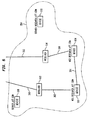
- Figure 3 shows the DNS 30 divided into domains purdue.edu 202, att.com 204, buzbiz.com 206, nrl.gov 208 and root 210.
- the root domain 101 is shown to include domains edu, com and gov.
- the domains edu, com and gov may be delegated by the root name server 100 to other authoritative name servers, however, in this case, a single name server, root 100, retains the authority for domains edu, com and gov.
- FIG. 4 shows the IP addresses of devices 102, 104 and 106.
- device 106 In order to transfer data from device 106 to device 102, device 106 must specify 192.193.194.1 as the destination IP address.
- Every device in the DNS 30 has at least one IP address.
- the domain 204 includes devices 102, 104, 108 and 110. Each of the above devices has a domain name and an IP address.
- Server.research.att.com is the name of the device 110 having the IP address of 192.203.194.3 and server.research.att.com is an authoritative name server for the research.att.com domain 210.
- the research.att.com domain 210 includes devices 102 and 104 having IP addresses 192.193.194.1 and 192.193.194.2, respectively.
- each device in the DNS 30 has a domain name and an IP address
- two translation tables can be constructed, for example, see Table 1 and Table 2 below.
- Table 1 of domain names has for each domain name a corresponding IP address
- Table 2 of IP addresses has for each IP address a corresponding domain name. If Table 1 is sorted by the domain name and Table 2 is sorted by the IP addresses, Table 1 may be used to quickly determine the IP address for a domain name and Table 2 may be used to quickly determine the domain name for an IP address.
- Each name server contains tables corresponding to Table 1 and Table 2 for all the devices for which it has name authority. Because authoritative name servers contain this information, other devices send get-address and get-name requests to the authoritative name servers to provide IP addresses of domain names and domain names of IP addresses, respectively, under its authority.
- a first device When a first device receives an instruction to send data to a second device known by its domain name, the first device sends a query request to an authoritative name server of the second device for the IP address of the second device.
- the authoritative name server either returns the requested information or if the name authority has been delegated, the authoritative name server returns the name of another authoritative name server that has the information.
- the first device After obtaining the IP address, the first device incorporates the IP address into a message containing the data and sends the message to the second device.
- file servers retain domain names and IP addresses so that devices local to the file servers can gain easy access to names of other local devices.
- These file servers are also called name servers or resolvers for resolving domain names with IP addresses and vice-versa.
- authoritative name servers also accumulate IP addresses and corresponding domain names to facilitate efficient resolution of domain names to IP addresses and vice-versa.
- authoritative name servers are also referred to as resolvers for resolving domain names.
- name servers In a further effort to improve the efficiency of the DNS 30, name servers often pass on "additional information" such as IP addresses of other related devices and their domain names by appending the additional information to query request responses. Resolvers receive and store the additional information in the cache memories for future address resolutions.
- Figure 6 shows that the domain 204 further includes resolvers 112 and 114.
- Devices 102 and 104 send query requests to resolvers 112 and 114 via communication lines 302 and 308 respectively to resolve domain names into IP addresses.
- the resolvers 112 and 114 are physically located close to the devices 102 and 104, respectively.
- the resolvers 112 and 114 may be on the same LAN or closely connected in a single building to the devices 102 and 104, respectively.
- address resolution required by the devices 102 and 104 may be performed without any network traffic beyond local LAN connections.
- the resolvers 112 and 114 resolves domain names by receiving IP addresses not obtained from an authoritative source, the IP addresses are offered to the querying device as unauthorized. Many times the querying device decides to use the IP address anyway because the DNS 30 in general does not change that quickly.
- each of the resource records includes a time-to-live field that indicates the lifetime of each resource record.
- the resolvers 112 and 114 discard resource records periodically when the time-to-live value of the resource records expire.
- the time-to-live values are set by the name server that has authority over the contents of the resource record such as the IP address.
- Att.com may be a domain owned and controlled by the AT&T Corp. Thus, all the devices controlled by the AT&T Corp. are within the att.com domain.
- the AT&T Corp. may distribute the devices in the att.com domain in sites which are physically distant from each other. For example, device 102 and resolver 112, may be located in one site and device 104 and resolver 114 may be located at another site.
- the communication paths 302, 304 and 308 represent intercommunication between devices within the att.com domain even though communication path 304 is between geographically two distant locations.
- Communication paths 310 and 312 represent communication paths between the resolvers 112 and 114 within the att.com domain and devices of other domains.
- Private information of a domain is information that describes something about that domain.
- the authority to change the private information lies within the domain. For example, IP addresses and domain names are private information within the domain.
- Devices such as a firewall 402, as shown in Fig. 7, is installed to control data transfers in and out of the domain 204.
- Communication paths 310 and 312 pass through the firewall 402 before reaching devices outside the domain 204 through communication line 316.
- the firewall 402 prevents unauthorized transfer of private information out of the domain 204 and denies requests from devices external to the domain 204 for information that is private to the domain 204.
- an intruder has identified a target device, a user name to impersonate and a device trusted by the target device so that a password is not necessary for the trusted device to login to the target device.
- the intruder may be able to identify target devices from mail messages or news articles. Once the target device is identified, the intruder may use standard services such as simple network management protocol (SNMP) to examine the target device to discover other devices that are connected to the target device.
- SNMP simple network management protocol
- services such as "finger” provides personal information about either an individual user or other user's logged onto a system.
- mail headers often indicate the name of a file server that is an apparent sender of the mail and the name of the actual device that originated the mail which typically is the name of a workstation.
- file servers and workstations served by the file server communicate without using passwords. Thus, the intruder may obtain all the required information using standard available services.
- the intruder has the ability to modify any of the files in intru.buzbiz.com. If the intruder has identified ws1.research.att.com as a target and has also identified ws2.research.att.com as a device trusted by ws1.research.att.com, then the intruder may modify the translation table, similar to Table 2, used to convert IP addresses to corresponding domain names so that the IP address of intru.buzbiz.com (201.202.203.1) corresponds to the domain name ws2.research.att.com. After modifying the translation table, the intruder then attempts to login to ws1.research.att.com as a trusted device using an rlogin procedure and providing 201.202.203.1 as the IP address of ws2.research.att.com.
- ws1.research.att.com executes a get-name request for the IP address 201.202.203.1 to obtain the corresponding domain name.
- the get-name request is eventually routed to intru.buzbiz.com because intru.buzbiz.com is the authoritative address server for the 201.202.203.1 IP address and has the table to convert 201.202.203.1 to its corresponding domain name.
- the table has been modified to output ws2.research.att.com instead of intru.buzbiz.com in response to a get-name request for IP address 201.202.203.1, the erroneous domain name of ws2.research.att.com is returned.
- ws1.research.att.com receives ws2.research.att.com as the domain name of the device corresponding to the rlogin request. Since ws2.research.att.com is a trusted machine, ws1.research.att.com accepts the rlogin request and permits the intruder to login to ws1.research.att.com. Accordingly, the intruder gains access to all the private information reachable from within ws1.research.att.com.
- Another technique for gaining unauthorized access to private information is to poison the cache memory of a resolver such as resolver 112.
- the intruder by various methods induces ws1.research.att.com to query intru.buzbiz.com for information.
- Ws1.research.att.com sends a get-address request to resolver 112 to obtain the IP address of the intruding device intru.buzbiz.com. Since the resolver 112 does not have any information regarding intru.buzbiz.com, it outputs a get-address request to a name server for intru.buzbiz.com, which in this case is intru.buzbiz.com itself.
- Intru.buzbiz.com returns the requested IP address but appends additional information which indicates that the IP address of ws2.research.att.com is associated with IP address 201.202.203.1 instead of the legitimate IP address 192.193.194.2.
- the intruder sets a very short time-to-live for the additional information so that the resolver 112 will erase the corrupted resource record soon after the intruder completes the unauthorized access.
- the resolver accepts the response from intru.buzbiz.com and, as discussed earlier, enters the IP address for intru.buzbiz.com into its cache as well as the corrupted IP address 201.202.203.1 for ws2.research.att.com.
- the cache memory of resolver 112 is poisoned with the corrupted IP address for ws2.research.att.com.
- intru.buzbiz.com logins to ws1.research.att.com using 201.202.203.1 as the IP address.
- the resolver 112 returns ws2.research.att.com based on the information in its poisoned cache.
- Ws1.research.att.com grants the rlogin request by the intruder because ws2.research.att.com is a trusted device.
- the resolver 112 discards the resource record erasing any trace of the intrusion.
- the intruder has again successfully gained access to all the private information from within ws1.research.att.com.
- the intruder is not restricted to using the rlogin procedure as discussed above. For example, once the corrupted IP address is accepted by the resolver 112 or ws1.research.att.com, the intruder may choose to intercept any messages sent by ws1.research.att.com to ws2.research.att.com. The interception is possible because the resolver 112 returns to ws1.research.att.com the IP address corresponding intru.buzbiz.com instead of the IP address of ws2.research.att.com.
- the intruder may forward the data to ws2.research.att.com so that the communication between ws1.research.att.com and ws2.research.att.com continues without being modified.
- the intruder may intercept private information such as passwords with little chance of being detected.
- the unauthorized access to private information by the intruder described above is achieved because devices within the domain 204 receives an IP address of other devices in the domain 204 from an unreliable source external to the domain 204.
- the present invention prevents corrupted private information such as IP addresses from entering a domain by preventing two types of communications from occurring as discussed below.
- the filter device 502 receives messages 520 from devices external to the domain 204.
- the filter device 502 examines the received messages 520 for any information that is private to domain 204 such as IP addresses and domain names and deletes the private information from the messages. Then the filtered messages 522 are forwarded to the destination devices in domain 204.
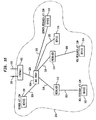
- Figure 10 shows that the domain 204 includes a DNS proxy device 404.
- the DNS proxy 404 performs the switching and filtering functions described above.
- the devices within the domain 204 are modified to direct all queries to the DNS proxy 404.
- the DNS proxy 404 examines all query requests from devices in the domain 204 and separates requests for information private to the domain 204 and requests for other information. Requests for private information are redirected to name servers within the domain 204 such as server.att.com and server.research.att.com. Queries for information other than private information are forwarded to the firewall 402 through communication path 328 which in turn forwards the request to external sources through communication path 316.
- the embodiment shown in Fig. 10 requires modification of the software of devices such as resolvers 112 and 114 and device 116 to redirect query requests to the DNS proxy 404 instead of an appropriate name server external to the domain 204.
- the device 116 is not a name server but has the ability to communicate with external sources directly through communication path 322. This embodiment redirects the communication paths 318, 320 and 322 to the DNS proxy 404.
- Information received from external sources through communication path 330 is filtered by the DNS proxy 404.
- the DNS proxy 404 examines all the information entering domain 204 and filters out any information that is private to the domain 204 such as IP addresses of devices within the domain 204.
- the private information included in the information supplied by the external sources is deleted before the information is forwarded to the destination device within the domain 204. Thus any attempt to append corrupted IP addresses to legitimate responses to query requests are eliminated.
- Information received from the external sources through communication path 330 may also be deleted or modified for local security administrative policies. For example, if the information received from the external sources include pointers to name servers outside of the domain 204 and the pointers must be deleted before forwarding the information to a destination device within the domain 204. Otherwise, devices within the domain 204 may attempt to contact these name servers directly without the intervention of the DNS proxy 404. Conversely, pointers to name servers within the domain 204 may be inserted into the information received from external sources so that future name or address queries internal to the domain 204 may be resolved directly, without the aid of the DNS proxy 404.
- information such as electronic mail exchange records received from the external sources may be modified to redirect outbound electronic mail to a logging device (not shown) within the domain 204 to maintain a log record.
- the log record provides additional information to assist the protection of private information within the domain 204.
- FIG 11 shows that the DNS proxy 404 is incorporated into the firewall 402.
- none of the programs of the devices within the domain 204 need to be modified. All the query requests continue to be directed to external sources through communication paths 310, 312 and 322.
- the DNS proxy within the firewall 402 switches all query requests for private information of the domain 204 to either server.att.com or server.research.att.com, for example, through communication paths 324 and 326, respectively.
- Information input from external sources through communication paths 322 are filtered to delete any private information before forwarding to the destination devices within the domain 204.
- FIG 12 shows a process of the DNS proxy 404 performing the switching function.
- the DNS proxy 404 receives query requests directed to devices external to the domain 204 and goes to step S1002.
- the DNS proxy 404 examines each query request to determine if private information is being solicited from the devices external to the domain 204. Then the DNS proxy 404 goes to step S1004.
- the DNS proxy 404 goes to step S1006 if private information was requested; otherwise, the DNS proxy 404 goes to step S1010.
- step S1006 the DNS proxy 404 separates requests for private information of the domain 204 from requests for information not private to the domain 204. Then the DNS proxy 404 goes to step S1008. In step 51008, the DNS proxy 404 redirects all requests for private information to a device within the domain 204 such as a name server of the domain 204. Then the DNS proxy goes to step S1010.
- step S1010 the DNS proxy 404 forwards all requests for information not private to the domain 204 to the device external to the domain 204. Then the DNS proxy 404 goes to step S1012 and ends the process.
- FIG 13 shows the process of the DNS proxy 404 for filtering communication received from a device external to the domain 204.
- the DNS proxy 404 receives the communication from the external device and goes to step S2002.
- the DNS proxy 404 examines the communication for private information and goes to step S2004.
- the DNS proxy 404 goes to step S2006 if private information was discovered in the communication from the external device; otherwise, the DNS proxy 404 goes to step S2008.
- step S2006 the DNS proxy 404 filters the communication by removing all private information from the communication and goes to step S2008.
- step S2008 the DNS proxy 404 forwards the filtered communication to the destination device within the domain 204, goes to step 52010 and ends the process.
Landscapes
- Engineering & Computer Science (AREA)
- Computer Networks & Wireless Communication (AREA)
- Signal Processing (AREA)
- Computer Hardware Design (AREA)
- Computer Security & Cryptography (AREA)
- Computing Systems (AREA)
- General Engineering & Computer Science (AREA)
- Data Exchanges In Wide-Area Networks (AREA)
- Computer And Data Communications (AREA)
Claims (8)
- Vorrichtung zur Verwendung in einem Domänennamensystem, umfassend:dadurch gekennzeichnet, dass die Filtereinrichtung ausgelegt ist, um gefilterte Information durch Entfernen von privater Information der zweiten Domäne von der Information, die von der ersten Einrichtung empfangen wird, zu erzeugen, wobei die private Information der zweiten Domäne (204) wenigstens einen Domänennamen und/oder eine IP-Adresse einer Einrichtung (104) der zweiten Domäne (204) einschließt, und ausgelegt ist, um die gefilterte Information an die zweite Einrichtung (102) der zweiten Domäne (204) weiterzuleiten.eine Filtereinrichtung (404, 502), die dafür ausgelegt ist, um Information von einer ersten Einrichtung (106) einer ersten Domäne (206) bestimmt für eine zweite Einrichtung (102) einer zweiten Domäne (204) zu empfangen;
- Vorrichtung nach Anspruch 1, wobei die Information von der ersten Einrichtung (106) der ersten Domäne (206) im Ansprechen auf eine Abfrageanforderung durch die zweite Einrichtung (102) der zweiten Domäne (204) ist und zusätzlich Information einschließt, die durch die zweite Einrichtung der zweiten Domäne nicht angefordert wird, und die Filtereinrichtung (404, 502) ausgelegt ist, um die private Information der zweiten Domäne von der zusätzlichen Information, die durch die zweite Einrichtung der zweiten Domäne nicht angefordert wird, zu entfernen.
- Vorrichtung nach Anspruch 1, wobei die Filtereinrichtung ausgelegt ist, um gefilterte Information durch Modifizieren der Information auf Grundlage von lokalen Sicherheitsverwaltungs-Strategien zu erzeugen.
- Vorrichtung nach Anspruch 3, wobei die Filtereinrichtung ausgelegt ist, um die gefilterte Information auf Grundlage der lokalen Sicherheitsverwaltungs-Strategien durch entweder (a) Ersetzen eines Zeigers auf eine Einrichtung der ersten Domäne in der von der ersten Einrichtung der ersten Domäne empfangenen Information durch einen Zeiger auf eine Einrichtung der zweiten Domäne zu ersetzen, oder (b) Modifizieren einer Postaustauschaufzeichnung, die von der ersten Einrichtung der ersten Domäne empfangen wird, oder durch sowohl (a) als auch (b) zu erzeugen.
- Verfahren zum Betrieb einer Vorrichtung (404, 502) in einem Domänennamensystem zum Filtern von Information, wobei das Verfahren umfasst:wobei das Verfahren dadurch gekennzeichnet ist, dass es weiter umfasst:Empfangen der Information von einer ersten Einrichtung (106) in der ersten Domäne (206) bestimmt für eine zweite Einrichtung (102) einer zweiten Domäne (204);Erzeugen von gefilterter Information durch Entfernen von privater Information der zweiten Domäne (204) von der Information, die von der ersten Einrichtung (103) empfangen wird, wobei die private Information der zweiten Domäne (204) wenigstens einen Domänennamen und/oder eine IP-Adresse einer Einrichtung (104) der zweiten Domäne (204) einschließt; undWeiterleiten der gefilterten Information an die zweite Einrichtung (102) der zweiten Domäne (204).
- Verfahren nach Anspruch 5, wobei die Information durch die erste Einrichtung (106) der ersten Domäne (206) im Ansprechen auf eine Abfrageanforderung durch die zweite Einrichtung (102) der zweiten Domäne (204) gesendet wird, wobei die Information zusätzliche Informationen einschließt, die durch die zweite Einrichtung der zweiten Domäne nicht angefordert wird, wobei der Schritt zum Erzeugen von gefilterter Information umfasst:Entfernen der privaten Information der zweiten Domäne von der zusätzlichen Information, die durch die zweite Einrichtung der zweiten Domäne nicht angefordert wird.
- Verfahren nach Anspruch 5, ferner umfassend:Modifizieren der Information auf Grundlage von lokalen Sicherheitsverwaltungs-Strategien.
- Verfahren nach Anspruch 7, wobei die lokalen Sicherheitsverwaltungs-Strategien entweder (a) ein Ersetzen eines Zeigers auf eine Einrichtung der ersten Domäne in der von der ersten Einrichtung der ersten Domäne empfangenen Information durch einen Zeiger auf eine Einrichtung in der zweiten Domäne oder (b) Modifizieren einer Postaustauschaufzeichnung, die von der ersten Einrichtung der ersten Domäne empfangen wird, oder sowohl (a) als auch (b) sind.
Applications Claiming Priority (4)
| Application Number | Priority Date | Filing Date | Title |
|---|---|---|---|
| US679466 | 1996-07-15 | ||
| US08/679,466 US5805820A (en) | 1996-07-15 | 1996-07-15 | Method and apparatus for restricting access to private information in domain name systems by redirecting query requests |
| US08/683,019 US5958052A (en) | 1996-07-15 | 1996-07-16 | Method and apparatus for restricting access to private information in domain name systems by filtering information |
| US683019 | 1996-07-16 |
Publications (3)
| Publication Number | Publication Date |
|---|---|
| EP0820176A2 EP0820176A2 (de) | 1998-01-21 |
| EP0820176A3 EP0820176A3 (de) | 1999-02-24 |
| EP0820176B1 true EP0820176B1 (de) | 2005-09-14 |
Family
ID=27102241
Family Applications (1)
| Application Number | Title | Priority Date | Filing Date |
|---|---|---|---|
| EP97304969A Expired - Lifetime EP0820176B1 (de) | 1996-07-15 | 1997-07-08 | Verfahren und Vorrichtung zum Begrenzen des Zugriffs auf private Information in Domain Name Systemen durch Informationsfilterung |
Country Status (2)
| Country | Link |
|---|---|
| EP (1) | EP0820176B1 (de) |
| DE (1) | DE69734179T2 (de) |
Families Citing this family (9)
| Publication number | Priority date | Publication date | Assignee | Title |
|---|---|---|---|---|
| GB2357227B (en) | 1999-12-08 | 2003-12-17 | Hewlett Packard Co | Security protocol |
| GB2357228B (en) | 1999-12-08 | 2003-07-09 | Hewlett Packard Co | Method and apparatus for discovering a trust chain imparting a required attribute to a subject |
| GB2357226B (en) | 1999-12-08 | 2003-07-16 | Hewlett Packard Co | Security protocol |
| GB2357225B (en) | 1999-12-08 | 2003-07-16 | Hewlett Packard Co | Electronic certificate |
| GB2363297B (en) * | 2000-06-09 | 2004-04-07 | Hewlett Packard Co | Secure network communications |
| GB2408368B (en) * | 2000-08-18 | 2005-07-06 | Smart Media Ltd | Apparatus, system and method for enhancing data security |
| FR2860366A1 (fr) * | 2003-09-26 | 2005-04-01 | France Telecom | Systeme de telecommunication mettant en oeuvre une resolution de noms de domaine securisee |
| GB0322891D0 (en) * | 2003-09-30 | 2003-10-29 | Nokia Corp | Communication method |
| WO2019165492A1 (en) * | 2018-03-02 | 2019-09-06 | Kakku Pte. Ltd | System and method for controlled delivery of on-line media advertising |
Family Cites Families (3)
| Publication number | Priority date | Publication date | Assignee | Title |
|---|---|---|---|---|
| US4754395A (en) * | 1985-05-06 | 1988-06-28 | Computer X, Inc. | Network interface module with minimized data paths |
| FR2686755A1 (fr) * | 1992-01-28 | 1993-07-30 | Electricite De France | Procede de chiffrement de messages transmis entre reseaux interconnectes, appareil de chiffrement et dispositif de communication de donnees chiffrees mettant en óoeuvre un tel procede. |
| US5864683A (en) * | 1994-10-12 | 1999-01-26 | Secure Computing Corporartion | System for providing secure internetwork by connecting type enforcing secure computers to external network for limiting access to data based on user and process access rights |
-
1997
- 1997-07-08 EP EP97304969A patent/EP0820176B1/de not_active Expired - Lifetime
- 1997-07-08 DE DE69734179T patent/DE69734179T2/de not_active Expired - Fee Related
Also Published As
| Publication number | Publication date |
|---|---|
| EP0820176A3 (de) | 1999-02-24 |
| DE69734179D1 (de) | 2005-10-20 |
| EP0820176A2 (de) | 1998-01-21 |
| DE69734179T2 (de) | 2006-06-29 |
Similar Documents
| Publication | Publication Date | Title |
|---|---|---|
| EP0825748B1 (de) | Verfahren und Vorrichtung zum Begrenzen des Zugriffes an privater Information in Domänennamensystemen durch Umleitung von Abfrageanforderungen | |
| JP2006262532A5 (de) | ||
| CN116015865B (zh) | 用于网络安全应用的高效加密sni过滤的方法和系统 | |
| US6961783B1 (en) | DNS server access control system and method | |
| US7249376B2 (en) | Firewall providing enhanced network security and user transparency | |
| Schuba et al. | Addressing weaknesses in the domain name system protocol | |
| US7792995B2 (en) | Accessing data processing systems behind a NAT enabled network | |
| US6324585B1 (en) | Method and apparatus for domain name service request resolution | |
| EP4022876B1 (de) | Verhindung eines netzworkprotokolls über einen verschlüsselten kanal und entsprechende anwendungen | |
| GB2340702A (en) | Accessing a server in a virtual private network protected by a firewall | |
| WO1998031124A9 (en) | Reverse proxy server | |
| Dooley et al. | DNS Security Management | |
| EP0820176B1 (de) | Verfahren und Vorrichtung zum Begrenzen des Zugriffs auf private Information in Domain Name Systemen durch Informationsfilterung | |
| Rajendran et al. | Domain name system (dns) security: Attacks identification and protection methods | |
| Lioy et al. | DNS security | |
| US7715326B2 (en) | Webserver alternative for increased security | |
| CA2209648C (en) | A method and apparatus for restricting access to private information in domain name systems by filtering information | |
| Mogul | Using screend to implement IP/TCP security policies | |
| MXPA97005262A (en) | An apparatus and method for restricting access to private information in domain name systems through the filtration of information | |
| Carli | Security issues with dns | |
| MXPA97005260A (en) | An apparatus and method to restrict access to private information in domain name systems by redirecting the requests of pregu | |
| Liu | Securing an Internet name server | |
| Sato et al. | Domain survey for counting connected hosts in the Internet | |
| Perrig et al. | Name Resolution | |
| Mogul | NSL Technical Note TN-2 |
Legal Events
| Date | Code | Title | Description |
|---|---|---|---|
| PUAI | Public reference made under article 153(3) epc to a published international application that has entered the european phase |
Free format text: ORIGINAL CODE: 0009012 |
|
| AK | Designated contracting states |
Kind code of ref document: A2 Designated state(s): DE FR GB |
|
| AX | Request for extension of the european patent |
Free format text: AL;LT;LV;RO;SI |
|
| PUAL | Search report despatched |
Free format text: ORIGINAL CODE: 0009013 |
|
| AK | Designated contracting states |
Kind code of ref document: A3 Designated state(s): AT BE CH DE DK ES FI FR GB GR IE IT LI LU MC NL PT SE |
|
| AX | Request for extension of the european patent |
Free format text: AL;LT;LV;RO;SI |
|
| 17P | Request for examination filed |
Effective date: 19990426 |
|
| AKX | Designation fees paid |
Free format text: DE FR GB |
|
| 17Q | First examination report despatched |
Effective date: 20011106 |
|
| GRAP | Despatch of communication of intention to grant a patent |
Free format text: ORIGINAL CODE: EPIDOSNIGR1 |
|
| GRAS | Grant fee paid |
Free format text: ORIGINAL CODE: EPIDOSNIGR3 |
|
| GRAA | (expected) grant |
Free format text: ORIGINAL CODE: 0009210 |
|
| AK | Designated contracting states |
Kind code of ref document: B1 Designated state(s): DE FR GB |
|
| REG | Reference to a national code |
Ref country code: GB Ref legal event code: FG4D |
|
| REF | Corresponds to: |
Ref document number: 69734179 Country of ref document: DE Date of ref document: 20051020 Kind code of ref document: P |
|
| ET | Fr: translation filed | ||
| PLBE | No opposition filed within time limit |
Free format text: ORIGINAL CODE: 0009261 |
|
| STAA | Information on the status of an ep patent application or granted ep patent |
Free format text: STATUS: NO OPPOSITION FILED WITHIN TIME LIMIT |
|
| 26N | No opposition filed |
Effective date: 20060615 |
|
| PGFP | Annual fee paid to national office [announced via postgrant information from national office to epo] |
Ref country code: FR Payment date: 20090708 Year of fee payment: 13 |
|
| PGFP | Annual fee paid to national office [announced via postgrant information from national office to epo] |
Ref country code: GB Payment date: 20090612 Year of fee payment: 13 Ref country code: DE Payment date: 20090730 Year of fee payment: 13 |
|
| GBPC | Gb: european patent ceased through non-payment of renewal fee |
Effective date: 20100708 |
|
| REG | Reference to a national code |
Ref country code: FR Ref legal event code: ST Effective date: 20110331 |
|
| PG25 | Lapsed in a contracting state [announced via postgrant information from national office to epo] |
Ref country code: DE Free format text: LAPSE BECAUSE OF NON-PAYMENT OF DUE FEES Effective date: 20110201 |
|
| REG | Reference to a national code |
Ref country code: DE Ref legal event code: R119 Ref document number: 69734179 Country of ref document: DE Effective date: 20110201 |
|
| PG25 | Lapsed in a contracting state [announced via postgrant information from national office to epo] |
Ref country code: FR Free format text: LAPSE BECAUSE OF NON-PAYMENT OF DUE FEES Effective date: 20100802 |
|
| PG25 | Lapsed in a contracting state [announced via postgrant information from national office to epo] |
Ref country code: GB Free format text: LAPSE BECAUSE OF NON-PAYMENT OF DUE FEES Effective date: 20100708 |