EP0819990A2 - Reclaimable transparencies for plain paper copiers - Google Patents
Reclaimable transparencies for plain paper copiers Download PDFInfo
- Publication number
- EP0819990A2 EP0819990A2 EP97112304A EP97112304A EP0819990A2 EP 0819990 A2 EP0819990 A2 EP 0819990A2 EP 97112304 A EP97112304 A EP 97112304A EP 97112304 A EP97112304 A EP 97112304A EP 0819990 A2 EP0819990 A2 EP 0819990A2
- Authority
- EP
- European Patent Office
- Prior art keywords
- weight
- copolymer
- antistatic
- recording sheet
- coating composition
- Prior art date
- Legal status (The legal status is an assumption and is not a legal conclusion. Google has not performed a legal analysis and makes no representation as to the accuracy of the status listed.)
- Granted
Links
- 239000008199 coating composition Substances 0.000 claims abstract description 71
- 238000000576 coating method Methods 0.000 claims abstract description 69
- 239000011248 coating agent Substances 0.000 claims abstract description 67
- 229920001577 copolymer Polymers 0.000 claims abstract description 46
- 239000002245 particle Substances 0.000 claims abstract description 45
- 239000000203 mixture Substances 0.000 claims abstract description 38
- 229920006243 acrylic copolymer Polymers 0.000 claims abstract description 29
- 239000011230 binding agent Substances 0.000 claims abstract description 22
- NWLSIXHRLQYIAE-UHFFFAOYSA-N oxiran-2-ylmethoxysilicon Chemical compound [Si]OCC1CO1 NWLSIXHRLQYIAE-UHFFFAOYSA-N 0.000 claims abstract description 22
- 239000011236 particulate material Substances 0.000 claims abstract description 20
- 229920000058 polyacrylate Polymers 0.000 claims abstract description 19
- QJGQUHMNIGDVPM-UHFFFAOYSA-N nitrogen group Chemical group [N] QJGQUHMNIGDVPM-UHFFFAOYSA-N 0.000 claims abstract description 15
- 230000003068 static effect Effects 0.000 claims abstract description 12
- 238000010438 heat treatment Methods 0.000 claims abstract description 3
- -1 alkylamino acrylamide Chemical compound 0.000 claims description 52
- VYPSYNLAJGMNEJ-UHFFFAOYSA-N Silicium dioxide Chemical compound O=[Si]=O VYPSYNLAJGMNEJ-UHFFFAOYSA-N 0.000 claims description 39
- 150000003839 salts Chemical group 0.000 claims description 28
- 239000004971 Cross linker Substances 0.000 claims description 22
- 238000000034 method Methods 0.000 claims description 20
- 239000000499 gel Substances 0.000 claims description 18
- 238000004519 manufacturing process Methods 0.000 claims description 18
- 239000000741 silica gel Substances 0.000 claims description 14
- 229910002027 silica gel Inorganic materials 0.000 claims description 14
- JIGUQPWFLRLWPJ-UHFFFAOYSA-N Ethyl acrylate Chemical compound CCOC(=O)C=C JIGUQPWFLRLWPJ-UHFFFAOYSA-N 0.000 claims description 12
- 229910019142 PO4 Inorganic materials 0.000 claims description 12
- PNJWIWWMYCMZRO-UHFFFAOYSA-N pent‐4‐en‐2‐one Natural products CC(=O)CC=C PNJWIWWMYCMZRO-UHFFFAOYSA-N 0.000 claims description 12
- 235000021317 phosphate Nutrition 0.000 claims description 12
- VVQNEPGJFQJSBK-UHFFFAOYSA-N Methyl methacrylate Chemical compound COC(=O)C(C)=C VVQNEPGJFQJSBK-UHFFFAOYSA-N 0.000 claims description 11
- NIXOWILDQLNWCW-UHFFFAOYSA-N 2-Propenoic acid Natural products OC(=O)C=C NIXOWILDQLNWCW-UHFFFAOYSA-N 0.000 claims description 9
- LYCAIKOWRPUZTN-UHFFFAOYSA-N Ethylene glycol Chemical compound OCCO LYCAIKOWRPUZTN-UHFFFAOYSA-N 0.000 claims description 9
- 150000001252 acrylic acid derivatives Chemical class 0.000 claims description 9
- 125000000217 alkyl group Chemical group 0.000 claims description 9
- 239000000839 emulsion Substances 0.000 claims description 9
- CNCOEDDPFOAUMB-UHFFFAOYSA-N N-Methylolacrylamide Chemical compound OCNC(=O)C=C CNCOEDDPFOAUMB-UHFFFAOYSA-N 0.000 claims description 8
- CERQOIWHTDAKMF-UHFFFAOYSA-M Methacrylate Chemical compound CC(=C)C([O-])=O CERQOIWHTDAKMF-UHFFFAOYSA-M 0.000 claims description 7
- 125000004432 carbon atom Chemical group C* 0.000 claims description 7
- 229910052739 hydrogen Inorganic materials 0.000 claims description 7
- 239000001257 hydrogen Substances 0.000 claims description 7
- 229920000728 polyester Polymers 0.000 claims description 7
- QTBSBXVTEAMEQO-UHFFFAOYSA-N Acetic acid Chemical compound CC(O)=O QTBSBXVTEAMEQO-UHFFFAOYSA-N 0.000 claims description 6
- BAPJBEWLBFYGME-UHFFFAOYSA-N Methyl acrylate Chemical compound COC(=O)C=C BAPJBEWLBFYGME-UHFFFAOYSA-N 0.000 claims description 6
- 229940045714 alkyl sulfonate alkylating agent Drugs 0.000 claims description 6
- 150000001450 anions Chemical class 0.000 claims description 6
- 150000004649 carbonic acid derivatives Chemical class 0.000 claims description 6
- 150000002823 nitrates Chemical class 0.000 claims description 6
- 150000003013 phosphoric acid derivatives Chemical class 0.000 claims description 6
- 150000003871 sulfonates Chemical class 0.000 claims description 6
- 150000003467 sulfuric acid derivatives Chemical class 0.000 claims description 6
- 239000004698 Polyethylene Substances 0.000 claims description 5
- OFOBLEOULBTSOW-UHFFFAOYSA-N Propanedioic acid Natural products OC(=O)CC(O)=O OFOBLEOULBTSOW-UHFFFAOYSA-N 0.000 claims description 5
- 150000001875 compounds Chemical class 0.000 claims description 5
- VAYGXNSJCAHWJZ-UHFFFAOYSA-N dimethyl sulfate Chemical compound COS(=O)(=O)OC VAYGXNSJCAHWJZ-UHFFFAOYSA-N 0.000 claims description 5
- 229920000573 polyethylene Polymers 0.000 claims description 5
- JKNCOURZONDCGV-UHFFFAOYSA-N 2-(dimethylamino)ethyl 2-methylprop-2-enoate Chemical compound CN(C)CCOC(=O)C(C)=C JKNCOURZONDCGV-UHFFFAOYSA-N 0.000 claims description 4
- CQEYYJKEWSMYFG-UHFFFAOYSA-N butyl acrylate Chemical compound CCCCOC(=O)C=C CQEYYJKEWSMYFG-UHFFFAOYSA-N 0.000 claims description 4
- LEQAOMBKQFMDFZ-UHFFFAOYSA-N glyoxal Chemical compound O=CC=O LEQAOMBKQFMDFZ-UHFFFAOYSA-N 0.000 claims description 4
- 125000002496 methyl group Chemical group [H]C([H])([H])* 0.000 claims description 4
- SMZOUWXMTYCWNB-UHFFFAOYSA-N 2-(2-methoxy-5-methylphenyl)ethanamine Chemical compound COC1=CC=C(C)C=C1CCN SMZOUWXMTYCWNB-UHFFFAOYSA-N 0.000 claims description 3
- GOXQRTZXKQZDDN-UHFFFAOYSA-N 2-Ethylhexyl acrylate Chemical compound CCCCC(CC)COC(=O)C=C GOXQRTZXKQZDDN-UHFFFAOYSA-N 0.000 claims description 3
- 229920000877 Melamine resin Polymers 0.000 claims description 3
- 229920001807 Urea-formaldehyde Polymers 0.000 claims description 3
- 238000001035 drying Methods 0.000 claims description 3
- SUPCQIBBMFXVTL-UHFFFAOYSA-N ethyl 2-methylprop-2-enoate Chemical compound CCOC(=O)C(C)=C SUPCQIBBMFXVTL-UHFFFAOYSA-N 0.000 claims description 3
- LNMQRPPRQDGUDR-UHFFFAOYSA-N hexyl prop-2-enoate Chemical compound CCCCCCOC(=O)C=C LNMQRPPRQDGUDR-UHFFFAOYSA-N 0.000 claims description 3
- WGCNASOHLSPBMP-UHFFFAOYSA-N hydroxyacetaldehyde Natural products OCC=O WGCNASOHLSPBMP-UHFFFAOYSA-N 0.000 claims description 3
- 229940065472 octyl acrylate Drugs 0.000 claims description 3
- ANISOHQJBAQUQP-UHFFFAOYSA-N octyl prop-2-enoate Chemical compound CCCCCCCCOC(=O)C=C ANISOHQJBAQUQP-UHFFFAOYSA-N 0.000 claims description 3
- ODGAOXROABLFNM-UHFFFAOYSA-N polynoxylin Chemical compound O=C.NC(N)=O ODGAOXROABLFNM-UHFFFAOYSA-N 0.000 claims description 3
- NHARPDSAXCBDDR-UHFFFAOYSA-N propyl 2-methylprop-2-enoate Chemical compound CCCOC(=O)C(C)=C NHARPDSAXCBDDR-UHFFFAOYSA-N 0.000 claims description 3
- PNXMTCDJUBJHQJ-UHFFFAOYSA-N propyl prop-2-enoate Chemical compound CCCOC(=O)C=C PNXMTCDJUBJHQJ-UHFFFAOYSA-N 0.000 claims description 3
- HRPVXLWXLXDGHG-UHFFFAOYSA-N Acrylamide Chemical compound NC(=O)C=C HRPVXLWXLXDGHG-UHFFFAOYSA-N 0.000 claims description 2
- 150000001541 aziridines Chemical class 0.000 claims description 2
- IVJISJACKSSFGE-UHFFFAOYSA-N formaldehyde;1,3,5-triazine-2,4,6-triamine Chemical compound O=C.NC1=NC(N)=NC(N)=N1 IVJISJACKSSFGE-UHFFFAOYSA-N 0.000 claims description 2
- 229940015043 glyoxal Drugs 0.000 claims description 2
- VZCYOOQTPOCHFL-UPHRSURJSA-N maleic acid Chemical compound OC(=O)\C=C/C(O)=O VZCYOOQTPOCHFL-UPHRSURJSA-N 0.000 claims description 2
- 239000011976 maleic acid Substances 0.000 claims description 2
- FPYJFEHAWHCUMM-UHFFFAOYSA-N maleic anhydride Chemical compound O=C1OC(=O)C=C1 FPYJFEHAWHCUMM-UHFFFAOYSA-N 0.000 claims description 2
- FQPSGWSUVKBHSU-UHFFFAOYSA-N methacrylamide Chemical compound CC(=C)C(N)=O FQPSGWSUVKBHSU-UHFFFAOYSA-N 0.000 claims description 2
- WSFSSNUMVMOOMR-NJFSPNSNSA-N methanone Chemical compound O=[14CH2] WSFSSNUMVMOOMR-NJFSPNSNSA-N 0.000 claims description 2
- CHDKQNHKDMEASZ-UHFFFAOYSA-N n-prop-2-enoylprop-2-enamide Chemical compound C=CC(=O)NC(=O)C=C CHDKQNHKDMEASZ-UHFFFAOYSA-N 0.000 claims description 2
- 150000003242 quaternary ammonium salts Chemical class 0.000 claims description 2
- VZCYOOQTPOCHFL-UHFFFAOYSA-N trans-butenedioic acid Natural products OC(=O)C=CC(O)=O VZCYOOQTPOCHFL-UHFFFAOYSA-N 0.000 claims description 2
- 125000004209 (C1-C8) alkyl group Chemical group 0.000 claims 8
- UFHFLCQGNIYNRP-UHFFFAOYSA-N Hydrogen Chemical compound [H][H] UFHFLCQGNIYNRP-UHFFFAOYSA-N 0.000 claims 4
- 150000004820 halides Chemical class 0.000 claims 4
- XXROGKLTLUQVRX-UHFFFAOYSA-N allyl alcohol Chemical compound OCC=C XXROGKLTLUQVRX-UHFFFAOYSA-N 0.000 claims 2
- JAHNSTQSQJOJLO-UHFFFAOYSA-N 2-(3-fluorophenyl)-1h-imidazole Chemical compound FC1=CC=CC(C=2NC=CN=2)=C1 JAHNSTQSQJOJLO-UHFFFAOYSA-N 0.000 claims 1
- NEYTXADIGVEHQD-UHFFFAOYSA-N 2-hydroxy-2-(prop-2-enoylamino)acetic acid Chemical compound OC(=O)C(O)NC(=O)C=C NEYTXADIGVEHQD-UHFFFAOYSA-N 0.000 claims 1
- OFNISBHGPNMTMS-UHFFFAOYSA-N 3-methylideneoxolane-2,5-dione Chemical compound C=C1CC(=O)OC1=O OFNISBHGPNMTMS-UHFFFAOYSA-N 0.000 claims 1
- JDSHMPZPIAZGSV-UHFFFAOYSA-N melamine Chemical compound NC1=NC(N)=NC(N)=N1 JDSHMPZPIAZGSV-UHFFFAOYSA-N 0.000 claims 1
- LVHBHZANLOWSRM-UHFFFAOYSA-N methylenebutanedioic acid Natural products OC(=O)CC(=C)C(O)=O LVHBHZANLOWSRM-UHFFFAOYSA-N 0.000 claims 1
- ZIUHHBKFKCYYJD-UHFFFAOYSA-N n,n'-methylenebisacrylamide Chemical compound C=CC(=O)NCNC(=O)C=C ZIUHHBKFKCYYJD-UHFFFAOYSA-N 0.000 claims 1
- DNTMQTKDNSEIFO-UHFFFAOYSA-N n-(hydroxymethyl)-2-methylprop-2-enamide Chemical compound CC(=C)C(=O)NCO DNTMQTKDNSEIFO-UHFFFAOYSA-N 0.000 claims 1
- 238000004383 yellowing Methods 0.000 abstract description 18
- 239000007787 solid Substances 0.000 abstract description 15
- 239000003431 cross linking reagent Substances 0.000 abstract description 9
- 239000002216 antistatic agent Substances 0.000 abstract description 7
- 230000002411 adverse Effects 0.000 abstract description 5
- 239000000463 material Substances 0.000 abstract description 4
- 239000001993 wax Substances 0.000 description 29
- XLYOFNOQVPJJNP-UHFFFAOYSA-N water Substances O XLYOFNOQVPJJNP-UHFFFAOYSA-N 0.000 description 21
- 238000002156 mixing Methods 0.000 description 14
- 229920000642 polymer Polymers 0.000 description 14
- 239000000377 silicon dioxide Substances 0.000 description 12
- 235000019645 odor Nutrition 0.000 description 11
- 230000000052 comparative effect Effects 0.000 description 9
- 238000002845 discoloration Methods 0.000 description 9
- 229920000139 polyethylene terephthalate Polymers 0.000 description 9
- 239000005020 polyethylene terephthalate Substances 0.000 description 9
- 239000000758 substrate Substances 0.000 description 9
- 230000015572 biosynthetic process Effects 0.000 description 8
- 229920006267 polyester film Polymers 0.000 description 8
- 239000012528 membrane Substances 0.000 description 7
- 239000000178 monomer Substances 0.000 description 7
- 230000003746 surface roughness Effects 0.000 description 7
- NIXOWILDQLNWCW-UHFFFAOYSA-M Acrylate Chemical compound [O-]C(=O)C=C NIXOWILDQLNWCW-UHFFFAOYSA-M 0.000 description 6
- 239000004615 ingredient Substances 0.000 description 6
- 239000003960 organic solvent Substances 0.000 description 6
- 230000008569 process Effects 0.000 description 5
- 238000010998 test method Methods 0.000 description 5
- 238000006116 polymerization reaction Methods 0.000 description 4
- 239000002904 solvent Substances 0.000 description 4
- AFVFQIVMOAPDHO-UHFFFAOYSA-M Methanesulfonate Chemical compound CS([O-])(=O)=O AFVFQIVMOAPDHO-UHFFFAOYSA-M 0.000 description 3
- ZMXDDKWLCZADIW-UHFFFAOYSA-N N,N-Dimethylformamide Chemical compound CN(C)C=O ZMXDDKWLCZADIW-UHFFFAOYSA-N 0.000 description 3
- 238000005054 agglomeration Methods 0.000 description 3
- 230000002776 aggregation Effects 0.000 description 3
- 239000003945 anionic surfactant Substances 0.000 description 3
- 230000007423 decrease Effects 0.000 description 3
- 230000006866 deterioration Effects 0.000 description 3
- MTHSVFCYNBDYFN-UHFFFAOYSA-N diethylene glycol Chemical compound OCCOCCO MTHSVFCYNBDYFN-UHFFFAOYSA-N 0.000 description 3
- 150000002148 esters Chemical class 0.000 description 3
- 238000000227 grinding Methods 0.000 description 3
- 125000004435 hydrogen atom Chemical class [H]* 0.000 description 3
- 239000002736 nonionic surfactant Substances 0.000 description 3
- 239000011148 porous material Substances 0.000 description 3
- 239000004094 surface-active agent Substances 0.000 description 3
- BPSIOYPQMFLKFR-UHFFFAOYSA-N trimethoxy-[3-(oxiran-2-ylmethoxy)propyl]silane Chemical compound CO[Si](OC)(OC)CCCOCC1CO1 BPSIOYPQMFLKFR-UHFFFAOYSA-N 0.000 description 3
- UUGXDEDGRPYWHG-UHFFFAOYSA-N (dimethylamino)methyl 2-methylprop-2-enoate Chemical compound CN(C)COC(=O)C(C)=C UUGXDEDGRPYWHG-UHFFFAOYSA-N 0.000 description 2
- VTYYLEPIZMXCLO-UHFFFAOYSA-L Calcium carbonate Chemical compound [Ca+2].[O-]C([O-])=O VTYYLEPIZMXCLO-UHFFFAOYSA-L 0.000 description 2
- VEXZGXHMUGYJMC-UHFFFAOYSA-M Chloride anion Chemical compound [Cl-] VEXZGXHMUGYJMC-UHFFFAOYSA-M 0.000 description 2
- 239000004793 Polystyrene Substances 0.000 description 2
- BLRPTPMANUNPDV-UHFFFAOYSA-N Silane Chemical compound [SiH4] BLRPTPMANUNPDV-UHFFFAOYSA-N 0.000 description 2
- PPBRXRYQALVLMV-UHFFFAOYSA-N Styrene Chemical compound C=CC1=CC=CC=C1 PPBRXRYQALVLMV-UHFFFAOYSA-N 0.000 description 2
- KKEYFWRCBNTPAC-UHFFFAOYSA-N Terephthalic acid Chemical compound OC(=O)C1=CC=C(C(O)=O)C=C1 KKEYFWRCBNTPAC-UHFFFAOYSA-N 0.000 description 2
- GWEVSGVZZGPLCZ-UHFFFAOYSA-N Titan oxide Chemical compound O=[Ti]=O GWEVSGVZZGPLCZ-UHFFFAOYSA-N 0.000 description 2
- WNLRTRBMVRJNCN-UHFFFAOYSA-N adipic acid Chemical compound OC(=O)CCCCC(O)=O WNLRTRBMVRJNCN-UHFFFAOYSA-N 0.000 description 2
- 125000005910 alkyl carbonate group Chemical group 0.000 description 2
- 150000008052 alkyl sulfonates Chemical class 0.000 description 2
- 125000000129 anionic group Chemical group 0.000 description 2
- 239000007864 aqueous solution Substances 0.000 description 2
- 238000005266 casting Methods 0.000 description 2
- 238000010924 continuous production Methods 0.000 description 2
- 238000007334 copolymerization reaction Methods 0.000 description 2
- 238000003851 corona treatment Methods 0.000 description 2
- 230000003247 decreasing effect Effects 0.000 description 2
- 239000006185 dispersion Substances 0.000 description 2
- 150000002170 ethers Chemical class 0.000 description 2
- 125000001495 ethyl group Chemical group [H]C([H])([H])C([H])([H])* 0.000 description 2
- 238000001125 extrusion Methods 0.000 description 2
- 239000007888 film coating Substances 0.000 description 2
- 238000009501 film coating Methods 0.000 description 2
- 238000005755 formation reaction Methods 0.000 description 2
- 239000007863 gel particle Substances 0.000 description 2
- 229910052736 halogen Inorganic materials 0.000 description 2
- 150000002367 halogens Chemical class 0.000 description 2
- 238000009998 heat setting Methods 0.000 description 2
- 125000004051 hexyl group Chemical group [H]C([H])([H])C([H])([H])C([H])([H])C([H])([H])C([H])([H])C([H])([H])* 0.000 description 2
- 238000009863 impact test Methods 0.000 description 2
- 239000003999 initiator Substances 0.000 description 2
- QQVIHTHCMHWDBS-UHFFFAOYSA-N isophthalic acid Chemical compound OC(=O)C1=CC=CC(C(O)=O)=C1 QQVIHTHCMHWDBS-UHFFFAOYSA-N 0.000 description 2
- 125000005395 methacrylic acid group Chemical group 0.000 description 2
- CXHHBNMLPJOKQD-UHFFFAOYSA-M methyl carbonate Chemical compound COC([O-])=O CXHHBNMLPJOKQD-UHFFFAOYSA-M 0.000 description 2
- 230000007935 neutral effect Effects 0.000 description 2
- BDJRBEYXGGNYIS-UHFFFAOYSA-N nonanedioic acid Chemical compound OC(=O)CCCCCCCC(O)=O BDJRBEYXGGNYIS-UHFFFAOYSA-N 0.000 description 2
- 229920002223 polystyrene Polymers 0.000 description 2
- 230000002829 reductive effect Effects 0.000 description 2
- CXMXRPHRNRROMY-UHFFFAOYSA-N sebacic acid Chemical compound OC(=O)CCCCCCCCC(O)=O CXMXRPHRNRROMY-UHFFFAOYSA-N 0.000 description 2
- 238000000926 separation method Methods 0.000 description 2
- 229910000077 silane Inorganic materials 0.000 description 2
- 239000000243 solution Substances 0.000 description 2
- TYFQFVWCELRYAO-UHFFFAOYSA-N suberic acid Chemical compound OC(=O)CCCCCCC(O)=O TYFQFVWCELRYAO-UHFFFAOYSA-N 0.000 description 2
- 238000003786 synthesis reaction Methods 0.000 description 2
- 210000003813 thumb Anatomy 0.000 description 2
- LGJCFVYMIJLQJO-UHFFFAOYSA-N 1-dodecylperoxydodecane Chemical compound CCCCCCCCCCCCOOCCCCCCCCCCCC LGJCFVYMIJLQJO-UHFFFAOYSA-N 0.000 description 1
- RTBFRGCFXZNCOE-UHFFFAOYSA-N 1-methylsulfonylpiperidin-4-one Chemical compound CS(=O)(=O)N1CCC(=O)CC1 RTBFRGCFXZNCOE-UHFFFAOYSA-N 0.000 description 1
- WFUGQJXVXHBTEM-UHFFFAOYSA-N 2-hydroperoxy-2-(2-hydroperoxybutan-2-ylperoxy)butane Chemical compound CCC(C)(OO)OOC(C)(CC)OO WFUGQJXVXHBTEM-UHFFFAOYSA-N 0.000 description 1
- JYCQQPHGFMYQCF-UHFFFAOYSA-N 4-tert-Octylphenol monoethoxylate Chemical compound CC(C)(C)CC(C)(C)C1=CC=C(OCCO)C=C1 JYCQQPHGFMYQCF-UHFFFAOYSA-N 0.000 description 1
- OAOABCKPVCUNKO-UHFFFAOYSA-N 8-methyl Nonanoic acid Chemical compound CC(C)CCCCCCC(O)=O OAOABCKPVCUNKO-UHFFFAOYSA-N 0.000 description 1
- 239000005995 Aluminium silicate Substances 0.000 description 1
- 239000004342 Benzoyl peroxide Substances 0.000 description 1
- OMPJBNCRMGITSC-UHFFFAOYSA-N Benzoylperoxide Chemical compound C=1C=CC=CC=1C(=O)OOC(=O)C1=CC=CC=C1 OMPJBNCRMGITSC-UHFFFAOYSA-N 0.000 description 1
- 229920001634 Copolyester Polymers 0.000 description 1
- LFQSCWFLJHTTHZ-UHFFFAOYSA-N Ethanol Chemical compound CCO LFQSCWFLJHTTHZ-UHFFFAOYSA-N 0.000 description 1
- CERQOIWHTDAKMF-UHFFFAOYSA-N Methacrylic acid Chemical compound CC(=C)C(O)=O CERQOIWHTDAKMF-UHFFFAOYSA-N 0.000 description 1
- 229920000707 Poly(2-dimethylamino)ethyl methacrylate) methyl chloride Polymers 0.000 description 1
- 239000002202 Polyethylene glycol Substances 0.000 description 1
- 239000004743 Polypropylene Substances 0.000 description 1
- DBMJMQXJHONAFJ-UHFFFAOYSA-M Sodium laurylsulphate Chemical compound [Na+].CCCCCCCCCCCCOS([O-])(=O)=O DBMJMQXJHONAFJ-UHFFFAOYSA-M 0.000 description 1
- KDYFGRWQOYBRFD-UHFFFAOYSA-N Succinic acid Natural products OC(=O)CCC(O)=O KDYFGRWQOYBRFD-UHFFFAOYSA-N 0.000 description 1
- XTXRWKRVRITETP-UHFFFAOYSA-N Vinyl acetate Chemical compound CC(=O)OC=C XTXRWKRVRITETP-UHFFFAOYSA-N 0.000 description 1
- 239000002253 acid Substances 0.000 description 1
- 229920006397 acrylic thermoplastic Polymers 0.000 description 1
- 230000009471 action Effects 0.000 description 1
- 239000000654 additive Substances 0.000 description 1
- 239000000853 adhesive Substances 0.000 description 1
- 230000001070 adhesive effect Effects 0.000 description 1
- 239000001361 adipic acid Substances 0.000 description 1
- 235000011037 adipic acid Nutrition 0.000 description 1
- 150000001298 alcohols Chemical class 0.000 description 1
- 125000005250 alkyl acrylate group Chemical group 0.000 description 1
- 125000005907 alkyl ester group Chemical group 0.000 description 1
- 125000005233 alkylalcohol group Chemical group 0.000 description 1
- 125000002947 alkylene group Chemical group 0.000 description 1
- 235000012211 aluminium silicate Nutrition 0.000 description 1
- 150000001408 amides Chemical class 0.000 description 1
- 150000001412 amines Chemical class 0.000 description 1
- 229910021486 amorphous silicon dioxide Inorganic materials 0.000 description 1
- JFCQEDHGNNZCLN-UHFFFAOYSA-N anhydrous glutaric acid Natural products OC(=O)CCCC(O)=O JFCQEDHGNNZCLN-UHFFFAOYSA-N 0.000 description 1
- 239000003963 antioxidant agent Substances 0.000 description 1
- 125000003118 aryl group Chemical group 0.000 description 1
- 230000009286 beneficial effect Effects 0.000 description 1
- 235000019400 benzoyl peroxide Nutrition 0.000 description 1
- 230000005540 biological transmission Effects 0.000 description 1
- QIGLLCHDIZAZFE-YPKPFQOOSA-N bis(6-methylheptyl) (z)-but-2-enedioate Chemical compound CC(C)CCCCCOC(=O)\C=C/C(=O)OCCCCCC(C)C QIGLLCHDIZAZFE-YPKPFQOOSA-N 0.000 description 1
- 230000000903 blocking effect Effects 0.000 description 1
- CDQSJQSWAWPGKG-UHFFFAOYSA-N butane-1,1-diol Chemical compound CCCC(O)O CDQSJQSWAWPGKG-UHFFFAOYSA-N 0.000 description 1
- KDYFGRWQOYBRFD-NUQCWPJISA-N butanedioic acid Chemical compound O[14C](=O)CC[14C](O)=O KDYFGRWQOYBRFD-NUQCWPJISA-N 0.000 description 1
- 229910000019 calcium carbonate Inorganic materials 0.000 description 1
- 229920002301 cellulose acetate Polymers 0.000 description 1
- 150000008280 chlorinated hydrocarbons Chemical class 0.000 description 1
- 230000003750 conditioning effect Effects 0.000 description 1
- 239000013310 covalent-organic framework Substances 0.000 description 1
- 238000004132 cross linking Methods 0.000 description 1
- 238000002425 crystallisation Methods 0.000 description 1
- 230000008025 crystallization Effects 0.000 description 1
- 239000008367 deionised water Substances 0.000 description 1
- 229910021641 deionized water Inorganic materials 0.000 description 1
- 230000002939 deleterious effect Effects 0.000 description 1
- JBSLOWBPDRZSMB-FPLPWBNLSA-N dibutyl (z)-but-2-enedioate Chemical compound CCCCOC(=O)\C=C/C(=O)OCCCC JBSLOWBPDRZSMB-FPLPWBNLSA-N 0.000 description 1
- OTARVPUIYXHRRB-UHFFFAOYSA-N diethoxy-methyl-[3-(oxiran-2-ylmethoxy)propyl]silane Chemical compound CCO[Si](C)(OCC)CCCOCC1CO1 OTARVPUIYXHRRB-UHFFFAOYSA-N 0.000 description 1
- TVWTZAGVNBPXHU-FOCLMDBBSA-N dioctyl (e)-but-2-enedioate Chemical compound CCCCCCCCOC(=O)\C=C\C(=O)OCCCCCCCC TVWTZAGVNBPXHU-FOCLMDBBSA-N 0.000 description 1
- 150000002009 diols Chemical class 0.000 description 1
- 238000009826 distribution Methods 0.000 description 1
- GVGUFUZHNYFZLC-UHFFFAOYSA-N dodecyl benzenesulfonate;sodium Chemical compound [Na].CCCCCCCCCCCCOS(=O)(=O)C1=CC=CC=C1 GVGUFUZHNYFZLC-UHFFFAOYSA-N 0.000 description 1
- 239000003995 emulsifying agent Substances 0.000 description 1
- 230000001804 emulsifying effect Effects 0.000 description 1
- 230000007613 environmental effect Effects 0.000 description 1
- 238000001704 evaporation Methods 0.000 description 1
- 230000008020 evaporation Effects 0.000 description 1
- 239000004744 fabric Substances 0.000 description 1
- 239000000945 filler Substances 0.000 description 1
- 210000003811 finger Anatomy 0.000 description 1
- 150000002334 glycols Chemical class 0.000 description 1
- 230000036541 health Effects 0.000 description 1
- 125000003187 heptyl group Chemical group [H]C([*])([H])C([H])([H])C([H])([H])C([H])([H])C([H])([H])C([H])([H])C([H])([H])[H] 0.000 description 1
- 239000007970 homogeneous dispersion Substances 0.000 description 1
- 239000008240 homogeneous mixture Substances 0.000 description 1
- 238000003384 imaging method Methods 0.000 description 1
- 238000007654 immersion Methods 0.000 description 1
- 230000006872 improvement Effects 0.000 description 1
- 230000000977 initiatory effect Effects 0.000 description 1
- 150000002500 ions Chemical class 0.000 description 1
- 125000000959 isobutyl group Chemical group [H]C([H])([H])C([H])(C([H])([H])[H])C([H])([H])* 0.000 description 1
- 125000001449 isopropyl group Chemical group [H]C([H])([H])C([H])(*)C([H])([H])[H] 0.000 description 1
- NLYAJNPCOHFWQQ-UHFFFAOYSA-N kaolin Chemical compound O.O.O=[Al]O[Si](=O)O[Si](=O)O[Al]=O NLYAJNPCOHFWQQ-UHFFFAOYSA-N 0.000 description 1
- 150000002576 ketones Chemical class 0.000 description 1
- 239000007788 liquid Substances 0.000 description 1
- 230000005923 long-lasting effect Effects 0.000 description 1
- 150000002688 maleic acid derivatives Chemical class 0.000 description 1
- 239000000155 melt Substances 0.000 description 1
- IHBKAGRPNRKYAO-UHFFFAOYSA-M methyl sulfate;trimethyl-[2-(2-methylprop-2-enoyloxy)ethyl]azanium Chemical compound COS([O-])(=O)=O.CC(=C)C(=O)OCC[N+](C)(C)C IHBKAGRPNRKYAO-UHFFFAOYSA-M 0.000 description 1
- 125000004108 n-butyl group Chemical group [H]C([H])([H])C([H])([H])C([H])([H])C([H])([H])* 0.000 description 1
- 125000004123 n-propyl group Chemical group [H]C([H])([H])C([H])([H])C([H])([H])* 0.000 description 1
- 125000001624 naphthyl group Chemical group 0.000 description 1
- 229920002113 octoxynol Polymers 0.000 description 1
- 239000008188 pellet Substances 0.000 description 1
- 230000035515 penetration Effects 0.000 description 1
- 125000001997 phenyl group Chemical group [H]C1=C([H])C([H])=C(*)C([H])=C1[H] 0.000 description 1
- 230000000704 physical effect Effects 0.000 description 1
- 239000000049 pigment Substances 0.000 description 1
- 239000004014 plasticizer Substances 0.000 description 1
- 229920003229 poly(methyl methacrylate) Polymers 0.000 description 1
- 229920002492 poly(sulfone) Polymers 0.000 description 1
- 229920001707 polybutylene terephthalate Polymers 0.000 description 1
- 229920000515 polycarbonate Polymers 0.000 description 1
- 239000004417 polycarbonate Substances 0.000 description 1
- 238000006068 polycondensation reaction Methods 0.000 description 1
- 229920001223 polyethylene glycol Polymers 0.000 description 1
- 229920006254 polymer film Polymers 0.000 description 1
- 229920005862 polyol Polymers 0.000 description 1
- 229920000098 polyolefin Polymers 0.000 description 1
- 150000003077 polyols Chemical class 0.000 description 1
- 229920001155 polypropylene Polymers 0.000 description 1
- 229920000915 polyvinyl chloride Polymers 0.000 description 1
- 239000011541 reaction mixture Substances 0.000 description 1
- 238000004064 recycling Methods 0.000 description 1
- 239000012966 redox initiator Substances 0.000 description 1
- 230000002441 reversible effect Effects 0.000 description 1
- 150000004756 silanes Chemical class 0.000 description 1
- RMAQACBXLXPBSY-UHFFFAOYSA-N silicic acid Chemical compound O[Si](O)(O)O RMAQACBXLXPBSY-UHFFFAOYSA-N 0.000 description 1
- 235000012239 silicon dioxide Nutrition 0.000 description 1
- 239000002356 single layer Substances 0.000 description 1
- 229940080264 sodium dodecylbenzenesulfonate Drugs 0.000 description 1
- 235000019333 sodium laurylsulphate Nutrition 0.000 description 1
- 238000005507 spraying Methods 0.000 description 1
- 239000003381 stabilizer Substances 0.000 description 1
- 238000004381 surface treatment Methods 0.000 description 1
- 229910002029 synthetic silica gel Inorganic materials 0.000 description 1
- 125000000999 tert-butyl group Chemical group [H]C([H])([H])C(*)(C([H])([H])[H])C([H])([H])[H] 0.000 description 1
- ISXSCDLOGDJUNJ-UHFFFAOYSA-N tert-butyl prop-2-enoate Chemical compound CC(C)(C)OC(=O)C=C ISXSCDLOGDJUNJ-UHFFFAOYSA-N 0.000 description 1
- 239000004408 titanium dioxide Substances 0.000 description 1
- 230000007704 transition Effects 0.000 description 1
- 229920001567 vinyl ester resin Polymers 0.000 description 1
- 125000000391 vinyl group Chemical group [H]C([*])=C([H])[H] 0.000 description 1
- 239000003039 volatile agent Substances 0.000 description 1
Classifications
-
- B—PERFORMING OPERATIONS; TRANSPORTING
- B41—PRINTING; LINING MACHINES; TYPEWRITERS; STAMPS
- B41M—PRINTING, DUPLICATING, MARKING, OR COPYING PROCESSES; COLOUR PRINTING
- B41M5/00—Duplicating or marking methods; Sheet materials for use therein
- B41M5/50—Recording sheets characterised by the coating used to improve ink, dye or pigment receptivity, e.g. for ink-jet or thermal dye transfer recording
- B41M5/52—Macromolecular coatings
-
- C—CHEMISTRY; METALLURGY
- C09—DYES; PAINTS; POLISHES; NATURAL RESINS; ADHESIVES; COMPOSITIONS NOT OTHERWISE PROVIDED FOR; APPLICATIONS OF MATERIALS NOT OTHERWISE PROVIDED FOR
- C09D—COATING COMPOSITIONS, e.g. PAINTS, VARNISHES OR LACQUERS; FILLING PASTES; CHEMICAL PAINT OR INK REMOVERS; INKS; CORRECTING FLUIDS; WOODSTAINS; PASTES OR SOLIDS FOR COLOURING OR PRINTING; USE OF MATERIALS THEREFOR
- C09D133/00—Coating compositions based on homopolymers or copolymers of compounds having one or more unsaturated aliphatic radicals, each having only one carbon-to-carbon double bond, and at least one being terminated by only one carboxyl radical, or of salts, anhydrides, esters, amides, imides, or nitriles thereof; Coating compositions based on derivatives of such polymers
- C09D133/04—Homopolymers or copolymers of esters
- C09D133/06—Homopolymers or copolymers of esters of esters containing only carbon, hydrogen and oxygen, the oxygen atom being present only as part of the carboxyl radical
-
- G—PHYSICS
- G03—PHOTOGRAPHY; CINEMATOGRAPHY; ANALOGOUS TECHNIQUES USING WAVES OTHER THAN OPTICAL WAVES; ELECTROGRAPHY; HOLOGRAPHY
- G03G—ELECTROGRAPHY; ELECTROPHOTOGRAPHY; MAGNETOGRAPHY
- G03G7/00—Selection of materials for use in image-receiving members, i.e. for reversal by physical contact; Manufacture thereof
- G03G7/0006—Cover layers for image-receiving members; Strippable coversheets
- G03G7/0013—Inorganic components thereof
-
- G—PHYSICS
- G03—PHOTOGRAPHY; CINEMATOGRAPHY; ANALOGOUS TECHNIQUES USING WAVES OTHER THAN OPTICAL WAVES; ELECTROGRAPHY; HOLOGRAPHY
- G03G—ELECTROGRAPHY; ELECTROPHOTOGRAPHY; MAGNETOGRAPHY
- G03G7/00—Selection of materials for use in image-receiving members, i.e. for reversal by physical contact; Manufacture thereof
- G03G7/0006—Cover layers for image-receiving members; Strippable coversheets
- G03G7/002—Organic components thereof
-
- G—PHYSICS
- G03—PHOTOGRAPHY; CINEMATOGRAPHY; ANALOGOUS TECHNIQUES USING WAVES OTHER THAN OPTICAL WAVES; ELECTROGRAPHY; HOLOGRAPHY
- G03G—ELECTROGRAPHY; ELECTROPHOTOGRAPHY; MAGNETOGRAPHY
- G03G7/00—Selection of materials for use in image-receiving members, i.e. for reversal by physical contact; Manufacture thereof
- G03G7/0006—Cover layers for image-receiving members; Strippable coversheets
- G03G7/002—Organic components thereof
- G03G7/0026—Organic components thereof being macromolecular
- G03G7/004—Organic components thereof being macromolecular obtained by reactions only involving carbon-to-carbon unsaturated bonds
-
- G—PHYSICS
- G03—PHOTOGRAPHY; CINEMATOGRAPHY; ANALOGOUS TECHNIQUES USING WAVES OTHER THAN OPTICAL WAVES; ELECTROGRAPHY; HOLOGRAPHY
- G03G—ELECTROGRAPHY; ELECTROPHOTOGRAPHY; MAGNETOGRAPHY
- G03G7/00—Selection of materials for use in image-receiving members, i.e. for reversal by physical contact; Manufacture thereof
- G03G7/006—Substrates for image-receiving members; Image-receiving members comprising only one layer
- G03G7/0066—Inorganic components thereof
-
- G—PHYSICS
- G03—PHOTOGRAPHY; CINEMATOGRAPHY; ANALOGOUS TECHNIQUES USING WAVES OTHER THAN OPTICAL WAVES; ELECTROGRAPHY; HOLOGRAPHY
- G03G—ELECTROGRAPHY; ELECTROPHOTOGRAPHY; MAGNETOGRAPHY
- G03G7/00—Selection of materials for use in image-receiving members, i.e. for reversal by physical contact; Manufacture thereof
- G03G7/006—Substrates for image-receiving members; Image-receiving members comprising only one layer
- G03G7/0073—Organic components thereof
-
- G—PHYSICS
- G03—PHOTOGRAPHY; CINEMATOGRAPHY; ANALOGOUS TECHNIQUES USING WAVES OTHER THAN OPTICAL WAVES; ELECTROGRAPHY; HOLOGRAPHY
- G03G—ELECTROGRAPHY; ELECTROPHOTOGRAPHY; MAGNETOGRAPHY
- G03G7/00—Selection of materials for use in image-receiving members, i.e. for reversal by physical contact; Manufacture thereof
- G03G7/006—Substrates for image-receiving members; Image-receiving members comprising only one layer
- G03G7/0073—Organic components thereof
- G03G7/008—Organic components thereof being macromolecular
-
- B—PERFORMING OPERATIONS; TRANSPORTING
- B41—PRINTING; LINING MACHINES; TYPEWRITERS; STAMPS
- B41M—PRINTING, DUPLICATING, MARKING, OR COPYING PROCESSES; COLOUR PRINTING
- B41M5/00—Duplicating or marking methods; Sheet materials for use therein
- B41M5/50—Recording sheets characterised by the coating used to improve ink, dye or pigment receptivity, e.g. for ink-jet or thermal dye transfer recording
- B41M5/52—Macromolecular coatings
- B41M5/5218—Macromolecular coatings characterised by inorganic additives, e.g. pigments, clays
-
- B—PERFORMING OPERATIONS; TRANSPORTING
- B41—PRINTING; LINING MACHINES; TYPEWRITERS; STAMPS
- B41M—PRINTING, DUPLICATING, MARKING, OR COPYING PROCESSES; COLOUR PRINTING
- B41M5/00—Duplicating or marking methods; Sheet materials for use therein
- B41M5/50—Recording sheets characterised by the coating used to improve ink, dye or pigment receptivity, e.g. for ink-jet or thermal dye transfer recording
- B41M5/52—Macromolecular coatings
- B41M5/5227—Macromolecular coatings characterised by organic non-macromolecular additives, e.g. UV-absorbers, plasticisers, surfactants
-
- B—PERFORMING OPERATIONS; TRANSPORTING
- B41—PRINTING; LINING MACHINES; TYPEWRITERS; STAMPS
- B41M—PRINTING, DUPLICATING, MARKING, OR COPYING PROCESSES; COLOUR PRINTING
- B41M5/00—Duplicating or marking methods; Sheet materials for use therein
- B41M5/50—Recording sheets characterised by the coating used to improve ink, dye or pigment receptivity, e.g. for ink-jet or thermal dye transfer recording
- B41M5/52—Macromolecular coatings
- B41M5/5245—Macromolecular coatings characterised by the use of polymers containing cationic or anionic groups, e.g. mordants
-
- B—PERFORMING OPERATIONS; TRANSPORTING
- B41—PRINTING; LINING MACHINES; TYPEWRITERS; STAMPS
- B41M—PRINTING, DUPLICATING, MARKING, OR COPYING PROCESSES; COLOUR PRINTING
- B41M5/00—Duplicating or marking methods; Sheet materials for use therein
- B41M5/50—Recording sheets characterised by the coating used to improve ink, dye or pigment receptivity, e.g. for ink-jet or thermal dye transfer recording
- B41M5/52—Macromolecular coatings
- B41M5/5254—Macromolecular coatings characterised by the use of polymers obtained by reactions only involving carbon-to-carbon unsaturated bonds, e.g. vinyl polymers
-
- B—PERFORMING OPERATIONS; TRANSPORTING
- B41—PRINTING; LINING MACHINES; TYPEWRITERS; STAMPS
- B41M—PRINTING, DUPLICATING, MARKING, OR COPYING PROCESSES; COLOUR PRINTING
- B41M5/00—Duplicating or marking methods; Sheet materials for use therein
- B41M5/50—Recording sheets characterised by the coating used to improve ink, dye or pigment receptivity, e.g. for ink-jet or thermal dye transfer recording
- B41M5/52—Macromolecular coatings
- B41M5/529—Macromolecular coatings characterised by the use of fluorine- or silicon-containing organic compounds
-
- C—CHEMISTRY; METALLURGY
- C08—ORGANIC MACROMOLECULAR COMPOUNDS; THEIR PREPARATION OR CHEMICAL WORKING-UP; COMPOSITIONS BASED THEREON
- C08L—COMPOSITIONS OF MACROMOLECULAR COMPOUNDS
- C08L33/00—Compositions of homopolymers or copolymers of compounds having one or more unsaturated aliphatic radicals, each having only one carbon-to-carbon double bond, and only one being terminated by only one carboxyl radical, or of salts, anhydrides, esters, amides, imides or nitriles thereof; Compositions of derivatives of such polymers
- C08L33/04—Homopolymers or copolymers of esters
- C08L33/14—Homopolymers or copolymers of esters of esters containing halogen, nitrogen, sulfur, or oxygen atoms in addition to the carboxy oxygen
-
- Y—GENERAL TAGGING OF NEW TECHNOLOGICAL DEVELOPMENTS; GENERAL TAGGING OF CROSS-SECTIONAL TECHNOLOGIES SPANNING OVER SEVERAL SECTIONS OF THE IPC; TECHNICAL SUBJECTS COVERED BY FORMER USPC CROSS-REFERENCE ART COLLECTIONS [XRACs] AND DIGESTS
- Y10—TECHNICAL SUBJECTS COVERED BY FORMER USPC
- Y10T—TECHNICAL SUBJECTS COVERED BY FORMER US CLASSIFICATION
- Y10T428/00—Stock material or miscellaneous articles
- Y10T428/24—Structurally defined web or sheet [e.g., overall dimension, etc.]
- Y10T428/24802—Discontinuous or differential coating, impregnation or bond [e.g., artwork, printing, retouched photograph, etc.]
-
- Y—GENERAL TAGGING OF NEW TECHNOLOGICAL DEVELOPMENTS; GENERAL TAGGING OF CROSS-SECTIONAL TECHNOLOGIES SPANNING OVER SEVERAL SECTIONS OF THE IPC; TECHNICAL SUBJECTS COVERED BY FORMER USPC CROSS-REFERENCE ART COLLECTIONS [XRACs] AND DIGESTS
- Y10—TECHNICAL SUBJECTS COVERED BY FORMER USPC
- Y10T—TECHNICAL SUBJECTS COVERED BY FORMER US CLASSIFICATION
- Y10T428/00—Stock material or miscellaneous articles
- Y10T428/24—Structurally defined web or sheet [e.g., overall dimension, etc.]
- Y10T428/24802—Discontinuous or differential coating, impregnation or bond [e.g., artwork, printing, retouched photograph, etc.]
- Y10T428/24893—Discontinuous or differential coating, impregnation or bond [e.g., artwork, printing, retouched photograph, etc.] including particulate material
Definitions
- This invention relates to reclaimable transparencies having a transparent base coated with a transparent coating for receiving an image in a plain paper copier.
- the present invention also relates to methods for the continuous production of the reclaimable transparent sheets.
- Overhead transparencies for plain paper copiers must be capable of receiving and holding toner upon one or more surfaces while being sufficiently transparent for projection of clear, crisp images using an overhead projector.
- Plain paper copiers may be used to copy an image onto an overhead transparency or they may be used to copy an image from a transparency to another transparent sheet or plain paper.
- the overhead transparency should be capable of continuous or repeated feeding from a stack of sheets through the plain paper copier without singulation or jamming problems.
- the tendency for stacked sheets to cling together may be reduced by the inclusion of antistatic agents or particulate materials in the transparent coating. The particulate materials creates surface roughness which facilitates the separation of stacked sheets and the passage of the sheets over plain paper copier rollers without jamming.
- particulate materials in the coating may increase surface haze, generally some haze is desirable to mask scratches or fingerprints which may be incurred upon the surface during production of the sheets or during their use. Increased surface roughness may be achieved with fewer particles by increasing the particle size. However, a strong, durable binder is needed to permanently adhere larger sized particulates on the transparent base sheet.
- Crosslinking agents have been used in film coating compositions to enhance the adhesive qualities of film and the durability of film coatings.
- crosslinking agents may give rise to undesirable yellowing or discoloration when subjected to recycling temperatures.
- Significant amounts of scrap film are generated during the film-forming process.
- Scrap film is normally comminuted, melted, extruded into the form of pellets, mixed with fresh virgin polymer, re-melted and re-fed to the film forming extruder.
- Temperatures of about 270°C to about 310°C may be encountered during such processing of polymer reclaim film.
- the coating on an overhead transmission transparency must be stable at such temperatures and not impart an undesirable yellow or black discoloration to finished film containing significant amounts of the reclaimed film.
- a coating composition for in-line application to a film surface should generally be quickly settable or curable for compatibility with film production rates. Additionally, the coating composition should be capable of being drawn with the substrate without undergoing deterioration in adhesiveness, strength, and transparency.
- the present invention provides image receptive transparencies which do not undergo substantial gel formation or yellowing or discoloration upon being subjected to reclaiming temperatures.
- Particulates having a large mean particle size are used to improve singulation and improve antistatic properties without the need for yellowing, foul-odor producing amounts of nitrogenous antistatic agents and crosslinking agents.
- the large particulates are strongly adhered to the base sheet without the need for gel-forming amounts of cross-linking agents which would adversely affect reclaimability.
- the reclaimable or recyclable transparencies may be continuously produced by coating a base sheet during the base sheet manufacturing operation.
- the coating composition can be subjected to drawing during orientation of the substrate or base sheet without undergoing deterioration in adhesiveness, strength, and transparency.
- the overhead transparencies of the present invention may be continuously fed through a plain paper copier from a stack without misfeeding or jamming. They receive and retain toner without substantial ruboff to provide long-lasting, clear, crisp images for projection with an overhead projector.
- a transparent, polymeric antistatic binder composition which does not substantially cause gel formation or yellowing during reclamation is used to strongly adhere large particulates to an oriented polymeric base sheet to provide reclaimable or recyclable image-receptive transparencies.
- the preferred polymeric base sheet or film is a polyethylene terephthalate (polyester) film.
- the transparencies of the present invention can be continuously fed through plain paper copiers without singulation or jamming problems.
- the large particulates provide surface bumps or roughness so that contiguous sheets do not contact each other on their entire surfaces. The roughness helps to reduce singulation and facilitates passage of individual sheets through plain paper copiers.
- Nitrogenous antistatic agents and nitrogenous crosslinking agents may be reduced and controlled to avoid: (1) the production of membrane gels during reclamation grinding, and (2) yellowing, discoloration, and foul odors at reclamation temperatures of at least about 250 °C., for example from about 270 °C to about 310 °C.
- the amount of crosslinker in the coating may be less than about 6% by weight, based upon the weight of the polymeric antistatic binder composition.
- the total amount of nitrogenous antistatic compounds used in producing the coating may be from about 21% by weight to about 55% by weight based upon the weight of the polymeric antistatic binder composition.
- a glycidoxy sane is included in the coating composition to promote bonding between the polymeric antistatic binder composition and silica gel particulates to securely anchor or hold the particles.
- the coefficient of friction of the toner receptive coating may be lowered by inclusion of a wax without adversely affecting the adhesion of particles or reclaimability.
- the transparent toner-receptive coating comprises: a) from about 60% by weight to about 85% by weight of the polymeric antistatic binder composition, b) from about 5% by weight to about 20% by weight of a glycidoxy silane, c) from about 3% by weight to about 12% by weight of a wax, and d) from about 3% by weight to about 15% by weight of a particulate material having a mean particle size of from 4 ⁇ m to 15 ⁇ m, preferably from 7 ⁇ m to 12 ⁇ m, the weight percentages of components a) through d) adding up to 100%.
- the transparent coating may be coated on one or both sides of the transparent base sheet.
- the polymeric antistatic binder composition comprises an acrylic polymer or copolymer and an antistatic copolymer. Use of the mixture of copolymers helps to control coating durability, adhesiveness, and conductivity as well as yellowing, discoloration, odor, and gelling under reclamation temperatures.
- the antistatic copolymer promotes conductivity of the coating and may contain non-yellowing, non-gelling amounts of one or more copolymerized nitrogenous antistatic monomers and one or more copolymerized monomeric crosslinkers.
- the antistatic copolymer may be used in an amount of from about 20% by weight to about 45% by weight, preferably from about 20% by weight to about 40% by weight, based upon the weight of components a) through d).
- the aritistatic copolymer is a copolymer of: 1) from about 60% by weight to about 85% by weight of a quaternary salt of an alkylamino acrylamide or an alkylamino acrylate, 2) from about 5% by weight to about 40% by weight of one or more acrylates, and 3) from 0 to about 10% by weight of a crosslinker, wherein the total of the weight percentages of components 1, 2, and 3 equals 100%.
- the preferred quaternary salt is the dimethyl sulfate quaternary salt of dimethylaminoethyl methacrylate. Ethyl acrylate and/or methyl methacrylate are the preferred acrlates.
- the preferred crosslinker is N-methylolacrylamide.
- the reclaimable or recyclable tranparencies may be continuously produced by the in-line coating of a base sheet with an aqueous-based coating composition having from about 2% by weight to about 17% by weight solids, and drying the composition upon the base sheet.
- the coating composition can be subjected to drawing during orientation of the substrate or base sheet without undergoing deterioration in adhesiveness, strength, and transparency.
- the coating on each side of the base sheet may have a weight of from 0.003 g/m 2 to 0.4 g/m 2 .
- the transparent image-recording sheets of the present invention may, in embodiments of the invention, have a surface resistivity of less than about 5 x 10 12 , preferably less than about 1.4 x 10 12 , most preferably less than about 1.25 x 10 12 ohms/square, a static coefficient of friction of less than about 0.32, preferably less than about 0.30, most preferably less than about 0.28, and a surface smoothness of preferably less than about 3000 Bekk seconds.
- the coating compositions may also be used to produce reclaimable image-receptive transparent sheets or film having anti-newton ringing properties for use as a layout montage material in the graphics arts field.
- the reclaimable image-receptive transparencies of the present invention may also be used in black and white, or color solid ink jet printers and electrostatic printers.
- the present invention provides reclaimable or recyclable overhead transparencies for plain paper copiers.
- the reclaimable transparencies of the present invention exhibit anti-newton ringing properties and may be used as layout montage material in ⁇ the graphic arts field. They may also be used in solid ink jet printers or electrostatic printers, either of which may be black and white or color printers.
- the transparencies comprise a transparent base sheet coated on at least one image-recording surface with a transparent toner-receptive coating. Continuous production of the transparencies may be achieved by the in-line coating of base sheet film with an aqueous-based coating composition.
- the transparencies and coated scrap generated during their manufacture may be subjected to reclamation temperatures without substantial yellowing or discoloration. Embodiments of the invention may be subjected to reclamation temperatures of at least about 250 °C., for example from about 270 °C to about 310 °C.
- the reclaimable sheets and scraps do not substantially produce non-recyclable membrane gels or foul odors during the reclamation process. Upon being subjected to grinding during the reclamation process, the coating on the sheets forms small particles, if any, which do not significantly affect reclaimed film properties.
- the transparent base sheet may be any polymeric film capable of acting as a substrate for the transparent coating.
- Exemplary polymeric films which may be used include those made from one or more polyesters, cellulose acetates, polycarbonates, polyvinyl chlorides, polystyrenes, or polysulfones, and mixtures thereof.
- the preferred transparent substrate film or base sheet is polyester film, most preferably polyethylene terephthalate.
- the present invention can also utilize other polyesters such as polybutylene terephthalate, or copolyesters such has polyethylene terephthalate isophthalate.
- any transparent polyester film based on a polymer resulting from the polycondensation of a glycol or diol with a dicarboxylic acid (or the ester equivalents) such as terephthalic acid, isophthalic acid, sebacic acid, malonic acid, adipic acid, azelaic acid, glutaric acid, suberic acid, succinic acid, and the like, or mixtures of these, can be employed in the present invention.
- exemplary glycols which may be used are ethylene glycol, diethylene glycol, polyethylene glycol, and polyols such as butanediol, and the like.
- the polymeric film may comprise a polymeric laminate of two or more transparent polymeric films, such as a polymer-polymer laminate of two different polyester films, or a polyester-polystyrene laminate.
- the preferred film is a single layer polyethylene terephthalate (polyester) film.
- the substrate film or base sheet thickness may be any sheet thickness compatible for use in a plain paper copier. Exemplary film thicknesses range from about 50 ⁇ m to about 200 ⁇ m. Preferred film thicknesses range from about 3 mil to about 5 mil.
- the film is heat treated, after stretching, for a period of time necessary to crystallize the polymer film. Crystallization imparts stability and good tensile properties to the film.
- a polyester such as polyethylene terephthalate
- a heat setting temperature in the range of between about 190 °C and about 240 °C.
- the coating composition may be applied post draw, but before heat setting as disclosed, for example, in U. S. Patent No. 3,322,553.
- the coating is applied in-line, after the film is uniaxially stretched, but before the film is stretched in the opposite direction.
- the heat applied to the film during the stretching or final conditioning stages is sufficient to evaporate off the water and other volatiles and dry and optionally cross-link the coating composition.
- drying ovens may be used to dry the coating after stretching.
- the coating composition is applied to the polymeric film, it is preferred to make the surface of the polymeric film more receptive to bonding with the coating composition.
- Such surface treatments are well known in the art and corona treatment is the most popular.
- corona treatment of about 3-7 watts/ft 2 /min. may be employed.
- the film or substrate may be coated with the toner-receptive coating composition by any well known technique employed in the art.
- the coating composition may be applied by a roller, by spray coating, by slot coating, by immersion coating, reverse gravure roll coating, or gravure roll coating.
- the aqueous portion (or organic solvent, if solvent based) of the composition evaporates leaving a dried coating on the film.
- the coating composition when applied to the film, may be such to yield a final dry coating on a weight basis, of from 0.003 g/m 2 to 0.4 g/m 2 .
- water is the preferred carrier for the coating composition
- water/organic solvents could also be employed.
- exemplary organic solvents include alcohols, chlorinated hydrocarbons, esters, ethers, glycol and ether/ester derivatives, ketones, and dimethyl formamide.
- the coating composition may contain from about 2% by weight to about 17% by weight solids, with the remainder being water or a water/organic solvent. Higher solids levels may result in agglomeration of the particles into larger particles or clumps of particles which will tend to precipitate from the solution as grit. Lower solids level creates a burden on the process to adequately dry all the coating composition necessary to achieve the desired solids level.
- the coating composition and the transparent toner-receptive coating obtained by evaporation of the carrier may comprise: a) from about 60% by weight to about 85% by weight of a polymeric antistatic binder composition, b) from about 5% by weight to about 20% by weight of a glycidoxy silane, c) from about 3% by weight to about 12% by weight of a wax, and d) from about 3% by weight to about 15% by weight of a particulate material having a mean particle size of from 4 ⁇ m to 15 ⁇ m, preferably from 7 ⁇ m to 12 ⁇ m, the weight percentages of components a) through d) adding up to 100%.
- the polymeric antistatic binder composition does not substantially form gels or yellow upon heating to reclamation temperatures.
- the amount of optional crosslinker in the coating may be less than about 6% by weight, based upon the weight of the polymeric antistatic binder composition.
- the total amount of nitrogenous antistatic compounds used in producing the coating may be from about 21% by weight to about 55% by weight based upon the weight of the polymeric antistatic binder composition.
- Examples of the optional, non-acrylic comonomers include dialkyl maleates such as dioctyl maleate, di-isooctyl maleate and dibutyl maleate; vinyl esters of versatic acid; vinyl acetate, and styrene.
- Preferred acrylic monomers which may be used to obtain the acrylic polymer or copolymer are esters of acrylic acid or methacrylic acid, especially an alkyl ester wherein the alkyl group contains up to ten carbon atoms such as methyl, ethyl, n-propyl, isopropyl, n-butyl, isobutyl, tertbutyl, hexyl, 2-ethyl, hexyl, heptyl and n-octyl.
- Acrylic copolymers derived from a lower alkyl (C 1 to C 4 ) acrylate, especially ethyl acrylate, together with a lower alkyl methacrylate provide particularly effective adhesion to the polyester film.
- Acrylic copolymers comprising an alkyl acrylate, e.g. ethyl acrylate or butyl acrylate, together with an alkyl methacrylate, e.g. methyl methacrylate, are particularly preferred.
- the acrylate comonomer of such acrylic/methacrylic combinations may be present in a proportion in the range 15 to 65 weight percent.
- the methacrylate may be present in a proportion in the range of 35 to 85 weight percent, with the weight percentages of acrylate comonomer and methacrylate comonomer adding up to 100% by weight.
- the methacrylate comonomer may preferably be in a proportion exceeding that of the acrylate comonomer generally by an amount in the range of 5 to 20 weight percent.
- the acrylic polymer or copolymer can be prepared using conventional polymer synthesis such as described in "Principles of Polymerization” by George Odian, second edition, published by John Wiley and Sons.
- the acrylic polymer or copolymer may be used in an amount of from about 25% by weight to about 55% by weight, based upon the weight of components a) through d).
- the antistatic copolymer promotes conductivity of the coating. It may be used in an amount of from about 20% by weight to about 45% by weight, preferably from about 25% by weight to about 40% by weight, based upon the weight of components a) through d).
- the antistatic copolymer may contain non-yellowing, non-gelling amounts of one or more copolymerized nitrogenous antistatic monomers and one or more copolymerized monomeric crosslinkers.
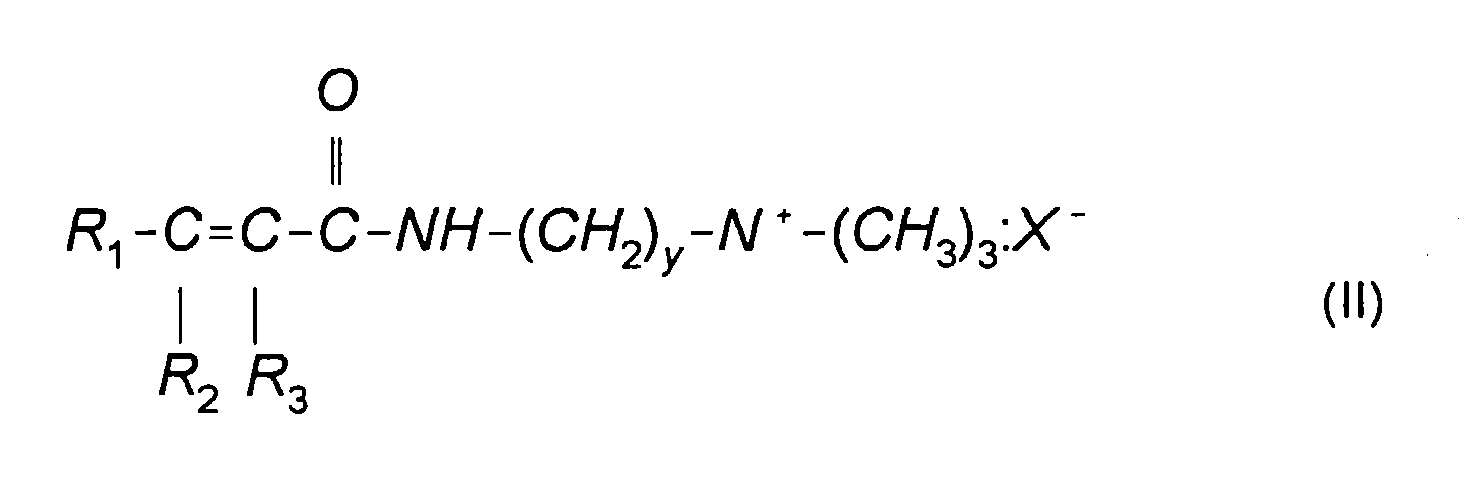
- the quaternary salts of alkylamino acrylamides which may be used in the present invention may be represented by the generic formula (II): wherein R 1 , R 2 and R 3 may be the same or different and may be hydrogen, or an alkyl containing 1-8 carbon atoms; y is 1 to 8; and X may be anions selected from halogens such as chloride; sulfates; sulfonates; alkyl sulfonates such as methyl sulfonate; carbonates; alkyl carbonates such as methyl carbonate; nitrates; phosphates; alkyl phosphates; and the like, or mixtures of these.
- R 1 , R 2 and R 3 may be the same or different and may be hydrogen, or an alkyl containing 1-8 carbon atoms; y is 1 to 8; and X may be anions selected from halogens such as chloride; sulfates; sulfonates; alkyl s
- the quaternary salts of the alkylamino acrylamides may be produced in accordance with U.S. Patent No. 4,910,325 issued to Shen, et al.
- Exemplary acrylates which may be used to produce the antistatic copolymer may be methyl acrylate, ethyl acrylate, propyl acrylate, butyl acrylate, hexyl acrylate, octyl acrylate, 2-ethyl-hexyl acrylate, methacrylate, methylmethacrylate, ethyl methacrylate, propyl methacrylate, and the like. More than one acrylate may be employed. Preferably, ethyl acrylate and/or methyl methacrylate are employed.
- Exemplary crosslinkers for the antistatic copolymer may be self crosslinking components such as N-methylolacrylamide and N-methylolanhydride, acrylic acid, alkyl alcohol, maleic acid, maleic anhydride, acrylamide or methacrylamide cross inked with melamine formaldehyde or urea formaldehyde, aziridines, glycouril-formaldehyde, glyoxal, formaldehyde, diacrylamide acetic acid or other suitable crosslinkers.
- the preferred crosslinker of the present invention is N-methylolacrylamide.
- the optional crosslinker is employed in amounts which do not result in the substantial production of gel particles or membrane gels when the coating composition is subjected to reclamation temperatures.
- the only crosslinker present in the coating composition is a crosslinker which is a comonomer in the antistatic copolymer.
- the only crosslinker present in the coating composition may be N-methylolacrylamide which is present in the antistatic copolymer.
- the amount of the N-methylolacrylamide may be less than about 6% by weight, based upon the weight of the polymeric antistatic binder composition.
- the reaction mixture will comprise small particles suspended in water due to the nonionic and anionic surfactants.
- This mixture may typically have a solids level of from 25 to 30 percent. It may be used at that concentration, or diluted with water or solvent, or concentrated, or dried for admixture with the other coating composition components, such as the acrylic polymer or copolymer.
- the antistatic copolymer may be diluted to about 2% by weight to about 12% by weight solids with the remainder being water or a water/organic solvent. The diluted mixture may then be combined with the remaining coating composition components.
- a glycidoxy silane is included in the coating composition to promote bonding between the polymeric antistatic binder composition and the particulate component to securely anchor or hold the particles.
- the glycidoxy silane may be glycidoxypropyltrimethoxysilane or glycidoxypropylmethyldiethoxysilane, or generally any glycidoxy silane represented by the formula X-Y-Si-R 1 R 2 R 3 , i.e.
- X is a glycidoxy group
- Y is an alkylene group, such as methylene, ethylene, propylene, etc.
- R 1 and R 2 are hydrolyzable groups, such as methoxy, ethoxy, acetoxy, and the like
- R 3 may be a hydrolyzable group or a non-hydrolyzable group. If R 3 is a non-hydrolyzable group, it may be an alkyl such as methyl, ethyl, and the like, or aryl such as phenyl, naphthyl, and the like.
- These silanes may possess water solubility or water dispersibility, as well as solvent solubility/dispersibility.
- a commercially available glycidoxypropyltrimethoxysilane which may be used in the present invention is Z6040 produced by Dow Corning.
- the amount of glycidoxy silane employed may be from about 5% by weight to about 20% by weight, based on the total weight percentages of components a) through d). Less than about 5% by weight does not improve rub-off significantly, while more than 20% by weight may result in excessive stickiness, an increase in rub-off, and an increase in coefficient of friction.
- particulate materials in the coating may increase surface haze, generally some haze is desirable to mask scratches or fingerprints which may be incurred upon the surface during production of the sheets or during their use. Increased surface roughness may be achieved with fewer particles by increasing the particle size. However, the particles should not be so large that ruboff increases to undesireable levels.
- the coefficient of friction of the toner-receptive coating may be lowered by inclusion of a wax which does not adversely affect the adhesion of particles or reclaimability.
- exemplary waxes which may be used are emulsions of oxidized, low-molecular weight polyolefins, such as polyethylene or polypropylene. Emulsified waxes based upon polyethylene are preferred.
- Commercially available emulsifiable waxes based upon polyethylene are Epolene E waxes, sold by Eastman Kodak. While solid waxes may be used, they are more difficult to incorporate into an aqueous-based coating composition without emulsifying them prior to addition.
- emulsified waxes based upon Epolene E waxes are employed, such as MICHEM emulsion 18325 or MICHEMLUBE 18130, produced by Michelman, Inc, Cincinnati, Ohio.
- the preferred emulsions may have a solids content of from about 23% by weight to about 32% by weight, based upon the weight of the wax emulsion, a Brookfield viscosity of less than 50 cps, and a pH of about 8 to 10.
- the emulsified waxes may be used in coefficient of friction lowering amounts of from about 3% by weight to about 12% by weight, based upon the total weight of components a) through d).
- the overhead transparencies of the present invention may have a surface resistivity of less than about 5 x 10 12 , preferably less than about 1.4 x 10 12 , most preferably less than about 1.25 x 10 12 ohms/square. Films having a surface resistivity which is too high may not adequately dissipate static charge. Films having a surface resistivity less than 10 9 ohms are considered to be conductive or semiconductive, but are not economically beneficial for most antistatic applications.
- antistatic film can dissipate a charge very quickly.
- antistatic films which demonstrate the capability of dissipating an induced 5,000 volt charge within 2.0 seconds are satisfactory.
- the transparent image-recording sheets of the present invention may have a static coefficient of friction and a kinetic coefficient of friction of less than about 0.32, preferably less than about 0.30, most preferably less than about 0.28. Values above 0.35 tend to impede singulation and increase jamming.
- the static and kinetic coefficients of friction may be determined using ASTM 1894 wherein the coefficient of friction is measured between the opposite or the same sides of a material.
- the internal and surface haze (percent HI and percent HS, respectively) may be measured pursuant to ASTM D1003 using a Gardner Hazemeter.
- the overhead transparencies may exhibit an internal haze of from about 0.2 to about 2.0 and the surface haze may range from about 1.75 to about 7.0.
- Ra in microns may be measured using a MAHR Perthometer.
- Exemplary roughness values which may be obtained may range from about 0.02 ⁇ to about 0.05 ⁇ for Ra, and from about 0.2 ⁇ to about 1.5 ⁇ for Rz wherein higher values indicate higher roughness.
- Singulation may be tested by placing a stack of sheets, for example, at least about 25 sheets, generally from about 100 to 300 sheets, in the feeding tray of a plain paper copy machine. The number of times the machine jams because of multiple feeds or failure to pick up a sheet is recorded. Generally results vary from machine to machine. The transparencies may be rated as good, marginal, or bad depending upon the relative number of machine jams recorded.
- a delta yellowness index (Hunter Labs YI based on L,a,b color) due to the coating at about 200 ppm per mil of film may be used to evaluate yellowness compared to other reclaimable coatings and films.
- Reclaimability may also be evaluated by microscopic examination of samples subjected to reclaiming conditions for excessive production of crosslinked gels or membrane gels.
- the gelling characteristics may be evaluated in terms of gel particle size and amounts relative to those for known reclaimable products. Odor may be evaluated relative to odor production for known reclaimable products.
- the acrylic copolymer is 60% by weight of methyl methacrylate and 40% by weight of ethyl acrylate.
- the antistatic copolymer is a crosslinked acrylic-based copolymer which is: (1) 65% by weight of the dimethylsulfate quaternary salt of dimethylaminomethyl methacrylate, (2) 30% by weight of methyl methacrylate, and (3) 5% by weight of N-methylolacrylamide.
- the glycidoxy silane is Dow Corning's Z6040 which is glycidoxypropyl trimethoxysilane.
- the silica gel employed is Syloid 74 sold by W. R. Grace and Company, Baltimore, MD.
- Syloid 74 silica gel has an average particle size of 8 ⁇ , a silica particle density of 0.65 grams per cc, and an average pore diameter of 150 Angstroms.
- the wax employed is the solids content of a commercially available wax emulsion, Michem® LUBE 18130 sold by Michelman, Inc., of Cincinnati, OH.
- the wax emulsion is a non-anionic emulsion having a light yellow, thin, semi-translucent liquid appearance.
- the total solids content of the product is from about 29.5% to about 30.5% by weight, with the balance being water.
- the solids are a synthetic wax based upon Epolene® E14 wax.
- the Epolene® E14 emulsifiable wax has a ring and ball softening point of 104 °C, a penetration hardness of (100 g/5 sec./25 °C, tenths of mm) of 4, a density of 0.94 g/cc. at 25 °C, an acid number of 16, a Brookfield thermosel viscosity cP at 125 °C of 225, and at 140 °C of 160.
- the Epolene® E14 has a molecular weight, GPC of 3600 (weight average molecular weight, M w ) and 1300 (number average molecular weight, M n ).
- the coating composition is produced at room temperature in a mixing vessel.
- the water is added to the vessel, followed by the addition of the glycidoxy silane with mixing.
- the mixture is allowed to stand for approximately 30 minutes to at least substantially hydrolyze the glycidoxy silane.
- the acrylic copolymer may then be added with continued mixing to achieve substantial homogeneity.
- the antistatic copolymer may be added next with mixing to achieve substantial homogeneity.
- the emulsified wax may then be added with continued mixing to obtain a uniform mixture.
- the silica gel may then be added with mixing to avoid agglomeration or lumping and to obtain a substantial homogeneous aqueous-based coating composition.
- PET polyethylene terephthalate
- the film was oriented in the transverse direction about 4.0 times to yield an overhead transparency sheet having a dry coating weight of about 0.2 g/sq. meter on each side.
- the overhead transparent sheet of Comparative Example 1 exhibited better surface resistivity and lower surface haze than exhibited by the sheet of Example 1.
- the static and kinetic coefficients of friction, the smear, and ruboff were all comparable.
- the sheet of Comparative Example 1 was not reclaimable.
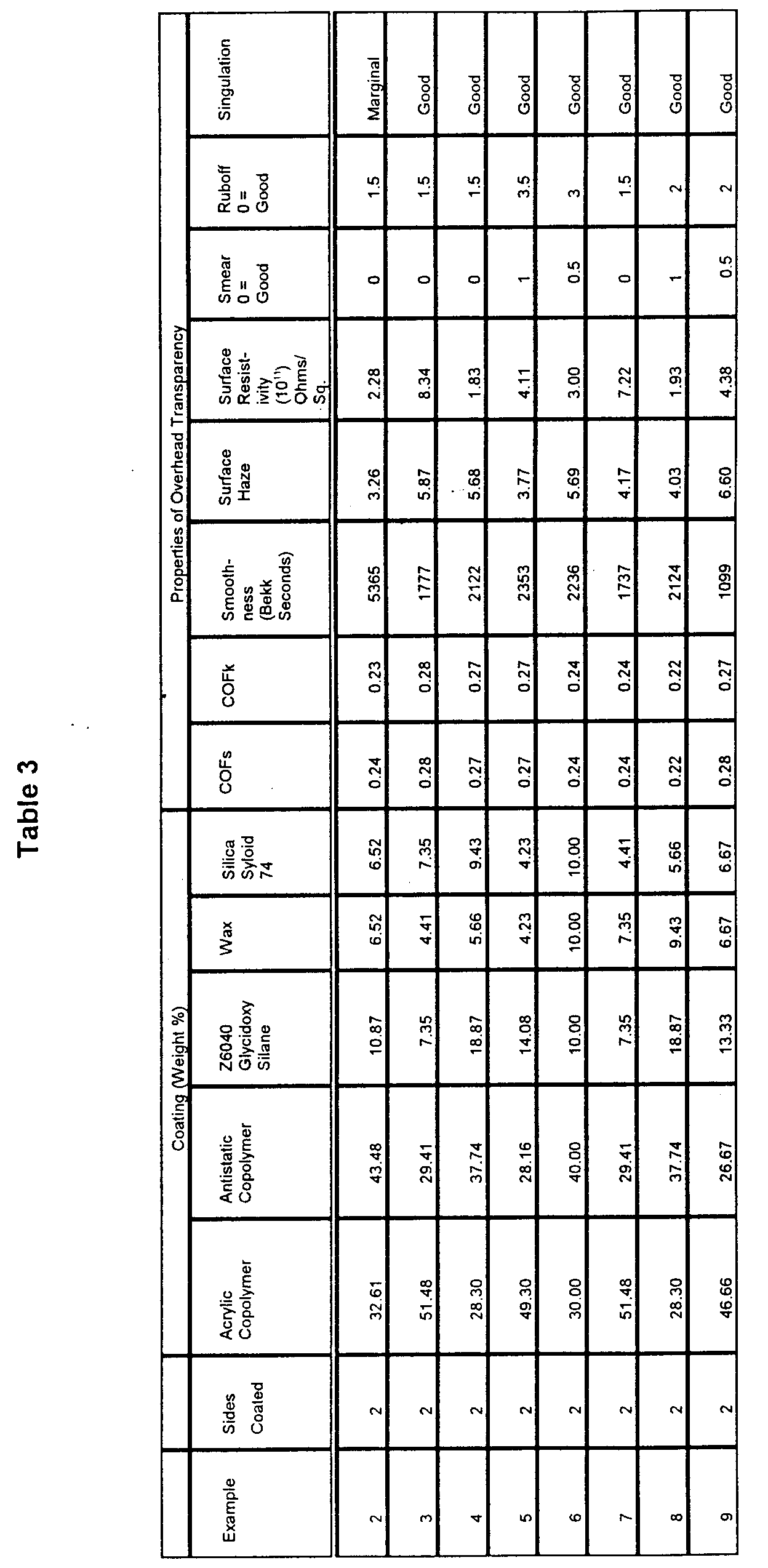
- aqueous-based coating compositions were coated onto polyethylene terephthalate film to obtain an overhead transparency sheet having a dry coating weight of about 0.2 g/sq. meter on each side in the same manner as in Example 1.
- the ingredients and their relative amounts used to obtain the aqueous-based coating composition and the dry coating are presented in Table 2:
- aqueous-based coating compositions were prepared using the same ingredients and mixing method as in Example 1.
- the level of antistatic copolymer was kept at 4% by weight, based upon the total weight of the aqueous coating composition to maintain the ability to reclaim the transparent, coated film.
- Increasing levels of silica gel were used to reduce smoothness or decrease (improve) Bekk numbers. Wax levels and glycidoxy silane levels were raised to maintain coefficients of friction and ruboff.
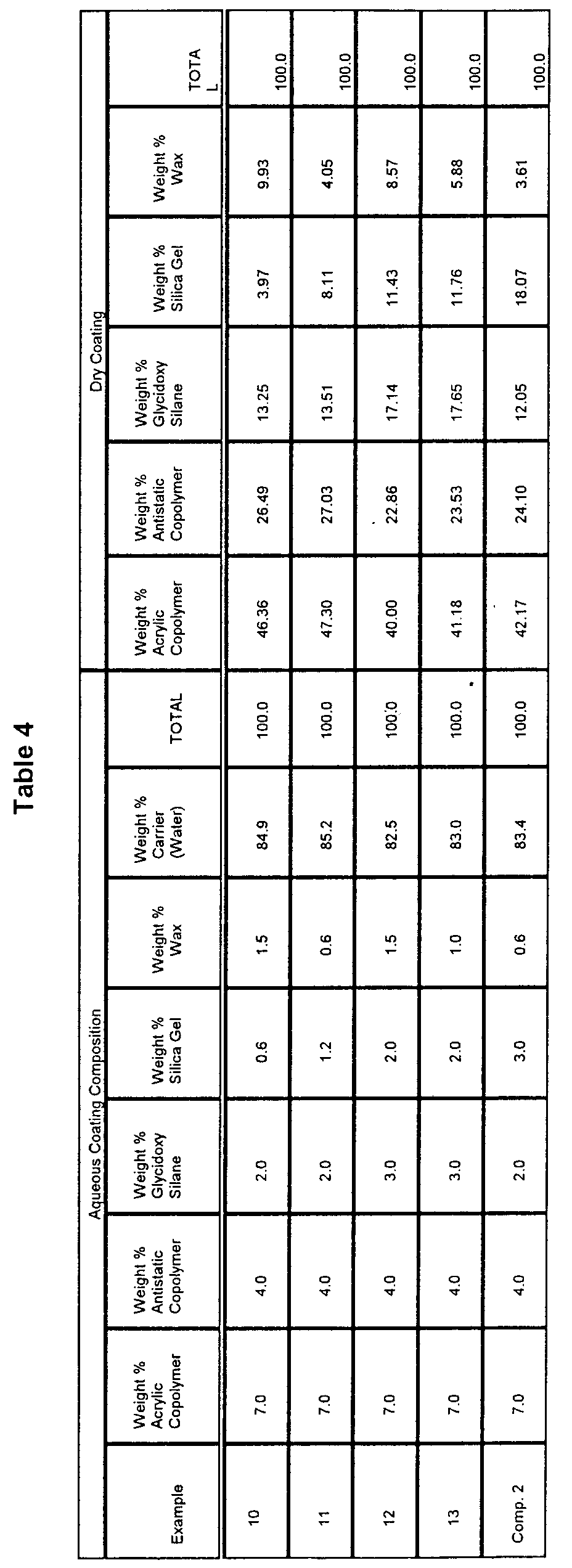
- Each of the aqueous-based coating compositions were coated onto polyethylene terephthalate film to obtain an overhead transparency sheet having a dry coating weight of about 0.2 g/sq. meter in the same manner as in Example 1 except only one side was coated.
- the ingredients and their relative amounts used to obtain the aqueous-based coating composition and the dry coating are presented in Table 4:
Landscapes
- Physics & Mathematics (AREA)
- General Physics & Mathematics (AREA)
- Chemical & Material Sciences (AREA)
- Inorganic Chemistry (AREA)
- Spectroscopy & Molecular Physics (AREA)
- Wood Science & Technology (AREA)
- Organic Chemistry (AREA)
- Materials Engineering (AREA)
- Engineering & Computer Science (AREA)
- Life Sciences & Earth Sciences (AREA)
- Chemical Kinetics & Catalysis (AREA)
- Laminated Bodies (AREA)
- Coating Of Shaped Articles Made Of Macromolecular Substances (AREA)
- Ink Jet Recording Methods And Recording Media Thereof (AREA)
Abstract
Description


| Component | Weight % Based On Aqueous Coating Composition | Weight % Based On Dry Coating |
| Acrylic copolymer | 7.0 | 53.02 |
| Antistatic copolymer | 4.0 | 30.30 |
| Glycidoxy Silane (Z6040) | 1.0 | 7.58 |
| Silica Gel (Syloid 74) | 0.6 | 4.55 |
| Wax | 0.6 | 4.55 |
| Carrier (water) | 86.8 | -- |
| 100.0 | 100.0 |
| Component | Weight % Based On Aquroues Coating Composition | Weight % Based On Dry Coating |
| Acrylic copolymer | 0.0 | 0.00 |
| Antistatic copolymer | 11.0 | 85.27 |
| Glycidoxy Silane (Z6040) | 1.0 | 7.75 |
| Silica Gel (Syloid 74) | 0.3 | 2.33 |
| Wax | 0.6 | 4.65 |
| Carrier (water) | 87.1 | -- |
| 100.0 | 100.0 |



Claims (38)
- A transparent image-recording sheet comprising a transparent base sheet coated on at least one image-recording surface with a transparent toner-receptive coating, said coating comprisingthe weight percentages of components a) through d) adding up to 100%.a) from 60% by weight to 85% by weight of a polymeric antistatic binder composition which does not substantially form a gel or yellow upon heating to reclamation temperatures,b) from 5% by weight to 20% by weight of a glycidoxy silane,c) from 3% by weight to 12% by weight of a wax, andd) from 3% by weight to 15% by weight of a particulate material having a mean particle size of from 4 µm to 15 µm,
- A transparent image-recording sheet as claimed in claim 1 wherein said polymeric antistatic binder composition comprisesi) from 25% by weight to 55% by weight of an acrylic polymer or copolymer, based upon the weight of components a) through d), andii) from 20% by weight to 45% by weight of an antistatic copolymer, based upon the weight of components a) through d).
- A transparent image-recording sheet as claimed in claim 2 wherein said acrylic polymer or copolymer is a copolymer of methyl methacrylate and ethyl acrylate.
- A transparent image-recording sheet as claimed in claim 2 or 3 wherein said antistatic copolymer is a copolymer of:wherein the total weight percent of components 1, 2, and 3 equals 100%.1) from 60% by weight to 85% by weight of a quaternary salt of an alkylamino acrylamide or an alkylamino acrylate,2) from 5% by weight to 40% by weight of one or more acrylates other than the acrylates under 1) above, and3) from 0 to 10% by weight of a crosslinker,
- A transparent image-recording sheet as claimed in any one or more of claims 1 to 4 wherein the amount of crosslinker in said coating is less than 6% by weight, based upon the weight of said polymeric antistatic binder composition.
- A transparent image-recording sheet as claimed in any one or more of claims 1 to 5 wherein said particulate material is silica gel.
- A transparent image-recording sheet as claimed in any one or more of claims 1 to 6 comprising nitrogenous antistatic compounds, wherein the total amount of said nitrogenous antistatic compounds used in producing said coating is from 21% by weight to 55% by weight based upon the weight of said polymeric antistatic binder composition.
- A transparent image-recording sheet as claimed in claim 7 wherein the nitrogenous antistatic compound used in producing said coating consists essentially of a copolymerizable quaternary ammonium salt.
- A transparent image-recording sheet as claimed in claim 8 wherein said quaternary salt is a quaternary salt of an alkylamino acrylate, said salt having the general formula (I):wherein each of R1, R2 and R3 are selected from hydrogen or an alkyl group containing 1-8 carbon atoms, y is 1 to 8; and X- may be an anion selected from the group consisting of halides, sulfates, sulfonates, C1-C8-alkyl sulfonates, carbonates, C1-C8-alkyl carbonates, nitrates,. phosphates, and C1-C8-alkyl phosphates.

- A transparent image-recording sheet as claimed in claim 8 or 9 wherein the quaternary salt is the dimethyl sulfate quaternary salt of dimethylaminoethyl methacrylate.
- A transparent image-recording sheet as claimed in claim 8 wherein said quaternary salt is a quaternary salt of an alkylamino acrylamide, said salt having the general formula (II):wherein each of R1, R2 and R3 are selected from hydrogen or an alkyl group containing 1-8 carbon atoms; y is 1 to 8; and X- is an anion selected from the group consisting of halides, sulfates, sulfonates, C1-C8-alkyl sulfonates, carbonates, C1-C8-alkyl carbonates, nitrates, phosphates, and C1-C8-alkyl phosphates.
- A transparent image-recording sheet as claimed in claim 4 wherein said one or more acrylates other than the ones defined in claim 4 under 1) are selected from the group comprising methyl acrylate, ethyl acrylate, propyl acrylate, butyl acrylate, methacrylate, methyl methacrylate, ethyl methacrylate, propyl methacrylate, hexyl acrylate, 2-ethyl-hexyl acrylate, and octyl acrylate.
- A transparent image-recording sheet as claimed in claim 4 wherein said crosslinker is selected from the group consisting of:N-methylolacrylamide,N-methylol methacrylamide,melamine or urea formaldehyde crosslinked with one or more of itaconic acid, itaconic anhydride, acrylic acid, allyl alcohol, maleic acid, or maleic anhydride,acrylamide and methacrylamide crosslinked with melamine formaldehyde or urea formaldehyde,aziridines,glycouril-formaldehyde,benzoguanamines,acrylamido glycolic acid,bis-acrylamide glycol,glyoxal,formaldehyde, anddiacrylamide acetic acid.
- A transparent image-recording sheet as claimed in any one or more of claims 1 to 13 wherein said base sheet is biaxially oriented polyester.
- A transparent image-recording sheet as claimed in any one or more of claims 1 to 14 wherein said coating is on both sides of said base sheet.
- A transparent image-recording sheet as claimed in any one or more of claims 1 to 15 wherein said coating on said base sheet is from 0.003 g/m2 to 0.4 g/m2.
- A transparent image-recording sheet as claimed in any one or more of claims 1 to 16 wherein said image recording sheet has a surface resistivity of less than 1.25 x 10¹² ohms/square, static coefficient of friction of less than 0.32, and a surface smoothness of less than 3000 Bekk seconds.
- A transparent image-recording sheet as claimed in any one or more of claims 1 to 17 wherein the mean particle size of said particulate material is from 7 µm to 12 µm.
- A transparent image-recording sheet as claimed in any one or more of claims 1 to 18 wherein said wax is a wax emulsion of polyethylene.
- A transparent image-recording sheet comprising a transparent base sheet coated on at least one image-recording surface with a transparent toner-receptive coating, said coating comprising:the weight percentages of components a) through e) adding up to 100%, wherein said image recording sheet has a surface resistivity of less than 1.25 x 10¹² ohms/square, static coefficient of friction of less than 0.32, and a surface smoothness of less than 3000 Bekk seconds.a) from 25% by weight to 55% by weight of a copolymer of methyl methacrylate and ethyl acrylate,b) from 20% by weight to 45% by weight of an antistatic copolymer, wherein said antistatic copolymer is a copolymer of:wherein the total weight percent of components 1, 2, and 3 equals 100%,1) from 60% by weight to 85% by weight of a quaternary salt of an alkylamino acrylamide or an alkylamino acrylate,2) from 5% by weight to 40% by weight of one or more acrylates, and3) from 0 to 10% by weight of a crosslinker,c) a glycidoxy silane,d) a wax, ande) from 3% by weight to 15% by weight of silica gel having a mean particle size of from 4 µm to 15 µm,
- Use of a transparent image-recording sheet as claimed in any one or more of claims 1 to 20 in a plain paper copier.
- A coating composition comprising:the weight percentages of components a) through e) adding up to 100%.a) from 25% by weight to 55% by weight of an acrylic polymer or copolymer,b) from 20% by weight to 45% by weight of an antistatic copolymer, wherein said antistatic copolymer is a copolymer of:wherein the total weight percent of components 1, 2, and 3 equals 100%,1) from 60% by weight to 85% by weight of a quaternary salt of an alkylamino acrylamide or an alkylamino acrylate,2) from 5% by weight to 40% by weight of one or more acrylates other than the ones under b) 1) above, and3) from 0 to 10% by weight of a crosslinker,c) from 5% by weight to 20% by weight of a glycidoxy silane,d) from 3% by weight to 12% by weight of a wax, ande) from 3% by weight to 15% by weight of a particulate material having a mean particle size of from 4 µm to 15 µm,
- A coating composition as claimed in claim 22 wherein the mean particle size of said particulate material is from 7 µm to 12 µm.
- A coating composition as claimed in claim 22 wherein said acrylic polymer or copolymer is a copolymer of methyl methacrylate and ethyl acrylate.
- A coating composition as claimed in claim 22 wherein said wax is a wax emulsion of polyethylene.
- A coating composition as claimed in claim 22 wherein said quaternary salt is a quaternary salt of an alkylamino acrylate, said salt having the general formula (I):wherein each of R1, R2 and R3 are selected from hydrogen or an alkyl group containing 1-8 carbon atoms, y is 1 to 8; and X- may be an anion selected from the group consisting of halides, sulfates, sulfonates, C1-C8-alkyl sulfonates, carbonates, C1-C8-alkyl carbonates, nitrates, phosphates, and C1-C8-alkyl phosphates.

- A coating composition as claimed in claim 26 wherein said quaternary salt is the dimethyl sulfate quaternary salt of dimethylaminoethyl methacrylate.
- A coating composition as claimed in claim 22 wherein said quaternary salt is a quaternary salt of an alkylamino acrylamide, said salt having the general formula (II):wherein each of R1, R2 and R3 are selected from hydrogen or an alkyl group containing 1-8 carbon atoms; y is 1 to 8; and X- is an anion selected from the group consisting of halides, sulfates, sulfonates, C1-C8-alkyl sulfonates, carbonates, C1-C8-alkyl carbonates, nitrates, phosphates, and C1-C8-alkyl phosphates.
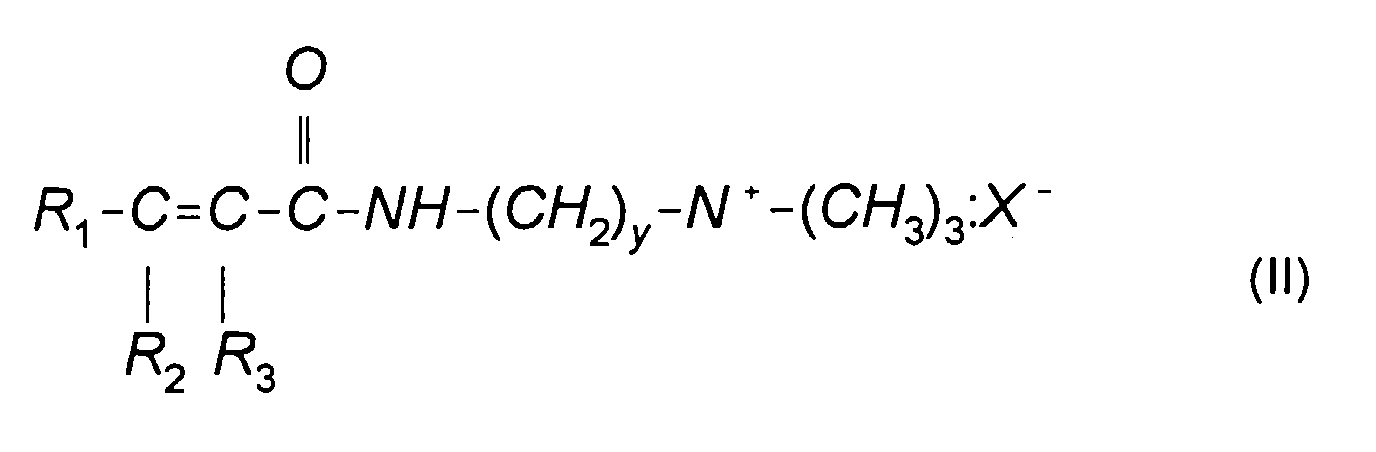
- A coating composition as claimed in claim 22 wherein said one or more acrylates other than the ones defined in clain 22 under b) 1) of said antistatic copolymer are selected from the group comprising methyl acrylate, ethyl acrylate, propyl acrylate, butyl acrylate, methacrylate, methyl.. methacrylate, ethyl methacrylate, propyl methacrylate, hexyl acrylate, 2-ethyl-hexyl acrylate, and octyl acrylate.
- A coating composition as claimed in any one or more of claims 22 to 29 wherein said crosslinker is N-methylolacrylamide.
- A coating composition as claimed in claim 30 wherein the amount of crosslinker in said coating composition is less than 6% by weight, based upon the weight of said polymeric antistatic binder composition.
- A coating composition as claimed in any one or more of claims 22 to 31 wherein said particulate material is silica gel
- A method for making a transparent image-recording sheet comprising:A) coating a polymeric film on at least one surface with a toner-receptive coating composition according to any one or more of claims 22 to 32, andB) drying said coating composition on said film to obtain a transparent image-recording sheet.
- A method as claimed in claim 33 wherein said film is biaxially oriented.
- A method as claimed in claim 33 or 34 wherein said film is corona treated before being coated with said coating composition.
- A method as claimed in any one or more of claims 33 to 35 wherein said coating composition is applied to said polymeric film in-line during the manufacturing of said polymeric film.
- A method as claimed in any one or more of claims 33 to 36 wherein the coating composition is applied to said polymeric film intradraw during the film manufacturing process.
- A method as claimed in any one or more of claims 33 to 37 wherein the coating composition is applied to the at least one surface of said film, on a dry weight basis, in a range of from 0.003 g/m2 to 0.4 g/m2.
Applications Claiming Priority (2)
| Application Number | Priority Date | Filing Date | Title |
|---|---|---|---|
| US683337 | 1996-07-18 | ||
| US08/683,337 US5709926A (en) | 1996-07-18 | 1996-07-18 | Reclaimable transparencies for plain paper copiers |
Publications (3)
| Publication Number | Publication Date |
|---|---|
| EP0819990A2 true EP0819990A2 (en) | 1998-01-21 |
| EP0819990A3 EP0819990A3 (en) | 1998-10-21 |
| EP0819990B1 EP0819990B1 (en) | 2002-10-23 |
Family
ID=24743597
Family Applications (1)
| Application Number | Title | Priority Date | Filing Date |
|---|---|---|---|
| EP97112304A Expired - Lifetime EP0819990B1 (en) | 1996-07-18 | 1997-07-17 | Reclaimable transparencies for plain paper copiers |
Country Status (4)
| Country | Link |
|---|---|
| US (1) | US5709926A (en) |
| EP (1) | EP0819990B1 (en) |
| JP (1) | JP3839916B2 (en) |
| DE (1) | DE69716522T2 (en) |
Cited By (4)
| Publication number | Priority date | Publication date | Assignee | Title |
|---|---|---|---|---|
| EP1022618A1 (en) * | 1999-01-22 | 2000-07-26 | SKC Co., Ltd. | Composition for image receiving layer and polymer film having the image receiving layer formed therefrom |
| EP1078774A3 (en) * | 1999-08-26 | 2002-04-17 | Hewlett-Packard Company, A Delaware Corporation | Technique for modifying the coefficient of friction of inkjet media |
| DE10214106B4 (en) * | 2001-04-02 | 2005-11-10 | Hewlett-Packard Development Co., L.P., Houston | Method and device for detecting overhead transparencies |
| CN102356001A (en) * | 2009-01-19 | 2012-02-15 | 艾利丹尼森公司 | Reusable printing medium and apparatus and method employing the same |
Families Citing this family (9)
| Publication number | Priority date | Publication date | Assignee | Title |
|---|---|---|---|---|
| US6180708B1 (en) * | 1996-06-28 | 2001-01-30 | W. R. Grace & Co.-Conn. | Thermoplastic adsorbent compositions containing wax and insulating glass units containing such compositions |
| US5925447A (en) * | 1996-07-18 | 1999-07-20 | Mitsubishi Polyester Film, Llc | Permanent antistatic coating and coated polymeric film |
| JP4316696B2 (en) * | 1998-02-12 | 2009-08-19 | 株式会社きもと | Anti-Newton ring film |
| ES2189134T3 (en) | 1998-02-25 | 2003-07-01 | Minnesota Mining & Mfg | PROTECTION DEVICE FOR TRANSPARENCIES FOR RETROPROJECTORS. |
| US6811867B1 (en) * | 2000-02-10 | 2004-11-02 | 3M Innovative Properties Company | Color stable pigmented polymeric films |
| KR100419195B1 (en) * | 2000-12-14 | 2004-02-19 | 주식회사 티엔지코리아 | digital printing textile manufacture method and digital printing textile |
| KR100932873B1 (en) * | 2001-12-10 | 2009-12-21 | 데이진 듀폰 필름 가부시키가이샤 | Optical Adhesive Polyester Film |
| US8449970B2 (en) * | 2007-07-23 | 2013-05-28 | 3M Innovative Properties Company | Antistatic article, method of making the same, and display device having the same |
| WO2015120018A1 (en) * | 2014-02-07 | 2015-08-13 | Dupont Teijin Films U.S. Limited Partnership | Antistatic coated polyester film |
Family Cites Families (17)
| Publication number | Priority date | Publication date | Assignee | Title |
|---|---|---|---|---|
| DE1571022C3 (en) * | 1963-11-14 | 1976-01-08 | Hoechst Ag, 6000 Frankfurt | Process for the continuous coating of thermoplastic polyester films |
| GB1411564A (en) * | 1972-04-27 | 1975-10-29 | Impeial Chemical Ind Ltd | Coated polyester films |
| JPS6017298B2 (en) * | 1977-12-20 | 1985-05-02 | ダイセル化学工業株式会社 | Aqueous coating composition |
| US4214035A (en) * | 1979-01-31 | 1980-07-22 | American Hoechst Corporation | Antistatic coated polyester film |
| US4571363A (en) * | 1983-12-12 | 1986-02-18 | American Hoechst Corporation | Polyester film primed with crosslinked acrylic polymers |
| JP2637955B2 (en) * | 1986-07-31 | 1997-08-06 | 大日本インキ化学工業株式会社 | Aqueous coating composition |
| US4910325A (en) * | 1989-01-25 | 1990-03-20 | Hoechst Celanese Corporation | Polymerizable quaternary ammonium methyl carbonates |
| US5182338A (en) * | 1989-11-17 | 1993-01-26 | General Electric Company | Polymer blend compositions |
| US5208092A (en) * | 1990-10-24 | 1993-05-04 | Minnesota Mining And Manufacturing Company | Transparent liquid absorbent materials for use as ink-receptive layers |
| US5212260A (en) * | 1990-11-07 | 1993-05-18 | Hoechst Celanese Corporation | Primer coating composition for silicone release applications |
| SG48350A1 (en) * | 1991-02-25 | 1998-04-17 | Canon Kk | Laminate film for receiving toner image and method for forming fixed toner image on laminate film |
| CA2067482A1 (en) * | 1991-05-09 | 1992-11-10 | Emanuiel Cooper | Permanent antistatic coating and coated polymeric film |
| US5310591A (en) * | 1992-09-18 | 1994-05-10 | Minnesota Mining And Manufacturing Company | Image-receptive sheets for plain paper copiers |
| US5310595A (en) * | 1992-09-18 | 1994-05-10 | Minnesota Mining And Manufacturing Company | Water-based transparent image recording sheet for plain paper copiers |
| US5518809A (en) * | 1992-09-18 | 1996-05-21 | Minnesota Mining And Manufacturing Company | Water-based transparent image recording sheet for plain paper copiers |
| US5326688A (en) * | 1993-05-27 | 1994-07-05 | Eastman Kodak Company | Coating compositions for antistatic layers for photographic elements |
| US5411787A (en) * | 1993-10-19 | 1995-05-02 | Minnesota Mining And Manufacturing Company | Water based transparent image recording sheet |
-
1996
- 1996-07-18 US US08/683,337 patent/US5709926A/en not_active Expired - Lifetime
-
1997
- 1997-07-17 EP EP97112304A patent/EP0819990B1/en not_active Expired - Lifetime
- 1997-07-17 DE DE69716522T patent/DE69716522T2/en not_active Expired - Lifetime
- 1997-07-18 JP JP19343097A patent/JP3839916B2/en not_active Expired - Fee Related
Cited By (6)
| Publication number | Priority date | Publication date | Assignee | Title |
|---|---|---|---|---|
| EP1022618A1 (en) * | 1999-01-22 | 2000-07-26 | SKC Co., Ltd. | Composition for image receiving layer and polymer film having the image receiving layer formed therefrom |
| EP1078774A3 (en) * | 1999-08-26 | 2002-04-17 | Hewlett-Packard Company, A Delaware Corporation | Technique for modifying the coefficient of friction of inkjet media |
| DE10214106B4 (en) * | 2001-04-02 | 2005-11-10 | Hewlett-Packard Development Co., L.P., Houston | Method and device for detecting overhead transparencies |
| CN102356001A (en) * | 2009-01-19 | 2012-02-15 | 艾利丹尼森公司 | Reusable printing medium and apparatus and method employing the same |
| AU2010204493B2 (en) * | 2009-01-19 | 2014-09-18 | Avery Dennison Corporation | Reusable printing medium and apparatus employing the same |
| EP2505375B1 (en) * | 2009-01-19 | 2016-03-23 | Avery Dennison Corporation | Method of using a reusable printing medium, apparatus and method employing the same |
Also Published As
| Publication number | Publication date |
|---|---|
| EP0819990B1 (en) | 2002-10-23 |
| EP0819990A3 (en) | 1998-10-21 |
| US5709926A (en) | 1998-01-20 |
| JPH1097091A (en) | 1998-04-14 |
| DE69716522D1 (en) | 2002-11-28 |
| DE69716522T2 (en) | 2003-06-12 |
| JP3839916B2 (en) | 2006-11-01 |
Similar Documents
| Publication | Publication Date | Title |
|---|---|---|
| US4571363A (en) | Polyester film primed with crosslinked acrylic polymers | |
| EP0819990B1 (en) | Reclaimable transparencies for plain paper copiers | |
| EP0819742B1 (en) | Permanent antistatic coating and coated polymeric film | |
| WO1994013476A1 (en) | Copolyester film primed with acrylic polymers | |
| EP0674591A1 (en) | Biaxially oriented copolyester film primed with vinyl acetate polymers | |
| EP0436152B1 (en) | Polyester film with nodule surface | |
| JPH05245922A (en) | Method for producing releasable polyester film | |
| JPH07256844A (en) | Laminated film and its manufacturing method | |
| US4592953A (en) | Polyester film primed with crosslinked vinyl acetate polymers | |
| JPH0518334B2 (en) | ||
| US5478644A (en) | Laminated polyester film | |
| EP0512540A1 (en) | Permanent antistatic coating and coated polymeric film | |
| JPH11348211A (en) | Laminated thermoplastic film | |
| US5114739A (en) | Process of manufacturing a polyester film with nodule surface | |
| JPH106640A (en) | Inkjet recording materials | |
| JP3122001B2 (en) | Laminated film | |
| JPH0693122A (en) | Transparent printing film | |
| JPH09141798A (en) | Laminated film | |
| KR950007644B1 (en) | Manufacturing method of electrophotographic film | |
| JPH06255055A (en) | Laminated polyester film | |
| JPH0694205B2 (en) | Composite film | |
| KR950000985B1 (en) | Method of manufacturing polyester films | |
| JP3375005B2 (en) | Laminated polyester film | |
| JPH09169089A (en) | Laminated film | |
| JP3312399B2 (en) | Easy adhesion laminated polyester film |
Legal Events
| Date | Code | Title | Description |
|---|---|---|---|
| PUAI | Public reference made under article 153(3) epc to a published international application that has entered the european phase |
Free format text: ORIGINAL CODE: 0009012 |
|
| AK | Designated contracting states |
Kind code of ref document: A2 Designated state(s): DE FR GB IT LU NL |
|
| PUAL | Search report despatched |
Free format text: ORIGINAL CODE: 0009013 |
|
| AK | Designated contracting states |
Kind code of ref document: A3 Designated state(s): AT BE CH DE DK ES FI FR GB GR IE IT LI LU MC NL PT SE |
|
| RAP1 | Party data changed (applicant data changed or rights of an application transferred) |
Owner name: MITSUBISHI POLYESTER FILM, LLC |
|
| 17P | Request for examination filed |
Effective date: 19990421 |
|
| AKX | Designation fees paid |
Free format text: DE FR GB IT LU NL |
|
| 17Q | First examination report despatched |
Effective date: 19991220 |
|
| GRAG | Despatch of communication of intention to grant |
Free format text: ORIGINAL CODE: EPIDOS AGRA |
|
| GRAG | Despatch of communication of intention to grant |
Free format text: ORIGINAL CODE: EPIDOS AGRA |
|
| GRAH | Despatch of communication of intention to grant a patent |
Free format text: ORIGINAL CODE: EPIDOS IGRA |
|
| RBV | Designated contracting states (corrected) |
Designated state(s): DE FR GB |
|
| GRAH | Despatch of communication of intention to grant a patent |
Free format text: ORIGINAL CODE: EPIDOS IGRA |
|
| GRAA | (expected) grant |
Free format text: ORIGINAL CODE: 0009210 |
|
| AK | Designated contracting states |
Kind code of ref document: B1 Designated state(s): DE FR GB |
|
| REG | Reference to a national code |
Ref country code: GB Ref legal event code: FG4D |
|
| REF | Corresponds to: |
Ref document number: 69716522 Country of ref document: DE Date of ref document: 20021128 |
|
| ET | Fr: translation filed | ||
| PLBE | No opposition filed within time limit |
Free format text: ORIGINAL CODE: 0009261 |
|
| STAA | Information on the status of an ep patent application or granted ep patent |
Free format text: STATUS: NO OPPOSITION FILED WITHIN TIME LIMIT |
|
| 26N | No opposition filed |
Effective date: 20030724 |
|
| PGFP | Annual fee paid to national office [announced via postgrant information from national office to epo] |
Ref country code: GB Payment date: 20120625 Year of fee payment: 16 |
|
| PGFP | Annual fee paid to national office [announced via postgrant information from national office to epo] |
Ref country code: FR Payment date: 20120712 Year of fee payment: 16 Ref country code: DE Payment date: 20120731 Year of fee payment: 16 |
|
| GBPC | Gb: european patent ceased through non-payment of renewal fee |
Effective date: 20130717 |
|
| REG | Reference to a national code |
Ref country code: FR Ref legal event code: ST Effective date: 20140331 |
|
| PG25 | Lapsed in a contracting state [announced via postgrant information from national office to epo] |
Ref country code: GB Free format text: LAPSE BECAUSE OF NON-PAYMENT OF DUE FEES Effective date: 20130717 Ref country code: DE Free format text: LAPSE BECAUSE OF NON-PAYMENT OF DUE FEES Effective date: 20140201 |
|
| REG | Reference to a national code |
Ref country code: DE Ref legal event code: R119 Ref document number: 69716522 Country of ref document: DE Effective date: 20140201 |
|
| PG25 | Lapsed in a contracting state [announced via postgrant information from national office to epo] |
Ref country code: FR Free format text: LAPSE BECAUSE OF NON-PAYMENT OF DUE FEES Effective date: 20130731 |