EP0819649A1 - Photocatalytic method for treatment of contaminated water - Google Patents
Photocatalytic method for treatment of contaminated water Download PDFInfo
- Publication number
- EP0819649A1 EP0819649A1 EP19970111977 EP97111977A EP0819649A1 EP 0819649 A1 EP0819649 A1 EP 0819649A1 EP 19970111977 EP19970111977 EP 19970111977 EP 97111977 A EP97111977 A EP 97111977A EP 0819649 A1 EP0819649 A1 EP 0819649A1
- Authority
- EP
- European Patent Office
- Prior art keywords
- membrane
- filtration
- photocatalyst
- semiconducting
- irradiation
- Prior art date
- Legal status (The legal status is an assumption and is not a legal conclusion. Google has not performed a legal analysis and makes no representation as to the accuracy of the status listed.)
- Withdrawn
Links
- 238000000034 method Methods 0.000 title claims abstract description 45
- XLYOFNOQVPJJNP-UHFFFAOYSA-N water Substances O XLYOFNOQVPJJNP-UHFFFAOYSA-N 0.000 title claims abstract description 22
- 230000001699 photocatalysis Effects 0.000 title abstract description 12
- 239000012528 membrane Substances 0.000 claims abstract description 64
- 238000001914 filtration Methods 0.000 claims abstract description 21
- 239000011941 photocatalyst Substances 0.000 claims abstract description 21
- 239000000919 ceramic Substances 0.000 claims abstract description 11
- 239000001301 oxygen Substances 0.000 claims abstract description 11
- 229910052760 oxygen Inorganic materials 0.000 claims abstract description 11
- MHAJPDPJQMAIIY-UHFFFAOYSA-N Hydrogen peroxide Chemical compound OO MHAJPDPJQMAIIY-UHFFFAOYSA-N 0.000 claims abstract description 10
- QVGXLLKOCUKJST-UHFFFAOYSA-N atomic oxygen Chemical compound [O] QVGXLLKOCUKJST-UHFFFAOYSA-N 0.000 claims abstract description 10
- 238000000746 purification Methods 0.000 claims abstract description 10
- 239000007800 oxidant agent Substances 0.000 claims abstract description 9
- CBENFWSGALASAD-UHFFFAOYSA-N Ozone Chemical compound [O-][O+]=O CBENFWSGALASAD-UHFFFAOYSA-N 0.000 claims abstract description 5
- 238000005374 membrane filtration Methods 0.000 claims abstract description 5
- 239000004065 semiconductor Substances 0.000 claims abstract description 5
- 238000000926 separation method Methods 0.000 claims abstract description 5
- 239000008213 purified water Substances 0.000 claims abstract description 4
- GWEVSGVZZGPLCZ-UHFFFAOYSA-N Titan oxide Chemical compound O=[Ti]=O GWEVSGVZZGPLCZ-UHFFFAOYSA-N 0.000 claims description 18
- 239000011148 porous material Substances 0.000 claims description 10
- 239000012535 impurity Substances 0.000 claims description 5
- 239000000203 mixture Substances 0.000 claims description 5
- 239000000843 powder Substances 0.000 claims description 5
- 229910052980 cadmium sulfide Inorganic materials 0.000 claims description 4
- 230000006378 damage Effects 0.000 claims description 4
- JEIPFZHSYJVQDO-UHFFFAOYSA-N iron(III) oxide Inorganic materials O=[Fe]O[Fe]=O JEIPFZHSYJVQDO-UHFFFAOYSA-N 0.000 claims description 4
- 239000002245 particle Substances 0.000 claims description 4
- 229910002370 SrTiO3 Inorganic materials 0.000 claims description 3
- 239000012780 transparent material Substances 0.000 claims 1
- 231100000331 toxic Toxicity 0.000 abstract description 4
- 230000002588 toxic effect Effects 0.000 abstract description 4
- 239000002351 wastewater Substances 0.000 abstract description 4
- 150000001875 compounds Chemical class 0.000 abstract description 3
- 125000003118 aryl group Chemical group 0.000 abstract description 2
- 239000007789 gas Substances 0.000 abstract description 2
- 239000008239 natural water Substances 0.000 abstract description 2
- 238000007146 photocatalysis Methods 0.000 abstract 1
- 239000000243 solution Substances 0.000 description 19
- 238000007539 photo-oxidation reaction Methods 0.000 description 11
- 239000000126 substance Substances 0.000 description 11
- 230000003647 oxidation Effects 0.000 description 7
- 238000007254 oxidation reaction Methods 0.000 description 7
- DVIPPHSQIBKWSA-UHFFFAOYSA-N 4-chlorophthalic acid Chemical compound OC(=O)C1=CC=C(Cl)C=C1C(O)=O DVIPPHSQIBKWSA-UHFFFAOYSA-N 0.000 description 6
- LRHPLDYGYMQRHN-UHFFFAOYSA-N N-Butanol Chemical compound CCCCO LRHPLDYGYMQRHN-UHFFFAOYSA-N 0.000 description 6
- 239000000725 suspension Substances 0.000 description 6
- FPCJKVGGYOAWIZ-UHFFFAOYSA-N butan-1-ol;titanium Chemical compound [Ti].CCCCO.CCCCO.CCCCO.CCCCO FPCJKVGGYOAWIZ-UHFFFAOYSA-N 0.000 description 5
- 238000006303 photolysis reaction Methods 0.000 description 5
- 239000000047 product Substances 0.000 description 5
- 239000000758 substrate Substances 0.000 description 5
- 238000009281 ultraviolet germicidal irradiation Methods 0.000 description 5
- 239000010410 layer Substances 0.000 description 4
- 238000004458 analytical method Methods 0.000 description 3
- 230000015572 biosynthetic process Effects 0.000 description 3
- 239000011248 coating agent Substances 0.000 description 3
- 238000000576 coating method Methods 0.000 description 3
- 239000000706 filtrate Substances 0.000 description 3
- 230000015843 photosynthesis, light reaction Effects 0.000 description 3
- 238000003756 stirring Methods 0.000 description 3
- 239000002344 surface layer Substances 0.000 description 3
- WXNZTHHGJRFXKQ-UHFFFAOYSA-N 4-chlorophenol Chemical compound OC1=CC=C(Cl)C=C1 WXNZTHHGJRFXKQ-UHFFFAOYSA-N 0.000 description 2
- XKRFYHLGVUSROY-UHFFFAOYSA-N Argon Chemical compound [Ar] XKRFYHLGVUSROY-UHFFFAOYSA-N 0.000 description 2
- GRYLNZFGIOXLOG-UHFFFAOYSA-N Nitric acid Chemical compound O[N+]([O-])=O GRYLNZFGIOXLOG-UHFFFAOYSA-N 0.000 description 2
- RTAQQCXQSZGOHL-UHFFFAOYSA-N Titanium Chemical compound [Ti] RTAQQCXQSZGOHL-UHFFFAOYSA-N 0.000 description 2
- 239000000654 additive Substances 0.000 description 2
- 238000001354 calcination Methods 0.000 description 2
- 230000015556 catabolic process Effects 0.000 description 2
- 230000000052 comparative effect Effects 0.000 description 2
- 238000000354 decomposition reaction Methods 0.000 description 2
- 238000006731 degradation reaction Methods 0.000 description 2
- 238000010586 diagram Methods 0.000 description 2
- 238000009792 diffusion process Methods 0.000 description 2
- 239000012153 distilled water Substances 0.000 description 2
- 238000010438 heat treatment Methods 0.000 description 2
- 239000000543 intermediate Substances 0.000 description 2
- 238000004519 manufacturing process Methods 0.000 description 2
- 229910017604 nitric acid Inorganic materials 0.000 description 2
- 230000001590 oxidative effect Effects 0.000 description 2
- 238000001935 peptisation Methods 0.000 description 2
- 239000002574 poison Substances 0.000 description 2
- 231100000614 poison Toxicity 0.000 description 2
- 238000001556 precipitation Methods 0.000 description 2
- 239000010453 quartz Substances 0.000 description 2
- VYPSYNLAJGMNEJ-UHFFFAOYSA-N silicon dioxide Inorganic materials O=[Si]=O VYPSYNLAJGMNEJ-UHFFFAOYSA-N 0.000 description 2
- 229910052719 titanium Inorganic materials 0.000 description 2
- 239000010936 titanium Substances 0.000 description 2
- LINPIYWFGCPVIE-UHFFFAOYSA-N 2,4,6-trichlorophenol Chemical compound OC1=C(Cl)C=C(Cl)C=C1Cl LINPIYWFGCPVIE-UHFFFAOYSA-N 0.000 description 1
- VEXZGXHMUGYJMC-UHFFFAOYSA-M Chloride anion Chemical compound [Cl-] VEXZGXHMUGYJMC-UHFFFAOYSA-M 0.000 description 1
- 238000004566 IR spectroscopy Methods 0.000 description 1
- ISWSIDIOOBJBQZ-UHFFFAOYSA-N Phenol Chemical compound OC1=CC=CC=C1 ISWSIDIOOBJBQZ-UHFFFAOYSA-N 0.000 description 1
- XSTXAVWGXDQKEL-UHFFFAOYSA-N Trichloroethylene Chemical compound ClC=C(Cl)Cl XSTXAVWGXDQKEL-UHFFFAOYSA-N 0.000 description 1
- 238000010521 absorption reaction Methods 0.000 description 1
- 238000013019 agitation Methods 0.000 description 1
- 239000007864 aqueous solution Substances 0.000 description 1
- 229910052786 argon Inorganic materials 0.000 description 1
- 238000000149 argon plasma sintering Methods 0.000 description 1
- 238000003763 carbonization Methods 0.000 description 1
- 230000003197 catalytic effect Effects 0.000 description 1
- 239000007795 chemical reaction product Substances 0.000 description 1
- 150000007938 chlorocyclic compounds Chemical class 0.000 description 1
- 239000002131 composite material Substances 0.000 description 1
- 239000000356 contaminant Substances 0.000 description 1
- 238000001816 cooling Methods 0.000 description 1
- 230000003247 decreasing effect Effects 0.000 description 1
- 239000004205 dimethyl polysiloxane Substances 0.000 description 1
- 238000007598 dipping method Methods 0.000 description 1
- 238000002474 experimental method Methods 0.000 description 1
- 238000004128 high performance liquid chromatography Methods 0.000 description 1
- 230000007062 hydrolysis Effects 0.000 description 1
- 238000006460 hydrolysis reaction Methods 0.000 description 1
- TUJKJAMUKRIRHC-UHFFFAOYSA-N hydroxyl Chemical compound [OH] TUJKJAMUKRIRHC-UHFFFAOYSA-N 0.000 description 1
- 229910052500 inorganic mineral Inorganic materials 0.000 description 1
- 238000004811 liquid chromatography Methods 0.000 description 1
- 230000007774 longterm Effects 0.000 description 1
- 239000000463 material Substances 0.000 description 1
- QSHDDOUJBYECFT-UHFFFAOYSA-N mercury Chemical compound [Hg] QSHDDOUJBYECFT-UHFFFAOYSA-N 0.000 description 1
- 229910052753 mercury Inorganic materials 0.000 description 1
- 244000005700 microbiome Species 0.000 description 1
- 239000011707 mineral Substances 0.000 description 1
- 231100000252 nontoxic Toxicity 0.000 description 1
- 230000003000 nontoxic effect Effects 0.000 description 1
- 239000011224 oxide ceramic Substances 0.000 description 1
- 238000013032 photocatalytic reaction Methods 0.000 description 1
- 231100000572 poisoning Toxicity 0.000 description 1
- 230000000607 poisoning effect Effects 0.000 description 1
- 229920000435 poly(dimethylsiloxane) Polymers 0.000 description 1
- 150000003071 polychlorinated biphenyls Chemical class 0.000 description 1
- -1 polydimethylsiloxane Polymers 0.000 description 1
- 239000002244 precipitate Substances 0.000 description 1
- 238000002360 preparation method Methods 0.000 description 1
- 238000004321 preservation Methods 0.000 description 1
- 230000002441 reversible effect Effects 0.000 description 1
- 238000005070 sampling Methods 0.000 description 1
- 238000004062 sedimentation Methods 0.000 description 1
- 239000010802 sludge Substances 0.000 description 1
- 239000002002 slurry Substances 0.000 description 1
- 238000001228 spectrum Methods 0.000 description 1
- 230000002269 spontaneous effect Effects 0.000 description 1
- 229910001220 stainless steel Inorganic materials 0.000 description 1
- 239000010935 stainless steel Substances 0.000 description 1
- 230000003068 static effect Effects 0.000 description 1
- OGIDPMRJRNCKJF-UHFFFAOYSA-N titanium oxide Inorganic materials [Ti]=O OGIDPMRJRNCKJF-UHFFFAOYSA-N 0.000 description 1
- 238000004448 titration Methods 0.000 description 1
- 230000032895 transmembrane transport Effects 0.000 description 1
- ZNOKGRXACCSDPY-UHFFFAOYSA-N tungsten(VI) oxide Inorganic materials O=[W](=O)=O ZNOKGRXACCSDPY-UHFFFAOYSA-N 0.000 description 1
- 231100000925 very toxic Toxicity 0.000 description 1
- 238000001429 visible spectrum Methods 0.000 description 1
- XLOMVQKBTHCTTD-UHFFFAOYSA-N zinc oxide Inorganic materials [Zn]=O XLOMVQKBTHCTTD-UHFFFAOYSA-N 0.000 description 1
Images

Classifications
-
- C—CHEMISTRY; METALLURGY
- C02—TREATMENT OF WATER, WASTE WATER, SEWAGE, OR SLUDGE
- C02F—TREATMENT OF WATER, WASTE WATER, SEWAGE, OR SLUDGE
- C02F1/00—Treatment of water, waste water, or sewage
- C02F1/72—Treatment of water, waste water, or sewage by oxidation
- C02F1/74—Treatment of water, waste water, or sewage by oxidation with air
-
- C—CHEMISTRY; METALLURGY
- C02—TREATMENT OF WATER, WASTE WATER, SEWAGE, OR SLUDGE
- C02F—TREATMENT OF WATER, WASTE WATER, SEWAGE, OR SLUDGE
- C02F1/00—Treatment of water, waste water, or sewage
- C02F1/44—Treatment of water, waste water, or sewage by dialysis, osmosis or reverse osmosis
- C02F1/444—Treatment of water, waste water, or sewage by dialysis, osmosis or reverse osmosis by ultrafiltration or microfiltration
-
- C—CHEMISTRY; METALLURGY
- C02—TREATMENT OF WATER, WASTE WATER, SEWAGE, OR SLUDGE
- C02F—TREATMENT OF WATER, WASTE WATER, SEWAGE, OR SLUDGE
- C02F1/00—Treatment of water, waste water, or sewage
- C02F1/72—Treatment of water, waste water, or sewage by oxidation
- C02F1/722—Oxidation by peroxides
-
- C—CHEMISTRY; METALLURGY
- C02—TREATMENT OF WATER, WASTE WATER, SEWAGE, OR SLUDGE
- C02F—TREATMENT OF WATER, WASTE WATER, SEWAGE, OR SLUDGE
- C02F1/00—Treatment of water, waste water, or sewage
- C02F1/72—Treatment of water, waste water, or sewage by oxidation
- C02F1/725—Treatment of water, waste water, or sewage by oxidation by catalytic oxidation
-
- C—CHEMISTRY; METALLURGY
- C02—TREATMENT OF WATER, WASTE WATER, SEWAGE, OR SLUDGE
- C02F—TREATMENT OF WATER, WASTE WATER, SEWAGE, OR SLUDGE
- C02F1/00—Treatment of water, waste water, or sewage
- C02F1/30—Treatment of water, waste water, or sewage by irradiation
- C02F1/32—Treatment of water, waste water, or sewage by irradiation with ultraviolet light
-
- C—CHEMISTRY; METALLURGY
- C02—TREATMENT OF WATER, WASTE WATER, SEWAGE, OR SLUDGE
- C02F—TREATMENT OF WATER, WASTE WATER, SEWAGE, OR SLUDGE
- C02F1/00—Treatment of water, waste water, or sewage
- C02F1/72—Treatment of water, waste water, or sewage by oxidation
- C02F1/78—Treatment of water, waste water, or sewage by oxidation with ozone
-
- C—CHEMISTRY; METALLURGY
- C02—TREATMENT OF WATER, WASTE WATER, SEWAGE, OR SLUDGE
- C02F—TREATMENT OF WATER, WASTE WATER, SEWAGE, OR SLUDGE
- C02F2305/00—Use of specific compounds during water treatment
- C02F2305/10—Photocatalysts
-
- Y—GENERAL TAGGING OF NEW TECHNOLOGICAL DEVELOPMENTS; GENERAL TAGGING OF CROSS-SECTIONAL TECHNOLOGIES SPANNING OVER SEVERAL SECTIONS OF THE IPC; TECHNICAL SUBJECTS COVERED BY FORMER USPC CROSS-REFERENCE ART COLLECTIONS [XRACs] AND DIGESTS
- Y02—TECHNOLOGIES OR APPLICATIONS FOR MITIGATION OR ADAPTATION AGAINST CLIMATE CHANGE
- Y02W—CLIMATE CHANGE MITIGATION TECHNOLOGIES RELATED TO WASTEWATER TREATMENT OR WASTE MANAGEMENT
- Y02W10/00—Technologies for wastewater treatment
- Y02W10/30—Wastewater or sewage treatment systems using renewable energies
- Y02W10/37—Wastewater or sewage treatment systems using renewable energies using solar energy
Definitions
- This invention relates to the field of natural and waste water purification and water treatment, in particular to water purification from dissolved organics, especially toxic and hardly decomposing aromatic and halogenaromatic compounds.
- contact of the substrate solution with the ceramic porous membrane is provided either at their static contact [PCT Patent Application N o 89/00985, Publication N o 88/02539, published 9.02.89] or in the solution flow along the porous membrane surface which is coated on the UV-transparent impermeable support - the photoreactor wall [Kottelat J.P., et al "The 1990 Int. Congress on Membranes and Membrane Processes" Chicago, USA, 1990, p.1125-1127].
- the above method does not eliminate resistance of the substrate diffusion in the membrane pores to the internal surface of the membrane photocatalyst, and as a result specific photocatalytic activity of the membrane is insufficient because of ineffective application of its internal porous structure.
- the photocatalyst based on TiO 2 is characterized as a membrane one according to its forming method, but is not such because the transmembrane transport of the substrate is missing.
- the disadvantage of the above method is a complicated performance as it includes permanent separate stages of the powder photocatalyst feeding, suspension exposition to UV-irradiation providing agitation and separation of the photocatalyst. Moreover, it is known that application of suspended photocatalyst causes additional losses of a radiant energy as a heat one because of the light scattering in the suspension.
- the object of the proposed invention is to reduce power consumption and simplify the method of photocatalytic decomposition of dissolved substances using semiconducting photocatalysts.
- the above object is provided by the fact that the stage of dissolved substances contact with the semiconducting photocatalyst, UV-irradiation and separation of purified water from the photocatalyst by membrane filtration are carried out within the united process of the solution filtration at 0.3 - 12 atm g pressure through the porous membrane made of a semiconducting material in the course of its irradiation with ultraviolet.
- the present invention provides a method for water purification from dissolved organics which incorporates putting solution into a contact with a semiconducting photocatalyst, their irradiation with ultraviolet within the time period sufficient for the impurities destruction, and separation of the purified water from the photocatalyst by the membrane filtration, the distinction of which is that all three stages are performed within the united process by the solution filtration at 30 - 180 l/h m 2 volume filtration rate and at 0.15 - 12 atm g pressure through a porous membrane made of a semiconducting material based on TiO 2 , CdS, SrTiO 3 , Fe 2 O 3 providing a simultaneous membrane irradiation with ultraviolet in the presence of the oxidizing agent excess.
- Figure 1 schematically represents an apparatus for carrying out the present invention.
- a membrane photoreactor which contains a porous membrane of a flat or tube form, the surface layer of which consists of a semiconducting photocatalyst based on TiO 2 (preferably anatase form), CdS, SrTiO 3 , Fe 2 O 3 .
- TiO 2 preferably anatase form
- CdS CdS
- SrTiO 3 SrTiO 3
- Fe 2 O 3 a semiconducting photocatalyst based on TiO 2 (preferably anatase form)
- Fig. 1 The diagram of the membrane photoreactor and the process in general is shown in Fig. 1.
- the membrane surface is exposed to irradiation with ultraviolet through a UV-transparent wall of the photoreactor that in case of the ultraviolet wave length less than the width of the forbidden zone of the particular semiconductor ( ⁇ 370 nm for TiO 2 ) causes the formation in the presence of dissolved Oxygen, ozone or hydrogen peroxide of such highly active oxidizing forms as a hydroxyl-radical and a hole in the valent zone.
- Molecules of dissolved substances are exposed to the oxidative destruction in the course of filtration through the membrane pores of micron and submicron size on their surface and under their influence. Filtrate passed through the membrance contains only products of dissolved substances photooxidation.
- This invention is based on the application of porous membranes from semiconducting oxides combining both a photocatalytic activity and a composite porous structure the nature of which provides control of the transmembrane flow value in such a way that to provide a complete photooxidation of dissolved substances.
- it is preferably to use membranes of a minimum pore size in the surface layer up to 0.004 m ⁇ . While, first, it is actually eliminates the resistance of diffusion in the membrane pores to the catalytically active membrane surface, and second, the thickness of the UV-transparent and i.e. photocatalytically active membrane layer is increased.
- two types of membrane may be used: ceramic and dynamic the preparation procedures of which are described in Example 1 and 2, respectively.
- Advantages of the proposed membrane form of the photocatalyst providing the substrate photooxidation in the course of transmembrane filtration may be realized under conditions of a long-term preservation of its photocatalytic activity.
- Our studies revealed that it is observed, first, at not very high total concentration of dissolved oxidized organics, not more than 2400 ppm, and secondly, at excess of the oxidizing agent.
- the latter condition is valid when both air oxygen and active oxidants such as ozone and hydrogen peroxide are used.
- Mole excess of oxygen and hydrogen peroxide should be not less than 3 and that of ozone - not less than 2; observance of these conditions prevents the formation of coloured carbonized products of incomplete oxidation which poison the photocatalyst surface.
- Heterogeneous products of carbonization may sometimes be formed under conditions of non-catalytic photolysis of dissolved organic substances at their considerable concentration.
- a filtration mode in a tangential flow providing 0.2 - 5.0 m/s value of the latter. Below 0.2 m/s the heterogeneous components of solution are not entrained with the flow, and above 5.0 m/s power consumption for the solution circulation is extremely increased.
- Pressure of filtration in this invention is 0.15 - 12 atm g, and is selected based on the pressure scanning test in the course of photooxidation at filtration as pressure under which completeness of photooxidation of dissolved substances in the filtrate is rather high, while the process rate is rather high too.
- pressure drop is less than 0.15 atm g, and more than 12 atm g it is not possible to provide the required volume rate of filtration 30 - 180 l/h m 2 on ceramic and dynamic membranes at which the degree of photooxidation of dissolved substrate in the combined process (should be at least 90%) is high enough.
- the membrane surface may be irreversibly blocked with carbonized products of photodecomposition followed by decrease of its photocatalytic activity.
- the process is effective even for water purification from dissolved chloroaromatics which are very toxic, poorly decomposed under conditions of biological oxidation, and poison the applied strains of microorganisms.
- Examples show results of a photooxidative degradation of such compounds as: 4-chlorophthalic acid (CPA), 4-chlorophenol (CP), phenol (P), 2,4'-dichlorophenol (DCP), 2,4,6-trichlorophenol (TCP), trichloroethylene (TCE).
- CPA 4-chlorophthalic acid
- CP 4-chlorophenol
- P phenol
- DCP 2,4'-dichlorophenol
- TCP 2,4,6-trichlorophenol
- TCE trichloroethylene
- a forming solution is prepared: to 0.3 mole of tetrabutoxytitanium 280 ml of butyl alcohol are added and stirred at room temperature. Then to 280 ml of butyl alcohol 14 ml of distilled water are added, the resulted mixture is added to the solution of tetrabutoxytitanium. For peptization of the produced residue 2.8 ml of nitric acid are used. The resulted solution is fed by the dipping method on the external surface of a tube type porous support of sintered titanium with 3 - 5 m ⁇ pore size, and dried for 10 min at room temperature. Then the calcination stage is performed to form a ceramic structure. Calcination is carried out in argon medium in the following mode:
- an average pore size is calculated by Poiseuille equation based on value of water flow through a membrane at a fixed pressure drop, taking into consideration the thickness of the membrane coating, and making a correction to the porous support flow resistance.
- the average size of pores for the resulted membrane is 0.50 m ⁇ .
- the produced ceramic membrane in the form of a tube of 8 mm diameter and 140 mm length and with an external membrane coating is positioned in a cylindrical photoreactor with UV-transparent quartz shell the diagram of which is shown in Fig. 1.
- the gap between the membrane surface and the reactor wall is 1.5 mm.
- the membrane photoreactor is installed along the axial line of UV-irradiation unit which consists of 2 low pressure rod-type mercury lamps of 250W power each, and elliptic light-reflecting screen the surface geometry of which provides a uniform irradiation treatment of the photoreactor surface. Then starts circulation of CPA solution of 10 ppm concentration charged into a circulation vessel through the photoreactor at the rate corresponding to the value of tangential flow along the membrane surface of 0.2 m/s.
- Oxygen concentration in the solution according to Clark oxygen electrode is 30 ppm that is 3 times mole excess.
- Filtration pressure of 0.5 atm g is set by a back pressure regulator, and 100 l/m 2 h volume rate of filtration.
- UV-irradiation is switched on providing a batchwise solution sampling from the circulation vessel and analyzing by the method of high pressure liquid chromatography.
- Period of time within which CPA concentration is 10 times decreased and evaluated by the kinetic curve of CPA photodecomposition is 16 minutes. Chromatograms record in the course of photooxidation the formation of different intermediates but by the end of a 16-minutes cycle their signs disappear.
- TBT tetrabutoxytitanium
- Hydrolysis of TBT is performed with 1080 ml of bidistilled water at stirring and room temperature.
- the resulted precipitate is filtrated and flushed with excess of bidistillate.
- Peptization is performed with 10 ml of nitric acid at stirring.
- the produced slurry dispersed in distilled water up to 0.5% mass is precipitated on the surface of porous support made of stainless steel.
- the precipitation is carried out in 3.0 m/s tangential flow.
- the average size of particles of the introduced dynamic membrane layer is evaluated based on data of the sedimentation analysis of feed suspension and the suspension after the dynamic layer precipitation. Fraction of TiO 2 precipitated on the support surface and forming the dynamic layer is not more than 20 - 30% of the initial suspension mass.
- the resulted dynamic membrane with 3.0 m ⁇ average particle size of the coating and on the tube type support is put into a cylindrical photoreactor, and CPA is subjected to the photooxidation in aqueous solution of 100 ppm concentration in the course of its filtration through the dynamic membrane as described in Example 1 but at actual absence of the tangential flow (less than 1 mm/s) at 0.3 atm g filtration pressure and 180 l/m 2 ⁇ h volume filtration rate. While 1200 ppm of air oxygen are fed into the circulation vessel through a non-porous gas-permeable water - impermeable membrane of polydimethylsiloxane on the support. The results are shown in Table 1.
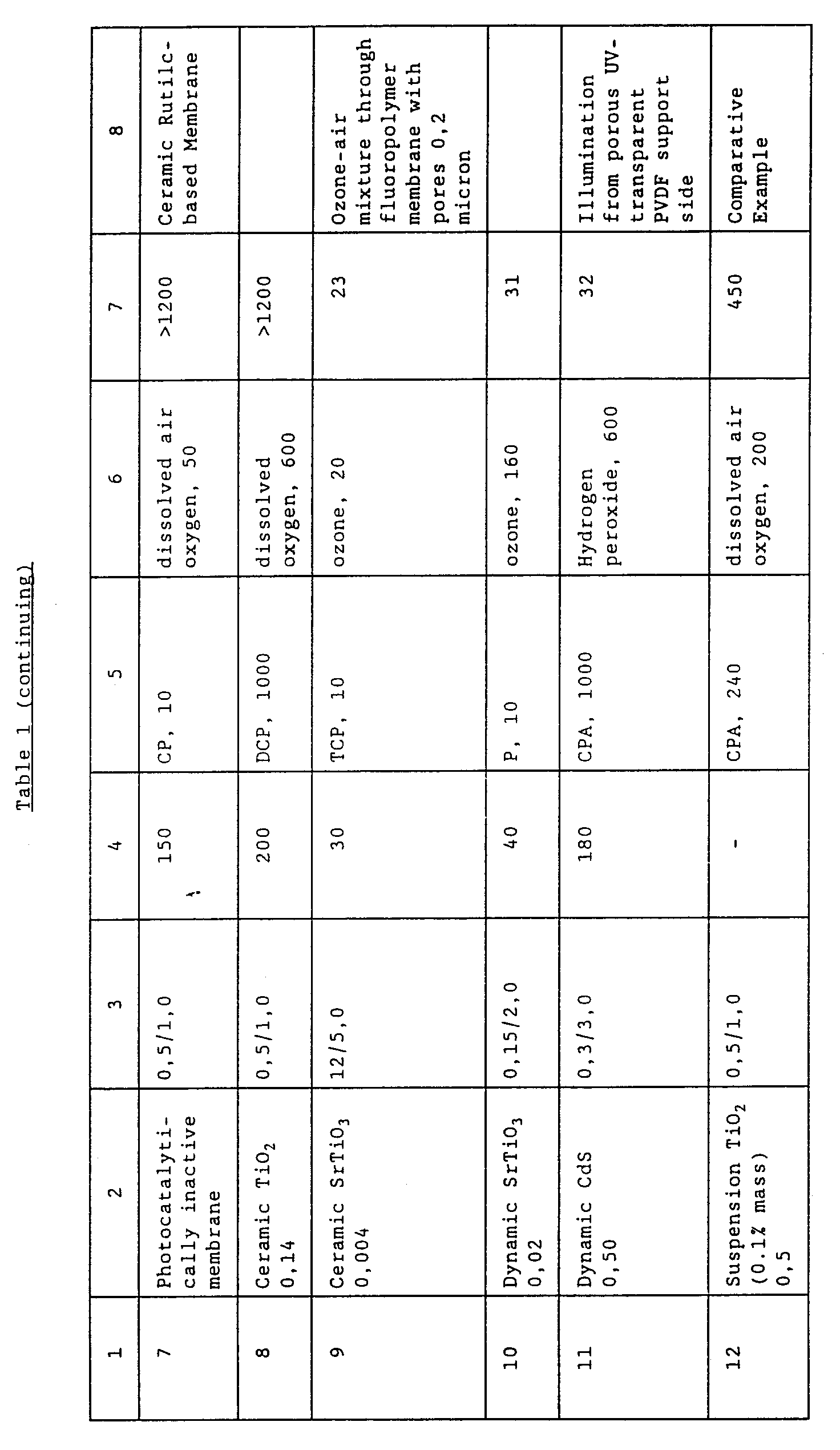
- Example 3 - 11 are similar to Example 1, 2, the distinctive features of membrane photocatalysts and process conditions as well as results are given in Table 1.
Landscapes
- Chemical & Material Sciences (AREA)
- Life Sciences & Earth Sciences (AREA)
- Hydrology & Water Resources (AREA)
- Engineering & Computer Science (AREA)
- Environmental & Geological Engineering (AREA)
- Water Supply & Treatment (AREA)
- Organic Chemistry (AREA)
- Chemical Kinetics & Catalysis (AREA)
- Treatment Of Water By Oxidation Or Reduction (AREA)
- Physical Water Treatments (AREA)
- Catalysts (AREA)
- Separation Using Semi-Permeable Membranes (AREA)
Abstract
Description
- possibility of a complete degradation of steady highly toxic organics to non-toxic products of complete oxidation;
- simplicity and low power consumption due to participation in the process of near ultraviolet and a part of visible spectrum, up to 370 nm, and in particular, a major part of the solar spectrum.
- heating up to 400°C at 0.5°C/min rate;
- heating from 400°C up to 600°C at 0.5°C/min rate;
- cooling from 600°C up to 20°C at 0.5°C/min rate.

Claims (9)
- A method of water purification from dissolved organics comprising the steps of putting solution into a contact with a semiconducting photocatalyst, their irradiation with ultraviolet within the time period sufficient for the impurities destruction, and separation of the purified water from the photocatalyst by the membrane filtration, wherein all three stages are performed within the united process by the solution filtration at 30 - 180 l/h m2 volume filtration rate and 0.15 - 12 atm g pressure through a porous membrane made of a semiconducting material based on TiO2, CdS, SrTiO3, Fe2O3 providing a simultaneous membrane irradiation with ultraviolet in the presence of the oxidizing agent excess.
- A method according to claim 1 wherein a combined process of photoradiation/filtration incorporates a preliminary stage of oxygen or hydrogen peroxide feeding as an oxidizing agent in the amount of 3 - 35 of mole excess to the total concentration of dissolved organics.
- A method according to claim 1 the distinction of which is that into the organics solution 2 - 16 mole excess of ozone as oxidizing agent is preliminary fed.
- A method according to any one of claims 1 to 3, wherein the total concentration of dissolved organics does not exceed 2400 ppm.
- A method according to any one of claims 1 to 4, wherein oxygen or ozone-oxygen mixture is fed through a gas-permeable water-impermeable membrane.
- A method according to any one of claims 1 to 5, wherein the porous membrane a dynamic membrane in the form of a layer of fine powder of a semiconducting photocatalyst with particle size of 0.02 - 3.0 mµ on a large pore support is used.
- A method according to any one of claims 1 to 6, wherein the porous support is made of UV-transparent material and the membrane is exposed to irradiation with ultraviolet on the porous support side.
- A method according to any one of claims 1 to 5, wherein the porous membrane a sintered ceramic membrane with 0.004 - 0.50 mµ pore size is used.
- A method according to any one of claims 1 to 8, wherein the process is performed at 0.2 - 5.0 m/s tangential flow.
Applications Claiming Priority (2)
| Application Number | Priority Date | Filing Date | Title |
|---|---|---|---|
| RU96114464A RU2117517C1 (en) | 1996-07-16 | 1996-07-16 | Method of removing dissolved organics from water |
| RU96114464 | 1996-07-16 |
Publications (1)
| Publication Number | Publication Date |
|---|---|
| EP0819649A1 true EP0819649A1 (en) | 1998-01-21 |
Family
ID=20183419
Family Applications (1)
| Application Number | Title | Priority Date | Filing Date |
|---|---|---|---|
| EP19970111977 Withdrawn EP0819649A1 (en) | 1996-07-16 | 1997-07-14 | Photocatalytic method for treatment of contaminated water |
Country Status (3)
| Country | Link |
|---|---|
| EP (1) | EP0819649A1 (en) |
| JP (1) | JPH1043775A (en) |
| RU (1) | RU2117517C1 (en) |
Cited By (24)
| Publication number | Priority date | Publication date | Assignee | Title |
|---|---|---|---|---|
| EP1167300A1 (en) * | 2000-06-22 | 2002-01-02 | Enitechnologie S.p.A. | Photodegradative process for the purification of contaminated water |
| FR2819799A1 (en) * | 2001-01-22 | 2002-07-26 | Ahlstrom Res And Competence Ct | Treating liquid effluents, especially waste water containing oils or waxes, comprises solid-liquid and/or liquid-liquid separation and photocatalytic steps |
| WO2002027765A3 (en) * | 2000-09-26 | 2003-01-30 | Max Planck Gesellschaft | Stoichiometric modification of an ionic structured solid |
| WO2004049352A1 (en) * | 2002-11-25 | 2004-06-10 | Rwe Nukem Gmbh | Method for treating radioactive waste water |
| WO2004101442A1 (en) * | 2003-05-19 | 2004-11-25 | Ntu Ventures Private Limited | Method and system for the degradation of halogenated compounds |
| WO2010021551A1 (en) * | 2008-08-18 | 2010-02-25 | Sinvent As | Photo-catalytic membrane reactor |
| FR2936509A1 (en) * | 2008-09-30 | 2010-04-02 | Commissariat Energie Atomique | DEVICE AND METHOD FOR REMOVING A CONTINUOUS COMPOUND IN A FLUID. |
| CN101786715A (en) * | 2010-03-08 | 2010-07-28 | 九江学院 | Titanium dioxide precoated dynamic membrane photocatalytic water treatment device |
| CN101643250B (en) * | 2009-09-07 | 2011-05-18 | 浙江理工大学 | Absorption and photocatalysis integrated system for deep-treating organic waste water |
| CN102527410A (en) * | 2012-01-16 | 2012-07-04 | 河北科技大学 | Preparation method of carbon fiber felt loaded CdS/TiO2 composite photocatalytic material |
| EP2326597A4 (en) * | 2008-08-18 | 2013-06-12 | Sinvent As | METHOD AND SYSTEM FOR REMOVING ORGANIC MATERIALS IN LIQUIDS |
| CN101767913B (en) * | 2010-01-21 | 2013-06-19 | 云南大学 | Method for treatment of high-salinity and high-concentration organic wastewater through process of high-efficiency photocatalytic vacuum separation of gas phase, liquid phase and solid phase |
| CN104496075A (en) * | 2014-12-17 | 2015-04-08 | 中国石油天然气股份有限公司 | A photocatalytic-hydrogen peroxide synergistic oxidation method and device for treating aniline wastewater |
| CN104525206A (en) * | 2014-12-04 | 2015-04-22 | 格丰科技材料有限公司 | Porous ozone catalyst for removing COD from waste water and preparation method thereof |
| CN104971743A (en) * | 2015-06-29 | 2015-10-14 | 江苏大学 | A kind of preparation method and application of SrTiO3/CdS heterojunction material |
| CN105461045A (en) * | 2016-01-26 | 2016-04-06 | 安徽工业大学 | Ultrafiltration membrane assembly integrating catalytic oxidation and carrying catalyst |
| CN105481154A (en) * | 2016-01-26 | 2016-04-13 | 安徽工业大学 | Ultrafiltration membrane reclaimed water treatment device integrating catalytic oxidation and supported catalyst |
| CN108706677A (en) * | 2018-05-21 | 2018-10-26 | 大连理工大学 | A kind of method of hydrogen peroxide enhancing photocatalysis membrana separating property |
| CN109437367A (en) * | 2018-12-10 | 2019-03-08 | 广东智环创新环境科技有限公司 | A kind of advanced oxidation equipment based on fludized bed photoreactor |
| CN110818015A (en) * | 2018-08-13 | 2020-02-21 | 中国石油化工股份有限公司 | Method for treating nitrobenzene wastewater by photocatalytic oxidation |
| CN111825239A (en) * | 2020-07-10 | 2020-10-27 | 湖北汇富纳米材料股份有限公司 | Sodium hypochlorite wastewater treatment device and process |
| CN111962209A (en) * | 2019-05-20 | 2020-11-20 | 中国科学院过程工程研究所 | Composite catalytic membrane, photocatalytic oxidation-membrane distillation multi-dimensional sewage treatment system and treatment method |
| CN113233572A (en) * | 2021-04-28 | 2021-08-10 | 中建安装集团有限公司 | Photocatalytic circulation reaction method and device for fuel ethanol production wastewater |
| CN114434886A (en) * | 2021-12-31 | 2022-05-06 | 浙江大学 | Selective separation catalytic membrane, preparation method thereof and application thereof in soil and water remediation |
Families Citing this family (11)
| Publication number | Priority date | Publication date | Assignee | Title |
|---|---|---|---|---|
| JP4893901B2 (en) * | 2000-09-11 | 2012-03-07 | 幹男 小林 | Contaminated environmental water treatment equipment |
| RU2278829C2 (en) * | 2003-11-28 | 2006-06-27 | Открытое акционерное общество "Центральное конструкторское бюро Научно-производственного объединения "Судоремонт" (ОАО "Центральное конструкторское бюро Научно-производственного объединения "Судоремонт") | Method of purification of the waste waters |
| MD3149G2 (en) * | 2005-09-15 | 2007-04-30 | Государственный Университет Молд0 | Plant for water photocatalytic purification from organic substances |
| JP2007260534A (en) * | 2006-03-28 | 2007-10-11 | Sumitomo Chemical Co Ltd | Method for producing photocatalytic titanium oxide |
| RU2394772C2 (en) * | 2008-05-05 | 2010-07-20 | Некоммерческая организация Учреждение Институт проблем химической физики Российской академии наук (ИПХФ РАН) | Photocatalytic water treatment module |
| MD4041C2 (en) * | 2008-11-10 | 2010-12-31 | Государственный Университет Молд0 | Process for biochemical treatment of vinasse |
| RU2404928C2 (en) * | 2008-11-28 | 2010-11-27 | Альбина Ивановна Леонтьева | Method of cleaning polluted medium from organic substances |
| RU2466791C1 (en) * | 2011-08-11 | 2012-11-20 | Государственное образовательное учреждение высшего профессионального образования "Саратовский государственный технический университет" (СГТУ) | Method of obtaining titanate photocatalyst, active in visible area of spectrum |
| RU2479349C1 (en) * | 2012-01-19 | 2013-04-20 | Федеральное государственное бюджетное образовательное учреждение высшего профессионального образования "Саратовский государственный технический университет имени Гагарина Ю.А." (СГТУ имени Гагарина Ю.А.) | Method of producing catalyst for cleaning water from hydrocarbon contaminants |
| RU2502682C1 (en) * | 2012-05-10 | 2013-12-27 | Федеральное государственное бюджетное образовательное учреждение высшего профессионального образования "Уфимский государственный нефтяной технический университет" | Method of water purification |
| RU182587U1 (en) * | 2018-03-20 | 2018-08-23 | федеральное государственное бюджетное образовательное учреждение высшего образования "Тольяттинский государственный университет" | INSTALLATION OF PHOTOCATALYTIC WATER TREATMENT |
Citations (2)
| Publication number | Priority date | Publication date | Assignee | Title |
|---|---|---|---|---|
| US5118422A (en) * | 1990-07-24 | 1992-06-02 | Photo-Catalytics, Inc. | Photocatalytic treatment of water |
| US5512178A (en) * | 1992-04-17 | 1996-04-30 | Yoshihisa Masuda | Water treatment method and apparatus therefor |
Family Cites Families (1)
| Publication number | Priority date | Publication date | Assignee | Title |
|---|---|---|---|---|
| SU1587011A1 (en) * | 1987-11-30 | 1990-08-23 | Б.И.Ревут | Method of cleaning waste water from organic matter |
-
1996
- 1996-07-16 RU RU96114464A patent/RU2117517C1/en not_active IP Right Cessation
- 1996-12-24 JP JP34415496A patent/JPH1043775A/en active Pending
-
1997
- 1997-07-14 EP EP19970111977 patent/EP0819649A1/en not_active Withdrawn
Patent Citations (2)
| Publication number | Priority date | Publication date | Assignee | Title |
|---|---|---|---|---|
| US5118422A (en) * | 1990-07-24 | 1992-06-02 | Photo-Catalytics, Inc. | Photocatalytic treatment of water |
| US5512178A (en) * | 1992-04-17 | 1996-04-30 | Yoshihisa Masuda | Water treatment method and apparatus therefor |
Non-Patent Citations (1)
| Title |
|---|
| BELLOBONO I R ET AL: "PRE-INDUSTRIAL EXPERIENCE IN ADVANCE OXIDATION AND INTEGRAL PHOTODEGRADATION OR ORGANICS IN POTABLE WATERS AND WASTE WATERS BY PHOTOPERM MEMBRANES IMMOBILIZING TITANIUM DIOXIDE AND PROMOTING PHOTOCATALYSTS", JOURNAL OF MEMBRANE SCIENCE, vol. 102, 15 June 1995 (1995-06-15), pages 139 - 147, XP000546477 * |
Cited By (32)
| Publication number | Priority date | Publication date | Assignee | Title |
|---|---|---|---|---|
| EP1167300A1 (en) * | 2000-06-22 | 2002-01-02 | Enitechnologie S.p.A. | Photodegradative process for the purification of contaminated water |
| US6468434B2 (en) | 2000-06-22 | 2002-10-22 | Enitecnologie S.P.A. | Photodegradative process for the purification of contaminated water |
| WO2002027765A3 (en) * | 2000-09-26 | 2003-01-30 | Max Planck Gesellschaft | Stoichiometric modification of an ionic structured solid |
| FR2819799A1 (en) * | 2001-01-22 | 2002-07-26 | Ahlstrom Res And Competence Ct | Treating liquid effluents, especially waste water containing oils or waxes, comprises solid-liquid and/or liquid-liquid separation and photocatalytic steps |
| WO2004049352A1 (en) * | 2002-11-25 | 2004-06-10 | Rwe Nukem Gmbh | Method for treating radioactive waste water |
| WO2004101442A1 (en) * | 2003-05-19 | 2004-11-25 | Ntu Ventures Private Limited | Method and system for the degradation of halogenated compounds |
| WO2010021551A1 (en) * | 2008-08-18 | 2010-02-25 | Sinvent As | Photo-catalytic membrane reactor |
| EP2326597A4 (en) * | 2008-08-18 | 2013-06-12 | Sinvent As | METHOD AND SYSTEM FOR REMOVING ORGANIC MATERIALS IN LIQUIDS |
| FR2936509A1 (en) * | 2008-09-30 | 2010-04-02 | Commissariat Energie Atomique | DEVICE AND METHOD FOR REMOVING A CONTINUOUS COMPOUND IN A FLUID. |
| WO2010037717A1 (en) * | 2008-09-30 | 2010-04-08 | Commissariat A L'energie Atomique | Device, use thereof and process for removing a compound contained in a fluid |
| CN101643250B (en) * | 2009-09-07 | 2011-05-18 | 浙江理工大学 | Absorption and photocatalysis integrated system for deep-treating organic waste water |
| CN101767913B (en) * | 2010-01-21 | 2013-06-19 | 云南大学 | Method for treatment of high-salinity and high-concentration organic wastewater through process of high-efficiency photocatalytic vacuum separation of gas phase, liquid phase and solid phase |
| CN101786715A (en) * | 2010-03-08 | 2010-07-28 | 九江学院 | Titanium dioxide precoated dynamic membrane photocatalytic water treatment device |
| CN102527410B (en) * | 2012-01-16 | 2015-06-17 | 河北科技大学 | Preparation method of carbon fiber felt loaded CdS/TiO2 composite photocatalytic material |
| CN102527410A (en) * | 2012-01-16 | 2012-07-04 | 河北科技大学 | Preparation method of carbon fiber felt loaded CdS/TiO2 composite photocatalytic material |
| CN104525206A (en) * | 2014-12-04 | 2015-04-22 | 格丰科技材料有限公司 | Porous ozone catalyst for removing COD from waste water and preparation method thereof |
| CN104496075A (en) * | 2014-12-17 | 2015-04-08 | 中国石油天然气股份有限公司 | A photocatalytic-hydrogen peroxide synergistic oxidation method and device for treating aniline wastewater |
| CN104971743B (en) * | 2015-06-29 | 2017-12-22 | 江苏大学 | A kind of SrTiO3The preparation method and purposes of/CdS heterojunction materials |
| CN104971743A (en) * | 2015-06-29 | 2015-10-14 | 江苏大学 | A kind of preparation method and application of SrTiO3/CdS heterojunction material |
| CN105461045B (en) * | 2016-01-26 | 2018-01-19 | 安徽工业大学 | A kind of integrated catalytic oxidation and the hyperfiltration membrane assembly of supported catalyst |
| CN105481154A (en) * | 2016-01-26 | 2016-04-13 | 安徽工业大学 | Ultrafiltration membrane reclaimed water treatment device integrating catalytic oxidation and supported catalyst |
| CN105481154B (en) * | 2016-01-26 | 2018-01-09 | 安徽工业大学 | A kind of integrated catalytic oxidation and the milipore filter reused water processing device of supported catalyst |
| CN105461045A (en) * | 2016-01-26 | 2016-04-06 | 安徽工业大学 | Ultrafiltration membrane assembly integrating catalytic oxidation and carrying catalyst |
| CN108706677A (en) * | 2018-05-21 | 2018-10-26 | 大连理工大学 | A kind of method of hydrogen peroxide enhancing photocatalysis membrana separating property |
| CN110818015A (en) * | 2018-08-13 | 2020-02-21 | 中国石油化工股份有限公司 | Method for treating nitrobenzene wastewater by photocatalytic oxidation |
| CN110818015B (en) * | 2018-08-13 | 2022-02-11 | 中国石油化工股份有限公司 | Method for treating nitrobenzene wastewater by photocatalytic oxidation |
| CN109437367A (en) * | 2018-12-10 | 2019-03-08 | 广东智环创新环境科技有限公司 | A kind of advanced oxidation equipment based on fludized bed photoreactor |
| CN109437367B (en) * | 2018-12-10 | 2020-01-17 | 广东智环创新环境科技有限公司 | Advanced oxidation equipment based on fluidized bed photocatalytic reactor |
| CN111962209A (en) * | 2019-05-20 | 2020-11-20 | 中国科学院过程工程研究所 | Composite catalytic membrane, photocatalytic oxidation-membrane distillation multi-dimensional sewage treatment system and treatment method |
| CN111825239A (en) * | 2020-07-10 | 2020-10-27 | 湖北汇富纳米材料股份有限公司 | Sodium hypochlorite wastewater treatment device and process |
| CN113233572A (en) * | 2021-04-28 | 2021-08-10 | 中建安装集团有限公司 | Photocatalytic circulation reaction method and device for fuel ethanol production wastewater |
| CN114434886A (en) * | 2021-12-31 | 2022-05-06 | 浙江大学 | Selective separation catalytic membrane, preparation method thereof and application thereof in soil and water remediation |
Also Published As
| Publication number | Publication date |
|---|---|
| JPH1043775A (en) | 1998-02-17 |
| RU2117517C1 (en) | 1998-08-20 |
Similar Documents
| Publication | Publication Date | Title |
|---|---|---|
| RU2117517C1 (en) | Method of removing dissolved organics from water | |
| Tseng et al. | Removal of chlorophenols from water by photocatalytic oxidation | |
| Chen et al. | Application of nano TiO2 towards polluted water treatment combined with electro-photochemical method | |
| Laoufi et al. | The degradation of phenol in water solution by TiO2 photocatalysis in a helical reactor | |
| US5118422A (en) | Photocatalytic treatment of water | |
| Kiriakidou et al. | The effect of operational parameters and TiO2-doping on the photocatalytic degradation of azo-dyes | |
| Pelegrini et al. | Photoassisted electrochemical degradation of organic pollutants on a DSA type oxide electrode: process test for a phenol synthetic solution and its application for the E1 bleach kraft mill effluent | |
| Fotou et al. | Photocatalytic destruction of phenol and salicylic acid with aerosol-made and commercial titania powders | |
| US6524447B1 (en) | Apparatus and method for photocatalytic purification and disinfection of water and ultrapure water | |
| CA2156298A1 (en) | Apparatus for removal of organic material from water | |
| Mazzarino et al. | Degradation of organic pollutants in water by photochemical reactors | |
| KR20140134990A (en) | A water treatment system including porous alumina membranes immobilized photocatalysts, operating method thereof, and purifying method of wastewater using thereby | |
| EP0766647B1 (en) | Photoelectrochemical reactor | |
| CA2444385A1 (en) | Apparatus and method for phtocatalytic purification and disinfection of water and ultrapure water | |
| KR102597770B1 (en) | Catalytic composite for catalytic ozone oxidation process and preparation method thereof | |
| EP0997439B1 (en) | Method for decomposing bromic acid by photocatalyst | |
| Gupta et al. | Photocatalytic mineralisation of perchloroethylene using titanium dioxide | |
| Dehghani et al. | High performance degradation of phenol from aqueous media using ozonation process and zinc oxide nanoparticles as a semiconductor photo catalyst in the presence of ultraviolet radiation | |
| JPH05154473A (en) | Photochemical reaction treatment for fluid | |
| Royaee et al. | Application of photo-impinging streams reactor in degradation of phenol in aqueous phase | |
| Zanta et al. | Degradation of 2-hydroxybenzoic acid by advanced oxidation processes | |
| CN1830830A (en) | A photocatalytic method for removing nitrogen from water | |
| WO2001012562A1 (en) | Apparatus for purification of contaminated water by using rotating member | |
| Govindasamy et al. | Advanced Oxidation Processes driven by heterogeneous photocatalysis: a critical review of challenges and perspectives | |
| JPH10249336A (en) | Water treating method and water treating device using photocatalyst |
Legal Events
| Date | Code | Title | Description |
|---|---|---|---|
| PUAI | Public reference made under article 153(3) epc to a published international application that has entered the european phase |
Free format text: ORIGINAL CODE: 0009012 |
|
| AK | Designated contracting states |
Kind code of ref document: A1 Designated state(s): DE FR GB IT |
|
| AX | Request for extension of the european patent |
Free format text: AL;LT;LV;RO;SI |
|
| 17P | Request for examination filed |
Effective date: 19980313 |
|
| AKX | Designation fees paid |
Free format text: DE FR GB IT |
|
| RBV | Designated contracting states (corrected) |
Designated state(s): DE FR GB IT |
|
| 17Q | First examination report despatched |
Effective date: 19991117 |
|
| STAA | Information on the status of an ep patent application or granted ep patent |
Free format text: STATUS: THE APPLICATION IS DEEMED TO BE WITHDRAWN |
|
| 18D | Application deemed to be withdrawn |
Effective date: 20020201 |