EP0819405B1 - Module pour enregister la fréquence cardiaque instantanée et module portable en faisant application - Google Patents
Module pour enregister la fréquence cardiaque instantanée et module portable en faisant application Download PDFInfo
- Publication number
- EP0819405B1 EP0819405B1 EP97401659A EP97401659A EP0819405B1 EP 0819405 B1 EP0819405 B1 EP 0819405B1 EP 97401659 A EP97401659 A EP 97401659A EP 97401659 A EP97401659 A EP 97401659A EP 0819405 B1 EP0819405 B1 EP 0819405B1
- Authority
- EP
- European Patent Office
- Prior art keywords
- recording
- cardiac cycles
- ecg signal
- signal
- cardiac
- Prior art date
- Legal status (The legal status is an assumption and is not a legal conclusion. Google has not performed a legal analysis and makes no representation as to the accuracy of the status listed.)
- Expired - Lifetime
Links
- 0 CCCCCCC(*)CC(CCC1)CC1S Chemical compound CCCCCCC(*)CC(CCC1)CC1S 0.000 description 1
Images


Classifications
-
- A—HUMAN NECESSITIES
- A61—MEDICAL OR VETERINARY SCIENCE; HYGIENE
- A61B—DIAGNOSIS; SURGERY; IDENTIFICATION
- A61B5/00—Measuring for diagnostic purposes; Identification of persons
- A61B5/02—Detecting, measuring or recording for evaluating the cardiovascular system, e.g. pulse, heart rate, blood pressure or blood flow
- A61B5/024—Measuring pulse rate or heart rate
- A61B5/02438—Measuring pulse rate or heart rate with portable devices, e.g. worn by the patient
-
- A—HUMAN NECESSITIES
- A61—MEDICAL OR VETERINARY SCIENCE; HYGIENE
- A61B—DIAGNOSIS; SURGERY; IDENTIFICATION
- A61B5/00—Measuring for diagnostic purposes; Identification of persons
- A61B5/02—Detecting, measuring or recording for evaluating the cardiovascular system, e.g. pulse, heart rate, blood pressure or blood flow
- A61B5/0205—Simultaneously evaluating both cardiovascular conditions and different types of body conditions, e.g. heart and respiratory condition
Definitions
- the present invention relates to the technical field of recording physiological and physical data of a patient in order to allow in particular, carry out surveillance, research or diagnostics.
- the object of the invention aims more precisely to record, on the one hand, the electrical activity of a patient's heart muscle and, on the other hand, the temperature of the patient.
- European document EP-A-0 553 372 discloses such an ambulatory device making it possible to acquire at least two measurement signals such as an ECG signal and a temperature signal.
- the object of the invention is to remedy the drawbacks stated above by providing a method for recording the instant heart rate of a patient and his temperature.
- Another object of the invention is to propose a portable module allowing recording of instant heart rate and temperature of the patient while presenting a great autonomy of operation.
- Fig. 1 is a functional block diagram illustrating the ambulatory module according to the invention.
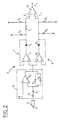
- Fig. 2 is a diagram illustrating a characteristic detail of the ambulatory module according to the invention.
- Fig. 3 is an example of curves illustrating the principle of detection of the heart rate, in accordance with the invention.
- module 1 is suitable for recording a person's heart activity and temperature.
- the module 1 is intended to be worn by the patient by any suitable means not shown.
- the portable module 1 is designed to be connected to a device, not shown but known per se, comprising electrodes placed on the patient, so as to deliver an electrical signal produced by the contractions of the heart muscle.
- an electrocardiogram signal 2 is received by an acquisition and processing unit 3 forming part of the module 1 .
- the module 1 is intended to also collect at least one temperature from the patient simultaneously with the acquisition of the ECG signal.
- the module 1 is thus intended to be connected to sensors 4 placed so as to make it possible to collect for example one or more skin, esophageal, tympanic or rectal temperatures.
- the module 1 includes means for processing and calculating the received signals and is thus structured around a processor P , for example of the Microchip Technology Inc. PIC 16C74 type.
- the module 1 also includes a main power supply A delivering, for example, a voltage of 3.6 V, a memory block M connected to the output port D, C of the processor P , a clock H connected to a serial port SC1 of the processor and a transmission circuit T connected to the serial port SC2 of the processor and intended to be connected with a remote computer O via a link, for example, RS232.
- the module 1 is also provided with a push button BP connected to the standby unit V of the processor P.
- the processor P also includes a counter B connected to the acquisition and processing unit 3 .
- the acquisition and processing unit 3 comprises, at the input, a stage 5 for filtering the ECG signal.
- the filtering stage 5 has a bandwidth between 1 and 24 Hz and preferably between 5 and 16 Hz.
- the output of the filtering stage 5 is connected to a circuit 6 for amplifying the alternating component of the signal .
- the output of the filtering stage 5 is connected via a resistor 6 1 and a capacitor 6 2 connected in series, to the inverting input of an operational amplifier 6 3 whose input non-inverting is connected to ground.
- the inverting input of the operational amplifier 6 3 is connected to its output by means of a resistive 6 4 and capacitive 6 5 parallel circuit.
- the output of the operational amplifier 6 3 and, consequently, of the stage 6 is connected to two integrators 7 and 8 having different time constants.
- Each integrator 7 and 8 thus comprises an operational amplifier 7 1 , 8 1 whose non-inverting input is connected to the output of the filtering stage 6 .
- the inverting input of each amplifier 7 1 , 8 1 is connected to the cathode of a diode 7 2 , 8 2 whose anode is connected to the output of the corresponding operational amplifier.
- the cathode of each diode 7 2 , 8 2 is connected to ground via a capacitor 7 3 , 8 3 mounted in parallel with resistors 7 4 , 7 5 and 8 4 respectively .
- Each integrator 7 , 8 thus delivers a signal E 1 , E 2 respectively having time constants ⁇ 1 , ⁇ 2 of different values.
- the outputs of the integrators 7 , 8 drive a comparator 11 delivering a signal E 3 in slots representative of the cardiac cycle.
- the acquisition and processing unit 3 makes it possible to detect the peaks "R" of the ECG signal using the two signals E 1 and E 2 detecting the envelope of the signal with different fidelities.
- the comparator 11 goes from a high level to a low level, as soon as the signal E 1 which has the largest time constant, has reached its maximum value. Comparator 11 retains its low state as long as the value of signal E 2 is greater than the value of signal E 1 . As soon as the value of the signal E 2 becomes lower than the value of the signal E 1 , the comparator 11 switches from a low level to a high level.
- the acquisition and processing unit 3 thus makes it possible to detect with great fidelity the peaks "R" of the ECG signal and, consequently, to detect the heart rate of a person.
- each elementary period t separating two consecutive heartbeats makes it possible to determine the instantaneous heart rate.
- the instantaneous heart rate is obtained by performing the sum of the elementary periods t , divided by the number of determined cardiac peaks. It should be noted that it can be envisaged to determine this instantaneous heart rate by no longer considering the elementary period t , but a period T corresponding to n x t .
- the processor P comprises an analog-digital converter CAN connected to a multiplexer 15 whose analog inputs are connected to the temperature sensors 4 .
- the multiplexer 15 is controlled by means of a signal delivered, for example, by the output port E of the processor P.
- the port E controls a secondary energy source 18 intended to supply the temperature sensors 4 of all types known per se.
- the portable module 1 described above is implemented in the following manner considering that the processor P integrates programming means adapted to ensure its operation in accordance with the invention.
- the processor P When it is not operating, it must be considered that the processor P is placed in the sleep state, while the secondary energy source 18 does not supply the temperature sensors 4 .
- the processor P includes integrated programming means making it possible to monitor the interruptions likely to occur by the clock H , the push button BP or the computer system O.
- the module 1 Prior to carrying out a series of measurements, the module 1 receives instructions or operating parameters via the computer system O. This initialization phase of module 1 consists, in particular, in defining the recording instructions, namely the start and end time of the recording of the measurements, as well as the definition of the number n of cardiac periods to be taken into account. account.
- the module 1 is adapted to scan the state of the push button BP and read the clock, in order to determine whether the start time for recording the data chosen during the initialization phase has been reached. As soon as the start time of the recording period is reached or an action on the push button intervenes, the processor P goes into sleep mode and is placed in the waiting state for an interruption generated by the counter. and corresponding to a low level of the ECG signal. As soon as the low level of the ECG signal is detected, the processor P reads a clock H 1 and controls the secondary energy source 18 supplying the temperature sensors 4 . The multiplexer 15 is controlled so as to allow the recording of the selected temperatures.
- the secondary energy source 18 is controlled so as to no longer supply the sensors 4 .
- the processor P then goes into sleep mode until a new interruption.
- a new low level of the signal E 3 appears corresponding to the n th pulsation consecutive to that previously detected, the values of the temperature sensors are acquired and a clock H 2 is read.
- the duration T of a selected cycle is determined.
- the instantaneous heart rate is obtained by dividing the duration T by the selected parameter n .
- the ambulatory module according to the invention makes it possible to detect the instantaneous heart rate with great precision while offering great operating autonomy.
- n 1
Landscapes
- Health & Medical Sciences (AREA)
- Life Sciences & Earth Sciences (AREA)
- Cardiology (AREA)
- Physiology (AREA)
- Medical Informatics (AREA)
- Animal Behavior & Ethology (AREA)
- Pathology (AREA)
- Engineering & Computer Science (AREA)
- Biomedical Technology (AREA)
- Heart & Thoracic Surgery (AREA)
- Physics & Mathematics (AREA)
- Molecular Biology (AREA)
- Surgery (AREA)
- Biophysics (AREA)
- General Health & Medical Sciences (AREA)
- Public Health (AREA)
- Veterinary Medicine (AREA)
- Pulmonology (AREA)
- Measuring Pulse, Heart Rate, Blood Pressure Or Blood Flow (AREA)
- Measuring And Recording Apparatus For Diagnosis (AREA)
- Measurement Of The Respiration, Hearing Ability, Form, And Blood Characteristics Of Living Organisms (AREA)
- Measurement And Recording Of Electrical Phenomena And Electrical Characteristics Of The Living Body (AREA)
- Electrotherapy Devices (AREA)
Description
- détecter les pics du signal ECG à l'aide de deux intégrateurs présentant des constantes de temps différentes et raccordées à un comparateur délivrant un signal représentatif des cycles cardiaques,
- enregistrer la durée des cycles cardiaques,
- et à enregistrer la température dès la détection du début des cycles cardiaques.
- une source principale d'énergie reliée à une source secondaire d'énergie alimentant par un circuit commandé, le capteur de température,
- une unité d'acquisition et de traitement du signal ECG comportant un étage de filtration du signal ECG, relié à deux intégrateurs présentant des constantes de temps différentes, les sorties des intégrateurs étant connectées à un comparateur délivrant un signal représentatif des cycles cardiaques,
- des moyens de mise en fonctionnement de l'unité d'acquisition et de traitement du signal ECG,
- et un processeur comportant :
- un convertisseur analogique-numérique destiné à recevoir le signal analogique délivré par le capteur de température,
- un compteur auquel est reliée la sortie du comparateur, afin de permettre de déterminer la durée des cycles cardiaques,
- des moyens de commande permettant, d'une part, de commander le circuit pilotant le fonctionnement de la source secondaire d'énergie et, d'autre part, d'enregistrer la durée des cycles cardiaques et les valeurs de température associées.
Claims (9)
- Procédé pour enregistrer, d'une part, l'activité cardiaque d'une personne à l'aide d'un dispositif délivrant un signal ECG et, d'autre part, au moins une température du patient à l'aide d'un capteur de température (4), caractérisé en ce qu'il consisteà détecter les pics "R" du signal ECG à l'aide de deux intégrateurs (7, 8) présentant des constantes de temps différentes et raccordées à un comparateur (11) délivrant un signal (E3 ) représentatif des cycles cardiaques,à enregistrer la durée (T) des cycles cardiaques, en vue de déterminer, en considération du nombre de pics détectés, la fréquence cardiaque instantanée,et à enregistrer la température dès la détection du début des cycles cardiaques.
- Procédé selon la revendication 1, caractérisé en ce qu'il consiste à choisir une fréquence (n) de sélection des cycles cardiaques et à enregistrer la durée des cycles cardiaques sélectionnés.
- Procédé selon la revendication 1, caractérisé en ce qu'il consiste à alimenter en énergie les capteurs de température (4) dès la détection du début de chaque cycle cardiaque et à l'interrompre dès l'enregistrement des valeurs de températures.
- Procédé selon la revendication 1, caractérisé en ce qu'il consiste à assurer le filtrage du signal ECG, dont la bande passante est comprise entre 1 et 24 Hz et, de préférence, entre 5 et 16 Hz.
- Module portable pour enregistrer, selon le procédé conforme à la revendication 1, d'une part, l'activité cardiaque d'une personne à l'aide d'un dispositif délivrant un signal ECG et, d'autre part, au moins une température du patient prise à l'aide d'un capteur de température (4), caractérisé en ce qu'il comporte :une source principale d'énergie (A) reliée à une source secondaire d'énergie (18) alimentant par un circuit commandé, le capteur de température (4),une unité (3) d'acquisition et de traitement du signal ECG comportant un étage de filtrage (5) du signal ECG, relié à deux intégrateurs (7, 8) présentant des constantes de temps différentes, les sorties des intégrateurs étant connectées à un comparateur (11) délivrant un signal (E3 ) représentatif des cycles cardiaques,des moyens de mise en fonctionnement de l'unité d'acquisition et de traitement du signal ECG,et un processeur (P) comportant :un convertisseur analogique-numérique (CAN) destiné à recevoir le signal analogique délivré par le capteur de température,un compteur (B) auquel est reliée la sortie du comparateur (11), afin de permettre de déterminer la durée des cycles cardiaques,des moyens de commande permettant, d'une part, de commander le circuit pilotant le fonctionnement de la source secondaire d'énergie (18) et, d'autre part, d'enregistrer la durée des cycles cardiaques et les valeurs de température associées,et des moyens de détermination de la fréquence cardiaque instantanée en considération du nombre de pics détectés et de la durée des cycles cardiaques.
- Module selon la revendication 5, caractérisé en ce qu'il comporte des moyens de sélection des consignes d'enregistrement liées aux cycles cardiaques permettant de choisir une fréquence (n) de sélection des cycles cardiaques et d'enregistrer la durée des cycles cardiaques sélectionnés.
- Module selon la revendication 6, caractérisé en ce que les moyens de sélection des consignes d'enregistrement permettent de choisir l'enregistrement des durées des cycles cardiaques dans une gamme de fréquence de sélection comprise entre 1 à 16.
- Module selon la revendication 5, caractérisé en ce que les moyens de mise en fonctionnement de l'unité d'acquisition et de traitement du signal ECG sont constitués par un bouton de commande (BP) ou une horloge programmée (H).
- Module selon la revendication 5, caractérisé en ce que l'unité d'acquisition et de traitement comporte un circuit de filtrage du signal ECG dont la bande passante est comprise entre 1 et 24 Hz et, de préférence, entre 5 et 16 Hz.
Applications Claiming Priority (2)
| Application Number | Priority Date | Filing Date | Title |
|---|---|---|---|
| FR9608993 | 1996-07-18 | ||
| FR9608993A FR2751198B1 (fr) | 1996-07-18 | 1996-07-18 | Module pour enregistrer la frequence cardiaque instantanee et module portable en faisant application |
Publications (2)
| Publication Number | Publication Date |
|---|---|
| EP0819405A1 EP0819405A1 (fr) | 1998-01-21 |
| EP0819405B1 true EP0819405B1 (fr) | 2003-11-12 |
Family
ID=9494181
Family Applications (1)
| Application Number | Title | Priority Date | Filing Date |
|---|---|---|---|
| EP97401659A Expired - Lifetime EP0819405B1 (fr) | 1996-07-18 | 1997-07-10 | Module pour enregister la fréquence cardiaque instantanée et module portable en faisant application |
Country Status (5)
| Country | Link |
|---|---|
| US (1) | US5865762A (fr) |
| EP (1) | EP0819405B1 (fr) |
| AT (1) | ATE253863T1 (fr) |
| DE (1) | DE69726059D1 (fr) |
| FR (1) | FR2751198B1 (fr) |
Families Citing this family (1)
| Publication number | Priority date | Publication date | Assignee | Title |
|---|---|---|---|---|
| JP2002033182A (ja) * | 2000-05-10 | 2002-01-31 | Canon Inc | 加熱装置および画像形成装置 |
Family Cites Families (3)
| Publication number | Priority date | Publication date | Assignee | Title |
|---|---|---|---|---|
| DE2633371C3 (de) * | 1976-07-24 | 1987-01-22 | Schuler, Martin, Dipl.-Ing., 8000 München | Gerät zur Registrierung von Herzaktionsspannungen |
| US4576178A (en) * | 1983-03-28 | 1986-03-18 | David Johnson | Audio signal generator |
| EP0553372B1 (fr) * | 1992-01-29 | 1996-11-13 | Hewlett-Packard GmbH | Méthode et système de surveillance de fonctions vitales |
-
1996
- 1996-07-18 FR FR9608993A patent/FR2751198B1/fr not_active Expired - Fee Related
-
1997
- 1997-07-10 EP EP97401659A patent/EP0819405B1/fr not_active Expired - Lifetime
- 1997-07-10 DE DE69726059T patent/DE69726059D1/de not_active Expired - Lifetime
- 1997-07-10 AT AT97401659T patent/ATE253863T1/de not_active IP Right Cessation
- 1997-07-17 US US08/895,927 patent/US5865762A/en not_active Expired - Lifetime
Also Published As
| Publication number | Publication date |
|---|---|
| US5865762A (en) | 1999-02-02 |
| DE69726059D1 (de) | 2003-12-18 |
| EP0819405A1 (fr) | 1998-01-21 |
| FR2751198B1 (fr) | 1998-09-04 |
| FR2751198A1 (fr) | 1998-01-23 |
| ATE253863T1 (de) | 2003-11-15 |
Similar Documents
| Publication | Publication Date | Title |
|---|---|---|
| BE1004497A5 (fr) | Instrument de mesure de niveau de stress. | |
| FR2557318A1 (fr) | Dispositif electronique assurant une interface universelle entre des capteurs et un appareil de saisie et de traitement des signaux en provenance de ces capteurs | |
| FR2548008A1 (fr) | Controleur des fonctions oesophagiennes et ecg | |
| FR3000544A1 (fr) | Dispositif de pesage multi-fonction | |
| EP0663219A1 (fr) | Procédé de contrôle d'un dispositif implantable actif | |
| EP0264329B1 (fr) | Dispositif de surveillance de l'activite d'un organe du corps humain | |
| FR2887425A1 (fr) | Systeme d'analyse electrophysiologique | |
| EP1330980B1 (fr) | Enregistreur de signaux physiologiques, notamment de type Holter, avec un dispositif de contrôle de la continuité d'un cable | |
| FR2707860A1 (fr) | Appareil de mesure et de traitement de signaux physiologiques et procédé automatique mis en Óoeuvre par ledit appareil. | |
| FR2832298A1 (fr) | Dispositif de brossage de dents | |
| US5072415A (en) | Method and microprocessor-based apparatus for directly measuring a particular index for the evaluation of the environmental noise pollution | |
| EP0079305B1 (fr) | Dispositif de mesure de la pression sanguine | |
| EP0819405A1 (fr) | Module pour enregister la fréquence cardiaque instantanée et module portable en faisant application | |
| FR2700683A1 (fr) | Dispositif de reconnaissance de phases de sommeil, et application correspondante. | |
| CH690936A5 (fr) | Dispositif de détection ultra-sonore, notamment pour un système de nettoyage de pare-brise à commande automatique. | |
| EP1236056B1 (fr) | Enregistreur de donnees numeriques autonome du bruit de fond d'un site | |
| FR2555431A1 (fr) | Appareil et procede pour mesurer tres rapidement le rythme cardiaque | |
| EP0672433A1 (fr) | Procédé de commande de la fréquence de base d'un stimulateur cardiaque | |
| EP0681448B1 (fr) | Tensiometre a mesure en continu, et procede correspondant | |
| EP0136212A1 (fr) | Appareil et procédé pour mesure la tension artérielle suivant une méthode indirecte | |
| EP1426738A1 (fr) | Dispositif électronique et procédé comportant des moyens capacitifs de détection d'eau | |
| EP2059167A2 (fr) | Dispositif et procede d'analyse temporelle de l'agitation d'un patient alite | |
| FR2534132A1 (fr) | Systeme de mesure des depassements des limites physiologiques d'un utilisateur | |
| EP0221981A1 (fr) | Dispositif de mesure automatique de la pression arterielle par monitorage autonome, informatise, en ambulatoire vrai | |
| FR2498071A1 (fr) | Procede de mesure de la pression arterielle et dispositif pour mettre en oeuvre ce procede |
Legal Events
| Date | Code | Title | Description |
|---|---|---|---|
| PUAI | Public reference made under article 153(3) epc to a published international application that has entered the european phase |
Free format text: ORIGINAL CODE: 0009012 |
|
| 17P | Request for examination filed |
Effective date: 19970717 |
|
| AK | Designated contracting states |
Kind code of ref document: A1 Designated state(s): AT CH DE GB IT LI |
|
| AKX | Designation fees paid |
Free format text: AT CH DE GB IT LI |
|
| RBV | Designated contracting states (corrected) |
Designated state(s): AT CH DE GB IT LI |
|
| RBV | Designated contracting states (corrected) |
Designated state(s): AT CH DE GB IT LI |
|
| GRAH | Despatch of communication of intention to grant a patent |
Free format text: ORIGINAL CODE: EPIDOS IGRA |
|
| GRAS | Grant fee paid |
Free format text: ORIGINAL CODE: EPIDOSNIGR3 |
|
| GRAA | (expected) grant |
Free format text: ORIGINAL CODE: 0009210 |
|
| AK | Designated contracting states |
Kind code of ref document: B1 Designated state(s): AT CH DE GB IT LI |
|
| PG25 | Lapsed in a contracting state [announced via postgrant information from national office to epo] |
Ref country code: IT Free format text: LAPSE BECAUSE OF FAILURE TO SUBMIT A TRANSLATION OF THE DESCRIPTION OR TO PAY THE FEE WITHIN THE PRE;WARNING: LAPSES OF ITALIAN PATENTS WITH EFFECTIVE DATE BEFORE 2007 MAY HAVE OCCURRED AT ANY TIME BEFORE 2007. THE CORRECT EFFECTIVE DATE MAY BE DIFFERENT FROM THE ONE RECORDED.SCRIBED TIME-LIMIT Effective date: 20031112 Ref country code: GB Free format text: LAPSE BECAUSE OF FAILURE TO SUBMIT A TRANSLATION OF THE DESCRIPTION OR TO PAY THE FEE WITHIN THE PRESCRIBED TIME-LIMIT Effective date: 20031112 Ref country code: AT Free format text: LAPSE BECAUSE OF FAILURE TO SUBMIT A TRANSLATION OF THE DESCRIPTION OR TO PAY THE FEE WITHIN THE PRESCRIBED TIME-LIMIT Effective date: 20031112 |
|
| REG | Reference to a national code |
Ref country code: GB Ref legal event code: FG4D Free format text: NOT ENGLISH |
|
| REG | Reference to a national code |
Ref country code: CH Ref legal event code: EP |
|
| REF | Corresponds to: |
Ref document number: 69726059 Country of ref document: DE Date of ref document: 20031218 Kind code of ref document: P |
|
| PG25 | Lapsed in a contracting state [announced via postgrant information from national office to epo] |
Ref country code: DE Free format text: LAPSE BECAUSE OF FAILURE TO SUBMIT A TRANSLATION OF THE DESCRIPTION OR TO PAY THE FEE WITHIN THE PRESCRIBED TIME-LIMIT Effective date: 20040213 |
|
| GBV | Gb: ep patent (uk) treated as always having been void in accordance with gb section 77(7)/1977 [no translation filed] |
Effective date: 20031112 |
|
| PG25 | Lapsed in a contracting state [announced via postgrant information from national office to epo] |
Ref country code: LI Free format text: LAPSE BECAUSE OF NON-PAYMENT OF DUE FEES Effective date: 20040731 Ref country code: CH Free format text: LAPSE BECAUSE OF NON-PAYMENT OF DUE FEES Effective date: 20040731 |
|
| PLBE | No opposition filed within time limit |
Free format text: ORIGINAL CODE: 0009261 |
|
| STAA | Information on the status of an ep patent application or granted ep patent |
Free format text: STATUS: NO OPPOSITION FILED WITHIN TIME LIMIT |
|
| 26N | No opposition filed |
Effective date: 20040813 |
|
| REG | Reference to a national code |
Ref country code: CH Ref legal event code: PL |