EP0818512B1 - Quinoline derivative and use of same - Google Patents
Quinoline derivative and use of same Download PDFInfo
- Publication number
- EP0818512B1 EP0818512B1 EP97110593A EP97110593A EP0818512B1 EP 0818512 B1 EP0818512 B1 EP 0818512B1 EP 97110593 A EP97110593 A EP 97110593A EP 97110593 A EP97110593 A EP 97110593A EP 0818512 B1 EP0818512 B1 EP 0818512B1
- Authority
- EP
- European Patent Office
- Prior art keywords
- substituted
- unsubstituted
- formula
- group
- branched
- Prior art date
- Legal status (The legal status is an assumption and is not a legal conclusion. Google has not performed a legal analysis and makes no representation as to the accuracy of the status listed.)
- Expired - Lifetime
Links
- 0 CC1C(*)=C2C(*)=C(*)C(*)=C(*)C2NC1C=ClC1=C(C(N)=O)C(*)=*C(C)C1=* Chemical compound CC1C(*)=C2C(*)=C(*)C(*)=C(*)C2NC1C=ClC1=C(C(N)=O)C(*)=*C(C)C1=* 0.000 description 7
Images




Classifications
-
- C—CHEMISTRY; METALLURGY
- C07—ORGANIC CHEMISTRY
- C07D—HETEROCYCLIC COMPOUNDS
- C07D401/00—Heterocyclic compounds containing two or more hetero rings, having nitrogen atoms as the only ring hetero atoms, at least one ring being a six-membered ring with only one nitrogen atom
- C07D401/02—Heterocyclic compounds containing two or more hetero rings, having nitrogen atoms as the only ring hetero atoms, at least one ring being a six-membered ring with only one nitrogen atom containing two hetero rings
- C07D401/06—Heterocyclic compounds containing two or more hetero rings, having nitrogen atoms as the only ring hetero atoms, at least one ring being a six-membered ring with only one nitrogen atom containing two hetero rings linked by a carbon chain containing only aliphatic carbon atoms
-
- C—CHEMISTRY; METALLURGY
- C09—DYES; PAINTS; POLISHES; NATURAL RESINS; ADHESIVES; COMPOSITIONS NOT OTHERWISE PROVIDED FOR; APPLICATIONS OF MATERIALS NOT OTHERWISE PROVIDED FOR
- C09B—ORGANIC DYES OR CLOSELY-RELATED COMPOUNDS FOR PRODUCING DYES, e.g. PIGMENTS; MORDANTS; LAKES
- C09B23/00—Methine or polymethine dyes, e.g. cyanine dyes
- C09B23/02—Methine or polymethine dyes, e.g. cyanine dyes the polymethine chain containing an odd number of >CH- or >C[alkyl]- groups
- C09B23/04—Methine or polymethine dyes, e.g. cyanine dyes the polymethine chain containing an odd number of >CH- or >C[alkyl]- groups one >CH- group, e.g. cyanines, isocyanines, pseudocyanines
-
- C—CHEMISTRY; METALLURGY
- C09—DYES; PAINTS; POLISHES; NATURAL RESINS; ADHESIVES; COMPOSITIONS NOT OTHERWISE PROVIDED FOR; APPLICATIONS OF MATERIALS NOT OTHERWISE PROVIDED FOR
- C09B—ORGANIC DYES OR CLOSELY-RELATED COMPOUNDS FOR PRODUCING DYES, e.g. PIGMENTS; MORDANTS; LAKES
- C09B57/00—Other synthetic dyes of known constitution
- C09B57/04—Isoindoline dyes
-
- C—CHEMISTRY; METALLURGY
- C09—DYES; PAINTS; POLISHES; NATURAL RESINS; ADHESIVES; COMPOSITIONS NOT OTHERWISE PROVIDED FOR; APPLICATIONS OF MATERIALS NOT OTHERWISE PROVIDED FOR
- C09B—ORGANIC DYES OR CLOSELY-RELATED COMPOUNDS FOR PRODUCING DYES, e.g. PIGMENTS; MORDANTS; LAKES
- C09B57/00—Other synthetic dyes of known constitution
- C09B57/10—Metal complexes of organic compounds not being dyes in uncomplexed form
-
- C—CHEMISTRY; METALLURGY
- C09—DYES; PAINTS; POLISHES; NATURAL RESINS; ADHESIVES; COMPOSITIONS NOT OTHERWISE PROVIDED FOR; APPLICATIONS OF MATERIALS NOT OTHERWISE PROVIDED FOR
- C09K—MATERIALS FOR MISCELLANEOUS APPLICATIONS, NOT PROVIDED FOR ELSEWHERE
- C09K11/00—Luminescent materials, e.g. electroluminescent or chemiluminescent
- C09K11/06—Luminescent materials, e.g. electroluminescent or chemiluminescent containing organic luminescent materials
-
- H—ELECTRICITY
- H05—ELECTRIC TECHNIQUES NOT OTHERWISE PROVIDED FOR
- H05B—ELECTRIC HEATING; ELECTRIC LIGHT SOURCES NOT OTHERWISE PROVIDED FOR; CIRCUIT ARRANGEMENTS FOR ELECTRIC LIGHT SOURCES, IN GENERAL
- H05B33/00—Electroluminescent light sources
- H05B33/12—Light sources with substantially two-dimensional [2D] radiating surfaces
- H05B33/14—Light sources with substantially two-dimensional [2D] radiating surfaces characterised by the chemical or physical composition or the arrangement of the electroluminescent material, or by the simultaneous addition of the electroluminescent material in or onto the light source
-
- Y—GENERAL TAGGING OF NEW TECHNOLOGICAL DEVELOPMENTS; GENERAL TAGGING OF CROSS-SECTIONAL TECHNOLOGIES SPANNING OVER SEVERAL SECTIONS OF THE IPC; TECHNICAL SUBJECTS COVERED BY FORMER USPC CROSS-REFERENCE ART COLLECTIONS [XRACs] AND DIGESTS
- Y10—TECHNICAL SUBJECTS COVERED BY FORMER USPC
- Y10S—TECHNICAL SUBJECTS COVERED BY FORMER USPC CROSS-REFERENCE ART COLLECTIONS [XRACs] AND DIGESTS
- Y10S428/00—Stock material or miscellaneous articles
- Y10S428/917—Electroluminescent
Definitions
- the present invention relates to a quinoline compound suited for use in a luminous layer of an electro-luminescence element, the electro-luminescence element and fluorescent material by using said compound, and a preparation process of said compound.
- the invention also relates to a zinc halogenide complex suited for use in a luminous layer of an electro-luminescence element or an ultraviolet absorption material, the electro-luminescence element and the ultraviolet absorption material by using said complex, and a preparation process of said complex.
- the invention further relates to a zinc complex suited for use in a luminous layer of an electro-luminescence element or an ultraviolet absorption material, the electro-luminescence element and the ultraviolet absorption material by using said complex, and a preparation process of said complex.
- a quinoline having the formula (7) has been known to have fluorescent property as described in Liebigs Ann. Chem., vol.315, p.303(1901) and Chem. Ber., vol.100, p. 2261-2273 (1967).
- This compound is also referred to in JP-A-56-147784 as a luminescing substance, as are further ⁇ -quinonaphtalines in DE-OS-1544646.
- EP-A-652 274 discloses a 10-hydroxybenzo [b] quinoline zinc complex for use is the luminescent layer of an EL device.
- Aromatic compounds which exhibit fluorescence in the ultraviolet to visible region have been known [I.B. Berlman, Handbook of Fluorescence Spectra of Aromatic Molecules, published from Academic Press].
- inorganic compounds such as titanium dioxide and zinc oxide
- organic compounds such as benzophenone, benzotriazole and other compounds having a triazine structure
- ultraviolet absorption materials as disclosed in JP-A-64-20248.
- the first object of the invention is to provide an excellent material as an EL material and a useful preparation process of the material.
- the second object of the invention is to provide an excellent material as a fluorescent material and a useful preparation process of the material.
- the third object of the invention is to provide an excellent material as an ultraviolet absorption material and a useful preparation process of the material.
- the present invention provides the compound represented by the formulas (2), (3) and a tautomer of the same as an EL material which has a strong luminescent intensity, the compound represented by the formulas (2) and (3) and a tautomer of the same as a specific ultraviolet absorption material which has absorption at a wave length of 400 nm or less, and further an electro-luminescent element, wherein the luminous layer is the compound represented by the formula (4) and a tautomer of the same as an excellent fluorescent material which has a strong luminescent intensity.
- the present invention can prepare these useful materials by each other related preparation processes directly from the quinoline derivative represented by the formula (5) and the phthalimide derivative represented by the formula (6), or by way of the quinoline compound represented by the formula (4) which is obtained from these derivatives.
- the invention provides excellent materials for the EL material, ultraviolet absorption material and fluorescent material, and a useful process of preparing these materials.
- the quinoline compound and the tautomer of the same, and the complex having these compounds as ligands that is, the zinc halogenide complex and tautomer of the same and the zinc complex and the tautomer of the same can be prepared by way of the process A, process B, process C, process D, process E, process F and process G as illustrated in the reaction step figure.
- the quinoline compound of the formula (4) and the tautomer of the same can be obtained by reacting the quinoline derivative of the formula (5) and the phthalimide derivative of the formula (6) with zinc halogenide in an organic base solvent and successively treating with an inorganic acid.
- Compound (1) is obtained from compounds (5a) and (6a) correspondingly.
- the zinc halogenide complex of the formula (2) and the tautomer of the same can be obtained by reacting one or two kinds of the quinoline derivative of the formula (5) and one or two kinds of the phthalimide derivative of the formula (6) with zinc halogenide in an organic solvent.
- the zinc halogenide complex of the formula (2) and the tautomer of the same can be obtained by reacting the quinoline compound of the formula (4) and the tautomer of the same with zinc halogenide in an organic solvent.
- the zinc complex of the formula (3) and the tautomer of the same can be obtained by heating the zinc halogenide complex of the formula (2) and the tautomer of the same in an organic amine.
- the zinc complex of the formula (3) and the tautomer of the same can be obtained by reacting one or two kinds of the quinoline derivative of the formula (5) and one or two kinds of the phthalimide derivative of the formula (6) with zinc halogenide in an organic solvent.
- the quinoline compound of the formula (4) can be obtained by successively carrying out Process D and Process B without isolating the zinc halogenide complex of the formula (2).
- the quinoline compound of the formula (4) can be obtained by successively carrying out Process D, Process F and Process C without isolating the zinc halogenide complex of the formula (2) and zinc complex of the formula (3).
- each substituent of the compound (1) is shown by R 1 , R 2 , R 3 , R 4 , R 5 , R 6 , R 7 , R 8 , R 9 and R 10 , and is individually a hydrogen atom, halogen atom, cyano, amino, substituted or unsubstituted alkyl having two or more carbon atoms, substituted or unsubstituted aryl, substituted or unsubstituted alkoxy, substituted or unsubstituted aryloxy, substituted or unsubstituted N-alkyl amino, substituted or unsubstituted N,N-dialkyl amino, substituted or unsubstituted N-aryl amino, substituted or unsubstituted N,N-diaryl amino or substituted or unsubstituted N-alkyl-N-aryl amino group, with the proviso that not all of R 1 -R 10 are hydrogen atoms at the same time.
- halogen atoms include a fluorine, chlorine, bromine or iodine atom.
- Substituted or unsubstituted alkyl groups include methyl, ethyl, n-propyl radical, iso-propyl, n-butyl, iso-butyl, tert-butyl, sec-butyl, n-pentyl, iso-pentyl, tert-pentyl, sec-pentyl, cyclopentyl, n-hexyl, 1-methylpentyl, 2-methylpentyl, 3-methylpentyl, 4-methylpentyl, 1,1-dimethylbutyl, 1,2-dimethylbutyl, 1,3-dimethylbutyl, 2,3-dimethylbutyl, 1,1,2-trimethylpropyl, 1,2,2-trimethylpropyl, 1-ethylbutyl, 2-ethylbutyl, 1-ethyl-2-methylpropyl, cyclohexyl, methylcyclopentyl, n-heptyl
- substituted or unsubstituted aryl groups include, for example, a phenyl, naphthyl, anthranyl, 2-methylphenyl, 3-methylphenyl, 4-methylphenyl, 2,3-dimethylphenyl, 2,4-dimethylphenyl, 2,5-dimethylphenyl, 2,6-dimethylphenyl, 3,4-dimethylphenyl, 3,5-dimethylphenyl, 3,6-dimethylphenyl, 2,3,4-trimethylphenyl, 2,3,5-trimethylphenyl, 2,3,6-trimethylphenyl, 2,4,5-trimethylphenyl, 2,4,6-trimethylphenyl, 3,4,5-trimethylphenyl, 2-ethylphenyl, propylphenyl, butylphenyl, hexylphenyl, cyclohexylphenyl, octylphenyl, 2-methyl-1-naphthyl, 3-methyl-1-nap
- Substituted or unsubstituted alkoxy groups include, a methoxy, ethoxy, propoxy, butoxy, pentoxy, 1-methylbutoxy, 2-methylbutoxy, 3-methylbutoxy, 1,1-dimethylbutoxy, 1,2-dimethylbutoxy, 2,2-dimethylbutoxy, 1-ethylpropoxy, 2-ethylpropoxy, hexyloxy, cyclohexyloxy, heptyloxy, methylcyclohexyloxy, octyloxy, ethylcyclohexyloxy, dimethylcyclohexyloxy, nonyloxy, 2-ethylhexyloxy, 3,5,5-trimethylhexyloxy and decyloxy group, and other straight, branched or cyclic alkoxy groups which have 1 to 10 carbon atoms; a fluoromethoxy, trifluoromethoxy, fluoroethoxy, trifluoroethoxy, hexaflu
- Exemplary substituted or unsubstituted aryloxy groups include, for example, a phenyloxy, naphthyloxy, anthranyloxy, 2-methylphenyloxy, 3-methylphenyloxy, 4-methylphenyloxy, 2,3-dimethylphenyloxy, 2,4-dimethylphenyloxy, 2,5-dimethylphenyloxy, 2,6-dimethylphenyloxy, 3,4-dimethylphenyloxy, 3,5-dimethylphenyloxy, 3,6-dimethylphenyloxy, 2,3,4-trimethylphenyloxy, 2,3,5-trimethylphenyloxy, 2,3,6-trimethylphenyloxy, 2,4,5-trimethylphenyloxy, 2,4,6-trimethylphenyloxy, 3,4,5-trimethylphenyloxy, 2-ethylphenyloxy, propylphenyloxy, butylphenyloxy, hexylphenyloxy, cyclohexylphenyloxy, o
- Substituted or unsubstituted N-alkylamino groups include a N-methylamino, N-ethylamino, N-n-propylamino, N-iso-propylamino, N-n-butylamino, N-iso-butylamino, N-sec-butylamino, N-n-pentylamino, N-1-methylbutylamino, N-2-methylbutylamino, N-3-methylbutylamino, N-1,1-dimethylbutylamino, N-1,2-dimethylbutylamino, N-2,2-dimethylbutylamino, N-1-ethylpropylamino, N-2-ethylpropylamino, N-n-hexylamino, N-cyclohexylamino, N-n-heptylamino, N-methylcyclohexylamino, N-n-octylamino
- Substituted or unsubstituted N,N-dialkylamino groups include a N,N-dimethylamino, N,N-diethylamino, N,N- di(n-propyl)amino, N,N-di(iso-propyl)amino, N,N-di(n-butyl)amino, N,N-di(iso-butyl)amino, N,N-di(sec-butyl)amino, N,N-di(n-pentyl)amino, N,N-di(1-methylbutyl)amino, N,N-di(2-methylbutyl)amino, N,N-di(3-methylbutyl)amino, N,N-di(1,1-dimethylbutyl)amino, N,N-di(1,2-dimethylbutyl)amino, N,N-di(2,2-
- N-arylamino groups include, for example, a N-phenylamino, N-tolylamino, N-chlorophenylamino ,N-trifluorophenylamino, N-naphthylamino, N-methylnaphthylamino and N-chloronaphthylamino group.
- Exemplary substituted or unsubstituted N,N-diarylamino group include, for example, a N,N-diphenylamino, N,N-ditolylamino, N,N-dichlorophenylamino, N,N-ditrifluorophenylamino, N,N-dinaphthylamino, N,N-dimethylnaphthylamino and N,N-dichloronaphthylamino group.
- Exemplary substituted or unsubstituted N-alkyl-N-arylamino group include a N-methyl-N-phenylamino, N-ethyl-N-tolylamino, N-methoxyethyl-N-chlorophenylamino, N-ethyl-N-trifluorophenylamino, N-cyclohexyl-N-naphthylamino, N-ethyl-N-naphthylamino, N-2-ethylhexyl-N-methylnaphthylamino, N-methyl-N-chloronaphthylamino group.
- Substituents of R 1 to R 10 are preferably a hydrogen, fluorine, chlorine and bromine atom and a hydroxy, amino, methyl, ethyl, propyl, trifluoromethyl, phenyl, N,N-dimethylamino, N,N-diphenylamino and N,N-ditolylamino group.
- Substituents of R 11 to R 60 are preferably and Y 1 to Y 10 are preferably a hydrogen, fluorine, chlorine and bromine atom, and a nitro, amino, hydroxy, methyl, ethyl and trifluoromethyl group, and phenyl group.
- Preferred X 1 and X 2 are fluorine, chlorine and bromine atom.
- the organic basic solvent used in Process A includes at least one of N,N-dimethylaniline, N,N-diethylaniline, N-methylaniline, N-ethylaniline and other aniline derivatives ; pyridine and other pyridine derivatives ; quinoline, methylquinoline, isoquinoline and other quinoline derivatives ; diazabicycloundecene, diazabicyclononene, N-ethylmorpholine and other cyclic amine derivatives.
- N,N-dimethylaniline and N,N-diethylaniline are preferably used.
- the solvents can be used singly or as a mixture.
- the amount of the solvent is 1 to 50 parts by weight, preferably 4 to 21 parts by weight for a part of the quinoline derivative of the formula (5).
- organic solvent used n Process D, Process E and Process G include N,N-dimethylaniline, N,N-diethylaniline, N-methylaniline, N-ethylaniline and other aniline derivatives ; pyridine and other pyridine derivatives ; quinoline, methylquinoline, isoquinoline and other quinoline derivatives ; toluene, xylene and other aromatic hydrocarbons ; chlorobenzene, dichlorobenzene and other halogenated aromatic hydrocarbons ; and nitrobenzene and other nitroaromatic hydrocarbons.
- Preferred solvents are N,N-dimethylaniline, N,N-diethylaniline, dichlorobenzene and quinoline.
- the amount of the solvent is 1 to 50 parts by weight, preferably 4 to 16 parts by weight for a part by weight of the quinoline derivative of the formula (5) or the quinoline compound of the formula (4).
- organic amine for use in Process F include, pyridine, picoline, lutidine and other pyridine derivatives ; quinoline, isoquinoline and other quinoline derivatives ; diazabicyclo-undecene, diazabicyclo-nonene, N-methylmorpholine, N,N'-dimethylmorpholine, N-methylpiperidine, N,N'-dimethylpiperidine and other nitrogen heterocyclic compounds.
- Pyridine, picoline and butidine are preferably used in these organic amines, and can be used singly or as a mixture.
- the amount of the organic amine is 3 to 100 parts by weight, preferably 5 to 50 parts by weight for a part by weight of the zinc halogenide complex of the formula (2).
- inorganic acids which can be used in Process A, Process B and Process C include hydrochloric acid, sulfuric acid, nitric acid and phosphoric acid. Hydrochloric acid and sulfuric acid are preferably used in these inorganic acids.
- the amount in Process A is 1 to 200 molar ratio, preferably 6 to 35 molar ratio to the amount of the quinoline derivative of the formula (5).
- the amount in Process B is 2 to 200 molar ratio to the amount of the zinc halogenide complex of the formula (2).
- the amount in Process C is 2 to 200 molar ratio to the amount of the zinc complex of the formula (3).
- zinc halogenide which are used in Process A, Process D, Process E and Process G include zinc fluoride, zinc chloride, zinc bromide and zinc iodide. Zinc chloride and zinc bromide are preferably used.
- the amount in Process A, Process D and Process G is 0.1 to 50 molar ratio, preferably 0.5 to 10 molar ratio to the amount of the quinoline derivative of the formula (5).
- the amount in Process E is 0.1 to 50 molar ratio, preferably 0.2 to 10 molar ratio, more preferably 0.5 to 2.5 molar ratio to the amount of the quinoline compound of the formula (4).
- the amount of the phthalimide derivative of the formula (6) which is used in Process A is 0.2 to 10 molar ratio, preferably 0.5 to 2 molar ratio, more preferably 1.1 to 2.0 molar ratio to the amount of the quinoline derivative of the formula (5).
- the amount of the phthalimide derivative which is used in Process D and Process G is 0.2 to 10 molar ratio, preferably 0.5 to 2 molar ratio to the amount of the quinoline derivative of the formula (5).
- the reaction temperature with zinc halogenide in Process A, Process D and Process E is usually 100 to 250°C, preferably 130 to 180 °C.
- the reaction time is usually 5 to 50 hours.
- the reaction temperature with zinc halogenide in Process G is usually 100 to 250°C, preferably 110 to 180 °C.
- the reaction time is usually 5 to 50 hours.
- the temperature for treating with the inorganic acid in Process A, Process B and Process C is usually 50 to 100°C, preferably 80 to 95 °C.
- the treating time is usually 0.1 to 10 hours.
- the temperature for heating with the organic amine in Process F is 30 ⁇ 200 °C, preferably 50 ⁇ 150 °C.
- the treating time is usually 0.1 ⁇ 10 hours.
- Process B As to the post-treatment after finishing the reaction in Process A, Process B and Process C, precipitated solid is filtered as intact, washed and dried, and subjected to purification such as sludging with a polar solvent or recrystallization, when necessary.
- Process D Process E, Process F and Process G, the precipitated solid is filtered as intact or after removing the solvent by distillation, washed, dried and, when necessary, purified by sludging with a polar solvent.
- the quinoline compound of the formula (7) obtained by the process A isa crystal having a peak at least at a Bragg angle(2 ⁇ ) of 12.8 °, 15.2° , 18.3° , 22.5° , 25° and 28.4 °.
- the crystal where the intensity ratio of the peak at 12.8° is 0.7 or less to peak at 15.2° has brightness of 180 % or more in the solid state for the brightness of Lumogen Brilliant Yellow and is thus a compound being excellent in luminescent property.
- the EL element has structure wherein as anode (4), positive hole transporting layer (3) which is composed of an organic compound, luminescent layer (2) which consists of the compound of the invention, and a metal cathode (1) are successively stacked up on a glass substrate (ITO glass substrate) (5).
- the EL element can also have structure wherein an anode (4), positive hole transporting layer (3) which is composed of an organic compound, luminescent layer (2) which consists of the compound of the invention, electron transporting layer (6) and a metal cathode (1) are successively stacked up on a glass substrate (IT0 glass substrate) (5).
- the positive hole transporting compounds which can be used for the positive hole transporting layer (3) in the above structure of the element are compounds containing tertiary amine which bonds to one or more aromatic rings, or other low-molecular weight compounds or high polymers which have positive hole transporting property.
- the transporting compounds are preferably triphenylamine derivatives represented by the formula (8) or the formula (9), or pyrazoline derivative, polyvinyl carbazole and polysilane. These compounds can be used singly or as a mixture. where each of a, b, c, d, e, f, g, h, and k is individually 0 or an integer of 1, 2, or 3.
- each of l, m, n, p, q, r, s, t, u, v, w, x, y, z, ⁇ , and ⁇ is individually 0 or 1; and A is a non-ring forming divalent hydrogen atom, -CH 2 -, or -C(CH 3 ) 2 -.
- the materials used for the anode of the EL element in the invention preferably have a work function as large as possible and include, for example, nickel, gold, platinum, palladium, selenium, iridium, an alloy of these metals, tin oxide, ITO, and copper iodide.
- Polyphenylene sulfide, polyaniline and other conductive polymers can also be used.
- the materials used for the cathode preferably have a small work function and include, for example, silver, lead, tin, magnesium, aluminum, calcium, indium, chromium, lithium and an alloy of these metals.
- One of a pair of materials used for the anode and cathode desirably has transmittance of 50% or more in the oscillating wave length region of the element.
- Glass and a plastic film can be used for a substrate of transparent electrodes which are used in the invention.
- the compounds (7) had purity of 100% and purity reduced yield for quinaldine was 86%.
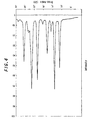
- the X-ray diffraction spectrum of the compound (7) is shown in Figure 1.
- the peak intensity ratio at Bragg angle 12.8° was 0.46 for the intensity at Bragg angle 15.2° .
- the crystal was measured in the solid state as intact with a fluorophotometer: UM-2S, manufactured by Hekisa Kagaku Co. The crystal had brightness of 220 % for the brightness of Lumogen Brilliant Yellow.
- the compounds had purity of 100% and purity reduced yield for phthalimide was 77%.
- the X-ray diffraction spectrum of the compound is shown in Figure 2.
- the peak intensity ratio at Bragg angle 12.8° was 0.46 for the intensity at Bragg angle 15.2° .
- the crystal was measured in the solid state as intact with a fluorophotometer: UM-2S, manufactured by Hekisa Kagaku Co.
- the crystal has brightness of 204 % for the brightness of Lumogen Brilliant Yellow.
- the compounds had purity of 100% and purity reduced yield for phthalimide was 75%.
- the X-ray diffraction spectrum of the compound is shown in Figure 3.
- the peak intensity ratio at Bragg angle 12.8° was 0.70 for the intensity at Bragg angle 15.2°.
- the crystal was measured in the solid state as intact with a fluorophotometer: UM-2S, manufactured by Hekisa Kagaku Co. The crystal had brightness of 189% for the brightness of Lumogen Brilliant Yellow.
- the compounds had purity of 97% and purity reduced yield for phthalimide was 84%.
- the X-ray diffraction spectrum of the compound is shown in Figure 4.
- the peak intensity ratio at Bragg angle 12.8° was 0.70 for the intensity at Bragg angle 15.2° .
- the crystal was measured in the solid state as intact with a fluorophotometer: UM-2S, manufactured by Hekisa Kagaku Co. The crystal had brightness of 180% for the brightness of Lumogen Brilliant Yellow.
- N,N'-diphenyl-N,N'-ditolyl-1,1-diphenyl-4,4'-diamine was stacked to a film thickness of 50nm under vacuum of 5 ⁇ 10 -5 torr by a resistance heating method.
- the quinoline compound of the formula (7) was stacked to a film thickness of 50nm and further, an aluminum electrode was deposited to a film thickness of 150nm under vacuum of 6 ⁇ 10 -5 torr.
- a positive electric field was applied to the ITO side of the element and a negative electric field was applied to the aluminum side.
- the emission from the surface of ITO glass substrate of the element was observed. As a voltage of 19V and a current density of 26mA/cm 2 , the emission was green and stable and the brightness was 115 Cd/m 2 .
- the compound of the formula (7) was added to polyethylene terephthalate resin powder, hot pressed at 280°C and cooled to obtain a sheet having thickness of 0.5mm.
- the sheet was measured with a fluorophotometer: FP-770, manufactured by Nippon Bunko Co. ⁇ em was 523nm.
- N,N'-diphenyl-N,N'-ditolyl-1,1-diphenyl-4,4'-diamine was stacked to a film thickness of 50nm under vacuum of 5 ⁇ 10 -5 torr by a resistance heating method.
- the quinoline compound of the formula (10) was stacked to a film thickness of 50nm and further, an aluminum electrode was deposited to a film thickness of 150nm under vacuum of 6 ⁇ 10 -5 torr.
- a positive electric field was applied to the ITO side of the element and a negative electric field was applied to the aluminum side.
- the emission from the surface of ITO glass substrate of the element was observed. As a voltage of 19V and a current density of 26mA/cm 2 , the emission was green and stable and the brightness was 115 Cd/m 2 .
- the quinoline compound of the formula (10) was added to polyethylene terephthalate resin powder, hot pressed at 280 °C and cooled to obtain a sheet having thickness of 0.5mm.
- the sheet was measured with a fluorophotometer: FP-770, manufactured by Nippon Bunko Co. Emission at 520 nm and excitatioin at 375 nm were obtained.
- 1,1-bis(4-N,N-ditolylaminophenyl)cyclohexanone was stacked to a film thickness of 50nm.
- the quinoline compound of the formula (11) was stacked to a film thickness of 50nm and further, 2,2',6,6'-tetramethylphenoquinone was stacked to a film thickness of 50nm.
- a back electrode was formed by stacking indium to a film thickness of 150nm. When a voltage of 8V was applied, emission of 280Cd/m 2 was obtained.
- the quinoline compound of the formula (11) was added to polyethylene terephthalate resin powder, hot pressed at 280 °C and cooled to obtain a sheet having thickness of 0.5mm.
- the sheet was measured with a fluorophotometer: FP-770, manufactured by Nippon Bunko Co. Emission at 530 nm and excitation at 383 nm were obtained.
- N,N,N',N'-tetra(4-ditolylaminophenyl)-1,4-phenylenediamine was stacked to a film thickness of 50nm under vacuum of 5 ⁇ 10 -6 torr by a resistance heating method.
- the quinoline compound of the formula (12) was stacked to a film thickness of 50nm and further, an aluminum electrode was deposited to a film thickness of 150nm under vacuum of 6 ⁇ 10 -5 torr.
- a positive electric field was applied to the ITO side of the element and a negative electric field was applied to the aluminum side.
- the emission from the surface of ITO glass substrate of the element was observed. When a voltage of 19V was applied, the emission was stable and the emission of 118Cd/m 2 was obtained.
- the quinoline compound of the formula (12) was added to polyethylene terephthalate resin powder, hot pressed at 280 °C and cooled to obtain a sheet having thickness of 0.5mm.
- the sheet was measured with a fluorophotometer: FP-770, manufactured by Nippon Bunko C o. Emission at 530 nm and excitation at 380 nm were obtained.
- N,N'-diphenyl-N,N'-ditolyl-1,1'-diphenyl-4,4'-diamine was stacked to a film thickness of 50nm under vacuum of 5 ⁇ 10 -5 torr by a resistance heating method.
- the quinoline compound of the formula (13) was stacked to a film thickness of 50nm and further, an aluminum electrode was deposited to a film thickness of 150nm under vacuum of 6 ⁇ 10 -5 torr.
- a positive electric field was applied to the ITO side of the element and a negative electric field was applied to the aluminum side.
- the emission from the surface of ITO glass substrate of the element was observed. As a voltage of 19V and a current density of 26mA/cm 2 , the emission was stable and the emission of 115 Cd/m 2 was obtained.
- the compound of the formula (13) was added to polyethylene terephthalate resin powder, hot pressed at 280 °C, and cooled to obtain a sheet having thickness of 0.5nm.
- the sheet was measured with a spectrophotometer: UV-3100 PC, manufactured by Shimadzu Seisakusho Co. Ultraviolet transmittance at 380nm was 2%.
- 1,1-bis(4-N,N-ditolylaminophenyl)cyclohexanone was stacked to a film thickness of 50nm.
- the quinoline compound of the formula (13) was stacked to a film thickness of 50nm, and further 2,2',6,6'-tetramethyldiphenoquinone was stacked to a film thickness of 50 nm.
- a back electrode was formed by stacking indium to a film thickness of 150nm. When a voltage of 8V was applied, emission of 300Cd/m 2 was obtained.
- the compound of the formula (14) was added to polyethylene terephthalate resin powder, hot pressed at 280 °C, and cooled to obtain a sheet having thickness of 0.5nm.
- the sheet was measured with a spectrophotometer: UV-3100PC, manufactured by Shimadzu Seisakusho Co. Ultraviolet transmittance at 380nm was 4%.
- N,N,N',N'-tetra(4-ditrylaminophenyl)-1,4-phenylenediamine was stacked to a film thickness of 50nm under vacuum of 5 ⁇ 10 -6 torr by a resistance heating method.
- the compound of the formula (15) was stacked to a film thickness of 50nm and further, an aluminum electrode was deposited to a film thickness of 150nm under vacuum of 6 ⁇ 10 -5 torr.
- a positive electric field was applied to the ITC side of the element and a negative electric field was applied to the aluminum side.
- the emission from the surface of ITO glass substrate of the element was observed. As a voltage of 9 V, the emission was stable and the emission of 120 Cd/m 2 was obtained.
- the compound of the formula (15) was added to polyethylene terephthalate resin powder, hot pressed at 280 °C, and cooled to obtain a sheet having thickness of 0.5 mm.
- the sheet was measured with a spectrophotometer: UV-3100PC, manufactured by Shimadzu Seisakusho Co. Ultraviolet transmittance at 370nm was 3%.
- Figure 6 illustrates an NMR chart
- Figure 7 illustrates an IR spectrum
- Figure 8 illustrates an MS spectrum of the compound having the formula (16), respectively.
- N,N'-diphenyl-N,N'-ditolyl-1,1'-diphenyl-4,4'-diamine was stacked to a film thickness of 50nm under vacuum of 5 ⁇ 10 -5 torr by a resistance heating method.
- the compound of the formula (16) was stacked to a film thickness of 50nm and further, an aluminum electrode was deposited to a film thickness of 150nm under vacuum of 6 ⁇ 10 -5 torr.
- a positive electric field was applied to the ITO side of the element and a negative electric field was applied to the aluminum side.
- the emission from the surface of ITO glass substrate of the element was observed. As a voltage of 19 V and a current density of 26 mA/cm 2 , the emission was stable and the emission of 115 Cd/m 2 was obtained.
- the compound of the formula (16) was added to polyethylene terephthalate resin powder, hot pressed at 280 °C, and cooled to obtain a sheet having thickness of 0.5mm.
- the sheet was measured with a spectrophotometer: UV-3100PC, manufactured by Shimadzu Seisakusho Co. Ultraviolet transmittance at 380nm was 5%.
- 1,1-bis(4-N,N-ditolylaminophenyl)cyclohexanone was stacked to a film thickness of 50nm.
- the quinoline compound of the formula (17) was stacked to a film thickness of 50nm, and further 2,2', 6,6'-tetramethyldiphenoquinone was stacked to a film thickness of 50 nm.
- a back electrode was formed by stacking indium to a film thickness of 150nm. When a voltage of 8 V was applied, emission of 300 Cd/m 2 was obtained.
- the compound of the formula (17) was added to polyethylene terephthalate resin powder, hot pressed at 280 °C, and cooled to obtain a sheet having thickness of 0.5mm.
- the sheet was measured with a spectrophotometer: UV-3100PC, manufactured by Shimadzu Seisakusho Co. Ultraviolet transmittance at 380nm was 4%.
- N,N,N',N'-tetra(4-ditolylaminophenyl)-1,4-phenylenediamine was stacked to a film thickness of 50nm under vacuum of 5 ⁇ 10 -6 torr by a resistance heating method.
- the compound of the formula (18) was stacked to a film thickness of 50nm and further, an aluminum electrode was deposited to a film thickness of 150nm under vacuum of 6 ⁇ 10 -5 torr.
- a positive electric field was applied to the ITC side of the element and a negative electric field was applied to the aluminum side.
- the emission from the surface of ITO glass substrate of the element was observed. As a voltage of 9 V, the emission was stable and the emission of 120 Cd/m 2 was obtained.
- the compound of the formula (18) was added to polyethylene terephthalate resin powder, hot pressed at 280 °C, and cooled to obtain a sheet having thickness of 0.5 mm.
- the sheet was measured with a spectrophotometer: UV-3100PC, manufactured by Shimadzu Seisakusho Co. Ultraviolet transmittance at 375nm was 2%.
- An EL element was prepared by stacking the compound having the formula below in place of the compound (7) in Example 1.
- the EL element had an emission intensity of 80Cd/m 2 .
Landscapes
- Chemical & Material Sciences (AREA)
- Organic Chemistry (AREA)
- Engineering & Computer Science (AREA)
- Materials Engineering (AREA)
Description
- The present invention relates to a quinoline compound suited for use in a luminous layer of an electro-luminescence element, the electro-luminescence element and fluorescent material by using said compound, and a preparation process of said compound.
- The invention also relates to a zinc halogenide complex suited for use in a luminous layer of an electro-luminescence element or an ultraviolet absorption material, the electro-luminescence element and the ultraviolet absorption material by using said complex, and a preparation process of said complex.
- The invention further relates to a zinc complex suited for use in a luminous layer of an electro-luminescence element or an ultraviolet absorption material, the electro-luminescence element and the ultraviolet absorption material by using said complex, and a preparation process of said complex.
- In recent years, many researches on fluorescent materials and luminescent materials have been carried out in order to use these materials for electro-luminescence (EL) elements.
- A quinoline having the formula (7):has been known to have fluorescent property as described in Liebigs Ann. Chem., vol.315, p.303(1901) and Chem. Ber., vol.100, p. 2261-2273 (1967).

- This compound is also referred to in JP-A-56-147784 as a luminescing substance, as are further β-quinonaphtalines in DE-OS-1544646.
- On the other hand, the EL elements have recently attained a great progress. Luminous layers and positive hole transport layers have been investigated and approached to practical use [Tsutsui, Saito et. al., Japan Journal of Applied Physics, vol.27, No.2, L269 (1988); vol.27, No.4,L713(1988)].
- EP-A-652 274 discloses a 10-hydroxybenzo [b] quinoline zinc complex for use is the luminescent layer of an EL device.
- Aromatic compounds which exhibit fluorescence in the ultraviolet to visible region have been known [I.B. Berlman, Handbook of Fluorescence Spectra of Aromatic Molecules, published from Academic Press].
- Further, inorganic compounds such as titanium dioxide and zinc oxide, and organic compounds such as benzophenone, benzotriazole and other compounds having a triazine structure have been known as ultraviolet absorption materials as disclosed in JP-A-64-20248.
- The first object of the invention is to provide an excellent material as an EL material and a useful preparation process of the material.
- The second object of the invention is to provide an excellent material as a fluorescent material and a useful preparation process of the material.
- Further, the third object of the invention is to provide an excellent material as an ultraviolet absorption material and a useful preparation process of the material.
- These objects can be achieved by the following aspects of the present invention.
- (1) A quinoline compound and a tautomer of the same which are represented by the
formula (1):
where each of R1, R2, R3, R4, R5, R6, R7, R8, R9 and R10 is individually a hydrogen atom, halogen atom, cyano, amino, substituted or unsubstituted straight, branched or cyclic hydrocarbon group having 2 to 10 carbon atoms, substituted or unsubstituted aryl, substituted or unsubstituted straight, branched or cyclic alkoxy group having 1 to 10 carbon atoms, substituted or unsubstituted aryloxy, substituted or unsubstituted N-alkylamino group having a straight, branched or cyclic alkyl group with 1 to 10 carbon atoms, substituted or unsubstituted N,N-dialkylamino, group having straight, branched or cyclic alkyl groups with 1 to 10 carbon atoms, substituted or unsubstituted N-arylamino, substituted or unsubstituted N,N-diarylamino or substituted or unsubstituted N-alkyl-N-arylamino group, except the case where all of R1, R2, R3, R4, R5, R6, R7, R8, R9 and R10 is a hydrogen atom.

- (2) A zinc halogenide complex and a tautomer of the same which are represented
by the formula (2):
where each of R11, R12, R13, R14, R15, R16, R17, R18, R19, R20, R21, R22, R23, R24, R25, R26, R27, R28, R29 and R30 is individually a hydrogen atom, halogen atom, nitro, cyano, hydroxy, amino, substituted or unsubstituted straight, branched or cyclic hydrocarbon group having 1 to 10 carbon atoms, substituted or unsubstituted aryl, substituted or unsubstituted straight, branched or cyclic alkoxy group having 1 to 10 carbon atoms, substituted or unsubstituted aryloxy, substituted or unsubstituted N-alkylamino, group having a straight, branched or cyclic alkyl group with 1 to 10 carbon atoms, substituted or unsubstituted N,N-dialklamino group having straight, branched or cyclic alkyl groups with 1 to 10 carbon atoms, substituted or unsubstituted N-arylamino, substituted or unsubstituted N,N-diarylamino or substituted or unsubstituted N-alkyl-N-arylamino group, and each of X1 and X2 is individually a fluorine, chlorine, bromine or iodine atom.
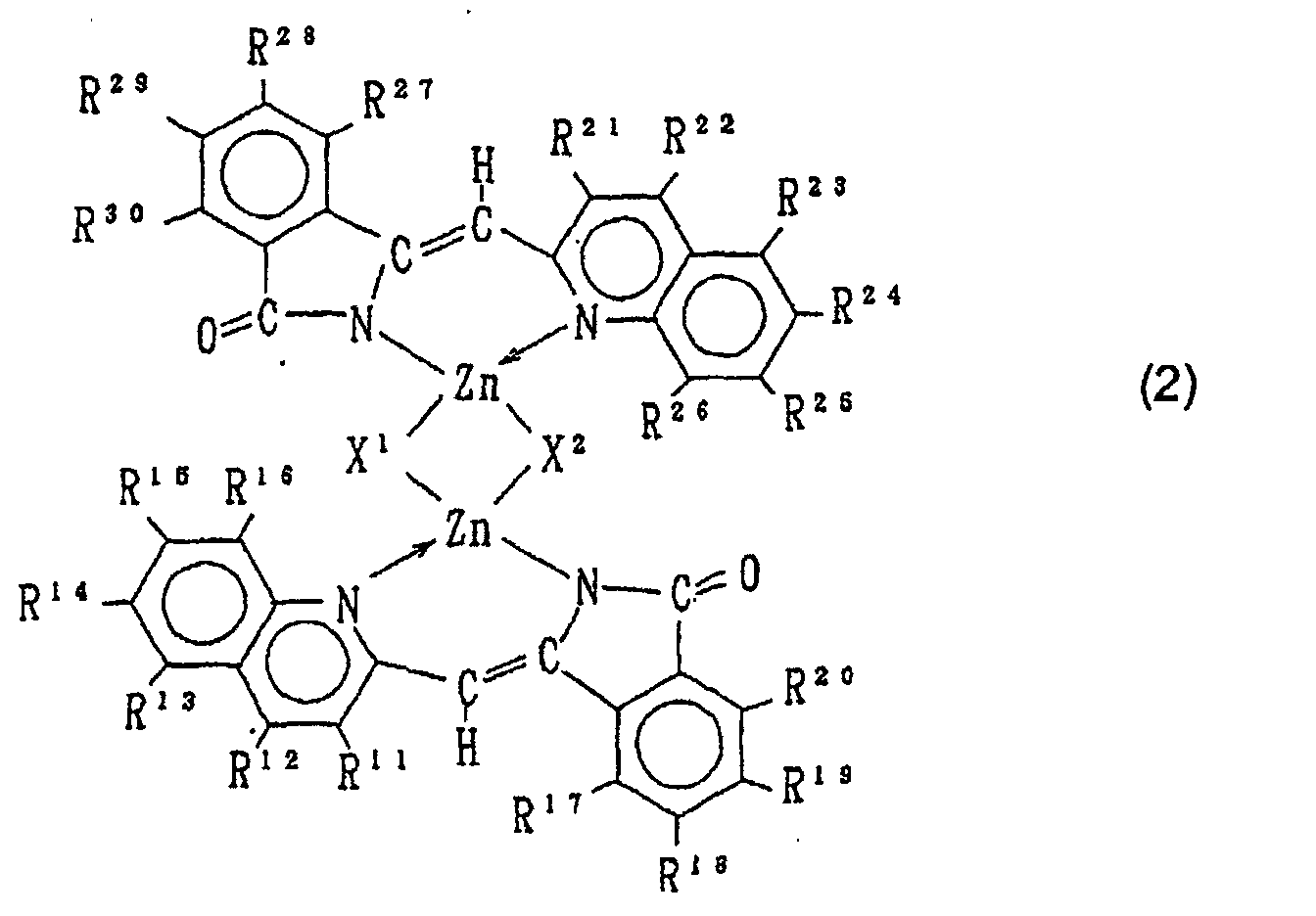
- (3) A zinc complex and tautomer of the same which are represented by the formula
(3):
where each of R31, R32, R33, R34, R35, R36, R37, R38, R39, R40, R41, R42,R43, R44, R45, R46, R47, R48, R49 and R50 is individually hydrogen atom, halogen atom, nitro, cyano, hydroxy, amino, substituted or unsubstituted straight, branched or cyclic hydrocarbon group having 1 to 10 carbon atoms, substituted or unsubstituted aryl, substituted or unsubstituted straight, branched or cyclic alkoxy group having 1 to 10 carbon atoms, substituted or unsubstituted aryloxy, substituted or unsubstituted N-alkylamino group having a straight, branched or cyclic alkyl group with 1 to 10 carbon atoms, substituted or unsubstituted N,N-dialklamino group having straight, branched or cyclic alkyl groups with 1 to 10 carbon atoms, substituted or unsubstituted N-arylamino, substituted or unsubstituted N,N-diarylamino or substituted or unsubstituted N-alkyl-N-arylamino group.

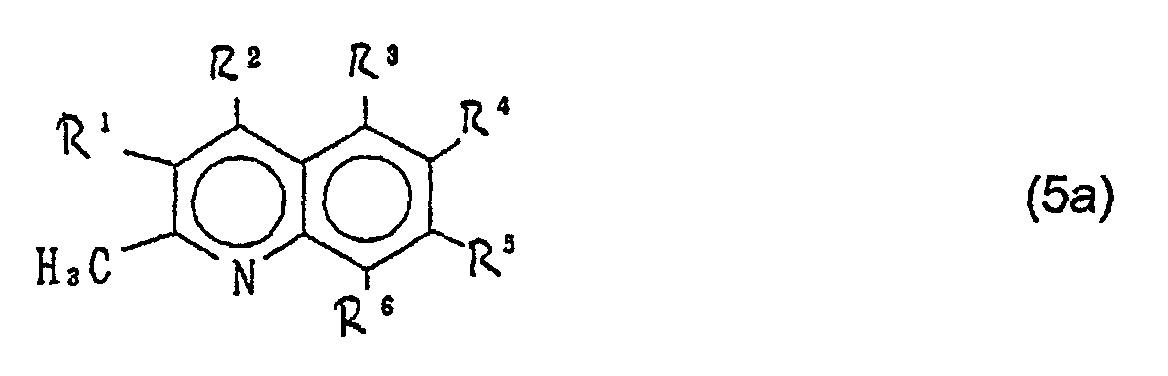
- (4) A preparation process of a quinoline compound and a tautomer of the same
which are represented by the formula (1) indicated above comprising reacting a
quinoline derivative represented by the formula (5a):
where each of R1, R2, R3, R4, R5 and R6 are as defined above and a phthalimide derivative represented by the formula (6a):
 where each of R7, R8, R9 and R10 are as defined in
claim 1
with zinc halogenide in an organic basic solvent selected from N,N-dimethylaniline, N,N-diethylaniline, N-methylaniline, N-ethylaniline and other aniline derivatives; pyridine and its derivatives, quinoline, methylquinoline, isoquinoline and other quinoline derivatives; diazabicycloundecene, diazabicyclononene, N-ethylmorpholino and other cyclic amine derivatives; or mixtures of the above solvents and successively treating with an inorganic acid. - (5) A preparation process according to the preparation indicated under (4) above wherein the phthalimide derivative is in a molar ratio of 0.5 to 2.0 to the quinoline derivative.
- (6) A preparation process according to the preparation indicated under (4) above wherein the phthalimide derivative is in a molar ratio of 1.1 to 2.0 to the quinoline derivative.
- (7) A preparation process of a quinoline compound and a tautomer of the same
which are represented by formula (1) above
comprising treating a zinc halogenide complex and a tautomer of the same which are represented by the formula (2a):wherein R1, R2, R3, R4, R5, R6, R7, R8, R9 and R10 are as defined in
claim 1 and X1 and X2 are as defined section (2) above with an inorganic acid. - (8) A preparation process of a quinoline compound and a tautomer of the same
which are represented by formula (1) above.
comprising treating a zinc complex and a tautomer of the same which are represented by the formula (3a):wherein R1, R2, R3, R4, R5, R6, R7, R8, R9 and R10 are as defined in section (1) above, with an inorganic acid.
- (9) An electro-luminescence element wherein the luminous layer is a compound
represented by the formula (4)
and a tautomer of the same,

where each of R51, R52, R53, R54, R55, R56, R57, R58, R59 and R60 is individually hydrogen atom, halogen atom, nitro, cyano, hydroxy, amino, substituted or unsubstituted straight, branched or cyclic hydrocarbon group having 1 to 10 carbon atoms, substituted or unsubstituted aryl, substituted or unsubstituted straight, branched or cyclic alkoxy group having 1 to 10 carbon atoms, substituted or unsubstituted aryloxy, substituted or unsubstituted N-alkylamino group having a straight, branched or cyclic alkyl group with 1 to 10 carbon atoms, substituted or unsubstituted N,N-dialklamino group having straight, branched or cyclic alkyl groups with 1 to 10 carbon atoms, substituted or unsubstituted N-arylamino, substituted or unsubstituted N,N-diarylamino or substituted or unsubstituted N-alkyl-N-arylamino group. - (10) A fluorescent material comprising a quinoline compound represented by the formula (1) as defined in section (1) above and a tautomer of the same.
- (11) A preparation process of a zinc halogenide complex represented by the formula
(2) as defined in section (2) above and a tautomer of the same, comprising reacting one or
two kinds of a quinoline derivative represented by the formula (5):
where each of Y1, Y2, Y3, Y4, Y5 and Y6 is a hydrogen atom, halogen atom, nitro, cyano, hydroxy, amino, substituted or unsubstituted straight, branched or cyclic hydrocarbon group having 1 to 10 carbon atoms, substituted or unsubstituted aryl, substituted or unsubstituted straight, branched or cyclic alkoxy group having 1 to 10 carbon atoms, substituted or unsubstituted aryloxy, substituted or unsubstituted N-alkylamino group having a straight, branched or cyclic alkyl group with 1 to 10 carbon atoms, substituted or unsubstituted N,N-dialklamino group having straight, branched or cyclic alkyl groups with 1 to 10 carbon atoms, substituted or unsubstituted N-arylamino, substituted or unsubstituted N,N-diarylamino or substituted or unsubstituted N-alkyl-N-arylamino group,
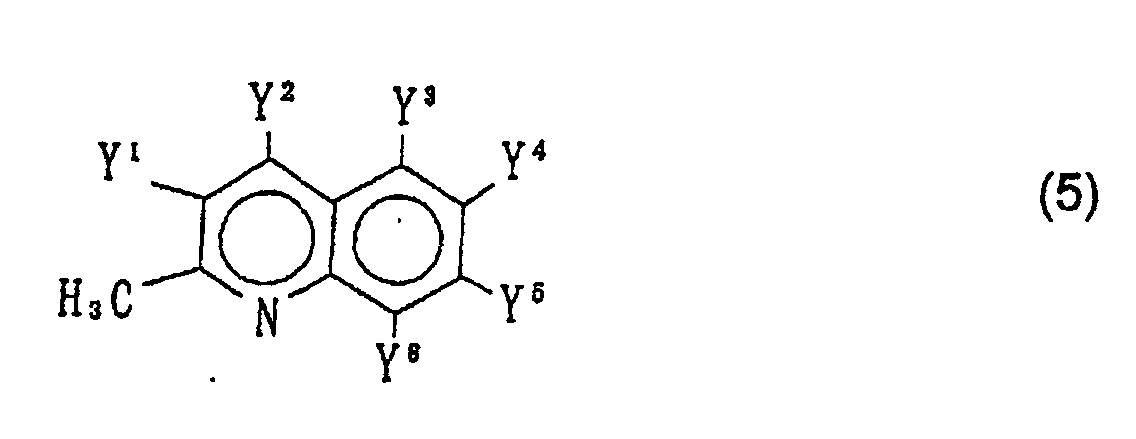
and one or two kind of a phthalimide derivative represented by the formula (6):where each of Y7, Y8, Y9 and Y10 is individually a hydrogen atom, halogen atom, nitro, cyano, hydroxy, amino, substituted or unsubstituted straight, branched or cyclic hydrocarbon group having 1 to 10 carbon atoms, substituted or unsubstituted aryl, substituted or unsubstituted straight, branched or cyclic alkoxy group having 1 to 10 carbon atoms, substituted or unsubstituted aryloxy, substituted or unsubstituted N-alkylamino group having a straight, branched or cyclic alkyl group with 1 to 10 carbon atoms, substituted or unsubstituted N,N-dialklamino group having straight, branched or cyclic alkyl groups with 1 to 10 carbon atoms, substituted or unsubstituted N-arylamino, substituted or unsubstituted N,N-diarylamino or substituted or unsubstituted N-alkyl-N-arylamino group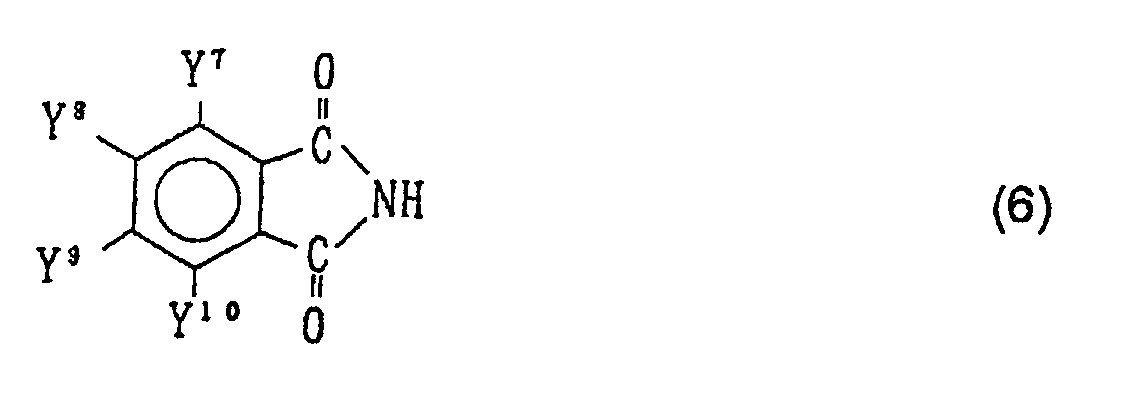
with zinc halogenide in an organic basic solvent. - (12) A preparation process of a zinc halogenide complex represented by the formula
(2) and a tautomer of the same, comprising reacting a quinoline derivative
represented by the formula (4):
wherein R51, R52, R53, R54, R55, R56, R57, R58, R59 and R60 are as defined in

claim 9, and a tautomer of the same, with zinc halogenide in an organic solvent. - (13) An electro-luminescence element wherein the luminous layer is a zinc
halogenide complex represented by the formula (2)
as defined in section (2) above and a tautomer of the same. - (14) An ultraviolet absorption material comprising a zinc halogenide complex represented by the formula (2) as defined in section (2) above and a tautomer of the same.
- (15) A preparation process of a zinc complex represented by the formula (3) as
defined in section (3) above and a tautomer of the same comprising heating in organic
amine a zinc halogenide complex represented by the formula (2)
wherein R11, R12, R13, R14, R15, R16, R17, R18, R19, R20, R21, R22, R23, R24, R25, R26, R27, R28, R29, R30, X1 and X2 is as defined in section (2) above, and a tautomer of the same.

- (16) A preparation process of a zinc complex represented by the general formula (3)
as defined in
claim 3 and a tautomer of the same comprising reacting one or two kinds of a quinoline derivative represented by the formula (5)wherein Y1, Y2, Y3, Y4, Y5 and Y6 is as defined in claim 11, and reacting one or two kinds of a phthalimide derivative represented by the formula (6):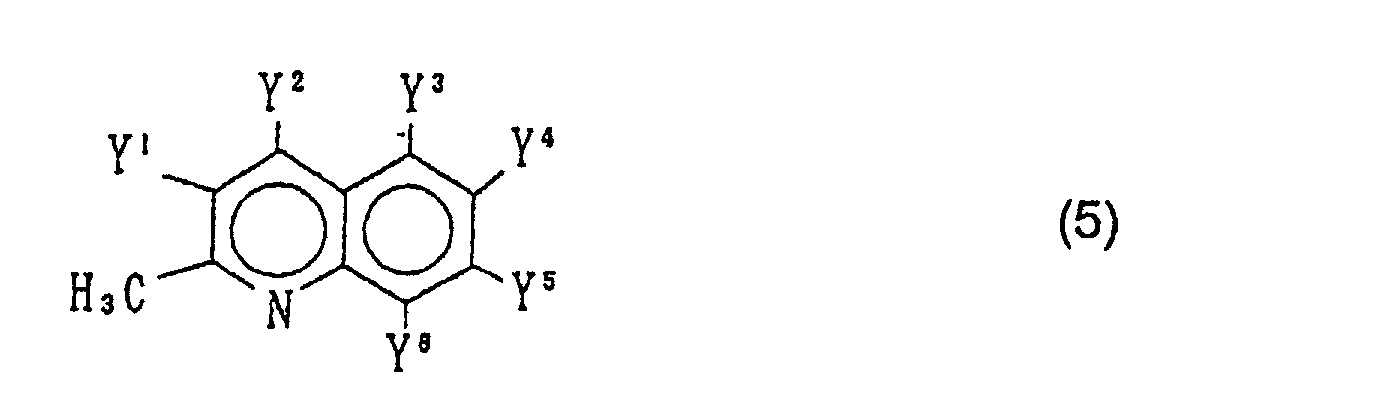 wherein Y7, Y8, Y9 and Y10 is as defined in section (11) above with zinc halogenide in an organic solvent.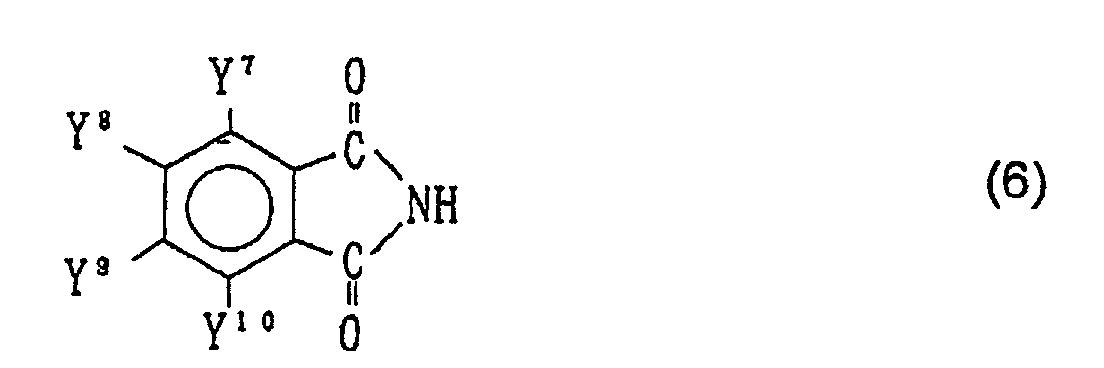
- (17) An electro-luminescence element wherein the luminous layer is a zinc complex represented by the formula (3) as defined in section (3) above and a tautomer of the same.
- (18) An ultraviolet absorption material comprising a zinc complex represented by the formula (3) as defined in section (3) above and a tautomer of the same.
-
- The present invention provides the compound represented by the formulas (2), (3) and a tautomer of the same as an EL material which has a strong luminescent intensity, the compound represented by the formulas (2) and (3) and a tautomer of the same as a specific ultraviolet absorption material which has absorption at a wave length of 400 nm or less, and further an electro-luminescent element, wherein the luminous layer is the compound represented by the formula (4) and a tautomer of the same as an excellent fluorescent material which has a strong luminescent intensity.
- Further, the present invention can prepare these useful materials by each other related preparation processes directly from the quinoline derivative represented by the formula (5) and the phthalimide derivative represented by the formula (6), or by way of the quinoline compound represented by the formula (4) which is obtained from these derivatives.
- That is, the invention provides excellent materials for the EL material, ultraviolet absorption material and fluorescent material, and a useful process of preparing these materials.
- For a more complete understandings of the present invention, reference should be made to the detailed description should be read together with the accompanying drawings, wherein;
- Figure 1 is a X-ray diffraction spectrum of the quinoline compound obtained in Example 1 and shown by the formula (7).
- Figure 2 is a X-ray diffraction spectrum of the quinoline compound obtained in Example 2 and shown by the formula (7).
- Figure 3 is a X-ray diffraction spectrum of the quinoline compound obtained in Example 3 and shown by the formula (7).
- Figure 4 is a X-ray diffraction spectrum of the quinoline compound obtained in Example 4 and shown by the formula (7).
- Figure 5 is a NMR chart of a zinc chloride complex obtained in Example 16 and shown by the formula (13).
- Figure 6 is a NMR chart of a zinc complex obtained in Example 19 and shown by the formula (16).
- Figure 7 is IR spectrum of a zinc complex obtained in Example 19 and shown by the formula (16).
- Figure 8 is a MS spectrum of a zinc complex obtained in Example 19 and shown by the formula (16).
- Figure 9 is a drawing which shows one embodiment of the EL element to be applied the compound of the invention.
- Figure 10 is a drawing which shows another embodiment of the EL element to be applied the compound of the invention.
-
- The present invention will be illustrated in detailed hereinafter.
- In the invention, the quinoline compound and the tautomer of the same, and the complex having these compounds as ligands, that is, the zinc halogenide complex and tautomer of the same and the zinc complex and the tautomer of the same can be prepared by way of the process A, process B, process C, process D, process E, process F and process G as illustrated in the reaction step figure.
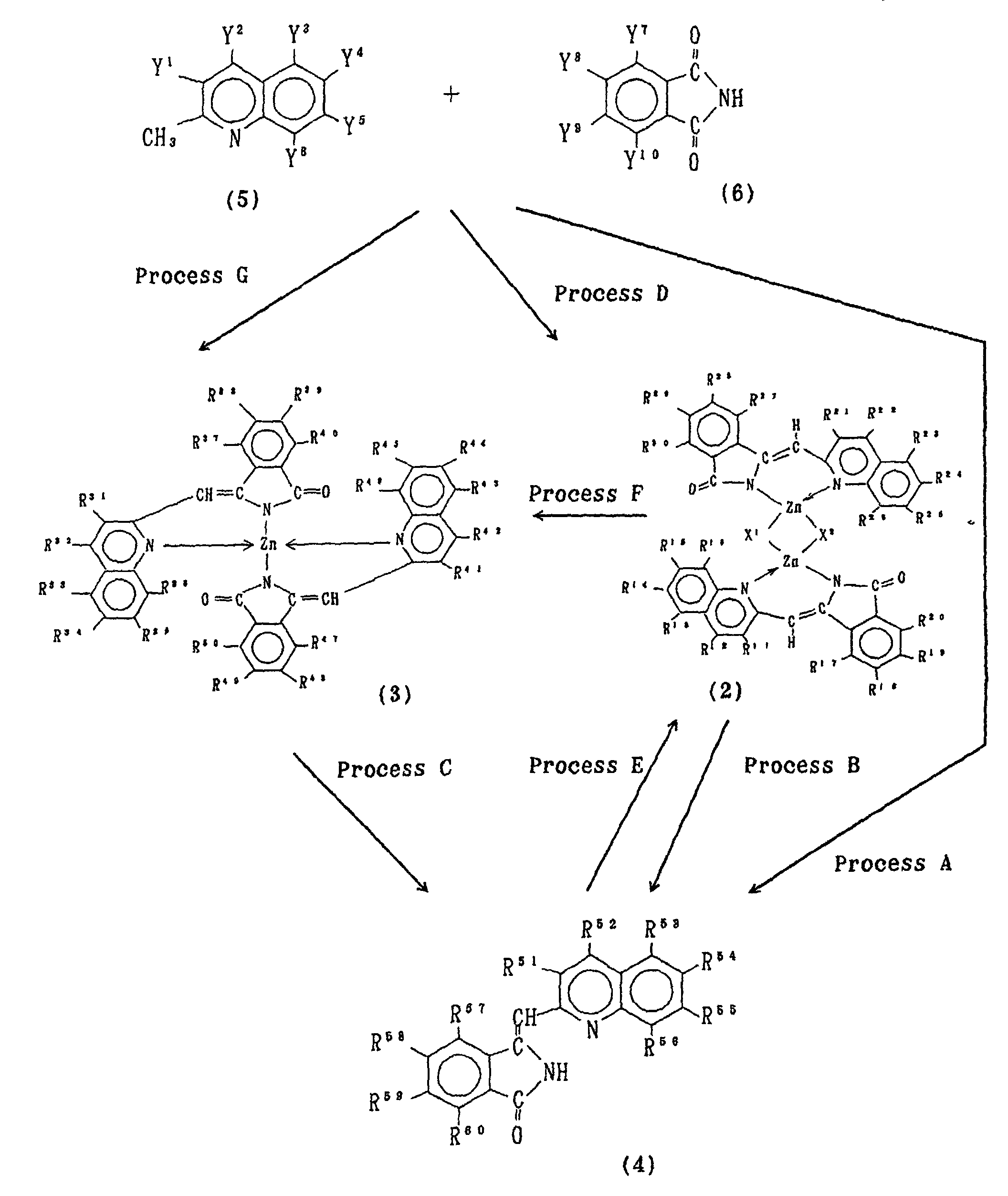
- [Process A] The quinoline compound of the formula (4) and the tautomer of the same can be obtained by reacting the quinoline derivative of the formula (5) and the phthalimide derivative of the formula (6) with zinc halogenide in an organic base solvent and successively treating with an inorganic acid. Compound (1) is obtained from compounds (5a) and (6a) correspondingly.
- [Process B] The quinoline compound of the formula (4) and the tautomer of the same can be obtained by treating the zinc halogenide complex of the formula (2) and the tautomer of the same with an inorganic acid.
- [Process C] The quinoline compound of the formula (4) and the tautomer o the same can be obtained by treating the zinc complex of the formula (3) and the tautomer of the same with an inorganic acid.
- [Process D] The zinc halogenide complex of the formula (2) and the tautomer of the same can be obtained by reacting one or two kinds of the quinoline derivative of the formula (5) and one or two kinds of the phthalimide derivative of the formula (6) with zinc halogenide in an organic solvent.
- [Process E] The zinc halogenide complex of the formula (2) and the tautomer of the same can be obtained by reacting the quinoline compound of the formula (4) and the tautomer of the same with zinc halogenide in an organic solvent.
- [Process F] The zinc complex of the formula (3) and the tautomer of the same can be obtained by heating the zinc halogenide complex of the formula (2) and the tautomer of the same in an organic amine.
- [Process G] The zinc complex of the formula (3) and the tautomer of the same can be obtained by reacting one or two kinds of the quinoline derivative of the formula (5) and one or two kinds of the phthalimide derivative of the formula (6) with zinc halogenide in an organic solvent.
- In Process A, the quinoline compound of the formula (4) can be obtained by successively carrying out Process D and Process B without isolating the zinc halogenide complex of the formula (2).
- Alternatively, the quinoline compound of the formula (4) can be obtained by successively carrying out Process D, Process F and Process C without isolating the zinc halogenide complex of the formula (2) and zinc complex of the formula (3).
- In the invention, each substituent of the compound (1) is shown by R1, R2, R3, R4, R5, R6, R7, R8, R9 and R10, and is individually a hydrogen atom, halogen atom, cyano, amino, substituted or unsubstituted alkyl having two or more carbon atoms, substituted or unsubstituted aryl, substituted or unsubstituted alkoxy, substituted or unsubstituted aryloxy, substituted or unsubstituted N-alkyl amino, substituted or unsubstituted N,N-dialkyl amino, substituted or unsubstituted N-aryl amino, substituted or unsubstituted N,N-diaryl amino or substituted or unsubstituted N-alkyl-N-aryl amino group, with the proviso that not all of R1-R10 are hydrogen atoms at the same time.
- Each substituent of the compounds (2), (3) and (4) and intermediates thereof, that is, the quinoline derivative (5) and phthalimide derivative (6) is shown by R11, R12, R13, R14, R15, R16, R17, , R18, R19, R20, R21, R22, R23, R24, R25, R26, R27, R28, R29, R30, R31, R32, R33, R34, R35, R36, R37, R38, R39, R40, R41, R42, R43, R44, R45, R46, R47, R48, R49, R50, R51, R52, R53, R54, R55, R56, R57, R58, R59, R60, Y1, Y2, Y3, Y4, Y5, Y6, Y7, Y8, Y9 and Y10; and is individually hydrogen atom, halogen atom, nitro, cyano, hydroxy, amino, substituted or unsubstituted alkyl, substituted or unsubstituted aryl, substituted or unsubstituted alkoxy, substituted or unsubstituted aryloxy, substituted or unsubstituted N-alkyl amino, substituted or unsubstituted N,N-dialkyl amino, substituted or unsubstituted N-aryl amino, substituted or unsubstituted N,N-diaryl amino or substituted or unsubstituted N-alkyl-N-aryl amino, and each of X1 and X2 is individually a fluorine, chlorine, bromine or iodine atom.
- Practical examples of halogen atoms include a fluorine, chlorine, bromine or iodine atom.
- Substituted or unsubstituted alkyl groups include methyl, ethyl, n-propyl radical, iso-propyl, n-butyl, iso-butyl, tert-butyl, sec-butyl, n-pentyl, iso-pentyl, tert-pentyl, sec-pentyl, cyclopentyl, n-hexyl, 1-methylpentyl, 2-methylpentyl, 3-methylpentyl, 4-methylpentyl, 1,1-dimethylbutyl, 1,2-dimethylbutyl, 1,3-dimethylbutyl, 2,3-dimethylbutyl, 1,1,2-trimethylpropyl, 1,2,2-trimethylpropyl, 1-ethylbutyl, 2-ethylbutyl, 1-ethyl-2-methylpropyl, cyclohexyl, methylcyclopentyl, n-heptyl, 1-methylhexyl, 2-methylhexyl, 3-methylhexyl, 4-methylhexyl, 5-methylhexyl, 1,1-dimethylpentyl, 1,2-dimethylpentyl, 1,3-dimethylpentyl, 1,4-dimethylpentyl, 2,2-dimethylpentyl, 2,3-dimethylpentyl, 2,4-dimethylpentyl, 3,3-dimethylpentyl, 3,4-dimethylpentyl, 1-ethylpentyl, 2-ethylpentyl, 3-ethylpentyl, 1,1,2-trimethylbutyl, 1,1,3-trimethylbutyl, 1,2,3-trimethylbutyl, 1,2,2-trimethylbutyl, 1,3,3-trimethylbutyl, 2,3,3-trimethylbutyl, 1-ethyl-1-methylbutyl, 1-ethyl-2-methylbutyl, 1-ethyl-3-methylbutyl, 2-ethyl-1-methylbutyl, 2-ethyl-3-methylbutyl, 1-n-propylbutyl, 1-iso-propylbutyl, 1-iso-propyl-2-methylpropyl, methylcyclohexyl, n-octyl, 1-methylheptyl, 2-methylheptyl, 3-methylheptyl, 4-methylheptyl, 5-methylheptyl, 6-methylheptyl, 1,1-dimethylhexyl, 1,2-dimethylhexyl, 1,3-dimethylhexyl, 1,4-dimethylhexyl, 1,5-dimethylhexyl, 2,2-dimethylhexyl, 2,3-dimethylhexyl, 2,4-dimethylhexyl, 2,5-dimethylhexyl, 3,3-dimethylhexyl, 3,4-dimethylhexyl, 3,5-dimethylhexyl, 4,4-dimethylhexyl, 4,5-dimethylhexyl, 1-ethylhexyl, 2-ethylhexyl, 3-ethylhexyl, 4-ethylhexyl, 1-n-propylpentyl, 2-n-propylpentyl, 1-iso-propylpentyl, 2-iso-propylpentyl, 1-ethyl-1-methylpentyl, 1-ethyl-2-methylpentyl, 1-ethyl-3-methylpentyl, 1-ethyl-4-methylpentyl, 2-ethyl-1-methylpentyl, 2-ethyl-2-methylpentyl, 2-ethyl-3-methylpentyl, 2-ethyl-4-methylpentyl, 3-ethyl-1-methylpentyl, 3-ethyl-2-methylpentyl, 3-ethyl-3-methylpentyl, 3-ethyl-4-methylpentyl, 1,1,2-trimethylpentyl, 1,1,3-trimethylpentyl, 1,1,4-trimethylpentyl, 1,2,2-trimethylpentyl, 1,2,3-trimethylpentyl, 1,2,4-trimethylpentyl, 1,3,4-trimethylpentyl, 2,2,3-trimethylpentyl, 2,2,4-trimethylpentyl, 2,3,4-trimethylpentyl, 1,3,3-trimethylpentyl, 2,3,3-trimethylpentyl, 3,3,4-trimethylpentyl, 1,4,4-trimethylpentyl, 2,4,4-trimethylpentyl, 3,4,4-trimethylpentyl, 1-n-butylbutyl, 1-iso-butylbutyl, 1-sec-butylbutyl, 1-tert-butylbutyl, 2-tert-butylbutyl, 1-n-propyl-1-methylbutyl, 1-n-propyl-2-methylbutyl, 1-n-propyl-3-methylbutyl, 1-iso-propyl-1-methylbutyl, 1-iso-propyl-2-methylbutyl, 1-iso-propyl-3-methylbutyl, 1,1-diethylbutyl, 1,2,-diethylbutyl, 1-ethyl-1,2-dimethylbutyl, 1-ethyl-1,3-dimethylbutyl, 1-ethyl-2,3-dimethylbutyl, 2-ethyl-1,1-dimethylbutyl, 2-ethyl-1,2-dimethylbutyl, 2-ethyl-1,3-dimethylbutyl, 2-ethyl-2,3-dimethylbutyl, 1,2-dimethylcyclohexyl, 1,3-dimethylcyclohexyl, 1,4-dimethylcyclohexyl, ethylcyclohexyl, n-nonyl, 3,5,5-trimethylhexyl and n-decyl group, and other straight, branched or cyclic hydrocarbon groups having 1 to 10 carbon atoms;
- a fluoromethyl, trifluoromethyl, chloromethyl, dichloromethyl, trichloromethyl, bormomethyl, dibromomethyl, tribromomethyl, fluoroethyl, chloroethyl, bromoethyl, trifluoroethyl, pentafluoroethyl, tetrachloroethyl and hexafluoro-iso-propyl group, and other straight, branched or cyclic halogenated hydrocarbon groups which have 1 to 21 halogen atoms and 1 to 10 carbon atoms;
a methoxymethyl, ethoxymethyl, propoxymethyl, butoxymethyl, pentoxymethyl, hexyloxymethyl, cyclohexyloxymethyl, methoxyethyl, ethoxyethyl, propoxyethyl, butoxyethyl, pentoxyethyl, hexyloxyethyl, cyclohexyloxyethyl, methoxyethoxyethyl, methoxypropyl, ethoxypropyl, propoxypropyl, butoxypropyl, pentoxypropyl, hexyloxypropyl, cyclohexyloxypropyl and methoxyethoxypropyl group, and other alkyl groups which are substituted with straight, branched or cyclic alkoxy groups having 1 to 10 carbon atoms;
a methylthiomethyl, ethylthiomethyl, propylthiomethyl, butylthiomethyl, pentylthiomethyl, hexylthiomethyl, cyclohexylthiomethyl, methylthioethyl, ethylthioethyl, propylthioethyl, butylthioethyl, pentylthioethyl, hexylthioethyl, cyclohexylthioethyl, methoxyethylthioethyl, methylthiopropyl, ethylthiopropyl, propylthiopropyl, butylthiopropyl, pentylthiopropyl, hexylthiopropyl, cyclohexylthiopropyl and methoxyethylthiopropyl group and other alkyl groups which are substituted with straight, branched or cyclic alkylthio gruops having 1 to 10 carbon atoms;
a N-methylaminomethyl, N,N-dimethylaminomethyl, N-ethylaminomethyl N,N-diethylaminomethyl, N-propylaminomethyl, N,N-dipropylaminomethyl, N-methyl-N-ethylaminomethyl, N-methylaminoethyl, N,N-dimethylaminoethyl, N-ethylaminoethyl, N,N-diethylaminoethyl, N-propylaminoethyl, N,N-dipropylaminoethyl, N-methyl-N-ethylaminoethyl, N-methylaminopropyl, N,N-dimethylaminopropyl, N-ethylaminopropyl, N,N-diethylaminopropyl, N-propylaminopropyl, N,N-dipropylaminopropyl and N-ethyl-N-butylaminopropyl group and other alkyl groups which are substituted with straight, branched or cyclic mono- or di-alkylamino groups having 1 to 10 carbon atoms. - Representative substituted or unsubstituted aryl groups include, for example, a phenyl, naphthyl, anthranyl, 2-methylphenyl, 3-methylphenyl, 4-methylphenyl, 2,3-dimethylphenyl, 2,4-dimethylphenyl, 2,5-dimethylphenyl, 2,6-dimethylphenyl, 3,4-dimethylphenyl, 3,5-dimethylphenyl, 3,6-dimethylphenyl, 2,3,4-trimethylphenyl, 2,3,5-trimethylphenyl, 2,3,6-trimethylphenyl, 2,4,5-trimethylphenyl, 2,4,6-trimethylphenyl, 3,4,5-trimethylphenyl, 2-ethylphenyl, propylphenyl, butylphenyl, hexylphenyl, cyclohexylphenyl, octylphenyl, 2-methyl-1-naphthyl, 3-methyl-1-naphthyl, 4-methyl-1-naphthyl, 5-methyl-1-naphthyl, 6-methyl-1-naphthyl, 7-methyl-1-naphthyl, 8-methyl-1-naphthyl, 1-methyl-2-naphthyl, 3-methyl-2-naphthyl, 4-methyl-2-naphthyl, 5-methyl-2-naphthyl, 6-methyl-2-naphthyl, 7-methyl-2-naphthyl, 8-methyl-2-naphthyl and 2-ethyl-1-naphthyl group, and other aryl groups which are substituted with straight, branched or cyclic alkyl groups having 1 to 10 carbon atoms;
a 3-methoxyphenyl, 4-methoxyphenyl, 2,3-dimethoxyphenyl, 2,4-dimethoxyphenyl, 2,5-dimethoxyphenyl, 2,6-dimethoxyphenyl, 3,4-dimethoxyphenyl, 3,5-dimethoxyphenyl, 3,6-dimethoxyphenyl, 2,3,4-trimethoxyphenyl, 2,3,5-trimethoxyphenyl, 2,3,6-trimethoxyphenyl, 2,4,5-trimethoxyphenyl, 2,4,6-trimethoxyphenyl, 3,4,5-trimethoxyphenyl, 2-ethoxyphenyl, propoxyphenyl, butoxyphenyl, hextyloxyphenyl, cyclohexyloxyphenyl, octyloxyphenyl, 2-methoxy-1-naphthyl, 3-methoxy-1-naphthyl, 4-methoxy-1-naphthyl, 5-methoxy-1-naphthyl, 6-methoxy-1-naphthyl, 7-methoxy-1-naphthyl, 8-methoxy-1-naphthyl, 1-methoxy-2-naphthyl, 3-methoxy-2-naphthyl, 4-methoxy-2-naphthyl, 5-methoxy-2-naphthyl, 6-methoxy-2-naphthyl, 7-methoxy-2-naphthyl, 8-methoxy-2-naphthyl and 2-ethoxy-1-naphthyl group, and other aryl groups which are substituted with straight, branched or cyclic alkyl groups having 1 to 10 carbon atoms;
a chlorophenyl, dichlorophenyl, trichlorophenyl, bromophenyl, dibromophenyl, iodophenyl, fluorophenyl, difluorophenyl, trifluorophenyl, tetrafluorophenyl, pentafluorophenyl and trifluoromethylphenyl group, and other aryl groups which are substituted with halogen atoms or halogenated alkyl groups;
a N,N-dimethylaminophenyl, N,N-diethylaminophenyl, N-phenyl-N-methylaminophenyl, N-tolyl-N-ethylaminophenyl, N-chlorophenyl-N-cyclohexylaminophenyl and N,N-ditolylaminophenyl group and other aryl groups which are substituted with mono- or disubstituted amino groups;
and a methylthiophenyl, ethylthiophenyl, methylthionaphthyl and phenylthiophenyl group and other alkylthioaryl groups and other arylthioaryl groups. - Substituted or unsubstituted alkoxy groups include,
a methoxy, ethoxy, propoxy, butoxy, pentoxy, 1-methylbutoxy, 2-methylbutoxy, 3-methylbutoxy, 1,1-dimethylbutoxy, 1,2-dimethylbutoxy, 2,2-dimethylbutoxy, 1-ethylpropoxy, 2-ethylpropoxy, hexyloxy, cyclohexyloxy, heptyloxy, methylcyclohexyloxy, octyloxy, ethylcyclohexyloxy, dimethylcyclohexyloxy, nonyloxy, 2-ethylhexyloxy, 3,5,5-trimethylhexyloxy and decyloxy group, and other straight, branched or cyclic alkoxy groups which have 1 to 10 carbon atoms;
a fluoromethoxy, trifluoromethoxy, fluoroethoxy, trifluoroethoxy, hexafluoroethoxy, fluoropropoxy, trifluoropropoxy, hexafluoropropoxy, chloromethoxy, trichloromethoxy, chloroethoxy and trichloroethoxy group, and other halogenated and straight, branched or cyclic alkoxy groups which have 1 to 21 halogen atoms and 1 to 10 carbon atoms;
a methoxymethoxy, ethoxymethoxy, propoxymethoxy, butoxymethoxy, cyclohexyloxymethoxy, methoxymethoxymethoxy, methoxyethoxy, ethoxyethoxy, propoxyethoxy, butoxyethoxy, cyclohexyloxyethoxy, methoxyethoxyethoxy, ethoxyethoxyethoxy, propoxyethoxyethoxy, butoxyethoxyethoxy, methoxymethylethoxy, ethoxymethylethoxy, propoxymethylethoxy, butoxymethylethoxy, cyclohexyloxymethylethoxy, methoxyethoxymethylethoxy, ethoxyethoxymethylethoxy, propoxyethoxymethy lethoxy, butoxyethoxymethylethoxy, 2-[(2'-methoxy)propoxy]propoxy, methoxypropoxy, ethoxypropoxy and propoxypropoxy group, and orther straight, branched or cyclic alkoxyalkoxy and alkoxyalkoxyalkoxy groups which have 1 to 10 carbon atoms;
a N-methylaminomethoxy, N,N-dimethylaminomethoxy, N-ethylaminomethoxy, N,N-diethylaminomethoxy, N-methylaminoethoxy, N,N-dimethylaminoethoxy, N-ethylaminoethoxy, N,N-diethylaminoethoxy, N-methylaminopropoxy, N,N-dibutylaminopropoxy and N-methylaminobutoxy group, and other straight, branched or cyclic alkylaminoalkoxy groups which have 1 to 10 carbon atoms;
a methylthiomethoxy, ethylthiomethoxy, propylthiomethoxy, methylthioethoxy, ethylthioethoxy and propylthioethoxy group, and other straight, branched or cyclic alkylthioalkoxy groups which have 1 to 10 carbon atoms;
a phenoxyethoxy, naphthyloxyethoxy, tolyloxyethoxy and ethylphenoxyethoxy group, and other aryloxyalkoxy groups. - Exemplary substituted or unsubstituted aryloxy groups include, for example, a phenyloxy, naphthyloxy, anthranyloxy, 2-methylphenyloxy, 3-methylphenyloxy, 4-methylphenyloxy, 2,3-dimethylphenyloxy, 2,4-dimethylphenyloxy, 2,5-dimethylphenyloxy, 2,6-dimethylphenyloxy, 3,4-dimethylphenyloxy, 3,5-dimethylphenyloxy, 3,6-dimethylphenyloxy, 2,3,4-trimethylphenyloxy, 2,3,5-trimethylphenyloxy, 2,3,6-trimethylphenyloxy, 2,4,5-trimethylphenyloxy, 2,4,6-trimethylphenyloxy, 3,4,5-trimethylphenyloxy, 2-ethylphenyloxy, propylphenyloxy, butylphenyloxy, hexylphenyloxy, cyclohexylphenyloxy, octylphenyloxy, 2-methyl-1-naphthyloxy, 3-methyl-1-naphthyloxy, 4-methyl-1-naphthyloxy, 5-methyl-1-naphthyloxy, 6-methyl-1-naphthyloxy, 7-methyl-1-naphthyloxy, 8-methyl-1-naphthyloxy, 1-methyl-2-naphthyloxy, 3-methyl-2-naphthyloxy, 4-methyl-2-naphthyloxy, 5-methyl-2-naphthyloxy, 6-methyl-2-naphthyloxy, 7-methyl-2-naphthyloxy, 8-methyl-2-naphthyloxy and 2-ethyl-1-naphthyloxy group, and other aryloxy groups which are substituted with straight, branched or cyclic alkyl groups having 1 to 10 carbon atoms; a 3-methoxyphenyloxy, 4-methoxyphenyloxy, 2,3-dimethoxyphenyloxy, 2,4-dimethoxyphenyloxy, 2,5-dimethoxyphenyloxy, 2,6-dimethoxyphenyloxy, 3,4-dimethoxyphenyloxy, 3,5-dimethoxyphenyloxy, 3,6-dimethoxyphenyloxy, 2,3,4-trimethoxyphenyloxy, 2,3,5-trimethoxyphenyloxy, 2,3,6-trimethoxyphenyloxy, 2,4,5-trimethoxyphenyloxy, 2,4,6-trimethoxyphenyloxy, 3,4,5-trimethoxyphenyloxy, 2-ethoxyphenyloxy, propoxyphenyloxy, butoxyphenyloxy, hexyloxyphenyloxy, cyclohexyloxyphenyloxy, octyloxyphenyloxy, 2-methoxy-1-naphthyloxy, 3-methoxy-1-naphthyloxy, 4-methoxy-1-naphthyloxy, 5-methoxy-1-naphthyloxy, 6-methoxy-1-naphthyloxy, 7-methoxy-1-naphthyloxy, 8-methoxy-1-naphthyloxy, 1-methoxy-2-naphthyloxy, 3-methoxy-2-naphthyloxy, 4-methoxy-2-naphthyloxy, 5-methoxy-2-naphthyloxy, 6-methoxy-2-naphthyloxy, 7-methoxy-2-naphthyloxy, 8-methoxy-2-naphthyloxy and 2-ethoxy-1-naphthyloxy group, and other aryloxy groups which are substituted with straight, branched or cyclic alkoxy groups having 1 to 10 carbon atoms;
a chlorophenyloxy, dichlorophenyloxy, trichlorophenyloxy, bromophenyloxy, dibromophenyloxy, iodophenyloxy, fluorophenyloxy, difluorophenyloxy, trifluorophenyloxy, tetrafluorophenyloxy and pentafluorophenyloxy group, and other aryloxy groups which are substituted with halogen atoms;
a trifluoromethylphenyloxy group and other aryloxy groups which are substituted with halogenated alkyl groups;
a N,N-dimethylaminophenyloxy, N,N-diethylaminophenyloxy, N-phenyl-N-methylaminophenyloxy, N-tolyl-N-ethylaminophenyloxy, N-chlorophenyl-N-cyclohexylaminophenyloxy and N,N-ditrylaminophenyloxy group, and other N-mono or N,N-disubstituted aminoaryloxy groups;
a methylthiophenyloxy, ethylthiophenyloxy, methylthionaphthyloxy and cyclohexylthoiphenyloxy and other alkylthioaryloxy groups; and a phenylthiophenyloxy, naphthylthiophenyloxy and phenylthionaphthyloxy group and other arylthioaryloxy groups. - Substituted or unsubstituted N-alkylamino groups include a N-methylamino, N-ethylamino, N-n-propylamino, N-iso-propylamino, N-n-butylamino, N-iso-butylamino, N-sec-butylamino, N-n-pentylamino, N-1-methylbutylamino, N-2-methylbutylamino, N-3-methylbutylamino, N-1,1-dimethylbutylamino, N-1,2-dimethylbutylamino, N-2,2-dimethylbutylamino, N-1-ethylpropylamino, N-2-ethylpropylamino, N-n-hexylamino, N-cyclohexylamino, N-n-heptylamino, N-methylcyclohexylamino, N-n-octylamino, N-2-ethylhexylamino, N-ethylcyclohexylamino, N-dimethylcyclohexylamino, N-n-nonylamino, N-3,5,5-trimethylhexylamino and N-n-decylamino group, and other straight, branched or cyclic alkylamino groups having 1 to 10 carbon atoms;
a N-methoxymethylamino, N-ethoxymethylamino, N-methoxyethylamino, N-ethoxyethylamino, N-n-propoxyethylamino, N-iso-propoxyethylamino, N-n-butoxyethylamino, N-iso-butoxyethylamino, N-tert-butoxyethylamino, N-n-hexyloxyethylamino, N-cyclohexyloxyethylamino, N-2-methoxypropylamino, N-methoxy-iso-propylamino, N-2-ethoxypropylamino, N-ethoxy-iso-propylamino, N-2-propoxypropylamino and N-propoxy-iso-propylamino group, and other straight, branched or cyclic alkoxyalkylamino groups having 1 to 10 carbon atoms;
a N-methylthiomethylamino, N-ethylthiomethylamino, N-methylthioethylamino, N-ethylthioethylamino, N-n-propylthioethylamino, N-iso-propylthioethylamino, N-n-butylthioethylamino, N-iso-butylthioethylamino, N-tert-butylthioethylamino, N-n-hexylthioethylamino, N-cyclohexylthioethylamino, N-2-methylthiopropylamino, N-methylthio-iso-propylamino, N-2-ethylthiopropylamino, N-ethylthio-iso-propylamino, N-2-propylthiopropylamino, N-propylthio-iso-propylamino, N-methylthioethoxyethylamino and N-ethylthioethylthioethylamino group, and straight, branched or cyclic alkylthioalkylamino groups having 1 to 10 carbon atoms;
a N-methylaminomethylamino, N-methylaminoethylamino, N-ethylaminomethylamino, N-ethylaminoethylamino, N,N-dimethylaminomethylamino, N,N-diethylaminomethylamino, N,N-dimethylaminoethylamino and N,N-diethylaminoethylamino group, and other straight, branched and cyclic N-alkylaminoalkylamino groups and N,N-dialkylaminoalkylamino group. - Substituted or unsubstituted N,N-dialkylamino groups include a N,N-dimethylamino, N,N-diethylamino, N,N- di(n-propyl)amino, N,N-di(iso-propyl)amino, N,N-di(n-butyl)amino, N,N-di(iso-butyl)amino, N,N-di(sec-butyl)amino, N,N-di(n-pentyl)amino, N,N-di(1-methylbutyl)amino, N,N-di(2-methylbutyl)amino, N,N-di(3-methylbutyl)amino, N,N-di(1,1-dimethylbutyl)amino, N,N-di(1,2-dimethylbutyl)amino, N,N-di(2,2-dimethylbutyl)amino, N,N-di(1-ethylpropyl)amino, N,N-di(2-ethylpropyl)amino, N,N-di(n-hexyl)amino, N,N-di(cyclohexyl)amino, N,N-di(n-heptyl)amino, N,N-di(methylcyclohexyl)amino, N,N-di(n-octyl)amino, N,N-di(2-ethylhexyl)amino, N,N-di(dimethylcyclohexyl)amino, N,N-di(n-nonyl)amino, N,N-di(3,5,5-trimethylhexyl)amino, N,N-di(n-decyl)amino, N-methyl-N-ethylamino, N-propyl-N-ethylamino, N-hexyl-N-ethylamino, N-octyl-N-ethylamino, N-cyclohexyl-N-ethylamino group and other dialkylamino groups which are substituted with straight, branched or cyclic alkyl groups having 1 to 10 carbon atoms;
a N,N-di(methoxymethyl)amino, N,N-di(ethoxymethyl)amino, N,N-di(methoxyethyl)amino, N,N-di(ethoxyethyl)amino, N,N-di(n-propoxyethyl)amino, N,N-di(iso-propoxyethyl)amino, N,N-di(n-butoxyethyl)amino, N,N-di(iso-butoxyethyl)amino, N,N-di(tert-butoxyethyl)amino, N,N-di(n-hexyloxyethyl)amino, N,N-di(cyclohexyloxyethyl)amino, N,N-di(2-methoxypropyl)amino, N,N-di(methoxy-iso-propyl)amino, N,N-di(2-ethoxypropyl)amino, N,N-di(ethoxy-iso-propyl)amino, N,N-di(2-propoxypropyl)amino, N,N-di(propoxy-iso-propyl)amino, N,N-di(methoxyethoxyethyl)amino, N,N-di(ethoxyethoxyethyl)amino, N-methyl-N-methoxyethylamino, N-propyloxyethyl-N-ethylamino, N-hexyloxyethyl-N-ethylamino, N-ethoxyethoxyethyl-N-ethylamino and N-cyclohexyloxyethyl-N-ethylamino group, and other dialkylamino groups which are substituted with straight, branched or cyclic alkoxy groups;
a N,N-di(methylthiomethyl)amino, N,N-di(ethylthiomethyl)amino, N,N-di(methylthioethyl)amino, N,N-di(ethylthioethyl)amino, N,N-di(n-propylthioethyl)amino, N,N-di(iso-propylthioethyl)amino, N,N-di(n-butylthioethyl)amino, N,N-di(iso-butylthioethyl)amino, N,N-di(tert-butylthioethyl)amino, N,N-di(n-hexylthioethyl)amino, N,N-di(cyclohexylthioethyl)amino, N,N-di(2-methylthiopropyl)amino, N,N-di(methylthio-iso-propyl)amino, N,N-di(2-ethylthiopropyl)amino, N,N-di(ethylthio-iso-propyl)amino, N,N-di(2-propylthiopropyl)amino, N,N-di(propylthio-iso-propyl)amino, N,N-di(methylthioethoxyethyl)amino and N,N-di(ethylthioethylthioethyl)amino group, and other N,N-dialkylthioalkylamino groups which are substituted with straight, branched or cyclic alkoxy groups;
a N,N-di(N-methylaminomethyl)amino, N,N-di(N-methylaminoethyl)amino, N,N-di(N-ethylaminomethyl)amino, N,N-di(N-ethylaminoethyl)amino, N,N-di(N,N-dimethylaminomethyl)amino, N,N-di(N,N-diethylaminomethyl)amino, N,N-di(N,N-dimethylaminoethyl)amino and N,N-di(N,N-diethylaminoethyl) amino group, and other N,N-di(N-alkylaminoalkyl)amino groups, and N,N-di(N,N-dialkylaminoalkyl)amino groups which have 1 to 10 carbon atoms. - Representative substituted or unsubstituted N-arylamino groups include, for example, a N-phenylamino, N-tolylamino, N-chlorophenylamino ,N-trifluorophenylamino, N-naphthylamino, N-methylnaphthylamino and N-chloronaphthylamino group.
- Exemplary substituted or unsubstituted N,N-diarylamino group include, for example, a N,N-diphenylamino, N,N-ditolylamino, N,N-dichlorophenylamino, N,N-ditrifluorophenylamino, N,N-dinaphthylamino, N,N-dimethylnaphthylamino and N,N-dichloronaphthylamino group.
- Exemplary substituted or unsubstituted N-alkyl-N-arylamino group include a N-methyl-N-phenylamino, N-ethyl-N-tolylamino, N-methoxyethyl-N-chlorophenylamino, N-ethyl-N-trifluorophenylamino, N-cyclohexyl-N-naphthylamino, N-ethyl-N-naphthylamino, N-2-ethylhexyl-N-methylnaphthylamino, N-methyl-N-chloronaphthylamino group.
- Substituents of R1 to R10 are preferably a hydrogen, fluorine, chlorine and bromine atom and a hydroxy, amino, methyl, ethyl, propyl, trifluoromethyl, phenyl, N,N-dimethylamino, N,N-diphenylamino and N,N-ditolylamino group.
- Substituents of R11 to R60 are preferably and Y1 to Y10 are preferably a hydrogen, fluorine, chlorine and bromine atom, and a nitro, amino, hydroxy, methyl, ethyl and trifluoromethyl group, and phenyl group.
- Preferred X1 and X2 are fluorine, chlorine and bromine atom.
- The organic basic solvent used in Process A includes at least one of N,N-dimethylaniline, N,N-diethylaniline, N-methylaniline, N-ethylaniline and other aniline derivatives ; pyridine and other pyridine derivatives ; quinoline, methylquinoline, isoquinoline and other quinoline derivatives ; diazabicycloundecene, diazabicyclononene, N-ethylmorpholine and other cyclic amine derivatives. In these solvents, N,N-dimethylaniline and N,N-diethylaniline are preferably used. The solvents can be used singly or as a mixture. The amount of the solvent is 1 to 50 parts by weight, preferably 4 to 21 parts by weight for a part of the quinoline derivative of the formula (5).
- Specific examples of the organic solvent used n Process D, Process E and Process G include N,N-dimethylaniline, N,N-diethylaniline, N-methylaniline, N-ethylaniline and other aniline derivatives ; pyridine and other pyridine derivatives ; quinoline, methylquinoline, isoquinoline and other quinoline derivatives ; toluene, xylene and other aromatic hydrocarbons ; chlorobenzene, dichlorobenzene and other halogenated aromatic hydrocarbons ; and nitrobenzene and other nitroaromatic hydrocarbons. Preferred solvents are N,N-dimethylaniline, N,N-diethylaniline, dichlorobenzene and quinoline. These solvents can be used singly or as a mixture. The amount of the solvent is 1 to 50 parts by weight, preferably 4 to 16 parts by weight for a part by weight of the quinoline derivative of the formula (5) or the quinoline compound of the formula (4).
- Specific examples of organic amine for use in Process F include, pyridine, picoline, lutidine and other pyridine derivatives ; quinoline, isoquinoline and other quinoline derivatives ; diazabicyclo-undecene, diazabicyclo-nonene, N-methylmorpholine, N,N'-dimethylmorpholine, N-methylpiperidine, N,N'-dimethylpiperidine and other nitrogen heterocyclic compounds. Pyridine, picoline and butidine are preferably used in these organic amines, and can be used singly or as a mixture. The amount of the organic amine is 3 to 100 parts by weight, preferably 5 to 50 parts by weight for a part by weight of the zinc halogenide complex of the formula (2).
- Specific examples of inorganic acids which can be used in Process A, Process B and Process C include hydrochloric acid, sulfuric acid, nitric acid and phosphoric acid. Hydrochloric acid and sulfuric acid are preferably used in these inorganic acids. The amount in Process A is 1 to 200 molar ratio, preferably 6 to 35 molar ratio to the amount of the quinoline derivative of the formula (5). The amount in Process B is 2 to 200 molar ratio to the amount of the zinc halogenide complex of the formula (2). The amount in Process C is 2 to 200 molar ratio to the amount of the zinc complex of the formula (3). When a compound which forms salt with inorganic acid is present as in the case of organic basic solvent and organic solvent, the inorganic acid is required in excess.
- Specific examples of zinc halogenide which are used in Process A, Process D, Process E and Process G include zinc fluoride, zinc chloride, zinc bromide and zinc iodide. Zinc chloride and zinc bromide are preferably used. The amount in Process A, Process D and Process G is 0.1 to 50 molar ratio, preferably 0.5 to 10 molar ratio to the amount of the quinoline derivative of the formula (5). The amount in Process E is 0.1 to 50 molar ratio, preferably 0.2 to 10 molar ratio, more preferably 0.5 to 2.5 molar ratio to the amount of the quinoline compound of the formula (4).
- The amount of the phthalimide derivative of the formula (6) which is used in Process A is 0.2 to 10 molar ratio, preferably 0.5 to 2 molar ratio, more preferably 1.1 to 2.0 molar ratio to the amount of the quinoline derivative of the formula (5). When the quinoline derivative is used in excess, residual quinoline derivative or impurity of the same cannot be removed satisfactorily and is liable to reduce fluorescence property of the quinoline compound of the formula (4). The amount of the phthalimide derivative which is used in Process D and Process G is 0.2 to 10 molar ratio, preferably 0.5 to 2 molar ratio to the amount of the quinoline derivative of the formula (5).
- The reaction temperature with zinc halogenide in Process A, Process D and Process E is usually 100 to 250°C, preferably 130 to 180 °C. The reaction time is usually 5 to 50 hours. The reaction temperature with zinc halogenide in Process G is usually 100 to 250°C, preferably 110 to 180 °C. The reaction time is usually 5 to 50 hours.
- The temperature for treating with the inorganic acid in Process A, Process B and Process C is usually 50 to 100°C, preferably 80 to 95 °C. The treating time is usually 0.1 to 10 hours.
- The temperature for heating with the organic amine in Process F is 30∼200 °C, preferably 50 ∼150 °C. The treating time is usually 0.1 ∼10 hours.
- As to the post-treatment after finishing the reaction in Process A, Process B and Process C, precipitated solid is filtered as intact, washed and dried, and subjected to purification such as sludging with a polar solvent or recrystallization, when necessary. In Process D, Process E, Process F and Process G, the precipitated solid is filtered as intact or after removing the solvent by distillation, washed, dried and, when necessary, purified by sludging with a polar solvent.
- The quinoline compound of the formula (7) obtained by the process Aisa crystal having a peak at least at a Bragg angle(2 ) of 12.8 °, 15.2° , 18.3° , 22.5° , 25° and 28.4 °. Particularly, the crystal where the intensity ratio of the peak at 12.8° is 0.7 or less to peak at 15.2° has brightness of 180 % or more in the solid state for the brightness of Lumogen Brilliant Yellow and is thus a compound being excellent in luminescent property.
- Preparation process of electro luminescence element has been known in the description of Japanese Laid-Open Patent SHO 58-194393, J. Appl. Phys. Lett., 51(12), 913(1987), and 65(7), 3610(1989), and Japan Journal of Applied Physics, vol. 27, No.2, line 269(1998), and vol. 27, No.4. line 71(1988).
- As shown in Figure 9 in detail, the EL element has structure wherein as anode (4), positive hole transporting layer (3) which is composed of an organic compound, luminescent layer (2) which consists of the compound of the invention, and a metal cathode (1) are successively stacked up on a glass substrate (ITO glass substrate) (5). Further, as shown in Figure 10, the EL element can also have structure wherein an anode (4), positive hole transporting layer (3) which is composed of an organic compound, luminescent layer (2) which consists of the compound of the invention, electron transporting layer (6) and a metal cathode (1) are successively stacked up on a glass substrate (IT0 glass substrate) (5).
- The positive hole transporting compounds which can be used for the positive hole transporting layer (3) in the above structure of the element are compounds containing tertiary amine which bonds to one or more aromatic rings, or other low-molecular weight compounds or high polymers which have positive hole transporting property. The transporting compounds are preferably triphenylamine derivatives represented by the formula (8) or the formula (9), or pyrazoline derivative, polyvinyl carbazole and polysilane. These compounds can be used singly or as a mixture.where each of a, b, c, d, e, f, g, h, and k is individually 0 or an integer of 1, 2, or 3.
 where each of l, m, n, p, q, r, s, t, u, v, w, x, y, z, α, and β is individually 0 or 1; and A is a non-ring forming divalent hydrogen atom, -CH2-, or -C(CH3)2-.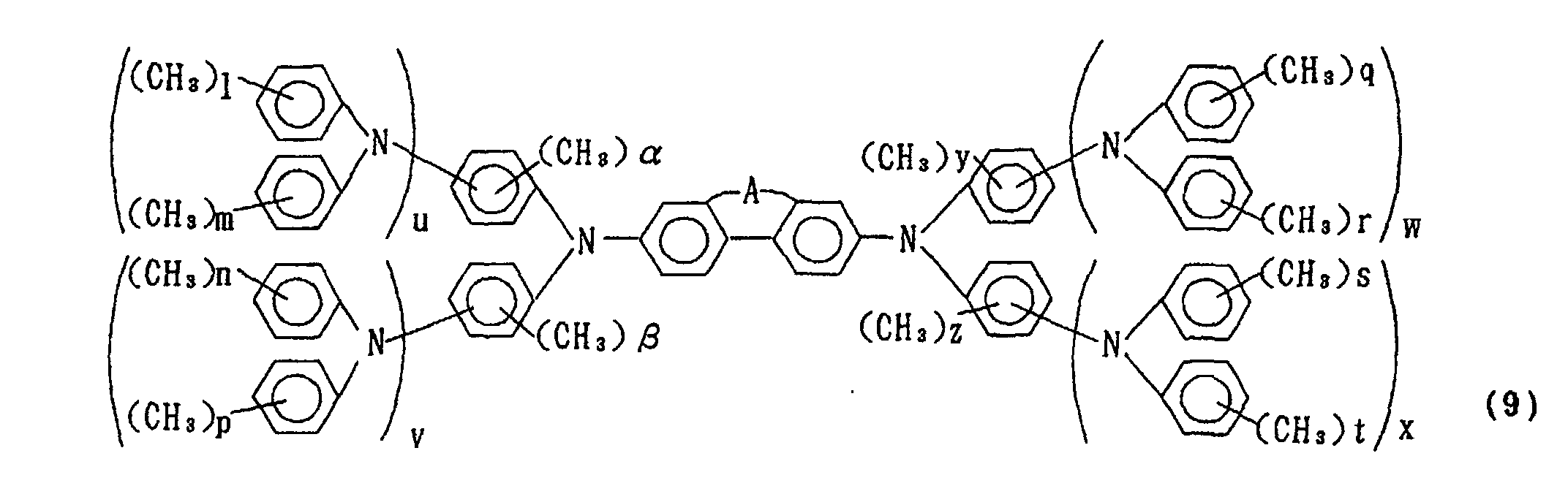
- The materials used for the anode of the EL element in the invention preferably have a work function as large as possible and include, for example, nickel, gold, platinum, palladium, selenium, iridium, an alloy of these metals, tin oxide, ITO, and copper iodide. Polyphenylene sulfide, polyaniline and other conductive polymers can also be used.
- On the other hand, the materials used for the cathode preferably have a small work function and include, for example, silver, lead, tin, magnesium, aluminum, calcium, indium, chromium, lithium and an alloy of these metals. One of a pair of materials used for the anode and cathode desirably has transmittance of 50% or more in the oscillating wave length region of the element.
- Glass and a plastic film can be used for a substrate of transparent electrodes which are used in the invention.
- The present invention will be further illustrated by way of examples hereinafter. However, the invention is not limited to the following examples unless exceeding the subject matter.
- To a reaction vessel, 15g (0.102 mole) of phthalimide, 7.3g (0.051 mole) of quinaldine, 29.2g (0.214 mole) of zinc chloride and 150g of N,N-dimethylaniline were charged and heated under nitrogen ventilation at 150 °C for 30 hours. The reaction mixture was poured into 650g of a 10% aqueous hydrochloric acid solution and treated at 95 °C for 1 hour. After cooling to 50 °C, the mixture was filtered and washed with water. The filter cake was dried to obtain 11.9g of the quinoline compound having the formula (7).
- The compounds (7) had purity of 100% and purity reduced yield for quinaldine was 86%.

- The X-ray diffraction spectrum of the compound (7) is shown in Figure 1. The peak intensity ratio at Bragg angle 12.8° was 0.46 for the intensity at Bragg angle 15.2° . The crystal was measured in the solid state as intact with a fluorophotometer: UM-2S, manufactured by Hekisa Kagaku Co. The crystal had brightness of 220 % for the brightness of Lumogen Brilliant Yellow.
- To a reaction vessel, 15g (0.102 mole) of phthalimide, 13.2g (0.0923 mole) of quinaldine, 29.2g (0.214 mole) of zinc chloride and 150g of N,N-dimethylaniline were charged and heated under nitrogen ventilation at 150 °C for 30 hours. The reaction mixture was poured into 650g of a 10% aqueous hydrochloric acid solution and treated at 95 °C for 1 hour. After cooling to 50 °C, the mixture was filtered and washed with water. The filter cake was dried to obtain 19.4g of the quinoline compound having the formula (7).
- The compounds had purity of 100% and purity reduced yield for phthalimide was 77%.
- The X-ray diffraction spectrum of the compound is shown in Figure 2. The peak intensity ratio at Bragg angle 12.8° was 0.46 for the intensity at Bragg angle 15.2° . The crystal was measured in the solid state as intact with a fluorophotometer: UM-2S, manufactured by Hekisa Kagaku Co. The crystal has brightness of 204 % for the brightness of Lumogen Brilliant Yellow.
- To a reaction vessel, 15g (0.102 mole) of phthalimide, 14.6g (0.102 mole) of quinaldine, 29.2g (0.214 mole) of zinc chloride and 150g of N,N-dimethylaniline were charged and heated under nitrogen ventilation at 150°C for 30 hours. The reaction mixture was poured into 650g of a 10% aqueous hydrochloric acid solution and treated at 95 °C for 1 hour. After cooling to 50 °C, the mixture was filtered and washed with water. The filter cake was dried to obtain 20.9g of the quinoline compound having the formula (7).
- The compounds had purity of 100% and purity reduced yield for phthalimide was 75%.
- The X-ray diffraction spectrum of the compound is shown in Figure 3. The peak intensity ratio at Bragg angle 12.8° was 0.70 for the intensity at Bragg angle 15.2°. The crystal was measured in the solid state as intact with a fluorophotometer: UM-2S, manufactured by Hekisa Kagaku Co. The crystal had brightness of 189% for the brightness of Lumogen Brilliant Yellow.
- To a reaction vessel, 50.0g (0.340 mole) of phthalimide, 97.3g (0.680 mole) of quinaldine, 99.0g (0.726 mole) of zinc chloride and 400g of N,N-dimethylaniline were charged and heated under nitrogen ventilation at 180°C for 10 hours. The reaction mixture was poured into 1720g of a 10% aqueous hydrochloric acid solution and treated at 100 °C for 1 hour. After cooling to a room temperature, the mixture was filtered and washed with 2000 g of methanol. The filter cake was sludged with 500 g of methanol, the mixture was filtered and washed with methanol and then the filter cake was dried to obtain 80g of the quinoline compound having the formula (7).
- The compounds had purity of 97% and purity reduced yield for phthalimide was 84%.
- The X-ray diffraction spectrum of the compound is shown in Figure 4. The peak intensity ratio at Bragg angle 12.8° was 0.70 for the intensity at Bragg angle 15.2° . The crystal was measured in the solid state as intact with a fluorophotometer: UM-2S, manufactured by Hekisa Kagaku Co. The crystal had brightness of 180% for the brightness of Lumogen Brilliant Yellow.
- On an ITO glass substrate, N,N'-diphenyl-N,N'-ditolyl-1,1-diphenyl-4,4'-diamine was stacked to a film thickness of 50nm under vacuum of 5 × 10⁻⁵ torr by a resistance heating method. Successively, the quinoline compound of the formula (7) was stacked to a film thickness of 50nm and further, an aluminum electrode was deposited to a film thickness of 150nm under vacuum of 6×10⁻⁵ torr. A positive electric field was applied to the ITO side of the element and a negative electric field was applied to the aluminum side. The emission from the surface of ITO glass substrate of the element was observed. As a voltage of 19V and a current density of 26mA/cm2, the emission was green and stable and the brightness was 115 Cd/m2.
- The compound of the formula (7) was added to polyethylene terephthalate resin powder, hot pressed at 280°C and cooled to obtain a sheet having thickness of 0.5mm. The sheet was measured with a fluorophotometer: FP-770, manufactured by Nippon Bunko Co. λ em was 523nm.
- To a reaction vessel, 10g (0.068 mole) of phthalimide, 18.74g (0.136 mole) of quinaldine, 23.6g (0.173 mole) of zinc chloride and 250g of N,N-dimethylaniline were charged and heated under nitrogen ventilation at 150 °C for 10 hours. The reaction mixture was poured into 640g of a 10% aqueous hydrochloric acid solution and treated at 100 °C for 1 hour. After cooling to 40 °C, the solid portion was filtered, washed with water and dried to obtain 15.0g of the quinoline compound having the formula (7). Purity of the compound was 98.2% and purity reduced yield was 80% for phthalimide.
- After suspending 92.5g (0.497 mole) of 6-isopropylquinaldine and 48g (0.25 mole) of 3-nitrophthalimide in 384g of N,N-dimethylaniline, 72.3g (0.53 mole) of zinc chloride was added. The mixture was heated under nitrogen ventilation at 150°C for 10 hours. The reaction mixture was poured into 1265g of a 10% aqueous hydrochloric acid solution and treated at 100 °C for an hour. After cooling to 40°C, the solid portion was filtered, washed with water and dried to obtain 69.6g of the quinoline compound having the formula (10).
- The purity was 97% and the purity reduced yield was 75% for 3-nitrophthalimide.

- The result of MS spectrum was as follow; m/e = 358
- Following results were obtained by elemental analysis.
C H N Calculated (%) 70.4 4.5 11.7 Found (%) 70.1 4.8 11.3 - On an ITO glass substrate, N,N'-diphenyl-N,N'-ditolyl-1,1-diphenyl-4,4'-diamine was stacked to a film thickness of 50nm under vacuum of 5 × 10⁻⁵ torr by a resistance heating method. Successively, the quinoline compound of the formula (10) was stacked to a film thickness of 50nm and further, an aluminum electrode was deposited to a film thickness of 150nm under vacuum of 6 ×10⁻⁵ torr. A positive electric field was applied to the ITO side of the element and a negative electric field was applied to the aluminum side. The emission from the surface of ITO glass substrate of the element was observed. As a voltage of 19V and a current density of 26mA/cm2, the emission was green and stable and the brightness was 115 Cd/m2.
- The quinoline compound of the formula (10) was added to polyethylene terephthalate resin powder, hot pressed at 280 °C and cooled to obtain a sheet having thickness of 0.5mm. The sheet was measured with a fluorophotometer: FP-770, manufactured by Nippon Bunko Co. Emission at 520 nm and excitatioin at 375 nm were obtained.
- To a reaction vessel, 219g (1.00 mole) of 5-phenylquinaldine, 143g (0.502 mol) of 3,4,5,6-tetrachlorophthalimide, 136g (0.604 mole) of zinc bromide and 2000g of N,N-diethylaniline were charged and heated under nitrogen ventilation at 180 °C for 15 hours. The reaction mixture was poured into 10 liter of a 5% aqueous hydrochloric acid solution and treated at 80°C for 2 hours. After cooling to room temperature, the solid portion was filtered, washed with 4000g of methanol, sludged with 1000g of methanol, filtered, washed with methanol, and dried to obtain 220g of the quinoline compound having the formula (11). Purity was 98% and the purity reduced yield was 88% for 3,4,5,6-tetrachlorophthalimide
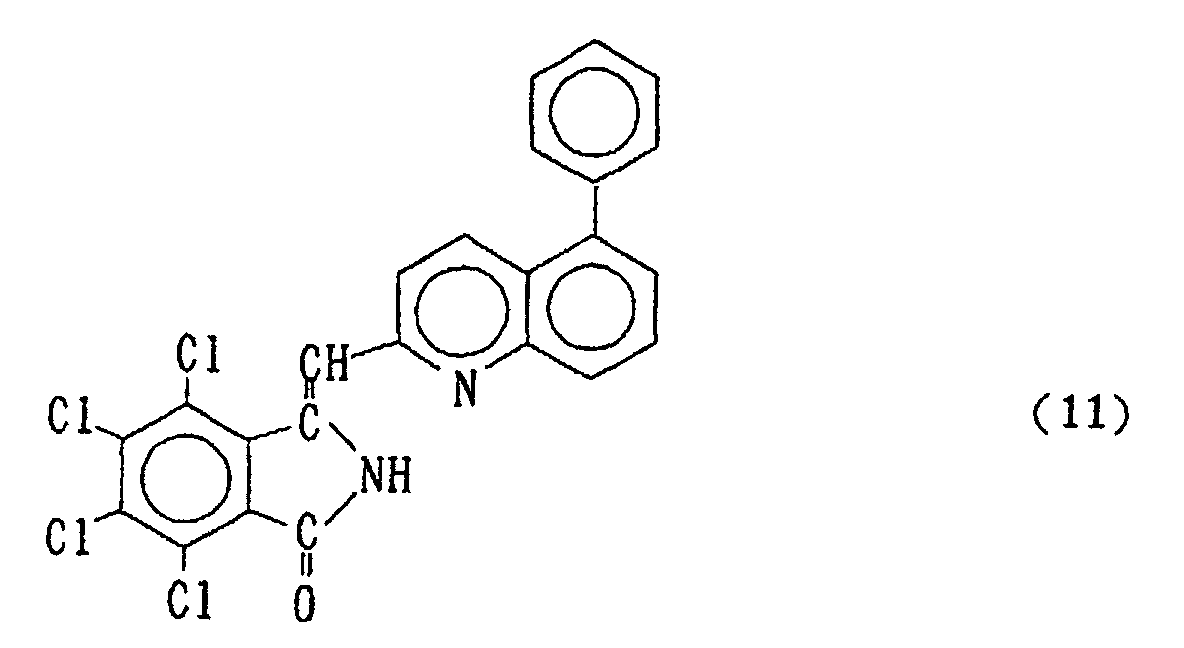
- Result of MS spectrum was as follows; m/e = 486
- Following results were obtained by elemental analysis.
C H N Cl Calculated(%) 59.3 2.5 5.8 29.2 Found (%) 58.9 2.5 5.7 29.1 - On a glass substrate which formed an ITO transparent electrode, 1,1-bis(4-N,N-ditolylaminophenyl)cyclohexanone was stacked to a film thickness of 50nm. Successively, the quinoline compound of the formula (11) was stacked to a film thickness of 50nm and further, 2,2',6,6'-tetramethylphenoquinone was stacked to a film thickness of 50nm. A back electrode was formed by stacking indium to a film thickness of 150nm. When a voltage of 8V was applied, emission of 280Cd/m2 was obtained.
- The quinoline compound of the formula (11) was added to polyethylene terephthalate resin powder, hot pressed at 280 °C and cooled to obtain a sheet having thickness of 0.5mm. The sheet was measured with a fluorophotometer: FP-770, manufactured by Nippon Bunko Co. Emission at 530 nm and excitation at 383 nm were obtained.
- To a reaction vessel, 338g (1.00 mole) of 6-N,N-ditolylaminoquinal dine, 95g (0.508 mol) of 3-ethoxyphthalimide, 183g (0.997 mole) of zinc acetate and 6000g of o-dichlorobenzene were charged and heated under nitrogen ventilation at 180°C for 15 hours. The reaction mixture was poured into 10 liter of a 5% aqueous hydrochloric acid solution and treated at 80°C for 2 hours. After cooling to room temperature, the solid portion was filtered, washed with 5000g of methanol, sludged with 4000g of methanol, filtered, washed with methanol, and dried to obtain 200g of the quinoline compound having the formula (12). Purity was 98% and the purity reduced yield for 3-ethoxyphthalimide was 77.
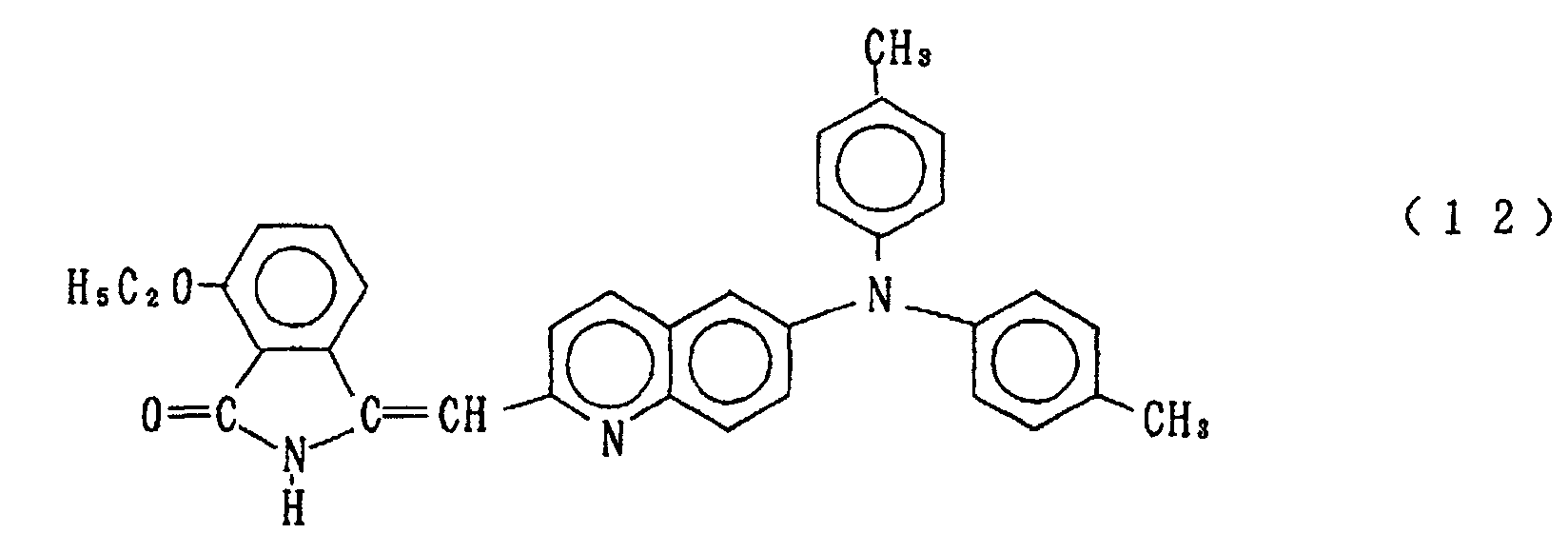
- Result of MS spectrum was as follows. m/e = 487
- Following results were obtained by elemental analysis.
C H N Calculated(%) 78.5 6.0 8.6 Found (%) 58.9 2.5 5.7 - On an ITO glass substrate, N,N,N',N'-tetra(4-ditolylaminophenyl)-1,4-phenylenediamine was stacked to a film thickness of 50nm under vacuum of 5 ×10⁻⁶ torr by a resistance heating method. Successively, the quinoline compound of the formula (12) was stacked to a film thickness of 50nm and further, an aluminum electrode was deposited to a film thickness of 150nm under vacuum of 6 ×10⁻⁵ torr. A positive electric field was applied to the ITO side of the element and a negative electric field was applied to the aluminum side. The emission from the surface of ITO glass substrate of the element was observed. When a voltage of 19V was applied, the emission was stable and the emission of 118Cd/m2 was obtained.
- The quinoline compound of the formula (12) was added to polyethylene terephthalate resin powder, hot pressed at 280 °C and cooled to obtain a sheet having thickness of 0.5mm. The sheet was measured with a fluorophotometer: FP-770, manufactured by Nippon Bunko C o. Emission at 530 nm and excitation at 380 nm were obtained.
- The same reaction procedures as described in Reference Example 1 were carried out by using phthalimide base compounds or quinaldine base compounds as shown in Table 1. The purity reduced yields of quinoline derivatives obtained are illustrated in Table 1.

- To a reaction vessel, 143g (1.00 mole) of quinaldine, 78g (0.531 mol) of phthalimide, 136.3 g (1.00 mole) of zinc chloride and 2000g of N,N-dimethylaniline were charged and heated under nitrogen ventilation at 180 °C for 15 hours. After cooling to room temperature, the solid portion was filtered, washed with 4000g of methanol, sludged with 3000g of DMF, filtered, washed with methanol, and dried to obtain 120g of the quinoline compound having the formula (13). Purity was 97% and the purity reduced yield was 65% for phthalimide.
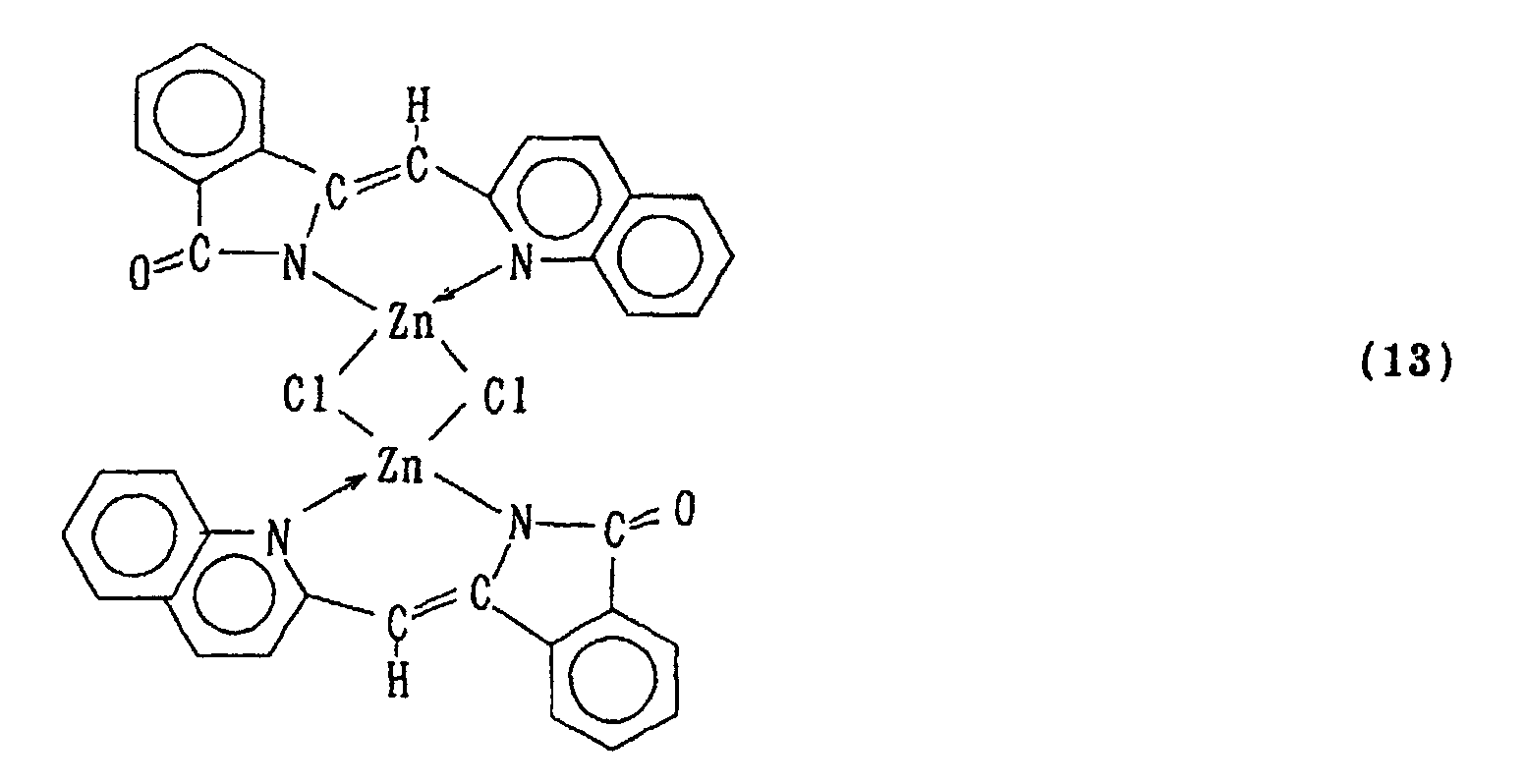
- NMR chart of the compound (13) was illustrated in Figure 5.
- Following results were obtained by elemental analysis.
C H N Zn Cl Calculated(%) 58.1 3.0 7.5 17.6 9.6 Found (%) 57.3 3.0 7.6 17.4 9.6 - On an ITO glass substrate, N,N'-diphenyl-N,N'-ditolyl-1,1'-diphenyl-4,4'-diamine was stacked to a film thickness of 50nm under vacuum of 5×10⁻⁵ torr by a resistance heating method. Successively, the quinoline compound of the formula (13) was stacked to a film thickness of 50nm and further, an aluminum electrode was deposited to a film thickness of 150nm under vacuum of 6 ×10⁻⁵ torr. A positive electric field was applied to the ITO side of the element and a negative electric field was applied to the aluminum side. The emission from the surface of ITO glass substrate of the element was observed. As a voltage of 19V and a current density of 26mA/cm2, the emission was stable and the emission of 115 Cd/m2 was obtained.
- The compound of the formula (13) was added to polyethylene terephthalate resin powder, hot pressed at 280 °C, and cooled to obtain a sheet having thickness of 0.5nm. The sheet was measured with a spectrophotometer: UV-3100 PC, manufactured by Shimadzu Seisakusho Co. Ultraviolet transmittance at 380nm was 2%.
- To a reaction vessel, 219g (1.00 mole) of 5-phenylquinaldine, 142.5g (0.5 mol) of 3,4,5,6-tetrachlorophthalimide, 136.g (0.604mole) of zinc bromide and 2000g of N,N-dimethylaniline were charged and heated under nitrogen ventilation at 180°C for 15 hours. After cooling to room temperature, the solid portion was filtered, washed with 4000g of methanol, sludged with 3000g of DMF, filtered, washed with methanol, and dried to obtain 200g of the quinoline compound having the formula (14). Purity was 97% and the purity reduced yield was 65% for 3,4,5,6-tetrachlorophthalimide.
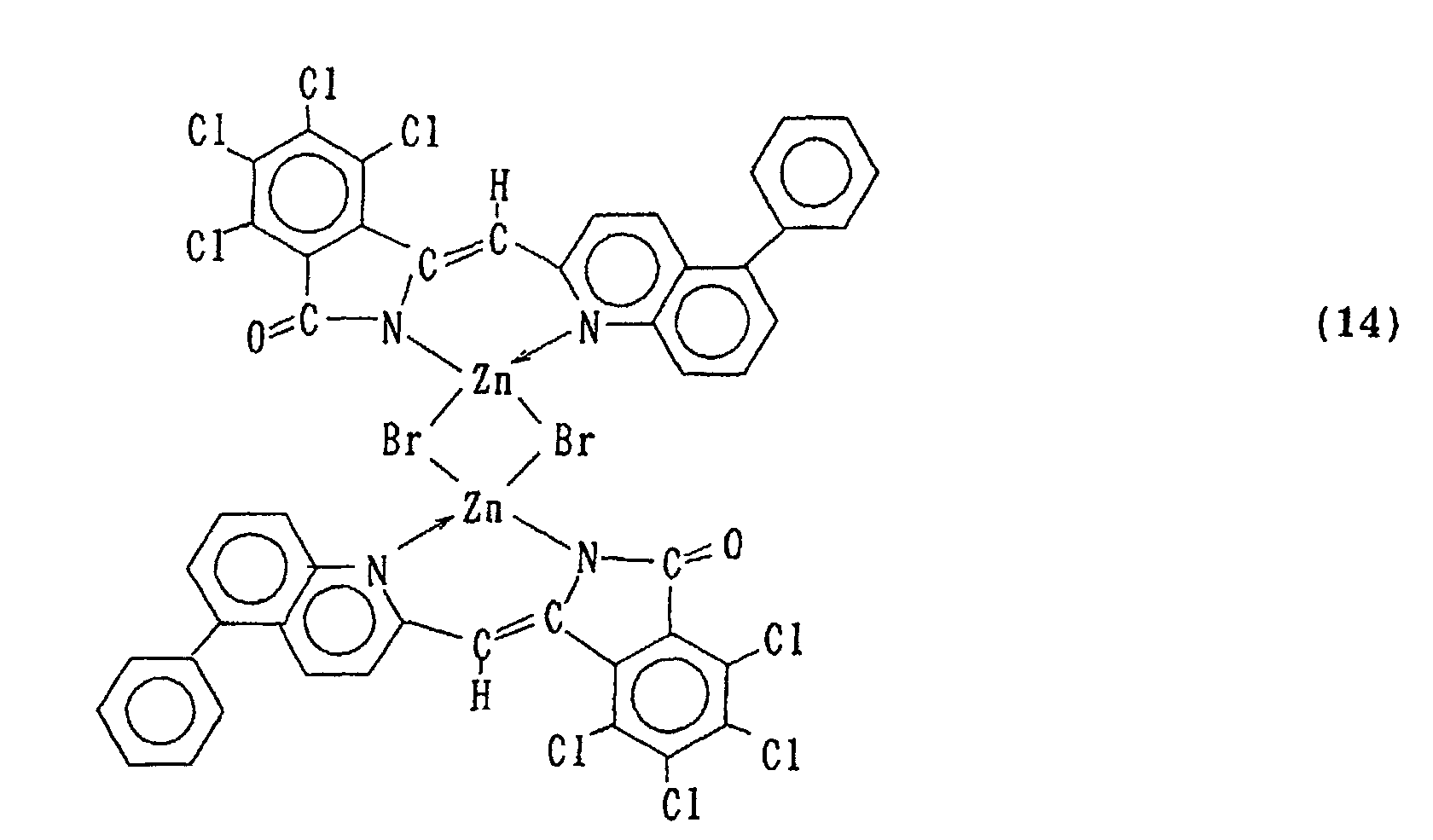
- Following results were obtained by elemental analysis.
C H N Zn Calculated(%) 45.7 1.8 4.4 10.4 Found (%) 45.2 1.9 5.1 10.4 - On a glass substrate which formed an ITO transparent electrode, 1,1-bis(4-N,N-ditolylaminophenyl)cyclohexanone was stacked to a film thickness of 50nm. Successively, the quinoline compound of the formula (13) was stacked to a film thickness of 50nm, and further 2,2',6,6'-tetramethyldiphenoquinone was stacked to a film thickness of 50 nm. A back electrode was formed by stacking indium to a film thickness of 150nm. When a voltage of 8V was applied, emission of 300Cd/m2 was obtained.
- The compound of the formula (14) was added to polyethylene terephthalate resin powder, hot pressed at 280 °C, and cooled to obtain a sheet having thickness of 0.5nm. The sheet was measured with a spectrophotometer: UV-3100PC, manufactured by Shimadzu Seisakusho Co. Ultraviolet transmittance at 380nm was 4%.
- To a reaction vessel, 338g (1.00 mole) of 6-N,N-ditolylamino-2-quinaldine, 95g (0.5 mol) of 3-ethoxyphthalimide, 136.3 g (1.00 mole) of zinc chloride, 6000g of o-dichlorobenzene and 200 g of isoquinoline were charged and heated under nitrogen ventilation at 180 °C for 45 hours. After cooling to room temperature, the solid portion was filtered, washed with 5000g of methanol, sludged with 4000g of methanol, filtered, washed with methanol, and dried to obtain 160g of the compound having the formula (15). Purity was 98% and the purity reduced yield was 54%.

- Following results were obtained by elemental analysis.
C H N Zn Cl Calculated(%) 65.4 4.8 7.2 11.1 6.0 Found (%) 65.2 5.0 7.7 11.1 6.1 - On an ITO glass substrate, N,N,N',N'-tetra(4-ditrylaminophenyl)-1,4-phenylenediamine was stacked to a film thickness of 50nm under vacuum of 5×10⁻⁶ torr by a resistance heating method. Successively, the compound of the formula (15) was stacked to a film thickness of 50nm and further, an aluminum electrode was deposited to a film thickness of 150nm under vacuum of 6 ×10⁻⁵ torr. A positive electric field was applied to the ITC side of the element and a negative electric field was applied to the aluminum side. The emission from the surface of ITO glass substrate of the element was observed. As a voltage of 9 V, the emission was stable and the emission of 120 Cd/m2 was obtained.
- The compound of the formula (15) was added to polyethylene terephthalate resin powder, hot pressed at 280 °C, and cooled to obtain a sheet having thickness of 0.5 mm. The sheet was measured with a spectrophotometer: UV-3100PC, manufactured by Shimadzu Seisakusho Co. Ultraviolet transmittance at 370nm was 3%.
- To 200g of pyridine, 20g of the compound having the formula (13) was added and heated with stirring at 110-115°C for 8 hours. After cooling the reaction mixture, the precipitated solid was filtered, throughly washed with water, and dried to obtain 14.9g of the compound having the formula (16).

- Figure 6 illustrates an NMR chart, Figure 7 illustrates an IR spectrum, and Figure 8 illustrates an MS spectrum of the compound having the formula (16), respectively.
- Following results were obtained by elemental analysis.
C H N Zn Calculated 71.2 3.6 9.2 10.7 Found 69.6 3.7 9.0 10.6 - On an ITO glass substrate, N,N'-diphenyl-N,N'-ditolyl-1,1'-diphenyl-4,4'-diamine was stacked to a film thickness of 50nm under vacuum of 5×10⁻⁵ torr by a resistance heating method. Successively, the compound of the formula (16) was stacked to a film thickness of 50nm and further, an aluminum electrode was deposited to a film thickness of 150nm under vacuum of 6 ×10⁻⁵ torr. A positive electric field was applied to the ITO side of the element and a negative electric field was applied to the aluminum side. The emission from the surface of ITO glass substrate of the element was observed. As a voltage of 19 V and a current density of 26 mA/cm2, the emission was stable and the emission of 115 Cd/m2 was obtained.
- The compound of the formula (16) was added to polyethylene terephthalate resin powder, hot pressed at 280 °C, and cooled to obtain a sheet having thickness of 0.5mm. The sheet was measured with a spectrophotometer: UV-3100PC, manufactured by Shimadzu Seisakusho Co. Ultraviolet transmittance at 380nm was 5%.
- To 200g of γ-picoline pyridine, 20g(0.0167 mole) of the compound having the formula (14) was added and heated with stirring at 110-115°C for 8 hours. After cooling the reaction mixture, the precipitated solid was filtered, throughly washed with water, and dried to obtain 13.5g of the compound having the formula (17).
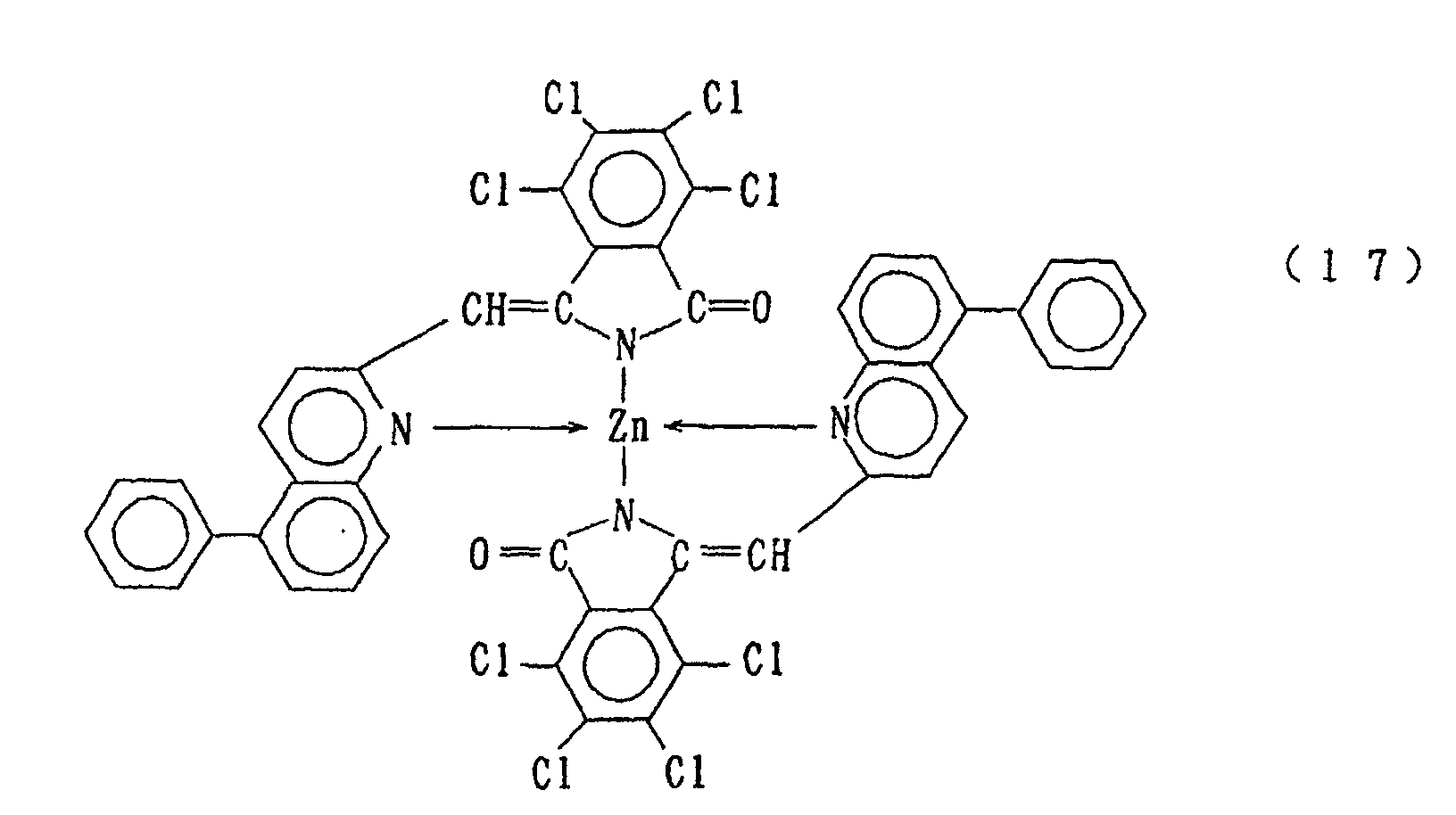
- Result of MS spectrum was as follows. m/e = 1035
- Following results were obtained by elemental analysis.
C H N Zn Cl Calculated(%) 55.7 2.1 5.4 27.4 6.3 Found (%) 55.1 2.0 5.5 27.3 6.3 - On a glass substrate which formed an ITO transparent electrode, 1,1-bis(4-N,N-ditolylaminophenyl)cyclohexanone was stacked to a film thickness of 50nm. Successively, the quinoline compound of the formula (17) was stacked to a film thickness of 50nm, and further 2,2', 6,6'-tetramethyldiphenoquinone was stacked to a film thickness of 50 nm. A back electrode was formed by stacking indium to a film thickness of 150nm. When a voltage of 8 V was applied, emission of 300 Cd/m2 was obtained.
- The compound of the formula (17) was added to polyethylene terephthalate resin powder, hot pressed at 280 °C, and cooled to obtain a sheet having thickness of 0.5mm. The sheet was measured with a spectrophotometer: UV-3100PC, manufactured by Shimadzu Seisakusho Co. Ultraviolet transmittance at 380nm was 4%.
- To 200g of γ-picoline pyridine, 20g(0.0173 mole) of the compound having the formula (15) was added and heated with stirring at 110-115°C for 8 hours. After cooling the reaction mixture, the precipitated solid was filtered, throughly washed with water, and dried to obtain 13.5g of the compound having the formula (18).
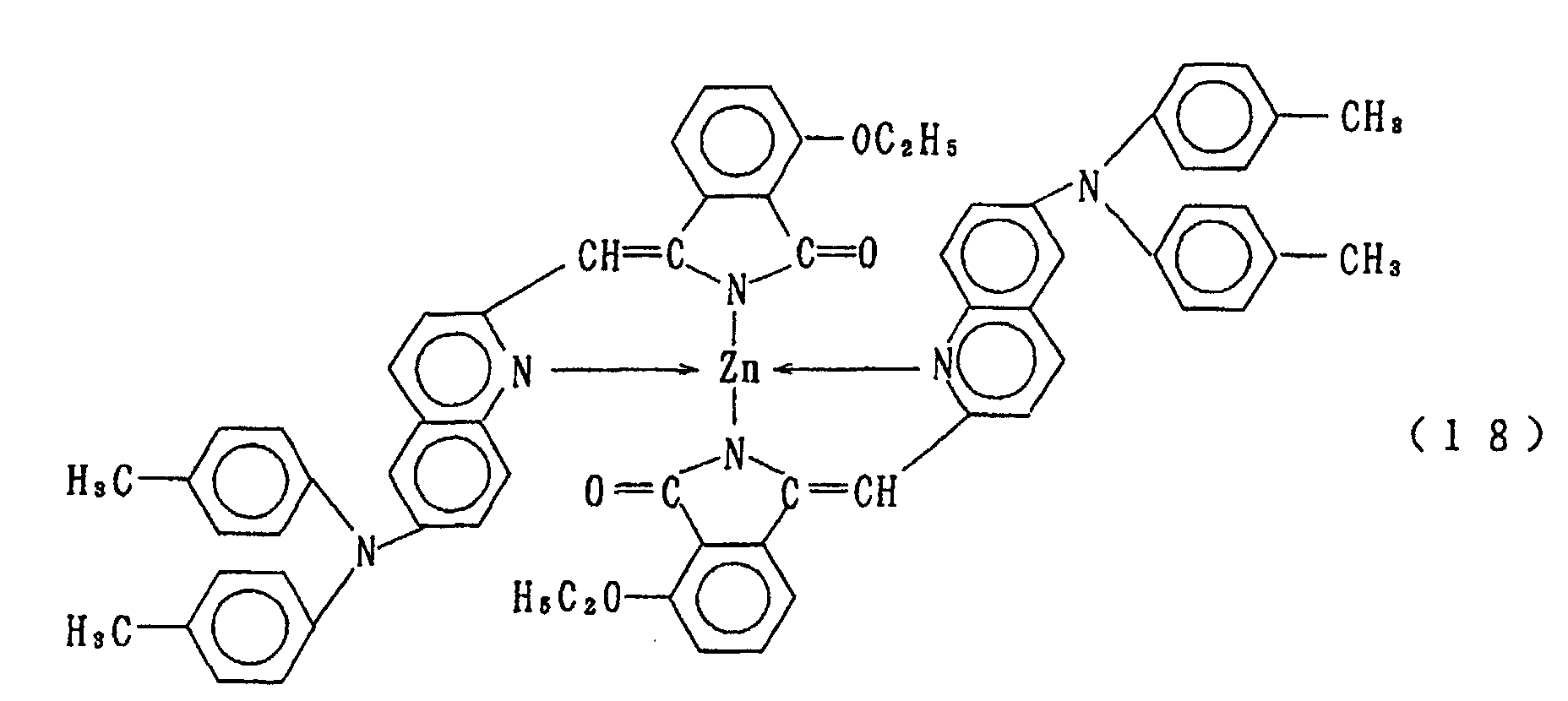
- Result of MS spectrum was as follows. m/e = 1038
- Following results were obtained by elemental analysis.
C H N Zn Calculated(%) 74.0 5.4 8.1 6.3 Found (%) 74.0 6.5 8.1 6.2 - On an ITO glass substrate, N,N,N',N'-tetra(4-ditolylaminophenyl)-1,4-phenylenediamine was stacked to a film thickness of 50nm under vacuum of 5 × 10⁻⁶ torr by a resistance heating method. Successively, the compound of the formula (18) was stacked to a film thickness of 50nm and further, an aluminum electrode was deposited to a film thickness of 150nm under vacuum of 6 × 10⁻⁵ torr. A positive electric field was applied to the ITC side of the element and a negative electric field was applied to the aluminum side. The emission from the surface of ITO glass substrate of the element was observed. As a voltage of 9 V, the emission was stable and the emission of 120 Cd/m2 was obtained.
- The compound of the formula (18) was added to polyethylene terephthalate resin powder, hot pressed at 280 °C, and cooled to obtain a sheet having thickness of 0.5 mm. The sheet was measured with a spectrophotometer: UV-3100PC, manufactured by Shimadzu Seisakusho Co. Ultraviolet transmittance at 375nm was 2%.
- To 1000 g of a 10% aqueous hydrochloric acid solution, 25 g(0.0369 mole) of the compound having the formula (13) was added and heated with stirring at 95 °C for an hour. Solid reaction mass was isolated, washed with water and dried to obtain 17g of the compound having the formula (7). Purity was 99%.
- To 1000 g of a 10% aqueous hydrochloric acid solution, 25 g(0.0209 mole) of the compound having the formula (14) was added and heated with stirring at 95 °C for an hour. Solid reaction mass was isolated, washed with water and dried to obtain 16g of the compound having the formula (11). Purity was 98%.
- To 800 g of a 10% aqueous hydrochloric acid solution, 25 g(0.0216 mole) of the compound having the formula (15) was added and heated with stirring at 95°C for an hour. Solid reaction mass was isolated, washed with water and dried to obtain 18g of the compound having the formula (12). Purity was 97%.
- To 1200 g of a 10% aqueous hydrochloric acid solution, 35 g(0.0576 mole) of the compound having the formula (16) was added and heated with stirring at 95 °C for an hour. Solid reaction mass was isolated, washed with water and dried to obtain 29g of the compound having the formula (7). Purity was 100%.
- To 1320 g of a 10% aqueous hydrochloric acid solution, 35 g(0.0338 mole) of the compound having the formula (17) was added and heated with stirring at 95 °C for an hour. Solid reaction mass was isolated, washed with water and dried to obtain 31g of the compound having the formula (11). Purity was 99%.
- To 960 g of a 10% aqueous hydrochloric acid solution, 35 g(0.0322 mole) of the compound having the formula (18) was added and heated with stirring at 95°C for an hour. Solid reaction mass was isolated, washed with water and dried to obtain 32g of the compound having the formula (12). Purity was 99%.
- To 200g of N,N-dimethylaniline, 20g(0.0735 mole) of the compound having the formula (7) and 25.2g (0.185 mole) of zinc chloride were added and heated with stirring at 180°C for 7 hours. After cooling, the reaction mixture was poured into 800 ml of methanol and stirred at room temperature for an hour. The precipitated solid was filtered, washed with water and dried to obtain 15.5g of the compound having the formula (13). Purity was 98%.
- To 200g of N,N-dimethylaniline, 20g(0.0391 mole) of the compound having the formula (12) and 5.6g (0.041 mole) of zinc chloride were added and heated with stirring at 150°C for 27 hours. After cooling, the reaction mixture was poured into 800 ml of methanol and stirred at room temperature for an hour. The precipitated solid was filtered, washed with water and dried to obtain 28.9g of the compound having the formula (15). Purity was 98%.
- To a reaction vessel, 50g (0.34 mole) of phthalimide, 97.3g (0.68 mole) of quinaldine, 99g (0.73 mole) of zinc chloride, and 400g of N,N-dimethylaniline were charged and heated under nitrogen ventilation at 180°C for 10 hours. The reaction mixture was poured into 1720g of pyridine and treated at 110 °C for 9 hours. After cooling to room temperature, the precipitate was filtered, washed with water, and dried to obtain 95g of the compound having the formula (16). Purity was 99%.
- To a reaction vessel, 219 g (1.0 mole) of 5-phenylquinaldine, 143g (0.5 mole) of 3,4,5,6-tetrachlorophthalimide, 136 g (0.604 mole) of zinc bromide, and 2000g of N,N-dimethylaniline were charged and heated under nitrogen ventilation at 180 °C for 15 hours. The reaction mixture was poured into 100g of γ-picoline and treated at 110°C for 6 hours. After cooling to room temperature, the precipitate was filtered, washed with water, and dried to obtain 298 g of the compound having the formula (17). Purity was 99%.
- An EL element was prepared by stacking the compound having the formula below in place of the compound (7) in Example 1. The EL element had an emission intensity of 80Cd/m2.

Claims (18)
- A quinoline compound and a tautomer of the same which are represented by the formula (1):where each of R1, R2, R3, R4, R5, R6, R7, R8, R9 and R10 is individually a hydrogen atom, halogen atom, cyano, amino, substituted or unsubstituted straight, branched or cyclic hydrocarbon group having 2 to 10 carbon atoms, substituted or unsubstituted aryl, substituted or unsubstituted straight, branched or cyclic alkoxy group having 1 to 10 carbon atoms, substituted or unsubstituted aryloxy, substituted or unsubstituted N-alkylamino group having a straight, branched or cyclic alkyl group with 1 to 10 carbon atoms, substituted or unsubstituted N,N-dialkylamino, group having straight, branched or cyclic alkyl groups with 1 to 10 carbon atoms, substituted or unsubstituted N-arylamino, substituted or unsubstituted N,N-diarylamino or substituted or unsubstituted N-alkyl-N-arylamino group, except the case where all of R1, R2, R3, R4, R5, R6, R7, R8, R9 and R10 is a hydrogen atom.
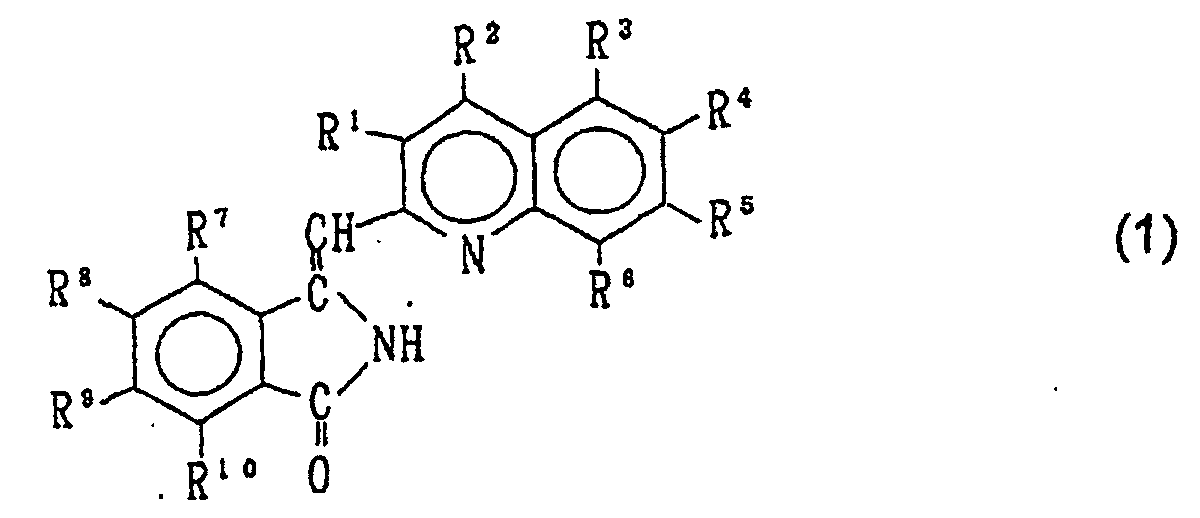
- A zinc halogenide complex and a tautomer of the same which are represented by the formula (2):where each of R11, R12, R13, R14, R15, R16, R17, R18, R19, R20, R21, R22, R23, R24, R25, R26, R27, R28, R29 and R30 is individually a hydrogen atom, halogen atom, nitro, cyano, hydroxy, amino, substituted or unsubstituted straight, branched or cyclic hydrocarbon group having 1 to 10 carbon atoms, substituted or unsubstituted aryl, substituted or unsubstituted straight, branched or cyclic alkoxy group having 1 to 10 carbon atoms, substituted or unsubstituted aryloxy, substituted or unsubstituted N-alkylamino group having a straight, branched or cyclic alkyl group with 1 to 10 carbon atoms, substituted or unsubstituted N,N-dialklamino group having straight, branched or cyclic alkyl groups with 1 to 10 carbon atoms, substituted or unsubstituted N-arylamino, substituted or unsubstituted N,N-diarylamino or substituted or unsubstituted N-alkyl-N-arylamino group, and each of X1 and X2 is individually a fluorine, chlorine, bromine or iodine atom.

- A zinc complex and tautomer of the same which are represented by the formula (3):where each of R31, R32, R33, R34, R35, R36, R37, R38, R39, R40, R41, R42, R43, R44, R45, R46, R47, R48, R49 and R50 is individually hydrogen atom, halogen atom, nitro, cyano, hydroxy, amino, substituted or unsubstituted straight, branched or cyclic hydrocarbon group having 1 to 10 carbon atoms, substituted or unsubstituted aryl, substituted or unsubstituted straight, branched or cyclic alkoxy group having 1 to 10 carbon atoms, substituted or unsubstituted aryloxy, substituted or unsubstituted N-alkylamino group having a straight, branched or cyclic alkyl group with 1 to 10 carbon atoms, substituted or unsubstituted N,N-dialklamino group having straight, branched or cyclic alkyl groups with 1 to 10 carbon atoms, substituted or unsubstituted N-arylamino, substituted or unsubstituted N,N-diarylamino or substituted or unsubstituted N-alkyl-N-arylamino group.

- A preparation process of a quinoline compound and a tautomer of the same which are represented by the formula (1) of claim 1 comprising reacting a quinoline derivative represented by the formula (5a):where each of R1, R2, R3, R4, R5 and R6 are as defined in claim 1

and a phthalimide derivative represented by the formula (6a):where each of R7, R8, R9 and R10 are as defined in claim 1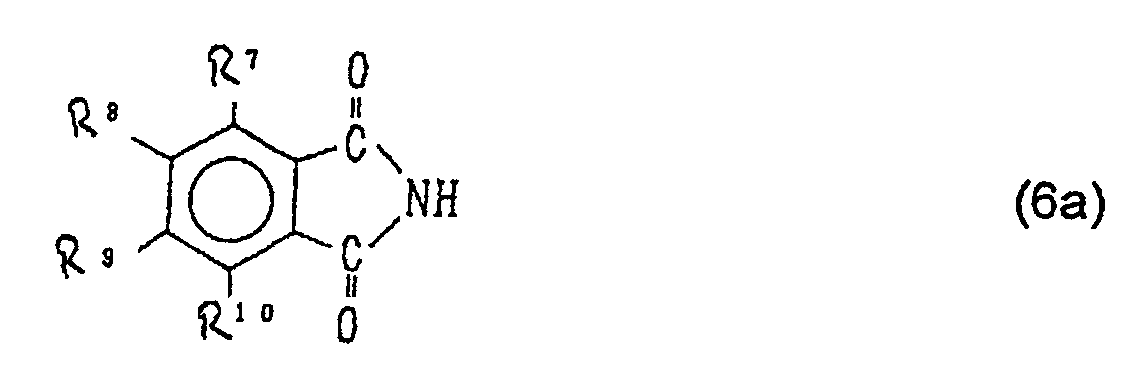
with zinc halogenide in an organic basic solvent selected from N,N-dimethylaniline, N,N-diethylaniline, N-methylaniline, N-ethylaniline and other aniline derivatives; pyridine and its derivatives, quinoline, methylquinoline, isoquinoline and other quinoline derivatives; diazabicycloundecene, diazabicyclononene, N-ethylmorpholino and other cyclic amine derivatives; or mixtures of the above solvents and successively treating with an inorganic acid. - A preparation process according to claim 4 wherein the phthalimide derivative is in a molar ratio of 0.5 to 2.0 to the quinoline derivative.
- A preparation process according to claim 4 wherein the phthalimide derivative is in a molar ratio of 1.1 to 2.0 to the quinoline derivative.
- A preparation process of a quinoline compound and a tautomer of the same which are represented by formula (1) of claim 1
comprising treating a zinc halogenide complex and a tautomer of the same which are represented by the formula (2a):wherein R1, R2, R3, R4, R5, R6, R7, R8, R9 and R10 are as defined in claim 1 and X1 and X2 are as defined in claim 2, with an inorganic acid.
- A preparation process of a quinoline compound and a tautomer of the same which are represented by formula (1) of claim 1
comprising treating a zinc complex and a tautomer of the same which are represented by the formula (3a):wherein R1, R2, R3, R4, R5, R6, R7, R8, R9 and R10 are as defined in claim 1, with an inorganic acid.
- An electro-luminescence element wherein the luminous layer is a compound represented by the formula (4)and a tautomer of the same,
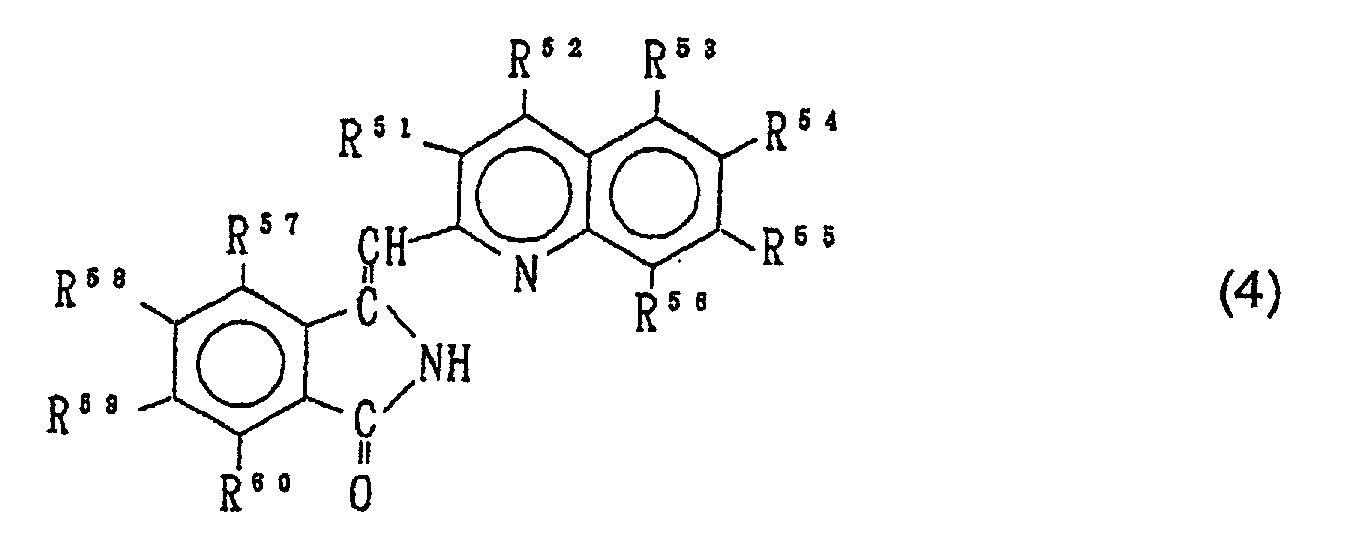
where each of R51, R52, R53, R54, R55, R56, R57, R58, R59 and R60 is individually hydrogen atom, halogen atom, nitro, cyano, hydroxy, amino, substituted or unsubstituted straight, branched or cyclic hydrocarbon group having 1 to 10 carbon atoms, substituted or unsubstituted aryl, substituted or unsubstituted straight, branched or cyclic alkoxy group having 1 to 10 carbon atoms, substituted or unsubstituted aryloxy, substituted or unsubstituted N-alkylamino group having a straight, branched or cyclic alkyl group with 1 to 10 carbon atoms, substituted or unsubstituted N,N-dialklamino group having straight, branched or cyclic alkyl groups with 1 to 10 carbon atoms, substituted or unsubstituted N-arylamino, substituted or unsubstituted N,N-diarylamino or substituted or unsubstituted N-alkyl-N-arylamino group. - A fluorescent material comprising a quinoline compound represented by the formula (1) as defined in claim 1 and a tautomer of the same.
- A preparation process of a zinc halogenide complex represented by the formula (2) as defined in claim 2 and a tautomer of the same, comprising reacting one or two kinds of a quinoline derivative represented by the formula (5):where each of Y1, Y2, Y3, Y4, Y5 and Y6 is a hydrogen atom, halogen atom, nitro, cyano, hydroxy, amino, substituted or unsubstituted straight, branched or cyclic hydrocarbon group having 1 to 10 carbon atoms, substituted or unsubstituted aryl, substituted or unsubstituted straight, branched or cyclic alkoxy group having 1 to 10 carbon atoms, substituted or unsubstituted aryloxy, substituted or unsubstituted N-alkylamino group having a straight, branched or cyclic alkyl group with 1 to 10 carbon atoms, substituted or unsubstituted N,N-dialklamino group having straight, branched or cyclic alkyl groups with 1 to 10 carbon atoms, substituted or unsubstituted N-arylamino, substituted or unsubstituted N,N-diarylamino or substituted or unsubstituted N-alkyl-N-arylamino group,
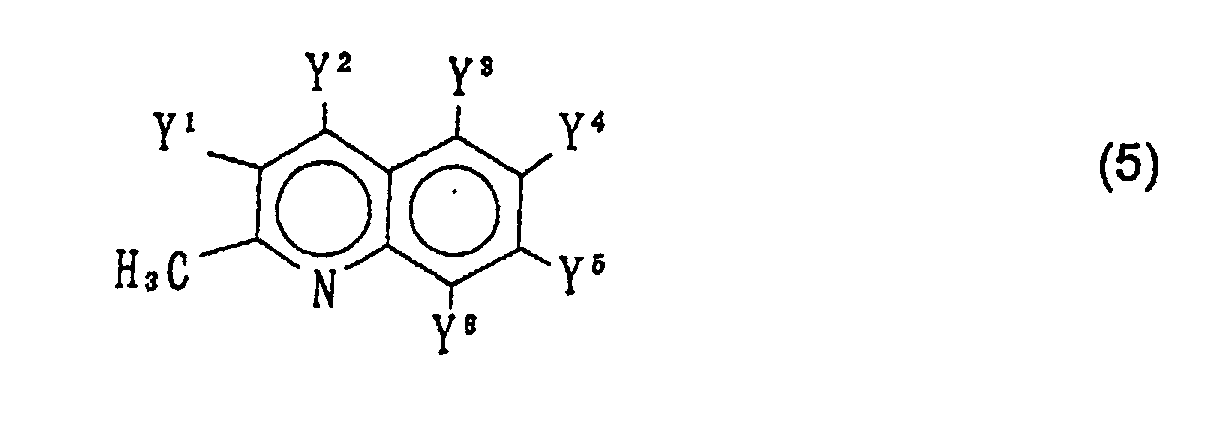
and one or two kind of a phthalimide derivative represented by the formula (6):where each of Y7, Y8, Y9 and Y10 Is individually a hydrogen atom, halogen atom, nitro, cyano, hydroxy, amino, substituted or unsubstituted straight, branched or cyclic hydrocarbon group having 1 to 10 carbon atoms, substituted or unsubstituted aryl, substituted or unsubstituted straight, branched or cyclic alkoxy group having 1 to 10 carbon atoms, substituted or unsubstituted aryloxy, substituted or unsubstituted N-alkylamino group having a straight, branched or cyclic alkyl group with 1 to 10 carbon atoms, substituted or unsubstituted N,N-dialklamino group having straight, branched or cyclic alkyl groups with 1 to 10 carbon atoms, substituted or unsubstituted N-arylamino, substituted or unsubstituted N,N-diarylamino or substituted or unsubstituted N-alkyl-N-arylamino group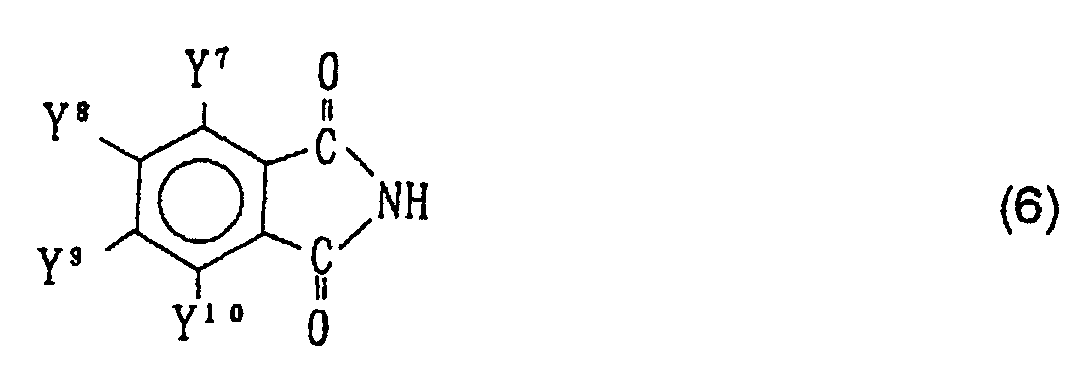
with zinc halogenide in an organic basic solvent. - A preparation process of a zinc halogenide complex represented by the formula (2) and a tautomer of the same, comprising reacting a quinoline derivative represented by the formula (4):wherein R51, R52, R53, R54, R55, R56, R57, R58, R59 and R60 are as defined in claim 9, and a tautomer of the same, with zinc halogenide in an organic solvent.

- An electro-luminescence element wherein the luminous layer is a zinc halogenide complex represented by the formula (2)
as defined in claim 2 and a tautomer of the same. - An ultraviolet absorption material comprising a zinc halogenide complex represented by the formula (2) as defined in claim 2 and a tautomer of the same.
- A preparation process of a zinc complex represented by the formula (3) as defined in claim 3 and a tautomer of the same comprising heating in organic amine a zinc halogenide complex represented by the formula (2)wherein R11, R12, R13, R14, R15, R16, R17, R18, R19, R20, R21, R22, R23, R24, R25, R26, R27, R28, R29, R30, X1 and X2 is as defined in claim 2, and a tautomer of the same.

- A preparation process of a zinc complex represented by the general formula (3) as defined in claim 3 and a tautomer of the same comprising reacting one or two kinds of a quinoline derivative represented by the formula (5)wherein Y1, Y2, Y3, Y4, Y5 and Y6 is as defined in claim 11, and reacting one or two kinds of a phthalimide derivative represented by the formula (6):
 wherein Y7, Y8, Y9 and Y10 is as defined in claim 11, with zinc halogenide in an organic solvent.
- An electro-luminescence element wherein the luminous layer is a zinc complex represented by the formula (3) as defined in claim 3 and a tautomer of the same.
- An ultraviolet absorption material comprising a zinc complex represented by the formula (3) as defined in claim 3 and a tautomer of the same.
Applications Claiming Priority (15)
| Application Number | Priority Date | Filing Date | Title |
|---|---|---|---|
| JP16886196 | 1996-06-28 | ||
| JP166860/96 | 1996-06-28 | ||
| JP16886096 | 1996-06-28 | ||
| JP16886196 | 1996-06-28 | ||
| JP16686096 | 1996-06-28 | ||
| JP168861/96 | 1996-06-28 | ||
| JP268592/96 | 1996-10-09 | ||
| JP26859296 | 1996-10-09 | ||
| JP26859296 | 1996-10-09 | ||
| JP32540296 | 1996-12-05 | ||
| JP32540296 | 1996-12-05 | ||
| JP325402/96 | 1996-12-05 | ||
| JP33213596 | 1996-12-12 | ||
| JP332135/96 | 1996-12-12 | ||
| JP33213596 | 1996-12-12 |
Publications (2)
| Publication Number | Publication Date |
|---|---|
| EP0818512A1 EP0818512A1 (en) | 1998-01-14 |
| EP0818512B1 true EP0818512B1 (en) | 2002-10-02 |
Family
ID=27528467
Family Applications (1)
| Application Number | Title | Priority Date | Filing Date |
|---|---|---|---|
| EP97110593A Expired - Lifetime EP0818512B1 (en) | 1996-06-28 | 1997-06-27 | Quinoline derivative and use of same |
Country Status (4)
| Country | Link |
|---|---|
| US (1) | US6132640A (en) |
| EP (1) | EP0818512B1 (en) |
| KR (2) | KR100255281B1 (en) |
| DE (1) | DE69715979T2 (en) |
Families Citing this family (4)
| Publication number | Priority date | Publication date | Assignee | Title |
|---|---|---|---|---|
| US6420057B1 (en) | 1999-07-05 | 2002-07-16 | Konica Corporation | Organic electroluminescent element |
| KR100865096B1 (en) | 2000-11-30 | 2008-10-24 | 캐논 가부시끼가이샤 | Light emitting element and display device |
| US7189989B2 (en) * | 2002-08-22 | 2007-03-13 | Fuji Photo Film Co., Ltd. | Light emitting element |
| CN118165397B (en) * | 2024-04-08 | 2024-08-30 | 东莞市嘉上实业有限公司 | Polyethylene composite material for plastic barrels and preparation method thereof |
Family Cites Families (4)
| Publication number | Priority date | Publication date | Assignee | Title |
|---|---|---|---|---|
| DE1544646A1 (en) * | 1964-09-25 | 1970-04-09 | Basf Ag | Pigments that fluoresce in UV light |
| JPS56147784A (en) * | 1980-04-18 | 1981-11-16 | Tokushu Toryo Kk | Preparation of beta-quinophthalone |
| JP2875463B2 (en) * | 1993-11-10 | 1999-03-31 | 新光電気工業株式会社 | Light emitting material for EL element and EL element |
| EP0761772B1 (en) * | 1995-07-28 | 2000-03-15 | Ciba SC Holding AG | Soluble chromophors containing solubility-enhancing groups which separate easily therefrom |
-
1997
- 1997-06-18 US US08/877,913 patent/US6132640A/en not_active Expired - Fee Related
- 1997-06-27 DE DE69715979T patent/DE69715979T2/en not_active Expired - Fee Related
- 1997-06-27 KR KR1019970028250A patent/KR100255281B1/en not_active Expired - Fee Related
- 1997-06-27 EP EP97110593A patent/EP0818512B1/en not_active Expired - Lifetime
-
1999
- 1999-08-24 KR KR1019990035300A patent/KR100281247B1/en not_active Expired - Fee Related
Also Published As
| Publication number | Publication date |
|---|---|
| KR100281247B1 (en) | 2001-02-01 |
| DE69715979D1 (en) | 2002-11-07 |
| EP0818512A1 (en) | 1998-01-14 |
| US6132640A (en) | 2000-10-17 |
| KR980002042A (en) | 1998-03-30 |
| KR100255281B1 (en) | 2000-05-01 |
| DE69715979T2 (en) | 2003-08-07 |
Similar Documents
| Publication | Publication Date | Title |
|---|---|---|
| US5925472A (en) | Electroluminescent devices | |
| DE69811303T2 (en) | Electroluminescent devices | |
| KR101506761B1 (en) | Organic compound and organic electroluminescent devices using the same | |
| KR101477344B1 (en) | Novel compound and organic electroluminescent device comprising the same | |
| KR20110116184A (en) | Compound and organic electroluminescent device having triazole ring structure with pyridyl group | |
| JPH1112205A (en) | Fluoranthene derivative and organic electroluminescent element | |
| KR20130125182A (en) | Novel compounds and organic electro luminescence device using the same | |
| US6132640A (en) | Quinoline derivative and use of same | |
| JPH10312073A (en) | El device, photoconductive image forming member, and manufacture of star burst aromatic amine compound | |
| US6407242B1 (en) | Quinoline derivative and use of same | |
| DE112004001667T5 (en) | Polymer complex compound and light emitting polymer component using the same | |
| KR101418146B1 (en) | Novel compounds and organic electro luminescence device using the same | |
| JP2001167885A (en) | Organic electroluminescent element | |
| JP3808175B2 (en) | Quinoline derivatives and their uses | |
| JP2009542893A (en) | Electroluminescent materials including organic luminescent materials | |
| JP3341086B2 (en) | EL device | |
| JPH11158185A (en) | Production of quinoline derivative | |
| JPH11116569A (en) | Production of quinoline compound | |
| KR101827039B1 (en) | Organic compound and organic electroluminescent devices using the same | |
| JPH11158176A (en) | Production of picoline compound | |
| KR101434724B1 (en) | Novel compounds and organic electro luminescence device using the same | |
| JPH11116568A (en) | Production of quinoline compound | |
| JPH11140080A (en) | Production of quinoline derivative | |
| KR101650294B1 (en) | Novel organic electroluminescent compounds and organic electroluminescent device using the same | |
| KR101552477B1 (en) | Novel organic electroluminescent compounds and organic electroluminescent device using the same |
Legal Events
| Date | Code | Title | Description |
|---|---|---|---|
| PUAI | Public reference made under article 153(3) epc to a published international application that has entered the european phase |
Free format text: ORIGINAL CODE: 0009012 |
|
| AK | Designated contracting states |
Kind code of ref document: A1 Designated state(s): CH DE FR GB LI NL |
|
| RAP1 | Party data changed (applicant data changed or rights of an application transferred) |
Owner name: MITSUI CHEMICALS, INC. |
|
| 17P | Request for examination filed |
Effective date: 19980626 |
|
| AKX | Designation fees paid |
Free format text: CH DE FR GB LI NL |
|
| RBV | Designated contracting states (corrected) |
Designated state(s): CH DE FR GB LI NL |
|
| 17Q | First examination report despatched |
Effective date: 19991222 |
|
| GRAG | Despatch of communication of intention to grant |
Free format text: ORIGINAL CODE: EPIDOS AGRA |
|
| GRAG | Despatch of communication of intention to grant |
Free format text: ORIGINAL CODE: EPIDOS AGRA |
|
| GRAH | Despatch of communication of intention to grant a patent |
Free format text: ORIGINAL CODE: EPIDOS IGRA |
|
| GRAH | Despatch of communication of intention to grant a patent |
Free format text: ORIGINAL CODE: EPIDOS IGRA |
|
| GRAA | (expected) grant |
Free format text: ORIGINAL CODE: 0009210 |
|
| AK | Designated contracting states |
Kind code of ref document: B1 Designated state(s): CH DE FR GB LI NL |
|
| REG | Reference to a national code |
Ref country code: GB Ref legal event code: FG4D |
|
| REG | Reference to a national code |
Ref country code: CH Ref legal event code: EP |
|
| REF | Corresponds to: |
Ref document number: 69715979 Country of ref document: DE Date of ref document: 20021107 |
|
| REG | Reference to a national code |
Ref country code: CH Ref legal event code: NV Representative=s name: ISLER & PEDRAZZINI AG |
|
| ET | Fr: translation filed | ||
| PGFP | Annual fee paid to national office [announced via postgrant information from national office to epo] |
Ref country code: GB Payment date: 20030605 Year of fee payment: 7 |
|
| PGFP | Annual fee paid to national office [announced via postgrant information from national office to epo] |
Ref country code: NL Payment date: 20030617 Year of fee payment: 7 |
|
| PGFP | Annual fee paid to national office [announced via postgrant information from national office to epo] |
Ref country code: FR Payment date: 20030618 Year of fee payment: 7 |
|
| PG25 | Lapsed in a contracting state [announced via postgrant information from national office to epo] |
Ref country code: LI Free format text: LAPSE BECAUSE OF NON-PAYMENT OF DUE FEES Effective date: 20030630 Ref country code: CH Free format text: LAPSE BECAUSE OF NON-PAYMENT OF DUE FEES Effective date: 20030630 |
|
| PLBE | No opposition filed within time limit |
Free format text: ORIGINAL CODE: 0009261 |
|
| STAA | Information on the status of an ep patent application or granted ep patent |
Free format text: STATUS: NO OPPOSITION FILED WITHIN TIME LIMIT |
|
| 26N | No opposition filed |
Effective date: 20030703 |
|
| PGFP | Annual fee paid to national office [announced via postgrant information from national office to epo] |
Ref country code: DE Payment date: 20031124 Year of fee payment: 7 |
|
| REG | Reference to a national code |
Ref country code: CH Ref legal event code: PL |
|
| PG25 | Lapsed in a contracting state [announced via postgrant information from national office to epo] |
Ref country code: GB Free format text: LAPSE BECAUSE OF NON-PAYMENT OF DUE FEES Effective date: 20040627 |
|
| PG25 | Lapsed in a contracting state [announced via postgrant information from national office to epo] |
Ref country code: NL Free format text: LAPSE BECAUSE OF NON-PAYMENT OF DUE FEES Effective date: 20050101 Ref country code: DE Free format text: LAPSE BECAUSE OF NON-PAYMENT OF DUE FEES Effective date: 20050101 |
|
| GBPC | Gb: european patent ceased through non-payment of renewal fee |
Effective date: 20040627 |
|
| PG25 | Lapsed in a contracting state [announced via postgrant information from national office to epo] |
Ref country code: FR Free format text: LAPSE BECAUSE OF NON-PAYMENT OF DUE FEES Effective date: 20050228 |
|
| NLV4 | Nl: lapsed or anulled due to non-payment of the annual fee |
Effective date: 20050101 |
|
| REG | Reference to a national code |
Ref country code: FR Ref legal event code: ST |