EP0817765B1 - Stereoselective ring opening reactions - Google Patents
Stereoselective ring opening reactions Download PDFInfo
- Publication number
- EP0817765B1 EP0817765B1 EP96910448A EP96910448A EP0817765B1 EP 0817765 B1 EP0817765 B1 EP 0817765B1 EP 96910448 A EP96910448 A EP 96910448A EP 96910448 A EP96910448 A EP 96910448A EP 0817765 B1 EP0817765 B1 EP 0817765B1
- Authority
- EP
- European Patent Office
- Prior art keywords
- unsubstituted
- substituted
- substituents
- independently
- cyclic
- Prior art date
- Legal status (The legal status is an assumption and is not a legal conclusion. Google has not performed a legal analysis and makes no representation as to the accuracy of the status listed.)
- Expired - Lifetime
Links
- 230000000707 stereoselective effect Effects 0.000 title claims abstract description 25
- 238000007142 ring opening reaction Methods 0.000 title claims description 74
- 239000003054 catalyst Substances 0.000 claims abstract description 233
- 238000000034 method Methods 0.000 claims abstract description 161
- 239000000758 substrate Substances 0.000 claims abstract description 102
- 239000012038 nucleophile Substances 0.000 claims abstract description 96
- 230000008569 process Effects 0.000 claims abstract description 63
- 125000004122 cyclic group Chemical group 0.000 claims abstract description 48
- 238000003786 synthesis reaction Methods 0.000 claims abstract description 48
- 125000001424 substituent group Chemical group 0.000 claims description 194
- 238000006243 chemical reaction Methods 0.000 claims description 162
- 239000003446 ligand Substances 0.000 claims description 124
- 125000000623 heterocyclic group Chemical group 0.000 claims description 109
- -1 thiol amines Chemical class 0.000 claims description 101
- 125000002915 carbonyl group Chemical group [*:2]C([*:1])=O 0.000 claims description 92
- 125000000472 sulfonyl group Chemical group *S(*)(=O)=O 0.000 claims description 83
- 125000000217 alkyl group Chemical group 0.000 claims description 78
- 150000002466 imines Chemical class 0.000 claims description 76
- 150000001408 amides Chemical class 0.000 claims description 73
- 125000004429 atom Chemical group 0.000 claims description 73
- 150000002148 esters Chemical class 0.000 claims description 73
- 150000001299 aldehydes Chemical class 0.000 claims description 69
- 229910052739 hydrogen Inorganic materials 0.000 claims description 69
- 239000001257 hydrogen Substances 0.000 claims description 68
- 125000001181 organosilyl group Chemical group [SiH3]* 0.000 claims description 68
- 150000002576 ketones Chemical class 0.000 claims description 67
- 150000003568 thioethers Chemical class 0.000 claims description 65
- 125000003178 carboxy group Chemical group [H]OC(*)=O 0.000 claims description 64
- 150000003346 selenoethers Chemical class 0.000 claims description 64
- 229910052736 halogen Inorganic materials 0.000 claims description 63
- 150000002367 halogens Chemical class 0.000 claims description 63
- 125000002887 hydroxy group Chemical group [H]O* 0.000 claims description 63
- 125000000449 nitro group Chemical group [O-][N+](*)=O 0.000 claims description 63
- 125000002924 primary amino group Chemical group [H]N([H])* 0.000 claims description 63
- 150000002170 ethers Chemical class 0.000 claims description 62
- 150000003003 phosphines Chemical class 0.000 claims description 61
- ABLZXFCXXLZCGV-UHFFFAOYSA-N Phosphorous acid Chemical class OP(O)=O ABLZXFCXXLZCGV-UHFFFAOYSA-N 0.000 claims description 60
- 125000003118 aryl group Chemical group 0.000 claims description 60
- 150000001412 amines Chemical class 0.000 claims description 59
- 150000003624 transition metals Chemical group 0.000 claims description 54
- 230000015572 biosynthetic process Effects 0.000 claims description 53
- 125000000753 cycloalkyl group Chemical group 0.000 claims description 53
- 229910052751 metal Inorganic materials 0.000 claims description 52
- 229910052723 transition metal Inorganic materials 0.000 claims description 50
- 229910052717 sulfur Inorganic materials 0.000 claims description 49
- 125000000392 cycloalkenyl group Chemical group 0.000 claims description 47
- 239000002184 metal Substances 0.000 claims description 47
- 150000003573 thiols Chemical class 0.000 claims description 44
- 125000000547 substituted alkyl group Chemical group 0.000 claims description 42
- 229910052760 oxygen Inorganic materials 0.000 claims description 41
- 150000001875 compounds Chemical class 0.000 claims description 32
- 238000006467 substitution reaction Methods 0.000 claims description 32
- 239000000203 mixture Substances 0.000 claims description 30
- 229910052757 nitrogen Inorganic materials 0.000 claims description 27
- IJGRMHOSHXDMSA-UHFFFAOYSA-N Atomic nitrogen Chemical compound N#N IJGRMHOSHXDMSA-UHFFFAOYSA-N 0.000 claims description 26
- RTZKZFJDLAIYFH-UHFFFAOYSA-N Diethyl ether Chemical compound CCOCC RTZKZFJDLAIYFH-UHFFFAOYSA-N 0.000 claims description 22
- 239000001301 oxygen Substances 0.000 claims description 20
- 239000000376 reactant Substances 0.000 claims description 20
- QVGXLLKOCUKJST-UHFFFAOYSA-N atomic oxygen Chemical compound [O] QVGXLLKOCUKJST-UHFFFAOYSA-N 0.000 claims description 19
- VEUMANXWQDHAJV-UHFFFAOYSA-N 2-[2-[(2-hydroxyphenyl)methylideneamino]ethyliminomethyl]phenol Chemical compound OC1=CC=CC=C1C=NCCN=CC1=CC=CC=C1O VEUMANXWQDHAJV-UHFFFAOYSA-N 0.000 claims description 18
- NINIDFKCEFEMDL-UHFFFAOYSA-N Sulfur Chemical compound [S] NINIDFKCEFEMDL-UHFFFAOYSA-N 0.000 claims description 17
- 230000003197 catalytic effect Effects 0.000 claims description 17
- 239000011593 sulfur Substances 0.000 claims description 17
- LFGREXWGYUGZLY-UHFFFAOYSA-N phosphoryl Chemical group [P]=O LFGREXWGYUGZLY-UHFFFAOYSA-N 0.000 claims description 15
- 150000001541 aziridines Chemical class 0.000 claims description 13
- 229910000071 diazene Inorganic materials 0.000 claims description 13
- 150000003951 lactams Chemical class 0.000 claims description 13
- 125000006575 electron-withdrawing group Chemical group 0.000 claims description 12
- 125000004432 carbon atom Chemical group C* 0.000 claims description 11
- BDHFUVZGWQCTTF-UHFFFAOYSA-M sulfonate Chemical compound [O-]S(=O)=O BDHFUVZGWQCTTF-UHFFFAOYSA-M 0.000 claims description 11
- 239000002879 Lewis base Substances 0.000 claims description 10
- XYFCBTPGUUZFHI-UHFFFAOYSA-N Phosphine Chemical compound P XYFCBTPGUUZFHI-UHFFFAOYSA-N 0.000 claims description 10
- JUJWROOIHBZHMG-UHFFFAOYSA-N Pyridine Chemical compound C1=CC=NC=C1 JUJWROOIHBZHMG-UHFFFAOYSA-N 0.000 claims description 10
- 150000001923 cyclic compounds Chemical class 0.000 claims description 10
- 150000002596 lactones Chemical class 0.000 claims description 10
- 150000007527 lewis bases Chemical class 0.000 claims description 10
- 125000002813 thiocarbonyl group Chemical group *C(*)=S 0.000 claims description 10
- UFHFLCQGNIYNRP-UHFFFAOYSA-N Hydrogen Chemical compound [H][H] UFHFLCQGNIYNRP-UHFFFAOYSA-N 0.000 claims description 9
- OAICVXFJPJFONN-UHFFFAOYSA-N Phosphorus Chemical compound [P] OAICVXFJPJFONN-UHFFFAOYSA-N 0.000 claims description 9
- 229910052804 chromium Inorganic materials 0.000 claims description 9
- 150000005676 cyclic carbonates Chemical class 0.000 claims description 9
- 229910052748 manganese Inorganic materials 0.000 claims description 9
- 230000000269 nucleophilic effect Effects 0.000 claims description 9
- 230000003647 oxidation Effects 0.000 claims description 9
- 238000007254 oxidation reaction Methods 0.000 claims description 9
- 229910052698 phosphorus Inorganic materials 0.000 claims description 9
- 239000011574 phosphorus Substances 0.000 claims description 9
- 125000006413 ring segment Chemical group 0.000 claims description 9
- 150000003553 thiiranes Chemical class 0.000 claims description 9
- 125000006527 (C1-C5) alkyl group Chemical group 0.000 claims description 8
- 229910019142 PO4 Inorganic materials 0.000 claims description 8
- BUGBHKTXTAQXES-UHFFFAOYSA-N Selenium Chemical compound [Se] BUGBHKTXTAQXES-UHFFFAOYSA-N 0.000 claims description 8
- 150000001942 cyclopropanes Chemical class 0.000 claims description 8
- 235000021317 phosphate Nutrition 0.000 claims description 8
- 238000006049 ring expansion reaction Methods 0.000 claims description 8
- 229910052711 selenium Inorganic materials 0.000 claims description 8
- 239000011669 selenium Substances 0.000 claims description 8
- 229910052785 arsenic Inorganic materials 0.000 claims description 7
- RQNWIZPPADIBDY-UHFFFAOYSA-N arsenic atom Chemical compound [As] RQNWIZPPADIBDY-UHFFFAOYSA-N 0.000 claims description 7
- 235000013877 carbamide Nutrition 0.000 claims description 7
- 229910052742 iron Inorganic materials 0.000 claims description 7
- 229910052750 molybdenum Inorganic materials 0.000 claims description 7
- 229910052759 nickel Inorganic materials 0.000 claims description 7
- 229910052707 ruthenium Inorganic materials 0.000 claims description 7
- 229910052721 tungsten Inorganic materials 0.000 claims description 7
- 229910052720 vanadium Inorganic materials 0.000 claims description 7
- RAABOESOVLLHRU-UHFFFAOYSA-N diazene Chemical group N=N RAABOESOVLLHRU-UHFFFAOYSA-N 0.000 claims description 6
- 150000008053 sultones Chemical class 0.000 claims description 6
- 150000003571 thiolactams Chemical class 0.000 claims description 6
- UEZVMMHDMIWARA-UHFFFAOYSA-M phosphonate Chemical compound [O-]P(=O)=O UEZVMMHDMIWARA-UHFFFAOYSA-M 0.000 claims description 5
- 229910000073 phosphorus hydride Inorganic materials 0.000 claims description 5
- UMJSCPRVCHMLSP-UHFFFAOYSA-N pyridine Natural products COC1=CC=CN=C1 UMJSCPRVCHMLSP-UHFFFAOYSA-N 0.000 claims description 5
- BFGKITSFLPAWGI-UHFFFAOYSA-N chromium(3+) Chemical group [Cr+3] BFGKITSFLPAWGI-UHFFFAOYSA-N 0.000 claims description 4
- 239000002262 Schiff base Substances 0.000 claims description 3
- 150000004753 Schiff bases Chemical class 0.000 claims description 3
- 125000001495 ethyl group Chemical group [H]C([H])([H])C([H])([H])* 0.000 claims description 3
- 229910052747 lanthanoid Inorganic materials 0.000 claims description 3
- 150000002602 lanthanoids Chemical class 0.000 claims description 3
- 239000003795 chemical substances by application Substances 0.000 claims description 2
- 150000003983 crown ethers Chemical class 0.000 claims description 2
- 239000011159 matrix material Substances 0.000 claims description 2
- 125000004426 substituted alkynyl group Chemical group 0.000 claims 35
- 125000005017 substituted alkenyl group Chemical group 0.000 claims 34
- 150000002431 hydrogen Chemical class 0.000 claims 32
- 150000002118 epoxides Chemical class 0.000 claims 5
- 125000000008 (C1-C10) alkyl group Chemical group 0.000 claims 2
- 150000002924 oxiranes Chemical class 0.000 description 67
- 239000000047 product Substances 0.000 description 59
- 125000003342 alkenyl group Chemical group 0.000 description 42
- 125000000304 alkynyl group Chemical group 0.000 description 39
- 239000000243 solution Substances 0.000 description 37
- LFQSCWFLJHTTHZ-UHFFFAOYSA-N Ethanol Chemical compound CCO LFQSCWFLJHTTHZ-UHFFFAOYSA-N 0.000 description 32
- 125000004435 hydrogen atom Chemical class [H]* 0.000 description 32
- SEDZOYHHAIAQIW-UHFFFAOYSA-N trimethylsilyl azide Chemical compound C[Si](C)(C)N=[N+]=[N-] SEDZOYHHAIAQIW-UHFFFAOYSA-N 0.000 description 28
- VLKZOEOYAKHREP-UHFFFAOYSA-N n-Hexane Chemical compound CCCCCC VLKZOEOYAKHREP-UHFFFAOYSA-N 0.000 description 23
- 239000002904 solvent Substances 0.000 description 21
- 0 *[C@@]1[C@@](*)CC=CC1 Chemical compound *[C@@]1[C@@](*)CC=CC1 0.000 description 17
- YMWUJEATGCHHMB-UHFFFAOYSA-N Dichloromethane Chemical compound ClCCl YMWUJEATGCHHMB-UHFFFAOYSA-N 0.000 description 15
- 239000003153 chemical reaction reagent Substances 0.000 description 15
- HEDRZPFGACZZDS-MICDWDOJSA-N Trichloro(2H)methane Chemical compound [2H]C(Cl)(Cl)Cl HEDRZPFGACZZDS-MICDWDOJSA-N 0.000 description 14
- 229910052799 carbon Inorganic materials 0.000 description 14
- CURLTUGMZLYLDI-UHFFFAOYSA-N Carbon dioxide Chemical compound O=C=O CURLTUGMZLYLDI-UHFFFAOYSA-N 0.000 description 13
- WYURNTSHIVDZCO-UHFFFAOYSA-N Tetrahydrofuran Chemical compound C1CCOC1 WYURNTSHIVDZCO-UHFFFAOYSA-N 0.000 description 13
- 239000007858 starting material Substances 0.000 description 13
- CSCPPACGZOOCGX-UHFFFAOYSA-N Acetone Chemical compound CC(C)=O CSCPPACGZOOCGX-UHFFFAOYSA-N 0.000 description 12
- WEVYAHXRMPXWCK-UHFFFAOYSA-N Acetonitrile Chemical compound CC#N WEVYAHXRMPXWCK-UHFFFAOYSA-N 0.000 description 12
- KAESVJOAVNADME-UHFFFAOYSA-N Pyrrole Chemical compound C=1C=CNC=1 KAESVJOAVNADME-UHFFFAOYSA-N 0.000 description 12
- 239000000543 intermediate Substances 0.000 description 12
- 239000000463 material Substances 0.000 description 12
- 238000002360 preparation method Methods 0.000 description 11
- 239000007787 solid Substances 0.000 description 11
- XLYOFNOQVPJJNP-UHFFFAOYSA-N water Substances O XLYOFNOQVPJJNP-UHFFFAOYSA-N 0.000 description 11
- XEKOWRVHYACXOJ-UHFFFAOYSA-N Ethyl acetate Chemical compound CCOC(C)=O XEKOWRVHYACXOJ-UHFFFAOYSA-N 0.000 description 10
- 238000013459 approach Methods 0.000 description 10
- 150000001540 azides Chemical class 0.000 description 10
- 239000011651 chromium Substances 0.000 description 10
- 150000004032 porphyrins Chemical class 0.000 description 10
- SMQUZDBALVYZAC-UHFFFAOYSA-N salicylaldehyde Chemical class OC1=CC=CC=C1C=O SMQUZDBALVYZAC-UHFFFAOYSA-N 0.000 description 10
- 238000005160 1H NMR spectroscopy Methods 0.000 description 9
- NOWKCMXCCJGMRR-UHFFFAOYSA-N Aziridine Chemical compound C1CN1 NOWKCMXCCJGMRR-UHFFFAOYSA-N 0.000 description 9
- OKKJLVBELUTLKV-UHFFFAOYSA-N Methanol Chemical compound OC OKKJLVBELUTLKV-UHFFFAOYSA-N 0.000 description 9
- 230000008901 benefit Effects 0.000 description 9
- 238000006555 catalytic reaction Methods 0.000 description 9
- RAXXELZNTBOGNW-UHFFFAOYSA-N imidazole Natural products C1=CNC=N1 RAXXELZNTBOGNW-UHFFFAOYSA-N 0.000 description 9
- 239000011541 reaction mixture Substances 0.000 description 9
- OKTJSMMVPCPJKN-UHFFFAOYSA-N Carbon Chemical compound [C] OKTJSMMVPCPJKN-UHFFFAOYSA-N 0.000 description 8
- ZMXDDKWLCZADIW-UHFFFAOYSA-N N,N-Dimethylformamide Chemical compound CN(C)C=O ZMXDDKWLCZADIW-UHFFFAOYSA-N 0.000 description 8
- VTAZRSXSBIHBMH-UHFFFAOYSA-N Ophiocordin Natural products OC1=CC(C(=O)O)=CC(O)=C1C(=O)C1=C(O)C=CC=C1C(=O)NC1C(OC(=O)C=2C=CC(O)=CC=2)CCCNC1 VTAZRSXSBIHBMH-UHFFFAOYSA-N 0.000 description 8
- 125000003545 alkoxy group Chemical group 0.000 description 8
- XYUFCXJZFZPEJD-PGRDOPGGSA-N balanol Chemical compound OC(=O)C1=CC=CC(O)=C1C(=O)C1=C(O)C=C(C(=O)O[C@H]2[C@H](CNCCC2)NC(=O)C=2C=CC(O)=CC=2)C=C1O XYUFCXJZFZPEJD-PGRDOPGGSA-N 0.000 description 8
- 125000005842 heteroatom Chemical group 0.000 description 8
- 239000011572 manganese Substances 0.000 description 8
- 230000002829 reductive effect Effects 0.000 description 8
- 125000002023 trifluoromethyl group Chemical group FC(F)(F)* 0.000 description 8
- HBAQYPYDRFILMT-UHFFFAOYSA-N 8-[3-(1-cyclopropylpyrazol-4-yl)-1H-pyrazolo[4,3-d]pyrimidin-5-yl]-3-methyl-3,8-diazabicyclo[3.2.1]octan-2-one Chemical class C1(CC1)N1N=CC(=C1)C1=NNC2=C1N=C(N=C2)N1C2C(N(CC1CC2)C)=O HBAQYPYDRFILMT-UHFFFAOYSA-N 0.000 description 7
- 229910002092 carbon dioxide Inorganic materials 0.000 description 7
- 239000000460 chlorine Substances 0.000 description 7
- 238000004519 manufacturing process Methods 0.000 description 7
- 150000002894 organic compounds Chemical class 0.000 description 7
- UHOVQNZJYSORNB-UHFFFAOYSA-N Benzene Chemical compound C1=CC=CC=C1 UHOVQNZJYSORNB-UHFFFAOYSA-N 0.000 description 6
- HEDRZPFGACZZDS-UHFFFAOYSA-N Chloroform Chemical compound ClC(Cl)Cl HEDRZPFGACZZDS-UHFFFAOYSA-N 0.000 description 6
- KFZMGEQAYNKOFK-UHFFFAOYSA-N Isopropanol Chemical compound CC(C)O KFZMGEQAYNKOFK-UHFFFAOYSA-N 0.000 description 6
- RWRDLPDLKQPQOW-UHFFFAOYSA-N Pyrrolidine Chemical compound C1CCNC1 RWRDLPDLKQPQOW-UHFFFAOYSA-N 0.000 description 6
- VYPSYNLAJGMNEJ-UHFFFAOYSA-N Silicium dioxide Chemical compound O=[Si]=O VYPSYNLAJGMNEJ-UHFFFAOYSA-N 0.000 description 6
- 238000004458 analytical method Methods 0.000 description 6
- 238000011914 asymmetric synthesis Methods 0.000 description 6
- 239000001569 carbon dioxide Substances 0.000 description 6
- 125000004093 cyano group Chemical group *C#N 0.000 description 6
- 239000012039 electrophile Substances 0.000 description 6
- 238000006735 epoxidation reaction Methods 0.000 description 6
- 239000007789 gas Substances 0.000 description 6
- 238000004128 high performance liquid chromatography Methods 0.000 description 6
- 239000000843 powder Substances 0.000 description 6
- RMVRSNDYEFQCLF-UHFFFAOYSA-N thiophenol Chemical compound SC1=CC=CC=C1 RMVRSNDYEFQCLF-UHFFFAOYSA-N 0.000 description 6
- VEXZGXHMUGYJMC-UHFFFAOYSA-M Chloride anion Chemical compound [Cl-] VEXZGXHMUGYJMC-UHFFFAOYSA-M 0.000 description 5
- XDTMQSROBMDMFD-UHFFFAOYSA-N Cyclohexane Chemical compound C1CCCCC1 XDTMQSROBMDMFD-UHFFFAOYSA-N 0.000 description 5
- YLQBMQCUIZJEEH-UHFFFAOYSA-N Furan Chemical compound C=1C=COC=1 YLQBMQCUIZJEEH-UHFFFAOYSA-N 0.000 description 5
- BZLVMXJERCGZMT-UHFFFAOYSA-N Methyl tert-butyl ether Chemical compound COC(C)(C)C BZLVMXJERCGZMT-UHFFFAOYSA-N 0.000 description 5
- QAOWNCQODCNURD-UHFFFAOYSA-L Sulfate Chemical compound [O-]S([O-])(=O)=O QAOWNCQODCNURD-UHFFFAOYSA-L 0.000 description 5
- 150000001336 alkenes Chemical class 0.000 description 5
- 239000012298 atmosphere Substances 0.000 description 5
- 239000006227 byproduct Substances 0.000 description 5
- 238000004821 distillation Methods 0.000 description 5
- 230000000694 effects Effects 0.000 description 5
- 239000000706 filtrate Substances 0.000 description 5
- 150000002430 hydrocarbons Chemical group 0.000 description 5
- 239000002777 nucleoside Substances 0.000 description 5
- 230000003287 optical effect Effects 0.000 description 5
- 125000002524 organometallic group Chemical group 0.000 description 5
- 238000010992 reflux Methods 0.000 description 5
- QAEDZJGFFMLHHQ-UHFFFAOYSA-N trifluoroacetic anhydride Chemical compound FC(F)(F)C(=O)OC(=O)C(F)(F)F QAEDZJGFFMLHHQ-UHFFFAOYSA-N 0.000 description 5
- RGZSQWQPBWRIAQ-CABCVRRESA-N (-)-alpha-Bisabolol Chemical class CC(C)=CCC[C@](C)(O)[C@H]1CCC(C)=CC1 RGZSQWQPBWRIAQ-CABCVRRESA-N 0.000 description 4
- 238000001644 13C nuclear magnetic resonance spectroscopy Methods 0.000 description 4
- QGZKDVFQNNGYKY-UHFFFAOYSA-N Ammonia Chemical compound N QGZKDVFQNNGYKY-UHFFFAOYSA-N 0.000 description 4
- OTMSDBZUPAUEDD-UHFFFAOYSA-N Ethane Chemical compound CC OTMSDBZUPAUEDD-UHFFFAOYSA-N 0.000 description 4
- 239000002841 Lewis acid Substances 0.000 description 4
- 239000007832 Na2SO4 Substances 0.000 description 4
- NQRYJNQNLNOLGT-UHFFFAOYSA-N Piperidine Chemical compound C1CCNCC1 NQRYJNQNLNOLGT-UHFFFAOYSA-N 0.000 description 4
- KYQCOXFCLRTKLS-UHFFFAOYSA-N Pyrazine Chemical compound C1=CN=CC=N1 KYQCOXFCLRTKLS-UHFFFAOYSA-N 0.000 description 4
- PMZURENOXWZQFD-UHFFFAOYSA-L Sodium Sulfate Chemical compound [Na+].[Na+].[O-]S([O-])(=O)=O PMZURENOXWZQFD-UHFFFAOYSA-L 0.000 description 4
- PXIPVTKHYLBLMZ-UHFFFAOYSA-N Sodium azide Chemical compound [Na+].[N-]=[N+]=[N-] PXIPVTKHYLBLMZ-UHFFFAOYSA-N 0.000 description 4
- AWMVMTVKBNGEAK-UHFFFAOYSA-N Styrene oxide Chemical compound C1OC1C1=CC=CC=C1 AWMVMTVKBNGEAK-UHFFFAOYSA-N 0.000 description 4
- 150000001298 alcohols Chemical class 0.000 description 4
- UGUUDTWORXNLAK-UHFFFAOYSA-N azidoalcohol Chemical compound ON=[N+]=[N-] UGUUDTWORXNLAK-UHFFFAOYSA-N 0.000 description 4
- 239000002585 base Substances 0.000 description 4
- 150000001721 carbon Chemical group 0.000 description 4
- 239000007795 chemical reaction product Substances 0.000 description 4
- ZWAJLVLEBYIOTI-UHFFFAOYSA-N cyclohexene oxide Chemical compound C1CCCC2OC21 ZWAJLVLEBYIOTI-UHFFFAOYSA-N 0.000 description 4
- 150000004985 diamines Chemical class 0.000 description 4
- 235000019439 ethyl acetate Nutrition 0.000 description 4
- 238000001914 filtration Methods 0.000 description 4
- 230000003993 interaction Effects 0.000 description 4
- 150000007517 lewis acids Chemical class 0.000 description 4
- 230000007246 mechanism Effects 0.000 description 4
- 239000012299 nitrogen atmosphere Substances 0.000 description 4
- 239000003921 oil Substances 0.000 description 4
- 229940094443 oxytocics prostaglandins Drugs 0.000 description 4
- 150000003180 prostaglandins Chemical class 0.000 description 4
- 238000000746 purification Methods 0.000 description 4
- 229910052938 sodium sulfate Inorganic materials 0.000 description 4
- 230000002194 synthesizing effect Effects 0.000 description 4
- XYPISWUKQGWYGX-UHFFFAOYSA-N 2,2,2-trifluoroethaneperoxoic acid Chemical compound OOC(=O)C(F)(F)F XYPISWUKQGWYGX-UHFFFAOYSA-N 0.000 description 3
- OISVCGZHLKNMSJ-UHFFFAOYSA-N 2,6-dimethylpyridine Chemical compound CC1=CC=CC(C)=N1 OISVCGZHLKNMSJ-UHFFFAOYSA-N 0.000 description 3
- XFXPMWWXUTWYJX-UHFFFAOYSA-N Cyanide Chemical compound N#[C-] XFXPMWWXUTWYJX-UHFFFAOYSA-N 0.000 description 3
- BRLQWZUYTZBJKN-UHFFFAOYSA-N Epichlorohydrin Chemical compound ClCC1CO1 BRLQWZUYTZBJKN-UHFFFAOYSA-N 0.000 description 3
- GOOHAUXETOMSMM-UHFFFAOYSA-N Propylene oxide Chemical compound CC1CO1 GOOHAUXETOMSMM-UHFFFAOYSA-N 0.000 description 3
- YXFVVABEGXRONW-UHFFFAOYSA-N Toluene Chemical compound CC1=CC=CC=C1 YXFVVABEGXRONW-UHFFFAOYSA-N 0.000 description 3
- PNEYBMLMFCGWSK-UHFFFAOYSA-N aluminium oxide Inorganic materials [O-2].[O-2].[O-2].[Al+3].[Al+3] PNEYBMLMFCGWSK-UHFFFAOYSA-N 0.000 description 3
- 150000001413 amino acids Chemical class 0.000 description 3
- 230000000903 blocking effect Effects 0.000 description 3
- 239000012267 brine Substances 0.000 description 3
- 150000007942 carboxylates Chemical class 0.000 description 3
- 238000003776 cleavage reaction Methods 0.000 description 3
- FWFSEYBSWVRWGL-UHFFFAOYSA-N cyclohexene oxide Natural products O=C1CCCC=C1 FWFSEYBSWVRWGL-UHFFFAOYSA-N 0.000 description 3
- KQAVUGAZLAPNJY-UHFFFAOYSA-N cyclopent-3-en-1-one Chemical compound O=C1CC=CC1 KQAVUGAZLAPNJY-UHFFFAOYSA-N 0.000 description 3
- 238000005828 desilylation reaction Methods 0.000 description 3
- 239000003814 drug Substances 0.000 description 3
- 238000003818 flash chromatography Methods 0.000 description 3
- 229930195733 hydrocarbon Natural products 0.000 description 3
- 239000004615 ingredient Substances 0.000 description 3
- 230000001404 mediated effect Effects 0.000 description 3
- 229910021645 metal ion Inorganic materials 0.000 description 3
- 150000002739 metals Chemical class 0.000 description 3
- 239000012074 organic phase Substances 0.000 description 3
- 230000000737 periodic effect Effects 0.000 description 3
- 125000001997 phenyl group Chemical group [H]C1=C([H])C([H])=C(*)C([H])=C1[H] 0.000 description 3
- 239000002243 precursor Substances 0.000 description 3
- 238000001953 recrystallisation Methods 0.000 description 3
- 230000009467 reduction Effects 0.000 description 3
- 230000007017 scission Effects 0.000 description 3
- 239000000741 silica gel Substances 0.000 description 3
- 229910002027 silica gel Inorganic materials 0.000 description 3
- HPALAKNZSZLMCH-UHFFFAOYSA-M sodium;chloride;hydrate Chemical compound O.[Na+].[Cl-] HPALAKNZSZLMCH-UHFFFAOYSA-M 0.000 description 3
- 239000000126 substance Substances 0.000 description 3
- 150000003871 sulfonates Chemical class 0.000 description 3
- 150000003467 sulfuric acid derivatives Chemical class 0.000 description 3
- 125000000999 tert-butyl group Chemical group [H]C([H])([H])C(*)(C([H])([H])[H])C([H])([H])[H] 0.000 description 3
- 230000009466 transformation Effects 0.000 description 3
- PONXTPCRRASWKW-ZIAGYGMSSA-N (1r,2r)-1,2-diphenylethane-1,2-diamine Chemical compound C1([C@@H](N)[C@H](N)C=2C=CC=CC=2)=CC=CC=C1 PONXTPCRRASWKW-ZIAGYGMSSA-N 0.000 description 2
- PZFVJMFUEYGVKL-QMMMGPOBSA-N (4r)-4-trimethylsilyloxycyclopent-2-en-1-one Chemical compound C[Si](C)(C)O[C@@H]1CC(=O)C=C1 PZFVJMFUEYGVKL-QMMMGPOBSA-N 0.000 description 2
- 101710175516 14 kDa zinc-binding protein Proteins 0.000 description 2
- ICKWICRCANNIBI-UHFFFAOYSA-N 2,4-di-tert-butylphenol Chemical compound CC(C)(C)C1=CC=C(O)C(C(C)(C)C)=C1 ICKWICRCANNIBI-UHFFFAOYSA-N 0.000 description 2
- WHNBDXQTMPYBAT-UHFFFAOYSA-N 2-butyloxirane Chemical compound CCCCC1CO1 WHNBDXQTMPYBAT-UHFFFAOYSA-N 0.000 description 2
- UBWACFPVLLTWMS-UHFFFAOYSA-N 3-benzhydrylsilyl-2-hydroxybenzaldehyde Chemical compound C1=CC=C(C=O)C(O)=C1[SiH2]C(C=1C=CC=CC=1)C1=CC=CC=C1 UBWACFPVLLTWMS-UHFFFAOYSA-N 0.000 description 2
- ROILLNJICXGZQQ-UHFFFAOYSA-N 3-tert-butyl-2-hydroxybenzaldehyde Chemical compound CC(C)(C)C1=CC=CC(C=O)=C1O ROILLNJICXGZQQ-UHFFFAOYSA-N 0.000 description 2
- VZMRGSWFCBXBPW-UHFFFAOYSA-N 6-oxabicyclo[3.1.0]hexan-3-one Chemical compound C1C(=O)CC2OC21 VZMRGSWFCBXBPW-UHFFFAOYSA-N 0.000 description 2
- QLQSJLSVPZCPPZ-UHFFFAOYSA-N 7-oxabicyclo[4.1.0]hept-3-ene Chemical compound C1C=CCC2OC12 QLQSJLSVPZCPPZ-UHFFFAOYSA-N 0.000 description 2
- NLXLAEXVIDQMFP-UHFFFAOYSA-N Ammonia chloride Chemical compound [NH4+].[Cl-] NLXLAEXVIDQMFP-UHFFFAOYSA-N 0.000 description 2
- XKRFYHLGVUSROY-UHFFFAOYSA-N Argon Chemical compound [Ar] XKRFYHLGVUSROY-UHFFFAOYSA-N 0.000 description 2
- LSNNMFCWUKXFEE-UHFFFAOYSA-M Bisulfite Chemical compound OS([O-])=O LSNNMFCWUKXFEE-UHFFFAOYSA-M 0.000 description 2
- 229910021556 Chromium(III) chloride Inorganic materials 0.000 description 2
- RWSOTUBLDIXVET-UHFFFAOYSA-N Dihydrogen sulfide Chemical class S RWSOTUBLDIXVET-UHFFFAOYSA-N 0.000 description 2
- XTHFKEDIFFGKHM-UHFFFAOYSA-N Dimethoxyethane Chemical compound COCCOC XTHFKEDIFFGKHM-UHFFFAOYSA-N 0.000 description 2
- IAZDPXIOMUYVGZ-UHFFFAOYSA-N Dimethylsulphoxide Chemical compound CS(C)=O IAZDPXIOMUYVGZ-UHFFFAOYSA-N 0.000 description 2
- OAKJQQAXSVQMHS-UHFFFAOYSA-N Hydrazine Chemical compound NN OAKJQQAXSVQMHS-UHFFFAOYSA-N 0.000 description 2
- YNAVUWVOSKDBBP-UHFFFAOYSA-N Morpholine Chemical compound C1COCCN1 YNAVUWVOSKDBBP-UHFFFAOYSA-N 0.000 description 2
- ZCQWOFVYLHDMMC-UHFFFAOYSA-N Oxazole Chemical compound C1=COC=N1 ZCQWOFVYLHDMMC-UHFFFAOYSA-N 0.000 description 2
- OFBQJSOFQDEBGM-UHFFFAOYSA-N Pentane Chemical compound CCCCC OFBQJSOFQDEBGM-UHFFFAOYSA-N 0.000 description 2
- PCNDJXKNXGMECE-UHFFFAOYSA-N Phenazine Natural products C1=CC=CC2=NC3=CC=CC=C3N=C21 PCNDJXKNXGMECE-UHFFFAOYSA-N 0.000 description 2
- GLUUGHFHXGJENI-UHFFFAOYSA-N Piperazine Chemical compound C1CNCCN1 GLUUGHFHXGJENI-UHFFFAOYSA-N 0.000 description 2
- 229940123924 Protein kinase C inhibitor Drugs 0.000 description 2
- XUIMIQQOPSSXEZ-UHFFFAOYSA-N Silicon Chemical compound [Si] XUIMIQQOPSSXEZ-UHFFFAOYSA-N 0.000 description 2
- UIIMBOGNXHQVGW-UHFFFAOYSA-M Sodium bicarbonate Chemical compound [Na+].OC([O-])=O UIIMBOGNXHQVGW-UHFFFAOYSA-M 0.000 description 2
- ZMZDMBWJUHKJPS-UHFFFAOYSA-M Thiocyanate anion Chemical compound [S-]C#N ZMZDMBWJUHKJPS-UHFFFAOYSA-M 0.000 description 2
- YTPLMLYBLZKORZ-UHFFFAOYSA-N Thiophene Chemical compound C=1C=CSC=1 YTPLMLYBLZKORZ-UHFFFAOYSA-N 0.000 description 2
- DTQVDTLACAAQTR-UHFFFAOYSA-N Trifluoroacetic acid Chemical compound OC(=O)C(F)(F)F DTQVDTLACAAQTR-UHFFFAOYSA-N 0.000 description 2
- LICPNZOGRCGBTL-UHFFFAOYSA-M [Cl-].CC(C)=CC[Mg+] Chemical compound [Cl-].CC(C)=CC[Mg+] LICPNZOGRCGBTL-UHFFFAOYSA-M 0.000 description 2
- 150000000476 acetylides Chemical class 0.000 description 2
- 125000002015 acyclic group Chemical group 0.000 description 2
- 230000010933 acylation Effects 0.000 description 2
- 238000005917 acylation reaction Methods 0.000 description 2
- 125000001931 aliphatic group Chemical group 0.000 description 2
- 229910052784 alkaline earth metal Inorganic materials 0.000 description 2
- 150000004703 alkoxides Chemical group 0.000 description 2
- 125000003277 amino group Chemical group 0.000 description 2
- 229910021529 ammonia Inorganic materials 0.000 description 2
- 150000001450 anions Chemical class 0.000 description 2
- WPYMKLBDIGXBTP-UHFFFAOYSA-N benzoic acid Chemical compound OC(=O)C1=CC=CC=C1 WPYMKLBDIGXBTP-UHFFFAOYSA-N 0.000 description 2
- 230000002051 biphasic effect Effects 0.000 description 2
- 125000002837 carbocyclic group Chemical group 0.000 description 2
- 150000004649 carbonic acid derivatives Chemical class 0.000 description 2
- 239000012069 chiral reagent Substances 0.000 description 2
- 229910052801 chlorine Inorganic materials 0.000 description 2
- 125000001309 chloro group Chemical group Cl* 0.000 description 2
- MVPPADPHJFYWMZ-UHFFFAOYSA-N chlorobenzene Chemical compound ClC1=CC=CC=C1 MVPPADPHJFYWMZ-UHFFFAOYSA-N 0.000 description 2
- XENVCRGQTABGKY-ZHACJKMWSA-N chlorohydrin Chemical compound CC#CC#CC#CC#C\C=C\C(Cl)CO XENVCRGQTABGKY-ZHACJKMWSA-N 0.000 description 2
- 239000011636 chromium(III) chloride Substances 0.000 description 2
- 150000004696 coordination complex Chemical class 0.000 description 2
- 239000013078 crystal Substances 0.000 description 2
- ZSWFCLXCOIISFI-UHFFFAOYSA-N cyclopentadiene Chemical compound C1C=CC=C1 ZSWFCLXCOIISFI-UHFFFAOYSA-N 0.000 description 2
- 238000001212 derivatisation Methods 0.000 description 2
- HSUGRBWQSSZJOP-RTWAWAEBSA-N diltiazem Chemical compound C1=CC(OC)=CC=C1[C@H]1[C@@H](OC(C)=O)C(=O)N(CCN(C)C)C2=CC=CC=C2S1 HSUGRBWQSSZJOP-RTWAWAEBSA-N 0.000 description 2
- 229960004166 diltiazem Drugs 0.000 description 2
- XBDQKXXYIPTUBI-UHFFFAOYSA-N dimethylselenoniopropionate Natural products CCC(O)=O XBDQKXXYIPTUBI-UHFFFAOYSA-N 0.000 description 2
- QDYBCIWLGJMJGO-UHFFFAOYSA-N dinitromethanone Chemical compound [O-][N+](=O)C(=O)[N+]([O-])=O QDYBCIWLGJMJGO-UHFFFAOYSA-N 0.000 description 2
- 150000002009 diols Chemical class 0.000 description 2
- 229940079593 drug Drugs 0.000 description 2
- 230000008030 elimination Effects 0.000 description 2
- 238000003379 elimination reaction Methods 0.000 description 2
- 150000004795 grignard reagents Chemical class 0.000 description 2
- 150000004678 hydrides Chemical class 0.000 description 2
- ZMZDMBWJUHKJPS-UHFFFAOYSA-N hydrogen thiocyanate Natural products SC#N ZMZDMBWJUHKJPS-UHFFFAOYSA-N 0.000 description 2
- XLYOFNOQVPJJNP-UHFFFAOYSA-M hydroxide Chemical compound [OH-] XLYOFNOQVPJJNP-UHFFFAOYSA-M 0.000 description 2
- 230000001965 increasing effect Effects 0.000 description 2
- 230000006698 induction Effects 0.000 description 2
- 239000010410 layer Substances 0.000 description 2
- 239000007788 liquid Substances 0.000 description 2
- KWGKDLIKAYFUFQ-UHFFFAOYSA-M lithium chloride Chemical compound [Li+].[Cl-] KWGKDLIKAYFUFQ-UHFFFAOYSA-M 0.000 description 2
- 125000004433 nitrogen atom Chemical group N* 0.000 description 2
- QJGQUHMNIGDVPM-UHFFFAOYSA-N nitrogen group Chemical group [N] QJGQUHMNIGDVPM-UHFFFAOYSA-N 0.000 description 2
- JRZJOMJEPLMPRA-UHFFFAOYSA-N olefin Natural products CCCCCCCC=C JRZJOMJEPLMPRA-UHFFFAOYSA-N 0.000 description 2
- 125000001979 organolithium group Chemical group 0.000 description 2
- 125000004430 oxygen atom Chemical group O* 0.000 description 2
- 235000021178 picnic Nutrition 0.000 description 2
- 229920000642 polymer Polymers 0.000 description 2
- 239000002244 precipitate Substances 0.000 description 2
- 239000003881 protein kinase C inhibitor Substances 0.000 description 2
- 150000003233 pyrroles Chemical class 0.000 description 2
- 125000000168 pyrrolyl group Chemical group 0.000 description 2
- 230000009257 reactivity Effects 0.000 description 2
- 229910052710 silicon Inorganic materials 0.000 description 2
- 239000010703 silicon Substances 0.000 description 2
- 230000003637 steroidlike Effects 0.000 description 2
- 235000000346 sugar Nutrition 0.000 description 2
- 239000000725 suspension Substances 0.000 description 2
- 239000010409 thin film Substances 0.000 description 2
- 150000007970 thio esters Chemical class 0.000 description 2
- 125000004001 thioalkyl group Chemical group 0.000 description 2
- 150000007944 thiolates Chemical group 0.000 description 2
- 125000000025 triisopropylsilyl group Chemical group C(C)(C)[Si](C(C)C)(C(C)C)* 0.000 description 2
- 230000007306 turnover Effects 0.000 description 2
- AQLJVWUFPCUVLO-UHFFFAOYSA-N urea hydrogen peroxide Chemical compound OO.NC(N)=O AQLJVWUFPCUVLO-UHFFFAOYSA-N 0.000 description 2
- XMGQYMWWDOXHJM-SNVBAGLBSA-N (-)-α-limonene Chemical compound CC(=C)[C@H]1CCC(C)=CC1 XMGQYMWWDOXHJM-SNVBAGLBSA-N 0.000 description 1
- LOPKSXMQWBYUOI-IUCAKERBSA-N (1s,2s)-1-amino-2,3-dihydro-1h-inden-2-ol Chemical compound C1=CC=C2[C@H](N)[C@@H](O)CC2=C1 LOPKSXMQWBYUOI-IUCAKERBSA-N 0.000 description 1
- SSJXIUAHEKJCMH-WDSKDSINSA-N (1s,2s)-cyclohexane-1,2-diamine Chemical compound N[C@H]1CCCC[C@@H]1N SSJXIUAHEKJCMH-WDSKDSINSA-N 0.000 description 1
- 239000001500 (2R)-6-methyl-2-[(1R)-4-methyl-1-cyclohex-3-enyl]hept-5-en-2-ol Substances 0.000 description 1
- PJGRMBOWSWHGDV-NXEZZACHSA-N (2s)-2-methyl-2-[(1s)-4-methylcyclohex-3-en-1-yl]oxirane Chemical compound C1CC(C)=CC[C@H]1[C@]1(C)OC1 PJGRMBOWSWHGDV-NXEZZACHSA-N 0.000 description 1
- DHNDDRBMUVFQIZ-BYPYZUCNSA-N (4r)-4-hydroxycyclopent-2-en-1-one Chemical compound O[C@@H]1CC(=O)C=C1 DHNDDRBMUVFQIZ-BYPYZUCNSA-N 0.000 description 1
- MIOPJNTWMNEORI-GMSGAONNSA-N (S)-camphorsulfonic acid Chemical compound C1C[C@@]2(CS(O)(=O)=O)C(=O)C[C@@H]1C2(C)C MIOPJNTWMNEORI-GMSGAONNSA-N 0.000 description 1
- SCYULBFZEHDVBN-UHFFFAOYSA-N 1,1-Dichloroethane Chemical compound CC(Cl)Cl SCYULBFZEHDVBN-UHFFFAOYSA-N 0.000 description 1
- WQADWIOXOXRPLN-UHFFFAOYSA-N 1,3-Dithiane Natural products C1CSCSC1 WQADWIOXOXRPLN-UHFFFAOYSA-N 0.000 description 1
- DDAPSNKEOHDLKB-UHFFFAOYSA-N 1-(2-aminonaphthalen-1-yl)naphthalen-2-amine Chemical group C1=CC=C2C(C3=C4C=CC=CC4=CC=C3N)=C(N)C=CC2=C1 DDAPSNKEOHDLKB-UHFFFAOYSA-N 0.000 description 1
- DRGAZIDRYFYHIJ-UHFFFAOYSA-N 2,2':6',2''-terpyridine Chemical compound N1=CC=CC=C1C1=CC=CC(C=2N=CC=CC=2)=N1 DRGAZIDRYFYHIJ-UHFFFAOYSA-N 0.000 description 1
- VGAJDQCIDNCJQC-FTKQXCDWSA-K 2,4-ditert-butyl-6-[[(1S,2S)-2-[(3,5-ditert-butyl-2-hydroxyphenyl)methylideneamino]cyclohexyl]iminomethyl]phenol trichloromanganese Chemical compound [Cl-].[Cl-].[Cl-].[Mn+3].CC(C)(C)C1=CC(C(C)(C)C)=CC(C=N[C@@H]2[C@H](CCCC2)N=CC=2C(=C(C=C(C=2)C(C)(C)C)C(C)(C)C)O)=C1O VGAJDQCIDNCJQC-FTKQXCDWSA-K 0.000 description 1
- OMNFEFLKDQUMRN-UHFFFAOYSA-N 2,6-di(pyrazol-1-yl)pyridine Chemical compound C1=CC=NN1C1=CC=CC(N2N=CC=C2)=N1 OMNFEFLKDQUMRN-UHFFFAOYSA-N 0.000 description 1
- ZWEHNKRNPOVVGH-UHFFFAOYSA-N 2-Butanone Chemical compound CCC(C)=O ZWEHNKRNPOVVGH-UHFFFAOYSA-N 0.000 description 1
- RHBJMYOTXIENOZ-UHFFFAOYSA-N 2-[10,15,20-tris(2-hydroxyphenyl)-21,23-dihydroporphyrin-5-yl]phenol Chemical compound Oc1ccccc1-c1c2ccc(n2)c(-c2ccccc2O)c2ccc([nH]2)c(-c2ccccc2O)c2ccc(n2)c(-c2ccccc2O)c2ccc1[nH]2 RHBJMYOTXIENOZ-UHFFFAOYSA-N 0.000 description 1
- VADKRMSMGWJZCF-UHFFFAOYSA-N 2-bromophenol Chemical compound OC1=CC=CC=C1Br VADKRMSMGWJZCF-UHFFFAOYSA-N 0.000 description 1
- KAKCLWUKLSECEM-UHFFFAOYSA-N 2-ethyl-5-(4,4,5,5-tetramethyl-1,3,2-dioxaborolan-2-yl)pyridine Chemical compound C1=NC(CC)=CC=C1B1OC(C)(C)C(C)(C)O1 KAKCLWUKLSECEM-UHFFFAOYSA-N 0.000 description 1
- XWKFPIODWVPXLX-UHFFFAOYSA-N 2-methyl-5-methylpyridine Natural products CC1=CC=C(C)N=C1 XWKFPIODWVPXLX-UHFFFAOYSA-N 0.000 description 1
- JKIFPWHZEZQCQA-UHFFFAOYSA-N 2-nitrobenzenethiol Chemical compound [O-][N+](=O)C1=CC=CC=C1S JKIFPWHZEZQCQA-UHFFFAOYSA-N 0.000 description 1
- RRIQVLZDOZPJTH-UHFFFAOYSA-N 3,5-di-tert-butyl-2-hydroxybenzaldehyde Chemical compound CC(C)(C)C1=CC(C=O)=C(O)C(C(C)(C)C)=C1 RRIQVLZDOZPJTH-UHFFFAOYSA-N 0.000 description 1
- AIUTZIYTEUMXGG-UHFFFAOYSA-N 3,6-dioxabicyclo[3.1.0]hexane Chemical compound C1OCC2OC12 AIUTZIYTEUMXGG-UHFFFAOYSA-N 0.000 description 1
- NHQDETIJWKXCTC-UHFFFAOYSA-N 3-chloroperbenzoic acid Chemical compound OOC(=O)C1=CC=CC(Cl)=C1 NHQDETIJWKXCTC-UHFFFAOYSA-N 0.000 description 1
- PZFVJMFUEYGVKL-UHFFFAOYSA-N 4-trimethylsilyloxycyclopent-2-en-1-one Chemical compound C[Si](C)(C)OC1CC(=O)C=C1 PZFVJMFUEYGVKL-UHFFFAOYSA-N 0.000 description 1
- ASZFCDOTGITCJI-UHFFFAOYSA-N 6-oxabicyclo[3.1.0]hex-2-ene Chemical compound C1C=CC2OC12 ASZFCDOTGITCJI-UHFFFAOYSA-N 0.000 description 1
- GJEZBVHHZQAEDB-UHFFFAOYSA-N 6-oxabicyclo[3.1.0]hexane Chemical compound C1CCC2OC21 GJEZBVHHZQAEDB-UHFFFAOYSA-N 0.000 description 1
- QTBSBXVTEAMEQO-UHFFFAOYSA-M Acetate Chemical compound CC([O-])=O QTBSBXVTEAMEQO-UHFFFAOYSA-M 0.000 description 1
- IVRMZWNICZWHMI-UHFFFAOYSA-N Azide Chemical compound [N-]=[N+]=[N-] IVRMZWNICZWHMI-UHFFFAOYSA-N 0.000 description 1
- 238000006237 Beckmann rearrangement reaction Methods 0.000 description 1
- 239000005711 Benzoic acid Substances 0.000 description 1
- CPELXLSAUQHCOX-UHFFFAOYSA-M Bromide Chemical compound [Br-] CPELXLSAUQHCOX-UHFFFAOYSA-M 0.000 description 1
- LWLOKSXSAUHTJO-UHFFFAOYSA-N CC(C(C)O1)OC1=O Chemical compound CC(C(C)O1)OC1=O LWLOKSXSAUHTJO-UHFFFAOYSA-N 0.000 description 1
- POVNYOLUWDFQOZ-UHFFFAOYSA-N CC(C(C)O1)OS1(=O)=O Chemical compound CC(C(C)O1)OS1(=O)=O POVNYOLUWDFQOZ-UHFFFAOYSA-N 0.000 description 1
- HTSABYAWKQAHBT-MLWJPKLSSA-N CC(CCC1)C[C@H]1O Chemical compound CC(CCC1)C[C@H]1O HTSABYAWKQAHBT-MLWJPKLSSA-N 0.000 description 1
- TUDOCCKBGXGIEO-UBGFSITPSA-N CC1(CCCCC1)c1cc(C)cc(/C=N/[C@H]([C@@H](C2)O)c3c2cccc3)c1O Chemical compound CC1(CCCCC1)c1cc(C)cc(/C=N/[C@H]([C@@H](C2)O)c3c2cccc3)c1O TUDOCCKBGXGIEO-UBGFSITPSA-N 0.000 description 1
- XTYMSXNQWSWSOU-IUCAKERBSA-N C[C@@H]([C@H](C)O)Nc1ccccc1 Chemical compound C[C@@H]([C@H](C)O)Nc1ccccc1 XTYMSXNQWSWSOU-IUCAKERBSA-N 0.000 description 1
- 239000004215 Carbon black (E152) Substances 0.000 description 1
- BVKZGUZCCUSVTD-UHFFFAOYSA-L Carbonate Chemical compound [O-]C([O-])=O BVKZGUZCCUSVTD-UHFFFAOYSA-L 0.000 description 1
- WILSTHMRGIEJLV-AGLPQOFOSA-N Cc1cc([C@@H]([C@H](c2cc(C)cc(C)c2)/N=C/c(ccc(CC2)c3[C@@H]2c2ccccc2)c3O)/N=C/c2ccc(CC[C@H]3c4ccccc4)c3c2O)cc(C)c1 Chemical compound Cc1cc([C@@H]([C@H](c2cc(C)cc(C)c2)/N=C/c(ccc(CC2)c3[C@@H]2c2ccccc2)c3O)/N=C/c2ccc(CC[C@H]3c4ccccc4)c3c2O)cc(C)c1 WILSTHMRGIEJLV-AGLPQOFOSA-N 0.000 description 1
- ZAMOUSCENKQFHK-UHFFFAOYSA-N Chlorine atom Chemical compound [Cl] ZAMOUSCENKQFHK-UHFFFAOYSA-N 0.000 description 1
- VYZAMTAEIAYCRO-UHFFFAOYSA-N Chromium Chemical compound [Cr] VYZAMTAEIAYCRO-UHFFFAOYSA-N 0.000 description 1
- 229910021554 Chromium(II) chloride Inorganic materials 0.000 description 1
- LVZWSLJZHVFIQJ-UHFFFAOYSA-N Cyclopropane Chemical compound C1CC1 LVZWSLJZHVFIQJ-UHFFFAOYSA-N 0.000 description 1
- 102000004190 Enzymes Human genes 0.000 description 1
- 108090000790 Enzymes Proteins 0.000 description 1
- 239000004593 Epoxy Substances 0.000 description 1
- BDAGIHXWWSANSR-UHFFFAOYSA-M Formate Chemical compound [O-]C=O BDAGIHXWWSANSR-UHFFFAOYSA-M 0.000 description 1
- 230000005526 G1 to G0 transition Effects 0.000 description 1
- ZGUNAGUHMKGQNY-ZETCQYMHSA-N L-alpha-phenylglycine zwitterion Chemical compound OC(=O)[C@@H](N)C1=CC=CC=C1 ZGUNAGUHMKGQNY-ZETCQYMHSA-N 0.000 description 1
- 239000000232 Lipid Bilayer Substances 0.000 description 1
- WHXSMMKQMYFTQS-UHFFFAOYSA-N Lithium Chemical compound [Li] WHXSMMKQMYFTQS-UHFFFAOYSA-N 0.000 description 1
- FYYHWMGAXLPEAU-UHFFFAOYSA-N Magnesium Chemical compound [Mg] FYYHWMGAXLPEAU-UHFFFAOYSA-N 0.000 description 1
- LSDPWZHWYPCBBB-UHFFFAOYSA-N Methanethiol Chemical compound SC LSDPWZHWYPCBBB-UHFFFAOYSA-N 0.000 description 1
- 238000007126 N-alkylation reaction Methods 0.000 description 1
- 101100109871 Neurospora crassa (strain ATCC 24698 / 74-OR23-1A / CBS 708.71 / DSM 1257 / FGSC 987) aro-8 gene Proteins 0.000 description 1
- 238000006995 Noyori hydrogenation reaction Methods 0.000 description 1
- FZNVHMDFJAWXTJ-IVAFLUGOSA-N Oc(cc1)ccc1C(NC(CNCCC1)[C@@H]1OC(c1cc(O)c(C(c(c(O)ccc2)c2O)=O)c(O)c1)=O)=O Chemical compound Oc(cc1)ccc1C(NC(CNCCC1)[C@@H]1OC(c1cc(O)c(C(c(c(O)ccc2)c2O)=O)c(O)c1)=O)=O FZNVHMDFJAWXTJ-IVAFLUGOSA-N 0.000 description 1
- WTKZEGDFNFYCGP-UHFFFAOYSA-N Pyrazole Chemical compound C=1C=NNC=1 WTKZEGDFNFYCGP-UHFFFAOYSA-N 0.000 description 1
- CZPWVGJYEJSRLH-UHFFFAOYSA-N Pyrimidine Chemical compound C1=CN=CN=C1 CZPWVGJYEJSRLH-UHFFFAOYSA-N 0.000 description 1
- 238000006202 Sharpless epoxidation reaction Methods 0.000 description 1
- 229910021607 Silver chloride Inorganic materials 0.000 description 1
- KEAYESYHFKHZAL-UHFFFAOYSA-N Sodium Chemical compound [Na] KEAYESYHFKHZAL-UHFFFAOYSA-N 0.000 description 1
- FZWLAAWBMGSTSO-UHFFFAOYSA-N Thiazole Chemical compound C1=CSC=N1 FZWLAAWBMGSTSO-UHFFFAOYSA-N 0.000 description 1
- HCHKCACWOHOZIP-UHFFFAOYSA-N Zinc Chemical compound [Zn] HCHKCACWOHOZIP-UHFFFAOYSA-N 0.000 description 1
- DRBWRJPFNOBNIO-KOLCDFICSA-N [(2r)-1-[(2r)-2-(pyridine-4-carbonylamino)propanoyl]pyrrolidin-2-yl]boronic acid Chemical compound N([C@H](C)C(=O)N1[C@@H](CCC1)B(O)O)C(=O)C1=CC=NC=C1 DRBWRJPFNOBNIO-KOLCDFICSA-N 0.000 description 1
- FOQGPMGPNUYCOK-QZTJIDSGSA-N [(2r,3r)-2,3-dihydroxy-4-(4-methylphenyl)sulfonyloxybutyl] 4-methylbenzenesulfonate Chemical compound C1=CC(C)=CC=C1S(=O)(=O)OC[C@@H](O)[C@H](O)COS(=O)(=O)C1=CC=C(C)C=C1 FOQGPMGPNUYCOK-QZTJIDSGSA-N 0.000 description 1
- 238000002835 absorbance Methods 0.000 description 1
- 230000004913 activation Effects 0.000 description 1
- 239000000654 additive Substances 0.000 description 1
- 230000000996 additive effect Effects 0.000 description 1
- 230000002411 adverse Effects 0.000 description 1
- 230000032683 aging Effects 0.000 description 1
- 125000003158 alcohol group Chemical group 0.000 description 1
- 125000002723 alicyclic group Chemical group 0.000 description 1
- 150000001338 aliphatic hydrocarbons Chemical class 0.000 description 1
- 239000003513 alkali Substances 0.000 description 1
- 150000003973 alkyl amines Chemical class 0.000 description 1
- 125000000746 allylic group Chemical group 0.000 description 1
- RGZSQWQPBWRIAQ-LSDHHAIUSA-N alpha-Bisabolol Natural products CC(C)=CCC[C@@](C)(O)[C@@H]1CCC(C)=CC1 RGZSQWQPBWRIAQ-LSDHHAIUSA-N 0.000 description 1
- 125000003368 amide group Chemical group 0.000 description 1
- 125000004103 aminoalkyl group Chemical group 0.000 description 1
- 125000005365 aminothiol group Chemical class 0.000 description 1
- 239000000538 analytical sample Substances 0.000 description 1
- 150000008064 anhydrides Chemical class 0.000 description 1
- 150000001449 anionic compounds Chemical class 0.000 description 1
- 125000000129 anionic group Chemical group 0.000 description 1
- 239000004004 anti-anginal agent Substances 0.000 description 1
- 230000000844 anti-bacterial effect Effects 0.000 description 1
- 230000001387 anti-histamine Effects 0.000 description 1
- 230000003110 anti-inflammatory effect Effects 0.000 description 1
- 230000001857 anti-mycotic effect Effects 0.000 description 1
- 230000000840 anti-viral effect Effects 0.000 description 1
- 239000000739 antihistaminic agent Substances 0.000 description 1
- 229940125715 antihistaminic agent Drugs 0.000 description 1
- 229910052786 argon Inorganic materials 0.000 description 1
- 150000004945 aromatic hydrocarbons Chemical class 0.000 description 1
- RBFQJDQYXXHULB-UHFFFAOYSA-N arsane Chemical class [AsH3] RBFQJDQYXXHULB-UHFFFAOYSA-N 0.000 description 1
- 125000000852 azido group Chemical group *N=[N+]=[N-] 0.000 description 1
- 125000004069 aziridinyl group Chemical group 0.000 description 1
- 235000010233 benzoic acid Nutrition 0.000 description 1
- 238000007068 beta-elimination reaction Methods 0.000 description 1
- 239000012455 biphasic mixture Substances 0.000 description 1
- 229940036350 bisabolol Drugs 0.000 description 1
- 238000010504 bond cleavage reaction Methods 0.000 description 1
- 150000001649 bromium compounds Chemical class 0.000 description 1
- 229940045348 brown mixture Drugs 0.000 description 1
- OTJZCIYGRUNXTP-UHFFFAOYSA-N but-3-yn-1-ol Chemical compound OCCC#C OTJZCIYGRUNXTP-UHFFFAOYSA-N 0.000 description 1
- 150000001732 carboxylic acid derivatives Chemical class 0.000 description 1
- 239000002327 cardiovascular agent Substances 0.000 description 1
- 229940125692 cardiovascular agent Drugs 0.000 description 1
- 230000015556 catabolic process Effects 0.000 description 1
- 150000001768 cations Chemical class 0.000 description 1
- 239000003576 central nervous system agent Substances 0.000 description 1
- 229940125693 central nervous system agent Drugs 0.000 description 1
- 238000005119 centrifugation Methods 0.000 description 1
- 238000012512 characterization method Methods 0.000 description 1
- 229910052729 chemical element Inorganic materials 0.000 description 1
- 238000005557 chiral recognition Methods 0.000 description 1
- 150000001805 chlorine compounds Chemical class 0.000 description 1
- FZFAMSAMCHXGEF-UHFFFAOYSA-N chloro formate Chemical compound ClOC=O FZFAMSAMCHXGEF-UHFFFAOYSA-N 0.000 description 1
- 238000004587 chromatography analysis Methods 0.000 description 1
- 238000011097 chromatography purification Methods 0.000 description 1
- QTGXYCYBAVYYCM-UHFFFAOYSA-N chromium(3+) triazide Chemical compound [Cr+3].[N-]=[N+]=[N-].[N-]=[N+]=[N-].[N-]=[N+]=[N-] QTGXYCYBAVYYCM-UHFFFAOYSA-N 0.000 description 1
- QSWDMMVNRMROPK-UHFFFAOYSA-K chromium(3+) trichloride Chemical compound [Cl-].[Cl-].[Cl-].[Cr+3] QSWDMMVNRMROPK-UHFFFAOYSA-K 0.000 description 1
- 235000007831 chromium(III) chloride Nutrition 0.000 description 1
- XBWRJSSJWDOUSJ-UHFFFAOYSA-L chromium(ii) chloride Chemical compound Cl[Cr]Cl XBWRJSSJWDOUSJ-UHFFFAOYSA-L 0.000 description 1
- 229910052681 coesite Inorganic materials 0.000 description 1
- 238000010668 complexation reaction Methods 0.000 description 1
- 239000012141 concentrate Substances 0.000 description 1
- 238000009833 condensation Methods 0.000 description 1
- 230000005494 condensation Effects 0.000 description 1
- 239000000470 constituent Substances 0.000 description 1
- 238000010276 construction Methods 0.000 description 1
- 238000011109 contamination Methods 0.000 description 1
- 238000007796 conventional method Methods 0.000 description 1
- 238000001816 cooling Methods 0.000 description 1
- GBRBMTNGQBKBQE-UHFFFAOYSA-L copper;diiodide Chemical compound I[Cu]I GBRBMTNGQBKBQE-UHFFFAOYSA-L 0.000 description 1
- 238000010168 coupling process Methods 0.000 description 1
- 239000006071 cream Substances 0.000 description 1
- 229910052906 cristobalite Inorganic materials 0.000 description 1
- 238000004132 cross linking Methods 0.000 description 1
- 239000012043 crude product Substances 0.000 description 1
- 238000006114 decarboxylation reaction Methods 0.000 description 1
- 238000006731 degradation reaction Methods 0.000 description 1
- 230000001419 dependent effect Effects 0.000 description 1
- VWWMOACCGFHMEV-UHFFFAOYSA-N dicarbide(2-) Chemical compound [C-]#[C-] VWWMOACCGFHMEV-UHFFFAOYSA-N 0.000 description 1
- VILAVOFMIJHSJA-UHFFFAOYSA-N dicarbon monoxide Chemical compound [C]=C=O VILAVOFMIJHSJA-UHFFFAOYSA-N 0.000 description 1
- SBZXBUIDTXKZTM-UHFFFAOYSA-N diglyme Chemical compound COCCOCCOC SBZXBUIDTXKZTM-UHFFFAOYSA-N 0.000 description 1
- 230000003292 diminished effect Effects 0.000 description 1
- 238000000921 elemental analysis Methods 0.000 description 1
- 239000003480 eluent Substances 0.000 description 1
- 238000010828 elution Methods 0.000 description 1
- 239000000839 emulsion Substances 0.000 description 1
- 230000002708 enhancing effect Effects 0.000 description 1
- 230000032050 esterification Effects 0.000 description 1
- 238000005886 esterification reaction Methods 0.000 description 1
- 238000002474 experimental method Methods 0.000 description 1
- 125000000524 functional group Chemical group 0.000 description 1
- 239000011521 glass Substances 0.000 description 1
- 150000004820 halides Chemical class 0.000 description 1
- XLYOFNOQVPJJNP-ZSJDYOACSA-N heavy water Substances [2H]O[2H] XLYOFNOQVPJJNP-ZSJDYOACSA-N 0.000 description 1
- 239000008241 heterogeneous mixture Substances 0.000 description 1
- 239000008240 homogeneous mixture Substances 0.000 description 1
- XMBWDFGMSWQBCA-UHFFFAOYSA-N hydrogen iodide Chemical compound I XMBWDFGMSWQBCA-UHFFFAOYSA-N 0.000 description 1
- 238000005984 hydrogenation reaction Methods 0.000 description 1
- 230000007062 hydrolysis Effects 0.000 description 1
- 238000006460 hydrolysis reaction Methods 0.000 description 1
- 125000004356 hydroxy functional group Chemical group O* 0.000 description 1
- 238000010348 incorporation Methods 0.000 description 1
- 239000012442 inert solvent Substances 0.000 description 1
- 238000002329 infrared spectrum Methods 0.000 description 1
- 229910001412 inorganic anion Inorganic materials 0.000 description 1
- 230000002452 interceptive effect Effects 0.000 description 1
- 150000004694 iodide salts Chemical class 0.000 description 1
- 238000002955 isolation Methods 0.000 description 1
- 229930014550 juvenile hormone Natural products 0.000 description 1
- 239000002949 juvenile hormone Substances 0.000 description 1
- 150000003633 juvenile hormone derivatives Chemical class 0.000 description 1
- 239000011133 lead Substances 0.000 description 1
- 230000000670 limiting effect Effects 0.000 description 1
- CCEFMUBVSUDRLG-UHFFFAOYSA-N limonene-1,2-epoxide Chemical compound C1C(C(=C)C)CCC2(C)OC21 CCEFMUBVSUDRLG-UHFFFAOYSA-N 0.000 description 1
- 150000002632 lipids Chemical class 0.000 description 1
- 229910052744 lithium Inorganic materials 0.000 description 1
- 239000006210 lotion Substances 0.000 description 1
- 239000011777 magnesium Substances 0.000 description 1
- 229910052749 magnesium Inorganic materials 0.000 description 1
- MMIPFLVOWGHZQD-UHFFFAOYSA-N manganese(3+) Chemical compound [Mn+3] MMIPFLVOWGHZQD-UHFFFAOYSA-N 0.000 description 1
- 230000010534 mechanism of action Effects 0.000 description 1
- QSHDDOUJBYECFT-UHFFFAOYSA-N mercury Chemical compound [Hg] QSHDDOUJBYECFT-UHFFFAOYSA-N 0.000 description 1
- 229910052753 mercury Inorganic materials 0.000 description 1
- 229910052752 metalloid Inorganic materials 0.000 description 1
- 150000002738 metalloids Chemical class 0.000 description 1
- 230000004048 modification Effects 0.000 description 1
- 238000012986 modification Methods 0.000 description 1
- COCAUCFPFHUGAA-MGNBDDOMSA-N n-[3-[(1s,7s)-5-amino-4-thia-6-azabicyclo[5.1.0]oct-5-en-7-yl]-4-fluorophenyl]-5-chloropyridine-2-carboxamide Chemical compound C=1C=C(F)C([C@@]23N=C(SCC[C@@H]2C3)N)=CC=1NC(=O)C1=CC=C(Cl)C=N1 COCAUCFPFHUGAA-MGNBDDOMSA-N 0.000 description 1
- 229930014626 natural product Natural products 0.000 description 1
- 150000002825 nitriles Chemical class 0.000 description 1
- 229940021182 non-steroidal anti-inflammatory drug Drugs 0.000 description 1
- 239000002674 ointment Substances 0.000 description 1
- 238000005580 one pot reaction Methods 0.000 description 1
- 150000002891 organic anions Chemical class 0.000 description 1
- 239000012044 organic layer Substances 0.000 description 1
- 239000007800 oxidant agent Substances 0.000 description 1
- 230000001590 oxidative effect Effects 0.000 description 1
- 230000036961 partial effect Effects 0.000 description 1
- 230000037361 pathway Effects 0.000 description 1
- 150000002960 penicillins Chemical class 0.000 description 1
- 150000002978 peroxides Chemical class 0.000 description 1
- 239000012071 phase Substances 0.000 description 1
- ORQWTLCYLDRDHK-UHFFFAOYSA-N phenylselanylbenzene Chemical compound C=1C=CC=CC=1[Se]C1=CC=CC=C1 ORQWTLCYLDRDHK-UHFFFAOYSA-N 0.000 description 1
- 125000005538 phosphinite group Chemical group 0.000 description 1
- 150000003013 phosphoric acid derivatives Chemical class 0.000 description 1
- XKJCHHZQLQNZHY-UHFFFAOYSA-N phthalimide Chemical compound C1=CC=C2C(=O)NC(=O)C2=C1 XKJCHHZQLQNZHY-UHFFFAOYSA-N 0.000 description 1
- 239000003880 polar aprotic solvent Substances 0.000 description 1
- 239000004417 polycarbonate Substances 0.000 description 1
- 229920000515 polycarbonate Polymers 0.000 description 1
- 125000003367 polycyclic group Chemical group 0.000 description 1
- 230000003389 potentiating effect Effects 0.000 description 1
- 239000012041 precatalyst Substances 0.000 description 1
- 238000002953 preparative HPLC Methods 0.000 description 1
- 235000019260 propionic acid Nutrition 0.000 description 1
- 125000006239 protecting group Chemical group 0.000 description 1
- PBMFSQRYOILNGV-UHFFFAOYSA-N pyridazine Chemical compound C1=CC=NN=C1 PBMFSQRYOILNGV-UHFFFAOYSA-N 0.000 description 1
- CCOXWRVWKFVFDG-UHFFFAOYSA-N pyrimidine-2-carbaldehyde Chemical compound O=CC1=NC=CC=N1 CCOXWRVWKFVFDG-UHFFFAOYSA-N 0.000 description 1
- IUVKMZGDUIUOCP-BTNSXGMBSA-N quinbolone Chemical compound O([C@H]1CC[C@H]2[C@H]3[C@@H]([C@]4(C=CC(=O)C=C4CC3)C)CC[C@@]21C)C1=CCCC1 IUVKMZGDUIUOCP-BTNSXGMBSA-N 0.000 description 1
- 239000012429 reaction media Substances 0.000 description 1
- 230000008707 rearrangement Effects 0.000 description 1
- 238000011084 recovery Methods 0.000 description 1
- 238000004064 recycling Methods 0.000 description 1
- 238000009877 rendering Methods 0.000 description 1
- 239000012508 resin bead Substances 0.000 description 1
- 238000010916 retrosynthetic analysis Methods 0.000 description 1
- 230000002441 reversible effect Effects 0.000 description 1
- 238000012552 review Methods 0.000 description 1
- 238000006798 ring closing metathesis reaction Methods 0.000 description 1
- 239000000523 sample Substances 0.000 description 1
- 238000000926 separation method Methods 0.000 description 1
- 238000000526 short-path distillation Methods 0.000 description 1
- 238000007086 side reaction Methods 0.000 description 1
- 239000000377 silicon dioxide Substances 0.000 description 1
- HKZLPVFGJNLROG-UHFFFAOYSA-M silver monochloride Chemical compound [Cl-].[Ag+] HKZLPVFGJNLROG-UHFFFAOYSA-M 0.000 description 1
- 125000003808 silyl group Chemical group [H][Si]([H])([H])[*] 0.000 description 1
- 125000005353 silylalkyl group Chemical group 0.000 description 1
- 238000006884 silylation reaction Methods 0.000 description 1
- 239000002002 slurry Substances 0.000 description 1
- 229910000030 sodium bicarbonate Inorganic materials 0.000 description 1
- BEOOHQFXGBMRKU-UHFFFAOYSA-N sodium cyanoborohydride Chemical compound [Na+].[B-]C#N BEOOHQFXGBMRKU-UHFFFAOYSA-N 0.000 description 1
- 239000012312 sodium hydride Substances 0.000 description 1
- 229910000104 sodium hydride Inorganic materials 0.000 description 1
- AKHNMLFCWUSKQB-UHFFFAOYSA-L sodium thiosulfate Chemical compound [Na+].[Na+].[O-]S([O-])(=O)=S AKHNMLFCWUSKQB-UHFFFAOYSA-L 0.000 description 1
- 239000011343 solid material Substances 0.000 description 1
- 239000007790 solid phase Substances 0.000 description 1
- 238000006561 solvent free reaction Methods 0.000 description 1
- 229910001220 stainless steel Inorganic materials 0.000 description 1
- 239000010935 stainless steel Substances 0.000 description 1
- 238000010561 standard procedure Methods 0.000 description 1
- 125000004079 stearyl group Chemical group [H]C([*])([H])C([H])([H])C([H])([H])C([H])([H])C([H])([H])C([H])([H])C([H])([H])C([H])([H])C([H])([H])C([H])([H])C([H])([H])C([H])([H])C([H])([H])C([H])([H])C([H])([H])C([H])([H])C([H])([H])C([H])([H])[H] 0.000 description 1
- 238000003756 stirring Methods 0.000 description 1
- 229910052682 stishovite Inorganic materials 0.000 description 1
- 125000005346 substituted cycloalkyl group Chemical group 0.000 description 1
- 150000008163 sugars Chemical class 0.000 description 1
- 230000009897 systematic effect Effects 0.000 description 1
- 238000012360 testing method Methods 0.000 description 1
- RAOIDOHSFRTOEL-UHFFFAOYSA-N tetrahydrothiophene Chemical compound C1CCSC1 RAOIDOHSFRTOEL-UHFFFAOYSA-N 0.000 description 1
- 125000000101 thioether group Chemical group 0.000 description 1
- 125000003396 thiol group Chemical group [H]S* 0.000 description 1
- 229930192474 thiophene Natural products 0.000 description 1
- 125000005490 tosylate group Chemical group 0.000 description 1
- 230000007704 transition Effects 0.000 description 1
- 150000003852 triazoles Chemical class 0.000 description 1
- 229910052905 tridymite Inorganic materials 0.000 description 1
- LEIMLDGFXIOXMT-UHFFFAOYSA-N trimethylsilyl cyanide Chemical compound C[Si](C)(C)C#N LEIMLDGFXIOXMT-UHFFFAOYSA-N 0.000 description 1
- 239000003039 volatile agent Substances 0.000 description 1
- 239000002699 waste material Substances 0.000 description 1
- 229910052725 zinc Inorganic materials 0.000 description 1
- 239000011701 zinc Substances 0.000 description 1
Images


Classifications
-
- C—CHEMISTRY; METALLURGY
- C07—ORGANIC CHEMISTRY
- C07F—ACYCLIC, CARBOCYCLIC OR HETEROCYCLIC COMPOUNDS CONTAINING ELEMENTS OTHER THAN CARBON, HYDROGEN, HALOGEN, OXYGEN, NITROGEN, SULFUR, SELENIUM OR TELLURIUM
- C07F7/00—Compounds containing elements of Groups 4 or 14 of the Periodic Table
- C07F7/02—Silicon compounds
- C07F7/08—Compounds having one or more C—Si linkages
- C07F7/0803—Compounds with Si-C or Si-Si linkages
- C07F7/0825—Preparations of compounds not comprising Si-Si or Si-cyano linkages
- C07F7/083—Syntheses without formation of a Si-C bond
-
- C—CHEMISTRY; METALLURGY
- C07—ORGANIC CHEMISTRY
- C07B—GENERAL METHODS OF ORGANIC CHEMISTRY; APPARATUS THEREFOR
- C07B53/00—Asymmetric syntheses
-
- C—CHEMISTRY; METALLURGY
- C07—ORGANIC CHEMISTRY
- C07B—GENERAL METHODS OF ORGANIC CHEMISTRY; APPARATUS THEREFOR
- C07B57/00—Separation of optically-active compounds
-
- C—CHEMISTRY; METALLURGY
- C07—ORGANIC CHEMISTRY
- C07C—ACYCLIC OR CARBOCYCLIC COMPOUNDS
- C07C213/00—Preparation of compounds containing amino and hydroxy, amino and etherified hydroxy or amino and esterified hydroxy groups bound to the same carbon skeleton
- C07C213/02—Preparation of compounds containing amino and hydroxy, amino and etherified hydroxy or amino and esterified hydroxy groups bound to the same carbon skeleton by reactions involving the formation of amino groups from compounds containing hydroxy groups or etherified or esterified hydroxy groups
-
- C—CHEMISTRY; METALLURGY
- C07—ORGANIC CHEMISTRY
- C07C—ACYCLIC OR CARBOCYCLIC COMPOUNDS
- C07C247/00—Compounds containing azido groups
- C07C247/14—Compounds containing azido groups with azido groups bound to carbon atoms of rings other than six-membered aromatic rings
-
- C—CHEMISTRY; METALLURGY
- C07—ORGANIC CHEMISTRY
- C07D—HETEROCYCLIC COMPOUNDS
- C07D317/00—Heterocyclic compounds containing five-membered rings having two oxygen atoms as the only ring hetero atoms
- C07D317/08—Heterocyclic compounds containing five-membered rings having two oxygen atoms as the only ring hetero atoms having the hetero atoms in positions 1 and 3
- C07D317/10—Heterocyclic compounds containing five-membered rings having two oxygen atoms as the only ring hetero atoms having the hetero atoms in positions 1 and 3 not condensed with other rings
- C07D317/32—Heterocyclic compounds containing five-membered rings having two oxygen atoms as the only ring hetero atoms having the hetero atoms in positions 1 and 3 not condensed with other rings with hetero atoms or with carbon atoms having three bonds to hetero atoms with at the most one bond to halogen, e.g. ester or nitrile radicals, directly attached to ring carbon atoms
- C07D317/34—Oxygen atoms
- C07D317/36—Alkylene carbonates; Substituted alkylene carbonates
-
- C—CHEMISTRY; METALLURGY
- C07—ORGANIC CHEMISTRY
- C07F—ACYCLIC, CARBOCYCLIC OR HETEROCYCLIC COMPOUNDS CONTAINING ELEMENTS OTHER THAN CARBON, HYDROGEN, HALOGEN, OXYGEN, NITROGEN, SULFUR, SELENIUM OR TELLURIUM
- C07F7/00—Compounds containing elements of Groups 4 or 14 of the Periodic Table
- C07F7/02—Silicon compounds
- C07F7/08—Compounds having one or more C—Si linkages
- C07F7/18—Compounds having one or more C—Si linkages as well as one or more C—O—Si linkages
- C07F7/1804—Compounds having Si-O-C linkages
- C07F7/1872—Preparation; Treatments not provided for in C07F7/20
- C07F7/188—Preparation; Treatments not provided for in C07F7/20 by reactions involving the formation of Si-O linkages
-
- C—CHEMISTRY; METALLURGY
- C07—ORGANIC CHEMISTRY
- C07F—ACYCLIC, CARBOCYCLIC OR HETEROCYCLIC COMPOUNDS CONTAINING ELEMENTS OTHER THAN CARBON, HYDROGEN, HALOGEN, OXYGEN, NITROGEN, SULFUR, SELENIUM OR TELLURIUM
- C07F7/00—Compounds containing elements of Groups 4 or 14 of the Periodic Table
- C07F7/02—Silicon compounds
- C07F7/08—Compounds having one or more C—Si linkages
- C07F7/18—Compounds having one or more C—Si linkages as well as one or more C—O—Si linkages
- C07F7/1804—Compounds having Si-O-C linkages
- C07F7/1872—Preparation; Treatments not provided for in C07F7/20
- C07F7/1892—Preparation; Treatments not provided for in C07F7/20 by reactions not provided for in C07F7/1876 - C07F7/1888
-
- C—CHEMISTRY; METALLURGY
- C07—ORGANIC CHEMISTRY
- C07C—ACYCLIC OR CARBOCYCLIC COMPOUNDS
- C07C2601/00—Systems containing only non-condensed rings
- C07C2601/06—Systems containing only non-condensed rings with a five-membered ring
- C07C2601/10—Systems containing only non-condensed rings with a five-membered ring the ring being unsaturated
-
- C—CHEMISTRY; METALLURGY
- C07—ORGANIC CHEMISTRY
- C07C—ACYCLIC OR CARBOCYCLIC COMPOUNDS
- C07C2601/00—Systems containing only non-condensed rings
- C07C2601/12—Systems containing only non-condensed rings with a six-membered ring
- C07C2601/14—The ring being saturated
-
- C—CHEMISTRY; METALLURGY
- C07—ORGANIC CHEMISTRY
- C07C—ACYCLIC OR CARBOCYCLIC COMPOUNDS
- C07C2601/00—Systems containing only non-condensed rings
- C07C2601/12—Systems containing only non-condensed rings with a six-membered ring
- C07C2601/16—Systems containing only non-condensed rings with a six-membered ring the ring being unsaturated
Definitions
- Epoxides are valuable intermediates for the stereocontrolled synthesis of complex organic compounds due to the variety of compounds which can be obtained by epoxide-opening reactions.
- ⁇ -amino alcohols can be obtained simply by opening of an epoxide with azide ion, and reduction of the resulting ⁇ -azido alcohol (for example, by hydrogenation). Reaction of other nucleophiles similarly yields functionalized compounds which can be converted to useful materials.
- a Lewis acid may be added to act as an epoxide-activating reagent.
- a particularly desirable reaction is the asymmetric ring-opening of symmetrical epoxides, a technique which utilizes easily made achiral starting materials and can simultaneously set two stereogenic centers in the functionalized product.
- asymmetric ring-opening of epoxides with a chiral reagent has been reported, in most previously known cases the enantiomeric purity of the products has been poor.
- many previously reported methods have required stoichiometric amounts of the chiral reagent, which is likely to be expensive on a large scale.
- a catalytic asymmetric ring-opening of epoxides has been reported (Nugent, W.A., J Am Chem Soc 1992, 114, 2768); however, the catalyst is expensive to make.
- a process for stereoselective chemical synthesis which generally comprises reacting a nucleophile and a chiral or prochiral cyclic substrate in the presence of a non-racemic chiral catalyst to produce a stereoisomerically enriched product.
- the cyclic substrate comprises a carbocycle or heterocycle having a reactive center susceptible to nucleophilic attack by the nucleophile
- the chiral catalyst comprises an asymmetric tetradentate or tridentate ligand complexed with a transition metal atom.
- the catalyst complex has a rectangular planar or rectangular pyrimidal geometry.
- the tridentate ligand-metal complex assumes a planar geometry.
- the ligand has at least one schiff base nitrogen complexed with the metal core of the catalyst.
- the ligand provides at least one stereogenic center within two bonds of an ligand atom which coordinates the metal.
- the metal atom is a transition metal from Groups 3-12 or from the lanthanide series, and is preferably not in its highest state of oxidation.
- the metal can be a late transition metal, such as selected from Group 5-12 transition metals.
- the metal atom is selected from the group consisting of Cr, Mn, V, Fe, Mo, W, Ru and Ni.
- the substrate is represented which is acted on by the nucleophile is represented by the general formula 118: in which Y represents O, S, N(R 50 ), C(R 52 )(R 54 ), or has the formula A-B-C; wherein R 50 represents a hydrogen, an alkyl, a carbonyl-substituted alkyl, a carbonyl-substituted aryl, or a sulfonate, R 52 and R 54 each independently represent an electron-withdrawing group; A and C are independently absent, or represent a C 1 -C 5 alkyl, O, S, carbonyl, or N(R 50 ); and B is a carbonyl, a thiocarbonyl, a phosphoryl, or a sulfonyl; and R 30 , R 31 , R 32 , and R 33 represent organic or inorganic substituent which form a covalent bond with the C1 or C2 carbon atoms of 118, and which permit
- the substituents R 30 , R 31 , R 32 , and R 33 each independently represent hydrogen, halogens, alkyls, alkenyls, alkynyls, hydroxyl, amino, nitro, thiol, amines, imines, amides, phosphoryls, phosphonates, phosphines, carbonyls, carboxyls, silyls, ethers, thioethers, sulfonyls, selenoethers, ketones, aldehydes, esters, or - (CH 2 ) m -R 7 ; or any two or more of the substituents R 30 , R 31 , R 32 , and R 33 taken together form a carbocylic or heterocyclic ring having from 4 to 8 atoms in the ring structure.
- R 7 represents an aryl, a cycloalkyl, a cycloalkenyl, a heterocycle or a polycycle; and m is zero or an integer in the range of 1 to 8.
- R 30 , R 31 , R 32 , and R 33 are chosen such that the substrate has a plane of symmetry.
- Exemplary cyclic substrate for the subject reaction include epoxides, aziridines, episulfides, cyclopropanes, cyclic carbonates, cyclic thiocarbonates, cyclic sulfates, cyclic anhydrides, cyclic phosphates, cyclic ureas, cyclic thioureas, lactams, thiolactams, lactones, thiolactones and sultones.
- the method includes combining a nucleophilic reactant, a prochiral or chiral cyclic substrate, and a non-racemic chiral catalyst as described herein, and maintaining the combination under conditions appropriate for the chiral catalyst to catalyze stereoselective opening of the cyclic substrate at the electrophilic atom by reaction with the nucleophilic reactant.
- the chiral catalyst which is employed in the subject reaction is represented by the general formula: in which Z 1 , Z 2 , Z 3 and Z 4 each represent a Lewis base; the C 1 moiety, taken with Z 1 , Z 3 and M, and the C 2 moiety, taken with Z 2 , Z 4 and M, each, independently, form a heterocycle; R 1 , R 2 , R' 1 , and R' 2 each, independently, are absent or represent a covalent substitution with an organic or inorganic substituent permitted by valence requirements of the electron donor atom to which it is attached, R 40 and R 41 each independently are absent, or represent one or more covalent substitutions of C 1 and C 2 with an organic or inorganic substituent permitted by valence requirements of the ring atom to which it is attached, or any two or more of the R 1 , R 2 , R' 1 , R' 2 R 40 and R 41 taken together form a bridging substituent; with the proviso that C 1 is substituted at at least one site
- R 1 , R 2 , R' 1 , and R' 2 independently, represent hydrogen, halogens, alkyls, alkenyls, alkynyls, hydroxyl, amino, nitro, thiol, amines, imines, amides, phosphoryls, phosphonates, phosphines, carbonyls, carboxyls, silyls, ethers, thioethers, sulfonyls, selenoethers, ketones, aldehydes, esters, or -(CH 2 ) m -R 7 ; each R 40 and R 41 occuring in 100 independently represent hydrogen, halogens, alkyls, alkenyls, alkynyls, hydroxyl, amino, nitro, thiol, amines, imines, amides, phosphoryls, phosphonates, phosphines, carbonyls, carboxyls, sily
- a preferred class of catalysts are represented by the general formula: in which the B 1 moiety represents a diimine bridging substituent represented by -R 15 -R 16 -R 17 -, wherein R 15 and R 17 each independently are absent or represent an alkyl, an alkenyl, or an alkynyl, and R 16 is absent or represents an amine, an imine, an amide, a phosphoryl, a carbonyl, a silyl, an oxygen, a sulfur, a sufonyl, a selenium, a carbonyl, or an ester; each of B 2 and B 3 independently represent rings selected from a group consisting of cycloalkyls, cycloakenyls, aryls, and heterocyclic rings, which rings comprising from 4 to 8 atoms in a ring structure; Y 1 and Y 2 each independently represent hydrogen, halogens, alkyls, alkenyls, alkynyls, hydroxyl
- A represents a counterion or a nucleophile, wherein R 12 , R 13 , R 14 , Y 1 and Y 2 are selected such that the catalyst is asymmetric.
- the catalyst is a metallosalenate catalyst represented by the general formula: in which each of the substituents R 1 , R 2 , R 3 , R 4 , R 5 , Y 1 , Y 2 , X 1 , X 2 , X 3 , X 4 , X 5 , X 6 , X 7 , and X 8 , independently, represent hydrogen, halogens, alkyls, alkenyls, alkynyls, hydroxyl, amino, nitro, thiol, amines, imines, amides, phosphoryls, phosphonates, phosphines, carbonyls, carboxyls, silyls, ethers, thioethers, sulfonyls, selenoethers, ketones, aldehydes, esters, or - (CH 2 ) m -R 7 ; or any two or more of the substituents taken together form
- the catalyst can have a tridentate ligand, such as the ligand represented by the general formula: in which Z 1 , Z 2 , and Z 3 each represent a Lewis base; the E 1 moiety, taken with Z 1 , Z 2 and M, and the E 2 moiety, taken with Z 2 , Z 3 and M, each, independently, form a heterocycle; R 80 and R 81 each independently are absent, hydrogen, halogens, alkyls, alkenyls, alkynyls, hydroxyl, amino, nitro, thiol amines, imines, amides, phosphonates, phosphines, carbonyls, carboxyls, silyls, ethers, thioethers, sulfonyls, selenoethers, ketones, aldehydes, esters, or -(CH 2 ) m -R 7 , or any two or more of the R 80 and R 81 substituents taken together form a triden
- the subject method can be used for carrying out enantioselective ring opening, diastereoselective ring opening (including kinetic resolution) as well as expanding a ring of a cyclic compound.
- the ability to introduce a stereocenter selectively or to resolve a racemic mixture has broad application, especially in the agricultural and pharmaceutical industries, as well as in the polymer industry.
- the present invention makes available methods and reagents for stereoselective and regioselective synthesis involving nucleophile-mediated ring opening reactions.
- the primary constituents of the method set out in more detail below, are a chiral metal catalyst of particular tetradentate or tridentate geometry; a chiral or prochiral "substrate” including a carbocycle or heterocycle moiety with at least one electrophilic ring atom; and a nucleophilic reactant which is desired to be added at the site of the electrophilic ring atom.
- nucleophile is recognized in the art, and as used herein means a chemical moiety having a reactive pair of electrons.
- nucleophiles include uncharged compounds such as amines, mercaptans and alcohols, and charged moieties such as alkoxides, thiolates, carbanions, and a variety of organic and inorganic anions.
- Illustrative anionic nucleophiles include simple anions such as azide, cyanide, thiocyanate, acetate, formate or chloroformate, and bisulfite.
- Organometallic reagents such as organocuprates, organozincs, organolithiums, Grignard reagents, enolates, acetylides, and the like may, under approriate reaction conditions, be suitable nucleophiles. Hydride may also be a suitable nucleophile when reduction of the substrate is desired.
- Electrophiles useful in the method of the present invention include cyclic compounds such as epoxides, aziridines, episulfides, cyclic sulfates, carbonates, lactones, lactams and the like.
- Non-cyclic electrophiles include sulfates, sulfonates (e.g. tosylates), chlorides, bromides, iodides, and the like
- electrophilic atom refers to the atom of the substrate which is attacked by, and forms a new bond to, the nucleophile. In most (but not all) cases, this will also be the atom from which the leaving group departs.
- electron-withdrawing group is recognized in the art and as used herein means a functionality which draws electrons to itself more than a hydrogen atom would at the same position.
- Exemplary electron-withdrawing groups include nitro, ketone, aldehyde, sulfonyl, trifluoromethyl, -CN, chloride, and the like.
- electron-donating group means a functionality which draws electrons to itself less than a hydrogen atom would at the same position.
- Exemplary electron-donating groups include amino, methoxy, and the like.
- ring expansion refers to a process whereby the number of atoms in a ring of a cyclic compound is increased.
- An illustrative example of ring expansion is the reaction of epoxides with CO 2 to yield cyclic carbonates.
- meso compound is recognized in the art and means a chemical compound which has at least two chiral centers but is achiral due to a plane of symmetry.
- chiral refers to molecules which have the property of non-superimposability of the mirror image partner, while the term “achiral” refers to molecules which are superimposable on their mirror image partner.
- a "prochiral molecule” is a molecule which has the potential to be converted to a chiral molecule in a particular process.
- stereoisomers refers to compounds which have identical chemical constitution, but differ with regard to the arrangement of the atoms or groups in space.
- enantiomers refer to two stereoisomers of a compound which are non-superimposable mirror images of one another.
- Diastereomers refers to stereoisomers with two or more centers of dissymmetry and whose molecules are not mirror images of one another.
- a “stereoselective process” is one which produces a particular stereoisomer of a reaction product in preference to other possible stereoisomers of that product.
- An “enantioselective process” is one which favors production of one of the two possible enantiomers of a reaction product.
- the subject method is said to produce a "stereoselectively-enriched" product (e.g., enantioselectively-enriched or diastereoselectively-enriched) when the yield of a particular stereoisomer of the product is greater by a statistically significant amount relative to the yield of that stereoisomer resulting from the same reaction run in the absence of a chiral catalyst.
- an enantioselective reaction catalyzed by one of the subject chiral catalysts will yield an e.e. for a particular enantiomer that is larger than the e.e. of the reaction lacking the chiral catalyst.
- regioisomers refers to compounds which have the same molecular formula but differ in the connectivity of the atoms. Accordingly, a “regioselective process" is one which favors the production of a particular regioisomer over others, e.g., the reaction produces a statistically significant increase in the yield of a certain regioisomer.
- reaction product means a compound which results from the reaction of a nucleophile and a substrate.
- reaction product will be used herein to refer to a stable, isolable compound, and not to unstable intermediates or transition states.
- complex means a coordination compound formed by the union of one or more electronically rich molecules or atoms capable of independent existence with one or more electronically poor molecules or atoms, each of which is also capable of independent existence.
- substrate is intended to mean a chemical compound which can react with a nucleophile, or with a ring-expansion reagent, according to the present invention, to yield at least product having a stereogenic center.
- catalytic amount is recognized in the art and means a substoichiometric amount of catalyst relative to a reactant. As used herein, a catalytic amount means from 0.0001 to 90 mole percent catalyst relative to a reactant, more preferably from 0.001 to 50 mole percent, still more preferably from 0.01 to 10 mole percent, and even more preferably from 0.1 to 5 mole percent catalyst to reactant.
- the reactions contemplated in the present invention include reactions which are enantioselective, diastereoselective, or regioselective.
- An enantioselective reaction is a reaction which converts an achiral reactant to a chiral, nonracemic product enriched in one enantiomer.
- An enantioselective reaction yields a product with an e.e. greater than zero.
- Preferred enantioselective reactions yield a product with an e.e. greater than 20%, more preferably greater than 50%, even more preferably greater than 70%, and most preferably greater than 80%.
- a diastereoselective reaction converts a chiral reactant (which may be racemic or enantiomerically pure) to a product enriched in one diastereomer. If the chiral reactant is racemic, in the presence of a chiral non-racemic reagent or catalyst, one reactant enantiomer may react more slowly than the other. This is termed a kinetic resolution, wherein the reactant enantiomers are resolved by differential reaction rate to yield an enantiomerically enriched product. Kinetic resolution is usually achieved by the use of sufficient reagent to react with only one reactant enantiomer (i.e. one-half mole of reagent per mole of racemic substrate). Examples of catalytic reactions which have been used for kinetic resolution of racemic reactants include the Sharpless epoxidation and the Noyori hydrogenation.
- a regioselective reaction is a reaction which occurs preferentially at one reactive center rather than another reactive center.
- a regioselective reaction of an unsymmetrically substituted epoxide substrate would cause preferential reaction at one of the two epoxide ring carbons.
- non-racemic with respect to the chiral catalyst, means a preparation of catalyst having greater than 50% of a desired stereoisomer, more preferably at least 75%.
- substantially non-racemic refers to preparations of the catalyst which have greater than 90% ee for a desired stereoisomer of the catalyst, more preferably greater than 95% ee.
- alkyl refers to the radical of saturated aliphatic groups, including straight-chain alkyl groups, branched-chain alkyl groups, cycloalkyl (alicyclic) groups, alkyl substituted cycloalkyl groups, and cycloalkyl substituted alkyl groups.
- a straight chain or branched chain alkyl has 30 or fewer carbon atoms in its backbone (e.g., C 1 -C 30 for straight chain, C 3 -C 30 for branched chain), and more preferably 20 of fewer.
- preferred cycloalkyls have from 4-10 carbon atoms in their ring structure, and more preferably have 5, 6 or 7 carbons in the ring structure.
- alkyl as used throughout the specification and claims is intended to include both "unsubstituted alkyls" and “substituted alkyls", the latter of which refers to alkyl moieties having substituents replacing a hydrogen on one or more carbons of the hydrocarbon backbone.
- substituents can include, for example, a halogen, a hydroxyl, a carbonyl, an alkoxyl, and ester, a phosphoryl, an amine, an amide, an imine, a thiol, a thioether, a thioester, a sulfonyl, an amino, a nitro, or an organometallic moiety.
- the moieties substituted on the hydrocarbon chain can themselves be substituted, if appropriate.
- the substituents of a substituted alkyl may include substituted and unsubstituted forms of amines, imines, amides, phosphoryls (inlcuding phosphonates and phosphines), sulfonyls (inlcuding sulfates and sulfonates), and silyl groups, as well as ethers, thioethers, selenoethers, carbonyls (including ketones, aldehydes, carboxylates, and esters), -CF 3 , -CN and the like.
- Cycloalkyls can be further substituted with alkyls, alkenyls, alkoxys, thioalkyls, aminoalkyls, carbonyl-substituted alkyls, CF 3 , CN, and the like.
- alkenyl and alkynyl refer to unsaturated aliphatic groups analogous in length and possible substitution to the alkyls described above, but which contain at least one double or triple bond respectively.
- lower alkyl as used herein means an alkyl group, as defined above, but having from one to ten carbons, more preferably from one to six carbon atoms in its backbone structure. Likewise, “lower alkenyl” and “lower alkynyl” have similar chain lengths.
- the term "amino” means -NH 2 ; the term “nitro” means -NO 2 ; the term “halogen” designates -F, -Cl, -Br or -I; the term “thiol” means -SH; the term “hydroxyl” means -OH; the term “sulfonyl” means -SO 2 - and the term “organometallic” refers to a metallic atom (such as mercury, zinc, lead, magnesium or lithium) or a metalloid (such as silicon, arsenic or selenium) which is bonded directly to a carbon atom, such as a diphenylmethylsilyl group.
- alkylamine as used herein means an alkyl group, as defined above, having a substituted or unsubstituted amine attached thereto.
- alkylamide refers to an alkyl group having a substituted or unsubstituted amide group attached thereto.
- an “amide” can be represented by the general formula: wherein R 8 and R 9 are as defined above.
- alkylimine refers to an alkyl group having a substituted or unsubstituted imine attached thereto.
- An “imine” can be represented by the general formula: wherein R 8 is as described above.
- thioalkyl refers to an alkyl group, as defined above, having a sulfhydryl or thioether group attached thereto.
- the "thioether” moiety is represented by one of -S-alkyl, -S-alkenyl, -S-alkynyl, and -S-(CH 2 ) m -R 7 , wherein m and R 7 are defined above.
- carbonyl-substituted alkyl as used herein means an alkyl group, as defined above, having a substituted or unsubstituted carbonyl group attached thereto, and includes aldehydes, ketones, carboxylates and esters.
- the "carbonyl” moiety is represented by the general formula: wherein X is absent or represents an oxygen or a sulfur, and R 10 represents a hydrogen, an alkyl, an alkenyl, or -(CH 2 ) m -R 7 , where m and R 7 are as defined above. Where X is an oxygen, the formula represents an "ester".
- alkoxyl or "alkoxy” as used herein refers to an alkyl group, as defined above, having an oxygen radical attached thereto.
- Representative alkoxyl groups include methoxy, ethoxy, propoxy, tert-butoxy and the like.
- An "ether” is two hydrocarbons covalently linked by an oxygen. Accordingly, the substituent of an alkyl which renders that alkyl an ether is or resembles an alkoxyl, such as can be represented by one of -O-alkyl, -O-alkenyl, -O-alkynyl, -O-(CH 2 ) m -R 7 , where m and R 7 are described above.
- phosphorylalkyl as used herein means an alkyl group, as defined above, having a substituted or unsubstituted phosphoryl group attached thereto.
- a "phosphoryl” can in general be represented by the formula: wherein Q 1 represented S or O, and R 46 represents hydrogen, a lower alkyl or an aryl.
- the phosphoryl group of the phosphorylalkyl can be represented by the general formula: wherein Q 1 represented S or O, and each R 46 indepedently represents hydrogen, a lower alkyl or an aryl, Q 2 represents O, S or N.
- metaloalkyl refers to an alkyl group, as defined above, having a substituted or unsubstituted organometallic group attached thereto.
- a "silyl alkyl” is an alkyl having a substituted silicon attached thereto.
- the "silyl" moiety which may be substituted on the alkyl can be represented by the general formula: wherein R 10 , R' 10 and R" 10 independently represent a hydrogen, an alkyl, an alkenyl, or -(CH 2 ) m -R 7 , m and R 7 being defined above.
- a “selenoalkyl” refers to an alkyl group having a substituted seleno group attached thereto.
- Exemplary “selenoethers” which may be substituted on the alkyl are selected from one of -Se-alkyl, -Se-alkenyl, -Se-alkynyl, and -Se-(CH 2 ) m -R 7 , m and R 7 being defined above.
- sulfonate as used herein means a sulfonyl group, as defined above, attached to an alkyl or aryl group.
- a sulfonate has the structure : in which R 11 is an alkyl or an aryl.
- sulfate means a sulfonyl group, as defined above, attached to a hydroxy or alkoxy group.
- a sulfate has the structure: in which R 40 and R 41 are independently absent, a hydrogen, an alkyl, or an aryl.
- R 40 and R 41 taken together with the sulfonyl group and the oxygen atoms to which they are attached, may form a ring structure having from 5 to 10 members.
- Analogous substitutions can be made to alkenyl and alkynyl groups to produce, for example, alkenylamines, alkynylamines, alkenylamides, alkynylamides, alkenylimines, alkynylimines, thioalkenyls, thioalkynyls, carbonyl-substituted alkenyls or alkynyls, alkenoxyls, alkynoxyls, metalloalkenyls and metalloalkynyls.
- aryl as used herein includes 4-, 5-, 6- and 7-membered single-ring aromatic groups which may include from zero to four heteroatoms, for example, benzene, pyrrole, furan, thiophene, imidazole, oxazole, thiazole, triazole, pyrazole, pyridine, pyrazine, pyridazine and pyrimidine, and the like. Those aryl groups having heteroatoms in the ring structure may also be referred to as "aryl heterocycle”.
- the aromatic ring can be substituted at one or more ring positions with such substituents as described above, as for example, halogens, alkyls, alkenyls, alkynyls, hydroxyl, amino, nitro, thiol amines, imines, amides, phosphonates, phosphines, carbonyls, carboxyls, silyls, ethers, thioethers, sulfonyls, selenoethers, ketones, aldehydes, esters, or -(CH 2 ) m -R 7 , -CF 3 , -CN, or the like.
- substituents as described above, as for example, halogens, alkyls, alkenyls, alkynyls, hydroxyl, amino, nitro, thiol amines, imines, amides, phosphonates, phosphines, carbonyls, carboxyls, sily
- heterocycle or “heterocyclic group” refer to 4 to 10-membered ring structures, more preferably 5 to 7 membered rings, which ring structures include one to four heteroatoms.
- Heterocyclic groups include pyrrolidine, oxolane, thiolane, imidazole, oxazole, piperidine, piperazine, morpholine.
- the heterocyclic ring can be substituted at one or more positions with such substituents as described above, as for example, halogens, alkyls, alkenyls, alkynyls, hydroxyl, amino, nitro, thiol, amines, imines, amides, phosphonates, phosphines, carbonyls, carboxyls, silyls, ethers, thioethers, sulfonyls, selenoethers, ketones, aldehydes, esters, or -(CH 2 ) m -R 7 , -CF 3 , -CN, or the like.
- substituents as described above, as for example, halogens, alkyls, alkenyls, alkynyls, hydroxyl, amino, nitro, thiol, amines, imines, amides, phosphonates, phosphines, carbonyls, carboxyls,
- polycycle or “polycyclic group” refer to two or more cyclic rings (e.g., cycloalkyls, cycloalkenyls, cycloalkynyls, aryls and/or heterocycles) in which two or more carbons are common to two adjoining rings, e.g., the rings are "fused rings". Rings that are joined through non-adjacent atoms are termed "bridged" rings.
- Each of the rings of the polycycle can be substituted with such substituents as described above, as for example, halogens, alkyls, alkenyls, alkynyls, hydroxyl, amino, nitro, thiol, amines, imines, amides, phosphonates, phosphines, carbonyls, carboxyls, silyls, ethers, thioethers, sulfonyls, selenoethers, ketones, aldehydes, esters, or -(CH 2 ) m -R 7 , -CF 3 , -CN, or the like.
- substituents as described above, as for example, halogens, alkyls, alkenyls, alkynyls, hydroxyl, amino, nitro, thiol, amines, imines, amides, phosphonates, phosphines, carbonyls, carboxyls, silyl
- heteroatom as used herein means an atom of any element other than carbon or hydrogen. Preferred heteroatoms are nitrogen, oxygen, sulfur, phosphorus and selenium.
- a “bridging substituent” refers to a substitution at two (or more) sites on the core structure of the catalyst by the same (as opposed to identical) substituent so as to form a covalent bridge between the substitution sites.
- a bridging substituent may be represented by the general formula or -R 15 -R 16 -R 17 -, wherein R 15 and R 17 each independently are absent or represent an alkyl, an alkenyl, or an alkynyl, preferably C 1 to C 10 , and R 16 is absent or represents an amine, an imine, an amide, a phosphoryl a carbonyl, a silyl, an oxygen, a sulfonyl, a sulfer, a selenium, or an ester.
- Exemplary bridging substituents are given by the "picnic basket" forms of, for instance, the porphoryn catalysts described below.
- hydrocarbon is contemplated to include all permissible compounds having at least one hydrogen and one carbon atom.
- permissible hydrocarbons include acyclic and cyclic, branched and unbranched, carbocyclic and heterocyclic, aromatic and nonaromatic organic compounds which can be substituted or unsubstituted.
- the term "substituted" is contemplated to include all permissible substituents of organic compounds.
- the permissible substituents include acyclic and cyclic, branched and unbranched, carbocyclic and heterocyclic, aromatic and nonaromatic substituents of organic compounds.
- Illustrative substituents include, for example, those described hereinabove.
- the permissible substituents can be one or more and the same or different for appropriate organic compounds.
- the heteroatoms such as nitrogen may have hydrogen substituents and/or any permissible substituents of organic compounds described herein which satisfy the valencies of the heteroatoms. This invention is not intended to be limited in any manner by the permissible substituents of organic compounds.
- a process for stereoselectively producing compounds with at least one stereogenic center is provided.
- An advantage of this invention is that enantiomerically enriched products can be synthesized from achiral or racemic reactants.
- Another advantage is that yield losses associated with the production of an undesired enantiomer can be substantially reduced.
- the invention features a stereoselective ring opening process which comprises combining a nucleophilic reactant, a prochiral or chiral cyclic substrate, and at least a catalytic amount of non-racemic chiral catalyst of particular characteristics (as described below).
- the cyclic substrate of the reaction will include a carbocycle or heterocycle which has an electrophilic atom susceptible to attack by the nucleophile.
- the combination is maintained under conditions appropriate for the chiral catalyst to catalyze stereoselective opening of the cyclic substrate at the electrophilic atom by reaction with the nucleophilic reactant.
- This reaction can be applied to enatioselective processes as well as diastereoselective processes. It may also be adapted for regioselective reactions. Examples of enantioselective reactions, kinetic resolution, and regioselective reactions which may be catalyzed according to the present invention follow.
- an epoxide ring can be opened with a nucleophile, e.g., trimethylsilyl azide (TMS-N 3 ), in the presence of a chiral catalyst of the subject reaction.
- a nucleophile e.g., trimethylsilyl azide (TMS-N 3 )
- TMS-N 3 trimethylsilyl azide
- the opening of a meso epoxide in the presence of a chiral catalyst yields an enantiomerically enriched silyl azidoalcohol, which can then be transformed, through standard manipulations, to a variety of products, a few examples of which are shown above. These products are useful for the synthesis of compounds with potential antiviral activity, such as the three carbocyclic nucleoside analogs shown below, some of which are in clinical trials.
- the present invention also provides a practical method of synthesizing precursors for prostaglandins, including key intermediates used for the commercial production of prostaglandins. As shown below, the ring-opening of a meso epoxide produces an enantiomerically enriched product which is easily converted to a useful intermediate.
- the present invention provides a method for synthesizing balanol, a potent protein kinase C inhibitor, as shown below.
- the subject reaction can be used to catalyze the stereoselective ring-opening of an aziridine, such as with the nucleophile ammonia exemplified below:
- the chiral diamines are useful in, for example, synthesis of certain of the chiral ligands of the catalyst described herein.
- such chiral diamines can be used to make metallosalenate catalysts for use in the method of the present invention.
- the ring-opening of an episulfide with an amine in the presence of a chiral catalyst is another exemplary reaction of the subject methofd which can be carried out stereoselectively.
- the product amino thiols are useful in, for example, the synthesis of penicillin analogs.
- the opening of a cyclic sulfate with an acetylide can be carried out in the presence of a chiral catalyst of the subject method, such as illustrated below:
- the sulfate group of the product can be removed to reveal the homopropargylic alcohol, or can be used as a protecting group in further synthesis.
- Still another ring-opening reaction contemplated by the present method is the opening of a cyclopropane by a mercaptan in the presence of one of the subjectchiral catalyst:
- the product may be converted, for example, to a 3,4-substituted carboxylic acid by hydrolysis and decarboxylation.
- the subject reaction can be used for a reaction involving intramolecular ring-opening.
- an epoxide can be opened by an alcohol moiety of the same molecule in the presence of a chiral catalyst in accordance with the present method:
- the product 1,2-epoxy diol can easily be converted to a variety of natural and non-natural products such as sugars and sugar analogs.
- Still another exemplary ring-opening scheme of the present invention is generally illustrated below by the opening of a cyclic carbonate with an amine: It will be understood that two different products may result from this ring opening, depending on whether nucleophilic attack at the carbonyl carbon or the hydroxylic carbon is favored. The ratio of products can be adjusted to favor one or the other by manipulation of such factors as the nucleophile, the chiral catalyst, and the reaction conditions employed. Both products can be converted to synthetically useful products by conventional methods.
- Still another enantioselective reaction is demonstrated by the ring-opening of an epoxide by an organocopper reagent in the presence of a chiral catalyst, as is shown below:
- kinetic resolution of enantiomers occurs by catalysis with a chiral catalyst of a ring-opening reaction of a racemic substrate.
- a chiral catalyst of a ring-opening reaction of a racemic substrate In the subject metal-mediated kinetic resolution process for a racemic substrate, one enantiomer can be recovered as unreacted substrate while the other is transformed to the desired product.
- the kinetic resolution can be performed by removing the undesired enantiomer by reaction with a nucleophile, and recovering the desired enantiomer unchanged from the reaction mixture.
- One significant advantage of this approach is the ability to use inexpensive racemic starting materials rather than the expensive, enantiomerically pure starting compounds.
- propylene oxide is a versatile reagent for introduction of a functionalized three-carbon unit into a molecule.
- the pure (S)-propylene oxide is very expensive, costing up to 300 times more than the racemic mixture.
- kinetic resolution according to the present method may result in the waste of half of the reagent, large cost savings may be realized by use of the racemic mixture. Examples of such kinetic resolutions are shown below.
- catalyst-mediated kinetic resolution of chiral oxiranes e.g. chiral recognition
- chiral recognition e.g. chiral recognition
- racemic oxiranes are easily accessible and often produced at a large industrial scale rendering the loss of 50% of the antipode acceptable.
- Stereoselectivity in the kinetic resolution of oxiranes by the subject reaction processes is determined by the chirality of the catalyst.
- the kinetic resolution of a racemic epoxide is shown below.
- One enantiomer of styrene epoxide is preferentially consumed by trimethylsilyl cyanide in the presence of a chiral catalyst.
- the remaining enantiomer is then reacted with TMS-azide to yield either of a pair of silyl azidoalcohols.
- the desired isomer can be made the major product by choice of appropriate reaction conditions.
- the ⁇ -phenylazide isomer can be converted, through conventional reactions, to the amino acid (S)-phenylglycine. The ability to carry out this conversion has significant commercial value since optically active amino acids and amino acid analogs are biologically important and have many agricultural and pharmaceutical applications.
- the ⁇ -phenylazide isomer can also be converted to pharmaceutically useful products.
- Ring-opening of cyclic sulfates by amines, followed by treatment with a base is a useful method of producing aziridines, as disclosed in U.S. Patent No. 5,321,143 to Sharpless.
- ring-opening of a racemic chiral cyclic sulfate with an amine, in the presence of a chiral catalyst according to the present invention, followed by treatment with a base is a method of preparing enantiomerically enriched aziridines.
- the subject method can be used to provide enantiomerically enriched compounds useful in the synthesis of the anti-anginal drug diltiazem.
- the racemic mixture of trans-epoxides is resolved by reaction with 2-nitrothiophenol in the presence of a chiral catalyst, and the enantiomerically enriched ring-opened product is separated from the unreacted epoxide.
- the ring-opened product is then transformed to diltiazem by standard techniques.
- Still another example of kinetic resolution with a reaction of the present invention involves the synthesis of juvenile hormone.
- treatment of the racemic epoxide with TMS-azide or the like in the presence of one of the subject chiral catalyst which is enantioselective for the (S)-epoxide can yield, after separation, the optically pure (R)-epoxide.
- the subject method can be used for kinetic resolution of ⁇ -bisabolol stereoisomers during synthesis from epoxylimonene precursors.
- the (-)- ⁇ -bisabolol enantiomer is used on an industrial scale for the preparation of various skin-care creams, lotions and ointments because of its antiinflammatory, bactericidal, and anti-mycotic properties.
- a representative reaction scheme a mixture containing (4S,8R)- and (4S,8S)-8,9-epoxy-p-menth-1-ene, obtained from 4(S)-limonene (Husstedt et al.
- racemic limonene epoxide mixture can be reacted with TMS-azide or the like in the presence of the antipodal chiral catalyst used in the illustrated reaction scheme in order to remove the (4S,8R)-epoxide, and subsequently reacting the remaining (4S,8S)-epoxide with (3-methylbut-2-enyl) m agnesium chloride in the presence of copper iodide.
- An another embodiment of a kinetic resolution reaction there is provided a scheme for the ring-opening of a lactam with a nucleophile.
- thiophenol can be reacted with a lactam in the presence of a chiral catalyst according to the present invention:
- This aspect of the invention provides methods of easily synthesizing functionalized nonracemic products from inexpensive racemic starting materials.
- lactams have two potential modes of ring opening, viz. at the acyl carbon and at the nitrogen-bearing sp 3 carbon. Either mode is suitable for kinetic resolution according to the present invention.
- the present invention provides for the kinetic resolution of lactones by opening with such nucleophiles as a phenyl selenide anion in the presence of a chiral catalyst, as shown below.
- nucleophiles as a phenyl selenide anion in the presence of a chiral catalyst
- two possible modes of ring-opening may operate to kinetically resolve the racemic substrate.
- more strained substrates will be more prone to undergo cleavage at the sp 3 carbon.
- certain nucleophiles, such as phenylselenide are known to favor cleavage at the sp 3 carbon under appropriate conditions, even for larger ring lactones.
- kinetic resolution of enantiomers occurs by catalysis with a chiral catalyst of a ring expansion reaction of a racemic substrate.
- An example of such a kinetic resolution is shown below.
- the racemic propylene oxide is resolved by reaction with carbon dioxide in the presence of a chiral catalyst.
- the resolved propylene oxide is a valuable reagent for use in synthesis of chiral materials, but is very expensive to purchase in enantiomerically pure form.
- the instant invention provides a highly economical method of producing such enantiomerically enriched materials.
- kinetic resolution of diastereomers occurs by reaction of a diastereomeric mixture of a substrate with a nucleophile in the presence of a chiral catalyst.
- An illustrative example of such a diastereoselective reaction is shown below.
- a mixture of diastereomers is generated by the epoxidation of a chiral alkene with MCPBA.
- the mixture of diastereomers is then resolved by reaction with trimethylsilyl azide in the presence of a chiral catalyst.
- the resolved diastereomers may then be easily separated.
- This method of resolution provides a simple means of separating diastereomers which may not be easily separated by other methods such as distillation or chromatography.
- the reaction of a substrate with a nucleophile in the presence of a chiral catalyst occurs in a regioselective manner.
- An illustrative example of a regioselective reaction is shown below.
- a steroidal bis-epoxide is reacted with trimethylsilyl azide in the presence of a chiral catalyst in a lipid bilayer.
- the chiral catalyst in this example is derivatized with steroidal groups, and can be further substituted with alkyl or other substituents to optimize the polarity of the catalyst and the selectivity of the reaction. Only one of the two epoxide moieties is opened by the nucleophile, and only one of the diastereomers is reactive. This reaction is therefore both regioselective and diastereoselective.
- the processes of this invention can provide optically active products with very high stereoselectivity (e.g., enantioselectivity or diasteroselectivity) or regioselectivity.
- enantiomeric excesses preferably greater than 50%, more preferably greater than 75% and most preferably greater than 90% can be obtained by the processes of this invention.
- molar ratios for desired/undesired regioisomers preferably greater than 5:1, more preferably greater than 10:1 and most preferably greater than 25:1 can be obtained by the processes of this invention.
- the processes of this invention can also be carried out at highly desirable reaction rates suitable for commercial use.
- chiral products produced by the asymmetric synthesis processes of this invention can undergo further reaction(s) to afford desired derivatives thereof.
- Such permissible derivatization reactions can be carried out in accordance with conventional procedures known in the art.
- potential derivatization reactions include esterification, oxidation of alcohols to aldehydes, N-alkylation of amides, addition of aldehydes to amides, nitrile reduction, acylation of ketones by esters, acylation of amines and the like.
- exemplary classes of pharmaceuticals which can be synthesized by a scheme including the subject stereoselective reaction are cardiovascular drugs, nonsteroidal antiinflammatory drugs, central nervous system agents, and antihistaminics.
- catalysts employed in the subject method involve chiral complexes which provide controlled steric environments for asymmetric opening of a carbocycle or heterocycle coupled, in certain preferred embodiments, with the generation of one or two new stereocenters upon reaction with a nucleophile.
- catalysts intended by the present invention can be characterized in terms of a number of features. For instance, a salient aspect of each of the catalysts contemplated by the instant invention concerns the use of metalloligands which provide a rigid or semi-rigid environment near the catalytic site of the molecule.
- This feature through imposition of structural rigidity on the chelated metal, can be used to establish selective approach of the substrate to the catalytic site and thereby induce stereoselectivity and/or regioselectivity in a ring opening reaction.
- the ligand preferably places a restriction on the coordination sphere of the metal.
- any transition metal e.g., having d electons
- the metal may be used to form the catalyst, e.g., a metal selected from one of Groups 3-12 of the periodic table or from the lanthanide series.
- the metal will be selected from the group of late transition metals, e.g. preferably from Groups 5-12, in order to provide metal centers which are coordinatively unsaturated and not in their highest oxidation state.
- suitable metals include Cr, Mn, V, Fe, Mo, W, Ru and Ni. Particularly preferred metals are from group 6, especially Cr(III).
- one class of particularly preferred chiral catalysts provide a chiral tetradentate ligand which coordinates a transition metal in a substantially square planar or square pyramidal geometry, though some distortion to these geometries is contemplated. Restated, these square geometries refer to tetradentate ligands in which the Lewis basic atoms lie substantially in the same plane, with the metal also in that plane (square planar), or above or below that plane (square pyramidal).
- Preferred square tetradentate catalysts which may be employed in the subject reactions can be represented by the general formula 100: wherein Z 1 , Z 2 , Z 3 and Z 4 each represent a Lewis base, such as selected from the group consisting of nitrogen (e.g., imines, amines and amides), oxygen, phosphorus (e.g., phosphines or phosphinites), arsenic (arsines) and sulfur.
- nitrogen e.g., imines, amines and amides
- oxygen e.g., phosphines or phosphinites
- arsenic (arsines) arsenic
- this and similar structures involving the metal catalyst atom M will nevertheless be referred to as heterocyclic rings, and substituents thereof will be referenced relative to heterocycle nomenclature (e.g., "fused rings” or "bridged rings”).
- the C 1 and C 2 rings can of course be substituted as appropriate at other ring positions, as illustrated by R 40 and R 41 .
- two or more substituents of C 1 can be covalently bonded to each other to provide a fused ring or bridged ring including the C 1 ring atoms. Similar structures can be provided on the C 2 ring.
- R 1 , R 2 , R' 1 and R' 2 each independently are absent, or represent some substitution, as permitted by valence requirements, of the Lewis basic atoms, which substitution may be with hydrogen, halogens, alkyls, alkenyls, alkynyls, hydroxyl, amino, nitro, thio amines, imines, amides, phosphonates, phosphines, carbonyls, carboxyls, silyls, ethers, thioethers, sulfonyls, selenoethers, ketones, aldehydes, esters, or - (CH 2 ) m -R 7 ;
- R 40 and R 41 each independently are absent, or represent one or more covalent substitutions of C 1 and C 2 with an organic or inorganic substituent permitted by valence requirements of the ring atom to which it is attached, or any two or more of the R 1 , R 2 , R' 1
- substituents of C 1 and C 2 can vary widely as necessary for a particular reaction scheme, one important proviso is that at least one substituent of C 1 must form a covalent bond with at least one substituent of C 2 in order to provide a tetradentate ligand which forms a square complex with M. That is, the ligand is a bridged cycle or polycycle which includes C 1 and C 2 .
- R 1 , R 2 , R' 1 , R' 2 and other substituents of C 1 and C 2 are selected to provide at least one stereogenic center or an axis of dissymmetry, e.g. such that the ligand is asymmetric.
- M represents a transition metal of Group 3-12 or the lanthide series of the periodic table, though preferably a metal ion which is not in its highest oxidation state.
- M will be selected from the group of late transition metals,e.g., from the Group 5-12 metals. Even more preferably, M will be Cr(III).
- the metal can be coordinated with a counteranion or a nucleophile (as in the aged catalyst described below).
- Exemplary catalysts of this class are comprised of ligands derived from, for example, salens, porphyrins, crown ethers, azacrown ethers, cyclams, phthalocyanines, and the like.
- the subject reactions use a chiral catalyst having a metal ion complexed via an imine of a chiral ligand, preferably a diimine bridge.
- a chiral catalyst having a metal ion complexed via an imine of a chiral ligand, preferably a diimine bridge.
- any one or more of the Lewis bases is an imine, with metallo-schiff base forms of imines being highly preferred.
- a tetradentate catalyst useful in the subject method can be derived using chiral salen or salen-like ligands (hereinafter "salenates").
- the asymmetric metallosalenate catalysts offer a distinct advantage over many other chiral tetradentate catalyts, such as the metalloporphyrinates described infra , in that the salenate ligand can have stereogenic centers located just two bond lengths away from the metal. This proximity of the chiral centers to the reactive site can yield a high degree of stereoselectivity.
- salen complexes are highly effective catalysts for the enantioselective ring-opening of epoxides and other cyclic compounds with nucleophiles. This reaction is notable not only for its high enantioselectivity and for the utility of its products, but also for its remarkable efficiency as a catalytic process.
- the salenate ligands which are useful in the subject method as chiral metallosalenate catalysts can be characterized as two substituted ⁇ -iminocarbonyls which are linked to form a tetradentate ligand having at least one stereogenic center.
- a metallosalenate catalyst useful in the asymmetric ring-opening processes of the present invention can be represented by a metal complex with two substituted ⁇ -iminocarbonyls having the general formula: in which the substituents R 1 , R 2 , Y 1 , Y 2 , X 1 , X 2 , X 3 and X 4 each, independently, represent hydrogen, halogens, alkyls, alkenyls, alkynyls, hydroxyl, amino, nitro, thiol, amines, imines, amides, phosphonates, phosphines, carbonyls, carboxyls, silyls, ethers, thioethers, sulfonyls, selenoethers, ketones, aldehydes, esters, or -(CH 2 ) m- R 7 , or any two or more of the substituents taken together form a carbocycle or heterocycle having
- each of R 1 , R 2 , Y 1 , Y 2 , X 1 , X 2 , X 3 and X 4 is also dependent on electronic and steric considerations, e.g., the tuning of the catalyst for a particular set of substrate and nucleophile, as well as the reactivity of the nucleophile, and the solvent system in which the reaction is to be carried out.
- the chirality of the salenate ligand may be the result of the presence of one or more chiral atoms (e.g. carbon, sulfur, phosphorus, or other atoms capable of chirality), or may be the result of an axis of asymmetry due to restricted rotation, helicity, molecular knotting or chiral metal complexation.
- the chiral ligand has at least one chiral atom or axis of asymmetry due to restricted rotation. Further guidance respecting the particular choice of the substituents is set out herein.
- the choice of R 1 , R 2 , X 1 , X 2 , X 3 and X 4 yield a class of chiral catalysts which are represented by the general formula in which the B 1 moiety represents a diimine bridge, e.g. a bridging substituent which links the imino nitrogens of each ⁇ -iminocarbonyl, and preferably contains at least one chiral center of the salen ligand.
- the B 1 moiety represents a diimine bridge, e.g. a bridging substituent which links the imino nitrogens of each ⁇ -iminocarbonyl, and preferably contains at least one chiral center of the salen ligand.
- B 1 taken together with the metal-coordinating imines of the ⁇ -iminocarbonyl, can represent the diimine of an alkyl, an alkenyl, an alkynyl, or the diimine of -R 15 -R 16 -R 17 -, wherein R 15 and R 17 each independently are absent or represent an alkyl, an alkenyl, or an alkynyl, and R 16 is absent or represents an amine, an imine, an amide, a phosphonate, a phosphine, a carbonyl, a carboxyl, a silyl, an oxygen, a sulfur, a sulfonyl, a selenium, or an ester; each of B 2 and B 3 independently represent rings selected from a group consisting of cycloalkyls, cycloalkenyls, aryls, and heterocycles, which rings comprise from 4 to 8 atoms in a ring structure.
- the substituents R 12 , R 13 and R 14 each independently are absent, or represent one or more covalent substitutions of B 1 , B 2 and B 3 with halogens, alkyls, alkenyls, alkynyls, hydroxyl, amino, nitro, thiol, amines, imines, amides, phosphonates, phosphines, carbonyls, carboxyls, silyls, ethers, thioethers, sulfonyls, selenoethers, ketones, aldehydes, esters, or -(CH 2 ) m -R 7 (the substituent R 12 occuring on one or more positions of -R 15 -R 16 -R 17 -).
- any two or more of the R 12 , R 13 , R 14 , Y 1 and Y 2 substituted taken together can form bridging substituents to bridge the two ⁇ -iminocarbonyls and/or bridge different portions of the same ⁇ -iminocarbonyl.
- the choice of B 2 and B 3 (including their substituents) and/or the choice of substituents on B 1 (e.g., B 1 has a stereogenic center) is made to establish a chiral ligand.
- A represents a counteranion or a nucleophile.
- the salenate ligand can be derived from condensation of a substituted salicylaldehyde with a substituted diamine, preferably one stereoisomer of a chiral diamine, and then reacted with a desired metal to form a salen (N,N'-bis(salicylideneamino)alkyl) metal complex.
- An exemplary reaction for generating the salen ligand is based on Zhang and Jacobsen (1991) J Org Chem 56:2296-2298, and Jacobsen et al. PCT WO93/03838, and comprises
- each of the substituents R 1 , R 2 , R 3 , R 4 , R 5 , Y 1 , Y 2 , X 1 , X 2 , X 3 , X 4 , X 5 , X 6 , X 7 , and X 8 independently, represent hydrogen, halogens, alkyls, alkenyls, alkynyls, hydroxyl, amino, nitro, thiol, amines, imines, amides, phosphoryls, phosphonates, phosphines, carbonyls, carboxyls, silyls, ethers, thioethers, sulfonyls, selenoethers, ketones, aldehydes, esters, or -(CH 2 ) m -R 7 ; or any two or more of the substituents
- the first of these options is preferred.
- (R,R)-1,2-Diphenyl-1,2-bis(3-tert-butylsalicylideamino)ethane, described in Example 1 contains two stereogenic centers on the diimine bridge which give rise to identical stereoselective faces on each side of the catalyst.
- This bis-faced catalyst has the advantage of not being susceptible to "leakage" reactions because substrate approach, albeit constrained, may occur from either face without loss of selectivity.
- control of the reactivity of the mono-faced catalyst can be accomplished by sterically hindering substrate approach to the undesired face.
- the salenate (R)-2-phenyl-1,2-bis(3-tert-butylsalicylideamino)ethane e.g., formula 106 wherein R 1 , R 2 and R 3 are protons, and R 4 is a phenyl, has two non-equivalent faces in terms of enantioselectivity.
- derivatizing the salenate ligand with a group which blocks access to the "free" face can establish the ligand as a chiral catalyst with one enantiotopic face.
- a "picnic basket" form of the ligand can be generated wherein the phenyl moiety of the diimine bridge is on the "frontside” of the catalyst, and X 4 and X 8 are covalently linked to form a bridge on the "backside” of the catalyst, which bridge substitution precludes access to the metal ion from the backside.
- the tetradentate catalyst of formula 100 is derived as a chiral tetradentate ligand represented, with the metal atom, by the general formula: in which D 1 , D 2 , D 3 and D 4 each represent heterocycles, such as pyrrole, pyrrolidine, pyridine, piperidine, imidazole, pyrazine, or the like; each R 18 occurring in the structure represents a bridging substituent which links adjacent heterocycles, and preferably contains at least one stereogenic center of the ligand.
- D 1 -D 4 are substituted pyrroles
- the catalyst is a chiral porphyrin or porphyrin-like ligand (hereinafter "porphyrinates").
- porphyrinates As with the salenate ligands above, the synthesis of a vast number of porphyrinates has been reported in the literature. In general, most chiral porphyrins have been prepared in three ways. The most common approach involves attaching chiral units to preformed porphyrins such as amino- or hydroxy-substituted porphyrin derivatives (Groves et al. (1983) J Am Chem Soc 105:5791).
- chiral substituents can be introduced at the porphyrin-forming stage by allowing chiral aldehydes to condense with pyrrole (O'Malley et al. (1989) J Am Chem Soc 111:9116). Chiral porphyrins can also be prepared without the attachment of chiral groups. Similar to the bridged enantiotopic faces described for the salenates above, bridged porphyrinates can be generated by cross-linking adjacent and/or opposite pyrrolic positions and then separating the resulting mono-faced enantiomers with preparative HPLC using a chiral stationary phase (Konishi et al. (1992) J Am Chem Soc 114:1313). Ultimately, as with the generation of chiral salenate ligands, the resulting porphyrinate must have no mirror plane in order to be considered chiral.
- metalloporphyrinate catalysts in addition to being represented by formula 108, can be represented generally by the compound of formula 100 when each of Z 1 , Z 2 , Z 3 and Z 4 represent nitrogen, and C 1 and C 2 along with their substituents (including R 1 , R' 1 , R 2 , R' 2 ) form four substituted pyrrole rings which include Z 1 , Z 2 , Z 3 and Z 4 .
- each pyrrole ring is covalently attached to the two adjacent pyrrole rings.
- the metalloporphyrinate catalyst is represented by the general formula: in which each R 20 occurring in structure 110 , independently, represent hydrogen, halogens, alkyls, alkenyls, alkynyls, hydroxyl, amino, nitro, thiol amines, imines, amides, phosphonates, phosphines, carbonyls, carboxyls, silyls, ethers, thioethers, sulfonyls, selenoethers, ketones, aldehydes, esters, or -(CH 2 ) m -R7; each R 19 and R' 19 occurring in structure 110 , independently, represent hydrogen, halogens, alkyls, alkenyls, alkynyls, hydroxyl, amino, nitro, thiol amines, imines, amides, phosphonates, phosphines, carbonyls, carboxyls, silyls,
- Still another class of the tetradentate catalysts represented by the genreal formula 100 and which are useful in the present asymmetric synthesis reactions can be represented by the formula: in which each of the substituents R 1 , R 2 , R 3 , R 4 , R 5 , R 11 , R 12 , R 13 and R 14 , independently, represent hydrogen, halogens, alkyls, alkenyls, alkynyls, hydroxyl, amino, nitro, thiol amines, imines, amides, phosphonates, phosphines, carbonyls, carboxyls, silyls, ethers, thioethers, sulfonyls, selenoethers, ketones, aldehydes, esters, or -(CH 2 ) m -R 7 ; or any two or more of the substituents taken together form a carbocycle or heterocycle having at least 4 atoms in the ring structure; R 7 represents an
- the metal will generally be coordinated with a counteranion or a nucleophile (as in the aged catalyst described below).
- exemplary catalysts of formula 112 include: The synthesis of these and other related catalyst can be adapted from the literature. See, for example, Ozaki et al. (1990) J Chem Soc Perkin Trans2:353; Collins et al. (1986) J Am Chem Soc 108:2088; and Brewer et al. (1988) J Am Chem Soc 110:423.
- the tetradentate catalysts of formula 100 can be chosen from the class of azamacrocycle having a ligand represented by the general formula: wherein R 21 and R 22 each represent hydrogen, halogens, alkyls, alkenyls, alkynyls, hydroxyl, amino, nitro, thiol amines, imines, amides, phosphonates, phosphines, carbonyls, carboxyls, silyls, ethers, thioethers, sulfonyls, selenoethers, ketones, aldehydes, esters, or -(CH 2 ) m -R 7 ; R 20 is absent or represents one or more substituents of the pyridine to which it is attached, each substituent independently selected from the group consisting of halogens, alkyls, alkenyls, alkynyls, hydroxyl, amino, nitro, thiol amines,
- ligand provides a metallo-shiff base complex. Furthermore, stereogenic centers can be sited within two bond lengths of the metal center.
- Exemplary ligands of formula 114 include: The synthesis of these and other embodiments of 114 are described in Prince et al. (1974) Inorg Chim Acta 9:51-54, and references cited therein.
- tetradentate ligands of the subject method are the cyclams, such as represented by the general formula: in which each of the substituents Q 8 indpendently, are absent or represent hydrogen or a lower alkyl, and each of R 25 , R 26 , R 27 and R 28 , independently, represent one or more substituents on the ethyl or propyl diimine to which they are attached, which substituents are selected from the group of hydrogen, halogens, alkyls, alkenyls, alkynyls, hydroxyl, amino, nitro, thiol, amines, imines, amides, phosphonates, phosphines, carbonyls, carboxyls, silyls, ethers, thioethers, sulfonyls, selenoethers, ketones, aldehydes, esters, and -(CH 2 ) m -R 7 ; or any two or
- the chiral catalyst which is provided in the reaction is from a class of chiral catalyst having a tridentate ligand which coordinates a transition metal in a substantially planar geometry, though as above some distortion to this geometry is contemplated.
- this planar geometry refers to tridentate ligands in which the Lewis basic atoms lie substantially in the same plane, with the metal also in that plane, or slightly above or below that plane.
- Preferred planar tridentate catalysts which may be employed in the subject reactions can be represented by the general formula 140: wherein Z 1 , Z 2 , and Z 3 each represent a Lewis base, such as selected from the group consisting of nitrogen, oxygen, phosphorus, arsenic and sulfur; the E 1 moiety, taken with Z 1 , Z 2 and M, and the E 2 moiety, taken with Z 2 , Z 3 and M, each, independently, form heterocycles; R 80 and R 81 each independently are absent, or represent one or more covalent substitutions of E 1 and E 2 with an organic or inorganic substituent permitted by valence requirements of the ring atom to which it is attached, or any two or more of the R 80 and R 81 substituents taken together form a bridging substituent; and M represents a transition metal, wherein each R 1 , R 2 , R' 1 , R' 2 R 80 and R 81 substituents are selected to provide at least one stereogenic center in said tridentate ligand.
- each R 80 and R 81 occuring in 140 independently represent hydrogen, halogens, alkyls, alkenyls, alkynyls, hydroxyl, amino, nitro, thiol amines, imines, amides, phosphonates, phosphines, carbonyls, carboxyls, silyls, ethers, thioethers, sulfonyls, selenoethers, ketones, aldehydes, esters, or - (CH 2 ) m -R 7 ; R 7 represents an aryl, a cycloalkyl, a cycloalkenyl, a heterocycle or a polycycle; and m is zero or an integer in the range of 1 to 8.
- the metal will generally be coordinated with a counteranion or a nucleophile (as in the aged catalyst described below).
- a chiral tridentate catalyst useful in the subject stereoselective reactions can have a ligand represented by the general formula: wherein each of R 100 , R 102 and R 104 each independently are absent, or represent one or more covalent substitutions of heterocycle to which it is attached, or any two or more of the substituents taken together form a bridging substituent; wherein each R 100 , R 102 and R 104 substituents, if present, can be selected from the group consisting of halogens, alkyls, alkenyls, alkynyls, hydroxyl, amino, nitro, thiol amines, imines, amides, phosphonates, phosphines, carbonyls, carboxyls, silyls, ethers, thioethers, sulfonyls, selenoethers, ketones, aldehydes, esters, or -(CH 2 ) m -R 7 ; R 7
- 142 is intended to provide at least one stereogenic center in the tridentate ligand.
- Exemplary embodiments of the 2,2':6',2"-terpyridine ligands 142 and their synthesis can be adapted from, for example, Potts et al. (1987) J Am Chem Soc 109:3961; Hadda et al. (1988) Polyhedron 7:575; Potts et al. (1985) Org Synth 66:189; and Constable et al. (1988) Inorg Chim Acta 141:201.
- Exemplary 2,6-bis(N-pyrazolyl)pyridine ligands 144 can be adapted from, for example, Steel et al. (1983) Inorg Chem 22:1488; and Jameson et al. (1990) J Org Chem 55:4992.
- planar tridentate catalyst useful in the subject stereoselective reactions can have a ligand represented by the general formula: wherein each of R 106 , R 108 and R 110 can be selected from the group consisting of hydrogens, halogens, alkyls, alkenyls, alkynyls, hydroxyl, amino, nitro, thiol amines, imines, amides, phosphonates, phosphines, carbonyls, carboxyls, silyls, ethers, thioethers, sulfonyls, selenoethers, ketones, aldehydes, esters, or -(CH 2 ) m -R 7 ; R 112 is absent or represent one or more covalent substitutions of the heterocycle to which it is attached; or any two or more of the R 106 , R 108 , R 110 and R 112 substituents taken together form a bridging substituent; R 7 represents an ary
- the tridentate ligand is given by the general formula 150 wherein R 106 represents a hydrogen, halogen, alkyl, alkenyl, alkynyl, hydroxyl, amino, nitro, thiol amine, imine, amide, phosphonate, phosphine, carbonyl, carboxyl, silyl, ether, thioether, sulfonyl, selenoether, ketone, aldehyde, ester, or -(CH 2 ) m -R 7 ; and each of R 112 and R' 112 is absent or represent one or more covalent substitutions of the heterocycle to which it is attached, such as designated for R 106 ; R 7 represents an aryl, a cycloalkyl, a cycloalkenyl, a heterocycle or a polycycle; and m is zero or an integer in the range of 1 to 8.
- a preferred salicyl represents a hydrogen, halogen, alkyl, al
- Still another class of planar tridentate catalyst useful in the subject stereoselective reactions can have a ligand represented by the general formula: wherein R 100 is as described above, and each R 116 and R 114 can be selected from the group consisting of hydrogens, halogens, alkyls, alkenyls, alkynyls, hydroxyl, amino, nitro, thiol amines, imines, amides, phosphonates, phosphines, carbonyls, carboxyls, silyls, ethers, thioethers, sulfonyls, selenoethers, ketones, aldehydes, esters, or -(CH 2 ) m -R 7 ; or any two or more of the substituents taken together form a bridging substituent; R 7 represents an aryl, a cycloalkyl, a cycloalkenyl, a heterocycle or a polycycle; and m is zero
- substitution of 148 is intended to provide at least one stereogenic center in the tridentate ligand.
- Exemplary embodiments of the salicylaldehyde-derived ligands 148 and their synthesis can be adapted from, for example, Marangoni et al. (1993) Polyhedron 12:1669.
- the ligand substituents are chosen to optimize the selectivity of reaction and the catalyst stability.
- the exact mechanism of action of the metallosalenate-catalyzed ring opening has not yet been precisely elucidated.
- the need for stereoselective nonbonded interactions between the substrate and catalyst is a feature of this and other chiral planar catalysts of the subject reaction which is believed to be comparable to the mechanism of olefin epoxidation by similar catalysts.
- the present ring opening reactions involve two factors largely responsible for induction of asymmetry by formation of stereospecific nonbonded pairs of catalyst and substrate, namely, steric and electronic interactions between the incoming substrate and the ligand of the chiral catalyst.
- “tuning” refers altering the steric bulk of the ligand to limit the approach of the substrate, utilizing steric repulsions between the substrate and ligand substituents, and altering the electronic characteristics of the ligand to influence electronic interactions between the substrate and the ligand, as well as the rate and mechanism of the catalyzed reaction.
- “blocking groups” enforces certain approach geometries and disfavors others.
- substituent may also affect catalyst stability; in general, bulkier substituents are found to provide higher catalyst turnover numbers. It has been found that for the asymmetric epoxidation of olefins by Mn(salen) complexes, t-butyl groups (or other tertiary groups) are suitable bulky moieties for optimizing stereoselectivity and increasing catalyst turnover.
- a preferred embodiment for each of the embodiments described above provides a catalyst having a molecular weight less than 10,000g/m (a.m.u.), more preferably less than 5000g/m, and even more preferably less than 2500g/m.
- none of the substituents of the core ligand, or any molecule coordinated to the metal in addition to the ligand have molecular weights in excess 1000g/m, more preferably they are less than 500g/m, and even more preferably, are less than 250g/m.
- the choice of substituent on the ligand can also be used to influence the solubility of the catalyst in a particular solvent system.
- ligand substituents can also affect the electronic properties of the catalyst.
- Substitution of the ligand with electron-rich (electron-donating) moieties increases the electron density of the ligand and at the metal center.
- electron-withdrawing moieties for example, chloro or trifluoromethyl
- the electron density of the ligand is important due to the possibility of interactions (such as pi-stacking) with the substrate (see, e.g., Hamada et al. Tetrahedron (1994) 50:11827).
- the electron density at the metal center may influence the Lewis acidity of the metal or the nucleophilicity of a nucleophile if coordinated to the metal. Choice of appropriate substituents thus makes possible the "tuning" of the reaction rate and the stereoselectivity of the reaction.
- nucleophiles which are useful in the present invention may be determined by the skilled artisan according to several criteria.
- a suitable nucleophile will have one or more of the following properties: 1) It will be capable of reaction with the substrate at the desired electrophilic site; 2) It will yield a useful product upon reaction with the substrate; 3) It will not react with the substrate at functionalities other than the desired electrophilic site; 4) It will react with the substrate at least partly through a mechanism catalyzed by the chiral catalyst; 5) It will not substantially undergo further undesired reaction after reacting with the substrate in the desired sense; 6) It will not substantially react with or degrade the catalyst, e.g. at a rate greater than conversion of the substrate. It will be understood that while undesirable side reactions (such as catalyst degradation) may occur, the rates of such reactions can be manipulated through the selection of reactants and conditions to be slow in comparison with the rate of the desired reaction(s).
- Nucleophiles which satisfy the above criteria can be chosen for each substrate and will vary according to the substrate structure and the desired product. Routine experimentation may be necessary to determine the preferred nucleophile for a given transformation. For example, if a nitrogen atom is to be joined to the substrate, a nitrogen nucleophile such as azide, ammonia, phthalimide, hydrazine or an amine may be employed. Similarly, oxygen nucleophiles such as water, hydroxide, alcohols, alkoxides, siloxanes, carboxylates or peroxides may be used to introduce oxygen; and mercaptans, thiolates, bisulfite, thiocyanate and the like may be used to introduce a sulfur-containing moiety. Nucleophiles which introduce other atoms such as halides, selenium, or phosphorus, will be apparent.
- carbon nucleophiles such as cyanide, acetylides, 1,3-dithiane anion, or stabilized carbanions such as enolates may be useful in the present invention.
- the counterion can be any of a variety of conventional cations, including alkali and alkaline earth metal cations and ammonium cations.
- nonionic reagents may be useful; for example trimethylsilyl azide (TMS-N 3 ) may be used to deliver the azide nucleophile.
- Organometallic reagents such as simple or higher-order organocuprate or organozinc species may also be useful.
- Grignard reagents or organolithium reagents may be employed as nucleophiles.
- the nucleophile may be part of the substrate, thus resulting in an intramolecular reaction.
- the nucleophile may be a hydride, by use of, e.g., sodium cyanoborohydride.
- substrates are useful in the methods of the present invention.
- the choice of substrate will depend on factors such as the nucleophile to be employed and the desired product, and an appropriate substrate will be apparent to the skilled artisan. It will be understood that the substrate preferably will not contain any interfering functionalities.
- an appropriate substrate will contain a reactive electrophilic center where a nucleophile may attack. The attack of the nucleophile will cause the breaking of a bond between the electrophilic atom and a leaving group atom, and the formation of a bond between the substrate and the nucleophile. It will further be understood that not all electrophiles will react with every nucleophile.
- cyclic electrophiles contemplated for use in the methods of the present invention contain at least one ring having three to five atoms. Such small rings are frequently strained, making them more susceptible to ring-opening by nucleophiles. However, in some embodiments a cyclic substrate may not be strained, and may have a larger electrophilic ring. Cyclic electrophiles which have good leaving groups (for example, cyclic sulfates) or which have sp 2 reactive centers (for example, carbonates or anhydrides) may have electrophilic rings with greater than 5 atoms, for example, from 6 to 9 atoms.
- Highly activated carbocycles such as certain substituted cyclopropanes (e.g., those substituted with electron-withdrawing groups) also are reactive toward ring-opening with nucleophiles and thus are contemplated for use in the methods of the invention. Furthermore, in certain embodiments it may be desired to use a substrate which has an allylic functionality which may be opened by attack at the allylic double bond in an "S N 2'-type" fashion.
- Suitable cyclic substrates which can be opened include epoxides, aziridines, episulfides, cyclopropanes, cyclic carbonates, cyclic thiocarbonates, cyclic sulfates, cyclic anhydrides, cyclic phosphates, cyclic ureas, cyclic thioureas, lactams, thiolactams, lactones, thiolactones, and the like.
- the cyclic substrate will be a meso compound. In other preferred embodiments, the cyclic substrate will be a chiral compound. In certain embodiments, the substrate will be a racemic mixture. In certain embodiments, the substrate will be a mixture of diastereomers.
- a cyclic substrate suitable for use in the present invention has the following formula: in which Y represents O, S, N(R 50 ), C(R 52 )(R 54 ), or has the formula A-B-C; wherein R 50 represents a hydrogen, an alkyl, a carbonyl-substituted alkyl, a carbonyl-substituted aryl, or a sulfonate, R 52 and R 54 each independently represent an electron-withdrawing group, such as nitro, ketones, aldehydes, sulfonyls, trifluoromethyl, -CN, chloride, and the like; A and C are independently absent, or represent a C 1 -C 5 alkyl, O, S, carbonyl, or N(R 50 ); and B is a carbonyl, a thiocarbonyl, a phosphoryl, or a sulfonyl; R 30 , R 31 , R 32 , and R
- R 30 , R 31 , R 32 , and R 33 can each independently represent hydrogen, a halogen; an alkyl, an alkenyl, an alkynyl, a hydroxyl, a nitro, a thiol, an amino, an amine, an imine, an amide, a phosphoryl, a phosphonate, a phosphine, a carbonyl, a carboxyl, a silyl, an ether, a thioether, a sulfonyl, a selenoether, a ketone, an aldehyde, an ester, or -(CH 2 ) m -R 7 ; or any two or more of the substituents R 30 , R 31 , R 32 , and R 33 taken together form a carbocylic or heterocyclic ring having from 4 to 8 atoms in the ring structure; R 7 represents an aryl, a cycloalkyl, a
- R 30 , R 31 , R 32 , and R 33 are chosen such that the resulting compound has a plane of symmetry.
- a leaving group is a functionality which upon bond cleavage departs with an electron pair.
- good leaving groups are those moieties which are expelled from the substrate as weak bases. For example, sulfates, sulfonates, chloride, bromide, iodide, phosphates and the like are good leaving groups.
- some moieties may be good leaving groups when protonated or complexed with a Lewis acid. For example, alkoxide ions are generally poor leaving groups, but alcohols are good leaving groups.
- ring strain may, in some cases, allow a rather poor leaving group to be expelled, as in the case of epoxides, aziridines, and the like. Though not intended to be limiting, many compounds which have ring strain of more than 20 kcal/mole (compared to cyclohexane) will generally be suitable substrates.
- the electrophilic atom may be a heteroatom.
- asymmetric reactions of the present invention may be performed under a wide range of conditions, though it will be understood that the solvents and temperature ranges recited herein are not limitative and only correspond to a preferred mode of the process of the invention.
- reaction temperature influences the speed of the reaction, as well as the stability of the reactants and catalyst.
- the reactions will usually be run at temperatures in the range of -78°C to 100°C, more preferably in the range -20°C to 50°C and still more preferably in the range -20°C to 25°C.
- the asymmetric synthesis reactions of the present invention are carried out in a liquid reaction medium.
- the reactions may be run without addition of solvent (see Example 8, infra ).
- the reactions may be run in an inert solvent, preferably one in which the reaction ingredients, including the catalyst, are substantially soluble.
- Suitable solvents include ethers such as diethyl ether, 1,2-dimethoxyethane, diglyme, t-butyl methyl ether, tetrahydrofuran and the like; halogenated solvents such as chloroform, dichloromethane, dichloroethane, chlorobenzene, and the like; aliphatic or aromatic hydrocarbon solvents such as benzene, toluene, hexane, pentane and the like; esters and ketones such as ethyl acetate, acetone, and 2-butanone; polar aprotic solvents such as acetonitrile, dimethylsulfoxide, dimethylformamide and the like; or combinations of two or more solvents.
- ethers such as diethyl ether, 1,2-dimethoxyethane, diglyme, t-butyl methyl ether, tetrahydrofuran and the like
- halogenated solvents such as chlor
- a solvent which is not inert to the substrate under the conditions employed, e.g., use of ethanol as a solvent when ethanol is the desired nucleophile.
- the reactions can be conducted under anhydrous conditions.
- ethereal solvents are preferred.
- the invention also contemplates reaction in a biphasic mixture of solvents, in an emulsion or suspension, or reaction in a lipid vesicle or bilayer. In certain embodiments, it may be preferred to perform the catalyzed reactions in the solid phase.
- the reaction may be carried out under an atmosphere of a reactive gas.
- a reactive gas For example, ring-opening by the cyanide nucleophile may be performed under an atmosphere of HCN gas.
- the reaction may be performed under an atmosphere of carbon dioxide, or a mixture of carbon dioxide and other gases.
- the partial pressure of the reactive gas may be from 0.1 to 1000 atmospheres, more preferably from 0.5 to 100 atm, and most preferably from about 1 to about 10 atm.
- the asymmetric synthesis processes of the present invention can be conducted in continuous, semi-continuous or batch fashion and may involve a liquid recycle and/or gas recycle operation as desired.
- the processes of this invention are preferably conducted in batch fashion.
- the manner or order of addition of the reaction ingredients, catalyst and solvent are also not critical and may be accomplished in any conventional fashion.
- the reaction can be conducted in a single reaction zone or in a plurality of reaction zones, in series or in parallel or it may be conducted batchwise or continuously in an elongated tubular zone or series of such zones.
- the materials of construction employed should be inert to the starting materials during the reaction and the fabrication of the equipment should be able to withstand the reaction temperatures and pressures.
- Means to introduce and/or adjust the quantity of starting materials or ingredients introduced batchwise or continuously into the reaction zone during the course of the reaction can be conveniently utilized in the processes especially to maintain the desired molar ratio of the starting materials.
- the reaction steps may be effected by the incremental addition of one of the starting materials to the other. Also, the reaction steps can be combined by the joint addition of the starting materials to the optically active metal-ligand complex catalyst. When complete conversion is not desired or not obtainable, the starting materials can be separated from the product and then recycled back into the reaction zone.
- the processes may be conducted in either glass lined, stainless steel or similar type reaction equipment.
- the reaction zone may be fitted with one or more internal and/or external heat exchanger(s) in order to control undue temperature fluctuations, or to prevent any possible "runaway" reaction temperatures.
- the chiral catalyst can be immobilized or incorporated into a polymer or other insoluble matrix by, for example, derivativation with one or more of substituents of the ligand.
- the immobilized ligands can be complexed with the desired metal to form the chiral metallocatalyst.
- the catalyst particularly the "aged" catalyst described herein (Example 8, infra), is easily recovered after the reaction as, for instance, by filtration or centrifugation.
- 3,5-Di-t-butylsalicylaldehyde (2.0 equivalents) (prepared from the inexpensive, commercially available 2,4-di-t-butylphenol according to Larrow, J.F.; Jacobsen, E.N.; Gao, Y.; Hong, Y.; Nie, X.; Zepp, C.M. J Org Chem 1994, 59, 1939) was added as a solid to a 0.2 M solution of (S,S)-1,2-diaminocyclohexane (1.0 equivalent) (Aldrich Chemical Co., Milwaukee, WI) in absolute ethanol. The mixture was heated to reflux for 1 hr. and then H 2 O was added dropwise to the cooled bright yellow solution. The resulting yellow crystalline solid was collected by filtration and washed with a small portion of 95% ethanol. The yield of analytically pure salen ligand 2 obtained in this manner was 90-97%.
- Example 4 The salen ligand synthesized in Example 4 is redissolved in hot absolute ethanol to give a 0.1 M solution. Solid Mn(OAc) 2 •4H 2 O(2.5 equivalents) is added in one portion and the solution is refluxed for 1 hr. Approximately 5 equivalents of solid LiCl are then added and the mixture is heated to reflux for an additional 0.5 hr. Cooling the mixture to 0°C and addition of a volume of water equal to the volume of the brown ethanolic solution affords the Mn(III) complex as a dark brown powder which is washed thoroughly with H 2 O, and isolated by filtration in 81-93% yield. Acceptable C, H, N, Cl and Mn analyses of the catalyst have been obtained ( ⁇ 0.4%), but these vary according to the extent of water and ethanol incorporation in the powdery product. The solvent content of the catalyst does not influence its effectiveness.
- this product was contaminated with small amounts ( ⁇ 2% of each) of silylated chlorohydrin 5 and bis-silylated diol 6 .
- Treatment of the residual catalyst with additional portions of cyclohexene oxide (5 mmol) and TMSN 3 (5.25 mmol) resulted in an 88% yield of product (87% ee) that was completely free of any byproducts (cycle 2).
- An additional recycling of the catalyst gave the product in 91% yield and 88% ee (cycle 3).
- a fourth reaction was then performed with cyclopentene oxide and the corresponding product was obtained in 81% yield and 94% ee (cycle 4).
- 1,4-cyclohexadiene monoepoxide was used for the fifth cycle (75% yield, 83% ee; cycle 5). In all cases, complete conversion of the epoxide was observed at the times indicated.
- the ee of the unreacted epichlorohydrin was 97%. proceeded to 80% conversion (based on the available enantiomer) when treated with 0.60 equiv of TMSN 3 and 2 mol% 1. The ee of the unreacted epichlorohydrin was 97%.
- the kinetic resolution of racemic epoxides can provide trimethylsilyl azidoalcohols, which can in turn be converted to 1-amino-2-ols.
- the overall process is efficient and procedes with high enantio- and regioselectivity, as shown in Table IV.
- the use of the catalyst 1 for selective opening of epoxides which have little inherent steric or electronic bias has also been investigated.
- the ring opening of a racemic epoxide occurs with little selectivity when an achiral catalyst is used, but ring-opening of the optically-enriched epoxide occurs with good regioselectivity in the presence of either enantiomer of the chiral catalyst.
- optically pure styrene epoxide with an achiral catalyst results in preferential nucleophile attack at the less-substituted carbon atom of the epoxide. This inherent regiochemical preference can be either enhanced or reversed by selection of the appropriate antipode of the chiral catalyst.
- the (R,R)-enantiomer of the catalyst 1 reverses the regioselectivity of nucleophile attack, while the (S,S)-enantiomer of catalyst 1 enhances the pre-existing regioselectivity of ring opening.
- meso epoxides were immobilized on resin beads.
- the immobilized epoxides had the following structures: in which X represents -N, -OCH, or -OCH 2 CH. Both diastereomers of the carbocyclic epoxides were used.
- the immobilized epoxides were treated with trimethylsilyl azide in ether in the presence of 20-50 mol% of chromium salen catalyst, and the reaction was allowed to proceed.
- the ring-opened compounds were released from the solid support by treatment with trifluoroacetic acid/trifluoroacetic anhydride in methylene chloride.
- the released products had the following structures: in which X is as described above.
- the ee of the released products was determined., and the results demonstrate that solid-supported meso epoxides can be ring-opened with excellent optical yields and conversion. Ee's ranged from 91-96% and yields were high.
- a tridentate catalyst was synthesized as descibed below and shown in Figure 2.
- (S,S)- 201 ((S,S)-1-amino-2-hydroxyindane) (0.857 g, 5.75 mmol) in 60 ml EtOH was added 202 (1.829 g, 5.75 mmol) under a nitrogen atmosphere.
- the resulting solution was refluxed under N 2 for 12 hours.
- the solution was then cooled to room temperature, and solvent was removed under reduced pressure.
- the concentrate was purified by recrystallization from hexane to give 2.15g - 2.46g (83%-95 yield) of 203 .
- catalyst 200 The ability of catalyst 200 to catalyze ring-opening of aziridines was tested in two different procedures. In this Example, aziridine 205 (See Figure 5) was used in all ring-opening reactions.
- Procedure A To a solution of 1.34 mg (0.0025 mmol) of catalyst 200 in 0.5 ml of acetone under N 2 was added aziridine 205 (13.2 mg, 0.05 mmol). The homogenous solution was stirred at room temperature under N 2 for 15 min. Azidotrimethylsilane (6.64 ⁇ l, 0.05 mmol) was added. Aliquots were taken at different time intervals to determine ee and conversion of the product. The reaction was normally done in 4 hours. The enantiomeric excess of the product was 67% and conversion was greater than 95%.
- Procedure B To a solution of 5.42 mg (0.001 mmol) of catalyst 204 in 0.5 ml of acetone under N 2 was added aziridine 205 (26.3 mg, 0.10 mmol). The homogenous solution was cooled to -20C° under N 2 . Azidotrimethylsilane (13.3 ⁇ l, 0.10 mmol) was added. The reaction mixture was stirred at -20C° under N 2 for 21 hours and was then concentrated under reduced pressure to remove acetone. The residue was chromatographed on silica gel (elution with 15% ethyl acetate in hexane) to give 24.8 mg (81% yield) of the product with 82% ee. Enantiomeric excess was determined by Chiralpak AS column on HPLC.
- Figures 3-5 depict the structures of other catalysts tested in the aziridine opening reaction, and the enantiomeric excess of products obtained by treatment of aziridine 205 with each catalyst. In general, ee's were modest to good, and conversions were high.
- Noyori The three-component coupling method of Noyori (see, e.g., Noyori, R. "Asymmetric Catalysis in Organic Synthesis", Wiley, New York, 1994, pp. 298-322) is an effective means of synthesizing prostaglandins and related compounds.
- the central element an O-protected (R)-hydroxy-2-cyclopentenone, is thus an important synthetic target.
- R O-protected
- Asymmetric ring-opening of epoxides provides a potentially valuable synthetic route to this class of intermediates. A realization of this synthetic route is described below and shown in Figure 6 (and see, e.g., J.L. Leighton and E.N. Jacobsen, J. Org. Chem., (1996) 61:389-390).
- the requisite epoxide 211 for the enantioselective ring-opening reaction was prepared according to the method of Noyori (Suzuki, M.; Oda Y., Noyori, R. J. Am. Chem. Soc. 1979, 101, 1623-1625).
- 3-cyclopentenone was synthesized via the Pd(0)-catalyzed rearrangement of 3,4-epoxycyclopentene, a reaction remarkable both for the efficiency of catalysis and the ease of the experimental procedure.
- Epoxidation of 3-cyclopantenone was effected with trifluoroperacetic acid to afford 3,4-epoxycyclopentanone (211) in 60% isolated yield after distillation.
- the asymmetric ring opening of epoxide 211 was effected using the (salen)CrN 3 complex (S,S)-212 (i.e., the chromium-azide complex of ligand (S,S)-2).
- Complex 212 catalyzes the ring opening of epoxides by TMSN 3 with virtually the same enantioselectivity as the chloride complex 1; preliminary mechanistic studies indicate that 1 is in fact a precatalyst and that 212 is the active catalyst. (see supra, e.g., Example 8; and Martinez, L.E.; Leighton J.L., Carsten, D.H.; Jacobsen, E.N. J. Am. Chem. Soc.
- a distinct synthetic advantage to using catalyst 212 in catalytic ring-opening reactions is that the chloride addition side product observed using catalyst 1 is avoided.
- a one-pot synthesis of azide complex (S,S)-212 can be accomplished by treatment of complex 1 with AgClO 4 in CH 3 CN, followed by filtration to remove the AgCl, and treatment of the filtrate with NaN 3 ; permitting the isolation of 212 in. ⁇ 90% yield.
- an analytical sample of 212 was prepared as follows. In a N 2 -filled drybox, 1.0 g of 212 prepared as described above was treated with Et 2 O (2.0 mL) and TMSN 3 (1.0 mL). The initially homogeneous mixture was stirred for 1 h, during which time a precipitate was deposited. The volatiles were removed in vacuo, and the resulting brown powder was placed in a fitted funnel and washed with Et 2 O (5 x 5 mL).
- the biphasic oxidant solution was transferred to the dropping funnel and was added over 5 min to the 3-cyclopentenone solution.
- the resulting heterogeneous mixture was stirred for 15 min at 0°C and then for 16 h at 23°C.
- the reaction was quenched by the addition of Na 2 S 2 O 3 ⁇ 5 H 2 O (20.7 g, 83.4 mmol) and H 2 O (300 mL), followed by vigorous stirring for 5 min.
- the layers were separated, and the aqueous layer was extracted with CH 2 Cl 2 (150 mL).
- the combined organic layers were dried (Na 2 SO 4 ), filtered and concentrated. Distillation of the residue (short path, ⁇ 250 mTorr, bp 46-50°C) provided 4.43 g (60%) of epoxide 211 as an oil, which was used without further purification.
- reaction mixture was concentrated, and the residue was filtered through a pad (-20 mL) of silica gel with 20:80 EtoAc/hexane (200 mL). The filtrate was concentrated to give azido silyl ether 3, contaminated with ⁇ 2% of 214 as judged by 1 H NMR spectroscopy.
- the azido silyl ether 213 obtained as described above was dissolved in CH 2 CL 2 (20 mL) and treated with 10 g of basic alumina (Fisher, Brockman activity 1). The slurry was stirred for 30 min and then filtered through a pad (-20 mL) of basic alumina with 150 mL of 95:5 CH 2 Cl 2 :EtOAc. The filtrate was concentrated, and purification of the residue by distillation (short path, -250 mTorr, bp 54-55°C) provided enone 214 as an oil which was > 98% pure as determined by 1 H NMR analysis (1.74 g, 77% overall yield from epoxide 211).
- Asymmetric ring-opening reactions provide a synthetic route to carbocyclic nucleoside analogs, as discussed supra and shown in Figures 7 and 8.
- epoxide 215 can be opened in high yield and excellent optical purity by treatment with trimethylsilylazide in the presence of 2 mol% of Cr-azide catalyst 212.
- the resulting azido intermediate 216 can be efficiently converted (Figure 8) to further products (e.g., 217-219) useful in the synthesis of carbocyclic nucleoside analogs such as 220 and 221.
- Asymmetric ring-opening reactions also provide a synthetic route to the protein kinase C inhibitor balanol, as discussed supra and shown in Figures 9-11.
- FIG 9 depicts a general retrosynthetic scheme for the synthesis of the central heterocyclic ring of balanol.
- Figure 10 shows the synthetic steps required to obtain optically enriched products for an asymmetric synthesis of balanol.
- ARO asymmetric ring opening
- the above-named porphyrin is dissolved in dimethylformamide, cooled to 0°C, and treated with sodium hydride (4 equivalents). The mixture is stirred for 30 minutes, and then a solution of D-threitol 1,4-ditosylate (Aldrich Chemical Co.) in DMF is added slowly. When the addition is finished, the reaction mixture is stirred for 30 minutes more, then carefully quenched. The organic phase is washed with brine and the solvent is evaporated. The residue is purified by HPLC to yield the chiral porphyrin.
Landscapes
- Chemical & Material Sciences (AREA)
- Organic Chemistry (AREA)
- Chemical Kinetics & Catalysis (AREA)
- Organic Low-Molecular-Weight Compounds And Preparation Thereof (AREA)
- Catalysts (AREA)
- Low-Molecular Organic Synthesis Reactions Using Catalysts (AREA)
- Physical Or Chemical Processes And Apparatus (AREA)
- Pyrrole Compounds (AREA)
Abstract
Description
- The demand for enantiomerically pure compounds has grown rapidly in recent years. One important use for such chiral, non-racemic compounds is as intermediates for synthesis in the pharmaceutical industry. For instance, it has become increasingly clear that enantiomerically pure drugs have many advantages over racemic drug mixtures. These advantages (reviewed in, e.g., Stinson, S.C., Chem Eng News, Sept. 28, 1992, pp. 46-79) include fewer side effects and greater potency of enantiomerically pure compounds.
- Traditional methods of organic synthesis have often been optimized for the production of racemic materials. The production of enantiomerically pure material has historically been achieved in one of two ways: use of enantiomerically pure starting materials derived from natural sources (the so-called "chiral pool"), or resolution of racemic mixtures by classical techniques. Each of these methods has serious drawbacks, however. The chiral pool is limited to compounds found in nature, so only certain structures and configurations are readily available. Resolution of racemates often requires the use of resolving agents, which may be inconvenient and time-consuming. Furthermore, resolution often means that the undesired enantiomer is discarded, thus wasting half of the material.
- Epoxides are valuable intermediates for the stereocontrolled synthesis of complex organic compounds due to the variety of compounds which can be obtained by epoxide-opening reactions. For example, α-amino alcohols can be obtained simply by opening of an epoxide with azide ion, and reduction of the resulting α-azido alcohol (for example, by hydrogenation). Reaction of other nucleophiles similarly yields functionalized compounds which can be converted to useful materials. A Lewis acid may be added to act as an epoxide-activating reagent.
- The utility of epoxides has expanded dramatically with the advent of practical asymmetric catalytic methods for their synthesis (Johnson, R.A.; Sharpless, K.B. In Catalytic Asymmetric Synthesis. Ojima, I., Ed.: VCH: New York, 1993; Chapter 4.1. Jacobsen, E.N. Ibid. Chapter 4.2). In addition to epoxidation of prochiral and chiral olefins, approaches to the use of epoxides in the synthesis of enantiomerically enriched compounds include kinetic resolutions of racemic epoxides (Maruoka, K.; Nagahara, S.; Ooi, T.; Yamamoto, H. Tetrahedron Lett 1989, 30, 5607. Chen, X.-J.; Archelas, A.; Rurstoss, R. J Org Chem 1993, 58, 5528. Barili, P.L.; Berti, G.; Mastrorilli, E. Tetrahedron 1993, 49, 6263.)
- A particularly desirable reaction is the asymmetric ring-opening of symmetrical epoxides, a technique which utilizes easily made achiral starting materials and can simultaneously set two stereogenic centers in the functionalized product. Although the asymmetric ring-opening of epoxides with a chiral reagent has been reported, in most previously known cases the enantiomeric purity of the products has been poor. Furthermore, many previously reported methods have required stoichiometric amounts of the chiral reagent, which is likely to be expensive on a large scale. A catalytic asymmetric ring-opening of epoxides has been reported (Nugent, W.A., J Am Chem Soc 1992, 114, 2768); however, the catalyst is expensive to make. Furthermore, good asymmetric induction (>90% e.e.) was observed only for a few substrates and required the use of a Lewis-acid additive. Moreover, the catalytic species is not well characterized, making rational mechanism-based modifications to the catalyst difficult.
- In one aspect of the present invention, there is provided a process for stereoselective chemical synthesis which generally comprises reacting a nucleophile and a chiral or prochiral cyclic substrate in the presence of a non-racemic chiral catalyst to produce a stereoisomerically enriched product. The cyclic substrate comprises a carbocycle or heterocycle having a reactive center susceptible to nucleophilic attack by the nucleophile, and the chiral catalyst comprises an asymmetric tetradentate or tridentate ligand complexed with a transition metal atom. In the instance of the tetradentate ligand, the catalyst complex has a rectangular planar or rectangular pyrimidal geometry. The tridentate ligand-metal complex assumes a planar geometry. In a preferred embodiment, the ligand has at least one schiff base nitrogen complexed with the metal core of the catalyst. In another preferred embodiment, the ligand provides at least one stereogenic center within two bonds of an ligand atom which coordinates the metal.
- In general, the metal atom is a transition metal from Groups 3-12 or from the lanthanide series, and is preferably not in its highest state of oxidation. For example, the metal can be a late transition metal, such as selected from Group 5-12 transition metals. In preferred embodiments, the metal atom is selected from the group consisting of Cr, Mn, V, Fe, Mo, W, Ru and Ni.
- In preferred embodiments, the substrate is represented which is acted on by the nucleophile is represented by the general formula 118:

in which
Y represents O, S, N(R50), C(R52)(R54), or has the formula A-B-C; wherein R50 represents a hydrogen, an alkyl, a carbonyl-substituted alkyl, a carbonyl-substituted aryl, or a sulfonate, R52 and R54 each independently represent an electron-withdrawing group; A and C are independently absent, or represent a C1-C5 alkyl, O, S, carbonyl, or N(R50); and B is a carbonyl, a thiocarbonyl, a phosphoryl, or a sulfonyl; and
R30, R31, R32, and R33 represent organic or inorganic substituent which form a covalent bond with the C1 or C2 carbon atoms of 118, and which permit formation of a stable ring structure including Y. For instance, the substituents R30, R31, R32, and R33 each independently represent hydrogen, halogens, alkyls, alkenyls, alkynyls, hydroxyl, amino, nitro, thiol, amines, imines, amides, phosphoryls, phosphonates, phosphines, carbonyls, carboxyls, silyls, ethers, thioethers, sulfonyls, selenoethers, ketones, aldehydes, esters, or - (CH2)m-R7; or any two or more of the substituents R30, R31, R32, and R33 taken together form a carbocylic or heterocyclic ring having from 4 to 8 atoms in the ring structure. In this formula, R7 represents an aryl, a cycloalkyl, a cycloalkenyl, a heterocycle or a polycycle; and m is zero or an integer in the range of 1 to 8. In certain embodiments, R30, R31, R32, and R33 are chosen such that the substrate has a plane of symmetry. - Exemplary cyclic substrate for the subject reaction include epoxides, aziridines, episulfides, cyclopropanes, cyclic carbonates, cyclic thiocarbonates, cyclic sulfates, cyclic anhydrides, cyclic phosphates, cyclic ureas, cyclic thioureas, lactams, thiolactams, lactones, thiolactones and sultones.
- In a preferred embodiment, the method includes combining a nucleophilic reactant, a prochiral or chiral cyclic substrate, and a non-racemic chiral catalyst as described herein, and maintaining the combination under conditions appropriate for the chiral catalyst to catalyze stereoselective opening of the cyclic substrate at the electrophilic atom by reaction with the nucleophilic reactant.
- In preferred embodiments, the chiral catalyst which is employed in the subject reaction is represented by the general formula:

in which
Z1, Z2, Z3 and Z4 each represent a Lewis base;
the C1 moiety, taken with Z1, Z3 and M, and the C2 moiety, taken with Z2, Z4 and M, each, independently, form a heterocycle;
R1, R2, R'1, and R'2 each, independently, are absent or represent a covalent substitution with an organic or inorganic substituent permitted by valence requirements of the electron donor atom to which it is attached,
R40 and R41 each independently are absent, or represent one or more covalent substitutions of C1 and C2 with an organic or inorganic substituent permitted by valence requirements of the ring atom to which it is attached,
or any two or more of the R1, R2, R'1, R'2 R40 and R41 taken together form a bridging substituent;
with the proviso that C1 is substituted at at least one site by R1 , R'1 or R41 , and C2 is substituted at at least one site by R2, R'2 or R40, and at least one of R1, R'1 and R41 is taken together with at least one of R2, R'2 and R40 to form a bridging substituent so as to provide Z1, Z2, Z3 and Z4 as a tetradentate;
M represents a transition metal; and
A represents a counterion or a nucleophile,
wherein each R1, R2, R'1, R'2 R40 and R41 are selected to provide at least one stereogenic center in the tetradentate ligand. - In exemplary embodiments, R1, R2, R'1, and R'2, independently, represent hydrogen, halogens, alkyls, alkenyls, alkynyls, hydroxyl, amino, nitro, thiol, amines, imines, amides, phosphoryls, phosphonates, phosphines, carbonyls, carboxyls, silyls, ethers, thioethers, sulfonyls, selenoethers, ketones, aldehydes, esters, or -(CH2)m-R7;
each R40 and R41 occuring in 100 independently represent hydrogen, halogens, alkyls, alkenyls, alkynyls, hydroxyl, amino, nitro, thiol, amines, imines, amides, phosphoryls, phosphonates, phosphines, carbonyls, carboxyls, silyls, ethers, thioethers, sulfonyls, selenoethers, ketones, aldehydes, esters, or -(CH2)m-R7;
R7 represents an aryl, a cycloalkyl, a cycloalkenyl, a heterocycle or a polycycle;
Z1, Z2, Z3 and Z4 are independently selected from the group consisting of nitrogen, oxygen, phosphorus, arsenic, and sulfur; and
m is zero or an integer in the range of 1 to 8. - For example, the catalyst can be represented by the general formula:

in which
the substituents R1, R2, Y1, Y2, X1, X2, X3 and X4 each, independently, represent hydrogen, halogens, alkyls, alkenyls, alkynyls, hydroxyl, amino, nitro, thiol, amines, imines, amides, phosphoryls, phosphonates, phosphines, carbonyls, carboxyls, silyls, ethers, thioethers, sulfonyls, selenoethers, ketones, aldehydes, esters, or -(CH2)m-R7,
or any two or more of the substituents taken together form a carbocyle or heterocycle ring having from 4 to 8 atoms in the ring structure,
with the proviso that at least one of R1, Y1, X1 and X2 is covalently bonded to at least one of R2, Y2, X3 and X4 to provide the β-iminocarbonyls to which they are attached as a tetradentate ligand, and at least one of Y1 and Y2 is a hydrogen;
R7 represents an aryl, a cycloalkyl, a cycloalkenyl, a heterocycle , or a polycycle;
m is zero or an integer in the range of 1 to 8;
M represents a transition metal; and
A represents a counterion or a nucleophile, wherein each of of the substituents R1, R2, Y1, Y2, X1, X2, X3 and X4, are selected such that the catalyst is asymmetric. - For example, a preferred class of catalysts are represented by the general formula:
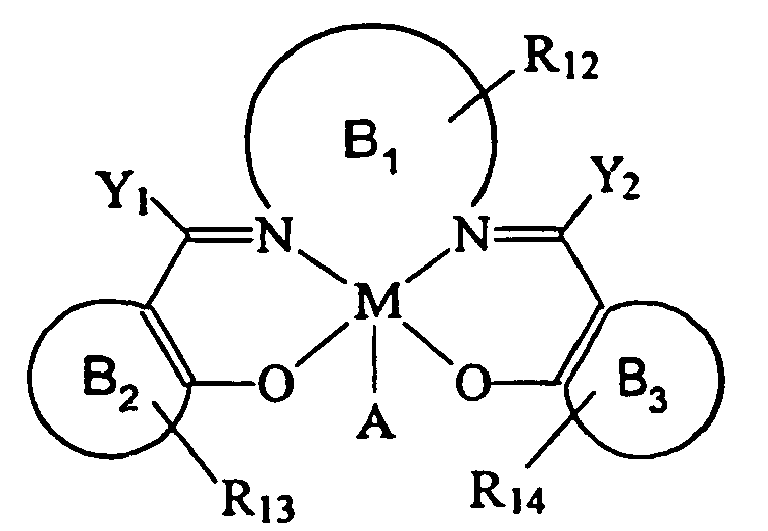
in which
the B1 moiety represents a diimine bridging substituent represented by -R15-R16-R17-, wherein R15 and R17 each independently are absent or represent an alkyl, an alkenyl, or an alkynyl, and R16 is absent or represents an amine, an imine, an amide, a phosphoryl, a carbonyl, a silyl, an oxygen, a sulfur, a sufonyl, a selenium, a carbonyl, or an ester;
each of B2 and B3 independently represent rings selected from a group consisting of cycloalkyls, cycloakenyls, aryls, and heterocyclic rings, which rings comprising from 4 to 8 atoms in a ring structure;
Y1 and Y2 each independently represent hydrogen, halogens, alkyls, alkenyls, alkynyls, hydroxyl, amino, nitro, thiol, amines, imines, amides, phosphoryls, phosphonates, phosphines, carbonyls, carboxyls, silyls, ethers, thioethers, sulfonyls, selenoethers, ketones, aldehydes, esters, or -(CH2)m-R7,
R12, R13, and R14 each independently are absent, or represent one or more covalent substitutions of B1, B2 and B3 with halogens, alkyls, alkenyls, alkynyls, hydroxyl, amino, nitro, thiol, amines, imines, amides, phosphoryls, phosphonates, phosphines, carbonyls, carboxyls, silyls, ethers, thioethers, sulfonyls, selenoethers, ketones, aldehydes, esters, or - (CH2)m-R7, wherein R12 can occur on one or more positions of -R15-R16-R17-,
or any two or more of the R12, R13, R14, Y1 and Y2 taken together form a bridging substituent;
R7 represents an aryl, a cycloalkyl, a cycloalkenyl, a heterocycle , or a polycycle;
m is zero or an integer in the range of 1 to 8;
M represents a transition metal; and - A represents a counterion or a nucleophile,
wherein R12, R13, R14, Y1 and Y2 are selected such that the catalyst is asymmetric. - In yet further preferred embodiments, the catalyst is a metallosalenate catalyst represented by the general formula:

in which
each of the substituents R1, R2, R3, R4, R5, Y1, Y2, X1, X2, X3, X4, X5, X6, X7, and X8, independently, represent hydrogen, halogens, alkyls, alkenyls, alkynyls, hydroxyl, amino, nitro, thiol, amines, imines, amides, phosphoryls, phosphonates, phosphines, carbonyls, carboxyls, silyls, ethers, thioethers, sulfonyls, selenoethers, ketones, aldehydes, esters, or - (CH2)m-R7;
or any two or more of the substituents taken together form a carbocycle or heterocycle having from 4 to 10 atoms in the ring structure;
R7 represents an aryl, a cycloalkyl, a cycloalkenyl, a heterocycle or a polycycle; m is zero or an integer in the range of 1 to 8;
M represents a transition metal; and
A represents a counterion or a nucleophile;
wherein if R5 is absent, at least one of R1 and R2 is taken together with at least one of R3 and R4 to form a bridging substituent, and each of of the substituents of 106 are selected such that the salenate is asymmetric. - Alternatively, the catalyst can have a tridentate ligand, such as the ligand represented by the general formula:

in which
Z1, Z2, and Z3 each represent a Lewis base;
the E1 moiety, taken with Z1, Z2 and M, and the E2 moiety, taken with Z2, Z3 and M, each, independently, form a heterocycle;
R80 and R81 each independently are absent, hydrogen, halogens, alkyls, alkenyls, alkynyls, hydroxyl, amino, nitro, thiol amines, imines, amides, phosphonates, phosphines, carbonyls, carboxyls, silyls, ethers, thioethers, sulfonyls, selenoethers, ketones, aldehydes, esters, or -(CH2)m-R7, or any two or more of the R80 and R81 substituents taken together form a bridging substituent;
R7 represents an aryl, a cycloalkyl, a cycloalkenyl, a heterocycle or a polycycle;
m is zero or an integer in the range of 1 to 8;
M represents a transition metal; and
A represents a counteranion or a nucleophile,
wherein the tridentate ligand is asymmetric. - As described herein, the subject method can be used for carrying out enantioselective ring opening, diastereoselective ring opening (including kinetic resolution) as well as expanding a ring of a cyclic compound.
-
- Figure 1 shows the regioselective ring opening of epoxides with a chiral catalyst.
- Figure 2 depicts the synthesis of a chiral tridentate catalyst.
- Figures 3-5 show the structures of ligands used to form catalysts used for asymmetric ring opening of aziridines.
- Figure 6 shows the synthesis of an intermediate useful for the synthesis of prostaglandins.
- Figures 7 and 8 show the synthesis of intermediates useful for synthesis of carbocyclic nucleoside analogs.
- Figure 9 shows a retrosynthetic analysis of balanol.
- Figures 10 and 11 depict synthetic steps in a synthesis of balanol.
- The ability to introduce a stereocenter selectively or to resolve a racemic mixture has broad application, especially in the agricultural and pharmaceutical industries, as well as in the polymer industry. As described herein, the present invention makes available methods and reagents for stereoselective and regioselective synthesis involving nucleophile-mediated ring opening reactions. The primary constituents of the method, set out in more detail below, are a chiral metal catalyst of particular tetradentate or tridentate geometry; a chiral or prochiral "substrate" including a carbocycle or heterocycle moiety with at least one electrophilic ring atom; and a nucleophilic reactant which is desired to be added at the site of the electrophilic ring atom.
- For convenience, certain terms employed in the specification, examples, and appended claims are collected here.
- The term "nucleophile" is recognized in the art, and as used herein means a chemical moiety having a reactive pair of electrons. Examples of nucleophiles include uncharged compounds such as amines, mercaptans and alcohols, and charged moieties such as alkoxides, thiolates, carbanions, and a variety of organic and inorganic anions. Illustrative anionic nucleophiles include simple anions such as azide, cyanide, thiocyanate, acetate, formate or chloroformate, and bisulfite. Organometallic reagents such as organocuprates, organozincs, organolithiums, Grignard reagents, enolates, acetylides, and the like may, under approriate reaction conditions, be suitable nucleophiles. Hydride may also be a suitable nucleophile when reduction of the substrate is desired.
- The term "electrophile" is art-recognized and refers to chemical moieties which can accept a pair of electrons from a nucleophile as defined above. Electrophiles useful in the method of the present invention include cyclic compounds such as epoxides, aziridines, episulfides, cyclic sulfates, carbonates, lactones, lactams and the like. Non-cyclic electrophiles include sulfates, sulfonates (e.g. tosylates), chlorides, bromides, iodides, and the like
- The terms "electrophilic atom", "electrophilic center" and "reactive center" as used herein refer to the atom of the substrate which is attacked by, and forms a new bond to, the nucleophile. In most (but not all) cases, this will also be the atom from which the leaving group departs.
- The term "electron-withdrawing group" is recognized in the art and as used herein means a functionality which draws electrons to itself more than a hydrogen atom would at the same position. Exemplary electron-withdrawing groups include nitro, ketone, aldehyde, sulfonyl, trifluoromethyl, -CN, chloride, and the like. The term "electron-donating group", as used herein, means a functionality which draws electrons to itself less than a hydrogen atom would at the same position. Exemplary electron-donating groups include amino, methoxy, and the like.
- The term "ring expansion" refers to a process whereby the number of atoms in a ring of a cyclic compound is increased. An illustrative example of ring expansion is the reaction of epoxides with CO2 to yield cyclic carbonates.
- The term "meso compound" is recognized in the art and means a chemical compound which has at least two chiral centers but is achiral due to a plane of symmetry.
- The term "chiral" refers to molecules which have the property of non-superimposability of the mirror image partner, while the term "achiral" refers to molecules which are superimposable on their mirror image partner. A "prochiral molecule" is a molecule which has the potential to be converted to a chiral molecule in a particular process.
- The term "stereoisomers" refers to compounds which have identical chemical constitution, but differ with regard to the arrangement of the atoms or groups in space. In particular, "enantiomers" refer to two stereoisomers of a compound which are non-superimposable mirror images of one another. "Diastereomers", on the other hand, refers to stereoisomers with two or more centers of dissymmetry and whose molecules are not mirror images of one another.
- Furthermore, a "stereoselective process" is one which produces a particular stereoisomer of a reaction product in preference to other possible stereoisomers of that product. An "enantioselective process" is one which favors production of one of the two possible enantiomers of a reaction product. The subject method is said to produce a "stereoselectively-enriched" product (e.g., enantioselectively-enriched or diastereoselectively-enriched) when the yield of a particular stereoisomer of the product is greater by a statistically significant amount relative to the yield of that stereoisomer resulting from the same reaction run in the absence of a chiral catalyst. For example, an enantioselective reaction catalyzed by one of the subject chiral catalysts will yield an e.e. for a particular enantiomer that is larger than the e.e. of the reaction lacking the chiral catalyst.
- The term "regioisomers" refers to compounds which have the same molecular formula but differ in the connectivity of the atoms. Accordingly, a "regioselective process" is one which favors the production of a particular regioisomer over others, e.g., the reaction produces a statistically significant increase in the yield of a certain regioisomer.
- The term "reaction product" means a compound which results from the reaction of a nucleophile and a substrate. In general, the term "reaction product" will be used herein to refer to a stable, isolable compound, and not to unstable intermediates or transition states.
- The term "complex" as used herein and in the claims means a coordination compound formed by the union of one or more electronically rich molecules or atoms capable of independent existence with one or more electronically poor molecules or atoms, each of which is also capable of independent existence.
- The term "substrate" is intended to mean a chemical compound which can react with a nucleophile, or with a ring-expansion reagent, according to the present invention, to yield at least product having a stereogenic center.
- The term "catalytic amount" is recognized in the art and means a substoichiometric amount of catalyst relative to a reactant. As used herein, a catalytic amount means from 0.0001 to 90 mole percent catalyst relative to a reactant, more preferably from 0.001 to 50 mole percent, still more preferably from 0.01 to 10 mole percent, and even more preferably from 0.1 to 5 mole percent catalyst to reactant.
- As discussed more fully below, the reactions contemplated in the present invention include reactions which are enantioselective, diastereoselective, or regioselective. An enantioselective reaction is a reaction which converts an achiral reactant to a chiral, nonracemic product enriched in one enantiomer. Enantioselectivity is generally quantified as "enantiomeric excess" ("e.e.", sometimes referred to as "optical purity" or "optical activity"), defined as follows:

where A and B are the amounts of the enantiomers formed. An enantioselective reaction yields a product with an e.e. greater than zero. Preferred enantioselective reactions yield a product with an e.e. greater than 20%, more preferably greater than 50%, even more preferably greater than 70%, and most preferably greater than 80%. - A diastereoselective reaction converts a chiral reactant (which may be racemic or enantiomerically pure) to a product enriched in one diastereomer. If the chiral reactant is racemic, in the presence of a chiral non-racemic reagent or catalyst, one reactant enantiomer may react more slowly than the other. This is termed a kinetic resolution, wherein the reactant enantiomers are resolved by differential reaction rate to yield an enantiomerically enriched product. Kinetic resolution is usually achieved by the use of sufficient reagent to react with only one reactant enantiomer (i.e. one-half mole of reagent per mole of racemic substrate). Examples of catalytic reactions which have been used for kinetic resolution of racemic reactants include the Sharpless epoxidation and the Noyori hydrogenation.
- A regioselective reaction is a reaction which occurs preferentially at one reactive center rather than another reactive center. For example, a regioselective reaction of an unsymmetrically substituted epoxide substrate would cause preferential reaction at one of the two epoxide ring carbons.
- The term "non-racemic" with respect to the chiral catalyst, means a preparation of catalyst having greater than 50% of a desired stereoisomer, more preferably at least 75%. "Substantially non-racemic" refers to preparations of the catalyst which have greater than 90% ee for a desired stereoisomer of the catalyst, more preferably greater than 95% ee.
- The term "alkyl" refers to the radical of saturated aliphatic groups, including straight-chain alkyl groups, branched-chain alkyl groups, cycloalkyl (alicyclic) groups, alkyl substituted cycloalkyl groups, and cycloalkyl substituted alkyl groups. In preferred embodiments, a straight chain or branched chain alkyl has 30 or fewer carbon atoms in its backbone (e.g., C1-C30 for straight chain, C3-C30 for branched chain), and more preferably 20 of fewer. Likewise, preferred cycloalkyls have from 4-10 carbon atoms in their ring structure, and more preferably have 5, 6 or 7 carbons in the ring structure.
- Moreover, the term alkyl as used throughout the specification and claims is intended to include both "unsubstituted alkyls" and "substituted alkyls", the latter of which refers to alkyl moieties having substituents replacing a hydrogen on one or more carbons of the hydrocarbon backbone. Such substituents can include, for example, a halogen, a hydroxyl, a carbonyl, an alkoxyl, and ester, a phosphoryl, an amine, an amide, an imine, a thiol, a thioether, a thioester, a sulfonyl, an amino, a nitro, or an organometallic moiety. It will be understood by those skilled in the art that the moieties substituted on the hydrocarbon chain can themselves be substituted, if appropriate. For instance, the substituents of a substituted alkyl may include substituted and unsubstituted forms of amines, imines, amides, phosphoryls (inlcuding phosphonates and phosphines), sulfonyls (inlcuding sulfates and sulfonates), and silyl groups, as well as ethers, thioethers, selenoethers, carbonyls (including ketones, aldehydes, carboxylates, and esters), -CF3, -CN and the like. Exemplary substitued alkyls are described below. Cycloalkyls can be further substituted with alkyls, alkenyls, alkoxys, thioalkyls, aminoalkyls, carbonyl-substituted alkyls, CF3, CN, and the like.
- The terms "alkenyl" and "alkynyl" refer to unsaturated aliphatic groups analogous in length and possible substitution to the alkyls described above, but which contain at least one double or triple bond respectively.
- Unless the number of carbons is otherwise specified, "lower alkyl" as used herein means an alkyl group, as defined above, but having from one to ten carbons, more preferably from one to six carbon atoms in its backbone structure. Likewise, "lower alkenyl" and "lower alkynyl" have similar chain lengths.
- As used herein, the term "amino" means -NH2; the term "nitro" means -NO2; the term "halogen" designates -F, -Cl, -Br or -I; the term "thiol" means -SH; the term "hydroxyl" means -OH; the term "sulfonyl" means -SO2- and the term "organometallic" refers to a metallic atom (such as mercury, zinc, lead, magnesium or lithium) or a metalloid (such as silicon, arsenic or selenium) which is bonded directly to a carbon atom, such as a diphenylmethylsilyl group.
- Thus, the term "alkylamine" as used herein means an alkyl group, as defined above, having a substituted or unsubstituted amine attached thereto. In exemplary embodiments, an "amine" can be represented by the general formula:

wherein R8 and R9 each independently represent a hydrogen, an alkyl, an alkenyl, -(CH2)m-R7, -C(=O)-alkyl, -C(=O)-alkenyl, -C(=O)-alkynyl, -C(=O)-(CH2)m-R7, or R8 and R9 taken together with the N atom to which they are attached complete a heterocycle having from 4 to 8 atoms in the ring structure; R7 represents an aryl, a cycloalkyl, a cycloalkenyl, a heterocycle or a polycycle; and m is zero or an integer in the range of 1 to 8. - Likewise, the term "alkylamide" refers to an alkyl group having a substituted or unsubstituted amide group attached thereto. For instance, an "amide" can be represented by the general formula:

wherein R8 and R9 are as defined above. - The term "alkylimine" refers to an alkyl group having a substituted or unsubstituted imine attached thereto. An "imine" can be represented by the general formula:

wherein R8 is as described above. - The term "thioalkyl" refers to an alkyl group, as defined above, having a sulfhydryl or thioether group attached thereto. In preferred embodiments, the "thioether" moiety is represented by one of -S-alkyl, -S-alkenyl, -S-alkynyl, and -S-(CH2)m-R7, wherein m and R7 are defined above.
- The term "carbonyl-substituted alkyl" as used herein means an alkyl group, as defined above, having a substituted or unsubstituted carbonyl group attached thereto, and includes aldehydes, ketones, carboxylates and esters. In exemplary embodiments, the "carbonyl" moiety is represented by the general formula:

wherein X is absent or represents an oxygen or a sulfur, and R10 represents a hydrogen, an alkyl, an alkenyl, or -(CH2)m-R7, where m and R7 are as defined above. Where X is an oxygen, the formula represents an "ester". Where X is a sulfur, the formula represents a "thioester." Where X is absent, and R10 is not hydrogen, the above formula represents a "ketone" group. Where the oxygen atom of the above formula is replaced by sulfur, the formula represents a "thiocarbonyl" group. - The terms "alkoxyl" or "alkoxy" as used herein refers to an alkyl group, as defined above, having an oxygen radical attached thereto. Representative alkoxyl groups include methoxy, ethoxy, propoxy, tert-butoxy and the like. An "ether" is two hydrocarbons covalently linked by an oxygen. Accordingly, the substituent of an alkyl which renders that alkyl an ether is or resembles an alkoxyl, such as can be represented by one of -O-alkyl, -O-alkenyl, -O-alkynyl, -O-(CH2)m-R7, where m and R7 are described above.
- Thus, the term "phosphorylalkyl" as used herein means an alkyl group, as defined above, having a substituted or unsubstituted phosphoryl group attached thereto. A "phosphoryl" can in general be represented by the formula:

wherein Q1 represented S or O, and R46 represents hydrogen, a lower alkyl or an aryl. When used to substitute an alkyl, the phosphoryl group of the phosphorylalkyl can be represented by the general formula:
wherein Q1 represented S or O, and each R46 indepedently represents hydrogen, a lower alkyl or an aryl, Q2 represents O, S or N. - The term "metalloalkyl" refers to an alkyl group, as defined above, having a substituted or unsubstituted organometallic group attached thereto. A "silyl alkyl" is an alkyl having a substituted silicon attached thereto. In a preferred embodiment, the "silyl" moiety which may be substituted on the alkyl can be represented by the general formula:

wherein R10, R'10 and R"10 independently represent a hydrogen, an alkyl, an alkenyl, or -(CH2)m-R7, m and R7 being defined above. - Likewise, a "selenoalkyl" refers to an alkyl group having a substituted seleno group attached thereto. Exemplary "selenoethers" which may be substituted on the alkyl are selected from one of -Se-alkyl, -Se-alkenyl, -Se-alkynyl, and -Se-(CH2)m-R7, m and R7 being defined above.
- The term "sulfonate" as used herein means a sulfonyl group, as defined above, attached to an alkyl or aryl group. Thus, in a preferred embodiment, a sulfonate has the structure :

in which R11 is an alkyl or an aryl. - The term sulfate, as used herein, means a sulfonyl group, as defined above, attached to a hydroxy or alkoxy group. Thus, in a preferred embodiment, a sulfate has the structure:

in which R40 and R41 are independently absent, a hydrogen, an alkyl, or an aryl. Furthermore, R40 and R41, taken together with the sulfonyl group and the oxygen atoms to which they are attached, may form a ring structure having from 5 to 10 members. - Analogous substitutions can be made to alkenyl and alkynyl groups to produce, for example, alkenylamines, alkynylamines, alkenylamides, alkynylamides, alkenylimines, alkynylimines, thioalkenyls, thioalkynyls, carbonyl-substituted alkenyls or alkynyls, alkenoxyls, alkynoxyls, metalloalkenyls and metalloalkynyls.
- The term "aryl" as used herein includes 4-, 5-, 6- and 7-membered single-ring aromatic groups which may include from zero to four heteroatoms, for example, benzene, pyrrole, furan, thiophene, imidazole, oxazole, thiazole, triazole, pyrazole, pyridine, pyrazine, pyridazine and pyrimidine, and the like. Those aryl groups having heteroatoms in the ring structure may also be referred to as "aryl heterocycle". The aromatic ring can be substituted at one or more ring positions with such substituents as described above, as for example, halogens, alkyls, alkenyls, alkynyls, hydroxyl, amino, nitro, thiol amines, imines, amides, phosphonates, phosphines, carbonyls, carboxyls, silyls, ethers, thioethers, sulfonyls, selenoethers, ketones, aldehydes, esters, or -(CH2)m-R7, -CF3, -CN, or the like.
- The terms "heterocycle" or "heterocyclic group" refer to 4 to 10-membered ring structures, more preferably 5 to 7 membered rings, which ring structures include one to four heteroatoms. Heterocyclic groups include pyrrolidine, oxolane, thiolane, imidazole, oxazole, piperidine, piperazine, morpholine. The heterocyclic ring can be substituted at one or more positions with such substituents as described above, as for example, halogens, alkyls, alkenyls, alkynyls, hydroxyl, amino, nitro, thiol, amines, imines, amides, phosphonates, phosphines, carbonyls, carboxyls, silyls, ethers, thioethers, sulfonyls, selenoethers, ketones, aldehydes, esters, or -(CH2)m-R7, -CF3, -CN, or the like.
- The terms "polycycle" or "polycyclic group" refer to two or more cyclic rings (e.g., cycloalkyls, cycloalkenyls, cycloalkynyls, aryls and/or heterocycles) in which two or more carbons are common to two adjoining rings, e.g., the rings are "fused rings". Rings that are joined through non-adjacent atoms are termed "bridged" rings. Each of the rings of the polycycle can be substituted with such substituents as described above, as for example, halogens, alkyls, alkenyls, alkynyls, hydroxyl, amino, nitro, thiol, amines, imines, amides, phosphonates, phosphines, carbonyls, carboxyls, silyls, ethers, thioethers, sulfonyls, selenoethers, ketones, aldehydes, esters, or -(CH2)m-R7, -CF3, -CN, or the like.
- The term "heteroatom" as used herein means an atom of any element other than carbon or hydrogen. Preferred heteroatoms are nitrogen, oxygen, sulfur, phosphorus and selenium.
- A "bridging substituent" refers to a substitution at two (or more) sites on the core structure of the catalyst by the same (as opposed to identical) substituent so as to form a covalent bridge between the substitution sites. For example, a bridging substituent may be represented by the general formula or -R15-R16-R17-, wherein R15 and R17 each independently are absent or represent an alkyl, an alkenyl, or an alkynyl, preferably C1 to C10, and R16 is absent or represents an amine, an imine, an amide, a phosphoryl a carbonyl, a silyl, an oxygen, a sulfonyl, a sulfer, a selenium, or an ester. Exemplary bridging substituents are given by the "picnic basket" forms of, for instance, the porphoryn catalysts described below.
- For purposes of this invention, the chemical elements are identified in accordance with the Periodic Table of the Elements, CAS version, Handbook of Chemistry and Physics, 67th Ed., 1986-87, inside cover. Also for purposes of this invention, the term "hydrocarbon" is contemplated to include all permissible compounds having at least one hydrogen and one carbon atom. In a broad aspect, the permissible hydrocarbons include acyclic and cyclic, branched and unbranched, carbocyclic and heterocyclic, aromatic and nonaromatic organic compounds which can be substituted or unsubstituted.
- As used herein, the term "substituted" is contemplated to include all permissible substituents of organic compounds. In a broad aspect, the permissible substituents include acyclic and cyclic, branched and unbranched, carbocyclic and heterocyclic, aromatic and nonaromatic substituents of organic compounds. Illustrative substituents include, for example, those described hereinabove. The permissible substituents can be one or more and the same or different for appropriate organic compounds. For purposes of this invention, the heteroatoms such as nitrogen may have hydrogen substituents and/or any permissible substituents of organic compounds described herein which satisfy the valencies of the heteroatoms. This invention is not intended to be limited in any manner by the permissible substituents of organic compounds.
- In one aspect of the present invention there is provided a process for stereoselectively producing compounds with at least one stereogenic center. An advantage of this invention is that enantiomerically enriched products can be synthesized from achiral or racemic reactants. Another advantage is that yield losses associated with the production of an undesired enantiomer can be substantially reduced.
- In general, the invention features a stereoselective ring opening process which comprises combining a nucleophilic reactant, a prochiral or chiral cyclic substrate, and at least a catalytic amount of non-racemic chiral catalyst of particular characteristics (as described below). The cyclic substrate of the reaction will include a carbocycle or heterocycle which has an electrophilic atom susceptible to attack by the nucleophile. The combination is maintained under conditions appropriate for the chiral catalyst to catalyze stereoselective opening of the cyclic substrate at the electrophilic atom by reaction with the nucleophilic reactant. This reaction can be applied to enatioselective processes as well as diastereoselective processes. It may also be adapted for regioselective reactions. Examples of enantioselective reactions, kinetic resolution, and regioselective reactions which may be catalyzed according to the present invention follow.
- In an exemplary embodiment, an epoxide ring can be opened with a nucleophile, e.g., trimethylsilyl azide (TMS-N3), in the presence of a chiral catalyst of the subject reaction.

The opening of a meso epoxide in the presence of a chiral catalyst yields an enantiomerically enriched silyl azidoalcohol, which can then be transformed, through standard manipulations, to a variety of products, a few examples of which are shown above. These products are useful for the synthesis of compounds with potential antiviral activity, such as the three carbocyclic nucleoside analogs shown below, some of which are in clinical trials.
- The present invention also provides a practical method of synthesizing precursors for prostaglandins, including key intermediates used for the commercial production of prostaglandins. As shown below, the ring-opening of a meso epoxide produces an enantiomerically enriched product which is easily converted to a useful intermediate.

- In another illustrative embodiment, the present invention provides a method for synthesizing balanol, a potent protein kinase C inhibitor, as shown below.

- In yet another exemplary embodiment, the subject reaction can be used to catalyze the stereoselective ring-opening of an aziridine, such as with the nucleophile ammonia exemplified below:

In this case, the chiral diamines are useful in, for example, synthesis of certain of the chiral ligands of the catalyst described herein. For instance, such chiral diamines can be used to make metallosalenate catalysts for use in the method of the present invention. - The ring-opening of an episulfide with an amine in the presence of a chiral catalyst, shown below, is another exemplary reaction of the subject methofd which can be carried out stereoselectively.

The product amino thiols are useful in, for example, the synthesis of penicillin analogs. - In another embodiment, the opening of a cyclic sulfate with an acetylide can be carried out in the presence of a chiral catalyst of the subject method, such as illustrated below:

The sulfate group of the product can be removed to reveal the homopropargylic alcohol, or can be used as a protecting group in further synthesis. - Still another ring-opening reaction contemplated by the present method is the opening of a cyclopropane by a mercaptan in the presence of one of the subjectchiral catalyst:

The product may be converted, for example, to a 3,4-substituted carboxylic acid by hydrolysis and decarboxylation. - In certain embodiments, the subject reaction can be used for a reaction involving intramolecular ring-opening. For instance, as illustrated below, an epoxide can be opened by an alcohol moiety of the same molecule in the presence of a chiral catalyst in accordance with the present method:

Theproduct 1,2-epoxy diol can easily be converted to a variety of natural and non-natural products such as sugars and sugar analogs. - Still another exemplary ring-opening scheme of the present invention is generally illustrated below by the opening of a cyclic carbonate with an amine:

- Still another enantioselective reaction is demonstrated by the ring-opening of an epoxide by an organocopper reagent in the presence of a chiral catalyst, as is shown below:

- In another aspect of the present invention, kinetic resolution of enantiomers occurs by catalysis with a chiral catalyst of a ring-opening reaction of a racemic substrate. In the subject metal-mediated kinetic resolution process for a racemic substrate, one enantiomer can be recovered as unreacted substrate while the other is transformed to the desired product. Of course, it will be appreciated that the kinetic resolution can be performed by removing the undesired enantiomer by reaction with a nucleophile, and recovering the desired enantiomer unchanged from the reaction mixture. One significant advantage of this approach is the ability to use inexpensive racemic starting materials rather than the expensive, enantiomerically pure starting compounds. For example, propylene oxide is a versatile reagent for introduction of a functionalized three-carbon unit into a molecule. However, the pure (S)-propylene oxide is very expensive, costing up to 300 times more than the racemic mixture. Thus, although kinetic resolution according to the present method may result in the waste of half of the reagent, large cost savings may be realized by use of the racemic mixture. Examples of such kinetic resolutions are shown below.
- For instance, catalyst-mediated kinetic resolution of chiral oxiranes (e.g. chiral recognition) described herein represent important alternate approaches to asymmetric epoxidation (prochiral recognition) processes of the prior art because racemic oxiranes are easily accessible and often produced at a large industrial scale rendering the loss of 50% of the antipode acceptable. Stereoselectivity in the kinetic resolution of oxiranes by the subject reaction processes is determined by the chirality of the catalyst.
- In an exemplary embodiment, the kinetic resolution of a racemic epoxide is shown below.

One enantiomer of styrene epoxide is preferentially consumed by trimethylsilyl cyanide in the presence of a chiral catalyst. The remaining enantiomer is then reacted with TMS-azide to yield either of a pair of silyl azidoalcohols. The desired isomer can be made the major product by choice of appropriate reaction conditions. The α-phenylazide isomer can be converted, through conventional reactions, to the amino acid (S)-phenylglycine. The ability to carry out this conversion has significant commercial value since optically active amino acids and amino acid analogs are biologically important and have many agricultural and pharmaceutical applications. The β-phenylazide isomer can also be converted to pharmaceutically useful products. - Ring-opening of cyclic sulfates by amines, followed by treatment with a base, is a useful method of producing aziridines, as disclosed in U.S. Patent No. 5,321,143 to Sharpless. Thus, ring-opening of a racemic chiral cyclic sulfate with an amine, in the presence of a chiral catalyst according to the present invention, followed by treatment with a base, is a method of preparing enantiomerically enriched aziridines.
- In another illustrative embodiment, the subject method can be used to provide enantiomerically enriched compounds useful in the synthesis of the anti-anginal drug diltiazem.
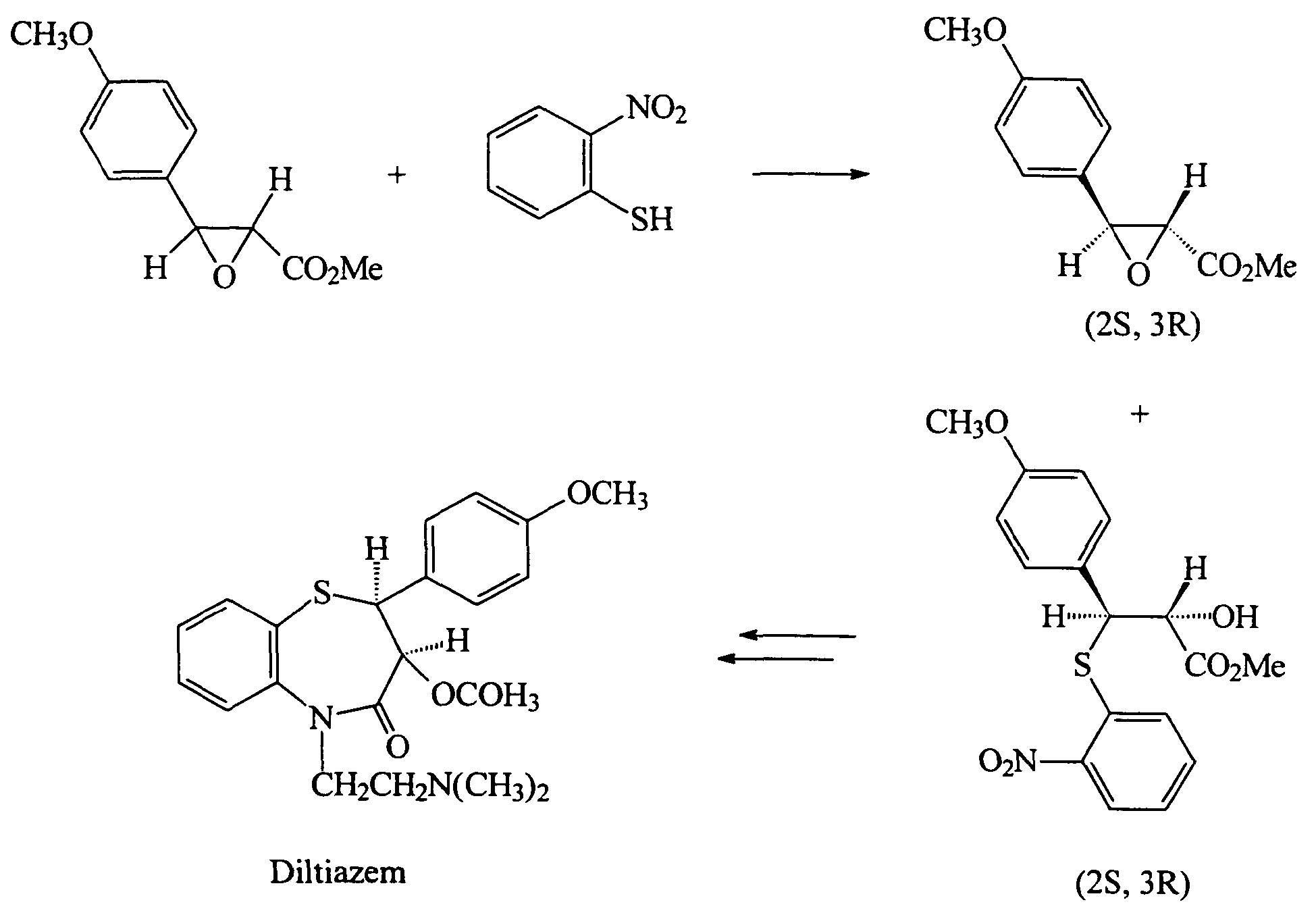
The racemic mixture of trans-epoxides is resolved by reaction with 2-nitrothiophenol in the presence of a chiral catalyst, and the enantiomerically enriched ring-opened product is separated from the unreacted epoxide. The ring-opened product is then transformed to diltiazem by standard techniques. - Still another example of kinetic resolution with a reaction of the present invention involves the synthesis of juvenile hormone. In the reaction scheme:

treatment of the racemic epoxide with TMS-azide or the like in the presence of one of the subject chiral catalyst which is enantioselective for the (S)-epoxide can yield, after separation, the optically pure (R)-epoxide. - In yet another illustrative embodiment, the subject method can be used for kinetic resolution of α-bisabolol stereoisomers during synthesis from epoxylimonene precursors. The (-)-α-bisabolol enantiomer is used on an industrial scale for the preparation of various skin-care creams, lotions and ointments because of its antiinflammatory, bactericidal, and anti-mycotic properties. In a representative reaction scheme:

a mixture containing (4S,8R)- and (4S,8S)-8,9-epoxy-p-menth-1-ene, obtained from 4(S)-limonene (Husstedt et al. (1979) Synthesis 966), is reacted with (3-methylbut-2-enyl)magnesium chloride in the presence of a chiral catalyst described herein. The resulting (-)-α-bisabolol can be isolated from the unreacted (4S,8R)-epoxide by, for example, flash chromatography. Alternatively, the racemic limonene epoxide mixture can be reacted with TMS-azide or the like in the presence of the antipodal chiral catalyst used in the illustrated reaction scheme in order to remove the (4S,8R)-epoxide, and subsequently reacting the remaining (4S,8S)-epoxide with (3-methylbut-2-enyl)magnesium chloride in the presence of copper iodide. - An another embodiment of a kinetic resolution reaction, there is provided a scheme for the ring-opening of a lactam with a nucleophile. For example, thiophenol can be reacted with a lactam in the presence of a chiral catalyst according to the present invention:
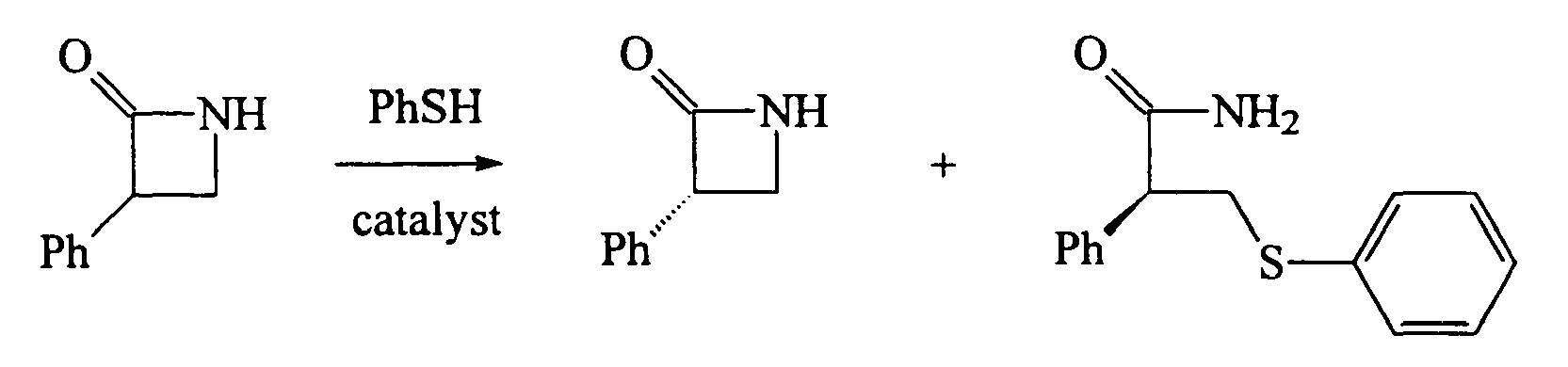
This aspect of the invention provides methods of easily synthesizing functionalized nonracemic products from inexpensive racemic starting materials. It will be noted that lactams have two potential modes of ring opening, viz. at the acyl carbon and at the nitrogen-bearing sp3 carbon. Either mode is suitable for kinetic resolution according to the present invention. Which of the two modes of reaction will predominate will depend upon the particular substrate, nucleophile, catalyst, and reaction conditions employed, and can be determined and accordingly adjusted for the desired reaction by routine experimentation. In general, more highly strained, small-ring (e.g. 3- or 4-membered lactams) will be more likely to undergo cleavage at the sp3 carbon. - In another illustrative embodiment, the present invention provides for the kinetic resolution of lactones by opening with such nucleophiles as a phenyl selenide anion in the presence of a chiral catalyst, as shown below.

As with the lactam example shown above, two possible modes of ring-opening may operate to kinetically resolve the racemic substrate. As previously noted, more strained substrates will be more prone to undergo cleavage at the sp3 carbon. However, certain nucleophiles, such as phenylselenide, are known to favor cleavage at the sp3 carbon under appropriate conditions, even for larger ring lactones. - In another aspect of the present invention, kinetic resolution of enantiomers occurs by catalysis with a chiral catalyst of a ring expansion reaction of a racemic substrate. An example of such a kinetic resolution is shown below.

The racemic propylene oxide is resolved by reaction with carbon dioxide in the presence of a chiral catalyst. The resolved propylene oxide is a valuable reagent for use in synthesis of chiral materials, but is very expensive to purchase in enantiomerically pure form. The instant invention provides a highly economical method of producing such enantiomerically enriched materials. - In another aspect of the invention, kinetic resolution of diastereomers occurs by reaction of a diastereomeric mixture of a substrate with a nucleophile in the presence of a chiral catalyst. An illustrative example of such a diastereoselective reaction is shown below.

In this example, a mixture of diastereomers is generated by the epoxidation of a chiral alkene with MCPBA. The mixture of diastereomers is then resolved by reaction with trimethylsilyl azide in the presence of a chiral catalyst. The resolved diastereomers may then be easily separated. This method of resolution provides a simple means of separating diastereomers which may not be easily separated by other methods such as distillation or chromatography. - In another aspect of the invention, the reaction of a substrate with a nucleophile in the presence of a chiral catalyst occurs in a regioselective manner. An illustrative example of a regioselective reaction is shown below.

- The processes of this invention can provide optically active products with very high stereoselectivity (e.g., enantioselectivity or diasteroselectivity) or regioselectivity. In preferred embodiments of the subject enantioselective reactions, enantiomeric excesses of preferably greater than 50%, more preferably greater than 75% and most preferably greater than 90% can be obtained by the processes of this invention. Likewise, with respect to regioselective reactions, molar ratios for desired/undesired regioisomers of preferably greater than 5:1, more preferably greater than 10:1 and most preferably greater than 25:1 can be obtained by the processes of this invention. The processes of this invention can also be carried out at highly desirable reaction rates suitable for commercial use.
- As is clear from the above discussion, the chiral products produced by the asymmetric synthesis processes of this invention can undergo further reaction(s) to afford desired derivatives thereof. Such permissible derivatization reactions can be carried out in accordance with conventional procedures known in the art. For example, potential derivatization reactions include esterification, oxidation of alcohols to aldehydes, N-alkylation of amides, addition of aldehydes to amides, nitrile reduction, acylation of ketones by esters, acylation of amines and the like. To further illustrate, exemplary classes of pharmaceuticals which can be synthesized by a scheme including the subject stereoselective reaction are cardiovascular drugs, nonsteroidal antiinflammatory drugs, central nervous system agents, and antihistaminics.
- The catalysts employed in the subject method involve chiral complexes which provide controlled steric environments for asymmetric opening of a carbocycle or heterocycle coupled, in certain preferred embodiments, with the generation of one or two new stereocenters upon reaction with a nucleophile. In general, catalysts intended by the present invention can be characterized in terms of a number of features. For instance, a salient aspect of each of the catalysts contemplated by the instant invention concerns the use of metalloligands which provide a rigid or semi-rigid environment near the catalytic site of the molecule. This feature, through imposition of structural rigidity on the chelated metal, can be used to establish selective approach of the substrate to the catalytic site and thereby induce stereoselectivity and/or regioselectivity in a ring opening reaction. Moreover, the ligand preferably places a restriction on the coordination sphere of the metal.
- Another aspect of the catalyst concerns the selection of metal atoms for the catalyst. In general, any transition metal (e.g., having d electons) may be used to form the catalyst, e.g., a metal selected from one of Groups 3-12 of the periodic table or from the lanthanide series. However, in preferred embodiments, the metal will be selected from the group of late transition metals, e.g. preferably from Groups 5-12, in order to provide metal centers which are coordinatively unsaturated and not in their highest oxidation state. For example, suitable metals include Cr, Mn, V, Fe, Mo, W, Ru and Ni. Particularly preferred metals are from
group 6, especially Cr(III). - Consistent with these desirable features, one class of particularly preferred chiral catalysts provide a chiral tetradentate ligand which coordinates a transition metal in a substantially square planar or square pyramidal geometry, though some distortion to these geometries is contemplated. Restated, these square geometries refer to tetradentate ligands in which the Lewis basic atoms lie substantially in the same plane, with the metal also in that plane (square planar), or above or below that plane (square pyramidal).
- Preferred square tetradentate catalysts which may be employed in the subject reactions can be represented by the general formula 100:

wherein Z1, Z2, Z3 and Z4 each represent a Lewis base, such as selected from the group consisting of nitrogen (e.g., imines, amines and amides), oxygen, phosphorus (e.g., phosphines or phosphinites), arsenic (arsines) and sulfur. - The C1 moiety (taken with Z1, Z3 and M) and the C2 moiety, (taken with Z2, Z4 and M) each, independently, form a heterocyclic ring. It will be understood that while the C1 and C2 structures depicted in the above formula may not formally be covalently closed rings for lack of a covalent bond with the metal M, for purposes of this disclosure, this and similar structures involving the metal catalyst atom M will nevertheless be referred to as heterocyclic rings, and substituents thereof will be referenced relative to heterocycle nomenclature (e.g., "fused rings" or "bridged rings"). In addition to substitutions at R1, R2, R'1 and R'2, the C1 and C2 rings can of course be substituted as appropriate at other ring positions, as illustrated by R40 and R41. Moreover, it will be appreciated that in certain embodiments two or more substituents of C1 can be covalently bonded to each other to provide a fused ring or bridged ring including the C1 ring atoms. Similar structures can be provided on the C2 ring.
- Accordingly, in the illustrated structure 100, R1, R2, R'1 and R'2 each independently are absent, or represent some substitution, as permitted by valence requirements, of the Lewis basic atoms, which substitution may be with hydrogen, halogens, alkyls, alkenyls, alkynyls, hydroxyl, amino, nitro, thio amines, imines, amides, phosphonates, phosphines, carbonyls, carboxyls, silyls, ethers, thioethers, sulfonyls, selenoethers, ketones, aldehydes, esters, or - (CH2)m-R7; R40 and R41 each independently are absent, or represent one or more covalent substitutions of C1 and C2 with an organic or inorganic substituent permitted by valence requirements of the ring atom to which it is attached, or any two or more of the R1, R2, R'1, R'2 R40 and R41 substituents taken together can form a bridging substituent; with the proviso that at least one of R1, R'1 and R41 forms a bridging substituent with at least one of R2, R'2 and R40 in order to provide C1 and C2 as a tetradentate; R7 represents an aryl, a cycloalkyl, a cycloalkenyl, a heterocycle or a polycycle, and m is zero or an integer in the range of 1 to 8.
- While the actual substituents of C1 and C2 can vary widely as necessary for a particular reaction scheme, one important proviso is that at least one substituent of C1 must form a covalent bond with at least one substituent of C2 in order to provide a tetradentate ligand which forms a square complex with M. That is, the ligand is a bridged cycle or polycycle which includes C1 and C2. Furthermore, in order for the catalyst to be chiral, e.g., to be capable of catalyzing stereoselective reactions, R1, R2, R'1, R'2 and other substituents of C1 and C2 are selected to provide at least one stereogenic center or an axis of dissymmetry, e.g. such that the ligand is asymmetric.
- In the general structure 100, M represents a transition metal of Group 3-12 or the lanthide series of the periodic table, though preferably a metal ion which is not in its highest oxidation state. In the most preferred embodiments, M will be selected from the group of late transition metals,e.g., from the Group 5-12 metals. Even more preferably, M will be Cr(III). Moreover, the metal can be coordinated with a counteranion or a nucleophile (as in the aged catalyst described below).
- Exemplary catalysts of this class are comprised of ligands derived from, for example, salens, porphyrins, crown ethers, azacrown ethers, cyclams, phthalocyanines, and the like.
- In a particularly preferred embodiment, the subject reactions use a chiral catalyst having a metal ion complexed via an imine of a chiral ligand, preferably a diimine bridge. Accordingly, such variants of structure 100 can be provided in embodiments wherein any one or more of the Lewis bases is an imine, with metallo-schiff base forms of imines being highly preferred.
- To further illustrate, a tetradentate catalyst useful in the subject method can be derived using chiral salen or salen-like ligands (hereinafter "salenates"). The asymmetric metallosalenate catalysts offer a distinct advantage over many other chiral tetradentate catalyts, such as the metalloporphyrinates described infra, in that the salenate ligand can have stereogenic centers located just two bond lengths away from the metal. This proximity of the chiral centers to the reactive site can yield a high degree of stereoselectivity.
- As disclosed herein, salen complexes are highly effective catalysts for the enantioselective ring-opening of epoxides and other cyclic compounds with nucleophiles. This reaction is notable not only for its high enantioselectivity and for the utility of its products, but also for its remarkable efficiency as a catalytic process.
- Moreover, the synthesis of chiral salenates is well characterized in the art, with more than 150 different chiral metallosalenates having been reported in the literature (see, for review, Collman et al. (1993) Science 261:1404-1411). These ligands are easily and inexpensively synthesized on large scale starting from readily available materials, as described in Larrow et al., J Org Chem (1994) 59:1939-1942. Importantly, the general familiarity and ease of synthesis of metallosalenates permits the substituents to be readily varied in a systematic fashion in order to adjust the steric or electronic characteristics of the ligand. This feature makes possible the synthesis of ligands which are optimized for particular types of reaction or substrate. It has been found that such steric and electronic "tuning" (described infra) can have significant effects on the yield and e.e. of products formed in asymmetric reactions. In particular, the use of bulky blocking substituents is desirable to achieve high product e.e. in the asymmetric ring opening. Furthermore, the stereogenic moiety can easily be modified to improve enantioselectivity.
- In general, the salenate ligands which are useful in the subject method as chiral metallosalenate catalysts can be characterized as two substituted β-iminocarbonyls which are linked to form a tetradentate ligand having at least one stereogenic center. In an exemplary embodiment, a metallosalenate catalyst useful in the asymmetric ring-opening processes of the present invention can be represented by a metal complex with two substituted β-iminocarbonyls having the general formula:

in which
the substituents R1, R2, Y1, Y2, X1, X2, X3 and X4 each, independently, represent hydrogen, halogens, alkyls, alkenyls, alkynyls, hydroxyl, amino, nitro, thiol, amines, imines, amides, phosphonates, phosphines, carbonyls, carboxyls, silyls, ethers, thioethers, sulfonyls, selenoethers, ketones, aldehydes, esters, or -(CH2)m-R7,
or any two or more of the substituents taken together form a carbocycle or heterocycle having from 4 to 8 atoms in the ring structure, which ring structure may be a fused ring, as in the case of, for example, X1 and X2 forming a ring, or which ring may be a bridging ring, as in the case of R1 and R2, X2 and X4, or Y1 and X2 representing different ends of a single substituent,
with the proviso that at least one of R1, Y1, X1 and X2 is covalently bonded to at least one of R2, Y2, X3 and X4 to provide the β-iminocarbonyls as a tetradentate ligand;
R7 represents an aryl, a cycloalkyl, a cycloalkenyl, a heterocycle , or a polycycle;
m is zero or an integer in the range of 1 to 8;
M represents a transition metal; and
A represents a counterion or a nucleophile;
wherein each of of the substituents of the β-iminocarbonyls, e.g., R1, R2, Y1, Y2, X1, X2, X3 and X4, are selected such that the catalyst is asymmetric. - The choice of each of R1, R2, Y1, Y2, X1, X2, X3 and X4 is also dependent on electronic and steric considerations, e.g., the tuning of the catalyst for a particular set of substrate and nucleophile, as well as the reactivity of the nucleophile, and the solvent system in which the reaction is to be carried out.
- The chirality of the salenate ligand may be the result of the presence of one or more chiral atoms (e.g. carbon, sulfur, phosphorus, or other atoms capable of chirality), or may be the result of an axis of asymmetry due to restricted rotation, helicity, molecular knotting or chiral metal complexation. In preferred embodiments, the chiral ligand has at least one chiral atom or axis of asymmetry due to restricted rotation. Further guidance respecting the particular choice of the substituents is set out herein.
- In preferred embodiments, the choice of R1, R2, X1, X2, X3 and X4 yield a class of chiral catalysts which are represented by the general formula

in which the B1 moiety represents a diimine bridge, e.g. a bridging substituent which links the imino nitrogens of each β-iminocarbonyl, and preferably contains at least one chiral center of the salen ligand. For example, B1, taken together with the metal-coordinating imines of the β-iminocarbonyl, can represent the diimine of an alkyl, an alkenyl, an alkynyl, or the diimine of -R15-R16-R17-, wherein R15 and R17 each independently are absent or represent an alkyl, an alkenyl, or an alkynyl, and R16 is absent or represents an amine, an imine, an amide, a phosphonate, a phosphine, a carbonyl, a carboxyl, a silyl, an oxygen, a sulfur, a sulfonyl, a selenium, or an ester; each of B2 and B3 independently represent rings selected from a group consisting of cycloalkyls, cycloalkenyls, aryls, and heterocycles, which rings comprise from 4 to 8 atoms in a ring structure. The substituents R12, R13 and R14 each independently are absent, or represent one or more covalent substitutions of B1, B2 and B3 with halogens, alkyls, alkenyls, alkynyls, hydroxyl, amino, nitro, thiol, amines, imines, amides, phosphonates, phosphines, carbonyls, carboxyls, silyls, ethers, thioethers, sulfonyls, selenoethers, ketones, aldehydes, esters, or -(CH2)m-R7 (the substituent R12 occuring on one or more positions of -R15-R16-R17-). Moreover, any two or more of the R12, R13, R14, Y1 and Y2 substituted taken together can form bridging substituents to bridge the two β-iminocarbonyls and/or bridge different portions of the same β-iminocarbonyl. As above, in order to provide for a chiral catalyst, the choice of B2 and B3 (including their substituents) and/or the choice of substituents on B1 (e.g., B1 has a stereogenic center) is made to establish a chiral ligand. A represents a counteranion or a nucleophile. - In particular, as described in the appended examples, the salenate ligand can be derived from condensation of a substituted salicylaldehyde with a substituted diamine, preferably one stereoisomer of a chiral diamine, and then reacted with a desired metal to form a salen (N,N'-bis(salicylideneamino)alkyl) metal complex. An exemplary reaction for generating the salen ligand is based on Zhang and Jacobsen (1991) J Org Chem 56:2296-2298, and Jacobsen et al. PCT WO93/03838, and comprises

- Utilizing this and other reaction schemes generally known in the art can provide a class of salens represented by the general formula:

in which
each of the substituents R1, R2, R3, R4, R5, Y1, Y2, X1, X2, X3, X4, X5, X6, X7, and X8, independently, represent hydrogen, halogens, alkyls, alkenyls, alkynyls, hydroxyl, amino, nitro, thiol, amines, imines, amides, phosphoryls, phosphonates, phosphines, carbonyls, carboxyls, silyls, ethers, thioethers, sulfonyls, selenoethers, ketones, aldehydes, esters, or -(CH2)m-R7;
or any two or more of the substituents taken together form a carbocyle or heterocycle having at least 4 atoms in the ring structure;
R7 represents an aryl, a cycloalkyl, a cycloalkenyl, a heterocycle or a polycycle;
m is zero or an integer in the range of 1 to 8; and
M represents a transition metal;
wherein
if R5 is absent, at least one of R1 and R2 is covalently bonded to at least one of R3 and R4; and the substituents of the salenate ligand are selected such that the salenate has at least one stereogenic center, e.g., is asymmetric. Moreover, the metal can be coordinated with a counteranion or a nucleophile (as in the aged catalyst described below). - With respect to generating a chiral ligand, it is important to note when selecting particular substituents that the salenate ligand has a potential catalytic site on both "sides" of the catalyst, e.g., relative to the plane of the four coordinating atoms of the ligand. Accordingly, when selecting the appropriate substituents for the β-iminocarbonyls in the above embodiments, it is important that either (1) both sides of the catalyst have stereogenic centers which effect identical stereoselectivity, or (2) the side having a stereogenic center of appropriate stereoselectivity is accessible while the other side has a blocking structure which substantially impairs approach to the metal atom on that side.
- The first of these options is preferred. In other words, it is preferred to have at least one stereogenic center on each side of the salenate ligand, each having the same R/S configuration. For example, (R,R)-1,2-Diphenyl-1,2-bis(3-tert-butylsalicylideamino)ethane, described in Example 1, contains two stereogenic centers on the diimine bridge which give rise to identical stereoselective faces on each side of the catalyst. This bis-faced catalyst has the advantage of not being susceptible to "leakage" reactions because substrate approach, albeit constrained, may occur from either face without loss of selectivity.
- In contrast, control of the reactivity of the mono-faced catalyst can be accomplished by sterically hindering substrate approach to the undesired face. For instance, the salenate (R)-2-phenyl-1,2-bis(3-tert-butylsalicylideamino)ethane, e.g., formula 106 wherein R1, R2 and R3 are protons, and R4 is a phenyl, has two non-equivalent faces in terms of enantioselectivity. Accordingly, derivatizing the salenate ligand with a group which blocks access to the "free" face (e.g., the face having both a C1 and C2 proton of the diimine) can establish the ligand as a chiral catalyst with one enantiotopic face. For instance, a "picnic basket" form of the ligand can be generated wherein the phenyl moiety of the diimine bridge is on the "frontside" of the catalyst, and X4 and X8 are covalently linked to form a bridge on the "backside" of the catalyst, which bridge substitution precludes access to the metal ion from the backside. Those skilled in the art will recognize other single- and double-sided embodiments (see, for example, Collman et al. (1993) Science 261:1404).
- The synthesis schemes for metallosalenates which may be useful in the present method, or precursors thereof, can be adapted from the literature. For example, see Zhang et al. (1990) J Am Chem Soc112:2801; Zhang et al. (1991) J Org Chem 56:2296; Jacobsen et al. (1991) J Am Chem Soc 113:7063; Jacobsen et al. (1991) J Am Chem Soc 113:6703; Lee et al. (1991) Tetrahedron Lett 32:5055; Jacobsen, E.N. In Catalytic Assymetric Synthesis, Ojima, I., Ed., VCH: New York, 1993, chapter 4.2; E.N. Jacobsen PCT Publications WO81/14694 and WO93/03838; Larrow et al. (1994) J Am Chem Soc 116:12129; Larrow et al. (1994) J Org Chem 59:1939; Irie et al. (1990) Tetrahedron Lett 31:7345; Irie et al. (1991) Synlett 265; Irie et al. (1991) Tetrahedron Lett 32:1056; Irie et al. (1991) Tetrahedron Assymetry 2:481; Katsuki et al. U.S. Patent 5,352,814; Collman et al. (1993) Science 261:1404; Sasaki et al. (1994) Tetrahedron 50:11827; Palucki et al. (1992) Tetrahedron Lett 33:7111; and Srinivasan et al. (1986) J Am Chem Soc 108:2309. Exemplary salenate ligands described in the above references are illustrated below, as well as in the appended examples. Ph=phenyl, tBu=t-butyl.

- In yet another embodiment of the subject method, the tetradentate catalyst of formula 100 is derived as a chiral tetradentate ligand represented, with the metal atom, by the general formula:

in which
D1, D2, D3 and D4 each represent heterocycles, such as pyrrole, pyrrolidine, pyridine, piperidine, imidazole, pyrazine, or the like;
each R18 occurring in the structure represents a bridging substituent which links adjacent heterocycles, and preferably contains at least one stereogenic center of the ligand. For example, each R18, represents an alkyl, an alkenyl, an alkynyl, or -R15-R16-R17-, wherein R15 and R17 each independently are absent or represent an alkyl, an alkenyl, or an alkynyl, and R16 is absent or represents an amine, an imine, an amide, a phosphonate, a phosphine, a carbonyl, a carboxyl, a silyl, an oxygen, a sulfonyl, a sulfer, a selenium, or an ester;
each R19, independently, is absent or represents one or more substituents of the heterocycle to which it is attached, each substituent independently selected from the group consisting of halogens, alkyls, alkenyls, alkynyls, hydroxyl, amino, nitro, thiol amines, imines, amides, phosphonates, phosphines, carbonyls, carboxyls, silyls, ethers, thioethers, sulfonyls, selenoethers, ketones, aldehydes, esters, and -(CH2)m-R7;
or any two or more of the R18 and R19 substituents are covalently linked to form a bridge substitution;
R7 represents an aryl, a cycloalkyl, a cycloalkenyl, a heterocycle or a polycycle;
m is zero or an integer in the range of 1 to 8; and
M represents a transition metal,
wherein each of the substituents R18 and R19 are selected such that the catalyst is asymmetric, e.g., the catalyst contains at least one stereogenic center. The metal will generally be coordinated with a counteranion or a nucleophile (as in the aged catalyst described below). - In preferred embodiments, D1-D4 are substituted pyrroles, and the catalyst is a chiral porphyrin or porphyrin-like ligand (hereinafter "porphyrinates"). As with the salenate ligands above, the synthesis of a vast number of porphyrinates has been reported in the literature. In general, most chiral porphyrins have been prepared in three ways. The most common approach involves attaching chiral units to preformed porphyrins such as amino- or hydroxy-substituted porphyrin derivatives (Groves et al. (1983) J Am Chem Soc 105:5791). Alternatively, chiral substituents can be introduced at the porphyrin-forming stage by allowing chiral aldehydes to condense with pyrrole (O'Malley et al. (1989) J Am Chem Soc 111:9116). Chiral porphyrins can also be prepared without the attachment of chiral groups. Similar to the bridged enantiotopic faces described for the salenates above, bridged porphyrinates can be generated by cross-linking adjacent and/or opposite pyrrolic positions and then separating the resulting mono-faced enantiomers with preparative HPLC using a chiral stationary phase (Konishi et al. (1992) J Am Chem Soc 114:1313). Ultimately, as with the generation of chiral salenate ligands, the resulting porphyrinate must have no mirror plane in order to be considered chiral.
- With reference to formula 100, it will be understood that metalloporphyrinate catalysts, in addition to being represented by formula 108, can be represented generally by the compound of formula 100 when each of Z1, Z2, Z3 and Z4 represent nitrogen, and C1 and C2 along with their substituents (including R1, R'1, R2, R'2) form four substituted pyrrole rings which include Z1, Z2, Z3 and Z4. To complete the square tetradentate ligand, each pyrrole ring is covalently attached to the two adjacent pyrrole rings.
- In preferred embodiments, the metalloporphyrinate catalyst is represented by the general formula:

in which
each R20 occurring in structure 110, independently, represent hydrogen, halogens, alkyls, alkenyls, alkynyls, hydroxyl, amino, nitro, thiol amines, imines, amides, phosphonates, phosphines, carbonyls, carboxyls, silyls, ethers, thioethers, sulfonyls, selenoethers, ketones, aldehydes, esters, or -(CH2)m-R7;
each R19 and R'19 occurring in structure 110, independently, represent hydrogen, halogens, alkyls, alkenyls, alkynyls, hydroxyl, amino, nitro, thiol amines, imines, amides, phosphonates, phosphines, carbonyls, carboxyls, silyls, ethers, thioethers, sulfonyls, selenoethers, ketones, aldehydes, esters, or -(CH2)m-R7;
or any two R19 and R'19 substituents on the same pyrrole can be taken together to form a fused carbocycle or fused heterocycle having from 4 to 7 atoms in the ring structure;
or any two or more of the R19, R'19 and R20 substituents are covalently cross-linked to form a bridging substituent;
R7 represents an aryl, a cycloalkyl, a cycloalkenyl, a heterocycle or a polycycle; m is zero or an integer in the range of 1 to 8; and
M represents a transition metal,
wherein the substituents R19, R'19 and R20 are selected such that the catalysthas at least one stereogenic center, e.g., is asymmetric. The metal will generally be coordinated with a counteranion or a nucleophile (as in the aged catalyst described below). - As with the salenate ligands previously described, it is possible to sterically and electronically "tune" the porphyrin ligands to optimize reaction yield and e.e. Examples of suitable porphyrin ligands and synthesis schemes can be adapted from the art. For example, see Chang et al. (1979) J Am Chem Soc 101:3413; Groves et al. (1989) J Am Chem Soc 111:8537; Groves et al. (1990) J Org Chem 55:3628; Mansuy et al. (1985) J Chem Soc Chem Commun p155; Nauta et al. (1991) J Am Chem Soc 113:6865; Collman et al. (1993) J Am Chem Soc 115:3834; and Kruper et al. (1995) J Org Chem 60:725.
- Still another class of the tetradentate catalysts represented by the genreal formula 100 and which are useful in the present asymmetric synthesis reactions can be represented by the formula:

in which
each of the substituents R1, R2, R3, R4, R5, R11, R12, R13 and R14, independently, represent hydrogen, halogens, alkyls, alkenyls, alkynyls, hydroxyl, amino, nitro, thiol amines, imines, amides, phosphonates, phosphines, carbonyls, carboxyls, silyls, ethers, thioethers, sulfonyls, selenoethers, ketones, aldehydes, esters, or -(CH2)m-R7;
or any two or more of the substituents taken together form a carbocycle or heterocycle having at least 4 atoms in the ring structure;
R7 represents an aryl, a cycloalkyl, a cycloalkenyl, a heterocycle or a polycycle; m is zero or an integer in the range of 1 to 8; and
M represents a transition metal;
wherein
if R5 is absent, at least one of R1 and R2 is covalently bonded to at least one of R3 and R4, and
the substituents are selected such that the catalyst is asymmetric. The metal will generally be coordinated with a counteranion or a nucleophile (as in the aged catalyst described below).
Exemplary catalysts of formula 112 include: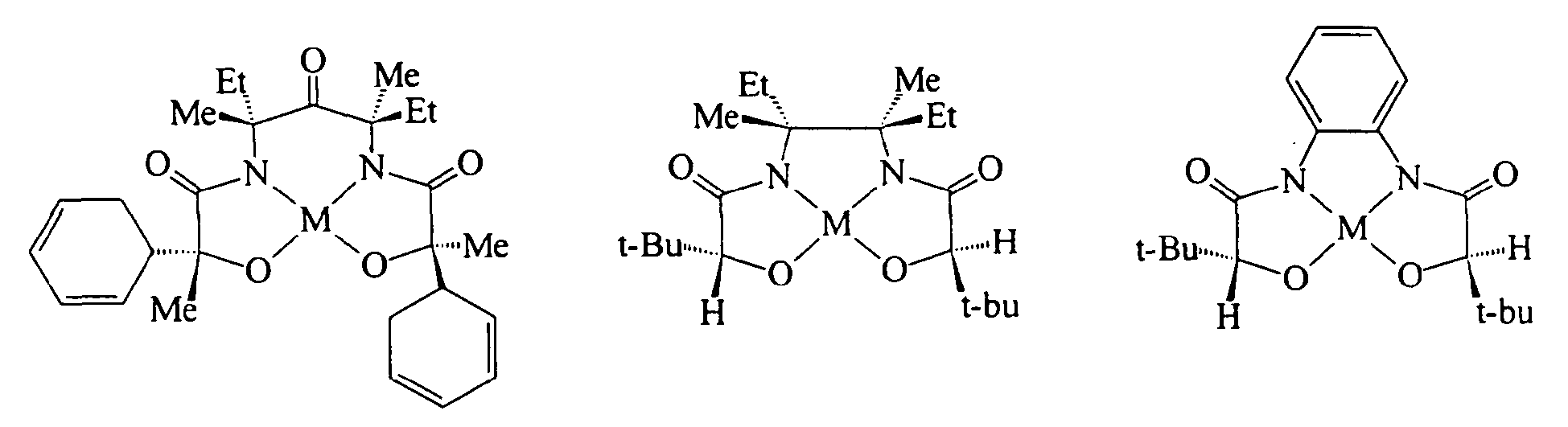
The synthesis of these and other related catalyst can be adapted from the literature. See, for example, Ozaki et al. (1990) J Chem Soc Perkin Trans2:353; Collins et al. (1986) J Am Chem Soc 108:2088; and Brewer et al. (1988) J Am Chem Soc 110:423. - In yet another embodiment, the tetradentate catalysts of formula 100 can be chosen from the class of azamacrocycle having a ligand represented by the general formula:

wherein
R21 and R22 each represent hydrogen, halogens, alkyls, alkenyls, alkynyls, hydroxyl, amino, nitro, thiol amines, imines, amides, phosphonates, phosphines, carbonyls, carboxyls, silyls, ethers, thioethers, sulfonyls, selenoethers, ketones, aldehydes, esters, or -(CH2)m-R7;
R20 is absent or represents one or more substituents of the pyridine to which it is attached, each substituent independently selected from the group consisting of halogens, alkyls, alkenyls, alkynyls, hydroxyl, amino, nitro, thiol amines, imines, amides, phosphonates, phosphines, carbonyls, carboxyls, silyls, ethers, thioethers, sulfonyls, selenoethers, ketones, aldehydes, esters, or -(CH2)m- R7;
R23 and R24 each independently are absent or represent one or more substituents of the 1,3-diiminopropyl to which they are attached, each substituent independently selected from the group consisting of halogens, alkyls, alkenyls, alkynyls, hydroxyl, amino, nitro, thiol amines, imines, amides, phosphonates, phosphines, carbonyls, carboxyls, silyls, ethers, thioethers, sulfonyls, selenoethers, ketones, aldehydes, esters, or -(CH2)m-R7;
or any two or more of the R20, R21, R22, R23 and R24 substituents are covalently linked to form a bridging substituent;
R7 represents an aryl, a cycloalkyl, a cycloalkenyl, a heterocycle or a polycycle; and
m is zero or an integer in the range of 1 to 8,
wherein the substituents R20, R21 , R22, R23 and R24 are selected such that the catalyst is asymmetric. - One advantage to this class of tetradentate catalysts, like the salenates, derives from the fact that the ligand provides a metallo-shiff base complex. Furthermore, stereogenic centers can be sited within two bond lengths of the metal center. Exemplary ligands of formula 114 include:

The synthesis of these and other embodiments of 114 are described in Prince et al. (1974) Inorg Chim Acta 9:51-54, and references cited therein. - Yet another class of tetradentate ligands of the subject method are the cyclams, such as represented by the general formula:

in which each of the substituents Q8 indpendently, are absent or represent hydrogen or a lower alkyl, and each of R25, R26, R27 and R28, independently, represent one or more substituents on the ethyl or propyl diimine to which they are attached, which substituents are selected from the group of hydrogen, halogens, alkyls, alkenyls, alkynyls, hydroxyl, amino, nitro, thiol, amines, imines, amides, phosphonates, phosphines, carbonyls, carboxyls, silyls, ethers, thioethers, sulfonyls, selenoethers, ketones, aldehydes, esters, and -(CH2)m-R7; or any two or more of the substituents taken together form a bridging substituent; R7 represents an aryl, a cycloalkyl, a cycloalkenyl, a heterocycle , or a polycycle; and m is zero or an integer in the range of 1 to 8. Wherein the substituents are selected such that the catalyst is asymmetric. Exemplary embodiments and synthesis schemes for chiral cyclams useful in the present invention can be adapted from the art. See, for example, the Burrows et al. U.S. patent 5,126,464, Kimura et al. (1984) Inorg Chem 23 :4181; Kimura et al. (1984) J Am Chem Soc 106: 5497; Kushi et al. (1985) J ChemSoc Chem Commun 216; Machida et al. (1986) Inorg Chem 25:3461; Kimura et al. (1988) J Am Chem Soc 110:3679; and Tabushi et al. (1977) Tetrahedron Lett 18:1049. - In yet another embodiment of the subject method, the chiral catalyst which is provided in the reaction is from a class of chiral catalyst having a tridentate ligand which coordinates a transition metal in a substantially planar geometry, though as above some distortion to this geometry is contemplated. Accordingly, this planar geometry refers to tridentate ligands in which the Lewis basic atoms lie substantially in the same plane, with the metal also in that plane, or slightly above or below that plane.
- Preferred planar tridentate catalysts which may be employed in the subject reactions can be represented by the general formula 140:

wherein Z1, Z2, and Z3 each represent a Lewis base, such as selected from the group consisting of nitrogen, oxygen, phosphorus, arsenic and sulfur; the E1 moiety, taken with Z1, Z2 and M, and the E2 moiety, taken with Z2, Z3 and M, each, independently, form heterocycles; R80 and R81 each independently are absent, or represent one or more covalent substitutions of E1 and E2 with an organic or inorganic substituent permitted by valence requirements of the ring atom to which it is attached, or any two or more of the R80 and R81 substituents taken together form a bridging substituent; and M represents a transition metal,
wherein each R1, R2, R'1, R'2 R80 and R81 substituents are selected to provide at least one stereogenic center in said tridentate ligand. In preferred embodiments, each R80 and R81 occuring in 140 independently represent hydrogen, halogens, alkyls, alkenyls, alkynyls, hydroxyl, amino, nitro, thiol amines, imines, amides, phosphonates, phosphines, carbonyls, carboxyls, silyls, ethers, thioethers, sulfonyls, selenoethers, ketones, aldehydes, esters, or - (CH2)m-R7; R7 represents an aryl, a cycloalkyl, a cycloalkenyl, a heterocycle or a polycycle; and m is zero or an integer in the range of 1 to 8. The metal will generally be coordinated with a counteranion or a nucleophile (as in the aged catalyst described below). - For example, a chiral tridentate catalyst useful in the subject stereoselective reactions can have a ligand represented by the general formula:

wherein each of R100, R102 and R104 each independently are absent, or represent one or more covalent substitutions of heterocycle to which it is attached, or any two or more of the substituents taken together form a bridging substituent; wherein each R100, R102 and R104 substituents, if present, can be selected from the group consisting of halogens, alkyls, alkenyls, alkynyls, hydroxyl, amino, nitro, thiol amines, imines, amides, phosphonates, phosphines, carbonyls, carboxyls, silyls, ethers, thioethers, sulfonyls, selenoethers, ketones, aldehydes, esters, or -(CH2)m-R7; R7 represents an aryl, a cycloalkyl, a cycloalkenyl, a heterocycle or a polycycle; and m is zero or an integer in the range of 1 to 8. Again, the substitution of 142 is intended to provide at least one stereogenic center in the tridentate ligand. Exemplary embodiments of the 2,2':6',2"-terpyridine ligands 142 and their synthesis can be adapted from, for example, Potts et al. (1987) J Am Chem Soc 109:3961; Hadda et al. (1988) Polyhedron 7:575; Potts et al. (1985) Org Synth 66:189; and Constable et al. (1988) Inorg Chim Acta 141:201. Exemplary 2,6-bis(N-pyrazolyl)pyridine ligands 144 can be adapted from, for example, Steel et al. (1983) Inorg Chem 22:1488; and Jameson et al. (1990) J Org Chem 55:4992. - Yet another class of planar tridentate catalyst useful in the subject stereoselective reactions can have a ligand represented by the general formula:

wherein each of R106, R108 and R110 can be selected from the group consisting of hydrogens, halogens, alkyls, alkenyls, alkynyls, hydroxyl, amino, nitro, thiol amines, imines, amides, phosphonates, phosphines, carbonyls, carboxyls, silyls, ethers, thioethers, sulfonyls, selenoethers, ketones, aldehydes, esters, or -(CH2)m-R7; R112 is absent or represent one or more covalent substitutions of the heterocycle to which it is attached; or any two or more of the R106, R108, R110 and R112 substituents taken together form a bridging substituent; R7 represents an aryl, a cycloalkyl, a cycloalkenyl, a heterocycle or a polycycle; and m is zero or an integer in the range of 1 to 8. The choice of substitution of 146 is intended to enhance its chirality. Exemplary embodiments of the salicylaldehyde-derived ligands 146 and their synthesis can be adapted from, for example, Desimoni et al. (1992) Gazzetta Chimica Italiana 122:269. - In a preferred embodiment, the tridentate ligand is given by the general formula 150

wherein R106 represents a hydrogen, halogen, alkyl, alkenyl, alkynyl, hydroxyl, amino, nitro, thiol amine, imine, amide, phosphonate, phosphine, carbonyl, carboxyl, silyl, ether, thioether, sulfonyl, selenoether, ketone, aldehyde, ester, or -(CH2)m-R7; and each of R112 and R'112 is absent or represent one or more covalent substitutions of the heterocycle to which it is attached, such as designated for R106; R7 represents an aryl, a cycloalkyl, a cycloalkenyl, a heterocycle or a polycycle; and m is zero or an integer in the range of 1 to 8. For example, as described in the appended examples, a preferred salicylaldehyde-derived ligand is given by the general formula 152
each R112 being independently selected. - Still another class of planar tridentate catalyst useful in the subject stereoselective reactions can have a ligand represented by the general formula:
wherein R100 is as described above, and each R116 and R114 can be selected from the group consisting of hydrogens, halogens, alkyls, alkenyls, alkynyls, hydroxyl, amino, nitro, thiol amines, imines, amides, phosphonates, phosphines, carbonyls, carboxyls, silyls, ethers, thioethers, sulfonyls, selenoethers, ketones, aldehydes, esters, or -(CH2)m-R7; or any two or more of the substituents taken together form a bridging substituent; R7 represents an aryl, a cycloalkyl, a cycloalkenyl, a heterocycle or a polycycle; and m is zero or an integer in the range of 1 to 8. The choice of substitution of 148 is intended to provide at least one stereogenic center in the tridentate ligand. Exemplary embodiments of the salicylaldehyde-derived ligands 148 and their synthesis can be adapted from, for example, Marangoni et al. (1993) Polyhedron 12:1669. - The ligand substituents are chosen to optimize the selectivity of reaction and the catalyst stability. The exact mechanism of action of the metallosalenate-catalyzed ring opening has not yet been precisely elucidated. However, the need for stereoselective nonbonded interactions between the substrate and catalyst is a feature of this and other chiral planar catalysts of the subject reaction which is believed to be comparable to the mechanism of olefin epoxidation by similar catalysts. While not wishing to be bound by any particular theory, it is believed that the present ring opening reactions involve two factors largely responsible for induction of asymmetry by formation of stereospecific nonbonded pairs of catalyst and substrate, namely, steric and electronic interactions between the incoming substrate and the ligand of the chiral catalyst. In general, "tuning" refers altering the steric bulk of the ligand to limit the approach of the substrate, utilizing steric repulsions between the substrate and ligand substituents, and altering the electronic characteristics of the ligand to influence electronic interactions between the substrate and the ligand, as well as the rate and mechanism of the catalyzed reaction. For instance, the choice of appropriate substituents as "blocking groups" enforces certain approach geometries and disfavors others.
- Furthermore, the choice of substituent may also affect catalyst stability; in general, bulkier substituents are found to provide higher catalyst turnover numbers. It has been found that for the asymmetric epoxidation of olefins by Mn(salen) complexes, t-butyl groups (or other tertiary groups) are suitable bulky moieties for optimizing stereoselectivity and increasing catalyst turnover.
- A preferred embodiment for each of the embodiments described above provides a catalyst having a molecular weight less than 10,000g/m (a.m.u.), more preferably less than 5000g/m, and even more preferably less than 2500g/m. In another preferred embodiment, none of the substituents of the core ligand, or any molecule coordinated to the metal in addition to the ligand, have molecular weights in excess 1000g/m, more preferably they are less than 500g/m, and even more preferably, are less than 250g/m. The choice of substituent on the ligand can also be used to influence the solubility of the catalyst in a particular solvent system.
- As mentioned briefly above, the choice of ligand substituents can also affect the electronic properties of the catalyst. Substitution of the ligand with electron-rich (electron-donating) moieties (including, for example, alkoxy or amino groups) increases the electron density of the ligand and at the metal center. Conversely, electron-withdrawing moieties (for example, chloro or trifluoromethyl) on the ligand result in lower electron density of the ligand and metal center. The electron density of the ligand is important due to the possibility of interactions (such as pi-stacking) with the substrate (see, e.g., Hamada et al. Tetrahedron (1994) 50:11827). The electron density at the metal center may influence the Lewis acidity of the metal or the nucleophilicity of a nucleophile if coordinated to the metal. Choice of appropriate substituents thus makes possible the "tuning" of the reaction rate and the stereoselectivity of the reaction.
- Nucleophiles which are useful in the present invention may be determined by the skilled artisan according to several criteria. In general, a suitable nucleophile will have one or more of the following properties: 1) It will be capable of reaction with the substrate at the desired electrophilic site; 2) It will yield a useful product upon reaction with the substrate; 3) It will not react with the substrate at functionalities other than the desired electrophilic site; 4) It will react with the substrate at least partly through a mechanism catalyzed by the chiral catalyst; 5) It will not substantially undergo further undesired reaction after reacting with the substrate in the desired sense; 6) It will not substantially react with or degrade the catalyst, e.g. at a rate greater than conversion of the substrate. It will be understood that while undesirable side reactions (such as catalyst degradation) may occur, the rates of such reactions can be manipulated through the selection of reactants and conditions to be slow in comparison with the rate of the desired reaction(s).
- Nucleophiles which satisfy the above criteria can be chosen for each substrate and will vary according to the substrate structure and the desired product. Routine experimentation may be necessary to determine the preferred nucleophile for a given transformation. For example, if a nitrogen atom is to be joined to the substrate, a nitrogen nucleophile such as azide, ammonia, phthalimide, hydrazine or an amine may be employed. Similarly, oxygen nucleophiles such as water, hydroxide, alcohols, alkoxides, siloxanes, carboxylates or peroxides may be used to introduce oxygen; and mercaptans, thiolates, bisulfite, thiocyanate and the like may be used to introduce a sulfur-containing moiety. Nucleophiles which introduce other atoms such as halides, selenium, or phosphorus, will be apparent.
- In addition, carbon nucleophiles such as cyanide, acetylides, 1,3-dithiane anion, or stabilized carbanions such as enolates may be useful in the present invention.
- For any of the above nucleophiles which exist as anions, the counterion can be any of a variety of conventional cations, including alkali and alkaline earth metal cations and ammonium cations. In some cases, nonionic reagents may be useful; for example trimethylsilyl azide (TMS-N3) may be used to deliver the azide nucleophile.
- Organometallic reagents such as simple or higher-order organocuprate or organozinc species may also be useful. In certain embodiments, Grignard reagents or organolithium reagents may be employed as nucleophiles.
- In certain embodiments, the nucleophile may be part of the substrate, thus resulting in an intramolecular reaction.
- In certain embodiments, the nucleophile may be a hydride, by use of, e.g., sodium cyanoborohydride.
- As discussed above, a wide variety of substrates are useful in the methods of the present invention. The choice of substrate will depend on factors such as the nucleophile to be employed and the desired product, and an appropriate substrate will be apparent to the skilled artisan. It will be understood that the substrate preferably will not contain any interfering functionalities. In general, an appropriate substrate will contain a reactive electrophilic center where a nucleophile may attack. The attack of the nucleophile will cause the breaking of a bond between the electrophilic atom and a leaving group atom, and the formation of a bond between the substrate and the nucleophile. It will further be understood that not all electrophiles will react with every nucleophile.
- Most of the cyclic electrophiles contemplated for use in the methods of the present invention contain at least one ring having three to five atoms. Such small rings are frequently strained, making them more susceptible to ring-opening by nucleophiles. However, in some embodiments a cyclic substrate may not be strained, and may have a larger electrophilic ring. Cyclic electrophiles which have good leaving groups (for example, cyclic sulfates) or which have sp2 reactive centers (for example, carbonates or anhydrides) may have electrophilic rings with greater than 5 atoms, for example, from 6 to 9 atoms. Highly activated carbocycles such as certain substituted cyclopropanes (e.g., those substituted with electron-withdrawing groups) also are reactive toward ring-opening with nucleophiles and thus are contemplated for use in the methods of the invention. Furthermore, in certain embodiments it may be desired to use a substrate which has an allylic functionality which may be opened by attack at the allylic double bond in an "SN2'-type" fashion.
- Examples of suitable cyclic substrates which can be opened include epoxides, aziridines, episulfides, cyclopropanes, cyclic carbonates, cyclic thiocarbonates, cyclic sulfates, cyclic anhydrides, cyclic phosphates, cyclic ureas, cyclic thioureas, lactams, thiolactams, lactones, thiolactones, and the like.
- In certain preferred embodiments, the cyclic substrate will be a meso compound. In other preferred embodiments, the cyclic substrate will be a chiral compound. In certain embodiments, the substrate will be a racemic mixture. In certain embodiments, the substrate will be a mixture of diastereomers.
- In exemplary embodiments, a cyclic substrate suitable for use in the present invention has the following formula:

in which
Y represents O, S, N(R50), C(R52)(R54), or has the formula A-B-C; wherein R50 represents a hydrogen, an alkyl, a carbonyl-substituted alkyl, a carbonyl-substituted aryl, or a sulfonate, R52 and R54 each independently represent an electron-withdrawing group, such as nitro, ketones, aldehydes, sulfonyls, trifluoromethyl, -CN, chloride, and the like; A and C are independently absent, or represent a C1-C5 alkyl, O, S, carbonyl, or N(R50); and B is a carbonyl, a thiocarbonyl, a phosphoryl, or a sulfonyl;
R30, R31, R32, and R33 can be any organic or inorganic substutituent which forms a covalent bond with a carbon atom of 118, and which permits formation of the stable ring structure including Y. For instance, R30, R31, R32, and R33 can each independently represent hydrogen, a halogen; an alkyl, an alkenyl, an alkynyl, a hydroxyl, a nitro, a thiol, an amino, an amine, an imine, an amide, a phosphoryl, a phosphonate, a phosphine, a carbonyl, a carboxyl, a silyl, an ether, a thioether, a sulfonyl, a selenoether, a ketone, an aldehyde, an ester, or -(CH2)m-R7;
or any two or more of the substituents R30, R31, R32, and R33 taken together form a carbocylic or heterocyclic ring having from 4 to 8 atoms in the ring structure;
R7 represents an aryl, a cycloalkyl, a cycloalkenyl, a heterocycle or a polycycle; and
m is zero or an integer in the range of 1 to 8. - In preferred embodiments, R30, R31, R32, and R33 are chosen such that the resulting compound has a plane of symmetry. A leaving group is a functionality which upon bond cleavage departs with an electron pair. In general, good leaving groups are those moieties which are expelled from the substrate as weak bases. For example, sulfates, sulfonates, chloride, bromide, iodide, phosphates and the like are good leaving groups. In addition, some moieties may be good leaving groups when protonated or complexed with a Lewis acid. For example, alkoxide ions are generally poor leaving groups, but alcohols are good leaving groups. It should be noted that ring strain may, in some cases, allow a rather poor leaving group to be expelled, as in the case of epoxides, aziridines, and the like. Though not intended to be limiting, many compounds which have ring strain of more than 20 kcal/mole (compared to cyclohexane) will generally be suitable substrates.
- In certain embodiments, the electrophilic atom may be a heteroatom.
- The asymmetric reactions of the present invention may be performed under a wide range of conditions, though it will be understood that the solvents and temperature ranges recited herein are not limitative and only correspond to a preferred mode of the process of the invention.
- In general, it will be desirable that reactions are run using mild conditions which will not adversely affect the substrate, the catalyst, or the product. For example, the reaction temperature influences the speed of the reaction, as well as the stability of the reactants and catalyst. The reactions will usually be run at temperatures in the range of -78°C to 100°C, more preferably in the range -20°C to 50°C and still more preferably in the range -20°C to 25°C.
- In general, the asymmetric synthesis reactions of the present invention are carried out in a liquid reaction medium. The reactions may be run without addition of solvent (see Example 8, infra). Alternatively, the reactions may be run in an inert solvent, preferably one in which the reaction ingredients, including the catalyst, are substantially soluble. Suitable solvents include ethers such as diethyl ether, 1,2-dimethoxyethane, diglyme, t-butyl methyl ether, tetrahydrofuran and the like; halogenated solvents such as chloroform, dichloromethane, dichloroethane, chlorobenzene, and the like; aliphatic or aromatic hydrocarbon solvents such as benzene, toluene, hexane, pentane and the like; esters and ketones such as ethyl acetate, acetone, and 2-butanone; polar aprotic solvents such as acetonitrile, dimethylsulfoxide, dimethylformamide and the like; or combinations of two or more solvents. Furthermore, in certain embodiments it may be advantageous to employ a solvent which is not inert to the substrate under the conditions employed, e.g., use of ethanol as a solvent when ethanol is the desired nucleophile. In embodiments where water or hydroxide are not preferred nucleophiles, the reactions can be conducted under anhydrous conditions. In certain embodiments, ethereal solvents are preferred.
- The invention also contemplates reaction in a biphasic mixture of solvents, in an emulsion or suspension, or reaction in a lipid vesicle or bilayer. In certain embodiments, it may be preferred to perform the catalyzed reactions in the solid phase.
- In some preferred embodiments, the reaction may be carried out under an atmosphere of a reactive gas. For example, ring-opening by the cyanide nucleophile may be performed under an atmosphere of HCN gas. Similarly, in embodiments in which the ring-expansion of an epoxide by carbon dioxide or a similar reaction is desired, the reaction may be performed under an atmosphere of carbon dioxide, or a mixture of carbon dioxide and other gases. The partial pressure of the reactive gas may be from 0.1 to 1000 atmospheres, more preferably from 0.5 to 100 atm, and most preferably from about 1 to about 10 atm.
- In certain embodiments it is preferable to perform the reactions under an inert atmosphere of a gas such as nitrogen or argon.
- The asymmetric synthesis processes of the present invention can be conducted in continuous, semi-continuous or batch fashion and may involve a liquid recycle and/or gas recycle operation as desired. The processes of this invention are preferably conducted in batch fashion. Likewise, the manner or order of addition of the reaction ingredients, catalyst and solvent are also not critical and may be accomplished in any conventional fashion.
- The reaction can be conducted in a single reaction zone or in a plurality of reaction zones, in series or in parallel or it may be conducted batchwise or continuously in an elongated tubular zone or series of such zones. The materials of construction employed should be inert to the starting materials during the reaction and the fabrication of the equipment should be able to withstand the reaction temperatures and pressures. Means to introduce and/or adjust the quantity of starting materials or ingredients introduced batchwise or continuously into the reaction zone during the course of the reaction can be conveniently utilized in the processes especially to maintain the desired molar ratio of the starting materials. The reaction steps may be effected by the incremental addition of one of the starting materials to the other. Also, the reaction steps can be combined by the joint addition of the starting materials to the optically active metal-ligand complex catalyst. When complete conversion is not desired or not obtainable, the starting materials can be separated from the product and then recycled back into the reaction zone.
- The processes may be conducted in either glass lined, stainless steel or similar type reaction equipment. The reaction zone may be fitted with one or more internal and/or external heat exchanger(s) in order to control undue temperature fluctuations, or to prevent any possible "runaway" reaction temperatures.
- Furthermore, the chiral catalyst can be immobilized or incorporated into a polymer or other insoluble matrix by, for example, derivativation with one or more of substituents of the ligand. The immobilized ligands can be complexed with the desired metal to form the chiral metallocatalyst. The catalyst, particularly the "aged" catalyst described herein (Example 8, infra), is easily recovered after the reaction as, for instance, by filtration or centrifugation.
- The invention now being generally described, it will be more readily understood by reference to the following examples which are included merely for purposes of illustration of certain aspects and embodiments of the present invention, and are not intended to limit the invention.
-

- A solution of 360.5 mg (2.0 mmol) of 3-tert-butylsalicylaldehyde in 3 ml of EtOH was added dropwise to a solution of 212.3 mg (1.0 mmol) of (R,R)-1,2-diamino-1,2-diphenylethane in 5 ml of EtOH. The reaction mixture was heated to reflux for 1 h and water (5 ml) was added. The oil that separated solidified upon standing. Recrystallization from MeOH/H2O gave 485.8 mg (91%) of yellow powder, mp 73-74°C. 1H NMR (CDCl3) δ 1.42 (s, 18H, CH3), 4.72 (s, 2H, CHN=C), 6.67-7.27 (m, 16H, ArH), 8.35 (s, 2H, CH=N), 13.79 (s, 2H, ArOH) ppm; 13C NMR (CDCl3) δ 29.3, 34.8, 80.1, 117.8, 118.5, 127.5,128.0, 128.3, 129.6, 130.1, 137.1, 139.5, 160.2, 166.8 ppm. Anal. Calcd. for C36H40N2O2. C, 81.17; H, 7.57; N, 5.26. Found: C, 81.17; H, 7.60; N, 5.25.
- Preparation of (R,R)-1,2-Diphenyl-1,2-bis(3-diphenylmethylsilylsalicylideamino)ethane.

3-(Diphenylmethylsilyl)salicylaldehyde was prepared from 2-bromophenol in 5 steps according to established procedures. A solution of 348.3 mg (1.09 mmol) of 3-(diphenylmethylsilyl)salicylaldehyde and 116.0 mg (0.546 mmol) of (R,R)-1,2-diamino-1,2-diphenylethane in 5 ml of ethanol was heated to reflux for 0.5 h. A bright yellow oil separated from the solution and it solidified upon standing. The mixture was filtered and the yellow solid was washed with 2 x 5 ml ethanol. The isolated yield of product pure by 1H NMR analysis was 416 mg (97%). 1H NMR (CDCl3) δ 0.95 (s, 3H), 4.68 (s, 2H), 6.72-7.55 (m, 36H, ArH), 8.37 (s, 2H), 13.34 (s, 2H) ppm. -

- A solution of 725 mg (4.0 mmol) of 3-tert-butyl-salicylaldehyde in 6 ml of EtOH was added dropwise to a solution of 569 mg (2.0 mmol) of (+)-2,2'-diamino-1,1-binaphthyl in 5 ml of EtOH. The reaction mixture was heated to reflux for 8 h and then volatile materials were removed under vacuum. The residue was purified by flash chromatography on 80 g SiO2, using 20% CH2Cl2 in hexane as eluent. The mobile yellow fraction was collected and solvents were removed under vacuum to give 725 mg (1.20 mmol, 59% yield) of the diimine as a yellow powder.
-

3,5-Di-t-butylsalicylaldehyde (2.0 equivalents) (prepared from the inexpensive, commercially available 2,4-di-t-butylphenol according to Larrow, J.F.; Jacobsen, E.N.; Gao, Y.; Hong, Y.; Nie, X.; Zepp, C.M. J Org Chem 1994, 59, 1939) was added as a solid to a 0.2 M solution of (S,S)-1,2-diaminocyclohexane (1.0 equivalent) (Aldrich Chemical Co., Milwaukee, WI) in absolute ethanol. The mixture was heated to reflux for 1 hr. and then H2O was added dropwise to the cooled bright yellow solution. The resulting yellow crystalline solid was collected by filtration and washed with a small portion of 95% ethanol. The yield of analyticallypure salen ligand 2 obtained in this manner was 90-97%. - Spectroscopic and analytical data for the salen ligand: 1H NMR (CDCl3) δ 13.72 (s, 1H), 8.30 (S, 1H), 7.30 (d, J = 2.3 Hz, 1H), 6.98 (d, J = 2.3 Hz, 1H), 3.32 (m, 1H), 2.0-1.8 (m, 2H), 1.8-1.65 (m, 1H), 1.45 (m, 1H), 1.41 (s, 9H), 1.24 (s, 9H). 13C NMR (CDCl3): δ 165.8, 158.0, 139.8, 136.3, 126.0, 117.8, 72.4, 34.9, 33.0, 31.4, 29.4, 24.3. Anal. Calcd. for C36H54N2O2: C, 79.07; H, 9.95; N, 5.12. Found: C, 79.12; H, 9.97; N, 5.12.
- The salen ligand synthesized in Example 4 is redissolved in hot absolute ethanol to give a 0.1 M solution. Solid Mn(OAc)2•4H2O(2.5 equivalents) is added in one portion and the solution is refluxed for 1 hr. Approximately 5 equivalents of solid LiCl are then added and the mixture is heated to reflux for an additional 0.5 hr. Cooling the mixture to 0°C and addition of a volume of water equal to the volume of the brown ethanolic solution affords the Mn(III) complex as a dark brown powder which is washed thoroughly with H2O, and isolated by filtration in 81-93% yield. Acceptable C, H, N, Cl and Mn analyses of the catalyst have been obtained (± 0.4%), but these vary according to the extent of water and ethanol incorporation in the powdery product. The solvent content of the catalyst does not influence its effectiveness.
- Analytical data for this catalyst: Anal. Calcd for C36H52ClMnN2O2•C2H5OH: C, 67.19; H, 8.31; Cl, 5.22; Mn, 8.09; N, 4.12: Observed: C, 67.05; H, 8.34; Cl, 5.48; Mn, 8.31; N, 4.28.
- The following procedure was found to provide 1 with reproducible catalytic activity. Under a nitrogen atmosphere, 0.309g (2.52 mmol) of CrCl2 (anhydrous, 99.9%, Alfa/Johnson Matthey) was added to the (R,R)-
ligand 2 synthesized in Example 4 (1.25g, 2.29 mmol) in dry, degassed THF (45 mL). The resulting dark brown solution was stirred under N2 for 3 h and then in air for an additional 3 h. The solution was then diluted with 250 ml of t-butyl methyl ether and washed with satd. NH4Cl (3 x 150 ml) and brine (3 x 150 ml). The organic phase was dried (Na2SO4) and solvent was removed under reduced pressure, affording 1.41 g (87% yield) of 1 as a brown solid which was >98% pure as determined by HPLC analysis (octadecyl reverse phase, 100% CH3CN). This material was used in the ring opening reactions without further purification. Recrystallization from acetonitrile provided high quality orange-brown crystals with 63% recovery: mp 375-398°C (dec). IR (KBr, cm-1) 3610 (br), 3420 (br), 2951(s), 2866, 1619(s), 1531, 1434, 1390, 1321, 1255, 1170, 1030, 837, 785, 748, 563, 543. Anal. Calcd for C38H59N2O4CrCl 1•3/2H2O•1/2THF: C, 65.64; H, 8.55; N, 4.03; Cr, 7.48; Cl, 5.10. Found: C, 65.72; H, 8.53; N, 4.04; Cr, 7.45; Cl, 5.15. MS (FD): m/z 631 ([M]+). HRMS (FAB): m/z calcd for [C36H52N2O2Cr]+ ([1 - Cl]+) 596.3418, found 596.3434. µeff = 3.97 µB.
Conductance (CH3CN, 0.0045M) 0.57 Ω-1 cm2 mol-1. - Metal complexes of the readily available
chiral salen ligand 2 were screened as catalysts for the model reaction of cyclohexene oxide with TMS-N3. Complexes of Al, Ti, and Mn each catalyzed the reaction, but theazido silylether product 4 was generated in racemic form. In contrast, the corresponding Cr complex 1 catalyzed ring-opening to generate 4 with up to >80% ee. In addition, trace amounts of the byproducts 
- The reaction of a variety of meso epoxides with Me3SiN3 was screened with catalyst 1 (Table I) according the following general procedure:
- A 5 mL flask is charged with 42 mg (0.060 mmol) of 1 and 1.0 mL of Et2O. The epoxide (3.00 mmol) is added and the mixture is stirred for 15 min, at which time Me3SiN3 (0.418 mL, 3.15 mmol) is added. The resulting brown solution is stirred at room temperature for the indicated time (Table I). The solution is then concentrated in vacuo and the residue is filtered through a 10mL plug of silica gel with 100 mL of 5-20% EtOAc/hexanes. The filtrate is concentrated and the resulting residue is subjected to analysis by GC or HPLC to determine the enantiomeric composition of silylated azidoalcohol.
- Desilylation: The product obtained as described above is dissolved in methanol (5 mL). (1S)-(+)-10-Camphorsulfonic acid (35 mg, 0.15 mmol) is added and the resulting solution is stirred for 30 min and then concentrated in vacuo. The residue is purified by flash chromatography to afford pure azidoalcohol.
- Five-membered ring epoxides underwent ring-opening with very high levels of enantioselectivity, while 6-membered ring and acyclic epoxides afforded somewhat diminished selectivities. Ether, olefin, and carbonyl-containing functional groups were all tolerated (entries 2-4,7). Interestingly, 3,4-epoxytetrahydrofuran (entry 2) was one of the most reactive epoxides in this study, suggesting that Lewis bases do not inhibit catalytic activity.



- The enantioselectivity of the epoxide ring-opening reaction was found to be remarkably insensitive to the initial concentration of reagents. We therefore investigated solvent-free reactions in which, in principle, no reaction byproducts of any kind are generated (Table II). Thus, reaction of 5 mmol of cyclohexene oxide with 2
mol% catalyst 1 and 5.25 mmol (1.05 equiv) of TMSN3 for 18 h, followed by short path distillation under reduced pressure, afforded an 86% yield of the TMS-protected azido alcohol in 84% e.e. (cycle 1). As expected, this product was contaminated with small amounts (≤ 2% of each) ofsilylated chlorohydrin 5 and bis-silylated diol 6. Treatment of the residual catalyst with additional portions of cyclohexene oxide (5 mmol) and TMSN3 (5.25 mmol) resulted in an 88% yield of product (87% ee) that was completely free of any byproducts (cycle 2). An additional recycling of the catalyst gave the product in 91% yield and 88% ee (cycle 3). A fourth reaction was then performed with cyclopentene oxide and the corresponding product was obtained in 81% yield and 94% ee (cycle 4). Finally, 1,4-cyclohexadiene monoepoxide was used for the fifth cycle (75% yield, 83% ee; cycle 5). In all cases, complete conversion of the epoxide was observed at the times indicated.

- Based on these results, the first reaction can be thought of as an "aging" of the catalyst. Consistent with the observation of
silylated chlorohydrin 5 in the first reaction only, the "aged" catalyst contains no chlorine as judged by elemental analysis. This aged catalyst also displays an absorbance at 2058 cm-1 in its infrared spectrum, consistent with a Cr-N3 N=N stretch. We therefore conclude that the active catalyst is (salen) Cr-N3. An X-ray crystal structure of the (salen) Cr-N3 (with an associated molecule of tetrahydrofuran) has been obtained, confirming that azide is associated with the metal center. While not wishing to be bound by any particular theory, it appears that catalysis involves Lewis acid activation by the chromium center or nucleophilic delivery of azide by a Cr-N3 intermediate, or both. The apparent intermediacy of a Cr-N3 intermediate provides circumstantial support for the latter. - We have also investigated the use of
catalyst 1 for the kinetic resolution of chiral racemic epoxides. Preliminary results are shown in Table III. Thus, treatment of 3 mmol of styrene oxide with 0.70 equiv. of TMSN3 and 2 mol% ofcatalyst 1 resulted in 76% conversion (based on the available enantiomer) of the epoxide to a complex mixture of products. The ee of the unreacted styrene oxide was 98%. Similarly, epichlorohydrin proceeded to 80% conversion (based on the available enantiomer) when treated with 0.60 equiv of TMSN3 and 2mol% 1. The ee of the unreacted epichlorohydrin was 97%. proceeded to 80% conversion (based on the available enantiomer) when treated with 0.60 equiv of TMSN3 and 2mol% 1. The ee of the unreacted epichlorohydrin was 97%.
- As shown in Table III, the kinetic resolution of racemic epoxides can provide trimethylsilyl azidoalcohols, which can in turn be converted to 1-amino-2-ols. The overall process is efficient and procedes with high enantio- and regioselectivity, as shown in Table IV.


- The use of the
catalyst 1 for selective opening of epoxides which have little inherent steric or electronic bias has also been investigated. As shown in the top scheme of Figure 1, the ring opening of a racemic epoxide occurs with little selectivity when an achiral catalyst is used, but ring-opening of the optically-enriched epoxide occurs with good regioselectivity in the presence of either enantiomer of the chiral catalyst.
optically pure styrene epoxide with an achiral catalyst results in preferential nucleophile attack at the less-substituted carbon atom of the epoxide. This inherent regiochemical preference can be either enhanced or reversed by selection of the appropriate antipode of the chiral catalyst. Thus, the (R,R)-enantiomer of thecatalyst 1 reverses the regioselectivity of nucleophile attack, while the (S,S)-enantiomer ofcatalyst 1 enhances the pre-existing regioselectivity of ring opening. - To test chiral ring-opening reactions on substrates attached to a solid support, meso epoxides were immobilized on resin beads. The immobilized epoxides had the following structures:

in which X represents -N, -OCH, or -OCH2CH. Both diastereomers of the carbocyclic epoxides were used. The immobilized epoxides were treated with trimethylsilyl azide in ether in the presence of 20-50 mol% of chromium salen catalyst, and the reaction was allowed to proceed. The ring-opened compounds were released from the solid support by treatment with trifluoroacetic acid/trifluoroacetic anhydride in methylene chloride. The released products had the following structures: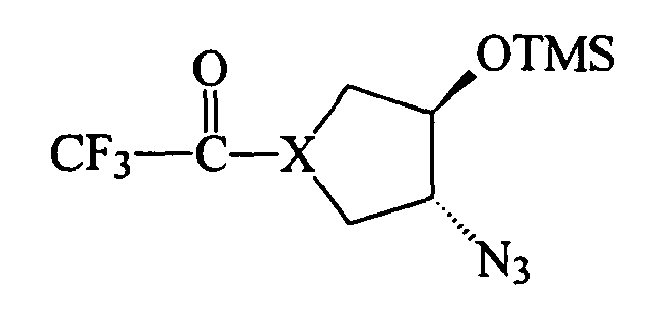
in which X is as described above. The ee of the released products was determined., and the results demonstrate that solid-supported meso epoxides can be ring-opened with excellent optical yields and conversion. Ee's ranged from 91-96% and yields were high. - The ability of the salen catalysts to catalyze enantioselective ring-opening reactions with oxygen and sulfur nucleophiles has also been investigated. Cyclohexane epoxide (1,2-epoxycyclohexane) was treated benzoic acid, methanol, or thiophenol in the presence of a Cr-salen catalyst. The results are shown below:

In each case, the reaction proceeded cleanly and with moderate enantioselectivity. - The use of
catalyst 1 for ring expansion of epoxides was investigated using 1,2-epoxyhexane as substrate, according the scheme below:
- Under one atmosphere of carbon dioxide and in the presence of 1 mol% of catalyst (R,R)-1, racemic 1,2-epoxyhexane selectively underwent reaction. At 90% conversion, the unreacted starting epoxide was found to be enriched in the (R)-enantiomer (90% ee). The polycarbonate product is heated to effect ring closure and the resulting carbonate is analyzed and found to be optically active.
- A tridentate catalyst was synthesized as descibed below and shown in Figure 2. To a solution of (S,S)-201 ((S,S)-1-amino-2-hydroxyindane) (0.857 g, 5.75 mmol) in 60 ml EtOH was added 202 (1.829 g, 5.75 mmol) under a nitrogen atmosphere. The resulting solution was refluxed under N2 for 12 hours. The solution was then cooled to room temperature, and solvent was removed under reduced pressure. The concentrate was purified by recrystallization from hexane to give 2.15g - 2.46g (83%-95 yield) of 203.
- In a dry Schlenk flask under a nitrogen atmosphere, (S,S)-203 (0.765 g, 1.7 mmol) was dissolved in dry THF (30 ml). 2,6-lutidine (0.730 g, 6.81 mmol, distilled over CaH2) was added to the flask, followed by 0.638 g (1.70 mmol) chromium (III) chloride: tetrahydrofuran complex (1:3, 97%, Aldrich). The resulting dark brown solution was stirred under N2 for 12 hours. The solution was then diluted with 200 ml of t-butyl methyl ether and washed with saturated NH4Cl (4x150ml) and brine (3 x 150 ml). The organic portion was dried over Na2SO4, and the solvent was removed under reduced pressure. Catalyst-200 (0.890 mg, 95% yield) was obtained as a dark brown solid.
- In a dry Schlenk flask under a nitrogen atmosphere, 200 (0.653g, 1.22 mmol) was dissolved in azidotrimethylsilane (3 ml). The reaction mixture was stirred under N2 for 12 hours and was then concentrated under reduced pressure to remove excess azidotrimethylsilane and TMSCI, and the resulting Cr-N3 azide catalyst 204 could be used without further purification.
- The ability of
catalyst 200 to catalyze ring-opening of aziridines was tested in two different procedures. In this Example, aziridine 205 (See Figure 5) was used in all ring-opening reactions. - Procedure A: To a solution of 1.34 mg (0.0025 mmol) of
catalyst 200 in 0.5 ml of acetone under N2 was added aziridine 205 (13.2 mg, 0.05 mmol). The homogenous solution was stirred at room temperature under N2 for 15 min. Azidotrimethylsilane (6.64 µl, 0.05 mmol) was added. Aliquots were taken at different time intervals to determine ee and conversion of the product. The reaction was normally done in 4 hours. The enantiomeric excess of the product was 67% and conversion was greater than 95%. - Procedure B: To a solution of 5.42 mg (0.001 mmol) of catalyst 204 in 0.5 ml of acetone under N2 was added aziridine 205 (26.3 mg, 0.10 mmol). The homogenous solution was cooled to -20C° under N2. Azidotrimethylsilane (13.3 µl, 0.10 mmol) was added. The reaction mixture was stirred at -20C° under N2 for 21 hours and was then concentrated under reduced pressure to remove acetone. The residue was chromatographed on silica gel (elution with 15% ethyl acetate in hexane) to give 24.8 mg (81% yield) of the product with 82% ee. Enantiomeric excess was determined by Chiralpak AS column on HPLC.
- Figures 3-5 depict the structures of other catalysts tested in the aziridine opening reaction, and the enantiomeric excess of products obtained by treatment of aziridine 205 with each catalyst. In general, ee's were modest to good, and conversions were high.
- The three-component coupling method of Noyori (see, e.g., Noyori, R. "Asymmetric Catalysis in Organic Synthesis", Wiley, New York, 1994, pp. 298-322) is an effective means of synthesizing prostaglandins and related compounds. The central element, an O-protected (R)-hydroxy-2-cyclopentenone, is thus an important synthetic target. Asymmetric ring-opening of epoxides provides a potentially valuable synthetic route to this class of intermediates. A realization of this synthetic route is described below and shown in Figure 6 (and see, e.g., J.L. Leighton and E.N. Jacobsen, J. Org. Chem., (1996) 61:389-390).
- The
requisite epoxide 211 for the enantioselective ring-opening reaction was prepared according to the method of Noyori (Suzuki, M.; Oda Y., Noyori, R. J. Am. Chem. Soc. 1979, 101, 1623-1625). Thus, 3-cyclopentenone was synthesized via the Pd(0)-catalyzed rearrangement of 3,4-epoxycyclopentene, a reaction remarkable both for the efficiency of catalysis and the ease of the experimental procedure. Epoxidation of 3-cyclopantenone was effected with trifluoroperacetic acid to afford 3,4-epoxycyclopentanone (211) in 60% isolated yield after distillation. We found that treatment of the trifluroacetic anhydride with hydrogen peroxide urea addition compound provided a useful alternative to the literature method for the preparation of trifluoroperacetic acid Noyori's procedure for preparation of trifluoroperacetic acid specifies the use of 90% H2O2. Overall, this two-step sequence provided multigram quantities ofepoxide 211 in pure form with no chromatographic purification necessary. - The asymmetric ring opening of
epoxide 211 was effected using the (salen)CrN3 complex (S,S)-212 (i.e., the chromium-azide complex of ligand (S,S)-2).Complex 212 catalyzes the ring opening of epoxides by TMSN3 with virtually the same enantioselectivity as thechloride complex 1; preliminary mechanistic studies indicate that 1 is in fact a precatalyst and that 212 is the active catalyst. (see supra, e.g., Example 8; and Martinez, L.E.; Leighton J.L., Carsten, D.H.; Jacobsen, E.N. J. Am. Chem. Soc. 1995, 117, 5897-5898). A distinct synthetic advantage to usingcatalyst 212 in catalytic ring-opening reactions is that the chloride addition side product observed usingcatalyst 1 is avoided. A one-pot synthesis of azide complex (S,S)-212 can be accomplished by treatment of complex 1 with AgClO4 in CH3CN, followed by filtration to remove the AgCl, and treatment of the filtrate with NaN3; permitting the isolation of 212 in. ≥ 90% yield. - Submission of
epoxide 211 to the previously described ring-opening conditions (Martinez, L.E.; Leighton J.L., Carsten, D.H.; Jacobsen, E.N. J. Am. Chem. Soc. 1995, 117, 5897-5898) with azide catalyst (S,S)-212 produced azido silyl ether 213, which was invariably contaminated with ~10% of 4-((trimethylsilyl)oxy)-2-cyclopentenone (214). Treatment of this mixture with basic alumina induced selective elimination of the azide to cleanly provide the desired enone (R)-214. However, HPLC analysis of this material ((R,R) Whelk-O, 97:3 hexane: 2-propanol, 1.0 mL/min) revealed an overall enantioselectivity of only 80%. - Reasoning that the
enone side product 214 obtained in the epoxide ring-opening reaction might be due to non-enantioselective β-elimination from 212 followed by silylation of the resulting alcohol with TMSN3, we examined several reaction parameters with the goal of suppressing this pathway and thus enhancing the enantioselectivity in the ultimate generation of 214. When the ring-opening reaction was run at -10°C for 22 h and then warmed slowly to 10°C over 3 h, 213 was obtained in ~90% yield, with only ~2% contamination byenone 214 as judged by 1H NMR analysis of the crude product mixture. Basic alumina-promoted azide elimination followed by distillation under reduced pressure then provided the desiredenone 214 in 94% ee and in four steps from cyclopentadiene. As such, this asymmetric catalytic method represents an attractive alternative to existing enzyme-based procedures. - Complex (S,S)-212. A 200 mL round bottom flask fitted with a dropping funnel was charged with 2.18 g (10.5 mmol) of AgClO4 and 30 mL of CH3CN. The dropping funnel was charged with a solution of 6.75 g (10.0 mmol) of (salen)CrCl complex (S,S)-1 in 20 mL of CH3CN. This solution was added over 5 min to the AgClO4 solution. A precipitate began forming almost immediately. The heterogeneous brown mixture was stirred 16 h and then filtered through a pad of Celite with two 25 mL CH3CN washes. The filtrate was concentrated to a volume of ~30 mL. Solid NaN3 (1.30 g, 20.0 mmol) was added, and the brown solution was stirred for 24 h during which time the mixture became heterogeneous. The reaction mixture was diluted with tert-butyl methyl ether (300 mL) and washed with H2O (3 x 300 mL). The organic phase was dried (Na2SO4), filtered, and concentrated to give 5.92% (90%) of 212 as a brown powder. This material was used for the asymmetric ring opening of epoxides as described below.
- For the purpose of characterization, an analytical sample of 212 was prepared as follows. In a N2-filled drybox, 1.0 g of 212 prepared as described above was treated with Et2O (2.0 mL) and TMSN3 (1.0 mL). The initially homogeneous mixture was stirred for 1 h, during which time a precipitate was deposited. The volatiles were removed in vacuo, and the resulting brown powder was placed in a fitted funnel and washed with Et2O (5 x 5 mL). The recovered solid material was dried in vacuo to give complex 212 as a brown powder: IR (KBr) 2953, 2907, 2866, 2084, 1620, 1530, 1434, 1391, 1321, 1254, 1169, 837 cm-1 Anal. (H. Kolbe; Ar/V2O3) Calcd for C36H52CrN5O2: C, 67.69; H. 8.20; N., 10.96; Cr. 8.14. Found C, 67.75, H, 8.16; N, 10.95; Cr. 8.08.
- 3,4-Epoxycyclopentanone (211). To a cooled (0°C) suspension of H2O2-urea addition compound (9.27 g, 98.5 mmol) in Ch2-Cl2 (100 mL) was added 16.1 mL (23.9 g, 114 mmol) of trifluoroacetic anhydride over 3 min. The mixture was stirred 15 min during which time it became slightly cloudy and biphasic. A 1 L round bottom flask fitted with a dropping funnel was charged with 3-cyclopentenone (6.22g, 75.8 mmol) in methylene chloride (160 mL). The solution was cooled to 0°C, and NaHCO3 (20.7 g, 246 mmol) was added. The biphasic oxidant solution was transferred to the dropping funnel and was added over 5 min to the 3-cyclopentenone solution. The resulting heterogeneous mixture was stirred for 15 min at 0°C and then for 16 h at 23°C. The reaction was quenched by the addition of Na2S2O3·5 H2O (20.7 g, 83.4 mmol) and H2O (300 mL), followed by vigorous stirring for 5 min. The layers were separated, and the aqueous layer was extracted with CH2Cl2 (150 mL). The combined organic layers were dried (Na2SO4), filtered and concentrated. Distillation of the residue (short path, ~250 mTorr, bp 46-50°C) provided 4.43 g (60%) of
epoxide 211 as an oil, which was used without further purification. - (R)-4-((Trimethylsilyl)oxy)-2-cyclopentenone (214). To a solution of epoxide 211 (1.30 g, 13.3 mmol) in Et2O (2.0 mL) was added catalyst 212 (0.173 g, 0.266 mmol). After 5 min, the solution was cooled to -10°C and TMSN3, (1.86 mL, 1.61 g, 14.0 mmol) was added by syringe. The solution was stirred at -10°C for 22 h and then allowed to warm to 10°C over 3 h. The reaction mixture was concentrated, and the residue was filtered through a pad (-20 mL) of silica gel with 20:80 EtoAc/hexane (200 mL). The filtrate was concentrated to give
azido silyl ether 3, contaminated with ~2% of 214 as judged by 1H NMR spectroscopy. Data for 213: 1H NMR (CDCL3) δ 4.30 (m, 1H), 4.05 (m, 1H) 2.74-2.52 (m, 2H) 2.25-2.13 (m, 2H), 0.16 (5, 9H); 13C NMR (CDCL3) δ 211.8, 73-4, 64.9, 45.6, 41.5, -0.2; IR (thin film) 2958, 2105, 1757, 1254, 1134, 1082, 879 cm-1. - The azido silyl ether 213 obtained as described above was dissolved in CH2CL2 (20 mL) and treated with 10 g of basic alumina (Fisher, Brockman activity 1). The slurry was stirred for 30 min and then filtered through a pad (-20 mL) of basic alumina with 150 mL of 95:5 CH2Cl2:EtOAc. The filtrate was concentrated, and purification of the residue by distillation (short path, -250 mTorr, bp 54-55°C) provided
enone 214 as an oil which was > 98% pure as determined by 1H NMR analysis (1.74 g, 77% overall yield from epoxide 211). Analysis of HPLC ((R,R)) Whelk-O column, 97:3 hexane:2-propanol, 1.0 mL/min; 205nm) revealed an enantiomeric excess of 94% (t,(minor) = 10.7 min, t,(major) = 11.9 min). IR (thin film) 2958,2900, 1723, 1357, 1253, 1109, 1071, 904, 844cm-1; 1H NMR(CDCl3) 7.46 (dd, 1H, J = 2.2 and 5.7 Hz), 6.20 (dd, 1H, J = 1.2 and 5.7 Hz), 4.96 (m, 1H), 2.71 (dd, 1H J = 6.0 and 18.2 Hz), 2.25 (dd, 1H, J = 2.3 and 18.2 Hz), 0.18 (s, 9H); 13C NMR (CDCl3) δ 206.3, 163.6, 134.6, 70.4, 44.8, 0.0. - The absolute configuration of 214 was assigned by desilylation of a small sample of 214 (80% ee) to provide (R)-4-hydroxy-2-cyclopentenone [α]23 D +73.7° (c 0.700, CHCl3) lit. [a]22D +81 ° (c 0.1035, CHCl3) (Gill, M. et al., Tet. Lett. 1979: 1539-42)].
- Asymmetric ring-opening reactions provide a synthetic route to carbocyclic nucleoside analogs, as discussed supra and shown in Figures 7 and 8.
- As shown in Figure 7,
epoxide 215 can be opened in high yield and excellent optical purity by treatment with trimethylsilylazide in the presence of 2 mol% of Cr-azide catalyst 212. The resulting azido intermediate 216 can be efficiently converted (Figure 8) to further products (e.g., 217-219) useful in the synthesis of carbocyclic nucleoside analogs such as 220 and 221. - Asymmetric ring-opening reactions also provide a synthetic route to the protein kinase C inhibitor balanol, as discussed supra and shown in Figures 9-11.
- Figure 9 depicts a general retrosynthetic scheme for the synthesis of the central heterocyclic ring of balanol. Figure 10 shows the synthetic steps required to obtain optically enriched products for an asymmetric synthesis of balanol. Thus, asymmetric ring opening (ARO) of
epoxide 222 withcatalyst 1 and trimethylsilylazide, and subsequent desilylation providesazidoalcohol 223 in high yield and optical purity. Routine manipulations then provide the azidoenone 224 (TIPS = triisopropylsilyl) which, after transformation to 225 (Figure 11) subsequently undergoes Beckmann rearrangement to compound 226 in good yield (some unreacted starting material (SM) is recovered). Transformation to 227 proceeds in good yield. Further manipulations will yield balanol. - Pyrrole (1.0 equivalents) and salicylaldehyde (1.2 equivalents) are dissolved in propionic acid (1 liter/20ml pyrrole) and the solution is refluxed for 30 minutes. The reaction mixture is allowed to cool to room temperature and stand for one day. The mixture is filtered and the product is recrystallized to yield 5,10,15,20-tetrakis(2'-hydroxyphenyl) porphyrin.
- The above-named porphyrin is dissolved in dimethylformamide, cooled to 0°C, and treated with sodium hydride (4 equivalents). The mixture is stirred for 30 minutes, and then a solution of D-
threitol 1,4-ditosylate (Aldrich Chemical Co.) in DMF is added slowly. When the addition is finished, the reaction mixture is stirred for 30 minutes more, then carefully quenched. The organic phase is washed with brine and the solvent is evaporated. The residue is purified by HPLC to yield the chiral porphyrin. - All of the above-cited references and publications are hereby incorporated by reference.
- Those skilled in the art will recognize, or be able to ascertain using no more than routine experimentation, many equivalents to the specific embodiments of the invention described herein.
Claims (75)
- A process of stereoselective chemical synthesis which comprises reacting a nucleophile and a chiral or prochiral cyclic substrate in the presence of a non-racemic chiral catalyst to produce a steroisomerically enriched product, wherein said cyclic substrate comprises a carbocycle or heterocycle having a reactive centre susceptible to nucleophillic attack by said nucleophile, and said chiral catalyst comprises an asymmetric tetradentate ligand complexed with a transition metal atom, which complex has a rectangular planar or rectangular pyramidal geometry.
- The process of claim 1, wherein the metal atom is a transition metal from Groups 3-12 or from the lanthanide series.
- The process of claim 1, wherein the metal atom is a transition metal which is not in its highest state of oxidation.
- The process of claim 2, wherein the metal atom is selected from the group consisting of Cr, Mn, V, Fe, Mo, W, Ru and Ni.
- The process of claim 1, wherein the tetradentate ligand is selected from the group consisting of a chiral ligand represented by the formula 102:

or any two or more of the substients taken together form a carbocycle or heterocycle having from 4 to 8 atoms in the ring structure,
with the proviso that at least one of R1, Y1, X1, and X2 is covalently bonded to at least one of R2, Y2, X3 and X4 to provide the β-iminocarbonyls as a tetradentate ligand;
R7 represents an aryl, a cycloalkyl, a cycloalkenyl, a heterocycle, or a polycycle;
m is zero or an integer in the range of 1 to 8;
M represents a transition metal; and
A represents a counterion or a nucleophile; wherein each of the substituents R1, R2, Y1, Y2, X1, X2, X3 and X4 are selected such that the catalyst is asymmetric;
a chiral ligand represented by the Formula 108;
in which
D1, D2, D3 and D4 each represent heterocycles;
each R18 occurring in the structure represents a bridging substituent which links adjacent heterocycles;
each R19, independently, is absent or represents one or more substituents of the heterocycle to which it is attached, each substituent independently selected from the group consisting of halogens, unsubstituted or substituted alkyls, unsubstituted or substituted alkenyls, unsubstituted or substituted alkynyls, hydroxyl, amino, nitro, thiol, amines, imines, amides, phosphonates, phosphines, carbonyls, carboxyls, silyls, ethers, thioethers, sulfonyls, selenoethers, ketones, aldehydes, esters, and - (CH2)m-R7;
or any two or more of the R18 and R19 substituents are covalently linked to form a bridge substitution;
R7 represents an aryl, a cycloalkyl, a cycloalkenyl, a heterocycle or a polycycle;
m is zero or an integer in the range of 1 to 8; and
M represents a transition metal,
wherein each of the substituents R18 and R19 are selected such that the catalyst is asymmetric;
a chiral ligand represented by the Formula 112 :
in which
each of the substituents R1, R2, R3, R4, R5, R11, R12, R13 and R14, independently, represent hydrogen, halogens, unsubstituted or substituted alkyls, unsubstituted or substituted alkenyls, unsubstituted or substituted alkynyls, hydroxyl, amino, nitro, thiol, amines, imines, amides, phosphonates, phosphines, carbonyls, carboxyls, silyls, ethers, thioethers, sulfonyls, selenoethers, ketones, aldehydes, esters, or - (CH2) m-R7,
or any two or more of the substituents taken together form a carbocycle or heterocycle having at least 4 atoms in the ring structure;
R7 represents an aryl, a cycloalkyl, a cycloalkenyl, a heterocycle, or a polycycle;
m is zero or an integer in the range of 1 to 8; and
M represents a transition metal;
wherein
if R5 is absent, at least one of R1, and R2 is covalently bonded to at least one of R3 and R4, and
the substituents are selected such that the catalyst is asymmetric;
a chiral ligand represented by the Formula 114: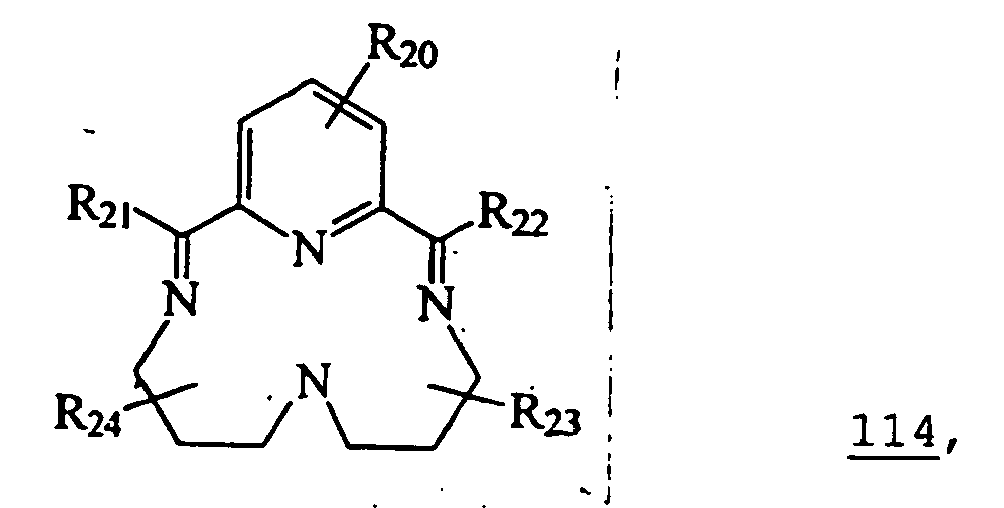
wherein
R21 and R22 each represent hydrogen, halogens, unsubstituted or substituted alkyls, unsubstituted or substituted alkenyls, unsubstituted or substituted alkynyls, hydroxyl, amino, nitro, thiol, amines, imines, amides, phosphonates, phosphines, carbonyls, carboxyls, silyls, ethers, thioethers, sulfonyls, selenoethers, ketones, aldehydes, esters, or - (CH2)m-R7;
R20 is absent or represents one or more substituents of the pyridine to which it is attached, each substituent independently selected from the group consisting of halogens, unsubstituted or substituted alkyls, unsubstituted or substituted alkenyls, unsubstituted or substituted alkynyls, hydroxyl, amino, nitro, thiol amines, imines, amides, phosphonates, phosphines, carbonyls, carboxyls, silyls, ethers, thioethers, sulfonyls, selenoethers, ketones, aldehydes, esters, or - (CH2)m-R7;
R23 and R24 each independently are absent or represent one or more substituents of the 1,3-diiminopropyl to which they are attached, each substituent independently selected from the group consisting of halogens, unsubstituted or substituted alkyls, unsubstituted or substituted alkenyls, unsubstituted or substituted alkynyls, hydroxyl, amino, nitro, thiol amines, imines, amides, phosphonates, phosphines, carbonyls, carboxyls, silyls, ethers, thioethers, sulfonyls, selenoethers, ketones, aldehydes, esters, or - (CH2) m-R7;
or any two or more of the R20, R21, R22, R23 and R24 substituents are covalently linked to form a bridging substituent;
R7 represents an aryl, a cycloalkyl, a cycloalkenyl, a heterocycle or a polycycle; and
m is zero or an integer in the range of 1 to 8, wherein the substituents R20, R21, R22, R23 and R24 are selected such that the catalyst is asymmetric; a chiral ligand represented by the formula 116:
in which
each of the substituents Q8 independently, are absent or represent hydrogen or a C1-C10 alkyl, and each of R25, R26, R27 and R28, independently, represent one or more substituents on the ethyl or propyl diimine to which they are attached, which substituents are selected from the group hydrogen, halogens, unsubstituted or substituted alkyls, unsubstituted or substituted alkenyls, unsubstituted or substituted alkynyls, hydroxyl, amino, nitro, thiol, amines, imines, amides, phosphonates, phosphines, carbonyls, carboxyls, silyls, ethers, thioethers, sulfonyls, selenoethers, ketones, aldehydes, esters, and - (CH2)mR7; or any two or more of the substituents taken together form a bridging substituent;
R7 represents an aryl, a cycloalkyl, a cycloalkenyl, a heterocycle or a polycycle; and
m is zero or an integer in the range of 1 to 8,
wherein the substituents are selected such that the catalyst is asymmetric;
and a chiral crown ether. - The process of claim 1, wherein the tetradentate ligand has at least one schiff base complexed with the metal atom.
- The process of claim 1, wherein the chiral catalyst has a molecular weight of less than 10,000 a.m.u.
- The process of claim 1, wherein the substrate is represented by the general formula 118:
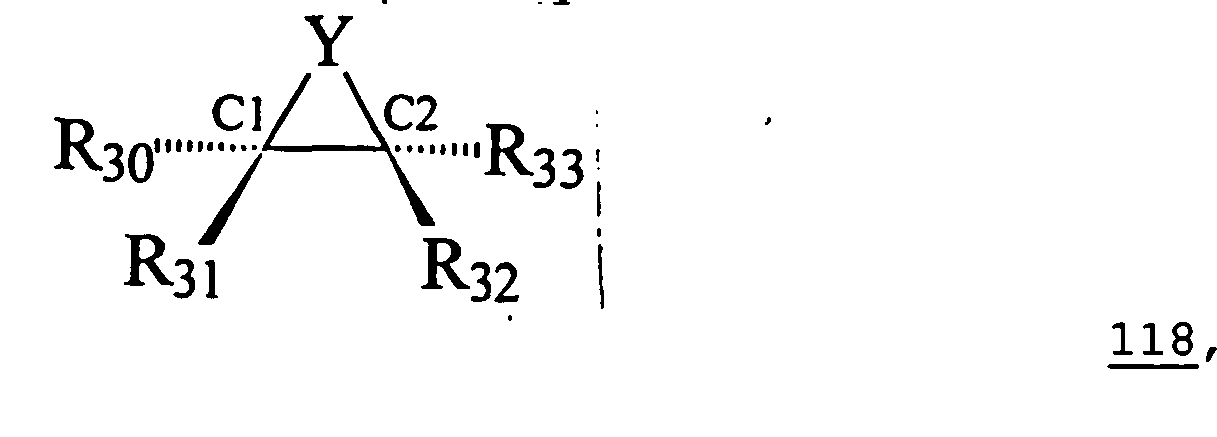
in which
Y represents O, S, N (R50), C(R52) (R54), or has the formula A-B-C; wherein R50 represents a hydrogen, an unsubstituted or substituted alkyl, a carbonyl-substituted alkyl, a carbonyl-substituted aryl, or a sulfonate, R52 and R54 each independently represent an electron-withdrawing group; A and C are independently absent, or represent a C1-C5 unsubstituted or substituted alkyl, O, S, carbonyl, or N (R50) ; and B is a carbonyl, a thiocarbonyl, a phosphoryl, or a sulfonyl; and
R30, R31, R32, and R33 represent organic or inorganic substituent which form a covalent bond with the C1 or C2 carbon atoms of 118, and which permit formation of a stable ring structure including Y. - The process of claim 8, wherein the substituents R30, R31, R32 and R33 each independently represent hydrogen, halogens, unsubstituted or substituted alkynyls, unsubstituted or substituted alkenyls, unsubstituted or substituted alkynyls, hydroxyl, amino, nitro, thiol, amines, imines, amides, phosphoryls, phosphonates, phosphines, carbonyls, carboxyls, silyls, ethers, thioethers, sulfonyls, selenoethers, ketones, aldehydes, esters, or -(CH2)m-R7;
or any two or more of the substituents R30, R31, R32 and R33 taken together form a carbocylic or heterocyclic ring having from 4 to 8 atoms in the ring structure;
R7 represents an aryl, a cycloalkyl, a cycloalkenyl, a heterocycle or a polycycle; and m is zero or an integer in the range of 1 to 8. - The process of claim 8, wherein R30, R31, R32 and R33 are chosen such that the substrate has a plane of symmetry.
- The process of claim 1, wherein the cyclic substrate is selected from the group consisting of epoxides, aziridines, episulfides, cyclopropanes, cyclic carbonates, cyclic thiocarbonates, cyclic sulfates, cyclic anhydrides, cyclic phosphates, cyclic ureas, cyclic thioureas, lactams, thiolactams, lactones, thiolactones and sultones.
- The process of claim 1, wherein the catalyst is immobilized on an insoluble matrix.
- The process of claim 1, which process is an enantioselective reaction.
- The process of claim 1, which process is a diastereoselective reaction.
- The process of claim 14, which diastereoselective reaction is a kinetic resolution reaction.
- A process of stereoselective chemical synthesis which comprises reacting a nucleophile and a chiral or prochiral cyclic substrate in the presence of a non-racemic chiral catalyst to produce a steriosomerically enriched product, wherein said cyclic substrate comprises a carbocycle or heterocycle having a reactive center susceptible to nucleophilic attack by said nucleophile, and said chiral catalyst comprises an asymmetric tridentate ligand complexed with a transition metal atom, which complex has a planar geometry.
- A stereoselective ring opening process which comprises
combining a nucelophilic reactant, a prochiral or chiral cyclic substrate, and a non-racemic chiral catalyst, wherein said cyclic substrate comprises a carbocycle or heterocycle having an electrophilic atom susceptible to attack by said nucleophile, and said chiral catalyst comprises a chiral tetradentate or tridentate ligand having at least one schiff base nitrogen complexed with a transition metal which is not in its highest state of oxidation; and
maintaining the combination under conditions appropriate for said chiral catalyst to catalyse stereoselective opening of said cyclic substrate at said electrophilic atom by reaction with said nucelophilic reactant. - The process of claim 17, wherein the metal is selected from Group 5-12 transition metals.
- The process of claim 17, wherein the metal is a Group 6 transition metal.
- The process of claim 17, wherein the metal atom is selected from the group consisting of Cr, Mn, V, Fe, Mo, W, Ru and Ni.
- The process of claim 17, wherein the catalyst is represented by the general formula:

in which
the substituents R1, R2, Y1, Y2, X1, X2, X3 and X4 each, independently, represent hydrogen, halogens, unsubstituted or substituted alkyls, unsubstituted or substituted alkenyls, unsubstituted or substituted alkynyls, hydroxyl, amino, nitro, thiol, amines, imines, amides, phosphoryls, phosphonates, phosphines, carbonyls, carboxyls, silyls, ethers, thioethers, sulfonyls, selenoethers, ketones, aldehydes, esters, or -(CH2)m-R7;
or any two or more of the substituents taken together form a carbocycle or heterocycle ring having from 4 to 8 atoms in the ring structure,
with the proviso that at least one of R1, Y1, X1 and X2 is covalently bonded to at least one of R2, Y2, X3 and X4 to provide the β-iminocarbonyls to which they are attached as a tetradentate ligand, and at least one of Y1 and Y2 is a hydrogen;
R7 represents an aryl, a cycloalkyl, a cycloalkenyl, a heterocycle or a polycycle;
m is zero or an integer in the range of 1 to 8;
M represents the late transition metal; and
A represents a counterion or a nucelophile,
wherein each of the substituents R1, R2, Y1, Y2, X1, X2, X3 and X4 are selected such that the catalyst is asymmetric. - The process of claim 17, wherein the substrate is represented by the general formula:

in which
Y represents O, S, N(R50), C(R52) (R54), or has the formula A-B-C; wherein R50 represents a hydrogen, an unsubstituted or substituted alkyl, a carbonyl-substituted alkyl, a carbonyl-substituted aryl, or a sulfonate, R52 and R54 each independently represent an electron-withdrawing group; A and C are independently absent, or represent a C1-C5 alkyl, O, S, carbonyl, or N(R50); and B is a carbonyl, a thiocarbonyl, a phosphoryl, or a sulfonyl; and
R30, R31, R32, and R33 represent organic or inorganic substituent which form a covalent bond with the C1 or C2 carbon atoms of 118, and which permit formation of a stable ring structure including Y. - The process of claim 22, wherein the substituents R30, R31, R32, and R33 each independently represent hydrogen, halogens, unsubstituted or substituted alkyls, unsubstituted or substituted alkenyls, unsubstituted or substituted alkynyls, hydroxyl, amino, nitro, thiol, amines, imines, amides, phosphoryls, phosphonates, phosphines, carbonyls, carboxyls, silyls, ethers, thioethers, sulfonyls, selenoethers, ketones, aldehydes, esters, or -(CH2)m-R7;
or any two or more of the substituents R30, R31, R32, and R33 taken together form a carbocycle or heterocycle having from 4 to 8 atoms in the ring structure;
R7 represents an aryl, a cycloalkyl, a cycloalkenyl, a heterocycle or a polycycle; and m is zero or an integer in the range of 1 to 8. - The process of claim 22, wherein R30, R31, R32, and R33 are chosen such that the substrate has a plane of symmetry.
- The process of claim 17, wherein the cyclic substrate is selected from the group consisting of epoxides, aziridines, episulfides, cyclopropanes, cyclic carbonates, cyclic thiocarbonates, cyclic sulfates, cyclic anhydrides, cyclic phosphates, cyclic ureas, cyclic thioureas, lactams, lactones, thiolactones and sultones.
- The process of claim 17 or claim 25 which process is an enantioselective ring opening.
- The process of claim 17 or claim 25, which process is a diastereoselective ring opening.
- The process of claim 27, which diastereoselective ring opening produces a kinetic resolution.
- The process of claim 17, wherein the chiral catalyst has a molecular weight of less than 10,000 a.m.u.
- A method for catalysing a stereoselective ring opening reaction which comprises
combining a nucleophile, a prochiral or chiral cyclic substrate, and a non-racemic chiral catalyst, wherein said cyclic substrate comprises a carbocycle or heterocycle having an reactive centre susceptible to attack by said nucleophile, and said chiral catalyst comprises a chiral tetradentate ligand complexed with a transition metal which is not in its highest state of oxidation; and
maintaining the combination under conditions appropriate for said chiral catalyst to catalyse stereoselective opening of said cyclic substrate at said reactive center by nucelophile attack by the said nucleophile. - The method of claim 30, wherein the chiral catalyst is represented by the general formula:

in which
Z1, Z2, Z3 and Z4 each represent a Lewis base;
The C1 moiety, taken with Z1, Z3 and M, and the C2 moiety, taken with Z2, Z4 and M, each, independently, form a heterocycle;
R1, R2, R'1, and R'2 each, independently, are absent or represent a covalent substitution with an organic or inorganic substituent permitted by valence requirements of the electron donor atom to which it is attached,
R40 and R41 each independently are absent, or represent one or more covalent substitutions of C1 and C2 with an organic or inorganic substituent permitted by valence requirements of the ring atom to which it is attached,
or any two or more of the R1, R2, R'1, R'2, R40 and R41 taken together form a bridging substituent;
with the proviso that C1 is substituted at least one site by R1, R'1, or R41, and C2 is substituted at at least one site by R2, R'2, or R40, and
at least one of R1, R' 1, and R41 is taken together with at least one of R2, R' 2, and R40 to form a bridging substituent so as to provide Z1, Z2, Z3 and Z4 as a tetradentate;
M represents a transition metal; and
A represents a counterion or a nucleophile, wherein each R1, R2, R'1, R'2, R40 and R41 are selected to provide at least one stereogenic center in said tetradentate ligand. - The method of claim 31, wherein R1, R2, R'1, and R'2, independently, represent hydrogen, halogens, unsubstituted or substituted alkyls, unsubstituted or substituted alkenyls, unsubstituted or substituted alkynyls, hydroxyl, amino, nitro, thiol, amines, imines, amides, phosphoryls, phosphonates, phosphines, carbonyls, carboxyls, silyls, ethers, thioethers, sulfonyls, selenoethers, ketones, aldehydes, esters, or -(CH2)m-R7;
each R40 and R41 occurring in 100 independently represent hydrogen, halogens, unsubstituted or substituted alkyls, unsubstituted or substituted alkenyls, unsubstituted or substituted alkynyls, hydroxyl, amino, nitro, thiol, amines, imines, amides, phosphoryls, phosphonates, phosphines, carbonyls, carboxyls, silyls, ethers, thioethers, sulfonyls, selenoethers, ketones, aldehydes, esters, or -(CH2)m-R7;
R7 represents an aryl, a cycloalkyl, a cycloalkenyl, a heterocycle or a polycycle; and m is zero or an integer in the range of 1 to 8. - The method of claim 31, wherein each Z1, Z2, Z3, and Z4, are independently selected from the group consisting of nitrogen, oxygen, phosphorus, arsenic and sulfur.
- The method of claim 31, wherein the M represents a transition metal from one of the Group 5-12 transition metals.
- The method of claim 30, wherein the metal atom is selected from the group consisting of Cr, Mn, V, Fe, Mo, W, Ru and Ni.
- The method of claim 31, wherein the M is group 6 transition metal.
- The method of claim 36, wherein the M is Cr(III).
- The method of claim 30, wherein the tetradentate ligand is selected from the group consisting of a chiral ligand represented by the formula 102:

in which R1, R2, Y1, Y2, X1, X2, X3 and X4 each, independently, represent hydrogen, halogens, unsubstituted or substituted alkyls, unsubstituted or substituted alkenyls, unsubstituted or substituted alkynyls, hydroxyl, amino, nitro, thiol, amines, imines, amides, phosphonates, phosphines, carbonyls, carboxyls, silyls, ethers, thioethers, sulfonyls, selenoethers, ketones, aldehydes, esters, or -(CH2)m-R7,
or any two or more of the substients taken together form a carbocycle or heterocycle having from 4 to 8 atoms in the ring structure,
with the proviso that at least one of R1, Y1, X1 and X2 is covalently bonded to at least one of R2, Y2, X3 and X4 to provide the β-iminocarbonyls as a tetradentate ligand;
R7 represents an aryl, a cycloalkyl, a cycloalkenyl, a heterocycle, or a polycycle;
m is zero or an integer in the range of 1 to 8;
M represents a transition metal; and
A represents a counterion or a nucleophile;
wherein each of the substituents R1, R2, Y1, Y2, X1, X2, X3 and X4 are selected such that the catalyst is asymmetric;
a chiral ligand represented by the formula 108:
in which
D1, D2, D3 and D4 each represent heterocycles;
each R18 occurring in the structure represents a bridging substituent which links adjacent heterocycles;
each R19, independently, is absent or represents one or more substituents of the heterocycle to which it is attached, each substituent independently selected from the group consisting of halogens, unsubstituted or substituted alkyls, unsubstituted or substituted alkenyls, unsubstituted or substituted alkynyls, hydroxyl, amino, nitro, thiol, amines, imines, amides, phosphonates, phosphines, carbonyls, carboxyls, silyls, ethers, thioethers, sulfonyls, selenoethers, ketones, aldehydes, esters, and -(CH2)m-R7;
or any two or more of the R18 and R19 substituents are covalently linked to form a bridge substitution;
R7 represents an aryl, a cycloalkyl, a cycloalkenyl, a heterocycle or a polycycle;
m is zero or an integer in the range of 1 to 8; and
M represents a transition metal,
wherein each of the substituents R18 and R19 are selected such that the catalyst is asymmetric;
a chiral ligand represented by the Formula 112:
in which
each of the substituents R1, R2, R3, R4, R5, R11, R12, R13 and R14, independently, represent hydrogen, halogens, unsubstituted or substituted alkyls, unsubstituted or substituted alkenyls, unsubstituted or substituted alkynyls, hydroxyl, amino, nitro, thiol, amines, imines, amides, phosphonates, phosphines, carbonyls, carboxyls, silyls, ethers, thioethers, sulfonyls, selenoethers, ketones, aldehydes, esters, or - (CH2) m-R7,
or any two or more of the substituents taken together form a carbocycle or heterocycle having at least 4 atoms in the ring structure;
R7 represents an aryl, a cycloalkyl, a cycloalkenyl, a heterocycle, or a polycycle;
m is zero or an integer in the range of 1 to 8; and
M represents a transition metal;
wherein
if R5 is absent, at least one of R1, and R2 is covalently bonded to at least one of R3 and R4, and
the substituents are selected such that the catalyst is asymmetric;
a chiral ligand represented by the Formula 114:
wherein
R21 and R22 each represent hydrogen, halogens, unsubstituted or substituted alkyls, unsubstituted or substituted alkenyls, unsubstituted or substituted alkynyls, hydroxyl, amino, nitro, thiol, amines, imines, amides, phosphonates, phosphines, carbonyls, carboxyls, silyls, ethers, thioethers, sulfonyls, selenoethers, ketones, aldehydes, esters, or -(CH2)m-R7;
R20 is absent or represents one or more substituents of the pyridine to which it is attached, each substituent independently selected from the group consisting of halogens, unsubstituted or substituted alkyls, unsubstituted or substituted alkenyls, unsubstituted or substituted alkynyls, hydroxyl, amino, nitro, thiol amines, imines, amides, phosphonates, phosphines, carbonyls, carboxyls, silyls, ethers, thioethers, sulfonyls, selenoethers, ketones, aldehydes, esters, or - (CH2)m-R7;
R23 and R24 each independently are absent or represent one or more substituents of the 1,3-diiminopropyl to which they are attached, each substituent independently selected from the group consisting of halogens, unsubstituted or substituted alkyls, unsubstituted or substituted alkenyls, unsubstituted or substituted alkynyls, hydroxyl, amino, nitro, thiol amines, imines, amides, phosphonates, phosphines, carbonyls, carboxyls, silyls, ethers, thioethers, sulfonyls, selenoethers, ketones, aldehydes, esters, or -(CH2)m-R7;
or any two or more of the R20, R21, R22, R23 and R24 substituents are covalently linked to form a bridging substituent;
R7 represents an aryl, a cycloalkyl, a cycloalkenyl, a heterocycle or a polycycle; and
m is zero or an integer in the range of 1 to 8, wherein the substituents R20, R21, R22, R23 and R24 are selected such that the catalyst is asymmetric; a chiral ligand represented by the Formula 116:
in which
each of the substituents Q8 independently, are absent or represent hydrogen or a C1-C10 alkyl, and each of R25, R26, R27 and R28, independently, represent one or more substituents on the ethyl or propyl diimine to which they are attached, which substituents are selected from the group hydrogen, halogens, unsubstituted or substituted alkyls, unsubstituted or substituted alkenyls, unsubstituted or substituted alkynyls, hydroxyl, amino, nitro, thiol, amines, imines, amides, phosphonates, phosphines, carbonyls, carboxyls, silyls, ethers, thioethers, sulfonyls, selenoethers, ketones, aldehydes, esters, and - (CH2)m-R7;
or any two or more of the substituents taken together form a bridging substituent;
R7 represents an aryl, a cycloalkyl, a cycloalkenyl, a heterocycle or a polycycle; and
m is zero or an integer in the range of 1 to 8,
wherein the substituents are selected such that the catalyst is asymmetric. - The method of claim 30, wherein the substrate is represented by the general formula:

in which
Y represents O, S, N(R50), C(R52) (R54) or has the formula A-B-C; wherein R50 represents a hydrogen, an alkyl, a carbonyl-substituted alkyl, a carbonyl-substituted aryl, or a sulfonate, R52 and R54 each independently represent an electron-withdrawing group; A and C are independently absent, or represent a C1-C5 alkyl, O, S, carbonyl, or N (R50) ; and B is a carbonyl, a thiocarbonyl, a phosphoryl, or a sulfonyl; and R30, R31, R32 and R33 represent organic or inorganic substituent which form a covalent bond with the C1 or C2 carbon atoms of 118, and which permit formation of a stable ring structure including Y. - The method of claim 39, wherein the substituents R30, R31, R32 and R33 each independently represent hydrogen, halogens, unsubstituted or substituted alkyls, unsubstituted or substituted alkenyls, unsubstituted or substituted alkynyls, hydroxyl, amino, nitro, thiol, amines, imines, amides, phosphoryls, phosphonates, phosphines, carbonyls, carboxyls, silyls, ethers, thioethers, sulfonyls, selenoethers, ketones, aldehydes, esters, or - (CH2)m-R7;
or any two or more of the substituents R30, R31, R32 and R33 taken together form a carbocycle or heterocycle having from 4 to 8 atoms in the ring structure;
R7 represents an aryl, a cycloalkyl, a cycloalkenyl, a heterocycle or a polycycle; and
m is zero or an integer in the range of 1 to 8. - The method of claim 39 wherein R30, R31, R32 and R33 are chosen such that the substrate has a plane of symmetry.
- The method of claim 39, wherein the substrate is selected from the group consisting of epoxides, aziridines, episulfides, cyclopropanes, cyclic carbonates, cyclic thiocarbonates, cyclic sulfates, cyclic anhydrides, cyclic phosphates, cyclic ureas, cyclic thioureas, lactams, thiolactams, lactones, thiolactones and sultones.
- A method for catalysing a stereoselective ring opening reaction which comprises
combining a nucleophile, a prochiral or chiral cyclic substrate, and a non-racemic chiral catalyst, wherein said cyclic substrate substrate comprises a carbocycle or heterocycle having an reactive center susceptible to attack by said nucleophile, and said chiral catalyst comprises a chiral tridentate ligand complexed with a transition metal which is not in its highest state of oxidation; and
maintaining the combination under conditions appropriate for said chiral catalyst to catalyse stereoselective opening of said cyclic substrate at said reactive center by nucelophilic attack by the said nucelophile. - The method of claim 43, wherein the chiral tridentate ligand of the chiral catalyst is represented by the general formula:

in which
Z1, Z2 and Z3 each represent a Lewis base;
the E1 moiety, taken with Z1, Z2 and M, and the E2 moiety, taken with Z2, Z3 and M, each, independently, form a heterocycle;
R80 and R81 each independently are absent, hydrogen, halogens, unsubstituted or substituted alkyls, unsubstituted or substituted alkenyls, unsubstituted or substituted alkynyls, hydroxyl, amino, nitro, thiol, amines, imines, amides, phosphonates, phosphines, carbonyls, carboxyls, silyls, ethers, thioethers, sulfonyls, selenoethers, ketones, aldehydes, esters, or - (CH2) m - R7 , or any two or more of the R80 and R81 substituents taken together form a bridging substituent;
R7 represents an aryl, a cycloalkyl, a cycloalkenyl, a heterocycle or a polycycle;
m is zero or an integer in the range of 1 to 8;
M represents a transition metal; and wherein the tridentate ligand is asymmetric. - The method of claim 44, wherein the chiral tridentate ligand of the chiral catalyst is represented by the general formula:

wherein R106 represents a hydrogen, halogens, unsubstituted or substituted alkyls, unsubstituted or substituted alkenyls, unsubstituted or substituted alkynyls, hydroxyl, amino, nitro, thiol, amine, imine, amide, phosphonate, phosphine, carbonyl, carboxyl, silyl, ether, thioether, sulfonyl, selenoether, ketone, aldehyde, ester, or - (CH2) m-R7, each of R112 and R'112 is absent or represent one or more covalent substitutions of the heterocycle to which it is attached; R7 represents an aryl, a cycloalkyl, a cycloalkenyl, a heterocycle or a polycycle; and m is zero or an integer in the range of 1 to 8. - A method for synthesis of enantimomerically enriched chiral compounds, comprising reacting a nucleophile with a prochiral or chiral cyclic substrate in the presence of a non-racemic chiral catalyst, and under conditions which said chiral catalyst catalyses enantioselective opening of said cyclic substrate by nucleophile attach of the cyclic substrate by the nucleophile to produce a product which is enantiomerically enriched relative to a racemic mixture produced in the absence of said chiral catalyst, wherein the chiral cyclic substrate is represented by the general formula:

in which
Y represents O, S, N(R50), C (R52) (R54), or has the formula A-B-C; wherein R50 represents a hydrogen, an alkyl, a carbonyl-substituted alkyl, a carbonyl-substituted aryl, or a sulfonate, R52 and R54 each independently represent an electron-withdrawing group; A and C are independently absent, or represent a C1-C5 alkyl, O, S, carbonyl, or N(R50) ; and B is a carbonyl, a thiocarbonyl, a phosphoryl, or a sulfonyl; and
R30, R31, R32, and R33 represent organic or inorganic substituent which form a covalent bond with the C1 or C2 carbon atoms of 118, and which permit formation of a stable ring structure including Y; and the chiral catalyst is represented by the general formula:
the substituents R1, R2, Y1, Y2, X1, X2, X3 and X4 each, independently, represent hydrogen, halogens, unsubstituted or substituted alkyls, unsubstituted or substituted alkenyls, unsubstituted or substituted alkynyls, hydroxyl, amino, nitro, thiol, amines, imines, amides, phosphoryls, phosphonates, phosphines, carbonyls, carboxyls, silyls, ethers, thioethers, sulfonyls, selenoethers, ketones, aldehydes, esters, or -(CH2)m-R7,
or any two or more of the substituents taken together form a carbocycle or heterocycle ring having from 4 to 8 atoms in the ring structure,
with the proviso that at least one of R1, Y1, X1 and X2 is covalently bonded to at least of R2, Y2, X3 and X4 to provide the β-iminocarbonyls to which they are attached as a tetradentate ligand, and at least one of Y1 and Y2 is a hydrogen;
R7 represents an aryl, a cycloalkyl, a cycloalkenyl, a heterocycle or a polycycle;
m is zero or an integer in the range of 1 to 8;
M represents a transition metal; and
A represents a counterion or a nucleophile,
wherein each of the substituents R1, R2, Y1, Y2, X1, X2, X3 and X4 are selected such that the catalyst is asymmetric. - The method of claim 46, wherein the M represents a transition metal selected from one of the Group 5-12 transition metals, which metal is not in its highest oxidation state.
- The method of claim 47, wherein the metal atom is selected from the group consisting of Cr, Mn, V, Fe, Mo, W, Ru and Ni.
- The method of claim 46, wherein the M is Group transition metal.
- The method of claim 49 wherein the M is Cr(III).
- The method of claim 46, wherein the catalyst is represented by the general formula 104:
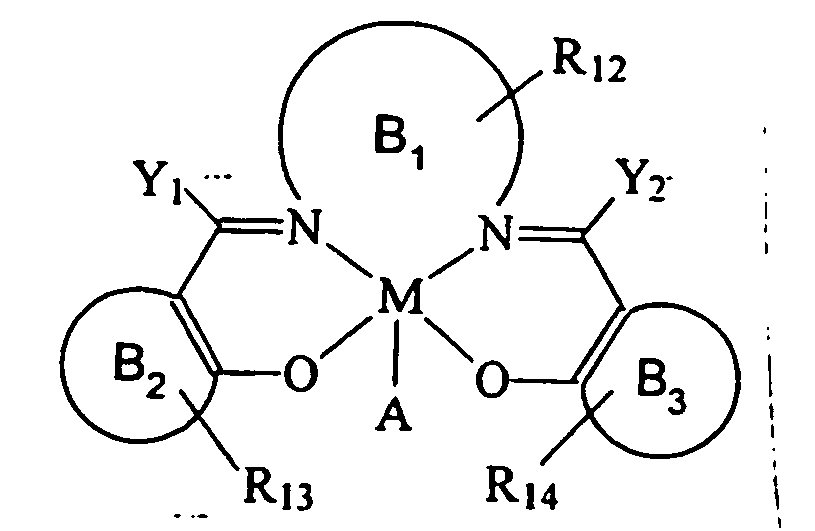
in which
the B1 moiety represents a diimine bridging substituent represented by -R15-R16-R17-, wherein R15 and R17 each independently are absent or represent an unsubstituted or substituted alkyl, an unsubstituted or substituted alkenyl, or an unsubstituted or substituted alkynyl, and R16 is absent or represents an amine, an imine, an amide, a phosphoryl, a carbonyl, a silyl, an oxygen, a sulfur, a sulfonyl, a selenium, a carbonyl, or an ester;
each of B2 and B3 independently represent rings selected from a group consisting of cycloalkyls, cycloakenyls, aryls, and heterocyclic rings, which rings comprising from 4 to 8 atoms in a ring structure;
Y1 and Y2 each independently, represent hydrogen, halogens, unsubstituted or substituted alkyls, unsubstituted or substituted alkenyls, unsubstituted or substituted alkynyls, hydroxyl, amino, nitro, thiol, amines, imines, amides, phosphoryls, phosphonates, phosphines, carbonyls, carboxyls, silyls, ethers, thioethers, sulfonyls, selenoethers, ketones, aldehydes, esters, or - (CH2)m-R7,
R12, R13, and R14 each independently are absent, or represent one or more covalent substitutions of B1, B2 and B3 with halogens, unsubstituted or substituted alkyls, unsubstituted or substituted alkenyls, unsubstituted or substituted alkynyls, hydroxyl, amino, nitro, thiol, amines, imines, amides, phosphoryls, phosphonates, phosphines, carbonyls, carboxyls, silyls, ethers, thioethers, sulfonyls, selenoethers, ketones, aldehydes, esters, or - (CH2)m-R7, wherein R12 can occur on one or more positions of -R15-R16-R17-,
or any two or more of the R12, R13, R14, Y1 and Y2 taken together form a bridging substituent;
R7 represents an aryl, a cycloalkyl, a cycloalkenyl, a heterocycle or a polycycle;
m is zero or an integer in the range of 1 to 8;
M represents a transition metal; and
A represents a counterion or a nucleophile,
wherein R12, R13, R14, Y1 and Y2, are selected such that the catalyst is asymmetric. - The method of claim 46, wherein the substituents R30, R31, R32, and R33 each independently represent hydrogen, halogens, unsubstituted or substituted alkyls, unsubstituted or substituted alkenyls, unsubstituted or substituted alkynyls, hydroxyl, amino, nitro, thiol, amines, imines, amides, phosphoryls, phosphonates, phosphines, carbonyls, carboxyls, silyls, ethers, thioethers, sulfonyls, selenoethers, ketones, aldehydes, esters, or -(CH2)m-R7;
or any two or more of the substituents R30, R31, R32, and R33 taken together form a carbocycle or heterocycle having from 4 to 8 atoms in the ring structure;
R7 represents an aryl, a cycloalkyl, a cycloalkenyl, a heterocycle or a polycycle; and
m is zero or an integer in the range of 1 to 8; - The method of claim 46 wherein R30, R31, R32, and R33 are chosen such that the substrate has a plane of symmetry.
- The method of claim 46 wherein the cyclic substrate is selected from the group consisting of epoxides, aziridines, episulfides, cyclopropanes, cyclic carbonates, cyclic thiocarbonates, cyclic sulfates, cyclic anhydrides, cyclic phosphates, cyclic ureas, cyclic thioureas, lactams, thiolactams, lactones, thiolactones and sultones.
- The method of claim 46 which process is an enantiselective ring opening.
- The method of claim 46 which process is a diasterselctive ring opening.
- The method of claim 56, which diastereoselective ring opening produces a kinetic resolution.
- A method of stereoselectively opening a ring of a cyclic compound of the general formula:

in which
Y represents O, S, N(R50), C (R52) (R54) or has the formula A-B-C; wherein R50 represents a hydrogen, an unsubstituted or substituted alkyl, a carbonyl-substituted alkyl, a carbonyl-substituted aryl, or a sulfonate, R52 and R54 each independently represent an electron-withdrawing group; A and C are independently absent, or represent a C1-C5 alkyl, O, S, carbonyl, or N(R50); and B is a carbonyl, a thiocarbonyl, a phosphoryl, or a sulfonyl; and
R30, R31, R32, and R33 represent organic or inorganic substituent which form a covalent bond with the C1 or C2 carbon atoms of 118, and which permit formation of a stable ring structure including Y;
which method comprises reacting a nucleophile with said cyclic compound in the presence of at least a catalytic amount of a non-racemic chiral metallosalenate catalyst comprising a transition metal atom and a tetradentate asymmetric salen ligand. - The method of claim 58, wherein the metallosalenate catalyst is represented by the general formula:

in which
each of the substituents R1, R2, R3, R4, Y1, Y2, X1, X2, X3, X4, X5, X6, X7 and X8, independently, represent hydrogen, halogens, unsubstituted or substituted alkyls, unsubstituted or substituted alkenyls, unsubstituted or substituted alkynyls, hydroxyl, amino, nitro, thiol, amines, imines, amides, phosphoryls, phosphonates, phosphines, carbonyls, carboxyls, silyls, ethers, thioethers, sulfonyls, selenoethers, ketones, aldehydes, esters, or - (CH2)m-R7;
R5 is a divalent radical derived from unsubstituted or substituted alkyls, unsubstituted or substituted alkenyls, unsubstituted or substituted alkynyls, amines, imines, amides, phosphoryls, phosphonates, phosphines, carbonyls, carboxyls, silyls, ethers, thioethers, sulfonyls, selenoethers, ketones, aldehydes, esters;
or any two or more of the substituents taken together form a carbocycle or heterocycle having from 4 to 10 atoms in the ring structure;
R7 represents an aryl, a cycloalkyl, a cycloalkenyl, a heterocycle or a polycycle;
m is zero or an integer in the range of 1 to 8;
M represents a transition metal; and
A represents a counterion or a nucleophile;
wherein
each of the substituents of 106 are selected such that the salenate is asymmetric. - The method of claim 58, wherein the substituents R30, R31, R32 and R33 each independently represent hydrogen, halogens, unsubstituted or substituted alkyls, unsubstituted or substituted alkenyls, unsubstituted or substituted alkynyls, hydroxyl, amino, nitro, thiol, amines, imines, amides, phosphoryls, phosphonates, phosphines, carbonyls, carboxyls, silyls, ethers, thioethers, sulfonyls, selenoethers, ketones, aldehydes, esters, or -(CH2)m-R7 ;
or any two or more of the substituents R30, R31, R32 and R33 taken together form a carbocycle or heterocycle having from 4 to 8 atoms in the ring structure;
R7 represents an aryl, a cycloalkyl, a cycloalkenyl, a heterocycle or a polycycle; and m is zero or an integer in the range of 1 to 8. - The method of claim 58, wherein R30, R31, R32 and R33 are chosen such that the substrate has a plane of symmetry.
- The method of claim 58, wherein the substrate is selected from the group consisting of epoxides, aziridines, episulfides, cyclopropanes, cyclic carbonates, cyclic thiocarbonates, cyclic sulfates, cyclic anhydrides, cyclic phosphates, cyclic ureas, cyclic thioureas, lactams, thiolactams, lactones, thiolactones and sultones.
- The method of claim 59, wherein the M represents a transition metal from one of the Group 5-12 transition metals.
- The method of claim 63, wherein the metal atom is selected from the group consisting of Cr, Mn, V, Fe, Mo, W, Ru and Ni.
- The method of claim 59, wherein the M is Group 6 transition metal.
- The method of claim 65, wherein the M is Cr (III).
- The method of claim 58, which process is an enantioselective ring opening.
- The method of claim 58, which process is a diastereoselective ring opening.
- The method of claim 68, which diastereoselective ring opening produces a kinetic resolution.
- A method of resolving enatiomers from a racemic mixture of a chiral cyclic compound having the general form:

in which
Y represents O, S, N(R50), C(R52) (R54), or has the formula A-B-C; wherein R50 represents a hydrogen, an unsubstituted or substituted alkyl, a carbonyl-substituted alkyl, a carbonyl-substituted aryl, or a sulfonate, R52 and R54 each independently represent an electron-withdrawing group; A and C are independently absent, or represent a C1-C5 alkyl, O, S, carbonyl, or N(R50); and B is a carbonyl, a thiocarbonyl, a phosphoryl, or a sulfonyl ; and
R30, R31, R32, and R33 represent organic or inorganic substituent which form a covalent bond with the C1 or C2 carbon atoms of 118, and which permit formation of a stable ring structure including Y;
the method comprising contacting a mixture of the compound and its enantiomer with a nucleophile able to react with the ring structure in the presence of a non-racemic chiral catalyst having the form:
in which
Z1, Z2, Z3 and Z4 each represent a Lewis base;
the C1 moiety, taken with Z1, Z3 and M, and the C2 moiety, taken with Z2, Z4 and M, each, independently, form a heterocycle;
R1, R2, R'1 and R'2 each, independently, are absent or represent a covalent substitution with an organic or inorganic substituent permitted by valence requirements of the electron donor atom to which it is attached,
R40 and R41 each independently are absent, or represent one or more covalent substitutions of C1 and C2 with an organic or inorganic substituent permitted by valence requirements of the ring atom to which it is attached,
or any two or more of the R1, R2, R'1, R'2, R40 and R41 taken together form a bridging substituent;
with the proviso that C1 is substituted at at least one site by R1, R'1, or R41, and C2 is substituted at at least one site by R2, R'2 or R40, and
at least one of R1, R'1, and R41, is taken together with at least one of R2, R'2 and R40 to form a bridging substituent so as to provide Z1, Z2, Z3 and Z4 as a tetradentate;
M represents a transition metal; and
A represents a counterion or a nucleophile,
wherein each R1, R2, R'1, R'2, R40 and R41, are selected to provide at least one stereogenic centre in said tetradentate ligand,
under conditions wherein the ring of one enantiomer is selectively opened leaving the other enantiomer substantially unchanged. - The method of claim 70, wherein R1, R2, R'1 and R'2, independently, represent hydrogen, halogens, unsubstituted or substituted alkyls, unsubstituted or substituted alkenyls, unsubstituted or substituted alkynyls, hydroxyl, amino, nitro, thiol, amines, imines, amides, phosphoryls, phosphonates, phosphines, carbonyls, carboxyls, silyls, ethers, thioethers, sulfonyls, selenoethers, ketones, aldehydes, esters, or -(CH2)m-R7 ;
each R40 and R41 occurring in 100 independently represent hydrogen, halogens, unsubstituted or substituted alkyls, unsubstituted or substituted alkenyls, unsubstituted or substituted alkynyls, hydroxyl, amino, nitro, thiol, amines, imines, amides, phosphoryls, phosphonates, phosphines, carbonyls, carboxyls, silyls, ethers, thioethers, sulfonyls, selenoethers, ketones, aldehydes, esters, or -(CH2)m-R7;
R7 represents an aryl, a cycloalkyl, a cycloalkenyl, a heterocycle or a polycycle; and m is zero or an integer in the range of 1 to 8. - The method of claim 70, wherein each Z1, Z2, Z3 and Z4 are independently selected from the group consisting of nitrogen, oxygen, phosphorus, arsenic and sulfur.
- A method of stereospecifically expanding a ring of a cyclic compound having the form:

in which
Y represents O, S, N(R50), C(R52) (R54) or has the formula A-B-C; wherein R50 represents a hydrogen, an unsubstituted or substituted alkyl, a carbonyl-substituted alkyl, a carbonyl-substituted aryl, or a sulfonate, R52 and R54 each independently represent an electron-withdrawing group; A and C are independently absent, or represent a C1-C5 alkyl, O, S, carbonyl, or N(R50); and B is a carbonyl, a thiocarbonyl, a phosphoryl, or a sulfonyl; and
R30, R31, R32, and R33 represent organic or inorganic substituent which form a covalent bond with the C1 or C2 carbon atoms of 118, and which permit formation of a stable ring structure including Y;
the method comprising reacting a ring expansion agent with said cyclic compound in the presence of a non-racemic chiral catalyst having the form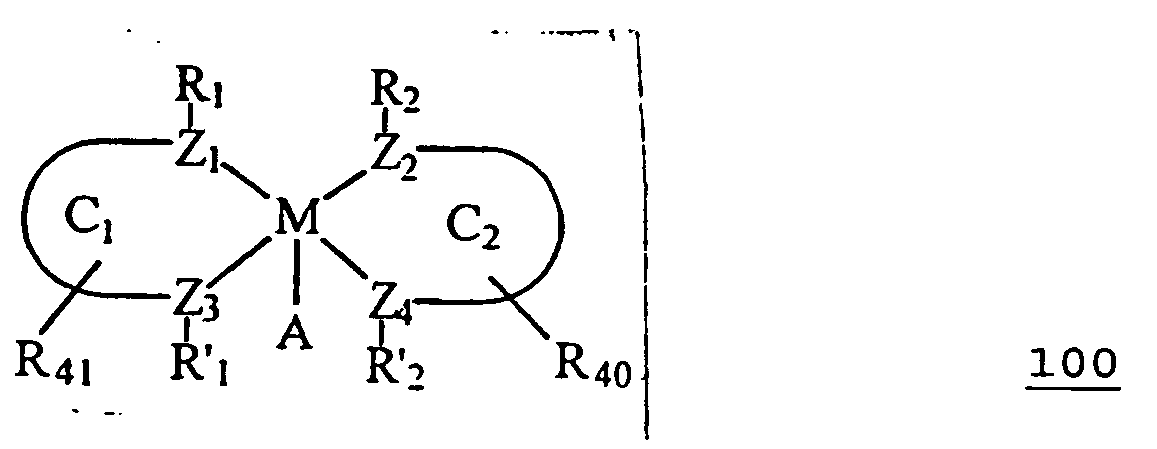
in which
Z1, Z2, Z3 and Z4 each represent a Lewis base;
the C1 moiety, taken with Z1, Z3 and M, and the C2 moiety, taken with Z2, Z4 and M, each, independently, form a heterocycle;
R1, R2, R' 1 and R' 2 each, independently, are absent or represent a covalent substitution with an organic or inorganic substituent permitted by valence requirements of the electron donor atom to which it is attached,
R40 and R41 each independently are absent, or represent one or more covalent substitutions of C1 and C2 with an organic or inorganic substituent permitted by valence requirements of the ring atom to which it is attached,
or any two or more of the R1, R2, R'1, R'2, R40 and R41 taken together form a bridging substituent; with the proviso that C1 is substituted at at least one site by R1, R'1, or R41, and C2 is substituted at at least one site by R2, R' 2 or R40 , and
at least one of R1, R'1, and R41, is taken together with at least one of R2, R'2 and R40 to form a bridging substituent so as to provide Z1, Z2, Z3 and Z4 as a tetradentate;
M represents a transition metal; and
A represents a counterion or a nucleophile,
wherein each R1, R2, R'1, R'2, R40 and R41, are selected to provide at least one stereogenic centre in said tetradentate ligand,
under conditions wherein the ring of one enantiomer is selectively opened leaving the other enantiomer substantially unchanged,
under conditions such that said ring of said cyclic compound is stereoselectively expanded. - The method of claim 73, wherein
R1, R2, R'1, R'2, independently represent hydrogen, halogens, unsubstituted or substituted alkyls, unsubstituted or substituted alkenyls, unsubstituted or substituted alkynyls, hydroxyl, amino, nitro, thiol, amines, imines, amides, phosphoryls, phosphonates, phosphines, carbonyls, carboxyls, silyls, ethers, thioethers, sulfonyls, selenoethers, ketones, aldehydes, esters, or - (CH2) m-R7;
each R40 and R41 occurring in 100 independently represent hydrogen, halogens, unsubstituted or substituted alkyls, unsubstituted or substituted alkenyls, unsubstituted or substituted alkynyls, hydroxyl, amino, nitro, thiol, amines, imines, amides, phosphoryls, phosphonates, phosphines, carbonyls, carboxyls, silyls, ethers, thioethers, sulfonyls, selenoethers, ketones, aldehydes, esters, or -(CH2)m-R7;
R7 represents an aryl, a cycloalkyl, a cycloalkenyl, a heterocycle or a polycycle; and m is zero or an integer in the range of 1 to 8. - The method of claim 73, wherein each Z1, Z2, Z3 and Z4 are independently selected from the group consisting of nitrogen, oxygen, phosphorus, arsenic, and sulfur.
Applications Claiming Priority (3)
| Application Number | Priority Date | Filing Date | Title |
|---|---|---|---|
| US08/403,374 US5665890A (en) | 1995-03-14 | 1995-03-14 | Stereoselective ring opening reactions |
| US403374 | 1995-03-14 | ||
| PCT/US1996/003493 WO1996028402A1 (en) | 1995-03-14 | 1996-03-14 | Stereoselective ring opening reactions |
Publications (2)
| Publication Number | Publication Date |
|---|---|
| EP0817765A1 EP0817765A1 (en) | 1998-01-14 |
| EP0817765B1 true EP0817765B1 (en) | 2006-02-01 |
Family
ID=23595533
Family Applications (1)
| Application Number | Title | Priority Date | Filing Date |
|---|---|---|---|
| EP96910448A Expired - Lifetime EP0817765B1 (en) | 1995-03-14 | 1996-03-14 | Stereoselective ring opening reactions |
Country Status (15)
| Country | Link |
|---|---|
| US (2) | US5665890A (en) |
| EP (1) | EP0817765B1 (en) |
| JP (2) | JP4010562B2 (en) |
| KR (2) | KR100473698B1 (en) |
| AT (1) | ATE316950T1 (en) |
| AU (1) | AU708622B2 (en) |
| CA (1) | CA2213007C (en) |
| CZ (1) | CZ298023B6 (en) |
| DE (1) | DE69635779T2 (en) |
| ES (1) | ES2258268T3 (en) |
| HU (1) | HU225739B1 (en) |
| MX (1) | MX220352B (en) |
| NO (1) | NO974234L (en) |
| PL (1) | PL184857B1 (en) |
| WO (1) | WO1996028402A1 (en) |
Families Citing this family (73)
| Publication number | Priority date | Publication date | Assignee | Title |
|---|---|---|---|---|
| US6262278B1 (en) * | 1995-03-14 | 2001-07-17 | President And Fellows Of Harvard College | Stereoselective ring opening reactions |
| WO1997048694A1 (en) | 1996-06-20 | 1997-12-24 | Board Of Regents, The University Of Texas System | Compounds and methods for providing pharmacologically active preparations and uses thereof |
| TW420693B (en) | 1997-04-25 | 2001-02-01 | Mitsui Chemicals Inc | Olefin polymerization catalysts, transition metal compounds, and <alpha>-olefin/conjugated diene copolymers |
| EP0991468A1 (en) * | 1997-06-20 | 2000-04-12 | Carnegie-Mellon University | Homogeneous oxidation catalysis using metal complexes |
| GB9721559D0 (en) * | 1997-10-11 | 1997-12-10 | Bp Chem Int Ltd | Novel polymerisation catalysts |
| US6211370B1 (en) | 1998-01-13 | 2001-04-03 | Harvard University | Asymmetric cycloaddition reactions |
| US6130340A (en) * | 1998-01-13 | 2000-10-10 | President And Fellows Of Harvard College | Asymmetric cycloaddition reactions |
| US6521561B1 (en) * | 1998-05-01 | 2003-02-18 | President And Fellows Of Harvard College | Main-group metal based asymmetric catalysts and applications thereof |
| TW576843B (en) | 1998-12-25 | 2004-02-21 | Mitsui Chemicals Inc | Olefin polymerization catalyst and process for olefin polymerization using the olefin polymerization catalyst |
| US6162924A (en) * | 1999-04-09 | 2000-12-19 | Eastman Chemical Company | Process for halohydrin preparation |
| US6410746B1 (en) | 1999-04-27 | 2002-06-25 | Research Foundation Of State University Of New York, The | Metal cataltsts and methods for making and using same |
| US6403777B1 (en) * | 1999-07-06 | 2002-06-11 | The Ohio State University Research Foundation | Metalloligands for cleaving nucleic acids |
| KR100508382B1 (en) * | 2000-02-02 | 2005-08-17 | 주식회사 엘지생명과학 | Novel process for the preparation of (5S)-[N-(benzyloxycarbonyl)-amino]-(3S,4R)-epoxy-N-[2-methyl- (1R)-[(phenyl)carbonyl]-propyl]-6-phenylhexanamide |
| WO2001081286A1 (en) * | 2000-04-21 | 2001-11-01 | Rhodia/Chirex, Inc. | Process for preparation of r-1-(aryloxy)propan-2-ol |
| EP1289655B1 (en) * | 2000-05-24 | 2005-12-28 | Rstech Co., Ltd. | A method for preparing chiral compounds from racemic epoxides using chiral salen catalysts |
| WO2002010096A1 (en) * | 2000-07-31 | 2002-02-07 | Brandeis University | Kinetic resolutions of chiral 2- and 3-substituted carboxylic acids |
| US6562967B2 (en) | 2000-07-31 | 2003-05-13 | Brandeis University | Kinetic resolutions of chiral 2-and-3-substituted carboxylic acids |
| KR100386552B1 (en) * | 2000-08-03 | 2003-06-02 | 한국화인케미칼주식회사 | Polymeric chiral salen derivatives useful for asymmetric epoxidation of olefins |
| WO2002012171A1 (en) * | 2000-08-05 | 2002-02-14 | Korea Institute Of Science And Technology | Method for preparing chiral compound by asymmetric ring opening reactions of epoxides |
| KR100342659B1 (en) | 2000-12-15 | 2002-07-04 | Rstech Co Ltd | Chiral polymer salene catalyst and process for preparing chiral compounds from racemic epoxide using the same |
| BR0208921B1 (en) | 2001-04-18 | 2012-07-24 | complex catalyst and processes for producing said catalyst and alcohol derivatives. | |
| KR100681326B1 (en) * | 2001-04-20 | 2007-02-15 | 주식회사 중외제약 | Novel manganese-chiral compounds and methods of use thereof |
| CN1233648C (en) * | 2001-06-27 | 2005-12-28 | 尔艾斯特公司 | SALEN catalyst, preparation of catalyst and method for preparing chiral compound by using catalyst |
| US8828902B2 (en) * | 2001-07-12 | 2014-09-09 | Reaxa Limited | Microencapsulated catalyst methods of preparation and method of use thereof |
| WO2003018520A1 (en) | 2001-08-22 | 2003-03-06 | Rhodia Pharma Solutions Inc. | Improved hydrolytic kinetic resolution of epoxides |
| US6639087B2 (en) | 2001-08-22 | 2003-10-28 | Rhodia Pharma Solutions Inc. | Kinetic resolution method |
| US6870004B1 (en) | 2001-08-24 | 2005-03-22 | Northwestern University | Metal-ligand complexes and related methods of chemical CO2 fixation |
| AU2002331753A1 (en) | 2001-08-27 | 2003-03-10 | The Research Foundation Of State University Of New York | Dirhodium catalyst compositions and methods for using same |
| US6962891B2 (en) | 2001-08-27 | 2005-11-08 | The Research Foundation Of State University Of New York | Solid support dirhodium catalyst compositions and methods for making and using same |
| KR100472572B1 (en) * | 2001-10-08 | 2005-03-07 | 주식회사 한솔케미칼 | Preparation of Chiral Compounds by Asymmetric Ring Opening of Racemates |
| GB0128839D0 (en) * | 2001-12-01 | 2002-01-23 | Univ Cambridge Tech | Encapsulated transition metal reagents for reactions in supercritical carbon dioxide |
| DE10164348A1 (en) * | 2001-12-28 | 2003-07-17 | Basf Ag | Process for the preparation of 1-methoypropanol-2 |
| AU2003239472A1 (en) * | 2002-05-15 | 2003-12-02 | Genzyme Corporation | Synthesis of benzonitriles and benzimidates |
| WO2003099272A1 (en) | 2002-05-22 | 2003-12-04 | Errant Gene Therapeutics, Llc | Histone deacetylase inhibitors based on alpha-ketoepoxide compounds |
| US6781006B2 (en) | 2002-09-17 | 2004-08-24 | Rhodia Pharma Solutions Inc. | Active catalysts for stereoselective ring-opening reactions |
| CN101899063B (en) * | 2002-12-11 | 2012-12-12 | 布里斯托尔-迈尔斯斯奎布公司 | Process for preparing the antiviral agent [1S-(1alpha,3 alpha,4beta)]-2-amino-1,9-dihydro-9-[4-hydroxy-3-(hydroxymethyl)-2-methylenecyclopentyl]-6H-purin-6-one |
| WO2005012209A2 (en) * | 2003-06-10 | 2005-02-10 | University Of North Carolina At Chapel Hill | Catalyzed enantioselective transformation of alkenes |
| US7531662B2 (en) | 2003-06-11 | 2009-05-12 | Brandeis University | Cinchona-alkaloid-based catalysts, and asymmetric alcoholysis of cyclic anhydrides using them |
| US7482483B2 (en) | 2004-01-27 | 2009-01-27 | University Of South Florida | Growth factor-binding compounds and methods of use |
| US7700798B1 (en) | 2005-06-08 | 2010-04-20 | The Research Foundation Of State University Of New York | Erogorgiaene congeners and methods and intermediates useful in the preparation of same |
| US7816536B2 (en) * | 2005-06-10 | 2010-10-19 | The Research Foundation Of State University Of New York | 4-substituted and 7-substituted indoles, benzofurans, benzothiophenes, benzimidazoles, benzoxazoles, and benzothiazoles and methods for making same |
| US7385064B1 (en) | 2005-11-30 | 2008-06-10 | The Research Foundation Of State University Of New York | Catalysts for use in enantioselective synthesis |
| WO2007081890A2 (en) | 2006-01-05 | 2007-07-19 | Teva Gyógyszergyár Zártkörüen Müködö Részvénytársaság | Production of dolasetron |
| JP4590607B2 (en) * | 2006-03-09 | 2010-12-01 | 独立行政法人科学技術振興機構 | Process for producing optically active 1,2-diamine compound and optically active niobium catalyst |
| KR100880360B1 (en) * | 2006-08-07 | 2009-01-28 | 주식회사 알에스텍 | Method for preparing alkylene carbonate using dimer salen catalyst |
| US20080114401A1 (en) * | 2006-11-10 | 2008-05-15 | Warsaw Orthopedic, Inc. | Posterior Fixation Devices and Methods of Use |
| PL2102196T3 (en) * | 2006-11-27 | 2012-12-31 | Zach System Spa | Process for preparing nebivolol |
| JP5665734B2 (en) | 2008-05-09 | 2015-02-04 | コーネル ユニバーシティー | Polymer of ethylene oxide and carbon dioxide |
| ES2879498T3 (en) | 2008-08-22 | 2021-11-22 | Saudi Aramco Tech Co | Catalysts and methods for polymer synthesis |
| KR20120034813A (en) | 2008-09-08 | 2012-04-12 | 노보머, 인코포레이티드 | Polycarbonate polyol compositions |
| KR101812466B1 (en) * | 2008-09-17 | 2018-01-30 | 사우디 아람코 테크놀로지스 컴퍼니 | Aliphatic polycarbonate quench method |
| CA2742119C (en) | 2008-11-01 | 2018-05-29 | Novomer, Inc. | Polycarbonate block copolymers |
| CN102665406B (en) | 2009-12-24 | 2016-03-09 | 诺沃梅尔公司 | The method for synthesizing polycyclic guanidine compound |
| KR101805648B1 (en) | 2010-09-14 | 2017-12-14 | 사우디 아람코 테크놀로지스 컴퍼니 | Catalysts and methods for polymer synthesis |
| CN103228137B (en) | 2010-09-22 | 2018-11-27 | 沙特阿美技术公司 | Synthesis of Substituted Salicylaldehyde Derivatives |
| KR20130118342A (en) | 2010-11-18 | 2013-10-29 | 사우디 베이식 인더스트리즈 코포레이션 | Process for preparing a polyester |
| JP6054950B2 (en) | 2011-05-09 | 2016-12-27 | ノボマー, インコーポレイテッド | Polymer compositions and methods |
| WO2013016331A2 (en) | 2011-07-25 | 2013-01-31 | Novomer, Inc. | Polymer compositions and methods |
| WO2013090276A1 (en) | 2011-12-11 | 2013-06-20 | Novomer, Inc. | Salen complexes with dianionic counterions |
| ES2963032T3 (en) | 2011-12-20 | 2024-03-25 | Saudi Aramco Tech Co | Methods for the synthesis of polymers |
| CN110791246B (en) | 2012-04-16 | 2022-04-22 | 沙特阿美技术公司 | Adhesive composition and method |
| EP2855558B1 (en) | 2012-05-24 | 2018-12-26 | Saudi Aramco Technologies Company | Polymerization system for the copolymerization of co2 and epoxides and related method |
| US9771388B2 (en) | 2012-08-24 | 2017-09-26 | Saudi Aramco Technologies Company | Metal complexes |
| WO2014074706A1 (en) | 2012-11-07 | 2014-05-15 | Novomer, Inc. | High strength polyurethane foam compositions and methods |
| CN103242375B (en) * | 2013-05-08 | 2015-08-26 | 沈阳金久奇科技有限公司 | A kind of High-activity bifunctional catalyst and application thereof preparing chiral epoxy alkane and glycol |
| CN106661215B (en) | 2014-04-03 | 2020-09-22 | 沙特阿美技术公司 | Aliphatic polycarbonate polyol composition |
| KR102747154B1 (en) | 2018-04-18 | 2024-12-31 | 사우디 아람코 테크놀로지스 컴퍼니 | Terminal group isomerization of poly(alkylene carbonate) polymers |
| CN109012748B (en) * | 2018-07-27 | 2021-03-16 | 安徽师范大学 | Pyridine-substituted pyrrole-based rare earth metal catalyst and preparation method and application thereof |
| US11180609B2 (en) | 2018-08-02 | 2021-11-23 | Saudi Aramco Technologies Company | Sustainable polymer compositions and methods |
| US11634539B2 (en) | 2018-09-24 | 2023-04-25 | Saudi Aramco Technologies Company | Polycarbonate block copolymers and methods thereof |
| US12496575B2 (en) * | 2019-09-30 | 2025-12-16 | Ptt Global Chemical Public Company Limited | Catalyst composition for cyclic carbonate production from CO2 and epoxides |
| CN112724060B (en) * | 2021-01-15 | 2022-10-21 | 常州博海威医药科技股份有限公司 | Novel process for producing prostaglandin and intermediate |
| TW202302704A (en) | 2021-06-23 | 2023-01-16 | 沙烏地阿拉伯商沙烏地阿美科技公司 | Polyol compositions and methods |
Family Cites Families (26)
| Publication number | Priority date | Publication date | Assignee | Title |
|---|---|---|---|---|
| JPS5231865B2 (en) * | 1971-08-16 | 1977-08-17 | ||
| FR2348901A1 (en) * | 1976-04-23 | 1977-11-18 | Roussel Uclaf | PROCESS FOR TRANSFORMATION OF AN OPTICALLY ACTIVE SECONDARY ALPHA-CYANE CHIRAL ACID ESTER INTO A RACEMIC ALPHA-CYAN SECONDARY ALCOHOL CHIRAL ACID ESTER |
| US4471130A (en) * | 1980-08-06 | 1984-09-11 | The Board Of Trustees Of The Leland Stanford Junior University | Method for asymmetric epoxidation |
| US4594439A (en) * | 1980-08-06 | 1986-06-10 | The Board Of Trustees Of The Leland Stanford Jr. University | Method for asymmetric epoxidation |
| US4538003A (en) * | 1983-10-27 | 1985-08-27 | E. I. Du Pont De Nemours And Company | Monoorganylation of dihaloaromatics |
| US4663467A (en) * | 1984-03-05 | 1987-05-05 | The Dow Chemical Company | Novel porphyrinate and amine composition useful as catalysts in the preparation of alkylene carbonates |
| US4565845A (en) * | 1984-09-05 | 1986-01-21 | Hitachi Chemical Company, Ltd. | Process for producing polyester and block copolymer thereof |
| US4822899A (en) * | 1985-04-12 | 1989-04-18 | The University Of Michigan | Metallic porphyrin complexes as catalysts in epoxidation reactions |
| US5093491A (en) * | 1987-01-02 | 1992-03-03 | Sun Refining And Marketing Company | Hydrocarbon oxidations catalyzed by azide-activated metal coordination complexes |
| US4885376A (en) * | 1987-10-13 | 1989-12-05 | Iowa State University Research Foundation, Inc. | New types of organometallic reagents and catalysts for asymmetric synthesis |
| US5126494A (en) * | 1988-01-11 | 1992-06-30 | Massachusetts Institute Of Technology | Methods for catalytic asymmetric dihydroxylation of olefins |
| US4965364A (en) * | 1988-02-23 | 1990-10-23 | Massachusetts Institute Of Technology | Ligand-accelerated catalytic asymmetric dihydroxylation |
| IT1217608B (en) * | 1988-05-17 | 1990-03-30 | Istituto Guido Donegami Spa | PROCESS FOR THE PREPARATION OF EPOXY |
| US5321143A (en) * | 1988-05-26 | 1994-06-14 | Massachusetts Institute Of Technology | Ruthenium-catalyzed production of cyclic sulfates |
| US4870208A (en) * | 1988-06-03 | 1989-09-26 | Monsanto Company | Asymmetric hydrogenolysis of epoxides |
| CA2077541C (en) * | 1990-03-21 | 1998-08-18 | Eric N. Jacobsen | Chiral catalysts and epoxidation reactions catalyzed thereby |
| US5175311A (en) * | 1990-03-29 | 1992-12-29 | Research Corporation Technologies, Inc. | Method of enantioselective cyclopropanation using chiral catalysts |
| US5258553A (en) * | 1991-04-26 | 1993-11-02 | E. I. Dupont De Nemours And Company | Chiral tridentate bis(phospholane) ligands |
| JP3070141B2 (en) * | 1991-05-20 | 2000-07-24 | チッソ株式会社 | Optically active alkenyl ethylene glycols and method for producing the same |
| US5360938A (en) * | 1991-08-21 | 1994-11-01 | Union Carbide Chemicals & Plastics Technology Corporation | Asymmetric syntheses |
| JP3497165B2 (en) * | 1991-08-26 | 2004-02-16 | リサーチ コーポレイション テクノロジーズ,インコーポレイテッド | Chiral catalyst, catalytic oxidation and disproportionation reaction, and method for producing epoxy chroman and taxol |
| US5352814A (en) * | 1991-08-30 | 1994-10-04 | Nissan Chemical Industries, Ltd. | Asymmetric epoxidation reaction |
| DE4129753C2 (en) * | 1991-09-04 | 1995-05-04 | Dainippon Ink & Chemicals | Process for the preparation of cyclocarbonate compounds |
| US5175335A (en) * | 1991-11-12 | 1992-12-29 | E. I. Du Pont De Nemours And Company | Enantioselective hydrocyanation of aromatic vinyl compounds |
| US5250731A (en) * | 1992-03-17 | 1993-10-05 | E. I. Du Pont De Nemours And Company | Preparation of optically active hydrazines and amines |
| JPH0665159A (en) * | 1992-08-12 | 1994-03-08 | Nippon Shokubai Co Ltd | Production of alkyleneamines |
-
1995
- 1995-03-14 US US08/403,374 patent/US5665890A/en not_active Expired - Lifetime
-
1996
- 1996-03-14 DE DE69635779T patent/DE69635779T2/en not_active Expired - Lifetime
- 1996-03-14 KR KR1019970706390A patent/KR100473698B1/en not_active Expired - Lifetime
- 1996-03-14 AU AU53639/96A patent/AU708622B2/en not_active Expired
- 1996-03-14 WO PCT/US1996/003493 patent/WO1996028402A1/en not_active Ceased
- 1996-03-14 MX MX9706890A patent/MX220352B/en unknown
- 1996-03-14 HU HU9801419A patent/HU225739B1/en unknown
- 1996-03-14 PL PL96327632A patent/PL184857B1/en unknown
- 1996-03-14 CZ CZ0287097A patent/CZ298023B6/en not_active IP Right Cessation
- 1996-03-14 EP EP96910448A patent/EP0817765B1/en not_active Expired - Lifetime
- 1996-03-14 ES ES96910448T patent/ES2258268T3/en not_active Expired - Lifetime
- 1996-03-14 AT AT96910448T patent/ATE316950T1/en not_active IP Right Cessation
- 1996-03-14 CA CA002213007A patent/CA2213007C/en not_active Expired - Lifetime
- 1996-03-14 JP JP52781796A patent/JP4010562B2/en not_active Expired - Lifetime
- 1996-03-25 US US08/622,549 patent/US5929232A/en not_active Expired - Lifetime
-
1997
- 1997-09-12 KR KR19977006390A patent/KR19987002982A/ko active Pending
- 1997-09-12 NO NO974234A patent/NO974234L/en not_active Application Discontinuation
-
2007
- 2007-01-04 JP JP2007000183A patent/JP4768638B2/en not_active Expired - Lifetime
Also Published As
| Publication number | Publication date |
|---|---|
| JP4010562B2 (en) | 2007-11-21 |
| CZ298023B6 (en) | 2007-05-30 |
| AU5363996A (en) | 1996-10-02 |
| KR19987002982A (en) | 1998-09-05 |
| JP2007112812A (en) | 2007-05-10 |
| ES2258268T3 (en) | 2006-08-16 |
| HUP9801419A3 (en) | 1999-05-28 |
| NO974234L (en) | 1997-11-13 |
| DE69635779T2 (en) | 2006-09-21 |
| MX220352B (en) | 2004-05-12 |
| AU708622B2 (en) | 1999-08-05 |
| US5665890A (en) | 1997-09-09 |
| CZ287097A3 (en) | 1998-09-16 |
| KR19980702982A (en) | 1998-09-05 |
| ATE316950T1 (en) | 2006-02-15 |
| EP0817765A1 (en) | 1998-01-14 |
| WO1996028402A1 (en) | 1996-09-19 |
| CA2213007A1 (en) | 1996-09-19 |
| MX9706890A (en) | 1997-11-29 |
| KR100473698B1 (en) | 2005-07-07 |
| NO974234D0 (en) | 1997-09-12 |
| PL184857B1 (en) | 2003-01-31 |
| HU225739B1 (en) | 2007-07-30 |
| JPH11502198A (en) | 1999-02-23 |
| PL327632A1 (en) | 1998-12-21 |
| JP4768638B2 (en) | 2011-09-07 |
| HUP9801419A2 (en) | 1998-10-28 |
| DE69635779D1 (en) | 2006-04-13 |
| CA2213007C (en) | 2004-01-27 |
| US5929232A (en) | 1999-07-27 |
Similar Documents
| Publication | Publication Date | Title |
|---|---|---|
| US5929232A (en) | Stereoselective ring opening reactions | |
| US6448414B1 (en) | Hydrolytic kinetic resolution of cyclic substrates | |
| US6130340A (en) | Asymmetric cycloaddition reactions | |
| AU678139B2 (en) | Method of enantio selectively epoxidizing cinnamate derivatives | |
| Corey et al. | Kinetic resolution by enantioselective dihydroxylation of secondary allylic 4-methoxybenzoate esters using a mechanistically designed cinchona alkaloid catalyst | |
| JP2004148290A (en) | Chiral catalysts and epoxidation reactions catalyzed thereby | |
| Ooi et al. | Evaluation of the Efficiency of the Chiral Quaternary Ammonium Salt β‐Np‐NAS‐Br in the Organic‐Aqueous Phase‐Transfer Alkylation of a Protected Glycine Derivative | |
| US6211370B1 (en) | Asymmetric cycloaddition reactions | |
| EP1706205B1 (en) | A catalytical asymmetric epoxidation | |
| Adam | Jacobsen et al. | |
| WO2000056448A1 (en) | Catalyst and process for producing optically active beta amino acids and esters |
Legal Events
| Date | Code | Title | Description |
|---|---|---|---|
| PUAI | Public reference made under article 153(3) epc to a published international application that has entered the european phase |
Free format text: ORIGINAL CODE: 0009012 |
|
| 17P | Request for examination filed |
Effective date: 19971014 |
|
| AK | Designated contracting states |
Kind code of ref document: A1 Designated state(s): AT BE CH DE DK ES FI FR GB GR IE IT LI LU MC NL PT SE |
|
| RIN1 | Information on inventor provided before grant (corrected) |
Inventor name: MARTINEZ, LUIS E., Inventor name: LEIGHTON, JAMES L., APARTMENT 3 Inventor name: JACOBSEN, ERIC N., APARTMENT 8 |
|
| RIN1 | Information on inventor provided before grant (corrected) |
Inventor name: MARTINEZ, LUIS E., Inventor name: LEIGHTON, JAMES L. Inventor name: JACOBSEN, ERIC N., APARTMENT 8 |
|
| 17Q | First examination report despatched |
Effective date: 19991201 |
|
| GRAP | Despatch of communication of intention to grant a patent |
Free format text: ORIGINAL CODE: EPIDOSNIGR1 |
|
| GRAS | Grant fee paid |
Free format text: ORIGINAL CODE: EPIDOSNIGR3 |
|
| GRAA | (expected) grant |
Free format text: ORIGINAL CODE: 0009210 |
|
| AK | Designated contracting states |
Kind code of ref document: B1 Designated state(s): AT BE CH DE DK ES FI FR GB GR IE IT LI LU MC NL PT SE |
|
| PG25 | Lapsed in a contracting state [announced via postgrant information from national office to epo] |
Ref country code: FI Free format text: LAPSE BECAUSE OF FAILURE TO SUBMIT A TRANSLATION OF THE DESCRIPTION OR TO PAY THE FEE WITHIN THE PRESCRIBED TIME-LIMIT Effective date: 20060201 Ref country code: AT Free format text: LAPSE BECAUSE OF FAILURE TO SUBMIT A TRANSLATION OF THE DESCRIPTION OR TO PAY THE FEE WITHIN THE PRESCRIBED TIME-LIMIT Effective date: 20060201 |
|
| REG | Reference to a national code |
Ref country code: GB Ref legal event code: FG4D |
|
| REG | Reference to a national code |
Ref country code: CH Ref legal event code: EP |
|
| REG | Reference to a national code |
Ref country code: IE Ref legal event code: FG4D |
|
| PG25 | Lapsed in a contracting state [announced via postgrant information from national office to epo] |
Ref country code: IE Free format text: LAPSE BECAUSE OF NON-PAYMENT OF DUE FEES Effective date: 20060314 |
|
| PG25 | Lapsed in a contracting state [announced via postgrant information from national office to epo] |
Ref country code: MC Free format text: LAPSE BECAUSE OF NON-PAYMENT OF DUE FEES Effective date: 20060331 |
|
| REF | Corresponds to: |
Ref document number: 69635779 Country of ref document: DE Date of ref document: 20060413 Kind code of ref document: P |
|
| PG25 | Lapsed in a contracting state [announced via postgrant information from national office to epo] |
Ref country code: DK Free format text: LAPSE BECAUSE OF FAILURE TO SUBMIT A TRANSLATION OF THE DESCRIPTION OR TO PAY THE FEE WITHIN THE PRESCRIBED TIME-LIMIT Effective date: 20060501 |
|
| REG | Reference to a national code |
Ref country code: SE Ref legal event code: TRGR |
|
| REG | Reference to a national code |
Ref country code: CH Ref legal event code: NV Representative=s name: RITSCHER & PARTNER AG |
|
| PG25 | Lapsed in a contracting state [announced via postgrant information from national office to epo] |
Ref country code: PT Free format text: LAPSE BECAUSE OF FAILURE TO SUBMIT A TRANSLATION OF THE DESCRIPTION OR TO PAY THE FEE WITHIN THE PRESCRIBED TIME-LIMIT Effective date: 20060703 |
|
| REG | Reference to a national code |
Ref country code: ES Ref legal event code: FG2A Ref document number: 2258268 Country of ref document: ES Kind code of ref document: T3 |
|
| ET | Fr: translation filed | ||
| PLBE | No opposition filed within time limit |
Free format text: ORIGINAL CODE: 0009261 |
|
| STAA | Information on the status of an ep patent application or granted ep patent |
Free format text: STATUS: NO OPPOSITION FILED WITHIN TIME LIMIT |
|
| 26N | No opposition filed |
Effective date: 20061103 |
|
| REG | Reference to a national code |
Ref country code: CH Ref legal event code: PCAR Free format text: RITSCHER & PARTNER AG;RESIRAIN 1;8125 ZOLLIKERBERG (CH) |
|
| PG25 | Lapsed in a contracting state [announced via postgrant information from national office to epo] |
Ref country code: GR Free format text: LAPSE BECAUSE OF FAILURE TO SUBMIT A TRANSLATION OF THE DESCRIPTION OR TO PAY THE FEE WITHIN THE PRESCRIBED TIME-LIMIT Effective date: 20060502 |
|
| PG25 | Lapsed in a contracting state [announced via postgrant information from national office to epo] |
Ref country code: LU Free format text: LAPSE BECAUSE OF NON-PAYMENT OF DUE FEES Effective date: 20060314 |
|
| REG | Reference to a national code |
Ref country code: CH Ref legal event code: PFA Owner name: PRESIDENT AND FELLOWS OF HARVARD COLLEGE, US Free format text: FORMER OWNER: PRESIDENT AND FELLOWS OF HARVARD COLLEGE, US |
|
| REG | Reference to a national code |
Ref country code: FR Ref legal event code: PLFP Year of fee payment: 20 |
|
| PGFP | Annual fee paid to national office [announced via postgrant information from national office to epo] |
Ref country code: ES Payment date: 20150326 Year of fee payment: 20 Ref country code: NL Payment date: 20150326 Year of fee payment: 20 Ref country code: IT Payment date: 20150324 Year of fee payment: 20 Ref country code: DE Payment date: 20150327 Year of fee payment: 20 Ref country code: CH Payment date: 20150327 Year of fee payment: 20 |
|
| PGFP | Annual fee paid to national office [announced via postgrant information from national office to epo] |
Ref country code: FR Payment date: 20150317 Year of fee payment: 20 Ref country code: SE Payment date: 20150327 Year of fee payment: 20 Ref country code: GB Payment date: 20150327 Year of fee payment: 20 |
|
| PGFP | Annual fee paid to national office [announced via postgrant information from national office to epo] |
Ref country code: BE Payment date: 20150327 Year of fee payment: 20 |
|
| REG | Reference to a national code |
Ref country code: DE Ref legal event code: R071 Ref document number: 69635779 Country of ref document: DE |
|
| REG | Reference to a national code |
Ref country code: NL Ref legal event code: MK Effective date: 20160313 |
|
| REG | Reference to a national code |
Ref country code: CH Ref legal event code: PL |
|
| REG | Reference to a national code |
Ref country code: GB Ref legal event code: PE20 Expiry date: 20160313 |
|
| PG25 | Lapsed in a contracting state [announced via postgrant information from national office to epo] |
Ref country code: GB Free format text: LAPSE BECAUSE OF EXPIRATION OF PROTECTION Effective date: 20160313 |
|
| REG | Reference to a national code |
Ref country code: SE Ref legal event code: EUG |
|
| REG | Reference to a national code |
Ref country code: ES Ref legal event code: FD2A Effective date: 20160624 |
|
| PG25 | Lapsed in a contracting state [announced via postgrant information from national office to epo] |
Ref country code: ES Free format text: LAPSE BECAUSE OF EXPIRATION OF PROTECTION Effective date: 20160315 |