EP0814193B1 - Methods of bleaching a fiber material by using a stabilising (pretreatment) agent - Google Patents
Methods of bleaching a fiber material by using a stabilising (pretreatment) agent Download PDFInfo
- Publication number
- EP0814193B1 EP0814193B1 EP97110041A EP97110041A EP0814193B1 EP 0814193 B1 EP0814193 B1 EP 0814193B1 EP 97110041 A EP97110041 A EP 97110041A EP 97110041 A EP97110041 A EP 97110041A EP 0814193 B1 EP0814193 B1 EP 0814193B1
- Authority
- EP
- European Patent Office
- Prior art keywords
- bleaching
- agent
- stabilizing
- pretreatment
- acid
- Prior art date
- Legal status (The legal status is an assumption and is not a legal conclusion. Google has not performed a legal analysis and makes no representation as to the accuracy of the status listed.)
- Expired - Lifetime
Links
- 238000004061 bleaching Methods 0.000 title claims description 96
- 238000000034 method Methods 0.000 title claims description 74
- 239000003795 chemical substances by application Substances 0.000 title claims description 39
- 239000002657 fibrous material Substances 0.000 title claims description 39
- 230000003019 stabilising effect Effects 0.000 title 1
- MHAJPDPJQMAIIY-UHFFFAOYSA-N Hydrogen peroxide Chemical compound OO MHAJPDPJQMAIIY-UHFFFAOYSA-N 0.000 claims description 60
- 230000000087 stabilizing effect Effects 0.000 claims description 53
- 229920001577 copolymer Polymers 0.000 claims description 34
- 239000007864 aqueous solution Substances 0.000 claims description 31
- -1 peroxide compound Chemical class 0.000 claims description 30
- 239000003381 stabilizer Substances 0.000 claims description 29
- 239000000835 fiber Substances 0.000 claims description 24
- 229920001519 homopolymer Polymers 0.000 claims description 24
- 150000003839 salts Chemical class 0.000 claims description 21
- 239000007844 bleaching agent Substances 0.000 claims description 20
- XLYOFNOQVPJJNP-UHFFFAOYSA-N water Substances O XLYOFNOQVPJJNP-UHFFFAOYSA-N 0.000 claims description 20
- FEWFXBUNENSNBQ-UHFFFAOYSA-N 2-hydroxyacrylic acid Chemical compound OC(=C)C(O)=O FEWFXBUNENSNBQ-UHFFFAOYSA-N 0.000 claims description 17
- NIXOWILDQLNWCW-UHFFFAOYSA-N 2-Propenoic acid Natural products OC(=O)C=C NIXOWILDQLNWCW-UHFFFAOYSA-N 0.000 claims description 12
- 239000002253 acid Substances 0.000 claims description 11
- SMZOUWXMTYCWNB-UHFFFAOYSA-N 2-(2-methoxy-5-methylphenyl)ethanamine Chemical compound COC1=CC=C(C)C=C1CCN SMZOUWXMTYCWNB-UHFFFAOYSA-N 0.000 claims description 10
- 239000007788 liquid Substances 0.000 claims description 8
- 102000004190 Enzymes Human genes 0.000 claims description 7
- 108090000790 Enzymes Proteins 0.000 claims description 7
- CERQOIWHTDAKMF-UHFFFAOYSA-N Methacrylic acid Chemical compound CC(=C)C(O)=O CERQOIWHTDAKMF-UHFFFAOYSA-N 0.000 claims description 7
- 150000007513 acids Chemical class 0.000 claims description 7
- OFOBLEOULBTSOW-UHFFFAOYSA-N Propanedioic acid Natural products OC(=O)CC(O)=O OFOBLEOULBTSOW-UHFFFAOYSA-N 0.000 claims description 6
- VZCYOOQTPOCHFL-UPHRSURJSA-N maleic acid Chemical compound OC(=O)\C=C/C(O)=O VZCYOOQTPOCHFL-UPHRSURJSA-N 0.000 claims description 6
- 239000011976 maleic acid Substances 0.000 claims description 6
- VZCYOOQTPOCHFL-UHFFFAOYSA-N trans-butenedioic acid Natural products OC(=O)C=CC(O)=O VZCYOOQTPOCHFL-UHFFFAOYSA-N 0.000 claims description 6
- QPCDCPDFJACHGM-UHFFFAOYSA-N N,N-bis{2-[bis(carboxymethyl)amino]ethyl}glycine Chemical compound OC(=O)CN(CC(O)=O)CCN(CC(=O)O)CCN(CC(O)=O)CC(O)=O QPCDCPDFJACHGM-UHFFFAOYSA-N 0.000 claims description 5
- 159000000003 magnesium salts Chemical class 0.000 claims description 4
- 229960003330 pentetic acid Drugs 0.000 claims description 4
- 239000012784 inorganic fiber Substances 0.000 claims description 3
- DAFQZPUISLXFBF-UHFFFAOYSA-N tetraoxathiolane 5,5-dioxide Chemical compound O=S1(=O)OOOO1 DAFQZPUISLXFBF-UHFFFAOYSA-N 0.000 claims description 2
- RUSUZAGBORAKPY-UHFFFAOYSA-N acetic acid;n'-[2-(2-aminoethylamino)ethyl]ethane-1,2-diamine Chemical compound CC(O)=O.CC(O)=O.CC(O)=O.CC(O)=O.CC(O)=O.CC(O)=O.NCCNCCNCCN RUSUZAGBORAKPY-UHFFFAOYSA-N 0.000 claims 1
- 239000000178 monomer Substances 0.000 claims 1
- 150000002978 peroxides Chemical class 0.000 description 30
- 239000000243 solution Substances 0.000 description 29
- 229960002163 hydrogen peroxide Drugs 0.000 description 27
- HEMHJVSKTPXQMS-UHFFFAOYSA-M Sodium hydroxide Chemical compound [OH-].[Na+] HEMHJVSKTPXQMS-UHFFFAOYSA-M 0.000 description 24
- 230000000052 comparative effect Effects 0.000 description 23
- 150000002500 ions Chemical class 0.000 description 18
- 229920001131 Pulp (paper) Polymers 0.000 description 14
- 229910001385 heavy metal Inorganic materials 0.000 description 14
- 230000000694 effects Effects 0.000 description 9
- KFSLWBXXFJQRDL-UHFFFAOYSA-N Peracetic acid Chemical compound CC(=O)OO KFSLWBXXFJQRDL-UHFFFAOYSA-N 0.000 description 8
- 239000004115 Sodium Silicate Substances 0.000 description 8
- 150000001875 compounds Chemical class 0.000 description 8
- 239000002655 kraft paper Substances 0.000 description 8
- NTHWMYGWWRZVTN-UHFFFAOYSA-N sodium silicate Chemical compound [Na+].[Na+].[O-][Si]([O-])=O NTHWMYGWWRZVTN-UHFFFAOYSA-N 0.000 description 8
- 229910052911 sodium silicate Inorganic materials 0.000 description 8
- 229910052784 alkaline earth metal Inorganic materials 0.000 description 7
- 150000001342 alkaline earth metals Chemical class 0.000 description 7
- 239000011572 manganese Substances 0.000 description 7
- CSNNHWWHGAXBCP-UHFFFAOYSA-L Magnesium sulfate Chemical compound [Mg+2].[O-][S+2]([O-])([O-])[O-] CSNNHWWHGAXBCP-UHFFFAOYSA-L 0.000 description 6
- BPQQTUXANYXVAA-UHFFFAOYSA-N Orthosilicate Chemical compound [O-][Si]([O-])([O-])[O-] BPQQTUXANYXVAA-UHFFFAOYSA-N 0.000 description 6
- 239000010949 copper Substances 0.000 description 6
- 229940088598 enzyme Drugs 0.000 description 6
- 239000008235 industrial water Substances 0.000 description 6
- XEEYBQQBJWHFJM-UHFFFAOYSA-N iron Substances [Fe] XEEYBQQBJWHFJM-UHFFFAOYSA-N 0.000 description 6
- 239000011777 magnesium Substances 0.000 description 6
- 238000005259 measurement Methods 0.000 description 6
- 239000012085 test solution Substances 0.000 description 6
- 238000012360 testing method Methods 0.000 description 6
- DGAQECJNVWCQMB-PUAWFVPOSA-M Ilexoside XXIX Chemical compound C[C@@H]1CC[C@@]2(CC[C@@]3(C(=CC[C@H]4[C@]3(CC[C@@H]5[C@@]4(CC[C@@H](C5(C)C)OS(=O)(=O)[O-])C)C)[C@@H]2[C@]1(C)O)C)C(=O)O[C@H]6[C@@H]([C@H]([C@@H]([C@H](O6)CO)O)O)O.[Na+] DGAQECJNVWCQMB-PUAWFVPOSA-M 0.000 description 5
- 150000003863 ammonium salts Chemical class 0.000 description 5
- 230000014759 maintenance of location Effects 0.000 description 5
- 239000000463 material Substances 0.000 description 5
- 159000000001 potassium salts Chemical class 0.000 description 5
- 229910052708 sodium Inorganic materials 0.000 description 5
- 239000011734 sodium Substances 0.000 description 5
- ZAMOUSCENKQFHK-UHFFFAOYSA-N Chlorine atom Chemical compound [Cl] ZAMOUSCENKQFHK-UHFFFAOYSA-N 0.000 description 4
- 229920002125 Sokalan® Polymers 0.000 description 4
- QAOWNCQODCNURD-UHFFFAOYSA-N Sulfuric acid Chemical compound OS(O)(=O)=O QAOWNCQODCNURD-UHFFFAOYSA-N 0.000 description 4
- 229910052783 alkali metal Inorganic materials 0.000 description 4
- 239000011575 calcium Substances 0.000 description 4
- 239000000460 chlorine Substances 0.000 description 4
- 229910052801 chlorine Inorganic materials 0.000 description 4
- 229910052802 copper Inorganic materials 0.000 description 4
- 229910052742 iron Inorganic materials 0.000 description 4
- 229910052749 magnesium Inorganic materials 0.000 description 4
- 229910052748 manganese Inorganic materials 0.000 description 4
- 239000004584 polyacrylic acid Substances 0.000 description 4
- 239000000126 substance Substances 0.000 description 4
- LYCAIKOWRPUZTN-UHFFFAOYSA-N Ethylene glycol Chemical compound OCCO LYCAIKOWRPUZTN-UHFFFAOYSA-N 0.000 description 3
- FYYHWMGAXLPEAU-UHFFFAOYSA-N Magnesium Chemical compound [Mg] FYYHWMGAXLPEAU-UHFFFAOYSA-N 0.000 description 3
- BAPJBEWLBFYGME-UHFFFAOYSA-N Methyl acrylate Chemical compound COC(=O)C=C BAPJBEWLBFYGME-UHFFFAOYSA-N 0.000 description 3
- CBENFWSGALASAD-UHFFFAOYSA-N Ozone Chemical compound [O-][O+]=O CBENFWSGALASAD-UHFFFAOYSA-N 0.000 description 3
- 229920002845 Poly(methacrylic acid) Polymers 0.000 description 3
- 239000002202 Polyethylene glycol Substances 0.000 description 3
- KWYUFKZDYYNOTN-UHFFFAOYSA-M Potassium hydroxide Chemical compound [OH-].[K+] KWYUFKZDYYNOTN-UHFFFAOYSA-M 0.000 description 3
- 238000004458 analytical method Methods 0.000 description 3
- 229910052791 calcium Inorganic materials 0.000 description 3
- 125000003178 carboxy group Chemical group [H]OC(*)=O 0.000 description 3
- 239000002738 chelating agent Substances 0.000 description 3
- KRKNYBCHXYNGOX-UHFFFAOYSA-N citric acid Chemical compound OC(=O)CC(O)(C(O)=O)CC(O)=O KRKNYBCHXYNGOX-UHFFFAOYSA-N 0.000 description 3
- 238000000354 decomposition reaction Methods 0.000 description 3
- 239000011121 hardwood Substances 0.000 description 3
- 229910052943 magnesium sulfate Inorganic materials 0.000 description 3
- 235000019341 magnesium sulphate Nutrition 0.000 description 3
- 239000000203 mixture Substances 0.000 description 3
- 239000000123 paper Substances 0.000 description 3
- 229920001223 polyethylene glycol Polymers 0.000 description 3
- 229920001444 polymaleic acid Polymers 0.000 description 3
- 239000007787 solid Substances 0.000 description 3
- HRPVXLWXLXDGHG-UHFFFAOYSA-N Acrylamide Chemical compound NC(=O)C=C HRPVXLWXLXDGHG-UHFFFAOYSA-N 0.000 description 2
- 229920002126 Acrylic acid copolymer Polymers 0.000 description 2
- QGZKDVFQNNGYKY-UHFFFAOYSA-N Ammonia Chemical compound N QGZKDVFQNNGYKY-UHFFFAOYSA-N 0.000 description 2
- OYPRJOBELJOOCE-UHFFFAOYSA-N Calcium Chemical compound [Ca] OYPRJOBELJOOCE-UHFFFAOYSA-N 0.000 description 2
- HEDRZPFGACZZDS-UHFFFAOYSA-N Chloroform Chemical compound ClC(Cl)Cl HEDRZPFGACZZDS-UHFFFAOYSA-N 0.000 description 2
- MYMOFIZGZYHOMD-UHFFFAOYSA-N Dioxygen Chemical compound O=O MYMOFIZGZYHOMD-UHFFFAOYSA-N 0.000 description 2
- LFQSCWFLJHTTHZ-UHFFFAOYSA-N Ethanol Chemical compound CCO LFQSCWFLJHTTHZ-UHFFFAOYSA-N 0.000 description 2
- VEXZGXHMUGYJMC-UHFFFAOYSA-N Hydrochloric acid Chemical compound Cl VEXZGXHMUGYJMC-UHFFFAOYSA-N 0.000 description 2
- TWRXJAOTZQYOKJ-UHFFFAOYSA-L Magnesium chloride Chemical compound [Mg+2].[Cl-].[Cl-] TWRXJAOTZQYOKJ-UHFFFAOYSA-L 0.000 description 2
- GRYLNZFGIOXLOG-UHFFFAOYSA-N Nitric acid Chemical compound O[N+]([O-])=O GRYLNZFGIOXLOG-UHFFFAOYSA-N 0.000 description 2
- 229920003171 Poly (ethylene oxide) Polymers 0.000 description 2
- 239000003513 alkali Substances 0.000 description 2
- 229910001420 alkaline earth metal ion Inorganic materials 0.000 description 2
- 125000003368 amide group Chemical group 0.000 description 2
- 239000012736 aqueous medium Substances 0.000 description 2
- QVGXLLKOCUKJST-UHFFFAOYSA-N atomic oxygen Chemical compound [O] QVGXLLKOCUKJST-UHFFFAOYSA-N 0.000 description 2
- KAKZBPTYRLMSJV-UHFFFAOYSA-N butadiene group Chemical group C=CC=C KAKZBPTYRLMSJV-UHFFFAOYSA-N 0.000 description 2
- 229910001424 calcium ion Inorganic materials 0.000 description 2
- ZCCIPPOKBCJFDN-UHFFFAOYSA-N calcium nitrate Chemical compound [Ca+2].[O-][N+]([O-])=O.[O-][N+]([O-])=O ZCCIPPOKBCJFDN-UHFFFAOYSA-N 0.000 description 2
- 150000001733 carboxylic acid esters Chemical group 0.000 description 2
- 229910001882 dioxygen Inorganic materials 0.000 description 2
- 230000001747 exhibiting effect Effects 0.000 description 2
- 230000003993 interaction Effects 0.000 description 2
- VCJMYUPGQJHHFU-UHFFFAOYSA-N iron(3+);trinitrate Chemical compound [Fe+3].[O-][N+]([O-])=O.[O-][N+]([O-])=O.[O-][N+]([O-])=O VCJMYUPGQJHHFU-UHFFFAOYSA-N 0.000 description 2
- 150000002681 magnesium compounds Chemical class 0.000 description 2
- 229910001425 magnesium ion Inorganic materials 0.000 description 2
- YIXJRHPUWRPCBB-UHFFFAOYSA-N magnesium nitrate Chemical compound [Mg+2].[O-][N+]([O-])=O.[O-][N+]([O-])=O YIXJRHPUWRPCBB-UHFFFAOYSA-N 0.000 description 2
- 238000004519 manufacturing process Methods 0.000 description 2
- 230000007246 mechanism Effects 0.000 description 2
- 150000002736 metal compounds Chemical class 0.000 description 2
- 229910021645 metal ion Inorganic materials 0.000 description 2
- 238000002156 mixing Methods 0.000 description 2
- 229910017604 nitric acid Inorganic materials 0.000 description 2
- 125000002560 nitrile group Chemical group 0.000 description 2
- 239000004745 nonwoven fabric Substances 0.000 description 2
- 239000001301 oxygen Substances 0.000 description 2
- 229910052760 oxygen Inorganic materials 0.000 description 2
- 239000002245 particle Substances 0.000 description 2
- 229920000642 polymer Polymers 0.000 description 2
- 238000002360 preparation method Methods 0.000 description 2
- 230000008569 process Effects 0.000 description 2
- 238000004064 recycling Methods 0.000 description 2
- 229920006395 saturated elastomer Polymers 0.000 description 2
- CDBYLPFSWZWCQE-UHFFFAOYSA-L sodium carbonate Substances [Na+].[Na+].[O-]C([O-])=O CDBYLPFSWZWCQE-UHFFFAOYSA-L 0.000 description 2
- 238000013112 stability test Methods 0.000 description 2
- 238000010186 staining Methods 0.000 description 2
- 239000002351 wastewater Substances 0.000 description 2
- 239000002023 wood Substances 0.000 description 2
- PQUXFUBNSYCQAL-UHFFFAOYSA-N 1-(2,3-difluorophenyl)ethanone Chemical compound CC(=O)C1=CC=CC(F)=C1F PQUXFUBNSYCQAL-UHFFFAOYSA-N 0.000 description 1
- OMIGHNLMNHATMP-UHFFFAOYSA-N 2-hydroxyethyl prop-2-enoate Chemical compound OCCOC(=O)C=C OMIGHNLMNHATMP-UHFFFAOYSA-N 0.000 description 1
- RYYXDZDBXNUPOG-UHFFFAOYSA-N 4,5,6,7-tetrahydro-1,3-benzothiazole-2,6-diamine;dihydrochloride Chemical compound Cl.Cl.C1C(N)CCC2=C1SC(N)=N2 RYYXDZDBXNUPOG-UHFFFAOYSA-N 0.000 description 1
- NIXOWILDQLNWCW-UHFFFAOYSA-M Acrylate Chemical compound [O-]C(=O)C=C NIXOWILDQLNWCW-UHFFFAOYSA-M 0.000 description 1
- 244000025254 Cannabis sativa Species 0.000 description 1
- 235000012766 Cannabis sativa ssp. sativa var. sativa Nutrition 0.000 description 1
- 235000012765 Cannabis sativa ssp. sativa var. spontanea Nutrition 0.000 description 1
- 108010059892 Cellulase Proteins 0.000 description 1
- 229920003043 Cellulose fiber Polymers 0.000 description 1
- KZBUYRJDOAKODT-UHFFFAOYSA-N Chlorine Chemical compound ClCl KZBUYRJDOAKODT-UHFFFAOYSA-N 0.000 description 1
- RYGMFSIKBFXOCR-UHFFFAOYSA-N Copper Chemical compound [Cu] RYGMFSIKBFXOCR-UHFFFAOYSA-N 0.000 description 1
- 229920000742 Cotton Polymers 0.000 description 1
- FEWJPZIEWOKRBE-JCYAYHJZSA-N Dextrotartaric acid Chemical compound OC(=O)[C@H](O)[C@@H](O)C(O)=O FEWJPZIEWOKRBE-JCYAYHJZSA-N 0.000 description 1
- 101710121765 Endo-1,4-beta-xylanase Proteins 0.000 description 1
- JIGUQPWFLRLWPJ-UHFFFAOYSA-N Ethyl acrylate Chemical compound CCOC(=O)C=C JIGUQPWFLRLWPJ-UHFFFAOYSA-N 0.000 description 1
- 101000836906 Homo sapiens Signal-induced proliferation-associated protein 1 Proteins 0.000 description 1
- WOBHKFSMXKNTIM-UHFFFAOYSA-N Hydroxyethyl methacrylate Chemical compound CC(=C)C(=O)OCCO WOBHKFSMXKNTIM-UHFFFAOYSA-N 0.000 description 1
- 102000004882 Lipase Human genes 0.000 description 1
- 239000004367 Lipase Substances 0.000 description 1
- 108090001060 Lipase Proteins 0.000 description 1
- PWHULOQIROXLJO-UHFFFAOYSA-N Manganese Chemical compound [Mn] PWHULOQIROXLJO-UHFFFAOYSA-N 0.000 description 1
- 229910021380 Manganese Chloride Inorganic materials 0.000 description 1
- GLFNIEUTAYBVOC-UHFFFAOYSA-L Manganese chloride Chemical compound Cl[Mn]Cl GLFNIEUTAYBVOC-UHFFFAOYSA-L 0.000 description 1
- CERQOIWHTDAKMF-UHFFFAOYSA-M Methacrylate Chemical compound CC(=C)C([O-])=O CERQOIWHTDAKMF-UHFFFAOYSA-M 0.000 description 1
- VVQNEPGJFQJSBK-UHFFFAOYSA-N Methyl methacrylate Chemical compound COC(=O)C(C)=C VVQNEPGJFQJSBK-UHFFFAOYSA-N 0.000 description 1
- 108091005804 Peptidases Proteins 0.000 description 1
- SCKXCAADGDQQCS-UHFFFAOYSA-N Performic acid Chemical compound OOC=O SCKXCAADGDQQCS-UHFFFAOYSA-N 0.000 description 1
- 239000004372 Polyvinyl alcohol Substances 0.000 description 1
- ZLMJMSJWJFRBEC-UHFFFAOYSA-N Potassium Chemical compound [K] ZLMJMSJWJFRBEC-UHFFFAOYSA-N 0.000 description 1
- 239000004365 Protease Substances 0.000 description 1
- 102100037486 Reverse transcriptase/ribonuclease H Human genes 0.000 description 1
- 102100027163 Signal-induced proliferation-associated protein 1 Human genes 0.000 description 1
- LSNNMFCWUKXFEE-UHFFFAOYSA-N Sulfurous acid Chemical compound OS(O)=O LSNNMFCWUKXFEE-UHFFFAOYSA-N 0.000 description 1
- FEWJPZIEWOKRBE-UHFFFAOYSA-N Tartaric acid Natural products [H+].[H+].[O-]C(=O)C(O)C(O)C([O-])=O FEWJPZIEWOKRBE-UHFFFAOYSA-N 0.000 description 1
- 229940048053 acrylate Drugs 0.000 description 1
- 239000000654 additive Substances 0.000 description 1
- 230000000996 additive effect Effects 0.000 description 1
- 150000007933 aliphatic carboxylic acids Chemical class 0.000 description 1
- 150000008044 alkali metal hydroxides Chemical class 0.000 description 1
- 150000001336 alkenes Chemical class 0.000 description 1
- 125000005250 alkyl acrylate group Chemical group 0.000 description 1
- 150000005215 alkyl ethers Chemical class 0.000 description 1
- 150000008051 alkyl sulfates Chemical class 0.000 description 1
- 229910021529 ammonia Inorganic materials 0.000 description 1
- 239000011260 aqueous acid Substances 0.000 description 1
- 239000010425 asbestos Substances 0.000 description 1
- AXCZMVOFGPJBDE-UHFFFAOYSA-L calcium dihydroxide Chemical compound [OH-].[OH-].[Ca+2] AXCZMVOFGPJBDE-UHFFFAOYSA-L 0.000 description 1
- 239000000920 calcium hydroxide Substances 0.000 description 1
- 229910001861 calcium hydroxide Inorganic materials 0.000 description 1
- 235000009120 camo Nutrition 0.000 description 1
- 125000004432 carbon atom Chemical group C* 0.000 description 1
- 229940106157 cellulase Drugs 0.000 description 1
- 230000008859 change Effects 0.000 description 1
- 235000005607 chanvre indien Nutrition 0.000 description 1
- 239000008139 complexing agent Substances 0.000 description 1
- 229910000365 copper sulfate Inorganic materials 0.000 description 1
- ARUVKPQLZAKDPS-UHFFFAOYSA-L copper(II) sulfate Chemical compound [Cu+2].[O-][S+2]([O-])([O-])[O-] ARUVKPQLZAKDPS-UHFFFAOYSA-L 0.000 description 1
- 230000007797 corrosion Effects 0.000 description 1
- 238000005260 corrosion Methods 0.000 description 1
- 230000001419 dependent effect Effects 0.000 description 1
- 230000008021 deposition Effects 0.000 description 1
- 150000002013 dioxins Chemical class 0.000 description 1
- VTIIJXUACCWYHX-UHFFFAOYSA-L disodium;carboxylatooxy carbonate Chemical compound [Na+].[Na+].[O-]C(=O)OOC([O-])=O VTIIJXUACCWYHX-UHFFFAOYSA-L 0.000 description 1
- 238000001035 drying Methods 0.000 description 1
- 229920001971 elastomer Polymers 0.000 description 1
- 230000002708 enhancing effect Effects 0.000 description 1
- 238000003912 environmental pollution Methods 0.000 description 1
- 235000019441 ethanol Nutrition 0.000 description 1
- RTZKZFJDLAIYFH-UHFFFAOYSA-N ether Substances CCOCC RTZKZFJDLAIYFH-UHFFFAOYSA-N 0.000 description 1
- 239000004744 fabric Substances 0.000 description 1
- 210000004209 hair Anatomy 0.000 description 1
- 239000011487 hemp Substances 0.000 description 1
- 238000009897 hydrogen peroxide bleaching Methods 0.000 description 1
- QWPPOHNGKGFGJK-UHFFFAOYSA-N hypochlorous acid Chemical class ClO QWPPOHNGKGFGJK-UHFFFAOYSA-N 0.000 description 1
- 239000012535 impurity Substances 0.000 description 1
- 235000019421 lipase Nutrition 0.000 description 1
- 229910001629 magnesium chloride Inorganic materials 0.000 description 1
- QUIOHQITLKCGNW-ODZAUARKSA-L magnesium;(z)-but-2-enedioate Chemical compound [Mg+2].[O-]C(=O)\C=C/C([O-])=O QUIOHQITLKCGNW-ODZAUARKSA-L 0.000 description 1
- 239000011565 manganese chloride Substances 0.000 description 1
- 235000002867 manganese chloride Nutrition 0.000 description 1
- 229940099607 manganese chloride Drugs 0.000 description 1
- 229910001437 manganese ion Inorganic materials 0.000 description 1
- 229910052751 metal Inorganic materials 0.000 description 1
- 239000002184 metal Substances 0.000 description 1
- 150000004692 metal hydroxides Chemical class 0.000 description 1
- 150000002739 metals Chemical class 0.000 description 1
- 125000005395 methacrylic acid group Chemical group 0.000 description 1
- 239000011490 mineral wool Substances 0.000 description 1
- 150000007522 mineralic acids Chemical class 0.000 description 1
- QJGQUHMNIGDVPM-UHFFFAOYSA-N nitrogen group Chemical group [N] QJGQUHMNIGDVPM-UHFFFAOYSA-N 0.000 description 1
- 150000007524 organic acids Chemical class 0.000 description 1
- 239000010893 paper waste Substances 0.000 description 1
- LQPLDXQVILYOOL-UHFFFAOYSA-I pentasodium;2-[bis[2-[bis(carboxylatomethyl)amino]ethyl]amino]acetate Chemical compound [Na+].[Na+].[Na+].[Na+].[Na+].[O-]C(=O)CN(CC([O-])=O)CCN(CC(=O)[O-])CCN(CC([O-])=O)CC([O-])=O LQPLDXQVILYOOL-UHFFFAOYSA-I 0.000 description 1
- PNJWIWWMYCMZRO-UHFFFAOYSA-N pent‐4‐en‐2‐one Natural products CC(=O)CC=C PNJWIWWMYCMZRO-UHFFFAOYSA-N 0.000 description 1
- 230000000704 physical effect Effects 0.000 description 1
- 229920002451 polyvinyl alcohol Polymers 0.000 description 1
- 229910052700 potassium Inorganic materials 0.000 description 1
- 239000011591 potassium Substances 0.000 description 1
- 238000002203 pretreatment Methods 0.000 description 1
- 102000004169 proteins and genes Human genes 0.000 description 1
- 108090000623 proteins and genes Proteins 0.000 description 1
- 238000004076 pulp bleaching Methods 0.000 description 1
- 239000013055 pulp slurry Substances 0.000 description 1
- 230000009257 reactivity Effects 0.000 description 1
- 230000004044 response Effects 0.000 description 1
- 229910052895 riebeckite Inorganic materials 0.000 description 1
- 238000009958 sewing Methods 0.000 description 1
- RMAQACBXLXPBSY-UHFFFAOYSA-N silicic acid Chemical class O[Si](O)(O)O RMAQACBXLXPBSY-UHFFFAOYSA-N 0.000 description 1
- 229940047670 sodium acrylate Drugs 0.000 description 1
- 229910000029 sodium carbonate Inorganic materials 0.000 description 1
- 229960001922 sodium perborate Drugs 0.000 description 1
- 229940045872 sodium percarbonate Drugs 0.000 description 1
- 159000000000 sodium salts Chemical class 0.000 description 1
- YKLJGMBLPUQQOI-UHFFFAOYSA-M sodium;oxidooxy(oxo)borane Chemical compound [Na+].[O-]OB=O YKLJGMBLPUQQOI-UHFFFAOYSA-M 0.000 description 1
- 239000004094 surface-active agent Substances 0.000 description 1
- 230000002195 synergetic effect Effects 0.000 description 1
- 239000011975 tartaric acid Substances 0.000 description 1
- 235000002906 tartaric acid Nutrition 0.000 description 1
- 239000004753 textile Substances 0.000 description 1
- 239000002562 thickening agent Substances 0.000 description 1
- 238000004448 titration Methods 0.000 description 1
- 210000002268 wool Anatomy 0.000 description 1
Classifications
-
- D—TEXTILES; PAPER
- D21—PAPER-MAKING; PRODUCTION OF CELLULOSE
- D21C—PRODUCTION OF CELLULOSE BY REMOVING NON-CELLULOSE SUBSTANCES FROM CELLULOSE-CONTAINING MATERIALS; REGENERATION OF PULPING LIQUORS; APPARATUS THEREFOR
- D21C9/00—After-treatment of cellulose pulp, e.g. of wood pulp, or cotton linters ; Treatment of dilute or dewatered pulp or process improvement taking place after obtaining the raw cellulosic material and not provided for elsewhere
- D21C9/10—Bleaching ; Apparatus therefor
- D21C9/16—Bleaching ; Apparatus therefor with per compounds
- D21C9/163—Bleaching ; Apparatus therefor with per compounds with peroxides
-
- C—CHEMISTRY; METALLURGY
- C11—ANIMAL OR VEGETABLE OILS, FATS, FATTY SUBSTANCES OR WAXES; FATTY ACIDS THEREFROM; DETERGENTS; CANDLES
- C11D—DETERGENT COMPOSITIONS; USE OF SINGLE SUBSTANCES AS DETERGENTS; SOAP OR SOAP-MAKING; RESIN SOAPS; RECOVERY OF GLYCEROL
- C11D3/00—Other compounding ingredients of detergent compositions covered in group C11D1/00
- C11D3/39—Organic or inorganic per-compounds
- C11D3/3902—Organic or inorganic per-compounds combined with specific additives
- C11D3/3937—Stabilising agents
- C11D3/394—Organic compounds
-
- D—TEXTILES; PAPER
- D06—TREATMENT OF TEXTILES OR THE LIKE; LAUNDERING; FLEXIBLE MATERIALS NOT OTHERWISE PROVIDED FOR
- D06L—DRY-CLEANING, WASHING OR BLEACHING FIBRES, FILAMENTS, THREADS, YARNS, FABRICS, FEATHERS OR MADE-UP FIBROUS GOODS; BLEACHING LEATHER OR FURS
- D06L4/00—Bleaching fibres, filaments, threads, yarns, fabrics, feathers or made-up fibrous goods; Bleaching leather or furs
- D06L4/10—Bleaching fibres, filaments, threads, yarns, fabrics, feathers or made-up fibrous goods; Bleaching leather or furs using agents which develop oxygen
- D06L4/12—Bleaching fibres, filaments, threads, yarns, fabrics, feathers or made-up fibrous goods; Bleaching leather or furs using agents which develop oxygen combined with specific additives
-
- D—TEXTILES; PAPER
- D21—PAPER-MAKING; PRODUCTION OF CELLULOSE
- D21C—PRODUCTION OF CELLULOSE BY REMOVING NON-CELLULOSE SUBSTANCES FROM CELLULOSE-CONTAINING MATERIALS; REGENERATION OF PULPING LIQUORS; APPARATUS THEREFOR
- D21C9/00—After-treatment of cellulose pulp, e.g. of wood pulp, or cotton linters ; Treatment of dilute or dewatered pulp or process improvement taking place after obtaining the raw cellulosic material and not provided for elsewhere
- D21C9/10—Bleaching ; Apparatus therefor
- D21C9/1026—Other features in bleaching processes
- D21C9/1036—Use of compounds accelerating or improving the efficiency of the processes
Definitions
- the present invention relates to methods of bleaching a fiber material by using a stabilizing (pretreatment) agent. More particularly, the present invention relates to methods of bleaching fiber material with a peroxide-containing bleaching agent under a stabilized condition, by preventing decomposition of the bleaching agent by impurities, for example, heavy metal ions and alkaline earth metals, introduced from the fiber material and industrial water into the bleaching system, with the silicate-free stabilizing (pretreatment) agent.
- impurities for example, heavy metal ions and alkaline earth metals
- a fiber material used herein includes fiber masses, fine fibrous particles, slivers, tows, yarns, webs, tapes, sheets (woven, knitted and nonwoven fabrics), and shaped articles comprising at least one type of natural organic and inorganic fibers, and wood and non-wood pulps.
- chlorine-containing bleaching agents for example, chlorine gas and hypochlorous acid salts
- chlorine-containing bleaching agents are cheap and have a strong bleaching activity for various fiber materials and paper-forming pulps.
- the chlorine-containing bleaching agents are disadvantageous in that they per se are dangerous in corrosion of the skin and apparatus and in production of harmful substances, for example, dioxins and chloroform.
- oxygen-containing bleaching agents for example, oxygen gas and peroxo compounds.
- the conventional bleaching method using the oxygen-containing bleaching agents will be explained below by taking a bleaching method using hydrogen peroxide as an example.
- a bleaching method using hydrogen peroxide is carried out under an alkaline condition.
- the alkali is preferably selected from sodium hydroxide and sodium carbonate.
- the bleaching system contains some heavy metal ions, for example, Mn and Fe ions, hydrogen peroxide is rapidly decomposed in the presence of the heavy metal ions. Therefore, to enhance the bleaching efficiency, the decomposition of hydrogen peroxide has to be prevented by adding a stabilizing agent to the bleaching system.
- sodium silicate is used as a decomposition-preventing agent for hydrogen peroxide.
- Sodium silicate is advantageous in its low price and high stabilizing effect on hydrogen peroxide.
- sodium silicate when sodium silicate is added to a bleaching system containing multivalent metal ions, for example, calcium and magnesium, it causes a deposition of water-insoluble silicate scale on the surfaces of individual fibers in the fiber material and the inside surfaces of the bleaching apparatus, the scaled fiber material exhibits a bad hand feeling and a degraded sewing property, and the scales on the inside surfaces of the bleaching apparatus damage the individual fibers in the fiber material. Sometimes, the individual fibers are broken by the scales. These phenomena is referred to as silicate obstruction.
- silicate scale causes stoppage of pipelines and machine, clogging of wire nets and staining of dryer. These phenomena also cause hole-formation on the resultant paper sheets, insufficient water removal by the paper-forming blanket and staining of the paper-drying canvas.
- PHAS poly- ⁇ -hydroxyacrylic acid salt
- PHAS is an excellent stabilizing agent for hydrogen peroxide used as a bleaching agent.
- PHAS is, however, disadvantageous in that when a concentration of heavy metal ions, for example, manganese (Mn), iron (Fe) and copper (Cu) ions, especially manganese ions, introduced in the bleaching system fluctuates, the PHAS cannot follow the fluctuation and thus sufficiently stabilize the bleaching system. Therefore, the bleaching effect by hydrogen peroxide cannot be kept sufficiently constant.
- heavy metal ions for example, manganese (Mn), iron (Fe) and copper (Cu) ions, especially manganese ions
- the concentration of the heavy metal ions for example, Mn, Fe and Cu ions, always fluctuates due to change in type of tree for the pulp and in the composition of the industrial water. Accordingly, the PHAS is unsatisfactory as a stabilizing agent for practical pulp-bleaching systems.
- Japanese Unexamined Patent Publication No. 5-148,784 provides a bleaching process in which lignocellulose-containing pulp material is pre-treated with an aqueous acid solution at a pH value of 1 to 6 and then with an aqueous solution of an alkaline earth metal-containing compound at a pH value of 1 to 7, and bleached with ozone or a peroxo compound, and Japanese Unexamined Patent Publication No.
- 5-148,785 provides a bleaching method in which a lignocellulose-containing pulp material is pre-treated with an aqueous solution of nitrogen-containing carboxylic acid-complexing agent at a pH value of 3.1 to 9.0 and then bleached with ozone or a peroxo compound.
- alkaline earth metals for example, magnesium (Mg) and calcium (Ca) are introduced from the pulp material and industrial water into the bleaching solution, and thus the concentration of the alkaline earth metals in the bleaching solution fluctuates due to the industrial water and the pulp material.
- the alkaline earth metals per se do not promote the decomposition of hydrogen peroxide.
- these metals react with a chelating agent added as a stabilizing agent for hydrogen peroxide to the bleaching solution and cause the stabilizing function of the chelating agent to be reduced or lost. Accordingly, the stability of the bleaching solution containing hydrogen-peroxide is significantly reduced with an increase in the concentration of the alkaline earth metals in the bleaching solution.
- a bleaching procedure with a peroxide bleaching agent for example, hydrogen peroxide is carried out in a range of pH values from 8 to 12. Therefore, a stabilizing agent for a peroxide bleaching procedure is required to be constantly effective over the range of pH values 8 to 12.
- the stabilizing effect of the conventional stabilizing agent varies depending on the pH value of the peroxide bleaching system.
- DE 3423452 A1 teaches a stabilizing agent for peroxide bleaching of cellulosic materials.
- This composition comprises (A) a poly- ⁇ -hydroxyl acrylic acid and (B) a water soluble homopolymer of acrylic acid or methacrylic acid, a copolymer of acrylic acid and/or a copolymer of malaeic acid.
- the bleached fabrics, in particular textiles, show a high degree of whiteness.
- An object of the present invention is to provide methods of bleaching a fiber material using a stabilizing agent free of silicic acid compounds and useful for peroxide-bleaching procedures.
- Another object of the present invention is to provide methods of bleaching a fiber material with a high bleaching efficiency by using a stabilizing agent capable of causing a peroxide-bleaching procedure to exhibit an excellent bleaching effect even when concentrations of heavy metals, for example Mn, Fe and Cu, and alkaline earth metals, for example Mg and Ca in the bleaching solution fluctuate.
- a stabilizing agent capable of causing a peroxide-bleaching procedure to exhibit an excellent bleaching effect even when concentrations of heavy metals, for example Mn, Fe and Cu, and alkaline earth metals, for example Mg and Ca in the bleaching solution fluctuate.
- Still another object of the present invention is to provide methods of bleaching a fiber material with a high bleaching efficiency by using a stabilizing agent capable of exhibiting a high constant stabilizing effect on a peroxide bleaching procedure in a range of pH value from about 8 to about 12.
- the stabilizing (pretreatment) agent to be used according to the present invention for a peroxide-bleaching procedure comprises specific three components (A), (B) and (C).
- the first component (A) comprises at least one member selected from the class consisting of homopolymers of ⁇ -hydroxyacrylic acid, copolymers of ⁇ -hydroxyacrylic acid with other comonomers, and water-soluble salts and polylactones of the above-mentioned homopolymers and copolymers.
- the homopolymers usable for the first component (A) include homopolymers of ⁇ -hydroxyacrylic acid and water-soluble salts, for example, alkali metal salts such as sodium and potassium salts and ammonium salt, of the ⁇ -hydroxyacrylic acid homopolymer, and preferably selected from sodium and potassium salts of poly- ⁇ -hydroxyacrylic acid.
- the ⁇ -hydroxyacrylic acid homopolymer can be converted to a corresponding polylactone.
- the ⁇ -hydroxyacrylic acid salt homopolymer can be prepared by reacting the corresponding polylactone with an alkali substance, for example, an alkali metal hydroxide or ammonia in an aqueous medium. This preparation method is disclosed in Japanese Unexamined Patent Publication No. 63-251,410.
- the comonomers for the copolymers of ⁇ -hydroxyacrylic acid are preferably selected from ethylenically unsaturated aliphatic carboxylic acids, for example, acrylic acid, methacrylic acid, and maleic acid, and other ethylenically unsaturated comonomers, for example, acrylic amide, alkyl acrylates and butadienes.
- the molar ratio of the ⁇ -hydroxyacrylic acid to the comonomers is preferably 50/50 or more, more preferably 80 / 20 or more, still more preferably 90/10 to 95/5.
- a preferable copolymer is selected from ⁇ -hydroxyacrylic acid/acrylic acid copolymers.
- the preparation methods for the ⁇ -hydroxyacrylic acid/acrylic acid copolymers are disclosed in Japanese Examined Patent Publication No. 57-49,561.
- the ⁇ -hydroxyacrylic acid copolymers may be converted to corresponding water soluble salts (for example, sodium, potassium and ammonium salts) and polylactones of the ⁇ -hydroxyacrylic acid copolymers.
- the first component (A) comprises at least one member selected from the homopolymers and copolymers of ⁇ -hydroxyacrylic and water-soluble salts of the homopolymer and copolymers.
- the homopolymers and copolymers usable for the first component (A) preferably have an average molecular weight of 2,000 to 500,000, more preferably 3,000 to 100,000.
- the first component (A) is soluble in water.
- the alkali metal salt or ammonium salt form of the ⁇ -hydroxyacrylic acid homopolymer and copolymers are most preferable.
- the second component (B) of the stabilizing agent of the present invention comprises at least one member selected from the class consisting of homopolymers and copolymers of acrylic acid, methacrylic acid and maleic acid, copolymers of at least one of the above-mentioned acids with other comonomers and water-soluble salts of the above-mentioned homopolymers and copolymers.
- the homopolymers for the second component (B) include polyacrylic acid, polymethacrylic acid, polymaleic acid and water-soluble salts of the above-mentioned polycarboxylic acids, for example, alkali metal salts such as sodium salts and potassium salts, and ammonium salts of polyacrylic acid, polymethacrylic acid and polymaleic acid.
- the homopolymers for the second component (B) are selected from the water-soluble salts of polyacrylic acid polymethacrylic acid and polymaleic acid.
- copolymers usable for the second component (B) include copolymers of at least two of acrylic acid, methacrylic acid and maleic acid, copolymers of at least one of acrylic acid, methacrylic acid and maleic acid with other comonomers and water-soluble salts of the above-mentioned copolymers.
- the comonomers may be selected from ethylenically unsaturated compounds other than ⁇ -hydroxyacrylic acid, acrylic acid, methacrylic acid and maleic acid, for example, acrylamide, acrylic esters, for example, methyl acrylate, ethyl acrylate, 2-hydroxyethyl acrylate and polyethyleneglycol acrylate, methacrylic esters, for example, polyethyleneglycol methacrylate, 2-hydroxyethyl methacrylate and methyl methacrylate, and alkene and diene compounds having 2 to 6 carbon atoms.
- the copolymers for the second component (B) are preferably selected from sodium acrylate/methyl acrylate copolymers, acrylic acid/polyethyleneglycol methacrylate copolymers, acrylic acid/methylmethacrylate copolymers and magnesium maleate/butadiene copolymers.
- the homopolymers and copolymers usable for the second component (B) preferably have an average molecular weight of 3,000 to 15,000, more preferably 5,000 to 13,000.
- the carboxyl groups are preferably converted to carboxylic salt groups.
- the third component (C) usable for the stabilizing agent of the present invention comprises at least one member selected from the class consisting of diethylenetriaminepentaacetic acid, triethylenetetraminehexaacetic acid, and water-soluble salts of the above-mentioned acids, for example, alkali metal salts such as sodium and potassium salts, and ammonium salts of diethylenetriaminepentaacetic acid and triethylenetetraminehexaacetic acid.
- the third component (C) preferably consists of sodium diethylenetriaminepentaacetate.
- Each of the components (A), (B) and (C) can exhibit a high stabilizing effect on the peroxide bleaching procedure only in the following range of pH value:
- each of the components (A), (B) and (C) and combinations of only two of the components (A), (B) and (C) exhibit an unsatisfactory stabilizing effect on the peroxide bleaching procedure.
- the resultant stabilizing (pretreatment) composition exhibits an unexpected excellent and constant stabilizing activity for the peroxide bleaching procedure even when the pH value of the peroxide bleaching system varies in the wide range of from 8 to 12, and even when the peroxide-bleaching system contains heavy metal ions and alkaline earth metal ions and the concentration of metal ions fluctuates greatly.
- the stabilizing mechanism of the stabilizing (pretreatment) agent to be used according to the present invention is not fully clear.
- the component (B) absorbs complexes of the heavy metal compounds, for example, heavy metal hydroxides, with the alkaline metal compounds so that the chelating effect of the component (A) for the heavy metal ions and the sequestering effect of the component (C) for the heavy metal ions are promoted and, as a result, the combination of the components (A), (B) and (C) exhibit an unexpected synergistic action for stabilizing the peroxide bleaching procedure.
- the stabilizing (pretreatment) agent to be used according to the present invention is applied to the fiber material prior to the peroxide bleaching procedure.
- the first component (A) comprises a member selected from the group consisting of poly- ⁇ -hydroxyacrylic acid and water-soluble salts thereof;
- the second component (B) comprises a member selected from the group consisting of polyacrylic acid and water-soluble salts thereof;
- the third component (C) comprises a member selected from the group consisting of diethylenetriamine pentaacetic acid and water-soluble salts thereof.
- the first, second and third components (A), (B) and (C) are preferably present in a mixing ratio in weight of 5 to 50 : 20 to 70 : 20 to 70, more preferably 10 to 30 : 30 to 60 : 30 to 60.
- first, second and third components (A), (B) and (C) are respectively contained in amounts of preferably 5 to 50 parts by weight, 20 to 70 parts by weight and 20 to 70 parts by weight, more preferably 10 to 30 parts by weight, 30 to 60 parts by weight and 30 to 60 parts by weight, per 100 parts by weight of the total of the components (A), (B) and (C).
- the stabilizing (pretreatment) agent to be used according to the present invention is in the state of an aqueous solution having a pH value of 6 to 11, more preferably 8 to 10.
- the pH-adjusted aqueous solution of the stabilizing agent of the present invention is useful for easily preparing a peroxide bleaching solution having an optimum pH value.
- the pH control of the aqueous stabilizing (pretreatment) agent solution to be used according to the present invention can be effected by employing an organic or inorganic acid substance, for example, hydrochloric acid, sulfuric acid, nitric acid, citric acid or tartaric acid, or an alkaline substance, for example, sodium hydroxide, potassium hydroxide and calcium hydroxide.
- an organic or inorganic acid substance for example, hydrochloric acid, sulfuric acid, nitric acid, citric acid or tartaric acid
- an alkaline substance for example, sodium hydroxide, potassium hydroxide and calcium hydroxide.
- the aqueous solution of the stabilizing (pretreatment) agent to be used according to the present invention optionally contains an aliphatic hydroxyl compound, for example, ethyl alcohol or ethylene glycol, a thickening agent, for example, polyvinyl alcohol and a surfactant, for example, polyoxyethylene alkyl ethers, alkyl sulfates, and polyoxyethylene alkylphenyl ether sulfates.
- an aliphatic hydroxyl compound for example, ethyl alcohol or ethylene glycol
- a thickening agent for example, polyvinyl alcohol
- a surfactant for example, polyoxyethylene alkyl ethers, alkyl sulfates, and polyoxyethylene alkylphenyl ether sulfates.
- the stabilizing (pretreatment) agent to be used according to the present invention optionally further comprises (D) a fourth component comprising at least one water-soluble inorganic magnesium salt, in addition to the components (A), (B) and (C).
- the fourth component (D) is contributory to enhancing the stabilizing effect of the resultant stabilizing (pretreatment) agent for the peroxide-bleaching procedure.
- the water-soluble inorganic magnesium compound for the fourth component (D) is preferably selected from magnesium sulfate, magnesium chloride, and magnesium nitrate, and a more preferable compound is magnesium sulfate.
- the stabilizing (pretreatment) agent of the present invention comprises the components (A), (B), (C) and (D) in a weight ratio of preferably 2 to 30 : 10 to 50 : 10 to 50 : 20 to 70, more preferably 3 to 10 : 20 to 40 : 20 to 40 : 25 to 50.
- the stabilizing (pretreatment) agent to be used according to the present invention comprises the components (A), (B), (C) and (D) in amounts of preferably 2 to 30 parts by weight, 10 to 50 parts by weight, 10 to 50 parts by weight and 20 to 70 parts by weight, more preferably 3 to 10 parts by weight, 20 to 40 parts by weight, 20 to 40 parts by weight and 25 to 50 parts by weight, per 100 parts by weight of the total of the components (A), (B), (C) and (D).
- the fourth component (D) is dissolved together with the other components (A), (B) and (C) in water to prepare an aqueous solution thereof, prior to employment, when the fourth component (D) is dissolved together with the other components (A) to (C) in water and the resultant aqueous solution is added to the aqueous peroxide bleaching solution, the resultant bleaching solution exhibits a significantly enhanced stability of the peroxide bleaching agent, compared with the case where the component (D) is added, separately from the other components (A) to (C), directly into the aqueous peroxide bleaching solution.
- the four component stabilizing (pretreatment) agent to be used according to the present invention is in the state of an aqueous solution thereof, before employment.
- the aqueous solution of the stabilizing (pretreatment) agent comprising the components (A), (B), (C) and (D) is preferably adjusted to a pH of 6 to 11, more preferably 6 to 8.
- the magnesium compounds of the fourth component (D) can be uniformly dissolved together with the other components (A), (B) and (C) in the aqueous solution.
- The-stabilization-enhancing mechanism of the water-soluble inorganic magnesium salts incorporated into the stabilizing (pretreatment) agent to be used according to the present invention to the peroxide bleaching procedure has not yet been made fully clear.
- the magnesium salts interact with the polymers of the components (A) and (B) so that the original three-dimensional structures of the polymer molecules of the components (A) and (B) are modified to structures having a higher chelating reactivity with the heavy metal ions than that of the original structure.
- the interaction between the component (D) and the components (A) and (B) can be effected only in an aqueous medium.
- the interaction is preferably completed before mixing the stabilizing (pretreatment) agent into the peroxide bleaching agent-containing aqueous solution. Accordingly, it is preferable that the fourth component (D) is dissolved together with components (A), (B) and (C) in water, before being subjected to the peroxide bleaching procedure.
- the stabilizing (pretreatment) agent to be used according to the present invention can be utilized for bleaching a fiber material.
- the fiber material can be selected from fiber masses, fine fibrous particles, slivers, tows, yarns, webs, tapes, sheets including woven, knitted and nonwoven fabrics and shaped articles including clothes, garments, foundation garments, hosieries and shirts, comprising at least one type of natural inorganic fibers, for example, asbestos, rockwool and repiolite fibers, and natural organic fibers, for example, cellulose fibers including wood pulp, nonwood pulp, cotton and hemp fibers, and protein fibers including silk fibers and animal hair fibers such as wool fibers.
- natural inorganic fibers for example, asbestos, rockwool and repiolite fibers
- natural organic fibers for example, cellulose fibers including wood pulp, nonwood pulp, cotton and hemp fibers, and protein fibers including silk fibers and animal hair fibers such as wool fibers.
- the pulp fibers include chemical pulp fibers, for example, kraft pulp fibers and sulfite pulp fibers, mechanical pulp fibers, for example, ground pulp fibers, thermomechanical pulp fibers and refiner ground pulp fibers, semichemical pulp fibers, for example, chemi-ground pulp fibers and waste paper pulp fibers.
- chemical pulp fibers for example, kraft pulp fibers and sulfite pulp fibers
- mechanical pulp fibers for example, ground pulp fibers, thermomechanical pulp fibers and refiner ground pulp fibers
- semichemical pulp fibers for example, chemi-ground pulp fibers and waste paper pulp fibers.
- the peroxide bleaching of the fiber material by using the above stabilizing (pretreatment) agent can be carried out in accordance with the following methods.
- a fiber material is pretreated with an aqueous solution of the stabilizing (pretreatment) agent as mentioned above, and then the pretreated fiber material is bleached with an aqueous solution of a bleaching agent comprising at least one bleaching peroxide compound.
- the pretreated fiber material is rinsed with water and squeezed or dehydrated before the bleaching procedure.
- the stabilizing (pretreatment) agent optionally comprises the fourth component (D) in addition to the components (A), (B) and (C).
- the aqueous solution of the stabilizing (pretreatment) agent for the pretreatment procedure preferably contain the stabilizing (pretreatment) agent in a concentration of 1 to 70%, more preferably 10 to 50% and has a pH of 6 to 11, more preferably 8 to 10.
- the stabilizing (pretreatment) agent is present in an amount of 0.01 to 5%, more preferably 0.1 to 3%, based on the absolute dry weight of the fiber material. If the amount of the stabilizing (pretreatment) agent based on the absolute dry weight of the fiber material is less than 0.01% by weight, the pretreatment aqueous solution may not exhibit a satisfactory stabilizing effect for the following peroxide bleaching procedure. Also, if the amount of the stabilizing (pretreatment) agent is more than 5% by weight, the stabilizing effect of the resultant pretreatment aqueous solution may be saturated and an economical disadvantage may occur.
- the fiber material is present preferably in a consistency in weight of 1 to 30%, more preferably 3 to 20%, in the pretreatment aqueous solution. If the consistency is less than 1%, the resultant pretreatment effect may be satisfactory. Also, a consistency more than 30% may cause the pretreatment for the fiber material to be uneven. For example, when the fiber material is a wood pulp, the wood pulp slurry having a consistency of more than 30% may not be uniformly agitated during the pretreatment.
- the pretreatment procedure is carried out preferably at a temperature of 20 to 120°C at a pH value of 6 to 11 for 15 to 180 minutes, more preferably at a temperature of 40 to 80°C at a pH value of 7 to 10.5 for 30 to 120 minutes.
- the pretreatment temperature is 100°C or more, the pretreatment must be carried out under pressure in a closed system. If the pretreatment temperature is too low and/or the pretreatment is too short, a satisfactory pretreatment effect may not be obtained. Also, a pretreatment temperature higher than 120°C may cause the pretreated fiber material to be deteriorated and a pretreatment time longer than 180 minutes may cause the pretreatment effect to be saturated and an economical disadvantage to occur.
- the aqueous solution of the stabilizing (pretreatment) agent for the pretreatment procedure optionally further comprises a bleach-promoting enzyme.
- the bleach-promoting enzyme can be selected from commercially available enzymes, for example, xylanase, cellulase, lipase and protease.
- the enzyme is used in an amount of 0.01 to 0.5 %, more preferably 0.02 to 0.2%, based on the absolute dry weight of the fiber material.
- An aqueous liquid discharged from the pretreatment procedure can be recovered and returned to the pretreatment procedure.
- the pretreatment procedure may be carried out in one single step or multiple steps.
- the pretreated fiber material is bleached with an aqueous solution of a bleaching agent comprising at least one bleaching peroxide compound.
- the bleaching peroxide compound can be selected from hydrogen peroxide, peroxyhydrates, for example, sodium percarbonate, and sodium perborate, peroxomonosulfuric acid and water-soluble salts thereof, for example, sodium and potassium salts thereof, and organic peroxo acids, for example, peroxyformic acid and peroxyacetic acid.
- the fiber material is used in a consistency of preferably 1 to 30% by weight, more preferably 3 to 20% by weight
- the peroxide bleaching agent is used in a content of preferably 0.01 to 5.0% by weight, more preferably 0.1 to 3.0% by weight, based on the absolute dry weight of the fiber material, in the bleaching peroxide aqueous solution.
- the bleaching procedure is preferably conducted at a temperature of 20 to 120°C, more preferably 40 to 80°C, for 15 to 180 minutes, more preferably 60 to 120 minutes, at a pH value of 8 to 12, more preferably 9 to 11.
- the peroxide bleaching procedure can be repeated twice or more, if necessary. Also, before and/or after the peroxide bleaching procedure, another bleaching procedure using a non-chlorine bleaching agent, for example, molecular oxygen, ozone, or thiourea dioxide, may be applied to the fiber material.
- a non-chlorine bleaching agent for example, molecular oxygen, ozone, or thiourea dioxide
- an aqueous solution of a stabilizing (pretreatment) agent having a total concentration of 30% by solid weight was prepared by dissolving the components (A), (B), (C) and (D), in the amounts as shown in Table 1, in water, and the pH value of the resultant aqueous solution was adjusted to 6.9 to 10.2
- the resultant aqueous stabilizing agent solutions were subjected to the following stability test.
- An aqueous test solution containing 50 mg/liter of Mg ions, 50 mg/liter of Ca ions, 5 mg/liter of Fe ions, 1 mg/liter of Cu ions, 2 mg/liter of Mn ions, 1.0 g/liter of hydrogen peroxide, and the stabilizing agent in the content as shown in Table 1, and having the pH value as shown in Table 1 was prepared by using magnesium sulfate, calcium nitrate, ferric nitrate, copper sulfate, manganese chloride, the aqueous stabilizing agent solution and a pH-adjustering agent, namely sodium hydroxide or diluted aqueous nitric acid solution.
- the test solution in an amount of 50 ml was placed in a conical flask with a 100 ml capacity, and the flask was stoppered with a rubber plug having fine holes and placed in a constant temperature vessel at a temperature of 60°C for 3 hours. Then, the flask was removed from the vessel, the test solution was cooled to room temperature, a diluted aqueous sulfuric acid solution was added to the test solution and the concentration of hydrogen peroxide remaining in the test solution was determined by an iodometric titration method. The retention (%) of hydrogen peroxide in the test solution represented the stability of hydrogen peroxide.
- the dehydrated wood pulp was bleached in a consistency of 12% by weight with an aqueous solution of 1.0% by weight of H 2 O 2 and 0.5% by weight of MaOH, at a temperature of 80°C for 2 hours, and then rinsed with water an dehydrated.
- Example 4 the same procedures as in Example 1 were carried out except that the pretreatment solution contained, in addition to 0.2% by weight of the same stabilizing agent as in Reference Example 1, 0.05% by weight a bleach-promoting enzyme (trademarks Irgazyme 40*4, made by Ciba-Geigy).
- a bleach-promoting enzyme trademarks Irgazyme 40*4, made by Ciba-Geigy.
- the resultant bleached pulp was subjected to a whiteness measurement, a kappa value determination, and a viscosity measurement.
- the discharged bleaching liquid was subjected to an analysis of the remaining hydrogen peroxide.
- the whiteness was measured by a Hunter whiteness method in accordance with Japanese Industrial Standard (JIS) P 8123, the pulp viscosity was measured by TAPPI T-230 om-82, and the kappa value was determined by TAPPI T-236 hm-85.
- the retention of hydrogen peroxide in the discharged bleaching liquid was determined by an iodometric method.
- Example 5 and 6 and Comparative Examples 7 to 9 the same procedures as in Example 1 were carried out except that the pretreated kraft pulp was bleached in a consistency of 12% by weight with an aqueous bleaching agent solution containing 1.0% by weight of practice acid (trademark: Oxypel, made by Nihon Peroxide K.K.) and having a pH value of 6.0 adjusted by NaOH, at a temperature of 60°C for 2 hours.
- practice acid trademark: Oxypel, made by Nihon Peroxide K.K.
- Comparative Examples 15 to 17 the same procedures as in Example 21 were carried out, except that the stabilizing agent of Example 1 was replaced by 100 parts by weight of SPA1 alone in Comparative Example 15, by 100 parts by weight of DTPA alone in Comparative Example 16 and by 100 parts by weight of grade 3 sodium silicate in Comparative 17.
- the sodium silicate was used in an amount of 10 g/liter in the bleaching solution. The test results are shown in Table 3.
- Example 22 an aqueous bleaching solution was prepared by dissolving the same aqueous stabilizing agent solution as in Example 1 in a solid amount of 0.2% by weight, together with 1.0% by weight of H 2 O 2 and 0.5% by weight of NaOH, in water.
- a unbleached Japanese hard wood pulp having a kappa value of 9.6, a viscosity of 24.8 cps and a whiteness of 43.8% was mixed in a consistency of 12% by weight in the aqueous bleaching solution, bleached at a temperature of 80°C for 2 hours, and thereafter rinsed with water and dehydrated.
- the resultant bleached pulp was subjected to a whiteness measurement, a kappa value determination, and a viscosity measurement.
- the discharged bleaching liquid was subjected to an analysis of the remaining hydrogen peroxide.
- the whiteness was measured by a Hunter whiteness method in accordance with Japanese Industrial Standard (JIS) P 8123, the pulp viscosity was measured by TAPPI T-230 om-82, and the kappa value was determined by TAPPI T-236 hm-85.
- the retention of hydrogen peroxide in the discharged bleaching liquid was determined by an iodometric method.
- Example 23 the same procedures as in Example 22 were carried out except that the stabilizing agent was the same as in Example 16.
- Comparative Example 19 the same procedures as in Example 22 were carried out except that the stabilizing agent was the same as in Comparative Example 16.
- Comparative Example 20 the same procedures as in Example 22 were carried out except that the stabilizing agent was the same as in Comparative Example 17.
- an aqueous bleaching solution was prepared by dissolving the same aqueous stabilizing agent solution as in Reference Example 1 in a solid amount of 0.2% by weight, together with 1.0% by weight of H 2 O 2 and 0.5% by weight of NaOH, in water.
- An unbleached Japanese hard wood pulp having a kappa value of 9.6, a viscosity of 24.8 cps and a whiteness of 43.8% was mixed in a consistency of 12% by weight in the aqueous bleaching solution, bleached at a temperature of 80°C for 2 hours, and thereafter rinsed with water and dehydrated.
- the resultant bleached pulp was subjected to a whiteness measurement, a kappa value determination, and a viscosity measurement.
- the discharged bleaching liquid was subjected to an analysis of the remaining hydrogen peroxide.
- the whiteness was measured by a Hunter whiteness method in accordance with Japanese Industrial Standard (JIS) P 8123, the pulp viscosity was measured by TAPPI T-230 om-82, and the kappa value was determined by TAPPI T-236 hm-85.
- the retention of hydrogen peroxide in the discharged bleaching liquid was determined by an iodometric method, with the following exceptions.
- the stabilizing agent was replaced by one as shown in Table 5.
- the unbleached wood pulp was pretreated in a consistency of 3.5% by weight with an aqueous solution of 0.2% by weight of the stabilizing agent at a temperature of 50°C for one hour, and then rinsed with water and dehydrated.
- the dehydrated wood pulp was bleached in a consistency of 12% by weight with an aqueous solution of 1.0% by weight of H 2 O 2 and 0.5% by weight of NaOH, at a temperature of 80°C for 2 hours, and then rinsed with water and dehydrated.
- Example 27 the same procedures as in Example 24 were carried out except that the pretreatment solution contained, in addition to 0.2% by weight of the same stabilizing agent as in Example 1, 0.05% by weight a bleach-promoting enzyme (trademark: Irgazyme 40*4, made by Ciba-Geigy).
- a bleach-promoting enzyme trademark: Irgazyme 40*4, made by Ciba-Geigy.
- Example 21 and 22 and Comparative Examples 21 to 23 the same procedures as in Example 17 were carried out except that the pretreated kraft pulp was bleached in a consistency of 12% by weight with an aqueous bleaching agent solution containing 1.0% by weight of peracetic acid (trademark: Oxypel, made by Nihon Peroxide K.K.) and having a pH value of 6.0 adjusted by NaOH, at a temperature of 60°C for 2 hours.
- an aqueous bleaching agent solution containing 1.0% by weight of peracetic acid (trademark: Oxypel, made by Nihon Peroxide K.K.) and having a pH value of 6.0 adjusted by NaOH, at a temperature of 60°C for 2 hours.
Landscapes
- Engineering & Computer Science (AREA)
- Chemical & Material Sciences (AREA)
- Life Sciences & Earth Sciences (AREA)
- Wood Science & Technology (AREA)
- Chemical Kinetics & Catalysis (AREA)
- Inorganic Chemistry (AREA)
- Textile Engineering (AREA)
- Oil, Petroleum & Natural Gas (AREA)
- Organic Chemistry (AREA)
- Detergent Compositions (AREA)
- Paper (AREA)
- Compounds Of Alkaline-Earth Elements, Aluminum Or Rare-Earth Metals (AREA)
- Compositions Of Macromolecular Compounds (AREA)
Description
- The present invention relates to methods of bleaching a fiber material by using a stabilizing (pretreatment) agent. More particularly, the present invention relates to methods of bleaching fiber material with a peroxide-containing bleaching agent under a stabilized condition, by preventing decomposition of the bleaching agent by impurities, for example, heavy metal ions and alkaline earth metals, introduced from the fiber material and industrial water into the bleaching system, with the silicate-free stabilizing (pretreatment) agent.
- The term "a fiber material" used herein includes fiber masses, fine fibrous particles, slivers, tows, yarns, webs, tapes, sheets (woven, knitted and nonwoven fabrics), and shaped articles comprising at least one type of natural organic and inorganic fibers, and wood and non-wood pulps.
- It is well-known that conventional chlorine-containing bleaching agents, for example, chlorine gas and hypochlorous acid salts, are cheap and have a strong bleaching activity for various fiber materials and paper-forming pulps. However, the chlorine-containing bleaching agents are disadvantageous in that they per se are dangerous in corrosion of the skin and apparatus and in production of harmful substances, for example, dioxins and chloroform. Currently, the chlorine-containing bleaching agents are, therefore, being superseded by oxygen-containing bleaching agents, for example, oxygen gas and peroxo compounds.
- The conventional bleaching method using the oxygen-containing bleaching agents will be explained below by taking a bleaching method using hydrogen peroxide as an example.
- Generally, a bleaching method using hydrogen peroxide is carried out under an alkaline condition. The alkali is preferably selected from sodium hydroxide and sodium carbonate. When the hydrogen peroxide-bleaching procedure is carried out under alkaline conditions and the bleaching system contains some heavy metal ions, for example, Mn and Fe ions, hydrogen peroxide is rapidly decomposed in the presence of the heavy metal ions. Therefore, to enhance the bleaching efficiency, the decomposition of hydrogen peroxide has to be prevented by adding a stabilizing agent to the bleaching system. Usually, sodium silicate is used as a decomposition-preventing agent for hydrogen peroxide.
- Sodium silicate is advantageous in its low price and high stabilizing effect on hydrogen peroxide. However, when sodium silicate is added to a bleaching system containing multivalent metal ions, for example, calcium and magnesium, it causes a deposition of water-insoluble silicate scale on the surfaces of individual fibers in the fiber material and the inside surfaces of the bleaching apparatus, the scaled fiber material exhibits a bad hand feeling and a degraded sewing property, and the scales on the inside surfaces of the bleaching apparatus damage the individual fibers in the fiber material. Sometimes, the individual fibers are broken by the scales. These phenomena is referred to as silicate obstruction.
- Also, in production of paper and pulp using sodium silicate, the silicate scale causes stoppage of pipelines and machine, clogging of wire nets and staining of dryer. These phenomena also cause hole-formation on the resultant paper sheets, insufficient water removal by the paper-forming blanket and staining of the paper-drying canvas.
- Recently, for the purpose of reducing a consumption of fresh industrial water in response to supply shortages of industrial water and of preventing environmental pollution due to waste water discharged from the paper and pulp-producing factory, it has been attempted to introduce a closed water-recycling system in which the discharge of the waste water is restricted to the utmost. The closed system is now practically utilized in some factories. When sodium silicate is used in a closed bleaching system, the resultant water-insoluble silicate is accumulated in the bleaching system, and deposited on the inside surfaces of the bleaching vessel and pipelines and thus causes water recycling through the system to be affected.
- To prevent the silicate obstruction, it has been attempted to replace the sodium silicate by a non-silicate type organic metal-chelating agent.
- Japanese Examined Patent Publication No. 60-1,360 discloses that poly-α-hydroxyacrylic acid salt (PHAS) is an excellent stabilizing agent for hydrogen peroxide used as a bleaching agent. PHAS is, however, disadvantageous in that when a concentration of heavy metal ions, for example, manganese (Mn), iron (Fe) and copper (Cu) ions, especially manganese ions, introduced in the bleaching system fluctuates, the PHAS cannot follow the fluctuation and thus sufficiently stabilize the bleaching system. Therefore, the bleaching effect by hydrogen peroxide cannot be kept sufficiently constant. In the bleaching system for pulp, the concentration of the heavy metal ions, for example, Mn, Fe and Cu ions, always fluctuates due to change in type of tree for the pulp and in the composition of the industrial water. Accordingly, the PHAS is unsatisfactory as a stabilizing agent for practical pulp-bleaching systems.
- To solve the above-mentioned problem due to the heavy metal ions, Japanese Unexamined Patent Publication No. 5-148,784 provides a bleaching process in which lignocellulose-containing pulp material is pre-treated with an aqueous acid solution at a pH value of 1 to 6 and then with an aqueous solution of an alkaline earth metal-containing compound at a pH value of 1 to 7, and bleached with ozone or a peroxo compound, and Japanese Unexamined Patent Publication No. 5-148,785 provides a bleaching method in which a lignocellulose-containing pulp material is pre-treated with an aqueous solution of nitrogen-containing carboxylic acid-complexing agent at a pH value of 3.1 to 9.0 and then bleached with ozone or a peroxo compound.
- The pre-treatments disclosed in the Japanese publications are unsatisfactory in heavy metal-removal effect. Further, in the bleaching procedure with the peroxo compound of the above-mentioned processes, sometimes, an additive selected from, for example, magnesium-containing compounds must be added to the bleaching solution, to control the physical properties, for example, viscosity, of the bleaching solution.
- Further, alkaline earth metals, for example, magnesium (Mg) and calcium (Ca) are introduced from the pulp material and industrial water into the bleaching solution, and thus the concentration of the alkaline earth metals in the bleaching solution fluctuates due to the industrial water and the pulp material. The alkaline earth metals per se do not promote the decomposition of hydrogen peroxide. However, these metals react with a chelating agent added as a stabilizing agent for hydrogen peroxide to the bleaching solution and cause the stabilizing function of the chelating agent to be reduced or lost. Accordingly, the stability of the bleaching solution containing hydrogen-peroxide is significantly reduced with an increase in the concentration of the alkaline earth metals in the bleaching solution.
- Usually, a bleaching procedure with a peroxide bleaching agent, for example, hydrogen peroxide is carried out in a range of pH values from 8 to 12. Therefore, a stabilizing agent for a peroxide bleaching procedure is required to be constantly effective over the range of pH values 8 to 12. However, the stabilizing effect of the conventional stabilizing agent varies depending on the pH value of the peroxide bleaching system.
- DE 3423452 A1 teaches a stabilizing agent for peroxide bleaching of cellulosic materials. This composition comprises (A) a poly-α-hydroxyl acrylic acid and (B) a water soluble homopolymer of acrylic acid or methacrylic acid, a copolymer of acrylic acid and/or a copolymer of malaeic acid. The bleached fabrics, in particular textiles, show a high degree of whiteness.
- Accordingly, there is a strong demand for a new type of stabilizing agent capable of exhibiting a constant high stabilizing effect for a peroxide bleaching procedure over a range of the pH values from 8 to 12.
- An object of the present invention is to provide methods of bleaching a fiber material using a stabilizing agent free of silicic acid compounds and useful for peroxide-bleaching procedures.
- Another object of the present invention is to provide methods of bleaching a fiber material with a high bleaching efficiency by using a stabilizing agent capable of causing a peroxide-bleaching procedure to exhibit an excellent bleaching effect even when concentrations of heavy metals, for example Mn, Fe and Cu, and alkaline earth metals, for example Mg and Ca in the bleaching solution fluctuate.
- Still another object of the present invention is to provide methods of bleaching a fiber material with a high bleaching efficiency by using a stabilizing agent capable of exhibiting a high constant stabilizing effect on a peroxide bleaching procedure in a range of pH value from about 8 to about 12.
- The above-mentioned objects can be attained by the method of the present invention for bleaching a fiber material, which is defined in the appended claim 1. Preferred embodiments of the method of the present invention are specified in the dependent claims.
- The stabilizing (pretreatment) agent to be used according to the present invention for a peroxide-bleaching procedure comprises specific three components (A), (B) and (C).
- The first component (A) comprises at least one member selected from the class consisting of homopolymers of α-hydroxyacrylic acid, copolymers of α-hydroxyacrylic acid with other comonomers, and water-soluble salts and polylactones of the above-mentioned homopolymers and copolymers.
- The homopolymers usable for the first component (A) include homopolymers of α-hydroxyacrylic acid and water-soluble salts, for example, alkali metal salts such as sodium and potassium salts and ammonium salt, of the α-hydroxyacrylic acid homopolymer, and preferably selected from sodium and potassium salts of poly-α-hydroxyacrylic acid.
- The α-hydroxyacrylic acid homopolymer can be converted to a corresponding polylactone. The α-hydroxyacrylic acid salt homopolymer can be prepared by reacting the corresponding polylactone with an alkali substance, for example, an alkali metal hydroxide or ammonia in an aqueous medium. This preparation method is disclosed in Japanese Unexamined Patent Publication No. 63-251,410.
- The comonomers for the copolymers of α-hydroxyacrylic acid are preferably selected from ethylenically unsaturated aliphatic carboxylic acids, for example, acrylic acid, methacrylic acid, and maleic acid, and other ethylenically unsaturated comonomers, for example, acrylic amide, alkyl acrylates and butadienes.
- In the α-hydroxyacrylic acid copolymers usable for the present invention, the molar ratio of the α-hydroxyacrylic acid to the comonomers is preferably 50/50 or more, more preferably 80/20 or more, still more preferably 90/10 to 95/5. A preferable copolymer is selected from α-hydroxyacrylic acid/acrylic acid copolymers. The preparation methods for the α-hydroxyacrylic acid/acrylic acid copolymers are disclosed in Japanese Examined Patent Publication No. 57-49,561.
- The α-hydroxyacrylic acid copolymers may be converted to corresponding water soluble salts (for example, sodium, potassium and ammonium salts) and polylactones of the α-hydroxyacrylic acid copolymers.
- Preferably, the first component (A) comprises at least one member selected from the homopolymers and copolymers of α-hydroxyacrylic and water-soluble salts of the homopolymer and copolymers.
- In the homopolymers and copolymers of α-hydroxyacrylic acid and salts thereof, some of the carboxyl groups or carboxylic salt groups are optionally converted to amide groups, carboxylic ester groups; and/or nitrile groups.
- The homopolymers and copolymers usable for the first component (A) preferably have an average molecular weight of 2,000 to 500,000, more preferably 3,000 to 100,000.
- The first component (A) is soluble in water. To enhance the solubility in water, the alkali metal salt or ammonium salt form of the α-hydroxyacrylic acid homopolymer and copolymers are most preferable.
- The second component (B) of the stabilizing agent of the present invention comprises at least one member selected from the class consisting of homopolymers and copolymers of acrylic acid, methacrylic acid and maleic acid, copolymers of at least one of the above-mentioned acids with other comonomers and water-soluble salts of the above-mentioned homopolymers and copolymers.
- The homopolymers for the second component (B) include polyacrylic acid, polymethacrylic acid, polymaleic acid and water-soluble salts of the above-mentioned polycarboxylic acids, for example, alkali metal salts such as sodium salts and potassium salts, and ammonium salts of polyacrylic acid, polymethacrylic acid and polymaleic acid. Preferably, the homopolymers for the second component (B) are selected from the water-soluble salts of polyacrylic acid polymethacrylic acid and polymaleic acid.
- The copolymers usable for the second component (B) include copolymers of at least two of acrylic acid, methacrylic acid and maleic acid, copolymers of at least one of acrylic acid, methacrylic acid and maleic acid with other comonomers and water-soluble salts of the above-mentioned copolymers. The comonomers may be selected from ethylenically unsaturated compounds other than α-hydroxyacrylic acid, acrylic acid, methacrylic acid and maleic acid, for example, acrylamide, acrylic esters, for example, methyl acrylate, ethyl acrylate, 2-hydroxyethyl acrylate and polyethyleneglycol acrylate, methacrylic esters, for example, polyethyleneglycol methacrylate, 2-hydroxyethyl methacrylate and methyl methacrylate, and alkene and diene compounds having 2 to 6 carbon atoms.
- The copolymers for the second component (B) are preferably selected from sodium acrylate/methyl acrylate copolymers, acrylic acid/polyethyleneglycol methacrylate copolymers, acrylic acid/methylmethacrylate copolymers and magnesium maleate/butadiene copolymers. Generally, the homopolymers and copolymers usable for the second component (B) preferably have an average molecular weight of 3,000 to 15,000, more preferably 5,000 to 13,000.
- In the homopolymers and copolymers usable for the second component (B), some of the carboxyl groups or carboxylic salt groups are optionally converted to amide groups, carboxylic ester groups and/or nitrile groups.
- Also, in the homopolymers and copolymers usable for the second component (B), the carboxyl groups are preferably converted to carboxylic salt groups.
- The third component (C) usable for the stabilizing agent of the present invention comprises at least one member selected from the class consisting of diethylenetriaminepentaacetic acid, triethylenetetraminehexaacetic acid, and water-soluble salts of the above-mentioned acids, for example, alkali metal salts such as sodium and potassium salts, and ammonium salts of diethylenetriaminepentaacetic acid and triethylenetetraminehexaacetic acid. The third component (C) preferably consists of sodium diethylenetriaminepentaacetate.
- Each of the components (A), (B) and (C) can exhibit a high stabilizing effect on the peroxide bleaching procedure only in the following range of pH value:
- Component (A) : pH value range of 9 to 10.5
- Component (B) : pH value range of 10.5 to 11.5
- Component (C) : pH value range of 8 to 9. Namely, the peroxide stabilizing effect of the component (A) is unsatisfactory in pH value ranges of less than 9 and more than 10.5, the stabilizing effect of the component (B) is unsatisfactory in the pH ranges of less than 10.5 and more than 11.5, and the stabilizing effect of the component (C) is unsatisfactory in the pH range of more than 9.0.
-
- Also, when a fiber material is bleached with a peroxide bleaching agent in an aqueous bleaching system containing heavy metal ions such as Mn, Fe, and Cu ions and alkaline earth metal ions such as Mg and Ca ions, each of the components (A), (B) and (C) and combinations of only two of the components (A), (B) and (C) exhibit an unsatisfactory stabilizing effect on the peroxide bleaching procedure. However, it was found in the present invention that in the case where the components (A), (B) and (C) are employed altogether, the resultant stabilizing (pretreatment) composition exhibits an unexpected excellent and constant stabilizing activity for the peroxide bleaching procedure even when the pH value of the peroxide bleaching system varies in the wide range of from 8 to 12, and even when the peroxide-bleaching system contains heavy metal ions and alkaline earth metal ions and the concentration of metal ions fluctuates greatly.
- The stabilizing mechanism of the stabilizing (pretreatment) agent to be used according to the present invention is not fully clear. However it is assumed that the component (B) absorbs complexes of the heavy metal compounds, for example, heavy metal hydroxides, with the alkaline metal compounds so that the chelating effect of the component (A) for the heavy metal ions and the sequestering effect of the component (C) for the heavy metal ions are promoted and, as a result, the combination of the components (A), (B) and (C) exhibit an unexpected synergistic action for stabilizing the peroxide bleaching procedure.
- The stabilizing (pretreatment) agent to be used according to the present invention is applied to the fiber material prior to the peroxide bleaching procedure.
- In the stabilizing (pretreatment) agent to be used according to the present invention, it is preferable that the first component (A) comprises a member selected from the group consisting of poly-α-hydroxyacrylic acid and water-soluble salts thereof; the second component (B) comprises a member selected from the group consisting of polyacrylic acid and water-soluble salts thereof; and the third component (C) comprises a member selected from the group consisting of diethylenetriamine pentaacetic acid and water-soluble salts thereof.
- Also, in the stabilizing (pretreatment) agent to be used according to the present invention, the first, second and third components (A), (B) and (C) are preferably present in a mixing ratio in weight of 5 to 50 : 20 to 70 : 20 to 70, more preferably 10 to 30 : 30 to 60 : 30 to 60.
- Further, the first, second and third components (A), (B) and (C) are respectively contained in amounts of preferably 5 to 50 parts by weight, 20 to 70 parts by weight and 20 to 70 parts by weight, more preferably 10 to 30 parts by weight, 30 to 60 parts by weight and 30 to 60 parts by weight, per 100 parts by weight of the total of the components (A), (B) and (C).
- The stabilizing (pretreatment) agent to be used according to the present invention is in the state of an aqueous solution having a pH value of 6 to 11, more preferably 8 to 10. The pH-adjusted aqueous solution of the stabilizing agent of the present invention is useful for easily preparing a peroxide bleaching solution having an optimum pH value.
- The pH control of the aqueous stabilizing (pretreatment) agent solution to be used according to the present invention can be effected by employing an organic or inorganic acid substance, for example, hydrochloric acid, sulfuric acid, nitric acid, citric acid or tartaric acid, or an alkaline substance, for example, sodium hydroxide, potassium hydroxide and calcium hydroxide.
- The aqueous solution of the stabilizing (pretreatment) agent to be used according to the present invention optionally contains an aliphatic hydroxyl compound, for example, ethyl alcohol or ethylene glycol, a thickening agent, for example, polyvinyl alcohol and a surfactant, for example, polyoxyethylene alkyl ethers, alkyl sulfates, and polyoxyethylene alkylphenyl ether sulfates.
- The stabilizing (pretreatment) agent to be used according to the present invention optionally further comprises (D) a fourth component comprising at least one water-soluble inorganic magnesium salt, in addition to the components (A), (B) and (C).
- The fourth component (D) is contributory to enhancing the stabilizing effect of the resultant stabilizing (pretreatment) agent for the peroxide-bleaching procedure. The water-soluble inorganic magnesium compound for the fourth component (D) is preferably selected from magnesium sulfate, magnesium chloride, and magnesium nitrate, and a more preferable compound is magnesium sulfate.
- When the fourth component (D) is contained, the stabilizing (pretreatment) agent of the present invention comprises the components (A), (B), (C) and (D) in a weight ratio of preferably 2 to 30 : 10 to 50 : 10 to 50 : 20 to 70, more preferably 3 to 10 : 20 to 40 : 20 to 40 : 25 to 50.
- Also, the stabilizing (pretreatment) agent to be used according to the present invention comprises the components (A), (B), (C) and (D) in amounts of preferably 2 to 30 parts by weight, 10 to 50 parts by weight, 10 to 50 parts by weight and 20 to 70 parts by weight, more preferably 3 to 10 parts by weight, 20 to 40 parts by weight, 20 to 40 parts by weight and 25 to 50 parts by weight, per 100 parts by weight of the total of the components (A), (B), (C) and (D).
- Preferably, the fourth component (D) is dissolved together with the other components (A), (B) and (C) in water to prepare an aqueous solution thereof, prior to employment, when the fourth component (D) is dissolved together with the other components (A) to (C) in water and the resultant aqueous solution is added to the aqueous peroxide bleaching solution, the resultant bleaching solution exhibits a significantly enhanced stability of the peroxide bleaching agent, compared with the case where the component (D) is added, separately from the other components (A) to (C), directly into the aqueous peroxide bleaching solution.
- Accordingly, the four component stabilizing (pretreatment) agent to be used according to the present invention is in the state of an aqueous solution thereof, before employment. The aqueous solution of the stabilizing (pretreatment) agent comprising the components (A), (B), (C) and (D) is preferably adjusted to a pH of 6 to 11, more preferably 6 to 8. In this pH range, the magnesium compounds of the fourth component (D) can be uniformly dissolved together with the other components (A), (B) and (C) in the aqueous solution.
- The-stabilization-enhancing mechanism of the water-soluble inorganic magnesium salts incorporated into the stabilizing (pretreatment) agent to be used according to the present invention to the peroxide bleaching procedure has not yet been made fully clear. However, it is assumed that when the magnesium salts interact with the polymers of the components (A) and (B) so that the original three-dimensional structures of the polymer molecules of the components (A) and (B) are modified to structures having a higher chelating reactivity with the heavy metal ions than that of the original structure. The interaction between the component (D) and the components (A) and (B) can be effected only in an aqueous medium. Also, the interaction is preferably completed before mixing the stabilizing (pretreatment) agent into the peroxide bleaching agent-containing aqueous solution. Accordingly, it is preferable that the fourth component (D) is dissolved together with components (A), (B) and (C) in water, before being subjected to the peroxide bleaching procedure.
- The stabilizing (pretreatment) agent to be used according to the present invention can be utilized for bleaching a fiber material.
- The fiber material can be selected from fiber masses, fine fibrous particles, slivers, tows, yarns, webs, tapes, sheets including woven, knitted and nonwoven fabrics and shaped articles including clothes, garments, foundation garments, hosieries and shirts, comprising at least one type of natural inorganic fibers, for example, asbestos, rockwool and repiolite fibers, and natural organic fibers, for example, cellulose fibers including wood pulp, nonwood pulp, cotton and hemp fibers, and protein fibers including silk fibers and animal hair fibers such as wool fibers.
- The pulp fibers include chemical pulp fibers, for example, kraft pulp fibers and sulfite pulp fibers, mechanical pulp fibers, for example, ground pulp fibers, thermomechanical pulp fibers and refiner ground pulp fibers, semichemical pulp fibers, for example, chemi-ground pulp fibers and waste paper pulp fibers.
- The peroxide bleaching of the fiber material by using the above stabilizing (pretreatment) agent can be carried out in accordance with the following methods.
- In the methods of the present invention, a fiber material is pretreated with an aqueous solution of the stabilizing (pretreatment) agent as mentioned above, and then the pretreated fiber material is bleached with an aqueous solution of a bleaching agent comprising at least one bleaching peroxide compound. The pretreated fiber material is rinsed with water and squeezed or dehydrated before the bleaching procedure.
- The stabilizing (pretreatment) agent optionally comprises the fourth component (D) in addition to the components (A), (B) and (C).
- The aqueous solution of the stabilizing (pretreatment) agent for the pretreatment procedure preferably contain the stabilizing (pretreatment) agent in a concentration of 1 to 70%, more preferably 10 to 50% and has a pH of 6 to 11, more preferably 8 to 10. The stabilizing (pretreatment) agent is present in an amount of 0.01 to 5%, more preferably 0.1 to 3%, based on the absolute dry weight of the fiber material. If the amount of the stabilizing (pretreatment) agent based on the absolute dry weight of the fiber material is less than 0.01% by weight, the pretreatment aqueous solution may not exhibit a satisfactory stabilizing effect for the following peroxide bleaching procedure. Also, if the amount of the stabilizing (pretreatment) agent is more than 5% by weight, the stabilizing effect of the resultant pretreatment aqueous solution may be saturated and an economical disadvantage may occur.
- In the pretreatment, the fiber material is present preferably in a consistency in weight of 1 to 30%, more preferably 3 to 20%, in the pretreatment aqueous solution. If the consistency is less than 1%, the resultant pretreatment effect may be satisfactory. Also, a consistency more than 30% may cause the pretreatment for the fiber material to be uneven. For example, when the fiber material is a wood pulp, the wood pulp slurry having a consistency of more than 30% may not be uniformly agitated during the pretreatment.
- The pretreatment procedure is carried out preferably at a temperature of 20 to 120°C at a pH value of 6 to 11 for 15 to 180 minutes, more preferably at a temperature of 40 to 80°C at a pH value of 7 to 10.5 for 30 to 120 minutes. When the pretreatment temperature is 100°C or more, the pretreatment must be carried out under pressure in a closed system. If the pretreatment temperature is too low and/or the pretreatment is too short, a satisfactory pretreatment effect may not be obtained. Also, a pretreatment temperature higher than 120°C may cause the pretreated fiber material to be deteriorated and a pretreatment time longer than 180 minutes may cause the pretreatment effect to be saturated and an economical disadvantage to occur.
- The aqueous solution of the stabilizing (pretreatment) agent for the pretreatment procedure optionally further comprises a bleach-promoting enzyme. The bleach-promoting enzyme can be selected from commercially available enzymes, for example, xylanase, cellulase, lipase and protease. Preferably, the enzyme is used in an amount of 0.01 to 0.5 %, more preferably 0.02 to 0.2%, based on the absolute dry weight of the fiber material.
- An aqueous liquid discharged from the pretreatment procedure can be recovered and returned to the pretreatment procedure. The pretreatment procedure may be carried out in one single step or multiple steps.
- The pretreated fiber material is bleached with an aqueous solution of a bleaching agent comprising at least one bleaching peroxide compound.
- The bleaching peroxide compound can be selected from hydrogen peroxide, peroxyhydrates, for example, sodium percarbonate, and sodium perborate, peroxomonosulfuric acid and water-soluble salts thereof, for example, sodium and potassium salts thereof, and organic peroxo acids, for example, peroxyformic acid and peroxyacetic acid.
- In the bleaching procedure, the fiber material is used in a consistency of preferably 1 to 30% by weight, more preferably 3 to 20% by weight, the peroxide bleaching agent is used in a content of preferably 0.01 to 5.0% by weight, more preferably 0.1 to 3.0% by weight, based on the absolute dry weight of the fiber material, in the bleaching peroxide aqueous solution.
- The bleaching procedure is preferably conducted at a temperature of 20 to 120°C, more preferably 40 to 80°C, for 15 to 180 minutes, more preferably 60 to 120 minutes, at a pH value of 8 to 12, more preferably 9 to 11.
- The peroxide bleaching procedure can be repeated twice or more, if necessary. Also, before and/or after the peroxide bleaching procedure, another bleaching procedure using a non-chlorine bleaching agent, for example, molecular oxygen, ozone, or thiourea dioxide, may be applied to the fiber material.
- The present invention will be further explained by the following examples. Reference
- In each of Reference Examples 1 to 16 and Comparative Examples 1 to 14, an aqueous solution of a stabilizing (pretreatment) agent having a total concentration of 30% by solid weight was prepared by dissolving the components (A), (B), (C) and (D), in the amounts as shown in Table 1, in water, and the pH value of the resultant aqueous solution was adjusted to 6.9 to 10.2
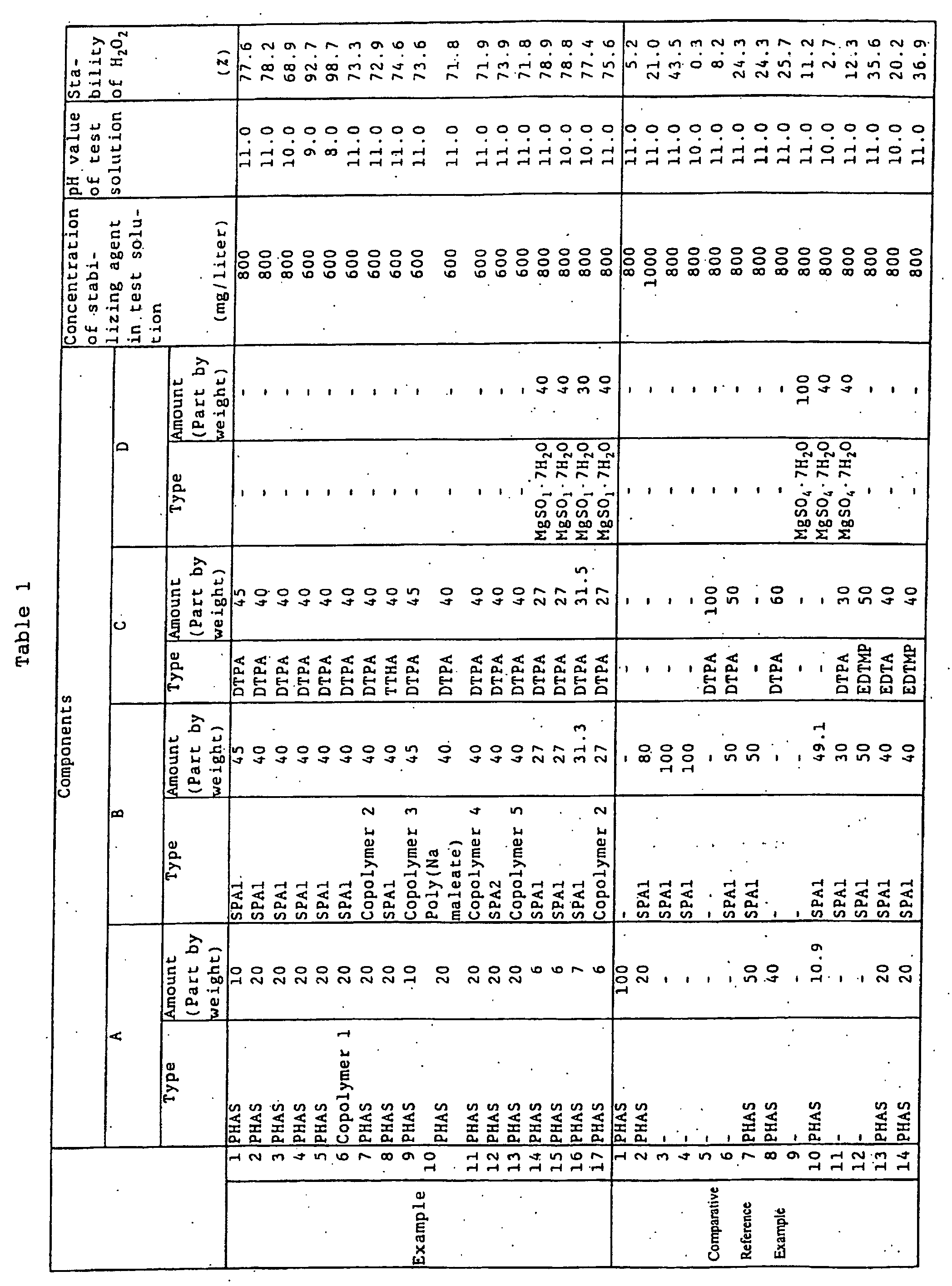

- The resultant aqueous stabilizing agent solutions were subjected to the following stability test.
- An aqueous test solution containing 50 mg/liter of Mg ions, 50 mg/liter of Ca ions, 5 mg/liter of Fe ions, 1 mg/liter of Cu ions, 2 mg/liter of Mn ions, 1.0 g/liter of hydrogen peroxide, and the stabilizing agent in the content as shown in Table 1, and having the pH value as shown in Table 1 was prepared by using magnesium sulfate, calcium nitrate, ferric nitrate, copper sulfate, manganese chloride, the aqueous stabilizing agent solution and a pH-adjustering agent, namely sodium hydroxide or diluted aqueous nitric acid solution.
- The test solution in an amount of 50 ml was placed in a conical flask with a 100 ml capacity, and the flask was stoppered with a rubber plug having fine holes and placed in a constant temperature vessel at a temperature of 60°C for 3 hours. Then, the flask was removed from the vessel, the test solution was cooled to room temperature, a diluted aqueous sulfuric acid solution was added to the test solution and the concentration of hydrogen peroxide remaining in the test solution was determined by an iodometric titration method. The retention (%) of hydrogen peroxide in the test solution represented the stability of hydrogen peroxide.
- The test results are also shown in Table 1.
- in each of Examples 1 to 4 and Comparative Examples 1 to 6, an unbleached Japanese hard wood pulp having a kappa value of 9.6, a viscosity of 24.8 cps and a whiteness-of 43.8% was pretreated in a consistency of 3.5% by weight, with an aqueous solution of 0.2% by weight of the stabilizing (pretreatment) agent as shown in Table 2, at a temperature of 50°C for one hour, and then rinsed with water and dehydrated.
- The dehydrated wood pulp was bleached in a consistency of 12% by weight with an aqueous solution of 1.0% by weight of H2O2 and 0.5% by weight of MaOH, at a temperature of 80°C for 2 hours, and then rinsed with water an dehydrated.
- Also, in Example 4, the same procedures as in Example 1 were carried out except that the pretreatment solution contained, in addition to 0.2% by weight of the same stabilizing agent as in Reference Example 1, 0.05% by weight a bleach-promoting enzyme (trademarks Irgazyme 40*4, made by Ciba-Geigy).
- The resultant bleached pulp was subjected to a whiteness measurement, a kappa value determination, and a viscosity measurement. The discharged bleaching liquid was subjected to an analysis of the remaining hydrogen peroxide.
- The whiteness was measured by a Hunter whiteness method in accordance with Japanese Industrial Standard (JIS) P 8123, the pulp viscosity was measured by TAPPI T-230 om-82, and the kappa value was determined by TAPPI T-236 hm-85. The retention of hydrogen peroxide in the discharged bleaching liquid was determined by an iodometric method.
- The test results are shown in Table 2.

- In each of Examples 5 and 6 and Comparative Examples 7 to 9, the same procedures as in Example 1 were carried out except that the pretreated kraft pulp was bleached in a consistency of 12% by weight with an aqueous bleaching agent solution containing 1.0% by weight of practice acid (trademark: Oxypel, made by Nihon Peroxide K.K.) and having a pH value of 6.0 adjusted by NaOH, at a temperature of 60°C for 2 hours.
- The test results are shown in Table 3.
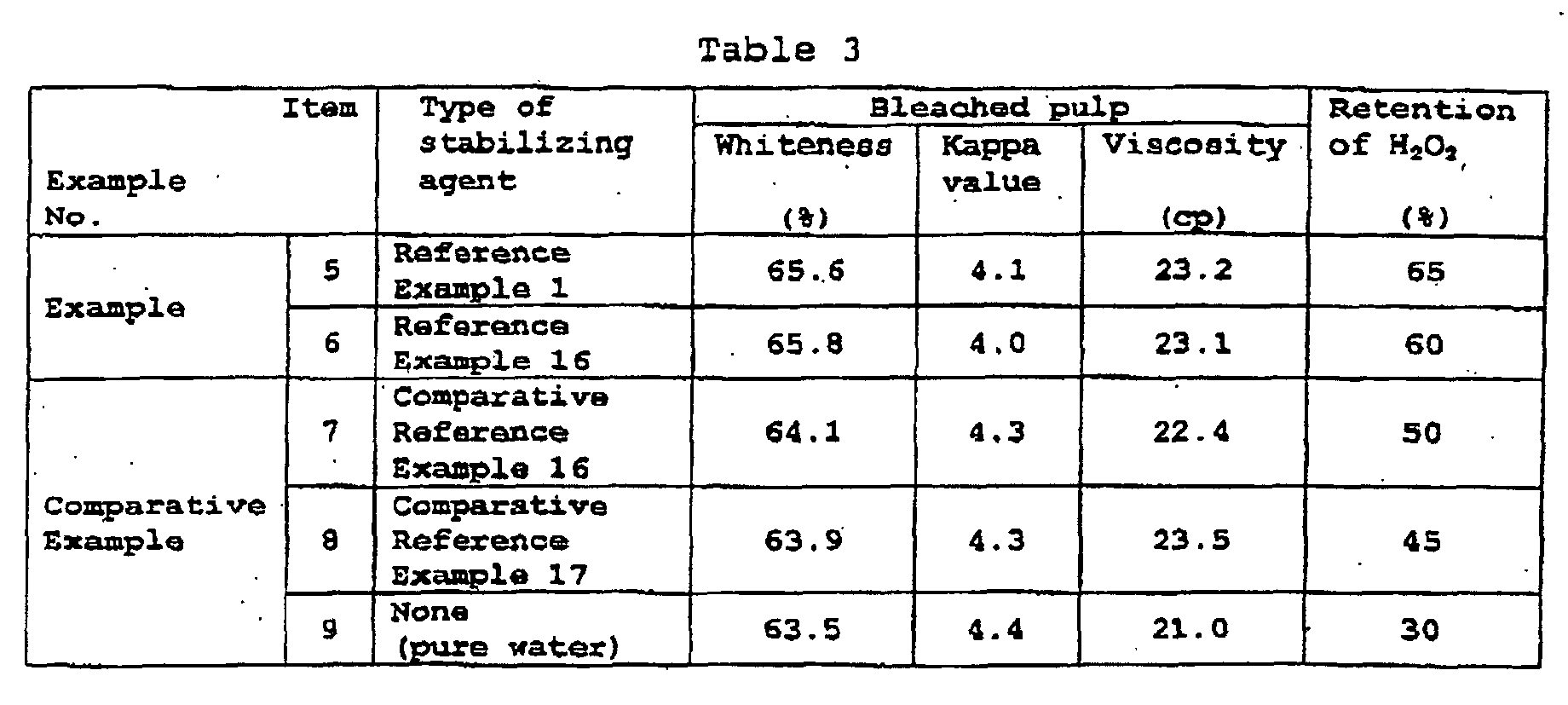
- In each of Comparative Examples 15 to 17, the same procedures as in Example 21 were carried out, except that the stabilizing agent of Example 1 was replaced by 100 parts by weight of SPA1 alone in Comparative Example 15, by 100 parts by weight of DTPA alone in Comparative Example 16 and by 100 parts by weight of grade 3 sodium silicate in Comparative 17. In Comparative Example 17, the sodium silicate was used in an amount of 10 g/liter in the bleaching solution. The test results are shown in Table 3.

- In Example 22, an aqueous bleaching solution was prepared by dissolving the same aqueous stabilizing agent solution as in Example 1 in a solid amount of 0.2% by weight, together with 1.0% by weight of H2O2 and 0.5% by weight of NaOH, in water.
- A unbleached Japanese hard wood pulp having a kappa value of 9.6, a viscosity of 24.8 cps and a whiteness of 43.8% was mixed in a consistency of 12% by weight in the aqueous bleaching solution, bleached at a temperature of 80°C for 2 hours, and thereafter rinsed with water and dehydrated.
- The resultant bleached pulp was subjected to a whiteness measurement, a kappa value determination, and a viscosity measurement. The discharged bleaching liquid was subjected to an analysis of the remaining hydrogen peroxide.
- The whiteness was measured by a Hunter whiteness method in accordance with Japanese Industrial Standard (JIS) P 8123, the pulp viscosity was measured by TAPPI T-230 om-82, and the kappa value was determined by TAPPI T-236 hm-85. The retention of hydrogen peroxide in the discharged bleaching liquid was determined by an iodometric method.
- In Example 23, the same procedures as in Example 22 were carried out except that the stabilizing agent was the same as in Example 16.
- In Comparative Example 18, the same procedures as in Example 22 were carried out except that the stabilizing agent was the same as in Comparative Example 9.
- In Comparative Example 19, the same procedures as in Example 22 were carried out except that the stabilizing agent was the same as in Comparative Example 16.
- In Comparative Example 20, the same procedures as in Example 22 were carried out except that the stabilizing agent was the same as in Comparative Example 17.

- In each of Examples 17 to 19 and Comparative Examples 15 to 20, the same following procedures were carried out: an aqueous bleaching solution was prepared by dissolving the same aqueous stabilizing agent solution as in Reference Example 1 in a solid amount of 0.2% by weight, together with 1.0% by weight of H2O2 and 0.5% by weight of NaOH, in water.
- An unbleached Japanese hard wood pulp having a kappa value of 9.6, a viscosity of 24.8 cps and a whiteness of 43.8% was mixed in a consistency of 12% by weight in the aqueous bleaching solution, bleached at a temperature of 80°C for 2 hours, and thereafter rinsed with water and dehydrated.
- The resultant bleached pulp was subjected to a whiteness measurement, a kappa value determination, and a viscosity measurement. The discharged bleaching liquid was subjected to an analysis of the remaining hydrogen peroxide.
- The whiteness was measured by a Hunter whiteness method in accordance with Japanese Industrial Standard (JIS) P 8123, the pulp viscosity was measured by TAPPI T-230 om-82, and the kappa value was determined by TAPPI T-236 hm-85. The retention of hydrogen peroxide in the discharged bleaching liquid was determined by an iodometric method, with the following exceptions. The stabilizing agent was replaced by one as shown in Table 5. The unbleached wood pulp was pretreated in a consistency of 3.5% by weight with an aqueous solution of 0.2% by weight of the stabilizing agent at a temperature of 50°C for one hour, and then rinsed with water and dehydrated. The dehydrated wood pulp was bleached in a consistency of 12% by weight with an aqueous solution of 1.0% by weight of H2O2 and 0.5% by weight of NaOH, at a temperature of 80°C for 2 hours, and then rinsed with water and dehydrated.
- Also, in Example 27, the same procedures as in Example 24 were carried out except that the pretreatment solution contained, in addition to 0.2% by weight of the same stabilizing agent as in Example 1, 0.05% by weight a bleach-promoting enzyme (trademark: Irgazyme 40*4, made by Ciba-Geigy).
- The test results are shown in Table 5

- In each of Examples 21 and 22 and Comparative Examples 21 to 23, the same procedures as in Example 17 were carried out except that the pretreated kraft pulp was bleached in a consistency of 12% by weight with an aqueous bleaching agent solution containing 1.0% by weight of peracetic acid (trademark: Oxypel, made by Nihon Peroxide K.K.) and having a pH value of 6.0 adjusted by NaOH, at a temperature of 60°C for 2 hours.
- The test results are shown in Table 6.

Claims (8)
- A method of bleaching a fiber material comprising:(1) pretreating a fiber material with an aqueous solution of a stabilizing (pretreatment) agent comprising:(A) a first component comprising at least one member selected from the class consisting of α-hydroxyacrylic homopolymers and copolymers of α-hydroxyacrylic acid with other comonomers, and water-soluble salts and polyactones of the above-mentioned homopolymers and copolymers;(B) a second component comprising at least one member selected from the class consisting of homopolymers and copolymers of acrylic acid, methacrylic acid and maleic acid, copolymers of at least one of the above-mentioned acids with other monomers and water-soluble salts of the above-mentioned homopolymers and copolymers; and(C) a third component comprising at least one member selected from the class consisting of diethylenetriaminepentaacetic acid, triethylenetetramine hexaacetic acid and water-soluble salts of the above-mentioned acids; the aqueous solution of the stabilizing (pretreatment) agent having a pH value of 6 to 11 and the stabilizing agent being present in an amount of 0.01 to 5%, based on the absolute dry weight of the fiber material; and(2) rinsing the pretreated fiber material with water and squeezing or dehydrating the rinsed fiber material; and(3) bleaching the rinsed fiber material with an aqueous solution of a bleaching agent comprising at least one bleaching peroxide compound.
- The method as claimed in claim 1, wherein the fiber material comprises at least one type of fibers selected from natural organic and inorganic fibers.
- The method as claimed in claim 1, wherein the pretreating procedure (1) is carried out at a temperature of 20 to 120°C for 15 to 180 minutes.
- The method as claimed in claim 1, wherein the aqueous solution of the stabilizing (pretreatment) agent contains the stabilizing (pretreatment) agent in a concentration of 1 to 70%.
- The method as claimed in claim 1, wherein the stabilizing (pretreatment) agent further comprises (D) a fourth component comprising at least one water-soluble inorganic magnesium salt, in addition to the first, second and third components (A), (B) and (C).
- The method as claimed in claim 1, wherein the aqueous solution of the stabilizing (pretreatment) agent further comprises a bleach-promoting enzyme.
- The method as claimed in claim 1, wherein the bleaching agent for the bleaching procedure (3) comprises at least one member selected from the group consisting of hydrogen peroxide, peroxyhydrates, peroxomonosulfuric acid and water-soluble salts thereof, and organic peroxo acids.
- The method as claimed in claim 1, wherein an aqueous liquid discharged from the pretreating procedure is recovered and returned to the pretreating procedure.
Applications Claiming Priority (3)
| Application Number | Priority Date | Filing Date | Title |
|---|---|---|---|
| JP8161757A JPH108092A (en) | 1996-06-21 | 1996-06-21 | Peroxide bleaching stabilizer and method for bleaching fibrous materials using the same |
| JP161757/96 | 1996-06-21 | ||
| JP16175796 | 1996-06-21 |
Publications (3)
| Publication Number | Publication Date |
|---|---|
| EP0814193A2 EP0814193A2 (en) | 1997-12-29 |
| EP0814193A3 EP0814193A3 (en) | 2000-01-12 |
| EP0814193B1 true EP0814193B1 (en) | 2003-10-15 |
Family
ID=15741323
Family Applications (1)
| Application Number | Title | Priority Date | Filing Date |
|---|---|---|---|
| EP97110041A Expired - Lifetime EP0814193B1 (en) | 1996-06-21 | 1997-06-19 | Methods of bleaching a fiber material by using a stabilising (pretreatment) agent |
Country Status (5)
| Country | Link |
|---|---|
| US (1) | US6120556A (en) |
| EP (1) | EP0814193B1 (en) |
| JP (1) | JPH108092A (en) |
| CA (1) | CA2207884A1 (en) |
| DE (1) | DE69725513D1 (en) |
Cited By (2)
| Publication number | Priority date | Publication date | Assignee | Title |
|---|---|---|---|---|
| US8066846B2 (en) | 2007-02-02 | 2011-11-29 | Kemira Oyj | Composition and process for the treatment of fibre material |
| CN105229225A (en) * | 2013-05-20 | 2016-01-06 | 凯米罗总公司 | Antifouland compositions and uses thereof |
Families Citing this family (26)
| Publication number | Priority date | Publication date | Assignee | Title |
|---|---|---|---|---|
| US6780832B1 (en) * | 1999-11-15 | 2004-08-24 | Nippon Shokubai Co., Ltd. | Water-soluble polymer and its use |
| DE10018192A1 (en) * | 2000-04-12 | 2001-10-25 | Basf Ag | Multifunctional polymers, processes for their production and their use |
| JP2002105849A (en) * | 2000-09-26 | 2002-04-10 | Gunze Ltd | Bleaching method for woven cellulose fiber fabric using ozone gas |
| US20030162685A1 (en) * | 2001-06-05 | 2003-08-28 | Man Victor Fuk-Pong | Solid cleaning composition including stabilized active oxygen component |
| US20030139310A1 (en) * | 2001-08-07 | 2003-07-24 | Smith Kim R. | Peroxygen compositions and methods for carpet or upholstery cleaning or sanitizing |
| JP4878710B2 (en) * | 2001-09-21 | 2012-02-15 | 日華化学株式会社 | Hydrogen peroxide stabilizer |
| US20030136942A1 (en) * | 2001-11-30 | 2003-07-24 | Smith Kim R. | Stabilized active oxygen compositions |
| FI117393B (en) * | 2003-01-10 | 2006-09-29 | Kemira Oyj | Process for bleaching cellulose fiber material |
| FI120202B (en) * | 2003-01-10 | 2009-07-31 | Kemira Oyj | Polymer composition and use thereof |
| EP1566479A1 (en) * | 2004-02-19 | 2005-08-24 | Nederlandse Organisatie voor toegepast-natuurwetenschappelijk onderzoek TNO | Process for preparing a particulate material from mammalian hair and use thereof in paper or paperboard products |
| FI122239B (en) | 2004-02-25 | 2011-10-31 | Kemira Oyj | Process for treating fibrous material and new composition |
| FI120201B (en) | 2004-05-12 | 2009-07-31 | Kemira Oyj | New composition and process for treating fiber material |
| FI20040833A7 (en) | 2004-06-16 | 2005-12-17 | Kemira Oyj | Recycled paper deinking method |
| WO2006049972A1 (en) * | 2004-10-27 | 2006-05-11 | Thomas P Frank | Color stabilized composite material |
| CA2678466A1 (en) * | 2007-02-21 | 2008-08-28 | Solvay (Societe Anonyme) | Process for the bleaching of paper pulp |
| EP2128331A1 (en) * | 2008-05-26 | 2009-12-02 | SOLVAY (Société Anonyme) | Process for the bleaching of paper pulp |
| BRPI1016066A2 (en) * | 2009-05-29 | 2016-06-07 | Solvay | "process for bleaching paper pulp with one or more peroxide oxidizing agents, and component use" |
| JP5471050B2 (en) * | 2009-06-09 | 2014-04-16 | 三菱瓦斯化学株式会社 | TCF bleaching method |
| JP5377536B2 (en) * | 2010-03-09 | 2013-12-25 | ローム アンド ハース カンパニー | Scale reducing additives for automatic dishwashing systems |
| CN101858033B (en) * | 2010-06-04 | 2012-08-22 | 上海里奥纤维企业发展有限公司 | Fiber bleaching method |
| WO2013000074A1 (en) * | 2011-06-30 | 2013-01-03 | Nano-Green Biorefineries Inc. | Catalytic biomass conversion |
| CN103374848B (en) * | 2012-04-28 | 2016-03-02 | 上海韬鸿化工科技有限公司 | The environmental protection method for bleaching of a kind of environmental protection bleaching liquid and natural fabric |
| EA201891627A1 (en) | 2016-01-28 | 2019-03-29 | Нано-Грин Байорифайнериз Инк. | RECEIVING CRYSTAL PULP |
| CN111154562B (en) * | 2020-01-13 | 2022-01-04 | 肖智泉 | Bleaching main lotion for laundry detergent and preparation method thereof |
| WO2025252742A1 (en) | 2024-06-04 | 2025-12-11 | Solvay Sa | An aqueous composition comprising hydrogen peroxide |
| WO2026001710A1 (en) * | 2024-06-24 | 2026-01-02 | 凯米拉公司 | Composition and use thereof |
Family Cites Families (20)
| Publication number | Priority date | Publication date | Assignee | Title |
|---|---|---|---|---|
| CA902861A (en) * | 1969-11-27 | 1972-06-20 | Pulp And Paper Research Institute Of Canada | Bleaching of cellulosic pulp |
| DE2327097B2 (en) * | 1973-05-28 | 1976-09-02 | Hoechst Ag, 6000 Frankfurt | COPOLYMERISATE OF ACRYLIC ACID, OR YOUR ALKALINE OR AMMONIUM SALTS |
| LU74434A1 (en) * | 1976-02-25 | 1977-09-12 | ||
| JPS5749561A (en) * | 1980-09-10 | 1982-03-23 | Lonseal Kogyo Kk | Manufacture of sheet with light and shade pattern tuning figure |
| JPS601360A (en) * | 1983-06-17 | 1985-01-07 | Nissan Motor Co Ltd | Main bearing structure for internal-combustion engine |
| DE3423452A1 (en) * | 1984-06-26 | 1986-01-02 | Sandoz-Patent-GmbH, 7850 Lörrach | Stabilising mixture for the peroxide bleaching of cellulose-containing materials |
| DE3545909A1 (en) * | 1985-12-23 | 1987-06-25 | Henkel Kgaa | SILICATE- AND MAGNESIUM-FREE ACTIVE SUBSTANCE MIXTURES |
| US4732650A (en) * | 1986-09-15 | 1988-03-22 | The Dow Chemical Company | Bleaching of cellulosic pulps using hydrogen peroxide |
| JPS63251410A (en) * | 1987-04-09 | 1988-10-18 | Nippon Peroxide Co Ltd | Preparation of polylactone corresponding to poly-alpha-hydroxyacrylic acid |
| US5013404A (en) * | 1989-11-15 | 1991-05-07 | The Dow Chemical Company | Process for alkaline peroxide bleaching of wood pulp using a quaternary amine as additive |
| JP2602563B2 (en) * | 1989-12-15 | 1997-04-23 | 花王株式会社 | Liquid oxygen bleach composition |
| SE468355B (en) * | 1991-04-30 | 1992-12-21 | Eka Nobel Ab | CHEMISTRY OF CHEMICAL MASS THROUGH TREATMENT WITH COMPLEX PICTURES AND OZONE |
| SE470065C (en) * | 1991-04-30 | 1996-01-15 | Eka Nobel Ab | Treatment of chemical pulp with an acid and then a magnesium and calcium compound in chlorine-free bleaching |
| JP2908600B2 (en) * | 1991-06-20 | 1999-06-21 | 花王株式会社 | Bleach composition |
| CA2115881C (en) * | 1993-02-25 | 2000-05-23 | Michael G. Paice | Non-chlorine bleaching of kraft pulp |
| DE4317060A1 (en) * | 1993-05-21 | 1994-11-24 | Basf Ag | Process for the continuous pretreatment of cellulose-containing textile goods |
| JP3381970B2 (en) * | 1993-06-29 | 2003-03-04 | 日本パーオキサイド株式会社 | Mixed composition of poly-α-hydroxyacrylate and diethylenetriaminepentaacetate |
| US5571378A (en) * | 1993-11-23 | 1996-11-05 | Hampshire Chemical Ltd. | Process for high-pH metal ion chelation in pulps |
| DE4416208A1 (en) * | 1994-05-07 | 1995-11-09 | Henkel Kgaa | Use of phosphorus-free, water-soluble polymers and polyhydroxy mono- or dicarboxylates to stabilize alkaline earth metal silicates in textile bleaching |
| US5503709A (en) * | 1994-07-27 | 1996-04-02 | Burton; Steven W. | Environmentally improved process for preparing recycled lignocellulosic materials for bleaching |
-
1996
- 1996-06-21 JP JP8161757A patent/JPH108092A/en active Pending
-
1997
- 1997-06-16 US US08/877,017 patent/US6120556A/en not_active Expired - Fee Related
- 1997-06-17 CA CA002207884A patent/CA2207884A1/en not_active Abandoned
- 1997-06-19 DE DE69725513T patent/DE69725513D1/en not_active Expired - Lifetime
- 1997-06-19 EP EP97110041A patent/EP0814193B1/en not_active Expired - Lifetime
Cited By (3)
| Publication number | Priority date | Publication date | Assignee | Title |
|---|---|---|---|---|
| US8066846B2 (en) | 2007-02-02 | 2011-11-29 | Kemira Oyj | Composition and process for the treatment of fibre material |
| CN105229225A (en) * | 2013-05-20 | 2016-01-06 | 凯米罗总公司 | Antifouland compositions and uses thereof |
| CN105229225B (en) * | 2013-05-20 | 2017-05-03 | 凯米罗总公司 | Antifouling compositions and uses thereof |
Also Published As
| Publication number | Publication date |
|---|---|
| US6120556A (en) | 2000-09-19 |
| CA2207884A1 (en) | 1997-12-21 |
| DE69725513D1 (en) | 2003-11-20 |
| JPH108092A (en) | 1998-01-13 |
| EP0814193A3 (en) | 2000-01-12 |
| EP0814193A2 (en) | 1997-12-29 |
Similar Documents
| Publication | Publication Date | Title |
|---|---|---|
| US6120556A (en) | Stabilizing agent for peroxide-bleaching procedure and methods of bleaching a fiber material by using same | |
| US5658429A (en) | Process for bleaching of lignocellulose-containing pulp using a chelating agent prior to a peroxide-ozone-peroxide sequence | |
| AU2008211802B2 (en) | New composition and process for the treatment of fibre material | |
| NZ242465A (en) | Delignification and bleaching of chemical pulp with acid and a magnesium | |
| CA2121387C (en) | Method for bleaching lignocellulose-containing pulp | |
| CN101589191A (en) | Bleaching of substrates | |
| CA2168288C (en) | Bleaching compositions comprising sulfamates and borates or gluconates and processes | |
| US5616280A (en) | Bleaching composition | |
| CA2512141C (en) | Bleaching of cellulosic fibre material with peroxide using polymers as a stabiliser | |
| US7867357B2 (en) | Polymer composition for peroxide bleaching of cellulosic fibre material and processes for peroxide bleaching | |
| US5547475A (en) | Phosphate-free reduction bleaching formulation | |
| CN100593600C (en) | Method for treating fibre materials and novel composition | |
| KR910002919B1 (en) | Bleach enhancers | |
| US5704947A (en) | Use of water-soluble polymers and polyhydroxymono- or dicarboxylates in the bleaching of textiles | |
| US5645688A (en) | Bleaching compositions and processes employing sulfamates and polyaminocarboxylic acids |
Legal Events
| Date | Code | Title | Description |
|---|---|---|---|
| PUAI | Public reference made under article 153(3) epc to a published international application that has entered the european phase |
Free format text: ORIGINAL CODE: 0009012 |
|
| AK | Designated contracting states |
Kind code of ref document: A2 Designated state(s): DE FI FR SE |
|
| PUAL | Search report despatched |
Free format text: ORIGINAL CODE: 0009013 |
|
| AK | Designated contracting states |
Kind code of ref document: A3 Designated state(s): AT BE CH DE DK ES FI FR GB GR IE IT LI LU MC NL PT SE |
|
| RIC1 | Information provided on ipc code assigned before grant |
Free format text: 7D 21C 9/10 A, 7D 21C 9/16 B, 7D 06L 3/02 B, 7C 11D 3/39 B |
|
| EUG | Se: european patent has lapsed | ||
| 17P | Request for examination filed |
Effective date: 20000620 |
|
| AKX | Designation fees paid |
Free format text: DE FI FR SE |
|
| 17Q | First examination report despatched |
Effective date: 20000920 |
|
| RTI1 | Title (correction) |
Free format text: METHODS OF BLEACHING A FIBER MATERIAL BY USING A STABILISING (PRETREATMENT) AGENT |
|
| GRAH | Despatch of communication of intention to grant a patent |
Free format text: ORIGINAL CODE: EPIDOS IGRA |
|
| RTI1 | Title (correction) |
Free format text: METHODS OF BLEACHING A FIBER MATERIAL BY USING A STABILISING (PRETREATMENT) AGENT |
|
| RTI1 | Title (correction) |
Free format text: METHODS OF BLEACHING A FIBER MATERIAL BY USING A STABILISING (PRETREATMENT) AGENT |
|
| GRAS | Grant fee paid |
Free format text: ORIGINAL CODE: EPIDOSNIGR3 |
|
| GRAA | (expected) grant |
Free format text: ORIGINAL CODE: 0009210 |
|
| AK | Designated contracting states |
Kind code of ref document: B1 Designated state(s): DE FI FR SE |
|
| PG25 | Lapsed in a contracting state [announced via postgrant information from national office to epo] |
Ref country code: FR Free format text: LAPSE BECAUSE OF FAILURE TO SUBMIT A TRANSLATION OF THE DESCRIPTION OR TO PAY THE FEE WITHIN THE PRESCRIBED TIME-LIMIT Effective date: 20031015 |
|
| REF | Corresponds to: |
Ref document number: 69725513 Country of ref document: DE Date of ref document: 20031120 Kind code of ref document: P |
|
| REG | Reference to a national code |
Ref country code: SE Ref legal event code: TRGR |
|
| PG25 | Lapsed in a contracting state [announced via postgrant information from national office to epo] |
Ref country code: DE Free format text: LAPSE BECAUSE OF FAILURE TO SUBMIT A TRANSLATION OF THE DESCRIPTION OR TO PAY THE FEE WITHIN THE PRESCRIBED TIME-LIMIT Effective date: 20040116 |
|
| PLBE | No opposition filed within time limit |
Free format text: ORIGINAL CODE: 0009261 |
|
| STAA | Information on the status of an ep patent application or granted ep patent |
Free format text: STATUS: NO OPPOSITION FILED WITHIN TIME LIMIT |
|
| 26N | No opposition filed |
Effective date: 20040716 |
|
| EN | Fr: translation not filed | ||
| PGFP | Annual fee paid to national office [announced via postgrant information from national office to epo] |
Ref country code: FI Payment date: 20060605 Year of fee payment: 10 |
|
| PGFP | Annual fee paid to national office [announced via postgrant information from national office to epo] |
Ref country code: SE Payment date: 20060607 Year of fee payment: 10 |
|
| PG25 | Lapsed in a contracting state [announced via postgrant information from national office to epo] |
Ref country code: FI Free format text: LAPSE BECAUSE OF NON-PAYMENT OF DUE FEES Effective date: 20070619 |
|
| EUG | Se: european patent has lapsed | ||
| PG25 | Lapsed in a contracting state [announced via postgrant information from national office to epo] |
Ref country code: SE Free format text: LAPSE BECAUSE OF NON-PAYMENT OF DUE FEES Effective date: 20070620 |