EP0809627B1 - Novel borneol derivatives, methods of manufacturing them, and their pharmaceutical use - Google Patents
Novel borneol derivatives, methods of manufacturing them, and their pharmaceutical use Download PDFInfo
- Publication number
- EP0809627B1 EP0809627B1 EP96903893A EP96903893A EP0809627B1 EP 0809627 B1 EP0809627 B1 EP 0809627B1 EP 96903893 A EP96903893 A EP 96903893A EP 96903893 A EP96903893 A EP 96903893A EP 0809627 B1 EP0809627 B1 EP 0809627B1
- Authority
- EP
- European Patent Office
- Prior art keywords
- μmol
- nmr
- ppm
- cdcl
- trimethyl
- Prior art date
- Legal status (The legal status is an assumption and is not a legal conclusion. Google has not performed a legal analysis and makes no representation as to the accuracy of the status listed.)
- Expired - Lifetime
Links
- 238000004519 manufacturing process Methods 0.000 title claims abstract 3
- 150000001637 borneol derivatives Chemical class 0.000 title claims description 6
- 238000000034 method Methods 0.000 title description 23
- 150000001875 compounds Chemical class 0.000 claims description 158
- -1 C4-C8-cycloalkyl Chemical group 0.000 claims description 44
- UFHFLCQGNIYNRP-UHFFFAOYSA-N Hydrogen Chemical compound [H][H] UFHFLCQGNIYNRP-UHFFFAOYSA-N 0.000 claims description 28
- 239000001257 hydrogen Substances 0.000 claims description 27
- 229910052739 hydrogen Inorganic materials 0.000 claims description 27
- 125000000008 (C1-C10) alkyl group Chemical group 0.000 claims description 18
- 150000002431 hydrogen Chemical class 0.000 claims description 14
- 125000003118 aryl group Chemical group 0.000 claims description 10
- 125000004430 oxygen atom Chemical group O* 0.000 claims description 10
- 125000000027 (C1-C10) alkoxy group Chemical group 0.000 claims description 9
- LFQSCWFLJHTTHZ-UHFFFAOYSA-N Ethanol Chemical compound CCO LFQSCWFLJHTTHZ-UHFFFAOYSA-N 0.000 claims description 8
- 125000002887 hydroxy group Chemical group [H]O* 0.000 claims description 8
- 229920000858 Cyclodextrin Polymers 0.000 claims description 4
- 150000002118 epoxides Chemical class 0.000 claims description 4
- 229910052736 halogen Inorganic materials 0.000 claims description 4
- 150000002367 halogens Chemical class 0.000 claims description 4
- XSXHWVKGUXMUQE-UHFFFAOYSA-N osmium dioxide Inorganic materials O=[Os]=O XSXHWVKGUXMUQE-UHFFFAOYSA-N 0.000 claims description 4
- 125000001997 phenyl group Chemical group [H]C1=C([H])C([H])=C(*)C([H])=C1[H] 0.000 claims description 4
- 150000003839 salts Chemical class 0.000 claims description 4
- 230000008707 rearrangement Effects 0.000 claims description 3
- 229920001450 Alpha-Cyclodextrin Polymers 0.000 claims description 2
- 239000000654 additive Substances 0.000 claims description 2
- 150000001336 alkenes Chemical class 0.000 claims description 2
- HFHDHCJBZVLPGP-RWMJIURBSA-N alpha-cyclodextrin Chemical compound OC[C@H]([C@H]([C@@H]([C@H]1O)O)O[C@H]2O[C@@H]([C@@H](O[C@H]3O[C@H](CO)[C@H]([C@@H]([C@H]3O)O)O[C@H]3O[C@H](CO)[C@H]([C@@H]([C@H]3O)O)O[C@H]3O[C@H](CO)[C@H]([C@@H]([C@H]3O)O)O3)[C@H](O)[C@H]2O)CO)O[C@@H]1O[C@H]1[C@H](O)[C@@H](O)[C@@H]3O[C@@H]1CO HFHDHCJBZVLPGP-RWMJIURBSA-N 0.000 claims description 2
- 229940043377 alpha-cyclodextrin Drugs 0.000 claims description 2
- WHGYBXFWUBPSRW-FOUAGVGXSA-N beta-cyclodextrin Chemical compound OC[C@H]([C@H]([C@@H]([C@H]1O)O)O[C@H]2O[C@@H]([C@@H](O[C@H]3O[C@H](CO)[C@H]([C@@H]([C@H]3O)O)O[C@H]3O[C@H](CO)[C@H]([C@@H]([C@H]3O)O)O[C@H]3O[C@H](CO)[C@H]([C@@H]([C@H]3O)O)O[C@H]3O[C@H](CO)[C@H]([C@@H]([C@H]3O)O)O3)[C@H](O)[C@H]2O)CO)O[C@@H]1O[C@H]1[C@H](O)[C@@H](O)[C@@H]3O[C@@H]1CO WHGYBXFWUBPSRW-FOUAGVGXSA-N 0.000 claims description 2
- 229960004853 betadex Drugs 0.000 claims description 2
- 239000000969 carrier Substances 0.000 claims description 2
- GDSRMADSINPKSL-HSEONFRVSA-N gamma-cyclodextrin Chemical compound OC[C@H]([C@H]([C@@H]([C@H]1O)O)O[C@H]2O[C@@H]([C@@H](O[C@H]3O[C@H](CO)[C@H]([C@@H]([C@H]3O)O)O[C@H]3O[C@H](CO)[C@H]([C@@H]([C@H]3O)O)O[C@H]3O[C@H](CO)[C@H]([C@@H]([C@H]3O)O)O[C@H]3O[C@H](CO)[C@H]([C@@H]([C@H]3O)O)O[C@H]3O[C@H](CO)[C@H]([C@@H]([C@H]3O)O)O3)[C@H](O)[C@H]2O)CO)O[C@@H]1O[C@H]1[C@H](O)[C@@H](O)[C@@H]3O[C@@H]1CO GDSRMADSINPKSL-HSEONFRVSA-N 0.000 claims description 2
- 229940080345 gamma-cyclodextrin Drugs 0.000 claims description 2
- 238000002955 isolation Methods 0.000 claims description 2
- JRZJOMJEPLMPRA-UHFFFAOYSA-N olefin Natural products CCCCCCCC=C JRZJOMJEPLMPRA-UHFFFAOYSA-N 0.000 claims description 2
- 238000000746 purification Methods 0.000 description 77
- 239000012230 colorless oil Substances 0.000 description 69
- AZUYLZMQTIKGSC-UHFFFAOYSA-N 1-[6-[4-(5-chloro-6-methyl-1H-indazol-4-yl)-5-methyl-3-(1-methylindazol-5-yl)pyrazol-1-yl]-2-azaspiro[3.3]heptan-2-yl]prop-2-en-1-one Chemical compound ClC=1C(=C2C=NNC2=CC=1C)C=1C(=NN(C=1C)C1CC2(CN(C2)C(C=C)=O)C1)C=1C=C2C=NN(C2=CC=1)C AZUYLZMQTIKGSC-UHFFFAOYSA-N 0.000 description 55
- 238000005481 NMR spectroscopy Methods 0.000 description 49
- 238000005160 1H NMR spectroscopy Methods 0.000 description 48
- RTZKZFJDLAIYFH-UHFFFAOYSA-N Diethyl ether Chemical compound CCOCC RTZKZFJDLAIYFH-UHFFFAOYSA-N 0.000 description 44
- XEKOWRVHYACXOJ-UHFFFAOYSA-N Ethyl acetate Chemical compound CCOC(C)=O XEKOWRVHYACXOJ-UHFFFAOYSA-N 0.000 description 42
- 239000000203 mixture Substances 0.000 description 38
- YMWUJEATGCHHMB-UHFFFAOYSA-N Dichloromethane Chemical compound ClCCl YMWUJEATGCHHMB-UHFFFAOYSA-N 0.000 description 33
- 239000000243 solution Substances 0.000 description 31
- 229940126062 Compound A Drugs 0.000 description 30
- NLDMNSXOCDLTTB-UHFFFAOYSA-N Heterophylliin A Natural products O1C2COC(=O)C3=CC(O)=C(O)C(O)=C3C3=C(O)C(O)=C(O)C=C3C(=O)OC2C(OC(=O)C=2C=C(O)C(O)=C(O)C=2)C(O)C1OC(=O)C1=CC(O)=C(O)C(O)=C1 NLDMNSXOCDLTTB-UHFFFAOYSA-N 0.000 description 30
- 238000010626 work up procedure Methods 0.000 description 29
- VLKZOEOYAKHREP-UHFFFAOYSA-N n-Hexane Chemical compound CCCCCC VLKZOEOYAKHREP-UHFFFAOYSA-N 0.000 description 26
- XKRFYHLGVUSROY-UHFFFAOYSA-N Argon Chemical compound [Ar] XKRFYHLGVUSROY-UHFFFAOYSA-N 0.000 description 20
- 125000002924 primary amino group Chemical group [H]N([H])* 0.000 description 19
- 230000008569 process Effects 0.000 description 19
- WYURNTSHIVDZCO-UHFFFAOYSA-N Tetrahydrofuran Chemical compound C1CCOC1 WYURNTSHIVDZCO-UHFFFAOYSA-N 0.000 description 18
- ZMANZCXQSJIPKH-UHFFFAOYSA-N Triethylamine Chemical compound CCN(CC)CC ZMANZCXQSJIPKH-UHFFFAOYSA-N 0.000 description 18
- 150000003952 β-lactams Chemical class 0.000 description 18
- UAXZZNDXCXGKHN-DLBZAZTESA-N (3r,4s)-4-phenyl-3-tri(propan-2-yl)silyloxyazetidin-2-one Chemical compound N1C(=O)[C@H](O[Si](C(C)C)(C(C)C)C(C)C)[C@@H]1C1=CC=CC=C1 UAXZZNDXCXGKHN-DLBZAZTESA-N 0.000 description 17
- CSNNHWWHGAXBCP-UHFFFAOYSA-L Magnesium sulfate Chemical compound [Mg+2].[O-][S+2]([O-])([O-])[O-] CSNNHWWHGAXBCP-UHFFFAOYSA-L 0.000 description 14
- 239000003480 eluent Substances 0.000 description 14
- 125000000217 alkyl group Chemical group 0.000 description 13
- 238000004587 chromatography analysis Methods 0.000 description 13
- 239000002904 solvent Substances 0.000 description 13
- KFZMGEQAYNKOFK-UHFFFAOYSA-N Isopropanol Chemical compound CC(C)O KFZMGEQAYNKOFK-UHFFFAOYSA-N 0.000 description 12
- 239000012298 atmosphere Substances 0.000 description 11
- 238000001914 filtration Methods 0.000 description 11
- XLYOFNOQVPJJNP-UHFFFAOYSA-N water Substances O XLYOFNOQVPJJNP-UHFFFAOYSA-N 0.000 description 11
- 229910052786 argon Inorganic materials 0.000 description 10
- 125000002915 carbonyl group Chemical group [*:2]C([*:1])=O 0.000 description 10
- 239000000126 substance Substances 0.000 description 10
- 102000029749 Microtubule Human genes 0.000 description 9
- 108091022875 Microtubule Proteins 0.000 description 9
- FAPWRFPIFSIZLT-UHFFFAOYSA-M Sodium chloride Chemical class [Na+].[Cl-] FAPWRFPIFSIZLT-UHFFFAOYSA-M 0.000 description 9
- YXFVVABEGXRONW-UHFFFAOYSA-N Toluene Chemical compound CC1=CC=CC=C1 YXFVVABEGXRONW-UHFFFAOYSA-N 0.000 description 9
- 102000004243 Tubulin Human genes 0.000 description 9
- 108090000704 Tubulin Proteins 0.000 description 9
- 210000004688 microtubule Anatomy 0.000 description 9
- YLQBMQCUIZJEEH-UHFFFAOYSA-N tetrahydrofuran Natural products C=1C=COC=1 YLQBMQCUIZJEEH-UHFFFAOYSA-N 0.000 description 9
- VYPSYNLAJGMNEJ-UHFFFAOYSA-N Silicium dioxide Chemical compound O=[Si]=O VYPSYNLAJGMNEJ-UHFFFAOYSA-N 0.000 description 8
- 229940123237 Taxane Drugs 0.000 description 8
- 230000004048 modification Effects 0.000 description 8
- 238000012986 modification Methods 0.000 description 8
- 239000000741 silica gel Substances 0.000 description 8
- 229910002027 silica gel Inorganic materials 0.000 description 8
- IAKHMKGGTNLKSZ-INIZCTEOSA-N (S)-colchicine Chemical compound C1([C@@H](NC(C)=O)CC2)=CC(=O)C(OC)=CC=C1C1=C2C=C(OC)C(OC)=C1OC IAKHMKGGTNLKSZ-INIZCTEOSA-N 0.000 description 7
- XMIIGOLPHOKFCH-UHFFFAOYSA-N 3-phenylpropionic acid Chemical compound OC(=O)CCC1=CC=CC=C1 XMIIGOLPHOKFCH-UHFFFAOYSA-N 0.000 description 7
- 125000003158 alcohol group Chemical group 0.000 description 7
- 229910052943 magnesium sulfate Inorganic materials 0.000 description 7
- 235000019341 magnesium sulphate Nutrition 0.000 description 7
- VEXZGXHMUGYJMC-UHFFFAOYSA-N Hydrochloric acid Chemical compound Cl VEXZGXHMUGYJMC-UHFFFAOYSA-N 0.000 description 6
- CIHOLLKRGTVIJN-UHFFFAOYSA-N tert‐butyl hydroperoxide Chemical compound CC(C)(C)OO CIHOLLKRGTVIJN-UHFFFAOYSA-N 0.000 description 6
- VXUYXOFXAQZZMF-UHFFFAOYSA-N titanium(IV) isopropoxide Chemical compound CC(C)O[Ti](OC(C)C)(OC(C)C)OC(C)C VXUYXOFXAQZZMF-UHFFFAOYSA-N 0.000 description 6
- 229930012538 Paclitaxel Natural products 0.000 description 5
- UIIMBOGNXHQVGW-UHFFFAOYSA-M Sodium bicarbonate Chemical class [Na+].OC([O-])=O UIIMBOGNXHQVGW-UHFFFAOYSA-M 0.000 description 5
- 229930013930 alkaloid Natural products 0.000 description 5
- 150000001412 amines Chemical class 0.000 description 5
- 210000004027 cell Anatomy 0.000 description 5
- 239000003814 drug Substances 0.000 description 5
- 230000032050 esterification Effects 0.000 description 5
- 238000005886 esterification reaction Methods 0.000 description 5
- 239000006260 foam Substances 0.000 description 5
- 230000000394 mitotic effect Effects 0.000 description 5
- 239000012074 organic phase Substances 0.000 description 5
- 229960001592 paclitaxel Drugs 0.000 description 5
- 238000006116 polymerization reaction Methods 0.000 description 5
- HEMHJVSKTPXQMS-UHFFFAOYSA-M sodium hydroxide Inorganic materials [OH-].[Na+] HEMHJVSKTPXQMS-UHFFFAOYSA-M 0.000 description 5
- RCINICONZNJXQF-MZXODVADSA-N taxol Chemical compound O([C@@H]1[C@@]2(C[C@@H](C(C)=C(C2(C)C)[C@H](C([C@]2(C)[C@@H](O)C[C@H]3OC[C@]3([C@H]21)OC(C)=O)=O)OC(=O)C)OC(=O)[C@H](O)[C@@H](NC(=O)C=1C=CC=CC=1)C=1C=CC=CC=1)O)C(=O)C1=CC=CC=C1 RCINICONZNJXQF-MZXODVADSA-N 0.000 description 5
- GQHTUMJGOHRCHB-UHFFFAOYSA-N 2,3,4,6,7,8,9,10-octahydropyrimido[1,2-a]azepine Chemical compound C1CCCCN2CCCN=C21 GQHTUMJGOHRCHB-UHFFFAOYSA-N 0.000 description 4
- AOJJSUZBOXZQNB-TZSSRYMLSA-N Doxorubicin Chemical compound O([C@H]1C[C@@](O)(CC=2C(O)=C3C(=O)C=4C=CC=C(C=4C(=O)C3=C(O)C=21)OC)C(=O)CO)[C@H]1C[C@H](N)[C@H](O)[C@H](C)O1 AOJJSUZBOXZQNB-TZSSRYMLSA-N 0.000 description 4
- 239000004593 Epoxy Substances 0.000 description 4
- ZDZOTLJHXYCWBA-VCVYQWHSSA-N N-debenzoyl-N-(tert-butoxycarbonyl)-10-deacetyltaxol Chemical compound O([C@H]1[C@H]2[C@@](C([C@H](O)C3=C(C)[C@@H](OC(=O)[C@H](O)[C@@H](NC(=O)OC(C)(C)C)C=4C=CC=CC=4)C[C@]1(O)C3(C)C)=O)(C)[C@@H](O)C[C@H]1OC[C@]12OC(=O)C)C(=O)C1=CC=CC=C1 ZDZOTLJHXYCWBA-VCVYQWHSSA-N 0.000 description 4
- PMZURENOXWZQFD-UHFFFAOYSA-L Sodium Sulfate Chemical compound [Na+].[Na+].[O-]S([O-])(=O)=O PMZURENOXWZQFD-UHFFFAOYSA-L 0.000 description 4
- NKANXQFJJICGDU-QPLCGJKRSA-N Tamoxifen Chemical compound C=1C=CC=CC=1C(/CC)=C(C=1C=CC(OCCN(C)C)=CC=1)/C1=CC=CC=C1 NKANXQFJJICGDU-QPLCGJKRSA-N 0.000 description 4
- 239000002253 acid Substances 0.000 description 4
- 125000003710 aryl alkyl group Chemical group 0.000 description 4
- 125000004432 carbon atom Chemical group C* 0.000 description 4
- 230000000694 effects Effects 0.000 description 4
- 239000000284 extract Substances 0.000 description 4
- 239000003112 inhibitor Substances 0.000 description 4
- PSHKMPUSSFXUIA-UHFFFAOYSA-N n,n-dimethylpyridin-2-amine Chemical compound CN(C)C1=CC=CC=N1 PSHKMPUSSFXUIA-UHFFFAOYSA-N 0.000 description 4
- 231100000614 poison Toxicity 0.000 description 4
- 239000002574 poison Substances 0.000 description 4
- 229910052938 sodium sulfate Inorganic materials 0.000 description 4
- 235000011152 sodium sulphate Nutrition 0.000 description 4
- 229940063683 taxotere Drugs 0.000 description 4
- VHYFNPMBLIVWCW-UHFFFAOYSA-N 4-Dimethylaminopyridine Chemical compound CN(C)C1=CC=NC=C1 VHYFNPMBLIVWCW-UHFFFAOYSA-N 0.000 description 3
- WFDIJRYMOXRFFG-UHFFFAOYSA-N Acetic anhydride Chemical compound CC(=O)OC(C)=O WFDIJRYMOXRFFG-UHFFFAOYSA-N 0.000 description 3
- NLXLAEXVIDQMFP-UHFFFAOYSA-N Ammonia chloride Chemical class [NH4+].[Cl-] NLXLAEXVIDQMFP-UHFFFAOYSA-N 0.000 description 3
- OKKJLVBELUTLKV-UHFFFAOYSA-N Methanol Chemical compound OC OKKJLVBELUTLKV-UHFFFAOYSA-N 0.000 description 3
- KWYUFKZDYYNOTN-UHFFFAOYSA-M Potassium hydroxide Chemical compound [OH-].[K+] KWYUFKZDYYNOTN-UHFFFAOYSA-M 0.000 description 3
- 239000004480 active ingredient Substances 0.000 description 3
- 125000002252 acyl group Chemical group 0.000 description 3
- 239000002585 base Substances 0.000 description 3
- 230000015572 biosynthetic process Effects 0.000 description 3
- 201000011510 cancer Diseases 0.000 description 3
- 150000001732 carboxylic acid derivatives Chemical class 0.000 description 3
- 230000032823 cell division Effects 0.000 description 3
- 238000006243 chemical reaction Methods 0.000 description 3
- 238000004140 cleaning Methods 0.000 description 3
- 229960001338 colchicine Drugs 0.000 description 3
- 239000012043 crude product Substances 0.000 description 3
- 238000002425 crystallisation Methods 0.000 description 3
- 230000008025 crystallization Effects 0.000 description 3
- 239000012442 inert solvent Substances 0.000 description 3
- 150000003254 radicals Chemical class 0.000 description 3
- WRIKHQLVHPKCJU-UHFFFAOYSA-N sodium bis(trimethylsilyl)amide Chemical compound C[Si](C)(C)N([Na])[Si](C)(C)C WRIKHQLVHPKCJU-UHFFFAOYSA-N 0.000 description 3
- 239000007787 solid Substances 0.000 description 3
- 238000002560 therapeutic procedure Methods 0.000 description 3
- 229960003048 vinblastine Drugs 0.000 description 3
- OGWKCGZFUXNPDA-XQKSVPLYSA-N vincristine Chemical compound C([N@]1C[C@@H](C[C@]2(C(=O)OC)C=3C(=CC4=C([C@]56[C@H]([C@@]([C@H](OC(C)=O)[C@]7(CC)C=CCN([C@H]67)CC5)(O)C(=O)OC)N4C=O)C=3)OC)C[C@@](C1)(O)CC)CC1=C2NC2=CC=CC=C12 OGWKCGZFUXNPDA-XQKSVPLYSA-N 0.000 description 3
- 229960004528 vincristine Drugs 0.000 description 3
- OGWKCGZFUXNPDA-UHFFFAOYSA-N vincristine Natural products C1C(CC)(O)CC(CC2(C(=O)OC)C=3C(=CC4=C(C56C(C(C(OC(C)=O)C7(CC)C=CCN(C67)CC5)(O)C(=O)OC)N4C=O)C=3)OC)CN1CCC1=C2NC2=CC=CC=C12 OGWKCGZFUXNPDA-UHFFFAOYSA-N 0.000 description 3
- ZUQBAQVRAURMCL-DOMZBBRYSA-N (2s)-2-[[4-[2-[(6r)-2-amino-4-oxo-5,6,7,8-tetrahydro-1h-pyrido[2,3-d]pyrimidin-6-yl]ethyl]benzoyl]amino]pentanedioic acid Chemical compound C([C@@H]1CC=2C(=O)N=C(NC=2NC1)N)CC1=CC=C(C(=O)N[C@@H](CCC(O)=O)C(O)=O)C=C1 ZUQBAQVRAURMCL-DOMZBBRYSA-N 0.000 description 2
- CLLFEJLEDNXZNR-UUOKFMHZSA-N (4ar,6r,7r,7as)-6-(6-amino-8-chloropurin-9-yl)-2-hydroxy-2-oxo-4a,6,7,7a-tetrahydro-4h-furo[3,2-d][1,3,2]dioxaphosphinin-7-ol Chemical compound C([C@H]1O2)OP(O)(=O)O[C@H]1[C@@H](O)[C@@H]2N1C(N=CN=C2N)=C2N=C1Cl CLLFEJLEDNXZNR-UUOKFMHZSA-N 0.000 description 2
- WORJRXHJTUTINR-UHFFFAOYSA-N 1,4-dioxane;hydron;chloride Chemical compound Cl.C1COCCO1 WORJRXHJTUTINR-UHFFFAOYSA-N 0.000 description 2
- SGTNSNPWRIOYBX-UHFFFAOYSA-N 2-(3,4-dimethoxyphenyl)-5-{[2-(3,4-dimethoxyphenyl)ethyl](methyl)amino}-2-(propan-2-yl)pentanenitrile Chemical compound C1=C(OC)C(OC)=CC=C1CCN(C)CCCC(C#N)(C(C)C)C1=CC=C(OC)C(OC)=C1 SGTNSNPWRIOYBX-UHFFFAOYSA-N 0.000 description 2
- HZAXFHJVJLSVMW-UHFFFAOYSA-N 2-Aminoethan-1-ol Chemical compound NCCO HZAXFHJVJLSVMW-UHFFFAOYSA-N 0.000 description 2
- CJBDUOMQLFKVQC-UHFFFAOYSA-N 3-(2-hydroxyphenyl)propanoic acid Chemical compound OC(=O)CCC1=CC=CC=C1O CJBDUOMQLFKVQC-UHFFFAOYSA-N 0.000 description 2
- CSCPPACGZOOCGX-UHFFFAOYSA-N Acetone Chemical compound CC(C)=O CSCPPACGZOOCGX-UHFFFAOYSA-N 0.000 description 2
- QGZKDVFQNNGYKY-UHFFFAOYSA-N Ammonia Chemical compound N QGZKDVFQNNGYKY-UHFFFAOYSA-N 0.000 description 2
- KZMGYPLQYOPHEL-UHFFFAOYSA-N Boron trifluoride etherate Chemical compound FB(F)F.CCOCC KZMGYPLQYOPHEL-UHFFFAOYSA-N 0.000 description 2
- KLWPJMFMVPTNCC-UHFFFAOYSA-N Camptothecin Natural products CCC1(O)C(=O)OCC2=C1C=C3C4Nc5ccccc5C=C4CN3C2=O KLWPJMFMVPTNCC-UHFFFAOYSA-N 0.000 description 2
- 102100031162 Collagen alpha-1(XVIII) chain Human genes 0.000 description 2
- HVXBOLULGPECHP-WAYWQWQTSA-N Combretastatin A4 Chemical compound C1=C(O)C(OC)=CC=C1\C=C/C1=CC(OC)=C(OC)C(OC)=C1 HVXBOLULGPECHP-WAYWQWQTSA-N 0.000 description 2
- IAZDPXIOMUYVGZ-WFGJKAKNSA-N Dimethyl sulfoxide Chemical compound [2H]C([2H])([2H])S(=O)C([2H])([2H])[2H] IAZDPXIOMUYVGZ-WFGJKAKNSA-N 0.000 description 2
- 108010079505 Endostatins Proteins 0.000 description 2
- MHAJPDPJQMAIIY-UHFFFAOYSA-N Hydrogen peroxide Chemical compound OO MHAJPDPJQMAIIY-UHFFFAOYSA-N 0.000 description 2
- 102000006992 Interferon-alpha Human genes 0.000 description 2
- 108010047761 Interferon-alpha Proteins 0.000 description 2
- 239000002841 Lewis acid Substances 0.000 description 2
- 206010027476 Metastases Diseases 0.000 description 2
- YNAVUWVOSKDBBP-UHFFFAOYSA-N Morpholine Chemical compound C1COCCN1 YNAVUWVOSKDBBP-UHFFFAOYSA-N 0.000 description 2
- 206010029260 Neuroblastoma Diseases 0.000 description 2
- MSHZHSPISPJWHW-PVDLLORBSA-N O-(chloroacetylcarbamoyl)fumagillol Chemical compound C([C@H]([C@H]([C@@H]1[C@]2(C)[C@H](O2)CC=C(C)C)OC)OC(=O)NC(=O)CCl)C[C@@]21CO2 MSHZHSPISPJWHW-PVDLLORBSA-N 0.000 description 2
- KDLHZDBZIXYQEI-UHFFFAOYSA-N Palladium Chemical compound [Pd] KDLHZDBZIXYQEI-UHFFFAOYSA-N 0.000 description 2
- RGCVKNLCSQQDEP-UHFFFAOYSA-N Perphenazine Chemical compound C1CN(CCO)CCN1CCCN1C2=CC(Cl)=CC=C2SC2=CC=CC=C21 RGCVKNLCSQQDEP-UHFFFAOYSA-N 0.000 description 2
- 102000004022 Protein-Tyrosine Kinases Human genes 0.000 description 2
- 108090000412 Protein-Tyrosine Kinases Proteins 0.000 description 2
- 201000004681 Psoriasis Diseases 0.000 description 2
- JUJWROOIHBZHMG-UHFFFAOYSA-N Pyridine Chemical compound C1=CC=NC=C1 JUJWROOIHBZHMG-UHFFFAOYSA-N 0.000 description 2
- OWPCHSCAPHNHAV-UHFFFAOYSA-N Rhizoxin Natural products C1C(O)C2(C)OC2C=CC(C)C(OC(=O)C2)CC2CC2OC2C(=O)OC1C(C)C(OC)C(C)=CC=CC(C)=CC1=COC(C)=N1 OWPCHSCAPHNHAV-UHFFFAOYSA-N 0.000 description 2
- KEAYESYHFKHZAL-UHFFFAOYSA-N Sodium Chemical compound [Na] KEAYESYHFKHZAL-UHFFFAOYSA-N 0.000 description 2
- WQDUMFSSJAZKTM-UHFFFAOYSA-N Sodium methoxide Chemical compound [Na+].[O-]C WQDUMFSSJAZKTM-UHFFFAOYSA-N 0.000 description 2
- 102000005157 Somatostatin Human genes 0.000 description 2
- 108010056088 Somatostatin Proteins 0.000 description 2
- DKGAVHZHDRPRBM-UHFFFAOYSA-N Tert-Butanol Chemical compound CC(C)(C)O DKGAVHZHDRPRBM-UHFFFAOYSA-N 0.000 description 2
- KLBQZWRITKRQQV-UHFFFAOYSA-N Thioridazine Chemical compound C12=CC(SC)=CC=C2SC2=CC=CC=C2N1CCC1CCCCN1C KLBQZWRITKRQQV-UHFFFAOYSA-N 0.000 description 2
- 102000004887 Transforming Growth Factor beta Human genes 0.000 description 2
- 108090001012 Transforming Growth Factor beta Proteins 0.000 description 2
- JXLYSJRDGCGARV-WWYNWVTFSA-N Vinblastine Natural products O=C(O[C@H]1[C@](O)(C(=O)OC)[C@@H]2N(C)c3c(cc(c(OC)c3)[C@]3(C(=O)OC)c4[nH]c5c(c4CCN4C[C@](O)(CC)C[C@H](C3)C4)cccc5)[C@@]32[C@H]2[C@@]1(CC)C=CCN2CC3)C JXLYSJRDGCGARV-WWYNWVTFSA-N 0.000 description 2
- 125000002777 acetyl group Chemical group [H]C([H])([H])C(*)=O 0.000 description 2
- 150000007513 acids Chemical class 0.000 description 2
- BYRVKDUQDLJUBX-JJCDCTGGSA-N adozelesin Chemical compound C1=CC=C2OC(C(=O)NC=3C=C4C=C(NC4=CC=3)C(=O)N3C[C@H]4C[C@]44C5=C(C(C=C43)=O)NC=C5C)=CC2=C1 BYRVKDUQDLJUBX-JJCDCTGGSA-N 0.000 description 2
- 229950004955 adozelesin Drugs 0.000 description 2
- 239000003513 alkali Substances 0.000 description 2
- 229940045799 anthracyclines and related substance Drugs 0.000 description 2
- VSRXQHXAPYXROS-UHFFFAOYSA-N azanide;cyclobutane-1,1-dicarboxylic acid;platinum(2+) Chemical compound [NH2-].[NH2-].[Pt+2].OC(=O)C1(C(O)=O)CCC1 VSRXQHXAPYXROS-UHFFFAOYSA-N 0.000 description 2
- 229960002890 beraprost Drugs 0.000 description 2
- CTPOHARTNNSRSR-APJZLKAGSA-N beraprost Chemical compound O([C@H]1C[C@@H](O)[C@@H]([C@@H]21)/C=C/[C@@H](O)C(C)CC#CC)C1=C2C=CC=C1CCCC(O)=O CTPOHARTNNSRSR-APJZLKAGSA-N 0.000 description 2
- 229940127093 camptothecin Drugs 0.000 description 2
- VSJKWCGYPAHWDS-FQEVSTJZSA-N camptothecin Chemical compound C1=CC=C2C=C(CN3C4=CC5=C(C3=O)COC(=O)[C@]5(O)CC)C4=NC2=C1 VSJKWCGYPAHWDS-FQEVSTJZSA-N 0.000 description 2
- 229960004562 carboplatin Drugs 0.000 description 2
- 230000003197 catalytic effect Effects 0.000 description 2
- 230000004663 cell proliferation Effects 0.000 description 2
- ZPEIMTDSQAKGNT-UHFFFAOYSA-N chlorpromazine Chemical compound C1=C(Cl)C=C2N(CCCN(C)C)C3=CC=CC=C3SC2=C1 ZPEIMTDSQAKGNT-UHFFFAOYSA-N 0.000 description 2
- 229950000634 cicaprost Drugs 0.000 description 2
- ARUGKOZUKWAXDS-SEWALLKFSA-N cicaprost Chemical compound C1\C(=C/COCC(O)=O)C[C@@H]2[C@@H](C#C[C@@H](O)[C@@H](C)CC#CCC)[C@H](O)C[C@@H]21 ARUGKOZUKWAXDS-SEWALLKFSA-N 0.000 description 2
- DQLATGHUWYMOKM-UHFFFAOYSA-L cisplatin Chemical compound N[Pt](N)(Cl)Cl DQLATGHUWYMOKM-UHFFFAOYSA-L 0.000 description 2
- 229960004316 cisplatin Drugs 0.000 description 2
- 229960005537 combretastatin A-4 Drugs 0.000 description 2
- HVXBOLULGPECHP-UHFFFAOYSA-N combretastatin A4 Natural products C1=C(O)C(OC)=CC=C1C=CC1=CC(OC)=C(OC)C(OC)=C1 HVXBOLULGPECHP-UHFFFAOYSA-N 0.000 description 2
- 229940126214 compound 3 Drugs 0.000 description 2
- 208000035250 cutaneous malignant susceptibility to 1 melanoma Diseases 0.000 description 2
- 125000000753 cycloalkyl group Chemical group 0.000 description 2
- 239000000824 cytostatic agent Substances 0.000 description 2
- 230000001085 cytostatic effect Effects 0.000 description 2
- HSUGRBWQSSZJOP-RTWAWAEBSA-N diltiazem Chemical compound C1=CC(OC)=CC=C1[C@H]1[C@@H](OC(C)=O)C(=O)N(CCN(C)C)C2=CC=CC=C2S1 HSUGRBWQSSZJOP-RTWAWAEBSA-N 0.000 description 2
- 229960004166 diltiazem Drugs 0.000 description 2
- 201000010099 disease Diseases 0.000 description 2
- 208000037265 diseases, disorders, signs and symptoms Diseases 0.000 description 2
- VSJKWCGYPAHWDS-UHFFFAOYSA-N dl-camptothecin Natural products C1=CC=C2C=C(CN3C4=CC5=C(C3=O)COC(=O)C5(O)CC)C4=NC2=C1 VSJKWCGYPAHWDS-UHFFFAOYSA-N 0.000 description 2
- 229960004679 doxorubicin Drugs 0.000 description 2
- HKSZLNNOFSGOKW-UHFFFAOYSA-N ent-staurosporine Natural products C12=C3N4C5=CC=CC=C5C3=C3CNC(=O)C3=C2C2=CC=CC=C2N1C1CC(NC)C(OC)C4(C)O1 HKSZLNNOFSGOKW-UHFFFAOYSA-N 0.000 description 2
- SIHZWGODIRRSRA-ONEGZZNKSA-N erbstatin Chemical compound OC1=CC=C(O)C(\C=C\NC=O)=C1 SIHZWGODIRRSRA-ONEGZZNKSA-N 0.000 description 2
- 239000000706 filtrate Substances 0.000 description 2
- 239000000796 flavoring agent Substances 0.000 description 2
- 239000000499 gel Substances 0.000 description 2
- 229940045109 genistein Drugs 0.000 description 2
- TZBJGXHYKVUXJN-UHFFFAOYSA-N genistein Natural products C1=CC(O)=CC=C1C1=COC2=CC(O)=CC(O)=C2C1=O TZBJGXHYKVUXJN-UHFFFAOYSA-N 0.000 description 2
- 235000006539 genistein Nutrition 0.000 description 2
- ZCOLJUOHXJRHDI-CMWLGVBASA-N genistein 7-O-beta-D-glucoside Chemical compound O[C@@H]1[C@@H](O)[C@H](O)[C@@H](CO)O[C@H]1OC1=CC(O)=C2C(=O)C(C=3C=CC(O)=CC=3)=COC2=C1 ZCOLJUOHXJRHDI-CMWLGVBASA-N 0.000 description 2
- 125000005843 halogen group Chemical group 0.000 description 2
- FFUAGWLWBBFQJT-UHFFFAOYSA-N hexamethyldisilazane Chemical compound C[Si](C)(C)N[Si](C)(C)C FFUAGWLWBBFQJT-UHFFFAOYSA-N 0.000 description 2
- IXCSERBJSXMMFS-UHFFFAOYSA-N hydrogen chloride Substances Cl.Cl IXCSERBJSXMMFS-UHFFFAOYSA-N 0.000 description 2
- 229910000041 hydrogen chloride Inorganic materials 0.000 description 2
- HIFJCPQKFCZDDL-ACWOEMLNSA-N iloprost Chemical compound C1\C(=C/CCCC(O)=O)C[C@@H]2[C@@H](/C=C/[C@@H](O)C(C)CC#CC)[C@H](O)C[C@@H]21 HIFJCPQKFCZDDL-ACWOEMLNSA-N 0.000 description 2
- 229960002240 iloprost Drugs 0.000 description 2
- 230000002401 inhibitory effect Effects 0.000 description 2
- 150000007517 lewis acids Chemical class 0.000 description 2
- 229950000909 lometrexol Drugs 0.000 description 2
- HQKMJHAJHXVSDF-UHFFFAOYSA-L magnesium stearate Chemical compound [Mg+2].CCCCCCCCCCCCCCCCCC([O-])=O.CCCCCCCCCCCCCCCCCC([O-])=O HQKMJHAJHXVSDF-UHFFFAOYSA-L 0.000 description 2
- 230000007246 mechanism Effects 0.000 description 2
- 201000001441 melanoma Diseases 0.000 description 2
- VKHAHZOOUSRJNA-GCNJZUOMSA-N mifepristone Chemical compound C1([C@@H]2C3=C4CCC(=O)C=C4CC[C@H]3[C@@H]3CC[C@@]([C@]3(C2)C)(O)C#CC)=CC=C(N(C)C)C=C1 VKHAHZOOUSRJNA-GCNJZUOMSA-N 0.000 description 2
- 210000005170 neoplastic cell Anatomy 0.000 description 2
- 239000012038 nucleophile Substances 0.000 description 2
- 239000012285 osmium tetroxide Substances 0.000 description 2
- 229910000489 osmium tetroxide Inorganic materials 0.000 description 2
- 229960000762 perphenazine Drugs 0.000 description 2
- 239000012071 phase Substances 0.000 description 2
- 239000000047 product Substances 0.000 description 2
- 102000004169 proteins and genes Human genes 0.000 description 2
- 108090000623 proteins and genes Proteins 0.000 description 2
- OWPCHSCAPHNHAV-LMONGJCWSA-N rhizoxin Chemical compound C/C([C@H](OC)[C@@H](C)[C@@H]1C[C@H](O)[C@]2(C)O[C@@H]2/C=C/[C@@H](C)[C@]2([H])OC(=O)C[C@@](C2)(C[C@@H]2O[C@H]2C(=O)O1)[H])=C\C=C\C(\C)=C\C1=COC(C)=N1 OWPCHSCAPHNHAV-LMONGJCWSA-N 0.000 description 2
- 239000012312 sodium hydride Substances 0.000 description 2
- 229910000104 sodium hydride Inorganic materials 0.000 description 2
- NHXLMOGPVYXJNR-ATOGVRKGSA-N somatostatin Chemical compound C([C@H]1C(=O)N[C@H](C(N[C@@H](CO)C(=O)N[C@@H](CSSC[C@@H](C(=O)N[C@@H](CCCCN)C(=O)N[C@@H](CC(N)=O)C(=O)N[C@@H](CC=2C=CC=CC=2)C(=O)N[C@@H](CC=2C=CC=CC=2)C(=O)N[C@@H](CC=2C3=CC=CC=C3NC=2)C(=O)N[C@@H](CCCCN)C(=O)N[C@H](C(=O)N1)[C@@H](C)O)NC(=O)CNC(=O)[C@H](C)N)C(O)=O)=O)[C@H](O)C)C1=CC=CC=C1 NHXLMOGPVYXJNR-ATOGVRKGSA-N 0.000 description 2
- 229960000553 somatostatin Drugs 0.000 description 2
- HKSZLNNOFSGOKW-FYTWVXJKSA-N staurosporine Chemical compound C12=C3N4C5=CC=CC=C5C3=C3CNC(=O)C3=C2C2=CC=CC=C2N1[C@H]1C[C@@H](NC)[C@@H](OC)[C@]4(C)O1 HKSZLNNOFSGOKW-FYTWVXJKSA-N 0.000 description 2
- FIAFUQMPZJWCLV-UHFFFAOYSA-N suramin Chemical compound OS(=O)(=O)C1=CC(S(O)(=O)=O)=C2C(NC(=O)C3=CC=C(C(=C3)NC(=O)C=3C=C(NC(=O)NC=4C=C(C=CC=4)C(=O)NC=4C(=CC=C(C=4)C(=O)NC=4C5=C(C=C(C=C5C(=CC=4)S(O)(=O)=O)S(O)(=O)=O)S(O)(=O)=O)C)C=CC=3)C)=CC=C(S(O)(=O)=O)C2=C1 FIAFUQMPZJWCLV-UHFFFAOYSA-N 0.000 description 2
- 229960005314 suramin Drugs 0.000 description 2
- 239000003826 tablet Substances 0.000 description 2
- 229960001603 tamoxifen Drugs 0.000 description 2
- FPGGTKZVZWFYPV-UHFFFAOYSA-M tetrabutylammonium fluoride Chemical compound [F-].CCCC[N+](CCCC)(CCCC)CCCC FPGGTKZVZWFYPV-UHFFFAOYSA-M 0.000 description 2
- 229960002784 thioridazine Drugs 0.000 description 2
- JOXIMZWYDAKGHI-UHFFFAOYSA-N toluene-4-sulfonic acid Chemical compound CC1=CC=C(S(O)(=O)=O)C=C1 JOXIMZWYDAKGHI-UHFFFAOYSA-N 0.000 description 2
- UCFGDBYHRUNTLO-QHCPKHFHSA-N topotecan Chemical compound C1=C(O)C(CN(C)C)=C2C=C(CN3C4=CC5=C(C3=O)COC(=O)[C@]5(O)CC)C4=NC2=C1 UCFGDBYHRUNTLO-QHCPKHFHSA-N 0.000 description 2
- 229960000303 topotecan Drugs 0.000 description 2
- 210000004881 tumor cell Anatomy 0.000 description 2
- OUYCCCASQSFEME-UHFFFAOYSA-N tyrosine Chemical compound OC(=O)C(N)CC1=CC=C(O)C=C1 OUYCCCASQSFEME-UHFFFAOYSA-N 0.000 description 2
- 229960001722 verapamil Drugs 0.000 description 2
- JXLYSJRDGCGARV-XQKSVPLYSA-N vincaleukoblastine Chemical compound C([C@@H](C[C@]1(C(=O)OC)C=2C(=CC3=C([C@]45[C@H]([C@@]([C@H](OC(C)=O)[C@]6(CC)C=CCN([C@H]56)CC4)(O)C(=O)OC)N3C)C=2)OC)C[C@@](C2)(O)CC)N2CCC2=C1NC1=CC=CC=C21 JXLYSJRDGCGARV-XQKSVPLYSA-N 0.000 description 2
- LOVQPJBOMWCSME-UHFFFAOYSA-N (11,16,16-trimethyl-8-methylidene-15-oxapentacyclo[8.4.1.111,14.01,10.02,7]hexadeca-2,4,6-trien-12-yl) 3-phenylpropanoate Chemical compound C=C1C2=CC=CC=C2C23C4CC(C(C2(C1)O3)(C4(C)C)C)OC(CCC1=CC=CC=C1)=O LOVQPJBOMWCSME-UHFFFAOYSA-N 0.000 description 1
- LNAZSHAWQACDHT-XIYTZBAFSA-N (2r,3r,4s,5r,6s)-4,5-dimethoxy-2-(methoxymethyl)-3-[(2s,3r,4s,5r,6r)-3,4,5-trimethoxy-6-(methoxymethyl)oxan-2-yl]oxy-6-[(2r,3r,4s,5r,6r)-4,5,6-trimethoxy-2-(methoxymethyl)oxan-3-yl]oxyoxane Chemical compound CO[C@@H]1[C@@H](OC)[C@H](OC)[C@@H](COC)O[C@H]1O[C@H]1[C@H](OC)[C@@H](OC)[C@H](O[C@H]2[C@@H]([C@@H](OC)[C@H](OC)O[C@@H]2COC)OC)O[C@@H]1COC LNAZSHAWQACDHT-XIYTZBAFSA-N 0.000 description 1
- JUMGUJWSSCELCQ-FCHUYYIVSA-N (3r,4s)-1-(3,3-dimethylbutanoyl)-4-phenyl-3-tri(propan-2-yl)silyloxyazetidin-2-one Chemical compound CC(C)(C)CC(=O)N1C(=O)[C@H](O[Si](C(C)C)(C(C)C)C(C)C)[C@@H]1C1=CC=CC=C1 JUMGUJWSSCELCQ-FCHUYYIVSA-N 0.000 description 1
- KLZLJFFTPYXMEM-LOSJGSFVSA-N (3r,4s)-1-(3-cyclopentylpropanoyl)-4-phenyl-3-tri(propan-2-yl)silyloxyazetidin-2-one Chemical compound N1([C@H]([C@H](C1=O)O[Si](C(C)C)(C(C)C)C(C)C)C=1C=CC=CC=1)C(=O)CCC1CCCC1 KLZLJFFTPYXMEM-LOSJGSFVSA-N 0.000 description 1
- UJDGAMHWUXGWPK-FCHUYYIVSA-N (3r,4s)-1-(3-methylbutanoyl)-4-phenyl-3-tri(propan-2-yl)silyloxyazetidin-2-one Chemical compound CC(C)[Si](C(C)C)(C(C)C)O[C@H]1C(=O)N(C(=O)CC(C)C)[C@H]1C1=CC=CC=C1 UJDGAMHWUXGWPK-FCHUYYIVSA-N 0.000 description 1
- UYAVIZLHGUCCIZ-XZOQPEGZSA-N (3r,4s)-1-(cyclohexanecarbonyl)-4-phenyl-3-tri(propan-2-yl)silyloxyazetidin-2-one Chemical compound N1([C@H]([C@H](C1=O)O[Si](C(C)C)(C(C)C)C(C)C)C=1C=CC=CC=1)C(=O)C1CCCCC1 UYAVIZLHGUCCIZ-XZOQPEGZSA-N 0.000 description 1
- BSRCKDWPWDYNRS-RBUKOAKNSA-N (3r,4s)-1-acetyl-4-phenyl-3-tri(propan-2-yl)silyloxyazetidin-2-one Chemical compound CC(=O)N1C(=O)[C@H](O[Si](C(C)C)(C(C)C)C(C)C)[C@@H]1C1=CC=CC=C1 BSRCKDWPWDYNRS-RBUKOAKNSA-N 0.000 description 1
- RKMPTVJJXUTDCL-XZOQPEGZSA-N (3r,4s)-1-benzoyl-4-phenyl-3-tri(propan-2-yl)silyloxyazetidin-2-one Chemical compound N1([C@H]([C@H](C1=O)O[Si](C(C)C)(C(C)C)C(C)C)C=1C=CC=CC=1)C(=O)C1=CC=CC=C1 RKMPTVJJXUTDCL-XZOQPEGZSA-N 0.000 description 1
- MFUNWFGHBXOTHG-LEWJYISDSA-N (3r,4s)-1-butanoyl-4-phenyl-3-tri(propan-2-yl)silyloxyazetidin-2-one Chemical compound CC(C)[Si](C(C)C)(C(C)C)O[C@H]1C(=O)N(C(=O)CCC)[C@H]1C1=CC=CC=C1 MFUNWFGHBXOTHG-LEWJYISDSA-N 0.000 description 1
- PTCQRLPIBGZKNL-IZZNHLLZSA-N (3r,4s)-4-phenyl-1-(3-phenylpropanoyl)-3-tri(propan-2-yl)silyloxyazetidin-2-one Chemical compound N1([C@H]([C@H](C1=O)O[Si](C(C)C)(C(C)C)C(C)C)C=1C=CC=CC=1)C(=O)CCC1=CC=CC=C1 PTCQRLPIBGZKNL-IZZNHLLZSA-N 0.000 description 1
- MTVKEXVGNHCLCI-VQTJNVASSA-N (3r,4s)-4-phenyl-1-propanoyl-3-tri(propan-2-yl)silyloxyazetidin-2-one Chemical compound CC(C)[Si](C(C)C)(C(C)C)O[C@H]1C(=O)N(C(=O)CC)[C@H]1C1=CC=CC=C1 MTVKEXVGNHCLCI-VQTJNVASSA-N 0.000 description 1
- IEXUMDBQLIVNHZ-YOUGDJEHSA-N (8s,11r,13r,14s,17s)-11-[4-(dimethylamino)phenyl]-17-hydroxy-17-(3-hydroxypropyl)-13-methyl-1,2,6,7,8,11,12,14,15,16-decahydrocyclopenta[a]phenanthren-3-one Chemical compound C1=CC(N(C)C)=CC=C1[C@@H]1C2=C3CCC(=O)C=C3CC[C@H]2[C@H](CC[C@]2(O)CCCO)[C@@]2(C)C1 IEXUMDBQLIVNHZ-YOUGDJEHSA-N 0.000 description 1
- 150000000180 1,2-diols Chemical class 0.000 description 1
- RYHBNJHYFVUHQT-UHFFFAOYSA-N 1,4-Dioxane Chemical compound C1COCCO1 RYHBNJHYFVUHQT-UHFFFAOYSA-N 0.000 description 1
- SGUVLZREKBPKCE-UHFFFAOYSA-N 1,5-diazabicyclo[4.3.0]-non-5-ene Chemical compound C1CCN=C2CCCN21 SGUVLZREKBPKCE-UHFFFAOYSA-N 0.000 description 1
- AWNXKZVIZARMME-UHFFFAOYSA-N 1-[[5-[2-[(2-chloropyridin-4-yl)amino]pyrimidin-4-yl]-4-(cyclopropylmethyl)pyrimidin-2-yl]amino]-2-methylpropan-2-ol Chemical compound N=1C(NCC(C)(O)C)=NC=C(C=2N=C(NC=3C=C(Cl)N=CC=3)N=CC=2)C=1CC1CC1 AWNXKZVIZARMME-UHFFFAOYSA-N 0.000 description 1
- MQLACMBJVPINKE-UHFFFAOYSA-N 10-[(3-hydroxy-4-methoxyphenyl)methylidene]anthracen-9-one Chemical compound C1=C(O)C(OC)=CC=C1C=C1C2=CC=CC=C2C(=O)C2=CC=CC=C21 MQLACMBJVPINKE-UHFFFAOYSA-N 0.000 description 1
- FALRKNHUBBKYCC-UHFFFAOYSA-N 2-(chloromethyl)pyridine-3-carbonitrile Chemical compound ClCC1=NC=CC=C1C#N FALRKNHUBBKYCC-UHFFFAOYSA-N 0.000 description 1
- RFVNOJDQRGSOEL-UHFFFAOYSA-N 2-hydroxyethyl octadecanoate Chemical compound CCCCCCCCCCCCCCCCCC(=O)OCCO RFVNOJDQRGSOEL-UHFFFAOYSA-N 0.000 description 1
- BUTKIHRNYUEGKB-UHFFFAOYSA-N 3,3-dimethylbutanoyl chloride Chemical compound CC(C)(C)CC(Cl)=O BUTKIHRNYUEGKB-UHFFFAOYSA-N 0.000 description 1
- NHQDETIJWKXCTC-UHFFFAOYSA-N 3-chloroperbenzoic acid Chemical compound OOC(=O)C1=CC=CC(Cl)=C1 NHQDETIJWKXCTC-UHFFFAOYSA-N 0.000 description 1
- SZQVEGOXJYTLLB-UHFFFAOYSA-N 3-cyclopentylpropanoyl chloride Chemical compound ClC(=O)CCC1CCCC1 SZQVEGOXJYTLLB-UHFFFAOYSA-N 0.000 description 1
- ISULZYQDGYXDFW-UHFFFAOYSA-N 3-methylbutanoyl chloride Chemical compound CC(C)CC(Cl)=O ISULZYQDGYXDFW-UHFFFAOYSA-N 0.000 description 1
- UIAGMCDKSXEBJQ-IBGZPJMESA-N 3-o-(2-methoxyethyl) 5-o-propan-2-yl (4s)-2,6-dimethyl-4-(3-nitrophenyl)-1,4-dihydropyridine-3,5-dicarboxylate Chemical compound COCCOC(=O)C1=C(C)NC(C)=C(C(=O)OC(C)C)[C@H]1C1=CC=CC([N+]([O-])=O)=C1 UIAGMCDKSXEBJQ-IBGZPJMESA-N 0.000 description 1
- MFEILWXBDBCWKF-UHFFFAOYSA-N 3-phenylpropanoyl chloride Chemical compound ClC(=O)CCC1=CC=CC=C1 MFEILWXBDBCWKF-UHFFFAOYSA-N 0.000 description 1
- 229960000549 4-dimethylaminophenol Drugs 0.000 description 1
- KWWCXEXKKYYNRF-UHFFFAOYSA-N 4-methoxy-4-oxobutanoic acid;hydrochloride Chemical compound Cl.COC(=O)CCC(O)=O KWWCXEXKKYYNRF-UHFFFAOYSA-N 0.000 description 1
- QSZOQSBROBQYGA-LEWJYISDSA-N 4-oxo-4-[(3r,4s)-2-oxo-4-phenyl-3-tri(propan-2-yl)silyloxyazetidin-1-yl]butanoic acid Chemical compound OC(=O)CCC(=O)N1C(=O)[C@H](O[Si](C(C)C)(C(C)C)C(C)C)[C@@H]1C1=CC=CC=C1 QSZOQSBROBQYGA-LEWJYISDSA-N 0.000 description 1
- ROUDCKODIMKLNO-CTBSXBMHSA-N 6-oxoprostaglandin E1 Chemical compound CCCCC[C@H](O)\C=C\[C@H]1[C@H](O)CC(=O)[C@@H]1CC(=O)CCCCC(O)=O ROUDCKODIMKLNO-CTBSXBMHSA-N 0.000 description 1
- ZCYVEMRRCGMTRW-UHFFFAOYSA-N 7553-56-2 Chemical compound [I] ZCYVEMRRCGMTRW-UHFFFAOYSA-N 0.000 description 1
- PZASAAIJIFDWSB-CKPDSHCKSA-N 8-[(1S)-1-[8-(trifluoromethyl)-7-[4-(trifluoromethyl)cyclohexyl]oxynaphthalen-2-yl]ethyl]-8-azabicyclo[3.2.1]octane-3-carboxylic acid Chemical compound FC(F)(F)C=1C2=CC([C@@H](N3C4CCC3CC(C4)C(O)=O)C)=CC=C2C=CC=1OC1CCC(C(F)(F)F)CC1 PZASAAIJIFDWSB-CKPDSHCKSA-N 0.000 description 1
- HBAQYPYDRFILMT-UHFFFAOYSA-N 8-[3-(1-cyclopropylpyrazol-4-yl)-1H-pyrazolo[4,3-d]pyrimidin-5-yl]-3-methyl-3,8-diazabicyclo[3.2.1]octan-2-one Chemical class C1(CC1)N1N=CC(=C1)C1=NNC2=C1N=C(N=C2)N1C2C(N(CC1CC2)C)=O HBAQYPYDRFILMT-UHFFFAOYSA-N 0.000 description 1
- 102100033350 ATP-dependent translocase ABCB1 Human genes 0.000 description 1
- 208000024893 Acute lymphoblastic leukemia Diseases 0.000 description 1
- 208000014697 Acute lymphocytic leukaemia Diseases 0.000 description 1
- 201000004384 Alopecia Diseases 0.000 description 1
- GUBGYTABKSRVRQ-XLOQQCSPSA-N Alpha-Lactose Chemical compound O[C@@H]1[C@@H](O)[C@@H](O)[C@@H](CO)O[C@H]1O[C@@H]1[C@@H](CO)O[C@H](O)[C@H](O)[C@H]1O GUBGYTABKSRVRQ-XLOQQCSPSA-N 0.000 description 1
- 208000024827 Alzheimer disease Diseases 0.000 description 1
- QTGIAADRBBLJGA-UHFFFAOYSA-N Articaine Chemical compound CCCNC(C)C(=O)NC=1C(C)=CSC=1C(=O)OC QTGIAADRBBLJGA-UHFFFAOYSA-N 0.000 description 1
- 241000894006 Bacteria Species 0.000 description 1
- LSNNMFCWUKXFEE-UHFFFAOYSA-M Bisulfite Chemical compound OS([O-])=O LSNNMFCWUKXFEE-UHFFFAOYSA-M 0.000 description 1
- WKBOTKDWSSQWDR-UHFFFAOYSA-N Bromine atom Chemical compound [Br] WKBOTKDWSSQWDR-UHFFFAOYSA-N 0.000 description 1
- 0 CC(C)(C1CC2O*)C2(C)C2(*)C1(*)C(CCCC(*)C1)=C1C(*)(*)C2 Chemical compound CC(C)(C1CC2O*)C2(C)C2(*)C1(*)C(CCCC(*)C1)=C1C(*)(*)C2 0.000 description 1
- ZAMOUSCENKQFHK-UHFFFAOYSA-N Chlorine atom Chemical compound [Cl] ZAMOUSCENKQFHK-UHFFFAOYSA-N 0.000 description 1
- FBPFZTCFMRRESA-KVTDHHQDSA-N D-Mannitol Chemical compound OC[C@@H](O)[C@@H](O)[C@H](O)[C@H](O)CO FBPFZTCFMRRESA-KVTDHHQDSA-N 0.000 description 1
- ZAFNJMIOTHYJRJ-UHFFFAOYSA-N Diisopropyl ether Chemical compound CC(C)OC(C)C ZAFNJMIOTHYJRJ-UHFFFAOYSA-N 0.000 description 1
- 244000165918 Eucalyptus papuana Species 0.000 description 1
- SMANXXCATUTDDT-UHFFFAOYSA-N Flunarizinum Chemical compound C1=CC(F)=CC=C1C(C=1C=CC(F)=CC=1)N1CCN(CC=CC=2C=CC=CC=2)CC1 SMANXXCATUTDDT-UHFFFAOYSA-N 0.000 description 1
- PXGOKWXKJXAPGV-UHFFFAOYSA-N Fluorine Chemical compound FF PXGOKWXKJXAPGV-UHFFFAOYSA-N 0.000 description 1
- 230000010337 G2 phase Effects 0.000 description 1
- 229920000084 Gum arabic Polymers 0.000 description 1
- DGAQECJNVWCQMB-PUAWFVPOSA-M Ilexoside XXIX Chemical compound C[C@@H]1CC[C@@]2(CC[C@@]3(C(=CC[C@H]4[C@]3(CC[C@@H]5[C@@]4(CC[C@@H](C5(C)C)OS(=O)(=O)[O-])C)C)[C@@H]2[C@]1(C)O)C)C(=O)O[C@H]6[C@@H]([C@H]([C@@H]([C@H](O6)CO)O)O)O.[Na+] DGAQECJNVWCQMB-PUAWFVPOSA-M 0.000 description 1
- GUBGYTABKSRVRQ-QKKXKWKRSA-N Lactose Natural products OC[C@H]1O[C@@H](O[C@H]2[C@H](O)[C@@H](O)C(O)O[C@@H]2CO)[C@H](O)[C@@H](O)[C@H]1O GUBGYTABKSRVRQ-QKKXKWKRSA-N 0.000 description 1
- NNJVILVZKWQKPM-UHFFFAOYSA-N Lidocaine Chemical compound CCN(CC)CC(=O)NC1=C(C)C=CC=C1C NNJVILVZKWQKPM-UHFFFAOYSA-N 0.000 description 1
- 229930195725 Mannitol Natural products 0.000 description 1
- 108010047230 Member 1 Subfamily B ATP Binding Cassette Transporter Proteins 0.000 description 1
- MBBZMMPHUWSWHV-BDVNFPICSA-N N-methylglucamine Chemical compound CNC[C@H](O)[C@@H](O)[C@H](O)[C@H](O)CO MBBZMMPHUWSWHV-BDVNFPICSA-N 0.000 description 1
- 206010028980 Neoplasm Diseases 0.000 description 1
- 206010033128 Ovarian cancer Diseases 0.000 description 1
- 206010061535 Ovarian neoplasm Diseases 0.000 description 1
- 206010034620 Peripheral sensory neuropathy Diseases 0.000 description 1
- 108091000080 Phosphotransferase Proteins 0.000 description 1
- 208000006664 Precursor Cell Lymphoblastic Leukemia-Lymphoma Diseases 0.000 description 1
- CZPWVGJYEJSRLH-UHFFFAOYSA-N Pyrimidine Chemical compound C1=CN=CN=C1 CZPWVGJYEJSRLH-UHFFFAOYSA-N 0.000 description 1
- 229920002472 Starch Polymers 0.000 description 1
- LCKIEQZJEYYRIY-UHFFFAOYSA-N Titanium ion Chemical compound [Ti+4] LCKIEQZJEYYRIY-UHFFFAOYSA-N 0.000 description 1
- GSEJCLTVZPLZKY-UHFFFAOYSA-N Triethanolamine Chemical compound OCCN(CCO)CCO GSEJCLTVZPLZKY-UHFFFAOYSA-N 0.000 description 1
- OKJPEAGHQZHRQV-UHFFFAOYSA-N Triiodomethane Natural products IC(I)I OKJPEAGHQZHRQV-UHFFFAOYSA-N 0.000 description 1
- FZNCGRZWXLXZSZ-CIQUZCHMSA-N Voglibose Chemical compound OCC(CO)N[C@H]1C[C@](O)(CO)[C@@H](O)[C@H](O)[C@H]1O FZNCGRZWXLXZSZ-CIQUZCHMSA-N 0.000 description 1
- 238000007239 Wittig reaction Methods 0.000 description 1
- 239000000205 acacia gum Substances 0.000 description 1
- 235000010489 acacia gum Nutrition 0.000 description 1
- WETWJCDKMRHUPV-UHFFFAOYSA-N acetyl chloride Chemical compound CC(Cl)=O WETWJCDKMRHUPV-UHFFFAOYSA-N 0.000 description 1
- 239000012346 acetyl chloride Substances 0.000 description 1
- 150000008065 acid anhydrides Chemical class 0.000 description 1
- 230000002378 acidificating effect Effects 0.000 description 1
- 230000009471 action Effects 0.000 description 1
- 239000013543 active substance Substances 0.000 description 1
- 125000004423 acyloxy group Chemical group 0.000 description 1
- 230000000996 additive effect Effects 0.000 description 1
- 150000008044 alkali metal hydroxides Chemical class 0.000 description 1
- 229910001860 alkaline earth metal hydroxide Inorganic materials 0.000 description 1
- 125000003545 alkoxy group Chemical group 0.000 description 1
- 150000003973 alkyl amines Chemical class 0.000 description 1
- 230000002152 alkylating effect Effects 0.000 description 1
- 150000001408 amides Chemical class 0.000 description 1
- 229910021529 ammonia Inorganic materials 0.000 description 1
- 230000031016 anaphase Effects 0.000 description 1
- 230000033115 angiogenesis Effects 0.000 description 1
- 229940046836 anti-estrogen Drugs 0.000 description 1
- 230000001833 anti-estrogenic effect Effects 0.000 description 1
- 230000003388 anti-hormonal effect Effects 0.000 description 1
- 230000000340 anti-metabolite Effects 0.000 description 1
- 229940100197 antimetabolite Drugs 0.000 description 1
- 239000002256 antimetabolite Substances 0.000 description 1
- 239000002246 antineoplastic agent Substances 0.000 description 1
- 239000003418 antiprogestin Substances 0.000 description 1
- 239000008135 aqueous vehicle Substances 0.000 description 1
- 239000012300 argon atmosphere Substances 0.000 description 1
- 229960003831 articaine Drugs 0.000 description 1
- 150000005840 aryl radicals Chemical class 0.000 description 1
- 125000004429 atom Chemical group 0.000 description 1
- PASDCCFISLVPSO-UHFFFAOYSA-N benzoyl chloride Chemical compound ClC(=O)C1=CC=CC=C1 PASDCCFISLVPSO-UHFFFAOYSA-N 0.000 description 1
- 125000003236 benzoyl group Chemical group [H]C1=C([H])C([H])=C(C([H])=C1[H])C(*)=O 0.000 description 1
- 125000001797 benzyl group Chemical group [H]C1=C([H])C([H])=C(C([H])=C1[H])C([H])([H])* 0.000 description 1
- 230000004071 biological effect Effects 0.000 description 1
- 239000002790 bombesin antagonist Substances 0.000 description 1
- 210000000481 breast Anatomy 0.000 description 1
- GDTBXPJZTBHREO-UHFFFAOYSA-N bromine Substances BrBr GDTBXPJZTBHREO-UHFFFAOYSA-N 0.000 description 1
- 229910052794 bromium Inorganic materials 0.000 description 1
- OEPWSKCUSTVDLT-LEWJYISDSA-N butyl (3r,4s)-2-oxo-4-phenyl-3-tri(propan-2-yl)silyloxyazetidine-1-carboxylate Chemical compound CC(C)[Si](C(C)C)(C(C)C)O[C@H]1C(=O)N(C(=O)OCCCC)[C@H]1C1=CC=CC=C1 OEPWSKCUSTVDLT-LEWJYISDSA-N 0.000 description 1
- NRDQFWXVTPZZAZ-UHFFFAOYSA-N butyl carbonochloridate Chemical compound CCCCOC(Cl)=O NRDQFWXVTPZZAZ-UHFFFAOYSA-N 0.000 description 1
- 125000000484 butyl group Chemical group [H]C([*])([H])C([H])([H])C([H])([H])C([H])([H])[H] 0.000 description 1
- DVECBJCOGJRVPX-UHFFFAOYSA-N butyryl chloride Chemical compound CCCC(Cl)=O DVECBJCOGJRVPX-UHFFFAOYSA-N 0.000 description 1
- 125000004063 butyryl group Chemical group O=C([*])C([H])([H])C([H])([H])C([H])([H])[H] 0.000 description 1
- 239000011575 calcium Substances 0.000 description 1
- AXCZMVOFGPJBDE-UHFFFAOYSA-L calcium dihydroxide Chemical compound [OH-].[OH-].[Ca+2] AXCZMVOFGPJBDE-UHFFFAOYSA-L 0.000 description 1
- 239000000920 calcium hydroxide Substances 0.000 description 1
- 229910001861 calcium hydroxide Inorganic materials 0.000 description 1
- 230000009460 calcium influx Effects 0.000 description 1
- 239000002775 capsule Substances 0.000 description 1
- 125000002837 carbocyclic group Chemical group 0.000 description 1
- ZFTFAPZRGNKQPU-UHFFFAOYSA-L carboxylato carbonate Chemical compound [O-]C(=O)OC([O-])=O ZFTFAPZRGNKQPU-UHFFFAOYSA-L 0.000 description 1
- 150000001244 carboxylic acid anhydrides Chemical class 0.000 description 1
- 150000001735 carboxylic acids Chemical class 0.000 description 1
- 239000003054 catalyst Substances 0.000 description 1
- XMPZTFVPEKAKFH-UHFFFAOYSA-P ceric ammonium nitrate Chemical compound [NH4+].[NH4+].[Ce+4].[O-][N+]([O-])=O.[O-][N+]([O-])=O.[O-][N+]([O-])=O.[O-][N+]([O-])=O.[O-][N+]([O-])=O.[O-][N+]([O-])=O XMPZTFVPEKAKFH-UHFFFAOYSA-P 0.000 description 1
- 238000002512 chemotherapy Methods 0.000 description 1
- 239000000460 chlorine Substances 0.000 description 1
- 229910052801 chlorine Inorganic materials 0.000 description 1
- 229960001076 chlorpromazine Drugs 0.000 description 1
- 229960001747 cinchocaine Drugs 0.000 description 1
- PUFQVTATUTYEAL-UHFFFAOYSA-N cinchocaine Chemical compound C1=CC=CC2=NC(OCCCC)=CC(C(=O)NCCN(CC)CC)=C21 PUFQVTATUTYEAL-UHFFFAOYSA-N 0.000 description 1
- 238000003776 cleavage reaction Methods 0.000 description 1
- 210000001072 colon Anatomy 0.000 description 1
- 229940127573 compound 38 Drugs 0.000 description 1
- 239000006071 cream Substances 0.000 description 1
- RVOJTCZRIKWHDX-UHFFFAOYSA-N cyclohexanecarbonyl chloride Chemical compound ClC(=O)C1CCCCC1 RVOJTCZRIKWHDX-UHFFFAOYSA-N 0.000 description 1
- 229960000978 cyproterone acetate Drugs 0.000 description 1
- UWFYSQMTEOIJJG-FDTZYFLXSA-N cyproterone acetate Chemical compound C1=C(Cl)C2=CC(=O)[C@@H]3C[C@@H]3[C@]2(C)[C@@H]2[C@@H]1[C@@H]1CC[C@@](C(C)=O)(OC(=O)C)[C@@]1(C)CC2 UWFYSQMTEOIJJG-FDTZYFLXSA-N 0.000 description 1
- 231100000433 cytotoxic Toxicity 0.000 description 1
- 230000001472 cytotoxic effect Effects 0.000 description 1
- 231100000135 cytotoxicity Toxicity 0.000 description 1
- 230000003013 cytotoxicity Effects 0.000 description 1
- 125000002704 decyl group Chemical group [H]C([H])([H])C([H])([H])C([H])([H])C([H])([H])C([H])([H])C([H])([H])C([H])([H])C([H])([H])C([H])([H])C([H])([H])* 0.000 description 1
- 230000001419 dependent effect Effects 0.000 description 1
- AQEFLFZSWDEAIP-UHFFFAOYSA-N di-tert-butyl ether Chemical compound CC(C)(C)OC(C)(C)C AQEFLFZSWDEAIP-UHFFFAOYSA-N 0.000 description 1
- ZBCBWPMODOFKDW-UHFFFAOYSA-N diethanolamine Chemical compound OCCNCCO ZBCBWPMODOFKDW-UHFFFAOYSA-N 0.000 description 1
- 239000000539 dimer Substances 0.000 description 1
- 239000002270 dispersing agent Substances 0.000 description 1
- 239000006185 dispersion Substances 0.000 description 1
- 239000003534 dna topoisomerase inhibitor Substances 0.000 description 1
- 229940079593 drug Drugs 0.000 description 1
- 150000002066 eicosanoids Chemical class 0.000 description 1
- 239000003995 emulsifying agent Substances 0.000 description 1
- 230000001804 emulsifying effect Effects 0.000 description 1
- 239000000839 emulsion Substances 0.000 description 1
- 238000006735 epoxidation reaction Methods 0.000 description 1
- 239000000328 estrogen antagonist Substances 0.000 description 1
- 125000001033 ether group Chemical group 0.000 description 1
- 238000006266 etherification reaction Methods 0.000 description 1
- 125000003754 ethoxycarbonyl group Chemical group C(=O)(OCC)* 0.000 description 1
- LUYVCMBWESXSBP-RBUKOAKNSA-N ethyl (3r,4s)-2-oxo-4-phenyl-3-tri(propan-2-yl)silyloxyazetidine-1-carboxylate Chemical compound CC(C)[Si](C(C)C)(C(C)C)O[C@H]1C(=O)N(C(=O)OCC)[C@H]1C1=CC=CC=C1 LUYVCMBWESXSBP-RBUKOAKNSA-N 0.000 description 1
- RIFGWPKJUGCATF-UHFFFAOYSA-N ethyl chloroformate Chemical compound CCOC(Cl)=O RIFGWPKJUGCATF-UHFFFAOYSA-N 0.000 description 1
- 125000001495 ethyl group Chemical group [H]C([H])([H])C([H])([H])* 0.000 description 1
- WUDNUHPRLBTKOJ-UHFFFAOYSA-N ethyl isocyanate Chemical compound CCN=C=O WUDNUHPRLBTKOJ-UHFFFAOYSA-N 0.000 description 1
- 125000000031 ethylamino group Chemical group [H]C([H])([H])C([H])([H])N([H])[*] 0.000 description 1
- VJJPUSNTGOMMGY-MRVIYFEKSA-N etoposide Chemical compound COC1=C(O)C(OC)=CC([C@@H]2C3=CC=4OCOC=4C=C3[C@@H](O[C@H]3[C@@H]([C@@H](O)[C@@H]4O[C@H](C)OC[C@H]4O3)O)[C@@H]3[C@@H]2C(OC3)=O)=C1 VJJPUSNTGOMMGY-MRVIYFEKSA-N 0.000 description 1
- 229960005420 etoposide Drugs 0.000 description 1
- 235000019634 flavors Nutrition 0.000 description 1
- SMANXXCATUTDDT-QPJJXVBHSA-N flunarizine Chemical compound C1=CC(F)=CC=C1C(C=1C=CC(F)=CC=1)N1CCN(C\C=C\C=2C=CC=CC=2)CC1 SMANXXCATUTDDT-QPJJXVBHSA-N 0.000 description 1
- 229960000326 flunarizine Drugs 0.000 description 1
- 229910052731 fluorine Inorganic materials 0.000 description 1
- 239000011737 fluorine Substances 0.000 description 1
- 229940014144 folate Drugs 0.000 description 1
- OVBPIULPVIDEAO-LBPRGKRZSA-N folic acid Chemical compound C=1N=C2NC(N)=NC(=O)C2=NC=1CNC1=CC=C(C(=O)N[C@@H](CCC(O)=O)C(O)=O)C=C1 OVBPIULPVIDEAO-LBPRGKRZSA-N 0.000 description 1
- 235000019152 folic acid Nutrition 0.000 description 1
- 239000011724 folic acid Substances 0.000 description 1
- 235000013355 food flavoring agent Nutrition 0.000 description 1
- 125000002541 furyl group Chemical group 0.000 description 1
- 239000008187 granular material Substances 0.000 description 1
- 239000003102 growth factor Substances 0.000 description 1
- 208000024963 hair loss Diseases 0.000 description 1
- 230000003676 hair loss Effects 0.000 description 1
- 150000004820 halides Chemical class 0.000 description 1
- 201000003911 head and neck carcinoma Diseases 0.000 description 1
- 125000003187 heptyl group Chemical group [H]C([*])([H])C([H])([H])C([H])([H])C([H])([H])C([H])([H])C([H])([H])C([H])([H])[H] 0.000 description 1
- 125000004051 hexyl group Chemical group [H]C([H])([H])C([H])([H])C([H])([H])C([H])([H])C([H])([H])C([H])([H])* 0.000 description 1
- 238000006197 hydroboration reaction Methods 0.000 description 1
- 238000005984 hydrogenation reaction Methods 0.000 description 1
- 239000007943 implant Substances 0.000 description 1
- 238000000338 in vitro Methods 0.000 description 1
- 238000001727 in vivo Methods 0.000 description 1
- 230000004941 influx Effects 0.000 description 1
- 150000007529 inorganic bases Chemical class 0.000 description 1
- 229910052500 inorganic mineral Inorganic materials 0.000 description 1
- 238000009830 intercalation Methods 0.000 description 1
- 239000011630 iodine Substances 0.000 description 1
- 229910052740 iodine Inorganic materials 0.000 description 1
- INQOMBQAUSQDDS-UHFFFAOYSA-N iodomethane Chemical compound IC INQOMBQAUSQDDS-UHFFFAOYSA-N 0.000 description 1
- 239000003456 ion exchange resin Substances 0.000 description 1
- 229920003303 ion-exchange polymer Polymers 0.000 description 1
- 125000000959 isobutyl group Chemical group [H]C([H])([H])C([H])(C([H])([H])[H])C([H])([H])* 0.000 description 1
- 125000001972 isopentyl group Chemical group [H]C([H])([H])C([H])(C([H])([H])[H])C([H])([H])C([H])([H])* 0.000 description 1
- 125000001449 isopropyl group Chemical group [H]C([H])([H])C([H])(*)C([H])([H])[H] 0.000 description 1
- 239000008101 lactose Substances 0.000 description 1
- 229960004194 lidocaine Drugs 0.000 description 1
- 239000002502 liposome Substances 0.000 description 1
- 239000003589 local anesthetic agent Substances 0.000 description 1
- 229960005015 local anesthetics Drugs 0.000 description 1
- 210000004072 lung Anatomy 0.000 description 1
- 239000003120 macrolide antibiotic agent Substances 0.000 description 1
- 229940041033 macrolides Drugs 0.000 description 1
- 235000019359 magnesium stearate Nutrition 0.000 description 1
- 201000004792 malaria Diseases 0.000 description 1
- 239000000594 mannitol Substances 0.000 description 1
- 235000010355 mannitol Nutrition 0.000 description 1
- LULAYUGMBFYYEX-UHFFFAOYSA-N metachloroperbenzoic acid Natural products OC(=O)C1=CC=CC(Cl)=C1 LULAYUGMBFYYEX-UHFFFAOYSA-N 0.000 description 1
- 229910052987 metal hydride Inorganic materials 0.000 description 1
- 150000004681 metal hydrides Chemical class 0.000 description 1
- 230000031864 metaphase Effects 0.000 description 1
- 230000009401 metastasis Effects 0.000 description 1
- QARBMVPHQWIHKH-UHFFFAOYSA-N methanesulfonyl chloride Chemical compound CS(Cl)(=O)=O QARBMVPHQWIHKH-UHFFFAOYSA-N 0.000 description 1
- 125000001160 methoxycarbonyl group Chemical group [H]C([H])([H])OC(*)=O 0.000 description 1
- CBKUUMCPUPOTMS-ZWKOTPCHSA-N methyl (3r,4s)-2-oxo-4-phenyl-3-tri(propan-2-yl)silyloxyazetidine-1-carboxylate Chemical compound CC(C)[Si](C(C)C)(C(C)C)O[C@H]1C(=O)N(C(=O)OC)[C@H]1C1=CC=CC=C1 CBKUUMCPUPOTMS-ZWKOTPCHSA-N 0.000 description 1
- WTCAYTYVXUBVNV-FCHUYYIVSA-N methyl 4-oxo-4-[(3r,4s)-2-oxo-4-phenyl-3-tri(propan-2-yl)silyloxyazetidin-1-yl]butanoate Chemical compound CC(C)[Si](C(C)C)(C(C)C)O[C@H]1C(=O)N(C(=O)CCC(=O)OC)[C@H]1C1=CC=CC=C1 WTCAYTYVXUBVNV-FCHUYYIVSA-N 0.000 description 1
- 229920000609 methyl cellulose Polymers 0.000 description 1
- XMJHPCRAQCTCFT-UHFFFAOYSA-N methyl chloroformate Chemical compound COC(Cl)=O XMJHPCRAQCTCFT-UHFFFAOYSA-N 0.000 description 1
- 125000002496 methyl group Chemical group [H]C([H])([H])* 0.000 description 1
- 239000001923 methylcellulose Substances 0.000 description 1
- 235000010981 methylcellulose Nutrition 0.000 description 1
- 229960003248 mifepristone Drugs 0.000 description 1
- 235000010755 mineral Nutrition 0.000 description 1
- 239000011707 mineral Substances 0.000 description 1
- 150000007522 mineralic acids Chemical class 0.000 description 1
- 230000011278 mitosis Effects 0.000 description 1
- 208000025113 myeloid leukemia Diseases 0.000 description 1
- 201000000050 myeloid neoplasm Diseases 0.000 description 1
- 125000001624 naphthyl group Chemical group 0.000 description 1
- 125000004998 naphthylethyl group Chemical group C1(=CC=CC2=CC=CC=C12)CC* 0.000 description 1
- 125000004923 naphthylmethyl group Chemical group C1(=CC=CC2=CC=CC=C12)C* 0.000 description 1
- 239000005445 natural material Substances 0.000 description 1
- 229930014626 natural product Natural products 0.000 description 1
- 125000001971 neopentyl group Chemical group [H]C([*])([H])C(C([H])([H])[H])(C([H])([H])[H])C([H])([H])[H] 0.000 description 1
- HYIMSNHJOBLJNT-UHFFFAOYSA-N nifedipine Chemical compound COC(=O)C1=C(C)NC(C)=C(C(=O)OC)C1C1=CC=CC=C1[N+]([O-])=O HYIMSNHJOBLJNT-UHFFFAOYSA-N 0.000 description 1
- 229960001597 nifedipine Drugs 0.000 description 1
- 229960000715 nimodipine Drugs 0.000 description 1
- 239000002687 nonaqueous vehicle Substances 0.000 description 1
- 231100000252 nontoxic Toxicity 0.000 description 1
- 230000003000 nontoxic effect Effects 0.000 description 1
- 239000002674 ointment Substances 0.000 description 1
- 229950011093 onapristone Drugs 0.000 description 1
- 210000003463 organelle Anatomy 0.000 description 1
- 150000007524 organic acids Chemical class 0.000 description 1
- 235000005985 organic acids Nutrition 0.000 description 1
- 150000007530 organic bases Chemical class 0.000 description 1
- 230000002611 ovarian Effects 0.000 description 1
- 125000002971 oxazolyl group Chemical group 0.000 description 1
- 238000007248 oxidative elimination reaction Methods 0.000 description 1
- 238000005949 ozonolysis reaction Methods 0.000 description 1
- 239000012188 paraffin wax Substances 0.000 description 1
- 125000001147 pentyl group Chemical group C(CCCC)* 0.000 description 1
- 239000008194 pharmaceutical composition Substances 0.000 description 1
- 239000000825 pharmaceutical preparation Substances 0.000 description 1
- 125000000286 phenylethyl group Chemical group [H]C1=C([H])C([H])=C(C([H])=C1[H])C([H])([H])C([H])([H])* 0.000 description 1
- 102000020233 phosphotransferase Human genes 0.000 description 1
- 150000003057 platinum Chemical class 0.000 description 1
- 229920001467 poly(styrenesulfonates) Polymers 0.000 description 1
- 229920000642 polymer Polymers 0.000 description 1
- 229920000136 polysorbate Polymers 0.000 description 1
- 239000012286 potassium permanganate Substances 0.000 description 1
- LPNYRYFBWFDTMA-UHFFFAOYSA-N potassium tert-butoxide Chemical compound [K+].CC(C)(C)[O-] LPNYRYFBWFDTMA-UHFFFAOYSA-N 0.000 description 1
- 238000002360 preparation method Methods 0.000 description 1
- 239000003755 preservative agent Substances 0.000 description 1
- 230000002265 prevention Effects 0.000 description 1
- WYVAMUWZEOHJOQ-UHFFFAOYSA-N propionic anhydride Chemical compound CCC(=O)OC(=O)CC WYVAMUWZEOHJOQ-UHFFFAOYSA-N 0.000 description 1
- 125000001501 propionyl group Chemical group O=C([*])C([H])([H])C([H])([H])[H] 0.000 description 1
- 125000001436 propyl group Chemical group [H]C([*])([H])C([H])([H])C([H])([H])[H] 0.000 description 1
- GMVPRGQOIOIIMI-DWKJAMRDSA-N prostaglandin E1 Chemical compound CCCCC[C@H](O)\C=C\[C@H]1[C@H](O)CC(=O)[C@@H]1CCCCCCC(O)=O GMVPRGQOIOIIMI-DWKJAMRDSA-N 0.000 description 1
- KAQKFAOMNZTLHT-OZUDYXHBSA-N prostaglandin I2 Chemical compound O1\C(=C/CCCC(O)=O)C[C@@H]2[C@@H](/C=C/[C@@H](O)CCCCC)[C@H](O)C[C@@H]21 KAQKFAOMNZTLHT-OZUDYXHBSA-N 0.000 description 1
- 125000003373 pyrazinyl group Chemical group 0.000 description 1
- 125000003226 pyrazolyl group Chemical group 0.000 description 1
- 125000002098 pyridazinyl group Chemical group 0.000 description 1
- UMJSCPRVCHMLSP-UHFFFAOYSA-N pyridine Natural products COC1=CC=CN=C1 UMJSCPRVCHMLSP-UHFFFAOYSA-N 0.000 description 1
- 125000004076 pyridyl group Chemical group 0.000 description 1
- 125000000714 pyrimidinyl group Chemical group 0.000 description 1
- 125000005493 quinolyl group Chemical group 0.000 description 1
- YPSUCTSXOROPBS-UHFFFAOYSA-N s-methyl chloromethanethioate Chemical compound CSC(Cl)=O YPSUCTSXOROPBS-UHFFFAOYSA-N 0.000 description 1
- LMHHRCOWPQNFTF-UHFFFAOYSA-N s-propan-2-yl azepane-1-carbothioate Chemical compound CC(C)SC(=O)N1CCCCCC1 LMHHRCOWPQNFTF-UHFFFAOYSA-N 0.000 description 1
- 230000007017 scission Effects 0.000 description 1
- 201000005572 sensory peripheral neuropathy Diseases 0.000 description 1
- 238000000926 separation method Methods 0.000 description 1
- AKHNMLFCWUSKQB-UHFFFAOYSA-L sodium thiosulfate Chemical compound [Na+].[Na+].[O-]S([O-])(=O)=S AKHNMLFCWUSKQB-UHFFFAOYSA-L 0.000 description 1
- 235000019345 sodium thiosulphate Nutrition 0.000 description 1
- 239000011877 solvent mixture Substances 0.000 description 1
- 238000001228 spectrum Methods 0.000 description 1
- 230000000087 stabilizing effect Effects 0.000 description 1
- 239000008107 starch Substances 0.000 description 1
- 235000019698 starch Nutrition 0.000 description 1
- 239000007858 starting material Substances 0.000 description 1
- 210000002784 stomach Anatomy 0.000 description 1
- 229940014800 succinic anhydride Drugs 0.000 description 1
- 150000003458 sulfonic acid derivatives Chemical class 0.000 description 1
- 150000003460 sulfonic acids Chemical class 0.000 description 1
- 239000013589 supplement Substances 0.000 description 1
- 239000000829 suppository Substances 0.000 description 1
- 239000004094 surface-active agent Substances 0.000 description 1
- 239000000725 suspension Substances 0.000 description 1
- 230000002195 synergetic effect Effects 0.000 description 1
- 239000000454 talc Substances 0.000 description 1
- 229910052623 talc Inorganic materials 0.000 description 1
- 235000012222 talc Nutrition 0.000 description 1
- DKPFODGZWDEEBT-QFIAKTPHSA-N taxane Chemical class C([C@]1(C)CCC[C@@H](C)[C@H]1C1)C[C@H]2[C@H](C)CC[C@@H]1C2(C)C DKPFODGZWDEEBT-QFIAKTPHSA-N 0.000 description 1
- NRUKOCRGYNPUPR-QBPJDGROSA-N teniposide Chemical compound COC1=C(O)C(OC)=CC([C@@H]2C3=CC=4OCOC=4C=C3[C@@H](O[C@H]3[C@@H]([C@@H](O)[C@@H]4O[C@@H](OC[C@H]4O3)C=3SC=CC=3)O)[C@@H]3[C@@H]2C(OC3)=O)=C1 NRUKOCRGYNPUPR-QBPJDGROSA-N 0.000 description 1
- 229960001278 teniposide Drugs 0.000 description 1
- GYEWWADWVOWMOF-VQTJNVASSA-N tert-butyl (3r,4s)-2-oxo-4-phenyl-3-tri(propan-2-yl)silyloxyazetidine-1-carboxylate Chemical compound CC(C)(C)OC(=O)N1C(=O)[C@H](O[Si](C(C)C)(C(C)C)C(C)C)[C@@H]1C1=CC=CC=C1 GYEWWADWVOWMOF-VQTJNVASSA-N 0.000 description 1
- 125000000999 tert-butyl group Chemical group [H]C([H])([H])C(*)(C([H])([H])[H])C([H])([H])[H] 0.000 description 1
- 125000001981 tert-butyldimethylsilyl group Chemical group [H]C([H])([H])[Si]([H])(C([H])([H])[H])[*]C(C([H])([H])[H])(C([H])([H])[H])C([H])([H])[H] 0.000 description 1
- 125000000037 tert-butyldiphenylsilyl group Chemical group [H]C1=C([H])C([H])=C([H])C([H])=C1[Si]([H])([*]C(C([H])([H])[H])(C([H])([H])[H])C([H])([H])[H])C1=C([H])C([H])=C([H])C([H])=C1[H] 0.000 description 1
- 125000003718 tetrahydrofuranyl group Chemical group 0.000 description 1
- 125000001412 tetrahydropyranyl group Chemical group 0.000 description 1
- 125000001544 thienyl group Chemical group 0.000 description 1
- 125000002088 tosyl group Chemical group [H]C1=C([H])C(=C([H])C([H])=C1C([H])([H])[H])S(*)(=O)=O 0.000 description 1
- IMNIMPAHZVJRPE-UHFFFAOYSA-N triethylenediamine Chemical compound C1CN2CCN1CC2 IMNIMPAHZVJRPE-UHFFFAOYSA-N 0.000 description 1
- LENZDBCJOHFCAS-UHFFFAOYSA-N tris Chemical compound OCC(N)(CO)CO LENZDBCJOHFCAS-UHFFFAOYSA-N 0.000 description 1
- JXLYSJRDGCGARV-CFWMRBGOSA-N vinblastine Chemical compound C([C@H](C[C@]1(C(=O)OC)C=2C(=CC3=C([C@]45[C@H]([C@@]([C@H](OC(C)=O)[C@]6(CC)C=CCN([C@H]56)CC4)(O)C(=O)OC)N3C)C=2)OC)C[C@@](C2)(O)CC)N2CCC2=C1NC1=CC=CC=C21 JXLYSJRDGCGARV-CFWMRBGOSA-N 0.000 description 1
- 239000000341 volatile oil Substances 0.000 description 1
- 238000009736 wetting Methods 0.000 description 1
- 239000000080 wetting agent Substances 0.000 description 1
Classifications
-
- C—CHEMISTRY; METALLURGY
- C07—ORGANIC CHEMISTRY
- C07D—HETEROCYCLIC COMPOUNDS
- C07D303/00—Compounds containing three-membered rings having one oxygen atom as the only ring hetero atom
- C07D303/02—Compounds containing oxirane rings
- C07D303/12—Compounds containing oxirane rings with hydrocarbon radicals, substituted by singly or doubly bound oxygen atoms
- C07D303/16—Compounds containing oxirane rings with hydrocarbon radicals, substituted by singly or doubly bound oxygen atoms by esterified hydroxyl radicals
-
- A—HUMAN NECESSITIES
- A61—MEDICAL OR VETERINARY SCIENCE; HYGIENE
- A61P—SPECIFIC THERAPEUTIC ACTIVITY OF CHEMICAL COMPOUNDS OR MEDICINAL PREPARATIONS
- A61P35/00—Antineoplastic agents
-
- A—HUMAN NECESSITIES
- A61—MEDICAL OR VETERINARY SCIENCE; HYGIENE
- A61P—SPECIFIC THERAPEUTIC ACTIVITY OF CHEMICAL COMPOUNDS OR MEDICINAL PREPARATIONS
- A61P43/00—Drugs for specific purposes, not provided for in groups A61P1/00-A61P41/00
-
- C—CHEMISTRY; METALLURGY
- C07—ORGANIC CHEMISTRY
- C07C—ACYCLIC OR CARBOCYCLIC COMPOUNDS
- C07C271/00—Derivatives of carbamic acids, i.e. compounds containing any of the groups, the nitrogen atom not being part of nitro or nitroso groups
- C07C271/06—Esters of carbamic acids
- C07C271/08—Esters of carbamic acids having oxygen atoms of carbamate groups bound to acyclic carbon atoms
- C07C271/10—Esters of carbamic acids having oxygen atoms of carbamate groups bound to acyclic carbon atoms with the nitrogen atoms of the carbamate groups bound to hydrogen atoms or to acyclic carbon atoms
- C07C271/22—Esters of carbamic acids having oxygen atoms of carbamate groups bound to acyclic carbon atoms with the nitrogen atoms of the carbamate groups bound to hydrogen atoms or to acyclic carbon atoms to carbon atoms of hydrocarbon radicals substituted by carboxyl groups
-
- C—CHEMISTRY; METALLURGY
- C07—ORGANIC CHEMISTRY
- C07C—ACYCLIC OR CARBOCYCLIC COMPOUNDS
- C07C2603/00—Systems containing at least three condensed rings
- C07C2603/56—Ring systems containing bridged rings
- C07C2603/86—Ring systems containing bridged rings containing four rings
Definitions
- the invention relates to new pharmacologically active compounds which Have the ability to tubulin polymerization or tubulin depolymerization influence.
- a number of natural mitotic poisons are used as antitumor agents themselves in the clinical trial.
- these mitotic poisons that their cytotoxic effects either by inhibiting the polymerization of microtubules unfold in the spindle apparatus (e.g. Vinka alkaloids, colchicine) or this through a GTP-independent increase in the polymerization of tubulin and prevention of Achieve depolymerization of microtubules (e.g. Taxol, Taxotere).
- Taxanes have recently had important areas of application developed that were not accessible through previously available cytostatics, e.g. Ovarian cancer, malignant melanoma.
- cytostatics e.g. Ovarian cancer, malignant melanoma.
- the side effects of taxanes are comparable to other cytostatics (e.g. hair loss, sensory neuropathy).
- Multi-drug resistant tumor cells that are overexpressing the P-glycoprotein resistant to taxanes.
- the limited availability of the natural product taxol also hinders broader clinical testing.
- Tubulin is an essential part of the mitotic spindle. It serves among other things to maintain the cell shape, to transport organelles within the cell and to influence cell mobility.
- taxanes have been the only known structural class that is able to Polymerization of tubulin (predominantly in the G2 phase) to accelerate as well stabilize formed microtubule polymers. This mechanism differs clearly the other, also the phase-specific cell division have influencing structure classes. For example, inhibit substances from the Group of Vinka alkaloids (e.g. Vincristine and Vinblastine) but also colchicine Polymerization of the tubulin dimers in the M phase.
- Vinka alkaloids e.g. Vincristine and Vinblastine
- the invention relates to the diastereomers and / or enantiomers of these borneol derivatives and also their mixtures.
- alkyl groups R 2 , R 4 , R 5 , R 6 , R 9a-e , R 10 , R 11a, b , R 12 , R 13 , R 14 , R 15a, b and X are straight or branched chain alkyl groups with 1 -10 carbon atoms to consider, such as methyl, ethyl, propyl, isopropyl, butyl, isobutyl, tert-butyl, pentyl, isopentyl, neopentyl, heptyl, hexyl, decyl.
- the alkyl groups R 2 , R 4 , R 5 , R 6 , R 9a-e , R 10 , R 11a, b , R 12 , R 13 , R 14 , R 15a, b and X can be substituted by 1-3 halogen atoms , Hydroxy groups, C 1 -C 4 alkoxy groups, C 6 -C 12 aryl groups, which can be substituted by 1-3 halogen atoms, di (C 1 -C 4 ) alkylamines and tri- (C 1 -C 4 ) -Alkylammonium.
- Suitable cycloalkyl groups R 9a-e , R 12 are substituted and unsubstituted radicals having 4 to 8 carbon atoms.
- Aryl radicals R 6 , R 9a-e , R 10 , R 11a, b , R 12 , R 13 , R 14 , R 15a, b are substituted and unsubstituted carbocyclic or heterocyclic radicals such as phenyl, naphthyl, furyl, thienyl, pyridyl , Pyrazolyl, pyrimidinyl, oxazolyl, pyridazinyl, pyrazinyl, quinolyl, which can be substituted several times by the groups defined in X, in question.
- alkoxy, acyl and acyloxy groups contained in R 2 , R 3 and X of the general formula I are each intended to contain 1 to 10 carbon atoms, methoxy, ethoxy propoxy, isopropoxy, t-butyloxy, formyl, acetyl, propionyl -, and isopropionyl groups are preferred.
- the C 7 -C 16 aralkyl groups in R 6 , R 9a-e , R 11a, b , R 12 , R 13 , R 14 , R 15a, b can contain up to 14 C atoms in the ring, preferably 6 to 10 and in the alkyl chain 1 to 4, preferably 1 to 2 atoms.
- Preferred aralkyl radicals are, for example, benzyl, phenylethyl, naphthylmethyl or naphthylethyl.
- the rings can be substituted several times by the groups defined in X.
- Free hydroxyl groups in R 1 , R 2 , R 3 , R 4 , R 5 , R 10 and X can be functionally modified, for example by etherification or esterification, with free hydroxyl groups being preferred.
- ether and acyl radicals are suitable as ether and acyl radicals.
- ether residues such as, for example, tetrahydropyranyl, Tetrahydrofuranyl, tert-butyldimethylsilyl, tert-butyldiphenylsilyl, tribenzylsilyl radical.
- acyl residues e.g. Acetyl, propionyl, butyryl, benzoyl in question.
- Halogen in the definitions for X means fluorine, chlorine, bromine and iodine.
- Examples include: alkali metal hydroxides such as sodium or potassium hydroxide, alkaline earth metal hydroxides such as calcium hydroxide, ammonia, amines such as ethanolamine, diethanolamine, triethanolamine, N-methylglucamine, morpholine, tris (hydroxymethyl) methylamine, etc
- the invention further relates to processes for the preparation of borneol derivatives of the formula I, which is characterized in that an olefin of the general formula II in which R 4 , R 5 , X 1 and X 2 have the meanings given above and hydroxyl groups contained in X 1 or X 2 are optionally protected, epoxidized and the epoxide formed without isolation to an alcohol of the general formula III in which R 4 , R 5 , X 1 and X 2 have the abovementioned meanings and hydroxyl groups contained in R 1 , X 1 or X 2 are optionally protected, rearranged and this rearrangement product converted into a derivative of the general formula I.
- reaction conditions of the aforementioned process stages are:
- the epoxidation of the double bond is carried out with a peroxy compound such as e.g. meta-chloroperbenzoic acid, Peroxotrifluoroacetic acid, hydrogen peroxide, tert-butyl hydroperoxide if necessary with the addition of a Lewis acid such as e.g. Titanium tetraisopropoxide in an inert solvent such as e.g. Dichloromethane, toluene at -40 ° C to + 40 ° C.
- a peroxy compound such as e.g. meta-chloroperbenzoic acid, Peroxotrifluoroacetic acid, hydrogen peroxide, tert-butyl hydroperoxide if necessary with the addition of a Lewis acid such as e.g. Titanium tetraisopropoxide in an inert solvent such as e.g. Dichloromethane, toluene at -40 ° C to + 40 ° C.
- Prefers is the
- the rearrangement of the epoxide formed is carried out by acids such as para-toluenesulfonic acid, Silica gel, acidic ion exchange resins, catalyzed hydrochloric acid.
- acids such as para-toluenesulfonic acid, Silica gel, acidic ion exchange resins, catalyzed hydrochloric acid.
- silica gel is preferred.
- a base such as metal hydrides (e.g. sodium hydride), alkali alcoholates (e.g. sodium methoxide, potassium tert-butoxide), alkali hexamethyldisilazane (e.g.
- R 4 and R 5 together represent a CHR 10 group
- the olefinic double bond can be functionalized by the methods known to the person skilled in the art.
- hydrogen can be added, for example by cat.
- Hydrogenation, hydroxyl groups can be introduced by water addition (hydroboration, oxymercuration) or by 1,2-bishydroxylation, for example with osmium tetroxide or potassium permanganate.
- a carbonyl group (R 4 , R 5 together represent an oxygen atom) can be introduced after cleavage of the double bond, for example by ozonolysis or by oxidative cleavage of a 1,2-diol.
- the epoxide can be generated by nucleophiles such as water, carboxylic acid derivatives (carboxylic acids, carboxylic acid halides, carboxylic acid anhydrides), sulfonic acid derivatives (sulfonic acids, sulfonic acid halides, sulfonic acid anhydrides), amines, in the presence of mineral or organic acids such as hydrogen chloride , para-toluenesulfonic acid or Lewis acids such as, for example, boron trifluoride etherate, titanium tetraisopropoxide, cerium ammonium nitrate can be reacted either in inert solvents or solvents which function as a nucleophile at -70 ° C. to + 50 ° C.
- nucleophiles such as water, carboxylic acid derivatives (carboxylic acids, carboxylic acid halides, carboxylic acid anhydrides), sulfonic acid derivatives (sulfonic acids, sulfonic acid
- the new compounds of formula I are valuable pharmaceuticals. You interact with Tubulin by stabilizing microtubules formed and are therefore able to To influence cell division in a phase-specific manner. This especially affects fast growing, neoplastic cells, their growth largely through intercellular control mechanisms is unaffected.
- active substances of this type are suitable for the treatment of Diseases in which the influence on cell division may be indicated therapeutically can like this e.g. in the treatment of Alzheimer's disease, malaria, therapy diseases caused by gram-negative bacteria and Treatment of malignant tumors.
- malignant Tumors for example, in the therapy of ovarian, stomach, colon, Adeno-, breast, lung, head and neck carcinomas, the malignant melanoma, the acute lymphocytic and myelocytic leukemia.
- the invention Compounds can be used alone or to achieve additive or synergistic Effects in combination with other principles applicable in tumor therapy and substance classes can be used.
- the invention also relates to pharmaceuticals based on the pharmaceutically acceptable, i.e. in the doses used, non-toxic compounds of the general formula I, optionally together with the usual auxiliaries and carriers.
- the compounds of the invention can according to known methods of Galenics for pharmaceutical preparations for enteral, percutaneous, parenteral or local application are processed. They can be in the form of tablets, coated tablets, gel capsules, Granules, suppositories, implants, injectable sterile aqueous or oily solutions, suspensions or emulsions, ointments, creams and gels become.
- the active ingredient (s) can be combined with the auxiliaries customary in galenics, such as e.g. Gum arabic, talc, starch, mannitol, methyl cellulose, lactose, surfactants such as Tweens or myrj, magnesium stearate, aqueous or non-aqueous vehicles, paraffin derivatives, Wetting, dispersing, emulsifying, preserving and flavoring agents for Flavor correction (e.g. essential oils) can be mixed.
- the auxiliaries customary in galenics such as e.g. Gum arabic, talc, starch, mannitol, methyl cellulose, lactose, surfactants such as Tweens or myrj, magnesium stearate, aqueous or non-aqueous vehicles, paraffin derivatives, Wetting, dispersing, emulsifying, preserving and flavoring agents for Flavor correction (e.g. essential oils) can be mixed.
- the invention thus also relates to pharmaceutical compositions which act as active ingredients contain at least one compound according to the invention. Contains one dose unit about 0.1-100 mg of active ingredient (s). The dosage of the compounds according to the invention in humans is around 0.1-1000 mg per day.
- Example 1c 79 mg (280 ⁇ mol) of the mixture shown in Example 1b and 176 mg of the ⁇ -lactam shown in Example 1c are dissolved in 30 ml of anhydrous tetrahydrofuran under an atmosphere of dry argon, mixed with 0.34 ml of a 1M at -35 ° C. Solution of sodium hexamethyldisilazane in tetrahydrofuran and stirred for 15 minutes. It is poured into saturated ammonium chloride solution, extracted several times with ethyl acetate, the combined organic extracts are washed with water and saturated sodium chloride solution and dried over sodium sulfate.
- Example 2 Analogously to Example 1, 26 mg (37 ⁇ mol) of the nonpolar compound B shown in Example 1a are reacted. After working up and purification, 14 mg (25 ⁇ mol, 69%) of the title compound are isolated as a colorless oil.
- 1 H NMR (CDCl 3 ): ⁇ 0.84 (3H), 0.96 (3H), 1.08 (3H), 1.42 (9H), 1.83 (1H), 2.40 ( 1H), 2.70 (1H), 2.72 (1H), 3.18 (1H), 3.21 (1H), 4.58 (1H), 5.02 (1H), 5.10 (1H) ), 5.28 (1H), 5.50 (1H), 5.55 (1H), 7.22-7.38 (9H) ppm.
- Example 1b 80 mg (283 ⁇ mol) of the mixture shown in Example 1b and 181 mg of the ⁇ -lactam shown in Example 1d are reacted analogously to Example 1a and, after workup and purification, 24 mg (34 ⁇ mol, 12%) of the title compound B is isolated non-polar component and 100 mg (142 ⁇ mol , 50%) of the title compound A as a polar component, in each case as a colorless oil.
- Example 5a 22 mg (30 ⁇ mol) of the compound shown in Example 5a is reacted analogously to Example 1 and, after workup and purification, 9 mg (16 ⁇ mol, 52%) of the title compound is isolated as a colorless oil.
- 1 H NMR (CDCl 3 ): ⁇ 0.65 (3H), 1.01 (6H), 1.43 (9H), 2.07 (1H), 2.41 (1H), 2.57 ( 1H), 2.73 (2H), 2.82 (3H), 3.27 (1H), 3.82 (1H), 4.51 (1H), 5.12 (1H), 5.21 (2H) ), 5.33 (1H), 6.23 (1H), 7.22-7.50 (9H) ppm.
- Example 6a 15.6 mg (21 ⁇ mol) of the compound shown in Example 6a is reacted analogously to Example 1 and, after workup and purification, 8.6 mg (15 ⁇ mol, 71%) of the title compound is isolated as a colorless oil.
- 1 H NMR (CDCl 3 ): ⁇ 0.65 (3H), 1.01 (6H), 1.43 (9H), 2.17 (1H), 2.38 (1H), 2.58 ( 1H), 2.73 (2H), 2.86 (3H), 3.11 (1H), 3.92 (1H), 4.56 (1H), 5.11 (1H), 5.21 (2H) ), 5.35 (1H), 6.21 (1H), 7.20-7.50 (9H) ppm.
- Example 1a 15 mg (21 ⁇ mol) of the polar compound A shown in Example 1a is reacted analogously to Example 5a and, after working up, 15.7 mg (21 ⁇ mol, 100%) of the title compound is isolated as a colorless oil, which is reacted further without purification.
- 1 H-NMR (CDCl 3 ): ⁇ 0.63 (3H), 0.78-1.04 (27H), 1.43 (9H), 2.03 (1H), 2.30 (1H), 2.58 (1H), 2.68 (1H), 2.74 (1H), 2.80 (3H), 3.82 (1H), 4.69 (1H), 5.11 (1H), 5 , 14 (1H), 5.27 (1H), 5.34 (1H), 6.39 (1H), 7.16-7.48 (9H) ppm.
- Example 7a 16 mg (21 ⁇ mol) of the compound shown in Example 7a is reacted analogously to Example 1 and, after workup and purification, 7.8 mg (13 ⁇ mol, 63%) of the title compound is isolated as a colorless oil.
- 1 H-NMR (CDCl 3 ): ⁇ 0.64 (3H), 1.01 (6H), 1.06 (3H), 1.41 (9H), 2.22-2.43 (2H), 2.58 (1H), 2.68-2.90 (3H), 2.93-3.13 (2H), 4.04 (1H), 4.56 (1H), 5.12 (1H), 5.18 (1H), 5.32 (2H), 6.36 (1H), 7.18-7.50 (9H) ppm.
- Example 1a 15 mg (21 ⁇ mol) of the polar compound A shown in Example 1a is reacted analogously to Example 5a using ethanol and, after working up, 16 mg (21 ⁇ mol, 100%) of the title compound is isolated, which is reacted further without purification than colorless oil.
- 1 H NMR (CDCl 3 ): ⁇ 0.63 (3H), 0.78-1.12 (30H), 1.43 (9H), 2.13-2.37 (2H), 2.57 (1H), 2.64-2.86 (3H), 3.08 (1H), 3.98 (1H), 4.69 (1H), 5.12 (2H), 5.33 (2H), 6.33 (1H), 7.15-7.48 (9H) ppm.
- Example 8a 6.5 mg (9.0 ⁇ mol) of the compound shown in Example 8a is reacted analogously to Example 1 and, after workup and purification, 3.5 mg (6.2 ⁇ mol, 69%) of the title compound is isolated as a colorless oil.
- 1 H-NMR (CDCl 3 ): ⁇ 0.69 (3H), 1.01 (3H), 1.07 (3H), 1.48 (9H), 2.26-2.49 (2H), 2.54 (1H), 2.76 (1H), 2.88 (1H), 3.25 (1H), 4.40 (1H), 4.54 (1H), 4.84 (1H), 5 , 08 (1H), 5.34 (1H), 5.37 (1H), 5.53 (1H), 5.65 (1H), 7.20-7.49 (9H) ppm.
- Example 9a 6.0 mg (8.3 ⁇ mol) of the compound shown in Example 9a is reacted analogously to Example 1 and 3.0 (5.3 ⁇ mol, 64%) of the title compound is isolated as a colorless oil after working up and purification.
- 1 H-NMR (CDCl 3 ): ⁇ 0.71 (3H), 1.04 (6H), 1.40 (9H), 2.22-2.48 (2H), 2.57 (1H), 2.73 (1H), 2.89 (1H), 3.01 (1H), 3.12 (1H), 3.95 (1H), 4.54 (1H), 5.12 (1H), 5 , 21 (2H), 5.37 (1H), 5.93 (1H), 7.22-7.50 (9H) ppm.
- Example 10a 38 mg (53 ⁇ mol) of the compound shown in Example 10a is reacted analogously to Example 1 and, after workup and purification, 24 mg (43 ⁇ mol, 81%) of the title compound is isolated as a colorless oil.
- 1 H-NMR (CDCl 3 ): ⁇ 0.60 (1H), 0.87 (3H), 0.93 (3H), 0.97-1.85 (14H), 2.22 (1H), 2.35 (1H), 2.76 (1H), 2.82 (1H), 3.10 (1H), 4.53 (1H), 5.08 (1H), 5.10 (1H), 5 , 47 (1H), 5.54 (1H), 7.19-7.45 (8H), 7.52 (1H), 7.58 (1H) ppm.
- Example 1f 5.6 mg (20 ⁇ mol) of the compound A prepared according to Example 1b and obtained enantiomerically pure by crystallization and 22 mg of the ⁇ -lactam prepared according to Example 1f are reacted analogously to Example 1a and, after working up, 28 mg of the title compound is isolated as a crude product, that you can continue to implement without cleaning.
- Example 12a 11 mg (17 ⁇ mol ) of the compound shown in Example 12a are reacted. After working up and purification, 3.0 mg (6.0 ⁇ mol , 35%) of the title compound is isolated as a colorless oil.
- 1 H NMR (CDCl 3 ): ⁇ 0.85 (3H), 0.93 (3H), 1.04 (3H), 1.08 (3H), 1.73 (1H), 2.22 ( 2H), 2.34 (1H), 2.77 (1H), 2.85 (1H), 2.99 (1H), 3.09 (1H), 4.48 (1H), 4.94 (1H) ), 5.01 (1H), 5.54 (1H), 5.58 (1H), 7.18-7.62 (10H) ppm.
- Example 1b 10 mg (35 ⁇ mol) of the compound A shown in Example 1b and 20 mg of the ⁇ -lactam shown in Example 1g are reacted analogously to Example 1a and, after workup and purification, 11 mg (17 ⁇ mol, 48%) of the title compound are isolated colorless oil.
- 1 H-NMR (CDCl 3 ): ⁇ 0.81 (3H), 0.88 (3H), 0.95-1.28 (24H), 1.38 (1H), 2.15 (1H), 2.25 (2H), 2.64 (1H), 2.80 (1H), 3.07 (1H), 4.63 (1H), 4.93 (1H), 5.00 (1H), 5 , 52 (1H), 5.58 (1H), 7.15-7.60 (10H) ppm.
- Example 16a Analogously to Example 1a, 19 mg (26 ⁇ mol ) of the compound shown in Example 16a are reacted. After working up and purification, 9 mg (16 ⁇ mol, 60%) of the title compound is isolated as a colorless oil.
- 1 H-NMR (CDCl 3 ): ⁇ 0.83 (3H), 0.90 (3H), 1.04 (3H), 1.59 (1H), 2.25 (1H), 2.44 ( 1H), 2.59 (1H), 2.70-89 (4H), 2.98 (1H), 3.03 (1H), 4.44 (1H), 4.81 (1H), 4.96 (1H), 5.20 (1H), 5.53 (1H), 6.84 (2H), 7.00 (2H), 7.03-7.23 (6H), 7.38 (2H), 7.45-7.52 (3H) ppm.
- Example 10 mg (35 ⁇ mol) of the compound A shown in Example 1b and 60 mg of the ⁇ -lactam shown in Example 11 are reacted analogously to Example 1a and, after workup and purification, 19 mg (26 ⁇ mol, 73%) of the title compound is isolated colorless oil.
- Example 17a Analogously to Example 1a, 25 mg (35 ⁇ mol ) of the compound shown in Example 17a are reacted. After working up and purification, 3.0 mg (5.5 ⁇ mol , 16%) of the title compound is isolated as a colorless oil.
- 1 H NMR (CDCl 3 ): ⁇ 0.68 (3H), 1.01 (3H), 1.03 (3H), 2.15 (1H), 2.40 (1H), 2.53 ( 1H), 2.55-2.69 (4H), 2.72 (1H), 2.82 (1H), 4.53 (1H), 5.08 (1H), 5.09 (1H), 5 , 33 (1H), 5.54 (1H), 7.20-7.47 (9H), 7.60 (1H) ppm.
- Example 1b 10 mg (35 ⁇ mol) of the compound A shown in Example 1b and 36 mg of the Example The ⁇ -lactams shown are reacted and isolated in analogy to Example 1a after working up 49 mg of the title compound as a crude product, which one without purification continues to implement.
- Example 19a 11 mg (16 ⁇ mol ) of the compound shown in Example 19a are reacted. After working up and purification, 8.0 mg (14.6 ⁇ mol, 89%) of the title compound is isolated as a colorless oil.
- 1 H-NMR (CDCl 3 ): ⁇ 0.78 (3H), 0.90 (3H), 1.02 (3H), 1.13-1.48 (12H), 1.78 (1H), 2.03 (1H), 2.19 (1H), 2.30 (1H), 2.66 (1H), 3.04 (1H), 3.25 (1H), 4.54 (1H), 4 , 95 (1H), 5.20 (1H), 5.93 (1H), 7.10-7.35 (6H), 7.47 (3H) ppm.
- Example 1a 10 mg (14 ⁇ mol) of the compound A shown in Example 1a is dissolved in 2 ml of ethanol, 2 mg of palladium on carbon (10%) are added and the mixture is hydrogenated at 1 atm under an atmosphere of hydrogen. After the theoretically calculated amount has been taken up, the catalyst is filtered off, the filtrate is concentrated and the residue obtained is purified by chromatography on an analytical thin-layer plate. A mixture of n-hexane and ethyl acetate serves as the eluent and diethyl ether as the eluent. 2.0 mg (2.8 ⁇ mol , 20%) of the title compound are isolated as a colorless foam.
- Example 20a Analogously to Example 1a, 9.0 mg (12 ⁇ mol ) of the diastereomer mixture shown in Example 20a are reacted. After working up and purification, 2.3 mg (4 ⁇ mol, 34%) of the title compound A is isolated as a more polar component and 1.1 mg (2 ⁇ mol, 16%) of the title compound B as a non-polar component in each case as a colorless oil.
- Example 21a Analogously to Example 1a, 9 mg (9.1 ⁇ mol ) of the compound shown in Example 21a are reacted. After working up and purification, 2 mg (2.9 ⁇ mol , 32%) of the title compound is isolated as a colorless oil.
- 1 H NMR (CDCl 3 ): ⁇ 0.82 (6H), 0.91 (3H), 1.01 (3H), 1.51 (2H), 1.76 (1H), 2.04 ( 2H), 2.28 (1H), 2.71-2.83 (2H), 3.03 (1H), 3.13 (1H), 3.53 (1H), 4.22 (1H), 4 , 42 (1H), 5.03 (1H), 5.10 (1H), 5.27 (1H), 5.42 (1H), 5.45 (1H), 6.62 (1H), 7, 0-7.3 (10H), 7.38 (2H), 7.55 (2H), 7.93 (1H) ppm.
- Example 1b 28 mg (100 ⁇ mol) of the compound A shown in Example 1b and 78 mg (2 equivalents) of the ⁇ -lactam shown in Example 1h are reacted analogously to Example 1a and, after workup and purification, 9.0 mg (9.1 ⁇ mol, 9%) of the title compound as a colorless oil and 53 mg of the compound described in Example 11a.
- Example 1a Analogously to Example 1a, 25 mg (26 ⁇ mol) of the compound shown in Example 22a are reacted. After working up and purification, 11 mg (17 ⁇ mol, 65%) of the title compound is isolated as a colorless oil.
- 1 H NMR (CDCl 3 ): ⁇ 0.83 (3H), 0.91 (3H), 1.01 (3H), 1.81 (1H), 1.86 (3H), 2.28 ( 1H), 2.45 (1H), 2.75 (1H), 2.78 (1H), 3.12 (1H), 3.6 (1H), 4.27 (1H), 4.40 (1H) ), 5.05 (1H), 5.10 (1H), 5.30 (1H), 5.42 (1H), 5.46 (1H), 6.67 (1H), 6.98-7, 41 (12H), 7.53 (2H), 7.93 (1H) ppm.
- Example 1b 40 mg (142 ⁇ mol) of the compound A shown in Example 1b and 152 mg (3 equivalents) of the ⁇ -lactam shown in Example 1f are reacted analogously to Example 1a and, after workup and purification, 25 mg (26 ⁇ mol, 18% ) the title compound as a colorless oil.
- Example 2a Analogously to Example 1a, 2.8 mg (4.2 ⁇ mol ) of the compound A shown in Example 23a are reacted. After working up and purification, 2.0 mg (4.0 ⁇ mol , 94%) of the title compound are isolated as a colorless oil.
- 1 H-NMR (CDCl 3 ): ⁇ 0.86 (3H), 0.92 (3H), 1.07 (3H), 1.75 (1H), 2.31 (1H), 2.73 (1H) , 2.79 (1H), 3.06 (1H), 3.14 (1H), 3.65 (3H), 4.52 (1H), 4.89 (1H), 5.05 (1H), 5.2.6 (1H), 5.54 (1H), 6.62 (1H), 7.18-7.60 (9H) ppm.
- Example 1b 10 mg (35 ⁇ mol) of a mixture of the compounds A and B shown in Example 1b and 20 mg of the ⁇ -lactam shown in Example 1p are reacted analogously to Example 1a and 2.8 mg (4.2 ⁇ mol, 12%) of the title compound A and 2.3 mg (3.5 ⁇ mol, 10%) of the title compound B each as a colorless oil.
- Example 24a 16 mg (23.7 ⁇ mol ) of the compound shown in Example 24a are reacted. After working up and purification, 7 mg (13.5 ⁇ mol, 57%) of the title compound is isolated as a colorless oil.
- 1 H NMR (CDCl 3 ): ⁇ 0.85 (3H), 0.92 (3H), 1.07 (3H), 1.21 (3H), 1.77 (1H), 2.30 ( 1H), 2.71 (1H), 2.78 (1H), 3.11 (1H), 3.15 (1H), 4.11 (2H), 4.53 (1H), 4.93 (1H) ), 5.06 (1H), 5.27 (1H), 5.52 (1H), 6.38 (1H), 7.18-7.37 (5H), 7.42-7.60 (4H) ppm .
- Example 1b 50 mg (177 ⁇ mol) of the compound A shown in Example 1b and 114 mg of the ⁇ -lactam shown in Example 1r are reacted analogously to Example 1a and, after workup and purification, 119 mg (176 ⁇ mol, 100%) of the title compound is isolated colorless oil.
- 1 H-NMR (CDCl 3 ): ⁇ 0.72-1.34 (33H), 1.53 (1H), 2.19 (1H), 2.63 (1H), 2.73 (1H), 3.10 (1H), 4.11 (2H), 4.67 (1H), 4.90 (1H), 5.03 (1H), 5.24 (1H), 5.52 (1H), 6 , 38 (1H), 7.12-7.35 (5H), 7.39-7.58 (4H) ppm.
- Example 1a 9 mg (13 ⁇ mol) of the compound shown in Example 25a are reacted. After working up and purification, 5 mg (9 ⁇ mol, 70%) of the title compound is isolated as a colorless oil.
- 1 H-NMR (CDCl 3 ): ⁇ 0.60-1.00 (9H), 1.07 (3H), 1.31 (2H), 1.58 (2H), 1.78 (1H), 2.30 (1H), 2.71 (1H), 2.77 (1H), 3.03-3.25 (2H), 3.81 (1H), 4.04 (1H), 4.54 ( 1H), 4.97 (1H), 5.06 (1H), 5.25 (1H), 5.51 (1H), 6.30 (1H), 7.16-7.60 (9H) ppm.
- Example 1a Analogously to Example 1a, 7 mg (10 ⁇ mol) of the compound shown in Example 26a are reacted. After working up and purification, 4.8 mg (9.2 ⁇ mol , 90%) of the title compound are isolated as a colorless oil.
- 1 H NMR (CDCl 3 ): ⁇ 0.86 (3H), 0.93 (3H), 1.13 (3H), 1.79 (1H), 2.39 (1H), 2.61 ( 3H), 2.73 (1H), 2.77 (1H), 2.95 (1H), 3.36 (1H), 4.65 (1H), 4.84 (1H), 4.99 (1H ), 5.22 (1H), 5.52 (1H), 6.41 (1H), 7.20-7.40 (5H), 7.45-7.60 (4H) ppm.
- Example 26b 20 mg (33 ⁇ mol) of the amine shown in Example 26b is dissolved in 1 ml of anhydrous dichloromethane, 14 ⁇ l of triethylamine, 12 mg of dimethylaminopyridine, 7.7 ⁇ l of methanesulfonic acid chloride are added at 0 ° C. under an atmosphere of dry argon, and the mixture is stirred for 1 hour. Saturated sodium hydrogen carbonate solution is added, the mixture is extracted with dichloromethane, the organic phase is washed with saturated sodium chloride solution and dried over magnesium sulfate. The residue obtained after filtration and removal of solvent is purified by chromatography on two analytical thin-layer plates.
- Example 27a Analogously to Example 1a, 8 mg (10.6 ⁇ mol ) of the compound shown in Example 27a are reacted. After working up and purification, 4 mg (6.7 ⁇ mol , 63%) of the title compound are isolated as a colorless oil.
- 1 H NMR (CDCl 3 ): ⁇ 0.89 (3H), 0.92 (3H), 1.16 (3H), 1.69 (1H), 2.20 (3H), 2.32 ( 1H), 2.73 (1H), 2.81 (1H), 2.99 (1H), 3.41 (1H), 4.61 (1H), 4.82 (1H), 4.90 (1H ), 5.29 (1H), 5.60 (1H), 6.53 (1H), 6.75 (2H), 6.97-7.11 (3H), 7.15 (2H), 7, 30-7.43 (4H), 7.53 (1H), 7.62 (1H) ppm.
- Example 26a 15 mg (25 ⁇ mol ) of the compound shown in Example 26b are reacted. After working up and purification, 6 mg (7.9 ⁇ mol , 32%) of the title compound are isolated as a colorless oil.
- 1 H-NMR (CDCl 3 ): ⁇ 0.83 (3H), 0.89 (3H), 0.96-1.17 (24H), 1.40 (1H), 2.16 (1H), 2.24 (3H), 2.63 (1H), 2.76 (1H), 3.35 (1H), 4.71-4.79 (2H), 4.85 (1H), 5.23 ( 1H), 5.58 (1H), 6.68 (1H), 6.88 (2H), 6.99-7.11 (3H), 7.20-7.40 (5H), 7.48 ( 3H) ppm.
- Example 29a 10 mg (15 ⁇ mol ) of the compound shown in Example 29a are reacted. After working up and purification, 4 mg (7.5 ⁇ mol , 50%) of the title compound are isolated as a colorless oil.
- 1 H-NMR (CDCl 3 ): ⁇ 0.53 (3H), 0.88 (6H), 0.95 (3H), 1.11 (3H), 1.85 (1H), 2.47 ( 1H), 2.71 (1H), 2.82 (1H), 2.87 (1H), 3.20 (1H), 3.67 (1H), 4.58 (1H), 4.78 (1H) ), 5.04 (1H), 5.17 (1H), 5.21 (1H), 5.57 (1H), 6.66 (1H), 7.19-7.42 (7H), 7, 58 (2H) ppm.
- Example 28a 20 mg (33 ⁇ mol ) of the amine shown in Example 26b are reacted. After working up and purification, 10 mg (14.5 ⁇ mol , 44%) of the title compound are isolated as a colorless oil.
- 1 H-NMR (CDCl 3 ): ⁇ 0.57 (3H), 0.76-1.22 (33H), 1.70 (1H), 2.32 (1H), 2.76 (1H), 2.84 (1H), 3.20 (1H), 3.70 (1H), 4.72 (1H), 4.77 (1H), 4.98 (1H), 5.17 (1H), 5 , 20 (1H), 5.56 (1H), 6.56 (1H), 7.12-7.42 (7H), 7.56 (2H) ppm.
- Example 2a Analogously to Example 1a, 2.3 mg (3.5 ⁇ mol ) of the compound B shown in Example 23a are reacted. After working up and purification, 1.6 mg (3.2 ⁇ mol, 91%) of the title compound are isolated as a colorless oil.
- 1 H NMR (CDCl 3 ): ⁇ 0.84 (3H), 0.95 (3H), 1.05 (3H), 1.81 (1H), 2.38 (1H), 2.70 ( 1H), 2.71 (1H), 3.15 (1H), 3.21 (1H), 3.66 (3H), 4.58 (1H), 5.03 (1H), 5.09 (1H) ), 5.32 (1H), 5.50 (1H), 5.79 (1H), 7.20-7.56 (9H) ppm.
- Example 1b 30 mg (106 ⁇ mol) of the compound shown in Example 1b and 49 mg of the Example 1q shown ⁇ -lactams are reacted in analogy to Example 1a and isolated after working up and cleaning 24 mg (41 ⁇ mol, 38%) of the title compounds as colorless oil.
- Example 1a Analogously to Example 1a, 22 mg (36 ⁇ mol ) of the mixture shown in Example 32a are reacted. After working up and purification, 2.5 mg (4.3 ⁇ mol , 12%) of the title compound A and 3 mg (5.2 ⁇ mol , 14%) of the title compound B are each isolated as a colorless oil.
- Example 1b 20 mg (71 ⁇ mol) of the compound shown in Example 1b and 34 mg of the Example 1s shown ⁇ -lactams are reacted in analogy to Example 1a and isolated after working up and purification 22 mg (36 ⁇ mol, 51%) of the title compounds as colorless oil.
- Example 1a 16 mg (24 ⁇ mol) of the mixture shown in Example 33a are reacted. After working up and purification, 3 mg (6 ⁇ mol, 25%) of the title compound A and 3 mg (6 ⁇ mol, 25%) of the title compound B are each isolated as a colorless oil.
- 1 H-NMR (CDCl 3 ) of A: ⁇ 0.79 (3H), 0.89 (3H), 1.02 (3H), 1.42 (3H), 1.73 (1H), 2, 09 (1H), 2.17 (1H), 2.28 (1H), 2.69 (1H), 3.11 (2H), 3.62 (3H), 4.54 (1H), 4.92 (1H), 5.28 (1H), 6.46 (1H), 7.10-7.59 (9H) ppm.
- Example 19a Analogously to Example 19a, 26 mg (39 ⁇ mol ) of the mixture shown in Example 23a are reacted. After working up and purification, 16 mg (24 ⁇ mol , 62%) of the title compounds are isolated as a colorless oil.
- Example 1a Analogously to Example 1a, 2 mg (3 ⁇ mol) of the compound A shown in Example 34a are reacted. After working up and purification, 1.3 mg (2.5 ⁇ mol, 85%) of the title compound is isolated as a colorless oil.
- 1 H-NMR (CDCl 3 ): ⁇ 0.78 (3H), 0.90 (3H), 1.07 (3H), 1.21 (3H), 1.43 (3H), 1.60 ( 1H), 1.75 (1H), 2.30 (1H), 2.47 (1H), 2.74 (1H), 3.00 (1H), 3.15 (1H), 4.10 (2H ), 4.52 (1H), 4.83 (1H), 5.28 (1H), 6.89 (1H), 7.13-7.58 (9H) ppm.
- Example 19a 102 mg (151 ⁇ mol ) of the compound shown in Example 24a are reacted. After working up and purification, 2 mg (3 ⁇ mol, 2%) of the title compound A and 38 mg (56 ⁇ mol, 37%) of the title compound B are each isolated as a colorless oil.
- 1 H NMR (CDCl 3 ) of A: ⁇ 0.72 (3H), 0.75-1.60 (35H), 2.15 (1H), 2.42 (1H), 2.63 (1H ), 3.13 (1H), 4.12 (2H), 4.68 (1H), 4.82 (1H), 5.27 (1H), 6.90 (1H), 7.16-7, 58 (9H) ppm.
- Example 36a Analogously to Example 1a, 7 mg (10 ⁇ mol) of the compound shown in Example 36a are reacted. After working up and purification, 5 mg (9 ⁇ mol, 90%) of the title compound is isolated as a colorless oil.
- 1 H-NMR (CDCl 3 ): ⁇ 0.60-1.62 (19H), 1.74 (1H), 2.07 (1H), 2.19 (1H), 2.30 (1H), 2.68 (1H), 3.07 (1H), 3.19 (1H), 3.80 (1H), 4.03 (1H), 4.53 (1H), 4.93 (1H), 5 , 27 (1H), 6.25 (1H), 7.10-7.58 (9H) ppm.
- Example 19a Analogously to Example 19a, 20 mg (28 ⁇ mol ) of the compound shown in Example 25a are reacted. After working up and purification, 7 mg (10 ⁇ mol, 36%) of the title compound is isolated as a colorless oil.
- 1 H-NMR (CDCl 3 ): ⁇ 0.68-1.61 (42H), 2.03 (1H), 2.16 (1H), 2.59 (1H), 3.05 (1H), 3.83 (1H), 4.05 (1H), 4.66 (1H), 4.87 (1H), 5.27 (1H), 6.23 (1H), 7.07-7.50 ( 9H) ppm.
- Example 1a Analogously to Example 1a, 24 mg (36 ⁇ mol ) of the compound shown in Example 37a are reacted. After working up and purification, 13 mg (25 ⁇ mol , 70%) of the title compound is isolated as a colorless oil.
- 1 H-NMR (CDCl 3 ): ⁇ 0.78 (3H), 0.82 (3H), 0.90 (3H), 0.98 (3H), 1.35 (3H), 1.62 ( 2H), 1.81 (1H), 2.10 (2H), 2.23 (2H), 2.32 (1H), 2.69 (1H), 3.08 (1H), 3.30 (1H) ), 4.54 (1H), 5.07 (1H), 5.49 (111), 7.03 (1H), 7.12-7.33 (6H), 7.39 (2H), 7, 48 (1H) ppm.
- Example 19a 60 mg (89 ⁇ mol ) of the compound shown in Example 13a are reacted. After working up and purification, 24 mg (36 ⁇ mol , 40%) of the title compound are isolated as a colorless oil.
- 1 H NMR (CDCl 3 ): ⁇ 0.75 (3H), 0.78-1.18 (30H), 1.38 (3H), 1.57-1.74 (3H), 2.08 (2H), 2.22 (1H), 2.28 (3H), 2.62 (1H), 3.05 (1H), 4.63 (1H), 4.96 (1H), 5.51 ( 1H), 6.98 (1H), 7.09-7.40 (8H), 7.46 (1H) ppm.
- Example 1a 10 mg (14 ⁇ mol) of the mixture shown in Example 38a are reacted. After working up and purification, 2 mg (3.5 ⁇ mol, 25%) of the title compound A and 2.4 mg (4.2 ⁇ mol, 30%) of the title compound B are each isolated as a colorless oil.
- 1 H NMR (CDCl 3 ) of A: ⁇ 0.79 (3H), 0.83-1.04 (8H), 1.30-1.70 (12H), 1.83 (1H), 2 , 09 (2H), 2.27 (2H), 2.35 (1H), 2.70 (1H), 3.08 (1H), 3.29 (1H), 4.56 (1H), 5, 09 (1H), 5.45 (1H), 7.10-7.43 (9H), 7.48 (1H) ppm.
- Example 19a Analogously to Example 19a, 18 mg (25 ⁇ mol ) of the mixture shown in Example 20a are reacted. After working up and purification, 10 mg (14 ⁇ mol , 56%) of the title compounds are isolated as a colorless oil.
- Example 19a 10 mg (15 ⁇ mol ) of the compound shown in Example 29a are reacted. After working up and purification, 4 mg (6 ⁇ mol, 40%) of the title compound is isolated as a colorless oil.
- 1 H-NMR (CDCl 3 ): ⁇ 0.65 (6H), 0.75-1.15 (30H), 1.39 (3H), 1.72 (1H), 2.18 (2H), 2.38 (1H), 2.70 (1H), 3.11 (1H), 3.68 (1H), 4.68 (2H), 4.97 (1H), 5.20 (1H), 6 , 04 (1H), 7.12-7.36 (8H), 7.47 (1H) ppm.
Landscapes
- Chemical & Material Sciences (AREA)
- Organic Chemistry (AREA)
- Health & Medical Sciences (AREA)
- General Health & Medical Sciences (AREA)
- Veterinary Medicine (AREA)
- Medicinal Chemistry (AREA)
- Nuclear Medicine, Radiotherapy & Molecular Imaging (AREA)
- Pharmacology & Pharmacy (AREA)
- Life Sciences & Earth Sciences (AREA)
- Animal Behavior & Ethology (AREA)
- Chemical Kinetics & Catalysis (AREA)
- Public Health (AREA)
- General Chemical & Material Sciences (AREA)
- Engineering & Computer Science (AREA)
- Bioinformatics & Cheminformatics (AREA)
- Pharmaceuticals Containing Other Organic And Inorganic Compounds (AREA)
- Organic Low-Molecular-Weight Compounds And Preparation Thereof (AREA)
- Steroid Compounds (AREA)
- Medicinal Preparation (AREA)
- Epoxy Compounds (AREA)
- Acyclic And Carbocyclic Compounds In Medicinal Compositions (AREA)
Abstract
Description
Die Erfindung betrifft neue pharmakologisch wirksame Verbindungen, welche die Fähigkeit haben, die Tubulin-Polymerisation bzw. Tubulin-Depolymerisation zu beeinflussen.The invention relates to new pharmacologically active compounds which Have the ability to tubulin polymerization or tubulin depolymerization influence.
Eine Reihe natürlicher Mitosegifte werden als Antitumormittel eingesetzt bzw. befinden sich in der klinischen Prüfung. Es existieren verschiedene Klassen dieser Mitosegifte, die ihre zytotoxische Wirkung entweder durch Inhibition der Polymerisation von Mikrotubuli im Spindelapparat entfalten (z. B. Vinka-Alkaloide, Colchicin) oder dies durch eine GTP-unabhängige Steigerung der Polymerisation des Tubulins und Verhinderung der Depolymerisation von Mikrotubuli erreichen (z. B. Taxol, Taxotere). Mitosegifte haben aufgrund bisher unverstandener physikochemischer Eigenschaften und durch die Besonderheiten neoplastischer Zellen eine gewisse Selektivität für Tumorzellen, es besteht jedoch auch eine nicht unerhebliche Zytotoxizität gegenüber nicht transformierten Zellen.A number of natural mitotic poisons are used as antitumor agents themselves in the clinical trial. There are different classes of these mitotic poisons that their cytotoxic effects either by inhibiting the polymerization of microtubules unfold in the spindle apparatus (e.g. Vinka alkaloids, colchicine) or this through a GTP-independent increase in the polymerization of tubulin and prevention of Achieve depolymerization of microtubules (e.g. Taxol, Taxotere). Have mitotic poisons due to physicochemical properties not yet understood and by Special features of neoplastic cells are a certain selectivity for tumor cells, it however, there is also a not inconsiderable cytotoxicity towards transformed cells.
Vinka-Alkaloide besitzen bis heute große Bedeutung in der kombinierten Chemotherapie myeloischer Tumore. Taxane haben in jüngster Zeit bedeutende Anwendungsgebiete erschlossen, die durch bisher verfügbare Zytostatika nicht zugänglich waren, z.B. Ovarialkarzinome, maligne Melanome. Die Nebenwirkungen der Taxane sind allerdings denen anderer Zytostatika vergleichbar (z.B. Haarausfall, sensorische Neuropathie). Multi-Drug-resistente Tumorzellen, die das P-Glycoprotein überexprimieren sind gegenüber Taxanen resistent. Die begrenzte Verfügbarkeit des Naturstoffs Taxol behindert zudem eine breitere klinische Testung.Vinka alkaloids are still of great importance in combined chemotherapy myeloid tumors. Taxanes have recently had important areas of application developed that were not accessible through previously available cytostatics, e.g. Ovarian cancer, malignant melanoma. The side effects of taxanes, however, are comparable to other cytostatics (e.g. hair loss, sensory neuropathy). Multi-drug resistant tumor cells that are overexpressing the P-glycoprotein resistant to taxanes. The limited availability of the natural product taxol also hinders broader clinical testing.
Es wurden deshalb Naturstoffe und synthetische Pharmaka getestet, die ein von den bisherigen Mitosegiften abweichendes Wirkspektrum besitzen. Eine in vitro Versuchsanordnung ermöglicht die Suche nach Substanzen, die die GTP-abhängige Polymersiation von Tubulin nicht beeinflussen, die Depolymersiation der gebildeten Mikrotubuli jedoch verhindern. Substanzen mit einem solchen Wirkprofil sollten die vielseitigen Funktionen von Mikrotubuli in extranukleären Zellkompartimenten weniger stark beeinflussen, als die Dynamik des Spindelapparats während der Mitose (Meta-/Anaphase). Folgerichtig sollten solche Verbindungen geringere Nebenwirkungen in vivo zeigen als Taxane oder Vinka-Alkaloide.For this reason, natural substances and synthetic pharmaceuticals were tested that have a spectrum of activity that deviates from the previous mitotic poisons. An in vitro experimental setup enables the search for substances that do not influence the GTP-dependent polymerization of tubulin, but prevent the depolymerization of the microtubules formed. Substances with such an activity profile should influence the versatile functions of microtubules in extranuclear cell compartments less than the dynamics of the spindle apparatus during mitosis (meta / anaphase). Consequently, such compounds should show fewer side effects in vivo than taxanes or vinka alkaloids.
Tubulin ist ein essentieller Bestandteil der mitotischen Spindel. Es dient unter anderem zur Aufrechterhaltung der Zellform, zum Transport von Organellen innerhalb der Zelle und zur Beeinflussung der Zellbeweglichkeit.Tubulin is an essential part of the mitotic spindle. It serves among other things to maintain the cell shape, to transport organelles within the cell and to influence cell mobility.
Taxane stellten bislang die einzige bekannte Strukturklasse dar, die in der Lage ist, die Polymerisation von Tubulin (überwiegend in der G2-Phase) zu beschleunigen sowie die gebildeten Mikrotubuli-Polymere zu stabilisieren. Dieser Mechanismus unterscheidet sich deutlich von denjenigen die andere, ebenfalls die phasenspezifische Zellteilung beeinflussende Strukturklassen aufweisen. So hemmen beispielsweise Substanzen aus der Gruppe der Vinka-Alkaloide (z.B. Vincristine und Vinblastine) aber auch Colchicin die Polymerisation der Tubulindimeren in der M-Phase.To date, taxanes have been the only known structural class that is able to Polymerization of tubulin (predominantly in the G2 phase) to accelerate as well stabilize formed microtubule polymers. This mechanism differs clearly the other, also the phase-specific cell division have influencing structure classes. For example, inhibit substances from the Group of Vinka alkaloids (e.g. Vincristine and Vinblastine) but also colchicine Polymerization of the tubulin dimers in the M phase.
Es wurde nun gefunden, daß vergleichsweise einfach herzustellende Verbindungen der Formel I in der Lage sind, die Depolymerisation von Mikrotubuli zu hemmen, ohne GTP-unabhängig die Bildung von Mikrotubuli zu steigern. Darüber hinaus wurden Verbindungen mit einem völlig neuen Wirkprofil identifiziert, die in der Lage sind, die Depolymerisation von Mikrotubuli zu beschleunigen. Auf Grund dieser Eigenschaften stellen die Verbindungen der Formel I wertvolle Pharmaka dar, die prinzipiell in der Lage sind, die schwer zu synthetisierenden und in ausreichenden Mengen noch nicht verfügbaren Taxane wie z.B. Taxol und Taxotere® in der Therapie maligner Tumore zu ergänzen bzw. zu ersetzen (EP-A 253739).It has now been found that the connections of the Formula I are able to inhibit the depolymerization of microtubules without GTP-independent to increase the formation of microtubules. Beyond that Identifies compounds with a completely new mode of action that are capable of Accelerate depolymerization of microtubules. Because of these properties the compounds of formula I are valuable pharmaceuticals that are in principle able are difficult to synthesize and not yet in sufficient quantities available taxanes such as Taxol and Taxotere® in the treatment of malignant tumors supplement or replace (EP-A 253739).
Die neuen Borneolderivate sind gekennzeichnet durch die allgemeine Formel I

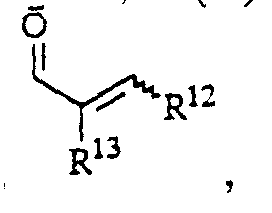
und, falls R15 Wasserstoff bedeutet, deren Salze mit physiologisch verträglichen Basen, sowie deren α-, β- oder γ-Cyclodextrinclathrate, sowie die mit Liposomen verkapselten Verbindungen der allgemeinen Formel I bedeuten.
and, if R 15 is hydrogen, their salts with physiologically compatible bases, and their α-, β- or γ-cyclodextrin clathrates, and the compounds of the general formula I encapsulated with liposomes.
Die Erfindung betrifft die Diastereomeren und/oder Enantiomeren dieser Borneolderivate und auch deren Gemische.The invention relates to the diastereomers and / or enantiomers of these borneol derivatives and also their mixtures.
Als Alkylgruppen R2, R4, R5, R6, R9a-e, R10, R11a,b, R12, R13, R14, R15a,b und X sind gerad- oder verzweigtkettige Alkylgruppen mit 1-10 Kohlenstoffatomen zu betrachten, wie beispielsweise Methyl, Ethyl, Propyl, Isopropyl, Butyl, Isobutyl, tert.-Butyl, Pentyl, Isopentyl, Neopentyl, Heptyl, Hexyl, Decyl.As alkyl groups R 2 , R 4 , R 5 , R 6 , R 9a-e , R 10 , R 11a, b , R 12 , R 13 , R 14 , R 15a, b and X are straight or branched chain alkyl groups with 1 -10 carbon atoms to consider, such as methyl, ethyl, propyl, isopropyl, butyl, isobutyl, tert-butyl, pentyl, isopentyl, neopentyl, heptyl, hexyl, decyl.
Die Alkylgruppen R2, R4, R5, R6, R9a-e, R10, R11a,b, R12, R13, R14, R15a,b und X können substituiert sein durch 1-3 Halogenatome, Hydroxygruppen, C1-C4-Alkoxygruppen, C6-C12-Arylgruppen, die durch 1-3 Halogenatome substituiert sein können, Di-(C1-C4)-Alkylamine und Tri-(C1-C4)-Alkylammonium.The alkyl groups R 2 , R 4 , R 5 , R 6 , R 9a-e , R 10 , R 11a, b , R 12 , R 13 , R 14 , R 15a, b and X can be substituted by 1-3 halogen atoms , Hydroxy groups, C 1 -C 4 alkoxy groups, C 6 -C 12 aryl groups, which can be substituted by 1-3 halogen atoms, di (C 1 -C 4 ) alkylamines and tri- (C 1 -C 4 ) -Alkylammonium.
Als Cycloalkylgruppen R9a-e, R12 kommen substituierte und unsubstituierte Reste mit 4 bis 8 Kohlenstoffatomen in Betracht.Suitable cycloalkyl groups R 9a-e , R 12 are substituted and unsubstituted radicals having 4 to 8 carbon atoms.
Als Arylrest R6, R9a-e, R10, R11a,b, R12, R13, R14, R15a,b kommen substituierte und unsubstituierte carbocyclische oder heterocyclische Reste wie z.B. Phenyl, Naphtyl, Furyl, Thienyl, Pyridyl, Pyrazolyl, Pyrimidinyl, Oxazolyl, Pyridazinyl, Pyrazinyl, Chinolyl, die mehrfach substituiert sein können durch die in X definierten Gruppen, in Frage.Aryl radicals R 6 , R 9a-e , R 10 , R 11a, b , R 12 , R 13 , R 14 , R 15a, b are substituted and unsubstituted carbocyclic or heterocyclic radicals such as phenyl, naphthyl, furyl, thienyl, pyridyl , Pyrazolyl, pyrimidinyl, oxazolyl, pyridazinyl, pyrazinyl, quinolyl, which can be substituted several times by the groups defined in X, in question.
Die in R2, R3 und X der allgemeinen Formel I enthaltenen Alkoxy-, Acyl- sowie Acyloxygruppen sollen jeweils 1 bis 10 Kohlenstoffatome enthalten, wobei Methoxy-, Ethoxy- Propoxy- Isopropoxy-, t-Butyloxy-, Formyl, Acetyl, Propionyl-, und Isopropionylgruppen bevorzugt sind.The alkoxy, acyl and acyloxy groups contained in R 2 , R 3 and X of the general formula I are each intended to contain 1 to 10 carbon atoms, methoxy, ethoxy propoxy, isopropoxy, t-butyloxy, formyl, acetyl, propionyl -, and isopropionyl groups are preferred.
Die C7-C16-Aralkylgruppen in R6, R9a-e, R11a,b, R12, R13, R14, R15a,b können im Ring bis 14 C-Atome enthalten, bevorzugt 6 bis 10 und in der Alkylkette 1 bis 4 , bevorzugt 1 bis 2 Atome. Bevorzugte Aralkylreste sind z.B. Benzyl, Phenylethyl, Naphtylmethyl bzw. Naphtylethyl. Die Ringe können mehrfach substituiert sein durch die in X definierten Gruppen.The C 7 -C 16 aralkyl groups in R 6 , R 9a-e , R 11a, b , R 12 , R 13 , R 14 , R 15a, b can contain up to 14 C atoms in the ring, preferably 6 to 10 and in the alkyl chain 1 to 4, preferably 1 to 2 atoms. Preferred aralkyl radicals are, for example, benzyl, phenylethyl, naphthylmethyl or naphthylethyl. The rings can be substituted several times by the groups defined in X.
Freie Hydroxygruppen in R1, R2, R3, R4, R5, R10 und X können funktionell abgewandelt sein, beispielsweise durch Veretherung oder Veresterung, wobei freie Hydroxygruppen bevorzugt sind.Free hydroxyl groups in R 1 , R 2 , R 3 , R 4 , R 5 , R 10 and X can be functionally modified, for example by etherification or esterification, with free hydroxyl groups being preferred.
Als Ether- und Acylreste kommen die dem Fachmann bekannten Reste in Betracht. Bevorzugt sind leicht abspaltbare Etherreste, wie beispielsweise der Tetrahydropyranyl-, Tetrahydrofuranyl-, tert.-Butyldimethylsilyl-, tert.-Butyldiphenylsilyl-, Tribenzylsilylrest. Als Acylreste kommen z.B. Acetyl, Propionyl, Butyryl, Benzoyl in Frage.The radicals known to the person skilled in the art are suitable as ether and acyl radicals. Easily removable ether residues, such as, for example, tetrahydropyranyl, Tetrahydrofuranyl, tert-butyldimethylsilyl, tert-butyldiphenylsilyl, tribenzylsilyl radical. As acyl residues e.g. Acetyl, propionyl, butyryl, benzoyl in question.
Halogen in den Definitionen für X bedeutet Fluor, Chlor, Brom und Iod.Halogen in the definitions for X means fluorine, chlorine, bromine and iodine.
Zur Salzbildung mit den freien Säuren (R15 = H) sind anorganische und organische Basen geeignet, wie sie dem Fachmann zur Bildung physiologisch verträglicher Salze bekannt sind. Beispielsweise seien genannt: Alkalihydroxide, wie Natrium- oder Kaliumhydroxid, Erdalkalihydroxide, wie Calciumhydroxid, Ammoniak, Amine, wie Ethanolamin, Diethanolamin, Triethanolamin, N-Methylglucamin, Morpholin, Tris-(hydroxymethyl)-methylamin u.s.w.Inorganic and organic bases are suitable for salt formation with the free acids (R 15 = H), as are known to the person skilled in the art for the formation of physiologically compatible salts. Examples include: alkali metal hydroxides such as sodium or potassium hydroxide, alkaline earth metal hydroxides such as calcium hydroxide, ammonia, amines such as ethanolamine, diethanolamine, triethanolamine, N-methylglucamine, morpholine, tris (hydroxymethyl) methylamine, etc
Die Erfindung betrifft ferner Verfahren zur Herstellung von Borneolderivaten der Formel
I, welches dadurch gekennzeichnet, daß man ein Olefin der allgemeinen Formel II
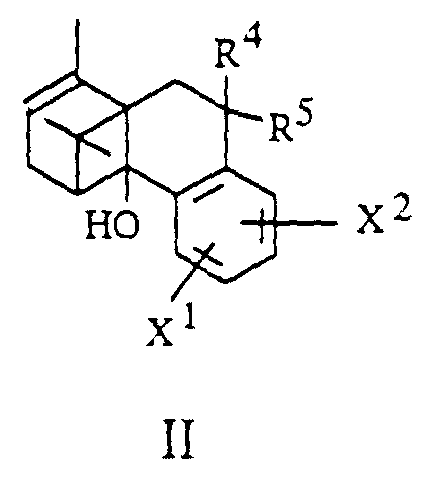

Die Reaktionsbedingungen der vorgenannten Verfahrensstufen sind:The reaction conditions of the aforementioned process stages are:
Die Epoxidierung der Doppelbindung erfolgt mit einer Peroxyverbindung wie z.B. meta-Chlorperbenzoesäure, Peroxotrifluoressigsäure, Wasserstoffperoxid, tert.-Butylhydro-peroxid gegebenfalls unter Zusatz einer Lewissäure wie z.B. Titantetraisopropoxid in einem inerten Solvens wie z.B. Dichlormethan, Toluol bei -40°C bis +40°C. Bevorzugt ist die Umsetzung mit tert.-Butylhydroperoxid und Titantetraisopropoxid in Toluol bei-10°C bis + 25°C.The epoxidation of the double bond is carried out with a peroxy compound such as e.g. meta-chloroperbenzoic acid, Peroxotrifluoroacetic acid, hydrogen peroxide, tert-butyl hydroperoxide if necessary with the addition of a Lewis acid such as e.g. Titanium tetraisopropoxide in an inert solvent such as e.g. Dichloromethane, toluene at -40 ° C to + 40 ° C. Prefers is the reaction with tert-butyl hydroperoxide and titanium tetraisopropoxide in toluene at -10 ° C up to + 25 ° C.
Die Umlagerung des gebildeten Epoxides wird durch Säuren wie z.B. para-Toluolsulfonsäure, Kieselgel, saure Ionenaustauscherharze, Salzsäure katalysiert. Bevorzugt ist die Verwendung von Kieselgel.The rearrangement of the epoxide formed is carried out by acids such as para-toluenesulfonic acid, Silica gel, acidic ion exchange resins, catalyzed hydrochloric acid. The use of silica gel is preferred.
Die Überführung der Verbindungen der Formel III in eine Verbindung der Formel I kann
in unterschiedlicher Reihenfolge vorgenommen werden:
Zur Veresterung der Alkoholfunktion (R1 = Wasserstoff) wird mit einer Base wie z.B. Metallhydriden (z.B. Natriumhydrid), Alkalialkoholaten (z.B. Natriummethanolat, Kalium-tert.-butanolat), Alkalihexamethyldisilazan (z.B. Natriumhexamethyldisilazan), 1,5-Diazabicyclo[4.3.0]non-5-en (DBN), 1,8-Diazabicyclo[5.4.0]undec-7-en (DBU), Triethylamin, 4-(Dimethylamino)pyridin (DMAP), 1,4-Diazabicyclo[2.2.2]octan (DABCO) deprotoniert und mit geeigneten Carbonsäurederivaten wie z.B. Säureamiden, Säurehalogeniden, Säureanhydriden in einem inerten Solvens wie z.B. Dichlormethan, Diethylether, Tetrahydrofuran bei -70°C bis +50°C umgesetzt. Bevorzugt wird die Umsetzung mit Natriumhexamethyldisilazan als Base, einem cyclischen Säureamid als Carbonsäurederivat, Tetrahydrofuran als Solvens bei Temperaturen von -40°C bis +25°C.To esterify the alcohol function (R 1 = hydrogen), a base such as metal hydrides (e.g. sodium hydride), alkali alcoholates (e.g. sodium methoxide, potassium tert-butoxide), alkali hexamethyldisilazane (e.g. sodium hexamethyldisilazane), 1,5-diazabicyclo [4.3.0 ] non-5-ene (DBN), 1,8-diazabicyclo [5.4.0] undec-7-ene (DBU), triethylamine, 4- (dimethylamino) pyridine (DMAP), 1,4-diazabicyclo [2.2.2 ] octane (DABCO) deprotonated and reacted with suitable carboxylic acid derivatives such as acid amides, acid halides, acid anhydrides in an inert solvent such as dichloromethane, diethyl ether, tetrahydrofuran at -70 ° C to + 50 ° C. The reaction with sodium hexamethyldisilazane as the base, a cyclic acid amide as the carboxylic acid derivative, tetrahydrofuran as the solvent at temperatures from -40 ° C. to + 25 ° C. is preferred.
Falls R4 und R5 gemeinsam eine =CHR10-Gruppe darstellen, kann die Funktionalisierung der olefinischen Doppelbindung nach den, dem Fachmann bekannten Methoden erfolgen. Beispielsweise kann Wasserstoff angelagert werden z.B. durch kat. Hydrierung, es können Hydroxylgruppen eingeführt werden durch Wasseranlagerung (Hydroborierung, Oxymercurierung) oder durch 1.2-Bishydroxylierung z.B. mit Osmiumtetroxid oder Kaliumpermanganat. Die Einführung einer Carbonylgruppe (R4, R5 stellen gemeinsam ein Sauerstoffatom dar) gelingt nach Spaltung der Doppelbindung z.B. durch Ozonolyse oder durch oxidative Spaltung eines 1.2-Diols. Eine derartig erzeugte Carbonylgruppe kann beispielsweise reduziert, alkyliert oder als Carbonylkomponente in einer Wittig-Reaktion zum Aufbau modifizierter =CHR10-Gruppen verwendet werden.If R 4 and R 5 together represent a = CHR 10 group, the olefinic double bond can be functionalized by the methods known to the person skilled in the art. For example, hydrogen can be added, for example by cat. Hydrogenation, hydroxyl groups can be introduced by water addition (hydroboration, oxymercuration) or by 1,2-bishydroxylation, for example with osmium tetroxide or potassium permanganate. A carbonyl group (R 4 , R 5 together represent an oxygen atom) can be introduced after cleavage of the double bond, for example by ozonolysis or by oxidative cleavage of a 1,2-diol. A carbonyl group produced in this way can, for example, be reduced, alkylated or used as a carbonyl component in a Wittig reaction to build up modified = CHR 10 groups.
Falls R2 und R3 gemeinsam ein Sauerstoffatom darstellen, kann das Epoxid durch Nucleophile wie beispielsweise Wasser, Carbonsäurederivate (Carbonsäuren, Carbonsäurehalogenide, Carbonsäureanhydride), Sulfonsäurederivate (Sulfonsäuren, Sulfonsäurehalogenide, Sulfonsäureanhydride), Amine, in Gegenwart von mineralischen oder organischen Säuren wie beispielsweise Chlorwasserstoff, para-Toluolsulfonsäure oder Lewissäuren wie beispielsweise Bortrifluoridetherat, Titantetraisopropoxid, Cerammoniumnitrat entweder in inerten oder als Nucleophil fungierenden Lösungsmitteln bei -70°C bis +50°C umgesetzt werden. If R 2 and R 3 together represent an oxygen atom, the epoxide can be generated by nucleophiles such as water, carboxylic acid derivatives (carboxylic acids, carboxylic acid halides, carboxylic acid anhydrides), sulfonic acid derivatives (sulfonic acids, sulfonic acid halides, sulfonic acid anhydrides), amines, in the presence of mineral or organic acids such as hydrogen chloride , para-toluenesulfonic acid or Lewis acids such as, for example, boron trifluoride etherate, titanium tetraisopropoxide, cerium ammonium nitrate can be reacted either in inert solvents or solvents which function as a nucleophile at -70 ° C. to + 50 ° C.
Die neuen Verbindungen der Formel I sind wertvolle Pharmaka. Sie interagieren mit Tubulin, indem sie gebildete Mikrotubuli stabilisieren und sind somit in der Lage, die Zellteilung phasenspezifisch zu beeinflussen. Dies betrifft vor allem schnell wachsende, neoplastische Zellen, deren Wachstum durch interzelluläre Regelmechnismen weitgehend unbeeinflußt ist. Wirkstoffe dieser Art sind prinzipiell geeignet zur Behandlung von Erkrankungen, bei denen die Beeinflussung der Zellteilung therapeutisch indiziert sein kann wie dies z.B. bei der Therapie des morbus Alzheimer, der Malaria, der Therapie von Erkrankungen, welche durch gram-negative Bakterien verursacht sind, sowie zur Behandlung maligner Tumoren der Fall ist. Als Anwendungsbereich für maligne Tumoren seien beispielweise genannt die Therapie von Ovarial-, Magen-, Colon-, Adeno-, Brust-, Lungen-, Kopf- und Nacken-Karzinomen, dem malignen Melanom, der akuten lymphozytären und myelocytären Leukämie. Die erfindungsgemäßen Verbindungen können alleine oder zur Erzielung additiver oder synergistischer Wirkungen in Kombination mit weiteren in der Tumortherapie anwendbaren Prinzipien und Substanzklassen verwendet werden.The new compounds of formula I are valuable pharmaceuticals. You interact with Tubulin by stabilizing microtubules formed and are therefore able to To influence cell division in a phase-specific manner. This especially affects fast growing, neoplastic cells, their growth largely through intercellular control mechanisms is unaffected. In principle, active substances of this type are suitable for the treatment of Diseases in which the influence on cell division may be indicated therapeutically can like this e.g. in the treatment of Alzheimer's disease, malaria, therapy diseases caused by gram-negative bacteria and Treatment of malignant tumors. As an area of application for malignant Tumors may be mentioned, for example, in the therapy of ovarian, stomach, colon, Adeno-, breast, lung, head and neck carcinomas, the malignant melanoma, the acute lymphocytic and myelocytic leukemia. The invention Compounds can be used alone or to achieve additive or synergistic Effects in combination with other principles applicable in tumor therapy and substance classes can be used.
Als Beispiele seien genannt die Kombination mit
Die Erfindung betrifft auch Arzneimittel auf Basis der pharmazeutisch verträglichen, d.h. in den verwendeten Dosen nicht toxischen Verbindungen der allgemeinen Formel I, gegebenenfalls zusammen mit den üblichen Hilfs- und Trägerstoffen.The invention also relates to pharmaceuticals based on the pharmaceutically acceptable, i.e. in the doses used, non-toxic compounds of the general formula I, optionally together with the usual auxiliaries and carriers.
Die erfindungsgemäßen Verbindungen können nach an sich bekannten Methoden der Galenik zu pharmazeutischen Präparaten für die enterale, percutane, parenterale oder lokale Applikation verarbeitet werden. Sie können in Form von Tabletten, Dragees, Gelkapseln, Granulaten, Suppositorien, Implantaten, injizierbaren sterilen wäßrigen oder öligen Lösungen, Suspensionen oder Emulsionen, Salben, Cremes und Gelen verabreicht werden.The compounds of the invention can according to known methods of Galenics for pharmaceutical preparations for enteral, percutaneous, parenteral or local application are processed. They can be in the form of tablets, coated tablets, gel capsules, Granules, suppositories, implants, injectable sterile aqueous or oily solutions, suspensions or emulsions, ointments, creams and gels become.
Der oder die Wirkstoffe können dabei mit den in der Galenik üblichen Hilfsstoffen wie z.B. Gummiarabikum, Talk, Stärke, Mannit, Methylcellulose, Laktose, Tensiden wie Tweens oder Myrj, Magnesiumstearat, wäßrigen oder nicht wäßrigen Trägern, Paraffinderivaten, Netz-, Dispergier-, Emulgier-, Konservierungsmitteln und Aromastoffen zur Geschmackskorrektur (z.B. etherischen Ölen) gemischt werden.The active ingredient (s) can be combined with the auxiliaries customary in galenics, such as e.g. Gum arabic, talc, starch, mannitol, methyl cellulose, lactose, surfactants such as Tweens or myrj, magnesium stearate, aqueous or non-aqueous vehicles, paraffin derivatives, Wetting, dispersing, emulsifying, preserving and flavoring agents for Flavor correction (e.g. essential oils) can be mixed.
Die Erfindung betrifft somit auch pharmazeutische Zusammensetzungen, die als Wirkstoff zumindest eine erfindungsgemäße Verbindung enthalten. Eine Dosiseinheit enthält etwa 0,1-100 mg Wirkstoff(e). Die Dosierung der erfindungsgemäßen Verbindungen liegt beim Menschen bei etwa 0,1-1000 mg pro Tag.The invention thus also relates to pharmaceutical compositions which act as active ingredients contain at least one compound according to the invention. Contains one dose unit about 0.1-100 mg of active ingredient (s). The dosage of the compounds according to the invention in humans is around 0.1-1000 mg per day.
Die nachfolgenden Ausführungsbeispiele dienen zur weiteren Erläuterung des erfindungsgemäßen Verfahrens. The following exemplary embodiments serve to explain the inventive method.
150 mg (214 µmol) der nach Beispiel 1a dargestellten polaren Verbindung A löst man
unter einer Atmosphäre aus trockenem Argon in 7 ml wasserfreiem Tetrahydrofuran,
versetzt mit 0,29 ml einer 1,1 M Lösung von Tetrabutylammoniumfluorid in
Tetrahydrofuran und rührt 1 Stunde bei 23°C. Man engt ein und reinigt den Rückstand
durch Chromatographie an ca. 40 ml feinem Kieselgel mit einem Gradientensystem aus
n-Hexan und Ethylacetat. Isoliert werden 113 mg (207 µmol, 97%) der Titelverbindung
als farbloser Schaum.
1H-NMR (DMSO-d6, 80°C): δ = 0,78 (3H), 0,91 (3H), 1,02 (3H), 1,32 (9H), 1,58
(1H), 2,17 (1H), 2,75 (2H), 3,08 (1H), 4,36 (1H), 4,93 (1H), 5,01 (1H), 5,07 (1H), 5,33
(1H), 5,49 (1H), 6,53 (1H), 7,20-7,38 (7H), 7,56 (2H) ppm.150 mg (214 μmol) of the polar compound A prepared according to Example 1a is dissolved in 7 ml of anhydrous tetrahydrofuran under an atmosphere of dry argon, mixed with 0.29 ml of a 1.1 M solution of tetrabutylammonium fluoride in tetrahydrofuran and stirred at 23 for 1 hour ° C. The mixture is concentrated and the residue is purified by chromatography on about 40 ml of fine silica gel using a gradient system composed of n-hexane and ethyl acetate. 113 mg (207 µmol, 97%) of the title compound are isolated as a colorless foam.
1 H-NMR (DMSO-d6, 80 ° C): δ = 0.78 (3H), 0.91 (3H), 1.02 (3H), 1.32 (9H), 1.58 (1H) , 2.17 (1H), 2.75 (2H), 3.08 (1H), 4.36 (1H), 4.93 (1H), 5.01 (1H), 5.07 (1H), 5.33 (1H), 5.49 (1H), 6.53 (1H), 7.20-7.38 (7H), 7.56 (2H) ppm.
79 mg (280 µmol) des nach Beispiel 1b dargestellten Gemisches sowie 176 mg des nach
Beispiel 1c dargestellten β-Lactams löst man unter einer Atmosphäre aus trockenem
Argon in 30 ml wasserfreiem Tetrahydrofuran, versetzt bei -35°C mit 0,34 ml einer 1M
Lösung von Natriumhexamethyldisilazan in Tetrahydrofuran und rührt 15 Minuten nach.
Man gießt in gesättigte Ammoniumchloridlösung, extrahiert mehrfach mit Ethylacetat,
wäscht die vereinigten organischen Extrakte mit Wasser und gesättigter
Natriumchloridlösung und trocknet über Natriumsulfat. Den nach Filtration und
Lösungsmittelabzug erhaltenen Rückstand trennt man durch Chromatographie an ca. 70
ml feinem Kieselgel mit einem Gradientensystem aus n-Hexan und Ethylacetat. Isoliert
werden 26 mg (37 µmol, 13%) der Titelverbindung B als unpolare Komponente sowie
91 mg (130 µ mol, 46%) der Titelverbindung A als polare Komponente, jeweils als
farbloser Schaum.
1H-NMR (CDCl3) von A: δ = 0,8-1,47 (39H), 1,71 (1H), 2,22 (1H), 2,64 (1H), 2,71
(1H), 3,03 (1H), 4,66 (1H), 4,96 (1H), 5,02 (1H), 5,16 (1H), 5,47 (1H), 5,92 (1H),
7,16-7,54 (9H) ppm.
1H-NMR (CDCl3) von B: δ = 0,8-1,47 (39H), 1,79 (1H), 2,38 (1H), 2,68 (1H), 2,70
(1H), 3,15 (1H), 4,69 (1H), 5,06 (1H), 5,08 (1H), 5,22 (1H), 5,50 (1H), 5,71 (1H),
7,18-7,56 (9H) ppm.79 mg (280 μmol) of the mixture shown in Example 1b and 176 mg of the β-lactam shown in Example 1c are dissolved in 30 ml of anhydrous tetrahydrofuran under an atmosphere of dry argon, mixed with 0.34 ml of a 1M at -35 ° C. Solution of sodium hexamethyldisilazane in tetrahydrofuran and stirred for 15 minutes. It is poured into saturated ammonium chloride solution, extracted several times with ethyl acetate, the combined organic extracts are washed with water and saturated sodium chloride solution and dried over sodium sulfate. The residue obtained after filtration and removal of solvent is separated by chromatography on about 70 ml of fine silica gel using a gradient system composed of n-hexane and ethyl acetate. Are isolated 26 mg (37 .mu.mol, 13%) of the title compound B as a nonpolar component, and 91 mg (130 μ mol, 46%) of the title compound A as a polar component, in each case as a colorless foam.
1 H NMR (CDCl 3 ) of A: δ = 0.8-1.47 (39H), 1.71 (1H), 2.22 (1H), 2.64 (1H), 2.71 (1H ), 3.03 (1H), 4.66 (1H), 4.96 (1H), 5.02 (1H), 5.16 (1H), 5.47 (1H), 5.92 (1H) , 7.16-7.54 (9H) ppm.
1 H NMR (CDCl 3 ) of B: δ = 0.8-1.47 (39H), 1.79 (1H), 2.38 (1H), 2.68 (1H), 2.70 (1H ), 3.15 (1H), 4.69 (1H), 5.06 (1H), 5.08 (1H), 5.22 (1H), 5.50 (1H), 5.71 (1H) , 7.18-7.56 (9H) ppm.
2,1g (7,88 mmol) eines ca. 7:3-Gemisches aus [4R-(4α,4aβ,10aα)]-9-Methylen-3,4,4a,9,10,10a-hexahydro-1,11,11-trimethyl-4,10a-methanophenanthren-4a-ol
und [4S-(4α,4aβ,10aα)]-9-Methylen-3,4,4a,9,10,10a-hexahydro-1,11,11-trimethyl-4,10a-methanophenanthren-4a-ol,
das man in Analogie zu dem im J. Am. Chem. Soc. 1992, auf
Seite 5879 beschriebenen Verfahren hergestellt hat, löst man unter einer Atmosphäre aus
trockenem Argon in 80 ml wasserfreiem Dichlormethan und kühlt auf 0°C. Man versetzt
mit 2,4 ml Titan(IV)isopropylat, 1,5 ml einer 6,5 M wasserfreien Lösung von tert.-Butylhydroperoxid
in Toluol und rührt 0,5 Stunden. Man gießt in Wasser, extrahiert
mehrfach mit Diethylether, wäscht die vereinigten organischen Extrakte mit Wasser und
gesättigter Natriumchloridlösung und trocknet über Natriumsulfat. Den nach Filtration
und Lösungsmittelabzug erhaltenen Rückstand trennt man durch Chromatographie an ca.
200 ml feinem Kieselgel mit einem Gradientensystem aus n-Hexan und Ethylacetat.
Isoliert werden 1,39 g (4,92 mmol, 62%) der Titelverbindungen A und B als kristalliner
Feststoff. Durch Kristallisation aus Diisopropylether läßt sich das im Überschuß in dem
Produktgemisch enthaltene Isomer A enantiomerenrein gewinnen.
1H-NMR (CDCl3): δ = 0,79 (3H), 0,88 (3H), 1,11 (3H), 1,58 (1H), 2,38 (1H), 2,68
(1H), 2,74 (1H), 3,08 (1H), 3,79 (1H), 3,97 (1H), 5,02 (1H), 5,48 (1H), 7,30 (2H), 7,51
(2H) ppm.2.1g (7.88 mmol) of an approx. 7: 3 mixture of [4R- (4α, 4aβ, 10aα)] - 9-methylene-3,4,4a, 9,10,10a-hexahydro-1, 11,11-trimethyl-4,10a-methanophenanthren-4a-ol and [4S- (4α, 4aβ, 10aα)] - 9-methylene-3,4,4a, 9,10,10a-hexahydro-1,11, 11-trimethyl-4,10a-methanophenanthren-4a-ol, which is analogous to that described in J. Am. Chem. Soc. 1992, on page 5879, is dissolved in an atmosphere of dry argon in 80 ml of anhydrous dichloromethane and cooled to 0 ° C. 2.4 ml of titanium (IV) isopropylate, 1.5 ml of a 6.5 M anhydrous solution of tert-butyl hydroperoxide in toluene are added and the mixture is stirred for 0.5 hours. It is poured into water, extracted several times with diethyl ether, the combined organic extracts are washed with water and saturated sodium chloride solution and dried over sodium sulfate. The residue obtained after filtration and removal of solvent is separated by chromatography on about 200 ml of fine silica gel using a gradient system composed of n-hexane and ethyl acetate. 1.39 g (4.92 mmol, 62%) of the title compounds A and B are isolated as a crystalline solid. The isomer A present in excess in the product mixture can be obtained enantiomerically pure by crystallization from diisopropyl ether.
1 H NMR (CDCl 3 ): δ = 0.79 (3H), 0.88 (3H), 1.11 (3H), 1.58 (1H), 2.38 (1H), 2.68 ( 1H), 2.74 (1H), 3.08 (1H), 3.79 (1H), 3.97 (1H), 5.02 (1H), 5.48 (1H), 7.30 (2H) ), 7.51 (2H) ppm.
2,5 g (7,82 mmol) (3R,4S)-3-Triisopropylsilyloxy-4-phenylazetidin-2-on, das man in
Analogie zu dem in Tetrahedron 48, 6985 (1992) beschriebenen Verfahren hergestellt
hat, löst man unter einer Atmosphäre aus trockenem Argon in 50 ml wasserfreiem
Dichlormethan, kühlt auf 0°C, versetzt mit 3,1 ml Triethylamin, 3,65 ml
Pyrokohlensäure-di-tert.butylether sowie einer katalytischen Menge Dimethylaminopyridin.
Man läßt auf 23°C erwärmen und 16 Stunden rühren. Man gießt in gesättigte
Ammoniumchloridlösung, extrahiert mehrfach mit Diethylether, wäscht die vereinigten
organischen Extrakte mit Wasser und gesättigter Natriumchloridlösung und trocknet
über Natriumsulfat. Den nach Filtration und Lösungsmittelabzug erhaltenen Rückstand
trennt man durch Chromatographie an ca. 300 ml feinem Kieselgel mit einem
Gradientensystem aus n-Hexan und Ethylacetat. Isoliert werden 3,1 g (7,39 mmol, 94%)
der Titelverbindung als kristalliner Feststoff.
1H-NMR (CDCl3): δ = 0,80-1,02 (21H), 1,40 (9H), 5,07 (1H), 5,17 (1H), 7,27-7,40
(5H) ppm.2.5 g (7.82 mmol) (3R, 4S) -3-triisopropylsilyloxy-4-phenylazetidin-2-one, which was prepared in analogy to the process described in Tetrahedron 48, 6985 (1992), is dissolved in an atmosphere of dry argon in 50 ml of anhydrous dichloromethane, cools to 0 ° C., mixed with 3.1 ml of triethylamine, 3.65 ml of pyrocarbonate di-tert-butyl ether and a catalytic amount of dimethylaminopyridine. The mixture is allowed to warm to 23 ° C. and stirred for 16 hours. It is poured into saturated ammonium chloride solution, extracted several times with diethyl ether, the combined organic extracts are washed with water and saturated sodium chloride solution and dried over sodium sulfate. The residue obtained after filtration and removal of solvent is separated by chromatography on about 300 ml of fine silica gel using a gradient system composed of n-hexane and ethyl acetate. 3.1 g (7.39 mmol, 94%) of the title compound are isolated as a crystalline solid.
1 H NMR (CDCl 3 ): δ = 0.80-1.02 (21H), 1.40 (9H), 5.07 (1H), 5.17 (1H), 7.27-7.40 (5H) ppm.
5,0 g (15,6 mmol) (3R,4S)-3-Triisopropylsilyloxy-4-phenylazetidin-2-on, das man in
Analogie zu dem in Tetrahedron 48, 6985 (1992) beschriebenen Verfahren hergestellt
hat, löst man unter einer Atmosphäre aus trockenem Argon in 100 ml wasserfreiem
Dichlormethan, kühlt auf 0°C, versetzt mit 6,2 ml Triethylamin, 3,85 ml Benzoylchlorid
sowie einer katalytischen Menge Dimethylaminopyridin. Man läßt auf 23°C erwärmen
und 16 Stunden rühren. Man gießt in gesättigte Ammoniumchloridlösung, extrahiert
mehrfach mit Diethylether, wäscht die vereinigten organischen Extrakte mit Wasser und
gesättigter Natriumchloridlösung und trocknet über Natriumsulfat. Den nach Filtration
und Lösungsmittelabzug erhaltenen Rückstand trennt man durch Chromatographie an ca.
400 ml feinem Kieselgel mit einem Gradientensystem aus n-Hexan und Ethylacetat.
Isoliert werden 6,43 g (15,2 mmol, 97%) der Titelverbindung als kristalliner Feststoff.
1H-NMR (CDCl3): δ = 0,80-1,07 (21H), 5,25 (1H), 5,43 (1H), 7,27-7,43 (5H), 7,48
(2H), 7,59 (1H), 8,03 (2H) ppm.5.0 g (15.6 mmol) of (3R, 4S) -3-triisopropylsilyloxy-4-phenylazetidin-2-one, which was prepared in analogy to the process described in Tetrahedron 48, 6985 (1992), is dissolved in an atmosphere of dry argon in 100 ml of anhydrous dichloromethane, cools to 0 ° C., mixed with 6.2 ml of triethylamine, 3.85 ml of benzoyl chloride and a catalytic amount of dimethylaminopyridine. The mixture is allowed to warm to 23 ° C. and stirred for 16 hours. It is poured into saturated ammonium chloride solution, extracted several times with diethyl ether, the combined organic extracts are washed with water and saturated sodium chloride solution and dried over sodium sulfate. The residue obtained after filtration and removal of solvent is separated by chromatography on about 400 ml of fine silica gel using a gradient system composed of n-hexane and ethyl acetate. 6.43 g (15.2 mmol, 97%) of the title compound are isolated as a crystalline solid.
1 H NMR (CDCl 3 ): δ = 0.80-1.07 (21H), 5.25 (1H), 5.43 (1H), 7.27-7.43 (5H), 7.48 (2H), 7.59 (1H), 8.03 (2H) ppm.
2,0 g (6,3 mmol) (3R,4S)-3-Triisopropylsilyloxy-4-phenylazetidin-2-on, das man in
Analogie zu dem in Tetrahedron 48, 6985 (1992) beschriebenen Verfahren hergestellt
hat, setzt man in Analogie zu Beispiel 1d unter Verwendung von
Cyclohexancarbonsäurechlorid um und isoliert nach Aufarbeitung und Reinigung 2,6 g
(6,1 mmol, 96%) der Titelverbindung.
1H-NMR (CDCl3): δ = 0,81-1,03 (21H), 1,12-2,04 (10H), 3,03 (1H), 5,14 (1H), 5,19
(1H), 7,18-7,37 (5H) ppm.2.0 g (6.3 mmol) (3R, 4S) -3-triisopropylsilyloxy-4-phenylazetidin-2-one, which was prepared in analogy to the process described in Tetrahedron 48, 6985 (1992), is put into Analogous to Example 1d using cyclohexane carboxylic acid chloride and after working up and purifying 2.6 g (6.1 mmol, 96%) of the title compound.
1 H NMR (CDCl 3 ): δ = 0.81-1.03 (21H), 1.12-2.04 (10H), 3.03 (1H), 5.14 (1H), 5.19 (1H), 7.18-7.37 (5H) ppm.
2,0 g (6,3 mmol) (3R,4S)-3-Triisopropylsilyloxy-4-phenylazetidin-2-on, das man in
Analogie zu dem in Tetrahedron 48, 6985 (1992) beschriebenen Verfahren hergestellt
hat, setzt man in Analogie zu Beispiel 1d unter Verwendung von Acetylchlorid um und
isoliert nach Aufarbeitung und Reinigung 1,8 g (5,0 mmol, 79%) der Titelverbindung.
1H-NMR (CDCl3): δ = 0,77-1,04 (21H), 2,45 (3H), 5,17 (1H), 5,22 (1H), 7,20-7,39
(5H) ppm.2.0 g (6.3 mmol) (3R, 4S) -3-triisopropylsilyloxy-4-phenylazetidin-2-one, which was prepared in analogy to the process described in Tetrahedron 48, 6985 (1992), is put into Analogous to Example 1d using acetyl chloride and after workup and purification, 1.8 g (5.0 mmol, 79%) of the title compound is isolated.
1 H NMR (CDCl 3 ): δ = 0.77-1.04 (21H), 2.45 (3H), 5.17 (1H), 5.22 (1H), 7.20-7.39 (5H) ppm.
96 mg (300 µmol) (3R,4S)-3-Triisopropylsilyloxy-4-phenylazetidin-2-on, das man in
Analogie zu dem in Tetrahedron 48, 6985 (1992) beschriebenen Verfahren hergestellt
hat, setzt man in Analogie zu Beispiel 1d unter Verwendung von Propionsäureanhydrid
um und isoliert nach Aufarbeitung und Reinigung 85 mg (226 µmol, 75%) der
Titelverbindung.
1H-NMR (CDCl3): δ = 0,75-1,05 (21H), 1,18 (3H), 2,29 (2H), 5,14 (1H), 5,20 (1H),
7,20-7,39 (5H) ppm.96 mg (300 μmol) (3R, 4S) -3-triisopropylsilyloxy-4-phenylazetidin-2-one, which was prepared in analogy to the process described in Tetrahedron 48, 6985 (1992), is set in analogy to Example 1d using propionic anhydride and, after workup and purification, isolated 85 mg (226 µmol, 75%) of the title compound.
1 H-NMR (CDCl 3 ): δ = 0.75-1.05 (21H), 1.18 (3H), 2.29 (2H), 5.14 (1H), 5.20 (1H), 7.20-7.39 (5H) ppm.
96 mg (300 µmol) (3R,4S)-3-Triisopropylsilyloxy-4-phenylazetidin-2-on, das man in
Analogie zu dem in Tetrahedron 48, 6985 (1992) beschriebenen Verfahren hergestellt
hat, setzt man in Analogie zu Beispiel 1d unter Verwendung von Buttersäurechlorid um
und isoliert nach Aufarbeitung und Reinigung 103 mg (264 µmol, 88%) der
Titelverbindung.
1H-NMR (CDCl3): δ = 0,75-1,07 (24H), 1,70 (2H), 2,76 (2H), 5,17 (1H), 5,20 (1H),
7,20-7,40 (5H) ppm.96 mg (300 μmol) (3R, 4S) -3-triisopropylsilyloxy-4-phenylazetidin-2-one, which was prepared in analogy to the process described in Tetrahedron 48, 6985 (1992), is set in analogy to Example 1d using butyric acid chloride and 103 mg (264 μmol, 88%) of the title compound is isolated after working up and purification.
1 H-NMR (CDCl 3 ): δ = 0.75-1.07 (24H), 1.70 (2H), 2.76 (2H), 5.17 (1H), 5.20 (1H), 7.20-7.40 (5H) ppm.
96 mg (300 µmol) (3R,4S)-3-Triisopropylsilyloxy-4-phenylazetidin-2-on, das man in
Analogie zu dem in Tetrahedron 48, 6985 (1992) beschriebenen Verfahren hergestellt
hat, setzt man in Analogie zu Beispiel 1d unter Verwendung von 3-Methylbuttersäurechlorid
um und isoliert nach Aufarbeitung und Reinigung 106 mg (263
µmol, 88%) der Titelverbindung.
1H-NMR (CDCl3): δ = 0,74-1,05 (27H), 2,20 (1H), 2,58 (1H), 2,75 (1H), 5,16 (1H),
5,20 (1H), 7,20-7,38 (5H) ppm.96 mg (300 μmol) (3R, 4S) -3-triisopropylsilyloxy-4-phenylazetidin-2-one, which was prepared in analogy to the process described in Tetrahedron 48, 6985 (1992), is set in analogy to Example 1d using 3-methylbutyric acid chloride and, after workup and purification, isolated 106 mg (263 μmol , 88%) of the title compound.
1 H-NMR (CDCl 3 ): δ = 0.74-1.05 (27H), 2.20 (1H), 2.58 (1H), 2.75 (1H), 5.16 (1H), 5.20 (1H), 7.20-7.38 (5H) ppm.
96 mg (300 µmol) (3R,4S)-3-Triisopropylsilyloxy-4-phenylazetidin-2-on, das man in
Analogie zu dem in Tetrahedron 48, 6985 (1992) beschriebenen Verfahren hergestellt
hat, setzt man in Analogie zu Beispiel 1d unter Verwendung von 3,3-Dimethylbuttersäurechlorid
um und isoliert nach Aufarbeitung und Reinigung 105 mg
(251 µmol, 84%) der Titelverbindung.
1H-NMR (CDCl3): δ = 0,80-1,14 (30H), 2,62 (1H), 2,81 (1H), 5,15 (1H), 5,19 (1H),
7,22-7,38 (5H) ppm.96 mg (300 μmol) (3R, 4S) -3-triisopropylsilyloxy-4-phenylazetidin-2-one, which was prepared in analogy to the process described in Tetrahedron 48, 6985 (1992), is set in analogy to Example 1d using 3,3-dimethylbutyric acid chloride and, after workup and purification, isolated 105 mg (251 μmol , 84%) of the title compound.
1 H-NMR (CDCl 3 ): δ = 0.80-1.14 (30H), 2.62 (1H), 2.81 (1H), 5.15 (1H), 5.19 (1H), 7.22-7.38 (5H) ppm.
96 mg (300 µmol) (3R,4S)-3-Triisopropylsilyloxy-4-phenylazetidin-2-on, das man in
Analogie zu dem in Tetrahedron 48, 6985 (1992) beschriebenen Verfahren hergestellt
hat, setzt man in Analogie zu Beispiel 1d unter Verwendung von 3-Phenylpropionsäurechlorid
um und isoliert nach Aufarbeitung und Reinigung 60 mg (133
µmol, 44%) der Titelverbindung.
1H-NMR (CDCl3): δ = 0,78-1,05 (21H), 2,92-3,25 (4H), 5,12 (1H), 5,17 (1H), 7,14-7,38
(10H) ppm.96 mg (300 μmol) (3R, 4S) -3-triisopropylsilyloxy-4-phenylazetidin-2-one, which was prepared in analogy to the process described in Tetrahedron 48, 6985 (1992), is set in analogy to Example 1d using 3-phenylpropionic acid chloride and, after workup and purification, isolated 60 mg (133 μmol , 44%) of the title compound.
1 H NMR (CDCl 3 ): δ = 0.78-1.05 (21H), 2.92-3.25 (4H), 5.12 (1H), 5.17 (1H), 7.14 -7.38 (10H) ppm.
96 mg (300 µmol) (3R,4S)-3-Triisopropylsilyloxy-4-phenylazetidin-2-on, das man in
Analogie zu dem in Tetrahedron 48, 6985 (1992) beschriebenen Verfahren hergestellt
hat, setzt man in Analogie zu Beispiel 1d unter Verwendung von
Bemsteinsäuremethylesterchlorid um und isoliert nach Aufarbeitung und Reinigung 24
mg (55 µmol, 18%) der Titelverbindung.
1H-NMR (CDCl3): δ = 0,75-1,06 (21H), 2,66 (2H), 3,09 (2H), 3,67 (3H), 5,18 (1H),
5,23 (1H), 7,20-7,38 (5H) ppm.96 mg (300 μmol) (3R, 4S) -3-triisopropylsilyloxy-4-phenylazetidin-2-one, which was prepared in analogy to the process described in Tetrahedron 48, 6985 (1992), is set in analogy to Example 1d using succinic acid methyl ester chloride and, after workup and purification, isolated 24 mg (55 μmol, 18%) of the title compound.
1 H-NMR (CDCl 3 ): δ = 0.75-1.06 (21H), 2.66 (2H), 3.09 (2H), 3.67 (3H), 5.18 (1H), 5.23 (1H), 7.20-7.38 (5H) ppm.
96 mg (300 µmol) (3R,4S)-3-Triisopropylsilyloxy-4-phenylazetidin-2-on, das man in
Analogie zu dem in Tetrahedron 48, 6985 (1992) beschriebenen Verfahren hergestellt
hat, setzt man in Analogie zu Beispiel 1d unter Verwendung von Bernsteinsäureanhydrid
um und isoliert nach Aufarbeitung 122 mg (300 µmol, 100%) der Titelverbindung, die
man ohne Reinigung weiter umsetzt.
1H-NMR (CDCl3): δ = 0,75-1,08 (21H), 2,72 (2H), 3,08 (2H), 5,18 (1H), 5,23 (1H),
7,20-7,40 (5H) ppm. 96 mg (300 μmol) (3R, 4S) -3-triisopropylsilyloxy-4-phenylazetidin-2-one, which was prepared in analogy to the process described in Tetrahedron 48, 6985 (1992), is set in analogy to Example 1d using succinic anhydride and isolated after workup, 122 mg (300 μmol, 100%) of the title compound, which is reacted further without purification.
1 H-NMR (CDCl 3 ): δ = 0.75-1.08 (21H), 2.72 (2H), 3.08 (2H), 5.18 (1H), 5.23 (1H), 7.20-7.40 (5H) ppm.
200 mg (626 µmol) (3R,4S)-3-Triisopropylsilyloxy-4-phenylazetidin-2-on, das man in
Analogie zu dem in Tetrahedron 48, 6985 (1992) beschriebenen Verfahren hergestellt
hat, setzt man in Analogie zu Beispiel 1d unter Verwendung von 3-Cyclopentyl-propionsäurechlorid
um und isoliert nach Aufarbeitung und Reinigung 102 mg (230
µmol, 37%) der Titelverbindung.
1H-NMR (CDCl3): δ = 0,80-1,19 (23H), 1,42-1,86 (9H), 2,79 (2H), 5,15 (1H), 5,20
(1H), 7,20-7,38 (5H) ppm.200 mg (626 μmol) (3R, 4S) -3-triisopropylsilyloxy-4-phenylazetidin-2-one, which was prepared in analogy to the process described in Tetrahedron 48, 6985 (1992), is set in analogy to Example 1d using 3-cyclopentyl-propionic acid chloride and, after workup and purification, isolated 102 mg (230 μmol, 37%) of the title compound.
1 H NMR (CDCl 3 ): δ = 0.80-1.19 (23H), 1.42-1.86 (9H), 2.79 (2H), 5.15 (1H), 5.20 (1H), 7.20-7.38 (5H) ppm.
200 mg (626 µmol) (3R,4S)-3-Triisopropylsilyloxy-4-phenylazetidin-2-on, das man in
Analogie zu dem in Tetrahedron 48, 6985 (1992) beschriebenen Verfahren hergestellt
hat, setzt man in Analogie zu Beispiel 1d unter Verwendung von
Chlorameisensäuremethylester um und isoliert nach Aufarbeitung und Reinigung 153 mg
(405 µmol, 65%) der Titelverbindung.
1H-NMR (CDCl3): δ = 0,78-1,06 (21H), 3,80 (3H), 5,12 (1H), 5,20 (1H), 7,22-7,40
(5H) ppm.200 mg (626 μmol) (3R, 4S) -3-triisopropylsilyloxy-4-phenylazetidin-2-one, which was prepared in analogy to the process described in Tetrahedron 48, 6985 (1992), is set in analogy to Example 1d using methyl chloroformate and isolated after working up and purification 153 mg (405 µmol, 65%) of the title compound.
1 H NMR (CDCl 3 ): δ = 0.78-1.06 (21H), 3.80 (3H), 5.12 (1H), 5.20 (1H), 7.22-7.40 (5H) ppm.
200 mg (626 µmol) (3R,4S)-3-Triisopropylsilyloxy-4-phenylazetidin-2-on, das man in
Analogie zu dem in Tetrahedron 48, 6985 (1992) beschriebenen Verfahren hergestellt
hat, setzt man in Analogie zu Beispiel 1d unter Verwendung von Chlorthioameisensäure-S-methylester
um und isoliert nach Aufarbeitung und Reinigung 224 mg (569 µmol,
91%) der Titelverbindung.
1H-NMR (CDCl3): δ = 0,82-1,05 (21H), 2,37 (3H), 5,23 (2H), 7,22-7,40 (5H) ppm.200 mg (626 μmol) (3R, 4S) -3-triisopropylsilyloxy-4-phenylazetidin-2-one, which was prepared in analogy to the process described in Tetrahedron 48, 6985 (1992), is set in analogy to Example 1d using S-methyl chlorothio formate and, after workup and purification, isolated 224 mg (569 μmol, 91%) of the title compound.
1 H NMR (CDCl 3 ): δ = 0.82-1.05 (21H), 2.37 (3H), 5.23 (2H), 7.22-7.40 (5H) ppm.
319 mg (1 mmol) (3R,4S)-3-Triisopropylsilyloxy-4-phenylazetidin-2-on, das man in
Analogie zu dem in Tetrahedron 48, 6985 (1992) beschriebenen Verfahren hergestellt
hat, setzt man in Analogie zu Beispiel 1d unter Verwendung von
Chlorameisensäureethylester um und isoliert nach Aufarbeitung und Reinigung 392 mg
(1 mmol, 100%) der Titelverbindung.
1H-NMR (CDCl3): δ = 0,76-1,05 (21H), 1,27 (3H), 4,23 (2H), 5,11 (1H), 5,20 (1H),
7,22-7,40 (5H) ppm.319 mg (1 mmol) (3R, 4S) -3-triisopropylsilyloxy-4-phenylazetidin-2-one, which was prepared in analogy to the process described in Tetrahedron 48, 6985 (1992), is set in analogy to Example 1d using ethyl chloroformate and isolated after working up and purification 392 mg (1 mmol, 100%) of the title compound.
1 H-NMR (CDCl 3 ): δ = 0.76-1.05 (21H), 1.27 (3H), 4.23 (2H), 5.11 (1H), 5.20 (1H), 7.22-7.40 (5H) ppm.
960 mg (3,0 mmol) (3R,4S)-3-Triisopropylsilyloxy-4-phenylazetidin-2-on, das man in
Analogie zu dem in Tetrahedron 48, 6985 (1992) beschriebenen Verfahren hergestellt
hat, setzt man in Analogie zu Beispiel 1d unter Verwendung von Chlorthioameisensäure-S-ethylester
um und isoliert nach Aufarbeitung und Reinigung 1,11 g (2,72 mmol, 91%)
der Titelverbindung.
1H-NMR (CDCl3): δ = 0,76-1,04 (21H), 1,28 (3H), 2,93 (2H), 5,21 (2H), 7,20-7,40
(5H) ppm.960 mg (3.0 mmol) (3R, 4S) -3-triisopropylsilyloxy-4-phenylazetidin-2-one, which was prepared in analogy to the process described in Tetrahedron 48, 6985 (1992), is added in analogy Example 1d using S-ethyl chlorothiooformate and, after workup and purification, isolated 1.11 g (2.72 mmol, 91%) of the title compound.
1 H NMR (CDCl 3 ): δ = 0.76-1.04 (21H), 1.28 (3H), 2.93 (2H), 5.21 (2H), 7.20-7.40 (5H) ppm.
96 mg (300 µmol) (3R,4S)-3-Triisopropylsilyloxy-4-phenylazetidin-2-on, das man in
Analogie zu dem in Tetrahedron 48, 6985 (1992) beschriebenen Verfahren hergestellt
hat, setzt man in Analogie zu Beispiel 1d unter Verwendung von
Chlorameisensäurebutylester um und isoliert nach Aufarbeitung und Reinigung 106 mg
(252 µmol, 84%) der Titelverbindung.
1H-NMR (CDCl3): δ = 0,76-1,04 (26H), 1,27 (1H), 1,57 (1H), 3,92 (1H), 4,15 (1H),
5,10 (1H), 5,20 (1H), 7,22-7,40 (5H) ppm.96 mg (300 μmol) (3R, 4S) -3-triisopropylsilyloxy-4-phenylazetidin-2-one, which was prepared in analogy to the process described in Tetrahedron 48, 6985 (1992), is set in analogy to Example 1d using butyl chloroformate and isolated after working up and purification 106 mg (252 µmol, 84%) of the title compound.
1 H-NMR (CDCl 3 ): δ = 0.76-1.04 (26H), 1.27 (1H), 1.57 (1H), 3.92 (1H), 4.15 (1H), 5.10 (1H), 5.20 (1H), 7.22-7.40 (5H) ppm.
In Analogie zu Beispiel 1 werden 26 mg (37 µmol) der nach Beispiel 1a dargestellten
unpolaren Verbindung B umgesetzt. Nach Aufarbeitung und Reinigung isoliert man 14
mg (25 µmol, 69%) der Titelverbindung als farbloses Öl.
1H-NMR (CDCl3): δ = 0,84 (3H), 0,96 (3H), 1,08 (3H), 1,42 (9H), 1,83 (1H), 2,40
(1H), 2,70 (1H), 2,72 (1H), 3,18 (1H), 3,21 (1H), 4,58 (1H), 5,02 (1H), 5,10 (1H), 5,28
(1H), 5,50 (1H), 5,55 (1H), 7,22-7,38 (9H) ppm.Analogously to Example 1, 26 mg (37 μmol) of the nonpolar compound B shown in Example 1a are reacted. After working up and purification, 14 mg (25 μmol, 69%) of the title compound are isolated as a colorless oil.
1 H NMR (CDCl 3 ): δ = 0.84 (3H), 0.96 (3H), 1.08 (3H), 1.42 (9H), 1.83 (1H), 2.40 ( 1H), 2.70 (1H), 2.72 (1H), 3.18 (1H), 3.21 (1H), 4.58 (1H), 5.02 (1H), 5.10 (1H) ), 5.28 (1H), 5.50 (1H), 5.55 (1H), 7.22-7.38 (9H) ppm.
100 mg (142 µmol) der nach Beispiel 3a dargestellten polaren Verbindung A setzt man
in Analogie zu Beispiel 1 um und isoliert nach Aufarbeitung und Reinigung 66 mg (120
µmol, 85%) der Titelverbindung als farbloses Öl.
1H-NMR (CDCl3): δ = 0,82 (3H), 0,91 (3H), 0,98 (3H), 1,81 (1H), 2,29 (1H), 2,68
(1H), 2,71 (1H), 2,91 (1H), 3,59 (1H), 4,71 (1H), 4,88 (1H), 5,13 (1H), 5,40 (1H), 5,71
(1H), 7,18 (2H), 7,22-7,40 (6H), 7,40-7,59 (4H), 7,70 (1H), 7,87 (2H) ppm.100 mg (142 μmol) of the polar compound A prepared according to Example 3a is reacted analogously to Example 1 and, after workup and purification, 66 mg (120 μmol, 85%) of the title compound is isolated as a colorless oil.
1 H NMR (CDCl 3 ): δ = 0.82 (3H), 0.91 (3H), 0.98 (3H), 1.81 (1H), 2.29 (1H), 2.68 ( 1H), 2.71 (1H), 2.91 (1H), 3.59 (1H), 4.71 (1H), 4.88 (1H), 5.13 (1H), 5.40 (1H) ), 5.71 (1H), 7.18 (2H), 7.22-7.40 (6H), 7.40-7.59 (4H), 7.70 (1H), 7.87 (2H ) ppm.
80 mg (283 µmol) des nach Beispiel 1b dargestellten Gemisches sowie 181 mg des nach
Beispiel 1d dargestellten β-Lactams setzt man in Analogie zu Beispiel 1a um und isoliert
nach Aufarbeitung und Reinigung 24 mg (34 µmol, 12%) der Titelverbindung B als
unpolare Komponente sowie 100 mg (142 µmol, 50%) der Titelverbindung A als polare
Komponente, jeweils als farbloses Öl.
1H-NMR (CDCl3) von A: δ = 0,8-1,22 (30H), 1,72 (1H), 2,20 (1H), 2,64 (1H), 2,66
(1H), 2,95 (1H), 4,78 (1H), 4,92 (1H), 5,05 (1H), 5,42 (1H), 5,68 (1H), 7,17-7,58
(12H), 7,65 (1H), 7,92 (2H) ppm.
1H-NMR (CDCl3) von B: δ = 0,77 (3H), 0,80 (3H), 0,85-1,18 (24H), 1,65 (1H), 2,28
(1H), 2,53 (1H), 2,61 (1H), 2,79 (1H), 4,78 (1H), 5,02 (1H), 5,15 (1H), 5,46 (1H), 5,78
(1H), 7,11 (2H), 7,21-7,57 (10H), 7,74 (1H), 7,92 (2H) ppm.80 mg (283 μmol) of the mixture shown in Example 1b and 181 mg of the β-lactam shown in Example 1d are reacted analogously to Example 1a and, after workup and purification, 24 mg (34 μmol, 12%) of the title compound B is isolated non-polar component and 100 mg (142 μmol , 50%) of the title compound A as a polar component, in each case as a colorless oil.
1 H NMR (CDCl 3 ) of A: δ = 0.8-1.22 (30H), 1.72 (1H), 2.20 (1H), 2.64 (1H), 2.66 (1H ), 2.95 (1H), 4.78 (1H), 4.92 (1H), 5.05 (1H), 5.42 (1H), 5.68 (1H), 7.17-7, 58 (12H), 7.65 (1H), 7.92 (2H) ppm.
1 H NMR (CDCl 3 ) of B: δ = 0.77 (3H), 0.80 (3H), 0.85-1.18 (24H), 1.65 (1H), 2.28 (1H ), 2.53 (1H), 2.61 (1H), 2.79 (1H), 4.78 (1H), 5.02 (1H), 5.15 (1H), 5.46 (1H) , 5.78 (1H), 7.11 (2H), 7.21-7.57 (10H), 7.74 (1H), 7.92 (2H) ppm.
24 mg (34 µmol) der nach Beispiel 3a dargestellten unpolaren Verbindung B setzt man in
Analogie zu Beispiel 1 um und isoliert nach Aufarbeitung und Reinigung 10 mg (18
µmol, 54%) der Titelverbindung als farbloses Öl.
1H-NMR (CDCl3): δ = 0,81 (3H), 0,90 (6H), 1,76 (1H), 2,32 (1H), 2,63 (1H), 2,67
(1H), 3,00 (1H), 3,34 (1H), 4,69 (1H), 5,07 (1H), 5,12 (1H), 5,47 (1H), 5,90 (1H),
7,16-7,58 (13H), 7,87 (2H) ppm. 24 mg (34 μmol) of the nonpolar compound B prepared according to Example 3a is reacted analogously to Example 1 and, after workup and purification, 10 mg (18 μmol, 54%) of the title compound is isolated as a colorless oil.
1 H-NMR (CDCl 3 ): δ = 0.81 (3H), 0.90 (6H), 1.76 (1H), 2.32 (1H), 2.63 (1H), 2.67 ( 1H), 3.00 (1H), 3.34 (1H), 4.69 (1H), 5.07 (1H), 5.12 (1H), 5.47 (1H), 5.90 (1H ), 7.16-7.58 (13H), 7.87 (2H) ppm.
22 mg (30 µmol) der nach Beispiel 5a dargestellten Verbindung setzt man in Analogie zu
Beispiel 1 um und isoliert nach Aufarbeitung und Reinigung 9 mg (16 µmol, 52%) der
Titelverbindung als farbloses Öl.
1H-NMR (CDCl3): δ = 0,65 (3H), 1,01 (6H), 1,43 (9H), 2,07 (1H), 2,41 (1H), 2,57
(1H), 2,73 (2H), 2,82 (3H), 3,27 (1H), 3,82 (1H), 4,51 (1H), 5,12 (1H), 5,21 (2H), 5,33
(1H), 6,23 (1H), 7,22-7,50 (9H) ppm.22 mg (30 μmol) of the compound shown in Example 5a is reacted analogously to Example 1 and, after workup and purification, 9 mg (16 μmol, 52%) of the title compound is isolated as a colorless oil.
1 H NMR (CDCl 3 ): δ = 0.65 (3H), 1.01 (6H), 1.43 (9H), 2.07 (1H), 2.41 (1H), 2.57 ( 1H), 2.73 (2H), 2.82 (3H), 3.27 (1H), 3.82 (1H), 4.51 (1H), 5.12 (1H), 5.21 (2H) ), 5.33 (1H), 6.23 (1H), 7.22-7.50 (9H) ppm.
20 mg (28 µmol) der nach Beispiel 1a dargestellten unpolaren Verbindung B löst man in
einem Gemisch aus 0,2 ml Dichlormethan und 2 ml Methanol, versetzt mit 200 mg
DOWEX 50 WX 4 und rührt unter einer Atmosphäre aus trockenem Argon 5 Stunden
bei 23°C. Man filtriert, wäscht das Filtrat mit gesättigter Natriumhydrogencarbonatlösung,
gesättigter Natriumchloridlösung und trocknet über Magnesiumsulfat. Nach
Filtration und Lösungsmittelabzug isoliert man 12 mg (16 µmol, 57%) der Titelverbindung
als farbloses Öl, den man ohne Reinigung weiter umsetzt.
1H-NMR (CDCl3): δ = 0,64 (3H), 0,80-1,09 (27H), 1,44 (9H), 2,09 (1H), 2,43 (1H),
2,57 (1H), 2,68 (1H), 2,75 (1H), 2,80 (3H), 3,70 (1H), 4,60 (1H), 5,10 (1H), 5,12 (1H),
5,20 (1H), 5,34 (1H), 6,08 (1H), 7,17-7,49 (9H) ppm.20 mg (28 μmol) of the nonpolar compound B prepared according to Example 1a is dissolved in a mixture of 0.2 ml dichloromethane and 2 ml methanol, mixed with 200 mg DOWEX 50 WX 4 and stirred under an atmosphere of dry argon at 23 for 5 hours ° C. It is filtered, the filtrate is washed with saturated sodium hydrogen carbonate solution, saturated sodium chloride solution and dried over magnesium sulfate. After filtration and removal of the solvent, 12 mg (16 μmol, 57%) of the title compound are isolated as a colorless oil, which is reacted further without purification.
1 H-NMR (CDCl 3 ): δ = 0.64 (3H), 0.80-1.09 (27H), 1.44 (9H), 2.09 (1H), 2.43 (1H), 2.57 (1H), 2.68 (1H), 2.75 (1H), 2.80 (3H), 3.70 (1H), 4.60 (1H), 5.10 (1H), 5 , 12 (1H), 5.20 (1H), 5.34 (1H), 6.08 (1H), 7.17-7.49 (9H) ppm.
15,6 mg (21 µmol) der nach Beispiel 6a dargestellten Verbindung setzt man in Analogie
zu Beispiel 1 um und isoliert nach Aufarbeitung und Reinigung 8,6 mg (15 µmol, 71%)
der Titelverbindung als farbloses Öl.
1H-NMR (CDCl3): δ = 0,65 (3H), 1,01 (6H), 1,43 (9H), 2,17 (1H), 2,38 (1H), 2,58
(1H), 2,73 (2H), 2,86 (3H), 3,11 (1H), 3,92 (1H), 4,56 (1H), 5,11 (1H), 5,21 (2H), 5,35
(1H), 6,21 (1H), 7,20-7,50 (9H) ppm. 15.6 mg (21 μmol) of the compound shown in Example 6a is reacted analogously to Example 1 and, after workup and purification, 8.6 mg (15 μmol, 71%) of the title compound is isolated as a colorless oil.
1 H NMR (CDCl 3 ): δ = 0.65 (3H), 1.01 (6H), 1.43 (9H), 2.17 (1H), 2.38 (1H), 2.58 ( 1H), 2.73 (2H), 2.86 (3H), 3.11 (1H), 3.92 (1H), 4.56 (1H), 5.11 (1H), 5.21 (2H) ), 5.35 (1H), 6.21 (1H), 7.20-7.50 (9H) ppm.
15 mg (21 µmol) der nach Beispiel 1a dargestellten polaren Verbindung A setzt man in
Analogie zu Beispiel 5a um und isoliert nach Aufarbeitung 15,7 mg (21 µmol, 100%) der
Titelverbindung als farbloses Öl, der ohne Reinigung weiter umgesetzt wird.
1H-NMR (CDCl3): δ = 0,63 (3H), 0,78-1,04 (27H), 1,43 (9H), 2,03 (1H), 2,30 (1H),
2,58 (1H), 2,68 (1H), 2,74 (1H), 2,80 (3H), 3,82 (1H), 4,69 (1H), 5,11 (1H), 5,14 (1H),
5,27 (1H), 5,34 (1H), 6,39 (1H), 7,16-7,48 (9H) ppm.15 mg (21 μmol) of the polar compound A shown in Example 1a is reacted analogously to Example 5a and, after working up, 15.7 mg (21 μmol, 100%) of the title compound is isolated as a colorless oil, which is reacted further without purification.
1 H-NMR (CDCl 3 ): δ = 0.63 (3H), 0.78-1.04 (27H), 1.43 (9H), 2.03 (1H), 2.30 (1H), 2.58 (1H), 2.68 (1H), 2.74 (1H), 2.80 (3H), 3.82 (1H), 4.69 (1H), 5.11 (1H), 5 , 14 (1H), 5.27 (1H), 5.34 (1H), 6.39 (1H), 7.16-7.48 (9H) ppm.
16 mg (21 µmol) der nach Beispiel 7a dargestellten Verbindung setzt man in Analogie zu
Beispiel 1 um und isoliert nach Aufarbeitung und Reinigung 7,8 mg (13 µmol, 63%) der
Titelverbindung als farbloses Öl.
1H-NMR (CDCl3): δ = 0,64 (3H), 1,01 (6H), 1,06 (3H), 1,41 (9H), 2,22-2,43 (2H),
2,58 (1H), 2,68-2,90 (3H), 2,93-3,13 (2H), 4,04 (1H), 4,56 (1H), 5,12 (1H), 5,18 (1H),
5,32 (2H), 6,36 (1H), 7,18-7,50 (9H) ppm.16 mg (21 μmol) of the compound shown in Example 7a is reacted analogously to Example 1 and, after workup and purification, 7.8 mg (13 μmol, 63%) of the title compound is isolated as a colorless oil.
1 H-NMR (CDCl 3 ): δ = 0.64 (3H), 1.01 (6H), 1.06 (3H), 1.41 (9H), 2.22-2.43 (2H), 2.58 (1H), 2.68-2.90 (3H), 2.93-3.13 (2H), 4.04 (1H), 4.56 (1H), 5.12 (1H), 5.18 (1H), 5.32 (2H), 6.36 (1H), 7.18-7.50 (9H) ppm.
15 mg (21 µmol) der nach Beispiel 1a dargestellten polaren Verbindung A setzt man in
Analogie zu Beispiel 5a unter Verwendung von Ethanol um und isoliert nach
Aufarbeitung 16 mg (21 µmol, 100%) der Titelverbindung, die man ohne Reinigung
weiter umsetzt, als farbloses Öl.
1H-NMR (CDCl3): δ = 0,63 (3H), 0,78-1,12 (30H), 1,43 (9H), 2,13-2,37 (2H), 2,57
(1H), 2,64-2,86 (3H), 3,08 (1H), 3,98 (1H), 4,69 (1H), 5,12 (2H), 5,33 (2H), 6,33 (1H),
7,15-7,48 (9H) ppm.15 mg (21 μmol) of the polar compound A shown in Example 1a is reacted analogously to Example 5a using ethanol and, after working up, 16 mg (21 μmol, 100%) of the title compound is isolated, which is reacted further without purification than colorless oil.
1 H NMR (CDCl 3 ): δ = 0.63 (3H), 0.78-1.12 (30H), 1.43 (9H), 2.13-2.37 (2H), 2.57 (1H), 2.64-2.86 (3H), 3.08 (1H), 3.98 (1H), 4.69 (1H), 5.12 (2H), 5.33 (2H), 6.33 (1H), 7.15-7.48 (9H) ppm.
6,5 mg (9,0 µmol) der nach Beispiel 8a dargestellten Verbindung setzt man in Analogie
zu Beispiel 1 um und isoliert nach Aufarbeitung und Reinigung 3,5 mg (6,2 µmol, 69%)
der Titelverbindung als farbloses Öl.
1H-NMR (CDCl3): δ = 0,69 (3H), 1,01 (3H), 1,07 (3H), 1,48 (9H), 2,26-2,49 (2H),
2,54 (1H), 2,76 (1H), 2,88 (1H), 3,25 (1H), 4,40 (1H), 4,54 (1H), 4,84 (1H), 5,08 (1H),
5,34 (1H), 5,37 (1H), 5,53 (1H), 5,65 (1H), 7,20-7,49 (9H) ppm.6.5 mg (9.0 μmol) of the compound shown in Example 8a is reacted analogously to Example 1 and, after workup and purification, 3.5 mg (6.2 μmol, 69%) of the title compound is isolated as a colorless oil.
1 H-NMR (CDCl 3 ): δ = 0.69 (3H), 1.01 (3H), 1.07 (3H), 1.48 (9H), 2.26-2.49 (2H), 2.54 (1H), 2.76 (1H), 2.88 (1H), 3.25 (1H), 4.40 (1H), 4.54 (1H), 4.84 (1H), 5 , 08 (1H), 5.34 (1H), 5.37 (1H), 5.53 (1H), 5.65 (1H), 7.20-7.49 (9H) ppm.
14 mg (20 µmol) der nach Beispiel 1a dargestellten unpolaren Verbindung B löst man in
1,5 ml Tetrahydrofuran, versetzt mit 0,5 ml Wasser, 3 Tropfen einer 4N Salzsäure und
rührt unter einer Atmosphäre aus Argon 16 Stunden bei 23°C. Man gießt in gesättigte
Natriumhydrogencarbonatlösung, extrahiert mit Diethylether, wäscht mit gesättigter
Natriumchloridlösung und trocknet über Magnesiumsulfat. Den nach Filtration und
Lösungsmittelabzug erhaltenen Rücklstand reinigt man durch Chromatographie an einer
analytischen Dünnschichtplatte. Als Laufmittel dient ein Gemisch aus n-Hexan und
Ethylacetat, als Elutionsmittel Diethylether. Isoliert werden 4,2 mg (5,8 µmol, 29%) der
Titelverbindung als farbloser Schaum sowie 8,6 mg Ausgangsmaterial.
1H-NMR (CDCl3): δ = 0,70 (3H), 0,80-1,08 (27H), 1,45 (9H), 2,31 (1H), 2,49 (1H),
2,54 (1H), 2,72 (1H), 2,86 (1H), 3,99 (1H), 4,54 (1H), 4,63 (1H), 5,08 (1H), 5,22-5,40
(3H), 5,75 (1H), 7,18-7,47 (9H) ppm.14 mg (20 μmol) of the nonpolar compound B prepared according to Example 1a is dissolved in 1.5 ml of tetrahydrofuran, mixed with 0.5 ml of water, 3 drops of 4N hydrochloric acid and stirred under an argon atmosphere at 23 ° C. for 16 hours. It is poured into saturated sodium bicarbonate solution, extracted with diethyl ether, washed with saturated sodium chloride solution and dried over magnesium sulfate. The residue obtained after filtration and removal of solvent is purified by chromatography on an analytical thin-layer plate. A mixture of n-hexane and ethyl acetate serves as the eluent and diethyl ether as the eluent. 4.2 mg (5.8 µmol, 29%) of the title compound are isolated as a colorless foam and 8.6 mg of starting material.
1 H-NMR (CDCl 3 ): δ = 0.70 (3H), 0.80-1.08 (27H), 1.45 (9H), 2.31 (1H), 2.49 (1H), 2.54 (1H), 2.72 (1H), 2.86 (1H), 3.99 (1H), 4.54 (1H), 4.63 (1H), 5.08 (1H), 5 , 22-5.40 (3H), 5.75 (1H), 7.18-7.47 (9H) ppm.
6,0 mg (8,3 µmol) der nach Beispiel 9a dargestellten Verbindung setzt man in Analogie
zu Beispiel 1 um und isoliert nach Aufarbeitung und Reinigung 3,0 (5,3 µmol, 64%) der
Titelverbindung als farbloses Öl.
1H-NMR (CDCl3): δ = 0,71 (3H), 1,04 (6H), 1,40 (9H), 2,22-2,48 (2H), 2,57 (1H),
2,73 (1H), 2,89 (1H), 3,01 (1H), 3,12 (1H), 3,95 (1H), 4,54 (1H), 5,12 (1H), 5,21 (2H),
5,37 (1H), 5,93 (1H), 7,22-7,50 (9H) ppm.6.0 mg (8.3 μmol) of the compound shown in Example 9a is reacted analogously to Example 1 and 3.0 (5.3 μmol, 64%) of the title compound is isolated as a colorless oil after working up and purification.
1 H-NMR (CDCl 3 ): δ = 0.71 (3H), 1.04 (6H), 1.40 (9H), 2.22-2.48 (2H), 2.57 (1H), 2.73 (1H), 2.89 (1H), 3.01 (1H), 3.12 (1H), 3.95 (1H), 4.54 (1H), 5.12 (1H), 5 , 21 (2H), 5.37 (1H), 5.93 (1H), 7.22-7.50 (9H) ppm.
15 mg (21,4 µmol) der nach Beispiel 1a dargestellten polaren Verbindung A setzt man in
Analogie zu Beispiel 8a um und isoliert nach Aufarbeitung und Reinigung 6 mg (8,3
µmol, 39%) der Titelverbindung als farbloses Öl.
1H-NMR (CDCl3): δ = 0,70 (3H), 0,78-1,50 (36H), 2,18-2,40 (2H), 2,56 (1H), 2,71
(1H), 2,86 (1H), 3,26 (1H), 4,25 (1H), 4,68 (1H), 5,12 (2H), 5,34 (2H), 5,99 (1H),
7,16-7,47 (9H) ppm.15 mg (21.4 µmol) of the polar compound A prepared according to Example 1a is reacted analogously to Example 8a and, after workup and purification, 6 mg (8.3 µmol, 39%) of the title compound is isolated as a colorless oil.
1 H NMR (CDCl 3 ): δ = 0.70 (3H), 0.78-1.50 (36H), 2.18-2.40 (2H), 2.56 (1H), 2.71 (1H), 2.86 (1H), 3.26 (1H), 4.25 (1H), 4.68 (1H), 5.12 (2H), 5.34 (2H), 5.99 ( 1H), 7.16-7.47 (9H) ppm.
38 mg (53 µmol) der nach Beispiel 10a dargestellten Verbindung setzt man in Analogie
zu Beispiel 1 um und isoliert nach Aufarbeitung und Reinigung 24 mg (43 µmol, 81%)
der Titelverbindung als farbloses Öl.
1H-NMR (CDCl3): δ = 0,60 (1H), 0,87 (3H), 0,93 (3H), 0,97-1,85 (14H), 2,22 (1H),
2,35 (1H), 2,76 (1H), 2,82 (1H), 3,10 (1H), 4,53 (1H), 5,08 (1H), 5,10 (1H), 5,47 (1H),
5,54 (1H), 7,19-7,45 (8H), 7,52 (1H), 7,58 (1H) ppm.38 mg (53 μmol) of the compound shown in Example 10a is reacted analogously to Example 1 and, after workup and purification, 24 mg (43 μmol, 81%) of the title compound is isolated as a colorless oil.
1 H-NMR (CDCl 3 ): δ = 0.60 (1H), 0.87 (3H), 0.93 (3H), 0.97-1.85 (14H), 2.22 (1H), 2.35 (1H), 2.76 (1H), 2.82 (1H), 3.10 (1H), 4.53 (1H), 5.08 (1H), 5.10 (1H), 5 , 47 (1H), 5.54 (1H), 7.19-7.45 (8H), 7.52 (1H), 7.58 (1H) ppm.
15 mg (53 µmol) der nach Beispiel 1b dargestellten und durch Kristallisation
enantiomerenrein erhaltenen Verbindung A sowie 34 mg des nach Beispiel 1e
dargestellten β-Lactams setzt man in Analogie zu Beispiel 1a um und isoliert nach
Aufarbeitung 44 mg der Titelverbindung als Rohprodukt, das man ohne Reinigung weiter
umsetzt.
1H-NMR (CDCl3): δ = 0,70-1,85 (40H), 2,22 (2H), 2,66 (1H), 2,78 (1H), 3,07 (1H),
4,64 (1H), 5,01 (1H), 5,09 (1H), 5,47 (1H), 5,53 (1H), 7,10-7,41 (9H), 7,49 (1H), 7,56
(1H) ppm.15 mg (53 μmol) of the compound A prepared according to Example 1b and obtained enantiomerically pure by crystallization and 34 mg of the β-lactam prepared according to Example 1e are reacted analogously to Example 1a and, after working up, 44 mg of the title compound is isolated as a crude product, which is obtained continues without cleaning.
1 H-NMR (CDCl 3 ): δ = 0.70-1.85 (40H), 2.22 (2H), 2.66 (1H), 2.78 (1H), 3.07 (1H), 4.64 (1H), 5.01 (1H), 5.09 (1H), 5.47 (1H), 5.53 (1H), 7.10-7.41 (9H), 7.49 ( 1H), 7.56 (1H) ppm.
6,0 mg (9,3 µmol)
1H-NMR (CDCl3): δ = 0,86 (3H), 0,93 (3H), 1,08 (3H), 1,74 (1H), 1,97 (3H), 2,35
(1H), 2,77 (1H), 2,83 (1H), 2,97 (1H), 3,09 (1H), 4,48 (1H), 4,97 (1H), 4,99 (1H), 5,52
(1H), 5,56 (1H), 7,19-7,42 (7H), 7,56 (2H), 7,61 (1H) ppm.6.0 mg (9.3 µmol)
1 H-NMR (CDCl 3 ): δ = 0.86 (3H), 0.93 (3H), 1.08 (3H), 1.74 (1H), 1.97 (3H), 2.35 ( 1H), 2.77 (1H), 2.83 (1H), 2.97 (1H), 3.09 (1H), 4.48 (1H), 4.97 (1H), 4.99 (1H ), 5.52 (1H), 5.56 (1H), 7.19-7.42 (7H), 7.56 (2H), 7.61 (1H) ppm.
5,6 mg (20 µmol) der nach Beispiel 1b dargestellten und durch Kristallisation
enantiomerenrein erhaltenen Verbindung A sowie 22 mg des nach Beispiel 1f
dargestellten β-Lactams setzt man in Analogie zu Beispiel 1a um und isoliert nach
Aufarbeitung 28 mg der Titelverbindung als Rohprodukt, das man ohne Reinigung weiter
umsetzt.
1H-NMR (CDCl3): δ = 0,81 (3H), 0,88 (3H), 0,95-1,30 (25H), 1,38 (1H), 1,98 (3H),
2,14 (1H), 2,65 (1H), 2,80 (1H), 3,08 (1H), 4,63 (1H), 4,93 (1H), 4,99 (1H), 5,50 (1H),
5,56 (1H), 7,15-7,38 (4H), 7,42-7,58 (4H), 7,67 (1H) ppm.5.6 mg (20 μmol) of the compound A prepared according to Example 1b and obtained enantiomerically pure by crystallization and 22 mg of the β-lactam prepared according to Example 1f are reacted analogously to Example 1a and, after working up, 28 mg of the title compound is isolated as a crude product, that you can continue to implement without cleaning.
1 H-NMR (CDCl 3 ): δ = 0.81 (3H), 0.88 (3H), 0.95-1.30 (25H), 1.38 (1H), 1.98 (3H), 2.14 (1H), 2.65 (1H), 2.80 (1H), 3.08 (1H), 4.63 (1H), 4.93 (1H), 4.99 (1H), 5 , 50 (1H), 5.56 (1H), 7.15-7.38 (4H), 7.42-7.58 (4H), 7.67 (1H) ppm.
In Analogie zu Beispiel 1a werden 11 mg (17 µ mol) der nach Beispiel 12a dargestellten
Verbindung umgesetzt. Nach Aufarbeitung und Reinigung isoliert man 3,0 mg (6,0
µmol, 35%) der Titelverbindung als farbloses Öl.
1H-NMR (CDCl3): δ = 0,85 (3H), 0,93 (3H), 1,04 (3H), 1,08 (3H), 1,73 (1H), 2,22
(2H), 2,34 (1H), 2,77 (1H), 2,85 (1H), 2,99 (1H), 3,09 (1H), 4,48 (1H), 4,94 (1H), 5,01
(1H), 5,54 (1H), 5,58 (1H), 7,18-7,62 (10H) ppm.Analogously to Example 1a, 11 mg (17 μmol ) of the compound shown in Example 12a are reacted. After working up and purification, 3.0 mg (6.0 μmol , 35%) of the title compound is isolated as a colorless oil.
1 H NMR (CDCl 3 ): δ = 0.85 (3H), 0.93 (3H), 1.04 (3H), 1.08 (3H), 1.73 (1H), 2.22 ( 2H), 2.34 (1H), 2.77 (1H), 2.85 (1H), 2.99 (1H), 3.09 (1H), 4.48 (1H), 4.94 (1H) ), 5.01 (1H), 5.54 (1H), 5.58 (1H), 7.18-7.62 (10H) ppm.
10 mg (35 µmol) der nach Beispiel 1b dargestellten Verbindung A sowie 20 mg des nach
Beispiel 1g dargestellten β-Lactams setzt man in Analogie zu Beispiel 1a um und isoliert
nach Aufarbeitung und Reinigung 11 mg (17 µmol, 48%) der Titelverbindung als
farbloses Öl.
1H-NMR (CDCl3): δ = 0,81 (3H), 0,88 (3H), 0,95-1,28 (24H), 1,38 (1H), 2,15 (1H),
2,25 (2H), 2,64 (1H), 2,80 (1H), 3,07 (1H), 4,63 (1H), 4,93 (1H), 5,00 (1H), 5,52 (1H),
5,58 (1H), 7,15-7,60 (10H) ppm. 10 mg (35 μmol) of the compound A shown in Example 1b and 20 mg of the β-lactam shown in Example 1g are reacted analogously to Example 1a and, after workup and purification, 11 mg (17 μmol, 48%) of the title compound are isolated colorless oil.
1 H-NMR (CDCl 3 ): δ = 0.81 (3H), 0.88 (3H), 0.95-1.28 (24H), 1.38 (1H), 2.15 (1H), 2.25 (2H), 2.64 (1H), 2.80 (1H), 3.07 (1H), 4.63 (1H), 4.93 (1H), 5.00 (1H), 5 , 52 (1H), 5.58 (1H), 7.15-7.60 (10H) ppm.
In Analogie zu Beispiel 1a werden 7,0 mg (10 µ mol) der nach Beispiel 13a dargestellten
Verbindung umgesetzt. Nach Aufarbeitung und Reinigung isoliert man 2,0 mg (3,9
µmol, 39%) der Titelverbindung als farbloses Öl.
1H-NMR (CDCl3): δ = 0,73 (3H), 0,86 (3H), 0,93 (3H), 1,08 (3H), 1,54 (2H), 1,73
(1H), 2,18 (2H), 2,33 (1H), 2,75 (1H), 2,84 (1H), 3,03 (1H), 3,10 (1H), 4,49 (1H), 4,98
(1H), 5,03 (1H), 5,53 (1H), 5,57 (1H), 7,18-7,62 (10H) ppm.In analogy to example 1a, 7.0 mg (10 μmol ) of the compound shown in example 13a are reacted. After working up and purification, 2.0 mg (3.9 μmol , 39%) of the title compound are isolated as a colorless oil.
1 H NMR (CDCl 3 ): δ = 0.73 (3H), 0.86 (3H), 0.93 (3H), 1.08 (3H), 1.54 (2H), 1.73 ( 1H), 2.18 (2H), 2.33 (1H), 2.75 (1H), 2.84 (1H), 3.03 (1H), 3.10 (1H), 4.49 (1H ), 4.98 (1H), 5.03 (1H), 5.53 (1H), 5.57 (1H), 7.18-7.62 (10H) ppm.
10 mg (35 µmol) der nach Beispiel 1b dargestellten Verbindung A sowie 21 mg des nach
Beispiel 1h dargestellten β-Lactams setzt man in Analogie zu Beispiel 1a um und isoliert
nach Aufarbeitung und Reinigung 7 mg (10 µmol, 30%) der Titelverbindung als farbloses
Öl.
1H-NMR (CDCl3): δ = 0,72-1,28 (33H), 1,49 (1H), 1,54 (2H), 2,13 (1H), 2,20 (2H),
2,64 (1H), 2,80 (1H), 3,07 (1H), 4,63 (1H), 4,93 (1H), 5,02 (1H), 5,52 (1H), 5,58 (1H),
7,13-7,60 (10H) ppm.10 mg (35 μmol) of the compound A shown in Example 1b and 21 mg of the β-lactam shown in Example 1h are reacted analogously to Example 1a and, after workup and purification, 7 mg (10 μmol, 30%) of the title compound is isolated colorless oil.
1 H-NMR (CDCl 3 ): δ = 0.72-1.28 (33H), 1.49 (1H), 1.54 (2H), 2.13 (1H), 2.20 (2H), 2.64 (1H), 2.80 (1H), 3.07 (1H), 4.63 (1H), 4.93 (1H), 5.02 (1H), 5.52 (1H), 5 , 58 (1H), 7.13-7.60 (10H) ppm.
In Analogie zu Beispiel 1a werden 12 mg (17 µ mol) der nach Beispiel 14a dargestellten
Verbindung umgesetzt. Nach Aufarbeitung und Reinigung isoliert man 4,0 mg (7,6
µmol, 44%) der Titelverbindung als farbloses Öl.
1H-NMR (CDCl3): δ = 0,63 (3H), 0,75 (3H), 0.86 (3H), 0,92 (3H), 1,08 (3H), 1,76
(1H), 1,92-2,18 (3H), 2,35 (1H), 2,76 (1H), 2,84 (1H), 2,98 (1H), 3,09 (1H), 4,52 (1H),
5,02 (1H), 5,07 (1H), 5,52 (1H), 5,55 (1H), 7,19-7,62 (10H) ppm.Analogously to example 1a, 12 mg (17 μmol ) of the compound shown in example 14a are reacted. After working up and purification, 4.0 mg (7.6 μmol , 44%) of the title compound is isolated as a colorless oil.
1 H-NMR (CDCl 3 ): δ = 0.63 (3H), 0.75 (3H), 0.86 (3H), 0.92 (3H), 1.08 (3H), 1.76 (1H) , 1.92-2.18 (3H), 2.35 (1H), 2.76 (1H), 2.84 (1H), 2.98 (1H), 3.09 (1H), 4.52 (1H), 5.02 (1H), 5.07 (1H), 5.52 (1H), 5.55 (1H), 7.19-7.62 (10H) ppm.
10 mg (35 µmol) der nach Beispiel 1b dargestellten Verbindung A sowie 21 mg des nach
Beispiel 1i dargestellten β-Lactams setzt man in Analogie zu Beispiel 1a um und isoliert
nach Aufarbeitung und Reinigung 12 mg (18 µmol, 50%) der Titelverbindung als
farbloses Öl.
1H-NMR (CDCl3): δ = 0,64-1,30 (36H), 1,43 (1H), 1,96-2,22 (4H), 2,65 (1H), 2,80
(1H), 3,07 (1H), 4,63 (1H), 4,97 (1H), 5,05 (1H), 5,51 (1H), 5,58 (1H), 7,14-7,64
(10H) ppm.10 mg (35 μmol) of the compound A shown in Example 1b and 21 mg of the β-lactam shown in Example 1i are reacted analogously to Example 1a and, after workup and purification, 12 mg (18 μmol, 50%) of the title compound are isolated as colorless oil.
1 H NMR (CDCl 3 ): δ = 0.64-1.30 (36H), 1.43 (1H), 1.96-2.22 (4H), 2.65 (1H), 2.80 (1H), 3.07 (1H), 4.63 (1H), 4.97 (1H), 5.05 (1H), 5.51 (1H), 5.58 (1H), 7.14- 7.64 (10H) ppm.
In Analogie zu Beispiel 1a werden 12 mg (17 µ mol) der nach Beispiel 15a dargestellten
Verbindung umgesetzt. Nach Aufarbeitung und Reinigung isoliert man 6,0 mg (11 µ mol,
67%) der Titelverbindung als farbloses Öl.
1H-NMR (CDCl3): δ = 0,73 (9H), 0,88 (3H), 0,94 (3H), 1,06 (3H), 1,81 (1H), 1,93
(1H), 2,21 (1H), 2,37 (1H), 2,76 (1H), 2,82 (1H), 2,93 (1H), 3,08 (1H), 4,52 (1H), 5,04
(1H), 5,08 (1H), 5,50 (1H), 5,53 (1H), 7,19-7,59 (10H) ppm.Analogously to example 1a, 12 mg (17 μmol ) of the compound shown in example 15a are reacted. After working up and purification, 6.0 mg (11 μmol , 67%) of the title compound are isolated as a colorless oil.
1 H NMR (CDCl 3 ): δ = 0.73 (9H), 0.88 (3H), 0.94 (3H), 1.06 (3H), 1.81 (1H), 1.93 ( 1H), 2.21 (1H), 2.37 (1H), 2.76 (1H), 2.82 (1H), 2.93 (1H), 3.08 (1H), 4.52 (1H) ), 5.04 (1H), 5.08 (1H), 5.50 (1H), 5.53 (1H), 7.19-7.59 (10H) ppm.
10 mg (35 µmol) der nach Beispiel 1b dargestellten Verbindung A sowie 22 mg des nach
Beispiel 1k dargestellten β-Lactams setzt man in Analogie zu Beispiel 1a um und isoliert
nach Aufarbeitung und Reinigung 12 mg (17 µmol, 48%) der Titelverbindung als
farbloses Öl.
1H-NMR (CDCl3): δ = 0,80 (9H), 0,85 (3H), 0,89 (3H), 1,01 (3H), 1,04-1,31 (21H),
1,58 (1H), 1,97 (1H), 2,20 (1H), 2,25 (1H), 2,68 (1H), 2,79 (1H), 3,08 (1H), 4,63 (1H),
5,02 (1H), 5,07 (1H), 5,49 (1H), 5,57 (1H), 7,13-7,61 (10H) ppm.10 mg (35 μmol) of the compound A shown in Example 1b and 22 mg of the β-lactam shown in Example 1k are reacted analogously to Example 1a and, after workup and purification, 12 mg (17 μmol, 48%) of the title compound are isolated colorless oil.
1 H-NMR (CDCl 3 ): δ = 0.80 (9H), 0.85 (3H), 0.89 (3H), 1.01 (3H), 1.04-1.31 (21H), 1.58 (1H), 1.97 (1H), 2.20 (1H), 2.25 (1H), 2.68 (1H), 2.79 (1H), 3.08 (1H), 4 , 63 (1H), 5.02 (1H), 5.07 (1H), 5.49 (1H), 5.57 (1H), 7.13-7.61 (10H) ppm.
In Analogie zu Beispiel 1a werden 19 mg (26 µ mol) der nach Beispiel 16a dargestellten
Verbindung umgesetzt. Nach Aufarbeitung und Reinigung isoliert man 9 mg (16 µmol,
60%) der Titelverbindung als farbloses Öl.
1H-NMR (CDCl3): δ = 0,83 (3H), 0,90 (3H), 1,04 (3H), 1,59 (1H), 2,25 (1H), 2,44
(1H), 2,59 (1H), 2,70-89 (4H), 2,98 (1H), 3,03 (1H), 4,44 (1H), 4,81 (1H), 4,96 (1H),
5,20 (1H), 5,53 (1H), 6,84 (2H), 7,00 (2H), 7,03-7,23 (6H), 7,38 (2H), 7,45-7,52 (3H)
ppm.Analogously to Example 1a, 19 mg (26 μmol ) of the compound shown in Example 16a are reacted. After working up and purification, 9 mg (16 μmol, 60%) of the title compound is isolated as a colorless oil.
1 H-NMR (CDCl 3 ): δ = 0.83 (3H), 0.90 (3H), 1.04 (3H), 1.59 (1H), 2.25 (1H), 2.44 ( 1H), 2.59 (1H), 2.70-89 (4H), 2.98 (1H), 3.03 (1H), 4.44 (1H), 4.81 (1H), 4.96 (1H), 5.20 (1H), 5.53 (1H), 6.84 (2H), 7.00 (2H), 7.03-7.23 (6H), 7.38 (2H), 7.45-7.52 (3H) ppm.
10 mg (35 µmol) der nach Beispiel 1b dargestellten Verbindung A sowie 60 mg des nach
Beispiel 11 dargestellten β-Lactams setzt man in Analogie zu Beispiel 1a um und isoliert
nach Aufarbeitung und Reinigung 19 mg (26 µmol, 73%) der Titelverbindung als
farbloses Öl.
1H-NMR (CDCl3): δ = 0,75-1,32 (31H), 2,01 (1H), 2,48 (1H), 2,60 (1H), 2,64 (1H),
2,75 (1H), 2,84 (2H), 3,03 (1H), 4,56 (1H), 4,86 (1H), 4,93 (1H), 5,25 (1H), 5,54 (1H),
6,88 (2H), 7,00 (2H), 7,02 (2H), 7,05-7,30 (6H), 7,52 (2H), 7,64 (1H) ppm.10 mg (35 μmol) of the compound A shown in Example 1b and 60 mg of the β-lactam shown in Example 11 are reacted analogously to Example 1a and, after workup and purification, 19 mg (26 μmol, 73%) of the title compound is isolated colorless oil.
1 H-NMR (CDCl 3 ): δ = 0.75-1.32 (31H), 2.01 (1H), 2.48 (1H), 2.60 (1H), 2.64 (1H), 2.75 (1H), 2.84 (2H), 3.03 (1H), 4.56 (1H), 4.86 (1H), 4.93 (1H), 5.25 (1H), 5 , 54 (1H), 6.88 (2H), 7.00 (2H), 7.02 (2H), 7.05-7.30 (6H), 7.52 (2H), 7.64 (1H ) ppm.
In Analogie zu Beispiel 1a werden 25 mg (35 µ mol) der nach Beispiel 17a dargestellten
Verbindung umgesetzt. Nach Aufarbeitung und Reinigung isoliert man 3,0 mg (5,5
µmol, 16%) der Titelverbindung als farbloses Öl.
1H-NMR (CDCl3): δ = 0,68 (3H), 1,01 (3H), 1,03 (3H), 2,15 (1H), 2,40 (1H), 2,53
(1H), 2,55-2,69 (4H), 2,72 (1H), 2,82 (1H), 4,53 (1H), 5,08 (1H), 5,09 (1H), 5,33 (1H),
5,54 (1H), 7,20-7,47 (9H), 7,60 (1H) ppm.Analogously to Example 1a, 25 mg (35 μmol ) of the compound shown in Example 17a are reacted. After working up and purification, 3.0 mg (5.5 μmol , 16%) of the title compound is isolated as a colorless oil.
1 H NMR (CDCl 3 ): δ = 0.68 (3H), 1.01 (3H), 1.03 (3H), 2.15 (1H), 2.40 (1H), 2.53 ( 1H), 2.55-2.69 (4H), 2.72 (1H), 2.82 (1H), 4.53 (1H), 5.08 (1H), 5.09 (1H), 5 , 33 (1H), 5.54 (1H), 7.20-7.47 (9H), 7.60 (1H) ppm.
10 mg (35 µmol) der nach Beispiel 1b dargestellten Verbindung A sowie 36 mg des nach Beispiel In dargestellten β-Lactams setzt man in Analogie zu Beispiel 1a um und isoliert nach Aufarbeitung 49 mg der Titelverbindung als Rohprodukt, das man ohne Reinigung weiter umsetzt. 10 mg (35 μmol) of the compound A shown in Example 1b and 36 mg of the Example The β-lactams shown are reacted and isolated in analogy to Example 1a after working up 49 mg of the title compound as a crude product, which one without purification continues to implement.
In Analogie zu Beispiel 1a werden 5,5 mg (7,5 µ mol) der nach Beispiel 18a dargestellten
Verbindung umgesetzt. Nach Aufarbeitung und Reinigung isoliert man 4,0 mg (6,9
µmol, 92%) der Titelverbindung als farbloses Öl.
1H-NMR (CDCl3): δ = 0,83 (3H), 0,90 (3H), 1,11 (3H), 1,48 (9H), 1,65 (1H), 1,92
(1H), 2,32 (1H), 2,72 (1H), 3,02 (1H), 3,14 (1H), 3,19 (1H), 3,82 (1H), 3,95 (1H), 4,51
(1H), 4,73 (1H), 5,02 (1H), 5,47 (1H), 6,12 (1H), 7,20-7,58 (8H), 7,83 (1H) ppm.In analogy to example 1a, 5.5 mg (7.5 μmol ) of the compound shown in example 18a are reacted. After working up and purification, 4.0 mg (6.9 μmol , 92%) of the title compound are isolated as a colorless oil.
1 H NMR (CDCl 3 ): δ = 0.83 (3H), 0.90 (3H), 1.11 (3H), 1.48 (9H), 1.65 (1H), 1.92 ( 1H), 2.32 (1H), 2.72 (1H), 3.02 (1H), 3.14 (1H), 3.19 (1H), 3.82 (1H), 3.95 (1H ), 4.51 (1H), 4.73 (1H), 5.02 (1H), 5.47 (1H), 6.12 (1H), 7.20-7.58 (8H), 7, 83 (1H) ppm.
10 mg (14 µmol) der nach Beispiel 1a dargestellten Verbindung A löst man unter einer
Atmosphäre aus trockenem Argon in 1,7 ml Aceton, versetzt mit 15 mg N-Methylmorpholino-N-oxid,
30 µl einer 2,5%igen Lösung von Osmiumtetroxid in t-Butanol,
3,3 ml Wasser und rührt bei 40°C zwei Tage. Man versetzt mit 170 mg
Natriumthiosulfat, extrahiert mit Diethylether, wäscht die organische Phase mit Wasser
und trocknet über Magnesiumsulfat. Den nach Filtration und Lösungsmittelabzug
erhaltenen Rücklstand reinigt man durch Chromatographie an einer analytischen
Dünnschichtplatte. Als Laufmittel dient ein Gemisch aus n-Hexan und Ethylacetat, als
Elutionsmittel Diethylether. Isoliert werden 5,5 mg (7,5 µmol, 55%) der Titelverbindung
als farbloser Schaum.
1H-NMR (CDCl3): δ = 0,77 (3H), 0,82-1,34 (27H), 1,42 (1H), 1,47 (9H), 1,98 (1H),
2,13 (1H), 2,60 (1H), 3,10 (1H), 3,20 (1H), 3,74 (1H), 3,98 (1H), 4,63 (1H), 4,78 (1H),
5,07 (1H), 5,40 (1H), 6,21 (1H), 7,17-7,35 (4H), 7,41 (1H), 7,48 (1H), 7,54 (2H), 7,80
(1H) ppm.10 mg (14 μmol) of the compound A shown in Example 1a is dissolved in an atmosphere of dry argon in 1.7 ml of acetone, mixed with 15 mg of N-methylmorpholino-N-oxide, 30 μl of a 2.5% solution of Osmium tetroxide in t-butanol, 3.3 ml water and stirred at 40 ° C for two days. 170 mg of sodium thiosulfate are added, the mixture is extracted with diethyl ether, the organic phase is washed with water and dried over magnesium sulfate. The residue obtained after filtration and removal of solvent is purified by chromatography on an analytical thin-layer plate. A mixture of n-hexane and ethyl acetate serves as the eluent and diethyl ether as the eluent. 5.5 mg (7.5 μmol, 55%) of the title compound are isolated as a colorless foam.
1 H-NMR (CDCl 3 ): δ = 0.77 (3H), 0.82-1.34 (27H), 1.42 (1H), 1.47 (9H), 1.98 (1H), 2.13 (1H), 2.60 (1H), 3.10 (1H), 3.20 (1H), 3.74 (1H), 3.98 (1H), 4.63 (1H), 4 , 78 (1H), 5.07 (1H), 5.40 (1H), 6.21 (1H), 7.17-7.35 (4H), 7.41 (1H), 7.48 (1H) ), 7.54 (2H), 7.80 (1H) ppm.
In Analogie zu Beispiel 1a werden 11 mg (16 µ mol) der nach Beispiel 19a dargestellten
Verbindung umgesetzt. Nach Aufarbeitung und Reinigung isoliert man 8,0 mg (14,6
µmol, 89%) der Titelverbindung als farbloses Öl.
1H-NMR (CDCl3): δ = 0,78 (3H), 0,90 (3H), 1,02 (3H), 1,13-1,48 (12H), 1,78 (1H),
2,03 (1H), 2,19 (1H), 2,30 (1H), 2,66 (1H), 3,04 (1H), 3,25 (1H), 4,54 (1H), 4,95 (1H),
5,20 (1H), 5,93 (1H), 7,10-7,35 (6H), 7,47 (3H) ppm.Analogously to Example 1a, 11 mg (16 μmol ) of the compound shown in Example 19a are reacted. After working up and purification, 8.0 mg (14.6 µmol, 89%) of the title compound is isolated as a colorless oil.
1 H-NMR (CDCl 3 ): δ = 0.78 (3H), 0.90 (3H), 1.02 (3H), 1.13-1.48 (12H), 1.78 (1H), 2.03 (1H), 2.19 (1H), 2.30 (1H), 2.66 (1H), 3.04 (1H), 3.25 (1H), 4.54 (1H), 4 , 95 (1H), 5.20 (1H), 5.93 (1H), 7.10-7.35 (6H), 7.47 (3H) ppm.
10 mg (14 µmol) der nach Beispiel 1a dargestellten Verbindung A löst man in 2 ml
Ethanol, versetzt mit 2 mg Palladium auf Kohle (10%ig) und hydriert bei 1 at unter einer
Atmosphäre aus Wasserstoff. Nach Aufnahme der theoretisch berechneten Menge wird
vom Katalysator agfiltriert, das Filtrat eingeengt und der erhaltene Rücklstand durch
Chromatographie an einer analytischen Dünnschichtplatte gereinigt. Als Laufmittel dient
ein Gemisch aus n-Hexan und Ethylacetat, als Elutionsmittel Diethylether. Isoliert
werden 2,0 mg (2,8 µmol, 20%) der Titelverbindung als farbloser Schaum.
1H-NMR (CDCl3): δ = 0,75 (3H), 0,82-1,48 (39H), 1,68 (1H), 1,95-2,30 (3H), 2,60
(1H), 3,03 (1H), 4,63 (1H), 4,89 (1H), 5,21 (1H), 5,90 (1H), 7,08-7,50 (9H), ppm.10 mg (14 μmol) of the compound A shown in Example 1a is dissolved in 2 ml of ethanol, 2 mg of palladium on carbon (10%) are added and the mixture is hydrogenated at 1 atm under an atmosphere of hydrogen. After the theoretically calculated amount has been taken up, the catalyst is filtered off, the filtrate is concentrated and the residue obtained is purified by chromatography on an analytical thin-layer plate. A mixture of n-hexane and ethyl acetate serves as the eluent and diethyl ether as the eluent. 2.0 mg (2.8 μmol , 20%) of the title compound are isolated as a colorless foam.
1 H NMR (CDCl 3 ): δ = 0.75 (3H), 0.82-1.48 (39H), 1.68 (1H), 1.95-2.30 (3H), 2.60 (1H), 3.03 (1H), 4.63 (1H), 4.89 (1H), 5.21 (1H), 5.90 (1H), 7.08-7.50 (9H), ppm.
In Analogie zu Beispiel 1a werden 9,0 mg (12 µ mol) des nach Beispiel 20a dargestellten
Diastereomerengemisches umgesetzt. Nach Aufarbeitung und Reinigung isoliert man 2,3
mg (4 µmol, 34%) der Titelverbindung A als polarere Komponente sowie 1,1 mg (2
µmol, 16%) der Titelverbindung B als unpolarere Komponente jeweils als farbloses Öl.
1H-NMR (CDCl3) von A: δ = 0,87 (3H), 0,75-1,00 (2H), 0,93 (3H), 1,08 (3H), 1,2-1,7
(9H), 1,77 (1H), 2,08-2,41 (3H), 2,76 (1H), 2,84 (1H), 3,00 (1H), 3,10 (1H), 4,51 (1H),
5,02 (1H), 5,03 (1H), 5,51 (1H), 5,55 (1H), 7,18-7,61 (10H), ppm.
1H-NMR (CDCl3) von B: δ = 0,73-1.02 (11H), 1,2-1,68 (9H), 1.80 (1H), 2,22 (2H),
2,37 (1H), 2,63 (1H), 2,70 (1H), 2,95 (1H), 3,18 (1H), 4,58 (1H), 5,03 (1H), 5,11 (1H),
5,47 (1H), 5,67 (1H), 6,95 (1H), 7,2-7,58 (9H), ppm.Analogously to Example 1a, 9.0 mg (12 μmol ) of the diastereomer mixture shown in Example 20a are reacted. After working up and purification, 2.3 mg (4 μmol, 34%) of the title compound A is isolated as a more polar component and 1.1 mg (2 μmol, 16%) of the title compound B as a non-polar component in each case as a colorless oil.
1 H NMR (CDCl 3 ) of A: δ = 0.87 (3H), 0.75-1.00 (2H), 0.93 (3H), 1.08 (3H), 1.2-1 , 7 (9H), 1.77 (1H), 2.08-2.41 (3H), 2.76 (1H), 2.84 (1H), 3.00 (1H), 3.10 (1H ), 4.51 (1H), 5.02 (1H), 5.03 (1H), 5.51 (1H), 5.55 (1H), 7.18-7.61 (10H), ppm.
1 H NMR (CDCl 3 ) of B: δ = 0.73-1.02 (11H), 1.2-1.68 (9H), 1.80 (1H), 2.22 (2H), 2.37 (1H ), 2.63 (1H), 2.70 (1H), 2.95 (1H), 3.18 (1H), 4.58 (1H), 5.03 (1H), 5.11 (1H) , 5.47 (1H), 5.67 (1H), 6.95 (1H), 7.2-7.58 (9H), ppm.
20 mg (71 µmol) des nach Beispiel 1b dargestellten Diastereomerengemisches der Verbindungen A und B sowie 48 mg des nach Beispiel 1o dargestellten β-Lactams setzt man in Analogie zu Beispiel 1a um und isoliert nach Aufarbeitung und Reinigung 27 mg (37 µmol, 52%) eines Gemisches der beiden Titelverbindungen, das man ohne Trennung weiter umsetzt, als farbloses Öl.20 mg (71 µmol) of the mixture of diastereomers shown in Example 1b Compounds A and B and 48 mg of the β-lactam shown in Example 1o in analogy to Example 1a and after workup and purification, 27 mg is isolated (37 µmol, 52%) of a mixture of the two title compounds, which one without separation reacted further than colorless oil.
In Analogie zu Beispiel 1a werden 9 mg (9,1 µ mol) der nach Beispiel 21a dargestellten
Verbindung umgesetzt. Nach Aufarbeitung und Reinigung isoliert man 2 mg (2,9 µ mol,
32%) der Titelverbindung als farbloses Öl.
1H-NMR (CDCl3): δ = 0,82 (6H), 0,91 (3H), 1,01 (3H), 1,51 (2H), 1,76 (1H), 2,04
(2H), 2,28 (1H), 2,71-2,83 (2H), 3,03 (1H), 3,13 (1H), 3,53 (1H), 4,22 (1H), 4,42 (1H),
5,03 (1H), 5,10 (1H), 5,27 (1H), 5,42 (1H), 5,45 (1H), 6,62 (1H), 7,0-7,3 (10H), 7,38
(2H), 7,55 (2H), 7,93 (1H) ppm.Analogously to Example 1a, 9 mg (9.1 μmol ) of the compound shown in Example 21a are reacted. After working up and purification, 2 mg (2.9 μmol , 32%) of the title compound is isolated as a colorless oil.
1 H NMR (CDCl 3 ): δ = 0.82 (6H), 0.91 (3H), 1.01 (3H), 1.51 (2H), 1.76 (1H), 2.04 ( 2H), 2.28 (1H), 2.71-2.83 (2H), 3.03 (1H), 3.13 (1H), 3.53 (1H), 4.22 (1H), 4 , 42 (1H), 5.03 (1H), 5.10 (1H), 5.27 (1H), 5.42 (1H), 5.45 (1H), 6.62 (1H), 7, 0-7.3 (10H), 7.38 (2H), 7.55 (2H), 7.93 (1H) ppm.
28 mg (100 µmol) der nach Beispiel 1b dargestellten Verbindung A sowie 78 mg (2
Äquivalente) des nach Beispiel 1h dargestellten β-Lactams setzt man in Analogie zu
Beispiel 1a um und isoliert nach Aufarbeitung und Reinigung 9,0 mg (9,1 µmol, 9%) der
Titelverbindung als farbloses Öl sowie 53 mg der in Beispiel 11a beschriebenen
Verbindung.
1H-NMR (CDCl3): δ = 0,73 (3H), 0,75 (3H), 0,85-1,35 (48H), 1,52-1,73 (3H), 2,14
(1H), 2,21 (2H), 2,61 (2H), 2,86 (1H), 4,16 (1H), 4,55 (1H), 4,72 (1H), 4,91 (1H), 5,22
(1H), 5,38 (1H), 5,40 (1H), 7,09-7,35 (13H), 7,48 (2H), 7,91 (1H) ppm. 28 mg (100 μmol) of the compound A shown in Example 1b and 78 mg (2 equivalents) of the β-lactam shown in Example 1h are reacted analogously to Example 1a and, after workup and purification, 9.0 mg (9.1 µmol, 9%) of the title compound as a colorless oil and 53 mg of the compound described in Example 11a.
1 H NMR (CDCl 3 ): δ = 0.73 (3H), 0.75 (3H), 0.85-1.35 (48H), 1.52-1.73 (3H), 2.14 (1H), 2.21 (2H), 2.61 (2H), 2.86 (1H), 4.16 (1H), 4.55 (1H), 4.72 (1H), 4.91 ( 1H), 5.22 (1H), 5.38 (1H), 5.40 (1H), 7.09-7.35 (13H), 7.48 (2H), 7.91 (1H) ppm.
In Analogie zu Beispiel 1a werden 25 mg (26 µmol) der nach Beispiel 22a dargestellten
Verbindung umgesetzt. Nach Aufarbeitung und Reinigung isoliert man 11 mg (17 µmol,
65%) der Titelverbindung als farbloses Öl.
1H-NMR (CDCl3): δ = 0,83 (3H), 0,91 (3H), 1,01 (3H), 1,81 (1H), 1,86 (3H), 2,28
(1H), 2,45 (1H), 2,75 (1H), 2,78 (1H), 3,12 (1H), 3,6 (1H), 4,27 (1H), 4,40 (1H), 5,05
(1H), 5,10 (1H), 5,30 (1H), 5,42 (1H), 5,46 (1H), 6,67 (1H), 6,98-7,41 (12H), 7,53
(2H), 7,93 (1H) ppm.Analogously to Example 1a, 25 mg (26 µmol) of the compound shown in Example 22a are reacted. After working up and purification, 11 mg (17 μmol, 65%) of the title compound is isolated as a colorless oil.
1 H NMR (CDCl 3 ): δ = 0.83 (3H), 0.91 (3H), 1.01 (3H), 1.81 (1H), 1.86 (3H), 2.28 ( 1H), 2.45 (1H), 2.75 (1H), 2.78 (1H), 3.12 (1H), 3.6 (1H), 4.27 (1H), 4.40 (1H) ), 5.05 (1H), 5.10 (1H), 5.30 (1H), 5.42 (1H), 5.46 (1H), 6.67 (1H), 6.98-7, 41 (12H), 7.53 (2H), 7.93 (1H) ppm.
40 mg (142 µmol) der nach Beispiel 1b dargestellten Verbindung A sowie 152 mg (3
Äquivalente) des nach Beispiel 1f dargestellten β-Lactams setzt man in Analogie zu
Beispiel 1a um und isoliert nach Aufarbeitung und Reinigung 25 mg (26 µmol, 18%) der
Titelverbindung als farbloses Öl.
1H-NMR (CDCl3): δ = 0,75 (3H), 0,77 (3H), 0,89 (3H), 0,94-1,23 (42H), 1,61 (1H),
2,02 (3H), 2,15 (1H), 2,56-2,68 (2H), 2,86 (1H), 4,20 (1H), 4,57 (1H), 4,73 (1H), 4,91
(1H), 5,24 (1H), 5,37 (1H), 5,40 (1H), 7,10-7,35 (13H), 7,48 (2H), 7,89 (1H) ppm.40 mg (142 µmol) of the compound A shown in Example 1b and 152 mg (3 equivalents) of the β-lactam shown in Example 1f are reacted analogously to Example 1a and, after workup and purification, 25 mg (26 µmol, 18% ) the title compound as a colorless oil.
1 H-NMR (CDCl 3 ): δ = 0.75 (3H), 0.77 (3H), 0.89 (3H), 0.94-1.23 (42H), 1.61 (1H), 2.02 (3H), 2.15 (1H), 2.56-2.68 (2H), 2.86 (1H), 4.20 (1H), 4.57 (1H), 4.73 ( 1H), 4.91 (1H), 5.24 (1H), 5.37 (1H), 5.40 (1H), 7.10-7.35 (13H), 7.48 (2H), 7 , 89 (1H) ppm.
In Analogie zu Beispiel 1a werden 2,8 mg (4,2 µ mol) der nach Beispiel 23a dargestellten
Verbindung A umgesetzt. Nach Aufarbeitung und Reinigung isoliert man 2,0 mg (4,0
µmol, 94%) der Titelverbindung als farbloses Öl.
1H-NMR (CDCl3): δ = 0,86 (3H), 0,92 (3H), 1.07 (3H), 1,75 (1H), 2,31 (1H), 2,73
(1H), 2,79 (1H), 3,06 (1H), 3,14 (1H), 3,65 (3H), 4,52 (1H), 4,89 (1H), 5,05 (1H),
5,2,6 (1H), 5,54 (1H), 6,62 (1H), 7,18-7,60 (9H) ppm. Analogously to Example 1a, 2.8 mg (4.2 μmol ) of the compound A shown in Example 23a are reacted. After working up and purification, 2.0 mg (4.0 μmol , 94%) of the title compound are isolated as a colorless oil.
1 H-NMR (CDCl 3 ): δ = 0.86 (3H), 0.92 (3H), 1.07 (3H), 1.75 (1H), 2.31 (1H), 2.73 (1H) , 2.79 (1H), 3.06 (1H), 3.14 (1H), 3.65 (3H), 4.52 (1H), 4.89 (1H), 5.05 (1H), 5.2.6 (1H), 5.54 (1H), 6.62 (1H), 7.18-7.60 (9H) ppm.
10 mg (35 µmol) eines Gemisches der nach Beispiel 1b dargestellten Verbindungen A
und B sowie 20 mg des nach Beispiel 1p dargestellten β-Lactams setzt man in Analogie
zu Beispiel 1a um und isoliert nach Aufarbeitung und Reinigung 2,8 mg (4,2 µmol, 12%)
der Titelverbindung A sowie 2,3 mg (3,5 µmol, 10%) der Titelverbindung B jeweils als
farbloses Öl.
1H-NMR (CDCl3) von A: δ = 0,70-1,20 (30H), 1,50 (1H), 2,18 (1H), 2,63 (1H), 2,26
(1H), 3,11 (1H), 3,65 (3H), 4,66 (1H), 4,88 (1H), 5,03 (1H), 5,24 (1H), 5,52 (1H), 6,64
(1H), 7,14-7,37 (5H), 7,42-7,59 (4H) ppm.
1H-NMR (CDCl3) von B: δ = 0,72-1,10 (30H), 1,77 (1H), 2,37 (1H), 2,61-2,75 (2H),
3,05 (1H), 3,65 (3H), 4,71 (1H), 5,06 (1H), 5,08 (1H), 5,28 (1H), 5,52 (1H), 6,02 (1H),
7,20-7,59 (9H) ppm.10 mg (35 μmol) of a mixture of the compounds A and B shown in Example 1b and 20 mg of the β-lactam shown in Example 1p are reacted analogously to Example 1a and 2.8 mg (4.2 µ mol, 12%) of the title compound A and 2.3 mg (3.5 µmol, 10%) of the title compound B each as a colorless oil.
1 H NMR (CDCl 3 ) of A: δ = 0.70-1.20 (30H), 1.50 (1H), 2.18 (1H), 2.63 (1H), 2.26 (1H ), 3.11 (1H), 3.65 (3H), 4.66 (1H), 4.88 (1H), 5.03 (1H), 5.24 (1H), 5.52 (1H) , 6.64 (1H), 7.14-7.37 (5H), 7.42-7.59 (4H) ppm.
1 H NMR (CDCl 3 ) of B: δ = 0.72-1.10 (30H), 1.77 (1H), 2.37 (1H), 2.61-2.75 (2H), 3 , 05 (1H), 3.65 (3H), 4.71 (1H), 5.06 (1H), 5.08 (1H), 5.28 (1H), 5.52 (1H), 6, 02 (1H), 7.20-7.59 (9H) ppm.
In Analogie zu Beispiel 1a werden 16 mg (23,7 µ mol) der nach Beispiel 24a
dargestellten Verbindung umgesetzt. Nach Aufarbeitung und Reinigung isoliert man 7
mg (13,5 µmol, 57%) der Titelverbindung als farbloses Öl.
1H-NMR (CDCl3): δ = 0,85 (3H), 0,92 (3H), 1,07 (3H), 1,21 (3H), 1,77 (1H), 2,30
(1H), 2,71 (1H), 2,78 (1H), 3,11 (1H), 3,15 (1H), 4,11 (2H), 4,53 (1H), 4,93 (1H), 5,06
(1H), 5.27 (1H), 5,52 (1H), 6,38 (1H), 7,18-7,37 (5H), 7,42-7,60 (4H) ppm.In analogy to Example 1a, 16 mg (23.7 μmol ) of the compound shown in Example 24a are reacted. After working up and purification, 7 mg (13.5 μmol, 57%) of the title compound is isolated as a colorless oil.
1 H NMR (CDCl 3 ): δ = 0.85 (3H), 0.92 (3H), 1.07 (3H), 1.21 (3H), 1.77 (1H), 2.30 ( 1H), 2.71 (1H), 2.78 (1H), 3.11 (1H), 3.15 (1H), 4.11 (2H), 4.53 (1H), 4.93 (1H) ), 5.06 (1H), 5.27 (1H), 5.52 (1H), 6.38 (1H), 7.18-7.37 (5H), 7.42-7.60 (4H) ppm .
50 mg (177 µmol) der nach Beispiel 1b dargestellten Verbindung A sowie 114 mg des
nach Beispiel 1r dargestellten β-Lactams setzt man in Analogie zu Beispiel 1a um und
isoliert nach Aufarbeitung und Reinigung 119 mg (176 µmol, 100%) der Titelverbindung
als farbloses Öl.
1H-NMR (CDCl3): δ = 0,72-1,34 (33H), 1,53 (1H), 2,19 (1H), 2,63 (1H), 2,73 (1H),
3,10 (1H), 4,11 (2H), 4,67 (1H), 4,90 (1H), 5,03 (1H), 5,24 (1H), 5,52 (1H), 6,38 (1H),
7,12-7,35 (5H), 7,39-7,58 (4H) ppm.50 mg (177 μmol) of the compound A shown in Example 1b and 114 mg of the β-lactam shown in Example 1r are reacted analogously to Example 1a and, after workup and purification, 119 mg (176 μmol, 100%) of the title compound is isolated colorless oil.
1 H-NMR (CDCl 3 ): δ = 0.72-1.34 (33H), 1.53 (1H), 2.19 (1H), 2.63 (1H), 2.73 (1H), 3.10 (1H), 4.11 (2H), 4.67 (1H), 4.90 (1H), 5.03 (1H), 5.24 (1H), 5.52 (1H), 6 , 38 (1H), 7.12-7.35 (5H), 7.39-7.58 (4H) ppm.
In Analogie zu Beispiel 1a werden 9 mg (13 µmol) der nach Beispiel 25a dargestellten
Verbindung umgesetzt. Nach Aufarbeitung und Reinigung isoliert man 5 mg (9 µmol,
70%) der Titelverbindung als farbloses Öl.
1H-NMR (CDCl3): δ = 0,60-1,00 (9H), 1,07 (3H), 1,31 (2H), 1,58 (2H), 1,78 (1H),
2,30 (1H), 2,71 (1H), 2,77 (1H), 3,03-3,25 (2H), 3,81 (1H), 4,04 (1H), 4,54 (1H), 4,97
(1H), 5,06 (1H), 5,25 (1H), 5,51 (1H), 6,30 (1H), 7,16-7,60 (9H) ppm.Analogously to Example 1a, 9 mg (13 μmol) of the compound shown in Example 25a are reacted. After working up and purification, 5 mg (9 μmol, 70%) of the title compound is isolated as a colorless oil.
1 H-NMR (CDCl 3 ): δ = 0.60-1.00 (9H), 1.07 (3H), 1.31 (2H), 1.58 (2H), 1.78 (1H), 2.30 (1H), 2.71 (1H), 2.77 (1H), 3.03-3.25 (2H), 3.81 (1H), 4.04 (1H), 4.54 ( 1H), 4.97 (1H), 5.06 (1H), 5.25 (1H), 5.51 (1H), 6.30 (1H), 7.16-7.60 (9H) ppm.
5 mg (18 µmol) der nach Beispiel 1b dargestellten Verbindung A sowie 12 mg des nach
Beispiel 1t dargestellten β-Lactams setzt man in Analogie zu Beispiel 1a um und isoliert
nach Aufarbeitung und Reinigung 9,5 mg (13,5 µmol, 75%) der Titelverbindung als
farbloses Öl.
1H-NMR (CDCl3): δ = 0,75-1,18 (33H), 1,29 (2H), 1,48-1,66 (3H), 2,19 (1H), 2,63
(1H), 2,72 (1H), 3,08 (1H), 3,82 (1H), 4,04 (1H), 4,67 (1H), 4,91 (1H), 5,02 (1H), 5,22
(1H), 5,48 (1H), 6,31 (1H), 7,14-7,57 (9H) ppm.5 mg (18 μmol) of the compound A shown in Example 1b and 12 mg of the β-lactam shown in Example 1t are reacted in analogy to Example 1a and, after workup and purification, 9.5 mg (13.5 μmol, 75% ) the title compound as a colorless oil.
1 H NMR (CDCl 3 ): δ = 0.75-1.18 (33H), 1.29 (2H), 1.48-1.66 (3H), 2.19 (1H), 2.63 (1H), 2.72 (1H), 3.08 (1H), 3.82 (1H), 4.04 (1H), 4.67 (1H), 4.91 (1H), 5.02 ( 1H), 5.22 (1H), 5.48 (1H), 6.31 (1H), 7.14-7.57 (9H) ppm.
In Analogie zu Beispiel 1a werden 7 mg (10 µmol) der nach Beispiel 26a dargestellten
Verbindung umgesetzt. Nach Aufarbeitung und Reinigung isoliert man 4,8 mg (9,2
µmol, 90%) der Titelverbindung als farbloses Öl.
1H-NMR (CDCl3): δ = 0,86 (3H), 0,93 (3H), 1,13 (3H), 1,79 (1H), 2,39 (1H), 2,61
(3H), 2,73 (1H), 2,77 (1H), 2,95 (1H), 3,36 (1H), 4,65 (1H), 4,84 (1H), 4,99 (1H), 5,22
(1H), 5,52 (1H), 6,41 (1H), 7,20-7,40 (5H), 7,45-7,60 (4H) ppm. Analogously to Example 1a, 7 mg (10 μmol) of the compound shown in Example 26a are reacted. After working up and purification, 4.8 mg (9.2 μmol , 90%) of the title compound are isolated as a colorless oil.
1 H NMR (CDCl 3 ): δ = 0.86 (3H), 0.93 (3H), 1.13 (3H), 1.79 (1H), 2.39 (1H), 2.61 ( 3H), 2.73 (1H), 2.77 (1H), 2.95 (1H), 3.36 (1H), 4.65 (1H), 4.84 (1H), 4.99 (1H ), 5.22 (1H), 5.52 (1H), 6.41 (1H), 7.20-7.40 (5H), 7.45-7.60 (4H) ppm.
20 mg (33 µmol) des nach Beispiel 26b dargestellten Amins löst man in 1 ml
wasserfreiem Dichlormethan, versetzt bei 0°C unter einer Atmosphäre aus trockenem
Argon mit 14 µl Triethylamin, 12 mg Dimethylaminopyridin, 7,7 µl
Methansulfonsäurechlorid und rührt 1 Stunde. Man versetzt mit gesättigter
Natriumhydrogencarbonatlösung, extrahiert mit Dichlormethan, wäscht die organische
Phase mit gesättigter Natriumchloridlösung und trocknet über Magnesiumsulfat. Den
nach Filtration und Lösungsmittelabzug erhaltenen Rückstand reinigt man durch
Chromatographie an zwei analytischen Dünnschichtplatten. Als Laufmittel dient ein
Gemisch aus n-Hexan und Ethylacetat, als Elutionsmittel ein Gemisch aus Diethylether
und 2-Propanol. Isoliert werden 7 mg (10,3 µmol, 31%) der Titelverbindung als
farbloses Öl.
1H-NMR (CDCl3): δ = 0,83 (3H), 0,91 (3H), 1,00-1,22 (24H), 1,61 (1H), 2,28 (1H),
2,68 (4H), 2,72 (1H), 3,31 (1H), 4,81 (1H), 4,83 (1H), 4,97 (1H), 5,18 (1H), 5,51 (1H),
6,51 (1H), 7,2-7,37 (5H), 7,46-7,59 (4H) ppm.20 mg (33 μmol) of the amine shown in Example 26b is dissolved in 1 ml of anhydrous dichloromethane, 14 μl of triethylamine, 12 mg of dimethylaminopyridine, 7.7 μl of methanesulfonic acid chloride are added at 0 ° C. under an atmosphere of dry argon, and the mixture is stirred for 1 hour. Saturated sodium hydrogen carbonate solution is added, the mixture is extracted with dichloromethane, the organic phase is washed with saturated sodium chloride solution and dried over magnesium sulfate. The residue obtained after filtration and removal of solvent is purified by chromatography on two analytical thin-layer plates. A mixture of n-hexane and ethyl acetate serves as the eluent, and a mixture of diethyl ether and 2-propanol serves as the eluent. 7 mg (10.3 µmol, 31%) of the title compound are isolated as a colorless oil.
1 H-NMR (CDCl 3 ): δ = 0.83 (3H), 0.91 (3H), 1.00-1.22 (24H), 1.61 (1H), 2.28 (1H), 2.68 (4H), 2.72 (1H), 3.31 (1H), 4.81 (1H), 4.83 (1H), 4.97 (1H), 5.18 (1H), 5 , 51 (1H), 6.51 (1H), 7.2-7.37 (5H), 7.46-7.59 (4H) ppm.
Die Lösung von 60 mg (85 µmol) der nach Beispiel 1a dargestellten Verbindung in 0,6
ml Tetrahydrofuran und 0,6 ml Dioxan versetzt man bei 0°C mit 0,6 ml einer 4N
HCl/Dioxan-Lösung. Man Läßt auf 23°C erwärmen und gibt nach 2 bzw. 3 Stunden
jeweils 0,6 ml einer 4N HCl/Dioxan-Lösung nach. Nach einer weiteren Stunde gießt man
in 5%ige Natriumhydroxidlösung, extrahiert mit Diethylether, wäscht die organische
Phase mit Wasser und trocknet über Magnesiumsulfat. Den nach Filtration und
Lösungsmittelabzug erhaltenen Rückstand reinigt man durch Chromatographie an 30 ml
feinem Kieselgel (0,040-0.063 mesh). Als Laufmittel dient ein Gemisch aus n-Hexan und
Ethylacetat, dem man 1% Triethylamin zusetzt. Isoliert werden 21 mg (35 µmol, 41%)
der Titelverbindung als farbloses Öl.
1H-NMR (CDCl3): δ = 0.82 (3H), 0.85-1,13 (27H), 1,64 (1H), 1,85 (2H), 2,23 (1H),
2,64 (1H), 2,72 (1H), 3,06 (1H), 4,38 (1H), 4,61 (1H), 4,91 (1H), 5,03 (1H), 5,46 (1H),
7,12-7,55 (9H) ppm. The solution of 60 mg (85 μmol) of the compound shown in Example 1a in 0.6 ml of tetrahydrofuran and 0.6 ml of dioxane is mixed at 0 ° C. with 0.6 ml of a 4N HCl / dioxane solution. The mixture is allowed to warm to 23 ° C. and, after 2 or 3 hours, 0.6 ml of a 4N HCl / dioxane solution is added. After a further hour, the mixture is poured into 5% sodium hydroxide solution, extracted with diethyl ether, the organic phase is washed with water and dried over magnesium sulfate. The residue obtained after filtration and removal of solvent is purified by chromatography on 30 ml of fine silica gel (0.040-0.063 mesh). A mixture of n-hexane and ethyl acetate, to which 1% of triethylamine is added, serves as the eluent. 21 mg (35 μmol, 41%) of the title compound are isolated as a colorless oil.
1 H-NMR (CDCl 3 ): δ = 0.82 (3H), 0.85-1.13 (27H), 1.64 (1H), 1.85 (2H), 2.23 (1H), 2.64 ( 1H), 2.72 (1H), 3.06 (1H), 4.38 (1H), 4.61 (1H), 4.91 (1H), 5.03 (1H), 5.46 (1H) ), 7.12-7.55 (9H) ppm.
In Analogie zu Beispiel 1a werden 8 mg (10,6 µ mol) der nach Beispiel 27a dargestellten
Verbindung umgesetzt. Nach Aufarbeitung und Reinigung isoliert man 4 mg (6,7 µ mol,
63%) der Titelverbindung als farbloses Öl.
1H-NMR (CDCl3): δ = 0,89 (3H), 0,92 (3H), 1,16 (3H), 1,69 (1H), 2,20 (3H), 2,32
(1H), 2,73 (1H), 2,81 (1H), 2,99 (1H), 3,41 (1H), 4,61 (1H), 4,82 (1H), 4,90 (1H), 5,29
(1H), 5,60 (1H), 6,53 (1H), 6,75 (2H), 6,97-7,11 (3H), 7,15 (2H), 7,30-7,43 (4H), 7,53
(1H), 7,62 (1H) ppm.Analogously to Example 1a, 8 mg (10.6 μmol ) of the compound shown in Example 27a are reacted. After working up and purification, 4 mg (6.7 μmol , 63%) of the title compound are isolated as a colorless oil.
1 H NMR (CDCl 3 ): δ = 0.89 (3H), 0.92 (3H), 1.16 (3H), 1.69 (1H), 2.20 (3H), 2.32 ( 1H), 2.73 (1H), 2.81 (1H), 2.99 (1H), 3.41 (1H), 4.61 (1H), 4.82 (1H), 4.90 (1H ), 5.29 (1H), 5.60 (1H), 6.53 (1H), 6.75 (2H), 6.97-7.11 (3H), 7.15 (2H), 7, 30-7.43 (4H), 7.53 (1H), 7.62 (1H) ppm.
In Analogie zu Beispiel 26a werden 15 mg (25 µ mol) der nach Beispiel 26b dargestellten
Verbindung umgesetzt. Nach Aufarbeitung und Reinigung isoliert man 6 mg (7,9 µ mol,
32%) der Titelverbindung als farbloses Öl.
1H-NMR (CDCl3): δ = 0,83 (3H), 0,89 (3H), 0,96-1,17 (24H), 1,40 (1H), 2,16 (1H),
2,24 (3H), 2,63 (1H), 2,76 (1H), 3,35 (1H), 4,71-4,79 (2H), 4,85 (1H), 5,23 (1H), 5,58
(1H), 6,68 (1H), 6,88 (2H), 6,99-7,11 (3H), 7,20-7,40 (5H), 7,48 (3H) ppm.Analogously to Example 26a, 15 mg (25 μmol ) of the compound shown in Example 26b are reacted. After working up and purification, 6 mg (7.9 μmol , 32%) of the title compound are isolated as a colorless oil.
1 H-NMR (CDCl 3 ): δ = 0.83 (3H), 0.89 (3H), 0.96-1.17 (24H), 1.40 (1H), 2.16 (1H), 2.24 (3H), 2.63 (1H), 2.76 (1H), 3.35 (1H), 4.71-4.79 (2H), 4.85 (1H), 5.23 ( 1H), 5.58 (1H), 6.68 (1H), 6.88 (2H), 6.99-7.11 (3H), 7.20-7.40 (5H), 7.48 ( 3H) ppm.
In Analogie zu Beispiel 1a werden 16 mg (24 µ mol) der nach Beispiel 28a dargestellten
Verbindung umgesetzt. Nach Aufarbeitung und Reinigung isoliert man 7 mg (13,5 µ mol,
56%) der Titelverbindung als farbloses Öl.
1H-NMR (CDCl3): δ = 0,70 (3H), 1,03 (3H), 1,07 (3H), 1,12 (3H), 2,21 (1H), 2,42
(1H), 2,57 (1H), 2,66 (1H), 2,74 (1H), 2,86 (1H), 3,21 (2H), 4,58 (1H), 4,71 (1H), 5,08
(1H), 5,10 (1H), 5,34 (1H), 5,37 (1H), 6,20 (1H), 7,18-7,50 (9H) ppm.In analogy to example 1a, 16 mg (24 μmol ) of the compound shown in example 28a are reacted. After working up and purification, 7 mg (13.5 μmol , 56%) of the title compound are isolated as a colorless oil.
1 H NMR (CDCl 3 ): δ = 0.70 (3H), 1.03 (3H), 1.07 (3H), 1.12 (3H), 2.21 (1H), 2.42 ( 1H), 2.57 (1H), 2.66 (1H), 2.74 (1H), 2.86 (1H), 3.21 (2H), 4.58 (1H), 4.71 (1H) ), 5.08 (1H), 5.10 (1H), 5.34 (1H), 5.37 (1H), 6.20 (1H), 7.18-7.50 (9H) ppm.
Die Lösung von 45 mg (75 µmol) des nach Beispiel 26b dargestellten Amins in 2 ml wasserfreiem Dichlormethan versetzt man bei 0°C mit 42 µl Triethylamin, 36 mg Dimethylaminopyridin, 23 µl Ethylisocyanat und rührt 1 Stunde. Man reinigt direkt durch Chromatographie an zwei analytischen Dünnschichtplatten. Als Laufmittel dient ein Gemisch aus n-Hexan und Ethylacetat, als Elutionsmittel ein Gemisch aus Diethylether und 2-Propanol. Isoliert werden 20 mg (30 µmol, 40%) der Titelverbindung als farbloses Öl.The solution of 45 mg (75 μmol) of the amine shown in Example 26b in 2 ml anhydrous dichloromethane is added at 0 ° C with 42 ul triethylamine, 36 mg Dimethylaminopyridine, 23 ul ethyl isocyanate and stirred for 1 hour. You clean directly Chromatography on two analytical thin-layer plates. A serves as a solvent Mixture of n-hexane and ethyl acetate, a mixture of diethyl ether as eluent and 2-propanol. 20 mg (30 μmol, 40%) of the title compound are isolated as a colorless Oil.
In Analogie zu Beispiel 1a werden 10 mg (15 µ mol) der nach Beispiel 29a dargestellten
Verbindung umgesetzt. Nach Aufarbeitung und Reinigung isoliert man 4 mg (7,5 µ mol,
50%) der Titelverbindung als farbloses Öl.
1H-NMR (CDCl3): δ = 0,53 (3H), 0,88 (6H), 0,95 (3H), 1,11 (3H), 1,85 (1H), 2,47
(1H), 2,71 (1H), 2,82 (1H), 2,87 (1H), 3,20 (1H), 3,67 (1H), 4,58 (1H), 4,78 (1H), 5,04
(1H), 5,17 (1H), 5,21 (1H), 5,57 (1H), 6,66 (1H), 7,19-7,42 (7H), 7,58 (2H) ppm.Analogously to Example 1a, 10 mg (15 μmol ) of the compound shown in Example 29a are reacted. After working up and purification, 4 mg (7.5 μmol , 50%) of the title compound are isolated as a colorless oil.
1 H-NMR (CDCl 3 ): δ = 0.53 (3H), 0.88 (6H), 0.95 (3H), 1.11 (3H), 1.85 (1H), 2.47 ( 1H), 2.71 (1H), 2.82 (1H), 2.87 (1H), 3.20 (1H), 3.67 (1H), 4.58 (1H), 4.78 (1H) ), 5.04 (1H), 5.17 (1H), 5.21 (1H), 5.57 (1H), 6.66 (1H), 7.19-7.42 (7H), 7, 58 (2H) ppm.
In Analogie zu Beispiel 28a werden 20 mg (33 µ mol) des nach Beispiel 26b dargestellten
Amins umgesetzt. Nach Aufarbeitung und Reinigung isoliert man 10 mg (14,5 µ mol,
44%) der Titelverbindung als farbloses Öl.
1H-NMR (CDCl3): δ = 0,57 (3H), 0,76-1,22 (33H), 1,70 (1H), 2,32 (1H), 2,76 (1H),
2,84 (1H), 3,20 (1H), 3,70 (1H), 4,72 (1H), 4,77 (1H), 4,98 (1H), 5,17 (1H), 5,20 (1H),
5,56 (1H), 6,56(1H), 7,12-7,42 (7H), 7,56 (2H) ppm.Analogously to Example 28a, 20 mg (33 μmol ) of the amine shown in Example 26b are reacted. After working up and purification, 10 mg (14.5 μmol , 44%) of the title compound are isolated as a colorless oil.
1 H-NMR (CDCl 3 ): δ = 0.57 (3H), 0.76-1.22 (33H), 1.70 (1H), 2.32 (1H), 2.76 (1H), 2.84 (1H), 3.20 (1H), 3.70 (1H), 4.72 (1H), 4.77 (1H), 4.98 (1H), 5.17 (1H), 5 , 20 (1H), 5.56 (1H), 6.56 (1H), 7.12-7.42 (7H), 7.56 (2H) ppm.
In Analogie zu Beispiel 1a werden 2,3 mg (3,5 µ mol) der nach Beispiel 23a dargestellten
Verbindung B umgesetzt. Nach Aufarbeitung und Reinigung isoliert man 1,6 mg (3,2
µmol, 91%) der Titelverbindung als farbloses Öl.
1H-NMR (CDCl3): δ = 0,84 (3H), 0,95 (3H), 1,05 (3H), 1,81 (1H), 2,38 (1H), 2,70
(1H), 2,71 (1H), 3,15 (1H), 3,21 (1H), 3,66 (3H), 4,58 (1H), 5,03 (1H), 5,09 (1H), 5,32
(1H), 5,50 (1H), 5,79 (1H), 7,20-7,56 (9H) ppm.Analogously to Example 1a, 2.3 mg (3.5 μmol ) of the compound B shown in Example 23a are reacted. After working up and purification, 1.6 mg (3.2 μmol, 91%) of the title compound are isolated as a colorless oil.
1 H NMR (CDCl 3 ): δ = 0.84 (3H), 0.95 (3H), 1.05 (3H), 1.81 (1H), 2.38 (1H), 2.70 ( 1H), 2.71 (1H), 3.15 (1H), 3.21 (1H), 3.66 (3H), 4.58 (1H), 5.03 (1H), 5.09 (1H) ), 5.32 (1H), 5.50 (1H), 5.79 (1H), 7.20-7.56 (9H) ppm.
Die Lösung von 32 mg (54 µmol) des nach Beispiel 31a dargestellten Gemisches in 1 ml
Ethanol versetzt man mit 40 µl einer 1N wässrigen HCl-Lösungund rührt bei 23°C 1
Stunde. Man versetzt mit gesättigter Natriumhydrogencarbonatlösung, extrahiert mit
Dichlormethan, wäscht die organische Phase mit gesättigter Natriumchloridlösung und
trocknet über Magnesiumsulfat. Den nach Filtration und Lösungsmittelabzug erhaltenen
Rückstand reinigt man durch Chromatographie an zwei analytischen Dünnschichtplatten.
Als Laufmittel dient ein Gemisch aus n-Hexan und Ethylacetat, als Elutionsmittel ein
Gemisch aus Diethylether und 2-Propanol. Nach Aufarbeitung und Reinigung isoliert
man 3,2 mg (5,7 µmol, 10%) der Titelverbindung A sowie 2,5 mg (4,4 µmol, 8%) der
Titelverbindung B jeweils als farbloses Öl.
1H-NMR (CDCl3) von A: δ = 0,64 (3H), 0,97 (3H), 1,02 (3H), 1,03 (3H), 2,03 (1H),
2,33 (3H), 2,40 (1H), 2,67 (1H), 2,71 (1H), 2,77 (1H), 2,83 (1H), 3,00 (1H), 3,19 (1H),
4,24 (1H), 4,50 (1H), 5,14 (1H), 5,26 (1H), 5,37 (1H), 5,50 (1H), 7,20-7,50 (9H), 7,72
(1H) ppm.
1H-NMR (CDCl3) von B: δ = 0,63 (3H), 0,93-1,12 (9H), 2,14 (1H), 2,35 (3H), 2,39
(1H), 2,70 (2H), 2,77 (1H), 2,86 (1H), 3,01 (1H), 3,08 (1H), 4,18 (1H), 4,53 (1H), 5,13
(1H), 5,21 (1H), 5,36 (1H), 5,55 (1H), 7,20-7,48 (9H), 7,58 (1H) ppm.The solution of 32 mg (54 µmol) of the mixture shown in Example 31a in 1 ml of ethanol is mixed with 40 µl of a 1N aqueous HCl solution and stirred at 23 ° C for 1 hour. Saturated sodium hydrogen carbonate solution is added, the mixture is extracted with dichloromethane, the organic phase is washed with saturated sodium chloride solution and dried over magnesium sulfate. The residue obtained after filtration and removal of solvent is purified by chromatography on two analytical thin-layer plates. A mixture of n-hexane and ethyl acetate serves as the eluent, and a mixture of diethyl ether and 2-propanol serves as the eluent. After working up and purification, 3.2 mg (5.7 μmol, 10%) of the title compound A and 2.5 mg (4.4 μmol, 8%) of the title compound B are each isolated as a colorless oil.
1 H NMR (CDCl 3 ) of A: δ = 0.64 (3H), 0.97 (3H), 1.02 (3H), 1.03 (3H), 2.03 (1H), 2, 33 (3H), 2.40 (1H), 2.67 (1H), 2.71 (1H), 2.77 (1H), 2.83 (1H), 3.00 (1H), 3.19 (1H), 4.24 (1H), 4.50 (1H), 5.14 (1H), 5.26 (1H), 5.37 (1H), 5.50 (1H), 7.20- 7.50 (9H), 7.72 (1H) ppm.
1 H NMR (CDCl 3 ) of B: δ = 0.63 (3H), 0.93-1.12 (9H), 2.14 (1H), 2.35 (3H), 2.39 (1H ), 2.70 (2H), 2.77 (1H), 2.86 (1H), 3.01 (1H), 3.08 (1H), 4.18 (1H), 4.53 (1H) , 5.13 (1H), 5.21 (1H), 5.36 (1H), 5.55 (1H), 7.20-7.48 (9H), 7.58 (1H) ppm.
30 mg (106 µmol) der nach Beispiel 1b dargestellten Verbindung sowie 49 mg des nach Beispiel 1q dargestellten β-Lactams setzt man in Analogie zu Beispiel 1a um und isoliert nach Aufarbeitung und Reinigung 24 mg (41 µmol, 38%) der Titelverbindungen als farbloses Öl.30 mg (106 µmol) of the compound shown in Example 1b and 49 mg of the Example 1q shown β-lactams are reacted in analogy to Example 1a and isolated after working up and cleaning 24 mg (41 µmol, 38%) of the title compounds as colorless oil.
In Analogie zu Beispiel 1a werden 22 mg (36 µ mol) des nach Beispiel 32a dargestellten
Gemisches umgesetzt. Nach Aufarbeitung und Reinigung isoliert man 2,5 mg (4,3 µ mol,
12%) der Titelverbindung A sowie 3 mg (5,2 µmol, 14%) der Titelverbindung B jeweils
als farbloses Öl.
1H-NMR (CDCl3) von A: δ = 0,63 (3H), 0,95 (3H), 1,00 (3H), 1,02 (3H), 1,27 (3H),
2,03 (1H), 2,39 (1H), 2,66 (1H), 2,70 (1H), 2,76 (1H), 2,78-3,07 (4H), 3,21 (1H), 4,21
(1H), 4,49 (1H), 5,14 (1H), 5,27 (1H), 5,36 (1H), 5,50(1H), 7,21-7,48 (9H), 7,61 (1H)
ppm.
1H-NMR (CDCl3) von B: δ = 0,64 (3H), 0,96-1,10 (9H), 1,29 (3H), 2,16 (1H), 2,38
(1H), 2,70 (1H), 2,77 (1H), 2,80-3,03 (5H), 3,07 (1H), 4,17 (1H), 4,54 (1H), 5,12 (1H),
5,21 (1H), 5,34 (1H), 5,54 (1H), 7,21-7,55 (10H) ppm.Analogously to Example 1a, 22 mg (36 μmol ) of the mixture shown in Example 32a are reacted. After working up and purification, 2.5 mg (4.3 μmol , 12%) of the title compound A and 3 mg (5.2 μmol , 14%) of the title compound B are each isolated as a colorless oil.
1 H-NMR (CDCl 3 ) of A: δ = 0.63 (3H), 0.95 (3H), 1.00 (3H), 1.02 (3H), 1.27 (3H), 2, 03 (1H), 2.39 (1H), 2.66 (1H), 2.70 (1H), 2.76 (1H), 2.78-3.07 (4H), 3.21 (1H) , 4.21 (1H), 4.49 (1H), 5.14 (1H), 5.27 (1H), 5.36 (1H), 5.50 (1H), 7.21-7.48 (9H), 7.61 (1H) ppm.
1 H NMR (CDCl 3 ) of B: δ = 0.64 (3H), 0.96-1.10 (9H), 1.29 (3H), 2.16 (1H), 2.38 (1H ), 2.70 (1H), 2.77 (1H), 2.80-3.03 (5H), 3.07 (1H), 4.17 (1H), 4.54 (1H), 5, 12 (1H), 5.21 (1H), 5.34 (1H), 5.54 (1H), 7.21-7.55 (10H) ppm.
20 mg (71 µmol) der nach Beispiel 1b dargestellten Verbindung sowie 34 mg des nach Beispiel 1s dargestellten β-Lactams setzt man in Analogie zu Beispiel 1a um und isoliert nach Aufarbeitung und Reinigung 22 mg (36 µmol, 51%) der Titelverbindungen als farbloses Öl.20 mg (71 µmol) of the compound shown in Example 1b and 34 mg of the Example 1s shown β-lactams are reacted in analogy to Example 1a and isolated after working up and purification 22 mg (36 µmol, 51%) of the title compounds as colorless oil.
In Analogie zu Beispiel 1a werden 16 mg (24 µmol) des nach Beispiel 33a dargestellten
Gemisches umgesetzt. Nach Aufarbeitung und Reinigung isoliert man 3 mg (6 µmol,
25%) der Titelverbindung A sowie 3 mg (6 µmol, 25%) der Titelverbindung B jeweils
als farbloses Öl.
1H-NMR (CDCl3) von A: δ = 0,79 (3H), 0,89 (3H), 1,02 (3H), 1,42 (3H), 1,73 (1H),
2,09 (1H), 2,17 (1H), 2,28 (1H), 2,69 (1H), 3,11 (2H), 3,62 (3H), 4,54 (1H), 4,92 (1H),
5,28 (1H), 6,46 (1H), 7,10-7,59 (9H) ppm.
1H-NMR (CDCl3) von B: δ = 0,78 (3H), 0,92 (6H), 1,38 (3H), 1,83 (1H), 2,01 (1H),
2,21 (1H), 2,33 (1H), 2,68 (111), 3,04 (1H), 3,20 (1H), 3,63 (3H), 4,55 (1H), 5,13 (1H),
5,33 (1H), 6,01 (1H), 7,11-7,51 (9H) ppm.Analogously to Example 1a, 16 mg (24 μmol) of the mixture shown in Example 33a are reacted. After working up and purification, 3 mg (6 μmol, 25%) of the title compound A and 3 mg (6 μmol, 25%) of the title compound B are each isolated as a colorless oil.
1 H-NMR (CDCl 3 ) of A: δ = 0.79 (3H), 0.89 (3H), 1.02 (3H), 1.42 (3H), 1.73 (1H), 2, 09 (1H), 2.17 (1H), 2.28 (1H), 2.69 (1H), 3.11 (2H), 3.62 (3H), 4.54 (1H), 4.92 (1H), 5.28 (1H), 6.46 (1H), 7.10-7.59 (9H) ppm.
1 H-NMR (CDCl 3 ) of B: δ = 0.78 (3H), 0.92 (6H), 1.38 (3H), 1.83 (1H), 2.01 (1H), 2, 21 (1H), 2.33 (1H), 2.68 (111), 3.04 (1H), 3.20 (1H), 3.63 (3H), 4.55 (1H), 5.13 (1H), 5.33 (1H), 6.01 (1H), 7.11-7.51 (9H) ppm.
In Analogie zu Beispiel 19a werden 26 mg (39 µ mol) des nach Beispiel 23a dargestellten Gemisches umgesetzt. Nach Aufarbeitung und Reinigung isoliert man 16 mg (24 µ mol, 62%) der Titelverbindungen als farbloses Öl.Analogously to Example 19a, 26 mg (39 μmol ) of the mixture shown in Example 23a are reacted. After working up and purification, 16 mg (24 μmol , 62%) of the title compounds are isolated as a colorless oil.
In Analogie zu Beispiel 1a werden 2 mg (3 µmol) der nach Beispiel 34a dargestellten
Verbindung A umgesetzt. Nach Aufarbeitung und Reinigung isoliert man 1,3 mg (2,5
µmol, 85%) der Titelverbindung als farbloses Öl.
1H-NMR (CDCl3): δ = 0,78 (3H), 0,90 (3H), 1,07 (3H), 1,21 (3H), 1,43 (3H), 1,60
(1H), 1,75 (1H), 2,30 (1H), 2,47 (1H), 2,74 (1H), 3,00 (1H), 3,15 (1H), 4,10 (2H), 4,52
(1H), 4,83 (1H), 5,28 (1H), 6,89 (1H), 7,13-7,58 (9H) ppm.Analogously to Example 1a, 2 mg (3 μmol) of the compound A shown in Example 34a are reacted. After working up and purification, 1.3 mg (2.5 μmol, 85%) of the title compound is isolated as a colorless oil.
1 H-NMR (CDCl 3 ): δ = 0.78 (3H), 0.90 (3H), 1.07 (3H), 1.21 (3H), 1.43 (3H), 1.60 ( 1H), 1.75 (1H), 2.30 (1H), 2.47 (1H), 2.74 (1H), 3.00 (1H), 3.15 (1H), 4.10 (2H ), 4.52 (1H), 4.83 (1H), 5.28 (1H), 6.89 (1H), 7.13-7.58 (9H) ppm.
In Analogie zu Beispiel 19a werden 102 mg (151 µ mol) der nach Beispiel 24a
dargestellten Verbindung umgesetzt. Nach Aufarbeitung und Reinigung isoliert man 2
mg (3 µmol, 2%) der Titelverbindung A sowie 38 mg (56 µmol, 37%) der
Titelverbindung B jeweils als farbloses Öl.
1H-NMR (CDCl3) von A: δ = 0,72 (3H), 0,75-1,60 (35H), 2,15 (1H), 2,42 (1H), 2,63
(1H), 3,13 (1H), 4,12 (2H), 4,68 (1H), 4,82 (1H), 5,27 (1H), 6,90 (1H), 7,16-7,58 (9H)
ppm.
1H-NMR (CDCl3) von B: δ = 0,75 (3H), 0,80-1,30 (31H), 1,42 (3H), 1,54 (1H), 2,05
(1H), 2,18 (1H), 2,59 (1H), 3,04 (1H), 4,11 (2H), 4,65 (1H), 4,89 (1H), 5,29 (1H), 6,27
(1H), 7,10-7,56 (9H) ppm.In analogy to Example 19a, 102 mg (151 μmol ) of the compound shown in Example 24a are reacted. After working up and purification, 2 mg (3 μmol, 2%) of the title compound A and 38 mg (56 μmol, 37%) of the title compound B are each isolated as a colorless oil.
1 H NMR (CDCl 3 ) of A: δ = 0.72 (3H), 0.75-1.60 (35H), 2.15 (1H), 2.42 (1H), 2.63 (1H ), 3.13 (1H), 4.12 (2H), 4.68 (1H), 4.82 (1H), 5.27 (1H), 6.90 (1H), 7.16-7, 58 (9H) ppm.
1 H NMR (CDCl 3 ) of B: δ = 0.75 (3H), 0.80-1.30 (31H), 1.42 (3H), 1.54 (1H), 2.05 (1H ), 2.18 (1H), 2.59 (1H), 3.04 (1H), 4.11 (2H), 4.65 (1H), 4.89 (1H), 5.29 (1H) , 6.27 (1H), 7.10-7.56 (9H) ppm.
In Analogie zu Beispiel 1a werden 38 mg (56 µ mol) der nach Beispiel 35a dargestellten
Verbindung B umgesetzt. Nach Aufarbeitung und Reinigung isoliert man 26 mg (50
µmol, 89%) der Titelverbindung als farbloses Öl.
1H-NMR (CDCl3): δ = 0,79 (3H), 0,90 (3H), 1,03 (3H), 1,20 (3H), 1,41 (3H), 1,73
(1H), 2,08 (1H), 2,20 (1H), 2,28 (1H), 2,68 (1H), 3,07 (1H), 3,20 (1H), 4,10 (2H), 4,52
(1H), 4,92 (1H), 5,28 (1H), 6,30 (1H), 7,10-7,60 (9H) ppm.Analogously to example 1a, 38 mg (56 μmol ) of the compound B shown in example 35a are reacted. After working up and purification, 26 mg (50 μmol , 89%) of the title compound are isolated as a colorless oil.
1 H-NMR (CDCl 3 ): δ = 0.79 (3H), 0.90 (3H), 1.03 (3H), 1.20 (3H), 1.41 (3H), 1.73 ( 1H), 2.08 (1H), 2.20 (1H), 2.28 (1H), 2.68 (1H), 3.07 (1H), 3.20 (1H), 4.10 (2H ), 4.52 (1H), 4.92 (1H), 5.28 (1H), 6.30 (1H), 7.10-7.60 (9H) ppm.
In Analogie zu Beispiel 1a werden 7 mg (10 µmol) der nach Beispiel 36a dargestellten
Verbindung umgesetzt. Nach Aufarbeitung und Reinigung isoliert man 5 mg (9 µmol,
90%) der Titelverbindung als farbloses Öl.
1H-NMR (CDCl3): δ = 0,60-1,62 (19H), 1,74 (1H), 2,07 (1H), 2,19 (1H), 2,30 (1H),
2,68 (1H), 3,07 (1H), 3,19 (1H), 3,80 (1H), 4,03 (1H), 4,53 (1H), 4,93 (1H), 5,27 (1H),
6,25 (1H), 7,10-7,58 (9H) ppm. Analogously to Example 1a, 7 mg (10 μmol) of the compound shown in Example 36a are reacted. After working up and purification, 5 mg (9 μmol, 90%) of the title compound is isolated as a colorless oil.
1 H-NMR (CDCl 3 ): δ = 0.60-1.62 (19H), 1.74 (1H), 2.07 (1H), 2.19 (1H), 2.30 (1H), 2.68 (1H), 3.07 (1H), 3.19 (1H), 3.80 (1H), 4.03 (1H), 4.53 (1H), 4.93 (1H), 5 , 27 (1H), 6.25 (1H), 7.10-7.58 (9H) ppm.
In Analogie zu Beispiel 19a werden 20 mg (28 µ mol) der nach Beispiel 25a dargestellten
Verbindung umgesetzt. Nach Aufarbeitung und Reinigung isoliert man 7 mg (10 µmol,
36%) der Titelverbindung als farbloses Öl.
1H-NMR (CDCl3): δ = 0,68-1,61 (42H), 2,03 (1H), 2,16 (1H), 2,59 (1H), 3,05 (1H),
3,83 (1H), 4,05 (1H), 4,66 (1H), 4,87 (1H), 5,27 (1H), 6,23 (1H), 7,07-7,50 (9H) ppm.Analogously to Example 19a, 20 mg (28 μmol ) of the compound shown in Example 25a are reacted. After working up and purification, 7 mg (10 μmol, 36%) of the title compound is isolated as a colorless oil.
1 H-NMR (CDCl 3 ): δ = 0.68-1.61 (42H), 2.03 (1H), 2.16 (1H), 2.59 (1H), 3.05 (1H), 3.83 (1H), 4.05 (1H), 4.66 (1H), 4.87 (1H), 5.27 (1H), 6.23 (1H), 7.07-7.50 ( 9H) ppm.
In Analogie zu Beispiel 1a werden 24 mg (36 µ mol) der nach Beispiel 37a dargestellten
Verbindung umgesetzt. Nach Aufarbeitung und Reinigung isoliert man 13 mg (25 µ mol,
70%) der Titelverbindung als farbloses Öl.
1H-NMR (CDCl3): δ = 0,78 (3H), 0,82 (3H), 0,90 (3H), 0,98 (3H), 1,35 (3H), 1,62
(2H), 1,81 (1H), 2,10 (2H), 2,23 (2H), 2,32 (1H), 2,69 (1H), 3,08 (1H), 3,30 (1H), 4,54
(1H), 5,07 (1H), 5,49 (111), 7,03 (1H), 7,12-7,33 (6H), 7,39 (2H), 7,48 (1H) ppm.Analogously to Example 1a, 24 mg (36 μmol ) of the compound shown in Example 37a are reacted. After working up and purification, 13 mg (25 μmol , 70%) of the title compound is isolated as a colorless oil.
1 H-NMR (CDCl 3 ): δ = 0.78 (3H), 0.82 (3H), 0.90 (3H), 0.98 (3H), 1.35 (3H), 1.62 ( 2H), 1.81 (1H), 2.10 (2H), 2.23 (2H), 2.32 (1H), 2.69 (1H), 3.08 (1H), 3.30 (1H) ), 4.54 (1H), 5.07 (1H), 5.49 (111), 7.03 (1H), 7.12-7.33 (6H), 7.39 (2H), 7, 48 (1H) ppm.
In Analogie zu Beispiel 19a werden 60 mg (89 µ mol) der nach Beispiel 13a dargestellten
Verbindung umgesetzt. Nach Aufarbeitung und Reinigung isoliert man 24 mg (36 µ mol,
40%) der Titelverbindung als farbloses Öl.
1H-NMR (CDCl3): δ = 0,75 (3H), 0,78-1,18 (30H), 1,38 (3H), 1,57-1,74 (3H), 2,08
(2H), 2,22 (1H), 2,28 (3H), 2,62 (1H), 3,05 (1H), 4,63 (1H), 4,96 (1H), 5,51 (1H), 6,98
(1H), 7,09-7,40 (8H), 7,46 (1H) ppm.In analogy to Example 19a, 60 mg (89 μmol ) of the compound shown in Example 13a are reacted. After working up and purification, 24 mg (36 μmol , 40%) of the title compound are isolated as a colorless oil.
1 H NMR (CDCl 3 ): δ = 0.75 (3H), 0.78-1.18 (30H), 1.38 (3H), 1.57-1.74 (3H), 2.08 (2H), 2.22 (1H), 2.28 (3H), 2.62 (1H), 3.05 (1H), 4.63 (1H), 4.96 (1H), 5.51 ( 1H), 6.98 (1H), 7.09-7.40 (8H), 7.46 (1H) ppm.
In Analogie zu Beispiel 1a werden 10 mg (14 µmol) des nach Beispiel 38a dargestellten
Gemisches umgesetzt. Nach Aufarbeitung und Reinigung isoliert man 2 mg (3,5 µmol,
25%) der Titelverbindung A sowie 2,4 mg (4,2 µmol, 30%) der Titelverbindung B
jeweils als farbloses Öl.
1H-NMR (CDCl3) von A: δ = 0,79 (3H), 0,83-1,04 (8H), 1,30-1,70 (12H), 1,83 (1H),
2,09 (2H), 2,27 (2H), 2,35 (1H), 2,70 (1H), 3,08 (1H), 3,29 (1H), 4,56 (1H), 5,09 (1H),
5,45 (1H), 7,10-7,43 (9H), 7,48 (1H) ppm.
1H-NMR (CDCl3) von B: δ = 0,77 (3H), 0,84-1,07 (8H), 1,32 (3H), 1,38-1,70 (9H),
1,81 (1H), 1,98 (1H), 2,08 (1H), 2,24 (2H), 2,33 (1H), 2,68 (1H), 3,03 (1H), 3,16 (1H),
4,53 (1H), 5,17 (1H), 5,66 (1H), 6,96 (1H), 7,10-7,48 (9H) ppm.Analogously to Example 1a, 10 mg (14 μmol) of the mixture shown in Example 38a are reacted. After working up and purification, 2 mg (3.5 μmol, 25%) of the title compound A and 2.4 mg (4.2 μmol, 30%) of the title compound B are each isolated as a colorless oil.
1 H NMR (CDCl 3 ) of A: δ = 0.79 (3H), 0.83-1.04 (8H), 1.30-1.70 (12H), 1.83 (1H), 2 , 09 (2H), 2.27 (2H), 2.35 (1H), 2.70 (1H), 3.08 (1H), 3.29 (1H), 4.56 (1H), 5, 09 (1H), 5.45 (1H), 7.10-7.43 (9H), 7.48 (1H) ppm.
1 H NMR (CDCl 3 ) of B: δ = 0.77 (3H), 0.84-1.07 (8H), 1.32 (3H), 1.38-1.70 (9H), 1 , 81 (1H), 1.98 (1H), 2.08 (1H), 2.24 (2H), 2.33 (1H), 2.68 (1H), 3.03 (1H), 3, 16 (1H), 4.53 (1H), 5.17 (1H), 5.66 (1H), 6.96 (1H), 7.10-7.48 (9H) ppm.
In Analogie zu Beispiel 19a werden 18 mg (25 µ mol) des nach Beispiel 20a dargestellten Gemisches umgesetzt. Nach Aufarbeitung und Reinigung isoliert man 10 mg (14 µ mol, 56%) der Titelverbindungen als farbloses Öl.Analogously to Example 19a, 18 mg (25 μmol ) of the mixture shown in Example 20a are reacted. After working up and purification, 10 mg (14 μmol , 56%) of the title compounds are isolated as a colorless oil.
In Analogie zu Beispiel 1a werden 4 mg (6 µmol) der nach Beispiel 39a dargestellten
Verbindung umgesetzt. Nach Aufarbeitung und Reinigung isoliert man 2 mg (3,8 µmol,
63%) der Titelverbindung als farbloses Öl.
1H-NMR (CDCl3): δ = 0,65 (3H), 0,71 (3H), 0,84 (3H), 0,95 (3H), 1,07 (3H), 1,40
(3H), 1,83 (1H), 2,19 (2H), 2,46 (1H), 2,75 (1H), 2,93 (1H), 3,13 (1H), 3,67 (1H), 4,58
(1H), 4,77 (1H), 5,08 (1H), 5,13 (1H), 6,20 (1H), 7,14-7,36 (8H), 7,49 (1H) ppm. Analogously to example 1a, 4 mg (6 μmol) of the compound shown in example 39a are reacted. After working up and purification, 2 mg (3.8 μmol, 63%) of the title compound is isolated as a colorless oil.
1 H NMR (CDCl 3 ): δ = 0.65 (3H), 0.71 (3H), 0.84 (3H), 0.95 (3H), 1.07 (3H), 1.40 ( 3H), 1.83 (1H), 2.19 (2H), 2.46 (1H), 2.75 (1H), 2.93 (1H), 3.13 (1H), 3.67 (1H) ), 4.58 (1H), 4.77 (1H), 5.08 (1H), 5.13 (1H), 6.20 (1H), 7.14-7.36 (8H), 7, 49 (1H) ppm.
In Analogie zu Beispiel 19a werden 10 mg (15 µ mol) der nach Beispiel 29a dargestellten
Verbindung umgesetzt. Nach Aufarbeitung und Reinigung isoliert man 4 mg (6 µmol,
40%) der Titelverbindung als farbloses Öl.
1H-NMR (CDCl3): δ = 0,65 (6H), 0,75-1,15 (30H), 1,39 (3H), 1,72 (1H), 2,18 (2H),
2,38 (1H), 2,70 (1H), 3,11 (1H), 3,68 (1H), 4,68 (2H), 4,97 (1H), 5,20 (1H), 6,04 (1H),
7,12-7,36 (8H), 7,47 (1H) ppm.Analogously to Example 19a, 10 mg (15 μmol ) of the compound shown in Example 29a are reacted. After working up and purification, 4 mg (6 μmol, 40%) of the title compound is isolated as a colorless oil.
1 H-NMR (CDCl 3 ): δ = 0.65 (6H), 0.75-1.15 (30H), 1.39 (3H), 1.72 (1H), 2.18 (2H), 2.38 (1H), 2.70 (1H), 3.11 (1H), 3.68 (1H), 4.68 (2H), 4.97 (1H), 5.20 (1H), 6 , 04 (1H), 7.12-7.36 (8H), 7.47 (1H) ppm.
In Analogie zu Beispiel 1a werden 9 mg (13 µmol) der nach Beispiel 40a dargestellten
Verbindung umgesetzt. Nach Aufarbeitung und Reinigung isoliert man 5,6 mg (10,6
µmol, 81%) der Titelverbindung als farbloses Öl.
1H-NMR (CDCl3): δ = 0,80 (3H), 0,87-1,06 (9H), 1,53-1,83 (3H), 2,22-2,40 (3H), 2,65
(1H), 2,70 (1H), 2,91 (3H), 3,02 (1H), 4,83 (2H), 5,02 (1H), 5,05 (1H), 5,46 (1H), 5,72
(1H), 7,21-7,40 (7H), 7,45 (1H), 7,50 (1H) ppm.Analogously to example 1a, 9 mg (13 μmol) of the compound shown in example 40a are reacted. After working up and purification, 5.6 mg (10.6 μmol, 81%) of the title compound is isolated as a colorless oil.
1 H-NMR (CDCl 3 ): δ = 0.80 (3H), 0.87-1.06 (9H), 1.53-1.83 (3H), 2.22-2.40 (3H) , 2.65 (1H), 2.70 (1H), 2.91 (3H), 3.02 (1H), 4.83 (2H), 5.02 (1H), 5.05 (1H), 5.46 (1H), 5.72 (1H), 7.21-7.40 (7H), 7.45 (1H), 7.50 (1H) ppm.
Zu 1 mg einer 60%igen öligen Natriumhydrid-Dispersion gibt man unter einer Atmosphäre aus trockenem Argon die Lösung von 15 mg (22 µmol) der nach Beispiel 13a dargestellten Verbindung in 0,3 ml wasserfreiem Tetrahydrofuran, versetzt mit 2,1 µl Iodmethan und rührt 2 Stunden bei 23°C. Nach Aufarbeitung isoliert man 9 mg (13 µmol, 60%) der Titelverbindung als farbloses Öl, das man direkt weiter umsetzt.To 1 mg of a 60% oily sodium hydride dispersion is added under a Atmosphere of dry argon the solution of 15 mg (22 µmol) according to the example 13a shown compound in 0.3 ml of anhydrous tetrahydrofuran, mixed with 2.1 ul Iodomethane and stirred for 2 hours at 23 ° C. After working up, 9 mg (13 µmol, 60%) of the title compound as a colorless oil, which is directly reacted further.
Die Lösung von 11 mg (21 µmol) der nach Beispiel 13 dargestellten Verbindung in 0,5
ml wasserfreiem Pyridin versetzt man mit 19 µl Acetanhydrid und rührt bei 23°C 1
Stunde unter einer Atmosphäre aus trockenem Argon. Man gießt in eine gesättigte
Natriumhydrogencarbonatlösung, extrahiert mit Dichlormethan, wäscht die organische
Phase mit gesättigter Natriumchloridlösung und trocknet über Magnesiumsulfat. Den
nach Filtration und Lösungsmittelabzug erhaltenen Rückstand reinigt man durch
Chromatographie an einer analytischen Dünnschichtplatte. Als Laufmittel dient ein
Gemisch aus n-Hexan und Ethylacetat, als Elutionsmittel ein Gemisch aus Diethylether
und 2-Propanol. Isoliert werden 8 mg (14 µmol, 68%) der Titelverbindung als farbloses
Öl.
1H-NMR (CDCl3): δ = 0,80 (3H), 0,83 (3H), 0,89 (3H), 1,07 (3H), 1,48 (1H), 1,60
(2H), 2,10-2,30 (3H), 2,20 (3H), 2,68 (1H), 2,81 (1H), 3,07 (1H), 4,97 (1H), 5,02 (1H),
5,32 (1H), 5,52 (1H), 5,69 (1H), 7,20-7,64 (10H) ppm.The solution of 11 mg (21 μmol) of the compound shown in Example 13 in 0.5 ml of anhydrous pyridine is mixed with 19 μl of acetic anhydride and stirred at 23 ° C. for 1 hour under an atmosphere of dry argon. It is poured into a saturated sodium bicarbonate solution, extracted with dichloromethane, the organic phase is washed with saturated sodium chloride solution and dried over magnesium sulfate. The residue obtained after filtration and removal of solvent is purified by chromatography on an analytical thin-layer plate. A mixture of n-hexane and ethyl acetate serves as the eluent, and a mixture of diethyl ether and 2-propanol serves as the eluent. 8 mg (14 μmol, 68%) of the title compound are isolated as a colorless oil.
1 H-NMR (CDCl 3 ): δ = 0.80 (3H), 0.83 (3H), 0.89 (3H), 1.07 (3H), 1.48 (1H), 1.60 ( 2H), 2.10-2.30 (3H), 2.20 (3H), 2.68 (1H), 2.81 (1H), 3.07 (1H), 4.97 (1H), 5 , 02 (1H), 5.32 (1H), 5.52 (1H), 5.69 (1H), 7.20-7.64 (10H) ppm.
Claims (3)
- Borneol derivatives of the general formula Iin which
 andR1 denotes C(O)-CH(OR6)-CH(NR7aR7b)-R8, C(O)-CH(OR6a)-CH[NH(C(O)-CH(OR6b)-CH(NR7aR7b)-R8)]-R8,R2 denotes hydrogen, -OH, C1-C10-alkyl, C1-C10-alkoxy, -OC(O)R9a, -OSO2R9a, -OP(O)(OH)2, NHR9a, NR9aR9b,R3 denotes hydrogen, -OH, C1-C10-alkoxy, -OC(O)R9b, -OSO2R9b, -OP(O)(OH)2 orR2 and R3 together denote an oxygen atom,R4 denotes hydrogen, C1-C10-alkyl, -(CH2)n-OR11a,R5 denotes hydrogen, C1-C10-alkyl, -(CH2)p-OR11b, orR4 and R5 together denote an oxygen atom, a =CHR10 group,R6a and R6b are identical or different and denote R6,R7a and R7b are identical or different and denote R7,n is from 0 to 8,p is from 1 to 8,R7 denotes -C(O)R12, -SO2R12, -C(O)OR12, -C(O)SR12, -C(O)NHR9d, -C(O)NR9dR9e, C1-C10-alkyl,
 R8 denotes phenyl,R9a-e and R12 are identical or different and denote C1-C10-alkyl, C4-C8-cycloalkyl, aryl, C7-C16-aralkyl,R10 denotes hydrogen, C1-C10-alkyl, - (CH2)s-OR14,s is from 1 to 8,R6, R11a,b and R14 are identical or different and denote hydrogen, C1-C10-alkyl, aryl, C1-C10-acyl, C7-C16-aralkyl, -SO2R9c, -P(O)(OH)2,R13 and R15a,b are identical or different and denote hydrogen, C1-C10-alkyl, aryl, C7-C16-aralkyl,X1 and X2 are identical or different and denote X,X can be hydrogen, halogen, -OH, -NO2, -N3, -CN, -NR15aR15b, -NHSO2R15a, -CO2R15, C1-C10-alkyl, C1-C10-alkoxy, C1-C10-acyloxy, C1-C10-acyl
if R15 is hydrogen, their salts with physiologically acceptable bases, and their α-, β- or γ-cyclodextrin clathrates, and the liposome-encapsulated compounds of the formula I. - Pharmaceutical, comprising one or more compounds of Claim 1 and customary auxiliaries, carriers and additives.
- Process for preparing borneol derivatives of the general formula I according to Patent Claim 1, characterized in that an olefin of the general formula IIin which R4, R5, X1 and X2 are as defined above and any hydroxyl groups present in X1 or X2 are optionally protected, is epoxidized and the resulting epoxide is rearranged without isolation into an alcohol of the general formula III
 in which R4, R5, X1 and X2 are as defined above and any hydroxyl groups present in R1, X1 or X2 are optionally protected, and this rearrangement product is converted into a derivative of the general formula I.
Applications Claiming Priority (3)
| Application Number | Priority Date | Filing Date | Title |
|---|---|---|---|
| DE19506885 | 1995-02-17 | ||
| DE19506885A DE19506885A1 (en) | 1995-02-17 | 1995-02-17 | New borneol derivatives, processes for their production and their pharmaceutical use |
| PCT/DE1996/000297 WO1996025392A1 (en) | 1995-02-17 | 1996-02-19 | Novel borneol derivatives, methods of manufacturing them, and their pharmaceutical use |
Publications (2)
| Publication Number | Publication Date |
|---|---|
| EP0809627A1 EP0809627A1 (en) | 1997-12-03 |
| EP0809627B1 true EP0809627B1 (en) | 2001-09-12 |
Family
ID=7755209
Family Applications (1)
| Application Number | Title | Priority Date | Filing Date |
|---|---|---|---|
| EP96903893A Expired - Lifetime EP0809627B1 (en) | 1995-02-17 | 1996-02-19 | Novel borneol derivatives, methods of manufacturing them, and their pharmaceutical use |
Country Status (10)
| Country | Link |
|---|---|
| US (1) | US6025507A (en) |
| EP (1) | EP0809627B1 (en) |
| JP (1) | JPH11500112A (en) |
| AT (1) | ATE205473T1 (en) |
| CA (1) | CA2213211A1 (en) |
| DE (2) | DE19506885A1 (en) |
| DK (1) | DK0809627T3 (en) |
| ES (1) | ES2163001T3 (en) |
| PT (1) | PT809627E (en) |
| WO (1) | WO1996025392A1 (en) |
Families Citing this family (6)
| Publication number | Priority date | Publication date | Assignee | Title |
|---|---|---|---|---|
| US6699843B2 (en) * | 1995-06-07 | 2004-03-02 | Gilead Sciences, Inc. | Method for treatment of tumors using nucleic acid ligands to PDGF |
| US6670344B2 (en) | 2000-09-14 | 2003-12-30 | Bristol-Myers Squibb Company | Combretastatin A-4 phosphate prodrug mono- and di-organic amine salts, mono- and di- amino acid salts, and mono- and di-amino acid ester salts |
| US20050153939A1 (en) * | 2003-09-10 | 2005-07-14 | Bristol-Myers Squibb Company | Combretastatin A-4 phosphate prodrug mono-and di-organic amine salts, mono-and di-amino acid salts, and mono-and di-amino acid ester salts |
| US8853376B2 (en) | 2002-11-21 | 2014-10-07 | Archemix Llc | Stabilized aptamers to platelet derived growth factor and their use as oncology therapeutics |
| EP2202320A1 (en) * | 2008-12-24 | 2010-06-30 | Agendia B.V. | Methods and means for typing a sample comprising colorectal cancer cells |
| WO2017031157A1 (en) | 2015-08-18 | 2017-02-23 | Mateon Therapeutics, Inc. | Use of vdas to enhance immunomodulating therapies against tumors |
Family Cites Families (2)
| Publication number | Priority date | Publication date | Assignee | Title |
|---|---|---|---|---|
| FR2601676B1 (en) * | 1986-07-17 | 1988-09-23 | Rhone Poulenc Sante | PROCESS FOR THE PREPARATION OF TAXOL AND DESACETYL-10 TAXOL |
| DE4416374A1 (en) * | 1994-05-05 | 1995-11-09 | Schering Ag | New borneol derivatives, processes for their production and their pharmaceutical use |
-
1995
- 1995-02-17 DE DE19506885A patent/DE19506885A1/en not_active Withdrawn
-
1996
- 1996-02-19 EP EP96903893A patent/EP0809627B1/en not_active Expired - Lifetime
- 1996-02-19 CA CA002213211A patent/CA2213211A1/en not_active Abandoned
- 1996-02-19 ES ES96903893T patent/ES2163001T3/en not_active Expired - Lifetime
- 1996-02-19 JP JP8524589A patent/JPH11500112A/en not_active Ceased
- 1996-02-19 DE DE59607683T patent/DE59607683D1/en not_active Expired - Lifetime
- 1996-02-19 WO PCT/DE1996/000297 patent/WO1996025392A1/en not_active Ceased
- 1996-02-19 PT PT96903893T patent/PT809627E/en unknown
- 1996-02-19 DK DK96903893T patent/DK0809627T3/en active
- 1996-02-19 AT AT96903893T patent/ATE205473T1/en not_active IP Right Cessation
- 1996-02-19 US US08/894,180 patent/US6025507A/en not_active Expired - Fee Related
Also Published As
| Publication number | Publication date |
|---|---|
| PT809627E (en) | 2002-03-28 |
| ES2163001T3 (en) | 2002-01-16 |
| DE59607683D1 (en) | 2001-10-18 |
| DK0809627T3 (en) | 2001-11-26 |
| JPH11500112A (en) | 1999-01-06 |
| WO1996025392A1 (en) | 1996-08-22 |
| EP0809627A1 (en) | 1997-12-03 |
| DE19506885A1 (en) | 1996-08-22 |
| CA2213211A1 (en) | 1996-08-22 |
| ATE205473T1 (en) | 2001-09-15 |
| US6025507A (en) | 2000-02-15 |
Similar Documents
| Publication | Publication Date | Title |
|---|---|---|
| DE2933189C2 (en) | ||
| DE69728544T2 (en) | TOTAL SYNTHESIS OF ACYL FULVENES WITH ANTITUARY EFFECT | |
| EP0122490A2 (en) | Process for the preparation of 1-alpha, 25-dihydroxy ergocalciferol | |
| EP0167008A2 (en) | 1,4:3,6-Dianhydro-hexite derivatives, process for their preparation and their use as medicaments | |
| AU613674B2 (en) | 2, 3-dihydro-2, 2-dimethyl-3-hydroxy-6-(trifluoroalkoxy)-4- amino derivatives | |
| EP0809627B1 (en) | Novel borneol derivatives, methods of manufacturing them, and their pharmaceutical use | |
| DE19605024A1 (en) | New selective taxanes, processes for their preparation and their pharmaceutical use | |
| DE2333847A1 (en) | TETRAHYDRONAPHTHOLS, THEIR SALTS AND MEDICINAL PRODUCTS CONTAINING THESE COMPOUNDS | |
| EP0758316B1 (en) | Borneol derivatives affecting tubulin polymerization and depolymerization | |
| EP0046243A2 (en) | Drugs with cytostatic activity, derivatives of isocyanuric acid and process for their preparation | |
| DE2645527A1 (en) | NEW CHOLESTERINE DERIVATIVES | |
| DE19509697A1 (en) | New borneol ester of 3-amino-2-hydroxy-3-phenyl-propionic acid or deriv. | |
| EP0817769B1 (en) | Borneol esters, process for their preparation and their pharmaceutical use | |
| EP0539803A1 (en) | Triazospirodecanone-methyl-chromans for the treatment of central nervous system illnesses | |
| DE19826213A1 (en) | New antiestrogens, processes for their preparation and their pharmaceutical use | |
| DE60112917T2 (en) | NEW POLYCYCLIC INDANYLIMIDAZOLE WITH ALPHA2 ADRENERGIC ACTIVITY | |
| JP4742239B2 (en) | Bicyclo [3.1.0] hexane derivative and method for producing the same | |
| EP0301401B1 (en) | Leukotriene antagonists, process for their preparation, their use in the treatment of illnesses | |
| JPWO1999043645A1 (en) | 24-hydroxyvitamin D derivatives | |
| EP0056962B1 (en) | N-substituted polyglycidyl urazol compounds, process for their preparation and pharmaceutical compositions containing them | |
| EP0293814A1 (en) | Mono- and polyhydroxyacyl derivatives of polyoxygenated labdanes, a process for their production and their use as drugs | |
| DE60306361T2 (en) | PROCESS FOR PREPARING BENAZEPRILHYDROCHLORIDE | |
| DE69108587T2 (en) | Processes and intermediates for the production of optically active chroman derivatives. | |
| DE4032059A1 (en) | 4-Aryl-2-pyrrolidinone cpds. prepn. - from new 4-amino-3-aryl-butanoic acid derivs. by thermal cyclisation | |
| DE2305079A1 (en) | NEW OXABICYCLONONANES AND THE PROCESS FOR THEIR PRODUCTION |
Legal Events
| Date | Code | Title | Description |
|---|---|---|---|
| PUAI | Public reference made under article 153(3) epc to a published international application that has entered the european phase |
Free format text: ORIGINAL CODE: 0009012 |
|
| 17P | Request for examination filed |
Effective date: 19970704 |
|
| AK | Designated contracting states |
Kind code of ref document: A1 Designated state(s): AT BE CH DE DK ES FR GB GR IE IT LI LU MC NL PT SE |
|
| GRAG | Despatch of communication of intention to grant |
Free format text: ORIGINAL CODE: EPIDOS AGRA |
|
| 17Q | First examination report despatched |
Effective date: 20001114 |
|
| GRAG | Despatch of communication of intention to grant |
Free format text: ORIGINAL CODE: EPIDOS AGRA |
|
| GRAH | Despatch of communication of intention to grant a patent |
Free format text: ORIGINAL CODE: EPIDOS IGRA |
|
| GRAH | Despatch of communication of intention to grant a patent |
Free format text: ORIGINAL CODE: EPIDOS IGRA |
|
| GRAA | (expected) grant |
Free format text: ORIGINAL CODE: 0009210 |
|
| AK | Designated contracting states |
Kind code of ref document: B1 Designated state(s): AT BE CH DE DK ES FR GB GR IE IT LI LU MC NL PT SE |
|
| REF | Corresponds to: |
Ref document number: 205473 Country of ref document: AT Date of ref document: 20010915 Kind code of ref document: T |
|
| REG | Reference to a national code |
Ref country code: CH Ref legal event code: EP |
|
| REG | Reference to a national code |
Ref country code: IE Ref legal event code: FG4D Free format text: GERMAN |
|
| REF | Corresponds to: |
Ref document number: 59607683 Country of ref document: DE Date of ref document: 20011018 |
|
| REG | Reference to a national code |
Ref country code: DK Ref legal event code: T3 |
|
| REG | Reference to a national code |
Ref country code: GB Ref legal event code: IF02 |
|
| GBT | Gb: translation of ep patent filed (gb section 77(6)(a)/1977) |
Effective date: 20011201 |
|
| ET | Fr: translation filed | ||
| REG | Reference to a national code |
Ref country code: ES Ref legal event code: FG2A Ref document number: 2163001 Country of ref document: ES Kind code of ref document: T3 |
|
| REG | Reference to a national code |
Ref country code: PT Ref legal event code: SC4A Free format text: AVAILABILITY OF NATIONAL TRANSLATION Effective date: 20011210 |
|
| REG | Reference to a national code |
Ref country code: GR Ref legal event code: EP Ref document number: 20010402384 Country of ref document: GR |
|
| PLBE | No opposition filed within time limit |
Free format text: ORIGINAL CODE: 0009261 |
|
| STAA | Information on the status of an ep patent application or granted ep patent |
Free format text: STATUS: NO OPPOSITION FILED WITHIN TIME LIMIT |
|
| 26N | No opposition filed | ||
| PGFP | Annual fee paid to national office [announced via postgrant information from national office to epo] |
Ref country code: AT Payment date: 20030109 Year of fee payment: 8 |
|
| PGFP | Annual fee paid to national office [announced via postgrant information from national office to epo] |
Ref country code: FR Payment date: 20030113 Year of fee payment: 8 |
|
| PGFP | Annual fee paid to national office [announced via postgrant information from national office to epo] |
Ref country code: DK Payment date: 20030114 Year of fee payment: 8 |
|
| PGFP | Annual fee paid to national office [announced via postgrant information from national office to epo] |
Ref country code: GB Payment date: 20030116 Year of fee payment: 8 |
|
| PGFP | Annual fee paid to national office [announced via postgrant information from national office to epo] |
Ref country code: SE Payment date: 20030120 Year of fee payment: 8 Ref country code: NL Payment date: 20030120 Year of fee payment: 8 Ref country code: DE Payment date: 20030120 Year of fee payment: 8 |
|
| PGFP | Annual fee paid to national office [announced via postgrant information from national office to epo] |
Ref country code: CH Payment date: 20030121 Year of fee payment: 8 |
|
| PGFP | Annual fee paid to national office [announced via postgrant information from national office to epo] |
Ref country code: PT Payment date: 20030124 Year of fee payment: 8 |
|
| PGFP | Annual fee paid to national office [announced via postgrant information from national office to epo] |
Ref country code: MC Payment date: 20030128 Year of fee payment: 8 |
|
| PGFP | Annual fee paid to national office [announced via postgrant information from national office to epo] |
Ref country code: IE Payment date: 20030129 Year of fee payment: 8 |
|
| PGFP | Annual fee paid to national office [announced via postgrant information from national office to epo] |
Ref country code: GR Payment date: 20030130 Year of fee payment: 8 |
|
| PGFP | Annual fee paid to national office [announced via postgrant information from national office to epo] |
Ref country code: BE Payment date: 20030203 Year of fee payment: 8 |
|
| PGFP | Annual fee paid to national office [announced via postgrant information from national office to epo] |
Ref country code: LU Payment date: 20030206 Year of fee payment: 8 |
|
| PGFP | Annual fee paid to national office [announced via postgrant information from national office to epo] |
Ref country code: ES Payment date: 20030212 Year of fee payment: 8 |
|
| PG25 | Lapsed in a contracting state [announced via postgrant information from national office to epo] |
Ref country code: LU Free format text: LAPSE BECAUSE OF NON-PAYMENT OF DUE FEES Effective date: 20040219 Ref country code: IE Free format text: LAPSE BECAUSE OF NON-PAYMENT OF DUE FEES Effective date: 20040219 Ref country code: GB Free format text: LAPSE BECAUSE OF NON-PAYMENT OF DUE FEES Effective date: 20040219 Ref country code: AT Free format text: LAPSE BECAUSE OF NON-PAYMENT OF DUE FEES Effective date: 20040219 |
|
| PG25 | Lapsed in a contracting state [announced via postgrant information from national office to epo] |
Ref country code: SE Free format text: LAPSE BECAUSE OF NON-PAYMENT OF DUE FEES Effective date: 20040220 Ref country code: ES Free format text: LAPSE BECAUSE OF NON-PAYMENT OF DUE FEES Effective date: 20040220 |
|
| PG25 | Lapsed in a contracting state [announced via postgrant information from national office to epo] |
Ref country code: MC Free format text: LAPSE BECAUSE OF NON-PAYMENT OF DUE FEES Effective date: 20040228 Ref country code: BE Free format text: LAPSE BECAUSE OF NON-PAYMENT OF DUE FEES Effective date: 20040228 |
|
| PG25 | Lapsed in a contracting state [announced via postgrant information from national office to epo] |
Ref country code: LI Free format text: LAPSE BECAUSE OF NON-PAYMENT OF DUE FEES Effective date: 20040229 Ref country code: CH Free format text: LAPSE BECAUSE OF NON-PAYMENT OF DUE FEES Effective date: 20040229 |
|
| PG25 | Lapsed in a contracting state [announced via postgrant information from national office to epo] |
Ref country code: DK Free format text: LAPSE BECAUSE OF NON-PAYMENT OF DUE FEES Effective date: 20040301 |
|
| PG25 | Lapsed in a contracting state [announced via postgrant information from national office to epo] |
Ref country code: DE Free format text: LAPSE BECAUSE OF THE APPLICANT RENOUNCES Effective date: 20040306 |
|
| BERE | Be: lapsed |
Owner name: *SCHERING A.G. Effective date: 20040228 |
|
| PG25 | Lapsed in a contracting state [announced via postgrant information from national office to epo] |
Ref country code: PT Free format text: LAPSE BECAUSE OF NON-PAYMENT OF DUE FEES Effective date: 20040831 |
|
| PG25 | Lapsed in a contracting state [announced via postgrant information from national office to epo] |
Ref country code: NL Free format text: LAPSE BECAUSE OF NON-PAYMENT OF DUE FEES Effective date: 20040901 |
|
| PG25 | Lapsed in a contracting state [announced via postgrant information from national office to epo] |
Ref country code: GR Free format text: LAPSE BECAUSE OF NON-PAYMENT OF DUE FEES Effective date: 20040903 |
|
| REG | Reference to a national code |
Ref country code: DK Ref legal event code: EBP |
|
| EUG | Se: european patent has lapsed | ||
| GBPC | Gb: european patent ceased through non-payment of renewal fee |
Effective date: 20040219 |
|
| REG | Reference to a national code |
Ref country code: CH Ref legal event code: PL |
|
| PG25 | Lapsed in a contracting state [announced via postgrant information from national office to epo] |
Ref country code: FR Free format text: LAPSE BECAUSE OF NON-PAYMENT OF DUE FEES Effective date: 20041029 |
|
| NLV4 | Nl: lapsed or anulled due to non-payment of the annual fee |
Effective date: 20040901 |
|
| REG | Reference to a national code |
Ref country code: IE Ref legal event code: MM4A |
|
| REG | Reference to a national code |
Ref country code: FR Ref legal event code: ST |
|
| PG25 | Lapsed in a contracting state [announced via postgrant information from national office to epo] |
Ref country code: IT Free format text: LAPSE BECAUSE OF NON-PAYMENT OF DUE FEES;WARNING: LAPSES OF ITALIAN PATENTS WITH EFFECTIVE DATE BEFORE 2007 MAY HAVE OCCURRED AT ANY TIME BEFORE 2007. THE CORRECT EFFECTIVE DATE MAY BE DIFFERENT FROM THE ONE RECORDED. Effective date: 20050219 |
|
| REG | Reference to a national code |
Ref country code: ES Ref legal event code: FD2A Effective date: 20040220 |