EP0808940A2 - Process for trichromic dyeing or printing - Google Patents
Process for trichromic dyeing or printing Download PDFInfo
- Publication number
- EP0808940A2 EP0808940A2 EP97810292A EP97810292A EP0808940A2 EP 0808940 A2 EP0808940 A2 EP 0808940A2 EP 97810292 A EP97810292 A EP 97810292A EP 97810292 A EP97810292 A EP 97810292A EP 0808940 A2 EP0808940 A2 EP 0808940A2
- Authority
- EP
- European Patent Office
- Prior art keywords
- formula
- alkyl
- hydrogen
- dye
- halogen
- Prior art date
- Legal status (The legal status is an assumption and is not a legal conclusion. Google has not performed a legal analysis and makes no representation as to the accuracy of the status listed.)
- Granted
Links
- 0 C/*=C/C/C(/*(*)/C=C(\C=C\*)/N=N/c(c(c(O)c1)c(cc2)cc1S(O)(=O)=O)c2N)=C\N=N\C(\CS(*)C1)=C\*(*)/C=C1/N=N/c1c2c(O)cc(S(O)(=O)=O)cc2ccc1N Chemical compound C/*=C/C/C(/*(*)/C=C(\C=C\*)/N=N/c(c(c(O)c1)c(cc2)cc1S(O)(=O)=O)c2N)=C\N=N\C(\CS(*)C1)=C\*(*)/C=C1/N=N/c1c2c(O)cc(S(O)(=O)=O)cc2ccc1N 0.000 description 1
Classifications
-
- D—TEXTILES; PAPER
- D06—TREATMENT OF TEXTILES OR THE LIKE; LAUNDERING; FLEXIBLE MATERIALS NOT OTHERWISE PROVIDED FOR
- D06P—DYEING OR PRINTING TEXTILES; DYEING LEATHER, FURS OR SOLID MACROMOLECULAR SUBSTANCES IN ANY FORM
- D06P3/00—Special processes of dyeing or printing textiles, or dyeing leather, furs, or solid macromolecular substances in any form, classified according to the material treated
- D06P3/02—Material containing basic nitrogen
- D06P3/04—Material containing basic nitrogen containing amide groups
- D06P3/06—Material containing basic nitrogen containing amide groups using acid dyes
-
- C—CHEMISTRY; METALLURGY
- C09—DYES; PAINTS; POLISHES; NATURAL RESINS; ADHESIVES; COMPOSITIONS NOT OTHERWISE PROVIDED FOR; APPLICATIONS OF MATERIALS NOT OTHERWISE PROVIDED FOR
- C09B—ORGANIC DYES OR CLOSELY-RELATED COMPOUNDS FOR PRODUCING DYES, e.g. PIGMENTS; MORDANTS; LAKES
- C09B67/00—Influencing the physical, e.g. the dyeing or printing properties of dyestuffs without chemical reactions, e.g. by treating with solvents grinding or grinding assistants, coating of pigments or dyes; Process features in the making of dyestuff preparations; Dyestuff preparations of a special physical nature, e.g. tablets, films
- C09B67/0033—Blends of pigments; Mixtured crystals; Solid solutions
- C09B67/0046—Mixtures of two or more azo dyes
- C09B67/0055—Mixtures of two or more disazo dyes
- C09B67/0057—Mixtures of two or more reactive disazo dyes
- C09B67/0058—Mixtures of two or more reactive disazo dyes all the reactive groups are directly attached to a heterocyclic system
-
- D—TEXTILES; PAPER
- D06—TREATMENT OF TEXTILES OR THE LIKE; LAUNDERING; FLEXIBLE MATERIALS NOT OTHERWISE PROVIDED FOR
- D06P—DYEING OR PRINTING TEXTILES; DYEING LEATHER, FURS OR SOLID MACROMOLECULAR SUBSTANCES IN ANY FORM
- D06P3/00—Special processes of dyeing or printing textiles, or dyeing leather, furs, or solid macromolecular substances in any form, classified according to the material treated
- D06P3/02—Material containing basic nitrogen
- D06P3/04—Material containing basic nitrogen containing amide groups
-
- D—TEXTILES; PAPER
- D06—TREATMENT OF TEXTILES OR THE LIKE; LAUNDERING; FLEXIBLE MATERIALS NOT OTHERWISE PROVIDED FOR
- D06P—DYEING OR PRINTING TEXTILES; DYEING LEATHER, FURS OR SOLID MACROMOLECULAR SUBSTANCES IN ANY FORM
- D06P3/00—Special processes of dyeing or printing textiles, or dyeing leather, furs, or solid macromolecular substances in any form, classified according to the material treated
- D06P3/02—Material containing basic nitrogen
- D06P3/04—Material containing basic nitrogen containing amide groups
- D06P3/10—Material containing basic nitrogen containing amide groups using reactive dyes
-
- Y—GENERAL TAGGING OF NEW TECHNOLOGICAL DEVELOPMENTS; GENERAL TAGGING OF CROSS-SECTIONAL TECHNOLOGIES SPANNING OVER SEVERAL SECTIONS OF THE IPC; TECHNICAL SUBJECTS COVERED BY FORMER USPC CROSS-REFERENCE ART COLLECTIONS [XRACs] AND DIGESTS
- Y10—TECHNICAL SUBJECTS COVERED BY FORMER USPC
- Y10S—TECHNICAL SUBJECTS COVERED BY FORMER USPC CROSS-REFERENCE ART COLLECTIONS [XRACs] AND DIGESTS
- Y10S8/00—Bleaching and dyeing; fluid treatment and chemical modification of textiles and fibers
- Y10S8/916—Natural fiber dyeing
- Y10S8/917—Wool or silk
-
- Y—GENERAL TAGGING OF NEW TECHNOLOGICAL DEVELOPMENTS; GENERAL TAGGING OF CROSS-SECTIONAL TECHNOLOGIES SPANNING OVER SEVERAL SECTIONS OF THE IPC; TECHNICAL SUBJECTS COVERED BY FORMER USPC CROSS-REFERENCE ART COLLECTIONS [XRACs] AND DIGESTS
- Y10—TECHNICAL SUBJECTS COVERED BY FORMER USPC
- Y10S—TECHNICAL SUBJECTS COVERED BY FORMER USPC CROSS-REFERENCE ART COLLECTIONS [XRACs] AND DIGESTS
- Y10S8/00—Bleaching and dyeing; fluid treatment and chemical modification of textiles and fibers
- Y10S8/916—Natural fiber dyeing
- Y10S8/918—Cellulose textile
-
- Y—GENERAL TAGGING OF NEW TECHNOLOGICAL DEVELOPMENTS; GENERAL TAGGING OF CROSS-SECTIONAL TECHNOLOGIES SPANNING OVER SEVERAL SECTIONS OF THE IPC; TECHNICAL SUBJECTS COVERED BY FORMER USPC CROSS-REFERENCE ART COLLECTIONS [XRACs] AND DIGESTS
- Y10—TECHNICAL SUBJECTS COVERED BY FORMER USPC
- Y10S—TECHNICAL SUBJECTS COVERED BY FORMER USPC CROSS-REFERENCE ART COLLECTIONS [XRACs] AND DIGESTS
- Y10S8/00—Bleaching and dyeing; fluid treatment and chemical modification of textiles and fibers
- Y10S8/92—Synthetic fiber dyeing
- Y10S8/924—Polyamide fiber
-
- Y—GENERAL TAGGING OF NEW TECHNOLOGICAL DEVELOPMENTS; GENERAL TAGGING OF CROSS-SECTIONAL TECHNOLOGIES SPANNING OVER SEVERAL SECTIONS OF THE IPC; TECHNICAL SUBJECTS COVERED BY FORMER USPC CROSS-REFERENCE ART COLLECTIONS [XRACs] AND DIGESTS
- Y10—TECHNICAL SUBJECTS COVERED BY FORMER USPC
- Y10S—TECHNICAL SUBJECTS COVERED BY FORMER USPC CROSS-REFERENCE ART COLLECTIONS [XRACs] AND DIGESTS
- Y10S8/00—Bleaching and dyeing; fluid treatment and chemical modification of textiles and fibers
- Y10S8/92—Synthetic fiber dyeing
- Y10S8/924—Polyamide fiber
- Y10S8/925—Aromatic polyamide
Definitions
- the present invention relates to a method for trichromatic dyeing or printing of natural and synthetic polyamide fiber materials.
- the object underlying the present invention was to find a process for dyeing or printing natural and synthetic polyamide fiber materials with dyes suitable for combination according to the trichromatic principle.
- the dyeings obtained in this way fulfill the tasks set.
- the dyeings obtained are distinguished by a uniform color structure with constant shade in different concentrations and good combinability.
- Trichromatic is to be understood as the additive color mixture of suitably selected yellow or orange, red and blue coloring dyes, with which any desired shade of the visible color spectrum can be adjusted by a suitable choice of the proportions of the dyes.
- radicals R and R 'as C 1 -C 4 alkyl can be unsubstituted or substituted, for example, by hydroxy, C 1 -C 4 alkoxy, halogen or sulfato. These radicals are preferably unsubstituted.
- R 1 -C 4 alkoxy for example methoxy, ethoxy, propoxy, isopropoxy, butoxy, sec-butoxy, isobutoxy or tert-butoxy, in particular methoxy, into consideration.
- C 2 -C 4 alkanoylamino come for R 1 , R 2 , R 3 , R 4 , R 5 , R 6 , R 7 , R 8 , R 9 , R 10 , R 11 , R 12 , R 13 , R 14 , R 15 and R 16, for example propionylamino or in particular acetylamino.
- the radicals R 9 , R 10 , R 11 , R 12 , R 13 , R 14 , R 15 and R 16 as C 2 -C 4 alkanoylamino can be unsubstituted or, for example, in the alkyl part by C 1 -C 4 alkoxy or hydroxy substituted.
- Suitable C 1 -C 4 alkoxycarbonylamino for R 9 , R 10 , R 11 , R 12 , R 13 , R 14 , R 15 and R 16 are in particular methoxy- or ethoxycarbonylamino.
- the radicals R 9 , R 10 , R 11 , R 12 , R 13 , R 14 , R 15 and R 16 as C 1 -C 4 alkoxycarbonylamino can be unsubstituted or, for example, in the alkyl part by C 1 -C 4 alkoxy or hydroxy substituted.
- R 1 , R 2 , R 3 , R 4 , R 5 , R 6 , R 7 , R 8 , R 9 , R 10 , R 11 , R 12 , R 13 , R 14 , R 15 and R 16 fluorine or bromine and especially chlorine.
- X 1 , X 2 and X 3 are preferably fluorine or chlorine, especially chlorine.
- R and R ' are preferably independently of one another hydrogen or C 1 -C 4 alkyl, in particular hydrogen.
- R 1 , R 2 , R 3 and R 4 are preferably independently of one another hydrogen, C 1 -C 4 alkyl, C 1 -C 4 alkoxy, C 2 -C 4 alkanoylamino, ureido or halogen, in particular hydrogen.
- R 5 , R 6 , R 7 and R 8 are preferably independently of one another hydrogen, C 1 -C 4 alkyl, C 1 -C 4 alkoxy, C 2 -C 4 alkanoylamino, ureido or halogen, in particular hydrogen.
- R 9 , R 10 , R 11 , R 12 , R 13 , R 14 , R 15 and R 16 are preferably independently of one another hydrogen, C 1 -C 4 alkyl, C 1 -C 4 alkoxy, ureido, halogen or, if appropriate in the alkyl part substituted by C 1 -C 4 alkoxy or hydroxy C 2 -C 4 alkanoylamino or C 1 -C 4 alkoxycarbonylamino.
- At least one dye of the formula is preferably used as the blue-coloring dye or where the meanings and preferences given above apply to R 1 , R 2 , R 3 and R 4 .
- R 1 , R 2 , R 3 and R 4 are preferably hydrogen.
- At least one dye of the formula (1) in particular at least one dye of the formula (6), as the blue-coloring dye.
- blue-coloring dyes are mixtures of the dyes of the formulas (1) and (2), in particular mixtures of the dyes of the formulas (6) and (7).
- the proportion of the dye of the formula (1) is preferably 5 to 95% by weight, in particular 10 to 90% by weight and preferably 20 to 80% by weight. -%.
- a proportion of the dye of the formula (1) of 40 to 60% by weight is particularly preferred.
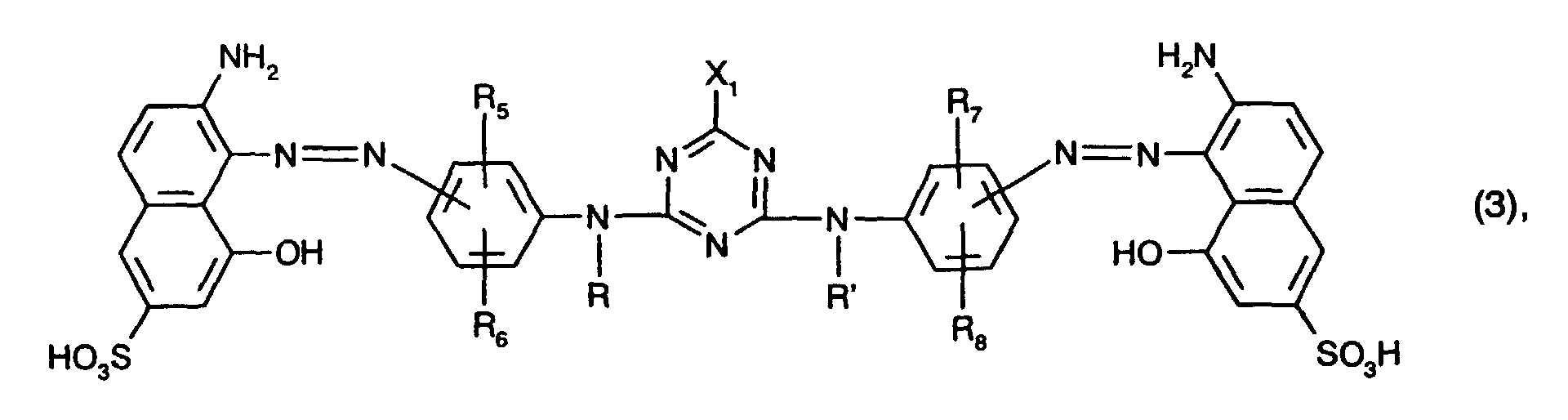
- At least one dye of the formula is preferably used as the red-coloring dye the meanings and preferences given above apply to R, R ', R 5 , R 6 , R 7 , R 8 and X 1 .
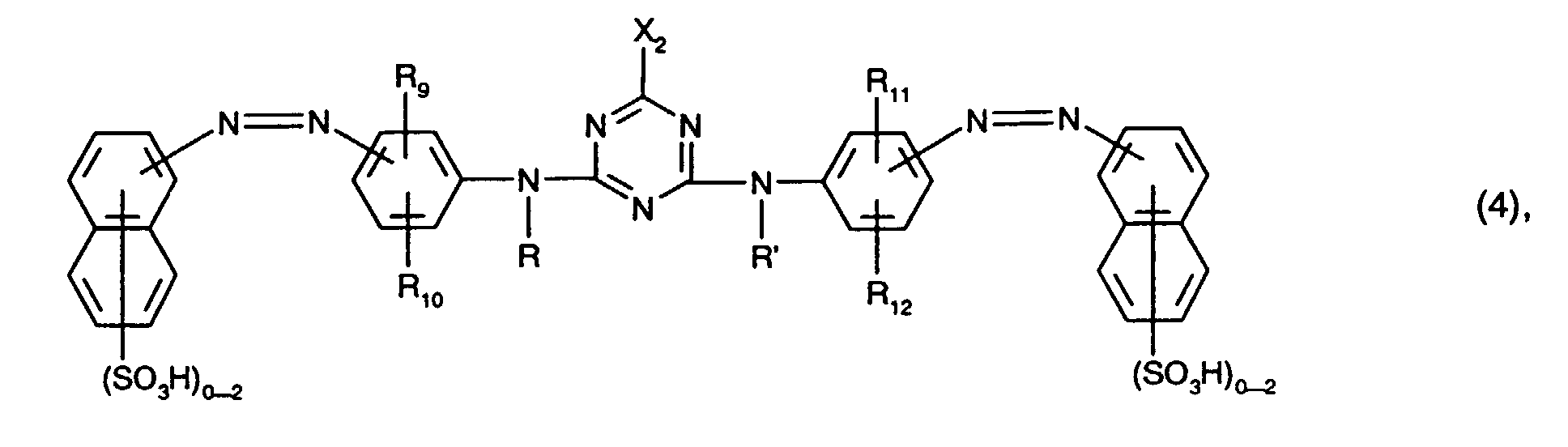
- the yellow or orange-colored dyes of the formulas (4) and (5) preferably each contain only one or two sulfo groups, in particular in each case only one sulfo group, in the naphthalene rings.
- the total number of sulfo groups in the dyes of the formulas (4) and (5) is preferably two to four, in particular two.
- Preferred as yellow or orange coloring dyes of the formula (4) are those of the formula the meanings and preferences given above apply to R, R ', R 9 , R 10 , R 11 , R 12 and X 2 .
- R 10 and R 12 in this case hydrogen, C 1 -C 4 alkyl, C 1 -C 4 alkoxy, ureido, halogen or optionally substituted in the alkyl moiety by C 1 -C 4 alkoxy or hydroxy-substituted C 2 -C 4 - alkanoylamino or C 1 -C 4 alkoxycarbonylamino, especially C 1 -C 4 alkyl, C 1 -C 4 alkoxy, ureido, halogen or optionally substituted in the alkyl moiety by C 1 -C 4 alkoxy or hydroxy-substituted C 2 -C 4 -Alkanoylamino or C 1 -C 4 -alkoxycarbonylamino and preferably ureido.
- Preferred yellow or orange dyes of the formula (5) are those of the formula the meanings and preferences given above apply to R, R ', R 13 , R 14 , R 15 , R 16 and X 2 .
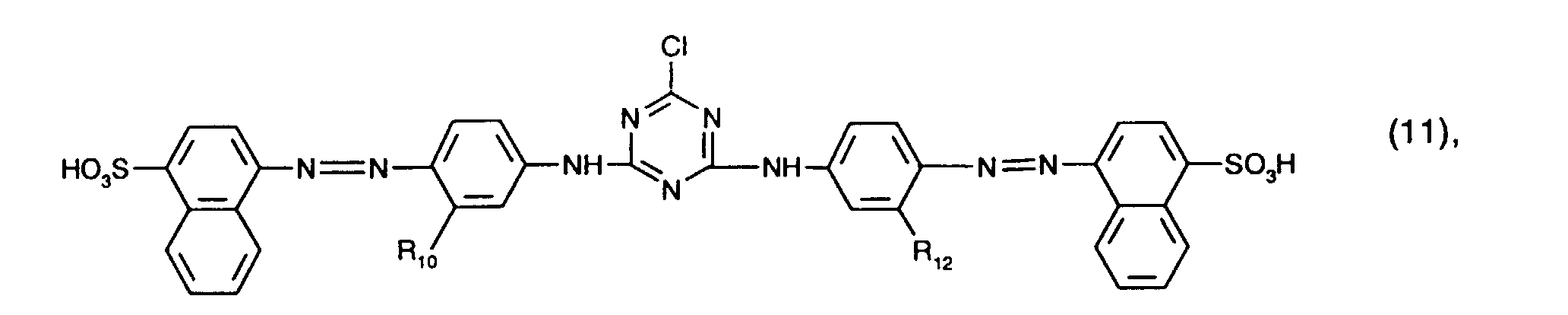
- yellow or orange coloring dyes are those of the formula (4), in particular those of the formula (10) and preferably those of the formula (11).
- yellow or orange dyes are those of the formula (11) in which R 10 and R 12 are ureido.
- a preferred embodiment of the process according to the invention is characterized in that at least one red dye of the formula (8) together with at least one yellow or orange dye of the formula (4), in particular of the formula (10) and preferably of the formula (11), used.
- the meanings and preferences given above apply to the blue-coloring dyes of the formulas (1) and (2).
- at least one dye of the formulas (6) and (7) is used as the blue-coloring dye, where R 1 , R 2 , R 3 and R 4 are preferably hydrogen.
- a particularly preferred embodiment of the process according to the invention is characterized in that a red-coloring dye of the formula (9) together with at least one yellow or orange-coloring dye of the formula (4), in particular of the formula (10) and preferably of the formula (11), used.
- the meanings and preferences given above apply to the blue-coloring dyes of the formulas (1) and (2).
- at least one dye of the formulas (6) and (7) is used as the blue-coloring dye, where R 1 , R 2 , R 3 and R 4 are preferably hydrogen.
- a very particularly preferred embodiment of the process according to the invention is characterized in that a red-coloring dye of the formula (9) is used together with a yellow or orange-coloring dye of the formula (11), in which R 10 and R 12 are ureido.
- a red-coloring dye of the formula (9) is used together with a yellow or orange-coloring dye of the formula (11), in which R 10 and R 12 are ureido.
- the blue-coloring dyes of the formulas (1) and (2) the following apply meanings and preferences given above.
- Preferably used as blue-coloring dyes are at least one dye of the formulas (6) and (7), where R 1 , R 2 , R 3 and R 4 are preferably hydrogen. Of particular interest here is the dye of the formula (6).
- the dyes of the formulas (1) and / or (2) are advantageously used in an amount of 30 to 70% by weight, in particular 40 to 60% by weight, the dyes of the formula (3) in an amount of 3 up to 20% by weight, in particular 5 to 15% by weight, and the dyes of the formulas (4) and / or (5) in an amount of 30 to 50% by weight, in particular 35 to 45% by weight .
- the quantities given relate to the total amount of the dyes of the formulas (1) to (5).
- the sum of the amounts of the dyes of the formulas (1) to (5) used is therefore 100% by weight.
- the dyes of the formulas (1), (2), (3), (4) and (5) are known or can be prepared analogously to known dyes.
- Dyes of the formulas (1) and (2) can be obtained in accordance with the details of US-A-4,009,156 and US-A-4,591,634.
- Dyes of formula (3) can be obtained, for example, by cyanuric halide with the amines of the formulas condensed.
- Dyes of the formula (4) can be obtained, for example, by cyanuric halide with the amines of the formulas condensed.
- Dyes of the formula (5) can be obtained, for example, by cyanuric halide with the amines of the formulas condensed.
- the cyanuric halide is first reacted with approximately stoichiometric amounts of one of the two aminoazo compounds at a temperature of -5 to 20 ° C, the pH being adjusted by adding suitable bases, e.g. Alkali metal bases such as lithium, sodium or potassium hydroxide or carbonate, neutral to slightly acidic, preferably at 5 to 7, is kept.
- suitable bases e.g. Alkali metal bases such as lithium, sodium or potassium hydroxide or carbonate
- the triazine derivative obtained can be separated off or the reaction mixture can be used directly for a further reaction.
- Approximately stoichiometric amounts of the other of the two aminoazo compounds are expediently added to the reaction mixture obtained or the previously separated triazine derivative and these at slightly elevated temperature, preferably at 30 to 50 ° C.
- a neutral to slightly acidic pH value preferably 6 to 7 is reacted with the triazine derivative.
- the two aminoazo compounds are identical aminoazo compounds, about 2 equivalents of this aminoazo dye are reacted with 1 equivalent of cyanuric halide, the temperature preferably initially being kept at -5 to 20 ° C. and then increased to about 30 to 50 ° C. becomes.
- the aminoazo compounds are known or can be prepared analogously to known compounds. These azo compounds can thus be obtained by generally customary diazotization and coupling reactions.
- Diazotization is usually done with a nitrite, e.g. with an alkali metal nitrite such as sodium nitrite, in a mineral acid medium, e.g. in a hydrochloric acid medium, at temperatures of, for example, -5 to 30 ° C and preferably at 0 to 10 ° C.
- a nitrite e.g. with an alkali metal nitrite such as sodium nitrite
- a mineral acid medium e.g. in a hydrochloric acid medium
- the coupling is usually carried out at acidic, neutral to weakly alkaline pH values and temperatures of, for example, -5 to 30 ° C., preferably 0 to 25 ° C.
- the dyes used in the process according to the invention for trichromatic dyeing or printing are either in the form of their free sulfonic acid or preferably as their salts.
- suitable salts are the alkali, alkaline earth or ammonium salts or the salts of an organic amine.
- suitable salts include the sodium, lithium, potassium or ammonium salts or the salt of mono-, di- or triethanolamine.
- the dyes used in the process according to the invention can contain further additives, e.g. Cooking salt or dextrin.
- the process according to the invention for trichromatic dyeing or printing can be applied to the customary dyeing or printing processes.
- the dyeing liquors or printing pastes can contain other additives, for example wetting agents, anti-foaming agents, leveling agents or agents which influence the property of the textile material, such as e.g. Plasticizers, flame retardants or dirt, water and oil repellents, water softeners and natural or synthetic thickeners such as Alginates and cellulose ethers.
- the process according to the invention for trichromatic dyeing or printing is also for dyeing from short liquors, such as e.g. suitable for continuous dyeing processes or discontinuous and continuous foam coloring processes.
- the amounts in which the individual dyes are used in the dyebaths or printing pastes can vary within wide limits depending on the desired depth of color, in general amounts of 0.01 to 15% by weight, in particular 0.1 to 10% by weight .-%, based on the dyed material or the printing paste, proved to be advantageous.
- Coloring is preferred, which is carried out in particular by the exhaust process.
- the dyes used in the process according to the invention are distinguished in trichromatic dyeing or printing by uniform color build-up, good absorption behavior, good consistency of shades also in different concentrations, good fastness and solubility as well as particularly good combinability.
- the process according to the invention for trichromatic dyeing or printing is suitable for dyeing or printing both natural polyamide materials such as Wool, such as in particular synthetic polyamide materials, e.g. Polyamide 6 or polyamide 6.6, and is suitable for dyeing or printing wool and synthetic polyamide blended fabrics or yarns.
- natural polyamide materials such as Wool
- synthetic polyamide materials e.g. Polyamide 6 or polyamide 6.6
- the textile material mentioned can be in a wide variety of processing forms, such as as fiber, yarn, fabric, knitted fabric or in the form of carpets.
- parts represent parts by weight.
- the temperatures are degrees Celsius.
- the relationship between parts by weight and parts by volume is the same as that between grams and cubic centimeters.
- Example 1 200 parts of demineralized water are adjusted to a pH of 3.5 at room temperature with acetic acid. Then a mixture of 1 part of a dye is added, which is in the form of the free acid of the compound of the formula corresponds to 0.19 parts of a dye in the form of the free acid of the compound of the formula corresponds, and 0.8 parts of a dye in the form of the free acid of the compound of the formula corresponds to.
- the dye solution obtained is mixed with 10 parts of polyamide-6.6 fiber material (Helancatrikot) and the dye bath is heated to a temperature of about 100 ° C. within 45 minutes. The temperature is maintained for 60 minutes, then cooled to a temperature of 70 ° C. and the material to be dyed is removed, which is rinsed with water and then dried. A fabric dyed in a black shade is obtained.
Landscapes
- Engineering & Computer Science (AREA)
- Textile Engineering (AREA)
- Chemical & Material Sciences (AREA)
- Chemical Kinetics & Catalysis (AREA)
- Organic Chemistry (AREA)
- Coloring (AREA)
Abstract
Verfahren zum Trichromie-Färben oder -Bedrucken von natürlichem oder synthetischem Polyamidfasermaterial, dadurch gekennzeichnet, dass man mindestens einen blaufärbenden Farbstoff der Formel


Das erfindungsgemässe Verfahren eignet sich zum Färben von natürlichen oder synthetischen Polyamidfasermaterialien aus wässriger Flotte oder zum Drucken mit Druckpasten.The method according to the invention is suitable for dyeing natural or synthetic polyamide fiber materials from an aqueous liquor or for printing with printing pastes.
Description
Die vorliegende Erfindung betrifft ein Verfahren zum Trichromie-Färben oder -Bedrucken von natürlichen und synthetischen Polyamidfasermaterialien.The present invention relates to a method for trichromatic dyeing or printing of natural and synthetic polyamide fiber materials.
Die der vorliegenden Erfindung zugrundeliegende Aufgabe war es, ein Verfahren zum Färben oder Bedrucken von natürlichen und synthetischen Polyamidfasermaterialien mit zur Kombination nach dem Trichromie-Prinzip geeigneten Farbstoffen zu finden.The object underlying the present invention was to find a process for dyeing or printing natural and synthetic polyamide fiber materials with dyes suitable for combination according to the trichromatic principle.
Es wurde nun gefunden, dass man diese Aufgabe erfindungsgemäss durch das nachfolgend beschriebene Verfahren lösen kann. Die so erhaltenen Färbungen genügen den gestellten Aufgaben. Insbesondere zeichnen sich die erhaltenen Färbungen durch einen gleichmässigen Farbaufbau bei gleichzeitiger Nuancenkonstanz in verschiedenen Konzentrationen und eine gute Kombinierbarkeit aus.It has now been found that this object can be achieved according to the invention by the method described below. The dyeings obtained in this way fulfill the tasks set. In particular, the dyeings obtained are distinguished by a uniform color structure with constant shade in different concentrations and good combinability.
Gegenstand der vorliegenden Erfindung ist ein Verfahren zum Trichromie-Färben oder -Bedrucken von natürlichem oder synthetischem Polyamidfasermaterial, welches dadurch gekennzeichnet ist, dass man
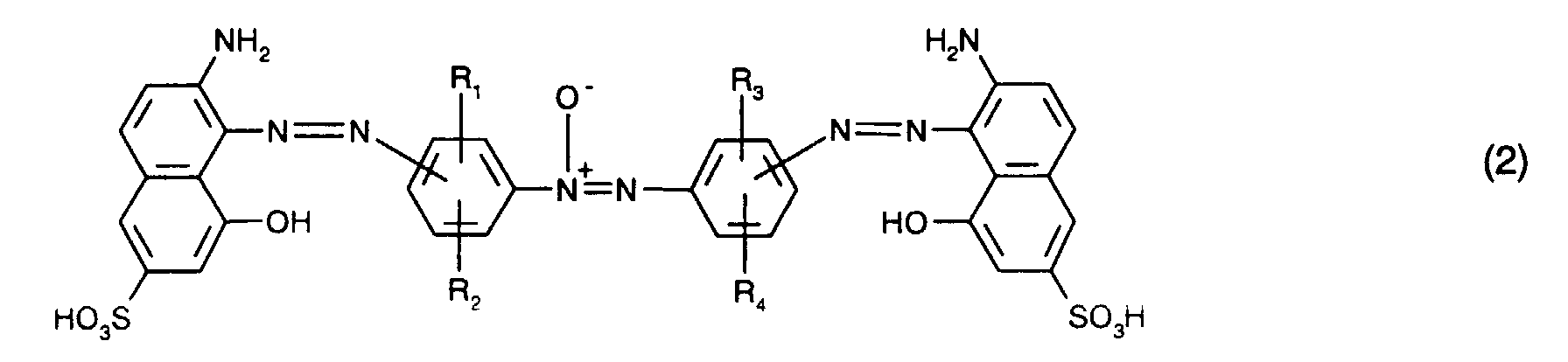
mindestens einen blaufärbenden Farbstoff der Formel (1) oder (2)


R1, R2, R3 und R4 unabhängig voneinander Wasserstoff, C1-C4-Alkyl, C1-C4-Alkoxy, C2-C4-Alkanoylamino, Ureido, Halogen oder Sulfo sind,
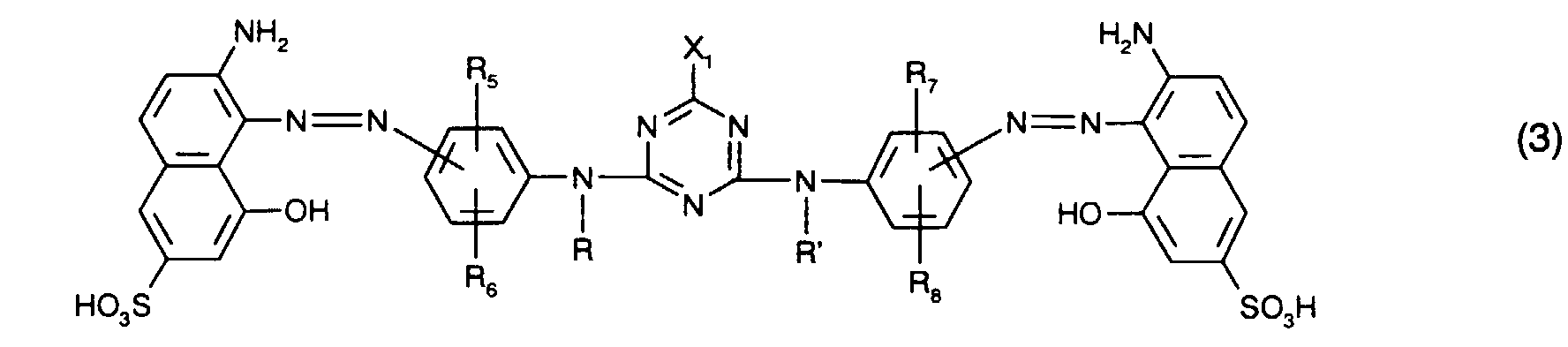
zusammen mit mindestens einem rotfärbenden Farbstoff der Formel (3)

- R und R' unabhängig voneinander Wasserstoff oder gegebenenfalls substituiertes C1-C4-Alkyl,
- R5, R6, R7 und R8 unabhängig voneinander Wasserstoff, C1-C4-Alkyl, C1-C4-Alkoxy, C2-C4-Alkanoylamino, Ureido, Halogen oder Sulfo sind und
- X1 Halogen ist,


- R und R' unabhängig voneinander Wasserstoff oder gegebenenfalls substituiertes C1-C4-Alkyl,
- X2 und X3 Halogen und
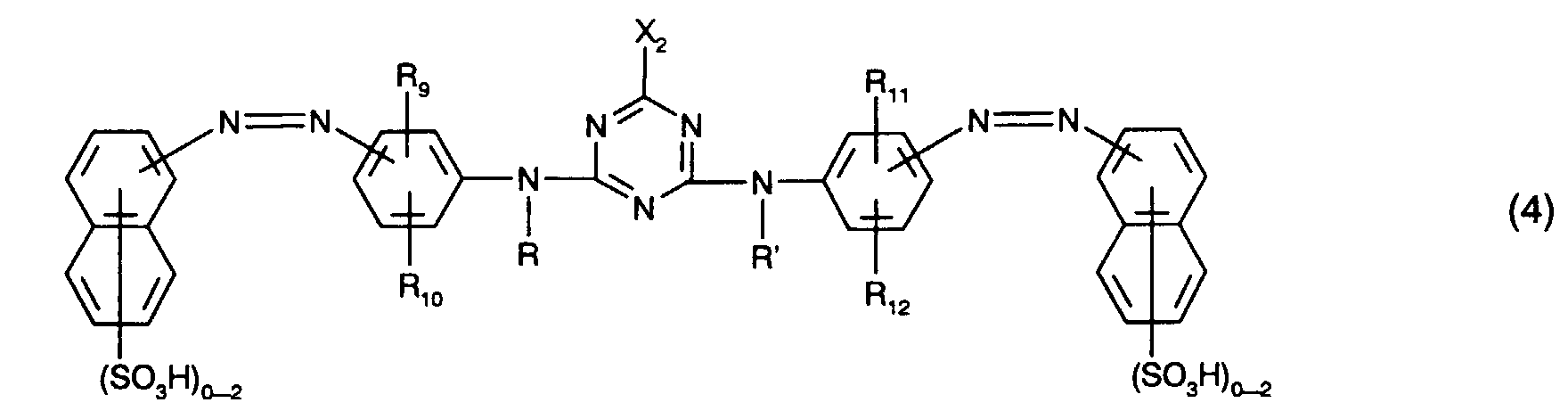
- R9, R10, R11, R12, R13, R14, R15 und R16 unabhängig voneinander Wasserstoff, C1-C4-Alkyl, C1-C4-Alkoxy, Ureido, Halogen, Sulfo oder gegebenenfalls im Alkylteil substituiertes C2-C4-Alkanoylamino oder C1-C4-Alkoxycarbonylamino bedeuten,
at least one blue-coloring dye of the formula (1) or (2)
R 1 , R 2 , R 3 and R 4 are independently hydrogen, C 1 -C 4 alkyl, C 1 -C 4 alkoxy, C 2 -C 4 alkanoylamino, ureido, halogen or sulfo,
together with at least one red-coloring dye of the formula (3)
- R and R 'independently of one another are hydrogen or optionally substituted C 1 -C 4 -alkyl,
- R 5 , R 6 , R 7 and R 8 are independently hydrogen, C 1 -C 4 alkyl, C 1 -C 4 alkoxy, C 2 -C 4 alkanoylamino, ureido, halogen or sulfo and
- X 1 is halogen,
- R and R 'independently of one another are hydrogen or optionally substituted C 1 -C 4 -alkyl,
- X 2 and X 3 halogen and
- R 9 , R 10 , R 11 , R 12 , R 13 , R 14 , R 15 and R 16 independently of one another hydrogen, C 1 -C 4 alkyl, C 1 -C 4 alkoxy, ureido, halogen, sulfo or optionally C 2 -C 4 -alkanoylamino or C 1 -C 4 -alkoxycarbonylamino substituted in the alkyl part,
Unter Trichromie ist die additive Farbmischung passend gewählter gelb- bzw. orange-, rot- und blaufärbender Farbstoffe zu verstehen, mit denen jede gewünschte Nuance des sichtbaren Farbspektrums durch geeignete Wahl der Mengenverhältnisse der Farbstoffe eingestellt werden kann.Trichromatic is to be understood as the additive color mixture of suitably selected yellow or orange, red and blue coloring dyes, with which any desired shade of the visible color spectrum can be adjusted by a suitable choice of the proportions of the dyes.
Als C1-C4-Alkyl kommen für R, R', R1, R2, R3, R4, R5, R6, R7, R8, R9, R10, R11, R12, R13, R14, R15 und R16 z.B. Methyl, Aethyl, Propyl, Isopropyl, Butyl, Isobutyl, sek.-Butyl oder tert.-Butyl in Betracht. Bevorzugt sind hierbei Methyl oder Aethyl, insbesondere Methyl. Die Reste R und R' in der Bedeutung als C1-C4-Alkyl können unsubstituiert oder beispielsweise durch Hydroxy, C1-C4-Alkoxy, Halogen oder Sulfato substituiert sein. Vorzugsweise sind diese Reste unsubstituiert.The C 1 -C 4 alkyl for R, R ', R 1 , R 2 , R 3 , R 4 , R 5 , R 6 , R 7 , R 8 , R 9 , R 10 , R 11 , R 12 , R 13 , R 14 , R 15 and R 16, for example methyl, ethyl, propyl, isopropyl, butyl, isobutyl, sec-butyl or tert-butyl. Methyl or ethyl, in particular methyl, are preferred. The radicals R and R 'as C 1 -C 4 alkyl can be unsubstituted or substituted, for example, by hydroxy, C 1 -C 4 alkoxy, halogen or sulfato. These radicals are preferably unsubstituted.
Als C1-C4-Alkoxy kommen für R1, R2, R3, R4, R5, R6, R7, R8, R9, R10, R11, R12, R13, R14, R15 und R16 beispielsweise Methoxy, Aethoxy, Propoxy, Isopropoxy, Butoxy, sek.-Butoxy, Isobutoxy oder tert.-Butoxy, insbesondere Methoxy, in Betracht.As C 1 -C 4 alkoxy for R 1 , R 2 , R 3 , R 4 , R 5 , R 6 , R 7 , R 8 , R 9 , R 10 , R 11 , R 12 , R 13 , R 14 , R 15 and R 16, for example methoxy, ethoxy, propoxy, isopropoxy, butoxy, sec-butoxy, isobutoxy or tert-butoxy, in particular methoxy, into consideration.
Als C2-C4-Alkanoylamino kommen für R1, R2, R3, R4, R5, R6, R7, R8, R9, R10, R11, R12, R13, R14, R15 und R16 z.B. Propionylamino oder insbesondere Acetylamino in Betracht. Die Reste R9, R10, R11, R12, R13, R14, R15 und R16 in der Bedeutung als C2-C4-Alkanoylamino können unsubstituiert oder z.B. im Alkylteil durch C1-C4-Alkoxy oder Hydroxy substituiert sein.As C 2 -C 4 alkanoylamino come for R 1 , R 2 , R 3 , R 4 , R 5 , R 6 , R 7 , R 8 , R 9 , R 10 , R 11 , R 12 , R 13 , R 14 , R 15 and R 16, for example propionylamino or in particular acetylamino. The radicals R 9 , R 10 , R 11 , R 12 , R 13 , R 14 , R 15 and R 16 as C 2 -C 4 alkanoylamino can be unsubstituted or, for example, in the alkyl part by C 1 -C 4 alkoxy or hydroxy substituted.
Als C1-C4-Alkoxycarbonylamino kommen für R9, R10, R11, R12, R13, R14, R15 und R16 insbesondere Methoxy- oder Aethoxycarbonylamino in Betracht. Die Reste R9, R10, R11, R12, R13, R14, R15 und R16 in der Bedeutung als C1-C4-Alkoxycarbonylamino können unsubstituiert oder z.B. im Alkylteil durch C1-C4-Alkoxy oder Hydroxy substituiert sein.Suitable C 1 -C 4 alkoxycarbonylamino for R 9 , R 10 , R 11 , R 12 , R 13 , R 14 , R 15 and R 16 are in particular methoxy- or ethoxycarbonylamino. The radicals R 9 , R 10 , R 11 , R 12 , R 13 , R 14 , R 15 and R 16 as C 1 -C 4 alkoxycarbonylamino can be unsubstituted or, for example, in the alkyl part by C 1 -C 4 alkoxy or hydroxy substituted.
Als Halogen kommen für R1, R2, R3, R4, R5, R6, R7, R8, R9, R10, R11, R12, R13, R14, R15 und R16 beispielsweise Fluor oder Brom und insbesondere Chlor in Betracht.As halogen come for R 1 , R 2 , R 3 , R 4 , R 5 , R 6 , R 7 , R 8 , R 9 , R 10 , R 11 , R 12 , R 13 , R 14 , R 15 and R 16 fluorine or bromine and especially chlorine.
X1, X2 und X3 sind vorzugsweise Fluor oder Chlor, insbesondere Chlor.X 1 , X 2 and X 3 are preferably fluorine or chlorine, especially chlorine.
R und R' sind bevorzugt unabhängig voneinander Wasserstoff oder C1-C4-Alkyl, insbesondere Wasserstoff.R and R 'are preferably independently of one another hydrogen or C 1 -C 4 alkyl, in particular hydrogen.
R1, R2, R3 und R4 sind bevorzugt unabhängig voneinander Wasserstoff, C1-C4-Alkyl, C1-C4-Alkoxy, C2-C4-Alkanoylamino, Ureido oder Halogen, insbesondere Wasserstoff.R 1 , R 2 , R 3 and R 4 are preferably independently of one another hydrogen, C 1 -C 4 alkyl, C 1 -C 4 alkoxy, C 2 -C 4 alkanoylamino, ureido or halogen, in particular hydrogen.
R5, R6, R7 und R8 sind bevorzugt unabhängig voneinander Wasserstoff, C1-C4-Alkyl, C1-C4-Alkoxy, C2-C4-Alkanoylamino, Ureido oder Halogen, insbesondere Wasserstoff.R 5 , R 6 , R 7 and R 8 are preferably independently of one another hydrogen, C 1 -C 4 alkyl, C 1 -C 4 alkoxy, C 2 -C 4 alkanoylamino, ureido or halogen, in particular hydrogen.
R9, R10, R11, R12, R13, R14, R15 und R16 sind bevorzugt unabhängig voneinander Wasserstoff, C1-C4-Alkyl, C1-C4-Alkoxy, Ureido, Halogen oder gegebenenfalls im Alkylteil durch C1-C4-Alkoxy oder Hydroxy substituiertes C2-C4-Alkanoylamino oder C1-C4-Alkoxycarbonylamino.R 9 , R 10 , R 11 , R 12 , R 13 , R 14 , R 15 and R 16 are preferably independently of one another hydrogen, C 1 -C 4 alkyl, C 1 -C 4 alkoxy, ureido, halogen or, if appropriate in the alkyl part substituted by C 1 -C 4 alkoxy or hydroxy C 2 -C 4 alkanoylamino or C 1 -C 4 alkoxycarbonylamino.
Als blaufärbenden Farbstoff verwendet man bevorzugt mindestens einen Farbstoff der Formel


Besonders bevorzugt verwendet man als blaufärbenden Farbstoff mindestens einen Farbstoff der Formel (1), insbesondere mindestens einen Farbstoff der Formel (6).It is particularly preferred to use at least one dye of the formula (1), in particular at least one dye of the formula (6), as the blue-coloring dye.
Von Interesse sind ferner als blaufärbende Farbstoffe Mischungen der Farbstoffe der Formeln (1) und (2), insbesondere Mischungen der Farbstoffe der Formeln (6) und (7). Bezogen auf die Gesamtmenge der Farbstoffe der Formeln (1) und (2) ist hierbei der Anteil des Farbstoffs der Formel (1) bevorzugt 5 bis 95 Gew.-%, insbesondere 10 bis 90 Gew.-% und vorzugsweise 20 bis 80 Gew.-%. Besonders bevorzugt ist hierbei ein Anteil des Farbstoffs der Formel (1) von 40 bis 60 Gew.-%.Also of interest as blue-coloring dyes are mixtures of the dyes of the formulas (1) and (2), in particular mixtures of the dyes of the formulas (6) and (7). Based on the total amount of the dyes of the formulas (1) and (2), the proportion of the dye of the formula (1) is preferably 5 to 95% by weight, in particular 10 to 90% by weight and preferably 20 to 80% by weight. -%. A proportion of the dye of the formula (1) of 40 to 60% by weight is particularly preferred.
Als rotfärbenden Farbstoff verwendet man bevorzugt mindestens einen Farbstoff der Formel

Besonders bevorzugt als rotfärbende Farbstoffe sind solche der Formel (3), insbesondere solche der Formel (8), worin
- R und R' unabhängig voneinander Wasserstoff oder C1-C4-Alkyl, insbesondere Wasserstoff,
- R5, R6, R7 und R8 unabhängig voneinander Wasserstoff, C1-C4-Alkyl, C1-C4-Alkoxy, C2-C4-Alkanoylamino, Ureido oder Halogen, insbesondere Wasserstoff, sind, und
- X1 Fluor oder insbesondere Chlor bedeutet.
- R and R 'independently of one another are hydrogen or C 1 -C 4 -alkyl, in particular hydrogen,
- R 5 , R 6 , R 7 and R 8 are independently hydrogen, C 1 -C 4 alkyl, C 1 -C 4 alkoxy, C 2 -C 4 alkanoylamino, ureido or halogen, in particular hydrogen, and
- X 1 is fluorine or especially chlorine.
Ganz besonders bevorzugt verwendet man als rotfärbenden Farbstoff einen Farbstoff der Formel

Die gelb- oder orangefärbenden Farbstoffe der Formeln (4) und (5) enthalten bevorzugt in den Naphthalinringen jeweils nur eine oder zwei Sulfogruppen, insbesondere jeweils nur eine Sulfogruppe. Die Gesamtzahl der Sulfogruppen der Farbstoffe der Formeln (4) und (5) ist bevorzugt jeweils zwei bis vier, insbesondere zwei.The yellow or orange-colored dyes of the formulas (4) and (5) preferably each contain only one or two sulfo groups, in particular in each case only one sulfo group, in the naphthalene rings. The total number of sulfo groups in the dyes of the formulas (4) and (5) is preferably two to four, in particular two.
Bevorzugt als gelb- oder orangefärbende Farbstoffe der Formel (4) sind solche der Formel
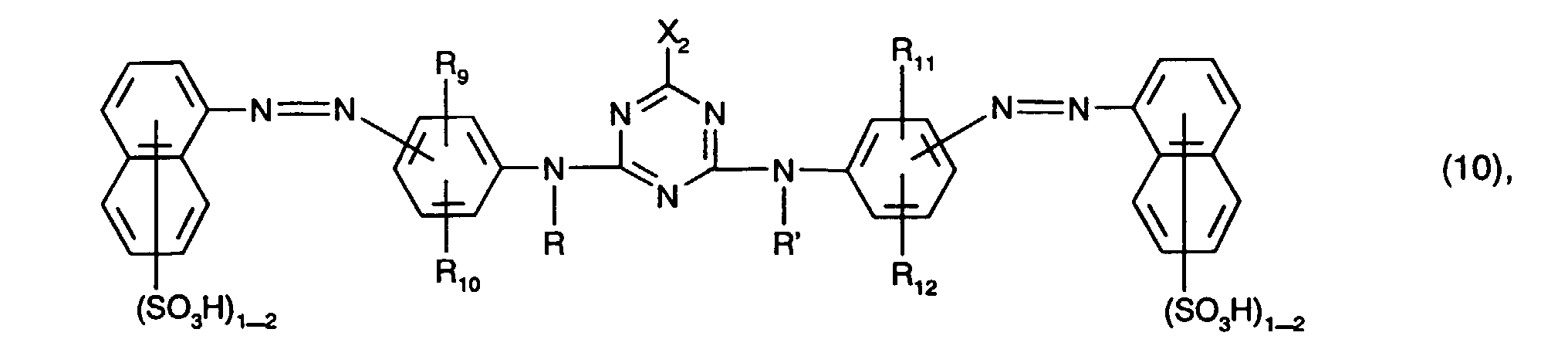
Besonders bevorzugt als gelb- oder orangefärbende Farbstoffe der Formel (4), insbesondere als Farbstoffe der Formel (10), sind solche, worin
- R und R' unabhängig voneinander Wasserstoff oder C1-C4-Alkyl, insbesondere Wasserstoff, sind,
- R9, R10, R11 und R12 unabhängig voneinander Wasserstoff, C1-C4-Alkyl, C1-C4-Alkoxy, Ureido, Halogen oder gegebenenfalls im Alkylteil durch C1-C4-Alkoxy oder Hydroxy substituiertes C2-C4-Alkanoylamino oder C1-C4-Alkoxycarbonylamino sind, wobei R9 und R11 vorzugsweise Wasserstoff bedeuten,
- X2 Fluor oder insbesondere Chlor ist und
enthalten.Particularly preferred as yellow or orange coloring dyes of the formula (4), in particular as dyes of the formula (10), are those in which
- R and R 'are independently hydrogen or C 1 -C 4 alkyl, in particular hydrogen,
- R 9 , R 10 , R 11 and R 12 independently of one another are hydrogen, C 1 -C 4 -alkyl, C 1 -C 4 -alkoxy, ureido, halogen or C which is optionally substituted in the alkyl part by C 1 -C 4 -alkoxy or hydroxy Are 2 -C 4 alkanoylamino or C 1 -C 4 alkoxycarbonylamino, where R 9 and R 11 are preferably hydrogen,
- X 2 is fluorine or in particular chlorine and
contain.
Ganz besonders bevorzugt als gelb- oder orangefärbende Farbstoffe der Formel (4) sind solche der Formel

Bevorzugt als gelb- oder orangefärbende Farbstoffe der Formel (5) sind solche der Formel

Besonders bevorzugt als gelb- oder orangefärbende Farbstoffe der Formel (5), insbesondere als Farbstoffe der Formel (12), sind solche, worin
- R und R' unabhängig voneinander Wasserstoff oder C1-C4-Alkyl, insbesondere Wasserstoff, sind,
- R13, R14, R15 und R16 unabhängig voneinander Wasserstoff, C1-C4-Alkyl, C1-C4-Alkoxy, Ureido, Halogen oder gegebenenfalls im Alkylteil durch C1-C4-Alkoxy oder Hydroxy substituiertes C2-C4-Alkanoylamino oder C1-C4-Alkoxycarbonylamino sind, wobei R13 und
- R15 vorzugsweise Wasserstoff bedeuten,
- X3 Fluor oder insbesondere Chlor ist und
enthalten.Particularly preferred as yellow or orange coloring dyes of the formula (5), in particular as dyes of the formula (12), are those in which
- R and R 'are independently hydrogen or C 1 -C 4 alkyl, in particular hydrogen,
- R 13 , R 14 , R 15 and R 16 independently of one another hydrogen, C 1 -C 4 alkyl, C 1 -C 4 alkoxy, ureido, halogen or optionally in the alkyl part by C 1 -C 4 alkoxy or hydroxy are substituted C 2 -C 4 alkanoylamino or C 1 -C 4 alkoxycarbonylamino, where R 13 and
- R 15 is preferably hydrogen,
- X 3 is fluorine or in particular chlorine and
contain.
Von besonderem Interesse als gelb- oder orangefärbende Farbstoffe sind solche der Formel (4), insbesondere solche der Formel (10) und vorzugsweise solche der Formel (11). Von ganz besonderem Interesse als gelb- oder orangefärbende Farbstoffe sind solche der Formel (11), worin R10 und R12 Ureido bedeuten.Of particular interest as yellow or orange coloring dyes are those of the formula (4), in particular those of the formula (10) and preferably those of the formula (11). Of particular interest as yellow or orange dyes are those of the formula (11) in which R 10 and R 12 are ureido.
Eine bevorzugte Ausführungsform des erfindungsgemässen Verfahrens ist dadurch gekennzeichnet, dass man mindestens einen roffärbenden Farbstoff der Formel (8) zusammen mit mindestens einem gelb- oder orangefärbenden Farbstoff der Formel (4), insbesondere der Formel (10) und vorzugsweise der Formel (11), verwendet. Für die blaufärbenden Farbstoffe der Formeln (1) und (2) gelten hierbei die oben angegebenen Bedeutungen und Bevorzugungen. Insbesondere verwendet man als blaufärbende Farbstoffe mindestens einen Farbstoff der Formeln (6) und (7), wobei R1, R2, R3 und R4 vorzugsweise Wasserstoff bedeuten.A preferred embodiment of the process according to the invention is characterized in that at least one red dye of the formula (8) together with at least one yellow or orange dye of the formula (4), in particular of the formula (10) and preferably of the formula (11), used. The meanings and preferences given above apply to the blue-coloring dyes of the formulas (1) and (2). In particular, at least one dye of the formulas (6) and (7) is used as the blue-coloring dye, where R 1 , R 2 , R 3 and R 4 are preferably hydrogen.
Eine besonders bevorzugte Ausführungsform des erfindungsgemässen Verfahrens ist dadurch gekennzeichnet, dass man einen rotfärbenden Farbstoff der Formel (9) zusammen mit mindestens einem gelb- oder orangefärbenden Farbstoff der Formel (4), insbesondere der Formel (10) und vorzugsweise der Formel (11), verwendet. Für die blaufärbenden Farbstoffe der Formeln (1) und (2) gelten hierbei die oben angegebenen Bedeutungen und Bevorzugungen. Insbesondere verwendet man als blaufärbende Farbstoffe mindestens einen Farbstoff der Formeln (6) und (7), wobei R1, R2, R3 und R4 vorzugsweise Wasserstoff bedeuten.A particularly preferred embodiment of the process according to the invention is characterized in that a red-coloring dye of the formula (9) together with at least one yellow or orange-coloring dye of the formula (4), in particular of the formula (10) and preferably of the formula (11), used. The meanings and preferences given above apply to the blue-coloring dyes of the formulas (1) and (2). In particular, at least one dye of the formulas (6) and (7) is used as the blue-coloring dye, where R 1 , R 2 , R 3 and R 4 are preferably hydrogen.
Eine ganz besonders bevorzugte Ausführungsform des erfindungsgemässen Verfahrens ist dadurch gekennzeichnet, dass man einen rotfärbenden Farbstoff der Formel (9) zusammen mit einem gelb- oder orangefärbenden Farbstoff der Formel (11), worin R10 und R12 Ureido sind, verwendet. Für die blaufärbenden Farbstoffe der Formeln (1) und (2) gelten hierbei die oben angegebenen Bedeutungen und Bevorzugungen. Bevorzugt verwendet man als blaufärbende Farbstoffe mindestens einen Farbstoff der Formeln (6) und (7), wobei R1, R2, R3 und R4 vorzugsweise Wasserstoff bedeuten. Von ganz besonderem Interesse ist hierbei der Farbstoff der Formel (6).A very particularly preferred embodiment of the process according to the invention is characterized in that a red-coloring dye of the formula (9) is used together with a yellow or orange-coloring dye of the formula (11), in which R 10 and R 12 are ureido. For the blue-coloring dyes of the formulas (1) and (2), the following apply meanings and preferences given above. Preferably used as blue-coloring dyes are at least one dye of the formulas (6) and (7), where R 1 , R 2 , R 3 and R 4 are preferably hydrogen. Of particular interest here is the dye of the formula (6).
Eine weitere interessante Ausführungsform des erfindungsgemässen Verfahrens betrifft die Erstellung von schwarzen Farbtönen. Vorteilhafterweise verwendet man hierbei die Farbstoffe der Formeln (1) und/oder (2) in einer Menge von 30 bis 70 Gew.-%, insbesondere 40 bis 60 Gew.-%, die Farbstoffe der Formel (3) in einer Menge von 3 bis 20 Gew.-%, insbesondere 5 bis 15 Gew.-%, und die Farbstoffe der Formeln (4) und/oder (5) in einer Menge von 30 bis 50 Gew.-%, insbesondere 35 bis 45 Gew.-%. Die Mengenangaben beziehen sich hierbei auf die Gesamtmenge der Farbstoffe der Formeln (1) bis (5). Die Summe der eingesetzten Mengen der Farbstoffe der Formeln (1) bis (5) beträgt daher 100 Gew.-%.Another interesting embodiment of the method according to the invention relates to the creation of black shades. The dyes of the formulas (1) and / or (2) are advantageously used in an amount of 30 to 70% by weight, in particular 40 to 60% by weight, the dyes of the formula (3) in an amount of 3 up to 20% by weight, in particular 5 to 15% by weight, and the dyes of the formulas (4) and / or (5) in an amount of 30 to 50% by weight, in particular 35 to 45% by weight . The quantities given relate to the total amount of the dyes of the formulas (1) to (5). The sum of the amounts of the dyes of the formulas (1) to (5) used is therefore 100% by weight.
Einen weiteren Gegenstand der vorliegenden Erfindung stellen Farbstoffmischungen dar, welche eine Mischung von
- mindestens einen blaufärbenden Farbstoff der Formel (1) oder (2),
- zusammen mit mindestens einem rotfärbenden Farbstoff der Formel (3) und
- zusammen mit mindestens einem gelb- oder orangefärbenden Farbstoff der Formel (4) oder (5) enthalten. Hierbei gelten für die Farbstoffe der Formeln (1), (2), (3), (4) und (5) sowie für deren Mischungen die oben angegebenen Bedeutungen und Bevorzugungen.
- at least one blue-coloring dye of the formula (1) or (2),
- together with at least one red-coloring dye of the formula (3) and
- together with at least one yellow or orange coloring dye of the formula (4) or (5). The dyes of the formulas (1), (2), (3), (4) and (5) and their mixtures apply the meanings and preferences given above.
Die Farbstoffe der Formeln (1), (2), (3), (4) und (5) sind bekannt oder können in Analogie zu bekannten Farbstoffen hergestellt werden. So können z.B. Farbstoffe der Formeln (1) und (2) gemäss den Angaben der US-A-4,009,156 und der US-A-4,591,634 erhalten werden.The dyes of the formulas (1), (2), (3), (4) and (5) are known or can be prepared analogously to known dyes. For example, Dyes of the formulas (1) and (2) can be obtained in accordance with the details of US-A-4,009,156 and US-A-4,591,634.
Farbstoffe der Formel (3) können beispielsweise erhalten werden, indem man Cyanurhalogenid mit den Aminen der Formeln

Farbstoffe der Formel (4) können z.B. erhalten werden, indem man Cyanurhalogenid mit den Aminen der Formeln

Farbstoffe der Formel (5) können z.B. erhalten werden, indem man Cyanurhalogenid mit den Aminen der Formeln
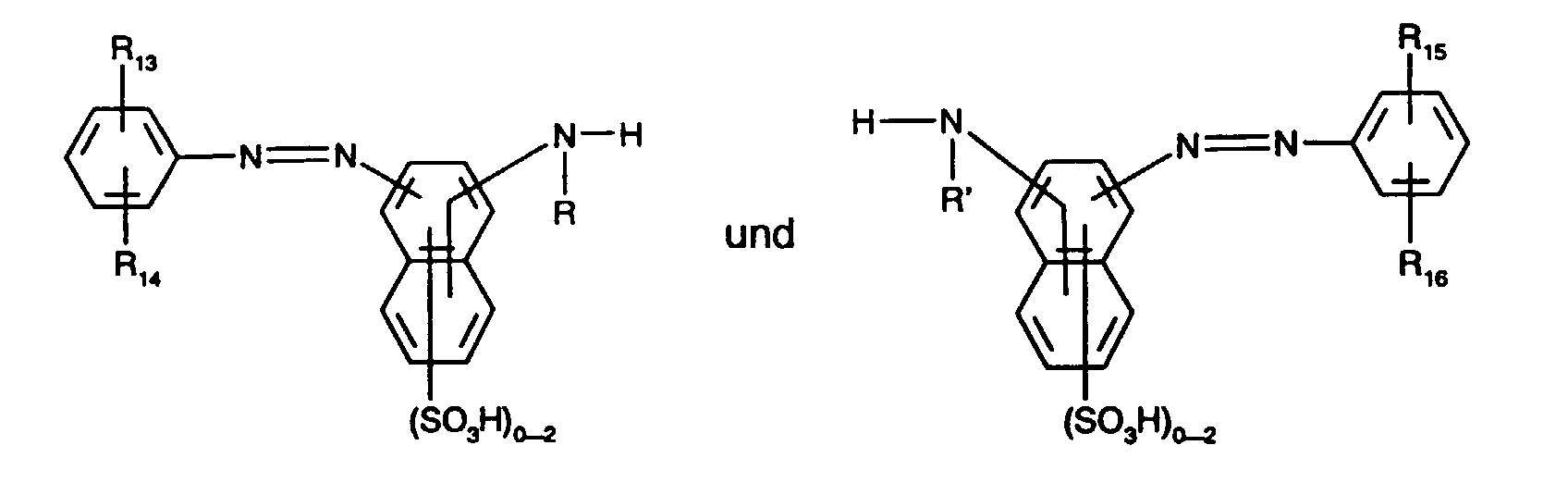
Vorzugsweise setzt man das Cyanurhalogenid zunächst mit in etwa stöchiometrischen Mengen einer der zwei Aminoazoverbindungen bei einer Temperatur von -5 bis 20°C um, wobei der pH-Wert durch Zugabe geeigneter Basen, z.B. Alkalimetallbasen wie Lithium-, Natrium- oder Kaliumhydroxid oder -carbonat, neutral bis leicht sauer, vorzugsweise bei 5 bis 7, gehalten wird. Das erhaltene Triazinderivat kann abgeschieden werden oder es kann das Reaktionsgemisch direkt für eine weitere Reaktion verwendet werden. Zu dem erhaltenen Reaktionsgemisch oder dem zuvor abgeschiedenen Triazinderivat werden zweckmässigerweise in etwa stöchiometrische Mengen der anderen der zwei Aminoazoverbindungen gegeben und diese bei leicht erhöhter Temperatur, vorzugsweise bei 30 bis 50°C und einem neutralen bis leicht sauren pH-Wert, der vorzugsweise 6 bis 7 beträgt, mit dem Triazinderivat zur Reaktion gebracht. Handelt es sich bei den zwei Aminoazoverbindungen um identische Aminoazoverbindungen, so setzt man ca. 2 Aequivalente dieses Aminoazofarbstoffes mit 1 Aequivalent Cyanurhalogenid um, wobei die Temperatur vorzugsweise zunächst bei -5 bis 20°C gehalten und dann auf ca. 30 bis 50°C erhöht wird.Preferably, the cyanuric halide is first reacted with approximately stoichiometric amounts of one of the two aminoazo compounds at a temperature of -5 to 20 ° C, the pH being adjusted by adding suitable bases, e.g. Alkali metal bases such as lithium, sodium or potassium hydroxide or carbonate, neutral to slightly acidic, preferably at 5 to 7, is kept. The triazine derivative obtained can be separated off or the reaction mixture can be used directly for a further reaction. Approximately stoichiometric amounts of the other of the two aminoazo compounds are expediently added to the reaction mixture obtained or the previously separated triazine derivative and these at slightly elevated temperature, preferably at 30 to 50 ° C. and a neutral to slightly acidic pH value, preferably 6 to 7 is reacted with the triazine derivative. If the two aminoazo compounds are identical aminoazo compounds, about 2 equivalents of this aminoazo dye are reacted with 1 equivalent of cyanuric halide, the temperature preferably initially being kept at -5 to 20 ° C. and then increased to about 30 to 50 ° C. becomes.
Die Aminoazoverbindungen sind bekannt oder können in Analogie zu bekannten Verbindungen hergestellt werden. So können diese Azoverbindungen durch allgemein übliche Diazotierungs- und Kupplungsreaktionen erhalten werden.The aminoazo compounds are known or can be prepared analogously to known compounds. These azo compounds can thus be obtained by generally customary diazotization and coupling reactions.
Die Diazotierung erfolgt üblicherweise mit einem Nitrit, z.B. mit einem Alkalimetallnitrit wie Natriumnitrit, in einem mineralsauren Medium, z.B. in einem salzsauren Medium, bei Temperaturen von beispielsweise -5 bis 30°C und vorzugsweise bei 0 bis 10°C.Diazotization is usually done with a nitrite, e.g. with an alkali metal nitrite such as sodium nitrite, in a mineral acid medium, e.g. in a hydrochloric acid medium, at temperatures of, for example, -5 to 30 ° C and preferably at 0 to 10 ° C.
Die Kupplung erfolgt üblicherweise bei sauren, neutralen bis schwach alkalischen pH-Werten und Temperaturen von beispielsweise -5 bis 30°C, vorzugsweise 0 bis 25°C.The coupling is usually carried out at acidic, neutral to weakly alkaline pH values and temperatures of, for example, -5 to 30 ° C., preferably 0 to 25 ° C.
Die in dem erfindungsgemässen Verfahren zum Trichromie-Färben oder -Bedrucken verwendeten Farbstoffe liegen entweder in der Form ihrer freien Sulfonsäure oder vorzugsweise als deren Salze vor.The dyes used in the process according to the invention for trichromatic dyeing or printing are either in the form of their free sulfonic acid or preferably as their salts.
Als Salze kommen beispielsweise die Alkali-, Erdalkali- oder Ammoniumsalze oder die Salze eines organischen Amins in Betracht. Als Beispiele seien die Natrium-, Lithium-, Kalium- oder Ammoniumsalze oder das Salz des Mono-, Di- oder Triäthanolamins genannt.Examples of suitable salts are the alkali, alkaline earth or ammonium salts or the salts of an organic amine. Examples include the sodium, lithium, potassium or ammonium salts or the salt of mono-, di- or triethanolamine.
Die in dem erfindungsgemässen Verfahren verwendeten Farbstoffe können weitere Zusätze, wie z.B. Kochsalz oder Dextrin, enthalten.The dyes used in the process according to the invention can contain further additives, e.g. Cooking salt or dextrin.
Das erfindungsgemässe Verfahren zum Trichromie-Färben oder -Bedrucken kann auf die üblichen Färbe- bzw. Druckverfahren angewendet werden. Die Färbeflotten oder Druckpasten können ausser Wasser und den Farbstoffen weitere Zusätze, beispielsweise Netzmittel, Antischaummittel, Egalisiermittel oder die Eigenschaft des Textilmaterials beeinflussende Mittel wie z.B. Weichmachungsmittel, Zusätze zum Flammfestausrüsten oder schmutz-, wasser- und öl-abweisende Mittel sowie wasserenthärtende Mittel und natürliche oder synthetische Verdicker, wie z.B. Alginate und Celluloseäther, enthalten.The process according to the invention for trichromatic dyeing or printing can be applied to the customary dyeing or printing processes. In addition to water and the dyes, the dyeing liquors or printing pastes can contain other additives, for example wetting agents, anti-foaming agents, leveling agents or agents which influence the property of the textile material, such as e.g. Plasticizers, flame retardants or dirt, water and oil repellents, water softeners and natural or synthetic thickeners such as Alginates and cellulose ethers.
Das erfindungsgemässe Verfahren zum Trichromie-Färben oder -Bedrucken ist auch zum Färben aus Kurzflotten, wie z.B. bei Kontinuefärbeverfahren oder diskontinuierlichen und kontinuierlichen Schaumfärbeverfahren, geeignet.The process according to the invention for trichromatic dyeing or printing is also for dyeing from short liquors, such as e.g. suitable for continuous dyeing processes or discontinuous and continuous foam coloring processes.
Die Mengen, in denen die einzelnen Farbstoffe in den Färbebädern oder Druckpasten verwendet werden, können je nach der gewünschten Farbtiefe in weiten Grenzen schwanken, im allgemeinen haben sich Mengen von 0,01 bis 15 Gew.-%, insbesondere 0,1 bis 10 Gew.-%, bezogen auf das Färbegut bzw. die Druckpaste, als vorteilhaft erwiesen.The amounts in which the individual dyes are used in the dyebaths or printing pastes can vary within wide limits depending on the desired depth of color, in general amounts of 0.01 to 15% by weight, in particular 0.1 to 10% by weight .-%, based on the dyed material or the printing paste, proved to be advantageous.
Bevorzugt ist das Färben, welches insbesondere nach dem Ausziehverfahren erfolgt.Coloring is preferred, which is carried out in particular by the exhaust process.
Vorzugsweise färbt man bei einem pH-Wert von 3 bis 7, insbesondere 3 bis 5. Das Flottenverhältnis kann innerhalb eines weiten Bereichs gewählt werden, z.B. von 1:5 bis 1:50, vorzugsweise 1:5 bis 1:30. Vorzugsweise färbt man bei einer Temperatur von 70 bis 110°C, insbesondere 80 bis 105°C.The dyeing is preferably carried out at a pH of 3 to 7, in particular 3 to 5. The liquor ratio can be chosen within a wide range, e.g. from 1: 5 to 1:50, preferably 1: 5 to 1:30. Dyeing is preferably carried out at a temperature of 70 to 110 ° C., in particular 80 to 105 ° C.
Die in dem erfindungsgemässen Verfahren verwendeten Farbstoffe zeichnen sich beim Trichromie-Färben oder -Bedrucken durch gleichmässigen Farbaufbau, gutes Aufziehverhalten, gute Nuancenkonstanz auch in verschiedenen Konzentrationen, gute Echtheiten und Löslichkeit sowie insbesondere durch sehr gute Kombinierbarkeit aus.The dyes used in the process according to the invention are distinguished in trichromatic dyeing or printing by uniform color build-up, good absorption behavior, good consistency of shades also in different concentrations, good fastness and solubility as well as particularly good combinability.
Das erfindungsgemässe Verfahren zum Trichromie-Färben oder -Bedrucken eignet sich zum Färben oder Bedrucken sowohl von natürlichen Polyamidmaterialien wie z.B. Wolle, wie insbesondere von synthetischen Polyamidmaterialien, wie z.B. Polyamid 6 oder Polyamid 6.6, und ist geeignet zum Färben oder Bedrucken von Woll- und synthetischen Polyamid-Mischgeweben oder -Garnen.The process according to the invention for trichromatic dyeing or printing is suitable for dyeing or printing both natural polyamide materials such as Wool, such as in particular synthetic polyamide materials, e.g. Polyamide 6 or polyamide 6.6, and is suitable for dyeing or printing wool and synthetic polyamide blended fabrics or yarns.
Das genannte Textilmaterial kann dabei in den verschiedensten Verarbeitungsformen vorliegen, wie z.B. als Faser, Garn, Gewebe, Gewirke oder in Form von Teppichen.The textile material mentioned can be in a wide variety of processing forms, such as as fiber, yarn, fabric, knitted fabric or in the form of carpets.
Es werden egale Färbungen mit guten Allgemeinechtheiten, insbesondere guter Reib-, Nass-, Nassreib- und Lichtechtheit erhalten.Level dyeings with good general fastness properties, in particular good rub, wet, wet rub and light fastness are obtained.
In den folgenden Beispielen stehen Teile für Gewichtsteile. Die Temperaturen sind Celsiusgrade. Die Beziehung zwischen Gewichtsteilen und Volumenteilen ist dieselbe wie diejenige zwischen Gramm und Kubikzentimeter.In the following examples, parts represent parts by weight. The temperatures are degrees Celsius. The relationship between parts by weight and parts by volume is the same as that between grams and cubic centimeters.
Beispiel 1: 200 Teile entmineralisiertes Wasser werden bei Raumtemperatur mit Essigsäure auf einen pH-Wert von 3,5 gestellt. Dann gibt man eine Mischung von 1 Teil eines Farbstoffs, der in Form der freien Säure der Verbindung der Formel

0,19 Teilen eines Farbstoffs, der in Form der freien Säure der Verbindung der Formel

0,8 Teilen eines Farbstoffs, der in Form der freien Säure der Verbindung der Formel

0.19 parts of a dye in the form of the free acid of the compound of the formula
0.8 parts of a dye in the form of the free acid of the compound of the formula
Claims (13)
man mindestens einen blaufärbenden Farbstoff der Formel (1) oder (2)
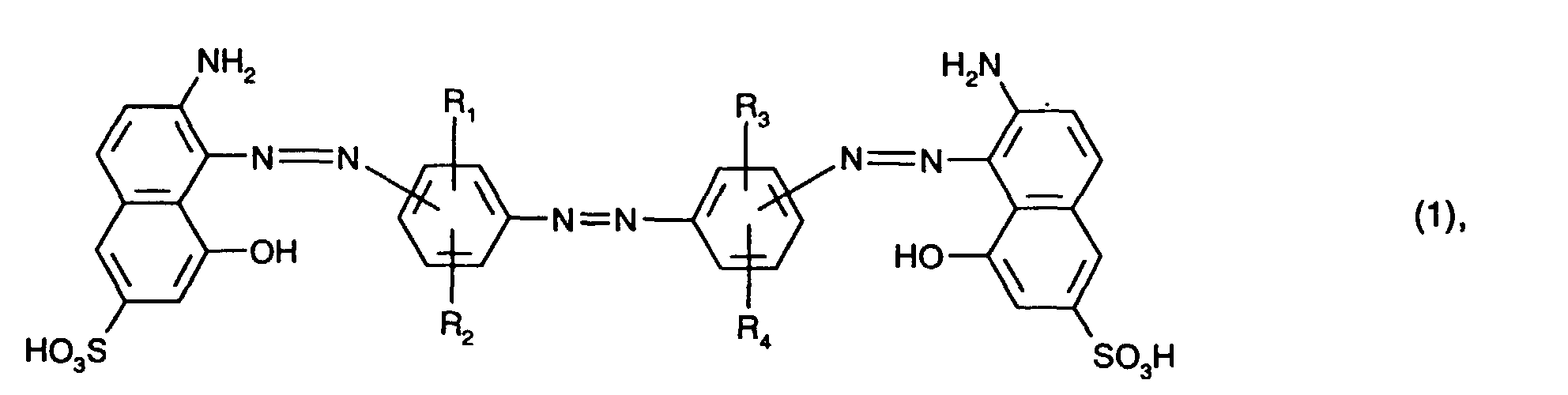

R1, R2, R3 und R4 unabhängig voneinander Wasserstoff, C1-C4-Alkyl, C1-C4-Alkoxy, C2-C4-Alkanoylamino, Ureido, Halogen oder Sulfo sind,
zusammen mit mindestens einem rotfärbenden Farbstoff der Formel (3)

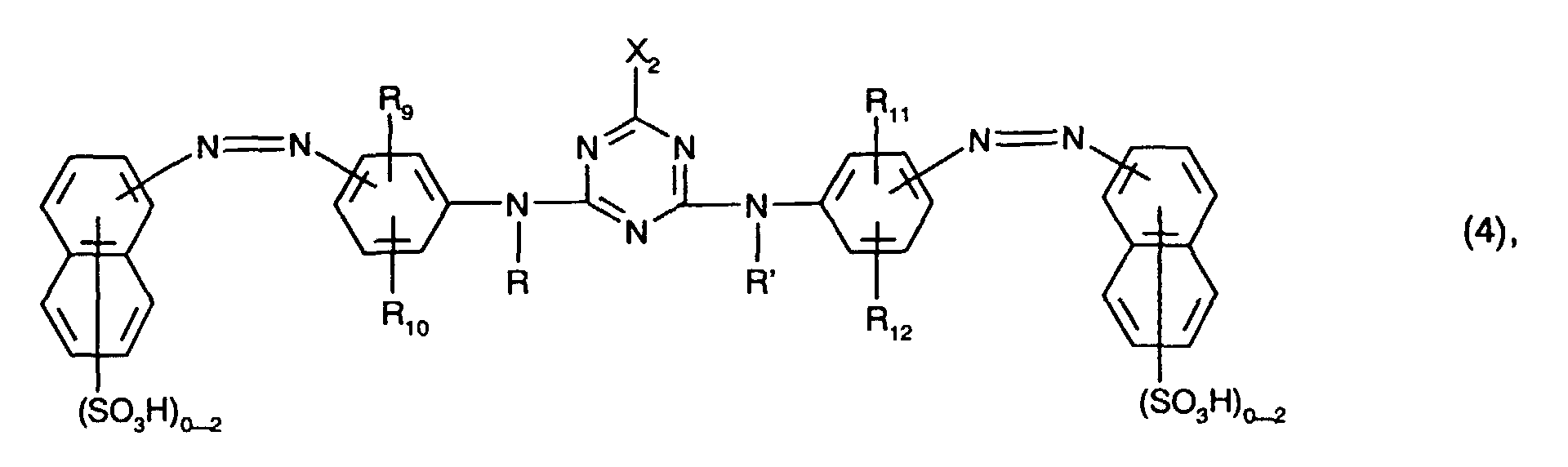
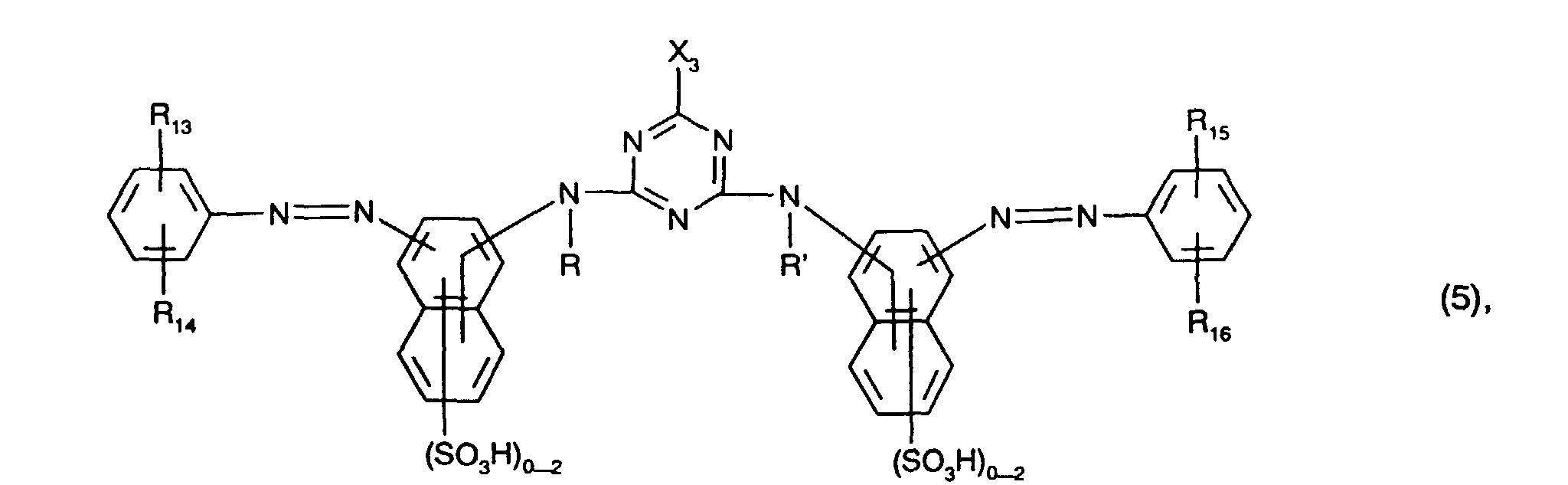
at least one blue-coloring dye of the formula (1) or (2)
R 1 , R 2 , R 3 and R 4 are independently hydrogen, C 1 -C 4 alkyl, C 1 -C 4 alkoxy, C 2 -C 4 alkanoylamino, ureido, halogen or sulfo,
together with at least one red-coloring dye of the formula (3)


R1, R2, R3 und R4 die in Anspruch 1 angegegebenen Bedeutungen haben.Process according to Claim 1, characterized in that at least one dye of the formula is used as the blue-coloring dye
R 1 , R 2 , R 3 and R 4 have the meanings given in Claim 1.

R, R', R5, R6, R7, R8 und X1 die in Anspruch 1 angegebenen Bedeutungen haben.Method according to one of claims 1 to 3, characterized in that at least one dye of the formula is used as the red-coloring dye
R, R ', R 5 , R 6 , R 7 , R 8 and X 1 have the meanings given in Claim 1.

R, R', R9, R10, R11, R12 und X2 die in Anspruch 1 angegebenen Bedeutungen haben.Process according to one of claims 1 to 5, characterized in that at least one dye of the formula is used as the yellow or orange dye
R, R ', R 9 , R 10 , R 11 , R 12 and X 2 have the meanings given in Claim 1.
R und R' Wasserstoff sind.Method according to one of claims 1 to 7, characterized in that
R and R 'are hydrogen.



R1, R2, R3 und R4 unabhängig voneinander Wasserstoff, C1-C4-Alkyl, C1-C4-Alkoxy, C2-C4-Alkanoylamino, Ureido, Halogen oder Sulfo sind,
zusammen mit mindestens einem rotfärbenden Farbstoff der Formel (3)

R 1 , R 2 , R 3 and R 4 are independently hydrogen, C 1 -C 4 alkyl, C 1 -C 4 alkoxy, C 2 -C 4 alkanoylamino, ureido, halogen or sulfo,
together with at least one red-coloring dye of the formula (3)
Applications Claiming Priority (3)
| Application Number | Priority Date | Filing Date | Title |
|---|---|---|---|
| CH1274/96 | 1996-05-21 | ||
| CH127496 | 1996-05-21 | ||
| CH127496 | 1996-05-21 |
Publications (3)
| Publication Number | Publication Date |
|---|---|
| EP0808940A2 true EP0808940A2 (en) | 1997-11-26 |
| EP0808940A3 EP0808940A3 (en) | 1998-10-07 |
| EP0808940B1 EP0808940B1 (en) | 2002-03-06 |
Family
ID=4206592
Family Applications (1)
| Application Number | Title | Priority Date | Filing Date |
|---|---|---|---|
| EP97810292A Expired - Lifetime EP0808940B1 (en) | 1996-05-21 | 1997-05-09 | Process for trichromic dyeing or printing |
Country Status (5)
| Country | Link |
|---|---|
| US (1) | US5928386A (en) |
| EP (1) | EP0808940B1 (en) |
| JP (1) | JPH1046045A (en) |
| CA (1) | CA2205672A1 (en) |
| DE (1) | DE59706532D1 (en) |
Cited By (4)
| Publication number | Priority date | Publication date | Assignee | Title |
|---|---|---|---|---|
| EP1081196A1 (en) * | 1999-08-30 | 2001-03-07 | Ciba SC Holding AG | Process for colouring and printing polyamid containing materials |
| WO2003033600A1 (en) | 2001-10-17 | 2003-04-24 | Clariant International Ltd | Trichromatic dyeing process and dye mixtures used therein |
| US6554874B1 (en) | 1999-08-30 | 2003-04-29 | Ciba Specialty Chemicals Corporation | Method of dyeing or printing polyamide-containing materials |
| WO2006103415A3 (en) * | 2005-03-31 | 2007-04-05 | Fujifilm Imaging Colorants Ltd | Disazo dyes for ink-jet printing |
Families Citing this family (2)
| Publication number | Priority date | Publication date | Assignee | Title |
|---|---|---|---|---|
| JP4988140B2 (en) * | 2000-12-05 | 2012-08-01 | クラリアント ファイナンス (ビーブイアイ) リミティド | Three primary color dyeing method |
| CN1942528B (en) * | 2004-04-06 | 2011-02-23 | 克莱里安特财务(Bvi)有限公司 | Process for dyeing |
Family Cites Families (7)
| Publication number | Priority date | Publication date | Assignee | Title |
|---|---|---|---|---|
| DE2421654C3 (en) * | 1974-05-04 | 1980-10-02 | Bayer Ag, 5090 Leverkusen | Trisazo dyes, process for their production and their use for dyeing and printing textile materials |
| JPS593594B2 (en) * | 1975-12-29 | 1984-01-25 | 住友化学工業株式会社 | The basics of the construction process |
| DE3021979A1 (en) * | 1980-06-12 | 1981-12-17 | Bayer Ag, 5090 Leverkusen | TRISAZO / AZOXY DYE MIXTURES, METHOD FOR THE PRODUCTION THEREOF AND THEIR USE |
| US4652269A (en) * | 1984-11-08 | 1987-03-24 | Ciba-Geigy Corporation | Process for the continuous trichromatic dyeing of synthetic polyamide materials: including a blue anthraquinone reactive dye |
| DE4332048A1 (en) * | 1993-09-21 | 1995-03-23 | Hoechst Ag | Mixtures of dyes with fiber-reactive groups and their use for dyeing fiber materials |
| US5456727A (en) * | 1994-05-24 | 1995-10-10 | Hoechst Celanese Corporation | Dye compositions for polyamides |
| US5644040A (en) * | 1994-12-02 | 1997-07-01 | Ciba-Geigy Corporation | Azo dyes having two monoazo-chromophores bound to a halotriazinyl radical processes for their preparation and their use |
-
1997
- 1997-05-06 JP JP9115468A patent/JPH1046045A/en active Pending
- 1997-05-09 EP EP97810292A patent/EP0808940B1/en not_active Expired - Lifetime
- 1997-05-09 DE DE59706532T patent/DE59706532D1/en not_active Expired - Fee Related
- 1997-05-16 CA CA002205672A patent/CA2205672A1/en not_active Abandoned
- 1997-05-21 US US08/861,288 patent/US5928386A/en not_active Expired - Fee Related
Cited By (5)
| Publication number | Priority date | Publication date | Assignee | Title |
|---|---|---|---|---|
| EP1081196A1 (en) * | 1999-08-30 | 2001-03-07 | Ciba SC Holding AG | Process for colouring and printing polyamid containing materials |
| US6554874B1 (en) | 1999-08-30 | 2003-04-29 | Ciba Specialty Chemicals Corporation | Method of dyeing or printing polyamide-containing materials |
| WO2003033600A1 (en) | 2001-10-17 | 2003-04-24 | Clariant International Ltd | Trichromatic dyeing process and dye mixtures used therein |
| US7410594B2 (en) | 2001-10-17 | 2008-08-12 | Clariant Finance (Bvi) Limited | Trichromatic dyeing process and dye mixtures used therein |
| WO2006103415A3 (en) * | 2005-03-31 | 2007-04-05 | Fujifilm Imaging Colorants Ltd | Disazo dyes for ink-jet printing |
Also Published As
| Publication number | Publication date |
|---|---|
| EP0808940B1 (en) | 2002-03-06 |
| DE59706532D1 (en) | 2002-04-11 |
| EP0808940A3 (en) | 1998-10-07 |
| JPH1046045A (en) | 1998-02-17 |
| US5928386A (en) | 1999-07-27 |
| CA2205672A1 (en) | 1997-11-21 |
Similar Documents
| Publication | Publication Date | Title |
|---|---|---|
| EP1247842A1 (en) | Fiber-reactive anthraquinone dyes, their preparation and use | |
| EP0135198B1 (en) | Process for dyeing synthetic polyamide fibrous material | |
| DE60312384T2 (en) | Dye Blends for Dyeing or Printing Fibrous Materials Containing CELLULOSE ACETATE | |
| EP0425434B1 (en) | Dyestuff mixtures and their use | |
| EP0808940B1 (en) | Process for trichromic dyeing or printing | |
| EP0658605B1 (en) | Process of trichromic dyeing or printing | |
| EP0718374B1 (en) | 1:2-Chromecomplex dyestuffs containing dyestuff-mixtures and 1:2-chromecomplex dyestuffs | |
| EP0823505B1 (en) | Process for trichromic dyeing or printing | |
| EP0524148B1 (en) | Dye mixtures and their use | |
| EP0548014B1 (en) | Dye mixtures and their utilization | |
| EP0714955A1 (en) | Azodyestuffs, process for their preparation and the use thereof | |
| EP0514330B1 (en) | Azodyes | |
| EP0601971B1 (en) | Process for trichromic dyeing or printing | |
| EP0651028B1 (en) | Process of trichromic dyeing or printing | |
| DE69702963T2 (en) | FIBER REACTIVE DYES | |
| EP1081196B1 (en) | Process for colouring and printing polyamid containing materials | |
| EP0690103B1 (en) | Azo dyes, process for their preparation and the use thereof | |
| EP0524147B1 (en) | Azo dyes, method for their preparation and their use | |
| CH649773A5 (en) | ASYMMETRIC 1: 2 CHROMIUM COMPLEX AROMATIC azo compounds, METHOD FOR THE PRODUCTION AND CONTAINING preparations. | |
| EP0739952B1 (en) | Azo dyestuff mixtures and their use | |
| DE2849995C3 (en) | Monoazo dyes, process for their preparation and their use | |
| EP0410930B1 (en) | Fibre reactive formazane dyes, methods of their preparation and use | |
| EP0586339B1 (en) | Azo dyes, process for their preparation and the use thereof | |
| EP0439423B1 (en) | Azodyes, process for their preparation and use thereof | |
| DE2917996A1 (en) | ORGANIC COMPOUNDS, THEIR PRODUCTION AND USE |
Legal Events
| Date | Code | Title | Description |
|---|---|---|---|
| PUAI | Public reference made under article 153(3) epc to a published international application that has entered the european phase |
Free format text: ORIGINAL CODE: 0009012 |
|
| AK | Designated contracting states |
Kind code of ref document: A2 Designated state(s): BE CH DE ES FR GB IT LI |
|
| PUAL | Search report despatched |
Free format text: ORIGINAL CODE: 0009013 |
|
| RHK1 | Main classification (correction) |
Ipc: C09B 67/22 |
|
| AK | Designated contracting states |
Kind code of ref document: A3 Designated state(s): BE CH DE ES FR GB IT LI |
|
| 17P | Request for examination filed |
Effective date: 19990308 |
|
| GRAG | Despatch of communication of intention to grant |
Free format text: ORIGINAL CODE: EPIDOS AGRA |
|
| 17Q | First examination report despatched |
Effective date: 20010228 |
|
| GRAG | Despatch of communication of intention to grant |
Free format text: ORIGINAL CODE: EPIDOS AGRA |
|
| GRAH | Despatch of communication of intention to grant a patent |
Free format text: ORIGINAL CODE: EPIDOS IGRA |
|
| GRAH | Despatch of communication of intention to grant a patent |
Free format text: ORIGINAL CODE: EPIDOS IGRA |
|
| REG | Reference to a national code |
Ref country code: GB Ref legal event code: IF02 |
|
| GRAA | (expected) grant |
Free format text: ORIGINAL CODE: 0009210 |
|
| AK | Designated contracting states |
Kind code of ref document: B1 Designated state(s): BE CH DE ES FR GB IT LI |
|
| PG25 | Lapsed in a contracting state [announced via postgrant information from national office to epo] |
Ref country code: IT Free format text: LAPSE BECAUSE OF FAILURE TO SUBMIT A TRANSLATION OF THE DESCRIPTION OR TO PAY THE FEE WITHIN THE PRE;WARNING: LAPSES OF ITALIAN PATENTS WITH EFFECTIVE DATE BEFORE 2007 MAY HAVE OCCURRED AT ANY TIME BEFORE 2007. THE CORRECT EFFECTIVE DATE MAY BE DIFFERENT FROM THE ONE RECORDED.SCRIBED TIME-LIMIT Effective date: 20020306 Ref country code: FR Free format text: LAPSE BECAUSE OF FAILURE TO SUBMIT A TRANSLATION OF THE DESCRIPTION OR TO PAY THE FEE WITHIN THE PRESCRIBED TIME-LIMIT Effective date: 20020306 |
|
| REG | Reference to a national code |
Ref country code: CH Ref legal event code: EP |
|
| REF | Corresponds to: |
Ref document number: 59706532 Country of ref document: DE Date of ref document: 20020411 |
|
| GBT | Gb: translation of ep patent filed (gb section 77(6)(a)/1977) |
Effective date: 20020507 |
|
| PG25 | Lapsed in a contracting state [announced via postgrant information from national office to epo] |
Ref country code: BE Free format text: LAPSE BECAUSE OF NON-PAYMENT OF DUE FEES Effective date: 20020531 |
|
| PG25 | Lapsed in a contracting state [announced via postgrant information from national office to epo] |
Ref country code: ES Free format text: LAPSE BECAUSE OF FAILURE TO SUBMIT A TRANSLATION OF THE DESCRIPTION OR TO PAY THE FEE WITHIN THE PRESCRIBED TIME-LIMIT Effective date: 20020925 |
|
| EN | Fr: translation not filed | ||
| PLBE | No opposition filed within time limit |
Free format text: ORIGINAL CODE: 0009261 |
|
| STAA | Information on the status of an ep patent application or granted ep patent |
Free format text: STATUS: NO OPPOSITION FILED WITHIN TIME LIMIT |
|
| 26N | No opposition filed |
Effective date: 20021209 |
|
| PGFP | Annual fee paid to national office [announced via postgrant information from national office to epo] |
Ref country code: CH Payment date: 20030415 Year of fee payment: 7 |
|
| PG25 | Lapsed in a contracting state [announced via postgrant information from national office to epo] |
Ref country code: LI Free format text: LAPSE BECAUSE OF NON-PAYMENT OF DUE FEES Effective date: 20040531 Ref country code: CH Free format text: LAPSE BECAUSE OF NON-PAYMENT OF DUE FEES Effective date: 20040531 |
|
| REG | Reference to a national code |
Ref country code: CH Ref legal event code: PL |
|
| PGFP | Annual fee paid to national office [announced via postgrant information from national office to epo] |
Ref country code: GB Payment date: 20050420 Year of fee payment: 9 |
|
| PGFP | Annual fee paid to national office [announced via postgrant information from national office to epo] |
Ref country code: DE Payment date: 20050421 Year of fee payment: 9 |
|
| PG25 | Lapsed in a contracting state [announced via postgrant information from national office to epo] |
Ref country code: GB Free format text: LAPSE BECAUSE OF NON-PAYMENT OF DUE FEES Effective date: 20060509 |
|
| PG25 | Lapsed in a contracting state [announced via postgrant information from national office to epo] |
Ref country code: DE Free format text: LAPSE BECAUSE OF NON-PAYMENT OF DUE FEES Effective date: 20061201 |
|
| GBPC | Gb: european patent ceased through non-payment of renewal fee |
Effective date: 20060509 |