EP0807669A2 - Carbon black granulate - Google Patents
Carbon black granulate Download PDFInfo
- Publication number
- EP0807669A2 EP0807669A2 EP97113431A EP97113431A EP0807669A2 EP 0807669 A2 EP0807669 A2 EP 0807669A2 EP 97113431 A EP97113431 A EP 97113431A EP 97113431 A EP97113431 A EP 97113431A EP 0807669 A2 EP0807669 A2 EP 0807669A2
- Authority
- EP
- European Patent Office
- Prior art keywords
- granules
- carbon black
- carbon blacks
- blacks
- weight
- Prior art date
- Legal status (The legal status is an assumption and is not a legal conclusion. Google has not performed a legal analysis and makes no representation as to the accuracy of the status listed.)
- Granted
Links
Images
Classifications
-
- C—CHEMISTRY; METALLURGY
- C11—ANIMAL OR VEGETABLE OILS, FATS, FATTY SUBSTANCES OR WAXES; FATTY ACIDS THEREFROM; DETERGENTS; CANDLES
- C11D—DETERGENT COMPOSITIONS; USE OF SINGLE SUBSTANCES AS DETERGENTS; SOAP OR SOAP-MAKING; RESIN SOAPS; RECOVERY OF GLYCEROL
- C11D3/00—Other compounding ingredients of detergent compositions covered in group C11D1/00
- C11D3/02—Inorganic compounds ; Elemental compounds
- C11D3/12—Water-insoluble compounds
- C11D3/124—Silicon containing, e.g. silica, silex, quartz or glass beads
- C11D3/1246—Silicates, e.g. diatomaceous earth
-
- B—PERFORMING OPERATIONS; TRANSPORTING
- B01—PHYSICAL OR CHEMICAL PROCESSES OR APPARATUS IN GENERAL
- B01J—CHEMICAL OR PHYSICAL PROCESSES, e.g. CATALYSIS OR COLLOID CHEMISTRY; THEIR RELEVANT APPARATUS
- B01J2/00—Processes or devices for granulating materials, e.g. fertilisers in general; Rendering particulate materials free flowing in general, e.g. making them hydrophobic
- B01J2/20—Processes or devices for granulating materials, e.g. fertilisers in general; Rendering particulate materials free flowing in general, e.g. making them hydrophobic by expressing the material, e.g. through sieves and fragmenting the extruded length
-
- B—PERFORMING OPERATIONS; TRANSPORTING
- B01—PHYSICAL OR CHEMICAL PROCESSES OR APPARATUS IN GENERAL
- B01J—CHEMICAL OR PHYSICAL PROCESSES, e.g. CATALYSIS OR COLLOID CHEMISTRY; THEIR RELEVANT APPARATUS
- B01J21/00—Catalysts comprising the elements, oxides, or hydroxides of magnesium, boron, aluminium, carbon, silicon, titanium, zirconium, or hafnium
- B01J21/18—Carbon
-
- B—PERFORMING OPERATIONS; TRANSPORTING
- B01—PHYSICAL OR CHEMICAL PROCESSES OR APPARATUS IN GENERAL
- B01J—CHEMICAL OR PHYSICAL PROCESSES, e.g. CATALYSIS OR COLLOID CHEMISTRY; THEIR RELEVANT APPARATUS
- B01J37/00—Processes, in general, for preparing catalysts; Processes, in general, for activation of catalysts
- B01J37/0009—Use of binding agents; Moulding; Pressing; Powdering; Granulating; Addition of materials ameliorating the mechanical properties of the product catalyst
-
- B—PERFORMING OPERATIONS; TRANSPORTING
- B01—PHYSICAL OR CHEMICAL PROCESSES OR APPARATUS IN GENERAL
- B01J—CHEMICAL OR PHYSICAL PROCESSES, e.g. CATALYSIS OR COLLOID CHEMISTRY; THEIR RELEVANT APPARATUS
- B01J37/00—Processes, in general, for preparing catalysts; Processes, in general, for activation of catalysts
- B01J37/0009—Use of binding agents; Moulding; Pressing; Powdering; Granulating; Addition of materials ameliorating the mechanical properties of the product catalyst
- B01J37/0063—Granulating
-
- C—CHEMISTRY; METALLURGY
- C01—INORGANIC CHEMISTRY
- C01B—NON-METALLIC ELEMENTS; COMPOUNDS THEREOF; METALLOIDS OR COMPOUNDS THEREOF NOT COVERED BY SUBCLASS C01C
- C01B33/00—Silicon; Compounds thereof
- C01B33/113—Silicon oxides; Hydrates thereof
- C01B33/12—Silica; Hydrates thereof, e.g. lepidoic silicic acid
- C01B33/18—Preparation of finely divided silica neither in sol nor in gel form; After-treatment thereof
- C01B33/181—Preparation of finely divided silica neither in sol nor in gel form; After-treatment thereof by a dry process
- C01B33/183—Preparation of finely divided silica neither in sol nor in gel form; After-treatment thereof by a dry process by oxidation or hydrolysis in the vapour phase of silicon compounds such as halides, trichlorosilane, monosilane
-
- C—CHEMISTRY; METALLURGY
- C09—DYES; PAINTS; POLISHES; NATURAL RESINS; ADHESIVES; COMPOSITIONS NOT OTHERWISE PROVIDED FOR; APPLICATIONS OF MATERIALS NOT OTHERWISE PROVIDED FOR
- C09C—TREATMENT OF INORGANIC MATERIALS, OTHER THAN FIBROUS FILLERS, TO ENHANCE THEIR PIGMENTING OR FILLING PROPERTIES ; PREPARATION OF CARBON BLACK ; PREPARATION OF INORGANIC MATERIALS WHICH ARE NO SINGLE CHEMICAL COMPOUNDS AND WHICH ARE MAINLY USED AS PIGMENTS OR FILLERS
- C09C1/00—Treatment of specific inorganic materials other than fibrous fillers; Preparation of carbon black
- C09C1/44—Carbon
- C09C1/48—Carbon black
- C09C1/56—Treatment of carbon black ; Purification
- C09C1/58—Agglomerating, pelleting, or the like by wet methods
-
- C—CHEMISTRY; METALLURGY
- C09—DYES; PAINTS; POLISHES; NATURAL RESINS; ADHESIVES; COMPOSITIONS NOT OTHERWISE PROVIDED FOR; APPLICATIONS OF MATERIALS NOT OTHERWISE PROVIDED FOR
- C09D—COATING COMPOSITIONS, e.g. PAINTS, VARNISHES OR LACQUERS; FILLING PASTES; CHEMICAL PAINT OR INK REMOVERS; INKS; CORRECTING FLUIDS; WOODSTAINS; PASTES OR SOLIDS FOR COLOURING OR PRINTING; USE OF MATERIALS THEREFOR
- C09D17/00—Pigment pastes, e.g. for mixing in paints
- C09D17/004—Pigment pastes, e.g. for mixing in paints containing an inorganic pigment
- C09D17/005—Carbon black
-
- C—CHEMISTRY; METALLURGY
- C11—ANIMAL OR VEGETABLE OILS, FATS, FATTY SUBSTANCES OR WAXES; FATTY ACIDS THEREFROM; DETERGENTS; CANDLES
- C11D—DETERGENT COMPOSITIONS; USE OF SINGLE SUBSTANCES AS DETERGENTS; SOAP OR SOAP-MAKING; RESIN SOAPS; RECOVERY OF GLYCEROL
- C11D11/00—Special methods for preparing compositions containing mixtures of detergents
-
- C—CHEMISTRY; METALLURGY
- C01—INORGANIC CHEMISTRY
- C01P—INDEXING SCHEME RELATING TO STRUCTURAL AND PHYSICAL ASPECTS OF SOLID INORGANIC COMPOUNDS
- C01P2004/00—Particle morphology
- C01P2004/30—Particle morphology extending in three dimensions
- C01P2004/32—Spheres
-
- C—CHEMISTRY; METALLURGY
- C01—INORGANIC CHEMISTRY
- C01P—INDEXING SCHEME RELATING TO STRUCTURAL AND PHYSICAL ASPECTS OF SOLID INORGANIC COMPOUNDS
- C01P2004/00—Particle morphology
- C01P2004/50—Agglomerated particles
-
- C—CHEMISTRY; METALLURGY
- C01—INORGANIC CHEMISTRY
- C01P—INDEXING SCHEME RELATING TO STRUCTURAL AND PHYSICAL ASPECTS OF SOLID INORGANIC COMPOUNDS
- C01P2004/00—Particle morphology
- C01P2004/51—Particles with a specific particle size distribution
- C01P2004/52—Particles with a specific particle size distribution highly monodisperse size distribution
-
- C—CHEMISTRY; METALLURGY
- C01—INORGANIC CHEMISTRY
- C01P—INDEXING SCHEME RELATING TO STRUCTURAL AND PHYSICAL ASPECTS OF SOLID INORGANIC COMPOUNDS
- C01P2004/00—Particle morphology
- C01P2004/60—Particles characterised by their size
- C01P2004/61—Micrometer sized, i.e. from 1-100 micrometer
-
- C—CHEMISTRY; METALLURGY
- C01—INORGANIC CHEMISTRY
- C01P—INDEXING SCHEME RELATING TO STRUCTURAL AND PHYSICAL ASPECTS OF SOLID INORGANIC COMPOUNDS
- C01P2006/00—Physical properties of inorganic compounds
- C01P2006/11—Powder tap density
-
- C—CHEMISTRY; METALLURGY
- C01—INORGANIC CHEMISTRY
- C01P—INDEXING SCHEME RELATING TO STRUCTURAL AND PHYSICAL ASPECTS OF SOLID INORGANIC COMPOUNDS
- C01P2006/00—Physical properties of inorganic compounds
- C01P2006/19—Oil-absorption capacity, e.g. DBP values
-
- C—CHEMISTRY; METALLURGY
- C01—INORGANIC CHEMISTRY
- C01P—INDEXING SCHEME RELATING TO STRUCTURAL AND PHYSICAL ASPECTS OF SOLID INORGANIC COMPOUNDS
- C01P2006/00—Physical properties of inorganic compounds
- C01P2006/21—Attrition-index or crushing strength of granulates
Definitions
- the invention relates to soot granules obtainable from powdery carbon blacks.
- Spherical soot granules are of particular interest. They have improved flow properties compared to powdery carbon blacks and cylindrical carbon black extrudates or carbon black tablets. As a result, they can be dosed, transported and stored more cheaply. In many cases, the granulated carbon blacks have to be redispersed during use, for example when carbon black is used as a structural reinforcer in rubber articles (rubber blacks) or for coloring paints and plastics (pigment blacks).
- the carbon blacks produced in powder form must therefore be granulated in a subsequent process step.
- simple and complete redispersibility is also desirable despite the highest possible strength (transport stability) of the granules.
- Redispersibility plays a decisive role in applications in the areas of paint manufacture, cable compounds and technical rubber articles, since even small amounts of undispersed soot agglomerates can lead to serious application-related defects in the end product.
- Soot agglomerates are understood here to mean agglomerates bound by physical cohesive forces (Van der Waals forces) from a large number of so-called soot aggregates, in accordance with the definitions in standard DIN 53206. Soot aggregates are formed by solid growth of the soot primary particles during the soot formation process, from which soot agglomerates are formed by spontaneous storage or by a granulation process.
- Dibutyl phthalate absorption according to DIN 53601 serves as a measure of the structure of a carbon black.
- the soot structure largely determines the product properties of the paints, plastics or rubber articles colored or reinforced with it. In order not to adversely affect the product properties, the least amount of structural growth required by the granulation process is therefore required.
- Granulated carbon blacks continue to be used as carriers for chemical catalysts and as adsorbents.
- the material itself or the addition of suitable binders must ensure that the granules do not dissolve in use. Good flow and dosing properties as well as low abrasion are also required here.
- the granulation of powdery solids is usually carried out with the addition of a suitable binder and a moistening agent, usually water. After the granulation, the moistening agent has to be removed to a certain residual moisture using energy-intensive drying processes. Depending on the area of application, the granules are then calcined at elevated temperatures.
- Typical areas of application for these agglomeration processes are the spray drying of detergent compounds and animal feed and the agglomeration of soot in spiked shaft mixers, ploughshare or counter-current mixers.
- the agglomerates or granules thus produced are compressed unevenly.
- the flow properties of the granulate fill are impaired by the relatively wide particle size distribution. This makes precise dosing difficult in the application.
- the addition of humectants and binders can have a negative effect on the redispersibility of the granules.
- Roller compactors, die presses and extruders are used in agglomeration processes with mechanical compression.
- the granules or agglomerates produced by these machines have a cylindrical shape and must be rounded in rounding units to form the spherical shape. It shows that very different granule qualities are obtained.
- the diameter distribution of the granules generally has a very broad spectrum and, in addition to the desired spherical granules, contains finely divided fragments which have to be screened off in a further process step in order to obtain a dust-free product.
- the physical properties of these granules such as homogeneity, breaking strength, abrasion and redispersibility show great fluctuations and can only be inadequately coordinated with the known methods.
- Roller compactors and ring die presses are characterized by significantly lower investment costs compared to extruders.
- Ring die presses consist of a motor-driven cylindrical hollow roller (die) with radially arranged press channels.
- a press roll runs on the inner surface of the ring die, the outer diameter of which is smaller than the inner diameter of the ring die.
- the press roll is arranged eccentrically to the central axis of the ring die.
- the axis distance between the press roll and the ring die press can be changed to adjust the nip W between the die and the press roll.
- Ring die and press roller rotate in the same direction, thereby pulling the bulk material into the nip a, compress it and press it out through the radial press channels.
- the resulting compression is determined by the pressure that is necessary to push the individual agglomerate strands out of the die. This can be controlled by the geometry of the press channels, given the diameter over the length.
- the press roll can be driven separately. This makes it possible to set a slip S between the die and the press roll.
- the slip thus defined varies between zero and one. Due to a non-zero slip, the material drawn into the nip is subjected to a higher pressing pressure in the nip and additionally sheared. This results in an improved compression and a more homogeneous structure of the agglomerates.
- the agglomerate strands emerging from the die can be cut off by suitable scraper knives.
- the cut or uncut cylindrical agglomerates can then in a rounding unit rounded to granules.
- a product change is generally very easy, since the clear separation of the shape of the feed material and the drive of the ring die press allows quick and thorough cleaning.
- Extruders produce very homogeneous and highly compressed agglomerate strands. However, extruders require a very precise setting of the moisture and the kneading time of the powdery solid. Permissible tolerances for the moisture of the feed material of only 1 to 2% are typical. The investment costs for extruders are high.
- the carbon black granules according to the invention can be obtained by a process for the production of spherical granules from powdery carbon blacks, the carbon blacks being uniformly moistened in a mixer with the addition of a moistening agent, and optionally a binder and further additives, and then the moistened mixture using a ring die press, which has an adjustable slip between the ring die and the press roll, pressed into cylindrical strands, and then the strands in a rounding unit with a corrugated disc spherical granules are rounded.
- the ring die press used has press channels with a length to diameter ratio of 1: 1 to 10: 1 and a roll gap between the ring die and press roll of 0.05 to 2 mm.
- the average grain diameter of the granules is essentially determined by the diameter of the press channels of the die and can therefore be easily changed by exchanging the die.
- the particle size distribution of the finished carbon black granules can be determined with the help of a sieve analysis.
- the sieve analysis provides a cumulative distribution curve for the grain diameter, from which the mean grain diameter can be read. It is defined as the diameter value at which the sum distribution curve assumes the value 50%, i.e. H. 50% by weight of the granules have a diameter which is smaller than the mean diameter.
- the carbon blacks according to the invention 80% by weight of the granules lie in a diameter interval, the width of which is less than 60% of the average grain diameter.
- the grain size distribution curves are not necessarily symmetrical to the mean grain diameter, but can have more or less large asymmetries.
- the agglomerate strands emerging from the ring die press need not be cut to length with the aid of a scraper knife. Rather, the seams between the partial agglomerates serve as predetermined breaking points, which lead to the agglomerate strand breaking in the rounding aggregate into partial agglomerates of the same size.
- the prerequisite for this, however, is that the moisture content of the feed material and the dimensioning of the ring die press are selected appropriately.
- the moisture content is understood to mean the proportion by weight of the moistening agent, based on the total weight of the moistened feed material.
- the optimal moisture content for the granulation process described is up to 20% below the optimal moisture content of conventional granulation processes. In individual cases, this can result in considerable energy savings when drying the granulate.
- the optimal moisture content depends on the pore volume and the structure of the powder black used. It can be determined with just a few preliminary tests. The techniques required for this are known to the person skilled in the art.
- additives up to a weight fraction of approximately 20% of the total weight of the mixture can be added to the powdered carbon blacks before the granulation process.
- These additives can be, for example, water repellents.
- the process described can be used particularly advantageously for the production of spherical soot granules with diameters of 0.5 to 4 mm.
- soot granules produced generally show good flow behavior. Because a granule is only formed from a partial agglomerate the granules are homogeneous in themselves. In addition, the pressing pressures are very uniform over the entire roll width of the ring die press, which leads to correspondingly evenly compressed agglomerate strands. This results in a constant density of all soot granules. Their redispersibility is generally very good.
- Rubber blacks generally have a DBP absorption between 60 and 140 ml / 100 g (measurement specification according to DIN 53601), an iodine adsorption below 150 mg / g (measurement specification according to DIN 53582) and a tamped density between 400 and 550 g / l (measurement specification according to DIN 787/11), while pigment blacks are characterized by a DBP absorption between 40 and 450 ml / 100 g, an iodine adsorption between 30 and 1200 mg / g and a tamped density between 150 and 500 g / l.
- the group of pigment blacks also includes the so-called conductivity blacks, which are characterized by a particularly high structure and surface, which is reflected in the exceptionally high values for DBP absorption and iodine adsorption.
- the specialty conductivity carbon black Printex XE2 (brand name of Degussa) has a DBP absorption of 380 ml / 100 g and an iodine adsorption of 1075 ml / g.
- An advantage over known wet granulation processes for carbon blacks is the fact that only very little binder has to be added to the carbon blacks. While conventional granulation processes require a binder content of the finished granules of 0.5 to 3% by weight, the described process manages with binder contents below 1, preferably below 0.5% by weight. Molasses or lignin sulfonate, for example, are used as binders, which are also used in conventional granulation processes. For applications in which the binders are disruptive, it is also possible to granulate completely without binders.
- the individual pearl hardness of the carbon black granules according to DIN 53603 is in the range between 10 and 50 cN even in the absence of binders, and the abrasion determined according to DIN 53583 is less than 3% by weight.
- the achievable tamped densities are between 400 and 550 g / l, in particular between 400 and 500 g / l.
- the dispersion hardness of this carbon black determined in accordance with DIN 53775, Part 7, is less than 5%. The carbon blacks granulated in this way can thus be redispersed excellently.
- a particular advantage of the granulation process is that the granulation process is extremely gentle.
- the structure and specific surface area of the powder blacks, measured by their DBP absorption and iodine adsorption, are only reduced by a maximum of 5% by the granulation. This property is particularly advantageous for carbon blacks with a high structure.
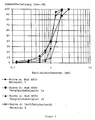
- FIG. 1 shows the cumulative distribution curves of three granules of rubber soot N550 (according to ASTM) and the distribution curve of a granulated conductivity black (Printex XE2, Degussa) obtained from sieve analyzes.
- Curve a is the distribution curve of a granulate obtained according to the invention.
- the granules for the distribution curves b and c were produced by conventional built-up agglomeration with a spiked shaft mixer (curve b) and a ploughshare mixer (curve c).
- Curve d is the distribution curve for the conductivity black granulated according to the invention.
- Example 1 Granulation of rubber blacks N550 and N660
- the described granulation process is outstandingly suitable for producing carbon black granules with properties that represent an optimal compromise between the contradicting practical requirements.
- carbon black N550 (according to ASTM), it was moistened with water to a moisture content of 43% (corresponding to 754 g of water per 1 kg of soot) and mixed thoroughly in a mixer. The addition of water is necessary, on the one hand, to reduce the required pressing forces and, on the other hand, to activate the adhesive forces between the particles.
- the average mixing time required is approx. 4 minutes. Due to the high-speed mixing tools, intensive mixing takes place without agglomerate formation.
- the moistened carbon black was then with a ring die press at a speed of the ring die of 630 min -1 and a specific volume throughput of 5.5 kg ⁇ s -1 ⁇ m -2 (the specific volume throughput here is equal to the mass of the compressed powder material per channel surface and Time unit) pressed.
- the agglomerate strands of about 1 to 10 mm in length were then rounded in a rounding unit with a corrugated disc at a speed of 900 min -1 for a period of 10 minutes.
- the carbon black N550 was granulated in powder form using two conventional methods. It was the granulation in a mixer with a spiked shaft and in a ploughshare mixer. The results of these granulation tests are compared in Table 1 with those according to Example 1.
- soot granules according to the invention have spheres with a very narrow particle size distribution.
- the abrasion is within the specification and is only undercut by Comparative Example 1a, in which the carbon black N550 was granulated with 1% lignin sulfonate as a binder. Comparative example 1b without a binder exhibits high abrasion.
- the dispersion hardness of the soot balls according to the invention is very low due to the narrow particle size distribution and homogeneity.
- the carbon blacks N550 and N660 were each granulated with the ring die press, with a spiked shaft and with a ploughshare mixer, and the granules thus obtained were compared with respect to individual bead hardness, abrasion, color strength and dispersion hardness.
- the carbon black could only be granulated with the ring die press. Granulation tests with a spiked shaft and ploughshare mixer did not produce any useful granules.
- the soot according to the invention provides the granulation with a ring die press and subsequent rounding with a corrugated disc. Because of the lack of a binder, they have a lower - but still sufficient - individual bead hardness than the conventional carbon black granules, but are superior to the conventional granules in terms of abrasion and dispersion hardness.
- the color strength determined according to DIN 53775 (cold) was measured at roller temperatures of 75 ° C.
- the values given in Table 2 are relative values, based on the color strength obtained with the granules granulated with the spiked shaft, multiplied by 100.
- the color strength which was obtained with the conductive carbon black in powder form was chosen as the reference variable.
- the granules of the conductivity carbon black were also examined for their grain size distribution.
- the corresponding sum distribution curve is shown in FIG. 1.
- the mean grain diameter and the 80% diameter interval which comprises 80% by weight of the respective granules, were determined in each case from the grain distribution curves of FIG. 1 for the four granules produced in Examples 1 and 2 and in Comparative Examples 1a and 1b. The results are shown in Table 3.
- the 80% interval was determined from the diameters of the distribution curves for the total values of 10 and 90%. It is given in Table 3 as a percentage of the mean grain diameter. It can be seen from this table that the granules according to the invention have a significantly narrower grain size distribution than the comparison granules. In particular, the granules according to the invention have a significantly lower fine fraction.
Landscapes
- Chemical & Material Sciences (AREA)
- Organic Chemistry (AREA)
- Engineering & Computer Science (AREA)
- Chemical Kinetics & Catalysis (AREA)
- Materials Engineering (AREA)
- Inorganic Chemistry (AREA)
- Life Sciences & Earth Sciences (AREA)
- Wood Science & Technology (AREA)
- Oil, Petroleum & Natural Gas (AREA)
- Pigments, Carbon Blacks, Or Wood Stains (AREA)
- Detergent Compositions (AREA)
- Glanulating (AREA)
Abstract
Die Erfindung betrifft aus pulverförmigen Rußen erhältliche kugelförmige Ruß-Granulate. Die Ruß-Granulate werden dadurch erhalten, daß die pulverförmigen Ruße gegebenenfalls zusammen mit für die Verpressung von Rußen üblichen Bindemitteln, Gleitmitteln und Plastifizieren durch Zugabe einer entsprechenden Flüssigkeitsmenge und Vermischen in einem Mischer gleichmäßig durchfeuchtet, mit einer Ringmatrizenpresse zu zylinderförmigen Agglomeratsträngen verpreßt und anschließend in einem Rundungsaggregat mit Riffelscheibe verrundet werden. Die nach diesem Verfahren granulierten Ruße weisen ein sehr enges Korngrößenspektrum auf und zeichnen sich je nach Verfahrensführung durch gute Fließfähigkeit und gute Dispergierbarkeit aus.
Description
Die Erfindung betrifft aus pulverförmigen Rußen erhältliche Rußgranulate.The invention relates to soot granules obtainable from powdery carbon blacks.
In vielen Industriezweigen besteht das Problem, pulverförmige Ruße zu lagern, zu transportieren und zu verarbeiten. Die technische Handhabbarkeit der Ruße wird verbessert, wenn sie in granulierter Form vorliegen. Hierzu werden die Rußpulver gewöhnlich unter Zusatz von geeigneten Bindemitteln mechanisch so weit verdichtet, daß Wechselwirkungskräfte zwischen den einzelnen Pulverpartikeln in molekularen Bereichen an den Oberflächen wirksam werden. Es bilden sich dabei Produkte mit neuen Eigenschaften.In many branches of industry there is the problem of storing, transporting and processing powdered carbon blacks. The technical handling of the carbon blacks is improved if they are in granular form. For this purpose, the carbon black powders are usually compressed mechanically with the addition of suitable binders to such an extent that interaction forces between the individual powder particles become effective on the surfaces in molecular areas. Products with new properties are formed.
Von besonderem Interesse sind kugelförmige Ruß-Granulate. Sie weisen gegenüber pulverförmigen Rußen und zylinderförmigen Ruß-Extrudaten oder Ruß-Tabletten verbesserte Fließeigenschaften auf. Dadurch können sie kostengünstiger dosiert, transportiert und gelagert werden. In vielen Fällen müssen die granulierten Ruße bei der Anwendung wieder dispergiert werden, so zum Beispiel bei Verwendung von Ruß als struktureller Verstärker in Gummiartikeln (Gummiruße) oder zur Einfärbung von Lacken und Kunststoffen (Pigmentruße).Spherical soot granules are of particular interest. They have improved flow properties compared to powdery carbon blacks and cylindrical carbon black extrudates or carbon black tablets. As a result, they can be dosed, transported and stored more cheaply. In many cases, the granulated carbon blacks have to be redispersed during use, for example when carbon black is used as a structural reinforcer in rubber articles (rubber blacks) or for coloring paints and plastics (pigment blacks).
Die bei der Herstellung pulverförmig anfallenden Ruße müssen daher in einem nachfolgenden Verfahrensschritt granuliert werden. Hierbei ist neben einem geringen Feinanteil und einer möglichst engen Korngrößenverteilung auch eine einfache und vollständige Redispergierbarkeit trotz möglichst hoher Festigkeit (Transportstabilität) der Granalien erwünscht.The carbon blacks produced in powder form must therefore be granulated in a subsequent process step. In addition to a small fine fraction and the narrowest possible particle size distribution, simple and complete redispersibility is also desirable despite the highest possible strength (transport stability) of the granules.
Die Redispergierbarkeit spielt beispielsweise bei Anwendungen auf den Gebieten der Lackherstellung, Kabelcompounds und technischen Gummiartikeln eine entscheidende Rolle, da selbst geringe Anteile nicht dispergierter Ruß-Agglomerate zu gravierenden anwendungstechnischen Mängeln des Endproduktes führen können.Redispersibility, for example, plays a decisive role in applications in the areas of paint manufacture, cable compounds and technical rubber articles, since even small amounts of undispersed soot agglomerates can lead to serious application-related defects in the end product.
Unter Ruß-Agglomeraten werden hier entsprechend den Definitionen in der Norm DIN 53206 durch physikalische Kohäsionskräfte (Van der Waals-Kräfte) gebundene Agglomerate aus einer Vielzahl sogenannter Ruß-Aggregate verstanden. Ruß-Aggregate entstehen durch feste Verwachsung der Ruß-Primärteilchen noch während des Ruß-Bildungsprozesses miteinander, aus denen sich durch spontane, oder durch einen Granulationsvorgang geförderte, Zusammenlagerung Ruß-Agglomerate bilden.Soot agglomerates are understood here to mean agglomerates bound by physical cohesive forces (Van der Waals forces) from a large number of so-called soot aggregates, in accordance with the definitions in standard DIN 53206. Soot aggregates are formed by solid growth of the soot primary particles during the soot formation process, from which soot agglomerates are formed by spontaneous storage or by a granulation process.
Bei Rußen mit hohem Hohlvolumenanteil der Aggregate spricht man von "hoher Struktur", bei geringem Hohlvolumenanteil von "niedriger Struktur". Als Maß für die Struktur eines Rußes dient die Dibutylphthalat-Absorption nach DIN 53601 (DBP-Absorption).In the case of carbon blacks with a high void volume fraction of the aggregates, one speaks of "high structure", and in the case of a low void volume fraction, "low structure". Dibutyl phthalate absorption according to DIN 53601 (DBP absorption) serves as a measure of the structure of a carbon black.
Die Rußstruktur bestimmt maßgeblich die Produkteigenschaften der damit eingefärbten bzw. verstärkten Lacke, Kunststoffe oder Gummiartikel. Um die Produkteigenschaften nicht zu beeinträchtigen, wird daher ein möglichst geringer Anbau der Struktur durch den Granulationsvorgang gefordert.The soot structure largely determines the product properties of the paints, plastics or rubber articles colored or reinforced with it. In order not to adversely affect the product properties, the least amount of structural growth required by the granulation process is therefore required.
Granulierte Ruße werden weiterhin als Träger für Chemiekatalysatoren und als Adsorbentien eingesetzt. In diesem Fall muß durch das Material selbst oder durch Zusatz geeigneter Bindemittel gewährleistet sein, daß sich die Granalien im Gebrauch nicht auflösen. Gute Fließ- und Dosiereigenschaften sowie ein geringer Abrieb sind aber auch hier gefragt.Granulated carbon blacks continue to be used as carriers for chemical catalysts and as adsorbents. In this case, the material itself or the addition of suitable binders must ensure that the granules do not dissolve in use. Good flow and dosing properties as well as low abrasion are also required here.
Verschiedene Verfahren zur Granulation bzw. Agglomeration pulverförmiger Feststoffe sind zum Beispiel aus Ullmann's Encyclopedia of Industrial Chemistry, Vol. B2, (1988), Seiten 7 - 15 bis 7 - 21 bekannt. Man unterscheidet Sprühagglomeration bzw. Sprühtrocknung, Aufbauagglomeration und Agglomeration durch mechanische Kompaktierung (Preßagglomeration). Die hierbei entstehenden Agglomerate mit Abmessungen im Bereich von einigen Zehntel Millimetern bis zu einigen Millimetern werden für die Zwecke dieser Patentanmeldung als Granulate bezeichnet, um eine deutliche Unterscheidung zu den gemäß DIN 53206 definierten Ruß-Agglomeraten zu schaffen, die durch die spontane Zusammenlagerung von Rußaggregaten entstehen und Abmessungen unterhalb von 100 µm haben.Various methods for granulating or agglomerating powdery solids are known, for example, from Ullmann's Encyclopedia of Industrial Chemistry, Vol. B2, (1988), pages 7-15 to 7-21. A distinction is made between spray agglomeration or spray drying, built-up agglomeration and agglomeration by mechanical compacting (press agglomeration). The resulting agglomerates with dimensions in the range of a few tenths of a millimeter to a few millimeters are referred to as granules for the purposes of this patent application in order to make a clear distinction from the soot agglomerates defined in accordance with DIN 53206, which result from the spontaneous accumulation of soot aggregates and have dimensions below 100 µm.
Die Granulation pulverförmiger Feststoffe wird gewöhnlich unter Zugabe eines geeigneten Bindemittels und eines Befeuchtungsmittels, in der Regel Wasser, durchgeführt. Das Befeuchtungsmittel muß nach der Granulation mit energieaufwendigen Trocknungsverfahren bis auf eine gewisse Restfeuchte entfernt werden. Je nach Einsatzgebiet schließt sich noch eine Kalzination der Granulate bei erhöhten Temperaturen an.The granulation of powdery solids is usually carried out with the addition of a suitable binder and a moistening agent, usually water. After the granulation, the moistening agent has to be removed to a certain residual moisture using energy-intensive drying processes. Depending on the area of application, the granules are then calcined at elevated temperatures.
Typische Einsatzgebiete dieser Agglomerationsverfahren sind die Sprühtrocknung von Waschmittelcompounds und Futtermitteln und die Aufbauagglomeration von Ruß in Stachelwellenmischern, Pflugschar- oder Gegenstrommischern. Die damit erzeugten Agglomerate bzw. Granulate sind ungleichmäßig verdichtet.Typical areas of application for these agglomeration processes are the spray drying of detergent compounds and animal feed and the agglomeration of soot in spiked shaft mixers, ploughshare or counter-current mixers. The agglomerates or granules thus produced are compressed unevenly.
Durch die relativ breite Korngrößenverteilung werden die Fließeigenschaften der Granulatschüttung beeinträchtigt. Damit wird eine genaue Dosierung im Anwendungsfall erschwert. Die Zugabe von Befeuchtungsmitteln und Bindemitteln kann sich negativ auf die Redispergierbarkeit der Granalien auswirken.The flow properties of the granulate fill are impaired by the relatively wide particle size distribution. This makes precise dosing difficult in the application. The addition of humectants and binders can have a negative effect on the redispersibility of the granules.
Bei Agglomerationsverfahren mit mechanischer Verdichtung werden Walzenkompaktoren, Matrizenpressen und Extruder eingesetzt. Die von diesen Maschinen erzeugten Granulate bzw. Agglomerate haben Zylinderform und müssen zur Ausbildung der Kugelform in Rundungsaggregaten gerundet werden. Dabei zeigt sich, daß sehr unterschiedliche Granulatqualitäten erhalten werden. Die Durchmesserverteilung der Granulate weist im allgemeinen ein sehr breites Spektrum auf und enthält neben den gewünschten kugelförmigen Granalien feinteilige Bruchstücke, die in einem weiteren Verfahrensschritt abgesiebt werden müssen, um ein staubfreies Produkt zu erhalten. Die physikalischen Eigenschaften dieser Granalien wie Homogenität, Bruchfestigkeit, Abrieb und Redispergierbarkeit weisen große Schwankungen auf und können mit den bekannten Verfahren nur unzureichend aufeinander abgestimmt werden.Roller compactors, die presses and extruders are used in agglomeration processes with mechanical compression. The granules or agglomerates produced by these machines have a cylindrical shape and must be rounded in rounding units to form the spherical shape. It shows that very different granule qualities are obtained. The diameter distribution of the granules generally has a very broad spectrum and, in addition to the desired spherical granules, contains finely divided fragments which have to be screened off in a further process step in order to obtain a dust-free product. The physical properties of these granules such as homogeneity, breaking strength, abrasion and redispersibility show great fluctuations and can only be inadequately coordinated with the known methods.
Walzenkompaktoren und Ringmatrizenpressen zeichnen sich gegenüber Extrudern durch wesentlich geringere Investitionskosten aus.Roller compactors and ring die presses are characterized by significantly lower investment costs compared to extruders.
Ringmatrizenpressen bestehen aus einer motorisch angetriebenen zylindrischen Hohlwalze (Matrize) mit radial angeordneten Preßkanälen. Auf der Innenfläche der Ringmatrize läuft eine Preßwalze (Koller) ab, deren äußerer Durchmesser kleiner ist als der innere Durchmesser der Ringmatrize.Ring die presses consist of a motor-driven cylindrical hollow roller (die) with radially arranged press channels. A press roll (Koller) runs on the inner surface of the ring die, the outer diameter of which is smaller than the inner diameter of the ring die.
Die Preßwalze ist exzentrisch zur Mittelachse der Ringmatrize angeordnet. Der Achsenabstand zwischen Preßwalze und Ringmatrizenpresse kann zur Einstellung des Walzenspaltes W zwischen Matrize und Preßwalze verändert werden. Ringmatrize und Preßwalze drehen sich gleichsinnig und ziehen dadurch das zugeführte Schüttgut in den Walzenspalt ein, verdichten es und pressen es durch die radialen Preßkanäle aus.The press roll is arranged eccentrically to the central axis of the ring die. The axis distance between the press roll and the ring die press can be changed to adjust the nip W between the die and the press roll. Ring die and press roller rotate in the same direction, thereby pulling the bulk material into the nip a, compress it and press it out through the radial press channels.
Die sich dabei ergebende Verdichtung wird von dem Druck bestimmt, der notwendig ist, die einzelnen Agglomeratstränge aus der Matrize auszuschieben. Dieser kann durch die Geometrie der Preßkanäle, bei vorgegebenem Durchmesser über die Länge, gesteuert werden.The resulting compression is determined by the pressure that is necessary to push the individual agglomerate strands out of the die. This can be controlled by the geometry of the press channels, given the diameter over the length.
Die Preßwalze kann separat angetrieben sein. Dadurch ist es möglich, einen Schlupf S zwischen Matrize und Preßwalze einzustellen. Der Schlupf S ist definiert durch die positive Differenz der Umfanggeschwindigkeiten von Matrize und Preßwalze geteilt durch die jeweils höhere Umfangsgeschwindigkeit
Der so definierte Schlupf variiert zwischen Null und Eins. Durch einen von Null verschiedenen Schlupf wird das in den Walzenspalt eingezogene Material im Walzenspalt einem höheren Preßdruck unterworfen und zusätzlich geschert. Dadurch erhält man eine verbesserte Verdichtung und einen homogeneren Aufbau der Agglomerate.The slip thus defined varies between zero and one. Due to a non-zero slip, the material drawn into the nip is subjected to a higher pressing pressure in the nip and additionally sheared. This results in an improved compression and a more homogeneous structure of the agglomerates.
Mit jeder Umdrehung der Matrize werden scheibenförmige Teilagglomerate in die Bohrungen der Matrize eingewalzt. Diese verbinden sich zu einem endlosen Strang. Die Festigkeit in der Nahtstelle zweier Teilagglomerate ist geringer als im Inneren eines Teilagglomerates (siehe Claas-Jürgen Klasen: "Die Agglomeration partikelförmiger Feststoffe in Matrizenpressen"; Fortschritt-Berichte VDI, Reihe 3: Verfahrenstechnik, Nr. 220; VDI-Verlag Düsseldorf 1990).With each rotation of the die, disc-shaped partial agglomerates are rolled into the holes in the die. These combine to form an endless strand. The strength in the interface between two partial agglomerates is lower than inside a partial agglomerate (see Claas-Jürgen Klasen: "The agglomeration of particulate solids in die presses"; progress reports VDI, series 3: process engineering, No. 220; VDI-Verlag Düsseldorf 1990) .
Durch geeignete Abstreifermesser können die aus der Matrize austretenden Agglomeratstränge abgeschnitten werden. Die geschnittenen oder ungeschnittenen zylinderförmigen Agglomerate können anschließend in einem Rundungsaggregat zu Granulaten gerundet werden. Ein Produktwechsel ist im allgemeinen mit nur geringem Aufwand verbunden, da die klare Trennung von Formgebung des Einsatzmaterials und Antrieb der Ringmatrizenpresse eine schnelle und gründliche Reinigung erlaubt.The agglomerate strands emerging from the die can be cut off by suitable scraper knives. The cut or uncut cylindrical agglomerates can then in a rounding unit rounded to granules. A product change is generally very easy, since the clear separation of the shape of the feed material and the drive of the ring die press allows quick and thorough cleaning.
Extruder erzeugen sehr homogene und hochverdichtete Agglomeratstränge. Extruder erfordern aber eine sehr genaue Einstellung der Feuchte und der Knetzeit des pulverförmigen Feststoffes. Typisch sind zulässige Toleranzen für die Feuchte des Einsatzmaterials von nur 1 bis 2 %. Die Investitionskosten für Extruder sind hoch.Extruders produce very homogeneous and highly compressed agglomerate strands. However, extruders require a very precise setting of the moisture and the kneading time of the powdery solid. Permissible tolerances for the moisture of the feed material of only 1 to 2% are typical. The investment costs for extruders are high.
Wie erwähnt, kommt es in vielen technischen Anwendungsfällen darauf an, Granulate mit möglichst guter Bruchfestigkeit und geringem Abrieb bei gleichzeitig guter Redispergierbarkeit zu erzeugen.As mentioned, it is important in many technical applications to produce granules with the best possible breaking strength and low abrasion with good redispersibility.
Diese Forderungen sind einander widersprechend und können mit den bekannten Agglomerations- bzw. Granulationsverfahren nicht immer vollständig erfüllt werden.These requirements are contradictory to each other and cannot always be completely met with the known agglomeration or granulation processes.
Es ist daher Aufgabe der vorliegenden Erfindung, kugelförmige Ruß-Granulate mit einem sehr engen Durchmesserspektrum zur Verfügung zu stellen, die bezüglich Bruchfestigkeit, Abrieb und Redispergierbarkeit optimiert sind.It is therefore an object of the present invention to provide spherical carbon black granules with a very narrow diameter spectrum, which are optimized with regard to breaking strength, abrasion and redispersibility.
Die erfindungsgemäßen Ruß-Granulate sind erhältlich durch ein Verfahren zur Herstellung kugelförmiger Granulate aus pulverförmigen Rußen, wobei die Ruße unter Zugabe eines Befeuchtungsmittels, und gegebenenfalls eines Bindemittels sowie weiterer Additive, in einem Mischer unter Vermischen gleichmäßig durchfeuchtet und anschließend die durchfeuchtete Mischung mit einer Ringmatrizenpresse, die einen einstellbaren Schlupf zwischen Ringmatrize und Preßwalze aufweist, zu zylinderförmigen Strängen verpreßt, und danach die Stränge in einem Rundungsaggregat mit Riffelscheibe zu kugelförmigen Granulaten gerundet werden. Die eingesetzte Ringmatrizenpresse weist Preßkanäle mit einem Längen- zu Durchmesserverhältnis von 1 : 1 bis 10 : 1 und einen Walzenspalt zwischen Ringmatrize und Preßwalze von 0,05 bis 2 mm auf.The carbon black granules according to the invention can be obtained by a process for the production of spherical granules from powdery carbon blacks, the carbon blacks being uniformly moistened in a mixer with the addition of a moistening agent, and optionally a binder and further additives, and then the moistened mixture using a ring die press, which has an adjustable slip between the ring die and the press roll, pressed into cylindrical strands, and then the strands in a rounding unit with a corrugated disc spherical granules are rounded. The ring die press used has press channels with a length to diameter ratio of 1: 1 to 10: 1 and a roll gap between the ring die and press roll of 0.05 to 2 mm.
Es wurde gefunden, daß bei geeigneter Aufbereitung der pulverförmigen Ruße durch Anfeuchten und Mischen mit einem Mischer sowie nachfolgendem Verpressen in einer geeignet dimensionierten Ringmatrizenpresse und Verrunden mit einem Rundungsaggregat mit Riffelscheibe kugelförmige Ruß-Granulate erzeugt werden können, die eine sehr enge Verteilungskurve der Korndurchmesser (Korngrößenverteilung) aufweisen.It has been found that with suitable processing of the powdery carbon blacks by moistening and mixing with a mixer and subsequent pressing in a suitably dimensioned ring die press and rounding with a rounding unit with a corrugated disc, spherical carbon black granules can be produced which have a very narrow distribution curve for the grain diameter (grain size distribution ) exhibit.
Der mittlere Korndurchmesser der Granalien wird wesentlich durch den Durchmesser der Preßkanäle der Matrize festgelegt und kann daher leicht durch Austausch der Matrize geändert werden.The average grain diameter of the granules is essentially determined by the diameter of the press channels of the die and can therefore be easily changed by exchanging the die.
Die Korngrößenverteilung der fertigen Ruß-Granulate kann mit Hilfe einer Siebanalyse ermittelt werden. Die Siebanalyse liefert eine Summenverteilungskurve für die Korndurchmesser, aus der der mittlere Korndurchmesser abgelesen werden kann. Er ist definiert als derjenige Durchmesserwert, bei dem die Summenverteilungskurve den Wert 50 % annimmt, d. h. 50 Gew.-% der Granalien weisen einen Durchmesser auf, der kleiner als der mittlere Durchmesser ist.The particle size distribution of the finished carbon black granules can be determined with the help of a sieve analysis. The sieve analysis provides a cumulative distribution curve for the grain diameter, from which the mean grain diameter can be read. It is defined as the diameter value at which the sum distribution curve assumes the
Bei den erfindungsgemäßen Rußen liegen 80 Gew.-% der Granalien in einem Durchmesserintervall, dessen Breite weniger als 60 % des mittleren Korndurchmessers beträgt. Die Korngrößen-Verteilungskurven sind nicht notwendigerweise symmetrisch zum mittleren Korndurchmesser, sondern können mehr oder weniger große Asymmetrien aufweisen.In the carbon blacks according to the invention, 80% by weight of the granules lie in a diameter interval, the width of which is less than 60% of the average grain diameter. The grain size distribution curves are not necessarily symmetrical to the mean grain diameter, but can have more or less large asymmetries.
Die aus der Ringmatrizenpresse austretenden Agglomeratstränge brauchen nicht mit Hilfe eines Abstreifermessers abgelängt werden. Vielmehr dienen die Nahtstellen zwischen den Teilagglomeraten als Sollbruchstellen, die zu einem Zerbrechen der Agglomeratstrange im Rundungsaggregat in immer gleich große Teilagglomerate führen. Voraussetzung dafür ist allerdings, daß der Feuchtegehalt des Einsatzmaterials und die Dimensionierung der Ringmatrizenpresse geeignet gewählt werden.The agglomerate strands emerging from the ring die press need not be cut to length with the aid of a scraper knife. Rather, the seams between the partial agglomerates serve as predetermined breaking points, which lead to the agglomerate strand breaking in the rounding aggregate into partial agglomerates of the same size. The prerequisite for this, however, is that the moisture content of the feed material and the dimensioning of the ring die press are selected appropriately.
Unter dem Feuchtegehalt wird im Rahmen dieser Erfindung der Gewichtsanteil des Befeuchtungsmittels, bezogen auf das Gesamtgewicht des angefeuchteten Einsatzmaterials, verstanden. Der optimale Feuchtegehalt für das beschriebene Granulationsverfahren liegt um bis zu 20 % unter dem optimalen Feuchtegehalt von herkömmlichen Granulationsverfahren. Dies kann im Einzelfall erhebliche Energieeinsparungen beim Trocknen des Granulats mit sich bringen.In the context of this invention, the moisture content is understood to mean the proportion by weight of the moistening agent, based on the total weight of the moistened feed material. The optimal moisture content for the granulation process described is up to 20% below the optimal moisture content of conventional granulation processes. In individual cases, this can result in considerable energy savings when drying the granulate.
Der optimale Feuchtegehalt hängt vom Porenvolumen und der Struktur des verwendeten Pulverrußes ab. Er kann mit wenigen Vorversuchen ermittelt werden. Die hierfür notwendigen Techniken sind dem Fachmann bekannt.The optimal moisture content depends on the pore volume and the structure of the powder black used. It can be determined with just a few preliminary tests. The techniques required for this are known to the person skilled in the art.
Neben den Befeuchtungs- und Bindemitteln können den pulverförmigen Rußen vor dem Granulationsvorgang noch weitere Additive bis zu einem Gewichtsanteil von etwa 20 % am Gesamtgewicht der Mischung zugefügt werden. Bei diesen Additiven kann es sich zum Beispiel um Hydrophobierungsmittel handeln.In addition to the moistening and binding agents, further additives up to a weight fraction of approximately 20% of the total weight of the mixture can be added to the powdered carbon blacks before the granulation process. These additives can be, for example, water repellents.
Das beschriebene Verfahren läßt sich besonders vorteilhaft für die Herstellung von kugelförmigen RußGranulaten mit Durchmessern von 0,5 bis 4 mm einsetzen.The process described can be used particularly advantageously for the production of spherical soot granules with diameters of 0.5 to 4 mm.
Wegen der hohen Sphärizität weisen die erzeugten Ruß-Granalien im allgemeinen ein gutes Fließverhalten auf. Da eine Granalie jeweils nur aus einem Teilagglomerat gebildet wird, sind die Granalien in sich homogen. Überdies sind die Preßdrücke über die gesamte Walzenbreite der Ringmatrizenpresse sehr gleichmäßig, was zu entsprechend gleichmäßig verdichteten Agglomeratsträngen führt. Dies hat eine konstante Dichte aller Ruß-Granalien zur Folge. Ihre Redispergierbarkeit ist im allgemeinen sehr gut.Because of the high sphericity, the soot granules produced generally show good flow behavior. Because a granule is only formed from a partial agglomerate the granules are homogeneous in themselves. In addition, the pressing pressures are very uniform over the entire roll width of the ring die press, which leads to correspondingly evenly compressed agglomerate strands. This results in a constant density of all soot granules. Their redispersibility is generally very good.
Obwohl das Granulationsverfahren auf viele pulverförmige Feststoffe anwendbar ist, liegt sein bevorzugtes Einsatzgebiet auf dem Gebiet der Granulation von Rußen verschiedener Qualitäten. Das Verfahren läßt sich gleichermaßen gut für die Granulation von Gummirußen als auch von Pigmentrußen anwenden. Gummiruße weisen im allgemeinen eine DBP-Absorption zwischen 60 und 140 ml/100 g (Meßvorschrift nach DIN 53601), eine Jodadsorption unter 150 mg/g (Meßvorschrift nach DIN 53582) und eine Stampfdichte zwischen 400 und 550 g/l (Meßvorschrift nach DIN 787/11) auf, während Pigmentruße durch eine DBP-Absorption zwischen 40 und 450 ml/100 g, eine Jodadsorption zwischen 30 und 1200 mg/g und eine Stampfdichte zwischen 150 und 500 g/l charakterisiert sind.Although the granulation process is applicable to many powdery solids, its preferred area of use is in the field of granulation of carbon blacks of various qualities. The method can be used equally well for the granulation of rubber blacks as well as pigment blacks. Rubber blacks generally have a DBP absorption between 60 and 140 ml / 100 g (measurement specification according to DIN 53601), an iodine adsorption below 150 mg / g (measurement specification according to DIN 53582) and a tamped density between 400 and 550 g / l (measurement specification according to DIN 787/11), while pigment blacks are characterized by a DBP absorption between 40 and 450 ml / 100 g, an iodine adsorption between 30 and 1200 mg / g and a tamped density between 150 and 500 g / l.
Die Gruppe der Pigmentruße umfaßt auch die sogenannten Leitfähigkeitsruße, die sich durch besonders hohe Struktur und Oberfläche auszeichnen, was in den außergewöhnlich hohen Werten für DBP-Absorption und Jodadsorption zum Ausdruck kommt.The group of pigment blacks also includes the so-called conductivity blacks, which are characterized by a particularly high structure and surface, which is reflected in the exceptionally high values for DBP absorption and iodine adsorption.
So weist zum Beispiel der Spezialleitfähigkeitsruß Printex XE2 (Markenname der Degussa) eine DBP-Absorption von 380 ml/100 g und eine Jodadsorption von 1075 ml/g auf.For example, the specialty conductivity carbon black Printex XE2 (brand name of Degussa) has a DBP absorption of 380 ml / 100 g and an iodine adsorption of 1075 ml / g.
Diese Leitfähigkeitsruße waren bisher einer Granulation nur schwer zugänglich und kommen daher überwiegend in Pulverform in den Handel. Es hat sich nun gezeigt, daß das beschriebene Granulationsverfahren in der Lage ist, auch diese Ruße zu granulieren.These conductivity blacks were previously difficult to access for granulation and are therefore predominantly sold in powder form. It has now been shown that the granulation process described is also able to granulate these carbon blacks.
Vorteilhaft gegenüber bekannten Naß-Granulationsverfahren für Ruße ist die Tatsache, daß nur sehr wenig Bindemittel den Rußen zugesetzt werden muß. Während konventionelle Granulationsverfahren einen Bindemittelgehalt der fertigen Granulate von 0,5 bis 3 Gew.-% erfordern, kommt das beschriebene Verfahren mit Bindemittelgehalten unter 1, bevorzugt unter 0,5 Gew.-% aus. Als Bindemittel kommen beispielsweise Melasse oder Ligninsulfonat zum Einsatz, die auch bei den konventionellen Granulationsverfahren verwendet werden. Für Anwendungsfälle, in denen die Bindemittel störend wirken, kann auch völlig bindemittelfrei granuliert werden.An advantage over known wet granulation processes for carbon blacks is the fact that only very little binder has to be added to the carbon blacks. While conventional granulation processes require a binder content of the finished granules of 0.5 to 3% by weight, the described process manages with binder contents below 1, preferably below 0.5% by weight. Molasses or lignin sulfonate, for example, are used as binders, which are also used in conventional granulation processes. For applications in which the binders are disruptive, it is also possible to granulate completely without binders.
Die Einzelperlhärte der Ruß-Granalien nach DIN 53603 liegt auch bei Abwesenheit von Bindemitteln im Bereich zwischen 10 und 50 cN und der nach DIN 53583 ermittelte Anrieb beträgt weniger als 3 Gew.-%.The individual pearl hardness of the carbon black granules according to DIN 53603 is in the range between 10 and 50 cN even in the absence of binders, and the abrasion determined according to DIN 53583 is less than 3% by weight.
Bei Granulation von Gummirußen wie zum Beispiel N326, N539, N550, N660 und N683 (Bezeichnungen nach ASTM) liegen die erzielbaren Stampfdichten zwischen 400 und 550 g/l, insbesondere zwischen 400 und 500 g/l. Die Dispergierhärte dieser Ruße, bestimmt nach DIN 53775, Teil 7, beträgt weniger als 5 %. Die so granulierten Ruße lassen sich somit hervorragend redispergieren.When granulating carbon blacks such as N326, N539, N550, N660 and N683 (ASTM designations), the achievable tamped densities are between 400 and 550 g / l, in particular between 400 and 500 g / l. The dispersion hardness of this carbon black, determined in accordance with DIN 53775, Part 7, is less than 5%. The carbon blacks granulated in this way can thus be redispersed excellently.
Ein besonderer Vorteil des Granulationsverfahrens besteht darin, daß der Granulationsvorgang äußerst schonend abläuft. Struktur und spezifische Oberfläche der Pulverruße, gemessen durch ihre DBP-Absorption und Jodadsorption werden durch die Granulation nur um höchstens 5 % abgebaut. Diese Eigenschaft ist besonders bei Rußen mit hoher Struktur vorteilhaft.A particular advantage of the granulation process is that the granulation process is extremely gentle. The structure and specific surface area of the powder blacks, measured by their DBP absorption and iodine adsorption, are only reduced by a maximum of 5% by the granulation. This property is particularly advantageous for carbon blacks with a high structure.
In den folgenden Beispielen wurde für die erfindungsgemäßen Ruß-Granulate eine Ringmatrizenpresse mit Preßkanaldurchmessern von 1 mm und einem l/d Längen- zu Durchmesserverhältnis von 5 sowie einem Walzenspalt von 0,2 mm eingesetzt. Der Schlupf war in allen Fällen gleich Null.In the following examples, a ring die press with press channel diameters of 1 mm and an l / d length to diameter ratio of 5 was used for the carbon black granules according to the invention as well as a roller gap of 0.2 mm. The slip was zero in all cases.
Figur 1 zeigt die aus Siebanalysen gewonnenen Summenverteilungskurven von drei Granulaten eines Gummirußes N550 (nach ASTM) sowie die Verteilungskurve eines granulierten Leitfähigkeitsrußes (Printex XE2, Degussa). Kurve a ist die Verteilungskurve eines gemäß der Erfindung gewonnenen Granulats. Die Granulate zu den Verteilungskurven b und c wurden durch konventionelle Aufbauagglomeration mit einem Stachelwellenmischer (Kurve b) bzw. einem Pflugscharmischer (Kurve c) hergestellt. Kurve d ist die Verteilungskurve für den erfindungsgemäß granulierten Leitfähigkeitsruß.FIG. 1 shows the cumulative distribution curves of three granules of rubber soot N550 (according to ASTM) and the distribution curve of a granulated conductivity black (Printex XE2, Degussa) obtained from sieve analyzes. Curve a is the distribution curve of a granulate obtained according to the invention. The granules for the distribution curves b and c were produced by conventional built-up agglomeration with a spiked shaft mixer (curve b) and a ploughshare mixer (curve c). Curve d is the distribution curve for the conductivity black granulated according to the invention.
Ruße werden in vielen technischen Gummiartikeln als strukturelle Verstärker eingesetzt. Für eine leichte Handhabbarkeit und Verarbeitbarkeit ist es einerseits notwendig, die Ruße für den Transport und die Einarbeitung zum Beispiel in Kautschuk zu möglichst abriebfesten und harten Agglomeraten zu verformen, die sich jedoch andererseits sehr leicht dispergieren lassen sollen. Die die Verarbeitbarkeit der Ruße betreffenden Spezifikationswerte haben typischerweise folgende Werte:
- Mittlerer Korndurchmesser:
- 0,5
bis 2 mm - Korngrößenverteilung:
- möglichst geringe Bandbreite
- Dispergierhärte:
- < 10 % (nach DIN 53775, Teil 7)
- Abrieb:
- < 5 % (nach DIN 53583)
- Average grain diameter:
- 0.5 to 2 mm
- Grain size distribution:
- bandwidth as small as possible
- Dispersion hardness:
- <10% (according to DIN 53775, part 7)
- Abrasion:
- <5% (according to DIN 53583)
Wie das folgende Beispiel zeigt, ist das beschriebene Granulationsverfahren in hervorragender Weise geeignet, Ruß-Granulate mit Eigenschaften herzustellen, die einen optimalen Kompromiß zwischen den sich widersprechenden Praxis-Anforderungen darstellen.As the following example shows, the described granulation process is outstandingly suitable for producing carbon black granules with properties that represent an optimal compromise between the contradicting practical requirements.
Zur Granulierung von Ruß N550 (nach ASTM) wurde er mit Wasser auf einen Feuchtegehalt von 43 % angefeuchtet (entsprechend 754 g Wasser auf 1 kg Ruß) und in einem Mischer gründlich vermischt. Die Zugabe von Wasser ist notwendig, um einerseits die erforderlichen Preßkräfte zu reduzieren und um andererseits die Haftkräfte zwischen den Partikeln zu aktivieren.To granulate carbon black N550 (according to ASTM), it was moistened with water to a moisture content of 43% (corresponding to 754 g of water per 1 kg of soot) and mixed thoroughly in a mixer. The addition of water is necessary, on the one hand, to reduce the required pressing forces and, on the other hand, to activate the adhesive forces between the particles.
Die erforderliche Mischzeit beträgt im Mittel ca. 4 Minuten. Aufgrund der schnellaufenden Mischwerkzeuge findet eine intensive Mischung ohne Agglomeratbildung statt.The average mixing time required is approx. 4 minutes. Due to the high-speed mixing tools, intensive mixing takes place without agglomerate formation.
Der angefeuchtete Ruß wurde anschließend mit einer Ringmatrizenpresse bei einer Drehzahl der Ringmatrize von 630 min-1 und einem spezifischen Mengendurchsatz von 5,5 kg · s-1 · m-2 (der spezifische Mengendurchsatz ist hier gleich der Masse des verpreßten Pulvermaterials pro Kanalfläche und Zeiteinheit) verpreßt. Die Agglomeratstränge von etwa 1 bis 10 mm Länge wurden dann in einem Rundungsaggregat mit Riffelscheibe bei einer Drehzahl von 900 min-1 für die Dauer von 10 Minuten verrundet.The moistened carbon black was then with a ring die press at a speed of the ring die of 630 min -1 and a specific volume throughput of 5.5 kg · s -1 · m -2 (the specific volume throughput here is equal to the mass of the compressed powder material per channel surface and Time unit) pressed. The agglomerate strands of about 1 to 10 mm in length were then rounded in a rounding unit with a corrugated disc at a speed of 900 min -1 for a period of 10 minutes.
Nach Trocknung der Ruß-Granulate bei 150 bis 250° C bis auf eine Restfeuchte von weniger als 1 % wurden sie anwendungstechnischen Prüfungen unterworfen. 93 % der so erhaltenen Granalien hatten einen Durchmesser zwischen 0,7 und 1,4 mm. Die weiteren anwendungstechnischen Eigenschaften sind aus Tabelle 1 zu entnehmen.After drying the soot granules at 150 to 250 ° C to a residual moisture content of less than 1%, they were subjected to application tests. 93% of the granules thus obtained had a diameter between 0.7 and 1.4 mm. The other application properties are shown in Table 1.
Zum Vergleich der erfindungsgemäßen Ruß-Granulate mit bekannten Ruß-Granulaten wurde der Ruß N550 in Pulverform mit zwei konventionellen Verfahren granuliert. Es handelte sich dabei um die Granulation in einem Mischer mit Stachelwelle und in einem Pflugscharmischer. Die Ergebnisse dieser Granulationsversuche sind in Tabelle 1 mit denen nach Beispiel 1 verglichen.To compare the carbon black granules according to the invention with known carbon black granules, the carbon black N550 was granulated in powder form using two conventional methods. It was the granulation in a mixer with a spiked shaft and in a ploughshare mixer. The results of these granulation tests are compared in Table 1 with those according to Example 1.
Wie Tabelle 1 zeigt, weist das erfindungsgemäße Ruß-Granulat Kugeln mit einer sehr engen Korngrößenverteilung auf.As Table 1 shows, the soot granules according to the invention have spheres with a very narrow particle size distribution.
Der Abrieb liegt innerhalb der Spezifikation und wird nur vom Vergleichsbeispiel 1a unterboten, bei dem der Ruß N550 mit 1 % Ligninsulfonat als Bindemittel granuliert wurde. Vergleichsbeispiel 1b ohne Bindemittel weist einen hohen Abrieb auf. Die Dispergierhärte der erfindungsgemäßen Rußkugeln ist aufgrund der engen Kornverteilung und Homogenität sehr gering.The abrasion is within the specification and is only undercut by Comparative Example 1a, in which the carbon black N550 was granulated with 1% lignin sulfonate as a binder. Comparative example 1b without a binder exhibits high abrasion. The dispersion hardness of the soot balls according to the invention is very low due to the narrow particle size distribution and homogeneity.
Bei den Vergleichsbeispielen mußte ein höherer Wassergehalt eingesetzt werden, um zufriedenstellende Granulationsergebnisse zu erhalten. Dies hat beim nachfolgenden Trocknungsvorgang einen höheren Energieverbrauch zur Folge.
In einer zweiten Versuchsserie wurden die Ruße N550, N660 und ein Leitfähigkeitsruß (Printex XE2 von Degussa) granuliert. Für diese Versuchsserie wurde eine Matrize mit Preßkanaldurchmessern von 1,4 mm und Preßkanallängen von 3,6 mm gewählt. Der Walzenspalt betrug wie bei Beispiel 1 0,2 mm.In a second test series, the carbon blacks N550, N660 and a conductivity carbon black (Printex XE2 from Degussa) were granulated. For this test series, a die with a press channel diameter of 1.4 mm and a press channel length of 3.6 mm selected. The roll nip was 0.2 mm as in Example 1.
Die Ruße N550 und N660 wurden jeweils mit der Ringmatrizenpresse, mit einer Stachelwelle und mit einem Pflugscharmischer granuliert und die damit erhaltenen Granulate bezüglich Einzelperlhärte, Abrieb, Farbstärke und Dispergierhärte miteinander verglichen.The carbon blacks N550 and N660 were each granulated with the ring die press, with a spiked shaft and with a ploughshare mixer, and the granules thus obtained were compared with respect to individual bead hardness, abrasion, color strength and dispersion hardness.
Der Leitfähigkeitsruß konnte nur mit der Ringmatrizenpresse granuliert werden. Granulierversuche mit Stachelwelle und Pflugscharmischer lieferten keine brauchbaren Granulate.The carbon black could only be granulated with the ring die press. Granulation tests with a spiked shaft and ploughshare mixer did not produce any useful granules.
Bei den konventionellen Granulationsverfahren mit Stachelwelle und Pflugscharmischer wurden jeweils 1 Gew.-% Ligninsulfonat als Bindemittel zugegeben. Bei Verwendung der Ringmatrizenpresse konnte ohne Bindemittelzusatz gearbeitet werden. Die Ergebnisse dieser Messungen sind in Tabelle 2 aufgeführt.
Die Granulation mit Ringmatrizenpresse und nachgeschalteter Verrundung mit einer Riffelscheibe liefert die erfindungsgemäßen Ruße. Sie weisen wegen des fehlenden Bindemittels eine geringere - jedoch immer noch ausreichende - Einzelperlhärte als die konventionellen Ruß-Granulate auf, sind aber bezüglich Abrieb und Dispergierhärte den konventionellen Granulaten überlegen.The soot according to the invention provides the granulation with a ring die press and subsequent rounding with a corrugated disc. Because of the lack of a binder, they have a lower - but still sufficient - individual bead hardness than the conventional carbon black granules, but are superior to the conventional granules in terms of abrasion and dispersion hardness.
Die nach DIN 53775 bestimmte Farbstärke, (kalt) wurde bei Walzentemperaturen von 75° C gemessen. Die in Tabelle 2 angegebenen Werte sind Relativwerte, bezogen auf die Farbstärke, die mit dem mit der Stachelwelle granulierten Granulat erhalten wurden, multipliziert mit 100. Im Falle des Leitfähigkeitsrußes wurde als Bezugsgröße die Farbstärke gewählt, die mit dem Leitfähigkeitsruß in Pulverform erhalten wurde.The color strength determined according to DIN 53775 (cold) was measured at roller temperatures of 75 ° C. The values given in Table 2 are relative values, based on the color strength obtained with the granules granulated with the spiked shaft, multiplied by 100. In the case of the conductive carbon black, the color strength which was obtained with the conductive carbon black in powder form was chosen as the reference variable.
Es ist überraschend, daß die erfindungsgemäßen Ruße einen geringeren Abrieb aufweisen als die konventionell granulierten Ruße, obwohl auf die Zugabe eines Bindemittels verzichtet wurde. Dieser Befund ist wahrscheinlich durch die gute Kugelform und einheitliche Verdichtung dieser Granulate zu erklären, die trotz geringerer Einzelperlhärte zu einem geringeren Abrieb führt.It is surprising that the carbon blacks according to the invention have less abrasion than the conventionally granulated carbon blacks, although the addition of a binder has been dispensed with. This finding can probably be explained by the good spherical shape and uniform compression of these granules, which leads to less abrasion despite the lower individual pearl hardness.
Das Granulat des Leitfähigkeitsrußes wurde auch bezüglich seiner Korngrößenverteilung untersucht. Die entsprechende Summenverteilungskurve ist in Figur 1 dargestellt.The granules of the conductivity carbon black were also examined for their grain size distribution. The corresponding sum distribution curve is shown in FIG. 1.
Aus den Kornverteilungskurven von Figur 1 wurden für die vier in den Beispielen 1 und 2 sowie in den Vergleichsbeispielen 1a und 1b hergestellten Granulate jeweils der mittlere Korndurchmesser sowie das 80 %-Durchmesserintervall bestimmt, welches 80 Gew.-% der jeweiligen Granalien umfaßt. Die Ergebnisse sind in Tabelle 3 aufgeführt. Das 80 %-Intervall wurde aus den Durchmessern der Verteilungskurven für die Summenwerte von 10 und 90 % ermittelt. Es ist in Tabelle 3 in Prozent des mittleren Korndurchmessers angegeben. Man erkennt aus dieser Tabelle, daß die erfindungsgemäßen Granulate eine deutlich engere Korngrößenverteilung aufweisen als die Vergleichsgranulate. Insbesondere besitzen die erfindungsgemäßen Granulate einen wesentlich geringeren Feinanteil. Bei dem Granulat des Leitfähigkeitsrußes nach Beispiel 2 ist der Einfluß des größeren Preßkanal-Durchmessers auf den sich ergebenden mittleren Korndurchmesser zu erkennen.
Claims (3)
daß das Granulat eine Stampfdichte zwischen 400 und 550 g/l, insbesondere 400 und 500 g/l aufweist, eine Dispergierhärte von weniger als 5 % besitzt und daß DBP-Zahl und Jodadsorption des Granulats höchstens 5 % gegenüber den Werten der Pulverform vermindert sind.Carbon black granules according to claim 1 made of rubber blacks, which have the following properties in powder form:
that the granulate has a tamped density between 400 and 550 g / l, in particular 400 and 500 g / l, has a dispersion hardness of less than 5% and that the DBP number and iodine adsorption of the granulate are reduced by at most 5% compared to the values of the powder form.
daß das Granulat eine Stampfdichte zwischen 180 und 550 g/l aufweist und daß DBP-Zahl und Jodadsorption des Granulats nur um höchstens 5 % gegenüber den Werten der Pulverform vermindert sind.Carbon black granules according to claim 1 made from pigment blacks which have the following properties in powder form:
that the granules have a tamped density between 180 and 550 g / l and that the DBP number and iodine adsorption of the granules are only reduced by at most 5% compared to the values of the powder form.
Applications Claiming Priority (5)
| Application Number | Priority Date | Filing Date | Title |
|---|---|---|---|
| DE4238495 | 1992-11-14 | ||
| DE4238495 | 1992-11-14 | ||
| DE4336548A DE4336548C2 (en) | 1992-11-14 | 1993-10-27 | Process for the production of spherical granules from powdery solids |
| DE4336548 | 1993-10-27 | ||
| EP93118198A EP0598318B1 (en) | 1992-11-14 | 1993-11-10 | Process for preparing spherical granulates from powdery solids |
Related Parent Applications (2)
| Application Number | Title | Priority Date | Filing Date |
|---|---|---|---|
| EP93118198A Division EP0598318B1 (en) | 1992-11-14 | 1993-11-10 | Process for preparing spherical granulates from powdery solids |
| EP93118198.6 Division | 1993-11-10 |
Publications (3)
| Publication Number | Publication Date |
|---|---|
| EP0807669A2 true EP0807669A2 (en) | 1997-11-19 |
| EP0807669A3 EP0807669A3 (en) | 1997-12-17 |
| EP0807669B1 EP0807669B1 (en) | 2000-03-08 |
Family
ID=6472890
Family Applications (1)
| Application Number | Title | Priority Date | Filing Date |
|---|---|---|---|
| EP97113431A Expired - Lifetime EP0807669B1 (en) | 1992-11-14 | 1993-11-10 | Carbon black granulate |
Country Status (2)
| Country | Link |
|---|---|
| EP (1) | EP0807669B1 (en) |
| DE (3) | DE4336548C2 (en) |
Cited By (4)
| Publication number | Priority date | Publication date | Assignee | Title |
|---|---|---|---|---|
| WO1999047609A1 (en) * | 1998-03-18 | 1999-09-23 | Bayer Aktiengesellschaft | Soot granules |
| EP1192989A1 (en) * | 2000-09-28 | 2002-04-03 | Degussa AG | Catalyst for the hydrogenation of aromatic nitro compounds |
| EP1529819A1 (en) * | 2003-10-28 | 2005-05-11 | Degussa AG | Carbon black granulate |
| DE102009019846A1 (en) | 2009-05-06 | 2010-11-11 | H.C. Carbon Gmbh | Granule composition and process for its preparation |
Families Citing this family (8)
| Publication number | Priority date | Publication date | Assignee | Title |
|---|---|---|---|---|
| DE19542570A1 (en) * | 1995-11-15 | 1997-05-22 | Henkel Kgaa | Process for the production of granular washing or cleaning agents or components therefor |
| DE19649756B4 (en) * | 1996-04-18 | 2005-05-25 | Bayer Chemicals Ag | Process for the preparation of briquetting and pressed granules from carbon black pigments and their use |
| DE19649119A1 (en) * | 1996-11-27 | 1998-05-28 | Huels Chemische Werke Ag | Process for the granulation of dirt-dissolving, amphiphilic polymers by press agglomeration |
| DE19959002C2 (en) * | 1999-12-08 | 2002-12-05 | Henkel Kgaa | Process for the production of compacted particles |
| DE10142736A1 (en) * | 2001-08-31 | 2003-03-27 | Degussa | Adsorbents, processes for their production and their use |
| DE102005061965A1 (en) * | 2005-12-23 | 2007-07-05 | Fraunhofer-Gesellschaft zur Förderung der angewandten Forschung e.V. | Oxidic agglomerate particles, useful e.g. in the production of lacquers, colors, ink, coating systems, flame protection systems and/or electrical rheologic liquids, comprises agglomerated oxidic nano-scale primary particles |
| DE102007026214A1 (en) | 2007-06-05 | 2008-12-11 | Evonik Degussa Gmbh | lamp black |
| CZ306695B6 (en) | 2015-11-16 | 2017-05-10 | Rieter Cz S.R.O. | A method of renewal of spinning on a jet spinning machine |
Family Cites Families (3)
| Publication number | Priority date | Publication date | Assignee | Title |
|---|---|---|---|---|
| DE1224859B (en) * | 1965-04-17 | 1966-09-15 | Degussa | Process for producing pearl black |
| DE3908022C1 (en) * | 1988-09-23 | 1990-03-29 | Degussa Ag, 6000 Frankfurt, De | |
| JP2674602B2 (en) * | 1988-11-25 | 1997-11-12 | 三菱化学株式会社 | Easy dispersible carbon black |
-
1993
- 1993-10-27 DE DE4336548A patent/DE4336548C2/en not_active Expired - Fee Related
- 1993-11-10 EP EP97113431A patent/EP0807669B1/en not_active Expired - Lifetime
- 1993-11-10 DE DE59309970T patent/DE59309970D1/en not_active Expired - Fee Related
- 1993-11-10 DE DE59309706T patent/DE59309706D1/en not_active Expired - Fee Related
Cited By (6)
| Publication number | Priority date | Publication date | Assignee | Title |
|---|---|---|---|---|
| WO1999047609A1 (en) * | 1998-03-18 | 1999-09-23 | Bayer Aktiengesellschaft | Soot granules |
| US6803026B1 (en) | 1998-03-18 | 2004-10-12 | Bayer Chemicals Ag | Compacted carbon black pellets |
| EP1192989A1 (en) * | 2000-09-28 | 2002-04-03 | Degussa AG | Catalyst for the hydrogenation of aromatic nitro compounds |
| EP1529819A1 (en) * | 2003-10-28 | 2005-05-11 | Degussa AG | Carbon black granulate |
| US7172652B2 (en) | 2003-10-28 | 2007-02-06 | Degussa Ag | Carbon black granules |
| DE102009019846A1 (en) | 2009-05-06 | 2010-11-11 | H.C. Carbon Gmbh | Granule composition and process for its preparation |
Also Published As
| Publication number | Publication date |
|---|---|
| DE59309970D1 (en) | 2000-04-13 |
| DE59309706D1 (en) | 1999-09-02 |
| DE4336548A1 (en) | 1994-05-19 |
| EP0807669B1 (en) | 2000-03-08 |
| DE4336548C2 (en) | 1994-11-17 |
| EP0807669A3 (en) | 1997-12-17 |
Similar Documents
| Publication | Publication Date | Title |
|---|---|---|
| EP0598318B1 (en) | Process for preparing spherical granulates from powdery solids | |
| EP0650939B1 (en) | Method of coloring building materials | |
| DE3586301T2 (en) | METHOD FOR GRANULATING POWDERED SUBSTANCES AND PRODUCTS RECEIVED. | |
| EP0802241B1 (en) | Process for preparing carbon black granules by briquetting and by compaction | |
| EP0807669B1 (en) | Carbon black granulate | |
| EP0651031B1 (en) | Process for colouring organic mediums | |
| DE10361993A1 (en) | Granular pigments that are suitable for coloring concrete | |
| EP0814133A1 (en) | Process for dry continous granulation of carbon black | |
| EP0924268B1 (en) | Pearly carbon black and process for its preparation | |
| DE4345168A1 (en) | Carbon black granules | |
| DE4337404A1 (en) | Process for producing binder-free pellets from a low grade coal | |
| DE3401485A1 (en) | Process for preparing molecular sieve mouldings | |
| EP1215249B1 (en) | Pearly Carbon Black | |
| EP1064331B1 (en) | Soot granules | |
| DE3512479A1 (en) | ACETYLENE CARBON AND METHOD FOR THE PRODUCTION THEREOF | |
| EP0040729B1 (en) | Granular powder agglomerates, and process for preparing same | |
| DE2255637C3 (en) | Process for the production of carbon black pellets | |
| DE19731698A1 (en) | Process for coloring building materials and asphalt | |
| DE3222865A1 (en) | Process for granulating chemically produced gypsum and apparatus for carrying out the process | |
| DE2161858B2 (en) | Process for the production of free-flowing polytetrafluoroethylene molding powders, optionally provided with fillers | |
| DE4027887A1 (en) | GRAINY AGGLOMERATE AND METHOD FOR THE PRODUCTION THEREOF | |
| EP2658929B1 (en) | Oil- and wax-containing compositions in piece form for the coloring of asphalt and bitumen | |
| EP1846456A1 (en) | Method for shaping cellulose ethers |
Legal Events
| Date | Code | Title | Description |
|---|---|---|---|
| PUAI | Public reference made under article 153(3) epc to a published international application that has entered the european phase |
Free format text: ORIGINAL CODE: 0009012 |
|
| PUAL | Search report despatched |
Free format text: ORIGINAL CODE: 0009013 |
|
| 17P | Request for examination filed |
Effective date: 19970804 |
|
| AC | Divisional application: reference to earlier application |
Ref document number: 598318 Country of ref document: EP |
|
| AK | Designated contracting states |
Kind code of ref document: A2 Designated state(s): AT BE CH DE DK ES FR GB GR IE IT LI LU MC NL PT SE |
|
| AK | Designated contracting states |
Kind code of ref document: A3 Designated state(s): AT BE CH DE DK ES FR GB GR IE IT LI LU MC NL PT SE |
|
| RIN1 | Information on inventor provided before grant (corrected) |
Inventor name: GILG, RAINER Inventor name: FRANTA, OLIVER Inventor name: RIEMENSCHNEIDER, HERBERT, DR. Inventor name: BAUER, KLAUS-PETER Inventor name: HOEFLER, ANDREAS, DR. Inventor name: FOERSTER, MARTIN, DR. Inventor name: KLASEN, CLAAS-JUERGEN, DR. |
|
| 17Q | First examination report despatched |
Effective date: 19980304 |
|
| GRAG | Despatch of communication of intention to grant |
Free format text: ORIGINAL CODE: EPIDOS AGRA |
|
| RAP1 | Party data changed (applicant data changed or rights of an application transferred) |
Owner name: DEGUSSA-HUELS AKTIENGESELLSCHAFT |
|
| GRAG | Despatch of communication of intention to grant |
Free format text: ORIGINAL CODE: EPIDOS AGRA |
|
| GRAH | Despatch of communication of intention to grant a patent |
Free format text: ORIGINAL CODE: EPIDOS IGRA |
|
| RAP3 | Party data changed (applicant data changed or rights of an application transferred) |
Owner name: DEGUSSA-HUELS AKTIENGESELLSCHAFT |
|
| GRAH | Despatch of communication of intention to grant a patent |
Free format text: ORIGINAL CODE: EPIDOS IGRA |
|
| GRAA | (expected) grant |
Free format text: ORIGINAL CODE: 0009210 |
|
| AC | Divisional application: reference to earlier application |
Ref document number: 598318 Country of ref document: EP |
|
| AK | Designated contracting states |
Kind code of ref document: B1 Designated state(s): AT BE CH DE DK ES FR GB GR IE IT LI LU MC NL PT SE |
|
| PG25 | Lapsed in a contracting state [announced via postgrant information from national office to epo] |
Ref country code: SE Free format text: THE PATENT HAS BEEN ANNULLED BY A DECISION OF A NATIONAL AUTHORITY Effective date: 20000308 Ref country code: GR Free format text: LAPSE BECAUSE OF NON-PAYMENT OF DUE FEES Effective date: 20000308 Ref country code: ES Free format text: THE PATENT HAS BEEN ANNULLED BY A DECISION OF A NATIONAL AUTHORITY Effective date: 20000308 |
|
| REF | Corresponds to: |
Ref document number: 190346 Country of ref document: AT Date of ref document: 20000315 Kind code of ref document: T |
|
| REG | Reference to a national code |
Ref country code: CH Ref legal event code: EP |
|
| REF | Corresponds to: |
Ref document number: 59309970 Country of ref document: DE Date of ref document: 20000413 |
|
| REG | Reference to a national code |
Ref country code: IE Ref legal event code: FG4D Free format text: GERMAN |
|
| GBT | Gb: translation of ep patent filed (gb section 77(6)(a)/1977) |
Effective date: 20000417 |
|
| ITF | It: translation for a ep patent filed | ||
| PG25 | Lapsed in a contracting state [announced via postgrant information from national office to epo] |
Ref country code: PT Free format text: LAPSE BECAUSE OF FAILURE TO SUBMIT A TRANSLATION OF THE DESCRIPTION OR TO PAY THE FEE WITHIN THE PRESCRIBED TIME-LIMIT Effective date: 20000608 Ref country code: DK Free format text: LAPSE BECAUSE OF FAILURE TO SUBMIT A TRANSLATION OF THE DESCRIPTION OR TO PAY THE FEE WITHIN THE PRESCRIBED TIME-LIMIT Effective date: 20000608 |
|
| ET | Fr: translation filed | ||
| PGFP | Annual fee paid to national office [announced via postgrant information from national office to epo] |
Ref country code: GB Payment date: 20001013 Year of fee payment: 8 |
|
| PGFP | Annual fee paid to national office [announced via postgrant information from national office to epo] |
Ref country code: NL Payment date: 20001026 Year of fee payment: 8 |
|
| PGFP | Annual fee paid to national office [announced via postgrant information from national office to epo] |
Ref country code: FR Payment date: 20001101 Year of fee payment: 8 |
|
| PGFP | Annual fee paid to national office [announced via postgrant information from national office to epo] |
Ref country code: DE Payment date: 20001102 Year of fee payment: 8 |
|
| PG25 | Lapsed in a contracting state [announced via postgrant information from national office to epo] |
Ref country code: LU Free format text: LAPSE BECAUSE OF NON-PAYMENT OF DUE FEES Effective date: 20001110 Ref country code: AT Free format text: LAPSE BECAUSE OF NON-PAYMENT OF DUE FEES Effective date: 20001110 |
|
| PGFP | Annual fee paid to national office [announced via postgrant information from national office to epo] |
Ref country code: BE Payment date: 20001116 Year of fee payment: 8 |
|
| PG25 | Lapsed in a contracting state [announced via postgrant information from national office to epo] |
Ref country code: MC Free format text: THE PATENT HAS BEEN ANNULLED BY A DECISION OF A NATIONAL AUTHORITY Effective date: 20001130 Ref country code: LI Free format text: LAPSE BECAUSE OF NON-PAYMENT OF DUE FEES Effective date: 20001130 Ref country code: CH Free format text: LAPSE BECAUSE OF NON-PAYMENT OF DUE FEES Effective date: 20001130 |
|
| PLBE | No opposition filed within time limit |
Free format text: ORIGINAL CODE: 0009261 |
|
| PG25 | Lapsed in a contracting state [announced via postgrant information from national office to epo] |
Ref country code: IE Free format text: LAPSE BECAUSE OF NON-PAYMENT OF DUE FEES Effective date: 20010109 |
|
| 26N | No opposition filed | ||
| REG | Reference to a national code |
Ref country code: CH Ref legal event code: PL |
|
| PG25 | Lapsed in a contracting state [announced via postgrant information from national office to epo] |
Ref country code: GB Free format text: LAPSE BECAUSE OF NON-PAYMENT OF DUE FEES Effective date: 20011110 |
|
| PG25 | Lapsed in a contracting state [announced via postgrant information from national office to epo] |
Ref country code: BE Free format text: LAPSE BECAUSE OF NON-PAYMENT OF DUE FEES Effective date: 20011130 |
|
| REG | Reference to a national code |
Ref country code: GB Ref legal event code: IF02 |
|
| BERE | Be: lapsed |
Owner name: DEGUSSA-HULS A.G. Effective date: 20011130 |
|
| PG25 | Lapsed in a contracting state [announced via postgrant information from national office to epo] |
Ref country code: NL Free format text: LAPSE BECAUSE OF NON-PAYMENT OF DUE FEES Effective date: 20020601 |
|
| PG25 | Lapsed in a contracting state [announced via postgrant information from national office to epo] |
Ref country code: DE Free format text: LAPSE BECAUSE OF NON-PAYMENT OF DUE FEES Effective date: 20020702 |
|
| PG25 | Lapsed in a contracting state [announced via postgrant information from national office to epo] |
Ref country code: FR Free format text: LAPSE BECAUSE OF NON-PAYMENT OF DUE FEES Effective date: 20020730 |
|
| NLV4 | Nl: lapsed or anulled due to non-payment of the annual fee |
Effective date: 20020601 |
|
| REG | Reference to a national code |
Ref country code: FR Ref legal event code: ST |
|
| REG | Reference to a national code |
Ref country code: FR Ref legal event code: ST |
|
| PG25 | Lapsed in a contracting state [announced via postgrant information from national office to epo] |
Ref country code: IT Free format text: LAPSE BECAUSE OF NON-PAYMENT OF DUE FEES Effective date: 20051110 |