EP0806943B1 - Valaciclovir tablets containing colloidal silicon dioxide - Google Patents
Valaciclovir tablets containing colloidal silicon dioxide Download PDFInfo
- Publication number
- EP0806943B1 EP0806943B1 EP96900626A EP96900626A EP0806943B1 EP 0806943 B1 EP0806943 B1 EP 0806943B1 EP 96900626 A EP96900626 A EP 96900626A EP 96900626 A EP96900626 A EP 96900626A EP 0806943 B1 EP0806943 B1 EP 0806943B1
- Authority
- EP
- European Patent Office
- Prior art keywords
- tablet
- valaciclovir
- silicon dioxide
- lubricant
- colloidal silicon
- Prior art date
- Legal status (The legal status is an assumption and is not a legal conclusion. Google has not performed a legal analysis and makes no representation as to the accuracy of the status listed.)
- Expired - Lifetime
Links
- VYPSYNLAJGMNEJ-UHFFFAOYSA-N Silicium dioxide Chemical compound O=[Si]=O VYPSYNLAJGMNEJ-UHFFFAOYSA-N 0.000 title claims description 58
- 229940075614 colloidal silicon dioxide Drugs 0.000 title claims description 47
- HDOVUKNUBWVHOX-QMMMGPOBSA-N Valacyclovir Chemical compound N1C(N)=NC(=O)C2=C1N(COCCOC(=O)[C@@H](N)C(C)C)C=N2 HDOVUKNUBWVHOX-QMMMGPOBSA-N 0.000 title claims description 46
- 229940093257 valacyclovir Drugs 0.000 title claims description 44
- 239000000945 filler Substances 0.000 claims description 39
- 239000008187 granular material Substances 0.000 claims description 35
- 239000000314 lubricant Substances 0.000 claims description 33
- 239000011230 binding agent Substances 0.000 claims description 25
- 150000003839 salts Chemical class 0.000 claims description 25
- 239000000203 mixture Substances 0.000 claims description 22
- WHNWPMSKXPGLAX-UHFFFAOYSA-N N-Vinyl-2-pyrrolidone Chemical compound C=CN1CCCC1=O WHNWPMSKXPGLAX-UHFFFAOYSA-N 0.000 claims description 18
- ZCDDBUOENGJMLV-QRPNPIFTSA-N Valacyclovir hydrochloride Chemical compound Cl.N1C(N)=NC(=O)C2=C1N(COCCOC(=O)[C@@H](N)C(C)C)C=N2 ZCDDBUOENGJMLV-QRPNPIFTSA-N 0.000 claims description 17
- HQKMJHAJHXVSDF-UHFFFAOYSA-L magnesium stearate Chemical compound [Mg+2].CCCCCCCCCCCCCCCCCC([O-])=O.CCCCCCCCCCCCCCCCCC([O-])=O HQKMJHAJHXVSDF-UHFFFAOYSA-L 0.000 claims description 16
- 229920000168 Microcrystalline cellulose Polymers 0.000 claims description 14
- 229940016286 microcrystalline cellulose Drugs 0.000 claims description 14
- 235000019813 microcrystalline cellulose Nutrition 0.000 claims description 14
- 239000008108 microcrystalline cellulose Substances 0.000 claims description 14
- 238000002156 mixing Methods 0.000 claims description 13
- 238000011282 treatment Methods 0.000 claims description 12
- 238000000034 method Methods 0.000 claims description 11
- 229920000036 polyvinylpyrrolidone Polymers 0.000 claims description 11
- 235000013855 polyvinylpyrrolidone Nutrition 0.000 claims description 11
- 229940069328 povidone Drugs 0.000 claims description 11
- 239000003795 chemical substances by application Substances 0.000 claims description 8
- 235000019359 magnesium stearate Nutrition 0.000 claims description 8
- QIQXTHQIDYTFRH-UHFFFAOYSA-N octadecanoic acid Chemical class CCCCCCCCCCCCCCCCCC(O)=O QIQXTHQIDYTFRH-UHFFFAOYSA-N 0.000 claims description 8
- 229960000913 crospovidone Drugs 0.000 claims description 7
- 235000013809 polyvinylpolypyrrolidone Nutrition 0.000 claims description 7
- 229920000523 polyvinylpolypyrrolidone Polymers 0.000 claims description 7
- 238000004519 manufacturing process Methods 0.000 claims description 5
- 238000005336 cracking Methods 0.000 claims description 4
- 238000001035 drying Methods 0.000 claims description 4
- 230000001629 suppression Effects 0.000 claims description 4
- 238000013160 medical therapy Methods 0.000 claims description 3
- 238000002360 preparation method Methods 0.000 claims description 3
- 239000000377 silicon dioxide Substances 0.000 claims description 3
- 208000001688 Herpes Genitalis Diseases 0.000 claims description 2
- 229920003082 Povidone K 90 Polymers 0.000 claims description 2
- 201000004946 genital herpes Diseases 0.000 claims description 2
- 229920000609 methyl cellulose Polymers 0.000 claims description 2
- 239000001923 methylcellulose Substances 0.000 claims description 2
- 239000002245 particle Substances 0.000 claims description 2
- 238000011321 prophylaxis Methods 0.000 claims description 2
- 230000000306 recurrent effect Effects 0.000 claims description 2
- 206010019972 Herpes viral infections Diseases 0.000 claims 1
- 235000012239 silicon dioxide Nutrition 0.000 claims 1
- 239000003826 tablet Substances 0.000 description 75
- ZMXDDKWLCZADIW-UHFFFAOYSA-N N,N-Dimethylformamide Chemical compound CN(C)C=O ZMXDDKWLCZADIW-UHFFFAOYSA-N 0.000 description 18
- XLYOFNOQVPJJNP-UHFFFAOYSA-N water Substances O XLYOFNOQVPJJNP-UHFFFAOYSA-N 0.000 description 17
- 239000003814 drug Substances 0.000 description 12
- 239000000843 powder Substances 0.000 description 12
- LFQSCWFLJHTTHZ-UHFFFAOYSA-N Ethanol Chemical compound CCO LFQSCWFLJHTTHZ-UHFFFAOYSA-N 0.000 description 11
- 229940079593 drug Drugs 0.000 description 11
- 239000004615 ingredient Substances 0.000 description 11
- 150000001875 compounds Chemical class 0.000 description 10
- 238000007906 compression Methods 0.000 description 9
- 230000006835 compression Effects 0.000 description 9
- CSCPPACGZOOCGX-UHFFFAOYSA-N Acetone Chemical compound CC(C)=O CSCPPACGZOOCGX-UHFFFAOYSA-N 0.000 description 8
- -1 L-valine ester Chemical class 0.000 description 8
- MKUXAQIIEYXACX-UHFFFAOYSA-N aciclovir Chemical compound N1C(N)=NC(=O)C2=C1N(COCCO)C=N2 MKUXAQIIEYXACX-UHFFFAOYSA-N 0.000 description 8
- BDAGIHXWWSANSR-UHFFFAOYSA-N methanoic acid Natural products OC=O BDAGIHXWWSANSR-UHFFFAOYSA-N 0.000 description 8
- 239000007916 tablet composition Substances 0.000 description 8
- 229960004150 aciclovir Drugs 0.000 description 7
- 239000011928 denatured alcohol Substances 0.000 description 7
- 239000000047 product Substances 0.000 description 7
- 239000007787 solid Substances 0.000 description 7
- 238000002441 X-ray diffraction Methods 0.000 description 6
- 238000009472 formulation Methods 0.000 description 6
- 239000000725 suspension Substances 0.000 description 6
- VEXZGXHMUGYJMC-UHFFFAOYSA-N Hydrochloric acid Chemical compound Cl VEXZGXHMUGYJMC-UHFFFAOYSA-N 0.000 description 5
- 208000015181 infectious disease Diseases 0.000 description 5
- OSWFIVFLDKOXQC-UHFFFAOYSA-N 4-(3-methoxyphenyl)aniline Chemical compound COC1=CC=CC(C=2C=CC(N)=CC=2)=C1 OSWFIVFLDKOXQC-UHFFFAOYSA-N 0.000 description 4
- 229910002012 Aerosil® Inorganic materials 0.000 description 4
- KDLHZDBZIXYQEI-UHFFFAOYSA-N Palladium Chemical compound [Pd] KDLHZDBZIXYQEI-UHFFFAOYSA-N 0.000 description 4
- 239000004480 active ingredient Substances 0.000 description 4
- 230000000840 anti-viral effect Effects 0.000 description 4
- 125000001584 benzyloxycarbonyl group Chemical group C(=O)(OCC1=CC=CC=C1)* 0.000 description 4
- 239000003054 catalyst Substances 0.000 description 4
- 201000010099 disease Diseases 0.000 description 4
- 208000037265 diseases, disorders, signs and symptoms Diseases 0.000 description 4
- 239000007888 film coating Substances 0.000 description 4
- 238000009501 film coating Methods 0.000 description 4
- 238000001914 filtration Methods 0.000 description 4
- 235000019253 formic acid Nutrition 0.000 description 4
- 230000036571 hydration Effects 0.000 description 4
- 238000006703 hydration reaction Methods 0.000 description 4
- 239000000546 pharmaceutical excipient Substances 0.000 description 4
- 238000000634 powder X-ray diffraction Methods 0.000 description 4
- GUBGYTABKSRVRQ-QKKXKWKRSA-N Lactose Natural products OC[C@H]1O[C@@H](O[C@H]2[C@H](O)[C@@H](O)C(O)O[C@@H]2CO)[C@H](O)[C@@H](O)[C@H]1O GUBGYTABKSRVRQ-QKKXKWKRSA-N 0.000 description 3
- OKKJLVBELUTLKV-UHFFFAOYSA-N Methanol Chemical compound OC OKKJLVBELUTLKV-UHFFFAOYSA-N 0.000 description 3
- 229920003081 Povidone K 30 Polymers 0.000 description 3
- 239000012141 concentrate Substances 0.000 description 3
- 239000010949 copper Substances 0.000 description 3
- 239000000706 filtrate Substances 0.000 description 3
- 239000011521 glass Substances 0.000 description 3
- 239000008101 lactose Substances 0.000 description 3
- 125000000956 methoxy group Chemical group [H]C([H])([H])O* 0.000 description 3
- 239000002904 solvent Substances 0.000 description 3
- 238000005292 vacuum distillation Methods 0.000 description 3
- 230000009385 viral infection Effects 0.000 description 3
- CANZBRDGRHNSGZ-NSHDSACASA-N (2s)-3-methyl-2-(phenylmethoxycarbonylamino)butanoic acid Chemical compound CC(C)[C@@H](C(O)=O)NC(=O)OCC1=CC=CC=C1 CANZBRDGRHNSGZ-NSHDSACASA-N 0.000 description 2
- JILCEWWZTBBOFS-UHFFFAOYSA-N 4-(methylamino)antipyrine Chemical compound O=C1C(NC)=C(C)N(C)N1C1=CC=CC=C1 JILCEWWZTBBOFS-UHFFFAOYSA-N 0.000 description 2
- VHYFNPMBLIVWCW-UHFFFAOYSA-N 4-Dimethylaminopyridine Chemical compound CN(C)C1=CC=NC=C1 VHYFNPMBLIVWCW-UHFFFAOYSA-N 0.000 description 2
- QCQCHGYLTSGIGX-GHXANHINSA-N 4-[[(3ar,5ar,5br,7ar,9s,11ar,11br,13as)-5a,5b,8,8,11a-pentamethyl-3a-[(5-methylpyridine-3-carbonyl)amino]-2-oxo-1-propan-2-yl-4,5,6,7,7a,9,10,11,11b,12,13,13a-dodecahydro-3h-cyclopenta[a]chrysen-9-yl]oxy]-2,2-dimethyl-4-oxobutanoic acid Chemical compound N([C@@]12CC[C@@]3(C)[C@]4(C)CC[C@H]5C(C)(C)[C@@H](OC(=O)CC(C)(C)C(O)=O)CC[C@]5(C)[C@H]4CC[C@@H]3C1=C(C(C2)=O)C(C)C)C(=O)C1=CN=CC(C)=C1 QCQCHGYLTSGIGX-GHXANHINSA-N 0.000 description 2
- RYGMFSIKBFXOCR-UHFFFAOYSA-N Copper Chemical compound [Cu] RYGMFSIKBFXOCR-UHFFFAOYSA-N 0.000 description 2
- QOSSAOTZNIDXMA-UHFFFAOYSA-N Dicylcohexylcarbodiimide Chemical compound C1CCCCC1N=C=NC1CCCCC1 QOSSAOTZNIDXMA-UHFFFAOYSA-N 0.000 description 2
- 208000007514 Herpes zoster Diseases 0.000 description 2
- 241000701027 Human herpesvirus 6 Species 0.000 description 2
- HEFNNWSXXWATRW-UHFFFAOYSA-N Ibuprofen Chemical compound CC(C)CC1=CC=C(C(C)C(O)=O)C=C1 HEFNNWSXXWATRW-UHFFFAOYSA-N 0.000 description 2
- 241000124008 Mammalia Species 0.000 description 2
- 241001465754 Metazoa Species 0.000 description 2
- 241000700584 Simplexvirus Species 0.000 description 2
- GWEVSGVZZGPLCZ-UHFFFAOYSA-N Titan oxide Chemical compound O=[Ti]=O GWEVSGVZZGPLCZ-UHFFFAOYSA-N 0.000 description 2
- 208000036142 Viral infection Diseases 0.000 description 2
- 241000700605 Viruses Species 0.000 description 2
- NIXOWILDQLNWCW-UHFFFAOYSA-N acrylic acid group Chemical group C(C=C)(=O)O NIXOWILDQLNWCW-UHFFFAOYSA-N 0.000 description 2
- 230000037396 body weight Effects 0.000 description 2
- 239000006227 byproduct Substances 0.000 description 2
- 238000001816 cooling Methods 0.000 description 2
- 229910052802 copper Inorganic materials 0.000 description 2
- 239000013058 crude material Substances 0.000 description 2
- 239000013078 crystal Substances 0.000 description 2
- 230000003247 decreasing effect Effects 0.000 description 2
- 239000007884 disintegrant Substances 0.000 description 2
- 230000000694 effects Effects 0.000 description 2
- 229960001680 ibuprofen Drugs 0.000 description 2
- 238000005461 lubrication Methods 0.000 description 2
- 239000000463 material Substances 0.000 description 2
- 229910052751 metal Inorganic materials 0.000 description 2
- 239000002184 metal Substances 0.000 description 2
- 239000012046 mixed solvent Substances 0.000 description 2
- 239000002244 precipitate Substances 0.000 description 2
- 230000005855 radiation Effects 0.000 description 2
- 239000011541 reaction mixture Substances 0.000 description 2
- 238000001953 recrystallisation Methods 0.000 description 2
- 238000010992 reflux Methods 0.000 description 2
- 239000011369 resultant mixture Substances 0.000 description 2
- 230000003612 virological effect Effects 0.000 description 2
- SKIIKRJAQOSWFT-UHFFFAOYSA-N 2-[3-[1-(2,2-difluoroethyl)piperidin-4-yl]oxy-4-[2-(2,3-dihydro-1H-inden-2-ylamino)pyrimidin-5-yl]pyrazol-1-yl]-1-(2,4,6,7-tetrahydrotriazolo[4,5-c]pyridin-5-yl)ethanone Chemical compound FC(CN1CCC(CC1)OC1=NN(C=C1C=1C=NC(=NC=1)NC1CC2=CC=CC=C2C1)CC(=O)N1CC2=C(CC1)NN=N2)F SKIIKRJAQOSWFT-UHFFFAOYSA-N 0.000 description 1
- RZVAJINKPMORJF-UHFFFAOYSA-N Acetaminophen Chemical compound CC(=O)NC1=CC=C(O)C=C1 RZVAJINKPMORJF-UHFFFAOYSA-N 0.000 description 1
- 229910002016 Aerosil® 200 Inorganic materials 0.000 description 1
- 239000005995 Aluminium silicate Substances 0.000 description 1
- OKTJSMMVPCPJKN-UHFFFAOYSA-N Carbon Chemical compound [C] OKTJSMMVPCPJKN-UHFFFAOYSA-N 0.000 description 1
- 229920002785 Croscarmellose sodium Polymers 0.000 description 1
- 241000701022 Cytomegalovirus Species 0.000 description 1
- 206010011831 Cytomegalovirus infection Diseases 0.000 description 1
- 241000450599 DNA viruses Species 0.000 description 1
- 208000031886 HIV Infections Diseases 0.000 description 1
- 208000009889 Herpes Simplex Diseases 0.000 description 1
- 206010019973 Herpes virus infection Diseases 0.000 description 1
- 241000282412 Homo Species 0.000 description 1
- 241000701044 Human gammaherpesvirus 4 Species 0.000 description 1
- UFHFLCQGNIYNRP-UHFFFAOYSA-N Hydrogen Chemical compound [H][H] UFHFLCQGNIYNRP-UHFFFAOYSA-N 0.000 description 1
- XQFRJNBWHJMXHO-RRKCRQDMSA-N IDUR Chemical group C1[C@H](O)[C@@H](CO)O[C@H]1N1C(=O)NC(=O)C(I)=C1 XQFRJNBWHJMXHO-RRKCRQDMSA-N 0.000 description 1
- KZSNJWFQEVHDMF-BYPYZUCNSA-N L-Valine Natural products CC(C)[C@H](N)C(O)=O KZSNJWFQEVHDMF-BYPYZUCNSA-N 0.000 description 1
- JAYAGJDXJIDEKI-PTGWOZRBSA-N Lanatoside C Chemical compound O([C@H]1[C@@H](OC(C)=O)C[C@@H](O[C@@H]1C)O[C@H]1[C@@H](O)C[C@@H](O[C@@H]1C)O[C@H]1[C@@H](O)C[C@@H](O[C@@H]1C)O[C@@H]1C[C@@H]2[C@]([C@@H]3[C@H]([C@]4(CC[C@@H]([C@@]4(C)[C@H](O)C3)C=3COC(=O)C=3)O)CC2)(C)CC1)[C@@H]1O[C@H](CO)[C@@H](O)[C@H](O)[C@H]1O JAYAGJDXJIDEKI-PTGWOZRBSA-N 0.000 description 1
- 101000870363 Oryctolagus cuniculus Glutathione S-transferase Yc Proteins 0.000 description 1
- 239000002202 Polyethylene glycol Substances 0.000 description 1
- 102100025490 Slit homolog 1 protein Human genes 0.000 description 1
- 101710123186 Slit homolog 1 protein Proteins 0.000 description 1
- 102100027340 Slit homolog 2 protein Human genes 0.000 description 1
- 101710133576 Slit homolog 2 protein Proteins 0.000 description 1
- DBMJMQXJHONAFJ-UHFFFAOYSA-M Sodium laurylsulphate Chemical compound [Na+].CCCCCCCCCCCCOS([O-])(=O)=O DBMJMQXJHONAFJ-UHFFFAOYSA-M 0.000 description 1
- 239000004141 Sodium laurylsulphate Substances 0.000 description 1
- 229920002472 Starch Polymers 0.000 description 1
- 208000005181 Varicella Zoster Virus Infection Diseases 0.000 description 1
- 208000000260 Warts Diseases 0.000 description 1
- DPXJVFZANSGRMM-UHFFFAOYSA-N acetic acid;2,3,4,5,6-pentahydroxyhexanal;sodium Chemical compound [Na].CC(O)=O.OCC(O)C(O)C(O)C(O)C=O DPXJVFZANSGRMM-UHFFFAOYSA-N 0.000 description 1
- 239000000853 adhesive Substances 0.000 description 1
- 230000001070 adhesive effect Effects 0.000 description 1
- 238000013019 agitation Methods 0.000 description 1
- 229910052784 alkaline earth metal Inorganic materials 0.000 description 1
- 235000012211 aluminium silicate Nutrition 0.000 description 1
- 230000000181 anti-adherent effect Effects 0.000 description 1
- 239000003911 antiadherent Substances 0.000 description 1
- 239000003443 antiviral agent Substances 0.000 description 1
- 239000000440 bentonite Substances 0.000 description 1
- 229910000278 bentonite Inorganic materials 0.000 description 1
- SVPXDRXYRYOSEX-UHFFFAOYSA-N bentoquatam Chemical compound O.O=[Si]=O.O=[Al]O[Al]=O SVPXDRXYRYOSEX-UHFFFAOYSA-N 0.000 description 1
- 239000002775 capsule Substances 0.000 description 1
- 235000010980 cellulose Nutrition 0.000 description 1
- 229920002678 cellulose Polymers 0.000 description 1
- 238000002512 chemotherapy Methods 0.000 description 1
- 239000007910 chewable tablet Substances 0.000 description 1
- 229940068682 chewable tablet Drugs 0.000 description 1
- 230000000052 comparative effect Effects 0.000 description 1
- 229960001681 croscarmellose sodium Drugs 0.000 description 1
- 235000010947 crosslinked sodium carboxy methyl cellulose Nutrition 0.000 description 1
- 230000002939 deleterious effect Effects 0.000 description 1
- 239000007919 dispersible tablet Substances 0.000 description 1
- 239000002552 dosage form Substances 0.000 description 1
- 239000012065 filter cake Substances 0.000 description 1
- 239000012530 fluid Substances 0.000 description 1
- 239000012458 free base Substances 0.000 description 1
- 229910021485 fumed silica Inorganic materials 0.000 description 1
- 210000001035 gastrointestinal tract Anatomy 0.000 description 1
- 239000010439 graphite Substances 0.000 description 1
- 229910002804 graphite Inorganic materials 0.000 description 1
- 238000010438 heat treatment Methods 0.000 description 1
- 208000002672 hepatitis B Diseases 0.000 description 1
- 230000007062 hydrolysis Effects 0.000 description 1
- 238000006460 hydrolysis reaction Methods 0.000 description 1
- 230000010354 integration Effects 0.000 description 1
- NLYAJNPCOHFWQQ-UHFFFAOYSA-N kaolin Chemical compound O.O.O=[Al]O[Si](=O)O[Si](=O)O[Al]=O NLYAJNPCOHFWQQ-UHFFFAOYSA-N 0.000 description 1
- 229960002614 lanatoside c Drugs 0.000 description 1
- 238000011068 loading method Methods 0.000 description 1
- 230000001050 lubricating effect Effects 0.000 description 1
- 238000003801 milling Methods 0.000 description 1
- 229940126701 oral medication Drugs 0.000 description 1
- 238000004806 packaging method and process Methods 0.000 description 1
- 208000003154 papilloma Diseases 0.000 description 1
- 229960005489 paracetamol Drugs 0.000 description 1
- 229940124531 pharmaceutical excipient Drugs 0.000 description 1
- 230000000704 physical effect Effects 0.000 description 1
- 229920003023 plastic Polymers 0.000 description 1
- 239000004033 plastic Substances 0.000 description 1
- 229920001223 polyethylene glycol Polymers 0.000 description 1
- 229920000136 polysorbate Polymers 0.000 description 1
- 229950008882 polysorbate Drugs 0.000 description 1
- 229920002223 polystyrene Polymers 0.000 description 1
- 230000003389 potentiating effect Effects 0.000 description 1
- 239000011164 primary particle Substances 0.000 description 1
- LFULEKSKNZEWOE-UHFFFAOYSA-N propanil Chemical compound CCC(=O)NC1=CC=C(Cl)C(Cl)=C1 LFULEKSKNZEWOE-UHFFFAOYSA-N 0.000 description 1
- 239000008213 purified water Substances 0.000 description 1
- 230000001177 retroviral effect Effects 0.000 description 1
- 239000011163 secondary particle Substances 0.000 description 1
- 201000010153 skin papilloma Diseases 0.000 description 1
- 235000019333 sodium laurylsulphate Nutrition 0.000 description 1
- 238000010561 standard procedure Methods 0.000 description 1
- 239000008107 starch Substances 0.000 description 1
- 235000019698 starch Nutrition 0.000 description 1
- 238000003756 stirring Methods 0.000 description 1
- 230000002195 synergetic effect Effects 0.000 description 1
- 239000000454 talc Substances 0.000 description 1
- 229910052623 talc Inorganic materials 0.000 description 1
- 229940124597 therapeutic agent Drugs 0.000 description 1
- 239000004408 titanium dioxide Substances 0.000 description 1
- 229960004295 valine Drugs 0.000 description 1
- 208000010531 varicella zoster infection Diseases 0.000 description 1
- 230000004580 weight loss Effects 0.000 description 1
- HBOMLICNUCNMMY-XLPZGREQSA-N zidovudine Chemical compound O=C1NC(=O)C(C)=CN1[C@@H]1O[C@H](CO)[C@@H](N=[N+]=[N-])C1 HBOMLICNUCNMMY-XLPZGREQSA-N 0.000 description 1
- 229960002555 zidovudine Drugs 0.000 description 1
Images


Classifications
-
- A—HUMAN NECESSITIES
- A61—MEDICAL OR VETERINARY SCIENCE; HYGIENE
- A61K—PREPARATIONS FOR MEDICAL, DENTAL OR TOILETRY PURPOSES
- A61K9/00—Medicinal preparations characterised by special physical form
- A61K9/20—Pills, tablets, discs, rods
-
- A—HUMAN NECESSITIES
- A61—MEDICAL OR VETERINARY SCIENCE; HYGIENE
- A61K—PREPARATIONS FOR MEDICAL, DENTAL OR TOILETRY PURPOSES
- A61K31/00—Medicinal preparations containing organic active ingredients
- A61K31/33—Heterocyclic compounds
- A61K31/395—Heterocyclic compounds having nitrogen as a ring hetero atom, e.g. guanethidine or rifamycins
- A61K31/495—Heterocyclic compounds having nitrogen as a ring hetero atom, e.g. guanethidine or rifamycins having six-membered rings with two or more nitrogen atoms as the only ring heteroatoms, e.g. piperazine or tetrazines
- A61K31/505—Pyrimidines; Hydrogenated pyrimidines, e.g. trimethoprim
- A61K31/519—Pyrimidines; Hydrogenated pyrimidines, e.g. trimethoprim ortho- or peri-condensed with heterocyclic rings
- A61K31/52—Purines, e.g. adenine
- A61K31/522—Purines, e.g. adenine having oxo groups directly attached to the heterocyclic ring, e.g. hypoxanthine, guanine, acyclovir
-
- A—HUMAN NECESSITIES
- A61—MEDICAL OR VETERINARY SCIENCE; HYGIENE
- A61K—PREPARATIONS FOR MEDICAL, DENTAL OR TOILETRY PURPOSES
- A61K47/00—Medicinal preparations characterised by the non-active ingredients used, e.g. carriers or inert additives; Targeting or modifying agents chemically bound to the active ingredient
- A61K47/02—Inorganic compounds
-
- A—HUMAN NECESSITIES
- A61—MEDICAL OR VETERINARY SCIENCE; HYGIENE
- A61K—PREPARATIONS FOR MEDICAL, DENTAL OR TOILETRY PURPOSES
- A61K9/00—Medicinal preparations characterised by special physical form
- A61K9/20—Pills, tablets, discs, rods
- A61K9/2004—Excipients; Inactive ingredients
- A61K9/2009—Inorganic compounds
-
- A—HUMAN NECESSITIES
- A61—MEDICAL OR VETERINARY SCIENCE; HYGIENE
- A61K—PREPARATIONS FOR MEDICAL, DENTAL OR TOILETRY PURPOSES
- A61K9/00—Medicinal preparations characterised by special physical form
- A61K9/20—Pills, tablets, discs, rods
- A61K9/2072—Pills, tablets, discs, rods characterised by shape, structure or size; Tablets with holes, special break lines or identification marks; Partially coated tablets; Disintegrating flat shaped forms
- A61K9/2077—Tablets comprising drug-containing microparticles in a substantial amount of supporting matrix; Multiparticulate tablets
-
- A—HUMAN NECESSITIES
- A61—MEDICAL OR VETERINARY SCIENCE; HYGIENE
- A61P—SPECIFIC THERAPEUTIC ACTIVITY OF CHEMICAL COMPOUNDS OR MEDICINAL PREPARATIONS
- A61P31/00—Antiinfectives, i.e. antibiotics, antiseptics, chemotherapeutics
- A61P31/12—Antivirals
-
- A—HUMAN NECESSITIES
- A61—MEDICAL OR VETERINARY SCIENCE; HYGIENE
- A61P—SPECIFIC THERAPEUTIC ACTIVITY OF CHEMICAL COMPOUNDS OR MEDICINAL PREPARATIONS
- A61P31/00—Antiinfectives, i.e. antibiotics, antiseptics, chemotherapeutics
- A61P31/12—Antivirals
- A61P31/20—Antivirals for DNA viruses
- A61P31/22—Antivirals for DNA viruses for herpes viruses
Definitions
- This invention relates to a tablet of the antiviral drug valaciclovir.
- the compound 9-[(2-hydroxyethoxy)methyl]guanine otherwise known as acyclovir, possesses potent antiviral activity and is widely used in the treatment and prophylaxis of viral infections in humans, particularly infections caused by the herpes group of viruses (see, for example, Schaeffer et al, Nature, 272, 583-585 (1978), UK-A-1523865, US-A-4,199,574).
- acyclovir is poorly absorbed from the gastro-intestinal tract upon oral administration and this low bioavailability means that multiple high doses of oral drug may need to be administered, especially for the treatment of less sensitive viruses or infections in order to achieve and maintain effective anti-viral levels in the plasma.
- valaciclovir The L-valine ester of acyclovir (2-[(2-amino-1,6-dihydro-6-oxo-purin-9-yl)methoxy]ethyl L-valinate) (herein referred to as valaciclovir) has been shown to possess much improved bioavailability whilst retaining the anti-viral properties of acyclovir.
- a preferred form of this compound is its hydrochloride salt which is herein referred to as valaciclovir hydrochloride.
- Valaciclovir and its salts including the hydrochloride salt are disclosed in US-A-4,957,924 (see particular example 1B), EP-B-0308065 (see particularly example 1B) and Beauchamp et al, Antiviral Chemistry and Chemotherapy, 3(3), 157-164 (1992) (see particularly page 162 column 1). Tablets of valaciclovir are also generally disclosed in the US-A-4,957,924 and EP-A-0308065.
- valaciclovir has 'adhesive' properties in that it can stick to tablet dies and therefore needs to be efficiently lubricated. It is difficult therefore to reduce the proportion of lubricant without causing the tablets to stick.
- the disintegration time of the valaciclovir tablet is also quite long and therefore any possible solution to the hardness and friability problem should not have a substantial deleterious effect on either the disintegration time or lubrication (as measured by the ejection force) of the tablet formulation.
- silica powder is added to ibuprofen tablets as an antiadherent to prevent the formulation sticking to the punch faces (a particular problem associated with ibuprofen in high humidity climates, such as China). Hardness and disintegration time were said to improve, but there is no mention of the effect on ejection force. Microcellulose was also used.
- J. Pharm. Pharmacol. 1985, 37:193-195 relates to a 500 mg paracetamol tablet in which various excipients including Aerosil (i.e. colloidal silicon dioxide) were added.
- Aerosil i.e. colloidal silicon dioxide
- the tablet did not, however, contain an extragranular cellulosic filler.
- the hardness of the tablet should be such that it not only has an acceptable crushing force (as measured by the kP value), but also that the tablet does not break during tumbling.
- a tablet comprising at least 50% w/w valaciclovir or a salt thereof present within the granules of the tablet, a cellulosic filler, a binding agent, a lubricant, and 0.05% to 3% w/w colloidal silicon dioxide, the lubricant, colloidal silicon dioxide and at least a portion of the cellulosic filler being present extragranularly, wherein the friability of the tablet does not exceed 1%, the hardness is at least 9kP and the ejection force does not exceed 1000 Newtons.
- a tablet of this formulation containing 0.05% to 3% w/w colloidal silicon dioxide and a cellulosic filler is robust, and has a substantially improved friability and hardness. Furthermore such improved properties are achieved while still retaining a satisfactory disintegration time and lubrication properties, even when the formulation is blended under high shear.
- An excellent tablet providing acyclovir in a highly bioavailable form is thus provided by virtue of the invention.
- the disintegration time of the tablet is not more than 30 minutes, more preferably not more than 25 minutes, and most preferably not more than 20 minutes.
- the ejection force should not be more than 1000N, preferably not more than 800N, more preferably still not more than 500N for tablets compressed at 10 to 30 kN, preferably 10 to 20 kN.
- Valaciclovir or a salt thereof are hereinafter referred to generally as the 'active ingredient' or 'drug'.
- colloidal silicon dioxide in its monograph
- colloidal silicon dioxide in its monograph
- a submicroscopic fumed silica prepared by the vapour phase hydrolysis of a silica compound.
- the colloidal silicon dioxide is present in amounts of 0.05% to 1% w/w of the total formulation, more preferably at 0.1% to 1% w/w, and most preferably 0.1% to 0.5%.
- Aerosil trade mark
- Cab-o-Sil trade mark
- the content of drug in the tablet is at least 50% w/w, preferably 60% to 90% w/w, more preferably still 65% w/w to 85% w/w and most preferably about 80% w/w.
- the (tapped) bulk density of the drug is 0.1 to 0.9 g/cc, more preferably 0.3 to 0.7 g/cc, more preferably still 0.34 to 0.66 g/cc, and most preferably 0.4 to 0.6g/cc.
- the drug is valaciclovir hydrochloride, preferably being of an anhydrous crystalline form including substantially a d-spacing pattern (derived from X-ray powder diffraction) as follows: d spacing pattern (in Angstroms): 10.20 ⁇ 0.08, 8.10 ⁇ 0.06, 7.27 ⁇ 0.06, 6.08 ⁇ 0.05, 5.83 ⁇ 0.03, 5.37 ⁇ 0.02, 5.23 ⁇ 0.02, 4.89 ⁇ 0.02, 4.42 ⁇ 0.02, 4.06 ⁇ 0.02, 3.71 ⁇ 0.02, 3.39 ⁇ 0.02, 3.32 ⁇ 0.02, 2.91 ⁇ 0.02, 2.77 ⁇ 0.02.
- d-spacing pattern derived from X-ray powder diffraction
- anhydrous crystalline form a crystalline form having substantially the same X-ray powder diffraction pattern as shown in figures 1 to 3, or having substantially the same d spacing pattern as defined above.
- the crystal form purity in any such drug lot of anhydrous crystalline valaciclovir hydrochloride used for valaciclovir tablets is as least 70%, more preferably at least 80%, more preferably still at least 90% and most preferably at least 95% anhydrous crystalline valaciclovir hydrochloride (as characterised above).
- any drug lot of anhydrous crystalline valaciclovir hydrochloride contains no more than 3% w/w, more preferably no more than 2% w/w, more preferably still not more than 1 % w/w and most preferably not more than 0.5 % w/w water of hydration.
- the filler is a cellulosic filler and is at least partly present extragranularly, which mitigates stress cracking of the tablet.
- a tablet formulation of the invention including colloidal silicon dioxide and extragranular cellulosic filler (such as microcrystalline cellulose) appears to have a synergistic effect and is particularly good and robust in that tablets of valaciclovir can consistently be made to an acceptable hardness without introducing stress cracks even under a high compression force.
- a tablet comprising at least 50% w/w valaciclovir or a salt thereof, a binding agent, a lubricant, 0.05 to 3% w/w colloidal silicon dioxide, and 3 to 30% of a cellulosic filler; wherein the valaciclovir or salt thereof is present within the granules of the tablet, the lubricant, colloidal silicon dioxide, and at least a portion of the cellulosic filler is present extragranularly; wherein the friability of the tablet does not exceed 1%, the hardness is at least 9kP, and the ejection force does not exceed 1000N.
- the cellulosic filler is microcrystalline cellulose (e.g. Avicel); and is preferably present at 5 to 15% w/w, most preferably about 10% w/w.
- the particle size of the cellulosic filler is preferably 20 to 300 ⁇ m, more preferably 30 to 200 ⁇ m, and most preferably 50 to 100 ⁇ m.
- the binding agent serves, for example, to bind the primary and secondary particles together and improve tablet hardness.
- the binding agent is present in an amount of 1% to 5% w/w, more preferably at 2% to 4% w/w, and is suitably a non-starch based binder such as methylcellulose or most preferably povidone.
- the grade of povidone is advantageously K30 and most preferably K90.
- the binding agent such as the povidone
- the granulating solvent such as water
- the lubricant is suitably present in an amount of 0.1% to 2.0% w/w, preferably 0.1% to 1.0% w/w.
- lubricants such as talc or sodium lauryl sulphate are suitable, preferably the lubricant is a stearate derivative, more preferably an alkaline earth metal stearate, such as magnesium stearate.
- the above amounts apply to the stearate, and they are ideally present in amount of 0.3% to 0.6% w/w.
- a disintegrating agent is present in the tablet formulation, suitably in an amount of 0.5 to 20% w/w, more preferably at 0.5% to 7.0% w/w.
- the disintegrating agent is advantageously present within the granules of the tablet and can be added before or after the binding agent.
- Clays such as kaolin, bentonite or Veegum (trademark), and celluloses such as microcrystalline cellulose or croscarmellose sodium e.g. Ac-Di-Sol (trademark) may be used as disintegrants.
- a non-ionic disintegrant such as crospovidone is used.
- the crospovidone is present at 0.5% to 7.0% w/w, more preferably 2 to 5% w/w, and preferably a portion is present intragranularly.
- a further aspect of the invention provides a process for preparing a tablet comprising at least 50% w/w valaciclovir or a salt thereof, a binding agent, a cellulosic filler, a lubricant, and 0.05 to 3.0% w/w colloidal silicon dioxide; wherein the hardness of the tablet is at least 9 kP, the friability is not more than 1%, and the ejection force is not more than 1000N; said process comprising forming granules which include valaciclovir or a salt thereof and then blending the lubricant, colloidal silicon dioxide and at least a portion of the cellulosic filler with said granules.
- Preferably said process comprises forming granules by mixing said valaciclovir or salt, optionally a binding agent or a portion thereof, and optionally a portion of cellulosic filler; granulating with a granulating solution to form granules or dissolving the binding agent or a portion in the granulating solution before adding to valaciclovir; drying the granules; blending the granules with the lubricant, colloidal silicon dioxide, and cellulosic filler or a portion thereof; and then compressing the blended mixture to form a tablet.
- a preferred aspect of the invention provides a process for preparing a tablet comprising at least 50% w/w valaciclovir or a salt thereof, a binding agent, a lubricant, 0.05 to 3% w/w colloidal silicon dioxide, and 3 to 30% w/w of a cellulosic filler; wherein the hardness of the tablet is at least 9kP, the friability is not more than 1%, and the ejection force is not more than 1000N; said process comprising forming granules by mixing the valaciclovir or salt, optional binding agent or a portion thereof, and optionally a portion of cellulosic filler; granulating with a granulating solution to form granules or dissolving the binding agent or a portion thereof in the granulating solution before adding to valaciclovir; drying the granules; blending the granules with the lubricant, colloidal silicon dioxide, and at least a portion of the cellulosic fill
- the colloidal silicon dioxide can be first blended with the lubricant, preferably a stearate derivative (e.g. magnesium stearate) before blending with the granules or it can be added separately from the lubricant.
- a stearate derivative e.g. magnesium stearate
- the ratio of stearate to colloidal silicon dioxide is 1:1 to 10:1, more preferable 1:1 to 3:1.
- the present Invention also provides a tablet (as described above) for use In medical therapy, e.g. in the treatment of a viral disease in an animal, e.g. a mammal such as a human.
- the compound is especially useful for the treatment of diseases caused by various DNA viruses, such as herpes infections, for example, herpes simplex 1 and 2, varicella zoster, cytomegalovirus, Epstein-Barr viruses or human herpes virus-6 (HHV-6) as well as diseases caused by hepatitis B.
- the active compound can also be used for the treatment of papilloma or wart virus infections and, may furthermore be administered in combination with other therapeutic agents, for example with zidovudine, to treat retroviral associated infections in particular HIV infections.
- the active compound can be administered to other animals for treatment of viral diseases, e.g. to other mammals.
- the present invention also provides the use of the active compound in the preparation of a tablet of the invention for the treatment of a viral infection.
- a tablet of the invention may be administered by any route appropriate to the condition to be treated, but the preferred route of administration is oral.
- tablets generally are included within the scope of the invention, for example a dispersible tablet or chewable tablet, preferably the tablet is a swallowable tablet, most preferably a film-coated swallowable tablet. It will be appreciated however, that the preferred route may vary with, for example, the condition of the recipient.
- a suitable effective dose will be in the range 1 to 150 mg per kilogram bodyweight of recipient per day, preferably in the range 5 to 120 mg per kilogram bodyweight per day (Unless otherwise indicated, all weights of the active ingredient are calculated with respect to the free base valaciclovir).
- the desired dose is preferably presented as one, two, three or four or more sub-doses administered at appropriate intervals throughout the day. These sub-doses may be administered in unit dosage forms, for example, containing 50 to 2000 mg, preferably 250, 500, 1000 or 2000mg of active ingredient per unit dose form.
- herpes simplex virus types 1 and 2 infection - total daily dose of 1 or 2 g administered at 500mg twice a day or lg twice a day for 5 to 10 days; suppression of herpes simplex virus types 1 and 2 infections:- total daily dose 250mg to 1g for one to ten years (depending on the patient); treatment of varicella zoster virus infections (for example shingles):- daily dose about 3g administered at 1g three times a day for seven days; suppression of cytomegalovirus infections:- total daily dose about 8g administered at 2g 4 times a day.
- this daily dose is administered for three to six months for the period at risk; and for HIV positive patients said daily dose is administered as usually indicated for improving quality of life, for example for two years or more.
- valaciclovir can be used in the effective suppression of recurrent genital herpes at a once daily dose of from 200 mg to 1000 mg for an effective treatment period.
- the most likely daily dosages are 250 mg, 500 mg or 1000 mg.
- Valaciclovir hydrochloride was made as described below:
- the X-ray powder diffraction patterns of the product of example 1B are shown in Figure 1 of the accompanying drawings.
- the d spacings and further X-ray diffraction data are shown in Table 1.
- the powder sample used to produce the above X-ray diffraction data was prepared by an equivalent method as the powder sample used to produce the X-ray diffraction data of table 2 (described hereinafter) except that for the above data the following preparation was used to prepare the powder sample.
- the sample was prepared by milling 1 g of sample in a plastic cup using two acrylic balls for 5 minutes with a Chemplex Spectromill. The samples were then back packed against a glass slide to a depth of 2 mm.
- the X-ray diffraction scan was obtained using a Scintag PADV diffractometer in the step scan mode at 0.02° per step and a 10 second count per step. The sample holder was spun at 1 rotation per second during the scan. Additional setting as described below.
- X-ray generator 45 kV, 40 mA Radiation Copper K alpha radiation Fixed divergent slit 1 mm Incident scatter slit 2 mm Diffracted scatter slit 0.5 mm Receiving slit 0.3 mm Goniometer radius 235 mm Detector Scintillation with a graphite monochromator.
- the peak intensities are reported as absolute counts of the peak top.
- the intensity units on the X-ray diffraction plot are counts/sec.
- the peak intensities in the table have been corrected for background and copper K alpha II X-ray wavelength contribution.
- reaction mixture was stirred for a further 1 hour then a second charge of formic acid made (20.88 ml) and the mixture filtered to remove the catalyst. The filtrate was treated with concentrated hydrochloric acid (38.56 ml) and the resultant mixture was concentrated under vacuum.
- Acetone (1480 ml) was then added over 15 minutes and the suspension stirred for 1 hour before filtering off the product. The solid was then slurried with acetone (ca. 500 ml), refiltered and dried at 60°C in vacuo to give the title compound (137.75 g : 87.6%).
- the diffraction patterns of the product of example 2B were generated on a Phillips PW1800 Automatic X-ray Powder Diffractometer using a scan of 2 to 45 2 ⁇ with step intervals of 0.02 degrees and an integration time of 4 seconds per step.
- the powder sample was prepared as follows:
- a 1 gram portion of valaciclovir hydrochloride was transferred to a Retsch 10 ml polystyrol container ref 31-762 containing 2 acrylic balls ref 26-253 and was then ground to a very fine powder using a Retsch MM2 miser mill set at 100% power for five minutes.
- the ground powder was back loaded into a Philips PW1811/10 sample holder which had been placed inverted on a perfectly smooth surface (e.g. that afforded by a glass plate or a highly polished metal sheet).
- the powder was then packed into the holder and further powder added and packed until the holder was full.
- a Philips PW 1811 00 bottom plate was then clamped into the holder and the entire assembly was then inverted before removing the glass/metal plate in an upwards direction to reveal the smooth sample surface which was flush with that of the holder.
- Example 8 9 Ingredients mg/tablet w/w mg/tablet w/w valaciclovir hydrochloride 615 65.80 615 65.74 lactose 205 21.93 205 21.91 microcrystallinecellulose (Avicel PH101) (intragranular) 75 8.02 75 8.02 povidone K30 18 1.93 18 1.92 crospovidone (intragranular) 18 1.93 18 1.92 colloidal silicon dioxide (Aerosil 200) 0.0 0.0 0.9 0.10 magnesium stearate 3.6 0.39 3.6 0.38 TOTAL WEIGHT 934.6 100.0 935.5 100
- Example 10 11 Ingredients mg/tablet w/w mg/tablet w/w valaciclovir hydrochloride 580 81.01 580 82.60 lactose - - - - microcrystalline cellulose (Avicel PH101) (intragranular) 70 9.78 - - microcrystalline cellulose
- Step 1 The following ingredients as shown were sifted with a hand screen. 30 Mesh (600 ⁇ m) valaciclovir hydrochloride 5.289 kg lactose 1.763 kg microcrystalline Cellulose 0.6450 kg povidone K30 0.1548 kg crospovidone 0.1548 kg 60 Mesh (250 ⁇ m) magnesium stearate 0.03096 kg colloidal silicon dioxide (CSD) 0.002598 kg
- Examples 10 and 11 were manufactured in a substantially similar manner to Examples 9 and 10 with the following exceptions.
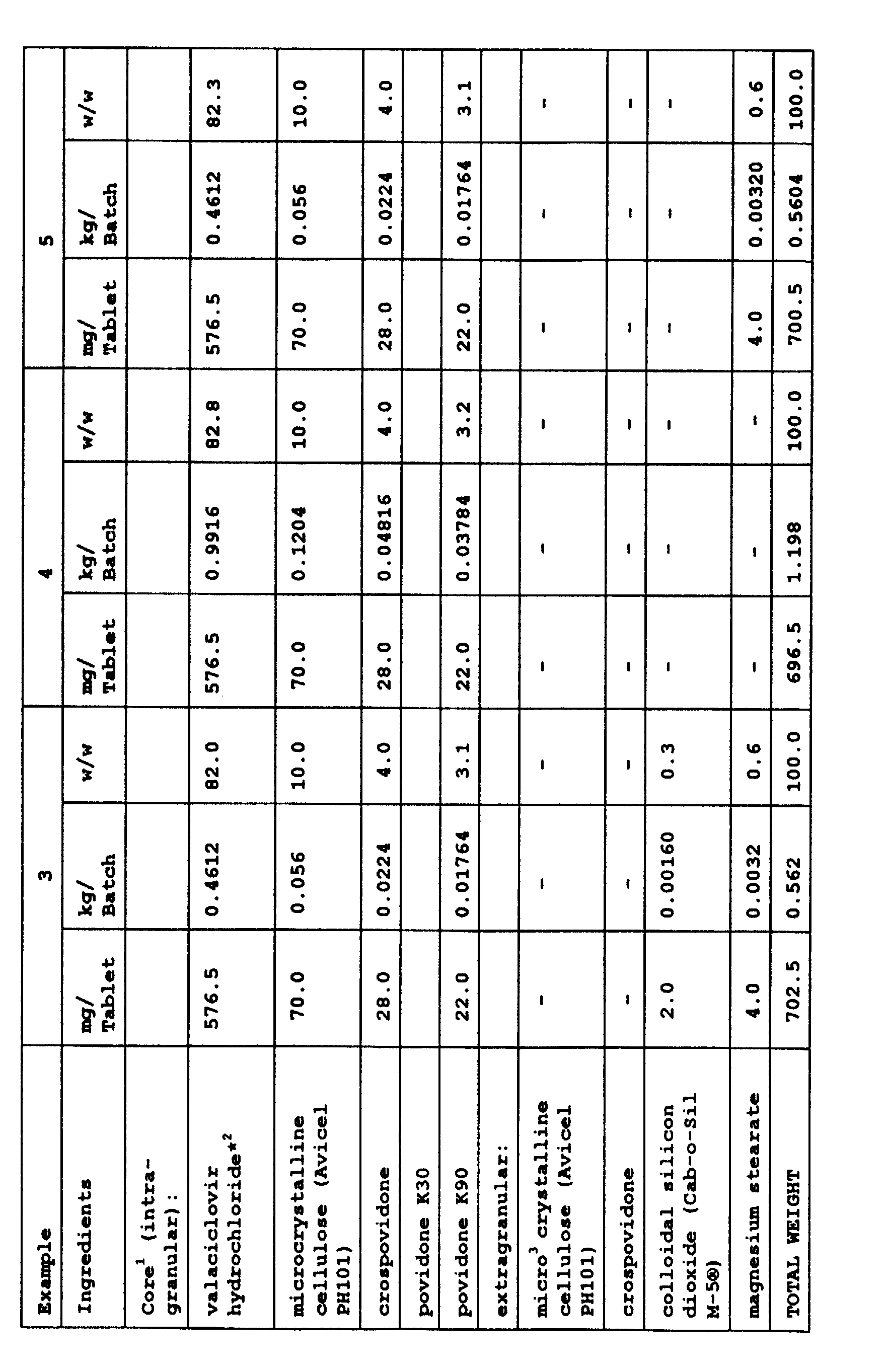
- Example 4 which lacks colloidal silicon dioxide and has microcrystalline cellulose intragranularly broke in half during tumbling, to simulate film coating conditions. The hardness of the tablet is therefore totally unacceptable.
- colloidal silicon dioxide was added (Example 3) the tablet surprisingly did not break and furthermore the disintegration time and ejection force increased by substantially less than would be expected.
- Example 5 The tablets of Examples 5 and 6, like that of Example 3, developed stress cracks after heating.
- Example 3 there was present colloidal silicon dioxide and intragranular microcrystalline cellulose; in Example 5 the microcrystalline cellulose was also intragranular, but there was no colloidal silicon dioxide; and in Example 6 again there was no colloidal silicon dioxide, but the microcrystalline cellulose was extragranular.
- Example 8a the hardness value is very low and the friability fails the US Pharmacopoeia (USP) limit of 1%. Even at the very high compression force used in Example 8b), the friability still fails the USP test.
- USP US Pharmacopoeia
- Example 9a and b In contrast on the addition of about 0.1% w/w of colloidal silicon dioxide (in Example 9a and b), hardness and friability have dramatically improved. Furthermore the ejection force, which was good before the addition of colloidal silicon dioxide is still good, and in fact actually improved on its addition. The disintegration time of the tablets of Example 9 is also very satisfactory.
- Example 11 when the formulation of Example 11 is repeated incorporating colloidal silicon dioxide in amounts ranging from 0.05 to 3% w/w, excellent tablets can be consistently produced having a high hardness and low friability value, substantially free of stress-cracks.
- the robust tablet formulation of the invention therefore can consistently provide valaciclovir tablets having excellent handling characteristics which are suitable for film coating and which still have an adequate lubricating and disintegration time.
Landscapes
- Health & Medical Sciences (AREA)
- Life Sciences & Earth Sciences (AREA)
- Chemical & Material Sciences (AREA)
- Public Health (AREA)
- Veterinary Medicine (AREA)
- Medicinal Chemistry (AREA)
- Pharmacology & Pharmacy (AREA)
- Animal Behavior & Ethology (AREA)
- General Health & Medical Sciences (AREA)
- Epidemiology (AREA)
- Virology (AREA)
- Inorganic Chemistry (AREA)
- Engineering & Computer Science (AREA)
- Organic Chemistry (AREA)
- Communicable Diseases (AREA)
- Oncology (AREA)
- Chemical Kinetics & Catalysis (AREA)
- General Chemical & Material Sciences (AREA)
- Nuclear Medicine, Radiotherapy & Molecular Imaging (AREA)
- Bioinformatics & Cheminformatics (AREA)
- Molecular Biology (AREA)
- Biotechnology (AREA)
- Pharmaceuticals Containing Other Organic And Inorganic Compounds (AREA)
- Medicinal Preparation (AREA)
Description
d spacing pattern (in Angstroms):
10.20 ± 0.08, 8.10 ± 0.06, 7.27 ± 0.06, 6.08 ± 0.05, 5.83 ± 0.03, 5.37 ± 0.02, 5.23 ± 0.02, 4.89 ± 0.02, 4.42 ± 0.02, 4.06 ± 0.02, 3.71 ± 0.02, 3.39 ± 0.02, 3.32 ± 0.02, 2.91 ± 0.02, 2.77 ± 0.02.
The d spacings and further X-ray diffraction data are shown in Table 1.
| Peak No: | Angle (degrees) | Peak (counts) | d Spacing pattern (Å) | Error in d (± Å) | I/Imax (%) |
| 1 | 3.56 | 680 | 24.8 | 0.5 | 24 |
| 2 | 8.62 | 1151 | 10.25 | 0.08 | 39 |
| 3 | 9.42 | 87 | 9.38 | 0.07 | 3 |
| 4 | 10.86 | 1438 | 8.14 | 0.06 | 49 |
| 5 | 12.10 | 835 | 7.31 | 0.06 | 28 |
| 6 | 13.22 | 198 | 6.69 | 0.05 | 6 |
| 7 | 14.49 | 2172 | 6.11 | 0.05 | 75 |
| 8 | 15.12 | 455 | 5.85 | 0.03 | 15 |
| 9 | 15.90 | 352 | 5.57 | 0.02 | 12 |
| 10 | 16.45 | 1969 | 5.38 | 0.02 | 68 |
| 11 | 16.90 | 744 | 5.24 | 0.02 | 25 |
| 12 | 17.33 | 119 | 5.11 | 0.02 | 4 |
| 13 | 18.12 | 1013 | 4.89 | 0.02 | 35 |
| 14 | 22.71 | 1429 | 4.43 | 0.02 | 49 |
| 15 | 20.55 | 256 | 4.32 | 0.02 | 8 |
| 16 | 21.21 | 370 | 4.19 | 0.02 | 12 |
| 17 | 21.83 | 753 | 4.07 | 0.02 | 26 |
| 18 | 22.71 | 95 | 3.91 | 0.02 | 3 |
| 19 | 23.95 | 2893 | 3.71 | 0.02 | 100 |
| 20 | 25.10 | 171 | 3.54 | 0.02 | 5 |
| 21 | 26.21 | 1784 | 3.40 | 0.02 | 61 |
| 22 | 26.89 | 428 | 3.31 | 0.02 | 14 |
| 23 | 27.08 | 373 | 3.29 | 0.02 | 12 |
| 24 | 28.02 | 158 | 3.18 | 0.02 | 5 |
| 25 | 28.27 | 161 | 3.15 | 0.02 | 5 |
| 26 | 28.91 | 391 | 3.09 | 0.02 | 13 |
| 27 | 29.68 | 191 | 3.01 | 0.02 | 6 |
| 28 | 30.55 | 502 | 2.92 | 0.02 | 17 |
| 29 | 31.34 | 110 | 2.85 | 0.02 | 3 |
| 30 | 31.58 | 98 | 2.83 | 0.02 | 3 |
| 31 | 32.13 | 597 | 2.78 | 0.02 | 20 |
| 32 | 32.96 | 260 | 2.72 | 0.02 | 8 |
| 33 | 33.99 | 344 | 2.64 | 0.02 | 11 |
| 34 | 34.38 | 374 | 2.61 | 0.02 | 12 |
| 35 | 35.12 | 141 | 2.55 | 0.02 | 4 |
| 36 | 36.78 | 408 | 2.44 | 0.02 | 14 |
| 37 | 38.71 | 101 | 2.32 | 0.02 | 3 |
| I/Imax = (peak height/max. peak ht) x 100 |
| | 45 kV, 40 mA |
| Radiation | Copper K alpha radiation |
| Fixed divergent slit | 1 mm |
| Incident scatter slit | 2 mm |
| Diffracted scatter slit | 0.5 mm |
| Receiving slit | 0.3 mm |
| Goniometer radius | 235 mm |
| Detector | Scintillation with a graphite monochromator. |
| Peak No: | Angle (degrees) | Peak (counts) | d Spacing pattern (Å) | I/Imax (%) |
| 1 | 3.62 | 2673 | 24.40 | 35 |
| 2 | 7.21 | 119 | 12.26 | 2 |
| 3 | 8.64 | 1910 | 10.22 | 25 |
| 4 | 9.43 | 180 | 9.37 | 2 |
| 5 | 10.86 | 2652 | 8.14 | 35 |
| 6 | 12.12 | 734 | 7.30 | 10 |
| 7 | 13.24 | 615 | 6.68 | 8 |
| 8 | 13.77 | 106 | 6.42 | 1 |
| 9 | 14.50 | 2333 | 6.11 | 31 |
| 10 | 15.14 | 635 | 5.85 | 8 |
| 11 | 15.89 | 511 | 5.57 | 7 |
| 12 | 16.44 | 2652 | 5.39 | 35 |
| 13 | 16.90 | 1267 | 5.24 | 17 |
| 14 | 17.33 | 475 | 5.11 | 6 |
| 15 | 18.13 | 1648 | 4.89 | 22 |
| 16 | 20.05 | 2172 | 4.43 | 28 |
| 17 | 20.56 | 640 | 4.32 | 8 |
| 18 | 21.20 | 1096 | 4.19 | 14 |
| 19 | 21.78 | 2034 | 4.08 | 27 |
| 20 | 21.90 | 1384 | 4.06 | 18 |
| 21 | 22.66 | 729 | 3.92 | 10 |
| 22 | 23.94 | 7621 | 3.71 | 100 |
| 23 | 24.39 | 1624 | 3.65 | 21 |
| 24 | 25.11 | 967 | 3.54 | 13 |
| 25 | 25.86 | 2460 | 3.44 | 32 |
| 26 | 26.21 | 5127 | 3.40 | 67 |
| 27 | 26.82 | 1892 | 3.32 | 25 |
| 28 | 26.89 | 1927 | 3.31 | 25 |
| 29 | 27.19 | 1429 | 3.28 | 19 |
| 30 | 27.99 | 1156 | 3.18 | 15 |
| 31 | 28.35 | 1076 | 3.15 | 14 |
| 32 | 28.87 | 1722 | 3.09 | 23 |
| 33 | 28.94 | 1529 | 3.08 | 20 |
| 34 | 29.62 | 1274 | 3.01 | 17 |
| 35 | 30.56 | 1673 | 2.92 | 22 |
| 36 | 31.30 | 999 | 2.86 | 13 |
| 37 | 32.25 | 2570 | 2.77 | 34 |
| 38 | 33.04 | 1376 | 2.71 | 18 |
| 39 | 34.00 | 1806 | 2.63 | 24 |
| 40 | 34.45 | 1225 | 2.60 | 16 |
| 41 | 35.13 | 1149 | 2.55 | 15 |
| 42 | 36.77 | 1600 | 2.44 | 21 |
| 43 | 38.01 | 576 | 2.37 | 8 |
| 44 | 38.76 | 729 | 2.32 | 10 |
| 45 | 39.52 | 524 | 2.28 | 7 |
| 46 | 40.70 | 751 | 2.22 | 10 |
| 47 | 41.28 | 870 | 2.19 | 11 |
| 48 | 41.88 | 686 | 2.16 | 9 |
| 49 | 42.47 | 718 | 2.13 | 9 |
| 50 | 43.40 | 548 | 2.08 | 7 |
| 51 | 44.53 | 729 | 2.03 | 10 |

| Example | 8 | 9 | ||
| Ingredients | mg/tablet | w/w | mg/tablet | w/w |
| valaciclovir hydrochloride | 615 | 65.80 | 615 | 65.74 |
| lactose | 205 | 21.93 | 205 | 21.91 |
| microcrystallinecellulose (Avicel PH101) (intragranular) | 75 | 8.02 | 75 | 8.02 |
| povidone K30 | 18 | 1.93 | 18 | 1.92 |
| crospovidone (intragranular) | 18 | 1.93 | 18 | 1.92 |
| colloidal silicon dioxide (Aerosil 200) | 0.0 | 0.0 | 0.9 | 0.10 |
| magnesium stearate | 3.6 | 0.39 | 3.6 | 0.38 |
| TOTAL WEIGHT | 934.6 | 100.0 | 935.5 | 100 |
| Example | 10 | 11 | ||
| Ingredients | mg/tablet | w/w | mg/tablet | w/w |
| valaciclovir hydrochloride | 580 | 81.01 | 580 | 82.60 |
| lactose | - | - | - | - |
| microcrystalline cellulose (Avicel PH101) (intragranular) | 70 | 9.78 | - | - |
| microcrystalline cellulose (extragranular) | - | - | 70.4 | 10.03 |
| | 35 | 4.89 | - | - |
| povidone K90 | - | - | 21.7 | 3.09 |
| crospovidone (intragranular) | 28 | 3.91 | 12 | 1.71 |
| crospovidone (extragranular) | - | - | 14.1 | 2.01 |
| magnesium stearate | 3.0 | 0.42 | 4.0 | 0.57 |
| TOTAL WEIGHT | 716 | 100.0 | 702.2 | 100.0 |
- Step 1.
- The core ingredients were sifted with a 20 mesh (840µm) hand screen, and then blended in an appropriately sized V-shell blender for 10 minutes.
-
Step 2. - The blended powders from Step 1 were then granulated in a 10 litre high shear mixer (model-SP1) by adding pure water while mixing. Approximately 11-14% water, w/w of the core ingredients was then added and the mixture massed for 3 to 4½ minutes.
- Step 3.
- The granule from
Step 2 was dried in a tray (Examples 5, 6 and 7) or vacuum (Examples 3 and 4) drier (model-SP1) at a temperature of 50°C to an acceptable moisture content of approximately 1.0 to 2.0 % L.O.D. - Step 4.
- The remaining ingredients were sifted through a 20 mesh (840µm) screen and added to the core ingredients of Step 3, and then the mixture was sifted using a Comil Model 197 AS fitted with a 0.062" (1.57mm) screen.
-
Step 5. - The mixture was then blended in an appropriately sized V-shell blender for 5 minutes.
- Step 6
- The blended granule from
Step 5 was compressed on a Manesty Beta Press fitted with capsule shaped tooling, 18.25 mm x 7.14 mm, at a compression weight of approximately 700 mg and a compression force of 14.5 to 18 kN. - Step 7
- The tablets can then optionally be film coated by using standard methods such as using white colour concentrate, methylhydroxypropylcellulose, titanium dioxide, polyethylene glycol and polysorbate.
| 30 Mesh (600µm) | |
| valaciclovir hydrochloride | 5.289 kg |
| lactose | 1.763 kg |
| microcrystalline Cellulose | 0.6450 kg |
| povidone K30 | 0.1548 kg |
| crospovidone | 0.1548 |
| 60 Mesh (250µm) | |
| magnesium stearate | 0.03096 kg |
| colloidal silicon dioxide (CSD) | 0.002598 kg |
-
Step 2. - The 30 mesh (600µm) sifted ingredients from Step 1 were then blended, excluding the povidone, in a 1 cubic foot (0.028m3) V-shell blender for 10 minutes.
- Step 3.
- 1.540 kg of SD3A alcohol (ethanol denatured with 5% methanol) was then mixed with 0.6600 kg of purified water and the screened povidone, 0.1548 kg, was dissolved in 0.6192 kg of the mixed solvents by hand stirring.
- Step 4.
- The blended powders from
Step 2 were then granulated in a 1 cubic foot (0.028m3) Littleford Lodige mixer by adding the dissolved povidone while mixing. 1,315 kg of more mixed solvent was added and the mixture massed for seven minutes total as shown below.
Ploughs 7 min Choppers 6.5 min -
Step 5. - The granule from Step 4 was then dried in a Fluid Bed Dryer (Glatt GPCGS) with an inlet air temperature of 50°C to any acceptable moisture content of approximately 1.0 to 3.0% L.O.D.
- Step 6.
- The granule from
Step 5 was then sifted using a Fitz Mill Model M fitted with a 30 mesh (600µm) screen, with knives forward, operating at medium speed. - Step 7.
- The screened magnesium stearate from Step 1 was
added to the granule from Step 6 and blended for
5 minutes using the blender from
Step 2. This was labelled as Example 10 (2.650kg). -
Step 8. - Part of the blended granule from Step 7 was compressed on a Manesty Beta Press fitted with oval tooling, 19.1 mm x 10.2 mm, at a compression weight of approximately 934.6 mg.
- Step 9.
- The remainder of the lubricated granule 2.650 kg (from Step 7) was weighed and the sifted CSD from Step 1 added, then dispersed by hand and the mixture blended for 5 minutes in the blender from Step 3. This portion was labelled as Example 11. The mixture was compressed to form tablets.

Claims (32)
- A tablet comprising at least 50% w/w valaciclovir or a salt thereof, a cellulosic filler, a binding agent, a lubricant and 0.05 to 3% w/w colloidal silicon dioxide wherein the valaciclovir or a salt thereof is present within the granules of the tablet, the lubricant, silicon dioxide and at least a portion of the cellulosic filler is present extragranularly; wherein the friability of the tablet does not exceed 1%, the hardness is at least 9 kP, and the ejection force does not exceed 1000 Newtons.
- A tablet as claimed in any one of the preceding claims wherein the colloidal silicon dioxide is present in an amount of 0.1% to 0.5% w/w.
- A tablet as claimed in Claims 1 or 2 wherein the cellulosic filler is present in an amount of 3% w/w to 30% w/w.
- A tablet as claimed in Claim 3 wherein the cellulosic filler is present at 5% to 15% w/w.
- A tablet as claimed in Claim 4, wherein the cellulosic filler is present at about 10% w/w.
- A tablet as claimed in any one of the preceding claims wherein the filler is microcrystalline cellulose.
- A tablet as claimed in any of the preceding claims, wherein the particle size of cellulosic filler is 20 to 300 µm.
- A tablet as claimed in any one of the preceding claims wherein the binding agent is present at 1 % to 5 % w/w.
- A tablet as claimed in any one of the preceding claims wherein the binding agent is methylcellulose or povidone.
- A tablet as claimed in Claim 9 wherein the binding agent is povidone.
- A tablet as claimed in Claim 10 wherein the povidone is povidone K90 grade.
- A tablet as claimed in any one of the preceding claims wherein the lubricant is present at 0.1% to 2.0% w/w.
- A tablet as claimed in Claim 12 wherein the lubricant is a stearate derivative.
- A tablet as claimed in Claim 13 wherein the lubricant is magnesium stearate and is present at 0. 1% to 1.0% w/w.
- A tablet as claimed in any one of the preceding claims wherein the valaciclovir or its salt is present at 65% to 85% w/w.
- A tablet as claimed in any one of the preceding claims comprising valaciclovir hydrochloride.
- A tablet as claimed in Claim 16 wherein the valaciclovir hydrochloride is anhydrous crystalline, form including substantially a d spacing pattern as follows:
d spacing pattern (in Angstroms):
10.20 ± 0.08, 8.10 ± 0.06, 7.27 ± 0.06, 6.08 ± 0.05, 5.83 ± 0.03, 5.37 ± 0.02, 5.23 ± 0.02, 4.89 ± 0.02, 4.42 ± 0.02, 4.06 ± 0.02, 3.71 ± 0.02, 3.39 ± 0.02, 3.32 ± 0.02, 2.91 ± 0.02, 2.77 ± 0.02. - A tablet as claimed in any one of the preceding claims wherein the tapped bulk density of valaciclovir or salt thereof is 0.1 to 0.9 g/cc.
- A tablet as claimed in any one of the preceding claims which further includes a disintegrating agent present at 0.5% to 20% w/w.
- A tablet as claimed in Claim 19 wherein the disintegrating agent is a non-ionic disintegrating agent.
- A tablet as claimed in Claim 20 wherein the disintegrating agent is crospovidone present at 0.5% to 7% w/w.
- A tablet comprising 65% to 85% w/w anhydrous crystalline valaciclovir hydrochloride including the d spacing diffraction pattern of Claim 17, 1% to 5% w/w of povidone, 3% to 30% w/w of a cellulosic filler, 0.5 to 7% w/w of a non-ionic disintegrating agent, 0.1% to 1.0% of a stearate lubricant and 0.1% to 0.5% w/w of colloidal silicon dioxide, wherein the valaciclovir hydrochloride is present intragranularly; and wherein the cellulosic filler, stearate lubricant and colloidal silicon dioxide are present extragranularly.
- A tablet as claimed in any one of Claims 1 to 22 which is film coated.
- A tablet as claimed in any one of the preceding claims for use in medical therapy.
- Use of valaciclovir or a salt thereof in the preparation of a tablet as claimed in any one of Claims 1 to 23 for the treatment or prophylaxis of a herpes viral infection.
- Use as claimed in Claim 25 wherein the tablet contains 50mg to 2000mg of valaciclovir or a salt thereof.
- Use as claimed in Claims 25 or 26 wherein the treatment is the suppression of recurrent genital herpes at a once daily dose of 200mg to 1000mg.
- A process for preparing a tablet comprising at least 50% w/w valaciclovir or a salt thereof, a binding agent, cellulosic filler, a lubricant, and 0.05 to 3.0% colloidal silicon dioxide, wherein the friability of the tablet does not exceed 1%, the hardness is at least 9 kP and the ejection force does not exceed 1000N; said process having the valaciclovir or its salt present within the granules of the tablet, and the lubricant, colloidal silicon dioxide, and at least a portion of the cellulosic filler present extragranularly.
- A process for preparing a tablet comprising at least 50% w/w valaciclovir or a salt thereof, a binding agent, a cellulosic filler, a lubricant, and 0.05 to 3.0% w/w colloidal silicon dioxide; wherein the hardness of the tablet is at least 9 kP, the friability is not more than 1%, and the ejection force is not more than 1000N; said process comprising forming granules which include valaciclovir or a salt thereof and then blending the lubricant, colloidal silicon dioxide and at least a portion of the cellulosic filler with said granules.
- A process according to Claim 28 or 29 comprising forming granules by mixing said valaciclovir or salt, optionally a binding agent or a portion thereof, and optionally a portion of the cellulosic filler; granulating with a granulating solution to form granules or dissolving the binding agent or a portion in the granulating solution before adding to valaciclovir, drying the granules; blending the granules with the lubricant, colloidal silicon dioxide, and cellulosic filler or a portion thereof; and then compressing the blended mixture to form a tablet.
- A process for preparing a table comprising at least 50% w/w valaciclovir or a salt thereof, a binding agent, a lubricant, 0.05 to 3% w/w colloidal silicon dioxide, and 3 to 30% w/w of a cellulosic filler; wherein the hardness of the tablet is at least 9kP, the friability is not more than 1%, and the ejection force is not more than 1000N; said process comprising forming granules by mixing the valaciclovir or salt, optional binding agent or a portion thereof, and optionally a portion of cellulosic filler; granulating with a granulating solution to form granules or dissolving the binding agent or a portion thereof in the granulating solution before adding to valaciclovir; drying the granules; blending the granules with the lubricant, colloidal silicon dioxide, and at least a portion of the cellulosic filler; and then compressing the blended mixture to form a tablet.
- Use of the combination of 0.05 to 3% w/w colloidal silicon dioxide and cellulosic filler present extragranularly in a tablet including at least 50% w/w intragranular valaciclovir hydrochloride, and extragranular lubricant to prevent stress cracking.
Priority Applications (1)
| Application Number | Priority Date | Filing Date | Title |
|---|---|---|---|
| SI9630193T SI0806943T1 (en) | 1995-01-20 | 1996-01-19 | Valaciclovir tablets containing colloidal silicon dioxide |
Applications Claiming Priority (3)
| Application Number | Priority Date | Filing Date | Title |
|---|---|---|---|
| GBGB9501127.6A GB9501127D0 (en) | 1995-01-20 | 1995-01-20 | Tablet |
| GB9501127 | 1995-01-20 | ||
| PCT/GB1996/000111 WO1996022082A1 (en) | 1995-01-20 | 1996-01-19 | Valaciclovir tablets containing colloidal silicon dioxide |
Publications (2)
| Publication Number | Publication Date |
|---|---|
| EP0806943A1 EP0806943A1 (en) | 1997-11-19 |
| EP0806943B1 true EP0806943B1 (en) | 2000-03-15 |
Family
ID=10768317
Family Applications (1)
| Application Number | Title | Priority Date | Filing Date |
|---|---|---|---|
| EP96900626A Expired - Lifetime EP0806943B1 (en) | 1995-01-20 | 1996-01-19 | Valaciclovir tablets containing colloidal silicon dioxide |
Country Status (38)
| Country | Link |
|---|---|
| US (1) | US5879706A (en) |
| EP (1) | EP0806943B1 (en) |
| JP (1) | JP3350055B2 (en) |
| KR (1) | KR100412298B1 (en) |
| CN (2) | CN1313081C (en) |
| AP (1) | AP666A (en) |
| AT (1) | ATE190483T1 (en) |
| AU (1) | AU710823B2 (en) |
| BG (1) | BG63187B1 (en) |
| BR (1) | BR9606769A (en) |
| CA (1) | CA2210891C (en) |
| CY (1) | CY2182B1 (en) |
| CZ (1) | CZ296514B6 (en) |
| DE (1) | DE69607146T2 (en) |
| DK (1) | DK0806943T3 (en) |
| EA (1) | EA000276B1 (en) |
| EE (1) | EE03336B1 (en) |
| ES (1) | ES2145425T3 (en) |
| FI (1) | FI119722B (en) |
| GB (1) | GB9501127D0 (en) |
| GE (1) | GEP20022752B (en) |
| GR (1) | GR3033677T3 (en) |
| HU (1) | HU226131B1 (en) |
| IL (1) | IL116830A (en) |
| IN (1) | IN181318B (en) |
| MY (1) | MY126346A (en) |
| NO (1) | NO311488B1 (en) |
| NZ (1) | NZ298846A (en) |
| OA (1) | OA10500A (en) |
| PL (1) | PL185307B1 (en) |
| PT (1) | PT806943E (en) |
| RO (1) | RO118175B1 (en) |
| SK (1) | SK282030B6 (en) |
| TR (1) | TR199700657T1 (en) |
| UA (1) | UA68325C2 (en) |
| UY (2) | UY25774A1 (en) |
| WO (1) | WO1996022082A1 (en) |
| ZA (1) | ZA96448B (en) |
Families Citing this family (46)
| Publication number | Priority date | Publication date | Assignee | Title |
|---|---|---|---|---|
| GB9501127D0 (en) * | 1995-01-20 | 1995-03-08 | Wellcome Found | Tablet |
| ATE254463T1 (en) * | 1996-01-19 | 2003-12-15 | Glaxo Group Ltd | USE OF VALACICLOVIR FOR THE MANUFACTURE OF A MEDICINAL PRODUCT FOR THE TREATMENT OF GENITAL HERPES BY ONCE DAILY ADMINISTRATION |
| AR016827A1 (en) * | 1997-08-22 | 2001-08-01 | Smithkline Beecham Corp | PROCEDURE FOR THE PREPARATION OF A PHARMACEUTICAL TABLET |
| AR017512A1 (en) * | 1997-08-22 | 2001-09-12 | Smithkline Beecham Corp | TABLETS OF QUICKLY DISPOSABLE METILCELLULOSE FOR ORAL ROUTE ADMINISTRATION AND PROCEDURE TO PREPARE THEM |
| ES2212667T3 (en) * | 1998-12-18 | 2004-07-16 | Abbott Laboratories | FORMULATION OF CONTROLLED RELEASE WITH DIVALPROEX SODICO. |
| GB0010446D0 (en) * | 2000-04-28 | 2000-06-14 | Glaxo Wellcome Kk | Pharmaceutical formulation |
| IL158390A0 (en) * | 2001-05-01 | 2004-05-12 | Pfizer Prod Inc | Method for manufacturing a low dose pharmaceutical composition |
| US7815936B2 (en) * | 2001-10-30 | 2010-10-19 | Evonik Degussa Gmbh | Use of granular materials based on pyrogenically produced silicon dioxide in pharmaceutical compositions |
| AU2002348022B2 (en) * | 2001-11-05 | 2006-06-15 | Glaxo Group Limited | Anhydrous crystal form of valaciclovir hydrochloride |
| CA2649826A1 (en) * | 2001-11-14 | 2003-05-22 | Teva Pharmaceutical Industries Ltd. | Synthesis and purification of valacyclovir |
| GB0203296D0 (en) * | 2002-02-12 | 2002-03-27 | Glaxo Group Ltd | Novel composition |
| GB0209265D0 (en) * | 2002-04-23 | 2002-06-05 | Novartis Ag | Organic compounds |
| US20060147519A1 (en) * | 2002-06-24 | 2006-07-06 | Ashish Gogia | Process for the preparation of robust formulations of valacyclovir hydrochloride tablets |
| US20050051922A1 (en) * | 2002-09-20 | 2005-03-10 | Avinash Nangia | Pharmaceutical composition with sodium lauryl sulfate as an extra-granular absorption/compression enhancer and the process to make the same |
| US20050059684A1 (en) * | 2002-10-16 | 2005-03-17 | Ben-Zion Dolitzky | Method for reducing residual alcohols in crystalline valacyclovir hydrochloride |
| ATE335743T1 (en) * | 2002-10-16 | 2006-09-15 | Teva Pharma | METHOD FOR REDUCING RESIDUAL CARBONS IN CRYSTALLINE VALACYCLOVIR HYDROCHLORIDE |
| US20040109889A1 (en) * | 2002-12-04 | 2004-06-10 | Bunick Frank J. | Surface treatment composition for soft substrates |
| US7786302B2 (en) * | 2003-05-30 | 2010-08-31 | Eczacibasi-Zentiva Kimyasal Urunler Sanayi Ve Ticaret A.S. | Crystalline forms of valacyclovir hydrochloride |
| EP1638972A2 (en) * | 2003-06-02 | 2006-03-29 | Teva Pharmaceutical Industries Limited | Novel crystalline forms of valacyclovir hydrochloride |
| US7632521B2 (en) * | 2003-07-15 | 2009-12-15 | Eurand, Inc. | Controlled release potassium chloride tablets |
| ES2401769T5 (en) | 2003-09-12 | 2020-07-01 | Amgen Inc | Fast dissolving formulation of cinacalcet HCl |
| DE10351448A1 (en) * | 2003-11-04 | 2005-06-09 | Bayer Healthcare Ag | Flavor-containing drug formulations with improved pharmaceutical properties |
| ATE301455T1 (en) * | 2003-12-09 | 2005-08-15 | Helm Ag | PHARMACEUTICAL PREPARATION CONTAINING VALACICLOVIR |
| US7344907B2 (en) * | 2004-11-19 | 2008-03-18 | International Business Machines Corporation | Apparatus and methods for encapsulating microelectromechanical (MEM) devices on a wafer scale |
| KR101116747B1 (en) | 2004-12-06 | 2012-02-22 | 에스케이케미칼주식회사 | Pharmaceutical composition of amlodipine maleate with improved stability |
| KR101335932B1 (en) | 2005-03-07 | 2013-12-04 | 바이엘 헬스케어 엘엘씨 | Pharmaceutical composition comprising an omega-carboxyaryl substituted diphenyl urea for the treatment of cancer |
| ES2379804T3 (en) * | 2005-05-25 | 2012-05-03 | Eli Lilly And Company | Acyclovir cyclopropanecarboxylate esters |
| EP1746098A1 (en) * | 2005-07-21 | 2007-01-24 | SOLMAG S.p.A. | Valacyclovir polymorphs and a process for the preparation thereof |
| WO2007090595A1 (en) * | 2006-02-06 | 2007-08-16 | Fidia Pharmaceutici S.P.A. | Solid formulations of valacyclovir hydrochloride |
| US20090312439A1 (en) * | 2006-05-10 | 2009-12-17 | Ralph Hofmann | Use of roll compacted pyrogenically produced silicon dioxide in pharmaceutical compositions |
| CN101489530A (en) * | 2006-05-31 | 2009-07-22 | 弗特克斯药品有限公司 | Oral controlled release formulations of an interleukin-1 beta converting enzyme inihibitor |
| EP2040684B1 (en) * | 2006-07-11 | 2013-01-23 | LEK Pharmaceuticals d.d. | Multiple unit tablets |
| US20080167325A1 (en) * | 2006-12-27 | 2008-07-10 | Bs Praveen Kumar | Valacyclovir compositions |
| US20090076039A1 (en) * | 2007-09-14 | 2009-03-19 | Protia, Llc | Deuterium-enriched valacyclovir |
| ITRM20080027A1 (en) * | 2008-01-18 | 2009-07-19 | Maria Balestrieri | USE OF ACICLOVIR FOR THE TREATMENT OF CONDILOMATOSIS. |
| US20100124560A1 (en) * | 2008-11-14 | 2010-05-20 | Mcneil Ab | Multi portion intra-oral dosage form and use thereof |
| CA2755274C (en) * | 2009-03-13 | 2017-02-28 | Sahoe Kakuda | Tablet and granulated powder containing 6-fluoro-3-hydroxy-2-pyrazinecarboxamide |
| CH703348A1 (en) * | 2010-06-29 | 2011-12-30 | Mepha Gmbh | Compositions having a high active ingredient content of pharmaceutically active substances. |
| GB2515486A (en) * | 2013-06-24 | 2014-12-31 | Kraft Foods R & D Inc | Soluble Beverage Ingredients |
| KR101497508B1 (en) * | 2013-12-20 | 2015-03-03 | 한국유나이티드제약 주식회사 | Solid preparations containing Pelargonium sidoides extracts and silicic acid compound, and preparing method thereof |
| CA2937365C (en) | 2016-03-29 | 2018-09-18 | F. Hoffmann-La Roche Ag | Granulate formulation of 5-methyl-1-phenyl-2-(1h)-pyridone and method of making the same |
| WO2020049536A1 (en) * | 2018-09-07 | 2020-03-12 | Jubilant Generics Limited | Pharmaceutical compositions of valacyclovir or its pharmaceutically acceptable salts thereof |
| CN110279667B (en) * | 2019-07-30 | 2023-02-10 | 珠海润都制药股份有限公司 | Valaciclovir hydrochloride tablet and preparation method thereof |
| CN115666516A (en) * | 2020-06-01 | 2023-01-31 | 希尔帕医疗保健有限公司 | Fast dispersing pharmaceutical compositions comprising capecitabine |
| MX2023005461A (en) * | 2020-12-01 | 2023-05-22 | Lg Chemical Ltd | Oral formulation comprising 1-(3-cyano-1-isopropyl-indole-5-yl)py razole-4-carboxylic acid and method for preparing same. |
| AU2023332020A1 (en) * | 2022-08-31 | 2025-04-17 | Astrazeneca Ab | Pharmaceutical formulation |
Family Cites Families (7)
| Publication number | Priority date | Publication date | Assignee | Title |
|---|---|---|---|---|
| CA1259924A (en) * | 1985-03-25 | 1989-09-26 | Wallace E. Becker | Pharmaceutical tableting method |
| AP55A (en) * | 1987-08-15 | 1989-09-26 | The Wellcome Foundation Ltd | Therapeutic Acyclic Nucleosides |
| EP0349103B1 (en) * | 1988-05-04 | 1992-11-25 | Smith Kline & French Laboratories Limited | Chewable tablet |
| FI20021701L (en) * | 1991-01-30 | 2002-09-24 | Wellcome Found | Water-dispersible tablets |
| GB9109862D0 (en) * | 1991-05-08 | 1991-07-03 | Beecham Lab Sa | Pharmaceutical formulations |
| GB9317146D0 (en) * | 1993-08-18 | 1993-10-06 | Wellcome Found | Therapeutic combinations |
| GB9501127D0 (en) * | 1995-01-20 | 1995-03-08 | Wellcome Found | Tablet |
-
1995
- 1995-01-20 GB GBGB9501127.6A patent/GB9501127D0/en active Pending
-
1996
- 1996-01-19 ES ES96900626T patent/ES2145425T3/en not_active Expired - Lifetime
- 1996-01-19 CZ CZ0229297A patent/CZ296514B6/en not_active IP Right Cessation
- 1996-01-19 NZ NZ298846A patent/NZ298846A/en not_active IP Right Cessation
- 1996-01-19 MY MYPI96000222A patent/MY126346A/en unknown
- 1996-01-19 AT AT96900626T patent/ATE190483T1/en not_active IP Right Cessation
- 1996-01-19 EE EE9700352A patent/EE03336B1/en not_active IP Right Cessation
- 1996-01-19 EA EA199700123A patent/EA000276B1/en not_active IP Right Cessation
- 1996-01-19 DK DK96900626T patent/DK0806943T3/en active
- 1996-01-19 HU HU9801872A patent/HU226131B1/en not_active IP Right Cessation
- 1996-01-19 DE DE69607146T patent/DE69607146T2/en not_active Expired - Lifetime
- 1996-01-19 AU AU44534/96A patent/AU710823B2/en not_active Ceased
- 1996-01-19 BR BR9606769A patent/BR9606769A/en not_active IP Right Cessation
- 1996-01-19 WO PCT/GB1996/000111 patent/WO1996022082A1/en not_active Ceased
- 1996-01-19 EP EP96900626A patent/EP0806943B1/en not_active Expired - Lifetime
- 1996-01-19 SK SK964-97A patent/SK282030B6/en not_active IP Right Cessation
- 1996-01-19 CA CA002210891A patent/CA2210891C/en not_active Expired - Fee Related
- 1996-01-19 UA UA97084269A patent/UA68325C2/en unknown
- 1996-01-19 ZA ZA96448A patent/ZA96448B/en unknown
- 1996-01-19 KR KR1019970704915A patent/KR100412298B1/en not_active Expired - Lifetime
- 1996-01-19 RO RO97-01333A patent/RO118175B1/en unknown
- 1996-01-19 AP APAP/P/1997/001057A patent/AP666A/en active
- 1996-01-19 US US08/875,172 patent/US5879706A/en not_active Expired - Lifetime
- 1996-01-19 JP JP52212696A patent/JP3350055B2/en not_active Expired - Fee Related
- 1996-01-19 CN CNB2003101029136A patent/CN1313081C/en not_active Expired - Fee Related
- 1996-01-19 IL IL11683096A patent/IL116830A/en not_active IP Right Cessation
- 1996-01-19 IN IN100MA1996 patent/IN181318B/en unknown
- 1996-01-19 PT PT96900626T patent/PT806943E/en unknown
- 1996-01-19 GE GEAP19963844A patent/GEP20022752B/en unknown
- 1996-01-19 TR TR97/00657T patent/TR199700657T1/en unknown
- 1996-01-19 CN CN96192661A patent/CN1131026C/en not_active Expired - Fee Related
-
1997
- 1997-07-16 OA OA70052A patent/OA10500A/en unknown
- 1997-07-18 NO NO19973327A patent/NO311488B1/en not_active IP Right Cessation
- 1997-07-18 FI FI973062A patent/FI119722B/en not_active IP Right Cessation
- 1997-07-18 PL PL96321361A patent/PL185307B1/en not_active IP Right Cessation
- 1997-08-14 BG BG101831A patent/BG63187B1/en unknown
-
1999
- 1999-10-28 UY UY25774A patent/UY25774A1/en unknown
- 1999-10-29 UY UY25778A patent/UY25778A1/en not_active IP Right Cessation
-
2000
- 2000-06-14 GR GR20000401364T patent/GR3033677T3/en not_active IP Right Cessation
- 2000-08-23 CY CY0000042A patent/CY2182B1/en unknown
Also Published As
Similar Documents
| Publication | Publication Date | Title |
|---|---|---|
| AU710823B2 (en) | Valaciclovir tablets containing colloidal silicon dioxide | |
| AP662A (en) | Anhydrous crystalline valaciclovir hydrochloride. | |
| AU722304B2 (en) | Use of valaciclovir for the manufacture of a medicament for the treatment of genital herpes by a single daily application | |
| HK1002851B (en) | Valaciclovir tablets containing colloidal silicon dioxide | |
| MXPA97005459A (en) | Valaciclovir tablets containing silicon dioxide color | |
| HK1003055B (en) | Guanine derivative | |
| HK1003055A1 (en) | Guanine derivative |
Legal Events
| Date | Code | Title | Description |
|---|---|---|---|
| PUAI | Public reference made under article 153(3) epc to a published international application that has entered the european phase |
Free format text: ORIGINAL CODE: 0009012 |
|
| 17P | Request for examination filed |
Effective date: 19970808 |
|
| AK | Designated contracting states |
Kind code of ref document: A1 Designated state(s): AT BE CH DE DK ES FR GB GR IE IT LI LU MC NL PT SE |
|
| AX | Request for extension of the european patent |
Free format text: LT PAYMENT 970808;LV PAYMENT 970808;SI PAYMENT 970808 |
|
| 17Q | First examination report despatched |
Effective date: 19971117 |
|
| GRAG | Despatch of communication of intention to grant |
Free format text: ORIGINAL CODE: EPIDOS AGRA |
|
| GRAG | Despatch of communication of intention to grant |
Free format text: ORIGINAL CODE: EPIDOS AGRA |
|
| GRAG | Despatch of communication of intention to grant |
Free format text: ORIGINAL CODE: EPIDOS AGRA |
|
| GRAH | Despatch of communication of intention to grant a patent |
Free format text: ORIGINAL CODE: EPIDOS IGRA |
|
| GRAH | Despatch of communication of intention to grant a patent |
Free format text: ORIGINAL CODE: EPIDOS IGRA |
|
| GRAH | Despatch of communication of intention to grant a patent |
Free format text: ORIGINAL CODE: EPIDOS IGRA |
|
| GRAA | (expected) grant |
Free format text: ORIGINAL CODE: 0009210 |
|
| AK | Designated contracting states |
Kind code of ref document: B1 Designated state(s): AT BE CH DE DK ES FR GB GR IE IT LI LU MC NL PT SE |
|
| AX | Request for extension of the european patent |
Free format text: LT PAYMENT 19970808;LV PAYMENT 19970808;SI PAYMENT 19970808 |
|
| REF | Corresponds to: |
Ref document number: 190483 Country of ref document: AT Date of ref document: 20000415 Kind code of ref document: T |
|
| REG | Reference to a national code |
Ref country code: CH Ref legal event code: EP |
|
| REF | Corresponds to: |
Ref document number: 69607146 Country of ref document: DE Date of ref document: 20000420 |
|
| REG | Reference to a national code |
Ref country code: IE Ref legal event code: FG4D |
|
| ITF | It: translation for a ep patent filed | ||
| ET | Fr: translation filed | ||
| REG | Reference to a national code |
Ref country code: CH Ref legal event code: NV Representative=s name: BRAUN & PARTNER PATENT-, MARKEN-, RECHTSANWAELTE |
|
| REG | Reference to a national code |
Ref country code: ES Ref legal event code: FG2A Ref document number: 2145425 Country of ref document: ES Kind code of ref document: T3 |
|
| REG | Reference to a national code |
Ref country code: DK Ref legal event code: T3 |
|
| REG | Reference to a national code |
Ref country code: PT Ref legal event code: SC4A Free format text: AVAILABILITY OF NATIONAL TRANSLATION Effective date: 20000608 |
|
| PLBE | No opposition filed within time limit |
Free format text: ORIGINAL CODE: 0009261 |
|
| STAA | Information on the status of an ep patent application or granted ep patent |
Free format text: STATUS: NO OPPOSITION FILED WITHIN TIME LIMIT |
|
| 26N | No opposition filed | ||
| REG | Reference to a national code |
Ref country code: GB Ref legal event code: IF02 |
|
| REG | Reference to a national code |
Ref country code: SI Ref legal event code: IF |
|
| PGFP | Annual fee paid to national office [announced via postgrant information from national office to epo] |
Ref country code: SE Payment date: 20091223 Year of fee payment: 15 Ref country code: MC Payment date: 20091218 Year of fee payment: 15 Ref country code: DK Payment date: 20091211 Year of fee payment: 15 |
|
| PGFP | Annual fee paid to national office [announced via postgrant information from national office to epo] |
Ref country code: PT Payment date: 20100104 Year of fee payment: 15 Ref country code: LU Payment date: 20100119 Year of fee payment: 15 Ref country code: IE Payment date: 20100114 Year of fee payment: 15 Ref country code: GB Payment date: 20091211 Year of fee payment: 15 Ref country code: ES Payment date: 20100120 Year of fee payment: 15 Ref country code: CH Payment date: 20100218 Year of fee payment: 15 |
|
| PGFP | Annual fee paid to national office [announced via postgrant information from national office to epo] |
Ref country code: IT Payment date: 20100122 Year of fee payment: 15 Ref country code: FR Payment date: 20100125 Year of fee payment: 15 |
|
| PGFP | Annual fee paid to national office [announced via postgrant information from national office to epo] |
Ref country code: GR Payment date: 20091230 Year of fee payment: 15 Ref country code: DE Payment date: 20100129 Year of fee payment: 15 Ref country code: BE Payment date: 20100201 Year of fee payment: 15 Ref country code: AT Payment date: 20091211 Year of fee payment: 15 |
|
| PGFP | Annual fee paid to national office [announced via postgrant information from national office to epo] |
Ref country code: NL Payment date: 20100118 Year of fee payment: 15 |
|
| REG | Reference to a national code |
Ref country code: PT Ref legal event code: MM4A Free format text: LAPSE DUE TO NON-PAYMENT OF FEES Effective date: 20110719 |
|
| BERE | Be: lapsed |
Owner name: THE *WELLCOME FOUNDATION LTD Effective date: 20110131 |
|
| REG | Reference to a national code |
Ref country code: NL Ref legal event code: V1 Effective date: 20110801 |
|
| LTLA | Lt: lapse of european patent or patent extension |
Effective date: 20110119 |
|
| REG | Reference to a national code |
Ref country code: DK Ref legal event code: EBP |
|
| PG25 | Lapsed in a contracting state [announced via postgrant information from national office to epo] |
Ref country code: MC Free format text: LAPSE BECAUSE OF NON-PAYMENT OF DUE FEES Effective date: 20110131 |
|
| REG | Reference to a national code |
Ref country code: CH Ref legal event code: PL |
|
| REG | Reference to a national code |
Ref country code: SE Ref legal event code: EUG |
|
| GBPC | Gb: european patent ceased through non-payment of renewal fee |
Effective date: 20110119 |
|
| REG | Reference to a national code |
Ref country code: SI Ref legal event code: KO00 Effective date: 20110831 |
|
| REG | Reference to a national code |
Ref country code: FR Ref legal event code: ST Effective date: 20110930 |
|
| REG | Reference to a national code |
Ref country code: IE Ref legal event code: MM4A |
|
| PG25 | Lapsed in a contracting state [announced via postgrant information from national office to epo] |
Ref country code: FR Free format text: LAPSE BECAUSE OF NON-PAYMENT OF DUE FEES Effective date: 20110131 Ref country code: PT Free format text: LAPSE BECAUSE OF NON-PAYMENT OF DUE FEES Effective date: 20110719 Ref country code: LI Free format text: LAPSE BECAUSE OF NON-PAYMENT OF DUE FEES Effective date: 20110131 Ref country code: CH Free format text: LAPSE BECAUSE OF NON-PAYMENT OF DUE FEES Effective date: 20110131 |
|
| PG25 | Lapsed in a contracting state [announced via postgrant information from national office to epo] |
Ref country code: BE Free format text: LAPSE BECAUSE OF NON-PAYMENT OF DUE FEES Effective date: 20110131 Ref country code: AT Free format text: LAPSE BECAUSE OF NON-PAYMENT OF DUE FEES Effective date: 20110119 Ref country code: GB Free format text: LAPSE BECAUSE OF NON-PAYMENT OF DUE FEES Effective date: 20110119 Ref country code: GR Free format text: LAPSE BECAUSE OF NON-PAYMENT OF DUE FEES Effective date: 20110802 |
|
| REG | Reference to a national code |
Ref country code: DE Ref legal event code: R119 Ref document number: 69607146 Country of ref document: DE Effective date: 20110802 |
|
| PG25 | Lapsed in a contracting state [announced via postgrant information from national office to epo] |
Ref country code: IT Free format text: LAPSE BECAUSE OF NON-PAYMENT OF DUE FEES Effective date: 20110119 Ref country code: NL Free format text: LAPSE BECAUSE OF NON-PAYMENT OF DUE FEES Effective date: 20110801 |
|
| PG25 | Lapsed in a contracting state [announced via postgrant information from national office to epo] |
Ref country code: IE Free format text: LAPSE BECAUSE OF NON-PAYMENT OF DUE FEES Effective date: 20110119 |
|
| REG | Reference to a national code |
Ref country code: ES Ref legal event code: FD2A Effective date: 20120220 |
|
| PG25 | Lapsed in a contracting state [announced via postgrant information from national office to epo] |
Ref country code: ES Free format text: LAPSE BECAUSE OF NON-PAYMENT OF DUE FEES Effective date: 20110120 |
|
| PG25 | Lapsed in a contracting state [announced via postgrant information from national office to epo] |
Ref country code: SE Free format text: LAPSE BECAUSE OF NON-PAYMENT OF DUE FEES Effective date: 20110120 |
|
| PG25 | Lapsed in a contracting state [announced via postgrant information from national office to epo] |
Ref country code: LU Free format text: LAPSE BECAUSE OF NON-PAYMENT OF DUE FEES Effective date: 20110119 |
|
| PG25 | Lapsed in a contracting state [announced via postgrant information from national office to epo] |
Ref country code: DE Free format text: LAPSE BECAUSE OF NON-PAYMENT OF DUE FEES Effective date: 20110802 |