EP0805434A2 - Verfahren und System zur Spracherkennung mittels verborgener Markoff-Modelle mit kontinuierlichen Ausgangswahrscheinlichkeiten - Google Patents
Verfahren und System zur Spracherkennung mittels verborgener Markoff-Modelle mit kontinuierlichen Ausgangswahrscheinlichkeiten Download PDFInfo
- Publication number
- EP0805434A2 EP0805434A2 EP97107116A EP97107116A EP0805434A2 EP 0805434 A2 EP0805434 A2 EP 0805434A2 EP 97107116 A EP97107116 A EP 97107116A EP 97107116 A EP97107116 A EP 97107116A EP 0805434 A2 EP0805434 A2 EP 0805434A2
- Authority
- EP
- European Patent Office
- Prior art keywords
- context
- dependent
- training data
- output probability
- state
- Prior art date
- Legal status (The legal status is an assumption and is not a legal conclusion. Google has not performed a legal analysis and makes no representation as to the accuracy of the status listed.)
- Granted
Links
Images




Classifications
-
- G—PHYSICS
- G10—MUSICAL INSTRUMENTS; ACOUSTICS
- G10L—SPEECH ANALYSIS TECHNIQUES OR SPEECH SYNTHESIS; SPEECH RECOGNITION; SPEECH OR VOICE PROCESSING TECHNIQUES; SPEECH OR AUDIO CODING OR DECODING
- G10L15/00—Speech recognition
- G10L15/08—Speech classification or search
- G10L15/14—Speech classification or search using statistical models, e.g. Hidden Markov Models [HMMs]
- G10L15/142—Hidden Markov Models [HMMs]
- G10L15/144—Training of HMMs
-
- G—PHYSICS
- G06—COMPUTING OR CALCULATING; COUNTING
- G06F—ELECTRIC DIGITAL DATA PROCESSING
- G06F18/00—Pattern recognition
- G06F18/20—Analysing
- G06F18/29—Graphical models, e.g. Bayesian networks
- G06F18/295—Markov models or related models, e.g. semi-Markov models; Markov random fields; Networks embedding Markov models
-
- G—PHYSICS
- G10—MUSICAL INSTRUMENTS; ACOUSTICS
- G10L—SPEECH ANALYSIS TECHNIQUES OR SPEECH SYNTHESIS; SPEECH RECOGNITION; SPEECH OR VOICE PROCESSING TECHNIQUES; SPEECH OR AUDIO CODING OR DECODING
- G10L15/00—Speech recognition
- G10L15/08—Speech classification or search
- G10L15/18—Speech classification or search using natural language modelling
- G10L15/183—Speech classification or search using natural language modelling using context dependencies, e.g. language models
- G10L15/187—Phonemic context, e.g. pronunciation rules, phonotactical constraints or phoneme n-grams
Definitions
- the present invention relates to computer speech recognition, and more particularly, to a computer speech recognition system that utilizes continuous hidden Markov models.
- the area of speech recognition is challenged by the need to produce a speaker-independent continuous speech recognition system which has a minimal recognition error rate.
- the focus in realizing this goal is on the recognition algorithm that is utilized by the speech recognition system.
- the recognition algorithm is essentially a mapping of the speech signal, a continuous-time signal, to a set of reference patterns representing the phonetic and phonological descriptions of speech previously obtained from training data.
- signal processing techniques such as fast fourier transforms (FFT), linear predictive coding (LPC), or filter banks are applied to a digital form of the speech signal to extract an appropriate parametric representation of the speech signal.
- a commonly-used representation is a feature vector containing for each time interval, the FFT or LPC coefficients that represent the frequency and/or energy bands contained in the speech signal.
- a sequence of these feature vectors is mapped to the set of reference patterns which identify linguistic units, words and/or sentences contained in the speech signal.
- HMMs Hidden Markov Models
- a HMM consists of a sequence of states connected by transitions.
- a HMM can represent a particular phonetic unit of speech, such as a phoneme or word.
- Associated with each state is an output probability indicating the likelihood that the state matches a feature vector.
- For each transition there is an associated transition probability indicating the likelihood of following the transition.
- the transition and output probabilities are estimated statistically from previously spoken speech patterns, referred to as "training data.”
- the recognition problem is one of finding the state sequence having the highest probability of matching the feature vectors representing the input speech signal. Primarily, this search process involves enumerating every possible state sequence that has been modeled and determining the probability that the state sequence matches the input speech signal. The utterance corresponding to the state sequence with the highest probability is selected as the recognized speech utterance.
- HMM-based speech recognition systems are based on discrete HMMs utilizing vector quantization.
- a discrete HMM has a finite set of output symbols and the transition and output probabilities are based on discrete probability distribution functions (pdfs).
- pdfs discrete probability distribution functions
- Vector quantization is used to characterize the continuous speech signal by a discrete representation referred to as a codeword.
- a feature vector is matched to a codeword using a distortion measure.
- the feature vector is replaced by the index of the codeword having the smallest distortion measure.
- the recognition problem is reduced to computing the discrete output probability of an observed speech signal as a table look-up operation which requires minimal computation.
- the present invention pertains to a speech recognition system which improves the modeling of the speech signal to continuous density HMM corresponding to a linguistic expression.
- the recognition system utilizes a context-independent and several context-dependent HMMs to represent the speech unit of a phoneme in different contextual patterns.
- the output and transition probabilities for each of these HMMs are estimated from the training data.
- the output probabilities associated with like states corresponding to the same modeled phoneme are clustered forming senones.
- a weighting factor for each context-dependent senone which indicates the robustness of the output probability in predicting unseen data is also generated.
- the weighting factor is estimated through deleted interpolation of all the data points in the training data.
- the weighting factor can be estimated from a parametric representation of the data points or from randomly-generated data points generated from a parametric representation of the data points.
- the recognition engine receives an input speech utterance and generates candidate word sequences which will most likely match the feature vectors of the input speech utterance.
- the word sequences can be composed of various senone alignments corresponding to state sequences of HMMs.
- the recognition engine determines which senone/state alignment best matches the feature vectors by utilizing an acoustic and language probability score.
- the acoustic probability score represents the likelihood that the senone alignment corresponds to the feature vectors and the language probability score indicates the likelihood of the utterance corresponding to the senone alignment occurring in the language.
- the acoustic probability score is based on an output and transition probability analysis.
- the output probability analysis utilizes the output probabilities of both the context-dependent and context-independent senones by weighing each output probability as a function of the weighting factor. The output probability having the more robust estimate will dominate the analysis thereby improving the output probability analysis. An improvement in the output probability analysis improves the acoustic score and, in turn, the overall recognition accuracy.
- Figure 1 is a block diagram of a speech recognition system employed in the preferred embodiment.
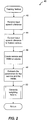
- Figure 2 is a flow diagram of a training method used in the system of Figure 1.
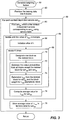
- Figure 3 is flow diagram of the method for calculating weighing factors used in the system of Figure 1.
- Figure 4 is a flow diagram of the preferred embodiment for calculating a new value for lambda as used in the system of Figure 3.
- Figure 5 is a flow diagram of a first alternate embodiment for calculating a new value for lambda as used in the system of Figure 3.
- Figure 6 is a flow diagram of a second alternate embodiment for calculating a new value for lambda as used in the system of Figure 3.
- Figures 7A and 7B depict an example of the hidden Markov models and senone structures associated with a phoneme.
- Figure 8 is a flow diagram of the speech recognition method used in the system of Figure 1.
- the preferred embodiment of the present invention recognizes that an improved recognition accuracy can be obtained in speech recognition systems that employ continuous density hidden Markov models by weighing different output probabilities representing the same phonetic unit relative to the degree to which each output probability can predict unseen data.
- the speech recognition system of the claimed invention receives an input speech utterance, in the form of a continuous signal, and generates the most likely linguistic expression that corresponds to the utterance.
- the preferred embodiment recognizes a linguistic expression by matching a set of feature vectors that form a parametric representation of the speech signal to a sequence of hidden Markov models (HMMs) which identify possible linguistic expressions.
- HMM hidden Markov models
- a HMM may represent a phoneme, and a sequence of HMMs may represent words or sentences composed of phonemes.
- Continuous density probability distribution functions such as a mixture of Gaussian probability distribution functions, can be utilized to represent the output probability of a state, since they are more accurate at modeling a speech signal.
- the output probability function is statistically estimated from training data. Often there is an insufficient amount of training data to accurately estimate the output probability function.
- context-independent and context-dependent models are constructed for a predetermined set of phonemes.
- the output probabilities of the context-independent model are then interpolated with the output probabilities of the context-dependent model. This is done through a weighting or interpolation factor which estimates the degree to which the output probability function of the context-dependent HMM can predict data not previously encountered in the training data.
- the new modified output probability function of a context-dependent state is a combination of the output probability functions of both models weighed in accordance with the robustness of the estimates. Accordingly, in the preferred embodiment, deleted interpolation is used to smooth the probability space rather than the parameter space.
- FIG. 1 illustrates a speech recognition system 10 which can be used to implement the recognition and training processes in accordance with the preferred embodiment of the invention.
- the speech recognition system 10 contains an input device 12, such as but not limited to a microphone, which receives an input speech utterance and generates a corresponding analog electric signal.
- a stored speech utterance that is stored on a storage device can be used as the input speech utterance.
- the analog electric signal corresponding to the speech utterance is transmitted to analog-to-digital (A/D) converter 14, which converts the analog signal to a sequence of digital samples.
- the digital samples are then transmitted to a feature extractor 16 which extracts a parametric representation of the digitized input speech signal.
- A/D analog-to-digital
- This parametric representation captures the acoustic properties of the input speech utterance.
- the feature extractor 16 performs spectral analysis to generate a sequence of feature vectors, each of which contains coefficients representing a spectra of the input speech signal.
- Methods for performing the spectral analysis are well-known in the art of signal processing and can include fast Fourier transforms (FFT), linear predictive coding (LPC), and cepstral coefficients, all of which can be utilized by feature extractor 16.
- Feature extractor 16 can be any conventional processor that performs spectral analysis. Spectral analysis may be performed every ten milliseconds to divide the input speech signal into a feature vector which represents twenty-five milliseconds of the utterance.
- this invention is not limited to using feature vectors that represent twenty-five milliseconds of the utterance. Feature vectors representing different lengths of time of a speech utterance can also be used. This process is repeated for the entire input speech signal and results in a sequence of feature vectors which is transmitted to a data processor 38.
- Data processor 38 can be any conventional computer, such as a desktop personal computer.
- the data processor contains a switching block 18 which routes the sequence of feature vectors. Switching block 18 can be implemented in hardware or software.
- the speech recognition system is not limited to executing on a data processor. Other types of executable mediums can be used, such as but not limited to, a computer readable storage medium which can be a memory device, compact disc, or floppy disk.
- Training engine 20 utilizes the feature vectors to estimate the parameters of the HMMs which will represent the phonemes present in the training data and to compute a set of weighting factors for use by the recognition engine 34.
- a more detailed description of the method employed by training engine 20 is presented below with reference to Figures 2-6.
- the training engine 20 generates context-independent and context-dependent phoneme-based hidden Markov models by estimating the parameters for these models from the training data.
- the output distributions for each context-dependent state are clustered forming senones which are stored in senone table storage 30.
- the senone table storage 30, in general, holds senones for both context-dependent and context-independent HMMs. Senones identifers for each HMM are stored in the HMM storage 28. The In addition, a weighting factor for each context-dependent senone is calculated and stored in lambda table storage 26 for use by the recognition engine 34. The lambda table storage 26 holds lambda values indexed by context-dependent HMMs.
- the training engine 20 also utilizes a text transcript that holds a translation 22 of the training data and a dictionary 24 that contains a phonemic description of each word in order to assure that each word is correctly modeled. A more detailed description of the operation of the training engine 20 will be discussed below.
- the dictionary 24 contains a pronunciation of each word in terms of phonemes. For example, a dictionary entry for "add" might be "/AE DD/.”
- Recognition engine 34 recognizes the sequence of feature vectors as a linguistic expression composed of phonemes that form words, which, in turn, form sentences. A detailed description of the method employed by the recognition engine 34 is presented below with reference to Figure 8.
- Recognition engine 34 utilizes the context-independent and context-dependent hidden Markov models stored in HMM storage 28, the context-dependent and context-independent senones stored in senone table storage 30, the weighting factors stored in lambda table storage 26, and a language model stored in language model storage 32 and dictionary 24.
- the language model storage 22 may specify a grammar.
- the linguistic expression which is generated from recognition engine 34 is displayed to an output device 36, such as a conventional printer, computer monitor, or the like.
- an output device 36 such as a conventional printer, computer monitor, or the like.
- this invention is not limited to displaying the linguistic expression to an output device.
- the linguistic expression can be used as input into another program or processor for further processing or may be stored.
- Figures 2-6 are flow charts that illustrate the steps performed in the training phase of the system where the parameters of the HMMs and senones are estimated and the weighting factors are calculated.
- the training method starts off by receiving input speech utterances, in the form of words, sentences, paragraphs, or the like, and converts them to parametric representations, known as feature vectors
- the structure of the hidden Markov models and senones is formed and estimates of the parameters for these data structures are calculated from the training data.
- the weighting factors are then determined through the technique of deleted interpolation.
- the training method commences by receiving a sequence of speech utterances (step 42) which is converted into a sequence of feature vectors (step 44) as previously described above with reference to Figure 1.
- the complete set of feature vectors is referred to as the "training data.”
- senone and HMM data structures are generated.
- Senones are well-known data structure in speech recognition systems and a detailed description of senones and the method used to construct them can be found in M. Huang et al., "Predicting Unseen Triphones with Senones," Proc. lCASSP '93 Vol. II, pp 311-314, 1993.
- a HMM can be used to model the speech unit of a phoneme.
- the HMM can also be referred to as an acoustic model. This speech unit is selected in order to accommodate large-vocabulary recognition. Modeling individual words requires a longer training period and additional storage to store the associated parameters.
- this invention is not limited to phoneme-based HMMs.
- Other speech units such as words, diphones, and syllables can be used as the basis of the HMMs.
- a context-dependent HMM can be used to model a phoneme with its left and right phonemic contexts. This type of model captures the contextual dependencies which are usually present in word modeling.
- a context-independent HMM can be used to model the phoneme in any context that it appears in the training data, therefore making it independent of any particular context.
- Predetermined patterns consisting of a set of phonemes and their associated left and right phonemic contexts are selected to be modeled by the context-dependent HMM. These selected patterns represent the most frequently occurring phonemes and the most frequently occurring contexts of these phonemes.
- the training data will provide the estimates for the parameters of these models.
- the context-independent models will be based on the selected phonemes and modeled within whatever phonemic context appears in the training data. Similarly, the training data will provide the estimates for the parameters of the context-independent models.
- the use of both a context-independent and context-dependent model is beneficial in achieving an improved recognition accuracy.
- Each model's robustness is related to the amount of training data used to estimate its parameters which also enables it to predict data not present in the training data.
- the combination of the two models provides a more robust estimate benefiting from the training of both models.
- the context-dependent model is beneficial at modeling co-articulatory effects but may be poorly trained due to limited training data. (Although a speaker may try to pronounce words as concatenated sequences of phones, the speaker's articulator cannot move instantaneously to produce unaffected phones. As a result, a phone is strongly inverted by the phone that precedes it and the phone that follows it in a word. The effects are "coarticulatory effects").
- the context-independent model is highly trainable thereby producing more robust estimates which are less detailed. The combination of these two models, weighed in the appropriate manner, can be used by the recognition engine to produce a more accurate acoustic probability score.
- the HMM can utilize a mixture of unimodal distributions for the output probability distributions functions (referred to throughout this application as "output pdf").
- output pdf a mixture of Gaussian probability density functions
- this invention is not constrained to this particular limitation. Mixtures of other well-known continuous density functions can be used, such as the Laplacian and K 0 - type density functions.
- the output distributions of like states of different context-dependent phonetic HMM models for the same context-independent phone are clustered together forming senones.
- Figure 7A illustrates an example of a context-independent HMM structure for the phoneme /aa/ 114.
- the context-independent HMM includes three states, denoted as state 1 (111), state 2 (112), and state 3 (113).
- the HMM depicted in Figure 7A models the phoneme /aa/ with any left and right phonemes that appear in the training data as designated by the notation (*,*) in Figure 7A.
- the first position within the parentheses designates the phoneme that precedes the given phoneme and the second position designates the phoneme that follows the given phoneme.
- Senones are classified within like states ( e . g ., state 1) for each type of model ( e . g ., context-dependent vs. context-independent) corresponding to the same phoneme.
- the context-independent HMM has senones 10, 55, and 125 corresponding to states 1, 2 and 3 respectively.
- Figure 7B shows an example of a corresponding context-dependent HMMs for the phoneme /aa/.
- the context-dependent model /aa/ (/dh/, /b/) 115 models the phoneme /aa/ in a context where the left or preceding phoneme is /dh/ and where the phoneme /b/ succeeds or is to the right of it.
- the senones are classified within like states in the different HMMs. In state 1, there are two context-dependent senones, denoted as senones 14 and 25.
- the compact notation ⁇ ( A , B , ⁇ ) is used to denote the complete parameter set of the model which is otherwise known as the parameter space of a HMM.
- step 48 of Figure 2 the parameters for the senone, context-dependent HMM, and the context-independent HMM are estimated.
- the training phase of a HMM consists of estimating these parameters using the training data, a text of the speech 22, and a dictionary of phonemic spellings of words 24.
- the output and transition probabilities can be estimated by the well-known Baum-Welch or forward-backward algorithm.
- the Baum-Welch algorithm is preferred since it makes better use of training data. It is described in Huang et al., Hidden Markov Models For Speech Recognition , Edinburgh University Press, 1990. However, this invention is not limited to this particular training algorithm, others may be utilized. Normally, about five iterations through the training data can be made to obtain good estimates of the parameters.
- weighting or interpolation factors for each content-dependent senone are generated and are denoted by the mathematical symbol, ⁇ .
- the weighting factors will be used to interpolate the output probabilities of the context-independent HMM with the output probabilities of the context-dependent HMM.
- the weighting factors indicate the adeptness of the context-dependent output pdf at predicting unseen data.
- the output pdf is estimated with training data and will closely predict data which resembles the training data. However, it is impossible to estimate the output pdf with training data that represents every possible input speech utterance, or with sufficient training data for it to predict all unseen data correctly.
- the role of the weighting factor is to indicate the adeptness of the output pdf to predict unseen data which is a function of the training data used to estimate the context-dependent and context-independent models. As the amount of training data for the context-dependent models gels large, ⁇ will approach 1.0 and the output pdf will be heavily weighed. With a small amount of training data for the context-dependent model, ⁇ will approach 0.0 and the output pdf will be weighed less. The optimal value for ⁇ for each context-dependent senone is determined by deleted interpolation.
- the technique of deleted interpolation partitions the training data into two distinct sets. One set is used to estimate the parameters of the model and a second set is used to determine the weighting factor which indicates how well the output pdf can predict unseen training data. This process is iterative where at each iteration the different sets are rotated and a new model and weighting factor is produced. At the end of all the iterations, the average value of the weighting factor is calculated and used in the recognition phase.
- Figures 3-6 illustrate the steps used in computing the weighting factors.
- the training data is partitioned into K blocks in step 60.
- the invention is not limited to this number of blocks, others may be used dependent on the constraints of training data storage and training time.
- a weighting factor is calculated for each context-dependent senone (step 62) by first finding sen Sl , which is the context-independent senone that corresponds to sen SD ( i . e ., the context-dependent senone) using the senone table (step 63).
- the calculation is derived through an iterative process, step 64, which converges when the difference between the new value of ⁇ , denoted as ⁇ new , meets a certain threshold.
- the process converges or finishes when
- the process commences by selecting an initial value for ⁇ , step 66.
- an initial value is preselected by the user.
- the initial value can be an estimated guess as 0.8.
- the process iterates K times. At each iteration, one block of data is selected as the deleted block, and the selected deleted block is one that was not chosen previously, step 70.
- the process then proceeds to estimate the output probabilities for each context-dependent (denoted as b 1 ) and context-independent (denoted as b 2 ) senone using the training data from all the blocks except the deleted block (step 72). These parameters are estimated using the same technique as described above in reference to the estimation of the parameters of the HMMs in the training phase ( i . e ., Baum-Welch algorithm).
- ⁇ new a new value, ⁇ new .
- ⁇ new a new value, ⁇ new .
- a value of ⁇ new is determined for each of the K iterations.
- Steps 66 through 76 are executed again if the value of ⁇ new does not meet the prescribed threshold.
- the current value of ⁇ new is stored in lambda table 26 for the particular context-dependent senone.
- Figure 4 depicts a flowchart of the steps used in computing the new value for the weighting factor, ⁇ new in accord with equations (2) and (3) above.
- the new value is computed by summing the contribution of the context-dependent output pdf relative to the overall probability for each data point in the deleted block.
- step 79 all points in the deleted block that correspond to sen SD are found using the model generated in step 48 and forced alignment.
- the process iterates for each data point x i in the deleted block that is aligned with sen SD .
- step 82 The contribution of the centext-dependent output pdf for data point x i relative to the overall probability is determined in step 82 in accord with the following mathematical definition: ( ⁇ b 1( xi )) ( ⁇ b 1( xi )+(1- ⁇ ) ⁇ b 2( xi ))
- step 84 The sum of the contributions for all data points computed thus far are totaled in step 84.
- the average of the contributions is computed, ⁇ new , step 86 in accord with equation (2) above
- the above computation of the weighting factor uses the data points in the deleted block. This produces a more accurate computation at the expense of increasing the training time as well as the amount of storage needed by the training engine to perform the computations. In some instances, it may be more advantageous to generate a parametric representation of the data points in the deleted block that correspond and to use the appropriate parameters instead. Another alternative is to use reconstructed data points from the parametric representation of the data points to sen SD . These alternatives provide a coarse approximation of the data points but has the advantage of computational efficiency.
- Figures 5 and 6 depict these alternate embodiments for the calculation of the weighting factors.
- Figure 5 depicts the first alternate embodiment.
- the parametric representation is a mixture of Gaussians. This representation can be made using the Baum-Welch algorithm as described above.
- the parameters generated include the mean, ⁇ j , and weight, c j , for each mixture component j .
- the computation of the new value of lambda, ⁇ new can be made in accord with the following mathematical definition for a deleted block ⁇ j .
- Steps 92 - 98 perform this calculation in the following manner.
- Step 92 iterates for each mixture and determines the contribution of the context-dependent output probability over the overall probability for the mixture having the corresponding mean and weight parameters. For mixture components, this is represented mathematically as: cj ⁇ ( ⁇ b1 ( ⁇ j ) ⁇ b1 ( ⁇ j )+( 1 - ⁇ ) ⁇ b2 ( ⁇ j )
- step 96 the sum of these contributions is formed for all the mixture components.
- step 98 the final sum resulting from step 96 is stored as the value of ⁇ new for the current sen SD and the deleted block:
- the process proceeds to calculate the average value for ⁇ new in step 76 in accord with equation (3) above.
- the process continues as described above with reference to Figure 3 until the process converges and the current average value ⁇ new stored in the lambda table 26 for the particular context-dependent senone.
- a parametric representation is generated for the data points in the deleted block.
- the parametric representation can consist of a mixture of Gaussians.
- This parametric representation can be derived using the Baum-Welch algorithm on the training data in the deleted block.
- From this parametric representation a prescribed number of data points is reconstructed using a random number generator with the mean and weight parameters, as shown in step 102.
- the number of data points that are reconstructed is a trade-off between the desired accuracy of ⁇ new and the computational requirements. A higher number of data points improves the accuracy of the ⁇ new at the cost of greater computational requirements.
- a suitable number of reconstructed data points per mixture is 100.
- step 104 steps 106 and 108 are performed for each data point in the set, step 104.
- step 106 the contribution of the context-dependent output probability over the overall probability for the data point is determined. This can be represented mathematically as: ( ⁇ b 1( xi )) ( ⁇ b 1( xi )+(1- ⁇ ) ⁇ b2 ( xi ))
- step 108 the sum of these contributions is formed for all the data points in the set.
- the average of all of the contributions is returned as the value of ⁇ new , (step 110).
- the process proceeds to calculate the average value for ⁇ new in step 76 in accord with equation (3) above.
- the process continues as described above with reference to Figure 3 until the process converges and the current average value ⁇ new stored in the lambda table 26 for the particular context-dependent senone.
- the recognition system is ready to execute.
- the primary task of the speech recognition system is to detect the linguistic message which is embodied in the input speech signal.
- This task is a multi-level decoding problem since it requires matching the sequence of feature vector's to a sequence of phonetics, matching the sequence of phonemes to a sequence of words, and matching the sequence of words to a sentence. This is performed by forming all possible linguistic expressions that have been modeled and calculating the probability that the expression matches the sequence of feature vectors. Since a linguistic expression is composed of a sequence of phonemes, the determination can involve calculating the likelihood that the phonomes forming the expression match the feature vectors and that the expression is likely to occur ( i .
- the probability that the phonemes forming an expression match the feature vectors can be referred to as an acoustic score and the probability that the expression occurs can be referred to as the language score.
- the language score takes into consideration the syntax and semantics of the language, such as the grammar of the language, and indicates whether the sequence of words corresponding to the sequence of phonemes form a grammatically-correct linguistic expression.
- phonemes are represented by HMM's where the output pdf of like states are clustered forming senones.
- the process of matching a feature vector to a phoneme then entails matching a feature vector to the senones associated with the states of a HMM representing the phoneme.
- the linguistic expression can be composed of senones corresponding to states of a sequence of HMMs.
- the task of the recognition engine can be one of finding the word sequence W which maximizes the probability P ( W / X ).
- the probability P ( W / X ) represents the probability of the linguistic expression W occurring given the input speech signal X .
- P ( W / X ) ( P ( X / W ) P ( W ))/ P ( X ).
- P ( X / W ) is the probability that the input speech signal X matches the word string W, and is referred to as the acoustic score.
- P ( W ) is the probability that the word string W will occur, and is referred to as the language score. Since P ( X ) is independent of W , maximizing P ( W / X ) is equivalent to maximizing the numerator, namely P ( W / X ) P ( W ) over all word sequences W .
- the recognition task considers various word sequences in trying to determine the best match. For each word sequence that is considered by the recognition task, it computes an acoustic score and a language score, A language score indicates how likely the word sequence is, in the language, and is indicated by the term P ( W ) in the above equation (10). An acoustic score indicates how well the sequence of acoustic vector features matches the acoustic model for the word sequence W . The acoustic score is indicated by the term P ( X / W ) in the above formula
- the recognition task In computing the acoustic score for a given word sequence, the recognition task considers various senone alignments.
- a senone alignment is a mapping from the sequence of acoustic feature vectors to senones which assigns a unique senone to each acoustic feature vector. Only the senone alignments which would result in the word sequence under consideration are considered by the recognition task.
- An acoustic score for the word sequence under the constraints of each senone alignment is computed. The acoustic score for the word sequence is the best acoustic score over all possible senone alignments.
- P ( A ) represents the state transition probability for the senone sequence sd i . . . sd n .
- P ( x i / sd i ) represents the probability that feature version x i matches context-dependent senone sd i .
- the essence of the acoustic score is the computation of the output probability p( x
- p( x ) the output probability
- sd the output probability
- One way to reduce this problem is to utilize several HMMs which model the same phenomes at several levels of detail.
- the output pdf for a particular state can then be constructed by using the output pdfs at various levels of detail and combining them. The combination is done based on the ability to predict data not seen during training.
- a robust output pdf which is more adept at predicting unseen data will receive a higher weight while a poorly estimated output pdf will receive a lower weight in the combined output pdf.
- several context-dependent HMMs and a context-independent HMM are utilized to model a phoneme.
- a weighting factor, ⁇ , for each senone corresponding to a context-dependent state which was computed previously in the training phase is used to indicate the weight each senone is given.
- ⁇ (approaches 1.0) the more the context-dependent senone dominates and the less the context-independent senone is weighed.
- ⁇ small (approaches 0.0), the context-independent senone dominates.
- sd ) can be represented by the following mathematical definition: p ( x
- sd ) ⁇ * p ( x
- sd ) is nearly linearly interpolated as a function of the output probabilities of context-dependent and context-independent senones.
- the weighting or interpolation factor ⁇ indicates the degree to which each senone is interpolated.
- Figure 8 depicts the operation of the speech recognition method.
- the method commences by receiving an input speech utterance, (step 122), which is converted to feature vectors (step 124), which was previously detailed above with reference to Figure 1.
- step 126 the method performs steps 128-136 for each word sequence that can represent the input speech utterance.
- the word sequence can consist of a variety of different senone alignments, where each senone alignment corresponds to a sequence of HMM states.
- steps 128-134 a combined recognition score for each possible senone alignment which can represent the word sequence is determined.
- the combined recognition score can be determined in accord with the modified Bayes formula as denoted above in equation (10).
- the combined recognition score consists of an acoustic score and a language score.
- the acoustic score is determined in step 130
- the language score is determined in step 132
- the combined score is computed in step 134.
- the senone alignment having the highest combined recognition score is then selected to represent the word sequence, step 136.
- the method recognizes the input speech utterance as the word sequence having the highest combined recognition score.
- step 130 the acoustic score can be determined as described above in accord with equation (11) where the output probability is computed as described above in equation (12).
- the method computes a language score based on the language models representing linguistic expressions stored in language model storage 32.
- Language models use knowledge of the structure and semantics of a language in predicting the likelihood of the occurence of a word considering the words that have been previously uttered.
- the language made can be a bigram language model where the language score is based on the probability of one word being followed by a particular second word.
- the language model may be based on N-grams other than bigrams or each on subword language probabilities.
- other lexical knowledge such as syntax and grammatical rules can be employed to create the language model. Methods for creating and using language models are well-known in the art and are described in more detail in the Huang et al. book referred to above.
- the above detailed invention improves the recognition capability of a speech recognition system by utilizing multiple continuous density output probabilities corresponding to the same speech event in different contexts. This improves the mapping of the feature vectors to the hidden Markov models since it improves the model's performance in predicting speech events that the model was not trained with. An improvement at this level is extremely beneficial since the mapping at this level is the foundation upon which the recognition process further builds on.
- this invention is not restricted to a speech recognition system. Any application which requires the matching of a speech utterance to a linguistic expression can utilize the claimed invention.
- the speech utterance can be any form of acoustic data, such as but not limited to, sounds, speech waveforms, and the like.
- An example of such an application is a speech synthesis system which utilizes probabilistic models to generate a speech waveform from a text string representing a linguistic expression.
Landscapes
- Engineering & Computer Science (AREA)
- Physics & Mathematics (AREA)
- Data Mining & Analysis (AREA)
- Theoretical Computer Science (AREA)
- General Engineering & Computer Science (AREA)
- Probability & Statistics with Applications (AREA)
- Computer Vision & Pattern Recognition (AREA)
- Evolutionary Biology (AREA)
- Evolutionary Computation (AREA)
- Bioinformatics & Cheminformatics (AREA)
- Artificial Intelligence (AREA)
- General Physics & Mathematics (AREA)
- Life Sciences & Earth Sciences (AREA)
- Bioinformatics & Computational Biology (AREA)
- Computational Linguistics (AREA)
- Health & Medical Sciences (AREA)
- Audiology, Speech & Language Pathology (AREA)
- Human Computer Interaction (AREA)
- Acoustics & Sound (AREA)
- Multimedia (AREA)
- Machine Translation (AREA)
- Image Analysis (AREA)
Applications Claiming Priority (2)
| Application Number | Priority Date | Filing Date | Title |
|---|---|---|---|
| US08/655,273 US5937384A (en) | 1996-05-01 | 1996-05-01 | Method and system for speech recognition using continuous density hidden Markov models |
| US655273 | 1996-05-01 |
Publications (3)
| Publication Number | Publication Date |
|---|---|
| EP0805434A2 true EP0805434A2 (de) | 1997-11-05 |
| EP0805434A3 EP0805434A3 (de) | 1998-08-26 |
| EP0805434B1 EP0805434B1 (de) | 2003-02-26 |
Family
ID=24628243
Family Applications (1)
| Application Number | Title | Priority Date | Filing Date |
|---|---|---|---|
| EP97107116A Expired - Lifetime EP0805434B1 (de) | 1996-05-01 | 1997-04-29 | Verfahren und System zur Spracherkennung mittels verborgener Markoff-Modelle mit kontinuierlichen Ausgangswahrscheinlichkeiten |
Country Status (5)
| Country | Link |
|---|---|
| US (1) | US5937384A (de) |
| EP (1) | EP0805434B1 (de) |
| JP (1) | JP3933750B2 (de) |
| CN (1) | CN1112669C (de) |
| DE (1) | DE69719236T2 (de) |
Cited By (6)
| Publication number | Priority date | Publication date | Assignee | Title |
|---|---|---|---|---|
| WO2002001549A1 (en) * | 2000-06-15 | 2002-01-03 | Intel Corporation | Speaker adaptation using weighted feedback |
| WO2003001508A1 (es) * | 2001-06-25 | 2003-01-03 | Universitat Pompeu-Fabra | Método para identificación de secuencias de audio |
| WO2004034355A3 (en) * | 2002-10-07 | 2004-05-27 | Univ Carnegie Mellon | System and methods for comparing speech elements |
| EP1580667A2 (de) | 2004-03-26 | 2005-09-28 | Microsoft Corporation | Darstellung eines "deleted interpolation" N-gram Sprachmodells in ARPA Standardformat |
| WO2005112000A1 (fr) * | 2004-04-20 | 2005-11-24 | France Telecom | Procede et systeme de reconnaissance vocale par modelisation contextuelle d’unites vocales |
| US7478038B2 (en) | 2004-03-31 | 2009-01-13 | Microsoft Corporation | Language model adaptation using semantic supervision |
Families Citing this family (87)
| Publication number | Priority date | Publication date | Assignee | Title |
|---|---|---|---|---|
| US6567778B1 (en) * | 1995-12-21 | 2003-05-20 | Nuance Communications | Natural language speech recognition using slot semantic confidence scores related to their word recognition confidence scores |
| US6807537B1 (en) * | 1997-12-04 | 2004-10-19 | Microsoft Corporation | Mixtures of Bayesian networks |
| US6418431B1 (en) * | 1998-03-30 | 2002-07-09 | Microsoft Corporation | Information retrieval and speech recognition based on language models |
| US6574597B1 (en) * | 1998-05-08 | 2003-06-03 | At&T Corp. | Fully expanded context-dependent networks for speech recognition |
| WO2000019409A1 (en) * | 1998-09-29 | 2000-04-06 | Lernout & Hauspie Speech Products N.V. | Inter-word triphone models |
| US6571210B2 (en) | 1998-11-13 | 2003-05-27 | Microsoft Corporation | Confidence measure system using a near-miss pattern |
| US7082397B2 (en) | 1998-12-01 | 2006-07-25 | Nuance Communications, Inc. | System for and method of creating and browsing a voice web |
| US6570964B1 (en) | 1999-04-16 | 2003-05-27 | Nuance Communications | Technique for recognizing telephone numbers and other spoken information embedded in voice messages stored in a voice messaging system |
| US7058573B1 (en) | 1999-04-20 | 2006-06-06 | Nuance Communications Inc. | Speech recognition system to selectively utilize different speech recognition techniques over multiple speech recognition passes |
| US7181399B1 (en) * | 1999-05-19 | 2007-02-20 | At&T Corp. | Recognizing the numeric language in natural spoken dialogue |
| US6539353B1 (en) * | 1999-10-12 | 2003-03-25 | Microsoft Corporation | Confidence measures using sub-word-dependent weighting of sub-word confidence scores for robust speech recognition |
| US6529866B1 (en) * | 1999-11-24 | 2003-03-04 | The United States Of America As Represented By The Secretary Of The Navy | Speech recognition system and associated methods |
| US6751621B1 (en) * | 2000-01-27 | 2004-06-15 | Manning & Napier Information Services, Llc. | Construction of trainable semantic vectors and clustering, classification, and searching using trainable semantic vectors |
| US6633845B1 (en) * | 2000-04-07 | 2003-10-14 | Hewlett-Packard Development Company, L.P. | Music summarization system and method |
| US6662158B1 (en) | 2000-04-27 | 2003-12-09 | Microsoft Corporation | Temporal pattern recognition method and apparatus utilizing segment and frame-based models |
| US6629073B1 (en) * | 2000-04-27 | 2003-09-30 | Microsoft Corporation | Speech recognition method and apparatus utilizing multi-unit models |
| US7912868B2 (en) * | 2000-05-02 | 2011-03-22 | Textwise Llc | Advertisement placement method and system using semantic analysis |
| US7031908B1 (en) * | 2000-06-01 | 2006-04-18 | Microsoft Corporation | Creating a language model for a language processing system |
| US6865528B1 (en) * | 2000-06-01 | 2005-03-08 | Microsoft Corporation | Use of a unified language model |
| US6684187B1 (en) * | 2000-06-30 | 2004-01-27 | At&T Corp. | Method and system for preselection of suitable units for concatenative speech |
| US6505158B1 (en) * | 2000-07-05 | 2003-01-07 | At&T Corp. | Synthesis-based pre-selection of suitable units for concatenative speech |
| US6728674B1 (en) | 2000-07-31 | 2004-04-27 | Intel Corporation | Method and system for training of a classifier |
| US6999926B2 (en) * | 2000-11-16 | 2006-02-14 | International Business Machines Corporation | Unsupervised incremental adaptation using maximum likelihood spectral transformation |
| EP1209659B1 (de) * | 2000-11-22 | 2005-10-05 | Matsushita Electric Industrial Co., Ltd. | Verfahren und Vorrichtung zur Texteingabe durch Spracherkennung |
| US7587321B2 (en) * | 2001-05-08 | 2009-09-08 | Intel Corporation | Method, apparatus, and system for building context dependent models for a large vocabulary continuous speech recognition (LVCSR) system |
| US6928409B2 (en) * | 2001-05-31 | 2005-08-09 | Freescale Semiconductor, Inc. | Speech recognition using polynomial expansion and hidden markov models |
| US7324945B2 (en) * | 2001-06-28 | 2008-01-29 | Sri International | Method of dynamically altering grammars in a memory efficient speech recognition system |
| US8229753B2 (en) * | 2001-10-21 | 2012-07-24 | Microsoft Corporation | Web server controls for web enabled recognition and/or audible prompting |
| US7711570B2 (en) * | 2001-10-21 | 2010-05-04 | Microsoft Corporation | Application abstraction with dialog purpose |
| US6990445B2 (en) * | 2001-12-17 | 2006-01-24 | Xl8 Systems, Inc. | System and method for speech recognition and transcription |
| US20030115169A1 (en) * | 2001-12-17 | 2003-06-19 | Hongzhuan Ye | System and method for management of transcribed documents |
| US7050975B2 (en) * | 2002-07-23 | 2006-05-23 | Microsoft Corporation | Method of speech recognition using time-dependent interpolation and hidden dynamic value classes |
| US7200559B2 (en) | 2003-05-29 | 2007-04-03 | Microsoft Corporation | Semantic object synchronous understanding implemented with speech application language tags |
| US8301436B2 (en) * | 2003-05-29 | 2012-10-30 | Microsoft Corporation | Semantic object synchronous understanding for highly interactive interface |
| US7650282B1 (en) * | 2003-07-23 | 2010-01-19 | Nexidia Inc. | Word spotting score normalization |
| US7280967B2 (en) * | 2003-07-30 | 2007-10-09 | International Business Machines Corporation | Method for detecting misaligned phonetic units for a concatenative text-to-speech voice |
| US8160883B2 (en) * | 2004-01-10 | 2012-04-17 | Microsoft Corporation | Focus tracking in dialogs |
| TWI276046B (en) * | 2005-02-18 | 2007-03-11 | Delta Electronics Inc | Distributed language processing system and method of transmitting medium information therefore |
| US7970613B2 (en) | 2005-11-12 | 2011-06-28 | Sony Computer Entertainment Inc. | Method and system for Gaussian probability data bit reduction and computation |
| US7778831B2 (en) | 2006-02-21 | 2010-08-17 | Sony Computer Entertainment Inc. | Voice recognition with dynamic filter bank adjustment based on speaker categorization determined from runtime pitch |
| US8010358B2 (en) * | 2006-02-21 | 2011-08-30 | Sony Computer Entertainment Inc. | Voice recognition with parallel gender and age normalization |
| KR100845428B1 (ko) * | 2006-08-25 | 2008-07-10 | 한국전자통신연구원 | 휴대용 단말기의 음성 인식 시스템 |
| US20080103772A1 (en) * | 2006-10-31 | 2008-05-01 | Duncan Bates | Character Prediction System |
| JP4322934B2 (ja) * | 2007-03-28 | 2009-09-02 | 株式会社東芝 | 音声認識装置、方法およびプログラム |
| US9129599B2 (en) * | 2007-10-18 | 2015-09-08 | Nuance Communications, Inc. | Automated tuning of speech recognition parameters |
| US8639510B1 (en) * | 2007-12-24 | 2014-01-28 | Kai Yu | Acoustic scoring unit implemented on a single FPGA or ASIC |
| US8352265B1 (en) | 2007-12-24 | 2013-01-08 | Edward Lin | Hardware implemented backend search engine for a high-rate speech recognition system |
| US8463610B1 (en) | 2008-01-18 | 2013-06-11 | Patrick J. Bourke | Hardware-implemented scalable modular engine for low-power speech recognition |
| US20100057452A1 (en) * | 2008-08-28 | 2010-03-04 | Microsoft Corporation | Speech interfaces |
| US9484019B2 (en) * | 2008-11-19 | 2016-11-01 | At&T Intellectual Property I, L.P. | System and method for discriminative pronunciation modeling for voice search |
| US8442833B2 (en) * | 2009-02-17 | 2013-05-14 | Sony Computer Entertainment Inc. | Speech processing with source location estimation using signals from two or more microphones |
| US8788256B2 (en) * | 2009-02-17 | 2014-07-22 | Sony Computer Entertainment Inc. | Multiple language voice recognition |
| US8442829B2 (en) * | 2009-02-17 | 2013-05-14 | Sony Computer Entertainment Inc. | Automatic computation streaming partition for voice recognition on multiple processors with limited memory |
| EP2238899B1 (de) * | 2009-04-06 | 2016-10-05 | GN Resound A/S | Effiziente Beurteilung des Hörvermögens |
| US8606578B2 (en) * | 2009-06-25 | 2013-12-10 | Intel Corporation | Method and apparatus for improving memory locality for real-time speech recognition |
| JP2012108748A (ja) * | 2010-11-18 | 2012-06-07 | Sony Corp | データ処理装置、データ処理方法、およびプログラム |
| US8688453B1 (en) * | 2011-02-28 | 2014-04-01 | Nuance Communications, Inc. | Intent mining via analysis of utterances |
| CN102129860B (zh) * | 2011-04-07 | 2012-07-04 | 南京邮电大学 | 基于无限状态隐马尔可夫模型的与文本相关的说话人识别方法 |
| EP2700071B1 (de) * | 2011-04-20 | 2014-12-24 | Robert Bosch GmbH | Spracherkennung unter Verwendung mehrerer Sprachmodelle |
| US8959014B2 (en) * | 2011-06-30 | 2015-02-17 | Google Inc. | Training acoustic models using distributed computing techniques |
| US10339214B2 (en) * | 2011-11-04 | 2019-07-02 | International Business Machines Corporation | Structured term recognition |
| US8924453B2 (en) * | 2011-12-19 | 2014-12-30 | Spansion Llc | Arithmetic logic unit architecture |
| US9153235B2 (en) | 2012-04-09 | 2015-10-06 | Sony Computer Entertainment Inc. | Text dependent speaker recognition with long-term feature based on functional data analysis |
| US9514739B2 (en) * | 2012-06-06 | 2016-12-06 | Cypress Semiconductor Corporation | Phoneme score accelerator |
| US9224384B2 (en) * | 2012-06-06 | 2015-12-29 | Cypress Semiconductor Corporation | Histogram based pre-pruning scheme for active HMMS |
| US9508045B2 (en) * | 2012-08-17 | 2016-11-29 | Raytheon Company | Continuous-time baum-welch training |
| US9336771B2 (en) * | 2012-11-01 | 2016-05-10 | Google Inc. | Speech recognition using non-parametric models |
| US9240184B1 (en) | 2012-11-15 | 2016-01-19 | Google Inc. | Frame-level combination of deep neural network and gaussian mixture models |
| KR101905827B1 (ko) * | 2013-06-26 | 2018-10-08 | 한국전자통신연구원 | 연속어 음성 인식 장치 및 방법 |
| US9711148B1 (en) * | 2013-07-18 | 2017-07-18 | Google Inc. | Dual model speaker identification |
| GB2523353B (en) * | 2014-02-21 | 2017-03-01 | Jaguar Land Rover Ltd | System for use in a vehicle |
| US10255903B2 (en) | 2014-05-28 | 2019-04-09 | Interactive Intelligence Group, Inc. | Method for forming the excitation signal for a glottal pulse model based parametric speech synthesis system |
| US10014007B2 (en) | 2014-05-28 | 2018-07-03 | Interactive Intelligence, Inc. | Method for forming the excitation signal for a glottal pulse model based parametric speech synthesis system |
| US9858922B2 (en) | 2014-06-23 | 2018-01-02 | Google Inc. | Caching speech recognition scores |
| US9299347B1 (en) | 2014-10-22 | 2016-03-29 | Google Inc. | Speech recognition using associative mapping |
| KR20180078252A (ko) * | 2015-10-06 | 2018-07-09 | 인터랙티브 인텔리전스 그룹, 인코포레이티드 | 성문 펄스 모델 기반 매개 변수식 음성 합성 시스템의 여기 신호 형성 방법 |
| US10229672B1 (en) | 2015-12-31 | 2019-03-12 | Google Llc | Training acoustic models using connectionist temporal classification |
| KR102434604B1 (ko) * | 2016-01-05 | 2022-08-23 | 한국전자통신연구원 | 개인화된 음성 인식을 수행하기 위한 음성 인식 단말, 음성 인식 서버 및 음성 인식 방법 |
| US10665243B1 (en) * | 2016-11-11 | 2020-05-26 | Facebook Technologies, Llc | Subvocalized speech recognition |
| US10706840B2 (en) | 2017-08-18 | 2020-07-07 | Google Llc | Encoder-decoder models for sequence to sequence mapping |
| US11211065B2 (en) * | 2018-02-02 | 2021-12-28 | Genesys Telecommunications Laboratories, Inc. | System and method for automatic filtering of test utterance mismatches in automatic speech recognition systems |
| CN113628613B (zh) * | 2020-05-06 | 2026-03-27 | 赛普拉斯半导体公司 | 两阶段的用户可定制唤醒词检测 |
| US11783818B2 (en) * | 2020-05-06 | 2023-10-10 | Cypress Semiconductor Corporation | Two stage user customizable wake word detection |
| CN113571094B (zh) * | 2021-02-03 | 2025-06-06 | 腾讯科技(深圳)有限公司 | 一种口语发音评测方法、装置、设备及存储介质 |
| CN116108391B (zh) * | 2023-04-12 | 2023-06-30 | 江西珉轩智能科技有限公司 | 一种基于无监督学习的人体姿态分类识别系统 |
| US20250285612A1 (en) * | 2024-03-06 | 2025-09-11 | Deepgram, Inc. | Multistage alignment for generating artificial intelligence training data |
| CN120199247B (zh) * | 2025-05-26 | 2025-08-12 | 华泽中熙(北京)科技发展有限公司 | 一种基于语音识别的智能客服语音交互方法及系统 |
Family Cites Families (16)
| Publication number | Priority date | Publication date | Assignee | Title |
|---|---|---|---|---|
| US4587670A (en) * | 1982-10-15 | 1986-05-06 | At&T Bell Laboratories | Hidden Markov model speech recognition arrangement |
| US4783803A (en) * | 1985-11-12 | 1988-11-08 | Dragon Systems, Inc. | Speech recognition apparatus and method |
| JPS62231993A (ja) * | 1986-03-25 | 1987-10-12 | インタ−ナシヨナル ビジネス マシ−ンズ コ−ポレ−シヨン | 音声認識方法 |
| US4866778A (en) * | 1986-08-11 | 1989-09-12 | Dragon Systems, Inc. | Interactive speech recognition apparatus |
| US4817156A (en) * | 1987-08-10 | 1989-03-28 | International Business Machines Corporation | Rapidly training a speech recognizer to a subsequent speaker given training data of a reference speaker |
| US5027406A (en) * | 1988-12-06 | 1991-06-25 | Dragon Systems, Inc. | Method for interactive speech recognition and training |
| US5268990A (en) * | 1991-01-31 | 1993-12-07 | Sri International | Method for recognizing speech using linguistically-motivated hidden Markov models |
| US5267345A (en) * | 1992-02-10 | 1993-11-30 | International Business Machines Corporation | Speech recognition apparatus which predicts word classes from context and words from word classes |
| US5293584A (en) * | 1992-05-21 | 1994-03-08 | International Business Machines Corporation | Speech recognition system for natural language translation |
| US5333236A (en) * | 1992-09-10 | 1994-07-26 | International Business Machines Corporation | Speech recognizer having a speech coder for an acoustic match based on context-dependent speech-transition acoustic models |
| EP0602296A1 (de) * | 1992-12-17 | 1994-06-22 | International Business Machines Corporation | Adaptives Verfahren zur Erzeugung gebietsabhängiger Modelle für intelligente Systeme |
| US5627939A (en) * | 1993-09-03 | 1997-05-06 | Microsoft Corporation | Speech recognition system and method employing data compression |
| US5621859A (en) * | 1994-01-19 | 1997-04-15 | Bbn Corporation | Single tree method for grammar directed, very large vocabulary speech recognizer |
| US5642519A (en) * | 1994-04-29 | 1997-06-24 | Sun Microsystems, Inc. | Speech interpreter with a unified grammer compiler |
| JP3581401B2 (ja) * | 1994-10-07 | 2004-10-27 | キヤノン株式会社 | 音声認識方法 |
| US5710866A (en) * | 1995-05-26 | 1998-01-20 | Microsoft Corporation | System and method for speech recognition using dynamically adjusted confidence measure |
-
1996
- 1996-05-01 US US08/655,273 patent/US5937384A/en not_active Expired - Lifetime
-
1997
- 1997-04-29 EP EP97107116A patent/EP0805434B1/de not_active Expired - Lifetime
- 1997-04-29 DE DE69719236T patent/DE69719236T2/de not_active Expired - Lifetime
- 1997-04-30 CN CN97114917A patent/CN1112669C/zh not_active Expired - Lifetime
- 1997-05-01 JP JP14838597A patent/JP3933750B2/ja not_active Expired - Lifetime
Cited By (13)
| Publication number | Priority date | Publication date | Assignee | Title |
|---|---|---|---|---|
| US7580836B1 (en) | 2000-06-15 | 2009-08-25 | Intel Corporation | Speaker adaptation using weighted feedback |
| WO2002001549A1 (en) * | 2000-06-15 | 2002-01-03 | Intel Corporation | Speaker adaptation using weighted feedback |
| WO2003001508A1 (es) * | 2001-06-25 | 2003-01-03 | Universitat Pompeu-Fabra | Método para identificación de secuencias de audio |
| ES2190342A1 (es) * | 2001-06-25 | 2003-07-16 | Uni Pompeu Fabra | Metodo para identificacion de secuencias de audio. |
| ES2190342B1 (es) * | 2001-06-25 | 2004-11-16 | Universitat Pompeu Fabra | Metodo para identificacion de secuencias de audio. |
| WO2004034355A3 (en) * | 2002-10-07 | 2004-05-27 | Univ Carnegie Mellon | System and methods for comparing speech elements |
| US7752045B2 (en) | 2002-10-07 | 2010-07-06 | Carnegie Mellon University | Systems and methods for comparing speech elements |
| EP1580667A2 (de) | 2004-03-26 | 2005-09-28 | Microsoft Corporation | Darstellung eines "deleted interpolation" N-gram Sprachmodells in ARPA Standardformat |
| EP1580667A3 (de) * | 2004-03-26 | 2007-10-10 | Microsoft Corporation | Darstellung eines "deleted interpolation" N-gram Sprachmodells in ARPA Standardformat |
| US7406416B2 (en) | 2004-03-26 | 2008-07-29 | Microsoft Corporation | Representation of a deleted interpolation N-gram language model in ARPA standard format |
| US7478038B2 (en) | 2004-03-31 | 2009-01-13 | Microsoft Corporation | Language model adaptation using semantic supervision |
| WO2005112000A1 (fr) * | 2004-04-20 | 2005-11-24 | France Telecom | Procede et systeme de reconnaissance vocale par modelisation contextuelle d’unites vocales |
| US7818172B2 (en) | 2004-04-20 | 2010-10-19 | France Telecom | Voice recognition method and system based on the contexual modeling of voice units |
Also Published As
| Publication number | Publication date |
|---|---|
| CN1171592A (zh) | 1998-01-28 |
| EP0805434B1 (de) | 2003-02-26 |
| US5937384A (en) | 1999-08-10 |
| EP0805434A3 (de) | 1998-08-26 |
| DE69719236D1 (de) | 2003-04-03 |
| CN1112669C (zh) | 2003-06-25 |
| JPH1063291A (ja) | 1998-03-06 |
| DE69719236T2 (de) | 2003-09-18 |
| JP3933750B2 (ja) | 2007-06-20 |
Similar Documents
| Publication | Publication Date | Title |
|---|---|---|
| EP0805434B1 (de) | Verfahren und System zur Spracherkennung mittels verborgener Markoff-Modelle mit kontinuierlichen Ausgangswahrscheinlichkeiten | |
| EP1610301B1 (de) | Verfahren zur Spracherkennung mittels Modellierung der Wortdauer | |
| WO2022148176A1 (en) | Method, device, and computer program product for english pronunciation assessment | |
| US6539353B1 (en) | Confidence measures using sub-word-dependent weighting of sub-word confidence scores for robust speech recognition | |
| CN101030369B (zh) | 基于子词隐含马尔可夫模型的嵌入式语音识别方法 | |
| EP1134727A2 (de) | Lautmodelle für unbekannte Wörter in einem Spracherkennungssystem | |
| JP2003308090A (ja) | 音声認識装置、音声認識方法および音声認識プログラム | |
| EP0453649A2 (de) | Verfahren und Einrichtung zur Wortmodellierung mittels zusammengesetzten Markov-Modellen | |
| Nocera et al. | Phoneme lattice based A* search algorithm for speech recognition | |
| Manasa et al. | Comparison of acoustical models of GMM-HMM based for speech recognition in Hindi using PocketSphinx | |
| JP2002342323A (ja) | 言語モデル学習装置およびそれを用いた音声認識装置ならびに言語モデル学習方法およびそれを用いた音声認識方法ならびにそれらの方法を記憶した記憶媒体 | |
| Samudravijaya et al. | A comparison of public-domain software tools for speech recognition | |
| De Wet et al. | Evaluation of formant-like features on an automatic vowel classification task | |
| Liu et al. | Modeling partial pronunciation variations for spontaneous Mandarin speech recognition | |
| Shen et al. | Automatic selection of phonetically distributed sentence sets for speaker adaptation with application to large vocabulary Mandarin speech recognition | |
| EP1369847B1 (de) | Verfahren und Vorrichtung zur Spracherkennung | |
| Schwartz et al. | Acoustic-Phonetic Decoding of Speech: Statistical Modeling for Phonetic Recognition | |
| Qian et al. | A Multi-Space Distribution (MSD) and two-stream tone modeling approach to Mandarin speech recognition | |
| Wu et al. | Integration of phonetic and prosodic information for robust utterance verification | |
| Hirsimäki | A decoder for large vocabulary continuous speech recognition | |
| JPH0981177A (ja) | 音声認識装置および単語構成要素の辞書並びに隠れマルコフモデルの学習方法 | |
| Lennig et al. | An 86,000-word recognizer based on phonemic models | |
| CN102479507B (zh) | 可辨认任何语言句子的方法 | |
| Vasquez | Feature space transformation for speech recognition | |
| Gopalakrishnan | Current Methods in Continuous Speech Recognition |
Legal Events
| Date | Code | Title | Description |
|---|---|---|---|
| PUAI | Public reference made under article 153(3) epc to a published international application that has entered the european phase |
Free format text: ORIGINAL CODE: 0009012 |
|
| AK | Designated contracting states |
Kind code of ref document: A2 Designated state(s): DE FR GB |
|
| PUAL | Search report despatched |
Free format text: ORIGINAL CODE: 0009013 |
|
| AK | Designated contracting states |
Kind code of ref document: A3 Designated state(s): DE FR GB |
|
| 17P | Request for examination filed |
Effective date: 19981214 |
|
| 17Q | First examination report despatched |
Effective date: 20010525 |
|
| GRAH | Despatch of communication of intention to grant a patent |
Free format text: ORIGINAL CODE: EPIDOS IGRA |
|
| RIC1 | Information provided on ipc code assigned before grant |
Free format text: 7G 06K 9/68 A, 7G 10L 15/14 B |
|
| RIC1 | Information provided on ipc code assigned before grant |
Free format text: 7G 10L 15/14 A |
|
| GRAH | Despatch of communication of intention to grant a patent |
Free format text: ORIGINAL CODE: EPIDOS IGRA |
|
| GRAA | (expected) grant |
Free format text: ORIGINAL CODE: 0009210 |
|
| AK | Designated contracting states |
Designated state(s): DE FR GB |
|
| REG | Reference to a national code |
Ref country code: GB Ref legal event code: FG4D |
|
| REF | Corresponds to: |
Ref document number: 69719236 Country of ref document: DE Date of ref document: 20030403 Kind code of ref document: P |
|
| ET | Fr: translation filed | ||
| PLBE | No opposition filed within time limit |
Free format text: ORIGINAL CODE: 0009261 |
|
| STAA | Information on the status of an ep patent application or granted ep patent |
Free format text: STATUS: NO OPPOSITION FILED WITHIN TIME LIMIT |
|
| 26N | No opposition filed |
Effective date: 20031127 |
|
| REG | Reference to a national code |
Ref country code: DE Ref legal event code: R082 Ref document number: 69719236 Country of ref document: DE Representative=s name: GRUENECKER, KINKELDEY, STOCKMAIR & SCHWANHAEUS, DE |
|
| REG | Reference to a national code |
Ref country code: GB Ref legal event code: 732E Free format text: REGISTERED BETWEEN 20150115 AND 20150121 |
|
| REG | Reference to a national code |
Ref country code: DE Ref legal event code: R082 Ref document number: 69719236 Country of ref document: DE Representative=s name: GRUENECKER PATENT- UND RECHTSANWAELTE PARTG MB, DE Effective date: 20150126 Ref country code: DE Ref legal event code: R081 Ref document number: 69719236 Country of ref document: DE Owner name: MICROSOFT TECHNOLOGY LICENSING, LLC, REDMOND, US Free format text: FORMER OWNER: MICROSOFT CORP., REDMOND, WASH., US Effective date: 20150126 |
|
| REG | Reference to a national code |
Ref country code: FR Ref legal event code: TP Owner name: MICROSOFT TECHNOLOGY LICENSING, LLC, US Effective date: 20150724 |
|
| REG | Reference to a national code |
Ref country code: FR Ref legal event code: PLFP Year of fee payment: 20 |
|
| PGFP | Annual fee paid to national office [announced via postgrant information from national office to epo] |
Ref country code: FR Payment date: 20160309 Year of fee payment: 20 |
|
| PGFP | Annual fee paid to national office [announced via postgrant information from national office to epo] |
Ref country code: GB Payment date: 20160427 Year of fee payment: 20 Ref country code: DE Payment date: 20160426 Year of fee payment: 20 |
|
| REG | Reference to a national code |
Ref country code: DE Ref legal event code: R071 Ref document number: 69719236 Country of ref document: DE |
|
| REG | Reference to a national code |
Ref country code: GB Ref legal event code: PE20 Expiry date: 20170428 |
|
| PG25 | Lapsed in a contracting state [announced via postgrant information from national office to epo] |
Ref country code: GB Free format text: LAPSE BECAUSE OF EXPIRATION OF PROTECTION Effective date: 20170428 |