EP0804501B1 - Microcapsules containing a stabiliser mixture made from chromane derivatives, inert organic solvents and organic phosphites or phosphonites and/or amines. - Google Patents
Microcapsules containing a stabiliser mixture made from chromane derivatives, inert organic solvents and organic phosphites or phosphonites and/or amines. Download PDFInfo
- Publication number
- EP0804501B1 EP0804501B1 EP96900923A EP96900923A EP0804501B1 EP 0804501 B1 EP0804501 B1 EP 0804501B1 EP 96900923 A EP96900923 A EP 96900923A EP 96900923 A EP96900923 A EP 96900923A EP 0804501 B1 EP0804501 B1 EP 0804501B1
- Authority
- EP
- European Patent Office
- Prior art keywords
- alkyl
- microcapsules
- groups
- phosphites
- organic
- Prior art date
- Legal status (The legal status is an assumption and is not a legal conclusion. Google has not performed a legal analysis and makes no representation as to the accuracy of the status listed.)
- Expired - Lifetime
Links
- 239000000203 mixture Substances 0.000 title claims abstract description 31
- 239000003381 stabilizer Substances 0.000 title claims abstract description 28
- 239000003960 organic solvent Substances 0.000 title claims abstract description 8
- 239000003094 microcapsule Substances 0.000 title claims description 32
- 150000001412 amines Chemical class 0.000 title claims description 13
- AQSJGOWTSHOLKH-UHFFFAOYSA-N phosphite(3-) Chemical class [O-]P([O-])[O-] AQSJGOWTSHOLKH-UHFFFAOYSA-N 0.000 title claims description 13
- XRBCRPZXSCBRTK-UHFFFAOYSA-N phosphonous acid Chemical class OPO XRBCRPZXSCBRTK-UHFFFAOYSA-N 0.000 title claims description 11
- 125000003016 chromanyl group Chemical class O1C(CCC2=CC=CC=C12)* 0.000 title 1
- VZWXIQHBIQLMPN-UHFFFAOYSA-N chromane Chemical class C1=CC=C2CCCOC2=C1 VZWXIQHBIQLMPN-UHFFFAOYSA-N 0.000 claims abstract description 13
- 241001465754 Metazoa Species 0.000 claims abstract description 3
- 125000001931 aliphatic group Chemical group 0.000 claims abstract description 3
- 150000004945 aromatic hydrocarbons Chemical class 0.000 claims abstract description 3
- 150000008282 halocarbons Chemical class 0.000 claims abstract description 3
- 229920002545 silicone oil Polymers 0.000 claims abstract description 3
- 235000013311 vegetables Nutrition 0.000 claims abstract description 3
- 239000011368 organic material Substances 0.000 claims description 10
- QVGXLLKOCUKJST-UHFFFAOYSA-N atomic oxygen Chemical compound [O] QVGXLLKOCUKJST-UHFFFAOYSA-N 0.000 claims description 5
- 239000001301 oxygen Substances 0.000 claims description 5
- 229910052760 oxygen Inorganic materials 0.000 claims description 5
- 239000001257 hydrogen Substances 0.000 claims description 4
- 229910052739 hydrogen Inorganic materials 0.000 claims description 4
- 125000001997 phenyl group Chemical group [H]C1=C([H])C([H])=C(*)C([H])=C1[H] 0.000 claims description 4
- 125000002887 hydroxy group Chemical group [H]O* 0.000 claims description 3
- 230000000087 stabilizing effect Effects 0.000 claims description 3
- 125000006539 C12 alkyl group Chemical group [H]C([H])([H])C([H])([H])C([H])([H])C([H])([H])C([H])([H])C([H])([H])C([H])([H])C([H])([H])C([H])([H])C([H])([H])C([H])([H])C([H])([H])* 0.000 claims description 2
- 239000010685 fatty oil Substances 0.000 claims description 2
- 125000004430 oxygen atom Chemical group O* 0.000 claims description 2
- 125000004435 hydrogen atom Chemical class [H]* 0.000 claims 2
- 239000003925 fat Substances 0.000 abstract 1
- -1 Polysiloxane Polymers 0.000 description 29
- 229920003023 plastic Polymers 0.000 description 22
- 239000004033 plastic Substances 0.000 description 22
- 229920000642 polymer Polymers 0.000 description 21
- WSFSSNUMVMOOMR-UHFFFAOYSA-N Formaldehyde Chemical compound O=C WSFSSNUMVMOOMR-UHFFFAOYSA-N 0.000 description 18
- 238000000034 method Methods 0.000 description 15
- 239000006185 dispersion Substances 0.000 description 14
- 229920000877 Melamine resin Polymers 0.000 description 13
- 239000002775 capsule Substances 0.000 description 13
- 229920001577 copolymer Polymers 0.000 description 11
- XLYOFNOQVPJJNP-UHFFFAOYSA-N water Substances O XLYOFNOQVPJJNP-UHFFFAOYSA-N 0.000 description 10
- 0 C*(C)c1ccc(*CP(c(cc2)ccc2-c(cc2)ccc2P(Oc2c(*(C)C)cc(*)cc2)Oc2c(*(C)C)cc(*)cc2)Oc2c(*)cc(*(C)C)cc2)c(C)c1 Chemical compound C*(C)c1ccc(*CP(c(cc2)ccc2-c(cc2)ccc2P(Oc2c(*(C)C)cc(*)cc2)Oc2c(*(C)C)cc(*)cc2)Oc2c(*)cc(*(C)C)cc2)c(C)c1 0.000 description 9
- 238000009833 condensation Methods 0.000 description 9
- 230000005494 condensation Effects 0.000 description 9
- JDSHMPZPIAZGSV-UHFFFAOYSA-N melamine Chemical compound NC1=NC(N)=NC(N)=N1 JDSHMPZPIAZGSV-UHFFFAOYSA-N 0.000 description 8
- 239000007787 solid Substances 0.000 description 7
- 239000000463 material Substances 0.000 description 6
- 125000000542 sulfonic acid group Chemical group 0.000 description 6
- QGZKDVFQNNGYKY-UHFFFAOYSA-N Ammonia Chemical compound N QGZKDVFQNNGYKY-UHFFFAOYSA-N 0.000 description 5
- PPBRXRYQALVLMV-UHFFFAOYSA-N Styrene Chemical compound C=CC1=CC=CC=C1 PPBRXRYQALVLMV-UHFFFAOYSA-N 0.000 description 5
- YXFVVABEGXRONW-UHFFFAOYSA-N Toluene Chemical compound CC1=CC=CC=C1 YXFVVABEGXRONW-UHFFFAOYSA-N 0.000 description 5
- 239000000654 additive Substances 0.000 description 5
- 125000000217 alkyl group Chemical group 0.000 description 5
- 239000007864 aqueous solution Substances 0.000 description 5
- 239000002245 particle Substances 0.000 description 5
- 229920001155 polypropylene Polymers 0.000 description 5
- 238000012545 processing Methods 0.000 description 5
- 239000000243 solution Substances 0.000 description 5
- GVJHHUAWPYXKBD-UHFFFAOYSA-N (±)-α-Tocopherol Chemical compound OC1=C(C)C(C)=C2OC(CCCC(C)CCCC(C)CCCC(C)C)(C)CCC2=C1C GVJHHUAWPYXKBD-UHFFFAOYSA-N 0.000 description 4
- 239000004743 Polypropylene Substances 0.000 description 4
- IVJISJACKSSFGE-UHFFFAOYSA-N formaldehyde;1,3,5-triazine-2,4,6-triamine Chemical compound O=C.NC1=NC(N)=NC(N)=N1 IVJISJACKSSFGE-UHFFFAOYSA-N 0.000 description 4
- 239000007788 liquid Substances 0.000 description 4
- BDAGIHXWWSANSR-UHFFFAOYSA-N methanoic acid Natural products OC=O BDAGIHXWWSANSR-UHFFFAOYSA-N 0.000 description 4
- 125000000020 sulfo group Chemical group O=S(=O)([*])O[H] 0.000 description 4
- GVJHHUAWPYXKBD-IEOSBIPESA-N α-tocopherol Chemical compound OC1=C(C)C(C)=C2O[C@@](CCC[C@H](C)CCC[C@H](C)CCCC(C)C)(C)CCC2=C1C GVJHHUAWPYXKBD-IEOSBIPESA-N 0.000 description 4
- 229920000536 2-Acrylamido-2-methylpropane sulfonic acid Polymers 0.000 description 3
- XHZPRMZZQOIPDS-UHFFFAOYSA-N 2-Methyl-2-[(1-oxo-2-propenyl)amino]-1-propanesulfonic acid Chemical compound OS(=O)(=O)CC(C)(C)NC(=O)C=C XHZPRMZZQOIPDS-UHFFFAOYSA-N 0.000 description 3
- UFHFLCQGNIYNRP-UHFFFAOYSA-N Hydrogen Chemical compound [H][H] UFHFLCQGNIYNRP-UHFFFAOYSA-N 0.000 description 3
- MUBZPKHOEPUJKR-UHFFFAOYSA-N Oxalic acid Chemical compound OC(=O)C(O)=O MUBZPKHOEPUJKR-UHFFFAOYSA-N 0.000 description 3
- 239000004952 Polyamide Substances 0.000 description 3
- HEMHJVSKTPXQMS-UHFFFAOYSA-M Sodium hydroxide Chemical compound [OH-].[Na+] HEMHJVSKTPXQMS-UHFFFAOYSA-M 0.000 description 3
- 239000002253 acid Substances 0.000 description 3
- 230000002378 acidificating effect Effects 0.000 description 3
- 239000008346 aqueous phase Substances 0.000 description 3
- 230000015572 biosynthetic process Effects 0.000 description 3
- 239000011162 core material Substances 0.000 description 3
- 150000001993 dienes Chemical class 0.000 description 3
- 230000009021 linear effect Effects 0.000 description 3
- 238000004519 manufacturing process Methods 0.000 description 3
- 239000000155 melt Substances 0.000 description 3
- 229920002647 polyamide Polymers 0.000 description 3
- 239000004417 polycarbonate Substances 0.000 description 3
- 229920000515 polycarbonate Polymers 0.000 description 3
- 229920000728 polyester Polymers 0.000 description 3
- 229920002635 polyurethane Polymers 0.000 description 3
- 239000004814 polyurethane Substances 0.000 description 3
- 229920000915 polyvinyl chloride Polymers 0.000 description 3
- 239000002904 solvent Chemical class 0.000 description 3
- 238000003756 stirring Methods 0.000 description 3
- 229960000984 tocofersolan Drugs 0.000 description 3
- 229920003169 water-soluble polymer Polymers 0.000 description 3
- HZAXFHJVJLSVMW-UHFFFAOYSA-N 2-Aminoethan-1-ol Chemical compound NCCO HZAXFHJVJLSVMW-UHFFFAOYSA-N 0.000 description 2
- OSWFIVFLDKOXQC-UHFFFAOYSA-N 4-(3-methoxyphenyl)aniline Chemical compound COC1=CC=CC(C=2C=CC(N)=CC=2)=C1 OSWFIVFLDKOXQC-UHFFFAOYSA-N 0.000 description 2
- JDCCCHBBXRQRGU-UHFFFAOYSA-N 5-phenylpenta-2,4-dienenitrile Chemical compound N#CC=CC=CC1=CC=CC=C1 JDCCCHBBXRQRGU-UHFFFAOYSA-N 0.000 description 2
- NIXOWILDQLNWCW-UHFFFAOYSA-M Acrylate Chemical compound [O-]C(=O)C=C NIXOWILDQLNWCW-UHFFFAOYSA-M 0.000 description 2
- 235000001815 DL-alpha-tocopherol Nutrition 0.000 description 2
- 239000011627 DL-alpha-tocopherol Substances 0.000 description 2
- VEXZGXHMUGYJMC-UHFFFAOYSA-N Hydrochloric acid Chemical compound Cl VEXZGXHMUGYJMC-UHFFFAOYSA-N 0.000 description 2
- WHNWPMSKXPGLAX-UHFFFAOYSA-N N-Vinyl-2-pyrrolidone Chemical compound C=CN1CCCC1=O WHNWPMSKXPGLAX-UHFFFAOYSA-N 0.000 description 2
- NBIIXXVUZAFLBC-UHFFFAOYSA-N Phosphoric acid Chemical compound OP(O)(O)=O NBIIXXVUZAFLBC-UHFFFAOYSA-N 0.000 description 2
- 239000004721 Polyphenylene oxide Substances 0.000 description 2
- QAOWNCQODCNURD-UHFFFAOYSA-N Sulfuric acid Chemical compound OS(O)(=O)=O QAOWNCQODCNURD-UHFFFAOYSA-N 0.000 description 2
- GSEJCLTVZPLZKY-UHFFFAOYSA-N Triethanolamine Chemical compound OCCN(CCO)CCO GSEJCLTVZPLZKY-UHFFFAOYSA-N 0.000 description 2
- XSQUKJJJFZCRTK-UHFFFAOYSA-N Urea Chemical compound NC(N)=O XSQUKJJJFZCRTK-UHFFFAOYSA-N 0.000 description 2
- MBHRHUJRKGNOKX-UHFFFAOYSA-N [(4,6-diamino-1,3,5-triazin-2-yl)amino]methanol Chemical class NC1=NC(N)=NC(NCO)=N1 MBHRHUJRKGNOKX-UHFFFAOYSA-N 0.000 description 2
- 150000007513 acids Chemical class 0.000 description 2
- NIXOWILDQLNWCW-UHFFFAOYSA-N acrylic acid group Chemical group C(C=C)(=O)O NIXOWILDQLNWCW-UHFFFAOYSA-N 0.000 description 2
- XYLMUPLGERFSHI-UHFFFAOYSA-N alpha-Methylstyrene Chemical compound CC(=C)C1=CC=CC=C1 XYLMUPLGERFSHI-UHFFFAOYSA-N 0.000 description 2
- 229910021529 ammonia Inorganic materials 0.000 description 2
- WWNGFHNQODFIEX-UHFFFAOYSA-N buta-1,3-diene;methyl 2-methylprop-2-enoate;styrene Chemical compound C=CC=C.COC(=O)C(C)=C.C=CC1=CC=CC=C1 WWNGFHNQODFIEX-UHFFFAOYSA-N 0.000 description 2
- HQABUPZFAYXKJW-UHFFFAOYSA-N butan-1-amine Chemical compound CCCCN HQABUPZFAYXKJW-UHFFFAOYSA-N 0.000 description 2
- 239000004202 carbamide Substances 0.000 description 2
- 239000012141 concentrate Substances 0.000 description 2
- JQVDAXLFBXTEQA-UHFFFAOYSA-N dibutylamine Chemical compound CCCCNCCCC JQVDAXLFBXTEQA-UHFFFAOYSA-N 0.000 description 2
- 235000013870 dimethyl polysiloxane Nutrition 0.000 description 2
- KWKXNDCHNDYVRT-UHFFFAOYSA-N dodecylbenzene Chemical compound CCCCCCCCCCCCC1=CC=CC=C1 KWKXNDCHNDYVRT-UHFFFAOYSA-N 0.000 description 2
- 230000000694 effects Effects 0.000 description 2
- 150000002170 ethers Chemical class 0.000 description 2
- 238000001125 extrusion Methods 0.000 description 2
- 235000019253 formic acid Nutrition 0.000 description 2
- 229920001519 homopolymer Polymers 0.000 description 2
- 238000006460 hydrolysis reaction Methods 0.000 description 2
- 238000010348 incorporation Methods 0.000 description 2
- 239000004922 lacquer Substances 0.000 description 2
- 238000002156 mixing Methods 0.000 description 2
- 150000005673 monoalkenes Chemical class 0.000 description 2
- 239000000178 monomer Substances 0.000 description 2
- 239000003921 oil Substances 0.000 description 2
- 235000019198 oils Nutrition 0.000 description 2
- 239000012071 phase Substances 0.000 description 2
- 229920000435 poly(dimethylsiloxane) Polymers 0.000 description 2
- 229920001643 poly(ether ketone) Polymers 0.000 description 2
- 229920002492 poly(sulfone) Polymers 0.000 description 2
- 229920002401 polyacrylamide Polymers 0.000 description 2
- 229920000058 polyacrylate Polymers 0.000 description 2
- 229920002239 polyacrylonitrile Polymers 0.000 description 2
- 229920002857 polybutadiene Polymers 0.000 description 2
- 229920006393 polyether sulfone Polymers 0.000 description 2
- 229920000573 polyethylene Polymers 0.000 description 2
- 229920001195 polyisoprene Polymers 0.000 description 2
- 229920000193 polymethacrylate Polymers 0.000 description 2
- 229920001296 polysiloxane Polymers 0.000 description 2
- 229920002223 polystyrene Polymers 0.000 description 2
- 229920002689 polyvinyl acetate Polymers 0.000 description 2
- 229920002451 polyvinyl alcohol Polymers 0.000 description 2
- 239000004800 polyvinyl chloride Substances 0.000 description 2
- 229920002620 polyvinyl fluoride Polymers 0.000 description 2
- 229920002981 polyvinylidene fluoride Polymers 0.000 description 2
- 239000000843 powder Substances 0.000 description 2
- 239000007921 spray Substances 0.000 description 2
- 230000006641 stabilisation Effects 0.000 description 2
- 238000011105 stabilization Methods 0.000 description 2
- 229920000638 styrene acrylonitrile Polymers 0.000 description 2
- 150000005846 sugar alcohols Polymers 0.000 description 2
- 229920001169 thermoplastic Polymers 0.000 description 2
- 239000004416 thermosoftening plastic Substances 0.000 description 2
- HVLLSGMXQDNUAL-UHFFFAOYSA-N triphenyl phosphite Chemical compound C=1C=CC=CC=1OP(OC=1C=CC=CC=1)OC1=CC=CC=C1 HVLLSGMXQDNUAL-UHFFFAOYSA-N 0.000 description 2
- 235000004835 α-tocopherol Nutrition 0.000 description 2
- HXKKHQJGJAFBHI-UHFFFAOYSA-N 1-aminopropan-2-ol Chemical compound CC(O)CN HXKKHQJGJAFBHI-UHFFFAOYSA-N 0.000 description 1
- WAOPGHCXGUXHKF-UHFFFAOYSA-N 2,2-bis(hydroxymethyl)-1,1-diphenylpropane-1,3-diol dihydroxyphosphanyl dihydrogen phosphite Chemical compound OP(O)OP(O)O.C1(=CC=CC=C1)C(O)(C(CO)(CO)CO)C1=CC=CC=C1 WAOPGHCXGUXHKF-UHFFFAOYSA-N 0.000 description 1
- HCOZFPULQBXXSS-UHFFFAOYSA-N 2-(2,5,7,8-tetramethyl-3,4-dihydrochromen-2-yl)ethyl octadecanoate Chemical compound C1=C(C)C(C)=C2OC(CCOC(=O)CCCCCCCCCCCCCCCCC)(C)CCC2=C1C HCOZFPULQBXXSS-UHFFFAOYSA-N 0.000 description 1
- SMZOUWXMTYCWNB-UHFFFAOYSA-N 2-(2-methoxy-5-methylphenyl)ethanamine Chemical compound COC1=CC=C(C)C=C1CCN SMZOUWXMTYCWNB-UHFFFAOYSA-N 0.000 description 1
- NJBCRXCAPCODGX-UHFFFAOYSA-N 2-methyl-n-(2-methylpropyl)propan-1-amine Chemical compound CC(C)CNCC(C)C NJBCRXCAPCODGX-UHFFFAOYSA-N 0.000 description 1
- FFODZTFGFDDGQQ-UHFFFAOYSA-N 2-methylprop-2-enoic acid;5-phenylpenta-2,4-dienenitrile Chemical compound CC(=C)C(O)=O.N#CC=CC=CC1=CC=CC=C1 FFODZTFGFDDGQQ-UHFFFAOYSA-N 0.000 description 1
- QZPSOSOOLFHYRR-UHFFFAOYSA-N 3-hydroxypropyl prop-2-enoate Chemical compound OCCCOC(=O)C=C QZPSOSOOLFHYRR-UHFFFAOYSA-N 0.000 description 1
- 244000215068 Acacia senegal Species 0.000 description 1
- UHOVQNZJYSORNB-UHFFFAOYSA-N Benzene Chemical compound C1=CC=CC=C1 UHOVQNZJYSORNB-UHFFFAOYSA-N 0.000 description 1
- LSNNMFCWUKXFEE-UHFFFAOYSA-M Bisulfite Chemical compound OS([O-])=O LSNNMFCWUKXFEE-UHFFFAOYSA-M 0.000 description 1
- 239000002656 Distearyl thiodipropionate Substances 0.000 description 1
- 108010010803 Gelatin Proteins 0.000 description 1
- 229920000084 Gum arabic Polymers 0.000 description 1
- AVXURJPOCDRRFD-UHFFFAOYSA-N Hydroxylamine Chemical compound ON AVXURJPOCDRRFD-UHFFFAOYSA-N 0.000 description 1
- 238000012696 Interfacial polycondensation Methods 0.000 description 1
- 239000004640 Melamine resin Substances 0.000 description 1
- CERQOIWHTDAKMF-UHFFFAOYSA-N Methacrylic acid Chemical compound CC(=C)C(O)=O CERQOIWHTDAKMF-UHFFFAOYSA-N 0.000 description 1
- GRYLNZFGIOXLOG-UHFFFAOYSA-N Nitric acid Chemical compound O[N+]([O-])=O GRYLNZFGIOXLOG-UHFFFAOYSA-N 0.000 description 1
- CTQNGGLPUBDAKN-UHFFFAOYSA-N O-Xylene Chemical compound CC1=CC=CC=C1C CTQNGGLPUBDAKN-UHFFFAOYSA-N 0.000 description 1
- REYJJPSVUYRZGE-UHFFFAOYSA-N Octadecylamine Chemical compound CCCCCCCCCCCCCCCCCCN REYJJPSVUYRZGE-UHFFFAOYSA-N 0.000 description 1
- 239000002033 PVDF binder Substances 0.000 description 1
- 235000019483 Peanut oil Nutrition 0.000 description 1
- ISWSIDIOOBJBQZ-UHFFFAOYSA-N Phenol Chemical compound OC1=CC=CC=C1 ISWSIDIOOBJBQZ-UHFFFAOYSA-N 0.000 description 1
- 239000005062 Polybutadiene Substances 0.000 description 1
- 239000004695 Polyether sulfone Substances 0.000 description 1
- 239000004698 Polyethylene Substances 0.000 description 1
- 239000004793 Polystyrene Substances 0.000 description 1
- 229920002396 Polyurea Polymers 0.000 description 1
- 239000004372 Polyvinyl alcohol Substances 0.000 description 1
- WUGQZFFCHPXWKQ-UHFFFAOYSA-N Propanolamine Chemical compound NCCCO WUGQZFFCHPXWKQ-UHFFFAOYSA-N 0.000 description 1
- 235000019484 Rapeseed oil Nutrition 0.000 description 1
- 239000002174 Styrene-butadiene Substances 0.000 description 1
- 235000019486 Sunflower oil Nutrition 0.000 description 1
- SLINHMUFWFWBMU-UHFFFAOYSA-N Triisopropanolamine Chemical compound CC(O)CN(CC(C)O)CC(C)O SLINHMUFWFWBMU-UHFFFAOYSA-N 0.000 description 1
- 229930003427 Vitamin E Natural products 0.000 description 1
- BLXLSQIOCCHAHJ-UHFFFAOYSA-N [2,3,4-tri(nonyl)phenyl] dihydrogen phosphite Chemical compound CCCCCCCCCC1=CC=C(OP(O)O)C(CCCCCCCCC)=C1CCCCCCCCC BLXLSQIOCCHAHJ-UHFFFAOYSA-N 0.000 description 1
- 239000000205 acacia gum Substances 0.000 description 1
- 235000010489 acacia gum Nutrition 0.000 description 1
- 150000001241 acetals Chemical class 0.000 description 1
- 150000001252 acrylic acid derivatives Chemical class 0.000 description 1
- XECAHXYUAAWDEL-UHFFFAOYSA-N acrylonitrile butadiene styrene Chemical compound C=CC=C.C=CC#N.C=CC1=CC=CC=C1 XECAHXYUAAWDEL-UHFFFAOYSA-N 0.000 description 1
- 239000004676 acrylonitrile butadiene styrene Substances 0.000 description 1
- 125000003158 alcohol group Chemical group 0.000 description 1
- 150000001298 alcohols Chemical class 0.000 description 1
- 229910052783 alkali metal Inorganic materials 0.000 description 1
- 150000001340 alkali metals Chemical class 0.000 description 1
- 229940087168 alpha tocopherol Drugs 0.000 description 1
- 229910000147 aluminium phosphate Inorganic materials 0.000 description 1
- 150000003863 ammonium salts Chemical class 0.000 description 1
- 125000003118 aryl group Chemical group 0.000 description 1
- SXXILWLQSQDLDL-UHFFFAOYSA-N bis(8-methylnonyl) phenyl phosphite Chemical compound CC(C)CCCCCCCOP(OCCCCCCCC(C)C)OC1=CC=CC=C1 SXXILWLQSQDLDL-UHFFFAOYSA-N 0.000 description 1
- 238000009835 boiling Methods 0.000 description 1
- NZOUSWWZFYETEV-UHFFFAOYSA-N buta-1,3-diene;ethyl prop-2-enoate;styrene Chemical compound C=CC=C.CCOC(=O)C=C.C=CC1=CC=CC=C1 NZOUSWWZFYETEV-UHFFFAOYSA-N 0.000 description 1
- MTAZNLWOLGHBHU-UHFFFAOYSA-N butadiene-styrene rubber Chemical compound C=CC=C.C=CC1=CC=CC=C1 MTAZNLWOLGHBHU-UHFFFAOYSA-N 0.000 description 1
- CJZGTCYPCWQAJB-UHFFFAOYSA-L calcium stearate Chemical compound [Ca+2].CCCCCCCCCCCCCCCCCC([O-])=O.CCCCCCCCCCCCCCCCCC([O-])=O CJZGTCYPCWQAJB-UHFFFAOYSA-L 0.000 description 1
- 235000013539 calcium stearate Nutrition 0.000 description 1
- 239000008116 calcium stearate Substances 0.000 description 1
- 239000003054 catalyst Substances 0.000 description 1
- 238000006243 chemical reaction Methods 0.000 description 1
- 239000000084 colloidal system Substances 0.000 description 1
- 238000001816 cooling Methods 0.000 description 1
- 239000002385 cottonseed oil Substances 0.000 description 1
- 235000012343 cottonseed oil Nutrition 0.000 description 1
- 238000000354 decomposition reaction Methods 0.000 description 1
- 125000002704 decyl group Chemical group [H]C([H])([H])C([H])([H])C([H])([H])C([H])([H])C([H])([H])C([H])([H])C([H])([H])C([H])([H])C([H])([H])C([H])([H])* 0.000 description 1
- 230000001419 dependent effect Effects 0.000 description 1
- ZBCBWPMODOFKDW-UHFFFAOYSA-N diethanolamine Chemical compound OCCNCCO ZBCBWPMODOFKDW-UHFFFAOYSA-N 0.000 description 1
- LVTYICIALWPMFW-UHFFFAOYSA-N diisopropanolamine Chemical compound CC(O)CNCC(C)O LVTYICIALWPMFW-UHFFFAOYSA-N 0.000 description 1
- 229940043276 diisopropanolamine Drugs 0.000 description 1
- 239000004205 dimethyl polysiloxane Substances 0.000 description 1
- PWWSSIYVTQUJQQ-UHFFFAOYSA-N distearyl thiodipropionate Chemical compound CCCCCCCCCCCCCCCCCCOC(=O)CCSCCC(=O)OCCCCCCCCCCCCCCCCCC PWWSSIYVTQUJQQ-UHFFFAOYSA-N 0.000 description 1
- 235000019305 distearyl thiodipropionate Nutrition 0.000 description 1
- 238000009826 distribution Methods 0.000 description 1
- 238000001035 drying Methods 0.000 description 1
- 239000000839 emulsion Substances 0.000 description 1
- QBKVWLAQSQPTNL-UHFFFAOYSA-N ethyl 2-methylprop-2-enoate;styrene Chemical compound CCOC(=O)C(C)=C.C=CC1=CC=CC=C1 QBKVWLAQSQPTNL-UHFFFAOYSA-N 0.000 description 1
- 125000001495 ethyl group Chemical group [H]C([H])([H])C([H])([H])* 0.000 description 1
- 238000002474 experimental method Methods 0.000 description 1
- 239000003000 extruded plastic Substances 0.000 description 1
- 235000021323 fish oil Nutrition 0.000 description 1
- WIGCFUFOHFEKBI-UHFFFAOYSA-N gamma-tocopherol Natural products CC(C)CCCC(C)CCCC(C)CCCC1CCC2C(C)C(O)C(C)C(C)C2O1 WIGCFUFOHFEKBI-UHFFFAOYSA-N 0.000 description 1
- 229920000159 gelatin Polymers 0.000 description 1
- 239000008273 gelatin Substances 0.000 description 1
- 235000019322 gelatine Nutrition 0.000 description 1
- 235000011852 gelatine desserts Nutrition 0.000 description 1
- 239000008187 granular material Substances 0.000 description 1
- 229910052736 halogen Inorganic materials 0.000 description 1
- 150000002367 halogens Chemical class 0.000 description 1
- 238000010438 heat treatment Methods 0.000 description 1
- 229920001903 high density polyethylene Polymers 0.000 description 1
- 239000004700 high-density polyethylene Substances 0.000 description 1
- 150000002431 hydrogen Chemical class 0.000 description 1
- 230000007062 hydrolysis Effects 0.000 description 1
- 230000002209 hydrophobic effect Effects 0.000 description 1
- YAMHXTCMCPHKLN-UHFFFAOYSA-N imidazolidin-2-one Chemical compound O=C1NCCN1 YAMHXTCMCPHKLN-UHFFFAOYSA-N 0.000 description 1
- 239000002198 insoluble material Substances 0.000 description 1
- 238000009413 insulation Methods 0.000 description 1
- 239000013067 intermediate product Substances 0.000 description 1
- 125000003010 ionic group Chemical group 0.000 description 1
- 239000012948 isocyanate Substances 0.000 description 1
- 150000002513 isocyanates Chemical class 0.000 description 1
- 229940102253 isopropanolamine Drugs 0.000 description 1
- 239000000944 linseed oil Substances 0.000 description 1
- 235000021388 linseed oil Nutrition 0.000 description 1
- 229920001684 low density polyethylene Polymers 0.000 description 1
- 239000004702 low-density polyethylene Substances 0.000 description 1
- 230000007257 malfunction Effects 0.000 description 1
- 238000005259 measurement Methods 0.000 description 1
- 239000006078 metal deactivator Substances 0.000 description 1
- WSFSSNUMVMOOMR-NJFSPNSNSA-N methanone Chemical compound O=[14CH2] WSFSSNUMVMOOMR-NJFSPNSNSA-N 0.000 description 1
- 125000002496 methyl group Chemical group [H]C([H])([H])* 0.000 description 1
- 239000002480 mineral oil Substances 0.000 description 1
- 235000010446 mineral oil Nutrition 0.000 description 1
- 229910017604 nitric acid Inorganic materials 0.000 description 1
- 229910000069 nitrogen hydride Inorganic materials 0.000 description 1
- 125000001400 nonyl group Chemical group [H]C([*])([H])C([H])([H])C([H])([H])C([H])([H])C([H])([H])C([H])([H])C([H])([H])C([H])([H])C([H])([H])[H] 0.000 description 1
- IOQPZZOEVPZRBK-UHFFFAOYSA-N octan-1-amine Chemical compound CCCCCCCCN IOQPZZOEVPZRBK-UHFFFAOYSA-N 0.000 description 1
- 125000002347 octyl group Chemical group [H]C([*])([H])C([H])([H])C([H])([H])C([H])([H])C([H])([H])C([H])([H])C([H])([H])C([H])([H])[H] 0.000 description 1
- 239000004006 olive oil Substances 0.000 description 1
- 235000008390 olive oil Nutrition 0.000 description 1
- 150000007530 organic bases Chemical class 0.000 description 1
- 235000006408 oxalic acid Nutrition 0.000 description 1
- 239000000312 peanut oil Substances 0.000 description 1
- 150000002989 phenols Chemical class 0.000 description 1
- OJMIONKXNSYLSR-UHFFFAOYSA-N phosphorous acid Chemical compound OP(O)O OJMIONKXNSYLSR-UHFFFAOYSA-N 0.000 description 1
- 229920003216 poly(methylphenylsiloxane) Polymers 0.000 description 1
- 229920001921 poly-methyl-phenyl-siloxane Polymers 0.000 description 1
- 229920001748 polybutylene Polymers 0.000 description 1
- 229920000098 polyolefin Polymers 0.000 description 1
- 229920001955 polyphenylene ether Polymers 0.000 description 1
- 229920006380 polyphenylene oxide Polymers 0.000 description 1
- 239000011118 polyvinyl acetate Substances 0.000 description 1
- 238000001556 precipitation Methods 0.000 description 1
- 238000002360 preparation method Methods 0.000 description 1
- 125000002924 primary amino group Chemical group [H]N([H])* 0.000 description 1
- 239000000047 product Substances 0.000 description 1
- LYBIZMNPXTXVMV-UHFFFAOYSA-N propan-2-yl prop-2-enoate Chemical compound CC(C)OC(=O)C=C LYBIZMNPXTXVMV-UHFFFAOYSA-N 0.000 description 1
- PNXMTCDJUBJHQJ-UHFFFAOYSA-N propyl prop-2-enoate Chemical compound CCCOC(=O)C=C PNXMTCDJUBJHQJ-UHFFFAOYSA-N 0.000 description 1
- 230000001681 protective effect Effects 0.000 description 1
- 239000010499 rapseed oil Substances 0.000 description 1
- 229920006395 saturated elastomer Polymers 0.000 description 1
- 235000003441 saturated fatty acids Nutrition 0.000 description 1
- 150000004671 saturated fatty acids Chemical class 0.000 description 1
- 238000007873 sieving Methods 0.000 description 1
- 239000002002 slurry Substances 0.000 description 1
- FWFUWXVFYKCSQA-UHFFFAOYSA-M sodium;2-methyl-2-(prop-2-enoylamino)propane-1-sulfonate Chemical compound [Na+].[O-]S(=O)(=O)CC(C)(C)NC(=O)C=C FWFUWXVFYKCSQA-UHFFFAOYSA-M 0.000 description 1
- 239000003549 soybean oil Substances 0.000 description 1
- 235000012424 soybean oil Nutrition 0.000 description 1
- 241000894007 species Species 0.000 description 1
- 238000001694 spray drying Methods 0.000 description 1
- 239000007858 starting material Substances 0.000 description 1
- 239000011145 styrene acrylonitrile resin Substances 0.000 description 1
- 239000011115 styrene butadiene Substances 0.000 description 1
- 229920003048 styrene butadiene rubber Polymers 0.000 description 1
- 125000001174 sulfone group Chemical group 0.000 description 1
- 150000003460 sulfonic acids Chemical class 0.000 description 1
- 239000002600 sunflower oil Substances 0.000 description 1
- 150000001911 terphenyls Chemical class 0.000 description 1
- 150000003512 tertiary amines Chemical class 0.000 description 1
- 229920001187 thermosetting polymer Polymers 0.000 description 1
- 150000003626 triacylglycerols Chemical class 0.000 description 1
- IMFACGCPASFAPR-UHFFFAOYSA-N tributylamine Chemical compound CCCCN(CCCC)CCCC IMFACGCPASFAPR-UHFFFAOYSA-N 0.000 description 1
- UFTFJSFQGQCHQW-UHFFFAOYSA-N triformin Chemical compound O=COCC(OC=O)COC=O UFTFJSFQGQCHQW-UHFFFAOYSA-N 0.000 description 1
- RKBCYCFRFCNLTO-UHFFFAOYSA-N triisopropylamine Chemical compound CC(C)N(C(C)C)C(C)C RKBCYCFRFCNLTO-UHFFFAOYSA-N 0.000 description 1
- YFTHZRPMJXBUME-UHFFFAOYSA-N tripropylamine Chemical compound CCCN(CCC)CCC YFTHZRPMJXBUME-UHFFFAOYSA-N 0.000 description 1
- 235000021122 unsaturated fatty acids Nutrition 0.000 description 1
- 150000004670 unsaturated fatty acids Chemical class 0.000 description 1
- NLVXSWCKKBEXTG-UHFFFAOYSA-N vinylsulfonic acid Chemical compound OS(=O)(=O)C=C NLVXSWCKKBEXTG-UHFFFAOYSA-N 0.000 description 1
- 239000011709 vitamin E Substances 0.000 description 1
- 229940046009 vitamin E Drugs 0.000 description 1
- 235000019165 vitamin E Nutrition 0.000 description 1
- 239000008096 xylene Substances 0.000 description 1
- 150000003738 xylenes Chemical class 0.000 description 1
- 239000002076 α-tocopherol Substances 0.000 description 1
- 150000003772 α-tocopherols Chemical class 0.000 description 1
Classifications
-
- C—CHEMISTRY; METALLURGY
- C09—DYES; PAINTS; POLISHES; NATURAL RESINS; ADHESIVES; COMPOSITIONS NOT OTHERWISE PROVIDED FOR; APPLICATIONS OF MATERIALS NOT OTHERWISE PROVIDED FOR
- C09K—MATERIALS FOR MISCELLANEOUS APPLICATIONS, NOT PROVIDED FOR ELSEWHERE
- C09K15/00—Anti-oxidant compositions; Compositions inhibiting chemical change
- C09K15/04—Anti-oxidant compositions; Compositions inhibiting chemical change containing organic compounds
- C09K15/06—Anti-oxidant compositions; Compositions inhibiting chemical change containing organic compounds containing oxygen
-
- A—HUMAN NECESSITIES
- A61—MEDICAL OR VETERINARY SCIENCE; HYGIENE
- A61K—PREPARATIONS FOR MEDICAL, DENTAL OR TOILETRY PURPOSES
- A61K8/00—Cosmetics or similar toiletry preparations
- A61K8/02—Cosmetics or similar toiletry preparations characterised by special physical form
- A61K8/11—Encapsulated compositions
-
- A—HUMAN NECESSITIES
- A61—MEDICAL OR VETERINARY SCIENCE; HYGIENE
- A61K—PREPARATIONS FOR MEDICAL, DENTAL OR TOILETRY PURPOSES
- A61K8/00—Cosmetics or similar toiletry preparations
- A61K8/18—Cosmetics or similar toiletry preparations characterised by the composition
- A61K8/30—Cosmetics or similar toiletry preparations characterised by the composition containing organic compounds
- A61K8/49—Cosmetics or similar toiletry preparations characterised by the composition containing organic compounds containing heterocyclic compounds
- A61K8/4973—Cosmetics or similar toiletry preparations characterised by the composition containing organic compounds containing heterocyclic compounds with oxygen as the only hetero atom
- A61K8/498—Cosmetics or similar toiletry preparations characterised by the composition containing organic compounds containing heterocyclic compounds with oxygen as the only hetero atom having 6-membered rings or their condensed derivatives, e.g. coumarin
-
- A—HUMAN NECESSITIES
- A61—MEDICAL OR VETERINARY SCIENCE; HYGIENE
- A61Q—SPECIFIC USE OF COSMETICS OR SIMILAR TOILETRY PREPARATIONS
- A61Q17/00—Barrier preparations; Preparations brought into direct contact with the skin for affording protection against external influences, e.g. sunlight, X-rays or other harmful rays, corrosive materials, bacteria or insect stings
-
- A—HUMAN NECESSITIES
- A61—MEDICAL OR VETERINARY SCIENCE; HYGIENE
- A61Q—SPECIFIC USE OF COSMETICS OR SIMILAR TOILETRY PREPARATIONS
- A61Q17/00—Barrier preparations; Preparations brought into direct contact with the skin for affording protection against external influences, e.g. sunlight, X-rays or other harmful rays, corrosive materials, bacteria or insect stings
- A61Q17/04—Topical preparations for affording protection against sunlight or other radiation; Topical sun tanning preparations
-
- C—CHEMISTRY; METALLURGY
- C08—ORGANIC MACROMOLECULAR COMPOUNDS; THEIR PREPARATION OR CHEMICAL WORKING-UP; COMPOSITIONS BASED THEREON
- C08K—Use of inorganic or non-macromolecular organic substances as compounding ingredients
- C08K5/00—Use of organic ingredients
- C08K5/0008—Organic ingredients according to more than one of the "one dot" groups of C08K5/01 - C08K5/59
-
- C—CHEMISTRY; METALLURGY
- C08—ORGANIC MACROMOLECULAR COMPOUNDS; THEIR PREPARATION OR CHEMICAL WORKING-UP; COMPOSITIONS BASED THEREON
- C08K—Use of inorganic or non-macromolecular organic substances as compounding ingredients
- C08K5/00—Use of organic ingredients
- C08K5/04—Oxygen-containing compounds
- C08K5/15—Heterocyclic compounds having oxygen in the ring
- C08K5/151—Heterocyclic compounds having oxygen in the ring having one oxygen atom in the ring
- C08K5/1545—Six-membered rings
-
- C—CHEMISTRY; METALLURGY
- C08—ORGANIC MACROMOLECULAR COMPOUNDS; THEIR PREPARATION OR CHEMICAL WORKING-UP; COMPOSITIONS BASED THEREON
- C08K—Use of inorganic or non-macromolecular organic substances as compounding ingredients
- C08K5/00—Use of organic ingredients
- C08K5/16—Nitrogen-containing compounds
- C08K5/17—Amines; Quaternary ammonium compounds
-
- C—CHEMISTRY; METALLURGY
- C08—ORGANIC MACROMOLECULAR COMPOUNDS; THEIR PREPARATION OR CHEMICAL WORKING-UP; COMPOSITIONS BASED THEREON
- C08K—Use of inorganic or non-macromolecular organic substances as compounding ingredients
- C08K5/00—Use of organic ingredients
- C08K5/49—Phosphorus-containing compounds
- C08K5/51—Phosphorus bound to oxygen
- C08K5/52—Phosphorus bound to oxygen only
- C08K5/524—Esters of phosphorous acids, e.g. of H3PO3
-
- C—CHEMISTRY; METALLURGY
- C09—DYES; PAINTS; POLISHES; NATURAL RESINS; ADHESIVES; COMPOSITIONS NOT OTHERWISE PROVIDED FOR; APPLICATIONS OF MATERIALS NOT OTHERWISE PROVIDED FOR
- C09D—COATING COMPOSITIONS, e.g. PAINTS, VARNISHES OR LACQUERS; FILLING PASTES; CHEMICAL PAINT OR INK REMOVERS; INKS; CORRECTING FLUIDS; WOODSTAINS; PASTES OR SOLIDS FOR COLOURING OR PRINTING; USE OF MATERIALS THEREFOR
- C09D7/00—Features of coating compositions, not provided for in group C09D5/00; Processes for incorporating ingredients in coating compositions
- C09D7/40—Additives
- C09D7/48—Stabilisers against degradation by oxygen, light or heat
-
- A—HUMAN NECESSITIES
- A61—MEDICAL OR VETERINARY SCIENCE; HYGIENE
- A61K—PREPARATIONS FOR MEDICAL, DENTAL OR TOILETRY PURPOSES
- A61K2800/00—Properties of cosmetic compositions or active ingredients thereof or formulation aids used therein and process related aspects
- A61K2800/40—Chemical, physico-chemical or functional or structural properties of particular ingredients
- A61K2800/41—Particular ingredients further characterized by their size
- A61K2800/412—Microsized, i.e. having sizes between 0.1 and 100 microns
-
- A—HUMAN NECESSITIES
- A61—MEDICAL OR VETERINARY SCIENCE; HYGIENE
- A61K—PREPARATIONS FOR MEDICAL, DENTAL OR TOILETRY PURPOSES
- A61K2800/00—Properties of cosmetic compositions or active ingredients thereof or formulation aids used therein and process related aspects
- A61K2800/40—Chemical, physico-chemical or functional or structural properties of particular ingredients
- A61K2800/52—Stabilizers
-
- A—HUMAN NECESSITIES
- A61—MEDICAL OR VETERINARY SCIENCE; HYGIENE
- A61K—PREPARATIONS FOR MEDICAL, DENTAL OR TOILETRY PURPOSES
- A61K2800/00—Properties of cosmetic compositions or active ingredients thereof or formulation aids used therein and process related aspects
- A61K2800/40—Chemical, physico-chemical or functional or structural properties of particular ingredients
- A61K2800/52—Stabilizers
- A61K2800/522—Antioxidants; Radical scavengers
-
- C—CHEMISTRY; METALLURGY
- C08—ORGANIC MACROMOLECULAR COMPOUNDS; THEIR PREPARATION OR CHEMICAL WORKING-UP; COMPOSITIONS BASED THEREON
- C08K—Use of inorganic or non-macromolecular organic substances as compounding ingredients
- C08K5/00—Use of organic ingredients
- C08K5/04—Oxygen-containing compounds
- C08K5/13—Phenols; Phenolates
Definitions
- the present invention relates to microcapsules containing a Stabilizer mixture of chroman derivatives, inert organic solvents and organic phosphites or phosphonites and / - or amines to stabilize organic material against the Exposure to light, oxygen and especially heat.
- DE-A 36 34 531 (1) contains stabilizer mixtures for stabilization of plastics from chroman derivatives (vitamin E, ⁇ -tocopherol) and organic phosphites or phosphonites are known.
- the Mixtures however, have the disadvantage that they can be stored as well as after incorporation into the plastics are stable. Probably due to hydrolysis reactions in A decrease is observed in the presence of traces of humidity the content of chroman derivatives and thus a reduction the stabilizing effect on the plastics.
- German patent application P 44 05 670 (2) a Stabilizer mixture of chroman derivatives, organic phosphites or phosphonites and amines for stabilizing organic Material, especially plastics, recommended, but points even this mixture still does not have the optimal stability at the Familiarization with the plastics.
- the object of the present invention was therefore to provide a stable Provide stabilizer mixture, which also as a solid can be used.
- inert organic solvents (b) are normal at the usual incorporation temperatures of additives in Plastics, i.e. up to approx. 300 ° C, heat resistant. They point in the Usually low volatility and have boiling temperatures in particular over 80 ° C.
- the organic solvents (b) can also be in the form of Mixtures of different of the species mentioned are used.
- the phosphites of the formula II can be synthesized by known methods, for example by reacting PCl 3 with mono- or polyhydric alcohols in the presence of an organic base or with optionally substituted phenols or solvents at 20 to 250 ° C.
- the mixed alkylaryl phosphites are prepared, for example, by reacting triphenyl phosphite with monohydric or polyhydric alcohols in the presence of a basic catalyst, preferably without a solvent.
- Phosphonite III is known and commercially available under the name Irgafos® P-EPQ available from Ciba-Geigy.
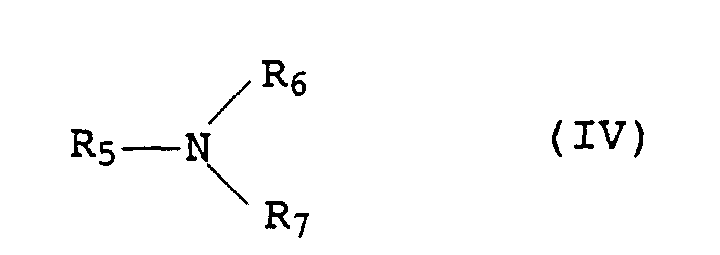
- the amines IV which can be used are preferably primary, secondary be tertiary amines.
- amines examples include butylamine, Dibutylamine, tributylamine, tripropylamine, triisopropylamine, Octylamine, diisobutylamine or stearylamine.
- Amines which have hydroxyl group-containing C 2 to C 18 radicals for R 5 to R 7 for example ethanolamine, diethanolamine, triethanolamine, propanolamine, dipropanolamine, tripropanolamine, isopropanolamine, diisopropanolamine and in particular triisopropanolamine, are also preferred.
- the amines IV should not be too volatile, so ammonia (NH 3 ) is not suitable for the stabilizer mixture.
- Stabilizer mixtures from components (a) + (b) + (c), (a) + (b) + (d) or (a) + (b) + (c) + (d) as the essential components available.
- Components (a) and (b) are preferably in a weight ratio from 90:10 to 5:95, in particular 60:40 to 10:90.
- the weight ratio is (b) (c) preferably 95: 5 to 5:95; it has proven to be convenient if at the same time the weight ratio (a) to (c) is in the range from 1: 1 to 1:14, in particular 1: 5 to 1:10.
- this component is preferably in one Amount of 0.001 to 2.0% by weight, in particular 0.01 to 1.0% by weight, especially 0.02 to 0.5 wt .-%, each based on the amount of (a) + (c), in the stabilizer mixture according to the invention.
- microcapsules usually serve as wall material (shells) solid polymeric materials natural or preferably of synthetic origin, in the core they contain the liquid or mush-like stabilizer mixture, which is usually 50 to 95 wt .-%, in particular 70 to 90 wt .-% of the total weight of the Micro capsule.
- Microcapsules are known in the prior art, the shells of which consist of polycondensates based on urea, phenol or in particular melamine and formaldehyde.
- EP-B 026 914 (3) describes a process for producing such microcapsules by condensing melamine-formaldehyde precondensates or their C 1 -C 4 -alkyl ethers in water, in which the water-insoluble material which forms the capsule core is dispersed is described in the presence of dissolved polymers with negatively charged ionic groups, in particular polymers containing sulfonic acid groups.
- the microcapsules thus obtainable are used for the production of pressure-sensitive recording papers.
- the production process for microcapsules described in (3) is also outstandingly suitable for producing the microcapsules according to the invention which contain the stabilizer mixture from components (a), (b) and (c) and / or (d).
- Suitable starting materials for the wall material are preferably melamine-formaldehyde precondensates and their C 1 -C 4 -alkyl ethers with a weight ratio of melamine to formaldehyde of preferably 1: 3 to 1: 6.
- These precondensates are N-methylol melamine compounds or their ethers with alkanols.
- the pre-condensates used for the process should be miscible with water in any ratio without creating turbidity. Turbidities caused by cooling must be removed by heating. For these reasons, the ethers of methylolmelamines are particularly preferred.
- Suitable water-soluble polymers bearing sulfonic acid groups are, for example, homopolymers or copolymers of sulfoethyl (meth) acrylate, sulfopropyl (meth) acrylate, maleimide-N-ethanesulfonic acid or 2-acrylamido-2-methylpropanesulfonic acid.
- Polymers of 2-acrylamido-2-methylpropanesulfonic acid which can be easily polymerized to give polymers having the desired K values, are preferred.
- the polymers are in the form of the free acid or preferably the alkali metal or trisubstituted ammonium salts.
- copolymers which comprise the monomers or vinylsulfonic acid carrying sulfone groups mentioned and C 1 -C 3 -alkyl acrylates, hydroxy-C 2 -C 4 -alkyl acrylates such as methyl, ethyl, n- or iso Propyl acrylate, hydroxypropyl acrylate and / or N-vinylpyrrolidone are constructed.
- acrylates their proportion in the copolymer is at most 30% by weight.
- hydroxyalkyl acrylates their proportion should not be greater than 10% by weight, based on the sum of the comonomers.
- the proportion of monomers bearing sulfonic acid groups is at least 5, preferably 30% by weight and above, based on the total of the comonomers.
- those with 2-acrylamido-2-methylpropanesulfonic acid as comonomers carrying sulfonic acid groups are preferred.
- the homopolymers and copolymers bearing sulfonic acid groups are prepared by known processes.
- the polymers should have a Fikentscher K value of 100 to 170 (measured in 1% strength by weight aqueous solution at 20 ° C.) or a viscosity of 200 to 5000 mPas at a shear rate of 489 s -1 (measured at 25 ° C in 20% by weight aqueous solution at pH 4.0 to 7.0). Polymers with a K value of 115 to 160 and a viscosity of 400 to 4000 mPas are preferred.
- the application amount of water-soluble sulfonic acids containing Polymers are usually between 1 and 5.5, preferably between 1.5 and 4.5% by weight, based on the aqueous phase.
- the optimal amount of water-soluble sulfo groups The polymer is on the one hand the polymer itself, on the other hand by the Reaction temperature, the desired microcapsule size and the Pre-condensate from melamine and formaldehyde affected. By simple Experiments can easily determine the optimally required amount become. It has been found that the optimal concentration of the water-soluble polymer containing sulfo groups is practically independent of the ratio of the aqueous continuous Phase for the organic, water-insoluble core material phase. That is, under the conditions once optimized Microcapsule dispersions with variable capsule contents practically constant quality.
- the further condensation and condensation of the precondensates during and after capsule formation is conveniently carried out at pH values from 3.0 to 6.5, preferably from 3.5 to 5.5.
- the pH in the aqueous phase can with acids, such as sulfuric acid, hydrochloric acid, Nitric acid, phosphoric acid, oxalic acid or preferably formic acid, or adjusted with sodium hydroxide solution in the case of an acidic aqueous phase become.
- acids such as sulfuric acid, hydrochloric acid, Nitric acid, phosphoric acid, oxalic acid or preferably formic acid, or adjusted with sodium hydroxide solution in the case of an acidic aqueous phase become.
- the onset of turbidity i.e. the precipitation of the Melamine-formaldehyde condensate, is somewhat dependent on the precondensate, so it is for the formation of microcapsules from different Precondensates slightly different optimal pH values and Temperatures there.
- temperatures are for the process described from 15 to 100 ° C is appropriate, temperatures of 40 are preferred up to 90 ° C to achieve faster microcapsule formation.
- the further condensation of the precondensate can be in the range of absence of pH and temperatures above, however also in the presence of the water-soluble sulfo groups High polymers are made.
- the latter method is preferred because the further condensate particles separating from the aqueous solution, which cause the cloudiness, then more even Size are.
- the hydrophobic material to be encapsulated i.e. the stabilizer mixture, can be added either after the appearance of the turbidity or during the further condensation of the precondensate to be present.
- microcapsules are different Diameter producible. So are the capsules in general smaller if you have more precondensate or hydrophilic protective colloid (i.e. the sulfo-containing polymers) or dispersed more intensely or the residence time in the dispersion stage extended. Larger capsules are the other way around To receive measures, individually or in combination. The The degree of further condensation of the precondensate has an influence on the capsule size. If it is in the optimum, it will be constant otherwise Conditions get the smallest capsules. In general are capsules with diameters of 1 to 200 microns, in particular those from 2 to 50 microns, obtained.
- microencapsulation is usually carried out discontinuously (3) performed. Microencapsulation can also be continuous take place, e.g. as described in EP-B 218 887 (4).
- the one in the condensation of melamine-formaldehyde precondensates released formaldehyde can be bound, e.g. in known Way with ammonia at pH values above 7 to 8 or with urea or ethylene urea. It is particularly advantageous in the dispersions obtained the free formaldehyde by condensation bind with melamine. This is done by the condensation acidic dispersion of the particles at 60 to 90 ° C, preferably at 70 to 85 ° C, and at pH 4.0 to 5.0 with stirring within one half to 2 hours with a slurry of melamine in water (Weight ratio melamine to water preferably 1: 2 to 1: 4) continuously added, the condensation until Consumption of free formaldehyde continues.
- the dispersions obtained by the process can be dried e.g. in a spray dryer.
- the powders obtained are free of agglomerates and can be in water or Simply incorporate systems containing solvents.
- For the Insulation by spray drying is the most complete dispersions freed from precondensate.
- processes for producing the microcapsules according to the invention can also be used, for example processes according to EP-A 457 154 (5) using C 1 - to C 24 -alkyl esters of acrylic or methacrylic acid EP-A 468 323 (6) by interfacial polyaddition or interfacial polycondensation between a hydroxylamine and a component reactive with amino and alcohol groups, for example isocyanate, or according to US Pat. No. 5,064,470 (7) using gelatin, for example in combination with Gum arabic.
- Powdered microcapsules are particularly suitable for use with With the help of an extruder as a solid, easily dosed into a plastic to be incorporated.
- the stabilizer mixtures in the form of the dried microcapsule dispersions be premixed homogeneously with a plastic granulate and without Bonding or other machine malfunctions processed in the extruder become.
- microcapsules according to the invention are outstandingly suitable Way to stabilize organic material, in particular of plastics, against the effects of light, oxygen and especially warmth. They are also effective as metal deactivators. They are the organic material to be stabilized in one Concentration from 0.005 to 10.0% by weight, preferably from 0.01 up to 4.0% by weight, in particular from 0.05 to 2.0% by weight, based on the organic material added before or during its manufacture.
- Thermoplastics in particular come as well stabilizable plastics such as polyvinyl chloride, styrene polymers, polyamides, polycarbonates, Polyphenylene oxide, polyester, polyolefins, preferably Polyethylene and polypropylene, polyurethanes and thermosets in Consideration.
- the suitability and effectiveness of the microcapsules according to the invention is in addition to the low intrinsic color and processing stability especially the resistance to hydrolysis and the stable Chroman derivative I content is particularly important.
- Organic material also includes, for example, photographic material Recording materials, especially photographic Emulsions, intermediate products for plastics and lacquers or lacquers to understand yourself.
- microcapsules according to the invention especially with Plastics can all known devices and methods for Mixing in stabilizers or other additives Polymers are applied.
- microcapsules according to the invention can be used primarily for stabilization of plastics used in their processing.
- Such microcapsules are plastic during or before Processing added to the plastics before decomposition protect, the effects of various Stabilizer systems can add.
- microencapsulated stabilizer system consisting of components (a), (b) and (c) and / or (d)
- other stabilizer additives can also be used, e.g. the known synergists calcium stearate and distearylthiodipropionate (S- (CH 2 CH 2 -COOC 18 H 37 ) 2 ), are mixed into the plastics in the usual quantities.
- the stabilizers described can also be used together with Plastic concentrates are made and then put together processed with the plastics to be stabilized. Depending on the area of application, concentrates are used during processing Advantages as these are easier to handle and easier to process are to be dosed.
- the present invention also relates to the action stabilized by light, oxygen and above all heat organic material, especially plastics, which the Microcapsules according to the invention in the concentrations given above contains.
- the stated solids content was obtained by drying (4 hours at 105 ° C) determines and consists essentially of the microcapsules and the water-soluble polymer together.
- the sieve residue was by sieving the dispersion using a vibrating screen Preserved 40 ⁇ m mesh size and weighed wet. Then it contains approx. 50% water.
- the capsule diameters were subjectively below that Microscope, objectively determined using a Malvern Auto-Sizer. The capsule diameter is given in the most common Particle size (number average) and for the particle fraction with the largest total volume (volume average) and the full width at half maximum of the volume average as the capsule diameter or the capsule diameter difference (HW) in the differential distribution curve is shown at 50% of the frequency.
- the viscosity of the capsule dispersion is given as the flow time in seconds from 100 ml of dispersion from the DIN cup with a 4 mm nozzle.
- the viscosity of the 20% strength solutions of the water-soluble, strongly acidic groups, for example polymers containing sulfonic acid, was measured at 25.degree. C. in a Rheomat® 30 (from Contraves) with a shear rate of 489 sec -1 .
- the K value was determined according to Fikentscher (Cellulosechemie 13 (1932), 58 ff), 1% in water, at 20 ° C.
- a solution of 93 g of DL- ⁇ -tocopherol and 93 g of tris-nonylphenyl phosphite in 525 g of white oil was added and dispersed at a stirring speed of 3000 rpm at 30 ° C.
- the pH was now adjusted to 3.6 with formic acid.
- the mixture was stirred further with a propeller stirrer at 800 rpm for one hour at 30 ° C.
- the mixture was then heated to 80 ° C. with stirring and kept at this temperature for 2 hours.
- the microcapsule dispersion was then neutralized to a pH of 7.5 with a 50% strength solution of triethanolamine in water.
- the microcapsules had a particle size of 7 to 20 ⁇ m light microscopic observation.
- the solids content of the dispersion was 39.5%.
- 2000 g of the dispersion were in a spray dryer with an inlet temperature of 140 ° C and a Initial temperature of 65-70 ° C dried.
- the yield was 800 g of a free flowing powder with a solids content of 96.7%.
- microencapsulated stabilizer mixture from Example 1 was in homogenized in an extruder in additive-free dechlorinated polypropylene and granulated. From this once extruded sample the melt index was determined in accordance with DIN 53 735. This sample was then extruded and granulated four times and after the third and fifth extrusion the melt index of the extrudate is determined.
- the extruded plastic is of better quality the lower the melt index value.
- Stabilizer mixture according to Concentration of the stabilizer mixture in polypropylene Melt index after the , Example No. [Wt .-%] 1. Third 5th extrusion 1 0.10 25 32 45 For comparison: without stabilizer - 39 77 > 150
Landscapes
- Chemical & Material Sciences (AREA)
- Health & Medical Sciences (AREA)
- Life Sciences & Earth Sciences (AREA)
- Organic Chemistry (AREA)
- General Health & Medical Sciences (AREA)
- Chemical Kinetics & Catalysis (AREA)
- Polymers & Plastics (AREA)
- Medicinal Chemistry (AREA)
- Veterinary Medicine (AREA)
- Animal Behavior & Ethology (AREA)
- Public Health (AREA)
- Engineering & Computer Science (AREA)
- Epidemiology (AREA)
- Materials Engineering (AREA)
- Birds (AREA)
- Dermatology (AREA)
- Wood Science & Technology (AREA)
- Manufacturing Of Micro-Capsules (AREA)
- Compositions Of Macromolecular Compounds (AREA)
- Anti-Oxidant Or Stabilizer Compositions (AREA)
- Cosmetics (AREA)
Abstract
Description
Die vorliegende Erfindung betrifft Mikrokapseln, enthaltend ein Stabilisatorgemisch aus Chromanderivaten, inerten organischen Lösungsmitteln und organischen Phosphiten oder Phosphoniten und/- oder Aminen zur Stabilisierung von organischem Material gegen die Einwirkung von Licht, Sauerstoff und insbesondere von Wärme.The present invention relates to microcapsules containing a Stabilizer mixture of chroman derivatives, inert organic solvents and organic phosphites or phosphonites and / - or amines to stabilize organic material against the Exposure to light, oxygen and especially heat.
Aus der DE-A 36 34 531 (1) sind Stabilisatorgemische zur Stabilisierung von Kunststoffen aus Chromanderivaten (Vitamin E, α-Tocopherol) und organischen Phosphiten bzw. Phosphoniten bekannt. Die Mischungen haben jedoch den Nachteil, daß sie sowohl bei der Lagerung als auch nach der Einarbeitung in die Kunststoffe nicht stabil sind. Wahrscheinlich aufgrund von Hydrolysereaktionen in Gegenwart von Spuren von Luftfeuchtigkeit beobachtet man eine Abnahme des Gehaltes an Chromanderivaten und damit eine Verringerung der stabilisierenden Wirkung auf die Kunststoffe.DE-A 36 34 531 (1) contains stabilizer mixtures for stabilization of plastics from chroman derivatives (vitamin E, α-tocopherol) and organic phosphites or phosphonites are known. The Mixtures, however, have the disadvantage that they can be stored as well as after incorporation into the plastics are stable. Probably due to hydrolysis reactions in A decrease is observed in the presence of traces of humidity the content of chroman derivatives and thus a reduction the stabilizing effect on the plastics.
In der deutschen Patentanmeldung P 44 05 670 (2) wird ein Stabilisatorgemisch aus Chromanderivaten, organischen Phosphiten bzw. Phosphoniten und Aminen zur Stabilisierung von organischem Material, insbesondere von Kunststoffen, empfohlen, jedoch weist auch dieses Gemisch noch nicht die optimale Stabilität bei der Einarbeitung in die Kunststoffe auf.In German patent application P 44 05 670 (2) a Stabilizer mixture of chroman derivatives, organic phosphites or phosphonites and amines for stabilizing organic Material, especially plastics, recommended, but points even this mixture still does not have the optimal stability at the Familiarization with the plastics.
Die genannten Stabilisatorgemische des Standes der Technik haben weiterhin den großen Nachteil, daß sie flüssig oder breiartig sind und sich somit äußerst schlecht mit thermoplastischen Kunststoffen mischen lassen. Die meisten Kunststoffhersteller und -verarbeiter können darüber hinaus derartige Additive nicht flüssig dosieren und fordern feste Additive, die gut wägbar und leicht handhabbar und zumischbar sind.Have the mentioned stabilizer mixtures of the prior art further the major disadvantage that they are liquid or mushy are and therefore extremely bad with thermoplastics let mix. Most plastic manufacturers and - In addition, processors cannot process such additives in liquid form dose and demand solid additives that are easy to weigh and are easy to handle and mix.
Aufgabe der vorliegenden Erfindung war es daher, ein stabiles Stabilisatorgemisch bereitzustellen, welches außerdem als Feststoff einsetzbar ist.The object of the present invention was therefore to provide a stable Provide stabilizer mixture, which also as a solid can be used.
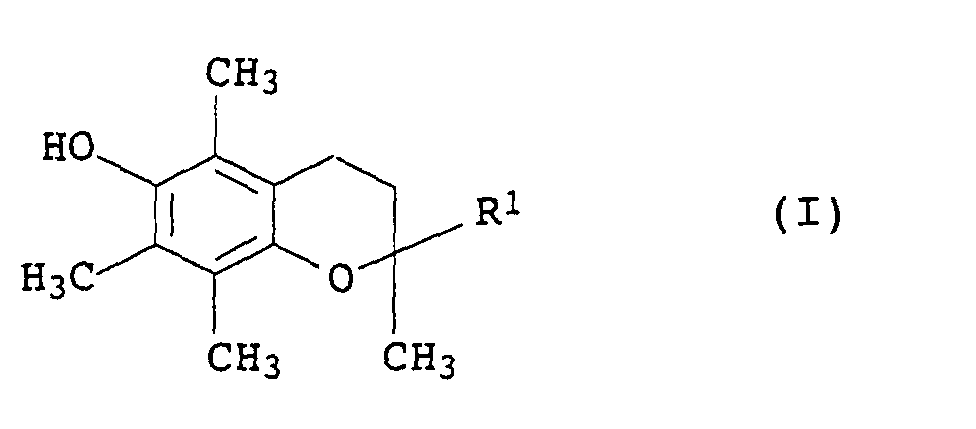
Demgemäß wurden Mikrokapseln, enthaltend ein Stabilisatorgemisch,
enthaltend
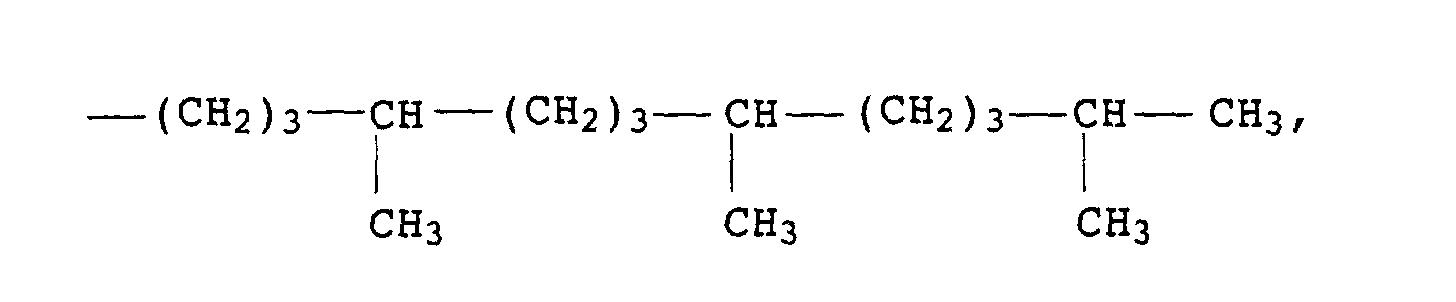
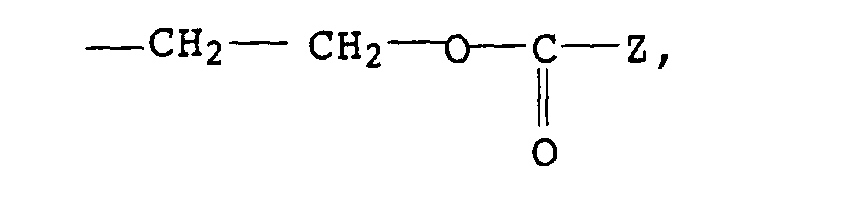
-CH2CH2-S-(C1- bis C30-Alkyl) oder

oder ein organisches Phosphonit der Formel III
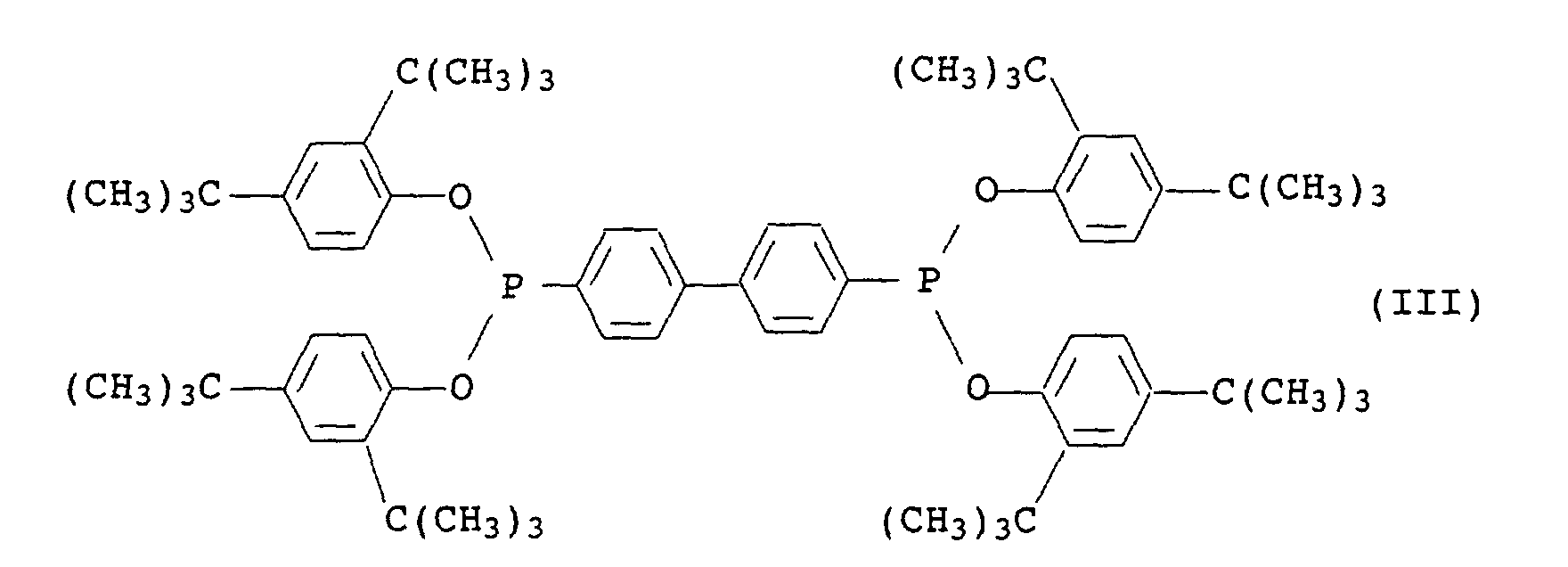
-CH 2 CH 2 -S- (C 1 - to C 30 alkyl) or
or an organic phosphonite of the formula III
Als Chromanderivate I eignen sich vor allem 2,5,7,8-Tetramethyl-2-(2'-stearoyloxyethyl)chroman (R1= -CH2CH2-O-CO-C17H35) und insbesondere α-Tocopherole, vorzugsweise DL-α-Tocopherol (R1= -(CH2)3-CH(CH3)-(CH2)3-CH(CH3)-(CH2)3-C(CH3)2).Particularly suitable as chroman derivatives I are 2,5,7,8-tetramethyl-2- (2'-stearoyloxyethyl) chroman (R 1 = -CH 2 CH 2 -O-CO-C 17 H 35 ) and in particular α-tocopherols , preferably DL-α-tocopherol (R 1 = - (CH 2 ) 3 -CH (CH 3 ) - (CH 2 ) 3 -CH (CH 3 ) - (CH 2 ) 3 -C (CH 3 ) 2 ).
Als inerte organische Lösungsmittel (b) für die Chromanderivate I eignen sich vor allem
- Benzin, Mineralöl und Paraffine wie Weißöl
- partiell hydrierte Terphenyle
- Toluol, Xylole und C2- bis C18-Alkylbenzole wie Dodecylbenzol
- C1- bis C12-Alkylnaphthaline
- Chlorparaffine
- Fluorkohlenwasserstoffe
- übliche Polysiloxane wie Polydimethylsiloxane oder Poly(methylphenylsiloxane)
- natürlich vorkommende Triglyceride gesättigter und/oder ungesättigter Fettsäuren wie Sojaöl, Rüböl, Olivenöl, Sonnenblumenöl, Baumwollsaatöl, Erdnußöl, Leinöl, Rapsöl oder Fischöl
- Gasoline, mineral oil and paraffins like white oil
- partially hydrogenated terphenyls
- Toluene, xylenes and C 2 - to C 18 -alkylbenzenes such as dodecylbenzene
- C 1 to C 12 alkyl naphthalenes
- chlorinated paraffins
- Hydrofluorocarbons
- usual polysiloxanes such as polydimethylsiloxanes or poly (methylphenylsiloxanes)
- naturally occurring triglycerides of saturated and / or unsaturated fatty acids such as soybean oil, rape oil, olive oil, sunflower oil, cottonseed oil, peanut oil, linseed oil, rapeseed oil or fish oil
Diese inerten organischen Lösungsmittel (b) sind normalerweise bei den üblichen Einarbeitungstemperaturen von Additiven in Kunststoffe, d.h. bis ca. 300°C, wärmebeständig. Sie weisen in der Regel eine geringe Flüchtigkeit auf und haben insbesondere Siedetemperaturen über 80°C.These inert organic solvents (b) are normal at the usual incorporation temperatures of additives in Plastics, i.e. up to approx. 300 ° C, heat resistant. They point in the Usually low volatility and have boiling temperatures in particular over 80 ° C.
Die organischen Lösungsmittel (b) können auch in Form von Mischungen verschiedener der genannten Species eingesetzt werden.The organic solvents (b) can also be in the form of Mixtures of different of the species mentioned are used.
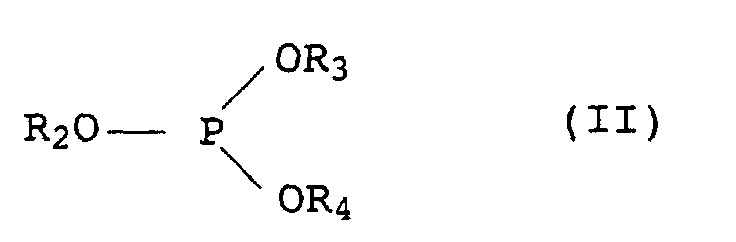
Die einsetzbaren organischen Phosphite II sind sowohl flüssige wie auch kristalline Produkte. Als Beispiel für derartige Phosphite sind zu nennen:
- Trisalkylphosphite mit bevorzugt langkettigen linearen oder verzweigten Alkylgruppen wie Octyl-, Nonyl-, Isononyl-, Decyloder Isodecylgruppen;
- Trisarylphosphite mit unsubstituierten oder ein- bis dreifach alkylsubstituierten Arylgruppen wie Phenyl-, Nonylphenyl- oder 2,4-Di-tert.-butylphenylgruppen;
- gemischte Arylalkylphosphite, wie Diisodecylphenylphosphit oder Diphenylpentaerythritdiphosphit.
- Trisalkyl phosphites with preferably long-chain linear or branched alkyl groups such as octyl, nonyl, isononyl, decyl or isodecyl groups;
- Trisaryl phosphites with unsubstituted or mono- to tri-alkyl-substituted aryl groups such as phenyl, nonylphenyl or 2,4-di-tert-butylphenyl groups;
- mixed arylalkyl phosphites, such as diisodecylphenyl phosphite or diphenylpentaerythritol diphosphite.
Die Phosphite der Formel II können nach bekannten Methoden synthetisiert werden, beispielsweise durch Umsetzung von PCl3 mit ein- oder mehrwertigen Alkoholen in Gegenwart einer organischen Base oder mit gegebenenfalls substituierten Phenolen oder Lösungsmittel bei 20 bis 250°C. Die gemischten Alkylarylphosphite werden beispielsweise durch Umsetzung von Triphenylphosphit mit ein- oder mehrwertigen Alkoholen in Gegenwart eines basischen Katalysators, vorzugsweise ohne Lösungsmittel, hergestellt.The phosphites of the formula II can be synthesized by known methods, for example by reacting PCl 3 with mono- or polyhydric alcohols in the presence of an organic base or with optionally substituted phenols or solvents at 20 to 250 ° C. The mixed alkylaryl phosphites are prepared, for example, by reacting triphenyl phosphite with monohydric or polyhydric alcohols in the presence of a basic catalyst, preferably without a solvent.
Das Phosphonit III ist bekannt und im Handel unter dem Namen Irgafos® P-EPQ der Firma Ciba-Geigy erhältlich.Phosphonite III is known and commercially available under the name Irgafos® P-EPQ available from Ciba-Geigy.
Die einsetzbaren Amine IV können primäre, sekundäre vorzugsweise tertiäre Amine sein.The amines IV which can be used are preferably primary, secondary be tertiary amines.
Als Beispiele für derartige Amine seien genannt: Butylamin, Dibutylamin, Tributylamin, Tripropylamin, Triisopropylamin, Octylamin, Diisobutylamin oder Stearylamin.Examples of such amines are: butylamine, Dibutylamine, tributylamine, tripropylamine, triisopropylamine, Octylamine, diisobutylamine or stearylamine.
Bevorzugt werden weiterhin Amine, die Hydroxylgruppen enthaltende C2- bis C18-Reste für R5 bis R7 besitzen, z.B. Ethanolamin, Diethanolamin, Triethanolamin, Propanolamin, Dipropanolamin, Tripropanolamin, Isopropanolamin, Diisopropanolamin und insbesondere Triisopropanolamin.Amines which have hydroxyl group-containing C 2 to C 18 radicals for R 5 to R 7 , for example ethanolamine, diethanolamine, triethanolamine, propanolamine, dipropanolamine, tripropanolamine, isopropanolamine, diisopropanolamine and in particular triisopropanolamine, are also preferred.
Die Amine IV sollten allerdings eine nicht zu hohe Flüchtigkeit aufweisen, daher eignet sich Ammoniak (NH3) nicht für das Stabilisatorgemisch.However, the amines IV should not be too volatile, so ammonia (NH 3 ) is not suitable for the stabilizer mixture.
Es können also Stabilisatorgemische aus den Komponenten (a)+(b) +(c), (a)+(b)+(d) oder (a)+(b)+(c)+(d) als den wesentlichen Bestandteilen vorliegen.Stabilizer mixtures from components (a) + (b) + (c), (a) + (b) + (d) or (a) + (b) + (c) + (d) as the essential components available.
Die Komponenten (a) und (b) stehen vorzugsweise im Gewichtsverhältnis von 90:10 bis 5:95, insbesondere 60:40 bis 10:90, stehen.Components (a) and (b) are preferably in a weight ratio from 90:10 to 5:95, in particular 60:40 to 10:90.
Bei Mitanwesenheit von (c) beträgt das Gewichtsverhältnis (b) zu (c) vorzugsweise 95:5 bis 5:95; es hat sich als günstig erwiesen, wenn gleichzeitig das Gewichtsverhältnis (a) zu (c) im Bereich von 1:1 bis 1:14, insbesondere 1:5 bis 1:10, liegt. Bei Mitanwesenheit von (d) liegt diese Komponente vorzugsweise in einer Menge von 0,001 bis 2,0 Gew.-%, insbesondere 0,01 bis 1,0 Gew.-%, vor allem 0,02 bis 0,5 Gew.-%, jeweils bezogen auf die Menge von (a)+(c), im erfindungsgemäßen Stabilisatorgemisch vor.If (c) is present, the weight ratio is (b) (c) preferably 95: 5 to 5:95; it has proven to be convenient if at the same time the weight ratio (a) to (c) is in the range from 1: 1 to 1:14, in particular 1: 5 to 1:10. In presence of (d) this component is preferably in one Amount of 0.001 to 2.0% by weight, in particular 0.01 to 1.0% by weight, especially 0.02 to 0.5 wt .-%, each based on the amount of (a) + (c), in the stabilizer mixture according to the invention.
Als Wandmaterial (Hüllen) dieser Mikrokapseln dienen üblicherweise feste polymere Materialien natürlichen oder vorzugsweise synthetischen Ursprungs, im Kern enthalten sie das flüssige oder breiartige Stabilisatorgemisch, welches in der Regel 50 bis 95 Gew.-%, insbesondere 70 bis 90 Gew.-% des Gesamtgewichtes der Mikrokapsel ausmacht.These microcapsules usually serve as wall material (shells) solid polymeric materials natural or preferably of synthetic origin, in the core they contain the liquid or mush-like stabilizer mixture, which is usually 50 to 95 wt .-%, in particular 70 to 90 wt .-% of the total weight of the Micro capsule.
Im Stand der Technik sind Mikrokapseln bekannt, deren Hüllen aus Polykondensaten auf Basis von Harnstoff, Phenol oder insbesondere Melamin und Formaldehyd bestehen. So wird beispielsweise in der EP-B 026 914 (3) ein Verfahren zur Herstellung solcher Mikrokapseln durch Kondensation von Melamin-Formaldehyd-Vorkondensaten oder deren C1- bis C4-Alkylethern in Wasser, in dem das wasserunlösliche, den Kapselkern bildende Material dispergiert ist, in Gegenwart von gelösten Polymeren mit negativ geladenen ionischen Gruppen, insbesondere sulfonsäuregruppenhaltigen Polymeren, beschrieben. Die so erhältlichen Mikrokapseln werden zur Herstellung von druckempfindlichen Aufzeichnungspapieren eingesetzt. Das in (3) beschriebene Herstellungsverfahren für Mikrokapseln eignet sich ebenfalls hervorragend zur Herstellung der erfindungsgemäßen Mikrokapseln, welche das Stabilisatorgemisch aus den Komponenten (a), (b) und (c) und/oder (d) enthalten.Microcapsules are known in the prior art, the shells of which consist of polycondensates based on urea, phenol or in particular melamine and formaldehyde. For example, EP-B 026 914 (3) describes a process for producing such microcapsules by condensing melamine-formaldehyde precondensates or their C 1 -C 4 -alkyl ethers in water, in which the water-insoluble material which forms the capsule core is dispersed is described in the presence of dissolved polymers with negatively charged ionic groups, in particular polymers containing sulfonic acid groups. The microcapsules thus obtainable are used for the production of pressure-sensitive recording papers. The production process for microcapsules described in (3) is also outstandingly suitable for producing the microcapsules according to the invention which contain the stabilizer mixture from components (a), (b) and (c) and / or (d).
Als Ausgangsstoffe für das Wandmaterial eignen sich vorzugsweise Melamin-Formaldehyd-Vorkondensate und deren C1- bis C4-Alkylether mit einem Gewichtsverhältnis von Melamin zu Formaldehyd von vorzugsweise 1:3 bis 1:6. Diese Vorkondensate sind N-Methylolmelaminverbindungen oder deren Ether mit Alkanolen. Die für das Verfahren verwendeten Vorkondensate sollen mit Wasser in jedem Verhältnis mischbar sein, ohne eine Trübung zu erzeugen. Durch Abkühlung auftretende Trübungen müssen sich durch Erwärmen entfernen lassen. Aus diesen Gründen sind die Ether der Methylolmelamine besonders bevorzugt.Suitable starting materials for the wall material are preferably melamine-formaldehyde precondensates and their C 1 -C 4 -alkyl ethers with a weight ratio of melamine to formaldehyde of preferably 1: 3 to 1: 6. These precondensates are N-methylol melamine compounds or their ethers with alkanols. The pre-condensates used for the process should be miscible with water in any ratio without creating turbidity. Turbidities caused by cooling must be removed by heating. For these reasons, the ethers of methylolmelamines are particularly preferred.
Als waserlösliche Sulfonsäuregruppen tragende Polymere kommen z.B. Homo- oder Copolymerisate des Sulfoethyl(meth)acrylats, des Sulfopropyl(meth)acrylats, der Maleinimid-N-ethansulfonsäure oder 2-Acrylamido-2-methylpropansulfonsäure in Betracht. Bevorzugt sind Polymere der 2-Acrylamido-2-methylpropansulfonsäure, die sich leicht zu Polymeren mit den gewünschten K-Werten polymerisieren läßt. Die Polymeren liegen in Form der freien Säure oder vorzugsweise der Alkalimetall- oder trisubstituierten Ammoniumsalze vor. Als Sulfonsäuregruppen tragende Polymere kommen außerdem Copolymere in Betracht, die aus den genannten Sulfongruppen tragenden Monomeren oder Vinylsulfonsäure und C1- bis C3-Alkylacrylaten, Hydroxy-C2- bis C4-alkylacrylaten wie Methyl-, Ethyl-, n- oder iso-Propylacrylat, Hydroxypropylacrylat und/oder N-Vinylpyrrolidon aufgebaut sind. Im Falle der Acrylate beträgt deren Anteil im Copolymerisat maximal 30 Gew.-%. Im Falle der Hydroxyalkylacrylate soll deren Anteil nicht größer als 10 Gew.-%, bezogen auf die Summe der Comonomeren, sein. Bei Copolymerisaten mit N-Vinylpyrrolidon liegt der Anteil an Sulfonsäuregruppen tragenden Monomeren bei mindestens 5, vorzugsweise bei 30 Gew.-% und darüber, bezogen auf die Summe der Comonomeren. Von den Copolymerisaten sind solche mit 2-Acrylamido-2-methylpropansulfonsäure als sulfonsäuregruppentragende Comonomere bevorzugt. Die sulfonsäuregruppentragenden Homo- und Copolymerisate werden nach bekannten Verfahren hergestellt.Suitable water-soluble polymers bearing sulfonic acid groups are, for example, homopolymers or copolymers of sulfoethyl (meth) acrylate, sulfopropyl (meth) acrylate, maleimide-N-ethanesulfonic acid or 2-acrylamido-2-methylpropanesulfonic acid. Polymers of 2-acrylamido-2-methylpropanesulfonic acid, which can be easily polymerized to give polymers having the desired K values, are preferred. The polymers are in the form of the free acid or preferably the alkali metal or trisubstituted ammonium salts. Also suitable as polymers carrying sulfonic acid groups are copolymers which comprise the monomers or vinylsulfonic acid carrying sulfone groups mentioned and C 1 -C 3 -alkyl acrylates, hydroxy-C 2 -C 4 -alkyl acrylates such as methyl, ethyl, n- or iso Propyl acrylate, hydroxypropyl acrylate and / or N-vinylpyrrolidone are constructed. In the case of acrylates, their proportion in the copolymer is at most 30% by weight. In the case of hydroxyalkyl acrylates, their proportion should not be greater than 10% by weight, based on the sum of the comonomers. In the case of copolymers with N-vinylpyrrolidone, the proportion of monomers bearing sulfonic acid groups is at least 5, preferably 30% by weight and above, based on the total of the comonomers. Of the copolymers, those with 2-acrylamido-2-methylpropanesulfonic acid as comonomers carrying sulfonic acid groups are preferred. The homopolymers and copolymers bearing sulfonic acid groups are prepared by known processes.
Die Polymeren sollen einen K-Wert nach Fikentscher von 100 bis 170 (gemessen in 1 gew.-%iger wäßriger Lösung bei 20°C) oder eine Viskosität von 200 bis 5000 mPas bei einem Schergefälle von 489 s-1 (gemessen bei 25°C in 20 gew.-%iger wäßriger Lösung bei pH 4,0 bis 7,0) aufweisen. Bevorzugt sind Polymere mit einem K-Wert von 115 bis 160, deren Viskosität 400 bis 4000 mPas beträgt.The polymers should have a Fikentscher K value of 100 to 170 (measured in 1% strength by weight aqueous solution at 20 ° C.) or a viscosity of 200 to 5000 mPas at a shear rate of 489 s -1 (measured at 25 ° C in 20% by weight aqueous solution at pH 4.0 to 7.0). Polymers with a K value of 115 to 160 and a viscosity of 400 to 4000 mPas are preferred.
Die Anwendungsmenge an wasserlöslichen Sulfonsäuren enthaltenden Polymeren liegt in der Regel zwischen 1 und 5,5, vorzugsweise zwischen 1,5 und 4,5 Gew.-%, bezogen auf die wäßrige Phase.The application amount of water-soluble sulfonic acids containing Polymers are usually between 1 and 5.5, preferably between 1.5 and 4.5% by weight, based on the aqueous phase.
Die optimale Menge der wasserlöslichen Sulfogruppen enthaltenden Polymeren wird einmal vom Polymeren selbst, zum anderen von der Reaktionstemperatur, der gewünschten Mikrokapselgröße und dem Vorkondensat aus Melamin und Formaldehyd beeinflußt. Durch einfache Versuche kann die optimal benötigte Menge leicht ermittelt werden. Es hat sich herausgestellt, daß die optimale Konzentration des wasserlöslichen Sulfogruppen aufweisenden Polymeren praktisch unabhängig ist vom Verhältnis der wäßrigen kontinuierlichen Phase zur organischen, wasserunlöslichen Kernmaterialphase. Das heißt, unter den einmal optimierten Bedingungen können Mikrokapseldispersionen mit variablen Gehalten an Kapseln bei praktisch gleichbleibender Qualität hergestellt werden.The optimal amount of water-soluble sulfo groups The polymer is on the one hand the polymer itself, on the other hand by the Reaction temperature, the desired microcapsule size and the Pre-condensate from melamine and formaldehyde affected. By simple Experiments can easily determine the optimally required amount become. It has been found that the optimal concentration of the water-soluble polymer containing sulfo groups is practically independent of the ratio of the aqueous continuous Phase for the organic, water-insoluble core material phase. That is, under the conditions once optimized Microcapsule dispersions with variable capsule contents practically constant quality.
Die Weiter- und Auskondensation der Vorkondensate während und nach der Kapselbildung erfolgt zweckmäßigerweise bei pH-Werten von 3,0 bis 6,5, vorzugsweise von 3,5 bis 5,5. Der pH-Wert in der wäßrigen Phase kann mit Säuren, wie Schwefelsäure, Salzsäure, Salpetersäure, Phosphorsäure, Oxalsäure oder vorzugsweise Ameisensäure, oder bei saurer wäßriger Phase mit Natronlauge eingestellt werden. Der Beginn der Trübung, d.h. die Ausfällung des Melamin-Formaldehyd-Kondensates, ist etwas vom Vorkondensat abhängig, so daß es für die Bildung der Mikrokapseln aus verschiedenen Vorkondensaten etwas unterschiedliche optimale pH-Werte und Temperaturen gibt. The further condensation and condensation of the precondensates during and after capsule formation, it is conveniently carried out at pH values from 3.0 to 6.5, preferably from 3.5 to 5.5. The pH in the aqueous phase can with acids, such as sulfuric acid, hydrochloric acid, Nitric acid, phosphoric acid, oxalic acid or preferably formic acid, or adjusted with sodium hydroxide solution in the case of an acidic aqueous phase become. The onset of turbidity, i.e. the precipitation of the Melamine-formaldehyde condensate, is somewhat dependent on the precondensate, so it is for the formation of microcapsules from different Precondensates slightly different optimal pH values and Temperatures there.
Im allgemeinen sind für das beschriebene Verfahren Temperaturen von 15 bis 100°C zweckmäßig, bevorzugt sind Temperaturen von 40 bis 90°C, um eine schnellere Mikrokapselbildung zu erreichen.In general, temperatures are for the process described from 15 to 100 ° C is appropriate, temperatures of 40 are preferred up to 90 ° C to achieve faster microcapsule formation.
Die Weiterkondensation des Vorkondensates kann im Bereich der oben genannten pH-Werte und Temperaturen in Abwesenheit, aber auch in Anwesenheit des wasserlöslichen Sulfogruppen tragenden Hochpolymeren erfolgen. Letzteres Verfahren ist bevorzugt, da die sich aus der wäßrigen Lösung ausscheidenden Weiterkondensatteilchen, die die Trübung verursachen, dann von gleichmäßigerer Größe sind.The further condensation of the precondensate can be in the range of absence of pH and temperatures above, however also in the presence of the water-soluble sulfo groups High polymers are made. The latter method is preferred because the further condensate particles separating from the aqueous solution, which cause the cloudiness, then more even Size are.
Das hydrophobe zu verkapselnde Material, d.h. das Stabilisatorgemisch, kann entweder nach dem Auftreten der Trübung zugegeben werden oder bereits während der Weiterkondensation des Vorkondensates anwesend sein.The hydrophobic material to be encapsulated, i.e. the stabilizer mixture, can be added either after the appearance of the turbidity or during the further condensation of the precondensate to be present.
Gemäß dem beschriebenen Verfahren sind Mikrokapseln verschiedener Durchmesser herstellbar. So werden die Kapseln im allgemeinen kleiner, wenn man mehr Vorkondensat oder hydrophiles Schutzkolloid (d.h. die sulfogruppenhaltigen Polymeren) einsetzt oder intensiver dispergiert oder die Verweilzeit in der Dispergierstufe verlängert. Größere Kapseln sind entsprechend mit den umgekehrten Maßnahmen, einzeln oder in Kombination, zu erhalten. Der Weiterkondensationsgrad des Vorkondensates ist von Einfluß auf die Kapselgröße. Liegt er im Optimum, werden unter sonst konstanten Bedingungen die kleinsten Kapseln erhalten. Im allgemeinen werden Kapseln mit Durchmessern von 1 bis 200 µm, insbesondere solche von 2 bis 50 µm, erhalten.According to the described method, microcapsules are different Diameter producible. So are the capsules in general smaller if you have more precondensate or hydrophilic protective colloid (i.e. the sulfo-containing polymers) or dispersed more intensely or the residence time in the dispersion stage extended. Larger capsules are the other way around To receive measures, individually or in combination. The The degree of further condensation of the precondensate has an influence on the capsule size. If it is in the optimum, it will be constant otherwise Conditions get the smallest capsules. In general are capsules with diameters of 1 to 200 microns, in particular those from 2 to 50 microns, obtained.
Die Mikroverkapselung wird in der Regel diskontinuierlich gemäß (3) durchgeführt. Die Mikroverkapselung kann aber auch kontinuierlich erfolgen, z.B. wie in der EP-B 218 887 (4) beschrieben.The microencapsulation is usually carried out discontinuously (3) performed. Microencapsulation can also be continuous take place, e.g. as described in EP-B 218 887 (4).
Der bei der Kondensation der Melamin-Formaldehyd-Vorkondensate freiwerdende Formaldehyd kann gebunden werden, z.B. in bekannter Weise mit Ammoniak bei pH-Werten oberhalb 7 bis 8 oder mit Harnstoff oder Ethylenharnstoff. Besonders vorteilhaft ist, bei den erhaltenen Dispersionen den freien Formaldehyd durch Kondensation mit Melamin zu binden. Hierzu wird die noch von der Kondensation her saure Dispersion der Teilchen bei 60 bis 90°C, bevorzugt bei 70 bis 85°C, und bei pH 4,0 bis 5,0 unter Rühren innerhalb einer halben bis 2 Stunden mit einer Aufschlämmung von Melamin in Wasser (Gewichtsverhältnis Melamin zu Wasser vorzugsweise 1:2 bis 1:4) kontinuierlich versetzt, wobei man die Kondensation bis zum Verbrauch des freien Formaldehyds fortführt. The one in the condensation of melamine-formaldehyde precondensates released formaldehyde can be bound, e.g. in known Way with ammonia at pH values above 7 to 8 or with urea or ethylene urea. It is particularly advantageous in the dispersions obtained the free formaldehyde by condensation bind with melamine. This is done by the condensation acidic dispersion of the particles at 60 to 90 ° C, preferably at 70 to 85 ° C, and at pH 4.0 to 5.0 with stirring within one half to 2 hours with a slurry of melamine in water (Weight ratio melamine to water preferably 1: 2 to 1: 4) continuously added, the condensation until Consumption of free formaldehyde continues.
Die nach dem Verfahren erhaltenen Dispersionen können getrocknet werden, z.B. in einem Sprühtrockner. Die dabei erhaltenen Pulver sind frei von Agglomeraten und lassen sich in Wasser oder Lösungsmittel enthaltende Systeme einfach einarbeiten. Für die Isolierung durch Sprühtrocknung sind vor allem die vollständig von Vorkondensat befreiten Dispersionen geeignet.The dispersions obtained by the process can be dried e.g. in a spray dryer. The powders obtained are free of agglomerates and can be in water or Simply incorporate systems containing solvents. For the Insulation by spray drying is the most complete dispersions freed from precondensate.
Neben dem oben beschriebenen Melaminharz-Verfahren können auch andere Verfahren zur Herstellung der erfindungsgemäßen Mikrokapseln eingesetzt werden, so beispielsweise Verfahren gemäß der EP-A 457 154 (5) unter Verwendung von C1- bis C24-Alkylestern der Acryl- oder Methacrylsäure, gemäß der EP-A 468 323 (6) durch Grenzflächenpolyaddition oder Grenzflächenpolykondensation zwischen einem Hydroxylamin und einer mit Amino- und Alkoholgruppen reaktiven Komponente, z.B. Isocyanat, oder gemäß der US-A 5 064 470 (7) unter Verwendung von Gelatine, beispielsweise in Kombination mit Gummi arabicum.In addition to the melamine resin process described above, other processes for producing the microcapsules according to the invention can also be used, for example processes according to EP-A 457 154 (5) using C 1 - to C 24 -alkyl esters of acrylic or methacrylic acid EP-A 468 323 (6) by interfacial polyaddition or interfacial polycondensation between a hydroxylamine and a component reactive with amino and alcohol groups, for example isocyanate, or according to US Pat. No. 5,064,470 (7) using gelatin, for example in combination with Gum arabic.
Besonders gut geeignet sind pulverförmige Mikrokapseln, um mit Hilfe eines Extruders als Feststoff gut dosierbar in einen Kunststoff eingearbeitet zu werden. Auf diese Weise können die Stabilisatorgemische in Form der getrockneten Mikrokapseldispersionen mit einem Kunststoffgranulat homogen vorgemischt werden und ohne Verklebungen oder andere Maschinenstörungen im Extruder verarbeitet werden.Powdered microcapsules are particularly suitable for use with With the help of an extruder as a solid, easily dosed into a plastic to be incorporated. In this way, the stabilizer mixtures in the form of the dried microcapsule dispersions be premixed homogeneously with a plastic granulate and without Bonding or other machine malfunctions processed in the extruder become.
Die erfindungsgemäßen Mikrokapseln eignen sich in hervorragender Weise zum Stabilisieren von organischem Material, insbesondere von Kunststoffen, gegen die Einwirkung von Licht, Sauerstoff und vor allem Wärme. Sie sind auch wirksam als Metalldesaktivatoren. Sie werden dem zu stabilisierenden organischen Material in einer Konzentration von 0,005 bis 10,0 Gew.-%, vorzugsweise von 0,01 bis 4,0 Gew.-%, insbesondere von 0,05 bis 2,0 Gew.-%, bezogen auf das organische Material, vor oder während seiner Herstellung zugesetzt.The microcapsules according to the invention are outstandingly suitable Way to stabilize organic material, in particular of plastics, against the effects of light, oxygen and especially warmth. They are also effective as metal deactivators. They are the organic material to be stabilized in one Concentration from 0.005 to 10.0% by weight, preferably from 0.01 up to 4.0% by weight, in particular from 0.05 to 2.0% by weight, based on the organic material added before or during its manufacture.
Als Kunststoffe, die durch die erfindungsgemäßen Mikrokapseln
stabilisiert werden können, seien beispielsweise genannt:
Als gutstabilisierbare Kunststoffe kommen insbesondere Thermoplaste wie Polyvinylchlorid, Styrolpolymerisate, Polyamide, Polycarbonate, Polyphenylenoxid, Polyester, Polyolefine, vorzugsweise Polyethylen und Polypropylen, Polyurethane sowie Duroplaste in Betracht.Thermoplastics in particular come as well stabilizable plastics such as polyvinyl chloride, styrene polymers, polyamides, polycarbonates, Polyphenylene oxide, polyester, polyolefins, preferably Polyethylene and polypropylene, polyurethanes and thermosets in Consideration.
Für die Eignung und Wirksamkeit der erfindungsgemäßen Mikrokapseln ist neben der geringen Eigenfarbe und der Verarbeitungsstabilität vor allem die Hydrolysebeständigkeit und der stabile Gehalt an Chromanderivaten I besonders wichtig.For the suitability and effectiveness of the microcapsules according to the invention is in addition to the low intrinsic color and processing stability especially the resistance to hydrolysis and the stable Chroman derivative I content is particularly important.
Unter organischem Material sind weiter beispielsweise photographische Aufzeichnungsmaterialien, insbesondere photographische Emulsionen, Vorprodukte für Kunststoffe und Lacke oder Lacke selbst zu verstehen.Organic material also includes, for example, photographic material Recording materials, especially photographic Emulsions, intermediate products for plastics and lacquers or lacquers to understand yourself.
Zur Vermischung der erfindungsgemäßen Mikrokapseln vor allem mit Kunststoffen können alle bekannten Vorrichtungen und Methoden zum Einmischen von Stabilisierungsmitteln oder anderen Zusätzen in Polymere angewandt werden.For mixing the microcapsules according to the invention especially with Plastics can all known devices and methods for Mixing in stabilizers or other additives Polymers are applied.
Die erfindungsgemäßen Mikrokapseln können vor allem zur Stabilisierung von Kunststoffen bei deren Verarbeitung verwendet werden. Derartige Mikrokapseln werden Kunststoffen während oder vor der Verarbeitung zugesetzt, um die Kunststoffe vor Zersetzung zu schützen, wobei sich bekanntlich die Wirkungen verschiedener Stabilisatorsysteme addieren können. The microcapsules according to the invention can be used primarily for stabilization of plastics used in their processing. Such microcapsules are plastic during or before Processing added to the plastics before decomposition protect, the effects of various Stabilizer systems can add.
Neben dem mikroverkapselten Stabilisatorsystem aus den Komponenten (a), (b) und (c) und/oder (d) können so auch weitere Stabilisatorzusätze, z.B. die für Stabilisierungszwecke bekannten Synergisten Calciumstearat und Distearylthiodipropionat (S-(CH2CH2-COOC18H37)2), in üblichen Mengen in die Kunststoffe mit eingemischt werden.In addition to the microencapsulated stabilizer system consisting of components (a), (b) and (c) and / or (d), other stabilizer additives can also be used, e.g. the known synergists calcium stearate and distearylthiodipropionate (S- (CH 2 CH 2 -COOC 18 H 37 ) 2 ), are mixed into the plastics in the usual quantities.
Mit den beschriebenen Stabilisatoren können auch zusammen mit Kunststoffen Konzentrate hergestellt werden und diese dann zusammen mit den zu stabilisierenden Kunststoffen verarbeitet werden. Bei der Verarbeitung bringen je nach Anwendungsgebiet Konzentrate Vorteile, da diese bei der Verarbeitung leichter zu handhaben und zu dosieren sind.The stabilizers described can also be used together with Plastic concentrates are made and then put together processed with the plastics to be stabilized. Depending on the area of application, concentrates are used during processing Advantages as these are easier to handle and easier to process are to be dosed.
Gegenstand der vorliegenden Erfindung ist außerdem gegen die Einwirkung von Licht, Sauerstoff und vor allem Wärme stabilisiertes organisches Material, insbesondere Kunststoffe, welches die erfindungsgemäßen Mikrokapseln in den oben angegebenen Konzentrationen enthält.The present invention also relates to the action stabilized by light, oxygen and above all heat organic material, especially plastics, which the Microcapsules according to the invention in the concentrations given above contains.
Das beschriebene Verfahren zur Herstellung der erfindungsgemäßen Mikrokapseln soll durch das folgende Ausführungsbeispiel weiter erläutert werden. Im folgenden beziehen sich die Teile und Prozente auf das Gewicht. Dabei sind die Prozentangaben ihrerseits auf das Gewicht der Lösung oder Dispersion bezogen. Volumenteile entsprechen Gewichtsteilen mit der Dichte 1.The process described for the preparation of the invention Microcapsules should continue through the following embodiment are explained. In the following, the parts and percentages refer on the weight. The percentages are in turn based on the weight of the solution or dispersion. volumes correspond to parts by weight with density 1.
Der angegebene Feststoffgehalt wurde durch Trocknung (4 Stunden bei 105°C) bestimmt und setzt sich im wesentlichen aus den Mikrokapseln und dem wasserlöslichen Polymeren zusammen. Der Siebrückstand wurde durch Sieben der Dispersion über ein Rüttelsieb mit 40 µm-Maschenweite erhalten und feucht gewogen. Er enthält dann ca. 50 % Wasser. Die Kapseldurchmesser wurden subjektiv unter dem Mikroskop, objektiv mittels eines Malvern Auto-Sizers bestimmt. Angegeben wird der Kapseldurchmesser in den für die häufigste Teilchengröße (Zahlenmittel) und für die Teilchenfraktion mit dem größten Gesamtvolumen (Volumenmittel) sowie die Halbwertsbreite des Volumenmittels als der Kapseldurchmesser bzw. die Kapseldurchmesserdifferenz (HW), die in der differentiellen Verteilungskurve bei 50 % der Häufigkeit ausgewiesen wird.The stated solids content was obtained by drying (4 hours at 105 ° C) determines and consists essentially of the microcapsules and the water-soluble polymer together. The sieve residue was by sieving the dispersion using a vibrating screen Preserved 40 µm mesh size and weighed wet. Then it contains approx. 50% water. The capsule diameters were subjectively below that Microscope, objectively determined using a Malvern Auto-Sizer. The capsule diameter is given in the most common Particle size (number average) and for the particle fraction with the largest total volume (volume average) and the full width at half maximum of the volume average as the capsule diameter or the capsule diameter difference (HW) in the differential distribution curve is shown at 50% of the frequency.
Die Viskosität der Kapseldispersion wird als Auslaufzeit in Sekunden von 100 ml Dispersion aus dem DIN-Becher mit 4 mm-Düse angegeben. Die Viskosität der 20 %igen Lösungen der wasserlöslichen stark saure Gruppen, z.B. Sulfonsäure, enthaltenden Polymeren wurde bei 25°C im Rheomat® 30 (Firma Contraves) bei einem Schergefälle von 489 sec-1 gemessen. Der K-Wert wurde nach Fikentscher (Cellulosechemie 13 (1932), 58 ff), 1 %ig in Wasser, bei 20°C bestimmt.The viscosity of the capsule dispersion is given as the flow time in seconds from 100 ml of dispersion from the DIN cup with a 4 mm nozzle. The viscosity of the 20% strength solutions of the water-soluble, strongly acidic groups, for example polymers containing sulfonic acid, was measured at 25.degree. C. in a Rheomat® 30 (from Contraves) with a shear rate of 489 sec -1 . The K value was determined according to Fikentscher (Cellulosechemie 13 (1932), 58 ff), 1% in water, at 20 ° C.
In einem zylindrisch geformten 4-1-Rührgefäß mit einem Dissolverrührer mit 5 cm-Zahnscheibe wurden 1000 g Wasser, 141 g einer 70 %igen, wäßrigen Lösung eines in Wasser klar löslichen, partiell methylierten Vorkondensates (enthielt ca. 2,3 CH3O-Gruppen pro Melaminmolekül) aus 1 mol Melamin und 5,25 mol Formaldehyd, 129 g einer 20 %igen wäßrigen Lösung von Poly-2-acrylamido-2-methylpropansulfonsäure-Natriumsalz (K-Wert = 140) vorgelegt. Bei 3000 Upm Rührgeschwindigkeit wurde bei 30°C eine Lösung aus 93 g DL-α-Tocopherol und 93 g Tris-nonylphenylphosphit in 525 g Weißöl hinzugegeben und dispergiert. Der pH-Wert wurde jetzt mit Ameisensäure auf 3,6 eingestellt. Nach einer Stunde Dispergieren wurde der Ansatz mit einem Propellerrührer bei 800 Upm für eine Stunde bei 30°C weitergerührt. Anschließend wurde unter Rühren auf 80°C aufgeheizt und für 2 Stunden bei dieser Temperatur gehalten. Anschließend wurde die Mikrokapseldispersion mit einer 50 %igen Lösung von Triethanolamin in Wasser auf einen pH-Wert von 7,5 neutralisiert.1000 g of water, 141 g of a 70% strength aqueous solution of a partially methylated precondensate which was clearly soluble in water (contained about 2.3 CH 3 O.) were placed in a cylindrical 4-1 stirred vessel with a dissolver stirrer with a 5 cm toothed lock washer Groups per melamine molecule) from 1 mol of melamine and 5.25 mol of formaldehyde, 129 g of a 20% strength aqueous solution of poly-2-acrylamido-2-methylpropanesulfonic acid sodium salt (K value = 140). A solution of 93 g of DL-α-tocopherol and 93 g of tris-nonylphenyl phosphite in 525 g of white oil was added and dispersed at a stirring speed of 3000 rpm at 30 ° C. The pH was now adjusted to 3.6 with formic acid. After dispersing for one hour, the mixture was stirred further with a propeller stirrer at 800 rpm for one hour at 30 ° C. The mixture was then heated to 80 ° C. with stirring and kept at this temperature for 2 hours. The microcapsule dispersion was then neutralized to a pH of 7.5 with a 50% strength solution of triethanolamine in water.
Die Mikrokapseln hatten eine Teilchengröße von 7 bis 20 µm nach lichtmikroskopischer Betrachtung. Der Feststoffgehalt der Dispersion betrug 39,5 %. 2000 g der Dispersion wurden in einem Sprühtrockner mit einer Eingangstemperatur von 140°C und einer Ausgangstemperatur von 65-70°C getrocknet. Die Ausbeute war 800 g eines freifließenden Pulvers mit einem Feststoffgehalt von 96,7 %.The microcapsules had a particle size of 7 to 20 µm light microscopic observation. The solids content of the dispersion was 39.5%. 2000 g of the dispersion were in a spray dryer with an inlet temperature of 140 ° C and a Initial temperature of 65-70 ° C dried. The yield was 800 g of a free flowing powder with a solids content of 96.7%.
Für die Eignung und Wirksamkeit von Kunststoffstabilisatoren ist vor allem die Verarbeitungsstabilität von Bedeutung.For the suitability and effectiveness of plastic stabilizers processing stability is particularly important.
Das mikroverkapselte Stabilisatorgemisch aus Beispiel 1 wurde in einem Extruder in additivfreies dechloriertes Polypropylen homogenisiert und granuliert. Aus dieser einmal extrudierten Probe wurde der Schmelzindex nach DIN 53 735 bestimmt. Diese Probe wurde dann noch viermal extrudiert und granuliert und nach der dritten und fünften Extrusion der Schmelzindex des Extrudats bestimmt.The microencapsulated stabilizer mixture from Example 1 was in homogenized in an extruder in additive-free dechlorinated polypropylene and granulated. From this once extruded sample the melt index was determined in accordance with DIN 53 735. This sample was then extruded and granulated four times and after the third and fifth extrusion the melt index of the extrudate is determined.
Die Meßergebnisse sind in der folgenden Tabelle zusammgestellt. The measurement results are summarized in the following table.
Dabei ist der extrudierte Kunststoff von um so besserer Qualität,
je niedriger der Schmelzindexwert ist.
Claims (3)
- Microcapsules containing a stabilizer mixture comprisingwhere components (a) and (b) are in a weight ratio of from 99:1 to 1:99 and components (b) and (c) are in a weight ratio of from 100:0 to 1:99, and component (d) is present in the stabilizer mixture in an amount of from 0 to 2.0% by weight, based on the amount of (a) + (c) with the proviso that at least one of components (c) or (d) is present.(a) one or more chroman derivatives of the general formula Iin which R1 is a group of the formula
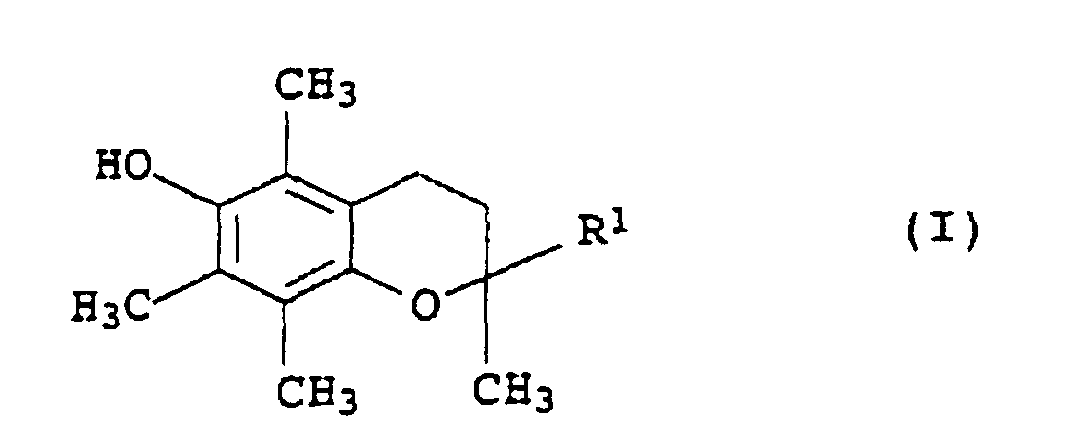
 in which Z is C7- to C30-alkyl,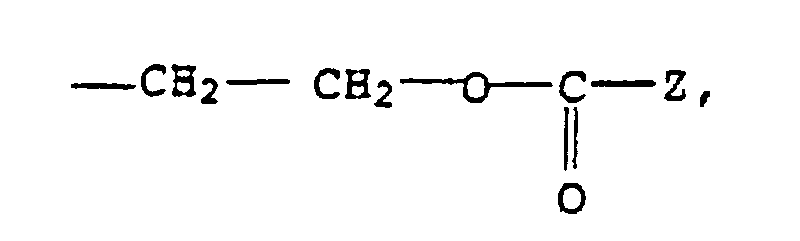
-CH2-CH2-S-(C1- to C30-alkyl) or (b) an inert organic solvent for the chroman derivatives I from the group consisting of aliphatic, cycloaliphatic and aromatic hydrocarbons or halogenated hydrocarbons, silicone oils and vegetable and animal fatty oils,(c) one or more organic phosphites of the general formula IIin which the radicals R2 to R4 are each C2- to C12-alkyl or C6- to C18-aryl, which may be substituted by C1- to C18-alkyl groups,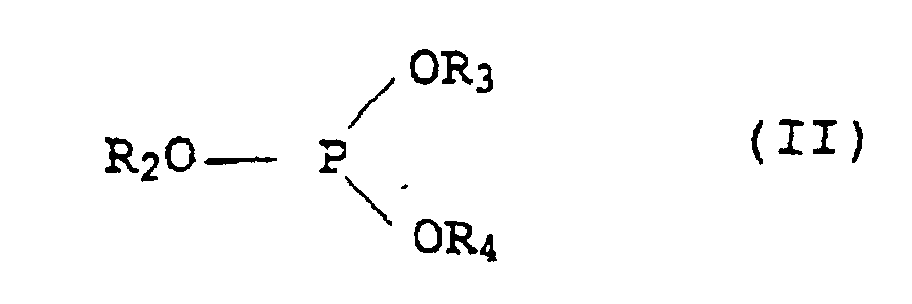
or an organic phosphonite of the formula IIIor mixtures of the phosphites II and the phosphonite III, and/or (d) one or more amines of the general formula IVin which the radicals R5 to R7 are each hydrogen, C1- to C18-alkyl, which may be interrupted by up to 5 non-adjacent oxygen atoms or groups of the formula -NR8- and may be substituted by up to 3 hydroxyl groups,
where R8 is hydrogen or C1- to C4-alkyl, or are phenyl, which may be substituted by up to 3 C4- to C18-alkyl groups, with the exception of NH3 as the amine IV, - Use of microcapsules as claimed in claim 1 for stabilizing organic material against the action of light, oxygen and heat.
- Organic material which is stabilized against the action of light, oxygen and heat, comprising from 0.005 to 10.0% by weight, based on the amount of the organic material, of microcapsules as claimed in claim 1.
Applications Claiming Priority (3)
| Application Number | Priority Date | Filing Date | Title |
|---|---|---|---|
| DE19501053A DE19501053A1 (en) | 1995-01-16 | 1995-01-16 | Stabilizer mixture of chroman derivatives and inert organic solvents and microcapsules containing this stabilizer mixture |
| DE19501053 | 1995-01-16 | ||
| PCT/EP1996/000058 WO1996022325A1 (en) | 1995-01-16 | 1996-01-09 | Stabiliser mixture made from chromane derivatives and inert organic solvents, and microcapsules containing the said stabiliser mixture |
Publications (2)
| Publication Number | Publication Date |
|---|---|
| EP0804501A1 EP0804501A1 (en) | 1997-11-05 |
| EP0804501B1 true EP0804501B1 (en) | 2002-05-22 |
Family
ID=7751558
Family Applications (1)
| Application Number | Title | Priority Date | Filing Date |
|---|---|---|---|
| EP96900923A Expired - Lifetime EP0804501B1 (en) | 1995-01-16 | 1996-01-09 | Microcapsules containing a stabiliser mixture made from chromane derivatives, inert organic solvents and organic phosphites or phosphonites and/or amines. |
Country Status (7)
| Country | Link |
|---|---|
| US (1) | US5837759A (en) |
| EP (1) | EP0804501B1 (en) |
| JP (1) | JP3594614B2 (en) |
| CN (1) | CN1168146A (en) |
| AT (1) | ATE217895T1 (en) |
| DE (2) | DE19501053A1 (en) |
| WO (1) | WO1996022325A1 (en) |
Families Citing this family (18)
| Publication number | Priority date | Publication date | Assignee | Title |
|---|---|---|---|---|
| DE19521848A1 (en) * | 1995-06-16 | 1996-12-19 | Basf Ag | Stabilization of polymers of styrene or a (meth) acrylic compound |
| DE69800335T2 (en) * | 1997-04-24 | 2001-02-22 | Konica Corp., Tokio/Tokyo | Photographic developer and method for developing photographic light-sensitive silver halide materials by the same |
| DE10036655A1 (en) * | 2000-07-26 | 2002-02-07 | Basf Ag | Cosmetic or dermatological preparations to prevent skin damage from peroxides |
| US20090088513A1 (en) | 2005-06-29 | 2009-04-02 | Adeka Corporation | Resin additive composition and resin composition |
| JP5456237B2 (en) | 2007-02-05 | 2014-03-26 | 株式会社Adeka | Resin additive masterbatch |
| US7593510B2 (en) * | 2007-10-23 | 2009-09-22 | American Science And Engineering, Inc. | X-ray imaging with continuously variable zoom and lateral relative displacement of the source |
| JP5680879B2 (en) | 2010-05-26 | 2015-03-04 | 株式会社Adeka | Resin additive masterbatch |
| US11267951B2 (en) | 2010-12-13 | 2022-03-08 | Cytec Technology Corp. | Stabilizer compositions containing substituted chroman compounds and methods of use |
| US11312043B2 (en) | 2010-12-13 | 2022-04-26 | Cytec Technology Corp. | Processing additives and uses of same in rotational molding |
| BR112014018614B1 (en) | 2012-02-01 | 2021-01-19 | Adeka Corporation | masterbatch for resin additive |
| CN103824973A (en) * | 2013-11-06 | 2014-05-28 | 溧阳市江大技术转移中心有限公司 | Method for manufacturing organic light-emitting diode provided with hole injection layer and electrical transmission layer |
| CN103811680A (en) * | 2013-11-06 | 2014-05-21 | 溧阳市江大技术转移中心有限公司 | Manufacturing method of high efficiency organic light emitting diode |
| CN103811664A (en) * | 2013-11-06 | 2014-05-21 | 溧阳市江大技术转移中心有限公司 | Organic light emitting diode with hole injection layer and electron transporting layer |
| CN103811681A (en) * | 2013-11-06 | 2014-05-21 | 溧阳市江大技术转移中心有限公司 | Manufacturing method for organic light emitting diode with hole injection layer |
| CN103811666A (en) * | 2013-11-06 | 2014-05-21 | 溧阳市江大技术转移中心有限公司 | Organic light emitting diode with hole injection layer |
| CN103811665A (en) * | 2013-11-06 | 2014-05-21 | 溧阳市江大技术转移中心有限公司 | High efficiency organic light emitting diode |
| BR112016007012B1 (en) | 2013-11-26 | 2022-02-01 | Adeka Corporation | Light stabilizer composition, resin composition, and vehicle part |
| JP6771453B2 (en) | 2015-02-17 | 2020-10-21 | 株式会社Adeka | Method for Producing Resin Additive Composition and Resin Additive Composition |
Citations (5)
| Publication number | Priority date | Publication date | Assignee | Title |
|---|---|---|---|---|
| JPS601125A (en) * | 1983-06-16 | 1985-01-07 | Eisai Co Ltd | Light-stable composition containing ubidecarenone |
| EP0198089A1 (en) * | 1984-10-03 | 1986-10-22 | Japan Synthetic Rubber Co., Ltd. | Encapsulated polymer particles and process for their production |
| EP0457154A1 (en) * | 1990-05-16 | 1991-11-21 | BASF Aktiengesellschaft | Microcapsules |
| US5232769A (en) * | 1989-08-01 | 1993-08-03 | Kanebo, Ltd. | Microcapsule, treating liquids containing the same, and textile structure having microcapsules adhering thereto |
| JPH0640891A (en) * | 1992-03-18 | 1994-02-15 | Bizen Kasei Kk | Coated soft capsule agent |
Family Cites Families (7)
| Publication number | Priority date | Publication date | Assignee | Title |
|---|---|---|---|---|
| DE3103707A1 (en) * | 1981-02-04 | 1982-08-19 | Basf Ag, 6700 Ludwigshafen | CHROME DERIVATIVES |
| DE3504981A1 (en) * | 1985-02-14 | 1986-08-14 | Basf Ag, 6700 Ludwigshafen | STABILIZERS |
| DE3634531A1 (en) * | 1986-10-10 | 1988-04-14 | Basf Ag | STABILIZER MIXTURES FOR PLASTICS |
| DE3735577A1 (en) * | 1987-10-21 | 1989-05-03 | Basf Ag | MIXTURE FOR STABILIZING POLYURETHANES |
| US5308549A (en) * | 1991-11-12 | 1994-05-03 | Hoffmann-La Roche Inc. | Stabilizers for thermo plastic materials |
| US5218008A (en) * | 1991-11-13 | 1993-06-08 | The Dow Chemical Company | Polyethers stabilized with 6-chromanol derivatives |
| US5585042A (en) * | 1992-02-24 | 1996-12-17 | Transitions Optical, Inc. | Photochromic naphthopyrans |
-
1995
- 1995-01-16 DE DE19501053A patent/DE19501053A1/en not_active Withdrawn
-
1996
- 1996-01-09 WO PCT/EP1996/000058 patent/WO1996022325A1/en not_active Ceased
- 1996-01-09 AT AT96900923T patent/ATE217895T1/en not_active IP Right Cessation
- 1996-01-09 JP JP52200896A patent/JP3594614B2/en not_active Expired - Fee Related
- 1996-01-09 DE DE59609234T patent/DE59609234D1/en not_active Expired - Lifetime
- 1996-01-09 US US08/875,094 patent/US5837759A/en not_active Expired - Fee Related
- 1996-01-09 EP EP96900923A patent/EP0804501B1/en not_active Expired - Lifetime
- 1996-01-09 CN CN96191467A patent/CN1168146A/en active Pending
Patent Citations (5)
| Publication number | Priority date | Publication date | Assignee | Title |
|---|---|---|---|---|
| JPS601125A (en) * | 1983-06-16 | 1985-01-07 | Eisai Co Ltd | Light-stable composition containing ubidecarenone |
| EP0198089A1 (en) * | 1984-10-03 | 1986-10-22 | Japan Synthetic Rubber Co., Ltd. | Encapsulated polymer particles and process for their production |
| US5232769A (en) * | 1989-08-01 | 1993-08-03 | Kanebo, Ltd. | Microcapsule, treating liquids containing the same, and textile structure having microcapsules adhering thereto |
| EP0457154A1 (en) * | 1990-05-16 | 1991-11-21 | BASF Aktiengesellschaft | Microcapsules |
| JPH0640891A (en) * | 1992-03-18 | 1994-02-15 | Bizen Kasei Kk | Coated soft capsule agent |
Non-Patent Citations (4)
| Title |
|---|
| DATABASE WPI Week 198507, Derwent World Patents Index; Class B05, AN 1985-041564 * |
| DATABASE WPI Week 199411, Derwent World Patents Index; Class B07, AN 1994-089265 * |
| PATENT ABSTRACTS OF JAPAN vol. 009, no. 108 (C - 280) 11 May 1985 (1985-05-11) * |
| PATENT ABSTRACTS OF JAPAN vol. 018, no. 262 (C - 1201) 19 May 1994 (1994-05-19) * |
Also Published As
| Publication number | Publication date |
|---|---|
| WO1996022325A1 (en) | 1996-07-25 |
| JPH10512320A (en) | 1998-11-24 |
| DE59609234D1 (en) | 2002-06-27 |
| EP0804501A1 (en) | 1997-11-05 |
| JP3594614B2 (en) | 2004-12-02 |
| CN1168146A (en) | 1997-12-17 |
| US5837759A (en) | 1998-11-17 |
| ATE217895T1 (en) | 2002-06-15 |
| DE19501053A1 (en) | 1996-07-18 |
Similar Documents
| Publication | Publication Date | Title |
|---|---|---|
| DE19501053A1 (en) | Stabilizer mixture of chroman derivatives and inert organic solvents and microcapsules containing this stabilizer mixture | |
| EP1829923B1 (en) | Composition containing microencapsulated rubber additive | |
| DE60108518T2 (en) | PARTICLE | |
| DE60100887T2 (en) | COMPOSITIONS COMPOSED OF PARTICLES AND THEIR PRODUCTION | |
| EP0026914B1 (en) | Process for the production of microcapsules, microcapsules obtained by this process, use of the microcapsules in the production of pressure sensitive recording papers and pressure sensitive recording system | |
| DE3037309C2 (en) | ||
| DE60207237T2 (en) | IN A POLYMERMATRIX INCLUDED DYES | |
| EP2225410B1 (en) | Process for producing cellulosic shaped articles, cellulosic shaped articles and the use thereof | |
| EP2091643B1 (en) | Method for production of a mini suspoemulsion or suspension of sub-micron core/shell particles | |
| DE102007055631B4 (en) | Silicone fine particles, process for producing the same and thermoplastic resin composition using the same | |
| DE3852229T2 (en) | Platinum group metal containing microcapsule and compositions containing the same. | |
| DE69304990T3 (en) | Process for the production of microcapsules | |
| EP0218887A2 (en) | Continuous process for producing aqueous dispersions of microcapsules with melamine-formaldehyde condensation product walls | |
| DE2949531A1 (en) | METHOD FOR PRODUCING A POLYMERIC MIXTURE, MOLDED PRODUCTS PRODUCED FROM SUCH A MIXTURE, AND UP TO HIGH TEMPERATURES, STABLE AND HOMOGENEOUS POLYMER ALLOY | |
| WO2002060573A2 (en) | Capsule-in-capsule system and method for the production thereof | |
| DE10324305A1 (en) | Process for the production of spherical zinc oxide particles | |
| DE3624187C2 (en) | Microcapsules, process for producing the microcapsules and their use in pressure-sensitive recording sheets | |
| EP2732803B1 (en) | Thermally opening stable core/shell micro capsules | |
| EP2175979B1 (en) | Improved microcapsules and the production thereof | |
| EP0052733B1 (en) | Microcapsules containing wax compositions, their preparation and use | |
| DE60308519T2 (en) | INCLUDING A SHOW OF TWO LIQUIDS | |
| DE1544677B2 (en) | Production of stable thermoplastic masses | |
| DE2930248A1 (en) | Polymer microcapsules prodn. - by adding an emulsion of polymer solution to a miscible non-solvent for the polymer | |
| DE2010110A1 (en) | Process for the production of microcapsules with the aid of synthetic coacervates | |
| EP1339802B1 (en) | Method for producing dust-free, pourable pigment concentrations |
Legal Events
| Date | Code | Title | Description |
|---|---|---|---|
| PUAI | Public reference made under article 153(3) epc to a published international application that has entered the european phase |
Free format text: ORIGINAL CODE: 0009012 |
|
| 17P | Request for examination filed |
Effective date: 19970702 |
|
| AK | Designated contracting states |
Kind code of ref document: A1 Designated state(s): AT BE CH DE DK ES FR GB GR IE IT LI LU MC NL PT SE |
|
| 17Q | First examination report despatched |
Effective date: 19980209 |
|
| GRAG | Despatch of communication of intention to grant |
Free format text: ORIGINAL CODE: EPIDOS AGRA |
|
| RTI1 | Title (correction) |
Free format text: MICROCAPSULES CONTAINING A STABILISER MIXTURE MADE FROM CHROMANE DERIVATIVES, INERT ORGANIC SOLVENTS AND ORGANIC PHOSPHITES OR PHOSPHONITES AND/OR AMINES. |
|
| GRAG | Despatch of communication of intention to grant |
Free format text: ORIGINAL CODE: EPIDOS AGRA |
|
| GRAH | Despatch of communication of intention to grant a patent |
Free format text: ORIGINAL CODE: EPIDOS IGRA |
|
| GRAH | Despatch of communication of intention to grant a patent |
Free format text: ORIGINAL CODE: EPIDOS IGRA |
|
| GRAA | (expected) grant |
Free format text: ORIGINAL CODE: 0009210 |
|
| PG25 | Lapsed in a contracting state [announced via postgrant information from national office to epo] |
Ref country code: IT Free format text: LAPSE BECAUSE OF FAILURE TO SUBMIT A TRANSLATION OF THE DESCRIPTION OR TO PAY THE FEE WITHIN THE PRE;WARNING: LAPSES OF ITALIAN PATENTS WITH EFFECTIVE DATE BEFORE 2007 MAY HAVE OCCURRED AT ANY TIME BEFORE 2007. THE CORRECT EFFECTIVE DATE MAY BE DIFFERENT FROM THE ONE RECORDED.SCRIBED TIME-LIMIT Effective date: 20020522 Ref country code: IE Free format text: LAPSE BECAUSE OF FAILURE TO SUBMIT A TRANSLATION OF THE DESCRIPTION OR TO PAY THE FEE WITHIN THE PRESCRIBED TIME-LIMIT Effective date: 20020522 Ref country code: GR Free format text: LAPSE BECAUSE OF FAILURE TO SUBMIT A TRANSLATION OF THE DESCRIPTION OR TO PAY THE FEE WITHIN THE PRESCRIBED TIME-LIMIT Effective date: 20020522 |
|
| REF | Corresponds to: |
Ref document number: 217895 Country of ref document: AT Date of ref document: 20020615 Kind code of ref document: T |
|
| REG | Reference to a national code |
Ref country code: GB Ref legal event code: FG4D Free format text: NOT ENGLISH |
|
| REG | Reference to a national code |
Ref country code: CH Ref legal event code: NV Representative=s name: SCHMAUDER & PARTNER AG PATENTANWALTSBUERO Ref country code: CH Ref legal event code: EP |
|
| REG | Reference to a national code |
Ref country code: IE Ref legal event code: FG4D Free format text: GERMAN |
|
| REF | Corresponds to: |
Ref document number: 59609234 Country of ref document: DE Date of ref document: 20020627 |
|
| GBT | Gb: translation of ep patent filed (gb section 77(6)(a)/1977) |
Effective date: 20020720 |
|
| PG25 | Lapsed in a contracting state [announced via postgrant information from national office to epo] |
Ref country code: SE Free format text: LAPSE BECAUSE OF FAILURE TO SUBMIT A TRANSLATION OF THE DESCRIPTION OR TO PAY THE FEE WITHIN THE PRESCRIBED TIME-LIMIT Effective date: 20020822 Ref country code: PT Free format text: LAPSE BECAUSE OF FAILURE TO SUBMIT A TRANSLATION OF THE DESCRIPTION OR TO PAY THE FEE WITHIN THE PRESCRIBED TIME-LIMIT Effective date: 20020822 Ref country code: DK Free format text: LAPSE BECAUSE OF FAILURE TO SUBMIT A TRANSLATION OF THE DESCRIPTION OR TO PAY THE FEE WITHIN THE PRESCRIBED TIME-LIMIT Effective date: 20020822 |
|
| ET | Fr: translation filed | ||
| PG25 | Lapsed in a contracting state [announced via postgrant information from national office to epo] |
Ref country code: ES Free format text: LAPSE BECAUSE OF FAILURE TO SUBMIT A TRANSLATION OF THE DESCRIPTION OR TO PAY THE FEE WITHIN THE PRESCRIBED TIME-LIMIT Effective date: 20021128 |
|
| REG | Reference to a national code |
Ref country code: IE Ref legal event code: FD4D Ref document number: 0804501E Country of ref document: IE |
|
| PG25 | Lapsed in a contracting state [announced via postgrant information from national office to epo] |
Ref country code: LU Free format text: LAPSE BECAUSE OF NON-PAYMENT OF DUE FEES Effective date: 20030109 Ref country code: AT Free format text: LAPSE BECAUSE OF NON-PAYMENT OF DUE FEES Effective date: 20030109 |
|
| PG25 | Lapsed in a contracting state [announced via postgrant information from national office to epo] |
Ref country code: MC Free format text: LAPSE BECAUSE OF NON-PAYMENT OF DUE FEES Effective date: 20030131 Ref country code: BE Free format text: LAPSE BECAUSE OF NON-PAYMENT OF DUE FEES Effective date: 20030131 |
|
| PLBE | No opposition filed within time limit |
Free format text: ORIGINAL CODE: 0009261 |
|
| STAA | Information on the status of an ep patent application or granted ep patent |
Free format text: STATUS: NO OPPOSITION FILED WITHIN TIME LIMIT |
|
| 26N | No opposition filed |
Effective date: 20030225 |
|
| PGFP | Annual fee paid to national office [announced via postgrant information from national office to epo] |
Ref country code: NL Payment date: 20050103 Year of fee payment: 10 |
|
| PGFP | Annual fee paid to national office [announced via postgrant information from national office to epo] |
Ref country code: GB Payment date: 20050105 Year of fee payment: 10 |
|
| PGFP | Annual fee paid to national office [announced via postgrant information from national office to epo] |
Ref country code: DE Payment date: 20050106 Year of fee payment: 10 |
|
| PGFP | Annual fee paid to national office [announced via postgrant information from national office to epo] |
Ref country code: FR Payment date: 20050110 Year of fee payment: 10 |
|
| PGFP | Annual fee paid to national office [announced via postgrant information from national office to epo] |
Ref country code: CH Payment date: 20050117 Year of fee payment: 10 |
|
| PG25 | Lapsed in a contracting state [announced via postgrant information from national office to epo] |
Ref country code: GB Free format text: LAPSE BECAUSE OF NON-PAYMENT OF DUE FEES Effective date: 20060109 |
|
| PG25 | Lapsed in a contracting state [announced via postgrant information from national office to epo] |
Ref country code: LI Free format text: LAPSE BECAUSE OF NON-PAYMENT OF DUE FEES Effective date: 20060131 Ref country code: FR Free format text: LAPSE BECAUSE OF NON-PAYMENT OF DUE FEES Effective date: 20060131 Ref country code: CH Free format text: LAPSE BECAUSE OF NON-PAYMENT OF DUE FEES Effective date: 20060131 |
|
| PG25 | Lapsed in a contracting state [announced via postgrant information from national office to epo] |
Ref country code: DE Free format text: LAPSE BECAUSE OF THE APPLICANT RENOUNCES Effective date: 20060304 |
|
| PG25 | Lapsed in a contracting state [announced via postgrant information from national office to epo] |
Ref country code: NL Free format text: LAPSE BECAUSE OF NON-PAYMENT OF DUE FEES Effective date: 20060801 |
|
| REG | Reference to a national code |
Ref country code: CH Ref legal event code: PL |
|
| GBPC | Gb: european patent ceased through non-payment of renewal fee |
Effective date: 20060109 |
|
| NLV4 | Nl: lapsed or anulled due to non-payment of the annual fee |
Effective date: 20060801 |
|
| REG | Reference to a national code |
Ref country code: FR Ref legal event code: ST Effective date: 20060929 |