EP0804429B1 - Alkenyl substituted cyclic carboxyl acid anhydrides and their application in hydrophobic paper sizing - Google Patents
Alkenyl substituted cyclic carboxyl acid anhydrides and their application in hydrophobic paper sizing Download PDFInfo
- Publication number
- EP0804429B1 EP0804429B1 EP95934139A EP95934139A EP0804429B1 EP 0804429 B1 EP0804429 B1 EP 0804429B1 EP 95934139 A EP95934139 A EP 95934139A EP 95934139 A EP95934139 A EP 95934139A EP 0804429 B1 EP0804429 B1 EP 0804429B1
- Authority
- EP
- European Patent Office
- Prior art keywords
- olefins
- olefin
- blend
- alkene
- carboxylic acid
- Prior art date
- Legal status (The legal status is an assumption and is not a legal conclusion. Google has not performed a legal analysis and makes no representation as to the accuracy of the status listed.)
- Expired - Lifetime
Links
Images
Classifications
-
- D—TEXTILES; PAPER
- D21—PAPER-MAKING; PRODUCTION OF CELLULOSE
- D21H—PULP COMPOSITIONS; PREPARATION THEREOF NOT COVERED BY SUBCLASSES D21C OR D21D; IMPREGNATING OR COATING OF PAPER; TREATMENT OF FINISHED PAPER NOT COVERED BY CLASS B31 OR SUBCLASS D21G; PAPER NOT OTHERWISE PROVIDED FOR
- D21H17/00—Non-fibrous material added to the pulp, characterised by its constitution; Paper-impregnating material characterised by its constitution
- D21H17/03—Non-macromolecular organic compounds
- D21H17/05—Non-macromolecular organic compounds containing elements other than carbon and hydrogen only
- D21H17/14—Carboxylic acids; Derivatives thereof
- D21H17/15—Polycarboxylic acids, e.g. maleic acid
- D21H17/16—Addition products thereof with hydrocarbons
-
- C—CHEMISTRY; METALLURGY
- C07—ORGANIC CHEMISTRY
- C07C—ACYCLIC OR CARBOCYCLIC COMPOUNDS
- C07C57/00—Unsaturated compounds having carboxyl groups bound to acyclic carbon atoms
- C07C57/02—Unsaturated compounds having carboxyl groups bound to acyclic carbon atoms with only carbon-to-carbon double bonds as unsaturation
- C07C57/13—Dicarboxylic acids
Definitions
- the present invention relates to new alkene-substituted cyclic carboxylic acid anhydrides.
- alkene-substituted succinic acid anhydrides i.e. so-called ASA sizing agents
- ASA sizing agents are used, for example, in the hydrophobic sizing of paper.
- the invention also relates to a process for preparing these anhydrides.
- the invention relates to a method of hydrophobic paper sizing within the neutral or the alkaline pH range by using ASA sizing agents prepared by the process according to the invention.
- Paper or cardboard material is usually treated in connection with manufacture or finishing with so-called sizing agents in order to produce a hydrophobic paper material.
- the purpose of this procedure is to reduce the penetration and adsorption of water and other liquids, such as ink, into the paper. Only sized paper is suitable for printing and writing purposes.
- hydrophobic sizing of paper or cardboard material is carried out by using substituted cyclic carboxylic acid anhydrides, the most commonly used among them being substituted succinic acid anhydrides.
- the substituents may be alkyl, alkene, aralkyl or aralkene groups, as disclosed in, for example, US patent publication 3 102 064. Alkene substituents are the most commonly used.
- Alkene-substituted succinic acid anhydrides are prepared by a simple method by allowing an alkene compound to react with maleic anhydride at a temperature of 150 - 250 °C.
- US patent publication 3 821 069 discloses for the sizing of paper an alkene-substituted succinic acid anhydride the alkene substituent of which comprises an internal olefin preferably having 14 - 22 carbon atoms.
- the double bond of the olefin is at least in position 6 in the carbon chain.
- GP patent publication 2 015 612 discloses for the neutral sizing of paper the use of an aqueous emulsion of a butene oligomer substituted succinic acid anhydride.
- the oligomer comprises 16 - 40 carbon atoms, and it is obtained through the oligomerization of 1-butene, 2-butene or isobutylene, the last-mentioned being the most preferable.
- the aqueous emulsion is prepared by using preferably cationic starch.
- the method according to the publication uses a cationic retention agent, for example, a commercially available water-soluble cross-bridged polyamidoamine.
- US patent publication 4 576 680 discloses for use for the sizing of paper the reaction product of maleic anhydride and a branched internal 14 - 36 carbon atom olefin oligomer.
- the oligomer is formed from one or several olefins containing 6 - 18 carbon atoms.
- the double bond in the chain is at least in position 3.
- a dispersing agent such as cationic starch
- an emulsifier such as certain fatty acids, ethers, phenols, esters, and their acetylated products.
- JP patent publication 61 172 866 discloses for the sizing of paper an alkene-substituted succinic acid anhydride in which the alkene substituent is a 12 - 22 carbon atom straight-chain 1-olefin obtained by oligomerizing ethylene, by dehydrochlorinating chlorinated paraffin, or by decomposing wax or the like.
- the alkene substituent used in the substituted succinic acid anhydride intended for paper sizing consists of straight-chain internal olefins containing 16 - 20 carbon atoms.
- the alkene substituent in the succinic acid anhydride is also made up of linear, internal olefins.
- internal olefins are used for the preparation of ASA sizing agents, sizing agents are obtained which have a high reactivity with respect to paper fiber, but on the other hand they also have a high hydrolysis rate in water, and thus it is difficult to obtain an emulsion sufficiently stable for paper making.
- the poor stability of the emulsion thus results in that the useful life of the emulsion is short and that it is difficult to obtain on the paper surface a uniform-quality ASA neutral sizing agent.
- an oligomerization product prepared from butene olefins, in particular from t-butene is not as such suitable for use as an initial material for an ASA neutral sizing agent; other additives are required in addition to the conventional cationic starch in order to obtain a high sizing efficacy.
- an object of the present invention is to prepare new alkene-substituted cyclic carboxylic acid anhydrides.
- alkene succinic acid type sizing agents so-called ASA sizing agents, which can be used within the neutral or the alkaline pH range and which make it possible, for example, to use calcium carbonate type preferred fillers in the paper.
- the new alkene-substituted cyclic carboxylic acid anhydrides according to the present invention can be prepared by using olefinic initial materials according to the invention, prepared by processes according to the invention.
- the said properties maximally optimal for, for example, paper sizing are accomplished by using the new alkene-substituted succinic acid anhydrides according to the invention.
- the alkene-substituted cyclic carboxylic acid anhydrides according to the invention are characterized in what is stated in the characterizing clause of Claim 1.
- alkene substituents of cyclic alkene-substituted carboxylic acid anhydrides disclosed in Claim 1, and further cyclic acid anhydrides prepared therefrom, can be prepared by methods which are characterized in what is stated in the characterizing clause of any of Claims 6 - 16.
- Alkene-substituted cyclic carboxylic acid anhydrides are prepared by allowing an olefin component to react with a corresponding cyclic anhydride having a double bond, in particular with maleic acid anhydride.
- the olefin component is allowed to react with maleic acid anhydride at approx. 160 - 250 °C for approx. 2 - 6 hours.
- the ratio of olefin to maleic acid anhydride is 1 - 4 : 1. Any unreacted olefin and maleic acid anhydride is removed by distillation. The olefin and the maleic acid anhydride may thus be reacted by using merely heat.
- additives i.e. inhibitors, which inhibit the formation of byproducts.
- Such inhibitors include hydroquinones, sterically hindered phenols, boric acid, etc. It is especially preferable to use as an additive a blend of boric acid and hindered phenol, such as di-tert-butylhydroxytoluene (BHT), wherein the ratio of acid to phenol is preferably 1 : 1.
- BHT di-tert-butylhydroxytoluene
- the reaction mixture may contain the blend in an amount of approx. 0.1 - 2.0 % by weight, calculated from the total mass of the olefin blend and the maleic acid anhydride.
- alkene-substituent for the alkene-substituted cyclic carboxylic acid anhydrides plays a significant role in the useful properties of the product, such as its usability in the hydrophobic sizing of paper.
- the olefin component which is used in the preparation of the alkene-substituted cyclic carboxylic acid anhydrides, in particular alkene-substituted succinic acid anhydrides, according to the invention, and which is prepared by the method described in greater detail below, comprises a blend of olefins having 13 - 25 carbon atoms.
- the number-average carbon number of the blend is preferably 14 - 17, most preferably it is 15 - 16.
- the best results in the ASA sizing of paper are obtained, i.e. the permeability of the paper to water is significantly reduced, when the number-average carbon number is within the preferred range of 14 - 17.
- the olefin blend contains both alpha-olefins and internal olefins, the carbon number being even or odd.
- Both the ⁇ -olefins and the internal olefins may be either linear, i.e. straight-chain, and/or branched olefins.
- the ratio of ⁇ -olefins to internal olefins in the olefin blend may vary within a wide range, which means an alpha-olefin amount of approx. 5 - 95 %, the amount of internal olefins being 95 - 5 %.
- the olefin blend contains alpha-olefins in an amount of 50 - 95 %, and most preferably 70 - 90 %, the amount of internal olefins being respectively 5 - 50 %, most preferably 10 - 30 %.
- the olefin blend according to the invention used as an initial material for substituted succinic acid anhydride, can be prepared by oligomerizing a preferred blend of 1-butene and 2-butene, a so-called Raffinate II stream, from which the 4-carbon isobutene olefin has been removed by reacting it with methanol.
- the oligomerizing of the n-butenes present in Raffinate II and suitable for further use can be carried out by using a batch, semi-batch or continuous-working process.
- the catalysts used are either homogenous or heterogenous catalysts.
- Especially suitable homogenous catalyst systems include BF 3 alcohol complexes or carboxylic acid complexes or various Al catalysts, such as AlCl 3 -HCl catalyst, AlCl 2 CH 2 CH 3 catalyst or AlCl 3 aromate catalyst.
- the heterogenous oligomerization catalyst used, for its part, may be a synthetic aluminum silicate.
- the structure of the olefin fraction of poly-n-butenes, and thereby the properties of the product can be affected by the selection of the catalyst.
- the desired olefin fraction, containing 13 - 25 carbon atoms, which in accordance with the invention contains both internal and alpha-olefins, can be separated from the product blend by distillation.
- the obtained olefin fraction may also contain lesser amounts of alkanes as inert solvent components.
- An olefinic initial material, suitable considering the hydrophobic sizing of paper, for the succinic acid anhydride can also be obtained by dehydrogenating one or several branched alcohols having 6 - 10 carbon atoms to a corresponding olefin blend and by dimerizing the said blend by using, for example, the above-mentioned acid catalysts.
- the dimerization catalyst is a BF 3 alcohol complex.
- the result obtained will be an olefin blend which contains, in accordance with the invention, both alpha olefins and internal olefins having 13 - 25 carbon atoms.
- suitable branched alcohols to be dehydrogenated include commercially available 2-propylheptanol and 2-ethylhexanol.
- the alkene-substituted cyclic carboxylic acid anhydride can also be prepared from an olefin prepared, surprisingly and advantageously, by pyrolyzing at a high temperature, i.e. at approx. 300 - 500 °C, a high molecular weight polyethylene waste obtained from recycling.
- the olefin blend suitable for use as the initial material for ASA is obtained by separating from the pyrolyzate by distillation an olefin blend made up of olefin chains containing 13 - 25 carbon atoms.
- the said olefin blend contains both alpha and internal olefins, the former in an amount of approx. 50 - 95 %, preferably approx.
- the pyrolysis fractions additionally contain alkanes as solvent components.
- the ratio of alkanes to olefins is within the range 20 : 80 - 80 : 20, preferably within the range 30 : 70 - 70 : 30, and most preferably within the range 40 : 60 - 60 : 40.
- the properties of ASA sizing agents prepared from olefins prepared by this procedure are as good as the properties of ASA sizing agents prepared from pure initial materials. Furthermore, the polyethylene waste can be exploited efficiently, which of course reduces the costs of waste treatment.
- the olefin blend component according to the invention necessary for the preparation of an ASA sizing agent, can, of course, also be prepared by mixing commercially available alpha-olefins and internal olefins having 13 - 25 carbon atoms, these olefins forming the desired olefin blend in which the proportion of ⁇ -olefin is 5 - 95 %, preferably 50 - 95 %, and most preferably 70 - 90 %, and the number-average carbon number is preferably 14 - 17, most preferably 15 - 16.
- an olefin component suitable for use as an initial material for an alkene-substituted carboxylic acid anhydride, in particular an alkene-substituted succinic acid anhydride usable for ASA neutral sizing is obtained advantageously from, for example, byproducts or wastes of other production.
- the olefin component (olefin blend) obtained by the methods described above has a carbon number, blend proportions and olefin chain structure highly suitable for producing highly usable properties for the hydrophobic sizing of paper within the neutral and the alkaline pH range.
- the ASA sizing agent according to the invention for example, enables preferred fillers of the calcium carbonate type to be used in the paper.
- the ASA sizing agents described above are used in paper-making in the form of dilute emulsions, which are prepared by using a colloidal dispersing agent, such as cationic starch, cationic polyacrylamine, poly(di-alkyl-di-methylammonium chloride), synthetic polyamine or polyethylene imine. It is especially suitable to use cationic starch in ASA sizing emulsions according to the invention.
- the ratio of starch to ASA sizing agent in a 0.1 - 10 wt. % aqueous solution is preferably within the range 0.5 - 10 : 1, preferably within the range 1 - 5 : 1, within the acid pH range (pH ⁇ 6).
- Emulsions thus prepared are stable at room temperature for up to 7 days.
- the suitable amount of ASA sizing agent in the fiber material for obtaining an optimal sizing efficacy is within the range 0.1 - 1.5 % by weight ASA of the amount of fiber, preferably 0.1 - 1 % by weight ASA of the amount of fiber, and most preferably the amount of ASA is within the range 0.3 - 0.5 % by weight.
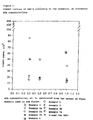
- Figure 1 shows the water permeability of ASA-sized experimental paper sheets, measured by a paper sizing test according to the COBB 60 index. According to the test, the amount of water adsorbed to the paper within 60 seconds at pH 7 was measured. Tests were performed using ASA concentrations of 0.1, 0.3, 0.5 and 1 % by weight ASA of the amount of fiber. The reference test (so-called zero test) was a completely untreated paper.
- the amount of inhibitor is calculated from the total combined mass of olefin and MHA.
- the product was purified by removing by vacuum distillation any unreacted initial materials, 1-hexadecene and MHA.
- an ASA emulsion was prepared as an aqueous solution by using a dispersing agent, at a temperature of 20 °C and a pH of 2.5.
- the molar ratio of dispersing agent to ASA was 2 : 1.
- the dispersing agent used was cationic starch or a synthetic polyamine-poly-DADMAC dispersing agent commonly used in the art.
- the stability of the emulsion and the changes occurring therein were studied by determining the homogeneity (A) of the emulsion, the creaming (B) and coalescence (C) appearing in the emulsion, and the decomposition (D) of the emulsion, at different concentrations of the said dispersing agent at 20 °C.
- the pH of the newly prepared emulsions was 2.5.
- the results are shown in Tables 2a and 2b.
- the tables indicate in hours the time which elapsed from the completion of the emulsion to the appearance of the phenomenon concerned.
- the dispersing agent is starch and in Table 2b it is poly-DADMAC.
- the neutral sizing test method used was the paper sizing test according to the COBB 60 index.
- the result of the test was 39.10 g/m 2 when the ASA concentration was 1 % by weight. This is shown in Figure 1, in which the result according to Example 1 is indicated by a white circle.
- the reaction product was emulsified by using cationic starch as the dispersing agent.
- Water permeability was measured at ASA concentrations of 0.3, 0.5 and 1 % by weight ASA of the amount of fiber.
- the water permeability results obtained by the COBB 60 test were 16.5, 18.6 and 13.5 g/m 2 , the respective ASA concentrations being 0.3, 0.5 and 1.0 % by weight.
- 2-Propyl-heptanol was dehydrogenated catalytically by using Al 2 O 3 catalyst at 300 - 500 °C.
- the result obtained was an olefin blend which contained 60 % 2-propyl-1-heptene and 40 % internal olefins having the same basic carbon structure.
- This decene blend was oligomerized by using as the catalyst a BF 3 butanol complex at a temperature of 10 - 40 °C and a BF 3 pressure of 0.5 - 3 bar, for 0.5 - 4 hours.
- the dimer fraction was separated by vacuum distillation from the produced oligomer blend.
- the dimerization product was allowed to react with MHA by charging a Parr high-pressure reactor with the dimerization product (150.2 g, 0.67 mol), MHA (44.0 g, 0.45 mol) as well as 0.4 g of H 3 BO 3 and 0.4 g BHT.
- the reactor was closed and rinsed with gaseous nitrogen, whereafter it was heated to 220 °C and was kept at this temperature for 5 h, the mixing being on throughout the reaction. Any unreacted initial materials were removed by vacuum distillation.
- the yield of the obtained alkene-substituted succinic acid anhydride was 67 %.
- ASA prepared in accordance with the above was emulsified as above. Neutral sizing of paper was carried out using the obtained emulsion.
- Raffinate II stream which contained 14 % 1-butene, 28 % 2-butene, 7 % iso-butene and 51 % butane and other impurities, was oligomerized by using as the catalyst a synthetic silica-alumina and a continuous-working reactor.
- the products from a) and b) were emulsified, and their neutral sizing efficacies were tested as above.
- the water permeability values determined using the COBB 60 test were in case a) 22.5, 16.4 and 17.6 g/m 2 when the ASA concentrations were respectively 0.3, 0.5 and 1.0 % by weight/fiber, which is indicated in Figure 1 by a white diamond.
- the Raffinate II stream described in Example 4 was oligomerized by using a BF 3 cocatalyst complex at a temperature of 20 - 50 °C and a BF 3 pressure of 1 - 10 bar for 0.5 - 6 hours.
- Fractions having primary carbon numbers of a) C 12 , b) C 16 and c) C 20 were separated by vacuum distillation from the produced oligomer blend.
- Table 3 shows the concentrations of the oligomers present in the various fractions.
- Each fraction contained approx. 80 % branched both internal and alpha-olefins and approx. 20 % alkanes.
- Each olefin fraction was reacted with MHA at the molar ratio 1.2 : 1 at 220 °C for 4 - 5 hours.
- 0.2 % by weight BHT and 0.2 % by weight H 3 BO 3 calculated from the total mass of MHA and olefin, were used in the reactions.
- the yields of the ASA product were:
- the olefin component required for the preparation of ASA was prepared by pyrolyzing a polyethylene waste at a temperature of 350 - 600 °C and a pressure of 1 - 25 bar. A fraction having carbon chains containing 13 - 16 carbon atoms and a number-average molar mass of approx. 200 g/mol was separated by vacuum distillation from the hydrocarbon blend formed. In this fraction the alkene/alkane ratio was 40/60. This hydrocarbon fraction was reacted with MHA at 220 °C for approx. 5 hours. The ASA yield obtained was 59.0 %. 0.2 % by weight BHT and 0.2 % H 3 BO 3 , calculated from the total mass of olefin and MHA, were used in the reactions.
- the product was emulsified and tested as above at an ASA concentration of 1.0 % by weight/fiber, the water permeability obtained being 62.5 g/m 2 .
- the result is indicated in Figure 1 by a half-shaded square.
- Example 2 To a fraction of olefin chains having 16-18 carbon atoms according to Example 2 (55.8 g) an olefin fraction having a number-average carbon number of 18 according to Example 4 b) was added so that the ratio of the former to the latter was a) 80 : 20 and b) 50 : 50.
- the obtained blend was allowed to react with MHA at 220 °C for 4.5 hours in the presence of an inhibitor (0.2 % by weight BHT and 0.2 % by weight H 3 BO 3 ).
Landscapes
- Chemical & Material Sciences (AREA)
- Organic Chemistry (AREA)
- Paper (AREA)
- Furan Compounds (AREA)
- Low-Molecular Organic Synthesis Reactions Using Catalysts (AREA)
Abstract
Description
- Example 1 :
- white circle
- 2 :
- white square
- 3 :
- white triangle
- 4a :
- inverted white triangle
- 4b :
- white diamond
- 5b :
- hexagon
- 6 :
- half-shaded square
- 7a :
- white circle with a cross
- 7b :
- half-shaded circle
The zero test gave as a result 420 g/m2 as the amount of adsorbed water.
| Effect of inhibitor on the yield of ASA | ||
| Reaction | Inhibitor | ASA yield, wt.% |
| a | - | 62 |
| b | 0.5 wt.% H3BO3 | 56 |
| c | 0.5 wt.% BHT | 51 |
| d | 0.2 wt.% H3BO3 0.2 wt.% BHT | 79 |
| Time which elapsed to the changes occurring in the emulsion, as a function of the starch concentration. | |||||||||
| disp/ | 0 | 0.05 | 0.1 | 0.2 | 0.5 | 1 | 2 | 3 | 4 |
| A | 0 | 0 | 0 | 0 | 0 | 0 | 0 | 0 | 0 |
| B | 0.2 | 0.2 | 0.5 | 1 | 1 | 3 | |||
| C | 4 | 5 | |||||||
| D | 23 | 96 |
| Time which elapsed to the changes occurring in the emulsion, as a function of the poly-DADMAC concentration. | |||||||||
| disp/ | 0 | 0.05 | 0.1 | 0.2 | 0.5 | 1 | 2 | 3 | 4 |
| A | 0 | 0 | 0 | 0 | 0 | 0 | 0 | 0 | 0 |
| B | 0.01 | 1 | 0.7 | 0.2 | 0.5 | 2 | 0.2 | 1.5 | 3.3 |
| C | 1.2 | 9 | 1 | 1 | 0.8 | 3 | 4 | 11 | 24 |
| D | 9 | 24 | 24 | 24 |
| Concentrations of the oligomers present in the various fractions | ||||
| C12/wt.% | C16/wt.% | C20/wt.% | C24+/wt.% | |
| fraction a) | 85.0 | 15.0 | - | - |
| fraction b) | 0.5 | 94.5 | 5.0 | - |
| fraction c) | - | 6.1 | 83.0 | 10.9 |
| Example | ASA concentration | COBB | 60 test g/ |
| 7 a) | 0.3 | 16.0 | |
| 7 a) | 0.5 | 16.4 | |
| 7 a) | 1.0 | 11.8 | |
| 7 b) | 0.3 | 49.3 | |
| 7 b) | 0.5 | 19.7 | |
| 7 b) | 1.0 | 15.5 |
Claims (22)
- Alkene-substituted cyclic carboxylic acid anhydrides, characterized in that they are reaction products of a cyclic carboxylic acid anhydride and an olefin blend, the olefin blend containing 5 - 95 % linear and branched internal olefins having 13 - 25 carbon atoms and 95 - 5 % linear and/or branched alpha-olefins having 13 - 25 carbon atoms and the blend is obtained 1) by oligomerization of Raffinate II flow, 2) by pyrolyzation of high molecular polyethene or 3) by dehydration of a branched alcohol and the blend is used as such or with one or several other olefins.
- Alkene-substituted cyclic carboxylic acid anhydrides according to Claim 1, characterized in that the cyclic carboxylic acid anhydride is a succinic acid anhydride.
- Alkene-substituted cyclic carboxylic acid anhydrides according Claim 1 or 2, characterized in that the number-average carbon number of the internal olefins and alpha-olefins is within the range 14 - 17, most preferably 15 - 16.
- Alkene-substituted cyclic carboxylic acid anhydrides according to Claim 1, 2 or 3, characterized in that the olefin blend contains alpha-olefins in an amount of 5 - 95 % and internal olefins in an amount of 95 - 5 %, preferably alpha-olefins 50 - 95 % and internal olefins 5 - 50 %, and most preferably alpha-olefins 70-90 % and internal olefins 10 - 30 %.
- Alkene-substituted cyclic carboxylic acid anhydrides according to Claim 1, characterized in that, in addition to olefins, the olefin blend contains alkanes, the percentage ratio of olefins to alkanes being 80 : 20 - 20 : 80, preferably 70 : 30 - 30 : 70, and most preferably 60 : 40 - 40 : 60.
- A process for the preparation of alkene-substituted cyclic carboxylic acid anhydrides according to any of the above claims by allowing the olefin component to react under the effect of heat with a corresponding cyclic anhydride having a double bond, preferably with maleic acid anhydride, characterized in that the olefin component is obtained by oligomerizing, by using a homogenous or heterogenous catalyst, a blend of 1-butene and 2-butene, the so-called Raffinate II stream, from which isobutene olefin has been removed by reacting it with methanol.
- A process according to Claim 6, characterized in that the homogenous catalyst used preferably consists of complexes of BF3, alcohol or carboxylic acid, or of various Al catalysts such as AlCl3-HCl catalysts, AlCl2CH2CH3 catalysts or AlCl3 aromate catalysts, and the heterogenous catalyst used is preferably a synthetic aluminum silicate.
- A process for the preparation of alkene-substituted cyclic carboxylic acid anhydrides according to any of Claims 1 - 5 by allowing the olefin component to react under the effect of heat with a corresponding cyclic anhydride having a double bond, preferably with maleic acid anhydride, characterized in that the olefin component is obtained by pyrolyzing a recycled high molecular weight olefin waste of polyethylene at a temperature of 300 - 500 °C and by separating a blend of alpha-olefins and internal olefins having 13 - 25 carbon atoms from the pyrolyzate by distillation.
- A process according to Claim 8, characterized in that the olefin blend separated from the pyrolyzate contains linear and/or branched alpha-olefins in an amount of 50 - 95 %, preferably 70 - 90 %, and linear and/or branched internal olefins in an amount of 50 - 5 %, preferably 30 - 10 %.
- A process according to Claim 8, characterized in that the olefin blend separated from the pyrolyzate contains alkanes in addition to olefins, the ratio of alkanes to olefins being within the range 20 : 80 - 80 : 20, preferably 30 : 70 - 70 : 30, and most preferably 40 : 60 - 60 : 40.
- A process for the preparation of alkene-substituted cyclic carboxylic acid anhydrides according to any of Claims 1 - 5 by allowing the olefin component to react under the effect of heat with a corresponding cyclic anhydride having a double bond, preferably with maleic acid anhydride, characterized in that the olefin component is obtained by dehydrogenating one or several branched alcohols having 6 - 10 carbon atoms to the corresponding olefin blend and by dimerizing the obtained blend by using catalysts, preferably acid catalysts, most preferably a BF3 alcohol complex.
- A process according to Claim 11, characterized in that the alcohol to be dehydrogenated is 2-propylheptanol or 2-ethylhexanol.
- A process for the preparation of alkene-substituted cyclic carboxylic acid anhydrides according to any of Claims 1 - 5 by allowing the olefin component to react under the effect of heat with a corresponding cyclic anhydride having a double bond, preferably with maleic acid anhydride, characterized in that the olefin component is obtained by preparing an olefin blend of alpha-olefins and internal olefins having 13 - 25 carbon atoms so that the proportion of alpha-olefins in the blend is 5 - 95 %, preferably 50 - 95 %, and most preferably 70 - 90 %, and the proportion of internal olefins in the blend is 95 - 5 %, preferably 50 - 5 %, and most preferably 30 - 10 %.
- A process according to Claim 13, characterized in that the number-average carbon number of the alpha-olefins and internal olefins in the olefin blend is within the range 14 - 17, most preferably 15 - 16.
- A process according to any of Claims 6 - 14, characterized in that in the reaction of the olefin component with a cyclic carboxylic acid anhydride, preferably maleic acid anhydride, an inhibitor, such as boric acid, di-tert-butylhydroxytoluene or a mixture of these, is used for inhibiting the formation of byproducts.
- A process according to Claim 15, characterized in that the inhibitor used is a 1 : 1 mixture of boric acid and di-tert-butylhydroxytoluene, in which each is present in an amount of 0.05 - 1.0 % by weight, most preferably 0.2 % by weight, of the total mass of the olefin and the maleic acid anhydride.
- The use of alkene-substituted succinic acid anhydrides according to Claim 2 or 3 as aqueous emulsions, i.e. as so-called ASA sizing agents, in the hydrophobic sizing of paper or cardboard fiber material.
- The use according to Claim 17 within the neutral or the alkaline pH range.
- A process for the hydrophobic sizing of paper or cardboard material with alkene-substituted succinic acid anhydride sizing agents, i.e. so-called ASA sizing agents, characterized in that the paper or cardboard fiber material is treated, in connection with the manufacture or finishing, with an ASA sizing agent which comprises a reaction product of succinic acid anhydride and the olefin blend defined in Claim 1, from which product an aqueous emulsion has been prepared by using a dispersing agent.
- A process according to Claim 19, characterized in that the dispersing agent used is cationic starch, cationic polyacrylamine, poly(di-alkyl-di-methylammonium chloride) or polyethylene imine, most preferably cationic starch.
- A process according to Claim 20, characterized in that the ratio of the dispersing agent, preferably cationic starch, to the ASA product in a 0.1 - 10 wt. % aqueous solution is within the range 0.5 - 10 : 1, preferably 1 - 5 : 1 within the acid pH range.
- A process according to Claim 19, characterized in that in the ASA sizing of paper or cardboard fiber material, the ASA sizing agent is used at a concentration of 0.01 - 1 % by weight of the amount of fiber.
Applications Claiming Priority (3)
| Application Number | Priority Date | Filing Date | Title |
|---|---|---|---|
| FI944690A FI96418C (en) | 1994-10-07 | 1994-10-07 | Alkene-substituted cyclic carboxylic anhydrides and their use in hydrophobic sizing of paper |
| FI944690 | 1994-10-07 | ||
| PCT/FI1995/000541 WO1996011193A1 (en) | 1994-10-07 | 1995-10-04 | Alkenyl substituted cyclic carboxyl acid anhydrides and their application in hydrophobic paper sizing |
Publications (2)
| Publication Number | Publication Date |
|---|---|
| EP0804429A1 EP0804429A1 (en) | 1997-11-05 |
| EP0804429B1 true EP0804429B1 (en) | 2004-03-17 |
Family
ID=8541529
Family Applications (1)
| Application Number | Title | Priority Date | Filing Date |
|---|---|---|---|
| EP95934139A Expired - Lifetime EP0804429B1 (en) | 1994-10-07 | 1995-10-04 | Alkenyl substituted cyclic carboxyl acid anhydrides and their application in hydrophobic paper sizing |
Country Status (9)
| Country | Link |
|---|---|
| US (1) | US5939562A (en) |
| EP (1) | EP0804429B1 (en) |
| JP (1) | JPH10506909A (en) |
| AT (1) | ATE261952T1 (en) |
| AU (1) | AU3653995A (en) |
| CA (1) | CA2201869A1 (en) |
| DE (1) | DE69532721T2 (en) |
| FI (1) | FI96418C (en) |
| WO (1) | WO1996011193A1 (en) |
Families Citing this family (20)
| Publication number | Priority date | Publication date | Assignee | Title |
|---|---|---|---|---|
| US6231659B1 (en) * | 1999-06-24 | 2001-05-15 | Albemarle Corporation | Sizing agents and starting materials for their preparation |
| US6225437B1 (en) | 1999-06-24 | 2001-05-01 | Albemarle Corporation | Sizing agents of enhanced performance capabilities |
| US6348132B1 (en) * | 2000-05-30 | 2002-02-19 | Hercules Incorporated | Alkenyl succinic anhydride compositons and the use thereof |
| US20030224945A1 (en) * | 2002-05-29 | 2003-12-04 | Twu Fred Chun-Chien | Process for well fluids base oil via metathesis of alpha-olefins |
| GB0213424D0 (en) * | 2002-06-12 | 2002-07-24 | Raisio Chem Uk Ltd | Sizing |
| US7271121B2 (en) | 2005-07-21 | 2007-09-18 | Chevron Phillips Chemical Company Lp | Diimine metal complexes, methods of synthesis, and methods of using in oligomerization and polymerization |
| US7129304B1 (en) | 2005-07-21 | 2006-10-31 | Chevron Phillips Chemical Company Lp | Dimine metal complexes, methods of synthesis, and methods of using in oligomerization and polymerization |
| US7268096B2 (en) | 2005-07-21 | 2007-09-11 | Chevron Phillips Chemical Company Lp | Diimine metal complexes, methods of synthesis, and methods of using in oligomerization and polymerization |
| US7727926B2 (en) | 2005-07-21 | 2010-06-01 | Chevron Phillips Chemical Company Lp | Diimine metal complexes, methods of synthesis, and method of using in oligomerization and polymerization |
| DE102005055541A1 (en) * | 2005-11-18 | 2007-05-24 | Basf Ag | Alkenylsuccinic anhydrides from oligomers of C4 to C8 olefins and maleic anhydride, process for their preparation and their use |
| US8092649B2 (en) | 2005-12-14 | 2012-01-10 | Nalco Company | Method of decreasing the rate of photoyellowing with thiocyanic acid |
| AT503093B1 (en) * | 2005-12-23 | 2008-02-15 | Kemira Chemie Ges Mbh | Papermaking emulsion, process for its preparation and its use |
| CA2687068A1 (en) * | 2007-05-09 | 2008-11-20 | Buckman Laboratories International, Inc. | Asa sizing emulsions for paper and paperboard |
| US8242287B2 (en) | 2009-03-12 | 2012-08-14 | Nalco Company | Process for reacting an α, β-unsaturated dicarboxylic acid compound with an ethylenically unsaturated hydrocarbon |
| US9586872B2 (en) | 2011-12-30 | 2017-03-07 | Chevron Phillips Chemical Company Lp | Olefin oligomerization methods |
| JP6297595B2 (en) * | 2013-01-31 | 2018-03-20 | グラットフェルター ゲルンスバッハ ゲーエムベーハー | Crosslinking / functionalizing system for paper or non-woven fabric |
| FI127288B (en) * | 2015-06-12 | 2018-03-15 | Teknologian Tutkimuskeskus Vtt Oy | Process and apparatus for preparing a chemical compound |
| EP3192837B1 (en) | 2016-01-14 | 2020-03-04 | Omya International AG | Wet surface treatment of surface-modified calcium carbonate |
| US9944661B2 (en) | 2016-08-09 | 2018-04-17 | Chevron Phillips Chemical Company Lp | Olefin hydroboration |
| EP3549937A1 (en) * | 2018-04-05 | 2019-10-09 | Karl-Heinz Elsässer | Process for the continuous preparation of c16-asa (hexadecene succinic anhydride) and/or c18-asa (octadecene succinic anhydride) |
Family Cites Families (5)
| Publication number | Priority date | Publication date | Assignee | Title |
|---|---|---|---|---|
| US4736044A (en) * | 1979-06-20 | 1988-04-05 | Amoco Corporation | Boron compounds to inhibit formation of tar during the "ene" reaction of an ethylenically unsaturated alpha, beta dicarboxylic acid compound and an ethylenically unsaturated hydrocarbon |
| IL69397A (en) * | 1982-08-20 | 1987-12-20 | Chevron Res | Alkenyl succinic anhydride composition and methods of sizing paper and treating cellulosic fabrics |
| JPS59144696A (en) * | 1983-02-07 | 1984-08-18 | 荒川化学工業株式会社 | Paper size agent |
| DE3477820D1 (en) * | 1984-07-16 | 1989-05-24 | Nippon Petrochemicals Co Ltd | Paper sizing agent |
| JP3002023B2 (en) * | 1991-07-10 | 2000-01-24 | 日石三菱株式会社 | Papermaking sizing agent |
-
1994
- 1994-10-07 FI FI944690A patent/FI96418C/en active
-
1995
- 1995-10-04 JP JP8512351A patent/JPH10506909A/en active Pending
- 1995-10-04 CA CA002201869A patent/CA2201869A1/en not_active Abandoned
- 1995-10-04 US US08/809,893 patent/US5939562A/en not_active Expired - Fee Related
- 1995-10-04 EP EP95934139A patent/EP0804429B1/en not_active Expired - Lifetime
- 1995-10-04 WO PCT/FI1995/000541 patent/WO1996011193A1/en not_active Ceased
- 1995-10-04 AT AT95934139T patent/ATE261952T1/en not_active IP Right Cessation
- 1995-10-04 AU AU36539/95A patent/AU3653995A/en not_active Abandoned
- 1995-10-04 DE DE1995632721 patent/DE69532721T2/en not_active Expired - Fee Related
Also Published As
| Publication number | Publication date |
|---|---|
| EP0804429A1 (en) | 1997-11-05 |
| FI96418B (en) | 1996-03-15 |
| DE69532721T2 (en) | 2005-01-13 |
| AU3653995A (en) | 1996-05-02 |
| JPH10506909A (en) | 1998-07-07 |
| FI944690A0 (en) | 1994-10-07 |
| ATE261952T1 (en) | 2004-04-15 |
| US5939562A (en) | 1999-08-17 |
| WO1996011193A1 (en) | 1996-04-18 |
| FI96418C (en) | 1996-06-25 |
| CA2201869A1 (en) | 1996-04-18 |
| DE69532721D1 (en) | 2004-04-22 |
Similar Documents
| Publication | Publication Date | Title |
|---|---|---|
| US5939562A (en) | Alkenyl substituted cyclic carboxyl acid anhydrides and their application in hydrophobic paper sizing | |
| DE69812693T2 (en) | METHOD FOR OLIGOMERIZING ISOBUTEN | |
| US4576680A (en) | Method of sizing paper | |
| US4514229A (en) | Paper sizing composition | |
| DE69310479T2 (en) | Catalytic composition for oligomerization and co-oligomerization of alkenes | |
| US4431826A (en) | Process for the preparation of alkenyl succinic anhydride | |
| EP0169250B1 (en) | Paper sizing agent | |
| JPS61215799A (en) | Papermaking size agent | |
| JPS63101486A (en) | Production of gasoline component from olefin | |
| DE69405222T2 (en) | CATALYTIC COMPOSITION FOR THE OLIGOMERIZATION AND CO-OLIGOMERIZATION OF ALKENES | |
| US6231659B1 (en) | Sizing agents and starting materials for their preparation | |
| GB2126260A (en) | Alkenyl succinic anhydride sizing composition and method for its preparation | |
| EP1951651A1 (en) | Alkenylsuccinic anhydrides formed from oligomers of c4- to c8-olefins and maleic anhydride, processes for their preparation and their use | |
| US4370253A (en) | Alkenylsuccinic acid emulsions and their preparation | |
| JPS61146898A (en) | Papermaking size agent | |
| JPS59179898A (en) | Paper size agent | |
| EP0883614B1 (en) | Additives usable in preparation of alkenyl succinic anhydride | |
| EP0261871A2 (en) | Process for the preparation of gasoline components from olefins | |
| JPH0633598B2 (en) | Papermaking sizing agent | |
| GB2108111A (en) | A maleic anhydride derivative used as a paper sizing agent | |
| CA3224186A1 (en) | Highly structured, high vinylidene propylene oligomer and method of making | |
| JPH09241661A (en) | Lubricating oil | |
| JPS59144697A (en) | Paper size agent | |
| JPH0533227B2 (en) | ||
| CN1162005A (en) | Lubricant oil |
Legal Events
| Date | Code | Title | Description |
|---|---|---|---|
| PUAI | Public reference made under article 153(3) epc to a published international application that has entered the european phase |
Free format text: ORIGINAL CODE: 0009012 |
|
| 17P | Request for examination filed |
Effective date: 19970506 |
|
| AK | Designated contracting states |
Kind code of ref document: A1 Designated state(s): AT DE FR GB SE |
|
| RAP1 | Party data changed (applicant data changed or rights of an application transferred) |
Owner name: KEMIRA CHEMICALS OY |
|
| 17Q | First examination report despatched |
Effective date: 20030214 |
|
| GRAP | Despatch of communication of intention to grant a patent |
Free format text: ORIGINAL CODE: EPIDOSNIGR1 |
|
| GRAS | Grant fee paid |
Free format text: ORIGINAL CODE: EPIDOSNIGR3 |
|
| GRAA | (expected) grant |
Free format text: ORIGINAL CODE: 0009210 |
|
| AK | Designated contracting states |
Kind code of ref document: B1 Designated state(s): AT DE FR GB SE |
|
| REG | Reference to a national code |
Ref country code: GB Ref legal event code: FG4D |
|
| RAP2 | Party data changed (patent owner data changed or rights of a patent transferred) |
Owner name: KEMIRA OYJ |
|
| REF | Corresponds to: |
Ref document number: 69532721 Country of ref document: DE Date of ref document: 20040422 Kind code of ref document: P |
|
| REG | Reference to a national code |
Ref country code: SE Ref legal event code: TRGR |
|
| PGFP | Annual fee paid to national office [announced via postgrant information from national office to epo] |
Ref country code: AT Payment date: 20040909 Year of fee payment: 10 |
|
| PGFP | Annual fee paid to national office [announced via postgrant information from national office to epo] |
Ref country code: FR Payment date: 20040913 Year of fee payment: 10 |
|
| PGFP | Annual fee paid to national office [announced via postgrant information from national office to epo] |
Ref country code: GB Payment date: 20040916 Year of fee payment: 10 |
|
| PGFP | Annual fee paid to national office [announced via postgrant information from national office to epo] |
Ref country code: DE Payment date: 20040917 Year of fee payment: 10 |
|
| PGFP | Annual fee paid to national office [announced via postgrant information from national office to epo] |
Ref country code: SE Payment date: 20040923 Year of fee payment: 10 |
|
| ET | Fr: translation filed | ||
| PLBE | No opposition filed within time limit |
Free format text: ORIGINAL CODE: 0009261 |
|
| STAA | Information on the status of an ep patent application or granted ep patent |
Free format text: STATUS: NO OPPOSITION FILED WITHIN TIME LIMIT |
|
| 26N | No opposition filed |
Effective date: 20041220 |
|
| PG25 | Lapsed in a contracting state [announced via postgrant information from national office to epo] |
Ref country code: GB Free format text: LAPSE BECAUSE OF NON-PAYMENT OF DUE FEES Effective date: 20051004 Ref country code: AT Free format text: LAPSE BECAUSE OF NON-PAYMENT OF DUE FEES Effective date: 20051004 |
|
| PG25 | Lapsed in a contracting state [announced via postgrant information from national office to epo] |
Ref country code: SE Free format text: LAPSE BECAUSE OF NON-PAYMENT OF DUE FEES Effective date: 20051005 |
|
| PG25 | Lapsed in a contracting state [announced via postgrant information from national office to epo] |
Ref country code: DE Free format text: LAPSE BECAUSE OF NON-PAYMENT OF DUE FEES Effective date: 20060503 |
|
| EUG | Se: european patent has lapsed | ||
| GBPC | Gb: european patent ceased through non-payment of renewal fee |
Effective date: 20051004 |
|
| PG25 | Lapsed in a contracting state [announced via postgrant information from national office to epo] |
Ref country code: FR Free format text: LAPSE BECAUSE OF NON-PAYMENT OF DUE FEES Effective date: 20060630 |
|
| REG | Reference to a national code |
Ref country code: FR Ref legal event code: ST Effective date: 20060630 |