EP0803774A1 - Verfahren zur Herstellung eines Farbbildes mit reduziertem Punktzuwachs und nach diesem Verfahren erhaltenes Farbbild - Google Patents
Verfahren zur Herstellung eines Farbbildes mit reduziertem Punktzuwachs und nach diesem Verfahren erhaltenes Farbbild Download PDFInfo
- Publication number
- EP0803774A1 EP0803774A1 EP97201120A EP97201120A EP0803774A1 EP 0803774 A1 EP0803774 A1 EP 0803774A1 EP 97201120 A EP97201120 A EP 97201120A EP 97201120 A EP97201120 A EP 97201120A EP 0803774 A1 EP0803774 A1 EP 0803774A1
- Authority
- EP
- European Patent Office
- Prior art keywords
- image
- layer
- light
- colour
- receiving material
- Prior art date
- Legal status (The legal status is an assumption and is not a legal conclusion. Google has not performed a legal analysis and makes no representation as to the accuracy of the status listed.)
- Granted
Links
- 238000000034 method Methods 0.000 title claims abstract description 28
- 230000008569 process Effects 0.000 title claims abstract description 26
- 239000010410 layer Substances 0.000 claims abstract description 61
- 239000000463 material Substances 0.000 claims abstract description 36
- 239000012790 adhesive layer Substances 0.000 claims abstract description 30
- 238000010030 laminating Methods 0.000 claims abstract 2
- 238000003475 lamination Methods 0.000 claims description 16
- -1 hexafluorophosphate Chemical compound 0.000 claims description 10
- 229920000642 polymer Polymers 0.000 claims description 8
- 238000011161 development Methods 0.000 claims description 7
- 239000012954 diazonium Substances 0.000 claims description 6
- 150000001989 diazonium salts Chemical class 0.000 claims description 6
- 229910052757 nitrogen Inorganic materials 0.000 claims description 3
- 238000006303 photolysis reaction Methods 0.000 claims description 2
- 230000015843 photosynthesis, light reaction Effects 0.000 claims description 2
- IJGRMHOSHXDMSA-UHFFFAOYSA-O diazynium Chemical compound [NH+]#N IJGRMHOSHXDMSA-UHFFFAOYSA-O 0.000 claims 2
- 229910052736 halogen Inorganic materials 0.000 claims 2
- 125000005843 halogen group Chemical group 0.000 claims 1
- 150000002367 halogens Chemical class 0.000 claims 1
- 150000001875 compounds Chemical class 0.000 abstract description 4
- 230000008901 benefit Effects 0.000 abstract description 3
- GWEVSGVZZGPLCZ-UHFFFAOYSA-N Titan oxide Chemical compound O=[Ti]=O GWEVSGVZZGPLCZ-UHFFFAOYSA-N 0.000 description 14
- 238000007639 printing Methods 0.000 description 11
- 239000003086 colorant Substances 0.000 description 7
- 239000000203 mixture Substances 0.000 description 7
- 229920001577 copolymer Polymers 0.000 description 6
- OEPOKWHJYJXUGD-UHFFFAOYSA-N 2-(3-phenylmethoxyphenyl)-1,3-thiazole-4-carbaldehyde Chemical compound O=CC1=CSC(C=2C=C(OCC=3C=CC=CC=3)C=CC=2)=N1 OEPOKWHJYJXUGD-UHFFFAOYSA-N 0.000 description 5
- GYCMBHHDWRMZGG-UHFFFAOYSA-N Methylacrylonitrile Chemical compound CC(=C)C#N GYCMBHHDWRMZGG-UHFFFAOYSA-N 0.000 description 5
- 239000000470 constituent Substances 0.000 description 5
- 230000003287 optical effect Effects 0.000 description 5
- 238000002360 preparation method Methods 0.000 description 5
- 230000009467 reduction Effects 0.000 description 5
- 239000007789 gas Substances 0.000 description 4
- 238000004519 manufacturing process Methods 0.000 description 4
- 238000000926 separation method Methods 0.000 description 4
- 239000004408 titanium dioxide Substances 0.000 description 4
- ZWEHNKRNPOVVGH-UHFFFAOYSA-N 2-Butanone Chemical compound CCC(C)=O ZWEHNKRNPOVVGH-UHFFFAOYSA-N 0.000 description 3
- 239000000853 adhesive Substances 0.000 description 3
- 230000001070 adhesive effect Effects 0.000 description 3
- 239000011230 binding agent Substances 0.000 description 3
- 239000003795 chemical substances by application Substances 0.000 description 3
- KRKNYBCHXYNGOX-UHFFFAOYSA-N citric acid Chemical compound OC(=O)CC(O)(C(O)=O)CC(O)=O KRKNYBCHXYNGOX-UHFFFAOYSA-N 0.000 description 3
- 238000004040 coloring Methods 0.000 description 3
- 238000001035 drying Methods 0.000 description 3
- 239000000049 pigment Substances 0.000 description 3
- 229920000139 polyethylene terephthalate Polymers 0.000 description 3
- 239000005020 polyethylene terephthalate Substances 0.000 description 3
- 239000012463 white pigment Substances 0.000 description 3
- ARXJGSRGQADJSQ-UHFFFAOYSA-N 1-methoxypropan-2-ol Chemical compound COCC(C)O ARXJGSRGQADJSQ-UHFFFAOYSA-N 0.000 description 2
- IAFBRPFISOTXSO-UHFFFAOYSA-N 2-[[2-chloro-4-[3-chloro-4-[[1-(2,4-dimethylanilino)-1,3-dioxobutan-2-yl]diazenyl]phenyl]phenyl]diazenyl]-n-(2,4-dimethylphenyl)-3-oxobutanamide Chemical compound C=1C=C(C)C=C(C)C=1NC(=O)C(C(=O)C)N=NC(C(=C1)Cl)=CC=C1C(C=C1Cl)=CC=C1N=NC(C(C)=O)C(=O)NC1=CC=C(C)C=C1C IAFBRPFISOTXSO-UHFFFAOYSA-N 0.000 description 2
- YEJRWHAVMIAJKC-UHFFFAOYSA-N 4-Butyrolactone Chemical compound O=C1CCCO1 YEJRWHAVMIAJKC-UHFFFAOYSA-N 0.000 description 2
- IJGRMHOSHXDMSA-UHFFFAOYSA-N Atomic nitrogen Chemical compound N#N IJGRMHOSHXDMSA-UHFFFAOYSA-N 0.000 description 2
- VTYYLEPIZMXCLO-UHFFFAOYSA-L Calcium carbonate Chemical compound [Ca+2].[O-]C([O-])=O VTYYLEPIZMXCLO-UHFFFAOYSA-L 0.000 description 2
- LFQSCWFLJHTTHZ-UHFFFAOYSA-N Ethanol Chemical compound CCO LFQSCWFLJHTTHZ-UHFFFAOYSA-N 0.000 description 2
- WYURNTSHIVDZCO-UHFFFAOYSA-N Tetrahydrofuran Chemical compound C1CCOC1 WYURNTSHIVDZCO-UHFFFAOYSA-N 0.000 description 2
- TZCXTZWJZNENPQ-UHFFFAOYSA-L barium sulfate Chemical compound [Ba+2].[O-]S([O-])(=O)=O TZCXTZWJZNENPQ-UHFFFAOYSA-L 0.000 description 2
- 238000000354 decomposition reaction Methods 0.000 description 2
- 230000000694 effects Effects 0.000 description 2
- 238000001125 extrusion Methods 0.000 description 2
- 238000010438 heat treatment Methods 0.000 description 2
- 229920002545 silicone oil Polymers 0.000 description 2
- 239000000126 substance Substances 0.000 description 2
- 239000000758 substrate Substances 0.000 description 2
- JMLIBSAYWRQXIV-UHFFFAOYSA-N 2,3-bis(4-methoxyphenyl)quinoxaline Chemical compound C1=CC(OC)=CC=C1C1=NC2=CC=CC=C2N=C1C1=CC=C(OC)C=C1 JMLIBSAYWRQXIV-UHFFFAOYSA-N 0.000 description 1
- FDSUVTROAWLVJA-UHFFFAOYSA-N 2-[[3-hydroxy-2,2-bis(hydroxymethyl)propoxy]methyl]-2-(hydroxymethyl)propane-1,3-diol;prop-2-enoic acid Chemical compound OC(=O)C=C.OC(=O)C=C.OC(=O)C=C.OC(=O)C=C.OC(=O)C=C.OCC(CO)(CO)COCC(CO)(CO)CO FDSUVTROAWLVJA-UHFFFAOYSA-N 0.000 description 1
- NLXLAEXVIDQMFP-UHFFFAOYSA-N Ammonium chloride Substances [NH4+].[Cl-] NLXLAEXVIDQMFP-UHFFFAOYSA-N 0.000 description 1
- VHUUQVKOLVNVRT-UHFFFAOYSA-N Ammonium hydroxide Chemical compound [NH4+].[OH-] VHUUQVKOLVNVRT-UHFFFAOYSA-N 0.000 description 1
- OKTJSMMVPCPJKN-UHFFFAOYSA-N Carbon Chemical compound [C] OKTJSMMVPCPJKN-UHFFFAOYSA-N 0.000 description 1
- KWORKYDIARWARF-UHFFFAOYSA-N N-(4-chloro-2-methylphenyl)-4-[(4-chloro-2-methylphenyl)diazenyl]-3-hydroxynaphthalene-2-carboxamide Chemical compound Cc1cc(Cl)ccc1NC(=O)c1cc2ccccc2c(N=Nc2ccc(Cl)cc2C)c1O KWORKYDIARWARF-UHFFFAOYSA-N 0.000 description 1
- 239000004698 Polyethylene Substances 0.000 description 1
- 239000004743 Polypropylene Substances 0.000 description 1
- XTXRWKRVRITETP-UHFFFAOYSA-N Vinyl acetate Chemical compound CC(=O)OC=C XTXRWKRVRITETP-UHFFFAOYSA-N 0.000 description 1
- 238000010521 absorption reaction Methods 0.000 description 1
- 230000009471 action Effects 0.000 description 1
- 239000008186 active pharmaceutical agent Substances 0.000 description 1
- 235000011114 ammonium hydroxide Nutrition 0.000 description 1
- 238000000149 argon plasma sintering Methods 0.000 description 1
- VQLYBLABXAHUDN-UHFFFAOYSA-N bis(4-fluorophenyl)-methyl-(1,2,4-triazol-1-ylmethyl)silane;methyl n-(1h-benzimidazol-2-yl)carbamate Chemical compound C1=CC=C2NC(NC(=O)OC)=NC2=C1.C=1C=C(F)C=CC=1[Si](C=1C=CC(F)=CC=1)(C)CN1C=NC=N1 VQLYBLABXAHUDN-UHFFFAOYSA-N 0.000 description 1
- 229910000019 calcium carbonate Inorganic materials 0.000 description 1
- 239000006229 carbon black Substances 0.000 description 1
- 230000008859 change Effects 0.000 description 1
- 239000011248 coating agent Substances 0.000 description 1
- 238000000576 coating method Methods 0.000 description 1
- 230000000052 comparative effect Effects 0.000 description 1
- 239000002131 composite material Substances 0.000 description 1
- 238000010276 construction Methods 0.000 description 1
- VVOLVFOSOPJKED-UHFFFAOYSA-N copper phthalocyanine Chemical compound [Cu].N=1C2=NC(C3=CC=CC=C33)=NC3=NC(C3=CC=CC=C33)=NC3=NC(C3=CC=CC=C33)=NC3=NC=1C1=CC=CC=C12 VVOLVFOSOPJKED-UHFFFAOYSA-N 0.000 description 1
- LDHQCZJRKDOVOX-NSCUHMNNSA-N crotonic acid Chemical compound C\C=C\C(O)=O LDHQCZJRKDOVOX-NSCUHMNNSA-N 0.000 description 1
- 230000008034 disappearance Effects 0.000 description 1
- 239000000428 dust Substances 0.000 description 1
- 239000011521 glass Substances 0.000 description 1
- 230000009477 glass transition Effects 0.000 description 1
- 239000000155 melt Substances 0.000 description 1
- 238000007645 offset printing Methods 0.000 description 1
- 229920002432 poly(vinyl methyl ether) polymer Polymers 0.000 description 1
- 229920000728 polyester Polymers 0.000 description 1
- 229920000573 polyethylene Polymers 0.000 description 1
- 229920001155 polypropylene Polymers 0.000 description 1
- 229920002689 polyvinyl acetate Polymers 0.000 description 1
- 239000011118 polyvinyl acetate Substances 0.000 description 1
- 238000012545 processing Methods 0.000 description 1
- 239000011241 protective layer Substances 0.000 description 1
- 238000004088 simulation Methods 0.000 description 1
- 239000002904 solvent Substances 0.000 description 1
- 230000002311 subsequent effect Effects 0.000 description 1
- 238000005496 tempering Methods 0.000 description 1
- 238000012360 testing method Methods 0.000 description 1
- YLQBMQCUIZJEEH-UHFFFAOYSA-N tetrahydrofuran Natural products C=1C=COC=1 YLQBMQCUIZJEEH-UHFFFAOYSA-N 0.000 description 1
- LDHQCZJRKDOVOX-UHFFFAOYSA-N trans-crotonic acid Natural products CC=CC(O)=O LDHQCZJRKDOVOX-UHFFFAOYSA-N 0.000 description 1
- 238000012546 transfer Methods 0.000 description 1
- 229920002554 vinyl polymer Polymers 0.000 description 1
- 238000005406 washing Methods 0.000 description 1
- XLYOFNOQVPJJNP-UHFFFAOYSA-N water Substances O XLYOFNOQVPJJNP-UHFFFAOYSA-N 0.000 description 1
Images
Classifications
-
- G—PHYSICS
- G03—PHOTOGRAPHY; CINEMATOGRAPHY; ANALOGOUS TECHNIQUES USING WAVES OTHER THAN OPTICAL WAVES; ELECTROGRAPHY; HOLOGRAPHY
- G03F—PHOTOMECHANICAL PRODUCTION OF TEXTURED OR PATTERNED SURFACES, e.g. FOR PRINTING, FOR PROCESSING OF SEMICONDUCTOR DEVICES; MATERIALS THEREFOR; ORIGINALS THEREFOR; APPARATUS SPECIALLY ADAPTED THEREFOR
- G03F3/00—Colour separation; Correction of tonal value
- G03F3/10—Checking the colour or tonal value of separation negatives or positives
- G03F3/102—Lamination or delamination method or apparatus for colour proofing systems
Definitions
- the invention relates to a process for producing a coloured image for the colour proofing of originals for multicolour printing, a layer material to carry it out, and a coloured image obtained thereby.
- a coloured image is generally produced to assist a printer in checking and, if necessary, correcting the colour separations which will be used in exposing the printing plates in multicolour printing.
- This colour-proofing image has to be a consistent duplicate of the desired halftone or line image.
- the proof should reproduce the tonal values of the colours naturally and identically with the later printed image.
- it is customary to produce successive primary colour images corresponding to the primary colours of the multicolour print on an image-receiving material or transfer them thereto.
- Each primary colour image is produced by exposing and developing a light-sensitive layer, the method of development employed being either washing off or peeling off a support film.
- Numerous materials and processes for producing such colour-proofing images are known and described for example in the following documents: US 3,649,268, US 3,642,474, US 4,260,673, US 4,650,738, US 4,656,114, US 4,659,642, US 4,895,787, US 5,049,476, EP-A 447829.
- the colour-proofing process must allow simulation of the dot gain in printing. Dot gain is the enlargement of the halftone dot in printing compared with the film original.
- Physical dot gain is an actually measurable enlargement of the halftone dot during the printing process, which depends on various parameters, for example the nature of the printing paper, the nature of the printing ink, the nature of the press and also the nature of the printing plates, etc.
- Optical dot gain by contrast, has its cause in light scattering and absorption properties (shadow effect). The actual dot size does not change.
- Optical dot gain depends on the texture and opacity of the paper and in the case of the colour-proofing image additionally on any adhesive and release layers present. In offset printing dot gain is depending on the parameters mentioned about 8-30% in the mid tones, i.e.
- the colour-proofing image production materials described in the cited references consist of a plurality of layers on temporary support films. Colourless release and/or adhesive layers are the cause in the ready-produced colour-proofing image of an optical dot gain which generally amounts to about 20-25%. Within certain limits, the dot gain in the colour-proofing image can be controlled by the thickness of the adhesive or release layers, as described for example in US 4,262,071 and EP-A 339860. The possibility of reducing dot gain by means of thin adhesive layers, however, is restricted by processing difficulties, which necessitate an increase in the lamination temperature or a reduction in the lamination speed.
- a further possible way of reducing dot gain is to add white pigments, for example titanium dioxide, to the adhesive layer of the colour films or to the image-receiving material.
- white pigments for example titanium dioxide
- the titanium dioxide is added to the adhesive layer of the colour films, only the colour film for the first primary colour image can in each case be provided with such a TiO 2 -containing adhesive layer, since, in the following layers, the white pigment would affect the colour.
- the sequence of colours in the construction of the image is disadvantageously predetermined and, what is more, only a small reduction in the dot gain is achieved.
- Such a material is described in EP-A 420675.
- TiO 2 it is also possible to use barium sulphate, calcium carbonate or titania-containing pearl lustre pigments described in EP-A 186902.
- the white pigment may also be applied to the image-receiving material as an additional primer layer, described in EP-A 639736.
- the primer layer has in this instance to be constructed of two layers - an adhesive layer and a layer containing the white pigment.
- the present invention describes a process using as the image-receiving material for a colour-proofing image a support consisting of film or paper coated with a light-sensitive layer in which gas bubbles form on irradiation.
- the photolytically produced gas remains in the layer and gives it an opaque appearance on heating.
- the heating necessary to develop the gas bubbles can preferably also take place simultaneously with the lamination of the 1st primary colour image.
- the order of the primary colour images is freely choosable.
- Materials according to the invention known as vesicular film, are described for example in EP 038016. If the vesicular layer is applied to a paper support, the colour-proofing image obtained is particularly similar to the print outcome to be simulated.
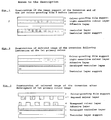
- the preferred embodiment of the process of the invention comprises first preparing a layer material consisting of a temporary support (1) and a vesicular layer (2).
- the temporary support (1) preferably consists of polymer or polymer-coated specialty paper.
- the composition of vesicular layer (2) is described for example in EP-B 038016, FR-A 2 304 944, US-A 3,622,336 and DE-A 2 438 157. It preferably includes a binder having a glass transition temperature of max. 130°C, so that the development temperature is max. 150°C.
- Such preferred binders include for example copolymers of methacrylonitrile and vinylidene chloride.
- the light-sensitive compounds used for the vesicular layer (2) are preferably diazonium compounds which evolve nitrogen on irradiation.
- diazonium salts which form a vesicular layer on exposure and development.
- any other compound which forms a gas by photolysis is also possible.
- the vesicular layer (2) on the temporary support (1) is uniformly exposed to UV light until the light-sensitive compound has completely decomposed.
- diazonium compounds When diazonium compounds are used, the decomposition is evidenced by the disappearance of the yellow colouring.
- Ga-doped UV light sources having a power of 5 kW are used together with diazonium salts, for example, just a few seconds (20 s) are sufficient for complete decomposition.
- the exposed vesicular layer (2) has laminated onto it a colour-proofing film (F) under heat and pressure.
- the colour-proofing films preferred for the process of the invention consist of a temporary support (3), a light-sensitive colour layer (4) and an adhesive layer (5). Such materials are described for example in EP-A 352 055, US-A 4,895,787, US-A 5,049,476 and EP-A 525 624.
- the colour-proofing film is laminated onto the vesicular layer (2) with the adhesive layer (5).
- the lamination temperature is preferably sufficiently high for the vesicular layer to be thermally developed in the course of this lamination process and at the same time for the adhesive layer (5) to soften, to form a composite of colour-proofing film and vesicular layer.
- the lamination temperature is 120°C. This method is preferred since it does not require an additional operation to develop the vesicular layer.
- the vesicular layer can also be thermally developed in some other way, for example in an oven, before the lamination of the first colour-proofing film.
- the light-sensitive layer (4) of the colour-proofing film is subjected to imagewise exposure through the support film (3) underneath a colour separation film before or preferably after lamination and developed after lamination onto the vesicular layer (2).
- the densities D s and D v are measured with a densitometer.
- Example 1 Preparation of a vesicular film
- a solution having the following composition is cast onto a biaxially oriented, 150 ⁇ m thick film of polyethylene terephthalate and dried: Constituents Parts by weight Copolymer of methacrylonitrile and vinylidene chloride (comonomer ratio 70:30) 12.8 Copolymer of methacrylonitrile and vinylidene chloride (comonomer ratio 20:80; Saran® F310, Dow Chemical) 3.2 4-Morpholino-2,5-diisopropoxybenzenediazonium tetrafluoroborate 0.8 Silicone oil (as flow-control agent) 0.05 2-Butanone 80.0
- the layer is dried initially at 70°C for 60 s and then at 130°C for 30 s.
- the weight of the dried layer is 8 g/m 2 .
- the film obtained has a yellow colour.
- Example 2 Preparation of colour-proofing films for producing a colour-proofing image according to the invention
- Pigments 1.-4. are ball-milled with part of the binder (5.) and of the solvent (8.) before their addition to the respective solution.
- Example 3 Preparation of a colour-proofing image on a vesicular film
- the vesicular film of Example 1 is exposed for 20 s in a contact copying frame (5 kW, Ga-doped burner). After exposure, the film no longer shows the typical intensive yellow colouring, but is still transparent.
- the cyan film of Example 2 is laminated with the adhesive-layer side onto the layer side of the exposed vesicular film at 120°C and under pressure. The vesicular film becomes opaquely white as a result.
- the cyan film of the laminate is subjected to imagewise exposure under a colour separation film (60 lines per cm screen) through its 50 ⁇ m thick support film. The exposure time is chosen so that the tonal value range is 3-98%. After exposure, this support film is peeled off the colour-proofing film. The unexposed areas with the entire adhesive layer remain on the vesicular layer, while the exposed areas of the colour layer are peeled off together with the support film.
- Example 4 Colour-proofing image on a support material without vesicular layer
- Example 2 The colour-proofing films of Example 2 are laminated in succession in the same order as in Example 3 onto a polymer-coated specialty paper (Ozasol® TF01) instead of onto a vesicular film, exposed and developed. Exposure is carried out in such a way that the tonal value range of every colour is identical in Example 3 and Example 4; only then are the dot gains comparable. Again the dot gains of the primary colours are determined in the ready-produced colour-proofing image. The results are shown in Table 2: Table 2 Coverage Film (S 1 ) Dot gain cyan Dot gain magenta Dot gain yellow Dot gain black 40 % 22 24 22 24 80 % 12 14 12 13
- Example 5 Preparation of a paper support with vesicular layer
- the support obtained has a yellow colour on the vesicular layer side. After exposure, which is carried out in the manner described in Example 3, the yellow colouring disappears.
- This support can either be used directly for preparing a colour-proofing image or else be first provided with an additional adhesive layer to ensure better adhesion of the image.
- a layer of the following composition is applied to a further temporary support film consisting of biaxially oriented and heat-set polyethylene terephthalate without adhesion promotion and dried.
- the weight of the dried layer is 20 g/m 2 . Constituents Parts by weight Polyvinyl acetate (Mowilith® 30, Hoechst) 25 2-Butanone 75
- This adhesive-layer film is laminated with the layer side face down onto the specialty paper coated with the exposed vesicular layer.
- the support film of the adhesive-layer film is peeled off; the additional adhesive layer remains on the vesicular layer, which was thermally developed at the same time as the lamination of the additional adhesive-layer film.
- Example 6 Preparation of a colour-proofing image on a paper support with vesicular layer
- a colour-proofing image is prepared on the specialty paper of Example 5, provided with an exposed vesicular layer and additional adhesive layer, analogously to Examples 3 and 4 by lamination, exposure and peeling off of the four colour-proofing films, and the dot gain is measured in the ready-produced proof.
- the values obtained are compared with those obtained in the case of a proof on TF01 without vesicular layer but (for reasons of comparability) with the additional adhesive layer of Example 5. The results are shown in Table 3.
- the comparison of the values shows a reduction in the dot gain due to the vesicular layer by 1-7% at a coverage of 40% and by 0-1% at a coverage of 80% in the film original.
- the effect is distinctly less with the fourth primary colour image (black) than with the first two primary colour images (cyan and magenta).
- the additional adhesive layer distinctly increases the dot gains in comparison with Example 4 without the action of the vesicular layer.
- the dot gain increase due to additional adhesive layers is known (see page 1 et seq.). With a vesicular layer it is thus possible to utilize the advantages of an additional adhesive layer (for example reduction in dust inclusions during lamination) without the simultaneous disadvantage of a dot gain increase.
- the proof obtained in this example is more similar to the final print result than a colour-proofing image obtained according to Example 3 on a vesicular film.
Landscapes
- Physics & Mathematics (AREA)
- General Physics & Mathematics (AREA)
- Photosensitive Polymer And Photoresist Processing (AREA)
Priority Applications (1)
| Application Number | Priority Date | Filing Date | Title |
|---|---|---|---|
| EP97201120A EP0803774B1 (de) | 1996-04-23 | 1997-04-15 | Verfahren zur Herstellung eines Farbbildes mit reduziertem Punktzuwachs und nach diesem Verfahren erhaltenes Farbbild |
Applications Claiming Priority (3)
| Application Number | Priority Date | Filing Date | Title |
|---|---|---|---|
| EP96201079 | 1996-04-23 | ||
| EP96201079 | 1996-04-23 | ||
| EP97201120A EP0803774B1 (de) | 1996-04-23 | 1997-04-15 | Verfahren zur Herstellung eines Farbbildes mit reduziertem Punktzuwachs und nach diesem Verfahren erhaltenes Farbbild |
Publications (2)
| Publication Number | Publication Date |
|---|---|
| EP0803774A1 true EP0803774A1 (de) | 1997-10-29 |
| EP0803774B1 EP0803774B1 (de) | 2000-09-13 |
Family
ID=26142720
Family Applications (1)
| Application Number | Title | Priority Date | Filing Date |
|---|---|---|---|
| EP97201120A Expired - Lifetime EP0803774B1 (de) | 1996-04-23 | 1997-04-15 | Verfahren zur Herstellung eines Farbbildes mit reduziertem Punktzuwachs und nach diesem Verfahren erhaltenes Farbbild |
Country Status (1)
| Country | Link |
|---|---|
| EP (1) | EP0803774B1 (de) |
Cited By (2)
| Publication number | Priority date | Publication date | Assignee | Title |
|---|---|---|---|---|
| US9731539B2 (en) | 2011-10-11 | 2017-08-15 | De La Rue International Limited | Security devices |
| US9804497B2 (en) | 2011-10-11 | 2017-10-31 | De La Rue International Limited | Security devices and methods of manufacture thereof |
Citations (1)
| Publication number | Priority date | Publication date | Assignee | Title |
|---|---|---|---|---|
| EP0246879A2 (de) * | 1986-05-20 | 1987-11-25 | Minnesota Mining And Manufacturing Company | Durchsichtigmachbare Lichthofschutzschichten |
Family Cites Families (1)
| Publication number | Priority date | Publication date | Assignee | Title |
|---|---|---|---|---|
| US3466172A (en) * | 1967-01-13 | 1969-09-09 | Ibm | Method of using photographic vesicular and diazo films having diazo antihalation layers |
-
1997
- 1997-04-15 EP EP97201120A patent/EP0803774B1/de not_active Expired - Lifetime
Patent Citations (1)
| Publication number | Priority date | Publication date | Assignee | Title |
|---|---|---|---|---|
| EP0246879A2 (de) * | 1986-05-20 | 1987-11-25 | Minnesota Mining And Manufacturing Company | Durchsichtigmachbare Lichthofschutzschichten |
Cited By (2)
| Publication number | Priority date | Publication date | Assignee | Title |
|---|---|---|---|---|
| US9731539B2 (en) | 2011-10-11 | 2017-08-15 | De La Rue International Limited | Security devices |
| US9804497B2 (en) | 2011-10-11 | 2017-10-31 | De La Rue International Limited | Security devices and methods of manufacture thereof |
Also Published As
| Publication number | Publication date |
|---|---|
| EP0803774B1 (de) | 2000-09-13 |
Similar Documents
| Publication | Publication Date | Title |
|---|---|---|
| CA1259848A (en) | Method for forming a multicolored image | |
| US4808508A (en) | Negative working color proofing process comprising diazo compound and polyvinyl acetal/polyvinyl alcohol/polyvinyl acetate resin | |
| EP0228175B1 (de) | Vorsensibilisierte Farbprüffolie | |
| US5534387A (en) | Transfer process for forming a colored image utilizing a non-photosensitive/photosensitive combination | |
| EP0339860A2 (de) | Vordruckprobeabzugsmaterial mit geringer Punktvergrösserung | |
| EP0365356B1 (de) | Negativ oder positiv arbeitendes Farbprüfverfahren durch Trockenübertragung | |
| US5094931A (en) | Image transfer to diverse paper stocks | |
| EP0357325A2 (de) | Positiv arbeitendes Farbprüfsystem mit einem Polyvinylacetal/Polyvinylakohol/Polyvinylacetat-Kunststoff | |
| EP0803774B1 (de) | Verfahren zur Herstellung eines Farbbildes mit reduziertem Punktzuwachs und nach diesem Verfahren erhaltenes Farbbild | |
| US5527654A (en) | Process for the production of a color image utilizing transferred white pigment layer | |
| US6007960A (en) | Process for producing a colored image with reduced dot gain and colored image obtained thereby | |
| US5246812A (en) | Partially translucent white film having a metallized surface | |
| US5108868A (en) | Negative working, peel developable, single sheet color proofing method | |
| US5529879A (en) | Photosensitive sheet comprising a substrate having a molecular orientation ratio in the range of from 1.0 to 1.4 | |
| EP0323191A2 (de) | Bilderzeugungsmaterial | |
| JP2954901B2 (ja) | 減少したドットゲインを有するカラー像を製造するための方法及びそれによって得られるカラー像 | |
| EP0413863A1 (de) | Bildaufzeichnungsverfahren und Material | |
| US5840464A (en) | Single coating transfer color proofing system | |
| EP0327883A2 (de) | Positiv oder negativ arbeitendes Einschicht-Farbprüfsystem | |
| AU704037B2 (en) | Photosensitive films having a thermally sensitive material containing layer and process for using the same | |
| US5534373A (en) | Peel-apart process for the production of a colored image and imaged product produced through the process | |
| US5288570A (en) | Composite black and white substrate for color proofing films | |
| EP0600534B1 (de) | Verfahren und Materialien zur Kontrolle des visuellen Aspektes von Bildern | |
| US5385805A (en) | Process and materials for controlling the visual aspect of images | |
| US6057077A (en) | Method for producing a positive or negative color-proof using the same materials |
Legal Events
| Date | Code | Title | Description |
|---|---|---|---|
| PUAI | Public reference made under article 153(3) epc to a published international application that has entered the european phase |
Free format text: ORIGINAL CODE: 0009012 |
|
| AK | Designated contracting states |
Kind code of ref document: A1 Designated state(s): BE DE FR GB NL |
|
| 17P | Request for examination filed |
Effective date: 19980429 |
|
| 17Q | First examination report despatched |
Effective date: 19990708 |
|
| GRAG | Despatch of communication of intention to grant |
Free format text: ORIGINAL CODE: EPIDOS AGRA |
|
| GRAG | Despatch of communication of intention to grant |
Free format text: ORIGINAL CODE: EPIDOS AGRA |
|
| GRAH | Despatch of communication of intention to grant a patent |
Free format text: ORIGINAL CODE: EPIDOS IGRA |
|
| 17Q | First examination report despatched |
Effective date: 19990708 |
|
| GRAH | Despatch of communication of intention to grant a patent |
Free format text: ORIGINAL CODE: EPIDOS IGRA |
|
| GRAA | (expected) grant |
Free format text: ORIGINAL CODE: 0009210 |
|
| AK | Designated contracting states |
Kind code of ref document: B1 Designated state(s): BE DE FR GB NL |
|
| PG25 | Lapsed in a contracting state [announced via postgrant information from national office to epo] |
Ref country code: NL Free format text: LAPSE BECAUSE OF FAILURE TO SUBMIT A TRANSLATION OF THE DESCRIPTION OR TO PAY THE FEE WITHIN THE PRESCRIBED TIME-LIMIT Effective date: 20000913 Ref country code: BE Free format text: LAPSE BECAUSE OF FAILURE TO SUBMIT A TRANSLATION OF THE DESCRIPTION OR TO PAY THE FEE WITHIN THE PRESCRIBED TIME-LIMIT Effective date: 20000913 |
|
| REF | Corresponds to: |
Ref document number: 69703062 Country of ref document: DE Date of ref document: 20001019 |
|
| ET | Fr: translation filed | ||
| NLV1 | Nl: lapsed or annulled due to failure to fulfill the requirements of art. 29p and 29m of the patents act | ||
| PLBE | No opposition filed within time limit |
Free format text: ORIGINAL CODE: 0009261 |
|
| STAA | Information on the status of an ep patent application or granted ep patent |
Free format text: STATUS: NO OPPOSITION FILED WITHIN TIME LIMIT |
|
| 26N | No opposition filed | ||
| REG | Reference to a national code |
Ref country code: GB Ref legal event code: IF02 |
|
| PGFP | Annual fee paid to national office [announced via postgrant information from national office to epo] |
Ref country code: FR Payment date: 20030213 Year of fee payment: 7 |
|
| PGFP | Annual fee paid to national office [announced via postgrant information from national office to epo] |
Ref country code: DE Payment date: 20030214 Year of fee payment: 7 |
|
| PGFP | Annual fee paid to national office [announced via postgrant information from national office to epo] |
Ref country code: GB Payment date: 20030304 Year of fee payment: 7 |
|
| PG25 | Lapsed in a contracting state [announced via postgrant information from national office to epo] |
Ref country code: GB Free format text: LAPSE BECAUSE OF NON-PAYMENT OF DUE FEES Effective date: 20040415 |
|
| PG25 | Lapsed in a contracting state [announced via postgrant information from national office to epo] |
Ref country code: DE Free format text: LAPSE BECAUSE OF NON-PAYMENT OF DUE FEES Effective date: 20041103 |
|
| GBPC | Gb: european patent ceased through non-payment of renewal fee |
Effective date: 20040415 |
|
| PG25 | Lapsed in a contracting state [announced via postgrant information from national office to epo] |
Ref country code: FR Free format text: LAPSE BECAUSE OF NON-PAYMENT OF DUE FEES Effective date: 20041231 |
|
| REG | Reference to a national code |
Ref country code: FR Ref legal event code: ST |