EP0803496B1 - Process for the preparation of diphenlyamine or nucleus-substituted derivative thereof - Google Patents
Process for the preparation of diphenlyamine or nucleus-substituted derivative thereof Download PDFInfo
- Publication number
- EP0803496B1 EP0803496B1 EP97111438A EP97111438A EP0803496B1 EP 0803496 B1 EP0803496 B1 EP 0803496B1 EP 97111438 A EP97111438 A EP 97111438A EP 97111438 A EP97111438 A EP 97111438A EP 0803496 B1 EP0803496 B1 EP 0803496B1
- Authority
- EP
- European Patent Office
- Prior art keywords
- nucleus
- substituted derivative
- derivative
- cyclohexanone
- phenol
- Prior art date
- Legal status (The legal status is an assumption and is not a legal conclusion. Google has not performed a legal analysis and makes no representation as to the accuracy of the status listed.)
- Expired - Lifetime
Links
- 238000000034 method Methods 0.000 title claims description 33
- 238000002360 preparation method Methods 0.000 title claims description 9
- JHIVVAPYMSGYDF-UHFFFAOYSA-N cyclohexanone Chemical compound O=C1CCCCC1 JHIVVAPYMSGYDF-UHFFFAOYSA-N 0.000 claims description 65
- 238000006243 chemical reaction Methods 0.000 claims description 52
- PAYRUJLWNCNPSJ-UHFFFAOYSA-N Aniline Chemical compound NC1=CC=CC=C1 PAYRUJLWNCNPSJ-UHFFFAOYSA-N 0.000 claims description 45
- 239000003054 catalyst Substances 0.000 claims description 37
- DMBHHRLKUKUOEG-UHFFFAOYSA-N diphenylamine Chemical compound C=1C=CC=CC=1NC1=CC=CC=C1 DMBHHRLKUKUOEG-UHFFFAOYSA-N 0.000 claims description 33
- KDLHZDBZIXYQEI-UHFFFAOYSA-N Palladium Chemical group [Pd] KDLHZDBZIXYQEI-UHFFFAOYSA-N 0.000 claims description 31
- ISWSIDIOOBJBQZ-UHFFFAOYSA-N Phenol Chemical compound OC1=CC=CC=C1 ISWSIDIOOBJBQZ-UHFFFAOYSA-N 0.000 claims description 29
- 239000001257 hydrogen Substances 0.000 claims description 19
- 229910052739 hydrogen Inorganic materials 0.000 claims description 19
- UFHFLCQGNIYNRP-UHFFFAOYSA-N Hydrogen Chemical compound [H][H] UFHFLCQGNIYNRP-UHFFFAOYSA-N 0.000 claims description 14
- 125000003545 alkoxy group Chemical group 0.000 claims description 11
- 125000000217 alkyl group Chemical group 0.000 claims description 11
- 229910000510 noble metal Inorganic materials 0.000 claims description 9
- 229910052783 alkali metal Inorganic materials 0.000 claims description 7
- 150000001340 alkali metals Chemical class 0.000 claims description 7
- 229910052784 alkaline earth metal Inorganic materials 0.000 claims description 7
- 150000001342 alkaline earth metals Chemical class 0.000 claims description 7
- 230000000737 periodic effect Effects 0.000 claims description 7
- 230000003197 catalytic effect Effects 0.000 claims description 5
- 150000002148 esters Chemical group 0.000 claims description 5
- 229910052763 palladium Inorganic materials 0.000 claims description 5
- BVKZGUZCCUSVTD-UHFFFAOYSA-M Bicarbonate Chemical compound OC([O-])=O BVKZGUZCCUSVTD-UHFFFAOYSA-M 0.000 claims description 4
- 125000003118 aryl group Chemical group 0.000 claims description 4
- 125000003178 carboxy group Chemical group [H]OC(*)=O 0.000 claims description 4
- 125000005843 halogen group Chemical group 0.000 claims description 4
- XLYOFNOQVPJJNP-UHFFFAOYSA-M hydroxide Chemical compound [OH-] XLYOFNOQVPJJNP-UHFFFAOYSA-M 0.000 claims description 4
- 125000002887 hydroxy group Chemical group [H]O* 0.000 claims description 4
- 150000002825 nitriles Chemical class 0.000 claims description 4
- BVKZGUZCCUSVTD-UHFFFAOYSA-L Carbonate Chemical compound [O-]C([O-])=O BVKZGUZCCUSVTD-UHFFFAOYSA-L 0.000 claims description 3
- -1 diphenyl amines Chemical class 0.000 description 22
- RNVCVTLRINQCPJ-UHFFFAOYSA-N o-toluidine Chemical compound CC1=CC=CC=C1N RNVCVTLRINQCPJ-UHFFFAOYSA-N 0.000 description 18
- HEMHJVSKTPXQMS-UHFFFAOYSA-M Sodium hydroxide Chemical compound [OH-].[Na+] HEMHJVSKTPXQMS-UHFFFAOYSA-M 0.000 description 16
- IJGRMHOSHXDMSA-UHFFFAOYSA-N Atomic nitrogen Chemical compound N#N IJGRMHOSHXDMSA-UHFFFAOYSA-N 0.000 description 6
- KWYUFKZDYYNOTN-UHFFFAOYSA-M Potassium hydroxide Chemical compound [OH-].[K+] KWYUFKZDYYNOTN-UHFFFAOYSA-M 0.000 description 6
- BASFCYQUMIYNBI-UHFFFAOYSA-N platinum Chemical compound [Pt] BASFCYQUMIYNBI-UHFFFAOYSA-N 0.000 description 6
- 239000011541 reaction mixture Substances 0.000 description 5
- JTMODJXOTWYBOZ-UHFFFAOYSA-N 2-methyl-n-phenylaniline Chemical compound CC1=CC=CC=C1NC1=CC=CC=C1 JTMODJXOTWYBOZ-UHFFFAOYSA-N 0.000 description 4
- 150000001448 anilines Chemical class 0.000 description 4
- 238000006356 dehydrogenation reaction Methods 0.000 description 4
- 239000000706 filtrate Substances 0.000 description 4
- 239000000543 intermediate Substances 0.000 description 4
- 239000000203 mixture Substances 0.000 description 4
- RPFGCUFAJAQNLJ-UHFFFAOYSA-N n-phenylcyclohexanimine Chemical compound C1CCCCC1=NC1=CC=CC=C1 RPFGCUFAJAQNLJ-UHFFFAOYSA-N 0.000 description 4
- 239000000047 product Substances 0.000 description 4
- 238000003756 stirring Methods 0.000 description 4
- WMFOQBRAJBCJND-UHFFFAOYSA-M Lithium hydroxide Chemical compound [Li+].[OH-] WMFOQBRAJBCJND-UHFFFAOYSA-M 0.000 description 3
- 239000002262 Schiff base Substances 0.000 description 3
- 150000004753 Schiff bases Chemical class 0.000 description 3
- 238000004817 gas chromatography Methods 0.000 description 3
- 150000002431 hydrogen Chemical class 0.000 description 3
- 125000002496 methyl group Chemical group [H]C([H])([H])* 0.000 description 3
- 229910052757 nitrogen Inorganic materials 0.000 description 3
- 150000002989 phenols Chemical class 0.000 description 3
- 229910052703 rhodium Inorganic materials 0.000 description 3
- 239000010948 rhodium Substances 0.000 description 3
- MHOVAHRLVXNVSD-UHFFFAOYSA-N rhodium atom Chemical compound [Rh] MHOVAHRLVXNVSD-UHFFFAOYSA-N 0.000 description 3
- 229910001220 stainless steel Inorganic materials 0.000 description 3
- 239000010935 stainless steel Substances 0.000 description 3
- GJYCVCVHRSWLNY-UHFFFAOYSA-N 2-butylphenol Chemical compound CCCCC1=CC=CC=C1O GJYCVCVHRSWLNY-UHFFFAOYSA-N 0.000 description 2
- DOLQYFPDPKPQSS-UHFFFAOYSA-N 3,4-dimethylaniline Chemical compound CC1=CC=C(N)C=C1C DOLQYFPDPKPQSS-UHFFFAOYSA-N 0.000 description 2
- ASHGTJPOSUFTGB-UHFFFAOYSA-N 3-methoxyphenol Chemical compound COC1=CC=CC(O)=C1 ASHGTJPOSUFTGB-UHFFFAOYSA-N 0.000 description 2
- PNEYBMLMFCGWSK-UHFFFAOYSA-N Alumina Chemical compound [O-2].[O-2].[O-2].[Al+3].[Al+3] PNEYBMLMFCGWSK-UHFFFAOYSA-N 0.000 description 2
- VYPSYNLAJGMNEJ-UHFFFAOYSA-N Silicium dioxide Chemical compound O=[Si]=O VYPSYNLAJGMNEJ-UHFFFAOYSA-N 0.000 description 2
- CDBYLPFSWZWCQE-UHFFFAOYSA-L Sodium Carbonate Chemical compound [Na+].[Na+].[O-]C([O-])=O CDBYLPFSWZWCQE-UHFFFAOYSA-L 0.000 description 2
- UIIMBOGNXHQVGW-UHFFFAOYSA-M Sodium bicarbonate Chemical compound [Na+].OC([O-])=O UIIMBOGNXHQVGW-UHFFFAOYSA-M 0.000 description 2
- PPBRXRYQALVLMV-UHFFFAOYSA-N Styrene Chemical compound C=CC1=CC=CC=C1 PPBRXRYQALVLMV-UHFFFAOYSA-N 0.000 description 2
- 238000004458 analytical method Methods 0.000 description 2
- RWZYAGGXGHYGMB-UHFFFAOYSA-N anthranilic acid Chemical compound NC1=CC=CC=C1C(O)=O RWZYAGGXGHYGMB-UHFFFAOYSA-N 0.000 description 2
- 230000015572 biosynthetic process Effects 0.000 description 2
- 239000007795 chemical reaction product Substances 0.000 description 2
- 238000002425 crystallisation Methods 0.000 description 2
- 230000008025 crystallization Effects 0.000 description 2
- 238000004821 distillation Methods 0.000 description 2
- 239000000975 dye Substances 0.000 description 2
- UKVIEHSSVKSQBA-UHFFFAOYSA-N methane;palladium Chemical compound C.[Pd] UKVIEHSSVKSQBA-UHFFFAOYSA-N 0.000 description 2
- IXQGCWUGDFDQMF-UHFFFAOYSA-N o-Hydroxyethylbenzene Natural products CCC1=CC=CC=C1O IXQGCWUGDFDQMF-UHFFFAOYSA-N 0.000 description 2
- NWVVVBRKAWDGAB-UHFFFAOYSA-N p-methoxyphenol Chemical compound COC1=CC=C(O)C=C1 NWVVVBRKAWDGAB-UHFFFAOYSA-N 0.000 description 2
- 229910052697 platinum Inorganic materials 0.000 description 2
- BWHMMNNQKKPAPP-UHFFFAOYSA-L potassium carbonate Chemical compound [K+].[K+].[O-]C([O-])=O BWHMMNNQKKPAPP-UHFFFAOYSA-L 0.000 description 2
- 239000002994 raw material Substances 0.000 description 2
- 238000011084 recovery Methods 0.000 description 2
- 238000003786 synthesis reaction Methods 0.000 description 2
- WQONPSCCEXUXTQ-UHFFFAOYSA-N 1,2-dibromobenzene Chemical compound BrC1=CC=CC=C1Br WQONPSCCEXUXTQ-UHFFFAOYSA-N 0.000 description 1
- BPRYUXCVCCNUFE-UHFFFAOYSA-N 2,4,6-trimethylphenol Chemical compound CC1=CC(C)=C(O)C(C)=C1 BPRYUXCVCCNUFE-UHFFFAOYSA-N 0.000 description 1
- KUFFULVDNCHOFZ-UHFFFAOYSA-N 2,4-xylenol Chemical compound CC1=CC=C(O)C(C)=C1 KUFFULVDNCHOFZ-UHFFFAOYSA-N 0.000 description 1
- HLCPWBZNUKCSBN-UHFFFAOYSA-N 2-aminobenzonitrile Chemical compound NC1=CC=CC=C1C#N HLCPWBZNUKCSBN-UHFFFAOYSA-N 0.000 description 1
- CDAWCLOXVUBKRW-UHFFFAOYSA-N 2-aminophenol Chemical compound NC1=CC=CC=C1O CDAWCLOXVUBKRW-UHFFFAOYSA-N 0.000 description 1
- QZUXMXZNVAJNSE-UHFFFAOYSA-N 2-fluoro-5-methylaniline Chemical compound CC1=CC=C(F)C(N)=C1 QZUXMXZNVAJNSE-UHFFFAOYSA-N 0.000 description 1
- CRBJBYGJVIBWIY-UHFFFAOYSA-N 2-isopropylphenol Chemical compound CC(C)C1=CC=CC=C1O CRBJBYGJVIBWIY-UHFFFAOYSA-N 0.000 description 1
- QTWJRLJHJPIABL-UHFFFAOYSA-N 2-methylphenol;3-methylphenol;4-methylphenol Chemical compound CC1=CC=C(O)C=C1.CC1=CC=CC(O)=C1.CC1=CC=CC=C1O QTWJRLJHJPIABL-UHFFFAOYSA-N 0.000 description 1
- WDTRNCFZFQIWLM-UHFFFAOYSA-N 4-benzylaniline Chemical compound C1=CC(N)=CC=C1CC1=CC=CC=C1 WDTRNCFZFQIWLM-UHFFFAOYSA-N 0.000 description 1
- MNVMYTVDDOXZLS-UHFFFAOYSA-N 4-methoxyguaiacol Natural products COC1=CC=C(O)C(OC)=C1 MNVMYTVDDOXZLS-UHFFFAOYSA-N 0.000 description 1
- NLZUEZXRPGMBCV-UHFFFAOYSA-N Butylhydroxytoluene Chemical compound CC1=CC(C(C)(C)C)=C(O)C(C(C)(C)C)=C1 NLZUEZXRPGMBCV-UHFFFAOYSA-N 0.000 description 1
- KJTLSVCANCCWHF-UHFFFAOYSA-N Ruthenium Chemical compound [Ru] KJTLSVCANCCWHF-UHFFFAOYSA-N 0.000 description 1
- DSVGQVZAZSZEEX-UHFFFAOYSA-N [C].[Pt] Chemical compound [C].[Pt] DSVGQVZAZSZEEX-UHFFFAOYSA-N 0.000 description 1
- 239000003905 agrochemical Substances 0.000 description 1
- 150000001412 amines Chemical class 0.000 description 1
- QVGXLLKOCUKJST-UHFFFAOYSA-N atomic oxygen Chemical compound [O] QVGXLLKOCUKJST-UHFFFAOYSA-N 0.000 description 1
- AYJRCSIUFZENHW-UHFFFAOYSA-L barium carbonate Inorganic materials [Ba+2].[O-]C([O-])=O AYJRCSIUFZENHW-UHFFFAOYSA-L 0.000 description 1
- HKNWKTRXBJXGMT-UHFFFAOYSA-N barium palladium Chemical compound [Pd].[Ba] HKNWKTRXBJXGMT-UHFFFAOYSA-N 0.000 description 1
- TZCXTZWJZNENPQ-UHFFFAOYSA-L barium sulfate Inorganic materials [Ba+2].[O-]S([O-])(=O)=O TZCXTZWJZNENPQ-UHFFFAOYSA-L 0.000 description 1
- 235000010290 biphenyl Nutrition 0.000 description 1
- 239000004305 biphenyl Substances 0.000 description 1
- AXCZMVOFGPJBDE-UHFFFAOYSA-L calcium dihydroxide Chemical compound [OH-].[OH-].[Ca+2] AXCZMVOFGPJBDE-UHFFFAOYSA-L 0.000 description 1
- 239000000920 calcium hydroxide Substances 0.000 description 1
- 229910001861 calcium hydroxide Inorganic materials 0.000 description 1
- 150000004649 carbonic acid derivatives Chemical class 0.000 description 1
- 239000003795 chemical substances by application Substances 0.000 description 1
- 229910052801 chlorine Inorganic materials 0.000 description 1
- 125000001309 chloro group Chemical group Cl* 0.000 description 1
- 230000000052 comparative effect Effects 0.000 description 1
- 238000013329 compounding Methods 0.000 description 1
- 150000001875 compounds Chemical class 0.000 description 1
- 238000009833 condensation Methods 0.000 description 1
- 230000005494 condensation Effects 0.000 description 1
- JHIVVAPYMSGYDF-PTQBSOBMSA-N cyclohexanone Chemical class O=[13C]1CCCCC1 JHIVVAPYMSGYDF-PTQBSOBMSA-N 0.000 description 1
- 230000018044 dehydration Effects 0.000 description 1
- 238000006297 dehydration reaction Methods 0.000 description 1
- 238000007269 dehydrobromination reaction Methods 0.000 description 1
- 239000003814 drug Substances 0.000 description 1
- 229940079593 drug Drugs 0.000 description 1
- 238000000605 extraction Methods 0.000 description 1
- FWQHNLCNFPYBCA-UHFFFAOYSA-N fluoran Chemical compound C12=CC=CC=C2OC2=CC=CC=C2C11OC(=O)C2=CC=CC=C21 FWQHNLCNFPYBCA-UHFFFAOYSA-N 0.000 description 1
- 239000007789 gas Substances 0.000 description 1
- 150000004679 hydroxides Chemical class 0.000 description 1
- NCBZRJODKRCREW-UHFFFAOYSA-N m-anisidine Chemical compound COC1=CC=CC(N)=C1 NCBZRJODKRCREW-UHFFFAOYSA-N 0.000 description 1
- VTHJTEIRLNZDEV-UHFFFAOYSA-L magnesium dihydroxide Chemical compound [OH-].[OH-].[Mg+2] VTHJTEIRLNZDEV-UHFFFAOYSA-L 0.000 description 1
- 239000000347 magnesium hydroxide Substances 0.000 description 1
- 229910001862 magnesium hydroxide Inorganic materials 0.000 description 1
- 239000000395 magnesium oxide Substances 0.000 description 1
- CPLXHLVBOLITMK-UHFFFAOYSA-N magnesium oxide Inorganic materials [Mg]=O CPLXHLVBOLITMK-UHFFFAOYSA-N 0.000 description 1
- 238000004519 manufacturing process Methods 0.000 description 1
- CDGNLUSBENXDGG-UHFFFAOYSA-N meta-Cresidine Chemical compound COC1=CC=C(N)C(C)=C1 CDGNLUSBENXDGG-UHFFFAOYSA-N 0.000 description 1
- 229910052751 metal Inorganic materials 0.000 description 1
- 239000002184 metal Substances 0.000 description 1
- RPNNPZHFJPXFQS-UHFFFAOYSA-N methane;rhodium Chemical compound C.[Rh] RPNNPZHFJPXFQS-UHFFFAOYSA-N 0.000 description 1
- TXTHKGMZDDTZFD-UHFFFAOYSA-N n-cyclohexylaniline Chemical compound C1CCCCC1NC1=CC=CC=C1 TXTHKGMZDDTZFD-UHFFFAOYSA-N 0.000 description 1
- 230000001590 oxidative effect Effects 0.000 description 1
- MUMZUERVLWJKNR-UHFFFAOYSA-N oxoplatinum Chemical compound [Pt]=O MUMZUERVLWJKNR-UHFFFAOYSA-N 0.000 description 1
- SJLOMQIUPFZJAN-UHFFFAOYSA-N oxorhodium Chemical compound [Rh]=O SJLOMQIUPFZJAN-UHFFFAOYSA-N 0.000 description 1
- 239000001301 oxygen Substances 0.000 description 1
- 229910052760 oxygen Inorganic materials 0.000 description 1
- 229910003445 palladium oxide Inorganic materials 0.000 description 1
- JQPTYAILLJKUCY-UHFFFAOYSA-N palladium(ii) oxide Chemical compound [O-2].[Pd+2] JQPTYAILLJKUCY-UHFFFAOYSA-N 0.000 description 1
- ZUOUZKKEUPVFJK-UHFFFAOYSA-N phenylbenzene Natural products C1=CC=CC=C1C1=CC=CC=C1 ZUOUZKKEUPVFJK-UHFFFAOYSA-N 0.000 description 1
- DOIRQSBPFJWKBE-UHFFFAOYSA-N phthalic acid di-n-butyl ester Natural products CCCCOC(=O)C1=CC=CC=C1C(=O)OCCCC DOIRQSBPFJWKBE-UHFFFAOYSA-N 0.000 description 1
- 229910003446 platinum oxide Inorganic materials 0.000 description 1
- 229910000027 potassium carbonate Inorganic materials 0.000 description 1
- 239000000376 reactant Substances 0.000 description 1
- 229910003450 rhodium oxide Inorganic materials 0.000 description 1
- 229910052707 ruthenium Inorganic materials 0.000 description 1
- 150000003839 salts Chemical class 0.000 description 1
- 239000000377 silicon dioxide Substances 0.000 description 1
- 229910000030 sodium bicarbonate Inorganic materials 0.000 description 1
- 235000017557 sodium bicarbonate Nutrition 0.000 description 1
- 229910000029 sodium carbonate Inorganic materials 0.000 description 1
- JOKPITBUODAHEN-UHFFFAOYSA-N sulfanylideneplatinum Chemical compound [Pt]=S JOKPITBUODAHEN-UHFFFAOYSA-N 0.000 description 1
- 239000012808 vapor phase Substances 0.000 description 1
Classifications
-
- C—CHEMISTRY; METALLURGY
- C07—ORGANIC CHEMISTRY
- C07C—ACYCLIC OR CARBOCYCLIC COMPOUNDS
- C07C209/00—Preparation of compounds containing amino groups bound to a carbon skeleton
- C07C209/04—Preparation of compounds containing amino groups bound to a carbon skeleton by substitution of functional groups by amino groups
- C07C209/14—Preparation of compounds containing amino groups bound to a carbon skeleton by substitution of functional groups by amino groups by substitution of hydroxy groups or of etherified or esterified hydroxy groups
- C07C209/18—Preparation of compounds containing amino groups bound to a carbon skeleton by substitution of functional groups by amino groups by substitution of hydroxy groups or of etherified or esterified hydroxy groups with formation of amino groups bound to carbon atoms of six-membered aromatic rings or from amines having nitrogen atoms bound to carbon atoms of six-membered aromatic rings
-
- C—CHEMISTRY; METALLURGY
- C07—ORGANIC CHEMISTRY
- C07C—ACYCLIC OR CARBOCYCLIC COMPOUNDS
- C07C209/00—Preparation of compounds containing amino groups bound to a carbon skeleton
- C07C209/24—Preparation of compounds containing amino groups bound to a carbon skeleton by reductive alkylation of ammonia, amines or compounds having groups reducible to amino groups, with carbonyl compounds
- C07C209/28—Preparation of compounds containing amino groups bound to a carbon skeleton by reductive alkylation of ammonia, amines or compounds having groups reducible to amino groups, with carbonyl compounds by reduction with other reducing agents
Definitions
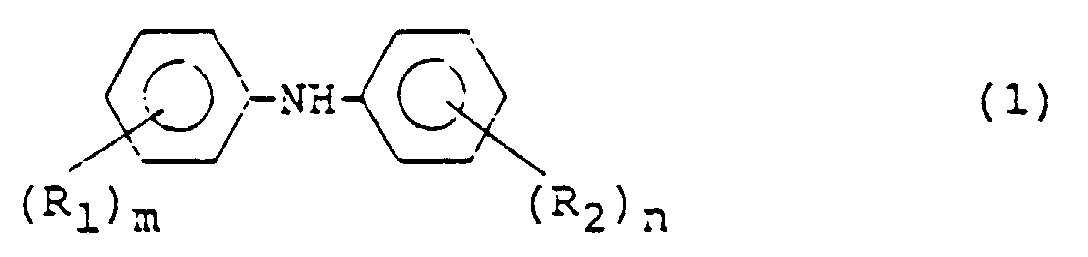
- This invention relates to an improved process for the preparation of diphenylamine or a nucleus-substituted derivative thereof (hereinafter referred to as "diphenylamine and a derivative thereof” for the sake of brevity). More specifically, this invention relates to a process for the preparation of diphenylamine or a derivative thereof by using phenol or a nucleus-substituted derivative thereof (hereinafter referred to as "phenol or a derivative thereof” for the sake of brevity) as a hydrogen acceptor and reacting, in the presence of a hydrogen transfer catalyst, aniline or a nucleus-substituted derivative thereof (hereinafter referred to as “aniline or a derivative thereof") with cyclohexanone or a nucleus-substituted derivative thereof (hereinafter referred to as "cyclohexanone or a derivative thereof”) corresponding to the phenol or the derivative thereof through condensation and inter-molecular hydrogen transfer.
- this invention is concerned with an industrial
- Diphenylamine and derivatives thereof are useful compounds as intermediates for the production of dyes, agricultural chemicals, medicines, compounding agents for rubber and so on.
- 2-methyl-4-alkoxydiphenylamine which can be obtained from a nucleus-substituted derivative of aniline, is highly valuable for its usefulness as a raw material for fluoran dyes employed in pressure-sensitive or heat-sensitive recording papers.
- Diphenylamine or a derivative thereof has heretofore been prepared by deammoniation of aniline or a derivative thereof; dehydration of a reaction product between aniline or a derivative thereof and phenol or a derivative thereof; or dehydrobromination of an reaction product between aniline or a derivative thereof and dibromobenzene.
- EP-A-494455 discloses a method for preparing diphenyl amines by dehydrogenation of cyclohexylidene-anilines.
- the dehydrogenation reaction takes place when gaseous cyclohexylidene-aniline passes through a layer of a rhodium-containing supported catalyst.
- diphenylamine or its derivative is prepared by reacting cyclohexanone or a derivative thereof with aniline or a derivative thereof in the presence of a hydrogen transfer catalyst while using phenol or a derivative thereof as a hydrogen acceptor and forming the cyclohexanone or the derivative thereof in a reaction system.
- This patent publication also discloses a process for obtaining 2-methyldiphenylamine in a yield of 97.0% (selectivity: 99.3%, conversion: 97.7%) by using 2-methylaniline and an excess amount of phenol in the presence of a palladium catalyst. This process is generally satisfactory from the viewpoints of the reaction velocity and selectivity.
- An object of the present invention is to improve the process disclosed in Japanese Patent Application Laid-Open No. 193949/1985 and to provide an industrially advantageous process.
- the amount of the fresh catalyst to be added each time can be reduced substantially while maintaining the reaction velocity and yield at the same levels.
- diphenylamine or a derivative thereof is prepared by reacting aniline or a derivative thereof with phenol or a derivative thereof in the presence of cyclohexanone or a derivative thereof is extremely efficient, because the hydrogen formed as a result of dehydrogenation of the Schiff base, which is an intermediate obtained by the reaction between the aniline or the derivative thereof and the cyclohexanone or the derivative thereof, is fully utilized in the same reaction system for the reduction of the phenol or the derivative thereof, that is, for the formation of the cyclohexanone or the derivative thereof corresponding to the phenol or the derivative thereof.
- nucleus-substituted diphenylamines whose syntheses have heretofore been difficult as long as a single-stage process is used can still be in one stage when the process of the present invention is employed. Even if it is difficult to procure cyclohexanone or the corresponding derivative, the reaction can still be conducted provided that phenol or the corresponding derivative is available because the reaction can be performed by converting beforehand a portion of the phenol or the derivative thereof to cyclohexanone or the corresponding derivative thereof with hydrogen. Thus, these processes also have the advantage that they can be applied for the preparation of a wide range of diphenylamines.
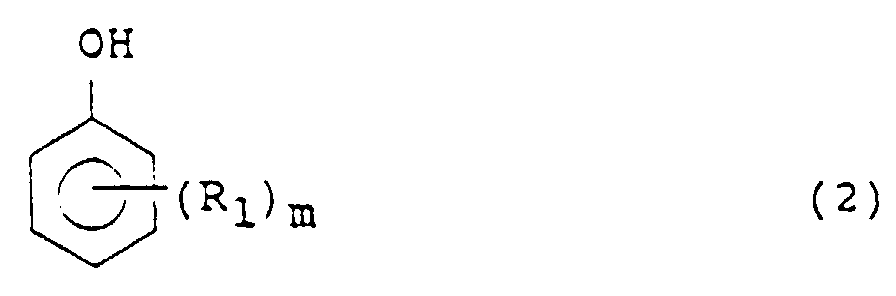
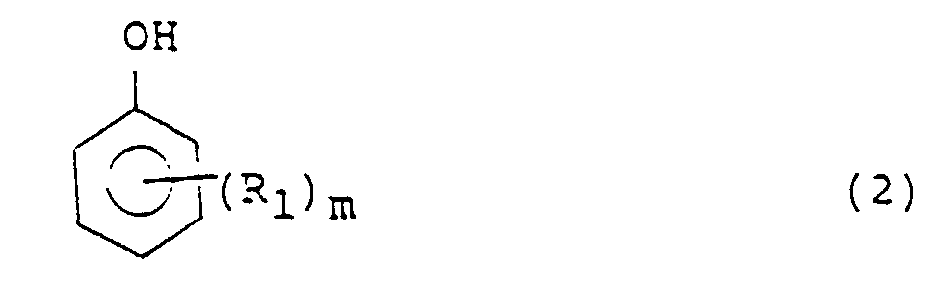
- Phenols or its nucleus-substituted derivatives (which may hereinafter be referred to collectively as "phenol compound” for the sake of brevity) used as a hydrogen receptor in the processes of the present invention are represented by the following formula (2): wherein R 1 is an alkyl or alkoxyl group, for example, a methyl group, m is an integer of 0 to 5, for example, 0, 1 or 2, and where m is 2 or greater, the plural R 1 s may be the same or different.
- phenol compounds examples include phenol; alkylphenols such as methylphenol, ethylphenol, isopropylphenol, butylphenol, 2,4-dimethylphenol, 2,4,6-trimethylphenol, 2,6-di-t-butyl-4-methylphenol; and alkoxyphenols such as 3-methoxyphenol and 4-methoxyphenol. Among them, phenol is particularly preferred.
- phenol compounds are each converted by hydrogen to the corresponding cyclohexanone or derivative thereof which may hereinafter be referred to collectively as “cyclohexanone compound” for the sake of brevity.
- This hydrogen is formed as a result of dehydrogenation of a Schiff base, that is, an intermediate formed by the reaction between aniline or its derivative (which may hereinafter be referred to collectively as “aniline compound”) and the cyclohexanone compound.
- aniline compound aniline compound
- Aniline or its nucleus-substituted derivative namely, the aniline compound used in the processes of the present invention is represented by the following formula (4): wherein R 2 is an alkyl, alkoxyl, carboxyl or an ester thereof, nitrile, aryl or hydroxyl group or a halogen atom, for example, a methyl or methoxyl group or a chlorine atom, n is an integer of 0 to 5, for example, 1 or 2, and where n is 2 or greater, the plural R 2 s may be the same or different.
- Illustrative aniline compounds include aniline; alkylanilines such as 2-methylaniline; dialkylanilines such as 3,4-dimethylaniline; alkoxyanilines such as 3-methoxyaniline; alkylalkoxyanilines such as 2-methyl-4-methoxyaniline; fluoroalkylanilines such as 2-fluoro-5-methylaniline; o-aminobenzoic acid and esters thereof, o-aminobenzonitrile, 4-benzylaniline and aminophenol.
- alkylanilines, alkoxyanilines, alkylalkoxyanilines can bring about high selectivity and are desirable aniline compounds.
- Cyclohexanone or its nucleus-substituted derivative namely, the cyclohexanone compound used in the processes of the present invention is that corresponding to the phenol compound described above and is represented by the following formula (3): wherein R 1 is an alkyl or alkoxyl group, for example, a methyl group, m is an integer of 0 to 5, for example, 0, 1 or 2, and where m is 2 or greater, the plural R 1 s may be the same or different.
- R 1 is an alkyl or alkoxyl group, for example, a methyl group
- m is an integer of 0 to 5, for example, 0, 1 or 2
- the plural R 1 s may be the same or different.
- These cyclohexanone compounds can be used in a catalytic amount of about 0.03 mole or more, preferably 0.05-0.40 mole per mole of the the aniline compound.
- the reaction velocity becomes lower. Amounts greater than 0.40 mole, on the other hand, may reduce the yield of the target diphenylamine compound. It is therefore not preferred to use the aniline compound in any amount outside the above range.
- the cyclohexanone compound When the cyclohexanone compound is not allowed to exist in a catalytic amount from the beginning of the reaction, it is necessary to charge a reactor with hydrogen in an amount sufficient to form a suitable amount of the cyclohexanone compound from the phenol compound. Namely, hydrogen is charged in an amount of at least about 0.06 mole, preferably 0.10-0.80 mole per mole of the aniline compound while taking its conversion into consideration. After that, the reactants are heated and reacted.
- the catalysts of the noble metal of Group VIII of the periodic table include palladium catalysts such as palladium black, palladium oxide, colloidal palladium, palladium-carbon, palladium-barium sulfate and palladium-barium carbonate; platinum or platinum-carrying catalysts such as platinum black, colloidal platinum, platinum sponge, platinum oxide, platinum sulfide and platinum-carbon; rhodium catalysts such as colloidal rhodium, rhodium-carbon and rhodium oxide; and ruthenium catalysts.
- palladium catalysts such as palladium black, palladium oxide, colloidal palladium, palladium-carbon, palladium-barium sulfate and palladium-barium carbonate
- platinum or platinum-carrying catalysts such as platinum black, colloidal platinum, platinum sponge, platinum oxide, platinum sulfide and platinum-carbon
- rhodium catalysts such as colloidal rhodium, rhodium-carbon and
- palladium catalysts are preferred, with palladium-carrying catalysts such as palladium-carbon, palladium-alumina and palladium-magnesium oxide being particularly preferred.
- the catalyst may ordinarily be used in an amount of 0.001 to 0.2 gram-atom, preferably 0.004 to 0.1 gram-atom per gram-molecule of the aniline compound described above.
- the hydroxides, carbonates and bicarbonates of alkali metals and alkaline earth metals can be employed. Specific examples include lithium hydroxide, sodium hydroxide, potassium hydroxide, calcium hydroxide, magnesium hydroxide, sodium carbonate, potassium carbonate and sodium bicarbonate. Among them, sodium hydroxide and potassium hydroxide are preferred.
- These cocatalysts may be used either singly or in combination. The cocatalyst may be added to the reaction system independently from the catalyst of the noble metal of the VIII group of the periodic table.
- a noble-metal-carrying catalyst after a noble-metal-carrying catalyst is prepared, it is also possible to have an alkali metal and/or an alkaline earth metal component additionally carried from a solution of a salt, the hydroxide or the like of the alkali metal and/or alkaline earth metal and then to use the catalyst so prepared.
- the cocatalyst may be used in an amount of 2-30 wt.%, preferably 5-20 wt.% in terms of the alkali metal and/or alkaline earth metal component based on the catalyst metal. If the amount exceeds the upper limit, the reaction velocity tends to lower. If the amount is less than the lower limit, the yield is deteriorated.
- the amount of the cocatalyst may be adjusted, as needed, by adding a fresh supply thereof together with a fresh supply of the catalyst of the noble metal of the VIII group of the periodic table, the latter fresh supply being added whenever the noble metal catalyst is recycled.
- the reaction temperature is generally within a range of from 150°C to 300°C, preferably from 170°C to 280°C.
- the diphenylamine or its derivative so formed can be obtained by treating the reaction mixture in a manner known per se in the art, for example, by distillation, crystallization, extraction or the like after the completion of the reaction.
- the resulting reaction mixture is filtered to separate the catalyst.
- the catalyst so recovered can be used again.
- the filtrate is then concentrated, and the excess amount of the phenol compound is recovered with a cyclohexanone compound still contained therein.
- the distillate so collected is returned to the reaction system as it is, that is, in the form of the mixture.
- Diphenylamine or its derivative remaining in the vessel is then purified and isolated by distillation, crystallization or the like.
- a stainless steel autoclave whose internal capacity was 500 ml was charged with 141.2 g (1.5 mole) of phenol, 5.0 g (0.05 mole) of cyclohexanone, 2.68 g of 5% Pd/C (product of N.E. Chemcat Corp.) and 0.58 g of 1N-NaOH.
- a dropping funnel was charged with 53.5 g (0.5 mole) of 2-methylaniline and the autoclave was purged with nitrogen, the temperature was raised to 200°C. At the same temperature, 2-methylaniline in the dropping funnel was added dropwise to the resulting mixture over 5 hours under stirring. After completion of the dropwise addition, stirring was continued for further one hour while maintaining the temperature. The autoclave was then allowed to cool down to room temperature.
- the reaction mixture was filtered to separate the 5% Pd/C. As a result of analysis of the filtrate by gas chromatography, it was found that the conversion of 2-methylaniline was 99.6% and the selectivity to 2-methyldiphenylamine was 99.3%.
- a stainless steel autoclave whose internal capacity was 500 ml was charged with 53.5 g (0.5 mole) of 2-methylaniline, 235.3 g (2.5 moles) of phenol, 5.0 g (0.05 mole) of cyclohexanone and 2.68 g of 5% Pd/C (product of N.E. Chemcat Corp.). After the autoclave was purged with nitrogen, the temperature was raised to 200°C. At the same temperature, the resulting mixture was allowed to react for 3 hours under stirring. The autoclave was allowed to cool down to room temperature. The reaction mixture was then filtered to separate the catalyst. A portion of the filtrate was sampled and analyzed by gas chromatography. As a result, it was found that the conversion of 2-methylaniline was 98.6% and the selectivity to 2-methyldiphenylamine was 99.2%.
Landscapes
- Chemical & Material Sciences (AREA)
- Organic Chemistry (AREA)
- Organic Low-Molecular-Weight Compounds And Preparation Thereof (AREA)
- Low-Molecular Organic Synthesis Reactions Using Catalysts (AREA)
Description
- This invention relates to an improved process for the preparation of diphenylamine or a nucleus-substituted derivative thereof (hereinafter referred to as "diphenylamine and a derivative thereof" for the sake of brevity). More specifically, this invention relates to a process for the preparation of diphenylamine or a derivative thereof by using phenol or a nucleus-substituted derivative thereof (hereinafter referred to as "phenol or a derivative thereof" for the sake of brevity) as a hydrogen acceptor and reacting, in the presence of a hydrogen transfer catalyst, aniline or a nucleus-substituted derivative thereof (hereinafter referred to as "aniline or a derivative thereof") with cyclohexanone or a nucleus-substituted derivative thereof (hereinafter referred to as "cyclohexanone or a derivative thereof") corresponding to the phenol or the derivative thereof through condensation and inter-molecular hydrogen transfer. In particular, this invention is concerned with an industrially advantageous process for the preparation of diphenylamine or a derivative thereof by using a nucleus-substituted derivative of aniline as a raw material.
- Diphenylamine and derivatives thereof are useful compounds as intermediates for the production of dyes, agricultural chemicals, medicines, compounding agents for rubber and so on. For instance, 2-methyl-4-alkoxydiphenylamine, which can be obtained from a nucleus-substituted derivative of aniline, is highly valuable for its usefulness as a raw material for fluoran dyes employed in pressure-sensitive or heat-sensitive recording papers.
- Diphenylamine or a derivative thereof has heretofore been prepared by deammoniation of aniline or a derivative thereof; dehydration of a reaction product between aniline or a derivative thereof and phenol or a derivative thereof; or dehydrobromination of an reaction product between aniline or a derivative thereof and dibromobenzene.
- Preparation of diphenylamine or a derivative thereof has also been proposed in patent publications, for example, in Japanese Patent Laid-Open Application No. 49924/1974 in which N-cyclohexylideneaniline is reacted in a vapor phase with an oxygen-containing gas in the presence of an oxidizing catalyst such as silica; in Japanese Patent Publication No. 14738/1974 in which phenol and aniline are reacted using γ-alumina as a catalyst; and in Japanese Patent Application Laid-Open No. 53543/1932 in which, upon preparing diphenylamine or a derivative thereof while reacting, in the presence of a hydroreduction catalyst, an amine and cyclohexanone or a derivative thereof to form a Schiff base, that is, an intermediate such as N-cyclohexylideneaniline, the synthesis is conducted using styrene or a derivative thereof as a hydrogen receptor.
- These conventional processes are, however, accompanied by one or more drawbacks such as the need for complex reaction steps and/or low reaction velocity.
- EP-A-494455 discloses a method for preparing diphenyl amines by dehydrogenation of cyclohexylidene-anilines. In this method, the dehydrogenation reaction takes place when gaseous cyclohexylidene-aniline passes through a layer of a rhodium-containing supported catalyst.
- It is also disclosed in Japanese Patent Application Laid-Open No. 193949/1985 that diphenylamine or its derivative is prepared by reacting cyclohexanone or a derivative thereof with aniline or a derivative thereof in the presence of a hydrogen transfer catalyst while using phenol or a derivative thereof as a hydrogen acceptor and forming the cyclohexanone or the derivative thereof in a reaction system. This patent publication also discloses a process for obtaining 2-methyldiphenylamine in a yield of 97.0% (selectivity: 99.3%, conversion: 97.7%) by using 2-methylaniline and an excess amount of phenol in the presence of a palladium catalyst. This process is generally satisfactory from the viewpoints of the reaction velocity and selectivity. Industrial adoption of this process, however, is accompanied with the problems that phenol or a derivative thereof has to be used in large excess relative to aniline or a derivative thereof to suppress byproduction of N-cyclohexylaniline and the like and the expensive noble metal catalyst has to be added freshly in a large amount upon recovery and recycle of the catalyst.
- An object of the present invention is to improve the process disclosed in Japanese Patent Application Laid-Open No. 193949/1985 and to provide an industrially advantageous process.
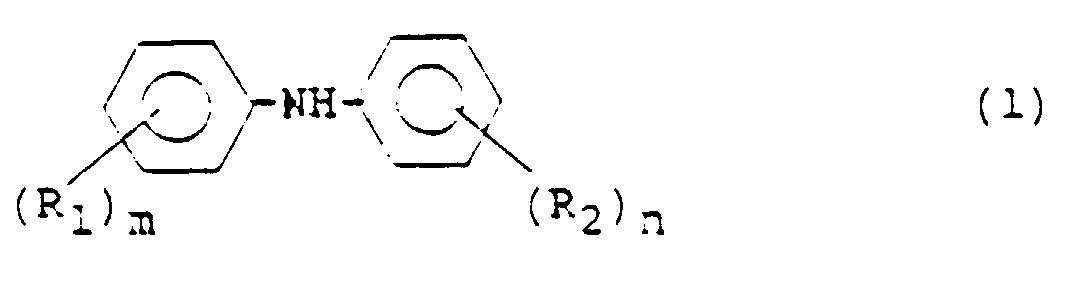
- According to the present invention, there is provided a process for the preparation of diphenylamine or a derivative thereof represented by the following formula (1):wherein R1 is an alkyl or alkoxyl group, m is an integer of 0 to 5, and where m is 2 or greater, the plural R1s may be the same or different; and R2 is an alkyl, alkoxyl, carboxyl or an ester thereof, nitrile, aryl or hydroxyl group or a halogen atom, n is an integer of 0 to 5, and where n is 2 or greater, the plural R2s may be the same or different, said process comprising:
- (i) feeding into a reaction system phenol or a
derivative thereof represented by the following formula
(2):
wherein R1 and m have the same meanings as defined above; and
reacting in the reaction system cyclohexanone or a derivative thereof represented by the following formula (3):wherein R1 and m have the same meanings as defined above with aniline or a derivative thereof represented by the following formula (4):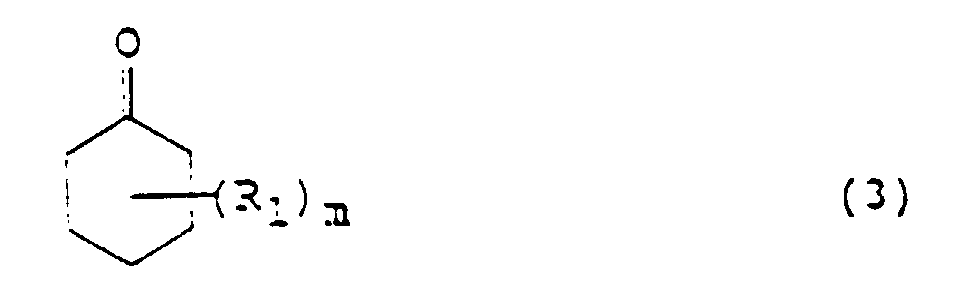 wherein R2 and n have the same meanings as defined above in the presence of a catalyst of a noble metal of Group VIII of the periodic table and a catalytic amount of the cyclohexanone or the derivative thereof corresponding to the phenol or the derivative thereof while using the phenol or the derivative thereof as a hydrogen acceptor and forming the cyclohexanone or the nucleus-substituted derivative thereof in the reaction system, or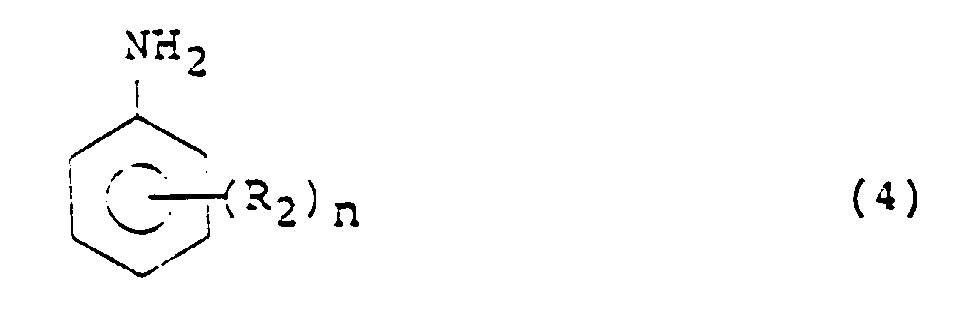
- (ii) converting under hydrogen pressure phenol or
the derivative thereof of the formula (2) to a
catalytic amount of the corresponding cyclohexanone or
derivative thereof of the formula (3) without allowing
the cyclohexanone or derivative thereof of the formula
(3) to exist in the reaction system from the beginning
of the reaction; and
reacting in the reaction system the cyclohexanone or the derivative thereof of with aniline or its derivative represented of the formula (4) while using the phenol or the derivative thereof as a hydrogen acceptor and forming the cyclohexanone or the derivative thereof in the reaction system. The reaction is conducted by adding, as a cocatalyst, the hydroxide, carbonate or bicarbonate of an alkali metal and/or an alkaline earth metal. -
- According to the process of the present invention, satisfactory results can be obtained from the viewpoints of the reaction velocity and the selectivity to the target product.
- According to the present process, when the used catalyst is used again after its recovery, the amount of the fresh catalyst to be added each time can be reduced substantially while maintaining the reaction velocity and yield at the same levels.
- The process in which diphenylamine or a derivative thereof is prepared by reacting aniline or a derivative thereof with phenol or a derivative thereof in the presence of cyclohexanone or a derivative thereof is extremely efficient, because the hydrogen formed as a result of dehydrogenation of the Schiff base, which is an intermediate obtained by the reaction between the aniline or the derivative thereof and the cyclohexanone or the derivative thereof, is fully utilized in the same reaction system for the reduction of the phenol or the derivative thereof, that is, for the formation of the cyclohexanone or the derivative thereof corresponding to the phenol or the derivative thereof. Some nucleus-substituted diphenylamines whose syntheses have heretofore been difficult as long as a single-stage process is used can still be in one stage when the process of the present invention is employed. Even if it is difficult to procure cyclohexanone or the corresponding derivative, the reaction can still be conducted provided that phenol or the corresponding derivative is available because the reaction can be performed by converting beforehand a portion of the phenol or the derivative thereof to cyclohexanone or the corresponding derivative thereof with hydrogen. Thus, these processes also have the advantage that they can be applied for the preparation of a wide range of diphenylamines.
- Phenols or its nucleus-substituted derivatives (which may hereinafter be referred to collectively as "phenol compound" for the sake of brevity) used as a hydrogen receptor in the processes of the present invention are represented by the following formula (2):wherein R1 is an alkyl or alkoxyl group, for example, a methyl group, m is an integer of 0 to 5, for example, 0, 1 or 2, and where m is 2 or greater, the plural R1s may be the same or different. Examples of the phenol compounds include phenol; alkylphenols such as methylphenol, ethylphenol, isopropylphenol, butylphenol, 2,4-dimethylphenol, 2,4,6-trimethylphenol, 2,6-di-t-butyl-4-methylphenol; and alkoxyphenols such as 3-methoxyphenol and 4-methoxyphenol. Among them, phenol is particularly preferred.
- These phenol compounds are each converted by hydrogen to the corresponding cyclohexanone or derivative thereof which may hereinafter be referred to collectively as "cyclohexanone compound" for the sake of brevity. This hydrogen is formed as a result of dehydrogenation of a Schiff base, that is, an intermediate formed by the reaction between aniline or its derivative (which may hereinafter be referred to collectively as "aniline compound") and the cyclohexanone compound. To efficiently and completely use hydrogen formed in the reaction system, therefore, it is necessary to use the phenol compound in an amount equivalent to the aniline compound.
- Aniline or its nucleus-substituted derivative, namely, the aniline compound used in the processes of the present invention is represented by the following formula (4):wherein R2 is an alkyl, alkoxyl, carboxyl or an ester thereof, nitrile, aryl or hydroxyl group or a halogen atom, for example, a methyl or methoxyl group or a chlorine atom, n is an integer of 0 to 5, for example, 1 or 2, and where n is 2 or greater, the plural R2s may be the same or different. Illustrative aniline compounds include aniline; alkylanilines such as 2-methylaniline; dialkylanilines such as 3,4-dimethylaniline; alkoxyanilines such as 3-methoxyaniline; alkylalkoxyanilines such as 2-methyl-4-methoxyaniline; fluoroalkylanilines such as 2-fluoro-5-methylaniline; o-aminobenzoic acid and esters thereof, o-aminobenzonitrile, 4-benzylaniline and aminophenol. In particular, alkylanilines, alkoxyanilines, alkylalkoxyanilines can bring about high selectivity and are desirable aniline compounds.

- Cyclohexanone or its nucleus-substituted derivative, namely, the cyclohexanone compound used in the processes of the present invention is that corresponding to the phenol compound described above and is represented by the following formula (3):wherein R1 is an alkyl or alkoxyl group, for example, a methyl group, m is an integer of 0 to 5, for example, 0, 1 or 2, and where m is 2 or greater, the plural R1s may be the same or different. These cyclohexanone compounds can be used in a catalytic amount of about 0.03 mole or more, preferably 0.05-0.40 mole per mole of the the aniline compound. When the cyclohexanone compound is used in an amount smaller than 0.03 mole, the reaction velocity becomes lower. Amounts greater than 0.40 mole, on the other hand, may reduce the yield of the target diphenylamine compound. It is therefore not preferred to use the aniline compound in any amount outside the above range.

- When the cyclohexanone compound is not allowed to exist in a catalytic amount from the beginning of the reaction, it is necessary to charge a reactor with hydrogen in an amount sufficient to form a suitable amount of the cyclohexanone compound from the phenol compound. Namely, hydrogen is charged in an amount of at least about 0.06 mole, preferably 0.10-0.80 mole per mole of the aniline compound while taking its conversion into consideration. After that, the reactants are heated and reacted.
- Specific examples of the catalysts of the noble metal of Group VIII of the periodic table include palladium catalysts such as palladium black, palladium oxide, colloidal palladium, palladium-carbon, palladium-barium sulfate and palladium-barium carbonate; platinum or platinum-carrying catalysts such as platinum black, colloidal platinum, platinum sponge, platinum oxide, platinum sulfide and platinum-carbon; rhodium catalysts such as colloidal rhodium, rhodium-carbon and rhodium oxide; and ruthenium catalysts.
- Among these catalysts, palladium catalysts are preferred, with palladium-carrying catalysts such as palladium-carbon, palladium-alumina and palladium-magnesium oxide being particularly preferred. The catalyst may ordinarily be used in an amount of 0.001 to 0.2 gram-atom, preferably 0.004 to 0.1 gram-atom per gram-molecule of the aniline compound described above.
- As cocatalysts usable in the the present invention, the hydroxides, carbonates and bicarbonates of alkali metals and alkaline earth metals can be employed. Specific examples include lithium hydroxide, sodium hydroxide, potassium hydroxide, calcium hydroxide, magnesium hydroxide, sodium carbonate, potassium carbonate and sodium bicarbonate. Among them, sodium hydroxide and potassium hydroxide are preferred. These cocatalysts may be used either singly or in combination. The cocatalyst may be added to the reaction system independently from the catalyst of the noble metal of the VIII group of the periodic table. Alternatively, after a noble-metal-carrying catalyst is prepared, it is also possible to have an alkali metal and/or an alkaline earth metal component additionally carried from a solution of a salt, the hydroxide or the like of the alkali metal and/or alkaline earth metal and then to use the catalyst so prepared. The cocatalyst may be used in an amount of 2-30 wt.%, preferably 5-20 wt.% in terms of the alkali metal and/or alkaline earth metal component based on the catalyst metal. If the amount exceeds the upper limit, the reaction velocity tends to lower. If the amount is less than the lower limit, the yield is deteriorated.
- The amount of the cocatalyst may be adjusted, as needed, by adding a fresh supply thereof together with a fresh supply of the catalyst of the noble metal of the VIII group of the periodic table, the latter fresh supply being added whenever the noble metal catalyst is recycled.
- The reaction temperature is generally within a range of from 150°C to 300°C, preferably from 170°C to 280°C.
- The diphenylamine or its derivative so formed can be obtained by treating the reaction mixture in a manner known per se in the art, for example, by distillation, crystallization, extraction or the like after the completion of the reaction. For example, after the completion of the reaction, the resulting reaction mixture is filtered to separate the catalyst. The catalyst so recovered can be used again. The filtrate is then concentrated, and the excess amount of the phenol compound is recovered with a cyclohexanone compound still contained therein. The distillate so collected is returned to the reaction system as it is, that is, in the form of the mixture. Diphenylamine or its derivative remaining in the vessel is then purified and isolated by distillation, crystallization or the like.
- The present invention will hereinafter be described specifically by Examples.
- A stainless steel autoclave whose internal capacity was 500 mℓ was charged with 53.5 g (0.5 mole) of 2-methylaniline, 235.3 g (2.5 moles) of phenol, 5.0 g (0.05 mol) of cyclohexanone, 2.68 g of 5% Pd/C (product of N.E. Chemcat Corp.) and 0.58 g of 1N-NaOH. After the autoclave was purged with nitrogen, the temperature was raised to 200°C. At the same temperature, the resulting mixture was allowed to react for 3 hours under stirring. The autoclave was then allowed to cool down to room temperature. The reaction mixture was filtered to separate the catalyst. A portion of the filtrate was sampled, followed by analysis by gas chromatography. As a result, it was found that the conversion of 2-methylaniline was 98.9% and the selectivity to 2-methyldiphenylamine was 99.2%.
- The reaction was continued similarly using the catalyst recovered and adding 5% Pd/C and NaOH in the corresponding amounts as shown in Table 1. As a result, it was found that the amount of 5% Pd/C newly added in order to maintain the reaction velocity and selectivity was, on average, about 3% of the amount added at the beginning of the reaction.
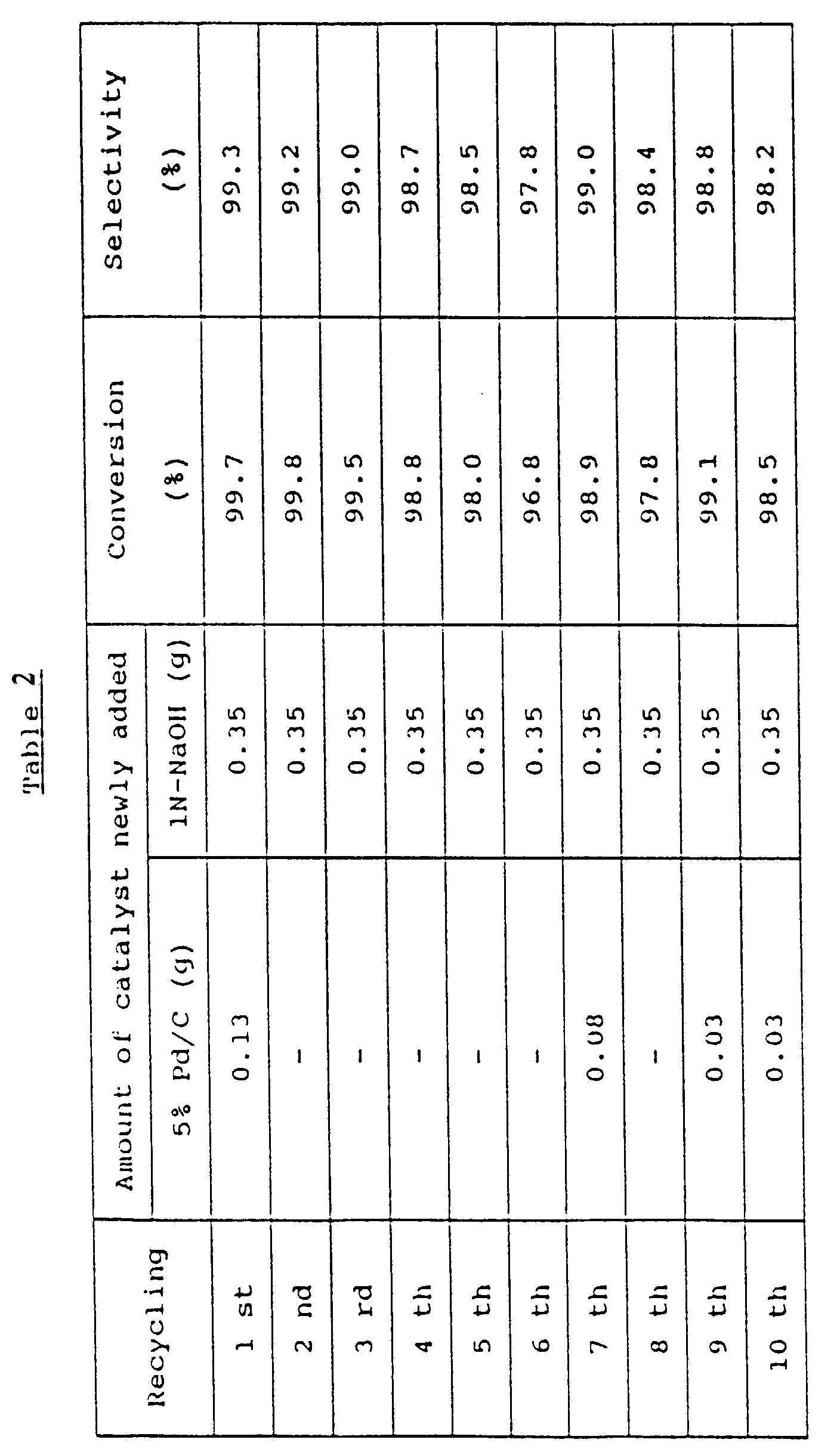
- A stainless steel autoclave whose internal capacity was 500 mℓ was charged with 141.2 g (1.5 mole) of phenol, 5.0 g (0.05 mole) of cyclohexanone, 2.68 g of 5% Pd/C (product of N.E. Chemcat Corp.) and 0.58 g of 1N-NaOH. After a dropping funnel was charged with 53.5 g (0.5 mole) of 2-methylaniline and the autoclave was purged with nitrogen, the temperature was raised to 200°C. At the same temperature, 2-methylaniline in the dropping funnel was added dropwise to the resulting mixture over 5 hours under stirring. After completion of the dropwise addition, stirring was continued for further one hour while maintaining the temperature. The autoclave was then allowed to cool down to room temperature. The reaction mixture was filtered to separate the 5% Pd/C. As a result of analysis of the filtrate by gas chromatography, it was found that the conversion of 2-methylaniline was 99.6% and the selectivity to 2-methyldiphenylamine was 99.3%.
- The reaction was continued further, while reusing the catalyst recovered and adding 5% Pd/C and NaOH in the corresponding amounts shown in Table 2. As a result, it was found that the amount of 5% Pd/C newly added in order to maintain the reaction velocity and the selectivity was, on average, about 1 % of the amount added at the beginning of the reaction.
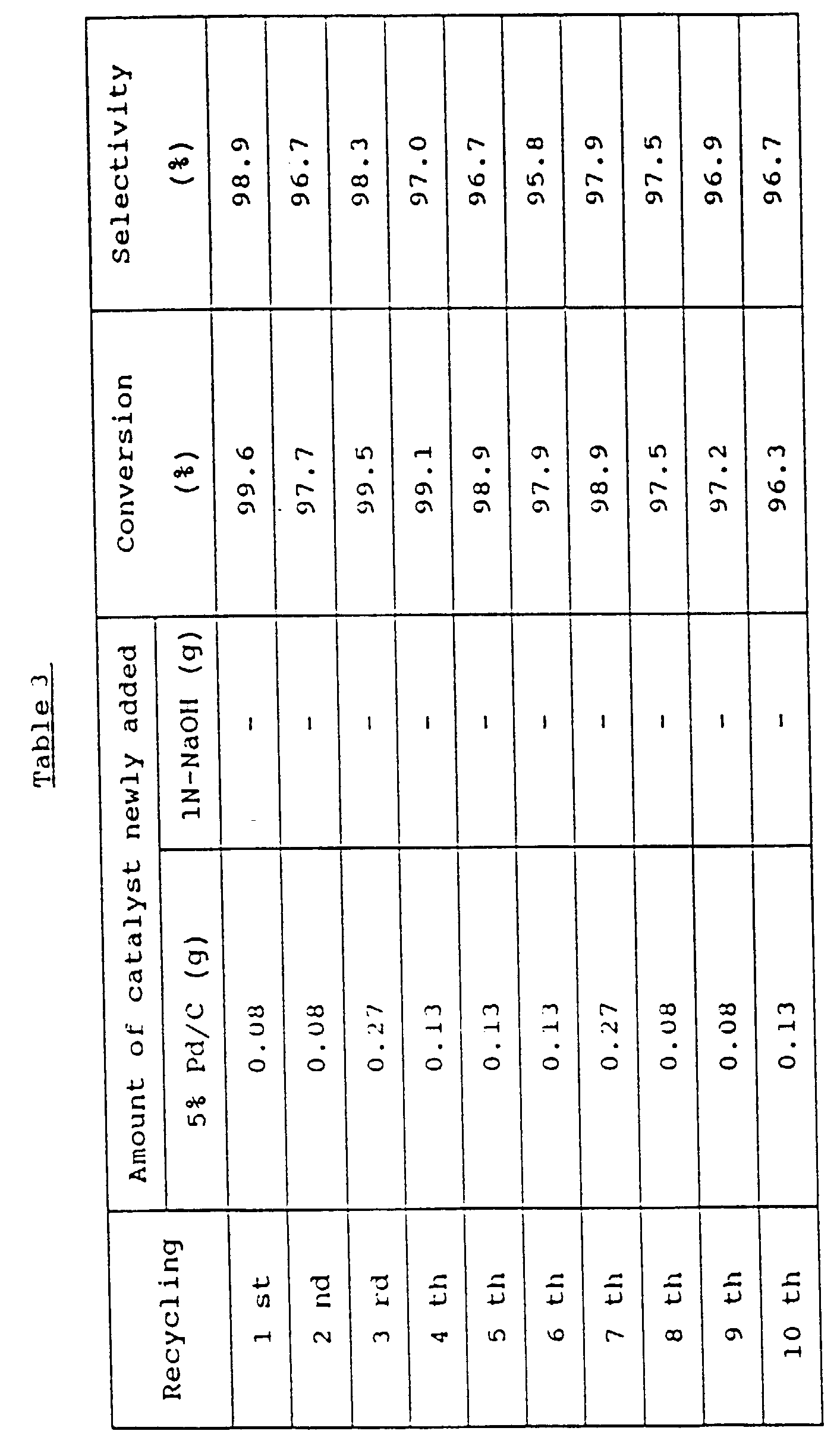
- A stainless steel autoclave whose internal capacity was 500 mℓ was charged with 53.5 g (0.5 mole) of 2-methylaniline, 235.3 g (2.5 moles) of phenol, 5.0 g (0.05 mole) of cyclohexanone and 2.68 g of 5% Pd/C (product of N.E. Chemcat Corp.). After the autoclave was purged with nitrogen, the temperature was raised to 200°C. At the same temperature, the resulting mixture was allowed to react for 3 hours under stirring. The autoclave was allowed to cool down to room temperature. The reaction mixture was then filtered to separate the catalyst. A portion of the filtrate was sampled and analyzed by gas chromatography. As a result, it was found that the conversion of 2-methylaniline was 98.6% and the selectivity to 2-methyldiphenylamine was 99.2%.
- The reaction was continued further, while reusing the catalyst recovered and adding 5% Pd/C in the amount shown in Table 3. As a result, it was found that the amount of 5% Pd/C newly added in order to maintain the reaction velocity and the selectivity was, on average, about 5% of the amount added at the beginning of the reaction.

Claims (8)
- A process for the preparation of diphenylamine or a nucleus-substituted derivative thereof represented by the following formula (1):wherein R1 is an alkyl or alkoxyl group, m is an integer of 0 to 5, and where m is 2 or greater, the plural R1s may be the same or different; and R2 is an alkyl, alkoxyl, carboxyl or an ester thereof, nitrile, aryl or hydroxyl group or a halogen atom, n is an integer of 0 to 5, and where n is 2 or greater, the plural R2s may be the same or different, said process comprising:

feeding into a reaction system phenol or a nucleus-substituted derivative thereof represented by the following formula (2):wherein R1 and m have the same meanings as defined above, and
reacting in the reaction system cyclohexanone or a nucleus-substituted derivative thereof represented by the following formula (3):wherein R1 and m have the same meanings as defined above with aniline or a nucleus-substituted derivative thereof represented by the following formula (4):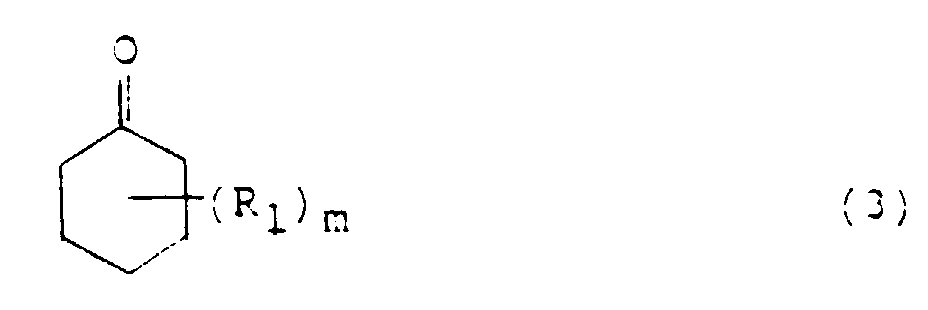 wherein R2 and n have the same meanings as defined above in the presence of a catalyst of a noble metal of Group VIII of the periodic table and a catalytic amount of the cyclohexanone or the nucleus-substituted derivative thereof corresponding to the phenol or the nucleus-substituted derivative thereof while using the phenol or the nucleus-substituted derivative thereof as a hydrogen acceptor and forming the cyclohexanone or the nucleus-substituted derivative thereof in the reaction system, characterized in that the reaction is conducted by adding, as a cocatalyst, the hydroxide, carbonate or bicarbonate of an alkali metal and/or an alkaline earth metal.
- A process for the preparation of diphenylamine or a nucleus-substituted derivative thereof represented by the following formula (1):wherein R1 is an alkyl or alkoxyl group, m is an integer of 0 to 5, and where m is 2 or greater, the plural R1s may be the same or different; and R2 is an alkyl, alkoxyl, carboxyl or an ester thereof, nitrile, aryl or hydroxyl group or a halogen atom, n is an integer of 0 to 5, and where n is 2 or greater, the plural R2s may be the same or different, said process comprising:
converting, in the presence of a catalyst of a noble metal of Group VIII of the periodic table and under hydrogen pressure in a reaction system, a portion of phenol or a nucleus-substituted derivative thereof represented by the following formula (2):wherein R1 and m have the same meanings as defined above to cyclohexanone or a nucleus-substituted derivative thereof represented by the following formula (3): wherein R1 and m have the same meanings as defined above and corresponding to the phenol or the nucleus-substituted derivative thereof and,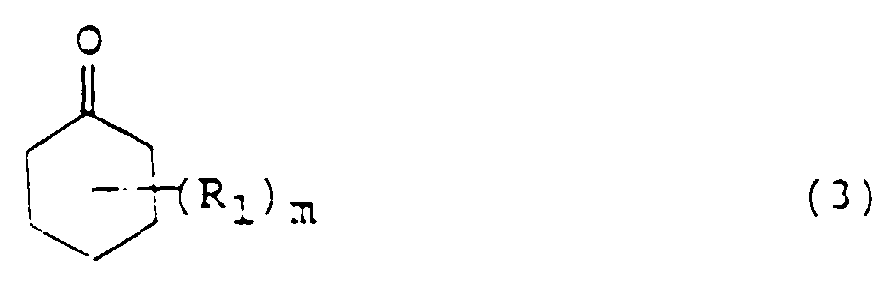
while using the phenol or the nucleus-substituted derivative thereof as a hydrogen acceptor and forming the cyclohexanone or the nucleus-substituted derivative thereof in the reaction system, reacting the cyclohexanone or the nucleus-substituted derivative thereof with aniline or a nucleus-substituted derivative thereof represented by the following formula (4):wherein R2 and n have the same meanings as defined above, characterized in that the reaction is conducted by adding, as a cocatalyst, the hydroxide, carbonate or bicarbonate of an alkali metal and/or alkaline earth metal.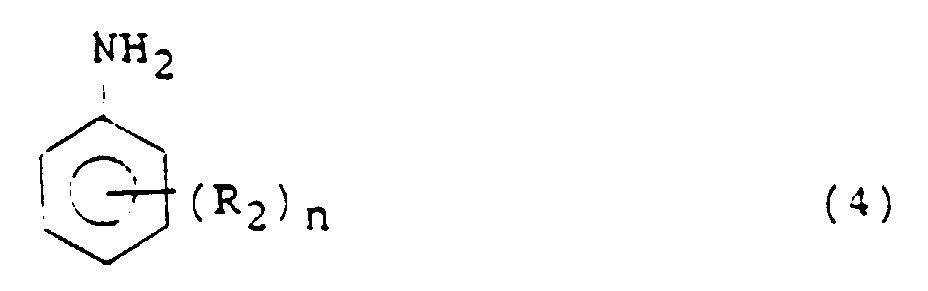
- A process of claim 1 or 2, wherein the reaction is conducted at 170-280°C.
- A process of claim 1 or 2, wherein the catalyst of the noble metal of Group VIII of the periodic table is palladium.
- A process of claim 1 or 2, wherein the cyclohexanone or the nucleus-substituted derivative thereof present in the reaction system amounts to 0.05-0.4 mole per mole of the aniline or the nucleus-substituted derivative thereof.
- A process of claim 1 or 2, wherein in the formula (2), R1 is an alkyl or alkoxyl group and m is 0 to 2.
- A process of claim 1 or 2, wherein in the formula (4), R2 is an alkyl or alkoxyl group and n is 1 or 2.
- A process of claim 1 or 2, wherein the reaction is conducted while adding dropwise aniline or the nucleus-substituted derivative thereof.
Applications Claiming Priority (7)
| Application Number | Priority Date | Filing Date | Title |
|---|---|---|---|
| JP290132/92 | 1992-10-28 | ||
| JP29013292 | 1992-10-28 | ||
| JP29013292 | 1992-10-28 | ||
| JP29131292A JP3234655B2 (en) | 1992-10-29 | 1992-10-29 | Process for producing diphenylamine or its nuclear substituted product |
| JP291312/92 | 1992-10-29 | ||
| JP29131292 | 1992-10-29 | ||
| EP93117523A EP0595332B1 (en) | 1992-10-28 | 1993-10-28 | Process for the preparation of diphenylamine or nucleus-substituted derivative thereof |
Related Parent Applications (2)
| Application Number | Title | Priority Date | Filing Date |
|---|---|---|---|
| EP93117523A Division EP0595332B1 (en) | 1992-10-28 | 1993-10-28 | Process for the preparation of diphenylamine or nucleus-substituted derivative thereof |
| EP93117523.6 Division | 1993-10-28 |
Publications (2)
| Publication Number | Publication Date |
|---|---|
| EP0803496A1 EP0803496A1 (en) | 1997-10-29 |
| EP0803496B1 true EP0803496B1 (en) | 2000-03-08 |
Family
ID=26557904
Family Applications (2)
| Application Number | Title | Priority Date | Filing Date |
|---|---|---|---|
| EP93117523A Expired - Lifetime EP0595332B1 (en) | 1992-10-28 | 1993-10-28 | Process for the preparation of diphenylamine or nucleus-substituted derivative thereof |
| EP97111438A Expired - Lifetime EP0803496B1 (en) | 1992-10-28 | 1993-10-28 | Process for the preparation of diphenlyamine or nucleus-substituted derivative thereof |
Family Applications Before (1)
| Application Number | Title | Priority Date | Filing Date |
|---|---|---|---|
| EP93117523A Expired - Lifetime EP0595332B1 (en) | 1992-10-28 | 1993-10-28 | Process for the preparation of diphenylamine or nucleus-substituted derivative thereof |
Country Status (5)
| Country | Link |
|---|---|
| US (1) | US5545752A (en) |
| EP (2) | EP0595332B1 (en) |
| KR (2) | KR100193156B1 (en) |
| CN (1) | CN1054368C (en) |
| DE (2) | DE69328046T2 (en) |
Families Citing this family (2)
| Publication number | Priority date | Publication date | Assignee | Title |
|---|---|---|---|---|
| US5654483A (en) * | 1994-12-26 | 1997-08-05 | Mitsui Toatsu Chemicals, Inc. | Process for producing alkoxy-substituted triphenylamines |
| FR2995895B1 (en) * | 2012-09-25 | 2015-01-30 | Fonds De Dev Des Filieres Des Oleagineux Et Proteagineux Fidop | PROCESS FOR SYNTHESIZING AN AROMATIC COMPOUND |
Family Cites Families (14)
| Publication number | Priority date | Publication date | Assignee | Title |
|---|---|---|---|---|
| JPS4914738B1 (en) * | 1970-12-17 | 1974-04-10 | ||
| US4200451A (en) * | 1972-06-06 | 1980-04-29 | Ciba-Geigy Corporation | Plant growth regulating agent |
| JPS4914738A (en) * | 1972-06-08 | 1974-02-08 | ||
| US4046810A (en) * | 1972-06-24 | 1977-09-06 | Snam Progetti S.P.A. | Process for the preparation of diphenylamine and derivatives thereof |
| IT961239B (en) * | 1972-06-24 | 1973-12-10 | Snam Progetti | PROCESS FOR THE PRODUCTION OF DIPHENYLAMINE AND ITS DERIVATIVES |
| US4124639A (en) * | 1975-12-22 | 1978-11-07 | America Cyanamid Company | N-alkoxyalkyl-2,6-dinitroaniline herbicides |
| JPS5758648A (en) * | 1980-09-26 | 1982-04-08 | Mitsui Petrochem Ind Ltd | Preparation of diphenylamine or its nuclear substitution product |
| JPS60193949A (en) * | 1984-03-14 | 1985-10-02 | Mitsui Toatsu Chem Inc | Production of diphenylamine or its nucleus-substituted derivative |
| CA1244836A (en) * | 1984-03-14 | 1988-11-15 | Teruyuki Nagata | Process for producing diphenylamines or n,n'-diphenyl- phenylenediamines |
| JPH0665662B2 (en) * | 1985-02-12 | 1994-08-24 | 三井東圧化学株式会社 | Method for producing triphenylamine or nuclear substitution product thereof |
| JPH01100152A (en) * | 1987-10-13 | 1989-04-18 | Honsyu Kagaku Kogyo Kk | Production of diphenylamine nucleus-substituted compound |
| DE3801754A1 (en) * | 1988-01-22 | 1989-07-27 | Bayer Ag | RHODIUM CATALYSTS, METHOD FOR THE PRODUCTION THEREOF AND METHOD FOR PRODUCING, IF NECESSARY, SUBSTITUTED DIPHENYLAMINE USING RHODIUM CATALYSTS |
| US5196592A (en) * | 1991-01-10 | 1993-03-23 | Bayer Aktiengesellschaft | Process for the preparation of diphenylamines |
| US5117063A (en) * | 1991-06-21 | 1992-05-26 | Monsanto Company | Method of preparing 4-aminodiphenylamine |
-
1993
- 1993-10-28 DE DE69328046T patent/DE69328046T2/en not_active Expired - Lifetime
- 1993-10-28 KR KR1019930022635A patent/KR100193156B1/en not_active Expired - Lifetime
- 1993-10-28 EP EP93117523A patent/EP0595332B1/en not_active Expired - Lifetime
- 1993-10-28 DE DE69316825T patent/DE69316825T2/en not_active Expired - Lifetime
- 1993-10-28 EP EP97111438A patent/EP0803496B1/en not_active Expired - Lifetime
- 1993-10-28 CN CN93120705A patent/CN1054368C/en not_active Expired - Lifetime
-
1995
- 1995-06-02 US US08/458,294 patent/US5545752A/en not_active Expired - Lifetime
-
1997
- 1997-12-01 KR KR97065097A patent/KR0141615B1/en not_active Expired - Lifetime
Also Published As
| Publication number | Publication date |
|---|---|
| EP0803496A1 (en) | 1997-10-29 |
| KR0141615B1 (en) | 1998-07-01 |
| DE69328046D1 (en) | 2000-04-13 |
| CN1092403A (en) | 1994-09-21 |
| EP0595332A1 (en) | 1994-05-04 |
| DE69316825T2 (en) | 1998-09-10 |
| US5545752A (en) | 1996-08-13 |
| KR100193156B1 (en) | 1999-06-15 |
| CN1054368C (en) | 2000-07-12 |
| EP0595332B1 (en) | 1998-02-04 |
| DE69328046T2 (en) | 2000-10-05 |
| DE69316825D1 (en) | 1998-03-12 |
Similar Documents
| Publication | Publication Date | Title |
|---|---|---|
| US4871875A (en) | Process for producing diphenylamines or N,N'-diphenylphenylenediamines | |
| US5449829A (en) | Process for the preparation of diphenylamine | |
| JPH05148217A (en) | Preparation of diphenylmethane-base poly(o- alkylurethane) | |
| US7256312B2 (en) | Method for producing aminoalkoxy benzylamines and aminoalkoxy benzonitriles as intermediates | |
| EP0595332B1 (en) | Process for the preparation of diphenylamine or nucleus-substituted derivative thereof | |
| JP3234655B2 (en) | Process for producing diphenylamine or its nuclear substituted product | |
| KR100275793B1 (en) | Process for the preparation of n,n'-disubstituted urea using selenium-based catalyst | |
| JPH0533215B2 (en) | ||
| JP3135436B2 (en) | Method for producing diphenylamine or its nuclear-substituted product | |
| JP3177350B2 (en) | Method for producing dinonyldiphenylamine | |
| JP3174425B2 (en) | Process for producing N, N-disubstituted aminophenols | |
| JP3177351B2 (en) | Method for producing tris (diarylamino) benzenes | |
| JP3213502B2 (en) | Method for producing triphenylamines | |
| JPH0528216B2 (en) | ||
| JPH0770003A (en) | Method for producing diphenylamines | |
| JPH0725836A (en) | Method for producing dinonyldiphenylamine | |
| JP3714539B2 (en) | Method for producing aromatic secondary amino compound | |
| JP3137827B2 (en) | Method for producing 3-aminodiphenylamine | |
| JP3154598B2 (en) | N- (4'-nonylcyclohexyl) -4-nonylaniline and method for producing the same | |
| JPH0665662B2 (en) | Method for producing triphenylamine or nuclear substitution product thereof | |
| JP2533565B2 (en) | Process for producing 3- (4-hydroxyphenyl) -cyclohexanecarboxylic acid and 4'-hydroxybiphenyl-3-carboxylic acid | |
| JPH01100151A (en) | Production of triphenylamine and its nucleus-substituted compound | |
| JPH051256B2 (en) | ||
| JPH01100152A (en) | Production of diphenylamine nucleus-substituted compound | |
| US5654483A (en) | Process for producing alkoxy-substituted triphenylamines |
Legal Events
| Date | Code | Title | Description |
|---|---|---|---|
| PUAI | Public reference made under article 153(3) epc to a published international application that has entered the european phase |
Free format text: ORIGINAL CODE: 0009012 |
|
| AC | Divisional application: reference to earlier application |
Ref document number: 595332 Country of ref document: EP |
|
| AK | Designated contracting states |
Kind code of ref document: A1 Designated state(s): CH DE FR GB IT LI NL |
|
| 17P | Request for examination filed |
Effective date: 19971216 |
|
| 17Q | First examination report despatched |
Effective date: 19980320 |
|
| RAP1 | Party data changed (applicant data changed or rights of an application transferred) |
Owner name: MITSUI CHEMICALS, INC. |
|
| GRAG | Despatch of communication of intention to grant |
Free format text: ORIGINAL CODE: EPIDOS AGRA |
|
| GRAG | Despatch of communication of intention to grant |
Free format text: ORIGINAL CODE: EPIDOS AGRA |
|
| GRAH | Despatch of communication of intention to grant a patent |
Free format text: ORIGINAL CODE: EPIDOS IGRA |
|
| GRAH | Despatch of communication of intention to grant a patent |
Free format text: ORIGINAL CODE: EPIDOS IGRA |
|
| GRAA | (expected) grant |
Free format text: ORIGINAL CODE: 0009210 |
|
| AC | Divisional application: reference to earlier application |
Ref document number: 595332 Country of ref document: EP |
|
| AK | Designated contracting states |
Kind code of ref document: B1 Designated state(s): CH DE FR GB IT LI NL |
|
| PG25 | Lapsed in a contracting state [announced via postgrant information from national office to epo] |
Ref country code: NL Free format text: LAPSE BECAUSE OF FAILURE TO SUBMIT A TRANSLATION OF THE DESCRIPTION OR TO PAY THE FEE WITHIN THE PRESCRIBED TIME-LIMIT Effective date: 20000308 Ref country code: LI Free format text: LAPSE BECAUSE OF NON-PAYMENT OF DUE FEES Effective date: 20000308 Ref country code: CH Free format text: LAPSE BECAUSE OF NON-PAYMENT OF DUE FEES Effective date: 20000308 |
|
| REG | Reference to a national code |
Ref country code: CH Ref legal event code: EP |
|
| REF | Corresponds to: |
Ref document number: 69328046 Country of ref document: DE Date of ref document: 20000413 |
|
| ET | Fr: translation filed | ||
| ITF | It: translation for a ep patent filed | ||
| NLV1 | Nl: lapsed or annulled due to failure to fulfill the requirements of art. 29p and 29m of the patents act | ||
| REG | Reference to a national code |
Ref country code: CH Ref legal event code: PL |
|
| PLBE | No opposition filed within time limit |
Free format text: ORIGINAL CODE: 0009261 |
|
| STAA | Information on the status of an ep patent application or granted ep patent |
Free format text: STATUS: NO OPPOSITION FILED WITHIN TIME LIMIT |
|
| 26N | No opposition filed | ||
| REG | Reference to a national code |
Ref country code: GB Ref legal event code: IF02 |
|
| PGFP | Annual fee paid to national office [announced via postgrant information from national office to epo] |
Ref country code: DE Payment date: 20121024 Year of fee payment: 20 Ref country code: FR Payment date: 20121018 Year of fee payment: 20 |
|
| PGFP | Annual fee paid to national office [announced via postgrant information from national office to epo] |
Ref country code: GB Payment date: 20121024 Year of fee payment: 20 Ref country code: IT Payment date: 20121016 Year of fee payment: 20 |
|
| REG | Reference to a national code |
Ref country code: DE Ref legal event code: R071 Ref document number: 69328046 Country of ref document: DE |
|
| REG | Reference to a national code |
Ref country code: GB Ref legal event code: PE20 Expiry date: 20131027 |
|
| PG25 | Lapsed in a contracting state [announced via postgrant information from national office to epo] |
Ref country code: DE Free format text: LAPSE BECAUSE OF EXPIRATION OF PROTECTION Effective date: 20131029 Ref country code: GB Free format text: LAPSE BECAUSE OF EXPIRATION OF PROTECTION Effective date: 20131027 |