EP0802901B1 - Novel carbamate compounds containing thiocarbamoyl group and process for preparing the same - Google Patents
Novel carbamate compounds containing thiocarbamoyl group and process for preparing the same Download PDFInfo
- Publication number
- EP0802901B1 EP0802901B1 EP96900456A EP96900456A EP0802901B1 EP 0802901 B1 EP0802901 B1 EP 0802901B1 EP 96900456 A EP96900456 A EP 96900456A EP 96900456 A EP96900456 A EP 96900456A EP 0802901 B1 EP0802901 B1 EP 0802901B1
- Authority
- EP
- European Patent Office
- Prior art keywords
- propandiol
- phenyl
- represented
- structural formula
- following structural
- Prior art date
- Legal status (The legal status is an assumption and is not a legal conclusion. Google has not performed a legal analysis and makes no representation as to the accuracy of the status listed.)
- Expired - Lifetime
Links
Classifications
-
- C—CHEMISTRY; METALLURGY
- C07—ORGANIC CHEMISTRY
- C07C—ACYCLIC OR CARBOCYCLIC COMPOUNDS
- C07C333/00—Derivatives of thiocarbamic acids, i.e. compounds containing any of the groups, the nitrogen atom not being part of nitro or nitroso groups
- C07C333/02—Monothiocarbamic acids; Derivatives thereof
-
- C—CHEMISTRY; METALLURGY
- C07—ORGANIC CHEMISTRY
- C07C—ACYCLIC OR CARBOCYCLIC COMPOUNDS
- C07C333/00—Derivatives of thiocarbamic acids, i.e. compounds containing any of the groups, the nitrogen atom not being part of nitro or nitroso groups
- C07C333/02—Monothiocarbamic acids; Derivatives thereof
- C07C333/04—Monothiocarbamic acids; Derivatives thereof having nitrogen atoms of thiocarbamic groups bound to hydrogen atoms or to acyclic carbon atoms
-
- A—HUMAN NECESSITIES
- A61—MEDICAL OR VETERINARY SCIENCE; HYGIENE
- A61P—SPECIFIC THERAPEUTIC ACTIVITY OF CHEMICAL COMPOUNDS OR MEDICINAL PREPARATIONS
- A61P25/00—Drugs for disorders of the nervous system
Definitions
- the present invention relates to novel carbamate compounds derived from 2-phenyl-1,3-propandiol. More particularly, the present invention relates to 3-thiocarbamoyl-2-phenyl-1,3-propandiol carbamates including their racemates and enantiomers, useful to treat the diseases of the central nervous system. Also, the present invention is concerned with a process for preparing the same.
- thiocarbamoyl-containing carbamates are pharmaceutically useful in prophylaxis and treatment of CNS disorders, for example, epilepsy and apoplexy.
- an optical isomer of one compound may exhibit on even better pharmaceutical effect than other optical isomers, and many examples showing such optical effect have been reported. Thus, it is very important to separate the racemates of one compound into the respective optical isomers and apply them for pharmacology.
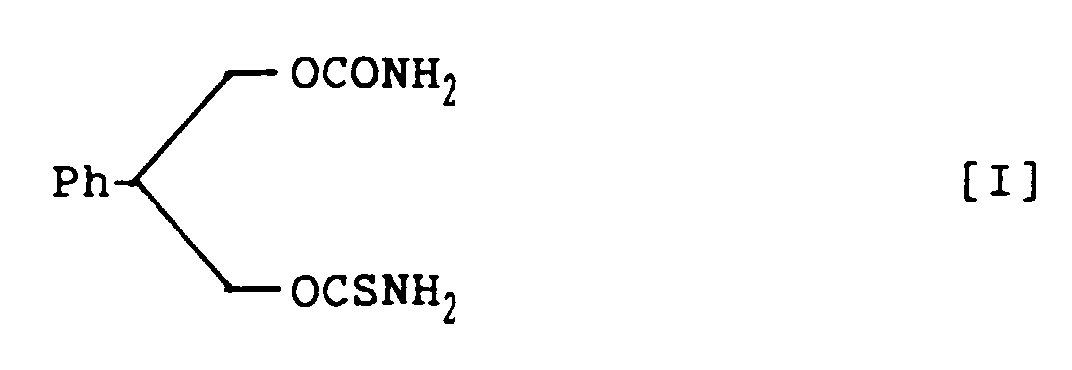
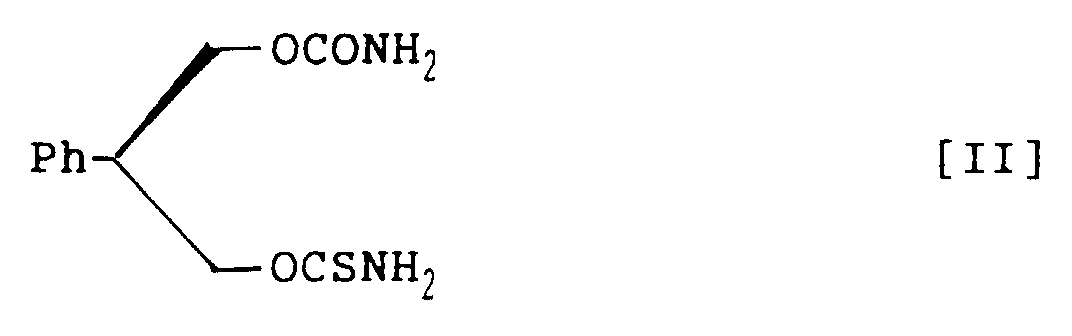
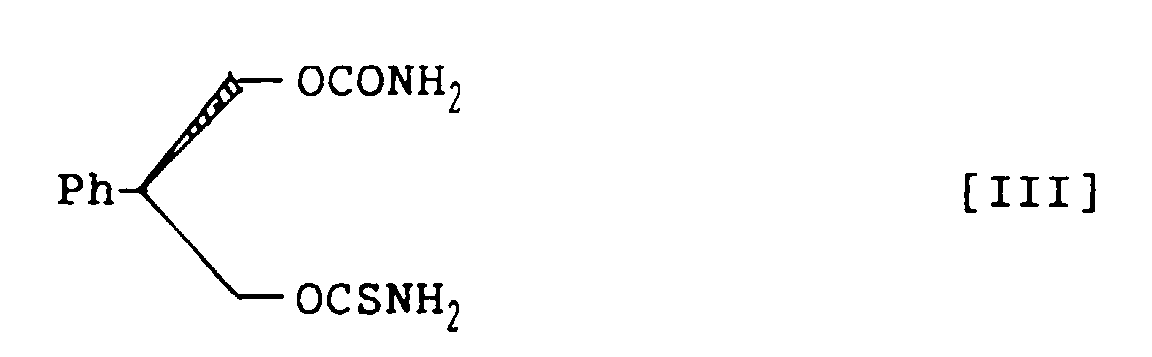
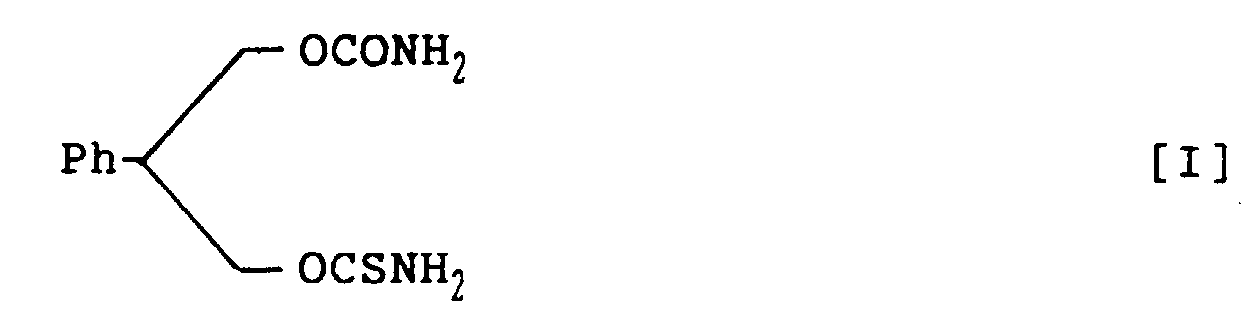
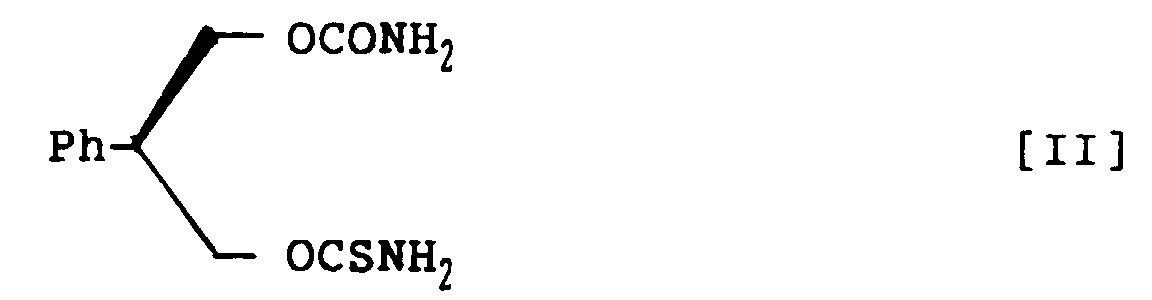
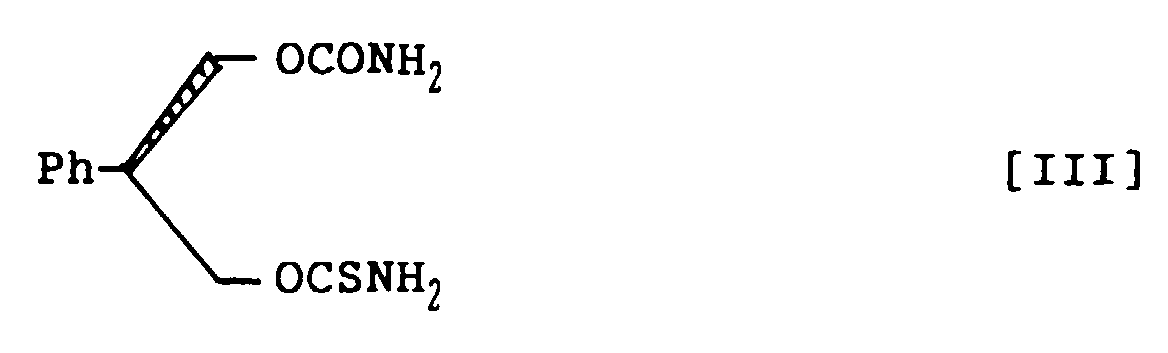
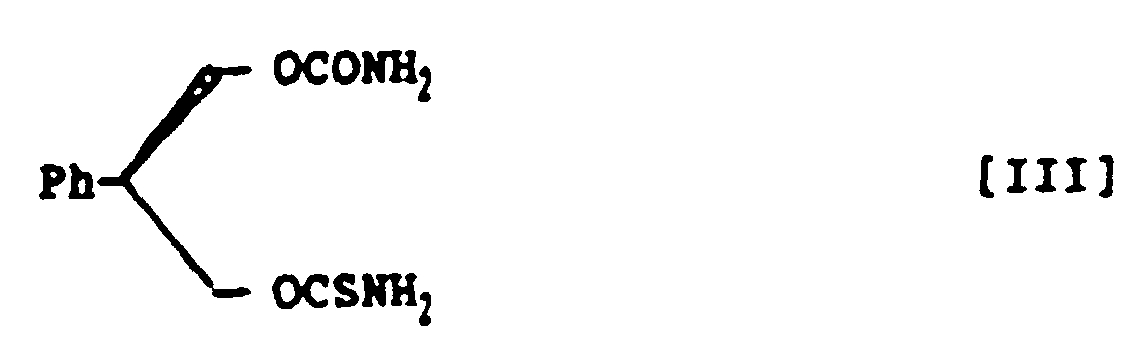
- novel carbamate derivatives pharmacologically excellent for prophylaxis and treatment of CNS disorders: 3-thiocarbamoyl-2-phenyl-1,3-propandiol carbamate racemate, represented by structural formula I; (S)-3-thiocarbamoyl-2-phenyl-1,3-propandiol carbamate, represented by structural formula II; and (R)-3-thiocarbamoyl-2-phenyl-1,3-propandiol carbamate, represented by structural formula III:
- novel compound of structural formula I has a chiral center, two optical isomers are possible as mentioned above.
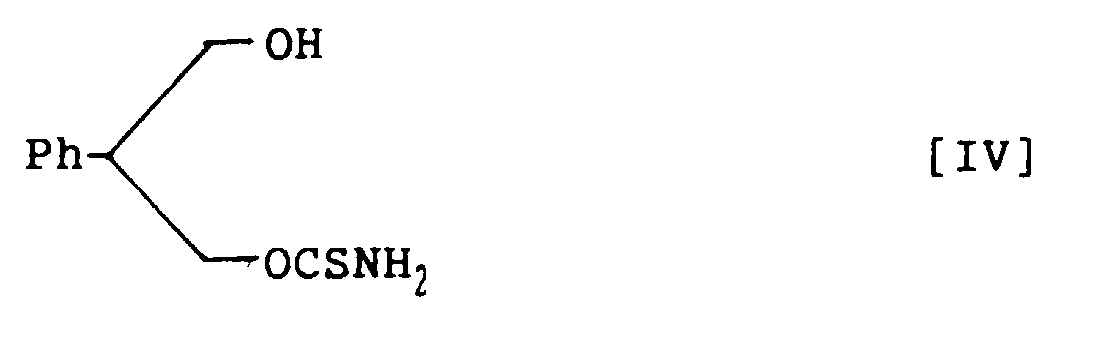
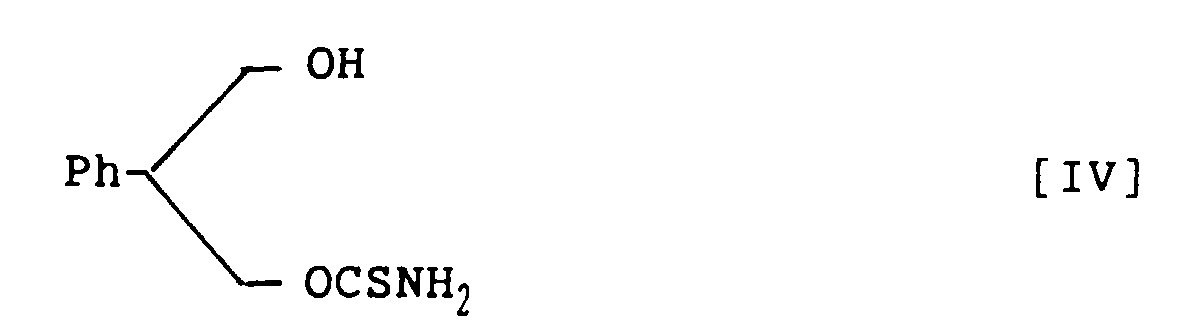
- the compounds of structural formulas I and II are prepared from their respective corresponding intermediates, structural formulas IV and V. This can be done by treating 0.1 to 2 moles of the compounds of structural formulas IV and V with 1.0 to 2.0 molar equivalents of phosgene in the mixed solvent of aromatic hydrocarbon and halogenohydrocarbon in the presence of an amine base, followed by reaction with 1 to 1,000 molar equivalents of ammonia.
- Amine base useful in the present invention includes antipyrine, diisopropylethyl amine and pyridine with a preference of antipyrine, a sterically hindered base.
- phosgene either neat or as solution in toluene
- ammonia either neat or as solution in water or lower alcohol such as methanol or ethanol, may be used.
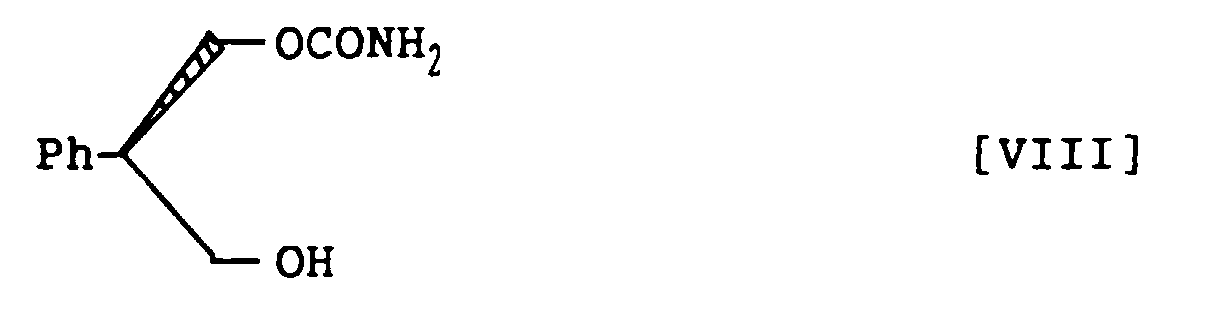
- the compound of structural formula III is prepared by 0.1 to 2 moles of (S)-2-phenyl-1,3-propandiol monocarbamate, represented by structural formula VIII; with 1.0 to 2.0 molar equivalents of thiophosgene in a mixed solvent of aromatic hydrocarbon and halogenohydrocarbon in the presence of an amine base and then, with 1 to 1,000 molar equivalents of ammonia, either neat or as solution in water or lower alcohol such as methanol and ethanol.
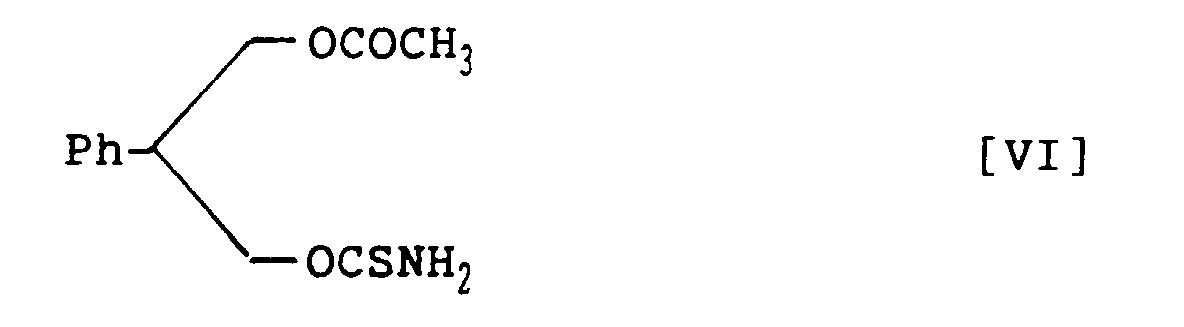
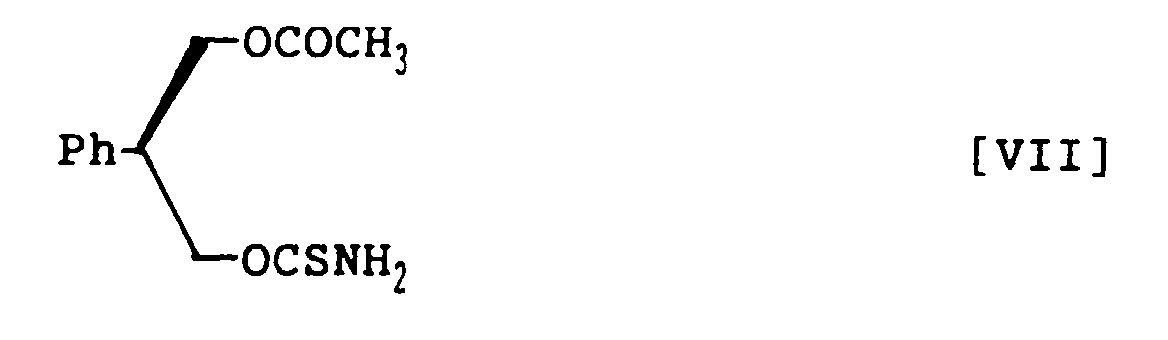
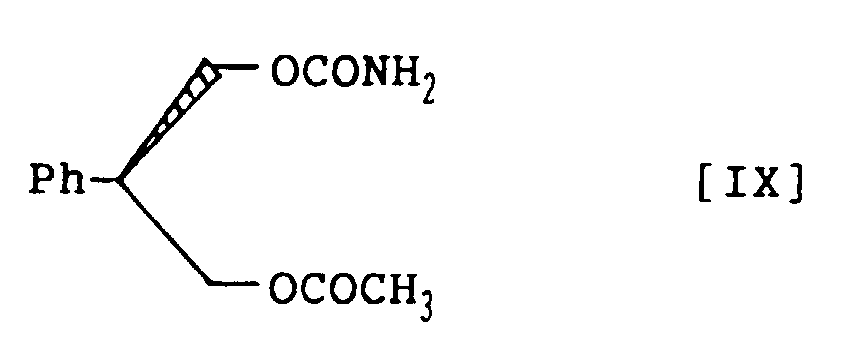
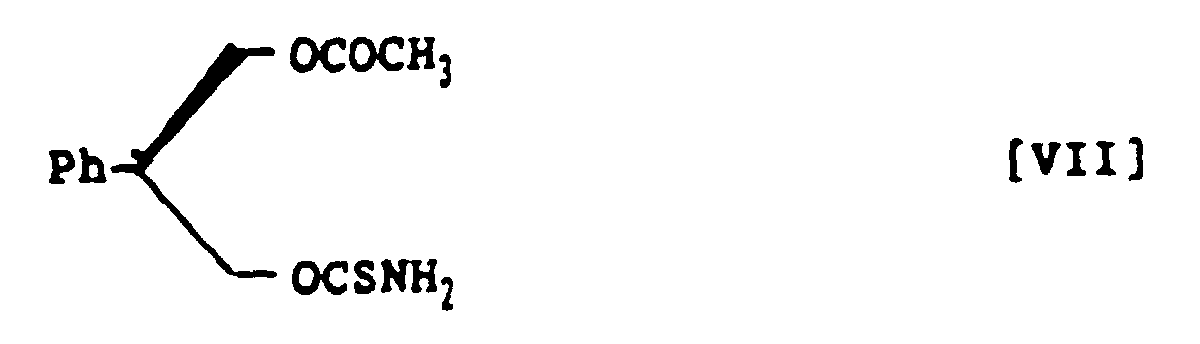
- the compounds of structural formulas IV, V and VIII can be synthesized from the compounds of structural formulas VI and VII, and the following structural formula IX, respectively:
- the compound represented by structural formula IV can be obtained by hydrolyzing 0.1 to 2.0 moles of the compound of structural formula VI in a mixed solution of 1N sodium hydroxide aqueous solution and ethanol (1:1) at a temperature of 0 to 30 °C.
- the compounds of structural formulas V and VIII can be achieved by hydrolyzing the compounds of structural formulas VII and IX, respectively, in the presence of an enzyme in a phosphate buffer.
- the phosphate buffer is diluted into 0.01 to 0.1 M in order to improve the selectivity of reaction, with pH 7.
- Examples of the enzyme useful for this hydrolysis include lipase extracted from the pancreas of pig (PPL), candida lipase (CCL), aspagilus lipase (ANL), pseudomonas lipase (PSL) and esterase extracted from the liver of pig (PLE), with a preference of PLE.
- PPL pancreas of pig
- CCL pancreas of pig
- ANL aspagilus lipase
- PSL pseudomonas lipase
- PLE esterase extracted from the liver of pig
- Such hydrolytic reaction is carried out at a temperature of 0 to 30 °C.
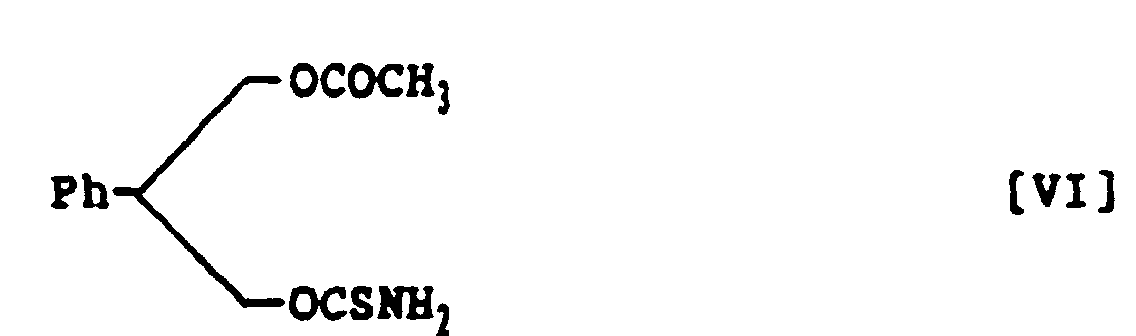
- the compounds of structural formulas VI and VII can be derived from their respective corresponding intermediates, 3-acetoxy-2-phenylpropanol racemate and (R)-3-acetoxy-2-phenylpropanol.
- amine base 0.1 to 2.0 moles of each of the intermediates are treated with 1.0 to 2.0 molar equivalents of thiophosgene, followed by the reaction with 1 to 1,000 molar equivalents of ammonia, either neat or as solution in water or a lower alcohol such as methanol or ethanol.
- both thiophosgene and ammonia are reacted at temperatures ranging from -10 °C to 10 °C.
- Example I was repeated using (R)-3-acetoxy-2-phenylpropanol as the starting material instead of 3-acetoxy-2-phenylpropanol racemate.
- the title compound thus obtained was tested for optical purity with a high pressure liquid chromatograph (HPLC) equipped with a column for separating optical isomers.
- HPLC high pressure liquid chromatograph
- the conversion of the reactants was monitored by HPLC. When the conversion rate reached about 80 %, the reaction was terminated, after which filtration was carried out. The filtrate was extracted three times with ethyl acetate.
- Example V was repeated using as the starting material (S)-2-phenyl-1,3-propandiol monothiocarbamate prepared in Example IV, instead of 2-phenyl-1,3-propandiol monothiocarbamate racemate.
- the title compound thus obtained was tested for optical purity with a high pressure liquid chromatograph equipped with a column for separating optical isomers. m.p.
Landscapes
- Chemical & Material Sciences (AREA)
- Organic Chemistry (AREA)
- Health & Medical Sciences (AREA)
- Medicinal Chemistry (AREA)
- Pharmacology & Pharmacy (AREA)
- Biomedical Technology (AREA)
- Neurology (AREA)
- Neurosurgery (AREA)
- Chemical Kinetics & Catalysis (AREA)
- General Chemical & Material Sciences (AREA)
- Engineering & Computer Science (AREA)
- Nuclear Medicine, Radiotherapy & Molecular Imaging (AREA)
- Bioinformatics & Cheminformatics (AREA)
- Life Sciences & Earth Sciences (AREA)
- Animal Behavior & Ethology (AREA)
- General Health & Medical Sciences (AREA)
- Public Health (AREA)
- Veterinary Medicine (AREA)
- Organic Low-Molecular-Weight Compounds And Preparation Thereof (AREA)
- Acyclic And Carbocyclic Compounds In Medicinal Compositions (AREA)
- Preparation Of Compounds By Using Micro-Organisms (AREA)
Description

1H-NMR(CDCl3, 200 MHz), ppm (δ):
2.00(s,3H), 3.38-3.45(m,lH), 4.29-4.33(d,2H), 4.64-4.67(d,2H), 6.18(b,1H), 6.69(b,1H), 7.25-7.28(m,5H)
m.p. = 62-63 °C
1H-NMR(CDCl3, 200 MHz), ppm (δ):
2.00(s,3H), 3.38-3.45(m,1H), 4.29-4.33(d,2H), 4.64-4.67(d,2H), 6.18(b,1H), 6.69(b,1H), 7.25-7.28(m,5H)
m.p. = 64-65 °C
1H-NMR(CDCl3, 200 MHz), ppm (δ):
2.50(b,1H), 3.15-3.39(m,1H), 3.80(d,2H), 4.70(d,2H), 6.35(b,1H), 6.80(b,1H), 7.19-7.35(m,5H)
1H-NMR(CDCl3, 200 MHz), ppm (δ):
2.50(b,1H), 3.15-3.39(m,1H), 3.80(d,2H), 4.70(d,2H), 6.35(b,lH), 6.80(b,1H), 7.19-7.35(m,5H)
1H-NMR(CDCL3,200 MHz), ppm (δ):
3.35-3.50(m,1H), 4.35(d,2H), 4.67(d,2H), 4.67(d,2H),4.78(b,2H), 6.21(b,1H), 6.62(b,1H), 7.21-7.37(m,5H)
m.p. = 108.5-109.0 °C
1H-NMR(CDCL3,200 MHz), ppm (δ):
3.35-3.50(m,1H), 4.35(d,2H), 4.67(d,2H), 4.67(d,2H), 4.78(b,2H), 6.21(b,1H), 6.62(b,1H), 7.21-7.37(m,5H)
m.p. = 113.5-114.0 °C
1H-NMR(CDCL3,200 MHz), ppm (δ):
3.35-3.50(m,1H), 4.35(d,2H), 4.67(d,2H), 4.67(d,2H), 4.78(d,2H), 6.21(b,1H), 6.62(b,1H), 7.21-7.37(m,5H)
Claims (17)
- 3-Thiocarbamoyl-2-phenyl-1,3-propandiol carbamate, represented by the following structural formula I:
- (S)-3-Thiocarbamoyl-2-phenyl-1,3-propandiol carbamate, represented by the following structural formula II:
- (R)-3-Thiocarbamoyl-2-phenyl-1,3-propandiol carbamate, represented by the following structural formula III:
- 2-Phenyl-1,3-propandiol monothiocarbamate, represented by the following structural formula IV:
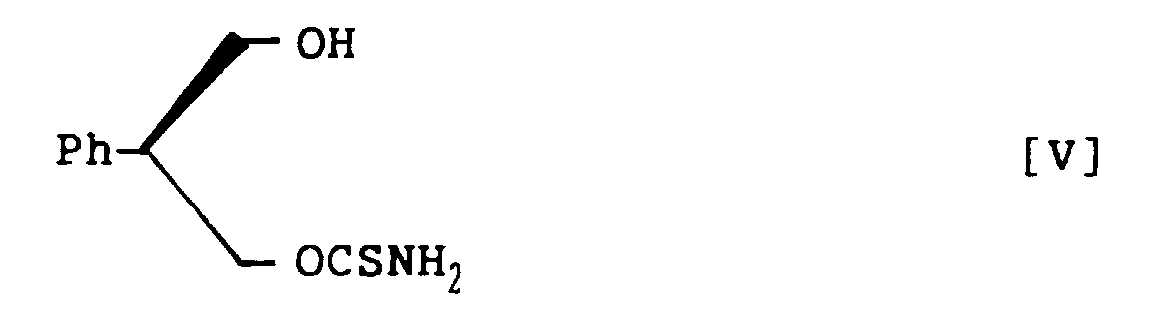
- (S)-2-Phenyl-1,3-propandiol monothiocarbamate, represented by the following structural formula V:
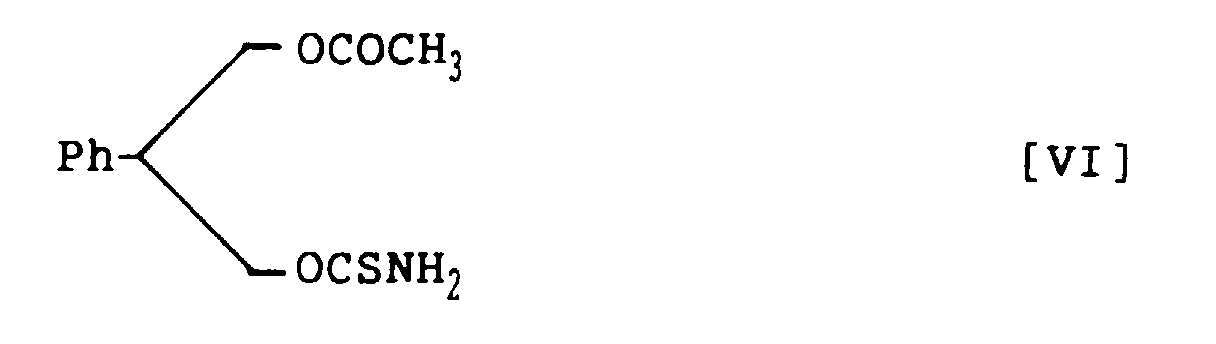
- 3-Acetoxy-2-phenylpropanol thiocarbamate, represented by the following structural formula VI:
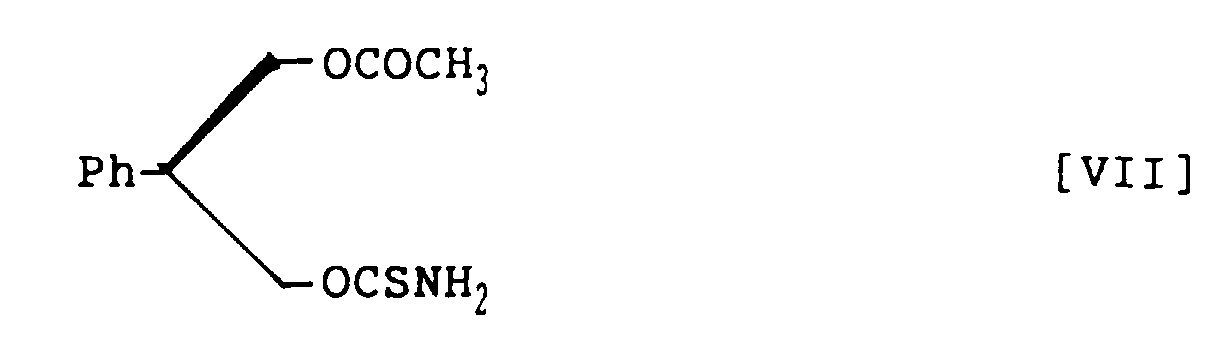
- (S)-3-Acetoxy-2-phenylpropanol thiocarbamate, represented by the following structural formula VII:
- A method for preparing 3-thiocarbamoyl-2-phenyl-1,3-propandiol carbamate, represented by the following structural formula I:which comprises treating 2-phenyl-1,3-propandiol monothiocarbamate, represented by the following structural formula IV:
 with phosgene in a mixed solvent of aromatic hydrocarbon and halogenohydrocarbon in the presence of amine base and subsequently with ammonia to prepare 3-thiocarbamoyl-2-phenyl-1,3-propandiol carbamate within a short time in a high yield.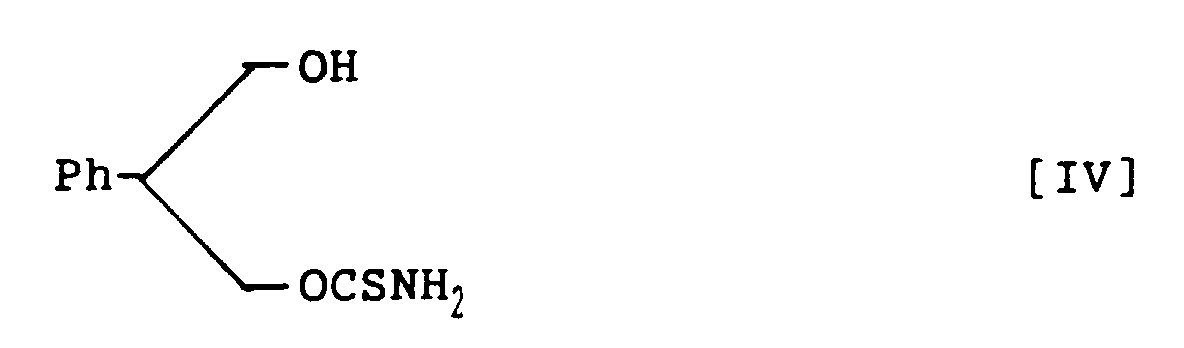
- A method for preparing (S)-3-thiocarbamoyl-2-phenyl-1,3-propandiol carbamate, represented by the following structural formula II:which comprises treating (S)-2-phenyl-1,3-propandiol monothiocarbamate, represented by the following structural formula V:
 with phosgene in a mixed solvent of aromatic hydrocarbon and halogenohydrocarbon in the presence of amine base and subsequently with ammonia to prepare (S)-3-thiocarbamoyl-2-phenyl-1,3-propandiol carbamate within a short time in a high yield and in a high purity.
- A method for preparing (R)-3-thiocarbamoyl-2-phenyl-1,3-propandiol carbamate, represented by the following structural formula III:which comprises treating (S)-2-phenyl-1,3-propandiol monocarbamate, represented by the following structural formula VIII:
 with thiophosgene in a mixed solvent of aromatic hydrocarbon and halogenohydrocarbon in the presence of amine base and subsequently with ammonia to prepare (R)-3-thiocarbamoyl-2-phenyl-1,3-propandiol carbamate within a short time in a high yield and in a high purity.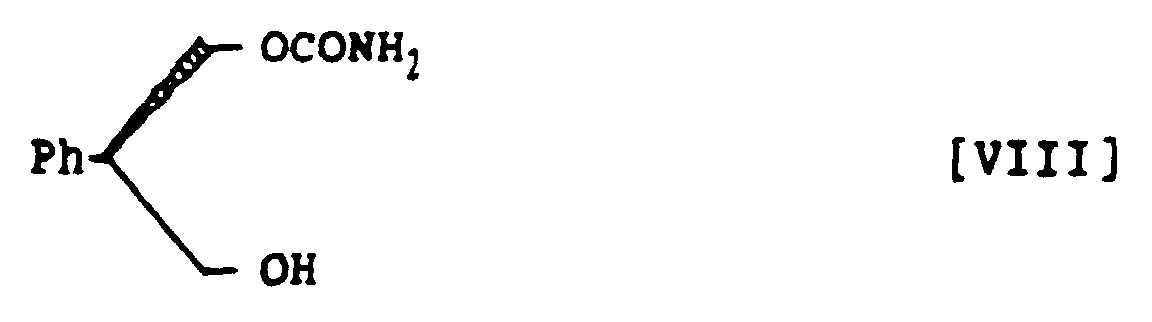
- A method for preparing 2-phenyl-1,3-propandiol monothiocarbamate, represented by the following structural formula IV:which comprises hydrolysing 3-acetoxy-2-phenylpropanol thiocarbamate, represented by the following structural formula VI:
 in a mixture of sodium hydroxide aqueous solution and ethanol to prepare 2-phenyl-1,3-propandiol monothiocarbamate within a short time in a high yield.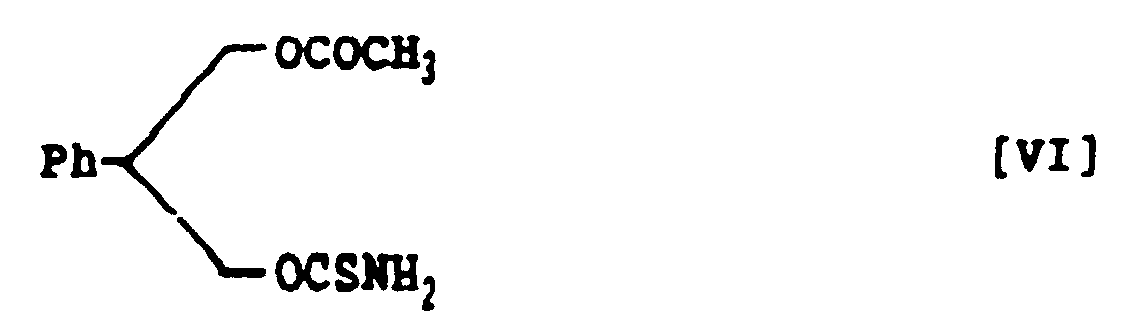
- A method for preparing (S)-2-phenyl-1,3-propandiol monothiocarbamate, represented by the following structural formula V:which comprises hydrolysing (S)-3-acetoxy-2-phenylpropanol thiocarbamate in a phosphate buffer in the presence of an enzyme to prepare (S)-2-phenyl-1,3-propandiol monothiocarbamate within a short time in a high yield and in a high optical purity.

- The method in accordance with claim 12, wherein said enzyme is selected from the group consisting of lipase extracted from the pancreas of pig, candida lipase, aspagilus lipase, pseudomonas lipase and esterase extracted from the liver of pig.
- A method for preparing 3-acetoxy-2-phenylpropanol thiocarbamate, represented by the following structural formula VI:which comprises treating 3-acetoxy-2-phenylpropanol with thiophosgene in a mixed solvent of aroaatic hydrocarbon and halogenohydrocarbon in the presence of nine base and subsequently with ammonia to prepare 3-acetoxy-2-phenylpropanol thiocarbamate within a short time in a high yield.
- A method for preparing (S)-3-acetoxy-2-phenylpropanol thiocarbamate, represented by the following structural formula VII:which comprises treating (R)-3-acetoxy-2-phenylpropanol with thiophosgene in a mixed solvent of aromatic hydrocarbon and halogenohydrocarbon in the presence of amine base and subsequently with ammonia to prepare (S)-3-acetoxy-2-phenylpropanol thiocarbamate within a short time in a high yield and in a high optical purity.
- A pharmaceutical composition for treating disorders of the central nervous system which comprises as an active ingredient an effective amount for treating disorders of the central nervous system of a compound of Formula (I) as defined in claim 1, Formula (II) as defined in claim 2, or Formula (III) as defined in claim 3 and a pharmaceutically acceptable carrier.
- The composition of claim 16, wherein the CNS disorder being treated is selected from the group consisting of apoplexy or epilepsy.
Applications Claiming Priority (3)
| Application Number | Priority Date | Filing Date | Title |
|---|---|---|---|
| KR9500017 | 1995-01-03 | ||
| KR1019950000017A KR0150288B1 (en) | 1995-01-03 | 1995-01-03 | Novel carbamate compounds containing thiocarbamoyl group and process for preparing the same |
| PCT/KR1996/000002 WO1996020922A1 (en) | 1995-01-03 | 1996-01-03 | Novel carbamate compounds containing thiocarbamoyl group and process for preparing the same |
Publications (2)
| Publication Number | Publication Date |
|---|---|
| EP0802901A1 EP0802901A1 (en) | 1997-10-29 |
| EP0802901B1 true EP0802901B1 (en) | 2000-10-04 |
Family
ID=19406348
Family Applications (1)
| Application Number | Title | Priority Date | Filing Date |
|---|---|---|---|
| EP96900456A Expired - Lifetime EP0802901B1 (en) | 1995-01-03 | 1996-01-03 | Novel carbamate compounds containing thiocarbamoyl group and process for preparing the same |
Country Status (10)
| Country | Link |
|---|---|
| US (1) | US5627300A (en) |
| EP (1) | EP0802901B1 (en) |
| JP (1) | JPH10511676A (en) |
| KR (1) | KR0150288B1 (en) |
| CN (2) | CN1070850C (en) |
| CA (1) | CA2209228A1 (en) |
| DE (1) | DE69610549T2 (en) |
| DK (1) | DK0802901T3 (en) |
| ES (1) | ES2153557T3 (en) |
| WO (1) | WO1996020922A1 (en) |
Families Citing this family (4)
| Publication number | Priority date | Publication date | Assignee | Title |
|---|---|---|---|---|
| CN1160329C (en) * | 1999-02-05 | 2004-08-04 | Sk株式会社 | O-thiocarbamoyl-aminoalkanol compounds, pharmaceutically acceptable salts thereof and process for preparing the same |
| IT1403618B1 (en) | 2011-01-05 | 2013-10-31 | Copan Italia Spa | PROCEDURE FOR REALIZING A DEVICE FOR THE COLLECTION AND TRANSFER OF SAMPLES FOR MOLECULAR BIOLOGY |
| CN105294600B (en) * | 2015-11-29 | 2017-11-07 | 重庆天春科技有限公司 | A kind of synthetic method of medicine intermediate diketone aminated compounds |
| CN106631947A (en) * | 2016-09-29 | 2017-05-10 | 广州市汇吉科技企业孵化器有限公司 | Extraction technology of thiocarbamate in moringa oleifera and application of thiocarbamate |
Family Cites Families (4)
| Publication number | Priority date | Publication date | Assignee | Title |
|---|---|---|---|---|
| US288444A (en) * | 1883-11-13 | Check-row planter | ||
| US2884444A (en) * | 1956-01-13 | 1959-04-28 | Carter Prod Inc | 2-phenyl-1,3 propane diol dicarbamate |
| US2937119A (en) * | 1959-06-11 | 1960-05-17 | Carter Prod Inc | Nu-monosubstituted-2, 2-dialkyl-1, 3-propanediol dicarbamates |
| US2901501A (en) * | 1958-02-03 | 1959-08-25 | Frosst & Co Charles E | Propanediol bis |
-
1995
- 1995-01-03 KR KR1019950000017A patent/KR0150288B1/en not_active Expired - Fee Related
-
1996
- 1996-01-03 DK DK96900456T patent/DK0802901T3/en active
- 1996-01-03 JP JP8520866A patent/JPH10511676A/en not_active Ceased
- 1996-01-03 CA CA002209228A patent/CA2209228A1/en not_active Abandoned
- 1996-01-03 US US08/582,498 patent/US5627300A/en not_active Expired - Lifetime
- 1996-01-03 EP EP96900456A patent/EP0802901B1/en not_active Expired - Lifetime
- 1996-01-03 DE DE69610549T patent/DE69610549T2/en not_active Expired - Fee Related
- 1996-01-03 CN CN96191334A patent/CN1070850C/en not_active Expired - Fee Related
- 1996-01-03 ES ES96900456T patent/ES2153557T3/en not_active Expired - Lifetime
- 1996-01-03 WO PCT/KR1996/000002 patent/WO1996020922A1/en not_active Ceased
-
2001
- 2001-01-03 CN CNB011013435A patent/CN1171868C/en not_active Expired - Fee Related
Non-Patent Citations (1)
| Title |
|---|
| E. SCHRÖDER et al, 'ARZNEINMITTELCHEMIE I', GEORGE THIEME VERLAG, STUTTGART * page 32 - page 33 * * |
Also Published As
| Publication number | Publication date |
|---|---|
| ES2153557T3 (en) | 2001-03-01 |
| US5627300A (en) | 1997-05-06 |
| DE69610549T2 (en) | 2001-05-31 |
| CN1070850C (en) | 2001-09-12 |
| CN1335304A (en) | 2002-02-13 |
| CA2209228A1 (en) | 1996-07-11 |
| CN1171868C (en) | 2004-10-20 |
| KR960029322A (en) | 1996-08-17 |
| KR0150288B1 (en) | 1998-10-15 |
| JPH10511676A (en) | 1998-11-10 |
| DK0802901T3 (en) | 2001-02-05 |
| DE69610549D1 (en) | 2000-11-09 |
| WO1996020922A1 (en) | 1996-07-11 |
| CN1167482A (en) | 1997-12-10 |
| EP0802901A1 (en) | 1997-10-29 |
Similar Documents
| Publication | Publication Date | Title |
|---|---|---|
| DE69618663T2 (en) | O-CARBAMOYL-PHENYLALANINOL COMPOSITIONS AND THEIR PHARMACEUTICAL APPLICABLE SALTS | |
| DE60102825T2 (en) | KINETIC RACEMATING OF CHIRALER 2 AND 3 SUBSTITUTED CARBOXYLIC ACIDS | |
| EP0802901B1 (en) | Novel carbamate compounds containing thiocarbamoyl group and process for preparing the same | |
| JP5548129B2 (en) | Asymmetric organic catalyst | |
| DE69416424T2 (en) | METHOD FOR PRODUCING TERT-LEUCIN AND ANALOGS IN ENANTIEMER FORM AND INTERMEDIATE PRODUCTS | |
| DE69732570T2 (en) | Sulphonic acid derivatives, process for their preparation and their use | |
| KR0150239B1 (en) | Monocarbamate Compound Derived from 2-phenyl-1,3-propanediol | |
| EP0730575B1 (en) | Novel carbamate compounds and processes for preparing the same | |
| US20080051583A1 (en) | Novel intermediate compounds useful in the production of diarylcycloalkyl derivatives | |
| EP2076485B1 (en) | Process for making aminoalkylphenyl carbamates and intermediates therefor | |
| KR0150289B1 (en) | Novel carbamate compounds containing imidocarbonate group and process for preparing the same | |
| US5654461A (en) | Sulfamate compound containing carbamoyl group | |
| JP2005053933A (en) | Acylated (r)-amines | |
| KR100197901B1 (en) | Monocarbamate of phenyl-1,2-ethandiol optical isomer | |
| CA2267247C (en) | Heteroaryloxyethylamines as 5-ht1a ligands | |
| JP3005669B2 (en) | Method for producing asymmetric fluorinated primary amines | |
| JPS62275697A (en) | Method for splitting racemic 2-amino-1-alkanol by enzyme | |
| CA2176960C (en) | Novel carbamate compounds and processes for preparing the same | |
| KR0139717B1 (en) | Carbamic compound | |
| WO1996035660A1 (en) | Synthesis of optically active aminoindanol | |
| JPH08231477A (en) | Production of optically active beta-aminoesters | |
| JP2003259889A (en) | Method for producing optically active allene |
Legal Events
| Date | Code | Title | Description |
|---|---|---|---|
| PUAI | Public reference made under article 153(3) epc to a published international application that has entered the european phase |
Free format text: ORIGINAL CODE: 0009012 |
|
| 17P | Request for examination filed |
Effective date: 19970729 |
|
| AK | Designated contracting states |
Kind code of ref document: A1 Designated state(s): BE CH DE DK ES FR GB IT LI NL SE |
|
| 17Q | First examination report despatched |
Effective date: 19981123 |
|
| GRAG | Despatch of communication of intention to grant |
Free format text: ORIGINAL CODE: EPIDOS AGRA |
|
| GRAG | Despatch of communication of intention to grant |
Free format text: ORIGINAL CODE: EPIDOS AGRA |
|
| GRAH | Despatch of communication of intention to grant a patent |
Free format text: ORIGINAL CODE: EPIDOS IGRA |
|
| GRAH | Despatch of communication of intention to grant a patent |
Free format text: ORIGINAL CODE: EPIDOS IGRA |
|
| GRAA | (expected) grant |
Free format text: ORIGINAL CODE: 0009210 |
|
| AK | Designated contracting states |
Kind code of ref document: B1 Designated state(s): BE CH DE DK ES FR GB IT LI NL SE |
|
| REG | Reference to a national code |
Ref country code: CH Ref legal event code: EP |
|
| REF | Corresponds to: |
Ref document number: 69610549 Country of ref document: DE Date of ref document: 20001109 |
|
| ITF | It: translation for a ep patent filed | ||
| ET | Fr: translation filed | ||
| REG | Reference to a national code |
Ref country code: DK Ref legal event code: T3 |
|
| REG | Reference to a national code |
Ref country code: CH Ref legal event code: NV Representative=s name: MOINAS SAVOYE & CRONIN |
|
| REG | Reference to a national code |
Ref country code: ES Ref legal event code: FG2A Ref document number: 2153557 Country of ref document: ES Kind code of ref document: T3 |
|
| PLBE | No opposition filed within time limit |
Free format text: ORIGINAL CODE: 0009261 |
|
| STAA | Information on the status of an ep patent application or granted ep patent |
Free format text: STATUS: NO OPPOSITION FILED WITHIN TIME LIMIT |
|
| 26N | No opposition filed | ||
| REG | Reference to a national code |
Ref country code: GB Ref legal event code: IF02 |
|
| PG25 | Lapsed in a contracting state [announced via postgrant information from national office to epo] |
Ref country code: IT Free format text: LAPSE BECAUSE OF NON-PAYMENT OF DUE FEES Effective date: 20050103 |
|
| REG | Reference to a national code |
Ref country code: FR Ref legal event code: CD Ref country code: FR Ref legal event code: CA |
|
| REG | Reference to a national code |
Ref country code: CH Ref legal event code: PUE Owner name: SK CORPORATION Free format text: YUKONG LIMITED#26-4 YOIDO-DONG#YONGDUNGPO-KU, SEOUL 150-010 (KR) -TRANSFER TO- SK CORPORATION#99 SEORIN-DONG JONGRO-GU#SEOUL SOUTH KOREA (KR) |
|
| NLT1 | Nl: modifications of names registered in virtue of documents presented to the patent office pursuant to art. 16 a, paragraph 1 |
Owner name: SK CORPORATION |
|
| REG | Reference to a national code |
Ref country code: ES Ref legal event code: PC2A |
|
| PGFP | Annual fee paid to national office [announced via postgrant information from national office to epo] |
Ref country code: SE Payment date: 20070108 Year of fee payment: 12 |
|
| PGFP | Annual fee paid to national office [announced via postgrant information from national office to epo] |
Ref country code: GB Payment date: 20070112 Year of fee payment: 12 Ref country code: ES Payment date: 20070112 Year of fee payment: 12 |
|
| PGFP | Annual fee paid to national office [announced via postgrant information from national office to epo] |
Ref country code: DK Payment date: 20070125 Year of fee payment: 12 |
|
| PGFP | Annual fee paid to national office [announced via postgrant information from national office to epo] |
Ref country code: NL Payment date: 20070131 Year of fee payment: 12 Ref country code: DE Payment date: 20070131 Year of fee payment: 12 |
|
| PGFP | Annual fee paid to national office [announced via postgrant information from national office to epo] |
Ref country code: BE Payment date: 20070201 Year of fee payment: 12 |
|
| PGFP | Annual fee paid to national office [announced via postgrant information from national office to epo] |
Ref country code: CH Payment date: 20070221 Year of fee payment: 12 |
|
| BECN | Be: change of holder's name |
Owner name: SK HOLDING CO. LTD Effective date: 20060531 |
|
| REG | Reference to a national code |
Ref country code: CH Ref legal event code: PFA Owner name: SK HOLDINGS CO., LTD. Free format text: SK CORPORATION#99 SEORIN-DONG JONGRO-GU#SEOUL SOUTH KOREA (KR) -TRANSFER TO- SK HOLDINGS CO., LTD.#99, SEORIN DONG, JONGRO-KU#SEOUL 110-110 (KR) |
|
| NLT1 | Nl: modifications of names registered in virtue of documents presented to the patent office pursuant to art. 16 a, paragraph 1 |
Owner name: SK HOLDINGS CO. LTD. |
|
| REG | Reference to a national code |
Ref country code: FR Ref legal event code: CD |
|
| PGFP | Annual fee paid to national office [announced via postgrant information from national office to epo] |
Ref country code: FR Payment date: 20070126 Year of fee payment: 12 |
|
| BERE | Be: lapsed |
Owner name: SK HOLDING CO. LTD Effective date: 20080131 |
|
| REG | Reference to a national code |
Ref country code: CH Ref legal event code: PL |
|
| REG | Reference to a national code |
Ref country code: DK Ref legal event code: EBP |
|
| EUG | Se: european patent has lapsed | ||
| GBPC | Gb: european patent ceased through non-payment of renewal fee |
Effective date: 20080103 |
|
| NLV4 | Nl: lapsed or anulled due to non-payment of the annual fee |
Effective date: 20080801 |
|
| PG25 | Lapsed in a contracting state [announced via postgrant information from national office to epo] |
Ref country code: NL Free format text: LAPSE BECAUSE OF NON-PAYMENT OF DUE FEES Effective date: 20080801 Ref country code: LI Free format text: LAPSE BECAUSE OF NON-PAYMENT OF DUE FEES Effective date: 20080131 Ref country code: DE Free format text: LAPSE BECAUSE OF NON-PAYMENT OF DUE FEES Effective date: 20080801 Ref country code: CH Free format text: LAPSE BECAUSE OF NON-PAYMENT OF DUE FEES Effective date: 20080131 |
|
| REG | Reference to a national code |
Ref country code: FR Ref legal event code: ST Effective date: 20081029 |
|
| PG25 | Lapsed in a contracting state [announced via postgrant information from national office to epo] |
Ref country code: GB Free format text: LAPSE BECAUSE OF NON-PAYMENT OF DUE FEES Effective date: 20080103 |
|
| PG25 | Lapsed in a contracting state [announced via postgrant information from national office to epo] |
Ref country code: SE Free format text: LAPSE BECAUSE OF NON-PAYMENT OF DUE FEES Effective date: 20080104 Ref country code: DK Free format text: LAPSE BECAUSE OF NON-PAYMENT OF DUE FEES Effective date: 20080131 |
|
| PG25 | Lapsed in a contracting state [announced via postgrant information from national office to epo] |
Ref country code: BE Free format text: LAPSE BECAUSE OF NON-PAYMENT OF DUE FEES Effective date: 20080131 |
|
| REG | Reference to a national code |
Ref country code: ES Ref legal event code: FD2A Effective date: 20080104 |
|
| PG25 | Lapsed in a contracting state [announced via postgrant information from national office to epo] |
Ref country code: FR Free format text: LAPSE BECAUSE OF NON-PAYMENT OF DUE FEES Effective date: 20080131 |
|
| PG25 | Lapsed in a contracting state [announced via postgrant information from national office to epo] |
Ref country code: ES Free format text: LAPSE BECAUSE OF NON-PAYMENT OF DUE FEES Effective date: 20080104 |
|
| PGFP | Annual fee paid to national office [announced via postgrant information from national office to epo] |
Ref country code: IT Payment date: 20070607 Year of fee payment: 12 |
|
| PGRI | Patent reinstated in contracting state [announced from national office to epo] |
Ref country code: IT Effective date: 20091201 |
|
| PGRI | Patent reinstated in contracting state [announced from national office to epo] |
Ref country code: IT Effective date: 20091201 |