EP0802523A2 - Ein Informationskriterium verwendendes System zur Produktion von Standardmustern - Google Patents
Ein Informationskriterium verwendendes System zur Produktion von Standardmustern Download PDFInfo
- Publication number
- EP0802523A2 EP0802523A2 EP97106569A EP97106569A EP0802523A2 EP 0802523 A2 EP0802523 A2 EP 0802523A2 EP 97106569 A EP97106569 A EP 97106569A EP 97106569 A EP97106569 A EP 97106569A EP 0802523 A2 EP0802523 A2 EP 0802523A2
- Authority
- EP
- European Patent Office
- Prior art keywords
- standard pattern
- standard
- pattern
- cluster
- production system
- Prior art date
- Legal status (The legal status is an assumption and is not a legal conclusion. Google has not performed a legal analysis and makes no representation as to the accuracy of the status listed.)
- Withdrawn
Links
Images


Classifications
-
- G—PHYSICS
- G10—MUSICAL INSTRUMENTS; ACOUSTICS
- G10L—SPEECH ANALYSIS TECHNIQUES OR SPEECH SYNTHESIS; SPEECH RECOGNITION; SPEECH OR VOICE PROCESSING TECHNIQUES; SPEECH OR AUDIO CODING OR DECODING
- G10L15/00—Speech recognition
- G10L15/06—Creation of reference templates; Training of speech recognition systems, e.g. adaptation to the characteristics of the speaker's voice
- G10L15/063—Training
-
- G—PHYSICS
- G10—MUSICAL INSTRUMENTS; ACOUSTICS
- G10L—SPEECH ANALYSIS TECHNIQUES OR SPEECH SYNTHESIS; SPEECH RECOGNITION; SPEECH OR VOICE PROCESSING TECHNIQUES; SPEECH OR AUDIO CODING OR DECODING
- G10L15/00—Speech recognition
- G10L15/08—Speech classification or search
- G10L15/14—Speech classification or search using statistical models, e.g. Hidden Markov Models [HMMs]
- G10L15/142—Hidden Markov Models [HMMs]
- G10L15/144—Training of HMMs
-
- G—PHYSICS
- G10—MUSICAL INSTRUMENTS; ACOUSTICS
- G10L—SPEECH ANALYSIS TECHNIQUES OR SPEECH SYNTHESIS; SPEECH RECOGNITION; SPEECH OR VOICE PROCESSING TECHNIQUES; SPEECH OR AUDIO CODING OR DECODING
- G10L15/00—Speech recognition
- G10L15/06—Creation of reference templates; Training of speech recognition systems, e.g. adaptation to the characteristics of the speaker's voice
- G10L15/063—Training
- G10L2015/0631—Creating reference templates; Clustering
Definitions
- This invention relates to a pattern production system for pattern recognition, and more particularly to a standard pattern production system for a speech recognition system which employs a standard pattern and another speech recognition system which employs a HMM of the continuous mixture distribution model type.
- HMM hidden Markov model
- a speech recognition system which employs a HMM
- a recognition system for a non-particular speaker by which voice of any person can be discriminated is investigated and developed energetically.
- a transition diagram Markov model which includes a small number of states is produced for each word or each phoneme, and it is checked and recognized from which one of the models input voice is produced most likely. Since what is observed then is a spectrum sequence produced by transition and the state itself is not observed, it is called "hidden".
- occurrence probabilities of a spectrum parameter in various states and transition probabilities between the states are estimated using learning samples in advance, and then, upon recognition, input voice is mapped with the models and that one of the models which is most likely to produce the input voice is selected and outputted as a result of recognition.
- the speech recognition system shown includes a standard pattern storage section 103, an input pattern production section 101, a recognition section 102 and a recognition result outputting section 104.
- Uttered voice of a speaker inputted to the speech recognition system is inputted to the input pattern production section 101, by which it is subject to such processes as analog to digital conversion and speech analysis so that it is converted into a time sequence of feature vectors for each unit called “frame” having a certain time length.
- the time sequence of feature vectors is called "input pattern”.
- the length of a frame is usually approximately 10 ms to 100 ms.
- a feature vector is obtained by extracting feature amounts of the voice spectrum at the point of time and normally have 10 to 100 dimensions.
- HMMs are stored in the standard pattern storage section 103.
- a HMM is one of models of an information source of voice, and parameters of it can be learned using voice of a speaker.
- the HMM will be hereinafter described in detail in the description of the recognition section.
- the HMM is usually prepared for each recognition unit.
- a phoneme is taken as an example of the recognition unit.
- speaker-independent HMMs learned using uttered voices of many speakers in advance are used as the HMMs of the standard pattern storage section 103.
- the recognition section 102 performs recognition of the input pattern using the word HMMs.
- a HMM is a model of an information source of voice, and in order to cope with various fluctuations of a speech pattern, a statistical idea is introduced in a description of a standard pattern. It is to be noted that, for detailed description of the HMM, reference is had to description of, for example, a publication written by Rabiner and Juang, "Fundarmentals of Speech Recognition", Prentice Hall, pp.321-389 (document 1).
- a HMM of each phoneme is formed usually from one to ten states and state transitions between the states.
- a start state and an end state are defined, and for each unit time, a symbol is outputted from each state and state transition takes place.
- Voice of each phoneme is represented as a time sequence of symbols outputted from a HMM within state transition from a start state to an end state.
- An output probability of a symbol is defined for each state, and a transition probability is defined for each transition between states.
- the transition probability parameter is a parameter for representing a fluctuation in time of a voice pattern.
- the output probability parameter represents a fluctuation of voice of a voice pattern.
- HMMs are prepared for individual recognition candidates, and if an utterance is inputted, then an occurrence probability for each HMM is calculated, and that one of the HMMs which exhibits a maximum occurrence probability is determined as a generation source and the recognition candidate corresponding to the HMM is determined as a result of recognition.
- the output probability parameter a discrete probability distribution representation and a continuous probability distribution representation are available, and here, the continuous probability representation is taken as an example.
- the continuous probability distribution representation a continuous mixture distribution, that is, a distribution wherein a plurality of Gaussian distributions are added with weights, is used.
- the output probability has a continuous mixture probability distribution.
- Such parameters as the output probability parameters, the transition probability parameters and the weight coefficients for the plurality of Gaussian distribution are learned in advance by an algorithm called Baum-Welch algorithm applying learning uttered voice corresponding to a model.
- Recognition candidate words are represented by W 1 , W 2 , ..., W N where N is a recognition candidate word number.
- Matching between a word HMM of each of the words W n and the input pattern O is performed in the following manner.
- the suffix n is omitted unless required.
- the transition probability from a state j to another state i is represented by a ji
- the mixture weight of the output probability distribution is represented by c im
- the average vector of each factor Gaussian distribution is represented by ⁇ im
- the covariance matrix is represented by ⁇ im
- t is an input time
- i and j are states of the HMM
- m is a mixture factor number.
- This forward probability ⁇ t (i) is a probability in which the state i is exhibited at the time t when a partial observation sequence o 1 , o 2 , ..., o t is outputted.
- ⁇ i is a probability in which the initial state is i
- b i (o t ) is defined by the following expression (4):
- the recognition result word is sent to the recognition result outputting section 104.
- the recognition result outputting section 104 performs such processing as outputting of the recognition result on a screen or sending of a control command corresponding to the recognition result to another apparatus.
- ⁇ T (i) is the probability of a partial observation sequence from the time t+1 to the last end when the time t and the state i are given.
- the speech recognition apparatus is described above taking a HMM as an example.
- the demi-syllable unit is a unit formed from a half when a syllable is cut into two
- the triphone unit is a phoneme unit formed from a phoneme when both of phonemes directly preceding and following the phoneme in uttered voice are taken into consideration. While, for example, is represented as "kotoba", since phonemes preceding and following the first /o/ and the second /o/ are different from each other in that the first /o/ is preceded by /k/ and followed by /t/ and the second /o/ is preceded by /t/ and followed by /b/, the first /o/ and the second /o/ are regarded as different phonemes from each other and different standard patterns are produced for them.
- An ordinary Japanese language presents 30 to 50 different monophone units, approximately 260 different demi-syllable units and 3,000 to 5,000 different triphone units. If a sufficient amount of uttered voice data for learing is available, then as the number of unit kinds increases, the recognition performance increases.
- each recognition unit is accompanied by four states, and each state is accompanied by two factor Gaussian distributions.
- utterances of approximately 250 words from 85 speakers are required.
- a comparatively small number of different units are used, a comparatively small amount of utterances for learning may be required, but where a comparatively large number of different units are used, a comparatively large amount of utterances for learning is required.
- the amount of utterance for learning is excessively small with respect to the number of units, such a phenomenon that parameter estimation becomes unstable or a parameter which has no corresponding learning data appears occurs, and the recognition performance is degraded.
- the conventional method requires preparation of a sufficient amount of speech data for testing in addition to speech data for learning and requires much calculation time for production of standard patterns and repetition of recognition experiments.
- a standard pattern production system for pattern recognition comprising input pattern production means for producing an input pattern from input data, standard pattern production means for producing a plurality of standard patterns for different categories using the input pattern, standard pattern selection means for selecting one of the plurality of standard patterns using an information criterion, and standard pattern storage means for storing the selected standard pattern.
- a standard pattern production system for pattern recognition in which a standard pattern is employed, comprising input pattern production means for producing an input pattern from input data, standard pattern producing parameter production means for producing parameters for production of standard patterns of different categories, cluster set production means for dividing a set of all of the categories into a plurality of clusters to produce cluster sets, common standard pattern production means for producing a standard pattern common to all of the categories in each of the clusters, optimum cluster set selection means for selecting, from among the plurality of cluster sets produced by the cluster set production means and different from each other, an optimum cluster set using an information criterion, and standard pattern storage means for storing the common standard pattern of the optimum cluster set as standard patterns of the categories.
- FIG. 1 shows a general construction of a speech recognition system in which a standard pattern production system to which the present invention is applied is incorporated.
- the standard pattern production system is applied as the standard pattern production section 105 shown in FIG. 1.
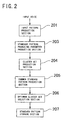
- FIG. 2 shows a standard pattern production system to which the present invention is applied.
- the pattern production system shown employs an information criterion and includes, for pattern recognition which employs a standard pattern, an input pattern production section 201 (which corresponds to the input pattern production section 101 of FIG.
- a standard pattern producing parameter production section 203 for producing parameters for production of standard patterns of different categories
- a cluster set production section 204 for dividing a set of all of the categories into a plurality of clusters to produce cluster sets
- a common standard pattern production section 205 for producing a standard pattern common to all of the categories in each of the clusters
- an optimum cluster set selection section 206 for selecting, from among the plurality of cluster sets produced by the cluster set production means and different from each other, an optimum cluster set using an information criterion
- a standard pattern storage section 207 (which corresponds to the standard pattern storage section 103 of FIG. 1) for storing the common standard pattern of the optimum cluster set as standard patterns of the categories.
- the input pattern production section 201 holds an input pattern, and the standard pattern producing parameter production section 203 calculates and outputs parameters necessary to produce standard patterns of individual categories.
- the cluster set production section 204 divides a category set into cluster sets.
- the common standard pattern production section 205 calculates standard patterns of individual clusters of the cluster sets.
- the optimum cluster selection section 206 receives a plurality of cluster sets and common standard patterns and selects an optimum cluster using an information criterion.
- the standard pattern storage section 207 stores the common standard pattern of the optimum cluster set as a standard pattern for the individual categories.
- FIG. 3 shows another standard pattern production system to which the present invention is applied.
- the standard pattern production system shown employs an information criterion and includes, for pattern recognition which employs a standard pattern, an input pattern production section 301, a standard pattern producing parameter production section 302, a cluster set production section 304, a common standard pattern production section 305, an optimum cluster set selection section 306 and a standard pattern storage section 307 which are similar to the input pattern production section 201, standard pattern producing parameter production section 203, cluster set production section 204, common standard pattern production section 205, optimum cluster set selection section 206 and standard pattern storage section 207 of the standard pattern production system of FIG. 2, respectively.
- the present standard pattern production system further includes a cluster tree structure production section 303 for producing a tree structure of clusters to produce a plurality of cluster sets.
- the input pattern production section 301 holds an input pattern.
- the standard pattern producing parameter production section 302 calculates and outputs parameters necessary to produce standard patterns of individual categories.
- the cluster production section 304 divides a category set to produce tree structure cluster sets.
- the common standard pattern production section 305 calculates standard patterns of the tree structure of the clusters of the cluster sets.
- the optimum cluster selection section 306 receives a plurality of cluster sets and common standard patterns and selects an optimum cluster using an information criterion.
- the standard pattern storage section 307 stores the common standard pattern of the optimum cluster set as a standard pattern for the individual categories.
- the standard pattern selection section preferably uses a minimum description length principle.
- the standard pattern selection means preferably uses an AIC proposed by Hirotsugu Akaike as the information criterion.
- AIC proposed by Hirotsugu Akaike as the information criterion.
- H. Akaike "A New-Look at the Statistical Mode Identification", IEEE , Trans. on Automatic Control , AC-19-6, 1974, pp.716-723, or another document by Hirotsugu Akaike, "What Is an Information Criterion", Mathematical Science , Sho 51-3, 1976, pp.5-11.
- voice is used as the input and a phonetic decision tree is used as the tree structure of clusters.
- voice is used as the input
- the tree structure of clusters is produced using hierarchical clustering which employs a distance in an acoustic space from a standard pattern.
- HMM hidden Markov model
- Pattern production by the standard pattern production system according to the present invention will be described with particular reference to FIG. 2.
- a left-to-right HMM is taken as an example.
- the left-to-right HMM is a model wherein the state number of the system increases as time passes.
- the left-to-right HMM has a characteristic that the state of the system progresses from the right to the left. Further, a case wherein, as a recognition unit with which the number of kinds of recognition units is small, a monophone unit is presumed, and as a recognition unit with which the number of kinds of recognition unit is large, a triphone unit is presumed will be described. Further, for the information criterion, the description length minimum principle is used.
- Parameters of a phoneme HMM are learned as a tie of parameters of a triphone HMM.
- the "tie" indicates that parameters are commonly used between different recognition units, states or distributions.
- the parameter of a phoneme HMM can be calculated as a form of a weighted average of parameters of a triphone HMM.
- the foregoing processing corresponds to the standard pattern parameter production section 203 of FIG. 2.
- each unit after the division is called cluster.
- a monophone unit is formed from a plurality of clusters.
- a set composed of a plurality of such clusters is called "cluster set".
- the division is performed such that a monophone unit is first divided into two and each unit obtained by the division is further divided into two and such operations are repeated. The repetition is stopped suitably. Where the monophone units are divided most finely, recognition units obtained by the division are equivalent to triphone units.
- a character called distinctive feature of preceding and following phonemes is used.
- a character called distinctive feature of preceding and following phonemes is used.
- the preceding phoneme is a plosive (for example, /b/, /d/, /g/, /p/, /t/ or /k/) or whether the following phoneme is voiced (for example, /b/, /m/ or /z/) or unvoiced (for example, /s/ or /k/).
- While criteria for division are prepared in advance, generally the number of kinds of them is several tens to several hundreds. It is to be noted that, here, as the object of division, not a monophone unit but a state of a monophone unit is taken. In other words, for a phoneme, different dividing methods are used for different states to which the phoneme belongs. For example, the first state and the second state of a monophone unit are divided in different ways from each other. By this manner of division, finer division can be performed and higher augmentation in performance can be anticipated than where an entire monophone unit is divided.
- the probability distributions of the individual states are single Gaussian distributions, and a same transition probability is used for both of a monophone unit and a triphone unit corresponding to a same phoneme.
- the processing described above corresponds to the processing of the cluster set production section 204 of FIG. 2.
- Various dividing methods are available. In other words, the number of kinds of possible cluster sets is very large. Consequently, a large number of kinds of cluster sets are produced.
- an optimum cluster set for the input data is determined from among the many different cluster sets using the minimum description length principle.
- the first term on the right side of the expression (20) above is a logarithmic likelihood of the data with the sign reversed, and the second term is an amount representative of a complexity of the model.
- the model becomes more complex, the first term decreases while the second term increases. In this manner, a trade-off is present between them, and a model having a certain suitable complexity is selected as an optimum model.
- the description length for a certain cluster set U is calculated in the following manner.
- the clusters of factors of the cluster set U are represented by S 1 , ..., S M where M is a number of factor clusters of U.
- the value V obtained is an amount corresponding to a frame number of all data corresponding to the cluster set U and does not rely upon the method of division.
- the description length l(U) is calculated, and a cluster set U which has the lowest l(U) is selected.
- the foregoing processing corresponds to the processing of the optimum cluster set selection section 206 of FIG. 2.
- the clusters which form the selected optimum cluster set has a single common standard pattern, that is, an average vector and a dispersion. They are divided with an average value of all states which belong to the cluster. Then, they are thereafter stored as standard patterns of triphone recognition units.
- the foregoing corresponds to the standard pattern storage section 207 of FIG. 2.
- the number of kinds of possible division that is, the number of cluster sets U, is usually very large.
- the amount of calculation is reduced by producing a tree structure of clusters (refer to the tree structure cluster production section 303). This will be described in detail below.
- a node for the phoneme p is produced. Now, this node will be referred to as route node.
- route node A common standard pattern of a route node is obtained when all triphone units corresponding to this phoneme are tied into a tied relationship.
- Division conditions for the phoneme p are presented by reference symbols Q 1 , ..., Q R where R is a number of all conditions. Division is performed for all those division conditions to check a variation of the description length.
- the original cluster is represented by S 0 ⁇
- the clusters obtained by dividing it into two are represented by S 1 and S 2
- a division condition with which the variation ⁇ in description length exhibits a minimum value is detected. Then, if the variation ⁇ ⁇ 0 then, then division into two is performed, but if the variation ⁇ > 0, then no division is performed.
- the description length of each division is calculated in a similar manner as described above. Then, if the description length decreases, then division is performed with a division condition which exhibits a maximum decrease amount. The foregoing processing is repeated. As a result, the history of the divisions is represented by a tree structure of a binary tree.
- the processing described above can be performed recursively to detect an optimum division in terms of the information criterion.
- the Akaike information criteria Information Criteria; called "AIC”
- AIC Information Criteria
- model determination parameters of various models are estimated using the most likelihood method, and one of the parameters with which the AIC exhibits a minimum value is selected as the best model. If two models are suitable to approximately equal degrees, then since the first term of the AIC is equal, one of the models with which the number of parameters of the second term is smaller is selected. Or, the standard pattern production system can be applied readily also where some other like information criteria than the AIC are used.
- a tree structure may otherwise be produced using distances on an acoustic space.
Landscapes
- Engineering & Computer Science (AREA)
- Artificial Intelligence (AREA)
- Computational Linguistics (AREA)
- Health & Medical Sciences (AREA)
- Audiology, Speech & Language Pathology (AREA)
- Human Computer Interaction (AREA)
- Physics & Mathematics (AREA)
- Acoustics & Sound (AREA)
- Multimedia (AREA)
- Image Analysis (AREA)
- Character Discrimination (AREA)
Applications Claiming Priority (2)
| Application Number | Priority Date | Filing Date | Title |
|---|---|---|---|
| JP122758/96 | 1996-04-19 | ||
| JP8122758A JP2982689B2 (ja) | 1996-04-19 | 1996-04-19 | 情報量基準を用いた標準パターン作成方式 |
Publications (2)
| Publication Number | Publication Date |
|---|---|
| EP0802523A2 true EP0802523A2 (de) | 1997-10-22 |
| EP0802523A3 EP0802523A3 (de) | 1998-12-30 |
Family
ID=14843893
Family Applications (1)
| Application Number | Title | Priority Date | Filing Date |
|---|---|---|---|
| EP97106569A Withdrawn EP0802523A3 (de) | 1996-04-19 | 1997-04-21 | Ein Informationskriterium verwendendes System zur Produktion von Standardmustern |
Country Status (3)
| Country | Link |
|---|---|
| US (1) | US5960396A (de) |
| EP (1) | EP0802523A3 (de) |
| JP (1) | JP2982689B2 (de) |
Cited By (1)
| Publication number | Priority date | Publication date | Assignee | Title |
|---|---|---|---|---|
| EP1241661A1 (de) * | 2001-03-13 | 2002-09-18 | Nec Corporation | Spracherkennungsvorrichtung |
Families Citing this family (5)
| Publication number | Priority date | Publication date | Assignee | Title |
|---|---|---|---|---|
| JP3896868B2 (ja) | 2002-02-27 | 2007-03-22 | 日本電気株式会社 | パターンの特徴選択方法及び分類方法及び判定方法及びプログラム並びに装置 |
| JP2005156593A (ja) * | 2003-11-20 | 2005-06-16 | Seiko Epson Corp | 音響モデル作成方法、音響モデル作成装置、音響モデル作成プログラムおよび音声認識装置 |
| JP4631076B2 (ja) * | 2004-11-01 | 2011-02-16 | 株式会社国際電気通信基礎技術研究所 | 音素単位セットを最適化する方法及びシステム |
| JP4170325B2 (ja) * | 2005-08-05 | 2008-10-22 | インターナショナル・ビジネス・マシーンズ・コーポレーション | 辞書の妥当性を評価する装置、方法およびプログラム |
| WO2010019831A1 (en) * | 2008-08-14 | 2010-02-18 | 21Ct, Inc. | Hidden markov model for speech processing with training method |
Family Cites Families (8)
| Publication number | Priority date | Publication date | Assignee | Title |
|---|---|---|---|---|
| US4817159A (en) * | 1983-06-02 | 1989-03-28 | Matsushita Electric Industrial Co., Ltd. | Method and apparatus for speech recognition |
| US5131043A (en) * | 1983-09-05 | 1992-07-14 | Matsushita Electric Industrial Co., Ltd. | Method of and apparatus for speech recognition wherein decisions are made based on phonemes |
| US4991216A (en) * | 1983-09-22 | 1991-02-05 | Matsushita Electric Industrial Co., Ltd. | Method for speech recognition |
| US5033087A (en) * | 1989-03-14 | 1991-07-16 | International Business Machines Corp. | Method and apparatus for the automatic determination of phonological rules as for a continuous speech recognition system |
| JPH03203794A (ja) * | 1989-12-29 | 1991-09-05 | Pioneer Electron Corp | 音声リモートコントロール装置 |
| JPH05134694A (ja) * | 1991-11-15 | 1993-05-28 | Sony Corp | 音声認識装置 |
| JPH05249990A (ja) * | 1992-03-04 | 1993-09-28 | Sony Corp | パターンマッチング方法およびパターン認識装置 |
| US5497447A (en) * | 1993-03-08 | 1996-03-05 | International Business Machines Corporation | Speech coding apparatus having acoustic prototype vectors generated by tying to elementary models and clustering around reference vectors |
-
1996
- 1996-04-19 JP JP8122758A patent/JP2982689B2/ja not_active Expired - Fee Related
-
1997
- 1997-04-21 EP EP97106569A patent/EP0802523A3/de not_active Withdrawn
- 1997-04-21 US US08/845,234 patent/US5960396A/en not_active Expired - Lifetime
Cited By (2)
| Publication number | Priority date | Publication date | Assignee | Title |
|---|---|---|---|---|
| EP1241661A1 (de) * | 2001-03-13 | 2002-09-18 | Nec Corporation | Spracherkennungsvorrichtung |
| US7437288B2 (en) | 2001-03-13 | 2008-10-14 | Nec Corporation | Speech recognition apparatus |
Also Published As
| Publication number | Publication date |
|---|---|
| US5960396A (en) | 1999-09-28 |
| JPH09288492A (ja) | 1997-11-04 |
| EP0802523A3 (de) | 1998-12-30 |
| JP2982689B2 (ja) | 1999-11-29 |
Similar Documents
| Publication | Publication Date | Title |
|---|---|---|
| JP2871561B2 (ja) | 不特定話者モデル生成装置及び音声認識装置 | |
| US20220223066A1 (en) | Method, device, and computer program product for english pronunciation assessment | |
| EP1400952B1 (de) | Umgebungs- und sprecheradaptierte Spracherkennung | |
| US5812975A (en) | State transition model design method and voice recognition method and apparatus using same | |
| KR100612840B1 (ko) | 모델 변이 기반의 화자 클러스터링 방법, 화자 적응 방법및 이들을 이용한 음성 인식 장치 | |
| EP0387602B1 (de) | Verfahren und Einrichtung zur automatischen Bestimmung von phonologischen Regeln für ein System zur Erkennung kontinuierlicher Sprache | |
| US5953701A (en) | Speech recognition models combining gender-dependent and gender-independent phone states and using phonetic-context-dependence | |
| EP0755046B1 (de) | Ein hierarchisch strukturiertes Wörterbuch verwendender Spracherkenner | |
| US6711541B1 (en) | Technique for developing discriminative sound units for speech recognition and allophone modeling | |
| US20020184020A1 (en) | Speech recognition apparatus | |
| Zen et al. | An introduction of trajectory model into HMM-based speech synthesis. | |
| JP2007047818A (ja) | 最適化された部分的確率混合共通化を用いる音声認識のための方法および装置 | |
| JPH06110493A (ja) | 音声モデルの構成方法及び音声認識装置 | |
| Yamagishi et al. | A training method of average voice model for HMM-based speech synthesis | |
| EP0562138A1 (de) | Methode und Einrichtung zur automatischen Erzeugung von Markov-Modellen von neuen Wörtern zur Aufnahme in einem Wortschatz zur Spracherkennung | |
| Zweig | Bayesian network structures and inference techniques for automatic speech recognition | |
| US5960396A (en) | Standard pattern production system employing information criterion | |
| Chen et al. | Modeling pronunciation variation using artificial neural networks for English spontaneous speech. | |
| US5774848A (en) | Reference pattern training system and speech recognition system using the same | |
| JP2005156593A (ja) | 音響モデル作成方法、音響モデル作成装置、音響モデル作成プログラムおよび音声認識装置 | |
| Abad et al. | Context dependent modelling approaches for hybrid speech recognizers. | |
| Zhang et al. | Application of pronunciation knowledge on phoneme recognition by LSTM neural network | |
| JP3003355B2 (ja) | 標準パターン作成装置 | |
| JP2961797B2 (ja) | 音声認識装置 | |
| Babu et al. | Voiceprint-based biometric template identifications |
Legal Events
| Date | Code | Title | Description |
|---|---|---|---|
| PUAI | Public reference made under article 153(3) epc to a published international application that has entered the european phase |
Free format text: ORIGINAL CODE: 0009012 |
|
| AK | Designated contracting states |
Kind code of ref document: A2 Designated state(s): DE FR GB |
|
| PUAL | Search report despatched |
Free format text: ORIGINAL CODE: 0009013 |
|
| AK | Designated contracting states |
Kind code of ref document: A3 Designated state(s): DE FR GB |
|
| 17P | Request for examination filed |
Effective date: 19990422 |
|
| 17Q | First examination report despatched |
Effective date: 20020506 |
|
| STAA | Information on the status of an ep patent application or granted ep patent |
Free format text: STATUS: THE APPLICATION IS DEEMED TO BE WITHDRAWN |
|
| 18D | Application deemed to be withdrawn |
Effective date: 20020917 |