EP0802441A2 - Multifocal spectacle glass - Google Patents
Multifocal spectacle glass Download PDFInfo
- Publication number
- EP0802441A2 EP0802441A2 EP97104911A EP97104911A EP0802441A2 EP 0802441 A2 EP0802441 A2 EP 0802441A2 EP 97104911 A EP97104911 A EP 97104911A EP 97104911 A EP97104911 A EP 97104911A EP 0802441 A2 EP0802441 A2 EP 0802441A2
- Authority
- EP
- European Patent Office
- Prior art keywords
- dpt
- reference point
- lens according
- sight
- add
- Prior art date
- Legal status (The legal status is an assumption and is not a legal conclusion. Google has not performed a legal analysis and makes no representation as to the accuracy of the status listed.)
- Granted
Links
Images



Classifications
-
- G—PHYSICS
- G02—OPTICS
- G02C—SPECTACLES; SUNGLASSES OR GOGGLES INSOFAR AS THEY HAVE THE SAME FEATURES AS SPECTACLES; CONTACT LENSES
- G02C7/00—Optical parts
- G02C7/02—Lenses; Lens systems ; Methods of designing lenses
- G02C7/06—Lenses; Lens systems ; Methods of designing lenses bifocal; multifocal ; progressive
- G02C7/061—Spectacle lenses with progressively varying focal power
- G02C7/063—Shape of the progressive surface
- G02C7/065—Properties on the principal line
-
- G—PHYSICS
- G02—OPTICS
- G02C—SPECTACLES; SUNGLASSES OR GOGGLES INSOFAR AS THEY HAVE THE SAME FEATURES AS SPECTACLES; CONTACT LENSES
- G02C7/00—Optical parts
- G02C7/02—Lenses; Lens systems ; Methods of designing lenses
- G02C7/06—Lenses; Lens systems ; Methods of designing lenses bifocal; multifocal ; progressive
-
- G—PHYSICS
- G02—OPTICS
- G02C—SPECTACLES; SUNGLASSES OR GOGGLES INSOFAR AS THEY HAVE THE SAME FEATURES AS SPECTACLES; CONTACT LENSES
- G02C7/00—Optical parts
- G02C7/02—Lenses; Lens systems ; Methods of designing lenses
- G02C7/06—Lenses; Lens systems ; Methods of designing lenses bifocal; multifocal ; progressive
- G02C7/061—Spectacle lenses with progressively varying focal power
Definitions
- the present invention relates to a multifocal spectacle lens with regionally sliding refractive power according to the preamble of the first claim.
- Such spectacle lenses are also generally referred to as varifocal lenses (e.g. EP 0 562 336 or EP 0 452 802).
- the surface of the spectacle lens that causes the desired sliding refractive index curve of the lens is also called the progressive surface.
- a usage situation is determined for the calculation of the varifocal lens.
- One of these is given, for example, in DIN 58 208 Part 2 in Figure 6.
- the fulcrum distance b 'from the apex of the varifocal lens on the eye side to the optical focal point Z' is assumed to be 0.00 dpt at 28 mm in the case of ametropia.
- the frame is generally inclined so that the ground varifocal lens is inclined by an average of about 9 ° to the vertical. This defines the relative position of the progressive lens to the eye. In this use situation, all beam calculations can be carried out correctly with the spectacle wearer, in other words exactly as they occur when the spectacle lens is worn in front of the wearer's eye.
- Progressive lenses have been known for many years and are offered by several manufacturers.
- An example is the progressive lens offered by the applicant under the name "Gradal HS", which is described in DE-PS 30 16 935 (EP-A-0 039 497).
- the distance vision zone should have the least possible spherical and astigmatic deviations for the spectacle wearer (since the greatest possible visual acuity is required when looking into the distance), the near vision zone should be sufficiently high so that no too strong, unnatural subsidence should be necessary for proximity and the usable area should be sufficiently wide.
- the area in the progression zone on both sides of the main line of sight, in which clear vision is possible, is also called the progression channel.
- the glasses wearer wants this progression channel as wide as possible so that he is not always forced to move his head when looking at objects at medium distances.
- the acceptance of each varifocal lens depends largely on this width.
- Binocular vision arises from the interaction of the pair of eyes. Binocular lens properties are therefore properties of the pair of lenses.
- Equivalent image quality enables the same visual acuity on the right and left, equivalent prismatic direction reversal ensures undisturbed fusion when viewing an object point (in direct vision) and familiar perception in the object environment (in indirect vision).
- a certain deficiency of all varifocal lenses is that astigmatic deviations, which prevent clear vision, are inevitable, especially in the progression zone to the side of the main line of sight.
- the eye-brain system tolerates the above-mentioned aberrations within certain limits. These limits differ depending on the distance to the object and the viewing direction.
- the in the DE-PS 30 16 935 (EP-A-0 039 497) described progressive lens can be regarded as a successful compromise.
- the special feature of the multifocal spectacle lens according to the invention is the optimally balanced combination of the most important properties of a progressive lens for the spectacle wearer: an extraordinary width of the progression channel with a gentle increase in the astigmatism on the side of the progression channel, and a harmonic, not too strong decrease in the mean effect on the side of the progression channel and the near part. It also has a convergence-correct location of the entire progression channel.
- the combination of features according to the invention thus defines a multifocal spectacle lens with the highest wearing quality.
- the invention has a particularly advantageous effect in the case of short progression zones, a low maximum value for the astigmatic deviations in the central regions of the spectacle lens being advantageous.
- the progressive lens shown in the figures has a far vision zone in its upper part and a near vision zone in its lower part.
- the progression zone lies between these two zones.
- stH describes the absolutely strongest main section of the effect in the distance reference point for the spectacle wearer.
- the eyeglass lenses have a tilt of 9 degrees in one version.
- the distance of the eye-side surface of the spectacle lens from the optical eye pivot is 28 - 0.2 ⁇ average effect (mm).
- the predetermined refractive power curve determines the distance of the sharply imaged object at every inclination of the gaze. A corresponding inward movement of the pair of eyes belongs to each object distance.
- the varifocal lens has a distance reference point, in which the dioptric effect (sphere, cylinder, axis) determined for vision into the distance is realized and a near reference point, in which the effect necessary for comfortable close vision is available.
- Progressive lenses are usually delivered with a stamped cross, the so-called centering cross. This is preferably 3 mm vertically below the distance reference point.
- the optician then grinds the varifocal lens into the spectacle frame so that the centering cross sits in front of the middle of the pupil with the eye looking straight ahead (see Fig. 5).
- the progressive lens is usually provided with a so-called thickness reduction prism, the size of which depends on the addition and the base position of which is 270 °.
- the following table is preferably used when determining the values to be used: Add (dpt) 1.00 1.25 1.50u. 1.75 2.0 2.25u. 2.50 2.75 3.00 Prism (cm / m) 0.50 0.75 1.00 1.25 1.50 1.75 2.00
- This prism is not used for the correction of an ametropia, but is to ensure that the edge thicknesses above and below become approximately the same.
- the invention is limited to multifocal spectacle lenses, the spherical effect of which in the distance reference point is between -4.00 dpt and +4.00 dpt and the astigmatic effect (cylinder) is between 0.00 dpt and +4.00 dpt. In addition, neither of the two main cuts may be greater than 4.00 dpt.
- the axial position of the cylinder can be between 0 and 180 degrees.
- the range of addition ranges from 1.00 D to 3.00 D
- the addition is here according to ISO / DIS 8980-2 no. 5.1.1 selected in the beam path correct for the glasses (as-worn position).
- At least one of the two surfaces of the progressive lens is an aspherical surface which can be continuously differentiated at least twice and which contains a far vision zone in the upper part, a near vision zone in the lower part and a progression zone in between.
- the distance from the far reference point to the near reference point is at most 21 mm.
- the near reference point is ideally on the main line of sight to take into account the convergence of the pair of eyes for close objects, but is preferably nasally offset with all effects and additions by 2.5 mm in order to have a uniform position of the measuring point for the near measurement values (see Fig. 5).
- the width of the progression channel essentially depends on the length of the progression zone.
- a progression zone that is too long pushes the near vision zone too far down so that it can no longer be used in a comfortable head and body position, and a progression zone that is too short unnecessarily narrows the progression channel.
- an optimum arises if the effect increases linearly by 75% of the addition over a length of at most 11 mm along the main line of sight.
- the linear increase means that the progression channel remains uniformly wide and no narrow points arise.
- the width of the progression channel i.e. the area with clear vision, is given by the area in which the astigmatic deviation is less than 0.75 dpt. Such an astigmatic deviation somewhat reduces visual acuity, but only in such a way that no impairment is felt in most visual tasks. It is known that e.g. a visual acuity of 0.5 is sufficient to read newspaper print.
- the minimum width of the progression channel depends on the addition (ADD) and the effect in the stronger main section at the long-distance reference point (stH).
- the compatibility of a progressive lens depends, among other things, on the maximum astigmatic deviation in the lateral areas.
- This area is described by an ellipse with an extension of 50 mm in the horizontal and 40 mm in the vertical, specifically around a point that is 4 mm perpendicular to the centering cross. Outside of this ellipse there are only points that are either ground away when grinding into the socket or are used extremely rarely when viewed directly.
- An advantageous embodiment of the concept of the invention is achieved if it is ensured in the viewing points corresponding to binocular vision that spherical and astigmatic deviations have approximately the same values. It was found in internal wear tests that the spectacle wearer finds it pleasant when the right and left eyes have equivalent visual impressions.
- the binocular vision is impaired as little as possible in the area delimited by the above-mentioned ellipse.
- 0.5 cm / m is e.g. specified in RAL-RG 915 as permissible prismatic deviation for binocular vision.
- the astigmatic deviations are limited depending on the addition.
- the Restrictions are kept very small; With larger additions, it is advantageous to accept somewhat larger restrictions in order not to noticeably affect the other requirements.
- Another advantageous embodiment is to allow such an astigmatic deviation along the main line of sight that does not noticeably impair clear vision.
- the measured values can be read more easily and more precisely, the less the spherical and astigmatic deviations vary within the measuring circuits.
- measurements are usually made with a bundle diameter of about 7 mm, in the local measuring circle with a bundle diameter of about 4 mm.
- the multifocal spectacle lens has an advantageous embodiment if the prescribed near effect is already reached 1 mm above the near measuring point. The spherical deviations within the local measuring circle thus remain small.
- FIGS. 1 to 3 An example according to the invention is shown in FIGS. 1 to 3.
- the long-range effect is 0.00 D and the addition is 2.00 D
- the material has a refractive index of 1,600, the center thickness is 2.5 mm and the thickness reduction prism is 1.25 cm / m with a base of 270 °.
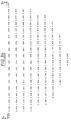
- FIG. 1 shows the astigmatic deviations
- FIG. 2 shows the increase in the effect starting from the distance reference point
- FIG. 3 shows the arrow heights of the front surface, which produces the sliding effect, in a grid of 3 to 3 mm.
- the progressive lenses according to the invention can be calculated and executed in silicate or in organic material (e.g. CR39) with the refractive indices available in each case.
- the front, back or both surfaces of the progressive lens can be designed as progressive surfaces.
Landscapes
- Health & Medical Sciences (AREA)
- Ophthalmology & Optometry (AREA)
- Physics & Mathematics (AREA)
- General Health & Medical Sciences (AREA)
- General Physics & Mathematics (AREA)
- Optics & Photonics (AREA)
- Eyeglasses (AREA)
- Materials For Medical Uses (AREA)
- Prostheses (AREA)
Abstract
Description
Die vorliegende Erfindung betrifft eine multifokale Brillenlinse mit gebietsweise gleitendem Brechwert nach dem Oberbegriff des ersten Patentanspruchs.The present invention relates to a multifocal spectacle lens with regionally sliding refractive power according to the preamble of the first claim.
Solche Brillenlinsen werden allgemein auch als Gleitsichtlinsen bezeichnet (z.B. EP 0 562 336 oder EP 0 452 802). Diejenige Fläche der Brillenlinse, welche den gewünschten gleitenden Brechwertverlauf der Linse bewirkt, heißt auch Gleitsichtfläche.Such spectacle lenses are also generally referred to as varifocal lenses (e.g. EP 0 562 336 or EP 0 452 802). The surface of the spectacle lens that causes the desired sliding refractive index curve of the lens is also called the progressive surface.
Zur Berechnung der Gleitsichtlinse wird eine Gebrauchssituation festgelegt. Eine solche ist zum Beispiel in DIN 58 208 Teil 2 im Bild 6 angegeben.A usage situation is determined for the calculation of the varifocal lens. One of these is given, for example, in DIN 58 208
Für die Objektabstände verwenden wir die Vorgaben aus der DIN 58 208, es sei also im Nahbezugspunkt die Objektentfernung a = -380 mm für alle Additionen <= 2,50 dpt und a = -1000 mm dpt/Addition für alle Additionen >2,50 dpt.We use the specifications from DIN 58 208 for the object distances, so let's say in the near reference point the object distance a = -380 mm for all additions <= 2.50 dpt and a = -1000 mm dpt / addition for all additions> 2.50 dpt.
Der Drehpunktscheitelabstand b' vom augenseitigen Scheitel der Gleitsichtlinse zum optischen Augendrehpunkt Z' wird bei der Fehlsichtigkeit 0,00 dpt zu 28 mm angenommen. Die Baulänge des Auges und die Fehlsichtigkeit hängen statistisch voneinander ab. Kurzsichtige Augen sind länger, weitsichtige Augen kürzer gebaut. Daher gilt näherungsweise b'= 28,0 - 0,2 x mittlere Fernteilwirkung. Die Fassung ist bei Gleitsichtbrillen in der Regel vorgeneigt, so daß die eingeschliffene Gleitsichtlinse um im Mittel etwa 9° zur Lotrechten geneigt ist. Damit ist die relative Lage der Gleitsichtlinse zum Auge festgelegt. In dieser Gebrauchssituation können alle Strahlrechnungen brillenträgerrichtig durchgeführt werden, also genau so, wie sie auch beim Tragen der Brillenlinse vor dem Auge des Brillenträgers auftreten.The fulcrum distance b 'from the apex of the varifocal lens on the eye side to the optical focal point Z' is assumed to be 0.00 dpt at 28 mm in the case of ametropia. The length of the eye and the ametropia depend statistically on each other. Myopic eyes are longer, long-sighted eyes shorter. Therefore approximately b '= 28.0 - 0.2 x mean distance effect. In the case of varifocals, the frame is generally inclined so that the ground varifocal lens is inclined by an average of about 9 ° to the vertical. This defines the relative position of the progressive lens to the eye. In this use situation, all beam calculations can be carried out correctly with the spectacle wearer, in other words exactly as they occur when the spectacle lens is worn in front of the wearer's eye.
Gleitsichtlinsen sind seit vielen Jahren bekannt und werden von mehreren Herstellern angeboten. Als Beispiel sei die unter der Bezeichnung "Gradal HS" angebotene Gleitsichtlinse der Anmelderin genannt, die in der DE-PS 30 16 935 (EP-A-0 039 497) beschrieben ist.Progressive lenses have been known for many years and are offered by several manufacturers. An example is the progressive lens offered by the applicant under the name "Gradal HS", which is described in DE-PS 30 16 935 (EP-A-0 039 497).
An eine universell einsetzbare Gleitsichtlinse werden viele Forderungen gestellt: Die Fernsichtzone soll möglichst geringe sphärische und astigmatische Abweichungen für den Brillenträger aufweisen (da beim Blick in die Ferne eine möglichst hohe Sehschärfe gefordert wird), die Nahsichtzone soll genügend hoch liegen, damit keine zu starken, unnatürlichen Blicksenkungen für die Nähe notwendig werden und ihr nutzbarer Bereich soll genügend breit sein.There are many requirements for a universally usable varifocal lens: the distance vision zone should have the least possible spherical and astigmatic deviations for the spectacle wearer (since the greatest possible visual acuity is required when looking into the distance), the near vision zone should be sufficiently high so that no too strong, unnatural subsidence should be necessary for proximity and the usable area should be sufficiently wide.
Der Bereich in der Progressionszone beidseits der Hauptblicklinie, in dem deutliches Sehen möglich ist, wird auch als Progressionskanal bezeichnet. Diesen Progressionskanal wünscht sich der Brillenträger möglichst breit, um beim Blick auf Objekte in mittleren Entfernungen nicht immer zu Kopfbewegungen gezwungen zu sein. Die Akzeptanz jeder Gleitsichtlinse hängt wesentlich von dieser Breite ab.The area in the progression zone on both sides of the main line of sight, in which clear vision is possible, is also called the progression channel. The glasses wearer wants this progression channel as wide as possible so that he is not always forced to move his head when looking at objects at medium distances. The acceptance of each varifocal lens depends largely on this width.
Zu diesen monokularen Forderungen kommen zusätzlich solche bezüglich des Binokularsehens. Wenn man sich die optimale Korrektion des Brillenträgers als Ziel gesetzt hat, dann muß den binokularen Eigenschaften des Glases besondere Aufmerksamkeit geschenkt werden.In addition to these monocular requirements, there are also those relating to binocular vision. If one has set the goal of optimal correction of the spectacle wearer, special attention must be paid to the binocular properties of the lens.
Das binokulare Sehen entsteht aus dem Zusammenwirken des Augenpaares. Binokulare Brillenglas-Eigenschaften sind deshalb Eigenschaften des Gläserpaares.Binocular vision arises from the interaction of the pair of eyes. Binocular lens properties are therefore properties of the pair of lenses.
Die Forderung nach binokularem Gleichgewicht für das Augenpaar verlangt die Gleichwertigkeit des Gläserpaares. Diese Gleichwertigkeit muß für jede Blickrichtung gegeben sein und ist zu beziehen auf die Abbildungsgüte und auf die prismatische Richtungsumlenkung.The requirement for binocular balance for the pair of eyes requires the pair of glasses to be equivalent. This equivalence must exist for every viewing direction and is to be related to the imaging quality and the prismatic directional change.
Gleichwertige Abbildungsgüte ermöglicht gleichen Visus rechts und links, gleichwertige prismatische Richtungsumlenkung sorgt bei der Betrachtung eines Objektpunktes (im direkten Sehen) für ungestörte Fusion und bei der Wahrnehmung des Objektumfeldes (im indirekten Sehen) für gewohnte Tiefenwahrnehmung.Equivalent image quality enables the same visual acuity on the right and left, equivalent prismatic direction reversal ensures undisturbed fusion when viewing an object point (in direct vision) and familiar perception in the object environment (in indirect vision).
Alle diese monokularen und binokularen Forderungen sollen möglichst bei allen vorkommenden dioptrischen Wirkungen und bei allen vorkommenden Additionen so gut wie möglich erfüllt sein.All of these monocular and binocular requirements should, as far as possible, be met as well as possible with all dioptric effects occurring and with all occurring additions.
Ein gewisser Mangel aller Gleitsichtlinsen besteht darin, daß vor allem in der Progressionszone seitlich der Hauptblicklinie astigmatische Abweichungen, welche ein deutliches Sehen verhindern, unvermeidbar sind.A certain deficiency of all varifocal lenses is that astigmatic deviations, which prevent clear vision, are inevitable, especially in the progression zone to the side of the main line of sight.
Es ist somit die Aufgabe der Erfindung eine multifokale Brillenlinse zu schaffen, deren Progressionskanal möglichst breit ist und die seitlichen Bildfehler auf dieser Brillenlinse zu verringern, ohne daß die monokularen und binokularen Anforderungen an Schärfe und Verträglichkeit merkbar beeinträchtigt werden.It is therefore the object of the invention to provide a multifocal spectacle lens whose progression channel is as wide as possible and to reduce the lateral image errors on this spectacle lens without the monocular and binocular requirements for sharpness and compatibility being appreciably impaired.
Diese Aufgabe wird erfindungsgemäß durch eine Gleitsichtlinse gelöst, welche die im kennzeichnenden Teil des ersten Patentanspruchs angeführte Merkmalskombination erfüllt.This object is achieved according to the invention by a progressive lens which fulfills the combination of features stated in the characterizing part of the first patent claim.
Im Prinzip sind alle bekannten Gleitsichtlinsen Kompromißlösungen, bei welchen die unvermeidbaren Fehler (Sehschärfenminderung, Verzeichnung, binokulare Ungleichgewichte) so verteilt werden, daß die "wichtigen" Sehbereiche (Ferne, Progressionszone, Nähe) gut nutzbar sind.In principle, all known progressive lenses are compromise solutions in which the unavoidable errors (visual acuity reduction, distortion, binocular imbalances) are distributed in such a way that the "important" visual areas (distance, progression zone, proximity) can be used well.
Das System Auge-Gehirn toleriert die oben genannten Abbildungsfehler in gewissen Grenzen. Diese Grenzen sind unterschiedlich in Abhängigkeit von Objektentfernung und Blickrichtung.The eye-brain system tolerates the above-mentioned aberrations within certain limits. These limits differ depending on the distance to the object and the viewing direction.
Bezüglich der binokularen Gleichgewichte kann die in der DE-PS 30 16 935 (EP-A-0 039 497) beschriebene Gleitsichtlinse als ein gelungener Kompromiß angesehen werden.Regarding the binocular equilibria, the in the DE-PS 30 16 935 (EP-A-0 039 497) described progressive lens can be regarded as a successful compromise.
Das besondere Kennzeichen der erfindungsgemäßen multifokalen Brillenlinse ist die für den Brillenträger optimal ausgewogene Kombination der wichtigsten Eigenschaften einer Gleitsichtlinse: eine außergewöhnliche Breite des Progressionskanals mit einem sanften Anstieg des Astigmatismus seitlich des Progressionskanals, und einem harmonischen, nicht zu starken Abfall der mittleren Wirkung seitlich des Progressionskanals und des Nahteils. Außerdem besitzt sie eine konvergenzrichtige Lage des gesamten Progressionskanals. Diese Verbesserungen werden im gesamten angegebenen Additionsbereich und bei allen sphärischen und astigmatischen Fernteilwirkungen des beanspruchten Bereichs erzielt.The special feature of the multifocal spectacle lens according to the invention is the optimally balanced combination of the most important properties of a progressive lens for the spectacle wearer: an extraordinary width of the progression channel with a gentle increase in the astigmatism on the side of the progression channel, and a harmonic, not too strong decrease in the mean effect on the side of the progression channel and the near part. It also has a convergence-correct location of the entire progression channel. These improvements are achieved in the entire specified addition range and with all spherical and astigmatic long-distance effects of the claimed range.
Die erfindungsgemäße Kombination der Merkmale definiert so eine multifokale Brillenlinse mit höchster Tragequalität.The combination of features according to the invention thus defines a multifocal spectacle lens with the highest wearing quality.
Besonders vorteilhaft wirkt sich die Erfindung bei kurzen Progressionszonen aus, wobei ein geringer Maximalwert für die astigmatischen Abweichungen in den mittleren Bereichen des Brillenglases vorteilhaft ist.The invention has a particularly advantageous effect in the case of short progression zones, a low maximum value for the astigmatic deviations in the central regions of the spectacle lens being advantageous.
Weitere vorteilhafte Ausgestaltungen der Erfindung sind in den Unteransprüchen gegeben und werden im folgenden Text noch näher erläutert.Further advantageous embodiments of the invention are given in the subclaims and are explained in more detail in the text below.
Die Erfindung wird im folgenden in beispielhafter Weise anhand von Zeichnungen erläutert, wobei weitere wesentliche Merkmale sowie dem besseren Verständnis dienende Erläuterungen und Ausgestaltungsmöglichkeiten des Erfindungsgedankens beschrieben sind.The invention is explained in the following in an exemplary manner with reference to drawings, further essential features and explanations and configuration options of the inventive concept serving for better understanding being described.
Dabei zeigen:
Figur 1- die astigmatischen Abweichungen einer erfindungsgemäßen Gleitsichtlinse mit der Fernteilwirkung 0,00 dpt und der
Addition 2,00 dpt in der mittleren Gebrauchssituation; Figur 2- die Zunahme der mittleren Wirkung einer erfindungsgemäßen Gleitsichtlinse mit der Fernteilwirkung 0,00 dpt und der
Addition 2,00 dpt in der mittleren Gebrauchssituation. Die Hauptblicklinie (1) wird an der Stelle von der waagrechten Linie (2) geschnitten, an der die Wirkungszunahme gerade 1,00 dpt beträgt. Unter der Linie (2) ist die mittlere Wirkung überall um mehr als 0,60 dpt größer als im Fernbezugspunkt; - Figur 3a
- die Pfeilhöhen des oberen Teils der Vorderfläche der Gleitsichtlinse, die den Berechnungen für die Fig. 1 und 2 zugrunde liegt;
- Figur 3b
- die Pfeilhöhen des unteren Teils der Vorderfläche der Gleitsichtlinse, die den Berechnungen für die Fig. 1 und 2 zugrunde liegt;
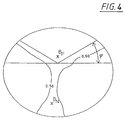
- Figur 4
- zeigt die Abgrenzung des Bereichs im Fernsichtbereich, in welchem die astigmatischen Abweichungen klein gehalten werden;
- Figur 5
- eine Gleitsichtlinse mit (1) Fernsichtzone, (2) Progressionszone, (3) Nahsichtzone, (4) Hauptblicklinie und (5) Zentrierkreuz; und
- Figur 6
- eine bekannte Gleitsichtlinse in einer mittleren Gebrauchssituation vor dem Auge mit dem optischen Augendrehpunkt Z' und dem Drehpunktscheitelabstand b'.
- Figure 1
- the astigmatic deviations of a varifocal lens according to the invention with the long-range effect 0.00 D and the addition 2.00 D in the middle use situation;
- Figure 2
- the increase in the mean power of a varifocal lens according to the invention with the long-range partial power 0.00 dpt and the addition 2.00 dpt in the middle use situation. The main line of sight (1) is cut by the horizontal line (2) at the point where the increase in effectiveness is just 1.00 dpt. Under line (2) the mean effect is greater by more than 0.60 dpt everywhere than in the long-distance reference point;
- Figure 3a
- the arrow heights of the upper part of the front surface of the progressive lens, on which the calculations for Figures 1 and 2 are based;
- Figure 3b
- the arrow heights of the lower part of the front surface of the varifocal lens, on which the calculations for Figures 1 and 2 are based;
- Figure 4
- shows the delimitation of the area in the far vision area, in which the astigmatic deviations are kept small;
- Figure 5
- a varifocal lens with (1) far vision zone, (2) progression zone, (3) near vision zone, (4) main line of sight and (5) centering cross; and
- Figure 6
- a known progressive lens in a medium use situation in front of the eye with the optical eye pivot point Z 'and the pivot point vertex distance b'.
Die in den Figuren dargestellte Gleitsichtlinse besitzt in ihrem oberen Teil eine Fernsichtzone und in ihrem unteren Teil eine Nahsichtzone. Zwischen diesen beiden Zonen liegt die Progressionszone.The progressive lens shown in the figures has a far vision zone in its upper part and a near vision zone in its lower part. The progression zone lies between these two zones.
Im folgenden bezeichnet stH den absolut stärksten Hauptschnitt der Wirkung im Fernbezugspunkt für den Brillenträger. Dabei haben die Brillenlinsen in einer Fassung eine Vorneigung von 9 Grad. Der Abstand der augenseitigen Fläche der Brillenlinse vom optischen Augendrehpunkt beträgt dabei 28 - 0.2∗ mittlerer Wirkung (mm).In the following, stH describes the absolutely strongest main section of the effect in the distance reference point for the spectacle wearer. The eyeglass lenses have a tilt of 9 degrees in one version. The distance of the eye-side surface of the spectacle lens from the optical eye pivot is 28 - 0.2 ∗ average effect (mm).
Läßt der Benutzer einer solchen Brillenlinse den Blick geradeaus von oben nach unten wandern, so bestimmt der vorgegebene Brechwertverlauf zu jeder Neigung des Blicks die Entfernung des scharf abgebildeten Objektes. Zu jeder Objektentfernung gehört eine entsprechende Einwärtsbewegung des Augenpaares.If the user of such an eyeglass lens lets his gaze wander straight from top to bottom, the predetermined refractive power curve determines the distance of the sharply imaged object at every inclination of the gaze. A corresponding inward movement of the pair of eyes belongs to each object distance.
Deshalb durchdringen die Sehstrahlen jedes Auges bei der beschriebenen Blickbewegung die Gleitsichtfläche längs einer ganz bestimmten Linie, der Hauptblicklinie. Diese ist also eine zur Nase hin geschwungene Kurve auf der Gleitsichtfläche. Sie teilt diese Fläche in einen nasalen und einen temporalen Bereich.That is why the visual rays of each eye penetrate the varifocal surface along a specific line, the main line of sight, during the described gaze movement. So this is a curve curved towards the nose on the varifocal surface. It divides this area into a nasal and a temporal area.
Die Gleitsichtlinse besitzt einen Fernbezugspunkt, in welchem die für das Sehen in die Ferne ermittelte dioptrische Wirkung (Sphäre, Zylinder, Achse) verwirklicht ist und einen Nahbezugspunkt, in welchem die für ein komfortables Nahsehen notwendige Wirkung vorhanden ist.The varifocal lens has a distance reference point, in which the dioptric effect (sphere, cylinder, axis) determined for vision into the distance is realized and a near reference point, in which the effect necessary for comfortable close vision is available.
Gleitsichtlinsen werden in der Regel mit einem aufgestempelten Kreuz, dem sogenannten Zentrierkreuz ausgeliefert. Dieses liegt vorzugsweise 3 mm senkrecht unterhalb des Fernbezugspunktes. Der Augenoptiker schleift dann die Gleitsichtlinse so in die Brillenfassung ein, daß das Zentrierkreuz vor der Pupillenmitte beim geradeaus blickenden Auge sitzt (siehe Fig. 5).Progressive lenses are usually delivered with a stamped cross, the so-called centering cross. This is preferably 3 mm vertically below the distance reference point. The optician then grinds the varifocal lens into the spectacle frame so that the centering cross sits in front of the middle of the pupil with the eye looking straight ahead (see Fig. 5).
Die Gleitsichtlinse ist in der Regel mit einem sogenannten Dickenreduktionsprisma versehen, dessen Größe von der Addition abhängt und dessen Basislage 270° beträgt. Vorzugsweise wird bei der Bestimmung der zu verwendenden Werte folgende Tabelle verwendet:
Dieses Prisma dient nicht zur Korrektion einer Winkelfehlsichtigkeit, sondern soll dafür sorgen, daß die Randdicken oben und unten annähernd gleich werden.This prism is not used for the correction of an ametropia, but is to ensure that the edge thicknesses above and below become approximately the same.
Die Erfindung beschränkt sich auf multifokale Brillenlinsen, deren sphärische Wirkung im Fernbezugspunkt zwischen -4,00 dpt und +4,00 dpt und deren astigmatische Wirkung (Zylinder) zwischen 0,00 dpt und +4,00 dpt liegt. Außerdem darf keiner der beiden Hauptschnitte dem Betrag nach größer als 4,00 dpt sein. Die Achslage des Zylinders kann zwischen 0 und 180 Grad liegen.The invention is limited to multifocal spectacle lenses, the spherical effect of which in the distance reference point is between -4.00 dpt and +4.00 dpt and the astigmatic effect (cylinder) is between 0.00 dpt and +4.00 dpt. In addition, neither of the two main cuts may be greater than 4.00 dpt. The axial position of the cylinder can be between 0 and 180 degrees.
Der Bereich der Addition reicht von 1,00 dpt bis 3,00 dpt. Die Addition ist hier gemäß ISO/DIS 8980-2 Ziff. 5.1.1 im brillenträgerrichtigen Strahlengang (as-worn position) gewählt.The range of addition ranges from 1.00 D to 3.00 D The addition is here according to ISO / DIS 8980-2 no. 5.1.1 selected in the beam path correct for the glasses (as-worn position).
Mindestens eine der beiden Flächen der Gleitsichtlinse ist eine asphärische Fläche, die mindestens zweimal stetig differenzierbar ist und die in ihrem oberen Teil eine Fernsichtzone, im unteren Teil eine Nahsichtzone und dazwischen eine Progressionszone enthält.At least one of the two surfaces of the progressive lens is an aspherical surface which can be continuously differentiated at least twice and which contains a far vision zone in the upper part, a near vision zone in the lower part and a progression zone in between.
Der Abstand vom Fernbezugspunkt zum Nahbezugspunkt beträgt höchstens 21 mm. Der Nahbezugspunkt liegt dabei idealerweise auf der Hauptblicklinie, um die Konvergenz des Augenpaares für nahe Objekte zu berücksichtigen, wird aber vorzugsweise bei allen Wirkungen und Additionen einheitlich um 2,5 mm nasal versetzt, um eine einheitliche Lage des Meßpunktes für die Nahmeßwerte zu haben (siehe Fig. 5).The distance from the far reference point to the near reference point is at most 21 mm. The near reference point is ideally on the main line of sight to take into account the convergence of the pair of eyes for close objects, but is preferably nasally offset with all effects and additions by 2.5 mm in order to have a uniform position of the measuring point for the near measurement values (see Fig. 5).
Die Breite des Progessionskanals hängt wesentlich von der Länge der Progressionszone ab.The width of the progression channel essentially depends on the length of the progression zone.
Eine zu lange Progressionszone schiebt die Nahsichtzone zu weit nach unten, so daß sie nicht mehr in bequemer Kopf- und Körperhaltung benutzbar ist, und eine zu kurze Progressionszone engt den Progressionskanal unnötig ein.A progression zone that is too long pushes the near vision zone too far down so that it can no longer be used in a comfortable head and body position, and a progression zone that is too short unnecessarily narrows the progression channel.
Erfindungsgemäß entsteht ein Optimum, wenn auf einer Länge von maximal 11 mm entlang der Hauptblicklinie die Wirkung um 75 % der Addition im wesentlichen linear ansteigt. Der lineare Anstieg bewirkt, daß der Progressionskanal gleichmäßig breit bleibt und keine Engstellen entstehen.According to the invention, an optimum arises if the effect increases linearly by 75% of the addition over a length of at most 11 mm along the main line of sight. The linear increase means that the progression channel remains uniformly wide and no narrow points arise.
Die Breite des Progressionskanals, also des Bereichs mit deutlichem Sehen, wird ist durch den Bereich gegeben, in welchem die astigmatische Abweichung kleiner als 0,75 dpt ist. Eine solche astigmatische Abweichung vermindert zwar etwas die Sehschärfe, aber nur so, daß bei den allermeisten Sehaufgaben keine Beeinträchtigung empfunden wird. Es ist bekannt, daß z.B. zum Lesen von Zeitungsdruck ein Visus von 0,5 ausreichend ist. Die Mindestbreite des Progressionskanals ist abhängig von der Addition (ADD) und der Wirkung im stärkeren Hauptschnitt im Fernbezugspunkt (stH).The width of the progression channel, i.e. the area with clear vision, is given by the area in which the astigmatic deviation is less than 0.75 dpt. Such an astigmatic deviation somewhat reduces visual acuity, but only in such a way that no impairment is felt in most visual tasks. It is known that e.g. a visual acuity of 0.5 is sufficient to read newspaper print. The minimum width of the progression channel depends on the addition (ADD) and the effect in the stronger main section at the long-distance reference point (stH).
Die Verträglichkeit einer Gleitsichtlinse hängt unter anderem von der maximalen astigmatischen Abweichung in den seitlichen Bereichen ab.The compatibility of a progressive lens depends, among other things, on the maximum astigmatic deviation in the lateral areas.
Je größer diese astigmatische Abweichung ist, um so stärker fühlt sich der Brillenträger beim Umherblicken gestört. Dies hängt sowohl mit den dadurch verursachten Unschärfen als auch mit den damit induzierten Schaukelbewegungen zusammen.The greater this astigmatic deviation, the more the glasses wearer feels disturbed when looking around. This is due both to the blurring caused by it and to the rocking movements induced with it.
Die vorteilhaften Werte für die minimale Breite der nutzbaren Progressionszone (astigmatische Abweichungen kleiner als 0.75 dpt) sind aus der nachfolgenden Tabelle zu entnehmen:
Es ist vorteilhaft, die maximalen astigmatischen Abweichungen möglichst klein zu halten. Erfindungsgemäß führt dies zu Werten, die wiederum eine Abhängigkeit von der Addition zeigen.It is advantageous to keep the maximum astigmatic deviations as small as possible. According to the invention, this leads to values which in turn show a dependence on the addition.
Diese Werte werden nur in dem Bereich der Gleitsichtlinse beschränkt, durch den nicht nur ganz selten geblickt wird.These values are only limited in the area of the varifocal lens, through which people do not only look very rarely.
Dieser Bereich wird durch eine Ellipse mit einer Ausdehnung von 50 mm in der Horizontalen und von 40 mm in der Vertikalen beschrieben, und zwar um einen Punkt, der 4 mm senkrecht unter dem Zentrierkreuz liegt. Außerhalb dieser Ellipse liegen nur Punkte, die entweder beim Einschleifen in die Fassung weggeschliffen werden oder beim direkten Sehen äußerst selten benützt werden.This area is described by an ellipse with an extension of 50 mm in the horizontal and 40 mm in the vertical, specifically around a point that is 4 mm perpendicular to the centering cross. Outside of this ellipse there are only points that are either ground away when grinding into the socket or are used extremely rarely when viewed directly.
Durch den Wirkungsanstieg und wegen der Forderung nach möglichst kleinen astigmatischen Abweichungen in den Seitenbereichen fällt die mittlere Wirkung im unteren Bereich der Gleitsichtlinse zur Seite hin ab. Dies würde die Breite des nutzbaren Nahbereichs einschränken und zu Schaukelbewegungen führen.Due to the increase in effectiveness and the requirement for the smallest possible astigmatic deviations in the side areas, the average effect in the lower area of the varifocal lens falls to the side. This would limit the width of the usable close range and lead to rocking movements.
Diese Nachteile werden deutlich verringert, indem man erfindungsgemäß dafür sorgt, daß die mittlere Wirkung einen von der Addition abhängigen Grenzwert nicht unterschreitet (siehe hierzu Fig. 2).These disadvantages are significantly reduced by ensuring, according to the invention, that the mean effect does not fall below a limit value dependent on the addition (see FIG. 2 in this regard).
Es hat sich gezeigt, daß alle diese Eigenschaften, die einen bisher noch nirgends erreichten optimalen Ausgleich zwischen zunächst widersprüchlich erscheinenden Forderungen darstellen, in einer Gleitsichtlinse verwirklicht werden können, indem mit den bekannten Verfahren zur Flächendarstellung und Optimierung gearbeitet wird.It has been shown that all of these properties, which represent an optimal balance between what initially appear to be contradictory requirements, can be achieved in a varifocal lens by working with the known methods for area display and optimization.
Eine vorteilhafte Ausgestaltung des Erfindungsgedankens erreicht man, wenn in den bezüglich des binokularen Sehens korrespondierenden Durchblickpunkten dafür gesorgt wird, daß sphärische und astigmatische Abweichungen annähernd die gleichen Werte aufweisen. Es wurde in internen Trageversuchen gefunden, daß der Brillenträger es als angenehm empfindet, wenn rechtes und linkes Auge gleichwertige Seheindrücke haben.An advantageous embodiment of the concept of the invention is achieved if it is ensured in the viewing points corresponding to binocular vision that spherical and astigmatic deviations have approximately the same values. It was found in internal wear tests that the spectacle wearer finds it pleasant when the right and left eyes have equivalent visual impressions.
Weiterhin ist es für eine gute Verträglichkeit der Brillenlinsen vor den Augen des Brillenträgers vorteilhaft, wenn in dem durch die oben genannte Ellipse begrenzten Bereich das binokulare Sehen möglichst wenig beeinträchtigt wird.Furthermore, for good compatibility of the spectacle lenses before the eyes of the spectacle wearer, it is advantageous if the binocular vision is impaired as little as possible in the area delimited by the above-mentioned ellipse.
Dies kann erreicht werden, indem die vertikalen Richtungsdifferenzen unter 0,5 cm/m gehalten werden. Dann wird das Augenpaar nicht zu unnatürlichen motorischen Fusionsbewegungen gezwungen und es werden Doppelbilder vermieden. Der Wert von 0,5 cm/m ist z.B. in der RAL-RG 915 als zulässige prismatische Abweichung für das binokulare Sehen angegeben.This can be achieved by keeping the vertical directional differences below 0.5 cm / m. Then the pair of eyes is not forced to make unnatural motor fusion movements and double images are avoided. The value of 0.5 cm / m is e.g. specified in RAL-RG 915 as permissible prismatic deviation for binocular vision.
Vorteilhaft ist es weiterhin dafür zu sorgen, daß bei seitlichem Blick in der Fernsichtzone die Objekte deutlich wahrgenommen werden können.It is also advantageous to ensure that the objects can be clearly perceived when looking sideways in the far vision zone.
Dazu werden die astigmatischen Abweichungen in Abhängigkeit von der Addition begrenzt. Bei kleinen Additionen können die Einschränkungen sehr klein gehalten werden; bei größeren Additionen ist es vorteilhaft, etwas größere Einschränkungen in Kauf zu nehmen, um die übrigen Forderungen nicht merkbar zu beeinträchtigen.For this purpose, the astigmatic deviations are limited depending on the addition. With small additions, the Restrictions are kept very small; With larger additions, it is advantageous to accept somewhat larger restrictions in order not to noticeably affect the other requirements.
Die Einschränkungen sind dabei von einer Größenordnung, die vom Brillenträger nach einer Eingewöhnungszeit nicht mehr als störend empfunden werden.The restrictions are of a magnitude that the spectacle wearer no longer finds annoying after a period of familiarization.
Eine weitere vorteilhafte Ausgestaltung besteht darin, längs der Hauptblicklinie eine solche astigmatische Abweichung zuzulassen, die das deutliche Sehen nicht merkbar beeinträchtigt.Another advantageous embodiment is to allow such an astigmatic deviation along the main line of sight that does not noticeably impair clear vision.
Dies ist sicher der Fall, wenn nicht mehr als 0,5 dpt astigmatische Abweichung zugelassen wird. Dadurch entstehen Freiheitsgrade für die Minimierung der übrigen Abbildungsfehler.This is certainly the case if no more than 0.5 D astigmatic deviation is allowed. This creates degrees of freedom for minimizing the other imaging errors.
Ebenfalls vorteilhaft kann es sein, bei objektseitiger Lage der Gleitsichtfläche diese so zu gestalten, daß Schnitte von Horizontalebenen mit der Gleitsichtfläche im oberen Teil der Progressionszone Kurven bilden, deren Krümmungen zur Seite hin zunächst merklich zu- und dann wieder abnehmen. Bei augenseitiger Lage der Gleitsichtflächen nehmen in entsprechender Weise die Krümmungen zunächst merklich ab und dann wieder zu. Diese Eigenschaft erleichtert die optimale Erfüllung aller gestellten Forderungen.It can also be advantageous to design the progressive surface on the object side in such a way that sections of horizontal planes with the progressive surface form curves in the upper part of the progression zone, the curvatures of which initially increase noticeably to the side and then decrease again. If the progressive surfaces are on the eye side, the curvatures correspondingly decrease noticeably at first and then increase again. This property facilitates the optimal fulfillment of all demands.
Bei der Messung von Gleitsichtlinsen in Scheitelbrechwertmeßgeräten lassen sich die Meßwerte um so leichter und genauer ablesen, je geringer die sphärischen und astigmatischen Abweichungen innerhalb der Meßkreise variieren.When measuring progressive lenses in apex refractive index measuring devices, the measured values can be read more easily and more precisely, the less the spherical and astigmatic deviations vary within the measuring circuits.
Im Fernmeßkreis wird üblicherweise mit einem Bündeldurchmesser von etwa 7 mm, im Nahmeßkreis mit einem Bündeldurchmesser von etwa 4 mm gemessen.In the remote measuring circle, measurements are usually made with a bundle diameter of about 7 mm, in the local measuring circle with a bundle diameter of about 4 mm.
Bezüglich der sphärischen Abweichungen im Nahmeßkreis hat die multifokalen Brillenlinse eine vorteilhafte Ausgestaltung, wenn die vorgeschriebene Nahwirkung bereits 1mm oberhalb des Nahmeßpunktes erreicht wird. Damit bleiben die sphärischen Abweichungen innerhalb des Nahmeßkreises gering.With regard to the spherical deviations in the near measuring circle, the multifocal spectacle lens has an advantageous embodiment if the prescribed near effect is already reached 1 mm above the near measuring point. The spherical deviations within the local measuring circle thus remain small.
Ein erfindungsgemäßes Beispiel ist in Fig. 1 bis 3 dargestellt. Die Fernwirkung ist dabei 0,00 dpt und die Addition ist 2,00 dpt. Das Material hat die Brechzahl 1,600, die Mittendicke ist 2,5 mm und das Dickenreduktionsprisma ist 1,25 cm/m mit Basis 270°.An example according to the invention is shown in FIGS. 1 to 3. The long-range effect is 0.00 D and the addition is 2.00 D The material has a refractive index of 1,600, the center thickness is 2.5 mm and the thickness reduction prism is 1.25 cm / m with a base of 270 °.
Figur 1 zeigt die astigmatischen Abweichungen, Fig. 2 die Zunahme der Wirkung vom Fernbezugspunkt ausgehend und Fig. 3 die Pfeilhöhen der Vorderfläche, welche die gleitende Wirkung erzeugt, in einem Raster von 3 zu 3 mm.FIG. 1 shows the astigmatic deviations, FIG. 2 shows the increase in the effect starting from the distance reference point, and FIG. 3 shows the arrow heights of the front surface, which produces the sliding effect, in a grid of 3 to 3 mm.
Die Gewißheit, daß mit der Erfüllung dieser Forderungen ein bestmöglicher Kompromiß für die große Mehrzahl der Brillenträger in diesem Wirkungsbereich gefunden wurde, erhält man aus Trageversuchen. Diese wurden hausintern durchgeführt und bestätigen das gewählte Design.The certainty that the best possible compromise has been found for the great majority of spectacle wearers in this field of action by fulfilling these requirements is obtained from wearing tests. These were carried out in-house and confirm the chosen design.
Selbstverständlich können die erfindungsgemäßen Gleitsichtlinsen in Silikat oder in organischem Material (z.B. CR39) mit den jeweils verfügbaren Brechzahlen berechnet und ausgeführt werden.Of course, the progressive lenses according to the invention can be calculated and executed in silicate or in organic material (e.g. CR39) with the refractive indices available in each case.
Je nach Herstellverfahren und wirtschaftlichen Überlegungen können die Vorder-, die Rückfläche oder beide Flächen der Gleitsichtlinse als Gleitsichtflächen ausgebildet werden.Depending on the manufacturing process and economic considerations, the front, back or both surfaces of the progressive lens can be designed as progressive surfaces.
Außerdem ist es selbstverständlich, daß entsprechende Gleitsichtlinsen für andere mittlere Gebrauchssituationen errechnet werden können.In addition, it goes without saying that corresponding progressive lenses can be calculated for other medium-sized use situations.
Claims (10)
mindestens zweimal stetig differenzierbaren und nicht achsensymmetrischen Gleitsichtfläche, die eine Fernsicht-, eine Nahsicht- und eine dazwischenliegende Progressionszone enthält, gekennzeichnet dadurch, daß folgende Merkmale, die in einem elliptischen Bereich mit der Ausdehnung 50 mm in der Horizontalen und 40 mm in der Vertikalen - gemessen von einem Punkt 4 mm senkrecht unterhalb des Zentrierkreuzes - zusammen erfüllt sind:
daß unterhalb der horizontalen Linie, an deren Schnittpunkt mit der Hauptblicklinie die Hälfte der Addition erreicht wird, die mittlere Wirkung um den in der folgenden Tabelle angegebenen Wert dW größer als die mittlere Wirkung im Fernbezugspunkt ist:
at least twice continuously differentiable and non-axisymmetric varifocal surface, which contains a far vision, a near vision and an intermediate progression zone, characterized in that the following features, which are in an elliptical area with the extent 50 mm horizontally and 40 mm vertically - measured from a point 4 mm vertically below the centering cross - together they are:
that below the horizontal line, at the point of intersection with the main line of sight half of the addition is reached, the mean effect is greater than the mean effect at the distance reference point by the value dW given in the following table:


Applications Claiming Priority (2)
| Application Number | Priority Date | Filing Date | Title |
|---|---|---|---|
| DE19612284A DE19612284A1 (en) | 1996-03-28 | 1996-03-28 | Multifocal eyeglass lens |
| DE19612284 | 1996-03-28 |
Publications (3)
| Publication Number | Publication Date |
|---|---|
| EP0802441A2 true EP0802441A2 (en) | 1997-10-22 |
| EP0802441A3 EP0802441A3 (en) | 1999-07-28 |
| EP0802441B1 EP0802441B1 (en) | 2005-05-11 |
Family
ID=7789687
Family Applications (1)
| Application Number | Title | Priority Date | Filing Date |
|---|---|---|---|
| EP97104911A Expired - Lifetime EP0802441B1 (en) | 1996-03-28 | 1997-03-22 | Multifocal spectacle glass |
Country Status (8)
| Country | Link |
|---|---|
| US (1) | US5784144A (en) |
| EP (1) | EP0802441B1 (en) |
| JP (1) | JPH1031198A (en) |
| AT (1) | ATE295552T1 (en) |
| AU (1) | AU717888B2 (en) |
| CA (1) | CA2201391C (en) |
| DE (2) | DE19612284A1 (en) |
| ES (1) | ES2241013T3 (en) |
Cited By (1)
| Publication number | Priority date | Publication date | Assignee | Title |
|---|---|---|---|---|
| US6709106B2 (en) | 2000-04-28 | 2004-03-23 | Carl-Zeiss-Stiftung | Method for the manufacture of a spectacle lens, spectacle lens and spectacle lens family |
Families Citing this family (17)
| Publication number | Priority date | Publication date | Assignee | Title |
|---|---|---|---|---|
| US6256098B1 (en) | 1998-11-23 | 2001-07-03 | Inray Ltd. | Method for determining and designing optical elements |
| US6661523B1 (en) | 1998-11-23 | 2003-12-09 | Inray Ltd. | Method for determining and designing optical elements |
| US6142627A (en) * | 1998-12-01 | 2000-11-07 | Sola International, Inc. | Short-corridor progressive lens |
| FR2788861B1 (en) * | 1999-01-22 | 2001-03-30 | Essilor Int | PROGRESSIVE MULTIFOCAL OPHTHALMIC LENS |
| ATE438880T1 (en) * | 1999-02-12 | 2009-08-15 | Hoya Corp | GLASSES AND THEIR PRODUCTION |
| EP1277077B1 (en) * | 2000-04-25 | 2008-02-13 | Rodenstock GmbH | Progressive spectacle glass with low rocking effect |
| ES2304385T3 (en) * | 2000-04-25 | 2008-10-16 | Rodenstock Gmbh | GLASS PROGRESSIVE GLASSES. |
| ATE322032T1 (en) * | 2000-04-25 | 2006-04-15 | Rodenstock Gmbh | METHOD FOR CALCULATION OF A PROGRESSIVE EYEGLASSE LENS AND METHOD FOR PRODUCING SUCH A EYEGLASSE LENS |
| US6655803B1 (en) * | 2000-06-01 | 2003-12-02 | Inray Ltd. | Wavefront method for designing optical elements |
| JP4243335B2 (en) * | 2002-10-17 | 2009-03-25 | セイコーオプティカルプロダクツ株式会社 | Progressive power lens |
| JP4229118B2 (en) * | 2005-03-09 | 2009-02-25 | セイコーエプソン株式会社 | Progressive power lens design method |
| DE102005023126B4 (en) | 2005-05-19 | 2022-06-30 | Rodenstock Gmbh | Series of spectacle lenses, manufacturing process |
| FR2895092B1 (en) * | 2005-12-16 | 2008-02-29 | Essilor Int | METHOD FOR DETERMINING AN OPHTHALMIC LENS |
| FR2898993B1 (en) | 2006-03-24 | 2008-08-01 | Essilor Int | METHOD FOR DETERMINING A PROGRESSIVE OPHTHALMIC LENS |
| EP2075622A3 (en) | 2007-11-27 | 2010-01-13 | Optofinanz AG | Progressive multifocal ophthalmic lenses with constant distribution |
| EP2255243A2 (en) * | 2008-02-20 | 2010-12-01 | Swissphonics SA | Progressive multifocal ophthalmic lenses identically optimized over a wide range of refractive indices, base curves and additions |
| JP6294466B2 (en) | 2014-03-31 | 2018-03-14 | ホヤ レンズ タイランド リミテッドHOYA Lens Thailand Ltd | Progressive power lens design method and manufacturing method, and progressive power lens manufacturing system |
Family Cites Families (4)
| Publication number | Priority date | Publication date | Assignee | Title |
|---|---|---|---|---|
| DE3016935C2 (en) * | 1980-05-02 | 1991-01-24 | Fa. Carl Zeiss, 7920 Heidenheim | Multifocal spectacle lens with partially sliding refractive power |
| DE4012609A1 (en) * | 1990-04-19 | 1991-10-24 | Zeiss Carl Fa | REFLECTIVE SURFACE FOR A REFLECTIVE PRESCRIPTION LENS |
| FR2683642B1 (en) * | 1991-11-12 | 1994-01-14 | Essilor Internal Cie Gle Optique | PROGRESSIVE MULTIFOCAL OPHTHALMIC LENS. |
| DE4210008A1 (en) * | 1992-03-27 | 1993-09-30 | Zeiss Carl Fa | Eyeglass lens |
-
1996
- 1996-03-28 DE DE19612284A patent/DE19612284A1/en not_active Ceased
-
1997
- 1997-03-14 US US08/818,778 patent/US5784144A/en not_active Expired - Lifetime
- 1997-03-22 EP EP97104911A patent/EP0802441B1/en not_active Expired - Lifetime
- 1997-03-22 AT AT97104911T patent/ATE295552T1/en not_active IP Right Cessation
- 1997-03-22 DE DE59712301T patent/DE59712301D1/en not_active Expired - Lifetime
- 1997-03-22 ES ES97104911T patent/ES2241013T3/en not_active Expired - Lifetime
- 1997-03-25 AU AU16531/97A patent/AU717888B2/en not_active Expired
- 1997-03-27 CA CA002201391A patent/CA2201391C/en not_active Expired - Lifetime
- 1997-03-28 JP JP9092736A patent/JPH1031198A/en active Pending
Cited By (1)
| Publication number | Priority date | Publication date | Assignee | Title |
|---|---|---|---|---|
| US6709106B2 (en) | 2000-04-28 | 2004-03-23 | Carl-Zeiss-Stiftung | Method for the manufacture of a spectacle lens, spectacle lens and spectacle lens family |
Also Published As
| Publication number | Publication date |
|---|---|
| ES2241013T3 (en) | 2005-10-16 |
| DE19612284A1 (en) | 1997-10-02 |
| EP0802441B1 (en) | 2005-05-11 |
| DE59712301D1 (en) | 2005-06-16 |
| EP0802441A3 (en) | 1999-07-28 |
| JPH1031198A (en) | 1998-02-03 |
| US5784144A (en) | 1998-07-21 |
| CA2201391C (en) | 2006-07-25 |
| CA2201391A1 (en) | 1997-09-28 |
| ATE295552T1 (en) | 2005-05-15 |
| AU1653197A (en) | 1997-10-02 |
| AU717888B2 (en) | 2000-04-06 |
Similar Documents
| Publication | Publication Date | Title |
|---|---|---|
| DE3016935C2 (en) | Multifocal spectacle lens with partially sliding refractive power | |
| EP0802441B1 (en) | Multifocal spectacle glass | |
| DE69626797T2 (en) | REFLECTIVE GLASS WITH PROGRESSIVE SURFACE AND ASTIGMATISM CORRECTION ON THE BACK | |
| DE3430334C2 (en) | Progressive lens with two aspherical surfaces | |
| DE69737931T2 (en) | Progressive lenses and methods for their design and use | |
| DE69813803T3 (en) | Lens with strong curvature for a pair of glasses | |
| DE60209114T2 (en) | PROGRESSIVE ADDITIONAL LINES | |
| DE102010007267B4 (en) | Lens element with improved prismatic effect and method for producing a lens element | |
| DE69931768T2 (en) | DECENTRIFIED SAFETY GOGGLES | |
| EP0452802B1 (en) | Progressive surface for a progressive lens | |
| DE4414106B4 (en) | Gleitsichtbrillenlinse | |
| DE3622757A1 (en) | PROGRESSIVE MULTIPLE POWER LENSES AND THESE GLASSES | |
| DE3151766C2 (en) | Spectacle lens with a distance and near vision zone | |
| EP0165950B1 (en) | Multi-intensity spectacle glass with high positive refraction index | |
| DE10247766B4 (en) | progressive lens | |
| DE8104023U1 (en) | EYEWEAR WITH INCREASING FOCAL POINT REINFORCEMENT | |
| DE60121667T2 (en) | Multifocal lens with progressive power | |
| EP1091233B1 (en) | Progressive spectacle lens | |
| EP1488274B1 (en) | Progressive spectacle lens with two non-spherical progressive surfaces | |
| EP1277077A2 (en) | Progressive spectacle glass with low rocking effect | |
| DE69133517T2 (en) | PROGRESSIVE LENS | |
| EP1570309B1 (en) | Method of producing a pair of spectacle lenses | |
| DE102006025398B4 (en) | Spectacle lens and glasses | |
| EP1939668B1 (en) | Progressive spectacle lens with low magnification differences | |
| DE69432201T2 (en) | Progressive multifocal lens |
Legal Events
| Date | Code | Title | Description |
|---|---|---|---|
| PUAI | Public reference made under article 153(3) epc to a published international application that has entered the european phase |
Free format text: ORIGINAL CODE: 0009012 |
|
| AK | Designated contracting states |
Kind code of ref document: A2 Designated state(s): AT CH DE ES FR GB IT LI NL SE |
|
| PUAL | Search report despatched |
Free format text: ORIGINAL CODE: 0009013 |
|
| AK | Designated contracting states |
Kind code of ref document: A3 Designated state(s): AT CH DE ES FR GB IT LI NL SE |
|
| 17P | Request for examination filed |
Effective date: 19991208 |
|
| 17Q | First examination report despatched |
Effective date: 20030327 |
|
| RAP1 | Party data changed (applicant data changed or rights of an application transferred) |
Owner name: CARL-ZEISS-STIFTUNG TRADING AS CARL ZEISS Owner name: CARL ZEISS |
|
| GRAP | Despatch of communication of intention to grant a patent |
Free format text: ORIGINAL CODE: EPIDOSNIGR1 |
|
| RAP1 | Party data changed (applicant data changed or rights of an application transferred) |
Owner name: CARL ZEISS AG |
|
| GRAS | Grant fee paid |
Free format text: ORIGINAL CODE: EPIDOSNIGR3 |
|
| GRAA | (expected) grant |
Free format text: ORIGINAL CODE: 0009210 |
|
| AK | Designated contracting states |
Kind code of ref document: B1 Designated state(s): AT CH DE ES FR GB IT LI NL SE |
|
| REG | Reference to a national code |
Ref country code: GB Ref legal event code: FG4D Free format text: NOT ENGLISH |
|
| REG | Reference to a national code |
Ref country code: CH Ref legal event code: EP |
|
| REF | Corresponds to: |
Ref document number: 59712301 Country of ref document: DE Date of ref document: 20050616 Kind code of ref document: P |
|
| REG | Reference to a national code |
Ref country code: SE Ref legal event code: TRGR |
|
| GBT | Gb: translation of ep patent filed (gb section 77(6)(a)/1977) |
Effective date: 20050719 |
|
| REG | Reference to a national code |
Ref country code: ES Ref legal event code: FG2A Ref document number: 2241013 Country of ref document: ES Kind code of ref document: T3 |
|
| PLBE | No opposition filed within time limit |
Free format text: ORIGINAL CODE: 0009261 |
|
| STAA | Information on the status of an ep patent application or granted ep patent |
Free format text: STATUS: NO OPPOSITION FILED WITHIN TIME LIMIT |
|
| ET | Fr: translation filed | ||
| 26N | No opposition filed |
Effective date: 20060214 |
|
| PGFP | Annual fee paid to national office [announced via postgrant information from national office to epo] |
Ref country code: SE Payment date: 20070313 Year of fee payment: 11 Ref country code: NL Payment date: 20070313 Year of fee payment: 11 Ref country code: AT Payment date: 20070313 Year of fee payment: 11 |
|
| EUG | Se: european patent has lapsed | ||
| PG25 | Lapsed in a contracting state [announced via postgrant information from national office to epo] |
Ref country code: NL Free format text: LAPSE BECAUSE OF NON-PAYMENT OF DUE FEES Effective date: 20081001 Ref country code: AT Free format text: LAPSE BECAUSE OF NON-PAYMENT OF DUE FEES Effective date: 20080322 |
|
| NLV4 | Nl: lapsed or anulled due to non-payment of the annual fee |
Effective date: 20081001 |
|
| PG25 | Lapsed in a contracting state [announced via postgrant information from national office to epo] |
Ref country code: SE Free format text: LAPSE BECAUSE OF NON-PAYMENT OF DUE FEES Effective date: 20080323 |
|
| REG | Reference to a national code |
Ref country code: FR Ref legal event code: PLFP Year of fee payment: 20 |
|
| PGFP | Annual fee paid to national office [announced via postgrant information from national office to epo] |
Ref country code: CH Payment date: 20160323 Year of fee payment: 20 Ref country code: ES Payment date: 20160309 Year of fee payment: 20 Ref country code: DE Payment date: 20160321 Year of fee payment: 20 |
|
| PGFP | Annual fee paid to national office [announced via postgrant information from national office to epo] |
Ref country code: GB Payment date: 20160321 Year of fee payment: 20 Ref country code: FR Payment date: 20160321 Year of fee payment: 20 |
|
| PGFP | Annual fee paid to national office [announced via postgrant information from national office to epo] |
Ref country code: IT Payment date: 20160324 Year of fee payment: 20 |
|
| REG | Reference to a national code |
Ref country code: DE Ref legal event code: R071 Ref document number: 59712301 Country of ref document: DE |
|
| REG | Reference to a national code |
Ref country code: CH Ref legal event code: PL |
|
| REG | Reference to a national code |
Ref country code: GB Ref legal event code: PE20 Expiry date: 20170321 |
|
| PG25 | Lapsed in a contracting state [announced via postgrant information from national office to epo] |
Ref country code: GB Free format text: LAPSE BECAUSE OF EXPIRATION OF PROTECTION Effective date: 20170321 |
|
| REG | Reference to a national code |
Ref country code: ES Ref legal event code: FD2A Effective date: 20170629 |
|
| PG25 | Lapsed in a contracting state [announced via postgrant information from national office to epo] |
Ref country code: ES Free format text: LAPSE BECAUSE OF EXPIRATION OF PROTECTION Effective date: 20170323 |