EP0800545B2 - Targeted magnetically labeled molecular marker systems for the nmr imaging - Google Patents
Targeted magnetically labeled molecular marker systems for the nmr imaging Download PDFInfo
- Publication number
- EP0800545B2 EP0800545B2 EP96935209A EP96935209A EP0800545B2 EP 0800545 B2 EP0800545 B2 EP 0800545B2 EP 96935209 A EP96935209 A EP 96935209A EP 96935209 A EP96935209 A EP 96935209A EP 0800545 B2 EP0800545 B2 EP 0800545B2
- Authority
- EP
- European Patent Office
- Prior art keywords
- added
- sbpa
- solution
- nhnh
- ether
- Prior art date
- Legal status (The legal status is an assumption and is not a legal conclusion. Google has not performed a legal analysis and makes no representation as to the accuracy of the status listed.)
- Expired - Lifetime
Links
- 238000003384 imaging method Methods 0.000 title description 6
- 239000003147 molecular marker Substances 0.000 title 1
- 241001465754 Metazoa Species 0.000 claims abstract description 4
- 239000002245 particle Substances 0.000 claims description 35
- 125000005647 linker group Chemical group 0.000 claims description 23
- SZVJSHCCFOBDDC-UHFFFAOYSA-N iron(II,III) oxide Inorganic materials O=[Fe]O[Fe]O[Fe]=O SZVJSHCCFOBDDC-UHFFFAOYSA-N 0.000 claims description 20
- 238000000034 method Methods 0.000 claims description 20
- -1 poly(oxypropylene) Polymers 0.000 claims description 18
- 108090000765 processed proteins & peptides Proteins 0.000 claims description 15
- 150000001875 compounds Chemical class 0.000 claims description 13
- 230000008685 targeting Effects 0.000 claims description 13
- 229940014144 folate Drugs 0.000 claims description 12
- 239000011724 folic acid Substances 0.000 claims description 12
- 230000002209 hydrophobic effect Effects 0.000 claims description 11
- PORPENFLTBBHSG-MGBGTMOVSA-N 1,2-dihexadecanoyl-sn-glycerol-3-phosphate Chemical compound CCCCCCCCCCCCCCCC(=O)OC[C@H](COP(O)(O)=O)OC(=O)CCCCCCCCCCCCCCC PORPENFLTBBHSG-MGBGTMOVSA-N 0.000 claims description 9
- 230000005298 paramagnetic effect Effects 0.000 claims description 9
- YBJHBAHKTGYVGT-ZKWXMUAHSA-N (+)-Biotin Chemical compound N1C(=O)N[C@@H]2[C@H](CCCCC(=O)O)SC[C@@H]21 YBJHBAHKTGYVGT-ZKWXMUAHSA-N 0.000 claims description 8
- 229960002685 biotin Drugs 0.000 claims description 7
- 239000011616 biotin Substances 0.000 claims description 7
- 239000003446 ligand Substances 0.000 claims description 7
- 102000004169 proteins and genes Human genes 0.000 claims description 7
- 108090000623 proteins and genes Proteins 0.000 claims description 7
- 239000006249 magnetic particle Substances 0.000 claims description 6
- 238000002595 magnetic resonance imaging Methods 0.000 claims description 6
- 229920001400 block copolymer Polymers 0.000 claims description 5
- 210000000056 organ Anatomy 0.000 claims description 5
- 235000020958 biotin Nutrition 0.000 claims description 4
- OVBPIULPVIDEAO-LBPRGKRZSA-N folic acid Chemical compound C=1N=C2NC(N)=NC(=O)C2=NC=1CNC1=CC=C(C(=O)N[C@@H](CCC(O)=O)C(O)=O)C=C1 OVBPIULPVIDEAO-LBPRGKRZSA-N 0.000 claims description 4
- 235000019152 folic acid Nutrition 0.000 claims description 4
- 229910052751 metal Inorganic materials 0.000 claims description 4
- 239000002184 metal Substances 0.000 claims description 4
- GUBGYTABKSRVRQ-QKKXKWKRSA-N Lactose Natural products OC[C@H]1O[C@@H](O[C@H]2[C@H](O)[C@@H](O)C(O)O[C@@H]2CO)[C@H](O)[C@@H](O)[C@H]1O GUBGYTABKSRVRQ-QKKXKWKRSA-N 0.000 claims description 3
- 150000001720 carbohydrates Chemical class 0.000 claims description 3
- 239000013522 chelant Substances 0.000 claims description 3
- 239000008101 lactose Substances 0.000 claims description 3
- 102000004196 processed proteins & peptides Human genes 0.000 claims description 3
- 239000002253 acid Substances 0.000 claims description 2
- 235000014633 carbohydrates Nutrition 0.000 claims description 2
- 238000004519 manufacturing process Methods 0.000 claims description 2
- 229920001223 polyethylene glycol Polymers 0.000 claims description 2
- 125000001165 hydrophobic group Chemical group 0.000 claims 2
- 125000006353 oxyethylene group Chemical group 0.000 claims 2
- DNIAPMSPPWPWGF-GSVOUGTGSA-N (R)-(-)-Propylene glycol Chemical compound C[C@@H](O)CO DNIAPMSPPWPWGF-GSVOUGTGSA-N 0.000 claims 1
- GUBGYTABKSRVRQ-XLOQQCSPSA-N Alpha-Lactose Chemical compound O[C@@H]1[C@@H](O)[C@@H](O)[C@@H](CO)O[C@H]1O[C@@H]1[C@@H](CO)O[C@H](O)[C@H](O)[C@H]1O GUBGYTABKSRVRQ-XLOQQCSPSA-N 0.000 claims 1
- 102000002068 Glycopeptides Human genes 0.000 claims 1
- 108010015899 Glycopeptides Proteins 0.000 claims 1
- 239000004698 Polyethylene Substances 0.000 claims 1
- 239000002872 contrast media Substances 0.000 claims 1
- 238000001212 derivatisation Methods 0.000 claims 1
- 229960001375 lactose Drugs 0.000 claims 1
- 229920001451 polypropylene glycol Polymers 0.000 claims 1
- 239000000203 mixture Substances 0.000 abstract description 32
- 239000000126 substance Substances 0.000 abstract description 21
- 238000005859 coupling reaction Methods 0.000 abstract description 12
- 230000008878 coupling Effects 0.000 abstract description 11
- 238000010168 coupling process Methods 0.000 abstract description 11
- OGQYPPBGSLZBEG-UHFFFAOYSA-N dimethyl(dioctadecyl)azanium Chemical compound CCCCCCCCCCCCCCCCCC[N+](C)(C)CCCCCCCCCCCCCCCCCC OGQYPPBGSLZBEG-UHFFFAOYSA-N 0.000 abstract description 7
- RTZKZFJDLAIYFH-UHFFFAOYSA-N Diethyl ether Chemical compound CCOCC RTZKZFJDLAIYFH-UHFFFAOYSA-N 0.000 description 94
- 239000000243 solution Substances 0.000 description 63
- XEEYBQQBJWHFJM-UHFFFAOYSA-N Iron Chemical compound [Fe] XEEYBQQBJWHFJM-UHFFFAOYSA-N 0.000 description 55
- YMWUJEATGCHHMB-UHFFFAOYSA-N Dichloromethane Chemical compound ClCCl YMWUJEATGCHHMB-UHFFFAOYSA-N 0.000 description 32
- LFQSCWFLJHTTHZ-UHFFFAOYSA-N Ethanol Chemical compound CCO LFQSCWFLJHTTHZ-UHFFFAOYSA-N 0.000 description 26
- 239000007787 solid Substances 0.000 description 24
- XEKOWRVHYACXOJ-UHFFFAOYSA-N Ethyl acetate Chemical compound CCOC(C)=O XEKOWRVHYACXOJ-UHFFFAOYSA-N 0.000 description 23
- VZGDMQKNWNREIO-UHFFFAOYSA-N tetrachloromethane Chemical compound ClC(Cl)(Cl)Cl VZGDMQKNWNREIO-UHFFFAOYSA-N 0.000 description 22
- 229920001983 poloxamer Polymers 0.000 description 19
- 238000002360 preparation method Methods 0.000 description 19
- IAZDPXIOMUYVGZ-UHFFFAOYSA-N Dimethylsulphoxide Chemical compound CS(C)=O IAZDPXIOMUYVGZ-UHFFFAOYSA-N 0.000 description 18
- 229910052742 iron Inorganic materials 0.000 description 18
- 210000004027 cell Anatomy 0.000 description 17
- 239000000562 conjugate Substances 0.000 description 17
- XLYOFNOQVPJJNP-UHFFFAOYSA-N water Substances O XLYOFNOQVPJJNP-UHFFFAOYSA-N 0.000 description 14
- 239000000725 suspension Substances 0.000 description 13
- 238000006243 chemical reaction Methods 0.000 description 12
- 230000000875 corresponding effect Effects 0.000 description 12
- 108020003175 receptors Proteins 0.000 description 12
- 102000005962 receptors Human genes 0.000 description 12
- 238000012360 testing method Methods 0.000 description 11
- 230000000694 effects Effects 0.000 description 10
- 230000006870 function Effects 0.000 description 10
- JKMHFZQWWAIEOD-UHFFFAOYSA-N 2-[4-(2-hydroxyethyl)piperazin-1-yl]ethanesulfonic acid Chemical compound OCC[NH+]1CCN(CCS([O-])(=O)=O)CC1 JKMHFZQWWAIEOD-UHFFFAOYSA-N 0.000 description 9
- QTBSBXVTEAMEQO-UHFFFAOYSA-N Acetic acid Chemical compound CC(O)=O QTBSBXVTEAMEQO-UHFFFAOYSA-N 0.000 description 9
- HEMHJVSKTPXQMS-UHFFFAOYSA-M Sodium hydroxide Chemical compound [OH-].[Na+] HEMHJVSKTPXQMS-UHFFFAOYSA-M 0.000 description 9
- 239000003153 chemical reaction reagent Substances 0.000 description 9
- 239000000523 sample Substances 0.000 description 9
- IMFACGCPASFAPR-UHFFFAOYSA-N tributylamine Chemical compound CCCCN(CCCC)CCCC IMFACGCPASFAPR-UHFFFAOYSA-N 0.000 description 9
- UQSXHKLRYXJYBZ-UHFFFAOYSA-N Iron oxide Chemical compound [Fe]=O UQSXHKLRYXJYBZ-UHFFFAOYSA-N 0.000 description 8
- RVGRUAULSDPKGF-UHFFFAOYSA-N Poloxamer Chemical compound C1CO1.CC1CO1 RVGRUAULSDPKGF-UHFFFAOYSA-N 0.000 description 8
- 210000000224 granular leucocyte Anatomy 0.000 description 8
- 238000002347 injection Methods 0.000 description 8
- 239000007924 injection Substances 0.000 description 8
- 239000000543 intermediate Substances 0.000 description 8
- 239000000047 product Substances 0.000 description 8
- 239000002904 solvent Substances 0.000 description 8
- KCXVZYZYPLLWCC-UHFFFAOYSA-N EDTA Chemical compound OC(=O)CN(CC(O)=O)CCN(CC(O)=O)CC(O)=O KCXVZYZYPLLWCC-UHFFFAOYSA-N 0.000 description 7
- 230000001413 cellular effect Effects 0.000 description 7
- 230000004087 circulation Effects 0.000 description 7
- 210000003714 granulocyte Anatomy 0.000 description 7
- 238000005259 measurement Methods 0.000 description 7
- 239000007995 HEPES buffer Substances 0.000 description 6
- OKKJLVBELUTLKV-UHFFFAOYSA-N Methanol Chemical compound OC OKKJLVBELUTLKV-UHFFFAOYSA-N 0.000 description 6
- YXFVVABEGXRONW-UHFFFAOYSA-N Toluene Chemical compound CC1=CC=CC=C1 YXFVVABEGXRONW-UHFFFAOYSA-N 0.000 description 6
- 239000013543 active substance Substances 0.000 description 6
- HQABUPZFAYXKJW-UHFFFAOYSA-N butan-1-amine Chemical compound CCCCN HQABUPZFAYXKJW-UHFFFAOYSA-N 0.000 description 6
- 238000001816 cooling Methods 0.000 description 6
- 239000012634 fragment Substances 0.000 description 6
- JPXMTWWFLBLUCD-UHFFFAOYSA-N nitro blue tetrazolium(2+) Chemical compound COC1=CC(C=2C=C(OC)C(=CC=2)[N+]=2N(N=C(N=2)C=2C=CC=CC=2)C=2C=CC(=CC=2)[N+]([O-])=O)=CC=C1[N+]1=NC(C=2C=CC=CC=2)=NN1C1=CC=C([N+]([O-])=O)C=C1 JPXMTWWFLBLUCD-UHFFFAOYSA-N 0.000 description 6
- 238000000527 sonication Methods 0.000 description 6
- IYMAXBFPHPZYIK-BQBZGAKWSA-N Arg-Gly-Asp Chemical compound NC(N)=NCCC[C@H](N)C(=O)NCC(=O)N[C@@H](CC(O)=O)C(O)=O IYMAXBFPHPZYIK-BQBZGAKWSA-N 0.000 description 5
- 101710091342 Chemotactic peptide Proteins 0.000 description 5
- VEXZGXHMUGYJMC-UHFFFAOYSA-N Hydrochloric acid Chemical compound Cl VEXZGXHMUGYJMC-UHFFFAOYSA-N 0.000 description 5
- 241000700159 Rattus Species 0.000 description 5
- VYPSYNLAJGMNEJ-UHFFFAOYSA-N Silicium dioxide Chemical compound O=[Si]=O VYPSYNLAJGMNEJ-UHFFFAOYSA-N 0.000 description 5
- 238000013019 agitation Methods 0.000 description 5
- 238000004458 analytical method Methods 0.000 description 5
- 229920001577 copolymer Polymers 0.000 description 5
- 239000013078 crystal Substances 0.000 description 5
- 239000003814 drug Substances 0.000 description 5
- 238000003379 elimination reaction Methods 0.000 description 5
- 210000003494 hepatocyte Anatomy 0.000 description 5
- 238000001727 in vivo Methods 0.000 description 5
- 210000001865 kupffer cell Anatomy 0.000 description 5
- 239000002502 liposome Substances 0.000 description 5
- 239000007788 liquid Substances 0.000 description 5
- 230000005291 magnetic effect Effects 0.000 description 5
- 239000011859 microparticle Substances 0.000 description 5
- 150000003904 phospholipids Chemical class 0.000 description 5
- 230000009467 reduction Effects 0.000 description 5
- 239000000758 substrate Substances 0.000 description 5
- IJGRMHOSHXDMSA-UHFFFAOYSA-N Atomic nitrogen Chemical compound N#N IJGRMHOSHXDMSA-UHFFFAOYSA-N 0.000 description 4
- 108090001008 Avidin Proteins 0.000 description 4
- 206010061218 Inflammation Diseases 0.000 description 4
- QPCDCPDFJACHGM-UHFFFAOYSA-N N,N-bis{2-[bis(carboxymethyl)amino]ethyl}glycine Chemical compound OC(=O)CN(CC(O)=O)CCN(CC(=O)O)CCN(CC(O)=O)CC(O)=O QPCDCPDFJACHGM-UHFFFAOYSA-N 0.000 description 4
- 239000008365 aqueous carrier Substances 0.000 description 4
- 230000015572 biosynthetic process Effects 0.000 description 4
- 125000003178 carboxy group Chemical group [H]OC(*)=O 0.000 description 4
- 238000005119 centrifugation Methods 0.000 description 4
- 239000003610 charcoal Substances 0.000 description 4
- 238000001514 detection method Methods 0.000 description 4
- 238000002523 gelfiltration Methods 0.000 description 4
- 208000015181 infectious disease Diseases 0.000 description 4
- 230000004054 inflammatory process Effects 0.000 description 4
- 239000000463 material Substances 0.000 description 4
- 210000000440 neutrophil Anatomy 0.000 description 4
- 230000004044 response Effects 0.000 description 4
- KDYFGRWQOYBRFD-UHFFFAOYSA-L succinate(2-) Chemical compound [O-]C(=O)CCC([O-])=O KDYFGRWQOYBRFD-UHFFFAOYSA-L 0.000 description 4
- FYSNRJHAOHDILO-UHFFFAOYSA-N thionyl chloride Chemical compound ClS(Cl)=O FYSNRJHAOHDILO-UHFFFAOYSA-N 0.000 description 4
- 238000004448 titration Methods 0.000 description 4
- XFNJVJPLKCPIBV-UHFFFAOYSA-N trimethylenediamine Chemical compound NCCCN XFNJVJPLKCPIBV-UHFFFAOYSA-N 0.000 description 4
- WEVYAHXRMPXWCK-UHFFFAOYSA-N Acetonitrile Chemical compound CC#N WEVYAHXRMPXWCK-UHFFFAOYSA-N 0.000 description 3
- 0 C[N+](C(C*(*1OC)O)C1O)[O-] Chemical compound C[N+](C(C*(*1OC)O)C1O)[O-] 0.000 description 3
- 229910052688 Gadolinium Inorganic materials 0.000 description 3
- 102000004856 Lectins Human genes 0.000 description 3
- 108090001090 Lectins Proteins 0.000 description 3
- VMHLLURERBWHNL-UHFFFAOYSA-M Sodium acetate Chemical compound [Na+].CC([O-])=O VMHLLURERBWHNL-UHFFFAOYSA-M 0.000 description 3
- ZMANZCXQSJIPKH-UHFFFAOYSA-N Triethylamine Chemical compound CCN(CC)CC ZMANZCXQSJIPKH-UHFFFAOYSA-N 0.000 description 3
- 125000001931 aliphatic group Chemical group 0.000 description 3
- 230000000975 bioactive effect Effects 0.000 description 3
- 239000000872 buffer Substances 0.000 description 3
- PFKFTWBEEFSNDU-UHFFFAOYSA-N carbonyldiimidazole Chemical compound C1=CN=CN1C(=O)N1C=CN=C1 PFKFTWBEEFSNDU-UHFFFAOYSA-N 0.000 description 3
- 239000002975 chemoattractant Substances 0.000 description 3
- 238000010790 dilution Methods 0.000 description 3
- 239000012895 dilution Substances 0.000 description 3
- 239000006185 dispersion Substances 0.000 description 3
- 239000012153 distilled water Substances 0.000 description 3
- 229940079593 drug Drugs 0.000 description 3
- 230000008030 elimination Effects 0.000 description 3
- 238000002474 experimental method Methods 0.000 description 3
- UIWYJDYFSGRHKR-UHFFFAOYSA-N gadolinium atom Chemical compound [Gd] UIWYJDYFSGRHKR-UHFFFAOYSA-N 0.000 description 3
- 238000000338 in vitro Methods 0.000 description 3
- 238000011835 investigation Methods 0.000 description 3
- PGLTVOMIXTUURA-UHFFFAOYSA-N iodoacetamide Chemical compound NC(=O)CI PGLTVOMIXTUURA-UHFFFAOYSA-N 0.000 description 3
- 239000002523 lectin Substances 0.000 description 3
- 210000000265 leukocyte Anatomy 0.000 description 3
- 150000002632 lipids Chemical class 0.000 description 3
- 210000002540 macrophage Anatomy 0.000 description 3
- VLKZOEOYAKHREP-UHFFFAOYSA-N n-Hexane Chemical compound CCCCCC VLKZOEOYAKHREP-UHFFFAOYSA-N 0.000 description 3
- 210000000653 nervous system Anatomy 0.000 description 3
- 239000000863 peptide conjugate Substances 0.000 description 3
- 238000001556 precipitation Methods 0.000 description 3
- 230000002829 reductive effect Effects 0.000 description 3
- 238000006467 substitution reaction Methods 0.000 description 3
- 230000032258 transport Effects 0.000 description 3
- 239000013598 vector Substances 0.000 description 3
- NWZSZGALRFJKBT-KNIFDHDWSA-N (2s)-2,6-diaminohexanoic acid;(2s)-2-hydroxybutanedioic acid Chemical compound OC(=O)[C@@H](O)CC(O)=O.NCCCC[C@H](N)C(O)=O NWZSZGALRFJKBT-KNIFDHDWSA-N 0.000 description 2
- SPEUIVXLLWOEMJ-UHFFFAOYSA-N 1,1-dimethoxyethane Chemical compound COC(C)OC SPEUIVXLLWOEMJ-UHFFFAOYSA-N 0.000 description 2
- HVCNXQOWACZAFN-UHFFFAOYSA-N 4-ethylmorpholine Chemical compound CCN1CCOCC1 HVCNXQOWACZAFN-UHFFFAOYSA-N 0.000 description 2
- QGZKDVFQNNGYKY-UHFFFAOYSA-N Ammonia Chemical compound N QGZKDVFQNNGYKY-UHFFFAOYSA-N 0.000 description 2
- HEDRZPFGACZZDS-UHFFFAOYSA-N Chloroform Chemical compound ClC(Cl)Cl HEDRZPFGACZZDS-UHFFFAOYSA-N 0.000 description 2
- PHEDXBVPIONUQT-UHFFFAOYSA-N Cocarcinogen A1 Natural products CCCCCCCCCCCCCC(=O)OC1C(C)C2(O)C3C=C(C)C(=O)C3(O)CC(CO)=CC2C2C1(OC(C)=O)C2(C)C PHEDXBVPIONUQT-UHFFFAOYSA-N 0.000 description 2
- ZHNUHDYFZUAESO-UHFFFAOYSA-N Formamide Chemical compound NC=O ZHNUHDYFZUAESO-UHFFFAOYSA-N 0.000 description 2
- AVXURJPOCDRRFD-UHFFFAOYSA-N Hydroxylamine Chemical compound ON AVXURJPOCDRRFD-UHFFFAOYSA-N 0.000 description 2
- YGYAWVDWMABLBF-UHFFFAOYSA-N Phosgene Chemical compound ClC(Cl)=O YGYAWVDWMABLBF-UHFFFAOYSA-N 0.000 description 2
- 229920002684 Sepharose Polymers 0.000 description 2
- 238000002835 absorbance Methods 0.000 description 2
- 125000000217 alkyl group Chemical group 0.000 description 2
- 238000003556 assay Methods 0.000 description 2
- 210000004369 blood Anatomy 0.000 description 2
- 239000008280 blood Substances 0.000 description 2
- 210000004556 brain Anatomy 0.000 description 2
- IRXBNHGNHKNOJI-UHFFFAOYSA-N butanedioyl dichloride Chemical compound ClC(=O)CCC(Cl)=O IRXBNHGNHKNOJI-UHFFFAOYSA-N 0.000 description 2
- HBBRVEMMVUOSTL-UHFFFAOYSA-N butyl n-aminocarbamate Chemical compound CCCCOC(=O)NN HBBRVEMMVUOSTL-UHFFFAOYSA-N 0.000 description 2
- 230000015556 catabolic process Effects 0.000 description 2
- 239000011248 coating agent Substances 0.000 description 2
- 238000000576 coating method Methods 0.000 description 2
- 238000002425 crystallisation Methods 0.000 description 2
- 230000008025 crystallization Effects 0.000 description 2
- UFULAYFCSOUIOV-UHFFFAOYSA-N cysteamine Chemical compound NCCS UFULAYFCSOUIOV-UHFFFAOYSA-N 0.000 description 2
- 238000006731 degradation reaction Methods 0.000 description 2
- 238000000502 dialysis Methods 0.000 description 2
- 150000005690 diesters Chemical class 0.000 description 2
- VYFYYTLLBUKUHU-UHFFFAOYSA-N dopamine Chemical compound NCCC1=CC=C(O)C(O)=C1 VYFYYTLLBUKUHU-UHFFFAOYSA-N 0.000 description 2
- 239000000975 dye Substances 0.000 description 2
- 239000003480 eluent Substances 0.000 description 2
- 125000003754 ethoxycarbonyl group Chemical group C(=O)(OCC)* 0.000 description 2
- 150000002191 fatty alcohols Chemical class 0.000 description 2
- 238000001914 filtration Methods 0.000 description 2
- 125000000524 functional group Chemical group 0.000 description 2
- 238000001641 gel filtration chromatography Methods 0.000 description 2
- 239000001963 growth medium Substances 0.000 description 2
- 238000010438 heat treatment Methods 0.000 description 2
- IKDUDTNKRLTJSI-UHFFFAOYSA-N hydrazine monohydrate Substances O.NN IKDUDTNKRLTJSI-UHFFFAOYSA-N 0.000 description 2
- 238000010348 incorporation Methods 0.000 description 2
- 238000011534 incubation Methods 0.000 description 2
- 230000004807 localization Effects 0.000 description 2
- 229960003151 mercaptamine Drugs 0.000 description 2
- 229910021645 metal ion Inorganic materials 0.000 description 2
- 229910052757 nitrogen Inorganic materials 0.000 description 2
- 239000002736 nonionic surfactant Substances 0.000 description 2
- 230000014207 opsonization Effects 0.000 description 2
- PHEDXBVPIONUQT-RGYGYFBISA-N phorbol 13-acetate 12-myristate Chemical compound C([C@]1(O)C(=O)C(C)=C[C@H]1[C@@]1(O)[C@H](C)[C@H]2OC(=O)CCCCCCCCCCCCC)C(CO)=C[C@H]1[C@H]1[C@]2(OC(C)=O)C1(C)C PHEDXBVPIONUQT-RGYGYFBISA-N 0.000 description 2
- 125000002467 phosphate group Chemical group [H]OP(=O)(O[H])O[*] 0.000 description 2
- 229960000502 poloxamer Drugs 0.000 description 2
- 229920000642 polymer Polymers 0.000 description 2
- 229910000343 potassium bisulfate Inorganic materials 0.000 description 2
- 239000002244 precipitate Substances 0.000 description 2
- 238000000746 purification Methods 0.000 description 2
- 230000002285 radioactive effect Effects 0.000 description 2
- 239000000700 radioactive tracer Substances 0.000 description 2
- 230000019254 respiratory burst Effects 0.000 description 2
- 230000000284 resting effect Effects 0.000 description 2
- DPCQJLQPDJPRCM-UHFFFAOYSA-N s-acetyl ethanethioate Chemical compound CC(=O)SC(C)=O DPCQJLQPDJPRCM-UHFFFAOYSA-N 0.000 description 2
- 238000001179 sorption measurement Methods 0.000 description 2
- 239000003381 stabilizer Substances 0.000 description 2
- 239000004094 surface-active agent Substances 0.000 description 2
- UCPYLLCMEDAXFR-UHFFFAOYSA-N triphosgene Chemical compound ClC(Cl)(Cl)OC(=O)OC(Cl)(Cl)Cl UCPYLLCMEDAXFR-UHFFFAOYSA-N 0.000 description 2
- YMXHPSHLTSZXKH-RVBZMBCESA-N (2,5-dioxopyrrolidin-1-yl) 5-[(3as,4s,6ar)-2-oxo-1,3,3a,4,6,6a-hexahydrothieno[3,4-d]imidazol-4-yl]pentanoate Chemical compound C([C@H]1[C@H]2NC(=O)N[C@H]2CS1)CCCC(=O)ON1C(=O)CCC1=O YMXHPSHLTSZXKH-RVBZMBCESA-N 0.000 description 1
- KIUKXJAPPMFGSW-DNGZLQJQSA-N (2S,3S,4S,5R,6R)-6-[(2S,3R,4R,5S,6R)-3-Acetamido-2-[(2S,3S,4R,5R,6R)-6-[(2R,3R,4R,5S,6R)-3-acetamido-2,5-dihydroxy-6-(hydroxymethyl)oxan-4-yl]oxy-2-carboxy-4,5-dihydroxyoxan-3-yl]oxy-5-hydroxy-6-(hydroxymethyl)oxan-4-yl]oxy-3,4,5-trihydroxyoxane-2-carboxylic acid Chemical compound CC(=O)N[C@H]1[C@H](O)O[C@H](CO)[C@@H](O)[C@@H]1O[C@H]1[C@H](O)[C@@H](O)[C@H](O[C@H]2[C@@H]([C@@H](O[C@H]3[C@@H]([C@@H](O)[C@H](O)[C@H](O3)C(O)=O)O)[C@H](O)[C@@H](CO)O2)NC(C)=O)[C@@H](C(O)=O)O1 KIUKXJAPPMFGSW-DNGZLQJQSA-N 0.000 description 1
- ZBRBEHIGVFMFAH-LTEQSDMASA-N (2s,3r,4s,5r,6r)-2-[(2r,3s,4r,5r)-4,5-dihydroxy-2-(hydroxymethyl)-6-isothiocyanatooxan-3-yl]oxy-6-(hydroxymethyl)oxane-3,4,5-triol Chemical compound O[C@@H]1[C@@H](O)[C@@H](O)[C@@H](CO)O[C@H]1O[C@H]1[C@H](O)[C@@H](O)C(N=C=S)O[C@@H]1CO ZBRBEHIGVFMFAH-LTEQSDMASA-N 0.000 description 1
- PHIQHXFUZVPYII-ZCFIWIBFSA-N (R)-carnitine Chemical compound C[N+](C)(C)C[C@H](O)CC([O-])=O PHIQHXFUZVPYII-ZCFIWIBFSA-N 0.000 description 1
- UYBWIEGTWASWSR-UHFFFAOYSA-N 1,3-diaminopropan-2-ol Chemical compound NCC(O)CN UYBWIEGTWASWSR-UHFFFAOYSA-N 0.000 description 1
- HLVFKOKELQSXIQ-UHFFFAOYSA-N 1-bromo-2-methylpropane Chemical compound CC(C)CBr HLVFKOKELQSXIQ-UHFFFAOYSA-N 0.000 description 1
- CXCHEKCRJQRVNG-UHFFFAOYSA-N 2,2,2-trifluoroethanesulfonyl chloride Chemical compound FC(F)(F)CS(Cl)(=O)=O CXCHEKCRJQRVNG-UHFFFAOYSA-N 0.000 description 1
- CVIGNWFVPQGWLH-UHFFFAOYSA-N 2-(2,5-dioxopyrrolidin-1-yl)-4-[4-(2,5-dioxopyrrol-1-yl)phenyl]-2-sulfobutanoic acid Chemical compound O=C1CCC(=O)N1C(S(O)(=O)=O)(C(=O)O)CCC(C=C1)=CC=C1N1C(=O)C=CC1=O CVIGNWFVPQGWLH-UHFFFAOYSA-N 0.000 description 1
- FALRKNHUBBKYCC-UHFFFAOYSA-N 2-(chloromethyl)pyridine-3-carbonitrile Chemical compound ClCC1=NC=CC=C1C#N FALRKNHUBBKYCC-UHFFFAOYSA-N 0.000 description 1
- RAZLJUXJEOEYAM-UHFFFAOYSA-N 2-[bis[2-(2,6-dioxomorpholin-4-yl)ethyl]azaniumyl]acetate Chemical compound C1C(=O)OC(=O)CN1CCN(CC(=O)O)CCN1CC(=O)OC(=O)C1 RAZLJUXJEOEYAM-UHFFFAOYSA-N 0.000 description 1
- LSTRKXWIZZZYAS-UHFFFAOYSA-N 2-bromoacetyl bromide Chemical compound BrCC(Br)=O LSTRKXWIZZZYAS-UHFFFAOYSA-N 0.000 description 1
- JTNCEQNHURODLX-UHFFFAOYSA-N 2-phenylethanimidamide Chemical compound NC(=N)CC1=CC=CC=C1 JTNCEQNHURODLX-UHFFFAOYSA-N 0.000 description 1
- SATHPVQTSSUFFW-UHFFFAOYSA-N 4-[6-[(3,5-dihydroxy-4-methoxyoxan-2-yl)oxymethyl]-3,5-dihydroxy-4-methoxyoxan-2-yl]oxy-2-(hydroxymethyl)-6-methyloxane-3,5-diol Chemical compound OC1C(OC)C(O)COC1OCC1C(O)C(OC)C(O)C(OC2C(C(CO)OC(C)C2O)O)O1 SATHPVQTSSUFFW-UHFFFAOYSA-N 0.000 description 1
- 108010088751 Albumins Proteins 0.000 description 1
- 102000009027 Albumins Human genes 0.000 description 1
- USFZMSVCRYTOJT-UHFFFAOYSA-N Ammonium acetate Chemical compound N.CC(O)=O USFZMSVCRYTOJT-UHFFFAOYSA-N 0.000 description 1
- 229920000189 Arabinogalactan Polymers 0.000 description 1
- 239000001904 Arabinogalactan Substances 0.000 description 1
- 208000035143 Bacterial infection Diseases 0.000 description 1
- BTBUEUYNUDRHOZ-UHFFFAOYSA-N Borate Chemical compound [O-]B([O-])[O-] BTBUEUYNUDRHOZ-UHFFFAOYSA-N 0.000 description 1
- 102000008186 Collagen Human genes 0.000 description 1
- 108010035532 Collagen Proteins 0.000 description 1
- SHZGCJCMOBCMKK-UHFFFAOYSA-N D-mannomethylose Natural products CC1OC(O)C(O)C(O)C1O SHZGCJCMOBCMKK-UHFFFAOYSA-N 0.000 description 1
- WQZGKKKJIJFFOK-QTVWNMPRSA-N D-mannopyranose Chemical compound OC[C@H]1OC(O)[C@@H](O)[C@@H](O)[C@@H]1O WQZGKKKJIJFFOK-QTVWNMPRSA-N 0.000 description 1
- 238000002965 ELISA Methods 0.000 description 1
- 102000004190 Enzymes Human genes 0.000 description 1
- 108090000790 Enzymes Proteins 0.000 description 1
- 241000588724 Escherichia coli Species 0.000 description 1
- PIICEJLVQHRZGT-UHFFFAOYSA-N Ethylenediamine Chemical compound NCCN PIICEJLVQHRZGT-UHFFFAOYSA-N 0.000 description 1
- 102000009123 Fibrin Human genes 0.000 description 1
- 108010073385 Fibrin Proteins 0.000 description 1
- PNNNRSAQSRJVSB-SLPGGIOYSA-N Fucose Natural products C[C@H](O)[C@@H](O)[C@H](O)[C@H](O)C=O PNNNRSAQSRJVSB-SLPGGIOYSA-N 0.000 description 1
- 108010010803 Gelatin Proteins 0.000 description 1
- 108090000288 Glycoproteins Proteins 0.000 description 1
- 102000003886 Glycoproteins Human genes 0.000 description 1
- 239000012981 Hank's balanced salt solution Substances 0.000 description 1
- 101001074035 Homo sapiens Zinc finger protein GLI2 Proteins 0.000 description 1
- 206010021143 Hypoxia Diseases 0.000 description 1
- 102000001706 Immunoglobulin Fab Fragments Human genes 0.000 description 1
- 108010054477 Immunoglobulin Fab Fragments Proteins 0.000 description 1
- 108010002350 Interleukin-2 Proteins 0.000 description 1
- 229910021578 Iron(III) chloride Inorganic materials 0.000 description 1
- SHZGCJCMOBCMKK-DHVFOXMCSA-N L-fucopyranose Chemical group C[C@@H]1OC(O)[C@@H](O)[C@H](O)[C@@H]1O SHZGCJCMOBCMKK-DHVFOXMCSA-N 0.000 description 1
- LRQKBLKVPFOOQJ-YFKPBYRVSA-N L-norleucine Chemical group CCCC[C@H]([NH3+])C([O-])=O LRQKBLKVPFOOQJ-YFKPBYRVSA-N 0.000 description 1
- OFOBLEOULBTSOW-UHFFFAOYSA-N Malonic acid Chemical compound OC(=O)CC(O)=O OFOBLEOULBTSOW-UHFFFAOYSA-N 0.000 description 1
- 229940123685 Monoamine oxidase inhibitor Drugs 0.000 description 1
- UQOFGTXDASPNLL-XHNCKOQMSA-N Muscarine Chemical compound C[C@@H]1O[C@H](C[N+](C)(C)C)C[C@H]1O UQOFGTXDASPNLL-XHNCKOQMSA-N 0.000 description 1
- 108010008211 N-Formylmethionine Leucyl-Phenylalanine Proteins 0.000 description 1
- NQTADLQHYWFPDB-UHFFFAOYSA-N N-Hydroxysuccinimide Chemical compound ON1C(=O)CCC1=O NQTADLQHYWFPDB-UHFFFAOYSA-N 0.000 description 1
- PSGRVVUXVXXHEK-RJMJUYIDSA-N N=C=O.OC[C@H]([C@@H]([C@@H]([C@H]1O)O)O)O[C@H]1O[C@H]([C@@H](CO)OC([C@@H]1O)O)[C@@H]1O Chemical compound N=C=O.OC[C@H]([C@@H]([C@@H]([C@H]1O)O)O)O[C@H]1O[C@H]([C@@H](CO)OC([C@@H]1O)O)[C@@H]1O PSGRVVUXVXXHEK-RJMJUYIDSA-N 0.000 description 1
- 206010028980 Neoplasm Diseases 0.000 description 1
- 102000008212 P-Selectin Human genes 0.000 description 1
- 108010035766 P-Selectin Proteins 0.000 description 1
- 102000057297 Pepsin A Human genes 0.000 description 1
- 108090000284 Pepsin A Proteins 0.000 description 1
- NBIIXXVUZAFLBC-UHFFFAOYSA-N Phosphoric acid Chemical compound OP(O)(O)=O NBIIXXVUZAFLBC-UHFFFAOYSA-N 0.000 description 1
- 102000001938 Plasminogen Activators Human genes 0.000 description 1
- 108010001014 Plasminogen Activators Proteins 0.000 description 1
- 239000004793 Polystyrene Substances 0.000 description 1
- 102000003800 Selectins Human genes 0.000 description 1
- 108090000184 Selectins Proteins 0.000 description 1
- 229920002125 Sokalan® Polymers 0.000 description 1
- QAOWNCQODCNURD-UHFFFAOYSA-L Sulfate Chemical compound [O-]S([O-])(=O)=O QAOWNCQODCNURD-UHFFFAOYSA-L 0.000 description 1
- 210000001744 T-lymphocyte Anatomy 0.000 description 1
- 229920002359 Tetronic® Polymers 0.000 description 1
- KKGHSVKNCUMEEN-UHFFFAOYSA-N Thevesid Natural products OC1C(O)C(O)C(CO)OC1OC1C2C(CO)=CCC2(O)C(C(O)=O)=CO1 KKGHSVKNCUMEEN-UHFFFAOYSA-N 0.000 description 1
- KKGHSVKNCUMEEN-JTFFBHRHSA-N Theveside Natural products O=C(O)C=1[C@]2(O)[C@H]([C@H](O[C@H]3[C@@H](O)[C@@H](O)[C@H](O)[C@@H](CO)O3)OC=1)C(CO)=CC2 KKGHSVKNCUMEEN-JTFFBHRHSA-N 0.000 description 1
- RYYWUUFWQRZTIU-UHFFFAOYSA-N Thiophosphoric acid Chemical compound OP(O)(S)=O RYYWUUFWQRZTIU-UHFFFAOYSA-N 0.000 description 1
- 208000007536 Thrombosis Diseases 0.000 description 1
- UATJOMSPNYCXIX-UHFFFAOYSA-N Trinitrobenzene Chemical compound [O-][N+](=O)C1=CC([N+]([O-])=O)=CC([N+]([O-])=O)=C1 UATJOMSPNYCXIX-UHFFFAOYSA-N 0.000 description 1
- 238000005411 Van der Waals force Methods 0.000 description 1
- 102100035558 Zinc finger protein GLI2 Human genes 0.000 description 1
- 238000011481 absorbance measurement Methods 0.000 description 1
- 239000002250 absorbent Substances 0.000 description 1
- 230000002745 absorbent Effects 0.000 description 1
- 125000000218 acetic acid group Chemical group C(C)(=O)* 0.000 description 1
- 229920006397 acrylic thermoplastic Polymers 0.000 description 1
- 230000003213 activating effect Effects 0.000 description 1
- 230000004913 activation Effects 0.000 description 1
- 239000003463 adsorbent Substances 0.000 description 1
- 230000002411 adverse Effects 0.000 description 1
- 238000001042 affinity chromatography Methods 0.000 description 1
- 230000002776 aggregation Effects 0.000 description 1
- 238000004220 aggregation Methods 0.000 description 1
- 229910021529 ammonia Inorganic materials 0.000 description 1
- 239000000427 antigen Substances 0.000 description 1
- 102000036639 antigens Human genes 0.000 description 1
- 108091007433 antigens Proteins 0.000 description 1
- 239000012736 aqueous medium Substances 0.000 description 1
- 239000007864 aqueous solution Substances 0.000 description 1
- 235000019312 arabinogalactan Nutrition 0.000 description 1
- 108010072041 arginyl-glycyl-aspartic acid Proteins 0.000 description 1
- 125000003118 aryl group Chemical group 0.000 description 1
- 210000003050 axon Anatomy 0.000 description 1
- 238000010533 azeotropic distillation Methods 0.000 description 1
- 208000022362 bacterial infectious disease Diseases 0.000 description 1
- 229940125717 barbiturate Drugs 0.000 description 1
- 239000011324 bead Substances 0.000 description 1
- 230000008901 benefit Effects 0.000 description 1
- WPIHMWBQRSAMDE-YCZTVTEBSA-N beta-D-galactosyl-(1->4)-beta-D-galactosyl-N-(pentacosanoyl)sphingosine Chemical compound CCCCCCCCCCCCCCCCCCCCCCCCC(=O)N[C@@H](CO[C@@H]1O[C@H](CO)[C@H](O[C@@H]2O[C@H](CO)[C@H](O)[C@H](O)[C@H]2O)[C@H](O)[C@H]1O)[C@H](O)\C=C\CCCCCCCCCCCCC WPIHMWBQRSAMDE-YCZTVTEBSA-N 0.000 description 1
- 229920002988 biodegradable polymer Polymers 0.000 description 1
- 239000004621 biodegradable polymer Substances 0.000 description 1
- GRSTVVGJSKHCCS-UHFFFAOYSA-N bis(1h-imidazol-2-yl)methanone Chemical group N=1C=CNC=1C(=O)C1=NC=CN1 GRSTVVGJSKHCCS-UHFFFAOYSA-N 0.000 description 1
- 230000017531 blood circulation Effects 0.000 description 1
- 244000309466 calf Species 0.000 description 1
- 238000011088 calibration curve Methods 0.000 description 1
- 229960004203 carnitine Drugs 0.000 description 1
- 239000000969 carrier Substances 0.000 description 1
- 239000002738 chelating agent Substances 0.000 description 1
- 230000003399 chemotactic effect Effects 0.000 description 1
- PRQROPMIIGLWRP-BZSNNMDCSA-N chemotactic peptide Chemical compound CSCC[C@H](NC=O)C(=O)N[C@@H](CC(C)C)C(=O)N[C@H](C(O)=O)CC1=CC=CC=C1 PRQROPMIIGLWRP-BZSNNMDCSA-N 0.000 description 1
- 238000004587 chromatography analysis Methods 0.000 description 1
- 229920001436 collagen Polymers 0.000 description 1
- 230000021615 conjugation Effects 0.000 description 1
- 239000013068 control sample Substances 0.000 description 1
- 230000006196 deacetylation Effects 0.000 description 1
- 238000003381 deacetylation reaction Methods 0.000 description 1
- 238000010908 decantation Methods 0.000 description 1
- 238000010511 deprotection reaction Methods 0.000 description 1
- 229960000633 dextran sulfate Drugs 0.000 description 1
- 238000003745 diagnosis Methods 0.000 description 1
- 230000029087 digestion Effects 0.000 description 1
- XPPKVPWEQAFLFU-UHFFFAOYSA-N diphosphoric acid Chemical compound OP(O)(=O)OP(O)(O)=O XPPKVPWEQAFLFU-UHFFFAOYSA-N 0.000 description 1
- KCIDZIIHRGYJAE-YGFYJFDDSA-L dipotassium;[(2r,3r,4s,5r,6r)-3,4,5-trihydroxy-6-(hydroxymethyl)oxan-2-yl] phosphate Chemical compound [K+].[K+].OC[C@H]1O[C@H](OP([O-])([O-])=O)[C@H](O)[C@@H](O)[C@H]1O KCIDZIIHRGYJAE-YGFYJFDDSA-L 0.000 description 1
- 229960003638 dopamine Drugs 0.000 description 1
- 231100000673 dose–response relationship Toxicity 0.000 description 1
- 239000003937 drug carrier Substances 0.000 description 1
- 238000005538 encapsulation Methods 0.000 description 1
- 230000012202 endocytosis Effects 0.000 description 1
- 239000003623 enhancer Substances 0.000 description 1
- 230000002708 enhancing effect Effects 0.000 description 1
- 229940088598 enzyme Drugs 0.000 description 1
- PQJJJMRNHATNKG-UHFFFAOYSA-N ethyl bromoacetate Chemical compound CCOC(=O)CBr PQJJJMRNHATNKG-UHFFFAOYSA-N 0.000 description 1
- 125000001495 ethyl group Chemical group [H]C([H])([H])C([H])([H])* 0.000 description 1
- DNJIEGIFACGWOD-UHFFFAOYSA-N ethyl mercaptane Natural products CCS DNJIEGIFACGWOD-UHFFFAOYSA-N 0.000 description 1
- 238000001704 evaporation Methods 0.000 description 1
- 230000008020 evaporation Effects 0.000 description 1
- 125000005313 fatty acid group Chemical group 0.000 description 1
- 230000005294 ferromagnetic effect Effects 0.000 description 1
- 210000002950 fibroblast Anatomy 0.000 description 1
- 239000000706 filtrate Substances 0.000 description 1
- 239000007850 fluorescent dye Substances 0.000 description 1
- 102000006815 folate receptor Human genes 0.000 description 1
- 108020005243 folate receptor Proteins 0.000 description 1
- 238000009472 formulation Methods 0.000 description 1
- 125000002485 formyl group Chemical group [H]C(*)=O 0.000 description 1
- 239000008273 gelatin Substances 0.000 description 1
- 229920000159 gelatin Polymers 0.000 description 1
- 235000019322 gelatine Nutrition 0.000 description 1
- 235000011852 gelatine desserts Nutrition 0.000 description 1
- 125000003147 glycosyl group Chemical group 0.000 description 1
- 238000004128 high performance liquid chromatography Methods 0.000 description 1
- 229940088597 hormone Drugs 0.000 description 1
- 239000005556 hormone Substances 0.000 description 1
- 108091008039 hormone receptors Proteins 0.000 description 1
- 229920002674 hyaluronan Polymers 0.000 description 1
- 229960003160 hyaluronic acid Drugs 0.000 description 1
- 229940042795 hydrazides for tuberculosis treatment Drugs 0.000 description 1
- 125000005597 hydrazone group Chemical group 0.000 description 1
- 230000005661 hydrophobic surface Effects 0.000 description 1
- 230000007954 hypoxia Effects 0.000 description 1
- 239000012216 imaging agent Substances 0.000 description 1
- 230000003100 immobilizing effect Effects 0.000 description 1
- 230000036039 immunity Effects 0.000 description 1
- 239000004615 ingredient Substances 0.000 description 1
- 239000003112 inhibitor Substances 0.000 description 1
- 208000014674 injury Diseases 0.000 description 1
- 102000006495 integrins Human genes 0.000 description 1
- 108010044426 integrins Proteins 0.000 description 1
- 238000002075 inversion recovery Methods 0.000 description 1
- WSSMOXHYUFMBLS-UHFFFAOYSA-L iron dichloride tetrahydrate Chemical compound O.O.O.O.[Cl-].[Cl-].[Fe+2] WSSMOXHYUFMBLS-UHFFFAOYSA-L 0.000 description 1
- RBTARNINKXHZNM-UHFFFAOYSA-K iron trichloride Chemical compound Cl[Fe](Cl)Cl RBTARNINKXHZNM-UHFFFAOYSA-K 0.000 description 1
- NQXWGWZJXJUMQB-UHFFFAOYSA-K iron trichloride hexahydrate Chemical compound O.O.O.O.O.O.[Cl-].Cl[Fe+]Cl NQXWGWZJXJUMQB-UHFFFAOYSA-K 0.000 description 1
- 238000002955 isolation Methods 0.000 description 1
- 239000000644 isotonic solution Substances 0.000 description 1
- 238000002372 labelling Methods 0.000 description 1
- 210000004185 liver Anatomy 0.000 description 1
- 230000007762 localization of cell Effects 0.000 description 1
- 210000004698 lymphocyte Anatomy 0.000 description 1
- 108091005485 macrophage scavenger receptors Proteins 0.000 description 1
- 239000002609 medium Substances 0.000 description 1
- 239000012528 membrane Substances 0.000 description 1
- 239000002207 metabolite Substances 0.000 description 1
- 229910044991 metal oxide Inorganic materials 0.000 description 1
- 150000004706 metal oxides Chemical class 0.000 description 1
- 229930182817 methionine Natural products 0.000 description 1
- 125000001360 methionine group Chemical group N[C@@H](CCSC)C(=O)* 0.000 description 1
- GRVDJDISBSALJP-UHFFFAOYSA-N methyloxidanyl Chemical compound [O]C GRVDJDISBSALJP-UHFFFAOYSA-N 0.000 description 1
- 239000004005 microsphere Substances 0.000 description 1
- 230000004048 modification Effects 0.000 description 1
- 238000012986 modification Methods 0.000 description 1
- 239000002899 monoamine oxidase inhibitor Substances 0.000 description 1
- 210000002864 mononuclear phagocyte Anatomy 0.000 description 1
- 239000002858 neurotransmitter agent Substances 0.000 description 1
- 239000002773 nucleotide Substances 0.000 description 1
- 125000003729 nucleotide group Chemical group 0.000 description 1
- 239000003605 opacifier Substances 0.000 description 1
- 125000004430 oxygen atom Chemical group O* 0.000 description 1
- 230000036961 partial effect Effects 0.000 description 1
- 230000001575 pathological effect Effects 0.000 description 1
- 239000008188 pellet Substances 0.000 description 1
- 229940111202 pepsin Drugs 0.000 description 1
- KHIWWQKSHDUIBK-UHFFFAOYSA-N periodic acid Chemical compound OI(=O)(=O)=O KHIWWQKSHDUIBK-UHFFFAOYSA-N 0.000 description 1
- 150000008103 phosphatidic acids Chemical class 0.000 description 1
- XKJCHHZQLQNZHY-UHFFFAOYSA-N phthalimide Chemical compound C1=CC=C2C(=O)NC(=O)C2=C1 XKJCHHZQLQNZHY-UHFFFAOYSA-N 0.000 description 1
- 229940127126 plasminogen activator Drugs 0.000 description 1
- 239000002797 plasminogen activator inhibitor Substances 0.000 description 1
- 229920001987 poloxamine Polymers 0.000 description 1
- 229920003229 poly(methyl methacrylate) Polymers 0.000 description 1
- 229920002401 polyacrylamide Polymers 0.000 description 1
- 239000004584 polyacrylic acid Substances 0.000 description 1
- 229920001515 polyalkylene glycol Polymers 0.000 description 1
- 229920005646 polycarboxylate Polymers 0.000 description 1
- 229920000136 polysorbate Polymers 0.000 description 1
- 229920002223 polystyrene Polymers 0.000 description 1
- XAEFZNCEHLXOMS-UHFFFAOYSA-M potassium benzoate Chemical compound [K+].[O-]C(=O)C1=CC=CC=C1 XAEFZNCEHLXOMS-UHFFFAOYSA-M 0.000 description 1
- CHKVPAROMQMJNQ-UHFFFAOYSA-M potassium bisulfate Chemical compound [K+].OS([O-])(=O)=O CHKVPAROMQMJNQ-UHFFFAOYSA-M 0.000 description 1
- FYRHIOVKTDQVFC-UHFFFAOYSA-M potassium phthalimide Chemical compound [K+].C1=CC=C2C(=O)[N-]C(=O)C2=C1 FYRHIOVKTDQVFC-UHFFFAOYSA-M 0.000 description 1
- LPNYRYFBWFDTMA-UHFFFAOYSA-N potassium tert-butoxide Chemical compound [K+].CC(C)(C)[O-] LPNYRYFBWFDTMA-UHFFFAOYSA-N 0.000 description 1
- 230000000750 progressive effect Effects 0.000 description 1
- AAEVYOVXGOFMJO-UHFFFAOYSA-N prometryn Chemical compound CSC1=NC(NC(C)C)=NC(NC(C)C)=N1 AAEVYOVXGOFMJO-UHFFFAOYSA-N 0.000 description 1
- 125000004805 propylene group Chemical group [H]C([H])([H])C([H])([*:1])C([H])([H])[*:2] 0.000 description 1
- 230000001681 protective effect Effects 0.000 description 1
- 239000012521 purified sample Substances 0.000 description 1
- 239000000376 reactant Substances 0.000 description 1
- 238000010992 reflux Methods 0.000 description 1
- 238000011160 research Methods 0.000 description 1
- 230000000717 retained effect Effects 0.000 description 1
- 150000003839 salts Chemical class 0.000 description 1
- 102000014452 scavenger receptors Human genes 0.000 description 1
- 210000002966 serum Anatomy 0.000 description 1
- 229910000077 silane Inorganic materials 0.000 description 1
- 150000004756 silanes Chemical class 0.000 description 1
- 238000002444 silanisation Methods 0.000 description 1
- 239000000377 silicon dioxide Substances 0.000 description 1
- 238000004513 sizing Methods 0.000 description 1
- 239000011734 sodium Substances 0.000 description 1
- BEOOHQFXGBMRKU-UHFFFAOYSA-N sodium cyanoborohydride Chemical compound [Na+].[B-]C#N BEOOHQFXGBMRKU-UHFFFAOYSA-N 0.000 description 1
- JQWHASGSAFIOCM-UHFFFAOYSA-M sodium periodate Chemical compound [Na+].[O-]I(=O)(=O)=O JQWHASGSAFIOCM-UHFFFAOYSA-M 0.000 description 1
- 159000000000 sodium salts Chemical class 0.000 description 1
- BMBWFDPPCSTUSZ-MGDILKBHSA-M sodium;[(2r)-2,3-di(hexadecanoyloxy)propyl] hydrogen phosphate Chemical compound [Na+].CCCCCCCCCCCCCCCC(=O)OC[C@H](COP(O)([O-])=O)OC(=O)CCCCCCCCCCCCCCC BMBWFDPPCSTUSZ-MGDILKBHSA-M 0.000 description 1
- HPALAKNZSZLMCH-UHFFFAOYSA-M sodium;chloride;hydrate Chemical class O.[Na+].[Cl-] HPALAKNZSZLMCH-UHFFFAOYSA-M 0.000 description 1
- NHXLMOGPVYXJNR-ATOGVRKGSA-N somatostatin Chemical class C([C@H]1C(=O)N[C@H](C(N[C@@H](CO)C(=O)N[C@@H](CSSC[C@@H](C(=O)N[C@@H](CCCCN)C(=O)N[C@@H](CC(N)=O)C(=O)N[C@@H](CC=2C=CC=CC=2)C(=O)N[C@@H](CC=2C=CC=CC=2)C(=O)N[C@@H](CC=2C3=CC=CC=C3NC=2)C(=O)N[C@@H](CCCCN)C(=O)N[C@H](C(=O)N1)[C@@H](C)O)NC(=O)CNC(=O)[C@H](C)N)C(O)=O)=O)[C@H](O)C)C1=CC=CC=C1 NHXLMOGPVYXJNR-ATOGVRKGSA-N 0.000 description 1
- 238000003756 stirring Methods 0.000 description 1
- 229940014800 succinic anhydride Drugs 0.000 description 1
- 229940124530 sulfonamide Drugs 0.000 description 1
- 150000003456 sulfonamides Chemical class 0.000 description 1
- BDHFUVZGWQCTTF-UHFFFAOYSA-M sulfonate Chemical compound [O-]S(=O)=O BDHFUVZGWQCTTF-UHFFFAOYSA-M 0.000 description 1
- 238000003786 synthesis reaction Methods 0.000 description 1
- QCPNSZPBSGURFK-UHFFFAOYSA-N tert-butyl n-amino-n-(2-bromoacetyl)carbamate Chemical compound CC(C)(C)OC(=O)N(N)C(=O)CBr QCPNSZPBSGURFK-UHFFFAOYSA-N 0.000 description 1
- DKACXUFSLUYRFU-UHFFFAOYSA-N tert-butyl n-aminocarbamate Chemical compound CC(C)(C)OC(=O)NN DKACXUFSLUYRFU-UHFFFAOYSA-N 0.000 description 1
- ISXSCDLOGDJUNJ-UHFFFAOYSA-N tert-butyl prop-2-enoate Chemical compound CC(C)(C)OC(=O)C=C ISXSCDLOGDJUNJ-UHFFFAOYSA-N 0.000 description 1
- 125000005931 tert-butyloxycarbonyl group Chemical group [H]C([H])([H])C(OC(*)=O)(C([H])([H])[H])C([H])([H])[H] 0.000 description 1
- 229940124597 therapeutic agent Drugs 0.000 description 1
- CWERGRDVMFNCDR-UHFFFAOYSA-M thioglycolate(1-) Chemical compound [O-]C(=O)CS CWERGRDVMFNCDR-UHFFFAOYSA-M 0.000 description 1
- 208000037816 tissue injury Diseases 0.000 description 1
- 239000003053 toxin Substances 0.000 description 1
- 231100000765 toxin Toxicity 0.000 description 1
- 108700012359 toxins Proteins 0.000 description 1
- 238000012546 transfer Methods 0.000 description 1
- 230000008733 trauma Effects 0.000 description 1
- NRTLTGGGUQIRRT-UHFFFAOYSA-N triethylazanium;bromide Chemical compound [Br-].CC[NH+](CC)CC NRTLTGGGUQIRRT-UHFFFAOYSA-N 0.000 description 1
- 230000001960 triggered effect Effects 0.000 description 1
- GPRLSGONYQIRFK-MNYXATJNSA-N triton Chemical compound [3H+] GPRLSGONYQIRFK-MNYXATJNSA-N 0.000 description 1
- 210000000689 upper leg Anatomy 0.000 description 1
- VBEQCZHXXJYVRD-GACYYNSASA-N uroanthelone Chemical compound C([C@@H](C(=O)N[C@H](C(=O)N[C@@H](CS)C(=O)N[C@@H](CC(N)=O)C(=O)N[C@@H](CS)C(=O)N[C@H](C(=O)N[C@@H]([C@@H](C)CC)C(=O)NCC(=O)N[C@@H](CC=1C=CC(O)=CC=1)C(=O)N[C@@H](CO)C(=O)NCC(=O)N[C@@H](CC(O)=O)C(=O)N[C@@H](CCCNC(N)=N)C(=O)N[C@@H](CS)C(=O)N[C@@H](CCC(N)=O)C(=O)N[C@@H]([C@@H](C)O)C(=O)N[C@@H](CCCNC(N)=N)C(=O)N[C@@H](CC(O)=O)C(=O)N[C@@H](CC(C)C)C(=O)N[C@@H](CCCNC(N)=N)C(=O)N[C@@H](CC=1C2=CC=CC=C2NC=1)C(=O)N[C@@H](CC=1C2=CC=CC=C2NC=1)C(=O)N[C@@H](CCC(O)=O)C(=O)N[C@@H](CC(C)C)C(=O)N[C@@H](CCCNC(N)=N)C(O)=O)C(C)C)[C@@H](C)O)NC(=O)[C@H](CO)NC(=O)[C@H](CC(O)=O)NC(=O)[C@H](CC(C)C)NC(=O)[C@H](CO)NC(=O)[C@H](CCC(O)=O)NC(=O)[C@@H](NC(=O)[C@H](CC=1NC=NC=1)NC(=O)[C@H](CCSC)NC(=O)[C@H](CS)NC(=O)[C@@H](NC(=O)CNC(=O)CNC(=O)[C@H](CC(N)=O)NC(=O)[C@H](CC(C)C)NC(=O)[C@H](CS)NC(=O)[C@H](CC=1C=CC(O)=CC=1)NC(=O)CNC(=O)[C@H](CC(O)=O)NC(=O)[C@H](CC=1C=CC(O)=CC=1)NC(=O)[C@H](CO)NC(=O)[C@H](CO)NC(=O)[C@H]1N(CCC1)C(=O)[C@H](CS)NC(=O)CNC(=O)[C@H]1N(CCC1)C(=O)[C@H](CC=1C=CC(O)=CC=1)NC(=O)[C@H](CO)NC(=O)[C@@H](N)CC(N)=O)C(C)C)[C@@H](C)CC)C1=CC=C(O)C=C1 VBEQCZHXXJYVRD-GACYYNSASA-N 0.000 description 1
- 210000003462 vein Anatomy 0.000 description 1
- ORZHVTYKPFFVMG-UHFFFAOYSA-N xylenol orange Chemical compound OC(=O)CN(CC(O)=O)CC1=C(O)C(C)=CC(C2(C3=CC=CC=C3S(=O)(=O)O2)C=2C=C(CN(CC(O)=O)CC(O)=O)C(O)=C(C)C=2)=C1 ORZHVTYKPFFVMG-UHFFFAOYSA-N 0.000 description 1
- DGVVWUTYPXICAM-UHFFFAOYSA-N β‐Mercaptoethanol Chemical compound OCCS DGVVWUTYPXICAM-UHFFFAOYSA-N 0.000 description 1
Images
Classifications
-
- A—HUMAN NECESSITIES
- A61—MEDICAL OR VETERINARY SCIENCE; HYGIENE
- A61K—PREPARATIONS FOR MEDICAL, DENTAL OR TOILETRY PURPOSES
- A61K49/00—Preparations for testing in vivo
- A61K49/06—Nuclear magnetic resonance [NMR] contrast preparations; Magnetic resonance imaging [MRI] contrast preparations
- A61K49/08—Nuclear magnetic resonance [NMR] contrast preparations; Magnetic resonance imaging [MRI] contrast preparations characterised by the carrier
- A61K49/10—Organic compounds
- A61K49/101—Organic compounds the carrier being a complex-forming compound able to form MRI-active complexes with paramagnetic metals
- A61K49/103—Organic compounds the carrier being a complex-forming compound able to form MRI-active complexes with paramagnetic metals the complex-forming compound being acyclic, e.g. DTPA
-
- A—HUMAN NECESSITIES
- A61—MEDICAL OR VETERINARY SCIENCE; HYGIENE
- A61K—PREPARATIONS FOR MEDICAL, DENTAL OR TOILETRY PURPOSES
- A61K49/00—Preparations for testing in vivo
- A61K49/06—Nuclear magnetic resonance [NMR] contrast preparations; Magnetic resonance imaging [MRI] contrast preparations
- A61K49/08—Nuclear magnetic resonance [NMR] contrast preparations; Magnetic resonance imaging [MRI] contrast preparations characterised by the carrier
- A61K49/085—Nuclear magnetic resonance [NMR] contrast preparations; Magnetic resonance imaging [MRI] contrast preparations characterised by the carrier conjugated systems
-
- A—HUMAN NECESSITIES
- A61—MEDICAL OR VETERINARY SCIENCE; HYGIENE
- A61K—PREPARATIONS FOR MEDICAL, DENTAL OR TOILETRY PURPOSES
- A61K49/00—Preparations for testing in vivo
- A61K49/06—Nuclear magnetic resonance [NMR] contrast preparations; Magnetic resonance imaging [MRI] contrast preparations
- A61K49/18—Nuclear magnetic resonance [NMR] contrast preparations; Magnetic resonance imaging [MRI] contrast preparations characterised by a special physical form, e.g. emulsions, microcapsules, liposomes
- A61K49/1818—Nuclear magnetic resonance [NMR] contrast preparations; Magnetic resonance imaging [MRI] contrast preparations characterised by a special physical form, e.g. emulsions, microcapsules, liposomes particles, e.g. uncoated or non-functionalised microparticles or nanoparticles
- A61K49/1821—Nuclear magnetic resonance [NMR] contrast preparations; Magnetic resonance imaging [MRI] contrast preparations characterised by a special physical form, e.g. emulsions, microcapsules, liposomes particles, e.g. uncoated or non-functionalised microparticles or nanoparticles coated or functionalised microparticles or nanoparticles
-
- A—HUMAN NECESSITIES
- A61—MEDICAL OR VETERINARY SCIENCE; HYGIENE
- A61K—PREPARATIONS FOR MEDICAL, DENTAL OR TOILETRY PURPOSES
- A61K49/00—Preparations for testing in vivo
- A61K49/06—Nuclear magnetic resonance [NMR] contrast preparations; Magnetic resonance imaging [MRI] contrast preparations
- A61K49/18—Nuclear magnetic resonance [NMR] contrast preparations; Magnetic resonance imaging [MRI] contrast preparations characterised by a special physical form, e.g. emulsions, microcapsules, liposomes
- A61K49/1818—Nuclear magnetic resonance [NMR] contrast preparations; Magnetic resonance imaging [MRI] contrast preparations characterised by a special physical form, e.g. emulsions, microcapsules, liposomes particles, e.g. uncoated or non-functionalised microparticles or nanoparticles
- A61K49/1821—Nuclear magnetic resonance [NMR] contrast preparations; Magnetic resonance imaging [MRI] contrast preparations characterised by a special physical form, e.g. emulsions, microcapsules, liposomes particles, e.g. uncoated or non-functionalised microparticles or nanoparticles coated or functionalised microparticles or nanoparticles
- A61K49/1824—Nuclear magnetic resonance [NMR] contrast preparations; Magnetic resonance imaging [MRI] contrast preparations characterised by a special physical form, e.g. emulsions, microcapsules, liposomes particles, e.g. uncoated or non-functionalised microparticles or nanoparticles coated or functionalised microparticles or nanoparticles coated or functionalised nanoparticles
- A61K49/1827—Nuclear magnetic resonance [NMR] contrast preparations; Magnetic resonance imaging [MRI] contrast preparations characterised by a special physical form, e.g. emulsions, microcapsules, liposomes particles, e.g. uncoated or non-functionalised microparticles or nanoparticles coated or functionalised microparticles or nanoparticles coated or functionalised nanoparticles having a (super)(para)magnetic core, being a solid MRI-active material, e.g. magnetite, or composed of a plurality of MRI-active, organic agents, e.g. Gd-chelates, or nuclei, e.g. Eu3+, encapsulated or entrapped in the core of the coated or functionalised nanoparticle
- A61K49/1866—Nuclear magnetic resonance [NMR] contrast preparations; Magnetic resonance imaging [MRI] contrast preparations characterised by a special physical form, e.g. emulsions, microcapsules, liposomes particles, e.g. uncoated or non-functionalised microparticles or nanoparticles coated or functionalised microparticles or nanoparticles coated or functionalised nanoparticles having a (super)(para)magnetic core, being a solid MRI-active material, e.g. magnetite, or composed of a plurality of MRI-active, organic agents, e.g. Gd-chelates, or nuclei, e.g. Eu3+, encapsulated or entrapped in the core of the coated or functionalised nanoparticle the nanoparticle having a (super)(para)magnetic core coated or functionalised with a peptide, e.g. protein, polyamino acid
-
- B—PERFORMING OPERATIONS; TRANSPORTING
- B82—NANOTECHNOLOGY
- B82Y—SPECIFIC USES OR APPLICATIONS OF NANOSTRUCTURES; MEASUREMENT OR ANALYSIS OF NANOSTRUCTURES; MANUFACTURE OR TREATMENT OF NANOSTRUCTURES
- B82Y5/00—Nanobiotechnology or nanomedicine, e.g. protein engineering or drug delivery
-
- C—CHEMISTRY; METALLURGY
- C08—ORGANIC MACROMOLECULAR COMPOUNDS; THEIR PREPARATION OR CHEMICAL WORKING-UP; COMPOSITIONS BASED THEREON
- C08G—MACROMOLECULAR COMPOUNDS OBTAINED OTHERWISE THAN BY REACTIONS ONLY INVOLVING UNSATURATED CARBON-TO-CARBON BONDS
- C08G65/00—Macromolecular compounds obtained by reactions forming an ether link in the main chain of the macromolecule
- C08G65/02—Macromolecular compounds obtained by reactions forming an ether link in the main chain of the macromolecule from cyclic ethers by opening of the heterocyclic ring
- C08G65/32—Polymers modified by chemical after-treatment
- C08G65/329—Polymers modified by chemical after-treatment with organic compounds
Definitions
- the present invention concerns administrable molecular conjugate systems or compositions comprising magnetically tagged vectors to be directed to specific sites in the body of human and animal patients for magnetic resonance imaging purposes.
- Systems of this kind are comprised of a magnetically responsive signal generator moiety (I) and, coupled thereto by means of a bond or a linker (L), a substance (II), for instance a protein, a peptide or a bioactive substrate having specific affinity for specific sites in the organism, i.e. specific organs or tissues which need to be visualized.
- moiety (II) acts as an arrowhead or homing factor to direct and transport signal generating moiety (I) to specific targets in the body via the circulation or otherwise.
- (II) may also mediate endocytosis of (I).
- the diagnostically active agents may include materials capable of generating a response signal to be picked-up by suitable receiving instruments, electronically processed and converted to display. For instance, an electromagnetic signal can be detected and processed by appropriate equipment, and finally converted to data medically interpretable by suitably trained personnel.
- diagnostically active agents one may cite radionuclides ( ⁇ - or ⁇ -emitters) detectable by counting and scintillation, iodinated X-ray opacifiers which provide a contrast effect in radio-investigations, magnetically responsive materials (ferromagnetic, paramagnetic and super-paramagnetic substances) which provide contrast effects in magnetic resonance imaging (MRI), and microbubbles as well as microballoons which provide contrast effects in ultrasonic echographic imaging.
- radionuclides ⁇ - or ⁇ -emitters
- iodinated X-ray opacifiers which provide a contrast effect in radio-investigations
- magnetically responsive materials ferromagnetic, paramagnetic and super-param
- polymeric microspheres containing magnetically active Fe 3 O 4 particles in which mainly acrylics polymers containing reactive functions, for instance polyacrylamide, polyacrylic acid and the like, are tagged with covalently bonded fluorescent dyes, lectins, antigens, antibodies and other biologically acive substances, thus allowing detection and localization of specific carbohydrates residues, hormone receptors and other specific cell surface components.
- Superparamagnetic metal oxide particles usable in-vivo for the diagnostic localization of cells or tissues recognized by a particular bioaffinity adsorbent coupled to the particles and also for magnetically directing therapeutically active agents coupled to the particles to pathological sites have also been proposed.
- the magnetic particles attached to a silane linker by a silanization reaction involving reactive silanes R-Si(OX) 3 in which X is a lower alkyl and R represents any aliphatic or aromatic sequence terminating in -NH 2 , -OH, -SH, aliphatic hydrophobic, or amphipatic function are reported to be suitable for covalently coupling to a bioaffinity absorbent.
- tissue-specific substances such as antibodies, neurotransmitters, hormones, metabolites, enzymes, toxins, and natural or synthetic drugs have been coupled to magnetite particles by coating the particles biodegradable polymers carrying reactive functional groups and linking to the tissue-specific substances through said reactive groups.
- the tissue-specific targeted magnetite microparticles administered by injection into the blood stream are thus transported to targeted organs or tissues where they operate as contrast enhancers in MRI investigations of said organs.
- PMN polymorphonuclear leukocytes
- a medically useful metal ion including radioisotopes and paramagnetic elements
- a formulation comprising a leukostimulatory reagent (a lectin) bound to a useful metal species under conditions allowing the reagent to attach to leukocytes, whereby the concentrations of the stimulated leukocytes are subsequently ascertained by detection and quantitation of the metal using conventional measuring means.
- a leukostimulatory reagent a lectin
- EP-A-0 398 143 discloses labeled chemotactic peptides to image focal sites of infection or inflammation.
- the labeled peptides described in this reference are schematized by the formula N(X)-Y-Leu-Phe-Z-W where N is nitrogen, X is a protective formyl, acetyl or t-Boc group; Y is methionine or norleucine; W is a label, e.g. an EDTA or DTPA chelate of a radioactive or paramagnetic isotope and Z is a covalent bond or a linker sequence.
- the reference also describes the injection of the radioactive labeled chemotactic peptides into experimental rats previously infected in the thighs with strains of E . coli, and the subsequent localization of the infection sites by hourly serial ⁇ -camera images.
- derivatized hydrophilic-hydrophobic bloc copolymers have been disclosed to bridge substrates to targeting proteins.
- WO-A-95/06251 discloses derivatized Pluronic® and Tetronic® compounds carrying reactive groups at the end of the PEG blocks.
- the derivatized copolymers are used to coat by adsorption hydrophobic surfaces (e.g. polystyrene beads and similar carriers), which coated surface then function as substrates for immobilizing proteins and alike substances (applications: e.g. ELISA tests).
- DE-A-4309333 relates to superparamagnetic particles which can be used in medicine for damaging tumours, for enhancing immunity and for diagnosis. This is achieved by very small superparamagnetic one-domain particles being induced to aggregate and being protected from further aggregation by a chemical linkage of reactive stabiliser substances on the surface of the superparamagnetic particles.
- the particles therefore consist of stable, degradable aggregates with a particle size in the range between 10 and 1000 nanometers with defined behaviour in the magnetic field, with the aggregates consisting of a plurality of small superparamagnetic one-domain particles of iron oxide, mixed iron oxide, or iron, and with a particle size in the range between 3 and 20 nanometers, which carry, chemically bonded to their surface, organic substances of the group of phosphate-, diphosphate-, polyphosphate-, thiophosphate-, phosphonate- or thiophosphonate-group-containing polyalkylene glycols, phosphate-group-containing nucleotides, their oligomers or their polymers, and phosphate-group-containing carbohydrates, which may have further binding sites.
- Both the superparamagnetic aggregates and the reactive stabiliser substances may be active substances.
- the present invention in which there are also used the linker properties of derivatized hydrpphobic-hydrophilic bloc copolymers constitute a serious advance toward simplification of the coupling between the magnetically responsive moieties (1) and the homing proteins or peptides (II).
- a first object of the invention is to provide novel administrable conjugate systems of the formula (IfL-II) as defined in claim 1.
- novel systems are characterized in that although the bond between L and (II) is covalent, the bond between (I) and L is non-covalent, preferably a bond by affinity controlled by Van de Waals forces, which results in considerable molecular mobility in aqueous carrier media and excellent resistance of the conjugate to opsonization after injection in the circulation.
- Another object of the invention is a method for making the linkers (L) according to the foregoing structures, which comprises functionalizing an amphiphilic surfactant compound YWm [or (WY) 2 NY 1 N(YW) 2 ], m being 2, in which "Y” is a lipophilic and hydrophobic sequence and "W” is a hydrocompatible sequence having oil-in-water dispersing properties and terminated with -OH or -NH 2 , by reacting it with reactants suitable to provide reactive functions R selected e.g. from -NHNH 2 , -CO-NH-NH 2 , -O-CO-NH-NH 2 .
- Still another object is a method in which the linkers L are covalently bound, via reactions involving function R, to targeting vectors (II) to make intermediates (L-II) suitably designed to effect transportation to specific sites in the organism.
- the lipophilic sequence Y is selected to attractively bind (non-covalently) to alike sequences of the signal generator moiety (I).
- this type of binding is denoted by a f.
- the binding force to link with the signal generator (I) can be modulated, which enables to adequately control the stability of systems (IfL-II) as well as their life-time before metabolization after administration to the body.
- This structure also enables easier degradation (with optional release of active species) and post-elimination from the organism.
- novel systems are characterized by the fact that although the bond between L and (II) is covalent, the bond between (I) and L is non-covalent, preferably a bond by affinity controlled by Van de Waals forces, which results in considerable molecular mobility in aqueous carrier media and excellent resistance of the conjugate to opsonization after injection in the circulation.
- the linkers L may have the formula (i) Y(W-Z-R) m , m being 2, (i) wherein the portion YW is an amphiphilic segment comprised of a hydrophobic-lipophilic sequence "Y" for non-covalently binding with moiety (I) and a hydrophilic-lipophobic sequence "W” connected covalently together, Z is a chemical bond or an intermediate connector sequence preferably a C 1 -C 4 aliphatic segment and R is a binding function for effecting coupling with said selected bioactive targeting compounds (II).
- Y contains repeating propylene units separated by oxygen atoms. In practice, a preferred Y comprises from about 10 to 60 propyleneoxy units. In general, the criteria for best selection of the nature of Y is its affinity for alike groups attached to moiety (I) as will be disclosed more fully hereafter.
- the hydrophilic properties of the sequence W of the linker should preferably be such as to promote easy dispersion of systems of structure (IfL-II) in aqueous liquids. Hence, there should be an appropriate matching of the lipophilicity of Y and the hydrophilicity of W for proper operation.
- the HLB balance should preferably be around 10 - 35, preferably 25 - 30, although this range may be overcome if necessary in special cases.
- W is a polyethyleneoxy chain, the number of polyethyleneoxy units may be 5-300, but preferably about 50 to 150.
- the reactive functions R include for instance the following groups: -NH 2 -CO-NH-NH 2 , -O-CO-NH-NH 2 .
- the reactive functions enable to prepare intermediates of structure (L-II) by reacting a functionalized -W-R of the linker with a targeting substance.
- a targeting substance one may cite the following ones including the respective targets: Homing factor Target Antibodies (and fragments such as Fab, F(ab)'2, Fv, Fc, etc.
- EGF Epidermal growth factor
- EGF Epidermal growth factor
- GMP 140 Leucocyte receptors "RGD” proteins Integrins
- Granulocytes IL-2 Activated T-cell CD4 HIV infected cells
- Cationized albumin Fibroblasts Carnitine Acetyl-, maleyl-proteins Macrophage scavenger receptor
- Hyaluronic acid Cellular receptors Lactosylceramide Hepatocytes Asialofoetuin Hepatocytes Arabinogalactan Hepatocytes Galactosylated particles Kupffer cells Terminal fucose Kupffer cells Mannose Kupffer cells, macrophages Lac
- Putting intermediate (L-II) into contact with a convenient magnetically responsive signal generator ligand (I) in an aqueous carrier liquid involves effecting direct attachment and formation of targeted factor (IfL-II) and its dispersion within said carrier liquid. This is thought to be due to the nature of the lipophilic sequence Y in the linkers of the invention which is believed to intermingles or intertwines (possibly by adsorption or Van der Waals forces) with suitable lipophilic groups of ligand (I), for instance the alkyl residue of fatty alcohols or fatty adds.
- linkers of the invention one will couple a reactively derivatized polyalkyleneoxy block-copolymer Y(WR) 2 (Y being a polypropyleneoxy sequence, W being a polyethyleneoxy sequence and R being -NH2) with a protein homing factor (for instance biotin-N-hydroxysuccinimide methyl ester) to provide an intermediate (L-II) of structure Y(W-biotin) 2 .
- Y(WR) 2 Y being a polypropyleneoxy sequence, W being a polyethyleneoxy sequence and R being -NH2
- a protein homing factor for instance biotin-N-hydroxysuccinimide methyl ester
- Poloxamer®s, Pluronic®, Synperonic®) and "hydrophobized" DTPA paramagnetic chelates are disclosed in European patent application EP 0 804 251 .
- exceptionally effective paramagnetic NMR contrast compositions have been obtained when, in addition to a paramagnetic metal ion complexed with a polyamino-polycarboxylate chelating agent having a lipophilic moiety, the imaging composition comprises a physiologically acceptable non-ionic surfactant or a mixture of non-ionic surfactants and preferably one or more amphipatic compounds such as phospholipids.
- the lipophilic sequence Y is selected to attractively bind (non-covalently) to alike sequences of the signal generator moiety (I).
- this type of binding is denoted by a f.
- the binding force to link with the signal generator (I) can be modulated, which enables to adequately control the stability of systems (IfL-II) as well as their life-time before metabolization after administration to the body.
- This structure also enables easier degradation (with optional release of active species) and post-elimination from the organism.
- one prepares an intermediate L-II, where L is derivatized Pluronic® F-108 and II is lactose, by linking together lactose isocyanate and the derivatised amphiphile bearing -NH 2 terminal groups at the polyethyleneoxy ends.
- L is derivatized Pluronic® F-108 and II is lactose
- lactose isocyanate by linking together lactose isocyanate and the derivatised amphiphile bearing -NH 2 terminal groups at the polyethyleneoxy ends.
- One may then take advantage of the ready coupling of the lipophilic segment Y of said intermediate with the fatty acid residues of phospholipids to target toward hepatocytes for instance magnetite particles coated with phosphatidic acids, e.g. dipalmitoylphosphatidic acid (DPPA).
- DPPA dipalmitoylphosphatidic acid
- the coating of magnetite particles with phospholipids is disclosed in publication WO-A-94/04197 (steal
- the remarkable affinity of the Y segments of the linkers and the fatty residues of phospholipids can be used to purposely tame liposome vesicles.
- the hydrophobic portion of the amphiphile is sunk in the membrane-constituting lipids, while the hydrophilic portion protrudes therefrom and extends into the surrounding aqueous medium.
- an intermediate (L-II) i.e. a tagged structure comprising a conjugate of a hydrophilic-lipophilic compound WY and a labeling biospecific substance
- L-II an intermediate
- the liposome contain, for instance, therapeutically or diagnostically active agents encapsulated therein, the latter can be administered and directed to specific sites in the organism.
- AcOEt dry ethyl acetate
- CDI carbonyldiimidazole
- the solid (4.97 g) was dissolved in 10 ml of dry methylene chloride and 5 ml of tetrafluoracetic acid (TFA) were added. After 1.5 hr at room temperature, the solvents were removed on the rotavapor, 20 ml of AcOEt were added and the solution heated to 40°C, at which time 40 ml ether were added and the solution allowed to come back to r.t, whereby crystals formed.
- TFA tetrafluoracetic acid
- the dihydrazide compounds (from Examples 1-4) were analyzed spectrometrically (505 nm, Kontron spectrometer) in aqueous solutions in the presence of trinitrobenzene sulfonate (TNBS) and potassium bisulfate. The measurements were done on solutions in the 10 -5 - 10 -3 M range with reference to a calibration curve prepared from known diluted solutions of t.Bu-carbazate.
- the samples (1 ml) to be measured contained 0.8 ml of the hydrazide solution (control or test), 0.1 ml of 1M KHSO 4 and 1 ml of TNBS (1 g/L). The absorbance measurements were done 1 hr after preparing the samples, this delay being necessary to assure reproducibility. For the blank controls, distilled water was used.
- the reactions are:
- F108 (21 g, 3 mEq) were dissolved in 200 ml of toluene and the solvent was distilled off slowly to remove the moisture. After removal of about 120 ml of solvent, the solution was cooled and there were added 0.5 g (4 mmol) of potassium tert.butoxide. After 2 hrs of reflux the orange solution was cooled and 0.7 ml (6 mmol) of ethylbromoacetate were added. After resting overnight, the solution was refluxed for 2 hrs, cooled and filtered over celite.
- the dicarboxylic acid was titrated (0.52 g in 9 ml of H 2 O) with an excess of NaOH 0.2N and back titration with HCl 0.2N. The results indicated that the substitution was 74%.
- F108 (21 g, 3 mEq OH) were dried by azeotropic distillation in toluene and thereafter converted to a solution (120 ml) of the corresponding dipotassium alkoxyde as disclosed in Example 8. Sixty ml of this solution were reacted under agitation with 1.82 ml (15 mmol) of bromoacetaldehyde dimethyl acetal. The yellow solution was refluxed overnight whereby it became orange and turbid. It was filtered on celite, concentrated on the rotavapor and diluted with 120 ml ether, whereby it crystallized on standing.
- F108 (7.5 g, 1.07 mEq OH) was dissolved in 30 ml CCl 4 at 50°C. the solution was filtered and 0.27 ml (1.1 mEq) of tri-n.butylamine were added at room temperature followed by 1.07 g (3.6 mmol) of Bis(trichloromethyl)carbonate (triphosgene), this being equivalent to 10.8 mmol of COCl 2 . After 1.5 hrs at room temperature, the solution was heated for 20 hrs at 50°C, then it was evaporated under vacuum to completely remove the HCl and phosgene excess.
- linkers produced according to Examples 1-16 were successfuly used to associate drugs or signal generator moieties (I) and bioactive targeting molecules (II) to provide efficient vectors for the transport of (I) to sites in the organism having receptor affinity for (II).
- Poloxamers® and Poloxamines® as well as other convenient amphiphiles belonging to the brands known under the general registered names of Solulan®, Brij®, Mirj®, Tween®, Triton®, Span®, etc., are also possible under special conditions.
- Measurements by means of a particle counter apparatus indicated that, depending on the run, the average particle size was in the range 50 - 100 nm ( ⁇ 20-40%).
- the purified Hepes suspension of SBPA-maleinimide was reacted overnight with a quantity of 2.5 ⁇ mol per mgFe of the thiol-derivatized peptide in the presence of EDTA (10 mM), then the excess reagents were eliminated by extensive dialysis against Hepes.
- a control preparation was first prepared by activating the control sample SBPA-ctrl (see above) with biotin under the same conditions used for making preparation SBPA-NH-Bio. Then, both preparations were diluted to a series of concentrations corresponding to 60, 30, 15, 7.5 and 3.75 mg/ml of iron, respectively. The various dilutions were then tested by inoculating into microtiter plates previously incubated with avidin. After 4 hrs, the plates were washed from non-adsorbed materials and the bound iron ascertained by conventional analysis (thioglycollate).
- Table 1 mean ng of Fe for 10 6 cells (standard dev.) 10 30 100 SBPA-rgd 74 (13.2) 181 (31) 854 (4.5) SBPA-cys 42 (0.8) 154 (14.9) 427 (120)
- the purity of the imaging agents was checked by measuring the gadolinium content by usual means (decomplexing in 2N hydrochloric acid and titrating with EDTA solution; indicator, Xylenol-orange). This analysis gave results substantially near theory.
- Gd-DTPA-SE (0.127 mmol) and 200 mg of dipalmitoylphosphatidic acid (DPPA-Na) were dissolved in 25 ml of a 1/1 mixture of MeOH and CHCl 3 .
- the solution was evaporated to dryness under reduced pressure (Rotavapor, 72°C/15 Torr, 1.5 hrs), after which 20 ml of distilled water were added under agitation.
- the mixture was further homogenised by sonication for about 30 min at 70°C (Branson Sonifier, output 40).
- EDM 510A Experiment Definition Module
- T 1 spin-lattice relaxation time
- EDM 610A was used to measure the spin-spin relaxation time T 2 by the Carr-Purcell-Meiboom-Gill (GPMG) technique.
- the neutrophil respiratory burst activity triggered by the addition of the RGD targeted system was tested as follows:
- reagents were introduced into suitable microplate wells: (a) 150 ⁇ l of solution (2mg/ml in Hank's BSS) of nitro blue tetrazolium (NBT). (b) 100 ⁇ l of the test or control samples diluted to the aforementioned values. (c) 50 ⁇ l of the purified granulocyte preparation containing 5x10 6 cells/ml in HBSS. Then, incubation at 37°C was carried out for various lengths of time.
- NBT nitro blue tetrazolium
- the response of the living cells is checked by the progressive increase of absorbance at 540 nm due to the reduction of the dye (yellow to blue) by the O 2 - generated during incubation.
- An additional plate containing the same mixture in 10 ⁇ M iodoacetamide is used as a color reference; its absorbance is subtracted from each time measurement of the tests or controls.
- the hexapeptide S-acetylthioacetate (2 mg) in DMSO solution was added to a HEPES solution of the SBPA-maleininimide derivatized iron oxide particles (2.5 mg Fe) prepared as disclosed in Example 21.
- the HEPES buffer used also contained EDTA (2.5 mM) and hydroxylamine (50 mM); the hydroxylamine acts as a deacetylation reagent.
- the mixture was kept at room temperature for 2 hrs, then the iron oxide particles were isolated by centrigugation, resuspended in buffer and extensively dialyzed for purification.
- Tissue injury and inflammation by bacterial infection induce granulocyte (PMN) and mononuclear phagocyte formation in response to the chemotactic peptides produced on the infection site.
- PMN granulocyte
- mononuclear phagocyte formation in response to the chemotactic peptides produced on the infection site.
- granulocytes will produce O 2 - radicals which can be assayed by the reduction of the dye Nitro Blue Tetrazolium (NBT) absorbing at 540 nm.
- NBT Nitro Blue Tetrazolium
- Neutrophils were isolated from fresh buffy coats and cultured according to Magn.Res.Imaging 13 (1995) 393-400 .
- the rate of NBT reduction was measured directly in the cells cultured in microplates.
- the assay media comprised 150 ⁇ l of NBT solution (2 mg/ml), 100 ⁇ l of the conjugate solution (this including various concentration samples) to which were added 50 ⁇ l of PMN (2.5 ⁇ 10 5 cells).
- Iodoacetamide an inhibitor of oxidative burst was added to the medium in the photometer reference well (to 10 mM final concentration), the cells having been preincubated for 10 min at 37°C in 10 mM iodoacetamide.
- the complete details of the assay are disclosed in " Methods in Enzymology" 132, 417 Academic Press 1987 .
- the F(ab) 2 ' fragments were incubated for 1 hr at 37°C with a solution of 1.5 mg/ml in 0.2M NaOAc, pH 5 of 2-mercaptoethylamine (MEA) to obtain a solution of approximately 10 mM final peptide concentration. Then the modified Fab fragments were isolated and purified by gel filtration in 0.15M NH 4 OAc, pH 6.8.
- the adduct preparation was used as such to prepare the corresponding SBPA-folate system by sonication according to the technique disclosed in Example 17, section a), for making the SBPA-NH 2 adduct (IfL).
- the preparation was centrifugated and the pellet ressuspended in isotonic buffer.
- the binding capacity of the conjugate system to KB cells was effected exactly as described in Example 17 for the corresponding 59 Fe-SBPA-folate conjugate adduct.
- the results compared to a same control are gathered in the Table 6 above.
Landscapes
- Health & Medical Sciences (AREA)
- Chemical & Material Sciences (AREA)
- Nanotechnology (AREA)
- Engineering & Computer Science (AREA)
- Nuclear Medicine, Radiotherapy & Molecular Imaging (AREA)
- Life Sciences & Earth Sciences (AREA)
- General Health & Medical Sciences (AREA)
- Public Health (AREA)
- Animal Behavior & Ethology (AREA)
- Epidemiology (AREA)
- Veterinary Medicine (AREA)
- Radiology & Medical Imaging (AREA)
- Medicinal Chemistry (AREA)
- Bioinformatics & Cheminformatics (AREA)
- General Chemical & Material Sciences (AREA)
- Biophysics (AREA)
- Biotechnology (AREA)
- General Engineering & Computer Science (AREA)
- Medical Informatics (AREA)
- Molecular Biology (AREA)
- Pharmacology & Pharmacy (AREA)
- Crystallography & Structural Chemistry (AREA)
- Proteomics, Peptides & Aminoacids (AREA)
- Chemical Kinetics & Catalysis (AREA)
- Polymers & Plastics (AREA)
- Organic Chemistry (AREA)
- Medicines Containing Antibodies Or Antigens For Use As Internal Diagnostic Agents (AREA)
- Medicinal Preparation (AREA)
- Magnetic Resonance Imaging Apparatus (AREA)
- Polyethers (AREA)
- Cosmetics (AREA)
Abstract
Description
- The present invention concerns administrable molecular conjugate systems or compositions comprising magnetically tagged vectors to be directed to specific sites in the body of human and animal patients for magnetic resonance imaging purposes.
- Systems of this kind are comprised of a magnetically responsive signal generator moiety (I) and, coupled thereto by means of a bond or a linker (L), a substance (II), for instance a protein, a peptide or a bioactive substrate having specific affinity for specific sites in the organism, i.e. specific organs or tissues which need to be visualized. Actually, moiety (II) acts as an arrowhead or homing factor to direct and transport signal generating moiety (I) to specific targets in the body via the circulation or otherwise. Optionally, (II) may also mediate endocytosis of (I).
- The use of administrable conjugates systems in which biomolecules (II) targeted to specific sites or receptors in the organism of patients are coupled to diagnostically active ligands (I) acting as signal generator means to provide diagnostically useful information has become widely known in recent years.
- The diagnostically active agents may include materials capable of generating a response signal to be picked-up by suitable receiving instruments, electronically processed and converted to display. For instance, an electromagnetic signal can be detected and processed by appropriate equipment, and finally converted to data medically interpretable by suitably trained personnel. Among diagnostically active agents, one may cite radionuclides (β- or γ-emitters) detectable by counting and scintillation, iodinated X-ray opacifiers which provide a contrast effect in radio-investigations, magnetically responsive materials (ferromagnetic, paramagnetic and super-paramagnetic substances) which provide contrast effects in magnetic resonance imaging (MRI), and microbubbles as well as microballoons which provide contrast effects in ultrasonic echographic imaging.
- The coupling in the foregoing conjugates generally relies on the assistance of a bond or a linker (L) having chemically reactive functions designed to effect covalent bonding between moieties (I) and (II). A number of systems which can be presented by the general formula (I-L-II) i.e. systems comprising moieties (I) and (II) connected chemically by a linker (L) are known in the art.
- Many different proposal known include for instance, polymeric microspheres containing magnetically active Fe3O4 particles in which mainly acrylics polymers containing reactive functions, for instance polyacrylamide, polyacrylic acid and the like, are tagged with covalently bonded fluorescent dyes, lectins, antigens, antibodies and other biologically acive substances, thus allowing detection and localization of specific carbohydrates residues, hormone receptors and other specific cell surface components.
- Superparamagnetic metal oxide particles usable in-vivo for the diagnostic localization of cells or tissues recognized by a particular bioaffinity adsorbent coupled to the particles and also for magnetically directing therapeutically active agents coupled to the particles to pathological sites have also been proposed. The magnetic particles attached to a silane linker by a silanization reaction involving reactive silanes R-Si(OX)3 in which X is a lower alkyl and R represents any aliphatic or aromatic sequence terminating in -NH2, -OH, -SH, aliphatic hydrophobic, or amphipatic function are reported to be suitable for covalently coupling to a bioaffinity absorbent.
- Similarly, administrable magnetic microparticles (for instance magnetite) coupled to substances having binding affinity for organic tissues have also been known. Thus for example, tissue-specific substances such as antibodies, neurotransmitters, hormones, metabolites, enzymes, toxins, and natural or synthetic drugs have been coupled to magnetite particles by coating the particles biodegradable polymers carrying reactive functional groups and linking to the tissue-specific substances through said reactive groups. The tissue-specific targeted magnetite microparticles administered by injection into the blood stream are thus transported to targeted organs or tissues where they operate as contrast enhancers in MRI investigations of said organs.
- Methods and reagents for the in-vivo tagging of polymorphonuclear leukocytes (PMN), e.g. lymphocytes, with a medically useful metal ion, including radioisotopes and paramagnetic elements, and subsequent detection of the PMN trafficking and sites of concentrated leukocytes within the organism by radiodetection or MRI have also been suggested. In the suggetsed method there is administered an effective amount of a formulation comprising a leukostimulatory reagent (a lectin) bound to a useful metal species under conditions allowing the reagent to attach to leukocytes, whereby the concentrations of the stimulated leukocytes are subsequently ascertained by detection and quantitation of the metal using conventional measuring means.
-
EP-A-0 398 143 (A.J. Fischman et al.) discloses labeled chemotactic peptides to image focal sites of infection or inflammation. The labeled peptides described in this reference are schematized by the formula
N(X)-Y-Leu-Phe-Z-W
where N is nitrogen, X is a protective formyl, acetyl or t-Boc group; Y is methionine or norleucine; W is a label, e.g. an EDTA or DTPA chelate of a radioactive or paramagnetic isotope and Z is a covalent bond or a linker sequence. The reference also describes the injection of the radioactive labeled chemotactic peptides into experimental rats previously infected in the thighs with strains of E. coli, and the subsequent localization of the infection sites by hourly serial γ-camera images.
Moreover, derivatized hydrophilic-hydrophobic bloc copolymers have been disclosed to bridge substrates to targeting proteins. For instance,WO-A-95/06251 -
DE-A-4309333 , relates to superparamagnetic particles which can be used in medicine for damaging tumours, for enhancing immunity and for diagnosis. This is achieved by very small superparamagnetic one-domain particles being induced to aggregate and being protected from further aggregation by a chemical linkage of reactive stabiliser substances on the surface of the superparamagnetic particles. The particles therefore consist of stable, degradable aggregates with a particle size in the range between 10 and 1000 nanometers with defined behaviour in the magnetic field, with the aggregates consisting of a plurality of small superparamagnetic one-domain particles of iron oxide, mixed iron oxide, or iron, and with a particle size in the range between 3 and 20 nanometers, which carry, chemically bonded to their surface, organic substances of the group of phosphate-, diphosphate-, polyphosphate-, thiophosphate-, phosphonate- or thiophosphonate-group-containing polyalkylene glycols, phosphate-group-containing nucleotides, their oligomers or their polymers, and phosphate-group-containing carbohydrates, which may have further binding sites. Both the superparamagnetic aggregates and the reactive stabiliser substances may be active substances. - Although the achievements of the prior art have merit, they may suffer from some inevitable drawbacks related to preparing the systems of the general formula (I-L-II) by conventional chemical means, which are tedious and costly.
- Another disadvantage of the systems known so far is linked to the problem of metabolisations or elimination from the body of these complex molecules which once served their purpose i.e. imaging of the targeted tissue do not have further purpose or reason d'etre. When such complex systems are used to deliver a therapeutic agent to a given site, the depletion of the therapeutically active substance simultaneously causes at least a partial digestion and susequent elimination of the complex molecule. However, when such systems are used for imaging elimination of the used molecule becomes a problem.
- The present invention in which there are also used the linker properties of derivatized hydrpphobic-hydrophilic bloc copolymers constitute a serious advance toward simplification of the coupling between the magnetically responsive moieties (1) and the homing proteins or peptides (II).
- A first object of the invention is to provide novel administrable conjugate systems of the formula (IfL-II) as defined in claim 1.
- The novel systems are characterized in that although the bond between L and (II) is covalent, the bond between (I) and L is non-covalent, preferably a bond by affinity controlled by Van de Waals forces, which results in considerable molecular mobility in aqueous carrier media and excellent resistance of the conjugate to opsonization after injection in the circulation.
- Evidently, the injection of such systems IfL-II into the circulation for transporting ligand I to specific targeted sites is also an object of the invention.
- Another object of the invention is a method for making the linkers (L) according to the foregoing structures, which comprises functionalizing an amphiphilic surfactant compound YWm [or (WY)2NY1N(YW)2], m being 2, in which "Y" is a lipophilic and hydrophobic sequence and "W" is a hydrocompatible sequence having oil-in-water dispersing properties and terminated with -OH or -NH2, by reacting it with reactants suitable to provide reactive functions R selected e.g. from -NHNH2, -CO-NH-NH2, -O-CO-NH-NH2.
- Still another object is a method in which the linkers L are covalently bound, via reactions involving function R, to targeting vectors (II) to make intermediates (L-II) suitably designed to effect transportation to specific sites in the organism.
- In this invention, the lipophilic sequence Y is selected to attractively bind (non-covalently) to alike sequences of the signal generator moiety (I). As said above, in this description, this type of binding is denoted by a f. Hence, depending on the nature of Y, the binding force to link with the signal generator (I) can be modulated, which enables to adequately control the stability of systems (IfL-II) as well as their life-time before metabolization after administration to the body. This structure also enables easier degradation (with optional release of active species) and post-elimination from the organism.
-
-
Fig. 1 is a schematic representation of an embodiment of a system IfL-II according to the invention. In this embodiment gadolinium chelates (large circles marked Gd) are provided with hydrophobic segments (plain lines) whose hydrophobic segments associate by affinity with corresponding segments (Y) of an amphiphilic linker (L) whose hydrophilic segments (W) (small circles) are derivatised (-ZR-) and coupled with arrowhead II. -
Fig. 2 is a schematic representation of another system according to the invention. In this embodiment, magnetite microparticles (Fe3O4), acting as MRI signal generator, are coated with a phosphatidic acid (circles with heavy side arm) whose hydrophobic moiety (straight arm) associates with the hydrophobic segments (plain rounded lines) of an amphiphile (YW). The hydrophilic portions (W) of the latter (small circles) are derivatized and coupled to a homing factor as in the previous embodiment ofFig. 1 . -
Fig. 3 is a graph showing the recognition by avidin of a molecular system comprising magnetic particles targeted with biotin via a linker according to the invention versus an untargeted system. -
Fig. 4 is a graph showing the activity toward cultures of cellular neutrophils of a system comprising magnetic microparticles (SBPA) equiped with a chemotactic targeting factor (RGD peptide) via a linker (derivatized amphiphile) of the invention. -
Fig. 5 (a and b) are graphs showing the rate of reduction of NET by human PMN stimulated by magnetite-labeled hexapeptide. - The main aspects of the invention as set out in the accompanying claims are based on the unexpected finding that administrable conjugate systems of the formula (IfL-II) as defined in claim 1.
- The novel systems are characterized by the fact that although the bond between L and (II) is covalent, the bond between (I) and L is non-covalent, preferably a bond by affinity controlled by Van de Waals forces, which results in considerable molecular mobility in aqueous carrier media and excellent resistance of the conjugate to opsonization after injection in the circulation.
- Evidently, the injection of such systems IfL-II into the circulation for transporting ligand I to specific targeted sites is also an object of the invention.
- The linkers L may have the formula (i)
Y(W-Z-R)m, m being 2, (i)
wherein the portion YW is an amphiphilic segment comprised of a hydrophobic-lipophilic sequence "Y" for non-covalently binding with moiety (I) and a hydrophilic-lipophobic sequence "W" connected covalently together, Z is a chemical bond or an intermediate connector sequence preferably a C1-C4 aliphatic segment and R is a binding function for effecting coupling with said selected bioactive targeting compounds (II). - "Y" contains repeating propylene units separated by oxygen atoms. In practice, a preferred Y comprises from about 10 to 60 propyleneoxy units. In general, the criteria for best selection of the nature of Y is its affinity for alike groups attached to moiety (I) as will be disclosed more fully hereafter.
- In order to be operative in the sense of the present invention, the hydrophilic properties of the sequence W of the linker should preferably be such as to promote easy dispersion of systems of structure (IfL-II) in aqueous liquids. Hence, there should be an appropriate matching of the lipophilicity of Y and the hydrophilicity of W for proper operation. In practice, the HLB balance should preferably be around 10 - 35, preferably 25 - 30, although this range may be overcome if necessary in special cases. W is a polyethyleneoxy chain, the number of polyethyleneoxy units may be 5-300, but preferably about 50 to 150.
- The reactive functions R include for instance the following groups: -NH2 -CO-NH-NH2, -O-CO-NH-NH2. In the present invention, one preferably introduces such functions by end modification of the segment W as more fully detailed hereafter in the
- The reactive functions enable to prepare intermediates of structure (L-II) by reacting a functionalized -W-R of the linker with a targeting substance. Among the targeting substances, one may cite the following ones including the respective targets:
Homing factor Target Antibodies (and fragments such as Fab, F(ab)'2, Fv, Fc, etc. RES system Epidermal growth factor (EGF) Cellular receptors Collagen Cellular receptors Gelatin Cellular receptors Fibrin-binding-protein Fibrin Plasminogen activator Thrombus Urokinase inhibitors Invasive cells Somatostatin analogs Cellular receptors Lectin WGA) Axones f-Met-Leu-Phe Neutrophils Selectin active fragments Glycosyl structures ELAM, GMP 140Leucocyte receptors "RGD" proteins Integrins, Granulocytes IL-2 Activated T-cell CD4 HIV infected cells Cationized albumin Fibroblasts Carnitine Acetyl-, maleyl-proteins Macrophage scavenger receptor Hyaluronic acid Cellular receptors Lactosylceramide Hepatocytes Asialofoetuin Hepatocytes Arabinogalactan Hepatocytes Galactosylated particles Kupffer cells Terminal fucose Kupffer cells Mannose Kupffer cells, macrophages Lactose Hepatocytes Dimuramyl-tripeptide Kupffer cells, macrophages Fucoidin-dextran sulfate Kupffer cells, macrophages Sulfatides Brain Glycosyl-steroids Glycosphyngolipids Other glycosylated structures Hypoxia mediators Infarted tissues Amphetamines Nervous system Barbiturates Nervous system Sulfonamides Monoamine oxidase inhibitor Brain substrates Chemotactic peptides(*) Inflammation sites Muscarine and dopamine Nervous system receptor substrates (*) Chemotactic peptides are useful for the detection and investigation of diseased or disordered tissue sites or organs in the body of human and animal patients, i.e. sites of infection, inflammation, or other trauma. - Putting intermediate (L-II) into contact with a convenient magnetically responsive signal generator ligand (I) in an aqueous carrier liquid involves effecting direct attachment and formation of targeted factor (IfL-II) and its dispersion within said carrier liquid. This is thought to be due to the nature of the lipophilic sequence Y in the linkers of the invention which is believed to intermingles or intertwines (possibly by adsorption or Van der Waals forces) with suitable lipophilic groups of ligand (I), for instance the alkyl residue of fatty alcohols or fatty adds.
- In a preferred make and use embodiment of the linkers of the invention, one will couple a reactively derivatized polyalkyleneoxy block-copolymer Y(WR)2 (Y being a polypropyleneoxy sequence, W being a polyethyleneoxy sequence and R being -NH2) with a protein homing factor (for instance biotin-N-hydroxysuccinimide methyl ester) to provide an intermediate (L-II) of structure Y(W-biotin)2. When the latter, in an aqueous carrier liquid, is put in the presence of a fatty alcohol mono- or diester of DTPA (in form of chelate with a paramagnetic metal), coupling occurs and there is obtained a dispersion of a system (IfL-II) of structure DTPAfY(W-biotin)2, which upon injection, is directed to cellular receptors subjected to biotin-avidin activation. This is illustrated by the scheme of
Fig. 1 . Techniques of concern here that involve affinity coupling of unmodified polyoxyalkylene block-copolymers (e.g. Poloxamer®s, Pluronic®, Synperonic®) and "hydrophobized" DTPA paramagnetic chelates are disclosed inEuropean . Indeed, exceptionally effective paramagnetic NMR contrast compositions have been obtained when, in addition to a paramagnetic metal ion complexed with a polyamino-polycarboxylate chelating agent having a lipophilic moiety, the imaging composition comprises a physiologically acceptable non-ionic surfactant or a mixture of non-ionic surfactants and preferably one or more amphipatic compounds such as phospholipids.patent application EP 0 804 251 - In this invention, the lipophilic sequence Y is selected to attractively bind (non-covalently) to alike sequences of the signal generator moiety (I). As said above, this type of binding is denoted by a f. Hence, depending on the nature of Y, the binding force to link with the signal generator (I) can be modulated, which enables to adequately control the stability of systems (IfL-II) as well as their life-time before metabolization after administration to the body. This structure also enables easier degradation (with optional release of active species) and post-elimination from the organism.
- In another advantageous make and use embodiment of the present invention (see
Fig. 2 ), one prepares an intermediate L-II, where L is derivatized Pluronic® F-108 and II is lactose, by linking together lactose isocyanate and the derivatised amphiphile bearing -NH2 terminal groups at the polyethyleneoxy ends. One may then take advantage of the ready coupling of the lipophilic segment Y of said intermediate with the fatty acid residues of phospholipids to target toward hepatocytes for instance magnetite particles coated with phosphatidic acids, e.g. dipalmitoylphosphatidic acid (DPPA). The coating of magnetite particles with phospholipids is disclosed in publicationWO-A-94/04197 - The remarkable affinity of the Y segments of the linkers and the fatty residues of phospholipids can be used to purposely tame liposome vesicles. For this, one may for instance refer to the incorporation of amphiphilic substances (see
EP-A-0 354 855 ) to the phospholipids making the envelope of liposomic drug-carrier vesicles, said amphiphilic substances being of a nature similar to that which constitute the portion YW of the present linkers. In the techniques disclosed in the foregoing document, the hydrophobic portion of the amphiphile is sunk in the membrane-constituting lipids, while the hydrophilic portion protrudes therefrom and extends into the surrounding aqueous medium. - If, by analogy with the foregoing, one uses as the amphiphile an intermediate (L-II) according to the present specification, i.e. a tagged structure comprising a conjugate of a hydrophilic-lipophilic compound WY and a labeling biospecific substance one obtains a system comprising targeted liposome vesicles. When the liposome contain, for instance, therapeutically or diagnostically active agents encapsulated therein, the latter can be administered and directed to specific sites in the organism. This technique is simple and supersedes ancient techniques (such as that disclosed for instance
WO-A-86/04232 - The following Examples illustrate the invention.
- Ten g of Pluronic® F-108 of formula H-(O(CH2)2)a-(OCH(CH3)CH2)b-(O(CH2)2)a-OH, in which a = 147 and b = 48, (1.43 mEq OH) were dissolved under agitation in 40 ml of dry ethyl acetate (AcOEt), 255 mg (1.47 mEq) of carbonyldiimidazole (CDI) were added and stirring was continued for about 1/2 hr at room temperature. The solution was degassed and 396 mg (3 mEq) of t.Butyl carbazate (t.Bu-O-CO-NH-NH2) were added. After a 24 hr rest, 40 ml of ether were added and the solution was allowed to crystallize overnight at 4°C. The solid was collected by filtration and recrystallized from AcOEt (or CH2Cl2) and ether; yield 9.37 g of F-108-di[hydrazidourethane-BOC].
- The reactions are schematized as follows:

- Twenty (20) g of Pluronic® F-108 of formula H-(O(CH2)2)a-(OCH(CH3)CH2)b-(O(CH2)2)a-OH, in which a = 147 and b = 48, (2.86 mEq OH) were dissolved under agitation in 80 ml of dry ethyl acetate (AcOEt), 0.72 ml (3 mmol) of tri-n.butylamine N(n-Bu)3 and 0.7 g (7 mmol) of succinic anhydride were added. The mixture was heated for 18 hr at 70°C, cooled to room temperature and filtered. After heating to 40°C, 40 ml of ether and 5 mmol of acetic acid (AcOH) were added and the mixture was allowed to crystallize overnight at 4°C. The solid was collected, suspended in 200 ml of ether, drained and dried. There were collected 19.74 g of F-108 diacid succinate of purity about 90% (ascertained by titration of the free carboxyl groups with 0.02N NaOH solution). The reaction was:

- In 20 ml of CCl4 were dissolved 5 g (0.62 mEq COOH) of the F-108 diacid succinate as prepared in Example 2 and 0.3 ml (4.2 mmol, 6.5 eq in regard to COOH) of thionyl chloride were added. The mixture was refluxed for 2 hrs and the solvent removed completely on the rotavapor. To the residue were added 10 ml of dry AcOEt, then a solution of 132 g (10 mmol) of t.Bu-carbazate and 2.39 ml (10 mmol) of N(n.Bu)3 in 8 ml of AcOEt. The yellow solution was heated for 1 hr at 50°C, then it was diluted with 40 ml ether and allowed to crystallize overnight at room temperature.
- The solid (4.97 g) was dissolved in 10 ml of dry methylene chloride and 5 ml of tetrafluoracetic acid (TFA) were added. After 1.5 hr at room temperature, the solvents were removed on the rotavapor, 20 ml of AcOEt were added and the solution heated to 40°C, at which
time 40 ml ether were added and the solution allowed to come back to r.t, whereby crystals formed. These were collected, dissolved in 20 ml AcOEt, 0.5 ml of N(n-Bu)3 were added, the solution was again heated to 40°C, diluted with 40 ml ether and allowed to cool to room temperature Then a further 30 ml ether were added and, after resting overnight, there were gathered 4.33 g of F108-dihydrazido succinate as ascertained by conventional hydrazide analysis (see below). The reactions were: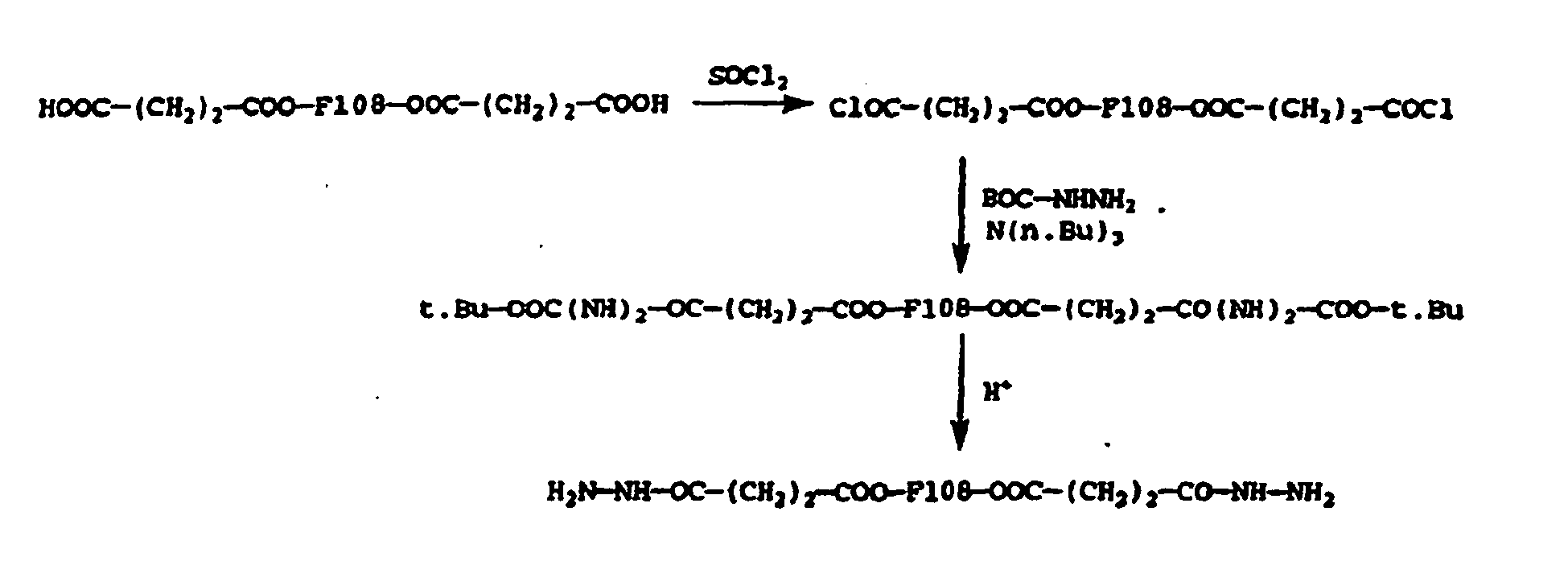
- To a solution of 10 g (1.3 mEq) of F108 in 10 ml of CCl4 were added 0.8 ml (3.6 mEq) of N(n.Bu)3, then at 0°C, 14.3 mEq of succinyl dichloride (as from Fluka A.G.). After allowing the black mixture to come back to room temperature, it was heated to 50°C for 2.5 hrs, then it was allowed to cool and left aside overnight. The mixture was concentrated on the rotavapor to about 50 ml, and 200 ml of ether were added which caused fogging. The milky liquid was then poured into 600 ml of ether, whereby a greenish solid precipitated. This solid was redissolved, treated with charcoal and reprecipitated with ether from the filtered solution, which provided 8.84 g of the dichloride. If in the foregoing preparation there were used redistilled succinyl dichloride (46-47°C/0.7-0.9 Torr), the product obtained crystallized slowly after the addition of ether and charcoal purification was unnecessary. Also the yield was higher. The reaction is as follows:

- The dihydrazide compounds (from Examples 1-4) were analyzed spectrometrically (505 nm, Kontron spectrometer) in aqueous solutions in the presence of trinitrobenzene sulfonate (TNBS) and potassium bisulfate. The measurements were done on solutions in the 10-5 - 10-3M range with reference to a calibration curve prepared from known diluted solutions of t.Bu-carbazate. The samples (1 ml) to be measured contained 0.8 ml of the hydrazide solution (control or test), 0.1 ml of 1M KHSO4 and 1 ml of TNBS (1 g/L). The absorbance measurements were done 1 hr after preparing the samples, this delay being necessary to assure reproducibility. For the blank controls, distilled water was used.
- The results showed that the techniques of Examples 1 and 4 were preferred to provide hydrazides with optimal purity and yields.
- Five g (0.62 mEq -COOH) of the F108-diacid succinate (as obtained in Example 2) were dissolved (heating slightly was useful) in 20 ml of AcOEt and there were added ar room temperature 1 g (6 mmol) of CDI. The solution was left 30 min at room temperature, then it was heated to 50°C for 3 hr. After allowing to stand 2 hr at room temperature, it was reheated to 50°C and 50 ml ether were added, whereby a solid crystallized (4.91 g). This was collected, washed with ether and dried.
- The solid was dissolved in 20 ml CH2Cl2 and to 10 ml thereof were added 400 mg (3 mmol) of t.Bu-carbazate in 1 ml of CH2Cl2. After 2 hrs at room temperature, 0.72 ml (3 mmol) of N(n.Bu)3 were added and the mixture was left aside overnight. The product that crystallized out was collected and recrystallized in AcOEt/ether; yield 2.31 g. This product was deprotected by reacting with 4 ml of TFA in 4 ml of CH2Cl2 as in Example 3, and the solid obtained after removal of the solvents was crystallized from AcOEt/ether; yield 2.12 g. of F108-disuccinyl-hydrazide. Hydrazide analysis performed as disclosed above gave 2.96 mEq/g which is near theory.
- The other 10 ml of solution of the di-imidazolyl-carbonyl derivative prepared above was treated with a solution containing 253 ml (3 mmol) of 1,3-diaminopropane and 0.72 ml (3 mmol) of tributylamine in CH2Cl2. After one night at room temperature, the solution was filtered and diluted with 50 ml ether which gave a solid. The latter was collected and recrystallized from successively AcOEt/ether and CCl4/ether; yield 2.26 g of the di[aminopropylamidosuccinyl]-derivative of F108. The reactions are:

- Five g of F108 (0.7 mEq) were dissolved in 10 ml of methylene chloride and 0.51 ml (2.15 mEq) of N(n.Bu)3 were added. The solution was cooled to 0°C and there were added 0.23 ml (2 mEq) of tresyl chloride. After allowing to slowly come back to room temperature (5 hrs). 10 ml of AcOEt were added, the solution was heated to about 50°C, 50 ml of ether were added and the whole was left to crystallize. After 2 days, the solid was separated by centrifugation (8000 g), washed with ether, dried, and dissolved in 20 ml of methylene chloride.
- A 10 ml portion of this solution was treated with 400 mg (3 mmol) of t.Bu-carbazate in 1 ml of CH2Cl2. After 2 hrs at room temperature, 0.72 ml (3 mmol) of tributylamine were added and the mixture was left overnight at room temperature Then 50 ml of ether were added, whereby a precipitate of F108-di(hydrazino-BOC) formed after several hrs at 4°C; yield 2.11 g.
- The above solid was dissolved in 4 ml of CH2Cl2 and de-protected with 4 ml TFA as disclosed in the previous Examples. After 1 hr at room temperature, the solvent was removed on the rotavapor and the residue was treated in 8 ml of AcOEt with 0.24 ml of tributylamine; addition of ether caused the precipitation of 2 g of the desired dihydrazino-F108.
- The reactions are:

- From the reaction scheme it follows that the corresponding di(aminopropylamino) compound was obtained from the other 10 ml of the ditresylate solution in methylene chloride by treatment with 3 mmol of 1,3-diaminopropane and 3 mmol of tri-n.butylamine at room temperature, precipitation with ether and crystallization from CCl4/ether.
- In a filtered solution of 21 g (3 mEq) of F108 in 80 ml of CCl4, there were added at room temperature 1 ml (4.2 mEq) of tributylamine. After cooling, 2.2 ml (30 mmol) of thionyl chloride were added and the mixture was refluxed 4 hrs, whereby it turned red. It was filtered, stripped from the solvents, the residue redissolved in 80 ml of CCl4 around 60°C and 200 ml of ether were added which caused the precipitation of 20.3 g of solid; the latter was dissolved in AcOEt (80 ml) bleached with active charcoal, filtered and allowed to crystallize after the addition of 200 ml of ether. There were collected 19.06 g of the desired F108 dichloride. The reaction is schematized below.

- F108 (21 g, 3 mEq) were dissolved in 200 ml of toluene and the solvent was distilled off slowly to remove the moisture. After removal of about 120 ml of solvent, the solution was cooled and there were added 0.5 g (4 mmol) of potassium tert.butoxide. After 2 hrs of reflux the orange solution was cooled and 0.7 ml (6 mmol) of ethylbromoacetate were added. After resting overnight, the solution was refluxed for 2 hrs, cooled and filtered over celite. Addition of 200 ml of ether causes the formation 20.71 g of solid which were collected and crystallized from successively EtOH (100 ml)/ether (4°C), and AcOEt (80 ml)/ether (200 ml). Yield 19.25 g.
F108(O-)2 + 2BrAcOEt - EtOOC-CH2-O-F108-O-CH2-COOEt
- Five g of the diester from Example 8 (0.7 mEq) were dissolved in 25 ml of EtOH at about 50°C, and about 1 ml (21 mmol) of hydrazine hydrate were added after which the mixture was refluxed for 3 hrs. After cooling to room temperature and 4°C, crystals of the dihydrazide formed which were collected and washed with alcohol and ether; yield 4,85 g.
F108(OCH2-COOEt)2 + N2H4.H2O - F108(OCH2-CO-NH-NH2)2
- Ten g of the ethyl F108-diacetate from Example 8 were dissolved in a solution of 50 ml EtOH and 70 ml H2O and 3 ml of 32% NaOH were added. After 2 hrs at 50°C and one night at room temperature, 15 g of salt were added, the pH was brought to 2 with conc. HCl and the mixture was extracted twice with 100 ml CH2Cl2. The combined organic fractions were washed with saturated brine and dried over anh. Na-Mg sulfate. After evaporation, the residue was redissolved in 50 ml alcohol and allowed to crystallize at 4°C.
- The dicarboxylic acid was titrated (0.52 g in 9 ml of H2O) with an excess of NaOH 0.2N and back titration with HCl 0.2N. The results indicated that the substitution was 74%.
- Two g (0.28 mEq) of the F108 dichloride from Example 7 were dissolved in 8 ml of dry DMF and there were added 0.54 g (2.9 mmol) of potassium phthalimide. The mixture was stirred overnight at 90°C after which it was cooled and filtered over celite. The solution was heated to 50°C, 30 ml of ether were added and, upon cooling, a solid formed; yield 1.46 g after crystallization from EtOH (20 ml)/ether (50 ml). Better yields and purer product were experienced when the potassim phthalimide was added in form of a solution in formamide.

- The compound of the previous Example (1.46 g, 0.2 mEq) was dissolved in 9 ml EtOH, and there were added 0.1 ml (2 mmol) of hydrazine hydrate. After one night at room temperature, the solution was diluted with 10 ml EtOH and refluxed for 3 hrs. Then the solvent was removed under reduced pressure, the residue was dissolved in 8 ml EtOH and a solid was precipitated by the addition of 40 ml ether. The solid was collected, washed with ether, dissolved in 8 ml ethanol, and 0.11 ml (2 mmol) of AcOH were added. the mixture was heated to 50°C, 50 ml of ether were added thereto and it was left to crystallize. White crystals (1.24 g) of diamino-F108 were collected and analyzed. titration of the -NH2 groups showed that the substitution was substantially 100%.

- F108 (21 g, 3 mEq OH) were dried by azeotropic distillation in toluene and thereafter converted to a solution (120 ml) of the corresponding dipotassium alkoxyde as disclosed in Example 8. Sixty ml of this solution were reacted under agitation with 1.82 ml (15 mmol) of bromoacetaldehyde dimethyl acetal. The yellow solution was refluxed overnight whereby it became orange and turbid. It was filtered on celite, concentrated on the rotavapor and diluted with 120 ml ether, whereby it crystallized on standing. The solid was collected and dissolved in 50 ml EtOH, the ethanol solution was treated with charcoal, filtered and diluted with 40 ml ether. After cooling to 4°C, crystals of F108 diacetaldehyde dimethylacetal (9.05 g) had formed which were collected dried and analyzed.
F108(O-)2 + BrCH2-CH(OCH3)2 → (CH3O)2CH-CH2-O-F108-O-CH2-CH(OCH3)2
- F108 (7.5 g, 1.07 mEq OH) was dissolved in 30 ml CCl4 at 50°C. the solution was filtered and 0.27 ml (1.1 mEq) of tri-n.butylamine were added at room temperature followed by 1.07 g (3.6 mmol) of Bis(trichloromethyl)carbonate (triphosgene), this being equivalent to 10.8 mmol of COCl2. After 1.5 hrs at room temperature, the solution was heated for 20 hrs at 50°C, then it was evaporated under vacuum to completely remove the HCl and phosgene excess.
- The residue was dissolved in 30 ml CCl4 and diluted with 80 ml of ether. The solid formed was collected at 4°C, washed with ether and redissolved in 30 ml CCl4.
- A solution was made containing 1.9 g (14.3 mmol) of t.butyl carbazate and 0.2 ml (0.8 mEq) of tributylamine in 2 ml of CCl4. To this were added 20 ml of the above solution of F108 dichloroformate (0.715 mEq). After 18 hrs at 50°C, the solution was filtered and precipitated by the addition of 50 ml of ether and cooling to 4°C. The solid was crystallized in AcOEt/ether (20 ml/50 ml) to give 4.21 g.
- The di(hydrazide-COO-t.Bu) compound in 8 ml CH2Cl2 was treated with 8 ml of TFA for deprotection as disclosed in Example 4. After 3 hrs at room temperature, the mixture was evaporated under vacuum, the residue redissolved in 15 ml CH2Cl2 and a solid precipitated by the addition of 90 ml of ether. This solid was crystallized from 20 ml EtOH + 0.5 ml tributylamine, the solution being left overnight at 4°C. Yield 4.04 g of F108-dicarbazate (urethanehydrazide)

- To a solution of 0.1 ml (0.4 mmol) of tributylamine and 0.5 ml (7.2 mmol) of ethylene diamine in 2 ml of CCl4 were added 10 ml (0.36 mEq) of the F108-dichloroformate solution of Example 13. The solution was heated for 18 hrs at 50°C, it was diluted with 10 ml of methanol, filtered and a solid precipitated by 50 ml of ether. The solid was collected and recrystallized in AcOEt (10 ml)/ether (30 ml); yield 2.25 g of H2N-(CH2)2-NH-COO-F108-OOC-NH-(CH2)2-NH2- Titration of the -NH2 groups by usual means showed that the substitution rate was about 60%.
- In 100 ml of ether were dissolved 13.22 g (0.1 mol) of tert.butyl carbazate and 15.4 ml (0.11 mol) of triethylamine. Under cooling (0 to 5°C) there were slowly added (in about 0.5 hr) 8.9 ml (0.1 mol) of bromoacetyl bromide. At the end, the temperature was allowed to come back to ambient and the precipitated triethyl ammonium bromide was removed by filtration (19.86 g = near theory). the red filtrate was chromatographed on silica (24 cm column; 200 ml) using ether as the eluent (100 + 250 ml). the yellow eluate was concentrated to about 80 ml and hexane was added until turbidity appeared. Crystals readily formed thereafter on shaking; the latter were collected at 4°C, yield 21.46 g, 85%.
- The obtained product (tert-butyl N-bromoacetylcarbazate was reacted with the potassium salt of F108 like in Examples 8 and 13 and thereafter the t.Bu group was removed with TFA. There was thus obtained the hydrazide corresponding to the product obtained in Example 9.

- The linkers produced according to Examples 1-16 were successfuly used to associate drugs or signal generator moieties (I) and bioactive targeting molecules (II) to provide efficient vectors for the transport of (I) to sites in the organism having receptor affinity for (II).
- If in the previous Examples the Pluronic® F108 amphiphilic compound was replaced by other copolymers having OH or NH2 terminated hydrophilic polyalkyleneoxy segments, similar results were obtained, the resulting corresponding linker products being usable to bridge moieties (I) and (II) as said above. Among such copolymers, one may cite the Pluronics® and Synperonics® of various structures falling within the specifications of this invention, these structures involving various hydrophilic and hydrophobic. sequences of different lengths. Other Poloxamers® and Poloxamines® as well as other convenient amphiphiles belonging to the brands known under the general registered names of Solulan®, Brij®, Mirj®, Tween®, Triton®, Span®, etc., are also possible under special conditions.
- In 40 ml of water, there were dissolved 81.1 mg (0.3 mmole) of FeCl3.6H2O and 56.9 mg (0.3 mmole) of FeCl2.4H2O (total Fe = 0.6 mmole or 33.5 mg) To this were added 0.1 mCi of 59Fe (tracer quantity) in the form FeCl3.
- The mixture was stirred and an aqueous 7.5% solution of ammonia was added dropwise until the pH reached a stable value of 8.6. A suspension of black particles formed which was heated for 5 min at 75°C and the particles were allowed to settle at room temperature. The precipitate was washed three times by decantation with portions of 100 ml of water, after which it was again suspended in 60 ml of water under agitation. The iron concentration of this suspension was 0.5 mg/ml.
- To 10 ml of this suspension (5 mg of Fe) were added (as component (a) 100 mg of the sodium salt of dipalmitoylphosphatidic acid (DPPA·Na) and sonication was effected for 20 min (BRANSON 250 Sonifier, 1/8" microprobe, output 20 (15-20 W). The temperature which rose to about 68°C during sonication was allowed to drop to room temperature, and there were added (as component (b) 100 mg of Pluronic® (NH2)2 as prepared in Example 12 (or identically modified amphiphiles such as Synperonic® from ICI, or Poloxamer® 338). Sonication was then resumed for 15 min under the aforementioned conditions.
- The obtained suspension of coated particles (Sample SBPA-NH2) therefore contained, per ml, 0.5 mg of iron, 10 mg of DPPA and 10 mg of the derivatized Pluronic® (NH2)2 surfactant (weight ratio of (a) to (b) = 1:1). Measurements by means of a particle counter apparatus (Nicomp 370 HDL-NPSS of Particle Sizing Systems, Santa Barbara, California, USA) indicated that, depending on the run, the average particle size was in the range 50 - 100 nm (± 20-40%).
- Other samples (see below) were prepared identically with the other derivatized amphiphiles disclosed in the previous examples:
Derivatized amphiphile Example No Sample code F108 (underivatized) (for controls) SBPA-Ctrl F108(NHNH2)2 6 SBPA-Hz F108(OOC-NHNH2)2 14 SBPA-COHz F108(OCH2-CONHNH2)2 9 SBPA-MeCOHz - Ten ml of sample SBPA-NH2 (see above under a) were centrifugated for 1 hr under 27'000 g. The undernatant residue was taken with 2.5 ml of 100mM borate buffer (pH 8.2) [or phosphate-free isotonic solution] to provide a suspension containing 2 mg of iron/ml.
- To 1 ml of the suspension were added 5 µmol of the couple biotin-NHS (NHS = N-hydroxy succinimide) available from Fluka A.G., Switzerland, neat, or as a concentrated DMSO solution. The mixture was agitated for 2 hrs at room temperature (room temperature), then it was dialyzed 4 succesive times against distilled water to give a purified sample of the desired magnetite-biotin conjugate labeled SBPA-NH-Bio.
- Similar reactions were carried out between SBPA-NH2 and other targeting factors (II), respectively, lactose isothiocyanate and folate-NHS (prepared according to J. Biol. Chem. 269 (1994) 3198-3204), to give respectively SBPA-NH-Lac and SBPA-NH-Fol. Coupling with the "RGD" peptide (H-Gly-Arg-Gly-Asp-Ser-Cys-OH) to give SBPA-NH-RGD was effected with the additional assistance of sSMBP [N-hydroxysulfosuccinimidyl-(4-maleinimidophenyl)-butyrate] according to the following scheme:
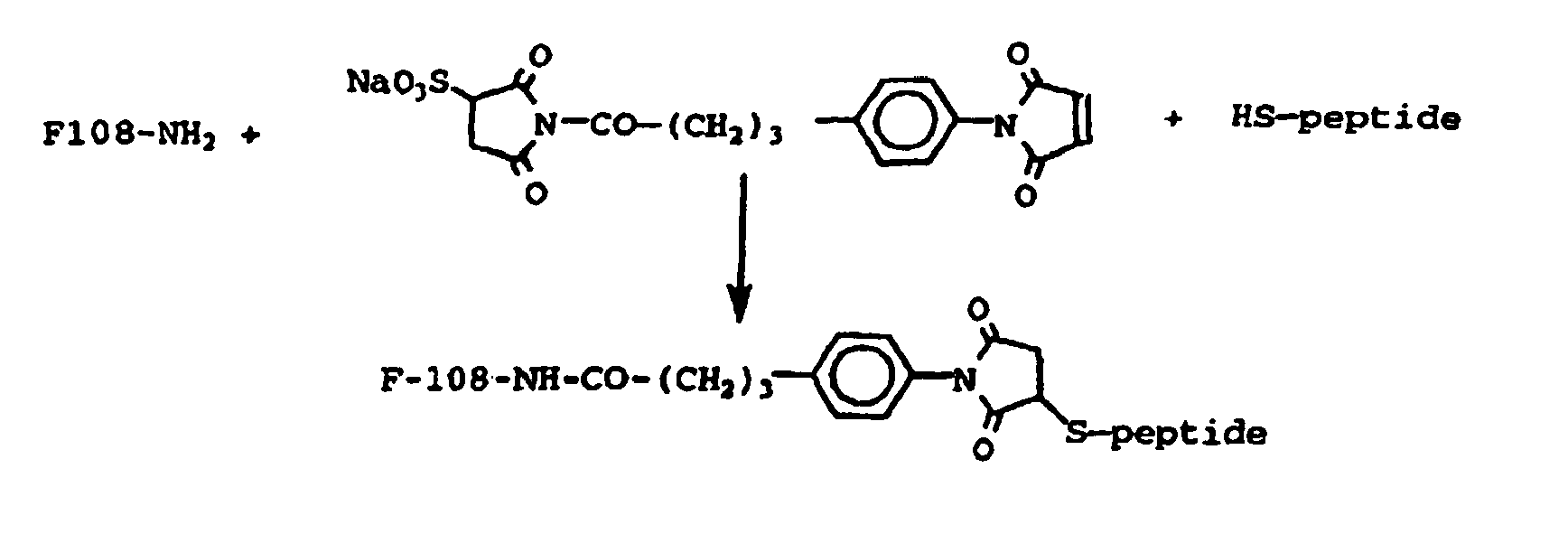
- The procedure was as follows: a residue of centrifugation of a SBPA-NH2 sample [obtained as under b), see above, in connection with the coupling with biotin] was suspended in 100mM Hepes buffer,
pH 7, to a concentration of 2 mg Fe/ml. To 1 ml of the iron suspension were added 5 µmol of sSMPB and the mixture was incubated for 2 hrs at room temperature. The product suspension was purified from excess reagent by gel-filtration chromatography (column G25). The purified Hepes suspension of SBPA-maleinimide was reacted overnight with a quantity of 2.5 µmol per mgFe of the thiol-derivatized peptide in the presence of EDTA (10 mM), then the excess reagents were eliminated by extensive dialysis against Hepes. - Controls were made also by "pseudocoupling" (under the foregoing conditions) magnetite particles carrying underivatized F108 with the above homing factors.
- The foregoing targeted (and control) preparations were filtered on 0.2 µm membranes and tested both in vitro (avidin and THP1 receptors) and in vivo in laboratory rats.
- For the in vitro testing, a control preparation was first prepared by activating the control sample SBPA-ctrl (see above) with biotin under the same conditions used for making preparation SBPA-NH-Bio. Then, both preparations were diluted to a series of concentrations corresponding to 60, 30, 15, 7.5 and 3.75 mg/ml of iron, respectively. The various dilutions were then tested by inoculating into microtiter plates previously incubated with avidin. After 4 hrs, the plates were washed from non-adsorbed materials and the bound iron ascertained by conventional analysis (thioglycollate). The results are presented in the form of the following graph in which the adsorbed iron ("Y" axis) is plotted against the iron in the foregoing dilutions ("X" axis). The curve denoting the behavior of SBPA-NH-Bio is marked with "◆"'s; the control curve is marked with "□"'s. The graph clearly demonstrates that the targeted magnetic particles have much greater affinity for avidin than the non-targeted ones.
- Further in vitro tests in connection with the binding of 59Fe-labeled preparations of SBPA-RGD (control: SBPA-cys) were effected using cell lines for expression of the corresponding receptor. For this, U937 strain samples containing various concentrations of the preparations to be tested were cultivated for 48 hrs in standard media activated with 50 nM PMA (phorbol-12-myristate-13-acetate), then incubated for 1 hr at 37°C. The cells were washed in cold PBS, detached and radiocounted. From the measurements, the amount of iron-tagged cells relative to the controls could be ascertained.
- The results are gathered in Table 1. They show that the amount of iron delivered by the SBPA-targeted particles is significantly greater than that from the controls.
Table 1 mean ng of Fe for 106 cells (standard dev.) 10 30 100 SBPA-rgd 74 (13.2) 181 (31) 854 (4.5) SBPA-cys 42 (0.8) 154 (14.9) 427 (120) - In a similar way, the binding of the 55Fe-SBPA-folate system (see above) was tested for affinity to the human KB cell line expressing folate receptors. KB cells were cultured as described in P.N.A.S. 92 (1995) 3318-3322 and incubated for 2 hrs at 37°C with various concentrations of 55Fe-SBPA-folate. As the control, there was used a preparation containing 55Fe-SBPA, F108(OH) "pseudo-coupled" to folate.
- The results are presented in the Table 2 below which show the iron concentration (mean values and standard deviation within brackets) retained in the media (in the presence and in the absence of additional foetal calf serum [FCS]).
Table 2 mg of Fe/ml in culture medium Fe(ng)/106 cells 10 30 100 SBPA-folate 111 (7.5) 361 (28.5) 1170 (53) SBPA-folate + FCS 77.5 (8.5) 228 (27.5) 557 (54.8) Control 124 (25.89 317 (37) 739 (47) Control + FCS 99.7 (3.2) 245 (10.2) 611 (45) - For in vivo tests, the preparations (diluted 20 fold) were injected in the caudal vein of the experimental rats (starting time to); then after various periods of time (t10 min to t120 min), blood samples were taken and analyzed for iron concentration. The results are gathered (expressed in % of the injected dose) in the Table 3 below. (A = SBPA-Ctrl; B = SBPA-NH-; "+" indicates there was no coupling between "A" and the targeting compound).
Table 3 Time (min) A B-Lac A+Lac B-Bio A+Bio B-Fol A+Fol B- RGD 10 87.9 87.8 85.3 94.1 96.1 9.1 91.3 91.7 30 85.8 66.5 72.6 68.9 76.2 0.4 74.3 71.9 60 80.4 33.9 31.3 34.6 43.9 0.7 26.7 22.4 90 76.7 25.4 10.3 24.6 22.9 0.6 9.9 8.1 120 66.5 19.6 4.3 18.0 13.9 0.5 5.6 4.6 - The results of the foregoing Table indicate that, with the exeption of one case (B-Fol), the conjugates remained in the circulation for an appreciable length of time, actually longer than the uncoupled mixtures; this indicates that they are not rapidly removed by the liver and can be carried efficiently to the selected site. The B-Fol case is still unexplained, but its fate is probably due to some unidentified artefact.
- The DTPA mono- and di-stearyl esters of formulae


- A hundred mg of Gd-DTPA-SE (0.127 mmol) and 200 mg of dipalmitoylphosphatidic acid (DPPA-Na) were dissolved in 25 ml of a 1/1 mixture of MeOH and CHCl3. The solution was evaporated to dryness under reduced pressure (Rotavapor, 72°C/15 Torr, 1.5 hrs), after which 20 ml of distilled water were added under agitation. The mixture was further homogenised by sonication for about 30 min at 70°C (Branson Sonifier, output 40). To the above suspension were added 200 mg of modified Synperonic® F-108(NH2)2 as disclosed in Example 12 and sonication was resumed for a few minutes, whereby a stable optically clear suspension of submicronic particles (labelled "M1") in micellar form was obtained. The foregoing preparation was repeated, but this time using Gd-DTPA-(SE)2 (0.095 mmol) instead of the Gd-DTPA-SE, to give a suspension labeled "M2".
- Proton spin relaxivities of the foregoing suspension were measured using a Minispec PC-120 (Bruker) apparatus, operating under 0.47 Tesla (20 MHz). EDM 510A (EDM = Experiment Definition Module) was used to measure the spin-lattice relaxation time T1 by the "inversion recovery" method. EDM 610A was used to measure the spin-spin relaxation time T2 by the Carr-Purcell-Meiboom-Gill (GPMG) technique. The relaxivities (r1 and r2) expressed as r in [mMs]-1=1/T for a 1 mM concentration are presented in Table 4.
- When the foregoing preparation was coupled to selected homing factors (II) as described in Example 17, corres-ponding administrable systems Gd-DTPA-SEfF108-NH-(II), and Gd-DTPA-(SE)2fF108NH-(II) were obtained. In vivo tests were performed with rats, as in Example 17, and gave comparable results regarding blood circulation.
Table 4 Sample r1 r2 Size (nm) "M1" 36.0 35.0 60±30 "M2" 30 31 80±40 - Magnetite micro particles coated with Synperonic®F108 derivatized with terminal NH2 groups were coupled to the "RGD" peptide as described in Example 17 (b) to provide test sample labeled SBPA-RGD. Control (SBPA-ME) was made similarly but using mercaptoethanol instead of the peptide in the terminal coupling reaction. Dilutions of test and control were prepared containing respectively 66 and 33 µg of iron/ml. These are labeled SBPA-RGD(66 µg Fe/ml) and SBPA-RGD(33 µg Fe/ml), respectively, SBPA-ME(66 µg Fe/ml) and SBPA-ME(33 µg Fe/ml).
- The neutrophil respiratory burst activity triggered by the addition of the RGD targeted system was tested as follows:
- Fully viable granulocyte cultures were prepared as disclosed by Y. Kasuya et al. in J. Biomedical Materials Research 28 (1994) 397-404.
- Then the following reagents were introduced into suitable microplate wells: (a) 150 µl of solution (2mg/ml in Hank's BSS) of nitro blue tetrazolium (NBT). (b) 100 µl of the test or control samples diluted to the aforementioned values. (c) 50 µl of the purified granulocyte preparation containing 5x10⁶ cells/ml in HBSS. Then, incubation at 37°C was carried out for various lengths of time.
- The response of the living cells is checked by the progressive increase of absorbance at 540 nm due to the reduction of the dye (yellow to blue) by the O2- generated during incubation. An additional plate containing the same mixture in 10µM iodoacetamide is used as a color reference; its absorbance is subtracted from each time measurement of the tests or controls.
- Results of the foregoing experiments are presented in the graph of
Fig. 4 which show the considerable activity of the systems according to the invention. - Ten ml of sample SBPA-NH2 (see above under Example 17) were centrifuged for 1 hr under 27'000 g. The undernatant residue was taken with 100mM HEPES buffer (pH 7.0) and diluted to 2 mg Fe/ml. To this were added 2.5 µmole of sulfosuccinimidyl-4[p-maleinimidophenyl]-butyrate (sulfo-SMPB) and the mixture was incubated for 2 hrs at room temperature Excess reagent was eliminated by adding EDTA (10 mM) and centrifugation (2 min, 100g). The residue was resuspended in HEPES (2.5 mg Fe/ml).
- 6 µmol of the hexapeptide (prepared as from
EP-A-0 398 143 ) were dissolved in DMSO to make a concentration of 10 mg/ml and 1 equiv. of N-hydroxysuccinimidyl-S-thioacetate (SATA) in the form of a 14 mg/ml DMSO solution was admixed; thereafter, N-ethylmorpholine was added to bring the apparent pH to 8 (moist pH strip). After 1 hr, the mixture was diluted 20 fold with H2O and loaded on a HPLC chromatography cartridge equilibrated in water (C18 Bond Elut cartridge, eluent 80% aqeous acetonitrile). The thioacetylated peptide appeared in the 18.77 min fraction which was dried to a solid; the latter was redissolved in a little DMSO. - The hexapeptide S-acetylthioacetate (2 mg) in DMSO solution was added to a HEPES solution of the SBPA-maleininimide derivatized iron oxide particles (2.5 mg Fe) prepared as disclosed in Example 21. The HEPES buffer used also contained EDTA (2.5 mM) and hydroxylamine (50 mM); the hydroxylamine acts as a deacetylation reagent. The mixture was kept at room temperature for 2 hrs, then the iron oxide particles were isolated by centrigugation, resuspended in buffer and extensively dialyzed for purification.
- Testing of the magnetite-chemoattractant peptide conjugate - affinity with granulocytes.
- Tissue injury and inflammation by bacterial infection induce granulocyte (PMN) and mononuclear phagocyte formation in response to the chemotactic peptides produced on the infection site. As acknowledged in Example 19, granulocytes will produce O2 - radicals which can be assayed by the reduction of the dye Nitro Blue Tetrazolium (NBT) absorbing at 540 nm.
- Neutrophils were isolated from fresh buffy coats and cultured according to Magn.Res.Imaging 13 (1995) 393-400. The rate of NBT reduction was measured directly in the cells cultured in microplates. The assay media comprised 150 µl of NBT solution (2 mg/ml), 100 µl of the conjugate solution (this including various concentration samples) to which were added 50 µl of PMN (2.5·105 cells). Iodoacetamide (an inhibitor of oxidative burst) was added to the medium in the photometer reference well (to 10 mM final concentration), the cells having been preincubated for 10 min at 37°C in 10 mM iodoacetamide. The complete details of the assay are disclosed in "Methods in Enzymology" 132, 417 Academic Press 1987.
- In the graph (a) of
Fig. 5 , there are respectively shown the rates of O2-production by granulocytes in response to various dlutions (identified by the iron concentrations) of the SBPA-chemoattractant synthetic peptide. The capacity of PMN to be stimulated in a dose-dependent manner by the SBPA-hexapeptide is evidenced of the presence of the magnetite particles coupled to the chemoattractant. In the controls (b), the effect of the magnetic particles alone, uncoupled to the peptide, is virtually naught. - The foregoing results have been further confirmed by radioactivity measurements (59Fe-labeled conjugates) and T2 proton relaxation parameters (NMR). For these experiments, frshly purified human PMN was incubated for 1 hr at 37°C with various SBPA-peptide conjugates, then washed in cold PBS. The T2 measurements showed that the incorpora-tion/association of iron from the conjugate gave an effect 6 to 43 times greater than with uncoupled magnetite particles.
- In laboratory rats, tracer measurements after intraveinous injection of 59Fe-SBPA-hexapeptide samples showed a preferential transfer of the iron through the circulation toward traumatized sites.
- The conjugation of magnetite particles with non-specific F(ab)2' fragments.
- Ten ml of sample SBPA-NH2 (see above under Example 17) were centrifuged for 1 hr under 27'000 g. The undernatant residue was taken with 100mM HEPES buffer (pH 7.0) and diluted to 2 mg Fe/ml. To this were added 2.5 µmole of sulfosucdnimidyl-4[p-maleinimidophenyl]-butyrate (sulfo-SMPB) and the mixture was incubated for 2 hrs at room temperature Excess reagent was eliminated by adding EDTA (10 mM) and centrifugation (2 min, 100g). The residue was resuspended in HEPES (2.5 mg Fe/ml).
- A sample of antibody (Ab = non-specific IgG) was digested for 20 hrs at 37°C with pepsin (in 0.2M NaOAc, pH 4.2) and the fragments purified by affinity chromatography and gel filtration.
- In order to expose the free -SH groups, the F(ab)2' fragments were incubated for 1 hr at 37°C with a solution of 1.5 mg/ml in 0.2M NaOAc, pH 5 of 2-mercaptoethylamine (MEA) to obtain a solution of approximately 10 mM final peptide concentration. Then the modified Fab fragments were isolated and purified by gel filtration in 0.15M NH4OAc, pH 6.8.
- An amount (1 mg) of the reduced Ab fragment was added to 2 ml of the foregoing SBPA-NH-sSMPB solution (diluted to 2 mg Fe/ml) in the presence of EDTA (10mM). The solution was left overnight at room temperature unde nitrogen; then it was chromatographed on sepharose 4B equilibrated in PBS, whereby unconjugated Fab was eliminated. Identification of the remaining desired compound was established by analysis using conventional means (iron and peptide determination).
- To a solution of selected antibody (Ab) (2.5 mg/ml in PBS, pH 6) were added at 0°C a quantity of 0.5M aqueous periodate solution in order to achieve a 22mM NaIO4 solution. the mixture was left to incubate in the dark on ice for 75 min, then 1,3-diamino-2-propanol (to make 30mM) was added to stop the reaction. The pH was lowered to 4 with AcOH and the oxidized glycoprotein (generation of reactive -CO groups) was desalted by gel filtration on a Parmacia Superose 12 column.
- Two ml of a solution of the foregoing oxidized Ab (1.5 g/ml in 0.1 M NaOAc, pH 4.6-5.3) were added to 1 ml of a SBPA-OCO-NH-NH2 solution containing 4 mg Fe/ml (code SBPA-COHz, see Examples 14 and 17) and the mixture was incubated for 20 hrs at room temperature whereby hydrazone bonds formed.
- Before isolation of the labeled magnetic particles, reduction of the hydrazone function was effected using 0.2M sodium cyanoborohydride at pH 4.6. The Ab-SBPA conjugate was thereafter separated by gel filtration on a Sepharose 4B column.
- In a variant from the procedure of Example 17, an adduct (L-II) involving a derivatized amphiphile linker (Synperonic® F108-NH2) and a targeting peptide (folate-NHS) was first prepared and thereafter conjugated with signal generating magnetic iron particles to give exemplified system (IfL-II). As a starting ingredient, there was used a concentrated solution (100-180 mg/ml) of derivatized Synperonic® F108-NH2 (see Example 12) in DMSO.
- To an amount of this solution was added 1 molar equivalent of the modified folate-NHS peptide (see Example 17) and sufficient N-ethylmorpholine to bring the pH to 8.2 (moist strips). After 24 hrs standing at room temperature, unreacted ligand was removed by gel-filtration chromatography and the F108-peptide conjugate further purified by repeated dialysis against pure water. The yield of folate-coupled F108 was determined spectrophotometrically at 365 nm to be 0.63 mole of folate/mole of F108.
Table 6 mg of Fe/ml in culture medium Fe (ng)/106 cells 10 30 100 SBPA-folate 1060 (142) 2010 (98) 3960 (413) SBPA-folate + FCS 543 (38.4) 1410 (39.4) 3620 (360) Control 132 (2.3) 381 (30.7) 1530 (201) Control + FCS 118 (12.7) 434 (8.4) 1500 (141) - The adduct preparation was used as such to prepare the corresponding SBPA-folate system by sonication according to the technique disclosed in Example 17, section a), for making the SBPA-NH2 adduct (IfL). The preparation was centrifugated and the pellet ressuspended in isotonic buffer. The binding capacity of the conjugate system to KB cells was effected exactly as described in Example 17 for the corresponding 59Fe-SBPA-folate conjugate adduct. The results compared to a same control are gathered in the Table 6 above.
Claims (6)
- Molecular conjugate systems represented by the formula (IfL-II) wherein:(I) is a magnetically responsive ligand component moiety constituted by magnetic particles coated with phosphatidic acid or a paramagnetic metal chelate of polyamino polycarboxylic acid partially esterified with a hydrophobic long chain aliphatic alcohol,(II) is a selected biospecific targeting factor component moiety having bioaffinity for specific sites, organs or tissues in the body,(I) and (II) are connected together by amphiphilic bridging linker component L having hydrophobic groups and reactively functionalized hydrophilic sequences, characterized in that the connection between L and (II) is covalent and involves said reactive function of the hydrophilic sequences; the connection between L and (I) schematized by f, is non-covalent and involves affinity forces between hydrophobic groups of both said components; and in which (II) is selected from tissue and cyto specific or surface-specific homing proteins, peptides, glycopeptides and carbohydrates, and L is derivatized block copolymers of polyethylene and polypropylene glycol selected from F108(NH2)2, F108(NHNH2)2, F108(OOC-NHNH2)2, F108(OCH2-CONHNH2)2, F108(OC-NHNH2)2 wherein F108 is α-hydro-w-hydroxypoly(oxyethylene) poly(oxypropylene)poly(oxyethylene) block copolymer.
- A method for making the systems of claim 1, which comprises selecting amphiphilic linkers comprising suitable hydrophilic and hydrophobic sequences; then (a) providing by derivatization said linkers with chemically reactive groups; (b) covalently binding via said reactive groups with a targeting factor (II) and (c) non-covalently binding via said hydrophobic sequences with a magnetically responsive compound, thus obtaining the sytems of formula (IfL-II).
- The method of claim 2, whereby an intermediate of structure (L-II) is obtained after step (b), step (c) being effected using said intermediate (L-II)
- The method of claim 2, wherein step (c) is effected before step (b), whereby an intermediate (IfL) is obtained from step (c).
- The method of claim 2, in which the derivatized linker L is selected from F108(NH2)2, F108(NHNH2)2, F108(OOC-NHNH2)2, F108(OCH2-CONHNH2)2, F108(OC-NHNH2)2 wherein F108 is a-hydro-w-hydroxypoly(oxyethylene) poly(oxypropylene)poly(oxyethylene) block copolymer, (I) is selected from magnetite submicronic particles coated with a phosphatidic acid, and hydrophobized paramagnetic chelates; and Il is selected from biotin, lactose, folate, and H-Gly-Arg-Gly-Asp-Ser-Cys-OH.
- Use of compounds of claim 1 for the manufacture of contrast agents used in magnetic resonance imaging of specific sites in the body of human and animal patients.
Priority Applications (2)
| Application Number | Priority Date | Filing Date | Title |
|---|---|---|---|
| DE69628731T DE69628731T3 (en) | 1995-11-01 | 1996-10-31 | TARGETED MAGNETICALLY MARKED MOLECULAR MARKER SYSTEMS AS NMR IMAGING PRODUCTS |
| EP96935209A EP0800545B2 (en) | 1995-11-01 | 1996-10-31 | Targeted magnetically labeled molecular marker systems for the nmr imaging |
Applications Claiming Priority (4)
| Application Number | Priority Date | Filing Date | Title |
|---|---|---|---|
| EP95810689 | 1995-11-01 | ||
| EP95810689 | 1995-11-01 | ||
| PCT/IB1996/001174 WO1997016474A1 (en) | 1995-11-01 | 1996-10-31 | Targeted magnetically labeled molecular marker systems for the nmr imaging |
| EP96935209A EP0800545B2 (en) | 1995-11-01 | 1996-10-31 | Targeted magnetically labeled molecular marker systems for the nmr imaging |
Publications (3)
| Publication Number | Publication Date |
|---|---|
| EP0800545A1 EP0800545A1 (en) | 1997-10-15 |
| EP0800545B1 EP0800545B1 (en) | 2003-06-18 |
| EP0800545B2 true EP0800545B2 (en) | 2011-03-02 |
Family
ID=8221811
Family Applications (1)
| Application Number | Title | Priority Date | Filing Date |
|---|---|---|---|
| EP96935209A Expired - Lifetime EP0800545B2 (en) | 1995-11-01 | 1996-10-31 | Targeted magnetically labeled molecular marker systems for the nmr imaging |
Country Status (6)
| Country | Link |
|---|---|
| US (1) | US5910300A (en) |
| EP (1) | EP0800545B2 (en) |
| JP (1) | JP4018141B2 (en) |
| AT (1) | ATE243230T1 (en) |
| DE (1) | DE69628731T3 (en) |
| WO (1) | WO1997016474A1 (en) |
Families Citing this family (44)
| Publication number | Priority date | Publication date | Assignee | Title |
|---|---|---|---|---|
| US5910300A (en) * | 1995-11-01 | 1999-06-08 | Bracco Research S.A. | Amphiphilic linkers for coupling administrable diagnostically or physiologically active agents and bioselective targeting compounds |
| US6331289B1 (en) * | 1996-10-28 | 2001-12-18 | Nycomed Imaging As | Targeted diagnostic/therapeutic agents having more than one different vectors |
| US20070036722A1 (en) * | 1996-10-28 | 2007-02-15 | Pal Rongved | Separation processes |
| US6261537B1 (en) | 1996-10-28 | 2001-07-17 | Nycomed Imaging As | Diagnostic/therapeutic agents having microbubbles coupled to one or more vectors |
| US6264917B1 (en) | 1996-10-28 | 2001-07-24 | Nycomed Imaging As | Targeted ultrasound contrast agents |
| US6548663B1 (en) | 1998-03-31 | 2003-04-15 | Bristol-Myers Squibb Pharma Company | Benzodiazepine vitronectin receptor antagonist pharmaceuticals |
| EA200001007A1 (en) | 1998-03-31 | 2001-04-23 | Дюпон Фармасьютикалз Компани | PHARMACEUTICAL PREPARATIONS FOR THE VISUALIZATION OF ANGIOGENIC DISORDERS |
| US6537520B1 (en) | 1998-03-31 | 2003-03-25 | Bristol-Myers Squibb Pharma Company | Pharmaceuticals for the imaging of angiogenic disorders |
| US6524553B2 (en) | 1998-03-31 | 2003-02-25 | Bristol-Myers Squibb Pharma Company | Quinolone vitronectin receptor antagonist pharmaceuticals |
| US6511649B1 (en) | 1998-12-18 | 2003-01-28 | Thomas D. Harris | Vitronectin receptor antagonist pharmaceuticals |
| US6569402B1 (en) | 1998-12-18 | 2003-05-27 | Bristol-Myers Squibb Pharma Company | Vitronectin receptor antagonist pharmaceuticals |
| US6794518B1 (en) | 1998-12-18 | 2004-09-21 | Bristol-Myers Squibb Pharma Company | Vitronectin receptor antagonist pharmaceuticals |
| CA2727746A1 (en) | 1998-12-18 | 2000-06-22 | Bristol-Myers Squibb Pharma Company | Quinolone vitronectin receptor antagonist pharmaceuticals |
| WO2000035887A2 (en) | 1998-12-18 | 2000-06-22 | Du Pont Pharm Co | Vitronectin receptor antagonist pharmaceuticals |
| US9289487B2 (en) * | 1999-09-14 | 2016-03-22 | Antigen Express, Inc. | II-key/antigenic epitope hybrid peptide vaccines |
| US6432409B1 (en) * | 1999-09-14 | 2002-08-13 | Antigen Express, Inc. | Hybrid peptides modulate the immune response |
| EP2279757A3 (en) | 2000-06-02 | 2011-08-03 | Bracco Suisse SA | Compounds for targeting endothelial cells |
| WO2002036073A2 (en) * | 2000-11-02 | 2002-05-10 | Smithkline Beecham Corporation | Receptor antagonist-lipid conjugates and delivery vehicles containing same |
| US20040058458A1 (en) * | 2002-04-18 | 2004-03-25 | The Regents Of The University Of Michigan | Modulated chemical sensors |
| US8697029B2 (en) | 2002-04-18 | 2014-04-15 | The Regents Of The University Of Michigan | Modulated physical and chemical sensors |
| US7179645B2 (en) | 2002-09-24 | 2007-02-20 | Antigen Express, Inc. | Ii-Key/antigenic epitope hybrid peptide vaccines |
| WO2004030616A2 (en) | 2002-09-17 | 2004-04-15 | Antigen Express, Inc. | Ii-KEY/ANTIGENIC EPITOPE HYBRID PEPTIDE VACCINES |
| WO2011008992A2 (en) * | 2009-07-15 | 2011-01-20 | The Regents Of The University Of California | Peptides whose uptake in cells is controllable |
| US7985401B2 (en) * | 2003-10-31 | 2011-07-26 | The Regents Of The University Of California | Peptides whose uptake by cells is controllable |
| US7431915B2 (en) | 2003-10-31 | 2008-10-07 | The Regents Of The University Of California | Peptides whose uptake by cells is controllable |
| US9695251B2 (en) | 2003-10-31 | 2017-07-04 | The Regents Of The University Of California | Activatable cell penetrating peptides with quenched fluorophores |
| US20050260137A1 (en) * | 2004-05-18 | 2005-11-24 | General Electric Company | Contrast agents for magnetic resonance imaging |
| US20080019918A1 (en) * | 2004-09-10 | 2008-01-24 | Takao Aoki | Medicinal Preparation |
| US20100041613A1 (en) * | 2006-03-09 | 2010-02-18 | John Coleman | Novel antibiotic compositions |
| WO2008003099A1 (en) | 2006-06-29 | 2008-01-03 | Invitrogen, Dynal As | Particles containing multi- block polymers |
| JP5345945B2 (en) * | 2006-12-11 | 2013-11-20 | ブラッコ・イメージング・ソシエタ・ペル・アチオニ | Fibrin-binding peptides and conjugates thereof |
| US9068977B2 (en) * | 2007-03-09 | 2015-06-30 | The Regents Of The University Of Michigan | Non-linear rotation rates of remotely driven particles and uses thereof |
| CA2731444A1 (en) | 2008-09-02 | 2010-03-11 | Antigen Express, Inc. | Human papillomavirus / li-key hybrids and methods of use |
| CA2750922A1 (en) * | 2009-01-28 | 2010-08-05 | Antigen Express, Inc. | Li-key hybrid peptides that modulate the immune response to influenza |
| WO2012027747A2 (en) | 2010-08-27 | 2012-03-01 | The Regents Of The University Of Michigan | Asynchronous magnetic bead rotation sensing systems and methods |
| US9816993B2 (en) | 2011-04-11 | 2017-11-14 | The Regents Of The University Of Michigan | Magnetically induced microspinning for super-detection and super-characterization of biomarkers and live cells |
| US9797817B2 (en) | 2012-05-03 | 2017-10-24 | The Regents Of The University Of Michigan | Multi-mode separation for target detection |
| US10029017B2 (en) | 2013-01-29 | 2018-07-24 | The Regents Of The University Of California | Pretargeted activatable cell penetrating peptide with intracellularly releasable prodrug |
| KR102363779B1 (en) | 2013-01-30 | 2022-02-15 | 아벨라스 바이오사이언시즈 인코포레이티드 | Selective delivery molecules and methods of use |
| US9983110B2 (en) | 2013-11-04 | 2018-05-29 | The Regents Of The University Of Michigan | Asynchronous magnetic bead rotation (AMBR) microviscometer for analysis of analytes |
| US10385380B2 (en) | 2014-10-02 | 2019-08-20 | The Regents Of The University Of California | Personalized protease assay to measure protease activity in neoplasms |
| US10596259B2 (en) | 2015-05-20 | 2020-03-24 | The Regents Of The University Of California | Tumor radiosensitization with monomethyl auristatin E (MMAE) and derivatives thereof |
| EP3492460A1 (en) * | 2017-12-01 | 2019-06-05 | Ustav Organicke Chemie A Biochemie Av Cr, V.v.i. | Compounds for separation of rare earth elements, method of separation, and use thereof |
| WO2025146054A1 (en) | 2024-01-02 | 2025-07-10 | Beijing Youfeng Biological Technology Co., Ltd. | EPITOPE POTENCY ENHANCEMENT VIA AMINO ACID MODIFICATION OF Ii-KEY PEPTIDE |
Family Cites Families (24)
| Publication number | Priority date | Publication date | Assignee | Title |
|---|---|---|---|---|
| US4070246A (en) * | 1976-04-09 | 1978-01-24 | Abbott Laboratories | Reactive matrices |
| US4157323A (en) * | 1976-06-09 | 1979-06-05 | California Institute Of Technology | Metal containing polymeric functional microspheres |
| US4628037A (en) * | 1983-05-12 | 1986-12-09 | Advanced Magnetics, Inc. | Binding assays employing magnetic particles |
| CA1268208A (en) * | 1984-08-10 | 1990-04-24 | Truman Brown | Magnetic micro-particles as contrast agents in nuclear magnetic resonance imaging |
| US4762915A (en) * | 1985-01-18 | 1988-08-09 | Liposome Technology, Inc. | Protein-liposome conjugates |
| GB8601100D0 (en) * | 1986-01-17 | 1986-02-19 | Cosmas Damian Ltd | Drug delivery system |
| US5271927A (en) * | 1986-02-13 | 1993-12-21 | Celltech Limited | Antibody conjugates with macrocyclic ligands |
| US4827945A (en) * | 1986-07-03 | 1989-05-09 | Advanced Magnetics, Incorporated | Biologically degradable superparamagnetic materials for use in clinical applications |
| US5284646A (en) * | 1986-07-03 | 1994-02-08 | Advanced Magnetics Inc. | Hepatocyte specific receptor mediated endocytosis type magnetic resonance imaging contrast agents |
| US5314679A (en) * | 1986-07-03 | 1994-05-24 | Advanced Magnetics Inc. | Vascular magnetic resonance imaging agent comprising nanoparticles |
| US5069216A (en) * | 1986-07-03 | 1991-12-03 | Advanced Magnetics Inc. | Silanized biodegradable super paramagnetic metal oxides as contrast agents for imaging the gastrointestinal tract |
| JPH0720857B2 (en) * | 1988-08-11 | 1995-03-08 | テルモ株式会社 | Liposome and its manufacturing method |
| US4986979A (en) * | 1989-03-14 | 1991-01-22 | Neorx Corporation | Imaging tissue sites of inflammation |
| NZ314680A (en) * | 1989-05-09 | 2000-08-25 | Ortho Pharma Corp | Treating localised infection or inflammation with a therapeutically conjugated chemotactic peptide |
| US5395609A (en) * | 1989-06-19 | 1995-03-07 | Antisoma Limited | Synthetic peptides for use in tumor detection |
| JP2978187B2 (en) * | 1989-11-02 | 1999-11-15 | 日本ケミカルリサーチ株式会社 | Method for producing modified superoxide dismutase |
| US5552525A (en) * | 1991-02-08 | 1996-09-03 | Diatech Inc. | Technetium-99m labeled peptides for imaging inflammation |
| US5370901A (en) * | 1991-02-15 | 1994-12-06 | Bracco International B.V. | Compositions for increasing the image contrast in diagnostic investigations of the digestive tract of patients |
| US5464696A (en) * | 1992-08-13 | 1995-11-07 | Bracco International B.V. | Particles for NMR imaging |
| NZ250375A (en) * | 1992-12-09 | 1995-07-26 | Ortho Pharma Corp | Peg hydrazone and peg oxime linkage forming reagents and protein derivatives |
| DE4309333A1 (en) * | 1993-03-17 | 1994-09-22 | Silica Gel Gmbh | Superparamagnetic particles, process for their production and use thereof |
| EP0689430B1 (en) * | 1993-03-17 | 1997-08-13 | Silica Gel Ges.M.B.H | Superparamagnetic particles, process for producing the same and their use |
| US5516703A (en) * | 1993-08-20 | 1996-05-14 | The University Of Utah | Coating of hydrophobic surfaces to render them protein resistant while permitting covalent attachment of specific ligands |
| US5910300A (en) * | 1995-11-01 | 1999-06-08 | Bracco Research S.A. | Amphiphilic linkers for coupling administrable diagnostically or physiologically active agents and bioselective targeting compounds |
-
1996
- 1996-10-31 US US08/740,620 patent/US5910300A/en not_active Expired - Lifetime
- 1996-10-31 JP JP51719697A patent/JP4018141B2/en not_active Expired - Fee Related
- 1996-10-31 DE DE69628731T patent/DE69628731T3/en not_active Expired - Lifetime
- 1996-10-31 AT AT96935209T patent/ATE243230T1/en not_active IP Right Cessation
- 1996-10-31 EP EP96935209A patent/EP0800545B2/en not_active Expired - Lifetime
- 1996-10-31 WO PCT/IB1996/001174 patent/WO1997016474A1/en not_active Ceased
Also Published As
| Publication number | Publication date |
|---|---|
| EP0800545B1 (en) | 2003-06-18 |
| US5910300A (en) | 1999-06-08 |
| EP0800545A1 (en) | 1997-10-15 |
| WO1997016474A1 (en) | 1997-05-09 |
| DE69628731T2 (en) | 2004-04-29 |
| ATE243230T1 (en) | 2003-07-15 |
| DE69628731D1 (en) | 2003-07-24 |
| JPH10512617A (en) | 1998-12-02 |
| JP4018141B2 (en) | 2007-12-05 |
| DE69628731T3 (en) | 2012-09-20 |
Similar Documents
| Publication | Publication Date | Title |
|---|---|---|
| EP0800545B2 (en) | Targeted magnetically labeled molecular marker systems for the nmr imaging | |
| Martin et al. | Enhanced cell uptake of superparamagnetic iron oxide nanoparticles functionalized with dendritic guanidines | |
| US11654204B2 (en) | Rod-shaped plant virus nanoparticles as imaging agent platforms | |
| Jacques et al. | New classes of MRI contrast agents | |
| US8147803B2 (en) | Ultrasmall superparamagnetic iron oxide nanoparticles and uses thereof | |
| US5512294A (en) | Targeted polymerized liposome contrast agents | |
| US8420055B2 (en) | Amine functionalized superparamagnetic nanoparticles for the synthesis of bioconjugates and uses therefor | |
| US5679323A (en) | Hepatocyte-specific receptor-mediated endocytosis-type compositions | |
| US20070014725A1 (en) | Conjugates of macrocyclic metal complexes with biomolecules and their use for the production of agents for NMR diagnosis and radiodiagnosis as well as radiotherapy | |
| Otis et al. | Dendrimer antibody conjugate to target and image HER-2 overexpressing cancer cells | |
| US5352432A (en) | Hepatocyte specific composition and their use as diagnostic imaging agents | |
| US5284646A (en) | Hepatocyte specific receptor mediated endocytosis type magnetic resonance imaging contrast agents | |
| ES2316961T3 (en) | CONJUGATED FOR THE FORMATION OF MEDICAL IMAGES THAT INCLUDE CARRIER, OTHER GUIDANCE AND A CONTRACTING AGENT. | |
| Xiong et al. | Gd-Chelated poly (propylene imine) dendrimers with densely organized maltose shells for enhanced MR imaging applications | |
| Mulas et al. | Mn (II)-Based Lipidic Nanovesicles as High-Efficiency MRI Probes | |
| Vera et al. | A molecular receptor-binding contrast agent for magnetic resonance imaging of the liver | |
| Richard et al. | Nanoparticles for imaging and tumor gene delivery | |
| Polyanichko et al. | Synthesis of dendronized polymeric chelating agents using hydrazone ligation strategy | |
| KR101142905B1 (en) | Synthesis of cationic magnetic nano-complexs using cationic amphiphilic polymers | |
| Doan et al. | Lipidic spherulites as magnetic resonance imaging contrast agents | |
| Zu et al. | PEGylated chitosan grafted with polyamidoamine-dendron as tumor-targeted magnetic resonance imaging contrast agent | |
| Pothayee et al. | Multivalent Gd-DOTA Decorated Oligopeptide as Sensitive MRI Molecular Probes for In Vivo Imaging of Brain Connectivity | |
| CN111840324B (en) | Au DENPs-macrophage complexes for imaging or therapy of osteosarcoma cells | |
| Sawant | Polyethylene glycol (peg) as a key component of long-circulating delivery systems for therapy and imaging | |
| Xu | Design, Synthesis and Evaluation of Innovative Carriers for Delivery of MR Contrast Agents and Nucleic Acids |
Legal Events
| Date | Code | Title | Description |
|---|---|---|---|
| PUAI | Public reference made under article 153(3) epc to a published international application that has entered the european phase |
Free format text: ORIGINAL CODE: 0009012 |
|
| AK | Designated contracting states |
Kind code of ref document: A1 Designated state(s): AT BE CH DE DK ES FI FR GB GR IE IT LI LU MC NL PT SE |
|
| 17P | Request for examination filed |
Effective date: 19971110 |
|
| RAP1 | Party data changed (applicant data changed or rights of an application transferred) |
Owner name: BRACCO RESEARCH S.A. |
|
| 19U | Interruption of proceedings before grant |
Effective date: 19980903 |
|
| 19W | Proceedings resumed before grant after interruption of proceedings |
Effective date: 19991001 |
|
| 17Q | First examination report despatched |
Effective date: 20010124 |
|
| GRAH | Despatch of communication of intention to grant a patent |
Free format text: ORIGINAL CODE: EPIDOS IGRA |
|
| GRAH | Despatch of communication of intention to grant a patent |
Free format text: ORIGINAL CODE: EPIDOS IGRA |
|
| GRAA | (expected) grant |
Free format text: ORIGINAL CODE: 0009210 |
|
| AK | Designated contracting states |
Designated state(s): AT BE CH DE DK ES FI FR GB GR IE IT LI LU MC NL PT SE |
|
| PG25 | Lapsed in a contracting state [announced via postgrant information from national office to epo] |
Ref country code: NL Free format text: LAPSE BECAUSE OF FAILURE TO SUBMIT A TRANSLATION OF THE DESCRIPTION OR TO PAY THE FEE WITHIN THE PRESCRIBED TIME-LIMIT Effective date: 20030618 Ref country code: FI Free format text: LAPSE BECAUSE OF FAILURE TO SUBMIT A TRANSLATION OF THE DESCRIPTION OR TO PAY THE FEE WITHIN THE PRESCRIBED TIME-LIMIT Effective date: 20030618 Ref country code: BE Free format text: LAPSE BECAUSE OF FAILURE TO SUBMIT A TRANSLATION OF THE DESCRIPTION OR TO PAY THE FEE WITHIN THE PRESCRIBED TIME-LIMIT Effective date: 20030618 Ref country code: AT Free format text: LAPSE BECAUSE OF FAILURE TO SUBMIT A TRANSLATION OF THE DESCRIPTION OR TO PAY THE FEE WITHIN THE PRESCRIBED TIME-LIMIT Effective date: 20030618 |
|
| REG | Reference to a national code |
Ref country code: GB Ref legal event code: FG4D |
|
| REG | Reference to a national code |
Ref country code: CH Ref legal event code: EP |
|
| REG | Reference to a national code |
Ref country code: IE Ref legal event code: FG4D |
|
| REF | Corresponds to: |
Ref document number: 69628731 Country of ref document: DE Date of ref document: 20030724 Kind code of ref document: P |
|
| PG25 | Lapsed in a contracting state [announced via postgrant information from national office to epo] |
Ref country code: SE Free format text: LAPSE BECAUSE OF FAILURE TO SUBMIT A TRANSLATION OF THE DESCRIPTION OR TO PAY THE FEE WITHIN THE PRESCRIBED TIME-LIMIT Effective date: 20030918 Ref country code: PT Free format text: LAPSE BECAUSE OF FAILURE TO SUBMIT A TRANSLATION OF THE DESCRIPTION OR TO PAY THE FEE WITHIN THE PRESCRIBED TIME-LIMIT Effective date: 20030918 Ref country code: GR Free format text: LAPSE BECAUSE OF FAILURE TO SUBMIT A TRANSLATION OF THE DESCRIPTION OR TO PAY THE FEE WITHIN THE PRESCRIBED TIME-LIMIT Effective date: 20030918 Ref country code: DK Free format text: LAPSE BECAUSE OF FAILURE TO SUBMIT A TRANSLATION OF THE DESCRIPTION OR TO PAY THE FEE WITHIN THE PRESCRIBED TIME-LIMIT Effective date: 20030918 |
|
| PG25 | Lapsed in a contracting state [announced via postgrant information from national office to epo] |
Ref country code: ES Free format text: LAPSE BECAUSE OF FAILURE TO SUBMIT A TRANSLATION OF THE DESCRIPTION OR TO PAY THE FEE WITHIN THE PRESCRIBED TIME-LIMIT Effective date: 20030929 |
|
| PG25 | Lapsed in a contracting state [announced via postgrant information from national office to epo] |
Ref country code: MC Free format text: LAPSE BECAUSE OF NON-PAYMENT OF DUE FEES Effective date: 20031031 Ref country code: LU Free format text: LAPSE BECAUSE OF NON-PAYMENT OF DUE FEES Effective date: 20031031 Ref country code: IE Free format text: LAPSE BECAUSE OF NON-PAYMENT OF DUE FEES Effective date: 20031031 |
|
| NLV1 | Nl: lapsed or annulled due to failure to fulfill the requirements of art. 29p and 29m of the patents act | ||
| PLBQ | Unpublished change to opponent data |
Free format text: ORIGINAL CODE: EPIDOS OPPO |
|
| PLBI | Opposition filed |
Free format text: ORIGINAL CODE: 0009260 |
|
| ET | Fr: translation filed | ||
| PLAX | Notice of opposition and request to file observation + time limit sent |
Free format text: ORIGINAL CODE: EPIDOSNOBS2 |
|
| 26 | Opposition filed |
Opponent name: BRISTOL-MYERS SQUIBB MEDICAL IMAGING, INC. Effective date: 20040315 |
|
| REG | Reference to a national code |
Ref country code: IE Ref legal event code: MM4A |
|
| PLAX | Notice of opposition and request to file observation + time limit sent |
Free format text: ORIGINAL CODE: EPIDOSNOBS2 |
|
| PLAX | Notice of opposition and request to file observation + time limit sent |
Free format text: ORIGINAL CODE: EPIDOSNOBS2 |
|
| PLBB | Reply of patent proprietor to notice(s) of opposition received |
Free format text: ORIGINAL CODE: EPIDOSNOBS3 |
|
| APAH | Appeal reference modified |
Free format text: ORIGINAL CODE: EPIDOSCREFNO |
|
| APBP | Date of receipt of notice of appeal recorded |
Free format text: ORIGINAL CODE: EPIDOSNNOA2O |
|
| APBQ | Date of receipt of statement of grounds of appeal recorded |
Free format text: ORIGINAL CODE: EPIDOSNNOA3O |
|
| APBU | Appeal procedure closed |
Free format text: ORIGINAL CODE: EPIDOSNNOA9O |
|
| PUAH | Patent maintained in amended form |
Free format text: ORIGINAL CODE: 0009272 |
|
| STAA | Information on the status of an ep patent application or granted ep patent |
Free format text: STATUS: PATENT MAINTAINED AS AMENDED |
|
| 27A | Patent maintained in amended form |
Effective date: 20110302 |
|
| AK | Designated contracting states |
Kind code of ref document: B2 Designated state(s): AT BE CH DE DK ES FI FR GB GR IE IT LI LU MC NL PT SE |
|
| REG | Reference to a national code |
Ref country code: CH Ref legal event code: AEN Free format text: BREVET MAINTENU DANS UNE FORME MODIFIEE |
|
| REG | Reference to a national code |
Ref country code: DE Ref legal event code: R102 Ref document number: 69628731 Country of ref document: DE Effective date: 20110302 |
|
| REG | Reference to a national code |
Ref country code: CH Ref legal event code: PFUS Owner name: BRACCO SUISSE S.A., CH Free format text: FORMER OWNER: BRACCO RESEARCH S.A., CH |
|
| REG | Reference to a national code |
Ref country code: DE Ref legal event code: R082 Ref document number: 69628731 Country of ref document: DE Representative=s name: UEXKUELL & STOLBERG, DE |
|
| REG | Reference to a national code |
Ref country code: FR Ref legal event code: TP Owner name: BRACCO SUISSE S.A., CH Effective date: 20120525 |
|
| REG | Reference to a national code |
Ref country code: GB Ref legal event code: 732E Free format text: REGISTERED BETWEEN 20120628 AND 20120704 |
|
| REG | Reference to a national code |
Ref country code: DE Ref legal event code: R082 Ref document number: 69628731 Country of ref document: DE Representative=s name: UEXKUELL & STOLBERG, DE Effective date: 20120615 Ref country code: DE Ref legal event code: R081 Ref document number: 69628731 Country of ref document: DE Owner name: BRACCO SUISSE S.A., CH Free format text: FORMER OWNER: BRACCO RESEARCH S.A., PLAN-LES-QUATES, CH Effective date: 20120615 |
|
| PGFP | Annual fee paid to national office [announced via postgrant information from national office to epo] |
Ref country code: CH Payment date: 20121025 Year of fee payment: 17 Ref country code: DE Payment date: 20121029 Year of fee payment: 17 Ref country code: FR Payment date: 20121107 Year of fee payment: 17 |
|
| PGFP | Annual fee paid to national office [announced via postgrant information from national office to epo] |
Ref country code: GB Payment date: 20121025 Year of fee payment: 17 Ref country code: IT Payment date: 20121024 Year of fee payment: 17 |
|
| REG | Reference to a national code |
Ref country code: CH Ref legal event code: PL |
|
| GBPC | Gb: european patent ceased through non-payment of renewal fee |
Effective date: 20131031 |
|
| PG25 | Lapsed in a contracting state [announced via postgrant information from national office to epo] |
Ref country code: CH Free format text: LAPSE BECAUSE OF NON-PAYMENT OF DUE FEES Effective date: 20131031 Ref country code: LI Free format text: LAPSE BECAUSE OF NON-PAYMENT OF DUE FEES Effective date: 20131031 Ref country code: GB Free format text: LAPSE BECAUSE OF NON-PAYMENT OF DUE FEES Effective date: 20131031 |
|
| REG | Reference to a national code |
Ref country code: DE Ref legal event code: R119 Ref document number: 69628731 Country of ref document: DE Effective date: 20140501 |
|
| REG | Reference to a national code |
Ref country code: FR Ref legal event code: ST Effective date: 20140630 |
|
| PG25 | Lapsed in a contracting state [announced via postgrant information from national office to epo] |
Ref country code: IT Free format text: LAPSE BECAUSE OF NON-PAYMENT OF DUE FEES Effective date: 20131031 Ref country code: DE Free format text: LAPSE BECAUSE OF NON-PAYMENT OF DUE FEES Effective date: 20140501 Ref country code: FR Free format text: LAPSE BECAUSE OF NON-PAYMENT OF DUE FEES Effective date: 20131031 |