EP0799889B1 - Famille de canaux potassium de mammifère, leur clonage et leur utilisation notamment pour le criblage de drogues - Google Patents
Famille de canaux potassium de mammifère, leur clonage et leur utilisation notamment pour le criblage de drogues Download PDFInfo
- Publication number
- EP0799889B1 EP0799889B1 EP96401137A EP96401137A EP0799889B1 EP 0799889 B1 EP0799889 B1 EP 0799889B1 EP 96401137 A EP96401137 A EP 96401137A EP 96401137 A EP96401137 A EP 96401137A EP 0799889 B1 EP0799889 B1 EP 0799889B1
- Authority
- EP
- European Patent Office
- Prior art keywords
- twik
- domains
- nucleic acid
- potassium
- transmembrane segments
- Prior art date
- Legal status (The legal status is an assumption and is not a legal conclusion. Google has not performed a legal analysis and makes no representation as to the accuracy of the status listed.)
- Expired - Lifetime
Links
- 102000004257 Potassium Channel Human genes 0.000 title claims abstract description 41
- 108020001213 potassium channel Proteins 0.000 title claims abstract description 41
- 238000010367 cloning Methods 0.000 title abstract description 8
- 238000007877 drug screening Methods 0.000 title description 2
- 108090000623 proteins and genes Proteins 0.000 claims abstract description 27
- 102000004169 proteins and genes Human genes 0.000 claims abstract description 24
- 108020004707 nucleic acids Proteins 0.000 claims abstract description 20
- 102000039446 nucleic acids Human genes 0.000 claims abstract description 20
- 150000007523 nucleic acids Chemical class 0.000 claims abstract description 20
- 238000012216 screening Methods 0.000 claims abstract description 5
- 230000000694 effects Effects 0.000 claims description 30
- 238000000034 method Methods 0.000 claims description 20
- 230000014509 gene expression Effects 0.000 claims description 14
- 239000013598 vector Substances 0.000 claims description 12
- 125000003275 alpha amino acid group Chemical group 0.000 claims description 10
- FWMNVWWHGCHHJJ-SKKKGAJSSA-N 4-amino-1-[(2r)-6-amino-2-[[(2r)-2-[[(2r)-2-[[(2r)-2-amino-3-phenylpropanoyl]amino]-3-phenylpropanoyl]amino]-4-methylpentanoyl]amino]hexanoyl]piperidine-4-carboxylic acid Chemical compound C([C@H](C(=O)N[C@H](CC(C)C)C(=O)N[C@H](CCCCN)C(=O)N1CCC(N)(CC1)C(O)=O)NC(=O)[C@H](N)CC=1C=CC=CC=1)C1=CC=CC=C1 FWMNVWWHGCHHJJ-SKKKGAJSSA-N 0.000 claims description 7
- 238000004519 manufacturing process Methods 0.000 claims description 6
- 239000000126 substance Substances 0.000 claims description 6
- 240000004808 Saccharomyces cerevisiae Species 0.000 claims description 4
- 230000007812 deficiency Effects 0.000 claims description 4
- 241000894006 Bacteria Species 0.000 claims description 3
- 241000206602 Eukaryota Species 0.000 claims description 2
- 241000238631 Hexapoda Species 0.000 claims description 2
- 238000000338 in vitro Methods 0.000 claims 2
- 239000008194 pharmaceutical composition Substances 0.000 claims 2
- 241000124008 Mammalia Species 0.000 claims 1
- 101001049841 Homo sapiens Potassium channel subfamily K member 1 Proteins 0.000 abstract description 129
- 102100023242 Potassium channel subfamily K member 1 Human genes 0.000 abstract description 101
- 108091006146 Channels Proteins 0.000 abstract description 56
- 229940079593 drug Drugs 0.000 abstract description 4
- 239000003814 drug Substances 0.000 abstract description 4
- 230000001747 exhibiting effect Effects 0.000 abstract description 3
- LOUPRKONTZGTKE-WZBLMQSHSA-N Quinine Chemical compound C([C@H]([C@H](C1)C=C)C2)C[N@@]1[C@@H]2[C@H](O)C1=CC=NC2=CC=C(OC)C=C21 LOUPRKONTZGTKE-WZBLMQSHSA-N 0.000 description 24
- 239000012528 membrane Substances 0.000 description 23
- 210000000287 oocyte Anatomy 0.000 description 23
- 210000004027 cell Anatomy 0.000 description 21
- PHEDXBVPIONUQT-RGYGYFBISA-N phorbol 13-acetate 12-myristate Chemical compound C([C@]1(O)C(=O)C(C)=C[C@H]1[C@@]1(O)[C@H](C)[C@H]2OC(=O)CCCCCCCCCCCCC)C(CO)=C[C@H]1[C@H]1[C@]2(OC(C)=O)C1(C)C PHEDXBVPIONUQT-RGYGYFBISA-N 0.000 description 18
- UFBJCMHMOXMLKC-UHFFFAOYSA-N 2,4-dinitrophenol Chemical compound OC1=CC=C([N+]([O-])=O)C=C1[N+]([O-])=O UFBJCMHMOXMLKC-UHFFFAOYSA-N 0.000 description 15
- LOUPRKONTZGTKE-UHFFFAOYSA-N cinchonine Natural products C1C(C(C2)C=C)CCN2C1C(O)C1=CC=NC2=CC=C(OC)C=C21 LOUPRKONTZGTKE-UHFFFAOYSA-N 0.000 description 13
- 235000001258 Cinchona calisaya Nutrition 0.000 description 12
- 229960000948 quinine Drugs 0.000 description 12
- 239000002299 complementary DNA Substances 0.000 description 11
- 238000002347 injection Methods 0.000 description 11
- 239000007924 injection Substances 0.000 description 11
- 108020004394 Complementary RNA Proteins 0.000 description 10
- 241000282414 Homo sapiens Species 0.000 description 10
- ZLMJMSJWJFRBEC-UHFFFAOYSA-N Potassium Chemical compound [K] ZLMJMSJWJFRBEC-UHFFFAOYSA-N 0.000 description 10
- 239000003184 complementary RNA Substances 0.000 description 10
- 239000011591 potassium Substances 0.000 description 10
- 229910052700 potassium Inorganic materials 0.000 description 10
- 230000004913 activation Effects 0.000 description 9
- 239000011777 magnesium Substances 0.000 description 9
- 239000000243 solution Substances 0.000 description 9
- 210000001519 tissue Anatomy 0.000 description 8
- 230000020477 pH reduction Effects 0.000 description 7
- 108020004414 DNA Proteins 0.000 description 6
- 102000003923 Protein Kinase C Human genes 0.000 description 6
- 108090000315 Protein Kinase C Proteins 0.000 description 6
- 238000004458 analytical method Methods 0.000 description 6
- 239000011575 calcium Substances 0.000 description 6
- 230000028161 membrane depolarization Effects 0.000 description 6
- 230000008569 process Effects 0.000 description 6
- 108091026890 Coding region Proteins 0.000 description 5
- 241001465754 Metazoa Species 0.000 description 5
- 108091000080 Phosphotransferase Proteins 0.000 description 5
- 235000001014 amino acid Nutrition 0.000 description 5
- 230000001086 cytosolic effect Effects 0.000 description 5
- 201000010099 disease Diseases 0.000 description 5
- 208000037265 diseases, disorders, signs and symptoms Diseases 0.000 description 5
- 102000020233 phosphotransferase Human genes 0.000 description 5
- 238000011282 treatment Methods 0.000 description 5
- JKMHFZQWWAIEOD-UHFFFAOYSA-N 2-[4-(2-hydroxyethyl)piperazin-1-yl]ethanesulfonic acid Chemical compound OCC[NH+]1CCN(CCS([O-])(=O)=O)CC1 JKMHFZQWWAIEOD-UHFFFAOYSA-N 0.000 description 4
- ZHNUHDYFZUAESO-UHFFFAOYSA-N Formamide Chemical compound NC=O ZHNUHDYFZUAESO-UHFFFAOYSA-N 0.000 description 4
- 239000007995 HEPES buffer Substances 0.000 description 4
- 108700026244 Open Reading Frames Proteins 0.000 description 4
- 108091034057 RNA (poly(A)) Proteins 0.000 description 4
- FAPWRFPIFSIZLT-UHFFFAOYSA-M Sodium chloride Chemical compound [Na+].[Cl-] FAPWRFPIFSIZLT-UHFFFAOYSA-M 0.000 description 4
- 150000001413 amino acids Chemical class 0.000 description 4
- 230000000903 blocking effect Effects 0.000 description 4
- 210000004556 brain Anatomy 0.000 description 4
- 210000002216 heart Anatomy 0.000 description 4
- 230000035772 mutation Effects 0.000 description 4
- 210000002569 neuron Anatomy 0.000 description 4
- 230000010412 perfusion Effects 0.000 description 4
- 230000026731 phosphorylation Effects 0.000 description 4
- 238000006366 phosphorylation reaction Methods 0.000 description 4
- 239000013612 plasmid Substances 0.000 description 4
- 230000032258 transport Effects 0.000 description 4
- 108091032973 (ribonucleotides)n+m Proteins 0.000 description 3
- OYPRJOBELJOOCE-UHFFFAOYSA-N Calcium Chemical compound [Ca] OYPRJOBELJOOCE-UHFFFAOYSA-N 0.000 description 3
- 238000000636 Northern blotting Methods 0.000 description 3
- AYFVYJQAPQTCCC-UHFFFAOYSA-N THREONINE Chemical compound CC(O)C(N)C(O)=O AYFVYJQAPQTCCC-UHFFFAOYSA-N 0.000 description 3
- 229910052791 calcium Inorganic materials 0.000 description 3
- 230000001413 cellular effect Effects 0.000 description 3
- 230000001419 dependent effect Effects 0.000 description 3
- 238000002474 experimental method Methods 0.000 description 3
- 230000005764 inhibitory process Effects 0.000 description 3
- 210000003734 kidney Anatomy 0.000 description 3
- 230000000051 modifying effect Effects 0.000 description 3
- 239000011148 porous material Substances 0.000 description 3
- 238000002360 preparation method Methods 0.000 description 3
- 108090000765 processed proteins & peptides Proteins 0.000 description 3
- 230000001105 regulatory effect Effects 0.000 description 3
- BVKZGUZCCUSVTD-UHFFFAOYSA-M Bicarbonate Chemical compound OC([O-])=O BVKZGUZCCUSVTD-UHFFFAOYSA-M 0.000 description 2
- 102000019025 Calcium-Calmodulin-Dependent Protein Kinases Human genes 0.000 description 2
- 108010026870 Calcium-Calmodulin-Dependent Protein Kinases Proteins 0.000 description 2
- 108020004705 Codon Proteins 0.000 description 2
- 108020003215 DNA Probes Proteins 0.000 description 2
- 239000003298 DNA probe Substances 0.000 description 2
- OHCQJHSOBUTRHG-KGGHGJDLSA-N FORSKOLIN Chemical compound O=C([C@@]12O)C[C@](C)(C=C)O[C@]1(C)[C@@H](OC(=O)C)[C@@H](O)[C@@H]1[C@]2(C)[C@@H](O)CCC1(C)C OHCQJHSOBUTRHG-KGGHGJDLSA-N 0.000 description 2
- 102000004310 Ion Channels Human genes 0.000 description 2
- 108090000862 Ion Channels Proteins 0.000 description 2
- QNAYBMKLOCPYGJ-REOHCLBHSA-N L-alanine Chemical compound C[C@H](N)C(O)=O QNAYBMKLOCPYGJ-REOHCLBHSA-N 0.000 description 2
- OUYCCCASQSFEME-QMMMGPOBSA-N L-tyrosine Chemical compound OC(=O)[C@@H](N)CC1=CC=C(O)C=C1 OUYCCCASQSFEME-QMMMGPOBSA-N 0.000 description 2
- 239000004473 Threonine Substances 0.000 description 2
- 241000269368 Xenopus laevis Species 0.000 description 2
- 230000009471 action Effects 0.000 description 2
- 235000004279 alanine Nutrition 0.000 description 2
- 125000000539 amino acid group Chemical group 0.000 description 2
- 230000033228 biological regulation Effects 0.000 description 2
- 230000008859 change Effects 0.000 description 2
- 230000000875 corresponding effect Effects 0.000 description 2
- 238000012217 deletion Methods 0.000 description 2
- 230000037430 deletion Effects 0.000 description 2
- 238000009826 distribution Methods 0.000 description 2
- 231100000673 dose–response relationship Toxicity 0.000 description 2
- 239000012634 fragment Substances 0.000 description 2
- 230000002209 hydrophobic effect Effects 0.000 description 2
- 230000001965 increasing effect Effects 0.000 description 2
- 238000001802 infusion Methods 0.000 description 2
- 230000003834 intracellular effect Effects 0.000 description 2
- 230000007246 mechanism Effects 0.000 description 2
- 108020004999 messenger RNA Proteins 0.000 description 2
- 230000004048 modification Effects 0.000 description 2
- 238000012986 modification Methods 0.000 description 2
- 239000002773 nucleotide Substances 0.000 description 2
- 230000036961 partial effect Effects 0.000 description 2
- 229920001184 polypeptide Polymers 0.000 description 2
- 102000004196 processed proteins & peptides Human genes 0.000 description 2
- 235000018102 proteins Nutrition 0.000 description 2
- LOUPRKONTZGTKE-LHHVKLHASA-N quinidine Chemical compound C([C@H]([C@H](C1)C=C)C2)C[N@@]1[C@H]2[C@@H](O)C1=CC=NC2=CC=C(OC)C=C21 LOUPRKONTZGTKE-LHHVKLHASA-N 0.000 description 2
- 235000019515 salmon Nutrition 0.000 description 2
- 230000028327 secretion Effects 0.000 description 2
- 230000035945 sensitivity Effects 0.000 description 2
- 238000012163 sequencing technique Methods 0.000 description 2
- 239000011734 sodium Substances 0.000 description 2
- 239000011780 sodium chloride Substances 0.000 description 2
- 238000013456 study Methods 0.000 description 2
- 125000000341 threoninyl group Chemical group [H]OC([H])(C([H])([H])[H])C([H])(N([H])[H])C(*)=O 0.000 description 2
- 230000009261 transgenic effect Effects 0.000 description 2
- LWIHDJKSTIGBAC-UHFFFAOYSA-K tripotassium phosphate Chemical compound [K+].[K+].[K+].[O-]P([O-])([O-])=O LWIHDJKSTIGBAC-UHFFFAOYSA-K 0.000 description 2
- OUYCCCASQSFEME-UHFFFAOYSA-N tyrosine Natural products OC(=O)C(N)CC1=CC=C(O)C=C1 OUYCCCASQSFEME-UHFFFAOYSA-N 0.000 description 2
- CLLFEJLEDNXZNR-UUOKFMHZSA-N (4ar,6r,7r,7as)-6-(6-amino-8-chloropurin-9-yl)-2-hydroxy-2-oxo-4a,6,7,7a-tetrahydro-4h-furo[3,2-d][1,3,2]dioxaphosphinin-7-ol Chemical compound C([C@H]1O2)OP(O)(=O)O[C@H]1[C@@H](O)[C@@H]2N1C(N=CN=C2N)=C2N=C1Cl CLLFEJLEDNXZNR-UUOKFMHZSA-N 0.000 description 1
- IVVNZDGDKPTYHK-JTQLQIEISA-N 1-cyano-2-[(2s)-3,3-dimethylbutan-2-yl]-3-pyridin-4-ylguanidine Chemical compound CC(C)(C)[C@H](C)N=C(NC#N)NC1=CC=NC=C1 IVVNZDGDKPTYHK-JTQLQIEISA-N 0.000 description 1
- MHKBMNACOMRIAW-UHFFFAOYSA-N 2,3-dinitrophenol Chemical compound OC1=CC=CC([N+]([O-])=O)=C1[N+]([O-])=O MHKBMNACOMRIAW-UHFFFAOYSA-N 0.000 description 1
- NUKYPUAOHBNCPY-UHFFFAOYSA-N 4-aminopyridine Chemical compound NC1=CC=NC=C1 NUKYPUAOHBNCPY-UHFFFAOYSA-N 0.000 description 1
- DGOSGFYDFDYMCW-OEFRVDPMSA-N 4alpha-phorbol 12,13-didecanoate Chemical compound C([C@@]1(O)C(=O)C(C)=C[C@H]1[C@@]1(O)[C@H](C)[C@H]2OC(=O)CCCCCCCCC)C(CO)=C[C@H]1[C@H]1[C@]2(OC(=O)CCCCCCCCC)C1(C)C DGOSGFYDFDYMCW-OEFRVDPMSA-N 0.000 description 1
- 206010002660 Anoxia Diseases 0.000 description 1
- 241000976983 Anoxia Species 0.000 description 1
- 101000924591 Apis mellifera Apamin Proteins 0.000 description 1
- 241000244203 Caenorhabditis elegans Species 0.000 description 1
- 102000052052 Casein Kinase II Human genes 0.000 description 1
- 108010010919 Casein Kinase II Proteins 0.000 description 1
- 108010023798 Charybdotoxin Proteins 0.000 description 1
- WPSYTTKBGAZSCX-UHFFFAOYSA-N Clofilium Chemical compound CCCCCCC[N+](CC)(CC)CCCCC1=CC=C(Cl)C=C1 WPSYTTKBGAZSCX-UHFFFAOYSA-N 0.000 description 1
- 108020004635 Complementary DNA Proteins 0.000 description 1
- 102000008130 Cyclic AMP-Dependent Protein Kinases Human genes 0.000 description 1
- 108010049894 Cyclic AMP-Dependent Protein Kinases Proteins 0.000 description 1
- 102000053602 DNA Human genes 0.000 description 1
- 102000016928 DNA-directed DNA polymerase Human genes 0.000 description 1
- 108010014303 DNA-directed DNA polymerase Proteins 0.000 description 1
- SUZLHDUTVMZSEV-UHFFFAOYSA-N Deoxycoleonol Natural products C12C(=O)CC(C)(C=C)OC2(C)C(OC(=O)C)C(O)C2C1(C)C(O)CCC2(C)C SUZLHDUTVMZSEV-UHFFFAOYSA-N 0.000 description 1
- KCXVZYZYPLLWCC-UHFFFAOYSA-N EDTA Chemical compound OC(=O)CN(CC(O)=O)CCN(CC(O)=O)CC(O)=O KCXVZYZYPLLWCC-UHFFFAOYSA-N 0.000 description 1
- 102000004190 Enzymes Human genes 0.000 description 1
- 108090000790 Enzymes Proteins 0.000 description 1
- 101000580317 Homo sapiens RNA 3'-terminal phosphate cyclase-like protein Proteins 0.000 description 1
- 206010021143 Hypoxia Diseases 0.000 description 1
- ROHFNLRQFUQHCH-YFKPBYRVSA-N L-leucine Chemical compound CC(C)C[C@H](N)C(O)=O ROHFNLRQFUQHCH-YFKPBYRVSA-N 0.000 description 1
- ROHFNLRQFUQHCH-UHFFFAOYSA-N Leucine Natural products CC(C)CC(N)C(O)=O ROHFNLRQFUQHCH-UHFFFAOYSA-N 0.000 description 1
- FYYHWMGAXLPEAU-UHFFFAOYSA-N Magnesium Chemical compound [Mg] FYYHWMGAXLPEAU-UHFFFAOYSA-N 0.000 description 1
- 102000018697 Membrane Proteins Human genes 0.000 description 1
- 108010052285 Membrane Proteins Proteins 0.000 description 1
- 108091028043 Nucleic acid sequence Proteins 0.000 description 1
- 238000009004 PCR Kit Methods 0.000 description 1
- 102000001253 Protein Kinase Human genes 0.000 description 1
- 108010076504 Protein Sorting Signals Proteins 0.000 description 1
- 102100027566 RNA 3'-terminal phosphate cyclase-like protein Human genes 0.000 description 1
- 208000037065 Subacute sclerosing leukoencephalitis Diseases 0.000 description 1
- 206010042297 Subacute sclerosing panencephalitis Diseases 0.000 description 1
- 101710137500 T7 RNA polymerase Proteins 0.000 description 1
- 241000269370 Xenopus <genus> Species 0.000 description 1
- 239000002253 acid Substances 0.000 description 1
- 239000012190 activator Substances 0.000 description 1
- 229960005260 amiodarone Drugs 0.000 description 1
- IYIKLHRQXLHMJQ-UHFFFAOYSA-N amiodarone Chemical compound CCCCC=1OC2=CC=CC=C2C=1C(=O)C1=CC(I)=C(OCCN(CC)CC)C(I)=C1 IYIKLHRQXLHMJQ-UHFFFAOYSA-N 0.000 description 1
- 230000007953 anoxia Effects 0.000 description 1
- 230000003288 anthiarrhythmic effect Effects 0.000 description 1
- 239000003416 antiarrhythmic agent Substances 0.000 description 1
- 238000000211 autoradiogram Methods 0.000 description 1
- 210000003050 axon Anatomy 0.000 description 1
- 230000015572 biosynthetic process Effects 0.000 description 1
- 238000009835 boiling Methods 0.000 description 1
- 239000000872 buffer Substances 0.000 description 1
- 210000004899 c-terminal region Anatomy 0.000 description 1
- 230000011712 cell development Effects 0.000 description 1
- 230000002759 chromosomal effect Effects 0.000 description 1
- 210000000349 chromosome Anatomy 0.000 description 1
- OHCQJHSOBUTRHG-UHFFFAOYSA-N colforsin Natural products OC12C(=O)CC(C)(C=C)OC1(C)C(OC(=O)C)C(O)C1C2(C)C(O)CCC1(C)C OHCQJHSOBUTRHG-UHFFFAOYSA-N 0.000 description 1
- 239000000470 constituent Substances 0.000 description 1
- 238000010276 construction Methods 0.000 description 1
- 238000007796 conventional method Methods 0.000 description 1
- 238000012937 correction Methods 0.000 description 1
- 230000002596 correlated effect Effects 0.000 description 1
- CNVQLPPZGABUCM-LIGYZCPXSA-N ctx toxin Chemical compound C([C@@H](C(=O)N[C@H](C(=O)N[C@@H](CC(N)=O)C(=O)N[C@H](C(=O)N[C@@H](CO)C(=O)N[C@H]1CSSC[C@H]2C(=O)N[C@H](C(N[C@@H](CC(N)=O)C(=O)N[C@@H](CCCCN)C(=O)N[C@@H](CCCCN)C(=O)N[C@H]3CSSC[C@@H](C(N[C@@H](CC=4C5=CC=CC=C5NC=4)C(=O)N[C@@H](CO)C(=O)N[C@H](C(=O)N[C@@H](CSSC[C@H](NC(=O)[C@H](CCCNC(N)=N)NC3=O)C(=O)N[C@@H](CC=3C=CC(O)=CC=3)C(=O)N[C@@H](CO)C(O)=O)C(=O)N[C@@H](CCC(N)=O)C(=O)N[C@@H](CCCNC(N)=N)C(=O)N[C@@H](CC(C)C)C(=O)N[C@@H](CC=3NC=NC=3)C(=O)N[C@@H](CC(N)=O)C(=O)N[C@@H]([C@@H](C)O)C(=O)N[C@@H](CO)C(=O)N[C@@H](CCCNC(N)=N)C(=O)NCC(=O)N[C@@H](CCCCN)C(=O)N2)C(C)C)=O)NC(=O)[C@H](CCC(O)=O)NC(=O)[C@H](CCCCN)NC(=O)[C@H](CO)NC(=O)[C@H]([C@@H](C)O)NC(=O)[C@H]([C@@H](C)O)NC1=O)=O)CCSC)C(C)C)[C@@H](C)O)NC(=O)[C@H]1NC(=O)CC1)C1=CC=CC=C1 CNVQLPPZGABUCM-LIGYZCPXSA-N 0.000 description 1
- 230000030609 dephosphorylation Effects 0.000 description 1
- 238000006209 dephosphorylation reaction Methods 0.000 description 1
- 230000002999 depolarising effect Effects 0.000 description 1
- 238000003745 diagnosis Methods 0.000 description 1
- 239000005546 dideoxynucleotide Substances 0.000 description 1
- SLPJGDQJLTYWCI-UHFFFAOYSA-N dimethyl-(4,5,6,7-tetrabromo-1h-benzoimidazol-2-yl)-amine Chemical compound BrC1=C(Br)C(Br)=C2NC(N(C)C)=NC2=C1Br SLPJGDQJLTYWCI-UHFFFAOYSA-N 0.000 description 1
- 230000004064 dysfunction Effects 0.000 description 1
- 230000002124 endocrine Effects 0.000 description 1
- 235000021183 entrée Nutrition 0.000 description 1
- 206010015037 epilepsy Diseases 0.000 description 1
- DEFVIWRASFVYLL-UHFFFAOYSA-N ethylene glycol bis(2-aminoethyl)tetraacetic acid Chemical compound OC(=O)CN(CC(O)=O)CCOCCOCCN(CC(O)=O)CC(O)=O DEFVIWRASFVYLL-UHFFFAOYSA-N 0.000 description 1
- 229960004979 fampridine Drugs 0.000 description 1
- 125000000524 functional group Chemical group 0.000 description 1
- 238000001415 gene therapy Methods 0.000 description 1
- 239000011521 glass Substances 0.000 description 1
- 229960004580 glibenclamide Drugs 0.000 description 1
- 102000018146 globin Human genes 0.000 description 1
- 108060003196 globin Proteins 0.000 description 1
- ZNNLBTZKUZBEKO-UHFFFAOYSA-N glyburide Chemical compound COC1=CC=C(Cl)C=C1C(=O)NCCC1=CC=C(S(=O)(=O)NC(=O)NC2CCCCC2)C=C1 ZNNLBTZKUZBEKO-UHFFFAOYSA-N 0.000 description 1
- 230000003054 hormonal effect Effects 0.000 description 1
- 239000005556 hormone Substances 0.000 description 1
- 229940088597 hormone Drugs 0.000 description 1
- 238000009396 hybridization Methods 0.000 description 1
- 230000002102 hyperpolarization Effects 0.000 description 1
- 238000001727 in vivo Methods 0.000 description 1
- 230000000415 inactivating effect Effects 0.000 description 1
- 239000003112 inhibitor Substances 0.000 description 1
- 230000012105 intracellular pH reduction Effects 0.000 description 1
- 150000002500 ions Chemical class 0.000 description 1
- 208000028867 ischemia Diseases 0.000 description 1
- 238000002955 isolation Methods 0.000 description 1
- 125000001909 leucine group Chemical group [H]N(*)C(C(*)=O)C([H])([H])C(C([H])([H])[H])C([H])([H])[H] 0.000 description 1
- 230000009021 linear effect Effects 0.000 description 1
- 210000005229 liver cell Anatomy 0.000 description 1
- 210000004072 lung Anatomy 0.000 description 1
- 229910052749 magnesium Inorganic materials 0.000 description 1
- 238000005259 measurement Methods 0.000 description 1
- 230000002503 metabolic effect Effects 0.000 description 1
- 210000003470 mitochondria Anatomy 0.000 description 1
- YVIIHEKJCKCXOB-STYWVVQQSA-N molport-023-276-178 Chemical compound C([C@H](NC(=O)[C@H](CCC(N)=O)NC(=O)[C@H](CCC(N)=O)NC(=O)[C@@H]1CSSC[C@H]2C(=O)N[C@@H](CCCCN)C(=O)N[C@@H](C)C(=O)N3CCC[C@H]3C(=O)N[C@@H](CCC(O)=O)C(=O)N[C@H](C(=O)N[C@@H](C)C(=O)N[C@H](C(N[C@@H](CSSC[C@H](N)C(=O)N[C@@H](CC(N)=O)C(=O)N2)C(=O)N[C@@H](C)C(=O)N[C@@H](CCCNC(N)=N)C(=O)N[C@@H](CCCNC(N)=N)C(=O)N1)=O)CC(C)C)[C@@H](C)O)C(N)=O)C1=CNC=N1 YVIIHEKJCKCXOB-STYWVVQQSA-N 0.000 description 1
- 210000003205 muscle Anatomy 0.000 description 1
- 230000004118 muscle contraction Effects 0.000 description 1
- 210000000653 nervous system Anatomy 0.000 description 1
- 230000004770 neurodegeneration Effects 0.000 description 1
- 230000010353 neuronal integration Effects 0.000 description 1
- 239000002547 new drug Substances 0.000 description 1
- 125000003729 nucleotide group Chemical group 0.000 description 1
- 230000007170 pathology Effects 0.000 description 1
- 230000035699 permeability Effects 0.000 description 1
- 230000000144 pharmacologic effect Effects 0.000 description 1
- COLNVLDHVKWLRT-UHFFFAOYSA-N phenylalanine Natural products OC(=O)C(N)CC1=CC=CC=C1 COLNVLDHVKWLRT-UHFFFAOYSA-N 0.000 description 1
- COLNVLDHVKWLRT-QMMMGPOBSA-N phenylalanine group Chemical group N[C@@H](CC1=CC=CC=C1)C(=O)O COLNVLDHVKWLRT-QMMMGPOBSA-N 0.000 description 1
- 239000002644 phorbol ester Substances 0.000 description 1
- XLCISDOVNFLSGO-VONOSFMSSA-N phorbol-12-myristate Chemical compound C([C@]1(O)C(=O)C(C)=C[C@H]1[C@@]1(O)[C@H](C)[C@H]2OC(=O)CCCCCCCCCCCCC)C(CO)=C[C@H]1[C@H]1[C@]2(O)C1(C)C XLCISDOVNFLSGO-VONOSFMSSA-N 0.000 description 1
- 229960002310 pinacidil Drugs 0.000 description 1
- 210000002826 placenta Anatomy 0.000 description 1
- 229910001414 potassium ion Inorganic materials 0.000 description 1
- 229910000160 potassium phosphate Inorganic materials 0.000 description 1
- XWIJIXWOZCRYEL-UHFFFAOYSA-M potassium;methanesulfonate Chemical compound [K+].CS([O-])(=O)=O XWIJIXWOZCRYEL-UHFFFAOYSA-M 0.000 description 1
- 108060006633 protein kinase Proteins 0.000 description 1
- 229960001404 quinidine Drugs 0.000 description 1
- 230000009467 reduction Effects 0.000 description 1
- 238000011160 research Methods 0.000 description 1
- 108091008146 restriction endonucleases Proteins 0.000 description 1
- 230000002441 reversible effect Effects 0.000 description 1
- 239000001509 sodium citrate Substances 0.000 description 1
- NLJMYIDDQXHKNR-UHFFFAOYSA-K sodium citrate Chemical compound O.O.[Na+].[Na+].[Na+].[O-]C(=O)CC(O)(CC([O-])=O)C([O-])=O NLJMYIDDQXHKNR-UHFFFAOYSA-K 0.000 description 1
- 239000001488 sodium phosphate Substances 0.000 description 1
- 229910000162 sodium phosphate Inorganic materials 0.000 description 1
- 239000007787 solid Substances 0.000 description 1
- 230000000638 stimulation Effects 0.000 description 1
- 238000006467 substitution reaction Methods 0.000 description 1
- 238000003786 synthesis reaction Methods 0.000 description 1
- CTIRHWCPXYGDGF-HDICACEKSA-N tedisamil Chemical compound [H][C@]12CN(CC3CC3)C[C@]([H])(CN(CC3CC3)C1)C21CCCC1 CTIRHWCPXYGDGF-HDICACEKSA-N 0.000 description 1
- 229960002926 tedisamil Drugs 0.000 description 1
- 230000001225 therapeutic effect Effects 0.000 description 1
- 231100000331 toxic Toxicity 0.000 description 1
- 230000002588 toxic effect Effects 0.000 description 1
- 238000013519 translation Methods 0.000 description 1
- RYFMWSXOAZQYPI-UHFFFAOYSA-K trisodium phosphate Chemical compound [Na+].[Na+].[Na+].[O-]P([O-])([O-])=O RYFMWSXOAZQYPI-UHFFFAOYSA-K 0.000 description 1
- 230000002792 vascular Effects 0.000 description 1
- 210000001534 vitelline membrane Anatomy 0.000 description 1
Images


Classifications
-
- C—CHEMISTRY; METALLURGY
- C07—ORGANIC CHEMISTRY
- C07K—PEPTIDES
- C07K14/00—Peptides having more than 20 amino acids; Gastrins; Somatostatins; Melanotropins; Derivatives thereof
- C07K14/435—Peptides having more than 20 amino acids; Gastrins; Somatostatins; Melanotropins; Derivatives thereof from animals; from humans
- C07K14/705—Receptors; Cell surface antigens; Cell surface determinants
-
- A—HUMAN NECESSITIES
- A61—MEDICAL OR VETERINARY SCIENCE; HYGIENE
- A61K—PREPARATIONS FOR MEDICAL, DENTAL OR TOILETRY PURPOSES
- A61K38/00—Medicinal preparations containing peptides
Definitions
- the present invention relates to a new family of potassium channels. It concerns more particularly the cloning of a human potassium channel who is the first member of a new group functional and structural potassium channels. The abundance of this channel and its presence in a large number of tissues are likely to give it a key role in the transport of potassium in a large number of types cell.
- K + channels define the shape of action potentials and the frequency of electrical activity, and play a major role in neuronal integration, muscle contraction or hormonal secretion.
- non-excitable cells their expression seems to be correlated with specific stages of cell development (Barres, BA et al., 1990, Annu. Rev.
- K + channels play a vital role in determining the electrical potential of the membrane at rest by regulating the membrane permeability to K + ions. These channels have the particularity of being instantaneous and open in a wide range of membrane potentials.
- the subunits of the voltage-dependent K + channels activated by depolarization (families Kv) and of the calcium-dependent K + channels have six hydrophobic transmembrane domains, one of which (S4) contains repeated positive charges which give these channels their voltage sensitivity and consequently in their outgoing functional rectification (Logothetis, DE et al., 1992, Neuron, 8, 531-540; Bezanilla, F. and Stefani, E., 1994, Annu. Rev. Biophys. Biomol. Struct ., 23, 819-846).
- K + channels with an incoming rectification have only two transmembrane domains. They do not have the S4 segment and the incoming rectification results from a voltage-dependent blockage by cytoplasmic magnesium (Matsuda, H, 1991, Annu. Rev. Physiol ., 53, 289-298; Lu, Z. and Mackinnon, R., 1994, Nature, 371, 243-246; Nichols, CG eta;., 1994, J. Physiol. London, 476, 399-409).
- the presence of this motif in a membrane protein is considered to be the signature of the structure of a K + channel (Pongs, O., 1993, J. Membrane Biol ., 136, 1-8; Heginbotham, L. et al. , 1994, Biophys. J., 66, 1061-1067; Mackinnon, R. 1995, Neuron , 14, 889-892; Pascual, JM et al., 1995, Neuron, 14, 1055-1063).
- the present invention is based on the cloning of a K + channel which is the first member of a new structural and functional group of potassium channels.
- This new K + channel has a new molecular architecture with four trans-membrane segments and two P domains. From a functional point of view, this channel is remarkable in that it exhibits slightly marked inward rectification properties.
- This new channel is hereinafter referred to as TWIK-1 to designate the English terminology "Tandem of P domains in a Weak Inward rectifying K + channel". Its abundance and its presence in a large number of tissues are such as to give it a primordial role in the transport of potassium in a large number of cell types.
- the P domains of K + channels were used to search the GenBank database for corresponding sequences by implementing the BLAST sequence alignment program (Altschul, SF, et al., 1990, J. Mol. Biol . , 215, 403-410).
- a human Tag expressed sequence (EST, HSC3AH031) of 298 bp has thus been identified, the deduced amino acid sequence of which comprises an unconventional "P-like" domain sequence: GLG instead of GYG as shown in FIG. 2a. It was envisioned then that this EST sequence was a partial copy of an mRNA encoding a new type of K + channel subunit.
- a DNA probe was prepared from this sequence in order to carry out bybridation with a Northern blot (Clontech) of multiple human tissues.
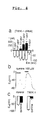
- a 1.9 kb transcript has thus been abundantly found, as shown in FIG. 1 a, in the heart and the brain and, to a lesser extent, in the placenta, the lung, the faith and the kidney.
- the DNA probe was used to screen a kidney cDNA library and four independent clones were obtained.
- the 1.8 to 1.9 kb cDNA inserts of these clones all have the same open reading frame (ORF) containing a region identical to the 298 bp sequence of HSC3AH031 and differ only in the length of their sequences 5 'non-coding.
- TWIK-1 The comparison of the complete sequence of TWIK-1 with sequences from the Genbank database made it possible to identify at least five genes of Caenorhabditis elegans which have been characterized within the framework of the Nematode Sequencing project, and which potentially encodes structural counterparts of TWIK-1.
- the alignment of two of them with TWIK-1 is shown in Figure 2b.
- the total sequence homologies between the deduced proteins from C. elegans and TWIK-1 are approximately 55 to 60% and approximately 25 to 28% of identity.
- the homologies between sequences of C. elegans are not superior.
- the coding sequence of TWIK-1 was inserted between the 5 'and 3' non-coding sequences of Xenopus globin in the vector pEXO (Lingueglia, E. et al., 1993, J. Biol. Chem ., 269, 13736-13739).
- a complementary RNA (cRNA) was transcribed from this construction and injected into oocytes of X. laevis .
- a non-inactivating current, absent from the non-injected cells, was measured by the imposed voltage technique, as shown in FIG. 3a. The kinetic activation of the current is most often instantaneous and cannot be resolved because it is masked by the capacitive discharge of the current recorded at the start of the pulse.
- TWIK-1 is therefore K + selective.
- the reversal of the current potential follows the equilibrium potential K + (E K ), as shown in Figure 3c .
- E K equilibrium potential
- a change by 10 of the concentration [(K)] o leads to a change of 56 ⁇ 2 mV of the inversion value of the potential, in accordance with the Nernst equation.
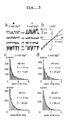
- the K + currents of TWIK-1 are inhibited by Ba 2+ (Figure 3d) with an IC 50 value of 100 ⁇ M, by quinine ( Figure 3e and 3f) and by quinidine (not shown ) with IC 50 values of 50 and 95 ⁇ M respectively.
- the TWIK-1 currents are slightly sensitive to TEA and to class III anti-arrhythmic tedisamil (30% inhibition for each, at 10 mM and 100 ⁇ M respectively).
- TWIK-1 channel is not sensitive to the K + channel openers that are cromakaline (100 ⁇ M) and pinacidil (100 ⁇ M).
- FIG. 4 shows the effect of increasing the injected doses of TWIK-1 cRNA on the time-independent expression of K + currents and on the rest of the membrane potential (E m ). As soon as the current appears, the oocytes become more polarized, reaching a value of E m close to E K. The amplitude of the TWIK-1 current reaches values of 0.6 to 0.8 ⁇ A for the injection of 20 ng per oocyte. Higher doses of TWIK-1 cRNA are toxic resulting in lower expression.
- the single channel recordings of currents in a patch configuration of the "inside-out" type or in an entire cell configuration shows that the TWIK-1 channels ensure the passage of outgoing or entering currents in function , respectively, of depolarization or hyperpolarization (Figure 5a).
- the current-voltage relationship of the single channel represented in FIG. 5b, shows an inward rectification which is not very accentuated in the presence of 3 mM (FIG. 5) and 10 mM (not shown) of Mg 2+ on the cytoplasmic side. As shown in Figure 5b, this correction disappears in the absence of internal Mg 2+ .
- the mean opening time at +80 mV is 1.9 ms and the unit conductance is 19 ⁇ 1 pS ( Figure 5c).
- the channels are flickering with an average opening time of 0.3 ms, and a conductance value increasing to 34 ⁇ 4 pS.
- the removal of internal Mg 2+ ions does not influence the kinetic parameters in both polarized and depolarized conditions, but the unit conductance measured at -80 mV reaches 35 ⁇ 4 pS. This apparent increase in conductance in the single channel suggests that it is the extremely rapid vacillation induced by Mg 2+ which leads to an underestimation of the actual value of the conductance.
- TWIK-1 channels in excised patches do not discharge and do not seem to require intra-cellular constituents. Unlike many channels that require the presence of ATP, for their activity in the configuration of excised patch, ATP is not necessary for the expression of TWIK-1. In addition, infusion of the patch with a solution containing 10 mM ATP has no effect on the activity of the TWIK-1 channel.
- Ph i Intracellular pH
- TWIK-1 sequence contains a consensus phosphorylation site for protein kinase C (PKC), located at the level of threonine at position 161 ( Figure 1b), the effect of PMA suggests regulation under control from PKC.
- PKC protein kinase C
- the mutation of threonine 161 into alanine leads to a mutated cnal which remains functional and retains the ability to be activated by PMA.
- Activation of protein kinase A by application of 8-Cl-cAMP (300 ⁇ M) or forskolin (10 ⁇ M) does not affect the activity of TWIK-1.
- the increase in the concentration of cytoplasmic Ca 2+ by application of A23187 (1 ⁇ M), which could have activated Ca 2+ -calmodulin kinase II and / or revealed the presence of a channel activated by Ca 2+ is also without effect on the properties of the TWIK-1 channel.
- the present invention therefore relates to a isolated and purified nucleic acid molecule encoding for a protein constituting a TWIK-1 potassium channel or having properties and a structure of the type of those of the TWIK-1 channel described above.
- said molecule of nucleic acid encodes the TWIK-1 protein
- the amino acid sequence is represented in the list of sequence annexed under the number SEQ ID NO: 2, or a functionally equivalent derivative of this sequence.
- derivatives can be obtained by modifying and / or by removing one or more amino acid residues from this sequence, as soon as this modification and / or removal does not affect the functional properties of TWIK-1 potassium channel of the resulting protein.
- sequence of a DNA molecule encoding this protein is more particularly that encoding TWIK-1 shown in the attached sequence list under the number SEQ ID NO: 1.
- the invention also relates to a vector.
- a vector comprising a previous nucleic acid molecule, as well as a production or expression process in a cellular host of a protein constituting a channel potassium TWIK-1 or a channel of the same family as TWIK-1.
- the cellular host used in the previous methods can be chosen from prokaryotes or eukaryotes and in particular among bacteria, yeast, mammalian, plant or insects.
- the vector used is chosen according to the host to which it will be transferred, it can be any vector like a plasmid.
- the invention therefore also relates to cells transformed expressing potassium channels exhibiting properties and a structure like those of the canal TWIK-1 obtained in accordance with the preceding methods.
- Cells expressing potassium channels TWIK-1 or channels with properties and structure of the type of those of the TWIK-1 channel obtained in accordance with the above procedures are useful for the screening of substances capable of modulating the activity of TWIK-1 potassium channels. This screening is carried out in bringing variable quantities of a substance into contact to be tested with cells expressing the TWIK-1 channel or potassium channels with properties and structure of the type of those of the TWIK-1 channel, then in measuring, by any appropriate means, the possible effects of said substance on potassium channel currents of these channels.
- This screening process identifies drugs useful in the treatment of diseases of the heart or nervous system.
- Pathologies involving potassium channels and therefore likely to affect TWIK-1 family channels are for example, epilepsy, heart conditions (arrhythmias) and vascular, neurodegeneration particularly those associated with ischemia or anoxia, endocrine pathologies associated with abnormalities of hormone secretion, muscle pathologies.
- An isolated nucleic acid molecule and purified coding for a protein constituting a channel TWIK-1 potassium or a vector comprising this molecule nucleic acid or a cell expressing TWIK-1 potassium channels are also useful for preparation of NON-HUMAN transgenic animals. It could be animals overexpressing said channels, but above all of animals known as "knock out", that is to say having a deficiency in these channels; these NON-HUMAN transgenic animals are prepared by methods known to those skilled in the art, and provide live models for the study of animal pathologies associated with TWIK-1 channels.
- the nucleic acid molecules of the invention or the cells transformed by said molecule are further likely to be used in gene therapy strategies to compensate for a potassium channel deficiency at one or multiple tissues of a patient.
- the invention therefore relates also a drug with acid molecules nucleic acid of the invention or cells transformed by said molecule for the treatment of pathology involving potassium channels.
- TWIK-1 channel gene has been located on chromosome 1 in position q42-q43.
- the chromosomal location of this gene constitutes a decisive result for the identification of diseases genetics associated with this new family of channels potassium; knowledge of the structure of TWIK-1 family channels is likely to allow carrying out ante-natal diagnosis of such diseases.
- the present invention also relates to a new family of K + channels, to which TWIK-1 belongs, present in most human tissues and more particularly abundant in the brain and the heart, and having properties and a structure of the type of those of the TWIK-1 channel described above. It therefore relates to an isolated and purified protein whose amino acid sequence is represented in the sequence list in the appendix under the number SEQ ID NO: 2, or a functionally equivalent derivative of this sequence.
- Such derivatives can be obtained in modifying and / or deleting one or more residues amino acids of this sequence or by segmenting this sequence, as soon as this modification and / or deletion or deletion of a fragment does not modify the properties functional potassium channel type TWIK-1, resulting protein.
- a protein constituting a potassium channel of type TWIK-1 is useful for the manufacture of medicines to treat or prevent diseases involving potassium channel dysfunction.
- Poly or mono-clonal antibodies directed against a protein constituting a potassium channel of the type TWIK-1 can be prepared by conventional methods described in the literature.
- These antibodies are useful for detecting the presence of potassium channels of the TWIK-1 family in different human or nuclear tissues, but they can also find applications in the therapeutic field to inhibit or activate in vivo, thanks to their specificity, the channels TWIK-1 potassium.
- the P domains of the cloned channels were used to search for homolhues in databases of the NCBI (National Center of Biotechnology) by implementing the sequence alignment program tBLASTn.
- This 298 bp sequence was originally obtained from a human brain cDNA library as part of the Genexpress cDNA program (Auffray, C. et al., 1995, CR Acad. Sci., III, Sci Life, 318, 263-272).
- a 255 bp DNA fragment corresponding to HSC3AH031 was amplified by PCR from cDNAs derived from poly (A) + from the human brain and subcloned in pBluescript (Stratagene) to give pBS-HSC3A.
- RNA analysis a multiple human tissue blot (Clontech) was screened with the P 32 -labeled pBS-HSCA insert in 50% formamide, 5 x SSPE (0.9 M NaCl; 50 mM sodium phosphate; pH 7.4; 5 mM EDTA), 0.1% SDS, 5 x Denhardts, 20 mM potassium phosphate, pH 6.5 and 250 ⁇ g denatured salmon sperm DNA at 55 ° C for 18 hours. The blots were washed to a final stringency of 0.1 SSC (3M NaCl; 0.3 M sodium citrate; pH 7.0), 0.3% SDS at 65 ° C.
- oligo (dT) cDNA library derived from poly (A) + RNA isolated from adult human kidneys was screened with the PBS-HSCA insert labeled with P 32 .
- the filters were hybridized in 50% formamide, 5 x SSC, 4 X Denhardt, 0.1% SDS and 100 ⁇ g of DNA from denatured salmon sperm at 50 ° C for 18 hours.
- Four positive hybridization clones were isolated from approximately 5 x 10 5 clones.
- the ⁇ ZAPII phages containing the cDNA inserts were converted into cDNA plasmids (Stratagene).
- the cDNA inserts were characterized by analysis by restriction enzymes and by total or partial sequencing of DNA on the two strands by the dideoxy nucleotide method using an automatic sequencer (Applied Biosystems 373A).
- the TWIK-1 coding sequence was amplified using low error DNA polymerase (Pwo DNA pol, Boehringer) and subcloned into the plasmid pEXO to give pEXO-TWIK-1.
- the mutations were made by amplifying the entire pEXO-TWIK-1 plasmid with a highly faithful extension PCR kit (Boehringer) and two adjacent primers. One of them introduced a point mutation in the coding sequence of TWIK-1 changing the codon of Thr 161 to a codon for alanine.
- the PCR product was linearized with the enzyme BamHI and the cRNAs were synthesized using a T7 RNA polymerase (Stratagene).
- the preparation of X. laevis oocytes and the injection of RNAC were carried out as described in the literature (Guillemare, E. et al., 1992, Biochemistry , 31, 12463-12468).
- a single oocyte was impaled on two standard glass micro-electrodes (0.5 - 2.0 MW) loaded with 3M KCl and maintained under voltage-clamp with a Dagan TEV200 amplifier .
- the bath solution contained 98 mM KCl, 1.8 mM CaCl 2 , 2 mM MgCl 2 and 5 mM HEPES at pH 7.4 with KOH.
- the stimulation of the preparation, the data acquisition and the analyzes were carried out with the pClamp software (Axon Instruments, USA).
- the oocytes were stripped of their vitelline membrane as described in the literature (Duprat, F. et al., 1995, Biochem. Biophys. Res. Commun., 212, 657-663) and placed 'in a bath solution containing 140 mM KCl, 1.8 mM CaCl 2 , 2 mM MgCl 2 and 5 mM HEPES at pH 7.4 with KOH.
- the pipettes were filled with a strong K + solution (40 mM KCL, 100 mM potassium methane sulphonate, 1.8 mM CaCl 2 , 2 mM MgCl 2 and 5 mM HEPES adjusted to pH 7.4 with KOH).
Landscapes
- Health & Medical Sciences (AREA)
- Life Sciences & Earth Sciences (AREA)
- Chemical & Material Sciences (AREA)
- Organic Chemistry (AREA)
- Zoology (AREA)
- Genetics & Genomics (AREA)
- Gastroenterology & Hepatology (AREA)
- Immunology (AREA)
- Biochemistry (AREA)
- Biophysics (AREA)
- General Health & Medical Sciences (AREA)
- Toxicology (AREA)
- Medicinal Chemistry (AREA)
- Molecular Biology (AREA)
- Proteomics, Peptides & Aminoacids (AREA)
- Cell Biology (AREA)
- Peptides Or Proteins (AREA)
- Micro-Organisms Or Cultivation Processes Thereof (AREA)
- Preparation Of Compounds By Using Micro-Organisms (AREA)
- Medicines Containing Antibodies Or Antigens For Use As Internal Diagnostic Agents (AREA)
Description
- SEQ ID NO : 1 représente la séquence la séquence nucléotidique de l'ADNc de TWIK-1 et la séquences en acides aminés de la séquence codante.
- SEQ ID NO : 2 représente la séquence en acides aminés de la protéine TWIK-1.
- La figure 1 représente l'analyse en Northern blot, les séquences en nucléotides et la séquence déduite en acides aminés, ainsi que le profile d'hydrophobicité de TWIK-1. (a) : expression de l'ARNm de TWIK-1 dans des tissus humains; chaque voie contient 5 µg de poly(A)+; l'autoradiogramme a été exposé 24 heures. (b) : séquence de l'ADNc de TWIK-1 et la séquences en acides aminés de la séquence codante. Les segments supposés trans-membranaires sont encadrés et les domaines P sont soulignés; o, représente un site potentiel de glycosilation, et ▪ représente le résidu thréonine dans lesite consensus de reconnaissance de la protéine kinase C. (c) : l'analyse d'hydrophobicité et la topologie de TWIK-1 qui en est déduite; les valeurs d'hydrophobicité ont été calculées conformément à la méthode de Kyte et Doolittle (taille de la fenêtre de 11 acides aminés) et sont rapportées vis-à-vis de la position de l'acide aminé; les pics hydrophobes ombrés correspondent aux segments trans-membranaires.
- La figure 2 représente les alignements de séquences. (a) : alignement des domaines P de TWIK-1, TOC/YORK, et d'autres familles de canaux K+ représentatives; les résidus identiques et conservés sont encadrés respectivementen noir et en gris. (b) : alignement de TWIK-1 avec des homologues potentiels de C. elegans; les séquences M110.2 et F17C8.5 ont été déduites des séquences des gènes (numéros d'accès respectifs Z49968 et Z35719); l'épissage informatisé des autres séquences génomique de C. elegans (numéros d'accès Z49889, P34411 et Z22180) n'est pas suffisament précis pour permettre leur alignement parfait et n'est donc pas représenté.
- La figure 3 montre les propriétés biophysiques et pharmacologiques de courants K+ enregistrés par la technique de voltage-imposé sur des oocytes de Xenope ayant reçus une injection d'ARNc de TWIK-1; (a) : l'oocyte a été maintenu à un potentiel de maintien (HP) de -80 mV et les courants ont été enregistrés à la suite de sauts de voltage de 1-s de -120 à + 60 mV par incrément de 20 mV. (b) : relation régulièrecourant-voltage, selon la même expérience qu'en (a). (c) : renversement de potentiel des courants de TWIK-1 (Erev) en fonction de la concentration externe en K+. (d) : traces de courants liées à des dépolarisations de +30 mV à partir d'un potentiel maintenu (HP) de -80 mV en l'absence (trace supérieur) et en présence (trace inférieur) de 1 mM de Ba2+. (e) : effet bloquant de 100 µM de quinine, même protocole qu'en (d). (f) : relation dose-réponse du blocage des courants de TWIK-1 par la quinine.
- La figure 4 montre l'influence de l'expression de TWIK-1 sur le potentiel membranaire. (a) : relations dose-réponse de l'ARNc; rangé du haut = état d'équilibre des courants sortants mesurés à +30 mV; rangée du bas = potentiels membranaires associés au repos. (b) : effet de 100 µM de quinine sur le potentiel membranaire d'un oocyte n'ayant pas reçu d'injection (trace de gauche) et d'un oocyte ayant reçu 20 ng d'ARNc de TWIK-1. (c) : traitement statistique des effets dépolarisants de 100 µM de quinine sur des oocytes n'ayant pas reçus d'injection (barres de gauche) et sur des oocytes ayant reçus une injection de 20 ng d'ARNc de TWIK-1 (barres de droite); contrôle (barre ouverte), + quinine (barres solides); chaque barre représente la moyenne ± SD de 5 oocytes.
- La figure 5 montre les propriétés de de canal unique de TWIK-1. (a) : traces de courants enregistrées dans la configuration entrée-sortie aux potentiels de membrane indiqués en l'absence (m) ou en présence (•) de Mg2+ interne (3 mM) et en symétrique de 140 mM de K+. (b) : moyenne des courbes I-V (n = 10). (c et d) : temps ouvert de distribution obtenues à + 80 mV (histogrammes du haut) et à -80mV (histogrammes du bas) en présence of 3 mM Mg2+ (c) ou en l'absence de Mg2+ (d).
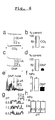
- La figure 6 montre le blocage des canaux TWIK-1 par le pH interne. (a et b) : effet bloquant de l'acidification interne sur les courants TWIK-1, induite par perfusion de CO2; (a) : traces de courants superimposés provoqués par une phase de dépolarization à - 30 mV à partir de HP = -80 mV, contrôle (trace supérieure), effet quand l'éliquilibre est atteint en présence de CO2 (trace inférieure); (b) : graphe (n = 5) montrant le bloquage presque complet des courants de TWIK-1 induit par du CO2; (c et d) : acidification interne induite par l'application de DNP (1 mM). (c) : même protocole qu'en (a), contrôle (trace supérieure) et après 5 minutes d'application du DNP (trace inférieure); (d) : graphe (n = 4) indiquant le pourcentage de courant TWIK-1 restant après traitement par le DNP. (e et f) : voltage imposé (mode : patch attaché) dans des conditions symétriques de concentration en K+ (140 mM) maintenu à +80 mV. (e) déroulement dans le temps de l'effet de 1 mM de DNP (fléché) sur les activités de canal unique de TWIK-1. (f) : graphe (n = 4) montrant l'effet du DNP sur la probabilité moyenne d'ouverture NPo calculé pendant 1 minute d'enregistrement à partir de l'état d'équilibre. (g) : activités mesurées dans la configuration "patch-inside-out" à + 80 mV à différent pH interne. Graphe de barres (n = 10) de NPo en fonction du pH interne.
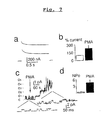
- La figure 7 montre l'activation des canaux TWIK-1 par le PMA, activateur de la protéine kinase C. (a) : perfusion pendant 10 minutes de PMA (30 nM) augmente le courant TWIK-1 (trace supérieure) provoqué par une phase de dépolarisation à +30 mV à partir de HP = -80 mV, courant de contrôle (trace inférieure). (b) graphe (n = 5) montrant l'effet d'activation du PMA sur les courants TWIK-1. (c et d) : configuration "patch" attaché en conditions de concentrations en K+ symétriques maintenu à +60 mV; (c) : déroulement dans le temps de l'effet de 30 nM de PMA sur les activités de canal unique; les enregistrements de l'activité du canal sont effectués avec un balayage rapide avant et après l'application du PMA; (d) : graphe de barres (n = 5) montrant l'effet d'activation du PMA sur NP o .
- Les séquences des clones d'ADNc contiennent un ORF de 1011 nucléotides codant pour un polypeptide de 336 acides aminés représenté à la figure 1b.
- Cette protéine comporte deux domaines P.
- En dehors des domaines P, aucun alignement significatif n'a été observé entre TWIK-1 et un canal K+ récemment cloné chez la levure et qui comporte également deux domaines P (Ketchum, K. A. et al, 1995, Nature, 376, 690-695).
- L'analyse d'hydrophobicité de TWIK-1, représenté à la figure 1c, révèle la présence de quatre domaines trans-membranaires, désignés T1 à T4.
- En plaçant l'extrémité NH2 sur la face cytoplasmique, conformément à l'abscence de peptide signal, on obtient le modèle de topologie représenté à la figure 1c.
- Dans ce modèle, les deux domaines P sont insérés dans la membrane depuis l'extérieur conformément à l'orientation connue de ces boucles dans les canaux K+.
- En outre, le motif structurel général de TWIK-1 est similaire au motif que l'on obtiendrait en faisant un tandem de deux sous-unités classiques rectifiant l'entrée d'un canal potassium. Comme un rectificateur entrant classique, TWIK-1 ne présente pas le segment hautement conservé S4 qui est responsable de la sensibilité au potentiel de membrane de la rectification entrante des canaux K+ de la famille Kv.
- Une large boucle non habituelle de 59 acides aminés est présente entre M1 et P1, de manière à étendre la longueur du linker M1-P1 du coté extracellulaire de la membrane.
- Un site de N-glycosilation potentiel est présent dans cette boucle.
- Trois sites consensus de phosphorylation sont présents aux extrémités N-terminale (Ser 19 pour la calcium calmodulin kinase II) et C-terminale (Ser 303 pour la caséine kinase II) des domaines cytoplasmiques, et dans le linker M2-M3 (Thrl61 pour la protéine kinase II).
- L'alignement des domaines P d'un groupe important de canaux K+ est donné à la figure 2a. Il montre que les régions constituant le pore sélectif au K+ sont bien conservées incluant le résidus G en position 16 et 18 et trois autres résidus indiquant des changements pratiquement exclusivement conservatifs aux positions 7, 14 et 17. De façon interessante, un résidu leucine est présent à la place d'une tyrosine conservée en position 17 dans le domaine P2 de TWIK-1, ou d'un phénylalanine en position 17 dans le domaine P du canal K+ de type eag.
- superfusion avec une solution enrichies en CO2 qui produit une acidification par un mécanisme impliquant le système de transport de bicarbonate (Guillemare, E. et al., 1995, Mol. Pharmacol., 47, 588-594);
- traitement avec le dinitrophénol (DNP), qui est un inhibiteur métabolique découplant le gradient de H+ dans les mitochondries et qui induit une acidité interne (Pedersen, P. L. et Carafoli, E., 1987, Trends Biol. Sci., 12, 146-189).
- à transférer une molécule d'acide nucléique de l'invention ou un vecteur contenant ladite molécule dans un hôte cellulaire,
- à cultiver l'hôte cellulaire obtenu à l'étape précédente dans des conditions permettant la production de canaux potassium présentant les propriétés de TWIK-1,
- à isoler, par tous moyens appropriés les protéines constituant des canaux potassium de la famille de TWIK-1.
- à transférer une molécule d'acide nucléique de l'invention ou un vecteur contenant ladite molécule dans un hôte cellulaire,
- à cultiver l'hôte cellulaire obtenu à l'étape précédente dans des conditions permettant l'expression de canaux potassium de la famille de TWIK-1.


Claims (14)
- Molécule d'acide nucléique isolée et purifiée codant pour une protéine constituant un canal potassium à quatre segments transmembranaires et deux domaines P et présentant des propriétés de rectification entrante peu marquées.
- Molécule d'acide nucléique isolée et purifiée codant pour une protéine constituant un canal potassium, caractérisée en ce quelle code pour la protéine dont la séquence en acides aminés est représentée dans la liste de séquence en annexe sous le numéro SEQ ID NO:2.
- Molécule d'acide nucléique selon la revendication 2, dont la séquence est représentée dans la liste de séquence en annexe sous le numéro SEQ ID NO:1.
- Vecteur comprenant une molécule d'acide nucléique selon l'une quelconque des revendications 1 à 3.
- Procédé de production d'une protéine constituant un canal potassium à quatre segments transmembranaires et deux domaines P et présentant des propriétés de rectification entrante peu marquées consistant :à transférer une molécule d'acide nucléique selon l'une quelconque des revendications 1 à 3 ou un vecteur selon la revendication 4, dans un hôte cellulaire,à cultiver, in vitro, l'hôte cellulaire obtenu à l'étape précédente dans des conditions permettant la production de canaux potassium à quatre segments transmembranaires et deux domaines P et présentant des propriétés de rectification entrante peu marquées,à isoler, par tous moyens appropriés les protéines constituant des canaux potassium à quatre segments transmembranaires et deux domaines P et présentant des propriétés de rectification entrante peu marquées.
- Procédé d'expression d'un canal potassium à quatre segments transmembranaires et deux domaines P et présentant des propriétés de rectification entrante peu marquées consistant :à transférer une molécule d'acide nucléique selon l'une quelconque des revendications 1 à 3 ou un vecteur selon la revendication 4, dans un hôte cellulaire,à cultiver, in vitro, l'hôte cellulaire obtenu à l'étape précédente dans des conditions permettant l'expression de canaux potassium à quatre segments transmembranaires et deux domaines P et présentant des propriétés de rectification entrante peu marquées.
- Procédé selon l'une quelconque des revendications 5 et 6, caractérisé en ce que l'hôte cellulaire est choisi parmi les procaryotes ou les eucaryotes et notamment parmi les bactéries, les levures, les cellules de mammifères, de plantes ou d'insectes.
- Cellule transformée exprimant des canaux potassium à quatre segments transmembranaires et deux domaines P et présentant des propriétés de rectification entrante peu marquées caractérisée en ce qu'une molécule d'acide nucléique selon l'une quelconque des revendications 1 à 3 ou un vecteur selon la revendication 4 ont été transférés dans ladite cellule.
- Procédé de criblage de substances capables de moduler l'activité des canaux potassium à quatre segments transmembranaires et deux domaines P et présentant des propriétés de rectification entrante peu marquées, caractérisé en ce que :l'on met en contact des quantités variables d'une substance à tester avec des cellules exprimant des canaux potassium à quatre segments transmembranaires et deux domaines P et présentant des propriétés de rectification entrante peu marquées selon la revendication 8 , puisl'on mesure, par tous moyens appropriés, les effets éventuels de ladite substance sur les courants des canaux potassium à quatre segments transmembranaires et deux domaines P et présentant des propriétés de rectification entrante peu marquées.
- Composition pharmaceutique pour compenser une déficience des canaux potassium au niveau de un ou plusieurs tissus, caractérisée en en ce qu'elle comprend des molécules d'acide nucléique selon l'une quelconque des revendications 1 à 3, ou un vecteur selon la revendication 4, ou encore des cellules selon la revendication 8.
- Protéine isolée et purifiée constituant un canal potassium à quatre segments transmembranaires et deux domaines P et présentant des propriétés de rectification entrante peu marquées.
- Protéine selon la revendication 11 dont la séquence en acides aminés est représentée dans la liste de séquence en annexe sous le numéro SEQ ID NO:2.
- Composition pharmaceutique pour compenser une déficience des canaux potassium au niveau de un ou plusieurs tissus, caractérisée en en ce quelle comprend une protéine selon l'une quelconque des revendications 11 et 12.
- Anticorps monoclonal ou polyclonal dirigé contre une protéine selon l'une quelconque des revendications 11 et 12.
Applications Claiming Priority (2)
| Application Number | Priority Date | Filing Date | Title |
|---|---|---|---|
| FR9601565 | 1996-02-08 | ||
| FR9601565A FR2744730B1 (fr) | 1996-02-08 | 1996-02-08 | Nouvelle famille de canaux potassium de mammifere, leur clonage et leur utilisation notamment pour le criblage de drogues |
Publications (2)
| Publication Number | Publication Date |
|---|---|
| EP0799889A1 EP0799889A1 (fr) | 1997-10-08 |
| EP0799889B1 true EP0799889B1 (fr) | 2004-02-11 |
Family
ID=9488994
Family Applications (1)
| Application Number | Title | Priority Date | Filing Date |
|---|---|---|---|
| EP96401137A Expired - Lifetime EP0799889B1 (fr) | 1996-02-08 | 1996-05-24 | Famille de canaux potassium de mammifère, leur clonage et leur utilisation notamment pour le criblage de drogues |
Country Status (5)
| Country | Link |
|---|---|
| US (1) | US6013470A (fr) |
| EP (1) | EP0799889B1 (fr) |
| AT (1) | ATE259418T1 (fr) |
| DE (1) | DE69631516T2 (fr) |
| FR (1) | FR2744730B1 (fr) |
Families Citing this family (10)
| Publication number | Priority date | Publication date | Assignee | Title |
|---|---|---|---|---|
| EP0930364A1 (fr) * | 1998-01-16 | 1999-07-21 | Synthelabo | Canal de potassium avec deux domaines P et apparenté à TWIK-1 |
| JP2002511233A (ja) * | 1998-01-27 | 2002-04-16 | スミスクライン・ビーチャム・パブリック・リミテッド・カンパニー | Trek1様の2孔カリウムチャネル |
| US7468422B2 (en) | 1998-03-05 | 2008-12-23 | Centre National De La Recherche Scientifique - Cnrs | Mechanosensitive mammalian potassium channel activatable by polyunsaturated fatty acids |
| FR2775688B1 (fr) * | 1998-03-05 | 2002-04-05 | Centre Nat Rech Scient | Nouvelle famille de canaux potassium de mammiferes mecanosensibles et actives par les acides gras polyinsatures et leur utilisation notamment pour le criblage de drogues |
| ES2307343T3 (es) * | 1998-11-09 | 2008-11-16 | Centre National De La Recherche Scientifique (Cnrs) | Nueva familia de canales de potasio de mamiferos, su clonacion y su uso, particularmente para el escrutinio de farmacos. |
| ATE508192T1 (de) * | 1999-02-12 | 2011-05-15 | Centre Nat Rech Scient | Humanes und maus trek-1 kaliumkanal protein und dessen verwendung |
| JP2004500825A (ja) | 2000-03-03 | 2004-01-15 | トゥラリック インコーポレイテッド | Kcnb:新規なカリウムチャネルタンパク質 |
| US20030211575A1 (en) * | 2001-02-07 | 2003-11-13 | Swartz Kenton J. | Constituitively open voltage-gated kand methods for discovering modulators thereof |
| US6756223B2 (en) * | 2001-12-18 | 2004-06-29 | Motorola, Inc. | Electro-chemical analysis device with integrated thermal sensor and method for monitoring a sample using the device |
| DE10332685A1 (de) * | 2003-07-18 | 2005-02-17 | Bayer Healthcare Ag | Vorhof-selektiv exprimierte Kaliumkanäle |
Family Cites Families (2)
| Publication number | Priority date | Publication date | Assignee | Title |
|---|---|---|---|---|
| US5747278A (en) * | 1993-05-21 | 1998-05-05 | California Institute Of Technology | DNA encoding inward rectifier, G-protein activated, mammalian, potassium KGA channel and uses thereof |
| WO1995021943A1 (fr) * | 1994-02-08 | 1995-08-17 | State Of Oregon, Acting By And Through The Oregon State Board Of Higher Education On Behalf Of The Oregon Health Sciences University | Adn codant pour les proteines du canal k+ dependant de l'atp, et applications |
-
1996
- 1996-02-08 FR FR9601565A patent/FR2744730B1/fr not_active Expired - Lifetime
- 1996-05-24 EP EP96401137A patent/EP0799889B1/fr not_active Expired - Lifetime
- 1996-05-24 DE DE69631516T patent/DE69631516T2/de not_active Expired - Lifetime
- 1996-05-24 AT AT96401137T patent/ATE259418T1/de not_active IP Right Cessation
- 1996-11-15 US US08/749,816 patent/US6013470A/en not_active Expired - Lifetime
Also Published As
| Publication number | Publication date |
|---|---|
| FR2744730B1 (fr) | 1998-04-17 |
| DE69631516T2 (de) | 2004-12-30 |
| DE69631516D1 (de) | 2004-03-18 |
| FR2744730A1 (fr) | 1997-08-14 |
| ATE259418T1 (de) | 2004-02-15 |
| EP0799889A1 (fr) | 1997-10-08 |
| US6013470A (en) | 2000-01-11 |
Similar Documents
| Publication | Publication Date | Title |
|---|---|---|
| Kaupp et al. | Cyclic nucleotide-gated ion channels | |
| Ronnett et al. | G proteins and olfactory signal transduction | |
| Verri et al. | Molecular and functional characterisation of the zebrafish (Danio rerio) PEPT1‐type peptide transporter 1 | |
| Michalski et al. | Genes involved in the development and physiology of both the peripheral and central auditory systems | |
| Wyszynski et al. | Biochemical and immunocytochemical characterization of GRIP, a putative AMPA receptor anchoring protein, in rat brain | |
| Liutkevičiūtė et al. | Oxytocin-like signaling in ants influences metabolic gene expression and locomotor activity | |
| EP0799889A1 (fr) | Famille de canaux potassium de mammifère, leur clonage et leur utilisation notamment pour le criblage de drogues | |
| Matsuo et al. | Expression and light-dependent translocation of β-arrestin in the visual system of the terrestrial slug Limax valentianus | |
| Zapater et al. | Dual neofunctionalization of a rapidly evolving aquaporin-1 paralog resulted in constrained and relaxed traits controlling channel function during meiosis resumption in teleosts | |
| EP0977844B1 (fr) | Canal cationique neuronal de mammifere sensible a l'acidite, son clonage et ses applications | |
| Iwasaki et al. | Structure and function of neurohypophysial hormones | |
| EP1058726B1 (fr) | Nouvelle famille de canaux potassium de mammiferes mecanosensibles et actives par les acides gras polyinsatures et leur utilisation notamment pour le criblage de drogues | |
| McLachlan et al. | Zebrafish Cx35: cloning and characterization of a gap junction gene highly expressed in the retina | |
| US7067625B1 (en) | Isolated TWIK-1 potassium channel proteins | |
| WO2006013003A1 (fr) | Utilisation de produits dérivés de la sélénoprotéine t, dans des applications liées à l'homéostasie calcique. | |
| Uchiyama et al. | Ontogeny of ENaC expression in the gills and the kidneys of the Japanese black salamander (Hynobius nigrescens Stejneger) | |
| Yang et al. | Two distinct aquaporin-4 cDNAs isolated from medullary cone of quail kidney | |
| Rosenthal | Sequential Expression of Nicotinic Acetylcholine Receptor Subunits Supports Development and Plasticity of a Drosophila Central Synapse | |
| Schott | Evolution and molecular mechanisms of photoreceptor transmutation in reptiles | |
| Koizumi | A novel neuropeptide, Hym-355, positively regulates neuron differentiation in Hydra | |
| Feingold | Characterization of a Family of Orphan Cys-Loop Ligand-Gated Ion Channel Subunits in Drosophila melanogaster Evidence for a Novel Role beyond Synaptic Transmission | |
| Moehlman | Genetic Analysis of Fic-Mediated BiP AMPylation in Photoreceptors | |
| Rashid | Contribution of Kv3 potassium channels to signal processing by electrosensory neurons | |
| Wang et al. | Identification and Regulatory Role of Dynorphin in the Reproduction of Spotted Sea Bass (Lateolabrax Maculatus) | |
| Wang et al. | Identification and Regulatory Role in the Reproduction of Dynorphin in Spotted Sea Bass (Lateolabrax Maculatus) |
Legal Events
| Date | Code | Title | Description |
|---|---|---|---|
| PUAI | Public reference made under article 153(3) epc to a published international application that has entered the european phase |
Free format text: ORIGINAL CODE: 0009012 |
|
| AK | Designated contracting states |
Kind code of ref document: A1 Designated state(s): AT BE CH DE DK ES FI FR GB GR IE IT LI LU MC NL PT SE |
|
| 17P | Request for examination filed |
Effective date: 19980305 |
|
| 17Q | First examination report despatched |
Effective date: 20020121 |
|
| GRAP | Despatch of communication of intention to grant a patent |
Free format text: ORIGINAL CODE: EPIDOSNIGR1 |
|
| GRAS | Grant fee paid |
Free format text: ORIGINAL CODE: EPIDOSNIGR3 |
|
| GRAA | (expected) grant |
Free format text: ORIGINAL CODE: 0009210 |
|
| AK | Designated contracting states |
Kind code of ref document: B1 Designated state(s): AT BE CH DE DK ES FI FR GB GR IE IT LI LU MC NL PT SE |
|
| PG25 | Lapsed in a contracting state [announced via postgrant information from national office to epo] |
Ref country code: NL Free format text: LAPSE BECAUSE OF FAILURE TO SUBMIT A TRANSLATION OF THE DESCRIPTION OR TO PAY THE FEE WITHIN THE PRESCRIBED TIME-LIMIT Effective date: 20040211 Ref country code: IT Free format text: LAPSE BECAUSE OF FAILURE TO SUBMIT A TRANSLATION OF THE DESCRIPTION OR TO PAY THE FEE WITHIN THE PRESCRIBED TIME-LIMIT;WARNING: LAPSES OF ITALIAN PATENTS WITH EFFECTIVE DATE BEFORE 2007 MAY HAVE OCCURRED AT ANY TIME BEFORE 2007. THE CORRECT EFFECTIVE DATE MAY BE DIFFERENT FROM THE ONE RECORDED. Effective date: 20040211 Ref country code: IE Free format text: LAPSE BECAUSE OF FAILURE TO SUBMIT A TRANSLATION OF THE DESCRIPTION OR TO PAY THE FEE WITHIN THE PRESCRIBED TIME-LIMIT Effective date: 20040211 Ref country code: FI Free format text: LAPSE BECAUSE OF FAILURE TO SUBMIT A TRANSLATION OF THE DESCRIPTION OR TO PAY THE FEE WITHIN THE PRESCRIBED TIME-LIMIT Effective date: 20040211 Ref country code: AT Free format text: LAPSE BECAUSE OF FAILURE TO SUBMIT A TRANSLATION OF THE DESCRIPTION OR TO PAY THE FEE WITHIN THE PRESCRIBED TIME-LIMIT Effective date: 20040211 |
|
| REG | Reference to a national code |
Ref country code: GB Ref legal event code: FG4D Free format text: NOT ENGLISH |
|
| REG | Reference to a national code |
Ref country code: CH Ref legal event code: EP |
|
| REG | Reference to a national code |
Ref country code: IE Ref legal event code: FG4D Free format text: FRENCH |
|
| REF | Corresponds to: |
Ref document number: 69631516 Country of ref document: DE Date of ref document: 20040318 Kind code of ref document: P |
|
| PG25 | Lapsed in a contracting state [announced via postgrant information from national office to epo] |
Ref country code: SE Free format text: LAPSE BECAUSE OF FAILURE TO SUBMIT A TRANSLATION OF THE DESCRIPTION OR TO PAY THE FEE WITHIN THE PRESCRIBED TIME-LIMIT Effective date: 20040511 Ref country code: GR Free format text: LAPSE BECAUSE OF FAILURE TO SUBMIT A TRANSLATION OF THE DESCRIPTION OR TO PAY THE FEE WITHIN THE PRESCRIBED TIME-LIMIT Effective date: 20040511 Ref country code: DK Free format text: LAPSE BECAUSE OF FAILURE TO SUBMIT A TRANSLATION OF THE DESCRIPTION OR TO PAY THE FEE WITHIN THE PRESCRIBED TIME-LIMIT Effective date: 20040511 |
|
| REG | Reference to a national code |
Ref country code: CH Ref legal event code: NV Representative=s name: ABREMA AGENCE BREVETS ET MARQUES GANGUILLET & HUMP |
|
| PG25 | Lapsed in a contracting state [announced via postgrant information from national office to epo] |
Ref country code: ES Free format text: LAPSE BECAUSE OF FAILURE TO SUBMIT A TRANSLATION OF THE DESCRIPTION OR TO PAY THE FEE WITHIN THE PRESCRIBED TIME-LIMIT Effective date: 20040522 |
|
| PG25 | Lapsed in a contracting state [announced via postgrant information from national office to epo] |
Ref country code: LU Free format text: LAPSE BECAUSE OF NON-PAYMENT OF DUE FEES Effective date: 20040524 |
|
| PG25 | Lapsed in a contracting state [announced via postgrant information from national office to epo] |
Ref country code: MC Free format text: LAPSE BECAUSE OF NON-PAYMENT OF DUE FEES Effective date: 20040531 |
|
| GBT | Gb: translation of ep patent filed (gb section 77(6)(a)/1977) |
Effective date: 20040603 |
|
| NLV1 | Nl: lapsed or annulled due to failure to fulfill the requirements of art. 29p and 29m of the patents act | ||
| REG | Reference to a national code |
Ref country code: IE Ref legal event code: FD4D |
|
| PLBE | No opposition filed within time limit |
Free format text: ORIGINAL CODE: 0009261 |
|
| STAA | Information on the status of an ep patent application or granted ep patent |
Free format text: STATUS: NO OPPOSITION FILED WITHIN TIME LIMIT |
|
| 26N | No opposition filed |
Effective date: 20041112 |
|
| PG25 | Lapsed in a contracting state [announced via postgrant information from national office to epo] |
Ref country code: PT Free format text: LAPSE BECAUSE OF NON-PAYMENT OF DUE FEES Effective date: 20040711 |
|
| REG | Reference to a national code |
Ref country code: FR Ref legal event code: PLFP Year of fee payment: 20 |
|
| PGFP | Annual fee paid to national office [announced via postgrant information from national office to epo] |
Ref country code: GB Payment date: 20150424 Year of fee payment: 20 Ref country code: CH Payment date: 20150421 Year of fee payment: 20 Ref country code: DE Payment date: 20150422 Year of fee payment: 20 |
|
| PGFP | Annual fee paid to national office [announced via postgrant information from national office to epo] |
Ref country code: FR Payment date: 20150422 Year of fee payment: 20 |
|
| PGFP | Annual fee paid to national office [announced via postgrant information from national office to epo] |
Ref country code: BE Payment date: 20150422 Year of fee payment: 20 |
|
| REG | Reference to a national code |
Ref country code: DE Ref legal event code: R071 Ref document number: 69631516 Country of ref document: DE |
|
| REG | Reference to a national code |
Ref country code: CH Ref legal event code: PL |
|
| REG | Reference to a national code |
Ref country code: GB Ref legal event code: PE20 Expiry date: 20160523 |
|
| PG25 | Lapsed in a contracting state [announced via postgrant information from national office to epo] |
Ref country code: GB Free format text: LAPSE BECAUSE OF EXPIRATION OF PROTECTION Effective date: 20160523 |