EP0797627B1 - Transparent package with aliphatic polyketone oxygen-scavenger - Google Patents
Transparent package with aliphatic polyketone oxygen-scavenger Download PDFInfo
- Publication number
- EP0797627B1 EP0797627B1 EP19950942612 EP95942612A EP0797627B1 EP 0797627 B1 EP0797627 B1 EP 0797627B1 EP 19950942612 EP19950942612 EP 19950942612 EP 95942612 A EP95942612 A EP 95942612A EP 0797627 B1 EP0797627 B1 EP 0797627B1
- Authority
- EP
- European Patent Office
- Prior art keywords
- package
- oxygen
- polymer
- pet
- aliphatic polyketone
- Prior art date
- Legal status (The legal status is an assumption and is not a legal conclusion. Google has not performed a legal analysis and makes no representation as to the accuracy of the status listed.)
- Expired - Lifetime
Links
- 229920001470 polyketone Polymers 0.000 title claims abstract description 73
- 125000001931 aliphatic group Chemical group 0.000 title claims abstract description 53
- 229940123973 Oxygen scavenger Drugs 0.000 title claims abstract description 16
- 239000010410 layer Substances 0.000 claims abstract description 95
- 239000001301 oxygen Substances 0.000 claims abstract description 90
- 229910052760 oxygen Inorganic materials 0.000 claims abstract description 90
- QVGXLLKOCUKJST-UHFFFAOYSA-N atomic oxygen Chemical compound [O] QVGXLLKOCUKJST-UHFFFAOYSA-N 0.000 claims abstract description 87
- 229920000642 polymer Polymers 0.000 claims abstract description 74
- 239000000203 mixture Substances 0.000 claims abstract description 44
- 230000004888 barrier function Effects 0.000 claims abstract description 41
- 239000000047 product Substances 0.000 claims abstract description 36
- 239000012792 core layer Substances 0.000 claims abstract description 30
- 239000004715 ethylene vinyl alcohol Substances 0.000 claims abstract description 27
- 230000002000 scavenging effect Effects 0.000 claims abstract description 24
- -1 polyethylene terephthalate Polymers 0.000 claims abstract description 20
- 229920000728 polyester Polymers 0.000 claims abstract description 16
- 229920000139 polyethylene terephthalate Polymers 0.000 claims abstract description 14
- 239000005020 polyethylene terephthalate Substances 0.000 claims abstract description 14
- XLYOFNOQVPJJNP-UHFFFAOYSA-N water Substances O XLYOFNOQVPJJNP-UHFFFAOYSA-N 0.000 claims abstract description 11
- XUIMIQQOPSSXEZ-UHFFFAOYSA-N Silicon Chemical group [Si] XUIMIQQOPSSXEZ-UHFFFAOYSA-N 0.000 claims abstract description 7
- 239000001257 hydrogen Substances 0.000 claims abstract description 7
- 229910052739 hydrogen Inorganic materials 0.000 claims abstract description 7
- 125000004435 hydrogen atom Chemical group [H]* 0.000 claims abstract description 7
- 239000012466 permeate Substances 0.000 claims abstract description 6
- 229920001897 terpolymer Polymers 0.000 claims description 25
- UGFAIRIUMAVXCW-UHFFFAOYSA-N Carbon monoxide Chemical compound [O+]#[C-] UGFAIRIUMAVXCW-UHFFFAOYSA-N 0.000 claims description 22
- 229910002091 carbon monoxide Inorganic materials 0.000 claims description 15
- VGGSQFUCUMXWEO-UHFFFAOYSA-N Ethene Chemical compound C=C VGGSQFUCUMXWEO-UHFFFAOYSA-N 0.000 claims description 13
- 239000005977 Ethylene Substances 0.000 claims description 13
- 239000003054 catalyst Substances 0.000 claims description 13
- 239000000463 material Substances 0.000 claims description 13
- 229920001577 copolymer Polymers 0.000 claims description 12
- 239000011112 polyethylene naphthalate Substances 0.000 claims description 12
- CURLTUGMZLYLDI-UHFFFAOYSA-N Carbon dioxide Chemical compound O=C=O CURLTUGMZLYLDI-UHFFFAOYSA-N 0.000 claims description 10
- KDLHZDBZIXYQEI-UHFFFAOYSA-N Palladium Chemical compound [Pd] KDLHZDBZIXYQEI-UHFFFAOYSA-N 0.000 claims description 10
- 229920003207 poly(ethylene-2,6-naphthalate) Polymers 0.000 claims description 9
- 238000000034 method Methods 0.000 claims description 8
- 150000001336 alkenes Chemical class 0.000 claims description 7
- 239000004677 Nylon Substances 0.000 claims description 6
- PPBRXRYQALVLMV-UHFFFAOYSA-N Styrene Chemical compound C=CC1=CC=CC=C1 PPBRXRYQALVLMV-UHFFFAOYSA-N 0.000 claims description 6
- 238000005882 aldol condensation reaction Methods 0.000 claims description 6
- 229910002092 carbon dioxide Inorganic materials 0.000 claims description 6
- 239000001569 carbon dioxide Substances 0.000 claims description 6
- 229920001778 nylon Polymers 0.000 claims description 6
- 229920002239 polyacrylonitrile Polymers 0.000 claims description 6
- 229910052710 silicon Inorganic materials 0.000 claims description 6
- 239000010703 silicon Substances 0.000 claims description 6
- 229920001707 polybutylene terephthalate Polymers 0.000 claims description 5
- 239000002356 single layer Substances 0.000 claims description 5
- VXNZUUAINFGPBY-UHFFFAOYSA-N 1-Butene Chemical compound CCC=C VXNZUUAINFGPBY-UHFFFAOYSA-N 0.000 claims description 4
- KWKAKUADMBZCLK-UHFFFAOYSA-N 1-octene Chemical compound CCCCCCC=C KWKAKUADMBZCLK-UHFFFAOYSA-N 0.000 claims description 4
- ISPYQTSUDJAMAB-UHFFFAOYSA-N 2-chlorophenol Chemical compound OC1=CC=CC=C1Cl ISPYQTSUDJAMAB-UHFFFAOYSA-N 0.000 claims description 4
- 229920000106 Liquid crystal polymer Polymers 0.000 claims description 4
- 239000004977 Liquid-crystal polymers (LCPs) Substances 0.000 claims description 4
- 239000004372 Polyvinyl alcohol Substances 0.000 claims description 4
- 238000005575 aldol reaction Methods 0.000 claims description 4
- 229940117927 ethylene oxide Drugs 0.000 claims description 4
- 239000004615 ingredient Substances 0.000 claims description 4
- JRZJOMJEPLMPRA-UHFFFAOYSA-N olefin Natural products CCCCCCCC=C JRZJOMJEPLMPRA-UHFFFAOYSA-N 0.000 claims description 4
- 229910052763 palladium Inorganic materials 0.000 claims description 4
- YWAKXRMUMFPDSH-UHFFFAOYSA-N pentene Chemical compound CCCC=C YWAKXRMUMFPDSH-UHFFFAOYSA-N 0.000 claims description 4
- 229920002451 polyvinyl alcohol Polymers 0.000 claims description 4
- QQONPFPTGQHPMA-UHFFFAOYSA-N propylene Natural products CC=C QQONPFPTGQHPMA-UHFFFAOYSA-N 0.000 claims description 4
- 125000004805 propylene group Chemical group [H]C([H])([H])C([H])([*:1])C([H])([H])[*:2] 0.000 claims description 4
- 239000010941 cobalt Substances 0.000 claims description 3
- 229910017052 cobalt Inorganic materials 0.000 claims description 3
- GUTLYIVDDKVIGB-UHFFFAOYSA-N cobalt atom Chemical compound [Co] GUTLYIVDDKVIGB-UHFFFAOYSA-N 0.000 claims description 3
- 239000007859 condensation product Substances 0.000 claims description 3
- 239000004800 polyvinyl chloride Substances 0.000 claims description 3
- UKRDPEFKFJNXQM-UHFFFAOYSA-N vinylsilane Chemical class [SiH3]C=C UKRDPEFKFJNXQM-UHFFFAOYSA-N 0.000 claims description 3
- 239000004215 Carbon black (E152) Substances 0.000 claims description 2
- VEXZGXHMUGYJMC-UHFFFAOYSA-M Chloride anion Chemical compound [Cl-] VEXZGXHMUGYJMC-UHFFFAOYSA-M 0.000 claims description 2
- BZHJMEDXRYGGRV-UHFFFAOYSA-N Vinyl chloride Chemical class ClC=C BZHJMEDXRYGGRV-UHFFFAOYSA-N 0.000 claims description 2
- 150000001252 acrylic acid derivatives Chemical class 0.000 claims description 2
- 229910052787 antimony Inorganic materials 0.000 claims description 2
- WATWJIUSRGPENY-UHFFFAOYSA-N antimony atom Chemical compound [Sb] WATWJIUSRGPENY-UHFFFAOYSA-N 0.000 claims description 2
- 239000007795 chemical reaction product Substances 0.000 claims description 2
- BLCTWBJQROOONQ-UHFFFAOYSA-N ethenyl prop-2-enoate Chemical class C=COC(=O)C=C BLCTWBJQROOONQ-UHFFFAOYSA-N 0.000 claims description 2
- 229910052732 germanium Inorganic materials 0.000 claims description 2
- GNPVGFCGXDBREM-UHFFFAOYSA-N germanium atom Chemical compound [Ge] GNPVGFCGXDBREM-UHFFFAOYSA-N 0.000 claims description 2
- PCHJSUWPFVWCPO-UHFFFAOYSA-N gold Chemical compound [Au] PCHJSUWPFVWCPO-UHFFFAOYSA-N 0.000 claims description 2
- 229910052737 gold Inorganic materials 0.000 claims description 2
- 239000010931 gold Substances 0.000 claims description 2
- 229930195733 hydrocarbon Natural products 0.000 claims description 2
- 150000002430 hydrocarbons Chemical group 0.000 claims description 2
- TVMXDCGIABBOFY-UHFFFAOYSA-N n-Octanol Natural products CCCCCCCC TVMXDCGIABBOFY-UHFFFAOYSA-N 0.000 claims description 2
- 125000001181 organosilyl group Chemical group [SiH3]* 0.000 claims description 2
- 229920000515 polycarbonate Polymers 0.000 claims description 2
- 239000004417 polycarbonate Substances 0.000 claims description 2
- 229920005644 polyethylene terephthalate glycol copolymer Polymers 0.000 claims description 2
- 229920000098 polyolefin Polymers 0.000 claims description 2
- 229920000915 polyvinyl chloride Polymers 0.000 claims description 2
- 239000011145 styrene acrylonitrile resin Substances 0.000 claims description 2
- 239000012855 volatile organic compound Substances 0.000 claims description 2
- 229920000470 poly(p-phenylene terephthalate) polymer Polymers 0.000 claims 1
- 229920000058 polyacrylate Polymers 0.000 claims 1
- 229920001230 polyarylate Polymers 0.000 claims 1
- 125000003367 polycyclic group Chemical group 0.000 claims 1
- 229920000193 polymethacrylate Polymers 0.000 claims 1
- 239000000178 monomer Substances 0.000 abstract description 6
- 229920001169 thermoplastic Polymers 0.000 abstract description 6
- 238000012545 processing Methods 0.000 abstract description 4
- 238000002347 injection Methods 0.000 abstract description 3
- 239000007924 injection Substances 0.000 abstract description 3
- 238000001746 injection moulding Methods 0.000 abstract description 2
- 238000010103 injection stretch blow moulding Methods 0.000 abstract description 2
- 239000012263 liquid product Substances 0.000 abstract 1
- 229920000219 Ethylene vinyl alcohol Polymers 0.000 description 21
- RZXDTJIXPSCHCI-UHFFFAOYSA-N hexa-1,5-diene-2,5-diol Chemical compound OC(=C)CCC(O)=C RZXDTJIXPSCHCI-UHFFFAOYSA-N 0.000 description 21
- 239000000543 intermediate Substances 0.000 description 14
- 238000010276 construction Methods 0.000 description 13
- 235000013305 food Nutrition 0.000 description 10
- 238000004806 packaging method and process Methods 0.000 description 10
- HSJKGGMUJITCBW-UHFFFAOYSA-N 3-hydroxybutanal Chemical compound CC(O)CC=O HSJKGGMUJITCBW-UHFFFAOYSA-N 0.000 description 8
- LYCAIKOWRPUZTN-UHFFFAOYSA-N Ethylene glycol Chemical compound OCCO LYCAIKOWRPUZTN-UHFFFAOYSA-N 0.000 description 8
- 230000005540 biological transmission Effects 0.000 description 8
- 238000002844 melting Methods 0.000 description 7
- 230000035699 permeability Effects 0.000 description 7
- 230000000694 effects Effects 0.000 description 6
- 230000008018 melting Effects 0.000 description 6
- 239000004952 Polyamide Substances 0.000 description 5
- 238000011161 development Methods 0.000 description 5
- 230000018109 developmental process Effects 0.000 description 5
- 238000007254 oxidation reaction Methods 0.000 description 5
- 229920002647 polyamide Polymers 0.000 description 5
- 239000004743 Polypropylene Substances 0.000 description 4
- 239000000654 additive Substances 0.000 description 4
- KKEYFWRCBNTPAC-UHFFFAOYSA-N benzene-dicarboxylic acid Natural products OC(=O)C1=CC=C(C(O)=O)C=C1 KKEYFWRCBNTPAC-UHFFFAOYSA-N 0.000 description 4
- 235000013361 beverage Nutrition 0.000 description 4
- 239000000356 contaminant Substances 0.000 description 4
- 238000011049 filling Methods 0.000 description 4
- 235000008960 ketchup Nutrition 0.000 description 4
- 230000003647 oxidation Effects 0.000 description 4
- 229920001155 polypropylene Polymers 0.000 description 4
- 239000000126 substance Substances 0.000 description 4
- 239000004416 thermosoftening plastic Substances 0.000 description 4
- 229920002302 Nylon 6,6 Polymers 0.000 description 3
- 239000004698 Polyethylene Substances 0.000 description 3
- 125000000217 alkyl group Chemical group 0.000 description 3
- 229920005603 alternating copolymer Polymers 0.000 description 3
- 235000013405 beer Nutrition 0.000 description 3
- 230000015572 biosynthetic process Effects 0.000 description 3
- 125000002915 carbonyl group Chemical group [*:2]C([*:1])=O 0.000 description 3
- 238000006243 chemical reaction Methods 0.000 description 3
- 239000000796 flavoring agent Substances 0.000 description 3
- 235000019634 flavors Nutrition 0.000 description 3
- 238000004519 manufacturing process Methods 0.000 description 3
- XNGIFLGASWRNHJ-UHFFFAOYSA-L phthalate(2-) Chemical compound [O-]C(=O)C1=CC=CC=C1C([O-])=O XNGIFLGASWRNHJ-UHFFFAOYSA-L 0.000 description 3
- 229920003023 plastic Polymers 0.000 description 3
- 239000004033 plastic Substances 0.000 description 3
- 229920000573 polyethylene Polymers 0.000 description 3
- 230000009257 reactivity Effects 0.000 description 3
- 239000002904 solvent Substances 0.000 description 3
- 238000003786 synthesis reaction Methods 0.000 description 3
- 229920002292 Nylon 6 Polymers 0.000 description 2
- 239000003963 antioxidant agent Substances 0.000 description 2
- 125000003118 aryl group Chemical group 0.000 description 2
- 229920005601 base polymer Polymers 0.000 description 2
- 230000008901 benefit Effects 0.000 description 2
- 239000006227 byproduct Substances 0.000 description 2
- 235000012174 carbonated soft drink Nutrition 0.000 description 2
- 230000015556 catabolic process Effects 0.000 description 2
- 230000008859 change Effects 0.000 description 2
- 150000001875 compounds Chemical class 0.000 description 2
- 238000006731 degradation reaction Methods 0.000 description 2
- 238000009792 diffusion process Methods 0.000 description 2
- 230000003292 diminished effect Effects 0.000 description 2
- 230000007062 hydrolysis Effects 0.000 description 2
- 238000006460 hydrolysis reaction Methods 0.000 description 2
- 230000003993 interaction Effects 0.000 description 2
- QQVIHTHCMHWDBS-UHFFFAOYSA-N isophthalic acid Chemical compound OC(=O)C1=CC=CC(C(O)=O)=C1 QQVIHTHCMHWDBS-UHFFFAOYSA-N 0.000 description 2
- 125000000468 ketone group Chemical group 0.000 description 2
- 239000000155 melt Substances 0.000 description 2
- 230000005012 migration Effects 0.000 description 2
- 238000013508 migration Methods 0.000 description 2
- 230000003287 optical effect Effects 0.000 description 2
- 230000001590 oxidative effect Effects 0.000 description 2
- 229920001225 polyester resin Polymers 0.000 description 2
- 239000004645 polyester resin Substances 0.000 description 2
- 230000008569 process Effects 0.000 description 2
- 239000000243 solution Substances 0.000 description 2
- 241000894007 species Species 0.000 description 2
- 239000004711 α-olefin Substances 0.000 description 2
- 125000002934 2-oxopropylidene group Chemical group 0.000 description 1
- LLLVZDVNHNWSDS-UHFFFAOYSA-N 4-methylidene-3,5-dioxabicyclo[5.2.2]undeca-1(9),7,10-triene-2,6-dione Chemical compound C1(C2=CC=C(C(=O)OC(=C)O1)C=C2)=O LLLVZDVNHNWSDS-UHFFFAOYSA-N 0.000 description 1
- 229920013683 Celanese Polymers 0.000 description 1
- 241000207199 Citrus Species 0.000 description 1
- MYMOFIZGZYHOMD-UHFFFAOYSA-N Dioxygen Chemical compound O=O MYMOFIZGZYHOMD-UHFFFAOYSA-N 0.000 description 1
- 235000007688 Lycopersicon esculentum Nutrition 0.000 description 1
- 239000004594 Masterbatch (MB) Substances 0.000 description 1
- 239000004793 Polystyrene Substances 0.000 description 1
- 240000003768 Solanum lycopersicum Species 0.000 description 1
- 239000012963 UV stabilizer Substances 0.000 description 1
- YIMQCDZDWXUDCA-UHFFFAOYSA-N [4-(hydroxymethyl)cyclohexyl]methanol Chemical compound OCC1CCC(CO)CC1 YIMQCDZDWXUDCA-UHFFFAOYSA-N 0.000 description 1
- 238000010521 absorption reaction Methods 0.000 description 1
- NIXOWILDQLNWCW-UHFFFAOYSA-N acrylic acid group Chemical group C(C=C)(=O)O NIXOWILDQLNWCW-UHFFFAOYSA-N 0.000 description 1
- 230000002411 adverse Effects 0.000 description 1
- 230000032683 aging Effects 0.000 description 1
- 125000003545 alkoxy group Chemical group 0.000 description 1
- XAGFODPZIPBFFR-UHFFFAOYSA-N aluminium Chemical compound [Al] XAGFODPZIPBFFR-UHFFFAOYSA-N 0.000 description 1
- 229910052782 aluminium Inorganic materials 0.000 description 1
- 238000013459 approach Methods 0.000 description 1
- 230000009286 beneficial effect Effects 0.000 description 1
- 239000002981 blocking agent Substances 0.000 description 1
- 238000000071 blow moulding Methods 0.000 description 1
- 238000009835 boiling Methods 0.000 description 1
- 238000004364 calculation method Methods 0.000 description 1
- 239000011203 carbon fibre reinforced carbon Substances 0.000 description 1
- 230000003197 catalytic effect Effects 0.000 description 1
- 238000012668 chain scission Methods 0.000 description 1
- 239000003795 chemical substances by application Substances 0.000 description 1
- 235000020971 citrus fruits Nutrition 0.000 description 1
- 230000002860 competitive effect Effects 0.000 description 1
- 238000009833 condensation Methods 0.000 description 1
- 230000005494 condensation Effects 0.000 description 1
- 238000001816 cooling Methods 0.000 description 1
- 238000004132 cross linking Methods 0.000 description 1
- 239000013078 crystal Substances 0.000 description 1
- 238000002425 crystallisation Methods 0.000 description 1
- 230000008025 crystallization Effects 0.000 description 1
- VEIOBOXBGYWJIT-UHFFFAOYSA-N cyclohexane;methanol Chemical compound OC.OC.C1CCCCC1 VEIOBOXBGYWJIT-UHFFFAOYSA-N 0.000 description 1
- 239000007857 degradation product Substances 0.000 description 1
- 229910001882 dioxygen Inorganic materials 0.000 description 1
- 238000005516 engineering process Methods 0.000 description 1
- HQQADJVZYDDRJT-UHFFFAOYSA-N ethene;prop-1-ene Chemical group C=C.CC=C HQQADJVZYDDRJT-UHFFFAOYSA-N 0.000 description 1
- 238000005429 filling process Methods 0.000 description 1
- 229920005570 flexible polymer Polymers 0.000 description 1
- 239000006260 foam Substances 0.000 description 1
- 235000011389 fruit/vegetable juice Nutrition 0.000 description 1
- 230000009477 glass transition Effects 0.000 description 1
- 150000002334 glycols Chemical class 0.000 description 1
- 230000005484 gravity Effects 0.000 description 1
- 125000001188 haloalkyl group Chemical group 0.000 description 1
- 125000003106 haloaryl group Chemical group 0.000 description 1
- 238000009998 heat setting Methods 0.000 description 1
- 229920001903 high density polyethylene Polymers 0.000 description 1
- 239000004700 high-density polyethylene Substances 0.000 description 1
- 229920001519 homopolymer Polymers 0.000 description 1
- 235000021587 hot fill beverage Nutrition 0.000 description 1
- 150000002440 hydroxy compounds Chemical class 0.000 description 1
- WGCNASOHLSPBMP-UHFFFAOYSA-N hydroxyacetaldehyde Natural products OCC=O WGCNASOHLSPBMP-UHFFFAOYSA-N 0.000 description 1
- 150000003949 imides Chemical class 0.000 description 1
- 230000006872 improvement Effects 0.000 description 1
- 239000011261 inert gas Substances 0.000 description 1
- 229920001684 low density polyethylene Polymers 0.000 description 1
- 239000004702 low-density polyethylene Substances 0.000 description 1
- 239000000314 lubricant Substances 0.000 description 1
- 230000014759 maintenance of location Effects 0.000 description 1
- 238000005259 measurement Methods 0.000 description 1
- 235000013372 meat Nutrition 0.000 description 1
- 238000010128 melt processing Methods 0.000 description 1
- 150000002734 metacrylic acid derivatives Chemical class 0.000 description 1
- 125000002496 methyl group Chemical group [H]C([H])([H])* 0.000 description 1
- 238000012986 modification Methods 0.000 description 1
- 230000004048 modification Effects 0.000 description 1
- 125000005487 naphthalate group Chemical group 0.000 description 1
- 235000015205 orange juice Nutrition 0.000 description 1
- 229920000620 organic polymer Polymers 0.000 description 1
- 238000010525 oxidative degradation reaction Methods 0.000 description 1
- 239000012785 packaging film Substances 0.000 description 1
- 229920006280 packaging film Polymers 0.000 description 1
- 239000005022 packaging material Substances 0.000 description 1
- 238000012856 packing Methods 0.000 description 1
- 230000035515 penetration Effects 0.000 description 1
- 239000000825 pharmaceutical preparation Substances 0.000 description 1
- 229940127557 pharmaceutical product Drugs 0.000 description 1
- 125000001997 phenyl group Chemical group [H]C1=C([H])C([H])=C(*)C([H])=C1[H] 0.000 description 1
- 230000000704 physical effect Effects 0.000 description 1
- 239000002685 polymerization catalyst Substances 0.000 description 1
- 238000006116 polymerization reaction Methods 0.000 description 1
- 230000000379 polymerizing effect Effects 0.000 description 1
- 229920002223 polystyrene Polymers 0.000 description 1
- 239000002243 precursor Substances 0.000 description 1
- 238000002360 preparation method Methods 0.000 description 1
- 230000001737 promoting effect Effects 0.000 description 1
- 230000005855 radiation Effects 0.000 description 1
- 239000002516 radical scavenger Substances 0.000 description 1
- 239000012048 reactive intermediate Substances 0.000 description 1
- 238000004064 recycling Methods 0.000 description 1
- 229920005989 resin Polymers 0.000 description 1
- 239000011347 resin Substances 0.000 description 1
- 150000003839 salts Chemical class 0.000 description 1
- 229920006126 semicrystalline polymer Polymers 0.000 description 1
- 238000003860 storage Methods 0.000 description 1
- 230000035882 stress Effects 0.000 description 1
- 125000003107 substituted aryl group Chemical group 0.000 description 1
- 230000008961 swelling Effects 0.000 description 1
- KKEYFWRCBNTPAC-UHFFFAOYSA-L terephthalate(2-) Chemical compound [O-]C(=O)C1=CC=C(C([O-])=O)C=C1 KKEYFWRCBNTPAC-UHFFFAOYSA-L 0.000 description 1
- 239000012815 thermoplastic material Substances 0.000 description 1
- 230000001988 toxicity Effects 0.000 description 1
- 231100000419 toxicity Toxicity 0.000 description 1
- 230000001960 triggered effect Effects 0.000 description 1
- 239000003643 water by type Substances 0.000 description 1
- 230000004580 weight loss Effects 0.000 description 1
Images


Classifications
-
- B—PERFORMING OPERATIONS; TRANSPORTING
- B32—LAYERED PRODUCTS
- B32B—LAYERED PRODUCTS, i.e. PRODUCTS BUILT-UP OF STRATA OF FLAT OR NON-FLAT, e.g. CELLULAR OR HONEYCOMB, FORM
- B32B27/00—Layered products comprising a layer of synthetic resin
- B32B27/28—Layered products comprising a layer of synthetic resin comprising synthetic resins not wholly covered by any one of the sub-groups B32B27/30 - B32B27/42
-
- B—PERFORMING OPERATIONS; TRANSPORTING
- B32—LAYERED PRODUCTS
- B32B—LAYERED PRODUCTS, i.e. PRODUCTS BUILT-UP OF STRATA OF FLAT OR NON-FLAT, e.g. CELLULAR OR HONEYCOMB, FORM
- B32B27/00—Layered products comprising a layer of synthetic resin
- B32B27/06—Layered products comprising a layer of synthetic resin as the main or only constituent of a layer, which is next to another layer of the same or of a different material
- B32B27/08—Layered products comprising a layer of synthetic resin as the main or only constituent of a layer, which is next to another layer of the same or of a different material of synthetic resin
-
- B—PERFORMING OPERATIONS; TRANSPORTING
- B32—LAYERED PRODUCTS
- B32B—LAYERED PRODUCTS, i.e. PRODUCTS BUILT-UP OF STRATA OF FLAT OR NON-FLAT, e.g. CELLULAR OR HONEYCOMB, FORM
- B32B27/00—Layered products comprising a layer of synthetic resin
- B32B27/30—Layered products comprising a layer of synthetic resin comprising vinyl (co)polymers; comprising acrylic (co)polymers
- B32B27/306—Layered products comprising a layer of synthetic resin comprising vinyl (co)polymers; comprising acrylic (co)polymers comprising vinyl acetate or vinyl alcohol (co)polymers
-
- B—PERFORMING OPERATIONS; TRANSPORTING
- B32—LAYERED PRODUCTS
- B32B—LAYERED PRODUCTS, i.e. PRODUCTS BUILT-UP OF STRATA OF FLAT OR NON-FLAT, e.g. CELLULAR OR HONEYCOMB, FORM
- B32B27/00—Layered products comprising a layer of synthetic resin
- B32B27/34—Layered products comprising a layer of synthetic resin comprising polyamides
-
- B—PERFORMING OPERATIONS; TRANSPORTING
- B32—LAYERED PRODUCTS
- B32B—LAYERED PRODUCTS, i.e. PRODUCTS BUILT-UP OF STRATA OF FLAT OR NON-FLAT, e.g. CELLULAR OR HONEYCOMB, FORM
- B32B27/00—Layered products comprising a layer of synthetic resin
- B32B27/36—Layered products comprising a layer of synthetic resin comprising polyesters
-
- B—PERFORMING OPERATIONS; TRANSPORTING
- B32—LAYERED PRODUCTS
- B32B—LAYERED PRODUCTS, i.e. PRODUCTS BUILT-UP OF STRATA OF FLAT OR NON-FLAT, e.g. CELLULAR OR HONEYCOMB, FORM
- B32B7/00—Layered products characterised by the relation between layers; Layered products characterised by the relative orientation of features between layers, or by the relative values of a measurable parameter between layers, i.e. products comprising layers having different physical, chemical or physicochemical properties; Layered products characterised by the interconnection of layers
- B32B7/04—Interconnection of layers
- B32B7/12—Interconnection of layers using interposed adhesives or interposed materials with bonding properties
-
- B—PERFORMING OPERATIONS; TRANSPORTING
- B65—CONVEYING; PACKING; STORING; HANDLING THIN OR FILAMENTARY MATERIAL
- B65D—CONTAINERS FOR STORAGE OR TRANSPORT OF ARTICLES OR MATERIALS, e.g. BAGS, BARRELS, BOTTLES, BOXES, CANS, CARTONS, CRATES, DRUMS, JARS, TANKS, HOPPERS, FORWARDING CONTAINERS; ACCESSORIES, CLOSURES, OR FITTINGS THEREFOR; PACKAGING ELEMENTS; PACKAGES
- B65D1/00—Rigid or semi-rigid containers having bodies formed in one piece, e.g. by casting metallic material, by moulding plastics, by blowing vitreous material, by throwing ceramic material, by moulding pulped fibrous material or by deep-drawing operations performed on sheet material
- B65D1/02—Bottles or similar containers with necks or like restricted apertures, designed for pouring contents
- B65D1/0207—Bottles or similar containers with necks or like restricted apertures, designed for pouring contents characterised by material, e.g. composition, physical features
- B65D1/0215—Bottles or similar containers with necks or like restricted apertures, designed for pouring contents characterised by material, e.g. composition, physical features multilayered
-
- B—PERFORMING OPERATIONS; TRANSPORTING
- B65—CONVEYING; PACKING; STORING; HANDLING THIN OR FILAMENTARY MATERIAL
- B65D—CONTAINERS FOR STORAGE OR TRANSPORT OF ARTICLES OR MATERIALS, e.g. BAGS, BARRELS, BOTTLES, BOXES, CANS, CARTONS, CRATES, DRUMS, JARS, TANKS, HOPPERS, FORWARDING CONTAINERS; ACCESSORIES, CLOSURES, OR FITTINGS THEREFOR; PACKAGING ELEMENTS; PACKAGES
- B65D81/00—Containers, packaging elements, or packages, for contents presenting particular transport or storage problems, or adapted to be used for non-packaging purposes after removal of contents
- B65D81/24—Adaptations for preventing deterioration or decay of contents; Applications to the container or packaging material of food preservatives, fungicides, pesticides or animal repellants
- B65D81/26—Adaptations for preventing deterioration or decay of contents; Applications to the container or packaging material of food preservatives, fungicides, pesticides or animal repellants with provision for draining away, or absorbing, or removing by ventilation, fluids, e.g. exuded by contents; Applications of corrosion inhibitors or desiccators
- B65D81/266—Adaptations for preventing deterioration or decay of contents; Applications to the container or packaging material of food preservatives, fungicides, pesticides or animal repellants with provision for draining away, or absorbing, or removing by ventilation, fluids, e.g. exuded by contents; Applications of corrosion inhibitors or desiccators for absorbing gases, e.g. oxygen absorbers or desiccants
-
- B—PERFORMING OPERATIONS; TRANSPORTING
- B65—CONVEYING; PACKING; STORING; HANDLING THIN OR FILAMENTARY MATERIAL
- B65D—CONTAINERS FOR STORAGE OR TRANSPORT OF ARTICLES OR MATERIALS, e.g. BAGS, BARRELS, BOTTLES, BOXES, CANS, CARTONS, CRATES, DRUMS, JARS, TANKS, HOPPERS, FORWARDING CONTAINERS; ACCESSORIES, CLOSURES, OR FITTINGS THEREFOR; PACKAGING ELEMENTS; PACKAGES
- B65D81/00—Containers, packaging elements, or packages, for contents presenting particular transport or storage problems, or adapted to be used for non-packaging purposes after removal of contents
- B65D81/24—Adaptations for preventing deterioration or decay of contents; Applications to the container or packaging material of food preservatives, fungicides, pesticides or animal repellants
- B65D81/26—Adaptations for preventing deterioration or decay of contents; Applications to the container or packaging material of food preservatives, fungicides, pesticides or animal repellants with provision for draining away, or absorbing, or removing by ventilation, fluids, e.g. exuded by contents; Applications of corrosion inhibitors or desiccators
- B65D81/266—Adaptations for preventing deterioration or decay of contents; Applications to the container or packaging material of food preservatives, fungicides, pesticides or animal repellants with provision for draining away, or absorbing, or removing by ventilation, fluids, e.g. exuded by contents; Applications of corrosion inhibitors or desiccators for absorbing gases, e.g. oxygen absorbers or desiccants
- B65D81/267—Adaptations for preventing deterioration or decay of contents; Applications to the container or packaging material of food preservatives, fungicides, pesticides or animal repellants with provision for draining away, or absorbing, or removing by ventilation, fluids, e.g. exuded by contents; Applications of corrosion inhibitors or desiccators for absorbing gases, e.g. oxygen absorbers or desiccants the absorber being in sheet form
-
- C—CHEMISTRY; METALLURGY
- C08—ORGANIC MACROMOLECULAR COMPOUNDS; THEIR PREPARATION OR CHEMICAL WORKING-UP; COMPOSITIONS BASED THEREON
- C08L—COMPOSITIONS OF MACROMOLECULAR COMPOUNDS
- C08L101/00—Compositions of unspecified macromolecular compounds
-
- C—CHEMISTRY; METALLURGY
- C08—ORGANIC MACROMOLECULAR COMPOUNDS; THEIR PREPARATION OR CHEMICAL WORKING-UP; COMPOSITIONS BASED THEREON
- C08L—COMPOSITIONS OF MACROMOLECULAR COMPOUNDS
- C08L67/00—Compositions of polyesters obtained by reactions forming a carboxylic ester link in the main chain; Compositions of derivatives of such polymers
- C08L67/02—Polyesters derived from dicarboxylic acids and dihydroxy compounds
-
- B—PERFORMING OPERATIONS; TRANSPORTING
- B29—WORKING OF PLASTICS; WORKING OF SUBSTANCES IN A PLASTIC STATE IN GENERAL
- B29C—SHAPING OR JOINING OF PLASTICS; SHAPING OF MATERIAL IN A PLASTIC STATE, NOT OTHERWISE PROVIDED FOR; AFTER-TREATMENT OF THE SHAPED PRODUCTS, e.g. REPAIRING
- B29C49/00—Blow-moulding, i.e. blowing a preform or parison to a desired shape within a mould; Apparatus therefor
- B29C49/42—Component parts, details or accessories; Auxiliary operations
- B29C49/64—Heating or cooling preforms, parisons or blown articles
- B29C49/6604—Thermal conditioning of the blown article
- B29C49/6605—Heating the article, e.g. for hot fill
-
- B—PERFORMING OPERATIONS; TRANSPORTING
- B29—WORKING OF PLASTICS; WORKING OF SUBSTANCES IN A PLASTIC STATE IN GENERAL
- B29K—INDEXING SCHEME ASSOCIATED WITH SUBCLASSES B29B, B29C OR B29D, RELATING TO MOULDING MATERIALS OR TO MATERIALS FOR MOULDS, REINFORCEMENTS, FILLERS OR PREFORMED PARTS, e.g. INSERTS
- B29K2995/00—Properties of moulding materials, reinforcements, fillers, preformed parts or moulds
- B29K2995/0037—Other properties
- B29K2995/004—Semi-crystalline
-
- B—PERFORMING OPERATIONS; TRANSPORTING
- B32—LAYERED PRODUCTS
- B32B—LAYERED PRODUCTS, i.e. PRODUCTS BUILT-UP OF STRATA OF FLAT OR NON-FLAT, e.g. CELLULAR OR HONEYCOMB, FORM
- B32B2250/00—Layers arrangement
- B32B2250/24—All layers being polymeric
-
- B—PERFORMING OPERATIONS; TRANSPORTING
- B32—LAYERED PRODUCTS
- B32B—LAYERED PRODUCTS, i.e. PRODUCTS BUILT-UP OF STRATA OF FLAT OR NON-FLAT, e.g. CELLULAR OR HONEYCOMB, FORM
- B32B2307/00—Properties of the layers or laminate
- B32B2307/40—Properties of the layers or laminate having particular optical properties
- B32B2307/412—Transparent
-
- B—PERFORMING OPERATIONS; TRANSPORTING
- B32—LAYERED PRODUCTS
- B32B—LAYERED PRODUCTS, i.e. PRODUCTS BUILT-UP OF STRATA OF FLAT OR NON-FLAT, e.g. CELLULAR OR HONEYCOMB, FORM
- B32B2307/00—Properties of the layers or laminate
- B32B2307/50—Properties of the layers or laminate having particular mechanical properties
- B32B2307/514—Oriented
- B32B2307/518—Oriented bi-axially
-
- B—PERFORMING OPERATIONS; TRANSPORTING
- B32—LAYERED PRODUCTS
- B32B—LAYERED PRODUCTS, i.e. PRODUCTS BUILT-UP OF STRATA OF FLAT OR NON-FLAT, e.g. CELLULAR OR HONEYCOMB, FORM
- B32B2307/00—Properties of the layers or laminate
- B32B2307/70—Other properties
- B32B2307/724—Permeability to gases, adsorption
- B32B2307/7242—Non-permeable
- B32B2307/7244—Oxygen barrier
-
- B—PERFORMING OPERATIONS; TRANSPORTING
- B32—LAYERED PRODUCTS
- B32B—LAYERED PRODUCTS, i.e. PRODUCTS BUILT-UP OF STRATA OF FLAT OR NON-FLAT, e.g. CELLULAR OR HONEYCOMB, FORM
- B32B2329/00—Polyvinylalcohols, polyvinylethers, polyvinylaldehydes, polyvinylketones or polyvinylketals
- B32B2329/04—Polyvinylalcohol
-
- B—PERFORMING OPERATIONS; TRANSPORTING
- B32—LAYERED PRODUCTS
- B32B—LAYERED PRODUCTS, i.e. PRODUCTS BUILT-UP OF STRATA OF FLAT OR NON-FLAT, e.g. CELLULAR OR HONEYCOMB, FORM
- B32B2367/00—Polyesters, e.g. PET, i.e. polyethylene terephthalate
-
- B—PERFORMING OPERATIONS; TRANSPORTING
- B32—LAYERED PRODUCTS
- B32B—LAYERED PRODUCTS, i.e. PRODUCTS BUILT-UP OF STRATA OF FLAT OR NON-FLAT, e.g. CELLULAR OR HONEYCOMB, FORM
- B32B2377/00—Polyamides
-
- B—PERFORMING OPERATIONS; TRANSPORTING
- B32—LAYERED PRODUCTS
- B32B—LAYERED PRODUCTS, i.e. PRODUCTS BUILT-UP OF STRATA OF FLAT OR NON-FLAT, e.g. CELLULAR OR HONEYCOMB, FORM
- B32B2439/00—Containers; Receptacles
- B32B2439/70—Food packaging
-
- Y—GENERAL TAGGING OF NEW TECHNOLOGICAL DEVELOPMENTS; GENERAL TAGGING OF CROSS-SECTIONAL TECHNOLOGIES SPANNING OVER SEVERAL SECTIONS OF THE IPC; TECHNICAL SUBJECTS COVERED BY FORMER USPC CROSS-REFERENCE ART COLLECTIONS [XRACs] AND DIGESTS
- Y10—TECHNICAL SUBJECTS COVERED BY FORMER USPC
- Y10T—TECHNICAL SUBJECTS COVERED BY FORMER US CLASSIFICATION
- Y10T428/00—Stock material or miscellaneous articles
- Y10T428/13—Hollow or container type article [e.g., tube, vase, etc.]
- Y10T428/1352—Polymer or resin containing [i.e., natural or synthetic]
- Y10T428/1355—Elemental metal containing [e.g., substrate, foil, film, coating, etc.]
-
- Y—GENERAL TAGGING OF NEW TECHNOLOGICAL DEVELOPMENTS; GENERAL TAGGING OF CROSS-SECTIONAL TECHNOLOGIES SPANNING OVER SEVERAL SECTIONS OF THE IPC; TECHNICAL SUBJECTS COVERED BY FORMER USPC CROSS-REFERENCE ART COLLECTIONS [XRACs] AND DIGESTS
- Y10—TECHNICAL SUBJECTS COVERED BY FORMER USPC
- Y10T—TECHNICAL SUBJECTS COVERED BY FORMER US CLASSIFICATION
- Y10T428/00—Stock material or miscellaneous articles
- Y10T428/13—Hollow or container type article [e.g., tube, vase, etc.]
- Y10T428/1352—Polymer or resin containing [i.e., natural or synthetic]
- Y10T428/1355—Elemental metal containing [e.g., substrate, foil, film, coating, etc.]
- Y10T428/1359—Three or more layers [continuous layer]
-
- Y—GENERAL TAGGING OF NEW TECHNOLOGICAL DEVELOPMENTS; GENERAL TAGGING OF CROSS-SECTIONAL TECHNOLOGIES SPANNING OVER SEVERAL SECTIONS OF THE IPC; TECHNICAL SUBJECTS COVERED BY FORMER USPC CROSS-REFERENCE ART COLLECTIONS [XRACs] AND DIGESTS
- Y10—TECHNICAL SUBJECTS COVERED BY FORMER USPC
- Y10T—TECHNICAL SUBJECTS COVERED BY FORMER US CLASSIFICATION
- Y10T428/00—Stock material or miscellaneous articles
- Y10T428/13—Hollow or container type article [e.g., tube, vase, etc.]
- Y10T428/1352—Polymer or resin containing [i.e., natural or synthetic]
- Y10T428/1379—Contains vapor or gas barrier, polymer derived from vinyl chloride or vinylidene chloride, or polymer containing a vinyl alcohol unit
- Y10T428/1383—Vapor or gas barrier, polymer derived from vinyl chloride or vinylidene chloride, or polymer containing a vinyl alcohol unit is sandwiched between layers [continuous layer]
-
- Y—GENERAL TAGGING OF NEW TECHNOLOGICAL DEVELOPMENTS; GENERAL TAGGING OF CROSS-SECTIONAL TECHNOLOGIES SPANNING OVER SEVERAL SECTIONS OF THE IPC; TECHNICAL SUBJECTS COVERED BY FORMER USPC CROSS-REFERENCE ART COLLECTIONS [XRACs] AND DIGESTS
- Y10—TECHNICAL SUBJECTS COVERED BY FORMER USPC
- Y10T—TECHNICAL SUBJECTS COVERED BY FORMER US CLASSIFICATION
- Y10T428/00—Stock material or miscellaneous articles
- Y10T428/31504—Composite [nonstructural laminate]
- Y10T428/31786—Of polyester [e.g., alkyd, etc.]
- Y10T428/31797—Next to addition polymer from unsaturated monomers
Definitions
- the present invention relates to transparent packaging structures, e.g., blow-molded polyethylene terephthalate (PET) containers, which incorporate an aliphatic polyketone oxygen-scavenging composition for the packaging of oxygen-sensitive products.
- transparent packaging structures e.g., blow-molded polyethylene terephthalate (PET) containers, which incorporate an aliphatic polyketone oxygen-scavenging composition for the packaging of oxygen-sensitive products.
- PET polyethylene terephthalate
- Oxygen sensitive materials including foods, beverages, and pharmaceutical products, have special packaging requirements to prevent the ingress of exterior oxygen into the package and/or to scavenge oxygen which is present inside the package.
- oxygen is removed from the product by vacuum or by inert gas sparging, or both.
- oxygen scavenger is any material or compound which can remove oxygen from the interior of a closed package either by reacting or combining with the entrapped oxygen, or by promoting an oxidation reaction which yields innocuous products.
- the present invention provides a substantially transparent package made from a polymer composition including a blend of an aliphatic polyketone as an oxygen scavenger having the formula: wherein n is the number of repeating units and R is selected from the group consisting of hydrogen, an organic side chain and a silicon-based side chain, and a biaxially orientable polymer, wherein the biaxially orientable polymer comprises 90 to 99.9% by total weight of the polymer composition and the polyketone 0.1 to 10% by total weight of the polymer composition.
- the present invention further provides a preform for making a substantially transparent, biaxially-oriented container body, the preform including one or more layers of a polymer composition including a blend of an aliphatic polyketone as an oxygen scavenger having the formula: where n is the number of repeating units and R is selected from the group consisting of hydrogen, an organic side chain, and a silicon-based side chain and a biaxially orientable polymer, wherein the biaxially orientable polymer comprises 90 to 99.9% by total weight of the polymer composition and the polyketone 0.1 to 10% by total weight of the polymer composition.
- the present invention is directed to the novel use of an aliphatic polyketone as an oxygen scavenger in a structure for the packaging of oxygen-sensitive products.
- this invention utilizes the polymer's high oxygen reactivity to effectively capture any oxygen which may enter the product and thus enhance the shelf life.
- the carbon dioxide (CO 2 ) which builds up in the package sidewall (as a degradation product) would be expected to reduce the migration of CO 2 from the food product.
- Aliphatic polyketone co- and terpolymers are semi-crystalline thermoplastics having a high melting point and good strength, toughness, and impact strength. Their mechanical properties include high levels of stiffness, toughness and strength over a broad temperature range, and resistance to hydrolysis, swelling, and chemical attack.
- a linear, high-molecular weight alternating copolymer of ethylene and carbon monoxide may be used, or a terpolymer produced from ethylene, carbon monoxide, and a minor amount of propylene.
- the aliphatic polyketone oxygen scavenger may be advantageously combined with other thermoplastic polymers to provide the desired injection molding and stretch blow molding characteristics.
- the aliphatic polyketone may be blended with PET, recycled PET, polyethylene naphthalate (PEN), or other polymers.
- the polyester or other structural polymer is the primary polymer comprising, by total weight of the polymer composition, preferably at least 95%, and more preferably at least about 98%.
- a multilayer expanded preform container body has a core layer which includes an aliphatic polyketone as an oxygen scavenger having the formula: where n is the number of repeating units and R is selected from the group consisting of hydrogen, an organic side chain, and a silicon-based side chain.
- the container body is substantially transparent and includes exterior PET layers and inner and outer intermediate barrier layers of ethylene vinyl alcohol (EVOH).
- a monolayer transparent package wherein an aliphatic polyketone is blended or copolymerized with other polymers.
- a blend comprising 0.1 to 10% by total weight of a polyketone terpolymer scavenger, and the remainder PET, is used to form an injection molded preform and transparent expanded preform beverage bottle.
- the polyketone polymer remains amorphous and the container substantially transparent (in contrast to the highly crystalline and opaque barrier polyketone proposed in the art).
- the terpolymer may scavenge oxygen from the container based on direct food contact with the product.
- Aliphatic polyketones also referred to as poly(olefin-ketones), are linear, alternating copolymers having the generalized formula shown in formula a: where n is the number of repeating units and R is hydrogen, an organic side chain, or a silicon based side chain. These polymers are produced from abundant and inexpensive monomers - ethylene (or other alpha-olefins) and carbon monoxide. The molecular structure, combining simple, linear repeating units with strong polar intermolecular forces and a flexible polymer backbone, produces semicrystalline materials with excellent thermal mechanical, and barrier properties.
- the simplest member of this class of polyketones is the alternating copolymer of ethylene and carbon monoxide (E/CO):
- This polymer structure is sensitive to oxidation (and aldol reaction) because the CH 2 protons are activated by the carbonyl (CO) groups. All protons are activated by carbonyl groups so the emperical formula C 3 H 4 O, with a molecular weight of only 56, will in theory react with 64 grams of oxygen to form -(CO) n -, which in turn may react with more oxygen to generate carbon dioxide.
- 56 grams of an E/CO copolymer may ultimately react with 112 grams of oxygen.
- catalysts may be used to further promote this reaction.
- the aliphatic polyketone polymer chains are flexible, but possess enough molecular symmetry and cohesive energy derived from the polar ketone groups to produce a tough, high-melting, semicrystalline thermoplastic suitable for a broad range of applications. Particularly important is its high melting point and thermal stability making it suitable for use with PET, and the ability to produce a colorless (substantially transparent) container therefrom.
- E/P/CO terpolymer poly(ethylene-alt-carbon monoxide)-stat-(propylene-alt-carbon monoxide)(hereinafter E/P/CO terpolymer): where n and m are the number of repeating units respectively.
- the termonomer modifies the melting point and crystallinity of the polymer in order to broaden the melt processing window and further improve the resilience and ductility of the polymer.
- the E/P/CO terpolymer is a semicrystalline material having a melting point of 220°C, and a glass transition temperature in the neighborhood of 15°C.
- the specific gravity is 1.24g/cm 3 at room temperature, and about 1.00g/cm 3 in the melt.
- the stiffness at room temperature is moderate, with tensile and flexural moduli of about 1.7GPa (250kpsi), however the material exhibits good retention of stiffness up to temperatures reasonably close to the melting point.
- the E/P/CO terpolymer exhibits a natural draw ratio of around 300%.
- the tensile yield stress at room temperature is 62MPa (9000psi).
- the impact strength is unusually high for an unmodified semi-crystalline polymer, and increases with increasing molecular weight.
- the notched Izod impact strength is 220J/m (4ft-lb/in) at room temperature and 50J/m (1ft-lb/in) at -40°C.
- the E/P/CO terpolymer is commercially available from Shell Development Company, Houston, Texas.
- E/P/CO is just one example of a terpolymer, there being many other possible terpolymers with varying properties.
- Additives such as aldol blocking agents, lubricants, release agents, etc. may be used to enhance processing properties and to reduce the tendency for aldol condensation.
- the polarity of the polyketone also results in a modest level of moisture absorption -- 0.5% at 50% relative humidity (RH) and 2.3% at saturation (100% RH).
- the absorbed water exhibits a mild plasticizing effect on stiffness and almost no effect on strength.
- the ketone group has little tendency to hydrolize.
- the polyketone exhibits resistance to hydrolysis and excellent stability under a broad range of aqueous environments (temperature, pH, salts, etc.).
- the aliphatic polyketones are produced by polymerizing ethylene (or other alpha-olefins) with carbon monoxide over a palladium-based catalyst system.
- polymer synthesis occurs with perfect alternation of monomer units:
- a bisphosphine Pd (II) based catalyst complex has been developed by Shell Laboratorium Amsterdam (KSLA)(see U.S. Patent 4,835,250 (1989); European Patent Application 121965A2 (1984); and E. Drent et al., J. Organomet. Chem. 417 (1991) 235-251), and produces polyketones with essentially 100% selectivity at high catalytic activities (greater than 6000g/g Pd/hr) and high yields under modest synthesis conditions.
- terpolymer that is even more active is made with styrene, ethylene and carbon monoxide:;
- the phenyl group (C 6 H 5 -) activates the tertiary proton (CH) far more than the methyl group.
- the comonomers used may effect transparency and/or the processing conditions.
- other olefins such as 1-butene, 1-pentene, 1-octene, etc. can be used to provide the necessary optical properties.
- Other alternatives are halogen-substituted olefins or silane-substituted olefins.
- a silane-substituted olefin will produce the terpolymer: which is expected to have different optical properties than the simple E/P/CO terpolymer.
- Aldol condensation i.e.: has been considered a problem with the production of aliphatic polyketones.
- it may be beneficial to include aldol condensation products because the aldol product, i.e.: (C 6 H 6 O 2 ) (C 7 H 10 O) is a repeating unit, is in theory more effective (in oxygen capture) than the parent polymer.
- This factor must be balanced against the color of the various aldol products, where the goal is to provide a substantially transparent package.
- a polymer composition which is primarily PET, e.g., 90% by total weight of the composition, and 8% aliphatic polyketone, may include up to on the order of 2% aldol product by total weight of the composition.
- the aliphatic polyketone is to be a major structural element in the package, then it should have a high molecular weight (MW) in the commercial range of 1 or greater LVN (limiting viscosity number) or a melt flow index of 100 or less. If the polyketone is used with another polymer where both contribute to the strength, then an E/CO polymer with an LVN of less than 1 can be used, possibly as low as 0.5 or 0.6 dl/g. Finally, if the aldol reaction products of the co- or terpolymer are to be used, then LVN and melt flow index have less meaning as the crosslinking process progresses. In this case, polymers with boiling points above the expected processing temperature and all higher MW products are useful as additives.
- LVN limiting viscosity number
- Aliphatic polyketones are sensitive to UV radiation in direct sunlight exposure, whereby the polyketones undergo molecular weight loss due to chain scission.
- proper choice of UV additives can significantly improve the UV stability, e.g., Tinuvan P, sold by Ciba-Geigy; other UV stabilizers are sold by BASF, Bayer, Cytec, Hoechst-Celanese, Sandoz, Sumitomo, etc.
- the aliphatic polyketone structure is: where n is equal to zero or any whole number and m is 1 or any whole number, and where X is where n is equal to zero or any whole number and m is 1 or any whole number, and where X is selected from an organic side chain including hydrocarbon, alkyl, aryl, silyl, haloalkyl, haloaryl, substituted aryl, alkoxy,arloxy, etc.
- the semicrystalline structure of the terpolymer is spherulitic, with spherulite size ranging from 5-15 microns. It appears to be an "entangled" spherulitic structure, which may contribute to its high-impact properties and toughness (by terminating crack propagation).
- the semicrystalline copolymer is an entangled hedritic structure, also with high-impact strength and good toughness.
- the E/P/CO terpolymer generally exhibits between 20-40 weight percent crystallinity.
- a flexible backbone and high concentration of dipoles allows for efficient chain packing.
- the density of the terpolymer at room temperature is 1.235g/cm 3 with an amorphous density of 1.206g/cm 3 .
- the oxygen permeability coefficients of aliphatic polyketones are among the lowest of conventional polymeric materials. However, as the moisture content is increased, the oxygen barrier of standard aliphatic polyketones is diminished. Table 1 shows the oxygen permeability coefficients of PET, nylon 66, ethylene vinyl alcohol (EVOH), and aliphatic polyketones, for comparison purposes: Oxygen permeability coefficients as a function of percent moisture content (%RH) at 23°C for several barrier polymers. Oxygen permeability coefficient units: (cc(STP)mil/100in2 day atm).
- Figs. 1-2 show two alternative multi-layer preform structures
- Figs. 3-6 show two alternative container structures, in accordance with the present invention.
- Fig. 1 shows a substantially amorphous and transparent three-layer preform 70 having an open upper end 71, and a neck finish including outer threads 72 and a cylindrical flange 73. Below the flange is a substantially cylindrical body portion 74, terminating in a closed hemispherical bottom end 75.
- the three-layer sidewall construction includes outer layer 76, core layer 77, and inner layer 78.
- the inner and outer (exterior) layers may be virgin bottle grade PET, while the core layer is the aliphatic polyketone oxygen-scavenging composition of this invention.
- a five-layer structure may be formed by a last shot of virgin PET (to clear the injection nozzle so it is filled with virgin PET for the next preform).
- the virgin PET 79 extends to the exterior of the preform at the gate region.
- the dimensions and wall thicknesses of the preform shown in Fig. 1 are not critical to the invention. Any number of different preform constructions may be used.
- the oxygen-scavenging core layer may include an oxidation catalyst (to further enhance the scavenging effect) and/or a UV protecting catalyst (to prevent UV degradation).
- Suitable oxidation-enhancing catalysts include cobalt, antimony, germanium, gold, and palladium.
- the polymerization catalyst residues may also catalyze oxidation.
- the polyketone may be blended with polymers such as PET, post-consumer (PC-PET) or PEN. The amount of aliphatic polyketone is sufficient to provide the oxygen scavenging effect and does not substantially reduce the transparency; the other polymers may enhance adhesion to outer and inner layers.
- PC-PET post-consumer
- PEN post-consumer
- the amount of aliphatic polyketone is sufficient to provide the oxygen scavenging effect and does not substantially reduce the transparency; the other polymers may enhance adhesion to outer and inner layers.
- the contaminants therein (in PC-PET) may enhance the oxygen-scaven
- Figs. 3-4 show a representative hot-fill beverage container which may be stretch blow-molded from a three-layer preform, similar to that shown in Fig. 1.
- the hot-fill container 110 includes an open top end 111, substantially cylindrical sidewall 112, and closed bottom end 113.
- the container includes the same neck finish 114 and flange 115 as the preform, which are not expanded during blow molding.
- the sidewall includes a flared shoulder portion 116 increasing in diameter to a cylindrical panel portion 117, the latter including a plurality of vertically-elongated, symmetrically-disposed vacuum panels 118.
- the vacuum panels move inwardly to alleviate the vacuum formed during product cooling in the sealed container.
- this container construction is by way of example only, and the invention is not limited to any particular package structure.
- Fig. 4 shows the three-layer sidewall construction including inner layer 120, core layer 121, and outer layer 122.
- the inner and outer layers may be virgin bottle grade PET, while the core layer 121 is made of an aliphatic polyketone oxygen-scavenging composition.
- Fig. 2 shows an alternative five-layer preform 90.
- the preform includes an open upper end 91, neck finish with threads 92 and flange 93, and body-forming portion 94 with a closed bottom end 95.
- the five-layer sidewall construction includes outer layer 96, first intermediate layer 97, core layer 98, second intermediate layer 99, and inner layer 100, disposed in serial order.
- the inner and outer layers 96 and 100 may be virgin bottle grade PET, while the intermediate layers 97 and 99 are a high oxygen barrier material such as EVOH, and the core layer 98 is the aliphatic polyketone oxygen-scavenging composition.
- the core layer scavenges oxygen from the interior of the filled package, and prevents exterior oxygen from reaching the contents of the package.
- the inner layer protects the food product from contact with the oxygen scavenger and its byproducts.
- Figs. 5-6 show a representative ketchup container made from a five-layer preform similar to that of Fig. 2. Again, the details of the preform and container construction are not critical, and variations may be required to the preform construction in order to stretch blow mold the container of Fig. 5.
- the ketchup container 130 includes an open top end 131, neck finish 132 with flange 133, a shoulder portion 134 increasing in diameter, and a panel portion 135 connecting to a base 136.
- the five-layer sidewall construction, as shown in Fig. 6, includes an inner layer 137, first intermediate layer 138, core layer 139, second intermediate layer 140, and outer layer 141.
- the inner and outer layers 137 and 141 may be virgin bottle grade PET, the core layer an aliphatic polyketone oxygen scavenging composition, and the intermediate layers 138 and 140 a high oxygen barrier material such as EVOH.
- Figs. 7-8 illustrate the change in oxygen barrier condition when water from the product is transmitted across the wall.
- Fig. 7 shows the increase in oxygen transmission for EVOH with increasing moisture content (relative humidity).
- Fig. 8 shows the relative humidity across the respective layers of the five-layer container shown in Fig. 6.
- the five-layer container sidewall provides a high barrier to oxygen transmission based on the two very dry intermediate EVOH layers.
- water vapor permeates through the inner PET and EVOH layers causing a drop in the relative oxygen barrier property of the EVOH layer.
- FIG. 7 shows the increase in oxygen transmission for EVOH with increasing moisture content (relative humidity).
- Fig. 8 shows the relative humidity across the respective layers of the five-layer container shown in Fig. 6.
- the five-layer container sidewall provides a high barrier to oxygen transmission based on the two very dry intermediate EVOH layers.
- water vapor transmission across the wall may produce an 85% relative humidity at the inner EVOH layer, and a 55% moisture content at the outer EVOH layer.
- the inner EVOH layer would have a relatively low oxygen barrier condition (see Fig. 7) and thus allow oxygen entrapped in the container with the product to be transmitted across the inner PET and inner intermediate EVOH layers to reach the central oxygen scavenging layer, where the oxygen would be consumed.
- oxygen would be less able to pass the outer EVOH barrier layer, which is at a lower relative humidity.
- a first five-layer structure may have relatively thin inner and outer intermediate layers of EVOH to provide the necessary high oxygen barrier properties without loss of clarity. Relatively thicker inner and outer layers of virgin PET would provide the necessary strength and clarity.
- a thick oxygen scavenger layer of for example 50% of the wall thickness, and incorporating an aliphatic polyketone and post consumer polyethylene terephthalate (PC-PET), provides the oxygen scavenging effect at a competitive price.
- the two intermediate EVOH layers may be replaced by oxygen scavenging layers, and a non-scavenging core layer provided.
- a PET/aliphatic polyketone blend comprising 2-10% of the total preform weight, and more preferably 4-6% of the total preform weight, would provide two highly concentrated intermediate oxidative layers to provide optimum scavenging while maintaining clarity by the low blend layer thickness. Adhesion to inner, outer and core layers of PET would also be improved.
- the center core layer may be virgin PET or post-consumer PET.
- the core layer may be an oxygen scavenging blend to further increase the shelf life, e.g., for highly O 2 sensitive products such as beer.
- the inner and outer layers would remain virgin PET for FDA approved use with food and beverages.
- a first alternative three-layer sidewall construction may consist of an inner barrier layer providing a high oxygen barrier in one condition, and a lower oxygen barrier in a second condition, a central core layer of an oxygen scavenging material, and an outer layer to provide strength to the wall structure.
- the inner layer may be EVOH, the barrier properties of which are reduced by moisture from the filled product.
- the change in oxygen barrier condition could be triggered by another ingredient in the product, for example, carbon dioxide or volatile organic compounds. Encapsulating the central oxygen scavenger layer eliminates any potential food contact problems.
- a central oxygen scavenging core layer is disposed between inner and outer layers, at least one of the inner and outer layers being permeable to and including a catalyst which enhances the oxygen scavenging activity of the core layer.
- Another three-layer sidewall construction may comprise inner and outer layers of substantially virgin PET, and a core layer including PC-PET, an aliphatic polyketone, virgin PET, and PEN.
- the core layer includes a blend of PET and PEN, it may comprise 5-20% homopolymer PEN by total weight of the blend.
- the core layer includes a copolymer of PET and PEN, it may comprise a copolymer of ethylene with terephthalate and including 5-20% naphthalate by total weight of the copolymer.
- the PEN provides enhanced thermal resistance in higher temperature applications.
- Fig. 9 shows a single layer preform 80 which can be used to make a single layer container according to another embodiment of the invention.
- the preform includes open top end 81, a neck finish with outer threads 82 and flange 83, sidewall forming portion 84 and base forming portion 85.
- the preform may be made from a blend of 98% virgin PET and 2% ethylene/propylene/carbon monoxide terpolymer for good clarity and ease of processability.
- the base polymer in the oxygen scavenger blend may be an aromatic condensation polymer including formable polyesters, polyamides and polycarbonates.
- Suitable polyesters include polyethylene terephthalate (PET), polybutylene terephthalate (PBT), polypropylene terephthalate (PPT), polyethylene napthalate, and a cyclohexane dimethanol/PET copolymer, known as PETG (available from Eastern Chemical, Kingsport, TN).
- Suitable polyamides (PA) include PA6, PA6,6, PA6,4, PA6,10, PA11, PA12, etc.
- Other options include acrylic/imide, amorphous nylon, polyacrylonitrile (PAN), polystyrene, crystallizable nylon (MXD-6), polyethylene (PE), polypropylene (PP), and polyvinyl chloride (PVC).
- Polyesters based on terephthalic or isophthalic acid are commercially available and convenient.
- the hydroxy compounds are typically ethylene glycol and 1,4-di-(hydroxy methyl)-cyclohexane.
- the inherent viscosity (I.V.) for phthalate polyesters are typically in the range of 0.6 to 1.2, and more particularly 0.7 to 1.0 (for O-chlorolphenol solvent).
- 0.6 corresponds approximately to a viscosity average molecular weight of 59,000, and 1.2 to a viscosity average molecular weight of 112,000.
- the phthalate polyester may include polymer linkages, side chains, and end groups not related to the formal precursors of a simple phthalate polyester previously specified.
- at least 90 mole percent will be terephthalic acid and at least 90 mole percent an aliphatic glycol or glycols, especially ethylene glycol.
- PC-PET Post-consumer PET
- PET plastic containers and other recycables that are returned by consumers for a recycling operation, and has now been approved by the FDA for use in certain food containers.
- PC-PET is known to have a certain level of I.V. inherent viscosity), moisture content, and contaminants.
- typical PC-PET having a flake size of one-half inch maximum
- PEN polyethylene naphthalate
- Oxygen barrier layers other than EVOH and PEN may include polyvinyl alcohol (PVOH), polyvinyldene chloride (PVDC), nylon 6, crystallizable nylon (MXD-6), LCP (liquid crystal polymer), amorphous nylon, polyacrylonitrile (PAN) and styrene acrylonitrile (SAN).
- PVH polyvinyl alcohol
- PVDC polyvinyldene chloride
- MXD-6 crystallizable nylon
- LCP liquid crystal polymer
- amorphous nylon polyacrylonitrile
- PAN polyacrylonitrile
- SAN styrene acrylonitrile
- a masterbatch preparation may be used, similar to that described in U.S. Serial No. 08/349,173, filed December 7, 1994 by Collette et al., and hereby incorporated by reference.
- the container of the present invention may be used to provide good oxygen barrier properties for products such as carbonated soft drinks. It is particularly useful in packaging products such as beer, because beer rapidly loses its flavor due to oxygen migration into the bottle. This is also true for products such as citrus products, tomato-based products, and aseptically-packaged meat.
- the inherent viscosity (I.V.) effects the processability of the resins.
- Polyethylene terephthalate having an inherent viscosity of about 0.8 is widely used in the carbonated soft drink (CSD) industry.
- Polyester resins for various applications may range from about 0.55 to about 1.04, and more particularly from about 0.65 to 0.85dl/g.
- Inherent viscosity measurements of polyester resins are made according to the procedure of ASTM D-2857, by employing 0.0050 ⁇ 0.0002 g/ml of the polymer in a solvent comprising o-chlorophenol (melting point 0°C), respectively, at 30°C.
- the blown container should be substantially transparent
- the diffuse and specular light transmission values are measured in accordance with ASTM Method D 1003, using any standard color difference meter such as model D25D3P manufactured by Hunterlab, Inc.
- the container of this invention should have a percent haze (through the panel wall) of less than about 10%, and more preferably less than about 5%.
- the preform should also be substantially transparent, having a percent haze across the wall of no more than about 10%, and more preferably no more than about 5%.
- the container will have varying levels of strain-induced crystallinity in the layers at various positions along the height of the bottle from the neck finish to the base, based on the varying stretch ratios along the bottle.
- the panel portion of the container is stretched the greatest and preferably has an average percent crystallinity in the outer layer of at least about 15%, and more preferably at least about 20%. For primarily PET polymers, a 15-25% crystallinity range is useful in refill and hot-fill applications.
- Crystallinity can be achieved by heat setting to provide a combination of strain-induced and thermal-induced crystallization.
- Thermal-induced crystallinity is achieved at low temperatures to preserve transparency, e.g., holding the container in contact with a low temperature blow mold. In some applications, a high level of crystallinity at the surface of the sidewall alone is sufficient.
- packaging includes packaging structures other than blow-molded containers, such as packaging films.
Landscapes
- Engineering & Computer Science (AREA)
- Chemical & Material Sciences (AREA)
- Mechanical Engineering (AREA)
- Polymers & Plastics (AREA)
- Health & Medical Sciences (AREA)
- Organic Chemistry (AREA)
- Medicinal Chemistry (AREA)
- Food Science & Technology (AREA)
- Chemical Kinetics & Catalysis (AREA)
- Ceramic Engineering (AREA)
- Laminated Bodies (AREA)
- Packages (AREA)
- Wrappers (AREA)
- Containers Having Bodies Formed In One Piece (AREA)
- Blow-Moulding Or Thermoforming Of Plastics Or The Like (AREA)
- Solid-Sorbent Or Filter-Aiding Compositions (AREA)
Abstract
Description
- The present invention relates to transparent packaging structures, e.g., blow-molded polyethylene terephthalate (PET) containers, which incorporate an aliphatic polyketone oxygen-scavenging composition for the packaging of oxygen-sensitive products.
- "Oxygen sensitive" materials, including foods, beverages, and pharmaceutical products, have special packaging requirements to prevent the ingress of exterior oxygen into the package and/or to scavenge oxygen which is present inside the package. In some cases, particularly in the orange juice and brewing industries, oxygen is removed from the product by vacuum or by inert gas sparging, or both. However, it is difficult and expensive to remove the last traces of oxygen by these methods; they have an additional disadvantage of tending to remove volatile product components which are often responsible for some or all of the aroma and flavor of the product.
- Molecular oxygen (O2) can be reduced to a variety of highly reactive intermediate species by the addition of one to four electrons. The carbon-carbon double bonds found in virtually all foods and beverages are particularly susceptible to reaction with these intermediate species. The resulting oxidation products adversely affect the performance, odor or flavor of the product. An "oxygen scavenger" is any material or compound which can remove oxygen from the interior of a closed package either by reacting or combining with the entrapped oxygen, or by promoting an oxidation reaction which yields innocuous products.
- Extensive work has been done on incorporating metal-catalyzed oxidizable organic polymers (i.e., polyamides) as oxygen scavengers for the production of plastic containers. However, problems exist with the time/expense required to activate the scavenging composition, the toxicity of the metal-catalysts and the need to prevent interaction of the oxidative reaction byproducts with the package contents and/or environment, and the loss of the oxygen scavenging effect during storage prior to filling.
- Other efforts to control oxygen permeation involve the use of high barrier layers which do not scavenge oxygen, but merely retard the transmission of oxygen through the container wall. Of significant commercial success are the five-layer ketchup and hot-fill juice containers developed by Continental PET Technologies, Inc. of Bedford, New Hampshire. These multilayer structures incorporate inner, core and outer layers of PET, and intermediate layers of a high oxygen barrier material such as ethylene vinyl alcohol (EVOH).
- There has recently been announced the development of a new family of thermoplastic aliphatic polyketones having improved oxygen barrier properties. See: "Development of a New Polymer Family of Thermoplastic Aliphatic Polyketones," R.L. Danforth and J.M. Machado; "The Chemical Resistance and Barrier Properties of Aliphatic Polyketones," D.H. Weinkauf, P.A. Kinneberg, and C.E. Ash; "Synthesis and Stability of Aliphatic Polyketones," C.E. Ash, D.G. Waters, and A.A. Smaarkdijk; and other papers presented by Shell Development Company, Houston, Texas, at the Society of Plastics Engineers (SPE) 1995 ANTEC Conference, Session W30 (Thermoplastic Materials and Foams). Early polyketones quickly embrittled upon heat aging; however, the recent use of antioxidant additives is said to produce polyketone polymers resistant to thermal oxidative degradation (Ash et al. at page 2320). Also, these new polymers are said to have a low oxygen permeability at room temperature and under dry conditions, resulting from relatively low polymer-penetrant interactions and strong interchain forces that reduce the rate of diffusion (Weinkauf at page 2342). However, as the relative humidity (moisture content) increases, the barrier property is diminished. Therefore, the authors describe their efforts to reduce the negative effect of water on the oxygen barrier property, whereby the polymer is expected to be useful for food packaging applications (Weinkauf at page 2342). Weinkauf et al. also seek to reduce or eliminate aldol condensation which renders the polymer brittle and reduces processability (Weinkauf at page 2342).
- The apparent goal of Weinkauf et al. is to: (1) eliminate oxygen degradation through the use of anti-oxidant additives; and (2) reduce oxygen penetration and/or diffusion at higher levels of moisture content, presumably via polymer structure, additives and/or process conditions. Again, this approach seeks to maximize the barrier property, and minimize oxygen reactivity. In a proposed packaging application, it is believed that this polyketone polymer would be highly crystallized in order to enhance the strength (note the polymer's low Tg of 15°C), which would render the package opaque (nontransparent). Thus, there is no indication that a transparent container can be obtained by this method and clearly, the oxygen reactivity is a property the authors consider undesirable and seek to eliminate.
- The variety of oxygen barrier systems and oxygen scavenging systems disclosed in the art is strong evidence of the commercial need for such packaging, and also that the known systems do not satisfy all of the problems. Thus, there is an ongoing need for packaging for oxygen-sensitive products which is both cost-effective and provides a long product shelf life.
- The present invention provides a substantially transparent package made from a polymer composition including a blend of an aliphatic polyketone as an oxygen scavenger having the formula:wherein n is the number of repeating units and R is selected from the group consisting of hydrogen, an organic side chain and a silicon-based side chain, and a biaxially orientable polymer, wherein the biaxially orientable polymer comprises 90 to 99.9% by total weight of the polymer composition and the polyketone 0.1 to 10% by total weight of the polymer composition.

- The present invention further provides a preform for making a substantially transparent, biaxially-oriented container body, the preform including one or more layers of a polymer composition including a blend of an aliphatic polyketone as an oxygen scavenger having the formula:where n is the number of repeating units and R is selected from the group consisting of hydrogen, an organic side chain, and a silicon-based side chain and a biaxially orientable polymer, wherein the biaxially orientable polymer comprises 90 to 99.9% by total weight of the polymer composition and the polyketone 0.1 to 10% by total weight of the polymer composition.

- The present invention is directed to the novel use of an aliphatic polyketone as an oxygen scavenger in a structure for the packaging of oxygen-sensitive products. In contrast to the prior art which would modify the aliphatic polyketone to render it less reactive with and less permeable to oxygen, this invention utilizes the polymer's high oxygen reactivity to effectively capture any oxygen which may enter the product and thus enhance the shelf life. As an additional benefit, the carbon dioxide (CO2) which builds up in the package sidewall (as a degradation product) would be expected to reduce the migration of CO2 from the food product.
- Aliphatic polyketone co- and terpolymers are semi-crystalline thermoplastics having a high melting point and good strength, toughness, and impact strength. Their mechanical properties include high levels of stiffness, toughness and strength over a broad temperature range, and resistance to hydrolysis, swelling, and chemical attack. A linear, high-molecular weight alternating copolymer of ethylene and carbon monoxide may be used, or a terpolymer produced from ethylene, carbon monoxide, and a minor amount of propylene. The aliphatic polyketone oxygen scavenger may be advantageously combined with other thermoplastic polymers to provide the desired injection molding and stretch blow molding characteristics. The aliphatic polyketone may be blended with PET, recycled PET, polyethylene naphthalate (PEN), or other polymers. The polyester or other structural polymer is the primary polymer comprising, by total weight of the polymer composition, preferably at least 95%, and more preferably at least about 98%.
- The polyketone has a varying barrier property with moisture content which may be utilized in the present invention. In one embodiment, a multilayer expanded preform container body has a core layer which includes an aliphatic polyketone as an oxygen scavenger having the formula:where n is the number of repeating units and R is selected from the group consisting of hydrogen, an organic side chain, and a silicon-based side chain. The container body is substantially transparent and includes exterior PET layers and inner and outer intermediate barrier layers of ethylene vinyl alcohol (EVOH). Upon filling with an aqueous product, water vapor permeates through the inner PET and EVOH layers causing an increase in moisture content which reduces the barrier property of the EVOH and polyketone and allows oxygen entrapped in the product during filling to permeate through the inner layers and be consumed by the core layer. The outer EVOH layer remains sufficiently dry to prevent oxygen transmission from the exterior of the container.

- In another embodiment, a monolayer transparent package is provided wherein an aliphatic polyketone is blended or copolymerized with other polymers. For example, a blend comprising 0.1 to 10% by total weight of a polyketone terpolymer scavenger, and the remainder PET, is used to form an injection molded preform and transparent expanded preform beverage bottle. At relatively low levels, the polyketone polymer remains amorphous and the container substantially transparent (in contrast to the highly crystalline and opaque barrier polyketone proposed in the art). In this embodiment, the terpolymer may scavenge oxygen from the container based on direct food contact with the product.
- These and other advantages of the present invention will be more particularly set forth with regard to the following detailed description and accompanying drawings, in which:-
- Fig. 1 is a cross-sectional view of a two-material/three-layer (2M,3L) preform according to one embodiment of this invention;
- Fig. 2 is a cross-sectional view of a three-material/five-layer (3M,5L) preform according to another embodiment of this invention;
- Fig. 3 is an elevational view of a hot-fill container made from the preform of Fig.1;
- Fig. 4 is an enlarged fragmentary sectional view taken through the sidewall of the container of Fig. 3, showing the three layers;
- Fig. 5 is an elevational view of a ketchup container made from the preform of Fig. 2;
- Fig. 6 is an enlarged fragmentary sectional view taken through the sidewall of the container of Fig. 5, showing the five layers;
- Fig. 7 is a graph illustrating an increase in oxygen transmission rate with increasing moisture content for EVOH;
- Fig. 8 is a graph illustrating the variation in moisture content across a container sidewall (after product filing) which increases the O2 permeability of an inner EVOH layer, enabling transmission of oxygen through the inner layer to the oxygen-scavenging core layer, and
- Fig. 9 is a cross-sectional view of a single layer preform according to another embodiment of the invention.
-
- Aliphatic polyketones, also referred to as poly(olefin-ketones), are linear, alternating copolymers having the generalized formula shown in formula a:where n is the number of repeating units and R is hydrogen, an organic side chain, or a silicon based side chain. These polymers are produced from abundant and inexpensive monomers - ethylene (or other alpha-olefins) and carbon monoxide. The molecular structure, combining simple, linear repeating units with strong polar intermolecular forces and a flexible polymer backbone, produces semicrystalline materials with excellent thermal mechanical, and barrier properties.

- The simplest member of this class of polyketones is the alternating copolymer of ethylene and carbon monoxide (E/CO):This polymer structure is sensitive to oxidation (and aldol reaction) because the CH2 protons are activated by the carbonyl (CO) groups. All protons are activated by carbonyl groups so the emperical formula C3H4O, with a molecular weight of only 56, will in theory react with 64 grams of oxygen to form -(CO)n-, which in turn may react with more oxygen to generate carbon dioxide. Thus, 56 grams of an E/CO copolymer may ultimately react with 112 grams of oxygen. Optionally, catalysts may be used to further promote this reaction.

- The above calculation indicates that one gram of the E/CO copolymer will consume two grams of oxygen. In contrast, one gram of an oxygen-sensitive polyamide structure, e.g.,:
- The aliphatic polyketone polymer chains are flexible, but possess enough molecular symmetry and cohesive energy derived from the polar ketone groups to produce a tough, high-melting, semicrystalline thermoplastic suitable for a broad range of applications. Particularly important is its high melting point and thermal stability making it suitable for use with PET, and the ability to produce a colorless (substantially transparent) container therefrom.
- It is possible to introduce a second olefinic monomer into the polymerization, such as propylene, which will substitute randomly for ethylene, and in alternation with carbon monoxide, to produce the terpolymer poly(ethylene-alt-carbon monoxide)-stat-(propylene-alt-carbon monoxide)(hereinafter E/P/CO terpolymer):where n and m are the number of repeating units respectively.

- The termonomer modifies the melting point and crystallinity of the polymer in order to broaden the melt processing window and further improve the resilience and ductility of the polymer. By way of example, the E/P/CO terpolymer is a semicrystalline material having a melting point of 220°C, and a glass transition temperature in the neighborhood of 15°C. The specific gravity is 1.24g/cm3 at room temperature, and about 1.00g/cm3 in the melt. The stiffness at room temperature is moderate, with tensile and flexural moduli of about 1.7GPa (250kpsi), however the material exhibits good retention of stiffness up to temperatures reasonably close to the melting point. At room temperature, the E/P/CO terpolymer exhibits a natural draw ratio of around 300%. The tensile yield stress at room temperature is 62MPa (9000psi). The impact strength is unusually high for an unmodified semi-crystalline polymer, and increases with increasing molecular weight. The notched Izod impact strength is 220J/m (4ft-lb/in) at room temperature and 50J/m (1ft-lb/in) at -40°C. The E/P/CO terpolymer is commercially available from Shell Development Company, Houston, Texas.
- E/P/CO is just one example of a terpolymer, there being many other possible terpolymers with varying properties. Alternatively, it is possible to introduce one or more other olefin monomers that will copolymerize, such as acrylates, methacrylates, alkyl compounds, vinyl acrylate, vinylsilanes, vinyl chloride, etc. Additives such as aldol blocking agents, lubricants, release agents, etc. may be used to enhance processing properties and to reduce the tendency for aldol condensation.
- The polarity of the polyketone also results in a modest level of moisture absorption -- 0.5% at 50% relative humidity (RH) and 2.3% at saturation (100% RH). The absorbed water exhibits a mild plasticizing effect on stiffness and almost no effect on strength. The ketone group has little tendency to hydrolize. Thus, the polyketone exhibits resistance to hydrolysis and excellent stability under a broad range of aqueous environments (temperature, pH, salts, etc.).
- The aliphatic polyketones are produced by polymerizing ethylene (or other alpha-olefins) with carbon monoxide over a palladium-based catalyst system. Notably, polymer synthesis occurs with perfect alternation of monomer units:A bisphosphine Pd (II) based catalyst complex has been developed by Shell Laboratorium Amsterdam (KSLA)(see U.S. Patent 4,835,250 (1989); European Patent Application 121965A2 (1984); and E. Drent et al., J. Organomet. Chem. 417 (1991) 235-251), and produces polyketones with essentially 100% selectivity at high catalytic activities (greater than 6000g/g Pd/hr) and high yields under modest synthesis conditions. These catalysts provide stable, melt-processable polymers with catalyst residues measured in ppm, and provide the possibility of co-and terpolymerizing CO with other monomers such as propylene and styrene.

- Another terpolymer that is even more active is made with styrene, ethylene and carbon monoxide:;The phenyl group (C6H5-) activates the tertiary proton (CH) far more than the methyl group.

- The comonomers used may effect transparency and/or the processing conditions. In addition to a terpolymer with polypropylene, other olefins such as 1-butene, 1-pentene, 1-octene, etc. can be used to provide the necessary optical properties. Other alternatives are halogen-substituted olefins or silane-substituted olefins. For example, a silane-substituted olefin will produce the terpolymer:which is expected to have different optical properties than the simple E/P/CO terpolymer.

- Aldol condensation, i.e.:has been considered a problem with the production of aliphatic polyketones. However, in this invention it may be beneficial to include aldol condensation products because the aldol product, i.e.:

- If the aliphatic polyketone is to be a major structural element in the package, then it should have a high molecular weight (MW) in the commercial range of 1 or greater LVN (limiting viscosity number) or a melt flow index of 100 or less. If the polyketone is used with another polymer where both contribute to the strength, then an E/CO polymer with an LVN of less than 1 can be used, possibly as low as 0.5 or 0.6 dl/g. Finally, if the aldol reaction products of the co- or terpolymer are to be used, then LVN and melt flow index have less meaning as the crosslinking process progresses. In this case, polymers with boiling points above the expected processing temperature and all higher MW products are useful as additives.
- Aliphatic polyketones are sensitive to UV radiation in direct sunlight exposure, whereby the polyketones undergo molecular weight loss due to chain scission. However, proper choice of UV additives can significantly improve the UV stability, e.g., Tinuvan P, sold by Ciba-Geigy; other UV stabilizers are sold by BASF, Bayer, Cytec, Hoechst-Celanese, Sandoz, Sumitomo, etc.
- In general, the aliphatic polyketone structure is:where n is equal to zero or any whole number and m is 1 or any whole number, and where X is where n is equal to zero or any whole number and m is 1 or any whole number, and where X is selected from an organic side chain including hydrocarbon, alkyl, aryl, silyl, haloalkyl, haloaryl, substituted aryl, alkoxy,arloxy, etc.
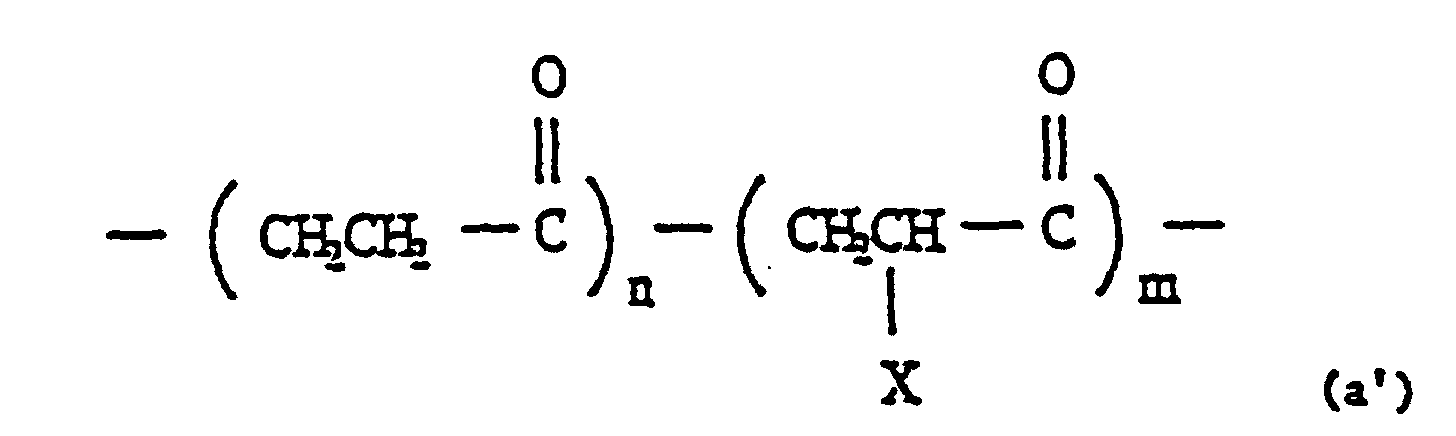
- The semicrystalline structure of the terpolymer is spherulitic, with spherulite size ranging from 5-15 microns. It appears to be an "entangled" spherulitic structure, which may contribute to its high-impact properties and toughness (by terminating crack propagation). The semicrystalline copolymer is an entangled hedritic structure, also with high-impact strength and good toughness.
- The E/P/CO terpolymer generally exhibits between 20-40 weight percent crystallinity. A flexible backbone and high concentration of dipoles allows for efficient chain packing. The density of the terpolymer at room temperature is 1.235g/cm3 with an amorphous density of 1.206g/cm3.
- At room temperature and in dry conditions, the oxygen permeability coefficients of aliphatic polyketones are among the lowest of conventional polymeric materials. However, as the moisture content is increased, the oxygen barrier of standard aliphatic polyketones is diminished. Table 1 shows the oxygen permeability coefficients of PET, nylon 66, ethylene vinyl alcohol (EVOH), and aliphatic polyketones, for comparison purposes:
Oxygen permeability coefficients as a function of percent moisture content (%RH) at 23°C for several barrier polymers. Oxygen permeability coefficient units: (cc(STP)mil/100in2 day atm). Polymer 0 %rh 75 %rh 90%rh Poly(ethylene terephthalate (PET) 3.4 3.5 3.5 Poly(hexamethylene adipamide)(PA66) 1.8 2.0 4.5 Poly(ethylene-co-vinyl alcohol (EVOH) 0.09 0.11 0.35 Aliphatic Polyketone 0.1 1.0 3.4 - The following is a description of alternative structures in which the aliphatic polyketone may be used.
- Figs. 1-2 show two alternative multi-layer preform structures, and Figs. 3-6 show two alternative container structures, in accordance with the present invention.
- Fig. 1 shows a substantially amorphous and transparent three-
layer preform 70 having an openupper end 71, and a neck finish includingouter threads 72 and acylindrical flange 73. Below the flange is a substantiallycylindrical body portion 74, terminating in a closed hemisphericalbottom end 75. - The three-layer sidewall construction includes
outer layer 76,core layer 77, andinner layer 78. By way of example, the inner and outer (exterior) layers may be virgin bottle grade PET, while the core layer is the aliphatic polyketone oxygen-scavenging composition of this invention. In a lower base-forming portion of the preform, a five-layer structure may be formed by a last shot of virgin PET (to clear the injection nozzle so it is filled with virgin PET for the next preform). In this case the virgin PET 79 extends to the exterior of the preform at the gate region. The dimensions and wall thicknesses of the preform shown in Fig. 1 are not critical to the invention. Any number of different preform constructions may be used. - The oxygen-scavenging core layer may include an oxidation catalyst (to further enhance the scavenging effect) and/or a UV protecting catalyst (to prevent UV degradation). Suitable oxidation-enhancing catalysts include cobalt, antimony, germanium, gold, and palladium. The polymerization catalyst residues may also catalyze oxidation. The polyketone may be blended with polymers such as PET, post-consumer (PC-PET) or PEN. The amount of aliphatic polyketone is sufficient to provide the oxygen scavenging effect and does not substantially reduce the transparency; the other polymers may enhance adhesion to outer and inner layers. Furthermore, where PC-PET is included in the core layer, the contaminants therein (in PC-PET) may enhance the oxygen-scavenging effect of the polyketone.
- Figs. 3-4 show a representative hot-fill beverage container which may be stretch blow-molded from a three-layer preform, similar to that shown in Fig. 1. The hot-
fill container 110 includes an open top end 111, substantiallycylindrical sidewall 112, and closedbottom end 113. The container includes thesame neck finish 114 andflange 115 as the preform, which are not expanded during blow molding. The sidewall includes a flaredshoulder portion 116 increasing in diameter to acylindrical panel portion 117, the latter including a plurality of vertically-elongated, symmetrically-disposedvacuum panels 118. The vacuum panels move inwardly to alleviate the vacuum formed during product cooling in the sealed container. Again, this container construction is by way of example only, and the invention is not limited to any particular package structure. - Fig. 4 shows the three-layer sidewall construction including
inner layer 120,core layer 121, andouter layer 122. The inner and outer layers may be virgin bottle grade PET, while thecore layer 121 is made of an aliphatic polyketone oxygen-scavenging composition. - Fig. 2 shows an alternative five-
layer preform 90. Again, the preform includes an openupper end 91, neck finish withthreads 92 andflange 93, and body-formingportion 94 with a closedbottom end 95. The five-layer sidewall construction includesouter layer 96, firstintermediate layer 97,core layer 98, secondintermediate layer 99, andinner layer 100, disposed in serial order. By way of example, the inner andouter layers intermediate layers core layer 98 is the aliphatic polyketone oxygen-scavenging composition. Again in the base, there may be alast shot 101 of virgin PET to clear the nozzle of non-virgin polymer. The core layer scavenges oxygen from the interior of the filled package, and prevents exterior oxygen from reaching the contents of the package. The inner layer protects the food product from contact with the oxygen scavenger and its byproducts. - Figs. 5-6 show a representative ketchup container made from a five-layer preform similar to that of Fig. 2. Again, the details of the preform and container construction are not critical, and variations may be required to the preform construction in order to stretch blow mold the container of Fig. 5. The
ketchup container 130 includes an opentop end 131,neck finish 132 withflange 133, ashoulder portion 134 increasing in diameter, and apanel portion 135 connecting to abase 136. The five-layer sidewall construction, as shown in Fig. 6, includes aninner layer 137, firstintermediate layer 138,core layer 139, secondintermediate layer 140, andouter layer 141. The inner andouter layers intermediate layers 138 and 140 a high oxygen barrier material such as EVOH. - Figs. 7-8 illustrate the change in oxygen barrier condition when water from the product is transmitted across the wall. Fig. 7 shows the increase in oxygen transmission for EVOH with increasing moisture content (relative humidity). Fig. 8 shows the relative humidity across the respective layers of the five-layer container shown in Fig. 6. In an initial unfilled state, the five-layer container sidewall provides a high barrier to oxygen transmission based on the two very dry intermediate EVOH layers. When the container is filled with an aqueous product, water vapor permeates through the inner PET and EVOH layers causing a drop in the relative oxygen barrier property of the EVOH layer. As shown in FIG. 8, water vapor transmission across the wall may produce an 85% relative humidity at the inner EVOH layer, and a 55% moisture content at the outer EVOH layer. At 85% moisture content, the inner EVOH layer would have a relatively low oxygen barrier condition (see Fig. 7) and thus allow oxygen entrapped in the container with the product to be transmitted across the inner PET and inner intermediate EVOH layers to reach the central oxygen scavenging layer, where the oxygen would be consumed. In contrast, oxygen would be less able to pass the outer EVOH barrier layer, which is at a lower relative humidity.
- There are numerous multilayer preform and container constructions possible, each of which may be adapted for a particular food product and/or package, filling, and manufacturing process. A few representative examples will be given.
- A first five-layer structure may have relatively thin inner and outer intermediate layers of EVOH to provide the necessary high oxygen barrier properties without loss of clarity. Relatively thicker inner and outer layers of virgin PET would provide the necessary strength and clarity. A thick oxygen scavenger layer, of for example 50% of the wall thickness, and incorporating an aliphatic polyketone and post consumer polyethylene terephthalate (PC-PET), provides the oxygen scavenging effect at a competitive price.
- In an alternative five-layer structure, the two intermediate EVOH layers may be replaced by oxygen scavenging layers, and a non-scavenging core layer provided. For example, a PET/aliphatic polyketone blend comprising 2-10% of the total preform weight, and more preferably 4-6% of the total preform weight, would provide two highly concentrated intermediate oxidative layers to provide optimum scavenging while maintaining clarity by the low blend layer thickness. Adhesion to inner, outer and core layers of PET would also be improved. The center core layer may be virgin PET or post-consumer PET. Alternatively, the core layer may be an oxygen scavenging blend to further increase the shelf life, e.g., for highly O2 sensitive products such as beer. The inner and outer layers would remain virgin PET for FDA approved use with food and beverages.
- A first alternative three-layer sidewall construction may consist of an inner barrier layer providing a high oxygen barrier in one condition, and a lower oxygen barrier in a second condition, a central core layer of an oxygen scavenging material, and an outer layer to provide strength to the wall structure. The inner layer may be EVOH, the barrier properties of which are reduced by moisture from the filled product. Alternatively, the change in oxygen barrier condition could be triggered by another ingredient in the product, for example, carbon dioxide or volatile organic compounds. Encapsulating the central oxygen scavenger layer eliminates any potential food contact problems.
- In an alternative three-layer construction, a central oxygen scavenging core layer is disposed between inner and outer layers, at least one of the inner and outer layers being permeable to and including a catalyst which enhances the oxygen scavenging activity of the core layer.
- Another three-layer sidewall construction may comprise inner and outer layers of substantially virgin PET, and a core layer including PC-PET, an aliphatic polyketone, virgin PET, and PEN. Where the core layer includes a blend of PET and PEN, it may comprise 5-20% homopolymer PEN by total weight of the blend. Where the core layer includes a copolymer of PET and PEN, it may comprise a copolymer of ethylene with terephthalate and including 5-20% naphthalate by total weight of the copolymer. The PEN provides enhanced thermal resistance in higher temperature applications.
- Fig. 9 shows a
single layer preform 80 which can be used to make a single layer container according to another embodiment of the invention. The preform includes opentop end 81, a neck finish withouter threads 82 andflange 83,sidewall forming portion 84 andbase forming portion 85. The preform may be made from a blend of 98% virgin PET and 2% ethylene/propylene/carbon monoxide terpolymer for good clarity and ease of processability. - The base polymer in the oxygen scavenger blend may be an aromatic condensation polymer including formable polyesters, polyamides and polycarbonates. Suitable polyesters include polyethylene terephthalate (PET), polybutylene terephthalate (PBT), polypropylene terephthalate (PPT), polyethylene napthalate, and a cyclohexane dimethanol/PET copolymer, known as PETG (available from Eastern Chemical, Kingsport, TN). Suitable polyamides (PA) include PA6, PA6,6, PA6,4, PA6,10, PA11, PA12, etc. Other options include acrylic/imide, amorphous nylon, polyacrylonitrile (PAN), polystyrene, crystallizable nylon (MXD-6), polyethylene (PE), polypropylene (PP), and polyvinyl chloride (PVC).
- Polyesters based on terephthalic or isophthalic acid are commercially available and convenient. The hydroxy compounds are typically ethylene glycol and 1,4-di-(hydroxy methyl)-cyclohexane. The inherent viscosity (I.V.) for phthalate polyesters are typically in the range of 0.6 to 1.2, and more particularly 0.7 to 1.0 (for O-chlorolphenol solvent). 0.6 corresponds approximately to a viscosity average molecular weight of 59,000, and 1.2 to a viscosity average molecular weight of 112,000. In general, the phthalate polyester may include polymer linkages, side chains, and end groups not related to the formal precursors of a simple phthalate polyester previously specified. Conveniently, at least 90 mole percent will be terephthalic acid and at least 90 mole percent an aliphatic glycol or glycols, especially ethylene glycol.
- Post-consumer PET (PC-PET) is prepared from PET plastic containers and other recycables that are returned by consumers for a recycling operation, and has now been approved by the FDA for use in certain food containers. PC-PET is known to have a certain level of I.V. inherent viscosity), moisture content, and contaminants. For example, typical PC-PET (having a flake size of one-half inch maximum), has an I.V. average of about 0.66 dl/g, a relative humidity of less than 0.25%, and the following levels of contaminants:
- PVC: < 100 ppm
- aluminum: < 50 ppm
- olefin polymers (HDPE, LDPE, PP): < 500 ppm
- paper and labels: < 250 ppm
- colored PET: < 2000 ppm
- other contaminants: < 500 ppm
-
- Also useful as a base polymer or as a high-oxygen barrier layer is a packaging material with physical properties similar to PET, namely polyethylene naphthalate (PEN). PEN also provides a 3-5X improvement in barrier property and enhanced thermal resistance, at some additional expense.
- Oxygen barrier layers other than EVOH and PEN may include polyvinyl alcohol (PVOH), polyvinyldene chloride (PVDC), nylon 6, crystallizable nylon (MXD-6), LCP (liquid crystal polymer), amorphous nylon, polyacrylonitrile (PAN) and styrene acrylonitrile (SAN).
- A masterbatch preparation may be used, similar to that described in U.S. Serial No. 08/349,173, filed December 7, 1994 by Collette et al., and hereby incorporated by reference.
- The container of the present invention may be used to provide good oxygen barrier properties for products such as carbonated soft drinks. It is particularly useful in packaging products such as beer, because beer rapidly loses its flavor due to oxygen migration into the bottle. This is also true for products such as citrus products, tomato-based products, and aseptically-packaged meat.
- The inherent viscosity (I.V.) effects the processability of the resins. Polyethylene terephthalate having an inherent viscosity of about 0.8 is widely used in the carbonated soft drink (CSD) industry. Polyester resins for various applications may range from about 0.55 to about 1.04, and more particularly from about 0.65 to 0.85dl/g. Inherent viscosity measurements of polyester resins are made according to the procedure of ASTM D-2857, by employing 0.0050 ± 0.0002 g/ml of the polymer in a solvent comprising o-chlorophenol (
melting point 0°C), respectively, at 30°C. Inherent viscosity (I.V.) is, in this specification, given by the following formula:- - VSoln. is the viscosity of the solution in any units;
- VSol. is the viscosity of the solvent in the same units; and
- C is the concentration in grams of polymer per 100 mls of solution.
-
- The blown container should be substantially transparent One measure of transparency is the percent haze for transmitted light through the wall (HT) which is given by the following formula:
- The preform should also be substantially transparent, having a percent haze across the wall of no more than about 10%, and more preferably no more than about 5%.
- The container will have varying levels of strain-induced crystallinity in the layers at various positions along the height of the bottle from the neck finish to the base, based on the varying stretch ratios along the bottle. The percent crystallinity may be determined according to ASTM 1505 as follows:
X 100 - Further increases in crystallinity can be achieved by heat setting to provide a combination of strain-induced and thermal-induced crystallization. Thermal-induced crystallinity is achieved at low temperatures to preserve transparency, e.g., holding the container in contact with a low temperature blow mold. In some applications, a high level of crystallinity at the surface of the sidewall alone is sufficient.
- As used herein, "package" includes packaging structures other than blow-molded containers, such as packaging films.
- While there have been shown and described several embodiments of the present invention, it will be obvious to those skilled in the art that various changes and modifications may be made therein without departing from the scope of the invention as defined by the appending claims.
Claims (32)
- A substantially transparent package made from a polymer composition including a blend of an aliphatic polyketone as an oxygen scavenger having the formula:wherein n is the number of repeating units and R is selected from the group consisting of hydrogen, an organic side chain and a silicon-based side chain, and a biaxially orientable polymer, wherein the biaxially orientable polymer comprises 90 to 99.9% by total weight of the polymer composition and the polyketone 0.1 to 10% by total weight ofthe polymer composition.

- The package of claim 1, wherein the biaxially orientable polymer is polyester.
- The package of claim 3, wherein the biaxially orientable polymer is substantially polyethylene terephthalate (PET).
- The package of claim 1, wherein the package comprises a single layer.
- The package of claim 1, wherein the package has multiple layers including an inner layer (120) of at least one barrier polymer and another layer of the oxygen scavenging polymer composition; and
wherein the at least one barrier polymer is, in use, in contact with a product in the filled package and is permeable to an ingredient of the product, the barrier polymer having a high oxygen barrier condition in the absence of the ingredient to prevent depletion of the oxygen scavenging effect, and a low oxygen barrier condition in the presence of the ingredient to allow oxygen in the filled package to permeate the inner layer (120) and be consumed by the oxygen scavenging layer. - The package of claim 5,wherein the component is selected from the group consisting of one or more of water, carbon dioxide, and volatile organic compounds.
- The package of claim 6, wherein the component is water.
- The package of claim 5, wherein the barrier polymer is selected from the group consisting of ethylene vinyl alcohol (EVOH) and MXD-6 nylon.
- The package of claim 5, having a core layer (121) of the oxygen scavenging polymer composition.
- The package of claim 9, further including inner and outer exterior layers (120,122) of polyester.
- The package of claim 10 wherein the exterior layers (120,122) are substantially polyethylene terephthalate (PET).
- The package of claim 1, wherein the aliphatic polyketone is a copolymer of ethylene and carbon monoxide having the formula:

- The package of claim 1, wherein the aliphatic polyketone is a terpolymer having the formula:wherein m is the number of repeating units and X is selected from the group consisting of an organic side chain and a silyl side chain.

- The package of claim 13,wherein the aliphatic polyketone is a terpolymer of ethylene, carbon monoxide, and an olefin compound selected from the group consisting of propylene, 1-butene, 1-pentene, 1-octene, halogen-substituted olefins, vinyl silane, acrylates, vinyl acrylate, vinylsilanes, and vinyl chloride.
- The package of claim 13, wherein the aliphatic polyketone is a terpolymer of ethylene, propolyene and carbon monoxide having the formula:

- The package of claim 13, wherein the aliphatic polyketone is a terpolymer of ethylene, styrene and carbon monoxide having the formula:

- The package of claim 13,wherein the aliphatic polyketone is a terpolymer of ethylene, a silane-substituted olefin, and carbon monoxide having the formula:where R is a hydrocarbon.

- , The package of claim 1, wherein the package includes a core layer (121) of the oxygen scavenging polymer composition and inner and outer layers (120,122) of a polyester.
- The package of claim 18, wherein the inner and outer layers (120,122) comprise substantially polyethylene terephthalate (PET).
- The package of claim 19, wherein the outer layer (122) includes high-oxygen barrier material selected from the group consisting of ethylene vinyl alcohol (EVOH), polyvinyl alcohol (PVOH), polyvinyldene chloride (PVDC), polyethylene naphthalate (PEN), polyacrylonitrile (PAN), styrene acrylonitrile (SAN), liquid crystal polymer (LCP), MXD-6 nylon, and polybutylene terephthalate (PBT).
- The package of claim 18, wherein the core layer (121) includes post-consumer polyethylene terephthalate (PC-PET).
- The package of claim 21 ,wherein the PC-PET comprises at least on the order of 10% of the total weight of the core layer (121).
- The package of claim 21,wherein the PC-PET has an inherent viscosity on the order of 0.58 to 0.77 dl/g as measured using the procedure of ASTM D-2857 at 30°C with 0.0050 ± 0.002 glml of PC-PET in o-chlorophenol and a moisture content on the order of 50-300ppm.
- The package of claim 1, wherein the polymer composition includes a catalyst which enhances the oxygen scavenging activity of the aliphatic polyketone.
- The package of claim 24,wherein the catalyst is selected from the group consisting of cobalt, antimony, germanium, gold, and palladium.
- The package of claim 1, wherein the biaxially orientable polymer is selected from the group consisting of polyesters, polycarbonate, polyolefins, polyarylates, polymethacrylates, polyacrylates, polyvinylacrylates, polyvinylsilanes, polyvinyl chloride and polycyclics.
- The package of claim 26, wherein the polyester is selected from the group consisting of PET, PETG, PEN, PBT, PPT, recycled polyester, and blends or copolymers of the same.
- The package of claim 27, wherein the polyester includes on the order of 0.1 to 2% aliphatic polyketone and aldol condensation products thereof as a percentage of the total weight of the polymer composition.
- The package of claim 1, wherein the polymer composition further includes an aldol condensation product of the aliphatic polyketone having a repeating unit of the formula:

- The package of claim 29, wherein the aldol reaction product comprises on the order of 0 to 2% by total weight of the polymer composition.
- The package of claim 3, wherein the polyester has an inherent viscosity in o-chlorophenol on the order of 0.8 to 1.2 as measured using the procedure of ASTM D-2857 at 30°C with 0.0050±0.002 glml of PC-PET on o-chloro-phenol.
- A preform (70) for making a substantially transparent, biaxially-oriented container body, the preform (70) including one or more layers of a polymer composition including a blend of an aliphatic polyketone as an oxygen scavenger having the formula:where n is the number of repeating units and R is selected from the group consisting of hydrogen, an organic side chain, and a silicon-based side chain and a biaxially orientable polymer, wherein the biaxially orientable polymer comprises 90 to 99.9% by total weight of the polymer composition and the polyketone 0.1 to 10% by total weight of the polymer composition.

Applications Claiming Priority (5)
| Application Number | Priority Date | Filing Date | Title |
|---|---|---|---|
| US08/355,703 US5759653A (en) | 1994-12-14 | 1994-12-14 | Oxygen scavenging composition for multilayer preform and container |
| US355703 | 1994-12-14 | ||
| US51036095A | 1995-08-02 | 1995-08-02 | |
| US510360 | 1995-08-02 | ||
| PCT/US1995/016103 WO1996018686A1 (en) | 1994-12-14 | 1995-12-11 | Transparent package with aliphatic polyketone oxygen-scavenger |
Publications (2)
| Publication Number | Publication Date |
|---|---|
| EP0797627A1 EP0797627A1 (en) | 1997-10-01 |
| EP0797627B1 true EP0797627B1 (en) | 2003-04-16 |
Family
ID=26998963
Family Applications (1)
| Application Number | Title | Priority Date | Filing Date |
|---|---|---|---|
| EP19950942612 Expired - Lifetime EP0797627B1 (en) | 1994-12-14 | 1995-12-11 | Transparent package with aliphatic polyketone oxygen-scavenger |
Country Status (12)
| Country | Link |
|---|---|
| US (1) | US5952066A (en) |
| EP (1) | EP0797627B1 (en) |
| AT (1) | ATE237658T1 (en) |
| AU (1) | AU711170B2 (en) |
| BR (1) | BR9510039A (en) |
| CA (1) | CA2207680A1 (en) |
| DE (1) | DE69530413T2 (en) |
| DK (1) | DK0797627T3 (en) |
| ES (1) | ES2196096T3 (en) |
| MX (1) | MX9704426A (en) |
| PT (1) | PT797627E (en) |
| WO (1) | WO1996018686A1 (en) |
Cited By (1)
| Publication number | Priority date | Publication date | Assignee | Title |
|---|---|---|---|---|
| US8691915B2 (en) | 2012-04-23 | 2014-04-08 | Sabic Innovative Plastics Ip B.V. | Copolymers and polymer blends having improved refractive indices |
Families Citing this family (52)
| Publication number | Priority date | Publication date | Assignee | Title |
|---|---|---|---|---|
| DE69530413T2 (en) * | 1994-12-14 | 2004-02-12 | Continental Pet Technologies, Inc. | TRANSPARENT PACKAGING WITH ALIPHATIC POLYKETONE AS AN OXYGEN ABSORBER |
| US6132825A (en) * | 1996-07-12 | 2000-10-17 | Tetra Laval Holdings & Finance, Sa | Sterilant degrading polymeric material |
| CZ298276B6 (en) | 1996-09-23 | 2007-08-15 | Bp Corporation North America Inc. | Thermoplastic container, thermoplastic bottle and process for producing multilayered thermoplastic bottle |
| US6863988B2 (en) * | 1996-09-23 | 2005-03-08 | Bp Corporation North America Inc. | Oxygen scavenging monolayer bottles |
| JP2001504399A (en) * | 1996-09-25 | 2001-04-03 | コンチネンタル ピーイーティー テクノロジーズ,インコーポレイテッド | Transparent oxygen-absorbing article containing biaxially stretched polyester |
| DE19753507A1 (en) * | 1997-12-03 | 1999-06-10 | Wolff Walsrode Ag | Flexible, multilayer film with high rigidity, dimensional stability and resistance to kink breakage |
| DE19753584A1 (en) * | 1997-12-03 | 1999-06-10 | Wolff Walsrode Ag | Flexible, thermoformable multilayer film with improved machine operation |
| US6051323A (en) * | 1997-12-18 | 2000-04-18 | Shell Oil Company | Multilayer polyketone structures |
| DE19757219A1 (en) * | 1997-12-22 | 1999-06-24 | Bayer Ag | Polyalkylene terephthalate-based thermoplastic molding composition |
| DE19757606C2 (en) | 1997-12-23 | 2001-05-10 | Inventa Ag | Thermoplastic multilayer composites |
| EP1054925B1 (en) * | 1998-02-03 | 2011-10-12 | Graham Packaging PET Technologies Inc. | Enhanced oxygen-scavenging polymers, and packaging made therefrom |
| US6524672B1 (en) | 1999-02-12 | 2003-02-25 | Plastipak Packaging, Inc. | Multilayer preform and container with co-extruded liner |
| GB9911560D0 (en) * | 1999-05-18 | 1999-07-21 | Bp Chem Int Ltd | Packaging |
| ES2292611T3 (en) | 2000-08-08 | 2008-03-16 | Evergreen Packaging International B.V. | PROCEDURE FOR THE ACTIVATION OF OXYGEN SEQUENCING COMPONENTS DURING A FILLING PROCESS OF CARTON BOXES WITH PEAK COVER. |
| US7655179B2 (en) * | 2001-03-12 | 2010-02-02 | Toyo Seikan Kaisha, Ltd. | Heat-resistant resin container and method of producing the same |
| WO2003026532A2 (en) | 2001-09-28 | 2003-04-03 | Boston Scientific Limited | Medical devices comprising nanomaterials and therapeutic methods utilizing the same |
| ES2428096T3 (en) | 2001-10-24 | 2013-11-05 | Amcor Rigid Plastics Usa, Inc. | Preform for a polypropylene container |
| US20030235667A1 (en) * | 2002-06-25 | 2003-12-25 | Darr Richard C. | Multilayered plastic container |
| US8337968B2 (en) | 2002-09-11 | 2012-12-25 | Boston Scientific Scimed, Inc. | Radiation sterilized medical devices comprising radiation sensitive polymers |
| MXPA05007662A (en) * | 2003-01-16 | 2006-03-10 | Ian Orde Michael Jacobs | Methods, compositions and blends for forming articles having improved environmental stress crack resistance. |
| US20050059746A1 (en) * | 2003-09-17 | 2005-03-17 | Moncada Andres Juan Antonio | Flexible manufacture of polyethylene terephthalate ("PET") |
| US20050221036A1 (en) * | 2004-04-01 | 2005-10-06 | The Coca-Cola Company | Polyester composition with enhanced gas barrier, articles made therewith, and methods |
| US7572493B2 (en) * | 2005-05-11 | 2009-08-11 | The Coca-Cola Company | Low IV pet based copolymer preform with enhanced mechanical properties and cycle time, container made therewith and methods |
| US8545952B2 (en) * | 2005-06-07 | 2013-10-01 | The Coca-Cola Company | Polyester container with enhanced gas barrier and method |
| WO2007007867A1 (en) | 2005-07-13 | 2007-01-18 | Toyo Seikan Kaisha, Ltd. | Plastic container having pearl-like appearance and process for producing the same |
| US7820258B2 (en) * | 2005-10-05 | 2010-10-26 | The Coca-Cola Company | Container and composition for enhanced gas barrier properties |
| DE102006021018B4 (en) | 2006-05-05 | 2014-08-14 | Wabco Gmbh | Inductive sensor |
| US7790077B2 (en) * | 2006-09-15 | 2010-09-07 | The Coca-Cola Company | Pressurized tooling for injection molding and method of using |
| US8124202B2 (en) * | 2006-09-15 | 2012-02-28 | The Coca-Cola Company | Multilayer container for enhanced gas barrier properties |
| JP5509315B2 (en) * | 2009-04-09 | 2014-06-04 | カラーマトリックス ホールディングス インコーポレイテッド | Oxygen scavenging |
| EP2434910B1 (en) * | 2009-05-28 | 2015-10-21 | Cargill, Incorporated | Shelf stable monatin sweetened beverage |
| US9074092B2 (en) | 2010-12-20 | 2015-07-07 | Eastman Chemical Company | Miscible polyester blends utilizing recycled polyesters |
| US9302799B2 (en) * | 2011-02-17 | 2016-04-05 | Sabic Global Technologies B.V. | Method for bulk transporting 2,6-xylenol susceptible to oxidative discoloration |
| US10207853B2 (en) | 2011-08-24 | 2019-02-19 | APG Polytech, LLC | Oxygen scavengers |
| US10589882B2 (en) | 2014-07-16 | 2020-03-17 | Dow Global Technologies Llc | Flexible container with fitment and process for producing same |
| USD817173S1 (en) * | 2014-12-25 | 2018-05-08 | Dai Nippon Printing Co., Ltd. | Preform for bottles |
| US12441045B2 (en) | 2019-11-04 | 2025-10-14 | Ring Container Technologies, Llc | Container and method of manufacture |
| JP1566839S (en) * | 2016-07-28 | 2019-12-23 | ||
| FR3066890B1 (en) * | 2017-06-06 | 2021-07-09 | Albea Services | USE OF A MATERIAL IN COSMETIC PACKAGINGS AND A PRESSURE PRODUCT DISTRIBUTION SYSTEM INCLUDING AT LEAST ONE PART CONSISTING OF OR INCLUDING THIS MATERIAL |
| FR3077013B1 (en) * | 2018-01-24 | 2023-12-15 | Aptar France Sas | FLUID PRODUCT DISTRIBUTION DEVICE. |
| CH715582A1 (en) * | 2018-11-22 | 2020-05-29 | Alpla Werke Alwin Lehner Gmbh & Co Kg | Plastic container with at least partially sharp-edged container geometry and method for producing the plastic container. |
| JP7072999B2 (en) | 2018-11-30 | 2022-05-23 | 株式会社吉野工業所 | Synthetic resin container and method for manufacturing synthetic resin container |
| GB2614995A (en) * | 2019-01-11 | 2023-07-26 | Raven Eng Films Inc | Flexible bladder tanks including polyketone |
| WO2020145987A1 (en) * | 2019-01-11 | 2020-07-16 | Redford Steven G | Flexible bladder tanks including polyketone |
| GB2595145B (en) * | 2019-01-11 | 2023-08-09 | Raven Eng Films Inc | Flexible bladder tanks including polyketone |
| EP3924160A4 (en) | 2019-01-26 | 2022-09-07 | Finite Research Ltd | Formulations capable of reacting with or removal of molecular oxygen |
| WO2020219101A1 (en) | 2019-04-23 | 2020-10-29 | Smart Bottle, Inc. | Flexible container and process for installation of fitment in same |
| JP2023500047A (en) | 2019-11-04 | 2023-01-04 | リング コンテナ テクノロジーズ エルエルシー | Container and method of manufacture |
| KR102509969B1 (en) * | 2021-03-25 | 2023-03-14 | 아주대학교산학협력단 | Palladium complex catalyst and method of synthesizing polyketone using the palladium complex catalyst |
| IL308358B2 (en) | 2021-05-17 | 2025-03-01 | Jabil Inc | Polyketone powder for laser sintering |
| CN115612138B (en) * | 2022-10-31 | 2023-09-19 | 链行走新材料科技(广州)有限公司 | High-barrier film, sheet or container and preparation method thereof |
| EP4446111A1 (en) | 2023-04-11 | 2024-10-16 | Yparex B.V. | Multi-layer pipe |
Family Cites Families (26)
| Publication number | Priority date | Publication date | Assignee | Title |
|---|---|---|---|---|
| US3780140A (en) * | 1971-08-06 | 1973-12-18 | Du Pont | Ethylene/carbon monoxide polymer compositions |
| US4401805A (en) * | 1982-03-01 | 1983-08-30 | Eastman Kodak Company | Modified poly(ethylene terephthalate) having improved gas barrier properties |
| US4948506A (en) * | 1986-07-07 | 1990-08-14 | Bend Research, Inc. | Physicochemically functional ultrathin films by interfacial polymerization |
| AU1008088A (en) * | 1987-01-23 | 1988-07-28 | W.R. Grace & Co.-Conn. | Packaging of oxygen sensitive food products |
| SE8702840D0 (en) * | 1987-07-10 | 1987-07-10 | Plm Ab | BARRIERFORSTERKNING |
| WO1989001012A1 (en) * | 1987-07-27 | 1989-02-09 | Mb Group Plc | Improvements in and relating to packaging |
| US4895689A (en) * | 1987-12-04 | 1990-01-23 | Shell Oil Company | Process for preparing heat treated solution cast polyketone-based barrier polymer materials |
| FI895189A0 (en) * | 1988-03-12 | 1989-11-01 | Metal Box Plc | FOERBAETTRINGAR VID PACKANDE. |
| DE68926902T2 (en) * | 1988-04-30 | 1996-12-12 | Toyo Seikan Kaisha Ltd | MULTILAYERED PLASTIC CONTAINER |
| US4962164A (en) * | 1988-06-27 | 1990-10-09 | Owens-Illinois Plastic Products Inc. | Degradable polymers and articles made therefrom |
| SE464086B (en) * | 1988-07-11 | 1991-03-04 | Plm Ab | FOR PREPARATION OF CONTAINERS FOR POLYMER COMPOSITION AND PROCEDURES BEFORE ITS PREPARATION |
| US5239016A (en) * | 1989-01-26 | 1993-08-24 | Cmb Packaging (Uk) Limited | Process for production of a wall for a package |
| CA2014280A1 (en) * | 1989-04-10 | 1990-10-10 | Hiroshi Wakumoto | Cocondensation polyester, process for manufacturing same and uses thereof |
| US5175245A (en) * | 1989-09-25 | 1992-12-29 | Shell Oil Company | Mono- or biaxially drawn polyketone films |
| US5077111A (en) * | 1990-01-12 | 1991-12-31 | Continental Pet Technologies, Inc. | Recyclable multilayer plastic preform and container blown therefrom |
| US5281360A (en) * | 1990-01-31 | 1994-01-25 | American National Can Company | Barrier composition and articles made therefrom |
| US5314987A (en) * | 1990-01-31 | 1994-05-24 | American National Can Company | Barrier compositions and film made therefrom having improved optical and oxygen barrier properties |
| US4996086A (en) * | 1990-03-05 | 1991-02-26 | Shell Oil Company | Method for the fabrication of a multi-ovenable, retortable container apparatus |
| US5202052A (en) * | 1990-09-12 | 1993-04-13 | Aquanautics Corporation | Amino polycarboxylic acid compounds as oxygen scavengers |
| US5301838A (en) * | 1991-01-23 | 1994-04-12 | Continental Pet Technologies, Inc. | Multilayer bottle with separable inner layer and method for forming same |
| CA2062083C (en) * | 1991-04-02 | 2002-03-26 | Drew Ve Speer | Compositions, articles and methods for scavenging oxygen |
| FI922379A7 (en) * | 1991-06-19 | 1992-12-20 | Chevron Research And Tech Company | Oxygen scavenging, homogeneous mixtures of modified polyolefin, oxidizable polymer and metal salt |
| US5704503A (en) * | 1994-10-28 | 1998-01-06 | Continental Pet Technologies, Inc. | Hot-fillable plastic container with tall and slender panel section |
| US5759653A (en) * | 1994-12-14 | 1998-06-02 | Continental Pet Technologies, Inc. | Oxygen scavenging composition for multilayer preform and container |
| DE69530413T2 (en) * | 1994-12-14 | 2004-02-12 | Continental Pet Technologies, Inc. | TRANSPARENT PACKAGING WITH ALIPHATIC POLYKETONE AS AN OXYGEN ABSORBER |
| US5506014A (en) * | 1995-09-01 | 1996-04-09 | Eastman Chemical Company | Pet copolyesters containing succinic and naphthalenedicarboxylic acid moieties having improved barrier properties |
-
1995
- 1995-12-11 DE DE1995630413 patent/DE69530413T2/en not_active Expired - Fee Related
- 1995-12-11 BR BR9510039A patent/BR9510039A/en not_active IP Right Cessation
- 1995-12-11 PT PT95942612T patent/PT797627E/en unknown
- 1995-12-11 AU AU43779/96A patent/AU711170B2/en not_active Ceased
- 1995-12-11 DK DK95942612T patent/DK0797627T3/en active
- 1995-12-11 WO PCT/US1995/016103 patent/WO1996018686A1/en not_active Ceased
- 1995-12-11 AT AT95942612T patent/ATE237658T1/en not_active IP Right Cessation
- 1995-12-11 EP EP19950942612 patent/EP0797627B1/en not_active Expired - Lifetime
- 1995-12-11 ES ES95942612T patent/ES2196096T3/en not_active Expired - Lifetime
- 1995-12-11 CA CA002207680A patent/CA2207680A1/en not_active Abandoned
-
1997
- 1997-06-13 MX MX9704426A patent/MX9704426A/en not_active IP Right Cessation
- 1997-10-28 US US08/958,849 patent/US5952066A/en not_active Expired - Fee Related
Cited By (1)
| Publication number | Priority date | Publication date | Assignee | Title |
|---|---|---|---|---|
| US8691915B2 (en) | 2012-04-23 | 2014-04-08 | Sabic Innovative Plastics Ip B.V. | Copolymers and polymer blends having improved refractive indices |
Also Published As
| Publication number | Publication date |
|---|---|
| EP0797627A1 (en) | 1997-10-01 |
| DE69530413T2 (en) | 2004-02-12 |
| US5952066A (en) | 1999-09-14 |
| PT797627E (en) | 2003-08-29 |
| MX9704426A (en) | 1998-07-31 |
| WO1996018686A1 (en) | 1996-06-20 |
| ATE237658T1 (en) | 2003-05-15 |
| AU4377996A (en) | 1996-07-03 |
| CA2207680A1 (en) | 1996-06-20 |
| DK0797627T3 (en) | 2003-08-11 |
| ES2196096T3 (en) | 2003-12-16 |
| BR9510039A (en) | 1998-11-03 |
| AU711170B2 (en) | 1999-10-07 |
| DE69530413D1 (en) | 2003-05-22 |
Similar Documents
| Publication | Publication Date | Title |
|---|---|---|
| EP0797627B1 (en) | Transparent package with aliphatic polyketone oxygen-scavenger | |
| US7807270B2 (en) | Multilayered package with barrier properties | |
| EP1009615B1 (en) | Enhanced shelf-life pressurized container with ribbed appearance | |
| EP1449646B1 (en) | Multilayer bottle and process for its production | |
| US7179868B2 (en) | Polyglycolic acid-based resin composition and shaped product thereof | |
| US20060029823A1 (en) | Articles incorporating polyester-containing multilayer coextruded structures | |
| EP1773590B1 (en) | Containers incorporating polyester-containing multilayer structures | |
| EP1507663B1 (en) | Multilayer stretched product | |
| KR100725311B1 (en) | Multilayer laminate with excellent heat resistance and gas barrier resistance | |
| US9370916B2 (en) | Poly(ethylene terephthalate)(CPET) multilayer oxygen-scavenging containers and methods of making | |
| EP0580360A1 (en) | Multilayer container | |
| WO1998013266A9 (en) | Transparent oxygen-scavenging article including biaxially-oriented polyester | |
| CA2266503A1 (en) | Transparent oxygen-scavenging article including biaxially-oriented polyester | |
| US20050214489A1 (en) | Multilayer stretched product | |
| KR102244999B1 (en) | Molded body with excellent gas barrier properties | |
| US5439718A (en) | Multilayer container of polycarbonate and amorphous polyamide of improved barrier and stress crack resistant properties | |
| EP0581495A1 (en) | Multilayer containers | |
| JP2002234127A (en) | Multilayer molded body | |
| JPS60158045A (en) | Multilayer blow molding vessel |
Legal Events
| Date | Code | Title | Description |
|---|---|---|---|
| PUAI | Public reference made under article 153(3) epc to a published international application that has entered the european phase |
Free format text: ORIGINAL CODE: 0009012 |
|
| 17P | Request for examination filed |
Effective date: 19970704 |
|
| AK | Designated contracting states |
Kind code of ref document: A1 Designated state(s): AT BE CH DE DK ES FR GB GR IE IT LI LU MC NL PT SE |
|
| 17Q | First examination report despatched |
Effective date: 19971028 |
|
| GRAH | Despatch of communication of intention to grant a patent |
Free format text: ORIGINAL CODE: EPIDOS IGRA |
|
| GRAH | Despatch of communication of intention to grant a patent |
Free format text: ORIGINAL CODE: EPIDOS IGRA |
|
| GRAA | (expected) grant |
Free format text: ORIGINAL CODE: 0009210 |
|
| AK | Designated contracting states |
Designated state(s): AT BE CH DE DK ES FR GB GR IE IT LI LU MC NL PT SE |
|
| REG | Reference to a national code |
Ref country code: GB Ref legal event code: FG4D |
|
| REG | Reference to a national code |
Ref country code: CH Ref legal event code: EP |
|
| REF | Corresponds to: |
Ref document number: 69530413 Country of ref document: DE Date of ref document: 20030522 Kind code of ref document: P |
|
| REG | Reference to a national code |
Ref country code: IE Ref legal event code: FG4D |
|
| REG | Reference to a national code |
Ref country code: SE Ref legal event code: TRGR |
|
| REG | Reference to a national code |
Ref country code: DK Ref legal event code: T3 |
|
| REG | Reference to a national code |
Ref country code: CH Ref legal event code: NV Representative=s name: KELLER & PARTNER PATENTANWAELTE AG |
|
| REG | Reference to a national code |
Ref country code: GR Ref legal event code: EP Ref document number: 20030402535 Country of ref document: GR |
|
| REG | Reference to a national code |
Ref country code: ES Ref legal event code: FG2A Ref document number: 2196096 Country of ref document: ES Kind code of ref document: T3 |
|
| ET | Fr: translation filed | ||
| PLBE | No opposition filed within time limit |
Free format text: ORIGINAL CODE: 0009261 |
|
| STAA | Information on the status of an ep patent application or granted ep patent |
Free format text: STATUS: NO OPPOSITION FILED WITHIN TIME LIMIT |
|
| 26N | No opposition filed |
Effective date: 20040119 |
|
| PGFP | Annual fee paid to national office [announced via postgrant information from national office to epo] |
Ref country code: AT Payment date: 20041209 Year of fee payment: 10 |
|
| PGFP | Annual fee paid to national office [announced via postgrant information from national office to epo] |
Ref country code: PT Payment date: 20041210 Year of fee payment: 10 |
|
| PGFP | Annual fee paid to national office [announced via postgrant information from national office to epo] |
Ref country code: LU Payment date: 20041215 Year of fee payment: 10 |
|
| PGFP | Annual fee paid to national office [announced via postgrant information from national office to epo] |
Ref country code: CH Payment date: 20041217 Year of fee payment: 10 |
|
| PGFP | Annual fee paid to national office [announced via postgrant information from national office to epo] |
Ref country code: SE Payment date: 20041220 Year of fee payment: 10 |
|
| PGFP | Annual fee paid to national office [announced via postgrant information from national office to epo] |
Ref country code: GR Payment date: 20041223 Year of fee payment: 10 |
|
| PGFP | Annual fee paid to national office [announced via postgrant information from national office to epo] |
Ref country code: DE Payment date: 20050121 Year of fee payment: 10 |
|
| PG25 | Lapsed in a contracting state [announced via postgrant information from national office to epo] |
Ref country code: IT Free format text: LAPSE BECAUSE OF NON-PAYMENT OF DUE FEES Effective date: 20051211 Ref country code: AT Free format text: LAPSE BECAUSE OF NON-PAYMENT OF DUE FEES Effective date: 20051211 |
|
| PG25 | Lapsed in a contracting state [announced via postgrant information from national office to epo] |
Ref country code: SE Free format text: LAPSE BECAUSE OF NON-PAYMENT OF DUE FEES Effective date: 20051212 |
|
| PG25 | Lapsed in a contracting state [announced via postgrant information from national office to epo] |
Ref country code: MC Free format text: LAPSE BECAUSE OF NON-PAYMENT OF DUE FEES Effective date: 20051231 Ref country code: LU Free format text: LAPSE BECAUSE OF NON-PAYMENT OF DUE FEES Effective date: 20051231 Ref country code: LI Free format text: LAPSE BECAUSE OF NON-PAYMENT OF DUE FEES Effective date: 20051231 Ref country code: CH Free format text: LAPSE BECAUSE OF NON-PAYMENT OF DUE FEES Effective date: 20051231 |
|
| PG25 | Lapsed in a contracting state [announced via postgrant information from national office to epo] |
Ref country code: DK Free format text: LAPSE BECAUSE OF NON-PAYMENT OF DUE FEES Effective date: 20060102 |
|
| PG25 | Lapsed in a contracting state [announced via postgrant information from national office to epo] |
Ref country code: PT Free format text: LAPSE BECAUSE OF NON-PAYMENT OF DUE FEES Effective date: 20060612 |
|
| PG25 | Lapsed in a contracting state [announced via postgrant information from national office to epo] |
Ref country code: DE Free format text: LAPSE BECAUSE OF NON-PAYMENT OF DUE FEES Effective date: 20060701 |
|
| REG | Reference to a national code |
Ref country code: DK Ref legal event code: EBP |
|
| REG | Reference to a national code |
Ref country code: CH Ref legal event code: PL |
|
| EUG | Se: european patent has lapsed | ||
| REG | Reference to a national code |
Ref country code: PT Ref legal event code: MM4A Effective date: 20060612 |
|
| PGFP | Annual fee paid to national office [announced via postgrant information from national office to epo] |
Ref country code: NL Payment date: 20061215 Year of fee payment: 12 |
|
| PGFP | Annual fee paid to national office [announced via postgrant information from national office to epo] |
Ref country code: GB Payment date: 20061221 Year of fee payment: 12 |
|
| PGFP | Annual fee paid to national office [announced via postgrant information from national office to epo] |
Ref country code: IE Payment date: 20061222 Year of fee payment: 12 |
|
| PGFP | Annual fee paid to national office [announced via postgrant information from national office to epo] |
Ref country code: ES Payment date: 20061228 Year of fee payment: 12 |
|
| PGFP | Annual fee paid to national office [announced via postgrant information from national office to epo] |
Ref country code: BE Payment date: 20070118 Year of fee payment: 12 |
|
| PGFP | Annual fee paid to national office [announced via postgrant information from national office to epo] |
Ref country code: DK Payment date: 20070629 Year of fee payment: 12 |
|
| PGFP | Annual fee paid to national office [announced via postgrant information from national office to epo] |
Ref country code: MC Payment date: 20070702 Year of fee payment: 12 |
|
| PG25 | Lapsed in a contracting state [announced via postgrant information from national office to epo] |
Ref country code: GR Free format text: LAPSE BECAUSE OF NON-PAYMENT OF DUE FEES Effective date: 20030416 |
|
| PGFP | Annual fee paid to national office [announced via postgrant information from national office to epo] |
Ref country code: FR Payment date: 20061212 Year of fee payment: 12 |
|
| BERE | Be: lapsed |
Owner name: *CONTINENTAL PET TECHNOLOGIES INC. Effective date: 20071231 |
|
| GBPC | Gb: european patent ceased through non-payment of renewal fee |
Effective date: 20071211 |
|
| NLV4 | Nl: lapsed or anulled due to non-payment of the annual fee |
Effective date: 20080701 |
|
| REG | Reference to a national code |
Ref country code: IE Ref legal event code: MM4A |
|
| PG25 | Lapsed in a contracting state [announced via postgrant information from national office to epo] |
Ref country code: BE Free format text: LAPSE BECAUSE OF NON-PAYMENT OF DUE FEES Effective date: 20071231 |
|
| PG25 | Lapsed in a contracting state [announced via postgrant information from national office to epo] |
Ref country code: IE Free format text: LAPSE BECAUSE OF NON-PAYMENT OF DUE FEES Effective date: 20071211 |
|
| REG | Reference to a national code |
Ref country code: FR Ref legal event code: ST Effective date: 20081020 |
|
| PG25 | Lapsed in a contracting state [announced via postgrant information from national office to epo] |
Ref country code: NL Free format text: LAPSE BECAUSE OF NON-PAYMENT OF DUE FEES Effective date: 20080701 |
|
| PG25 | Lapsed in a contracting state [announced via postgrant information from national office to epo] |
Ref country code: GB Free format text: LAPSE BECAUSE OF NON-PAYMENT OF DUE FEES Effective date: 20071211 |
|
| REG | Reference to a national code |
Ref country code: ES Ref legal event code: FD2A Effective date: 20071212 |
|
| PG25 | Lapsed in a contracting state [announced via postgrant information from national office to epo] |
Ref country code: FR Free format text: LAPSE BECAUSE OF NON-PAYMENT OF DUE FEES Effective date: 20071231 Ref country code: ES Free format text: LAPSE BECAUSE OF NON-PAYMENT OF DUE FEES Effective date: 20071212 |
|
| PGFP | Annual fee paid to national office [announced via postgrant information from national office to epo] |
Ref country code: IT Payment date: 20070830 Year of fee payment: 13 |
|
| PGRI | Patent reinstated in contracting state [announced from national office to epo] |
Ref country code: IT Effective date: 20091201 |
|
| PG25 | Lapsed in a contracting state [announced via postgrant information from national office to epo] |
Ref country code: MC Free format text: LAPSE BECAUSE OF NON-PAYMENT OF DUE FEES Effective date: 20071231 |
|
| PGRI | Patent reinstated in contracting state [announced from national office to epo] |
Ref country code: IT Effective date: 20091201 |