EP0795548A1 - Quinazoline derivatives and use thereof - Google Patents
Quinazoline derivatives and use thereof Download PDFInfo
- Publication number
- EP0795548A1 EP0795548A1 EP96932039A EP96932039A EP0795548A1 EP 0795548 A1 EP0795548 A1 EP 0795548A1 EP 96932039 A EP96932039 A EP 96932039A EP 96932039 A EP96932039 A EP 96932039A EP 0795548 A1 EP0795548 A1 EP 0795548A1
- Authority
- EP
- European Patent Office
- Prior art keywords
- group
- substituted
- ring
- halogen atom
- lower alkyl
- Prior art date
- Legal status (The legal status is an assumption and is not a legal conclusion. Google has not performed a legal analysis and makes no representation as to the accuracy of the status listed.)
- Granted
Links
- 125000002294 quinazolinyl group Chemical class N1=C(N=CC2=CC=CC=C12)* 0.000 title claims abstract description 11
- 208000037265 diseases, disorders, signs and symptoms Diseases 0.000 claims abstract description 34
- 201000010099 disease Diseases 0.000 claims abstract description 31
- 230000000747 cardiac effect Effects 0.000 claims abstract description 25
- 238000004519 manufacturing process Methods 0.000 claims abstract description 24
- 230000002265 prevention Effects 0.000 claims abstract description 21
- 150000003839 salts Chemical class 0.000 claims abstract description 19
- 230000002159 abnormal effect Effects 0.000 claims abstract description 18
- 230000005713 exacerbation Effects 0.000 claims abstract description 18
- 239000003601 chymase inhibitor Substances 0.000 claims abstract description 13
- 239000004615 ingredient Substances 0.000 claims abstract description 13
- 229940119334 Chymase inhibitor Drugs 0.000 claims abstract description 12
- 125000000217 alkyl group Chemical group 0.000 claims description 192
- -1 phenylpiperazinyl group Chemical group 0.000 claims description 175
- 125000005843 halogen group Chemical group 0.000 claims description 129
- 125000003178 carboxy group Chemical group [H]OC(*)=O 0.000 claims description 73
- 125000003903 2-propenyl group Chemical group [H]C([*])([H])C([H])=C([H])[H] 0.000 claims description 58
- 125000002496 methyl group Chemical group [H]C([H])([H])* 0.000 claims description 55
- 125000003545 alkoxy group Chemical group 0.000 claims description 54
- 125000004435 hydrogen atom Chemical group [H]* 0.000 claims description 40
- 125000001424 substituent group Chemical group 0.000 claims description 39
- 125000001997 phenyl group Chemical group [H]C1=C([H])C([H])=C(*)C([H])=C1[H] 0.000 claims description 37
- 125000006615 aromatic heterocyclic group Chemical group 0.000 claims description 36
- 229910052801 chlorine Inorganic materials 0.000 claims description 31
- 125000003710 aryl alkyl group Chemical group 0.000 claims description 28
- 125000000449 nitro group Chemical group [O-][N+](*)=O 0.000 claims description 27
- 125000002887 hydroxy group Chemical group [H]O* 0.000 claims description 19
- 125000001624 naphthyl group Chemical group 0.000 claims description 18
- 125000002943 quinolinyl group Chemical group N1=C(C=CC2=CC=CC=C12)* 0.000 claims description 18
- 125000004573 morpholin-4-yl group Chemical group N1(CCOCC1)* 0.000 claims description 15
- 125000003226 pyrazolyl group Chemical group 0.000 claims description 15
- 125000003342 alkenyl group Chemical group 0.000 claims description 14
- 125000004093 cyano group Chemical group *C#N 0.000 claims description 12
- 239000003814 drug Substances 0.000 claims description 11
- 125000002057 carboxymethyl group Chemical group [H]OC(=O)C([H])([H])[*] 0.000 claims description 10
- 239000008194 pharmaceutical composition Substances 0.000 claims description 10
- 101800000733 Angiotensin-2 Proteins 0.000 claims description 9
- CZGUSIXMZVURDU-JZXHSEFVSA-N Ile(5)-angiotensin II Chemical compound C([C@@H](C(=O)N[C@@H]([C@@H](C)CC)C(=O)N[C@@H](CC=1NC=NC=1)C(=O)N1[C@@H](CCC1)C(=O)N[C@@H](CC=1C=CC=CC=1)C([O-])=O)NC(=O)[C@@H](NC(=O)[C@H](CCCNC(N)=[NH2+])NC(=O)[C@@H]([NH3+])CC([O-])=O)C(C)C)C1=CC=C(O)C=C1 CZGUSIXMZVURDU-JZXHSEFVSA-N 0.000 claims description 9
- 229950006323 angiotensin ii Drugs 0.000 claims description 9
- 125000003831 tetrazolyl group Chemical group 0.000 claims description 9
- 206010020772 Hypertension Diseases 0.000 claims description 7
- 206010012601 diabetes mellitus Diseases 0.000 claims description 7
- JUJWROOIHBZHMG-UHFFFAOYSA-N Pyridine Chemical group C1=CC=NC=C1 JUJWROOIHBZHMG-UHFFFAOYSA-N 0.000 claims description 6
- 208000017169 kidney disease Diseases 0.000 claims description 6
- 125000000168 pyrrolyl group Chemical group 0.000 claims description 6
- 206010019280 Heart failures Diseases 0.000 claims description 4
- 125000001309 chloro group Chemical group Cl* 0.000 claims description 4
- 230000002093 peripheral effect Effects 0.000 claims description 4
- 208000019622 heart disease Diseases 0.000 claims description 3
- 238000007887 coronary angioplasty Methods 0.000 claims description 2
- 102000005862 Angiotensin II Human genes 0.000 claims 4
- 239000000825 pharmaceutical preparation Substances 0.000 abstract description 2
- IAZDPXIOMUYVGZ-WFGJKAKNSA-N Dimethyl sulfoxide Chemical compound [2H]C([2H])([2H])S(=O)C([2H])([2H])[2H] IAZDPXIOMUYVGZ-WFGJKAKNSA-N 0.000 description 274
- 150000001875 compounds Chemical class 0.000 description 271
- 239000013078 crystal Substances 0.000 description 157
- 230000015572 biosynthetic process Effects 0.000 description 155
- 238000003786 synthesis reaction Methods 0.000 description 155
- 238000002844 melting Methods 0.000 description 153
- 230000008018 melting Effects 0.000 description 153
- 238000000034 method Methods 0.000 description 128
- 238000000354 decomposition reaction Methods 0.000 description 61
- 125000001495 ethyl group Chemical group [H]C([H])([H])C([H])([H])* 0.000 description 50
- XEKOWRVHYACXOJ-UHFFFAOYSA-N Ethyl acetate Chemical compound CCOC(C)=O XEKOWRVHYACXOJ-UHFFFAOYSA-N 0.000 description 45
- 125000000999 tert-butyl group Chemical group [H]C([H])([H])C(*)(C([H])([H])[H])C([H])([H])[H] 0.000 description 45
- 125000001449 isopropyl group Chemical group [H]C([H])([H])C([H])(*)C([H])([H])[H] 0.000 description 44
- 238000006243 chemical reaction Methods 0.000 description 37
- 108090000227 Chymases Proteins 0.000 description 32
- 102000003858 Chymases Human genes 0.000 description 32
- WYURNTSHIVDZCO-UHFFFAOYSA-N Tetrahydrofuran Chemical compound C1CCOC1 WYURNTSHIVDZCO-UHFFFAOYSA-N 0.000 description 32
- 239000000243 solution Substances 0.000 description 31
- HEDRZPFGACZZDS-MICDWDOJSA-N Trichloro(2H)methane Chemical compound [2H]C(Cl)(Cl)Cl HEDRZPFGACZZDS-MICDWDOJSA-N 0.000 description 30
- LJOOWESTVASNOG-UFJKPHDISA-N [(1s,3r,4ar,7s,8s,8as)-3-hydroxy-8-[2-[(4r)-4-hydroxy-6-oxooxan-2-yl]ethyl]-7-methyl-1,2,3,4,4a,7,8,8a-octahydronaphthalen-1-yl] (2s)-2-methylbutanoate Chemical compound C([C@H]1[C@@H](C)C=C[C@H]2C[C@@H](O)C[C@@H]([C@H]12)OC(=O)[C@@H](C)CC)CC1C[C@@H](O)CC(=O)O1 LJOOWESTVASNOG-UFJKPHDISA-N 0.000 description 30
- 229940127204 compound 29 Drugs 0.000 description 30
- 125000004108 n-butyl group Chemical group [H]C([H])([H])C([H])([H])C([H])([H])C([H])([H])* 0.000 description 30
- 125000004123 n-propyl group Chemical group [H]C([H])([H])C([H])([H])C([H])([H])* 0.000 description 30
- 125000002914 sec-butyl group Chemical group [H]C([H])([H])C([H])([H])C([H])(*)C([H])([H])[H] 0.000 description 30
- WKBOTKDWSSQWDR-UHFFFAOYSA-N Bromine atom Chemical compound [Br] WKBOTKDWSSQWDR-UHFFFAOYSA-N 0.000 description 27
- ZAMOUSCENKQFHK-UHFFFAOYSA-N Chlorine atom Chemical compound [Cl] ZAMOUSCENKQFHK-UHFFFAOYSA-N 0.000 description 27
- YMWUJEATGCHHMB-UHFFFAOYSA-N Dichloromethane Chemical compound ClCCl YMWUJEATGCHHMB-UHFFFAOYSA-N 0.000 description 27
- PXGOKWXKJXAPGV-UHFFFAOYSA-N Fluorine Chemical compound FF PXGOKWXKJXAPGV-UHFFFAOYSA-N 0.000 description 27
- GDTBXPJZTBHREO-UHFFFAOYSA-N bromine Substances BrBr GDTBXPJZTBHREO-UHFFFAOYSA-N 0.000 description 27
- 229910052794 bromium Inorganic materials 0.000 description 27
- 239000000460 chlorine Substances 0.000 description 27
- 229910052731 fluorine Inorganic materials 0.000 description 27
- 239000011737 fluorine Substances 0.000 description 27
- 239000000203 mixture Substances 0.000 description 26
- 229940024606 amino acid Drugs 0.000 description 24
- 150000001413 amino acids Chemical class 0.000 description 24
- JGHDVROWMPBQSR-UHFFFAOYSA-N 4-chloro-n-(oxomethylidene)benzenesulfonamide Chemical compound ClC1=CC=C(S(=O)(=O)N=C=O)C=C1 JGHDVROWMPBQSR-UHFFFAOYSA-N 0.000 description 23
- QTBSBXVTEAMEQO-UHFFFAOYSA-N Acetic acid Chemical compound CC(O)=O QTBSBXVTEAMEQO-UHFFFAOYSA-N 0.000 description 23
- ZMXDDKWLCZADIW-UHFFFAOYSA-N N,N-Dimethylformamide Chemical compound CN(C)C=O ZMXDDKWLCZADIW-UHFFFAOYSA-N 0.000 description 23
- 150000001412 amines Chemical class 0.000 description 23
- DLFVBJFMPXGRIB-UHFFFAOYSA-N Acetamide Chemical compound CC(N)=O DLFVBJFMPXGRIB-UHFFFAOYSA-N 0.000 description 22
- JYYLQSCZISREGY-UHFFFAOYSA-N 2-amino-4-chlorobenzoic acid Chemical compound NC1=CC(Cl)=CC=C1C(O)=O JYYLQSCZISREGY-UHFFFAOYSA-N 0.000 description 21
- ZCYVEMRRCGMTRW-UHFFFAOYSA-N 7553-56-2 Chemical compound [I] ZCYVEMRRCGMTRW-UHFFFAOYSA-N 0.000 description 21
- 125000003277 amino group Chemical group 0.000 description 21
- 229910052740 iodine Inorganic materials 0.000 description 21
- 239000011630 iodine Substances 0.000 description 21
- CUYKNJBYIJFRCU-UHFFFAOYSA-N 3-aminopyridine Chemical compound NC1=CC=CN=C1 CUYKNJBYIJFRCU-UHFFFAOYSA-N 0.000 description 20
- IAZDPXIOMUYVGZ-UHFFFAOYSA-N Dimethylsulphoxide Chemical compound CS(C)=O IAZDPXIOMUYVGZ-UHFFFAOYSA-N 0.000 description 20
- 239000000126 substance Substances 0.000 description 20
- 230000002401 inhibitory effect Effects 0.000 description 19
- 229960005261 aspartic acid Drugs 0.000 description 18
- 150000001732 carboxylic acid derivatives Chemical class 0.000 description 18
- XLYOFNOQVPJJNP-UHFFFAOYSA-N water Substances O XLYOFNOQVPJJNP-UHFFFAOYSA-N 0.000 description 18
- 230000002829 reductive effect Effects 0.000 description 17
- PAYRUJLWNCNPSJ-UHFFFAOYSA-N Aniline Chemical compound NC1=CC=CC=C1 PAYRUJLWNCNPSJ-UHFFFAOYSA-N 0.000 description 16
- 229940125904 compound 1 Drugs 0.000 description 16
- 150000003246 quinazolines Chemical class 0.000 description 16
- 125000001301 ethoxy group Chemical group [H]C([H])([H])C([H])([H])O* 0.000 description 15
- 125000000956 methoxy group Chemical group [H]C([H])([H])O* 0.000 description 15
- 125000003506 n-propoxy group Chemical group [H]C([H])([H])C([H])([H])C([H])([H])O* 0.000 description 15
- 239000012043 crude product Substances 0.000 description 13
- 150000003141 primary amines Chemical class 0.000 description 13
- 238000012360 testing method Methods 0.000 description 13
- QUSNBJAOOMFDIB-UHFFFAOYSA-N Ethylamine Chemical compound CCN QUSNBJAOOMFDIB-UHFFFAOYSA-N 0.000 description 12
- BAVYZALUXZFZLV-UHFFFAOYSA-N Methylamine Chemical compound NC BAVYZALUXZFZLV-UHFFFAOYSA-N 0.000 description 12
- RWRDLPDLKQPQOW-UHFFFAOYSA-N Pyrrolidine Chemical compound C1CCNC1 RWRDLPDLKQPQOW-UHFFFAOYSA-N 0.000 description 12
- 125000003253 isopropoxy group Chemical group [H]C([H])([H])C([H])(O*)C([H])([H])[H] 0.000 description 12
- 125000006606 n-butoxy group Chemical group 0.000 description 12
- 125000005920 sec-butoxy group Chemical group 0.000 description 12
- 102000004190 Enzymes Human genes 0.000 description 11
- 108090000790 Enzymes Proteins 0.000 description 11
- 229940088598 enzyme Drugs 0.000 description 11
- 230000005764 inhibitory process Effects 0.000 description 11
- 238000001308 synthesis method Methods 0.000 description 11
- HEMHJVSKTPXQMS-UHFFFAOYSA-M Sodium hydroxide Chemical compound [OH-].[Na+] HEMHJVSKTPXQMS-UHFFFAOYSA-M 0.000 description 10
- UYSKDLSSJJRADF-UHFFFAOYSA-N methyl 4-chloro-2-(phenoxycarbonylamino)benzoate Chemical compound COC(=O)C1=CC=C(Cl)C=C1NC(=O)OC1=CC=CC=C1 UYSKDLSSJJRADF-UHFFFAOYSA-N 0.000 description 10
- GQHTUMJGOHRCHB-UHFFFAOYSA-N 2,3,4,6,7,8,9,10-octahydropyrimido[1,2-a]azepine Chemical compound C1CCCCN2CCCN=C21 GQHTUMJGOHRCHB-UHFFFAOYSA-N 0.000 description 9
- 239000005541 ACE inhibitor Substances 0.000 description 9
- OKKJLVBELUTLKV-UHFFFAOYSA-N Methanol Chemical compound OC OKKJLVBELUTLKV-UHFFFAOYSA-N 0.000 description 9
- 125000004453 alkoxycarbonyl group Chemical group 0.000 description 9
- 150000003973 alkyl amines Chemical class 0.000 description 9
- 229940044094 angiotensin-converting-enzyme inhibitor Drugs 0.000 description 9
- RWZYAGGXGHYGMB-UHFFFAOYSA-N anthranilic acid Chemical class NC1=CC=CC=C1C(O)=O RWZYAGGXGHYGMB-UHFFFAOYSA-N 0.000 description 9
- 125000002795 guanidino group Chemical group C(N)(=N)N* 0.000 description 9
- 125000002950 monocyclic group Chemical group 0.000 description 9
- 229910052757 nitrogen Inorganic materials 0.000 description 9
- 230000037361 pathway Effects 0.000 description 9
- 238000002360 preparation method Methods 0.000 description 9
- FAPWRFPIFSIZLT-UHFFFAOYSA-M Sodium chloride Chemical class [Na+].[Cl-] FAPWRFPIFSIZLT-UHFFFAOYSA-M 0.000 description 8
- KDYFGRWQOYBRFD-UHFFFAOYSA-N Succinic acid Natural products OC(=O)CCC(O)=O KDYFGRWQOYBRFD-UHFFFAOYSA-N 0.000 description 8
- PAFZNILMFXTMIY-UHFFFAOYSA-N cyclohexylamine Chemical group NC1CCCCC1 PAFZNILMFXTMIY-UHFFFAOYSA-N 0.000 description 8
- 230000000694 effects Effects 0.000 description 8
- 238000011156 evaluation Methods 0.000 description 8
- 238000000605 extraction Methods 0.000 description 7
- 238000001914 filtration Methods 0.000 description 7
- JJWLVOIRVHMVIS-UHFFFAOYSA-N isopropylamine Chemical compound CC(C)N JJWLVOIRVHMVIS-UHFFFAOYSA-N 0.000 description 7
- 239000012044 organic layer Substances 0.000 description 7
- IWZSHWBGHQBIML-ZGGLMWTQSA-N (3S,8S,10R,13S,14S,17S)-17-isoquinolin-7-yl-N,N,10,13-tetramethyl-2,3,4,7,8,9,11,12,14,15,16,17-dodecahydro-1H-cyclopenta[a]phenanthren-3-amine Chemical compound CN(C)[C@H]1CC[C@]2(C)C3CC[C@@]4(C)[C@@H](CC[C@@H]4c4ccc5ccncc5c4)[C@@H]3CC=C2C1 IWZSHWBGHQBIML-ZGGLMWTQSA-N 0.000 description 6
- RUFPHBVGCFYCNW-UHFFFAOYSA-N 1-naphthylamine Chemical compound C1=CC=C2C(N)=CC=CC2=C1 RUFPHBVGCFYCNW-UHFFFAOYSA-N 0.000 description 6
- QLSWIGRIBOSFMV-UHFFFAOYSA-N 1h-pyrrol-2-amine Chemical compound NC1=CC=CN1 QLSWIGRIBOSFMV-UHFFFAOYSA-N 0.000 description 6
- WGFNXGPBPIJYLI-UHFFFAOYSA-N 2,6-difluoro-3-[(3-fluorophenyl)sulfonylamino]-n-(3-methoxy-1h-pyrazolo[3,4-b]pyridin-5-yl)benzamide Chemical compound C1=C2C(OC)=NNC2=NC=C1NC(=O)C(C=1F)=C(F)C=CC=1NS(=O)(=O)C1=CC=CC(F)=C1 WGFNXGPBPIJYLI-UHFFFAOYSA-N 0.000 description 6
- GTYMOPRVIHOEKU-UHFFFAOYSA-N 2-[3-(benzenesulfonyl)-7-chloro-2,4-dioxoquinazolin-1-yl]-n-pyridin-3-ylacetamide Chemical compound C=1C(Cl)=CC=C(C(N(C2=O)S(=O)(=O)C=3C=CC=CC=3)=O)C=1N2CC(=O)NC1=CC=CN=C1 GTYMOPRVIHOEKU-UHFFFAOYSA-N 0.000 description 6
- RVEMGYBQEFTHNQ-UHFFFAOYSA-N 2-[7-chloro-3-(4-methoxyphenyl)sulfonyl-2,4-dioxoquinazolin-1-yl]-n-pyridin-3-ylacetamide Chemical compound C1=CC(OC)=CC=C1S(=O)(=O)N1C(=O)C2=CC=C(Cl)C=C2N(CC(=O)NC=2C=NC=CC=2)C1=O RVEMGYBQEFTHNQ-UHFFFAOYSA-N 0.000 description 6
- CSCPPACGZOOCGX-UHFFFAOYSA-N Acetone Chemical compound CC(C)=O CSCPPACGZOOCGX-UHFFFAOYSA-N 0.000 description 6
- WEVYAHXRMPXWCK-UHFFFAOYSA-N Acetonitrile Chemical compound CC#N WEVYAHXRMPXWCK-UHFFFAOYSA-N 0.000 description 6
- XTEGARKTQYYJKE-UHFFFAOYSA-M Chlorate Chemical compound [O-]Cl(=O)=O XTEGARKTQYYJKE-UHFFFAOYSA-M 0.000 description 6
- CKLJMWTZIZZHCS-UHFFFAOYSA-N D-OH-Asp Natural products OC(=O)C(N)CC(O)=O CKLJMWTZIZZHCS-UHFFFAOYSA-N 0.000 description 6
- RTZKZFJDLAIYFH-UHFFFAOYSA-N Diethyl ether Chemical compound CCOCC RTZKZFJDLAIYFH-UHFFFAOYSA-N 0.000 description 6
- ROSDSFDQCJNGOL-UHFFFAOYSA-N Dimethylamine Chemical compound CNC ROSDSFDQCJNGOL-UHFFFAOYSA-N 0.000 description 6
- DHMQDGOQFOQNFH-UHFFFAOYSA-N Glycine Chemical compound NCC(O)=O DHMQDGOQFOQNFH-UHFFFAOYSA-N 0.000 description 6
- CKLJMWTZIZZHCS-UWTATZPHSA-N L-Aspartic acid Natural products OC(=O)[C@H](N)CC(O)=O CKLJMWTZIZZHCS-UWTATZPHSA-N 0.000 description 6
- CKLJMWTZIZZHCS-REOHCLBHSA-N L-aspartic acid Chemical compound OC(=O)[C@@H](N)CC(O)=O CKLJMWTZIZZHCS-REOHCLBHSA-N 0.000 description 6
- CSNNHWWHGAXBCP-UHFFFAOYSA-L Magnesium sulfate Chemical compound [Mg+2].[O-][S+2]([O-])([O-])[O-] CSNNHWWHGAXBCP-UHFFFAOYSA-L 0.000 description 6
- NQRYJNQNLNOLGT-UHFFFAOYSA-N Piperidine Chemical compound C1CCNCC1 NQRYJNQNLNOLGT-UHFFFAOYSA-N 0.000 description 6
- 150000003927 aminopyridines Chemical class 0.000 description 6
- WGQKYBSKWIADBV-UHFFFAOYSA-N benzylamine Chemical compound NCC1=CC=CC=C1 WGQKYBSKWIADBV-UHFFFAOYSA-N 0.000 description 6
- 125000000051 benzyloxy group Chemical group [H]C1=C([H])C([H])=C(C([H])=C1[H])C([H])([H])O* 0.000 description 6
- KDYFGRWQOYBRFD-NUQCWPJISA-N butanedioic acid Chemical compound O[14C](=O)CC[14C](O)=O KDYFGRWQOYBRFD-NUQCWPJISA-N 0.000 description 6
- 125000002915 carbonyl group Chemical group [*:2]C([*:1])=O 0.000 description 6
- PFKFTWBEEFSNDU-UHFFFAOYSA-N carbonyldiimidazole Chemical compound C1=CN=CN1C(=O)N1C=CN=C1 PFKFTWBEEFSNDU-UHFFFAOYSA-N 0.000 description 6
- 238000001816 cooling Methods 0.000 description 6
- YGGDKADLVJRKLV-UHFFFAOYSA-N ditert-butyl 4-[[2-[7-chloro-3-(4-chlorophenyl)sulfonyl-2,4-dioxoquinazolin-1-yl]acetyl]amino]benzene-1,3-dicarboxylate Chemical compound CC(C)(C)OC(=O)C1=CC(C(=O)OC(C)(C)C)=CC=C1NC(=O)CN1C(=O)N(S(=O)(=O)C=2C=CC(Cl)=CC=2)C(=O)C2=CC=C(Cl)C=C21 YGGDKADLVJRKLV-UHFFFAOYSA-N 0.000 description 6
- FKOSOEVBTFZFAO-UHFFFAOYSA-N ethyl 4-chloro-2-(phenoxycarbonylamino)benzoate Chemical compound CCOC(=O)C1=CC=C(Cl)C=C1NC(=O)OC1=CC=CC=C1 FKOSOEVBTFZFAO-UHFFFAOYSA-N 0.000 description 6
- 229910052736 halogen Inorganic materials 0.000 description 6
- 150000002367 halogens Chemical group 0.000 description 6
- PNDPGZBMCMUPRI-UHFFFAOYSA-N iodine Chemical compound II PNDPGZBMCMUPRI-UHFFFAOYSA-N 0.000 description 6
- UJYAZVSPFMJCLW-UHFFFAOYSA-N n-(oxomethylidene)benzenesulfonamide Chemical compound O=C=NS(=O)(=O)C1=CC=CC=C1 UJYAZVSPFMJCLW-UHFFFAOYSA-N 0.000 description 6
- IUGYQRQAERSCNH-UHFFFAOYSA-N pivalic acid Chemical compound CC(C)(C)C(O)=O IUGYQRQAERSCNH-UHFFFAOYSA-N 0.000 description 6
- 125000005575 polycyclic aromatic hydrocarbon group Chemical group 0.000 description 6
- 208000037803 restenosis Diseases 0.000 description 6
- VXTAAORLWOQTJZ-UHFFFAOYSA-N 2-[7-chloro-3-(4-chlorophenyl)sulfonyl-2,4-dioxoquinazolin-1-yl]-N-(pyridin-4-ylmethyl)acetamide Chemical compound C1=CC(Cl)=CC=C1S(=O)(=O)N1C(=O)C2=CC=C(Cl)C=C2N(CC(=O)NCC=2C=CN=CC=2)C1=O VXTAAORLWOQTJZ-UHFFFAOYSA-N 0.000 description 5
- WLRUUNODALZECO-UHFFFAOYSA-N 2-[7-chloro-3-(4-chlorophenyl)sulfonyl-2,4-dioxoquinazolin-1-yl]-n-pyrimidin-4-ylacetamide Chemical compound C1=CC(Cl)=CC=C1S(=O)(=O)N1C(=O)C2=CC=C(Cl)C=C2N(CC(=O)NC=2N=CN=CC=2)C1=O WLRUUNODALZECO-UHFFFAOYSA-N 0.000 description 5
- HPADJSIBVQFMLN-UHFFFAOYSA-N 2-[7-chloro-3-(4-methylphenyl)sulfonyl-2,4-dioxoquinazolin-1-yl]-n-pyridin-3-ylacetamide Chemical compound C1=CC(C)=CC=C1S(=O)(=O)N1C(=O)C2=CC=C(Cl)C=C2N(CC(=O)NC=2C=NC=CC=2)C1=O HPADJSIBVQFMLN-UHFFFAOYSA-N 0.000 description 5
- LFOIDLOIBZFWDO-UHFFFAOYSA-N 2-methoxy-6-[6-methoxy-4-[(3-phenylmethoxyphenyl)methoxy]-1-benzofuran-2-yl]imidazo[2,1-b][1,3,4]thiadiazole Chemical compound N1=C2SC(OC)=NN2C=C1C(OC1=CC(OC)=C2)=CC1=C2OCC(C=1)=CC=CC=1OCC1=CC=CC=C1 LFOIDLOIBZFWDO-UHFFFAOYSA-N 0.000 description 5
- FPNWOSDSLQJECJ-UHFFFAOYSA-N 3-(4-chlorophenyl)sulfonyl-8-methyl-1h-quinazoline-2,4-dione Chemical compound CC1=CC=CC(C2=O)=C1NC(=O)N2S(=O)(=O)C1=CC=C(Cl)C=C1 FPNWOSDSLQJECJ-UHFFFAOYSA-N 0.000 description 5
- CYAMZLOGARATLI-UHFFFAOYSA-N 3-[7-chloro-2,4-dioxo-1-[2-oxo-2-(pyridin-3-ylamino)ethyl]quinazolin-3-yl]sulfonylbenzoic acid Chemical compound OC(=O)C1=CC=CC(S(=O)(=O)N2C(C3=CC=C(Cl)C=C3N(CC(=O)NC=3C=NC=CC=3)C2=O)=O)=C1 CYAMZLOGARATLI-UHFFFAOYSA-N 0.000 description 5
- KKJUPNGICOCCDW-UHFFFAOYSA-N 7-N,N-Dimethylamino-1,2,3,4,5-pentathiocyclooctane Chemical compound CN(C)C1CSSSSSC1 KKJUPNGICOCCDW-UHFFFAOYSA-N 0.000 description 5
- XGPUQFZUAOZSQN-UHFFFAOYSA-N 7-chloro-3-(3,4-dimethylphenyl)sulfonyl-1h-quinazoline-2,4-dione Chemical compound C1=C(C)C(C)=CC=C1S(=O)(=O)N1C(=O)C2=CC=C(Cl)C=C2NC1=O XGPUQFZUAOZSQN-UHFFFAOYSA-N 0.000 description 5
- 102400000345 Angiotensin-2 Human genes 0.000 description 5
- 108090000617 Cathepsin G Proteins 0.000 description 5
- 102000004173 Cathepsin G Human genes 0.000 description 5
- KEAYESYHFKHZAL-UHFFFAOYSA-N Sodium Chemical compound [Na] KEAYESYHFKHZAL-UHFFFAOYSA-N 0.000 description 5
- 239000002253 acid Substances 0.000 description 5
- 239000007864 aqueous solution Substances 0.000 description 5
- 239000008187 granular material Substances 0.000 description 5
- SDXKMSNKBACEBF-UHFFFAOYSA-N n-benzyl-2-[7-chloro-3-(4-chlorophenyl)sulfonyl-2,4-dioxoquinazolin-1-yl]acetamide Chemical compound C1=CC(Cl)=CC=C1S(=O)(=O)N1C(=O)C2=CC=C(Cl)C=C2N(CC(=O)NCC=2C=CC=CC=2)C1=O SDXKMSNKBACEBF-UHFFFAOYSA-N 0.000 description 5
- 125000004433 nitrogen atom Chemical group N* 0.000 description 5
- 238000010898 silica gel chromatography Methods 0.000 description 5
- 239000012312 sodium hydride Substances 0.000 description 5
- 229910000104 sodium hydride Inorganic materials 0.000 description 5
- 239000002904 solvent Substances 0.000 description 5
- 150000003672 ureas Chemical class 0.000 description 5
- 230000002792 vascular Effects 0.000 description 5
- NGPZHZGSFZSVBO-UHFFFAOYSA-N 1-[(2-aminophenyl)methyl]-7-chloro-3-(4-chlorophenyl)sulfonylquinazoline-2,4-dione Chemical compound NC1=CC=CC=C1CN1C(=O)N(S(=O)(=O)C=2C=CC(Cl)=CC=2)C(=O)C2=CC=C(Cl)C=C21 NGPZHZGSFZSVBO-UHFFFAOYSA-N 0.000 description 4
- CYVQEUANDWVQPZ-UHFFFAOYSA-N 2-(7-chloro-2,4-dioxo-3-pyridin-3-ylsulfonylquinazolin-1-yl)-n-pyridin-3-ylacetamide Chemical compound C=1C(Cl)=CC=C(C(N(C2=O)S(=O)(=O)C=3C=NC=CC=3)=O)C=1N2CC(=O)NC1=CC=CN=C1 CYVQEUANDWVQPZ-UHFFFAOYSA-N 0.000 description 4
- IRZKWCBCVWRSMN-UHFFFAOYSA-N 2-[7-chloro-3-(4-chlorophenyl)sulfonyl-2,4-dioxoquinazolin-1-yl]-n-(1-ethylpyridin-1-ium-3-yl)acetamide;iodide Chemical compound [I-].CC[N+]1=CC=CC(NC(=O)CN2C(N(C(=O)C3=CC=C(Cl)C=C32)S(=O)(=O)C=2C=CC(Cl)=CC=2)=O)=C1 IRZKWCBCVWRSMN-UHFFFAOYSA-N 0.000 description 4
- XXKIWZVWCKOTJY-UHFFFAOYSA-N 2-[7-chloro-3-(4-chlorophenyl)sulfonyl-2,4-dioxoquinazolin-1-yl]-n-quinolin-5-ylacetamide Chemical compound C1=CC(Cl)=CC=C1S(=O)(=O)N1C(=O)C2=CC=C(Cl)C=C2N(CC(=O)NC=2C3=CC=CN=C3C=CC=2)C1=O XXKIWZVWCKOTJY-UHFFFAOYSA-N 0.000 description 4
- RLQUNTNMPVMLFA-UHFFFAOYSA-N 3-(4-chlorophenyl)sulfonyl-8-methoxy-1h-quinazoline-2,4-dione Chemical compound COC1=CC=CC(C2=O)=C1NC(=O)N2S(=O)(=O)C1=CC=C(Cl)C=C1 RLQUNTNMPVMLFA-UHFFFAOYSA-N 0.000 description 4
- VAKJYVZDPDCJIA-UHFFFAOYSA-N 3-[(7-chloro-2,4-dioxo-1h-quinazolin-3-yl)sulfonyl]benzonitrile Chemical compound C=1C(Cl)=CC=C(C2=O)C=1NC(=O)N2S(=O)(=O)C1=CC=CC(C#N)=C1 VAKJYVZDPDCJIA-UHFFFAOYSA-N 0.000 description 4
- LKDMKWNDBAVNQZ-UHFFFAOYSA-N 4-[[1-[[1-[2-[[1-(4-nitroanilino)-1-oxo-3-phenylpropan-2-yl]carbamoyl]pyrrolidin-1-yl]-1-oxopropan-2-yl]amino]-1-oxopropan-2-yl]amino]-4-oxobutanoic acid Chemical compound OC(=O)CCC(=O)NC(C)C(=O)NC(C)C(=O)N1CCCC1C(=O)NC(C(=O)NC=1C=CC(=CC=1)[N+]([O-])=O)CC1=CC=CC=C1 LKDMKWNDBAVNQZ-UHFFFAOYSA-N 0.000 description 4
- HCCNBKFJYUWLEX-UHFFFAOYSA-N 7-(6-methoxypyridin-3-yl)-1-(2-propoxyethyl)-3-(pyrazin-2-ylmethylamino)pyrido[3,4-b]pyrazin-2-one Chemical compound O=C1N(CCOCCC)C2=CC(C=3C=NC(OC)=CC=3)=NC=C2N=C1NCC1=CN=CC=N1 HCCNBKFJYUWLEX-UHFFFAOYSA-N 0.000 description 4
- PKMUHQIDVVOXHQ-HXUWFJFHSA-N C[C@H](C1=CC(C2=CC=C(CNC3CCCC3)S2)=CC=C1)NC(C1=C(C)C=CC(NC2CNC2)=C1)=O Chemical compound C[C@H](C1=CC(C2=CC=C(CNC3CCCC3)S2)=CC=C1)NC(C1=C(C)C=CC(NC2CNC2)=C1)=O PKMUHQIDVVOXHQ-HXUWFJFHSA-N 0.000 description 4
- 108090000317 Chymotrypsin Proteins 0.000 description 4
- DTQVDTLACAAQTR-UHFFFAOYSA-N Trifluoroacetic acid Chemical compound OC(=O)C(F)(F)F DTQVDTLACAAQTR-UHFFFAOYSA-N 0.000 description 4
- 229910052783 alkali metal Inorganic materials 0.000 description 4
- 125000002029 aromatic hydrocarbon group Chemical group 0.000 description 4
- 210000001367 artery Anatomy 0.000 description 4
- 239000003795 chemical substances by application Substances 0.000 description 4
- 229960002376 chymotrypsin Drugs 0.000 description 4
- HHHKFGXWKKUNCY-FHWLQOOXSA-N cilazapril Chemical compound C([C@@H](C(=O)OCC)N[C@@H]1C(N2[C@@H](CCCN2CCC1)C(O)=O)=O)CC1=CC=CC=C1 HHHKFGXWKKUNCY-FHWLQOOXSA-N 0.000 description 4
- 229960005025 cilazapril Drugs 0.000 description 4
- 229940126545 compound 53 Drugs 0.000 description 4
- 229940126179 compound 72 Drugs 0.000 description 4
- 230000002255 enzymatic effect Effects 0.000 description 4
- XMBWDFGMSWQBCA-UHFFFAOYSA-N hydrogen iodide Chemical compound I XMBWDFGMSWQBCA-UHFFFAOYSA-N 0.000 description 4
- HQKMJHAJHXVSDF-UHFFFAOYSA-L magnesium stearate Chemical compound [Mg+2].CCCCCCCCCCCCCCCCCC([O-])=O.CCCCCCCCCCCCCCCCCC([O-])=O HQKMJHAJHXVSDF-UHFFFAOYSA-L 0.000 description 4
- VLKZOEOYAKHREP-UHFFFAOYSA-N n-Hexane Chemical compound CCCCCC VLKZOEOYAKHREP-UHFFFAOYSA-N 0.000 description 4
- 125000001501 propionyl group Chemical group O=C([*])C([H])([H])C([H])([H])[H] 0.000 description 4
- 125000006239 protecting group Chemical group 0.000 description 4
- BNWCETAHAJSBFG-UHFFFAOYSA-N tert-butyl 2-bromoacetate Chemical compound CC(C)(C)OC(=O)CBr BNWCETAHAJSBFG-UHFFFAOYSA-N 0.000 description 4
- SZUVGFMDDVSKSI-WIFOCOSTSA-N (1s,2s,3s,5r)-1-(carboxymethyl)-3,5-bis[(4-phenoxyphenyl)methyl-propylcarbamoyl]cyclopentane-1,2-dicarboxylic acid Chemical compound O=C([C@@H]1[C@@H]([C@](CC(O)=O)([C@H](C(=O)N(CCC)CC=2C=CC(OC=3C=CC=CC=3)=CC=2)C1)C(O)=O)C(O)=O)N(CCC)CC(C=C1)=CC=C1OC1=CC=CC=C1 SZUVGFMDDVSKSI-WIFOCOSTSA-N 0.000 description 3
- MRXDGVXSWIXTQL-HYHFHBMOSA-N (2s)-2-[[(1s)-1-(2-amino-1,4,5,6-tetrahydropyrimidin-6-yl)-2-[[(2s)-4-methyl-1-oxo-1-[[(2s)-1-oxo-3-phenylpropan-2-yl]amino]pentan-2-yl]amino]-2-oxoethyl]carbamoylamino]-3-phenylpropanoic acid Chemical compound C([C@H](NC(=O)N[C@H](C(=O)N[C@@H](CC(C)C)C(=O)N[C@@H](CC=1C=CC=CC=1)C=O)C1NC(N)=NCC1)C(O)=O)C1=CC=CC=C1 MRXDGVXSWIXTQL-HYHFHBMOSA-N 0.000 description 3
- VUEGYUOUAAVYAS-JGGQBBKZSA-N (6ar,9s,10ar)-9-(dimethylsulfamoylamino)-7-methyl-6,6a,8,9,10,10a-hexahydro-4h-indolo[4,3-fg]quinoline Chemical compound C1=CC([C@H]2C[C@@H](CN(C)[C@@H]2C2)NS(=O)(=O)N(C)C)=C3C2=CNC3=C1 VUEGYUOUAAVYAS-JGGQBBKZSA-N 0.000 description 3
- RYHBNJHYFVUHQT-UHFFFAOYSA-N 1,4-Dioxane Chemical compound C1COCCO1 RYHBNJHYFVUHQT-UHFFFAOYSA-N 0.000 description 3
- IHWDSEPNZDYMNF-UHFFFAOYSA-N 1H-indol-2-amine Chemical compound C1=CC=C2NC(N)=CC2=C1 IHWDSEPNZDYMNF-UHFFFAOYSA-N 0.000 description 3
- MAIRNKUIJWCSSO-UHFFFAOYSA-N 2-(7-chloro-2,4-dioxo-3-pyridin-3-ylsulfonylquinazolin-1-yl)-n-(1-ethylpyridin-1-ium-3-yl)acetamide;iodide Chemical compound [I-].CC[N+]1=CC=CC(NC(=O)CN2C(N(C(=O)C3=CC=C(Cl)C=C32)S(=O)(=O)C=2C=NC=CC=2)=O)=C1 MAIRNKUIJWCSSO-UHFFFAOYSA-N 0.000 description 3
- OYAIERONJXMZOT-UHFFFAOYSA-N 2-(7-chloro-2,4-dioxo-3-pyridin-3-ylsulfonylquinazolin-1-yl)acetic acid Chemical compound O=C1N(CC(=O)O)C2=CC(Cl)=CC=C2C(=O)N1S(=O)(=O)C1=CC=CN=C1 OYAIERONJXMZOT-UHFFFAOYSA-N 0.000 description 3
- WOXFMYVTSLAQMO-UHFFFAOYSA-N 2-Pyridinemethanamine Chemical compound NCC1=CC=CC=N1 WOXFMYVTSLAQMO-UHFFFAOYSA-N 0.000 description 3
- OFSPNWGRFCMXFE-UHFFFAOYSA-N 2-[2-[[7-chloro-3-(4-chlorophenyl)sulfonyl-2,4-dioxoquinazolin-1-yl]methyl]pyridin-1-ium-1-yl]acetic acid bromide Chemical compound [Br-].OC(=O)C[N+]1=C(CN2C(=O)N(C(=O)C3=CC=C(Cl)C=C23)S(=O)(=O)C2=CC=C(Cl)C=C2)C=CC=C1 OFSPNWGRFCMXFE-UHFFFAOYSA-N 0.000 description 3
- QKBYOAVVHMQLCD-UHFFFAOYSA-N 2-[3-(benzenesulfonyl)-7-chloro-2,4-dioxoquinazolin-1-yl]acetic acid Chemical compound O=C1N(CC(=O)O)C2=CC(Cl)=CC=C2C(=O)N1S(=O)(=O)C1=CC=CC=C1 QKBYOAVVHMQLCD-UHFFFAOYSA-N 0.000 description 3
- YPIPKNLJNHQFCC-UHFFFAOYSA-N 2-[4-[[7-chloro-3-(4-chlorophenyl)sulfonyl-2,4-dioxoquinazolin-1-yl]methyl]phenyl]guanidine Chemical compound C1=CC(N=C(N)N)=CC=C1CN1C(=O)N(S(=O)(=O)C=2C=CC(Cl)=CC=2)C(=O)C2=CC=C(Cl)C=C21 YPIPKNLJNHQFCC-UHFFFAOYSA-N 0.000 description 3
- QKNJXAXRAIWMEU-UHFFFAOYSA-N 2-[7-chloro-2,4-dioxo-3-[4-(1h-pyrazol-5-yl)phenyl]sulfonylquinazolin-1-yl]-n-pyridin-3-ylacetamide Chemical compound C=1C(Cl)=CC=C(C(N(C2=O)S(=O)(=O)C=3C=CC(=CC=3)C=3NN=CC=3)=O)C=1N2CC(=O)NC1=CC=CN=C1 QKNJXAXRAIWMEU-UHFFFAOYSA-N 0.000 description 3
- YZOCWPVTWSHMPS-UHFFFAOYSA-N 2-[7-chloro-3-(1-methylpyrrol-3-yl)sulfonyl-2,4-dioxoquinazolin-1-yl]-n-pyridin-3-ylacetamide Chemical compound CN1C=CC(S(=O)(=O)N2C(C3=CC=C(Cl)C=C3N(CC(=O)NC=3C=NC=CC=3)C2=O)=O)=C1 YZOCWPVTWSHMPS-UHFFFAOYSA-N 0.000 description 3
- ZOEMICAKNBENNZ-UHFFFAOYSA-N 2-[7-chloro-3-(4-chlorophenyl)sulfonyl-2,4-dioxoquinazolin-1-yl]-n-cyclohexylacetamide Chemical compound C1=CC(Cl)=CC=C1S(=O)(=O)N1C(=O)C2=CC=C(Cl)C=C2N(CC(=O)NC2CCCCC2)C1=O ZOEMICAKNBENNZ-UHFFFAOYSA-N 0.000 description 3
- UETFPWUCMZJWPR-UHFFFAOYSA-N 2-[7-chloro-3-(4-methoxyphenyl)sulfonyl-2,4-dioxoquinazolin-1-yl]-n-(1-ethylpyridin-1-ium-3-yl)acetamide;iodide Chemical compound [I-].CC[N+]1=CC=CC(NC(=O)CN2C(N(C(=O)C3=CC=C(Cl)C=C32)S(=O)(=O)C=2C=CC(OC)=CC=2)=O)=C1 UETFPWUCMZJWPR-UHFFFAOYSA-N 0.000 description 3
- BAIIDGPRMHVCSP-UHFFFAOYSA-N 2-[7-chloro-3-(4-methoxyphenyl)sulfonyl-2,4-dioxoquinazolin-1-yl]acetic acid Chemical compound C1=CC(OC)=CC=C1S(=O)(=O)N1C(=O)C2=CC=C(Cl)C=C2N(CC(O)=O)C1=O BAIIDGPRMHVCSP-UHFFFAOYSA-N 0.000 description 3
- OBEVTUIKVPBSOD-UHFFFAOYSA-N 2-[7-chloro-3-(4-methylphenyl)sulfonyl-2,4-dioxoquinazolin-1-yl]acetic acid Chemical compound C1=CC(C)=CC=C1S(=O)(=O)N1C(=O)C2=CC=C(Cl)C=C2N(CC(O)=O)C1=O OBEVTUIKVPBSOD-UHFFFAOYSA-N 0.000 description 3
- OGTUHDYUVPDDMK-UHFFFAOYSA-N 2-[[7-chloro-3-(4-chlorophenyl)sulfonyl-2,4-dioxoquinazolin-1-yl]methyl]benzoic acid Chemical compound OC(=O)c1ccccc1Cn1c2cc(Cl)ccc2c(=O)n(c1=O)S(=O)(=O)c1ccc(Cl)cc1 OGTUHDYUVPDDMK-UHFFFAOYSA-N 0.000 description 3
- 125000000094 2-phenylethyl group Chemical group [H]C1=C([H])C([H])=C(C([H])=C1[H])C([H])([H])C([H])([H])* 0.000 description 3
- 125000006479 2-pyridyl methyl group Chemical group [H]C1=C([H])C([H])=C([H])C(=N1)C([H])([H])* 0.000 description 3
- XGPFSEKYHSXHPH-UHFFFAOYSA-N 3-(4-acetylphenyl)sulfonyl-7-chloro-1h-quinazoline-2,4-dione Chemical compound C1=CC(C(=O)C)=CC=C1S(=O)(=O)N1C(=O)C2=CC=C(Cl)C=C2NC1=O XGPFSEKYHSXHPH-UHFFFAOYSA-N 0.000 description 3
- RTEMMFYFBVPDFT-UHFFFAOYSA-N 3-(4-aminophenyl)sulfonyl-7-chloro-1h-quinazoline-2,4-dione Chemical compound C1=CC(N)=CC=C1S(=O)(=O)N1C(=O)C2=CC=C(Cl)C=C2NC1=O RTEMMFYFBVPDFT-UHFFFAOYSA-N 0.000 description 3
- GGGMTNLREUZZFM-UHFFFAOYSA-N 3-(4-chlorophenyl)sulfonyl-7-methoxy-1h-quinazoline-2,4-dione Chemical compound C=1C(OC)=CC=C(C2=O)C=1NC(=O)N2S(=O)(=O)C1=CC=C(Cl)C=C1 GGGMTNLREUZZFM-UHFFFAOYSA-N 0.000 description 3
- GTSCNFLGDWFLLK-UHFFFAOYSA-N 3-[4-(2-bromoethoxy)phenyl]sulfonyl-7-chloro-1h-quinazoline-2,4-dione Chemical compound C=1C(Cl)=CC=C(C2=O)C=1NC(=O)N2S(=O)(=O)C1=CC=C(OCCBr)C=C1 GTSCNFLGDWFLLK-UHFFFAOYSA-N 0.000 description 3
- LBWGWBDBWFSHCQ-UHFFFAOYSA-N 4-[(7-chloro-2,4-dioxo-1h-quinazolin-3-yl)sulfonyl]benzoic acid Chemical compound C1=CC(C(=O)O)=CC=C1S(=O)(=O)N1C(=O)C2=CC=C(Cl)C=C2NC1=O LBWGWBDBWFSHCQ-UHFFFAOYSA-N 0.000 description 3
- AMCBIILJHASVIP-UHFFFAOYSA-N 4-[4-[[2-[7-chloro-3-(4-chlorophenyl)sulfonyl-2,4-dioxoquinazolin-1-yl]acetyl]amino]phenoxy]butanoic acid Chemical compound C1=CC(OCCCC(=O)O)=CC=C1NC(=O)CN1C(=O)N(S(=O)(=O)C=2C=CC(Cl)=CC=2)C(=O)C2=CC=C(Cl)C=C21 AMCBIILJHASVIP-UHFFFAOYSA-N 0.000 description 3
- XLTDHUVQMYWCMP-UHFFFAOYSA-N 7-chloro-3-(1-methylpyrrol-3-yl)sulfonyl-1h-quinazoline-2,4-dione Chemical compound CN1C=CC(S(=O)(=O)N2C(C3=CC=C(Cl)C=C3NC2=O)=O)=C1 XLTDHUVQMYWCMP-UHFFFAOYSA-N 0.000 description 3
- FRBNRSWGGNJNAT-UHFFFAOYSA-N 7-chloro-3-(1h-pyrrol-2-ylsulfonyl)-1h-quinazoline-2,4-dione Chemical compound C=1C(Cl)=CC=C(C2=O)C=1NC(=O)N2S(=O)(=O)C1=CC=CN1 FRBNRSWGGNJNAT-UHFFFAOYSA-N 0.000 description 3
- RAQKORJTJZRIIF-UHFFFAOYSA-N 7-chloro-3-(2-chlorophenyl)sulfonyl-1h-quinazoline-2,4-dione Chemical compound C=1C(Cl)=CC=C(C2=O)C=1NC(=O)N2S(=O)(=O)C1=CC=CC=C1Cl RAQKORJTJZRIIF-UHFFFAOYSA-N 0.000 description 3
- LMFPWDHJZKACFV-UHFFFAOYSA-N 7-chloro-3-(4-chloro-2-fluorophenyl)sulfonyl-1h-quinazoline-2,4-dione Chemical compound FC1=CC(Cl)=CC=C1S(=O)(=O)N1C(=O)C2=CC=C(Cl)C=C2NC1=O LMFPWDHJZKACFV-UHFFFAOYSA-N 0.000 description 3
- HQYNANLOCQOVIZ-UHFFFAOYSA-N 7-chloro-3-(4-chlorophenyl)sulfonyl-1-(phenylmethoxymethyl)quinazoline-2,4-dione Chemical compound C1=CC(Cl)=CC=C1S(=O)(=O)N1C(=O)C2=CC=C(Cl)C=C2N(COCC=2C=CC=CC=2)C1=O HQYNANLOCQOVIZ-UHFFFAOYSA-N 0.000 description 3
- VFZXVVDESPTJMO-UHFFFAOYSA-N 7-chloro-3-(4-chlorophenyl)sulfonyl-1-(pyridin-3-ylmethyl)quinazoline-2,4-dione Chemical compound C1=CC(Cl)=CC=C1S(=O)(=O)N1C(=O)C2=CC=C(Cl)C=C2N(CC=2C=NC=CC=2)C1=O VFZXVVDESPTJMO-UHFFFAOYSA-N 0.000 description 3
- GQUAOFASDQEICQ-UHFFFAOYSA-M 7-chloro-3-(4-chlorophenyl)sulfonyl-1-[(1-ethylpyridin-1-ium-3-yl)methyl]quinazoline-2,4-dione;iodide Chemical compound [I-].CC[N+]1=CC=CC(CN2C(N(C(=O)C3=CC=C(Cl)C=C32)S(=O)(=O)C=2C=CC(Cl)=CC=2)=O)=C1 GQUAOFASDQEICQ-UHFFFAOYSA-M 0.000 description 3
- SHSFIDRLYLIZJO-UHFFFAOYSA-N 7-chloro-3-(4-methoxyphenyl)sulfonyl-1h-quinazoline-2,4-dione Chemical compound C1=CC(OC)=CC=C1S(=O)(=O)N1C(=O)C2=CC=C(Cl)C=C2NC1=O SHSFIDRLYLIZJO-UHFFFAOYSA-N 0.000 description 3
- YMYLQKNRPIPRHU-UHFFFAOYSA-N 7-chloro-3-[4-(1h-pyrazol-5-yl)phenyl]sulfonyl-1h-quinazoline-2,4-dione Chemical compound C=1C(Cl)=CC=C(C2=O)C=1NC(=O)N2S(=O)(=O)C(C=C1)=CC=C1C=1C=CNN=1 YMYLQKNRPIPRHU-UHFFFAOYSA-N 0.000 description 3
- WXRQVNGAHGJNTE-UHFFFAOYSA-N 7-chloro-3-[4-(2-morpholin-4-ylethoxy)phenyl]sulfonyl-1h-quinazoline-2,4-dione Chemical compound C=1C(Cl)=CC=C(C2=O)C=1NC(=O)N2S(=O)(=O)C(C=C1)=CC=C1OCCN1CCOCC1 WXRQVNGAHGJNTE-UHFFFAOYSA-N 0.000 description 3
- GKGLZQDOXLUGSS-UHFFFAOYSA-N 7-chloro-3-[4-[2-(4-phenylpiperazin-1-yl)ethoxy]phenyl]sulfonyl-1h-quinazoline-2,4-dione Chemical compound C=1C(Cl)=CC=C(C2=O)C=1NC(=O)N2S(=O)(=O)C(C=C1)=CC=C1OCCN(CC1)CCN1C1=CC=CC=C1 GKGLZQDOXLUGSS-UHFFFAOYSA-N 0.000 description 3
- KHBQMWCZKVMBLN-UHFFFAOYSA-N Benzenesulfonamide Chemical compound NS(=O)(=O)C1=CC=CC=C1 KHBQMWCZKVMBLN-UHFFFAOYSA-N 0.000 description 3
- JQUCWIWWWKZNCS-LESHARBVSA-N C(C1=CC=CC=C1)(=O)NC=1SC[C@H]2[C@@](N1)(CO[C@H](C2)C)C=2SC=C(N2)NC(=O)C2=NC=C(C=C2)OC(F)F Chemical compound C(C1=CC=CC=C1)(=O)NC=1SC[C@H]2[C@@](N1)(CO[C@H](C2)C)C=2SC=C(N2)NC(=O)C2=NC=C(C=C2)OC(F)F JQUCWIWWWKZNCS-LESHARBVSA-N 0.000 description 3
- OLVPQBGMUGIKIW-UHFFFAOYSA-N Chymostatin Natural products C=1C=CC=CC=1CC(C=O)NC(=O)C(C(C)CC)NC(=O)C(C1NC(N)=NCC1)NC(=O)NC(C(O)=O)CC1=CC=CC=C1 OLVPQBGMUGIKIW-UHFFFAOYSA-N 0.000 description 3
- AVYVHIKSFXVDBG-UHFFFAOYSA-N N-benzyl-N-hydroxy-2,2-dimethylbutanamide Chemical compound C(C1=CC=CC=C1)N(C(C(CC)(C)C)=O)O AVYVHIKSFXVDBG-UHFFFAOYSA-N 0.000 description 3
- 229910002651 NO3 Inorganic materials 0.000 description 3
- NHNBFGGVMKEFGY-UHFFFAOYSA-N Nitrate Chemical compound [O-][N+]([O-])=O NHNBFGGVMKEFGY-UHFFFAOYSA-N 0.000 description 3
- KWYUFKZDYYNOTN-UHFFFAOYSA-M Potassium hydroxide Chemical compound [OH-].[K+] KWYUFKZDYYNOTN-UHFFFAOYSA-M 0.000 description 3
- 208000027418 Wounds and injury Diseases 0.000 description 3
- 125000000738 acetamido group Chemical group [H]C([H])([H])C(=O)N([H])[*] 0.000 description 3
- 230000009471 action Effects 0.000 description 3
- 125000001931 aliphatic group Chemical group 0.000 description 3
- 239000003513 alkali Substances 0.000 description 3
- 150000005005 aminopyrimidines Chemical class 0.000 description 3
- 150000005010 aminoquinolines Chemical class 0.000 description 3
- 239000002585 base Substances 0.000 description 3
- 125000001797 benzyl group Chemical group [H]C1=C([H])C([H])=C(C([H])=C1[H])C([H])([H])* 0.000 description 3
- 239000000872 buffer Substances 0.000 description 3
- 125000004369 butenyl group Chemical group C(=CCC)* 0.000 description 3
- 150000007942 carboxylates Chemical class 0.000 description 3
- 210000004027 cell Anatomy 0.000 description 3
- 108010086192 chymostatin Proteins 0.000 description 3
- KRKNYBCHXYNGOX-UHFFFAOYSA-N citric acid Chemical compound OC(=O)CC(O)(C(O)=O)CC(O)=O KRKNYBCHXYNGOX-UHFFFAOYSA-N 0.000 description 3
- 229940126543 compound 14 Drugs 0.000 description 3
- 230000006378 damage Effects 0.000 description 3
- HPNMFZURTQLUMO-UHFFFAOYSA-N diethylamine Chemical compound CCNCC HPNMFZURTQLUMO-UHFFFAOYSA-N 0.000 description 3
- 238000006911 enzymatic reaction Methods 0.000 description 3
- XVMIQRZNUMSPKC-UHFFFAOYSA-N ethyl 4-[4-[(7-chloro-2,4-dioxo-1h-quinazolin-3-yl)sulfonyl]phenoxy]butanoate Chemical compound C1=CC(OCCCC(=O)OCC)=CC=C1S(=O)(=O)N1C(=O)C2=CC=C(Cl)C=C2NC1=O XVMIQRZNUMSPKC-UHFFFAOYSA-N 0.000 description 3
- UKXJFBNYGWFTJG-UHFFFAOYSA-N ethyl 5-[(7-chloro-2,4-dioxo-1h-quinazolin-3-yl)sulfonyl]-1-methylpyrazole-4-carboxylate Chemical compound C1=NN(C)C(S(=O)(=O)N2C(C3=CC=C(Cl)C=C3NC2=O)=O)=C1C(=O)OCC UKXJFBNYGWFTJG-UHFFFAOYSA-N 0.000 description 3
- 125000005343 heterocyclic alkyl group Chemical group 0.000 description 3
- 238000004128 high performance liquid chromatography Methods 0.000 description 3
- 125000001183 hydrocarbyl group Chemical group 0.000 description 3
- 239000005457 ice water Substances 0.000 description 3
- 208000014674 injury Diseases 0.000 description 3
- 125000000555 isopropenyl group Chemical group [H]\C([H])=C(\*)C([H])([H])[H] 0.000 description 3
- 238000005259 measurement Methods 0.000 description 3
- 125000004998 naphthylethyl group Chemical group C1(=CC=CC2=CC=CC=C12)CC* 0.000 description 3
- 125000004043 oxo group Chemical group O=* 0.000 description 3
- NFHFRUOZVGFOOS-UHFFFAOYSA-N palladium;triphenylphosphane Chemical compound [Pd].C1=CC=CC=C1P(C=1C=CC=CC=1)C1=CC=CC=C1.C1=CC=CC=C1P(C=1C=CC=CC=1)C1=CC=CC=C1.C1=CC=CC=C1P(C=1C=CC=CC=1)C1=CC=CC=C1.C1=CC=CC=C1P(C=1C=CC=CC=1)C1=CC=CC=C1 NFHFRUOZVGFOOS-UHFFFAOYSA-N 0.000 description 3
- 125000004344 phenylpropyl group Chemical group 0.000 description 3
- 125000003170 phenylsulfonyl group Chemical group C1(=CC=CC=C1)S(=O)(=O)* 0.000 description 3
- XAEFZNCEHLXOMS-UHFFFAOYSA-M potassium benzoate Chemical compound [K+].[O-]C(=O)C1=CC=CC=C1 XAEFZNCEHLXOMS-UHFFFAOYSA-M 0.000 description 3
- 125000004368 propenyl group Chemical group C(=CC)* 0.000 description 3
- 239000006215 rectal suppository Substances 0.000 description 3
- 239000000523 sample Substances 0.000 description 3
- 239000012488 sample solution Substances 0.000 description 3
- 229930195734 saturated hydrocarbon Natural products 0.000 description 3
- 150000003335 secondary amines Chemical class 0.000 description 3
- 159000000000 sodium salts Chemical class 0.000 description 3
- YROXIXLRRCOBKF-UHFFFAOYSA-N sulfonylurea Chemical class OC(=N)N=S(=O)=O YROXIXLRRCOBKF-UHFFFAOYSA-N 0.000 description 3
- YLQBMQCUIZJEEH-UHFFFAOYSA-N tetrahydrofuran Natural products C=1C=COC=1 YLQBMQCUIZJEEH-UHFFFAOYSA-N 0.000 description 3
- JLEXUIVKURIPFI-UHFFFAOYSA-N tris phosphate Chemical compound OP(O)(O)=O.OCC(N)(CO)CO JLEXUIVKURIPFI-UHFFFAOYSA-N 0.000 description 3
- 239000002753 trypsin inhibitor Substances 0.000 description 3
- GLGNXYJARSMNGJ-VKTIVEEGSA-N (1s,2s,3r,4r)-3-[[5-chloro-2-[(1-ethyl-6-methoxy-2-oxo-4,5-dihydro-3h-1-benzazepin-7-yl)amino]pyrimidin-4-yl]amino]bicyclo[2.2.1]hept-5-ene-2-carboxamide Chemical compound CCN1C(=O)CCCC2=C(OC)C(NC=3N=C(C(=CN=3)Cl)N[C@H]3[C@H]([C@@]4([H])C[C@@]3(C=C4)[H])C(N)=O)=CC=C21 GLGNXYJARSMNGJ-VKTIVEEGSA-N 0.000 description 2
- GCTFTMWXZFLTRR-GFCCVEGCSA-N (2r)-2-amino-n-[3-(difluoromethoxy)-4-(1,3-oxazol-5-yl)phenyl]-4-methylpentanamide Chemical compound FC(F)OC1=CC(NC(=O)[C@H](N)CC(C)C)=CC=C1C1=CN=CO1 GCTFTMWXZFLTRR-GFCCVEGCSA-N 0.000 description 2
- IUSARDYWEPUTPN-OZBXUNDUSA-N (2r)-n-[(2s,3r)-4-[[(4s)-6-(2,2-dimethylpropyl)spiro[3,4-dihydropyrano[2,3-b]pyridine-2,1'-cyclobutane]-4-yl]amino]-3-hydroxy-1-[3-(1,3-thiazol-2-yl)phenyl]butan-2-yl]-2-methoxypropanamide Chemical compound C([C@H](NC(=O)[C@@H](C)OC)[C@H](O)CN[C@@H]1C2=CC(CC(C)(C)C)=CN=C2OC2(CCC2)C1)C(C=1)=CC=CC=1C1=NC=CS1 IUSARDYWEPUTPN-OZBXUNDUSA-N 0.000 description 2
- VIJSPAIQWVPKQZ-BLECARSGSA-N (2s)-2-[[(2s)-2-[[(2s)-2-[[(2s)-2-[[(2s)-2-[[(2s)-2-acetamido-5-(diaminomethylideneamino)pentanoyl]amino]-4-methylpentanoyl]amino]-4,4-dimethylpentanoyl]amino]-4-methylpentanoyl]amino]propanoyl]amino]-5-(diaminomethylideneamino)pentanoic acid Chemical compound NC(=N)NCCC[C@@H](C(O)=O)NC(=O)[C@H](C)NC(=O)[C@H](CC(C)C)NC(=O)[C@H](CC(C)(C)C)NC(=O)[C@H](CC(C)C)NC(=O)[C@H](CCCNC(N)=N)NC(C)=O VIJSPAIQWVPKQZ-BLECARSGSA-N 0.000 description 2
- QFLWZFQWSBQYPS-AWRAUJHKSA-N (3S)-3-[[(2S)-2-[[(2S)-2-[5-[(3aS,6aR)-2-oxo-1,3,3a,4,6,6a-hexahydrothieno[3,4-d]imidazol-4-yl]pentanoylamino]-3-methylbutanoyl]amino]-3-(4-hydroxyphenyl)propanoyl]amino]-4-[1-bis(4-chlorophenoxy)phosphorylbutylamino]-4-oxobutanoic acid Chemical compound CCCC(NC(=O)[C@H](CC(O)=O)NC(=O)[C@H](Cc1ccc(O)cc1)NC(=O)[C@@H](NC(=O)CCCCC1SC[C@@H]2NC(=O)N[C@H]12)C(C)C)P(=O)(Oc1ccc(Cl)cc1)Oc1ccc(Cl)cc1 QFLWZFQWSBQYPS-AWRAUJHKSA-N 0.000 description 2
- UDQTXCHQKHIQMH-KYGLGHNPSA-N (3ar,5s,6s,7r,7ar)-5-(difluoromethyl)-2-(ethylamino)-5,6,7,7a-tetrahydro-3ah-pyrano[3,2-d][1,3]thiazole-6,7-diol Chemical compound S1C(NCC)=N[C@H]2[C@@H]1O[C@H](C(F)F)[C@@H](O)[C@@H]2O UDQTXCHQKHIQMH-KYGLGHNPSA-N 0.000 description 2
- OOKAZRDERJMRCJ-KOUAFAAESA-N (3r)-7-[(1s,2s,4ar,6s,8s)-2,6-dimethyl-8-[(2s)-2-methylbutanoyl]oxy-1,2,4a,5,6,7,8,8a-octahydronaphthalen-1-yl]-3-hydroxy-5-oxoheptanoic acid Chemical compound C1=C[C@H](C)[C@H](CCC(=O)C[C@@H](O)CC(O)=O)C2[C@@H](OC(=O)[C@@H](C)CC)C[C@@H](C)C[C@@H]21 OOKAZRDERJMRCJ-KOUAFAAESA-N 0.000 description 2
- HUWSZNZAROKDRZ-RRLWZMAJSA-N (3r,4r)-3-azaniumyl-5-[[(2s,3r)-1-[(2s)-2,3-dicarboxypyrrolidin-1-yl]-3-methyl-1-oxopentan-2-yl]amino]-5-oxo-4-sulfanylpentane-1-sulfonate Chemical compound OS(=O)(=O)CC[C@@H](N)[C@@H](S)C(=O)N[C@@H]([C@H](C)CC)C(=O)N1CCC(C(O)=O)[C@H]1C(O)=O HUWSZNZAROKDRZ-RRLWZMAJSA-N 0.000 description 2
- MAYZWDRUFKUGGP-VIFPVBQESA-N (3s)-1-[5-tert-butyl-3-[(1-methyltetrazol-5-yl)methyl]triazolo[4,5-d]pyrimidin-7-yl]pyrrolidin-3-ol Chemical compound CN1N=NN=C1CN1C2=NC(C(C)(C)C)=NC(N3C[C@@H](O)CC3)=C2N=N1 MAYZWDRUFKUGGP-VIFPVBQESA-N 0.000 description 2
- USZKOIUIZMUMSE-UHFFFAOYSA-N 1h-pyrrole-2-sulfonamide Chemical compound NS(=O)(=O)C1=CC=CN1 USZKOIUIZMUMSE-UHFFFAOYSA-N 0.000 description 2
- LYDQIFZADSUDGM-UHFFFAOYSA-N 2,5-dichloro-n-(oxomethylidene)benzenesulfonamide Chemical compound ClC1=CC=C(Cl)C(S(=O)(=O)N=C=O)=C1 LYDQIFZADSUDGM-UHFFFAOYSA-N 0.000 description 2
- RHPCYVNTFRAYEO-UHFFFAOYSA-N 2,6-dichloro-n-(oxomethylidene)benzenesulfonamide Chemical compound ClC1=CC=CC(Cl)=C1S(=O)(=O)N=C=O RHPCYVNTFRAYEO-UHFFFAOYSA-N 0.000 description 2
- VCUXVXLUOHDHKK-UHFFFAOYSA-N 2-(2-aminopyrimidin-4-yl)-4-(2-chloro-4-methoxyphenyl)-1,3-thiazole-5-carboxamide Chemical compound ClC1=CC(OC)=CC=C1C1=C(C(N)=O)SC(C=2N=C(N)N=CC=2)=N1 VCUXVXLUOHDHKK-UHFFFAOYSA-N 0.000 description 2
- FDSYTWVNUJTPMA-UHFFFAOYSA-N 2-[3,9-bis(carboxymethyl)-3,6,9,15-tetrazabicyclo[9.3.1]pentadeca-1(15),11,13-trien-6-yl]acetic acid Chemical compound C1N(CC(O)=O)CCN(CC(=O)O)CCN(CC(O)=O)CC2=CC=CC1=N2 FDSYTWVNUJTPMA-UHFFFAOYSA-N 0.000 description 2
- GSRPVXINVSTILW-UHFFFAOYSA-N 2-[7-chloro-2,4-dioxo-3-[4-(1h-pyrazol-5-yl)phenyl]sulfonylquinazolin-1-yl]acetic acid Chemical compound O=C1N(CC(=O)O)C2=CC(Cl)=CC=C2C(=O)N1S(=O)(=O)C(C=C1)=CC=C1C=1C=CNN=1 GSRPVXINVSTILW-UHFFFAOYSA-N 0.000 description 2
- RHZONQUYFQIFCI-UHFFFAOYSA-N 2-[7-chloro-3-(1-methylpyrrol-3-yl)sulfonyl-2,4-dioxoquinazolin-1-yl]acetic acid Chemical compound CN1C=CC(S(=O)(=O)N2C(C3=CC=C(Cl)C=C3N(CC(O)=O)C2=O)=O)=C1 RHZONQUYFQIFCI-UHFFFAOYSA-N 0.000 description 2
- UXCIELVSWMFAKT-UHFFFAOYSA-N 2-[7-chloro-3-(4-chlorophenyl)sulfonyl-2,4-dioxoquinazolin-1-yl]-n-(4-chlorophenyl)acetamide Chemical compound C1=CC(Cl)=CC=C1NC(=O)CN1C(=O)N(S(=O)(=O)C=2C=CC(Cl)=CC=2)C(=O)C2=CC=C(Cl)C=C21 UXCIELVSWMFAKT-UHFFFAOYSA-N 0.000 description 2
- VVCMGAUPZIKYTH-VGHSCWAPSA-N 2-acetyloxybenzoic acid;[(2s,3r)-4-(dimethylamino)-3-methyl-1,2-diphenylbutan-2-yl] propanoate;1,3,7-trimethylpurine-2,6-dione Chemical compound CC(=O)OC1=CC=CC=C1C(O)=O.CN1C(=O)N(C)C(=O)C2=C1N=CN2C.C([C@](OC(=O)CC)([C@H](C)CN(C)C)C=1C=CC=CC=1)C1=CC=CC=C1 VVCMGAUPZIKYTH-VGHSCWAPSA-N 0.000 description 2
- HJVAVGOPTDJYOJ-UHFFFAOYSA-N 2-amino-4,5-dimethoxybenzoic acid Chemical compound COC1=CC(N)=C(C(O)=O)C=C1OC HJVAVGOPTDJYOJ-UHFFFAOYSA-N 0.000 description 2
- HHNWXQCVWVVVQZ-UHFFFAOYSA-N 2-amino-4-methoxybenzoic acid Chemical compound COC1=CC=C(C(O)=O)C(N)=C1 HHNWXQCVWVVVQZ-UHFFFAOYSA-N 0.000 description 2
- CDAWCLOXVUBKRW-UHFFFAOYSA-N 2-aminophenol Chemical compound NC1=CC=CC=C1O CDAWCLOXVUBKRW-UHFFFAOYSA-N 0.000 description 2
- ICSNLGPSRYBMBD-UHFFFAOYSA-N 2-aminopyridine Chemical compound NC1=CC=CC=N1 ICSNLGPSRYBMBD-UHFFFAOYSA-N 0.000 description 2
- LALCDSDHLXWTTL-UHFFFAOYSA-N 2-chloro-n-(oxomethylidene)benzenesulfonamide Chemical compound ClC1=CC=CC=C1S(=O)(=O)N=C=O LALCDSDHLXWTTL-UHFFFAOYSA-N 0.000 description 2
- QZBOWJXHXLIMGD-UHFFFAOYSA-N 2-cyanobenzenesulfonamide Chemical compound NS(=O)(=O)C1=CC=CC=C1C#N QZBOWJXHXLIMGD-UHFFFAOYSA-N 0.000 description 2
- PNDMGELBDCITCU-UHFFFAOYSA-N 3,4-dimethoxy-n-(oxomethylidene)benzenesulfonamide Chemical compound COC1=CC=C(S(=O)(=O)N=C=O)C=C1OC PNDMGELBDCITCU-UHFFFAOYSA-N 0.000 description 2
- GDXVMOMJBMYCPI-UHFFFAOYSA-N 3,4-dimethyl-n-(oxomethylidene)benzenesulfonamide Chemical compound CC1=CC=C(S(=O)(=O)N=C=O)C=C1C GDXVMOMJBMYCPI-UHFFFAOYSA-N 0.000 description 2
- VQYUPKGKIUTFGU-UHFFFAOYSA-N 3-(4-chlorophenyl)sulfonyl-7-phenylmethoxy-1h-quinazoline-2,4-dione Chemical compound C1=CC(Cl)=CC=C1S(=O)(=O)N1C(=O)C2=CC=C(OCC=3C=CC=CC=3)C=C2NC1=O VQYUPKGKIUTFGU-UHFFFAOYSA-N 0.000 description 2
- QBWKPGNFQQJGFY-QLFBSQMISA-N 3-[(1r)-1-[(2r,6s)-2,6-dimethylmorpholin-4-yl]ethyl]-n-[6-methyl-3-(1h-pyrazol-4-yl)imidazo[1,2-a]pyrazin-8-yl]-1,2-thiazol-5-amine Chemical compound N1([C@H](C)C2=NSC(NC=3C4=NC=C(N4C=C(C)N=3)C3=CNN=C3)=C2)C[C@H](C)O[C@H](C)C1 QBWKPGNFQQJGFY-QLFBSQMISA-N 0.000 description 2
- WFOVEDJTASPCIR-UHFFFAOYSA-N 3-[(4-methyl-5-pyridin-4-yl-1,2,4-triazol-3-yl)methylamino]-n-[[2-(trifluoromethyl)phenyl]methyl]benzamide Chemical compound N=1N=C(C=2C=CN=CC=2)N(C)C=1CNC(C=1)=CC=CC=1C(=O)NCC1=CC=CC=C1C(F)(F)F WFOVEDJTASPCIR-UHFFFAOYSA-N 0.000 description 2
- LGHGIYIQMLXJMB-UHFFFAOYSA-N 3-[[7-chloro-3-(4-chlorophenyl)sulfonyl-2,4-dioxoquinazolin-1-yl]methyl]benzoic acid Chemical compound OC(=O)C1=CC=CC(CN2C(N(C(=O)C3=CC=C(Cl)C=C32)S(=O)(=O)C=2C=CC(Cl)=CC=2)=O)=C1 LGHGIYIQMLXJMB-UHFFFAOYSA-N 0.000 description 2
- XFXOLBNQYFRSLQ-UHFFFAOYSA-N 3-amino-2-naphthoic acid Chemical compound C1=CC=C2C=C(C(O)=O)C(N)=CC2=C1 XFXOLBNQYFRSLQ-UHFFFAOYSA-N 0.000 description 2
- VLYUWILZJHOKQE-UHFFFAOYSA-N 3-cyano-n-(oxomethylidene)benzenesulfonamide Chemical compound O=C=NS(=O)(=O)C1=CC=CC(C#N)=C1 VLYUWILZJHOKQE-UHFFFAOYSA-N 0.000 description 2
- LUBUJHFFYCYJRQ-UHFFFAOYSA-N 4-(1h-pyrazol-5-yl)benzenesulfonamide Chemical compound C1=CC(S(=O)(=O)N)=CC=C1C1=NNC=C1 LUBUJHFFYCYJRQ-UHFFFAOYSA-N 0.000 description 2
- BFWYZZPDZZGSLJ-UHFFFAOYSA-N 4-(aminomethyl)aniline Chemical compound NCC1=CC=C(N)C=C1 BFWYZZPDZZGSLJ-UHFFFAOYSA-N 0.000 description 2
- DDDTXSOFDUOFAT-UHFFFAOYSA-N 4-[(7-chloro-2,4-dioxo-1h-quinazolin-3-yl)sulfonyl]benzonitrile Chemical compound C=1C(Cl)=CC=C(C2=O)C=1NC(=O)N2S(=O)(=O)C1=CC=C(C#N)C=C1 DDDTXSOFDUOFAT-UHFFFAOYSA-N 0.000 description 2
- VQQPRDUJVJHXFT-UHFFFAOYSA-N 4-[2-(4-phenylpiperazin-1-yl)ethoxy]benzenesulfonamide Chemical compound C1=CC(S(=O)(=O)N)=CC=C1OCCN1CCN(C=2C=CC=CC=2)CC1 VQQPRDUJVJHXFT-UHFFFAOYSA-N 0.000 description 2
- CSATVXJBGFVJES-UHFFFAOYSA-N 4-acetylbenzenesulfonamide Chemical compound CC(=O)C1=CC=C(S(N)(=O)=O)C=C1 CSATVXJBGFVJES-UHFFFAOYSA-N 0.000 description 2
- CKYIFWQORONJHP-UHFFFAOYSA-N 4-chloro-2-cyanobenzenesulfonamide Chemical compound NS(=O)(=O)C1=CC=C(Cl)C=C1C#N CKYIFWQORONJHP-UHFFFAOYSA-N 0.000 description 2
- PUOLZUUCOCSFNE-UHFFFAOYSA-N 4-chloro-2-fluoro-n-(oxomethylidene)benzenesulfonamide Chemical compound FC1=CC(Cl)=CC=C1S(=O)(=O)N=C=O PUOLZUUCOCSFNE-UHFFFAOYSA-N 0.000 description 2
- SBHMGGQUCKPKKA-UHFFFAOYSA-N 4-cyano-n-(oxomethylidene)benzenesulfonamide Chemical compound O=C=NS(=O)(=O)C1=CC=C(C#N)C=C1 SBHMGGQUCKPKKA-UHFFFAOYSA-N 0.000 description 2
- FHMRJRSOWRCSKA-UHFFFAOYSA-N 4-fluoro-n-(oxomethylidene)benzenesulfonamide Chemical compound FC1=CC=C(S(=O)(=O)N=C=O)C=C1 FHMRJRSOWRCSKA-UHFFFAOYSA-N 0.000 description 2
- RGVBEISMHCYSNF-UHFFFAOYSA-N 4-methoxy-n-(oxomethylidene)benzenesulfonamide Chemical compound COC1=CC=C(S(=O)(=O)N=C=O)C=C1 RGVBEISMHCYSNF-UHFFFAOYSA-N 0.000 description 2
- VLJQDHDVZJXNQL-UHFFFAOYSA-N 4-methyl-n-(oxomethylidene)benzenesulfonamide Chemical compound CC1=CC=C(S(=O)(=O)N=C=O)C=C1 VLJQDHDVZJXNQL-UHFFFAOYSA-N 0.000 description 2
- BXLRBPNDOBBLHO-UHFFFAOYSA-N 4-nitro-n-(oxomethylidene)benzenesulfonamide Chemical compound [O-][N+](=O)C1=CC=C(S(=O)(=O)N=C=O)C=C1 BXLRBPNDOBBLHO-UHFFFAOYSA-N 0.000 description 2
- XFJBGINZIMNZBW-CRAIPNDOSA-N 5-chloro-2-[4-[(1r,2s)-2-[2-(5-methylsulfonylpyridin-2-yl)oxyethyl]cyclopropyl]piperidin-1-yl]pyrimidine Chemical compound N1=CC(S(=O)(=O)C)=CC=C1OCC[C@H]1[C@@H](C2CCN(CC2)C=2N=CC(Cl)=CN=2)C1 XFJBGINZIMNZBW-CRAIPNDOSA-N 0.000 description 2
- RSIWALKZYXPAGW-NSHDSACASA-N 6-(3-fluorophenyl)-3-methyl-7-[(1s)-1-(7h-purin-6-ylamino)ethyl]-[1,3]thiazolo[3,2-a]pyrimidin-5-one Chemical compound C=1([C@@H](NC=2C=3N=CNC=3N=CN=2)C)N=C2SC=C(C)N2C(=O)C=1C1=CC=CC(F)=C1 RSIWALKZYXPAGW-NSHDSACASA-N 0.000 description 2
- GDUANFXPOZTYKS-UHFFFAOYSA-N 6-bromo-8-[(2,6-difluoro-4-methoxybenzoyl)amino]-4-oxochromene-2-carboxylic acid Chemical compound FC1=CC(OC)=CC(F)=C1C(=O)NC1=CC(Br)=CC2=C1OC(C(O)=O)=CC2=O GDUANFXPOZTYKS-UHFFFAOYSA-N 0.000 description 2
- MKNWPWQXLYDPCB-UHFFFAOYSA-N 7-chloro-3-(2,5-dichlorophenyl)sulfonyl-1h-quinazoline-2,4-dione Chemical compound ClC1=CC=C(Cl)C(S(=O)(=O)N2C(C3=CC=C(Cl)C=C3NC2=O)=O)=C1 MKNWPWQXLYDPCB-UHFFFAOYSA-N 0.000 description 2
- UGICPXAZNCKTNK-UHFFFAOYSA-N 7-chloro-3-(4-chlorophenyl)sulfonyl-1-phenacylquinazoline-2,4-dione Chemical compound C1=CC(Cl)=CC=C1S(=O)(=O)N1C(=O)C2=CC=C(Cl)C=C2N(CC(=O)C=2C=CC=CC=2)C1=O UGICPXAZNCKTNK-UHFFFAOYSA-N 0.000 description 2
- KYPXUNSLGFIITH-UHFFFAOYSA-N 7-chloro-3-[4-(trifluoromethyl)phenyl]sulfonyl-1h-quinazoline-2,4-dione Chemical compound C1=CC(C(F)(F)F)=CC=C1S(=O)(=O)N1C(=O)C2=CC=C(Cl)C=C2NC1=O KYPXUNSLGFIITH-UHFFFAOYSA-N 0.000 description 2
- SKXCMJMKFIMIOI-UHFFFAOYSA-N 7-methoxy-3-(4-methylphenyl)sulfonyl-1h-quinazoline-2,4-dione Chemical compound C=1C(OC)=CC=C(C2=O)C=1NC(=O)N2S(=O)(=O)C1=CC=C(C)C=C1 SKXCMJMKFIMIOI-UHFFFAOYSA-N 0.000 description 2
- IRBAWVGZNJIROV-SFHVURJKSA-N 9-(2-cyclopropylethynyl)-2-[[(2s)-1,4-dioxan-2-yl]methoxy]-6,7-dihydropyrimido[6,1-a]isoquinolin-4-one Chemical compound C1=C2C3=CC=C(C#CC4CC4)C=C3CCN2C(=O)N=C1OC[C@@H]1COCCO1 IRBAWVGZNJIROV-SFHVURJKSA-N 0.000 description 2
- 206010003210 Arteriosclerosis Diseases 0.000 description 2
- UHNRLQRZRNKOKU-UHFFFAOYSA-N CCN(CC1=NC2=C(N1)C1=CC=C(C=C1N=C2N)C1=NNC=C1)C(C)=O Chemical compound CCN(CC1=NC2=C(N1)C1=CC=C(C=C1N=C2N)C1=NNC=C1)C(C)=O UHNRLQRZRNKOKU-UHFFFAOYSA-N 0.000 description 2
- HEDRZPFGACZZDS-UHFFFAOYSA-N Chloroform Chemical compound ClC(Cl)Cl HEDRZPFGACZZDS-UHFFFAOYSA-N 0.000 description 2
- WFRRDMVOFZWOMJ-UHFFFAOYSA-N ClC1=CC=C(C=C1)S(=O)(=O)N1C(N(C2=CC=CC=C2C1=O)C(C)C1=CC=CC=C1)=O Chemical compound ClC1=CC=C(C=C1)S(=O)(=O)N1C(N(C2=CC=CC=C2C1=O)C(C)C1=CC=CC=C1)=O WFRRDMVOFZWOMJ-UHFFFAOYSA-N 0.000 description 2
- ZAFNJMIOTHYJRJ-UHFFFAOYSA-N Diisopropyl ether Chemical compound CC(C)OC(C)C ZAFNJMIOTHYJRJ-UHFFFAOYSA-N 0.000 description 2
- 235000010469 Glycine max Nutrition 0.000 description 2
- 244000068988 Glycine max Species 0.000 description 2
- 241000282412 Homo Species 0.000 description 2
- AJKRSUIUJNTDOE-UHFFFAOYSA-N N-[3-(2,4,3-benzodioxaphosphepin-5-yloxy)phenyl]-2-[7-chloro-3-(4-chlorophenyl)sulfonyl-2,4-dioxoquinazolin-1-yl]acetamide Chemical compound ClC1=CC=C2C(N(C(N(C2=C1)CC(=O)NC=1C=C(OC=2OPOC=C3C2C=CC=C3)C=CC1)=O)S(=O)(=O)C1=CC=C(C=C1)Cl)=O AJKRSUIUJNTDOE-UHFFFAOYSA-N 0.000 description 2
- POFVJRKJJBFPII-UHFFFAOYSA-N N-cyclopentyl-5-[2-[[5-[(4-ethylpiperazin-1-yl)methyl]pyridin-2-yl]amino]-5-fluoropyrimidin-4-yl]-4-methyl-1,3-thiazol-2-amine Chemical compound C1(CCCC1)NC=1SC(=C(N=1)C)C1=NC(=NC=C1F)NC1=NC=C(C=C1)CN1CCN(CC1)CC POFVJRKJJBFPII-UHFFFAOYSA-N 0.000 description 2
- QOVYHDHLFPKQQG-NDEPHWFRSA-N N[C@@H](CCC(=O)N1CCC(CC1)NC1=C2C=CC=CC2=NC(NCC2=CN(CCCNCCCNC3CCCCC3)N=N2)=N1)C(O)=O Chemical compound N[C@@H](CCC(=O)N1CCC(CC1)NC1=C2C=CC=CC2=NC(NCC2=CN(CCCNCCCNC3CCCCC3)N=N2)=N1)C(O)=O QOVYHDHLFPKQQG-NDEPHWFRSA-N 0.000 description 2
- KDLHZDBZIXYQEI-UHFFFAOYSA-N Palladium Chemical compound [Pd] KDLHZDBZIXYQEI-UHFFFAOYSA-N 0.000 description 2
- CDBYLPFSWZWCQE-UHFFFAOYSA-L Sodium Carbonate Chemical compound [Na+].[Na+].[O-]C([O-])=O CDBYLPFSWZWCQE-UHFFFAOYSA-L 0.000 description 2
- UIIMBOGNXHQVGW-UHFFFAOYSA-M Sodium bicarbonate Chemical compound [Na+].OC([O-])=O UIIMBOGNXHQVGW-UHFFFAOYSA-M 0.000 description 2
- 229940100389 Sulfonylurea Drugs 0.000 description 2
- XSQUKJJJFZCRTK-UHFFFAOYSA-N Urea Chemical compound NC(N)=O XSQUKJJJFZCRTK-UHFFFAOYSA-N 0.000 description 2
- SPXSEZMVRJLHQG-XMMPIXPASA-N [(2R)-1-[[4-[(3-phenylmethoxyphenoxy)methyl]phenyl]methyl]pyrrolidin-2-yl]methanol Chemical compound C(C1=CC=CC=C1)OC=1C=C(OCC2=CC=C(CN3[C@H](CCC3)CO)C=C2)C=CC=1 SPXSEZMVRJLHQG-XMMPIXPASA-N 0.000 description 2
- PSLUFJFHTBIXMW-WYEYVKMPSA-N [(3r,4ar,5s,6s,6as,10s,10ar,10bs)-3-ethenyl-10,10b-dihydroxy-3,4a,7,7,10a-pentamethyl-1-oxo-6-(2-pyridin-2-ylethylcarbamoyloxy)-5,6,6a,8,9,10-hexahydro-2h-benzo[f]chromen-5-yl] acetate Chemical compound O([C@@H]1[C@@H]([C@]2(O[C@](C)(CC(=O)[C@]2(O)[C@@]2(C)[C@@H](O)CCC(C)(C)[C@@H]21)C=C)C)OC(=O)C)C(=O)NCCC1=CC=CC=N1 PSLUFJFHTBIXMW-WYEYVKMPSA-N 0.000 description 2
- 108010027597 alpha-chymotrypsin Proteins 0.000 description 2
- 239000000010 aprotic solvent Substances 0.000 description 2
- 208000011775 arteriosclerosis disease Diseases 0.000 description 2
- KGNDCEVUMONOKF-UGPLYTSKSA-N benzyl n-[(2r)-1-[(2s,4r)-2-[[(2s)-6-amino-1-(1,3-benzoxazol-2-yl)-1,1-dihydroxyhexan-2-yl]carbamoyl]-4-[(4-methylphenyl)methoxy]pyrrolidin-1-yl]-1-oxo-4-phenylbutan-2-yl]carbamate Chemical compound C1=CC(C)=CC=C1CO[C@H]1CN(C(=O)[C@@H](CCC=2C=CC=CC=2)NC(=O)OCC=2C=CC=CC=2)[C@H](C(=O)N[C@@H](CCCCN)C(O)(O)C=2OC3=CC=CC=C3N=2)C1 KGNDCEVUMONOKF-UGPLYTSKSA-N 0.000 description 2
- 230000036772 blood pressure Effects 0.000 description 2
- 210000001168 carotid artery common Anatomy 0.000 description 2
- 239000003054 catalyst Substances 0.000 description 2
- 229940125758 compound 15 Drugs 0.000 description 2
- 229940125833 compound 23 Drugs 0.000 description 2
- 229940125846 compound 25 Drugs 0.000 description 2
- 229940125807 compound 37 Drugs 0.000 description 2
- 229940125936 compound 42 Drugs 0.000 description 2
- 229940127271 compound 49 Drugs 0.000 description 2
- 229940125898 compound 5 Drugs 0.000 description 2
- 229940125900 compound 59 Drugs 0.000 description 2
- OPTASPLRGRRNAP-UHFFFAOYSA-N cytosine Chemical compound NC=1C=CNC(=O)N=1 OPTASPLRGRRNAP-UHFFFAOYSA-N 0.000 description 2
- 208000035475 disorder Diseases 0.000 description 2
- 239000004210 ether based solvent Substances 0.000 description 2
- GWNFQAKCJYEJEW-UHFFFAOYSA-N ethyl 3-[8-[[4-methyl-5-[(3-methyl-4-oxophthalazin-1-yl)methyl]-1,2,4-triazol-3-yl]sulfanyl]octanoylamino]benzoate Chemical compound CCOC(=O)C1=CC(NC(=O)CCCCCCCSC2=NN=C(CC3=NN(C)C(=O)C4=CC=CC=C34)N2C)=CC=C1 GWNFQAKCJYEJEW-UHFFFAOYSA-N 0.000 description 2
- CFWRCKTVFVEAFZ-UHFFFAOYSA-N ethyl 4-(4-isocyanatosulfonylphenoxy)butanoate Chemical compound CCOC(=O)CCCOC1=CC=C(S(=O)(=O)N=C=O)C=C1 CFWRCKTVFVEAFZ-UHFFFAOYSA-N 0.000 description 2
- JIMDPGJYUCXNSD-UHFFFAOYSA-N ethyl 5-isocyanatosulfonyl-1-methylpyrazole-4-carboxylate Chemical compound CCOC(=O)C=1C=NN(C)C=1S(=O)(=O)N=C=O JIMDPGJYUCXNSD-UHFFFAOYSA-N 0.000 description 2
- 230000012010 growth Effects 0.000 description 2
- 230000010005 growth-factor like effect Effects 0.000 description 2
- VEXZGXHMUGYJMC-UHFFFAOYSA-N hydrochloric acid Substances Cl VEXZGXHMUGYJMC-UHFFFAOYSA-N 0.000 description 2
- 239000001257 hydrogen Substances 0.000 description 2
- 229910052739 hydrogen Inorganic materials 0.000 description 2
- 238000001727 in vivo Methods 0.000 description 2
- 239000013038 irreversible inhibitor Substances 0.000 description 2
- 235000019359 magnesium stearate Nutrition 0.000 description 2
- 229910052943 magnesium sulfate Inorganic materials 0.000 description 2
- 235000019341 magnesium sulphate Nutrition 0.000 description 2
- SOXAGEOHPCXXIO-DVOMOZLQSA-N menthyl anthranilate Chemical class CC(C)[C@@H]1CC[C@@H](C)C[C@H]1OC(=O)C1=CC=CC=C1N SOXAGEOHPCXXIO-DVOMOZLQSA-N 0.000 description 2
- 108020004999 messenger RNA Proteins 0.000 description 2
- BDAGIHXWWSANSR-UHFFFAOYSA-N methanoic acid Natural products OC=O BDAGIHXWWSANSR-UHFFFAOYSA-N 0.000 description 2
- AQQLKUABKSTMKE-UHFFFAOYSA-N methyl 4-isocyanatosulfonylbenzoate Chemical compound COC(=O)C1=CC=C(S(=O)(=O)N=C=O)C=C1 AQQLKUABKSTMKE-UHFFFAOYSA-N 0.000 description 2
- UBDGBFBBHDYKSS-UHFFFAOYSA-N n-(oxomethylidene)-4-(trifluoromethyl)benzenesulfonamide Chemical compound FC(F)(F)C1=CC=C(S(=O)(=O)N=C=O)C=C1 UBDGBFBBHDYKSS-UHFFFAOYSA-N 0.000 description 2
- 210000005036 nerve Anatomy 0.000 description 2
- AICOOMRHRUFYCM-ZRRPKQBOSA-N oxazine, 1 Chemical compound C([C@@H]1[C@H](C(C[C@]2(C)[C@@H]([C@H](C)N(C)C)[C@H](O)C[C@]21C)=O)CC1=CC2)C[C@H]1[C@@]1(C)[C@H]2N=C(C(C)C)OC1 AICOOMRHRUFYCM-ZRRPKQBOSA-N 0.000 description 2
- 210000005259 peripheral blood Anatomy 0.000 description 2
- 239000011886 peripheral blood Substances 0.000 description 2
- YBYRMVIVWMBXKQ-UHFFFAOYSA-N phenylmethanesulfonyl fluoride Chemical compound FS(=O)(=O)CC1=CC=CC=C1 YBYRMVIVWMBXKQ-UHFFFAOYSA-N 0.000 description 2
- 239000000902 placebo Substances 0.000 description 2
- 229940068196 placebo Drugs 0.000 description 2
- BWHMMNNQKKPAPP-UHFFFAOYSA-L potassium carbonate Chemical compound [K+].[K+].[O-]C([O-])=O BWHMMNNQKKPAPP-UHFFFAOYSA-L 0.000 description 2
- 239000000843 powder Substances 0.000 description 2
- 108090000623 proteins and genes Proteins 0.000 description 2
- 102000004169 proteins and genes Human genes 0.000 description 2
- NKFLEFWUYAUDJV-UHFFFAOYSA-N pyridine-3-sulfonamide Chemical compound NS(=O)(=O)C1=CC=CN=C1 NKFLEFWUYAUDJV-UHFFFAOYSA-N 0.000 description 2
- ZTYZEUXZHGOXRT-UHFFFAOYSA-N quinoline-8-sulfonamide Chemical compound C1=CN=C2C(S(=O)(=O)N)=CC=CC2=C1 ZTYZEUXZHGOXRT-UHFFFAOYSA-N 0.000 description 2
- FDDDEECHVMSUSB-UHFFFAOYSA-N sulfanilamide Chemical compound NC1=CC=C(S(N)(=O)=O)C=C1 FDDDEECHVMSUSB-UHFFFAOYSA-N 0.000 description 2
- 229940124530 sulfonamide Drugs 0.000 description 2
- 239000000829 suppository Substances 0.000 description 2
- 230000002889 sympathetic effect Effects 0.000 description 2
- 239000006188 syrup Substances 0.000 description 2
- 235000020357 syrup Nutrition 0.000 description 2
- SJMDMGHPMLKLHQ-UHFFFAOYSA-N tert-butyl 2-aminoacetate Chemical compound CC(C)(C)OC(=O)CN SJMDMGHPMLKLHQ-UHFFFAOYSA-N 0.000 description 2
- LMYRWZFENFIFIT-UHFFFAOYSA-N toluene-4-sulfonamide Chemical compound CC1=CC=C(S(N)(=O)=O)C=C1 LMYRWZFENFIFIT-UHFFFAOYSA-N 0.000 description 2
- RIOQSEWOXXDEQQ-UHFFFAOYSA-N triphenylphosphine Chemical compound C1=CC=CC=C1P(C=1C=CC=CC=1)C1=CC=CC=C1 RIOQSEWOXXDEQQ-UHFFFAOYSA-N 0.000 description 2
- 210000004026 tunica intima Anatomy 0.000 description 2
- 210000004509 vascular smooth muscle cell Anatomy 0.000 description 2
- VCGRFBXVSFAGGA-UHFFFAOYSA-N (1,1-dioxo-1,4-thiazinan-4-yl)-[6-[[3-(4-fluorophenyl)-5-methyl-1,2-oxazol-4-yl]methoxy]pyridin-3-yl]methanone Chemical compound CC=1ON=C(C=2C=CC(F)=CC=2)C=1COC(N=C1)=CC=C1C(=O)N1CCS(=O)(=O)CC1 VCGRFBXVSFAGGA-UHFFFAOYSA-N 0.000 description 1
- ASGMFNBUXDJWJJ-JLCFBVMHSA-N (1R,3R)-3-[[3-bromo-1-[4-(5-methyl-1,3,4-thiadiazol-2-yl)phenyl]pyrazolo[3,4-d]pyrimidin-6-yl]amino]-N,1-dimethylcyclopentane-1-carboxamide Chemical compound BrC1=NN(C2=NC(=NC=C21)N[C@H]1C[C@@](CC1)(C(=O)NC)C)C1=CC=C(C=C1)C=1SC(=NN=1)C ASGMFNBUXDJWJJ-JLCFBVMHSA-N 0.000 description 1
- UAOUIVVJBYDFKD-XKCDOFEDSA-N (1R,9R,10S,11R,12R,15S,18S,21R)-10,11,21-trihydroxy-8,8-dimethyl-14-methylidene-4-(prop-2-enylamino)-20-oxa-5-thia-3-azahexacyclo[9.7.2.112,15.01,9.02,6.012,18]henicosa-2(6),3-dien-13-one Chemical compound C([C@@H]1[C@@H](O)[C@@]23C(C1=C)=O)C[C@H]2[C@]12C(N=C(NCC=C)S4)=C4CC(C)(C)[C@H]1[C@H](O)[C@]3(O)OC2 UAOUIVVJBYDFKD-XKCDOFEDSA-N 0.000 description 1
- AOSZTAHDEDLTLQ-AZKQZHLXSA-N (1S,2S,4R,8S,9S,11S,12R,13S,19S)-6-[(3-chlorophenyl)methyl]-12,19-difluoro-11-hydroxy-8-(2-hydroxyacetyl)-9,13-dimethyl-6-azapentacyclo[10.8.0.02,9.04,8.013,18]icosa-14,17-dien-16-one Chemical compound C([C@@H]1C[C@H]2[C@H]3[C@]([C@]4(C=CC(=O)C=C4[C@@H](F)C3)C)(F)[C@@H](O)C[C@@]2([C@@]1(C1)C(=O)CO)C)N1CC1=CC=CC(Cl)=C1 AOSZTAHDEDLTLQ-AZKQZHLXSA-N 0.000 description 1
- ABJSOROVZZKJGI-OCYUSGCXSA-N (1r,2r,4r)-2-(4-bromophenyl)-n-[(4-chlorophenyl)-(2-fluoropyridin-4-yl)methyl]-4-morpholin-4-ylcyclohexane-1-carboxamide Chemical compound C1=NC(F)=CC(C(NC(=O)[C@H]2[C@@H](C[C@@H](CC2)N2CCOCC2)C=2C=CC(Br)=CC=2)C=2C=CC(Cl)=CC=2)=C1 ABJSOROVZZKJGI-OCYUSGCXSA-N 0.000 description 1
- GHYOCDFICYLMRF-UTIIJYGPSA-N (2S,3R)-N-[(2S)-3-(cyclopenten-1-yl)-1-[(2R)-2-methyloxiran-2-yl]-1-oxopropan-2-yl]-3-hydroxy-3-(4-methoxyphenyl)-2-[[(2S)-2-[(2-morpholin-4-ylacetyl)amino]propanoyl]amino]propanamide Chemical compound C1(=CCCC1)C[C@@H](C(=O)[C@@]1(OC1)C)NC([C@H]([C@@H](C1=CC=C(C=C1)OC)O)NC([C@H](C)NC(CN1CCOCC1)=O)=O)=O GHYOCDFICYLMRF-UTIIJYGPSA-N 0.000 description 1
- YJLIKUSWRSEPSM-WGQQHEPDSA-N (2r,3r,4s,5r)-2-[6-amino-8-[(4-phenylphenyl)methylamino]purin-9-yl]-5-(hydroxymethyl)oxolane-3,4-diol Chemical compound C=1C=C(C=2C=CC=CC=2)C=CC=1CNC1=NC=2C(N)=NC=NC=2N1[C@@H]1O[C@H](CO)[C@@H](O)[C@H]1O YJLIKUSWRSEPSM-WGQQHEPDSA-N 0.000 description 1
- WWTBZEKOSBFBEM-SPWPXUSOSA-N (2s)-2-[[2-benzyl-3-[hydroxy-[(1r)-2-phenyl-1-(phenylmethoxycarbonylamino)ethyl]phosphoryl]propanoyl]amino]-3-(1h-indol-3-yl)propanoic acid Chemical compound N([C@@H](CC=1C2=CC=CC=C2NC=1)C(=O)O)C(=O)C(CP(O)(=O)[C@H](CC=1C=CC=CC=1)NC(=O)OCC=1C=CC=CC=1)CC1=CC=CC=C1 WWTBZEKOSBFBEM-SPWPXUSOSA-N 0.000 description 1
- STBLNCCBQMHSRC-BATDWUPUSA-N (2s)-n-[(3s,4s)-5-acetyl-7-cyano-4-methyl-1-[(2-methylnaphthalen-1-yl)methyl]-2-oxo-3,4-dihydro-1,5-benzodiazepin-3-yl]-2-(methylamino)propanamide Chemical compound O=C1[C@@H](NC(=O)[C@H](C)NC)[C@H](C)N(C(C)=O)C2=CC(C#N)=CC=C2N1CC1=C(C)C=CC2=CC=CC=C12 STBLNCCBQMHSRC-BATDWUPUSA-N 0.000 description 1
- MPDDTAJMJCESGV-CTUHWIOQSA-M (3r,5r)-7-[2-(4-fluorophenyl)-5-[methyl-[(1r)-1-phenylethyl]carbamoyl]-4-propan-2-ylpyrazol-3-yl]-3,5-dihydroxyheptanoate Chemical compound C1([C@@H](C)N(C)C(=O)C2=NN(C(CC[C@@H](O)C[C@@H](O)CC([O-])=O)=C2C(C)C)C=2C=CC(F)=CC=2)=CC=CC=C1 MPDDTAJMJCESGV-CTUHWIOQSA-M 0.000 description 1
- YQOLEILXOBUDMU-KRWDZBQOSA-N (4R)-5-[(6-bromo-3-methyl-2-pyrrolidin-1-ylquinoline-4-carbonyl)amino]-4-(2-chlorophenyl)pentanoic acid Chemical compound CC1=C(C2=C(C=CC(=C2)Br)N=C1N3CCCC3)C(=O)NC[C@H](CCC(=O)O)C4=CC=CC=C4Cl YQOLEILXOBUDMU-KRWDZBQOSA-N 0.000 description 1
- STPKWKPURVSAJF-LJEWAXOPSA-N (4r,5r)-5-[4-[[4-(1-aza-4-azoniabicyclo[2.2.2]octan-4-ylmethyl)phenyl]methoxy]phenyl]-3,3-dibutyl-7-(dimethylamino)-1,1-dioxo-4,5-dihydro-2h-1$l^{6}-benzothiepin-4-ol Chemical compound O[C@H]1C(CCCC)(CCCC)CS(=O)(=O)C2=CC=C(N(C)C)C=C2[C@H]1C(C=C1)=CC=C1OCC(C=C1)=CC=C1C[N+]1(CC2)CCN2CC1 STPKWKPURVSAJF-LJEWAXOPSA-N 0.000 description 1
- OIIOPWHTJZYKIL-PMACEKPBSA-N (5S)-5-[[[5-[2-chloro-3-[2-chloro-3-[6-methoxy-5-[[[(2S)-5-oxopyrrolidin-2-yl]methylamino]methyl]pyrazin-2-yl]phenyl]phenyl]-3-methoxypyrazin-2-yl]methylamino]methyl]pyrrolidin-2-one Chemical compound C1(=C(N=C(C2=C(C(C3=CC=CC(=C3Cl)C3=NC(OC)=C(N=C3)CNC[C@H]3NC(=O)CC3)=CC=C2)Cl)C=N1)OC)CNC[C@H]1NC(=O)CC1 OIIOPWHTJZYKIL-PMACEKPBSA-N 0.000 description 1
- YKYIFUROKBDHCY-ONEGZZNKSA-N (e)-4-ethoxy-1,1,1-trifluorobut-3-en-2-one Chemical group CCO\C=C\C(=O)C(F)(F)F YKYIFUROKBDHCY-ONEGZZNKSA-N 0.000 description 1
- MOWXJLUYGFNTAL-DEOSSOPVSA-N (s)-[2-chloro-4-fluoro-5-(7-morpholin-4-ylquinazolin-4-yl)phenyl]-(6-methoxypyridazin-3-yl)methanol Chemical compound N1=NC(OC)=CC=C1[C@@H](O)C1=CC(C=2C3=CC=C(C=C3N=CN=2)N2CCOCC2)=C(F)C=C1Cl MOWXJLUYGFNTAL-DEOSSOPVSA-N 0.000 description 1
- DEVSOMFAQLZNKR-RJRFIUFISA-N (z)-3-[3-[3,5-bis(trifluoromethyl)phenyl]-1,2,4-triazol-1-yl]-n'-pyrazin-2-ylprop-2-enehydrazide Chemical compound FC(F)(F)C1=CC(C(F)(F)F)=CC(C2=NN(\C=C/C(=O)NNC=3N=CC=NC=3)C=N2)=C1 DEVSOMFAQLZNKR-RJRFIUFISA-N 0.000 description 1
- 0 *C1=CCC(C(O)=O)C(N)=C1 Chemical compound *C1=CCC(C(O)=O)C(N)=C1 0.000 description 1
- KKHFRAFPESRGGD-UHFFFAOYSA-N 1,3-dimethyl-7-[3-(n-methylanilino)propyl]purine-2,6-dione Chemical compound C1=NC=2N(C)C(=O)N(C)C(=O)C=2N1CCCN(C)C1=CC=CC=C1 KKHFRAFPESRGGD-UHFFFAOYSA-N 0.000 description 1
- MHSLDASSAFCCDO-UHFFFAOYSA-N 1-(5-tert-butyl-2-methylpyrazol-3-yl)-3-(4-pyridin-4-yloxyphenyl)urea Chemical compound CN1N=C(C(C)(C)C)C=C1NC(=O)NC(C=C1)=CC=C1OC1=CC=NC=C1 MHSLDASSAFCCDO-UHFFFAOYSA-N 0.000 description 1
- KQZLRWGGWXJPOS-NLFPWZOASA-N 1-[(1R)-1-(2,4-dichlorophenyl)ethyl]-6-[(4S,5R)-4-[(2S)-2-(hydroxymethyl)pyrrolidin-1-yl]-5-methylcyclohexen-1-yl]pyrazolo[3,4-b]pyrazine-3-carbonitrile Chemical compound ClC1=C(C=CC(=C1)Cl)[C@@H](C)N1N=C(C=2C1=NC(=CN=2)C1=CC[C@@H]([C@@H](C1)C)N1[C@@H](CCC1)CO)C#N KQZLRWGGWXJPOS-NLFPWZOASA-N 0.000 description 1
- WZZBNLYBHUDSHF-DHLKQENFSA-N 1-[(3s,4s)-4-[8-(2-chloro-4-pyrimidin-2-yloxyphenyl)-7-fluoro-2-methylimidazo[4,5-c]quinolin-1-yl]-3-fluoropiperidin-1-yl]-2-hydroxyethanone Chemical compound CC1=NC2=CN=C3C=C(F)C(C=4C(=CC(OC=5N=CC=CN=5)=CC=4)Cl)=CC3=C2N1[C@H]1CCN(C(=O)CO)C[C@@H]1F WZZBNLYBHUDSHF-DHLKQENFSA-N 0.000 description 1
- DAUUYXVYTAFVOS-UHFFFAOYSA-N 1-[(4-aminophenyl)methyl]-7-chloro-3-(4-chlorophenyl)sulfonylquinazoline-2,4-dione Chemical compound C1=CC(N)=CC=C1CN1C(=O)N(S(=O)(=O)C=2C=CC(Cl)=CC=2)C(=O)C2=CC=C(Cl)C=C21 DAUUYXVYTAFVOS-UHFFFAOYSA-N 0.000 description 1
- ABDDQTDRAHXHOC-QMMMGPOBSA-N 1-[(7s)-5,7-dihydro-4h-thieno[2,3-c]pyran-7-yl]-n-methylmethanamine Chemical compound CNC[C@@H]1OCCC2=C1SC=C2 ABDDQTDRAHXHOC-QMMMGPOBSA-N 0.000 description 1
- ONBQEOIKXPHGMB-VBSBHUPXSA-N 1-[2-[(2s,3r,4s,5r)-3,4-dihydroxy-5-(hydroxymethyl)oxolan-2-yl]oxy-4,6-dihydroxyphenyl]-3-(4-hydroxyphenyl)propan-1-one Chemical compound O[C@@H]1[C@H](O)[C@@H](CO)O[C@H]1OC1=CC(O)=CC(O)=C1C(=O)CCC1=CC=C(O)C=C1 ONBQEOIKXPHGMB-VBSBHUPXSA-N 0.000 description 1
- JEPILAVGZSHYMW-UHFFFAOYSA-N 1-benzyl-7-chloro-3-(4-chlorophenyl)sulfonylquinazoline-2,4-dione Chemical compound C1=CC(Cl)=CC=C1S(=O)(=O)N1C(=O)C2=CC=C(Cl)C=C2N(CC=2C=CC=CC=2)C1=O JEPILAVGZSHYMW-UHFFFAOYSA-N 0.000 description 1
- LMDZBCPBFSXMTL-UHFFFAOYSA-N 1-ethyl-3-(3-dimethylaminopropyl)carbodiimide Chemical compound CCN=C=NCCCN(C)C LMDZBCPBFSXMTL-UHFFFAOYSA-N 0.000 description 1
- CVGYKDZPLVGJAH-UHFFFAOYSA-N 1-methylpyrrole-2-sulfonamide Chemical compound CN1C=CC=C1S(N)(=O)=O CVGYKDZPLVGJAH-UHFFFAOYSA-N 0.000 description 1
- QWTKBYABEJDTQD-UHFFFAOYSA-N 1-methylpyrrole-3-sulfonamide Chemical compound CN1C=CC(S(N)(=O)=O)=C1 QWTKBYABEJDTQD-UHFFFAOYSA-N 0.000 description 1
- ZCBIFHNDZBSCEP-UHFFFAOYSA-N 1H-indol-5-amine Chemical compound NC1=CC=C2NC=CC2=C1 ZCBIFHNDZBSCEP-UHFFFAOYSA-N 0.000 description 1
- HFFXLYHRNRKAPM-UHFFFAOYSA-N 2,4,5-trichloro-n-(5-methyl-1,2-oxazol-3-yl)benzenesulfonamide Chemical compound O1C(C)=CC(NS(=O)(=O)C=2C(=CC(Cl)=C(Cl)C=2)Cl)=N1 HFFXLYHRNRKAPM-UHFFFAOYSA-N 0.000 description 1
- FQMZXMVHHKXGTM-UHFFFAOYSA-N 2-(1-adamantyl)-n-[2-[2-(2-hydroxyethylamino)ethylamino]quinolin-5-yl]acetamide Chemical compound C1C(C2)CC(C3)CC2CC13CC(=O)NC1=CC=CC2=NC(NCCNCCO)=CC=C21 FQMZXMVHHKXGTM-UHFFFAOYSA-N 0.000 description 1
- QEBYEVQKHRUYPE-UHFFFAOYSA-N 2-(2-chlorophenyl)-5-[(1-methylpyrazol-3-yl)methyl]-4-[[methyl(pyridin-3-ylmethyl)amino]methyl]-1h-pyrazolo[4,3-c]pyridine-3,6-dione Chemical compound C1=CN(C)N=C1CN1C(=O)C=C2NN(C=3C(=CC=CC=3)Cl)C(=O)C2=C1CN(C)CC1=CC=CN=C1 QEBYEVQKHRUYPE-UHFFFAOYSA-N 0.000 description 1
- QGXNHCXKWFNKCG-UHFFFAOYSA-N 2-(bromomethyl)benzonitrile Chemical compound BrCC1=CC=CC=C1C#N QGXNHCXKWFNKCG-UHFFFAOYSA-N 0.000 description 1
- WNAJXPYVTFYEST-UHFFFAOYSA-N 2-Amino-3-methylbenzoate Chemical compound CC1=CC=CC(C(O)=O)=C1N WNAJXPYVTFYEST-UHFFFAOYSA-N 0.000 description 1
- UMKSAURFQFUULT-UHFFFAOYSA-N 2-Amino-5-methoxybenzoic acid Chemical compound COC1=CC=C(N)C(C(O)=O)=C1 UMKSAURFQFUULT-UHFFFAOYSA-N 0.000 description 1
- DYOSYOHWBSLVLE-UHFFFAOYSA-N 2-[(4-acetylphenyl)sulfonylcarbamoylamino]-4-chlorobenzoic acid Chemical compound C1=CC(C(=O)C)=CC=C1S(=O)(=O)NC(=O)NC1=CC(Cl)=CC=C1C(O)=O DYOSYOHWBSLVLE-UHFFFAOYSA-N 0.000 description 1
- XWQGEXAHMRMQEP-UHFFFAOYSA-N 2-[(4-aminophenyl)sulfonylcarbamoylamino]-4-chlorobenzoic acid Chemical compound C1=CC(N)=CC=C1S(=O)(=O)NC(=O)NC1=CC(Cl)=CC=C1C(O)=O XWQGEXAHMRMQEP-UHFFFAOYSA-N 0.000 description 1
- QGDGCZRYNZDDEP-UHFFFAOYSA-N 2-[(7-chloro-2,4-dioxo-1h-quinazolin-3-yl)sulfonyl]benzonitrile Chemical compound C=1C(Cl)=CC=C(C2=O)C=1NC(=O)N2S(=O)(=O)C1=CC=CC=C1C#N QGDGCZRYNZDDEP-UHFFFAOYSA-N 0.000 description 1
- OLFXJORPZSWGPT-UHFFFAOYSA-N 2-[3-[[2-[7-chloro-3-(4-chlorophenyl)sulfonyl-2,4-dioxoquinazolin-1-yl]acetyl]amino]pyridin-1-ium-1-yl]acetic acid;bromide Chemical compound [Br-].OC(=O)C[N+]1=CC=CC(NC(=O)CN2C(N(C(=O)C3=CC=C(Cl)C=C32)S(=O)(=O)C=2C=CC(Cl)=CC=2)=O)=C1 OLFXJORPZSWGPT-UHFFFAOYSA-N 0.000 description 1
- PYRKKGOKRMZEIT-UHFFFAOYSA-N 2-[6-(2-cyclopropylethoxy)-9-(2-hydroxy-2-methylpropyl)-1h-phenanthro[9,10-d]imidazol-2-yl]-5-fluorobenzene-1,3-dicarbonitrile Chemical compound C1=C2C3=CC(CC(C)(O)C)=CC=C3C=3NC(C=4C(=CC(F)=CC=4C#N)C#N)=NC=3C2=CC=C1OCCC1CC1 PYRKKGOKRMZEIT-UHFFFAOYSA-N 0.000 description 1
- TXZWAUKIYDJJNV-UHFFFAOYSA-N 2-[7-chloro-3-(4-chlorophenyl)sulfonyl-2,4-dioxoquinazolin-1-yl]-n-(1-methylpyridin-1-ium-3-yl)acetamide;iodide Chemical compound [I-].C[N+]1=CC=CC(NC(=O)CN2C(N(C(=O)C3=CC=C(Cl)C=C32)S(=O)(=O)C=2C=CC(Cl)=CC=2)=O)=C1 TXZWAUKIYDJJNV-UHFFFAOYSA-N 0.000 description 1
- OYBSCUJEVQNBTI-UHFFFAOYSA-N 2-[7-chloro-3-(4-chlorophenyl)sulfonyl-2,4-dioxoquinazolin-1-yl]-n-(1-methylpyridin-1-ium-4-yl)acetamide;iodide Chemical compound [I-].C1=C[N+](C)=CC=C1NC(=O)CN1C(=O)N(S(=O)(=O)C=2C=CC(Cl)=CC=2)C(=O)C2=CC=C(Cl)C=C21 OYBSCUJEVQNBTI-UHFFFAOYSA-N 0.000 description 1
- KFIWRBGXYKRUJV-UHFFFAOYSA-N 2-[7-chloro-3-(4-chlorophenyl)sulfonyl-2,4-dioxoquinazolin-1-yl]-n-(1h-indol-5-yl)acetamide Chemical compound C1=CC(Cl)=CC=C1S(=O)(=O)N1C(=O)C2=CC=C(Cl)C=C2N(CC(=O)NC=2C=C3C=CNC3=CC=2)C1=O KFIWRBGXYKRUJV-UHFFFAOYSA-N 0.000 description 1
- ZXCJXGHNIOVAHO-UHFFFAOYSA-N 2-[7-chloro-3-(4-chlorophenyl)sulfonyl-2,4-dioxoquinazolin-1-yl]-n-(2-hydroxyphenyl)acetamide Chemical compound OC1=CC=CC=C1NC(=O)CN1C(=O)N(S(=O)(=O)C=2C=CC(Cl)=CC=2)C(=O)C2=CC=C(Cl)C=C21 ZXCJXGHNIOVAHO-UHFFFAOYSA-N 0.000 description 1
- UQUYGGOXVYKNFK-UHFFFAOYSA-N 2-[7-chloro-3-(4-chlorophenyl)sulfonyl-2,4-dioxoquinazolin-1-yl]-n-(3-hydroxyphenyl)acetamide Chemical compound OC1=CC=CC(NC(=O)CN2C(N(C(=O)C3=CC=C(Cl)C=C32)S(=O)(=O)C=2C=CC(Cl)=CC=2)=O)=C1 UQUYGGOXVYKNFK-UHFFFAOYSA-N 0.000 description 1
- GOKPQTQVDVZINL-UHFFFAOYSA-N 2-[7-chloro-3-(4-chlorophenyl)sulfonyl-2,4-dioxoquinazolin-1-yl]-n-(4-hydroxyphenyl)acetamide Chemical compound C1=CC(O)=CC=C1NC(=O)CN1C(=O)N(S(=O)(=O)C=2C=CC(Cl)=CC=2)C(=O)C2=CC=C(Cl)C=C21 GOKPQTQVDVZINL-UHFFFAOYSA-N 0.000 description 1
- GZFWGYLSQIRHSC-UHFFFAOYSA-N 2-[7-chloro-3-(4-chlorophenyl)sulfonyl-2,4-dioxoquinazolin-1-yl]-n-[4-(morpholin-4-ylmethyl)phenyl]acetamide Chemical compound C1=CC(Cl)=CC=C1S(=O)(=O)N1C(=O)C2=CC=C(Cl)C=C2N(CC(=O)NC=2C=CC(CN3CCOCC3)=CC=2)C1=O GZFWGYLSQIRHSC-UHFFFAOYSA-N 0.000 description 1
- JRUQBJQJJQZBRB-UHFFFAOYSA-N 2-[7-chloro-3-(4-chlorophenyl)sulfonyl-2,4-dioxoquinazolin-1-yl]-n-phenylacetamide Chemical compound C1=CC(Cl)=CC=C1S(=O)(=O)N1C(=O)C2=CC=C(Cl)C=C2N(CC(=O)NC=2C=CC=CC=2)C1=O JRUQBJQJJQZBRB-UHFFFAOYSA-N 0.000 description 1
- NPHAPQNQIOZAHD-UHFFFAOYSA-N 2-[7-chloro-3-(4-chlorophenyl)sulfonyl-2,4-dioxoquinazolin-1-yl]-n-propan-2-ylacetamide Chemical compound O=C1N(CC(=O)NC(C)C)C2=CC(Cl)=CC=C2C(=O)N1S(=O)(=O)C1=CC=C(Cl)C=C1 NPHAPQNQIOZAHD-UHFFFAOYSA-N 0.000 description 1
- CWDRXIUVHWNQMY-UHFFFAOYSA-N 2-[7-chloro-3-(4-chlorophenyl)sulfonyl-2,4-dioxoquinazolin-1-yl]-n-pyridin-2-ylacetamide Chemical compound C1=CC(Cl)=CC=C1S(=O)(=O)N1C(=O)C2=CC=C(Cl)C=C2N(CC(=O)NC=2N=CC=CC=2)C1=O CWDRXIUVHWNQMY-UHFFFAOYSA-N 0.000 description 1
- JTQLVOMNPNFDHG-UHFFFAOYSA-N 2-[7-chloro-3-(4-chlorophenyl)sulfonyl-2,4-dioxoquinazolin-1-yl]-n-pyridin-3-ylacetamide Chemical compound C1=CC(Cl)=CC=C1S(=O)(=O)N1C(=O)C2=CC=C(Cl)C=C2N(CC(=O)NC=2C=NC=CC=2)C1=O JTQLVOMNPNFDHG-UHFFFAOYSA-N 0.000 description 1
- JROCZQBVBPXIKW-UHFFFAOYSA-N 2-[7-chloro-3-(4-chlorophenyl)sulfonyl-2,4-dioxoquinazolin-1-yl]-n-pyridin-4-ylacetamide Chemical compound C1=CC(Cl)=CC=C1S(=O)(=O)N1C(=O)C2=CC=C(Cl)C=C2N(CC(=O)NC=2C=CN=CC=2)C1=O JROCZQBVBPXIKW-UHFFFAOYSA-N 0.000 description 1
- FTBAXBWSXSVPFC-UHFFFAOYSA-N 2-[7-chloro-3-(4-chlorophenyl)sulfonyl-2,4-dioxoquinazolin-1-yl]acetic acid Chemical compound O=C1N(CC(=O)O)C2=CC(Cl)=CC=C2C(=O)N1S(=O)(=O)C1=CC=C(Cl)C=C1 FTBAXBWSXSVPFC-UHFFFAOYSA-N 0.000 description 1
- SEXOGDXRBPRCGA-UHFFFAOYSA-N 2-[[3-[[7-chloro-3-(4-chlorophenyl)sulfonyl-2,4-dioxoquinazolin-1-yl]methyl]benzoyl]amino]acetic acid Chemical compound OC(=O)CNC(=O)C1=CC=CC(CN2C(N(C(=O)C3=CC=C(Cl)C=C32)S(=O)(=O)C=2C=CC(Cl)=CC=2)=O)=C1 SEXOGDXRBPRCGA-UHFFFAOYSA-N 0.000 description 1
- FMKGJQHNYMWDFJ-CVEARBPZSA-N 2-[[4-(2,2-difluoropropoxy)pyrimidin-5-yl]methylamino]-4-[[(1R,4S)-4-hydroxy-3,3-dimethylcyclohexyl]amino]pyrimidine-5-carbonitrile Chemical compound FC(COC1=NC=NC=C1CNC1=NC=C(C(=N1)N[C@H]1CC([C@H](CC1)O)(C)C)C#N)(C)F FMKGJQHNYMWDFJ-CVEARBPZSA-N 0.000 description 1
- KKZHWOMZOKZXIR-UHFFFAOYSA-N 2-[[4-(2-bromoethoxy)phenyl]sulfonylcarbamoylamino]-4-chlorobenzoic acid Chemical compound OC(=O)C1=CC=C(Cl)C=C1NC(=O)NS(=O)(=O)C1=CC=C(OCCBr)C=C1 KKZHWOMZOKZXIR-UHFFFAOYSA-N 0.000 description 1
- KMUBLOSZQBEAPR-UHFFFAOYSA-N 2-[[4-[[7-chloro-3-(4-chlorophenyl)sulfonyl-2,4-dioxoquinazolin-1-yl]methyl]benzoyl]amino]acetic acid Chemical compound C1=CC(C(=O)NCC(=O)O)=CC=C1CN1C(=O)N(S(=O)(=O)C=2C=CC(Cl)=CC=2)C(=O)C2=CC=C(Cl)C=C21 KMUBLOSZQBEAPR-UHFFFAOYSA-N 0.000 description 1
- PAYROHWFGZADBR-UHFFFAOYSA-N 2-[[4-amino-5-(5-iodo-4-methoxy-2-propan-2-ylphenoxy)pyrimidin-2-yl]amino]propane-1,3-diol Chemical compound C1=C(I)C(OC)=CC(C(C)C)=C1OC1=CN=C(NC(CO)CO)N=C1N PAYROHWFGZADBR-UHFFFAOYSA-N 0.000 description 1
- OBKGGYCAWOCSIA-UHFFFAOYSA-N 2-[[7-chloro-3-(4-chlorophenyl)sulfonyl-2,4-dioxoquinazolin-1-yl]methyl]benzonitrile Chemical compound C1=CC(Cl)=CC=C1S(=O)(=O)N1C(=O)C2=CC=C(Cl)C=C2N(CC=2C(=CC=CC=2)C#N)C1=O OBKGGYCAWOCSIA-UHFFFAOYSA-N 0.000 description 1
- MUOBMUYSNYMSDM-UHFFFAOYSA-N 2-amino-3,4-dimethylbenzoic acid Chemical compound CC1=CC=C(C(O)=O)C(N)=C1C MUOBMUYSNYMSDM-UHFFFAOYSA-N 0.000 description 1
- REBBDMHTSKPGCO-UHFFFAOYSA-N 2-amino-4,5-dimethylbenzoic acid Chemical compound CC1=CC(N)=C(C(O)=O)C=C1C REBBDMHTSKPGCO-UHFFFAOYSA-N 0.000 description 1
- LGPVTNAJFDUWLF-UHFFFAOYSA-N 2-amino-4-fluorobenzoic acid Chemical compound NC1=CC(F)=CC=C1C(O)=O LGPVTNAJFDUWLF-UHFFFAOYSA-N 0.000 description 1
- IFXKXCLVKQVVDI-UHFFFAOYSA-N 2-amino-5-chlorobenzoic acid Chemical compound NC1=CC=C(Cl)C=C1C(O)=O IFXKXCLVKQVVDI-UHFFFAOYSA-N 0.000 description 1
- NBUUUJWWOARGNW-UHFFFAOYSA-N 2-amino-5-methylbenzoic acid Chemical compound CC1=CC=C(N)C(C(O)=O)=C1 NBUUUJWWOARGNW-UHFFFAOYSA-N 0.000 description 1
- XHYVBIXKORFHFM-UHFFFAOYSA-N 2-amino-6-methylbenzoic acid Chemical compound CC1=CC=CC(N)=C1C(O)=O XHYVBIXKORFHFM-UHFFFAOYSA-N 0.000 description 1
- YSUIQYOGTINQIN-UZFYAQMZSA-N 2-amino-9-[(1S,6R,8R,9S,10R,15R,17R,18R)-8-(6-aminopurin-9-yl)-9,18-difluoro-3,12-dihydroxy-3,12-bis(sulfanylidene)-2,4,7,11,13,16-hexaoxa-3lambda5,12lambda5-diphosphatricyclo[13.2.1.06,10]octadecan-17-yl]-1H-purin-6-one Chemical compound NC1=NC2=C(N=CN2[C@@H]2O[C@@H]3COP(S)(=O)O[C@@H]4[C@@H](COP(S)(=O)O[C@@H]2[C@@H]3F)O[C@H]([C@H]4F)N2C=NC3=C2N=CN=C3N)C(=O)N1 YSUIQYOGTINQIN-UZFYAQMZSA-N 0.000 description 1
- TVTJUIAKQFIXCE-HUKYDQBMSA-N 2-amino-9-[(2R,3S,4S,5R)-4-fluoro-3-hydroxy-5-(hydroxymethyl)oxolan-2-yl]-7-prop-2-ynyl-1H-purine-6,8-dione Chemical compound NC=1NC(C=2N(C(N(C=2N=1)[C@@H]1O[C@@H]([C@H]([C@H]1O)F)CO)=O)CC#C)=O TVTJUIAKQFIXCE-HUKYDQBMSA-N 0.000 description 1
- WMPPDTMATNBGJN-UHFFFAOYSA-N 2-phenylethylbromide Chemical compound BrCCC1=CC=CC=C1 WMPPDTMATNBGJN-UHFFFAOYSA-N 0.000 description 1
- DFRAKBCRUYUFNT-UHFFFAOYSA-N 3,8-dicyclohexyl-2,4,7,9-tetrahydro-[1,3]oxazino[5,6-h][1,3]benzoxazine Chemical compound C1CCCCC1N1CC(C=CC2=C3OCN(C2)C2CCCCC2)=C3OC1 DFRAKBCRUYUFNT-UHFFFAOYSA-N 0.000 description 1
- HCDMJFOHIXMBOV-UHFFFAOYSA-N 3-(2,6-difluoro-3,5-dimethoxyphenyl)-1-ethyl-8-(morpholin-4-ylmethyl)-4,7-dihydropyrrolo[4,5]pyrido[1,2-d]pyrimidin-2-one Chemical compound C=1C2=C3N(CC)C(=O)N(C=4C(=C(OC)C=C(OC)C=4F)F)CC3=CN=C2NC=1CN1CCOCC1 HCDMJFOHIXMBOV-UHFFFAOYSA-N 0.000 description 1
- BYHQTRFJOGIQAO-GOSISDBHSA-N 3-(4-bromophenyl)-8-[(2R)-2-hydroxypropyl]-1-[(3-methoxyphenyl)methyl]-1,3,8-triazaspiro[4.5]decan-2-one Chemical compound C[C@H](CN1CCC2(CC1)CN(C(=O)N2CC3=CC(=CC=C3)OC)C4=CC=C(C=C4)Br)O BYHQTRFJOGIQAO-GOSISDBHSA-N 0.000 description 1
- SIELOKORNUEVNH-UHFFFAOYSA-N 3-(4-chlorophenyl)sulfonyl-1h-benzo[g]quinazoline-2,4-dione Chemical compound C1=CC(Cl)=CC=C1S(=O)(=O)N1C(=O)C2=CC3=CC=CC=C3C=C2NC1=O SIELOKORNUEVNH-UHFFFAOYSA-N 0.000 description 1
- JCHYMFUBHLNOPT-UHFFFAOYSA-N 3-(4-chlorophenyl)sulfonyl-1h-quinazoline-2,4-dione Chemical compound C1=CC(Cl)=CC=C1S(=O)(=O)N1C(=O)C2=CC=CC=C2NC1=O JCHYMFUBHLNOPT-UHFFFAOYSA-N 0.000 description 1
- UFBSDXFEQYQERO-UHFFFAOYSA-N 3-(4-chlorophenyl)sulfonyl-5-methyl-1h-quinazoline-2,4-dione Chemical compound O=C1C=2C(C)=CC=CC=2NC(=O)N1S(=O)(=O)C1=CC=C(Cl)C=C1 UFBSDXFEQYQERO-UHFFFAOYSA-N 0.000 description 1
- NSRPDVZNBVFFOF-UHFFFAOYSA-N 3-(4-chlorophenyl)sulfonyl-6,7-dimethoxy-1h-quinazoline-2,4-dione Chemical compound O=C1C=2C=C(OC)C(OC)=CC=2NC(=O)N1S(=O)(=O)C1=CC=C(Cl)C=C1 NSRPDVZNBVFFOF-UHFFFAOYSA-N 0.000 description 1
- MDGRUOIIUYQKKF-UHFFFAOYSA-N 3-(4-chlorophenyl)sulfonyl-6,7-dimethyl-1h-quinazoline-2,4-dione Chemical compound O=C1C=2C=C(C)C(C)=CC=2NC(=O)N1S(=O)(=O)C1=CC=C(Cl)C=C1 MDGRUOIIUYQKKF-UHFFFAOYSA-N 0.000 description 1
- XMGUPUPTRUTKCP-UHFFFAOYSA-N 3-(4-chlorophenyl)sulfonyl-6-fluoro-1h-quinazoline-2,4-dione Chemical compound O=C1C2=CC(F)=CC=C2NC(=O)N1S(=O)(=O)C1=CC=C(Cl)C=C1 XMGUPUPTRUTKCP-UHFFFAOYSA-N 0.000 description 1
- LHTPYCALHVZGNK-UHFFFAOYSA-N 3-(4-chlorophenyl)sulfonyl-6-methoxy-1h-quinazoline-2,4-dione Chemical compound O=C1C2=CC(OC)=CC=C2NC(=O)N1S(=O)(=O)C1=CC=C(Cl)C=C1 LHTPYCALHVZGNK-UHFFFAOYSA-N 0.000 description 1
- BUQSIOKMOGUNQL-UHFFFAOYSA-N 3-(4-chlorophenyl)sulfonyl-6-methyl-1h-quinazoline-2,4-dione Chemical compound O=C1C2=CC(C)=CC=C2NC(=O)N1S(=O)(=O)C1=CC=C(Cl)C=C1 BUQSIOKMOGUNQL-UHFFFAOYSA-N 0.000 description 1
- ILIWCNQFTVKCCA-UHFFFAOYSA-N 3-(4-chlorophenyl)sulfonyl-7,8-dimethyl-1h-quinazoline-2,4-dione Chemical compound CC=1C(C)=CC=C(C2=O)C=1NC(=O)N2S(=O)(=O)C1=CC=C(Cl)C=C1 ILIWCNQFTVKCCA-UHFFFAOYSA-N 0.000 description 1
- DGKVJHGAEWXCPG-UHFFFAOYSA-N 3-(4-chlorophenyl)sulfonyl-7-fluoro-1h-quinazoline-2,4-dione Chemical compound C=1C(F)=CC=C(C2=O)C=1NC(=O)N2S(=O)(=O)C1=CC=C(Cl)C=C1 DGKVJHGAEWXCPG-UHFFFAOYSA-N 0.000 description 1
- UMQZSZRMVVTKDE-UHFFFAOYSA-N 3-(4-chlorophenyl)sulfonyl-7-hydroxy-1h-quinazoline-2,4-dione Chemical compound C=1C(O)=CC=C(C2=O)C=1NC(=O)N2S(=O)(=O)C1=CC=C(Cl)C=C1 UMQZSZRMVVTKDE-UHFFFAOYSA-N 0.000 description 1
- SHZCOMUXPWGDIQ-UHFFFAOYSA-N 3-(4-chlorophenyl)sulfonyl-7-nitro-1h-quinazoline-2,4-dione Chemical compound C=1C([N+](=O)[O-])=CC=C(C2=O)C=1NC(=O)N2S(=O)(=O)C1=CC=C(Cl)C=C1 SHZCOMUXPWGDIQ-UHFFFAOYSA-N 0.000 description 1
- ZDBWYUOUYNQZBM-UHFFFAOYSA-N 3-(aminomethyl)aniline Chemical compound NCC1=CC=CC(N)=C1 ZDBWYUOUYNQZBM-UHFFFAOYSA-N 0.000 description 1
- WLQFDRMFPLFEAI-UHFFFAOYSA-N 3-(benzenesulfonyl)-1h-quinazoline-2,4-dione Chemical compound O=C1NC2=CC=CC=C2C(=O)N1S(=O)(=O)C1=CC=CC=C1 WLQFDRMFPLFEAI-UHFFFAOYSA-N 0.000 description 1
- CBRGLITUQMJROO-UHFFFAOYSA-N 3-(benzenesulfonyl)-7-chloro-1h-quinazoline-2,4-dione Chemical compound C=1C(Cl)=CC=C(C2=O)C=1NC(=O)N2S(=O)(=O)C1=CC=CC=C1 CBRGLITUQMJROO-UHFFFAOYSA-N 0.000 description 1
- FTPAHNNMUYOHOB-UHFFFAOYSA-N 3-(bromomethyl)benzoic acid Chemical compound OC(=O)C1=CC=CC(CBr)=C1 FTPAHNNMUYOHOB-UHFFFAOYSA-N 0.000 description 1
- CVKOOKPNCVYHNY-UHFFFAOYSA-N 3-(bromomethyl)benzonitrile Chemical compound BrCC1=CC=CC(C#N)=C1 CVKOOKPNCVYHNY-UHFFFAOYSA-N 0.000 description 1
- FPQQSJJWHUJYPU-UHFFFAOYSA-N 3-(dimethylamino)propyliminomethylidene-ethylazanium;chloride Chemical compound Cl.CCN=C=NCCCN(C)C FPQQSJJWHUJYPU-UHFFFAOYSA-N 0.000 description 1
- JALIBSZPTUDJDH-UHFFFAOYSA-N 3-[(7-chloro-2,4-dioxo-1h-quinazolin-3-yl)sulfonyl]benzoic acid Chemical compound OC(=O)C1=CC=CC(S(=O)(=O)N2C(C3=CC=C(Cl)C=C3NC2=O)=O)=C1 JALIBSZPTUDJDH-UHFFFAOYSA-N 0.000 description 1
- WNEODWDFDXWOLU-QHCPKHFHSA-N 3-[3-(hydroxymethyl)-4-[1-methyl-5-[[5-[(2s)-2-methyl-4-(oxetan-3-yl)piperazin-1-yl]pyridin-2-yl]amino]-6-oxopyridin-3-yl]pyridin-2-yl]-7,7-dimethyl-1,2,6,8-tetrahydrocyclopenta[3,4]pyrrolo[3,5-b]pyrazin-4-one Chemical compound C([C@@H](N(CC1)C=2C=NC(NC=3C(N(C)C=C(C=3)C=3C(=C(N4C(C5=CC=6CC(C)(C)CC=6N5CC4)=O)N=CC=3)CO)=O)=CC=2)C)N1C1COC1 WNEODWDFDXWOLU-QHCPKHFHSA-N 0.000 description 1
- UTSSNGRPHJRFCF-UHFFFAOYSA-N 3-[4-[(7-chloro-2,4-dioxo-1H-quinazolin-3-yl)sulfonyl]phenoxy]propanoic acid Chemical compound OC(=O)CCOC1=CC=C(C=C1)S(=O)(=O)N1C(=O)NC2=CC(Cl)=CC=C2C1=O UTSSNGRPHJRFCF-UHFFFAOYSA-N 0.000 description 1
- ZMOHLFLGVSLLQN-UHFFFAOYSA-N 3-[[7-chloro-3-(4-chlorophenyl)sulfonyl-2,4-dioxoquinazolin-1-yl]methyl]-n-pyridin-3-ylbenzamide Chemical compound C1=CC(Cl)=CC=C1S(=O)(=O)N1C(=O)C2=CC=C(Cl)C=C2N(CC=2C=C(C=CC=2)C(=O)NC=2C=NC=CC=2)C1=O ZMOHLFLGVSLLQN-UHFFFAOYSA-N 0.000 description 1
- VZDLMQVFBCJLFQ-UHFFFAOYSA-N 3-[[7-chloro-3-(4-chlorophenyl)sulfonyl-2,4-dioxoquinazolin-1-yl]methyl]benzonitrile Chemical compound C1=CC(Cl)=CC=C1S(=O)(=O)N1C(=O)C2=CC=C(Cl)C=C2N(CC=2C=C(C=CC=2)C#N)C1=O VZDLMQVFBCJLFQ-UHFFFAOYSA-N 0.000 description 1
- CWLKGDAVCFYWJK-UHFFFAOYSA-N 3-aminophenol Chemical compound NC1=CC=CC(O)=C1 CWLKGDAVCFYWJK-UHFFFAOYSA-N 0.000 description 1
- NHQDETIJWKXCTC-UHFFFAOYSA-N 3-chloroperbenzoic acid Chemical compound OOC(=O)C1=CC=CC(Cl)=C1 NHQDETIJWKXCTC-UHFFFAOYSA-N 0.000 description 1
- SXOPCLUOUFQBJV-UHFFFAOYSA-N 3-methoxyanthranilic acid Chemical compound COC1=CC=CC(C(O)=O)=C1N SXOPCLUOUFQBJV-UHFFFAOYSA-N 0.000 description 1
- CUCDEDAWEGQBPY-UHFFFAOYSA-N 3-methylimidazole-4-sulfonamide Chemical compound CN1C=NC=C1S(N)(=O)=O CUCDEDAWEGQBPY-UHFFFAOYSA-N 0.000 description 1
- CYGFGUSYYFANTB-UHFFFAOYSA-N 4-(2-bromoethoxy)benzenesulfonamide Chemical compound NS(=O)(=O)C1=CC=C(OCCBr)C=C1 CYGFGUSYYFANTB-UHFFFAOYSA-N 0.000 description 1
- WAKMPLDWYRISBC-UHFFFAOYSA-N 4-(2-morpholin-4-ylethoxy)benzenesulfonamide Chemical compound C1=CC(S(=O)(=O)N)=CC=C1OCCN1CCOCC1 WAKMPLDWYRISBC-UHFFFAOYSA-N 0.000 description 1
- OMLSKMGYOARVQY-UHFFFAOYSA-N 4-(2-pyrrolidin-1-ylethoxy)benzenesulfonamide Chemical compound C1=CC(S(=O)(=O)N)=CC=C1OCCN1CCCC1 OMLSKMGYOARVQY-UHFFFAOYSA-N 0.000 description 1
- ANMFCTUVVZJPQL-UHFFFAOYSA-N 4-(2h-tetrazol-5-yl)benzenesulfonamide Chemical compound C1=CC(S(=O)(=O)N)=CC=C1C1=NNN=N1 ANMFCTUVVZJPQL-UHFFFAOYSA-N 0.000 description 1
- OSWFIVFLDKOXQC-UHFFFAOYSA-N 4-(3-methoxyphenyl)aniline Chemical compound COC1=CC=CC(C=2C=CC(N)=CC=2)=C1 OSWFIVFLDKOXQC-UHFFFAOYSA-N 0.000 description 1
- CQQSQBRPAJSTFB-UHFFFAOYSA-N 4-(bromomethyl)benzoic acid Chemical compound OC(=O)C1=CC=C(CBr)C=C1 CQQSQBRPAJSTFB-UHFFFAOYSA-N 0.000 description 1
- UMLFTCYAQPPZER-UHFFFAOYSA-N 4-(bromomethyl)benzonitrile Chemical compound BrCC1=CC=C(C#N)C=C1 UMLFTCYAQPPZER-UHFFFAOYSA-N 0.000 description 1
- WNYFVEFUHMDIRQ-UHFFFAOYSA-N 4-(morpholin-4-ylmethyl)aniline Chemical compound C1=CC(N)=CC=C1CN1CCOCC1 WNYFVEFUHMDIRQ-UHFFFAOYSA-N 0.000 description 1
- WYFCZWSWFGJODV-MIANJLSGSA-N 4-[[(1s)-2-[(e)-3-[3-chloro-2-fluoro-6-(tetrazol-1-yl)phenyl]prop-2-enoyl]-5-(4-methyl-2-oxopiperazin-1-yl)-3,4-dihydro-1h-isoquinoline-1-carbonyl]amino]benzoic acid Chemical compound O=C1CN(C)CCN1C1=CC=CC2=C1CCN(C(=O)\C=C\C=1C(=CC=C(Cl)C=1F)N1N=NN=C1)[C@@H]2C(=O)NC1=CC=C(C(O)=O)C=C1 WYFCZWSWFGJODV-MIANJLSGSA-N 0.000 description 1
- MPMKMQHJHDHPBE-RUZDIDTESA-N 4-[[(2r)-1-(1-benzothiophene-3-carbonyl)-2-methylazetidine-2-carbonyl]-[(3-chlorophenyl)methyl]amino]butanoic acid Chemical compound O=C([C@@]1(N(CC1)C(=O)C=1C2=CC=CC=C2SC=1)C)N(CCCC(O)=O)CC1=CC=CC(Cl)=C1 MPMKMQHJHDHPBE-RUZDIDTESA-N 0.000 description 1
- YTKGQBFECMOJGP-UHFFFAOYSA-N 4-[[2-[7-chloro-3-(4-chlorophenyl)sulfonyl-2,4-dioxoquinazolin-1-yl]acetyl]amino]benzene-1,3-dicarboxylic acid Chemical compound OC(=O)C1=CC(C(=O)O)=CC=C1NC(=O)CN1C(=O)N(S(=O)(=O)C=2C=CC(Cl)=CC=2)C(=O)C2=CC=C(Cl)C=C21 YTKGQBFECMOJGP-UHFFFAOYSA-N 0.000 description 1
- GBDGKNJNZXILJN-UHFFFAOYSA-N 4-[[2-[7-chloro-3-(4-chlorophenyl)sulfonyl-2,4-dioxoquinazolin-1-yl]acetyl]amino]benzoic acid Chemical compound C1=CC(C(=O)O)=CC=C1NC(=O)CN1C(=O)N(S(=O)(=O)C=2C=CC(Cl)=CC=2)C(=O)C2=CC=C(Cl)C=C21 GBDGKNJNZXILJN-UHFFFAOYSA-N 0.000 description 1
- CSZZXYXWFGUKJD-UHFFFAOYSA-N 4-[[7-chloro-3-(4-chlorophenyl)sulfonyl-2,4-dioxoquinazolin-1-yl]methyl]-n-pyridin-3-ylbenzamide Chemical compound C1=CC(Cl)=CC=C1S(=O)(=O)N1C(=O)C2=CC=C(Cl)C=C2N(CC=2C=CC(=CC=2)C(=O)NC=2C=NC=CC=2)C1=O CSZZXYXWFGUKJD-UHFFFAOYSA-N 0.000 description 1
- KVCQTKNUUQOELD-UHFFFAOYSA-N 4-amino-n-[1-(3-chloro-2-fluoroanilino)-6-methylisoquinolin-5-yl]thieno[3,2-d]pyrimidine-7-carboxamide Chemical compound N=1C=CC2=C(NC(=O)C=3C4=NC=NC(N)=C4SC=3)C(C)=CC=C2C=1NC1=CC=CC(Cl)=C1F KVCQTKNUUQOELD-UHFFFAOYSA-N 0.000 description 1
- TUJUMNQZXGTCOO-UHFFFAOYSA-N 4-aminobutyl 2-anilinoacetate Chemical compound NCCCCOC(=O)CNC1=CC=CC=C1 TUJUMNQZXGTCOO-UHFFFAOYSA-N 0.000 description 1
- PLIKAWJENQZMHA-UHFFFAOYSA-N 4-aminophenol Chemical compound NC1=CC=C(O)C=C1 PLIKAWJENQZMHA-UHFFFAOYSA-N 0.000 description 1
- NUKYPUAOHBNCPY-UHFFFAOYSA-N 4-aminopyridine Chemical compound NC1=CC=NC=C1 NUKYPUAOHBNCPY-UHFFFAOYSA-N 0.000 description 1
- BQBPSUFYMKPPOX-UHFFFAOYSA-N 4-chloro-2-(1h-pyrrol-2-ylsulfonylcarbamoylamino)benzoic acid Chemical compound OC(=O)C1=CC=C(Cl)C=C1NC(=O)NS(=O)(=O)C1=CC=CN1 BQBPSUFYMKPPOX-UHFFFAOYSA-N 0.000 description 1
- GSDQYSSLIKJJOG-UHFFFAOYSA-N 4-chloro-2-(3-chloroanilino)benzoic acid Chemical compound OC(=O)C1=CC=C(Cl)C=C1NC1=CC=CC(Cl)=C1 GSDQYSSLIKJJOG-UHFFFAOYSA-N 0.000 description 1
- DVTSIEZGLYJPHM-UHFFFAOYSA-N 4-chloro-2-(pyridin-2-ylmethylamino)benzoic acid Chemical compound OC(=O)C1=CC=C(Cl)C=C1NCC1=CC=CC=N1 DVTSIEZGLYJPHM-UHFFFAOYSA-N 0.000 description 1
- QXEAEIPUHFBGJM-UHFFFAOYSA-N 4-chloro-2-(pyridin-3-ylmethylamino)benzoic acid Chemical compound OC(=O)C1=CC=C(Cl)C=C1NCC1=CC=CN=C1 QXEAEIPUHFBGJM-UHFFFAOYSA-N 0.000 description 1
- SNXMYIKWFIQADJ-UHFFFAOYSA-N 4-chloro-2-(pyridin-3-ylsulfonylcarbamoylamino)benzoic acid Chemical compound OC(=O)C1=CC=C(Cl)C=C1NC(=O)NS(=O)(=O)C1=CC=CN=C1 SNXMYIKWFIQADJ-UHFFFAOYSA-N 0.000 description 1
- IVWUUMBYPWLPJM-UHFFFAOYSA-N 4-chloro-2-(pyridin-4-ylmethylamino)benzoic acid Chemical compound OC(=O)C1=CC=C(Cl)C=C1NCC1=CC=NC=C1 IVWUUMBYPWLPJM-UHFFFAOYSA-N 0.000 description 1
- CGXLQENIGZGEDF-UHFFFAOYSA-N 4-chloro-2-[(1-methylpyrrol-3-yl)sulfonylcarbamoylamino]benzoic acid Chemical compound CN1C=CC(S(=O)(=O)NC(=O)NC=2C(=CC=C(Cl)C=2)C(O)=O)=C1 CGXLQENIGZGEDF-UHFFFAOYSA-N 0.000 description 1
- UDQLKXKOPWLOSW-UHFFFAOYSA-N 4-chloro-2-[(2-cyanophenyl)sulfonylcarbamoylamino]benzoic acid Chemical compound OC(=O)C1=CC=C(Cl)C=C1NC(=O)NS(=O)(=O)C1=CC=CC=C1C#N UDQLKXKOPWLOSW-UHFFFAOYSA-N 0.000 description 1
- OKFVJDMNSZUTNI-UHFFFAOYSA-N 4-chloro-2-[(4-chloro-2-cyanophenyl)sulfonylcarbamoylamino]benzoic acid Chemical compound OC(=O)C1=CC=C(Cl)C=C1NC(=O)NS(=O)(=O)C1=CC=C(Cl)C=C1C#N OKFVJDMNSZUTNI-UHFFFAOYSA-N 0.000 description 1
- CVXYIOVAIGDLOO-UHFFFAOYSA-N 4-chloro-2-[[4-(1h-pyrazol-5-yl)phenyl]sulfonylcarbamoylamino]benzoic acid Chemical compound OC(=O)C1=CC=C(Cl)C=C1NC(=O)NS(=O)(=O)C1=CC=C(C2=NNC=C2)C=C1 CVXYIOVAIGDLOO-UHFFFAOYSA-N 0.000 description 1
- YKGCCIVIJXHBLP-UHFFFAOYSA-N 4-chloro-2-[[4-(2h-tetrazol-5-yl)phenyl]sulfonylcarbamoylamino]benzoic acid Chemical compound OC(=O)C1=CC=C(Cl)C=C1NC(=O)NS(=O)(=O)C1=CC=C(C=2NN=NN=2)C=C1 YKGCCIVIJXHBLP-UHFFFAOYSA-N 0.000 description 1
- QKSAGVFXKHIZFB-UHFFFAOYSA-N 4-chloro-2-[[4-[2-(4-phenylpiperazin-1-yl)ethoxy]phenyl]sulfonylcarbamoylamino]benzoic acid Chemical compound OC(=O)C1=CC=C(Cl)C=C1NC(=O)NS(=O)(=O)C(C=C1)=CC=C1OCCN1CCN(C=2C=CC=CC=2)CC1 QKSAGVFXKHIZFB-UHFFFAOYSA-N 0.000 description 1
- QSNSCYSYFYORTR-UHFFFAOYSA-N 4-chloroaniline Chemical compound NC1=CC=C(Cl)C=C1 QSNSCYSYFYORTR-UHFFFAOYSA-N 0.000 description 1
- DQAZPZIYEOGZAF-UHFFFAOYSA-N 4-ethyl-n-[4-(3-ethynylanilino)-7-methoxyquinazolin-6-yl]piperazine-1-carboxamide Chemical compound C1CN(CC)CCN1C(=O)NC(C(=CC1=NC=N2)OC)=CC1=C2NC1=CC=CC(C#C)=C1 DQAZPZIYEOGZAF-UHFFFAOYSA-N 0.000 description 1
- UEALKTCRMBVTFN-UHFFFAOYSA-N 4-nitroanthranilic acid Chemical compound NC1=CC([N+]([O-])=O)=CC=C1C(O)=O UEALKTCRMBVTFN-UHFFFAOYSA-N 0.000 description 1
- VOLRSQPSJGXRNJ-UHFFFAOYSA-N 4-nitrobenzyl bromide Chemical compound [O-][N+](=O)C1=CC=C(CBr)C=C1 VOLRSQPSJGXRNJ-UHFFFAOYSA-N 0.000 description 1
- IRPVABHDSJVBNZ-RTHVDDQRSA-N 5-[1-(cyclopropylmethyl)-5-[(1R,5S)-3-(oxetan-3-yl)-3-azabicyclo[3.1.0]hexan-6-yl]pyrazol-3-yl]-3-(trifluoromethyl)pyridin-2-amine Chemical compound C1=C(C(F)(F)F)C(N)=NC=C1C1=NN(CC2CC2)C(C2[C@@H]3CN(C[C@@H]32)C2COC2)=C1 IRPVABHDSJVBNZ-RTHVDDQRSA-N 0.000 description 1
- VKLKXFOZNHEBSW-UHFFFAOYSA-N 5-[[3-[(4-morpholin-4-ylbenzoyl)amino]phenyl]methoxy]pyridine-3-carboxamide Chemical compound O1CCN(CC1)C1=CC=C(C(=O)NC=2C=C(COC=3C=NC=C(C(=O)N)C=3)C=CC=2)C=C1 VKLKXFOZNHEBSW-UHFFFAOYSA-N 0.000 description 1
- CVICEEPAFUYBJG-UHFFFAOYSA-N 5-chloro-2,2-difluoro-1,3-benzodioxole Chemical group C1=C(Cl)C=C2OC(F)(F)OC2=C1 CVICEEPAFUYBJG-UHFFFAOYSA-N 0.000 description 1
- FPQMGQZTBWIHDN-UHFFFAOYSA-N 5-fluoroanthranilic acid Chemical compound NC1=CC=C(F)C=C1C(O)=O FPQMGQZTBWIHDN-UHFFFAOYSA-N 0.000 description 1
- IJRKLHTZAIFUTB-UHFFFAOYSA-N 5-nitro-2-(2-phenylethylamino)benzoic acid Chemical compound OC(=O)C1=CC([N+]([O-])=O)=CC=C1NCCC1=CC=CC=C1 IJRKLHTZAIFUTB-UHFFFAOYSA-N 0.000 description 1
- KCBWAFJCKVKYHO-UHFFFAOYSA-N 6-(4-cyclopropyl-6-methoxypyrimidin-5-yl)-1-[[4-[1-propan-2-yl-4-(trifluoromethyl)imidazol-2-yl]phenyl]methyl]pyrazolo[3,4-d]pyrimidine Chemical compound C1(CC1)C1=NC=NC(=C1C1=NC=C2C(=N1)N(N=C2)CC1=CC=C(C=C1)C=1N(C=C(N=1)C(F)(F)F)C(C)C)OC KCBWAFJCKVKYHO-UHFFFAOYSA-N 0.000 description 1
- QBCYHCGVMMNGEK-UHFFFAOYSA-N 6-chloro-3-(4-chlorophenyl)sulfonyl-1h-quinazoline-2,4-dione Chemical compound C1=CC(Cl)=CC=C1S(=O)(=O)N1C(=O)C2=CC(Cl)=CC=C2NC1=O QBCYHCGVMMNGEK-UHFFFAOYSA-N 0.000 description 1
- CJVNGZDGDKXVAH-UHFFFAOYSA-N 7-chloro-3-(2,6-dichlorophenyl)sulfonyl-1h-quinazoline-2,4-dione Chemical compound C=1C(Cl)=CC=C(C2=O)C=1NC(=O)N2S(=O)(=O)C1=C(Cl)C=CC=C1Cl CJVNGZDGDKXVAH-UHFFFAOYSA-N 0.000 description 1
- UKMSHRKETGBKNX-UHFFFAOYSA-N 7-chloro-3-(3,4-dimethoxyphenyl)sulfonyl-1h-quinazoline-2,4-dione Chemical compound C1=C(OC)C(OC)=CC=C1S(=O)(=O)N1C(=O)C2=CC=C(Cl)C=C2NC1=O UKMSHRKETGBKNX-UHFFFAOYSA-N 0.000 description 1
- UQXPXPQGPXLHCM-UHFFFAOYSA-N 7-chloro-3-(4-chlorophenyl)sulfonyl-1-(pyridin-2-ylmethyl)quinazoline-2,4-dione Chemical compound C1=CC(Cl)=CC=C1S(=O)(=O)N1C(=O)C2=CC=C(Cl)C=C2N(CC=2N=CC=CC=2)C1=O UQXPXPQGPXLHCM-UHFFFAOYSA-N 0.000 description 1
- FYHZLWGZOCFCOD-UHFFFAOYSA-N 7-chloro-3-(4-chlorophenyl)sulfonyl-1-(pyridin-4-ylmethyl)quinazoline-2,4-dione Chemical compound C1=CC(Cl)=CC=C1S(=O)(=O)N1C(=O)C2=CC=C(Cl)C=C2N(CC=2C=CN=CC=2)C1=O FYHZLWGZOCFCOD-UHFFFAOYSA-N 0.000 description 1
- FLJDYZFDGSEWKG-UHFFFAOYSA-N 7-chloro-3-(4-chlorophenyl)sulfonyl-1-[(4-nitrophenyl)methyl]quinazoline-2,4-dione Chemical compound C1=CC([N+](=O)[O-])=CC=C1CN1C(=O)N(S(=O)(=O)C=2C=CC(Cl)=CC=2)C(=O)C2=CC=C(Cl)C=C21 FLJDYZFDGSEWKG-UHFFFAOYSA-N 0.000 description 1
- WNIHJHFADDMJLR-UHFFFAOYSA-N 7-chloro-3-(4-chlorophenyl)sulfonyl-1-methylquinazoline-2,4-dione Chemical compound O=C1N(C)C2=CC(Cl)=CC=C2C(=O)N1S(=O)(=O)C1=CC=C(Cl)C=C1 WNIHJHFADDMJLR-UHFFFAOYSA-N 0.000 description 1
- ZENSSHAETXPASI-UHFFFAOYSA-N 7-chloro-3-(4-chlorophenyl)sulfonyl-1h-quinazoline-2,4-dione Chemical compound C1=CC(Cl)=CC=C1S(=O)(=O)N1C(=O)C2=CC=C(Cl)C=C2NC1=O ZENSSHAETXPASI-UHFFFAOYSA-N 0.000 description 1
- JMXNIGADBQGKMR-UHFFFAOYSA-N 7-chloro-3-(4-fluorophenyl)sulfonyl-1h-quinazoline-2,4-dione Chemical compound C1=CC(F)=CC=C1S(=O)(=O)N1C(=O)C2=CC=C(Cl)C=C2NC1=O JMXNIGADBQGKMR-UHFFFAOYSA-N 0.000 description 1
- DOEHYAWMGUWCLQ-UHFFFAOYSA-N 7-chloro-3-(4-methylphenyl)sulfonyl-1h-quinazoline-2,4-dione Chemical compound C1=CC(C)=CC=C1S(=O)(=O)N1C(=O)C2=CC=C(Cl)C=C2NC1=O DOEHYAWMGUWCLQ-UHFFFAOYSA-N 0.000 description 1
- UWHOPFXDMBFLOM-UHFFFAOYSA-N 7-chloro-3-(4-nitrophenyl)sulfonyl-1h-quinazoline-2,4-dione Chemical compound C1=CC([N+](=O)[O-])=CC=C1S(=O)(=O)N1C(=O)C2=CC=C(Cl)C=C2NC1=O UWHOPFXDMBFLOM-UHFFFAOYSA-N 0.000 description 1
- OHSLCWXARLGEGQ-UHFFFAOYSA-N 7-chloro-3-[4-(2h-tetrazol-5-yl)phenyl]sulfonyl-1h-quinazoline-2,4-dione Chemical compound C=1C(Cl)=CC=C(C2=O)C=1NC(=O)N2S(=O)(=O)C(C=C1)=CC=C1C=1N=NNN=1 OHSLCWXARLGEGQ-UHFFFAOYSA-N 0.000 description 1
- RTMHVFHUNNSNCW-UHFFFAOYSA-N 7-chloro-3-pyridin-3-ylsulfonyl-1h-quinazoline-2,4-dione Chemical compound C=1C(Cl)=CC=C(C2=O)C=1NC(=O)N2S(=O)(=O)C1=CC=CN=C1 RTMHVFHUNNSNCW-UHFFFAOYSA-N 0.000 description 1
- GBLKSQLOCNFQJE-UHFFFAOYSA-N 7-chloro-3-quinolin-8-ylsulfonyl-1h-quinazoline-2,4-dione Chemical compound C1=CN=C2C(S(=O)(=O)N3C(=O)NC=4C(C3=O)=CC=C(C=4)Cl)=CC=CC2=C1 GBLKSQLOCNFQJE-UHFFFAOYSA-N 0.000 description 1
- CYJRNFFLTBEQSQ-UHFFFAOYSA-N 8-(3-methyl-1-benzothiophen-5-yl)-N-(4-methylsulfonylpyridin-3-yl)quinoxalin-6-amine Chemical compound CS(=O)(=O)C1=C(C=NC=C1)NC=1C=C2N=CC=NC2=C(C=1)C=1C=CC2=C(C(=CS2)C)C=1 CYJRNFFLTBEQSQ-UHFFFAOYSA-N 0.000 description 1
- XASOHFCUIQARJT-UHFFFAOYSA-N 8-methoxy-6-[7-(2-morpholin-4-ylethoxy)imidazo[1,2-a]pyridin-3-yl]-2-(2,2,2-trifluoroethyl)-3,4-dihydroisoquinolin-1-one Chemical compound C(N1C(=O)C2=C(OC)C=C(C=3N4C(=NC=3)C=C(C=C4)OCCN3CCOCC3)C=C2CC1)C(F)(F)F XASOHFCUIQARJT-UHFFFAOYSA-N 0.000 description 1
- FHHHOYXPRDYHEZ-COXVUDFISA-N Alacepril Chemical compound CC(=O)SC[C@@H](C)C(=O)N1CCC[C@H]1C(=O)N[C@H](C(O)=O)CC1=CC=CC=C1 FHHHOYXPRDYHEZ-COXVUDFISA-N 0.000 description 1
- 101800000734 Angiotensin-1 Proteins 0.000 description 1
- 102400000344 Angiotensin-1 Human genes 0.000 description 1
- 102000004881 Angiotensinogen Human genes 0.000 description 1
- 108090001067 Angiotensinogen Proteins 0.000 description 1
- 108010064733 Angiotensins Proteins 0.000 description 1
- 102000015427 Angiotensins Human genes 0.000 description 1
- IYHHRZBKXXKDDY-UHFFFAOYSA-N BI-605906 Chemical compound N=1C=2SC(C(N)=O)=C(N)C=2C(C(F)(F)CC)=CC=1N1CCC(S(C)(=O)=O)CC1 IYHHRZBKXXKDDY-UHFFFAOYSA-N 0.000 description 1
- 241000283690 Bos taurus Species 0.000 description 1
- BGGALFIXXQOTPY-NRFANRHFSA-N C1(=C(C2=C(C=C1)N(C(C#N)=C2)C[C@@H](N1CCN(CC1)S(=O)(=O)C)C)C)CN1CCC(CC1)NC1=NC(=NC2=C1C=C(S2)CC(F)(F)F)NC Chemical compound C1(=C(C2=C(C=C1)N(C(C#N)=C2)C[C@@H](N1CCN(CC1)S(=O)(=O)C)C)C)CN1CCC(CC1)NC1=NC(=NC2=C1C=C(S2)CC(F)(F)F)NC BGGALFIXXQOTPY-NRFANRHFSA-N 0.000 description 1
- BQXUPNKLZNSUMC-YUQWMIPFSA-N CCN(CCCCCOCC(=O)N[C@H](C(=O)N1C[C@H](O)C[C@H]1C(=O)N[C@@H](C)c1ccc(cc1)-c1scnc1C)C(C)(C)C)CCOc1ccc(cc1)C(=O)c1c(sc2cc(O)ccc12)-c1ccc(O)cc1 Chemical compound CCN(CCCCCOCC(=O)N[C@H](C(=O)N1C[C@H](O)C[C@H]1C(=O)N[C@@H](C)c1ccc(cc1)-c1scnc1C)C(C)(C)C)CCOc1ccc(cc1)C(=O)c1c(sc2cc(O)ccc12)-c1ccc(O)cc1 BQXUPNKLZNSUMC-YUQWMIPFSA-N 0.000 description 1
- UXVMQQNJUSDDNG-UHFFFAOYSA-L Calcium chloride Chemical compound [Cl-].[Cl-].[Ca+2] UXVMQQNJUSDDNG-UHFFFAOYSA-L 0.000 description 1
- 241000282465 Canis Species 0.000 description 1
- 241000282472 Canis lupus familiaris Species 0.000 description 1
- 102000005600 Cathepsins Human genes 0.000 description 1
- 108010084457 Cathepsins Proteins 0.000 description 1
- 229940126657 Compound 17 Drugs 0.000 description 1
- 229940126639 Compound 33 Drugs 0.000 description 1
- 229940127007 Compound 39 Drugs 0.000 description 1
- 208000007342 Diabetic Nephropathies Diseases 0.000 description 1
- RRSNDVCODIMOFX-MPKOGUQCSA-N Fc1c(Cl)cccc1[C@H]1[C@@H](NC2(CCCCC2)[C@@]11C(=O)Nc2cc(Cl)ccc12)C(=O)Nc1ccc(cc1)C(=O)NCCCCCc1cccc2C(=O)N(Cc12)C1CCC(=O)NC1=O Chemical compound Fc1c(Cl)cccc1[C@H]1[C@@H](NC2(CCCCC2)[C@@]11C(=O)Nc2cc(Cl)ccc12)C(=O)Nc1ccc(cc1)C(=O)NCCCCCc1cccc2C(=O)N(Cc12)C1CCC(=O)NC1=O RRSNDVCODIMOFX-MPKOGUQCSA-N 0.000 description 1
- 101000909983 Homo sapiens Chymase Proteins 0.000 description 1
- UFHFLCQGNIYNRP-UHFFFAOYSA-N Hydrogen Chemical compound [H][H] UFHFLCQGNIYNRP-UHFFFAOYSA-N 0.000 description 1
- 206010020880 Hypertrophy Diseases 0.000 description 1
- GUBGYTABKSRVRQ-QKKXKWKRSA-N Lactose Natural products OC[C@H]1O[C@@H](O[C@H]2[C@H](O)[C@@H](O)C(O)O[C@@H]2CO)[C@H](O)[C@@H](O)[C@H]1O GUBGYTABKSRVRQ-QKKXKWKRSA-N 0.000 description 1
- WHXSMMKQMYFTQS-UHFFFAOYSA-N Lithium Chemical compound [Li] WHXSMMKQMYFTQS-UHFFFAOYSA-N 0.000 description 1
- 229920000168 Microcrystalline cellulose Polymers 0.000 description 1
- 241000699670 Mus sp. Species 0.000 description 1
- AYCPARAPKDAOEN-LJQANCHMSA-N N-[(1S)-2-(dimethylamino)-1-phenylethyl]-6,6-dimethyl-3-[(2-methyl-4-thieno[3,2-d]pyrimidinyl)amino]-1,4-dihydropyrrolo[3,4-c]pyrazole-5-carboxamide Chemical compound C1([C@H](NC(=O)N2C(C=3NN=C(NC=4C=5SC=CC=5N=C(C)N=4)C=3C2)(C)C)CN(C)C)=CC=CC=C1 AYCPARAPKDAOEN-LJQANCHMSA-N 0.000 description 1
- LVDRREOUMKACNJ-BKMJKUGQSA-N N-[(2R,3S)-2-(4-chlorophenyl)-1-(1,4-dimethyl-2-oxoquinolin-7-yl)-6-oxopiperidin-3-yl]-2-methylpropane-1-sulfonamide Chemical compound CC(C)CS(=O)(=O)N[C@H]1CCC(=O)N([C@@H]1c1ccc(Cl)cc1)c1ccc2c(C)cc(=O)n(C)c2c1 LVDRREOUMKACNJ-BKMJKUGQSA-N 0.000 description 1
- LIMFPAAAIVQRRD-BCGVJQADSA-N N-[2-[(3S,4R)-3-fluoro-4-methoxypiperidin-1-yl]pyrimidin-4-yl]-8-[(2R,3S)-2-methyl-3-(methylsulfonylmethyl)azetidin-1-yl]-5-propan-2-ylisoquinolin-3-amine Chemical compound F[C@H]1CN(CC[C@H]1OC)C1=NC=CC(=N1)NC=1N=CC2=C(C=CC(=C2C=1)C(C)C)N1[C@@H]([C@H](C1)CS(=O)(=O)C)C LIMFPAAAIVQRRD-BCGVJQADSA-N 0.000 description 1
- OPFJDXRVMFKJJO-ZHHKINOHSA-N N-{[3-(2-benzamido-4-methyl-1,3-thiazol-5-yl)-pyrazol-5-yl]carbonyl}-G-dR-G-dD-dD-dD-NH2 Chemical compound S1C(C=2NN=C(C=2)C(=O)NCC(=O)N[C@H](CCCN=C(N)N)C(=O)NCC(=O)N[C@H](CC(O)=O)C(=O)N[C@H](CC(O)=O)C(=O)N[C@H](CC(O)=O)C(N)=O)=C(C)N=C1NC(=O)C1=CC=CC=C1 OPFJDXRVMFKJJO-ZHHKINOHSA-N 0.000 description 1
- MKMORTQFTUOEQW-UHFFFAOYSA-N N1(CCCC1)C(=O)N.ClC1=CC=C2C(N(C(N(C2=C1)CC(=O)O)=O)S(=O)(=O)C1=CC=CC=C1)=O Chemical compound N1(CCCC1)C(=O)N.ClC1=CC=C2C(N(C(N(C2=C1)CC(=O)O)=O)S(=O)(=O)C1=CC=CC=C1)=O MKMORTQFTUOEQW-UHFFFAOYSA-N 0.000 description 1
- IDRGFNPZDVBSSE-UHFFFAOYSA-N OCCN1CCN(CC1)c1ccc(Nc2ncc3cccc(-c4cccc(NC(=O)C=C)c4)c3n2)c(F)c1F Chemical compound OCCN1CCN(CC1)c1ccc(Nc2ncc3cccc(-c4cccc(NC(=O)C=C)c4)c3n2)c(F)c1F IDRGFNPZDVBSSE-UHFFFAOYSA-N 0.000 description 1
- 229910019142 PO4 Inorganic materials 0.000 description 1
- 208000031481 Pathologic Constriction Diseases 0.000 description 1
- 206010034567 Peripheral circulatory failure Diseases 0.000 description 1
- 108090000783 Renin Proteins 0.000 description 1
- 102000012479 Serine Proteases Human genes 0.000 description 1
- 108010022999 Serine Proteases Proteins 0.000 description 1
- VYPSYNLAJGMNEJ-UHFFFAOYSA-N Silicium dioxide Chemical compound O=[Si]=O VYPSYNLAJGMNEJ-UHFFFAOYSA-N 0.000 description 1
- PNUZDKCDAWUEGK-CYZMBNFOSA-N Sitafloxacin Chemical compound C([C@H]1N)N(C=2C(=C3C(C(C(C(O)=O)=CN3[C@H]3[C@H](C3)F)=O)=CC=2F)Cl)CC11CC1 PNUZDKCDAWUEGK-CYZMBNFOSA-N 0.000 description 1
- 108090000631 Trypsin Proteins 0.000 description 1
- 102000004142 Trypsin Human genes 0.000 description 1
- 229940122618 Trypsin inhibitor Drugs 0.000 description 1
- 101710162629 Trypsin inhibitor Proteins 0.000 description 1
- LXRZVMYMQHNYJB-UNXOBOICSA-N [(1R,2S,4R)-4-[[5-[4-[(1R)-7-chloro-1,2,3,4-tetrahydroisoquinolin-1-yl]-5-methylthiophene-2-carbonyl]pyrimidin-4-yl]amino]-2-hydroxycyclopentyl]methyl sulfamate Chemical compound CC1=C(C=C(S1)C(=O)C1=C(N[C@H]2C[C@H](O)[C@@H](COS(N)(=O)=O)C2)N=CN=C1)[C@@H]1NCCC2=C1C=C(Cl)C=C2 LXRZVMYMQHNYJB-UNXOBOICSA-N 0.000 description 1
- LNUFLCYMSVYYNW-ZPJMAFJPSA-N [(2r,3r,4s,5r,6r)-2-[(2r,3r,4s,5r,6r)-6-[(2r,3r,4s,5r,6r)-6-[(2r,3r,4s,5r,6r)-6-[[(3s,5s,8r,9s,10s,13r,14s,17r)-10,13-dimethyl-17-[(2r)-6-methylheptan-2-yl]-2,3,4,5,6,7,8,9,11,12,14,15,16,17-tetradecahydro-1h-cyclopenta[a]phenanthren-3-yl]oxy]-4,5-disulfo Chemical compound O([C@@H]1[C@@H](COS(O)(=O)=O)O[C@@H]([C@@H]([C@H]1OS(O)(=O)=O)OS(O)(=O)=O)O[C@@H]1[C@@H](COS(O)(=O)=O)O[C@@H]([C@@H]([C@H]1OS(O)(=O)=O)OS(O)(=O)=O)O[C@@H]1[C@@H](COS(O)(=O)=O)O[C@H]([C@@H]([C@H]1OS(O)(=O)=O)OS(O)(=O)=O)O[C@@H]1C[C@@H]2CC[C@H]3[C@@H]4CC[C@@H]([C@]4(CC[C@@H]3[C@@]2(C)CC1)C)[C@H](C)CCCC(C)C)[C@H]1O[C@H](COS(O)(=O)=O)[C@@H](OS(O)(=O)=O)[C@H](OS(O)(=O)=O)[C@H]1OS(O)(=O)=O LNUFLCYMSVYYNW-ZPJMAFJPSA-N 0.000 description 1
- VNJHTTDYLLFEIT-UHFFFAOYSA-N [3-[[2-[7-chloro-3-(4-chlorophenyl)sulfonyl-2,4-dioxoquinazolin-1-yl]acetyl]amino]phenoxy] dihydrogen phosphate Chemical compound OP(O)(=O)OOC1=CC=CC(NC(=O)CN2C(N(C(=O)C3=CC=C(Cl)C=C32)S(=O)(=O)C=2C=CC(Cl)=CC=2)=O)=C1 VNJHTTDYLLFEIT-UHFFFAOYSA-N 0.000 description 1
- RRHZMCCTCJBGTM-UHFFFAOYSA-N [Br-].CC(C)(C)OC(=O)C[N+]1=CC=CC(NC(=O)CN2C(N(C(=O)C3=CC=C(Cl)C=C32)S(=O)(=O)C=2C=CC(Cl)=CC=2)=O)=C1 Chemical compound [Br-].CC(C)(C)OC(=O)C[N+]1=CC=CC(NC(=O)CN2C(N(C(=O)C3=CC=C(Cl)C=C32)S(=O)(=O)C=2C=CC(Cl)=CC=2)=O)=C1 RRHZMCCTCJBGTM-UHFFFAOYSA-N 0.000 description 1
- SMNRFWMNPDABKZ-WVALLCKVSA-N [[(2R,3S,4R,5S)-5-(2,6-dioxo-3H-pyridin-3-yl)-3,4-dihydroxyoxolan-2-yl]methoxy-hydroxyphosphoryl] [[[(2R,3S,4S,5R,6R)-4-fluoro-3,5-dihydroxy-6-(hydroxymethyl)oxan-2-yl]oxy-hydroxyphosphoryl]oxy-hydroxyphosphoryl] hydrogen phosphate Chemical compound OC[C@H]1O[C@H](OP(O)(=O)OP(O)(=O)OP(O)(=O)OP(O)(=O)OC[C@H]2O[C@H]([C@H](O)[C@@H]2O)C2C=CC(=O)NC2=O)[C@H](O)[C@@H](F)[C@@H]1O SMNRFWMNPDABKZ-WVALLCKVSA-N 0.000 description 1
- 238000002835 absorbance Methods 0.000 description 1
- 238000010521 absorption reaction Methods 0.000 description 1
- 230000001133 acceleration Effects 0.000 description 1
- 150000008065 acid anhydrides Chemical class 0.000 description 1
- 230000007059 acute toxicity Effects 0.000 description 1
- 231100000403 acute toxicity Toxicity 0.000 description 1
- YKIOKAURTKXMSB-UHFFFAOYSA-N adams's catalyst Chemical compound O=[Pt]=O YKIOKAURTKXMSB-UHFFFAOYSA-N 0.000 description 1
- 229950007884 alacepril Drugs 0.000 description 1
- QBYJBZPUGVGKQQ-SJJAEHHWSA-N aldrin Chemical compound C1[C@H]2C=C[C@@H]1[C@H]1[C@@](C3(Cl)Cl)(Cl)C(Cl)=C(Cl)[C@@]3(Cl)[C@H]12 QBYJBZPUGVGKQQ-SJJAEHHWSA-N 0.000 description 1
- 239000002168 alkylating agent Substances 0.000 description 1
- 229940100198 alkylating agent Drugs 0.000 description 1
- 230000029936 alkylation Effects 0.000 description 1
- 238000005804 alkylation reaction Methods 0.000 description 1
- BHELZAPQIKSEDF-UHFFFAOYSA-N allyl bromide Chemical compound BrCC=C BHELZAPQIKSEDF-UHFFFAOYSA-N 0.000 description 1
- 125000000539 amino acid group Chemical group 0.000 description 1
- ORWYRWWVDCYOMK-HBZPZAIKSA-N angiotensin I Chemical compound C([C@@H](C(=O)N[C@@H]([C@@H](C)CC)C(=O)N[C@@H](CC=1NC=NC=1)C(=O)N1[C@@H](CCC1)C(=O)N[C@@H](CC=1C=CC=CC=1)C(=O)N[C@@H](CC=1NC=NC=1)C(=O)N[C@@H](CC(C)C)C(O)=O)NC(=O)[C@@H](NC(=O)[C@H](CCCN=C(N)N)NC(=O)[C@@H](N)CC(O)=O)C(C)C)C1=CC=C(O)C=C1 ORWYRWWVDCYOMK-HBZPZAIKSA-N 0.000 description 1
- 230000003276 anti-hypertensive effect Effects 0.000 description 1
- XRWSZZJLZRKHHD-WVWIJVSJSA-N asunaprevir Chemical compound O=C([C@@H]1C[C@H](CN1C(=O)[C@@H](NC(=O)OC(C)(C)C)C(C)(C)C)OC1=NC=C(C2=CC=C(Cl)C=C21)OC)N[C@]1(C(=O)NS(=O)(=O)C2CC2)C[C@H]1C=C XRWSZZJLZRKHHD-WVWIJVSJSA-N 0.000 description 1
- METKIMKYRPQLGS-UHFFFAOYSA-N atenolol Chemical compound CC(C)NCC(O)COC1=CC=C(CC(N)=O)C=C1 METKIMKYRPQLGS-UHFFFAOYSA-N 0.000 description 1
- AGEZXYOZHKGVCM-UHFFFAOYSA-N benzyl bromide Chemical compound BrCC1=CC=CC=C1 AGEZXYOZHKGVCM-UHFFFAOYSA-N 0.000 description 1
- 210000004204 blood vessel Anatomy 0.000 description 1
- 210000004899 c-terminal region Anatomy 0.000 description 1
- 239000001110 calcium chloride Substances 0.000 description 1
- 229910001628 calcium chloride Inorganic materials 0.000 description 1
- 239000002775 capsule Substances 0.000 description 1
- FAKRSMQSSFJEIM-RQJHMYQMSA-N captopril Chemical compound SC[C@@H](C)C(=O)N1CCC[C@H]1C(O)=O FAKRSMQSSFJEIM-RQJHMYQMSA-N 0.000 description 1
- 229960000830 captopril Drugs 0.000 description 1
- 239000004202 carbamide Substances 0.000 description 1
- 238000010531 catalytic reduction reaction Methods 0.000 description 1
- 230000010261 cell growth Effects 0.000 description 1
- 239000003638 chemical reducing agent Substances 0.000 description 1
- LADPCMZCENPFGV-UHFFFAOYSA-N chloromethoxymethylbenzene Chemical compound ClCOCC1=CC=CC=C1 LADPCMZCENPFGV-UHFFFAOYSA-N 0.000 description 1
- WRJWRGBVPUUDLA-UHFFFAOYSA-N chlorosulfonyl isocyanate Chemical compound ClS(=O)(=O)N=C=O WRJWRGBVPUUDLA-UHFFFAOYSA-N 0.000 description 1
- 230000007012 clinical effect Effects 0.000 description 1
- 229940125773 compound 10 Drugs 0.000 description 1
- 229940125797 compound 12 Drugs 0.000 description 1
- 229940126142 compound 16 Drugs 0.000 description 1
- 229940125782 compound 2 Drugs 0.000 description 1
- 229940125810 compound 20 Drugs 0.000 description 1
- 229940126086 compound 21 Drugs 0.000 description 1
- 229940126208 compound 22 Drugs 0.000 description 1
- 229940125961 compound 24 Drugs 0.000 description 1
- 229940125851 compound 27 Drugs 0.000 description 1
- 229940126214 compound 3 Drugs 0.000 description 1
- 229940125877 compound 31 Drugs 0.000 description 1
- 229940125878 compound 36 Drugs 0.000 description 1
- 229940127573 compound 38 Drugs 0.000 description 1
- 229940126540 compound 41 Drugs 0.000 description 1
- 229940125844 compound 46 Drugs 0.000 description 1
- 229940127113 compound 57 Drugs 0.000 description 1
- 238000009833 condensation Methods 0.000 description 1
- 230000005494 condensation Effects 0.000 description 1
- 238000006482 condensation reaction Methods 0.000 description 1
- 210000004748 cultured cell Anatomy 0.000 description 1
- 229940104302 cytosine Drugs 0.000 description 1
- 238000007275 deallylation reaction Methods 0.000 description 1
- 238000011161 development Methods 0.000 description 1
- 208000033679 diabetic kidney disease Diseases 0.000 description 1
- GCBKOTWSHZCZKO-UHFFFAOYSA-N ditert-butyl 4-aminobenzene-1,3-dicarboxylate Chemical compound CC(C)(C)OC(=O)C1=CC=C(N)C(C(=O)OC(C)(C)C)=C1 GCBKOTWSHZCZKO-UHFFFAOYSA-N 0.000 description 1
- BJXYHBKEQFQVES-NWDGAFQWSA-N enpatoran Chemical compound N[C@H]1CN(C[C@H](C1)C(F)(F)F)C1=C2C=CC=NC2=C(C=C1)C#N BJXYHBKEQFQVES-NWDGAFQWSA-N 0.000 description 1
- 150000002148 esters Chemical class 0.000 description 1
- 150000002168 ethanoic acid esters Chemical class 0.000 description 1
- DQYBDCGIPTYXML-UHFFFAOYSA-N ethoxyethane;hydrate Chemical compound O.CCOCC DQYBDCGIPTYXML-UHFFFAOYSA-N 0.000 description 1
- MWWNVJPTMBFYAC-UHFFFAOYSA-N ethyl 2-(phenoxycarbonylamino)benzoate Chemical compound CCOC(=O)C1=CC=CC=C1NC(=O)OC1=CC=CC=C1 MWWNVJPTMBFYAC-UHFFFAOYSA-N 0.000 description 1
- NWKOLTZQQBIRJC-UHFFFAOYSA-N ethyl 2-[[4-(2-bromoethoxy)phenyl]sulfonylcarbamoylamino]-4-chlorobenzoate Chemical compound CCOC(=O)C1=CC=C(Cl)C=C1NC(=O)NS(=O)(=O)C1=CC=C(OCCBr)C=C1 NWKOLTZQQBIRJC-UHFFFAOYSA-N 0.000 description 1
- SUZUJIFZZAQVRC-UHFFFAOYSA-N ethyl 4-chloro-2-[(2-cyanophenyl)sulfonylcarbamoylamino]benzoate Chemical compound CCOC(=O)C1=CC=C(Cl)C=C1NC(=O)NS(=O)(=O)C1=CC=CC=C1C#N SUZUJIFZZAQVRC-UHFFFAOYSA-N 0.000 description 1
- KBMQSDKTBZZTBD-UHFFFAOYSA-N ethyl 4-chloro-2-[(4-chloro-2-cyanophenyl)sulfonylcarbamoylamino]benzoate Chemical compound CCOC(=O)C1=CC=C(Cl)C=C1NC(=O)NS(=O)(=O)C1=CC=C(Cl)C=C1C#N KBMQSDKTBZZTBD-UHFFFAOYSA-N 0.000 description 1
- ZOEZAVGSBJUFQF-UHFFFAOYSA-N ethyl 4-chloro-2-[[4-(2-morpholin-4-ylethoxy)phenyl]sulfonylcarbamoylamino]benzoate Chemical compound CCOC(=O)C1=CC=C(Cl)C=C1NC(=O)NS(=O)(=O)C(C=C1)=CC=C1OCCN1CCOCC1 ZOEZAVGSBJUFQF-UHFFFAOYSA-N 0.000 description 1
- ODXCRIIWTCJVGX-UHFFFAOYSA-N ethyl 4-chloro-2-[[4-[2-(4-phenylpiperazin-1-yl)ethoxy]phenyl]sulfonylcarbamoylamino]benzoate Chemical compound CCOC(=O)C1=CC=C(Cl)C=C1NC(=O)NS(=O)(=O)C(C=C1)=CC=C1OCCN1CCN(C=2C=CC=CC=2)CC1 ODXCRIIWTCJVGX-UHFFFAOYSA-N 0.000 description 1
- PQJJJMRNHATNKG-UHFFFAOYSA-N ethyl bromoacetate Chemical compound CCOC(=O)CBr PQJJJMRNHATNKG-UHFFFAOYSA-N 0.000 description 1
- 230000001747 exhibiting effect Effects 0.000 description 1
- 229960004979 fampridine Drugs 0.000 description 1
- 239000000706 filtrate Substances 0.000 description 1
- 235000019253 formic acid Nutrition 0.000 description 1
- 125000000524 functional group Chemical group 0.000 description 1
- HYBBIBNJHNGZAN-UHFFFAOYSA-N furfural Chemical compound O=CC1=CC=CO1 HYBBIBNJHNGZAN-UHFFFAOYSA-N 0.000 description 1
- 230000014509 gene expression Effects 0.000 description 1
- 239000003102 growth factor Substances 0.000 description 1
- JAXFJECJQZDFJS-XHEPKHHKSA-N gtpl8555 Chemical compound OC(=O)C[C@H](N)C(=O)N[C@@H](CCC(O)=O)C(=O)N[C@@H](C(C)C)C(=O)N[C@@H](C(C)C)C(=O)N1CCC[C@@H]1C(=O)N[C@H](B1O[C@@]2(C)[C@H]3C[C@H](C3(C)C)C[C@H]2O1)CCC1=CC=C(F)C=C1 JAXFJECJQZDFJS-XHEPKHHKSA-N 0.000 description 1
- 230000007062 hydrolysis Effects 0.000 description 1
- 238000006460 hydrolysis reaction Methods 0.000 description 1
- 230000001631 hypertensive effect Effects 0.000 description 1
- 239000003112 inhibitor Substances 0.000 description 1
- 239000007924 injection Substances 0.000 description 1
- 238000002347 injection Methods 0.000 description 1
- 150000007529 inorganic bases Chemical class 0.000 description 1
- 210000002570 interstitial cell Anatomy 0.000 description 1
- HVTICUPFWKNHNG-UHFFFAOYSA-N iodoethane Chemical compound CCI HVTICUPFWKNHNG-UHFFFAOYSA-N 0.000 description 1
- INQOMBQAUSQDDS-UHFFFAOYSA-N iodomethane Chemical compound IC INQOMBQAUSQDDS-UHFFFAOYSA-N 0.000 description 1
- ZLVXBBHTMQJRSX-VMGNSXQWSA-N jdtic Chemical compound C1([C@]2(C)CCN(C[C@@H]2C)C[C@H](C(C)C)NC(=O)[C@@H]2NCC3=CC(O)=CC=C3C2)=CC=CC(O)=C1 ZLVXBBHTMQJRSX-VMGNSXQWSA-N 0.000 description 1
- 210000003734 kidney Anatomy 0.000 description 1
- 239000008101 lactose Substances 0.000 description 1
- 229910052744 lithium Inorganic materials 0.000 description 1
- RENRQMCACQEWFC-UGKGYDQZSA-N lnp023 Chemical compound C1([C@H]2N(CC=3C=4C=CNC=4C(C)=CC=3OC)CC[C@@H](C2)OCC)=CC=C(C(O)=O)C=C1 RENRQMCACQEWFC-UGKGYDQZSA-N 0.000 description 1
- 230000007246 mechanism Effects 0.000 description 1
- UKVIEHSSVKSQBA-UHFFFAOYSA-N methane;palladium Chemical compound C.[Pd] UKVIEHSSVKSQBA-UHFFFAOYSA-N 0.000 description 1
- UWPAYCMISNVEGF-UHFFFAOYSA-N methyl 2-(phenoxycarbonylamino)benzoate Chemical compound COC(=O)C1=CC=CC=C1NC(=O)OC1=CC=CC=C1 UWPAYCMISNVEGF-UHFFFAOYSA-N 0.000 description 1
- ZNIHNXFZVSWCLH-UHFFFAOYSA-N methyl 2-[(4-acetylphenyl)sulfonylcarbamoylamino]-4-chlorobenzoate Chemical compound COC(=O)C1=CC=C(Cl)C=C1NC(=O)NS(=O)(=O)C1=CC=C(C(C)=O)C=C1 ZNIHNXFZVSWCLH-UHFFFAOYSA-N 0.000 description 1
- GGONUSNEVOHZQR-UHFFFAOYSA-N methyl 2-[(4-aminophenyl)sulfonylcarbamoylamino]-4-chlorobenzoate Chemical compound COC(=O)C1=CC=C(Cl)C=C1NC(=O)NS(=O)(=O)C1=CC=C(N)C=C1 GGONUSNEVOHZQR-UHFFFAOYSA-N 0.000 description 1
- FECIHJZFSOBDNS-UHFFFAOYSA-N methyl 2-[(4-chlorophenyl)sulfonylcarbamoylamino]-4-hydroxybenzoate Chemical compound COC(=O)C1=CC=C(O)C=C1NC(=O)NS(=O)(=O)C1=CC=C(Cl)C=C1 FECIHJZFSOBDNS-UHFFFAOYSA-N 0.000 description 1
- CFPPPMSEKZJZLF-UHFFFAOYSA-N methyl 2-amino-4-phenylmethoxybenzoate Chemical compound C1=C(N)C(C(=O)OC)=CC=C1OCC1=CC=CC=C1 CFPPPMSEKZJZLF-UHFFFAOYSA-N 0.000 description 1
- PZRUDUSGXRKGBV-UHFFFAOYSA-N methyl 4-[(7-chloro-2,4-dioxo-1h-quinazolin-3-yl)sulfonyl]benzoate Chemical compound C1=CC(C(=O)OC)=CC=C1S(=O)(=O)N1C(=O)C2=CC=C(Cl)C=C2NC1=O PZRUDUSGXRKGBV-UHFFFAOYSA-N 0.000 description 1
- WAQOQPMKTJJVEJ-UHFFFAOYSA-N methyl 4-acetyloxy-2-aminobenzoate Chemical compound COC(=O)C1=CC=C(OC(C)=O)C=C1N WAQOQPMKTJJVEJ-UHFFFAOYSA-N 0.000 description 1
- QALUIPRRZCBOFJ-UHFFFAOYSA-N methyl 4-chloro-2-(1h-pyrrol-2-ylsulfonylcarbamoylamino)benzoate Chemical compound COC(=O)C1=CC=C(Cl)C=C1NC(=O)NS(=O)(=O)C1=CC=CN1 QALUIPRRZCBOFJ-UHFFFAOYSA-N 0.000 description 1
- WNPPTKPSQCMWSF-UHFFFAOYSA-N methyl 4-chloro-2-(pyridin-3-ylsulfonylcarbamoylamino)benzoate Chemical compound COC(=O)C1=CC=C(Cl)C=C1NC(=O)NS(=O)(=O)C1=CC=CN=C1 WNPPTKPSQCMWSF-UHFFFAOYSA-N 0.000 description 1
- SAYMONUXEJXRFC-UHFFFAOYSA-N methyl 4-chloro-2-[(1-methylpyrrol-3-yl)sulfonylcarbamoylamino]benzoate Chemical compound COC(=O)C1=CC=C(Cl)C=C1NC(=O)NS(=O)(=O)C1=CN(C)C=C1 SAYMONUXEJXRFC-UHFFFAOYSA-N 0.000 description 1
- ZVBUZEYIRKIMQX-UHFFFAOYSA-N methyl 4-chloro-2-[[4-(1h-pyrazol-5-yl)phenyl]sulfonylcarbamoylamino]benzoate Chemical compound COC(=O)C1=CC=C(Cl)C=C1NC(=O)NS(=O)(=O)C1=CC=C(C=2NN=CC=2)C=C1 ZVBUZEYIRKIMQX-UHFFFAOYSA-N 0.000 description 1
- YZYNEIJTXOIGKL-UHFFFAOYSA-N methyl 4-chloro-2-[[4-(2h-tetrazol-5-yl)phenyl]sulfonylcarbamoylamino]benzoate Chemical compound COC(=O)C1=CC=C(Cl)C=C1NC(=O)NS(=O)(=O)C1=CC=C(C2=NNN=N2)C=C1 YZYNEIJTXOIGKL-UHFFFAOYSA-N 0.000 description 1
- 229940016286 microcrystalline cellulose Drugs 0.000 description 1
- 235000019813 microcrystalline cellulose Nutrition 0.000 description 1
- 239000008108 microcrystalline cellulose Substances 0.000 description 1
- 239000011259 mixed solution Substances 0.000 description 1
- 230000002969 morbid Effects 0.000 description 1
- 210000002464 muscle smooth vascular Anatomy 0.000 description 1
- 230000002107 myocardial effect Effects 0.000 description 1
- 208000010125 myocardial infarction Diseases 0.000 description 1
- OVOPWLFFDUJLKQ-UHFFFAOYSA-N n-[4-(aminomethyl)phenyl]-2-[7-chloro-3-(4-chlorophenyl)sulfonyl-2,4-dioxoquinazolin-1-yl]acetamide Chemical compound C1=CC(CN)=CC=C1NC(=O)CN1C(=O)N(S(=O)(=O)C=2C=CC(Cl)=CC=2)C(=O)C2=CC=C(Cl)C=C21 OVOPWLFFDUJLKQ-UHFFFAOYSA-N 0.000 description 1
- YGBMCLDVRUGXOV-UHFFFAOYSA-N n-[6-[6-chloro-5-[(4-fluorophenyl)sulfonylamino]pyridin-3-yl]-1,3-benzothiazol-2-yl]acetamide Chemical compound C1=C2SC(NC(=O)C)=NC2=CC=C1C(C=1)=CN=C(Cl)C=1NS(=O)(=O)C1=CC=C(F)C=C1 YGBMCLDVRUGXOV-UHFFFAOYSA-N 0.000 description 1
- IOMMMLWIABWRKL-WUTDNEBXSA-N nazartinib Chemical compound C1N(C(=O)/C=C/CN(C)C)CCCC[C@H]1N1C2=C(Cl)C=CC=C2N=C1NC(=O)C1=CC=NC(C)=C1 IOMMMLWIABWRKL-WUTDNEBXSA-N 0.000 description 1
- 210000000440 neutrophil Anatomy 0.000 description 1
- IJGRMHOSHXDMSA-UHFFFAOYSA-N nitrogen Substances N#N IJGRMHOSHXDMSA-UHFFFAOYSA-N 0.000 description 1
- QJGQUHMNIGDVPM-UHFFFAOYSA-N nitrogen group Chemical group [N] QJGQUHMNIGDVPM-UHFFFAOYSA-N 0.000 description 1
- 239000002674 ointment Substances 0.000 description 1
- PIDFDZJZLOTZTM-KHVQSSSXSA-N ombitasvir Chemical compound COC(=O)N[C@@H](C(C)C)C(=O)N1CCC[C@H]1C(=O)NC1=CC=C([C@H]2N([C@@H](CC2)C=2C=CC(NC(=O)[C@H]3N(CCC3)C(=O)[C@@H](NC(=O)OC)C(C)C)=CC=2)C=2C=CC(=CC=2)C(C)(C)C)C=C1 PIDFDZJZLOTZTM-KHVQSSSXSA-N 0.000 description 1
- 210000000056 organ Anatomy 0.000 description 1
- 229910052763 palladium Inorganic materials 0.000 description 1
- LIGACIXOYTUXAW-UHFFFAOYSA-N phenacyl bromide Chemical compound BrCC(=O)C1=CC=CC=C1 LIGACIXOYTUXAW-UHFFFAOYSA-N 0.000 description 1
- NBIIXXVUZAFLBC-UHFFFAOYSA-K phosphate Chemical compound [O-]P([O-])([O-])=O NBIIXXVUZAFLBC-UHFFFAOYSA-K 0.000 description 1
- 239000010452 phosphate Substances 0.000 description 1
- 125000002467 phosphate group Chemical group [H]OP(=O)(O[H])O[*] 0.000 description 1
- 150000003014 phosphoric acid esters Chemical class 0.000 description 1
- 229910000027 potassium carbonate Inorganic materials 0.000 description 1
- 238000000899 pressurised-fluid extraction Methods 0.000 description 1
- 108090000765 processed proteins & peptides Proteins 0.000 description 1
- 239000000047 product Substances 0.000 description 1
- VMBJJCDVORDOCF-UHFFFAOYSA-N prop-2-enyl 2-chloroacetate Chemical compound ClCC(=O)OCC=C VMBJJCDVORDOCF-UHFFFAOYSA-N 0.000 description 1
- RCLUGZNGGNESST-UHFFFAOYSA-N prop-2-enyl 4-aminobenzoate Chemical compound NC1=CC=C(C(=O)OCC=C)C=C1 RCLUGZNGGNESST-UHFFFAOYSA-N 0.000 description 1
- 230000000069 prophylactic effect Effects 0.000 description 1
- 125000002572 propoxy group Chemical group [*]OC([H])([H])C(C([H])([H])[H])([H])[H] 0.000 description 1
- TXQWFIVRZNOPCK-UHFFFAOYSA-N pyridin-4-ylmethanamine Chemical compound NCC1=CC=NC=C1 TXQWFIVRZNOPCK-UHFFFAOYSA-N 0.000 description 1
- OYRRZWATULMEPF-UHFFFAOYSA-N pyrimidin-4-amine Chemical compound NC1=CC=NC=N1 OYRRZWATULMEPF-UHFFFAOYSA-N 0.000 description 1
- DNACGYGXUFTEHO-UHFFFAOYSA-N pyrimidine-2,5-diamine Chemical compound NC1=CN=C(N)N=C1 DNACGYGXUFTEHO-UHFFFAOYSA-N 0.000 description 1
- XMIAFAKRAAMSGX-UHFFFAOYSA-N quinolin-5-amine Chemical compound C1=CC=C2C(N)=CC=CC2=N1 XMIAFAKRAAMSGX-UHFFFAOYSA-N 0.000 description 1
- 229940100618 rectal suppository Drugs 0.000 description 1
- 238000006722 reduction reaction Methods 0.000 description 1
- 238000007634 remodeling Methods 0.000 description 1
- 230000036454 renin-angiotensin system Effects 0.000 description 1
- 230000004044 response Effects 0.000 description 1
- 239000011369 resultant mixture Substances 0.000 description 1
- 238000007363 ring formation reaction Methods 0.000 description 1
- 238000007127 saponification reaction Methods 0.000 description 1
- 229920006395 saturated elastomer Polymers 0.000 description 1
- 230000002784 sclerotic effect Effects 0.000 description 1
- XGVXKJKTISMIOW-ZDUSSCGKSA-N simurosertib Chemical compound N1N=CC(C=2SC=3C(=O)NC(=NC=3C=2)[C@H]2N3CCC(CC3)C2)=C1C XGVXKJKTISMIOW-ZDUSSCGKSA-N 0.000 description 1
- 210000002460 smooth muscle Anatomy 0.000 description 1
- 229910000030 sodium bicarbonate Inorganic materials 0.000 description 1
- 235000017557 sodium bicarbonate Nutrition 0.000 description 1
- 229910000029 sodium carbonate Inorganic materials 0.000 description 1
- KSAVQLQVUXSOCR-UHFFFAOYSA-M sodium lauroyl sarcosinate Chemical compound [Na+].CCCCCCCCCCCC(=O)N(C)CC([O-])=O KSAVQLQVUXSOCR-UHFFFAOYSA-M 0.000 description 1
- ZSPWQWMGAWDABL-UHFFFAOYSA-M sodium;3-[(7-chloro-2,4-dioxo-1h-quinazolin-3-yl)sulfonyl]benzoate Chemical compound [Na+].[O-]C(=O)C1=CC=CC(S(=O)(=O)N2C(C3=CC=C(Cl)C=C3NC2=O)=O)=C1 ZSPWQWMGAWDABL-UHFFFAOYSA-M 0.000 description 1
- LYNQQHHTHYEESF-UHFFFAOYSA-M sodium;4-[(7-chloro-2,4-dioxo-1h-quinazolin-3-yl)sulfonyl]benzoate Chemical compound [Na+].C1=CC(C(=O)[O-])=CC=C1S(=O)(=O)N1C(=O)C2=CC=C(Cl)C=C2NC1=O LYNQQHHTHYEESF-UHFFFAOYSA-M 0.000 description 1
- 239000007787 solid Substances 0.000 description 1
- 238000001228 spectrum Methods 0.000 description 1
- 239000007921 spray Substances 0.000 description 1
- 239000007858 starting material Substances 0.000 description 1
- 230000036262 stenosis Effects 0.000 description 1
- 208000037804 stenosis Diseases 0.000 description 1
- 230000000638 stimulation Effects 0.000 description 1
- 239000000758 substrate Substances 0.000 description 1
- 239000001384 succinic acid Substances 0.000 description 1
- 239000003826 tablet Substances 0.000 description 1
- GUXBRUSMHRLWQI-UHFFFAOYSA-M tert-butyl 2-[2-[[7-chloro-3-(4-chlorophenyl)sulfonyl-2,4-dioxoquinazolin-1-yl]methyl]pyridin-1-ium-1-yl]acetate;bromide Chemical compound [Br-].CC(C)(C)OC(=O)C[N+]1=CC=CC=C1CN1C(=O)N(S(=O)(=O)C=2C=CC(Cl)=CC=2)C(=O)C2=CC=C(Cl)C=C21 GUXBRUSMHRLWQI-UHFFFAOYSA-M 0.000 description 1
- NIOWBYUMZJOCJB-UHFFFAOYSA-N tert-butyl 2-[7-chloro-3-(4-chlorophenyl)sulfonyl-2,4-dioxoquinazolin-1-yl]acetate Chemical compound O=C1N(CC(=O)OC(C)(C)C)C2=CC(Cl)=CC=C2C(=O)N1S(=O)(=O)C1=CC=C(Cl)C=C1 NIOWBYUMZJOCJB-UHFFFAOYSA-N 0.000 description 1
- DLUABUBPNXOIGS-UHFFFAOYSA-N tert-butyl 4-(4-aminophenoxy)butanoate Chemical compound CC(C)(C)OC(=O)CCCOC1=CC=C(N)C=C1 DLUABUBPNXOIGS-UHFFFAOYSA-N 0.000 description 1
- RXFHRKPNLPBDGE-UHFFFAOYSA-N tert-butyl 4-(4-aminophenyl)piperazine-1-carboxylate Chemical compound C1CN(C(=O)OC(C)(C)C)CCN1C1=CC=C(N)C=C1 RXFHRKPNLPBDGE-UHFFFAOYSA-N 0.000 description 1
- WMOVHXAZOJBABW-UHFFFAOYSA-N tert-butyl acetate Chemical compound CC(=O)OC(C)(C)C WMOVHXAZOJBABW-UHFFFAOYSA-N 0.000 description 1
- UXWQXBSQQHAGMG-UHFFFAOYSA-N tert-butyl n-[(4-aminophenyl)methyl]carbamate Chemical compound CC(C)(C)OC(=O)NCC1=CC=C(N)C=C1 UXWQXBSQQHAGMG-UHFFFAOYSA-N 0.000 description 1
- RRLOJNBCMQJDHS-UHFFFAOYSA-N tert-butyl n-[2-(bromomethyl)phenyl]carbamate Chemical compound CC(C)(C)OC(=O)NC1=CC=CC=C1CBr RRLOJNBCMQJDHS-UHFFFAOYSA-N 0.000 description 1
- RTBDPYAKTNFVEK-UHFFFAOYSA-N tert-butyl n-[2-[[7-chloro-3-(4-chlorophenyl)sulfonyl-2,4-dioxoquinazolin-1-yl]methyl]phenyl]carbamate Chemical compound CC(C)(C)OC(=O)NC1=CC=CC=C1CN1C(=O)N(S(=O)(=O)C=2C=CC(Cl)=CC=2)C(=O)C2=CC=C(Cl)C=C21 RTBDPYAKTNFVEK-UHFFFAOYSA-N 0.000 description 1
- SEJJVDQALSUQQI-UHFFFAOYSA-N tert-butyl n-[[4-[[2-[7-chloro-3-(4-chlorophenyl)sulfonyl-2,4-dioxoquinazolin-1-yl]acetyl]amino]phenyl]methyl]carbamate Chemical compound C1=CC(CNC(=O)OC(C)(C)C)=CC=C1NC(=O)CN1C(=O)N(S(=O)(=O)C=2C=CC(Cl)=CC=2)C(=O)C2=CC=C(Cl)C=C21 SEJJVDQALSUQQI-UHFFFAOYSA-N 0.000 description 1
- 150000003536 tetrazoles Chemical class 0.000 description 1
- WROMPOXWARCANT-UHFFFAOYSA-N tfa trifluoroacetic acid Chemical compound OC(=O)C(F)(F)F.OC(=O)C(F)(F)F WROMPOXWARCANT-UHFFFAOYSA-N 0.000 description 1
- 210000001519 tissue Anatomy 0.000 description 1
- 230000000699 topical effect Effects 0.000 description 1
- 230000001988 toxicity Effects 0.000 description 1
- 231100000419 toxicity Toxicity 0.000 description 1
- WORJEOGGNQDSOE-ASTXPPQBSA-N trichloro(deuterio)methane;trideuterio(deuteriooxy)methane Chemical compound [2H]C(Cl)(Cl)Cl.[2H]OC([2H])([2H])[2H] WORJEOGGNQDSOE-ASTXPPQBSA-N 0.000 description 1
- 239000012588 trypsin Substances 0.000 description 1
- 239000006216 vaginal suppository Substances 0.000 description 1
- 231100000216 vascular lesion Toxicity 0.000 description 1
Classifications
-
- C—CHEMISTRY; METALLURGY
- C07—ORGANIC CHEMISTRY
- C07D—HETEROCYCLIC COMPOUNDS
- C07D401/00—Heterocyclic compounds containing two or more hetero rings, having nitrogen atoms as the only ring hetero atoms, at least one ring being a six-membered ring with only one nitrogen atom
- C07D401/02—Heterocyclic compounds containing two or more hetero rings, having nitrogen atoms as the only ring hetero atoms, at least one ring being a six-membered ring with only one nitrogen atom containing two hetero rings
- C07D401/06—Heterocyclic compounds containing two or more hetero rings, having nitrogen atoms as the only ring hetero atoms, at least one ring being a six-membered ring with only one nitrogen atom containing two hetero rings linked by a carbon chain containing only aliphatic carbon atoms
-
- C—CHEMISTRY; METALLURGY
- C07—ORGANIC CHEMISTRY
- C07D—HETEROCYCLIC COMPOUNDS
- C07D239/00—Heterocyclic compounds containing 1,3-diazine or hydrogenated 1,3-diazine rings
- C07D239/70—Heterocyclic compounds containing 1,3-diazine or hydrogenated 1,3-diazine rings condensed with carbocyclic rings or ring systems
- C07D239/72—Quinazolines; Hydrogenated quinazolines
- C07D239/95—Quinazolines; Hydrogenated quinazolines with hetero atoms directly attached in positions 2 and 4
- C07D239/96—Two oxygen atoms
-
- C—CHEMISTRY; METALLURGY
- C07—ORGANIC CHEMISTRY
- C07D—HETEROCYCLIC COMPOUNDS
- C07D401/00—Heterocyclic compounds containing two or more hetero rings, having nitrogen atoms as the only ring hetero atoms, at least one ring being a six-membered ring with only one nitrogen atom
- C07D401/02—Heterocyclic compounds containing two or more hetero rings, having nitrogen atoms as the only ring hetero atoms, at least one ring being a six-membered ring with only one nitrogen atom containing two hetero rings
- C07D401/12—Heterocyclic compounds containing two or more hetero rings, having nitrogen atoms as the only ring hetero atoms, at least one ring being a six-membered ring with only one nitrogen atom containing two hetero rings linked by a chain containing hetero atoms as chain links
-
- C—CHEMISTRY; METALLURGY
- C07—ORGANIC CHEMISTRY
- C07D—HETEROCYCLIC COMPOUNDS
- C07D401/00—Heterocyclic compounds containing two or more hetero rings, having nitrogen atoms as the only ring hetero atoms, at least one ring being a six-membered ring with only one nitrogen atom
- C07D401/14—Heterocyclic compounds containing two or more hetero rings, having nitrogen atoms as the only ring hetero atoms, at least one ring being a six-membered ring with only one nitrogen atom containing three or more hetero rings
-
- C—CHEMISTRY; METALLURGY
- C07—ORGANIC CHEMISTRY
- C07D—HETEROCYCLIC COMPOUNDS
- C07D403/00—Heterocyclic compounds containing two or more hetero rings, having nitrogen atoms as the only ring hetero atoms, not provided for by group C07D401/00
- C07D403/02—Heterocyclic compounds containing two or more hetero rings, having nitrogen atoms as the only ring hetero atoms, not provided for by group C07D401/00 containing two hetero rings
- C07D403/12—Heterocyclic compounds containing two or more hetero rings, having nitrogen atoms as the only ring hetero atoms, not provided for by group C07D401/00 containing two hetero rings linked by a chain containing hetero atoms as chain links
-
- C—CHEMISTRY; METALLURGY
- C07—ORGANIC CHEMISTRY
- C07F—ACYCLIC, CARBOCYCLIC OR HETEROCYCLIC COMPOUNDS CONTAINING ELEMENTS OTHER THAN CARBON, HYDROGEN, HALOGEN, OXYGEN, NITROGEN, SULFUR, SELENIUM OR TELLURIUM
- C07F9/00—Compounds containing elements of Groups 5 or 15 of the Periodic Table
- C07F9/02—Phosphorus compounds
- C07F9/547—Heterocyclic compounds, e.g. containing phosphorus as a ring hetero atom
- C07F9/645—Heterocyclic compounds, e.g. containing phosphorus as a ring hetero atom having two nitrogen atoms as the only ring hetero atoms
- C07F9/6509—Six-membered rings
- C07F9/6512—Six-membered rings having the nitrogen atoms in positions 1 and 3
- C07F9/65128—Six-membered rings having the nitrogen atoms in positions 1 and 3 condensed with carbocyclic rings or carbocyclic ring systems
Definitions
- the present invention relates to a pharmaceutical composition, a medicament for the prevention or treatment of cardiac and circulatory system diseases derived from the abnormal exacerbation of angiotensin II production, and a chymase inhibitor, containing a quinazoline derivative as an effective ingredient, and a novel quinazoline derivative useful as a chymase inhibitor and said pharmaceutical compositions.
- a renin-angiotensin system is one of mechanisms by which the blood pressure of a living body is controlled.
- Angiotensin I (hereinafter referred to as Ang I) is excised from angiotensinogen biosynthesized in vivo by a renal enzyme renin, and two amino acid residues of C-terminal are cleaved to form angiotensin II (hereinafter referred to as Ang II). It is considered that this Ang II constricts a peripheral blood vessels and stimulates a sympathetic nerve, thereby exhibiting a hypertensive effect. Accordingly, Ang II is an important substance for maintaining the blood pressure. It is however considered that the abnormal acceleration of its production may result in an attack of hypertension or heart failure.
- ACEs angiotensin converting enzymes
- Ang II has, in addition to its actions in constriction of the peripheral blood vessel and stimulation of sympathetic nerves, an action of facilitating cell growth.
- Naftilan et al. have used cultured cells of a rat vascular smooth muscle to show that Ang II plays an important role in the growth of a vascular smooth muscle cells (see Hypertension, vol. 13, pp. 706-711, 1989).
- Ang II serves as a growth factor for myocardial cells, interstitial cells, angioendothelial cells, and vascular smooth muscle cells and so deeply affects the progress of intravascular stenosis attendant on sclerotic vascular lesions, vascular restenosis after the operation of percutaneous transluminal coronary angioplasty (hereinafter abbreviated as PTCA), arteriosclerosis, peripheral circulatory failure, diabetic and non-diabetic nephropathy, and a morbid state called the remodeling of the ventricle structure after myocardial infarction.
- PTCA percutaneous transluminal coronary angioplasty
- the known inhibitors for chymase are the protein soybean-derived trypsin inhibitor and ⁇ -antitrypsin, the peptide derivative chymostatin, the irreversible inhibitor phenylmethylsulfonylfluoride, etc., but the clinical application of the protein soybean-derived trypsin and ⁇ -antitrypsin is practically impossible, chymostatin is difficult to put it to practical use since the peptide bonds easily decompose in vivo , and irreversible inhibitor is considered to be impossible to clinical apply it because of its non-selective activity. That is, up to now, no clinically applicable chymase inhibitor has been found. Development of a chymase inhibitor which can be clinically used and would lead to the prevention or treatment of cardiac and circulatory system diseases derived from the abnormal exacerbation of Ang II production is currently being awaited.
- the object of the present invention is to solve the above-mentioned problem and to develop a compound capable of inhibiting chymase and also useful as a medicament for the prevention or treatment of cardiac and circulatory system diseases derived from abnormal exacerbation of Ang II production through intensive synthesis using as an indicator human heart chymase refined by the method of Urata et al. (reference mentioned earlier).
- a pharmaceutical composition containing, as an effective ingredient, a quinazoline derivative, or a pharmaceutically acceptable salt thereof, having the formula (1): wherein, the ring A represents a benzene ring, a pyridine ring, a pyrrole ring, or a pyrazole ring, m represents 0, 1, or 2,
- the preferable examples of the halogen atom for X are fluorine, chlorine, bromine, or iodine.
- the examples of the lower alkyl group of the C 1 to C 4 lower alkyl group for X, which is substituted with a halogen atom are straight chain alkyl groups such as a methyl group, ethyl group, n-propyl group and n-butyl group, and branched alkyl groups such as an isopropyl group, sec-butyl group and t-butyl group, and, while the examples of the halogen atom of the C 1 to C 4 lower alkyl group for X which is substituted with a halogen atom, are fluorine, chlorine, bromine and iodine.
- the examples of the lower alkoxy group of the C 1 to C 4 lower alkoxy group for X, which is substituted with a halogen atom are straight chain alkoxy groups such as a methoxy group, ethoxy group, n-propoxy group and n-butoxy group, and branched alkoxy groups such as an isopropoxy group, sec-butoxy group and t-butoxy group, while the examples of the halogen atom of the C 1 to C 4 lower alkoxy group for X, which is substituted with a halogen atom, are fluorine, chlorine, bromine, and iodine.
- the examples of the C 7 to C 12 aralkyloxy group for X are a benzyloxy group, phenethyloxy group, phenylpropoxy group and naphthylethyloxy group, etc, preferably the benzyloxy group.
- the preferable examples of the halogen atom for R 1 or R 2 are fluorine, chlorine, bromine, or iodine.
- the examples of the lower alkyl group of the C 1 to C 4 lower alkyl group for R 1 or R 2 , which is substituted with a halogen atom are straight chain alkyl groups such as a methyl group, ethyl group, n-propyl group and n-butyl group, and branched alkyl groups such as an isopropyl group, sec-butyl group and t-butyl group, while the examples of the halogen atom of the C 1 to C 4 lower alkyl group for R 1 or R 2 , which is substituted with a halogen atom, are fluorine, chlorine, bromine, or iodine.
- the preferable examples of the C 1 to C 4 lower alkyl group of the carboxyl group for R 1 or R 2 which may be esterified with the C 1 to C 4 lower alkyl group or an allyl group, are straight chain alkyl groups such as a methyl group, ethyl group, n-propyl group and n-butyl group, and branched alkyl groups such as an isopropyl group, sec-butyl group and t-butyl group.
- the examples of the alkoxy group of the C 1 to C 4 lower alkoxy group for R 1 or R 2 which is substituted with one or more substituent groups selected from the group consisting of a halogen atom, a morpholino group, a phenylpiperazinyl group, and a carboxyl group which may be esterified with a C 1 to C 4 lower alkyl group or an allyl group, are straight chain alkoxy groups such as a methoxy group, ethoxy group, n-propoxy group and n-butoxy group, and branched alkoxy groups such as an isopropoxy group, sec-butoxy group and t-butoxy group.
- the examples of the halogen atom shown as the above substituent group are fluorine, chlorine, bromine, or iodine and the preferable examples of the C 1 to C 4 lower alkyl group of the carboxyl group which is esterified with a C 1 to C 4 lower alkyl group or an allyl group shown as the above substituent group, are a methyl group, ethyl group, n-propyl group, n-butyl group, and other straight chain alkyl groups and an isopropyl group, sec-butyl group, t-butyl group, and other branched alkyl groups.
- the examples of the lower alkyl group of the C 1 to C 4 lower alkyl group shown as Z which may be substituted with halogen are straight chain alkyl groups such as a methyl group, ethyl group, n-propyl group and n-butyl group, and branched alkyl groups such as an isopropyl group, sec-butyl group and t-butyl group, while the examples of the halogen atom of the C 1 to C 4 lower alkyl group which may be substituted with the halogen atom are fluorine, chlorine, bromine, or iodine.
- the examples of the C 2 to C 5 alkenyl group for Z are an allyl group, propenyl group, isopropenyl group, butenyl group, etc.
- aralkyl group of an unsubstituted or substituted aralkyl group shown as Z are a C 7 to C 12 aralkyl group, preferably a benzyl group, phenethyl group, phenylpropyl group, or naphthylethyl group.
- the preferable examples of the substituent group of an unsubstituted or substituted aralkyl group are a carboxyl group which may be esterified with a C 1 to C 4 lower alkyl group or an allyl group, a cyano group, a nitro group, a carbonyl group amidized with primary amine, an amine group which may be amidized with a carboxylic acid or an amino acid, and a guanidino group which may be substituted with a lower alkoxycarbonyl group.
- the examples of the lower alkyl group of the carboxyl group which may be esterified with a C 1 to C 4 lower alkyl group or an allyl group are straight alkyl groups such as a methyl group, ethyl group, n-propyl group and n-butyl group, and branched alkyl groups such as an isopropyl group, sec-butyl group and t-butyl group.
- the examples of the primary amine of the carbonyl group amidized with primary amine are a chain C 1 to C 4 lower alkylamine or those which may be substituted with carboxyl group, such as, preferably, methylamine, ethylamine, isopropylamine and carboxylmethylamine; amines having monocyclic or polycyclic aromatic hydrocarbon group such as aniline and naphthylamine; amines having aromatic heterocyclic group such as aminopyridine, aminopyrrole, and other.
- the examples of the carboxylic acid of the amine group which may be amidized with a carboxylic acid or an amino acid are preferably C 2 to C 5 aliphatic monocarboxylic acids or aliphatic dicarboxylic acids such as pivalic acid and succinic acid, while the examples of the amino acid are amino acids, of which carboxyl group may be esterified or of which amine group may be amidized, such as L-aspartic acid, ⁇ -O-t-butyl-N-t-butoxycarbonyl-L-aspartic acid and other.
- the examples of the aromatic heterocyclic alkyl group of an unsubstituted or substituted aromatic heterocyclic alkyl group shown as Z are thienylalkyl groups such as a 2-thenyl group and a 2-thienylethyl group, furylalkyl groups such as a 2-furfuryl group and a 2-furylethyl group, pyridylalkyl groups such as a 2-pyridylmethyl group, 3-pyridylmethyl group, 4-pyridylmethyl group and 4-pyridylethyl group, pyrimidinylalkyl groups such as a 5-pyrimidinylmethyl group, pyrazinylalkyl groups such as a 2-pyrazinylmethyl group, pyridazinylalkyl groups such as a 3-pyridazinylmethyl group tetrazolylalkyl groups such as a 5-tetrazolylmethyl group, isothiazolylalkyl groups
- the preferable examples of the substituent group of an unsubstituted or substituted heterocyclic alkyl group are C 1 to C 4 lower alkyl groups such as a methyl group and ethyl group, and C 1 to C 4 carboxyl lower alkyl groups such as a carboxylmethyl group and carboxylethyl group.
- the examples of the lower alkyl group of the carboxymethyl group which may be esterified with a C 1 to C 4 lower alkyl group or an allyl group shown as Z are straight chain alkyl groups such as a methyl group, ethyl group, n-propyl group and n-butyl group, and branched alkyl groups such as an isopropyl group, sec-butyl group and t-butyl group.
- the examples of the primary amine of the carbonylmethyl group which may be amidized with primary or secondary or cyclic amine shown as Z are chain C 1 to C 4 lower alkylamines or those which may be substituted with a carboxyl group such as preferably methylamine, ethylamine, isopropylamine and carboxylmethylamine, and amines having monocyclic saturated hydrocarbon group such as a cyclohexylamine, and amines having monocyclic or polycyclic aromatic hydrocarbon group such as aniline, a benzylamine and a naphthylamine, and amines having aromatic heterocyclic group such as an aminopyridine, an aminomethylpyridine, an aminopyrrole, an aminopyrimidine, an aminoindole and aminoquinoline, wherein the amines having aromatic hydrocarbon group or aromatic heterocyclic group may have on its ring one or more substituent such as
- the examples of the carboxylic acid of amino group of the above d), which may be amidized with carboxylic acid or amino acid, are preferably C 2 to C 5 aliphatic mono- or di- carboxylic acids such as pivalic acid and succinic acid, while the examples of the amino acid are amino acids of which carboxyl group may be esterified or of which amino group may be amidized, such as a L-aspartic acid, an ⁇ -O-t-butyl-N-t-butoxycarbonyl-L-aspartic acid, and a ⁇ -O-t-butyl-N-t-butoxycarbonyl-L-aspartic acid.
- the amine having aromatic heterocyclic group may have the nitrogen atom on its ring, which may be substituted with C 1 to C 4 lower alkyl group such as a methyl group, and an ethyl group, or carboxy lower alkyl group, which may be esterified, such as a carboxylmethyl group and a t-butoxy carbonylmethyl group.
- the examples of the secondary amine of the carbonylmethyl group shown as Z, which is amidized with primary or secondary or cyclic amine are di-lower alkylamines such as a dimethylamine and diethylamine.
- the examples of the cyclic amine of the carbonylmethyl group shown as Z, which is amidized with primary or secondary or cyclic amine are pyrrolidine and piperidine.
- the examples of the arylcarbonylmethyl group of the unsubstituted or substituted arylcarbonylmethyl group shown as Z are a phenylcarbonylmethyl group and a naphthylcarbonylmethyl group, while the preferable examples of the substituent group are a hydroxy group, a nitro group, halogen atoms such as fluorine, chlorine, bromine and iodine, straight or branched C 1 to C 4 lower alkyl groups, which may be substituted with halogen atom such as methyl group, ethyl group, n-propyl group, n-butyl group, isopropyl group, sec-butyl group and t-butyl group, straight or branched C 1 to C 4 lower alkoxy groups, which may be substituted with halogen atom, such as methoxy group, ethoxy group, n-propoxy group, n-butoxy group, isopropoxy group, sec-butoxy group and t-
- the examples of the aralkyloxymethyl group of the unsubstituted or substituted aralkyloxymethyl group shown as Z are preferably C 8 to C 13 aralkyloxymethyl groups such as a benzyloxy methyl group, phenethyloxymethyl group and naphthylethyloxymethyl group, while the preferable examples of the substituent group are a hydroxy group, a nitro group, halogen atoms such as fluorine, chlorine, bromine and iodine, straight or branched C 1 to C 4 lower alkyl groups which may be substituted with halogen atom, such as methyl group, ethyl group, n-propyl group, n-butyl group, isopropyl group, sec-butyl group and t-butyl group, straight or branched C 1 to C 4 lower alkoxy groups, which may be substituted with halogen atom, such as methoxy group, ethoxy group, n-prop
- a pharmaceutically acceptable salt examples include acid salts such as a chlorate and nitrate and alkali metal salts such as a sodium salt, potassium salt.
- a novel quinazoline derivative, and its pharmaceutically acceptable salts having the general formula (1'): wherein, the ring A represents a benzene ring, a pyridine ring, a pyrrole ring or a pyrazole ring, m represents 0, 1, or 2,
- the preferable examples of the halogen atom for X are fluorine, chlorine, bromine, or iodine.
- the examples of the lower alkyl group of the C 1 to C 4 lower alkyl group for X, which is substituted with a halogen atom are straight chain alkyl groups such as a methyl group, ethyl group, n-propyl group and n-butyl group, and branched alkyl groups such as an isopropyl group, sec-butyl group and t-butyl group, and, while the examples of the halogen atom of the C 1 to C 4 lower alkyl group for X which is substituted with a halogen atom, are fluorine, chlorine, bromine and iodine.
- the examples of the lower alkoxy group of the C 1 to C 4 lower alkoxy group for X, which is substituted with a halogen atom are straight chain alkoxy groups such as a methoxy group, ethoxy group, n-propoxy group and n-butoxy group, and branched alkoxy groups such as an isopropoxy group, sec-butoxy group and t-butoxy group, while the examples of the halogen atom of the C 1 to C 4 lower alkoxy group for X, which is substituted with a halogen atom, are fluorine, chlorine, bromine, and iodine.
- the examples of the C 7 to C 12 aralkyloxy group for X are a benzyloxy group, phenethyloxy group, phenylpropoxy group and naphthylethyloxy group, etc, preferably the benzyloxy group.
- the preferable examples of the halogen atom for R 1 or R 2 are fluorine, chlorine, bromine, or iodine.
- the examples of the lower alkyl group of the C 1 to C 4 lower alkyl group for R 1 or R 2 , which is substituted with a halogen atom are straight chain alkyl groups such as a methyl group, ethyl group, n-propyl group and n-butyl group, and branched alkyl groups such as an isopropyl group, sec-butyl group and t-butyl group, while the examples of the halogen atom of the C 1 to C 4 lower alkyl group for R 1 or R 2 , which is substituted with a halogen atom, are fluorine, chlorine, bromine, or iodine.
- the preferable examples of the C 1 to C 4 lower alkyl group of the carboxyl group for R 1 or R 2 which may be esterified with the C 1 to C 4 lower alkyl group or an allyl group, are straight chain alkyl groups such as a methyl group, ethyl group, n-propyl group and n-butyl group, and branched alkyl groups such as an isopropyl group, sec-butyl group and t-butyl group.
- the examples of the alkoxy group of the C 1 to C 4 lower alkoxy group for R 1 or R 2 which is substituted with one or more substituent groups selected from the group consisting of a halogen atom, a morpholino group, a phenylpiperazinyl group, and a carboxyl group which may be esterified with a C 1 to C 4 lower alkyl group or an allyl group, are straight chain alkoxy groups such as a methoxy group, ethoxy group, n-propoxy group and n-butoxy group, and branched alkoxy groups such as an isopropoxy group, sec-butoxy group and t-butoxy group.
- the examples of the halogen atom shown as the above substituent group are fluorine, chlorine, bromine, or iodine and the preferable examples of the C 1 to C 4 lower alkyl group of the carboxyl group which is esterified with a C 1 to C 4 lower alkyl group or an ally] group shown as the above substituent group, are a methyl group, ethyl group, n-propyl group, n-butyl group, and other straight chain alkyl groups and an isopropyl group, sec-butyl group, t-butyl group, and other branched alkyl groups.
- the examples of the lower alkyl group of the C 1 to C 4 lower alkyl group shown as Z which may be substituted with halogen are straight chain alkyl groups such as a methyl group, ethyl group, n-propyl group and n-butyl group, and branched alkyl groups such as an isopropyl group, sec-butyl group and t-butyl group, while the examples of the halogen atom of the C 1 to C 4 lower alkyl group which may be substituted with the halogen atom are fluorine, chlorine, bromine, or iodine.
- the examples of the C 2 to C 5 alkenyl group for Z are an allyl group, propenyl group, isopropenyl group, butenyl group, etc.
- aralkyl group of an unsubstituted or substituted aralkyl group shown as Z are a C 7 to C 12 aralkyl group, preferably a benzyl group, phenethyl group, phenylpropyl group, or naphthylethyl group.
- the preferable examples of the substituent group of an unsubstituted or substituted aralkyl group are a carboxyl group which may be esterified with a C 1 to C 4 lower alkyl group or an allyl group, a cyano group, a nitro group, a carbonyl group amidized with primary amine, an amine group which may be amidized with a carboxylic acid or an amino acid, and a guanidino group which may be substituted with a lower alkoxycarbonyl group.
- the examples of the lower alkyl group of the carboxyl group which may be esterified with a C 1 to C 4 lower alkyl group or an ally] group are straight alkyl groups such as a methyl group, ethyl group, n-propyl group and n-butyl group, and branched alkyl groups such as an isopropyl group, sec-butyl group and t-butyl group.
- the examples of the primary amine of the carbonyl group amidized with primary amine are a chain C 1 to C 4 lower alkylamine or those which may be substituted with carboxyl group, such as, preferably, methylamine, ethylamine, isopropylamine and carboxylmethylamine; amines having monocyclic or polycyclic aromatic hydrocarbon group such as aniline and naphthylamine; amines having aromatic heterocyclic group such as aminopyridine, aminopyrrole, and other.
- the examples of the carboxylic acid of the amine group which may be amidized with a carboxylic acid or an amino acid are preferably C 2 to C 5 aliphatic monocarboxylic acids or aliphatic dicarboxylic acids such as pivalic acid and succinic acid, while the examples of the amino acid are amino acids, of which carboxyl group may be esterified or of which amine group may be amidized, such as L-aspartic acid, ⁇ -O-t-butyl-N-t-butoxycarbonyl-L-aspartic acid and other.
- the examples of the aromatic heterocyclic alkyl group of an unsubstituted or substituted aromatic heterocyclic alkyl group shown as Z are thienylalkyl groups such as a 2-thenyl group and a 2-thienylethyl group, furylalkyl groups such as a 2-furfuryl group and a 2-furylethyl group, pyridylalkyl groups such as a 2-pyridylmethyl group, 3-pyridylmethyl group, 4-pyridylmethyl group and 4-pyridylethyl group, pyrimidinylalkyl groups such as a 5-pyrimidinylmethyl group, pyrazinylalkyl groups such as a 2-pyrazinylmethyl group, pyridazinylalkyl groups such as a 3-pyridazinylmethyl group tetrazolylalkyl groups such as a 5-tetrazolylmethyl group, isothiazolylalkyl groups
- the preferable examples of the substituent group of an unsubstituted or substituted heterocyclic alkyl group are C 1 to C 4 lower alkyl groups such as a methyl group and ethyl group, and C 1 to C 4 carboxyl lower alkyl groups such as a carboxylmethyl group and carboxylethyl group.
- the examples of the lower alkyl group of the carboxymethyl group which may be esterified with a C 1 to C 4 lower alkyl group or an allyl group shown as Z are straight chain alkyl groups such as a methyl group, ethyl group, n-propyl group and n-butyl group, and branched alkyl groups such as an isopropyl group, sec-butyl group and t-butyl group.
- the examples of the primary amine of the carbonylmethyl group which may be amidized with primary or secondary or cyclic amine shown as Z are chain C 1 to C 4 lower alkylamines or those which may be substituted with a carboxyl group such as preferably methylamine, ethylamine, isopropylamine and carboxylmethylamine, and amines having monocyclic saturated hydrocarbon group such as a cyclohexylamine, and amines having monocyclic or polycyclic aromatic hydrocarbon group such as aniline, a benzylamine and a naphthylamine, and amines having aromatic heterocyclic group such as an aminopyridine, an aminomethylpyridine, an aminopyrrole, an aminopyrimidine, an aminoindole and aminoquinoline, wherein the amines having aromatic hydrocarbon group or aromatic heterocyclic group may have on its ring one or more substituent such as
- the examples of the carboxylic acid of amino group of the above d), which may be amidized with carboxylic acid or amino acid, are preferably C 2 to C 5 aliphatic mono- or di- carboxylic acids such as pivalic acid and succinic acid, while the examples of the amino acid are amino acids of which carboxyl group may be esterified or of which amino group may be amidized, such as a L-aspartic acid, an ⁇ -O-t-butyl-N-t-butoxycarbonyl-L-aspartic acid, and a ⁇ -O-t-butyl-N-t-butoxycarbonyl-L-aspartic acid.
- the amine having aromatic heterocyclic group may have the nitrogen atom on its ring, which may be substituted with C 1 to C 4 lower alkyl group such as a methyl group, and an ethyl group, or carboxy lower alkyl group, which may be esterified, such as a carboxylmethyl group and a t-butoxy carbonylmethyl group.
- the examples of the secondary amine of the carbonylmethyl group shown as Z, which is amidized with primary or secondary or cyclic amine are di-lower alkylamines such as a dimethylamine and diethylamine.
- the examples of the cyclic amine of the carbonylmethyl group shown as Z, which is amidized with primary or secondary or cyclic amine are pyrrolidine and piperidine.
- the examples of the arylcarbonylmethyl group of the unsubstituted or substituted arylcarbonylmethyl group shown as Z are a phenylcarbonylmethyl group and a naphthylcarbonylmethyl group, while the preferable examples of the substituent group are a hydroxy group, a nitro group, halogen atoms such as fluorine, chlorine, bromine and iodine, straight or branched C 1 to C 4 lower alkyl groups, which may be substituted with halogen atom such as methyl group, ethyl group, n-propyl group, n-butyl group, isopropyl group, sec-butyl group and t-butyl group, straight or branched C 1 to C 4 lower alkoxy groups, which may be substituted with halogen atom, such as methoxy group, ethoxy group, n-propoxy group, n-butoxy group, isopropoxy group, sec-butoxy group and t-
- the examples of the aralkyloxymethyl group of the unsubstituted or substituted aralkyloxymethyl group shown as Z are preferably C 8 to C 13 aralkyloxymethyl groups such as a benzyloxy methyl group, phenethyloxymethyl group and naphthylethyloxymethyl group, while the preferable examples of the substituent group are a hydroxy group, a nitro group, halogen atoms such as fluorine, chlorine, bromine and iodine, straight or branched C 1 to C 4 lower alkyl groups which may be substituted with halogen atom, such as methyl group, ethyl group, n-propyl group, n-butyl group, isopropyl group, sec-butyl group and t-butyl group, straight or branched C 1 to C 4 lower alkoxy groups, which may be substituted with halogen atom, such as methoxy group, ethoxy group, n-prop
- a pharmaceutically acceptable salt examples include acid salts such as a chlorate and nitrate and alkali metal salts such as a sodium salt, potassium salt.
- a novel quinazoline derivative, and its pharmaceutically acceptable salts having the general formula (1a): wherein, X represents a hydroxy group, a nitro group, a halogen atom, a C 1 to C 4 lower alkyl group which may be substituted with a halogen atom, a C 1 to C 4 lower alkoxy group which may be substituted with a halogen atom, or a C 7 to C 12 aralkyloxy group, or X, together with the benzene ring which is shown as substituted with said X, represents a group forming a naphthalene ring or a quinoline ring,
- the preferable examples of the halogen atom for X are fluorine, chlorine, bromine, or iodine.
- the examples of the lower alkyl group of the C 1 to C 4 lower alkyl group for X, which is substituted with a halogen atom are straight chain alkyl groups such as a methyl group, ethyl group, n-propyl group and n-butyl group, and branched alkyl groups such as an isopropyl group, sec-butyl group and t-butyl group, and, while the examples of the halogen atom of the C 1 to C 4 lower alkyl group for X which is substituted with a halogen atom, are fluorine, chlorine, bromine and iodine.
- the examples of the lower alkoxy group of the C 1 to C 4 lower alkoxy group for X, which is substituted with a halogen atom are straight chain alkoxy groups such as a methoxy group, ethoxy group, n-propoxy group and n-butoxy group, and branched alkoxy groups such as an isopropoxy group, sec-butoxy group and t-butoxy group, while the examples of the halogen atom of the C 1 to C 4 lower alkoxy group for X, which is substituted with a halogen atom, are fluorine, chlorine, bromine, and iodine.
- the examples of the C 7 to C 12 aralkyloxy group for X are a benzyloxy group, phenethyloxy group, phenylpropoxy group and naphthylethyloxy group, etc, preferably the benzyloxy group.
- the preferable examples of the halogen atom for R 1 or R 2 are fluorine, chlorine, bromine, or iodine.
- the examples of the lower alkyl group of the C 1 to C 4 lower alkyl group for R 1 or R 2 , which is substituted with a halogen atom are straight chain alkyl groups such as a methyl group, ethyl group, n-propyl group and n-butyl group, and branched alkyl groups such as an isopropyl group, sec-butyl group and t-butyl group, while the examples of the halogen atom of the C 1 to C 4 lower alkyl group for R 1 or R 2 , which is substituted with a halogen atom, are fluorine, chlorine, bromine, or iodine.
- the preferable examples of the C 1 to C 4 lower alkyl group of the carboxyl group for R 1 or R 2 which may be esterified with the C 1 to C 4 lower alkyl group or an allyl group, are straight chain alkyl groups such as a methyl group, ethyl group, n-propyl group and n-butyl group, and branched alkyl groups such as an isopropyl group, sec-butyl group and t-butyl group.
- the examples of the alkoxy group of the C 1 to C 4 lower alkoxy group for R 1 or R 2 which is substituted with one or more substituent groups selected from the group consisting of a halogen atom, a morpholino group, a phenylpiperazinyl group, and a carboxyl group which may be esterified with a C 1 to C 4 lower alkyl group or an allyl group, are straight chain alkoxy groups such as a methoxy group, ethoxy group, n-propoxy group and n-butoxy group, and branched alkoxy groups such as an isopropoxy group, sec-butoxy group and t-butoxy group.
- the examples of the halogen atom shown as the above substituent group are fluorine, chlorine, bromine, or iodine and the preferable examples of the C 1 to C 4 lower alkyl group of the carboxyl group which is esterified with a C 1 to C 4 lower alkyl group or an allyl group shown as the above substituent group, are a methyl group, ethyl group, n-propyl group, n-butyl group, and other straight chain alkyl groups and an isopropyl group, sec-butyl group, t-butyl group, and other branched alkyl groups.
- the examples of the lower alkyl group of the C 1 to C 4 lower alkyl group shown as Z which may be substituted with halogen are straight chain alkyl groups such as a methyl group, ethyl group, n-propyl group and n-butyl group, and branched alkyl groups such as an isopropyl group, sec-butyl group and t-butyl group, while the examples of the halogen atom of the C 1 to C 4 lower alkyl group which may be substituted with the halogen atom are fluorine, chlorine, bromine, or iodine.
- the examples of the C 2 to C 5 alkenyl group for Z are an allyl group, propenyl group, isopropenyl group, butenyl group, etc.
- aralkyl group of an unsubstituted or substituted aralkyl group shown as Z are a C 7 to C 12 aralkyl group, preferably a benzyl group, phenethyl group, phenylpropyl group, or naphthylethyl group.
- the preferable examples of the substituent group of an unsubstituted or substituted aralkyl group are a carboxyl group which may be esterified with a C 1 to C 4 lower alkyl group or an allyl group, a cyano group, a nitro group, a carbonyl group amidized with primary amine, an amine group which may be amidized with a carboxylic acid or an amino acid, and a guanidino group which may be substituted with a lower alkoxycarbonyl group.
- the examples of the lower alkyl group of the carboxyl group which may be esterified with a C 1 to C 4 lower alkyl group or an allyl group are straight alkyl groups such as a methyl group, ethyl group, n-propyl group and n-butyl group, and branched alkyl groups such as an isopropyl group, sec-butyl group and t-butyl group.
- the examples of the primary amine of the carbonyl group amidized with primary amine are a chain C 1 to C 4 lower alkylamine or those which may be substituted with carboxyl group, such as, preferably, methylamine, ethylamine, isopropylamine and carboxylmethylamine; amines having monocyclic or polycyclic aromatic hydrocarbon group such as aniline and naphthylamine; amines having aromatic heterocyclic group such as aminopyridine, aminopyrrole, and other.
- the examples of the carboxylic acid of the amine group which may be amidized with a carboxylic acid or an amino acid are preferably C 2 to C 5 aliphatic monocarboxylic acids or aliphatic dicarboxylic acids such as pivalic acid and succinic acid, while the examples of the amino acid are amino acids, of which carboxyl group may be esterified or of which amine group may be amidized, such as L-aspartic acid, ⁇ -O-t-butyl-N-t-butoxycarbonyl-L-aspartic acid and other.
- the examples of the aromatic heterocyclic alkyl group of an unsubstituted or substituted aromatic heterocyclic alkyl group shown as Z are thienylalkyl groups such as a 2-thenyl group and a 2-thienylethyl group, furylalkyl groups such as a 2-furfuryl group and a 2-furylethyl group, pyridylalkyl groups such as a 2-pyridylmethyl group, 3-pyridylmethyl group, 4-pyridylmethyl group and 4-pyridylethyl group, pyrimidinylalkyl groups such as a 5-pyrimidinylmethyl group, pyrazinylalkyl groups such as a 2-pyrazinylmethyl group, pyridazinylalkyl groups such as a 3-pyridazinylmethyl group tetrazolylalkyl groups such as a 5-tetrazolylmethyl group, isothiazolylalkyl groups
- the preferable examples of the substituent group of an unsubstituted or substituted heterocyclic alkyl group are C 1 to C 4 lower alkyl groups such as a methyl group and ethyl group, and C 1 to C 4 carboxyl lower alkyl groups such as a carboxylmethyl group and carboxylethyl group.
- the examples of the lower alkyl group of the carboxymethyl group which may be esterified with a C 1 to C 4 lower alkyl group or an ally] group shown as Z are straight chain alkyl groups such as a methyl group, ethyl group, n-propyl group and n-butyl group, and branched alkyl groups such as an isopropyl group, sec-butyl group and t-butyl group.
- the examples of the primary amine of the carbonylmethyl group which may be amidized with primary or secondary or cyclic amine shown as Z are chain C 1 to C 4 lower alkylamines or those which may be substituted with a carboxyl group such as preferably methylamine, ethylamine, isopropylamine and carboxylmethylamine, and amines having monocyclic saturated hydrocarbon group such as a cyclohexylamine, and amines having monocyclic or polycyclic aromatic hydrocarbon group such as aniline, a benzylamine and a naphthylamine, and amines having aromatic heterocyclic group such as an aminopyridine, an aminomethylpyridine, an aminopyrrole, an aminopyrimidine, an aminoindole and aminoquinoline, wherein the amines having aromatic hydrocarbon group or aromatic heterocyclic group may have on its ring one or more substituent such as
- the examples of the carboxylic acid of amino group of the above d), which may be amidized with carboxylic acid or amino acid, are preferably C 2 to C 5 aliphatic mono- or di- carboxylic acids such as pivalic acid and succinic acid, while the examples of the amino acid are amino acids of which carboxyl group may be esterified or of which amino group may be amidized, such as a L-aspartic acid, an ⁇ -O-t-butyl-N-t-butoxycarbonyl-L-aspartic acid, and a ⁇ -O-t-butyl-N-t-butoxycarbonyl-L-aspartic acid.
- the amine having aromatic heterocyclic group may have the nitrogen atom on its ring, which may be substituted with C 1 to C 4 lower alkyl group such as a methyl group, and an ethyl group, or carboxy lower alkyl group, which may be esterified, such as a carboxylmethyl group and a t-butoxy carbonylmethyl group.
- the examples of the secondary amine of the carbonylmethyl group shown as Z, which is amidized with primary or secondary or cyclic amine are di-lower alkylamines such as a dimethylamine and diethylamine.
- the examples of the cyclic amine of the carbonylmethyl group shown as Z, which is amidized with primary or secondary or cyclic amine are pyrrolidine and piperidine.
- the examples of the arylcarbonylmethyl group of the unsubstituted or substituted arylcarbonylmethyl group shown as Z are a phenylcarbonylmethyl group and a naphthylcarbonylmethyl group, while the preferable examples of the substituent group are a hydroxy group, a nitro group, halogen atoms such as fluorine, chlorine, bromine and iodine, straight or branched C 1 to C 4 lower alkyl groups, which may be substituted with halogen atom such as methyl group, ethyl group, n-propyl group, n-butyl group, isopropyl group, sec-butyl group and t-butyl group, straight or branched C 1 to C 4 lower alkoxy groups, which may be substituted with halogen atom, such as methoxy group, ethoxy group, n-propoxy group, n-butoxy group, isopropoxy group, sec-butoxy group and t-
- the examples of the aralkyloxymethyl group of the unsubstituted or substituted aralkyloxymethyl group shown as Z are preferably C 8 to C 13 aralkyloxymethyl groups such as a benzyloxy methyl group, phenethyloxymethyl group and naphthylethyloxymethyl group, while the preferable examples of the substituent group are a hydroxy group, a nitro group, halogen atoms such as fluorine, chlorine, bromine and iodine, straight or branched C 1 to C 4 lower alkyl groups which may be substituted with halogen atom, such as methyl group, ethyl group, n-propyl group, n-butyl group, isopropyl group, sec-butyl group and t-butyl group, straight or branched C 1 to C 4 lower alkoxy groups, which may be substituted with halogen atom, such as methoxy group, ethoxy group, n-prop
- a pharmaceutically acceptable salt examples include acid salts such as a chlorate and nitrate and alkali metal salts such as a sodium salt, potassium salt.
- the compounds where both of R 1 and R 2 are other than a carboxyl group and Z is a hydrogen atom, an unsubstituted or substituted aromatic heterocyclic alkyl group, or an unsubstituted or substituted aralkyl group may be synthesized for example by the Synthesis Method (A) or Synthesis Method (B) shown below.
- the compound having the formula (2) or (2a) used in this reaction may include a commercially available one or one synthesized by a known method.
- a compound synthesizable from a corresponding sulfonamide derivative using chlorosulfonylisocyanate by the method of synthesis described in European Patent No. 0269141 may be used.
- benzenesulfonylisocyanate 4-chlorobenzenesulfonylisocyanate, 2-chlorobenzenesulfonylisocyanate, 4-fluorobenzenesulfonylisocyanate, 2,5-dichlorobenzenesulfonylisocyanate, 2,6-dichlorobenzenesulfonylisocyanate, 4-chloro-2-fluorobenzenesulfonylisocyanate, p-toluenesulfonylisocyanate, 3,4-dimethylbenzenesulfonylisocyanate, 4-trifluoromethylbenzenesulfonylisocyanate, 4-nitrobenzenesulfonylisocyanate, 3-cyanobenzenesulfonylisocyanate, 4-cyanobenzenesulfonylisocyanate, 4-methoxybenzenesulfony
- the 2-aminobenzoic acid derivative having the formula (3) or the formula (3a) used in this reaction may include a commercially available one or one synthesized by a known method.
- 2-aminobenzoic acid and derivatives thereof having, as its substituent group (X)m or X, a 4-chloro group, 4-fluoro group, 5-fluoro group, 5-chloro group, 5-trifluoromethyl group, 6-methyl group, 5-methyl group, 3-methyl group, 4-methyl group, 4-ethyl group, 5-ethyl group, 4-n-propyl group, 5-n-propyl group, 4-iso-propyl group, 5-iso-propyl group, 3-methoxy group, 4-methoxy group, 5-methoxy group, 4-ethoxy group, 5-ethoxy group, 4-nitro group, 5-nitro group, 3,4-dimethyl group, 3,4-dimethoxy group, 4,5-dimethoxy group, 3,4-diethoxy group, 4,5-diethoxy group, 4-benzyl
- the compounds having the formula (3) or the formula (3a) where Z' represents an unsubstituted or substituted aralkyl group, or an unsubstituted or substituted aromatic heterocyclic alkyl group may be obtained by reductively N-alkylating a compound having the formula (3) or the formula (3a) where Z' represents hydrogen, using an arylaldehyde or aromatic heterocyclic aldehyde.
- the arylaldehyde or aromatic heterocyclic aldehyde used in the above method may include a commercially available one or one synthesized by a known method.
- 2-allyloxycarbonylbenzaldehyde, 2-pyridinecarboxyaldehyde, 3-pyridinecarboxyaldehyde, 4-pyridinecarboxyaldehyde, 2-furancarboxyaldehyde, 2-thiophencarboxyaldehyde, 5-pyrimidinecarboxyaldehyde, 2-pyradinecarboxyaldehyde, 3-pyridazinecarboxyaldehyde, 5-tetrazolecarboxyaldehyde, 4-isothiazolecarboxyaldehyde, 5-isothiazolecarboxyaldehyde, 5-thiazolecarboxyaldehyde, 5-oxazolecarboxyaldehyde, 4-isoxazolecarboxyaldehyde, 5-isoxazolecarboxyaldehyde, etc. may be used.
- the reaction for closing the quinazoline ring from the urea derivative of the formula (4) or (4a) may be performed using an aprotic solvent, for example, ether solvents such as tetrahydrofuran and dioxane, halogen solvents such as methylene chloride or dimethylformamide etc. at a temperature of -50°C to 50°C, preferably -20°C to room temperature.
- an ordinary dehydrocondensation agent for example, carbonyldiimidazole, DCC, and similar carbodiimide compounds, mixed acid anhydrides, etc. may be used.
- DBU 1,8-diazabicyclo[5,4,0
- the compound of the formula (5) or (5a) used in this reaction may include a commercially available one or one synthesized by a known method.
- the 2-aminobenzoic acid ester derivative of the formula (6) or (6a) used in this reaction may include one which is commercially available or known or can be synthesized by known methods, for example, methyl 4-chloro-2-phenoxycarbonylaminobenzoate, ethyl 4-chloro-2-phenoxycarbonylaminobenzoate, methyl 2-phenoxycarbonylaminobenzoate, ethyl 2-phenoxycarbonylaminobenzoate, etc.
- the reaction for causing condensation of the compound having the formula (5) or (5a) and the 2-aminobenzoate derivative having the formula (6) or (6a) to obtain a urea derivative methylester may be performed using an aprotic solvent, for example, ether solvents such as tetrahydrofuran and dioxane, halogen solvents such as methylene chloride, or dimethylformamide, etc. at a temperature of -50°C to 50°C, preferably -20°C to room temperature.
- organic strong bases such as DBU
- inorganic bases such as potassium carbonate, sodium carbonate, potassium hydroxide and sodium hydroxide
- lithium bases such as sodium hydride
- compounds where Z represents a C 1 to C 4 lower alkyl group which may be substituted with halogen, a C 2 to C 5 alkenyl group, an unsubstituted or substituted aralkyl group, an unsubstituted or substituted arylcarbonylmethyl group, or an unsubstituted or substituted aralkyloxymethyl group can, for example, be synthesized by treating the compound where Z represents a hydrogen atom, synthesized in accordance with the above-mentioned Synthesis Method (A) or (B), to alkylation, alkenylation, aralkylation, arylcarbonylmethylation, or aralkyloxymethylation using sodium hydride and a halogenated alkyl, halogenated alkenyl, halogenated aralkyl, halogenated arylcarbonylmethyl, or halogenated aralkyloxymethyl
- the substituent group represented by Z in the compounds obtained above may further be suitably modified by known methods.
- Z is carbonylmethyl group amidized with a primary or secondary or cyclic amine when Z is a carbonylmethyl group, which is amidized with amine having an aromatic hydrocarbon group and there is a hydroxy group as the substituent group on its ring
- N,N'-diethyl-1,5-dihydro-2,4,3-benzodioxaphosphepin-3-amine and other phosphatizing agent may be used to make a phosphoric acid ester.
- the above reaction may be performed while protecting the functional groups not involved in the reaction.
- it may be performed by the step of introducing a carboxymethyl group into a compound where Z is a hydrogen atom, a step of introducing an amidized carbonylmethyl group, a step of quaternizing the nitrogen atom, and a step of introducing a phosphate group.
- the protective group used above may be removed by using chemical reduction, catalytic reduction, or an ordinary agent for removing protection in accordance with the type of the protective group.
- the protective group is a t-butyl group or t-butoxycarbonyl group
- trifluoroacetic acid may be used
- the protective group is an allyl group
- tetrakis (triphenylphosphine) palladium(O) and other palladium catalysts may be used.
- the pharmaceutically acceptable salts of the compound according to the present invention can be obtained by making acid salts or alkali metal salts by the ordinary method.
- the chymase inhibitive activity shown by the quinazoline derivatives of the present invention was determined by measuring the rate of conversion of Ang I to Ang II using human heart chymase refined by the method of Urata et al. (see previous reference) and using the method described in that reference (Evaluation Example 1). At the same time, further, the inhibitive activities on the serine protease cathepsin G (Evaluation Example 2) and ⁇ -chymotrypsin (Evaluation Example 3) were measured. As shown in Table I and Table II, the quinazoline derivatives of the present invention show various strengths of enzyme inhibitive activity with respect to these three types of enzymes. That is, it became clear that by combining in the formula (1) , X, R 1 , R 2 , Z, and m in various ways, chymase inhibitors with various enzyme inhibitive spectrums could be obtained.
- one or more of the compounds of the present invention may be mixed and formed into a form suited to the method of administration by an ordinary method.
- preparation forms for oral administration include capsules, tablets, granules, fine granules, syrups, dry syrups, and other preparations
- preparation forms for non-oral administration include injections and besides suppositories such as rectal suppositories and vaginal suppositories, transnasal preparations such as sprays and ointments, and percutaneous preparations such as tapes for percutaneous absorption.
- ACE inhibitors such as alacepril, captopril, cilazapril, which are being clinically applied may be used jointly.
- the clinical dose of the compound of the present invention varies according to the diseased condition, degree of seriousness, age, presence of complication, etc. and also varies according to its preparation form.
- oral administration it may be dosed usually, in terms of effective ingredients, 1 to 1000 mg per adult per day, preferably 1 to 500 mg, more preferably 5 to 100 mg.
- non-oral administration it is sufficient to administer 1/10 to 1/2 the amount of the case of oral administration.
- the toxicity of the compound according to the present invention is low.
- the acute toxicity values LD 50 of the compounds of the later mentioned Examples 1 and 2 upon elapsed time of 24 hours after oral administration to male mice aged 5 weeks were not lower than 1 g/kg. This value is at least 50 times of the clinical dose envisaged, and therefore, the safety of these compounds is judged to be high.
- cardiac insufficiency hypercardia, stasis cardiac diseases, hypertension, arteriosclerosis, peripheral circulatory disorders, revasoconstriction after PCTA, diabetic renal disorders or non-diabetic renal disorders, etc.
- diseases are caused by enlargement of the heart or angioendothelia due to the growth factor-like activity of Ang II in the heart, peripheral arteries, and kidneys, and therefore, the quinazoline derivatives of the present invention are believed to lead to the prevention or treatment of these cardiac and circulatory system diseases through inhibition of the chymase activity.
- Example 17 50 mg (0.13 mmol) of the compound 15 was treated by the same method as used in Example 17 to obtain (quantitatively) 54 mg of the above-identified compound as a colorless amorphous powder. Melting point: >230°C, PMR ( ⁇ ppm, DMSO-d6): 7.10 (1H,s), 7.11 (1H,d), 7.60 (1H,t), 7.81 (1H,d), 8.12 (1H,d), 8.21 (1H,d), 8.61 (1H,s).
- the resultant urea derivative (380 mg, 0.90 mmol) was dissolved in a mixture of 1N-sodium hydroxide aqueous solution (8 ml) and methanol (4 ml) and reacted at 60°C for 30 minutes.
- the reaction solution was adjusted to pH3, the resultant crystal was obtained by filtration, and the corresponding carboxylate was obtained (280 mg, yield 76.7%).
- the resultant carboxylate 100 mg, 0.25 mmol
- the crude product thus obtained was dissolved in 3 ml of THF, then 4 ml of 1N-sodium hydroxide was added under ice cooling and the result was agitated for 5 hours.
- the reaction solution was diluted by water, then adjusted to pH 2 to 3 by 1N-hydrochloric acid, then extraction was performed by ethyl acetate, the organic layer was washed with water and then saturated saline, then the result was concentrated and dried under reduced pressure to obtain a crude product of a carboxylate.
- the crude product thus obtained was dissolved in 10 ml of anhydrous THF, then 286 mg (1.76 mmol) of CDI was added under ice cooling and the result was stirred for 30 minutes.
- Example 38 The same method as in Example 38 was used to obtain from 300 mg (0.70 mmol) of the compound 29 and 134 mg (0.49 mmol) of 4-aminobenzoic acid allylester 324 mg of the above-identified compound (yield 76.8%).
- Example 38 The same method as in Example 38 was used to obtain from 155 mg (0.36 mmol) of the compound 29 and 69 mg (0.36 mmol) of 4-morpholinomethylaniline 150 mg of the above-identified compound (yield 69.0%).
- Example 29 The same method as in Example 29 was used to obtain from 302 mg (0.47 mmol) of the compound 45 207 mg of the above-identified compound (yield 81.4%).
- Example 38 The same method as in Example 38 was used to obtain from 322 mg (0.75 mmol) of the compound 29 and 304 mg (0.75 mmol) of ⁇ -O-t-butyl-N-t-butoxycarbonyl-L-aspartic acid 4-aminobenzylamide 504 mg of the above-identified compound (yield 62.6%).
- Example 38 The same method as in Example 38 was used to obtain from 322 mg (0.75 mmol) of the compound 29 and 304 mg (0.75 mmol) of ⁇ -O-t-butyl-N-t-butoxycarbonyl-L-aspartic acid 4-aminobenzylamide 519 mg of the above-identified compound (yield 86.0%).
- Example 29 The same method as in Example 29 was used to obtain from 400 mg (0.50 mmol) of the compound 49 322 mg of the above-identified compound (yield 100 %).
- Example 51 Synthesis of [7-chloro-3-(4-chlorobenzenesulfonyl)-2,4(1H,3H)-quinazolinedion-1-yl]-N-3-((3-t-butoxycarbonyl)-3-S-(t-butoxycarbonylamino)propionyl)aminomethylphenyl)acetamide (Compound 51)
- Example 38 The same method as in Example 38 was used to obtain from 137 mg (0.32 mmol) of the compound 29 and 129 mg (0.32 mmol) of ⁇ -O-t-butyl-N-t-butoxycarbonyl-L-aspartic acid 3-aminobenzylamide 188 mg of the above-identified compound (yield 73.0%).
- Example 29 The same method as in Example 29 was used to obtain from 100 mg (0.124 mmol) of the compound 51 80 mg of the above-identified compound (yield 100 %).
- Example 38 The same method as in Example 38 was used to obtain from 300 mg (0.70 mmol) of the compound 29 and 66 mg (0.70 mmol) of 3-aminopyridine 250 mg of the above-identified compound (yield 70.7%).
- Example 38 The same method as in Example 38 was used to obtain from 300 mg (0.70 mmol) of the compound 29 and 66 mg (0.70 mmol) of 4-aminopyridine 26 mg of the above-identified compound (yield 7.4 %).
- Example 38 The same method as in Example 38 was used to obtain from 300 mg (0.70 mmol) of the compound 29 and 66 mg (0.70 mmol) of 2-aminopyridine 150 mg of the above-identified compound (yield 42.4%).
- Example 56 The same method as in Example 56 was used to obtain from 200 mg (0.396 mmol) of the compound 53 169 mg of the above-identified compound (yield 65.9%).
- Example 56 The same method as in Example 56 was used to obtain from 46 mg (0.091 mmol) of the compound 54 29 mg of the above-identified compound (yield 49.2%).
- Example 59 The same method as in Example 59 was used to obtain from 1.0 g (2.69 mmol) of the compound 1 and 540 mg (2.75 mmol) of 4-cyanobenzylbromide 460 mg of the above-identified compound (yield 34.9%).
- Example 59 The same method as in Example 59 was used to obtain from 1.0 g (2.69 mmol) of the compound 1 and 540 mg (2.75 mmol) of 3-cyanobenzylbromide 420 mg of the above-identified compound (yield 32.0%).
- Example 59 The same method as in Example 59 was used to obtain from 2.0 g (5.39 mmol) of the compound 1 and 1.6 g (6.27 mmol) of 4-bromomethylbenzoic acid allylester 1.32 g of the above-identified compound (yield 44.9%).
- Example 59 The same method as in Example 59 was used to obtain from 2.0 g (5.39 mmol) of the compound 1 and 1.6 g (6.27 mmol) of 3-bromomethylbenzoic acid allylester 1.85 g of the above-identified compound (yield 62.9%).
- Example 38 The same method as in Example 38 was used to obtain from 100 mg (0.2 mmol) of the compound 64 and 19 mg (0.2 mmol) of 3-aminopyridine 91 mg of the above-identified compound (yield 80.0%).
- Example 38 The same method as in Example 38 was used to obtain from 100 mg (0.2 mmol) of the compound 66 and 19 mg (0.2 mmol) of 3-aminopyridine 96 mg of the above-identified compound (yield 85.0%).
- Example 38 The same method as in Example 38 was used to obtain from 250 mg (0.5 mmol) of the compound 64 and 85 mg (0.2 mmol) of glycine-t-butyl ester 310 mg of the corresponding t-butyl ester derivative.
- Example 38 The same method as in Example 38 was used to obtain from 250 mg (0.5 mmol) of the compound 66 and 85 mg (0.2 mmol) of glycine-t-butyl ester 310 mg of the corresponding t-butyl ester derivative.
- Example 59 The same method as in Example 59 was used to obtain from 3.71 g (10 mmol) of the compound 1 and 2.38 g (11 mmol) of 4-nitrobenzylbromide 4.96 g of the above-identified compound (yield 98.0%).
- Example 59 The same method as in Example 59 was used to obtain from 1.05 g (2.83 mmol) of the compound 1 and 894 mg (3.12 mmol) of 2-t-butoxycarbonylaminobenzylbromide 1.08 mg of the above-identified compound (yield 66.3%).
- Example 29 The same method as in Example 29 was used to obtain from 950 mg (1.65 mmol) of the compound 74,751 mg of the above-identified compound (yield 95.7%).
- Example 73 The same method as in Example 73 was used to obtain from 100 mg (1.65 mmol) of the compound 75,94 mg of the above-identified compound (yield 77.7%).
- Example 14 The compound 14 was used as the starting substance and the same method as in Example 25 was applied to obtain [3-(3-allyloxycarbonylbenzenesulfonyl)-7-chloro-2,4(1H,3H)-quinazolinedion-1-yl]acetic acid t-butyl ester then the same method as in Example 29 was used to obtain [3-(3-allyloxycarbonylbenzenesulfonyl)-7-chloro-2,4(1H,3H)-quinazolinedion-1-yl]acetic acid.
- Example 38 the same method as in Example 38 was used to obtain from 500 mg (1.04 mmol) of [3-(3-allyloxycarbonylbenzenesulfonyl)-7-chloro-2,4(1H,3H)-quinazolinedion-1-yl]acetic acid and 98 mg (1.04 mmol) of 3-aminopyridine 332 mg of the above-identified compound (yield 55.8%).
- Example 38 The same method as in Example 38 was used to obtain from 300 mg (0.70 mmol) of the compound 29 and 76 ⁇ l (0.70 mmol) of 3-aminopyridine 250 mg of the above-identified compound (yield 68.9%).
- Example 38 The same method as in Example 38 was used to obtain from 300 mg (0.70 mmol) of the compound 29 and 92 mg (0.70 mmol) of 5-aminoindole 257 mg of the above-identified compound (yield 67.6%).
- Example 56 The same method as in Example 56 was used to obtain from 100 mg (0.20 mmol) of the compound 53 and 58 ⁇ l (0.39 mmol) of t-butyl bromoacetate 113 mg of the above-identified compound (yield 81.5%).
- Example 29 The same method as in Example 29 was used to obtain (quantitatively) from 94 mg (0.13 mmol) of the compound 83 82 mg of the above-identified compound.
- Example 38 The same method as in Example 38 was used to obtain from 300 mg (0.70 mmol) of the compound 29 and 67 mg (0.70 mmol) of 4-aminopyrimidine 60 mg of the above-identified compound (yield 16.9%).
- Example 38 The same method as in Example 38 was used to obtain from 300 mg (0.70 mmol) of the compound 29 and 59 ml (0.70 mmol) of isopropylamine 130 mg of the above-identified compound (yield 39.5%).
- Example 38 The same method as in Example 38 was used to obtain from 300 mg (0.70 mmol) of the compound 29 and 77 mg (0.70 mmol) of 2,5-diaminopyrimidine 190 mg of the above-identified compound (yield 52.1%).
- Example 38 The same method as in Example 38 was used to obtain from 300 mg (0.70 mmol) of the compound 29 and 85 mg (0.70 mmol) of cytosine 101 mg of the above-identified compound (yield 27.6%).
- the compound 135 was used as the starting substance and the same method was used as in Example 25 to obtain [7-chloro-3-(4-methoxybenzenesulfonyl)-2,4(1H,3H)-quinazolinedion-1-yl]acetic acid t-butyl ester then the same method was used as in Example 29 to obtain [7-chloro-3-(4-methoxybenzenesulfonyl)-2,4(1H,3H)- quinazolinedion-1-yl]acetic acid.
- Example 38 the same method as in Example 38 was used to obtain from 300 mg (0.71 mmol) of [7-chloro-3-(4-methoxybenzenesulfonyl)-2,4(1H,3H)-quinazolinedion-1-yl]acetic acid and 66 mg (0.71 mmol) of 3-aminopyridine 261 mg of the above-identified compound (yield 73.4%).
- Example 38 The same method as in Example 38 was used to obtain from 300 mg (0.70 mmol) of the compound 29 and 101 mg (0.70 mmol) of 5-aminoquinoline 245 mg of the above-identified compound (yield 63.0%).
- Example 38 The same method as in Example 38 was used to obtain from 500 mg (1.17 mmol) of the compound 29 and 323 mg (1.17 mmol) of 4-(1-t-butoxycarbonylpiperazin-4-yl)aniline 608 mg of the above-identified compound (yield 76.9%).
- Example 29 The same method as in Example 29 was used to obtain from 406 mg (0.69 mmol) of the compound 92 220 mg of the above-identified compound (yield 54.2%).
- the compound 37 was used as the starting substance and the same method was applied as in Example 25 to obtain [7-chloro-3-(4-methylbenzenesulfonyl)-2,4(1H,3H)-quinazolinedion-1-yl]acetic acid t-butyl ester then the same method was used as in Example 29 to obtain [7-chloro-3-(4-methylbenzenesulfonyl)-2,4(1H,3H)-quinazolinedion-1-yl]acetic acid.
- Example 38 the same method as in Example 38 was used to obtain from 1.0 g (2.45 mmol) of the compound 29 and 230 mg (2.45 mmol) of [7-chloro-3-(4-methylbenzenesulfonyl)-2,4(1H,3H)-quinazolinedion-1-yl]acetic acid 1.0 g of the above-identified compound (yield 84.2%).
- Example 38 the same method as in Example 38 was used to obtain from 500 mg (1.30 mmol) of [3-benzenesulfonyl-7-chloro-2,4(1H,3H)-quinazolinedion-1-yl]acetic acid and 123 mg (1.30 mmol) of 3-aminopyridine 390 mg of the above-identified compound (yield 63.7%).
- Example 56 The same method as in Example 56 was used to obtain from 200 mg (0.42 mmol) of the compound 96 100 mg of the above-identified compound (yield 38.0%).
- Example 38 The same method as in Example 38 was used to obtain from 500 mg (1.30 mmol) of the compound 29 and 392 mg (1.17 mmol) of 4-aminobutoxycarbonylmethylaniline 500 mg of the above-identified compound (yield 63.1%).
- Example 29 The same method as in Example 29 was used to obtain (quantitatively) from 400 mg (0.59 mmol) of the compound 98 310 mg of the above-identified compound.
- Example 38 The same method as in Example 38 was used to obtain from 500 mg (1.17 mmol) of the compound 29 and 342 mg (1.17 mmol) of 2,4-di-t-butoxycarbonylaniline 239 mg of the above-identified compound (yield 62.3%).
- Example 29 The same method as in Example 29 was used to obtain from 304 mg (0.43 mmol) of the compound 100 239 mg of the above-identified compound (yield 93.8%).
- methyl 4-chloro-2-phenoxycarbonylaminobenzoate and 1-methylpyrrole-3-sulfonamide were used and the same method was applied as in Example 36 to obtain N-(1-methylpyrrole-3-sulfonyl)-N'-(2-methoxycarbonyl-5-chlorophenyl)urea and further to obtain from 1.89 g (5.08 mmol) of N-(1-methylpyrrole-3-sulfonyl)-N'-(2-carboxy-5-chlorophenyl)urea 712 mg of the above-identified compound (yield 41.3%).
- the compound 102 was used as a starting material and the same method as in Example 25 was applied to obtain [7-chloro-3-(1-methylpyrrole-3-sulfonyl)-2,4(1H,3H)-quinazolinedion-1-yl] acetic acid t-butyl ester and further the same method was used as in Example 29 to obtain [7-chloro-3-(1-methylpyrrole-3-sulfonyl)-2,4(1H,3H)-quinazolinedion-1-yl]acetic acid.
- Example 38 the same method as in Example 38 was used to obtain from 410 mg (1.03 mmol) of 3-[7-chloro-3-(1-methylpyrrole-3-sulfonyl)-2,4(1H,3H)-quinazolinedion-1-yl]acetic acid and 97 mg (1.03 mmol) of 3-aminopyridine 45 mg of the above-identified compound (yield 9.2%).
- the organic layer was washed by a saturated aqueous solution of sodium hydrogencarbonate, water, and saturated saline, then was dried over magnesium sulfate and concentrated to obtain a crude product of a phosphate.
- the obtained crude product was suspended in 20 ml of dioxane, then 70 mg of palladium carbon (10%) was added and the mixture was agitated overnight under a flow of hydrogen.
- the reaction solution was filtered on Celite, then was washed by a small amount of dimethylformamide and the filtrate was concentrated.
- the obtained oily substance was crystallized by ethyl acetate, then dried to obtain 256 mg of the above-identified compound (yield 49.2%).
- Example 106 Synthesis of 1-[4-(2,3-bis-t-butoxycarbonylguanidino)benzyl-7-chloro-3-(4-chlorobenzenesulfonyl)-2,4(1H,3H)-quinazolinedione (Compound 106)
- Example 29 The same method as in Example 29 was used to obtain from 218 mg (0.30 mmol) of the compound 106 103 mg of the above-identified compound (yield 65.6%).
- Example 110 Synthesis of [7-chloro-3-(4-chlorobenzenesulfonyl)-2,4(1H,3H)-quinazolinedion-1-yl]-N-(4-[3-(t-butyloxycarbonyl)propoxy)phenyl)acetamide (Compound 110)
- Example 38 The same method as in Example 38 was used to obtain from 500 mg (1.16 mmol) of the compound 29 and 300 mg (1.19 mmol) of t-butyl 4-(4-aminophenoxy)butyrate 119 mg (1.28 mmol) to 510 mg of the above-identified compound (yield 66.4%).
- Example 29 The same method as in Example 29 was used to obtain from 350 mg (0.53 mmol) of the compound 110 230 mg of the above-identified compound (yield 71.8%).
- Example 56 The same method was used as in Example 56 to obtain from 60 mg (0.130 mmol) of the compound 114 60 mg of the above-identified compound (yield 74.6%).
- Example 56 The same method was used as in Example 56 to obtain from 100 mg (0.217 mmol) of the compound 116 75 mg of the above-identified compound (yield 54.5%).
- Example 56 The same method as in Example 56 was used to react 40 mg (0.087 mmol) of the compound 114 and 70 ⁇ l (0.47 mmol) of t-butyl bromoacetate to synthesize 2- ⁇ [3-(4-chlorobenzenesulfonyl)-7-chloro-2,4(1H,3H)-quinazolinedion-1-yl]methyl ⁇ -N-t-butyloxycarbonylmethylpyridiniumbromide, then the same method as in Example 29 was used to obtain 10 mg of the above-identified compound (yield 19.5%).
- methyl 4-chloro-2-phenoxycarbonylaminobenzoate and 4-(3-pyrazolyl)benzenesulfonamide were used and the same method was applied as in Example 36 to obtain N-[4-(3-pyrazolyl)benzenesulfonyl]-N'-(2-methoxycarbonyl-5-chlorophenyl)urea and further to obtain from 1.70 g (4.04 mmol) of N-[4-(3-pyrazolyl)benzenesulfonyl]-N'-(2-carboxyl-5-chlorophenyl)urea 870 mg of the above-identified compound (yield 53.5%).
- Example 121 Synthesis of ⁇ 7-chloro-3-[4-(3-pyrazolyl)benzenesulfonyl]-2,4(1H,3H)-quinazolinedion-1-yl ⁇ -N-(3-pyridyl)acetamide (Compound 121)
- Compound 120 was used as the starting substance and the same method as in Example 25 was applied to obtain ⁇ 7-chloro-3-[4-(3-pyrazolyl)benzenesulfonyl]-2,4(1H,3H)-quinazolinedion-1-yl ⁇ acetic acid t-butyl ester, then the same method was used as in Example 29 to obtain ⁇ 7-chloro-3-[4-(3-pyrazolyl)benzenesulfonyl]-2,4(1H,3H)-quinazolinedion-1-yl ⁇ acetic acid.
- Example 38 the same method as in Example 38 was used to obtain from 200 mg (0.43 mmol) of 3-[7-chloro-3- ⁇ 7-chloro-3-[4-(3-pyrazolyl)benzenesulfonyl]-2,4(1H,3H)-quinazolinedion-1-yl ⁇ acetic acid and 45 mg (0.48 mmol) of 3-aminopyridine 140 mg of the above-identified compound (yield 60.5%).
- methyl 4-chloro-2-phenoxycarbonylaminobenzoate and pyridine-3-sulfonamide were used and the same method was applied as in Example 36 to obtain N-(3-pyridine sulfonyl)-N'-(2-methoxycarbonyl-5-chlorophenyl)urea and further to obtain from 1.3 g (3.66 mmol) of N-(3-pyridine sulfonyl)-N'-(2-carboxyl-5-chlorophenyl)urea 1.1 g of the above-identified compound (yield 88.3%).
- Compound 122 was used as the starting substance and the same method as in Example 25 was applied to obtain [7-chloro-3-(pyridine-3-sulfonyl)-2,4(1H,3H)-quinazolinedion-1-yl]acetic acid t-butyl ester and further the same method as in Example 29 was used to obtain [7-chloro-3-(pyridine-3-sulfonyl)-2,4(1H,3H)-quinazolinedion-1-yl]acetic acid.
- Example 38 the same method as in Example 38 was used to obtain from 300 mg (0.76 mmol) of [7-chloro-3-(pyridine-3-sulfonyl)-2,4(1H,3H)-quinazolinedion-1-yl]acetic acid and 78 mg (0.83 mmol) of 3-aminopyridine 120 mg of the above-identified compound (yield 33.6%).
- Example 56 The same method as in Example 56 was used to obtain from 100 mg (0.21 mmol) of the compound 123 100 mg of the above-identified compound (yield 76.2%).
- methyl 4-chloro-2-phenoxycarbonylaminobenzoate and pyrrole-2-sulfonamide were used and the same method was applied as in Example 36 to obtain N-(pyrrole-2-sulfonyl)-N'-(2-methoxycarbonyl-5-chlorophenyl)urea and further to obtain from 750 mg (2.16 mmol) of N-(pyrrole-2-sulfonyl)-N'-(2-carboxyl-5-chlorophenyl)urea 550 mg of the above-identified compound (yield 77.3%).
- Example 38 The same method as in Example 38 was used to quantitatively obtain from 300 mg (0.70 mmol) of the compound 29 and 89 mg (0.70 mmol) of 4-chloroaniline 400 mg of the above-identified compound.
- Example 38 The same method as in Example 38 was used to obtain from 300 mg (0.70 mmol) of the compound 29 and 80 ⁇ l (0.70 mmol) of cyclohexylamine 324 mg of the above-identified compound (yield 76.8%).
- ethyl 4-chloro-2-phenoxycarbonylaminobenzoate and 2-cyanobenzenesulfonamide were used and the same method was applied as in Example 36 to obtain N-(2-cyanobenzenesulfonyl)-N'-(2-ethyloxycarbonyl-5-chlorophenyl)urea and further to obtain from 1.52 g (3.73 mmol) of N-(2-cyanobenzenesulfonyl)-N'-(2-carboxyl-5-chlorophenyl)urea 810 mg of the above-identified compound (yield 60.1%).
- methyl 4-chloro-2-phenoxycarbonylaminobenzoate and 4-aminobenzenesulfonamide were used and the same method was applied as in Example 36 to obtain N-(4-aminobenzenesulfonyl)-N'-(2-methoxycarbonyl-5-chlorophenyl)urea and further to obtain from 470 mg (1.27 mmol) of N-(4-aminobenzenesulfonyl)-N'-(2-carboxy-5-chlorophenyl)urea 270 mg of the above-identified compound (yield 60.5%).
- methyl 4-chloro-2-phenoxycarbonylaminobenzoate and 4-acetylbenzenesulfonamide were used and the same method was applied as in Example 36 to obtain N-(4-acetylbenzenesulfonyl)-N'-(2-methoxycarbonyl-5-chlorophenyl)urea and further to obtain from 300 mg (0.76 mmol) of N-(4-acetylbenzenesulfonyl)-N'-(2-carboxyl-5-chlorophenyl)urea 170 mg of the above-identified compound (yield 59.1%).
- methyl 4-chloro-2-phenoxycarbonylaminobenzoate and 4-(5-tetrazolyl) benzenesulfonamide were used and the same method was applied as in Example 36 to obtain N-[4-(5-tetrazolyl)benzenesulfonyl]-N'-(2-methoxycarbonyl-5-chlorophenyl)urea and further to obtain from 2.00 g (4.44 mmol) of N-[4-(5-tetrazolyl)benzenesulfonyl]-N'-(2-carboxyl-5-chlorophenyl)urea 602 mg of the above-identified compound (yield 33.5%).
- Example 36 N-(4-chlorobenzenesulfonyl)-N'-(2-methoxycarbonyl-5-hydroxyphenyl)urea 58 mg of the above-identified compound (yield 8.1%).
- Example 151 The same method as in Example 151 was used to obtain from 886 mg (3.44 mmol) of 2-amino4-benzyloxybenzoic acid methylester and 796 mg (3.44 mmol) of 4-chlorobenzenesulfonylisocyanate 220 mg of the above-identified compound (yield 9.6%).
- Example 153 Synthesis of N-[(3-t-butoxycarbonyl)-3-S-(t-butoxycarbonylamino)propionyl]- ⁇ 4-[7-chloro-3-(4-chlorobenzenesulfonyl)-2,4(1H,3H)-quinazolinedion-1-yl]methyl ⁇ aniline (Compound 153)
- Example 38 The same method as in Example 38 was used to obtain from 200 mg (0.42 mmol) of the compound 72 and 198 mg (0.42 mmol) of ⁇ -O-t-butyl-N-t-butoxycarbonyl-L-asparatic acid 178 mg of the above-identified compound (yield 56.7%).
- Example 154 Synthesis of N-( ⁇ -L-aspartyl)- ⁇ 4-[7-chloro-3-(4-chlorobenzenesulfonyl)-2,4(1H,3H)-quinazolinedion-1-yl]methyl ⁇ aniline (Compound 154)
- Example 29 The same method as in Example 29 was used to obtain from 170 mg (0.23 mmol) of the compound 153 123 mg of the above-identified compound (yield 91.6%).
- Human heart chymase was prepared in accordance with the method of Urata et al. (see previous reference), then the inhibitive activity of the quinazoline derivatives of the present invention was measured in the following manner. That is, to 10 ⁇ l of a 20 mM trisphosphate buffer (pH7.5) containing 2MKCl were added 10 ⁇ l of purified chymase and 5 ⁇ l of a dimethylsulfoxide (hereinafter referred to as DMSO) solution of the test sample. The mixture was preincubated at 37°C for 10 minutes, then 25 ⁇ l of a 1mM Ang I solution was added and the mixture preincubated at 37°C for 30 minutes. Next, 50 ⁇ l of 30% acetic acid was added to stop the enzymatic reaction. At the same time, a blind test was performed by adding, instead of the test sample solution, 5 ⁇ l of DMSO and performing the same reaction.
- DMSO dimethylsulfoxide
- the reacted solution was subjected to high performance liquid chromatography using Develosil ODS-5 (made by Nomura Kagaku, ⁇ 4.6 mm x 150 mm) and developed at a flow rate of 2.0 ml/min in 0.05% TFA by a straight concentration gradient raising the acetonitrile from 0% to 60% over 10 minutes. This was monitored by the absorbance at 210 nm and the peaks identified by comparison with standard samples of Ang I and Ang II. The peak areas were measured by an integrating meter to quantitatively analyze the Ang I and Ang II and calculate the chymase activity. The chymase inhibitive activity was expressed by a rate of inhibition, that is, the 50% inhibition concentration (IC 50 ), based on the blind test value.
- IC 50 50% inhibition concentration
- the quinazoline derivatives of the present invention all strongly inhibited human chymase at concentrations of 100 ⁇ M.
- the IC 50 values for typical compounds are shown in Table I. Table I Enzyme Inhibitive Activity of Compounds (IC 50 , ⁇ M) Ex. no. Chymase inhibitive activity Ex. no. Chymase inhibitive activity Ex. no.
- the reacted solution was treated by high performance liquid chromatography in the same way as Evaluation Example 1 to quantitatively analyze the Ang I and Ang II and calculate the cathepsin G activity.
- the cathepsin G inhibitive activity was expressed by a rate of inhibition, that is, the 50 percent inhibition concentration (IC 50 ), based on the blind test value. The results are shown in Table II.
- 100.0 g of compound 1 was mixed with microcrystalline cellulose in an amount of 22.5 g and magnesium stearate in an amount of 2.5 g and then tabletized by a single-action type tabletizing machine to produce tablets each containing 200 mg of the compound 1 and having a diameter of 9 mm and a weight of 250 mg.
- Vitepsol H-15 (made by Dynamite Nobel Co.) was warmed to melt. To this was added the compound 19 to a concentration of 12.5 mg/ml. This was homogeneously mixed, then was added in 2 ml amounts to a rectal suppository mold and cooled to obtain rectal suppositories each containing 25 mg of the compound 19.
- a pharmaceutical composition containing a quinazoline derivative or pharmaceutically acceptable salt thereof as an effective ingredient, a chymase inhibitor, a medicament for the prevention or treatment of cardiac and circulatory system diseases derived from the abnormal exacerbation of Ang II production, and a novel quinazoline derivative useful as said pharmaceutical compositions.
- a quinazoline derivative or pharmaceutically acceptable salt thereof as an effective ingredient
- a chymase inhibitor for the prevention or treatment of cardiac and circulatory system diseases derived from the abnormal exacerbation of Ang II production
- a novel quinazoline derivative useful as said pharmaceutical compositions.
- cardiac insufficiency As examples of such diseases, cardiac insufficiency, hypercardia, stasis cardiac diseases, hypertension, artherosclerosis, peripheral circulatory disorders, revasoconstriction after PCTA, diabetic renal disorders or non-diabetic renal disorders, etc. may be given as examples.
- the present invention provides a method of prevention or treatment useful for diseases for which there had been no effective method of prevention or treatment in the past.
Landscapes
- Chemical & Material Sciences (AREA)
- Organic Chemistry (AREA)
- Health & Medical Sciences (AREA)
- Life Sciences & Earth Sciences (AREA)
- Biochemistry (AREA)
- General Health & Medical Sciences (AREA)
- Molecular Biology (AREA)
- Pharmaceuticals Containing Other Organic And Inorganic Compounds (AREA)
- Plural Heterocyclic Compounds (AREA)
Abstract
Description
- The present invention relates to a pharmaceutical composition, a medicament for the prevention or treatment of cardiac and circulatory system diseases derived from the abnormal exacerbation of angiotensin II production, and a chymase inhibitor, containing a quinazoline derivative as an effective ingredient, and a novel quinazoline derivative useful as a chymase inhibitor and said pharmaceutical compositions.
- A renin-angiotensin system is one of mechanisms by which the blood pressure of a living body is controlled. Angiotensin I (hereinafter referred to as Ang I) is excised from angiotensinogen biosynthesized in vivo by a renal enzyme renin, and two amino acid residues of C-terminal are cleaved to form angiotensin II (hereinafter referred to as Ang II). It is considered that this Ang II constricts a peripheral blood vessels and stimulates a sympathetic nerve, thereby exhibiting a hypertensive effect. Accordingly, Ang II is an important substance for maintaining the blood pressure. It is however considered that the abnormal acceleration of its production may result in an attack of hypertension or heart failure. From this perspective, attention is paid to the relation between the enzymes converting Ang I to Ang II [angiotensin converting enzymes (hereinafter referred to as ACEs)] and diseases of the heart or circulatory organs, including hypertension and various ACE inhibitors have been developed as anti-hypertensive and anti-cardiodysfunctional agents.
- Further, recently, it has been revealed that Ang II has, in addition to its actions in constriction of the peripheral blood vessel and stimulation of sympathetic nerves, an action of facilitating cell growth. For example, Naftilan et al. have used cultured cells of a rat vascular smooth muscle to show that Ang II plays an important role in the growth of a vascular smooth muscle cells (see Hypertension, vol. 13, pp. 706-711, 1989). These facts have revealed that Ang II serves as a growth factor for myocardial cells, interstitial cells, angioendothelial cells, and vascular smooth muscle cells and so deeply affects the progress of intravascular stenosis attendant on sclerotic vascular lesions, vascular restenosis after the operation of percutaneous transluminal coronary angioplasty (hereinafter abbreviated as PTCA), arteriosclerosis, peripheral circulatory failure, diabetic and non-diabetic nephropathy, and a morbid state called the remodeling of the ventricle structure after myocardial infarction.
- Based on this finding, various attempts have been made to prevent or treat these diseases by suppressing the cell growth-facilitating action of Ang II with an ACE inhibitor. For example, in Europe, the prophylactic effect of the ACE inhibitor cilazapril on vascular restenosis after the operation of PTCA has been evaluated by random multifacility collaboration using a placebo as a control. In this clinical study, however, no statistically significant difference has been recognized between cilazapril and the placebo, therefore the effectiveness of cilazapril in prevention of vascular restenosis after the operation of PTCA could not be confirmed (see Circulation, vol. 86, no. 1, pp. 100-110, 1992).
- The results of the above clinical study suggests that Ang II producing pathway in which no ACE participates exists in the human. In fact, Okunishi et al. have identified another enzyme than ACE, which converts Ang I to Ang II in canine, simian, and human arterial tissue (see J. Hypertension, vol. 2, p. 277, 1984 and Biochem. Biophys. Res. Commun., vol. 149, p. 1186, 1987). This enzyme is an enzyme referred to as chymase and belongs to the family of serine proteases. It converts Ang I to Ang II with better efficiency and higher selectivity than ACE. The enzymatic activity of this enzyme is inhibited by chymostatin, but is not inhibited by any ACE inhibitor. Namely, it is considered that in humans, two pathways of the ACE pathway inhibited by an ACE inhibitor and the chymase pathway not inhibited by an ACE inhibitor exist as pathways in which Ang II is produced. In the above clinical study, it is believed that the clinical effect could not be sufficiently achieved even when the ACE pathway was blocked by ACE inhibitor, because the chymase pathway has still functioned.
- On the other hand, Urata et al. have purified chymase from the human heart and shown that 70 to 80 percent of the amount of Ang II produced in the heart and blood vessel is accounted for by the chymase pathway (see J. Biol. Chem., vol. 265, pp. 22348 - 22357, 1990). That is, this report indicated that inhibition of chymase was important for the prevention or treatment of cardiac and circulatory system diseases derived from the abnormal exacerbation of Ang II production and that it was important to inhibit chymase rather than ACE and thereby suggested application of a chymase inhibitor to cardiac and circulatory system diseases.
- At the present time, the known inhibitors for chymase are the protein soybean-derived trypsin inhibitor and α-antitrypsin, the peptide derivative chymostatin, the irreversible inhibitor phenylmethylsulfonylfluoride, etc., but the clinical application of the protein soybean-derived trypsin and α-antitrypsin is practically impossible, chymostatin is difficult to put it to practical use since the peptide bonds easily decompose in vivo, and irreversible inhibitor is considered to be impossible to clinical apply it because of its non-selective activity. That is, up to now, no clinically applicable chymase inhibitor has been found. Development of a chymase inhibitor which can be clinically used and would lead to the prevention or treatment of cardiac and circulatory system diseases derived from the abnormal exacerbation of Ang II production is currently being awaited.
- Accordingly, the object of the present invention is to solve the above-mentioned problem and to develop a compound capable of inhibiting chymase and also useful as a medicament for the prevention or treatment of cardiac and circulatory system diseases derived from abnormal exacerbation of Ang II production through intensive synthesis using as an indicator human heart chymase refined by the method of Urata et al. (reference mentioned earlier).
- In accordance with the present invention, there are provided a pharmaceutical composition, a medicament for the prevention or treatment of cardiac or circulatory system diseases derived from abnormal exacerbation of Ang II production, and a chymase inhibitor containing, as an effective ingredient, a quinazoline derivative, or a pharmaceutically acceptable salt thereof, having the formula (1):

- X represents a hydroxy group, a nitro group, a halogen atom, a C1 to C4 lower alkyl group which may be substituted with a halogen atom, a C1 to C4 lower alkoxy group which may be substituted with a halogen atom, or a C7 to C12 aralkyloxy group, or X together with the benzene ring which is shown as substituted with said X, represents a group forming a naphthalene ring or a quinoline ring,
- R1 and R2 are the same or different and represent a hydrogen atom, a halogen atom, a C1 to C4 lower alkyl group which may be substituted with a halogen atom, a nitro group, a cyano group, a pyrazolyl group, a tetrazolyl group, a carboxyl group which may be esterified with a C1 to C4 lower alkyl group or an allyl group, or a C1 to C4 lower alkoxy group which may be substituted with one or more substituent groups selected from the group consisting of a halogen atom, a morpholino group, a phenylpiperazinyl group, and a carboxyl group which may be esterified with a C1 to C4 lower alkyl group or an allyl group, or, when the ring A represents a benzene ring R1 and R2 together with the benzene ring which is shown as substituted with said R1 and R2 represent a group forming a naphthalene ring or a quinoline ring, and
- Z represents a hydrogen atom, a C1 to C4 lower alkyl group which may be substituted with a halogen atom, a C2 to C5 alkenyl group, an unsubstituted or substituted aralkyl group, an unsubstituted or substituted aromatic heterocyclic alkyl group, a carboxylmethyl group which may be esterified with a C1 to C4 lower alkyl group or an allyl group, a carbonylmethyl group which is amidated with a primary or secondary or cyclic amine, an unsubstituted or substituted arylcarbonylmethyl group, or an unsubstituted or substituted aralkyloxymethyl group.
- In the general formula (1), the preferable examples of the halogen atom for X are fluorine, chlorine, bromine, or iodine. The examples of the lower alkyl group of the C1 to C4 lower alkyl group for X, which is substituted with a halogen atom, are straight chain alkyl groups such as a methyl group, ethyl group, n-propyl group and n-butyl group, and branched alkyl groups such as an isopropyl group, sec-butyl group and t-butyl group, and, while the examples of the halogen atom of the C1 to C4 lower alkyl group for X which is substituted with a halogen atom, are fluorine, chlorine, bromine and iodine. The examples of the lower alkoxy group of the C1 to C4 lower alkoxy group for X, which is substituted with a halogen atom, are straight chain alkoxy groups such as a methoxy group, ethoxy group, n-propoxy group and n-butoxy group, and branched alkoxy groups such as an isopropoxy group, sec-butoxy group and t-butoxy group, while the examples of the halogen atom of the C1 to C4 lower alkoxy group for X, which is substituted with a halogen atom, are fluorine, chlorine, bromine, and iodine. The examples of the C7 to C12 aralkyloxy group for X are a benzyloxy group, phenethyloxy group, phenylpropoxy group and naphthylethyloxy group, etc, preferably the benzyloxy group.
- The preferable examples of the halogen atom for R1 or R2 are fluorine, chlorine, bromine, or iodine. The examples of the lower alkyl group of the C1 to C4 lower alkyl group for R1 or R2, which is substituted with a halogen atom, are straight chain alkyl groups such as a methyl group, ethyl group, n-propyl group and n-butyl group, and branched alkyl groups such as an isopropyl group, sec-butyl group and t-butyl group, while the examples of the halogen atom of the C1 to C4 lower alkyl group for R1 or R2, which is substituted with a halogen atom, are fluorine, chlorine, bromine, or iodine. The preferable examples of the C1 to C4 lower alkyl group of the carboxyl group for R1 or R2, which may be esterified with the C1 to C4 lower alkyl group or an allyl group, are straight chain alkyl groups such as a methyl group, ethyl group, n-propyl group and n-butyl group, and branched alkyl groups such as an isopropyl group, sec-butyl group and t-butyl group. The examples of the alkoxy group of the C1 to C4 lower alkoxy group for R1 or R2, which is substituted with one or more substituent groups selected from the group consisting of a halogen atom, a morpholino group, a phenylpiperazinyl group, and a carboxyl group which may be esterified with a C1 to C4 lower alkyl group or an allyl group, are straight chain alkoxy groups such as a methoxy group, ethoxy group, n-propoxy group and n-butoxy group, and branched alkoxy groups such as an isopropoxy group, sec-butoxy group and t-butoxy group. The examples of the halogen atom shown as the above substituent group, are fluorine, chlorine, bromine, or iodine and the preferable examples of the C1 to C4 lower alkyl group of the carboxyl group which is esterified with a C1 to C4 lower alkyl group or an allyl group shown as the above substituent group, are a methyl group, ethyl group, n-propyl group, n-butyl group, and other straight chain alkyl groups and an isopropyl group, sec-butyl group, t-butyl group, and other branched alkyl groups.
- The examples of the lower alkyl group of the C1 to C4 lower alkyl group shown as Z which may be substituted with halogen, are straight chain alkyl groups such as a methyl group, ethyl group, n-propyl group and n-butyl group, and branched alkyl groups such as an isopropyl group, sec-butyl group and t-butyl group, while the examples of the halogen atom of the C1 to C4 lower alkyl group which may be substituted with the halogen atom are fluorine, chlorine, bromine, or iodine. The examples of the C2 to C5 alkenyl group for Z are an allyl group, propenyl group, isopropenyl group, butenyl group, etc.
- The examples of the aralkyl group of an unsubstituted or substituted aralkyl group shown as Z are a C7 to C12 aralkyl group, preferably a benzyl group, phenethyl group, phenylpropyl group, or naphthylethyl group. The preferable examples of the substituent group of an unsubstituted or substituted aralkyl group are a carboxyl group which may be esterified with a C1 to C4 lower alkyl group or an allyl group, a cyano group, a nitro group, a carbonyl group amidized with primary amine, an amine group which may be amidized with a carboxylic acid or an amino acid, and a guanidino group which may be substituted with a lower alkoxycarbonyl group. The examples of the lower alkyl group of the carboxyl group, which may be esterified with a C1 to C4 lower alkyl group or an allyl group are straight alkyl groups such as a methyl group, ethyl group, n-propyl group and n-butyl group, and branched alkyl groups such as an isopropyl group, sec-butyl group and t-butyl group. The examples of the primary amine of the carbonyl group amidized with primary amine are a chain C1 to C4 lower alkylamine or those which may be substituted with carboxyl group, such as, preferably, methylamine, ethylamine, isopropylamine and carboxylmethylamine; amines having monocyclic or polycyclic aromatic hydrocarbon group such as aniline and naphthylamine; amines having aromatic heterocyclic group such as aminopyridine, aminopyrrole, and other. The examples of the carboxylic acid of the amine group which may be amidized with a carboxylic acid or an amino acid are preferably C2 to C5 aliphatic monocarboxylic acids or aliphatic dicarboxylic acids such as pivalic acid and succinic acid, while the examples of the amino acid are amino acids, of which carboxyl group may be esterified or of which amine group may be amidized, such as L-aspartic acid, α-O-t-butyl-N-t-butoxycarbonyl-L-aspartic acid and other. The examples of the guanidino group which may be substituted with a lower alkoxycarbonyl group are preferably a guadinino group which may be substituted with a C2 to C5 lower alkoxycarbonyl group such as a guanidino group and 2, 3-bis-t-butoxycarbonylguanidino group.
- The examples of the aromatic heterocyclic alkyl group of an unsubstituted or substituted aromatic heterocyclic alkyl group shown as Z are thienylalkyl groups such as a 2-thenyl group and a 2-thienylethyl group, furylalkyl groups such as a 2-furfuryl group and a 2-furylethyl group, pyridylalkyl groups such as a 2-pyridylmethyl group, 3-pyridylmethyl group, 4-pyridylmethyl group and 4-pyridylethyl group, pyrimidinylalkyl groups such as a 5-pyrimidinylmethyl group, pyrazinylalkyl groups such as a 2-pyrazinylmethyl group, pyridazinylalkyl groups such as a 3-pyridazinylmethyl group tetrazolylalkyl groups such as a 5-tetrazolylmethyl group, isothiazolylalkyl groups such as a 4-isothiazolylmethyl group and a 5-isothiazolylmethyl group, thiazolylalkyl groups such as a 5-thiazolylmethyl group, oxazolylalkyl groups such as a 5-oxazolylmethyl group, and isoxazolylalkyl groups such as a 4-isooxazolylmethyl group and 5-isoxazolylmethyl group. The preferable examples of the substituent group of an unsubstituted or substituted heterocyclic alkyl group, are C1 to C4 lower alkyl groups such as a methyl group and ethyl group, and C1 to C4 carboxyl lower alkyl groups such as a carboxylmethyl group and carboxylethyl group.
- The examples of the lower alkyl group of the carboxymethyl group which may be esterified with a C1 to C4 lower alkyl group or an allyl group shown as Z are straight chain alkyl groups such as a methyl group, ethyl group, n-propyl group and n-butyl group, and branched alkyl groups such as an isopropyl group, sec-butyl group and t-butyl group.
- The examples of the primary amine of the carbonylmethyl group which may be amidized with primary or secondary or cyclic amine shown as Z are chain C1 to C4 lower alkylamines or those which may be substituted with a carboxyl group such as preferably methylamine, ethylamine, isopropylamine and carboxylmethylamine, and amines having monocyclic saturated hydrocarbon group such as a cyclohexylamine, and amines having monocyclic or polycyclic aromatic hydrocarbon group such as aniline, a benzylamine and a naphthylamine, and amines having aromatic heterocyclic group such as an aminopyridine, an aminomethylpyridine, an aminopyrrole, an aminopyrimidine, an aminoindole and aminoquinoline, wherein the amines having aromatic hydrocarbon group or aromatic heterocyclic group may have on its ring one or more substituent such as
- 1) hydroxy group,
- 2) -OPO(OH)2,
- 3) amino group,
- 4) oxo group,
- 5) halogen atom,
- 6) carboxyl group, which may be esterified with C1 to C4 lower alkyl group such as a methyl group, an ethyl group, an isopropyl group and a t-butyl group, or an allyl group,
- 7) straight chain or branched C1 to C4 lower alkoxy group such as a methoxy group, an ethoxy group, a n-propoxy group and t-butoxy group, which may be substituted with a carboxyl group, which may be esterified with a C1 to C4 lower alkyl group such as a methyl group, an ethyl group, an isopropyl group and a t-butyl group, or an allyl group,
- 8) straight chain or branched C1 to C4 lower alkyl groups such as a methyl group, an ethyl group, a n-propyl group, a n-butyl group, an isopropyl group, a sec-butyl group, and t-butyl group, which may be substituted.
- Further, the preferable examples of the substituent of the C1 to C4 lower alkyl group, which may be substituted, of the above 8),
- a) a carboxyl group, which may be esterified with C1 to C4 lower alkyl group such as a methyl group, an ethyl group, an isopropyl group and a t-butyl group, or an allyl group,
- b) piperadinyl group, which may be N-substituted with carboxy group which is esterified with C1 to C4 lower alkyl group such as a methyl group, an ethyl group, an isopropyl group and a t-butyl group, or an allyl group,
- c) morpholino group, and
- d) amino group which may be amidized with carboxylic acid or amino acid
- The examples of the carboxylic acid of amino group of the above d), which may be amidized with carboxylic acid or amino acid, are preferably C2 to C5 aliphatic mono- or di- carboxylic acids such as pivalic acid and succinic acid, while the examples of the amino acid are amino acids of which carboxyl group may be esterified or of which amino group may be amidized, such as a L-aspartic acid, an α-O-t-butyl-N-t-butoxycarbonyl-L-aspartic acid, and a β-O-t-butyl-N-t-butoxycarbonyl-L-aspartic acid. Further, the amine having aromatic heterocyclic group may have the nitrogen atom on its ring, which may be substituted with C1 to C4 lower alkyl group such as a methyl group, and an ethyl group, or carboxy lower alkyl group, which may be esterified, such as a carboxylmethyl group and a t-butoxy carbonylmethyl group.
- The examples of the secondary amine of the carbonylmethyl group shown as Z, which is amidized with primary or secondary or cyclic amine are di-lower alkylamines such as a dimethylamine and diethylamine. The examples of the cyclic amine of the carbonylmethyl group shown as Z, which is amidized with primary or secondary or cyclic amine are pyrrolidine and piperidine.
- The examples of the arylcarbonylmethyl group of the unsubstituted or substituted arylcarbonylmethyl group shown as Z are a phenylcarbonylmethyl group and a naphthylcarbonylmethyl group, while the preferable examples of the substituent group are a hydroxy group, a nitro group, halogen atoms such as fluorine, chlorine, bromine and iodine, straight or branched C1 to C4 lower alkyl groups, which may be substituted with halogen atom such as methyl group, ethyl group, n-propyl group, n-butyl group, isopropyl group, sec-butyl group and t-butyl group, straight or branched C1 to C4 lower alkoxy groups, which may be substituted with halogen atom, such as methoxy group, ethoxy group, n-propoxy group, n-butoxy group, isopropoxy group, sec-butoxy group and t-butoxy group.
- The examples of the aralkyloxymethyl group of the unsubstituted or substituted aralkyloxymethyl group shown as Z, are preferably C8 to C13 aralkyloxymethyl groups such as a benzyloxy methyl group, phenethyloxymethyl group and naphthylethyloxymethyl group, while the preferable examples of the substituent group are a hydroxy group, a nitro group, halogen atoms such as fluorine, chlorine, bromine and iodine, straight or branched C1 to C4 lower alkyl groups which may be substituted with halogen atom, such as methyl group, ethyl group, n-propyl group, n-butyl group, isopropyl group, sec-butyl group and t-butyl group, straight or branched C1 to C4 lower alkoxy groups, which may be substituted with halogen atom, such as methoxy group, ethoxy group, n-propoxy group, n-butoxy group, isopropoxy group, sec-butoxy group and t-butoxy group.
- Further, the examples of a pharmaceutically acceptable salt are acid salts such as a chlorate and nitrate and alkali metal salts such as a sodium salt, potassium salt.
- Further, according to the present invention, there are provided a novel quinazoline derivative, and its pharmaceutically acceptable salts, having the general formula (1'):
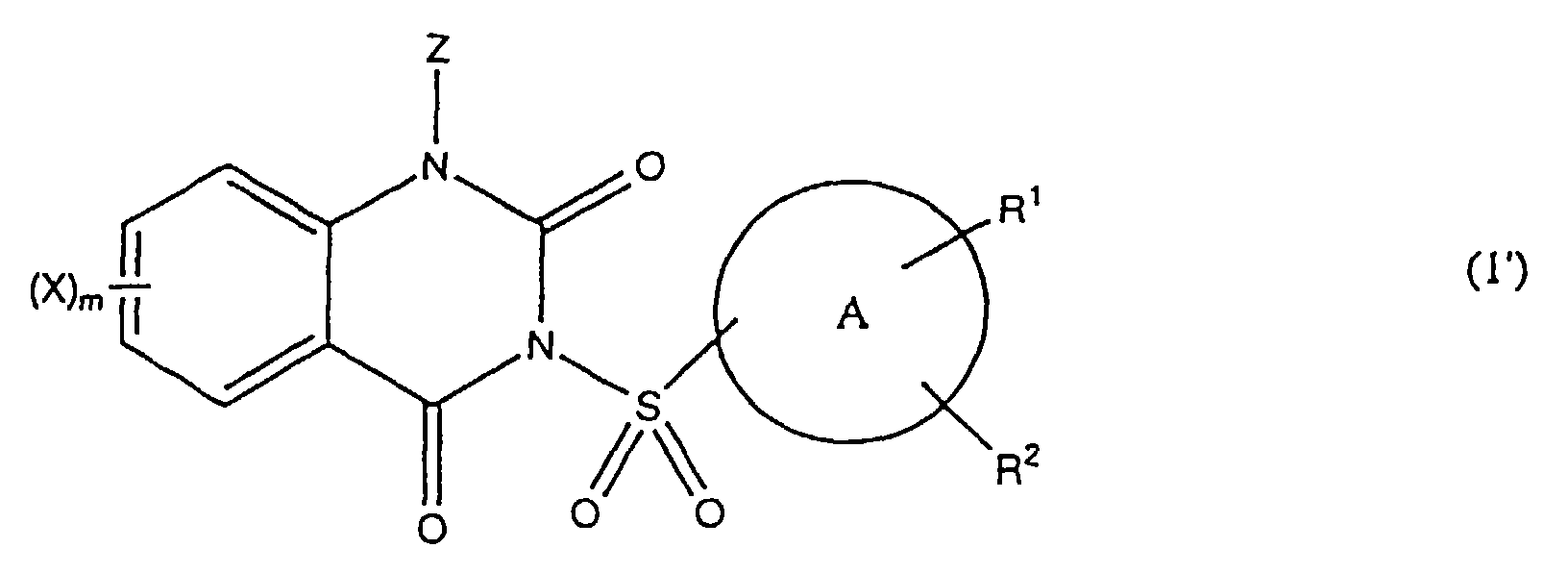
- X represents a hydroxy group, a nitro group, a halogen atom, a C1 to C4 lower alkyl group which may be substituted with a halogen atom, a C1 to C4 lower alkoxy group which may be substituted with a halogen atom or C7 to C12 aralkyloxy group, or X together with the benzene ring which is shown as substituted with said X represents a group forming a naphthalene ring or a quinoline ring,
- R1 and R2 are the same or different and represent a hydrogen atom, a halogen atom, a C1 to C4 lower alkyl group which may be substituted with a halogen atom, a nitro group, a cyano group, a pyrazolyl group, a tetrazolyl group, a carboxyl group which may be esterified with a C1 to C4 lower alkyl group or an allyl group, or a C1 to C4 lower alkoxy group which may be substituted with one or more substituent groups selected from the group consisting of a halogen atom, a morpholino group, a phenylpiperazinyl group, and a carboxyl group which may be esterified with a C1 to C4 lower alkyl group or an allyl group, or R1 and R2 together with the benzene ring which is shown as substituted with said R1 and R2, represent a group forming a naphthalene ring or a quinoline ring.
- Z represents a hydrogen atom, a C1 to C4 lower alkyl group which may be substituted with a halogen atom, a C2 to C5 alkenyl group, an unsubstituted or substituted aralkyl group, an unsubstituted or substituted aromatic heterocyclic alkyl group, a carboxymethyl group which may be esterified with a C1 to C4 lower alkyl group or an allyl group, a carbonylmethyl group which is amidized with a primary or secondary or cyclic amine, an unsubstituted or substituted arylcarbonylmethyl group, or an unsubstituted or substituted aralkyloxymethyl group,
- when the ring A represents a benzene ring, Z represents a hydrogen atom and m represents 0, R1 and R2 do not simultaneously represent a hydrogen atom;
- when the ring A represents a benzene ring, Z represents a hydrogen atom, m represents 0 and one of R1 or R2 is a hydrogen atom, the other of R1 or R2 represents neither a methyl group nor a chlorine atom;
- and when the ring A represents a benzene ring, Z represents a hydrogen atom, m represents 1 and R1 and R2 simultaneously represent a hydrogen atom, X does not represent a chlorine atom, useful as the above pharmaceutical composition, chymase inhibitor, and medicament for the prevention or treatment of cardiac and circulatory system diseases derived from the abnormal exacerbation of angiotensin II production.
- In the general formula (1'), the preferable examples of the halogen atom for X are fluorine, chlorine, bromine, or iodine. The examples of the lower alkyl group of the C1 to C4 lower alkyl group for X, which is substituted with a halogen atom, are straight chain alkyl groups such as a methyl group, ethyl group, n-propyl group and n-butyl group, and branched alkyl groups such as an isopropyl group, sec-butyl group and t-butyl group, and, while the examples of the halogen atom of the C1 to C4 lower alkyl group for X which is substituted with a halogen atom, are fluorine, chlorine, bromine and iodine. The examples of the lower alkoxy group of the C1 to C4 lower alkoxy group for X, which is substituted with a halogen atom, are straight chain alkoxy groups such as a methoxy group, ethoxy group, n-propoxy group and n-butoxy group, and branched alkoxy groups such as an isopropoxy group, sec-butoxy group and t-butoxy group, while the examples of the halogen atom of the C1 to C4 lower alkoxy group for X, which is substituted with a halogen atom, are fluorine, chlorine, bromine, and iodine. The examples of the C7 to C12 aralkyloxy group for X are a benzyloxy group, phenethyloxy group, phenylpropoxy group and naphthylethyloxy group, etc, preferably the benzyloxy group.
- The preferable examples of the halogen atom for R1 or R2 are fluorine, chlorine, bromine, or iodine. The examples of the lower alkyl group of the C1 to C4 lower alkyl group for R1 or R2, which is substituted with a halogen atom, are straight chain alkyl groups such as a methyl group, ethyl group, n-propyl group and n-butyl group, and branched alkyl groups such as an isopropyl group, sec-butyl group and t-butyl group, while the examples of the halogen atom of the C1 to C4 lower alkyl group for R1 or R2, which is substituted with a halogen atom, are fluorine, chlorine, bromine, or iodine. The preferable examples of the C1 to C4 lower alkyl group of the carboxyl group for R1 or R2, which may be esterified with the C1 to C4 lower alkyl group or an allyl group, are straight chain alkyl groups such as a methyl group, ethyl group, n-propyl group and n-butyl group, and branched alkyl groups such as an isopropyl group, sec-butyl group and t-butyl group. The examples of the alkoxy group of the C1 to C4 lower alkoxy group for R1 or R2, which is substituted with one or more substituent groups selected from the group consisting of a halogen atom, a morpholino group, a phenylpiperazinyl group, and a carboxyl group which may be esterified with a C1 to C4 lower alkyl group or an allyl group, are straight chain alkoxy groups such as a methoxy group, ethoxy group, n-propoxy group and n-butoxy group, and branched alkoxy groups such as an isopropoxy group, sec-butoxy group and t-butoxy group. The examples of the halogen atom shown as the above substituent group, are fluorine, chlorine, bromine, or iodine and the preferable examples of the C1 to C4 lower alkyl group of the carboxyl group which is esterified with a C1 to C4 lower alkyl group or an ally] group shown as the above substituent group, are a methyl group, ethyl group, n-propyl group, n-butyl group, and other straight chain alkyl groups and an isopropyl group, sec-butyl group, t-butyl group, and other branched alkyl groups.
- The examples of the lower alkyl group of the C1 to C4 lower alkyl group shown as Z which may be substituted with halogen, are straight chain alkyl groups such as a methyl group, ethyl group, n-propyl group and n-butyl group, and branched alkyl groups such as an isopropyl group, sec-butyl group and t-butyl group, while the examples of the halogen atom of the C1 to C4 lower alkyl group which may be substituted with the halogen atom are fluorine, chlorine, bromine, or iodine. The examples of the C2 to C5 alkenyl group for Z are an allyl group, propenyl group, isopropenyl group, butenyl group, etc.
- The examples of the aralkyl group of an unsubstituted or substituted aralkyl group shown as Z are a C7 to C12 aralkyl group, preferably a benzyl group, phenethyl group, phenylpropyl group, or naphthylethyl group. The preferable examples of the substituent group of an unsubstituted or substituted aralkyl group are a carboxyl group which may be esterified with a C1 to C4 lower alkyl group or an allyl group, a cyano group, a nitro group, a carbonyl group amidized with primary amine, an amine group which may be amidized with a carboxylic acid or an amino acid, and a guanidino group which may be substituted with a lower alkoxycarbonyl group. The examples of the lower alkyl group of the carboxyl group, which may be esterified with a C1 to C4 lower alkyl group or an ally] group are straight alkyl groups such as a methyl group, ethyl group, n-propyl group and n-butyl group, and branched alkyl groups such as an isopropyl group, sec-butyl group and t-butyl group. The examples of the primary amine of the carbonyl group amidized with primary amine are a chain C1 to C4 lower alkylamine or those which may be substituted with carboxyl group, such as, preferably, methylamine, ethylamine, isopropylamine and carboxylmethylamine; amines having monocyclic or polycyclic aromatic hydrocarbon group such as aniline and naphthylamine; amines having aromatic heterocyclic group such as aminopyridine, aminopyrrole, and other. The examples of the carboxylic acid of the amine group which may be amidized with a carboxylic acid or an amino acid are preferably C2 to C5 aliphatic monocarboxylic acids or aliphatic dicarboxylic acids such as pivalic acid and succinic acid, while the examples of the amino acid are amino acids, of which carboxyl group may be esterified or of which amine group may be amidized, such as L-aspartic acid, α-O-t-butyl-N-t-butoxycarbonyl-L-aspartic acid and other. The examples of the guanidino group which may be substituted with a lower alkoxycarbonyl group are preferably a guadinino group which may be substituted with a C2 to C5 lower alkoxycarbonyl group such as a guanidino group and 2, 3-bis-t-butoxycarbonylguanidino group.
- The examples of the aromatic heterocyclic alkyl group of an unsubstituted or substituted aromatic heterocyclic alkyl group shown as Z are thienylalkyl groups such as a 2-thenyl group and a 2-thienylethyl group, furylalkyl groups such as a 2-furfuryl group and a 2-furylethyl group, pyridylalkyl groups such as a 2-pyridylmethyl group, 3-pyridylmethyl group, 4-pyridylmethyl group and 4-pyridylethyl group, pyrimidinylalkyl groups such as a 5-pyrimidinylmethyl group, pyrazinylalkyl groups such as a 2-pyrazinylmethyl group, pyridazinylalkyl groups such as a 3-pyridazinylmethyl group tetrazolylalkyl groups such as a 5-tetrazolylmethyl group, isothiazolylalkyl groups such as a 4-isothiazolylmethyl group and a 5-isothiazolylmethyl group, thiazolylalkyl groups such as a 5-thiazolylmethyl group, oxazolylalkyl groups such as a 5-oxazolylmethyl group, and isoxazolylalkyl groups such as a 4-isooxazolylmethyl group and 5-isoxazolylmethyl group. The preferable examples of the substituent group of an unsubstituted or substituted heterocyclic alkyl group, are C1 to C4 lower alkyl groups such as a methyl group and ethyl group, and C1 to C4 carboxyl lower alkyl groups such as a carboxylmethyl group and carboxylethyl group.
- The examples of the lower alkyl group of the carboxymethyl group which may be esterified with a C1 to C4 lower alkyl group or an allyl group shown as Z are straight chain alkyl groups such as a methyl group, ethyl group, n-propyl group and n-butyl group, and branched alkyl groups such as an isopropyl group, sec-butyl group and t-butyl group.
- The examples of the primary amine of the carbonylmethyl group which may be amidized with primary or secondary or cyclic amine shown as Z are chain C1 to C4 lower alkylamines or those which may be substituted with a carboxyl group such as preferably methylamine, ethylamine, isopropylamine and carboxylmethylamine, and amines having monocyclic saturated hydrocarbon group such as a cyclohexylamine, and amines having monocyclic or polycyclic aromatic hydrocarbon group such as aniline, a benzylamine and a naphthylamine, and amines having aromatic heterocyclic group such as an aminopyridine, an aminomethylpyridine, an aminopyrrole, an aminopyrimidine, an aminoindole and aminoquinoline, wherein the amines having aromatic hydrocarbon group or aromatic heterocyclic group may have on its ring one or more substituent such as
- 1) hydroxy group,
- 2) -OPO(OH)2,
- 3) amino group,
- 4) oxo group,
- 5) halogen atom,
- 6) carboxyl group, which may be esterified with C1 to C4 lower alkyl group such as a methyl group, an ethyl group, an isopropyl group and a t-butyl group, or an allyl group,
- 7) straight chain or branched C1 to C4 lower alkoxy group such as a methoxy group, an ethoxy group, a n-propoxy group and t-butoxy group, which may be substituted with a carboxyl group, which may be esterified with a C1 to C4 lower alkyl group such as a methyl group, an ethyl group, an isopropyl group and a t-butyl group, or an allyl group,
- 8) straight chain or branched C1 to C4 lower alkyl groups such as a methyl group, an ethyl group, a n-propyl group, a n-butyl group, an isopropyl group, a sec-butyl group, and t-butyl group, which may be substituted.
- Further, the preferable examples of the substituent of the C1 to C4 lower alkyl group, which may be substituted, of the above 8),
- a) a carboxyl group, which may be esterified with C1 to C4 lower alkyl group such as a methyl group, an ethyl group, an isopropyl group and a t-butyl group, or an allyl group,
- b) piperadinyl group, which may be N-substituted with carboxy group which is esterified with C1 to C4 lower alkyl group such as a methyl group, an ethyl group, an isopropyl group and a t-butyl group, or an allyl group,
- c) morpholino group, and
- d) amino group which may be amidized with carboxylic acid or amino acid
- The examples of the carboxylic acid of amino group of the above d), which may be amidized with carboxylic acid or amino acid, are preferably C2 to C5 aliphatic mono- or di- carboxylic acids such as pivalic acid and succinic acid, while the examples of the amino acid are amino acids of which carboxyl group may be esterified or of which amino group may be amidized, such as a L-aspartic acid, an α-O-t-butyl-N-t-butoxycarbonyl-L-aspartic acid, and a β-O-t-butyl-N-t-butoxycarbonyl-L-aspartic acid. Further, the amine having aromatic heterocyclic group may have the nitrogen atom on its ring, which may be substituted with C1 to C4 lower alkyl group such as a methyl group, and an ethyl group, or carboxy lower alkyl group, which may be esterified, such as a carboxylmethyl group and a t-butoxy carbonylmethyl group.
- The examples of the secondary amine of the carbonylmethyl group shown as Z, which is amidized with primary or secondary or cyclic amine are di-lower alkylamines such as a dimethylamine and diethylamine. The examples of the cyclic amine of the carbonylmethyl group shown as Z, which is amidized with primary or secondary or cyclic amine are pyrrolidine and piperidine.
- The examples of the arylcarbonylmethyl group of the unsubstituted or substituted arylcarbonylmethyl group shown as Z are a phenylcarbonylmethyl group and a naphthylcarbonylmethyl group, while the preferable examples of the substituent group are a hydroxy group, a nitro group, halogen atoms such as fluorine, chlorine, bromine and iodine, straight or branched C1 to C4 lower alkyl groups, which may be substituted with halogen atom such as methyl group, ethyl group, n-propyl group, n-butyl group, isopropyl group, sec-butyl group and t-butyl group, straight or branched C1 to C4 lower alkoxy groups, which may be substituted with halogen atom, such as methoxy group, ethoxy group, n-propoxy group, n-butoxy group, isopropoxy group, sec-butoxy group and t-butoxy group.
- The examples of the aralkyloxymethyl group of the unsubstituted or substituted aralkyloxymethyl group shown as Z, are preferably C8 to C13 aralkyloxymethyl groups such as a benzyloxy methyl group, phenethyloxymethyl group and naphthylethyloxymethyl group, while the preferable examples of the substituent group are a hydroxy group, a nitro group, halogen atoms such as fluorine, chlorine, bromine and iodine, straight or branched C1 to C4 lower alkyl groups which may be substituted with halogen atom, such as methyl group, ethyl group, n-propyl group, n-butyl group, isopropyl group, sec-butyl group and t-butyl group, straight or branched C1 to C4 lower alkoxy groups, which may be substituted with halogen atom, such as methoxy group, ethoxy group, n-propoxy group, n-butoxy group, isopropoxy group, sec-butoxy group and t-butoxy group.
- Further, the examples of a pharmaceutically acceptable salt are acid salts such as a chlorate and nitrate and alkali metal salts such as a sodium salt, potassium salt.
- Further, according to the present invention, there is provided a novel quinazoline derivative, and its pharmaceutically acceptable salts, having the general formula (1a):

- R1 and R2 are the same or different and represent a hydrogen atom, a halogen atom, a C1 to C4 lower alkyl group which may be substituted with a halogen atom, a nitro group, a cyano group, a pyrazolyl group, a tetrazolyl group, a carboxyl group which may be esterified with a C1 to C4 lower alkyl group or an allyl group, or a C1 to C4 lower alkoxy group which may be substituted with one or more substituent groups selected from the group consisting of a halogen atom, a morpholino group, a phenylpiperazinyl group, and a carboxyl group which may be esterified with a C1 to C4 lower alkyl group or an allyl group, or, R1 and R2 together with the benzene ring which is shown as substituted with said R1 and R2 represent a group forming a naphthalene ring or a quinoline ring,
- Z represents a hydrogen atom, a C1 to C4 lower alkyl group which may be substituted with a halogen atom, a C2 to C5 alkenyl group, an unsubstituted or substituted aralkyl group, an unsubstituted or substituted aromatic heterocyclic alkyl group, a carboxymethyl group which may be esterified with a C1 to C4 lower alkyl group or an allyl group, a carbonylmethyl group which is amidized with a primary or secondary or cyclic amine, an unsubstituted or substituted arylcarbonylmethyl group, or an unsubstituted or substituted aralkyloxymethyl group, useful as the above pharmaceutical composition, chymase inhibitor, and medicament for the prevention or treatment of cardiac and circulatory system diseases derived from abnormal exacerbation of angiotensin II production and a pharmaceutical composition, chymase inhibitor, and medicament for the prevention or treatment of cardiac and circulatory system diseases derived from abnormal exacerbation of angiotensin II production containing the same as effective ingredients.
- In general formula (1a), the preferable examples of the halogen atom for X are fluorine, chlorine, bromine, or iodine. The examples of the lower alkyl group of the C1 to C4 lower alkyl group for X, which is substituted with a halogen atom, are straight chain alkyl groups such as a methyl group, ethyl group, n-propyl group and n-butyl group, and branched alkyl groups such as an isopropyl group, sec-butyl group and t-butyl group, and, while the examples of the halogen atom of the C1 to C4 lower alkyl group for X which is substituted with a halogen atom, are fluorine, chlorine, bromine and iodine. The examples of the lower alkoxy group of the C1 to C4 lower alkoxy group for X, which is substituted with a halogen atom, are straight chain alkoxy groups such as a methoxy group, ethoxy group, n-propoxy group and n-butoxy group, and branched alkoxy groups such as an isopropoxy group, sec-butoxy group and t-butoxy group, while the examples of the halogen atom of the C1 to C4 lower alkoxy group for X, which is substituted with a halogen atom, are fluorine, chlorine, bromine, and iodine. The examples of the C7 to C12 aralkyloxy group for X are a benzyloxy group, phenethyloxy group, phenylpropoxy group and naphthylethyloxy group, etc, preferably the benzyloxy group.
- The preferable examples of the halogen atom for R1 or R2 are fluorine, chlorine, bromine, or iodine. The examples of the lower alkyl group of the C1 to C4 lower alkyl group for R1 or R2, which is substituted with a halogen atom, are straight chain alkyl groups such as a methyl group, ethyl group, n-propyl group and n-butyl group, and branched alkyl groups such as an isopropyl group, sec-butyl group and t-butyl group, while the examples of the halogen atom of the C1 to C4 lower alkyl group for R1 or R2, which is substituted with a halogen atom, are fluorine, chlorine, bromine, or iodine. The preferable examples of the C1 to C4 lower alkyl group of the carboxyl group for R1 or R2, which may be esterified with the C1 to C4 lower alkyl group or an allyl group, are straight chain alkyl groups such as a methyl group, ethyl group, n-propyl group and n-butyl group, and branched alkyl groups such as an isopropyl group, sec-butyl group and t-butyl group. The examples of the alkoxy group of the C1 to C4 lower alkoxy group for R1 or R2, which is substituted with one or more substituent groups selected from the group consisting of a halogen atom, a morpholino group, a phenylpiperazinyl group, and a carboxyl group which may be esterified with a C1 to C4 lower alkyl group or an allyl group, are straight chain alkoxy groups such as a methoxy group, ethoxy group, n-propoxy group and n-butoxy group, and branched alkoxy groups such as an isopropoxy group, sec-butoxy group and t-butoxy group. The examples of the halogen atom shown as the above substituent group, are fluorine, chlorine, bromine, or iodine and the preferable examples of the C1 to C4 lower alkyl group of the carboxyl group which is esterified with a C1 to C4 lower alkyl group or an allyl group shown as the above substituent group, are a methyl group, ethyl group, n-propyl group, n-butyl group, and other straight chain alkyl groups and an isopropyl group, sec-butyl group, t-butyl group, and other branched alkyl groups.
- The examples of the lower alkyl group of the C1 to C4 lower alkyl group shown as Z which may be substituted with halogen, are straight chain alkyl groups such as a methyl group, ethyl group, n-propyl group and n-butyl group, and branched alkyl groups such as an isopropyl group, sec-butyl group and t-butyl group, while the examples of the halogen atom of the C1 to C4 lower alkyl group which may be substituted with the halogen atom are fluorine, chlorine, bromine, or iodine. The examples of the C2 to C5 alkenyl group for Z are an allyl group, propenyl group, isopropenyl group, butenyl group, etc.
- The examples of the aralkyl group of an unsubstituted or substituted aralkyl group shown as Z are a C7 to C12 aralkyl group, preferably a benzyl group, phenethyl group, phenylpropyl group, or naphthylethyl group. The preferable examples of the substituent group of an unsubstituted or substituted aralkyl group are a carboxyl group which may be esterified with a C1 to C4 lower alkyl group or an allyl group, a cyano group, a nitro group, a carbonyl group amidized with primary amine, an amine group which may be amidized with a carboxylic acid or an amino acid, and a guanidino group which may be substituted with a lower alkoxycarbonyl group. The examples of the lower alkyl group of the carboxyl group, which may be esterified with a C1 to C4 lower alkyl group or an allyl group are straight alkyl groups such as a methyl group, ethyl group, n-propyl group and n-butyl group, and branched alkyl groups such as an isopropyl group, sec-butyl group and t-butyl group. The examples of the primary amine of the carbonyl group amidized with primary amine are a chain C1 to C4 lower alkylamine or those which may be substituted with carboxyl group, such as, preferably, methylamine, ethylamine, isopropylamine and carboxylmethylamine; amines having monocyclic or polycyclic aromatic hydrocarbon group such as aniline and naphthylamine; amines having aromatic heterocyclic group such as aminopyridine, aminopyrrole, and other. The examples of the carboxylic acid of the amine group which may be amidized with a carboxylic acid or an amino acid are preferably C2 to C5 aliphatic monocarboxylic acids or aliphatic dicarboxylic acids such as pivalic acid and succinic acid, while the examples of the amino acid are amino acids, of which carboxyl group may be esterified or of which amine group may be amidized, such as L-aspartic acid, α-O-t-butyl-N-t-butoxycarbonyl-L-aspartic acid and other. The examples of the guanidino group which may be substituted with a lower alkoxycarbonyl group are preferably a guadinino group which may be substituted with a C2 to C5 lower alkoxycarbonyl group such as a guanidino group and 2, 3-bis-t-butoxycarbonylguanidino group.
- The examples of the aromatic heterocyclic alkyl group of an unsubstituted or substituted aromatic heterocyclic alkyl group shown as Z are thienylalkyl groups such as a 2-thenyl group and a 2-thienylethyl group, furylalkyl groups such as a 2-furfuryl group and a 2-furylethyl group, pyridylalkyl groups such as a 2-pyridylmethyl group, 3-pyridylmethyl group, 4-pyridylmethyl group and 4-pyridylethyl group, pyrimidinylalkyl groups such as a 5-pyrimidinylmethyl group, pyrazinylalkyl groups such as a 2-pyrazinylmethyl group, pyridazinylalkyl groups such as a 3-pyridazinylmethyl group tetrazolylalkyl groups such as a 5-tetrazolylmethyl group, isothiazolylalkyl groups such as a 4-isothiazolylmethyl group and a 5-isothiazolylmethyl group, thiazolylalkyl groups such as a 5-thiazolylmethyl group, oxazolylalkyl groups such as a 5-oxazolylmethyl group, and isoxazolylalkyl groups such as a 4-isooxazolylmethyl group and 5-isoxazolylmethyl group. The preferable examples of the substituent group of an unsubstituted or substituted heterocyclic alkyl group, are C1 to C4 lower alkyl groups such as a methyl group and ethyl group, and C1 to C4 carboxyl lower alkyl groups such as a carboxylmethyl group and carboxylethyl group.
- The examples of the lower alkyl group of the carboxymethyl group which may be esterified with a C1 to C4 lower alkyl group or an ally] group shown as Z are straight chain alkyl groups such as a methyl group, ethyl group, n-propyl group and n-butyl group, and branched alkyl groups such as an isopropyl group, sec-butyl group and t-butyl group.
- The examples of the primary amine of the carbonylmethyl group which may be amidized with primary or secondary or cyclic amine shown as Z are chain C1 to C4 lower alkylamines or those which may be substituted with a carboxyl group such as preferably methylamine, ethylamine, isopropylamine and carboxylmethylamine, and amines having monocyclic saturated hydrocarbon group such as a cyclohexylamine, and amines having monocyclic or polycyclic aromatic hydrocarbon group such as aniline, a benzylamine and a naphthylamine, and amines having aromatic heterocyclic group such as an aminopyridine, an aminomethylpyridine, an aminopyrrole, an aminopyrimidine, an aminoindole and aminoquinoline, wherein the amines having aromatic hydrocarbon group or aromatic heterocyclic group may have on its ring one or more substituent such as
- 1) hydroxy group,
- 2) -OPO(OH)2,
- 3) amino group,
- 4) oxo group,
- 5) halogen atom,
- 6) carboxyl group, which may be esterified with C1 to C4 lower alkyl group such as a methyl group, an ethyl group, an isopropyl group and a t-butyl group, or an allyl group,
- 7) straight chain or branched C1 to C4 lower alkoxy group such as a methoxy group, an ethoxy group, a n-propoxy group and t-butoxy group, which may be substituted with a carboxyl group, which may be esterified with a C1 to C4 lower alkyl group such as a methyl group, an ethyl group, an isopropyl group and a t-butyl group, or an allyl group,
- 8) straight chain or branched C1 to C4 lower alkyl groups such as a methyl group, an ethyl group, a n-propyl group, a n-butyl group, an isopropyl group, a sec-butyl group, and t-butyl group, which may be substituted.
- Further, the preferable examples of the substituent of the C1 to C4 lower alkyl group, which may be substituted, of the above 8),
- a) a carboxyl group, which may be esterified with C1 to C4 lower alkyl group such as a methyl group, an ethyl group, an isopropyl group and a t-butyl group, or an allyl group,
- b) piperadinyl group, which may be N-substituted with carboxy group which is esterified with C1 to C4 lower alkyl group such as a methyl group, an ethyl group, an isopropyl group and a t-butyl group, or an allyl group,
- c) morpholino group, and
- d) amino group which may be amidized with carboxylic acid or amino acid
- The examples of the carboxylic acid of amino group of the above d), which may be amidized with carboxylic acid or amino acid, are preferably C2 to C5 aliphatic mono- or di- carboxylic acids such as pivalic acid and succinic acid, while the examples of the amino acid are amino acids of which carboxyl group may be esterified or of which amino group may be amidized, such as a L-aspartic acid, an α-O-t-butyl-N-t-butoxycarbonyl-L-aspartic acid, and a β-O-t-butyl-N-t-butoxycarbonyl-L-aspartic acid. Further, the amine having aromatic heterocyclic group may have the nitrogen atom on its ring, which may be substituted with C1 to C4 lower alkyl group such as a methyl group, and an ethyl group, or carboxy lower alkyl group, which may be esterified, such as a carboxylmethyl group and a t-butoxy carbonylmethyl group.
- The examples of the secondary amine of the carbonylmethyl group shown as Z, which is amidized with primary or secondary or cyclic amine are di-lower alkylamines such as a dimethylamine and diethylamine. The examples of the cyclic amine of the carbonylmethyl group shown as Z, which is amidized with primary or secondary or cyclic amine are pyrrolidine and piperidine.
- The examples of the arylcarbonylmethyl group of the unsubstituted or substituted arylcarbonylmethyl group shown as Z are a phenylcarbonylmethyl group and a naphthylcarbonylmethyl group, while the preferable examples of the substituent group are a hydroxy group, a nitro group, halogen atoms such as fluorine, chlorine, bromine and iodine, straight or branched C1 to C4 lower alkyl groups, which may be substituted with halogen atom such as methyl group, ethyl group, n-propyl group, n-butyl group, isopropyl group, sec-butyl group and t-butyl group, straight or branched C1 to C4 lower alkoxy groups, which may be substituted with halogen atom, such as methoxy group, ethoxy group, n-propoxy group, n-butoxy group, isopropoxy group, sec-butoxy group and t-butoxy group.
- The examples of the aralkyloxymethyl group of the unsubstituted or substituted aralkyloxymethyl group shown as Z, are preferably C8 to C13 aralkyloxymethyl groups such as a benzyloxy methyl group, phenethyloxymethyl group and naphthylethyloxymethyl group, while the preferable examples of the substituent group are a hydroxy group, a nitro group, halogen atoms such as fluorine, chlorine, bromine and iodine, straight or branched C1 to C4 lower alkyl groups which may be substituted with halogen atom, such as methyl group, ethyl group, n-propyl group, n-butyl group, isopropyl group, sec-butyl group and t-butyl group, straight or branched C1 to C4 lower alkoxy groups, which may be substituted with halogen atom, such as methoxy group, ethoxy group, n-propoxy group, n-butoxy group, isopropoxy group, sec-butoxy group and t-butoxy group.
- Further, the examples of a pharmaceutically acceptable salt are acid salts such as a chlorate and nitrate and alkali metal salts such as a sodium salt, potassium salt.
- Among the quinazoline derivatives of general formulae (1), (1'), and (1a) of the present invention, the compounds where both of R1 and R2 are other than a carboxyl group and Z is a hydrogen atom, an unsubstituted or substituted aromatic heterocyclic alkyl group, or an unsubstituted or substituted aralkyl group may be synthesized for example by the Synthesis Method (A) or Synthesis Method (B) shown below.
- A compound having the formula (2):

the formula (2a):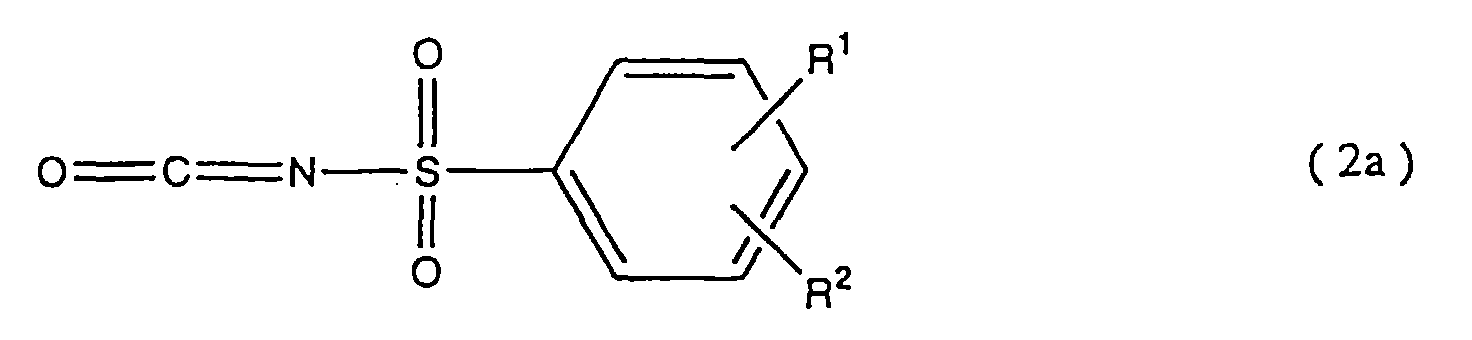

the formula (3a):

or the formula (4'a):

the formula (4a):
- The compound having the formula (2) or (2a) used in this reaction may include a commercially available one or one synthesized by a known method. For example, a compound synthesizable from a corresponding sulfonamide derivative using chlorosulfonylisocyanate by the method of synthesis described in European Patent No. 0269141 may be used. For example, benzenesulfonylisocyanate, 4-chlorobenzenesulfonylisocyanate, 2-chlorobenzenesulfonylisocyanate, 4-fluorobenzenesulfonylisocyanate, 2,5-dichlorobenzenesulfonylisocyanate, 2,6-dichlorobenzenesulfonylisocyanate, 4-chloro-2-fluorobenzenesulfonylisocyanate, p-toluenesulfonylisocyanate, 3,4-dimethylbenzenesulfonylisocyanate, 4-trifluoromethylbenzenesulfonylisocyanate, 4-nitrobenzenesulfonylisocyanate, 3-cyanobenzenesulfonylisocyanate, 4-cyanobenzenesulfonylisocyanate, 4-methoxybenzenesulfonylisocyanate, 3,4-dimethoxybenzenesulfonylisocyanate, 3-allyloxycarbonylbenzenesulfonylisocyanate, 4-allyloxycarbonylbenzenesulfonylisocyanate, 4-methoxycarbonylbenzenesulfonylisocyanate, 4-(2-allyloxycarbonylethyl)benzenesulfonylisocyanate, 4-(3-ethyloxycarbonylpropoxy) benzenesulfonylisocyanate, 1-methyl-4-ethoxycarbonylpyrazol-5-sulfonylisocyanate, etc. may be used.
- The 2-aminobenzoic acid derivative having the formula (3) or the formula (3a) used in this reaction may include a commercially available one or one synthesized by a known method. For example, 2-aminobenzoic acid and derivatives thereof having, as its substituent group (X)m or X, a 4-chloro group, 4-fluoro group, 5-fluoro group, 5-chloro group, 5-trifluoromethyl group, 6-methyl group, 5-methyl group, 3-methyl group, 4-methyl group, 4-ethyl group, 5-ethyl group, 4-n-propyl group, 5-n-propyl group, 4-iso-propyl group, 5-iso-propyl group, 3-methoxy group, 4-methoxy group, 5-methoxy group, 4-ethoxy group, 5-ethoxy group, 4-nitro group, 5-nitro group, 3,4-dimethyl group, 3,4-dimethoxy group, 4,5-dimethoxy group, 3,4-diethoxy group, 4,5-diethoxy group, 4-benzyloxy group or 5-benzyloxy group, and 3-amino-2-naphthalic acid etc. may be used.
- Further, the compounds having the formula (3) or the formula (3a) where Z' represents an unsubstituted or substituted aralkyl group, or an unsubstituted or substituted aromatic heterocyclic alkyl group, may be obtained by reductively N-alkylating a compound having the formula (3) or the formula (3a) where Z' represents hydrogen, using an arylaldehyde or aromatic heterocyclic aldehyde. The arylaldehyde or aromatic heterocyclic aldehyde used in the above method may include a commercially available one or one synthesized by a known method. For example, 2-allyloxycarbonylbenzaldehyde, 2-pyridinecarboxyaldehyde, 3-pyridinecarboxyaldehyde, 4-pyridinecarboxyaldehyde, 2-furancarboxyaldehyde, 2-thiophencarboxyaldehyde, 5-pyrimidinecarboxyaldehyde, 2-pyradinecarboxyaldehyde, 3-pyridazinecarboxyaldehyde, 5-tetrazolecarboxyaldehyde, 4-isothiazolecarboxyaldehyde, 5-isothiazolecarboxyaldehyde, 5-thiazolecarboxyaldehyde, 5-oxazolecarboxyaldehyde, 4-isoxazolecarboxyaldehyde, 5-isoxazolecarboxyaldehyde, etc. may be used.
- The reaction for closing the quinazoline ring from the urea derivative of the formula (4) or (4a) may be performed using an aprotic solvent, for example, ether solvents such as tetrahydrofuran and dioxane, halogen solvents such as methylene chloride or dimethylformamide etc. at a temperature of -50°C to 50°C, preferably -20°C to room temperature. Further, for the ring closing reaction, an ordinary dehydrocondensation agent, for example, carbonyldiimidazole, DCC, and similar carbodiimide compounds, mixed acid anhydrides, etc. may be used.
- A compound having the formula (5):

the formula (5a):
and a 2-aminobenzoic acid ester derivative having the formula (6):
the formula (6a):
are condensed using, for example, 1,8-diazabicyclo[5,4,0]-7-undecene (hereinafter referred to as DBU) to form a urea derivative methylester, then this is saponified by an alkali to derive the urea derivative having the formula (4) or the formula (4a), then in the same way as in Synthesis Method (A) the quinazoline ring is closed. - The compound of the formula (5) or (5a) used in this reaction may include a commercially available one or one synthesized by a known method. For example, 8-quinoline sulfonamide, 4-toluenesulfonamide, 2-cyanobenzenesulfonamide, 4-chloro-2-cyanobenzenesulfonamide, 4-aminobenzenesulfonamide, 4-acetylbenzenesulfonamide, 4-(5-tetrazole)benzenesulfonamide, 3-pyridinesulfonamide, 2-pyrrolesulfonamide, 1-methyl-2-pyrrolesulfonamide, 3-methyl-4-imidazolesulfonamide, 4-(3-pyrazolyl)benzenesulfonamide, 4-[2-(4-phenyl-1-piperazinyl)ethyloxy]benzenesulfonamide, 4-[2-(1-morpholyl)ethyloxy]benzenesulfonamide, 4-[2-(1-pyrrolidinyl)ethyloxy]benzenesulfonamide, 4-[2-(1-piperizinyl)ethyloxy]benzenesulfonamide, etc. may be used.
- The 2-aminobenzoic acid ester derivative of the formula (6) or (6a) used in this reaction may include one which is commercially available or known or can be synthesized by known methods, for example, methyl 4-chloro-2-phenoxycarbonylaminobenzoate, ethyl 4-chloro-2-phenoxycarbonylaminobenzoate, methyl 2-phenoxycarbonylaminobenzoate, ethyl 2-phenoxycarbonylaminobenzoate, etc.
- The reaction for causing condensation of the compound having the formula (5) or (5a) and the 2-aminobenzoate derivative having the formula (6) or (6a) to obtain a urea derivative methylester may be performed using an aprotic solvent, for example, ether solvents such as tetrahydrofuran and dioxane, halogen solvents such as methylene chloride, or dimethylformamide, etc. at a temperature of -50°C to 50°C, preferably -20°C to room temperature. Further, as the base used in the condensation reaction, organic strong bases such as DBU, inorganic bases such as potassium carbonate, sodium carbonate, potassium hydroxide and sodium hydroxide, or lithium bases such as sodium hydride can be used.
- In the reaction for saponification by an alkali of the resultant urea derivative methylester to obtain the formula (4) or (4a) urea derivative, the usual hydrolysis conditions for esters may be used.
- Among the quinazoline derivatives having the formula (1), (1'), and (1a), compounds where Z represents a C1 to C4 lower alkyl group which may be substituted with halogen, a C2 to C5 alkenyl group, an unsubstituted or substituted aralkyl group, an unsubstituted or substituted arylcarbonylmethyl group, or an unsubstituted or substituted aralkyloxymethyl group, can, for example, be synthesized by treating the compound where Z represents a hydrogen atom, synthesized in accordance with the above-mentioned Synthesis Method (A) or (B), to alkylation, alkenylation, aralkylation, arylcarbonylmethylation, or aralkyloxymethylation using sodium hydride and a halogenated alkyl, halogenated alkenyl, halogenated aralkyl, halogenated arylcarbonylmethyl, or halogenated aralkyloxymethyl.
- Among the above-mentioned compounds, those compounds where Z is a pyridylalkyl group and among the compounds where Z is a carbonylmethyl group which is amidized with a primary or secondary or cyclic amine, the compounds where the primary amine is an amine having aromatic heterocyclic group can have the nitrogen atom on the ring quaternized by a usual technique using alkylating agents such as a halogenated alkyl and a halogenated acetic acid ester.
- Further, the substituent group represented by Z in the compounds obtained above may further be suitably modified by known methods. For example, among the compounds where the above-mentioned Z is carbonylmethyl group amidized with a primary or secondary or cyclic amine when Z is a carbonylmethyl group, which is amidized with amine having an aromatic hydrocarbon group and there is a hydroxy group as the substituent group on its ring, N,N'-diethyl-1,5-dihydro-2,4,3-benzodioxaphosphepin-3-amine and other phosphatizing agent may be used to make a phosphoric acid ester.
- Note that the above reaction may be performed while protecting the functional groups not involved in the reaction. For example, it may be performed by the step of introducing a carboxymethyl group into a compound where Z is a hydrogen atom, a step of introducing an amidized carbonylmethyl group, a step of quaternizing the nitrogen atom, and a step of introducing a phosphate group.
- Further, the protective group used above may be removed by using chemical reduction, catalytic reduction, or an ordinary agent for removing protection in accordance with the type of the protective group. For example, when the protective group is a t-butyl group or t-butoxycarbonyl group, trifluoroacetic acid may be used, while when the protective group is an allyl group, tetrakis (triphenylphosphine) palladium(O) and other palladium catalysts may be used.
- Among the quinazoline derivatives having the formula (1), (1'), and (1a), compounds where one of R1 or R2 or both of R1 and R2 are carboxyl groups, for example, can be synthesized from compounds synthesized according to the above Synthesis Method (A) or Synthesis Method (B) where one of R1 or R2 or both of R1 and R2 are an allyloxycarbonyl group by deallylation.
- Further, the pharmaceutically acceptable salts of the compound according to the present invention can be obtained by making acid salts or alkali metal salts by the ordinary method.
- The chymase inhibitive activity shown by the quinazoline derivatives of the present invention was determined by measuring the rate of conversion of Ang I to Ang II using human heart chymase refined by the method of Urata et al. (see previous reference) and using the method described in that reference (Evaluation Example 1). At the same time, further, the inhibitive activities on the serine protease cathepsin G (Evaluation Example 2) and α-chymotrypsin (Evaluation Example 3) were measured. As shown in Table I and Table II, the quinazoline derivatives of the present invention show various strengths of enzyme inhibitive activity with respect to these three types of enzymes. That is, it became clear that by combining in the formula (1) , X, R1, R2, Z, and m in various ways, chymase inhibitors with various enzyme inhibitive spectrums could be obtained.
- To use the effective ingredient of the present invention as a pharmaceutical preparation for the prevention or treatment of cardiac and circulatory system diseases derived from the abnormal exacerbation of Ang II production, one or more of the compounds of the present invention may be mixed and formed into a form suited to the method of administration by an ordinary method. Examples of preparation forms for oral administration include capsules, tablets, granules, fine granules, syrups, dry syrups, and other preparations, while examples of preparation forms for non-oral administration include injections and besides suppositories such as rectal suppositories and vaginal suppositories, transnasal preparations such as sprays and ointments, and percutaneous preparations such as tapes for percutaneous absorption. Further, in order to enhance the effects of the effective ingredients of the present invention, ACE inhibitors such as alacepril, captopril, cilazapril, which are being clinically applied may be used jointly.
- The clinical dose of the compound of the present invention varies according to the diseased condition, degree of seriousness, age, presence of complication, etc. and also varies according to its preparation form. In the case of oral administration, however, it may be dosed usually, in terms of effective ingredients, 1 to 1000 mg per adult per day, preferably 1 to 500 mg, more preferably 5 to 100 mg. In the case of non-oral administration, it is sufficient to administer 1/10 to 1/2 the amount of the case of oral administration. These dosages can be suitably adjusted in accordance with the age, the diseased condition, and the like of the patient to be dosed.
- The toxicity of the compound according to the present invention is low. For example, the acute toxicity values LD50 of the compounds of the later mentioned Examples 1 and 2, upon elapsed time of 24 hours after oral administration to male mice aged 5 weeks were not lower than 1 g/kg. This value is at least 50 times of the clinical dose envisaged, and therefore, the safety of these compounds is judged to be high.
- Okunishi et al. (see Hideki Okunishi, Naotaka Shiota, Shinji Takai, Mizuo Miyazaki, "Inflammation" (in Japanese), vol. 14, no. 3, pp. 193-197, 1994) used, as models of balloon injury of the common carotid artery, dogs having the same Ang II producing pathway as the human to study the role of chymase in restenosis after PTCA. This paper reported that when balloon injury is inflicted on the common carotid artery of beagles, hypertrophy occurs in the artery on the injured side, and so ACE and chymase on the injured artery side increase to 4.6 times and 22 times, respectively, at the enzymatic activity level, and also to 4.8 times and 3.4 times, respectively, at the mRNA level as compared with the artery on the control side. It was also described that even in the vascular histological aspect, the Ang II concentration on the injured side increases to about twice the control side. From these experimental findings, Okunishi et al. considered that when physical injury by balloon catheter is inflicted on the vascular wall, gene expression in of both chymase and ACE rises in response to such infliction, and so their enzymatic activities increase, and concluded that the fact that the enzymatic activity of chymase increases about 5 times as much as that of ACE through ACE rather increases than chymase at the mRNA level indicates that chymase plays an important part in the restenosis after PTCA.
- From this report, it is considered that topical increase the production of Ang II at the injured site, in which chymase participates, is tied, through the growth factor-like activity of Ang II, with the wandering of the smooth muscle into the tunica intima, its growth in the tunica intima, and the exacerbation of production of extracellular substrate, and consequently causes the restenosis. The quinazoline derivatives according to the present invention, as shown in the later evaluation examples, inhibit human heart chymase. This strongly suggests that the compounds according to the present invention suppress the excess production of Ang II through inhibition of the chymase activity and thereby lead to the prevention or treatment of cardiac and circulatory system diseases derived from the abnormal exacerbation of Ang II production.
- As examples of such diseases, cardiac insufficiency, hypercardia, stasis cardiac diseases, hypertension, arteriosclerosis, peripheral circulatory disorders, revasoconstriction after PCTA, diabetic renal disorders or non-diabetic renal disorders, etc. may be given as examples. These diseases are caused by enlargement of the heart or angioendothelia due to the growth factor-like activity of Ang II in the heart, peripheral arteries, and kidneys, and therefore, the quinazoline derivatives of the present invention are believed to lead to the prevention or treatment of these cardiac and circulatory system diseases through inhibition of the chymase activity.
- The present invention will now be further illustrated by, but is by no means limited to, the following Examples.
- Following Synthesis Method (A), into 200 ml of anhydrous tetrahydrofuran (hereinafter referred to as THF) was dissolved 4.90 g (22.5 mmol) of 4-chlorobenzenesulfonylisocyanate, then 3.51 g (20.5 mmol) of 2-amino-4-chlorobenzoic acid was added and the mixture was stirred at room temperature for two hours. The reaction solution was cooled by ice water, then 3.98 g (24.55 mmol) of CDI was added and the mixture was stirred under ice cooling for 30 minutes. An excess amount of water was poured into the reaction solution, then the precipitated crystal was obtained by filtration and the obtained crystal was washed by water, then was washed by ethyl acetate to obtain 5.03 g of the above-identified compound (yield 66.5%). Properties: colorless crystal, Melting point: 286-287°C, PMR (δppm, DMSO-d6): 7.12 (1H,s), 7.23 (1H,d), 7.26 (2H,d), 7.86 (1H,d), 8.17 (2H,d), 11.71 (1H,br).
- 2.00 g (9.19 mmol) of 4-chlorobenzenesulfonylisocyanate and 1.26 g (8.33 mmol) of 2-amino-6-methylbenzoic acid were treated in the same way as in Example 1 to obtain 2.50 g of the above-identified compound (yield 85.6%). Properties: colorless crystal, Melting point: >250°C, PMR (δppm, DMSO-d6): 2.56 (3H,s), 6.99 (2H,t), 7.49 (1H,t), 7.77 (2H,d), 8.20 (2H,d), 11.54 (1H,br).
- 2.75 g (12.6 mmol) of 4-chlorobenzenesulfonylisocyanate and 1.74 g (11.5 mmol) of 2-amino-5-methylbenzoic acid were treated in the same way as in Example 1 to obtain 2.47 g of the above-identified compound (yield 53.3%). Properties: colorless crystal, Melting point: 251-253°C, PMR (δppm, DMSO-d6): 2.32 (3H,s), 7.03 (1H,d), 7.48 (1H,t), 7.66 (2H,d), 7.75 (2H,d), 8.16 (2H,d), 11.53 (1H,br).
- 2.00 g (9.19 mmol) of 4-chlorobenzenesulfonylisocyanate and 1.26 g (8.33 mmol) of 2-amino-3-methylbenzoic acid were treated in the same way as in Example 1 to obtain 2.86 g of the above-identified compound (yield 98.0%). Properties: colorless crystal, Melting point: 221-225°C, PMR (δppm, DMSO-d6): 2.32 (3H,s), 7.12 (1H,t), 7.51 (1H,d), 7.72 (1H,d), 7.76 (2H,d), 8.19 (2H,d), 11.10 (1H,br).
- 1.10 g (4.15 mmol) of 4-allyloxycarbonylbenzenesulfonylisocyanate and 712 mg (4.15 mmol) of 2-amino-4-chlorobenzoic acid were treated in the same way as in Example 1 to obtain 657 mg of the above-identified compound (yield 37.6%). Properties: colorless crystal, Melting point: 130-132°C, PMR (δppm, DMSO-d6): 4.59 (2H,d), 5.18 (1H,d), 5.27 (1H,d), 5.87-5.94 (1H,m), 7.13 (1H,s), 7.22 (1H,d), 7.62-7.70 (2H,m), 7.86 (1H,d), 8.09 (2H,d), 11.63 (1H,br).
- 538 mg (1.28 mmol) of the compound 5 was dissolved in 20 ml of a THF/formic acid (9/1) mixture, then 150 mg of triphenylphosphine was added. Next, the reaction vessel was reduced in pressure and the inside replaced with nitrogen, then 150 mg of tetrakis(triphenylphosphine)palladium(0) was added and the mixture was stirred while blocked from light at room temperature for 16 hours. The reaction solution was concentrated under reduced pressure and the obtained solid was washed by dichloromethane to obtain 342 mg of the above-identified compound (yield 70.2%). Properties: colorless crystal, Melting point: >200°C, PMR (δppm, DMSO-d6): 7.13 (1H,s), 7.23 (1H,d), 7.61-7.69 (2H,m), 7.86 (1H,d), 8.05 (2H,d), 12.07 (1H,br).
- 2.00 g (9.19 mmol) of 4-chlorobenzenesulfonylisocyanate and 1.40 g (8.38 mmol) of 2-amino-3-methoxybenzoic acid were treated in the same way as in Example 1 to obtain 2.58 g of the above-identified compound (yield 84.0%). Properties: colorless crystal, Melting point: 220-222°C, PMR (δppm, DMSO-d6): 3.88 (3H,s), 7.16 (1H,t), 7.32 (1H,d), 7.43 (1H,d), 7.76 (2H,d), 8.17 (2H,d), 10.95 (1H,br).
- 1.14 g (5.49 mmol) of 3-cyanobenzenesulfonylisocyanate and 943 mg (5.50 mmol) of 2-amino-4-chlorobenzoic acid were treated in the same way as in Example 1 to obtain 399 mg of the above-identified compound (yield 20.0%). Properties: colorless crystal, Melting point: 225-226°C, PMR (δppm, DMSO-d6): 7.13 (1H,s), 7.24 (1H,d), 7.89 (2H,m), 8.24 (1H,d), 8.43 (1H,d), 8.55 (1H,s), 11.76 (1H,br).
- 582 mg (2.76 mmol) of 3,4-dimethylbenzenesulfonylisocyanate and 473 mg (2.76 mmol) of 2-amino-4-chlorobenzoic acid were treated in the same way as in Example 1 to obtain 190 mg of the above-identified compound (yield 18.9%). Properties: colorless crystal, Melting point: >250°C, PMR (δppm, DMSO-d6): 2.33 (6H,s), 7.12 (1H,s), 7.23 (1H,d), 7.43 (1H,d), 7.84-7.91 (3H,m), 11.64 (1H,br).
- 897 mg (3.69 mmol) of 3,4-dimethoxybenzenesulfonylisocyanate and 633 mg (3.69 mmol) of 2-amino-4-chlorobenzoic acid were treated in the same way as in Example 1 to obtain 512 mg of the above-identified compound (yield 35.0%). Properties: colorless crystal, Melting point: >250°C, PMR (δppm, DMSO-d6): 3.85 (3H,s), 3.88 (3H,s), 7.12 (1H,s), 7.22 (2H,d), 7.67 (1H,s), 7.77 (1H,d), 7.86 (1H,d), 11.63 (1H,br).
- 1.09 g (5.46 mmol) of benzenesulfonylisocyanate and 929 mg (5.41 mmol) of 2-amino-4-chlorobenzoic acid were treated in the same way as in Example 1 to obtain 1.27 g of the above-identified compound (yield 69.7%). Properties: colorless crystal, Melting point: 282-284°C, PMR (δppm, DMSO-d6): 7.12 (1H,s), 7.22 (1H,d), 7.68 (2H,t), 7.79 (1H,t), 7.86 (1H,d), 8.17 (2H,d), 11.66 (1H,br).
- 1.00 g (4.59 mmol) of 4-chlorobenzenesulfonylisocyanate and 698 mg (4.18 mmol) of 2-amino-5-methoxybenzoic acid were treated in the same way as in Example 1 to obtain 992 mg of the above-identified compound (yield 64.8%). Properties: colorless crystal, Melting point: 192-194°C, PMR (δppm, DMSO-d6): 3.79 (3H,s), 7.08 (1H,d), 7.30 (2H,m), 7.75 (2H,d), 8.16 (2H,d), 11.48 (1H,br).
- 1.13 g (4.95 mmol) of 4-nitrobenzenesulfonylisocyanate and 849 mg (4.95 mmol) of 2-amino-4-chlorobenzoic acid were treated in the same way as in Example 1 to obtain 610 mg of the above-identified compound (yield 32.3%). Properties: colorless crystal, Melting point: >250°C, PMR (δppm, DMSO-d6): 7.13 (1H,s), 7.24 (1H,d), 7.87 (1H,d), 8.42 (2H,d), 8.48 (2H,d), 11.93 (1H,br).
- 1.66 g (6.22 mmol) of 3-allyloxycarbonylbenzenesulfonylisocyanate and 1.07 g (6.24 mmol) of 2-amino-4-chlorobenzoic acid were treated in the same way as in Example 1 to obtain 1.07 g of the above-identified compound (yield 40.9%). Properties: colorless crystal, Melting point: 187-189°C, PMR (δppm, DMSO-d6): 4.88 (2H,d), 5.31 (1H,d), 5.44 (1H,d), 6.02-6.12 (1H,m), 7.11 (1H,s), 7.22 (1H,d), 7.84-7.93 (2H,m), 8.35 (1H,d), 8.44 (1H,d), 8.73 (1H,s), 11.68 (1H,br).
- 500 mg (1.19 mmol) of the compound 14 was treated in the same way as in Example 6 to obtain 338 mg of the above-identified compound (yield 74.6%). Melting point: >250°C, PMR (δppm, DMSO-d6): 7.12 (1H,s), 7.23 (1H,d), 7.81-7.88 (2H,m), 8.30 (1H,d), 8.39 (1H,d), 8.69 (1H,s), 11.63 (1H,br), 13.49 (1H,br).
- 1.72 g (8.57 mmol) of 4-fluorobenzenesulfonylisocyanate and 1.47 g (8.57 mmol) of 2-amino-4-chlorobenzoic acid were treated in the same way as in Example 1 to obtain 815 mg of the above-identified compound (yield 26.8%). Properties: colorless crystal, Melting point: >250°C, PMR (δppm, DMSO-d6): 7.12 (1H,s), 7.23 (1H,d), 7.49-7.55 (2H,m), 7.86 (1H,d), 8.23-8.28 (2H,m), 11.90 (1H,br).
- 50 mg (0.13 mmol) of the compound 6 was suspended in 10 ml of water, 130 µl (0.13 mmol) of a 1N sodium hydroxide aqueous solution was added dropwise, and the mixture was vigorously agitated. When becoming transparent, the reaction solution was freeze dried to obtain (quantitatively) 53 mg of the above-identified compound as a colorless amorphous powder. Melting point: >250°C, PMR (δppm, DMSO-d6): 6.91-6.97 (2H,m), 7.51 (1H,t), 7.58 (1H,d), 7.72 (1H,d), 7.94 (1H,d), 7.99 (1H,s).
- 50 mg (0.13 mmol) of the compound 15 was treated by the same method as used in Example 17 to obtain (quantitatively) 54 mg of the above-identified compound as a colorless amorphous powder. Melting point: >230°C, PMR (δppm, DMSO-d6): 7.10 (1H,s), 7.11 (1H,d), 7.60 (1H,t), 7.81 (1H,d), 8.12 (1H,d), 8.21 (1H,d), 8.61 (1H,s).
- 1.12 g (4.65 mmol) of 4-methoxycarbonylbenzenesulfonylisocyanate and 798 mg (4.65 mmol) of 2-amino-4-chlorobenzoic acid were treated in the same way as in Example 1 to obtain 1.08 g of the above-identified compound (yield 58.9%). Properties: colorless crystal, Melting point: >230°C, PMR (δppm, DMSO-d6): 3.91 (3H,s), 7.13 (1H,s), 7.23 (1H,d), 7.86 (1H,d), 8.20 (2H,d), 8.29 (2H,d), 11.80 (1H,br).
- 365 mg (1.68 mmol) of 4-chlorobenzenesulfonylisocyanate and 230 mg (1.40 mmol) of 2-amino-3,4-dimethylbenzoic acid were treated in the same way as in Example 1 to obtain 272 mg of the above-identified compound (yield 53.6%). Properties: colorless crystal, Melting point: 241-245°C, PMR (δppm, DMSO-d6): 2.21 (3H,s), 2.32 (3H,s), 7.06 (1H,d), 7.63 (1H,d), 7.75 (2H,d), 8.18 (2H,d), 10.64 (1H,br).
- 365 mg (1.68 mmol) of 4-chlorobenzenesulfonylisocyanate and 230 mg (1.40 mmol) of 2-amino-4,5-dimethylbenzoic acid were treated in the same way as in Example 1 to obtain 80 mg of the above-identified compound (yield 15.7%). Properties: colorless crystal, Melting point: 221-222°C, PMR (δppm, DMSO-d6): 2.23 (3H,s), 2.27 (3H,s), 6.89 (1H,s), 7.60 (1H,s), 7.75 (2H,d), 8.15 (2H,d), 11.40 (1H,br).
- 2.36 g (10.8 mmol) of 4-chlorobenzenesulfonylisocyanate and 1.94 g (9.84 mmol) of 2-amino-4,5-dimethoxybenzoic acid were treated in the same way as in Example 1 to obtain 2.86 g of the above-identified compound (yield 73.3%). Properties: colorless crystal, Melting point: >250°C, PMR (δppm, DMSO-d6): 3.79 (3H,s), 3.84 (3H,s), 6.62 (1H,s), 7.22 (1H,s), 7.74 (2H,d), 8.15 (2H,d), 11.36 (1H,br).
- 3.10 g (14.3 mmol) of 4-chlorobenzenesulfonylisocyanate and 2.00 g (14.4 mmol) of 2-aminobenzoic acid were treated in the same way as in Example 1 to obtain 4.60 g of the above-identified compound (yield 94.4%). Properties: colorless crystal, Melting point: 214-215°C, PMR (δppm, DMSO-d6): 7.10 (1H,d), 7.20 (1H,t), 7.66 (2H,d), 7.70 (2H,d), 7.84 (1H,d), 7.15 (2H,d).
- 2.90 g (13.3 mmol) of 4-chlorobenzenesulfonylisocyanate and 2.21 g (14.1 mmol) of 2-amino-4-nitrobenzoic acid were treated in the same way as in Example 1 to obtain 7.02 g of the above-identified compound (yield 57.9%). Properties: colorless crystal, Melting point: 258-260°C, PMR (δppm, DMSO-d6): 7.10 (1H,s), 7.77 (2H,d), 7.92 (1H,d), 8.10 (1H,d), 8.19 (2H,d).
- Into 10 ml of dimethylformamide was dissolved 1.00 g (2.70 mmol) of the compound 1. Under ice cooling, 129 mg of sodium hydride (60%, in oil, 3.23 mol) was added and the mixture was stirred at room temperature for 30 minutes. Into the reaction solution was added drop-wise t-butyl bromacetate (478 µl, 3.24 mmol), then the mixture was stirred for one hour. Next, the same amount of sodium hydride (60%, in oil) and the same amount of t-butyl bromacetate were added and the mixture stirred for a further one hour. Ice water was poured into the reaction solution, extraction was performed by ethyl acetate, then the organic layer was washed by water and saturated saline, then was concentrated and dried under reduced pressure to obtain a crude product which was then purified by silica gel column chromatography (ethyl acetate/n-hexane=1/5) to obtain 545 mg of the above-identified compound (yield 41.6%). Properties: colorless crystal, Melting point: 188-190°C, PMR (δppm, CDCl3): 1.44 (9H,s), 4.65 (2H,s), 6.90 (1H,s), 7.22 (1H,d), 7.55 (2H,d), 8.06 (1H,d), 8.28 (2H,d).
- 500 mg of the compound 23 (1.49 mmol) and 208 µl of allyl chloroacetate (1.79 mmol) were treated in the same way as in Example 25 to obtain 343 mg of the above-identified compound (53.3%). Properties: colorless crystal, Melting point: 164-166°C, PMR (δppm, CDCl3): 4.65 (2H,d), 4.82 (2H,s), 5.25 (1H,d), 5.30 (1H,d), 5.80-5.90 (1H,m), 6.92 (1H,d), 7.27 (1H,d), 7.59 (2H,d), 8.14 (1H,d), 8.30 (2H,d).
- 500 mg of the compound 1(1.35 mmol) and 101 µl of methyl iodide (1.62 mmol) were treated in the same way as in Example 25 to obtain 308 mg of the above-identified compound (yield 59.2%). Properties: colorless crystal, Melting point: 205-208°C, PMR (δppm, CDCl3): 3.49 (3H,s), 7.14 (1H,s), 7.23 (1H,d), 7.56 (2H,d), 8.05 (1H,d), 8.30 (2H,d).
- 500 mg of the compound 1 (1.35 mmol) and 77 µl of allyl bromide (1.62 mmol) were treated in the same way as in Example 25 to obtain 249 mg of the above-identified compound (yield 45.0%). Properties: colorless crystal, Melting point: 161-163°C, PMR (δppm, CDCl3): 4.62 (3H,s), 5.26 (1H,d), 5.32 (1H,d), 5.81-5.90 (1H,m), 7.11 (1H,s), 7.21 (1H,d), 7.56 (2H,d), 8.04 (1H,d), 8.30 (2H,d).
- Into 5 ml of dichloromethane was dissolved 479 mg (0.99 mmol) of the compound 25. 10 ml of trifluoroacetic acid (TFA) was added, then the mixture was stirred at room temperature for 3.5 hours. The reaction solution was concentrated to obtain a residue which was then washed by diethyl ether to obtain 420 mg of the above-identified compound (quantitatively). Properties: colorless crystal, Melting point: 194-195°C, PMR (δppm, DMSO- d6):4.75 (2 H,s), 7.36 (1H,d), 7.56 (1H,s), 7.78 (2H,d), 7. 98 (1H,d), 8.18 (2H,d).
- 3.00 g (16.4 mmol) of benzenesulfonylisocyanate and 2.04 g (14.9 mmol) of 2-aminobenzoic acid were treated in the same way as in Example 1 to obtain 3.26 g of the above-identified compound (yield 72.4%). Properties: colorless crystal, Melting point: 211-213°C, PMR (δppm, DMSO-d6): 7.13 (1H,d), 7.20 (1H,t), 7.61-7.70 (3 H,m), 7.78 (1H,t), 7.87 (1H,d), 8.17 (2H,d), 11.51 (1H,br).
- 2.31 g (10.6 mmol) of 4-chlorobenzenesulfonylisocyanate and 1.50 g (9.67 mmol) of 2-amino-4-fluorobenzoic acid were treated in the same way as in Example 1 to obtain 2.87 g of the above-identified compound (yield 83.7%). Properties: colorless crystal, Melting point: >200°C, PMR (δppm, DMSO-d6): 6.86 (1H,d), 7.04 (1H,t), 7.76 (2H,d), 7.93 (1H,dd), 8.17 (2H,d), 11.65 (1H,br).
- In 15 ml of dichloromethane was suspended 197 mg (0.46 mmol) of the compound 29. 46 µl (0.55 mmol) of pyrrolidine and 106 mg (0.55 mmol) of 1-(3-dimethylaminopropyl)-3-ethylcarbodiimide hydrochloride were added, then the mixture was stirred at room temperature for 20 minutes. The reaction solution was washed with water and saturated saline, then dried over anhydrous magnesium sulfate and concentrated to dryness under reduced pressure to obtain a crude product. Next, the crude product thus obtained was purified by silica gel column chromatography (0.5-1% methanol/dichloromethane) to obtain 75 mg of the above-identified compound (yield 33.8%). Properties: colorless crystal, Melting point: 212-214°C, PMR (δppm, CDCl3): 1.87-2.16 (4H,m), 3.49 (2H,t), 3.56 (2H,t), 4.72 (2H,s), 6.96 (1H,s), 7.19 (1H,d), 7.55 (2H,d), 8.04 (1H,d), 8.27 (2H,d).
- 2.31 g (10.6 mmol) of 4-chlorobenzenesulfonylisocyanate and 1.50 g (9.67 mmol) of 2-amino-5-fluorobenzoic acid were treated in the same way as in Example 1 to obtain 1.04 g of the above-identified compound (yield 30.3%). Properties: colorless crystal, Melting point: >200°C, PMR (δppm, DMSO-d6): 7.16 (1H,dd), 7.52-7.61 (2H,m), 7.75 (2H,d), 8.17 (2H,d), 11.59 (1H,br).
- 630 mg (2.90 mmol) of 4-chlorobenzenesulfonylisocyanate and 500 mg (2.92 mmol) of 2-amino-5-chlorobenzoic acid were treated in the same way as in Example 1 to obtain 520 mg of the above-identified compound (yield 47.9%). Properties: colorless crystal, Melting point: 223-225°C, PMR (δppm, DMSO-d6): 7.11 (1H,d), 7.69 (1H,q), 7.78 (3H,m), 8.15 (2H,d), 11.67 (1H,s).
- 1.10 g (5.06 mmol) of 4-chlorobenzenesulfonylisocyanate and 1.00 g (5.35 mmol) of 3-amino-2-naphthalic acid were treated in the same way as in Example 1 to obtain 1.60 g of the above-identified compound (yield 77.4%). Properties: colorless crystal, Melting point: 243-246°C, PMR (δppm, DMSO-d6): 7.47 (2H,m), 7.62 (1H,t), 7.78 (2H,d), 7.90 (1H,d), 8.09 (1H,d), 8.19 (2H,d), 8.62 (1H,s), 11.62 (1H,s).
- Following Synthesis Method (B), 200 mg (0.96 mmol) of 8-quinolinesulfonamide and 190 mg (1.25 mmol) of DBU were dissolved in 10 ml of THF, 320 mg (1.05 mmol) of methyl 4-chloro-2-phenoxycarbonylaminobenzoate was added, and the mixture was stirred at room temperature for 8 hours. The resultant crystal was obtained by filtration to obtain 390 mg of N-(5-chloro-2-methoxycarbonyl)-N'-(8-quinolyl)sulfonylurea (yield 96.4%). The resultant urea derivative (380 mg, 0.90 mmol) was dissolved in a mixture of 1N-sodium hydroxide aqueous solution (8 ml) and methanol (4 ml) and reacted at 60°C for 30 minutes. The reaction solution was adjusted to pH3, the resultant crystal was obtained by filtration, and the corresponding carboxylate was obtained (280 mg, yield 76.7%). The resultant carboxylate (100 mg, 0.25 mmol) was suspended in a mixture of THF (10 ml) and dimethylformamide (2 ml), was ice-cooled and added with 100 mg (0.62 mmol) of CDI, then was agitated for 30 minutes. The solvent was distilled off under reduced pressure, then water was added, then the resultant crystal was washed by methanol to obtain 80 mg of the above-identified compound (84.0%). Properties: colorless crystal, Melting point: 284-286°C, PMR (δppm, DMSO-d6): 7.07 (1H,s), 7.21 (1H,d), 7.60 (1H,m), 7.83 (2H,m), 8.37 (1H,d), 8.52 (2H,d), 8.65 (1H,d), 11.57 (1H,s).
- Following Synthesis Method (B), in 30 ml of anhydrous THF was dissolved 541 mg (1.77 mmol) of methyl 4-chloro-2-phenoxycarbonylaminobenzoate. To this were added 332 mg (1.94 mmol) of 4-toluenesulfonamide and 317 µl (2.12 mmol) of DBU. The mixture was then stirred at room temperature for 2 hours and 30 minutes. The reaction solution was diluted by water, then extraction was performed by ethyl acetate, the organic layer was washed by water and then saturated saline, then the result was concentrated and dried under reduced pressure to obtain 648 mg of a crude product of a sulfonylurea. The crude product thus obtained was dissolved in 3 ml of THF, then 4 ml of 1N-sodium hydroxide was added under ice cooling and the result was agitated for 5 hours. The reaction solution was diluted by water, then adjusted to pH 2 to 3 by 1N-hydrochloric acid, then extraction was performed by ethyl acetate, the organic layer was washed with water and then saturated saline, then the result was concentrated and dried under reduced pressure to obtain a crude product of a carboxylate. The crude product thus obtained was dissolved in 10 ml of anhydrous THF, then 286 mg (1.76 mmol) of CDI was added under ice cooling and the result was stirred for 30 minutes. The reaction solution was concentrated under reduced pressure, then extraction was performed by ethyl acetate/THF. The organic layer was washed by water, then saturated saline, then was concentrated and dried under reduced pressure to obtain a crude product. The resultant crude product was washed by ethyl acetate and acetone to obtain 150 mg of the above-identified compound (yield 24.2%). Properties: colorless crystal, Melting point: >200°C, PMR (δppm, DMSO-d6): 2.43 (3H,s), 7.11 (1H,s), 7.20 (1H,d), 7.48 (2H,d), 7.85 (1H,d), 8.04 (2H,d), 11.33 (1H,br).
- 500 mg (1.16 mmol) of the compound 29 was dissolved in 15 ml of anhydrous THF, 246 mg (1.28 mmol) of 1-(3-dimethylaminopropyl)-3-ethyl carbodiimide hydroculoride and 119 mg (1.28 mmol) of aniline were added, and the result was stirred for 3 hours. Water was added to the reaction solution and the resultant crystals were obtained by filtration and washed by ethyl acetate to obtain 580 mg of the above-identified compound (yield 99.2%). Properties: colorless crystal, Melting point: 217-218°C, PMR (δppm, DMSO-d6): 4.86 (2H,s), 7.07 (1H,t), 7.30-7.38 (3H,m), 7.55 (2H,d), 7.60 (1H,s), 7.78 (2H,d), 7.99 (1H,s), 8.20 (2H,d), 10.30 (1H,s).
- The same method as in Example 38 was used to obtain from 212 mg (0.49 mmol) of the compound 29 and 54 mg (0.49 mmol) of 4-hydroxyaniline 148 mg of the above-identified compound (yield 58.0%). Properties: colorless crystal, Melting point: 216-218°C, PMR (δppm, DMSO-d6): 4.81 (2H,s), 6.69 (2H,d), 7.30 (2H,d), 7.36 (1H,d), 7.55 (1H,s), 7.78 (2H,d), 7.99 (1H,d), 8.20 (2H,d), 9.20 (1H,s), 10.00 (1H,s).
- The same method as in Example 38 was used to obtain from 212 mg (0.49 mmol) of the compound 29 and 54 mg (0.49 mmol) of 3-hydroxyaniline 223 mg of the above-identified compound (yield 87.5%). Properties: colorless crystal, Melting point: 215-217°C, PMR (δppm, DMSO-d6): 4.83 (2H,s), 6.47 (1H,d), 6.93 (1H,d), 7.05-7.10 (2H,m), 7.35 (1H,s), 7.57 (1H,s), 7.78 (2H,d), 7.99 (1H,d), 8.20 (2H,d), 9.33 (1H,s), 10.12 (1H,s).
- The same method as in Example 38 was used to obtain from 212 mg (0.49 mmol) of the compound 29 and 54 mg (0.49 mmol) of 2-hydroxyaniline 223 mg of the above-identified compound (yield 87.5%). Properties: colorless crystal, Melting point: 203-205°C, PMR (δppm, DMSO-d6): 4.97 (2H,s), 6.74 (1H,t), 6.88-6.94 (2H,m), 7.36 (1H,d), 7.53 (1H,s), 7.78 (2H,d), 8.10 (1H,d), 8.20 (2H,d), 9.59 (1H,s), 9.84 (1H,s).
- The same method as in Example 38 was used to obtain from 300 mg (0.70 mmol) of the compound 29 and 134 mg (0.49 mmol) of 4-aminobenzoic acid allylester 324 mg of the above-identified compound (yield 76.8%). Properties: colorless crystal, Melting point: 235-238°C, PMR (δppm, DMSO-d6): 3.65 (2H,s), 4.55 (2H,d), 4.85 (2H,s), 5.21 (2H,dd), 5.86-5.93 (1H,m), 7.22 (2H,d), 7.36 (1H,d), 7.49 (2H,d), 7.58 (1H,s), 7.77 (2H,d), 7.99 (1H,d), 8.20 (2H,d), 9.33 (1H,s), 10.26 (1H,s).
- The same method as in Example 6 was used to obtain from 310 mg (0.52 mmol) of the compound 42 106 mg of the above-identified compound (yield 36.2%). Properties: colorless crystal, Melting point: 219-221°C, PMR (δppm, DMSO-d6): 3.54 (2H,s), 4.86 (2H,s), 7.20 (2H,d), 7.35 (1H,d), 7.48 (2H,d), 7.57 (1H,s), 7.77 (2H,d), 7.95 (1H,s), 7.99 (2H,d), 8.20 (2H,d), 10.24 (1H,s), 12.20 (1H,s).
- The same method as in Example 38 was used to obtain from 155 mg (0.36 mmol) of the compound 29 and 69 mg (0.36 mmol) of 4-morpholinomethylaniline 150 mg of the above-identified compound (yield 69.0%). Properties: colorless crystal, Melting point: 226-227°C, PMR (δppm, DMSO-d6): 2.33 (4H,t), 3.56 (4H,t), 4.85 (2H,s), 7.24 (2H,d), 7.37 (1H,d), 7.50 (2H,d), 7.59 (1H,s), 7.79 (2H,d), 7.99 (1H,d), 8.20 (2H,d), 10.29 (1H,s).
- The same method as in Example 38 was used to obtain from 300 mg (0.70 mmol) of the compound 29 and 155 mg (0.70 mmol) of 4-t-butoxycarbonylaminomethylaniline 256 mg of the above-identified compound (yield 57.7%). Properties: colorless crystal, Melting point: 229-232°C, PMR (δppm, DMSO-d6): 1.39 (9H,s), 4.08 (2H,d), 4.85 (2H,d), 7.18 (2H,d), 7.37 (1H,d), 7.48 (2H,d), 7.60 (1H,s), 7.78 (2H,d), 7.99 (1H,d), 8.20 (2H,d), 10.27 (1H,s).
- The same method as in Example 29 was used to obtain from 302 mg (0.47 mmol) of the compound 45 207 mg of the above-identified compound (yield 81.4%). Properties: colorless crystal, Melting point: 210-211°C, PMR (δppm, DMSO-d6): 4.00 (2H,d), 4.88 (2H,s), 7.36-7.42 (3H,m), 7.60-7.61 (3H,m), 7.78 (2H,s), 7.99 (1H,d), 8.19-8.28 (4H,m), 10.48 (1H,s).
- The same method as in Example 38 was used to obtain from 322 mg (0.75 mmol) of the compound 29 and 304 mg (0.75 mmol) of β-O-t-butyl-N-t-butoxycarbonyl-L-aspartic acid 4-aminobenzylamide 504 mg of the above-identified compound (yield 62.6%). Properties: colorless crystal, Melting point: 213-214°C, PMR (δppm, DMSO-d6): 1.39 (18H,s), 2.41-2.68 (2H,m), 4.22-4.33 (3H,m), 4.85 (2H,m), 7.02 (1H,d), 7.18 (2H,d), 7.35 (1H,d), 7.47 (2H,d), 7.58 (1H,s), 7.99 (1H,d), 8.20 (2H,d), 8.26 (2H,t), 10.26 (1H,s).
- The same method as in Example 29 was used to obtain from 477 mg (0.59 mmol) of the compound 47,380 mg of the above-identified compound (yield 99.3%). Properties: colorless crystal, Melting point: 211-214°C, PMR (δppm, DMSO-d6): 2.80-2.84 (2H,m), 4.05 (1H), 4.28-4.34 (2H,m), 4.86 (2H,s), 7.23 (2H,d), 7.36 (1H,d), 7.52 (2H,d), 7.58 (1H,s), 7.77 (2H,d), 7.99 (1H,d), 8.19-8.28 (4H,m), 8.87 (1H,t), 10.35 (1H,s).
- The same method as in Example 38 was used to obtain from 322 mg (0.75 mmol) of the compound 29 and 304 mg (0.75 mmol) of α-O-t-butyl-N-t-butoxycarbonyl-L-aspartic acid 4-aminobenzylamide 519 mg of the above-identified compound (yield 86.0%). Properties: colorless crystal, Melting point: 220-222°C, PMR (δppm, DMSO-d6): 1.39 (18H,s), 2.51-2.57 (2H,m), 4.19-4.30 (3H,m), 4.86 (2H,s), 6.83 (1H,d), 7.19 (2H,d), 7.34 (1H,d), 7.48 (2H,d), 7.55 (1H,s), 7.76 (2H,d), 7.99 (1H,d), 8.20 (2H,d), 8.28 (2H,t), 10.22 (1H,s).
- The same method as in Example 29 was used to obtain from 400 mg (0.50 mmol) of the compound 49 322 mg of the above-identified compound (yield 100 %). Properties: colorless crystal, Melting point: 201-204°C, PMR (δppm, DMSO-d6): 2.77-2.80 (2H,m), 4.17-4.28 (3H,m), 4.85 (2H,s), 7.22 (2H,d), 7.36 (1H,d), 7.50 (2H,d), 7.57 (1H,s), 7.78 (2H,d), 7.99 (1H,d), 8.10-8.31 (4H,m), 8.65 (1H,t), 10.29 (1H,s).
- The same method as in Example 38 was used to obtain from 137 mg (0.32 mmol) of the compound 29 and 129 mg (0.32 mmol) of α-O-t-butyl-N-t-butoxycarbonyl-L-aspartic acid 3-aminobenzylamide 188 mg of the above-identified compound (yield 73.0%). Properties: amorphous, PMR (δppm, DMSO-d6): 1.39 (18H,s), 4.22-4.40 (3H,m), 4.86 (2H,s), 6.84 (1H,d), 6.98 (1H,d), 7.23 (1H,t), 7.35 (1H,d), 7.43 (1H,d), 7.48 (1H,s), 7.56 (1H,s), 7.76 (2H,d), 7.99 (1H,d), 8.19-8.35 (3H,m), 10.26 (1H,s).
- The same method as in Example 29 was used to obtain from 100 mg (0.124 mmol) of the compound 51 80 mg of the above-identified compound (yield 100 %). Properties: colorless crystal, Melting point: >200°C (decomposition), PMR (δppm, DMSO-d6): 2.77-2.81 (2H,m), 4.14-4.28 (3H,m), 4.86 (2H,s), 7.00 (1H,d), 7.27 (1H,t), 7.32-7.40 (2H,m), 7.56 (2H,s), 7.78 (2H,d), 7.99 (1H,d), 8.10-8.30 (4H,m), 10.32 (1H,s).
- The same method as in Example 38 was used to obtain from 300 mg (0.70 mmol) of the compound 29 and 66 mg (0.70 mmol) of 3-aminopyridine 250 mg of the above-identified compound (yield 70.7%). Properties: colorless crystal, Melting point: 216-220°C, PMR (δppm, DMSO-d6): 4.89 (2H,s), 7.35 (2H,t), 7.62 (1H,s), 7.77 (2H,d), 8.00 (2H,d), 8.20 (2H,d), 8.29 (1H,d), 8.72 (1H,s), 10.52 (1H,s).
- The same method as in Example 38 was used to obtain from 300 mg (0.70 mmol) of the compound 29 and 66 mg (0.70 mmol) of 4-aminopyridine 26 mg of the above-identified compound (yield 7.4 %). Properties: colorless crystal, Melting point: >180°C (decomposition), PMR (δppm, DMSO-d6): 4.88 (2H,s), 7.38 (1H,d), 7.53 (2H,d), 7.65 (1H,s), 7.78 (2H,d), 7.99 (1H,d), 8.18 (2H,d), 8.45 (2H,d), 10.68 (1H,s).
- The same method as in Example 38 was used to obtain from 300 mg (0.70 mmol) of the compound 29 and 66 mg (0.70 mmol) of 2-aminopyridine 150 mg of the above-identified compound (yield 42.4%). Properties: colorless crystal, Melting point: >180°C (decomposition), PMR (δppm, DMSO-d6): 4.94 (2H,s), 7.11 (2H,t), 7.35 (1H,d), 7.58 (1H,s), 7.76-8.33 (8H,m), 10.81 (1H,s).
- In 60 ml of acetonitrile was suspended 1.50 g (2.97 mmol) of the compound 53, then 2.37 ml(29.6 mmol) of ethyl iodide was added and the mixture was heated and refluxed for 13 hours. The reaction solution was allowed to cool to room temperature, then the resultant crystal was obtained by filtration and washed by acetone to obtain 1.5 g of the above-identified compound (yield 76.4%). Properties: light yellow crystal, Melting point: 171-172°C (decomposition), PMR (δppm, DMSO-d6): 1.53 (3H,t), 4.66 (2H,q), 4.98 (2H,s), 7.41 (1H,d), 7.67 (1H,s), 7.82 (2H,d), 8.01 (1H,d), 8.13 (1H,dd), 8.19 (2H,d), 8.39 (1H,d), 8.85 (1H,d), 9.43 (1H,s), 11.42 (1H,s).
- The same method as in Example 56 was used to obtain from 200 mg (0.396 mmol) of the compound 53 169 mg of the above-identified compound (yield 65.9%). Properties: light yellow crystal, Melting point: 177-178°C (decomposition), PMR (δppm, DMSO-d6): 4.37 (3H,s), 4.98 (2H,s), 7.41 (1H,d), 7.67 (1H,s), 7.82 (2H,d), 8.01 (1H,d), 8.10 (1H,dd), 8.19 (2H,d), 8.38 (1H,d), 8.73 (1H,d), 9.35 (1H,s), 11.38 (1H,s).
- The same method as in Example 56 was used to obtain from 46 mg (0.091 mmol) of the compound 54 29 mg of the above-identified compound (yield 49.2%). Properties: light yellow crystal, Melting point: 178-181°C (decomposition), PMR (δppm, DMSO-d6): 4.20 (3H,s), 4.97 (2H,s), 7.41 (1H,d), 7.71 (1H,s), 7.81 (2H,d), 8.00-8.04 (3H,m), 8.18 (2H,d), 8.73 (2H,d), 11.83 (1H,br).
- In 15 ml of dimethylformamide was dissolved 1.00 g (2.70 mmol) of the compound 1. Under ice cooling, 140 mg of sodium hydride (60%, in oil, 3.23 mol) was added and the mixture was stirred at room temperature for 30 minutes. To the reaction solution was further added dropwise benzylbromide (385 µl, 3.24 mmol) after which the mixture was stirred at room temperature overnight. An excess amount of ice water was poured into the reaction solution, the precipitated crystal was obtained by filtration and washed by a small amount of water and diethyl ether, then was concentrated under reduced pressure to obtain 777 mg of the above-identified compound (yield 62.4%). Properties: colorless crystal, Melting point: 242-244°C, PMR (δppm, CDCl3): 5.21 (2H,s), 7.07 (1H,s), 7.17-7.37 (6H,m), 7.57 (2H,d), 8.04 (1H,d), 8.31 (2H,d)
- The same method as in Example 59 was used to obtain from 1.0 g (2.69 mmol) of the compound 1 and 540 mg (2.75 mmol) of 4-cyanobenzylbromide 460 mg of the above-identified compound (yield 34.9%). Properties: colorless crystal, Melting point: >200°C (decomposition), PMR (δppm, DMSO-d6): 5.33 (2H,s), 7.28 (1H,s), 7.33 (1H,d), 7.50 (2H,d), 7.79 (2H,d), 7.98 (2H,d).
- The same method as in Example 59 was used to obtain from 1.0 g (2.69 mmol) of the compound 1 and 540 mg (2.75 mmol) of 3-cyanobenzylbromide 420 mg of the above-identified compound (yield 32.0%). Properties: colorless crystal, Melting point: >200°C (decomposition), PMR (δppm, DMSO-d6): 5.29 (2H,s), 7.29 (1H,s), 7,32 (1H,d), 7.5-7.6 (1H,m), 7.6-7.8 (5H,m), 7.98 (1H,d), 8.20 (2H,d).
- The same method as in Example 59 was used to obtain from 1.0 g (2.69 mmol) of the compound 1 and 540 mg (2.75 mmol) of 2-cyanobenzylbromide 310 mg of the above-identified compound (yield 23.8%). Properties: colorless crystal, Melting point: >200°C (decomposition), PMR (δppm, DMSO-d6): 5.38 (2H,s), 7.3-7.4 (2H,m), 7.4-7.5 (2H,m), 7.5-7.7 (1H,m), 7.77 (2H,d), 7.84 (1H,d), 8.00 (1H,d), 8.17 (2H,d).
- The same method as in Example 59 was used to obtain from 2.0 g (5.39 mmol) of the compound 1 and 1.6 g (6.27 mmol) of 4-bromomethylbenzoic acid allylester 1.32 g of the above-identified compound (yield 44.9%). Properties: colorless crystal, Melting point: 190-191°C (decomposition), PMR (δppm, DMSO-d6): 4.78 (2H,d), 5.2-5.4 (4H,m), 5.9-6.1 (1H,m), 7.2-7.4 (4H,m), 7.7-8.0 (6H,m), 8.1-8.3 (2H,m).
- The same method as in Example 6 was used to obtain from 1.0 g (1.83 mmol) of the compound 63 750 mg of the above-identified compound (yield 80.9%). Properties: colorless crystal, Melting point: >250°C (decomposition), PMR (δppm, DMSO-d6): 5.16 (2H,s), 7.1-7.3 (4H,m), 7.64 (2H,d), 7.72 (2H,d), 7.83 (1H,d), 8.04 (2H,d), 12.8 (1H,s,br).
- The same method as in Example 59 was used to obtain from 2.0 g (5.39 mmol) of the compound 1 and 1.6 g (6.27 mmol) of 3-bromomethylbenzoic acid allylester 1.85 g of the above-identified compound (yield 62.9%). Properties: colorless crystal, Melting point: >200°C (decomposition), PMR (δppm, DMSO-d6): 4.78 (2H,d), 5.2-5.4 (4H,m), 5.9-6.1 (1H,m), 7.2-7.4 (4H,m), 7.7-8.0 (6H,m), 8.1-8.3 (2H,m).
- The same method as in Example 6 was used to obtain from 1.5 g (2.75 mmol) of the compound 65 1.28 g of the above-identified compound (yield 92.0%). Properties: colorless crystal, Melting point: >250°C (decomposition), PMR (δppm, DMSO-d6): 5.30 (2H,s), 7.3-7.5 (4H,m), 7.7-7.9 (3H,m), 7.9-8.0 (2H,m), 8.19 (2H,d), 13.2 (1H,s,br).
- The same method as in Example 38 was used to obtain from 100 mg (0.2 mmol) of the compound 64 and 19 mg (0.2 mmol) of 3-aminopyridine 91 mg of the above-identified compound (yield 80.0%). Properties: colorless crystal, Melting point: >150°C (decomposition), PMR (δppm, DMSO-d6): 5.34 (2H,s), 7.2-7.5 (6H,m), 7.7-8.0 (5H,m), 8.1-8.3 (4H,m), 8.90 (1H,s), 10.41 (1H,s).
- The same method as in Example 38 was used to obtain from 100 mg (0.2 mmol) of the compound 66 and 19 mg (0.2 mmol) of 3-aminopyridine 96 mg of the above-identified compound (yield 85.0%). Properties: colorless crystal, Melting point: >150°C (decomposition), PMR (δppm, DMSO-d6): 5.33 (2H,s), 7.3-7.5 (6H,m), 7.7-8.0 (5H,m), 8.1-8.3 (4H,m), 8.90 (1H,s), 10.46 (1H,s).
- The same method as in Example 38 was used to obtain from 250 mg (0.5 mmol) of the compound 64 and 85 mg (0.2 mmol) of glycine-t-butyl ester 310 mg of the corresponding t-butyl ester derivative.
- This derivative was treated by the same method as in Example 29 to obtain 230 mg of the above-identified compound (yield 82.0%). Properties: colorless crystal, Melting point: >170°C (decomposition), PMR (δppm, DMSO-d6): 3.89 (2H,d), 5.29 (2H,s), 7.2-7.4 (4H,m), 7.7-8.0 (5H,m), 8.20 (1H,d), 8.80 (1H,t), 11.95 (1H,s,br).
- The same method as in Example 38 was used to obtain from 250 mg (0.5 mmol) of the compound 66 and 85 mg (0.2 mmol) of glycine-t-butyl ester 310 mg of the corresponding t-butyl ester derivative.
- This derivative was treated by the same method as in Example 29 to obtain 220 mg of the above-identified compound (yield 78.0%). Properties: colorless crystal, Melting point: >170°C (decomposition), PMR (δppm, DMSO-d6): 3.91 (2H,d), 5.28 (2H,s), 7.3-7.5 (4H,m), 7.7-8.0 (5H,m), 8.20 (2H,d), 8.83 (1H,t), 12.60 (1H,s,br).
- The same method as in Example 59 was used to obtain from 3.71 g (10 mmol) of the compound 1 and 2.38 g (11 mmol) of 4-nitrobenzylbromide 4.96 g of the above-identified compound (yield 98.0%). Properties: colorless crystal, Melting point: >235°C (decomposition), PMR (δppm, DMSO-d6): 5.39 (2H,s), 7.33-8.21 (11H,m).
- 1.0 g (1.98 mmol) of the compound 71 was dissolved in a mixed solution of THF (100 ml) and acetic acid (5 ml), 400 mg of platinum (IV) oxide was added, then the result was hydrolyzed. After six hours, the catalyst was filtered out and the solvent was distilled off under reduced pressure. The resultant residue was purified by silica gel column chromatography (methylene chloride:ethyl acetate = 30:1) and the result crystallized by isopropyl ether to obtain 425 mg of the above-identified compound (yield 45.2%). Properties: colorless crystal, Melting point: 191-192°C, PMR (δppm, CDCl3): 3.08 (2H,br), 5.08 (2H,s), 6.62-8.33 (11H,m).
- 300 mg (0.63 mmol) of the compound 72 and 100 mg (1 mmol) of anhydrous succinic acid were dissolved in THF (10ml). The resultant mixture was heated and refluxed for 2 hours. The reaction solution was distilled under reduced pressure and recrystallized from chloroform to obtain 253 mg of the above-identified compound (yield 69.7%). Properties: colorless crystal, Melting point: 175-177°C, PMR (δppm, CDCl3): 2.50 (4H,m), 5.18 (2H,s), 7.20-8.23 (11H,m), 9.94 (1H,s), 12.07 (1H,s).
- The same method as in Example 59 was used to obtain from 1.05 g (2.83 mmol) of the compound 1 and 894 mg (3.12 mmol) of 2-t-butoxycarbonylaminobenzylbromide 1.08 mg of the above-identified compound (yield 66.3%). Properties: colorless crystal, Melting point: 176-178°C, PMR (δppm, CDCl3): 1.52 (9H,s), 5.20 (2H,s), 6.64 (1H,s), 6.96-8.31 (11H,m).
- The same method as in Example 29 was used to obtain from 950 mg (1.65 mmol) of the compound 74,751 mg of the above-identified compound (yield 95.7%). Properties: colorless crystal, Melting point: 228-230°C, PMR (δppm, DMSO-d6): 4.96 (2H,s), 5.15 (2H,s), 6.44-8.22 (11H,m).
- The same method as in Example 73 was used to obtain from 100 mg (1.65 mmol) of the compound 75,94 mg of the above-identified compound (yield 77.7%). Properties: colorless crystal, Melting point: 148-152°C, PMR (δppm, DMSO-d6): 2.58 (4H,m), 5.08 (2H,s), 7.00-8.22 (11H,m), 9.77 (1H,s).
- The compound 14 was used as the starting substance and the same method as in Example 25 was applied to obtain [3-(3-allyloxycarbonylbenzenesulfonyl)-7-chloro-2,4(1H,3H)-quinazolinedion-1-yl]acetic acid t-butyl ester then the same method as in Example 29 was used to obtain [3-(3-allyloxycarbonylbenzenesulfonyl)-7-chloro-2,4(1H,3H)-quinazolinedion-1-yl]acetic acid.
- Next, the same method as in Example 38 was used to obtain from 500 mg (1.04 mmol) of [3-(3-allyloxycarbonylbenzenesulfonyl)-7-chloro-2,4(1H,3H)-quinazolinedion-1-yl]acetic acid and 98 mg (1.04 mmol) of 3-aminopyridine 332 mg of the above-identified compound (yield 55.8%). Properties: colorless crystal, Melting point: >200°C (decomposition), PMR (δppm, CDCl3):4.83 (2H,d), 4.92 (2H,s), 5.30 (1H,d), 5.42 (1H,d), 5.95-6.03 (1H,m), 7.17 (1H,q), 7.23 (1H,d), 7.38 (1H,s), 7.69 (1H,t), 7.94 (1H,d), 8.02 (1H,d), 8.33 (1H,d), 8.51 (1H,d), 8.56 (1H,s), 8.83 (1H,s), 8.95 (1H,s).
- The same method as in Example 6 was used to obtain from 286 mg (0.52 mmol) of the compound 77,230 mg of the above-identified compound (yield 86.7%). Properties: colorless crystal, Melting point: >200°C (decomposition), PMR (δppm, DMSO-d6):4.88 (2H,s), 7.38 (2H,d), 7.64 (1H,s), 7.86 (1H,t), 8.01 (2H,d), 8.31 (2H,t), 8.41 (1H,d), 8.72 (2H,s), 10.52 (1H,s), 13.4 (1H,br).
- The same method as in Example 56 was used to obtain from 100 mg (0.19 mmol) of the compound 78,65 mg of the above-identified compound (yield 49.9%). Properties: colorless crystal, Melting point: >200°C (decomposition), PMR (δppm, DMSO-d6):1.53 (3H,t), 4.66 (2H,q), 4.98 (2H,s), 7.41 (1H,d), 7.67 (1H,s), 7.87 (1H,t), 7.96 (1H,s), 8.02 (1H,d), 8.13 (1H,t), 8.33 (1H,d), 8.41 (1H,t), 8.71 (1H,s), 9.43 (1H,s), 11.41 (1H,s), 13.35 (1H,br).
- The same method as in Example 38 was used to obtain from 300 mg (0.70 mmol) of the compound 29 and 76 µl (0.70 mmol) of 3-aminopyridine 250 mg of the above-identified compound (yield 68.9%). Properties: colorless crystal, Melting point: 215-216°C, PMR (δppm, DMSO-d6):4.30 (2H,d), 4.75 (2H,s), 7.15 (2H,d), 7.23-7.40 (5H,m), 7.81 (2H,d), 7.98 (1H,d), 8.21 (2H,d), 8.66 (1H,t).
- The same method as in Example 38 was used to obtain from 300 mg (0.70 mmol) of the compound 29 and 71 µl (0.70 mmol) of 4-aminomethylpyridine, 160 mg of the above-identified compound (yield 44.0%). Properties: colorless crystal, Melting point: >200°C (decomposition), PMR (δppm, DMSO-d6):4.31 (2H,d), 4.79 (2H,s), 7.16 (2H,d), 7.39 (1H,d), 7.45 (1H,s), 7.81 (2H,d), 7.98 (1H,d), 8.21 (2H,d), 8.46 (2H,d), 8.93 (1H,t)
- The same method as in Example 38 was used to obtain from 300 mg (0.70 mmol) of the compound 29 and 92 mg (0.70 mmol) of 5-aminoindole 257 mg of the above-identified compound (yield 67.6%). Properties: colorless crystal, Melting point: 222-224°C, PMR (δppm, DMSO-d6):4.86 (2H,s), 6.37 (1H,s), 7.16 (1H,d), 7.31-7.40 (3H,m), 7.59 (1H,s), 7.77-7.82 (3H,m), 8.00 (1H,d), 8.21 (2H,d), 10.04 (1H,s), 11.01 (1H,s).
- The same method as in Example 56 was used to obtain from 100 mg (0.20 mmol) of the compound 53 and 58 µl (0.39 mmol) of t-butyl bromoacetate 113 mg of the above-identified compound (yield 81.5%). Properties: colorless crystal, Melting point: >200°C (decomposition), PMR (δppm, DMSO-d6):1.44 (9H,s), 4.97 (2H,s), 5.59 (2H,s), 7.39 (1H,d), 7.69 (1H,s), 7.80 (2H,d), 7.99 (1H,d), 8.18-8.20 (3H,m), 8.47 (1H,d), 8.77 (1H,d), 9.49 (1H,s), 11.51 (1H,s).
- The same method as in Example 29 was used to obtain (quantitatively) from 94 mg (0.13 mmol) of the compound 83 82 mg of the above-identified compound. Properties: colorless crystal, Melting point: 156-157°C, PMR (δppm, DMSO-d6):4.98 (2H,s), 5.60 (2H,s), 7.40 (1H,d), 7.70 (1H,s), 7.82 (2H,d), 8.00 (1H,d), 8.19 (3H,m), 8.49 (1H,d), 8.79 (1H,d), 9.49 (1H,s), 11.56 (1H,s).
- The same method as in Example 38 was used to obtain from 300 mg (0.70 mmol) of the compound 29 and 67 mg (0.70 mmol) of 4-aminopyrimidine 60 mg of the above-identified compound (yield 16.9%). Properties: colorless crystal, Melting point: 217-219°C, PMR (δppm, DMSO-d6):4.96 (2H,s), 7.38 (1H,d), 7.79 (1H,s), 7.81 (2H,d), 7.99 (2H,d), 8.19 (2H,d), 8.68 (1H,d), 8.93 (1H,s), 11.27 (1H,s).
- The same method as in Example 38 was used to obtain from 300 mg (0.70 mmol) of the compound 29 and 59 ml (0.70 mmol) of isopropylamine 130 mg of the above-identified compound (yield 39.5%). Properties: colorless crystal, Melting point: 223-224°C, PMR (δppm, DMSO-d6):1.02 (3H,s), 1.04 (3H,s), 3.81-3.86 (1H,m), 4.58 (2H,s), 7.30 (1H,s), 7.35 (1H,d), 7.79 (2H,d), 7.96 (1H,d), 8.04 (1H,d), 8.17 (2H,d).
- The same method as in Example 38 was used to obtain from 300 mg (0.70 mmol) of the compound 29 and 77 mg (0.70 mmol) of 2,5-diaminopyrimidine 190 mg of the above-identified compound (yield 52.1%). Properties: colorless crystal, Melting point: >200°C (decomposition), PMR (δppm, DMSO-d6):4.83 (2H,s), 6.49 (2H,s), 7.37 (1H,d), 7.57 (1H,s), 7.89 (2H,d), 7.97 (1H,d), 8.18 (2H,d), 8.34 (2H,s), 10.30 (1H,s).
- The same method as in Example 38 was used to obtain from 300 mg (0.70 mmol) of the compound 29 and 85 mg (0.70 mmol) of cytosine 101 mg of the above-identified compound (yield 27.6%). Properties: colorless crystal, Melting point: >200°C (decomposition), PMR (δppm, DMSO-d6):4.92 (2H,s), 6.96 (1H,d), 7.38 (1H,d), 7.65 (1H,s), 7.80 (2H,d), 7.85 (1H,d), 7.98 (1H,d), 8.19 (2H,d), 11.08 (1H,br), 11.58 (1H,br).
- The compound 135 was used as the starting substance and the same method was used as in Example 25 to obtain [7-chloro-3-(4-methoxybenzenesulfonyl)-2,4(1H,3H)-quinazolinedion-1-yl]acetic acid t-butyl ester then the same method was used as in Example 29 to obtain [7-chloro-3-(4-methoxybenzenesulfonyl)-2,4(1H,3H)- quinazolinedion-1-yl]acetic acid.
- Next, the same method as in Example 38 was used to obtain from 300 mg (0.71 mmol) of [7-chloro-3-(4-methoxybenzenesulfonyl)-2,4(1H,3H)-quinazolinedion-1-yl]acetic acid and 66 mg (0.71 mmol) of 3-aminopyridine 261 mg of the above-identified compound (yield 73.4%). Properties: colorless crystal, Melting point: >200°C (decomposition), PMR (δppm, DMSO-d6):3.86 (3H,s), 4.88 (2H,s), 7.21 (2H,d), 7.35 (2H,t), 7.62 (1H,s), 7.98 (2H,d), 8.12 (2H,d), 8.28 (1H,d), 8.70 (1H,s), 10.52 (1H,s).
- The same method as in Example 56 was used to obtain from 200 mg (0.40 mmol) of the compound 89 229 mg of the above-identified compound (yield 87.2%). Properties: colorless crystal, Melting point: 170-172°C, PMR (δppm, DMSO-d6):1.50 (3H,t), 3.87 (3H,s), 4.64 (2H,q), 4.97 (2H,s), 7.22 (2H,d), 7.39 (1H,d), 7.65 (1H,s), 7.99 (1H,d), 8.12 (2H,d), 8.37 (1H,d), 8.83 (1H,d), 9.42 (1H,s), 11.40 (1H,s).
- The same method as in Example 38 was used to obtain from 300 mg (0.70 mmol) of the compound 29 and 101 mg (0.70 mmol) of 5-aminoquinoline 245 mg of the above-identified compound (yield 63.0%). Properties: colorless crystal, Melting point: 218-220°C, PMR (δppm, DMSO-d6):5.02 (2H,s), 7.39 (1H,d), 7.64 (1H,t), 7.72-7.81 (5H,m), 7.89 (1H,d), 8.00 (1H,d), 8.21 (2H,d), 8.36 (1H,d), 8.92 (1H,d), 10.32 (1H,s).
- The same method as in Example 38 was used to obtain from 500 mg (1.17 mmol) of the compound 29 and 323 mg (1.17 mmol) of 4-(1-t-butoxycarbonylpiperazin-4-yl)aniline 608 mg of the above-identified compound (yield 76.9%). Properties: colorless crystal, Melting point: 195-197°C, PMR (δppm, DMSO-d6):1.40 (9H,s), 3.02 (4H,br), 3.43 (4H,br), 4.80 (2H,s), 6.90 (2H,d), 7.38 (3H,t), 7.55 (1H,s), 7.80 (2H,d), 7.97 (1H,d), 8.18 (2H,d), 10.05 (1H,s).
- The same method as in Example 29 was used to obtain from 406 mg (0.69 mmol) of the compound 92 220 mg of the above-identified compound (yield 54.2%). Properties: colorless crystal, Melting point: 176-178°C, PMR (δppm, DMSO-d6):3.14-3.21 (8H,m), 4.81 (2H,s), 6.93 (2H,d), 7.34-7.42 (3H,m), 7.55 (1H,s), 7.79 (2H,d), 7.97 (1H,d), 8.18 (2H,d), 10.11 (1H,br).
- The compound 37 was used as the starting substance and the same method was applied as in Example 25 to obtain [7-chloro-3-(4-methylbenzenesulfonyl)-2,4(1H,3H)-quinazolinedion-1-yl]acetic acid t-butyl ester then the same method was used as in Example 29 to obtain [7-chloro-3-(4-methylbenzenesulfonyl)-2,4(1H,3H)-quinazolinedion-1-yl]acetic acid.
- Next, the same method as in Example 38 was used to obtain from 1.0 g (2.45 mmol) of the compound 29 and 230 mg (2.45 mmol) of [7-chloro-3-(4-methylbenzenesulfonyl)-2,4(1H,3H)-quinazolinedion-1-yl]acetic acid 1.0 g of the above-identified compound (yield 84.2%). Properties: colorless crystal, Melting point: 151-153°C, PMR (δppm, DMSO-d6):2.41 (3H,s), 4.88 (2H,s), 7.35 (2H,t), 7.51 (2H,d), 7.61 (1H,s), 7.97 (2H,d), 8.06 (2H,d), 8.28 (1H,d), 8.70 (1H,d), 10.53 (1H,s).
- The same method as in Example 56 was used to obtain from 500 mg (1.03 mmol) of the compound 94 460 mg of the above-identified compound (yield 69.7%). Properties: colorless crystal, Melting point: 157-159°C, PMR (δppm, DMSO-d6):1.51 (3H,t), 2.42 (3H,s), 4.64 (2H,q), 4.97 (2H,s), 7.39 (1H,d), 7.51 (2H,d), 7.64 (1H,s), 7.98-8.11 (4H,m), 8.37 (1H,d), 8.82 (1H,d), 9.41 (1H,s), 11.38 (1H,s).
- Compound 11 was used as the starting substance and the same method was applied as in Example 25 to obtain [3-benzenesulfonyl-7-chloro-2,4(1H,3H)-quinazolinedion-1-yl]acetic acid t-butyl ester then the same method was used as in Example 29 to obtain [3-benzenesulfonyl-7-chloro-2,4(1H,3H)-quinazolinedion-1-yl]acetic acid.
- Next, the same method as in Example 38 was used to obtain from 500 mg (1.30 mmol) of [3-benzenesulfonyl-7-chloro-2,4(1H,3H)-quinazolinedion-1-yl]acetic acid and 123 mg (1.30 mmol) of 3-aminopyridine 390 mg of the above-identified compound (yield 63.7%). Properties: colorless crystal, Melting point: >200°C (decomposition), PMR (δppm, DMSO-d6):4.87 (2H,s), 7.34-7.39 (2H,m), 7.62 (1H,s), 7.70 (2H,t), 7.80 (1H,t), 7.98 (2H,d), 8.19 (2H,d), 8.29 (1H,d), 8.70 (1H,s), 10.50 (1H,s).
- The same method as in Example 56 was used to obtain from 200 mg (0.42 mmol) of the compound 96 100 mg of the above-identified compound (yield 38.0%). Properties: colorless crystal, Melting point: 99-101°C, PMR (δppm, DMSO-d6):1.52 (3H,t), 4.66 (2H,q), 4.97 (2H,s), 7.41 (1H,d), 7.67 (1H,s), 7.73 (2H,t), 8.01 (1H,d), 8.13 (1H,t), 8.20 (2H,d), 8.39 (1H,t), 8.85 (1H,d), 9.43 (1H,s), 11.40 (1H,s).
- The same method as in Example 38 was used to obtain from 500 mg (1.30 mmol) of the compound 29 and 392 mg (1.17 mmol) of 4-aminobutoxycarbonylmethylaniline 500 mg of the above-identified compound (yield 63.1%). Properties: colorless crystal, Melting point: >200°C (decomposition), PMR (δppm, DMSO-d6):1.34 (18H,s), 2.79-2.86 (2H,m), 3.95-4.03 (2H,s), 4.83 (2H,s), 7.16 (2H,d), 7.37 (1H,d), 7.43 (2H,d), 7.56 (1H,s), 7.78 (2H,d), 7.98 (1H,d), 8.17 (2H,d), 10.19 (1H,s).
- The same method as in Example 29 was used to obtain (quantitatively) from 400 mg (0.59 mmol) of the compound 98 310 mg of the above-identified compound. Properties: colorless crystal, Melting point: 191-193°C, PMR (δppm, DMSO-d6):2.97-3.10 (2H,m), 4.14 (1H,br), 4.85 (2H,s), 7.21 (2H,d), 7.37 (1H,d), 7.50 (2H,d), 7.56 (1H,s), 7.80 (2H,d), 7.98 (1H,d), 8.16-8.21 (4H,m), 10.32 (1H,s).
- The same method as in Example 38 was used to obtain from 500 mg (1.17 mmol) of the compound 29 and 342 mg (1.17 mmol) of 2,4-di-t-butoxycarbonylaniline 239 mg of the above-identified compound (yield 62.3%). Properties: colorless crystal, Melting point: >200°C (decomposition), PMR (δppm, DMSO-d6):1.57 (18H,s), 4.87 (2H,s), 7.40 (1H,d), 7.65 (1H,s), 7.80 (2H,d), 8.00 (1H,d), 8.11 (1H,s), 8.20 (2H,d), 8.36 (2H,s), 10.68 (1H,s).
- The same method as in Example 29 was used to obtain from 304 mg (0.43 mmol) of the compound 100 239 mg of the above-identified compound (yield 93.8%). Properties: colorless crystal, Melting point: 218-220°C, PMR (δppm, DMSO-d6):4.86 (2H,s), 7.38 (1H,d), 7.65 (1H,s), 7.78 (2H,d), 7.99 (1H,d), 8.17-8.19 (3H,m), 8.39 (2H,s), 10.62 (1H,s).
- As the starting substances, methyl 4-chloro-2-phenoxycarbonylaminobenzoate and 1-methylpyrrole-3-sulfonamide were used and the same method was applied as in Example 36 to obtain N-(1-methylpyrrole-3-sulfonyl)-N'-(2-methoxycarbonyl-5-chlorophenyl)urea and further to obtain from 1.89 g (5.08 mmol) of N-(1-methylpyrrole-3-sulfonyl)-N'-(2-carboxy-5-chlorophenyl)urea 712 mg of the above-identified compound (yield 41.3%). Properties: colorless crystal, Melting point: >200°C (decomposition), PMR (δppm, DMSO-d6):3.71 (3H,s), 6.61 (1H,s), 6.90 (1H,s), 7.12 (1H,s), 7.23 (1H,d), 7.72 (1H,s), 7.86 (1H,d), 11.59 (1H,br).
- The compound 102 was used as a starting material and the same method as in Example 25 was applied to obtain [7-chloro-3-(1-methylpyrrole-3-sulfonyl)-2,4(1H,3H)-quinazolinedion-1-yl] acetic acid t-butyl ester and further the same method was used as in Example 29 to obtain [7-chloro-3-(1-methylpyrrole-3-sulfonyl)-2,4(1H,3H)-quinazolinedion-1-yl]acetic acid.
- Next, the same method as in Example 38 was used to obtain from 410 mg (1.03 mmol) of 3-[7-chloro-3-(1-methylpyrrole-3-sulfonyl)-2,4(1H,3H)-quinazolinedion-1-yl]acetic acid and 97 mg (1.03 mmol) of 3-aminopyridine 45 mg of the above-identified compound (yield 9.2%). Properties: colorless crystal, Melting point: >200°C (decomposition), PMR (δppm, DMSO-d6):4.92 (2H,s), 6.64 (1H,s), 6.92 (1H,s), 7.36 (1H,d), 7.42 (1H,q), 7.62 (1H,s), 7,76 (1H,s), 7.98 (1H,d), 8.03 (1H,d), 8.33 (1H,d), 8.76 (1H,s), 10.60 (1H,s).
- 1.26 g (4.89 mmol) of 1-methyl-4-ethoxycarbonylpyrazol-5-sulfonylisocyanate and 839 mg (4.89 mmol) of 2-amino-4-chlorobenzoic acid were treated in the same way as in Example 1 to obtain 712 mg of the above-identified compound (yield 35.3%). Properties: colorless crystal, Melting point: 222-224°C, PMR (δppm, DMSO-d6):1.05 (3H,t), 2.09 (3H,s), 4.04 (2H,q), 4.25 (2H,s), 7.15 (1H,s), 7.29 (1H,s), 7.91 (1H,d), 8.02 (1H,s), 11.92 (1H,br).
- Into 35 ml of anhydrous THF and 2 ml of dimethylformamide was dissolved 1.00 g (1.92 mmol) of the compound 40, 606 mg (8.65 mmol) of tetrazole and 689 mg (2.88 mmol) of N,N'-diethyl-1,5-dihydro-2,4,3-benzodioxaphosphepin-3-amine were added, then the mixture was agitated at room temperature for one and a half hours. An excess amount of water was poured into the reaction solution and extraction was performed by ethyl acetate. The resultant organic layer was washed with water and saturated saline, then dried over anhydrous magnesium sulfate and concentrated under reduced pressure to obtain a crude product. The obtained crude product was refined by silica gel chromatography (ethyl acetate:n-hexane=1:3) to obtain 687 mg of 3-[7-chloro-3-(4-chlorobenzenesulfonyl)-2,4(1H,3H)-quinazolinedion-1-yl]acetylaminophenoxy-2,4,3-benzodioxaphosphepin.
- Next, in 10 ml of dichloromethane was suspended 595 mg (0.87 mmol) of 3-[7-chloro-3-(4-chlorobenzenesulfonyl)-2,4(1H,3H)-quinazolinedion-1-yl]acetylaminophenoxy-2,4,3-benzodioxaphosphepin and the mixture was cooled to-25°C. Under cooling, 256 mg (1.48 mmol) of m-chloroperbenzoic acid was added and the mixture agitated for 30 minutes. An excess amount of water was poured into the reaction solution, then extraction was performed by ethyl acetate. The organic layer was washed by a saturated aqueous solution of sodium hydrogencarbonate, water, and saturated saline, then was dried over magnesium sulfate and concentrated to obtain a crude product of a phosphate. The obtained crude product was suspended in 20 ml of dioxane, then 70 mg of palladium carbon (10%) was added and the mixture was agitated overnight under a flow of hydrogen. The reaction solution was filtered on Celite, then was washed by a small amount of dimethylformamide and the filtrate was concentrated. The obtained oily substance was crystallized by ethyl acetate, then dried to obtain 256 mg of the above-identified compound (yield 49.2%). Properties: colorless crystal, Melting point: >200°C (decomposition), PMR (δppm, DMSO-d6):4.85 (2H,s), 6.89 (1H,d), 7.27 (1H,t), 7.33-7.40 (2H,m), 7.48 (1H,s), 7.62 (1H,s), 7.81 (2H,d), 7.99 (1H,d), 8.20 (2H,d), 10.41 (1H,s).
- 200 mg (0.42 mmol) of the compound 72, 174 mg (0.63 mmol) of N,N'-t-butoxycarbonylthiourea, and 121 mg (0.63 mmol) of 1-(3-dimethylaminopropyl)-3-ethylcarbodiimidechlorate were dissolved in 5 ml of DMF and the mixture was agitated at room temperature for seven hours. The solvent of the reaction solution was distilled off under reduced pressure, then the residue was dissolved in ethyl acetate and washed by a 10% citric acid aqueous solution and saturated saline. The result was dried over magnesium sulfate, then concentrated under reduced pressure. The residue obtained was subjected to silica gel column chromatography and eluted by dichloromethane. The target product fraction was concentrated under reduced pressure, then isopropyl ether was added to the resultant crystal which was then obtained by filtration and heated and dried under reduced pressure to obtain 132 mg of the identified compound (yield 43.7%). Properties: colorless crystal, Melting point: 180°C (decomposition), PMR (δppm, CDCl3): 1.49 (9H,s), 1.53 (9H,s), 5.17 (2H,s), 7.08-8.33 (11H,m), 10.35 (1H,s), 11.60 (1H,s).
- The same method as in Example 29 was used to obtain from 218 mg (0.30 mmol) of the compound 106 103 mg of the above-identified compound (yield 65.6%). Properties: colorless crystal, Melting point: 163-165°C (decomposition), PMR (δppm, DMSO-d6):5.25 (2H,s), 7.0-8.2 (15H,m).
- 371 mg of the compound 1 (1.00 mmol) and 239 mg of phenacyl bromide (1.20 mmol) were treated by the same method as in Example 25 to obtain 437 mg of the above-identified compound (yield 89.4%). Properties: colorless crystal, Melting point: 269-270°C (decomposition), PMR (δppm, DMSO-d6):5.67 (2H,s), 7.3-8.2 (12H,m).
- 371 mg of the compound 1 (1.00 mmol) and 192 mg of benzyloxymethyl chloride (1.20 mmol) were treated by the same method as in Example 25 to obtain 407 mg of the above-identified compound (yield 82.9%). Properties: colorless crystal, Melting point: 186-187°C (decomposition), PMR (δppm, CDCl3): 4.66 (2H,s), 5.56 (2H,s), 7.1-8.3 (12H,m).
- The same method as in Example 38 was used to obtain from 500 mg (1.16 mmol) of the compound 29 and 300 mg (1.19 mmol) of t-butyl 4-(4-aminophenoxy)butyrate 119 mg (1.28 mmol) to 510 mg of the above-identified compound (yield 66.4%). Properties: colorless crystal, Melting point: 204-205°C, PMR (δppm, DMSO-d6):1.39 (9H,s), 1.8-1.9 (2H, m), 2.34 (2H,t), 3.92 (2H,t), 4.80 (2H,s), 6.87 (2H,d), 7.3-7.5 (3H,m), 7.58 (1H,s), 7.79 (2H,d), 7.97 (1H,d), 8.18 (2H,d), 10.12 (1H,s)
- The same method as in Example 29 was used to obtain from 350 mg (0.53 mmol) of the compound 110 230 mg of the above-identified compound (yield 71.8%). Properties: colorless crystal, Melting point: >200°C (decomposition), PMR (δppm, DMSO-d6):1.8-2.0 (2H,m), 2.36 (2H,t), 3.93 (2H,t), 4.80 (2H,s), 6.87 (2H,d), 7.3-7.5 (3H,m), 7.58 (1H,s), 7.79 (2H,d), 7.97 (1H,d), 8.18 (2H,d), 10.13 (1H,s)
- 1.38 g (6.36 mmol) of 4-chlorobenzenesulfonylisocyanate and 2.00 g (5.78 mmol) of 2-(2-allyloxycarbonylbenzyl)amino-4-chlorobenzoic acid were treated in the same way as in Example 1 to obtain 1.50 g of the above-identified compound (yield 47.6%). Properties: colorless crystal, Melting point: 155-156°C, PMR (δppm, DMSO-d6):4.83 (2H,d), 5.2-5.5 (4H,m), 6.0-6.2 (1H,m), 7.1-7.2 (2H,m), 7.3-7.5 (5H,m), 7.7-7.8 (2H,m), 7.9-8.1 (2H,m), 8.1-8.2 (2H,m)
- 1.25 g (2.29 mmol) of the compound 112 was treated in the same way as in Example 6 to obtain 704 mg of the above-identified compound (yield 60.7%). Melting point: >250°C, PMR (δppm, DMSO-d6):5.53 (2H,s), 7.1-7.2 (2H,m), 7.3-7.5 (3H,m), 7.7-7.9 (2H,m), 7.9-8.0 (2H,m), 8.1-8.2 (2H,m)
- 580 mg (2.68 mmol) of 4-chlorobenzenesulfonylisocyanate and 600 mg (2.28 mmol) of 4-chloro-2-(3-pyridylmethyl)aminobenzoic acid were treated in the same way as in Example 1 to obtain 175 mg of the above-identified compound (yield 16.6%). Properties: colorless crystal, Melting point: >190°C (decomposition), PMR (δppm, DMSO-d6):5.29 (2H,s), 7.3-7.4 (2H,m), 7.39 (1H,s), 7.68 (1H,d), 7.79 (2H,d), 7.97 (1H,d), 8.20 (2H,d), 8.46 (1H,d), 8.57 (1H,d).
- 950 mg (4.35 mmol) of 4-chlorobenzenesulfonylisocyanate and 950 mg (3.61 mmol) of 4-chloro-2-(2-pyridylmethyl)aminobenzoic acid were treated in the same way as in Example 1 to obtain 600 mg of the above-identified compound (yield 36.0%). Properties: colorless crystal, Melting point: >180°C (decomposition), PMR (δppm, DMSO-d6):5.29 (2H,s), 7.3-7.5 (4H,m), 7.7-7.8 (3H,m), 7.97 (1H,d), 8.17 (2H,d), 8.48 (1H,d)
- 655 mg (3.01 mmol) of 4-chlorobenzenesulfonylisocyanate and 620 mg (2.35 mmol) of 4-chloro-2-(4-pyridylmethyl)aminobenzoic acid were treated in the same way as in Example 1 to obtain 220 mg of the above-identified compound (yield 16.6%). Properties: colorless crystal, Melting point: >240°C (decomposition), PMR (δppm, DMSO-d6):5.35 (2H,s), 7.2-7.4 (5H,m), 7.4-7.8 (4H,m), 8.01 (1H,d), 8.50 (2H,d), 11.85 (1H,s)
- The same method was used as in Example 56 to obtain from 60 mg (0.130 mmol) of the compound 114 60 mg of the above-identified compound (yield 74.6%). Properties: light yellow crystal, Melting point: >150°C (decomposition), PMR (δppm, DMSO-d6): 1.49 (3H,t), 4.56 (2H,s), 5.43 (2H,s), 7.38 (1H,d), 7.49 (1H,s), 7.80 (2H,d), 8.01 (1H,d), 8.1-8.2 (3H,m), 8.52 (1H,d), 9.0-9.1 (2H,m)
- The same method was used as in Example 56 to obtain from 100 mg (0.217 mmol) of the compound 116 75 mg of the above-identified compound (yield 54.5%). Properties: light yellow crystal, Melting point: >250°C (decomposition), PMR (δppm, DMSO-d6): 1.51 (3H,t), 4.57 (2H,d), 5.59 (2H,s), 7.3-7.4 (3H,m), 7.58 (1H,d), 8.0-8.1 (3H,m), 8.98 (2H,d), 11.89 (1H,s)
- The same method as in Example 56 was used to react 40 mg (0.087 mmol) of the compound 114 and 70 µl (0.47 mmol) of t-butyl bromoacetate to synthesize 2-{[3-(4-chlorobenzenesulfonyl)-7-chloro-2,4(1H,3H)-quinazolinedion-1-yl]methyl}-N-t-butyloxycarbonylmethylpyridiniumbromide, then the same method as in Example 29 was used to obtain 10 mg of the above-identified compound (yield 19.5%). Properties: colorless crystal, Melting point: >200°C (decomposition), PMR (δppm, DMSO-d6):5.43 (2H,s), 5.47 (2H,s), 7.38 (1H,d), 7.47 (1H,s), 7.80 (2H,d), 8.01 (1H,d), 8.1-8.2 (2H,m), 8.63 (1H,d), 8.95 (2H,s)
- As the starting substances, methyl 4-chloro-2-phenoxycarbonylaminobenzoate and 4-(3-pyrazolyl)benzenesulfonamide were used and the same method was applied as in Example 36 to obtain N-[4-(3-pyrazolyl)benzenesulfonyl]-N'-(2-methoxycarbonyl-5-chlorophenyl)urea and further to obtain from 1.70 g (4.04 mmol) of N-[4-(3-pyrazolyl)benzenesulfonyl]-N'-(2-carboxyl-5-chlorophenyl)urea 870 mg of the above-identified compound (yield 53.5%). Properties: colorless crystal, Melting point: 124-126°C (decomposition), PMR (δppm, CDCl3-CD3OD):6.73 (1H,s), 7.09 (1H,s), 7.16 (2H,d), 7.48 (1H,s), 7.66 (1H,s), 7.9-8.1 (3H,m), 8.32 (2H,d).
- Compound 120 was used as the starting substance and the same method as in Example 25 was applied to obtain {7-chloro-3-[4-(3-pyrazolyl)benzenesulfonyl]-2,4(1H,3H)-quinazolinedion-1-yl}acetic acid t-butyl ester, then the same method was used as in Example 29 to obtain {7-chloro-3-[4-(3-pyrazolyl)benzenesulfonyl]-2,4(1H,3H)-quinazolinedion-1-yl}acetic acid.
- Next, the same method as in Example 38 was used to obtain from 200 mg (0.43 mmol) of 3-[7-chloro-3-{7-chloro-3-[4-(3-pyrazolyl)benzenesulfonyl]-2,4(1H,3H)-quinazolinedion-1-yl}acetic acid and 45 mg (0.48 mmol) of 3-aminopyridine 140 mg of the above-identified compound (yield 60.5%). Properties: colorless crystal, Melting point: 238.5-240°C, PMR (δppm, DMSO-d6):4.87 (2H,s), 6.89 (1H,s), 7.3-7.4 (2H,m), 7.64 (1H,s), 7.8-8.3 (8H,m), 8.70 (1H,s), 10.54 (1H,s).
- As the starting substances, methyl 4-chloro-2-phenoxycarbonylaminobenzoate and pyridine-3-sulfonamide were used and the same method was applied as in Example 36 to obtain N-(3-pyridine sulfonyl)-N'-(2-methoxycarbonyl-5-chlorophenyl)urea and further to obtain from 1.3 g (3.66 mmol) of N-(3-pyridine sulfonyl)-N'-(2-carboxyl-5-chlorophenyl)urea 1.1 g of the above-identified compound (yield 88.3%). Properties: colorless crystal, Melting point: >226°C (decomposition), PMR (δppm, DMSO-d6):7.10 (1H,s), 7.24 (1H,d), 7.73 (1H,t), 7.85 (1H,d), 8.50 (1H,d), 7.93 (1H,d), 9.23 (1H,s), 11.68 (1H,s).
- Compound 122 was used as the starting substance and the same method as in Example 25 was applied to obtain [7-chloro-3-(pyridine-3-sulfonyl)-2,4(1H,3H)-quinazolinedion-1-yl]acetic acid t-butyl ester and further the same method as in Example 29 was used to obtain [7-chloro-3-(pyridine-3-sulfonyl)-2,4(1H,3H)-quinazolinedion-1-yl]acetic acid.
- Next, the same method as in Example 38 was used to obtain from 300 mg (0.76 mmol) of [7-chloro-3-(pyridine-3-sulfonyl)-2,4(1H,3H)-quinazolinedion-1-yl]acetic acid and 78 mg (0.83 mmol) of 3-aminopyridine 120 mg of the above-identified compound (yield 33.6%). Properties: colorless crystal, Melting point: 262-263°C, PMR (δppm, DMSO-d6):4.86 (2H,s), 7.36 (2H,m), 7.64 (1H,s), 7.76 (1H,m), 8.00 (2H,d), 8.29 (1H,d), 8.54 (1H,d), 8.71 (1H,s), 8.95 (1H,d), 9.26 (1H,s), 10.50 (1H,s).
- The same method as in Example 56 was used to obtain from 100 mg (0.21 mmol) of the compound 123 100 mg of the above-identified compound (yield 76.2%). Properties: colorless crystal, Melting point: 156-159°C, PMR (δppm, DMSO-d6):1.51 (3H,t), 4.64 (2H,q), 4.95 (2H,s), 7.39 (1H,d), 7.42 (1H,s), 7.77 (1H,m), 8.00 (1H,d), 8.12 (1H,m), 8.35 (1H,d), 8.53 (1H,d), 8.83 (1H,d), 8.95 (1H,d), 9.26 (1H,s), 9.42 (1H,s), 11.39 (1H,s).
- As the starting substances, methyl 4-chloro-2-phenoxycarbonylaminobenzoate and pyrrole-2-sulfonamide were used and the same method was applied as in Example 36 to obtain N-(pyrrole-2-sulfonyl)-N'-(2-methoxycarbonyl-5-chlorophenyl)urea and further to obtain from 750 mg (2.16 mmol) of N-(pyrrole-2-sulfonyl)-N'-(2-carboxyl-5-chlorophenyl)urea 550 mg of the above-identified compound (yield 77.3%). Properties: colorless crystal, Melting point: >280°C (decomposition), PMR (δppm, DMSO-d6):7.10 (1H,s), 7.24 (1H,d), 7.73 (1H,t), 7.85 (1H,d), 8.50 (1H,d), 7.93 (1H,d), 9.23 (1H,s), 11.68 (1H,s).
- 1.14 g (5.49 mmol) of 4-cyanobenzenesulfonylisocyanate and 943 mg (5.50 mmol) of 2-amino-4-chlorobenzoic acid were treated in the same way as in Example 1 to obtain 349 mg of the above-identified compound (yield 17.6%). Properties: colorless crystal, Melting point: >250°C (decomposition), PMR (δppm, DMSO-d6):7.13 (1H,s), 7.24 (1H,d), 7.86 (1H,d), 8.16 (2H,d), 8.32 (2H,d), 11.9 (1H,br).
- 1.14 g (5.22 mmol) of 2-chlorobenzenesulfonylisocyanate and 896 mg (5.22 mmol) of 2-amino-4-chlorobenzoic acid were treated in the same way as in Example 1 to obtain 1.00 g of the above-identified compound (yield 51.6%). Properties: colorless crystal, Melting point: 275-276°C, PMR (δppm, DMSO-d6):7.16 (1H,s), 7.23 (1H,d), 7.63-7.76 (4H,m), 7.86 (1H,d), 8.20 (1H,d), 11.79 (1H,br). Example 128: Synthesis of 3-(4-chlorobenzene
- 1.00 g of compound 1 (2.70 mmol) and 359 µl (3.24 mmol) of ethyl bromoacetate were treated by the same method as in Example 25 to obtain 1.10 g of the above-identified compound (yield 89.1%). Properties: colorless crystal, Melting point: 208-209°C, PMR (δppm, CDCl3): 1.28 (3H,t), 4.25 (2H,q), 4.74 (2H,s), 6.91 (1H,s), 7.23 (1H,d), 7.56 (2H,d), 8.06 (1H,d), 8.28 (2H,d).
- 1.00 g of compound 1(2.70 mmol) and 442 µl of phenethyl bromide (3.24 mmol) were treated in the same method as in Example 25 to obtain 164 mg of the above-identified compound (yield 12.8%). Properties: colorless crystal, Melting point: 200-202°C, PMR (δppm, CDCl3): 2.98 (2H,t), 4.19 (2H,t), 7.05 (1H,s), 7.18-7.29 (6H,m), 7.56 (2H,d), 8.03 (1H,d), 8.28 (2H,d).
- 1.12 g (4.42 mmol) of 2,5-dichlorobenzenesulfonylisocyanate and 882 mg (4.42 mmol) of 2-amino-4-chlorobenzoic acid were treated in the same way as in Example 1 to obtain 1.06 g of the above-identified compound (yield 58.6%). Properties: colorless crystal, Melting point: 254-256°C, PMR (δppm, DMSO-d6):7.17 (1H,s), 7.24 (1H,d), 7.71 (1H,d), 7.80-7.89 (2H,m), 8.18 (1H,s).
- 1.12 g (4.42 mmol) of 2,6-dichlorobenzenesulfonylisocyanate and 882 mg (4.42 mmol) of 2-amino-4-chlorobenzoic acid were treated in the same way as in Example 1 to obtain 725 mg of the above-identified compound (yield 40.5%). Properties: colorless crystal, Melting point: 260-261°C, PMR (δppm, DMSO-d6):7.18 (1H,s), 7.22 (1H,br), 7.63 (3H,br), 7.88 (1H,d), 11.83 (1H,br).
- 313 mg (1.44 mmol) of 4-chlorobenzenesulfonylisocyanate and 200 mg (1.20 mmol) of 2-amino-4-methoxybenzoic acid were treated in the same way as in Example 1 to obtain 252 mg of the above-identified compound (yield 62.8%). Properties: colorless crystal, Melting point: 205-206°C, PMR (δppm, DMSO-d6):3.79 (3H,s), 7.08 (1H,d), 7.28-7.30 (2H,m), 7.75 (2H,d), 8.16 (2H,d), 11.42 (1H,br).
- 269 mg (1.36 mmol) of p-toluenesulfonylisocyanate and 190 mg (1.20 mmol) of 2-amino-4-methoxybenzoic acid were treated in the same way as in Example 1 to obtain 211 mg of the above-identified compound (yield 53.5%). Properties: colorless crystal, Melting point: 228-231°C, PMR (δppm, DMSO-d6):2.43 (3H,s), 3.79 (3H,s), 7.07 (1H,d), 7.29 (2H,br), 7.45-7.54 (2H,m), 8.04 (2H,d), 11.37 (1H,s).
- 1.12 g (4.77 mmol) of 4-chloro-2-fluorobenzenesulfonylisocyanate and 819 mg (4.77 mmol) of 2-amino-4-chlorobenzoic acid were treated in the same way as in Example 1 to obtain 742 mg of the above-identified compound (yield 40.0%). Properties: colorless crystal, Melting point: 267-268°C, PMR (δppm, DMSO-d6):7.16 (1H,s), 7.24 (1H,d), 7.56 (1H,t), 7.73 (1H,d), 7.87 (1H,d), 8.10 (1H,t), 12.2 (1H,br).
- 1.14 g (5.35 mmol) of 4-methoxybenzenesulfonylisocyanate and 938 mg (5.35 mmol) of 2-amino-4-chlorobenzoic acid were treated in the same way as in Example 1 to obtain 938 mg of the above-identified compound (yield 64.3%). Properties: colorless crystal, Melting point: >200°C (decomposition), PMR (δppm, DMSO-d6):3.88 (3H,s), 7.12 (1H,s), 7.17-7.23 (3H,m), 7.85 (1H,d), 8.10 (2H,d), 11.68 (1H,br).
- 1.67 g (6.67 mmol) of 4-trifluoromethylbenzenesulfonylisocyanate and 1.14 g (6.67 mmol) of 2-amino-4-chlorobenzoic acid were treated in the same way as in Example 1 to obtain 888 mg of the above-identified compound (yield 32.9%). Properties: colorless crystal, Melting point: >200°C (decomposition), PMR (δppm, DMSO-d6):7.13 (1H,s), 7.23 (1H,d), 7.87 (1H,d), 8.06 (2H,d), 8.39 (2H,d), 11.78 (1H,br).
- 1.09 g (3.53 mmol) of 4-(2-allyloxycarbonylethyl) benzenesulfonylisocyanate and 606 mg (3.53 mmol) of 2-amino-4-chlorobenzoic acid were treated in the same way as in Example 1 to obtain 505 mg of the above-identified compound (yield 30.8%). Properties: colorless crystal, Melting point: >200°C (decomposition), PMR (δppm, DMSO-d6):2.87 (2H,t), 4.35 (2H,t), 4.60 (2H,d), 5.20 (1H,d), 5.30 (1H,d), 5.89-5.94 (1H,m), 7.12 (1H,s), 7.20 (3H,t), 7.85 (1H,d), 8.10 (2H,d).
- 1.76 g (6.60 mmol) of 4-allyloxycarbonylbenzenesulfonylisocyanate and 1.13 mg (6.60 mmol) of 2-amino-4-chlorobenzoic acid were treated in the same way as in Example 1 to obtain 965 mg of the above-identified compound (yield 34.8%). Properties: colorless crystal, Melting point: >200°C (decomposition), PMR (δppm, DMSO-d6):4.87 (2H,d), 5.31 (1H,d), 5.43 (1H,d), 6.00-6.11 (1H,m), 7.12 (1H,s), 7.22 (1H,d), 7.85 (1H,d), 8.23 (2H,d), 8.32 (2H,d), 11.69 (1H,br).
- 200 mg (0.43 mmol) of the compound 137 was treated in the same way as in Example 6 to obtain 105 mg of the above-identified compound (yield 57.5%). Melting point: 200°C or more, PMR (δppm, DMSO-d6):2.73 (2H,t), 4.30 (2H,t), 7.12 (1H,s), 7.20 (3H,t), 7.85 (1H,d), 8.10 (2H,d), 12.09 (1H,br).
- The same method as in Example 38 was used to quantitatively obtain from 300 mg (0.70 mmol) of the compound 29 and 89 mg (0.70 mmol) of 4-chloroaniline 400 mg of the above-identified compound. Properties: colorless crystal, Melting point: >200°C (decomposition), PMR (δppm, DMSO-d6):4.85 (2H,s), 7.36 (3H,d), 7.60 (3H,t), 7.79 (2H,d), 7.99 (1H,d), 8.19 (2H,d), 10.45 (1H,s).
- The same method as in Example 38 was used to obtain from 300 mg (0.70 mmol) of the compound 29 and 80 µl (0.70 mmol) of cyclohexylamine 324 mg of the above-identified compound (yield 76.8%). Properties: colorless crystal, Melting point: >200°C (decomposition), PMR (δppm, DMSO-d6):1.05-1.78 (10H,m), 3.51-3.62 (1H,m), 4.71 (2H,s), 7.38 (1H,d), 7.78-7.82 (3H,m), 8.00 (1H,d), 8.21 (2H,d).
- 763 mg (2.44 mmol) of 4-(3-ethyloxycarbonylpropyloxy)benzenesulfonylisocyanate and 418 mg (2.44 mmol) of 2-amino-4-chlorobenzoic acid were treated in the same way as in Example 1 to obtain 306 mg of the above-identified compound (yield 27.0%). Properties: colorless crystal, Melting point: 167-169°C, PMR (δppm, DMSO-d6):1.18 (3H,s), 1.98-2.03 (1H,m), 2.46 (2H,t), 4.04-4.14 (4H,m), 7.12 (1H,s), 7.16 (2H,d), 7.21 (1H,d), 7.85 (1H,d), 8.09 (2H,d), 11.58 (1H,s).
- As the starting substances, ethyl 4-chloro-2-phenoxycarbonylaminobenzoate and 2-cyanobenzenesulfonamide were used and the same method was applied as in Example 36 to obtain N-(2-cyanobenzenesulfonyl)-N'-(2-ethyloxycarbonyl-5-chlorophenyl)urea and further to obtain from 1.52 g (3.73 mmol) of N-(2-cyanobenzenesulfonyl)-N'-(2-carboxyl-5-chlorophenyl)urea 810 mg of the above-identified compound (yield 60.1%). Properties: colorless crystal, Melting point: 160-161°C, PMR (δppm, DMSO-d6):3.71 (3H,s), 6.61 (1H,s), 6.90 (1H,s), 7.12 (1H,s), 7.23 (1H,d), 7.72 (1H,s), 7.86 (1H,d), 11.59 (1H,br).
- As the starting substances, ethyl 4-chloro-2-phenoxycarbonylaminobenzoate and 4-(2-morpholinoethyloxy)benzenesulfonamide were used and the same method was applied as in Example 36 to obtain N-[4-(2-morpholinoethyloxy)benzenesulfonyl]-N'-(2-ethyloxycarbonyl-5-chlorophenyl)urea and further to obtain from 500 mg (0.98 mmol) of N-[4-(2-morpholinoethyloxy)benzenesulfonyl)-N'-(2-carboxyl-5-chlorophenyl)urea 120 mg of the above-identified compound (yield 27.2%). Properties: colorless crystal, Melting point: >200°C (decomposition), PMR (δppm, DMSO-d6):2.48 (4H,t), 2.73 (2H,t), 3.57 (4H,t), 4.22 (2H,t), 7.12 (1H,s), 7.20 (3H,t), 7.85 (1H,d), 8.09 (2H,d), 11.56 (1H,br).
- As the starting substances, ethyl 4-chloro-2-phenoxycarbonylaminobenzoate and 4-(2-bromoethyloxy) benzenesulfonamide were used and the same method was applied as in Example 36 to obtain N-[4-(2-bromoethyloxy)benzenesulfonyl]-N'-(2-ethyloxycarbonyl-5-chlorophenyl)urea and further to obtain from 760 mg (1.50 mmol) of N-[4-(2-bromoethyloxy)benzenesulfonyl]-N'-(2-carboxyl-5-chlorophenyl)urea 320 mg of the above-identified compound (yield 46.4%). Properties: colorless crystal, Melting point: >200°C (decomposition), PMR (δppm, DMSO-d6):3.82 (2H,t), 4.46 (2H,t), 7.12 (1H,s), 7.12-7.23 (3H,m), 7.85 (1H,d), 8.11 (2H,d), 11.59 (1H,s).
- As the starting substances, ethyl 4-chloro-2-phenoxycarbonylaminobenzoate and 4-[2-(4-phenylpiperazin-1-yl)ethyloxy]benzenesulfonamide were used and the same method was applied as in Example 36 to obtain N-{4-[2-(4-phenylpiperazin-1-yl)ethyloxy] benzenesulfonyl}-N'-(2-ethyloxycarbonyl-5-chlorophenyl)urea and to obtain from 813 mg (1.39 mmol) of N-{4-[2-(4-phenylpiperazin-1-yl)ethyloxy] benzenesulfonyl}-N'-(2-carboxy-5-chlorophenyl)urea 115 mg of the above-identified compound (yield 15.3%). Properties: colorless crystal, Melting point: 177-179°C, PMR (δppm, DMSO-d6):2.65 (4H,t), 2.80 (2H,t), 3.13 (4H,t), 4.26 (2H,t), 6.75 (1H,t), 6.90 (2H,d), 7.12 (1H,s), 7.17-7.22 (5H,m), 7.85 (1H,d), 8.10 (2H,d), 11.59 (1H,br).
- As the starting substances, ethyl 4-chloro-2-phenoxycarbonylaminobenzoate and 4-chloro-2-cyanobenzenesulfonamide were used and the same method was applied as in Example 36 to obtain N-(4-chloro-2-cyanobenzenesulfonyl)-N'-(2-ethyloxycarbonyl-5-chlorophenyl)urea and further to obtain from 1.04 g (2.35 mmol) of N-(4-chloro-2-cyanobenzenesulfonyl)-N'-(2-carboxy-5-chlorophenyl)urea 31 mg of the above-identified compound (yield 3.3%). Properties: colorless crystal, Melting point: >200°C (decomposition), PMR (δppm, DMSO-d6):7.32-7.36 (2H,m), 7.99 (1H,d), 8.05 (1H,d), 8.38 (1H,d), 8.54 (1H,s), 12.16 (1H,br).
- As the starting substances, methyl 4-chloro-2-phenoxycarbonylaminobenzoate and 4-aminobenzenesulfonamide were used and the same method was applied as in Example 36 to obtain N-(4-aminobenzenesulfonyl)-N'-(2-methoxycarbonyl-5-chlorophenyl)urea and further to obtain from 470 mg (1.27 mmol) of N-(4-aminobenzenesulfonyl)-N'-(2-carboxy-5-chlorophenyl)urea 270 mg of the above-identified compound (yield 60.5%). Properties: colorless crystal, Melting point: >250°C (decomposition), PMR (δppm, DMSO-d6):6.39 (2H,s), 6.63 (2H,d), 7.09 (1H,s), 7.22 (2H,d), 7.76 (2H,d), 7.83 (2H,d), 11.51 (1H,s).
- As the starting substances, methyl 4-chloro-2-phenoxycarbonylaminobenzoate and 4-acetylbenzenesulfonamide were used and the same method was applied as in Example 36 to obtain N-(4-acetylbenzenesulfonyl)-N'-(2-methoxycarbonyl-5-chlorophenyl)urea and further to obtain from 300 mg (0.76 mmol) of N-(4-acetylbenzenesulfonyl)-N'-(2-carboxyl-5-chlorophenyl)urea 170 mg of the above-identified compound (yield 59.1%). Properties: colorless crystal, Melting point: >250°C (decomposition), PMR (δppm, DMSO-d6):2.64 (3H,s), 7.10 (1H,s), 7.24 (1H,q), 7.85 (1H,d), 8.17 (2H,d), 8.27 (2H,d).
- As the starting substances, methyl 4-chloro-2-phenoxycarbonylaminobenzoate and 4-(5-tetrazolyl) benzenesulfonamide were used and the same method was applied as in Example 36 to obtain N-[4-(5-tetrazolyl)benzenesulfonyl]-N'-(2-methoxycarbonyl-5-chlorophenyl)urea and further to obtain from 2.00 g (4.44 mmol) of N-[4-(5-tetrazolyl)benzenesulfonyl]-N'-(2-carboxyl-5-chlorophenyl)urea 602 mg of the above-identified compound (yield 33.5%). Properties: colorless crystal, Melting point: >200°C (decomposition), PMR (δppm, DMSO-d6):7.14 (1H,s), 7.24 (1H,d), 7.87 (2H,d), 8.34 (4H,q), 11.66 (1H,br).
- In 15 ml of anhydrous THF was dissolved 423 mg (2.02 mmol) of 4-acetoxy-2-aminobenzoic acid methylester, 485 mg (2.23 mmol) of 4-chlorobenzenesulfonylisocyanate was added, then the mixture was agitated at room temperature for one hour. Water was poured into the reaction solution, then extraction was performed by ethyl acetate and the obtained organic layer was washed, dried, and concentrated to obtain 594 mg (1.39 mmol) of the corresponding sulfonylurea derivative.
- Next, the same method was used as in Example 36 to obtain from 594 mg (1.39 mmol) of N-(4-chlorobenzenesulfonyl)-N'-(2-methoxycarbonyl-5-hydroxyphenyl)urea 58 mg of the above-identified compound (yield 8.1%). Properties: colorless crystal, Melting point: 244-248°C, PMR (δppm, DMSO-d6):6.99 (1H,d), 7.11 (1H,d), 7.20 (1H,s), 7.73 (2H,d), 8.16 (2H,d), 9.67 (1H,s), 11.29 (1H,s).
- The same method as in Example 151 was used to obtain from 886 mg (3.44 mmol) of 2-amino4-benzyloxybenzoic acid methylester and 796 mg (3.44 mmol) of 4-chlorobenzenesulfonylisocyanate 220 mg of the above-identified compound (yield 9.6%). Properties: colorless crystal, Melting point: 206-207°C, PMR (δppm, CDCl3):5.08 (2H,s), 6.93 (1H,d), 7.32-7.55 (9H,m), 8.27 (2H,d), 8.58 (1H,br).
- The same method as in Example 38 was used to obtain from 200 mg (0.42 mmol) of the compound 72 and 198 mg (0.42 mmol) of α-O-t-butyl-N-t-butoxycarbonyl-L-asparatic acid 178 mg of the above-identified compound (yield 56.7%). Properties: colorless crystal, Melting point: >200°C (decomposition), PMR (δppm, DMSO-d6): 1.43 (9H,s), 1.45 (9H,s), 2.83-2.98 (2H,m), 4.41-4.49 (1H,m), 5.16 (2H,s), 6.63 (1H,d), 7.03 (1H,d), 7.06 (1H,s), 7.15-7.20 (4H,m), 7.50 (2H,d), 8.02 (2H,d).
- The same method as in Example 29 was used to obtain from 170 mg (0.23 mmol) of the compound 153 123 mg of the above-identified compound (yield 91.6%). Properties: colorless crystal, Melting point: >200°C (decomposition), PMR (δppm, DMSO-d6): 2.92 (2H,d), 4.27 (1H,br), 5.20 (2H,s), 7.06 (1H,d), 7.25-7.34 (4H,m), 7.53 (2H,d), 7.80 (2H,d), 7.98 (1H,d), 8.21 (2H,d), 10.26 (1H,br).
- Human heart chymase was prepared in accordance with the method of Urata et al. (see previous reference), then the inhibitive activity of the quinazoline derivatives of the present invention was measured in the following manner. That is, to 10 µl of a 20 mM trisphosphate buffer (pH7.5) containing 2MKCl were added 10 µl of purified chymase and 5 µl of a dimethylsulfoxide (hereinafter referred to as DMSO) solution of the test sample. The mixture was preincubated at 37°C for 10 minutes, then 25 µl of a 1mM Ang I solution was added and the mixture preincubated at 37°C for 30 minutes. Next, 50 µl of 30% acetic acid was added to stop the enzymatic reaction. At the same time, a blind test was performed by adding, instead of the test sample solution, 5 µl of DMSO and performing the same reaction.
- The reacted solution was subjected to high performance liquid chromatography using Develosil ODS-5 (made by Nomura Kagaku, ⌀ 4.6 mm x 150 mm) and developed at a flow rate of 2.0 ml/min in 0.05% TFA by a straight concentration gradient raising the acetonitrile from 0% to 60% over 10 minutes. This was monitored by the absorbance at 210 nm and the peaks identified by comparison with standard samples of Ang I and Ang II. The peak areas were measured by an integrating meter to quantitatively analyze the Ang I and Ang II and calculate the chymase activity. The chymase inhibitive activity was expressed by a rate of inhibition, that is, the 50% inhibition concentration (IC50), based on the blind test value.
- The quinazoline derivatives of the present invention all strongly inhibited human chymase at concentrations of 100 µM. The IC50 values for typical compounds are shown in Table I.
Table I Enzyme Inhibitive Activity of Compounds (IC50, µM) Ex. no. Chymase inhibitive activity Ex. no. Chymase inhibitive activity Ex. no. Chymase inhibitive activity 1 0.53 46 0.32 90 0.13 3 3.9 48 0.5 91 0.18 5 13.0 50 0.33 93 0.39 7 23.0 52 0.11 94 0.17 9 1.6 53 0.05 95 0.21 11 0.73 54 0.034 99 0.21 13 0.85 55 0.072 101 0.28 15 2.4 56 0.031 103 4.6 17 3.1 58 0.13 105 0.025 19 0.20 59 0.37 107 0.23 21 30.0 60 0.34 108 1.3 23 1.6 61 0.16 109 0.24 25 6.3 66 0.24 111 0.13 27 7.0 68 0.11 114 0.046 29 3.3 70 0.23 121 0.34 31 1.7 73 2.3 123 0.58 33 1.9 75 0.18 125 29 35 2.4 80 0.14 129 3.2 37 1.3 81 0.22 134 1.8 38 0.063 82 0.051 136 0.46 39 0.065 83 0.038 138 1.6 40 0.11 84 0.043 140 0.060 41 0.31 85 0.19 145 1.5 43 0.42 87 0.13 149 0.57 44 0.56 88 0.20 151 2.8 - To a 20 mM trisphosphate buffer (pH7.5) containing 2MKCl were added 20 µl of human neutrophil derived cathepsin G (made by Carbiochem Co.) dissolved to a concentration of 2 µg/ml and 5 µl of a DMSO solution of the test sample. This was preincubated at 37°C for 10 minutes, then 25 µl of a 1mM Ang I solution was added and the result incubated at 37°C for 30 minutes. Next, 30% acetic acid was added in an amount of 50 µl to stop the enzyme reaction. At the same time, a blind test was performed by adding, instead of the test sample solution, 5 µl of DMSO and causing the same reaction. The reacted solution was treated by high performance liquid chromatography in the same way as Evaluation Example 1 to quantitatively analyze the Ang I and Ang II and calculate the cathepsin G activity. The cathepsin G inhibitive activity was expressed by a rate of inhibition, that is, the 50 percent inhibition concentration (IC50), based on the blind test value. The results are shown in Table II.
- To 12 µl of 20 mM trisphosphate buffer (pH7.5) containing 2M KCl were added 8 µl of bovine pancreatic α-chymotrypsin (made by Sigma Co., Type II) dissolved to a concentration of 8 µg/ml in a 20 mM CaCl2 aqueous solution containing 1 mM HCl and 5 µl of a DMSO solution of the test sample. This was preincubated at 37°C for 10 minutes, then 25 µl of a 1 mM Ang I solution was added and the result incubated at 37°C for 15 minutes. Next, 30% acetic acid was added in an amount of 50 µl to stop the enzyme reaction. At the same time, a blind test was run using instead of the test sample solution 5 µl of DMSO and performing the same reaction. The reacted solution was, in the same way as Test Example 1, treated by high performance liquid chromatography to quantitatively analyze the Ang I and Ang II and calculate the chymotrypsin activity. The chymotrypsin inhibitive activity was expressed by a rate of inhibition, that is, the 50% inhibition concentration (IC50), based on the blind test value. The results are shown in Table II.
Table II Enzyme Inhibiting Activity of Compounds (IC50, µM) Example no. Cathepsin g inhibitive activity Chymotrypsin inhibitive activity 1 0.52 1.5 3 64.4 3.5 5 0.34 2.0 7 3.2 1.9 9 0.48 2.5 11 0.25 3.0 13 0.034 0.24 15 0.79 4.8 17 0.58 25.0 19 0.16 0.40 21 37.0 8.5 23 3.8 12.0 25 37.0 34.5%* 27 16.0 27.0%* 29 14.02 46.5%* 31 1.1 5.7 33 3.6 4.6 35 24.9%* 1.4 37 1.2 6.1 *: Expressed by percent inhibition at 100 µM - 100.0 g of compound 1 was mixed with microcrystalline cellulose in an amount of 22.5 g and magnesium stearate in an amount of 2.5 g and then tabletized by a single-action type tabletizing machine to produce tablets each containing 200 mg of the compound 1 and having a diameter of 9 mm and a weight of 250 mg.
- 30 g of the compound 19 was mixed well with lactose in an amount of 265 g and magnesium stearate in an amount of 5 g. The mixture was pressed molded, then pulverized and the granules sieved to obtain excellent 10% granules of 20 to 50 mesh.
- Vitepsol H-15 (made by Dynamite Nobel Co.) was warmed to melt. To this was added the compound 19 to a concentration of 12.5 mg/ml. This was homogeneously mixed, then was added in 2 ml amounts to a rectal suppository mold and cooled to obtain rectal suppositories each containing 25 mg of the compound 19.
- According to the present invention, it is possible to provide a pharmaceutical composition containing a quinazoline derivative or pharmaceutically acceptable salt thereof as an effective ingredient, a chymase inhibitor, a medicament for the prevention or treatment of cardiac and circulatory system diseases derived from the abnormal exacerbation of Ang II production, and a novel quinazoline derivative useful as said pharmaceutical compositions. In humans, there are at least two paths for conversion of Ang I to Ang II. One path involves ACE and the other path involves chymase. Therefore, inhibition of chymase can be considered to lead to the prevention or treatment of various cardiac and circulatory system diseases derived from the abnormal exacerbation of Ang II production even in areas where ACE inhibitors do not exhibit any effect. As examples of such diseases, cardiac insufficiency, hypercardia, stasis cardiac diseases, hypertension, artherosclerosis, peripheral circulatory disorders, revasoconstriction after PCTA, diabetic renal disorders or non-diabetic renal disorders, etc. may be given as examples. The present invention provides a method of prevention or treatment useful for diseases for which there had been no effective method of prevention or treatment in the past.
Claims (9)
- A pharmaceutical composition containing as an effective ingredient, a quinazoline derivative having the general formula (1) or a pharmaceutically acceptable salt thereof:
 X represents a hydroxy group, a nitro group, a halogen atom, a C1 to C4 lower alkyl group which may be substituted with a halogen atom, a C1 to C4 lower alkoxy group which may be substituted with a halogen atom, or a C7 to C12 aralkyloxy group, or X together with the benzene ring which is shown as substituted with said X, represents a group forming a naphthalene ring or a quinoline ring,R1 and R2 are the same or different and represent a hydrogen atom, a halogen atom, a C1 to C4 lower alkyl group which may be substituted with a halogen atom, a nitro group, a cyano group, a pyrazolyl group, a tetrazolyl group, a carboxyl group which may be esterified with a C1 to C4 lower alkyl group or an allyl group, or a C1 to C4 lower alkoxy group which may be substituted with one or more substituent groups selected from the group consisting of a halogen atom, a morpholino group, a phenylpiperazinyl group, and a carboxyl group which may be esterified with a C1 to C4 lower alkyl group or an allyl group, or, when the ring A represents a benzene ring R1 and R2 together with benzene ring which is shown as substituted with said R1 and R2 represent a group forming a naphthalene ring or a quinoline ring, andZ represents a hydrogen atom, a C1 to C4 lower alkyl group which may be substituted with a halogen atom, a C2 to C5 alkenyl group, an unsubstituted or substituted aralkyl group, an unsubstituted or substituted aromatic heterocyclic alkyl group, a carboxymethyl group which may be esterified with a C1 to C4 lower alkyl group or an allyl group, a carbonylmethyl group which is amidized with a primary or secondary or cyclic amine, an unsubstituted or substituted arylcarbonylmethyl group, or an unsubstituted or substituted aralkyloxymethyl group.
 - A chymase inhibitor containing as an effective ingredient a quinazoline derivative, having the general formula (1), or a pharmaceutically acceptable salt thereof:
 X represents a hydroxy group, a nitro group, a halogen atom, a C1 to C4 lower alkyl group which may be substituted with a halogen atom, a C1 to C4 lower alkoxy group which may be substituted with a halogen atom or a C7 to C12 aralkyloxy group, or X together with the benzene ring which is shown as substituted with said X represents a group forming a naphthalene ring or a quinoline ring,R1 and R2 are the same or different and represent a hydrogen atom, a halogen atom, a C1 to C4 lower alkyl group which may be substituted with a halogen atom, a nitro group, a cyano group, a pyrazolyl group, a tetrazolyl group, a carboxyl group which may be esterified with a C1 to C4 lower alkyl group or an allyl group, or a C1 to C4 lower alkoxy group which may be substituted with one or more substituent groups selected from the group consisting of a halogen atom, a morpholino group, a phenylpiperazinyl group, and a carboxyl group which may be esterified with a C1 to C4 lower alkyl group or an allyl group, or, when the ring A represents a benzene ring, R1 and R2 together with the benzene ring which is shown as substituted with said R1 and R2 represent a group forming a naphthalene ring or a quinoline ring, andZ represents a hydrogen atom, a C1 to C4 lower alkyl group which may be substituted with a halogen atom, a C2 to C5 alkenyl group, an unsubstituted or substituted aralkyl group, an unsubstituted or substituted aromatic heterocyclic alkyl group, a carboxymethyl group which may be esterified with a C1 to C4 lower alkyl group or an allyl group, a carbonylmethyl group which is amidized with a primary or secondary or cyclic amine, an unsubstituted or substituted arylcarbonylmethyl group, or an unsubstituted or substituted aralkyloxymethyl group.
 - A medicament for the prevention or treatment of cardiac and circulatory system diseases derived from the abnormal exacerbation of angiotensin II production containing as an effective ingredient, a quinazoline derivative having the general formula (1), or a pharmaceutically acceptable salt thereof:
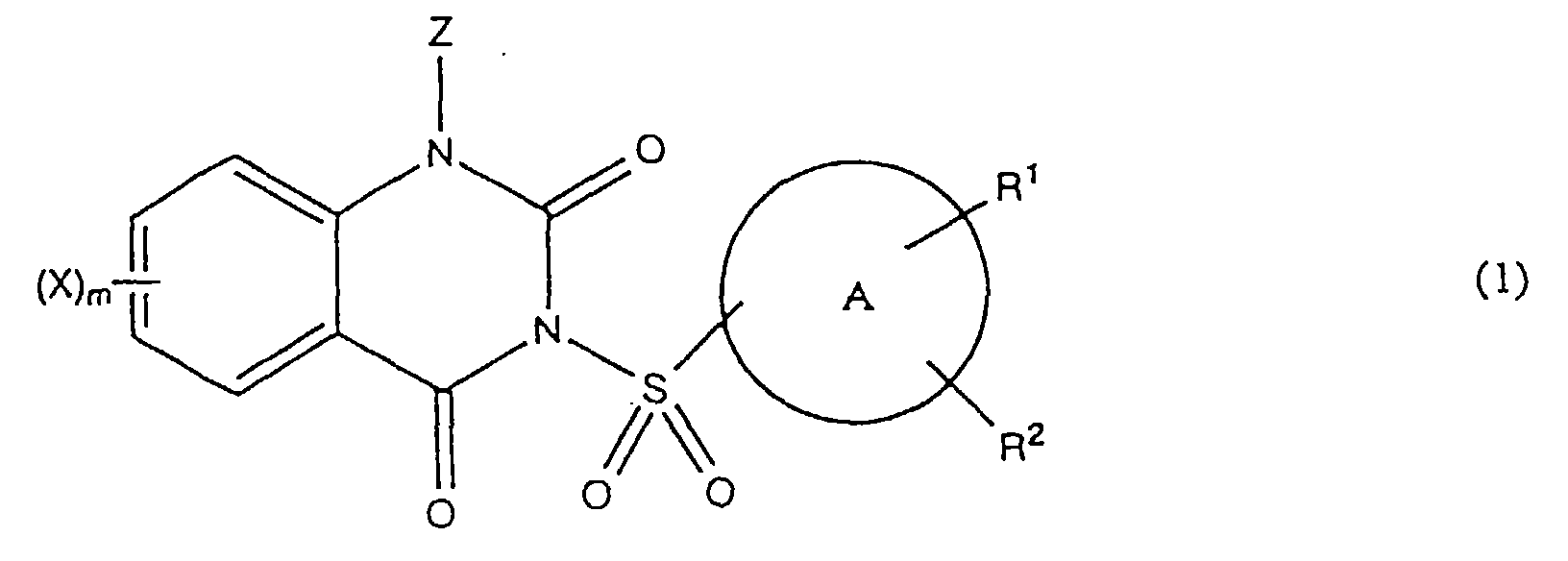 X represents a hydroxy group, a nitro group, a halogen atom, a C1 to C4 lower alkyl group which may be substituted with a halogen atom, a C1 to C4 lower alkoxy group which may be substituted with a halogen atom, or a C7 to C12 aralkyloxy group, or X together with the benzene ring which is shown as substituted with said X represents a group forming a naphthalene ring or a quinoline ring,R1 and R2 are the same or different and represent a hydrogen atom, a halogen atom, a C1 to C4 lower alkyl group which may be substituted with a halogen atom, a nitro group, a cyano group, a pyrazolyl group, a tetrazolyl group, a carboxyl group which may be esterified with a C1 to C4 lower alkyl group or an allyl group, or a C1 to C4 lower alkoxy group which may be substituted with one or more substituent groups selected from the group consisting of a halogen atom, a morpholino group, a phenylpiperazinyl group, and a carboxyl group which may be esterified with a C1 to C4 lower alkyl group or an allyl group, or, when the ring A represents a benzene ring R1 and R2 together with the benzene ring which is shown as substituted with said R1 and R2 represent a group forming a naphthalene ring or a quinoline ring, andZ represents a hydrogen atom, a C1 to C4 lower alkyl group which may be substituted with a halogen atom, a C2 to C5 alkenyl group, an unsubstituted or substituted aralkyl group, an unsubstituted or substituted aromatic heterocyclic alkyl group, a carboxymethyl group which may be esterified with a C1 to C4 lower alkyl group or an allyl group, a carbonylmethyl group which is amidized with a primary or secondary or cyclic amine, an unsubstituted or substituted arylcarbonylmethyl group, or an unsubstituted or substituted aralkyloxymethyl group.
 - A medicament for the prevention or treatment of cardiac and circulatory system diseases as claimed in claim 3, wherein the cardiac and circulatory system disease derived from the abnormal exacerbation of angiotensin II production is a cardiac and circulatory system disease selected from cardiac insufficiency, hypercardia, stasis cardiac diseases, and hypertension.
- A medicament for the prevention or treatment of cardiac and circulatory system diseases as claimed in claim 3, wherein the cardiac and circulatory system disease derived from the abnormal exacerbation of angiotensin II production is a cardiac and circulatory system disease selected from artherosclerosis, peripheral circulatory disorders, and revasoconstriction after percutaneous transluminal coronary angioplasty.
- A medicament for the prevention or treatment of cardiac and circulatory system diseases as claimed in claim 3, wherein the cardiac and circulatory system disease derived from the abnormal exacerbation of angiotensin II production is a cardiac and circulatory system disease selected from diabetic renal disorders or non-diabetic renal disorders.
- A pharmaceutical composition containing as an effective ingredient, a quinazoline derivative having the general formula (1a), or a pharmaceutically acceptable salt thereof:
 R1 and R2 are the same or different and represent a hydrogen atom, a halogen atom, a C1 to C4 lower alkyl group which may be substituted with a halogen atom, a nitro group, a cyano group, a pyrazolyl group, a tetrazolyl group, a carboxyl group which may be esterified with a C1 to C4 lower alkyl group or an allyl group, or a C1 to C4 lower alkoxy group which may be substituted with one or more substituent groups selected from the group consisting of a halogen atom, a morpholino group, a phenylpiperazinyl group, and a carboxyl group which may lie esterified with a C1 to C4 lower alkyl group or an allyl group, or, R1 and R2 together with the benzene ring which is shown as substituted with said R1 and R2, represent a group forming a naphthalene ring or a quinoline ring, andZ represents a hydrogen atom, a C1 to C4 lower alkyl group which may be substituted with a halogen atom, a C2 to C5 alkenyl group, an unsubstituted or substituted aralkyl group, an unsubstituted or substituted aromatic heterocyclic alkyl group, a carboxylmethyl group which may be esterified with a C1 to C4 lower alkyl group or an allyl group, a carbonylmethyl group which is amidized with a primary or secondary or cyclic amine, an unsubstituted or substituted arylcarbonylmethyl group, or an unsubstituted or substituted aralkyloxymethyl group.
 - A quinazoline derivative having the general formula (1'), or a pharmaceutically acceptable salt thereof:
 X represents a hydroxy group, nitro group, halogen atom, a C1 to C4 lower alkyl group which may be substituted with a halogen atom, a C1 to C4 lower alkoxy group which may be substituted with a halogen atom, or a C7 to C12 aralkyloxy group, or X together with the benzene ring which is shown as substituted with said X, represents a group forming a naphthalene ring or a quinoline ring,R1 and R2 are the same or different and represent a hydrogen atom, a halogen atom, a C1 to C4 lower alkyl group which may be substituted with a halogen atom, a nitro group, a cyano group, a pyrazolyl group, a tetrazolyl group, a carboxyl group which may be esterified with a C1 to C4 lower alkyl group or an allyl group, or a C1 to C4 lower alkoxy group which may be substituted with one or more substituent groups selected from the group consisting of a halogen atom, a morpholino group, a phenylpiperazinyl group, and a carboxyl group which may be esterified with a C1 to C4 lower alkyl group or an allyl group, or, when the ring A represents a benzene ring R1 and R2 together with the benzene ring which is shown as substituted with said R1 and R2, represent a group forming a naphthalene ring or a quinoline ring, andZ represents a hydrogen atom, a C1 to C4 lower alkyl group which may be substituted with a halogen atom, a C2 to C5 alkenyl group, an unsubstituted or substituted aralkyl group, an unsubstituted or substituted aromatic heterocyclic alkyl group, a carboxylmethyl group which may be esterified with a C1 to C4 lower alkyl group or an allyl group, a carbonylmethyl group which is amidized with a primary or secondary or cyclic amine, an unsubstituted or substituted arylcarbonylmethyl group, or an unsubstituted or substituted aralkyloxymethyl group, andwhen the ring A represents a benzene ring, Z represents a hydrogen atom and m represents 0, R1 and R2 do not simultaneously represent a hydrogen atom;when the ring A represents a benzene ring, Z represents a hydrogen atom, m represents 0 and one of R1 or R2 is a hydrogen atom, the other of R1 or R2 represents neither a methyl group nor a chlorine atom;and when the ring A represents a benzene ring, Z represents a hydrogen atom, m represents 1 and both of R1 and R2 simultaneously represent a hydrogen atom, X does not represent a chlorine atom.
 - A quinazoline derivative having the general formula (1a), or a pharmaceutically acceptable salt thereof:
 R1 and R2 are the same or different and represent a hydrogen atom, a halogen atom, a C1 to C4 lower alkyl group which may be substituted with a halogen atom, a nitro group, a cyano group, a pyrazolyl group, a tetrazolyl group, a carboxyl group which may be esterified with a C1 to C4 lower alkyl group or an allyl group, or a C1 to C4 lower alkoxy group which may be substituted with one or more substituent groups selected from the group consisting of a halogen atom, a morpholino group, a phenylpiperazinyl group, and a carboxyl group which may be esterified with a C1 to C4 lower alkyl group or an allyl group, or, R1 and R2 together with the benzene ring which is shown as substituted with said R1 and R2 represent a group forming a naphthalene ring or a quinoline ring, andZ represents a hydrogen atom, a C1 to C4 lower alkyl group which may be substituted with a halogen atom, a C2 to C5 alkenyl group, an unsubstituted or substituted aralkyl group, an unsubstituted or substituted aromatic heterocyclic alkyl group, a carboxymethyl group which may be esterified with a C1 to C4 lower alkyl group or an allyl group, a carbonylmethyl group which is amidized with a primary or secondary or cyclic amine, an unsubstituted or substituted arylcarbonylmethyl group, or an unsubstituted or substituted aralkyloxymethyl group.
Applications Claiming Priority (7)
| Application Number | Priority Date | Filing Date | Title |
|---|---|---|---|
| JP285437/95 | 1995-09-28 | ||
| JP28543795 | 1995-09-28 | ||
| JP28543795 | 1995-09-28 | ||
| JP11655796 | 1996-05-10 | ||
| JP116557/96 | 1996-05-10 | ||
| JP11655796 | 1996-05-10 | ||
| PCT/JP1996/002830 WO1997011941A1 (en) | 1995-09-28 | 1996-09-27 | Quinazoline derivatives and use thereof |
Publications (3)
| Publication Number | Publication Date |
|---|---|
| EP0795548A1 true EP0795548A1 (en) | 1997-09-17 |
| EP0795548A4 EP0795548A4 (en) | 1998-09-02 |
| EP0795548B1 EP0795548B1 (en) | 2002-07-03 |
Family
ID=26454863
Family Applications (1)
| Application Number | Title | Priority Date | Filing Date |
|---|---|---|---|
| EP96932039A Expired - Lifetime EP0795548B1 (en) | 1995-09-28 | 1996-09-27 | Quinazoline derivatives and use thereof |
Country Status (6)
| Country | Link |
|---|---|
| US (1) | US5814631A (en) |
| EP (1) | EP0795548B1 (en) |
| JP (1) | JP3992291B2 (en) |
| DE (1) | DE69622148T2 (en) |
| ES (1) | ES2175127T3 (en) |
| WO (1) | WO1997011941A1 (en) |
Cited By (25)
| Publication number | Priority date | Publication date | Assignee | Title |
|---|---|---|---|---|
| WO2000010982A1 (en) * | 1998-08-21 | 2000-03-02 | Suntory Limited | Quinazoline derivatives and pharmaceutical applications therof |
| WO2001032214A1 (en) * | 1999-11-01 | 2001-05-10 | Suntory Limited | Inhibitors against vascular lipid deposition containing chymase-inhibiting substances |
| WO2001062294A1 (en) * | 2000-02-22 | 2001-08-30 | Suntory Limited | Preventive or therapeutic drugs for dermatitises containing chymase inhibitors as the active ingredient |
| WO2001062292A1 (en) | 2000-02-22 | 2001-08-30 | Suntory Limited | Preventive or therapeutic drugs for fibrosis containing chymase inhibitors as the active ingredient |
| WO2001062293A1 (en) * | 2000-02-22 | 2001-08-30 | Suntory Limited | Preventive or therapeutic drugs for various eosinophilia-related diseases containing chymase inhibitors as the active ingredient |
| EP1136488A4 (en) * | 1998-12-01 | 2002-06-12 | Meiji Seika Kaisha | Sf2809-i, ii, iii, iv, v and vi substances exhibiting chymase-inhibiting activities |
| EP1419785A4 (en) * | 2001-08-24 | 2005-07-06 | Teijin Ltd | Drugs containing chymase inhibitor and ace inhibitor as the active ingredients |
| WO2007060220A3 (en) * | 2005-11-25 | 2007-08-02 | Basf Ag | Cyanobenzene compounds for combating animal pests |
| US7268145B2 (en) | 1998-07-15 | 2007-09-11 | Teijin Pharma Limited | Thiobenzimidazole derivatives |
| WO2009023655A1 (en) * | 2007-08-16 | 2009-02-19 | Boehringer Ingelheim International Gmbh | Quinazolinedione chymase inhibitors |
| US7667046B2 (en) | 2003-11-14 | 2010-02-23 | 3M Innovative Properties Company | N-sulfonyldicarboximide containing tethering compounds |
| US7671155B2 (en) | 2005-09-30 | 2010-03-02 | 3M Innovative Properties Company | Crosslinked polymers with amine binding groups |
| WO2012125521A1 (en) | 2011-03-14 | 2012-09-20 | Eternity Bioscience Inc. | Quinazolinediones and their use |
| US9290460B2 (en) | 2011-04-01 | 2016-03-22 | Impact Therapeutics, Inc. | 1-(Arylmethyl)quinazoline-2,4(1H,3H)-diones as PARP inhibitors and the use thereof |
| US10538487B2 (en) | 2015-02-16 | 2020-01-21 | The University Of Queensland | Sulfonylureas and related compounds and use of same |
| CN111094267A (en) * | 2017-09-30 | 2020-05-01 | 正大天晴药业集团股份有限公司 | Sulfonyl-Substituted Bicyclic Compounds as RORγ Inhibitors |
| US11370776B2 (en) | 2017-07-07 | 2022-06-28 | Inflazome Limited | Sulfonylureas and sulfonylthioureas as NLRP3 inhibitors |
| US11465992B2 (en) | 2017-07-07 | 2022-10-11 | Inflazome Limited | Sulfonamide carboxamide compounds |
| US11542255B2 (en) | 2017-08-15 | 2023-01-03 | Inflazome Limited | Sulfonylureas and sulfonylthioureas as NLRP3 inhibitors |
| US11613542B2 (en) | 2017-08-15 | 2023-03-28 | Inflazome Limited | Sulfonylureas and sulfonylthioureas as NLRP3 inhibitors |
| US11840543B2 (en) | 2017-05-24 | 2023-12-12 | The University Of Queensland | Compounds and uses |
| US11905252B2 (en) | 2018-03-02 | 2024-02-20 | Inflazome Limited | Compounds |
| US11926600B2 (en) | 2017-08-15 | 2024-03-12 | Inflazome Limited | Sulfonylureas and sulfonylthioureas as NLRP3 inhibitors |
| US12012392B2 (en) | 2017-11-09 | 2024-06-18 | Inflazome Limited | Sulfonamide carboxamide compounds |
| US12221434B2 (en) | 2017-11-09 | 2025-02-11 | Inflazome Limited | Sulfonamide carboxamide compounds |
Families Citing this family (18)
| Publication number | Priority date | Publication date | Assignee | Title |
|---|---|---|---|---|
| US20050267148A1 (en) * | 1998-07-15 | 2005-12-01 | Teijin Limited | Benzimidazole derivative |
| WO2000010605A2 (en) * | 1998-08-20 | 2000-03-02 | Senju Pharmaceutical Co., Ltd. | Preventives or remedies for eye circulatory failure |
| JP4491866B2 (en) * | 1999-09-30 | 2010-06-30 | 三菱化学株式会社 | Acylsulfonamide derivatives |
| WO2001023349A1 (en) * | 1999-09-30 | 2001-04-05 | Mitsubishi Chemical Corporation | Acylsulfonamide derivatives |
| WO2002022595A1 (en) * | 2000-09-18 | 2002-03-21 | Toa Eiyo Ltd. | N-substituted benzothiophenesulfonamide derivatives |
| US7071220B2 (en) | 2000-09-18 | 2006-07-04 | Toa Eiyo Ltd. | N-substituted benzothiophenesulfonamide derivatives |
| DE60333351D1 (en) * | 2002-03-15 | 2010-08-26 | Toa Eiyo Ltd | N-SUBSTITUTED BENZOTHIOPHENESULFONAMID DERIVATIVE |
| KR20050026019A (en) * | 2002-07-30 | 2005-03-14 | 소시에떼 더 콘세이유 더 레세르세 에 다플리까띠옹 시엔띠피끄, 에스.아.에스. | Use of chymase inhibitors for the prevention and/or treatment of arterio-venous graft failure |
| WO2005020921A2 (en) * | 2003-08-29 | 2005-03-10 | Exelixis, Inc. | C-kit modulators and methods of use |
| US7361767B2 (en) * | 2003-11-14 | 2008-04-22 | 3M Innovative Properties Company | N-sulfonyldicarboximide containing tethering compounds |
| JP5067968B2 (en) * | 2004-10-07 | 2012-11-07 | ビテ ファーマシューティカルズ, インコーポレイテッド | Diaminoalkane aspartic protease inhibitor |
| US8034822B2 (en) * | 2006-03-08 | 2011-10-11 | Takeda San Diego, Inc. | Glucokinase activators |
| US7705034B2 (en) * | 2006-10-13 | 2010-04-27 | Hoffmann-La Roche Inc. | Vinylogous acid derivatives |
| JP5587914B2 (en) | 2009-01-30 | 2014-09-10 | ベーリンガー インゲルハイム インターナショナル ゲゼルシャフト ミット ベシュレンクテル ハフツング | Azaquinazolinediones useful as chymase inhibitors |
| WO2014089364A1 (en) | 2012-12-06 | 2014-06-12 | Quanticel Pharmaceuticals, Inc | Histone demethylase inhibitors |
| US11077101B1 (en) * | 2018-07-18 | 2021-08-03 | Tango Therapeutics, Inc. | Compounds and methods of use |
| WO2021086879A1 (en) | 2019-10-28 | 2021-05-06 | Tango Therapeutics, Inc. | Compounds and methods of use |
| EP4188920A1 (en) | 2020-07-31 | 2023-06-07 | Tango Therapeutics, Inc. | Piperidin-1-yl-n-pyrydine-3-yl-2-oxoacetamide derivatives useful for the treatment of mtap-deficient and/or mta-accumulating cancers |
Family Cites Families (2)
| Publication number | Priority date | Publication date | Assignee | Title |
|---|---|---|---|---|
| US4684654A (en) * | 1985-08-14 | 1987-08-04 | American Cyanamid Company | 3-heteroalkyl-2,4-quinzaolinediones |
| IL79249A (en) * | 1986-06-26 | 1992-02-16 | Makhteshim Chem Works Ltd | Herbicidal compositions containing haloalkylthioquinazoline di(thi)ones and some new such compounds |
-
1996
- 1996-09-27 WO PCT/JP1996/002830 patent/WO1997011941A1/en not_active Ceased
- 1996-09-27 EP EP96932039A patent/EP0795548B1/en not_active Expired - Lifetime
- 1996-09-27 JP JP51329697A patent/JP3992291B2/en not_active Expired - Fee Related
- 1996-09-27 DE DE69622148T patent/DE69622148T2/en not_active Expired - Fee Related
- 1996-09-27 US US08/849,114 patent/US5814631A/en not_active Expired - Fee Related
- 1996-09-27 ES ES96932039T patent/ES2175127T3/en not_active Expired - Lifetime
Non-Patent Citations (2)
| Title |
|---|
| No further relevant documents disclosed * |
| See also references of WO9711941A1 * |
Cited By (45)
| Publication number | Priority date | Publication date | Assignee | Title |
|---|---|---|---|---|
| US7268145B2 (en) | 1998-07-15 | 2007-09-11 | Teijin Pharma Limited | Thiobenzimidazole derivatives |
| AU772771B2 (en) * | 1998-08-21 | 2004-05-06 | Daiichi Asubio Pharma Co., Ltd. | Quinazoline derivatives and pharmaceutical applications thereof |
| WO2000010982A1 (en) * | 1998-08-21 | 2000-03-02 | Suntory Limited | Quinazoline derivatives and pharmaceutical applications therof |
| US7169951B2 (en) | 1998-08-21 | 2007-01-30 | Daiichi Asubio Pharma Co., Ltd. | Quinazoline derivatives and pharmaceutical applications thereof |
| US6867214B1 (en) | 1998-08-21 | 2005-03-15 | Daiichi Suntory Pharma Co., Ltd. | Quinazoline derivatives and pharmaceutical applications thereof |
| EP1136488A4 (en) * | 1998-12-01 | 2002-06-12 | Meiji Seika Kaisha | Sf2809-i, ii, iii, iv, v and vi substances exhibiting chymase-inhibiting activities |
| WO2001032214A1 (en) * | 1999-11-01 | 2001-05-10 | Suntory Limited | Inhibitors against vascular lipid deposition containing chymase-inhibiting substances |
| US6921766B1 (en) | 1999-11-01 | 2005-07-26 | Daiichi Suntory Pharma Co., Ltd. | Blood vessel lipid deposition-preventive agent comprising chymase-inhibitor |
| AU784467B2 (en) * | 1999-11-01 | 2006-04-06 | Daiichi Asubio Pharma Co., Ltd. | Inhibitors against vascular lipid deposition containing chymase-inhibiting substances |
| WO2001062294A1 (en) * | 2000-02-22 | 2001-08-30 | Suntory Limited | Preventive or therapeutic drugs for dermatitises containing chymase inhibitors as the active ingredient |
| US6677344B2 (en) | 2000-02-22 | 2004-01-13 | Daiichi Suntory Pharma Co., Ltd. | Chymase inhibitor for the treatment of eosinophilia |
| WO2001062293A1 (en) * | 2000-02-22 | 2001-08-30 | Suntory Limited | Preventive or therapeutic drugs for various eosinophilia-related diseases containing chymase inhibitors as the active ingredient |
| US7618977B2 (en) | 2000-02-22 | 2009-11-17 | Asubio Pharma Co., Ltd. | Method of treating dermatitis comprising administering a chymase inhibitor |
| WO2001062292A1 (en) | 2000-02-22 | 2001-08-30 | Suntory Limited | Preventive or therapeutic drugs for fibrosis containing chymase inhibitors as the active ingredient |
| US6500835B2 (en) | 2000-02-22 | 2002-12-31 | Suntory Limited | Preventive or therapeutic drugs for fibrosis containing chymase inhibitors as the active ingredient |
| KR100902799B1 (en) * | 2001-08-24 | 2009-06-12 | 데이진 가부시키가이샤 | Pharmaceuticals containing a kinase inhibitor and an AC inhibitor as an active ingredient |
| AU2002328494B2 (en) * | 2001-08-24 | 2008-06-26 | Teijin Limited | Drugs containing chymase inhibitor and ACE inhibitor as the active ingredients |
| EP1419785A4 (en) * | 2001-08-24 | 2005-07-06 | Teijin Ltd | Drugs containing chymase inhibitor and ace inhibitor as the active ingredients |
| US7667046B2 (en) | 2003-11-14 | 2010-02-23 | 3M Innovative Properties Company | N-sulfonyldicarboximide containing tethering compounds |
| US7671155B2 (en) | 2005-09-30 | 2010-03-02 | 3M Innovative Properties Company | Crosslinked polymers with amine binding groups |
| WO2007060220A3 (en) * | 2005-11-25 | 2007-08-02 | Basf Ag | Cyanobenzene compounds for combating animal pests |
| WO2009023655A1 (en) * | 2007-08-16 | 2009-02-19 | Boehringer Ingelheim International Gmbh | Quinazolinedione chymase inhibitors |
| US8377949B2 (en) | 2007-08-16 | 2013-02-19 | Boehringer Ingelheim International Gmbh | Quinazolinedione chymase inhibitors |
| WO2012125521A1 (en) | 2011-03-14 | 2012-09-20 | Eternity Bioscience Inc. | Quinazolinediones and their use |
| US9090568B2 (en) | 2011-03-14 | 2015-07-28 | Impact Therapeutics, Inc. | Quinazolinediones and their use |
| EP2686305A4 (en) * | 2011-03-14 | 2014-08-06 | Eternity Bioscience Inc | QUINAZOLINEDIONES AND THEIR USE |
| US11358955B2 (en) | 2011-04-01 | 2022-06-14 | Impact Therapeutics, Inc. | 1-(arylmethyl)quinazoline-2,4(1H,3H)-diones as PARP inhibitors and the use thereof |
| US9290460B2 (en) | 2011-04-01 | 2016-03-22 | Impact Therapeutics, Inc. | 1-(Arylmethyl)quinazoline-2,4(1H,3H)-diones as PARP inhibitors and the use thereof |
| US9926304B2 (en) | 2011-04-01 | 2018-03-27 | Impact Therapeutics, Inc. | 1-(arylmethyl)quinazoline-2,4(1H,3H)-diones as PARP inhibitors and the use thereof |
| US10316027B2 (en) | 2011-04-01 | 2019-06-11 | Impact Therapeutics, Inc. | 1-(arylmethyl)quinazoline-2,4(1H,3H)-diones as PARP inhibitors and the use thereof |
| US10538487B2 (en) | 2015-02-16 | 2020-01-21 | The University Of Queensland | Sulfonylureas and related compounds and use of same |
| US11130731B2 (en) | 2015-02-16 | 2021-09-28 | The Provost, Fellows, Foundation Scholars, And The Other Members Of Board, Of The College Of The Holy And Undivided Trinity Of Queen Elizabeth Near Dublin | Sulfonylureas and related compounds and use of same |
| US11840543B2 (en) | 2017-05-24 | 2023-12-12 | The University Of Queensland | Compounds and uses |
| US11370776B2 (en) | 2017-07-07 | 2022-06-28 | Inflazome Limited | Sulfonylureas and sulfonylthioureas as NLRP3 inhibitors |
| US11465992B2 (en) | 2017-07-07 | 2022-10-11 | Inflazome Limited | Sulfonamide carboxamide compounds |
| US11981667B2 (en) | 2017-07-07 | 2024-05-14 | Inflazome Limited | Sulfonamide carboxamide compounds |
| US11542255B2 (en) | 2017-08-15 | 2023-01-03 | Inflazome Limited | Sulfonylureas and sulfonylthioureas as NLRP3 inhibitors |
| US11613542B2 (en) | 2017-08-15 | 2023-03-28 | Inflazome Limited | Sulfonylureas and sulfonylthioureas as NLRP3 inhibitors |
| US11926600B2 (en) | 2017-08-15 | 2024-03-12 | Inflazome Limited | Sulfonylureas and sulfonylthioureas as NLRP3 inhibitors |
| CN111094267B (en) * | 2017-09-30 | 2022-06-14 | 正大天晴药业集团股份有限公司 | Sulfonyl-substituted bicyclic compounds as ROR gamma inhibitors |
| US11396503B2 (en) | 2017-09-30 | 2022-07-26 | Chia Tai Tianqing Pharmaceutical Group Co., Ltd. | Sulfonyl substituted bicyclic compound which acts as ROR inhibitor |
| CN111094267A (en) * | 2017-09-30 | 2020-05-01 | 正大天晴药业集团股份有限公司 | Sulfonyl-Substituted Bicyclic Compounds as RORγ Inhibitors |
| US12012392B2 (en) | 2017-11-09 | 2024-06-18 | Inflazome Limited | Sulfonamide carboxamide compounds |
| US12221434B2 (en) | 2017-11-09 | 2025-02-11 | Inflazome Limited | Sulfonamide carboxamide compounds |
| US11905252B2 (en) | 2018-03-02 | 2024-02-20 | Inflazome Limited | Compounds |
Also Published As
| Publication number | Publication date |
|---|---|
| EP0795548B1 (en) | 2002-07-03 |
| US5814631A (en) | 1998-09-29 |
| DE69622148T2 (en) | 2002-10-31 |
| WO1997011941A1 (en) | 1997-04-03 |
| EP0795548A4 (en) | 1998-09-02 |
| ES2175127T3 (en) | 2002-11-16 |
| JP3992291B2 (en) | 2007-10-17 |
| DE69622148D1 (en) | 2002-08-08 |
Similar Documents
| Publication | Publication Date | Title |
|---|---|---|
| EP0795548B1 (en) | Quinazoline derivatives and use thereof | |
| JPWO1997011941A1 (en) | Quinazoline derivatives and their uses | |
| EP0721944B1 (en) | Imidazolidine derivative and use thereof | |
| US20020193377A1 (en) | Quinazolines as MMP-13 inhibitors | |
| US6300330B1 (en) | Heterocycle derivatives which inhibit factor Xa | |
| US4883800A (en) | Quinazoline derivatives and process for their production | |
| EP1453801B1 (en) | Substituted 2-amino-cycloalkanecarboxamides and their use as cysteine protease inhibitors | |
| HUT61984A (en) | Process for producing condensed imidazole derivatives and pharmaceutical compositions comprising same | |
| EP2526948A1 (en) | RHO kinase inhibitors | |
| NZ231588A (en) | Quinazoline-4-one derivatives, medicaments | |
| HUT70485A (en) | Substituted mono- and bipyridyl-methyl-pyridone derivatives and process for producing them | |
| PL212119B1 (en) | Acylated, heteroaryl-condensed cycloalkenylamines and their use as pharmaceuticals | |
| WO2007081978A2 (en) | Modulators of hepatocyte growth factor / c-met activity | |
| IL183599A (en) | Hydantoin derivatives, process for their preparation, pharmaceutical compositions comprising them and use thereof in the preparation of medicaments | |
| WO1999014203A1 (en) | Nitrogenous fused-ring compounds, process for the preparation of the same, and drugs | |
| EP2128156A1 (en) | Novel oxadiazole derivatives and thiadiazole derivatives having neovascularization inhibiting activity | |
| CA2712701A1 (en) | Cyclic azaindole-3-carboxamides, their preparation and their use as pharmaceuticals | |
| US6867214B1 (en) | Quinazoline derivatives and pharmaceutical applications thereof | |
| HU208131B (en) | Process for producing quinezoline derivatives and pharmaceutical compositions comprising same | |
| US11174255B2 (en) | Pyrido[2,3-d]pyrimidin-7-ones and related compounds as inhibitors of protein kinases | |
| JPH10504833A (en) | Novel 4-aminopyridazines, methods for their preparation and medicaments containing these compounds | |
| WO2001032214A1 (en) | Inhibitors against vascular lipid deposition containing chymase-inhibiting substances | |
| US7524871B2 (en) | Thrombin inhibitors | |
| JPWO2002083649A1 (en) | Novel imidazolidinedione derivatives and their pharmaceutical uses | |
| JPH11152275A (en) | Nitrogen-containing condensed ring compound, its production and agent |
Legal Events
| Date | Code | Title | Description |
|---|---|---|---|
| PUAI | Public reference made under article 153(3) epc to a published international application that has entered the european phase |
Free format text: ORIGINAL CODE: 0009012 |
|
| AK | Designated contracting states |
Kind code of ref document: A1 Designated state(s): CH DE ES FR GB IE IT LI |
|
| 17P | Request for examination filed |
Effective date: 19970922 |
|
| A4 | Supplementary search report drawn up and despatched | ||
| AK | Designated contracting states |
Kind code of ref document: A4 Designated state(s): AT BE CH DE DK ES FI FR GB GR IE IT LI LU MC NL PT SE |
|
| 17Q | First examination report despatched |
Effective date: 19990616 |
|
| GRAG | Despatch of communication of intention to grant |
Free format text: ORIGINAL CODE: EPIDOS AGRA |
|
| GRAG | Despatch of communication of intention to grant |
Free format text: ORIGINAL CODE: EPIDOS AGRA |
|
| GRAG | Despatch of communication of intention to grant |
Free format text: ORIGINAL CODE: EPIDOS AGRA |
|
| GRAH | Despatch of communication of intention to grant a patent |
Free format text: ORIGINAL CODE: EPIDOS IGRA |
|
| GRAH | Despatch of communication of intention to grant a patent |
Free format text: ORIGINAL CODE: EPIDOS IGRA |
|
| RBV | Designated contracting states (corrected) |
Designated state(s): CH DE ES FR GB IE IT LI |
|
| GRAA | (expected) grant |
Free format text: ORIGINAL CODE: 0009210 |
|
| AK | Designated contracting states |
Kind code of ref document: B1 Designated state(s): CH DE ES FR GB IE IT LI |
|
| REG | Reference to a national code |
Ref country code: CH Ref legal event code: EP |
|
| REG | Reference to a national code |
Ref country code: IE Ref legal event code: FG4D |
|
| REG | Reference to a national code |
Ref country code: CH Ref legal event code: NV Representative=s name: E. BLUM & CO. PATENTANWAELTE |
|
| REF | Corresponds to: |
Ref document number: 69622148 Country of ref document: DE Date of ref document: 20020808 |
|
| ET | Fr: translation filed | ||
| REG | Reference to a national code |
Ref country code: ES Ref legal event code: FG2A Ref document number: 2175127 Country of ref document: ES Kind code of ref document: T3 |
|
| PLBE | No opposition filed within time limit |
Free format text: ORIGINAL CODE: 0009261 |
|
| STAA | Information on the status of an ep patent application or granted ep patent |
Free format text: STATUS: NO OPPOSITION FILED WITHIN TIME LIMIT |
|
| REG | Reference to a national code |
Ref country code: GB Ref legal event code: 732E |
|
| 26N | No opposition filed |
Effective date: 20030404 |
|
| REG | Reference to a national code |
Ref country code: ES Ref legal event code: PC2A |
|
| REG | Reference to a national code |
Ref country code: CH Ref legal event code: PUE Owner name: DAIICHI SUNTORY PHARMA CO., LTD. Free format text: SUNTORY LIMITED#1-40, DOJIMAHAMA 2-CHOME#KITA-KU, OSAKA-SHI, OSAKA 530 (JP) -TRANSFER TO- DAIICHI SUNTORY PHARMA CO., LTD.#7-2, KOJIMACHI 5-CHOME#CHIYODA-KU, TOKYO (JP) Ref country code: CH Ref legal event code: NV Representative=s name: BOVARD AG PATENTANWAELTE |
|
| REG | Reference to a national code |
Ref country code: FR Ref legal event code: TP |
|
| REG | Reference to a national code |
Ref country code: CH Ref legal event code: PFA Owner name: DAIICHI ASUBIO PHARMA CO., LTD. Free format text: DAIICHI SUNTORY PHARMA CO., LTD.#7-2, KOJIMACHI 5-CHOME#CHIYODA-KU, TOKYO (JP) -TRANSFER TO- DAIICHI ASUBIO PHARMA CO., LTD.#9-11, AKASAKA 2-CHOME, MINATO-KU#TOKYO (JP) |
|
| REG | Reference to a national code |
Ref country code: FR Ref legal event code: CD Ref country code: FR Ref legal event code: CA |
|
| REG | Reference to a national code |
Ref country code: CH Ref legal event code: PFA Owner name: ASUBIO PHARMA CO., LTD. Free format text: DAIICHI ASUBIO PHARMA CO., LTD.#9-11, AKASAKA 2-CHOME, MINATO-KU#TOKYO (JP) -TRANSFER TO- ASUBIO PHARMA CO., LTD.#9-11, AKASAKA 2-CHOME#MINATO-KU, TOKYO (JP) |
|
| PGFP | Annual fee paid to national office [announced via postgrant information from national office to epo] |
Ref country code: IE Payment date: 20070919 Year of fee payment: 12 |
|
| PGFP | Annual fee paid to national office [announced via postgrant information from national office to epo] |
Ref country code: DE Payment date: 20070920 Year of fee payment: 12 |
|
| REG | Reference to a national code |
Ref country code: FR Ref legal event code: CD |
|
| PGFP | Annual fee paid to national office [announced via postgrant information from national office to epo] |
Ref country code: CH Payment date: 20070927 Year of fee payment: 12 |
|
| PGFP | Annual fee paid to national office [announced via postgrant information from national office to epo] |
Ref country code: GB Payment date: 20070926 Year of fee payment: 12 |
|
| PGFP | Annual fee paid to national office [announced via postgrant information from national office to epo] |
Ref country code: IT Payment date: 20070926 Year of fee payment: 12 Ref country code: ES Payment date: 20071005 Year of fee payment: 12 |
|
| PGFP | Annual fee paid to national office [announced via postgrant information from national office to epo] |
Ref country code: FR Payment date: 20070914 Year of fee payment: 12 |
|
| REG | Reference to a national code |
Ref country code: CH Ref legal event code: PL |
|
| GBPC | Gb: european patent ceased through non-payment of renewal fee |
Effective date: 20080927 |
|
| REG | Reference to a national code |
Ref country code: IE Ref legal event code: MM4A |
|
| REG | Reference to a national code |
Ref country code: FR Ref legal event code: ST Effective date: 20090529 |
|
| PG25 | Lapsed in a contracting state [announced via postgrant information from national office to epo] |
Ref country code: IE Free format text: LAPSE BECAUSE OF NON-PAYMENT OF DUE FEES Effective date: 20080929 |
|
| PG25 | Lapsed in a contracting state [announced via postgrant information from national office to epo] |
Ref country code: IT Free format text: LAPSE BECAUSE OF NON-PAYMENT OF DUE FEES Effective date: 20080927 Ref country code: DE Free format text: LAPSE BECAUSE OF NON-PAYMENT OF DUE FEES Effective date: 20090401 |
|
| PG25 | Lapsed in a contracting state [announced via postgrant information from national office to epo] |
Ref country code: LI Free format text: LAPSE BECAUSE OF NON-PAYMENT OF DUE FEES Effective date: 20080930 Ref country code: FR Free format text: LAPSE BECAUSE OF NON-PAYMENT OF DUE FEES Effective date: 20080930 Ref country code: CH Free format text: LAPSE BECAUSE OF NON-PAYMENT OF DUE FEES Effective date: 20080930 |
|
| REG | Reference to a national code |
Ref country code: ES Ref legal event code: FD2A Effective date: 20080929 |
|
| PG25 | Lapsed in a contracting state [announced via postgrant information from national office to epo] |
Ref country code: GB Free format text: LAPSE BECAUSE OF NON-PAYMENT OF DUE FEES Effective date: 20080927 |
|
| PG25 | Lapsed in a contracting state [announced via postgrant information from national office to epo] |
Ref country code: ES Free format text: LAPSE BECAUSE OF NON-PAYMENT OF DUE FEES Effective date: 20080929 |