EP0795182B1 - Ion-conductive polymers - Google Patents
Ion-conductive polymers Download PDFInfo
- Publication number
- EP0795182B1 EP0795182B1 EP95938374A EP95938374A EP0795182B1 EP 0795182 B1 EP0795182 B1 EP 0795182B1 EP 95938374 A EP95938374 A EP 95938374A EP 95938374 A EP95938374 A EP 95938374A EP 0795182 B1 EP0795182 B1 EP 0795182B1
- Authority
- EP
- European Patent Office
- Prior art keywords
- group
- polymer
- ion
- integer
- defined above
- Prior art date
- Legal status (The legal status is an assumption and is not a legal conclusion. Google has not performed a legal analysis and makes no representation as to the accuracy of the status listed.)
- Expired - Lifetime
Links
- 229920001940 conductive polymer Polymers 0.000 title claims abstract description 10
- 229920000642 polymer Polymers 0.000 claims abstract description 91
- 229910052739 hydrogen Inorganic materials 0.000 claims abstract description 19
- 239000001257 hydrogen Substances 0.000 claims abstract description 19
- 125000001997 phenyl group Chemical group [H]C1=C([H])C([H])=C(*)C([H])=C1[H] 0.000 claims abstract description 19
- 125000004432 carbon atom Chemical group C* 0.000 claims abstract description 17
- 125000000217 alkyl group Chemical group 0.000 claims abstract description 13
- 229910052736 halogen Inorganic materials 0.000 claims abstract description 8
- 125000003545 alkoxy group Chemical group 0.000 claims abstract description 6
- 125000000951 phenoxy group Chemical group [H]C1=C([H])C([H])=C(O*)C([H])=C1[H] 0.000 claims abstract description 6
- 125000002723 alicyclic group Chemical group 0.000 claims abstract description 5
- 125000001931 aliphatic group Chemical group 0.000 claims abstract description 5
- 125000003342 alkenyl group Chemical group 0.000 claims abstract description 5
- 125000000304 alkynyl group Chemical group 0.000 claims abstract description 5
- 125000001589 carboacyl group Chemical group 0.000 claims abstract description 5
- 125000004093 cyano group Chemical group *C#N 0.000 claims abstract description 5
- 150000002367 halogens Chemical group 0.000 claims abstract description 5
- 125000000449 nitro group Chemical group [O-][N+](*)=O 0.000 claims abstract description 5
- 125000003236 benzoyl group Chemical group [H]C1=C([H])C([H])=C(C([H])=C1[H])C(*)=O 0.000 claims abstract description 4
- 125000002188 cycloheptatrienyl group Chemical group C1(=CC=CC=CC1)* 0.000 claims abstract description 3
- -1 carbonyloxycarbonyl Chemical group 0.000 claims description 91
- 239000003792 electrolyte Substances 0.000 claims description 17
- 239000000446 fuel Substances 0.000 claims description 9
- 239000012528 membrane Substances 0.000 claims description 7
- 125000004435 hydrogen atom Chemical class [H]* 0.000 claims description 6
- 125000002496 methyl group Chemical group [H]C([H])([H])* 0.000 claims description 6
- 230000009477 glass transition Effects 0.000 claims description 4
- 125000006273 (C1-C3) alkyl group Chemical group 0.000 claims description 2
- 125000003178 carboxy group Chemical group [H]OC(*)=O 0.000 claims description 2
- 125000004181 carboxyalkyl group Chemical group 0.000 claims description 2
- 229910052700 potassium Inorganic materials 0.000 claims description 2
- 150000002431 hydrogen Chemical class 0.000 abstract description 7
- OKTJSMMVPCPJKN-UHFFFAOYSA-N Carbon Chemical group [C] OKTJSMMVPCPJKN-UHFFFAOYSA-N 0.000 abstract description 4
- 229910052799 carbon Inorganic materials 0.000 abstract description 4
- WYURNTSHIVDZCO-UHFFFAOYSA-N Tetrahydrofuran Chemical compound C1CCOC1 WYURNTSHIVDZCO-UHFFFAOYSA-N 0.000 description 50
- 150000002500 ions Chemical class 0.000 description 41
- 229920001223 polyethylene glycol Polymers 0.000 description 30
- 239000000203 mixture Substances 0.000 description 29
- 229920001843 polymethylhydrosiloxane Polymers 0.000 description 25
- YLQBMQCUIZJEEH-UHFFFAOYSA-N tetrahydrofuran Natural products C=1C=COC=1 YLQBMQCUIZJEEH-UHFFFAOYSA-N 0.000 description 25
- 239000002904 solvent Substances 0.000 description 21
- 238000006243 chemical reaction Methods 0.000 description 20
- 230000015572 biosynthetic process Effects 0.000 description 18
- MZRVEZGGRBJDDB-UHFFFAOYSA-N N-Butyllithium Chemical compound [Li]CCCC MZRVEZGGRBJDDB-UHFFFAOYSA-N 0.000 description 14
- 239000000178 monomer Substances 0.000 description 14
- 238000006116 polymerization reaction Methods 0.000 description 14
- 238000003786 synthesis reaction Methods 0.000 description 14
- YMWUJEATGCHHMB-UHFFFAOYSA-N Dichloromethane Chemical compound ClCCl YMWUJEATGCHHMB-UHFFFAOYSA-N 0.000 description 12
- 239000004793 Polystyrene Substances 0.000 description 12
- YXFVVABEGXRONW-UHFFFAOYSA-N Toluene Chemical compound CC1=CC=CC=C1 YXFVVABEGXRONW-UHFFFAOYSA-N 0.000 description 12
- 229920000233 poly(alkylene oxides) Polymers 0.000 description 12
- 239000002202 Polyethylene glycol Substances 0.000 description 10
- LCGLNKUTAGEVQW-UHFFFAOYSA-N Dimethyl ether Chemical compound COC LCGLNKUTAGEVQW-UHFFFAOYSA-N 0.000 description 9
- LYCAIKOWRPUZTN-UHFFFAOYSA-N Ethylene glycol Chemical compound OCCO LYCAIKOWRPUZTN-UHFFFAOYSA-N 0.000 description 9
- 238000001704 evaporation Methods 0.000 description 9
- 230000008020 evaporation Effects 0.000 description 9
- 239000011521 glass Substances 0.000 description 9
- 239000011159 matrix material Substances 0.000 description 9
- 229920005597 polymer membrane Polymers 0.000 description 9
- PPBRXRYQALVLMV-UHFFFAOYSA-N Styrene Chemical compound C=CC1=CC=CC=C1 PPBRXRYQALVLMV-UHFFFAOYSA-N 0.000 description 8
- 239000002253 acid Substances 0.000 description 8
- DSVRVHYFPPQFTI-UHFFFAOYSA-N bis(ethenyl)-methyl-trimethylsilyloxysilane;platinum Chemical compound [Pt].C[Si](C)(C)O[Si](C)(C=C)C=C DSVRVHYFPPQFTI-UHFFFAOYSA-N 0.000 description 8
- DBKDYYFPDRPMPE-UHFFFAOYSA-N lithium;cyclopenta-1,3-diene Chemical group [Li+].C=1C=C[CH-]C=1 DBKDYYFPDRPMPE-UHFFFAOYSA-N 0.000 description 8
- UAEPNZWRGJTJPN-UHFFFAOYSA-N methylcyclohexane Chemical compound CC1CCCCC1 UAEPNZWRGJTJPN-UHFFFAOYSA-N 0.000 description 8
- WHXSMMKQMYFTQS-UHFFFAOYSA-N Lithium Chemical compound [Li] WHXSMMKQMYFTQS-UHFFFAOYSA-N 0.000 description 7
- 229910052783 alkali metal Inorganic materials 0.000 description 7
- 150000001340 alkali metals Chemical class 0.000 description 7
- 150000001450 anions Chemical class 0.000 description 7
- 239000003054 catalyst Substances 0.000 description 7
- 239000003999 initiator Substances 0.000 description 7
- 229910052744 lithium Inorganic materials 0.000 description 7
- 238000000034 method Methods 0.000 description 7
- LVHBHZANLOWSRM-UHFFFAOYSA-N methylenebutanedioic acid Natural products OC(=O)CC(=C)C(O)=O LVHBHZANLOWSRM-UHFFFAOYSA-N 0.000 description 7
- STMDPCBYJCIZOD-UHFFFAOYSA-N 2-(2,4-dinitroanilino)-4-methylpentanoic acid Chemical group CC(C)CC(C(O)=O)NC1=CC=C([N+]([O-])=O)C=C1[N+]([O-])=O STMDPCBYJCIZOD-UHFFFAOYSA-N 0.000 description 6
- OKKJLVBELUTLKV-UHFFFAOYSA-N Methanol Chemical compound OC OKKJLVBELUTLKV-UHFFFAOYSA-N 0.000 description 6
- 229920002367 Polyisobutene Polymers 0.000 description 6
- ZSWFCLXCOIISFI-UHFFFAOYSA-N cyclopentadiene Chemical compound C1C=CC=C1 ZSWFCLXCOIISFI-UHFFFAOYSA-N 0.000 description 6
- 0 CCC(C)C(CC)C1C(CC*2)C2C(C)C1 Chemical compound CCC(C)C(CC)C1C(CC*2)C2C(C)C1 0.000 description 5
- RTZKZFJDLAIYFH-UHFFFAOYSA-N Diethyl ether Chemical compound CCOCC RTZKZFJDLAIYFH-UHFFFAOYSA-N 0.000 description 5
- UFHFLCQGNIYNRP-UHFFFAOYSA-N Hydrogen Chemical compound [H][H] UFHFLCQGNIYNRP-UHFFFAOYSA-N 0.000 description 5
- ISWSIDIOOBJBQZ-UHFFFAOYSA-N Phenol Chemical compound OC1=CC=CC=C1 ISWSIDIOOBJBQZ-UHFFFAOYSA-N 0.000 description 5
- IAZDPXIOMUYVGZ-UHFFFAOYSA-N Dimethylsulphoxide Chemical compound CS(C)=O IAZDPXIOMUYVGZ-UHFFFAOYSA-N 0.000 description 4
- KKEYFWRCBNTPAC-UHFFFAOYSA-N Terephthalic acid Chemical compound OC(=O)C1=CC=C(C(O)=O)C=C1 KKEYFWRCBNTPAC-UHFFFAOYSA-N 0.000 description 4
- WNLRTRBMVRJNCN-UHFFFAOYSA-N adipic acid Chemical compound OC(=O)CCCCC(O)=O WNLRTRBMVRJNCN-UHFFFAOYSA-N 0.000 description 4
- 239000000010 aprotic solvent Substances 0.000 description 4
- 125000003118 aryl group Chemical group 0.000 description 4
- 239000011324 bead Substances 0.000 description 4
- 150000001875 compounds Chemical class 0.000 description 4
- 238000004132 cross linking Methods 0.000 description 4
- FJKIXWOMBXYWOQ-UHFFFAOYSA-N ethenoxyethane Chemical compound CCOC=C FJKIXWOMBXYWOQ-UHFFFAOYSA-N 0.000 description 4
- 239000000463 material Substances 0.000 description 4
- GYNNXHKOJHMOHS-UHFFFAOYSA-N methyl-cycloheptane Natural products CC1CCCCCC1 GYNNXHKOJHMOHS-UHFFFAOYSA-N 0.000 description 4
- BASFCYQUMIYNBI-UHFFFAOYSA-N platinum Chemical compound [Pt] BASFCYQUMIYNBI-UHFFFAOYSA-N 0.000 description 4
- 159000000000 sodium salts Chemical class 0.000 description 4
- JOXIMZWYDAKGHI-UHFFFAOYSA-N toluene-4-sulfonic acid Chemical compound CC1=CC=C(S(O)(=O)=O)C=C1 JOXIMZWYDAKGHI-UHFFFAOYSA-N 0.000 description 4
- CHJMFFKHPHCQIJ-UHFFFAOYSA-L zinc;octanoate Chemical compound [Zn+2].CCCCCCCC([O-])=O.CCCCCCCC([O-])=O CHJMFFKHPHCQIJ-UHFFFAOYSA-L 0.000 description 4
- JAHNSTQSQJOJLO-UHFFFAOYSA-N 2-(3-fluorophenyl)-1h-imidazole Chemical compound FC1=CC=CC(C=2NC=CN=2)=C1 JAHNSTQSQJOJLO-UHFFFAOYSA-N 0.000 description 3
- BZKFMUIJRXWWQK-UHFFFAOYSA-N Cyclopentenone Chemical compound O=C1CCC=C1 BZKFMUIJRXWWQK-UHFFFAOYSA-N 0.000 description 3
- LFQSCWFLJHTTHZ-UHFFFAOYSA-N Ethanol Chemical compound CCO LFQSCWFLJHTTHZ-UHFFFAOYSA-N 0.000 description 3
- KFZMGEQAYNKOFK-UHFFFAOYSA-N Isopropanol Chemical compound CC(C)O KFZMGEQAYNKOFK-UHFFFAOYSA-N 0.000 description 3
- KWYHDKDOAIKMQN-UHFFFAOYSA-N N,N,N',N'-tetramethylethylenediamine Chemical compound CN(C)CCN(C)C KWYHDKDOAIKMQN-UHFFFAOYSA-N 0.000 description 3
- KWYUFKZDYYNOTN-UHFFFAOYSA-M Potassium hydroxide Chemical compound [OH-].[K+] KWYUFKZDYYNOTN-UHFFFAOYSA-M 0.000 description 3
- DNIAPMSPPWPWGF-UHFFFAOYSA-N Propylene glycol Chemical compound CC(O)CO DNIAPMSPPWPWGF-UHFFFAOYSA-N 0.000 description 3
- 150000007513 acids Chemical class 0.000 description 3
- 229920001577 copolymer Polymers 0.000 description 3
- 150000002148 esters Chemical class 0.000 description 3
- 239000011888 foil Substances 0.000 description 3
- 239000007789 gas Substances 0.000 description 3
- 125000005843 halogen group Chemical group 0.000 description 3
- XPJRQAIZZQMSCM-UHFFFAOYSA-N heptaethylene glycol Polymers OCCOCCOCCOCCOCCOCCOCCO XPJRQAIZZQMSCM-UHFFFAOYSA-N 0.000 description 3
- 238000009830 intercalation Methods 0.000 description 3
- 230000037427 ion transport Effects 0.000 description 3
- 239000007788 liquid Substances 0.000 description 3
- 238000002156 mixing Methods 0.000 description 3
- 238000002161 passivation Methods 0.000 description 3
- 150000002989 phenols Chemical class 0.000 description 3
- 239000005518 polymer electrolyte Substances 0.000 description 3
- 229920002223 polystyrene Polymers 0.000 description 3
- 230000008569 process Effects 0.000 description 3
- 238000010992 reflux Methods 0.000 description 3
- 150000003839 salts Chemical class 0.000 description 3
- 239000007858 starting material Substances 0.000 description 3
- 238000003756 stirring Methods 0.000 description 3
- 239000000725 suspension Substances 0.000 description 3
- 229920002554 vinyl polymer Polymers 0.000 description 3
- WWRUOBBEFDYYJF-UHFFFAOYSA-N 1-tert-butyl-3,5-bis(2-methoxypropan-2-yl)benzene Chemical compound COC(C)(C)C1=CC(C(C)(C)C)=CC(C(C)(C)OC)=C1 WWRUOBBEFDYYJF-UHFFFAOYSA-N 0.000 description 2
- UWKQJZCTQGMHKD-UHFFFAOYSA-N 2,6-di-tert-butylpyridine Chemical compound CC(C)(C)C1=CC=CC(C(C)(C)C)=N1 UWKQJZCTQGMHKD-UHFFFAOYSA-N 0.000 description 2
- ZWEHNKRNPOVVGH-UHFFFAOYSA-N 2-Butanone Chemical compound CCC(C)=O ZWEHNKRNPOVVGH-UHFFFAOYSA-N 0.000 description 2
- 125000003903 2-propenyl group Chemical group [H]C([*])([H])C([H])=C([H])[H] 0.000 description 2
- HEDRZPFGACZZDS-UHFFFAOYSA-N Chloroform Chemical compound ClC(Cl)Cl HEDRZPFGACZZDS-UHFFFAOYSA-N 0.000 description 2
- VQTUBCCKSQIDNK-UHFFFAOYSA-N Isobutene Chemical group CC(C)=C VQTUBCCKSQIDNK-UHFFFAOYSA-N 0.000 description 2
- CSNNHWWHGAXBCP-UHFFFAOYSA-L Magnesium sulfate Chemical compound [Mg+2].[O-][S+2]([O-])([O-])[O-] CSNNHWWHGAXBCP-UHFFFAOYSA-L 0.000 description 2
- IMNFDUFMRHMDMM-UHFFFAOYSA-N N-Heptane Chemical compound CCCCCCC IMNFDUFMRHMDMM-UHFFFAOYSA-N 0.000 description 2
- 229920003171 Poly (ethylene oxide) Polymers 0.000 description 2
- 235000011037 adipic acid Nutrition 0.000 description 2
- 239000001361 adipic acid Substances 0.000 description 2
- XXROGKLTLUQVRX-UHFFFAOYSA-N allyl alcohol Chemical compound OCC=C XXROGKLTLUQVRX-UHFFFAOYSA-N 0.000 description 2
- 125000000129 anionic group Chemical group 0.000 description 2
- QVGXLLKOCUKJST-UHFFFAOYSA-N atomic oxygen Chemical compound [O] QVGXLLKOCUKJST-UHFFFAOYSA-N 0.000 description 2
- 229920001400 block copolymer Polymers 0.000 description 2
- 125000002837 carbocyclic group Chemical group 0.000 description 2
- NAPZWBMEGHXRJS-UHFFFAOYSA-N diphenyl 2-methylidenebutanedioate Chemical compound C=1C=CC=CC=1OC(=O)C(=C)CC(=O)OC1=CC=CC=C1 NAPZWBMEGHXRJS-UHFFFAOYSA-N 0.000 description 2
- 230000000694 effects Effects 0.000 description 2
- 230000005611 electricity Effects 0.000 description 2
- 239000007772 electrode material Substances 0.000 description 2
- 238000010894 electron beam technology Methods 0.000 description 2
- 125000006575 electron-withdrawing group Chemical group 0.000 description 2
- 230000032050 esterification Effects 0.000 description 2
- 238000005886 esterification reaction Methods 0.000 description 2
- 238000005227 gel permeation chromatography Methods 0.000 description 2
- 238000010438 heat treatment Methods 0.000 description 2
- 125000001183 hydrocarbyl group Chemical group 0.000 description 2
- NUJOXMJBOLGQSY-UHFFFAOYSA-N manganese dioxide Chemical compound O=[Mn]=O NUJOXMJBOLGQSY-UHFFFAOYSA-N 0.000 description 2
- VNWKTOKETHGBQD-UHFFFAOYSA-N methane Chemical compound C VNWKTOKETHGBQD-UHFFFAOYSA-N 0.000 description 2
- DVSDBMFJEQPWNO-UHFFFAOYSA-N methyllithium Chemical compound C[Li] DVSDBMFJEQPWNO-UHFFFAOYSA-N 0.000 description 2
- 229910052760 oxygen Inorganic materials 0.000 description 2
- 239000001301 oxygen Substances 0.000 description 2
- 239000002245 particle Substances 0.000 description 2
- 150000004707 phenolate Chemical class 0.000 description 2
- 229910052697 platinum Inorganic materials 0.000 description 2
- 229920002627 poly(phosphazenes) Polymers 0.000 description 2
- 229920000098 polyolefin Polymers 0.000 description 2
- 239000002243 precursor Substances 0.000 description 2
- 238000002360 preparation method Methods 0.000 description 2
- KIDHWZJUCRJVML-UHFFFAOYSA-N putrescine Chemical compound NCCCCN KIDHWZJUCRJVML-UHFFFAOYSA-N 0.000 description 2
- 229920005604 random copolymer Polymers 0.000 description 2
- 230000009257 reactivity Effects 0.000 description 2
- 229910052710 silicon Inorganic materials 0.000 description 2
- 239000010703 silicon Substances 0.000 description 2
- 239000007787 solid Substances 0.000 description 2
- 238000003860 storage Methods 0.000 description 2
- 239000000126 substance Substances 0.000 description 2
- JRMUNVKIHCOMHV-UHFFFAOYSA-M tetrabutylammonium bromide Chemical compound [Br-].CCCC[N+](CCCC)(CCCC)CCCC JRMUNVKIHCOMHV-UHFFFAOYSA-M 0.000 description 2
- XJDNKRIXUMDJCW-UHFFFAOYSA-J titanium tetrachloride Chemical compound Cl[Ti](Cl)(Cl)Cl XJDNKRIXUMDJCW-UHFFFAOYSA-J 0.000 description 2
- JLGLQAWTXXGVEM-UHFFFAOYSA-N triethylene glycol monomethyl ether Chemical compound COCCOCCOCCO JLGLQAWTXXGVEM-UHFFFAOYSA-N 0.000 description 2
- XFNJVJPLKCPIBV-UHFFFAOYSA-N trimethylenediamine Chemical compound NCCCN XFNJVJPLKCPIBV-UHFFFAOYSA-N 0.000 description 2
- DNJRKFKAFWSXSE-UHFFFAOYSA-N 1-chloro-2-ethenoxyethane Chemical compound ClCCOC=C DNJRKFKAFWSXSE-UHFFFAOYSA-N 0.000 description 1
- SMZOUWXMTYCWNB-UHFFFAOYSA-N 2-(2-methoxy-5-methylphenyl)ethanamine Chemical compound COC1=CC=C(C)C=C1CCN SMZOUWXMTYCWNB-UHFFFAOYSA-N 0.000 description 1
- NIXOWILDQLNWCW-UHFFFAOYSA-N 2-Propenoic acid Natural products OC(=O)C=C NIXOWILDQLNWCW-UHFFFAOYSA-N 0.000 description 1
- MCSXGCZMEPXKIW-UHFFFAOYSA-N 3-hydroxy-4-[(4-methyl-2-nitrophenyl)diazenyl]-N-(3-nitrophenyl)naphthalene-2-carboxamide Chemical compound Cc1ccc(N=Nc2c(O)c(cc3ccccc23)C(=O)Nc2cccc(c2)[N+]([O-])=O)c(c1)[N+]([O-])=O MCSXGCZMEPXKIW-UHFFFAOYSA-N 0.000 description 1
- FASUFOTUSHAIHG-UHFFFAOYSA-N 3-methoxyprop-1-ene Chemical compound COCC=C FASUFOTUSHAIHG-UHFFFAOYSA-N 0.000 description 1
- ATVJXMYDOSMEPO-UHFFFAOYSA-N 3-prop-2-enoxyprop-1-ene Chemical compound C=CCOCC=C ATVJXMYDOSMEPO-UHFFFAOYSA-N 0.000 description 1
- XTCAGVVVEIJFON-UHFFFAOYSA-N 9h-fluorene;lithium Chemical compound [Li].C1=CC=C2CC3=CC=CC=C3C2=C1 XTCAGVVVEIJFON-UHFFFAOYSA-N 0.000 description 1
- OSDWBNJEKMUWAV-UHFFFAOYSA-N Allyl chloride Chemical compound ClCC=C OSDWBNJEKMUWAV-UHFFFAOYSA-N 0.000 description 1
- 239000004342 Benzoyl peroxide Substances 0.000 description 1
- OMPJBNCRMGITSC-UHFFFAOYSA-N Benzoylperoxide Chemical compound C=1C=CC=CC=1C(=O)OOC(=O)C1=CC=CC=C1 OMPJBNCRMGITSC-UHFFFAOYSA-N 0.000 description 1
- NFWSQSCIDYBUOU-UHFFFAOYSA-N CC1=CC=CC1 Chemical compound CC1=CC=CC1 NFWSQSCIDYBUOU-UHFFFAOYSA-N 0.000 description 1
- CURLTUGMZLYLDI-UHFFFAOYSA-N Carbon dioxide Chemical compound O=C=O CURLTUGMZLYLDI-UHFFFAOYSA-N 0.000 description 1
- VEXZGXHMUGYJMC-UHFFFAOYSA-M Chloride anion Chemical compound [Cl-] VEXZGXHMUGYJMC-UHFFFAOYSA-M 0.000 description 1
- QXNVGIXVLWOKEQ-UHFFFAOYSA-N Disodium Chemical class [Na][Na] QXNVGIXVLWOKEQ-UHFFFAOYSA-N 0.000 description 1
- 241000196324 Embryophyta Species 0.000 description 1
- CERQOIWHTDAKMF-UHFFFAOYSA-M Methacrylate Chemical compound CC(=C)C([O-])=O CERQOIWHTDAKMF-UHFFFAOYSA-M 0.000 description 1
- CERQOIWHTDAKMF-UHFFFAOYSA-N Methacrylic acid Chemical compound CC(=C)C(O)=O CERQOIWHTDAKMF-UHFFFAOYSA-N 0.000 description 1
- PXHVJJICTQNCMI-UHFFFAOYSA-N Nickel Chemical compound [Ni] PXHVJJICTQNCMI-UHFFFAOYSA-N 0.000 description 1
- 229920000562 Poly(ethylene adipate) Polymers 0.000 description 1
- 229920001311 Poly(hydroxyethyl acrylate) Polymers 0.000 description 1
- 239000004952 Polyamide Substances 0.000 description 1
- 239000004698 Polyethylene Substances 0.000 description 1
- 229920002873 Polyethylenimine Polymers 0.000 description 1
- 239000004743 Polypropylene Substances 0.000 description 1
- 239000004372 Polyvinyl alcohol Substances 0.000 description 1
- 239000005700 Putrescine Substances 0.000 description 1
- XUIMIQQOPSSXEZ-UHFFFAOYSA-N Silicon Chemical compound [Si] XUIMIQQOPSSXEZ-UHFFFAOYSA-N 0.000 description 1
- 229920002125 Sokalan® Polymers 0.000 description 1
- 238000000944 Soxhlet extraction Methods 0.000 description 1
- 239000004809 Teflon Substances 0.000 description 1
- 229920006362 Teflon® Polymers 0.000 description 1
- 229910003092 TiS2 Inorganic materials 0.000 description 1
- 125000002777 acetyl group Chemical group [H]C([H])([H])C(*)=O 0.000 description 1
- 125000002252 acyl group Chemical group 0.000 description 1
- 238000003915 air pollution Methods 0.000 description 1
- 150000001298 alcohols Chemical class 0.000 description 1
- 229910001413 alkali metal ion Inorganic materials 0.000 description 1
- HSFWRNGVRCDJHI-UHFFFAOYSA-N alpha-acetylene Natural products C#C HSFWRNGVRCDJHI-UHFFFAOYSA-N 0.000 description 1
- 150000001408 amides Chemical class 0.000 description 1
- 239000003963 antioxidant agent Substances 0.000 description 1
- 230000003078 antioxidant effect Effects 0.000 description 1
- 238000010533 azeotropic distillation Methods 0.000 description 1
- 239000002585 base Substances 0.000 description 1
- RWCCWEUUXYIKHB-UHFFFAOYSA-N benzophenone Chemical compound C=1C=CC=CC=1C(=O)C1=CC=CC=C1 RWCCWEUUXYIKHB-UHFFFAOYSA-N 0.000 description 1
- 239000012965 benzophenone Substances 0.000 description 1
- 229960003328 benzoyl peroxide Drugs 0.000 description 1
- 235000019400 benzoyl peroxide Nutrition 0.000 description 1
- 125000001246 bromo group Chemical group Br* 0.000 description 1
- 125000004063 butyryl group Chemical group O=C([*])C([H])([H])C([H])([H])C([H])([H])[H] 0.000 description 1
- 235000011089 carbon dioxide Nutrition 0.000 description 1
- 239000011203 carbon fibre reinforced carbon Substances 0.000 description 1
- 239000010406 cathode material Substances 0.000 description 1
- 239000002800 charge carrier Substances 0.000 description 1
- 125000003636 chemical group Chemical group 0.000 description 1
- 239000003153 chemical reaction reagent Substances 0.000 description 1
- 239000003795 chemical substances by application Substances 0.000 description 1
- 125000001309 chloro group Chemical group Cl* 0.000 description 1
- 239000000571 coke Substances 0.000 description 1
- 238000001816 cooling Methods 0.000 description 1
- 239000013078 crystal Substances 0.000 description 1
- 238000002425 crystallisation Methods 0.000 description 1
- 230000008025 crystallization Effects 0.000 description 1
- 125000004122 cyclic group Chemical group 0.000 description 1
- 125000000058 cyclopentadienyl group Chemical group C1(=CC=CC1)* 0.000 description 1
- 230000003247 decreasing effect Effects 0.000 description 1
- 238000010612 desalination reaction Methods 0.000 description 1
- 238000011161 development Methods 0.000 description 1
- 238000009792 diffusion process Methods 0.000 description 1
- GYZLOYUZLJXAJU-UHFFFAOYSA-N diglycidyl ether Chemical compound C1OC1COCC1CO1 GYZLOYUZLJXAJU-UHFFFAOYSA-N 0.000 description 1
- 238000010494 dissociation reaction Methods 0.000 description 1
- 230000005593 dissociations Effects 0.000 description 1
- 238000009826 distribution Methods 0.000 description 1
- 238000001035 drying Methods 0.000 description 1
- 230000005518 electrochemistry Effects 0.000 description 1
- 239000003480 eluent Substances 0.000 description 1
- 238000005516 engineering process Methods 0.000 description 1
- 230000007613 environmental effect Effects 0.000 description 1
- 125000003700 epoxy group Chemical group 0.000 description 1
- 125000001033 ether group Chemical group 0.000 description 1
- 150000002170 ethers Chemical class 0.000 description 1
- 229940052303 ethers for general anesthesia Drugs 0.000 description 1
- 125000001495 ethyl group Chemical group [H]C([H])([H])C([H])([H])* 0.000 description 1
- 125000002534 ethynyl group Chemical group [H]C#C* 0.000 description 1
- 238000000605 extraction Methods 0.000 description 1
- 125000001153 fluoro group Chemical group F* 0.000 description 1
- 125000002485 formyl group Chemical group [H]C(*)=O 0.000 description 1
- 125000000524 functional group Chemical group 0.000 description 1
- 229910002804 graphite Inorganic materials 0.000 description 1
- 239000010439 graphite Substances 0.000 description 1
- 229910001385 heavy metal Inorganic materials 0.000 description 1
- NAQMVNRVTILPCV-UHFFFAOYSA-N hexane-1,6-diamine Chemical compound NCCCCCCN NAQMVNRVTILPCV-UHFFFAOYSA-N 0.000 description 1
- 125000003104 hexanoyl group Chemical group O=C([*])C([H])([H])C([H])([H])C([H])([H])C([H])([H])C([H])([H])[H] 0.000 description 1
- 229920001519 homopolymer Polymers 0.000 description 1
- 238000006459 hydrosilylation reaction Methods 0.000 description 1
- 230000000977 initiatory effect Effects 0.000 description 1
- 230000002687 intercalation Effects 0.000 description 1
- 125000002346 iodo group Chemical group I* 0.000 description 1
- 238000005342 ion exchange Methods 0.000 description 1
- 230000002427 irreversible effect Effects 0.000 description 1
- 125000000959 isobutyl group Chemical group [H]C([H])([H])C([H])(C([H])([H])[H])C([H])([H])* 0.000 description 1
- 125000001449 isopropyl group Chemical group [H]C([H])([H])C([H])(*)C([H])([H])[H] 0.000 description 1
- MHCFAGZWMAWTNR-UHFFFAOYSA-M lithium perchlorate Chemical compound [Li+].[O-]Cl(=O)(=O)=O MHCFAGZWMAWTNR-UHFFFAOYSA-M 0.000 description 1
- 229910001486 lithium perchlorate Inorganic materials 0.000 description 1
- 229910052943 magnesium sulfate Inorganic materials 0.000 description 1
- 235000019341 magnesium sulphate Nutrition 0.000 description 1
- 238000004519 manufacturing process Methods 0.000 description 1
- 238000005259 measurement Methods 0.000 description 1
- 238000002844 melting Methods 0.000 description 1
- 230000008018 melting Effects 0.000 description 1
- BRMYZIKAHFEUFJ-UHFFFAOYSA-L mercury diacetate Chemical compound CC(=O)O[Hg]OC(C)=O BRMYZIKAHFEUFJ-UHFFFAOYSA-L 0.000 description 1
- 229910052751 metal Inorganic materials 0.000 description 1
- 239000002184 metal Substances 0.000 description 1
- GKTNLYAAZKKMTQ-UHFFFAOYSA-N n-[bis(dimethylamino)phosphinimyl]-n-methylmethanamine Chemical compound CN(C)P(=N)(N(C)C)N(C)C GKTNLYAAZKKMTQ-UHFFFAOYSA-N 0.000 description 1
- 125000004370 n-butenyl group Chemical group [H]\C([H])=C(/[H])C([H])([H])C([H])([H])* 0.000 description 1
- 125000004108 n-butyl group Chemical group [H]C([H])([H])C([H])([H])C([H])([H])C([H])([H])* 0.000 description 1
- 125000000740 n-pentyl group Chemical group [H]C([H])([H])C([H])([H])C([H])([H])C([H])([H])C([H])([H])* 0.000 description 1
- 125000004123 n-propyl group Chemical group [H]C([H])([H])C([H])([H])C([H])([H])* 0.000 description 1
- 125000001971 neopentyl group Chemical group [H]C([*])([H])C(C([H])([H])[H])(C([H])([H])[H])C([H])([H])[H] 0.000 description 1
- 150000002825 nitriles Chemical class 0.000 description 1
- 125000004430 oxygen atom Chemical group O* 0.000 description 1
- 229940031826 phenolate Drugs 0.000 description 1
- 239000004584 polyacrylic acid Substances 0.000 description 1
- 229920002647 polyamide Polymers 0.000 description 1
- 229920000728 polyester Polymers 0.000 description 1
- 229920000573 polyethylene Polymers 0.000 description 1
- 229940113115 polyethylene glycol 200 Drugs 0.000 description 1
- 238000012667 polymer degradation Methods 0.000 description 1
- 230000000379 polymerizing effect Effects 0.000 description 1
- 229920001155 polypropylene Polymers 0.000 description 1
- 229920001451 polypropylene glycol Polymers 0.000 description 1
- 229920001296 polysiloxane Polymers 0.000 description 1
- 229920002689 polyvinyl acetate Polymers 0.000 description 1
- 239000011118 polyvinyl acetate Substances 0.000 description 1
- 229920002451 polyvinyl alcohol Polymers 0.000 description 1
- 229920001290 polyvinyl ester Polymers 0.000 description 1
- 238000001556 precipitation Methods 0.000 description 1
- 125000001501 propionyl group Chemical group O=C([*])C([H])([H])C([H])([H])[H] 0.000 description 1
- RUOJZAUFBMNUDX-UHFFFAOYSA-N propylene carbonate Chemical compound CC1COC(=O)O1 RUOJZAUFBMNUDX-UHFFFAOYSA-N 0.000 description 1
- 125000002568 propynyl group Chemical group [*]C#CC([H])([H])[H] 0.000 description 1
- 238000011160 research Methods 0.000 description 1
- 238000012552 review Methods 0.000 description 1
- 238000007151 ring opening polymerisation reaction Methods 0.000 description 1
- 238000007142 ring opening reaction Methods 0.000 description 1
- 239000011833 salt mixture Substances 0.000 description 1
- 125000002914 sec-butyl group Chemical group [H]C([H])([H])C([H])([H])C([H])(*)C([H])([H])[H] 0.000 description 1
- 229920005573 silicon-containing polymer Polymers 0.000 description 1
- 239000004984 smart glass Substances 0.000 description 1
- 125000003011 styrenyl group Chemical group [H]\C(*)=C(/[H])C1=C([H])C([H])=C([H])C([H])=C1[H] 0.000 description 1
- 238000006467 substitution reaction Methods 0.000 description 1
- 125000000999 tert-butyl group Chemical group [H]C([H])([H])C(*)(C([H])([H])[H])C([H])([H])[H] 0.000 description 1
- 239000010409 thin film Substances 0.000 description 1
- 230000032258 transport Effects 0.000 description 1
- 125000003774 valeryl group Chemical group O=C([*])C([H])([H])C([H])([H])C([H])([H])C([H])([H])[H] 0.000 description 1
- 125000000391 vinyl group Chemical group [H]C([*])=C([H])[H] 0.000 description 1
- 238000005406 washing Methods 0.000 description 1
- XLYOFNOQVPJJNP-UHFFFAOYSA-N water Substances O XLYOFNOQVPJJNP-UHFFFAOYSA-N 0.000 description 1
Classifications
-
- H—ELECTRICITY
- H01—ELECTRIC ELEMENTS
- H01G—CAPACITORS; CAPACITORS, RECTIFIERS, DETECTORS, SWITCHING DEVICES, LIGHT-SENSITIVE OR TEMPERATURE-SENSITIVE DEVICES OF THE ELECTROLYTIC TYPE
- H01G9/00—Electrolytic capacitors, rectifiers, detectors, switching devices, light-sensitive or temperature-sensitive devices; Processes of their manufacture
- H01G9/004—Details
- H01G9/022—Electrolytes; Absorbents
- H01G9/025—Solid electrolytes
-
- C—CHEMISTRY; METALLURGY
- C08—ORGANIC MACROMOLECULAR COMPOUNDS; THEIR PREPARATION OR CHEMICAL WORKING-UP; COMPOSITIONS BASED THEREON
- C08J—WORKING-UP; GENERAL PROCESSES OF COMPOUNDING; AFTER-TREATMENT NOT COVERED BY SUBCLASSES C08B, C08C, C08F, C08G or C08H
- C08J5/00—Manufacture of articles or shaped materials containing macromolecular substances
- C08J5/20—Manufacture of shaped structures of ion-exchange resins
- C08J5/22—Films, membranes or diaphragms
- C08J5/2206—Films, membranes or diaphragms based on organic and/or inorganic macromolecular compounds
- C08J5/2218—Synthetic macromolecular compounds
- C08J5/2256—Synthetic macromolecular compounds based on macromolecular compounds obtained by reactions other than those involving carbon-to-carbon bonds, e.g. obtained by polycondensation
-
- G—PHYSICS
- G01—MEASURING; TESTING
- G01N—INVESTIGATING OR ANALYSING MATERIALS BY DETERMINING THEIR CHEMICAL OR PHYSICAL PROPERTIES
- G01N27/00—Investigating or analysing materials by the use of electric, electrochemical, or magnetic means
- G01N27/26—Investigating or analysing materials by the use of electric, electrochemical, or magnetic means by investigating electrochemical variables; by using electrolysis or electrophoresis
- G01N27/403—Cells and electrode assemblies
- G01N27/406—Cells and probes with solid electrolytes
- G01N27/407—Cells and probes with solid electrolytes for investigating or analysing gases
- G01N27/4073—Composition or fabrication of the solid electrolyte
-
- H—ELECTRICITY
- H01—ELECTRIC ELEMENTS
- H01B—CABLES; CONDUCTORS; INSULATORS; SELECTION OF MATERIALS FOR THEIR CONDUCTIVE, INSULATING OR DIELECTRIC PROPERTIES
- H01B1/00—Conductors or conductive bodies characterised by the conductive materials; Selection of materials as conductors
- H01B1/06—Conductors or conductive bodies characterised by the conductive materials; Selection of materials as conductors mainly consisting of other non-metallic substances
- H01B1/12—Conductors or conductive bodies characterised by the conductive materials; Selection of materials as conductors mainly consisting of other non-metallic substances organic substances
- H01B1/122—Ionic conductors
-
- H—ELECTRICITY
- H01—ELECTRIC ELEMENTS
- H01M—PROCESSES OR MEANS, e.g. BATTERIES, FOR THE DIRECT CONVERSION OF CHEMICAL ENERGY INTO ELECTRICAL ENERGY
- H01M10/00—Secondary cells; Manufacture thereof
- H01M10/05—Accumulators with non-aqueous electrolyte
- H01M10/052—Li-accumulators
-
- H—ELECTRICITY
- H01—ELECTRIC ELEMENTS
- H01M—PROCESSES OR MEANS, e.g. BATTERIES, FOR THE DIRECT CONVERSION OF CHEMICAL ENERGY INTO ELECTRICAL ENERGY
- H01M10/00—Secondary cells; Manufacture thereof
- H01M10/05—Accumulators with non-aqueous electrolyte
- H01M10/056—Accumulators with non-aqueous electrolyte characterised by the materials used as electrolytes, e.g. mixed inorganic/organic electrolytes
- H01M10/0564—Accumulators with non-aqueous electrolyte characterised by the materials used as electrolytes, e.g. mixed inorganic/organic electrolytes the electrolyte being constituted of organic materials only
- H01M10/0565—Polymeric materials, e.g. gel-type or solid-type
-
- H—ELECTRICITY
- H01—ELECTRIC ELEMENTS
- H01M—PROCESSES OR MEANS, e.g. BATTERIES, FOR THE DIRECT CONVERSION OF CHEMICAL ENERGY INTO ELECTRICAL ENERGY
- H01M6/00—Primary cells; Manufacture thereof
- H01M6/14—Cells with non-aqueous electrolyte
- H01M6/18—Cells with non-aqueous electrolyte with solid electrolyte
- H01M6/181—Cells with non-aqueous electrolyte with solid electrolyte with polymeric electrolytes
-
- H—ELECTRICITY
- H01—ELECTRIC ELEMENTS
- H01M—PROCESSES OR MEANS, e.g. BATTERIES, FOR THE DIRECT CONVERSION OF CHEMICAL ENERGY INTO ELECTRICAL ENERGY
- H01M8/00—Fuel cells; Manufacture thereof
- H01M8/10—Fuel cells with solid electrolytes
- H01M8/1016—Fuel cells with solid electrolytes characterised by the electrolyte material
- H01M8/1018—Polymeric electrolyte materials
- H01M8/102—Polymeric electrolyte materials characterised by the chemical structure of the main chain of the ion-conducting polymer
- H01M8/1023—Polymeric electrolyte materials characterised by the chemical structure of the main chain of the ion-conducting polymer having only carbon, e.g. polyarylenes, polystyrenes or polybutadiene-styrenes
-
- H—ELECTRICITY
- H01—ELECTRIC ELEMENTS
- H01M—PROCESSES OR MEANS, e.g. BATTERIES, FOR THE DIRECT CONVERSION OF CHEMICAL ENERGY INTO ELECTRICAL ENERGY
- H01M8/00—Fuel cells; Manufacture thereof
- H01M8/10—Fuel cells with solid electrolytes
- H01M8/1016—Fuel cells with solid electrolytes characterised by the electrolyte material
- H01M8/1018—Polymeric electrolyte materials
- H01M8/102—Polymeric electrolyte materials characterised by the chemical structure of the main chain of the ion-conducting polymer
- H01M8/1025—Polymeric electrolyte materials characterised by the chemical structure of the main chain of the ion-conducting polymer having only carbon and oxygen, e.g. polyethers, sulfonated polyetheretherketones [S-PEEK], sulfonated polysaccharides, sulfonated celluloses or sulfonated polyesters
-
- H—ELECTRICITY
- H01—ELECTRIC ELEMENTS
- H01M—PROCESSES OR MEANS, e.g. BATTERIES, FOR THE DIRECT CONVERSION OF CHEMICAL ENERGY INTO ELECTRICAL ENERGY
- H01M8/00—Fuel cells; Manufacture thereof
- H01M8/10—Fuel cells with solid electrolytes
- H01M8/1016—Fuel cells with solid electrolytes characterised by the electrolyte material
- H01M8/1018—Polymeric electrolyte materials
- H01M8/102—Polymeric electrolyte materials characterised by the chemical structure of the main chain of the ion-conducting polymer
- H01M8/1027—Polymeric electrolyte materials characterised by the chemical structure of the main chain of the ion-conducting polymer having carbon, oxygen and other atoms, e.g. sulfonated polyethersulfones [S-PES]
-
- H—ELECTRICITY
- H01—ELECTRIC ELEMENTS
- H01M—PROCESSES OR MEANS, e.g. BATTERIES, FOR THE DIRECT CONVERSION OF CHEMICAL ENERGY INTO ELECTRICAL ENERGY
- H01M8/00—Fuel cells; Manufacture thereof
- H01M8/10—Fuel cells with solid electrolytes
- H01M8/1016—Fuel cells with solid electrolytes characterised by the electrolyte material
- H01M8/1018—Polymeric electrolyte materials
- H01M8/102—Polymeric electrolyte materials characterised by the chemical structure of the main chain of the ion-conducting polymer
- H01M8/1034—Polymeric electrolyte materials characterised by the chemical structure of the main chain of the ion-conducting polymer having phosphorus, e.g. sulfonated polyphosphazenes [S-PPh]
-
- H—ELECTRICITY
- H01—ELECTRIC ELEMENTS
- H01M—PROCESSES OR MEANS, e.g. BATTERIES, FOR THE DIRECT CONVERSION OF CHEMICAL ENERGY INTO ELECTRICAL ENERGY
- H01M8/00—Fuel cells; Manufacture thereof
- H01M8/10—Fuel cells with solid electrolytes
- H01M8/1016—Fuel cells with solid electrolytes characterised by the electrolyte material
- H01M8/1018—Polymeric electrolyte materials
- H01M8/102—Polymeric electrolyte materials characterised by the chemical structure of the main chain of the ion-conducting polymer
- H01M8/1037—Polymeric electrolyte materials characterised by the chemical structure of the main chain of the ion-conducting polymer having silicon, e.g. sulfonated crosslinked polydimethylsiloxanes
-
- H—ELECTRICITY
- H01—ELECTRIC ELEMENTS
- H01M—PROCESSES OR MEANS, e.g. BATTERIES, FOR THE DIRECT CONVERSION OF CHEMICAL ENERGY INTO ELECTRICAL ENERGY
- H01M8/00—Fuel cells; Manufacture thereof
- H01M8/10—Fuel cells with solid electrolytes
- H01M8/1016—Fuel cells with solid electrolytes characterised by the electrolyte material
- H01M8/1018—Polymeric electrolyte materials
- H01M8/1067—Polymeric electrolyte materials characterised by their physical properties, e.g. porosity, ionic conductivity or thickness
-
- C—CHEMISTRY; METALLURGY
- C08—ORGANIC MACROMOLECULAR COMPOUNDS; THEIR PREPARATION OR CHEMICAL WORKING-UP; COMPOSITIONS BASED THEREON
- C08J—WORKING-UP; GENERAL PROCESSES OF COMPOUNDING; AFTER-TREATMENT NOT COVERED BY SUBCLASSES C08B, C08C, C08F, C08G or C08H
- C08J2383/00—Characterised by the use of macromolecular compounds obtained by reactions forming in the main chain of the macromolecule a linkage containing silicon with or without sulfur, nitrogen, oxygen, or carbon only; Derivatives of such polymers
- C08J2383/04—Polysiloxanes
Definitions
- the present invention concerns ion-conductive polymers which are useful as electrolytes in electrochemical devices such as rechargeable batteries and fuel cells.
- the stability of the alkali metal electrode is believed to depend on the formation of a passivation layer which is due to an irreversible chemical reaction between the counter anion and the alkali metal electrode.
- the passivation phenomenon seriously limits the lifetime of the battery.
- the passivation problem may be solved partially by covalently binding the anions to the backbone as has been done with the use of phenolates (c.f. EP 376 466).
- phenolates c.f. EP 376 466
- the anions are immobilized on the polymer matrix, these attempts have not resulted in electrolytes with ion conductivities of practically useful magnitude due to low dissociation constant of the lithium/phenolate ion pair and/or to the use of systems of inferior ion-solvating properties.
- the invention concerns an ion-conductive polymer containing covalently bound ion complexes of one of the formulas Ia-Ic wherein
- C 1-5 alkyl designates an alkyl moiety of 1-5 carbon atoms such as methyl, ethyl, n-propyl, isopropyl, n-butyl, isobutyl, sec-butyl, tert-butyl, n-pentyl, or neopentyl.
- C 2-5 alkenyl designates a monounsaturated hydrocarbyl group with 2-5 carbon atoms, such as vinyl, allyl, 1-, 2-, or 3-propenyl, n-butenyl, sec-butenyl, iso-butenyl, n-pentenyl, sec-pentenyl, iso-pentenyl.
- C 2-5 alkynyl designates a hydrocarbyl group with 2-5 carbon atoms and containing a triple bond, such as ethynyl, propynyl, n-butynyl, sec-butynyl, iso-butynyl, n-pentynyl, iso-pentynyl.
- C 1-5 alkoxy designates a C 1-5 alkyl group as defined bound via an oxygen atom.
- C 1-6 alkanoyl designates the acyl group derived from an alkanoic acid with 1-6 carbon atoms, such as formyl, acetyl, propionyl, butyryl, valeryl or hexanoyl.
- halogen designates fluoro, chloro, bromo, and iodo.
- phenyl and phenoxy designate phenyl and phenoxy groups, respectively, which are unsubstituted or are substituted with electron-withdrawing groups such as halogen, cyano, nitro, C 1-5 alkoxy, a group -CONR 5 R 6 as defined above, a group -NR 5 R 6 , as defined above, a group -N(R 5 )-CO-R 7 as defined above, a group R 7 -CO- as defined above, a group R 7 -O-CO- as defined above, a group R 7 -CO-O- as defined above, or a group R 7 -O-CO-O- as defined above.
- electron-withdrawing groups such as halogen, cyano, nitro, C 1-5 alkoxy, a group -CONR 5 R 6 as defined above, a group -NR 5 R 6 , as defined above, a group -N(R 5 )-CO-R 7 as defined above, a group R 7
- divalent groups are 1,3-propenylene, 1- or 2-buten-1,4-ylene, 1,3-butadien-1,4-ylene, 1,3-pentadien-1,5-ylene, 5-methyl-1,3-pentadien-1,5-ylene, 3-methyl-1,4-pentadien-1,5-ylene, 5-methylidene-1,3-pentadien-1,5-ylene, a group of the formula and a group of the formula where "a" indicates the free bonds.
- the divalent group together with the cyclic nucleus in the formulas Ia-Ic forms a complete aromatic structure.
- Preferred examples of the covalently bound anion in the ion complexes of the formulas Ia-Ic are the cyclopentadienylide ion, the indenylide ion, and the 9-fluorenylide ion, in particular the cyclopentadienylide ion.
- the glass transition temperature T g of the polymer of the invention is below 273°K, more preferably below 263°K, most preferably below 253°K, in particular below 243°K, especially below 233°K, such as below 223°K.
- an ion solvating solvent may be incorporated into the electrolyte, e.g. tetrahydrofuran or propylene carbonate.
- the ion conductivity is also improved in the presence of poly(alkylene oxide) moieties in the polymer, and it is therefore preferred that such moieties are present in the polymer.
- the polymer of the invention comprises sequences of the formula -(CH(Y)-CH 2 -O) n - where Y is hydrogen or methyl, and n is an integer in the range of 2-30 depending on the polymeric system selected, in particular in the range 3-10. Such sequences may be present either in the backbone of the polymer or in grafted side groups or in the intervening group. It has been shown that poly(alkylene oxide)s form canal-like structures in the polymeric matrix with the right dimensions for ion passage through the electrolyte.
- the poly(alkylene oxide) moieties in the polymer may affect the T g of the polymer due to the formation of crystalline domains amongst the poly(alkylene oxide) moieties present. While it has been found that such effects can be off-set by forming the electrolyte from a mixture of a polymer of the invention with for example polyisobutylene, it is also contemplated that the effect may be eliminated or substantially reduced by omitting forming the poly(alkylene oxide) moieties from identical units, thereby introducing an element of heterogeneity in the poly(alkylene oxide) moieties.
- the backbone in the polymers may in principle be any type of polymer which does not actually contain functionalities which would directly counteract the intended ion transport process such as groups or functionalities capable of binding strongly with M + .
- polystyrene resin examples, although by no means exhaustive, of general types of polymers which may form the basis for at least part of the backbone of the polymers of the invention are derivatives of polyolefines such as polyethylene, polypropylene or polyisobutylene; polymers of unsaturated acids such as acrylic acid, methacrylic acid, itaconic acid as well as derivatives of such acids such as esters, nitriles or amides, e.g. polyacrylic acid, poly (polyethoxymethylitaconate) (PEO(n)MI), poly(polyethyleneglycol methacrylate) (PGM), poly(hydroxyethyl acrylate); polyvinyl alcohol and derivatives thereof such as polyvinyl esters, e.g.
- polyvinyl acetate derivatives of polyesters, typically formed from a diacid (e.g. adipic acid, terephthalic acid) and a dihydroxy compound (e.g. ethylene glycol, propylene glycol), such as poly(ethylene adipate); derivatives of polyamides, typically formed from a diacid (e.g. adipic acid, terephthalic acid) and a diamino compound (e.g.
- the polymer may be either crosslinked or non-crosslinked, and the crosslinking may have been brought about in any manner known in the art, e.g. through reaction of reactive groups on the backbone or a grafted side group thereon with crosslinking moieties having two or more functionalities; or through irradiation with ultraviolet light (optionally in the presence of UV-sensitive initiators such as benzophenone or benzoylperoxide), X-rays, gamma rays or electron beams (EB).
- UV-sensitive initiators such as benzophenone or benzoylperoxide
- X-rays X-rays
- gamma rays gamma rays
- electron beams EB
- intervening group is intended to mean any chemical moiety located between on the one hand the ion complexes of the formulas Ia-Ic defined above and on the other hand the polymer backbone. Since, as discussed above, it is the properties of the ion complexes of the formulas Ia-Ic which are chiefly responsible for ion conductivity properties of the polymers, it is clear that similar to the polymer backbone, the intervening group may in principle be any type of divalent chemical group or moiety which does not actually contain functionalities which would directly counteract the intended ion transport process.
- the group (Phenyl) designates a benzene ring, the substitution pattern of which may be 1,2-, 1,3-, or 1,4-, and the remaining positions on the ring are unsubstituted or may be substituted with any group capable of delocalizing the charge of the anion, e.g.
- cyano nitro; C 1-5 alkoxy; optionally substituted phenyl; optionally substituted phenoxy; a group -CONR 5 R 6 where R 5 and R 6 independently are hydrogen, C 1-5 alkyl, optionally substituted phenyl, phenylcarbonyl, or C 1-6 alkanoyl; a group -NR 5 R 6 where R 5 and R 6 independently are as defined above; a group -N(R 5 )-CO-R 7 where R 5 is as defined above, and R 7 is hydrogen, C 1-5 alkyl, C 2-5 alkenyl, C 2-5 alkynyl, or optionally substituted phenyl; a group R 7 -CO-, a group R 7 -O-CO-, a group R 7 -CO-O-, or a group R 7 -O-CO-O- where R 7 is as defined above.
- sequences of the formula -(CH(Y)-CH 2 -O) n - discussed above are comprised in the intervening groups between the ion complexes of the formulas Ia-Ic and the polymer backbone.
- the backbone of the polymer may be one which is derived from one of the following examples of polymers which, however, should not be construed as being limiting.
- the basic structure of the polymer is given by showing the repeating units, but without showing where the location of the ion complex group of the formula Ia-Ic or the group containing the ion complex group.
- the backbone may be derived from polymer backbones of the following formulas II, III or IV wherein X is halogen; R 10 and R 11 independently are hydrogen, alkyl with 1-3 carbon atoms, carboxy, carboxyalkyl with 1-3 carbon atoms, phenyl, a group (OCH(Y)CH 2 ) n OH or a group - (OCH(Y)CH 2 ) n OR 12 wherein Y is H or methyl, n is an integer in the range 2-30 and R 12 is C 1-3 alkyl; and y is an integer in the range from 3 to 10 4 , preferably from 3 to 10 3 , such as from 3 to 500.
- the polymers of the invention may typically be prepared from suitably substituted monomers by known methods of polymerisation analogous to the manner in which the type of polymer, from which a polymer of the invention is derived, is usually prepared.
- known methods of polymerisation analogous to the manner in which the type of polymer, from which a polymer of the invention is derived, is usually prepared.
- a type of reagent capable of introducing an intervening group or a grafted side groups may be mentioned poly(ethylene glycol) allyl methyl diether, the double bond of which is able to react with the polymethylhydrosiloxane of formula II replacing the hydrogen in a hydrosilylation reaction.
- the actual polymerization is typically performed in the same manner as known polymerizations relevant for the polymer in question, including the use of catalysts, coinitiators, solvents, proton traps, etc., cf. standard works in the polymer field such as M.P. Stevens, "Polymer Chemistry", Oxford University Press, 1990.
- an antioxidant such as a sterically hindered phenol derivative
- the monomers may be modified by standard organic chemical methods as exemplified by the following.
- the monomers for preparation of poly(vinyl ether)s (PVE) where the ether functions are of the poly(alkylene oxide) type, in particular the poly(ethylene oxide) type may be for example synthesized from a mixture of ethyl vinyl ether and an appropriate poly(ethylene glycol)-monomethyl ether in the presence of mercuric acetate as a catalyst while heating the mixture at reflux temperature (15,16) .
- Ethylene glycol allyl vinyl diether for preparing allylated PVE may be prepared from allyl alcohol and (2-chloroethyl) vinyl ether, in the presence of a strong base such as potassium hydroxide, optionally in the presence of an aprotic solvent such as dimethyl sulfoxide (DMSO) at elevated temperatures, typically between 75°C and 85°C (15) .
- a strong base such as potassium hydroxide
- an aprotic solvent such as dimethyl sulfoxide (DMSO)
- Monomers which are esters of unsaturated acids with an alcohol such as poly(alkylene oxide)s or phenols, are typically prepared by acid catalyzed esterification of the unsaturated acid, e.g. itaconic acid, with an appropriate poly(alkylene oxide) or derivative thereof such as a suitable poly(ethylene glycol) or poly(ethylene glycol)-monomethyl ether, or with an appropriate phenol, or with a mixture of these, in the presence of e.g. p-toluene sulfonic acid catalyst in a solvent such as toluene at reflux temperature(17'18,19,20)
- a suitable starting material may be a poly(methyl hydrosiloxane) which may then be reacted with a poly(ethylene glycol) allyl methyl diether or with allyl glycid ether or with styrene or a mixture of these in the presence of platinum catalyst (2) .
- the poly(ethylene glycol) allyl methyl ether used as a starting material may be prepared by a reaction between allyl chloride and the sodium salt of an appropriate poly(ethylene glycol) monomethyl ether, optionally in an aprotic solvent such as tetrahydrofuran (THF) at temperatures between 40°C and 70°C (10) .
- THF tetrahydrofuran
- poly(ethylene glycol) monomethyl ether and phenols can be grafted on to poly(methyl hydrosiloxane) in the presence of zinc octoate as a catalyst (2) .
- These reactions may be carried out at room temperature, optionally in an aprotic solvent such as THF.
- an aprotic solvent such as THF.
- zinc octoate requires the extraction thereof from the resulting polymer by a modified Soxhlet process.
- a poly(alkylene oxide) matrix may also be introduced by mixing a polymer of the invention containing the ion complex of the formulas Ia-Ic (e.g. of the poly(methyl siloxane type) with 1) a copolymer of poly(ethylene glycol) methyl vinyl diether and ethylene glycol allyl vinyl diether; 2) poly(ethylene glycol)-crosslinked di-(poly(ethylene glycol) monomethyl ether)-polyphosphazene (DPP); or 3) poly(ethylene glycol)-crosslinked poly(di-poly (ethylene glycol) monomethyl ether) itaconate (PPI).
- a polymer of the invention containing the ion complex of the formulas Ia-Ic e.g. of the poly(methyl siloxane type
- DPP poly(ethylene glycol)-crosslinked di-(poly(ethylene glycol) monomethyl ether)-polyphosphazene
- PPI poly(ethylene glycol)-crosslinked poly(di-
- any mixture of poly(ethylene glycol)-crosslinked DPP, poly(ethylene glycol)-crosslinked PPI and allylated PVE may serve the same purpose.
- allylated PVE a crosslinking reaction occurs between the Si-H-bond in poly(methyl hydrosiloxane) and the double bonds in allylated PVE copolymer.
- DPP poly(ethylene glycol)-crosslinked DPP or phenylated DPP may be prepared by means of the ring-opening reaction of dichlorophosphazene at temperatures in the range 240-260°C, followed by reaction with the sodium salt of poly(ethylene glycol) monomethyl ether, poly(ethylene glycol), phenol, or a mixture thereof in the presence of tetra-n-butyl ammonium bromide.
- the reactions may optionally be carried out in an aprotic solvent such as THF, at temperatures between 60°C and 80°C (7,8,9) .
- Polymers of the PVE-type, the polyalkene (such as polyisobutylene (PIB)) type, the polystyrene type, or combinations thereof may be prepared by carbocationic polymerization methods.
- the relevant starting materials are, in a typical example of such a polymerization reaction, reacted in a 40/60 (v/v) methylcyclohexane/dichloromethane solvent system with an initiating complex of titanium(IV)chloride and 1,3-di-(2-methoxy-2-propyl)-5-tert-butylbenzene in the presence of a proton trap such as 2,6-di-tert-butylpyridine, and in another typical example polymerized in dichloromethane with BF 3 Et 2 O as the initiator at temperatures in the range from -70°C to -90°C (12,13,14,15,16) .
- Polymerization of unsaturated acid ester monomers such as itaconic acid diester monomers may be effected at temperatures in the range of 50-60°C using ⁇ , ⁇ '-azobisisobutyronitril as a radical initiator (17,18,19,20) .
- Polymers containing phenol- and/or styrene groups may furthermore be lithiated with alkyllithium (such as butyllithium (BuLi)) and then reacted with a suitable chemical compound for introducing a into the polymer precursor to the ion complex of the formulas Ia-Ic.
- alkyllithium such as butyllithium (BuLi)
- a suitable chemical compound for introducing a into the polymer precursor to the ion complex of the formulas Ia-Ic.
- a suitable chemical compound for introducing a into the polymer precursor to the ion complex of the formulas Ia-Ic.
- 2-cyclopentene-1-on for introducing a cyclopentadienyl group onto the phenyl group.
- the ion complex is then formed by reacting the precursor group on the polymer with a metallating agent, for example an alkyllithium (such as methyllithium (MeLi) or BuLi) which then results in the formation of a lithium cyclopentadienylide group complex (3,4,5,6) .
- a metallating agent for example an alkyllithium (such as methyllithium (MeLi) or BuLi) which then results in the formation of a lithium cyclopentadienylide group complex (3,4,5,6) .
- the ion-complex may also be introduced into the polymer either by adding a metal salt of the desired ion complex group to a polymer containing suitable functional groups with which to react; one example is the reaction between lithium cyclopentadienylide (LiCp) and an epoxy group on poly(methyl hydrosiloxane) carrying grafted allyl glycidyl ether groups.
- a metal salt of the desired ion complex group to a polymer containing suitable functional groups with which to react; one example is the reaction between lithium cyclopentadienylide (LiCp) and an epoxy group on poly(methyl hydrosiloxane) carrying grafted allyl glycidyl ether groups.
- Another aspect of the invention is a battery or a proton exchange membrane fuel cell comprising an electrolyte comprising a polymer of the invention.
- a polymer in which M + is H + is used, whereas when M + is Li + , Na + , or K + , the polymer is used in a battery.
- the polymers of the invention may also be used in other electrochemical devices such as electrochromic displays, "smart window” displays, electrochemical sensors, ion exchange matrixes (e.g. in desalination plants), galvanic cells, supercapacitors, and hydrogen concentration units.
- a battery or a fuel cell according to the invention may be designed in a manner known per se to the person skilled in the art, e.g. as described in "Polymer Electrolyte Reviews” vol. 1 and 2, Ed. J.R. MacCallum & C.A. Vincent, Elsevier Applied Science, 1989; “Electrochemical Science and Technology of Polymers” vol. 2, Ed. R.G. Linford, Elsevier Applied Science, 1990; Fiona M. Gray, “Solid Polymer Electrolytes", VCH Publishers, 1991; and A.J. Appleby & F.R. Foulkes, "Fuel Cell Handbook", Van Nostrand, New York, 1989.
- a typical example of a battery of the invention comprises a anode consisting of a sheet of nickel foil (serving as a current collector) laminated with a sheet of foil of the alkali metal in question, e.g. lithium foil with a thickness of 40-100 ⁇ m.
- the electrolyte is then laminated onto the alkali metal foil, the thickness of the polymeric electrolyte typically being the range 20-100 ⁇ m.
- a cathode is laminated onto the surface of the electrolyte opposite the anode laminate.
- the cathode typically comprises a intercalating material, such as TiS 2 , V 2 O 5 , V 6 O 13 , MnO 2 , CoO 2 , the alkali metal atoms resulting from the ion transport intercalating in vacant positions in the crystal lattice of the cathode material when the ion accepts an electron.
- the intercalation material is typically mixed with particles of an electrically conductive, but electrochemically inert material such as carbon, e.g. graphite and coke, and further contains a portion of the ion-conductive polymer.
- an electrically conductive, but electrochemically inert material such as carbon, e.g. graphite and coke, and further contains a portion of the ion-conductive polymer.
- the thickness of the entire laminate of anode, electrolyte, and cathode will depend on several factors but is typically up to a maximum of 2 mm.
- the above laminate may simply be provided with suitable insulating layers and electrical connections and rolled or folded into the appropriate shape, e.g. a cylinder, and placed in a suitable casing.
- a typical example of a proton exchange membrane fuel cell according to the invention comprises a pair of teflon-coated carbon gas diffusion electrodes laminated onto both sides of a membrane of a proton-conductive polymer according to the invention which has been platinized on both sides, i.e. has been coated with very small platinum particles (cf. M.S. Wilson & S. Gottesfeld, (Electronics Research Group, Los Alamos National Laboratory, USA), Thin-film Catalyst Layers for Polymer Electrolyte Fuel Cells, Journal of Applied Electrochemistry, 22 (1992) 1-7).
- the whole system is enclosed in a casing, and hydrogen or a hydrogen-containing gas (or methane) is supplied to the anode side of the membrane, while oxygen or an oxygen-containing gas is supplied to the cathode side of the membrane.
- a tetrahydrofuran solution (40 ml) of polymethyl hydrosiloxane (1.18 g, 5.2 ⁇ 10 -4 mole (PS 120)), polyethyleneglycol allyl methyl diether (2.12 g, 5.4 ⁇ 10 -3 mole (MW 391)) and allyl glycidyl ether (0.45 g, 3.9 ⁇ 10 -3 mole) was placed in a 50 ml Erlenmeyer flask. The reaction was catalyzed by adding 7.5 ⁇ l platinum-divinyltetramethyldisiloxan complex to the solution with a microsyringe (2) .
- the mixture was stirred for 72 hours followed by addition of lithium cyclopentadienylide (0.22 g, 3.0 ⁇ 10 -3 mole, corresponding to a EO/Li + ratio of approximately 15.
- the solution was stirred for another 24 hours and cast on a glass plate. After the evaporation of the solvent the resulting polymer membrane (thickness approx. 0.25 mm) was dried at high vacuum.
- the conductivity of the complex was tested by means of a Solartron 1260 AC conductivity meter and was found to be 1.1 ⁇ 10 5 S cm -1 at room temperature.
- a tetrahydrofuran solution (40 ml) of polymethyl hydrosiloxane (1.25 g, 5.5 ⁇ 10 -4 mole (PS 120)) and polyethyleneglycol 350 monomethyl ether (2.20 g, 6.3 ⁇ 10 -3 mole) was placed in a 50 ml Erlenmeyer flask. The reaction was catalyzed by adding 25 mg of zinc octoate to the solution (2) . The mixture was stirred for 24 hours followed by addition of allyl glycidyl ether (0.39 g, 3.4 ⁇ 10 -3 mole) and 5 ⁇ l platinum divinyl tetramethyldisiloxan complex for catalyzing (2) .
- the mixture was stirred for 48 hours followed by addition of lithium cyclopentadienylide (0.16 g, 2,3 ⁇ 10 -3 mole), corresponding to a EO/Li + ratio of approximately 20.
- the solution was stirred for another 24 hours, filtered and then cast on a glass plate. After the evaporation of the solvent the resulting polymer membrane (thickness approx. 0.25 mm) was dried at high-vacuum.
- the conductivity of the complex was found to be 1.3 ⁇ 10 -5 S cm -1 at room temperature.
- a tetrahydrofuran solution (40 ml) of polymethyl hydrosiloxane (1.38 g, 6.1 ⁇ 10 -4 mole (PS 120)), polyethyleneglycol allyl methyl diether (2.92 g, 7.5 ⁇ 10 -3 mole (MW 391)) and allyl glycidyl ether (0.37 g, 3.2 ⁇ 10 -3 mole) was placed in a 50 ml Erlenmeyer flask. The reaction was catalyzed by adding 7.5 ⁇ l platinum divinyl tetramethyldisiloxan complex to the solution with a microsyringe (2) .
- the mixture was stirred for 15 hours followed by addition of lithium indenylide (0.33 g, 2.7 ⁇ 10 -3 mole), corresponding to a EO/Li + ratio of approximately 20.
- the solution was stirred for another 8 hours, filtered and cast on a glass plate. After the evaporation of the solvent the resulting polymer membrane (thickness approx. 0.25 mm) was dried at high vacuum.
- the complex was purple and the conductivity was found to be 1.9 ⁇ 10 -6 S cm -1 at room temperature.
- a tetrahydrofuran solution (40 ml) of polymethyl hydrosiloxane (1.35 g, 5.9 ⁇ 10 -4 mole (PS 120)), polyethyleneglycol allyl methyl diether (2.84 g, 7.3 ⁇ 10 -3 mole (MW 391)) and allyl glycidyl ether (0.36 g, 3.2 ⁇ 10 -3 mole) was placed in a 50 ml Erlenmeyer flask. The reaction was catalyzed by adding 7.5 ⁇ l platinum divinyl tetramethyldisiloxan complex(2).
- PMHS/PEG - matrix solution A polymer membrane with a EO/Li + ratio of approximately 10 was prepared as follows: 15.0 ml of the PMHS/PEG - matrix solution was placed in a 50 ml Erlenmayer flask followed by addition of 5.7 ⁇ 10 -3 mole of lithiumallyl-cyclopentadienylide dissolved in 7 ml of tetrahydrofuran. The solution was diluted to approximately 30 ml, stirred for 15 hours, diluted again to approximately 40 ml, filtered and cast on a glass plate. After evaporation of the solvent the resulting polymer membrane (thickness approx. 0.25 mm) was dried at high vacuum. The complex was brown and waxy. The conductivity was found to be 2.7 ⁇ 10 5 S cm -1 at room temperature.
- the solution was diluted to approximately 40 ml, stirred for 15 hours, filtered and cast on a glass plate. After evaporation of the solvent the resulting polymer membrane (thickness approx. 0.25 mm) was dried at high vacuum. The complex was brown and the conductivity was found to be 3.3 ⁇ 10 -6 S cm -1 at room temperature.
- a 40 g sample of polymethyl hydrosiloxane (1.8 ⁇ 10 -2 mole (PS 120)) was mixed with 70 g of polyethyleneglycol 350 monomethyl ether (0.20 mole) and 10 g phenol (0.11 mole). The mixture was dissolved in 300 ml tetrahydrofuran and placed in a 0.5 1 three-necked flask. The reaction was catalyzed by adding 100 mg of zinc octoate to the solution (2) and the mixture was stirred at room temperature for 72 hours. The polymer was lithiated by addition of 40 ml N,N,N',N'-tetramethylethylenediamine (TMEDA) and 20 ml of 10 M butyllithium solution (3,4,6) .
- TEDA 40 ml N,N,N',N'-tetramethylethylenediamine
- a 40 g sample of polymethyl hydrosiloxane (1.8 ⁇ 10 -2 mole (PS 120)) was mixed with 78 g of polyethyleneglycol allyl methyl diether (0.20 mole (MW 391)) and 11 g freshly distilled styrene (0.11 mole). The mixture was dissolved in 300 ml tetrahydrofuran and placed in an 0.5 1 three-necked flask. The reaction was catalyzed by adding 25 ⁇ l platinum divinyl tetramethyldisiloxan complex to the solution (2) , and the mixture was stirred at room temperature for 72 hours.
- the polymer was lithiated by addition of 40 ml TMEDA and 20 ml of 10 M butyllithium solution (3,4,6) . The solution was refluxed overnight and then the solvent was removed by a rotary evaporator. The resulting polymer (a orange liquid) was washed three times with 100 ml of methylcyclohexane and dried at high vacuum. (Yield 109.9 g (82%)).
- lithium cyclopentadienylide 1.04 g (1.4 ⁇ 10 -2 mole) lithium cyclopentadienylide was weighed in a 100 ml volumetric flask and dissolved in approximately 50 ml tetrahydrofuran, followed by addition of 4.87 g (7.6 ⁇ 10 -3 mole) poly(propyleneoxide)diglycidyl ether. The mixture was stirred for 24 hours and then diluted to 100.0 ml. (PPO solution)
- the mixture was stirred for 15 hours followed by addition of 24 ml of the PPO solution, corresponding to a EO/Li + ratio of approximately 20.
- the solution was stirred for another 8 hours and cast on a glass plate. After evaporation of the solvent the resulting polymer membrane (thickness approx. 0.25 mm) was dried at high vacuum. The complex was red and seemed to be separated into two phases. The conductivity of the dominant phase was found to be 5.4 10 -6 S cm -1 at room temperature.
- Example 10 The synthesis of: may be carried out in the following manner: A 12.5 g sample of phosphornitrile chloride (Cl 6 N 3 P 3 ) is polymerized by a ring opening polymerization at 250°C (7) . The resulting polydichlorophosphazene is dissolved in 300 ml tetrahydrofuran and is added over a 0.5 hour period to a stirred suspension of 27.4 g of the sodium salt of triethyleneglycol monomethyl ether (polyoxyethylene-3-methylether (0.15 mole)) and 0.53 g of the disodium salt of polyethylene glycol 200 (2.1 ⁇ 10 -3 mole) in 200 ml tetrahydrofuran in a 1.0 1 three-necked flask.
- the reaction is carried out in the presence of tetra-n-butyl ammonium bromide to yield a fully substituted polymer (8) .
- the mixture is refluxed for another 24 hours and then 7.7 g of the sodium salt of the phenol suspended in 100 ml tetrahydrofuran is added.
- the mixture is refluxed for another 24 hours and is then cooled to room temperature.
- the polymer is recovered by precipitation into heptane.
- the resulting polymer is then lithiated, grafted with cyclopentadiene and complexed in the same manner as described in examples 7 and 8.
- Example 11 The synthesis of: may be carried out in the following manner: A polymer of the PVE-type, polyalkane, polystyrene or a combination thereof in a random copolymer or block-copolymer is prepared by living carbocationic polymerization with 1,3-di-(2-methoxy-2-propyl)-5-tert-butylbenzene as an initiator, with titanium (IV) chloride as coinitiator.
- An ideal solvent system may be a 40:60 (v/v) mixture of methylcyclohexane and dichloromethane (12,13,14) .
- the polymerization is carried out at -78°C, in a cooling bath consisting of isopropyl alcohol mixed with dry ice.
- a proton trap such as 2,6-di-tert-butylpyridine and an electron donor such as DMA may optionally be applied.
- the resulting polymer is rinsed for homopolymers by soxhlet extraction with ethyl methyl ketone as an eluent.
- the apparent average molecular weight of the purified polymer may be measured by Gel Permeation Chromatography (GPC) with polyisobutylene, polystyrene and/or poly(ethylene glycol) standards, depending on the actual composition (12,13,14) .
- a block-copolymer consisting of a middle-block of polyisobutylene and random end-blocks of polystyrene-co-poly(ethylene glycol) methyl vinyl diether is prepared by living carbocationic polymerization in the said system, by preparing a solution of the initiator, proton trap, and isobutylene according to the art.
- the polymerization is turned on by adding a solution of the coinitiator to the system. After a while (typically 1-5 hours) the electron donor is added, followed by addition of a solution of poly(ethylene glycol) methyl vinyl diether and styrene.
- the polymerization is quenched with methanol after another 2-3 hours (12,14) .
- the polymer is the lithiated, grafted with cyclopentadiene and complexed in the same manner as described in examples 7 and 8.
- Example 12 The synthesis of: may be carried out in the following manner: A random copolymer of poly(ethylene glycol) methyl vinyl diether and ethylene glycol allyl diether (allylated PVE) (15,16) is prepared by living carbocationic polymerization, in the same system as described in example 11, by preparing a solution of the initiator, proton trap, and the said monomers according to the art. The polymerization is turned on by adding a solution of the coinitiator to the system. After typically 1-5 hours, the polymerization is quenched with methanol (12,13,14) .
- methanol (12,13,14)
- the ion-conductivity may be gained by mixing the resulting copolymer with a polymer containing an ion complex of the invention, such as a poly(methyl hydrosiloxane) derivative (examples 1 and 2).
- a polymer containing an ion complex of the invention such as a poly(methyl hydrosiloxane) derivative (examples 1 and 2).
- a crosslinking reaction occurs between the Si-H bond in the poly(methyl hydrosiloxane) and the double bond in the allylated PVE.
- Example 13 The synthesis of: may be carried out in the following manner: Itaconate ester monomers may be prepared by acid catalyzed esterification of itaconic acid with the appropriate starting alcohol using p-toluene sulfonic acid as catalyst and toluene as solvent at reflux temperature. Alcohols such as polyethylene glycol 350 monomethyl ether, triethylene glycol monomethyl ether and phenol, may be used for the monomer synthesis. The corresponding itaconates are di-ethoxy(7,2)-methyl itaconate, di-ethoxy(3)-methyl itaconate and diphenyl itaconate. Unreacted alcohol is removed by washing the toluene solution several times with water. The required monomer may then be obtained by drying the toluene solution with magnesium sulphate, followed by azeotropic distillation (17,18,19,20) .
- a mixture of di-ethoxy(7,2)-methyl itaconate, di-ethoxy(3)-methyl itaconate and diphenyl itaconate is placed in a 0.5 1 flask.
- the monomers are polymerized using ⁇ , ⁇ '-azabisisobutyronitrile as initiator by heating the system at 340K for one week.
- the resulting polymer is dissolved in chloroform, precipitated from diethyl ether and dried for 24 hours in vacuo (17,18,19,20) .
- the polymer may then be lithiated, grafted with cyclopentadiene and complexed in the same manner as described in examples 7 and 8, with carefully purified and dried dichloromethane as solvent.
- ion-conductivity may be gained by mixing the resulting poly(poly(ethylene glycol) monomethyl ether) itaconate with a polymer containing an ion complex of the invention, such as a poly(methyl hydrosiloxane) derivative (example 1 and 2).
- a polymer containing an ion complex of the invention such as a poly(methyl hydrosiloxane) derivative (example 1 and 2).
Landscapes
- Chemical & Material Sciences (AREA)
- Chemical Kinetics & Catalysis (AREA)
- Engineering & Computer Science (AREA)
- Electrochemistry (AREA)
- Manufacturing & Machinery (AREA)
- General Chemical & Material Sciences (AREA)
- Life Sciences & Earth Sciences (AREA)
- Sustainable Energy (AREA)
- Sustainable Development (AREA)
- Crystallography & Structural Chemistry (AREA)
- Health & Medical Sciences (AREA)
- Physics & Mathematics (AREA)
- General Physics & Mathematics (AREA)
- Inorganic Chemistry (AREA)
- Power Engineering (AREA)
- General Health & Medical Sciences (AREA)
- Microelectronics & Electronic Packaging (AREA)
- Biochemistry (AREA)
- Molecular Biology (AREA)
- Organic Chemistry (AREA)
- Immunology (AREA)
- Pathology (AREA)
- Spectroscopy & Molecular Physics (AREA)
- Polymers & Plastics (AREA)
- Medicinal Chemistry (AREA)
- Materials Engineering (AREA)
- Analytical Chemistry (AREA)
- Condensed Matter Physics & Semiconductors (AREA)
- Dispersion Chemistry (AREA)
- Silicon Polymers (AREA)
- Addition Polymer Or Copolymer, Post-Treatments, Or Chemical Modifications (AREA)
- Other Resins Obtained By Reactions Not Involving Carbon-To-Carbon Unsaturated Bonds (AREA)
- Polyoxymethylene Polymers And Polymers With Carbon-To-Carbon Bonds (AREA)
- Compositions Of Macromolecular Compounds (AREA)
- Polymers With Sulfur, Phosphorus Or Metals In The Main Chain (AREA)
- Fuel Cell (AREA)
- Secondary Cells (AREA)
Abstract
Description
- The present invention concerns ion-conductive polymers which are useful as electrolytes in electrochemical devices such as rechargeable batteries and fuel cells.
- The production, storage, and distribution of energy are among the main concerns of modern industry and society. Thus, the efficient exploitation of energy sources that generate electricity on an intermittent basis, e.g. solar energy, wind and wave power, require the availability of low-cost, high-efficiency electricity storage systems. Similarly, the increasingly widespread use of various portable electronic devices and appliances having fairly high power requirements, such as mobile telephones, portable music and video systems (compact cassette recorders/players, CD-players, video camcorders etc.), laptop computers and the like, has increased the number of rechargeable battery units in use by a significant factor. Finally, the desire to reduce urban air pollution has resulted in the development of electric automobile systems that have highlighted the shortcomings of existing battery systems with respect to price, power-to-weight ratio, and/or environmental concerns due to use of environmentally problematic materials such as heavy metals.
- There have been a number of attempts at using ion-conductive polymers as electrolytes in batteries, i.a. in connection with the use of alkali metals as electrode material combined with the corresponding alkali metal cation as the charge carrier through the electrolyte. Lithium in particular is attractive for high-density batteries due to its low specific density, high standard potential and high melting point. Such attempts include the use of alkali metal salts such as LiClO4 solvated in a poly(alkylene oxide) matrix and the use of covalently bound ion-polymer complexes such as phenolate derivatives covalently bound to a poly(methyl hydrosiloxane) backbone.
- In the case of solvated salt, the stability of the alkali metal electrode is believed to depend on the formation of a passivation layer which is due to an irreversible chemical reaction between the counter anion and the alkali metal electrode. However, despite relatively high ion conductivities of such electrolytes, the passivation phenomenon seriously limits the lifetime of the battery.
- The passivation problem may be solved partially by covalently binding the anions to the backbone as has been done with the use of phenolates (c.f. EP 376 466). However, although the anions are immobilized on the polymer matrix, these attempts have not resulted in electrolytes with ion conductivities of practically useful magnitude due to low dissociation constant of the lithium/phenolate ion pair and/or to the use of systems of inferior ion-solvating properties.
- Consequently, there is a need for ion-conductive polymers that are stable in contact with the electrode materials and have ion conductivities of a magnitude that makes them practically applicable as electrolytes for inclusion into batteries or fuel cells.
- It has now been found that surprisingly high ion conductivities can be obtained by means of polymers containing ion complexes comprising covalently bound carbocyclic anionic groups, the anion groups being aromatic and having been rendered aromatic as a result of the anion formation through the removal of at least one H+ ion. The aromatic, carbocyclic anionic groups may be substituted by various groups including electron-withdrawing groups.
- In particular, the invention concerns an ion-conductive polymer containing covalently bound ion complexes of one of the formulas Ia-Icwherein
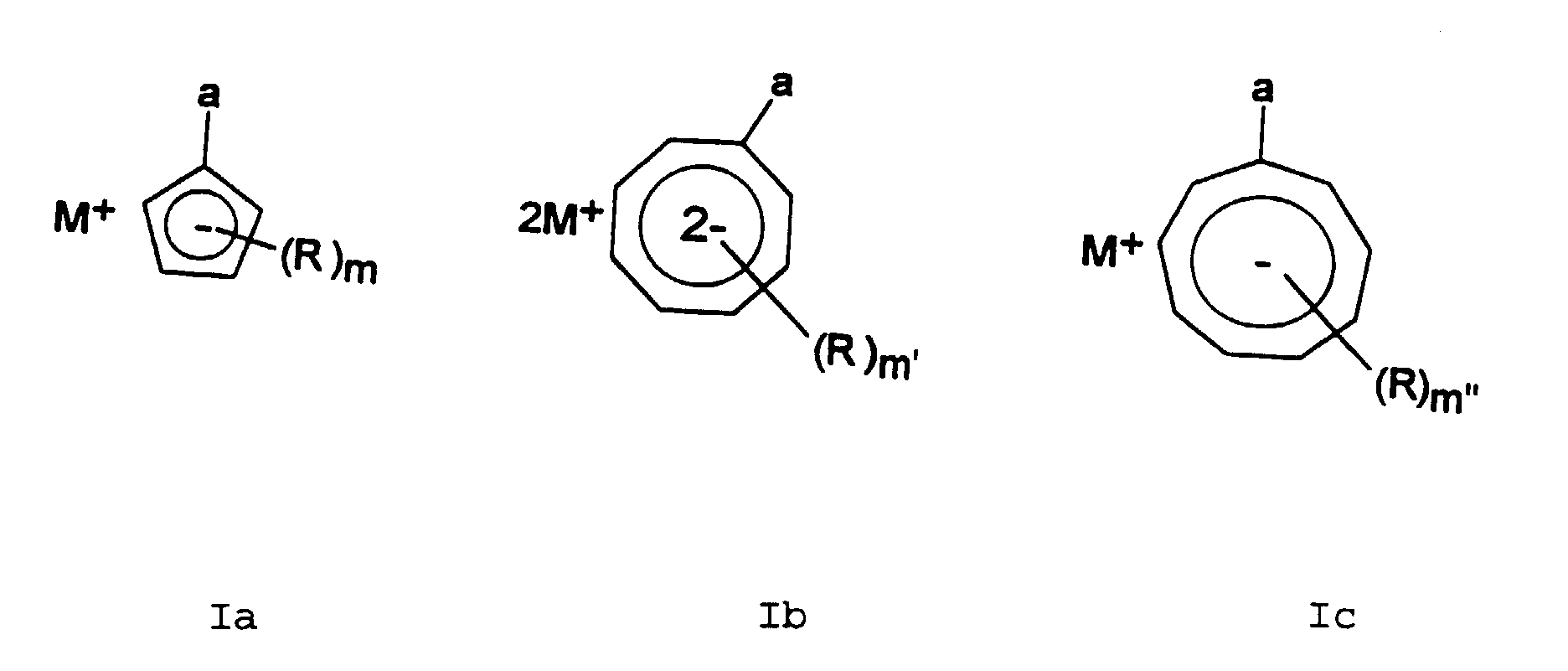
- M+ is H+, Li+, Na+, or K+;
- m is an integer in the range 0-4;
- m' is an integer in the range 0-7;
- m" is an integer in the range 0-8; and each group R independently is
- halogen;
- a group -CO-O-, -CO-O-,M+, or -SO2-O-, M+ wherein M+ is as defined above;
- cyano;
- nitro;
- C1-5 alkoxy;
- optionally substituted phenyl;
- optionally substituted phenoxy;
- a group -CONR5R6 where R5 and R6 independently are hydrogen, C1-5 alkyl, optionally substituted phenyl, phenylcarbonyl, or C1-6 alkanoyl;
- a group -NR5R6 where R5 and R6 independently are as defined above;
- a group -N(R5)-CO-R7 where R5 is as defined above, and R7 is hydrogen, C1-5 alkyl, C2-5 alkenyl, C2-5 alkynyl, or optionally substituted phenyl;
- a group R7-CO-, a group R7-O-CO-, a group R7-CO-O-, or a group R7-O-CO-O- where R7 is as defined above; cycloheptatrienyl; or
- one of the groups R is a ion complex Ia', Ib', or Ic'
wherein M+, m, m' and m" are as defined above, and R' has the same meanings as R defined above with the proviso that R' is not a ion complex Ia', Ib', or Ic';

-
- or two groups R bound to two adjacent carbon atoms may together form
- a divalent aliphatic or alicyclic group with 3-8 carbon atoms and having at least 2 C-C double bonds;
- carbonyloxycarbonyl;
- carbonylthiocarbonyl; or
- a group -CO-N(R7)-CO- where R7 is as defined above; and the free bond indicated by "a", either directly or through an intervening group, is bound to the polymer backbone.
-
- In the present context, the term "C1-5 alkyl" designates an alkyl moiety of 1-5 carbon atoms such as methyl, ethyl, n-propyl, isopropyl, n-butyl, isobutyl, sec-butyl, tert-butyl, n-pentyl, or neopentyl. The term "C2-5 alkenyl" designates a monounsaturated hydrocarbyl group with 2-5 carbon atoms, such as vinyl, allyl, 1-, 2-, or 3-propenyl, n-butenyl, sec-butenyl, iso-butenyl, n-pentenyl, sec-pentenyl, iso-pentenyl. The term "C2-5 alkynyl" designates a hydrocarbyl group with 2-5 carbon atoms and containing a triple bond, such as ethynyl, propynyl, n-butynyl, sec-butynyl, iso-butynyl, n-pentynyl, iso-pentynyl. The term "C1-5 alkoxy" designates a C1-5 alkyl group as defined bound via an oxygen atom. The term "C1-6 alkanoyl" designates the acyl group derived from an alkanoic acid with 1-6 carbon atoms, such as formyl, acetyl, propionyl, butyryl, valeryl or hexanoyl.
- The term "halogen" designates fluoro, chloro, bromo, and iodo.
- The terms "optionally substituted phenyl" and "optionally substituted phenoxy" designate phenyl and phenoxy groups, respectively, which are unsubstituted or are substituted with electron-withdrawing groups such as halogen, cyano, nitro, C1-5 alkoxy, a group -CONR5R6 as defined above, a group -NR5R6, as defined above, a group -N(R5)-CO-R7 as defined above, a group R7-CO- as defined above, a group R7-O-CO- as defined above, a group R7-CO-O- as defined above, or a group R7-O-CO-O- as defined above.
- When two groups R bound are to two adjacent carbon atoms and together form a divalent aliphatic or alicyclic group, examples of such divalent groups are 1,3-propenylene, 1- or 2-buten-1,4-ylene, 1,3-butadien-1,4-ylene, 1,3-pentadien-1,5-ylene, 5-methyl-1,3-pentadien-1,5-ylene, 3-methyl-1,4-pentadien-1,5-ylene, 5-methylidene-1,3-pentadien-1,5-ylene, a group of the formulaand a group of the formula
 where "a" indicates the free bonds.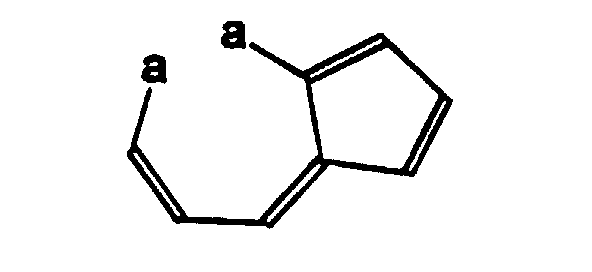
- Specific, but not limiting examples of covalently bound ion complexes of the formulas Ia-Ic wherein two groups R bound to adjacent carbon atoms form the above defined groups are as follows:

 where the free bond "a" shown in the formulas Ia-Ic may be in any of the possible positions.
- It is particularly preferred if the divalent group together with the cyclic nucleus in the formulas Ia-Ic forms a complete aromatic structure.
- Preferred examples of the covalently bound anion in the ion complexes of the formulas Ia-Ic are the cyclopentadienylide ion, the indenylide ion, and the 9-fluorenylide ion, in particular the cyclopentadienylide ion.
- Since the ion conductivity of an ion conductive polymer is unfavourably affected at temperatures below the glass transition temperature of the polymer due to crystallization of the ion-solvating polymer matrix, it is preferred that the glass transition temperature Tg of the polymer of the invention is below 273°K, more preferably below 263°K, most preferably below 253°K, in particular below 243°K, especially below 233°K, such as below 223°K.
- It has been established that a prerequisite for ion-conductivity is the presence of a suitably ion-solvating environment capable of solvating the ions, and in order to ensure such an environment, an ion solvating solvent may be incorporated into the electrolyte, e.g. tetrahydrofuran or propylene carbonate.
- However, it is known that the ion conductivity is also improved in the presence of poly(alkylene oxide) moieties in the polymer, and it is therefore preferred that such moieties are present in the polymer. It is particularly preferred that the polymer of the invention comprises sequences of the formula -(CH(Y)-CH2-O)n- where Y is hydrogen or methyl, and n is an integer in the range of 2-30 depending on the polymeric system selected, in particular in the range 3-10. Such sequences may be present either in the backbone of the polymer or in grafted side groups or in the intervening group. It has been shown that poly(alkylene oxide)s form canal-like structures in the polymeric matrix with the right dimensions for ion passage through the electrolyte.
- Depending on the precise composition of the poly(alkylene oxide) moieties in the polymer, they may affect the Tg of the polymer due to the formation of crystalline domains amongst the poly(alkylene oxide) moieties present. While it has been found that such effects can be off-set by forming the electrolyte from a mixture of a polymer of the invention with for example polyisobutylene, it is also contemplated that the effect may be eliminated or substantially reduced by omitting forming the poly(alkylene oxide) moieties from identical units, thereby introducing an element of heterogeneity in the poly(alkylene oxide) moieties.
- Since it is chiefly the properties of the ion complexes of the formulas Ia-Ic which are responsible for the surprising ion conductivity properties of the polymers of the invention, the backbone in the polymers may in principle be any type of polymer which does not actually contain functionalities which would directly counteract the intended ion transport process such as groups or functionalities capable of binding strongly with M+.
- Examples, although by no means exhaustive, of general types of polymers which may form the basis for at least part of the backbone of the polymers of the invention are derivatives of polyolefines such as polyethylene, polypropylene or polyisobutylene; polymers of unsaturated acids such as acrylic acid, methacrylic acid, itaconic acid as well as derivatives of such acids such as esters, nitriles or amides, e.g. polyacrylic acid, poly (polyethoxymethylitaconate) (PEO(n)MI), poly(polyethyleneglycol methacrylate) (PGM), poly(hydroxyethyl acrylate); polyvinyl alcohol and derivatives thereof such as polyvinyl esters, e.g. polyvinyl acetate; derivatives of polyesters, typically formed from a diacid (e.g. adipic acid, terephthalic acid) and a dihydroxy compound (e.g. ethylene glycol, propylene glycol), such as poly(ethylene adipate); derivatives of polyamides, typically formed from a diacid (e.g. adipic acid, terephthalic acid) and a diamino compound (e.g. 1,3-diaminopropane, 1,4-diaminobutane, 1,6-diaminohexane) ; polyalkyleneimines, both linear and branched, such as polyethyleneimine; substituted polyphosphazenes such as poly(bis-(methoxy-ethoxy-ethoxide)phosphazene; silicone polymer derivatives such as polysiloxane derivatives, e.g. derivatives of poly(methylhydrosiloxane).
- Furthermore, the polymer may be either crosslinked or non-crosslinked, and the crosslinking may have been brought about in any manner known in the art, e.g. through reaction of reactive groups on the backbone or a grafted side group thereon with crosslinking moieties having two or more functionalities; or through irradiation with ultraviolet light (optionally in the presence of UV-sensitive initiators such as benzophenone or benzoylperoxide), X-rays, gamma rays or electron beams (EB).
- The term "intervening group" is intended to mean any chemical moiety located between on the one hand the ion complexes of the formulas Ia-Ic defined above and on the other hand the polymer backbone. Since, as discussed above, it is the properties of the ion complexes of the formulas Ia-Ic which are chiefly responsible for ion conductivity properties of the polymers, it is clear that similar to the polymer backbone, the intervening group may in principle be any type of divalent chemical group or moiety which does not actually contain functionalities which would directly counteract the intended ion transport process.
- As examples, but by no means exhaustive, of intervening groups may be mentioned the following where the lefthand end of the various formulas is connected to the polymer backbone, and the righthand end is connected to the ion complex of the formulas Ia-Ic:
- -(CH2)x- where x is an integer from 1 to 10;
- -(CH2)x,-(Phenyl)-, where x' is an integer from 1 to 10;
- -O-;
- -O-(Phenyl)-;
- -O-(CH2)x"-, where x" is an integer from 1 to 10;
- -O-(CH2)x'-(Phenyl)-, where x' is as defined above; and
- -(CH2)y-O-CH2-CH(OH)-CH2-, where y is an integer from 1 to 10.
-
- In the above formulas, the group (Phenyl) designates a benzene ring, the substitution pattern of which may be 1,2-, 1,3-, or 1,4-, and the remaining positions on the ring are unsubstituted or may be substituted with any group capable of delocalizing the charge of the anion, e.g. cyano; nitro; C1-5 alkoxy; optionally substituted phenyl; optionally substituted phenoxy; a group -CONR5R6 where R5 and R6 independently are hydrogen, C1-5 alkyl, optionally substituted phenyl, phenylcarbonyl, or C1-6 alkanoyl; a group -NR5R6 where R5 and R6 independently are as defined above; a group -N(R5)-CO-R7 where R5 is as defined above, and R7 is hydrogen, C1-5 alkyl, C2-5 alkenyl, C2-5 alkynyl, or optionally substituted phenyl; a group R7-CO-, a group R7-O-CO-, a group R7-CO-O-, or a group R7-O-CO-O- where R7 is as defined above.
- In another embodiment of the polymer, sequences of the formula -(CH(Y)-CH2-O)n- discussed above are comprised in the intervening groups between the ion complexes of the formulas Ia-Ic and the polymer backbone.
- The backbone of the polymer may be one which is derived from one of the following examples of polymers which, however, should not be construed as being limiting. In the examples, the basic structure of the polymer is given by showing the repeating units, but without showing where the location of the ion complex group of the formula Ia-Ic or the group containing the ion complex group. Thus, the backbone may be derived from polymer backbones of the following formulas II, III or IV

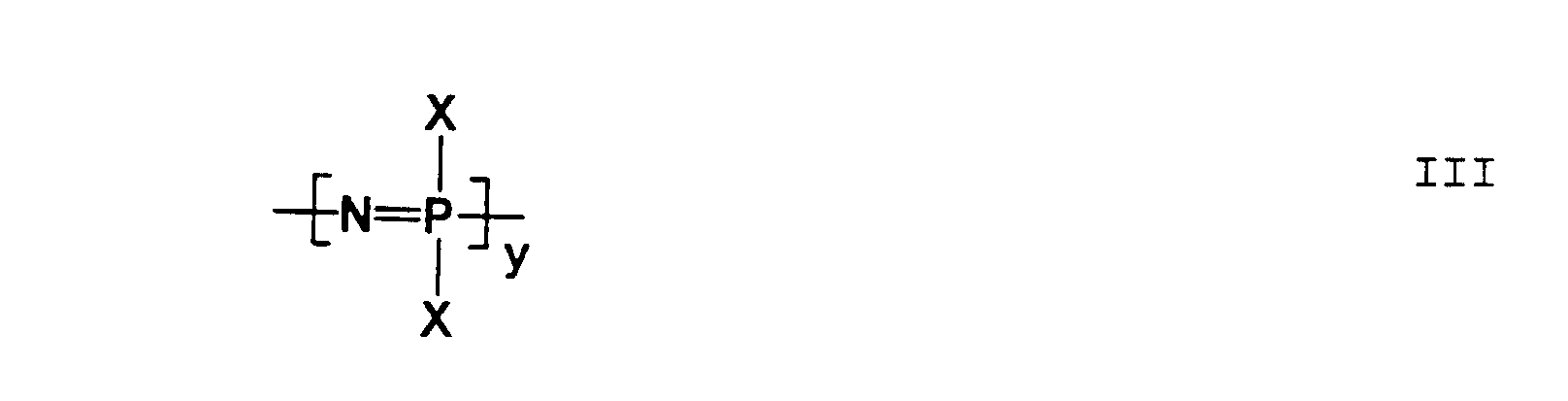 wherein X is halogen; R10 and R11 independently are hydrogen, alkyl with 1-3 carbon atoms, carboxy, carboxyalkyl with 1-3 carbon atoms, phenyl, a group (OCH(Y)CH2)nOH or a group - (OCH(Y)CH2)nOR12 wherein Y is H or methyl, n is an integer in the range 2-30 and R12 is C1-3 alkyl; and y is an integer in the range from 3 to 104, preferably from 3 to 103, such as from 3 to 500.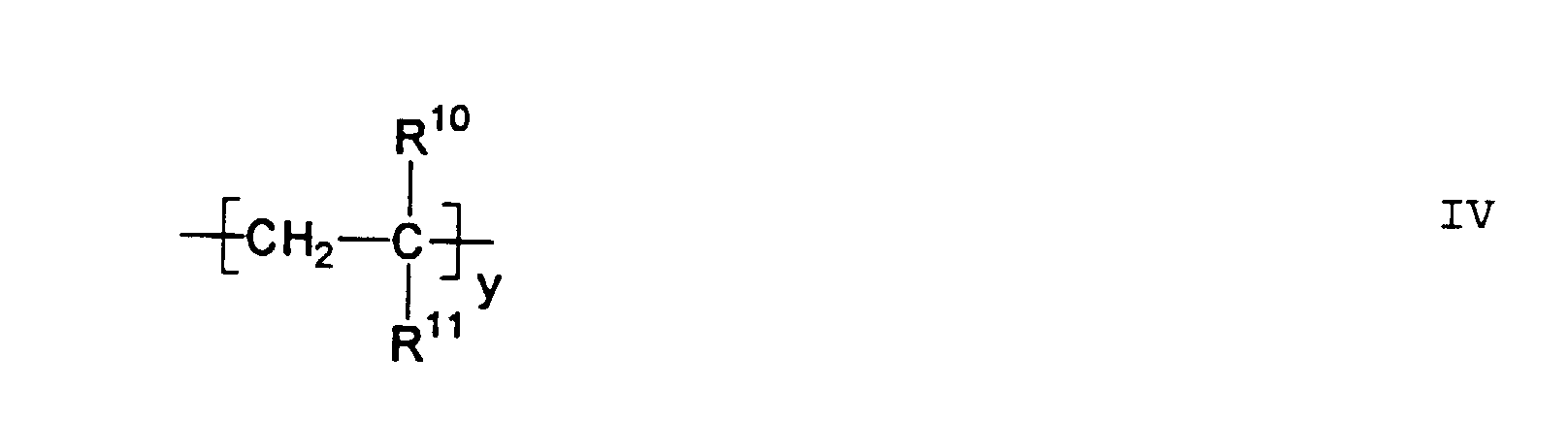
- In the formula II, it will typically be in the position of the silicon-bound hydrogen that an intervening group or an ion complex or, alternatively, a grafted side group is inserted as a result of the reactivity of the hydrogen-silicon bond. Likewise, in the formula III it will typically be in the position of the halogen atom that an intervening group or an ion complex or, alternatively, a grafted side group is inserted as a result of the reactivity of the phosphorous-halogen bond. In the formula IV, it will typically be somewhere in R10 and/or R11 that an intervening group or an ion complex or, alternatively, a grafted side group is inserted.
- The polymers of the invention may typically be prepared from suitably substituted monomers by known methods of polymerisation analogous to the manner in which the type of polymer, from which a polymer of the invention is derived, is usually prepared. However, in some cases such as poly(ethylene glycol) ethers and poly(methyl siloxane)s, it may be more practical to introduce the ion complex groups or moieties containing them or grafted side groups into already existing polymers having suitable functionalities in their structure. As an example of a type of reagent capable of introducing an intervening group or a grafted side groups may be mentioned poly(ethylene glycol) allyl methyl diether, the double bond of which is able to react with the polymethylhydrosiloxane of formula II replacing the hydrogen in a hydrosilylation reaction.
- When preparing the polymers of the invention from suitably modified monomers, the actual polymerization is typically performed in the same manner as known polymerizations relevant for the polymer in question, including the use of catalysts, coinitiators, solvents, proton traps, etc., cf. standard works in the polymer field such as M.P. Stevens, "Polymer Chemistry", Oxford University Press, 1990. Also, when the polymer contains poly(alkylene oxide) moieties, it may be advantageous to add an antioxidant, such as a sterically hindered phenol derivative, at the end of the polymerization reaction in order to prevent polymer degradation.
- Similarly, the monomers may be modified by standard organic chemical methods as exemplified by the following.
- Thus, the monomers for preparation of poly(vinyl ether)s (PVE) where the ether functions are of the poly(alkylene oxide) type, in particular the poly(ethylene oxide) type, may be for example synthesized from a mixture of ethyl vinyl ether and an appropriate poly(ethylene glycol)-monomethyl ether in the presence of mercuric acetate as a catalyst while heating the mixture at reflux temperature(15,16). Ethylene glycol allyl vinyl diether for preparing allylated PVE may be prepared from allyl alcohol and (2-chloroethyl) vinyl ether, in the presence of a strong base such as potassium hydroxide, optionally in the presence of an aprotic solvent such as dimethyl sulfoxide (DMSO) at elevated temperatures, typically between 75°C and 85°C(15).
- Monomers which are esters of unsaturated acids with an alcohol, such as poly(alkylene oxide)s or phenols, are typically prepared by acid catalyzed esterification of the unsaturated acid, e.g. itaconic acid, with an appropriate poly(alkylene oxide) or derivative thereof such as a suitable poly(ethylene glycol) or poly(ethylene glycol)-monomethyl ether, or with an appropriate phenol, or with a mixture of these, in the presence of e.g. p-toluene sulfonic acid catalyst in a solvent such as toluene at reflux temperature(17'18,19,20)
- When polymerizing the modified monomers, other unmodified, unsaturated co-monomers such as isobutylene or styrene may be included.
- For the preparation of polymers of the poly(methyl siloxane) type shown above, a suitable starting material may be a poly(methyl hydrosiloxane) which may then be reacted with a poly(ethylene glycol) allyl methyl diether or with allyl glycid ether or with styrene or a mixture of these in the presence of platinum catalyst(2). The poly(ethylene glycol) allyl methyl ether used as a starting material may be prepared by a reaction between allyl chloride and the sodium salt of an appropriate poly(ethylene glycol) monomethyl ether, optionally in an aprotic solvent such as tetrahydrofuran (THF) at temperatures between 40°C and 70°C(10). Similarly, poly(ethylene glycol) monomethyl ether and phenols can be grafted on to poly(methyl hydrosiloxane) in the presence of zinc octoate as a catalyst(2). These reactions may be carried out at room temperature, optionally in an aprotic solvent such as THF. However, the use of zinc octoate requires the extraction thereof from the resulting polymer by a modified Soxhlet process.
- A poly(alkylene oxide) matrix may also be introduced by mixing a polymer of the invention containing the ion complex of the formulas Ia-Ic (e.g. of the poly(methyl siloxane type) with 1) a copolymer of poly(ethylene glycol) methyl vinyl diether and ethylene glycol allyl vinyl diether; 2) poly(ethylene glycol)-crosslinked di-(poly(ethylene glycol) monomethyl ether)-polyphosphazene (DPP); or 3) poly(ethylene glycol)-crosslinked poly(di-poly (ethylene glycol) monomethyl ether) itaconate (PPI). Furthermore, any mixture of poly(ethylene glycol)-crosslinked DPP, poly(ethylene glycol)-crosslinked PPI and allylated PVE may serve the same purpose. In the case of allylated PVE, a crosslinking reaction occurs between the Si-H-bond in poly(methyl hydrosiloxane) and the double bonds in allylated PVE copolymer.
- DPP, poly(ethylene glycol)-crosslinked DPP or phenylated DPP may be prepared by means of the ring-opening reaction of dichlorophosphazene at temperatures in the range 240-260°C, followed by reaction with the sodium salt of poly(ethylene glycol) monomethyl ether, poly(ethylene glycol), phenol, or a mixture thereof in the presence of tetra-n-butyl ammonium bromide. The reactions may optionally be carried out in an aprotic solvent such as THF, at temperatures between 60°C and 80°C(7,8,9).
- Polymers of the PVE-type, the polyalkene (such as polyisobutylene (PIB)) type, the polystyrene type, or combinations thereof may be prepared by carbocationic polymerization methods. The relevant starting materials are, in a typical example of such a polymerization reaction, reacted in a 40/60 (v/v) methylcyclohexane/dichloromethane solvent system with an initiating complex of titanium(IV)chloride and 1,3-di-(2-methoxy-2-propyl)-5-tert-butylbenzene in the presence of a proton trap such as 2,6-di-tert-butylpyridine, and in another typical example polymerized in dichloromethane with BF3Et2O as the initiator at temperatures in the range from -70°C to -90°C(12,13,14,15,16).
- Polymerization of unsaturated acid ester monomers such as itaconic acid diester monomers may be effected at temperatures in the range of 50-60°C using α,α'-azobisisobutyronitril as a radical initiator(17,18,19,20).
- Polymers containing phenol- and/or styrene groups may furthermore be lithiated with alkyllithium (such as butyllithium (BuLi)) and then reacted with a suitable chemical compound for introducing a into the polymer precursor to the ion complex of the formulas Ia-Ic. One example of such a compound is 2-cyclopentene-1-on for introducing a cyclopentadienyl group onto the phenyl group. The ion complex is then formed by reacting the precursor group on the polymer with a metallating agent, for example an alkyllithium (such as methyllithium (MeLi) or BuLi) which then results in the formation of a lithium cyclopentadienylide group complex(3,4,5,6).
- The ion-complex may also be introduced into the polymer either by adding a metal salt of the desired ion complex group to a polymer containing suitable functional groups with which to react; one example is the reaction between lithium cyclopentadienylide (LiCp) and an epoxy group on poly(methyl hydrosiloxane) carrying grafted allyl glycidyl ether groups.
- Another aspect of the invention is a battery or a proton exchange membrane fuel cell comprising an electrolyte comprising a polymer of the invention. When a fuel cell is desired, a polymer in which M+ is H+ is used, whereas when M+ is Li+, Na+, or K+, the polymer is used in a battery. The polymers of the invention may also be used in other electrochemical devices such as electrochromic displays, "smart window" displays, electrochemical sensors, ion exchange matrixes (e.g. in desalination plants), galvanic cells, supercapacitors, and hydrogen concentration units.
- A battery or a fuel cell according to the invention may be designed in a manner known per se to the person skilled in the art, e.g. as described in "Polymer Electrolyte Reviews" vol. 1 and 2, Ed. J.R. MacCallum & C.A. Vincent, Elsevier Applied Science, 1989; "Electrochemical Science and Technology of Polymers" vol. 2, Ed. R.G. Linford, Elsevier Applied Science, 1990; Fiona M. Gray, "Solid Polymer Electrolytes", VCH Publishers, 1991; and A.J. Appleby & F.R. Foulkes, "Fuel Cell Handbook", Van Nostrand, New York, 1989.
- Thus, a typical example of a battery of the invention comprises a anode consisting of a sheet of nickel foil (serving as a current collector) laminated with a sheet of foil of the alkali metal in question, e.g. lithium foil with a thickness of 40-100 µm. The electrolyte is then laminated onto the alkali metal foil, the thickness of the polymeric electrolyte typically being the range 20-100 µm.
- Finally, a cathode is laminated onto the surface of the electrolyte opposite the anode laminate. In order to be able to accommodate the alkali metal atoms resulting from the transport across the electrolyte of alkali metal ions, the cathode typically comprises a intercalating material, such as TiS2, V2O5, V6O13, MnO2, CoO2, the alkali metal atoms resulting from the ion transport intercalating in vacant positions in the crystal lattice of the cathode material when the ion accepts an electron. In order to provide the cathode with sufficient electrical conductivity, the intercalation material is typically mixed with particles of an electrically conductive, but electrochemically inert material such as carbon, e.g. graphite and coke, and further contains a portion of the ion-conductive polymer.
- The thickness of the entire laminate of anode, electrolyte, and cathode will depend on several factors but is typically up to a maximum of 2 mm. To provide batteries of cylindrical shape, the above laminate may simply be provided with suitable insulating layers and electrical connections and rolled or folded into the appropriate shape, e.g. a cylinder, and placed in a suitable casing.
- A typical example of a proton exchange membrane fuel cell according to the invention comprises a pair of teflon-coated carbon gas diffusion electrodes laminated onto both sides of a membrane of a proton-conductive polymer according to the invention which has been platinized on both sides, i.e. has been coated with very small platinum particles (cf. M.S. Wilson & S. Gottesfeld, (Electronics Research Group, Los Alamos National Laboratory, USA), Thin-film Catalyst Layers for Polymer Electrolyte Fuel Cells, Journal of Applied Electrochemistry, 22 (1992) 1-7). The whole system is enclosed in a casing, and hydrogen or a hydrogen-containing gas (or methane) is supplied to the anode side of the membrane, while oxygen or an oxygen-containing gas is supplied to the cathode side of the membrane.
- The manner in which the polymers of the invention are prepared as well as the procedures for producing single ion-conductive membranes containing an ion-polymer complex of the invention will be illustrated in more detail in the following, non-limiting examples.
- All the reactions were carried out in dry, O2-free solvents and under a dry, inert atmosphere (N2 or Ar).
- Example 1. The synthesis of:
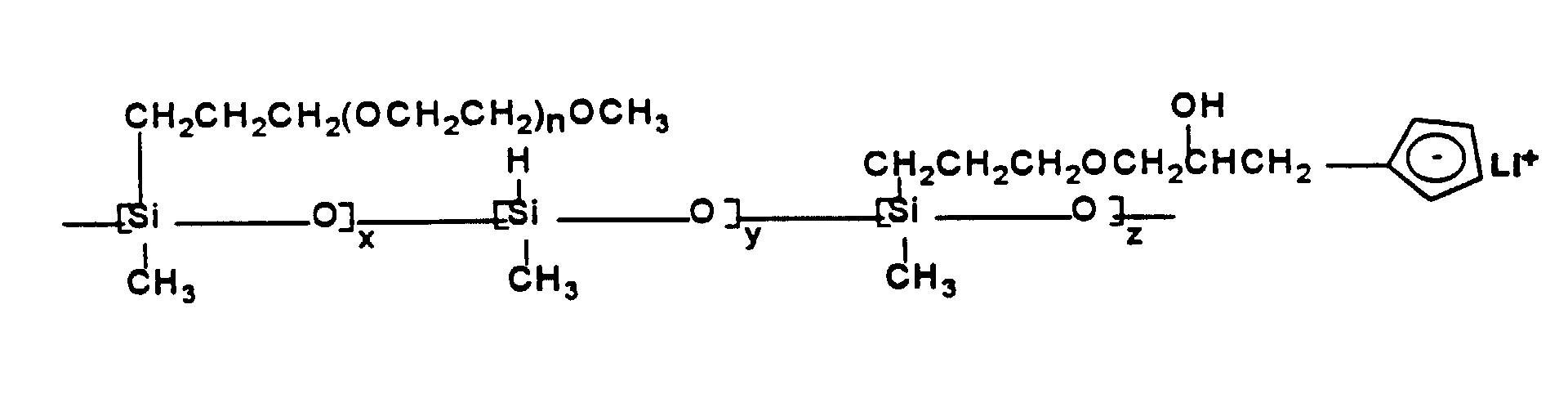
- A tetrahydrofuran solution (40 ml) of polymethyl hydrosiloxane (1.18 g, 5.2·10-4 mole (PS 120)), polyethyleneglycol allyl methyl diether (2.12 g, 5.4·10-3 mole (MW = 391)) and allyl glycidyl ether (0.45 g, 3.9·10-3 mole) was placed in a 50 ml Erlenmeyer flask. The reaction was catalyzed by adding 7.5 µl platinum-divinyltetramethyldisiloxan complex to the solution with a microsyringe(2). The mixture was stirred for 72 hours followed by addition of lithium cyclopentadienylide (0.22 g, 3.0·10-3 mole, corresponding to a EO/Li+ ratio of approximately 15. The solution was stirred for another 24 hours and cast on a glass plate. After the evaporation of the solvent the resulting polymer membrane (thickness approx. 0.25 mm) was dried at high vacuum. The conductivity of the complex was tested by means of a Solartron 1260 AC conductivity meter and was found to be 1.1·105 S cm-1 at room temperature.
- Example 2. The synthesis of:
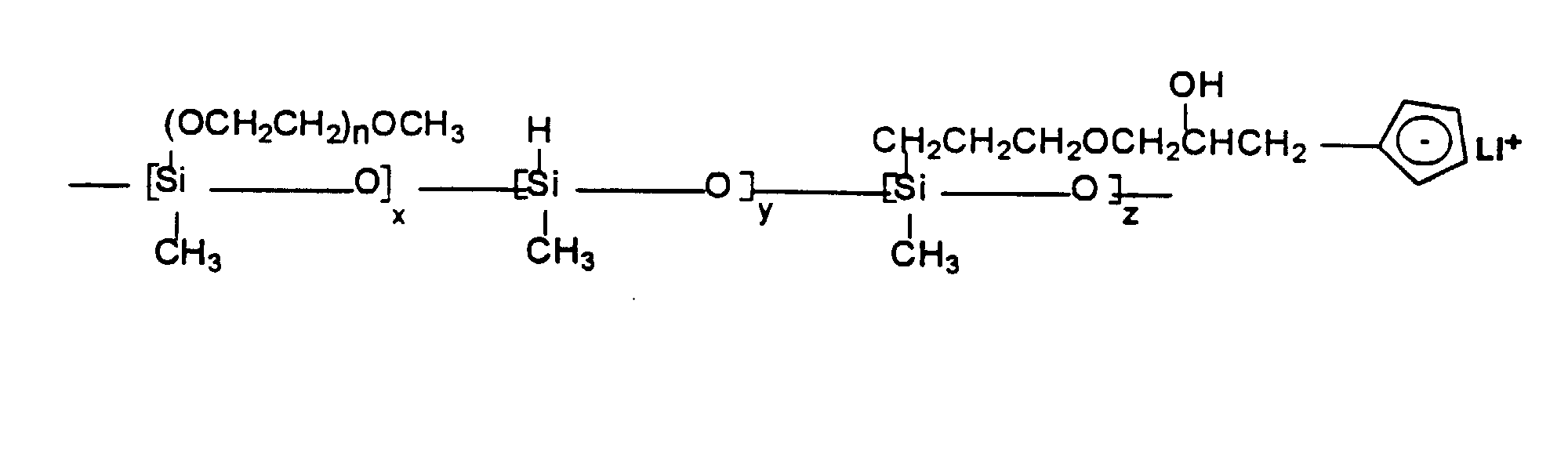
- A tetrahydrofuran solution (40 ml) of polymethyl hydrosiloxane (1.25 g, 5.5·10-4 mole (PS 120)) and polyethyleneglycol 350 monomethyl ether (2.20 g, 6.3·10-3 mole) was placed in a 50 ml Erlenmeyer flask. The reaction was catalyzed by adding 25 mg of zinc octoate to the solution(2). The mixture was stirred for 24 hours followed by addition of allyl glycidyl ether (0.39 g, 3.4·10-3 mole) and 5 µl platinum divinyl tetramethyldisiloxan complex for catalyzing(2). The mixture was stirred for 48 hours followed by addition of lithium cyclopentadienylide (0.16 g, 2,3·10-3 mole), corresponding to a EO/Li+ ratio of approximately 20. The solution was stirred for another 24 hours, filtered and then cast on a glass plate. After the evaporation of the solvent the resulting polymer membrane (thickness approx. 0.25 mm) was dried at high-vacuum. The conductivity of the complex was found to be 1.3·10-5 S cm-1 at room temperature.
- Example 3. The synthesis of:

- A tetrahydrofuran solution (40 ml) of polymethyl hydrosiloxane (1.38 g, 6.1 · 10-4 mole (PS 120)), polyethyleneglycol allyl methyl diether (2.92 g, 7.5 · 10-3 mole (MW = 391)) and allyl glycidyl ether (0.37 g, 3.2 · 10-3 mole) was placed in a 50 ml Erlenmeyer flask. The reaction was catalyzed by adding 7.5 µl platinum divinyl tetramethyldisiloxan complex to the solution with a microsyringe(2). The mixture was stirred for 15 hours followed by addition of lithium indenylide (0.33 g, 2.7 · 10-3 mole), corresponding to a EO/Li+ ratio of approximately 20. The solution was stirred for another 8 hours, filtered and cast on a glass plate. After the evaporation of the solvent the resulting polymer membrane (thickness approx. 0.25 mm) was dried at high vacuum. The complex was purple and the conductivity was found to be 1.9 · 10-6 S cm-1 at room temperature.
- Example 4. The synthesis of:
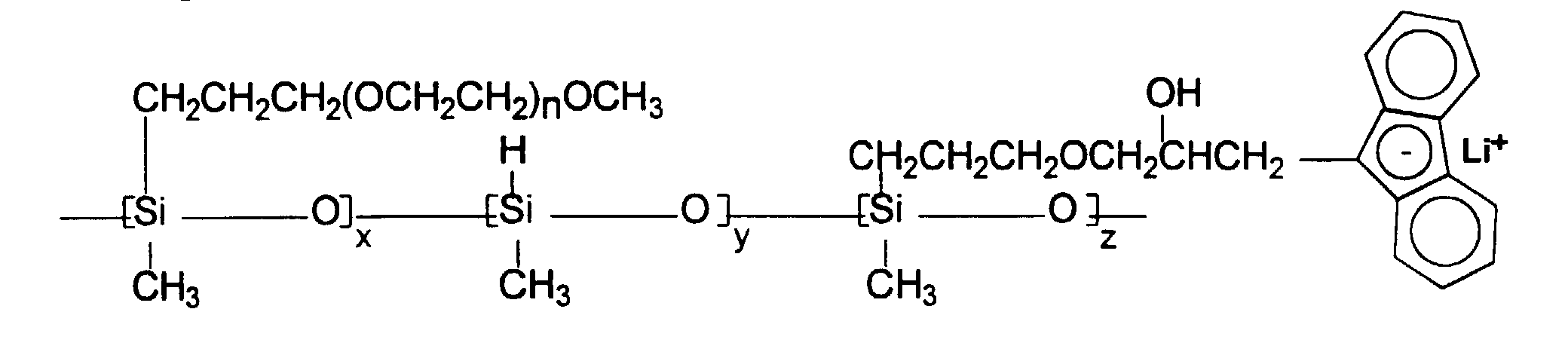
- A tetrahydrofuran solution (40 ml) of polymethyl hydrosiloxane (1.35 g, 5.9 · 10-4 mole (PS 120)), polyethyleneglycol allyl methyl diether (2.84 g, 7.3 · 10-3 mole (MW = 391)) and allyl glycidyl ether (0.36 g, 3.2 · 10-3 mole) was placed in a 50 ml Erlenmeyer flask. The reaction was catalyzed by adding 7.5 µl platinum divinyl tetramethyldisiloxan complex(2). The mixture was stirred for 20 hours followed by addition of lithium fluorenylide (0.45 g, 2.6 · 10-3 mole (9-lithiumfluorene)), corresponding to a EO/Li+ ratio of approximately 20. The solution was stirred for another 7 hours, filtered and then cast on a glass plate. After evaporation of the solvent the resulting polymer was a viscosious purple liquid.
- Complexes made as described above, containing mixed salt mixtures of lithium cyclopentadienylide (example 1) and lithium fluorenylide, were solid complexes. The result of conductivity measurements of complexes containing 20-80 mole % (of total salt content) lithium fluorenylide (LiFl) is shown on the following table. The conductivity is obviously decreasing with increasing lithium fluorene content.
% LiFl Conductivity (S cm-1) 20 1.0 · 10-6 60 7.4 · 10-7 80 4.7 · 10-7 - Example 5. The synthesis of

- 9.5 g polymethyl hydrosiloxane (4.2 · 10-3 mole (PS 120)) and 20.1 g polyethyleneglycol allyl methyl diether (4.8 · 10-2 mole (MW = 415)) was dissolved in approximately 70 ml tetrahydrofuran in a 100 ml volumetric flask. A reaction between the components was catalyzed by adding 25 µl platinum divinyl tetramethyldisiloxan complex to the solution with a microsyringe(2). The mixture was stirred for 5 hours and then diluted to 100.0 ml. (PMHS/PEG - matrix solution) A polymer membrane with a EO/Li+ ratio of approximately 10 was prepared as follows: 15.0 ml of the PMHS/PEG - matrix solution was placed in a 50 ml Erlenmayer flask followed by addition of 5.7 · 10-3 mole of lithiumallyl-cyclopentadienylide dissolved in 7 ml of tetrahydrofuran. The solution was diluted to approximately 30 ml, stirred for 15 hours, diluted again to approximately 40 ml, filtered and cast on a glass plate. After evaporation of the solvent the resulting polymer membrane (thickness approx. 0.25 mm) was dried at high vacuum. The complex was brown and waxy. The conductivity was found to be 2.7 · 105 S cm-1 at room temperature.
- Example 6. The synthesis of:
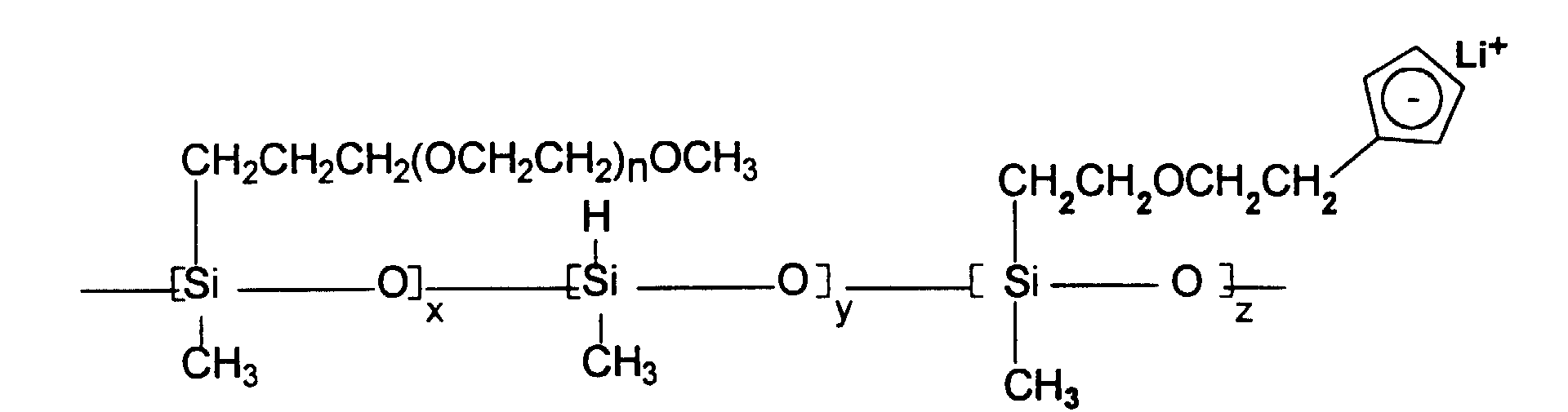
- 23.7 g polymethyl hydrosiloxane (1.0 · 10-2 mole (PS 120)) and 50.1 g polyethyleneglycol allyl methyl diether (0.121 mole (MW = 415)) was dissolved in approximately 150 ml tetrahydrofuran in a 250 ml volumetric flask. A reaction between the components was catalyzed by adding 100 µl platinum divinyl tetramethyldisiloxan complex to the solution with a microsyringe(2). The mixture was stirred for 15 hours and then diluted to 250.0 ml. (PMHS/PEG - matrix solution)
- 15.0 ml of the PMHS/PEG - matrix solution was placed in a 50 ml Erlenmeyer flask. The polymer was crosslinked by addition of 0.12 g polyethyleneglycol diallyl ether dissolved in 1.0 ml tetrahydrofuran (4.4 · 10-4 mole (MW = 282)). After stirring for 4 hours, approximately 3.9 · 10-3 mole of 2-(lithium cyclopentadienylide)ethyl-vinyl ether suspended in 8.3 ml tetrahydrofuran was added to the mixture, corresponding to a EO/Li+ ratio close to 15. The solution was diluted to approximately 40 ml, stirred for 15 hours, filtered and cast on a glass plate. After evaporation of the solvent the resulting polymer membrane (thickness approx. 0.25 mm) was dried at high vacuum. The complex was brown and the conductivity was found to be 3.3 · 10-6 S cm-1 at room temperature.
- Example 7. The synthesis of:

- A 40 g sample of polymethyl hydrosiloxane (1.8 · 10-2 mole (PS 120)) was mixed with 70 g of polyethyleneglycol 350 monomethyl ether (0.20 mole) and 10 g phenol (0.11 mole). The mixture was dissolved in 300 ml tetrahydrofuran and placed in a 0.5 1 three-necked flask. The reaction was catalyzed by adding 100 mg of zinc octoate to the solution(2) and the mixture was stirred at room temperature for 72 hours. The polymer was lithiated by addition of 40 ml N,N,N',N'-tetramethylethylenediamine (TMEDA) and 20 ml of 10 M butyllithium solution(3,4,6). The solution was refluxed overnight and then the solvent was removed a rotary evaporator. The resulting polymer (a yellow liquid) was washed three times with 100 ml of methylcyclohexane and dried at high vacuum (Yield 91.3 g (75%)).
- A 26 g sample of the lithiated polymer was dissolved in 100 ml tetrahydrofuran. While the mixture was stirred and cooled in an ice bath, 2.5 ml of 2-cyclopentene-1-on was added(3). The solution immediately became orange, but then slowly turned deep red while being stirred for 100 hours. The solvent was removed on a rotary evaporator whereby the polymer precipitated as beads.
- 3 g of the beads were suspended in 75 ml of tetrahydrofuran by stirring for 24 hours. Then they were treated with 0.25 ml of 10 M butyllithium solution(3), corresponding to a EO/Li+ ratio of approximately 20. The suspension was cast on a glass plate and after the evaporation of the solvent the resulting polymer membrane was dried at high vacuum. The conductivity of the complex was found to be 7.1·10-6 S cm-1 at room temperature.
- Example 8. The synthesis of:

- A 40 g sample of polymethyl hydrosiloxane (1.8·10-2 mole (PS 120)) was mixed with 78 g of polyethyleneglycol allyl methyl diether (0.20 mole (MW = 391)) and 11 g freshly distilled styrene (0.11 mole). The mixture was dissolved in 300 ml tetrahydrofuran and placed in an 0.5 1 three-necked flask. The reaction was catalyzed by adding 25 µl platinum divinyl tetramethyldisiloxan complex to the solution(2), and the mixture was stirred at room temperature for 72 hours. The polymer was lithiated by addition of 40 ml TMEDA and 20 ml of 10 M butyllithium solution(3,4,6). The solution was refluxed overnight and then the solvent was removed by a rotary evaporator. The resulting polymer (a orange liquid) was washed three times with 100 ml of methylcyclohexane and dried at high vacuum. (Yield 109.9 g (82%)).
- A 28 g sample of the lithiated polymer was dissolved in 100 ml tetrahydrofuran. While the mixture was stirred and cooled in an ice bath, 2.5 ml of 2-cyclopentene-1-on was added(3). The solution immediately became red, but then slowly turned brown while being stirred for 100 hours. The solvent was removed on a rotary evaporator whereby the polymer precipitated as beads.
- 4 g of the beads were suspended in 75 ml of tetrahydrofuran by stirring for 24 hours. Then they were treated with 0.30 ml of 10 M butyllithium solution(3), corresponding to a EO/Li+ ratio of approximately 20. The suspension was cast on a glass plate, and after the evaporation of the solvent the resulting polymer membrane was dried at high vacuum. The conductivity of the complex was found to be 9.1·10-6 S cm-1 at room temperature.
- Example 9. The synthesis of:

- 1.04 g (1.4· 10-2 mole) lithium cyclopentadienylide was weighed in a 100 ml volumetric flask and dissolved in approximately 50 ml tetrahydrofuran, followed by addition of 4.87 g (7.6· 10-3 mole) poly(propyleneoxide)diglycidyl ether. The mixture was stirred for 24 hours and then diluted to 100.0 ml. (PPO solution)
- A solution containing 0.74 g of polymethyl hydrosiloxane (3.3 · 10-4 mole (PS 120)), 2.70 g polyethyleneglycol allyl methyl diether (4.6 · 10-3 mole (MW = 591)) and allyl glycidyl ether (0.13 g, 1.1 · 10-3 mole) in tetrahydrofuran was prepared in a 50 ml Erlenmeyer flask. A reaction between the existing carbon-carbon double bonds and the silicon-hydrogen bonds was catalyzed by adding 5.0 µl platinum divinyl tetramethyldisiloxan complex to the solution with a microsyringe(2). The mixture was stirred for 15 hours followed by addition of 24 ml of the PPO solution, corresponding to a EO/Li+ ratio of approximately 20. The solution was stirred for another 8 hours and cast on a glass plate. After evaporation of the solvent the resulting polymer membrane (thickness approx. 0.25 mm) was dried at high vacuum. The complex was red and seemed to be separated into two phases. The conductivity of the dominant phase was found to be 5.4 10-6 S cm-1 at room temperature.
- Example 10. The synthesis of:may be carried out in the following manner:

A 12.5 g sample of phosphornitrile chloride (Cl6N3P3) is polymerized by a ring opening polymerization at 250°C(7). The resulting polydichlorophosphazene is dissolved in 300 ml tetrahydrofuran and is added over a 0.5 hour period to a stirred suspension of 27.4 g of the sodium salt of triethyleneglycol monomethyl ether (polyoxyethylene-3-methylether (0.15 mole)) and 0.53 g of the disodium salt of polyethylene glycol 200 (2.1·10-3 mole) in 200 ml tetrahydrofuran in a 1.0 1 three-necked flask. The reaction is carried out in the presence of tetra-n-butyl ammonium bromide to yield a fully substituted polymer(8). The mixture is refluxed for another 24 hours and then 7.7 g of the sodium salt of the phenol suspended in 100 ml tetrahydrofuran is added. The mixture is refluxed for another 24 hours and is then cooled to room temperature. The polymer is recovered by precipitation into heptane. - The resulting polymer is then lithiated, grafted with cyclopentadiene and complexed in the same manner as described in examples 7 and 8.
- Example 11. The synthesis of:may be carried out in the following manner:
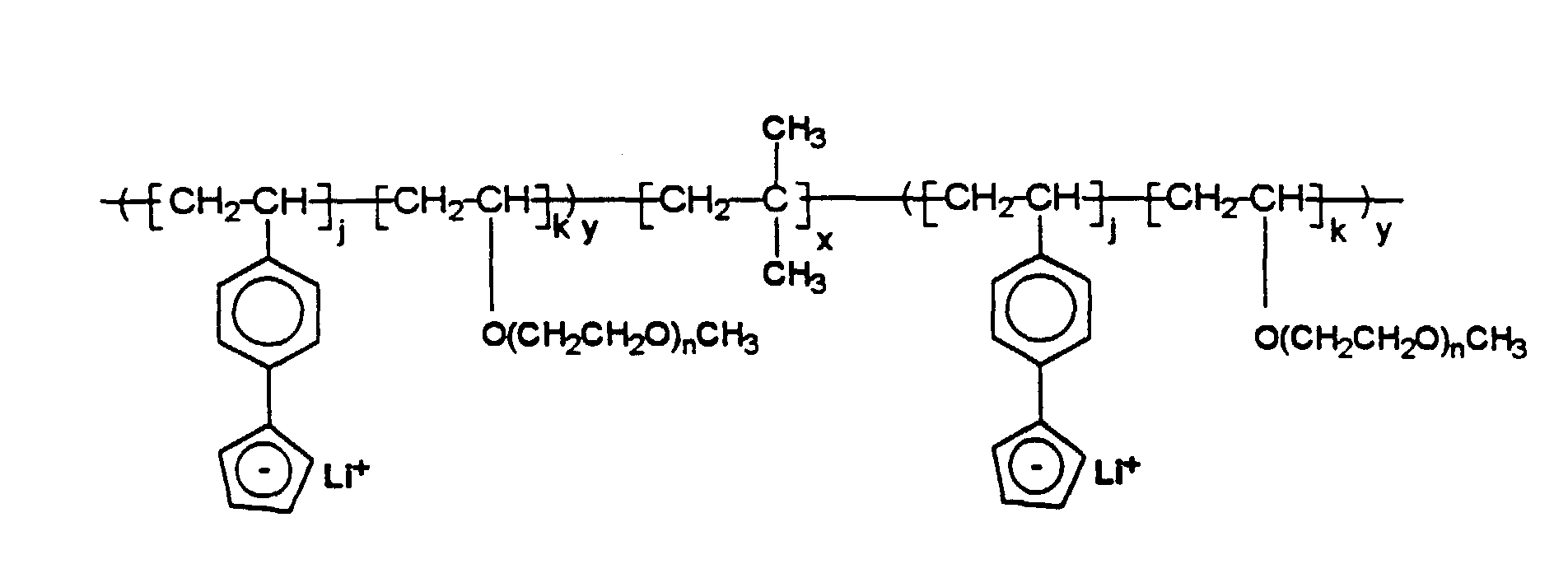
A polymer of the PVE-type, polyalkane, polystyrene or a combination thereof in a random copolymer or block-copolymer is prepared by living carbocationic polymerization with 1,3-di-(2-methoxy-2-propyl)-5-tert-butylbenzene as an initiator, with titanium(IV) chloride as coinitiator. An ideal solvent system may be a 40:60 (v/v) mixture of methylcyclohexane and dichloromethane (12,13,14). The polymerization is carried out at -78°C, in a cooling bath consisting of isopropyl alcohol mixed with dry ice. A proton trap such as 2,6-di-tert-butylpyridine and an electron donor such as DMA may optionally be applied. The resulting polymer is rinsed for homopolymers by soxhlet extraction with ethyl methyl ketone as an eluent. The apparent average molecular weight of the purified polymer may be measured by Gel Permeation Chromatography (GPC) with polyisobutylene, polystyrene and/or poly(ethylene glycol) standards, depending on the actual composition(12,13,14). - A block-copolymer consisting of a middle-block of polyisobutylene and random end-blocks of polystyrene-co-poly(ethylene glycol) methyl vinyl diether is prepared by living carbocationic polymerization in the said system, by preparing a solution of the initiator, proton trap, and isobutylene according to the art. The polymerization is turned on by adding a solution of the coinitiator to the system. After a while (typically 1-5 hours) the electron donor is added, followed by addition of a solution of poly(ethylene glycol) methyl vinyl diether and styrene. The polymerization is quenched with methanol after another 2-3 hours(12,14).
- The polymer is the lithiated, grafted with cyclopentadiene and complexed in the same manner as described in examples 7 and 8.
- Example 12. The synthesis of:may be carried out in the following manner:
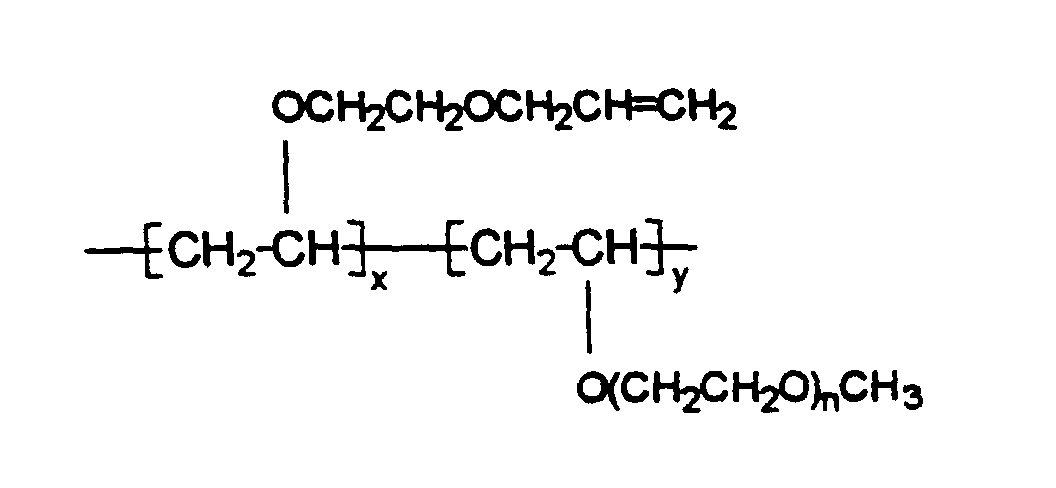
A random copolymer of poly(ethylene glycol) methyl vinyl diether and ethylene glycol allyl diether (allylated PVE)(15,16) is prepared by living carbocationic polymerization, in the same system as described in example 11, by preparing a solution of the initiator, proton trap, and the said monomers according to the art. The polymerization is turned on by adding a solution of the coinitiator to the system. After typically 1-5 hours, the polymerization is quenched with methanol(12,13,14). - The ion-conductivity may be gained by mixing the resulting copolymer with a polymer containing an ion complex of the invention, such as a poly(methyl hydrosiloxane) derivative (examples 1 and 2). In this case a crosslinking reaction occurs between the Si-H bond in the poly(methyl hydrosiloxane) and the double bond in the allylated PVE.
- Example 13. The synthesis of:may be carried out in the following manner:
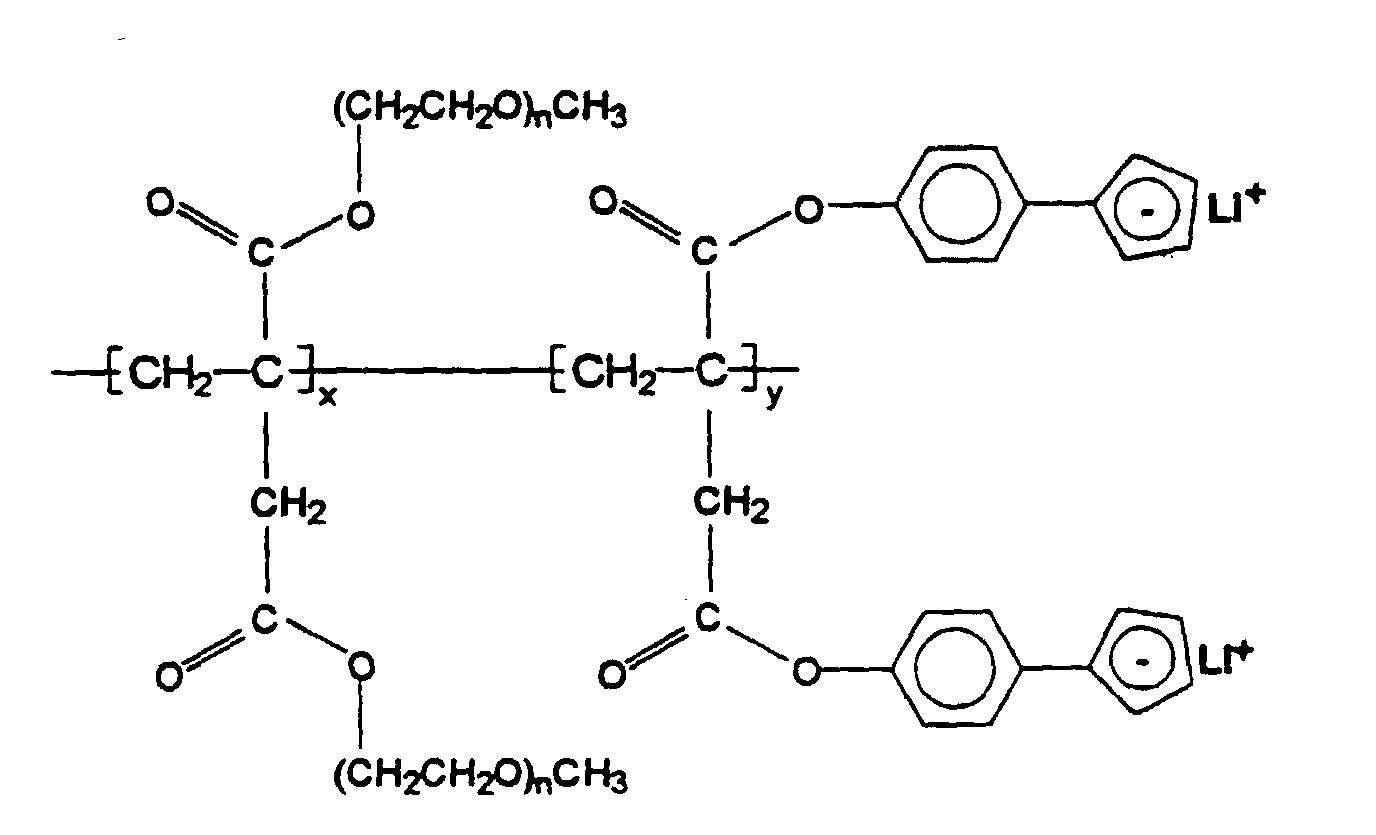
Itaconate ester monomers may be prepared by acid catalyzed esterification of itaconic acid with the appropriate starting alcohol using p-toluene sulfonic acid as catalyst and toluene as solvent at reflux temperature. Alcohols such as polyethylene glycol 350 monomethyl ether, triethylene glycol monomethyl ether and phenol, may be used for the monomer synthesis. The corresponding itaconates are di-ethoxy(7,2)-methyl itaconate, di-ethoxy(3)-methyl itaconate and diphenyl itaconate. Unreacted alcohol is removed by washing the toluene solution several times with water. The required monomer may then be obtained by drying the toluene solution with magnesium sulphate, followed by azeotropic distillation(17,18,19,20). - A mixture of di-ethoxy(7,2)-methyl itaconate, di-ethoxy(3)-methyl itaconate and diphenyl itaconate is placed in a 0.5 1 flask. The monomers are polymerized using α,α'-azabisisobutyronitrile as initiator by heating the system at 340K for one week. The resulting polymer is dissolved in chloroform, precipitated from diethyl ether and dried for 24 hours in vacuo(17,18,19,20).
- The polymer may then be lithiated, grafted with cyclopentadiene and complexed in the same manner as described in examples 7 and 8, with carefully purified and dried dichloromethane as solvent.
- In the case of y = 0, ion-conductivity may be gained by mixing the resulting poly(poly(ethylene glycol) monomethyl ether) itaconate with a polymer containing an ion complex of the invention, such as a poly(methyl hydrosiloxane) derivative (example 1 and 2).
-
- 1
- Gray, F.M.: "Solid Polymer Electrolytes - Fundamentals and Technological Applications", VHC Publishers Inc. 1991.
- 2
- Anderson, R., Arkles, B., and Larson, G.L.: "Silicon Compounds - Register and Review", Petrarch Systems Inc. 1987.
- 3
- Bonds, W.D., Brubaker, Jr., C.H., Chandrasekaran, E.S., Gibbons, R.H. and Kroll, L.C.: "Polystyrene Attached Titanocene Species - Preparation and Reactions", J. Am. Chem. Soc. 97(8), 2128 (1975).
- 4
- Fyles, T.M. and Leznoff, C.C.: "The Use of Polymer Supports in Organic Chemistry V. The Preparation of Monoacetates of Symmetrical Diols", Can. J. Chem. 54, 935 (1976).
- 5
- Grubbs, R.H. and Shiu.Chin, H. Su: " The Preparation of Polymeric Organophosphorous Ligands for Catalyst Attachment", J. Organom. Chem. 122, 151 (1976).
- 6
- Broaddus, C.D.: "Homogenous Metalation of Alkylbenzenes", J. Org. Chem. 35, 10 (1970).
- 7
- Allcock, H.R., Austin, P.E., Neenen, T.X., Sisko, J.T., Blonsky, P.M. and Shriver, D.F.: " Polyphosphazenes with Etheric Side Groups: Prospective Biomedical and Solid Electrolyte Polymers", Macromolecules 19, 1508 (1986).
- 8
- Blonsky, J.T. and Shriver, D.F: "Polyphosphazenes Solid Electrolytes", J. Am. Chem. Soc. 106, 6854 (1986).
- 9
- Tonge, J.S. and Shriver, D.F.: "Increased Dimensional Stability in Ionically Conducting Polyphosphanozenes systems", J. Electrochem. Soc. 134, 269 (1984).
- 10
- Feldstedt, J.: " Syntese og Karakterisering af Solventfrie Elektrolytter", DTH Kemisk Lab. A, Denmark 1991.
- 11
- Skotheim, T.A., Yoshiyuki, O. and Hung Sui, L.: European Patent Application Publ. No. 0376466.
- 12
- Kennedy, J.P. and Ivan, B.: "Designed Polymers by Carbocationic Macromolecular Engineering: Theory and Practice.", Hanser Publichers, 1992.
- 13
- Wang, B., Mishra, M.K. and Kennedy, J.P.: "Living Carbocationic Polymerization. XII. Telechelic Polyisobutylenes by a Sterically Hindered Bifunctional Initiator.", Polymer Bulletin 17, 205, (1987), Springer-Verlag 1987.
- 14
- Gylfason, G.H.: "Polymerer med kontrolleret struktur", DTH Institut for kemiteknik, 1993.
- 15
- Andrei, M., Marchese M. and Roggero A.: "Polymer Electrolytes Based on Crosslinked Siliated Poly-vinylether and Lithium Perchlorate.", Solid State Ionics 72, 140, (1994).
- 16
- Pantaloni, S., Passerini, S., Croce, F. and Scrosati B.: "Electrochemical Characterization of a Class of Low Temperature Conducting Polymer Electrolytes.", Electrochimica Acta 34/5, 635, (1989).
- 17
- Cowie, J.M.G., Ferguson, R.: "Glass and Subglass Transitions in a Series of Poly(itaconate ester)s with Methyl-Terminated Poly(ethylene oxide) Side Chains.", J. Polymer Science, Polymer Physics Ed. 23, 2181, (1985).
- 18
- Cowie, J.M.G. and Martin, A.C.S.: "Ionic Conductivity of Poly(diethoxy(3)methyl itaconate) Containing Lithium Perchlorate.", Polymer Communications 26, 298, (1985).
- 19
- Cowie, J.M.G. and Martin, A.C.S.: "Glass Transition in Poly(di-(polypropylene glycol)itaconate)-Salt Mixtures.", Polymer Communications 28, 130, (1987).
- 20
- Cowie, J.M.G. and Martin, A.C.S.: "Ionic Conductivity of Poly(di-(polypropylene glycol)itaconate)-Salt Mixtures.", Polymers 28, 627, (1987).
Claims (10)
- An ion-conductive polymer containing covalently bound ion complexes of one of the formulas Ia-Icwherein
 each group R independently isM+ is H+, Li+, Na+, or K+;m is an integer in the range 0-4;m' is an integer in the range 0-7;m" is an integer in the range 0-8; andtwo groups R bound to two adjacent carbon atoms may together formhalogen;a group -CO-O-, -CO-O-, M+, or -SO2-O-, M+ wherein M+ is as defined above;cyano;nitro;C1-5 alkoxy;optionally substituted phenyl;optionally substituted phenoxy;a group -CONR5R6 where R5 and R6 independently are hydrogen, C1-5 alkyl, optionally substituted phenyl, phenylcarbonyl, or C1-6 alkanoyl;a group -NR5R6 where R5 and R6 independently are as defined above;a group -N(R5)-CO-R7 where R5 is as defined above, and R7 is hydrogen, C1-5 alkyl, C2-5 alkenyl, C2-5 alkynyl, or optionally substituted phenyl; a group R7-CO-, a group R7-O-CO-, a group R7-CO-O-, or a group R7-O-CO-O- where R7 is as defined above; cycloheptatrienyl; orone of the groups R is a ion complex Ia', Ib', or Ic'wherein M+, m, m' and m" are as defined above, and R' has the same meanings as R defined above with the proviso that R' is not a ion complex Ia', Ib', or Ic'; or
 a divalent aliphatic or alicyclic group with 3-8 carbon atoms and having at least 2 C-C double bonds;carbonyloxycarbonyl;carbonylthiocarbonyl;a group -CO-N(R7)-CO- where R7 is as defined above;and the free bond indicated by "a", either directly or through an intervening group, is bound to the polymer backbone.
 - A polymer according to claim 1 in which a divalent aliphatic or alicyclic group formed by two groups R bound to two adjacent carbon atoms is selected from 1,3-propenylene, 1- or 2-buten-1,4-ylene, 1,3-butadien-1,4-ylene, 1,3-pentadien-1,5-ylene, 5-methyl-1,3-pentadien-1,5-ylene, 3-methyl-1,4-pentadien-1,5-ylene, 5-methylidene-1,3-pentadien-1,5-ylene, a group of the formulaand a group of the formula
 where "a" indicate the free bonds to two adjacent carbon atoms.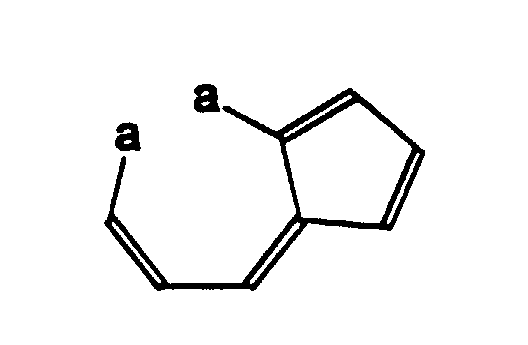
- A polymer as claimed in claim 1 or 2 which has a glass transition temperature Tg below 273°K.
- A polymer as claimed in claim 3 where the glass transition temperature Tg below 263°K, preferably below 253°K, in particular below 243°K, especially below 233°K, such as below 223°K.
- A polymer as claimed in any of claims 1-4 which further comprises sequences of the formula -(CH(Y)-CH2-O)n- where n is an integer in the range of 2-30, preferably 3-10, and each Y independently is hydrogen or methyl, said sequences being present either in the backbone of the polymer or in grafted side groups or in the intervening group.
- A polymer as claimed in claim 5 wherein the intervening group or grafted side groups comprise sequences of the formula -(CH(Y)-CH2-O)n-.
- A polymer as claimed in any of claims 1-6 which comprises a backbone derived from polymer backbones of the following formulae II, III or IV
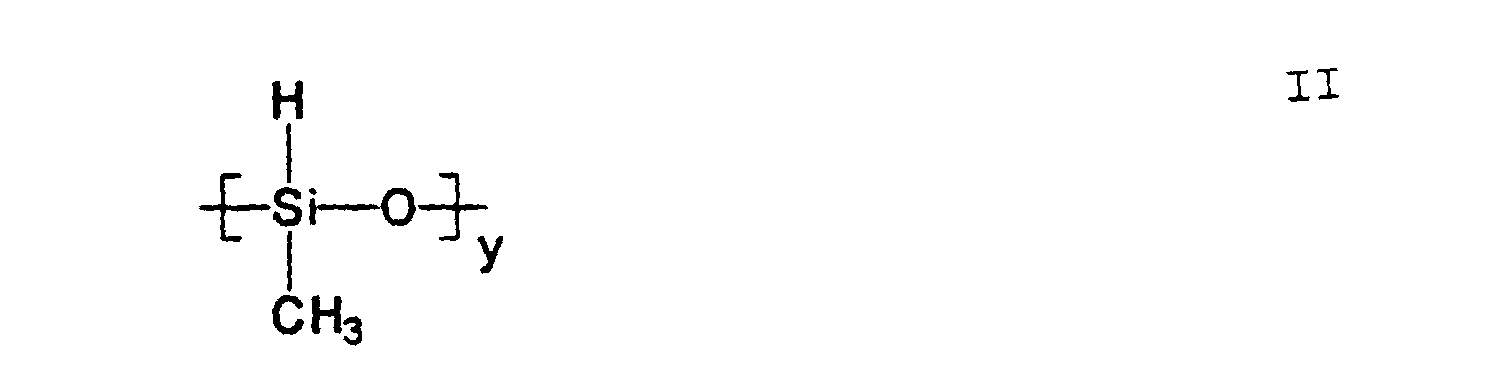

 wherein X is halogen;R10 and R11 independently are hydrogen, alkyl with 1-3 carbon atoms, carboxy, carboxyalkyl with 1-3 carbon atoms, phenyl, a group -(OCH(Y)CH2)nOH or a group -(OCH(Y)CH2)nOR12 wherein Y is H or methyl, n is an integer in the range 2-30 and R12 is C1-3 alkyl; andy is an integer in the range from 3 to 104, preferably from 3 to 103, such as from 3 to 500.
 - A polymer as claimed in any of claims 1-7 where M+ is H+; m, m' and m" are different from 0; the polymer contains sequences of the formula -(CH(Y)-CH2-O)n- where Y is hydrogen or methyl, and n is an integer in the range of 2-30; the ion complex of formula Ia, Ib, or Ic further having a pKa value of at the most 15, preferably at the most 10, in particular at the most 5, especially at the most 0.
- An electrochemical battery comprising an electrolyte comprising a polymer as defined in any of claims 1-7.
- A proton exchange membrane fuel cell comprising an electrolyte comprising a polymer as defined any of claims 1-8 wherein M+ is H+.
Applications Claiming Priority (4)
| Application Number | Priority Date | Filing Date | Title |
|---|---|---|---|
| DK1370/94 | 1994-12-01 | ||
| DK137094 | 1994-12-01 | ||
| DK137094 | 1994-12-01 | ||
| PCT/DK1995/000484 WO1996017359A1 (en) | 1994-12-01 | 1995-11-30 | Ion-conductive polymers |
Publications (2)
| Publication Number | Publication Date |
|---|---|
| EP0795182A1 EP0795182A1 (en) | 1997-09-17 |
| EP0795182B1 true EP0795182B1 (en) | 1999-03-03 |
Family
ID=8104115
Family Applications (1)
| Application Number | Title | Priority Date | Filing Date |
|---|---|---|---|
| EP95938374A Expired - Lifetime EP0795182B1 (en) | 1994-12-01 | 1995-11-30 | Ion-conductive polymers |
Country Status (10)
| Country | Link |
|---|---|
| US (1) | US5789106A (en) |
| EP (1) | EP0795182B1 (en) |
| JP (1) | JPH10510090A (en) |
| AT (1) | ATE177248T1 (en) |
| AU (1) | AU3979095A (en) |
| CA (1) | CA2206207C (en) |
| DE (1) | DE69508107T2 (en) |
| DK (1) | DK0795182T3 (en) |
| ES (1) | ES2132739T3 (en) |
| WO (1) | WO1996017359A1 (en) |
Families Citing this family (25)
| Publication number | Priority date | Publication date | Assignee | Title |
|---|---|---|---|---|
| JP3724903B2 (en) * | 1996-12-26 | 2005-12-07 | 日立マクセル株式会社 | Ionic conductor and electrochemical device using the same |
| WO2000005774A1 (en) * | 1998-07-23 | 2000-02-03 | Massachusetts Institute Of Technology | Block copolymer electrolyte |
| WO2000025323A1 (en) * | 1998-10-28 | 2000-05-04 | Kaneka Corporation | Curable composition for solid polymer electrolyte |
| DE19851717A1 (en) * | 1998-11-10 | 2000-06-15 | Magna Reflex Holding Gmbh | Electrochromic glass assembly |
| US6524498B1 (en) * | 1999-03-23 | 2003-02-25 | Nisshinbo Industries, Inc. | Electrolyte composition for electric double layer capacitor, solid polymer electrolyte composition for polarizable electrode, polarizable electrode, and electric double layer capacitor |
| WO2000056780A1 (en) * | 1999-03-23 | 2000-09-28 | Nisshinbo Industries, Inc. | Polymer, binder resin, composition for ionically conductive polymer electrolyte, and secondary battery |
| EP1090956A1 (en) * | 1999-03-23 | 2001-04-11 | Nisshinbo Industries, Inc. | Composition for ionically conductive solid polymer, ionically conductive solid polyelectrolyte, binder resin, and secondary battery |
| US6759157B1 (en) * | 1999-06-11 | 2004-07-06 | The Penn State Research Foundation | Proton conducting polymer membranes |
| WO2000077874A1 (en) * | 1999-06-11 | 2000-12-21 | The Penn State Research Foundation | Proton conducting polymer membranes |
| DE19933024C2 (en) * | 1999-07-15 | 2003-03-13 | Medinnova Ges Med Innovationen | Cationic block copolymers |
| JP3656244B2 (en) | 1999-11-29 | 2005-06-08 | 株式会社豊田中央研究所 | High durability solid polymer electrolyte, electrode-electrolyte assembly using the high durability solid polymer electrolyte, and electrochemical device using the electrode-electrolyte assembly |
| JP4033595B2 (en) * | 2000-02-02 | 2008-01-16 | 三洋電機株式会社 | Lithium polymer secondary battery |
| US20060130709A1 (en) * | 2000-11-20 | 2006-06-22 | Miksic Boris A | Liquid galvanic coatings for protection of embedded metals |
| US6627065B1 (en) | 2000-11-20 | 2003-09-30 | The United States Of America As Represented By The Administrator Of The National Aeronautics & Space Administration | Liquid galvanic coatings for protection of imbedded metals |
| US7238451B2 (en) * | 2000-12-29 | 2007-07-03 | The Board Of Regents Of The University Of Oklahoma | Conductive polyamine-based electrolyte |
| AU2003240532A1 (en) * | 2002-06-03 | 2003-12-19 | Parallel Solutions, Inc. | Sulfonated polyphosphazenes, uses thereof, and methods for preparing same |
| JP3922162B2 (en) | 2002-11-08 | 2007-05-30 | トヨタ自動車株式会社 | Proton conducting material |
| KR100588475B1 (en) | 2004-06-07 | 2006-06-09 | 한국화학연구원 | Solid polymer electrolyte composition containing polysiloxane compound |
| US7582147B1 (en) * | 2004-08-19 | 2009-09-01 | The United States Of America As Represented By The Administrator Of The National Aeronautics And Space Administration | Composite powder particles |
| JP4811575B2 (en) * | 2005-02-28 | 2011-11-09 | 信越化学工業株式会社 | Curable resin composition for electrolyte membrane, method for producing electrolyte membrane, and method for producing electrolyte membrane / electrode assembly |
| KR100762014B1 (en) * | 2006-07-24 | 2007-10-04 | 제일모직주식회사 | Conductive polymer composition containing an organic ion salt and organic photoelectric device using the same |
| US9035533B2 (en) * | 2010-09-24 | 2015-05-19 | Kuraray Co., Ltd. | Paste and polymer transducer including coating film formed from same as electrolyte film or electrode films |
| JP5742638B2 (en) * | 2011-09-30 | 2015-07-01 | 日立化成株式会社 | Ionic polymer |
| JP5742637B2 (en) * | 2011-09-30 | 2015-07-01 | 日立化成株式会社 | Resin composition for transparent conductive film and transparent conductive film |
| US10707531B1 (en) | 2016-09-27 | 2020-07-07 | New Dominion Enterprises Inc. | All-inorganic solvents for electrolytes |
Citations (1)
| Publication number | Priority date | Publication date | Assignee | Title |
|---|---|---|---|---|
| EP0376466A2 (en) * | 1988-11-22 | 1990-07-04 | Associated Universities, Inc. | Solvent-free solid polymer electrolyte and process for its preparation |
Family Cites Families (8)
| Publication number | Priority date | Publication date | Assignee | Title |
|---|---|---|---|---|
| US5196484A (en) * | 1986-10-27 | 1993-03-23 | The Secretary Of State For Defence In Her Britannic Majesty's Government Of The United Kingdom Of Great Britain And Northern Ireland | Polymeric ion conductors |
| JPH03115359A (en) * | 1989-09-28 | 1991-05-16 | Toray Dow Corning Silicone Co Ltd | Ionically conductive material and preparation thereof |
| IT1236512B (en) * | 1989-10-06 | 1993-03-11 | Eniricerche Spa | POLYEPOXIDE BASED SOLID POLYMER ELECTROLYTE. |
| JP2813834B2 (en) * | 1990-05-31 | 1998-10-22 | 第一工業製薬株式会社 | Ion conductive polymer electrolyte |
| FR2673769B1 (en) * | 1991-03-07 | 1993-06-18 | Centre Nat Rech Scient | POLYMERIC MATERIALS WITH ION CONDUCTION. |
| EP0581296A2 (en) * | 1992-07-30 | 1994-02-02 | Dow Corning Toray Silicone Co., Ltd. | Ionically conductive organosiloxane polymer compositions |
| US5665265A (en) * | 1996-09-23 | 1997-09-09 | Motorola, Inc., | Non woven gel electrolyte for electrochemical cells |
| US5681357A (en) * | 1996-09-23 | 1997-10-28 | Motorola, Inc. | Gel electrolyte bonded rechargeable electrochemical cell and method of making same |
-
1995
- 1995-11-30 JP JP8518088A patent/JPH10510090A/en not_active Ceased
- 1995-11-30 DE DE69508107T patent/DE69508107T2/en not_active Expired - Fee Related
- 1995-11-30 EP EP95938374A patent/EP0795182B1/en not_active Expired - Lifetime
- 1995-11-30 DK DK95938374T patent/DK0795182T3/en active
- 1995-11-30 US US08/849,090 patent/US5789106A/en not_active Expired - Fee Related
- 1995-11-30 AU AU39790/95A patent/AU3979095A/en not_active Abandoned
- 1995-11-30 CA CA002206207A patent/CA2206207C/en not_active Expired - Fee Related
- 1995-11-30 ES ES95938374T patent/ES2132739T3/en not_active Expired - Lifetime
- 1995-11-30 AT AT95938374T patent/ATE177248T1/en not_active IP Right Cessation
- 1995-11-30 WO PCT/DK1995/000484 patent/WO1996017359A1/en not_active Ceased
Patent Citations (1)
| Publication number | Priority date | Publication date | Assignee | Title |
|---|---|---|---|---|
| EP0376466A2 (en) * | 1988-11-22 | 1990-07-04 | Associated Universities, Inc. | Solvent-free solid polymer electrolyte and process for its preparation |
Also Published As
| Publication number | Publication date |
|---|---|
| ATE177248T1 (en) | 1999-03-15 |
| JPH10510090A (en) | 1998-09-29 |
| WO1996017359A1 (en) | 1996-06-06 |
| ES2132739T3 (en) | 1999-08-16 |
| DK0795182T3 (en) | 1999-10-04 |
| DE69508107D1 (en) | 1999-04-08 |
| AU3979095A (en) | 1996-06-19 |
| EP0795182A1 (en) | 1997-09-17 |
| DE69508107T2 (en) | 1999-10-28 |
| CA2206207C (en) | 2001-07-17 |
| CA2206207A1 (en) | 1996-06-06 |
| US5789106A (en) | 1998-08-04 |
Similar Documents
| Publication | Publication Date | Title |
|---|---|---|
| EP0795182B1 (en) | Ion-conductive polymers | |
| CN103509153B (en) | A kind of polymer list ionic electrolytes and preparation method thereof | |
| Kobayashi et al. | Poly [lithium methacrylate-co-oligo (oxyethylene) methacrylate] as a solid electrolyte with high ionic conductivity | |
| Zhang et al. | The impact of the molecular weight on the electrochemical properties of poly (TEMPO methacrylate) | |
| EP0301774B1 (en) | Polymer electrolytes | |
| JP5762748B2 (en) | Ion conductive polymer system crosslinkable at room temperature | |
| JP3105543B2 (en) | Soluble electrically conductive polypyrrole and method for producing the same | |
| CN111234240B (en) | Polycaprolactone-based hyperbranched polymer all-solid-state electrolyte and lithium ion battery | |
| WO2000005774A1 (en) | Block copolymer electrolyte | |
| AU3645599A (en) | Ionomers and ionically conductive compositions | |
| EP2176913A2 (en) | Electrochemical devices containing anionic-exchange membranes and polymeric ionomers | |
| JP2000285751A (en) | Method for producing cross-linked polymer solid electrolyte | |
| Hong et al. | Solid polymer electrolytes based on polysiloxane with anion-trapping boron moieties for all-solid-state lithium metal batteries | |
| EP1420473B1 (en) | Electrode structure for polymer electrolyte fuel cells, and polymer electrolyte fuel cell using the same | |
| CN113354784B (en) | A kind of block polymer of poly(1,5-dioxepane-2-one) base and its preparation method and application | |
| KR100843569B1 (en) | Hydrogen ion conductive composite triblock copolymer electrolyte membrane and its manufacturing method | |
| Kawai et al. | Electrochemical characteristics of poly (vinylferrocene) derivatives for battery application | |
| Gourdoupi et al. | New high temperature polymer electrolyte membranes. Influence of the chemical structure on their properties | |
| Chu et al. | Enhancing the performance of a silicon anode by using a new conjugated polymer binder prepared by direct arylation | |
| JP3843505B2 (en) | Polymer electrolyte and battery | |
| KR100947781B1 (en) | Electrolyte Membrane Using Water-Soluble Polymer and Crosslinkable Multiblock Copolymer | |
| CN113299987B (en) | Preparation method of solid polymer electrolyte of zinc ion battery | |
| JPH04253771A (en) | Solid polyelectrolyte and electric double-layer capacitor using same | |
| US20080269360A1 (en) | Solid-State Polymer Electrolyte Membrane, Method for Manufacture Thereof and Solid-State Polymer Electrolyte Fuel Cell Therewith | |
| Matsuda et al. | Poly (ethylene oxide)‐grafted polymers as materices for all‐solid batteries |
Legal Events
| Date | Code | Title | Description |
|---|---|---|---|
| PUAI | Public reference made under article 153(3) epc to a published international application that has entered the european phase |
Free format text: ORIGINAL CODE: 0009012 |
|
| 17P | Request for examination filed |
Effective date: 19970701 |
|
| AK | Designated contracting states |
Kind code of ref document: A1 Designated state(s): AT BE CH DE DK ES FR GB GR IE IT LI NL PT SE |
|
| GRAG | Despatch of communication of intention to grant |
Free format text: ORIGINAL CODE: EPIDOS AGRA |
|
| 17Q | First examination report despatched |
Effective date: 19980130 |
|
| GRAG | Despatch of communication of intention to grant |
Free format text: ORIGINAL CODE: EPIDOS AGRA |
|
| GRAH | Despatch of communication of intention to grant a patent |
Free format text: ORIGINAL CODE: EPIDOS IGRA |
|
| GRAH | Despatch of communication of intention to grant a patent |
Free format text: ORIGINAL CODE: EPIDOS IGRA |
|
| GRAA | (expected) grant |
Free format text: ORIGINAL CODE: 0009210 |
|
| AK | Designated contracting states |
Kind code of ref document: B1 Designated state(s): AT BE CH DE DK ES FR GB GR IE IT LI NL PT SE |
|
| PG25 | Lapsed in a contracting state [announced via postgrant information from national office to epo] |
Ref country code: SE Free format text: THE PATENT HAS BEEN ANNULLED BY A DECISION OF A NATIONAL AUTHORITY Effective date: 19990303 Ref country code: GR Free format text: LAPSE BECAUSE OF NON-PAYMENT OF DUE FEES Effective date: 19990303 Ref country code: AT Free format text: LAPSE BECAUSE OF FAILURE TO SUBMIT A TRANSLATION OF THE DESCRIPTION OR TO PAY THE FEE WITHIN THE PRESCRIBED TIME-LIMIT Effective date: 19990303 |
|
| REF | Corresponds to: |
Ref document number: 177248 Country of ref document: AT Date of ref document: 19990315 Kind code of ref document: T |
|
| REG | Reference to a national code |
Ref country code: CH Ref legal event code: EP |
|
| REG | Reference to a national code |
Ref country code: IE Ref legal event code: FG4D |
|
| REF | Corresponds to: |
Ref document number: 69508107 Country of ref document: DE Date of ref document: 19990408 |
|
| ITF | It: translation for a ep patent filed | ||
| PG25 | Lapsed in a contracting state [announced via postgrant information from national office to epo] |
Ref country code: PT Free format text: LAPSE BECAUSE OF FAILURE TO SUBMIT A TRANSLATION OF THE DESCRIPTION OR TO PAY THE FEE WITHIN THE PRESCRIBED TIME-LIMIT Effective date: 19990604 |
|
| REG | Reference to a national code |
Ref country code: CH Ref legal event code: NV Representative=s name: MICHELI & CIE INGENIEURS-CONSEILS |
|
| ET | Fr: translation filed | ||
| REG | Reference to a national code |
Ref country code: ES Ref legal event code: FG2A Ref document number: 2132739 Country of ref document: ES Kind code of ref document: T3 |
|
| REG | Reference to a national code |
Ref country code: DK Ref legal event code: T3 |
|
| PLBE | No opposition filed within time limit |
Free format text: ORIGINAL CODE: 0009261 |
|
| STAA | Information on the status of an ep patent application or granted ep patent |
Free format text: STATUS: NO OPPOSITION FILED WITHIN TIME LIMIT |
|
| 26N | No opposition filed | ||
| REG | Reference to a national code |
Ref country code: GB Ref legal event code: IF02 |
|
| PGFP | Annual fee paid to national office [announced via postgrant information from national office to epo] |
Ref country code: FR Payment date: 20051110 Year of fee payment: 11 Ref country code: DE Payment date: 20051110 Year of fee payment: 11 |
|
| PGFP | Annual fee paid to national office [announced via postgrant information from national office to epo] |
Ref country code: NL Payment date: 20051114 Year of fee payment: 11 Ref country code: CH Payment date: 20051114 Year of fee payment: 11 |
|
| PGFP | Annual fee paid to national office [announced via postgrant information from national office to epo] |
Ref country code: DK Payment date: 20051115 Year of fee payment: 11 |
|
| PGFP | Annual fee paid to national office [announced via postgrant information from national office to epo] |
Ref country code: GB Payment date: 20051121 Year of fee payment: 11 Ref country code: ES Payment date: 20051121 Year of fee payment: 11 |
|
| PGFP | Annual fee paid to national office [announced via postgrant information from national office to epo] |
Ref country code: IE Payment date: 20051122 Year of fee payment: 11 |
|
| PGFP | Annual fee paid to national office [announced via postgrant information from national office to epo] |
Ref country code: BE Payment date: 20051216 Year of fee payment: 11 |
|
| PG25 | Lapsed in a contracting state [announced via postgrant information from national office to epo] |
Ref country code: LI Free format text: LAPSE BECAUSE OF NON-PAYMENT OF DUE FEES Effective date: 20061130 Ref country code: IE Free format text: LAPSE BECAUSE OF NON-PAYMENT OF DUE FEES Effective date: 20061130 Ref country code: DK Free format text: LAPSE BECAUSE OF NON-PAYMENT OF DUE FEES Effective date: 20061130 Ref country code: CH Free format text: LAPSE BECAUSE OF NON-PAYMENT OF DUE FEES Effective date: 20061130 Ref country code: BE Free format text: LAPSE BECAUSE OF NON-PAYMENT OF DUE FEES Effective date: 20061130 |
|
| PGFP | Annual fee paid to national office [announced via postgrant information from national office to epo] |
Ref country code: IT Payment date: 20061130 Year of fee payment: 12 |
|
| PG25 | Lapsed in a contracting state [announced via postgrant information from national office to epo] |
Ref country code: NL Free format text: LAPSE BECAUSE OF NON-PAYMENT OF DUE FEES Effective date: 20070601 Ref country code: DE Free format text: LAPSE BECAUSE OF NON-PAYMENT OF DUE FEES Effective date: 20070601 |
|
| REG | Reference to a national code |
Ref country code: DK Ref legal event code: EBP |
|
| REG | Reference to a national code |
Ref country code: CH Ref legal event code: PL |
|
| GBPC | Gb: european patent ceased through non-payment of renewal fee |
Effective date: 20061130 |
|
| NLV4 | Nl: lapsed or anulled due to non-payment of the annual fee |
Effective date: 20070601 |
|
| REG | Reference to a national code |
Ref country code: FR Ref legal event code: ST Effective date: 20070731 |
|
| REG | Reference to a national code |
Ref country code: IE Ref legal event code: MM4A |
|
| PG25 | Lapsed in a contracting state [announced via postgrant information from national office to epo] |
Ref country code: GB Free format text: LAPSE BECAUSE OF NON-PAYMENT OF DUE FEES Effective date: 20061130 |
|
| BERE | Be: lapsed |
Owner name: *DANACELL APS Effective date: 20061130 |
|
| REG | Reference to a national code |
Ref country code: ES Ref legal event code: FD2A Effective date: 20061201 |
|
| PG25 | Lapsed in a contracting state [announced via postgrant information from national office to epo] |
Ref country code: FR Free format text: LAPSE BECAUSE OF NON-PAYMENT OF DUE FEES Effective date: 20061130 Ref country code: ES Free format text: LAPSE BECAUSE OF NON-PAYMENT OF DUE FEES Effective date: 20061201 |
|
| PG25 | Lapsed in a contracting state [announced via postgrant information from national office to epo] |
Ref country code: IT Free format text: LAPSE BECAUSE OF NON-PAYMENT OF DUE FEES Effective date: 20071130 |