EP0795146B1 - Imaging apparatus and method and liquid toner therefor - Google Patents
Imaging apparatus and method and liquid toner therefor Download PDFInfo
- Publication number
- EP0795146B1 EP0795146B1 EP95904038A EP95904038A EP0795146B1 EP 0795146 B1 EP0795146 B1 EP 0795146B1 EP 95904038 A EP95904038 A EP 95904038A EP 95904038 A EP95904038 A EP 95904038A EP 0795146 B1 EP0795146 B1 EP 0795146B1
- Authority
- EP
- European Patent Office
- Prior art keywords
- viscosity
- toner
- additional material
- image
- liquid
- Prior art date
- Legal status (The legal status is an assumption and is not a legal conclusion. Google has not performed a legal analysis and makes no representation as to the accuracy of the status listed.)
- Expired - Lifetime
Links
- 239000007788 liquid Substances 0.000 title claims description 71
- 238000000034 method Methods 0.000 title claims description 38
- 238000003384 imaging method Methods 0.000 title description 13
- 239000000463 material Substances 0.000 claims description 100
- 239000002245 particle Substances 0.000 claims description 37
- 239000000758 substrate Substances 0.000 claims description 20
- 238000005299 abrasion Methods 0.000 claims description 15
- 239000002861 polymer material Substances 0.000 claims description 15
- 229920000554 ionomer Polymers 0.000 claims description 11
- -1 polyethylene Polymers 0.000 claims description 11
- 239000004698 Polyethylene Substances 0.000 claims description 10
- 229920000573 polyethylene Polymers 0.000 claims description 10
- 238000001816 cooling Methods 0.000 claims description 9
- 239000007787 solid Substances 0.000 claims description 8
- VGGSQFUCUMXWEO-UHFFFAOYSA-N Ethene Chemical compound C=C VGGSQFUCUMXWEO-UHFFFAOYSA-N 0.000 claims description 6
- 239000005977 Ethylene Substances 0.000 claims description 6
- 229920001038 ethylene copolymer Polymers 0.000 claims description 5
- 229920001519 homopolymer Polymers 0.000 claims description 5
- 229920001897 terpolymer Polymers 0.000 claims description 5
- 238000010438 heat treatment Methods 0.000 claims description 3
- XOOUIPVCVHRTMJ-UHFFFAOYSA-L zinc stearate Chemical compound [Zn+2].CCCCCCCCCCCCCCCCCC([O-])=O.CCCCCCCCCCCCCCCCCC([O-])=O XOOUIPVCVHRTMJ-UHFFFAOYSA-L 0.000 claims description 3
- 239000010410 layer Substances 0.000 description 78
- 108091008695 photoreceptors Proteins 0.000 description 18
- 238000004140 cleaning Methods 0.000 description 13
- 239000007921 spray Substances 0.000 description 13
- 238000000227 grinding Methods 0.000 description 11
- 239000011248 coating agent Substances 0.000 description 10
- 238000000576 coating method Methods 0.000 description 10
- ZWEHNKRNPOVVGH-UHFFFAOYSA-N 2-Butanone Chemical compound CCC(C)=O ZWEHNKRNPOVVGH-UHFFFAOYSA-N 0.000 description 9
- 239000000853 adhesive Substances 0.000 description 6
- 230000001070 adhesive effect Effects 0.000 description 6
- 239000004372 Polyvinyl alcohol Substances 0.000 description 5
- 239000012790 adhesive layer Substances 0.000 description 5
- 230000000712 assembly Effects 0.000 description 5
- 238000000429 assembly Methods 0.000 description 5
- 230000004888 barrier function Effects 0.000 description 5
- 239000003086 colorant Substances 0.000 description 5
- 238000004519 manufacturing process Methods 0.000 description 5
- 229910052751 metal Inorganic materials 0.000 description 5
- 239000002184 metal Substances 0.000 description 5
- 239000000203 mixture Substances 0.000 description 5
- 229920002451 polyvinyl alcohol Polymers 0.000 description 5
- 229920002799 BoPET Polymers 0.000 description 4
- 239000005041 Mylar™ Substances 0.000 description 4
- CEGOLXSVJUTHNZ-UHFFFAOYSA-K aluminium tristearate Chemical compound [Al+3].CCCCCCCCCCCCCCCCCC([O-])=O.CCCCCCCCCCCCCCCCCC([O-])=O.CCCCCCCCCCCCCCCCCC([O-])=O CEGOLXSVJUTHNZ-UHFFFAOYSA-K 0.000 description 4
- 239000004744 fabric Substances 0.000 description 4
- 239000012530 fluid Substances 0.000 description 4
- 238000007639 printing Methods 0.000 description 4
- 229920000800 acrylic rubber Polymers 0.000 description 3
- 239000000654 additive Substances 0.000 description 3
- 238000010276 construction Methods 0.000 description 3
- 239000004922 lacquer Substances 0.000 description 3
- VNWKTOKETHGBQD-UHFFFAOYSA-N methane Chemical compound C VNWKTOKETHGBQD-UHFFFAOYSA-N 0.000 description 3
- 239000000049 pigment Substances 0.000 description 3
- 229920002635 polyurethane Polymers 0.000 description 3
- 239000004814 polyurethane Substances 0.000 description 3
- 238000003756 stirring Methods 0.000 description 3
- OKTJSMMVPCPJKN-UHFFFAOYSA-N Carbon Chemical compound [C] OKTJSMMVPCPJKN-UHFFFAOYSA-N 0.000 description 2
- 239000004215 Carbon black (E152) Substances 0.000 description 2
- LFQSCWFLJHTTHZ-UHFFFAOYSA-N Ethanol Chemical compound CCO LFQSCWFLJHTTHZ-UHFFFAOYSA-N 0.000 description 2
- 239000006229 carbon black Substances 0.000 description 2
- 239000002131 composite material Substances 0.000 description 2
- 230000000875 corresponding effect Effects 0.000 description 2
- 238000002788 crimping Methods 0.000 description 2
- 230000006866 deterioration Effects 0.000 description 2
- 230000000694 effects Effects 0.000 description 2
- 229930195733 hydrocarbon Natural products 0.000 description 2
- 150000002430 hydrocarbons Chemical class 0.000 description 2
- 238000002386 leaching Methods 0.000 description 2
- 238000002156 mixing Methods 0.000 description 2
- 230000003472 neutralizing effect Effects 0.000 description 2
- 238000007645 offset printing Methods 0.000 description 2
- 229920002631 room-temperature vulcanizate silicone Polymers 0.000 description 2
- 230000003381 solubilizing effect Effects 0.000 description 2
- XLYOFNOQVPJJNP-UHFFFAOYSA-N water Substances O XLYOFNOQVPJJNP-UHFFFAOYSA-N 0.000 description 2
- IIZPXYDJLKNOIY-JXPKJXOSSA-N 1-palmitoyl-2-arachidonoyl-sn-glycero-3-phosphocholine Chemical compound CCCCCCCCCCCCCCCC(=O)OC[C@H](COP([O-])(=O)OCC[N+](C)(C)C)OC(=O)CCC\C=C/C\C=C/C\C=C/C\C=C/CCCCC IIZPXYDJLKNOIY-JXPKJXOSSA-N 0.000 description 1
- 229910000975 Carbon steel Inorganic materials 0.000 description 1
- 239000004971 Cross linker Substances 0.000 description 1
- 229920000459 Nitrile rubber Polymers 0.000 description 1
- 229920000784 Nomex Polymers 0.000 description 1
- 229920003298 Nucrel® Polymers 0.000 description 1
- BUGBHKTXTAQXES-UHFFFAOYSA-N Selenium Chemical compound [Se] BUGBHKTXTAQXES-UHFFFAOYSA-N 0.000 description 1
- 229910000831 Steel Inorganic materials 0.000 description 1
- 229920003182 Surlyn® Polymers 0.000 description 1
- 230000000996 additive effect Effects 0.000 description 1
- 238000005054 agglomeration Methods 0.000 description 1
- 230000002776 aggregation Effects 0.000 description 1
- 229910052782 aluminium Inorganic materials 0.000 description 1
- XAGFODPZIPBFFR-UHFFFAOYSA-N aluminium Chemical compound [Al] XAGFODPZIPBFFR-UHFFFAOYSA-N 0.000 description 1
- 239000003963 antioxidant agent Substances 0.000 description 1
- 235000006708 antioxidants Nutrition 0.000 description 1
- 238000007664 blowing Methods 0.000 description 1
- 239000001055 blue pigment Substances 0.000 description 1
- 239000010962 carbon steel Substances 0.000 description 1
- 230000015556 catabolic process Effects 0.000 description 1
- 238000013329 compounding Methods 0.000 description 1
- 150000001875 compounds Chemical class 0.000 description 1
- 238000011109 contamination Methods 0.000 description 1
- 229920001577 copolymer Polymers 0.000 description 1
- 230000002596 correlated effect Effects 0.000 description 1
- 239000002178 crystalline material Substances 0.000 description 1
- 238000005520 cutting process Methods 0.000 description 1
- 230000001419 dependent effect Effects 0.000 description 1
- 238000007599 discharging Methods 0.000 description 1
- 238000001035 drying Methods 0.000 description 1
- 229920001971 elastomer Polymers 0.000 description 1
- 239000000806 elastomer Substances 0.000 description 1
- 230000005684 electric field Effects 0.000 description 1
- 238000001962 electrophoresis Methods 0.000 description 1
- 239000000835 fiber Substances 0.000 description 1
- 229910052736 halogen Inorganic materials 0.000 description 1
- 150000002367 halogens Chemical class 0.000 description 1
- 238000003780 insertion Methods 0.000 description 1
- 230000037431 insertion Effects 0.000 description 1
- 239000000787 lecithin Substances 0.000 description 1
- 229940067606 lecithin Drugs 0.000 description 1
- 235000010445 lecithin Nutrition 0.000 description 1
- 238000002844 melting Methods 0.000 description 1
- 230000008018 melting Effects 0.000 description 1
- 238000003801 milling Methods 0.000 description 1
- 239000004763 nomex Substances 0.000 description 1
- 230000003287 optical effect Effects 0.000 description 1
- 229920000058 polyacrylate Polymers 0.000 description 1
- 229920001225 polyester resin Polymers 0.000 description 1
- 239000004645 polyester resin Substances 0.000 description 1
- 229920000642 polymer Polymers 0.000 description 1
- 229920001296 polysiloxane Polymers 0.000 description 1
- 239000002244 precipitate Substances 0.000 description 1
- 238000010992 reflux Methods 0.000 description 1
- 150000003839 salts Chemical class 0.000 description 1
- 229920006395 saturated elastomer Polymers 0.000 description 1
- 238000005201 scrubbing Methods 0.000 description 1
- 229910052711 selenium Inorganic materials 0.000 description 1
- 239000011669 selenium Substances 0.000 description 1
- 239000013464 silicone adhesive Substances 0.000 description 1
- RYYKJJJTJZKILX-UHFFFAOYSA-M sodium octadecanoate Chemical compound [Na+].CCCCCCCCCCCCCCCCCC([O-])=O RYYKJJJTJZKILX-UHFFFAOYSA-M 0.000 description 1
- LMCILKQUBHEOPB-UHFFFAOYSA-M sodium;ethene;prop-2-enoate Chemical compound [Na+].C=C.[O-]C(=O)C=C LMCILKQUBHEOPB-UHFFFAOYSA-M 0.000 description 1
- 239000002904 solvent Substances 0.000 description 1
- 239000010959 steel Substances 0.000 description 1
- 229920003002 synthetic resin Polymers 0.000 description 1
- 239000000057 synthetic resin Substances 0.000 description 1
- 229920001169 thermoplastic Polymers 0.000 description 1
- 239000004416 thermosoftening plastic Substances 0.000 description 1
- 239000011345 viscous material Substances 0.000 description 1
Images


Classifications
-
- G—PHYSICS
- G03—PHOTOGRAPHY; CINEMATOGRAPHY; ANALOGOUS TECHNIQUES USING WAVES OTHER THAN OPTICAL WAVES; ELECTROGRAPHY; HOLOGRAPHY
- G03G—ELECTROGRAPHY; ELECTROPHOTOGRAPHY; MAGNETOGRAPHY
- G03G9/00—Developers
- G03G9/08—Developers with toner particles
- G03G9/12—Developers with toner particles in liquid developer mixtures
- G03G9/13—Developers with toner particles in liquid developer mixtures characterised by polymer components
- G03G9/131—Developers with toner particles in liquid developer mixtures characterised by polymer components obtained by reactions only involving carbon-to-carbon unsaturated bonds
-
- G—PHYSICS
- G03—PHOTOGRAPHY; CINEMATOGRAPHY; ANALOGOUS TECHNIQUES USING WAVES OTHER THAN OPTICAL WAVES; ELECTROGRAPHY; HOLOGRAPHY
- G03G—ELECTROGRAPHY; ELECTROPHOTOGRAPHY; MAGNETOGRAPHY
- G03G9/00—Developers
- G03G9/08—Developers with toner particles
- G03G9/12—Developers with toner particles in liquid developer mixtures
-
- G—PHYSICS
- G03—PHOTOGRAPHY; CINEMATOGRAPHY; ANALOGOUS TECHNIQUES USING WAVES OTHER THAN OPTICAL WAVES; ELECTROGRAPHY; HOLOGRAPHY
- G03G—ELECTROGRAPHY; ELECTROPHOTOGRAPHY; MAGNETOGRAPHY
- G03G9/00—Developers
- G03G9/08—Developers with toner particles
- G03G9/12—Developers with toner particles in liquid developer mixtures
- G03G9/13—Developers with toner particles in liquid developer mixtures characterised by polymer components
-
- G—PHYSICS
- G03—PHOTOGRAPHY; CINEMATOGRAPHY; ANALOGOUS TECHNIQUES USING WAVES OTHER THAN OPTICAL WAVES; ELECTROGRAPHY; HOLOGRAPHY
- G03G—ELECTROGRAPHY; ELECTROPHOTOGRAPHY; MAGNETOGRAPHY
- G03G9/00—Developers
- G03G9/08—Developers with toner particles
- G03G9/12—Developers with toner particles in liquid developer mixtures
- G03G9/135—Developers with toner particles in liquid developer mixtures characterised by stabiliser or charge-controlling agents
-
- G—PHYSICS
- G03—PHOTOGRAPHY; CINEMATOGRAPHY; ANALOGOUS TECHNIQUES USING WAVES OTHER THAN OPTICAL WAVES; ELECTROGRAPHY; HOLOGRAPHY
- G03G—ELECTROGRAPHY; ELECTROPHOTOGRAPHY; MAGNETOGRAPHY
- G03G9/00—Developers
- G03G9/08—Developers with toner particles
- G03G9/12—Developers with toner particles in liquid developer mixtures
- G03G9/135—Developers with toner particles in liquid developer mixtures characterised by stabiliser or charge-controlling agents
- G03G9/1355—Ionic, organic compounds
Definitions
- the present invention relates to a liquid toner and image forming method.
- Liquid toners have been in use for a great many years.
- U.S. Patent 4,794,651 and in a number of other patents and publications based on this patent, liquid toner having fibrous or tentacular toner particles made of various material was described.
- the present invention seeks to provide, in one aspect thereof, an improved liquid toner having greater abrasion resistance than prior art toners.
- the present invention seeks to provide in a related aspect a method for producing images using the new liquid toner.
- the scuff resistance, abrasion resistance and peel resistance of a wide class of liquid toners may be improved by the addition of a minor amount of an additional material which, at the fusing temperature used for the toner, has a much lower viscosity, preferably several orders of magnitude lower, than the viscosity of the toner particles at the fusing temperature and which forms a separate phase from the toner particles when solidified.
- the additional material may be added at almost any point during the toner manufacturing process, but that the effect of the material is most pronounced when the material is added during the final stage of the grinding of the toner or when it is separately ground and added as finely ground material to the toner.
- an image forming method comprising:
- the toner particles are solvated by the carrier liquid at the fusing temperature whereby their viscosity is reduced to the first viscosity.
- the additional material is solvated by the carrier liquid at the fusing temperature whereby its viscosity is reduced to the second viscosity.
- the additional material migrates to the surface of the image away from the substrate.
- at least a portion of the additional material forms a separate phase from the toner material at said surface, whereby the additional material forms a abrasion resistant layer covering the toner material.
- the additional material is comprised in the toner particles.
- the additional material is in a finely divided form and is dispersed in the carrier liquid separate from the toner particles.
- the additional material is at least partially incompatible with the toner particles.
- a liquid toner adapted for fusing at a fusing temperature comprising:
- the polymer material is solvated by the carrier liquid at the fusing temperature whereby its viscosity is reduced to the first viscosity.
- the additional material is solvated by the carrier liquid at the fusing temperature whereby its viscosity is reduced to the second viscosity.
- the additional material is comprised in the toner particles.
- the additional material is in a finely divided form and is dispersed in the carrier liquid separate from the toner particles.
- the additional material is at least partially incompatible with the toner particles.
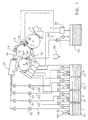
- FIGs. 1 and 2 illustrate a multicolor electrostatic imaging system constructed and operative in accordance with a preferred embodiment of the present invention.
- an imaging sheet preferably an organic photoreceptor 12, typically mounted on a rotating drum 10.
- Drum 10 is rotated about its axis by a motor or the like (not shown), in the direction of arrow 18, past charging apparatus 14, preferably a corotron, scorotron or roller charger or other suitable charging apparatus known in the art and which is adapted to charge the surface of sheet photoreceptor 12.
- the image to be reproduced is focused by an imager 16 upon the charged surface 12 at least partially discharging the photoconductor in the areas struck by light, thereby forming the electrostatic latent image.
- the latent image normally includes image areas at a first electrical potential and background areas at another electrical potential.
- Photoreceptor sheet 12 may use any suitable arrangement of layers of materials as is known in the art, however, in the preferred embodiment of the photoreceptor sheet, certain of the layers are removed from the ends of the sheet to facilitate its mounting on drum 10.
- photoreceptor 12 may be deposited on the drum 10 and may form a continuous surface.
- photoreceptor 12 may be a non-organic type photoconductor based, for example, on a compound of Selenium.
- Imaging apparatus 16 may be a modulated laser beam scanning apparatus, an optical focusing device for imaging a copy on a drum or other imaging apparatus such as is known in the art.
- drum 10 and photoreceptor sheet 12 are also associated with drum 10 and photoreceptor sheet 12, in the preferred embodiment of the invention, are a multicolor liquid developer spray assembly 20, a developing assembly 22, color specific cleaning blade assemblies 34, a background cleaning station 24, an electrified squeegee 26, a background discharge device 28, an intermediate transfer member 30, cleaning apparatus 32, and,optionally, a neutralizing lamp assembly 36.
- Developing assembly 22 preferably includes a development roller 38.
- Development roller 38 is preferably spaced from photoreceptor 12 thereby forming a gap therebetween of typically 40 to 150 micrometers and is charged to an electrical potential intermediate that of the image and background areas of the image.
- Development roller 38 is thus operative, when maintained at a suitable voltage, to apply an electric field to aid development of the latent electrostatic image.
- Development roller 38 typically rotates in the same sense as drum 10 as indicated by arrow 40. This rotation provides for the surface of sheet 12 and development roller 38 to have opposite velocities at the gap between them.
- Multicolor liquid developer spray assembly 20 may be mounted on axis 42 to allow assembly 20 to be pivoted in such a manner that a spray of liquid toner containing electrically charged pigmented toner particles can be directed either onto a portion of the development roller 38, a portion of the photoreceptor 12 or directly into a development region 44 between photoreceptor 12 and development roller 38.
- assembly 20 may be fixed.
- the spray is directed onto a portion of the development roller 38.
- Color specific cleaning blade assemblies 34 are operatively associated with developer roller 38 for separate removal of residual amounts of each colored toner remaining thereon after development. Each of blade assemblies 34 is selectably brought into operative association with developer roller 38 only when toner of a color corresponding thereto is supplied to development region 44 by spray assembly 20.
- the construction and operation of cleaning blade assemblies is described in PCT Publication WO 90/14619 and in US patent 5,289,238, the disclosures of which are incorporated herein by reference.
- Each cleaning blade assembly 34 includes a toner directing member 52 which serves to direct the toner removed by the cleaning blade assemblies 34 from the developer roller 38 to separate collection containers 54, 56, 58, and 60, for each color to prevent contamination of the various developers by mixing of the colors.
- the toner collected by the collection containers is recycled to a corresponding toner reservoir (55, 57, 59 and 61).
- a final toner directing member 62 always engages the developer roller 38 and the toner collected thereat is supplied into collection container 64 and thereafter to reservoir 65 via separator 66 which is operative to separate relatively clean carrier liquid from the various colored toner particles.
- the separator 66 may be typically of the type described in U.S. Patent 4,985,732, the disclosure of which is incorporated herein by reference.
- a background cleaning station 24 typically including a reverse roller 46 and a fluid spray apparatus 48 is provided.
- Reverse roller 46 which rotates in a direction indicated by arrow 50 is electrically biased to a potential intermediate that of the image and background areas of photoconductive drum 10, but different from that of the development roller.
- Reverse roller 46 is preferably spaced apart from photoreceptor sheet 12 thereby forming a gap therebetween which is typically 40 to 150 micrometers.
- Fluid spray apparatus 48 receives liquid toner from reservoir 65 via conduit 88 and operates to provide a supply of preferably non-pigmented carrier liquid to the gap between sheet 12 and reverse roller 46.
- the liquid supplied by fluid spray apparatus 48 replaces the liquid removed from drum 10 by development assembly 22 thus allowing the reverse roller 46 to remove charged pigmented toner particles by electrophoresis from the background areas of the latent image.
- Excess fluid is removed from reverse roller 46 by a liquid directing member 70 which continuously engages reverse roller 46 to collect excess liquid containing toner particles of various colors which is in turn supplied to reservoir 65 via a collection container 64 and separator 66.
- the apparatus embodied in reference numerals 46, 48, 50 and 70 is not required for low speed systems, but is preferably included in high speed systems.
- an electrically biased squeegee roller 26 is urged against the surface of sheet 12 and is operative to remove liquid carrier from the background regions and to compact the image and remove liquid carrier therefrom in the image regions.
- Squeegee roller 26 is preferably formed of resilient slightly conductive polymeric material as is well known in the art, and is preferably charged to a potential of several hundred to a few thousand volts with the same polarity as the polarity of the charge on the toner particles.
- Discharge device 28 is operative to flood the sheet 12 with light which discharges the voltage remaining on sheet 12, mainly to reduce electrical breakdown and improve transfer of the image to intermediate transfer member 30. Operation of such a device in a write black system is described in U.S. Patent 5,280,326, the disclosure of which is incorporated herein by reference.
- Figs. 1 and 2 further show that multicolor toner spray assembly 20 receives separate supplies of colored toner typically from four different reservoirs 55, 57, 59 and 61.
- Figure 1 shows four different colored toner reservoirs 55, 57, 59 and 61 typically containing the colors Yellow, Magenta, Cyan and, optionally, Black respectively.
- Pumps 90, 92, 94 and 96 may be provided along respective supply conduits 98, 101, 103 and 105 for providing a desired amount of pressure to feed the colored toner to multicolor spray assembly 20.
- multicolor toner spray assembly 20, which is preferably a three level spray assembly receives supplies of colored toner from up to six different reservoirs (not shown) which allows for custom colored tones in addition to the standard process colors.
- the scuff resistance, abrasion resistance and peel resistance of a wide class of liquid toners may be improved by the addition of a minor amount, between 2% and 20%, preferably between 4% to 15%, most preferably about 10% (with respect to the solids content of the toner) of an additional material which, at the fusing temperature used for the toner, has a much lower viscosity, preferably several orders of magnitude lower, than the viscosity of the toner particles and which forms a separate phase from the toner particles when solidified. It is believed that such material, during the fusing process, migrates to the outer surface of the image.
- the additional material forms a substantially separate phase resulting in a hard slippery outer coating of the additional material which protects the image from abrasion. While not believed to be absolutely necessary for the invention, the additional materials which have been found useful are at least partially incompatible with the toner polymer material.
- the additional material may be added at almost any point during the toner manufacturing process, but that the salutary effect of the additional material is most pronounced when it is added during the final stage of the grinding of the toner or when it is separately ground and added as finely ground material to the finished toner and dispersed in the carrier liquid. Somewhat less than optimum results are achieved when the additional material is added at the beginning of the grinding process or during the plasticization of the toner.
- the preferred additional material is Micronised Polyethylene Wax, for example ACumist A-12® , ACumist B-12® and ACumist C-9® (Allied Signal, Inc.).
- Other useful materials are A-C 9A and A-C 1702 Homopolymers (Allied Signal), and AC-290, AC-293A and similar ionomers which are low molecular weight ethylene-based copolymers neutralized with metal salts forming ionic clusters, manufactured by Allied Signal and sold under the trade mark "AClyn® .”
- One preferred method of forming a toner having improved abrasion resistance is the following:
- the resulting material is diluted with additional Isopar L and Marcol 82® to give a working developer in which the dry solids portion is about 1.7% and in which the overall ratio of Isopar® L to Marcol® is between about 50:1 and 500:1, more preferably between about 100:1 and 200:1.
- Charge director as described in US patent application 07/915,291 (utilizing lecithin, BBP and ICIG3300B) and in WO 94/02887, in an amount equal to 40 mg/gm of solids, is added to charge the toner particles.
- Other charge directors and additional additives as are known in the art may also be used.
- ACumist A-12® or one of the other materials listed can be pre-ground to a particle size of 1 to 2 ⁇ m (microns) and added to toner produced according to the above method, to which the ACumist A-12® was not added during grinding.
- Another additional material which has been found useful is the precipitate formed when the B-12 or the A-12 material (60 grams) is heated and solubilized together with 30 grams of zinc stearate in 556 grams Isopar® L and then stirred while cooling to room temperature. This material may be added during the grinding step or separately.
- Cyan, magenta and yellow toners can be produced by using a different mix of materials for step 2).
- Cyan toner 822g of the solubilized material, 21.33 grams each of BT 583D and BT 788D pigments (Cookson), 1.73 grams of D1355DD pigment (BASF), 7.59 grams of aluminum tri stearate and 1426 grams of Isopar L are used in step 2.
- Magenta toner 810 grams of solubilized material, 48.3 grams of Finess Red F2B, 6.81 grams of aluminum tri-stearate and 1434.2 grams of Isopar® L are used in step 2.
- For yellow toner 810 grams of solubilized material, 49.1 grams of D1355DD pigment, 6.9 grams of aluminum tri-stearate and 1423 grams of Isopar L are used in step 2.
- the additional materials described above also give improved abrasion resistance for liquid toner based on Bynell 2002® (ethylene terpolymer by Dupont), Surlyn 8940® or 8920 (ionomers by Dupont) and Iotek 8030 (ionomer by Iotek) and blends of these materials.
- Bynell 2002® ethylene terpolymer by Dupont
- Surlyn 8940® or 8920 ionomers by Dupont
- Iotek 8030 ionomer by Iotek
- Intermediate transfer member 30 may be any suitable intermediate transfer member having a multilayered transfer portion such as those described below or in US Patents 5,089,856 or 5,047,808 the disclosures of which are incorporated herein by reference.
- Member 30 is maintained at a suitable voltage and temperature for electrostatic transfer of the image thereto from the image bearing surface.
- Intermediate transfer member 30 is preferably associated with a pressure roller 71 for transfer and fusing of the image onto a final substrate 72, such as paper, preferably by heat and pressure.
- a final substrate 72 such as paper
- Cleaning apparatus 32 is operative to scrub clean the surface of photoreceptor 12 and preferably includes a cleaning roller 74, a sprayer 76 to spray a non-polar cleaning liquid to assist in the scrubbing process and a wiper blade 78 to complete the cleaning of the photoconductive surface.
- Cleaning roller 74 which may be formed of any synthetic resin known in the art for this purpose is driven in the same sense as drum 10 as indicated by arrow 80, such that the surface of the roller scrubs the surface of the photoreceptor. Any residual charge left on the surface of photoreceptor sheet 12 may be removed by flooding the photoconductive surface with light from optional neutralizing lamp assembly 36, which may not be required in practice.
- the single color image is transferred to intermediate transfer member 30.
- Subsequent images in different colors are sequentially transferred in alignment with the previous image onto intermediate transfer member 30.
- the complete multi-color image is transferred from transfer member 30 to substrate 72.
- Impression roller 71 only produces operative engagement between intermediate transfer member 30 and substrate 72 when transfer of the composite image to substrate 72 takes place.
- each single color image is separately transferred to the substrate via the intermediate transfer member. In this case, the substrate is fed through the machine once for each color or is held on a platen and contacted with intermediate transfer member 30 for composite image transfer.
- the intermediate transfer member is omitted and the developed single color images are transferred sequentially directly from drum 10 to substrate 72.
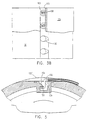
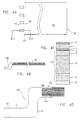
- FIGs. 3A, 3B and 4A-4D illustrate a preferred embodiment of intermediate transfer member 30 in accordance with a preferred embodiment of the invention.
- Fig 3A shows an intermediate transfer blanket 100 mounted on a drum 102.
- Transfer blanket 100 (whose details are shown in Figs. 4C and 4D) comprises a preferably layered transfer portion 104 and a mounting fitting 106.
- transfer portion 104 comprises a release layer 109 which is outermost on the blanket when it is mounted on drum 102.
- Underlying layer 109 is a conforming layer 111 preferably of a soft elastomer, preferably of polyurethane and preferably having a Shore A hardness of less than about 65, more preferably, less than about 55, but preferably more than about 35. A suitable hardness value is between 45-55, preferably about 50.
- Underlying layer 111 is a conductive layer 114 which overlays a thin barrier layer 115.
- Barrier layer 115 overlays a blanket body 116 comprising a top layer 118, a compressible layer 120 and a fabric layer 122.
- Underlying the fabric layer is an adhesive layer 126 which is in contact with drum 102.
- Drum 102 is preferably heated by an internal halogen lamp heater or other heater to aid transfer of the image to and from the release layer 109 to a final substrate as is well known in the art.
- the temperature at the surface of the intermediate transfer member is preferably about 95°C. The degree of heating will depend on the characteristics of the toner used in conjunction with the invention.
- mounting fitting 106 comprises an elongate electrically conducting bar 108, for example, of a metal such as aluminum formed with a series of L-shaped mounting legs 110 (in the form of finger-like extensions) which are also conducting, preferably of the same material as bar 108, and preferably formed integrally therewith.
- bar 108 is formed with a slot into which the end of layered transfer portion 104 is inserted.
- the end of the layered portion which is inserted into the mounting bar does not have a release layer 109 or conforming layer 111, whereby conducting layer 114 is exposed and is therefore in electrical contact with bar 108.
- the bar 108 can be formed with sharp internal projections which pierce the outer layers of the blanket and contact the conducting layer.
- each of the layers beneath the conducting layer 114 may be partially conducting (for example, by the addition of conductive carbon black or metal fibers) and the adhesive layer may be conductive, such that current also flows directly from the drum surface to the conducting layer.
- fitting 106 is formed of a single sheet of metal, wherein the legs are partially cut from the metal which is bent into a U shape to form the slot into which the layered portion is inserted. After insertion, the outer walls of the slot are forced against the layered portion to secure the layered portion in the slot. The partially cut out portion is bent to form the mounting legs.
- drum 102 is maintained at a potential suitable for transferring images to the intermediate transfer member, for example at 500 volts, which voltage is applied, via mounting fitting 106 to conductive layer 114.
- the source of transfer voltage is very near the outer surface of portion 104 which allows for a lower transfer potential on the drum.
- transfer portion 104 is fabricated by the following procedure:
- mounting legs 110 are inserted into a plurality of mounting holes 130 formed in drum 102, preferably without removing the mylar sheet from the adhesive layer (the back of the blanket).
- mounting legs 110 each have a tip portion 132 and a back portion 134. Tips 132 are inserted into slots formed in the far sidewalls of mounting holes 130 and the back portion 134 rests against the opposite sidewall of the hole. In this way the end of the blanket is accurately positioned. The edge of the mylar sheet closest to the legs is removed and the remainder of the mylar sheet is progressively removed while making sure that the successive portions of the blanket which are thus attached to the drum by the adhesive lie flat against the drum.
- Fig. 5 shows an alternative, preferred embodiment of the invention in which somewhat different shaped holes 130' are used.
- the back portion 134 rests against a protrusion 150 formed on one side of the hole while a surface 154 of leg 110 rests against the bottom 156 of a protrusion formed on the other side of the hole.
- the preferred electrical connection between the conductive layer and the mounting bar is preferably achieved by removing (or not forming) the layers which overlay an end portion of the conductive layer and piercing the overlying layers, for example, by crimping and/or piercing the mounting bar, for example, at points marked 160 in Fig. 4D. Crimping can also be used to hold the blanket in the mounting bar.
- the adhesive layer preferably covers the back of the blanket, alternatively the adhesive layer may cover only a portion of the back such as the edge farthest away from the bracket (the trailing edge of the blanket); or may, for some embodiments of the invention and under certain circumstances, be omitted.
- the invention is not limited to the specific type of image forming system or transfer system used.
- the invention is also useful in systems, such as those using other types of intermediate transfer members such as belt or continuous coated drum type transfer members and also for imaging systems which use direct transfer of the image (for example from an imaging surface) to the final substrate and which include a fuser for fusing the image to the substrate.
- imaging systems which use direct transfer of the image (for example from an imaging surface) to the final substrate and which include a fuser for fusing the image to the substrate.
- Such systems are very well known in the art.
Landscapes
- Physics & Mathematics (AREA)
- General Physics & Mathematics (AREA)
- Chemical & Material Sciences (AREA)
- Chemical Kinetics & Catalysis (AREA)
- Electrostatic Charge, Transfer And Separation In Electrography (AREA)
- Liquid Developers In Electrophotography (AREA)
- Wet Developing In Electrophotography (AREA)
- Developing Agents For Electrophotography (AREA)
- Ink Jet (AREA)
Description
Claims (36)
- An image forming method comprising:wherein the additional material has a second viscosity at the fusing temperature which is at least ten times lower than said first viscosity.providing an image on a substrate, the image comprising toner particles including a major amount of a polymer material, an additional material which is solid at room temperature and carrier liquid;fusing the image to the substrate by heating the image to a fusing temperature at which the toner particles soften to a first viscosity; andcooling the image after fusing,
- A method according to claim 1 wherein the toner particles are solvated by the carrier liquid at the fusing temperature whereby their viscosity is reduced to the first viscosity.
- A method according to claim 1 or claim 2 wherein the additional material is solvated by the carrier liquid at the fusing temperature whereby its viscosity is reduced to the second viscosity.
- A method according to any of the preceding claims wherein, during fusing or subsequent cooling, at least a portion of the additional material migrates to the surface of the image away from the substrate.
- A method according to claim 4 wherein, during cooling, at least a portion of the additional material forms a separate phase from the toner material at said surface.
- A method according to any of the preceding claims wherein, after cooling, the additional material forms an abrasion resistant layer covering the toner material.
- A method according to any of the preceding claims wherein the first viscosity is at least 100 times the second viscosity.
- A method according to any of the preceding claims wherein the first viscosity is at least 1000 times the second viscosity.
- A method according to any of the preceding claims wherein the additional material comprises a polyethylene.
- A method according to any of the preceding claims wherein the additional material comprises a polyethylene wax.
- A method according to any of claims 1-8 wherein the additional material comprises a homopolymer.
- A method according to any of claims 1-8 wherein the additional material comprises a low molecular weight ionomer.
- A method according to any of claims 9-11 wherein the additional material further comprises zinc stearate.
- A method according to any of the preceding claims wherein the additional material is comprised in the toner particles.
- A method according to any of the preceding claims wherein the additional material is in a finely divided form and is dispersed in the carrier liquid separate from the toner particles.
- A method according to any of the preceding claims wherein the polymer material comprises an ethylene terpolymer.
- A method according to any of the preceding claims wherein the polymer material comprises an ionomer.
- A method according to any of the preceding claims wherein the polymer material comprises an ethylene copolymer.
- A method according to any of the preceding claims wherein the additional material is at least partially incompatible with the toner POLYMER MATERIAL.
- A liquid toner adapted for fusing at a given fusing temperature corresponding to the toner image fusing temperature when a toner image is provided on a substrate comprising:toner particles comprising a polymer material which has a first viscosity at the fusing temperature;an additional material which is solid at room temperature and has a second viscosity at the fusing temperature; andcarrier liquid.said first viscosity being at least ten times said second viscosity.
- A liquid toner according to claim 20 wherein the polymer material is solvated by the carrier liquid at the fusing temperature whereby its viscosity is reduced to the first viscosity.
- A liquid toner according to claim 20 or claim 21 wherein the additional material is solvated by the carrier liquid at the fusing temperature whereby its viscosity is reduced to the second viscosity.
- A liquid toner according to any of claims 20-22 wherein the first viscosity is at least 100 times the second viscosity.
- A liquid toner according to claim 23 wherein the first viscosity is at least three orders of magnitude greater than the second viscosity.
- A liquid toner according to any of claims 20-24 wherein the additional material comprises a polyethylene.
- A liquid toner according claim 25 wherein the additional material comprises a polyethylene wax.
- A liquid toner according to any of claims 20-24 wherein the additional material comprises a homopolymer.
- A liquid toner according to any of claims 20-24 wherein the additional material comprises a low molecular weight ionomer.
- A liquid toner according to any of claims 25-27 wherein the additional material further comprises zinc stearate.
- A liquid toner according to any of claims 20-29 wherein the additional material is comprised in the toner particles.
- A liquid toner according to any of claims 20-30 wherein the additional material is in a finely divided form and is dispersed in the carrier liquid separate from the toner particles.
- A liquid toner according to any of claims 20-31 wherein the polymer material comprises an ethylene terpolymer.
- A liquid toner according to any of claims 20-32 wherein the polymer material comprises an ionomer.
- A liquid toner according to any of claims 20-33 wherein the polymer material comprises an ethylene copolymer.
- A liquid toner according to any of claims 20-34 wherein the additional material is at least partially incompatible with the toner POLYMER MATERIAL.
- A method according to any of claims 1-19 wherein the step of providing an image comprises forming the image using an electrophotographic process.
Applications Claiming Priority (3)
| Application Number | Priority Date | Filing Date | Title |
|---|---|---|---|
| IL11184594A IL111845A (en) | 1994-12-01 | 1994-12-01 | Imaging apparatus and method and liquid toner therefor |
| IL11184594 | 1994-12-01 | ||
| PCT/NL1994/000327 WO1996017277A1 (en) | 1994-12-01 | 1994-12-29 | Imaging apparatus and method and liquid toner therefor |
Publications (2)
| Publication Number | Publication Date |
|---|---|
| EP0795146A1 EP0795146A1 (en) | 1997-09-17 |
| EP0795146B1 true EP0795146B1 (en) | 2002-02-27 |
Family
ID=11066838
Family Applications (1)
| Application Number | Title | Priority Date | Filing Date |
|---|---|---|---|
| EP95904038A Expired - Lifetime EP0795146B1 (en) | 1994-12-01 | 1994-12-29 | Imaging apparatus and method and liquid toner therefor |
Country Status (10)
| Country | Link |
|---|---|
| US (1) | US5923929A (en) |
| EP (1) | EP0795146B1 (en) |
| JP (1) | JPH10510063A (en) |
| CN (1) | CN1103940C (en) |
| CA (1) | CA2206330C (en) |
| DE (1) | DE69430015T2 (en) |
| IL (1) | IL111845A (en) |
| SG (1) | SG34318A1 (en) |
| TW (1) | TW418353B (en) |
| WO (1) | WO1996017277A1 (en) |
Families Citing this family (60)
| Publication number | Priority date | Publication date | Assignee | Title |
|---|---|---|---|---|
| US6623902B1 (en) | 1991-03-28 | 2003-09-23 | Hewlett-Packard Indigo B.V. | Liquid toner and method of printing using same |
| JP3554433B2 (en) * | 1996-04-10 | 2004-08-18 | 特種製紙株式会社 | Recording sheet for wet electrophotography |
| US6912952B1 (en) | 1998-05-24 | 2005-07-05 | Hewlett-Packard Indigo B.V. | Duplex printing system |
| AU7447998A (en) | 1998-05-24 | 1999-12-13 | Indigo N.V. | Printing system |
| US6584294B1 (en) | 1998-11-25 | 2003-06-24 | Hewlett-Packard Indigo B.V. | Fuser and intermediate transfer drums |
| US6823786B1 (en) | 1999-11-07 | 2004-11-30 | Hewlett-Packard Indigo B.V. | Tandem printing system with fine paper-position correction |
| CA2406107A1 (en) | 2000-04-18 | 2001-10-25 | Indigo N.V. | Sheet transport position and jam monitor |
| WO2001088619A1 (en) | 2000-05-17 | 2001-11-22 | Indigo N.V. | Fluorescent liquid toner and method of printing using same |
| AU2000279418A1 (en) | 2000-10-13 | 2002-04-22 | Hewlett-Packard Indigo B.V. | Fuser and intermediate transfer drums |
| US6363234B2 (en) | 2000-11-21 | 2002-03-26 | Indigo N.V. | Printing system |
| US6615004B1 (en) | 2002-05-06 | 2003-09-02 | Hewlett-Packard Development Company, L.P. | Supplying marking fluid in an imaging system |
| US7152528B2 (en) | 2002-07-16 | 2006-12-26 | Ebe Hesterman | Digital printing machine |
| DE10235872A1 (en) | 2002-07-30 | 2004-02-19 | Ebe Hesterman | Satellite printing machine for printing on arched substrates |
| US7736828B2 (en) * | 2005-02-28 | 2010-06-15 | Hewlett-Packard Development Company, L.P. | Liquid toner methods of producing same |
| US7693461B2 (en) * | 2006-01-03 | 2010-04-06 | Hewlett-Packard Development Company, L.P. | System and method for minimizing residual charge effects in a printing device |
| US7977023B2 (en) | 2007-07-26 | 2011-07-12 | Hewlett-Packard Development Company, L.P. | Ink formulations and methods of making ink formulations |
| US8185020B2 (en) * | 2007-07-31 | 2012-05-22 | Konica Minolta Business Technologies, Inc. | Image forming apparatus and method for forming image with fine pigment and thermoplastic fine resin particles in a carrier liquid |
| US20100167198A1 (en) * | 2008-12-31 | 2010-07-01 | North Pacific Paper Corporation (Norpac) | Methods of liquid toner printing |
| US10632740B2 (en) | 2010-04-23 | 2020-04-28 | Landa Corporation Ltd. | Digital printing process |
| SG191743A1 (en) * | 2011-01-12 | 2013-08-30 | Oce Tech Bv | Electrophotographic toner comprising a high-melting wax, a printing system for applying said toner on an image receiving medium and a method for preparing said toner |
| WO2012105951A1 (en) | 2011-01-31 | 2012-08-09 | Hewlett-Packard Development Company, L.P. | Liquid electrophotographic ink and method for making the same |
| JP5763273B2 (en) | 2011-07-13 | 2015-08-12 | ヒューレット−パッカード・インデイゴ・ビー・ブイHewlett−Packard Indigo B.V. | Electrostatic ink composition, ink container, printing apparatus and printing method |
| US9643403B2 (en) | 2012-03-05 | 2017-05-09 | Landa Corporation Ltd. | Printing system |
| WO2015036960A1 (en) | 2013-09-11 | 2015-03-19 | Landa Corporation Ltd. | Release layer treatment formulations |
| US9498946B2 (en) | 2012-03-05 | 2016-11-22 | Landa Corporation Ltd. | Apparatus and method for control or monitoring of a printing system |
| US10434761B2 (en) | 2012-03-05 | 2019-10-08 | Landa Corporation Ltd. | Digital printing process |
| EP2823362B1 (en) * | 2012-03-05 | 2020-07-01 | Landa Corporation Ltd. | Printing system |
| US10642198B2 (en) | 2012-03-05 | 2020-05-05 | Landa Corporation Ltd. | Intermediate transfer members for use with indirect printing systems and protonatable intermediate transfer members for use with indirect printing systems |
| US9902147B2 (en) | 2012-03-05 | 2018-02-27 | Landa Corporation Ltd. | Digital printing system |
| EP2822776B1 (en) | 2012-03-05 | 2018-08-01 | Landa Corporation Ltd. | Transfer printing method |
| BR112014021786B1 (en) | 2012-03-05 | 2021-06-08 | Landa Corporation Ltd | paint film structures |
| DE202013012736U1 (en) | 2012-03-05 | 2018-12-20 | Landa Corporation Ltd. | Ink film constructions |
| US10190012B2 (en) | 2012-03-05 | 2019-01-29 | Landa Corporation Ltd. | Treatment of release layer and inkjet ink formulations |
| EP2822778B1 (en) | 2012-03-05 | 2019-05-08 | Landa Corporation Ltd. | Digital printing process |
| US9517618B2 (en) | 2012-03-15 | 2016-12-13 | Landa Corporation Ltd. | Endless flexible belt for a printing system |
| WO2013180716A1 (en) | 2012-05-31 | 2013-12-05 | Hewlett-Packard Development Company, L.P. | Making a liquid electrophotographic (lep) paste |
| AU2014215195B2 (en) | 2013-02-08 | 2017-07-27 | Sakata Inx Corporation | Liquid developing agent |
| EP2999997B1 (en) | 2013-05-23 | 2018-03-28 | HP Indigo B.V. | Electrostatic printing |
| GB201401173D0 (en) | 2013-09-11 | 2014-03-12 | Landa Corp Ltd | Ink formulations and film constructions thereof |
| GB2536489B (en) | 2015-03-20 | 2018-08-29 | Landa Corporation Ltd | Indirect printing system |
| GB2537813A (en) | 2015-04-14 | 2016-11-02 | Landa Corp Ltd | Apparatus for threading an intermediate transfer member of a printing system |
| GB201609463D0 (en) | 2016-05-30 | 2016-07-13 | Landa Labs 2012 Ltd | Method of manufacturing a multi-layer article |
| DE112017002714T5 (en) | 2016-05-30 | 2019-02-28 | Landa Corporation Ltd. | Digital printing process |
| US10682837B2 (en) | 2017-06-09 | 2020-06-16 | The Proctor & Gamble Company | Method and compositions for applying a material onto articles |
| CN111212736B (en) | 2017-10-19 | 2021-11-23 | 兰达公司 | Endless flexible belt for a printing system |
| WO2019097464A1 (en) | 2017-11-19 | 2019-05-23 | Landa Corporation Ltd. | Digital printing system |
| US11511536B2 (en) | 2017-11-27 | 2022-11-29 | Landa Corporation Ltd. | Calibration of runout error in a digital printing system |
| US11707943B2 (en) | 2017-12-06 | 2023-07-25 | Landa Corporation Ltd. | Method and apparatus for digital printing |
| US11679615B2 (en) | 2017-12-07 | 2023-06-20 | Landa Corporation Ltd. | Digital printing process and method |
| IL279556B2 (en) | 2018-06-26 | 2024-06-01 | Landa Corp Ltd | An intermediate transfer member for a digital printing system |
| US10994528B1 (en) | 2018-08-02 | 2021-05-04 | Landa Corporation Ltd. | Digital printing system with flexible intermediate transfer member |
| US12001902B2 (en) | 2018-08-13 | 2024-06-04 | Landa Corporation Ltd. | Correcting distortions in digital printing by implanting dummy pixels in a digital image |
| US11318734B2 (en) | 2018-10-08 | 2022-05-03 | Landa Corporation Ltd. | Friction reduction means for printing systems and method |
| CN113272144B (en) | 2018-12-24 | 2023-04-04 | 兰达公司 | Digital printing system and method |
| WO2020202145A1 (en) | 2019-03-31 | 2020-10-08 | Landa Corporation Ltd | Systems and methods for preventing or minimizing printing defects in printing processes |
| JP7342514B2 (en) * | 2019-08-14 | 2023-09-12 | 富士フイルムビジネスイノベーション株式会社 | Jacket, transfer device, and image forming device |
| WO2021105806A1 (en) | 2019-11-25 | 2021-06-03 | Landa Corporation Ltd. | Drying ink in digital printing using infrared radiation absorbed by particles embedded inside itm |
| US11321028B2 (en) | 2019-12-11 | 2022-05-03 | Landa Corporation Ltd. | Correcting registration errors in digital printing |
| CN114868087A (en) | 2019-12-29 | 2022-08-05 | 兰达公司 | Printing method and system |
| JP2024506561A (en) | 2021-02-02 | 2024-02-14 | ランダ コーポレイション リミテッド | Reduce distortion in printed images |
Family Cites Families (22)
| Publication number | Priority date | Publication date | Assignee | Title |
|---|---|---|---|---|
| US3965021A (en) * | 1966-01-14 | 1976-06-22 | Xerox Corporation | Electrostatographic toners using block copolymers |
| US4337303A (en) * | 1980-08-11 | 1982-06-29 | Minnesota Mining And Manufacturing Company | Transfer, encapsulating, and fixing of toner images |
| US4794651A (en) * | 1984-12-10 | 1988-12-27 | Savin Corporation | Toner for use in compositions for developing latent electrostatic images, method of making the same, and liquid composition using the improved toner |
| DE3673412D1 (en) * | 1986-05-29 | 1990-09-13 | Agfa Gevaert Nv | HEAT AND PRINT FIXING OF A WET OR DAMP TONER IMAGE COMPREHENSIVE IMAGE PRODUCTION PROCESS. |
| US5089856A (en) * | 1989-02-06 | 1992-02-18 | Spectrum Sciences B.V. | Image transfer apparatus incorporating an internal heater |
| US4984025A (en) * | 1989-02-06 | 1991-01-08 | Spectrum Sciences B.V. | Imaging system with intermediate transfer member |
| US5335054A (en) * | 1989-02-06 | 1994-08-02 | Spectrum Sciences B.V. | Image transfer apparatus including intermediate transfer blanket |
| US4974027A (en) * | 1989-02-06 | 1990-11-27 | Spectrum Sciences B.V. | Imaging system with compactor and squeegee |
| US5028964A (en) * | 1989-02-06 | 1991-07-02 | Spectrum Sciences B.V. | Imaging system with rigidizer and intermediate transfer member |
| US5047808A (en) * | 1989-02-06 | 1991-09-10 | Spectrum Sciences B.V. | Image transfer apparatus including a compliant transfer member |
| US4999677A (en) * | 1989-02-06 | 1991-03-12 | Spectrum Sciences B.V. | Imaging system with rigidizer |
| US4985732A (en) * | 1989-03-08 | 1991-01-15 | Spectrum Sciences B.V. | Electrostatic separator |
| US5585900A (en) * | 1989-05-15 | 1996-12-17 | Indigo N.V. | Developer for liquid toner imager |
| US5276492A (en) * | 1989-08-14 | 1994-01-04 | Spectrum Sciences B.V. | Imaging method and apparatus |
| US5117263A (en) * | 1991-01-22 | 1992-05-26 | Spectrum Sciences B.V. | Liquid toner developer |
| US5255058A (en) * | 1991-01-22 | 1993-10-19 | Spectrum Sciences B.V. | Liquid developer imaging system using a spaced developing roller and a toner background removal surface |
| US5166734A (en) * | 1991-02-12 | 1992-11-24 | Spectrum Sciences B.V. | Imaging system including pre-transfer discharge |
| US5289238A (en) * | 1991-09-05 | 1994-02-22 | Spectrum Sciences B.V. | Liquid toner developing apparatus having metal blade with insulating coating in contact with developing roller |
| US5308729A (en) * | 1992-04-30 | 1994-05-03 | Lexmark International, Inc. | Electrophotographic liquid developer with charge director |
| US5346796A (en) * | 1992-07-20 | 1994-09-13 | Spectrum Sciences B.V. | Electrically stabilized liquid toners |
| US5508790A (en) * | 1994-09-07 | 1996-04-16 | Indigo N.V. | Photoreceptor sheet and imaging system utilizing same |
| US5679492A (en) * | 1996-08-08 | 1997-10-21 | Xerox Corporation | Developer compositions |
-
1994
- 1994-12-01 IL IL11184594A patent/IL111845A/en not_active IP Right Cessation
- 1994-12-29 JP JP8518616A patent/JPH10510063A/en active Pending
- 1994-12-29 WO PCT/NL1994/000327 patent/WO1996017277A1/en not_active Ceased
- 1994-12-29 DE DE69430015T patent/DE69430015T2/en not_active Expired - Lifetime
- 1994-12-29 US US08/849,078 patent/US5923929A/en not_active Expired - Lifetime
- 1994-12-29 CA CA002206330A patent/CA2206330C/en not_active Expired - Fee Related
- 1994-12-29 EP EP95904038A patent/EP0795146B1/en not_active Expired - Lifetime
-
1995
- 1995-12-01 SG SG1995002005A patent/SG34318A1/en unknown
- 1995-12-01 CN CN95117577A patent/CN1103940C/en not_active Expired - Lifetime
-
1996
- 1996-01-15 TW TW085100409A patent/TW418353B/en not_active IP Right Cessation
Also Published As
| Publication number | Publication date |
|---|---|
| CA2206330C (en) | 2005-10-25 |
| WO1996017277A1 (en) | 1996-06-06 |
| IL111845A (en) | 2004-06-01 |
| JPH10510063A (en) | 1998-09-29 |
| IL111845A0 (en) | 1995-03-15 |
| CN1103940C (en) | 2003-03-26 |
| SG34318A1 (en) | 1996-12-06 |
| CN1130265A (en) | 1996-09-04 |
| DE69430015T2 (en) | 2002-08-29 |
| EP0795146A1 (en) | 1997-09-17 |
| DE69430015D1 (en) | 2002-04-04 |
| US5923929A (en) | 1999-07-13 |
| CA2206330A1 (en) | 1996-06-06 |
| TW418353B (en) | 2001-01-11 |
Similar Documents
| Publication | Publication Date | Title |
|---|---|---|
| CA2206330C (en) | Imaging apparatus and method and liquid toner therefor | |
| US5745829A (en) | Imaging apparatus and intermediate transfer blanket therefor | |
| US7647008B2 (en) | Imaging apparatus and improved toner therefor | |
| EP0819268B1 (en) | Printing on transparent film | |
| US5893016A (en) | Apparatus for printing images on generally cylindrical objects | |
| EP0784809B1 (en) | Imaging apparatus and intermediate transfer blanket therefor | |
| US20010038962A1 (en) | Printing on transparent film | |
| EP1178366B1 (en) | Imaging apparatus and intermediate transfer blanket therefor | |
| HK1044384A (en) | Imaging apparatus and intermediate transfer blanket therefor | |
| HK1044825A1 (en) | Imaging apparatus and intermediate transfer blanket therefor | |
| WO1996034319A1 (en) | Printing on floor tiles and the like |
Legal Events
| Date | Code | Title | Description |
|---|---|---|---|
| PUAI | Public reference made under article 153(3) epc to a published international application that has entered the european phase |
Free format text: ORIGINAL CODE: 0009012 |
|
| 17P | Request for examination filed |
Effective date: 19970527 |
|
| AK | Designated contracting states |
Kind code of ref document: A1 Designated state(s): DE FR GB IT |
|
| 17Q | First examination report despatched |
Effective date: 19971209 |
|
| GRAG | Despatch of communication of intention to grant |
Free format text: ORIGINAL CODE: EPIDOS AGRA |
|
| GRAG | Despatch of communication of intention to grant |
Free format text: ORIGINAL CODE: EPIDOS AGRA |
|
| GRAH | Despatch of communication of intention to grant a patent |
Free format text: ORIGINAL CODE: EPIDOS IGRA |
|
| GRAG | Despatch of communication of intention to grant |
Free format text: ORIGINAL CODE: EPIDOS AGRA |
|
| GRAH | Despatch of communication of intention to grant a patent |
Free format text: ORIGINAL CODE: EPIDOS IGRA |
|
| GRAH | Despatch of communication of intention to grant a patent |
Free format text: ORIGINAL CODE: EPIDOS IGRA |
|
| REG | Reference to a national code |
Ref country code: GB Ref legal event code: IF02 |
|
| GRAA | (expected) grant |
Free format text: ORIGINAL CODE: 0009210 |
|
| AK | Designated contracting states |
Kind code of ref document: B1 Designated state(s): DE FR GB IT |
|
| REF | Corresponds to: |
Ref document number: 69430015 Country of ref document: DE Date of ref document: 20020404 |
|
| ET | Fr: translation filed | ||
| PLBE | No opposition filed within time limit |
Free format text: ORIGINAL CODE: 0009261 |
|
| STAA | Information on the status of an ep patent application or granted ep patent |
Free format text: STATUS: NO OPPOSITION FILED WITHIN TIME LIMIT |
|
| 26N | No opposition filed |
Effective date: 20021128 |
|
| PGFP | Annual fee paid to national office [announced via postgrant information from national office to epo] |
Ref country code: IT Payment date: 20091230 Year of fee payment: 16 |
|
| PG25 | Lapsed in a contracting state [announced via postgrant information from national office to epo] |
Ref country code: IT Free format text: LAPSE BECAUSE OF NON-PAYMENT OF DUE FEES Effective date: 20101229 |
|
| REG | Reference to a national code |
Ref country code: DE Ref legal event code: R082 Ref document number: 69430015 Country of ref document: DE Representative=s name: BOEHMERT & BOEHMERT, DE |
|
| REG | Reference to a national code |
Ref country code: DE Ref legal event code: R082 Ref document number: 69430015 Country of ref document: DE Representative=s name: BOEHMERT & BOEHMERT, DE Effective date: 20120215 Ref country code: DE Ref legal event code: R082 Ref document number: 69430015 Country of ref document: DE Representative=s name: BOEHMERT & BOEHMERT ANWALTSPARTNERSCHAFT MBB -, DE Effective date: 20120215 Ref country code: DE Ref legal event code: R081 Ref document number: 69430015 Country of ref document: DE Owner name: HEWLETT-PACKARD INDIGO B.V., NL Free format text: FORMER OWNER: INDIGO N.V., MAASTRICHT, NL Effective date: 20120215 |
|
| PGFP | Annual fee paid to national office [announced via postgrant information from national office to epo] |
Ref country code: DE Payment date: 20131121 Year of fee payment: 20 Ref country code: GB Payment date: 20131125 Year of fee payment: 20 |
|
| PGFP | Annual fee paid to national office [announced via postgrant information from national office to epo] |
Ref country code: FR Payment date: 20131219 Year of fee payment: 20 |
|
| REG | Reference to a national code |
Ref country code: DE Ref legal event code: R071 Ref document number: 69430015 Country of ref document: DE |
|
| REG | Reference to a national code |
Ref country code: GB Ref legal event code: PE20 Expiry date: 20141228 |
|
| PG25 | Lapsed in a contracting state [announced via postgrant information from national office to epo] |
Ref country code: GB Free format text: LAPSE BECAUSE OF EXPIRATION OF PROTECTION Effective date: 20141228 |