EP0794783B1 - Cyclodextrins as suspending agents for pharmaceutical suspensions - Google Patents
Cyclodextrins as suspending agents for pharmaceutical suspensions Download PDFInfo
- Publication number
- EP0794783B1 EP0794783B1 EP95941473A EP95941473A EP0794783B1 EP 0794783 B1 EP0794783 B1 EP 0794783B1 EP 95941473 A EP95941473 A EP 95941473A EP 95941473 A EP95941473 A EP 95941473A EP 0794783 B1 EP0794783 B1 EP 0794783B1
- Authority
- EP
- European Patent Office
- Prior art keywords
- component
- suspensions
- suspension
- cyclodextrin
- drugs
- Prior art date
- Legal status (The legal status is an assumption and is not a legal conclusion. Google has not performed a legal analysis and makes no representation as to the accuracy of the status listed.)
- Expired - Lifetime
Links
- 229920000858 Cyclodextrin Polymers 0.000 title claims abstract description 51
- 239000000375 suspending agent Substances 0.000 title abstract description 13
- 229940097362 cyclodextrins Drugs 0.000 title description 23
- 239000007971 pharmaceutical suspension Substances 0.000 title 1
- 239000000725 suspension Substances 0.000 claims abstract description 70
- 239000003814 drug Substances 0.000 claims abstract description 48
- 229940079593 drug Drugs 0.000 claims abstract description 47
- HFHDHCJBZVLPGP-UHFFFAOYSA-N schardinger α-dextrin Chemical compound O1C(C(C2O)O)C(CO)OC2OC(C(C2O)O)C(CO)OC2OC(C(C2O)O)C(CO)OC2OC(C(O)C2O)C(CO)OC2OC(C(C2O)O)C(CO)OC2OC2C(O)C(O)C1OC2CO HFHDHCJBZVLPGP-UHFFFAOYSA-N 0.000 claims abstract description 16
- 230000001225 therapeutic effect Effects 0.000 claims abstract description 14
- 239000003755 preservative agent Substances 0.000 claims description 24
- 239000002245 particle Substances 0.000 claims description 17
- PEDCQBHIVMGVHV-UHFFFAOYSA-N glycerol group Chemical group OCC(O)CO PEDCQBHIVMGVHV-UHFFFAOYSA-N 0.000 claims description 15
- 230000002335 preservative effect Effects 0.000 claims description 11
- -1 bechmethasone Chemical compound 0.000 claims description 10
- XLYOFNOQVPJJNP-UHFFFAOYSA-N water Substances O XLYOFNOQVPJJNP-UHFFFAOYSA-N 0.000 claims description 10
- 239000000203 mixture Substances 0.000 claims description 7
- 239000012736 aqueous medium Substances 0.000 claims description 6
- 239000003795 chemical substances by application Substances 0.000 claims description 6
- FAOZLTXFLGPHNG-KNAQIMQKSA-N fluorometholone Chemical compound C([C@@]12C)=CC(=O)C=C1[C@@H](C)C[C@@H]1[C@]2(F)[C@@H](O)C[C@]2(C)[C@@](O)(C(C)=O)CC[C@H]21 FAOZLTXFLGPHNG-KNAQIMQKSA-N 0.000 claims description 5
- 229960005205 prednisolone Drugs 0.000 claims description 5
- OIGNJSKKLXVSLS-VWUMJDOOSA-N prednisolone Chemical compound O=C1C=C[C@]2(C)[C@H]3[C@@H](O)C[C@](C)([C@@](CC4)(O)C(=O)CO)[C@@H]4[C@@H]3CCC2=C1 OIGNJSKKLXVSLS-VWUMJDOOSA-N 0.000 claims description 5
- 239000001116 FEMA 4028 Substances 0.000 claims description 4
- WHGYBXFWUBPSRW-FOUAGVGXSA-N beta-cyclodextrin Chemical compound OC[C@H]([C@H]([C@@H]([C@H]1O)O)O[C@H]2O[C@@H]([C@@H](O[C@H]3O[C@H](CO)[C@H]([C@@H]([C@H]3O)O)O[C@H]3O[C@H](CO)[C@H]([C@@H]([C@H]3O)O)O[C@H]3O[C@H](CO)[C@H]([C@@H]([C@H]3O)O)O[C@H]3O[C@H](CO)[C@H]([C@@H]([C@H]3O)O)O3)[C@H](O)[C@H]2O)CO)O[C@@H]1O[C@H]1[C@H](O)[C@@H](O)[C@@H]3O[C@@H]1CO WHGYBXFWUBPSRW-FOUAGVGXSA-N 0.000 claims description 4
- 235000011175 beta-cyclodextrine Nutrition 0.000 claims description 4
- 229960004853 betadex Drugs 0.000 claims description 4
- 150000001875 compounds Chemical class 0.000 claims description 4
- DMKSVUSAATWOCU-HROMYWEYSA-N loteprednol etabonate Chemical compound C1CC2=CC(=O)C=C[C@]2(C)[C@@H]2[C@@H]1[C@@H]1CC[C@@](C(=O)OCCl)(OC(=O)OCC)[C@@]1(C)C[C@@H]2O DMKSVUSAATWOCU-HROMYWEYSA-N 0.000 claims description 4
- 229960003744 loteprednol etabonate Drugs 0.000 claims description 4
- 229960000686 benzalkonium chloride Drugs 0.000 claims description 3
- CADWTSSKOVRVJC-UHFFFAOYSA-N benzyl(dimethyl)azanium;chloride Chemical compound [Cl-].C[NH+](C)CC1=CC=CC=C1 CADWTSSKOVRVJC-UHFFFAOYSA-N 0.000 claims description 3
- 229960002537 betamethasone Drugs 0.000 claims description 3
- UREBDLICKHMUKA-DVTGEIKXSA-N betamethasone Chemical compound C1CC2=CC(=O)C=C[C@]2(C)[C@]2(F)[C@@H]1[C@@H]1C[C@H](C)[C@@](C(=O)CO)(O)[C@@]1(C)C[C@@H]2O UREBDLICKHMUKA-DVTGEIKXSA-N 0.000 claims description 3
- 229940043075 fluocinolone Drugs 0.000 claims description 3
- FEBLZLNTKCEFIT-VSXGLTOVSA-N fluocinolone acetonide Chemical compound C1([C@@H](F)C2)=CC(=O)C=C[C@]1(C)[C@]1(F)[C@@H]2[C@@H]2C[C@H]3OC(C)(C)O[C@@]3(C(=O)CO)[C@@]2(C)C[C@@H]1O FEBLZLNTKCEFIT-VSXGLTOVSA-N 0.000 claims description 3
- 230000000813 microbial effect Effects 0.000 claims description 3
- ZGTMUACCHSMWAC-UHFFFAOYSA-L EDTA disodium salt (anhydrous) Chemical compound [Na+].[Na+].OC(=O)CN(CC([O-])=O)CCN(CC(O)=O)CC([O-])=O ZGTMUACCHSMWAC-UHFFFAOYSA-L 0.000 claims 1
- 239000003246 corticosteroid Substances 0.000 abstract description 16
- 239000007900 aqueous suspension Substances 0.000 abstract description 14
- 229960001334 corticosteroids Drugs 0.000 abstract description 13
- 230000007928 solubilization Effects 0.000 abstract description 4
- 238000005063 solubilization Methods 0.000 abstract description 4
- 238000010668 complexation reaction Methods 0.000 abstract 1
- 238000000034 method Methods 0.000 description 16
- 150000003431 steroids Chemical class 0.000 description 16
- 239000004094 surface-active agent Substances 0.000 description 16
- 208000002463 Sveinsson chorioretinal atrophy Diseases 0.000 description 14
- FAPWRFPIFSIZLT-UHFFFAOYSA-M Sodium chloride Chemical compound [Na+].[Cl-] FAPWRFPIFSIZLT-UHFFFAOYSA-M 0.000 description 6
- 230000000694 effects Effects 0.000 description 6
- 229920000642 polymer Polymers 0.000 description 6
- 238000004128 high performance liquid chromatography Methods 0.000 description 5
- 238000002360 preparation method Methods 0.000 description 5
- 230000000699 topical effect Effects 0.000 description 5
- KCXVZYZYPLLWCC-UHFFFAOYSA-N EDTA Chemical compound OC(=O)CN(CC(O)=O)CCN(CC(O)=O)CC(O)=O KCXVZYZYPLLWCC-UHFFFAOYSA-N 0.000 description 4
- 206010061218 Inflammation Diseases 0.000 description 4
- 239000004372 Polyvinyl alcohol Substances 0.000 description 4
- 230000002776 aggregation Effects 0.000 description 4
- 238000013459 approach Methods 0.000 description 4
- 230000015572 biosynthetic process Effects 0.000 description 4
- 230000004054 inflammatory process Effects 0.000 description 4
- 238000005259 measurement Methods 0.000 description 4
- 239000002207 metabolite Substances 0.000 description 4
- 229920002451 polyvinyl alcohol Polymers 0.000 description 4
- 235000019422 polyvinyl alcohol Nutrition 0.000 description 4
- 229920000036 polyvinylpyrrolidone Polymers 0.000 description 4
- 235000013855 polyvinylpyrrolidone Nutrition 0.000 description 4
- 238000005054 agglomeration Methods 0.000 description 3
- 238000002136 electrolytic conductivity detection Methods 0.000 description 3
- 230000004406 elevated intraocular pressure Effects 0.000 description 3
- 238000009472 formulation Methods 0.000 description 3
- 125000002791 glucosyl group Chemical group C1([C@H](O)[C@@H](O)[C@H](O)[C@H](O1)CO)* 0.000 description 3
- 239000000463 material Substances 0.000 description 3
- 238000002156 mixing Methods 0.000 description 3
- 239000008194 pharmaceutical composition Substances 0.000 description 3
- MDYZKJNTKZIUSK-UHFFFAOYSA-N tyloxapol Chemical compound O=C.C1CO1.CC(C)(C)CC(C)(C)C1=CC=C(O)C=C1 MDYZKJNTKZIUSK-UHFFFAOYSA-N 0.000 description 3
- 229960004224 tyloxapol Drugs 0.000 description 3
- 229920001664 tyloxapol Polymers 0.000 description 3
- VOXZDWNPVJITMN-ZBRFXRBCSA-N 17β-estradiol Chemical compound OC1=CC=C2[C@H]3CC[C@](C)([C@H](CC4)O)[C@@H]4[C@@H]3CCC2=C1 VOXZDWNPVJITMN-ZBRFXRBCSA-N 0.000 description 2
- 101100123613 Caenorhabditis elegans hecd-1 gene Proteins 0.000 description 2
- 208000002177 Cataract Diseases 0.000 description 2
- 229920002307 Dextran Polymers 0.000 description 2
- HEFNNWSXXWATRW-UHFFFAOYSA-N Ibuprofen Chemical compound CC(C)CC1=CC=C(C(C)C(O)=O)C=C1 HEFNNWSXXWATRW-UHFFFAOYSA-N 0.000 description 2
- CMWTZPSULFXXJA-UHFFFAOYSA-N Naproxen Natural products C1=C(C(C)C(O)=O)C=CC2=CC(OC)=CC=C21 CMWTZPSULFXXJA-UHFFFAOYSA-N 0.000 description 2
- 229920001213 Polysorbate 20 Polymers 0.000 description 2
- RJKFOVLPORLFTN-LEKSSAKUSA-N Progesterone Chemical compound C1CC2=CC(=O)CC[C@]2(C)[C@@H]2[C@@H]1[C@@H]1CC[C@H](C(=O)C)[C@@]1(C)CC2 RJKFOVLPORLFTN-LEKSSAKUSA-N 0.000 description 2
- 229940124599 anti-inflammatory drug Drugs 0.000 description 2
- 230000003110 anti-inflammatory effect Effects 0.000 description 2
- 230000000845 anti-microbial effect Effects 0.000 description 2
- 230000003139 buffering effect Effects 0.000 description 2
- 210000000795 conjunctiva Anatomy 0.000 description 2
- DCOPUUMXTXDBNB-UHFFFAOYSA-N diclofenac Chemical compound OC(=O)CC1=CC=CC=C1NC1=C(Cl)C=CC=C1Cl DCOPUUMXTXDBNB-UHFFFAOYSA-N 0.000 description 2
- 229960001048 fluorometholone Drugs 0.000 description 2
- 229960001680 ibuprofen Drugs 0.000 description 2
- 238000001727 in vivo Methods 0.000 description 2
- 229960000905 indomethacin Drugs 0.000 description 2
- CGIGDMFJXJATDK-UHFFFAOYSA-N indomethacin Chemical compound CC1=C(CC(O)=O)C2=CC(OC)=CC=C2N1C(=O)C1=CC=C(Cl)C=C1 CGIGDMFJXJATDK-UHFFFAOYSA-N 0.000 description 2
- 208000015181 infectious disease Diseases 0.000 description 2
- ZEUXAIYYDDCIRX-UHFFFAOYSA-N losartan carboxylic acid Chemical compound CCCCC1=NC(Cl)=C(C(O)=O)N1CC1=CC=C(C=2C(=CC=CC=2)C2=NNN=N2)C=C1 ZEUXAIYYDDCIRX-UHFFFAOYSA-N 0.000 description 2
- FQQIIPAOSKSOJM-UHFFFAOYSA-N mebhydrolin Chemical compound C1N(C)CCC2=C1C1=CC=CC=C1N2CC1=CC=CC=C1 FQQIIPAOSKSOJM-UHFFFAOYSA-N 0.000 description 2
- 229960004934 mebhydrolin Drugs 0.000 description 2
- 229960002009 naproxen Drugs 0.000 description 2
- CMWTZPSULFXXJA-VIFPVBQESA-N naproxen Chemical compound C1=C([C@H](C)C(O)=O)C=CC2=CC(OC)=CC=C21 CMWTZPSULFXXJA-VIFPVBQESA-N 0.000 description 2
- 239000008188 pellet Substances 0.000 description 2
- 229960002895 phenylbutazone Drugs 0.000 description 2
- VYMDGNCVAMGZFE-UHFFFAOYSA-N phenylbutazonum Chemical compound O=C1C(CCCC)C(=O)N(C=2C=CC=CC=2)N1C1=CC=CC=C1 VYMDGNCVAMGZFE-UHFFFAOYSA-N 0.000 description 2
- 229960002702 piroxicam Drugs 0.000 description 2
- QYSPLQLAKJAUJT-UHFFFAOYSA-N piroxicam Chemical compound OC=1C2=CC=CC=C2S(=O)(=O)N(C)C=1C(=O)NC1=CC=CC=N1 QYSPLQLAKJAUJT-UHFFFAOYSA-N 0.000 description 2
- 239000000256 polyoxyethylene sorbitan monolaurate Substances 0.000 description 2
- 235000010486 polyoxyethylene sorbitan monolaurate Nutrition 0.000 description 2
- 239000000244 polyoxyethylene sorbitan monooleate Substances 0.000 description 2
- 235000010482 polyoxyethylene sorbitan monooleate Nutrition 0.000 description 2
- 229940068977 polysorbate 20 Drugs 0.000 description 2
- 229920000053 polysorbate 80 Polymers 0.000 description 2
- 229940068968 polysorbate 80 Drugs 0.000 description 2
- 238000003860 storage Methods 0.000 description 2
- 239000000126 substance Substances 0.000 description 2
- 230000009885 systemic effect Effects 0.000 description 2
- 229940126585 therapeutic drug Drugs 0.000 description 2
- 230000029663 wound healing Effects 0.000 description 2
- FUFLCEKSBBHCMO-UHFFFAOYSA-N 11-dehydrocorticosterone Natural products O=C1CCC2(C)C3C(=O)CC(C)(C(CC4)C(=O)CO)C4C3CCC2=C1 FUFLCEKSBBHCMO-UHFFFAOYSA-N 0.000 description 1
- QGKBSGBYSPTPKJ-UZMKXNTCSA-N 2,6-di-o-methyl-β-cyclodextrin Chemical compound COC[C@H]([C@H]([C@@H]([C@H]1OC)O)O[C@H]2O[C@@H]([C@@H](O[C@H]3O[C@H](COC)[C@H]([C@@H]([C@H]3OC)O)O[C@H]3O[C@H](COC)[C@H]([C@@H]([C@H]3OC)O)O[C@H]3O[C@H](COC)[C@H]([C@@H]([C@H]3OC)O)O[C@H]3O[C@H](COC)[C@H]([C@@H]([C@H]3OC)O)O3)[C@H](O)[C@H]2OC)COC)O[C@@H]1O[C@H]1[C@H](O)[C@@H](OC)[C@@H]3O[C@@H]1COC QGKBSGBYSPTPKJ-UZMKXNTCSA-N 0.000 description 1
- 206010001367 Adrenal insufficiency Diseases 0.000 description 1
- 229920001450 Alpha-Cyclodextrin Polymers 0.000 description 1
- 238000012935 Averaging Methods 0.000 description 1
- 206010007764 Cataract subcapsular Diseases 0.000 description 1
- 208000009043 Chemical Burns Diseases 0.000 description 1
- 206010010744 Conjunctivitis allergic Diseases 0.000 description 1
- 208000028006 Corneal injury Diseases 0.000 description 1
- MFYSYFVPBJMHGN-ZPOLXVRWSA-N Cortisone Chemical compound O=C1CC[C@]2(C)[C@H]3C(=O)C[C@](C)([C@@](CC4)(O)C(=O)CO)[C@@H]4[C@@H]3CCC2=C1 MFYSYFVPBJMHGN-ZPOLXVRWSA-N 0.000 description 1
- MFYSYFVPBJMHGN-UHFFFAOYSA-N Cortisone Natural products O=C1CCC2(C)C3C(=O)CC(C)(C(CC4)(O)C(=O)CO)C4C3CCC2=C1 MFYSYFVPBJMHGN-UHFFFAOYSA-N 0.000 description 1
- 102000014824 Crystallins Human genes 0.000 description 1
- 108010064003 Crystallins Proteins 0.000 description 1
- 208000014311 Cushing syndrome Diseases 0.000 description 1
- 206010011715 Cyclitis Diseases 0.000 description 1
- 102000004190 Enzymes Human genes 0.000 description 1
- 108090000790 Enzymes Proteins 0.000 description 1
- 208000001860 Eye Infections Diseases 0.000 description 1
- 206010015995 Eyelid ptosis Diseases 0.000 description 1
- CEAZRRDELHUEMR-URQXQFDESA-N Gentamicin Chemical compound O1[C@H](C(C)NC)CC[C@@H](N)[C@H]1O[C@H]1[C@H](O)[C@@H](O[C@@H]2[C@@H]([C@@H](NC)[C@@](C)(O)CO2)O)[C@H](N)C[C@@H]1N CEAZRRDELHUEMR-URQXQFDESA-N 0.000 description 1
- 229930182566 Gentamicin Natural products 0.000 description 1
- 208000010412 Glaucoma Diseases 0.000 description 1
- 102000003676 Glucocorticoid Receptors Human genes 0.000 description 1
- 108090000079 Glucocorticoid Receptors Proteins 0.000 description 1
- 206010020751 Hypersensitivity Diseases 0.000 description 1
- 206010020772 Hypertension Diseases 0.000 description 1
- 206010027940 Mood altered Diseases 0.000 description 1
- 208000010428 Muscle Weakness Diseases 0.000 description 1
- 206010028289 Muscle atrophy Diseases 0.000 description 1
- 206010028372 Muscular weakness Diseases 0.000 description 1
- 208000006550 Mydriasis Diseases 0.000 description 1
- 206010029155 Nephropathy toxic Diseases 0.000 description 1
- 206010052143 Ocular discomfort Diseases 0.000 description 1
- 208000001132 Osteoporosis Diseases 0.000 description 1
- 208000008469 Peptic Ulcer Diseases 0.000 description 1
- LRJOMUJRLNCICJ-JZYPGELDSA-N Prednisolone acetate Chemical compound C1CC2=CC(=O)C=C[C@]2(C)[C@@H]2[C@@H]1[C@@H]1CC[C@@](C(=O)COC(=O)C)(O)[C@@]1(C)C[C@@H]2O LRJOMUJRLNCICJ-JZYPGELDSA-N 0.000 description 1
- 206010037508 Punctate keratitis Diseases 0.000 description 1
- 206010053615 Thermal burn Diseases 0.000 description 1
- 206010046851 Uveitis Diseases 0.000 description 1
- 208000027418 Wounds and injury Diseases 0.000 description 1
- DPXJVFZANSGRMM-UHFFFAOYSA-N acetic acid;2,3,4,5,6-pentahydroxyhexanal;sodium Chemical compound [Na].CC(O)=O.OCC(O)C(O)C(O)C(O)C=O DPXJVFZANSGRMM-UHFFFAOYSA-N 0.000 description 1
- 230000004913 activation Effects 0.000 description 1
- 208000017515 adrenocortical insufficiency Diseases 0.000 description 1
- 238000004220 aggregation Methods 0.000 description 1
- 208000002205 allergic conjunctivitis Diseases 0.000 description 1
- 208000026935 allergic disease Diseases 0.000 description 1
- 230000007815 allergy Effects 0.000 description 1
- HFHDHCJBZVLPGP-RWMJIURBSA-N alpha-cyclodextrin Chemical compound OC[C@H]([C@H]([C@@H]([C@H]1O)O)O[C@H]2O[C@@H]([C@@H](O[C@H]3O[C@H](CO)[C@H]([C@@H]([C@H]3O)O)O[C@H]3O[C@H](CO)[C@H]([C@@H]([C@H]3O)O)O[C@H]3O[C@H](CO)[C@H]([C@@H]([C@H]3O)O)O3)[C@H](O)[C@H]2O)CO)O[C@@H]1O[C@H]1[C@H](O)[C@@H](O)[C@@H]3O[C@@H]1CO HFHDHCJBZVLPGP-RWMJIURBSA-N 0.000 description 1
- 229940043377 alpha-cyclodextrin Drugs 0.000 description 1
- 230000000843 anti-fungal effect Effects 0.000 description 1
- 230000001384 anti-glaucoma Effects 0.000 description 1
- 238000011861 anti-inflammatory therapy Methods 0.000 description 1
- 239000002246 antineoplastic agent Substances 0.000 description 1
- 229940041181 antineoplastic drug Drugs 0.000 description 1
- 239000003443 antiviral agent Substances 0.000 description 1
- 239000007864 aqueous solution Substances 0.000 description 1
- 208000024998 atopic conjunctivitis Diseases 0.000 description 1
- 230000037444 atrophy Effects 0.000 description 1
- 229960001716 benzalkonium Drugs 0.000 description 1
- 229960003872 benzethonium Drugs 0.000 description 1
- CYDRXTMLKJDRQH-UHFFFAOYSA-N benzododecinium Chemical compound CCCCCCCCCCCC[N+](C)(C)CC1=CC=CC=C1 CYDRXTMLKJDRQH-UHFFFAOYSA-N 0.000 description 1
- 230000003115 biocidal effect Effects 0.000 description 1
- 230000033228 biological regulation Effects 0.000 description 1
- 239000008280 blood Substances 0.000 description 1
- 210000004369 blood Anatomy 0.000 description 1
- 239000001768 carboxy methyl cellulose Substances 0.000 description 1
- 238000005119 centrifugation Methods 0.000 description 1
- OSASVXMJTNOKOY-UHFFFAOYSA-N chlorobutanol Chemical compound CC(C)(O)C(Cl)(Cl)Cl OSASVXMJTNOKOY-UHFFFAOYSA-N 0.000 description 1
- 229960004926 chlorobutanol Drugs 0.000 description 1
- 239000000599 controlled substance Substances 0.000 description 1
- 210000004087 cornea Anatomy 0.000 description 1
- 229960004544 cortisone Drugs 0.000 description 1
- 230000006378 damage Effects 0.000 description 1
- 230000003111 delayed effect Effects 0.000 description 1
- 238000011161 development Methods 0.000 description 1
- 229960003957 dexamethasone Drugs 0.000 description 1
- UREBDLICKHMUKA-CXSFZGCWSA-N dexamethasone Chemical compound C1CC2=CC(=O)C=C[C@]2(C)[C@]2(F)[C@@H]1[C@@H]1C[C@@H](C)[C@@](C(=O)CO)(O)[C@@]1(C)C[C@@H]2O UREBDLICKHMUKA-CXSFZGCWSA-N 0.000 description 1
- 206010012601 diabetes mellitus Diseases 0.000 description 1
- 150000002009 diols Chemical class 0.000 description 1
- 238000012377 drug delivery Methods 0.000 description 1
- 239000000839 emulsion Substances 0.000 description 1
- 150000002148 esters Chemical group 0.000 description 1
- 229960005309 estradiol Drugs 0.000 description 1
- 238000011156 evaluation Methods 0.000 description 1
- GDSRMADSINPKSL-HSEONFRVSA-N gamma-cyclodextrin Chemical compound OC[C@H]([C@H]([C@@H]([C@H]1O)O)O[C@H]2O[C@@H]([C@@H](O[C@H]3O[C@H](CO)[C@H]([C@@H]([C@H]3O)O)O[C@H]3O[C@H](CO)[C@H]([C@@H]([C@H]3O)O)O[C@H]3O[C@H](CO)[C@H]([C@@H]([C@H]3O)O)O[C@H]3O[C@H](CO)[C@H]([C@@H]([C@H]3O)O)O[C@H]3O[C@H](CO)[C@H]([C@@H]([C@H]3O)O)O3)[C@H](O)[C@H]2O)CO)O[C@@H]1O[C@H]1[C@H](O)[C@@H](O)[C@@H]3O[C@@H]1CO GDSRMADSINPKSL-HSEONFRVSA-N 0.000 description 1
- 229940080345 gamma-cyclodextrin Drugs 0.000 description 1
- 239000003163 gonadal steroid hormone Substances 0.000 description 1
- 230000036541 health Effects 0.000 description 1
- 125000002887 hydroxy group Chemical group [H]O* 0.000 description 1
- 230000001939 inductive effect Effects 0.000 description 1
- 230000004968 inflammatory condition Effects 0.000 description 1
- 208000014674 injury Diseases 0.000 description 1
- 230000003993 interaction Effects 0.000 description 1
- 201000004614 iritis Diseases 0.000 description 1
- 230000007794 irritation Effects 0.000 description 1
- 239000002502 liposome Substances 0.000 description 1
- 210000004185 liver Anatomy 0.000 description 1
- 229960001798 loteprednol Drugs 0.000 description 1
- YPZVAYHNBBHPTO-MXRBDKCISA-N loteprednol Chemical compound O=C1C=C[C@]2(C)[C@H]3[C@@H](O)C[C@](C)([C@@](CC4)(O)C(=O)OCCl)[C@@H]4[C@@H]3CCC2=C1 YPZVAYHNBBHPTO-MXRBDKCISA-N 0.000 description 1
- 230000004060 metabolic process Effects 0.000 description 1
- 235000010270 methyl p-hydroxybenzoate Nutrition 0.000 description 1
- 238000011169 microbiological contamination Methods 0.000 description 1
- 230000007510 mood change Effects 0.000 description 1
- 201000000585 muscular atrophy Diseases 0.000 description 1
- 230000017066 negative regulation of growth Effects 0.000 description 1
- 230000007694 nephrotoxicity Effects 0.000 description 1
- 231100000417 nephrotoxicity Toxicity 0.000 description 1
- 238000006386 neutralization reaction Methods 0.000 description 1
- 239000002736 nonionic surfactant Substances 0.000 description 1
- 231100000252 nontoxic Toxicity 0.000 description 1
- 230000003000 nontoxic effect Effects 0.000 description 1
- 229920001542 oligosaccharide Polymers 0.000 description 1
- 230000003647 oxidation Effects 0.000 description 1
- 238000007254 oxidation reaction Methods 0.000 description 1
- 230000035515 penetration Effects 0.000 description 1
- 230000035699 permeability Effects 0.000 description 1
- WVDDGKGOMKODPV-ZQBYOMGUSA-N phenyl(114C)methanol Chemical compound O[14CH2]C1=CC=CC=C1 WVDDGKGOMKODPV-ZQBYOMGUSA-N 0.000 description 1
- 239000008363 phosphate buffer Substances 0.000 description 1
- 239000001267 polyvinylpyrrolidone Substances 0.000 description 1
- 229960002800 prednisolone acetate Drugs 0.000 description 1
- 201000009395 primary hyperaldosteronism Diseases 0.000 description 1
- 239000000186 progesterone Substances 0.000 description 1
- 229960003387 progesterone Drugs 0.000 description 1
- 235000010232 propyl p-hydroxybenzoate Nutrition 0.000 description 1
- 201000003004 ptosis Diseases 0.000 description 1
- 239000008213 purified water Substances 0.000 description 1
- 238000011160 research Methods 0.000 description 1
- 230000000241 respiratory effect Effects 0.000 description 1
- 238000012552 review Methods 0.000 description 1
- 201000004700 rosacea Diseases 0.000 description 1
- 235000019812 sodium carboxymethyl cellulose Nutrition 0.000 description 1
- 229920001027 sodium carboxymethylcellulose Polymers 0.000 description 1
- 230000003381 solubilizing effect Effects 0.000 description 1
- 239000000243 solution Substances 0.000 description 1
- 238000013112 stability test Methods 0.000 description 1
- 238000001356 surgical procedure Methods 0.000 description 1
- 238000003786 synthesis reaction Methods 0.000 description 1
- 230000036575 thermal burns Effects 0.000 description 1
- RTKIYNMVFMVABJ-UHFFFAOYSA-L thimerosal Chemical compound [Na+].CC[Hg]SC1=CC=CC=C1C([O-])=O RTKIYNMVFMVABJ-UHFFFAOYSA-L 0.000 description 1
- 229940033663 thimerosal Drugs 0.000 description 1
- NLVFBUXFDBBNBW-PBSUHMDJSA-N tobramycin Chemical compound N[C@@H]1C[C@H](O)[C@@H](CN)O[C@@H]1O[C@H]1[C@H](O)[C@@H](O[C@@H]2[C@@H]([C@@H](N)[C@H](O)[C@@H](CO)O2)O)[C@H](N)C[C@@H]1N NLVFBUXFDBBNBW-PBSUHMDJSA-N 0.000 description 1
- 229960000707 tobramycin Drugs 0.000 description 1
- 239000012929 tonicity agent Substances 0.000 description 1
- 230000009466 transformation Effects 0.000 description 1
- 230000001052 transient effect Effects 0.000 description 1
- ODLHGICHYURWBS-LKONHMLTSA-N trappsol cyclo Chemical compound CC(O)COC[C@H]([C@H]([C@@H]([C@H]1O)O)O[C@H]2O[C@@H]([C@@H](O[C@H]3O[C@H](COCC(C)O)[C@H]([C@@H]([C@H]3O)O)O[C@H]3O[C@H](COCC(C)O)[C@H]([C@@H]([C@H]3O)O)O[C@H]3O[C@H](COCC(C)O)[C@H]([C@@H]([C@H]3O)O)O[C@H]3O[C@H](COCC(C)O)[C@H]([C@@H]([C@H]3O)O)O3)[C@H](O)[C@H]2O)COCC(O)C)O[C@@H]1O[C@H]1[C@H](O)[C@@H](O)[C@@H]3O[C@@H]1COCC(C)O ODLHGICHYURWBS-LKONHMLTSA-N 0.000 description 1
- DSDAICPXUXPBCC-MWDJDSKUSA-N trimethyl-β-cyclodextrin Chemical compound COC[C@H]([C@H]([C@@H]([C@H]1OC)OC)O[C@H]2O[C@@H]([C@@H](O[C@H]3O[C@H](COC)[C@H]([C@@H]([C@H]3OC)OC)O[C@H]3O[C@H](COC)[C@H]([C@@H]([C@H]3OC)OC)O[C@H]3O[C@H](COC)[C@H]([C@@H]([C@H]3OC)OC)O[C@H]3O[C@H](COC)[C@H]([C@@H]([C@H]3OC)OC)O3)[C@H](OC)[C@H]2OC)COC)O[C@@H]1O[C@H]1[C@H](OC)[C@@H](OC)[C@@H]3O[C@@H]1COC DSDAICPXUXPBCC-MWDJDSKUSA-N 0.000 description 1
- 239000003981 vehicle Substances 0.000 description 1
- 210000000707 wrist Anatomy 0.000 description 1
Classifications
-
- A—HUMAN NECESSITIES
- A61—MEDICAL OR VETERINARY SCIENCE; HYGIENE
- A61K—PREPARATIONS FOR MEDICAL, DENTAL OR TOILETRY PURPOSES
- A61K47/00—Medicinal preparations characterised by the non-active ingredients used, e.g. carriers or inert additives; Targeting or modifying agents chemically bound to the active ingredient
- A61K47/30—Macromolecular organic or inorganic compounds, e.g. inorganic polyphosphates
- A61K47/36—Polysaccharides; Derivatives thereof, e.g. gums, starch, alginate, dextrin, hyaluronic acid, chitosan, inulin, agar or pectin
- A61K47/40—Cyclodextrins; Derivatives thereof
-
- A—HUMAN NECESSITIES
- A61—MEDICAL OR VETERINARY SCIENCE; HYGIENE
- A61K—PREPARATIONS FOR MEDICAL, DENTAL OR TOILETRY PURPOSES
- A61K31/00—Medicinal preparations containing organic active ingredients
- A61K31/33—Heterocyclic compounds
- A61K31/395—Heterocyclic compounds having nitrogen as a ring hetero atom, e.g. guanethidine or rifamycins
- A61K31/40—Heterocyclic compounds having nitrogen as a ring hetero atom, e.g. guanethidine or rifamycins having five-membered rings with one nitrogen as the only ring hetero atom, e.g. sulpiride, succinimide, tolmetin, buflomedil
- A61K31/403—Heterocyclic compounds having nitrogen as a ring hetero atom, e.g. guanethidine or rifamycins having five-membered rings with one nitrogen as the only ring hetero atom, e.g. sulpiride, succinimide, tolmetin, buflomedil condensed with carbocyclic rings, e.g. carbazole
- A61K31/404—Indoles, e.g. pindolol
- A61K31/405—Indole-alkanecarboxylic acids; Derivatives thereof, e.g. tryptophan, indomethacin
-
- A—HUMAN NECESSITIES
- A61—MEDICAL OR VETERINARY SCIENCE; HYGIENE
- A61K—PREPARATIONS FOR MEDICAL, DENTAL OR TOILETRY PURPOSES
- A61K31/00—Medicinal preparations containing organic active ingredients
- A61K31/33—Heterocyclic compounds
- A61K31/395—Heterocyclic compounds having nitrogen as a ring hetero atom, e.g. guanethidine or rifamycins
- A61K31/41—Heterocyclic compounds having nitrogen as a ring hetero atom, e.g. guanethidine or rifamycins having five-membered rings with two or more ring hetero atoms, at least one of which being nitrogen, e.g. tetrazole
- A61K31/4164—1,3-Diazoles
- A61K31/4166—1,3-Diazoles having oxo groups directly attached to the heterocyclic ring, e.g. phenytoin
-
- A—HUMAN NECESSITIES
- A61—MEDICAL OR VETERINARY SCIENCE; HYGIENE
- A61K—PREPARATIONS FOR MEDICAL, DENTAL OR TOILETRY PURPOSES
- A61K31/00—Medicinal preparations containing organic active ingredients
- A61K31/33—Heterocyclic compounds
- A61K31/395—Heterocyclic compounds having nitrogen as a ring hetero atom, e.g. guanethidine or rifamycins
- A61K31/41—Heterocyclic compounds having nitrogen as a ring hetero atom, e.g. guanethidine or rifamycins having five-membered rings with two or more ring hetero atoms, at least one of which being nitrogen, e.g. tetrazole
- A61K31/4164—1,3-Diazoles
- A61K31/4174—Arylalkylimidazoles, e.g. oxymetazolin, naphazoline, miconazole
-
- A—HUMAN NECESSITIES
- A61—MEDICAL OR VETERINARY SCIENCE; HYGIENE
- A61K—PREPARATIONS FOR MEDICAL, DENTAL OR TOILETRY PURPOSES
- A61K31/00—Medicinal preparations containing organic active ingredients
- A61K31/33—Heterocyclic compounds
- A61K31/395—Heterocyclic compounds having nitrogen as a ring hetero atom, e.g. guanethidine or rifamycins
- A61K31/435—Heterocyclic compounds having nitrogen as a ring hetero atom, e.g. guanethidine or rifamycins having six-membered rings with one nitrogen as the only ring hetero atom
- A61K31/4353—Heterocyclic compounds having nitrogen as a ring hetero atom, e.g. guanethidine or rifamycins having six-membered rings with one nitrogen as the only ring hetero atom ortho- or peri-condensed with heterocyclic ring systems
- A61K31/437—Heterocyclic compounds having nitrogen as a ring hetero atom, e.g. guanethidine or rifamycins having six-membered rings with one nitrogen as the only ring hetero atom ortho- or peri-condensed with heterocyclic ring systems the heterocyclic ring system containing a five-membered ring having nitrogen as a ring hetero atom, e.g. indolizine, beta-carboline
-
- A—HUMAN NECESSITIES
- A61—MEDICAL OR VETERINARY SCIENCE; HYGIENE
- A61K—PREPARATIONS FOR MEDICAL, DENTAL OR TOILETRY PURPOSES
- A61K31/00—Medicinal preparations containing organic active ingredients
- A61K31/56—Compounds containing cyclopenta[a]hydrophenanthrene ring systems; Derivatives thereof, e.g. steroids
Definitions
- the invention relates to stable aqueous suspensions of poorly water soluble drugs for treatment of ophthalmic and otolaryngological inflammations or any other conditions requiring use of a drug in a suspension.
- Numerous drugs are prepared in the form of suspensions for ophthalmic, oral, otic, nasal and respiratory topical applications. Formulation of pharmaceutical dosages of water-insoluble drugs as suspensions is frequently hampered by the subsequent formation of cakes resulting from aggregation of the suspended material.
- Polymeric compounds e.g. polyvinyl pyrrolidone (“PVP"), polyvinyl alcohol (“PVA”), and dextran are commonly used to stabilize such suspensions.
- An alternative approach to the preparation of such drugs is to enhance the solubility of the drugs within the formulation by vehicles such as emulsions, liposomes, and cyclodextrins.
- certain drugs in their therapeutic concentrations, are not sufficiently stabilized or solubilized by these methods for the above-mentioned applications.
- cyclodextrins have been used to solubilize poorly water-soluble or water-insoluble drugs and to stabilize drugs which are unstable in water in the form of inclusion complexes.
- the present invention relates to the entirely novel use of modified cyclodextrins to stabilize and facilitate the formation of aqueous suspensions of particulate water-insoluble drugs.
- Cyclodextrins are cyclic oligosaccharides.
- the most common cyclodextrins are ⁇ -cyclodextrin, which is composed of a ring of six glucose residues; ⁇ -cyclodextrin, which is composed of a ring of seven glucose residues; and ⁇ -cyclodextrin, which is composed of a ring of eight glucose units.
- the inside cavity of a cyclodextrin is lipophilic, while the outside of the cyclodextrin is hydrophilic; this combination of properties has led to widespread study of natural cyclodextrins, particularly in connection with pharmaceuticals, and many inclusion complexes have been reported.
- ⁇ -Cyclodextrin has been of special interest because of its cavity size, but its relatively low aqueous solubility (about 1.8% w/v at 25°C) and attendant nephrotoxicity have limited its use in the pharmaceutical field.
- US-A 4, 383, 992 pertains to water soluble complexes or inclusion compounds of steroid components and the use thereof in pharmaceutical compositions.
- US-A 5, 089, 482 discloses a pharmaceutical composition suitable for nasal application containing a sex hormone selected from 17 ⁇ estradiol, progesterone and combinations thereof and dimethyl- ⁇ -cyclodextrtin.
- Chem. Abs. 117: 178175 relates to the lipophilicity, solubility and permeability of loteprednol etabonate.
- Topical steroids such as corticosteroids are commonly used for anti-inflammatory therapy of the eye, especially for treating inflammatory conditions of the palpebral or bulbar conjunctiva, cornea and anterior segment of the globe.
- Common therapeutic applications for steroids include allergic conjunctivitis, acne rosacea, superficial punctate keratitis and ulceris cyclitis.
- Steroids also are used to ameliorate inflammation associated with corneal injury due to chemical or thermal burns, or penetration of foreign bodies. Such conditions may result from surgery, injury, allergy or infection to the eye and can cause severe discomfort.
- topical ocular use of corticosteroids is associated with a number of complications, including posterior subcapsular cataract formation, elevation of intraocular pressure, secondary ocular infection, retardation of corneal wound healing, uveitis, mydriasis, transient ocular discomfort and ptosis.
- Numerous systemic complications also may arise from the topical ocular application of corticosteroids. These complications include adrenal insufficiency, Cushing's syndrome, peptic ulceration, osteoporosis, hypertension, muscle weakness or atrophy, inhibition of growth, diabetes, activation of infection, mood changes and delayed wound healing.
- Topical steroids for treating ocular inflammations can be based on soft drugs.
- Soft drugs as are known in the art, are designed to provide maximal therapeutic effect and minimal side effects.
- synthesis of a "soft drug” can be achieved by structurally modifying a known inactive metabolite of a known active drug to produce an active metabolite that undergoes a predictable one-step transformation in-vivo back to the inactive metabolite.
- "Soft drugs” therefore are biologically active chemical components characterized by predictable in vivo metabolism to non-toxic derivatives after they provide their therapeutic effect.
- compositions of water-insoluble drugs such as corticosteroids in aqueous suspensions for ocular and other uses must satisfy constraints imposed by physiological compatibilities such as pH, osmolality, and particle size of the suspended steroids. Furthermore, these compositions must meet requirements for preservative efficiency and ease of suspension over extended periods of time.
- Therapeutic suspensions of corticosteroids typically employ polymeric compounds such as PVP and PVA as suspending agents in concentrations ranging from 0.1 to 10%. See U.S. Patent 2,861,920.
- Polymeric compounds such as PVP, PVA, sodium carboxymethylcellulose, dextran, and surface-active agents such as Polysorbate 80, Polysorbate 20, and tyloxapol also have been used to stabilize corticosteroid suspensions intended for ophthalmic, nasal, and otic uses.
- polymeric compounds and surface active agents employed to provide stability to these suspensions must accurately be determined. For example, an excessive amount of polymeric compound may hamper the antimicrobial effects of preservatives added to the suspension. Also, pharmaceutical ocular and nasal dosages of these suspensions either must be buffered or have a pH with no buffering capacity. These suspensions also should be isotonic.
- Formulation of aqueous suspensions of corticosteroids for ocular applications and other uses has been hampered by agglomeration of the steroid particles. Agglomeration particularly has been a problem for "soft" steroids such as loteprednol etabonate (“LE”), bechmethasone, betamethasone, fluocinolone, fluoromethalone, prednisolone, either alone or in combination with other therapeutic drugs such as betaxalol, athenolol, livobanolol, epinenephrin, dipivalyl, oxonolol, acetazilumide-base, methazalomide, tobramycin, gentamycin, piroxicam, indomethacine, naproxen, phenylbutazone, ibuprofen, diclofenac-acid.
- soft steroids such as loteprednol etabonate (“LE")
- bechmethasone beta
- LE is a soft corticosteroid that has ocular anti-inflammatory activity. This corticosteroid is based on a known inactive metabolite of the active drug prednisolone. LE is an analog of prednisolone that does not have a 20-keto group attached to the 17 ⁇ -position. Instead, the 17- ⁇ position is occupied with a metabolically-labile ester function. In biological systems, LE is hydrolysed to the inactive carboxylic acid metabolite (PJ-91) that does not bind to glucocorticoid receptors. LE also provides superior safety by reducing the risk of steroid induced cataracts and elevation of intra-ocular pressure. The lability of LE to enzymes located in the blood and/or liver also reduces the likelihood of systemic side effects.
- PJ-91 carboxylic acid metabolite
- Soft steroids such as corticosteroids have the potential for treating inflammation without inducing elevation of intraocular pressure.
- these steroids lessen the tendency to induce cataracts which may result from interaction of the corticosteroids with the ocular lens proteins.
- LE provides therapeutic advantages over other corticosteroids by providing efficacy similar to its parent compound, namely, prednisolone acetate. Stable aqueous suspensions of LE, however, cannot be obtained by accepted buffering systems or ionic tonicity agents. Surprisingly, common tonicity agents such as aqueous solutions containing 0.9% Nacl, 0.1% EDTA, or phosphate buffer, even in concentrations as low as 1mM therefore can not be employed in aqueous suspensions of corticosteroids such as LE.
- suspensions of water insoluble or poorly soluble drugs include component (A) of a therapeutic concentration of a water insoluble or poorly soluble drug of particles less than ten microns, and component (B) of an amorphous cyclodextrin in an aqueous medium, wherein the molar ratio of component (A) to component (B) is about 1:0.5 to 1:20, preferably, about 1:0.5 to 1:6.
- Component (A) is a therapeutic quantity of a locally active steroid, such as LE, bechmethasone, betamethasone, fluocinolone, fluoromethalone, prednisolone, preferably LE, in a concentration of 0.1 to 10% (w/w), preferably 0.5 to 5% of the suspension.
- a locally active steroid such as LE, bechmethasone, betamethasone, fluocinolone, fluoromethalone, prednisolone, preferably LE, in a concentration of 0.1 to 10% (w/w), preferably 0.5 to 5% of the suspension.
- Component (B) can be an amorphous cyclodextrin such as hydroxypropyl cyclodextrin (“HPCD”), beta cyclodextrin (“BCD”), and hydroxyethyl cyclodextrin (“HECD”), preferably HPCD.
- HPCD hydroxypropyl cyclodextrin
- BCD beta cyclodextrin
- HECD hydroxyethyl cyclodextrin
- HPCD hydroxypropyl cyclodextrin
- HPCD hydroxypropyl cyclodextrin
- BCD beta cyclodextrin
- HECD hydroxyethyl cyclodextrin
- aqueous suspensions for ophthalmic, otolaryngological, or anti-inflammatory use which comprise the aforementioned component (A) and the aforementioned component (B) in an aqueous medium, further may be combined with component (C) of a nonionic surface active agent.
- the suspensions of the invention further may include component (D) of a tonicity imparting agent to impart isotonicity, and component (E) of at least one preservative compound to substantially prevent microbial growth.
- component (D) is glycerol in an amount of about 2 to 2.8% by weight of the suspension.
- the invention also provides stable aqueous suspensions of water-insoluble drugs which can remain in such a state that will allow for immediate suspension of the drugs when desired, even after extended periods of settling or standing. Suspensions of drugs which employ these suspending agents, moreover, do not cause discomfort upon application. Moreover, in the suspensions of the invention, surprisingly less than 2% of component (A) is solubilized by component (B). As used herein, stable suspensions are those which maintain the particles in a suspended state for a minimum of one year, typically about two to three years.
- stable aqueous suspensions of LE i.e., suspensions which are stable for at least one year, typically 2-3 years, are provided which have concentrations of about 0.5-1% of LE with a cyclodextrin, preferably HPCD, and a surface active agent of tyloxapol.
- Accepted preservatives such as benzalkonium chloride and disodium edetate ("EDTA") can be included in the suspension.
- EDTA disodium edetate
- surface active agents may be employed, use of cyclodextrins as suspending agents surprisingly provide sufficient stability to the suspensions to minimize use of surface active agents which may neutralize the effects of preservatives. In such suspensions, less than about 5% of cyclodextrins are used to suspend the drug in a stable manner.
- aqueous suspensions of a drug of component (A) for ophthalmic or otolaryngological use are made by asceptic preparation.
- the suspensions of the invention are prepared by mixing the drug of component (A), a suspending agent of component (B), and an aqueous medium, preferably purified water.
- component (C) of a surface-active agent, component (D) of an agent for producing isotonicity, and component (E) of preservative(s) may be included in the aqueous medium. Purity levels of all materials employed in the suspensions of the invention exceed 98%.
- Component (A) typically is added to obtain a final concentration in the suspension of about 0.1-10%, preferably about 0.5-5%, most preferably about 0.1%-2% based on the weight of the suspension.
- the molar ratio of component (A) to component (B) typically is in the range of about 2:1 to 1:20, more preferably about 2:1 to 1:6.
- Component (B) is a cyclodextrin such as methyl cyclodextrin, glucosyl cyclodextrin, maltosyl cyclodextrin, multiple derivative forms of the above cyclodextrins, BCD, and HECD, particularly HPCD.
- a cyclodextrin such as methyl cyclodextrin, glucosyl cyclodextrin, maltosyl cyclodextrin, multiple derivative forms of the above cyclodextrins, BCD, and HECD, particularly HPCD.
- Component (C) is a surface-active agent that is acceptable for ophthalmic or otolaryngological uses.
- Useful surface active agents include but are not limited to non-ionic surfactants such as Polysorbate 80 from ICI Americas, Wilmington, DE, Polysorbate 20 from ICI Americas, Wilmington, DE and Tyloxapol from ICI Americas, Wilmington, DE.
- concentration in which the surface active agent may be used is only limited by neutralization of the bacteriocidal effects of the accompanying preservatives employed, or by concentrations which may cause irritation.
- Component (D) can be a diol such as glycerol in a concentration of about 2-2.8%, preferably about 2.2-2.6% based on the weight of the suspension in order to provide isotonicity.
- the suspension thus can be prepared (hereinafter referred to as "Method 1") by thoroughly mixing the drug (component A) and the indicated suspending agent (component B) with the indicated surface active agent (component C), glycerol for tonicity adjustment, and preservatives, in an aqueous medium.
- the cyclodextrins of component (B) and the surface active agents of component (C) have good solubility in water, have sufficient number of hydroxyl groups to interact with the drug, and have mild effects on the viscosity of the suspension.
- ophthalmic preparations shall include a preservative.
- the preservatives of component (E) employed in the suspensions of the invention are chosen to avoid interacting with the surface active agent to an extent that the preservatives are prevented from protecting the suspension from microbiological contamination.
- the preservative(s), when required, are employed in a minimal concentration sufficient to prevent microbial growth.
- preservatives may be employed in the suspensions of the invention.
- benzalkonium chloride may be employed as a safe preservative.
- Other possible preservatives include but are not limited to benzyl alcohol, methyl parabens, propyl parabens, benzethonium chlorides, thimerosal (concentration of 0.01-0.2%) and chlorbutanol (concentration of 0.01-0.2%).
- a preservative or combination of preservatives which imparts standard antimicrobial activity to the suspension and which protects against oxidation of components (A)-(D) is employed.
- the preservative typically can be added to attain a concentration of 0.001-0.02%, preferably 0.005-0.015%, based on the weight of the suspension.
- anti-glaucoma drugs include but are not limited to timolol-base, betaxalol, athenolol, livobanolol, epinenephrin, dipivalyl, oxonolol, acetazilumide-base and methazalomide.
- anti-inflammatory drugs include but are not limited to steroids such as cortisone and dexamethasone, and non-steroids such as piroxicam, indomethacine, naproxen, phenylbutazone, ibuprofen and diclofenac-acid. Additional therapeutic materials which may be employed include but are not limited to tobromycin.
- the drugs of component (A) typically have particle sizes of about 0.1 ⁇ m - 30 ⁇ m, preferably 0.8-10 ⁇ , most preferably about 2-5 ⁇ in diameter. Drugs such as LE in this size range are commercially available from suppliers such as the Sipsy Co., Arville, France.
- Stable aqueous suspensions of the invention can be produced over a broad range of pH values.
- a pH of about 3-9, preferably about 4-8, most preferably about 4.5 - 7.5 is useful for preparing stable LE suspensions which employ cyclodextrins.
- a broad range of percents by weight of the cyclodextrin suspending agents and percents by weight of surface active agents can be employed to provide stable suspensions in accordance with the invention.
- Useful molar ratios of LE: cyclodextrin suspending agent can vary between about 1:0,5-1:20, preferably about 1:0,5 to 1:10.
- method i is used to prepare the aqueous suspensions of Example 1 - 7. These suspensions are prepared by mixing the micronized soft drug of component (A), the cyclodextrin suspending agent of component (B), and the surface active agent of component(C). A tonicity agent of component (D) such as glycerol is added for tonicity adjustment and component (D) of preservatives such as benzalkonium and EDTA also may be employed.
- a tonicity agent of component (D) such as glycerol is added for tonicity adjustment and component (D) of preservatives such as benzalkonium and EDTA also may be employed.
- Method A entails measuring the particle sizes with a Coulter LS130 instrument.
- a drug such as LE is micronized to particle sizes of less than ten microns, an indication of suspension stability is that large agglomerates do not form, i.e., particle sizes averaging less than 10 ⁇ m are maintained. This is indeed observed in suspensions of LE that employ cyclodextrins.
- Method B A second approach for evaluating stability of suspensions of drugs such as LE is to centrifuge samples of those suspensions for two minutes at 5000G to provide a pellet of the drug. The time required to suspend the resulting pellet by shaking provides a measure of stability. The results obtained by Method B indicate that >30 seconds of shaking required to suspend some sedimented particles, commercially available suspensions of fluorometholone and mebhydroline, when treated in this fashion. However, in the presence of cyclodextrins, suspensions of particles of fluorometholone and mebhydroline settled in this manner surprisingly are easily obtained with about five seconds of wrist shaking.
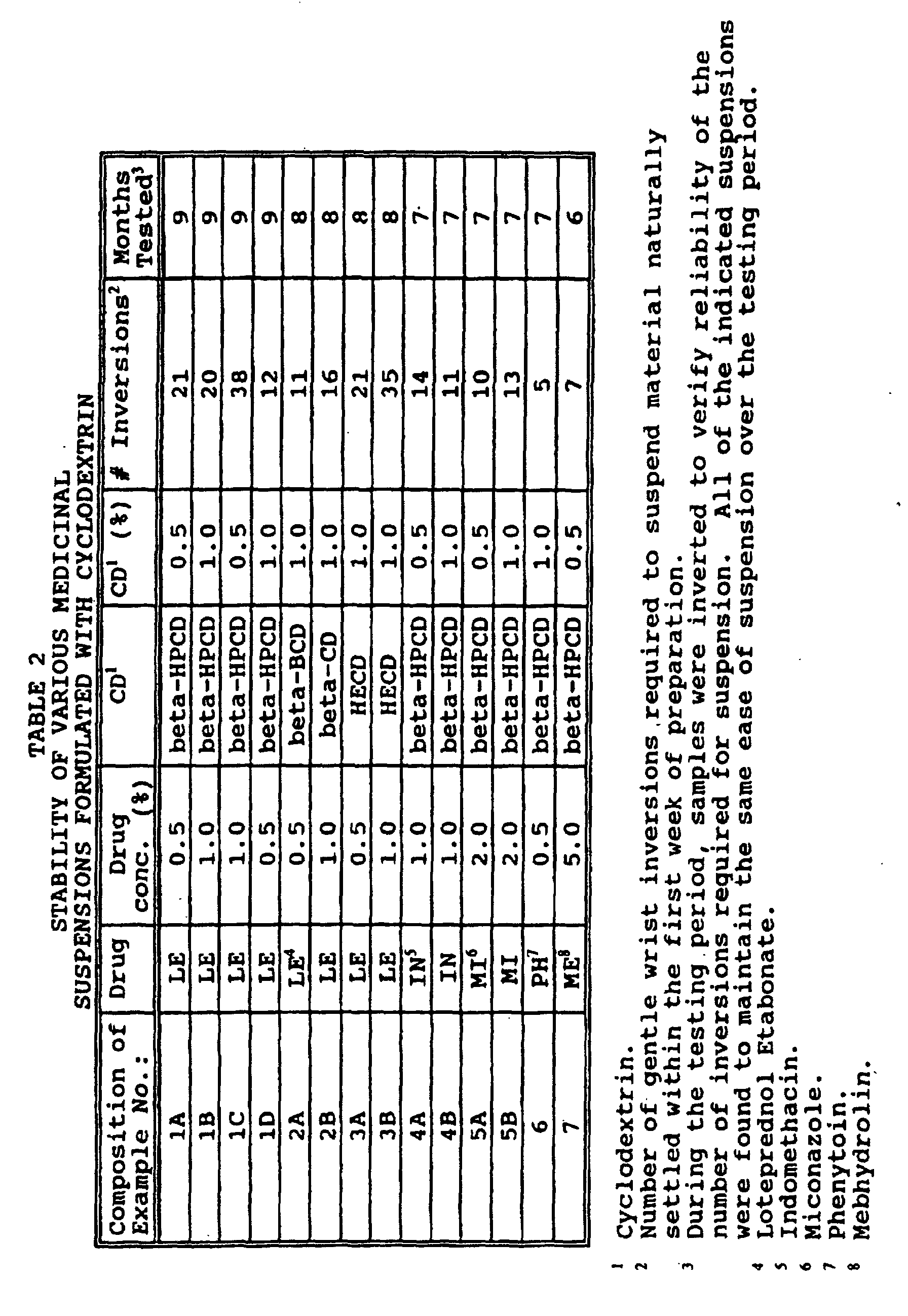
- Method C for evaluating stability of suspensions of drugs such as LE is to permit the particles in the samples to settle naturally, and to count the number of inversions required to resuspend the particles.
- the results obtained by Method C appear in Table 2.
- Method C indicate that surprisingly few inversions are required to resuspend settled suspension of particles of LE which include cyclodextrin suspending agent relative to commercial suspensions which may require more than 50 inversions to suspend the particles.
Landscapes
- Health & Medical Sciences (AREA)
- Chemical & Material Sciences (AREA)
- Medicinal Chemistry (AREA)
- Pharmacology & Pharmacy (AREA)
- Epidemiology (AREA)
- Life Sciences & Earth Sciences (AREA)
- Animal Behavior & Ethology (AREA)
- General Health & Medical Sciences (AREA)
- Public Health (AREA)
- Veterinary Medicine (AREA)
- Inorganic Chemistry (AREA)
- Medicinal Preparation (AREA)
- Pharmaceuticals Containing Other Organic And Inorganic Compounds (AREA)
- Cephalosporin Compounds (AREA)
Abstract
Description
- The invention relates to stable aqueous suspensions of poorly water soluble drugs for treatment of ophthalmic and otolaryngological inflammations or any other conditions requiring use of a drug in a suspension.
- Numerous drugs are prepared in the form of suspensions for ophthalmic, oral, otic, nasal and respiratory topical applications. Formulation of pharmaceutical dosages of water-insoluble drugs as suspensions is frequently hampered by the subsequent formation of cakes resulting from aggregation of the suspended material. Polymeric compounds (e.g. polyvinyl pyrrolidone ("PVP"), polyvinyl alcohol ("PVA"), and dextran are commonly used to stabilize such suspensions. An alternative approach to the preparation of such drugs is to enhance the solubility of the drugs within the formulation by vehicles such as emulsions, liposomes, and cyclodextrins. However, certain drugs, in their therapeutic concentrations, are not sufficiently stabilized or solubilized by these methods for the above-mentioned applications.
- Generally, a variety of cyclodextrins have been used to solubilize poorly water-soluble or water-insoluble drugs and to stabilize drugs which are unstable in water in the form of inclusion complexes. The present invention relates to the entirely novel use of modified cyclodextrins to stabilize and facilitate the formation of aqueous suspensions of particulate water-insoluble drugs.
- Cyclodextrins are cyclic oligosaccharides. The most common cyclodextrins are α-cyclodextrin, which is composed of a ring of six glucose residues; β-cyclodextrin, which is composed of a ring of seven glucose residues; and γ-cyclodextrin, which is composed of a ring of eight glucose units. The inside cavity of a cyclodextrin is lipophilic, while the outside of the cyclodextrin is hydrophilic; this combination of properties has led to widespread study of natural cyclodextrins, particularly in connection with pharmaceuticals, and many inclusion complexes have been reported. β-Cyclodextrin has been of special interest because of its cavity size, but its relatively low aqueous solubility (about 1.8% w/v at 25°C) and attendant nephrotoxicity have limited its use in the pharmaceutical field.
- Attempts to modify the properties of natural cyclodextrins have resulted in the development of heptakis (2,6-di-o-methyl)-β-cyclodextrin, heptakis (2,3,6-tri-O-methyl)-β-cyclodextrin, hydroxypropyl-β-cyclodextrin, β-cyclodextrin-epichlorohydrin polymer and others. For a comprehensive review of cyclodextrins and their use in pharmaceutical research, see Pitha et al, in Controlled Drug Delivery, ed. S.D. Bruck, Vol. I, CRC Press, Boca Raton, Fla, pp. 125-148 (1983). For an even more recent overview, see Uekama et al, in CRC Critical Reviews in Therapeutic Drug Carrier Systems, Vol. 3(1), 1-40 (1987); Uekama, in Topics in Pharmaceutical Sciences 1987; Uekama, in Topics in Pharmaceutical Sciences 1987, eds. D.D. Breimer and P. Speiser, Elsevier Science Publishers B.V. (Biomedical Division), 1987, 181-194 and Pagington, Chemistry in Britain, May 1987; pp. 455-458.
- Inclusion complexes of α-, β- or γ-cyclodextrin or their mixtures with a variety of drugs have been described by numerous parties and various advantages have been attributed to the complexes. See United States Patent Nos. 4,024,223; 4,228,160; 4,232,009; 4,351,846; 4,352,793; 4,383,992; 4,407,795; and 4,424,209.
- US-A 4, 383, 992 pertains to water soluble complexes or inclusion compounds of steroid components and the use thereof in pharmaceutical compositions.
- US-A 5, 089, 482 discloses a pharmaceutical composition suitable for nasal application containing a sex hormone selected from 17β estradiol, progesterone and combinations thereof and dimethyl-β-cyclodextrtin.
- Chem. Abs. 117: 178175 relates to the lipophilicity, solubility and permeability of loteprednol etabonate.
- In Remington's Pharmaceutical Sciences, 18th Edition, pages 1587-1592 inter alia steroid suspensions for ophthalmic use are disclosed.
- Topical steroids such as corticosteroids are commonly used for anti-inflammatory therapy of the eye, especially for treating inflammatory conditions of the palpebral or bulbar conjunctiva, cornea and anterior segment of the globe. Common therapeutic applications for steroids include allergic conjunctivitis, acne rosacea, superficial punctate keratitis and iritis cyclitis. Steroids also are used to ameliorate inflammation associated with corneal injury due to chemical or thermal burns, or penetration of foreign bodies. Such conditions may result from surgery, injury, allergy or infection to the eye and can cause severe discomfort.
- Despite their therapeutic advantages, topical ocular use of corticosteroids is associated with a number of complications, including posterior subcapsular cataract formation, elevation of intraocular pressure, secondary ocular infection, retardation of corneal wound healing, uveitis, mydriasis, transient ocular discomfort and ptosis. Numerous systemic complications also may arise from the topical ocular application of corticosteroids. These complications include adrenal insufficiency, Cushing's syndrome, peptic ulceration, osteoporosis, hypertension, muscle weakness or atrophy, inhibition of growth, diabetes, activation of infection, mood changes and delayed wound healing.
- Topical steroids for treating ocular inflammations can be based on soft drugs. Soft drugs, as are known in the art, are designed to provide maximal therapeutic effect and minimal side effects. By one approach, synthesis of a "soft drug" can be achieved by structurally modifying a known inactive metabolite of a known active drug to produce an active metabolite that undergoes a predictable one-step transformation in-vivo back to the inactive metabolite. (See U.S. Patents 4,996,335 and 4,710,495 for "soft" steroids). "Soft drugs" therefore are biologically active chemical components characterized by predictable in vivo metabolism to non-toxic derivatives after they provide their therapeutic effect.
- Pharmaceutical compositions of water-insoluble drugs such as corticosteroids in aqueous suspensions for ocular and other uses must satisfy constraints imposed by physiological compatibilities such as pH, osmolality, and particle size of the suspended steroids. Furthermore, these compositions must meet requirements for preservative efficiency and ease of suspension over extended periods of time.
- Therapeutic suspensions of corticosteroids typically employ polymeric compounds such as PVP and PVA as suspending agents in concentrations ranging from 0.1 to 10%. See U.S. Patent 2,861,920. Polymeric compounds such as PVP, PVA, sodium carboxymethylcellulose, dextran, and surface-active agents such as Polysorbate 80, Polysorbate 20, and tyloxapol also have been used to stabilize corticosteroid suspensions intended for ophthalmic, nasal, and otic uses.
- The amounts of polymeric compounds and surface active agents employed to provide stability to these suspensions must accurately be determined. For example, an excessive amount of polymeric compound may hamper the antimicrobial effects of preservatives added to the suspension. Also, pharmaceutical ocular and nasal dosages of these suspensions either must be buffered or have a pH with no buffering capacity. These suspensions also should be isotonic.
- Formulation of aqueous suspensions of corticosteroids for ocular applications and other uses has been hampered by agglomeration of the steroid particles. Agglomeration particularly has been a problem for "soft" steroids such as loteprednol etabonate ("LE"), bechmethasone, betamethasone, fluocinolone, fluoromethalone, prednisolone, either alone or in combination with other therapeutic drugs such as betaxalol, athenolol, livobanolol, epinenephrin, dipivalyl, oxonolol, acetazilumide-base, methazalomide, tobramycin, gentamycin, piroxicam, indomethacine, naproxen, phenylbutazone, ibuprofen, diclofenac-acid.
- LE is a soft corticosteroid that has ocular anti-inflammatory activity. This corticosteroid is based on a known inactive metabolite of the active drug prednisolone. LE is an analog of prednisolone that does not have a 20-keto group attached to the 17β-position. Instead, the 17-β position is occupied with a metabolically-labile ester function. In biological systems, LE is hydrolysed to the inactive carboxylic acid metabolite (PJ-91) that does not bind to glucocorticoid receptors. LE also provides superior safety by reducing the risk of steroid induced cataracts and elevation of intra-ocular pressure. The lability of LE to enzymes located in the blood and/or liver also reduces the likelihood of systemic side effects.
- Soft steroids such as corticosteroids have the potential for treating inflammation without inducing elevation of intraocular pressure. In addition, these steroids lessen the tendency to induce cataracts which may result from interaction of the corticosteroids with the ocular lens proteins.
- LE provides therapeutic advantages over other corticosteroids by providing efficacy similar to its parent compound, namely, prednisolone acetate. Stable aqueous suspensions of LE, however, cannot be obtained by accepted buffering systems or ionic tonicity agents. Surprisingly, common tonicity agents such as aqueous solutions containing 0.9% Nacl, 0.1% EDTA, or phosphate buffer, even in concentrations as low as 1mM therefore can not be employed in aqueous suspensions of corticosteroids such as LE.
- A need therefore exists for aqueous suspensions which have therapeutically effective amounts of "soft" drugs such as corticosteroids, but which avoid the problems of agglomeration associated with the suspensions of the prior art.
- New suspensions of water insoluble or poorly soluble drugs are now provided. These suspensions include component (A) of a therapeutic concentration of a water insoluble or poorly soluble drug of particles less than ten microns, and component (B) of an amorphous cyclodextrin in an aqueous medium,
wherein the molar ratio of component (A) to component (B) is about 1:0.5 to 1:20, preferably, about 1:0.5 to 1:6. - Component (A) is a therapeutic quantity of a locally active steroid, such as LE, bechmethasone, betamethasone, fluocinolone, fluoromethalone, prednisolone, preferably LE, in a concentration of 0.1 to 10% (w/w), preferably 0.5 to 5% of the suspension.
- Component (B) can be an amorphous cyclodextrin such as hydroxypropyl cyclodextrin ("HPCD"), beta cyclodextrin ("BCD"), and hydroxyethyl cyclodextrin ("HECD"), preferably HPCD. The cyclodextrins of component (B) surprisingly can be used as effective suspending agents to maintain suspensions of water-insoluble drugs which average ≤10µm particle size for ophthalmic or enteral use.
- In another aspect of the invention, aqueous suspensions for ophthalmic, otolaryngological, or anti-inflammatory use which comprise the aforementioned component (A) and the aforementioned component (B) in an aqueous medium, further may be combined with component (C) of a nonionic surface active agent.
- The suspensions of the invention further may include component (D) of a tonicity imparting agent to impart isotonicity, and component (E) of at least one preservative compound to substantially prevent microbial growth. Preferably, component (D) is glycerol in an amount of about 2 to 2.8% by weight of the suspension.
- The invention also provides stable aqueous suspensions of water-insoluble drugs which can remain in such a state that will allow for immediate suspension of the drugs when desired, even after extended periods of settling or standing. Suspensions of drugs which employ these suspending agents, moreover, do not cause discomfort upon application. Moreover, in the suspensions of the invention, surprisingly less than 2% of component (A) is solubilized by component (B). As used herein, stable suspensions are those which maintain the particles in a suspended state for a minimum of one year, typically about two to three years.
- In a preferred aspect, stable aqueous suspensions of LE, i.e., suspensions which are stable for at least one year, typically 2-3 years, are provided which have concentrations of about 0.5-1% of LE with a cyclodextrin, preferably HPCD, and a surface active agent of tyloxapol. Accepted preservatives such as benzalkonium chloride and disodium edetate ("EDTA") can be included in the suspension. Although surface active agents may be employed, use of cyclodextrins as suspending agents surprisingly provide sufficient stability to the suspensions to minimize use of surface active agents which may neutralize the effects of preservatives. In such suspensions, less than about 5% of cyclodextrins are used to suspend the drug in a stable manner.
- Having briefly summarized the invention, the invention will now be described in detail by reference to the following specification and non-limiting examples. Unless otherwise specified, all percentages are by weight and all temperatures are in degrees Celsius.
- Therapeutic, aqueous suspensions of a drug of component (A) for ophthalmic or otolaryngological use are made by asceptic preparation. The suspensions of the invention are prepared by mixing the drug of component (A), a suspending agent of component (B), and an aqueous medium, preferably purified water. Optionally, component (C) of a surface-active agent, component (D) of an agent for producing isotonicity, and component (E) of preservative(s) may be included in the aqueous medium. Purity levels of all materials employed in the suspensions of the invention exceed 98%.
- Component (A) typically is added to obtain a final concentration in the suspension of about 0.1-10%, preferably about 0.5-5%, most preferably about 0.1%-2% based on the weight of the suspension. The molar ratio of component (A) to component (B) typically is in the range of about 2:1 to 1:20, more preferably about 2:1 to 1:6.
- Component (B) is a cyclodextrin such as methyl cyclodextrin, glucosyl cyclodextrin, maltosyl cyclodextrin, multiple derivative forms of the above cyclodextrins, BCD, and HECD, particularly HPCD.
- Component (C) is a surface-active agent that is acceptable for ophthalmic or otolaryngological uses. Useful surface active agents include but are not limited to non-ionic surfactants such as Polysorbate 80 from ICI Americas, Wilmington, DE, Polysorbate 20 from ICI Americas, Wilmington, DE and Tyloxapol from ICI Americas, Wilmington, DE. The concentration in which the surface active agent may be used is only limited by neutralization of the bacteriocidal effects of the accompanying preservatives employed, or by concentrations which may cause irritation.
- Component (D) can be a diol such as glycerol in a concentration of about 2-2.8%, preferably about 2.2-2.6% based on the weight of the suspension in order to provide isotonicity.
- The suspension thus can be prepared (hereinafter referred to as "Method 1") by thoroughly mixing the drug (component A) and the indicated suspending agent (component B) with the indicated surface active agent (component C), glycerol for tonicity adjustment, and preservatives, in an aqueous medium.
- The cyclodextrins of component (B) and the surface active agents of component (C) have good solubility in water, have sufficient number of hydroxyl groups to interact with the drug, and have mild effects on the viscosity of the suspension.
- Health regulations in various countries generally require that ophthalmic preparations shall include a preservative. Many well known preservatives that have been used in ophthalmic preparations of the prior art, however, cannot be used in the preparations of the invention since those preservatives may no longer be considered safe for ocular use or may interact with the surfactant employed in the suspension to form a complex that reduces the bacteriocidic activity of the preservative.
- The preservatives of component (E) employed in the suspensions of the invention are chosen to avoid interacting with the surface active agent to an extent that the preservatives are prevented from protecting the suspension from microbiological contamination.
The preservative(s), when required, are employed in a minimal concentration sufficient to prevent microbial growth. - A variety of preservatives may be employed in the suspensions of the invention. In a preferred embodiment, benzalkonium chloride may be employed as a safe preservative. Other possible preservatives include but are not limited to benzyl alcohol, methyl parabens, propyl parabens, benzethonium chlorides, thimerosal (concentration of 0.01-0.2%) and chlorbutanol (concentration of 0.01-0.2%). Preferably, a preservative (or combination of preservatives) which imparts standard antimicrobial activity to the suspension and which protects against oxidation of components (A)-(D) is employed. The preservative typically can be added to attain a concentration of 0.001-0.02%, preferably 0.005-0.015%, based on the weight of the suspension.
- Additional therapeutic drugs such as drugs for treating glaucoma, anti-inflammatory drugs, antibiotic drugs, anti-cancer drugs, anti-fungal drugs and anti-viral drugs may be included in the suspensions of the invention. Examples of anti-glaucoma drugs include but are not limited to timolol-base, betaxalol, athenolol, livobanolol, epinenephrin, dipivalyl, oxonolol, acetazilumide-base and methazalomide. Examples of anti-inflammatory drugs include but are not limited to steroids such as cortisone and dexamethasone, and non-steroids such as piroxicam, indomethacine, naproxen, phenylbutazone, ibuprofen and diclofenac-acid. Additional therapeutic materials which may be employed include but are not limited to tobromycin.
- The drugs of component (A) typically have particle sizes of about 0.1 µm - 30 µm, preferably 0.8-10 µ, most preferably about 2-5 µ in diameter. Drugs such as LE in this size range are commercially available from suppliers such as the Sipsy Co., Arville, France.
- Stable aqueous suspensions of the invention can be produced over a broad range of pH values. A pH of about 3-9, preferably about 4-8, most preferably about 4.5 - 7.5 is useful for preparing stable LE suspensions which employ cyclodextrins. A broad range of percents by weight of the cyclodextrin suspending agents and percents by weight of surface active agents can be employed to provide stable suspensions in accordance with the invention. Useful molar ratios of LE: cyclodextrin suspending agent can vary between about 1:0,5-1:20, preferably about 1:0,5 to 1:10.
- Generally, method i is used to prepare the aqueous suspensions of Example 1 - 7. These suspensions are prepared by mixing the micronized soft drug of component (A), the cyclodextrin suspending agent of component (B), and the surface active agent of component(C). A tonicity agent of component (D) such as glycerol is added for tonicity adjustment and component (D) of preservatives such as benzalkonium and EDTA also may be employed.
- Without further elaboration, it is believed that one skilled in the art can, using the preceding description, utilize the present invention to its fullest extent. The following preferred specific embodiments are, therefore, to be construed as merely illustrative, and not limitative of the remainder of the disclosure in any way whatsoever.
- In Examples 1-7, the compositions thereof are produced with the indicated percentages of the components given in Table 1 using the above-described Method 1.

- Samples of suspensions of corticosteroids that have an average size of ≤ 10 µm are tested for stability using accelerated stability tests and "real time" studies.
- The ability of cyclodextrins to provide stable suspensions of drugs such as LE is evaluated by three methods. The first method ("Method A") entails measuring the particle sizes with a Coulter LS130 instrument. When a drug such as LE is micronized to particle sizes of less than ten microns, an indication of suspension stability is that large agglomerates do not form, i.e., particle sizes averaging less than 10 µm are maintained. This is indeed observed in suspensions of LE that employ cyclodextrins.
- A second approach ("Method B") for evaluating stability of suspensions of drugs such as LE is to centrifuge samples of those suspensions for two minutes at 5000G to provide a pellet of the drug. The time required to suspend the resulting pellet by shaking provides a measure of stability. The results obtained by Method B indicate that >30 seconds of shaking required to suspend some sedimented particles, commercially available suspensions of fluorometholone and mebhydroline, when treated in this fashion. However, in the presence of cyclodextrins, suspensions of particles of fluorometholone and mebhydroline settled in this manner surprisingly are easily obtained with about five seconds of wrist shaking.
- A third approach ("Method C") for evaluating stability of suspensions of drugs such as LE is to permit the particles in the samples to settle naturally, and to count the number of inversions required to resuspend the particles. The results obtained by Method C appear in Table 2.
- The results obtained by Method C indicate that surprisingly few inversions are required to resuspend settled suspension of particles of LE which include cyclodextrin suspending agent relative to commercial suspensions which may require more than 50 inversions to suspend the particles.
- To evaluate solubilization of drugs such as LE by cyclodextrins, LE is continuously mixed with cyclodextrins in various concentrations in water for one week at room temperature. Samples of the resulting suspensions and the soluble fractions of LE are analyzed by high pressure liquid chromatography ("HPLC") before and after centrifugation at 5000G, respectively (hereinafter referred to as "Method D"). The concentrations of LE are calculated from the area under the curve of the LE peak using known techniques. The extent of solubilization of LE by cyclodextrins is shown in Table 3.
- The results in Table 3 indicate that not more than 0.01 mg/ml LE is solubilized by cyclodextrins.
SOLUBILIZATION OF LOTEPREDNOL IN CYCLODEXTRIN SOLUTIONS Cyclodextrin in Suspension LE Solubilized (mg/ml) 0.5% HPCD 0.007 1.0% HPCD 0.005 1.0% HECD 0.01 1.0% BCD 0.01 - Measurement of the concentration of LE in suspensions of the above-mentioned samples is done using the HPLC technique of Method C. The results are shown in Table 4. As indicated in Table 4, the concentration of LE in the suspension was not significantly altered. Cyclodextrins therefore stabilize suspensions of drugs such as LE while minimizing solubilizing the LE.
HPLC MEASUREMENT OF LE IN CYCLODEXTRIN SUSPENSIONS [LE] on label (mg/ml) CD CD % storage temp. (C) period of storage (mos) measurement (%) of label) 5 HPCD 0.5 23 5.0 101.12 10 HPCD 0.5 23 5.0 109.09 5 HPCD 1 23 0.5 94.3 10 HPCD 1 23 0.5 88.18 5 HPCD 1 37 2.0 104.04 5 HPCD 1 45 2.0 96.84 5 HPCD 1 23 5.0 115.45 10 HPCD 1 23 5.0 110.23 5 BCD 1 23 4.0 106.78 10 BCD 1 23 4.0 105.7 5 HECD 1 23 4.0 104.26 10 HECD 1 23 4.0 135.88
Claims (8)
- A suspension of a water insoluble or poorly soluble drug comprising:wherein the molar ratio of component (A) to component (B) is 1:05 to 1:20, and wherein component (A) is selected from loteprednol etabonate, bechmethasone, betamethasone, fluocinolone, fluoromethalone and prednisolone.component (A) of a therapeutic concentration of a water insoluble or poorly soluble, drug of particles less than 10 microns and component (B) of an amorphous cyclodextrin in an aqueous medium,
- The suspension of claim 1 wherein component (A) is present in an amount of about 0.05 to 5% based on the weight of the solution, and component (B) is selected from the group of hydroxypropyl cyclodextrin, beta cyclodextrin, and hydroxyethyl cyclodextrin.
- The suspension of claim 2 wherein component (A) is loteprednol etabonate and component (B) is hydroxypropyl cyclodextrin.
- The suspension of claim 1 further comprising a tonicity imparting agent for achieving isotonicity.
- The composition of claim 4 wherein said tonicity imparting agent is glycerol.
- The suspension of claim 1 further comprising at least one preservative compound to prevent microbial growth in the suspension.
- The composition of claim 6 wherein said preservative is selected from the group of benzalkonium chloride and disodium edetate.
- The suspension of claim 1 wherein less than about 2% of component (A) is solubilized by component (B).
Applications Claiming Priority (3)
| Application Number | Priority Date | Filing Date | Title |
|---|---|---|---|
| US08/346,954 US5576311A (en) | 1994-11-30 | 1994-11-30 | Cyclodextrins as suspending agents for pharmaceutical suspensions |
| US346954 | 1994-11-30 | ||
| PCT/US1995/015348 WO1996016659A1 (en) | 1994-11-30 | 1995-11-28 | Cyclodextrins as suspending agents for pharmaceutical suspensions |
Publications (3)
| Publication Number | Publication Date |
|---|---|
| EP0794783A1 EP0794783A1 (en) | 1997-09-17 |
| EP0794783A4 EP0794783A4 (en) | 1998-03-04 |
| EP0794783B1 true EP0794783B1 (en) | 2003-05-14 |
Family
ID=23361723
Family Applications (1)
| Application Number | Title | Priority Date | Filing Date |
|---|---|---|---|
| EP95941473A Expired - Lifetime EP0794783B1 (en) | 1994-11-30 | 1995-11-28 | Cyclodextrins as suspending agents for pharmaceutical suspensions |
Country Status (8)
| Country | Link |
|---|---|
| US (1) | US5576311A (en) |
| EP (1) | EP0794783B1 (en) |
| JP (1) | JPH10510532A (en) |
| AT (1) | ATE240104T1 (en) |
| AU (1) | AU715895B2 (en) |
| CA (1) | CA2206348A1 (en) |
| DE (1) | DE69530785T2 (en) |
| WO (1) | WO1996016659A1 (en) |
Families Citing this family (65)
| Publication number | Priority date | Publication date | Assignee | Title |
|---|---|---|---|---|
| US5849263A (en) * | 1993-03-30 | 1998-12-15 | Charlotte-Mecklenburg Hospital Authority | Pharmaceutical compositions containing alkylaryl polyether alcohol polymer |
| WO1996022088A1 (en) * | 1995-01-20 | 1996-07-25 | Wakamoto Pharmaceutical Co., Ltd. | Anti-inflammatory eyedrops |
| US5942501A (en) * | 1996-08-16 | 1999-08-24 | Collaborative Laboratories, Inc. | Cyclodextrin derivative complex |
| EP0834308A1 (en) * | 1996-09-30 | 1998-04-08 | LG Chemical Limited | Ophthalmic formulation for treating myopia comprising dopamine agonist and cyclodextrin |
| EP0938896A1 (en) | 1998-01-15 | 1999-09-01 | Novartis AG | Autoclavable pharmaceutical compositions containing a chelating agent |
| JP2002523475A (en) * | 1998-09-02 | 2002-07-30 | アラーガン・セイルズ・インコーポレイテッド | Preserved cyclodextrin-containing composition |
| US6211246B1 (en) * | 1999-06-10 | 2001-04-03 | Mcneil-Ppc, Inc. | Rapidly absorbed liquid compositions |
| EP1305637A2 (en) * | 2000-08-02 | 2003-05-02 | Malope Company Limited | Diagnosis and treatment of non-ulcer dyspepsia based on hypothalamic-pituitary-adrenal axis abnormality |
| US20030044356A1 (en) * | 2001-04-20 | 2003-03-06 | Jin Auh | Composition for nasal solution sprays having effective component of 1,2,3,9-tetrahydro-9-methyl-3-[(2-methyl-1H-imidazol-1-yl)methyl]-4H-carbazol-4-one) |
| US20040214797A1 (en) * | 2001-05-07 | 2004-10-28 | Allergan, Inc. | Preserved pharmaceutical compositions comprising cyclodextrins |
| IL152573A (en) | 2002-10-31 | 2009-11-18 | Transpharma Medical Ltd | Transdermal delivery system for anti-emetic medication |
| IL152575A (en) | 2002-10-31 | 2008-12-29 | Transpharma Medical Ltd | Transdermal delivery system for water insoluble drugs |
| US20070224278A1 (en) | 2003-11-12 | 2007-09-27 | Lyons Robert T | Low immunogenicity corticosteroid compositions |
| US20050101582A1 (en) | 2003-11-12 | 2005-05-12 | Allergan, Inc. | Compositions and methods for treating a posterior segment of an eye |
| US20050250737A1 (en) * | 2003-11-12 | 2005-11-10 | Allergan, Inc. | Therapeutic ophthalmic compositions containing retinal friendly excipients and related methods |
| US20070020299A1 (en) | 2003-12-31 | 2007-01-25 | Pipkin James D | Inhalant formulation containing sulfoalkyl ether cyclodextrin and corticosteroid |
| CN100548271C (en) | 2004-01-20 | 2009-10-14 | 阿勒根公司 | Composition for topical treatment of the eye, preferably comprising triamcinolone acetonide and hyaluronic acid |
| US20050234018A1 (en) * | 2004-04-15 | 2005-10-20 | Allergan, Inc. | Drug delivery to the back of the eye |
| US20050239747A1 (en) * | 2004-04-21 | 2005-10-27 | Pharmaceutical Industry Technology And Development Center | Compositions and methods of enhanced transdermal delivery of steroid compounds and preparation methods |
| US8147865B2 (en) | 2004-04-30 | 2012-04-03 | Allergan, Inc. | Steroid-containing sustained release intraocular implants and related methods |
| US8119154B2 (en) | 2004-04-30 | 2012-02-21 | Allergan, Inc. | Sustained release intraocular implants and related methods |
| KR100649154B1 (en) | 2004-06-01 | 2006-11-24 | 명문제약주식회사 | Solubilization Method of Aceclofenac |
| EP1806129A1 (en) * | 2004-10-01 | 2007-07-11 | Eisai R&D Management Co., Ltd. | Composition containing fine particles and process for producing the same |
| WO2006040839A1 (en) * | 2004-10-15 | 2006-04-20 | Advanced Medicine Research Institute | Eye drops and kit for treatment of eye disease |
| EP2336117A1 (en) | 2005-05-26 | 2011-06-22 | Neuron Systems, Inc | Heterocyclic compounds for treating retinal diseases |
| WO2007076448A2 (en) * | 2005-12-23 | 2007-07-05 | Alcon, Inc. | Pharmaceutical composition for delivery of receptor tyrosine kinase inhibiting (rtki) compounds to the eye |
| US20070238789A1 (en) * | 2006-03-31 | 2007-10-11 | Chin-Ming Chang | Prednisolone acetate compositions |
| US8668676B2 (en) * | 2006-06-19 | 2014-03-11 | Allergan, Inc. | Apparatus and methods for implanting particulate ocular implants |
| US20080097335A1 (en) * | 2006-08-04 | 2008-04-24 | Allergan, Inc. | Ocular implant delivery assemblies |
| US9744137B2 (en) | 2006-08-31 | 2017-08-29 | Supernus Pharmaceuticals, Inc. | Topiramate compositions and methods of enhancing its bioavailability |
| TWI415629B (en) | 2006-10-26 | 2013-11-21 | Otsuka Pharma Co Ltd | Aqueous pharmaceutical suspensions containing rebamipide and manufacturing process thereof |
| US8158609B1 (en) * | 2006-11-02 | 2012-04-17 | Novartis Ag | Use of cyclodextrins as an active ingredient for treating dry AMD and solubilizing drusen |
| EP2394643B1 (en) | 2006-11-17 | 2015-09-02 | Supernus Pharmaceuticals, Inc. | Sustained-release formulations of topiramate |
| CN102114002B (en) * | 2006-12-04 | 2016-05-11 | 苏佩努斯制药公司 | The immediate release formulation of the enhancing of Topiramate |
| US12370352B2 (en) | 2007-06-28 | 2025-07-29 | Cydex Pharmaceuticals, Inc. | Nasal and ophthalmic delivery of aqueous corticosteroid solutions |
| US8545554B2 (en) | 2009-01-16 | 2013-10-01 | Allergan, Inc. | Intraocular injector |
| WO2011072141A1 (en) | 2009-12-11 | 2011-06-16 | Neuron Systems, Inc. | Compositions and methods for the treatment of macular degeneration |
| CA2791278C (en) | 2010-02-25 | 2015-11-24 | The Johns Hopkins University | Sustained delivery of therapeutic agents to an eye compartment |
| WO2012039979A2 (en) | 2010-09-10 | 2012-03-29 | The Johns Hopkins University | Rapid diffusion of large polymeric nanoparticles in the mammalian brain |
| AU2013232297B2 (en) | 2012-03-16 | 2016-01-14 | The Johns Hopkins University | Controlled release formulations for the delivery of HIF-1 inhibitors |
| EP2825207B1 (en) | 2012-03-16 | 2020-08-19 | The Johns Hopkins University | Non-linear multiblock copolymer-drug conjugates for the delivery of active agents |
| HK1208162A1 (en) | 2012-05-03 | 2016-02-26 | Kala Pharmaceuticals, Inc. | Pharmaceutical nanoparticles showing improved mucosal transport |
| US11596599B2 (en) | 2012-05-03 | 2023-03-07 | The Johns Hopkins University | Compositions and methods for ophthalmic and/or other applications |
| US9827191B2 (en) | 2012-05-03 | 2017-11-28 | The Johns Hopkins University | Compositions and methods for ophthalmic and/or other applications |
| WO2013166408A1 (en) | 2012-05-03 | 2013-11-07 | Kala Pharmaceuticals, Inc. | Pharmaceutical nanoparticles showing improved mucosal transport |
| CA2872519C (en) | 2012-05-04 | 2017-09-05 | The Johns Hopkins University | Lipid-based drug carriers for rapid penetration through mucus linings |
| JP2015524411A (en) * | 2012-07-18 | 2015-08-24 | オニキス セラピューティクス, インク.Onyx Therapeutics, Inc. | Liposome composition of epoxy ketone-based proteasome inhibitor |
| CA2898631C (en) | 2013-01-23 | 2023-06-13 | Aldeyra Therapeutics, Inc. | Toxic aldehyde related diseases and treatment |
| WO2014124006A1 (en) | 2013-02-05 | 2014-08-14 | The Johns Hopkins University | Nanoparticles for magnetic resonance imaging tracking and methods of making and using thereof |
| CA2974715C (en) | 2015-01-27 | 2020-05-05 | The Johns Hopkins University | Hypotonic hydrogel formulations for enhanced transport of active agents at mucosal surfaces |
| CN108135907A (en) | 2015-08-21 | 2018-06-08 | 奥尔德拉医疗公司 | Deuterated compounds and their uses |
| KR20170039347A (en) * | 2015-10-01 | 2017-04-11 | 삼진제약주식회사 | Novel opthalmic composition comprising rebamipide and method for preparing the same |
| MX2018010292A (en) | 2016-02-28 | 2018-09-27 | Aldeyra Therapeutics Inc | Treatment of allergic eye conditions with cyclodextrins. |
| US11129823B2 (en) | 2016-05-09 | 2021-09-28 | Aldeyra Therapeutics, Inc. | Combination treatment of ocular inflammatory disorders and diseases |
| US10414732B2 (en) | 2017-03-16 | 2019-09-17 | Aldeyra Therapeutics, Inc. | Polymorphic compounds and uses thereof |
| MX2020003425A (en) | 2017-10-10 | 2020-07-29 | Aldeyra Therapeutics Inc | Treatment of inflammatory disorders. |
| EP3833660A4 (en) | 2018-08-06 | 2022-05-11 | Aldeyra Therapeutics, Inc. | Polymorphic compounds and uses thereof |
| JP7505786B2 (en) | 2018-09-25 | 2024-06-25 | アルデイラ セラピューティクス, インコーポレイテッド | Formulations for treating dry eye disease |
| WO2020198064A1 (en) | 2019-03-26 | 2020-10-01 | Aldeyra Therapeutics, Inc. | Ophthalmic formulations and uses thereof |
| US12496279B2 (en) | 2019-04-11 | 2025-12-16 | The Johns Hopkins University | Nanoparticles for drug delivery to brain |
| US12098132B2 (en) | 2019-05-02 | 2024-09-24 | Aldeyra Therapeutics, Inc. | Process for preparation of aldehyde scavenger and intermediates |
| CA3137301A1 (en) | 2019-05-02 | 2020-11-05 | Aldeyra Therapeutics, Inc. | Polymorphic compounds and uses thereof |
| CN113209370B (en) * | 2020-01-21 | 2023-11-28 | 渼颜空间(河北)生物科技有限公司 | Biodegradable injection filler, preparation method and application thereof |
| WO2021231792A1 (en) | 2020-05-13 | 2021-11-18 | Aldeyra Therapeutics, Inc. | Pharmaceutical formulations and uses thereof |
| CN111840641A (en) * | 2020-08-31 | 2020-10-30 | 陈玉芝 | Poly-L-lactic acid filler and preparation method and application thereof |
Family Cites Families (13)
| Publication number | Priority date | Publication date | Assignee | Title |
|---|---|---|---|---|
| US2861920A (en) * | 1954-05-04 | 1958-11-25 | Upjohn Co | Therapeutic suspensions of steroids containing pvp and/or pva |
| US4710495A (en) * | 1980-07-10 | 1987-12-01 | Otsuka Pharmaceutical Co., Ltd. | Soft steroids having anti-inflammatory activity |
| US4383992A (en) * | 1982-02-08 | 1983-05-17 | Lipari John M | Water-soluble steroid compounds |
| DE3346123A1 (en) * | 1983-12-21 | 1985-06-27 | Janssen Pharmaceutica, N.V., Beerse | PHARMACEUTICAL PREPARATIONS OF SUBSTANCES MEDICAL OR UNSTABLE IN WATER AND METHOD FOR THE PRODUCTION THEREOF |
| US4727064A (en) * | 1984-04-25 | 1988-02-23 | The United States Of America As Represented By The Department Of Health And Human Services | Pharmaceutical preparations containing cyclodextrin derivatives |
| US4596795A (en) * | 1984-04-25 | 1986-06-24 | The United States Of America As Represented By The Secretary, Dept. Of Health & Human Services | Administration of sex hormones in the form of hydrophilic cyclodextrin derivatives |
| US4727077A (en) * | 1985-02-20 | 1988-02-23 | Ishihara Sangyo Kaisha Ltd. | Benzoyl urea compounds, process for their production, and antitumorous compositions containing them |
| NL8801670A (en) * | 1988-07-01 | 1990-02-01 | Walter Adrianus Josephus Johan | PHARMACEUTICAL PREPARATION. |
| EP0399716B1 (en) * | 1989-05-24 | 1994-01-26 | Innovet, Inc. | Hypoallergenic steroidal anesthetic/hypnotic compositions |
| IT1241417B (en) * | 1990-03-06 | 1994-01-14 | Vectorpharma Int | THERAPEUTIC COMPOSITIONS WITH CONTROLLED RELEASE OF DRUGS SUPPORTED ON CROSS-LINKED POLYMERS AND COATED WITH POLYMER FILM, AND THEIR PREPARATION PROCESS |
| FR2692168B1 (en) * | 1992-06-16 | 1995-03-24 | Centre Nat Rech Scient | Preparation and use of new dispersible colloidal systems based on cyclodextrin, in the form of nanospheres. |
| FR2692167B1 (en) * | 1992-06-16 | 1994-09-16 | Centre Nat Rech Scient | Preparation and application of new nanodispersible colloidal systems based on cyclodextrin, in the form of nanocapsules. |
| US5540930A (en) * | 1993-10-25 | 1996-07-30 | Pharmos Corporation | Suspension of loteprednol etabonate for ear, eye, or nose treatment |
-
1994
- 1994-11-30 US US08/346,954 patent/US5576311A/en not_active Expired - Lifetime
-
1995
- 1995-11-28 JP JP8518965A patent/JPH10510532A/en active Pending
- 1995-11-28 AT AT95941473T patent/ATE240104T1/en not_active IP Right Cessation
- 1995-11-28 AU AU42883/96A patent/AU715895B2/en not_active Ceased
- 1995-11-28 CA CA002206348A patent/CA2206348A1/en not_active Abandoned
- 1995-11-28 EP EP95941473A patent/EP0794783B1/en not_active Expired - Lifetime
- 1995-11-28 WO PCT/US1995/015348 patent/WO1996016659A1/en not_active Ceased
- 1995-11-28 DE DE69530785T patent/DE69530785T2/en not_active Expired - Fee Related
Also Published As
| Publication number | Publication date |
|---|---|
| US5576311A (en) | 1996-11-19 |
| DE69530785D1 (en) | 2003-06-18 |
| DE69530785T2 (en) | 2004-02-19 |
| EP0794783A1 (en) | 1997-09-17 |
| ATE240104T1 (en) | 2003-05-15 |
| AU4288396A (en) | 1996-06-19 |
| CA2206348A1 (en) | 1996-06-06 |
| AU715895B2 (en) | 2000-02-10 |
| WO1996016659A1 (en) | 1996-06-06 |
| EP0794783A4 (en) | 1998-03-04 |
| JPH10510532A (en) | 1998-10-13 |
Similar Documents
| Publication | Publication Date | Title |
|---|---|---|
| US5576311A (en) | Cyclodextrins as suspending agents for pharmaceutical suspensions | |
| AU697617B2 (en) | Suspension of loteprednol etabonate | |
| US5538721A (en) | Stabilization of aminosteroids for topical ophthalmic and other applications | |
| US4642305A (en) | Eye drops composition | |
| US20090118246A1 (en) | Therapeutic ophthalmic compositions containing retinal friendly recpients and related methods | |
| US20070248565A1 (en) | Pharmaceutical preparations comprising corticosteroids and antiinfective agents | |
| US20040152664A1 (en) | Prednisolone compositions | |
| WO2008005819A2 (en) | Ophthalmic formulation containing sulfoalkyl ether cyclodextrin and corticosteroid | |
| CA2150554A1 (en) | Cyclodextrin and polymer based drug delivery system | |
| JP2007532648A (en) | Drug delivery to the back of the eye | |
| CN104350063A (en) | Preparation of hydrophobic therapeutic agent, its preparation method and application | |
| WO2006026083A2 (en) | Nasal delivery of cyclodextrin complexes of anti-inflammatory steroids | |
| US4945089A (en) | Use of tetrahydrocortexolone to prevent elevations in intraocular pressure caused by corticosteroids | |
| CN115837027A (en) | Ophthalmic dexamethasone pharmaceutical composition | |
| Stefánsson et al. | Cyclodextrins in eye drop formulations | |
| CN114025803A (en) | Compositions and methods for treating ocular diseases | |
| JP5087242B2 (en) | Non-invasive drug delivery system for posterior ocular tissue using gel composition | |
| Akram et al. | Development of new ophthalmic suspension prednisolone acetate 1%. | |
| CA2174550E (en) | Suspension of loteprednol etabonate | |
| JP2531558B2 (en) | Sex steroid plaster for treatment of dry eye disease, preparation method and application method of the same |
Legal Events
| Date | Code | Title | Description |
|---|---|---|---|
| PUAI | Public reference made under article 153(3) epc to a published international application that has entered the european phase |
Free format text: ORIGINAL CODE: 0009012 |
|
| 17P | Request for examination filed |
Effective date: 19970626 |
|
| AK | Designated contracting states |
Kind code of ref document: A1 Designated state(s): AT BE CH DE DK ES FR GB GR IE IT LI LU MC NL PT SE |
|
| AX | Request for extension of the european patent |
Free format text: LT PAYMENT 970626;LV PAYMENT 970626;SI PAYMENT 970226 |
|
| A4 | Supplementary search report drawn up and despatched |
Effective date: 19980119 |
|
| AK | Designated contracting states |
Kind code of ref document: A4 Designated state(s): AT BE CH DE DK ES FR GB GR IE IT LI LU MC NL PT SE |
|
| 17Q | First examination report despatched |
Effective date: 20000921 |
|
| GRAG | Despatch of communication of intention to grant |
Free format text: ORIGINAL CODE: EPIDOS AGRA |
|
| GRAG | Despatch of communication of intention to grant |
Free format text: ORIGINAL CODE: EPIDOS AGRA |
|
| GRAG | Despatch of communication of intention to grant |
Free format text: ORIGINAL CODE: EPIDOS AGRA |
|
| GRAH | Despatch of communication of intention to grant a patent |
Free format text: ORIGINAL CODE: EPIDOS IGRA |
|
| RAP1 | Party data changed (applicant data changed or rights of an application transferred) |
Owner name: PHARMOS CORPORATION |
|
| GRAH | Despatch of communication of intention to grant a patent |
Free format text: ORIGINAL CODE: EPIDOS IGRA |
|
| GRAA | (expected) grant |
Free format text: ORIGINAL CODE: 0009210 |
|
| AK | Designated contracting states |
Designated state(s): AT BE CH DE DK ES FR GB GR IE IT LI LU MC NL PT SE |
|
| AX | Request for extension of the european patent |
Extension state: LT LV SI |
|
| PG25 | Lapsed in a contracting state [announced via postgrant information from national office to epo] |
Ref country code: NL Free format text: LAPSE BECAUSE OF FAILURE TO SUBMIT A TRANSLATION OF THE DESCRIPTION OR TO PAY THE FEE WITHIN THE PRESCRIBED TIME-LIMIT Effective date: 20030514 Ref country code: LI Free format text: LAPSE BECAUSE OF FAILURE TO SUBMIT A TRANSLATION OF THE DESCRIPTION OR TO PAY THE FEE WITHIN THE PRESCRIBED TIME-LIMIT Effective date: 20030514 Ref country code: IT Free format text: LAPSE BECAUSE OF FAILURE TO SUBMIT A TRANSLATION OF THE DESCRIPTION OR TO PAY THE FEE WITHIN THE PRE;WARNING: LAPSES OF ITALIAN PATENTS WITH EFFECTIVE DATE BEFORE 2007 MAY HAVE OCCURRED AT ANY TIME BEFORE 2007. THE CORRECT EFFECTIVE DATE MAY BE DIFFERENT FROM THE ONE RECORDED.SCRIBED TIME-LIMIT Effective date: 20030514 Ref country code: CH Free format text: LAPSE BECAUSE OF FAILURE TO SUBMIT A TRANSLATION OF THE DESCRIPTION OR TO PAY THE FEE WITHIN THE PRESCRIBED TIME-LIMIT Effective date: 20030514 Ref country code: BE Free format text: LAPSE BECAUSE OF FAILURE TO SUBMIT A TRANSLATION OF THE DESCRIPTION OR TO PAY THE FEE WITHIN THE PRESCRIBED TIME-LIMIT Effective date: 20030514 Ref country code: AT Free format text: LAPSE BECAUSE OF FAILURE TO SUBMIT A TRANSLATION OF THE DESCRIPTION OR TO PAY THE FEE WITHIN THE PRESCRIBED TIME-LIMIT Effective date: 20030514 |
|
| REG | Reference to a national code |
Ref country code: GB Ref legal event code: FG4D |
|
| REG | Reference to a national code |
Ref country code: CH Ref legal event code: EP |
|
| REG | Reference to a national code |
Ref country code: IE Ref legal event code: FG4D |
|
| REF | Corresponds to: |
Ref document number: 69530785 Country of ref document: DE Date of ref document: 20030618 Kind code of ref document: P |
|
| PG25 | Lapsed in a contracting state [announced via postgrant information from national office to epo] |
Ref country code: SE Free format text: LAPSE BECAUSE OF FAILURE TO SUBMIT A TRANSLATION OF THE DESCRIPTION OR TO PAY THE FEE WITHIN THE PRESCRIBED TIME-LIMIT Effective date: 20030814 Ref country code: PT Free format text: LAPSE BECAUSE OF FAILURE TO SUBMIT A TRANSLATION OF THE DESCRIPTION OR TO PAY THE FEE WITHIN THE PRESCRIBED TIME-LIMIT Effective date: 20030814 Ref country code: GR Free format text: LAPSE BECAUSE OF FAILURE TO SUBMIT A TRANSLATION OF THE DESCRIPTION OR TO PAY THE FEE WITHIN THE PRESCRIBED TIME-LIMIT Effective date: 20030814 Ref country code: DK Free format text: LAPSE BECAUSE OF FAILURE TO SUBMIT A TRANSLATION OF THE DESCRIPTION OR TO PAY THE FEE WITHIN THE PRESCRIBED TIME-LIMIT Effective date: 20030814 |
|
| PG25 | Lapsed in a contracting state [announced via postgrant information from national office to epo] |
Ref country code: ES Free format text: LAPSE BECAUSE OF FAILURE TO SUBMIT A TRANSLATION OF THE DESCRIPTION OR TO PAY THE FEE WITHIN THE PRESCRIBED TIME-LIMIT Effective date: 20030825 |
|
| LTIE | Lt: invalidation of european patent or patent extension |
Effective date: 20030514 |
|
| NLV1 | Nl: lapsed or annulled due to failure to fulfill the requirements of art. 29p and 29m of the patents act | ||
| ET | Fr: translation filed | ||
| PG25 | Lapsed in a contracting state [announced via postgrant information from national office to epo] |
Ref country code: LU Free format text: LAPSE BECAUSE OF NON-PAYMENT OF DUE FEES Effective date: 20031128 Ref country code: IE Free format text: LAPSE BECAUSE OF NON-PAYMENT OF DUE FEES Effective date: 20031128 |
|
| REG | Reference to a national code |
Ref country code: CH Ref legal event code: PL |
|
| PG25 | Lapsed in a contracting state [announced via postgrant information from national office to epo] |
Ref country code: MC Free format text: LAPSE BECAUSE OF NON-PAYMENT OF DUE FEES Effective date: 20031130 |
|
| PLBE | No opposition filed within time limit |
Free format text: ORIGINAL CODE: 0009261 |
|
| STAA | Information on the status of an ep patent application or granted ep patent |
Free format text: STATUS: NO OPPOSITION FILED WITHIN TIME LIMIT |
|
| 26N | No opposition filed |
Effective date: 20040217 |
|
| REG | Reference to a national code |
Ref country code: IE Ref legal event code: MM4A |
|
| PGFP | Annual fee paid to national office [announced via postgrant information from national office to epo] |
Ref country code: FR Payment date: 20061108 Year of fee payment: 12 |
|
| PGFP | Annual fee paid to national office [announced via postgrant information from national office to epo] |
Ref country code: GB Payment date: 20061122 Year of fee payment: 12 |
|
| PGFP | Annual fee paid to national office [announced via postgrant information from national office to epo] |
Ref country code: DE Payment date: 20061123 Year of fee payment: 12 |
|
| GBPC | Gb: european patent ceased through non-payment of renewal fee |
Effective date: 20071128 |
|
| PG25 | Lapsed in a contracting state [announced via postgrant information from national office to epo] |
Ref country code: DE Free format text: LAPSE BECAUSE OF NON-PAYMENT OF DUE FEES Effective date: 20080603 |
|
| REG | Reference to a national code |
Ref country code: FR Ref legal event code: ST Effective date: 20080930 |
|
| PG25 | Lapsed in a contracting state [announced via postgrant information from national office to epo] |
Ref country code: GB Free format text: LAPSE BECAUSE OF NON-PAYMENT OF DUE FEES Effective date: 20071128 |
|
| PG25 | Lapsed in a contracting state [announced via postgrant information from national office to epo] |
Ref country code: FR Free format text: LAPSE BECAUSE OF NON-PAYMENT OF DUE FEES Effective date: 20071130 |