EP0794530A2 - Système de compression et de mémorisation tampon d'un flux de données - Google Patents
Système de compression et de mémorisation tampon d'un flux de données Download PDFInfo
- Publication number
- EP0794530A2 EP0794530A2 EP97301210A EP97301210A EP0794530A2 EP 0794530 A2 EP0794530 A2 EP 0794530A2 EP 97301210 A EP97301210 A EP 97301210A EP 97301210 A EP97301210 A EP 97301210A EP 0794530 A2 EP0794530 A2 EP 0794530A2
- Authority
- EP
- European Patent Office
- Prior art keywords
- data
- dictionary
- output
- current
- records
- Prior art date
- Legal status (The legal status is an assumption and is not a legal conclusion. Google has not performed a legal analysis and makes no representation as to the accuracy of the status listed.)
- Granted
Links
Images


Classifications
-
- H—ELECTRICITY
- H03—ELECTRONIC CIRCUITRY
- H03M—CODING; DECODING; CODE CONVERSION IN GENERAL
- H03M7/00—Conversion of a code where information is represented by a given sequence or number of digits to a code where the same, similar or subset of information is represented by a different sequence or number of digits
- H03M7/30—Compression; Expansion; Suppression of unnecessary data, e.g. redundancy reduction
- H03M7/3084—Compression; Expansion; Suppression of unnecessary data, e.g. redundancy reduction using adaptive string matching, e.g. the Lempel-Ziv method
- H03M7/3086—Compression; Expansion; Suppression of unnecessary data, e.g. redundancy reduction using adaptive string matching, e.g. the Lempel-Ziv method employing a sliding window, e.g. LZ77
-
- G—PHYSICS
- G06—COMPUTING OR CALCULATING; COUNTING
- G06T—IMAGE DATA PROCESSING OR GENERATION, IN GENERAL
- G06T9/00—Image coding
- G06T9/005—Statistical coding, e.g. Huffman, run length coding
-
- G—PHYSICS
- G11—INFORMATION STORAGE
- G11B—INFORMATION STORAGE BASED ON RELATIVE MOVEMENT BETWEEN RECORD CARRIER AND TRANSDUCER
- G11B20/00—Signal processing not specific to the method of recording or reproducing; Circuits therefor
- G11B20/00007—Time or data compression or expansion
-
- G—PHYSICS
- G11—INFORMATION STORAGE
- G11B—INFORMATION STORAGE BASED ON RELATIVE MOVEMENT BETWEEN RECORD CARRIER AND TRANSDUCER
- G11B20/00—Signal processing not specific to the method of recording or reproducing; Circuits therefor
- G11B20/10—Digital recording or reproducing
-
- G—PHYSICS
- G11—INFORMATION STORAGE
- G11B—INFORMATION STORAGE BASED ON RELATIVE MOVEMENT BETWEEN RECORD CARRIER AND TRANSDUCER
- G11B20/00—Signal processing not specific to the method of recording or reproducing; Circuits therefor
- G11B20/10—Digital recording or reproducing
- G11B2020/10916—Seeking data on the record carrier for preparing an access to a specific address
-
- Y—GENERAL TAGGING OF NEW TECHNOLOGICAL DEVELOPMENTS; GENERAL TAGGING OF CROSS-SECTIONAL TECHNOLOGIES SPANNING OVER SEVERAL SECTIONS OF THE IPC; TECHNICAL SUBJECTS COVERED BY FORMER USPC CROSS-REFERENCE ART COLLECTIONS [XRACs] AND DIGESTS
- Y10—TECHNICAL SUBJECTS COVERED BY FORMER USPC
- Y10S—TECHNICAL SUBJECTS COVERED BY FORMER USPC CROSS-REFERENCE ART COLLECTIONS [XRACs] AND DIGESTS
- Y10S707/00—Data processing: database and file management or data structures
- Y10S707/99941—Database schema or data structure
- Y10S707/99942—Manipulating data structure, e.g. compression, compaction, compilation
Definitions
- This invention relates to large data base systems, and the like, where records are preferably stored in non-volatile memory in clusters or locations according to content.
- the records in the input stream are preferably stored in locations on the disk in such a way that records relating to the same subject are clustered in the same area. To achieve this result, the records in the input stream must be efficiently directed to their proper destination on disk.
- the problem involves routing each record from the input stream to one of several output streams to disk, based on some identifier stored in the record.
- the purpose of the invention is to provide techniques to increase the effective data that can be stored on the disk system by reducing the number of writes and to increase the data handling capacity within the limits of the system hardware.
- the first approach is to buffer records in main memory (RAM), and write data to disk only when either (a) enough records destined for a particular location in disk have gathered to justify writing them to disk, or (b) the disk to which data is destined is idle.
- This approach requires an enormous buffer space when used with a very large number of possible destinations on disk (for example, records for hundreds of millions of customers each having a separate destination on disk).
- the output streams are compressed in memory, and written to disk when sufficient data is accumulated, i.e. a full page or a sequence of several pages.
- data is routed to its final destination on the disk via a series of intermediate staging areas on disk. By using large contiguous writes, the number of seeks is reduced even though each record may be transferred several times between disk and memory.
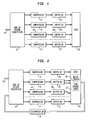
- Figure 1 is a flow diagram illustrating a buffered database system for storing records on disk at locations according to identifiers contained in the records, for example, according to customer names.
- Incoming records are accumulated in buffer memories corresponding to the various identifiers and are then transferred to disk when either (a) enough records destined for a particular location have been gathered to justify a write to disk, or (b) the destination disk is idle.
- “memory” refers to main-memory (RAM) in the computer whereas "disk” refers to a disk drive or other non-volatile storage.
- An incoming data stream 10 which contains the records to be stored passes through a sort routine 12.
- the sort routine separates the incoming records into a number of separate data streams which are temporarily stored in buffer memories 24-27.
- the separation into separate data streams can be according to any desired identifiers or group of identifiers.
- the number of buffer memories depends on the number of separate data streams and, in large database systems can be extremely large.
- the separate data streams are compressed in compression routines 14-17 after being sorted and are then appended to any data which may be stored in the associated buffer memory.
- records are routed from an input stream to one of several output streams according to identifiers in the records so that when sufficient data has accumulated, the accumulated data in an output stream can be transferred to a disk 20 with a single seek for location on the disk.
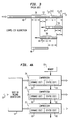
- FIG. 2 illustrates a similar system except that the incoming data is transferred to the final disk location in two or more stages.
- the incoming data stream 10 is sorted in sort routine 12 according to groups of identifiers and stored on disk as record clusters 30. Periodically, the coarse grouping in the record clusters are read from disk, passed through a decompression routine 34, and then supplied to sort routine 12.
- the sort routine sorts the records according to a smaller group of identifiers. Thus, on each pass through the sort routine the records are separated into a finer record groups, such as fine record group 32, which includes records corresponding to a smaller group of identifiers or a single identifier.
- Lempel-Ziv Long Term Evolution
- the Lempel-Ziv algorithm is described in the article "A Universal Algorithm for Sequential Data Compression” by Jacob Ziv and Abraham Lempel, IEEE Transactions on Information Theory, Vol. IT-23, No. 3, May 1977.
- the idea behind the Lempel-Ziv algorithm is to select a window size of k bytes, and use the latest k bytes of input data to code the next portion of the incoming data. This next portion of input data is coded in accordance with the longest string for which an exact match is found in the current window being used as a "dictionary", provided this is larger than some threshold.
- the data is replaced by a pointer to the start of the match and an indicator for the length of the match. If a match is not found, the single character remains.
- the window is then advanced by the number of characters encoded so that it is once more the last k bytes of input already seen.
- data compression is achieved by detecting data sequences that are repetitive within a certain distance. Where a repetitive sequence is detected, the sequence is replaced by a pointer that points to the prior occurrence and the length of the repetitive sequence.
- the algorithm continues in this fashion with the window dictionary moving along the data stream according to the length of exact matches and by length/pointer insertions made in place of data matching a moving dictionary sequence. If, for example, after the dictionary is moved seven bytes as a result of the first match, the next eleven bytes 56 in the example are found to be an exact match to eleven bytes 58 in the moving dictionary. These eleven bytes are replaced by a pointer to position P 27 with a length indication of eleven. Compression continues in this fashion until the end of the data stream is reached.
- a current dictionary must be maintained in memory for each of the output data streams in order to append additional new incoming data records.
- the current dictionaries for each of the multiple output streams can consume tremendous space in the computer main memory.
- the present invention reduces the memory space required for the current dictionaries which must be maintained so that incoming data can be appended to data previously accumulated.
- Figures 4A, 4B, and 4C illustrate a technique according to the invention whereby the memory space required for the current dictionaries is reduced by partitioning the dictionary so that the current dictionary includes a smaller dynamic portion in combination with a static portion.
- Figure 4A illustrates a system with partitioned current dictionaries including dynamic sub-dictionary parts 61-63 and static sub-dictionary parts 64-66.
- the dynamic sub-dictionaries are used for compression according to the Lempel-Ziv algorithm.
- the static sub-dictionaries include data sequences expected to be found in the database and are common to multiple data streams.
- the static portions of the dictionary can be stored in a common memory location 60 thereby substantially reducing the memory requirements for the current dictionaries.
- the static sub-dictionary should include substrings likely to have global applications and which exist in most strings being compressed.
- the incoming data stream 10 passes through a sort routine 12 which sorts the incoming data records into a large number of separate data streams for storage in the associated buffer memories.
- the data streams are each compressed by the compression routines 24-27.
- the dynamic sub-dictionary changes according to the Lempel-Ziv algorithm as the compression progresses while the static sub-dictionary remains unchanged.
- the presence of the static dictionary reduces the size of the dynamic dictionary necessary for effective compression. Since the static sub-dictionary is the same for all data streams and is therefore only stored once in memory 60, the memory required to store all the current dictionaries can be substantially reduced.
- Figure 4B illustrates a similar partitioned current dictionary except that the static sub-dictionaries 67-69 are local for each data stream. Many data streams have some internal commonality, such as a customer name or identifier, which does not depend on position. If these are captured in the static sub-dictionary which does not change, effective data compression can be achieved with a shorter dynamic dictionary.
- Figure 4C illustrates another partitioned dictionary technique wherein the static dictionaries are stored in hierarchical order in a memory 70.
- the hierarchical dictionary 70 includes three subparts, all three of which are used as static sub-dictionary 64 associated with one of the data streams. Only two of the heirarchical subparts are used in static dictionary 66 and only one subpart is used in static dictionary 66. With this arrangement the subparts not common to the static dictionaries are factored out at each level. The total memory space required for storage of the current dictionaries is reduced because of the common storage of static dictionary subparts in a common memory.
- Figures 5A, 5B and 5C illustrate techniques according to the invention whereby the memory space required for the current dictionaries is reduced by compressing the dictionaries used for compressing the data streams.
- the compression algorithm can be applied to the current dictionary 76 by using a smaller dictionary 74 in the process.
- the current dictionary is stored in compressed form as indicted at 78. With this approach the current dictionary must be decompressed when accessed. Thus, there is space-time tradeoff. For data streams which are appended to only occasionally, it is worthwhile to keep the current dictionary itself compressed.
- FIG. 5B Another approach to dictionary compression is illustrated in Figure 5B where the redundancy of unmatched sequences is eliminated in the compression dictionary.
- the compressed output often contains unmatched data sequences which were not found in the sliding window dictionary. Not only does the unmatched data sequence appear in the compressed data stream, but it subsequently also appears in the sliding window compression dictionary. Thus, the unmatched data sequences appear twice--once in the current dictionary and once in the compressed output.
- This redundancy is eliminated according to the technique illustrated in Figure 5B by replacing unmatched sequences by pointers to the output stream to the extent that parts of the output stream are still in memory.
- the incoming data stream 80 moves from left to right with the initial portion of the data stream forming the initial dictionary 82.
- the sliding window dictionary changes as it moves along the data stream. If sequences are found in the data stream that match data sequences in the sliding window dictionary the matched sequence is replaced by an appropriate pointer to the dictionary. When, for example, an unmatched sequence 84 is encountered, this data passes through to the output uncompressed. When the sliding dictionary window reaches the point (i) the unmatched sequence 88 will also appear in the current dictionary 86. The redundancy of having the unmatched sequence appear in memory twice is eliminated according to the invention by replacing the unmatched sequence 88 by a pointer 89 to the sequence 84 in the output stream.
- Figure 5C illustrates another technique according to the invention which usually provides the most effective dictionary compression.
- the incoming data stream 90 moves from left to right and the initial portion of the data stream forms the initial dictionary 92.
- the sliding dictionary changes as it moves along the data stream according to the data encountered.
- the current dictionary 94 includes the data preceding point (i). Instead of saving the current dictionary, this dictionary is reconstructed from a stored portion of the initial dictionary 95 and the compressed data stream that follows.
Landscapes
- Engineering & Computer Science (AREA)
- Theoretical Computer Science (AREA)
- Signal Processing (AREA)
- Multimedia (AREA)
- Physics & Mathematics (AREA)
- General Physics & Mathematics (AREA)
- Compression, Expansion, Code Conversion, And Decoders (AREA)
- Information Retrieval, Db Structures And Fs Structures Therefor (AREA)
Applications Claiming Priority (2)
| Application Number | Priority Date | Filing Date | Title |
|---|---|---|---|
| US607983 | 1996-03-04 | ||
| US08/607,983 US6012062A (en) | 1996-03-04 | 1996-03-04 | System for compression and buffering of a data stream with data extraction requirements |
Publications (3)
| Publication Number | Publication Date |
|---|---|
| EP0794530A2 true EP0794530A2 (fr) | 1997-09-10 |
| EP0794530A3 EP0794530A3 (fr) | 1998-12-30 |
| EP0794530B1 EP0794530B1 (fr) | 2002-05-22 |
Family
ID=24434537
Family Applications (1)
| Application Number | Title | Priority Date | Filing Date |
|---|---|---|---|
| EP97301210A Expired - Lifetime EP0794530B1 (fr) | 1996-03-04 | 1997-02-25 | Système de compression et de mémorisation tampon d'un flux de données |
Country Status (5)
| Country | Link |
|---|---|
| US (1) | US6012062A (fr) |
| EP (1) | EP0794530B1 (fr) |
| JP (1) | JP3592476B2 (fr) |
| CA (1) | CA2195595C (fr) |
| DE (1) | DE69712663T2 (fr) |
Cited By (3)
| Publication number | Priority date | Publication date | Assignee | Title |
|---|---|---|---|---|
| WO2001054284A3 (fr) * | 2000-01-06 | 2002-05-16 | Zakrytoe Aktsionernoe Obschest | Procede de tassement de tout message concernant des sujets d'une tres grande variete a une dimension fixe et canal de communication destine au transfert du message tasse |
| EP1283486A3 (fr) * | 2001-08-06 | 2004-12-08 | Addamark Technologies, Inc. | Stockage de données rangées-colonnes |
| US9342540B2 (en) | 2013-01-08 | 2016-05-17 | Tata Consultancy Services Limited | Method and system for creating and maintaining unique data repository |
Families Citing this family (22)
| Publication number | Priority date | Publication date | Assignee | Title |
|---|---|---|---|---|
| JP3337633B2 (ja) * | 1997-12-03 | 2002-10-21 | 富士通株式会社 | データ圧縮方法及びデータ復元方法並びにデータ圧縮プログラム又はデータ復元プログラムを記録したコンピュータ読み取り可能な記録媒体 |
| US6959300B1 (en) * | 1998-12-10 | 2005-10-25 | At&T Corp. | Data compression method and apparatus |
| KR100344530B1 (ko) * | 1999-12-20 | 2002-07-24 | 한국과학기술원 | 시계열 데이터베이스에서 윈도우 구성의 이원성을 사용한 서브시퀀스 매칭방법 |
| AU2001234758A1 (en) | 2000-02-04 | 2001-08-14 | America Online Incorporated | High performance "freeze-dried" dynamic web page generation |
| US6775293B1 (en) * | 2000-06-30 | 2004-08-10 | Alcatel Canada Inc. | Method and apparatus for monitoring buffer contents in a data communication system |
| US7126955B2 (en) | 2003-01-29 | 2006-10-24 | F5 Networks, Inc. | Architecture for efficient utilization and optimum performance of a network |
| US7286476B2 (en) * | 2003-08-01 | 2007-10-23 | F5 Networks, Inc. | Accelerating network performance by striping and parallelization of TCP connections |
| US7039394B2 (en) * | 2003-11-25 | 2006-05-02 | Good Technology, Inc. | Communication system and method for compressing information sent by a communication device to a target portable communication device |
| US8159940B1 (en) | 2004-11-11 | 2012-04-17 | F5 Networks, Inc. | Obtaining high availability using TCP proxy devices |
| US7280052B2 (en) * | 2005-09-30 | 2007-10-09 | Intel Corporation | Apparatus, system, and method of data compression |
| US8862759B2 (en) * | 2006-04-05 | 2014-10-14 | Agiledelta, Inc. | Multiplexing binary encoding to facilitate compression |
| US8769311B2 (en) | 2006-05-31 | 2014-07-01 | International Business Machines Corporation | Systems and methods for transformation of logical data objects for storage |
| CA2654395C (fr) | 2006-05-31 | 2017-09-19 | Storwize Ltd. | Procede et systeme de transformation d'objets de donnees logiques a des fins de stockage |
| US8099345B2 (en) * | 2007-04-02 | 2012-01-17 | Bank Of America Corporation | Financial account information management and auditing |
| US9362948B2 (en) * | 2008-02-14 | 2016-06-07 | Broadcom Corporation | System, method, and computer program product for saving and restoring a compression/decompression state |
| US20090287986A1 (en) * | 2008-05-14 | 2009-11-19 | Ab Initio Software Corporation | Managing storage of individually accessible data units |
| US8370326B2 (en) * | 2009-03-24 | 2013-02-05 | International Business Machines Corporation | System and method for parallel computation of frequency histograms on joined tables |
| US8380688B2 (en) * | 2009-11-06 | 2013-02-19 | International Business Machines Corporation | Method and apparatus for data compression |
| US8442988B2 (en) * | 2010-11-04 | 2013-05-14 | International Business Machines Corporation | Adaptive cell-specific dictionaries for frequency-partitioned multi-dimensional data |
| US10049089B2 (en) * | 2013-03-13 | 2018-08-14 | Usablenet Inc. | Methods for compressing web page menus and devices thereof |
| JP6613669B2 (ja) * | 2015-07-14 | 2019-12-04 | 富士通株式会社 | 圧縮プログラム、圧縮方法、情報処理装置、置換プログラムおよび置換方法 |
| JP7438246B2 (ja) * | 2019-07-02 | 2024-02-26 | マイクロソフト テクノロジー ライセンシング,エルエルシー | ハードウェアベースのメモリ圧縮 |
Family Cites Families (9)
| Publication number | Priority date | Publication date | Assignee | Title |
|---|---|---|---|---|
| EP0160672A4 (fr) * | 1983-10-19 | 1986-05-12 | Text Sciences Corp | Procede et appareil de compression de donnees. |
| US5010345A (en) * | 1989-12-28 | 1991-04-23 | International Business Machines Corporation | Data compression method |
| US5592667A (en) * | 1991-05-29 | 1997-01-07 | Triada, Ltd. | Method of storing compressed data for accelerated interrogation |
| US5481701A (en) * | 1991-09-13 | 1996-01-02 | Salient Software, Inc. | Method and apparatus for performing direct read of compressed data file |
| US5325091A (en) * | 1992-08-13 | 1994-06-28 | Xerox Corporation | Text-compression technique using frequency-ordered array of word-number mappers |
| JPH06161705A (ja) * | 1992-11-19 | 1994-06-10 | Fujitsu Ltd | データ符号化方式及びデータ復元方式 |
| US5412429A (en) * | 1993-03-11 | 1995-05-02 | The United States Of America As Represented By The Administrator Of The National Aeronautics And Space Administration | Picture data compression coder using subband/transform coding with a Lempel-Ziv-based coder |
| US5611066A (en) * | 1994-02-28 | 1997-03-11 | Data/Ware Development, Inc. | System for creating related sets via once caching common file with each unique control file associated within the set to create a unique record image |
| US5551020A (en) * | 1994-03-28 | 1996-08-27 | Flextech Systems, Inc. | System for the compacting and logical linking of data blocks in files to optimize available physical storage |
-
1996
- 1996-03-04 US US08/607,983 patent/US6012062A/en not_active Expired - Lifetime
-
1997
- 1997-01-21 CA CA002195595A patent/CA2195595C/fr not_active Expired - Fee Related
- 1997-02-25 DE DE69712663T patent/DE69712663T2/de not_active Expired - Lifetime
- 1997-02-25 EP EP97301210A patent/EP0794530B1/fr not_active Expired - Lifetime
- 1997-03-04 JP JP04833697A patent/JP3592476B2/ja not_active Expired - Fee Related
Cited By (3)
| Publication number | Priority date | Publication date | Assignee | Title |
|---|---|---|---|---|
| WO2001054284A3 (fr) * | 2000-01-06 | 2002-05-16 | Zakrytoe Aktsionernoe Obschest | Procede de tassement de tout message concernant des sujets d'une tres grande variete a une dimension fixe et canal de communication destine au transfert du message tasse |
| EP1283486A3 (fr) * | 2001-08-06 | 2004-12-08 | Addamark Technologies, Inc. | Stockage de données rangées-colonnes |
| US9342540B2 (en) | 2013-01-08 | 2016-05-17 | Tata Consultancy Services Limited | Method and system for creating and maintaining unique data repository |
Also Published As
| Publication number | Publication date |
|---|---|
| JP3592476B2 (ja) | 2004-11-24 |
| CA2195595C (fr) | 2000-11-14 |
| EP0794530B1 (fr) | 2002-05-22 |
| DE69712663T2 (de) | 2002-11-21 |
| CA2195595A1 (fr) | 1997-09-04 |
| JPH1083332A (ja) | 1998-03-31 |
| US6012062A (en) | 2000-01-04 |
| DE69712663D1 (de) | 2002-06-27 |
| EP0794530A3 (fr) | 1998-12-30 |
Similar Documents
| Publication | Publication Date | Title |
|---|---|---|
| US6012062A (en) | System for compression and buffering of a data stream with data extraction requirements | |
| US5956504A (en) | Method and system for compressing a data stream in a database log so as to permit recovery of only selected portions of the data stream | |
| US6657565B2 (en) | Method and system for improving lossless compression efficiency | |
| US7840774B2 (en) | Compressibility checking avoidance | |
| US5893102A (en) | Textual database management, storage and retrieval system utilizing word-oriented, dictionary-based data compression/decompression | |
| US6522268B2 (en) | Systems and methods for multiple-file data compression | |
| US8214607B2 (en) | Method and apparatus for detecting the presence of subblocks in a reduced-redundancy storage system | |
| DE69118250T2 (de) | Zugriff für komprimierte daten | |
| US6542906B2 (en) | Method of and an apparatus for merging a sequence of delta files | |
| US5870036A (en) | Adaptive multiple dictionary data compression | |
| US9450605B2 (en) | Block compression of tables with repeated values | |
| EP2093885A1 (fr) | Schéma de segmentation à base de contenu pour la compression de données dans le stockage et la transmission | |
| US20110313980A1 (en) | Compression of tables based on occurrence of values | |
| EP1866776B1 (fr) | Procede permettant de detecter la presence de sous-blocs dans un systeme de stockage a redondance reduite | |
| JPH1131096A (ja) | データ格納検索方式 | |
| US5502439A (en) | Method for compression of binary data | |
| US5394143A (en) | Run-length compression of index keys | |
| US7379940B1 (en) | Focal point compression method and apparatus | |
| Jiang et al. | Word-based dynamic algorithms for data compression | |
| US8244677B2 (en) | Focal point compression method and apparatus | |
| JP2004062475A (ja) | インデクス格納方法 | |
| Yu | Data compression for PC software distribution | |
| JP2000181768A (ja) | デ―タ格納検索方式 | |
| Nelson | Fast Adaptive Data Compression for Information Retrieval | |
| JPS6394366A (ja) | 英語文書圧縮装置 |
Legal Events
| Date | Code | Title | Description |
|---|---|---|---|
| PUAI | Public reference made under article 153(3) epc to a published international application that has entered the european phase |
Free format text: ORIGINAL CODE: 0009012 |
|
| AK | Designated contracting states |
Kind code of ref document: A2 Designated state(s): DE FR GB IT |
|
| PUAL | Search report despatched |
Free format text: ORIGINAL CODE: 0009013 |
|
| AK | Designated contracting states |
Kind code of ref document: A3 Designated state(s): DE FR GB IT |
|
| 17P | Request for examination filed |
Effective date: 19990621 |
|
| 17Q | First examination report despatched |
Effective date: 20001013 |
|
| GRAG | Despatch of communication of intention to grant |
Free format text: ORIGINAL CODE: EPIDOS AGRA |
|
| GRAG | Despatch of communication of intention to grant |
Free format text: ORIGINAL CODE: EPIDOS AGRA |
|
| GRAH | Despatch of communication of intention to grant a patent |
Free format text: ORIGINAL CODE: EPIDOS IGRA |
|
| GRAH | Despatch of communication of intention to grant a patent |
Free format text: ORIGINAL CODE: EPIDOS IGRA |
|
| GRAA | (expected) grant |
Free format text: ORIGINAL CODE: 0009210 |
|
| REG | Reference to a national code |
Ref country code: GB Ref legal event code: FG4D |
|
| REF | Corresponds to: |
Ref document number: 69712663 Country of ref document: DE Date of ref document: 20020627 |
|
| PLBE | No opposition filed within time limit |
Free format text: ORIGINAL CODE: 0009261 |
|
| STAA | Information on the status of an ep patent application or granted ep patent |
Free format text: STATUS: NO OPPOSITION FILED WITHIN TIME LIMIT |
|
| 26N | No opposition filed |
Effective date: 20030225 |
|
| REG | Reference to a national code |
Ref country code: GB Ref legal event code: 732E Free format text: REGISTERED BETWEEN 20131107 AND 20131113 |
|
| REG | Reference to a national code |
Ref country code: FR Ref legal event code: CD Owner name: ALCATEL-LUCENT USA INC. Effective date: 20131122 |
|
| REG | Reference to a national code |
Ref country code: FR Ref legal event code: GC Effective date: 20140410 |
|
| REG | Reference to a national code |
Ref country code: FR Ref legal event code: RG Effective date: 20141015 |
|
| REG | Reference to a national code |
Ref country code: FR Ref legal event code: PLFP Year of fee payment: 19 |
|
| PGFP | Annual fee paid to national office [announced via postgrant information from national office to epo] |
Ref country code: IT Payment date: 20150226 Year of fee payment: 19 Ref country code: DE Payment date: 20150219 Year of fee payment: 19 |
|
| PGFP | Annual fee paid to national office [announced via postgrant information from national office to epo] |
Ref country code: FR Payment date: 20150219 Year of fee payment: 19 Ref country code: GB Payment date: 20150218 Year of fee payment: 19 |
|
| REG | Reference to a national code |
Ref country code: DE Ref legal event code: R119 Ref document number: 69712663 Country of ref document: DE |
|
| GBPC | Gb: european patent ceased through non-payment of renewal fee |
Effective date: 20160225 |
|
| REG | Reference to a national code |
Ref country code: FR Ref legal event code: ST Effective date: 20161028 |
|
| PG25 | Lapsed in a contracting state [announced via postgrant information from national office to epo] |
Ref country code: IT Free format text: LAPSE BECAUSE OF NON-PAYMENT OF DUE FEES Effective date: 20160225 |
|
| PG25 | Lapsed in a contracting state [announced via postgrant information from national office to epo] |
Ref country code: FR Free format text: LAPSE BECAUSE OF NON-PAYMENT OF DUE FEES Effective date: 20160229 Ref country code: DE Free format text: LAPSE BECAUSE OF NON-PAYMENT OF DUE FEES Effective date: 20160901 Ref country code: GB Free format text: LAPSE BECAUSE OF NON-PAYMENT OF DUE FEES Effective date: 20160225 |