EP0794250A1 - Isolation and sequencing of the hazel FAd2-N gene - Google Patents
Isolation and sequencing of the hazel FAd2-N gene Download PDFInfo
- Publication number
- EP0794250A1 EP0794250A1 EP97103098A EP97103098A EP0794250A1 EP 0794250 A1 EP0794250 A1 EP 0794250A1 EP 97103098 A EP97103098 A EP 97103098A EP 97103098 A EP97103098 A EP 97103098A EP 0794250 A1 EP0794250 A1 EP 0794250A1
- Authority
- EP
- European Patent Office
- Prior art keywords
- gene
- hazel
- desaturase
- dna
- enzyme
- Prior art date
- Legal status (The legal status is an assumption and is not a legal conclusion. Google has not performed a legal analysis and makes no representation as to the accuracy of the status listed.)
- Withdrawn
Links
- 108090000623 proteins and genes Proteins 0.000 title claims abstract description 60
- 235000007466 Corylus avellana Nutrition 0.000 title claims abstract description 31
- 240000007582 Corylus avellana Species 0.000 title claims abstract description 27
- 235000001543 Corylus americana Nutrition 0.000 title claims abstract description 24
- 238000002955 isolation Methods 0.000 title claims abstract description 8
- 238000012163 sequencing technique Methods 0.000 title description 5
- 102000004190 Enzymes Human genes 0.000 claims abstract description 15
- 108090000790 Enzymes Proteins 0.000 claims abstract description 15
- 125000003275 alpha amino acid group Chemical group 0.000 claims abstract description 9
- 235000014113 dietary fatty acids Nutrition 0.000 claims abstract description 8
- 239000000194 fatty acid Substances 0.000 claims abstract description 8
- 229930195729 fatty acid Natural products 0.000 claims abstract description 8
- 150000004665 fatty acids Chemical class 0.000 claims abstract description 8
- 239000002773 nucleotide Substances 0.000 claims abstract description 8
- 125000003729 nucleotide group Chemical group 0.000 claims abstract description 8
- 108020004414 DNA Proteins 0.000 claims description 31
- 239000012634 fragment Substances 0.000 claims description 13
- 239000013612 plasmid Substances 0.000 claims description 12
- 210000002472 endoplasmic reticulum Anatomy 0.000 claims description 11
- 210000004027 cell Anatomy 0.000 claims description 10
- 108091028043 Nucleic acid sequence Proteins 0.000 claims description 4
- 150000001413 amino acids Chemical class 0.000 claims description 3
- 238000010276 construction Methods 0.000 claims description 3
- 230000000694 effects Effects 0.000 claims description 2
- 230000001105 regulatory effect Effects 0.000 claims description 2
- 235000013311 vegetables Nutrition 0.000 claims description 2
- 102000053602 DNA Human genes 0.000 claims 4
- 108020004511 Recombinant DNA Proteins 0.000 claims 3
- 239000013599 cloning vector Substances 0.000 claims 2
- 108090000765 processed proteins & peptides Proteins 0.000 claims 2
- 210000004102 animal cell Anatomy 0.000 claims 1
- 230000004927 fusion Effects 0.000 claims 1
- 235000003869 genetically modified organism Nutrition 0.000 claims 1
- 244000005700 microbiome Species 0.000 claims 1
- 229920001184 polypeptide Polymers 0.000 claims 1
- 102000004196 processed proteins & peptides Human genes 0.000 claims 1
- 102000004169 proteins and genes Human genes 0.000 claims 1
- 241000894007 species Species 0.000 claims 1
- 239000000523 sample Substances 0.000 abstract description 19
- 241000196324 Embryophyta Species 0.000 abstract description 10
- 239000000203 mixture Substances 0.000 abstract description 8
- 230000003228 microsomal effect Effects 0.000 abstract description 2
- 108020004635 Complementary DNA Proteins 0.000 description 28
- 238000010804 cDNA synthesis Methods 0.000 description 28
- 239000002299 complementary DNA Substances 0.000 description 28
- FAPWRFPIFSIZLT-UHFFFAOYSA-M Sodium chloride Chemical compound [Na+].[Cl-] FAPWRFPIFSIZLT-UHFFFAOYSA-M 0.000 description 22
- 108091032973 (ribonucleotides)n+m Proteins 0.000 description 16
- 241000219194 Arabidopsis Species 0.000 description 16
- 239000012528 membrane Substances 0.000 description 16
- 238000000034 method Methods 0.000 description 16
- 108010054576 Deoxyribonuclease EcoRI Proteins 0.000 description 14
- LFQSCWFLJHTTHZ-UHFFFAOYSA-N Ethanol Chemical compound CCO LFQSCWFLJHTTHZ-UHFFFAOYSA-N 0.000 description 14
- 239000000872 buffer Substances 0.000 description 12
- 239000011780 sodium chloride Substances 0.000 description 11
- 239000000499 gel Substances 0.000 description 9
- HEDRZPFGACZZDS-UHFFFAOYSA-N Chloroform Chemical compound ClC(Cl)Cl HEDRZPFGACZZDS-UHFFFAOYSA-N 0.000 description 8
- 239000004677 Nylon Substances 0.000 description 8
- 229920001778 nylon Polymers 0.000 description 8
- OYHQOLUKZRVURQ-HZJYTTRNSA-N Linoleic acid Chemical compound CCCCC\C=C/C\C=C/CCCCCCCC(O)=O OYHQOLUKZRVURQ-HZJYTTRNSA-N 0.000 description 7
- 108091034117 Oligonucleotide Proteins 0.000 description 7
- IJGRMHOSHXDMSA-UHFFFAOYSA-N Atomic nitrogen Chemical compound N#N IJGRMHOSHXDMSA-UHFFFAOYSA-N 0.000 description 6
- 239000011543 agarose gel Substances 0.000 description 6
- 238000011534 incubation Methods 0.000 description 6
- 238000012216 screening Methods 0.000 description 6
- 230000015572 biosynthetic process Effects 0.000 description 5
- 238000009396 hybridization Methods 0.000 description 5
- 235000020778 linoleic acid Nutrition 0.000 description 5
- OYHQOLUKZRVURQ-IXWMQOLASA-N linoleic acid Natural products CCCCC\C=C/C\C=C\CCCCCCCC(O)=O OYHQOLUKZRVURQ-IXWMQOLASA-N 0.000 description 5
- 238000010369 molecular cloning Methods 0.000 description 5
- 241000723382 Corylus Species 0.000 description 4
- 102000012410 DNA Ligases Human genes 0.000 description 4
- 108010061982 DNA Ligases Proteins 0.000 description 4
- 102000003960 Ligases Human genes 0.000 description 4
- 108090000364 Ligases Proteins 0.000 description 4
- TWRXJAOTZQYOKJ-UHFFFAOYSA-L Magnesium chloride Chemical compound [Mg+2].[Cl-].[Cl-] TWRXJAOTZQYOKJ-UHFFFAOYSA-L 0.000 description 4
- 108091034057 RNA (poly(A)) Proteins 0.000 description 4
- JLCPHMBAVCMARE-UHFFFAOYSA-N [3-[[3-[[3-[[3-[[3-[[3-[[3-[[3-[[3-[[3-[[3-[[5-(2-amino-6-oxo-1H-purin-9-yl)-3-[[3-[[3-[[3-[[3-[[3-[[5-(2-amino-6-oxo-1H-purin-9-yl)-3-[[5-(2-amino-6-oxo-1H-purin-9-yl)-3-hydroxyoxolan-2-yl]methoxy-hydroxyphosphoryl]oxyoxolan-2-yl]methoxy-hydroxyphosphoryl]oxy-5-(5-methyl-2,4-dioxopyrimidin-1-yl)oxolan-2-yl]methoxy-hydroxyphosphoryl]oxy-5-(6-aminopurin-9-yl)oxolan-2-yl]methoxy-hydroxyphosphoryl]oxy-5-(6-aminopurin-9-yl)oxolan-2-yl]methoxy-hydroxyphosphoryl]oxy-5-(6-aminopurin-9-yl)oxolan-2-yl]methoxy-hydroxyphosphoryl]oxy-5-(6-aminopurin-9-yl)oxolan-2-yl]methoxy-hydroxyphosphoryl]oxyoxolan-2-yl]methoxy-hydroxyphosphoryl]oxy-5-(5-methyl-2,4-dioxopyrimidin-1-yl)oxolan-2-yl]methoxy-hydroxyphosphoryl]oxy-5-(4-amino-2-oxopyrimidin-1-yl)oxolan-2-yl]methoxy-hydroxyphosphoryl]oxy-5-(5-methyl-2,4-dioxopyrimidin-1-yl)oxolan-2-yl]methoxy-hydroxyphosphoryl]oxy-5-(5-methyl-2,4-dioxopyrimidin-1-yl)oxolan-2-yl]methoxy-hydroxyphosphoryl]oxy-5-(6-aminopurin-9-yl)oxolan-2-yl]methoxy-hydroxyphosphoryl]oxy-5-(6-aminopurin-9-yl)oxolan-2-yl]methoxy-hydroxyphosphoryl]oxy-5-(4-amino-2-oxopyrimidin-1-yl)oxolan-2-yl]methoxy-hydroxyphosphoryl]oxy-5-(4-amino-2-oxopyrimidin-1-yl)oxolan-2-yl]methoxy-hydroxyphosphoryl]oxy-5-(4-amino-2-oxopyrimidin-1-yl)oxolan-2-yl]methoxy-hydroxyphosphoryl]oxy-5-(6-aminopurin-9-yl)oxolan-2-yl]methoxy-hydroxyphosphoryl]oxy-5-(4-amino-2-oxopyrimidin-1-yl)oxolan-2-yl]methyl [5-(6-aminopurin-9-yl)-2-(hydroxymethyl)oxolan-3-yl] hydrogen phosphate Polymers Cc1cn(C2CC(OP(O)(=O)OCC3OC(CC3OP(O)(=O)OCC3OC(CC3O)n3cnc4c3nc(N)[nH]c4=O)n3cnc4c3nc(N)[nH]c4=O)C(COP(O)(=O)OC3CC(OC3COP(O)(=O)OC3CC(OC3COP(O)(=O)OC3CC(OC3COP(O)(=O)OC3CC(OC3COP(O)(=O)OC3CC(OC3COP(O)(=O)OC3CC(OC3COP(O)(=O)OC3CC(OC3COP(O)(=O)OC3CC(OC3COP(O)(=O)OC3CC(OC3COP(O)(=O)OC3CC(OC3COP(O)(=O)OC3CC(OC3COP(O)(=O)OC3CC(OC3COP(O)(=O)OC3CC(OC3COP(O)(=O)OC3CC(OC3COP(O)(=O)OC3CC(OC3COP(O)(=O)OC3CC(OC3COP(O)(=O)OC3CC(OC3CO)n3cnc4c(N)ncnc34)n3ccc(N)nc3=O)n3cnc4c(N)ncnc34)n3ccc(N)nc3=O)n3ccc(N)nc3=O)n3ccc(N)nc3=O)n3cnc4c(N)ncnc34)n3cnc4c(N)ncnc34)n3cc(C)c(=O)[nH]c3=O)n3cc(C)c(=O)[nH]c3=O)n3ccc(N)nc3=O)n3cc(C)c(=O)[nH]c3=O)n3cnc4c3nc(N)[nH]c4=O)n3cnc4c(N)ncnc34)n3cnc4c(N)ncnc34)n3cnc4c(N)ncnc34)n3cnc4c(N)ncnc34)O2)c(=O)[nH]c1=O JLCPHMBAVCMARE-UHFFFAOYSA-N 0.000 description 4
- 239000003153 chemical reaction reagent Substances 0.000 description 4
- 238000001962 electrophoresis Methods 0.000 description 4
- 238000000605 extraction Methods 0.000 description 4
- PHTQWCKDNZKARW-UHFFFAOYSA-N isoamylol Chemical compound CC(C)CCO PHTQWCKDNZKARW-UHFFFAOYSA-N 0.000 description 4
- 239000007788 liquid Substances 0.000 description 4
- 238000007254 oxidation reaction Methods 0.000 description 4
- 239000011541 reaction mixture Substances 0.000 description 4
- 239000011347 resin Substances 0.000 description 4
- 229920005989 resin Polymers 0.000 description 4
- 108091008146 restriction endonucleases Proteins 0.000 description 4
- IAZDPXIOMUYVGZ-UHFFFAOYSA-N Dimethylsulphoxide Chemical compound CS(C)=O IAZDPXIOMUYVGZ-UHFFFAOYSA-N 0.000 description 3
- 101150058769 FAD2 gene Proteins 0.000 description 3
- WSFSSNUMVMOOMR-UHFFFAOYSA-N Formaldehyde Chemical compound O=C WSFSSNUMVMOOMR-UHFFFAOYSA-N 0.000 description 3
- 244000068988 Glycine max Species 0.000 description 3
- 235000010469 Glycine max Nutrition 0.000 description 3
- DTOSIQBPPRVQHS-PDBXOOCHSA-N alpha-linolenic acid Chemical compound CC\C=C/C\C=C/C\C=C/CCCCCCCC(O)=O DTOSIQBPPRVQHS-PDBXOOCHSA-N 0.000 description 3
- 235000020661 alpha-linolenic acid Nutrition 0.000 description 3
- 230000003321 amplification Effects 0.000 description 3
- 238000000376 autoradiography Methods 0.000 description 3
- 230000000903 blocking effect Effects 0.000 description 3
- 230000029087 digestion Effects 0.000 description 3
- PCHJSUWPFVWCPO-UHFFFAOYSA-N gold Chemical compound [Au] PCHJSUWPFVWCPO-UHFFFAOYSA-N 0.000 description 3
- 239000010931 gold Substances 0.000 description 3
- 229910052737 gold Inorganic materials 0.000 description 3
- 238000000338 in vitro Methods 0.000 description 3
- 229960004488 linolenic acid Drugs 0.000 description 3
- KQQKGWQCNNTQJW-UHFFFAOYSA-N linolenic acid Natural products CC=CCCC=CCC=CCCCCCCCC(O)=O KQQKGWQCNNTQJW-UHFFFAOYSA-N 0.000 description 3
- 108020004999 messenger RNA Proteins 0.000 description 3
- 229910052757 nitrogen Inorganic materials 0.000 description 3
- 238000003199 nucleic acid amplification method Methods 0.000 description 3
- ZQPPMHVWECSIRJ-KTKRTIGZSA-N oleic acid Chemical compound CCCCCCCC\C=C/CCCCCCCC(O)=O ZQPPMHVWECSIRJ-KTKRTIGZSA-N 0.000 description 3
- 238000004806 packaging method and process Methods 0.000 description 3
- 239000008188 pellet Substances 0.000 description 3
- 210000002706 plastid Anatomy 0.000 description 3
- 238000004321 preservation Methods 0.000 description 3
- 239000000126 substance Substances 0.000 description 3
- 239000000758 substrate Substances 0.000 description 3
- 238000003786 synthesis reaction Methods 0.000 description 3
- GVJHHUAWPYXKBD-UHFFFAOYSA-N (±)-α-Tocopherol Chemical compound OC1=C(C)C(C)=C2OC(CCCC(C)CCCC(C)CCCC(C)C)(C)CCC2=C1C GVJHHUAWPYXKBD-UHFFFAOYSA-N 0.000 description 2
- QKNYBSVHEMOAJP-UHFFFAOYSA-N 2-amino-2-(hydroxymethyl)propane-1,3-diol;hydron;chloride Chemical compound Cl.OCC(N)(CO)CO QKNYBSVHEMOAJP-UHFFFAOYSA-N 0.000 description 2
- KCXVZYZYPLLWCC-UHFFFAOYSA-N EDTA Chemical compound OC(=O)CN(CC(O)=O)CCN(CC(O)=O)CC(O)=O KCXVZYZYPLLWCC-UHFFFAOYSA-N 0.000 description 2
- ZHNUHDYFZUAESO-UHFFFAOYSA-N Formamide Chemical compound NC=O ZHNUHDYFZUAESO-UHFFFAOYSA-N 0.000 description 2
- KFZMGEQAYNKOFK-UHFFFAOYSA-N Isopropanol Chemical compound CC(C)O KFZMGEQAYNKOFK-UHFFFAOYSA-N 0.000 description 2
- 239000006137 Luria-Bertani broth Substances 0.000 description 2
- ISWSIDIOOBJBQZ-UHFFFAOYSA-N Phenol Chemical compound OC1=CC=CC=C1 ISWSIDIOOBJBQZ-UHFFFAOYSA-N 0.000 description 2
- VMHLLURERBWHNL-UHFFFAOYSA-M Sodium acetate Chemical compound [Na+].CC([O-])=O VMHLLURERBWHNL-UHFFFAOYSA-M 0.000 description 2
- 230000000692 anti-sense effect Effects 0.000 description 2
- 108010058966 bacteriophage T7 induced DNA polymerase Proteins 0.000 description 2
- 229940041514 candida albicans extract Drugs 0.000 description 2
- 238000006243 chemical reaction Methods 0.000 description 2
- 238000010367 cloning Methods 0.000 description 2
- 230000000295 complement effect Effects 0.000 description 2
- 230000002596 correlated effect Effects 0.000 description 2
- 230000000875 corresponding effect Effects 0.000 description 2
- SUYVUBYJARFZHO-RRKCRQDMSA-N dATP Chemical compound C1=NC=2C(N)=NC=NC=2N1[C@H]1C[C@H](O)[C@@H](COP(O)(=O)OP(O)(=O)OP(O)(O)=O)O1 SUYVUBYJARFZHO-RRKCRQDMSA-N 0.000 description 2
- SUYVUBYJARFZHO-UHFFFAOYSA-N dATP Natural products C1=NC=2C(N)=NC=NC=2N1C1CC(O)C(COP(O)(=O)OP(O)(=O)OP(O)(O)=O)O1 SUYVUBYJARFZHO-UHFFFAOYSA-N 0.000 description 2
- 238000001514 detection method Methods 0.000 description 2
- ZMMJGEGLRURXTF-UHFFFAOYSA-N ethidium bromide Chemical compound [Br-].C12=CC(N)=CC=C2C2=CC=C(N)C=C2[N+](CC)=C1C1=CC=CC=C1 ZMMJGEGLRURXTF-UHFFFAOYSA-N 0.000 description 2
- 229960005542 ethidium bromide Drugs 0.000 description 2
- 150000004676 glycans Chemical class 0.000 description 2
- 230000002779 inactivation Effects 0.000 description 2
- 229940049918 linoleate Drugs 0.000 description 2
- 229940040452 linolenate Drugs 0.000 description 2
- DTOSIQBPPRVQHS-PDBXOOCHSA-M linolenate Chemical compound CC\C=C/C\C=C/C\C=C/CCCCCCCC([O-])=O DTOSIQBPPRVQHS-PDBXOOCHSA-M 0.000 description 2
- 150000002632 lipids Chemical class 0.000 description 2
- 229910001629 magnesium chloride Inorganic materials 0.000 description 2
- 239000000463 material Substances 0.000 description 2
- 229940049964 oleate Drugs 0.000 description 2
- 229920001282 polysaccharide Polymers 0.000 description 2
- 239000005017 polysaccharide Substances 0.000 description 2
- 238000001556 precipitation Methods 0.000 description 2
- 239000000047 product Substances 0.000 description 2
- 239000000243 solution Substances 0.000 description 2
- 210000001519 tissue Anatomy 0.000 description 2
- 238000005406 washing Methods 0.000 description 2
- 239000012138 yeast extract Substances 0.000 description 2
- WRIDQFICGBMAFQ-UHFFFAOYSA-N (E)-8-Octadecenoic acid Natural products CCCCCCCCCC=CCCCCCCC(O)=O WRIDQFICGBMAFQ-UHFFFAOYSA-N 0.000 description 1
- LQJBNNIYVWPHFW-UHFFFAOYSA-N 20:1omega9c fatty acid Natural products CCCCCCCCCCC=CCCCCCCCC(O)=O LQJBNNIYVWPHFW-UHFFFAOYSA-N 0.000 description 1
- OPIFSICVWOWJMJ-AEOCFKNESA-N 5-bromo-4-chloro-3-indolyl beta-D-galactoside Chemical compound O[C@@H]1[C@@H](O)[C@@H](O)[C@@H](CO)O[C@H]1OC1=CNC2=CC=C(Br)C(Cl)=C12 OPIFSICVWOWJMJ-AEOCFKNESA-N 0.000 description 1
- QSBYPNXLFMSGKH-UHFFFAOYSA-N 9-Heptadecensaeure Natural products CCCCCCCC=CCCCCCCCC(O)=O QSBYPNXLFMSGKH-UHFFFAOYSA-N 0.000 description 1
- HRPVXLWXLXDGHG-UHFFFAOYSA-N Acrylamide Chemical compound NC(=O)C=C HRPVXLWXLXDGHG-UHFFFAOYSA-N 0.000 description 1
- 229920001817 Agar Polymers 0.000 description 1
- 102000002260 Alkaline Phosphatase Human genes 0.000 description 1
- 108020004774 Alkaline Phosphatase Proteins 0.000 description 1
- USFZMSVCRYTOJT-UHFFFAOYSA-N Ammonium acetate Chemical compound N.CC(O)=O USFZMSVCRYTOJT-UHFFFAOYSA-N 0.000 description 1
- 108700026181 Arabidopsis FAD2 Proteins 0.000 description 1
- 241000219195 Arabidopsis thaliana Species 0.000 description 1
- CURLTUGMZLYLDI-UHFFFAOYSA-N Carbon dioxide Chemical compound O=C=O CURLTUGMZLYLDI-UHFFFAOYSA-N 0.000 description 1
- LZZYPRNAOMGNLH-UHFFFAOYSA-M Cetrimonium bromide Chemical compound [Br-].CCCCCCCCCCCCCCCC[N+](C)(C)C LZZYPRNAOMGNLH-UHFFFAOYSA-M 0.000 description 1
- KRKNYBCHXYNGOX-UHFFFAOYSA-K Citrate Chemical compound [O-]C(=O)CC(O)(CC([O-])=O)C([O-])=O KRKNYBCHXYNGOX-UHFFFAOYSA-K 0.000 description 1
- 108091026890 Coding region Proteins 0.000 description 1
- 108010014303 DNA-directed DNA polymerase Proteins 0.000 description 1
- 102000016928 DNA-directed DNA polymerase Human genes 0.000 description 1
- SHIBSTMRCDJXLN-UHFFFAOYSA-N Digoxigenin Natural products C1CC(C2C(C3(C)CCC(O)CC3CC2)CC2O)(O)C2(C)C1C1=CC(=O)OC1 SHIBSTMRCDJXLN-UHFFFAOYSA-N 0.000 description 1
- 241000701959 Escherichia virus Lambda Species 0.000 description 1
- 239000001828 Gelatine Substances 0.000 description 1
- WQZGKKKJIJFFOK-GASJEMHNSA-N Glucose Natural products OC[C@H]1OC(O)[C@H](O)[C@@H](O)[C@@H]1O WQZGKKKJIJFFOK-GASJEMHNSA-N 0.000 description 1
- 108090000128 Lipoxygenases Proteins 0.000 description 1
- 102000003820 Lipoxygenases Human genes 0.000 description 1
- 241000218922 Magnoliophyta Species 0.000 description 1
- 108010074633 Mixed Function Oxygenases Proteins 0.000 description 1
- 102000008109 Mixed Function Oxygenases Human genes 0.000 description 1
- BACYUWVYYTXETD-UHFFFAOYSA-N N-Lauroylsarcosine Chemical compound CCCCCCCCCCCC(=O)N(C)CC(O)=O BACYUWVYYTXETD-UHFFFAOYSA-N 0.000 description 1
- 101150081000 N2 gene Proteins 0.000 description 1
- 238000000636 Northern blotting Methods 0.000 description 1
- ZQPPMHVWECSIRJ-UHFFFAOYSA-N Oleic acid Natural products CCCCCCCCC=CCCCCCCCC(O)=O ZQPPMHVWECSIRJ-UHFFFAOYSA-N 0.000 description 1
- 239000005642 Oleic acid Substances 0.000 description 1
- 108010079590 Phosphatidylcholine desaturase Proteins 0.000 description 1
- 108010021757 Polynucleotide 5'-Hydroxyl-Kinase Proteins 0.000 description 1
- 102000008422 Polynucleotide 5'-hydroxyl-kinase Human genes 0.000 description 1
- OFOBLEOULBTSOW-UHFFFAOYSA-N Propanedioic acid Natural products OC(=O)CC(O)=O OFOBLEOULBTSOW-UHFFFAOYSA-N 0.000 description 1
- 108010039491 Ricin Proteins 0.000 description 1
- 229920002684 Sepharose Polymers 0.000 description 1
- 101000877236 Siganus canaliculatus Acyl-CoA Delta-4 desaturase Proteins 0.000 description 1
- 238000002105 Southern blotting Methods 0.000 description 1
- 239000008049 TAE buffer Substances 0.000 description 1
- XSQUKJJJFZCRTK-UHFFFAOYSA-N Urea Chemical compound NC(N)=O XSQUKJJJFZCRTK-UHFFFAOYSA-N 0.000 description 1
- 229930003427 Vitamin E Natural products 0.000 description 1
- XYIPYISRNJUPBA-UHFFFAOYSA-N [3-(3'-methoxyspiro[adamantane-2,4'-dioxetane]-3'-yl)phenyl] dihydrogen phosphate Chemical compound O1OC2(C3CC4CC(C3)CC2C4)C1(OC)C1=CC=CC(OP(O)(O)=O)=C1 XYIPYISRNJUPBA-UHFFFAOYSA-N 0.000 description 1
- HGEVZDLYZYVYHD-UHFFFAOYSA-N acetic acid;2-amino-2-(hydroxymethyl)propane-1,3-diol;2-[2-[bis(carboxymethyl)amino]ethyl-(carboxymethyl)amino]acetic acid Chemical compound CC(O)=O.OCC(N)(CO)CO.OC(=O)CN(CC(O)=O)CCN(CC(O)=O)CC(O)=O HGEVZDLYZYVYHD-UHFFFAOYSA-N 0.000 description 1
- 239000008272 agar Substances 0.000 description 1
- 230000004075 alteration Effects 0.000 description 1
- AVKUERGKIZMTKX-NJBDSQKTSA-N ampicillin Chemical compound C1([C@@H](N)C(=O)N[C@H]2[C@H]3SC([C@@H](N3C2=O)C(O)=O)(C)C)=CC=CC=C1 AVKUERGKIZMTKX-NJBDSQKTSA-N 0.000 description 1
- 229960000723 ampicillin Drugs 0.000 description 1
- 238000004458 analytical method Methods 0.000 description 1
- 230000001580 bacterial effect Effects 0.000 description 1
- 238000010805 cDNA synthesis kit Methods 0.000 description 1
- 239000004202 carbamide Substances 0.000 description 1
- 235000011089 carbon dioxide Nutrition 0.000 description 1
- 230000015556 catabolic process Effects 0.000 description 1
- 239000003795 chemical substances by application Substances 0.000 description 1
- 210000003763 chloroplast Anatomy 0.000 description 1
- 238000004587 chromatography analysis Methods 0.000 description 1
- 150000001875 compounds Chemical class 0.000 description 1
- 238000004132 cross linking Methods 0.000 description 1
- 238000005520 cutting process Methods 0.000 description 1
- 230000002950 deficient Effects 0.000 description 1
- 238000006731 degradation reaction Methods 0.000 description 1
- 108010011713 delta-15 desaturase Proteins 0.000 description 1
- QONQRTHLHBTMGP-UHFFFAOYSA-N digitoxigenin Natural products CC12CCC(C3(CCC(O)CC3CC3)C)C3C11OC1CC2C1=CC(=O)OC1 QONQRTHLHBTMGP-UHFFFAOYSA-N 0.000 description 1
- SHIBSTMRCDJXLN-KCZCNTNESA-N digoxigenin Chemical compound C1([C@@H]2[C@@]3([C@@](CC2)(O)[C@H]2[C@@H]([C@@]4(C)CC[C@H](O)C[C@H]4CC2)C[C@H]3O)C)=CC(=O)OC1 SHIBSTMRCDJXLN-KCZCNTNESA-N 0.000 description 1
- 239000011536 extraction buffer Substances 0.000 description 1
- WIGCFUFOHFEKBI-UHFFFAOYSA-N gamma-tocopherol Natural products CC(C)CCCC(C)CCCC(C)CCCC1CCC2C(C)C(O)C(C)C(C)C2O1 WIGCFUFOHFEKBI-UHFFFAOYSA-N 0.000 description 1
- 238000001502 gel electrophoresis Methods 0.000 description 1
- 229920000159 gelatin Polymers 0.000 description 1
- 235000019322 gelatine Nutrition 0.000 description 1
- 239000008103 glucose Substances 0.000 description 1
- JARKCYVAAOWBJS-UHFFFAOYSA-N hexanal Chemical class CCCCCC=O JARKCYVAAOWBJS-UHFFFAOYSA-N 0.000 description 1
- 238000001727 in vivo Methods 0.000 description 1
- QXJSBBXBKPUZAA-UHFFFAOYSA-N isooleic acid Natural products CCCCCCCC=CCCCCCCCCC(O)=O QXJSBBXBKPUZAA-UHFFFAOYSA-N 0.000 description 1
- BPHPUYQFMNQIOC-NXRLNHOXSA-N isopropyl beta-D-thiogalactopyranoside Chemical compound CC(C)S[C@@H]1O[C@H](CO)[C@H](O)[C@H](O)[C@H]1O BPHPUYQFMNQIOC-NXRLNHOXSA-N 0.000 description 1
- 238000002372 labelling Methods 0.000 description 1
- 238000010841 mRNA extraction Methods 0.000 description 1
- WRUGWIBCXHJTDG-UHFFFAOYSA-L magnesium sulfate heptahydrate Chemical compound O.O.O.O.O.O.O.[Mg+2].[O-]S([O-])(=O)=O WRUGWIBCXHJTDG-UHFFFAOYSA-L 0.000 description 1
- VZCYOOQTPOCHFL-UPHRSURJSA-N maleic acid Chemical compound OC(=O)\C=C/C(O)=O VZCYOOQTPOCHFL-UPHRSURJSA-N 0.000 description 1
- 239000011976 maleic acid Substances 0.000 description 1
- 238000004519 manufacturing process Methods 0.000 description 1
- 108020004707 nucleic acids Proteins 0.000 description 1
- 102000039446 nucleic acids Human genes 0.000 description 1
- 150000007523 nucleic acids Chemical class 0.000 description 1
- 230000003647 oxidation Effects 0.000 description 1
- 230000008447 perception Effects 0.000 description 1
- 150000002978 peroxides Chemical class 0.000 description 1
- 230000026731 phosphorylation Effects 0.000 description 1
- 238000006366 phosphorylation reaction Methods 0.000 description 1
- 230000000243 photosynthetic effect Effects 0.000 description 1
- 235000020777 polyunsaturated fatty acids Nutrition 0.000 description 1
- 239000013641 positive control Substances 0.000 description 1
- 239000002244 precipitate Substances 0.000 description 1
- 230000037452 priming Effects 0.000 description 1
- 238000000746 purification Methods 0.000 description 1
- 230000002285 radioactive effect Effects 0.000 description 1
- 230000009291 secondary effect Effects 0.000 description 1
- 238000000926 separation method Methods 0.000 description 1
- 230000035939 shock Effects 0.000 description 1
- 239000007787 solid Substances 0.000 description 1
- 238000003756 stirring Methods 0.000 description 1
- 239000006228 supernatant Substances 0.000 description 1
- VZCYOOQTPOCHFL-UHFFFAOYSA-N trans-butenedioic acid Natural products OC(=O)C=CC(O)=O VZCYOOQTPOCHFL-UHFFFAOYSA-N 0.000 description 1
- PIEPQKCYPFFYMG-UHFFFAOYSA-N tris acetate Chemical compound CC(O)=O.OCC(N)(CO)CO PIEPQKCYPFFYMG-UHFFFAOYSA-N 0.000 description 1
- 239000005418 vegetable material Substances 0.000 description 1
- 235000019165 vitamin E Nutrition 0.000 description 1
- 229940046009 vitamin E Drugs 0.000 description 1
- 239000011709 vitamin E Substances 0.000 description 1
Images


Classifications
-
- C—CHEMISTRY; METALLURGY
- C12—BIOCHEMISTRY; BEER; SPIRITS; WINE; VINEGAR; MICROBIOLOGY; ENZYMOLOGY; MUTATION OR GENETIC ENGINEERING
- C12N—MICROORGANISMS OR ENZYMES; COMPOSITIONS THEREOF; PROPAGATING, PRESERVING, OR MAINTAINING MICROORGANISMS; MUTATION OR GENETIC ENGINEERING; CULTURE MEDIA
- C12N9/00—Enzymes; Proenzymes; Compositions thereof; Processes for preparing, activating, inhibiting, separating or purifying enzymes
- C12N9/0004—Oxidoreductases (1.)
- C12N9/0071—Oxidoreductases (1.) acting on paired donors with incorporation of molecular oxygen (1.14)
- C12N9/0083—Miscellaneous (1.14.99)
-
- C—CHEMISTRY; METALLURGY
- C12—BIOCHEMISTRY; BEER; SPIRITS; WINE; VINEGAR; MICROBIOLOGY; ENZYMOLOGY; MUTATION OR GENETIC ENGINEERING
- C12N—MICROORGANISMS OR ENZYMES; COMPOSITIONS THEREOF; PROPAGATING, PRESERVING, OR MAINTAINING MICROORGANISMS; MUTATION OR GENETIC ENGINEERING; CULTURE MEDIA
- C12N15/00—Mutation or genetic engineering; DNA or RNA concerning genetic engineering, vectors, e.g. plasmids, or their isolation, preparation or purification; Use of hosts therefor
- C12N15/09—Recombinant DNA-technology
- C12N15/63—Introduction of foreign genetic material using vectors; Vectors; Use of hosts therefor; Regulation of expression
- C12N15/79—Vectors or expression systems specially adapted for eukaryotic hosts
- C12N15/82—Vectors or expression systems specially adapted for eukaryotic hosts for plant cells, e.g. plant artificial chromosomes (PACs)
- C12N15/8241—Phenotypically and genetically modified plants via recombinant DNA technology
- C12N15/8242—Phenotypically and genetically modified plants via recombinant DNA technology with non-agronomic quality (output) traits, e.g. for industrial processing; Value added, non-agronomic traits
- C12N15/8243—Phenotypically and genetically modified plants via recombinant DNA technology with non-agronomic quality (output) traits, e.g. for industrial processing; Value added, non-agronomic traits involving biosynthetic or metabolic pathways, i.e. metabolic engineering, e.g. nicotine, caffeine
- C12N15/8247—Phenotypically and genetically modified plants via recombinant DNA technology with non-agronomic quality (output) traits, e.g. for industrial processing; Value added, non-agronomic traits involving biosynthetic or metabolic pathways, i.e. metabolic engineering, e.g. nicotine, caffeine involving modified lipid metabolism, e.g. seed oil composition
-
- C—CHEMISTRY; METALLURGY
- C07—ORGANIC CHEMISTRY
- C07K—PEPTIDES
- C07K2319/00—Fusion polypeptide
Definitions
- the present invention relates to the isolation from hazel ( Corylus avellana L. ) of the FAD2-N gene which codes for the ⁇ 12 desaturase enzyme of the microsomal fraction.
- the invention relates to the nucleotide sequence, to the derived amino-acid sequence of the gene, and to its use as a probe for the isolation of other plant desaturases. It also relates to the use of this gene for altering the desaturase levels, and consequently the fatty-acid composition of the plant.
- Alteration of the fatty-acid composition may have various applications in the industrial field.
- One of the greatest problems with hazelnuts is that they become rancid by oxidation. This is due to the auto-oxidation of unsaturated lipids with the consequent formation of volatile substances with a rancid odour which cannot easily be eliminated by the usual preservation systems.
- the rate of auto-oxidation of the fatty acids in comparison with the oleate (18:1) is about 30 times greater in the linoleate (18:2) and 80 times greater in the linolenate (18:3).
- the volatile substances resulting from the degradation of the linoleate and of the linolenate have a lower threshold of perception than those derived from the oleate.
- a reduction in linoleic acid should reduce the availability of substrates for lipoxygenase, reduce the loss of vitamin E during preservation, and reduce the production of volatile substances such as hexanals.
- the FAD2 locus contains a gene which codes for the oleate desaturase enzyme of the endoplasmic reticulum (Okuley et al, 1994, The Plant Cell 6, 147-158).
- the FAD2 gene was in fact able to complement mutants of Acabidopsis which were deficient in desaturase activity of the endoplasmic reticulum.
- the gene coding for the same enzyme in soya has also recently been isolated and sequenced (Heppard et al, 1995, Plant Physiol., in press).
- a reduction in the ⁇ 12 desaturase levels should therefore lead to a reduction in the linoleic acid content and, as a secondary effect, probably also to a reduction in linolenic acid.
- the percentage of linoleic acid varies from 5 to 15%; the percentage of linolenic acid is from 0.1 to 0.2%.
- a reduction in these fatty acids should therefore be useful in the preservation of hazelnuts.
- the hazel would have to be transformed by the entire FAD2-N gene or by portions thereof, inserted in the opposite direction to the regulating sequences.
- the hazel would have to be transformed by an identical copy of the FAD2-N gene.
- oligonucleotides were used as "primers" for the amplification of the sequences included between the start and the end of the gene.
- the oligonucleotides used were NOCC1 (CTGAATTCCAGGTGGAAGAATGCC) which contains the Eco RI restriction site and the sequences corresponding to the portion between bases 100 and 116 of the gene (Okuley J. et al, 1994, The Plant Cell 6, 147-158) and NOCC4 (AGGAATTCGACAATTTCTTCACCATCATGC) which contains the restriction site of the Eco RI enzyme and the sequences complementary to the portion between base 1245 and base 1266.
- the amplification reaction was as follows: 12.8 ⁇ l H 2 O, 2.5 ⁇ l 10 x PCR buffer (Perkin Elmer), 2.5 ⁇ l Arabidopsis genome DNA(10 ng/l), 1 ⁇ l dNTP, each 2.5mM, 2 ⁇ l 25mM MgCl 2 , 1 ⁇ l NOCC1 oligonucleotide (50ng/ ⁇ l), 1 ⁇ l NOCC4 oligonucleotide (50ng/ ⁇ l) 0.2 ⁇ l Taq I DNA polymerase (Perkin Elmer) (5U/ ⁇ l).
- the mixture thus prepared was subjected to 1 denaturing cycle for 1 minute at 94°C and to 40 cycles composed as follows: 30 seconds at 94°C, 1 minute at 52°C, 2 minutes at 72°C.
- the amplification products were separated on 1% agarose gel in TAE buffer (0.04M Tris-acetate, 0.002M EDTA) and stained with ethidium bromide at a concentration of 0.5 ⁇ g/ml. The portion of gel containing the fragment of the expected length was withdrawn. In order to extract the DNA, 10 ⁇ l of Qiaex resin (Qiaex extraction kit, firm Qiagen) were added for each 200mg of gel. The supplier's method was then followed. The DNA was then supplemented with a tenth of a volume of 10XH buffer (Boehringer) and 20 units of Eco RI enzyme (Boehringer).
- the DNA was precipitated with 0.1 volumes of 5M NH 4 OAc and one volume of isopropanol. After 10 minutes at ambient temperature, the DNA was centrifuged for 20 minutes at 14000 rpm and the precipitate was washed with 70% ethanol. The DNA was resuspended in 15 ⁇ l of H 2 O. The concentration was determined on gel by comparison with a known standard.
- the amplified fragment was inserted in the pUC18 vector.
- a ligation mixture was prepared as follows: 1 ⁇ l pUC18 plasmid DNA cut with Eco RI (20ng), 1.5 ⁇ l fragment amplified with NOCC1 and 4 (25ng), 1 ⁇ l 10X ligase buffer (Boehringer), 1 ⁇ l T4 DNA ligase (1U/ ⁇ l) (Boehringer), 4.5 ⁇ l H 2 O. The reaction mixture was incubated at 14°C for 12 hours.
- Some of the bacterial colonies obtained were first analyzed for their plasmid content by a quick method (Maniatis, Molecular cloning, 1989, Cold Spring Harbor Laboratory Press, 1.32). The colonies containing a plasmid of the expected length were grown and their plasmid DNA extracted (Maniatis, Molecular cloning, 1989, Cold Spring Harbor Laboratory Press, 1.33). Those containing a fragment of the expected length (1160 bp) were identified by digestion of the plasmid DNA with Eco RI. The E1 colony was selected.
- the plasmid DNA of the E1 clone was denatured and partially sequenced by Sanger's method using the enzyme Sequenase and 35 S-dATP (Amersham). The sequencing products were separated on 8% acrylamide, 8M urea, 1XTBE gel. After electrophoresis, the gel was dried and exposed overnight in contact with an autoradiographic plate ( ⁇ max, Amersham). The sequence was compared with that published and was identical, identifying the Arabidopsis FAD2 gene in the cloned fragment.
- Hazelnuts of the Nocchione, Montebello and San Giovanni varieties were harvested when almost fully ripe.
- the kernel was skinned before being used or frozen in liquid nitrogen.
- the leaves were harvested at a young stage and frozen in liquid nitrogen.
- 3 ml of extraction buffer were used for each gram of vegetable material with the use of the method described by Verwoerd et al. (Nucl. Ac. Res., 1989, 2362).
- two selective precipitations were carried out by the addition of NaCl 2M, and 2 volumes of 95% ethanol to eliminate polysaccharides.
- the final pellet was resuspended in H 2 O. Further centrifuging was then carried out to eliminate any non-resuspended material.
- DNA was extracted from young leaves of the Nocchione and Montebello varieties.
- the vegetable tissue was pulverized in liquid nitrogen and the DNA extracted by the CTAB (REF) method.
- CTAB CTAB
- NaCl 2M and 2 volumes of 95% ethanol were added.
- the samples were incubated for 15' at -80°C and centrifuged for 15' at 4°C and 14000 rmp (Eppendorf). This selective precipitation was repeated twice and the final pellet was resuspended in H 2 O. Further centrifuging was then carried out to eliminate any non-resuspended material.
- the Arabidopsis ⁇ 12 desaturase gene was used as a probe.
- the plasmid DNA of the E1 clone (5 ⁇ g) was cut with 20 units of Eco RI in the presence of H buffer (Boehringer) in a volume of 30 ⁇ l for 12 hours at 37°C.
- the insert of the clone was separated from the vector by electrophoresis on 1% agarose gel and extracted from the gel with the use of Qiaex resin in accordance with the suppliers' instructions (Qiagen).
- the DNA was denatured for 10' at 100°C, cooled rapidly in dry ice, and marked by the random priming method with the use of 6000 Ci/mmol ( ⁇ 32 )P dATP and the reagents of Boehringer's marking kit.
- the nylon membrane containing the hazel DNA was prehybridized for 1.5 hours at 55°C in standard buffer (5 x SSC, 0.1% (w/v) N-laurylsarcosine, 0.02% SDS, 1% blocking reagent solution) (10% blocking reagent solution: 10gr Boehringer blocking reagent in 150mM NaCl, 100mM maleic acid, pH7.5).
- the membrane was then hybridized with the Arabidopsis probe for one night at 55°C.
- the non-hybridized probe was washed twice for 15' in 2 x SSC, 0.1% SDS and twice for 15' each in 0.3 x SSC, 0.1% SDS, always at a temperature of 55°C.
- the probe remained coupled to the homologous sequences on the membrane was detected by autoradiography.
- RNA extracted from the young leaves of the Montebello and Nocchione varieties and from the kernels of the San Giovanni variety was separated on denaturing gel in the presence of formamide and transferred to nylon membrane by Northern blotting (Maniatis, Molecular cloning, 1989, Cold Spring Harbor Laboratory Press, 7.43-7.45). 40 ⁇ g/sample of total RNA extracted from San Rafael kernels, Nocchione leaves and Montebello leaves were used. 60 pg of probe were used as a positive control. The RNA was loaded onto a 1% agarose gel in the presence of formaldehyde. The samples were then subjected to electrophoresis for 3 hours at 80 volts in the presence of 1xMOPS.
- the gel was rinsed in H 2 O and then stained with ethidium bromide 0.5 ⁇ g/ml to display the RNA.
- the RNA was then transferred onto a nylon membrane (Boehringer) by "capillary blotting" in the presence of 20 x SSC throughout the night at 4°C. After transfer, the membrane was dried on 3 MM paper and then fixed by crosslinking using UV light (Stratagene UV Stratalinker 120000 ⁇ J/cm 2 ).
- the RNA was hybridised with the Arabidopsis ⁇ 12 desaturase probe as described for the DNA. Detection was carried out by autoradiography.
- the heterologous Arabidopsis probe was able to display a band with a molecular weight of about 1500 bp in the hazel RNA and 3 bands of about 18, 8 and 2.8 kb in the hazel DNA cut with Eco RI.
- the gene library of cDNA was constructed from RNA from kernels harvested when almost fully ripe and taken from plants of the San Giovanni variety.
- the Poly(A)+mRNA was isolated from the total RNA with the use of the Poly(A)Tract mRNA Isolation System II, in accordance with the method provided by the firm Promega.
- the samples were eluted in H 2 O and precipitated with 0.1 volumes of 3M NaOAc and 3 volumes of 95% ethanol. After one night at -80°C, the RNA was centrifuged for 15' at 14000 rpm (Eppendorf), the pellet was rinsed in 75% ethanol and resuspended in 10 ⁇ l of H 2 O. The concentration was read with a spectrophotometer and the yield was 3.2 ⁇ g of Poly(A)+mRNA per mg of total RNA.
- the messenger RNA polyadenilate derived from kernels of the San Giovanni variety was used as a template for the synthesis of complementary DNA (cDNA) with the use of Boehringer's "cDNA synthesis kit" in accordance with the method recommended by the suppliers. An extraction was then carried out with one volume of phenol:chloroform: isoamyl alcohol (25:24:1). The cDNA was then purified in a Pharmacia column (cDNA spun columns) after the addition of NaCl 100 mM. The buffer used was the following: 10mM Tris-HCl pH 7.5, 1mM EDTA, 150mM NaCl. Eco RI "adaptors" (Pharmacia) were added to the ends of the cDNA.
- the reaction mixture contained: 5 ⁇ l of cDNA (half of the cDNA obtained from 6 ⁇ g of Poly(A)+RNA), 10 ⁇ l of ligase buffer 10 x (Promega), 10 ⁇ l of Eco RI adaptors (0.01u/ ⁇ l), 6 units of T4 DNA ligase (Promega), in a final volume of 100 ⁇ l. After incubation for 12 hours at 12°C, the ligase enzyme was inactivated for 10' at 65°C. Phosphorylation of the adaptors then followed by the addition, to the 100 ⁇ l mixture, of 10 ⁇ l of 100mM ATP and 10 units of T4 polynucleotide kinase.
- the cDNA was then purified from fragments of less than 400 bp as follows. After the addition of NaCl to a final concentration of 0.1M NaCl, the cDNA was separated by chromatography in a column with Sepharose CL-4B resin (Size prep 400 spun column, Pharmacia) according to the method suggested by the suppliers. The fragments of cDNA shorter than 400 bases were thus excluded. The cDNA was precipitated with one thirtieth of a volume of 3M NaOAc and 2 volumes of 95% ethanol, centrifuged and resuspended in 10 ⁇ l of H 2 O.
- the cDNA was inserted in the ⁇ phage vector Zap II cut with Eco RI and dephosphorylated (Stratagene) in the following manner: 2 ⁇ l of cDNA (200 ng), 1 ⁇ l of ⁇ Zap II cut with Eco RI (1 ⁇ g/ ⁇ l) (Stratagene), 0.5 ⁇ l of T4 DNA Ligase (4U/ ⁇ l) (Promega), 0.5 ⁇ l of 10 x ligation buffer (Promega), 1 ⁇ l of H 2 O. The reaction mixture was incubated for 14 hours at 12°C. The mixture containing the cDNA inserted in the vector was used for the reconstruction of the phages with the use of Stratagene's Gigapack Gold "in vitro packaging" kit.
- the gene library of phages thus obtained was constituted by about 300,000 pfu (plaque-forming units).
- XL1 Blue MRF' cells were prepared as described by Stratagene and used the same day.
- the gene libraries were plated at a concentration of about 5000 pfu per plate (95 cm 2 ).
- the phages were resuspended in SM (5.8gr/l NaCl, 2gr/l MgSO 4 .7H 2 O, 50ml/l 1M Tris HCl (pH 7.5), 5ml/l 2% gelatine) and, after the addition of chloroform to 5% and incubation for 15 minutes at ambient temperature, the cell debris was centrifuged for 10 minutes at 2000 x g. Chloroform to 0.3% was added to the supernatant liquid and the phages were preserved at 4°C. Aliquots were preserved at -70°C after the addition of DMSO to 7%. The gene library was titled.
- the DNA of the Nocchione variety was digested with Eco RI restriction enzyme and separated on agarose gel. The fragments with lengths of up to 10000 bp (base pairs) were isolated from the gel with the use of Qiaex resin according to the Qiagen's method.
- For cloning in the ⁇ vector Zap II 400ng of DNA fragments were incubated with 1 ⁇ g of desphosphorylated ⁇ Zap II (Stratagene) in the presence of ligase buffer and 1.5 units of T4 DNA ligase (Promega) for 12 hours at 14°C.
- Strategene's Gigapack Gold "in vitro packaging" kit was used in accordance with the suppliers' instructions to make up the gene library.
- the gene library of phages thus produced was amplified as described for the cDNA gene library.
- the complexity of the gene library was 1,500,000 clones. This gene library was also amplified.
- phages of the cDNA gene library were plated on LB broth in the presence of XL1 Blue MRF' cells, divided into 12 plates each containing 20,000 pfu. After growth, the phages were transferred onto nylon membranes and their denatured DNA was fixed on the membranes as described by Boehringer for screening with non-radioactive probes. The membranes were then hybridized with the Arabidopsis ⁇ 12 desaturase gene. The probe was prepared by the isolation of the insert containing the entire coding region of the gene from the plasmid. The insert was then marked with digoxigenin-dUTP with the use of Boehringer's "DNA labelling kit". Prehybridization was carried out in standard buffer (Boehringer) and hybridization was carried out in the same buffer with the addition of the Arabidopsis probe at a concentration of 10ng/ml and at a temperature of 55°C.
- the gene library of Nocchione DNA was subjected to screening in the same way as the cDNA gene library. 1,600,000 phages were plated, divided into 40 plates. After growth, they were transferred to nylon membranes as described for the cDNA gene library. The membranes were then hybridized with the Arabidopsis ⁇ 12 desaturase gene as described for the cDNA gene library. Autoradiography of the membranes showed 9 positive plaques. These plaques were isolated, titled and subjected to a second screening. 6 plaques were re-confirmed as positive. 4 of these gave a very strong signal.
- the plasmid DNA of the clones of the cDNA gene library was isolated and the length of the insert analyzed by digestion with Eco RI.
- the plasmid DNA of the genome clones was isolated, the length of the insert analyzed by cutting with restriction enzyme, and the clones rechecked by hybridization with the Arabidopsis probe.
- Figure 1 shows the map of the N2 genome clone.
- the N2 clone was selected from the genome clones.
- the insert was fragmented with Sau3A restriction enzyme and the fragments obtained were subcloned in pUC18 vector cut with BamHI (Maniatis, Molecular cloning, 1989, Cold Spring Harbor Laboratory Press, 1.68-1.69).
- the clones obtained were analyzed both for the length of the insert and by hybridization with the Arabidopsis probe. Since the N2 insert was 2.8 kb and hence longer than the ⁇ 12 desaturase gene, the hybridization excluded the clones containing sequences outside the gene.
- the insert of the I, F, 4 and N2 clones was isolated and sequenced with the use of the Sequenase kit and (35S)dATP.
- OLIGONUCLEOTIDE SEQUENCE N2-3SS CAG ACC AGC ATC CGA GAC N2-3SD GGA TTG GCT TAG GGG GGC N2-29R'S GCC AAC CAT GTC ATC AAC CC NOCCS ATG GTA GAG AAG AGA TGG TG COL CTG GTG GGT TGT TGA AG N2-S1N GGA GAG GTC ATA AAC AAC
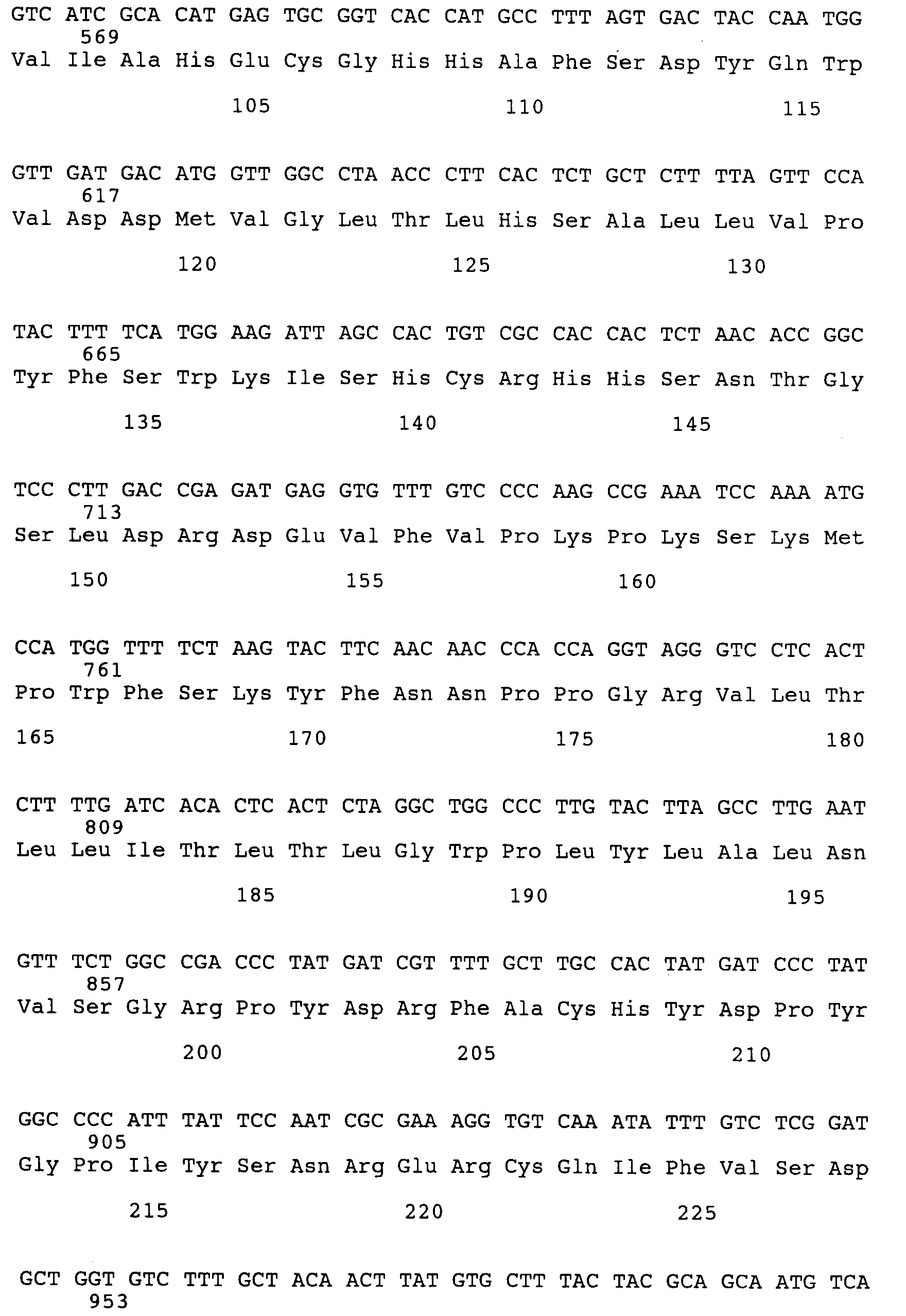
- the I and F clones were sequenced entirely. As far as the N2 clone is concerned, only the regions corresponding to the gene were sequenced. Figures 2 and 3 show their sequence. The I and F cDNA clones were identical. A comparison between I and the N2 genome clone showed the same sequence (Fig. 4), indicating that N2 contains the gene which codes for the cDNA of the I clone.
- RNA was extracted from kernels of the San Giovanni, Montebello and Nocchione varieties and from leaves of the Montebello and Nocchione varieties. After separation on agarose gel, the RNA was transferred onto a nylon membrane and hyhridized with the insert of the I clone marked with digoxigenin. The result is shown in Figure 7, in which a band is visible in the kernel RNA but not in that of the leaves.
Landscapes
- Health & Medical Sciences (AREA)
- Life Sciences & Earth Sciences (AREA)
- Genetics & Genomics (AREA)
- Engineering & Computer Science (AREA)
- Chemical & Material Sciences (AREA)
- Zoology (AREA)
- Organic Chemistry (AREA)
- Bioinformatics & Cheminformatics (AREA)
- Biotechnology (AREA)
- Wood Science & Technology (AREA)
- Biomedical Technology (AREA)
- Molecular Biology (AREA)
- General Engineering & Computer Science (AREA)
- Microbiology (AREA)
- Biochemistry (AREA)
- General Health & Medical Sciences (AREA)
- Nutrition Science (AREA)
- Oil, Petroleum & Natural Gas (AREA)
- Medicinal Chemistry (AREA)
- Cell Biology (AREA)
- Physics & Mathematics (AREA)
- Biophysics (AREA)
- Plant Pathology (AREA)
- Enzymes And Modification Thereof (AREA)
- Micro-Organisms Or Cultivation Processes Thereof (AREA)
- Breeding Of Plants And Reproduction By Means Of Culturing (AREA)
Abstract
The invention relates to the isolation from hazel (Corylus avellana L.) of the FAD2-N gene coding for the Δ12 desaturase enzyme of the microsomal fraction and, in particular, provides the nucleotide sequence and the deduced amino-acid sequence of the gene and provides for its use as a probe for the isolation of other plant desaturases. It also relates to the use of this gene for altering the desaturase levels and consequently the fatty-acid composition of the plant.
Description
- The present invention relates to the isolation from hazel (Corylus avellana L.) of the FAD2-N gene which codes for the Δ12 desaturase enzyme of the microsomal fraction.
- More particularly, the invention relates to the nucleotide sequence, to the derived amino-acid sequence of the gene, and to its use as a probe for the isolation of other plant desaturases. It also relates to the use of this gene for altering the desaturase levels, and consequently the fatty-acid composition of the plant.
- Alteration of the fatty-acid composition may have various applications in the industrial field. One of the greatest problems with hazelnuts is that they become rancid by oxidation. This is due to the auto-oxidation of unsaturated lipids with the consequent formation of volatile substances with a rancid odour which cannot easily be eliminated by the usual preservation systems. Amongst the possible strategies for reducing the tendency to become rancid, the best seems to be that of reducing the degree of unsaturation of the fatty acids present in the kernel oil, since susceptibility to auto-oxidation is positively correlated with this parameter. In fact, the rate of peroxide formation is correlated with the number of C=C double bonds in the fatty acids. The rate of auto-oxidation of the fatty acids in comparison with the oleate (18:1) is about 30 times greater in the linoleate (18:2) and 80 times greater in the linolenate (18:3). Moreover, the volatile substances resulting from the degradation of the linoleate and of the linolenate have a lower threshold of perception than those derived from the oleate. A reduction in linoleic acid should reduce the availability of substrates for lipoxygenase, reduce the loss of vitamin E during preservation, and reduce the production of volatile substances such as hexanals.
- In the angiosperms, most of the synthesis of polyunsaturated lipids takes place by means of a single enzyme, that is, Δ12 (or ω6) desaturase (18:1 desaturase), of the endoplasmic reticulum, although there is an 18:1 chloroplast desaturase in the leaves of some plants. Moreover, this enzyme is responsible for more than 90% of the synthesis of polyunsaturated fatty acids in non-photosynthetic tissues such as, for example, in the kernels. The conversion of oleic acid (18:1) to linoleic acid (18:2) thus takes place by means of Δ12 desaturase, and from linoleic acid to linolenic acid (18:3) by means of Δ15 (or ω3) desaturase.
- It has been shown with mutants of Arabidopsis that the FAD2 locus contains a gene which codes for the oleate desaturase enzyme of the endoplasmic reticulum (Okuley et al, 1994, The Plant Cell 6, 147-158). The FAD2 gene was in fact able to complement mutants of Acabidopsis which were deficient in desaturase activity of the endoplasmic reticulum. The gene coding for the same enzyme in soya has also recently been isolated and sequenced (Heppard et al, 1995, Plant Physiol., in press).
- A reduction in the Δ12 desaturase levels should therefore lead to a reduction in the linoleic acid content and, as a secondary effect, probably also to a reduction in linolenic acid. In hazelnuts the percentage of linoleic acid varies from 5 to 15%; the percentage of linolenic acid is from 0.1 to 0.2%. A reduction in these fatty acids should therefore be useful in the preservation of hazelnuts. There is therefore clearly a need to isolate the gene which codes for the Δ12 desaturase of the endoplasmic reticulum. The sequence of the gene could thus be used for gene inactivation in hazelnut kernels. This inactivation could be carried out either by the antisense technique (Smith et al. (1988) Nature 334, 724-726) or by the "transwitch" technique (Flavell (1994) Proc. Natl. Acad. Sci. USA 91, 3490-3496). In the antisense technique, the hazel would have to be transformed by the entire FAD2-N gene or by portions thereof, inserted in the opposite direction to the regulating sequences. In the "transwitch" technique, the hazel would have to be transformed by an identical copy of the FAD2-N gene.
- The subjects of the present invention are defined by the following claims.
- Embodiments of the present invention will now be described with reference to the following drawings, in which:
- Figure 1 shows the restriction map of the N2 genome clone,
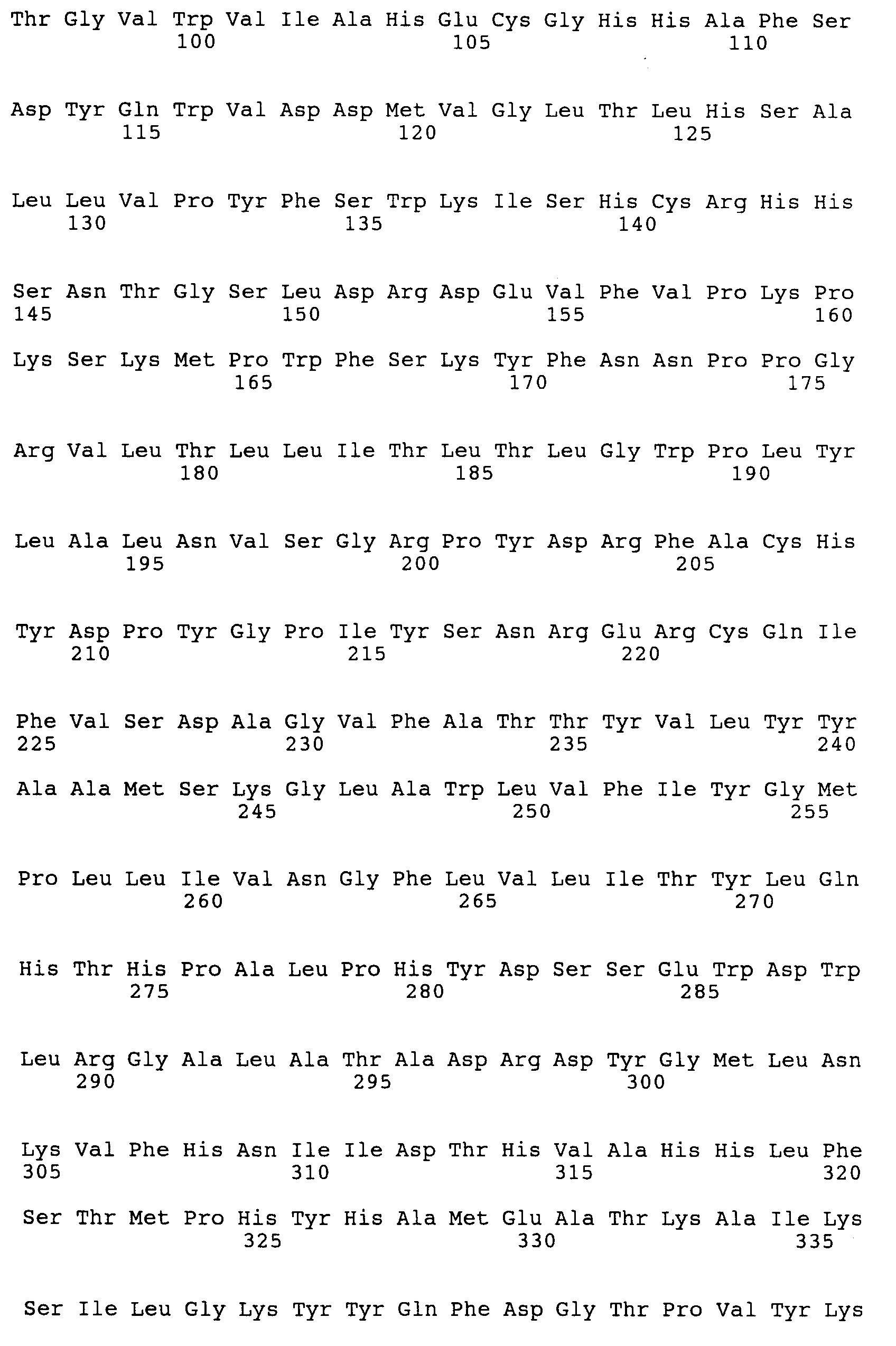
- Figure 2 shows the nucleotide sequence of the hazel FAD2-N gene; the amino-acid sequence of the coding portion is also shown;
- Figure 3 shows the nucleotide sequence of the "I" clone of cDNA,
- Figure 4 shows a comparison between the nucleotide sequences of the "I" and "N2" clones,
- Figure 5 shows a comparison between the amino-acids of the "N2" gene and Δ12 desaturases of Arabidopsis and of soya,
- Figure 6 shows the homology between hazel Δ12 desaturase and various desaturases of other plants both plastid and of the endoplasmic reticulum,
- Figure 7 shows the expression of the N2 gene in various varieties of hazel both in the leaves and in the kernels.
- In order to isolate the gene which codes for hazel Δ12 desaturase enzyme, it was necessary to use the FAD2 gene of Arabidopsis as a probe.
- In order to isolate the Arabidopsis gene, two oligonucleotides were used as "primers" for the amplification of the sequences included between the start and the end of the gene. The oligonucleotides used were NOCC1 (CTGAATTCCAGGTGGAAGAATGCC) which contains the Eco RI restriction site and the sequences corresponding to the portion between bases 100 and 116 of the gene (Okuley J. et al, 1994, The Plant Cell 6, 147-158) and NOCC4 (AGGAATTCGACAATTTCTTCACCATCATGC) which contains the restriction site of the Eco RI enzyme and the sequences complementary to the portion between base 1245 and base 1266. The amplification reaction was as follows: 12.8µl H2O, 2.5µl 10 x PCR buffer (Perkin Elmer), 2.5µl Arabidopsis genome DNA(10 ng/l), 1µl dNTP, each 2.5mM, 2µl 25mM MgCl2, 1µl NOCC1 oligonucleotide (50ng/µl), 1µl NOCC4 oligonucleotide (50ng/µl) 0.2µl Taq I DNA polymerase (Perkin Elmer) (5U/µl). The mixture thus prepared was subjected to 1 denaturing cycle for 1 minute at 94°C and to 40 cycles composed as follows: 30 seconds at 94°C, 1 minute at 52°C, 2 minutes at 72°C. The amplification products were separated on 1% agarose gel in TAE buffer (0.04M Tris-acetate, 0.002M EDTA) and stained with ethidium bromide at a concentration of 0.5µg/ml. The portion of gel containing the fragment of the expected length was withdrawn. In order to extract the DNA, 10µl of Qiaex resin (Qiaex extraction kit, firm Qiagen) were added for each 200mg of gel. The supplier's method was then followed. The DNA was then supplemented with a tenth of a volume of 10XH buffer (Boehringer) and 20 units of Eco RI enzyme (Boehringer). After incubation overnight at 37°C, the DNA was precipitated with 0.1 volumes of 5M NH4OAc and one volume of isopropanol. After 10 minutes at ambient temperature, the DNA was centrifuged for 20 minutes at 14000 rpm and the precipitate was washed with 70% ethanol. The DNA was resuspended in 15µl of H2O. The concentration was determined on gel by comparison with a known standard.
- The amplified fragment was inserted in the pUC18 vector. A ligation mixture was prepared as follows: 1µl pUC18 plasmid DNA cut with Eco RI (20ng), 1.5µl fragment amplified with NOCC1 and 4 (25ng), 1µl 10X ligase buffer (Boehringer), 1µl T4 DNA ligase (1U/µl) (Boehringer), 4.5µl H2O. The reaction mixture was incubated at 14°C for 12 hours.
- In order to prepare competent cells, the method based on the compound hexamino-cobalt chloride was used (Maniatis, Molecular cloning, 1989, Cold Spring Harbor Laboratory Press, 1.76-1.81). 10µl of the ligation mixture were added to each aliquot of competent cells, defrosted on ice. After the cells had been incubated on ice for 30 minutes they were subjected to thermal shock at 42°C for 90 seconds and were then replaced in ice for 60 seconds. After the addition of 0.5 ml of SOC broth (2% Bactotryptone, 0.5% yeast extract, 10mM NaCl, 2.5mM KCl, 10mM MgCl2, 20mM glucose, pH7), the cells were incubated at 37°C with stirring for 90'. 100, 200 and 300 µl aliquots were spread on plates containing solid LB broth (10gr/l NaCl, 10gr/l Bactotryptone, 5gr/l yeast extract, pH7.5, 15gr/l agar) with the addition of 50µg/ml of ampicillin and in the presence of IPTG and X-Gal. The plates were then incubated at 37°C overnight.
- Some of the bacterial colonies obtained were first analyzed for their plasmid content by a quick method (Maniatis, Molecular cloning, 1989, Cold Spring Harbor Laboratory Press, 1.32). The colonies containing a plasmid of the expected length were grown and their plasmid DNA extracted (Maniatis, Molecular cloning, 1989, Cold Spring Harbor Laboratory Press, 1.33). Those containing a fragment of the expected length (1160 bp) were identified by digestion of the plasmid DNA with Eco RI. The E1 colony was selected.
- One end of the insert of the E1 colony was sequenced. The plasmid DNA of the E1 clone was denatured and partially sequenced by Sanger's method using the enzyme Sequenase and 35S-dATP (Amersham). The sequencing products were separated on 8% acrylamide, 8M urea, 1XTBE gel. After electrophoresis, the gel was dried and exposed overnight in contact with an autoradiographic plate (β max, Amersham). The sequence was compared with that published and was identical, identifying the Arabidopsis FAD2 gene in the cloned fragment.
- Hazelnuts of the Nocchione, Montebello and San Giovanni varieties were harvested when almost fully ripe. The kernel was skinned before being used or frozen in liquid nitrogen. The leaves were harvested at a young stage and frozen in liquid nitrogen. 3 ml of extraction buffer were used for each gram of vegetable material with the use of the method described by Verwoerd et al. (Nucl. Ac. Res., 1989, 2362). Upon completion of the extraction, two selective precipitations were carried out by the addition of
NaCl 2M, and 2 volumes of 95% ethanol to eliminate polysaccharides. The final pellet was resuspended in H2O. Further centrifuging was then carried out to eliminate any non-resuspended material. - On the other hand, DNA was extracted from young leaves of the Nocchione and Montebello varieties. The vegetable tissue was pulverized in liquid nitrogen and the DNA extracted by the CTAB (REF) method. To eliminate the polysaccharides,
NaCl 2M and 2 volumes of 95% ethanol were added. The samples were incubated for 15' at -80°C and centrifuged for 15' at 4°C and 14000 rmp (Eppendorf). This selective precipitation was repeated twice and the final pellet was resuspended in H2O. Further centrifuging was then carried out to eliminate any non-resuspended material. - About 20µg of DNA of the Montebello and Nocchione varieties was cut with Eco RI restriction enzyme in a volume of 300 µl in the presence of 400 units of enzyme and H buffer (Promega), with incubation for one night at 37°C. After digestion had been checked by gel electrophoresis of one twentieth of the reaction mixture, the samples were precipitated with ethanol and resuspended in 30µl of H2O. The DNA was then subjected to electrophoresis on 0.7% agarose gel and transferred by capillarity onto nylon membrane (Southern blot) for one night in the presence of 20 x SSC (3M NaCl, 0.3M Na citrate). The membrane was dried in air for 30' and then fixed by UV treatment (120,000 µJ/cm2).
- The Arabidopsis Δ12 desaturase gene was used as a probe. For this purpose, the plasmid DNA of the E1 clone (5µg) was cut with 20 units of Eco RI in the presence of H buffer (Boehringer) in a volume of 30µl for 12 hours at 37°C. The insert of the clone was separated from the vector by electrophoresis on 1% agarose gel and extracted from the gel with the use of Qiaex resin in accordance with the suppliers' instructions (Qiagen). The DNA was denatured for 10' at 100°C, cooled rapidly in dry ice, and marked by the random priming method with the use of 6000 Ci/mmol (α32)P dATP and the reagents of Boehringer's marking kit.
- The nylon membrane containing the hazel DNA was prehybridized for 1.5 hours at 55°C in standard buffer (5 x SSC, 0.1% (w/v) N-laurylsarcosine, 0.02% SDS, 1% blocking reagent solution) (10% blocking reagent solution: 10gr Boehringer blocking reagent in 150mM NaCl, 100mM maleic acid, pH7.5). The membrane was then hybridized with the Arabidopsis probe for one night at 55°C. The non-hybridized probe was washed twice for 15' in 2 x SSC, 0.1% SDS and twice for 15' each in 0.3 x SSC, 0.1% SDS, always at a temperature of 55°C. The probe remained coupled to the homologous sequences on the membrane was detected by autoradiography.
- The RNA extracted from the young leaves of the Montebello and Nocchione varieties and from the kernels of the San Giovanni variety was separated on denaturing gel in the presence of formamide and transferred to nylon membrane by Northern blotting (Maniatis, Molecular cloning, 1989, Cold Spring Harbor Laboratory Press, 7.43-7.45). 40µg/sample of total RNA extracted from San Giovanni kernels, Nocchione leaves and Montebello leaves were used. 60 pg of probe were used as a positive control. The RNA was loaded onto a 1% agarose gel in the presence of formaldehyde. The samples were then subjected to electrophoresis for 3 hours at 80 volts in the presence of 1xMOPS. The gel was rinsed in H2O and then stained with ethidium bromide 0.5 µg/ml to display the RNA. The RNA was then transferred onto a nylon membrane (Boehringer) by "capillary blotting" in the presence of 20 x SSC throughout the night at 4°C. After transfer, the membrane was dried on 3 MM paper and then fixed by crosslinking using UV light (Stratagene UV Stratalinker 120000 µJ/cm2). The RNA was hybridised with the Arabidopsis Δ12 desaturase probe as described for the DNA. Detection was carried out by autoradiography. The heterologous Arabidopsis probe was able to display a band with a molecular weight of about 1500 bp in the hazel RNA and 3 bands of about 18, 8 and 2.8 kb in the hazel DNA cut with Eco RI.
- The gene library of cDNA was constructed from RNA from kernels harvested when almost fully ripe and taken from plants of the San Giovanni variety. For this purpose, the Poly(A)+mRNA was isolated from the total RNA with the use of the Poly(A)Tract mRNA Isolation System II, in accordance with the method provided by the firm Promega. The samples were eluted in H2O and precipitated with 0.1 volumes of 3M NaOAc and 3 volumes of 95% ethanol. After one night at -80°C, the RNA was centrifuged for 15' at 14000 rpm (Eppendorf), the pellet was rinsed in 75% ethanol and resuspended in 10µl of H2O. The concentration was read with a spectrophotometer and the yield was 3.2µg of Poly(A)+mRNA per mg of total RNA.
- The messenger RNA polyadenilate derived from kernels of the San Giovanni variety was used as a template for the synthesis of complementary DNA (cDNA) with the use of Boehringer's "cDNA synthesis kit" in accordance with the method recommended by the suppliers. An extraction was then carried out with one volume of phenol:chloroform: isoamyl alcohol (25:24:1). The cDNA was then purified in a Pharmacia column (cDNA spun columns) after the addition of NaCl 100 mM. The buffer used was the following: 10mM Tris-HCl pH 7.5, 1mM EDTA, 150mM NaCl. Eco RI "adaptors" (Pharmacia) were added to the ends of the cDNA. The reaction mixture contained: 5µl of cDNA (half of the cDNA obtained from 6µg of Poly(A)+RNA), 10µl of ligase buffer 10 x (Promega), 10µl of Eco RI adaptors (0.01u/µl), 6 units of T4 DNA ligase (Promega), in a final volume of 100µl. After incubation for 12 hours at 12°C, the ligase enzyme was inactivated for 10' at 65°C. Phosphorylation of the adaptors then followed by the addition, to the 100µl mixture, of 10µl of 100mM ATP and 10 units of T4 polynucleotide kinase. After incubation at 37°C for 30', the enzyme was inactivated by incubation for 10' at 65°C. Purification was then carried out with one volume of phenol:chloroform:isoamyl alcohol (25:24:1). The cDNA was then purified from fragments of less than 400 bp as follows. After the addition of NaCl to a final concentration of 0.1M NaCl, the cDNA was separated by chromatography in a column with Sepharose CL-4B resin (Size prep 400 spun column, Pharmacia) according to the method suggested by the suppliers. The fragments of cDNA shorter than 400 bases were thus excluded. The cDNA was precipitated with one thirtieth of a volume of 3M NaOAc and 2 volumes of 95% ethanol, centrifuged and resuspended in 10µl of H2O.
- The cDNA was inserted in the λ phage vector Zap II cut with Eco RI and dephosphorylated (Stratagene) in the following manner: 2µl of cDNA (200 ng), 1µl of λ Zap II cut with Eco RI (1µg/µl) (Stratagene), 0.5µl of T4 DNA Ligase (4U/µl) (Promega), 0.5µl of 10 x ligation buffer (Promega), 1µl of H2O. The reaction mixture was incubated for 14 hours at 12°C. The mixture containing the cDNA inserted in the vector was used for the reconstruction of the phages with the use of Stratagene's Gigapack Gold "in vitro packaging" kit. The gene library of phages thus obtained was constituted by about 300,000 pfu (plaque-forming units). In order to amplify the gene library, XL1 Blue MRF' cells were prepared as described by Stratagene and used the same day. The gene libraries were plated at a concentration of about 5000 pfu per plate (95 cm2). After growth, the phages were resuspended in SM (5.8gr/l NaCl, 2gr/l MgSO4.7H2O, 50ml/l 1M Tris HCl (pH 7.5), 5ml/
l 2% gelatine) and, after the addition of chloroform to 5% and incubation for 15 minutes at ambient temperature, the cell debris was centrifuged for 10 minutes at 2000 x g. Chloroform to 0.3% was added to the supernatant liquid and the phages were preserved at 4°C. Aliquots were preserved at -70°C after the addition of DMSO to 7%. The gene library was titled. - The DNA of the Nocchione variety was digested with Eco RI restriction enzyme and separated on agarose gel. The fragments with lengths of up to 10000 bp (base pairs) were isolated from the gel with the use of Qiaex resin according to the Qiagen's method. For cloning in the λ vector Zap II, 400ng of DNA fragments were incubated with 1µg of desphosphorylated λ Zap II (Stratagene) in the presence of ligase buffer and 1.5 units of T4 DNA ligase (Promega) for 12 hours at 14°C.
- Strategene's Gigapack Gold "in vitro packaging" kit was used in accordance with the suppliers' instructions to make up the gene library. The gene library of phages thus produced was amplified as described for the cDNA gene library. The complexity of the gene library was 1,500,000 clones. This gene library was also amplified.
- About 250,000 phages of the cDNA gene library were plated on LB broth in the presence of XL1 Blue MRF' cells, divided into 12 plates each containing 20,000 pfu. After growth, the phages were transferred onto nylon membranes and their denatured DNA was fixed on the membranes as described by Boehringer for screening with non-radioactive probes. The membranes were then hybridized with the Arabidopsis Δ12 desaturase gene. The probe was prepared by the isolation of the insert containing the entire coding region of the gene from the plasmid. The insert was then marked with digoxigenin-dUTP with the use of Boehringer's "DNA labelling kit". Prehybridization was carried out in standard buffer (Boehringer) and hybridization was carried out in the same buffer with the addition of the Arabidopsis probe at a concentration of 10ng/ml and at a temperature of 55°C.
- After washing twice in 2xSSC, 0.1% SDS for 5 minutes at ambient temperature and washing twice in 0.3xSSC, 0.1%SDS at 55°C, detection was carried out with the use of an anti-digoxigenin antibody conjugated with alkaline phosphatase (Boehringer) and a chemiluminescent substrate (AMPPD, Boehringer).
- 11 positive phage plaques were identified. These were isolated, the phages resuspended in SM and titled. From 50 to 200 phages were plated for each positive plaque. The plaques were transferred onto nylon membranes and subjected to a second hybridization with the Arabidopsis Δ12 desaturase probe, as already described above. The following clones which could hybridize with the Acabidopsis Δ12 desaturase gene were obtained from the second screening: I, F, 4.
- The gene library of Nocchione DNA was subjected to screening in the same way as the cDNA gene library. 1,600,000 phages were plated, divided into 40 plates. After growth, they were transferred to nylon membranes as described for the cDNA gene library. The membranes were then hybridized with the Arabidopsis Δ12 desaturase gene as described for the cDNA gene library. Autoradiography of the membranes showed 9 positive plaques. These plaques were isolated, titled and subjected to a second screening. 6 plaques were re-confirmed as positive. 4 of these gave a very strong signal.
- The following positive phage clones were converted into plasmids by in vivo excision in accordance with the method suggested by Stratagene (Gigapack Gold in vitro packaging) : I, F, 4 (cDNA gene library), N2, N11, N17, N18, N21, N25 (genome gene library).
- The plasmid DNA of the clones of the cDNA gene library was isolated and the length of the insert analyzed by digestion with Eco RI. The plasmid DNA of the genome clones was isolated, the length of the insert analyzed by cutting with restriction enzyme, and the clones rechecked by hybridization with the Arabidopsis probe. Figure 1 shows the map of the N2 genome clone.
- The N2 clone was selected from the genome clones. For sequencing, the insert was fragmented with Sau3A restriction enzyme and the fragments obtained were subcloned in pUC18 vector cut with BamHI (Maniatis, Molecular cloning, 1989, Cold Spring Harbor Laboratory Press, 1.68-1.69). The clones obtained were analyzed both for the length of the insert and by hybridization with the Arabidopsis probe. Since the N2 insert was 2.8 kb and hence longer than the Δ12 desaturase gene, the hybridization excluded the clones containing sequences outside the gene. The insert of the I, F, 4 and N2 clones was isolated and sequenced with the use of the Sequenase kit and (35S)dATP. All of the clones (cDNA and genome) were first sequenced at the ends with the use of primers which could couple with the vector in both orientations. In order to complete the internal regions and to assemble the fragments of the N2 genome clone, internal oligonucleotides were then designed and synthesized and were used for the sequencing. The following table shows the sequences of the internal oligonucleotides:
OLIGONUCLEOTIDE SEQUENCE N2-3SS CAG ACC AGC ATC CGA GAC N2-3SD GGA TTG GCT TAG GGG GGC N2-29R'S GCC AAC CAT GTC ATC AAC CC NOCCS ATG GTA GAG AAG AGA TGG TG COL CTG GTG GGT TGT TGA AG N2-S1N GGA GAG GTC ATA AAC AAC - The I and F clones were sequenced entirely. As far as the N2 clone is concerned, only the regions corresponding to the gene were sequenced. Figures 2 and 3 show their sequence. The I and F cDNA clones were identical. A comparison between I and the N2 genome clone showed the same sequence (Fig. 4), indicating that N2 contains the gene which codes for the cDNA of the I clone.
- The nucleotide and amino-acid sequence of the N2 clone was compared with other desaturases (Figure 6). The greatest homology was with the two Δ12 desaturases of the endoplasmic reticulum and with a hydroxylase of ricin which uses the same substrate as Δ12 desaturase. Homology with the plastid Δ12 desaturases and with both the plastid and endoplasmic reticulum Δ15 desaturases was, however, much lower. Figure 5 shows the comparison between the amino-acid sequence of hazel Δ12 and those of Arabidopsis and soya.
- RNA was extracted from kernels of the San Giovanni, Montebello and Nocchione varieties and from leaves of the Montebello and Nocchione varieties. After separation on agarose gel, the RNA was transferred onto a nylon membrane and hyhridized with the insert of the I clone marked with digoxigenin. The result is shown in Figure 7, in which a band is visible in the kernel RNA but not in that of the leaves.






Claims (14)
- A fragment of DNA from hazel (Corylus avellana L.) comprising the nucleotide sequence shown in Figure 2.
- A DNA fragment comprising the nucleotide sequence shown in Figure 2 from base 222 to base 1367, which codes for the hazel Δ12 desaturase enzyme of the endoplasmic reticulum or for a homologous sequence which can code for the same amino-acid sequence.
- A nucleotide sequence coding for a protein or peptide having an amino-acid homology greater than or equal to 80% and preferably greater than 90% with the hazel Δ12 desaturase enzyme of the endoplasmic reticulum of Claim 2 and having the function of the said enzyme.
- A recombinant DNA sequence comprising a DNA sequence according to Claims 1, 2 and 3, or a portion of such a sequence, together with sequences regulating expression.
- A recombinant DNA molecule comprising a cloning vector in which a DNA sequence according to any one of Claims 1, 2, 3 and 4 is inserted.
- A DNA molecule according to Claim 5, in which the cloning vector is a plasmid or a phage.
- A DNA molecule according to Claim 4 or Claim 5 having the restriction map shown in Figure 1.
- A host organism including a recombinant DNA molecule according to any one of Claims 3 to 6.
- A host organism according to Claim 8, selected from a vegetable cell,an animal cell, and a micro-organism.
- A genetically modified organism capable of expressing the FAD2-N gene, having the amino-acid sequence shown in Figure 2 from bp 222 to bp 1367, portions of this gene, or this gene conjugated with other molecules and containing sequences which can inactivate endogenous genes.
- A hazel Δ12 desaturase enzyme of the endoplasmic reticulum having the amino-acid sequence shown in Figure 2 in substantially pure form.
- A fusion polypeptide comprising the amino-acid sequence of the enzyme of Claim 11, in which the amino-acids additively connected thereto do not interfere with the desaturase activity or can easily be eliminated.
- The use of the FAD2-N gene coding for the hazel Δ12 desaturase enzyme of the endoplasmic reticulum or of portions thereof for the isolation of enzymes having the function of hazel desaturase or of the desaturase of another species.
- The use of the nucleotide sequences of the FAD2-N gene shown in Figure 2 for the construction of expression systems which can alter the fatty-acid content in hazel.
Applications Claiming Priority (2)
| Application Number | Priority Date | Filing Date | Title |
|---|---|---|---|
| CH55096 | 1996-03-04 | ||
| CH550/96 | 1996-03-04 |
Publications (1)
| Publication Number | Publication Date |
|---|---|
| EP0794250A1 true EP0794250A1 (en) | 1997-09-10 |
Family
ID=4189591
Family Applications (1)
| Application Number | Title | Priority Date | Filing Date |
|---|---|---|---|
| EP97103098A Withdrawn EP0794250A1 (en) | 1996-03-04 | 1997-02-26 | Isolation and sequencing of the hazel FAd2-N gene |
Country Status (4)
| Country | Link |
|---|---|
| US (1) | US6025172A (en) |
| EP (1) | EP0794250A1 (en) |
| AR (1) | AR006062A1 (en) |
| AU (1) | AU718602B2 (en) |
Cited By (35)
| Publication number | Priority date | Publication date | Assignee | Title |
|---|---|---|---|---|
| WO1999064579A3 (en) * | 1998-06-11 | 2000-06-29 | Du Pont | Corn oleosin promoter and genes encoding corn desaturases |
| WO2000011176A3 (en) * | 1998-08-20 | 2000-10-05 | Du Pont | Genes for plant fatty acid modifying enzymes associated with conjugated double bond formation |
| WO2004076617A2 (en) | 2003-02-27 | 2004-09-10 | Basf Plant Science Gmbh | Method for the production of polyunsaturated fatty acids |
| WO2005083053A2 (en) | 2004-02-27 | 2005-09-09 | Basf Plant Science Gmbh | Method for producing unsaturated omega-3 fatty acids in transgenic organisms |
| WO2006100241A2 (en) | 2005-03-22 | 2006-09-28 | Basf Plant Science Gmbh | Method for producing polyunsaturated c20 and c22 fatty acids with at least four double bonds in transgenic plants |
| EP1726652A2 (en) | 2002-02-27 | 2006-11-29 | Rothamsted Experimental Station | Delta 6-desaturases from primulaceae, expressing plants and PUFA-containing oils |
| WO2007017419A2 (en) | 2005-08-09 | 2007-02-15 | Basf Plant Science Gmbh | Method for producing arachidonic acid and/or eicosapentaenoic acid in useful transgenic plants |
| US7179647B2 (en) | 2002-01-30 | 2007-02-20 | Basf Plant Science Gmbh | Elongase gene and method for producing polyunsaturated fatty acids |
| US7183458B1 (en) | 1999-06-07 | 2007-02-27 | Basf Plant Science Gmbh | Δ6 acetylenase and Δ6-desaturase from ceratodon purpureus |
| WO2006073787A3 (en) * | 2004-12-20 | 2007-03-15 | Basf Plant Science Gmbh | Nucleic acid molecules encoding fatty acid desaturase genes from plants and methods of use |
| WO2007042510A2 (en) | 2005-10-13 | 2007-04-19 | Basf Plant Science Gmbh | Process for the production of arachidonic acid and/or eicosapentaenoic acid |
| WO2007051577A2 (en) | 2005-11-02 | 2007-05-10 | Basf Plant Science Gmbh | METHOD FOR THE PRODUCTION OF γ-LINOLENIC ACID AND/OR STEARIDONIC ACID IN TRANSGENIC BRASSICACEAE AND LINACEAE |
| US7615679B2 (en) | 2001-01-19 | 2009-11-10 | Basf Plant Science Gmbh | Method of producing polyunsaturated fatty acids, novel biosynthesis genes, and novel plant expression constructs |
| US7629503B2 (en) | 2003-04-08 | 2009-12-08 | Basf Plant Science Gmbh | Δ-4 desaturases from Euglena gracilis, expressing plants, and oils containing PUFA |
| EP2166071A2 (en) | 2003-08-01 | 2010-03-24 | BASF Plant Science GmbH | Method for producing polyunsaturated fatty acids in transgenic organisms |
| EP2177605A1 (en) | 2006-10-06 | 2010-04-21 | BASF Plant Science GmbH | Method for producing polyunsaturated fatty acids in transgenic non-human organisms |
| US7714185B2 (en) | 2002-12-19 | 2010-05-11 | University Of Bristol | Method for the production of polyunsaturated fatty acids |
| US7855321B2 (en) | 2003-03-31 | 2010-12-21 | University Of Bristol | Plant acyltransferases specific for long-chained, multiply unsaturated fatty acids |
| US7893320B2 (en) | 2002-04-29 | 2011-02-22 | Basf Plant Science Gmbh | Method for producing multiple unsaturated fatty acids in plants |
| DE112008003237T5 (en) | 2007-12-14 | 2011-03-17 | Basf Plant Science Gmbh | Promoters of Brassica napus for seed-specific gene expression |
| EP2380984A2 (en) | 2006-02-16 | 2011-10-26 | BASF Plant Science GmbH | Nucleic acid |
| WO2011161093A1 (en) | 2010-06-25 | 2011-12-29 | Basf Plant Science Company Gmbh | Acyltransferases and uses therof in fatty acid production |
| DE112009002048T5 (en) | 2008-08-26 | 2012-01-26 | Basf Plant Science Gmbh | Nucleic acid encoding desaturases and modified plant oil |
| DE112009001585T5 (en) | 2008-07-01 | 2012-02-23 | Basf Plant Science Gmbh | Promoters of Brassica napus for seed-specific gene expression |
| DE112009003708T5 (en) | 2008-12-12 | 2012-09-13 | Basf Plant Science Gmbh | Desaturases and methods of producing polyunsaturated fatty acids in transgenic organisms |
| EP2500420A1 (en) | 2006-08-24 | 2012-09-19 | BASF Plant Science GmbH | Pythium omega 3 desaturase with specificity to all omega 6 fatty acids longer than 18 carbon chains |
| US8318914B2 (en) | 2007-07-31 | 2012-11-27 | Bioriginal Food & Science Corp. | Elongases and methods for producing polyunsaturated fatty acids in transgenic organisms |
| EP2623584A1 (en) | 2004-02-27 | 2013-08-07 | BASF Plant Science GmbH | Method for producing polyunsatured fatty acids in transgenic plants |
| US8785727B2 (en) | 2008-04-30 | 2014-07-22 | Rothamsted Research Ltd. | Desaturase and method for the production of polyunsaturated fatty acids in transgenic organisms |
| US8835715B1 (en) | 2000-06-30 | 2014-09-16 | Basf Plant Science Gmbh | Plants expressing Δ6-desaturase genes and oils from these plants containing PUFAS and method for producing unsaturated fatty acids |
| EP2821492A2 (en) | 2009-05-13 | 2015-01-07 | BASF Plant Science Company GmbH | Acyltransferases and uses thereof in fatty acid production |
| US8952217B2 (en) | 2005-10-14 | 2015-02-10 | Metanomics Gmbh | Process for decreasing verbascose in a plant by expression of a chloroplast-targeted fimD protein |
| WO2015087058A1 (en) * | 2013-12-10 | 2015-06-18 | The University Of York | Desaturase nucleic acids and polypeptides |
| CN107312848A (en) * | 2017-07-13 | 2017-11-03 | 中国林业科学研究院林业研究所 | The method that hazel Germplasm Identification is carried out using cpDNA sequences |
| US10190131B2 (en) | 2006-02-21 | 2019-01-29 | Basf Plant Science Gmbh | Method for producing polyunsaturated fatty acids |
Families Citing this family (1)
| Publication number | Priority date | Publication date | Assignee | Title |
|---|---|---|---|---|
| WO2005118814A2 (en) * | 2004-06-04 | 2005-12-15 | Fluxome Sciences A/S | Metabolically engineered cells for the production of polyunsaturated fatty acids |
Citations (2)
| Publication number | Priority date | Publication date | Assignee | Title |
|---|---|---|---|---|
| WO1994011516A1 (en) * | 1992-11-17 | 1994-05-26 | E.I. Du Pont De Nemours And Company | Genes for microsomal delta-12 fatty acid desaturases and related enzymes from plants |
| WO1995022598A2 (en) * | 1994-02-15 | 1995-08-24 | E.I. Du Pont De Nemours And Company | Corn plants and products with improved oil composition |
-
1997
- 1997-02-26 EP EP97103098A patent/EP0794250A1/en not_active Withdrawn
- 1997-02-28 AU AU14984/97A patent/AU718602B2/en not_active Ceased
- 1997-03-03 AR ARP970100835A patent/AR006062A1/en not_active Application Discontinuation
- 1997-03-04 US US08/811,177 patent/US6025172A/en not_active Expired - Fee Related
Patent Citations (2)
| Publication number | Priority date | Publication date | Assignee | Title |
|---|---|---|---|---|
| WO1994011516A1 (en) * | 1992-11-17 | 1994-05-26 | E.I. Du Pont De Nemours And Company | Genes for microsomal delta-12 fatty acid desaturases and related enzymes from plants |
| WO1995022598A2 (en) * | 1994-02-15 | 1995-08-24 | E.I. Du Pont De Nemours And Company | Corn plants and products with improved oil composition |
Non-Patent Citations (1)
| Title |
|---|
| OKULEY, J., ET AL .: "ARABIDOPSIS FAD2 GENE ENCODES THE ENZYME THAT IS ESSENTIAL FOR POLYSATURATED LIPID SYNTHESIS", THE PLANT CELL, vol. 6, January 1994 (1994-01-01), pages 147 - 158, XP002034147 * |
Cited By (85)
| Publication number | Priority date | Publication date | Assignee | Title |
|---|---|---|---|---|
| US7008664B1 (en) | 1998-06-11 | 2006-03-07 | E. I. Du Pont De Nemours And Company | Method for improving the carcass quality of an animal |
| WO1999064579A3 (en) * | 1998-06-11 | 2000-06-29 | Du Pont | Corn oleosin promoter and genes encoding corn desaturases |
| WO2000011176A3 (en) * | 1998-08-20 | 2000-10-05 | Du Pont | Genes for plant fatty acid modifying enzymes associated with conjugated double bond formation |
| US7244563B2 (en) | 1998-08-20 | 2007-07-17 | E. I. Du Pont De Nemours And Company | Genes for plant fatty acid modifying enzymes associated with conjugated double bond formation |
| US7183458B1 (en) | 1999-06-07 | 2007-02-27 | Basf Plant Science Gmbh | Δ6 acetylenase and Δ6-desaturase from ceratodon purpureus |
| US9611441B2 (en) | 1999-07-06 | 2017-04-04 | Basf Plant Science Gmbh | Plants expressing Δ6-desaturase genes and oils from these plants containing PUFAS and method for producing unsaturated fatty acids |
| US8835715B1 (en) | 2000-06-30 | 2014-09-16 | Basf Plant Science Gmbh | Plants expressing Δ6-desaturase genes and oils from these plants containing PUFAS and method for producing unsaturated fatty acids |
| US8088974B2 (en) | 2001-01-19 | 2012-01-03 | Basf Plant Science Gmbh | Production of polyunsaturated fatty acids, novel biosynthesis genes, and novel plant expression constructs |
| US8729337B2 (en) | 2001-01-19 | 2014-05-20 | Basf Plant Science Gmbh | Production of polyunsaturated fatty acids, novel biosynthesis genes, and novel plant expression constructs |
| US7615679B2 (en) | 2001-01-19 | 2009-11-10 | Basf Plant Science Gmbh | Method of producing polyunsaturated fatty acids, novel biosynthesis genes, and novel plant expression constructs |
| US7179647B2 (en) | 2002-01-30 | 2007-02-20 | Basf Plant Science Gmbh | Elongase gene and method for producing polyunsaturated fatty acids |
| EP1726652A2 (en) | 2002-02-27 | 2006-11-29 | Rothamsted Experimental Station | Delta 6-desaturases from primulaceae, expressing plants and PUFA-containing oils |
| US7893320B2 (en) | 2002-04-29 | 2011-02-22 | Basf Plant Science Gmbh | Method for producing multiple unsaturated fatty acids in plants |
| US7714185B2 (en) | 2002-12-19 | 2010-05-11 | University Of Bristol | Method for the production of polyunsaturated fatty acids |
| US7537920B2 (en) | 2003-02-27 | 2009-05-26 | Basf Plant Science Gmbh | Method for the production of polyunsaturated fatty acids |
| US8486671B2 (en) | 2003-02-27 | 2013-07-16 | Basf Plant Science Gmbh | Method for the production of polyunsaturated fatty acids |
| WO2004076617A2 (en) | 2003-02-27 | 2004-09-10 | Basf Plant Science Gmbh | Method for the production of polyunsaturated fatty acids |
| EP2365063A1 (en) | 2003-03-31 | 2011-09-14 | University Of Bristol | New vegetable acyltransferases specifically for long-chain polyunsaturated fatty acids |
| EP2390313A1 (en) | 2003-03-31 | 2011-11-30 | University Of Bristol | New vegetable acyltransferases specifically for long-chain polyunsaturated fatty acids |
| US7855321B2 (en) | 2003-03-31 | 2010-12-21 | University Of Bristol | Plant acyltransferases specific for long-chained, multiply unsaturated fatty acids |
| US8354569B2 (en) | 2003-03-31 | 2013-01-15 | University Of Bristol | Plant acyltransferases specific for long-chained, multiply unsaturated fatty acids |
| US7629503B2 (en) | 2003-04-08 | 2009-12-08 | Basf Plant Science Gmbh | Δ-4 desaturases from Euglena gracilis, expressing plants, and oils containing PUFA |
| EP2169052A2 (en) | 2003-08-01 | 2010-03-31 | BASF Plant Science GmbH | Method for production of polyunsaturated fatty acids in transgenic organisms |
| EP2166071A2 (en) | 2003-08-01 | 2010-03-24 | BASF Plant Science GmbH | Method for producing polyunsaturated fatty acids in transgenic organisms |
| EP2172536A2 (en) | 2003-08-01 | 2010-04-07 | BASF Plant Science GmbH | Method for producing polyunsaturated fatty acids in transgenic organisms |
| EP3395945A1 (en) | 2003-08-01 | 2018-10-31 | BASF Plant Science GmbH | Method for producing polyunsatured fatty acids in transgenic organisms |
| US11952581B2 (en) | 2003-08-01 | 2024-04-09 | Basf Plant Science Gmbh | Process for the production of polyunsaturated fatty acids in transgenic organisms |
| EP2166090A2 (en) | 2003-08-01 | 2010-03-24 | BASF Plant Science GmbH | Method for production of polyunsaturated fatty acids in transgene organisms |
| EP2169053A2 (en) | 2003-08-01 | 2010-03-31 | BASF Plant Science GmbH | Method for production of polyunsaturated fatty acids in transgenic organisms |
| EP2166069A2 (en) | 2003-08-01 | 2010-03-24 | BASF Plant Science GmbH | Method for producing polyunsaturated fatty acids in transgenic organisms |
| EP2166089A2 (en) | 2003-08-01 | 2010-03-24 | BASF Plant Science GmbH | Method for production of polyunsaturated fatty acids in transgenic organisms |
| US11180769B2 (en) | 2003-08-01 | 2021-11-23 | Basf Plant Science Gmbh | Method for the production of multiple-unsaturated fatty acids in transgenic organisms |
| EP2166070A2 (en) | 2003-08-01 | 2010-03-24 | BASF Plant Science GmbH | Method for producing polyunsaturated fatty acids in transgenic organisms |
| US9433228B2 (en) | 2003-08-01 | 2016-09-06 | Basf Plant Science Gmbh | Method for the production of multiple-unsaturated fatty acids in transgenic organisms |
| US7777098B2 (en) | 2004-02-27 | 2010-08-17 | Basf Plant Science Gmbh | Method for producing unsaturated ω-3-fatty acids in transgenic organisms |
| US9458436B2 (en) | 2004-02-27 | 2016-10-04 | Basf Plant Science Gmbh | Method for producing polyunsaturated fatty acids in transgenic plants |
| US9624477B2 (en) | 2004-02-27 | 2017-04-18 | Basf Plant Science Gmbh | Method for producing unsaturated omega-3-fatty acids in transgenic organisms |
| US10035989B2 (en) | 2004-02-27 | 2018-07-31 | Basf Plant Science Gmbh | Method for producing polyunsaturated fatty acids in transgenic plants |
| EP2623584A1 (en) | 2004-02-27 | 2013-08-07 | BASF Plant Science GmbH | Method for producing polyunsatured fatty acids in transgenic plants |
| WO2005083053A2 (en) | 2004-02-27 | 2005-09-09 | Basf Plant Science Gmbh | Method for producing unsaturated omega-3 fatty acids in transgenic organisms |
| US8373024B2 (en) | 2004-02-27 | 2013-02-12 | Basf Plant Science Gmbh | Method for producing unsaturated ω-3-fatty acids in transgenic organisms |
| WO2006073787A3 (en) * | 2004-12-20 | 2007-03-15 | Basf Plant Science Gmbh | Nucleic acid molecules encoding fatty acid desaturase genes from plants and methods of use |
| US8049064B2 (en) | 2005-03-22 | 2011-11-01 | Basf Plant Science Gmbh | Method for producing polyunsaturated C20- and C22-fatty acids with at least four double bonds in transgenic plants |
| WO2006100241A2 (en) | 2005-03-22 | 2006-09-28 | Basf Plant Science Gmbh | Method for producing polyunsaturated c20 and c22 fatty acids with at least four double bonds in transgenic plants |
| WO2007017419A2 (en) | 2005-08-09 | 2007-02-15 | Basf Plant Science Gmbh | Method for producing arachidonic acid and/or eicosapentaenoic acid in useful transgenic plants |
| US8134046B2 (en) | 2005-08-09 | 2012-03-13 | Basf Plant Science Gmbh | Method for producing arachidonic acid and/or eicosapentaenoic acid in useful transgenic plants |
| EP2450434A2 (en) | 2005-10-13 | 2012-05-09 | BASF Plant Science GmbH | Process for the production of arachidonic acid and/or eicosapentaenoic acid |
| US8273958B2 (en) | 2005-10-13 | 2012-09-25 | Basf Plant Science Gmbh | Process for the production of arachidonic acid and/or eicosapentaenoic acid |
| US8017839B2 (en) | 2005-10-13 | 2011-09-13 | Basf Plant Science Gmbh | Process for the production of arachidonic acid and/or eicosapentaenoic acid |
| WO2007042510A2 (en) | 2005-10-13 | 2007-04-19 | Basf Plant Science Gmbh | Process for the production of arachidonic acid and/or eicosapentaenoic acid |
| US8258371B2 (en) | 2005-10-13 | 2012-09-04 | Basf Plant Science Gmbh | Process for the production of arachidonic acid and/or eicosapentaenoic acid |
| US8952217B2 (en) | 2005-10-14 | 2015-02-10 | Metanomics Gmbh | Process for decreasing verbascose in a plant by expression of a chloroplast-targeted fimD protein |
| US8013216B2 (en) | 2005-11-02 | 2011-09-06 | Basf Plant Science Gmbh | Method for the production of γ-linolenic acid and/or stearidonic acid in transgenic Brassicaceae and Linaceae |
| WO2007051577A2 (en) | 2005-11-02 | 2007-05-10 | Basf Plant Science Gmbh | METHOD FOR THE PRODUCTION OF γ-LINOLENIC ACID AND/OR STEARIDONIC ACID IN TRANSGENIC BRASSICACEAE AND LINACEAE |
| EP2380984A2 (en) | 2006-02-16 | 2011-10-26 | BASF Plant Science GmbH | Nucleic acid |
| US10533183B2 (en) | 2006-02-21 | 2020-01-14 | Basf Plant Science Gmbh | Oils, lipids and fatty acids produced in transgenic Brassica plant |
| US10301638B2 (en) | 2006-02-21 | 2019-05-28 | Basf Plant Science Gmbh | Oils, lipids and fatty acids produced in transgenic Brassica plant |
| US10533182B2 (en) | 2006-02-21 | 2020-01-14 | Basf Plant Science Gmbh | Oils, lipids and fatty acids produced in transgenic brassica plant |
| US10190131B2 (en) | 2006-02-21 | 2019-01-29 | Basf Plant Science Gmbh | Method for producing polyunsaturated fatty acids |
| US9029111B2 (en) | 2006-08-24 | 2015-05-12 | Basf Plant Science Gmbh | Isolation and characterization of a novel pythium omega 3 desaturase with specificity to all omega 6 fatty acids longer than 18 carbon chains |
| US10113189B2 (en) | 2006-08-24 | 2018-10-30 | Basf Plant Science Gmbh | Isolation and characterization of a novel pythium omega 3 desaturase with specificity to all omega 6 fatty acids longer than 18 carbon chains |
| EP2500420A1 (en) | 2006-08-24 | 2012-09-19 | BASF Plant Science GmbH | Pythium omega 3 desaturase with specificity to all omega 6 fatty acids longer than 18 carbon chains |
| US10308914B2 (en) | 2006-10-06 | 2019-06-04 | Basf Plant Science Gmbh | Processes for producing polyunsaturated fatty acids in transgenic organisms |
| US8710299B2 (en) | 2006-10-06 | 2014-04-29 | Basf Plant Science Gmbh | Processes for producing polyunsaturated fatty acids in transgenic organisms |
| EP2177605A1 (en) | 2006-10-06 | 2010-04-21 | BASF Plant Science GmbH | Method for producing polyunsaturated fatty acids in transgenic non-human organisms |
| EP2182056A1 (en) | 2006-10-06 | 2010-05-05 | BASF Plant Science GmbH | Method for producing polyunsaturated fatty acids in transgenic non-human organisms |
| US9382529B2 (en) | 2006-10-06 | 2016-07-05 | Basf Plant Science Gmbh | Processes for producing polyunsaturated fatty acids in transgenic organisms |
| US11168308B2 (en) | 2006-10-06 | 2021-11-09 | Basf Plant Science Gmbh | Processes for producing polyunsaturated fatty acids in transgenic organisms |
| US8318914B2 (en) | 2007-07-31 | 2012-11-27 | Bioriginal Food & Science Corp. | Elongases and methods for producing polyunsaturated fatty acids in transgenic organisms |
| DE112008003237T5 (en) | 2007-12-14 | 2011-03-17 | Basf Plant Science Gmbh | Promoters of Brassica napus for seed-specific gene expression |
| US8785727B2 (en) | 2008-04-30 | 2014-07-22 | Rothamsted Research Ltd. | Desaturase and method for the production of polyunsaturated fatty acids in transgenic organisms |
| EP2826864A2 (en) | 2008-07-01 | 2015-01-21 | BASF Plant Science GmbH | Promoters from Brassica napus for seed specific gene expression |
| DE112009001585T5 (en) | 2008-07-01 | 2012-02-23 | Basf Plant Science Gmbh | Promoters of Brassica napus for seed-specific gene expression |
| DE112009002048T5 (en) | 2008-08-26 | 2012-01-26 | Basf Plant Science Gmbh | Nucleic acid encoding desaturases and modified plant oil |
| US8822662B2 (en) | 2008-12-12 | 2014-09-02 | Basf Plant Science Company Gmbh | Desaturases and process for the production of polyunsaturated fatty acids in transgenic organisms |
| US9139854B2 (en) | 2008-12-12 | 2015-09-22 | Basf Plant Science Company Gmbh | Desaturases and process for the production of polyunsaturated fatty acids in transgenic organisms |
| EP2669380A1 (en) | 2008-12-12 | 2013-12-04 | BASF Plant Science GmbH | Desaturases and process for the production of polyunsaturated fatty acids in transgenic organisms |
| DE112009003708T5 (en) | 2008-12-12 | 2012-09-13 | Basf Plant Science Gmbh | Desaturases and methods of producing polyunsaturated fatty acids in transgenic organisms |
| EP2821492A2 (en) | 2009-05-13 | 2015-01-07 | BASF Plant Science Company GmbH | Acyltransferases and uses thereof in fatty acid production |
| US9212371B2 (en) | 2009-05-13 | 2015-12-15 | Basf Plant Science Company Gmbh | Acyltransferases and uses thereof in fatty acid production |
| US9828589B2 (en) | 2009-05-13 | 2017-11-28 | Basf Plant Science Company Gmbh | Acyltransferases and uses thereof in fatty acid production |
| WO2011161093A1 (en) | 2010-06-25 | 2011-12-29 | Basf Plant Science Company Gmbh | Acyltransferases and uses therof in fatty acid production |
| WO2015087058A1 (en) * | 2013-12-10 | 2015-06-18 | The University Of York | Desaturase nucleic acids and polypeptides |
| US10400222B2 (en) | 2013-12-10 | 2019-09-03 | The University Of York | Desaturase nucleic acids and polypeptides |
| CN107312848A (en) * | 2017-07-13 | 2017-11-03 | 中国林业科学研究院林业研究所 | The method that hazel Germplasm Identification is carried out using cpDNA sequences |
Also Published As
| Publication number | Publication date |
|---|---|
| AU718602B2 (en) | 2000-04-20 |
| AU1498497A (en) | 1997-09-11 |
| US6025172A (en) | 2000-02-15 |
| AR006062A1 (en) | 1999-07-21 |
Similar Documents
| Publication | Publication Date | Title |
|---|---|---|
| AU718602B2 (en) | Isolation and sequencing of the hazel FAD2-N gene | |
| US6693227B1 (en) | Inducibile plant promoters | |
| AU751402B2 (en) | Synthetic promoters | |
| US6194167B1 (en) | ω-3 fatty acid desaturase | |
| KR100954975B1 (en) | Genes encoding acetolactate synthase | |
| US6271438B1 (en) | Transgenic pathogen-resistant plant | |
| AU705401B2 (en) | DNA sequences coding for a cynnamoyl CoA reductase and their uses in the field of regulating the lignin levels of plants | |
| US6211432B1 (en) | DNA sequences coding for a cinnamoyl COA reductase, and applications thereof in the control of lignin contents in plants | |
| US5654495A (en) | Production of myristate in plant cells | |
| CA2120065A1 (en) | Oilseed crops producing valuable seeds having altered amino acid composition and fatty acid composition | |
| CN1310761A (en) | Enzyme | |
| WO1994023027A2 (en) | Plant gene specifying acetyl coenzyme a carboxylase and transformed plants containing same | |
| EP0977866A1 (en) | FATTY ACID MODIFYING ENZYMES FROM DEVELOPING SEEDS OF $i(VERNONIA GALAMENENSIS) | |
| WO1995029246A1 (en) | Plant gene specifying acetyl coenzyme a carboxylase and transformed plants containing same | |
| US6297425B1 (en) | Gene encoding oxalate decarboxylase from aspergillus phoenices | |
| US5821398A (en) | DNA molecules encoding inducible plant promoters and tomato ADH2 enzyme | |
| NZ328434A (en) | Coniferin beta-glucosidase cdna for modifying lignin content in plants | |
| AU697450B2 (en) | Processes for inhibiting and for inducing flower formation in plants | |
| CA2283750A1 (en) | Oxidative stress resistance gene | |
| CA2227414A1 (en) | Plant gene encoding acetyl coenzyme a carboxylase biotin carboxylase carrier protein | |
| AU715924B2 (en) | Transgenic plants expressing ACC oxidase genes | |
| JPH09173069A (en) | 4-Coumaric acid: Coenzyme A ligase gene and method for reducing lignin in plants using the gene | |
| US20040049806A1 (en) | Nucleic acid encoding a plant very long chain fatty acid biosynthetic enzyme | |
| WO1995032288A1 (en) | Nematode-induced genes in tomato | |
| Chye et al. | A cDNA clone encoding Brassica calmodulin |
Legal Events
| Date | Code | Title | Description |
|---|---|---|---|
| PUAI | Public reference made under article 153(3) epc to a published international application that has entered the european phase |
Free format text: ORIGINAL CODE: 0009012 |
|
| AK | Designated contracting states |
Kind code of ref document: A1 Designated state(s): BE ES FR GB IT NL |
|
| 17P | Request for examination filed |
Effective date: 19980227 |
|
| 17Q | First examination report despatched |
Effective date: 20020313 |
|
| STAA | Information on the status of an ep patent application or granted ep patent |
Free format text: STATUS: THE APPLICATION IS DEEMED TO BE WITHDRAWN |
|
| 18D | Application deemed to be withdrawn |
Effective date: 20020724 |