EP0792029B1 - Sprachdetektor für die E-Seite eines Echokompensators - Google Patents
Sprachdetektor für die E-Seite eines Echokompensators Download PDFInfo
- Publication number
- EP0792029B1 EP0792029B1 EP97301016A EP97301016A EP0792029B1 EP 0792029 B1 EP0792029 B1 EP 0792029B1 EP 97301016 A EP97301016 A EP 97301016A EP 97301016 A EP97301016 A EP 97301016A EP 0792029 B1 EP0792029 B1 EP 0792029B1
- Authority
- EP
- European Patent Office
- Prior art keywords
- value
- speech
- signal
- threshold variable
- signals
- Prior art date
- Legal status (The legal status is an assumption and is not a legal conclusion. Google has not performed a legal analysis and makes no representation as to the accuracy of the status listed.)
- Expired - Lifetime
Links
- 238000000034 method Methods 0.000 claims description 17
- 230000007423 decrease Effects 0.000 claims description 7
- 238000012545 processing Methods 0.000 claims description 4
- 230000001413 cellular effect Effects 0.000 claims description 3
- 230000003247 decreasing effect Effects 0.000 claims description 3
- 230000004044 response Effects 0.000 claims description 3
- 238000009795 derivation Methods 0.000 claims 1
- 230000005540 biological transmission Effects 0.000 description 14
- 238000001514 detection method Methods 0.000 description 13
- 230000003044 adaptive effect Effects 0.000 description 6
- 206010019133 Hangover Diseases 0.000 description 5
- 230000006978 adaptation Effects 0.000 description 5
- 230000006870 function Effects 0.000 description 4
- 238000010586 diagram Methods 0.000 description 2
- 230000005764 inhibitory process Effects 0.000 description 2
- 230000008878 coupling Effects 0.000 description 1
- 238000010168 coupling process Methods 0.000 description 1
- 238000005859 coupling reaction Methods 0.000 description 1
- 230000001419 dependent effect Effects 0.000 description 1
- 238000002592 echocardiography Methods 0.000 description 1
- 230000007774 longterm Effects 0.000 description 1
- 238000005259 measurement Methods 0.000 description 1
- 238000012544 monitoring process Methods 0.000 description 1
Images


Classifications
-
- H—ELECTRICITY
- H04—ELECTRIC COMMUNICATION TECHNIQUE
- H04B—TRANSMISSION
- H04B3/00—Line transmission systems
- H04B3/02—Details
- H04B3/20—Reducing echo effects or singing; Opening or closing transmitting path; Conditioning for transmission in one direction or the other
- H04B3/23—Reducing echo effects or singing; Opening or closing transmitting path; Conditioning for transmission in one direction or the other using a replica of transmitted signal in the time domain, e.g. echo cancellers
Definitions
- the invention relates to echo cancelers and the like.
- Echoes characterized by a partial reflection of an incoming signal are produced in a transmission system whenever an impedance discontinuity or mismatch exists, such as at the junction between a four-wire transmission path and a two-wire transmission path. If the so-called echo-path delay is very small, then the reflected signal is typically not noticed at the source of the original signal. However, if the echo-path delay is otherwise, then the echo becomes, qualitatively, most annoying to the source, e.g., the talking party.
- One echo controlling device known as an echo canceler, synthesizes an estimate of the echo signal and subtracts the estimate from an outgoing signal to effectively "cancel out" the echo signal. For example, FTG.
- FIG. 1 shows a transmission network, including a prior art echo canceler, coupling via hybrid 101 a bi-directional transmission path or facility 102 to a circuit arrangement including incoming unidirectional transmission path or facility 103 and outgoing unidirectional path or facility 104.
- a prior art echo canceler coupling via hybrid 101 a bi-directional transmission path or facility 102 to a circuit arrangement including incoming unidirectional transmission path or facility 103 and outgoing unidirectional path or facility 104.
- Such an incoming and outgoing circuit arrangement constitutes, for example, a four-wire transmission facility.
- incoming voice/speech signals are supplied via unidirectional path 103 to one input of adaptive filter 106-1 of canceler 106 and one input of Near End Speech (NES) detector 106-2. They are also supplied to hybrid 101 for presentation to station S1.
- incoming voice/speech signals received from the far end via path 103 will also be referred to herein as far-end speech and denoted by x(k).
- Such signals are supplied to station S 1 via hybrid 102.
- outgoing voice/speech signals received from station S1 via bi-directional path 102, hybrid 101 and unidirectional path 104 are presented to an input of Near End Speech (NES) detector 106-2 and to one input (+) of adder circuit 106-3.
- NES detector 106-2 monitors path 104 in a conventional manner to distinguish echo from NES. If such monitoring and detection indicates that NES is present on path 104, then detector 106-2 outputs an adaptation control signal which inhibits filter 106-1 from adapting to the level of echo on path 104. If, on the other hand, no NES is detected, then the inhibit signal is removed to allow filter 106-1 to.adapt, in a well-known way, to the echo signal on path 104.
- filter 106-1 supplies to an input (-) of adder circuit 106-3 a signal which effectively constitutes an estimate of the echo signal.
- Adder circuit 106-3 subtracts the estimate from the signal received via path 104 and outputs the result to unidirectional path 105 for transmission to the far-end. It can be appreciated that filter 106-1 initially outputs a coarse estimate of the echo, but through its adaptation process eventually attains finer estimates of the path I04 echo. (It is noted that a similar echo cancellation process occurs at the far-end.)
- NES detector 106-2 attempts to distinguish between the echoed far-end speech (FES) and direct NES supplied via unidirectional path 104. It does this by comparing an estimate of the power level of the y(k) signal with an estimate of the power level of the x(k) signal. If the estimated level of y(k) is greater than some fraction (e.g., 0.5, which corresponds to -6 dB) of the level of x(k), then NES detector 106-2 concludes that the y(k) signal contains NES and inhibits the filter 106-1 adaptation process.
- some fraction e.g., 0.5, which corresponds to -6 dB
- detector 106-2 concludes that the y(k) signal is pure echo and.allows.the.adaptation process to proceed.
- the apparatus disclosed in the US-B-4 894 820 is directed toward a double-talk detector.
- the double-talk detector is employed to detect whether double-talk is present or not. The detector determines whether the incoming signal is idle or active. If idle, the adaptive digital filter (ADF) estimation function is inhibited and a double-talk detection threshold is held constant. If active, and an echo signal is idle the inhibition of the ADF function is cleared and the double-talk threshold is rapidly reduced. If the echo signal is active. the level difference between the received signal and a residual signal is determined, a margin value is added to the difference and the resultant signal value is compared to the double-talk threshold.
- ADF adaptive digital filter
- the double-talk detection process employs a long-term average of the difference signal. In the double-talk state, the threshold value is slowly reduced or held constant. If a so-called howling state is detected the threshold is more rapidly reduced.
- a speech detector and method according to the invention are as set out in the independent claims. Preferred forms are set out in the dependent claims.
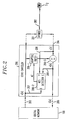
- FIG. 2 illustrates in simplified form a telecommunications connection between echo canceler 206 and a far-end digital network 100, in which the connection is composed of unidirectional paths 203 and 204.
- the dashed lines denote respective portions of the connections that may be of sufficient length to cause a noticeable echo path delay at the opposite ends of the bi-directional path.
- echo canceler 206 includes, inter alia, an adaptive filter 206-1, which may be a conventional digital signal processor (DSP) arranged as a finite-impulse-response (FIR) filter. It also includes adder 206-3 and NES detector 206-2.
- DSP digital signal processor
- FIR finite-impulse-response
- NES detector 206-2 which may also be a conventional DSP, monitors unidirectional path 203 via path 207 for the presence of far-end speech signals (x(k)) and monitors unidirectional path 204 for the presence of near-end speech signals. However, unlike NES detector 106-2, FIG. 1, NES detector 206-2 also monitors, in accord with an aspect of the invention, the level of the signals present at the E-side of canceler 206 to determine if NES is present, as will be discussed below in detail.
- digital speech samples received from far-end network 100 are converted in a conventional manner (not shown) to analog signals and then supplied to hybrid 201 for delivery to station S2 via path 202.
- the far-end speech samples are also supplied as they are received via path 203 to the X-port of NES detector 206-2 and to an input of adaptive filter 206-1.
- analog signals received from station S2 via hybrid 201 are converted in a conventional manner (not shown) into digital speech samples and then supplied to the Y-port of canceler 206 for ultimate delivery to the far end via adder 206-3 and path 205.
- the y(k) and e(k) signals are also respectively supplied to the Y and E ports of NES detector 206-2.
- NES detector 206-2 stores the x(k) samples in sequential order in an internal X-port memory buffer (not shown) composed of a predetermined number N, e.g., 512, of memory locations such that the current sample is stored in place of the oldest X-port sample stored in the buffer.
- N e.g., 512
- NES detector 206-2 stores the latest 512 X-port speech samples in the X-port buffer in the order that they are received from the far end, e.g., network 100.
- the contents of the buffer represent a moving window (i.e., a shift register) that spans a predetermined period of time, e.g., 64 milliseconds, which is equivalent to the duration 512 consecutive X-port speech samples.
- the DSP controlling the operation of NES detector 206-2 scans the contents of the buffer to locate the stored sample having the largest absolute magnitude (power level).
- NES detector 206-2 determines if NES is present based on comparing the relative level of the y(k) and x(k) signals. It is noted that different techniques for making such a determination are well known to the art. For example, the so-called Geigel algorithm is one such technique and is disclosed in the article entitled "A twelve Channel Digital Echo Canceler by D. L. Duttweiler and published in the May, 1978 IEEE Transactions on Communications.
- the Geigel algorithm compares the magnitude of the current sample of y(k) that is received via path 208 with a current value of x max (k) as follows:
- ⁇ y is a predetermined value based on an expected worst-case echo path loss (often 0.5, which corresponds to -6 dB). If detector 206-2 finds that equation (1) is satisfied, then it sets a logical value ⁇ y,big (k) to true.
- a Y-side speech detection algorithm e.g., the above mentioned Geigel algorithm, may fail to detect the presence of NES in echo. This is especially the case in the face of "level skew" that occurs in digital cellular networks.
- the E-port detection process of NES detector 206-2 adjusts the threshold ( ⁇ E (k)) upward, e.g., increases the value at another predetermined rate, to correct the mistake, as will also be discussed below in detail.
- this NES indication is used to inhibit the adaptation of adaptive filter 206-1 so that NES does not degrade the ability of the adaptive filter to estimate echo.
- NES detector 206-2 changes the threshold ⁇ E in accordance with equation (4) or (5) and uses the program of FIG. 3 to control the implementation of that function. Specifically, when entered the program proceeds to block 301 where it initializes the value of the E-side threshold ( ⁇ E ) to a predetermined value (e. g,, 0.5). The program then clears a so-called hangover count, E count to prepare for the implementation of the aforementioned hangover time. The program then waits for the receipt of a next digital sample of a far-end voice signal, x(k), as represented by the dashed line. Upon receipt of the sample, the program proceeds to block 302 where it compares e(k) against the threshold determined in accord with equation (3).
- the program (block 305) sets the value of E count to a maximum value, e.g., 255, so that the value of E count (hangover time) will hold true (nonzero) for the next 255 samples of x(k). That is, the program assumes that NES is present for the next 255 samples, as will be discussed below. Otherwise, the program (block 304) decrements the value of E count by a predetermined value, e.g., a value of one.
- a predetermined value e.g., a value of one.
- the program proceeds to block 307 if it finds that FES is present and NESy(k) has not been asserted. Otherwise, it returns to await for the receipt of the next digital sample of the far-end speech signal, x(k).
- the program determines in the manner discussed above whether near-end speech is still present (i.e., E count is not less than or equal to zero and the result of equation (3) is true). If that is not the case, which means that the E-side detection processing agrees with the Y-port detection processing (i.e., E count , equals zero indicating that NES E (k) is absent), then the program concludes that it may be more aggressive in the setting of threshold ⁇ E to improve its detection of NES.
- the program (block 311) decreases the value of ⁇ E (using equation 5).
- the program (block 312) checks to see if the decrease causes ⁇ E to fall below a predetermined minimum value, e.g., a value of 0.0625. If not, then the program returns to await for the receipt of the next sample of x(k). Otherwise, the program (block 313) sets the value of ⁇ E to the aforementioned minimum value to prevent it from falling below that value, and then returns await receipt of the next digital sample of x(k).
- the program determines whether the E-side detection process does not agree with the Y-port detection process -- then the program concludes that it may have been to too aggressive in the setting of ⁇ E . Accordingly, the program (block 308) increases the value of ⁇ E in the manner described above (i.e., using equation 5). The program (block 309) then checks to see if the new value of ⁇ E exceeds a predetermined maximum value, e.g., a value of 0.63, which is equivalent to -4 dB. If not, then the program returns to await receipt of the next digital sample of x(k). If so, then the program (block 310) sets ⁇ E to the maximum value to prevent it from exceeding that value and then returns likewise.
- a predetermined maximum value e.g., a value of 0.63, which is equivalent to -4 dB
Landscapes
- Engineering & Computer Science (AREA)
- Computer Networks & Wireless Communication (AREA)
- Signal Processing (AREA)
- Cable Transmission Systems, Equalization Of Radio And Reduction Of Echo (AREA)
- Filters That Use Time-Delay Elements (AREA)
Claims (11)
- Sprachdetektor (206-2) des nahen Endes für einen Echolöscher (206) mit mindestens einem Eingang (203) und einem Ausgang (205), wobei der Sprachdetektor des nahen Endes folgendes umfaßt:ein Mittel, dem (über 203) die empfangenen Sprachsignale (x(k), über 203) und ein vorgeschriebenes Signal des nahen Endes (y(k), über 204) zugeführt werden, das so ausgelegt ist, daß es die Anwesenheit oder Abwesenheit von Sprache des nahen Endes erkennt und eine Anzeige dessen erzeugt,ein Mittel (in 206-2), das so ausgelegt ist, daß es die Sprachsignale (x(k)) über eine Verbindung (203) empfängt, die sich zu einer Quelle (100) des fernen Endes von Sprachsignalen erstreckt, und die empfangenen Sprachsignale (x(k)) verarbeitet, um eine Repräsentation des Signalpegels für die Sprache des fernen Endes abzuleiten,ein Mittel (in 206-2), das auf die abgeleitete Repräsentation reagiert und so ausgelegt ist, daß es als Funktion der Repräsentation und eines aktuellen Werts einer Schwellenvariablen (α E ) bestimmt, ob ein Ausgangssignal (E(k), bei 205) von dem Echolöscher einen größeren Betrag als der nur eines Echosignals aufweist, undein Mittel (in 206-2), das so ausgelegt ist, daß es auf das Signal mit dem größeren Betrag und die Anzeige der Abwesenheit von Sprache des nahen Endes reagiert, um den Wert der Schwellenvariablen (α E ) zu verkleinern, und ansonsten so ausgelegt ist, daß es den Wert der Schwellenvariablen (α E ) vergrößert.
- Vorrichtung nach Anspruch 1, dadurch gekennzeichnet, daß der Wert der Schwellenvariablen (α E ) gemäß einer ersten vorbestimmten Rate verkleinert wird.
- Vorrichtung nach Anspruch 1, dadurch gekennzeichnet, daß der Wert der Schwellenvariablen (α E ) gemäß einer zweiten vorbestimmten Rate vergrößert wird.
- Vorrichtung nach Anspruch 1, dadurch gekennzeichnet, daß die Quelle des fernen Endes ein zellulares Netz ist.
- Vorrichtung nach Anspruch 1, dadurch gekennzeichnet, daß die erste vorbestimmte Rate kleiner als die zweite vorbestimmte Rate ist.
- Vorrichtung nach Anspruch 1, ferner gekennzeichnet durch ein Mittel (in 206-2, 307, 308, 309, 310), das so ausgelegt ist, daß es als Reaktion darauf, daß der Wert der Schwellenvariablen (α E ) einen Wert erreicht, der größer als ein vorbestimmter Maximalwert ist, den Wert der Schwellenvariablen (α E ) auf den Maximalwert setzt.
- Vorrichtung nach Anspruch 1, ferner gekennzeichnet durch ein Mittel (in 206-2, 307, 311, 312, 313), das so ausgelegt ist, daß es als Reaktion darauf, daß der Wert der Schwellenvariablen (α E ) einen Wert erreicht, der kleiner als ein vorbestimmter Minimalwert ist, den Wert der Schwellenvariablen (α E ) auf den Minimalwert setzt.
- Vorrichtung nach Anspruch 1, gekennzeichnet durch
ein Mittel (in 206-2), das so ausgelegt ist, daß es die empfangenen Sprachsignale (x(k)) auf der Basis der Reihenfolge, in der die Sprachsignale aus der Quelle (100) des fernen Endes empfangen werden, zu einer aktuellen Reihe von Sprachsignalen zusammenstellt,
ein Mittel (in 206-2), das so ausgelegt ist, daß es bestimmt, welches der die Reihe bildenden Sprachsignale den größten Betrag aufweist, und
ein Mittel (in 206-2), das so ausgelegt ist, daß es die Anzeige, ob ein aktuelles Signal des nahen Endes einen Betrag aufweist, der mindestens gleich einem Wert ist, der als Funktion des Signals des fernen Endes mit dem größten Betrag und eines Werts einer Schwellenvariablen (α E ) abgeleitet wird, ausgibt. - Vorrichtung nach Anspruch 1, dadurch gekennzeichnet, daß der Echolöscher einen weiteren Eingang aufweist, der so ausgelegt ist, daß er Signale des nahen Endes (y(k)) empfängt, und so ausgelegt ist, daß er der Quelle (100) des fernen Endes Signale (E(k)) zuführt, und dem Sprachdetektor (206-2) des nahen Endes und den Mitteln, die so ausgelegt sind, das sie den Wert der Schwellenvariablen (α E ) verkleinern und vergrößern, darin die von der Quelle des fernen Endes an dem Echolöscher ankommenden Signale (x(k)), die Signale des nahen Endes (x(k)) und ein Signal (e(k)), das an dem Echolöscherausgang entwickelt wird, zugeführt werden, um den Wert der Schwellenvariablen (α E ) zu verkleinern (307, 311, 312, 313) oder zu vergrößern (307, 308, 309, 310).
- Verfahren zum Detektieren von Sprache des nahen Endes (über 206-2) in einem Echolöscher (206) mit mindestens einem Eingang (203) und einem Ausgang (205), wobei das Verfahren die folgenden Schritte umfaßt:Empfangen (in 206) von Sprachsignalen (x(k)) über eine Verbindung 203, die sich zu einer Quelle (100) von Sprachsignalen des fernes Endes erstreckt,Erkennen (über 206-2) der Anwesenheit oder Abwesenheit von Sprache des nahen Endes und Erzeugen einer Anzeige dessen,Verarbeiten (in 206-2) der empfangenen Sprachsignale, um eine Repräsentation des Signalpegels für die Sprache des fernen Endes abzuleiten,als Reaktion auf die Ableitung des Signalpegels, Bestimmen (302), ob ein Ausgangssignal (e(k)) aus dem Echolöscher (206) einen größeren Betrag als der nur eines.Echosignals aufweist, als Funktion der Repräsentation und eines aktuellen Werts einer Schwellenvariablen (α E ), undferner als Reaktion auf das Signal mit dem größeren Betrag und die Anzeige der Abwesenheit von Sprache des nahen Endes, Verkleinern (307, 311, 312, 313) des Werts der Schwellenvariablen (α E ), und Vergrößern (307, 308, 309, 310) des Werts der Schwellenvariablen (α E ) andernfalls.
- Verfahren nach Anspruch 10, dadurch gekennzeichnet, daß der Echolöscher die ankommenden Sprachsignale (x(k)), ein einem weiteren Eingang des Echlöschers (206) zugeführtes Signal (y(k)) des nahen Endes und ein an dem Echolöscherausgang entwickeltes Signal (e(k)) dem Sprachdetektor (206-2) des nahen Endes zuführt, und durch Verarbeiten der zugeführten Signale (x(k), y(k), e(k)), um den Wert der Schwellenvariablen (α E ) zu verkleinern (307, 311, 312, 313) oder zu vergrößern (307, 308, 309, 310).
Applications Claiming Priority (2)
| Application Number | Priority Date | Filing Date | Title |
|---|---|---|---|
| US08/606,934 US5668865A (en) | 1996-02-26 | 1996-02-26 | Echo canceler E-side speech detector |
| US606934 | 1996-02-26 |
Publications (3)
| Publication Number | Publication Date |
|---|---|
| EP0792029A2 EP0792029A2 (de) | 1997-08-27 |
| EP0792029A3 EP0792029A3 (de) | 2003-06-25 |
| EP0792029B1 true EP0792029B1 (de) | 2006-05-24 |
Family
ID=24430130
Family Applications (1)
| Application Number | Title | Priority Date | Filing Date |
|---|---|---|---|
| EP97301016A Expired - Lifetime EP0792029B1 (de) | 1996-02-26 | 1997-02-18 | Sprachdetektor für die E-Seite eines Echokompensators |
Country Status (5)
| Country | Link |
|---|---|
| US (1) | US5668865A (de) |
| EP (1) | EP0792029B1 (de) |
| JP (1) | JP3667478B2 (de) |
| CA (1) | CA2195261C (de) |
| DE (1) | DE69735908T2 (de) |
Families Citing this family (21)
| Publication number | Priority date | Publication date | Assignee | Title |
|---|---|---|---|---|
| US5752229A (en) * | 1996-06-28 | 1998-05-12 | Lucent Technologies Inc. | Intelligent near-end speech detection |
| JP3597671B2 (ja) * | 1997-05-16 | 2004-12-08 | 三菱電機株式会社 | ハンズフリー電話機 |
| US6259680B1 (en) * | 1997-10-01 | 2001-07-10 | Adtran, Inc. | Method and apparatus for echo cancellation |
| US6256384B1 (en) | 1997-12-02 | 2001-07-03 | Telefonaktiebolaget Lm Ericsson (Publ) | Method and apparatus for cancelling echo originating from a mobile terminal |
| US6049606A (en) * | 1997-12-11 | 2000-04-11 | Nortel Networks Corporation | Circuit and method of double talk detection for use in handsfree telephony terminals |
| DE19801390A1 (de) | 1998-01-16 | 1999-07-22 | Cit Alcatel | Einrichtung und Verfahren zur Echounterdrückung mit adaptiven FIR-Filtern |
| DE19801389A1 (de) * | 1998-01-16 | 1999-07-22 | Cit Alcatel | Verfahren zur Echounterdrückung mit adaptiven FIR-Filtern |
| DE19815942A1 (de) | 1998-04-09 | 1999-10-14 | Cit Alcatel | Vielkanal-Echocanceller mit Compander |
| US6424635B1 (en) * | 1998-11-10 | 2002-07-23 | Nortel Networks Limited | Adaptive nonlinear processor for echo cancellation |
| US7512149B2 (en) * | 2003-04-23 | 2009-03-31 | At & T Intellectual Property Ii, L.P. | Bit and power allocation scheme for full-duplex transmission with echo cancellation in multicarrier-based modems |
| US6813352B1 (en) | 1999-09-10 | 2004-11-02 | Lucent Technologies Inc. | Quadrature filter augmentation of echo canceler basis functions |
| US7151803B1 (en) | 2002-04-01 | 2006-12-19 | At&T Corp. | Multiuser allocation method for maximizing transmission capacity |
| US7242762B2 (en) | 2002-06-24 | 2007-07-10 | Freescale Semiconductor, Inc. | Monitoring and control of an adaptive filter in a communication system |
| US6961423B2 (en) | 2002-06-24 | 2005-11-01 | Freescale Semiconductor, Inc. | Method and apparatus for performing adaptive filtering |
| US7388954B2 (en) | 2002-06-24 | 2008-06-17 | Freescale Semiconductor, Inc. | Method and apparatus for tone indication |
| US7215765B2 (en) | 2002-06-24 | 2007-05-08 | Freescale Semiconductor, Inc. | Method and apparatus for pure delay estimation in a communication system |
| US20070055522A1 (en) * | 2005-08-26 | 2007-03-08 | Sbc Knowledge Ventures, L.P. | Self-learning multi-source speech data reconstruction |
| US8041564B2 (en) * | 2005-09-12 | 2011-10-18 | At&T Intellectual Property I, L.P. | Multi-pass echo residue detection with speech application intelligence |
| US20070106515A1 (en) * | 2005-11-09 | 2007-05-10 | Sbc Knowledge Ventures, L.P. | Automated interactive statistical call visualization using abstractions stack model framework |
| US8740383B2 (en) | 2009-05-06 | 2014-06-03 | University Of Virginia Patent Foundation | Self-illuminated handheld lens for retinal examination and photography and related method thereof |
| US9357920B2 (en) | 2009-09-04 | 2016-06-07 | University Of Virginia Patent Foundation | Hand-held portable fundus camera for screening photography |
Family Cites Families (14)
| Publication number | Priority date | Publication date | Assignee | Title |
|---|---|---|---|---|
| US4029912A (en) * | 1975-12-10 | 1977-06-14 | Bell Telephone Laboratories, Incorporated | Common control digital echo suppressor |
| US4129753A (en) * | 1977-12-09 | 1978-12-12 | Bell Telephone Laboratories, Incorporated | Echo canceller using feedback to improve speech detector performance |
| US4382164A (en) * | 1980-01-25 | 1983-05-03 | Bell Telephone Laboratories, Incorporated | Signal stretcher for envelope generator |
| CA1137240A (en) * | 1980-09-09 | 1982-12-07 | Northern Telecom Limited | Method of and apparatus for echo detection in voice channel signals |
| US4562312A (en) * | 1983-02-17 | 1985-12-31 | At&T Bell Laboratories | Subsampling delay estimator for an echo canceler |
| JPS6156526A (ja) * | 1984-08-28 | 1986-03-22 | Toshiba Corp | 反響信号打消装置 |
| US4591669A (en) * | 1984-09-26 | 1986-05-27 | At&T Bell Laboratories | Adaptive filter update gain normalization |
| US4894820A (en) * | 1987-03-24 | 1990-01-16 | Oki Electric Industry Co., Ltd. | Double-talk detection in an echo canceller |
| CA1338218C (en) * | 1988-03-17 | 1996-04-02 | Yoshinori Tanaka | Echo canceller |
| DE3840433A1 (de) * | 1988-12-01 | 1990-06-07 | Philips Patentverwaltung | Echokompensator |
| FR2651077B1 (fr) * | 1989-08-18 | 1994-06-10 | Letourneur Gregoire | Dispositif de traitement d'echo notamment acoustique dans une ligne telephonique |
| DE4119963A1 (de) * | 1991-06-18 | 1992-12-24 | Philips Patentverwaltung | Echokompensator |
| EP0528491B1 (de) * | 1991-08-20 | 1996-01-10 | Koninklijke Philips Electronics N.V. | Telekommunikationssystem mit einer Leitung für digitalen Verkehr mit einer Anordnung zum Abzweigen des digitalen Duplexverkehrs, und Anordnung zur Anwendung in dem Telekommunikationssystem |
| US5577097A (en) * | 1994-04-14 | 1996-11-19 | Northern Telecom Limited | Determining echo return loss in echo cancelling arrangements |
-
1996
- 1996-02-26 US US08/606,934 patent/US5668865A/en not_active Expired - Lifetime
-
1997
- 1997-01-14 JP JP00485797A patent/JP3667478B2/ja not_active Expired - Fee Related
- 1997-01-16 CA CA002195261A patent/CA2195261C/en not_active Expired - Fee Related
- 1997-02-18 DE DE69735908T patent/DE69735908T2/de not_active Expired - Lifetime
- 1997-02-18 EP EP97301016A patent/EP0792029B1/de not_active Expired - Lifetime
Also Published As
| Publication number | Publication date |
|---|---|
| JP3667478B2 (ja) | 2005-07-06 |
| EP0792029A3 (de) | 2003-06-25 |
| DE69735908D1 (de) | 2006-06-29 |
| DE69735908T2 (de) | 2007-01-25 |
| JPH09247055A (ja) | 1997-09-19 |
| EP0792029A2 (de) | 1997-08-27 |
| CA2195261C (en) | 2002-10-01 |
| US5668865A (en) | 1997-09-16 |
| CA2195261A1 (en) | 1997-08-27 |
Similar Documents
| Publication | Publication Date | Title |
|---|---|---|
| EP0792029B1 (de) | Sprachdetektor für die E-Seite eines Echokompensators | |
| EP0806093B1 (de) | Anpassungssteuerung für einen echounterdrücker | |
| US6516063B1 (en) | Echo canceller having improved non-linear processor | |
| CN100530998C (zh) | 带有回声路径变化探测器的回声消除器 | |
| US6226380B1 (en) | Method of distinguishing between echo path change and double talk conditions in an echo canceller | |
| EP0755591B1 (de) | Bestimmung der echodämpfung einer echokompensationseinrichtung | |
| EP0135843B1 (de) | Echokompensatorsysteme | |
| US20030076949A1 (en) | Echo canceller employing dual-H architecture having improved non-linear echo path detection | |
| US6516050B1 (en) | Double-talk detecting apparatus, echo canceller using the double-talk detecting apparatus and echo suppressor using the double-talk detecting apparatus | |
| US5675644A (en) | Method and apparatus for canceling echo accounting for delay variations | |
| US5867486A (en) | Method and an apparatus for unknown system identification | |
| US6771701B1 (en) | Adaptive filter divergence control in echo cancelers by means of amplitude distribution evaluation with configurable hysteresis | |
| US6792106B1 (en) | Echo canceller and method of echo cancellation using an NLMS algorithm | |
| EP0053202B1 (de) | Detektor für gleichzeitiges Sprechen bei Echounterdrückern | |
| EP0855110B1 (de) | Adaptives echounterdrückungsverfahren | |
| EP1560441B1 (de) | Schmalbandtonerkennung in einem Echokompensationssystem | |
| JPH01318325A (ja) | 反響消去装置 | |
| JPH04127721A (ja) | 音響エコーキャンセラ | |
| KR20010007068A (ko) | 조절 가능한 히스테리시스를 가진 진폭 분포 평가에 의한에코 제거기들에서의 적응 필터 발산 제어 | |
| JPH03283824A (ja) | エコーキャンセラ | |
| JPS6315537A (ja) | 反響消去装置 |
Legal Events
| Date | Code | Title | Description |
|---|---|---|---|
| PUAI | Public reference made under article 153(3) epc to a published international application that has entered the european phase |
Free format text: ORIGINAL CODE: 0009012 |
|
| AK | Designated contracting states |
Kind code of ref document: A2 Designated state(s): DE FR GB IT |
|
| PUAL | Search report despatched |
Free format text: ORIGINAL CODE: 0009013 |
|
| AK | Designated contracting states |
Designated state(s): DE FR GB IT |
|
| 17P | Request for examination filed |
Effective date: 20031213 |
|
| 17Q | First examination report despatched |
Effective date: 20040805 |
|
| GRAP | Despatch of communication of intention to grant a patent |
Free format text: ORIGINAL CODE: EPIDOSNIGR1 |
|
| GRAS | Grant fee paid |
Free format text: ORIGINAL CODE: EPIDOSNIGR3 |
|
| GRAA | (expected) grant |
Free format text: ORIGINAL CODE: 0009210 |
|
| AK | Designated contracting states |
Kind code of ref document: B1 Designated state(s): DE FR GB IT |
|
| PG25 | Lapsed in a contracting state [announced via postgrant information from national office to epo] |
Ref country code: IT Free format text: LAPSE BECAUSE OF FAILURE TO SUBMIT A TRANSLATION OF THE DESCRIPTION OR TO PAY THE FEE WITHIN THE PRE;WARNING: LAPSES OF ITALIAN PATENTS WITH EFFECTIVE DATE BEFORE 2007 MAY HAVE OCCURRED AT ANY TIME BEFORE 2007. THE CORRECT EFFECTIVE DATE MAY BE DIFFERENT FROM THE ONE RECORDED.SCRIBED TIME-LIMIT Effective date: 20060524 |
|
| REG | Reference to a national code |
Ref country code: GB Ref legal event code: FG4D |
|
| REF | Corresponds to: |
Ref document number: 69735908 Country of ref document: DE Date of ref document: 20060629 Kind code of ref document: P |
|
| ET | Fr: translation filed | ||
| PLBE | No opposition filed within time limit |
Free format text: ORIGINAL CODE: 0009261 |
|
| STAA | Information on the status of an ep patent application or granted ep patent |
Free format text: STATUS: NO OPPOSITION FILED WITHIN TIME LIMIT |
|
| 26N | No opposition filed |
Effective date: 20070227 |
|
| REG | Reference to a national code |
Ref country code: GB Ref legal event code: 732E Free format text: REGISTERED BETWEEN 20131121 AND 20131127 |
|
| REG | Reference to a national code |
Ref country code: FR Ref legal event code: CD Owner name: ALCATEL-LUCENT USA INC. Effective date: 20131122 |
|
| REG | Reference to a national code |
Ref country code: FR Ref legal event code: GC Effective date: 20140410 |
|
| REG | Reference to a national code |
Ref country code: FR Ref legal event code: RG Effective date: 20141015 |
|
| REG | Reference to a national code |
Ref country code: FR Ref legal event code: PLFP Year of fee payment: 19 |
|
| PGFP | Annual fee paid to national office [announced via postgrant information from national office to epo] |
Ref country code: DE Payment date: 20150219 Year of fee payment: 19 |
|
| PGFP | Annual fee paid to national office [announced via postgrant information from national office to epo] |
Ref country code: GB Payment date: 20150218 Year of fee payment: 19 Ref country code: FR Payment date: 20150219 Year of fee payment: 19 |
|
| REG | Reference to a national code |
Ref country code: DE Ref legal event code: R119 Ref document number: 69735908 Country of ref document: DE |
|
| GBPC | Gb: european patent ceased through non-payment of renewal fee |
Effective date: 20160218 |
|
| REG | Reference to a national code |
Ref country code: FR Ref legal event code: ST Effective date: 20161028 |
|
| PG25 | Lapsed in a contracting state [announced via postgrant information from national office to epo] |
Ref country code: FR Free format text: LAPSE BECAUSE OF NON-PAYMENT OF DUE FEES Effective date: 20160229 Ref country code: DE Free format text: LAPSE BECAUSE OF NON-PAYMENT OF DUE FEES Effective date: 20160901 Ref country code: GB Free format text: LAPSE BECAUSE OF NON-PAYMENT OF DUE FEES Effective date: 20160218 |