EP0791884A2 - Procédé pour l'ajustement informatisé de plusieurs copies de fichiers d'un fichier stocké, stockées dans au moins un ordinateur - Google Patents
Procédé pour l'ajustement informatisé de plusieurs copies de fichiers d'un fichier stocké, stockées dans au moins un ordinateur Download PDFInfo
- Publication number
- EP0791884A2 EP0791884A2 EP97102891A EP97102891A EP0791884A2 EP 0791884 A2 EP0791884 A2 EP 0791884A2 EP 97102891 A EP97102891 A EP 97102891A EP 97102891 A EP97102891 A EP 97102891A EP 0791884 A2 EP0791884 A2 EP 0791884A2
- Authority
- EP
- European Patent Office
- Prior art keywords
- file
- dki
- comparison
- operations
- data records
- Prior art date
- Legal status (The legal status is an assumption and is not a legal conclusion. Google has not performed a legal analysis and makes no representation as to the accuracy of the status listed.)
- Withdrawn
Links
Images

Classifications
-
- G—PHYSICS
- G06—COMPUTING OR CALCULATING; COUNTING
- G06Q—INFORMATION AND COMMUNICATION TECHNOLOGY [ICT] SPECIALLY ADAPTED FOR ADMINISTRATIVE, COMMERCIAL, FINANCIAL, MANAGERIAL OR SUPERVISORY PURPOSES; SYSTEMS OR METHODS SPECIALLY ADAPTED FOR ADMINISTRATIVE, COMMERCIAL, FINANCIAL, MANAGERIAL OR SUPERVISORY PURPOSES, NOT OTHERWISE PROVIDED FOR
- G06Q10/00—Administration; Management
- G06Q10/10—Office automation; Time management
-
- G—PHYSICS
- G06—COMPUTING OR CALCULATING; COUNTING
- G06F—ELECTRIC DIGITAL DATA PROCESSING
- G06F16/00—Information retrieval; Database structures therefor; File system structures therefor
- G06F16/10—File systems; File servers
- G06F16/18—File system types
- G06F16/182—Distributed file systems
-
- Y—GENERAL TAGGING OF NEW TECHNOLOGICAL DEVELOPMENTS; GENERAL TAGGING OF CROSS-SECTIONAL TECHNOLOGIES SPANNING OVER SEVERAL SECTIONS OF THE IPC; TECHNICAL SUBJECTS COVERED BY FORMER USPC CROSS-REFERENCE ART COLLECTIONS [XRACs] AND DIGESTS
- Y10—TECHNICAL SUBJECTS COVERED BY FORMER USPC
- Y10S—TECHNICAL SUBJECTS COVERED BY FORMER USPC CROSS-REFERENCE ART COLLECTIONS [XRACs] AND DIGESTS
- Y10S707/00—Data processing: database and file management or data structures
- Y10S707/99951—File or database maintenance
- Y10S707/99952—Coherency, e.g. same view to multiple users
-
- Y—GENERAL TAGGING OF NEW TECHNOLOGICAL DEVELOPMENTS; GENERAL TAGGING OF CROSS-SECTIONAL TECHNOLOGIES SPANNING OVER SEVERAL SECTIONS OF THE IPC; TECHNICAL SUBJECTS COVERED BY FORMER USPC CROSS-REFERENCE ART COLLECTIONS [XRACs] AND DIGESTS
- Y10—TECHNICAL SUBJECTS COVERED BY FORMER USPC
- Y10S—TECHNICAL SUBJECTS COVERED BY FORMER USPC CROSS-REFERENCE ART COLLECTIONS [XRACs] AND DIGESTS
- Y10S707/00—Data processing: database and file management or data structures
- Y10S707/99951—File or database maintenance
- Y10S707/99952—Coherency, e.g. same view to multiple users
- Y10S707/99953—Recoverability
Definitions
- the invention relates to a method common in distributed environments, so-called groupware systems and so-called CSCW systems (C omputer C S upported ooperative W ork) applies. These systems are useful for supporting various types of collaborative work between different participants in different working groups on computers.
- CSCW systems can only be used efficiently if they support a simple transition between synchronous and asynchronous coupled cooperation between the various participants in the CSCW system.
- Coupled cooperation between subscribers in this context means that all messages which are sent by a subscriber of the CSCW system are transmitted to all other subscribers which are integrated in the CSCW system at the respective time.
- Coupled cooperation refers to all possibilities of electronic data exchange between computers connected via communication networks. These include, for example, an audio / video conference, so-called data sharing or to understand application sharing, electronic mail or so-called distributed calendar tools. However, this list is in no way to be considered exhaustive.
- a very simple example can be imagined of two participants of the CSCW system located at different locations, who develop a document together, for example a help document for a software tool.
- Each participant develops his part of the document asynchronously, i.e. completely independent of the other participant.
- the use of a video conference and application sharing can be a very efficient method for supporting a merging of the parts of the document into the overall document that is finally to be developed.
- decoupled collaboration means the situation that at least one participant in the shared work environment can either not send messages to the other participants or cannot receive messages from these participants.
- This possibility of decoupled collaboration which is also referred to as autonomous working, improves collaboration especially in organizations whose parts of the organization are located locally, if high costs are to be charged for the transmission of data, or the network used is exposed to high loads or is very prone to errors.
- Examples of such work environments are distributed office work environments and development groups that work according to the so-called tele-homework or distributed development tools.
- Replicating i.e. copying shared data
- Replicating is the prerequisite for an easy way to create a transition between coupled and decoupled collaboration without causing a significant delay. This enables, for example, the participants of a common work environment to continue working on their own copy of the data without any restrictions, even if connection errors occur.
- [2] describes a method used in a system called GINA.
- GINA This is a procedure in which log files are assigned to the individual file copies.
- the GINA method when the individual file copies are processed during the autonomous phase, different versions are created by performing change operations generated. In this way, a so-called tree with two branches is formed in a log file. The file copies are then compared in such a way that one of the branches is appended to the end of the other branch. The operations listed in one branch are also carried out on the other side. This process is inflexible. In addition, this procedure does not take individual conflicts into account or the order in which the conflicts are resolved.
- COCOON Another method that is used in a system called COCOON is described in [3].
- This method also uses log files assigned to the file copies.
- the procedure uses a fixed chronological order to match the file copies by keeping the log files from start to finish worked through "and the individual changes listed there are processed chronologically one after the other.
- This method has the disadvantage that certain comparisons are unnecessarily carried out due to limited knowledge of change operations in the log file or may even have to be revised later, for example comparing structural changes of data records deleted later .
- the invention is therefore based on the problem of a method for computer-aided comparison of a plurality of independent file copies of a file stored in at least one computer to be specified, which requires considerably less computing time.
- changes made to a file copy are each stored in a log file assigned to the respective file copy.
- the individual log files are compared with one another during the comparison of the file copies.
- the sequence of the examined change operations in the individual log files is determined in the method according to the invention in such a way that at the beginning of the method all delete operations (delete) of data records or creation operations (create) of data records of the file or the file copies are compared.
- the procedure for the method claimed in claim 2 is basically the same as the method described above, with the difference that the final decision on the adjustment does not have to be carried out by the users individually for each data record, but that a decision hierarchy is built up by defining a reference log file becomes. This means that when there are conflicts between the reference log file and another log file, the change that is in the reference log file always results in a final comparison of the file copies with the file itself. Different reference log files are determined for predefinable change operations.
- the inventive method according to claim 7 is based on the same inventive idea, namely to avoid unnecessary comparisons of change operations.
- the suggestions are first determined on the basis of entire information spaces, and then proceeding hierarchically from the root to the so-called leaves of the data tree.
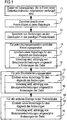
- FIG. 1 shows a flow chart that describes individual method steps of a first exemplary embodiment of the method according to the invention.
- the method is based on a file which has data records which are linked to one another in the form of a database structure 11.
- FIG. 6 An example of such a file is shown in FIG. 6, the individual links being described in each case by arrows between the data records, which are represented by ellipses.
- hierarchical links between two data records are represented by a solid arrow through which a hierarchical coupling P is described.
- hierarchical means that one object is assigned to a parent data record.
- container data records C can have child data records in a level that is hierarchically subordinate to the respective data record, with which the respective data record is also connected via the hierarchical coupling P.
- the entire file has a so-called tree structure, that is to say a structure which is strictly hierarchically structured.
- the data records can also be connected to one another via secondary couplings S.
- the individual data records are connected via cross-connections within the tree structure via the secondary couplings, which results in the hierarchical tree structure is resolved "and a generally networked structure of data records is created.
- FIG. 6 shows individual data records, container data records C, which have hierarchical links P to data records arranged in the hierarchical order below the respective container data record C.
- Other types of data records are sheet data records B, which are located within the tree structure on the lowest hierarchical level "and are therefore dependent on the respective parent data record. They only have a hierarchical coupling P to their respective parent data record.
- This parent data record is a container data record C.
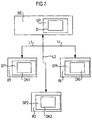
- FIG. 7 shows an arrangement of different computers Ri.
- a central server SE that has a memory SP in which the file D is stored.
- These computers Ri where i denotes an index which uniquely identifies the individual computers Ri and is an arbitrary natural number, are each coupled to the server SE via a line Li.
- the uncoupled collaboration arises when the connection to the other computers Ri is interrupted for one of the computers Ri and changes are made to the data records of the file copy Dki located on the decoupled computer Ri for any length of time. After at least one computer Ri has been disconnected from the common working environment and changes have been made in the file copies DKi, the respective computer Ri is coupled back into the common working environment.
- the method is not limited to the case where only a single computer is disconnected, but rather it is also provided that several computers can be disconnected at a certain time.
- Each file copy DKi is assigned a log file PDi 12, in which all changes that are made to the file copy DKi are stored 13.
- the comparison then takes place on the basis of a comparison of the different log files PDi. This procedure is described in [3].
- This general inventive idea leads, for example, to the fact that the method leads to a Top-down "approach when processing a hierarchical data tree.
- the aim of conflict resolution is to achieve the highest possible level of granularity and the highest possible hierarchy level of the data tree.
- a file copy DKi which is stored in a memory SPi of a computer Ri, is assigned a log file PDi 12.
- each log file PDi all changes to the file copy DKi, in the log file Pdi, that of the respective file copy DKi assigned, saved 13.
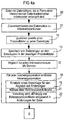
- steps 11 to 13 are equivalent in all exemplary embodiments, with the difference that in the method according to patent claim 6 and patent claim 7, a hierarchical database structure of the file is assumed 30 (cf. FIGS. 3a and 4a).
- Changes to the file copies DKi that is to say to the data records of the individual file copies DKi, can be made by different change operations.
- the sequence in which the change operations stored in the log files PDi are processed is defined in the following manner (see FIG. 1). First, all delete operations or all create operations are compared 14.
- the comparison is carried out by determining a proposal for the comparison 15. For this purpose, for example, the contents of the individual log files PDi that are to be compared are simply compared.
- the users who are on the respective computers that have saved the log files PDi are made the respective change proposal.
- This can, for example, transfer a data record generated in a decoupled file copy DKi into the entire file, and thus into all file copies DKi or also the reverse case of deleting a data record from all file copies DKi by comparison with the at least one new coupled computer Ri and its log file PDi.
- this proposal is now decided by the users.
- the proposal will take the form of a change in the file and all connected "file copies DKi 16. If the users cannot agree to adopt the proposal, a further development of the method can now propose to reuse an earlier, consistent structure of data records as a new, common file D.
- the respective users can then also independently decide on this proposal.
- This type of procedure has the considerable advantage that all structure change operations and all attribute change operations that were stored in the individual log files PDi and relate, for example, to data records that have already been completely deleted from the entire data structure by deletion operations, no longer have to be taken into account. Thus, unnecessary additional comparisons are avoided according to the invention, which leads to a considerable faster execution of the entire comparison by the computer.
- Editing the structure change operations before taking the attribute change operations into account also leads to a reduction in the computing time required for the method.
- attribute change operations are also processed by determining the proposal for the comparison 15 and the implementation, possibly in changes to the file 16.
- the second exemplary embodiment describes a method which differs only slightly from the first exemplary embodiment described above.
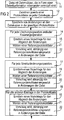
- the difference between the second exemplary embodiment and the first is to be seen in the fact that, although the sequence for the adjustment is in accordance with the procedure proposed in the first exemplary embodiment, it is no longer as in the first Exemplary embodiment, the proposal for the comparison determined in each case is implemented 16 in changes to the file depending on user decisions, but instead, as described in FIG. 2, a reference log file is selected from the log files PDi instead of this method step 21.
- the changes in file D are now determined when a conflict is detected between the reference log file and the other log files PDi in such a way that in each case the change that is stored in the reference log file or, if only one change is stored in the log file PDi, and in the reference log file no change is saved, the decision in each case results from the reference log file, that is to say is adopted 22 (cf. FIG. 2).
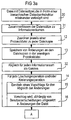
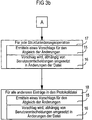
- FIGS. 3a and 3b show a flow chart which describes a third exemplary embodiment of the method according to the invention.
- this exemplary embodiment is based on a file whose data records are linked to one another in the form of a hierarchical database structure - 30. This means that only hierarchical couplings P occur in the database structure (cf. FIG. 6).
- a log file PDi is assigned 12 to each file copy DKi and all changes are stored 13 in the respective log file PDi.
- the comparison now takes place in this exemplary embodiment in such a way that an attempt is first made to achieve a comparison as a whole at the highest hierarchical level, that is to say at the respective level of the information spaces IU.
- the information space log files IUPDj are examined before the log files PDi are examined.
- this third exemplary embodiment if, for an information space IU as a whole, no agreement on transfer to the file is found, the comparison is again carried out at the level of the individual changes to data records in the information spaces IU, preferably after the in The procedure described in the first exemplary embodiment, that is to say in the sequence of first working on delete operations (create) or create operations (create) and finally the structure change operations and finally the remaining attribute change operations.
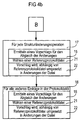
- the fourth exemplary embodiment (cf. FIGS. 4a and 4b) differs from the third exemplary embodiment shown in FIG. 3 in the same way as the second exemplary embodiment differs from the first exemplary embodiment.
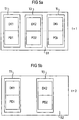
- 5a and 5b show a further development of the method for all of the exemplary embodiments described above.
- FIGS. 5a and 5b An example of three participants in a common working environment is shown in FIGS. 5a and 5b. These are a first subscriber T1, a second subscriber T2, a third subscriber T3, and further subscribers Ti.
- the subscribers T1, T2, T3 each work on a first computer R1, a second computer R2, a third computer R3, and further computers Ri.
- This decoupling designates the new composition of the common working environment with a second sequence number S2, that is to say all changes in the log files PD1 and PD3 are identified with the further sequence number S2 once the second subscriber T2 has been decoupled.
- Figures 5a and 5b are intended to illustrate the following general case. Any change in the composition of a common work environment by disconnecting or connecting a participant is identified by a unique sequence number. This considerably simplifies the procedure for comparing the individual log files and thus the file copies DKi. In other words, this means that a new sequence is generated each time at least one participant connects or at least one participant decouples from the common working environment. The generated sequence is then also the current sequence and all change operations occurring and to be saved during this sequence are assigned to this sequence and stored under this sequence.
- bracket constructions for the definition of composite change operations are taken into account in the procedure for comparing the file copies DKi.
- bracket messages that are uniquely identifiable throughout the system is necessary, at least one pair of bracket messages that has a bracket-on message and a bracket-on message.
- the respective bracketing of change operations with at least one pair of bracketing messages can be evaluated both at the central server SE and at the computers Ri.
- a further development of the methods also provides for taking account of the fact that, based on selectable specifications, change operations have priority, which relate to specific predefinable data records and / or information spaces IU.
- a room manager RM is provided, which is available in the same way on all computers. Change operations carried out at the information rooms IU are reported to the room manager RM with the aid of messages and stored in a room manager log file which is assigned to the room manager RM. With logging, all change operations that relate to entire information spaces are recorded. This way it is also possible to add or delete of information rooms IU to be taken into account in the comparison, automated or partially automated using the room manager log file. This enables the detection and correction of inconsistencies to generally available information space objects on an operation basis. Furthermore, the room manager RM carries out an access control for change operations. This takes place in that each change operation is checked by the room manager RM before the execution, whether the sender of the change operation has a right to change the respective information room IU in which the data record to be changed is located.
- each information space IU is uniquely assigned an information space log file IUPDj, an index j identifying each information space log file IUPDj and being a natural number. Changes to data records that are located in the respective information space IU are stored in the information space log files IUPDj.
Landscapes
- Engineering & Computer Science (AREA)
- Theoretical Computer Science (AREA)
- Business, Economics & Management (AREA)
- Human Resources & Organizations (AREA)
- Data Mining & Analysis (AREA)
- Strategic Management (AREA)
- Physics & Mathematics (AREA)
- General Physics & Mathematics (AREA)
- Entrepreneurship & Innovation (AREA)
- General Engineering & Computer Science (AREA)
- Databases & Information Systems (AREA)
- Economics (AREA)
- Marketing (AREA)
- Operations Research (AREA)
- Quality & Reliability (AREA)
- Tourism & Hospitality (AREA)
- General Business, Economics & Management (AREA)
- Information Retrieval, Db Structures And Fs Structures Therefor (AREA)
- Document Processing Apparatus (AREA)
Applications Claiming Priority (2)
| Application Number | Priority Date | Filing Date | Title |
|---|---|---|---|
| DE19607149 | 1996-02-26 | ||
| DE19607149A DE19607149A1 (de) | 1996-02-26 | 1996-02-26 | Verfahren zum rechnergestützten Abgleich mehrerer, in mindestens einem Rechner gespeicherten Dateikopien einer gespeicherten Datei |
Publications (2)
| Publication Number | Publication Date |
|---|---|
| EP0791884A2 true EP0791884A2 (fr) | 1997-08-27 |
| EP0791884A3 EP0791884A3 (fr) | 1998-12-09 |
Family
ID=7786451
Family Applications (1)
| Application Number | Title | Priority Date | Filing Date |
|---|---|---|---|
| EP97102891A Withdrawn EP0791884A3 (fr) | 1996-02-26 | 1997-02-21 | Procédé pour l'ajustement informatisé de plusieurs copies de fichiers d'un fichier stocké, stockées dans au moins un ordinateur |
Country Status (4)
| Country | Link |
|---|---|
| US (1) | US5948057A (fr) |
| EP (1) | EP0791884A3 (fr) |
| CN (1) | CN1130656C (fr) |
| DE (1) | DE19607149A1 (fr) |
Families Citing this family (29)
| Publication number | Priority date | Publication date | Assignee | Title |
|---|---|---|---|---|
| US6249786B1 (en) * | 1997-03-21 | 2001-06-19 | Rolf Wadewitz | Data-conversion method |
| DE19845043C1 (de) * | 1998-09-30 | 2000-03-30 | Siemens Ag | Verfahren und dessen Verwendung sowie Datenverarbeitungsvorrichtung zum Abgleichen von in verschiedenen Anwenderdateien gespeicherten Daten |
| US6947903B1 (en) * | 1999-08-06 | 2005-09-20 | Elcommerce.Com.Inc. | Method and system for monitoring a supply-chain |
| US6507865B1 (en) | 1999-08-30 | 2003-01-14 | Zaplet, Inc. | Method and system for group content collaboration |
| US6463461B1 (en) | 1999-08-30 | 2002-10-08 | Zaplet, Inc. | System for communicating information among a group of participants |
| US6457045B1 (en) | 1999-08-30 | 2002-09-24 | Zaplet, Inc. | System and method for group choice making |
| US6505233B1 (en) | 1999-08-30 | 2003-01-07 | Zaplet, Inc. | Method for communicating information among a group of participants |
| US6691153B1 (en) | 1999-08-30 | 2004-02-10 | Zaplet, Inc. | Method and system for process interaction among a group |
| US6523063B1 (en) | 1999-08-30 | 2003-02-18 | Zaplet, Inc. | Method system and program product for accessing a file using values from a redirect message string for each change of the link identifier |
| US6453337B2 (en) * | 1999-10-25 | 2002-09-17 | Zaplet, Inc. | Methods and systems to manage and track the states of electronic media |
| US7013313B1 (en) * | 1999-11-24 | 2006-03-14 | Pumatech, Inc. | System and methods for inheriting information into a dataset |
| WO2001088757A1 (fr) * | 1999-11-29 | 2001-11-22 | Interwoven, Inc. | Procede de mise en oeuvre de procedures de flux de travaux pour le developpement et l'entretien de sites web |
| US6678821B1 (en) | 2000-03-23 | 2004-01-13 | E-Witness Inc. | Method and system for restricting access to the private key of a user in a public key infrastructure |
| US6981019B1 (en) | 2000-05-02 | 2005-12-27 | International Business Machines Corporation | System and method for a computer based cooperative work system |
| AU2001296866A1 (en) | 2000-09-05 | 2002-03-22 | Zaplet, Inc. | Methods and apparatus providing electronic messages that are linked and aggregated |
| US6668254B2 (en) * | 2000-12-21 | 2003-12-23 | Fulltilt Solutions, Inc. | Method and system for importing data |
| US20030112273A1 (en) * | 2001-12-17 | 2003-06-19 | Workshare Technology, Ltd. | Document collaboration suite using a common database |
| AU2003211002A1 (en) * | 2002-02-13 | 2003-09-04 | Horizon, A Glimpse Of Tomorrow, Inc. | Distributed execution system |
| US6684372B2 (en) | 2002-03-15 | 2004-01-27 | Sun Microsystems, Inc. | Method, system and computer product to translate electronic schematic files between computer aided design platforms |
| US7277940B2 (en) * | 2002-08-29 | 2007-10-02 | Sap Ag | Managing uneven authorizations in a computer data exchange |
| US7269665B2 (en) | 2002-08-29 | 2007-09-11 | Sap Ag | Isolated mapping point |
| US7613773B2 (en) * | 2002-12-31 | 2009-11-03 | Rensselaer Polytechnic Institute | Asynchronous network audio/visual collaboration system |
| US7996673B2 (en) | 2004-05-12 | 2011-08-09 | Echoworx Corporation | System, method and computer product for sending encrypted messages to recipients where the sender does not possess the credentials of the recipient |
| CN100461684C (zh) * | 2005-02-21 | 2009-02-11 | 华东师范大学 | 基于标记和状态向量的带冲突检测的并发控制方法 |
| US8326926B2 (en) * | 2005-09-13 | 2012-12-04 | Mentor Graphics Corporation | Distributed electronic design automation architecture |
| US7792875B2 (en) * | 2006-03-30 | 2010-09-07 | International Business Machines Corporation | Method for representing and recreating object dependencies from one database system to another |
| US8386733B1 (en) * | 2008-02-15 | 2013-02-26 | Symantec Corporation | Method and apparatus for performing file-level restoration from a block-based backup file stored on a sequential storage device |
| US9519631B2 (en) | 2012-03-30 | 2016-12-13 | Microsoft Technology Licensing, Llc | Semantic diff and automerge |
| US12462095B2 (en) * | 2023-04-13 | 2025-11-04 | Microsoft Technology Licensing, Llc | Dynamic construction of large language model prompts |
Family Cites Families (5)
| Publication number | Priority date | Publication date | Assignee | Title |
|---|---|---|---|---|
| US4714996A (en) * | 1985-11-26 | 1987-12-22 | International Business Machines Corporation | Impact calculation for version management in a distributed information service |
| US5261094A (en) * | 1991-04-08 | 1993-11-09 | International Business Machines Corporation | Asynchronous replication of data changes by distributed update requests |
| US5317742A (en) * | 1991-06-21 | 1994-05-31 | Racal-Datacom, Inc. | Dynamic translation of network management primitives to queries to a database |
| US5630116A (en) * | 1993-08-11 | 1997-05-13 | Nec Corporation | Automatic delivery system for master files in a distributed processing system |
| US5588147A (en) * | 1994-01-14 | 1996-12-24 | Microsoft Corporation | Replication facility |
-
1996
- 1996-02-26 DE DE19607149A patent/DE19607149A1/de not_active Ceased
-
1997
- 1997-02-21 EP EP97102891A patent/EP0791884A3/fr not_active Withdrawn
- 1997-02-25 US US08/805,454 patent/US5948057A/en not_active Expired - Lifetime
- 1997-02-26 CN CN97104979A patent/CN1130656C/zh not_active Expired - Fee Related
Also Published As
| Publication number | Publication date |
|---|---|
| CN1130656C (zh) | 2003-12-10 |
| DE19607149A1 (de) | 1997-08-28 |
| US5948057A (en) | 1999-09-07 |
| CN1177152A (zh) | 1998-03-25 |
| EP0791884A3 (fr) | 1998-12-09 |
Similar Documents
| Publication | Publication Date | Title |
|---|---|---|
| DE19607149A1 (de) | Verfahren zum rechnergestützten Abgleich mehrerer, in mindestens einem Rechner gespeicherten Dateikopien einer gespeicherten Datei | |
| EP1151399B1 (fr) | Integration des systèmes de base de données hétérogènes | |
| DE10311082B4 (de) | Elektronikdokumentmanagementverfahren | |
| DE69902752T2 (de) | Vorrichtung und verfahren zur websiteentwicklung | |
| DE3689664T2 (de) | Verfahren und Gerät zur Verwaltung von veralteten Datenobjekten. | |
| DE3752196T2 (de) | Vorrichtung für Datenverarbeitungsverteilung über eine Mehrzahl von Steuerungsorten | |
| DE102008015662B4 (de) | Beseitigung von Daten | |
| DE69230452T2 (de) | Verfahren und Vorrichtung zur Änderungskontrolle in mehreren Entwicklungsumgebungen | |
| DE4420451C2 (de) | Sperrmechanismus für ein CHECK-IN/CHECK-OUT-Modell | |
| DE19844013A1 (de) | Strukturierter Arbeitsordner | |
| DE10112941A1 (de) | System und Verfahren für das parallele Lesen von primären und sekundären Sicherungen zur Wiederherstellung mehrerer gemeinsam benutzter Datenbankdateien | |
| DE60004211T2 (de) | Entfernung von duplizierten objekten aus einem objektspeicher | |
| EP2250588A2 (fr) | Procédé et programme de fourniture de cohérence de données dans des réseaux | |
| EP3441919A1 (fr) | Procédé d'échange de données entre les outils d'ingénierie d'un système d'ingénierie ainsi que ??système d'ingénierie permettant la mise en uvre du procédé | |
| EP0791886B1 (fr) | Procédé pour l'ajustement informatisé de plusieurs copies de fichiers d'un fichier stocké, stockées dans au moins un ordinateur | |
| EP1647898A1 (fr) | Système de replication de base de données sans serveur | |
| DE19607131B4 (de) | Verfahren zum rechnergestützten Abgleich mehrerer, in mindestens einem Rechner gespeicherten Dateikopien einer gespeicherten Datei | |
| EP0791885A2 (fr) | Procédé pour l'ajustement informatisé de plusieurs copies de fichiers d'un fichier stocké, stockées dans au moins un ordinateur | |
| EP1605368A1 (fr) | Génération des fichiers electroniques de signatures | |
| EP1414591B1 (fr) | Procede de production automatique de donnees en sequences reparties actuelles | |
| WO2000007116A1 (fr) | Procede, dispositif et jeu de dispositifs pour l'elimination d'au moins une inconsistance dans un ensemble de banques de donnees comportant une banque de donnees et au moins une banque de donnees de copie de ladite banque de donnees | |
| WO2019046872A1 (fr) | Procédé de comparaison de deux graphiques | |
| DE102006005840B4 (de) | Verfahren zum gemeinsamen Bearbeiten einer Datenmenge sowie ein Netzwerksystem und ein Kommunikationssystem zur Durchführung des Verfahrens | |
| DE10203775A1 (de) | Verfahren und Systemkonfiguration zum Verarbeiten von Daten eines Online-Systems | |
| DE10358040A1 (de) | Verfahren und System zur Sicherung der Datenkonsistenz bei Geschäftsprozessen, insbesondere bei der Anlagenprojektierung |
Legal Events
| Date | Code | Title | Description |
|---|---|---|---|
| PUAI | Public reference made under article 153(3) epc to a published international application that has entered the european phase |
Free format text: ORIGINAL CODE: 0009012 |
|
| AK | Designated contracting states |
Kind code of ref document: A2 Designated state(s): DE FR GB IT |
|
| PUAL | Search report despatched |
Free format text: ORIGINAL CODE: 0009013 |
|
| AK | Designated contracting states |
Kind code of ref document: A3 Designated state(s): DE FR GB IT |
|
| 17P | Request for examination filed |
Effective date: 19990305 |
|
| 17Q | First examination report despatched |
Effective date: 20040803 |
|
| STAA | Information on the status of an ep patent application or granted ep patent |
Free format text: STATUS: THE APPLICATION IS DEEMED TO BE WITHDRAWN |
|
| 18D | Application deemed to be withdrawn |
Effective date: 20041214 |