EP0791839B1 - Procédé et dispositif de détection de présence d'une être vivant d'espèce particulière dans un espace surveillé par un capteur Doppler - Google Patents
Procédé et dispositif de détection de présence d'une être vivant d'espèce particulière dans un espace surveillé par un capteur Doppler Download PDFInfo
- Publication number
- EP0791839B1 EP0791839B1 EP97400356A EP97400356A EP0791839B1 EP 0791839 B1 EP0791839 B1 EP 0791839B1 EP 97400356 A EP97400356 A EP 97400356A EP 97400356 A EP97400356 A EP 97400356A EP 0791839 B1 EP0791839 B1 EP 0791839B1
- Authority
- EP
- European Patent Office
- Prior art keywords
- signal
- energy
- frequency
- living
- analogue
- Prior art date
- Legal status (The legal status is an assumption and is not a legal conclusion. Google has not performed a legal analysis and makes no representation as to the accuracy of the status listed.)
- Expired - Lifetime
Links
- 238000000034 method Methods 0.000 title claims description 28
- 238000001914 filtration Methods 0.000 claims description 24
- 238000012360 testing method Methods 0.000 claims description 23
- 241000282414 Homo sapiens Species 0.000 claims description 22
- 230000033001 locomotion Effects 0.000 claims description 20
- 238000012545 processing Methods 0.000 claims description 13
- 238000001514 detection method Methods 0.000 claims description 12
- 230000015654 memory Effects 0.000 claims description 11
- 238000001228 spectrum Methods 0.000 claims description 9
- 230000000694 effects Effects 0.000 claims description 8
- 230000008030 elimination Effects 0.000 claims description 8
- 238000003379 elimination reaction Methods 0.000 claims description 8
- 230000003044 adaptive effect Effects 0.000 claims description 7
- 230000003321 amplification Effects 0.000 claims description 5
- 238000003199 nucleic acid amplification method Methods 0.000 claims description 5
- 230000006870 function Effects 0.000 claims description 3
- 238000006243 chemical reaction Methods 0.000 claims 2
- 238000007493 shaping process Methods 0.000 claims 1
- 241000894007 species Species 0.000 description 16
- 230000008569 process Effects 0.000 description 12
- 238000004364 calculation method Methods 0.000 description 11
- 230000000875 corresponding effect Effects 0.000 description 9
- 230000003595 spectral effect Effects 0.000 description 8
- 238000004458 analytical method Methods 0.000 description 7
- 230000009466 transformation Effects 0.000 description 6
- 230000003071 parasitic effect Effects 0.000 description 5
- 230000000737 periodic effect Effects 0.000 description 5
- OVXZVDMCQPLHIY-QXGOIDDHSA-L calcium;4-[[(2r)-2,4-dihydroxy-3,3-dimethylbutanoyl]amino]butanoate Chemical compound [Ca+2].OCC(C)(C)[C@@H](O)C(=O)NCCCC([O-])=O.OCC(C)(C)[C@@H](O)C(=O)NCCCC([O-])=O OVXZVDMCQPLHIY-QXGOIDDHSA-L 0.000 description 4
- 238000010586 diagram Methods 0.000 description 4
- 244000045947 parasite Species 0.000 description 4
- 230000005855 radiation Effects 0.000 description 4
- 230000002123 temporal effect Effects 0.000 description 4
- 230000009471 action Effects 0.000 description 3
- 238000010009 beating Methods 0.000 description 3
- 230000004044 response Effects 0.000 description 3
- 101100536354 Drosophila melanogaster tant gene Proteins 0.000 description 2
- 241000282412 Homo Species 0.000 description 2
- 230000008901 benefit Effects 0.000 description 2
- 238000011161 development Methods 0.000 description 2
- 239000006185 dispersion Substances 0.000 description 2
- 238000006073 displacement reaction Methods 0.000 description 2
- 230000033764 rhythmic process Effects 0.000 description 2
- 238000005070 sampling Methods 0.000 description 2
- 230000035945 sensitivity Effects 0.000 description 2
- XLYOFNOQVPJJNP-UHFFFAOYSA-N water Substances O XLYOFNOQVPJJNP-UHFFFAOYSA-N 0.000 description 2
- 230000002159 abnormal effect Effects 0.000 description 1
- 230000005540 biological transmission Effects 0.000 description 1
- 230000001276 controlling effect Effects 0.000 description 1
- 230000002596 correlated effect Effects 0.000 description 1
- 238000010219 correlation analysis Methods 0.000 description 1
- 125000004122 cyclic group Chemical group 0.000 description 1
- 229940082150 encore Drugs 0.000 description 1
- 235000021183 entrée Nutrition 0.000 description 1
- 230000005021 gait Effects 0.000 description 1
- 230000002452 interceptive effect Effects 0.000 description 1
- 238000012544 monitoring process Methods 0.000 description 1
- 238000010606 normalization Methods 0.000 description 1
- 230000003287 optical effect Effects 0.000 description 1
- 230000010355 oscillation Effects 0.000 description 1
- 238000005192 partition Methods 0.000 description 1
- 230000001681 protective effect Effects 0.000 description 1
- 230000029058 respiratory gaseous exchange Effects 0.000 description 1
- 230000000717 retained effect Effects 0.000 description 1
- 230000007704 transition Effects 0.000 description 1
- 238000001429 visible spectrum Methods 0.000 description 1
- 230000021542 voluntary musculoskeletal movement Effects 0.000 description 1
Images
Classifications
-
- G—PHYSICS
- G01—MEASURING; TESTING
- G01S—RADIO DIRECTION-FINDING; RADIO NAVIGATION; DETERMINING DISTANCE OR VELOCITY BY USE OF RADIO WAVES; LOCATING OR PRESENCE-DETECTING BY USE OF THE REFLECTION OR RERADIATION OF RADIO WAVES; ANALOGOUS ARRANGEMENTS USING OTHER WAVES
- G01S7/00—Details of systems according to groups G01S13/00, G01S15/00, G01S17/00
- G01S7/02—Details of systems according to groups G01S13/00, G01S15/00, G01S17/00 of systems according to group G01S13/00
- G01S7/41—Details of systems according to groups G01S13/00, G01S15/00, G01S17/00 of systems according to group G01S13/00 using analysis of echo signal for target characterisation; Target signature; Target cross-section
- G01S7/415—Identification of targets based on measurements of movement associated with the target
-
- G—PHYSICS
- G01—MEASURING; TESTING
- G01S—RADIO DIRECTION-FINDING; RADIO NAVIGATION; DETERMINING DISTANCE OR VELOCITY BY USE OF RADIO WAVES; LOCATING OR PRESENCE-DETECTING BY USE OF THE REFLECTION OR RERADIATION OF RADIO WAVES; ANALOGOUS ARRANGEMENTS USING OTHER WAVES
- G01S13/00—Systems using the reflection or reradiation of radio waves, e.g. radar systems; Analogous systems using reflection or reradiation of waves whose nature or wavelength is irrelevant or unspecified
- G01S13/02—Systems using reflection of radio waves, e.g. primary radar systems; Analogous systems
- G01S13/50—Systems of measurement based on relative movement of target
- G01S13/52—Discriminating between fixed and moving objects or between objects moving at different speeds
- G01S13/56—Discriminating between fixed and moving objects or between objects moving at different speeds for presence detection
Definitions
- the invention relates to a method for detecting the presence of a being living of a particular species, in particular of human species, in a space monitored where is placed a microwave Doppler sensor delivering a signal low frequency by beating between an emitted wave and a reflected wave, shifted in frequency by Doppler-Fizeau effect, by a moving target in the monitored space, process by which the signal, after amplification and filtering if any, is processed to appear in the spectrum of frequency of the signal from the sensor, peculiarities specific to the species of the living being so that the presence of such a being is recognized alone.
- the invention also relates to a device for implementing the process discussed above.
- the sensors can be acoustic, in audible and especially ultrasonic, optical fields in the visible spectrum or infrared, and electromagnetic (pulse or Doppler radars). Except for the video surveillance cameras, which practically require security, the most used sensors are infrared sensors and sensors Doppler microwave, which operate by beating between an emitted wave, generally continuous, and a reflected wave, shifted in frequency, by a target intruder in motion.
- EP-A-0 600 571 a system electronic detection of life by microwave waves reflected by a being alive and modulated by the body's oscillations, comprising a device for transmitting / receiving microwave waves and devices intended to process the reflected signal in order to highlight the frequencies corresponding to the life functions of this living being.
- This treatment of the reflected signal is based on filtering and amplifying the difference between the signal transmitted and the signal received in a determined frequency band considered to be rich in information on living things that we seek to detect.
- This document does not teach how to take advantage of the Doppler-Fizeau effect caused by the movements of said living being; moreover, this effect cannot be highlighted by performing the product (not the difference) of the signal received with the signal transmitted.
- Document US-A-4 400 700 describes a method of analysis in Doppler-Fizeau frequencies of radar signals to detect human targets. It proposes the use of a frequency modulation loop detector frequency lock designed to detect frequency modulation caused by the target's footsteps. The detected step frequencies are divided into several representative bands of targets walking at different gaits, that is to say at different step rates.
- a battery of analog bandpass filters at the exit of the detector frequency modulation with frequency lock loop is provided a battery of analog bandpass filters, each followed by a detector level acting on an indicator light when a predetermined level is achieved.
- this document proposes to eliminate the average speed of move the target relative to the sensors and focus only on fluctuations in this speed, one or more frequencies of which are determined dominant by a bank of analog filters.
- the invention is very precisely situated in this field, even if it is not not impossible that an intrusion detection system implements infrared sensors together with Doppler sensors which put in works the invention.
- formula (I) is that of the non-relativistic Doppler effect, which in practice merges with the relativistic Doppler-Fizeau effect, due to the very low value of the ratio v r / c.
- the Doppler sensors are not hampered by the response to fixed targets formed by fixed structures surrounding, like the walls and partitions and the furnishings of monitored premises, insofar as the sensors are not swiveling to sweep the space to be monitored.
- the choice of pivoting speed allows delimit relative radial velocities of fixed obstacles relative to sensors, and frequency offsets to avoid interfering with useful signals or ignore them by signal processing.
- the use of signals from a Doppler sensor assumes filtering with bandwidth appropriate for, on the one hand, improving the relationship signal / noise by reducing the input noise (the power white noise is proportional to the width of the band bandwidth), and, on the other hand, eliminate frequencies undesirable, such as those resulting from scanning sensor direction.
- the NF C 48 229 standard relating to intrusion detection, set a range of target speeds between 0.3 and 3 m / s, where to monitor the intrusion.
- a base frequency of 9.9 GHz X band allocated by the Telecommunications
- the limit frequencies are 19.9 and 199 Hz, i.e. practically 20-200 Hz.
- Fluorescent tubes create spurious signals by reflection of microwave signals on the plasma formed by the discharge at each half-wave of the network.
- the signal received by the sensor in return is modulated with a fundamental at 100 hertz, and a very wide spectrum of harmonics.
- the subject of the invention is a method for detecting presence of a living being of a particular species where processes the signals from a Doppler sensor so recognize, with a good degree of certainty, the presence of a be alive from this particular species.
- Steps (a) to (c) of the process according to the invention result in essentially eliminating spurious signals periodicals; step (a) reduces noise at the entrance, step (b) identifies the presence of dominant frequencies by autocorrelation, and controls the setting of the step filtering (c) to stop the dominant digitized frequencies, of a consistently and with minimization of the risks of distortion.
- step (d) which stops the signals lacking information (after elimination of the dominant frequencies)
- step (e) where the preferred frequency band is selected, which rids the signals of their unnecessary components
- step (f) where is judged, with a minimum risk of error, if a living being of the particular species is present or not in the monitored space.
- steps (b) and (c) are repeated until elimination of dominant frequencies, before passing step (d).
- the monitored space is the seat of several parasitic phenomena, or that the same parasitic source generates several dominant frequencies.
- the various filtering steps will be followed stages where the overall amplitude of the signal is brought back to a normalized level, this which facilitates consecutive digital processing.
- This device is capable of implementing the method according to the invention.
- a Doppler sensor 1 for discrimination of 1 Hz emits, in a monitored space, a beam of microwave radiation, at frequency f0, here at 9.9 GHz, and receives radiation reflected by obstacles present in the monitored space.
- Sensor 1 makes the emitted radiation beat and reflected to extract the frequency ⁇ f. This is amplified by a low noise amplifier 2 and filtered to through a 3 low-pass filter with cut-off frequency 200 Hz, to limit noise (proportional to bandwidth) and avoid aliasing. Then the signal is applied to an analog / digital converter 4, with a frequency 512 Hz sampling.
- the signal digitized is sent to a microprocessor 30, to which are associated two memories 31 and 32, respectively containing the signal processing programming elements and a reference signature, which will be discussed later.
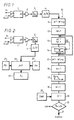
- the processing as a whole represented by the reference 10, of the digitized signal from the converter analog / digital 4 includes steps 11 to 20, which will first be stated with the proper result that they provide, while the computational processes which they understand will be described in a second step.
- This treatment takes place in successive cycles during one second (512 samples) corresponding to a compromise between the resolution of the necessary analysis, the ability to microprocessor calculation, and the speed of detection of desirable presence.
- Step 11 consists in determining the energy contained in the Doppler signal, and eliminating the signals having an energy lower than a threshold energy, this threshold energy corresponding to the discrimination between the noise and the Doppler signals. These two operations are symbolized by the formulas W? and W> w 0 .
- the discrimination by energy level was chosen in preference to the discrimination by amplitude level because of the random nature of the noise. Indeed, the probability of translating a noise peak into a real Doppler signal must be very low, and the energy distribution of the noise has a standard deviation proportionally much lower than that of the amplitude distribution.
- the average noise power is 1.24.10 -3 V 2 and the standard deviation is 9.09.10 -5 V 2 ; by setting the threshold energy at six standard deviations above the average noise energy, ie at 1.79.10 -3 V 2 the probability of taking Gaussian noise into account as useful signal is once in 32 years for an iteration of a second.
- Step 12 consists of resetting the signal from step 11, or standardization, the operations of signature comparisons assuming that the signals compared are of similar amplitudes.
- Steps 13 and 14 are planned to eliminate the dominant frequencies resulting from spurious signals at marked periodic character.
- Step 13 consists of a test autocorrelation (AC!) which highlights the dominant frequencies (Fd).
- the stage 14 is a rejection filtering (self-adaptive filtering in digital) on the dominant frequency (Fd) highlighted at step 13.
- Steps 13 and 14 are repeated, if more than one dominant frequency has been detected, to eliminate all of these dominant frequencies.
- step 15 the energy of the signal is determined after elimination of the dominant frequencies, and the signals of energy below a threshold are eliminated, these signals being deemed to contain no useful information, these operations are symbolized by the W formulas? and W> w 1 .
- Step 17 consists of filtering with a bandpass filter corresponding to an interval of approximately 15 to 35 Hz.
- analyzes of human signatures carried out during the development point of the invention have made it possible to discover that practically all human signatures had stable peculiarities in this spectral domain, while the parasitic signatures remaining in the signal from step 16 had no susceptible components to interfere with human signatures in this interval.
- the filter which should distort minimum energy of the spectrum, with a response curve flat in the band, is a Butterworth band pass whose characteristics (low cut-off frequency, frequency high cut-off and order) are properly fixed. In practice, the low and high cut-off frequencies retained are 16 and 34 Hz respectively, and the order is 6.
- the filtering is followed by a search for presence of signal after filtering.
- step 18 a normalization of the signal from filtering step 17, similar to steps 12 and 16, and for the same reason.
- step 19 a temporal cross-correlation test is carried out with a reference signal S REF contained in a memory 32, this test providing an interspectral energy rate T W.
- This step 19 is symbolized by the formula IC !.
- the reference signal S REF was obtained by the following process:
- the movement characteristics of the selected signature have been a transverse movement at a distance of 3 m and a speed of 1.4 m / s (5 km / h).
- step 20 the interspectral energy rate T W determined in step 19 is compared to a threshold energy T 0 (operation symbolized by T W > T 0 ). If the answer is YES, a signal is emitted on output 21, corresponding to the detection of the presence of a human being in the monitored space.
- the rate of interspectral energy with several threshold energies, to define several levels of certainty of the presence of a human being in the monitored space.
- the signal T W is then sent to an intercorrelation spectrum analyzer 33.
- the appearance of an interspectral energy rate greater than a low threshold energy will trigger an appropriate analysis of the cross-correlation spectrum, to cause different actions depending on the degree of certainty of presence and the risk involved.
- the signal consists of 512 samples per second, which are transferred to a buffer in cycles of one second (first phase of step 11). The samples are then upgraded by division by 0.2 and stored in a second buffer.
- This step 12 includes standardization; the calculation of the series of normalized values involves a factor of multiplication of the terms of the input series, after windowing, by 10 divided by the difference between the values maximum and minimum amplitudes of the input series.
- the sequence r 4 (j) is completed by giving it the value 0 for the terms 2045 to 2047.
- double autocorrelation allows detect two dominant frequencies of neighboring energies, and not an average frequency.
- Step 14 includes adaptive filtering. We use a order 3 Butterworth rejector filter whose frequencies low and high cutoff values are 0.95 fe and 1.05 fe.
- Steps 13 and 14 are repeated if, on leaving step 14, it still appears a dominant frequency.
- Step 15 includes an estimate of the power spectral, with a Fourier transformation by a formula similar to formula (2) and a spectral energy calculation by a formula similar to formula (3).
- spectral energy is compared to a threshold, and the processing stopped if the signal energy is below this threshold, this which means that, initially, only the periodic spurious signals.
- Step 16 is a refresher, or standardization of the signal.
- Step 17 is, as we have seen, filtering through a Butterworth filter of order 6, with low and high frequencies of 16 and 34 Hz, respectively.
- the coefficients a (k) are precalculated and the processing consists in calculating the series
- Signal x6 is analyzed to determine if it has significant spectral energy, with a transformation of Fourier (formula (2)), a calculation of spectral power (formula (3)) and a determination of peak power.
- step 19 If the signal has significant energy, it is again normalized, so that the cross-correlation from step 19 be effective.
- step 19 if we call y (k) the reference signature kept in memory 32, the cross-correlation between the two signals x 7 (k) from step 18 and y (k) is given through
- the spectral power P 15 (n) R * 6 (n).
- R 6 (n) / 1024 2 is calculated, then the estimated power. This is compared to a threshold in step 20.
- the presence detection process of a living being has based on a careful analysis of the peculiarities printed to the Doppler signal by this human being specifically, especially regardless of his voluntary movements, as well as a careful analysis of spurious signatures which may alter the Doppler signal, and that processing the signal was designed to, on the one hand, eliminate the components of the signal likely to mask the human signature, and on the other hand, isolate an area where the human signature brings together the majority of its stable features.
- the detection of the presence of a living being is not limited to detection of an intrusion into a monitored space or premises.
- the response to a detection of presence may not be a protective action, such as alarm. It is possible to monitor the presence of a being human at a workstation, or even just to order lighting a room, or part of a room.
- detecting the presence of living things other than humans by using a signature of specific reference determined by a process analogous to the one who allowed to choose a human signature of reference, is possible and may have aspects interesting, whether it's controlling the presence or the absence of the living being of a chosen species.
Landscapes
- Engineering & Computer Science (AREA)
- Radar, Positioning & Navigation (AREA)
- Remote Sensing (AREA)
- Computer Networks & Wireless Communication (AREA)
- Physics & Mathematics (AREA)
- General Physics & Mathematics (AREA)
- Radar Systems Or Details Thereof (AREA)
- Burglar Alarm Systems (AREA)
Description
- la figure 1 est un diagramme des opérations que comporte le procédé de l'invention;
- la figure 2 est un schéma d'organisation des dispositifs qui permettent de mettre en oeuvre le procédé de l'invention.




Claims (12)
- Procédé de détection de présence d'un être vivant d'espèce particulière, notamment d'espèce humaine, dans un espace surveillé où est disposé un capteur Doppler hyperfréquence délivrant un signal basse fréquence par battement entre une onde émise et une onde réfléchie, décalée en fréquence par effet Doppler-Fizeau, par une cible en mouvement dans l'espace surveillé, procédé suivant lequel le signal, après amplification et filtrage le cas échéant, est traité pour faire apparaítre, dans le spectre de fréquence du signal issu du capteur, des particularités propres à l'espèce de l'être vivant afin que la présence d'un tel être soit seule reconnue, caractérisé en ce que le traitement du signal est effectué après numérisation et comprend les étapes suivantes :a) détermination (11) de l'énergie globale du signal numérisé, et élimination des signaux d'énergie inférieure à une énergie de seuil ;b) application (13) au signal issu de (a) d'au moins un test d'autocorrélation propre à déceler la présence éventuelle d'une fréquence dominante ;c) filtrage (14) du signal numérisé à travers un filtre adaptatif réglé en réjection sur la fréquence dominante décelée à l'étape (b) ;d) détermination (15) de l'énergie globale du signal issu du filtrage de l'étape (c), et élimination des signaux d'énergie inférieure à une énergie de seuil ;e) filtrage (17) du signal issu de (d) pour isoler une bande de fréquence déterminée en tant que stable et spécifique de mouvements de l'espèce particulière de l'être vivant ;f) application (19) au signal issu de (e) d'un test d'intercorrélation temporelle avec un signal de référence, spécifique de l'espèce particulière de l'être vivant, conservé en mémoire, pour définir un taux d'énergie interspectrale et émission (20) d'au moins un signal à deux états correspondant à des taux d'énergie interspectrale respectivement supérieur et inférieur à une énergie de seuil.
- Procédé suivant la revendication 1, caractérisé en ce que, à l'étape (b), le test d'autocorrélation (13) est double.
- Procédé suivant la revendication 2, caractérisé en ce que les étapes (b) (13) et (c) (14) sont réitérées jusqu'à élimination de fréquences dominantes, avant de passer à l'étape (d).
- Procédé suivant l'une quelconque des revendications 1 à 3, caractérisé en ce que, entre les étapes (a) et (b), on intercale une étape (a') (12) où l'énergie globale du signal est ramenée à une valeur normalisée.
- Procédé suivant l'une quelconque des revendications 1 à 4, caractérisé en ce que, entre les étapes (d) et (e), on intercale une étape (d') (16) où l'énergie globale du signal est ramenée à une valeur normalisée.
- Procédé suivant l'une quelconque des revendications 1 à 5, caractérisé en ce que, à l'étape (e), le signal traverse un filtre (17) passe-bande correspondant à un intervalle d'environ 15 à 35 Hz.
- Procédé suivant l'une quelconque des revendications 1 à 6, caractérisé en ce que, entre les étapes (e) et (f), on intercale une étape (e') (18) où l'énergie globale du signal est ramenée à une valeur normalisée.
- Dispositif de détection de présence d'un être vivant d'espèce particulière, notamment d'espèce humaine, dans un espace surveillé, à sélectivité accrue, comportant un capteur Doppler (1) hyperfréquence propre à délivrer, par battement entre une onde émise et une onde réfléchie par une cible en mouvement dans l'espace surveillé, un signal basse fréquence fonction des mouvements relatifs de la cible par rapport au capteur, caractérisé en ce qu'il comporte en outre des moyens de numérisation (4) du signal issu du capteur après amplification (2) et filtrage (3) le cas échéant, des moyens de traitement comprenant un microprocesseur (30), avec des programmes associés et au moins une mémoire (31, 32), pour mettre en forme appropriée et comparer le signal numérisé à des signaux de référence pour déceler, dans le spectre de fréquence du signal issu du capteur (1) des particularités propres à l'espèce particulière de l'être vivant, dispositif également caractérisé en ce qu'il comporte :(m) - des moyens (11) pour déterminer l'énergie globale du signal numérisé, et éliminer les signaux d'énergie inférieure à une énergie de seuil,(n) - des moyens (13) pour appliquer au signal issu des moyens précédents au moins un test d'autocorrélation propre à faire ressortir la présence éventuelle d'une fréquence dominante,(p) - un premier filtre (14) adaptatif recevant en entrée le signal numérisé et réglé en réjection sur la fréquence dominante décelée par le test d'autocorrélation,(q) - des moyens comparateurs (15) pour déterminer l'énergie globale du signal filtré par le premier filtre adaptatif, capables d'éliminer les signaux d'énergie globale inférieure à un seuil,(r) - un second filtre (17) recevant le signal issu des moyens comparateurs et réglé pour isoler une bande de fréquence déterminée en tant que stable et spécifique des mouvements de l'espèce particulière de l'être vivant,(s) - et des moyens (19) pour appliquer au signal, réduit à la bande de fréquence déterminée citée précédemment, un test d'intercorrélation temporelle avec un signal de référence conservé en mémoire (32), spécifique de l'espèce particulière d'être vivant, le test définissant un taux d'énergie interspectrale, et pour émettre au moins un signal à deux états correspondant à un taux d'énergie interspectrale respectivement supérieur et inférieur à un seuil.
- Dispositif selon la revendication 8, caractérisé en ce que les moyens énoncés aux points (m), (n), (p), (q), (r), (s) sont constitués par la mise en oeuvre de programmes de calculs appropriés associés au microprocesseur (30) de traitement, en séquence.
- Dispositif selon l'une des revendications 8 et 9, caractérisé en ce que le capteur Doppler (1) émet à la fréquence de 9,9 GHz.
- Dispositif selon l'une quelconque des revendications 8 à 10, caractérisé en ce que le signal de référence correspond à un déplacement latéral d'un être humain à une distance de 3 m du capteur Doppler (1), à une vitesse de 1,4 m/s.
- Application d'un dispositif selon l'une des revendications 8 à 11 à la détection d'intrusion d'un individu dans un espace protégé.
Applications Claiming Priority (2)
| Application Number | Priority Date | Filing Date | Title |
|---|---|---|---|
| FR9602147 | 1996-02-21 | ||
| FR9602147A FR2745093B1 (fr) | 1996-02-21 | 1996-02-21 | Procede et dispositif de detection de presence d'un etre vivant d'espece particuliere dans un espace surveille par un capteur doppler |
Publications (2)
| Publication Number | Publication Date |
|---|---|
| EP0791839A1 EP0791839A1 (fr) | 1997-08-27 |
| EP0791839B1 true EP0791839B1 (fr) | 2001-11-21 |
Family
ID=9489439
Family Applications (1)
| Application Number | Title | Priority Date | Filing Date |
|---|---|---|---|
| EP97400356A Expired - Lifetime EP0791839B1 (fr) | 1996-02-21 | 1997-02-18 | Procédé et dispositif de détection de présence d'une être vivant d'espèce particulière dans un espace surveillé par un capteur Doppler |
Country Status (6)
| Country | Link |
|---|---|
| US (1) | US5760687A (fr) |
| EP (1) | EP0791839B1 (fr) |
| JP (1) | JP3747110B2 (fr) |
| DE (1) | DE69708352T2 (fr) |
| FR (1) | FR2745093B1 (fr) |
| IL (1) | IL120244A (fr) |
Cited By (1)
| Publication number | Priority date | Publication date | Assignee | Title |
|---|---|---|---|---|
| WO2009062773A1 (fr) | 2007-11-15 | 2009-05-22 | Robert Bosch Gmbh | Procédé de détection de la présence d'un être vivant |
Families Citing this family (39)
| Publication number | Priority date | Publication date | Assignee | Title |
|---|---|---|---|---|
| IL121068A (en) * | 1997-06-12 | 2000-11-21 | Visonic Ltd | Method and apparatus for detecting the presence of a moving object in a detection area |
| US6759954B1 (en) * | 1997-10-15 | 2004-07-06 | Hubbell Incorporated | Multi-dimensional vector-based occupancy sensor and method of operating same |
| US6351678B1 (en) | 1997-11-07 | 2002-02-26 | Hill-Rom Services, Inc. | Medical equipment controller |
| AU6109499A (en) * | 1998-09-30 | 2000-04-17 | Arkonia Systems Limited | Object identification apparatus |
| US6307475B1 (en) | 1999-02-26 | 2001-10-23 | Eric D. Kelley | Location method and system for detecting movement within a building |
| CA2445161A1 (fr) * | 2001-05-08 | 2002-11-14 | Hill-Rom Services, Inc. | Systeme de suivi et de localisation d'un article |
| US7242306B2 (en) | 2001-05-08 | 2007-07-10 | Hill-Rom Services, Inc. | Article locating and tracking apparatus and method |
| WO2003050370A1 (fr) * | 2001-12-10 | 2003-06-19 | Omron Co., Ltd. | Capteur d'objet et controleur |
| GB0202080D0 (en) * | 2002-01-30 | 2002-03-13 | Intelligent Sensors Ltd | Detection of objects |
| US7811234B2 (en) * | 2002-08-01 | 2010-10-12 | California Institute Of Technology | Remote-sensing method and device |
| US7272431B2 (en) * | 2002-08-01 | 2007-09-18 | California Institute Of Technology | Remote-sensing method and device |
| AU2003275297A1 (en) * | 2002-09-27 | 2004-04-23 | Hill-Rom Services, Inc. | Universal communications, monitoring, tracking, and control system for a healthcare facility |
| US7780596B2 (en) * | 2002-10-17 | 2010-08-24 | The Johns Hopkins University | Non-invasive health monitor |
| DE10259522A1 (de) * | 2002-12-19 | 2004-07-01 | Robert Bosch Gmbh | Radargestützte Sensierung von Lage und/oder Bewegung des Körpers oder im Körper von Lebewesen |
| US7626608B2 (en) | 2003-07-10 | 2009-12-01 | Sony Corporation | Object detecting apparatus and method, program and recording medium used therewith, monitoring system and method, information processing apparatus and method, and recording medium and program used therewith |
| US20070080801A1 (en) * | 2003-10-16 | 2007-04-12 | Weismiller Matthew W | Universal communications, monitoring, tracking, and control system for a healthcare facility |
| JP3724493B2 (ja) * | 2004-03-15 | 2005-12-07 | オムロン株式会社 | 侵入者検知装置、侵入者威嚇装置、および車両用侵入者威嚇装置 |
| US7471652B2 (en) * | 2004-12-16 | 2008-12-30 | Tektronix, Inc. | Real-time RF/IF signature trigger |
| US7154434B1 (en) * | 2005-09-12 | 2006-12-26 | The Boeing Company | Anti-personnel airborne radar application |
| US7541924B2 (en) * | 2006-02-06 | 2009-06-02 | Cooper Technologies Company | Infrared occupancy sensor |
| US7889053B2 (en) * | 2006-04-05 | 2011-02-15 | California Institute Of Technology | Remote, non-contacting personnel bio-identification using microwave radiation |
| US8232866B2 (en) * | 2006-04-05 | 2012-07-31 | California Institute Of Technology | Systems and methods for remote long standoff biometric identification using microwave cardiac signals |
| US7817082B2 (en) * | 2007-03-11 | 2010-10-19 | Vawd Applied Science And Technology Corporation | Multi frequency spectral imaging radar system and method of target classification |
| JP5222190B2 (ja) * | 2009-03-19 | 2013-06-26 | パナソニック株式会社 | ドップラセンサ |
| US7924212B2 (en) * | 2009-08-10 | 2011-04-12 | Robert Bosch Gmbh | Method for human only activity detection based on radar signals |
| JP2012168048A (ja) * | 2011-02-15 | 2012-09-06 | Panasonic Corp | ドップラーセンサ及び該ドップラーセンサを用いた照明器具 |
| US9383438B2 (en) * | 2011-04-04 | 2016-07-05 | Mitsubishi Electric Corporation | Presence detection system, presence detection method, and program |
| US9492099B2 (en) | 2012-03-19 | 2016-11-15 | Advanced Telesensors, Inc. | System and method for facilitating reflectometric detection of physiologic activity |
| WO2014172668A1 (fr) | 2013-04-18 | 2014-10-23 | California Institute Of Technology | Radars de détection de vie |
| JP6135280B2 (ja) * | 2013-04-26 | 2017-05-31 | 沖電気工業株式会社 | 特徴量算出装置、特徴量算出方法およびプログラム |
| US9986934B2 (en) | 2014-01-29 | 2018-06-05 | California Institute Of Technology | Microwave radar sensor modules |
| US9613508B2 (en) | 2014-03-31 | 2017-04-04 | Electronics And Telecommunications Research Institute | Security monitoring apparatus and method using correlation coefficient variation pattern of sound field spectrum |
| US10055959B1 (en) * | 2015-10-06 | 2018-08-21 | National Technology & Engineering Solutions Of Sandia, Llc | Systems and methods for intrusion detection using GHz beams |
| US10473762B2 (en) * | 2016-08-15 | 2019-11-12 | Microsoft Technology Licensing, Llc | Wireless radio module |
| CA3058796C (fr) * | 2017-04-03 | 2023-10-03 | GE Lighting Solutions, LLC | Systeme et procede de detection de presence |
| TW202012960A (zh) * | 2018-08-31 | 2020-04-01 | 鄒高迪 | 微波探測器及其應用 |
| US11886267B2 (en) | 2019-01-08 | 2024-01-30 | Advanced Telesensors, Inc. | User presence detection systems for control of electronic devices |
| US11826173B2 (en) | 2019-10-31 | 2023-11-28 | Advanced Telesensors, Inc. | System and method to compensate for transit-induced vibration when detecting heart rate using radar sensors |
| CN120370098B (zh) * | 2025-06-26 | 2025-09-02 | 东方电子股份有限公司 | 一种用于分布式电力线路的故障测距与故障定位系统 |
Family Cites Families (10)
| Publication number | Priority date | Publication date | Assignee | Title |
|---|---|---|---|---|
| US3614779A (en) * | 1962-12-14 | 1971-10-19 | Us Army | Radar target identification system |
| US3760400A (en) * | 1972-02-10 | 1973-09-18 | Aerospace Res | Intrusion detection system employing quadrature sampling |
| US4290126A (en) * | 1979-11-09 | 1981-09-15 | General Electric Company | Ultrasonic intrusion alarm system |
| US4400700A (en) * | 1981-06-08 | 1983-08-23 | The United States Of America As Represented By The Secretary Of The Army | Doppler frequency analysis of radar signals |
| US4958638A (en) * | 1988-06-30 | 1990-09-25 | Georgia Tech Research Corporation | Non-contact vital signs monitor |
| US4952939A (en) * | 1989-02-16 | 1990-08-28 | Seed Willian R | Radar intrusion detection system |
| US5150099A (en) * | 1990-07-19 | 1992-09-22 | Lienau Richard M | Home security system and methodology for implementing the same |
| DE4241664C2 (de) * | 1992-12-04 | 1995-04-06 | Borus Spezialverfahren | Elektronisches Lebensdetektionssystem |
| US5345240A (en) * | 1993-08-04 | 1994-09-06 | Hughes Missile Systems Company | Handheld obstacle penetrating motion detecting radar |
| US5576977A (en) * | 1995-04-27 | 1996-11-19 | Alarm Device Manufacturing Company | Filter for eliminating the effects of fluorescent lights on microwave transceivers |
-
1996
- 1996-02-21 FR FR9602147A patent/FR2745093B1/fr not_active Expired - Fee Related
-
1997
- 1997-02-17 IL IL12024497A patent/IL120244A/xx not_active IP Right Cessation
- 1997-02-18 EP EP97400356A patent/EP0791839B1/fr not_active Expired - Lifetime
- 1997-02-18 DE DE69708352T patent/DE69708352T2/de not_active Expired - Fee Related
- 1997-02-21 US US08/803,747 patent/US5760687A/en not_active Expired - Fee Related
- 1997-02-21 JP JP03769297A patent/JP3747110B2/ja not_active Expired - Fee Related
Cited By (1)
| Publication number | Priority date | Publication date | Assignee | Title |
|---|---|---|---|---|
| WO2009062773A1 (fr) | 2007-11-15 | 2009-05-22 | Robert Bosch Gmbh | Procédé de détection de la présence d'un être vivant |
Also Published As
| Publication number | Publication date |
|---|---|
| FR2745093B1 (fr) | 1998-04-24 |
| US5760687A (en) | 1998-06-02 |
| JPH1020026A (ja) | 1998-01-23 |
| DE69708352T2 (de) | 2002-08-14 |
| IL120244A (en) | 1999-10-28 |
| FR2745093A1 (fr) | 1997-08-22 |
| EP0791839A1 (fr) | 1997-08-27 |
| IL120244A0 (en) | 1997-06-10 |
| JP3747110B2 (ja) | 2006-02-22 |
| DE69708352D1 (de) | 2002-01-03 |
Similar Documents
| Publication | Publication Date | Title |
|---|---|---|
| EP0791839A1 (fr) | Procédé et dispositif de détection de présence d'une être vivant d'espèce particulière dans un espace surveillé par un capteur Doppler | |
| KR910009802B1 (ko) | 화재감지기 통계학적 식별기 | |
| FR2685092A1 (fr) | Procede et appareil optique pour detecter des objets dans une zone surveillee. | |
| KR100780470B1 (ko) | 탐색 레이더의 적응적 표적 탐지장치 | |
| EP4083659B1 (fr) | Dispositif et procédé de traitement du signal issus d'un ensemble de transducteurs ultrasonores | |
| WO2015177172A1 (fr) | Contraintes conjointes de transitivite de differences temporelles et effet dopler multibandes pour la separation, caracterisation, et localisation de sources sonores par acoustique passive | |
| EP3669773B1 (fr) | Dispositif et procédé de détection de fibrillation ventriculaire | |
| FR2624983A1 (fr) | Procede et dispositif de detection d'objets en mouvement a des vitesses variables dans une certaine zone | |
| FR3026494A1 (fr) | Systeme de mesure par ultrasons, capteur a ultrasons et procede d'examen d'un echo d'ultrasons | |
| EP1609001A1 (fr) | Procede de traitement de signaux, et sonar actif le mettant en oeuvre | |
| US8102310B2 (en) | Dismount step discrimination with temporal adaptive matched filtering of doppler spectral features | |
| US20150358750A1 (en) | Device and method for tracking sound source location by removing wind noise | |
| FR2873210A1 (fr) | Procede de tfac par segmentation statistique et normalisation | |
| KR102355382B1 (ko) | 라이다 시스템의 신호 분석 장치 및 방법 | |
| FR2953939A1 (fr) | Systeme radar uhf pour mettre en oeuvre un procede d'elimination d'un fouillis de vegetation | |
| CN112419635A (zh) | 融合光栅和视频的周界报警方法 | |
| CN112315440A (zh) | 心率检测方法、可穿戴设备及可读存储介质 | |
| EP1430280A2 (fr) | Systeme de detection de signaux a bande spectrale etroite | |
| Flanagan et al. | Robust distributed detection using low power acoustic sensors | |
| EP3470871A1 (fr) | Procédé de détection de signaux radar | |
| Ming et al. | Target geometry estimation using deep neural networks in sonar sensing | |
| WO2024251503A1 (fr) | Procédé de détection d'un être vivant | |
| JPH09210763A (ja) | 高調波ピッチ検出装置 | |
| FR3133252A1 (fr) | Procédé de détection et discrimination de gestes | |
| EP0188165B1 (fr) | Procédé et dispositif de protection de locaux contre l'intrusion |
Legal Events
| Date | Code | Title | Description |
|---|---|---|---|
| PUAI | Public reference made under article 153(3) epc to a published international application that has entered the european phase |
Free format text: ORIGINAL CODE: 0009012 |
|
| AK | Designated contracting states |
Kind code of ref document: A1 Designated state(s): DE GB IT |
|
| 17P | Request for examination filed |
Effective date: 19970915 |
|
| 17Q | First examination report despatched |
Effective date: 20000502 |
|
| GRAG | Despatch of communication of intention to grant |
Free format text: ORIGINAL CODE: EPIDOS AGRA |
|
| GRAG | Despatch of communication of intention to grant |
Free format text: ORIGINAL CODE: EPIDOS AGRA |
|
| GRAH | Despatch of communication of intention to grant a patent |
Free format text: ORIGINAL CODE: EPIDOS IGRA |
|
| GRAH | Despatch of communication of intention to grant a patent |
Free format text: ORIGINAL CODE: EPIDOS IGRA |
|
| GRAA | (expected) grant |
Free format text: ORIGINAL CODE: 0009210 |
|
| AK | Designated contracting states |
Kind code of ref document: B1 Designated state(s): DE GB IT |
|
| REG | Reference to a national code |
Ref country code: GB Ref legal event code: IF02 |
|
| REF | Corresponds to: |
Ref document number: 69708352 Country of ref document: DE Date of ref document: 20020103 |
|
| GBT | Gb: translation of ep patent filed (gb section 77(6)(a)/1977) |
Effective date: 20020318 |
|
| PLBE | No opposition filed within time limit |
Free format text: ORIGINAL CODE: 0009261 |
|
| STAA | Information on the status of an ep patent application or granted ep patent |
Free format text: STATUS: NO OPPOSITION FILED WITHIN TIME LIMIT |
|
| 26N | No opposition filed | ||
| PGFP | Annual fee paid to national office [announced via postgrant information from national office to epo] |
Ref country code: GB Payment date: 20050203 Year of fee payment: 9 |
|
| PGFP | Annual fee paid to national office [announced via postgrant information from national office to epo] |
Ref country code: DE Payment date: 20050208 Year of fee payment: 9 |
|
| PG25 | Lapsed in a contracting state [announced via postgrant information from national office to epo] |
Ref country code: GB Free format text: LAPSE BECAUSE OF NON-PAYMENT OF DUE FEES Effective date: 20060218 |
|
| PGFP | Annual fee paid to national office [announced via postgrant information from national office to epo] |
Ref country code: IT Payment date: 20060228 Year of fee payment: 10 |
|
| PG25 | Lapsed in a contracting state [announced via postgrant information from national office to epo] |
Ref country code: DE Free format text: LAPSE BECAUSE OF NON-PAYMENT OF DUE FEES Effective date: 20060901 |
|
| GBPC | Gb: european patent ceased through non-payment of renewal fee |
Effective date: 20060218 |
|
| PG25 | Lapsed in a contracting state [announced via postgrant information from national office to epo] |
Ref country code: IT Free format text: LAPSE BECAUSE OF NON-PAYMENT OF DUE FEES Effective date: 20070218 |