EP0785893B1 - Conditionnement pour boisson a base d'anethole - Google Patents
Conditionnement pour boisson a base d'anethole Download PDFInfo
- Publication number
- EP0785893B1 EP0785893B1 EP96929352A EP96929352A EP0785893B1 EP 0785893 B1 EP0785893 B1 EP 0785893B1 EP 96929352 A EP96929352 A EP 96929352A EP 96929352 A EP96929352 A EP 96929352A EP 0785893 B1 EP0785893 B1 EP 0785893B1
- Authority
- EP
- European Patent Office
- Prior art keywords
- packaging
- anethole
- packaging according
- film
- polyamide
- Prior art date
- Legal status (The legal status is an assumption and is not a legal conclusion. Google has not performed a legal analysis and makes no representation as to the accuracy of the status listed.)
- Expired - Lifetime
Links
- RUVINXPYWBROJD-ONEGZZNKSA-N trans-anethole Chemical compound COC1=CC=C(\C=C\C)C=C1 RUVINXPYWBROJD-ONEGZZNKSA-N 0.000 title claims abstract description 118
- 229940011037 anethole Drugs 0.000 title claims abstract description 59
- RUVINXPYWBROJD-UHFFFAOYSA-N para-methoxyphenyl Natural products COC1=CC=C(C=CC)C=C1 RUVINXPYWBROJD-UHFFFAOYSA-N 0.000 title claims abstract description 59
- 238000004806 packaging method and process Methods 0.000 title claims abstract description 57
- 239000004952 Polyamide Substances 0.000 claims abstract description 30
- 229920002647 polyamide Polymers 0.000 claims abstract description 30
- 230000001476 alcoholic effect Effects 0.000 claims abstract description 17
- 125000003118 aryl group Chemical group 0.000 claims abstract description 17
- 235000013334 alcoholic beverage Nutrition 0.000 claims abstract description 8
- WNLRTRBMVRJNCN-UHFFFAOYSA-N adipic acid Chemical compound OC(=O)CCCCC(O)=O WNLRTRBMVRJNCN-UHFFFAOYSA-N 0.000 claims abstract description 6
- 238000006068 polycondensation reaction Methods 0.000 claims abstract description 5
- FDLQZKYLHJJBHD-UHFFFAOYSA-N [3-(aminomethyl)phenyl]methanamine Chemical compound NCC1=CC=CC(CN)=C1 FDLQZKYLHJJBHD-UHFFFAOYSA-N 0.000 claims abstract description 3
- 239000001361 adipic acid Substances 0.000 claims abstract description 3
- 235000011037 adipic acid Nutrition 0.000 claims abstract description 3
- 235000019520 non-alcoholic beverage Nutrition 0.000 claims abstract description 3
- 239000011888 foil Substances 0.000 claims abstract 6
- -1 polyethylene terephthalate Polymers 0.000 claims description 22
- 229920000642 polymer Polymers 0.000 claims description 17
- 229920000139 polyethylene terephthalate Polymers 0.000 claims description 15
- 239000005020 polyethylene terephthalate Substances 0.000 claims description 15
- LFQSCWFLJHTTHZ-UHFFFAOYSA-N Ethanol Chemical compound CCO LFQSCWFLJHTTHZ-UHFFFAOYSA-N 0.000 claims description 13
- 239000004698 Polyethylene Substances 0.000 claims description 12
- 229920000573 polyethylene Polymers 0.000 claims description 12
- 239000004743 Polypropylene Substances 0.000 claims description 11
- 229920001155 polypropylene Polymers 0.000 claims description 11
- 235000013361 beverage Nutrition 0.000 claims description 10
- XLYOFNOQVPJJNP-UHFFFAOYSA-N water Substances O XLYOFNOQVPJJNP-UHFFFAOYSA-N 0.000 claims description 8
- 239000002861 polymer material Substances 0.000 claims description 6
- 238000010521 absorption reaction Methods 0.000 claims description 5
- 239000011230 binding agent Substances 0.000 claims description 5
- 238000004519 manufacturing process Methods 0.000 claims description 4
- 229920000098 polyolefin Polymers 0.000 claims description 4
- 239000002184 metal Substances 0.000 claims description 3
- 238000000034 method Methods 0.000 claims description 3
- 229920000728 polyester Polymers 0.000 claims description 3
- QVGXLLKOCUKJST-UHFFFAOYSA-N atomic oxygen Chemical compound [O] QVGXLLKOCUKJST-UHFFFAOYSA-N 0.000 claims description 2
- 229910052760 oxygen Inorganic materials 0.000 claims description 2
- 239000001301 oxygen Substances 0.000 claims description 2
- 229920006254 polymer film Polymers 0.000 claims description 2
- 230000035699 permeability Effects 0.000 claims 1
- 239000010410 layer Substances 0.000 description 29
- 240000004760 Pimpinella anisum Species 0.000 description 9
- 235000012550 Pimpinella anisum Nutrition 0.000 description 9
- 238000001125 extrusion Methods 0.000 description 5
- 238000007789 sealing Methods 0.000 description 5
- 235000007265 Myrrhis odorata Nutrition 0.000 description 4
- PPBRXRYQALVLMV-UHFFFAOYSA-N Styrene Chemical compound C=CC1=CC=CC=C1 PPBRXRYQALVLMV-UHFFFAOYSA-N 0.000 description 4
- 230000004888 barrier function Effects 0.000 description 4
- 239000002775 capsule Substances 0.000 description 4
- 230000000052 comparative effect Effects 0.000 description 4
- 239000000463 material Substances 0.000 description 4
- 229920003365 Selar® Polymers 0.000 description 3
- 239000004760 aramid Substances 0.000 description 3
- 229920003235 aromatic polyamide Polymers 0.000 description 3
- 239000011521 glass Substances 0.000 description 3
- 239000000178 monomer Substances 0.000 description 3
- 229920003023 plastic Polymers 0.000 description 3
- 239000004033 plastic Substances 0.000 description 3
- 238000001179 sorption measurement Methods 0.000 description 3
- 238000012360 testing method Methods 0.000 description 3
- NLHHRLWOUZZQLW-UHFFFAOYSA-N Acrylonitrile Chemical compound C=CC#N NLHHRLWOUZZQLW-UHFFFAOYSA-N 0.000 description 2
- CURLTUGMZLYLDI-UHFFFAOYSA-N Carbon dioxide Chemical compound O=C=O CURLTUGMZLYLDI-UHFFFAOYSA-N 0.000 description 2
- 241001312297 Selar Species 0.000 description 2
- 150000001299 aldehydes Chemical class 0.000 description 2
- 230000003385 bacteriostatic effect Effects 0.000 description 2
- 150000001875 compounds Chemical class 0.000 description 2
- 239000003995 emulsifying agent Substances 0.000 description 2
- 235000013305 food Nutrition 0.000 description 2
- 230000003993 interaction Effects 0.000 description 2
- 238000007254 oxidation reaction Methods 0.000 description 2
- 239000005022 packaging material Substances 0.000 description 2
- 239000004800 polyvinyl chloride Substances 0.000 description 2
- 229920000915 polyvinyl chloride Polymers 0.000 description 2
- 229920005989 resin Polymers 0.000 description 2
- 239000011347 resin Substances 0.000 description 2
- 239000002356 single layer Substances 0.000 description 2
- SQNQPRDLKOZZJK-UHFFFAOYSA-N 1-methoxy-2-prop-1-enylbenzene Chemical compound COC1=CC=CC=C1C=CC SQNQPRDLKOZZJK-UHFFFAOYSA-N 0.000 description 1
- UTPYTEWRMXITIN-YDWXAUTNSA-N 1-methyl-3-[(e)-[(3e)-3-(methylcarbamothioylhydrazinylidene)butan-2-ylidene]amino]thiourea Chemical compound CNC(=S)N\N=C(/C)\C(\C)=N\NC(=S)NC UTPYTEWRMXITIN-YDWXAUTNSA-N 0.000 description 1
- 229920002292 Nylon 6 Polymers 0.000 description 1
- 239000004793 Polystyrene Substances 0.000 description 1
- 229920006121 Polyxylylene adipamide Polymers 0.000 description 1
- 235000020471 RTD alcoholic beverage Nutrition 0.000 description 1
- ZVQOOHYFBIDMTQ-UHFFFAOYSA-N [methyl(oxido){1-[6-(trifluoromethyl)pyridin-3-yl]ethyl}-lambda(6)-sulfanylidene]cyanamide Chemical compound N#CN=S(C)(=O)C(C)C1=CC=C(C(F)(F)F)N=C1 ZVQOOHYFBIDMTQ-UHFFFAOYSA-N 0.000 description 1
- NIXOWILDQLNWCW-UHFFFAOYSA-N acrylic acid group Chemical group C(C=C)(=O)O NIXOWILDQLNWCW-UHFFFAOYSA-N 0.000 description 1
- 150000001298 alcohols Chemical class 0.000 description 1
- 125000001931 aliphatic group Chemical group 0.000 description 1
- 125000003368 amide group Chemical group 0.000 description 1
- 150000008064 anhydrides Chemical class 0.000 description 1
- 238000013459 approach Methods 0.000 description 1
- 235000013405 beer Nutrition 0.000 description 1
- 239000011449 brick Substances 0.000 description 1
- 239000001569 carbon dioxide Substances 0.000 description 1
- 229910002092 carbon dioxide Inorganic materials 0.000 description 1
- UBAZGMLMVVQSCD-UHFFFAOYSA-N carbon dioxide;molecular oxygen Chemical compound O=O.O=C=O UBAZGMLMVVQSCD-UHFFFAOYSA-N 0.000 description 1
- 230000015556 catabolic process Effects 0.000 description 1
- 125000002091 cationic group Chemical class 0.000 description 1
- 238000007697 cis-trans-isomerization reaction Methods 0.000 description 1
- 239000011248 coating agent Substances 0.000 description 1
- 238000000576 coating method Methods 0.000 description 1
- 235000008504 concentrate Nutrition 0.000 description 1
- 239000012141 concentrate Substances 0.000 description 1
- 238000007334 copolymerization reaction Methods 0.000 description 1
- 238000006731 degradation reaction Methods 0.000 description 1
- 238000010586 diagram Methods 0.000 description 1
- 150000004985 diamines Chemical class 0.000 description 1
- 235000013399 edible fruits Nutrition 0.000 description 1
- 230000000694 effects Effects 0.000 description 1
- 230000009881 electrostatic interaction Effects 0.000 description 1
- 239000000839 emulsion Substances 0.000 description 1
- 150000002148 esters Chemical class 0.000 description 1
- 238000002474 experimental method Methods 0.000 description 1
- 235000015203 fruit juice Nutrition 0.000 description 1
- 235000011389 fruit/vegetable juice Nutrition 0.000 description 1
- 239000007789 gas Substances 0.000 description 1
- 238000003780 insertion Methods 0.000 description 1
- 230000037431 insertion Effects 0.000 description 1
- 229920002521 macromolecule Polymers 0.000 description 1
- FPYJFEHAWHCUMM-UHFFFAOYSA-N maleic anhydride Chemical compound O=C1OC(=O)C=C1 FPYJFEHAWHCUMM-UHFFFAOYSA-N 0.000 description 1
- 125000000956 methoxy group Chemical group [H]C([H])([H])O* 0.000 description 1
- 230000003647 oxidation Effects 0.000 description 1
- 125000001997 phenyl group Chemical group [H]C1=C([H])C([H])=C(*)C([H])=C1[H] 0.000 description 1
- 238000006116 polymerization reaction Methods 0.000 description 1
- 229920002223 polystyrene Polymers 0.000 description 1
- 238000011160 research Methods 0.000 description 1
- 238000007493 shaping process Methods 0.000 description 1
- 235000014214 soft drink Nutrition 0.000 description 1
- 235000020357 syrup Nutrition 0.000 description 1
- 239000006188 syrup Substances 0.000 description 1
- 230000009897 systematic effect Effects 0.000 description 1
Images

Classifications
-
- B—PERFORMING OPERATIONS; TRANSPORTING
- B65—CONVEYING; PACKING; STORING; HANDLING THIN OR FILAMENTARY MATERIAL
- B65D—CONTAINERS FOR STORAGE OR TRANSPORT OF ARTICLES OR MATERIALS, e.g. BAGS, BARRELS, BOTTLES, BOXES, CANS, CARTONS, CRATES, DRUMS, JARS, TANKS, HOPPERS, FORWARDING CONTAINERS; ACCESSORIES, CLOSURES, OR FITTINGS THEREFOR; PACKAGING ELEMENTS; PACKAGES
- B65D1/00—Rigid or semi-rigid containers having bodies formed in one piece, e.g. by casting metallic material, by moulding plastics, by blowing vitreous material, by throwing ceramic material, by moulding pulped fibrous material or by deep-drawing operations performed on sheet material
- B65D1/02—Bottles or similar containers with necks or like restricted apertures, designed for pouring contents
- B65D1/0207—Bottles or similar containers with necks or like restricted apertures, designed for pouring contents characterised by material, e.g. composition, physical features
- B65D1/0215—Bottles or similar containers with necks or like restricted apertures, designed for pouring contents characterised by material, e.g. composition, physical features multilayered
Definitions
- the present invention relates to a new packaging containing an aqueous alcoholic drink or not containing anethole.
- It also relates to a method intended to limit the loss of anethole contained in an optionally alcoholic solution in contact with the wall of a packaging made of polymer material as well as the use of a polymer film for the production of a packaging in contact with possibly alcoholic anethole solutions in order to limit the loss of anethole in contact with the packaging wall.
- Anise drinks contain anethole or para propenyl methoxy benzene, in majority trans form (greater than 96-97%).
- Anethole has the distinction of being very sparingly soluble in water ( ⁇ 50 mg / l) and soluble in alcohol. In the presence of water, the anethole becomes cloudy, so than in a water / alcohol solution with a high alcohol content (around 45% by volume), the anethole remains in the solubilized state.
- an emulsifier is used because the anethole is no longer soluble.
- Anethole has a low coefficient of solubility in water but a high solubility coefficient in polymers. This phenomenon is all the more important for drinks with little or no alcohol. This induces significant electrostatic interaction with the polymer surface and adsorption of anethole thereon.
- the affinity of anethole for polymers is such that there is an absorption phenomenon, by insertion of this compound between the polymer chains. It is therefore a dynamic phenomenon adsorption / absorption.
- Anethole also reveals a strong propensity to polymerize in polyanethole.
- This cationic type polymerization is favored by the very electron-donating character of the methoxy group. This phenomenon occurs produced in particular in the case of polymers derived from styrene, from anhydride maleic or acrylonitrile commonly used as packaging for beverages. This is due to the fact that anethole reacts with the molecular chains of these polymers.
- anethole can also react with monomers residual given the well known copolymerization reaction with styrene (T. Higashimura et al, Journal of Polymer Science: part A.1, vol.10,85-93 (1972)) or terpolymerization with maleic anhydride and acrylic monomers such as acrylonitrile (T. Kobuko et al, Macromolecules, vol.3, n ° 5, Sept-Oct. 1970,518-523).
- the invention firstly relates to a packaging for an optionally alcoholic drink comprising anethole, characterized in that the inner layer of said packaging is formed of a polyamide film comprising aromatic units.
- Packaging means any single-layer packaging or multilayer, capable of containing said drink, whether in the form bottle, box or other equivalent closed systems, including bottles and pockets.
- the packaging was particularly interesting in the case of non-alcoholic or low-alcoholic drinks whose content alcohol is preferably less than 10% by volume, preferably between 3 and 9%.
- the aqueous alcoholic drink comprises from 0.01 to 2 g / l of anethole, preferably 0.02 g / l or more of anethole.
- the anethole concentration is around 2 g / l.
- ready-to-drink alcoholic beverages it is around 200 to 400 mg / l.
- anise flavored drinks it is in the range of 10 to 50 mg / l.
- the polyamide film is such that the water absorption measured according to ATSM D570 is less than 8% and the water uptake measured according to ASTM D570 is less than 5%.
- the polyamide film is such that the oxygen permeation rate (cc-20 ⁇ / m 2 day. Atm) at 20 ° C. and at 0% RH is less than 4.
- polyamide polymers are obtained by polycondensation of a dialcohol with a diamine, one of the monomers being aromatic.
- the polyamide polymers are obtained by polycondensation of an aliphatic dialcohol with an aromatic C 6 diamine (phenyl).
- polyamide polymers suitable in the context of present invention advantageously may be cited those obtained by polycondensation of meta-xylylenediamine with adipic acid such as Nylon-MXD6 sold by the company SOLVAY or SELAR® PA marketed by the company DU PONT DE NEMOURS.
- vis-à-vis anethole polyamide films with aromatic units must have a sufficient impermeability to carbon dioxide. They must also have sufficient tear strength and modulus of elasticity for the application considered, whether it is the actual packaging said, the sealing means or the seal, monolayer or multilayer.
- the thickness of the polyamide film is between 10 and 100 micrometers, generally between 20 and 80 micrometers and advantageously of the order of 50 micrometers.
- the invention relates in particular to a two-layer packaging comprising an outer structural layer and an inner film formed from a polyamide film comprising aromatic units.
- external structure layer is meant a material with sufficient tear resistance in the context of the use considered, polymer, metal or canon in particular.
- the outer layer will have rigidity sufficient for bottle shaping and will be chosen advantageously in the group consisting of polyesters such as polyethylene terephthalate (PET) or polyolefins such as polypropylene (PP) or polyethylene (PE).
- PET polyethylene terephthalate
- PP polypropylene
- PE polyethylene
- the coextrusion is carried out polyamide film with the associated layer or layers in temperature and pressure conditions well known in the art. Extrusion temperatures are usually between 200 and 320 ° C.
- the co-extrusion operation can be followed by a bi-axial orientation.
- the packaging is in the form of a tri-layer material obtained by co-extrusion comprising a layer intermediate of a binder ensuring cohesion between the inner layer and the outer layer.
- the different thicknesses of the layers constituting such a material are generally between the following intervals (in ⁇ m).
- the outer layer generally has a thickness comprised between 200 and 600 ⁇ m but can go down to 50 ⁇ m for films and go up to 1 mm or more for large packages (drums, etc.).
- the invention also relates to a means for sealing said packages provided with an internal film formed from a film polyamide comprising aromatic units applied on said packages.
- the sealing means is a multilayer material whose outer layer is chosen from the group consisting of polyesters such as polyethylene terephthalate (PET) or polyolefins such as polypropylene (PP) or polyethylene (PE).
- PET polyethylene terephthalate
- PP polypropylene
- PE polyethylene
- This sealing means is in particular a cylindrical capsule with inside of which is housed an internal film as defined above.
- Figure 1 There is shown in Figure 1 attached such a bottle.
- This Figure is a longitudinal sectional view in which the bottle 1 formed a cylindrical body 2 and a neck 3 consists of an outer layer 4 made of polyethylene terephthalate, an intermediate binder layer 5 and a inner layer 6 of aromatic polyamide.
- the capsule 7 is formed of a cylindrical body 8 and a base circular 9. Inside the capsule 7 is housed a disc formed of a layer of PE 10 applied to the inside of the base and a layer of aromatic polyamide 11 bearing on the neck 3.
- the invention also relates to the use of a polyamide including aromatic motifs for the production of packaging intended to come into contact with anethole solutions, in particular slightly alcoholic, in order to limit the loss of anethole on contact with the packaging wall.
- It also relates to a method intended to limit the loss of anethole contained in alcoholic or non-alcoholic solutions, especially low alcohol, in contact with the packaging wall in polymer material, characterized in that the wall in polymer material in contact with the anethole solution is a polyamide comprising units aromatic.
- the invention also relates to a method for producing a packaging containing an alcoholic or non-alcoholic drink comprising anethole, characterized in that a package such as described above with said drink which is then closed off.
- Bottles made of an outer layer of polypropylene and an internal film of a SELAR PA® brand polyamide film are formed by co-extrusion with an adhesion binder.
- the internal film has an average thickness of 50 micrometers
- the outer layer has an average thickness of 520 micrometers
- the layer intermediate an average thickness of 44 micrometers.
- the bottles are all heat sealed with a seal PE / ALU / PE and are cold filled in the presence of a bacteriostatic, non-alcoholic anise solution containing 235 mg / l anethole, then are left 12 months at 20 ° C.
- Bottles made of an outer layer of polypropylene and an internal film of a SELAR PA® brand polyamide film are formed by co-extrusion with an adhesion binder.
- the internal film has an average thickness of 50 micrometers
- the outer layer has an average thickness of 520 micrometers
- the layer intermediate an average thickness of 44 micrometers.
- the bottles are left for 12 months at 20 ° C.
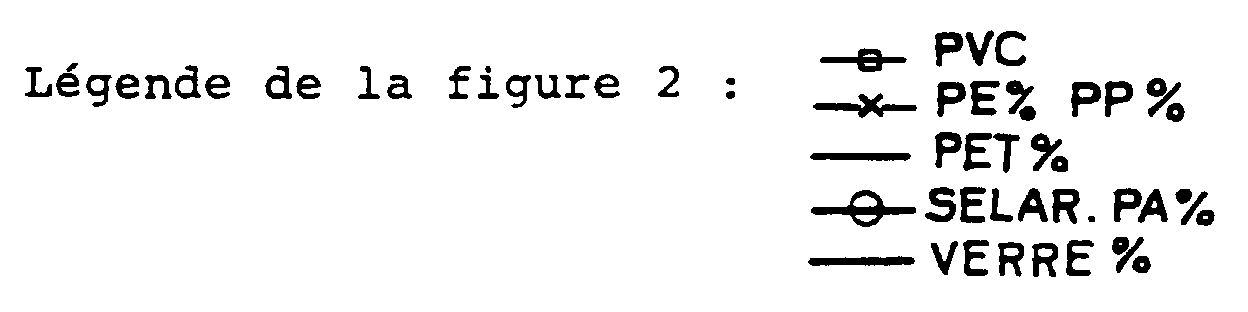
- Bottles made of polyethylene terephthalate marketed by Cusenier (France) for fruit syrups (Sironimo®) are filled with the same solutions as in Examples 1 and 2 and are left 12 months at 20 ° C.
- the loss of anethole is evaluated periodically. We aknowledge that after 6 months, the loss is around 90% and 100% after 12 months.
- Example 4 An example similar to Example 4 was carried out with polyethylene bottles sold by Pampryl (France) for fruit juices and with polypropylene bottles.
- Example 4 An example similar to Example 4 with a PVC bottle is realized.
- Example 4 A test similar to Example 4 with a glass bottle is realized. There is a loss of about 3% and about 6% after 6 months after 12 months.
Landscapes
- Engineering & Computer Science (AREA)
- Ceramic Engineering (AREA)
- Mechanical Engineering (AREA)
- Wrappers (AREA)
- Packages (AREA)
- Laminated Bodies (AREA)
- Non-Alcoholic Beverages (AREA)
- Containers Having Bodies Formed In One Piece (AREA)
- Tea And Coffee (AREA)
- Packging For Living Organisms, Food Or Medicinal Products That Are Sensitive To Environmental Conditiond (AREA)
- Pharmaceuticals Containing Other Organic And Inorganic Compounds (AREA)
- Food Preservation Except Freezing, Refrigeration, And Drying (AREA)
Description
- la lumière (isomérisation cis-trans),
- l'oxydation en présence de lumière,
- l'interaction entre l'anéthole et le matériau de conditionnement.
| Couche externe | 50 à 1000 |
| Couche intermédiaire | 5 à 50 |
| Couche interne (film polyamide) | 20 à 100 |
- bouteilles plastiques multicouches du type PP/L/PA; PET/L/PA.
- 235 mg/l d'anéthole,
- 6 % d'alcool en volume,
puis sont laissées 12 mois à 20°C.
Claims (23)
- Conditionnement formé d'au moins une pellicule interne, contenant une boisson alcoolisée ou non à base d'anéthole, caractérisé en ce que la pellicule interne dudit conditionnement est formée d'un film de polyamide comprenant des motifs aromatiques.
- Conditionnement selon la revendication 1, caractérisé en ce que le film de polyamide est tel que l'absorption d'eau mesurée selon ASTM D570 est inférieure à 8 % et la reprise en eau mesurée selon ASTM D570 est inférieure à 5 %.
- Conditionnement selon la revendication 1, caractérisé en ce que le film de polyamide est tel que la vitesse de perméation à l'oxygène (cc-20 µ/m2 jour. atm) à 20°C et 0 % de RH est inférieure à 4.
- Conditionnement selon l'une des revendications 1 à 3, caractérisé en ce que le film est un polyamide résultant de la polycondensation de méta-xylylènediamine avec l'acide adipique.
- Conditionnement selon la revendication 1, caractérisé en ce que la boisson est non alcoolisée ou faiblement alcoolisée.
- Conditionnement selon la revendication 5, caractérisé en ce que la boisson comprend jusqu'à 10 % en volume d'alcool.
- Conditionnement selon la revendication 6, caractérisé en ce que la boisson comprend 3 à 9 % en volume d'alcool.
- Conditionnement selon la revendication 1, caractérisé en ce que la boisson aqueuse alcoolisée ou non comprend 0,01 à 2 g/l d'anéthole.
- Conditionnement selon la revendication 8, caractérisé en ce que la boisson aqueuse alcoolisée ou non comprend 0,02 à 2 g/l d'anéthole.
- Conditionnement selon l'une des revendications précédentes, caractérisé en ce que le film présente une épaisseur comprise entre 10 et 100 micromètres.
- Conditionnement selon la revendication 10, caractérisé en ce que le film présente une épaisseur comprise entre 20 et 80 micromètres.
- Conditionnement selon la revendication 1, caractérisé en ce qu'il comprend une couche externe de structure et une pellicule interne formée d'un filin de polyamide comprenant des motifs aromatiques.
- Conditionnement selon la revendication 12, caractérisé en ce que la couche externe est en polymère.
- Conditionnement selon la revendication 13, caractérisé en ce que la couche externe est choisie dans le groupe constitué par les polyesters et les polyoléfines.
- Conditionnement selon la revendication 14, caractérisé en ce la couche externe est choisie dans le groupe constitué par le polyéthylènetéréphtalate, le polypropylène et le polyéthylène.
- Conditionnement selon la revendication 12, caractérisé en ce que la couche externe est en métal.
- Conditionnement selon la revendication 12, caractérisé en ce que la couche externe est en carton.
- Conditionnement selon l'une des revendications 12 à 17, caractérisé en ce qu'il comprend une couche intermédiaire d'un liant.
- Conditionnement selon l'une des revendications 12 à 15 ou 18, caractérisé en ce qu'il est sous la forme d'une bouteille.
- Moyen d'obturation pour conditionnement selon l'une des revendications précédentes, pourvu d'une pellicule interne formé d' un film polyamide comprenant des motifs aromatiques venant en application sur l'ouverture dudit conditionnement.
- Moyen d'obturation selon la revendication 20, caractérisé en ce qu'il est constitué d'une capsule cylindrique à l'intérieur de laquelle est logée une pellicule interne formée d' un film polyamide comprenant des motifs aromatiques venant en application sur l'ouverture dudit conditionnement.
- Utilisation d'un film polymère pour la réalisation d'un conditionnement en contact avec des solutions d'anéthole faiblement alcoolisées afin de limiter la déperdition d'anéthole au contact de la paroi du conditionnement, caractérisé en ce que le film est un polyamide comprenant des motifs aromatiques tels que décrits aux revendications 1 à 3,10,11.
- Procédé destiné à limiter la déperdition de l'anéthole contenu dans des solutions faiblement alcoolisées au contact des parois d'un conditionnement en matière polymère, caractérisé en ce que la paroi en matière polymère au contact de la solution d'anéthole est un polyamide tel que défini aux revendications 1 à 3, 10, 11.
Applications Claiming Priority (3)
| Application Number | Priority Date | Filing Date | Title |
|---|---|---|---|
| FR9509951 | 1995-08-21 | ||
| FR9509951A FR2738003B1 (fr) | 1995-08-21 | 1995-08-21 | Conditionnement pour boisson a base d'anethole |
| PCT/FR1996/001300 WO1997007029A1 (fr) | 1995-08-21 | 1996-08-21 | Conditionnement pour boisson a base d'anethole |
Publications (2)
| Publication Number | Publication Date |
|---|---|
| EP0785893A1 EP0785893A1 (fr) | 1997-07-30 |
| EP0785893B1 true EP0785893B1 (fr) | 2000-01-05 |
Family
ID=9482014
Family Applications (1)
| Application Number | Title | Priority Date | Filing Date |
|---|---|---|---|
| EP96929352A Expired - Lifetime EP0785893B1 (fr) | 1995-08-21 | 1996-08-21 | Conditionnement pour boisson a base d'anethole |
Country Status (15)
| Country | Link |
|---|---|
| US (1) | US5871791A (fr) |
| EP (1) | EP0785893B1 (fr) |
| JP (1) | JP3937452B2 (fr) |
| AT (1) | ATE188431T1 (fr) |
| AU (1) | AU6878496A (fr) |
| CA (1) | CA2203154C (fr) |
| DE (1) | DE69606014T2 (fr) |
| DK (1) | DK0785893T3 (fr) |
| ES (1) | ES2140892T3 (fr) |
| FR (1) | FR2738003B1 (fr) |
| GR (1) | GR3032741T3 (fr) |
| MX (1) | MX9702934A (fr) |
| NO (1) | NO320563B1 (fr) |
| PT (1) | PT785893E (fr) |
| WO (1) | WO1997007029A1 (fr) |
Families Citing this family (4)
| Publication number | Priority date | Publication date | Assignee | Title |
|---|---|---|---|---|
| US9931285B2 (en) | 2014-01-14 | 2018-04-03 | The Procter & Gamble Company | Multi-step product for improving the appearance and feel of human skin |
| US20150196464A1 (en) | 2014-01-14 | 2015-07-16 | The Procter & Gamble Company | Cosmetic Composition |
| JP6445022B2 (ja) | 2014-01-14 | 2018-12-26 | ザ プロクター アンド ギャンブル カンパニー | ヒトの皮膚の外観及び感触を改善するための多工程製品 |
| US10206859B2 (en) | 2014-07-29 | 2019-02-19 | The Procter & Gamble Company | Cosmetic composition |
Family Cites Families (4)
| Publication number | Priority date | Publication date | Assignee | Title |
|---|---|---|---|---|
| US3323670A (en) * | 1964-09-09 | 1967-06-06 | Standard Cap & Seal Inc | Bottle closure |
| US4438850A (en) * | 1982-07-15 | 1984-03-27 | Reynolds Metals Company | Membrane closure structure |
| DD223165A5 (de) * | 1983-04-29 | 1985-06-05 | Ciba Geigy Ag | Verfahren zur erzeugung proliferierender zellverbaende |
| JP3055108B2 (ja) * | 1990-12-26 | 2000-06-26 | 三井化学株式会社 | フレキシブルボトル |
-
1995
- 1995-08-21 FR FR9509951A patent/FR2738003B1/fr not_active Expired - Fee Related
-
1996
- 1996-08-21 DE DE69606014T patent/DE69606014T2/de not_active Expired - Fee Related
- 1996-08-21 MX MX9702934A patent/MX9702934A/es not_active IP Right Cessation
- 1996-08-21 WO PCT/FR1996/001300 patent/WO1997007029A1/fr not_active Ceased
- 1996-08-21 DK DK96929352T patent/DK0785893T3/da active
- 1996-08-21 EP EP96929352A patent/EP0785893B1/fr not_active Expired - Lifetime
- 1996-08-21 CA CA002203154A patent/CA2203154C/fr not_active Expired - Fee Related
- 1996-08-21 US US08/700,972 patent/US5871791A/en not_active Expired - Fee Related
- 1996-08-21 JP JP50899697A patent/JP3937452B2/ja not_active Expired - Fee Related
- 1996-08-21 AT AT96929352T patent/ATE188431T1/de not_active IP Right Cessation
- 1996-08-21 AU AU68784/96A patent/AU6878496A/en not_active Abandoned
- 1996-08-21 PT PT96929352T patent/PT785893E/pt unknown
- 1996-08-21 ES ES96929352T patent/ES2140892T3/es not_active Expired - Lifetime
-
1997
- 1997-04-18 NO NO19971810A patent/NO320563B1/no unknown
-
2000
- 2000-02-23 GR GR20000400441T patent/GR3032741T3/el not_active IP Right Cessation
Also Published As
| Publication number | Publication date |
|---|---|
| NO320563B1 (no) | 2005-12-19 |
| JPH10507980A (ja) | 1998-08-04 |
| PT785893E (pt) | 2000-06-30 |
| ATE188431T1 (de) | 2000-01-15 |
| JP3937452B2 (ja) | 2007-06-27 |
| MX9702934A (es) | 1998-04-30 |
| FR2738003B1 (fr) | 1997-11-07 |
| GR3032741T3 (en) | 2000-06-30 |
| WO1997007029A1 (fr) | 1997-02-27 |
| AU6878496A (en) | 1997-03-12 |
| NO971810L (no) | 1997-06-03 |
| DE69606014D1 (de) | 2000-02-10 |
| ES2140892T3 (es) | 2000-03-01 |
| US5871791A (en) | 1999-02-16 |
| NO971810D0 (no) | 1997-04-18 |
| FR2738003A1 (fr) | 1997-02-28 |
| CA2203154A1 (fr) | 1997-02-27 |
| CA2203154C (fr) | 2007-10-23 |
| DK0785893T3 (da) | 2000-06-19 |
| EP0785893A1 (fr) | 1997-07-30 |
| DE69606014T2 (de) | 2000-08-03 |
Similar Documents
| Publication | Publication Date | Title |
|---|---|---|
| EP2303571B1 (fr) | Scellage d'un opercule sur un recipient en verre | |
| EP2094483B1 (fr) | Capsule de bouchage a joint de forme multicouche | |
| FR2575412A1 (fr) | Stratifie a base d'un copolymere d'ethylene et d'alcool vinylique et recipient distributeur en comportant application | |
| FR2491825A1 (fr) | Recipient a paroi multicouche | |
| EP0652841B1 (fr) | Composition de polymere pour feuille d'emballage a ouverture dechirable | |
| CA2203154C (fr) | Conditionnement pour boisson a base d'anethole | |
| EP0912422B1 (fr) | Conditionnement de longue duree pour boisson a base d'anethole | |
| EP0880438B1 (fr) | Conditionnement pour boisson a base d'anethole | |
| WO2022053581A1 (fr) | Film multicouche étiré présentant une haute résistance à la température et son procédé de préparation | |
| WO2008056056A1 (fr) | Joints d'etancheite en materiau multicouche pour moyen de bouchage, typiquement pour une capsule de bouchage | |
| WO2012140602A1 (fr) | Structure multicouche d'emballage | |
| EP2013018A1 (fr) | Materiau multicouche en feuille semi-rigide a haute resistance thermique pour la fabrication par pliage de recipients de conditionnement de produits | |
| EP0793601B1 (fr) | Conditionnement de longue duree en matiere polymere contenant une boisson a base de fruits et/ou de legumes, utilisation d'un film polymere pour la realisation d'un tel conditionnement | |
| LU86231A1 (fr) | Feuille stratifiee a base de copolymere ethylene-propylene et recipient ecrasable realise avec celle-ci | |
| FR2739081A1 (fr) | Conditionnement de longue duree en matiere polymere contenant une boisson a base de fruits, utilisation d'un film polymere pour la realisation d'un tel conditionnement | |
| RU2371365C1 (ru) | Многослойная пластиковая емкость для хранения пищевых продуктов |
Legal Events
| Date | Code | Title | Description |
|---|---|---|---|
| PUAI | Public reference made under article 153(3) epc to a published international application that has entered the european phase |
Free format text: ORIGINAL CODE: 0009012 |
|
| AK | Designated contracting states |
Kind code of ref document: A1 Designated state(s): AT BE CH DE DK ES FI FR GB GR IE IT LI LU MC NL PT SE |
|
| 17P | Request for examination filed |
Effective date: 19970811 |
|
| GRAG | Despatch of communication of intention to grant |
Free format text: ORIGINAL CODE: EPIDOS AGRA |
|
| GRAG | Despatch of communication of intention to grant |
Free format text: ORIGINAL CODE: EPIDOS AGRA |
|
| GRAH | Despatch of communication of intention to grant a patent |
Free format text: ORIGINAL CODE: EPIDOS IGRA |
|
| 17Q | First examination report despatched |
Effective date: 19990602 |
|
| GRAH | Despatch of communication of intention to grant a patent |
Free format text: ORIGINAL CODE: EPIDOS IGRA |
|
| GRAA | (expected) grant |
Free format text: ORIGINAL CODE: 0009210 |
|
| AK | Designated contracting states |
Kind code of ref document: B1 Designated state(s): AT BE CH DE DK ES FI FR GB GR IE IT LI LU MC NL PT SE |
|
| REF | Corresponds to: |
Ref document number: 188431 Country of ref document: AT Date of ref document: 20000115 Kind code of ref document: T |
|
| REG | Reference to a national code |
Ref country code: CH Ref legal event code: NV Representative=s name: KIRKER & CIE SA Ref country code: CH Ref legal event code: EP |
|
| REF | Corresponds to: |
Ref document number: 69606014 Country of ref document: DE Date of ref document: 20000210 |
|
| ITF | It: translation for a ep patent filed | ||
| REG | Reference to a national code |
Ref country code: ES Ref legal event code: FG2A Ref document number: 2140892 Country of ref document: ES Kind code of ref document: T3 |
|
| REG | Reference to a national code |
Ref country code: IE Ref legal event code: FG4D Free format text: FRENCH |
|
| GBT | Gb: translation of ep patent filed (gb section 77(6)(a)/1977) |
Effective date: 20000228 |
|
| REG | Reference to a national code |
Ref country code: DK Ref legal event code: T3 |
|
| REG | Reference to a national code |
Ref country code: PT Ref legal event code: SC4A Free format text: AVAILABILITY OF NATIONAL TRANSLATION Effective date: 20000323 |
|
| PLBE | No opposition filed within time limit |
Free format text: ORIGINAL CODE: 0009261 |
|
| STAA | Information on the status of an ep patent application or granted ep patent |
Free format text: STATUS: NO OPPOSITION FILED WITHIN TIME LIMIT |
|
| 26N | No opposition filed | ||
| REG | Reference to a national code |
Ref country code: GB Ref legal event code: IF02 |
|
| REG | Reference to a national code |
Ref country code: FR Ref legal event code: CA |
|
| PGFP | Annual fee paid to national office [announced via postgrant information from national office to epo] |
Ref country code: ES Payment date: 20070725 Year of fee payment: 12 |
|
| PGFP | Annual fee paid to national office [announced via postgrant information from national office to epo] |
Ref country code: MC Payment date: 20070726 Year of fee payment: 12 |
|
| PGFP | Annual fee paid to national office [announced via postgrant information from national office to epo] |
Ref country code: IE Payment date: 20070727 Year of fee payment: 12 |
|
| PGFP | Annual fee paid to national office [announced via postgrant information from national office to epo] |
Ref country code: LU Payment date: 20070808 Year of fee payment: 12 |
|
| PGFP | Annual fee paid to national office [announced via postgrant information from national office to epo] |
Ref country code: DK Payment date: 20070815 Year of fee payment: 12 |
|
| PGFP | Annual fee paid to national office [announced via postgrant information from national office to epo] |
Ref country code: FI Payment date: 20070807 Year of fee payment: 12 Ref country code: AT Payment date: 20070822 Year of fee payment: 12 |
|
| PGFP | Annual fee paid to national office [announced via postgrant information from national office to epo] |
Ref country code: GB Payment date: 20070817 Year of fee payment: 12 |
|
| PGFP | Annual fee paid to national office [announced via postgrant information from national office to epo] |
Ref country code: SE Payment date: 20070817 Year of fee payment: 12 Ref country code: NL Payment date: 20070817 Year of fee payment: 12 Ref country code: IT Payment date: 20070808 Year of fee payment: 12 Ref country code: DE Payment date: 20071017 Year of fee payment: 12 Ref country code: BE Payment date: 20070821 Year of fee payment: 12 |
|
| PGFP | Annual fee paid to national office [announced via postgrant information from national office to epo] |
Ref country code: CH Payment date: 20071106 Year of fee payment: 12 |
|
| PGFP | Annual fee paid to national office [announced via postgrant information from national office to epo] |
Ref country code: FR Payment date: 20070727 Year of fee payment: 12 |
|
| PGFP | Annual fee paid to national office [announced via postgrant information from national office to epo] |
Ref country code: GR Payment date: 20070730 Year of fee payment: 12 |
|
| REG | Reference to a national code |
Ref country code: PT Ref legal event code: MM4A Free format text: LAPSE DUE TO NON-PAYMENT OF FEES Effective date: 20090223 |
|
| REG | Reference to a national code |
Ref country code: DK Ref legal event code: EBP |
|
| PG25 | Lapsed in a contracting state [announced via postgrant information from national office to epo] |
Ref country code: MC Free format text: LAPSE BECAUSE OF NON-PAYMENT OF DUE FEES Effective date: 20080831 |
|
| REG | Reference to a national code |
Ref country code: CH Ref legal event code: PL |
|
| EUG | Se: european patent has lapsed | ||
| GBPC | Gb: european patent ceased through non-payment of renewal fee |
Effective date: 20080821 |
|
| PG25 | Lapsed in a contracting state [announced via postgrant information from national office to epo] |
Ref country code: AT Free format text: LAPSE BECAUSE OF NON-PAYMENT OF DUE FEES Effective date: 20080821 |
|
| NLV4 | Nl: lapsed or anulled due to non-payment of the annual fee |
Effective date: 20090301 |
|
| REG | Reference to a national code |
Ref country code: IE Ref legal event code: MM4A |
|
| PG25 | Lapsed in a contracting state [announced via postgrant information from national office to epo] |
Ref country code: PT Free format text: LAPSE BECAUSE OF NON-PAYMENT OF DUE FEES Effective date: 20090223 Ref country code: NL Free format text: LAPSE BECAUSE OF NON-PAYMENT OF DUE FEES Effective date: 20090301 Ref country code: FI Free format text: LAPSE BECAUSE OF NON-PAYMENT OF DUE FEES Effective date: 20080821 |
|
| REG | Reference to a national code |
Ref country code: FR Ref legal event code: ST Effective date: 20090430 |
|
| PG25 | Lapsed in a contracting state [announced via postgrant information from national office to epo] |
Ref country code: LI Free format text: LAPSE BECAUSE OF NON-PAYMENT OF DUE FEES Effective date: 20080831 Ref country code: GR Free format text: LAPSE BECAUSE OF NON-PAYMENT OF DUE FEES Effective date: 20090304 Ref country code: CH Free format text: LAPSE BECAUSE OF NON-PAYMENT OF DUE FEES Effective date: 20080831 |
|
| PG25 | Lapsed in a contracting state [announced via postgrant information from national office to epo] |
Ref country code: IE Free format text: LAPSE BECAUSE OF NON-PAYMENT OF DUE FEES Effective date: 20080821 Ref country code: DK Free format text: LAPSE BECAUSE OF NON-PAYMENT OF DUE FEES Effective date: 20080831 Ref country code: BE Free format text: LAPSE BECAUSE OF NON-PAYMENT OF DUE FEES Effective date: 20080831 |
|
| PG25 | Lapsed in a contracting state [announced via postgrant information from national office to epo] |
Ref country code: IT Free format text: LAPSE BECAUSE OF NON-PAYMENT OF DUE FEES Effective date: 20080821 Ref country code: FR Free format text: LAPSE BECAUSE OF NON-PAYMENT OF DUE FEES Effective date: 20080901 Ref country code: DE Free format text: LAPSE BECAUSE OF NON-PAYMENT OF DUE FEES Effective date: 20090303 |
|
| REG | Reference to a national code |
Ref country code: ES Ref legal event code: FD2A Effective date: 20080822 |
|
| PG25 | Lapsed in a contracting state [announced via postgrant information from national office to epo] |
Ref country code: GB Free format text: LAPSE BECAUSE OF NON-PAYMENT OF DUE FEES Effective date: 20080821 |
|
| PGFP | Annual fee paid to national office [announced via postgrant information from national office to epo] |
Ref country code: PT Payment date: 20070726 Year of fee payment: 12 |
|
| PG25 | Lapsed in a contracting state [announced via postgrant information from national office to epo] |
Ref country code: ES Free format text: LAPSE BECAUSE OF NON-PAYMENT OF DUE FEES Effective date: 20080822 |
|
| PG25 | Lapsed in a contracting state [announced via postgrant information from national office to epo] |
Ref country code: LU Free format text: LAPSE BECAUSE OF NON-PAYMENT OF DUE FEES Effective date: 20080821 |
|
| PG25 | Lapsed in a contracting state [announced via postgrant information from national office to epo] |
Ref country code: SE Free format text: LAPSE BECAUSE OF NON-PAYMENT OF DUE FEES Effective date: 20080822 |