EP0783215B1 - Système de transmission optique mettant en oeuvre un cryptage par chaos déterministe - Google Patents
Système de transmission optique mettant en oeuvre un cryptage par chaos déterministe Download PDFInfo
- Publication number
- EP0783215B1 EP0783215B1 EP97400004A EP97400004A EP0783215B1 EP 0783215 B1 EP0783215 B1 EP 0783215B1 EP 97400004 A EP97400004 A EP 97400004A EP 97400004 A EP97400004 A EP 97400004A EP 0783215 B1 EP0783215 B1 EP 0783215B1
- Authority
- EP
- European Patent Office
- Prior art keywords
- chaos
- signal
- wavelength
- feedback loop
- modifying
- Prior art date
- Legal status (The legal status is an assumption and is not a legal conclusion. Google has not performed a legal analysis and makes no representation as to the accuracy of the status listed.)
- Expired - Lifetime
Links
- 230000003287 optical effect Effects 0.000 title claims description 21
- 230000005540 biological transmission Effects 0.000 title description 18
- 238000006243 chemical reaction Methods 0.000 claims description 6
- 238000010521 absorption reaction Methods 0.000 claims description 2
- 230000005693 optoelectronics Effects 0.000 claims description 2
- 239000013078 crystal Substances 0.000 claims 1
- 230000001902 propagating effect Effects 0.000 claims 1
- 230000000739 chaotic effect Effects 0.000 description 7
- 238000001514 detection method Methods 0.000 description 3
- 239000000835 fiber Substances 0.000 description 3
- 238000001228 spectrum Methods 0.000 description 3
- 230000002123 temporal effect Effects 0.000 description 3
- 241001562081 Ikeda Species 0.000 description 2
- 238000010586 diagram Methods 0.000 description 2
- 239000013307 optical fiber Substances 0.000 description 2
- 230000003595 spectral effect Effects 0.000 description 2
- 230000001360 synchronised effect Effects 0.000 description 2
- 230000003321 amplification Effects 0.000 description 1
- 230000003111 delayed effect Effects 0.000 description 1
- 230000037213 diet Effects 0.000 description 1
- 235000005911 diet Nutrition 0.000 description 1
- 230000000694 effects Effects 0.000 description 1
- 230000005684 electric field Effects 0.000 description 1
- 238000000034 method Methods 0.000 description 1
- 239000000203 mixture Substances 0.000 description 1
- 238000003199 nucleic acid amplification method Methods 0.000 description 1
Images


Classifications
-
- H—ELECTRICITY
- H04—ELECTRIC COMMUNICATION TECHNIQUE
- H04B—TRANSMISSION
- H04B10/00—Transmission systems employing electromagnetic waves other than radio-waves, e.g. infrared, visible or ultraviolet light, or employing corpuscular radiation, e.g. quantum communication
- H04B10/80—Optical aspects relating to the use of optical transmission for specific applications, not provided for in groups H04B10/03 - H04B10/70, e.g. optical power feeding or optical transmission through water
- H04B10/85—Protection from unauthorised access, e.g. eavesdrop protection
-
- H—ELECTRICITY
- H04—ELECTRIC COMMUNICATION TECHNIQUE
- H04K—SECRET COMMUNICATION; JAMMING OF COMMUNICATION
- H04K1/00—Secret communication
- H04K1/02—Secret communication by adding a second signal to make the desired signal unintelligible
- H04K1/025—Secret communication by adding a second signal to make the desired signal unintelligible using an analogue chaotic signal
-
- H—ELECTRICITY
- H04—ELECTRIC COMMUNICATION TECHNIQUE
- H04L—TRANSMISSION OF DIGITAL INFORMATION, e.g. TELEGRAPHIC COMMUNICATION
- H04L9/00—Cryptographic mechanisms or cryptographic arrangements for secret or secure communications; Network security protocols
- H04L9/001—Cryptographic mechanisms or cryptographic arrangements for secret or secure communications; Network security protocols using chaotic signals
-
- H—ELECTRICITY
- H04—ELECTRIC COMMUNICATION TECHNIQUE
- H04L—TRANSMISSION OF DIGITAL INFORMATION, e.g. TELEGRAPHIC COMMUNICATION
- H04L9/00—Cryptographic mechanisms or cryptographic arrangements for secret or secure communications; Network security protocols
- H04L9/12—Transmitting and receiving encryption devices synchronised or initially set up in a particular manner
-
- H—ELECTRICITY
- H04—ELECTRIC COMMUNICATION TECHNIQUE
- H04L—TRANSMISSION OF DIGITAL INFORMATION, e.g. TELEGRAPHIC COMMUNICATION
- H04L2209/00—Additional information or applications relating to cryptographic mechanisms or cryptographic arrangements for secret or secure communication H04L9/00
- H04L2209/08—Randomization, e.g. dummy operations or using noise
Definitions
- the present invention relates to optical transmission using encryption by deterministic chaos.
- the purpose of the proposed device is to respond to those needs.
- the chaos generation systems used in this effect are electronic systems in which non-linearities are produced by diodes or even by threshold and hysteresis comparators.
- a method has also been proposed. synchronization using a feedback on a dynamic parameter of the light signal, for example the light signal phase.
- the invention proposes a system for optical transmission using chaos encryption on the wavelength variable.
- Such a system exploits the characteristics dynamics of deterministic chaos, characteristics that are globally random, and locally quite deterministic.
- the degree of confidentiality it ensures is sufficient for a user with means of detection considered "ordinary” fails to break the encryption key from knowledge of statistical properties of chaos used for coding.
- the invention also relates to a device of emission and / or reception of such a system of transmission.
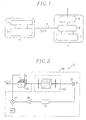
- the optical transmission system illustrated in the Figure 1 comprises transmission means 1, as well as reception means 4 between which the optical signal ⁇ s (t) carrying the encrypted information is conveyed by a fiber F.
- the emission means 1 comprise a generator of chaos in wavelength 3 as well as a system of coding 2, allowing to mix a carrier signal s (t) wavelength chaotic signal information thus generated.
- the signal s (t) can also be much an analog signal than a binary signal.
- the reception means 4 comprise a chaos generator 7 similar in whole or in part to generator 3, means 6 for synchronizing the local chaos with the chaos received, as well as ways to decoding 5, which generally include means common with the synchronization means 6.
- the chaos generators 3 and 7 are light sources, controlled so as to emit a signal whose wavelength ⁇ (t) has a chaotic dynamic behavior.
- This wavelength ⁇ (t) varies in amplitude between a wavelength ⁇ 1 and a wavelength ⁇ 2 , corresponding for example to an optical bandwidth of the order of a few Angstroms.
- ⁇ (t) being chaotic
- the signal has a white noise spectrum in the frequency usually used to transmit optical telecommunications information rates (from 100 Mbit / s to 10 Gbit / s).
- the solutions of this equation are of type chaotic: the wave numbers ⁇ solutions of this equation are pseudo-random; their spectrum of frequencies is akin to that of white noise.
- the nonlinear function NL ⁇ (tT) ⁇ can be arbitrary.
- ⁇ the limiting time constant of the device
- T a temporal delay at least twice greater than ⁇
- A a parameter specific to the system
- ⁇ is the bifurcation parameter
- M is a parameter which characterizes the periodicity of non-linearity, which is for example of the sinusoidal type.
- This parameter M is linked to the spectral range ([ ⁇ 1 , ⁇ 2 ]) within which the wavelength ⁇ (t) varies.
- FIG. 2 illustrates a mode of possible realization for the generators of chaos 3 and 7.
- the chaos generator illustrated in this figure 2 includes a laser emission diode 33 tunable by wavelength, as well as an opto-electronic loop 34 for the control of this laser diode 33.
- the laser diode 33 is a current-controlled multisegment laser diode, for example of the DFB type.
- FIG. 2 shows two control electrodes for this diode 33, one for controlling its active layer (current I 1 ), the other for controlling the wavelength shift (current I).
- the loop 34 includes an optical element 32 not linear in wavelength, which is crossed by a beam emitted by diode 33, as well as a photodetector 35 receiving the optical signal at the output of the element not linear 32.
- the output current of the photodetector 35 is sent, via a delay line 31 and an amplifier 36, on a control electrode of the emitting diode 33.
- the nonlinear element 32 is an element absorption or emission at extrema depending on the wavelength, for example a birefringent filter, or another Fabry Pérot or Mach Zender interferometer, a two-wave interferometer, a wave interferometer multiple.
- Such an element has the advantage of allowing achieve non-linearity in a very simple way.
- the light power P ⁇ (t) at the output of said optical element 32 varies as a function of the input wavelength according to a non-linear curve with extremum.
- the wavelength tunability of the laser source 33 covers a lobe of non-linearity.
- the non-linear element 32 can be a birefringent filter optical delay 10 mm (periodicity 2 ⁇ ( ⁇ 0 ) 2 / M 2.4 ⁇ , lobe approximately 1 ⁇ ).
- the line with electronic delay 31 is of electronic type. She could of course also be carried out by a certain length of optical fiber between the diode laser 33 and photodetector 35.
- T is at least equal to 2 ⁇ .
- the frequency band dynamics of chaos (coding noise) then covers typically a band of around 500 MHz. Any signal informative to mix with this chaos, will have to have a Fourier spectrum in this band to be able to be crypt.
- the signal s (t) carrying information and chaos can be mixed by summation on one of the currents I and I 1 .
- Is shown on the loop of Figure 2 a summator 37 by which the photocurrent at the output of the amplifier 36 is mixed with a current carrying the signal s (t).
- the signal s (t) can be mixed with chaos by modulation of the characteristic of non-linearity of element 32, for example by applying an electric field on it, to move the position of the maximum on the nonlinearity curve.
- this mixture can be produced by modulating the gain K of the amplifier 36.
- Figure 4 illustrates an embodiment possible means 4 for receiving the signal at the output of emission means of FIG. 2.
- the wavelength chaos ⁇ s (t) containing the coded signal is compared with the chaos coming from the local chaos generator 7.
- the reception means 4 comprise two wavelength / voltage converters 61, 62, which respectively convert the signal ⁇ s (t) and the signal generated by the chaos generator 7 into voltage signals.
- the local chaos generator 7 is identical to the generator 3 illustrated in Figure 2.
- the error signal is applied to generator 7 at the point where the mixing the chaos signal and the coded signal on the generator 3 (for example, summator 37 in FIG. 2).
- the wavelength / voltage converters 61 and 62 are for example constituted by optical filters whose transmission is linear according to the wave length.
- the signal s (t) can be superimposed on the chaos by phase modulation on the long chaos signal wave ⁇ (t) emitted by generator 3.
- the chaos signal at the output of generator 3 is at this effect sent to a phase 2 modulator at level from which the signal s (t) is applied to chaos in length wave.
- the reception means 4 are then constituted by means of detection by optical heterodyning. They include a synchronization module 5 and a local chaos generator 7 identical to those in figure 4.
- It also includes means 6 for heterodyning optics which receive on the one hand the signal optics corresponding to the emission chaos modulated in phase by s (t) and on the other hand the local synchronous chaos in generator wavelength 7.
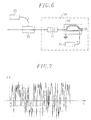
- the generator illustrated in this figure is a all-optical chaos generator that can be used at instead of the generator of figure 2.
- It includes a length-tunable laser diode wave 33 connected by an optical fiber 31 used as delay line T at a Mach Zender 32 interferometer terminated at its end opposite to fiber 31 by a face reflective 35.
- the emission wavelength ⁇ (t) at the output of the diode 33 is a function of the intensity I ⁇ (t) of the optical beam at the input of said diode, which corresponds to that initially emitted, but having crossed the no optical linearity 32 constituted by the Mach Zender interferometer and having been delayed by the delay line 31.
- the Mach Zender 32 interferometer is the non-linear element in wavelength.
- the signal s (t) can be mixed with chaos either by modulation of the control current of the laser diode 33, either by modulation of the control voltage of the Mach Zender 32 interferometer.
- Figure 7 illustrates an example of chaos in wavelength which can be obtained with a generator as shown in Figure 2 or Figure 5.
- Figure 8 is a diagram illustrating a system of multichannel coding by wavelength chaos.
- the system includes the emission system 1 such as described above, controlled by a unit 8 for the management of multi-channel wavelength encryption.
- This unit 8 makes it possible to modify the operating points of system 1, that is to say on the one hand to modify the central wavelength of the emission chaos ( ⁇ 0k ), and on the other hand to modify the encryption key.
- Unit 8 also has a key switch 10 which controls one of the elements of the control loop of the laser diode 33 so as to modify one of the chaos parameters, so the encryption key, depending of the channel used.
- unit 10 can do vary the gain K of amplifier 36 as a function of the channel used. It can also vary the no linearity of the non-linear element 32, for example by thermal, electrooptic, piezoelectric, optical effect.
- the transmission system that comes to be described does not require hanging on reception on the absolute value of the emission wavelength, but only on the relative variation thereof. This results in great decoding flexibility, in order to the selection of one or other of the coded channels, with of course, the condition of knowing the coding key (elements, and parameters of these elements).
Landscapes
- Engineering & Computer Science (AREA)
- Computer Networks & Wireless Communication (AREA)
- Signal Processing (AREA)
- Computer Security & Cryptography (AREA)
- Physics & Mathematics (AREA)
- Electromagnetism (AREA)
- Optical Communication System (AREA)
Description
- des moyens pour l'émission d'un signal optique crypté, qui comprennent des moyens pour la génération d'un chaos déterministe, ainsi que des moyens pour le codage du signal porteur d'informations, par ce chaos déterministe,
- une ligne pour la transmission du signal ainsi crypté,
- des moyens de réception qui comprennent des moyens pour la génération d'un chaos déterministe, ainsi que des moyens pour la synchronisation de ce chaos sur le signal crypté reçu et pour le décryptage dudit signal crypté,
- la figure 1 est un schéma de principe illustrant un système conforme à un mode de réalisation possible pour l'invention ;
- la figure 2 illustre un mode de réalisation possible pour un générateur de chaos en longueur d'onde ;
- la figure 3 est un graphe sur lequel on a porté un exemple de courbe de non linéarité pour l'élément non-linéaire du générateur de la figure 2 ;
- la figure 4 illustre un mode de réalisation possible pour les moyens de réception du système de transmission de la figure 1 ;
- la figure 5 représente schématiquement un système de transmission conforme à un mode de réalisation possible de l'invention, mettant en oeuvre une modulation de phase d'un signal de chaos en longueur d'onde ;
- la figure 6 illustre un autre mode de réalisation possible pour un générateur de chaos en longueur d'onde ;
- la figure 7 est un graphe sur lequel on a porté un exemple de chaos de longueur d'onde en fonction du temps ;
- la figure 8, enfin, est un système de transmission multicanal conforme à l'invention.

NL représente une fonction non linéaire de la variable σ(t),
T est un retard temporel.
Claims (10)
- Système pour la transmission d'un signal optique porteur d'informations, comportant :caractérisé en ce que le chaos est un chaos en longueur d'onde, les moyens (3, 7) de génération de chaos comportant une source lumineuse accordable en longueur d'onde (33), ainsi qu'une boucle (34) de contre-réaction du signal lumineux en sortie de ladite source sur la commande d'accord en longueur d'onde, ladite boucle (34) comportant des moyens (32) de conversion non linéaires de la longueur d'onde, ainsi qu'une ligne à retard (31), la longueur d'onde, ainsi qu'une ligne à retard (31), le système comportant en outre des moyens pour modifier les paramètres de la boucle de contre-réaction (34), et ainsi modifier la clef de cryptage.des moyens (1) pour l'émission d'un signal optique crypté, qui comprennent des moyens (3) pour la génératior d'un chaos déterministe, ainsi que des moyens (2) pour le codage du signal porteur d'informations, par ce chaos déterministe,une ligne (F) pour la transmission du signal ainsi crypté,des moyens de réception (4) qui comprennent des moyens (7) pour la génération d'un chaos déterministe, ainsi que des moyens (5, 6)) pour la synchronisation de ce chaos sur 'le signal crypté reçu et pour le décryptage dudit signal crypté,
- Système selon la revendication 1, caractérisé en ce que la source lumineuse (33) est commandée par un paramètre électrique et en ce que la boucle de contre-réaction (34) est optoélectronique.
- Système selon la revendication 1, caractérisé en ce que la commande de la source lumineuse (33) et la boucle de contre-réaction (34) sont tout optiques.
- Système selon la revendication 2 ou 3, caractérisé en ce que les moyens non linéaires (32) comportent un élément d'absorption ou d'émission à extrema en fonction de la longueur d'onde, tel qu'un interféromètre à deux ondes, un interféromètre de Mach Zender, un interféromètre de Fabry-Perot, un cristal biréfringent ou un interféromètre à ondes multiples.
- Système selon l'une quelconque des revendications 1 à 4, caractérisé en ce que les moyens de codage comportent des moyens (37) pour mélanger le signal porteur d'informations au signal qui se propage dans la boucle de contre réaction (34) pour produire un chaos λs(t) contenant le signal à transmettre.
- Système selon l'une quelconque des revendications 1 à 4, caractérisé en ce que les moyens de codage (2) comportent un modulateur de phase, qui réalise une modulation en phase du chaos émis en longueur d'onde, par le signal porteur d'informations.
- Système selon l'une des revendications précédentes, caractérisé en ce que les moyens (3, 7) de génération de chaos d'émission et de réception sont identiques.
- Système selon l'une des revendications précédentes, caractérisé en ce que les moyens pour modifier les paramètres de la boucle de contre-réaction (34) sont des moyens pour modifier la non-linéarité des moyens de conversion ou la valeur du retard.
- Système selon l'une des revendications précédentes, caractérisé en ce qu'il comporte plusieurs canaux.
- Dispositif d'émission d'un signal optique crypté, caractérisé en ce qu'il comporte des moyens de génération de chaos en longueur d'onde, ces moyens comportant une source lumineuse accordable en longueur d'onde, ainsi qu'une boucle de contre-réaction (34) du signal lumineux en sortie de ladite source sur la commande d'accord en longueur d'onde, ladite boucle comportant des moyens de conversion non linéaires de la longueur d'onde, ainsi qu'une ligne à retard, et en ce qu'il est associé à des moyens pour modifier des paramètres de la boucle de contre-réaction (34), et ainsi modifier la clef de cryptage.
Applications Claiming Priority (2)
| Application Number | Priority Date | Filing Date | Title |
|---|---|---|---|
| FR9600084A FR2743459B1 (fr) | 1996-01-05 | 1996-01-05 | Systeme de transmission optique mettant en oeuvre un cryptage par chaos deterministe |
| FR9600084 | 1996-01-05 |
Publications (2)
| Publication Number | Publication Date |
|---|---|
| EP0783215A1 EP0783215A1 (fr) | 1997-07-09 |
| EP0783215B1 true EP0783215B1 (fr) | 2002-04-24 |
Family
ID=9487910
Family Applications (1)
| Application Number | Title | Priority Date | Filing Date |
|---|---|---|---|
| EP97400004A Expired - Lifetime EP0783215B1 (fr) | 1996-01-05 | 1997-01-02 | Système de transmission optique mettant en oeuvre un cryptage par chaos déterministe |
Country Status (4)
| Country | Link |
|---|---|
| US (1) | US6018582A (fr) |
| EP (1) | EP0783215B1 (fr) |
| DE (1) | DE69712118T2 (fr) |
| FR (1) | FR2743459B1 (fr) |
Cited By (1)
| Publication number | Priority date | Publication date | Assignee | Title |
|---|---|---|---|---|
| CN108828534A (zh) * | 2018-06-11 | 2018-11-16 | 太原理工大学 | 一种基于混沌激光信号的雷达探测装置 |
Families Citing this family (40)
| Publication number | Priority date | Publication date | Assignee | Title |
|---|---|---|---|---|
| DE69832038D1 (de) * | 1998-03-06 | 2005-12-01 | St Microelectronics Srl | Verfahren und Vorrichtung zur Authentifizierung und zur elektronischen Unterschrift |
| FR2779296B1 (fr) * | 1998-06-02 | 2000-08-18 | France Telecom | Dispositif pour l'emission ou la reception d'un signal crypte par chaos deterministe |
| US6441940B1 (en) * | 1998-10-09 | 2002-08-27 | Agere Systems Guardian Corp. | Wavelength stabilization of light emitting components |
| FR2796789B1 (fr) * | 1999-07-23 | 2001-10-12 | France Telecom | Perfectionnements aux dispositifs pour l'emission ou la reception de signaux cryptes par chaos deterministe et systeme de transmission, notamment par radiocommunications, comportant de tels dispositifs |
| KR100327494B1 (ko) * | 2000-03-24 | 2002-03-15 | 윤종용 | 다중 접근 방식을 이용한 보안 통신 시스템에서의 키 동의방법 |
| AU2000261882A1 (en) * | 2000-08-02 | 2002-03-04 | Adsecu Co., Ltd. | Encryption system of digital signals using synchronization of chaos |
| WO2002017535A1 (fr) * | 2000-08-02 | 2002-02-28 | Adsecu Co., Ltd. | Appareil et methode permettant de generer des fonctions de hachage au moyen d'un dispositif d'application de la theorie du chaos |
| US7170997B2 (en) | 2000-12-07 | 2007-01-30 | Cryptico A/S | Method of generating pseudo-random numbers in an electronic device, and a method of encrypting and decrypting electronic data |
| US7050723B2 (en) * | 2001-01-19 | 2006-05-23 | Nippon Telegraph And Telephone Corporation | Laser oscillator, optical communication method and system |
| US7405692B2 (en) * | 2001-03-16 | 2008-07-29 | Battelle Memorial Institute | Detecting concealed objects at a checkpoint |
| US6717964B2 (en) | 2001-07-02 | 2004-04-06 | E20 Communications, Inc. | Method and apparatus for wavelength tuning of optically pumped vertical cavity surface emitting lasers |
| AU2002364229A1 (en) * | 2002-01-16 | 2003-09-02 | Teraphase Technologies, Inc. | System and method of transmitting optical signals |
| US7184553B2 (en) * | 2002-02-07 | 2007-02-27 | Eci Telecom Ltd. | Method and system for encryption of optical signals |
| US20040086117A1 (en) * | 2002-06-06 | 2004-05-06 | Petersen Mette Vesterager | Methods for improving unpredictability of output of pseudo-random number generators |
| US7720226B2 (en) * | 2002-11-19 | 2010-05-18 | Essex Corporation | Private and secure optical communication system using an optical tapped delay line |
| US7022099B2 (en) * | 2003-03-17 | 2006-04-04 | Cardiovention, Inc. | Extracorporeal blood handling system with automatic flow control and methods of use |
| US6966090B2 (en) * | 2003-05-01 | 2005-11-22 | The Coleman Company, Inc. | Air mattress with quilted pillow top |
| KR100543101B1 (ko) * | 2003-10-23 | 2006-01-20 | 학교법인 배재학당 | 시간지연가변 되먹임 혼돈시스템을 이용한 암호화 및 통신 장치와 그 방법 |
| KR100730086B1 (ko) * | 2006-07-10 | 2007-06-19 | 삼성전기주식회사 | 듀얼 시스템 송수신장치 |
| DE102006048793A1 (de) | 2006-10-12 | 2008-04-17 | Deutsche Telekom Ag | Verfahren und System zur verschlüsselten optischen Datenübertragung |
| US7852152B2 (en) * | 2008-08-28 | 2010-12-14 | Menara Networks | Nth order tunable low-pass continuous time filter for fiber optic receivers |
| US8244137B1 (en) * | 2009-06-30 | 2012-08-14 | Verizon Patent And Licensing Inc. | Multichannel on a single wave laser over wave division multiplexing in free space optics using phase masks |
| US8644362B1 (en) | 2011-09-01 | 2014-02-04 | The SI Organization, Inc. | Hybrid pseudo-random noise and chaotic signal implementation for covert communication |
| US9410903B2 (en) * | 2011-10-12 | 2016-08-09 | Baker Hughes Incorporated | Incoherent reflectometry utilizing chaotic excitation of light sources |
| WO2016161134A1 (fr) | 2015-03-31 | 2016-10-06 | Board Of Regents, The University Of Texas System | Procédé et appareil de chiffrement hybride |
| CN106791266B (zh) * | 2016-12-08 | 2023-04-18 | 西南大学 | 一种基于光混沌的彩色图像加密传输的方法及其系统 |
| CN109873697B (zh) * | 2019-04-17 | 2021-09-28 | 杭州电子科技大学 | 一种具有光电相位与强度反馈的混沌加密安全通信系统 |
| CN110278037B (zh) * | 2019-05-07 | 2022-02-01 | 太原理工大学 | 基于dbr激光器的波长混沌信号发生装置 |
| KR102244382B1 (ko) * | 2019-06-13 | 2021-04-26 | 숭실대학교산학협력단 | Wave-chaos 기반 무선 신호 전송의 물리적 암호화 시스템 |
| CN110635903B (zh) * | 2019-09-12 | 2022-04-19 | 太原理工大学 | 一种基于混沌延时相干的动态监控的密钥分发装置及方法 |
| CN112202499A (zh) * | 2020-09-22 | 2021-01-08 | 武汉光迅科技股份有限公司 | 信号发送装置、信号接收装置及混沌加密光通信系统 |
| CN112350818B (zh) * | 2020-11-04 | 2022-02-01 | 西南交通大学 | 一种基于相干检测的高速混沌保密传输方法 |
| CN112653545B (zh) * | 2020-12-08 | 2022-08-16 | 太原理工大学 | 基于dfb激光器注入光功率键控的密钥分发系统 |
| CN112600661B (zh) * | 2020-12-10 | 2022-06-10 | 杭州电子科技大学 | 一种基于双混沌调制的保密通信系统 |
| CN112713986B (zh) * | 2020-12-24 | 2022-06-10 | 杭州电子科技大学 | 一种电光相位互调制混沌多通道单向保密通信系统 |
| CN112821960A (zh) * | 2020-12-31 | 2021-05-18 | 中国科学院半导体研究所 | 保密通信装置及其保密通信方法 |
| CN113257260A (zh) * | 2021-04-09 | 2021-08-13 | 中国质量认证中心 | 一种用于手机保密通信的传输方法和终端设备 |
| CN113285736B (zh) * | 2021-04-26 | 2022-04-19 | 杭州电子科技大学 | 一种基于正交幅度调制的混沌扩频安全通信系统 |
| CN113612544B (zh) * | 2021-07-13 | 2022-08-19 | 杭州电子科技大学 | 具有四维密钥空间的光混沌保密通信系统 |
| CN116232469B (zh) * | 2022-12-29 | 2026-03-27 | 天府兴隆湖实验室 | 一种全光混沌空间同步发生装置和方法 |
Family Cites Families (2)
| Publication number | Priority date | Publication date | Assignee | Title |
|---|---|---|---|---|
| US5412730A (en) * | 1989-10-06 | 1995-05-02 | Telequip Corporation | Encrypted data transmission system employing means for randomly altering the encryption keys |
| US5777778A (en) * | 1996-01-23 | 1998-07-07 | California Institute Of Technology | Multi-Loop opto-electronic microwave oscillator with a wide tuning range |
-
1996
- 1996-01-05 FR FR9600084A patent/FR2743459B1/fr not_active Expired - Fee Related
-
1997
- 1997-01-02 DE DE69712118T patent/DE69712118T2/de not_active Expired - Fee Related
- 1997-01-02 EP EP97400004A patent/EP0783215B1/fr not_active Expired - Lifetime
- 1997-01-03 US US08/779,257 patent/US6018582A/en not_active Expired - Fee Related
Cited By (1)
| Publication number | Priority date | Publication date | Assignee | Title |
|---|---|---|---|---|
| CN108828534A (zh) * | 2018-06-11 | 2018-11-16 | 太原理工大学 | 一种基于混沌激光信号的雷达探测装置 |
Also Published As
| Publication number | Publication date |
|---|---|
| DE69712118T2 (de) | 2002-10-31 |
| DE69712118D1 (de) | 2002-05-29 |
| FR2743459A1 (fr) | 1997-07-11 |
| FR2743459B1 (fr) | 1998-04-03 |
| EP0783215A1 (fr) | 1997-07-09 |
| US6018582A (en) | 2000-01-25 |
Similar Documents
| Publication | Publication Date | Title |
|---|---|---|
| EP0783215A1 (fr) | Système de transmission optique mettant en oeuvre un cryptage par chaos déterministe | |
| EP0963064B1 (fr) | Dispositif pour l'émission ou la réception d'un signal crypté par chaos déterministe | |
| CA2079764C (fr) | Systeme de transmission bidirectionnelle, notamment par fibre optique, avec une porteuse unique pour les deux sens de transmission | |
| US5521738A (en) | Data encoded optical pulse generator | |
| FR2512298A1 (fr) | Systeme et methode de modulation de frequence optique | |
| EP0718992B1 (fr) | Dispositif de régénération en ligne d'un signal tranmis par solitons via la modulation synchrone des solitons à l'aide d'un miroir optique non-linéaire | |
| FR2763193A1 (fr) | Procede et dispositif de distribution quantique de cle de cryptage | |
| EP0762577B1 (fr) | Dispositif d'émission semi-conducteur avec modulation rapide de longueur d'onde | |
| EP0780723A1 (fr) | Modulateur optique réglable d'amplitude et de phase, et régénérateur de solitons comprenant un tel modulateur | |
| Shemis et al. | Broadly tunable self-injection locked InAs/InP quantum-dash laser based fiber/FSO/hybrid fiber-FSO communication at 1610 nm | |
| FR2756440A1 (fr) | Dispositif d'emission de donnees optiques | |
| EP0763912B1 (fr) | Doubleur tout optique et régénérateur de solitons utilisant le doubleur | |
| EP0231015B1 (fr) | Dispositif de télécommunications photoniques cohérentes | |
| EP0630123B1 (fr) | Dispositif pour la remise en forme d'un train d'impulsions optiques et dispositif pour la récupération d'un signal périodique synchronisé sur un train d'impulsions optiques modulées | |
| EP1071242A1 (fr) | Dispositifs pour l'émission ou la réception de signaux cryptés par chaos déterministe et système de transmission, notamment par radiocommunications, comportant de tels dispositifs | |
| FR2737582A1 (fr) | Composant opto-electronique integre | |
| Griffiths et al. | Optical transmitter tunable over a 65-nm wavelength range around 1550 nm for quantum key distribution | |
| FR2690294A1 (fr) | Source d'impulsion optique et système de transmission optique à solitons comportant cette source. | |
| Deng et al. | Generation and intelligent synchronization of photonic millimeter-wave chaos | |
| Das et al. | Bidirectional Transmission of 10 Gbit/s Using RSOA Based WDM-PON and Optical Carrier Suppression Scheme. | |
| FR2703547A1 (fr) | Dispositif optique de récupération du rythme d'un signal code. | |
| EP0381102B1 (fr) | Réseau de communication sur fibres optiques avec multiplexage en fréquence | |
| Djordjevic et al. | Entanglement assisted LPI and covert communications with SLM-based beam steering over turbulent optical channels | |
| FR2872359A1 (fr) | Emetteur optique micro-onde avec laser auto pulsant | |
| WO2007012730A2 (fr) | Système de transmission optique et dispositif de réception d'un signal optique |
Legal Events
| Date | Code | Title | Description |
|---|---|---|---|
| PUAI | Public reference made under article 153(3) epc to a published international application that has entered the european phase |
Free format text: ORIGINAL CODE: 0009012 |
|
| AK | Designated contracting states |
Kind code of ref document: A1 Designated state(s): DE GB |
|
| 17P | Request for examination filed |
Effective date: 19971222 |
|
| 17Q | First examination report despatched |
Effective date: 20010125 |
|
| GRAG | Despatch of communication of intention to grant |
Free format text: ORIGINAL CODE: EPIDOS AGRA |
|
| GRAG | Despatch of communication of intention to grant |
Free format text: ORIGINAL CODE: EPIDOS AGRA |
|
| GRAH | Despatch of communication of intention to grant a patent |
Free format text: ORIGINAL CODE: EPIDOS IGRA |
|
| REG | Reference to a national code |
Ref country code: GB Ref legal event code: IF02 |
|
| GRAH | Despatch of communication of intention to grant a patent |
Free format text: ORIGINAL CODE: EPIDOS IGRA |
|
| GRAA | (expected) grant |
Free format text: ORIGINAL CODE: 0009210 |
|
| AK | Designated contracting states |
Kind code of ref document: B1 Designated state(s): DE GB |
|
| REG | Reference to a national code |
Ref country code: GB Ref legal event code: FG4D Free format text: NOT ENGLISH |
|
| REF | Corresponds to: |
Ref document number: 69712118 Country of ref document: DE Date of ref document: 20020529 |
|
| GBT | Gb: translation of ep patent filed (gb section 77(6)(a)/1977) |
Effective date: 20020710 |
|
| PLBE | No opposition filed within time limit |
Free format text: ORIGINAL CODE: 0009261 |
|
| STAA | Information on the status of an ep patent application or granted ep patent |
Free format text: STATUS: NO OPPOSITION FILED WITHIN TIME LIMIT |
|
| 26N | No opposition filed |
Effective date: 20030127 |
|
| PGFP | Annual fee paid to national office [announced via postgrant information from national office to epo] |
Ref country code: GB Payment date: 20071227 Year of fee payment: 12 |
|
| PGFP | Annual fee paid to national office [announced via postgrant information from national office to epo] |
Ref country code: DE Payment date: 20080115 Year of fee payment: 12 |
|
| GBPC | Gb: european patent ceased through non-payment of renewal fee |
Effective date: 20090102 |
|
| PG25 | Lapsed in a contracting state [announced via postgrant information from national office to epo] |
Ref country code: DE Free format text: LAPSE BECAUSE OF NON-PAYMENT OF DUE FEES Effective date: 20090801 |
|
| PG25 | Lapsed in a contracting state [announced via postgrant information from national office to epo] |
Ref country code: GB Free format text: LAPSE BECAUSE OF NON-PAYMENT OF DUE FEES Effective date: 20090102 |