EP0783136B1 - Chemically amplified positive photoresists - Google Patents
Chemically amplified positive photoresists Download PDFInfo
- Publication number
- EP0783136B1 EP0783136B1 EP96118111A EP96118111A EP0783136B1 EP 0783136 B1 EP0783136 B1 EP 0783136B1 EP 96118111 A EP96118111 A EP 96118111A EP 96118111 A EP96118111 A EP 96118111A EP 0783136 B1 EP0783136 B1 EP 0783136B1
- Authority
- EP
- European Patent Office
- Prior art keywords
- photospeed
- photoresist
- control agent
- resist
- substituted
- Prior art date
- Legal status (The legal status is an assumption and is not a legal conclusion. Google has not performed a legal analysis and makes no representation as to the accuracy of the status listed.)
- Expired - Lifetime
Links
Classifications
-
- G—PHYSICS
- G03—PHOTOGRAPHY; CINEMATOGRAPHY; ANALOGOUS TECHNIQUES USING WAVES OTHER THAN OPTICAL WAVES; ELECTROGRAPHY; HOLOGRAPHY
- G03F—PHOTOMECHANICAL PRODUCTION OF TEXTURED OR PATTERNED SURFACES, e.g. FOR PRINTING, FOR PROCESSING OF SEMICONDUCTOR DEVICES; MATERIALS THEREFOR; ORIGINALS THEREFOR; APPARATUS SPECIALLY ADAPTED THEREFOR
- G03F7/00—Photomechanical, e.g. photolithographic, production of textured or patterned surfaces, e.g. printing surfaces; Materials therefor, e.g. comprising photoresists; Apparatus specially adapted therefor
- G03F7/004—Photosensitive materials
- G03F7/039—Macromolecular compounds which are photodegradable, e.g. positive electron resists
-
- G—PHYSICS
- G03—PHOTOGRAPHY; CINEMATOGRAPHY; ANALOGOUS TECHNIQUES USING WAVES OTHER THAN OPTICAL WAVES; ELECTROGRAPHY; HOLOGRAPHY
- G03F—PHOTOMECHANICAL PRODUCTION OF TEXTURED OR PATTERNED SURFACES, e.g. FOR PRINTING, FOR PROCESSING OF SEMICONDUCTOR DEVICES; MATERIALS THEREFOR; ORIGINALS THEREFOR; APPARATUS SPECIALLY ADAPTED THEREFOR
- G03F7/00—Photomechanical, e.g. photolithographic, production of textured or patterned surfaces, e.g. printing surfaces; Materials therefor, e.g. comprising photoresists; Apparatus specially adapted therefor
- G03F7/004—Photosensitive materials
- G03F7/0045—Photosensitive materials with organic non-macromolecular light-sensitive compounds not otherwise provided for, e.g. dissolution inhibitors
-
- Y—GENERAL TAGGING OF NEW TECHNOLOGICAL DEVELOPMENTS; GENERAL TAGGING OF CROSS-SECTIONAL TECHNOLOGIES SPANNING OVER SEVERAL SECTIONS OF THE IPC; TECHNICAL SUBJECTS COVERED BY FORMER USPC CROSS-REFERENCE ART COLLECTIONS [XRACs] AND DIGESTS
- Y10—TECHNICAL SUBJECTS COVERED BY FORMER USPC
- Y10S—TECHNICAL SUBJECTS COVERED BY FORMER USPC CROSS-REFERENCE ART COLLECTIONS [XRACs] AND DIGESTS
- Y10S430/00—Radiation imagery chemistry: process, composition, or product thereof
- Y10S430/1053—Imaging affecting physical property or radiation sensitive material, or producing nonplanar or printing surface - process, composition, or product: radiation sensitive composition or product or process of making binder containing
- Y10S430/1055—Radiation sensitive composition or product or process of making
- Y10S430/106—Binder containing
- Y10S430/111—Polymer of unsaturated acid or ester
Definitions
- This invention relates to new photoresist compositions particularly suitable for deep U.V. exposure and having the capability of forming highly resolved features of submicron dimension.
- Photoresists are photosensitive films for transfer of images to a substrate. They form negative or positive images. After coating a photoresist on a substrate, the coating is exposed through a patterned photomask to a source of activating energy such as ultraviolet light to form a latent image in the photoresist coating.
- the photomask has areas opaque and transparent to activating radiation that define a desired image to be transferred to the underlying substrate. A relief image is provided by development of the latent image pattern in the resist coating.
- photoresists are generally described, for example, by Deforest, Photoresist Materials and Processes, McGraw Hill Book Company, New York (1975), and by Moreau, Semiconductor Lithography, Principals, Practices and Materials, Plenum Press, New York (1988).
- photoresist compositions have been reported. Such photoresists may be negative-acting or positive-acting and rely on many crosslinking events (in the case of a negative-acting resist) or deprotection reactions (in the case of a positive-acting resist) per unit of photogenerated acid. In other words, the photogenerated acid acts catalytically.
- certain cationic photoinitiators have been used to induce cleavage of certain "blocking" groups pendant from a photoresist binder, or cleavage of certain groups that comprise a photoresist binder backbone. See, for example, U.S. Patents Nos.
- a polar functional group is provided, e.g., carboxyl or imide, which results in different solubility characteristics in exposed and unexposed areas of the resist coating layer.
- a photoresist image of fine line definition including lines of sub-micron and sub-half micron dimensions and having vertical or essentially vertical sidewalls is highly desirable to permit accurate transfer of circuit patterns to an underlying substrate.
- many current photoresists are not capable of providing such highly resolved fine line images.
- photospeed Another important property of a photoresist is photospeed, which can be defined as the exposure time coupled with the exposure energy required to activate the photoactive component, e.g. to generate the required amount of photoacid to provide the desired solubility differential between exposed and unexposed areas of a photoresist coating layer.
- a resist's photospeed is within an acceptable and consistent range or value to permit desired processing of the resist.
- sufficiently high photospeed is important in many processes, e.g. where a number of exposures are needed such as in generating multiple patterns by a step and repeat process, or where activating energy of reduced intensity is employed.
- Sufficiently high photospeed also permits reduction in the concentration of the radiation sensitive component in the photoresist.
- a resist that is "too fast" i.e. has too high photospeed, can be undesirable.
- an extremely high photospeed may compromise resolution of the patterned resist image and/or exposure equipment may not be well suited to image fast resists.
- a consistent photospeed of a resist can be critical, e.g. so that a device manufacturer can use the same imaging conditions and obtain consistent results despite lot-to-lot differences of a resist product (such as precise amount and/or nature of photoactive compound, resin, etc.) that may frequently occur, particularly in large scale resist manufacturing processes.
- a resist product such as precise amount and/or nature of photoactive compound, resin, etc.
- many current resists do not exhibit such consistent photospeed, and consequently a device manufacturer may either realize inconsistent results as different lots of a resist formulation are used, or the device manufacturer may be forced to carefully test the photospeed of each new lot of resist and then adjust the parameters of the exposure equipment to provide for consistent processing.
- the device manufacturer may be forced to carefully test the photospeed of each new lot of resist and then adjust the parameters of the exposure equipment to provide for consistent processing.
- either alternative is undesirable.
- EP-A-0 611 998 discloses a positive photoresist composition
- DE-A-44 08 318 discloses a photosensitive composition
- a photosensitive composition comprising a resin binder having acid labile groups, a photo acid generator and a quaternary ammonium compound, namely, tetramethylammonium hydroxide.
- a further radiation-sensitive mixture is known from EP-A-0 677 788 which mixture comprises a binder which is insoluble in water but soluble in an aqueous alkaline solution; a compound having at least one bond which can be cleaved by an acid or a compound having at least one bond which is crosslinked with the binder by an acid; a compound which generates an acid when irradiated; and a basic iodonium compound.
- Deep U.V. radiation refers to exposure radiation having a wavelength in the range of about 350 nm or less, more typically in the range of about 300 nm or less. While a number of deep U.V. resists have been reported, the need clearly exists for new deep U.V. resists that can provide highly resolved fine line images as well as acceptable photospeed and other lithographic properties.
- the present invention provides a positive photoresist composition
- a positive photoresist composition comprising
- photoresists of the invention can provide highly resolved relief images of small dimensions, including lines of sub-micron and sub-half micron dimensions with vertical or essentially vertical side walls.
- the photospeed control agent imparts an acceptable photospeed to resists of the invention.
- the photospeed control agent enables providing a consistent photospeed of the resist. That is, the photospeed of a particular resist composition of the invention can be precisely fixed at a specified value by use of the photospeed control agent. This is a significant advantage as photospeed differences between production lots of the resist can be compensated for by use of the photospeed control agent to provide uniform photospeed.
- the invention includes methods for providing a consistent photospeed of the resist compositions of the invention, which comprise adjusting the photospeed of a resist composition to a desired value by altering the concentration of the photospeed control agent in the composition.
- the photospeed control agent is a strong base, particularly an organic amine, or an organic salt of a strong base.
- Ammonium and phosphonium are the bases to use in salt form.
- salts of a compound substituted by hydroxy and carbonyl such as a lactate salt as well as sulfonyl salts such as a triflate or tosylate. It has been found that a photospeed control agent counter ion that is a hydroxy-substituted alkanoyl provides better performance results than a comparable composition that includes a counter ion of a photospeed control agent that is an alkanoyl without hydroxy substitution.
- Phenolic resins are generally preferred resin binders of resists of the invention. Particularly preferred are copolymers of vinyl phenol and other copolymerizable group(s), especially where the acid labile groups are present substantially, essentially or completely only on non-phenolic units of the copolymer.
- Preferred copolymer binders include copolymers that comprise substituted or unsubstituted phenol(s) and one or more alkylacrylates such as t -butylacrylate or t -butylmethacrylate.
- Non-phenolic resin binders are also suitable, e.g. copolymers of one or more alkyl acrylates and vinyl alicylics.
- Preferred acid labile groups are pendant from the resin binder backbone.
- Another preferred component of resist compositions of the invention is a dye compound.
- Preferred dyes will enhance resolution of the patterned resist image, typically by reducing reflections and the effects thereof (e.g. notching) of the exposure radiation, while permitting efficient imaging.
- Preferred dyes of compositions of the invention include substituted and unsubstituted phenothiazine, phenoxazine, anthracene and anthrarobin compounds as well as copolymers thereof such as an anthracene acrylate copolymer.
- the invention also provides methods for forming relief images of the photoresist compositions of the invention, including methods for forming highly resolved patterned photoresist images (e.g., a patterned line having essentially vertical sidewalls) of sub-micron or sub-half micron dimensions.
- the invention further provides articles of manufacture comprising substrates such as a microelectronic wafer or a flat panel display substrate having coated thereon the photoresists and relief images of the invention.
- the resin binder component of the photoresists of the invention suitably contains phenol units and has acid labile groups, typically pendant from the resin backbone, and typically used in a resist composition of the invention in an amount sufficient to render an exposed coating layer of the resist developable such as with an aqueous alkaline solution.
- acid labile groups typically pendant from the resin backbone
- a resist composition of the invention typically used in an amount sufficient to render an exposed coating layer of the resist developable such as with an aqueous alkaline solution.
- Exemplary phenolic resins containing such acid labile groups are disclosed in the above mentioned patents such as U.S. Patent 4,491,628 to Ito as well as in U.S. Patent 5,258,257 to Sinta et al.
- Such resins can be prepared by alkaline condensation of the preformed phenolic resin with a compound that comprises the acid labile group and a suitable leaving group.
- L is a leaving group such as bromide or chloride
- R 1 and R 2 are each independently hydrogen, an electron withdrawing group such as halogen (particularly F, Cl or Br), or substituted or unsubstituted C 1-10 alkyl
- R 3 is substituted or unsubstituted C 1-10 alkyl, or substituted or unsubstituted aryl such as phenyl or ary
- Photoacid degradation of those groups during exposure and/or post-exposure heating provides the polar acetic acid ether moiety pendant to the resin binder backbone.
- the resin binder is a copolymer of vinyl phenol and other copolymerizable group(s).
- Preferred copolymers comprise units of substituted or unsubstituted phenols and non-aromatic groups, particularly copolymers of vinyl phenols and alkyl acrylates, typically C 1-12 alkyl acrylates.
- Particularly preferred are copolymers of vinyl phenols and acrylates having branched alkyl chains, such as copolymers formed from t -butyl acrylate, t -butyl methacrylate, etc.
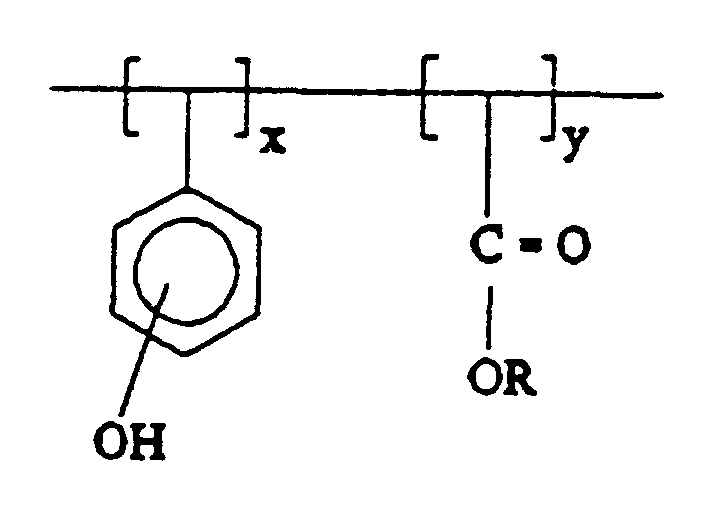
- One especially preferred copolymer binder has repeating units x and y of the following formula: wherein the hydroxyl group be present at either the ortho, meta or para positions throughout the copolymer, and R is substituted or unsubstituted alkyl having 1 to about 18 carbon atoms, more typically 1 to about 6 to 8 carbon atoms. Tert -butyl is a generally preferred R group.
- An R group may be optionally substituted by e.g. one or more halogen (particularly F, Cl or Br), C 1-8 alkoxy, C 2-8 alkenyl, etc.
- the units x and y may be regularly alternating in the copolymer, or may be randomly interspersed through the polymer.
- copolymers can be readily formed.
- vinyl phenols and a substituted or unsubstituted alkyl acrylate such as t-butylacrylate and the like may be condensed under free radical conditions as known in the art.
- the copolymer will have a M w of from about 8,000 to about 50,000, more preferably about 15,000 to about 30,000 with a molecular weight distribution of about 3 or less, more preferably a molecular weight distribution of about 2 or less.
- Non-phenolic resins e.g. a copolymer of an alkyl acrylate such as t-butylacrylate or t-butylmethacrylate and a vinyl alicyclic such as a vinyl norbornanyl or vinyl cyclohexanol compound, also may be prepared by such free radical polymerization or other known procedures and suitably will have a M w of from about 8,000 to about 50,000, and a molecular weight distribution of about 3 or less.
- the photoresist compositions of the invention also comprise a photospeed control agent.
- the photospeed control agent is a strong base in non-salt form, particularly a base having a pK a of about 10 or greater, more preferably a pK a of about 10.5 or 11 or greater.
- the photospeed control agent will have a lower pK a , e.g. a pK a of about 9 or less, more typically from about 5 to 9.
- pK a is used in accordance with its art recognized meaning, that is, pK a is the negative log (to the base 10) of the dissociation constant of the polar compound in aqueous solution at about room temperature.
- Organic bases are used as photospeed control agents, particularly organic amines such as a tetra-alkylammonium compound, e.g. tetrabutylammonium hydroxide (TBAH).
- organic amines such as a tetra-alkylammonium compound, e.g. tetrabutylammonium hydroxide (TBAH).
- TBAH tetrabutylammonium hydroxide
- a salt as a photospeed control agent, particularly a salt of an organic acid such as salt of lactic acid, succinic acid, citric acid, etc.
- a lactate salt is generally preferred, particularly a lactate salt of an organic amine such as a tetrabutylammonium compound or other tetraalkylammonium agent.
- Sulfonyl salts are also preferred such as a triflate or tosylate.
- Ammonium and phosphonium are the bases to use in salt form. It has been found that resolution of resist relief images of the invention will be even further enhanced by use of such a salt as a photospeed control agent relative to a comparable composition that contains the agent in non-salt form.
- One preferred group of photospeed control agents of the invention have a formula of N(R 1 ) 4 A, where each R 1 is independently substituted or unsubstituted alkyl preferably having from 1 to about 12 carbon atoms, more typically 1 to about 8 carbon atoms, or a substituted or unsubstituted aryl such as a C 6-10 aryl e.g. phenyl, naphthyl and the like; and A is a counter anion of a halide, a substituted or unsubstituted hydroxyalkanoyl preferably having 1 to about 18 carbon atoms (i.e.
- hydroxyalkanoyl refers to an alkanoyl group having one or more hydroxy moieties (typically 1, 2, 3 or 4 hydroxy moieties) on one or more carbons of the alkanoyl group.
- exemplary sulfonate A groups include mesylate, triflate, tosylate, etc.
- Substituted A groups may be suitably substituted by one or more groups such as halo particularly fluoro, chloro and bromo, hydroxy, cyano, nitro, C 1-12 alkyl, C 2-12 alkenyl, C 1-12 alkoxy, C 1-12 alkanoyl including acyl, etc.
- groups such as halo particularly fluoro, chloro and bromo, hydroxy, cyano, nitro, C 1-12 alkyl, C 2-12 alkenyl, C 1-12 alkoxy, C 1-12 alkanoyl including acyl, etc.
- a phosphonium compound also may be employed as a photospeed control, including phosphonium salts such as e.g. compounds of the formula P(R 1 ) 4 A where R 1 and A are each the same as defined above for the formula N(R 1 ) 4 A.
- Such salts of a photospeed control agent can be readily prepared by known procedures, e.g., by dissolving the free base in an aqueous solution containing the acid and then removing solvent or, alternatively, reacting the free base and acid in an organic solvent such as chloroform or the like and then isolating the salt.
- the photospeed control agent in salt or non-salt form, as well as all other components of a resist composition of the invention, should be soluble in the resist organic solvent carrier(s) so as to provide a formulation that is at least essentially particle-free. See also the examples which follow.
- the resist compositions of the invention also comprise a photoacid generator (i.e. "PAG”) that is suitably employed in an amount sufficient to generate a latent image in a coating layer of the resist upon exposure to activating radiation.
- PAG photoacid generator
- sulfonate compounds are preferred PAGs, particularly sulfonate salts.
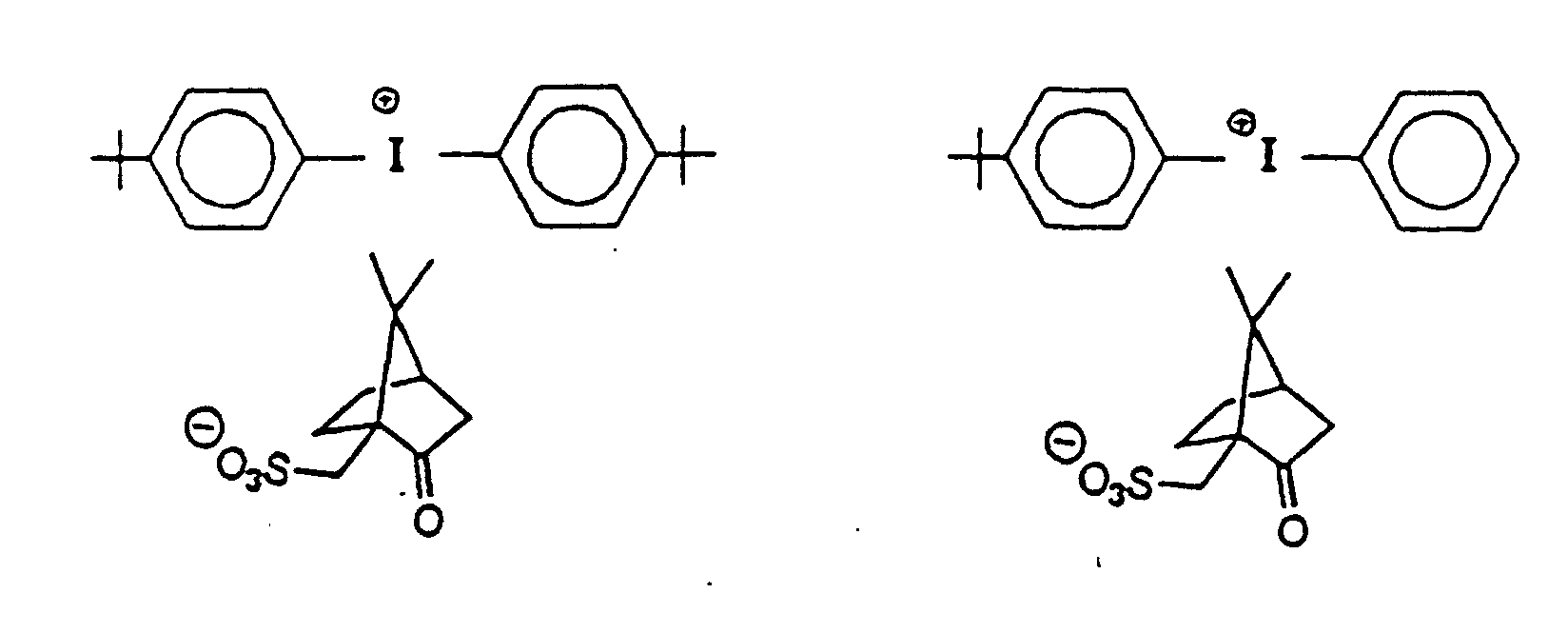
- Two specifically preferred agents are of the following formulae I and II:
- Such sulfonate compounds can be prepared in accordance with the following scheme which depicts the synthesis of a compound of formula I. See also Example 2 which follows for synthesis of that PAG.
- the PAG of formula II can be prepared as generally depicted in the below Scheme and Example 2, except approximately molar equivalents of t -butyl benzene and benzene would be reacted together in the first step with acetic anhydride and KIO 3 .
- Sulfonated esters including sulfonyloxy ketones are also preferred PAGs of resist compositions of the invention.
- Suitable sulfonated esters have been reporting in J. of Photopolymer Science and Technology, vol. 4, No. 3,337-340 (1991) including benzoin tosylate, t-butylphenyl alpha-(p-toluenesulfonyloxy)-acetate and t-butyl alpha-(p-toluenesulfonyloxy)-acetate.
- Preferred sulfonate PAGs are also disclosed in U.S. Patent 5,344,742 to Sinta et al.
- Onium salts are also generally preferred acid generators of compositions of the invention.
- Onium salts that have weakly nucleophilic anions have been found to be particularly suitable.
- Examples of such anions are the halogen complex anions of divalent to heptavalent metals or non-metals, for example, Sb, Sn, Fe, Bi, Al, Ga, In, Ti, Zr, Sc, D, Cr, Hf, and Cu as well as B, P, and As.
- onium salts are diaryl-diazonium salts and onium salts of group Va and B, Ia and B and I of the Periodic Table, for example, halonium salts, quaternary ammonium, phosphonium and arsonium salts, aromatic sulfonium salts and sulfoxonium salts or selenium salts.
- suitable preferred onium salts can be found in U.S. Patents 4,442,197; 4,603,101; and 4,624,912.
- Suitable s-triazine acid generators are disclosed, for example, in U.S. Patent 4,189,323.
- Non-ionic photoacid generators are suitable including halogenated non-ionic, photoacid generating compounds such as, for example, 1,1-bis[p-chlorophenyl]-2,2,2-trichloroethane (DDT); 1,1-bis[p-methoxyphenyl]-2,2,2-trichloroethane; 1,2,5,6,9,10-hexabromocyclodecane; 1,10-dibromodecane; 1,1-bis[p-chlorophenyl]-2,2-dichloroethane; 4,4-dichloro-2-(trichloromethyl) benzhydrol (Kelthane); hexachlorodimethyl sulfone; 2-chloro-6-(trichloromethyl) pyridine; o,o-diethyl-o-(3,5,6-trichloro-2-pyridyl)phosphorothionate; 1,2,3,4,5,6-hexachlorocyclohex
- Acid generators that are particularly preferred for deep U.V. exposure include 1,1-bis(p-chlorophenyl)-2,2,2-trichloroethane(DDT); 1,1-bis(p-methoxyphenol)-2,2,2-trichloroethane; 1,1-bis(chlorophenyl)-2,2,2 trichloroethanol; tris(1,2,3-methanesulfonyl)benzene; and tris(trichloromethyl)triazine.
- DDT 1,1-bis(p-chlorophenyl)-2,2,2-trichloroethane
- 1,1-bis(p-methoxyphenol)-2,2,2-trichloroethane 1,1-bis(chlorophenyl)-2,2,2 trichloroethanol
- tris(1,2,3-methanesulfonyl)benzene and tris(trichloromethyl)triazine.
- Another preferred component of resist compositions of the invention is a dye compound.
- Preferred dyes will enhance resolution of the patterned resist image, typically by reducing reflections and the effects thereof (e.g. notching) of the exposure radiation.
- Preferred dyes include substituted and unsubstituted phenothiazine, phenoxazine, anthracene and anthrarobin compounds.
- Preferred substituents of substituted phenothiazine, phenoxazine, anthracene and anthrarobin include e.g.
- Copolymers of such compounds also may be used as a dye, e.g., an anthracene acrylate polymer or copolymer. See for instance Example 5 which follows.
- a curcumin dye also may be used for some applications. In addition to reducing reflections in deep U.V. exposures, use of a dye may expand the spectral response of the compositions of invention.
- Photoresists of the invention also may contain other optional materials.
- other optional additives include anti-striation agents, plasticizers, speed enhancers, etc.
- Such optional additives typically will be present in minor concentration in a photoresist composition except for fillers and dyes which may be present in relatively large concentrations such as, e.g., in amounts of from about 5 to 30 percent by weight of the total weight of a resist's dry components.
- compositions of the invention can be readily prepared by those skilled in the art.
- a photoresist composition of the invention can be prepared by dissolving the components of the photoresist in a suitable solvent such as, for example, a glycol ether such as 2-methoxyethyl ether (diglyme), ethylene glycol monomethyl ether, ethylene glycol monomethyl ether, propylene glycol monomethyl ether; a Cellosolve® ester such as methyl ethyl ketone.
- a suitable solvent such as, for example, a glycol ether such as 2-methoxyethyl ether (diglyme), ethylene glycol monomethyl ether, ethylene glycol monomethyl ether, propylene glycol monomethyl ether; a Cellosolve® ester such as methyl ethyl ketone.
- the solids content of the composition varies between about 5 and 35 percent by weight of the total weight of the photoresist composition.
- the resin binder and PAG components should be present in amounts sufficient to provide a film coating layer and formation of good quality latent and relief images. See the examples which follow for exemplary preferred amounts of resist components.
- the photospeed control agent can be employed in relatively small amounts, e.g. about 1% to 20% by weight relative to the PAG.
- compositions of the invention are used in accordance with generally known procedures.
- the liquid coating compositions of the invention are applied to a substrate such as by spinning, dipping, roller coating or other conventional coating technique.
- spin coating the solids content of the coating solution can be adjusted to provide a desired film thickness based upon the specific spinning equipment utilized, the viscosity of the solution, the speed of the spinner and the amount of time allowed for spinning.
- a sample of the resist can be tested for its photospeed and the photospeed adjusted, if needed, to provide a photospeed of a desired value by altering the concentration of the photospeed control agent in the resist formulation. For example, if the resist photospeed is too high, an additional amount of the control agent can be added to the formulation, and a further sample tested to ensure the resist then exhibits the desired photospeed.
- the photospeed of a resist of the invention can be determined by procedures well known to those in the art, such as the procedure disclosed in U.S. Patent 4,618,233 to Hertlein.
- a resist composition of the invention preferably will contain a sufficient concentration of the photospeed control agent so that only a 3 percent or less, or more preferably about 1 to 2 percent or less, difference in photospeed exists between lots or batches.
- the resist compositions of the invention are suitably applied to substrates conventionally used in processes involving coating with photoresists.
- the composition may be applied over silicon or silicon dioxide wafers for the production of microprocessors and other integrated circuit components.
- Aluminum-aluminum oxide, gallium arsenide, ceramic, quartz or copper substrates also may be employed.
- Substrates used for liquid crystal display and other flat panel display applications are also suitably employed, e.g. glass substrates, indium tin oxide coated substrates and the like.
- the photoresist Following coating of the photoresist onto a surface, it is dried by heating to remove the solvent until preferably the photoresist coating is tack free. Thereafter, it is imaged through a mask in conventional manner.
- the exposure is sufficient to effectively activate the photoactive component of the photoresist system to produce a patterned image in the resist coating layer and, more specifically, the exposure energy typically ranges from about 10 to 300 mJ/cm 2 , dependent upon the exposure tool and the components of the photoresist composition.
- Coating layers of the resist compositions of the invention are preferably photoactivated by an exposure wavelength in the deep U.V. range i.e., 350 nm or less, more typically in the range of about 300 nm or less, typically about 150 to 300 or 350 nm.
- a particularly preferred exposure wavelength is about 248 nm.
- the film layer of the composition is preferably baked at temperatures ranging from about 70°C to about 160°C. Thereafter, the film is developed.
- the exposed resist film is rendered positive working by employing a polar developer, preferably an aqueous based developer such as an inorganic alkali exemplified by sodium hydroxide, potassium hydroxide, sodium carbonate, sodium bicarbonate, sodium silicate, sodium metasilicate; quaternary ammonium hydroxide solutions such as a tetra-alkyl ammonium hydroxide solution; various amine solutions such as ethyl amine, n-propyl amine, diethyl amine, di-n-propyl amine, triethyl amine, or methyldiethyl amine; alcohol amines such as diethanol amine or triethanol amine; cyclic amines such as pyrrole, pyridine, etc.
- a polar developer preferably an aqueous based developer such as an inorganic al
- the developed substrate may be selectively processed on those areas bared of resist, for example by chemically etching or plating substrate areas bared of resist in accordance with procedures known in the art.
- suitable etchants include a plasma gas etch (e.g. an oxygen plasma etch) and a hydrofluoric acid etching solution.
- the compositions of the invention are highly resistant to such etchants thereby enabling manufacture of highly resolved features, including lines with submicron widths.
- resist may be removed from the processed substrate using known stripping procedures.
- Example 1 Preparation of photospeed control agent of tetra-n-butylammonium d/l-lactate salt [(CH 3 CH 2 CH 2 CH 2 ) 4 NO(CO)CH(OH)CH 3 ]
- a 2L 3 neck round bottom flask was charged with potassium iodate (214.00 g, 1.00 mol), t-butylbenzene (268.44 g, 2.00 mol) and acetic anhydride (408.36 g, 4.00 mol).
- the flask was fitted with an efficient overhead paddle stirrer, a thermometer and a pressure equalizing dropping funnel fitted with a N 2 bubbler.
- the reaction mixture was cooled to 10°C in a ice-water bath and concentrated sulfuric acid (215.78 g, 2.20 mol) added dropwise via the addition funnel.
- the addition was carried out at such a rate as to maintain the reaction temperature around 25°C and required 2 hours. As the addition proceeded the starting white suspension became orange-yellow in color.
- reaction mixture was stirred at room temperature (20°C) for a further 22 hours.
- the reaction mixture was cooled to 5-10°C and water (600 ml) was added dropwise over 30 minutes, maintaining the temperature below 30°C. (Note the first 75 ml should be added at a particular slow rate as to control the initial . exotherm, thereafter the rest of the water may be added at a faster rate).
- This cloudy mixture was washed with hexane (3 x 100 ml) (to remove unreacted t-butylbenzene and some 4-t-butyliodobenzene byproduct) in a 2L separating funnel and the aqueous solution of diaryliodonium hydrogensulfate transferred to a 3L reaction vessel.
- the solution is cooled to 5-10°C, (+/-)-10-camphorsulfonic acid (232.30 g, 1.00 mol) was added in one portion with stirring and the solution was then neutralized with ammonium hydroxide (620 ml, 9.20 mol).
- the amount of base used was the theoretical amount required to neutralize all acidic species in the pot, assuming quantitative reaction.
- the addition of the base is carried out at such a rate as to keep the temperature below 25°C and takes about 1 hour.
- the addition nears completion and the pH of the reaction mixture approaches 7 the crude diaryliodonium camphorsulfonate precipitated as a tan solid.
- the resulting tan solid was then purified by recrystallization in the following manner.
- the tan solid was dissolved in the minimum amount of refluxing isopropanol (375 g PAG in 1150 ml IPA) in a 2L RBF to give a homogeneous dark red solution.
- the hot solution was transferred to a 2L conical flask and allowed to cool. While this solution is still warm, hexane (500 ml) was added and crystals form soon after. The crystallizing mixture was allowed to cool to room temperature and stored for 4 hours.
- the crystallizing solution was cooled to 5°C in an ice-water bath for 1.5 hours and then the solid is collected by suction filtration and washed until white with very cold isopropanol-hexane (1:3, 2 x 200 ml, prepared by cooling the solvent mixture in a dry ice-acetone bath before use).
- the white solid was dried under aspirator vacuum for 1 hour until the PAG (title compound; photoactive active compound of formula I was isolated as a free flowing white powder. At this stage about 285 g of PAG is obtained.
- a second recrystallization can be performed in a similar manner.
- Example 3 a photoresist composition of the invention was prepared that contained as a lactate salt of TBAH, prepared as described in Example 1 above.
- Example 4 a comparable resist was prepared which did not contain TBAH lactate or any other photospeed control agent.
- the resin binder was a copolymer of vinyl phenol and t -butylacrylate, having a M w of about 20,000 and available under the tradename of MaruzenTM CTBA 161 from Maruzen Oil Company of Tokyo, Japan.
- the leveling agent used in each of the examples is the commercially available material sold under the name SilwetTM L-7604 by Union Carbide.
- the photoacid generator (PAG) used in the examples below is the sulfonate salt of Example 2 and formula I above.
- Ethyl lactate was the solvent used in each of the Examples 3-4.
- a resist formulation was prepared by admixing the following components in the following amounts: Components Amount (expressed in grams) Resin binder 4.369 PAG 0.131 Photospeed control agent 0.013 Leveling agent 0.023 Solvent 30.311
- a resist formulation was prepared by admixing the following components in the following amounts: Components Amount (expressed in grams) Resin binder 9.500 PAG 0.285 Leveling agent 0.049 Solvent 41.897
- resists A-D Four different photoresists (resists A-D below) were prepared by admixing the specified components.
- the resin binder for each of the resists was a copolymer of vinyl phenol and t -butylacrylate, having a M w of about 20,000 and available under the tradename of MaruzenTM KE-610 from Maruzen Oil Company of Tokyo, Japan.
- Other resist composition components, including the dye compound, are indicated below.
- polymer KE-610 (38% t-butyl acrylate/62% hydroxystyrene copolymer), 0.456% photo acid generator (di t-butylphenyl iodonium camphor sulfonate formula I above); 0.30% photospeed control agent (tetrabutyl ammonium hydroxide), 0.080% leveling agent (SilwetTM L-7604), 0.304% dye (9-anthracenemethyl methacrylate /2-hydroxyethyl methacrylate copolymer, 50/50 w/w) and 83.920% ethyl lactate.
- polymer KE-610 (38% t-butyl acrylate/62% hydroxystyrene copolymer), 0.456% photo acid generator (di t-butylphenyl iodonium camphor sulfonate (formula I above); 0.30% photospeed control agent (tetrabutyl ammonium hydroxide), 0.080% leveling agent (SilwetTM L-7604), 0.304% dye (2-acetylphenothiazine) and 83.920% ethyl lactate.
- polymer KE-610 (38% t-butyl acrylate/62% hydroxystyrene copolymer), 0.456% photo acid generator (di t-butylphenyl iodonium camphor sulfonate formula I above; 0.30% photospeed control agent (tetrabutyl ammonium hydroxide), 0.080% leveling agent (SilwetTM L-7604), 0.304% dye (Anthrarobin) and 83.920% ethyl lactate.
- polymer KE-610 (38% t-butyl acrylate/62% hydroxystyrene copolymer), 0.444% photo acid generator (di t-butylphenyl iodonium camphor sulfonate formula I above), 0.30% photospeed control agent (tetrabutyl ammonium hydroxide), 0.080% leveling agent (SilwetTM L-7604), 0.739% dye (Curcumin) and 83.920% ethyl lactate.
- the resists were spun cast onto 10.16 cm (4") YES oven HMDS primed silicon wafers and soft baked for 60 seconds at 140°C (vacuum contact) on a GCA MicroTrac coat/bake track system. Coated wafers were then exposed with a GCA Excimer Stepper (fitted with a 0.53NA lens) using a focus/exposure array. Next, wafers were post exposure baked for 90 seconds at 140°C (vacuum contact) and developed using a 25 second/25 second double-spray puddle process on a GCA MicroTrac system using Shipley Megaposit® CD-26 developer (0.26 N aqueous tetramethylene ammonium hydroxide developer containing a leveling agent).
- Resist Eo Resist Eo, mJ Esize, mJ %UFTL Resolution, ⁇ m Masking Linearity, ⁇ m Focus Latitude, ⁇ m Exposure Latitude A 5.6 14.0 2.23 0.23 0.23 1.2 ⁇ 12.3 % B 9.0 21.0 2.07 0.24 0.24 1.0 ⁇ 10.5 % C 4.8 12.0 2.16 0.23 0.23 1.2 ⁇ 18.8 % D 5.4 13.0 3.20 0.24 0.24 1.0 ⁇ 7.9 %
- each of the photoresist compositions of this example contained a resin binder in the same relative amount that was a copolymer of vinyl phenol and t -butylacrylate, having a M w of about 20,000 and available under the tradename of MaruzenTM CTBA 161 from Maruzen Oil Company of Tokyo, Japan.
- the photoacid generator (PAG) used in the compositions of the examples was the sulfonate salt of Example 2 and formula I above.
- Ethyl lactate was the solvent used in each of the compositions.
- the respective resist compositions contained either no photospeed control agent (P.C.A. in Table 2), or a photospeed control agent of tetrabutylammonium acetate (TBAOAc), tetrabutylammonium tosylate (TBAOTs), tetrabutylammonium triflate (TBAOTf) or tetrabutylammonium lactate (TBAL).
- TSAOAc tetrabutylammonium acetate
- TSAOTs tetrabutylammonium tosylate
- TAAOTf tetrabutylammonium triflate
- TBAL tetrabutylammonium lactate
- the resist compositions were prepared by formulating ethyl lactate solutions containing the resin binder, the PAG at 4% weight of the resin binder, and the photospeed control agent (if present) at 9.6 ⁇ mol/g of the resin binder. All formulations were passed through GelmanTM Acro 0.2 ⁇ m filters prior to use.
- the energy to clear (EO in Table 2) was defined as the exposure dose necessary to remove the resist film upon development.
- Energy to size (Esize in Table 2) values were determined for 0.3 ⁇ M features as measured at the base of the resist image.
- Exposure and focus latitude values (EL and FL respectively in Table 2 below) were measured for 0.3 ⁇ m features and were defined as the change in exposure dose or focus needed to effect a ⁇ 10% change in linewidth.
- Linear resolution (Lin. Res. in Table 2) was defined as the size of the smallest feature within ⁇ 10% of the nominal linewidth.
- Resolution (Res. in Table 2) was defined as the nominal linewidth of the smallest open feature.
- IR spectra of the coated silicon wafers were obtained on a Mattson Polaris FT-IR spectrometer using 64 scans at 4 cm -1 resolution. IR contrast was defined as the change in magnitude of the 1150 cm -1 absorbance of the resin binder divided by the change in log exposure dose.
Landscapes
- Physics & Mathematics (AREA)
- Spectroscopy & Molecular Physics (AREA)
- General Physics & Mathematics (AREA)
- Materials For Photolithography (AREA)
- Exposure And Positioning Against Photoresist Photosensitive Materials (AREA)
Description


| Components | Amount (expressed in grams) |
| Resin binder | 4.369 |
| PAG | 0.131 |
| Photospeed control agent | 0.013 |
| Leveling agent | 0.023 |
| Solvent | 30.311 |
| Components | Amount (expressed in grams) |
| Resin binder | 9.500 |
| PAG | 0.285 |
| Leveling agent | 0.049 |
| Solvent | 41.897 |
| Resist | Eo, mJ | Esize, mJ | %UFTL | Resolution, µm | Masking Linearity, µm | Focus Latitude, µm | Exposure Latitude |
| A | 5.6 | 14.0 | 2.23 | 0.23 | 0.23 | 1.2 | ± 12.3 % |
| B | 9.0 | 21.0 | 2.07 | 0.24 | 0.24 | 1.0 | ± 10.5 % |
| C | 4.8 | 12.0 | 2.16 | 0.23 | 0.23 | 1.2 | ± 18.8 % |
| D | 5.4 | 13.0 | 3.20 | 0.24 | 0.24 | 1.0 | ± 7.9 % |

Claims (13)
- A positive photoresist composition comprisingwith said photoacid generator and said photospeed control agent being distinct from each other.1) a resin binder comprising acid labile groups,2) a photoacid generator, and3) a photospeed control agent that is selected from the groups consisting of:i) a compound of the formula N(R1)4A where each R1 is independently substituted or unsubstituted alkyl, or a substituted or unsubstituted aryl; and A is a counter anion of a halide, a substituted or unsubstituted sulfonate or a substituted or unsubstituted hydroxyalkanoyl; orii) a phosphonium compound;
- The photoresist of claim 1 wherein the photospeed control agent is a lactate salt.
- The photoresist of claim 1 wherein the photospeed control agent is a phosphonium compound.
- The photoresist of claim 1 wherein the photoacid generator is a sulfonate salt.
- The photoresist of claim 1 wherein the photoacid generator is selected from the group consisting of:
- The photoresist of claim 1 wherein the resin binder is a phenol-alkyl acrylate copolymer.
- The photoresist of claim 1 wherein the resin binder comprises units x and y of the structure:wherein R is substituted or unsubstituted alkyl having 1 to about 18 carbon atoms.
- A method for controlling photospeed of a chemically amplified positive photoresist, comprising using the positive photoresist composition of any one of claims 1 to 7, determining the photospeed of the photoresist composition, and adjusting the photospeed to a desired value by altering the amount of photospeed control agent in the composition.
- The method of claim 8 wherein an additional amount of the photospeed control agent is added to the composition to adjust the photospeed.
- The method of claim 8 wherein the photospeed control agent has a pKa of about 10 or greater in non-salt form.
- A method for forming a photoresist relief image comprising applying a coating layer of the photoresist composition of any one of claims 1 to 7 onto a substrate and exposing and developing the photoresist layer on the substrate to provide a relief image.
- An article of manufacture comprising a substrate having coated thereon the photoresist composition of any one of claims 1 to 7.
- The article of claim 12 wherein the substrate is a microelectronic wafer.
Applications Claiming Priority (2)
| Application Number | Priority Date | Filing Date | Title |
|---|---|---|---|
| US567630 | 1990-08-15 | ||
| US08/567,630 US5879856A (en) | 1995-12-05 | 1995-12-05 | Chemically amplified positive photoresists |
Publications (3)
| Publication Number | Publication Date |
|---|---|
| EP0783136A2 EP0783136A2 (en) | 1997-07-09 |
| EP0783136A3 EP0783136A3 (en) | 1998-08-19 |
| EP0783136B1 true EP0783136B1 (en) | 2002-10-02 |
Family
ID=24267981
Family Applications (1)
| Application Number | Title | Priority Date | Filing Date |
|---|---|---|---|
| EP96118111A Expired - Lifetime EP0783136B1 (en) | 1995-12-05 | 1996-11-12 | Chemically amplified positive photoresists |
Country Status (5)
| Country | Link |
|---|---|
| US (2) | US5879856A (en) |
| EP (1) | EP0783136B1 (en) |
| JP (1) | JP3963987B2 (en) |
| KR (1) | KR100500750B1 (en) |
| DE (1) | DE69624085T2 (en) |
Cited By (2)
| Publication number | Priority date | Publication date | Assignee | Title |
|---|---|---|---|---|
| EP2204392A1 (en) | 2008-12-31 | 2010-07-07 | Rohm and Haas Electronic Materials LLC | Compositions and processes for photolithography |
| EP2204694A1 (en) | 2008-12-31 | 2010-07-07 | Rohm and Haas Electronic Materials LLC | Compositions and processes for photolithography |
Families Citing this family (63)
| Publication number | Priority date | Publication date | Assignee | Title |
|---|---|---|---|---|
| EP0537524A1 (en) | 1991-10-17 | 1993-04-21 | Shipley Company Inc. | Radiation sensitive compositions and methods |
| JPH08110638A (en) * | 1994-10-13 | 1996-04-30 | Hitachi Chem Co Ltd | Photosensitive resin composition and method for producing resist image |
| US6077643A (en) * | 1997-08-28 | 2000-06-20 | Shipley Company, L.L.C. | Polymers and photoresist compositions |
| JP3955385B2 (en) * | 1998-04-08 | 2007-08-08 | Azエレクトロニックマテリアルズ株式会社 | Pattern formation method |
| US7704668B1 (en) | 1998-08-04 | 2010-04-27 | Rohm And Haas Electronic Materials Llc | Photoresist compositions and methods and articles of manufacture comprising same |
| US6127089A (en) * | 1998-08-28 | 2000-10-03 | Advanced Micro Devices, Inc. | Interconnect structure with low k dielectric materials and method of making the same with single and dual damascene techniques |
| US6280911B1 (en) * | 1998-09-10 | 2001-08-28 | Shipley Company, L.L.C. | Photoresist compositions comprising blends of ionic and non-ionic photoacid generators |
| US20040081912A1 (en) * | 1998-10-05 | 2004-04-29 | Tatsuro Nagahara | Photosensitive polysilazane composition and method of forming patterned polysilazane film |
| GR1003420B (en) * | 1999-05-26 | 2000-09-01 | Microlithographic materials and processes based on poly (hydroxyalkyl acrylates) | |
| US6582891B1 (en) | 1999-12-02 | 2003-06-24 | Axcelis Technologies, Inc. | Process for reducing edge roughness in patterned photoresist |
| JP2001183833A (en) * | 1999-12-27 | 2001-07-06 | Sumitomo Chem Co Ltd | Resist composition |
| KR20010082831A (en) * | 2000-02-21 | 2001-08-31 | 구본준, 론 위라하디락사 | Method of Fabricating Liquid Crystal Display Device |
| US20020164548A1 (en) * | 2001-02-21 | 2002-11-07 | Arch Specialty Chemicals, Inc. | Wet etch compatible deep UV photoresist compositions |
| US6936398B2 (en) | 2001-05-09 | 2005-08-30 | Massachusetts Institute Of Technology | Resist with reduced line edge roughness |
| EP1393131A4 (en) | 2001-05-11 | 2006-08-09 | Shipley Co Llc | THICK-FILM PHOTO RESISTANCE AND METHOD OF USE THEREOF |
| US6743563B2 (en) * | 2001-08-15 | 2004-06-01 | Shipley Company, L.L.C. | Photoresist compositions |
| US7666579B1 (en) * | 2001-09-17 | 2010-02-23 | Serenity Technologies, Inc. | Method and apparatus for high density storage of analog data in a durable medium |
| TW200403522A (en) * | 2002-03-01 | 2004-03-01 | Shipley Co Llc | Photoresist compositions |
| TW200401164A (en) * | 2002-03-01 | 2004-01-16 | Shipley Co Llc | Photoresist compositions |
| US20040170925A1 (en) * | 2002-12-06 | 2004-09-02 | Roach David Herbert | Positive imageable thick film compositions |
| US20040131970A1 (en) * | 2003-01-07 | 2004-07-08 | Meagley Robert P. | Photodefinable polymers for semiconductor applications |
| US7402373B2 (en) * | 2004-02-05 | 2008-07-22 | E.I. Du Pont De Nemours And Company | UV radiation blocking protective layers compatible with thick film pastes |
| TWI322334B (en) | 2004-07-02 | 2010-03-21 | Rohm & Haas Elect Mat | Method for processing a photoresist composition in an immersion photolithography process and system and organic barrier composition used therein |
| US7175944B2 (en) * | 2004-08-31 | 2007-02-13 | Micron Technology, Inc. | Prevention of photoresist scumming |
| JP4789599B2 (en) | 2004-12-06 | 2011-10-12 | ローム・アンド・ハース・エレクトロニック・マテリアルズ,エル.エル.シー. | Photoresist composition |
| KR101143005B1 (en) * | 2004-12-14 | 2012-05-08 | 삼성전자주식회사 | Mask and method for manufacturing semiconductor device and thin film transistor array panel using the mask |
| EP1691238A3 (en) | 2005-02-05 | 2009-01-21 | Rohm and Haas Electronic Materials, L.L.C. | Coating compositions for use with an overcoated photoresist |
| EP1762895B1 (en) | 2005-08-29 | 2016-02-24 | Rohm and Haas Electronic Materials, L.L.C. | Antireflective Hard Mask Compositions |
| EP1829942B1 (en) | 2006-02-28 | 2012-09-26 | Rohm and Haas Electronic Materials, L.L.C. | Coating compositions for use with an overcoated photoresist |
| TWI358613B (en) | 2006-03-10 | 2012-02-21 | Rohm & Haas Elect Mat | Compositions and processes for photolithography |
| CN102253596B (en) | 2006-10-30 | 2014-05-14 | 罗门哈斯电子材料有限公司 | Compositions and processes for immersion lithography |
| JP4355725B2 (en) * | 2006-12-25 | 2009-11-04 | 信越化学工業株式会社 | Positive resist material and pattern forming method |
| TWI374478B (en) | 2007-02-13 | 2012-10-11 | Rohm & Haas Elect Mat | Electronic device manufacture |
| JP5260094B2 (en) | 2007-03-12 | 2013-08-14 | ローム・アンド・ハース・エレクトロニック・マテリアルズ,エル.エル.シー. | Phenolic polymer and photoresist containing the same |
| CN101308329B (en) | 2007-04-06 | 2013-09-04 | 罗门哈斯电子材料有限公司 | Coating compositions |
| KR101347284B1 (en) * | 2007-09-28 | 2014-01-07 | 삼성전자주식회사 | Photoacid generator and chemically amplified resist composition comprising the same |
| US8257902B2 (en) | 2007-11-05 | 2012-09-04 | Deyan Wang | Compositons and processes for immersion lithography |
| EP2071400A1 (en) | 2007-11-12 | 2009-06-17 | Rohm and Haas Electronic Materials LLC | Coating compositions for use with an overcoated photoresist |
| JP4577354B2 (en) * | 2007-12-18 | 2010-11-10 | Jsr株式会社 | Positive radiation-sensitive resin composition and negative radiation-sensitive resin composition |
| JP5518743B2 (en) * | 2008-02-04 | 2014-06-11 | フジフィルム・エレクトロニック・マテリアルズ・ユーエスエイ・インコーポレイテッド | Novel positive photosensitive resin composition |
| EP2784584A1 (en) | 2008-11-19 | 2014-10-01 | Rohm and Haas Electronic Materials LLC | Compositions comprising sulfonamide material and processes for photolithography |
| EP3051348A1 (en) | 2008-11-19 | 2016-08-03 | Rohm and Haas Electronic Materials LLC | Compositions comprising hetero-substituted carbocyclic aryl component and processes for photolithography |
| EP2189846B1 (en) | 2008-11-19 | 2015-04-22 | Rohm and Haas Electronic Materials LLC | Process for photolithography applying a photoresist composition comprising a block copolymer |
| EP2189845B1 (en) | 2008-11-19 | 2017-08-02 | Rohm and Haas Electronic Materials LLC | Compositions and processes for photolithography |
| WO2010075232A1 (en) * | 2008-12-23 | 2010-07-01 | Novomer, Inc. | Tunable polymer compositions |
| TW201106101A (en) * | 2009-06-01 | 2011-02-16 | Fujifilm Electronic Materials | Chemically amplified positive photoresist composition |
| JP5814516B2 (en) | 2009-06-08 | 2015-11-17 | ローム アンド ハース エレクトロニック マテリアルズ エルエルシーRohm and Haas Electronic Materials LLC | Photolithographic method |
| US8338077B2 (en) | 2009-06-22 | 2012-12-25 | Rohm And Haas Electronic Materials Llc | Photoacid generators and photoresists comprising same |
| EP2452932A2 (en) | 2010-11-15 | 2012-05-16 | Rohm and Haas Electronic Materials LLC | Base reactive photoacid generators and photoresists comprising same |
| JP5961363B2 (en) | 2010-11-15 | 2016-08-02 | ローム アンド ハース エレクトロニック マテリアルズ エルエルシーRohm and Haas Electronic Materials LLC | Lactone photoacid generator, resin and photoresist containing the same |
| JP6144005B2 (en) | 2010-11-15 | 2017-06-07 | ローム アンド ハース エレクトロニック マテリアルズ エルエルシーRohm and Haas Electronic Materials LLC | Composition comprising sugar component and photolithography method |
| JP2012113302A (en) | 2010-11-15 | 2012-06-14 | Rohm & Haas Electronic Materials Llc | Compositions comprising base-reactive component and processes for photolithography |
| EP2472320A2 (en) | 2010-12-30 | 2012-07-04 | Rohm and Haas Electronic Materials LLC | Compositions comprising base-reactive component and processes for photolithography |
| EP2511766B1 (en) | 2011-04-14 | 2013-07-31 | Rohm and Haas Electronic Materials LLC | Topcoat compositions for photoresist and immersion photolithography process using them |
| JP5846889B2 (en) * | 2011-12-14 | 2016-01-20 | 東京応化工業株式会社 | Resist composition, resist pattern forming method, compound |
| TWI527792B (en) | 2012-06-26 | 2016-04-01 | 羅門哈斯電子材料有限公司 | Photoacid generator, photoresist comprising the photoacid generator, and coated article comprising same |
| JP5913241B2 (en) | 2012-09-15 | 2016-04-27 | ローム アンド ハース エレクトロニック マテリアルズ エルエルシーRohm and Haas Electronic Materials LLC | Photoresist containing a plurality of acid generator compounds |
| US9067909B2 (en) | 2013-08-28 | 2015-06-30 | Rohm And Haas Electronic Materials Llc | Photoacid generator, photoresist, coated substrate, and method of forming an electronic device |
| US9046767B2 (en) | 2013-10-25 | 2015-06-02 | Rohm And Haas Electronic Materials Llc | Photoacid generator, photoresist, coated substrate, and method of forming an electronic device |
| TWI646397B (en) | 2015-10-31 | 2019-01-01 | 南韓商羅門哈斯電子材料韓國公司 | Coating compositions for use with an overcoated photoresist |
| US11448964B2 (en) | 2016-05-23 | 2022-09-20 | Rohm And Haas Electronic Materials Korea Ltd. | Coating compositions for use with an overcoated photoresist |
| JP6810728B2 (en) | 2017-11-30 | 2021-01-06 | ローム アンド ハース エレクトロニック マテリアルズ エルエルシーRohm and Haas Electronic Materials LLC | Zwitterionic compounds and photoresists containing them |
| JP7400818B2 (en) * | 2019-06-06 | 2023-12-19 | Jsr株式会社 | Radiation-sensitive resin composition, resist pattern forming method, and compound |
Family Cites Families (31)
| Publication number | Priority date | Publication date | Assignee | Title |
|---|---|---|---|---|
| US4189323A (en) | 1977-04-25 | 1980-02-19 | Hoechst Aktiengesellschaft | Radiation-sensitive copying composition |
| US4442197A (en) | 1982-01-11 | 1984-04-10 | General Electric Company | Photocurable compositions |
| US4491628A (en) * | 1982-08-23 | 1985-01-01 | International Business Machines Corporation | Positive- and negative-working resist compositions with acid generating photoinitiator and polymer with acid labile groups pendant from polymer backbone |
| EP0153904B1 (en) | 1984-02-10 | 1988-09-14 | Ciba-Geigy Ag | Process for the preparation of a protection layer or a relief pattern |
| MX170270B (en) | 1984-06-01 | 1993-08-11 | Rohm & Haas | IMAGES ON A SURFACE AND A METHOD FOR FORMING THERMALLY STABLE POSITIVE AND NEGATIVE IMAGES ON A SURFACE |
| US4618233A (en) | 1985-05-20 | 1986-10-21 | Shipley Company Inc. | Scanning wedge method for determining characteristics of a photoresist |
| US4603101A (en) | 1985-09-27 | 1986-07-29 | General Electric Company | Photoresist compositions containing t-substituted organomethyl vinylaryl ether materials |
| CA1307695C (en) | 1986-01-13 | 1992-09-22 | Wayne Edmund Feely | Photosensitive compounds and thermally stable and aqueous developablenegative images |
| US4968581A (en) | 1986-02-24 | 1990-11-06 | Hoechst Celanese Corporation | High resolution photoresist of imide containing polymers |
| US4810613A (en) | 1987-05-22 | 1989-03-07 | Hoechst Celanese Corporation | Blocked monomer and polymers therefrom for use as photoresists |
| DE3721741A1 (en) | 1987-07-01 | 1989-01-12 | Basf Ag | RADIATION-SENSITIVE MIXTURE FOR LIGHT-SENSITIVE COATING MATERIALS |
| DE3817011A1 (en) | 1988-05-19 | 1989-11-30 | Basf Ag | RADIATION-SENSITIVE MIXTURE AND METHOD FOR PRODUCING RELIEF PATTERNS |
| EP0366590B2 (en) | 1988-10-28 | 2001-03-21 | International Business Machines Corporation | Highly sensitive positive photoresist compositions |
| US5202217A (en) * | 1989-08-08 | 1993-04-13 | Tosoh Corporation | Solubilization-inhibitor and positive resist composition |
| US5164278A (en) * | 1990-03-01 | 1992-11-17 | International Business Machines Corporation | Speed enhancers for acid sensitized resists |
| US5252427A (en) * | 1990-04-10 | 1993-10-12 | E. I. Du Pont De Nemours And Company | Positive photoresist compositions |
| DE69131673T2 (en) * | 1990-06-19 | 2000-04-20 | Shipley Co., Inc. | Acid-cured photoresists |
| GB9105750D0 (en) * | 1991-03-19 | 1991-05-01 | Minnesota Mining & Mfg | Speed stabilised positive-acting photoresist compositions |
| US5403695A (en) * | 1991-04-30 | 1995-04-04 | Kabushiki Kaisha Toshiba | Resist for forming patterns comprising an acid generating compound and a polymer having acid decomposable groups |
| US5258257A (en) * | 1991-09-23 | 1993-11-02 | Shipley Company Inc. | Radiation sensitive compositions comprising polymer having acid labile groups |
| EP0537524A1 (en) * | 1991-10-17 | 1993-04-21 | Shipley Company Inc. | Radiation sensitive compositions and methods |
| JP2654892B2 (en) * | 1992-07-27 | 1997-09-17 | 日本電信電話株式会社 | Positive resist material |
| JP3148426B2 (en) * | 1992-12-25 | 2001-03-19 | クラリアント インターナショナル リミテッド | Material for pattern formation |
| US5393642A (en) * | 1992-12-31 | 1995-02-28 | The University Of North Carolina At Charlotte | Ionic modification of organic resins and photoresists to produce photoactive etch resistant compositions |
| KR100355254B1 (en) * | 1993-02-15 | 2003-03-31 | Clariant Finance Bvi Ltd | Positive type radiation-sensitive mixture |
| DE4408318C2 (en) * | 1993-03-12 | 1999-09-09 | Toshiba Kk | Positive working photosensitive composition |
| US5344742A (en) * | 1993-04-21 | 1994-09-06 | Shipley Company Inc. | Benzyl-substituted photoactive compounds and photoresist compositions comprising same |
| KR960015081A (en) * | 1993-07-15 | 1996-05-22 | 마쯔모또 에이이찌 | Chemically Amplified Resist Composition |
| JP3203995B2 (en) * | 1993-12-24 | 2001-09-04 | ジェイエスアール株式会社 | Radiation-sensitive resin composition |
| US5663035A (en) * | 1994-04-13 | 1997-09-02 | Hoechst Japan Limited | Radiation-sensitive mixture comprising a basic iodonium compound |
| US5558971A (en) * | 1994-09-02 | 1996-09-24 | Wako Pure Chemical Industries, Ltd. | Resist material |
-
1995
- 1995-12-05 US US08/567,630 patent/US5879856A/en not_active Expired - Lifetime
-
1996
- 1996-11-12 DE DE69624085T patent/DE69624085T2/en not_active Expired - Fee Related
- 1996-11-12 EP EP96118111A patent/EP0783136B1/en not_active Expired - Lifetime
- 1996-12-04 KR KR1019960061565A patent/KR100500750B1/en not_active Expired - Lifetime
- 1996-12-05 JP JP32508396A patent/JP3963987B2/en not_active Expired - Lifetime
-
1998
- 1998-08-04 US US09/128,797 patent/US6300035B1/en not_active Expired - Lifetime
Cited By (2)
| Publication number | Priority date | Publication date | Assignee | Title |
|---|---|---|---|---|
| EP2204392A1 (en) | 2008-12-31 | 2010-07-07 | Rohm and Haas Electronic Materials LLC | Compositions and processes for photolithography |
| EP2204694A1 (en) | 2008-12-31 | 2010-07-07 | Rohm and Haas Electronic Materials LLC | Compositions and processes for photolithography |
Also Published As
| Publication number | Publication date |
|---|---|
| US5879856A (en) | 1999-03-09 |
| EP0783136A3 (en) | 1998-08-19 |
| KR970049038A (en) | 1997-07-29 |
| KR100500750B1 (en) | 2006-01-27 |
| JP3963987B2 (en) | 2007-08-22 |
| US6300035B1 (en) | 2001-10-09 |
| DE69624085D1 (en) | 2002-11-07 |
| DE69624085T2 (en) | 2003-06-18 |
| EP0783136A2 (en) | 1997-07-09 |
| JPH09179303A (en) | 1997-07-11 |
Similar Documents
| Publication | Publication Date | Title |
|---|---|---|
| EP0783136B1 (en) | Chemically amplified positive photoresists | |
| US6048672A (en) | Photoresist compositions and methods and articles of manufacture comprising same | |
| EP0834770B1 (en) | Dyed photoresists and methods and articles of manufacture comprising same | |
| EP1669803B1 (en) | Novel copolymers and photoresist compositions comprising copolymer resin binder component | |
| US6803169B2 (en) | Photoresist compositions comprising blends of photoacid generators | |
| US6280911B1 (en) | Photoresist compositions comprising blends of ionic and non-ionic photoacid generators | |
| EP0829766B1 (en) | Novel polymers and photoresist compositions | |
| US6037107A (en) | Photoresist compositions | |
| US7704668B1 (en) | Photoresist compositions and methods and articles of manufacture comprising same | |
| US5976770A (en) | Dyed photoresists and methods and articles of manufacture comprising same | |
| US6107425A (en) | Narrow molecular weight distribution polymers and use of same as resin binders for negative-acting photoresists | |
| US6852466B2 (en) | Photoresist compositions particularly suitable for short wavelength imaging | |
| JP2002055457A (en) | Photoresist for imaging with high energy radiation | |
| US5853953A (en) | Polymers and photoresist compositions comprising same | |
| US20030215748A1 (en) | Photoresist compositions |
Legal Events
| Date | Code | Title | Description |
|---|---|---|---|
| PUAI | Public reference made under article 153(3) epc to a published international application that has entered the european phase |
Free format text: ORIGINAL CODE: 0009012 |
|
| AK | Designated contracting states |
Kind code of ref document: A2 Designated state(s): DE FR GB IT |
|
| PUAL | Search report despatched |
Free format text: ORIGINAL CODE: 0009013 |
|
| AK | Designated contracting states |
Kind code of ref document: A3 Designated state(s): DE FR GB IT |
|
| 17P | Request for examination filed |
Effective date: 19990203 |
|
| 17Q | First examination report despatched |
Effective date: 19990927 |
|
| GRAG | Despatch of communication of intention to grant |
Free format text: ORIGINAL CODE: EPIDOS AGRA |
|
| GRAG | Despatch of communication of intention to grant |
Free format text: ORIGINAL CODE: EPIDOS AGRA |
|
| GRAH | Despatch of communication of intention to grant a patent |
Free format text: ORIGINAL CODE: EPIDOS IGRA |
|
| GRAH | Despatch of communication of intention to grant a patent |
Free format text: ORIGINAL CODE: EPIDOS IGRA |
|
| GRAA | (expected) grant |
Free format text: ORIGINAL CODE: 0009210 |
|
| AK | Designated contracting states |
Kind code of ref document: B1 Designated state(s): DE FR GB IT |
|
| REG | Reference to a national code |
Ref country code: GB Ref legal event code: FG4D |
|
| REF | Corresponds to: |
Ref document number: 69624085 Country of ref document: DE Date of ref document: 20021107 |
|
| ET | Fr: translation filed | ||
| PLBE | No opposition filed within time limit |
Free format text: ORIGINAL CODE: 0009261 |
|
| STAA | Information on the status of an ep patent application or granted ep patent |
Free format text: STATUS: NO OPPOSITION FILED WITHIN TIME LIMIT |
|
| 26N | No opposition filed |
Effective date: 20030703 |
|
| PGFP | Annual fee paid to national office [announced via postgrant information from national office to epo] |
Ref country code: IT Payment date: 20071128 Year of fee payment: 12 |
|
| PGFP | Annual fee paid to national office [announced via postgrant information from national office to epo] |
Ref country code: GB Payment date: 20071128 Year of fee payment: 12 Ref country code: FR Payment date: 20071119 Year of fee payment: 12 |
|
| PGFP | Annual fee paid to national office [announced via postgrant information from national office to epo] |
Ref country code: DE Payment date: 20071221 Year of fee payment: 12 |
|
| GBPC | Gb: european patent ceased through non-payment of renewal fee |
Effective date: 20081112 |
|
| PG25 | Lapsed in a contracting state [announced via postgrant information from national office to epo] |
Ref country code: IT Free format text: LAPSE BECAUSE OF NON-PAYMENT OF DUE FEES Effective date: 20081112 |
|
| REG | Reference to a national code |
Ref country code: FR Ref legal event code: ST Effective date: 20090731 |
|
| PG25 | Lapsed in a contracting state [announced via postgrant information from national office to epo] |
Ref country code: DE Free format text: LAPSE BECAUSE OF NON-PAYMENT OF DUE FEES Effective date: 20090603 |
|
| PG25 | Lapsed in a contracting state [announced via postgrant information from national office to epo] |
Ref country code: GB Free format text: LAPSE BECAUSE OF NON-PAYMENT OF DUE FEES Effective date: 20081112 |
|
| PG25 | Lapsed in a contracting state [announced via postgrant information from national office to epo] |
Ref country code: FR Free format text: LAPSE BECAUSE OF NON-PAYMENT OF DUE FEES Effective date: 20081130 |