EP0783008B1 - Coating composition and floor covering including the composition - Google Patents
Coating composition and floor covering including the composition Download PDFInfo
- Publication number
- EP0783008B1 EP0783008B1 EP96118484A EP96118484A EP0783008B1 EP 0783008 B1 EP0783008 B1 EP 0783008B1 EP 96118484 A EP96118484 A EP 96118484A EP 96118484 A EP96118484 A EP 96118484A EP 0783008 B1 EP0783008 B1 EP 0783008B1
- Authority
- EP
- European Patent Office
- Prior art keywords
- meth
- acrylate
- coating composition
- group
- polycarboxylic acid
- Prior art date
- Legal status (The legal status is an assumption and is not a legal conclusion. Google has not performed a legal analysis and makes no representation as to the accuracy of the status listed.)
- Expired - Lifetime
Links
- 239000000203 mixture Substances 0.000 title claims description 27
- 239000008199 coating composition Substances 0.000 title claims description 25
- NIXOWILDQLNWCW-UHFFFAOYSA-M Acrylate Chemical compound [O-]C(=O)C=C NIXOWILDQLNWCW-UHFFFAOYSA-M 0.000 claims description 70
- 239000003085 diluting agent Substances 0.000 claims description 23
- 239000002253 acid Substances 0.000 claims description 19
- 229920005906 polyester polyol Polymers 0.000 claims description 19
- 125000003118 aryl group Chemical group 0.000 claims description 17
- 239000005056 polyisocyanate Substances 0.000 claims description 16
- 229920001228 polyisocyanate Polymers 0.000 claims description 16
- 229920005862 polyol Polymers 0.000 claims description 14
- 150000003077 polyols Chemical class 0.000 claims description 13
- 125000002768 hydroxyalkyl group Chemical group 0.000 claims description 11
- 239000004814 polyurethane Substances 0.000 claims description 11
- 229920002635 polyurethane Polymers 0.000 claims description 11
- 125000002887 hydroxy group Chemical group [H]O* 0.000 claims description 10
- -1 trihydroxyethyl isocyanurate Chemical compound 0.000 claims description 10
- 239000007795 chemical reaction product Substances 0.000 claims description 8
- 239000012948 isocyanate Substances 0.000 claims description 8
- SLCVBVWXLSEKPL-UHFFFAOYSA-N neopentyl glycol Chemical class OCC(C)(C)CO SLCVBVWXLSEKPL-UHFFFAOYSA-N 0.000 claims description 8
- XNGIFLGASWRNHJ-UHFFFAOYSA-N phthalic acid Chemical compound OC(=O)C1=CC=CC=C1C(O)=O XNGIFLGASWRNHJ-UHFFFAOYSA-N 0.000 claims description 8
- 150000008064 anhydrides Chemical class 0.000 claims description 7
- XNGIFLGASWRNHJ-UHFFFAOYSA-L phthalate(2-) Chemical compound [O-]C(=O)C1=CC=CC=C1C([O-])=O XNGIFLGASWRNHJ-UHFFFAOYSA-L 0.000 claims description 7
- HCLJOFJIQIJXHS-UHFFFAOYSA-N 2-[2-[2-(2-prop-2-enoyloxyethoxy)ethoxy]ethoxy]ethyl prop-2-enoate Chemical compound C=CC(=O)OCCOCCOCCOCCOC(=O)C=C HCLJOFJIQIJXHS-UHFFFAOYSA-N 0.000 claims description 6
- RRAMGCGOFNQTLD-UHFFFAOYSA-N hexamethylene diisocyanate Chemical compound O=C=NCCCCCCN=C=O RRAMGCGOFNQTLD-UHFFFAOYSA-N 0.000 claims description 6
- 150000002513 isocyanates Chemical class 0.000 claims description 6
- ZFSLODLOARCGLH-UHFFFAOYSA-N isocyanuric acid Chemical compound OC1=NC(O)=NC(O)=N1 ZFSLODLOARCGLH-UHFFFAOYSA-N 0.000 claims description 6
- XXMIOPMDWAUFGU-UHFFFAOYSA-N hexane-1,6-diol Chemical compound OCCCCCCO XXMIOPMDWAUFGU-UHFFFAOYSA-N 0.000 claims description 5
- IQPQWNKOIGAROB-UHFFFAOYSA-N isocyanate group Chemical group [N-]=C=O IQPQWNKOIGAROB-UHFFFAOYSA-N 0.000 claims description 5
- LCZVSXRMYJUNFX-UHFFFAOYSA-N 2-[2-(2-hydroxypropoxy)propoxy]propan-1-ol Chemical compound CC(O)COC(C)COC(C)CO LCZVSXRMYJUNFX-UHFFFAOYSA-N 0.000 claims description 4
- LGRFSURHDFAFJT-UHFFFAOYSA-N Phthalic anhydride Natural products C1=CC=C2C(=O)OC(=O)C2=C1 LGRFSURHDFAFJT-UHFFFAOYSA-N 0.000 claims description 4
- KKEYFWRCBNTPAC-UHFFFAOYSA-N Terephthalic acid Chemical compound OC(=O)C1=CC=C(C(O)=O)C=C1 KKEYFWRCBNTPAC-UHFFFAOYSA-N 0.000 claims description 4
- IISBACLAFKSPIT-UHFFFAOYSA-N bisphenol A Chemical compound C=1C=C(O)C=CC=1C(C)(C)C1=CC=C(O)C=C1 IISBACLAFKSPIT-UHFFFAOYSA-N 0.000 claims description 4
- JHIWVOJDXOSYLW-UHFFFAOYSA-N butyl 2,2-difluorocyclopropane-1-carboxylate Chemical compound CCCCOC(=O)C1CC1(F)F JHIWVOJDXOSYLW-UHFFFAOYSA-N 0.000 claims description 4
- KORSJDCBLAPZEQ-UHFFFAOYSA-N dicyclohexylmethane-4,4'-diisocyanate Chemical compound C1CC(N=C=O)CCC1CC1CCC(N=C=O)CC1 KORSJDCBLAPZEQ-UHFFFAOYSA-N 0.000 claims description 4
- WOZVHXUHUFLZGK-UHFFFAOYSA-N dimethyl terephthalate Chemical compound COC(=O)C1=CC=C(C(=O)OC)C=C1 WOZVHXUHUFLZGK-UHFFFAOYSA-N 0.000 claims description 4
- QQVIHTHCMHWDBS-UHFFFAOYSA-N isophthalic acid Chemical compound OC(=O)C1=CC=CC(C(O)=O)=C1 QQVIHTHCMHWDBS-UHFFFAOYSA-N 0.000 claims description 4
- WXZMFSXDPGVJKK-UHFFFAOYSA-N pentaerythritol Chemical compound OCC(CO)(CO)CO WXZMFSXDPGVJKK-UHFFFAOYSA-N 0.000 claims description 4
- 229920001610 polycaprolactone Polymers 0.000 claims description 4
- 239000004632 polycaprolactone Substances 0.000 claims description 4
- AVWRKZWQTYIKIY-UHFFFAOYSA-N urea-1-carboxylic acid Chemical compound NC(=O)NC(O)=O AVWRKZWQTYIKIY-UHFFFAOYSA-N 0.000 claims description 4
- 229940008841 1,6-hexamethylene diisocyanate Drugs 0.000 claims description 3
- GTELLNMUWNJXMQ-UHFFFAOYSA-N 2-ethyl-2-(hydroxymethyl)propane-1,3-diol;prop-2-enoic acid Chemical class OC(=O)C=C.OC(=O)C=C.OC(=O)C=C.CCC(CO)(CO)CO GTELLNMUWNJXMQ-UHFFFAOYSA-N 0.000 claims description 3
- ZJCCRDAZUWHFQH-UHFFFAOYSA-N Trimethylolpropane Chemical compound CCC(CO)(CO)CO ZJCCRDAZUWHFQH-UHFFFAOYSA-N 0.000 claims description 3
- DAKWPKUUDNSNPN-UHFFFAOYSA-N Trimethylolpropane triacrylate Chemical compound C=CC(=O)OCC(CC)(COC(=O)C=C)COC(=O)C=C DAKWPKUUDNSNPN-UHFFFAOYSA-N 0.000 claims description 3
- FHLPGTXWCFQMIU-UHFFFAOYSA-N [4-[2-(4-prop-2-enoyloxyphenyl)propan-2-yl]phenyl] prop-2-enoate Chemical class C=1C=C(OC(=O)C=C)C=CC=1C(C)(C)C1=CC=C(OC(=O)C=C)C=C1 FHLPGTXWCFQMIU-UHFFFAOYSA-N 0.000 claims description 3
- OHJMTUPIZMNBFR-UHFFFAOYSA-N biuret Chemical compound NC(=O)NC(N)=O OHJMTUPIZMNBFR-UHFFFAOYSA-N 0.000 claims description 3
- NIMLQBUJDJZYEJ-UHFFFAOYSA-N isophorone diisocyanate Chemical compound CC1(C)CC(N=C=O)CC(C)(CN=C=O)C1 NIMLQBUJDJZYEJ-UHFFFAOYSA-N 0.000 claims description 3
- 229940096522 trimethylolpropane triacrylate Drugs 0.000 claims description 3
- DTGKSKDOIYIVQL-WEDXCCLWSA-N (+)-borneol Chemical group C1C[C@@]2(C)[C@@H](O)C[C@@H]1C2(C)C DTGKSKDOIYIVQL-WEDXCCLWSA-N 0.000 claims description 2
- BPXVHIRIPLPOPT-UHFFFAOYSA-N 1,3,5-tris(2-hydroxyethyl)-1,3,5-triazinane-2,4,6-trione Chemical compound OCCN1C(=O)N(CCO)C(=O)N(CCO)C1=O BPXVHIRIPLPOPT-UHFFFAOYSA-N 0.000 claims description 2
- ATOUXIOKEJWULN-UHFFFAOYSA-N 1,6-diisocyanato-2,2,4-trimethylhexane Chemical compound O=C=NCCC(C)CC(C)(C)CN=C=O ATOUXIOKEJWULN-UHFFFAOYSA-N 0.000 claims description 2
- QGLRLXLDMZCFBP-UHFFFAOYSA-N 1,6-diisocyanato-2,4,4-trimethylhexane Chemical compound O=C=NCC(C)CC(C)(C)CCN=C=O QGLRLXLDMZCFBP-UHFFFAOYSA-N 0.000 claims description 2
- TXBCBTDQIULDIA-UHFFFAOYSA-N 2-[[3-hydroxy-2,2-bis(hydroxymethyl)propoxy]methyl]-2-(hydroxymethyl)propane-1,3-diol Chemical compound OCC(CO)(CO)COCC(CO)(CO)CO TXBCBTDQIULDIA-UHFFFAOYSA-N 0.000 claims description 2
- UPMLOUAZCHDJJD-UHFFFAOYSA-N 4,4'-Diphenylmethane Diisocyanate Chemical compound C1=CC(N=C=O)=CC=C1CC1=CC=C(N=C=O)C=C1 UPMLOUAZCHDJJD-UHFFFAOYSA-N 0.000 claims description 2
- UWJRJUDLJQOQSP-UHFFFAOYSA-N N=C=O.N=C=O.CC1=CC=CC(C)=C1C Chemical compound N=C=O.N=C=O.CC1=CC=CC(C)=C1C UWJRJUDLJQOQSP-UHFFFAOYSA-N 0.000 claims description 2
- 229940106691 bisphenol a Drugs 0.000 claims description 2
- 125000003976 glyceryl group Chemical group [H]C([*])([H])C(O[H])([H])C(O[H])([H])[H] 0.000 claims description 2
- ACCCMOQWYVYDOT-UHFFFAOYSA-N hexane-1,1-diol Chemical compound CCCCCC(O)O ACCCMOQWYVYDOT-UHFFFAOYSA-N 0.000 claims description 2
- 229920001223 polyethylene glycol Polymers 0.000 claims description 2
- UWHCKJMYHZGTIT-UHFFFAOYSA-N tetraethylene glycol Chemical compound OCCOCCOCCOCCO UWHCKJMYHZGTIT-UHFFFAOYSA-N 0.000 claims description 2
- DVKJHBMWWAPEIU-UHFFFAOYSA-N toluene 2,4-diisocyanate Chemical compound CC1=CC=C(N=C=O)C=C1N=C=O DVKJHBMWWAPEIU-UHFFFAOYSA-N 0.000 claims description 2
- 150000002148 esters Chemical class 0.000 claims 4
- 125000005442 diisocyanate group Chemical group 0.000 claims 1
- 230000014759 maintenance of location Effects 0.000 description 11
- 238000000576 coating method Methods 0.000 description 10
- 230000000052 comparative effect Effects 0.000 description 10
- 238000005299 abrasion Methods 0.000 description 8
- 150000001252 acrylic acid derivatives Chemical class 0.000 description 6
- PEDCQBHIVMGVHV-UHFFFAOYSA-N Glycerine Chemical compound OCC(O)CO PEDCQBHIVMGVHV-UHFFFAOYSA-N 0.000 description 5
- RWCCWEUUXYIKHB-UHFFFAOYSA-N benzophenone Chemical compound C=1C=CC=CC=1C(=O)C1=CC=CC=C1 RWCCWEUUXYIKHB-UHFFFAOYSA-N 0.000 description 5
- 239000012965 benzophenone Substances 0.000 description 5
- 239000004615 ingredient Substances 0.000 description 4
- 239000000047 product Substances 0.000 description 4
- 239000013638 trimer Substances 0.000 description 4
- QNODIIQQMGDSEF-UHFFFAOYSA-N (1-hydroxycyclohexyl)-phenylmethanone Chemical compound C=1C=CC=CC=1C(=O)C1(O)CCCCC1 QNODIIQQMGDSEF-UHFFFAOYSA-N 0.000 description 3
- QKOWXXDOHMJOMQ-UHFFFAOYSA-N 1,3,5-tris(6-isocyanatohexyl)biuret Chemical compound O=C=NCCCCCCNC(=O)N(CCCCCCN=C=O)C(=O)NCCCCCCN=C=O QKOWXXDOHMJOMQ-UHFFFAOYSA-N 0.000 description 3
- KFZMGEQAYNKOFK-UHFFFAOYSA-N Isopropanol Chemical compound CC(C)O KFZMGEQAYNKOFK-UHFFFAOYSA-N 0.000 description 3
- 238000006243 chemical reaction Methods 0.000 description 3
- 238000010894 electron beam technology Methods 0.000 description 3
- AZIQALWHRUQPHV-UHFFFAOYSA-N prop-2-eneperoxoic acid Chemical compound OOC(=O)C=C AZIQALWHRUQPHV-UHFFFAOYSA-N 0.000 description 3
- 239000002689 soil Substances 0.000 description 3
- 239000012956 1-hydroxycyclohexylphenyl-ketone Substances 0.000 description 2
- DGMTZMCDDBNVPU-UHFFFAOYSA-N 3,10-dioxabicyclo[10.4.0]hexadeca-1(16),12,14-triene-2,11-dione Chemical compound O=C1OCCCCCCOC(=O)C2=CC=CC=C12 DGMTZMCDDBNVPU-UHFFFAOYSA-N 0.000 description 2
- OKKDHVXHNDLRQV-UHFFFAOYSA-N 6-[3-(6-isocyanatohexyl)-2,4-dioxo-1,3-diazetidin-1-yl]hexyl n-(6-isocyanatohexyl)carbamate Chemical compound O=C=NCCCCCCNC(=O)OCCCCCCN1C(=O)N(CCCCCCN=C=O)C1=O OKKDHVXHNDLRQV-UHFFFAOYSA-N 0.000 description 2
- 239000005057 Hexamethylene diisocyanate Substances 0.000 description 2
- WNLRTRBMVRJNCN-UHFFFAOYSA-N adipic acid Chemical compound OC(=O)CCCCC(O)=O WNLRTRBMVRJNCN-UHFFFAOYSA-N 0.000 description 2
- MQDJYUACMFCOFT-UHFFFAOYSA-N bis[2-(1-hydroxycyclohexyl)phenyl]methanone Chemical compound C=1C=CC=C(C(=O)C=2C(=CC=CC=2)C2(O)CCCCC2)C=1C1(O)CCCCC1 MQDJYUACMFCOFT-UHFFFAOYSA-N 0.000 description 2
- 239000003054 catalyst Substances 0.000 description 2
- 239000011248 coating agent Substances 0.000 description 2
- 239000002131 composite material Substances 0.000 description 2
- HNRMPXKDFBEGFZ-UHFFFAOYSA-N ethyl trimethyl methane Natural products CCC(C)(C)C HNRMPXKDFBEGFZ-UHFFFAOYSA-N 0.000 description 2
- 238000009472 formulation Methods 0.000 description 2
- 235000011187 glycerol Nutrition 0.000 description 2
- 239000007788 liquid Substances 0.000 description 2
- 239000003504 photosensitizing agent Substances 0.000 description 2
- 230000005855 radiation Effects 0.000 description 2
- 238000003756 stirring Methods 0.000 description 2
- 125000000391 vinyl group Chemical group [H]C([*])=C([H])[H] 0.000 description 2
- 229920002554 vinyl polymer Polymers 0.000 description 2
- XLYOFNOQVPJJNP-UHFFFAOYSA-N water Substances O XLYOFNOQVPJJNP-UHFFFAOYSA-N 0.000 description 2
- WXPWZZHELZEVPO-UHFFFAOYSA-N (4-methylphenyl)-phenylmethanone Chemical compound C1=CC(C)=CC=C1C(=O)C1=CC=CC=C1 WXPWZZHELZEVPO-UHFFFAOYSA-N 0.000 description 1
- OQBLGYCUQGDOOR-UHFFFAOYSA-L 1,3,2$l^{2}-dioxastannolane-4,5-dione Chemical compound O=C1O[Sn]OC1=O OQBLGYCUQGDOOR-UHFFFAOYSA-L 0.000 description 1
- ZIZJPRKHEXCVLL-UHFFFAOYSA-N 1,3-bis(6-isocyanatohexyl)-1,3-diazetidine-2,4-dione Chemical compound O=C=NCCCCCCN1C(=O)N(CCCCCCN=C=O)C1=O ZIZJPRKHEXCVLL-UHFFFAOYSA-N 0.000 description 1
- PIZHFBODNLEQBL-UHFFFAOYSA-N 2,2-diethoxy-1-phenylethanone Chemical compound CCOC(OCC)C(=O)C1=CC=CC=C1 PIZHFBODNLEQBL-UHFFFAOYSA-N 0.000 description 1
- KWVGIHKZDCUPEU-UHFFFAOYSA-N 2,2-dimethoxy-2-phenylacetophenone Chemical compound C=1C=CC=CC=1C(OC)(OC)C(=O)C1=CC=CC=C1 KWVGIHKZDCUPEU-UHFFFAOYSA-N 0.000 description 1
- NDWDBJJUEAHSHF-UHFFFAOYSA-N 2,6-dihydroxy-3,5-bis[4-(2-hydroxyethoxy)phenyl]-2,6-dimethylheptan-4-one Chemical compound C=1C=C(OCCO)C=CC=1C(C(C)(O)C)C(=O)C(C(C)(C)O)C1=CC=C(OCCO)C=C1 NDWDBJJUEAHSHF-UHFFFAOYSA-N 0.000 description 1
- UHFFVFAKEGKNAQ-UHFFFAOYSA-N 2-benzyl-2-(dimethylamino)-1-(4-morpholin-4-ylphenyl)butan-1-one Chemical compound C=1C=C(N2CCOCC2)C=CC=1C(=O)C(CC)(N(C)C)CC1=CC=CC=C1 UHFFVFAKEGKNAQ-UHFFFAOYSA-N 0.000 description 1
- LWRBVKNFOYUCNP-UHFFFAOYSA-N 2-methyl-1-(4-methylsulfanylphenyl)-2-morpholin-4-ylpropan-1-one Chemical compound C1=CC(SC)=CC=C1C(=O)C(C)(C)N1CCOCC1 LWRBVKNFOYUCNP-UHFFFAOYSA-N 0.000 description 1
- QWGRWMMWNDWRQN-UHFFFAOYSA-N 2-methylpropane-1,3-diol Chemical compound OCC(C)CO QWGRWMMWNDWRQN-UHFFFAOYSA-N 0.000 description 1
- 0 C*(C*CCCNC)O Chemical compound C*(C*CCCNC)O 0.000 description 1
- JOYRKODLDBILNP-UHFFFAOYSA-N Ethyl urethane Chemical compound CCOC(N)=O JOYRKODLDBILNP-UHFFFAOYSA-N 0.000 description 1
- CERQOIWHTDAKMF-UHFFFAOYSA-M Methacrylate Chemical compound CC(=C)C([O-])=O CERQOIWHTDAKMF-UHFFFAOYSA-M 0.000 description 1
- 244000028419 Styrax benzoin Species 0.000 description 1
- 235000000126 Styrax benzoin Nutrition 0.000 description 1
- 235000008411 Sumatra benzointree Nutrition 0.000 description 1
- 238000003848 UV Light-Curing Methods 0.000 description 1
- LFOXEOLGJPJZAA-UHFFFAOYSA-N [(2,6-dimethoxybenzoyl)-(2,4,4-trimethylpentyl)phosphoryl]-(2,6-dimethoxyphenyl)methanone Chemical compound COC1=CC=CC(OC)=C1C(=O)P(=O)(CC(C)CC(C)(C)C)C(=O)C1=C(OC)C=CC=C1OC LFOXEOLGJPJZAA-UHFFFAOYSA-N 0.000 description 1
- UKLDJPRMSDWDSL-UHFFFAOYSA-L [dibutyl(dodecanoyloxy)stannyl] dodecanoate Chemical compound CCCCCCCCCCCC(=O)O[Sn](CCCC)(CCCC)OC(=O)CCCCCCCCCCC UKLDJPRMSDWDSL-UHFFFAOYSA-L 0.000 description 1
- 150000007513 acids Chemical class 0.000 description 1
- 239000000654 additive Substances 0.000 description 1
- 235000011037 adipic acid Nutrition 0.000 description 1
- 239000001361 adipic acid Substances 0.000 description 1
- 230000002411 adverse Effects 0.000 description 1
- 125000001931 aliphatic group Chemical group 0.000 description 1
- 229960002130 benzoin Drugs 0.000 description 1
- 230000015572 biosynthetic process Effects 0.000 description 1
- 230000001680 brushing effect Effects 0.000 description 1
- 239000003795 chemical substances by application Substances 0.000 description 1
- 238000001816 cooling Methods 0.000 description 1
- 238000007766 curtain coating Methods 0.000 description 1
- VEIOBOXBGYWJIT-UHFFFAOYSA-N cyclohexane;methanol Chemical compound OC.OC.C1CCCCC1 VEIOBOXBGYWJIT-UHFFFAOYSA-N 0.000 description 1
- KQWGXHWJMSMDJJ-UHFFFAOYSA-N cyclohexyl isocyanate Chemical compound O=C=NC1CCCCC1 KQWGXHWJMSMDJJ-UHFFFAOYSA-N 0.000 description 1
- ISAOCJYIOMOJEB-UHFFFAOYSA-N desyl alcohol Natural products C=1C=CC=CC=1C(O)C(=O)C1=CC=CC=C1 ISAOCJYIOMOJEB-UHFFFAOYSA-N 0.000 description 1
- AYOHIQLKSOJJQH-UHFFFAOYSA-N dibutyltin Chemical compound CCCC[Sn]CCCC AYOHIQLKSOJJQH-UHFFFAOYSA-N 0.000 description 1
- 239000012975 dibutyltin dilaurate Substances 0.000 description 1
- VFHVQBAGLAREND-UHFFFAOYSA-N diphenylphosphoryl-(2,4,6-trimethylphenyl)methanone Chemical compound CC1=CC(C)=CC(C)=C1C(=O)P(=O)(C=1C=CC=CC=1)C1=CC=CC=C1 VFHVQBAGLAREND-UHFFFAOYSA-N 0.000 description 1
- 239000000975 dye Substances 0.000 description 1
- 230000000694 effects Effects 0.000 description 1
- 238000001227 electron beam curing Methods 0.000 description 1
- 238000011156 evaluation Methods 0.000 description 1
- 238000009408 flooring Methods 0.000 description 1
- 235000019382 gum benzoic Nutrition 0.000 description 1
- 239000000118 hair dye Substances 0.000 description 1
- 238000010438 heat treatment Methods 0.000 description 1
- 239000003112 inhibitor Substances 0.000 description 1
- PNDPGZBMCMUPRI-UHFFFAOYSA-N iodine Chemical compound II PNDPGZBMCMUPRI-UHFFFAOYSA-N 0.000 description 1
- 239000010985 leather Substances 0.000 description 1
- 239000004611 light stabiliser Substances 0.000 description 1
- 239000003550 marker Substances 0.000 description 1
- 239000000463 material Substances 0.000 description 1
- QSHDDOUJBYECFT-UHFFFAOYSA-N mercury Chemical compound [Hg] QSHDDOUJBYECFT-UHFFFAOYSA-N 0.000 description 1
- 229910052753 mercury Inorganic materials 0.000 description 1
- 238000000034 method Methods 0.000 description 1
- 238000002156 mixing Methods 0.000 description 1
- BDJRBEYXGGNYIS-UHFFFAOYSA-N nonanedioic acid Chemical compound OC(=O)CCCCCCCC(O)=O BDJRBEYXGGNYIS-UHFFFAOYSA-N 0.000 description 1
- 230000003287 optical effect Effects 0.000 description 1
- 239000002245 particle Substances 0.000 description 1
- 125000005498 phthalate group Chemical group 0.000 description 1
- 150000003021 phthalic acid derivatives Chemical class 0.000 description 1
- 239000000049 pigment Substances 0.000 description 1
- 239000004014 plasticizer Substances 0.000 description 1
- 229920000728 polyester Polymers 0.000 description 1
- 230000002035 prolonged effect Effects 0.000 description 1
- 238000010526 radical polymerization reaction Methods 0.000 description 1
- 150000003254 radicals Chemical class 0.000 description 1
- 239000000376 reactant Substances 0.000 description 1
- 230000009257 reactivity Effects 0.000 description 1
- 239000000565 sealant Substances 0.000 description 1
- 238000007086 side reaction Methods 0.000 description 1
- 239000000344 soap Substances 0.000 description 1
- 238000010186 staining Methods 0.000 description 1
- 239000000126 substance Substances 0.000 description 1
- 239000003017 thermal stabilizer Substances 0.000 description 1
- 229940098465 tincture Drugs 0.000 description 1
- ZIBGPFATKBEMQZ-UHFFFAOYSA-N triethylene glycol Chemical compound OCCOCCOCCO ZIBGPFATKBEMQZ-UHFFFAOYSA-N 0.000 description 1
- 238000004383 yellowing Methods 0.000 description 1
Classifications
-
- C—CHEMISTRY; METALLURGY
- C09—DYES; PAINTS; POLISHES; NATURAL RESINS; ADHESIVES; COMPOSITIONS NOT OTHERWISE PROVIDED FOR; APPLICATIONS OF MATERIALS NOT OTHERWISE PROVIDED FOR
- C09D—COATING COMPOSITIONS, e.g. PAINTS, VARNISHES OR LACQUERS; FILLING PASTES; CHEMICAL PAINT OR INK REMOVERS; INKS; CORRECTING FLUIDS; WOODSTAINS; PASTES OR SOLIDS FOR COLOURING OR PRINTING; USE OF MATERIALS THEREFOR
- C09D175/00—Coating compositions based on polyureas or polyurethanes; Coating compositions based on derivatives of such polymers
- C09D175/04—Polyurethanes
- C09D175/14—Polyurethanes having carbon-to-carbon unsaturated bonds
- C09D175/16—Polyurethanes having carbon-to-carbon unsaturated bonds having terminal carbon-to-carbon unsaturated bonds
-
- C—CHEMISTRY; METALLURGY
- C08—ORGANIC MACROMOLECULAR COMPOUNDS; THEIR PREPARATION OR CHEMICAL WORKING-UP; COMPOSITIONS BASED THEREON
- C08G—MACROMOLECULAR COMPOUNDS OBTAINED OTHERWISE THAN BY REACTIONS ONLY INVOLVING UNSATURATED CARBON-TO-CARBON BONDS
- C08G18/00—Polymeric products of isocyanates or isothiocyanates
- C08G18/06—Polymeric products of isocyanates or isothiocyanates with compounds having active hydrogen
- C08G18/28—Polymeric products of isocyanates or isothiocyanates with compounds having active hydrogen characterised by the compounds used containing active hydrogen
- C08G18/67—Unsaturated compounds having active hydrogen
- C08G18/671—Unsaturated compounds having only one group containing active hydrogen
- C08G18/672—Esters of acrylic or alkyl acrylic acid having only one group containing active hydrogen
-
- C—CHEMISTRY; METALLURGY
- C08—ORGANIC MACROMOLECULAR COMPOUNDS; THEIR PREPARATION OR CHEMICAL WORKING-UP; COMPOSITIONS BASED THEREON
- C08G—MACROMOLECULAR COMPOUNDS OBTAINED OTHERWISE THAN BY REACTIONS ONLY INVOLVING UNSATURATED CARBON-TO-CARBON BONDS
- C08G18/00—Polymeric products of isocyanates or isothiocyanates
- C08G18/06—Polymeric products of isocyanates or isothiocyanates with compounds having active hydrogen
- C08G18/28—Polymeric products of isocyanates or isothiocyanates with compounds having active hydrogen characterised by the compounds used containing active hydrogen
- C08G18/67—Unsaturated compounds having active hydrogen
- C08G18/671—Unsaturated compounds having only one group containing active hydrogen
- C08G18/672—Esters of acrylic or alkyl acrylic acid having only one group containing active hydrogen
- C08G18/6725—Esters of acrylic or alkyl acrylic acid having only one group containing active hydrogen containing ester groups other than acrylate or alkylacrylate ester groups
-
- C—CHEMISTRY; METALLURGY
- C08—ORGANIC MACROMOLECULAR COMPOUNDS; THEIR PREPARATION OR CHEMICAL WORKING-UP; COMPOSITIONS BASED THEREON
- C08G—MACROMOLECULAR COMPOUNDS OBTAINED OTHERWISE THAN BY REACTIONS ONLY INVOLVING UNSATURATED CARBON-TO-CARBON BONDS
- C08G18/00—Polymeric products of isocyanates or isothiocyanates
- C08G18/06—Polymeric products of isocyanates or isothiocyanates with compounds having active hydrogen
- C08G18/70—Polymeric products of isocyanates or isothiocyanates with compounds having active hydrogen characterised by the isocyanates or isothiocyanates used
- C08G18/72—Polyisocyanates or polyisothiocyanates
- C08G18/77—Polyisocyanates or polyisothiocyanates having heteroatoms in addition to the isocyanate or isothiocyanate nitrogen and oxygen or sulfur
- C08G18/78—Nitrogen
- C08G18/7806—Nitrogen containing -N-C=0 groups
- C08G18/7818—Nitrogen containing -N-C=0 groups containing ureum or ureum derivative groups
- C08G18/7831—Nitrogen containing -N-C=0 groups containing ureum or ureum derivative groups containing biuret groups
-
- C—CHEMISTRY; METALLURGY
- C08—ORGANIC MACROMOLECULAR COMPOUNDS; THEIR PREPARATION OR CHEMICAL WORKING-UP; COMPOSITIONS BASED THEREON
- C08G—MACROMOLECULAR COMPOUNDS OBTAINED OTHERWISE THAN BY REACTIONS ONLY INVOLVING UNSATURATED CARBON-TO-CARBON BONDS
- C08G18/00—Polymeric products of isocyanates or isothiocyanates
- C08G18/06—Polymeric products of isocyanates or isothiocyanates with compounds having active hydrogen
- C08G18/70—Polymeric products of isocyanates or isothiocyanates with compounds having active hydrogen characterised by the isocyanates or isothiocyanates used
- C08G18/72—Polyisocyanates or polyisothiocyanates
- C08G18/77—Polyisocyanates or polyisothiocyanates having heteroatoms in addition to the isocyanate or isothiocyanate nitrogen and oxygen or sulfur
- C08G18/78—Nitrogen
- C08G18/7806—Nitrogen containing -N-C=0 groups
- C08G18/7818—Nitrogen containing -N-C=0 groups containing ureum or ureum derivative groups
- C08G18/7837—Nitrogen containing -N-C=0 groups containing ureum or ureum derivative groups containing allophanate groups
-
- C—CHEMISTRY; METALLURGY
- C08—ORGANIC MACROMOLECULAR COMPOUNDS; THEIR PREPARATION OR CHEMICAL WORKING-UP; COMPOSITIONS BASED THEREON
- C08G—MACROMOLECULAR COMPOUNDS OBTAINED OTHERWISE THAN BY REACTIONS ONLY INVOLVING UNSATURATED CARBON-TO-CARBON BONDS
- C08G18/00—Polymeric products of isocyanates or isothiocyanates
- C08G18/06—Polymeric products of isocyanates or isothiocyanates with compounds having active hydrogen
- C08G18/70—Polymeric products of isocyanates or isothiocyanates with compounds having active hydrogen characterised by the isocyanates or isothiocyanates used
- C08G18/72—Polyisocyanates or polyisothiocyanates
- C08G18/77—Polyisocyanates or polyisothiocyanates having heteroatoms in addition to the isocyanate or isothiocyanate nitrogen and oxygen or sulfur
- C08G18/78—Nitrogen
- C08G18/79—Nitrogen characterised by the polyisocyanates used, these having groups formed by oligomerisation of isocyanates or isothiocyanates
- C08G18/791—Nitrogen characterised by the polyisocyanates used, these having groups formed by oligomerisation of isocyanates or isothiocyanates containing isocyanurate groups
- C08G18/792—Nitrogen characterised by the polyisocyanates used, these having groups formed by oligomerisation of isocyanates or isothiocyanates containing isocyanurate groups formed by oligomerisation of aliphatic and/or cycloaliphatic isocyanates or isothiocyanates
-
- C—CHEMISTRY; METALLURGY
- C08—ORGANIC MACROMOLECULAR COMPOUNDS; THEIR PREPARATION OR CHEMICAL WORKING-UP; COMPOSITIONS BASED THEREON
- C08G—MACROMOLECULAR COMPOUNDS OBTAINED OTHERWISE THAN BY REACTIONS ONLY INVOLVING UNSATURATED CARBON-TO-CARBON BONDS
- C08G18/00—Polymeric products of isocyanates or isothiocyanates
- C08G18/06—Polymeric products of isocyanates or isothiocyanates with compounds having active hydrogen
- C08G18/70—Polymeric products of isocyanates or isothiocyanates with compounds having active hydrogen characterised by the isocyanates or isothiocyanates used
- C08G18/72—Polyisocyanates or polyisothiocyanates
- C08G18/77—Polyisocyanates or polyisothiocyanates having heteroatoms in addition to the isocyanate or isothiocyanate nitrogen and oxygen or sulfur
- C08G18/78—Nitrogen
- C08G18/79—Nitrogen characterised by the polyisocyanates used, these having groups formed by oligomerisation of isocyanates or isothiocyanates
- C08G18/798—Nitrogen characterised by the polyisocyanates used, these having groups formed by oligomerisation of isocyanates or isothiocyanates containing urethdione groups
-
- Y—GENERAL TAGGING OF NEW TECHNOLOGICAL DEVELOPMENTS; GENERAL TAGGING OF CROSS-SECTIONAL TECHNOLOGIES SPANNING OVER SEVERAL SECTIONS OF THE IPC; TECHNICAL SUBJECTS COVERED BY FORMER USPC CROSS-REFERENCE ART COLLECTIONS [XRACs] AND DIGESTS
- Y10—TECHNICAL SUBJECTS COVERED BY FORMER USPC
- Y10T—TECHNICAL SUBJECTS COVERED BY FORMER US CLASSIFICATION
- Y10T428/00—Stock material or miscellaneous articles
- Y10T428/31504—Composite [nonstructural laminate]
- Y10T428/31551—Of polyamidoester [polyurethane, polyisocyanate, polycarbamate, etc.]
Definitions
- the present invention relates to a coating composition including a multifunctional polyurethane (meth)acrylate oligomer and floor coverings made with the coating composition, and more particularly, to radiation-curable coatings which have superior gloss retention, abrasion, gouge and stain resistance surfaces.
- Coatings as wear layers on floor coverings are designed to provide durability and cleanability to the flooring materials.
- Durability in this case refers to the ability of the coatings to resist wear and tear.
- the wear and tear come in two forms: (a) abrasion in micro scales at the very top of the surface that results in changes of gloss and appearance, and (b) deep scratch and gouge damages from soils or other grit particles dragged under foot traffic.
- Cleanability refers to the ability of the coatings to resist stain and chemical attacks, and maintain their original appearance.
- the prior art polyurethane-based wear layer compositions provide either gloss retention, stain resistance or gouge, but none of them have all three properties. Consequently, the need exists for performance coatings which have the aforementioned gloss retention, stain, abrasion and gouge resistance for floor coverings.
- the present invention provides a coating composition
- a coating composition comprising the reaction product of a polyisocyanate having 3 to 6 isocyanate functionalities per molecule, an aromatic polyester polyol and a hydroxyalkyl(meth)acrylate with an average molecular weight of about 344 to about 472 and a (meth)acrylate reactive diluent having a molecular weight of at least 200 and less than 2000.
- the present invention also provides a coating composition
- a coating composition comprising a multifunctional polyurethane (meth)acrylate and a (meth)acrylate reactive diluent having a molecular weight of 200 to 2000, the multifunctional polyurethane (meth)acrylate having the following structure: where
- the present invention further provides a floor covering comprising a base layer and wear layer adhered to the base layer, the wear layer comprising a cured coating composition, the coating composition comprising a (meth)acrylate reactive diluent having a molecular weight of about 200 to about 2000 and the reaction product of a polyisocyanate with a functionality of 3 to 6 isocyanate functionalities per molecule, an aromatic polyester polyol, and a hydroxyalkyl(meth)acrylate with a molecular weight of 344 to 472.
- the oligomer which comprises the coating composition of the present invention is the reaction product of a polyisocyanate with a functionality equal or higher than 3, preferably equal to or higher than 3.5, an aromatic polyester, preferably a phthalate polyester polyol, and a hydroxyalkyl(meth)acrylate with a molecular weight of 344 to 472.
- the resulting oligomer will be liquid at room temperature, highly branched, and have multi(meth)acrylate functionality.
- (meth)acrylate” and its variants mean "acrylate, methacrylate and mixtures thereof.”
- the coating composition may consist essentially of the oligomer.
- the oligomer without a diluent is viscous and difficult to coat. Therefore the coating composition of the present invention preferably includes a diluent.
- the preferred diluent is a reactive (meth)acrylate diluent.
- the coating composition may be cured either by electron beam curing or UV curing.
- the preferred composition includes a photoinitiator and the composition is cured with both electron beam and UV light.
- abrasion resistance and non-yellowing coatings can be obtained from radiation-curable polyurethane (meth)acrylate based on aliphatic diisocyanates such as isophorone diisocyanate (IPDI) or methylene-bis(4-cyclohexylisocyanate) (Bayer Corporation's Desmodur W).
- IPDI isophorone diisocyanate
- methylene-bis(4-cyclohexylisocyanate) Bayer Corporation's Desmodur W.
- higher functionality polyisocyanates such as isocyanurate, biuret and allophanate have not been used in the radiation-cured coatings, nor are such uses disclosed in the prior art.
- Preferred oligomers were prepared by reacting about 0.7 to 1.5 equivalents of Desmodur N-3300 with 1.0 equivalent of a mixture of hydroxyalkyl(meth)acrylate and phthalate polyester polyols (equivalent ratio of hydroxyalkyl(meth)acrylate to polyester polyol greater than about 0.10) to produce a highly branched, multifunctional (meth)acrylate polyurethane product.
- the product was mixed with acrylate reactive diluents and photoinitiators to form a coating composition.
- Especially valuable properties were obtained when substantial quantities of high molecular weight, ethoxylated and propoxylated tri(meth)acrylates were the principle reactive diluents.
- An aromatic polyester polyol is defined as a polyester polyol of acid number of less than about 15, preferably less than 5, comprising the reaction product of an equivalent excess of one or more polyols of equivalent weight less than 150 with at least one aromatic polycarboxylic acid. If the polycarboxylic acid is a phthalic acid derivative the result is a phthalate polyester polyol. Preferably at least 50 equivalent percent of the polycarboxylic acid is isophthalic acid, phthalic acid, terephthalic acid, phthalic anhydride, or dimethyl terephthalate.
- the preferred multifunctional polyurethane (meth)acrylate of the present invention can be represented by the following Formula 1. where
- the isocyanurates, biurets and allophanates of the present invention can be aliphatic, cycloaliphatic or aromatic such as those prepared from 1,6 hexamethylene diisocyanate (Desmodur H); methylene-bis(4-cyclohexylisocyanate); 1-isocyanato-3-isocyanatomethyl-3,5,5-trimethylcyclohexane; 2,2,4-trimethylhexamethylene diisocyanate; 2,4,4-trimethylhexamethylene diisocyanate; toluene diisocyanate; methylenediphenyl diisocyanate; and tetra methylxylene diisocyanate.
- Desmodur H 1,6 hexamethylene diisocyanate
- methylene-bis(4-cyclohexylisocyanate) 1-isocyanato-3-isocyanatomethyl-3,5,5-trimethylcyclohexane
- the preferred polyisocyanates are the trimer isocyanates represented by R in Formula 1 (isocyanurate, biuret and allophanate).
- the most preferred trimers are those derived from 1,6-hexamethylene diisocyanate which is commercially available as Desmodur N from Bayer Corporation.
- Suitable hydroxyalkyl(meth)acrylates are the polycaprolactone based hydroxy(meth)acrylate according to the skeletal structures in Formula 2: where
- the preferred oligomer is prepared from Desmodur N-3300, Tone M-100 and a predominantly 1,6-hexylene phthalate polyester polyol.
- a predominantly 1,6-hexylene phthalate polyester polyol is defined as a phthalate polyester polyol wherein at least 50 equivalent percent of the ⁇ 150 equivalent weight (eq. wt.) polyol is 1,6-hexanediol and wherein at least 50 equivalent percent of the polycarboxylic acid is phthalic acid or phthalic anhydride.
- Phthalate polyester polyols suitable for the present invention can be prepared by a procedure similar to example 1 of US Pat. No. 4,138,299 by reacting acids such as isophthalic, terephthalic, phthalic (or phthalic anhydride), adipic, azelaic, and/or sebacic with polyols such as 1,6-hexanediol; trimethylol propane; triethylene glycol; neopentyl glycol; cyclohexane dimethanol; 2-methyl-1,3-propanediol; trihydroxyethylisocyanurate; and glycerol in the presence of a catalyst such as dibutyltin bislauryl mercaptide or stannous oxalate.
- acids such as isophthalic, terephthalic, phthalic (or phthalic anhydride), adipic, azelaic, and/or sebacic
- polyols such as 1,6-he
- Suitable (meth)acrylate reactive diluents include, isodecyl (meth)acrylate, isobornyl (meth)acrylate, tetraethylene glycol (meth)acrylate, tripropylene glycol (meth)acrylate, hexanediol di(meth)acrylate, ethoxylate bisphenol-A di(meth)acrylate, ethoxylated neopentyl glycol di(meth)acrylate, propoxylated neopentyl glycol di(meth)acrylate, ethoxylated tripropylene glycol di(meth)acrylate, glyceryl propoxylated tri(meth)acrylate, tris (2-hydroxy ethyl) isocyanurate tri(meth)acrylate, pentaerythritol tri(meth)acrylate, pentaerythritol tetra(meth)acrylate, dimethylol propane tri(meth
- the preferred (meth)acrylate reactive diluents are the multifunctional acrylates with molecular weights of 200 to 2000. Examples of such are tetraethylene glycol diacrylate with a molecular weight of about 302, ethoxylated bisphenol-A diacrylate with a molecular weight of about 776 (SR602 from Sartomer Company), trihydroxyethyl isocyanurate triacrylate with molecular weight of about 423 (SR368 from Sartomer), trimethylol propane triacrylate with a molecular weight of about 296 (SR351 from Sartomer), and ethoxylated trimethylol propane triacrylates with molecular weights from 400 to 2000 (SR454, SR499, SR502, SR9035, and SR 415 from Sartomer Company and Photomer 4155 and Photomer 4158 from Henkel Corporation).
- photoinitiators include benzophenone; 4-methylbenzophenone; benzyl dimethyl ketal; diethoxy acetophenone; benzoin ethers; thioxanthones; 1-hydroxycyclohexyl phenyl ketone (Irgacure 184 from Ciba Corp); 2-hydroxy-2-methyl-1-phenol-propane-1-one; 4-(2-hydroxyethoxy)phenyl-(2-hydroxy-2-methylpropyl) ketone; 2,4,6-trimethylbenzoyl diphenylphosphine oxide; bis (2,6-dimethoxybenzoyl)-2,4,4-trimethylpentyl phosphine oxide; 2,2-dimethoxy-2-phenyl acetophenone; 2-benzyl-2-N,N-dimethylamino-1-(4-
- a preferred photoinitiator is benzophenone, which may be used in conjunction with other photoinitiators, photoactivators and/or photosensitizers.
- a preferred combination is about two parts benzophenone per one part of 1-hydroxycyclohexyl phenyl ketone.
- components which may be useful can also be included in the present invention.
- These include flow additives, free radical inhibitors, thermal stabilizers, light stabilizers, dyes, pigments, optical brighteners, flatting agents, plasticizers, and others as would be obvious to one skilled in the art.
- a catalyst such as dibutyltin dilaurate may or may not be included to aid the urethane formation between the polyisocyanate and the hydroxy-containing components.
- a catalyst such as dibutyltin dilaurate may or may not be included to aid the urethane formation between the polyisocyanate and the hydroxy-containing components.
- the vessel is equipped with dry-air blanket and a heating jacket, and has continuous mixing. It is further advantageous to prepare the oligomer in the presence of substantial amounts of the reactive acrylate diluents to help control heat of reactions which may otherwise cause undesired side reactions.
- the reaction temperature is maintained at about 75°C to about 85°C. Higher temperatures can initiate undesired free radical polymerization. On the other hand, lower temperatures will retard or slow down the NCO/OH reaction.
- compositions of the present invention can be applied by brushing, roller, gravure, spin, flow, or curtain coating at room temperature to an elevated temperature of up to about 75°C.
- the composition of the present invention has an excellent high temperature stability. Prolonged exposure to elevated temperature does not have any adverse effect on its superior properties.
- the radiation cure is achieved with ultraviolet or electron beam radiation. Although no photoinitiator is required when the composition is cured by electron beam, including a photoinitiator can further enhance the properties of the present invention.
- This composition had 64% oligomer and 36% reactive diluents, a NCO/OH of 0.933 and a hydroxyacrylate/polyol of 3.24. Viscosity at 25°C of the composition was 14,500 mPa.s (cps). Kept away from actinic light sources, it was stable at room temperature for more than 2 years. At 70°C, it remained in its liquid state for over a 6-month period.
- the above composition was curtain coated 3-mil thick on a rigid vinyl clad composite tile base.
- the coating was UV-cured 2 passes under a pair of 200-watt per inch medium pressure mercury lamps at a belt speed which resulted in a total UV dose of 2.32 J/sq cm.
- Comparative Composition 1 was similar in composition to Example 1 of US Pat. No. 5,003,026.
- Comparative Composition 2 was similar in composition to Product B of US Pat. No. 4,421,782.
- Example 1 of the present invention The composition of Example 1 of the present invention and the two comparative compositions were subject to the following performance evaluations:
- Example B is a comparative example.
- the results which are presented in the bottom of Table 3 showed that polyurethane acrylates, the reaction products of trifunctional isocyanates provided superior gloss retention, stain resistance, abrasion, scratch and gouge resistance.
- Example 4 The series of formulations in Table 4 were prepared, UV-cured, and tested as in Example 1. Examples N and O are comparative examples. The results are presented at the bottom of Table 4. The results showed superior properties could be obtained from trifunctional isocyanate for the polyurethane acrylates for the present invention.
- Desmodur N3200 is a biuret isocyanate derived from hexamethylene diisocyanate. It has an equivalent weight of 181.
- Desmodur N3400 is a uretidione isocyanate. It has an equivalent weight of 193.
- Polyisocyanate A is a mixture of polyisocyanates containing allophanate. It has an equivalent weight of 220.
- Polyisocyanate B is a partial timer of methyl-bis(4-cyclohexylisocyanate). It has an equivalent weight of 178.7.
Landscapes
- Chemical & Material Sciences (AREA)
- Organic Chemistry (AREA)
- Health & Medical Sciences (AREA)
- Chemical Kinetics & Catalysis (AREA)
- Medicinal Chemistry (AREA)
- Polymers & Plastics (AREA)
- Life Sciences & Earth Sciences (AREA)
- Engineering & Computer Science (AREA)
- Materials Engineering (AREA)
- Wood Science & Technology (AREA)
- Macromonomer-Based Addition Polymer (AREA)
- Paints Or Removers (AREA)
- Polyurethanes Or Polyureas (AREA)
- Floor Finish (AREA)
Description
- The present invention relates to a coating composition including a multifunctional polyurethane (meth)acrylate oligomer and floor coverings made with the coating composition, and more particularly, to radiation-curable coatings which have superior gloss retention, abrasion, gouge and stain resistance surfaces.
- Coatings as wear layers on floor coverings are designed to provide durability and cleanability to the flooring materials. Durability in this case refers to the ability of the coatings to resist wear and tear. The wear and tear come in two forms: (a) abrasion in micro scales at the very top of the surface that results in changes of gloss and appearance, and (b) deep scratch and gouge damages from soils or other grit particles dragged under foot traffic. Cleanability refers to the ability of the coatings to resist stain and chemical attacks, and maintain their original appearance.
- The prior art polyurethane-based wear layer compositions provide either gloss retention, stain resistance or gouge, but none of them have all three properties. Consequently, the need exists for performance coatings which have the aforementioned gloss retention, stain, abrasion and gouge resistance for floor coverings.
- The present invention provides a coating composition comprising the reaction product of a polyisocyanate having 3 to 6 isocyanate functionalities per molecule, an aromatic polyester polyol and a hydroxyalkyl(meth)acrylate with an average molecular weight of about 344 to about 472 and a (meth)acrylate reactive diluent having a molecular weight of at least 200 and less than 2000.
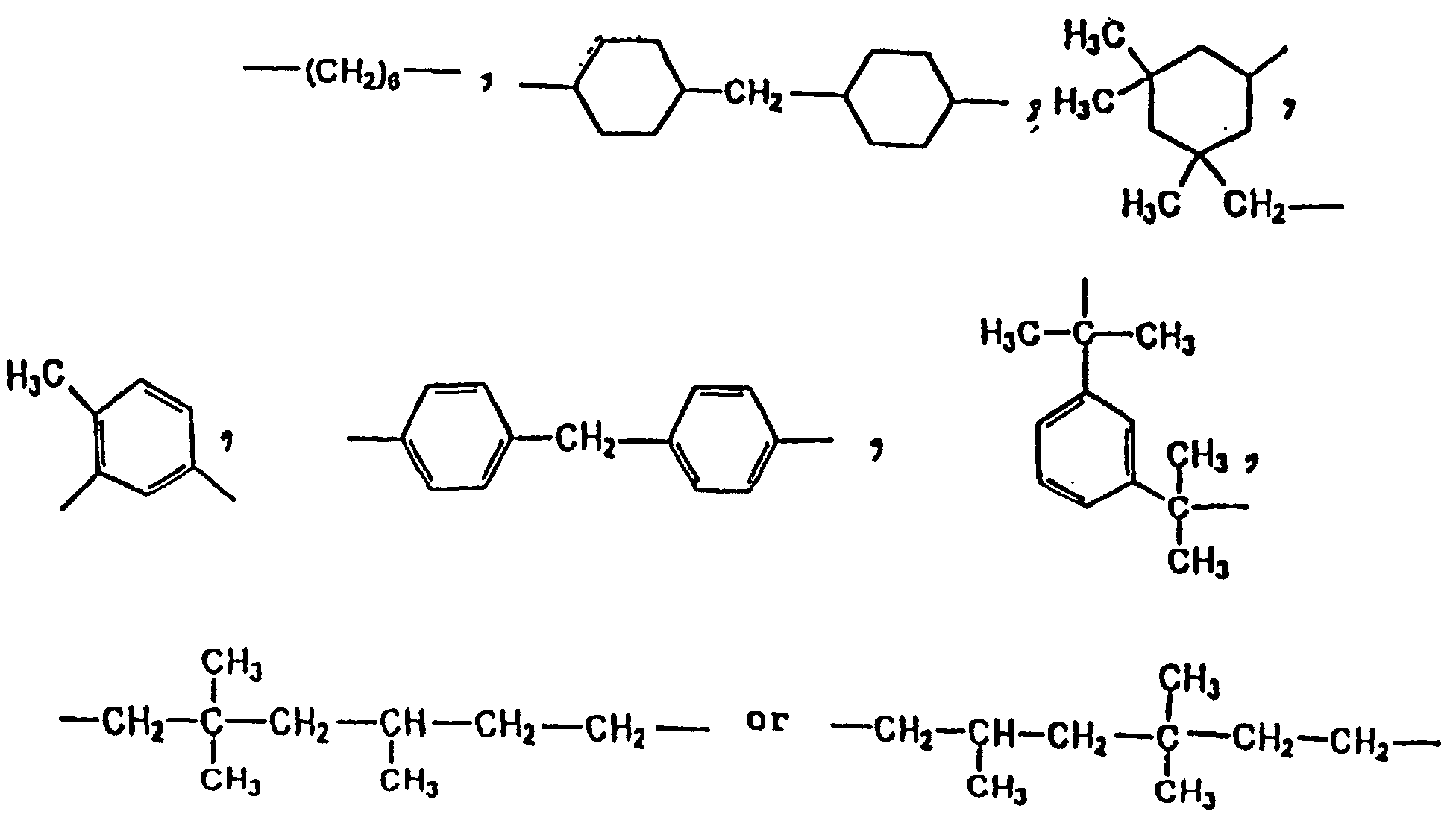
- The present invention also provides a coating composition comprising a multifunctional polyurethane (meth)acrylate and a (meth)acrylate reactive diluent having a molecular weight of 200 to 2000, the multifunctional polyurethane (meth)acrylate having the following structure:where
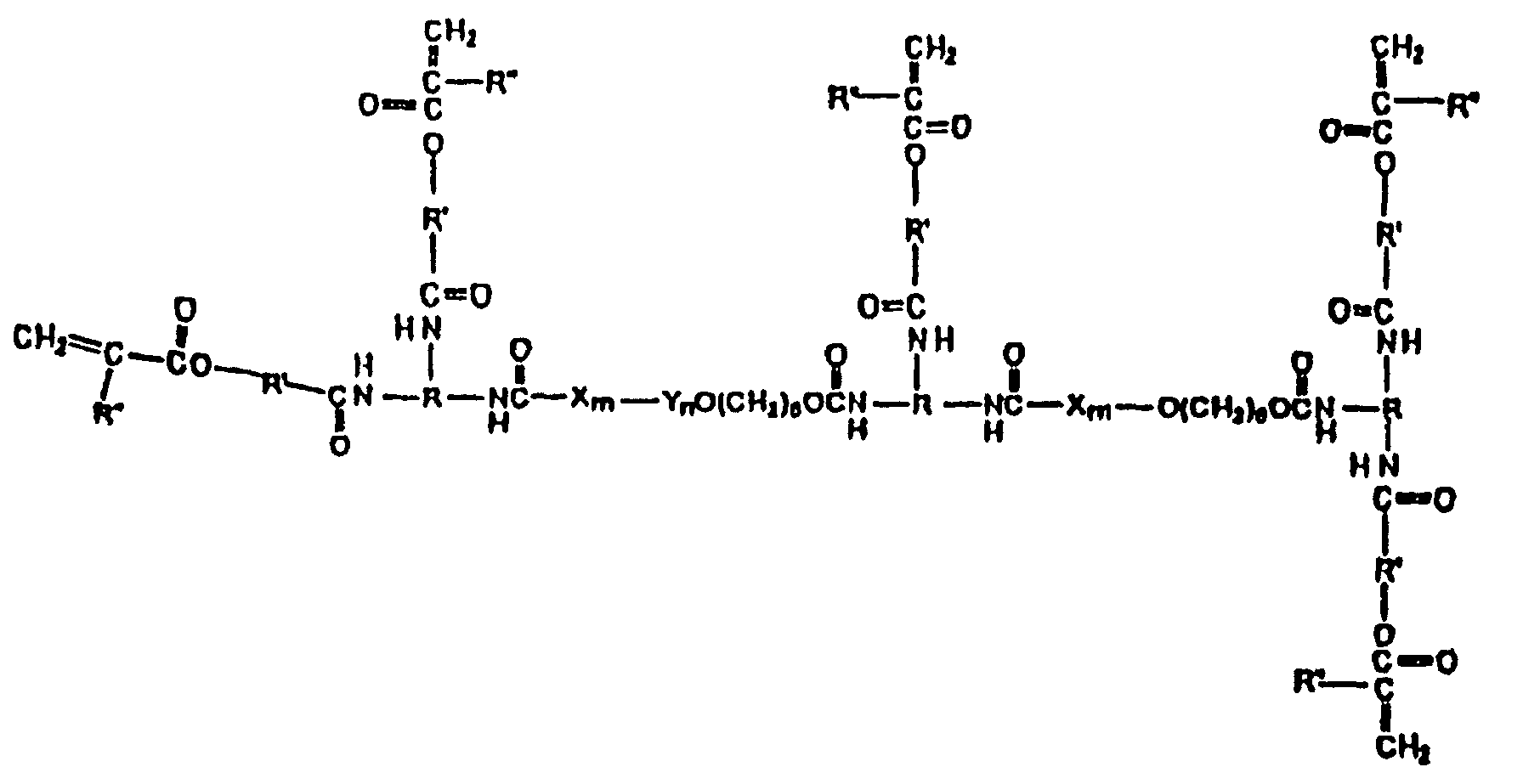
- m = 0, 1 or 2
- n = 1
- x =
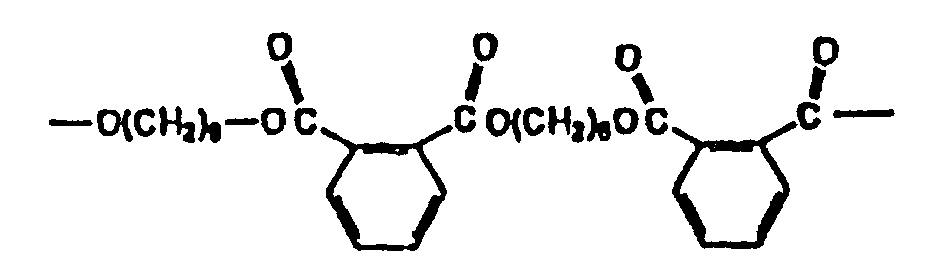
- Y =
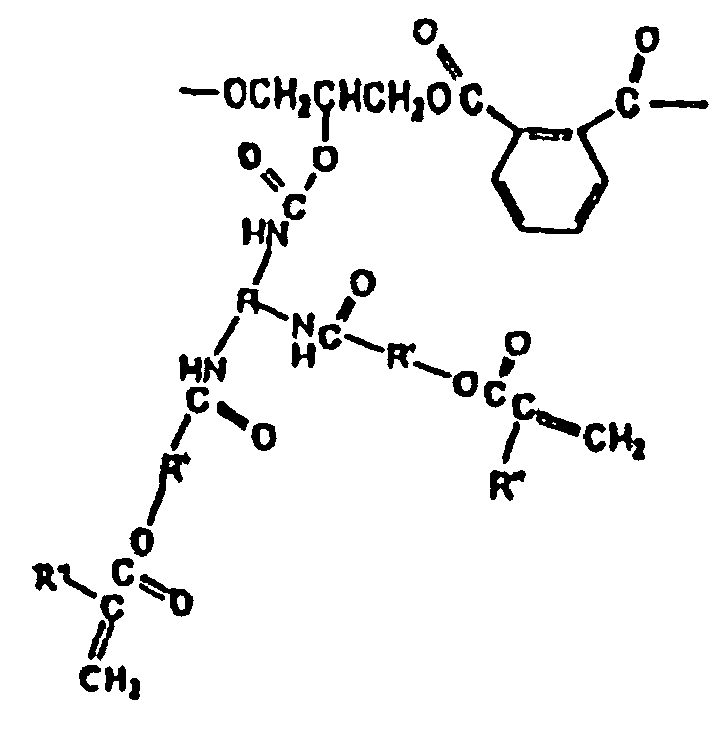
- R =

- R' =

- p = 1, 2 or 3
- R" = H or CH3
- R''' =
-
- The present invention further provides a floor covering comprising a base layer and wear layer adhered to the base layer, the wear layer comprising a cured coating composition, the coating composition comprising a (meth)acrylate reactive diluent having a molecular weight of about 200 to about 2000 and the reaction product of a polyisocyanate with a functionality of 3 to 6 isocyanate functionalities per molecule, an aromatic polyester polyol, and a hydroxyalkyl(meth)acrylate with a molecular weight of 344 to 472.
- The oligomer which comprises the coating composition of the present invention is the reaction product of a polyisocyanate with a functionality equal or higher than 3, preferably equal to or higher than 3.5, an aromatic polyester, preferably a phthalate polyester polyol, and a hydroxyalkyl(meth)acrylate with a molecular weight of 344 to 472. The resulting oligomer will be liquid at room temperature, highly branched, and have multi(meth)acrylate functionality. As used herein, term "(meth)acrylate" and its variants mean "acrylate, methacrylate and mixtures thereof."
- The coating composition may consist essentially of the oligomer. However, the oligomer without a diluent is viscous and difficult to coat. Therefore the coating composition of the present invention preferably includes a diluent. The preferred diluent is a reactive (meth)acrylate diluent.
- The coating composition may be cured either by electron beam curing or UV curing. The preferred composition includes a photoinitiator and the composition is cured with both electron beam and UV light.
- It is well known that abrasion resistance and non-yellowing coatings can be obtained from radiation-curable polyurethane (meth)acrylate based on aliphatic diisocyanates such as isophorone diisocyanate (IPDI) or methylene-bis(4-cyclohexylisocyanate) (Bayer Corporation's Desmodur W). However, higher functionality polyisocyanates such as isocyanurate, biuret and allophanate have not been used in the radiation-cured coatings, nor are such uses disclosed in the prior art.
- Because of their high reactivity, two-component coating systems must be mixed just prior to the application. After the two-components are put together, there is a limited pot-life in which the mixture must be used up before it is rendered useless.
- It was discovered that reacting isocyanurate trimers such as Bayer's Desmodur N3300 or biurets such as Bayer's Desmodur N100 or N3200 with a long chain hydroxyalkyl(meth)acrylate and an aromatic polyester polyol could produce one-component radiation-curable oligomers which have a long shelf-life. The oligomers would produce radiation-curable coatings of superior stain, gloss retention, abrasion and gouge resistance.
- Preferred oligomers were prepared by reacting about 0.7 to 1.5 equivalents of Desmodur N-3300 with 1.0 equivalent of a mixture of hydroxyalkyl(meth)acrylate and phthalate polyester polyols (equivalent ratio of hydroxyalkyl(meth)acrylate to polyester polyol greater than about 0.10) to produce a highly branched, multifunctional (meth)acrylate polyurethane product. The product was mixed with acrylate reactive diluents and photoinitiators to form a coating composition. Especially valuable properties were obtained when substantial quantities of high molecular weight, ethoxylated and propoxylated tri(meth)acrylates were the principle reactive diluents.
- An aromatic polyester polyol is defined as a polyester polyol of acid number of less than about 15, preferably less than 5, comprising the reaction product of an equivalent excess of one or more polyols of equivalent weight less than 150 with at least one aromatic polycarboxylic acid. If the polycarboxylic acid is a phthalic acid derivative the result is a phthalate polyester polyol. Preferably at least 50 equivalent percent of the polycarboxylic acid is isophthalic acid, phthalic acid, terephthalic acid, phthalic anhydride, or dimethyl terephthalate.
- The preferred multifunctional polyurethane (meth)acrylate of the present invention can be represented by the following Formula 1.where
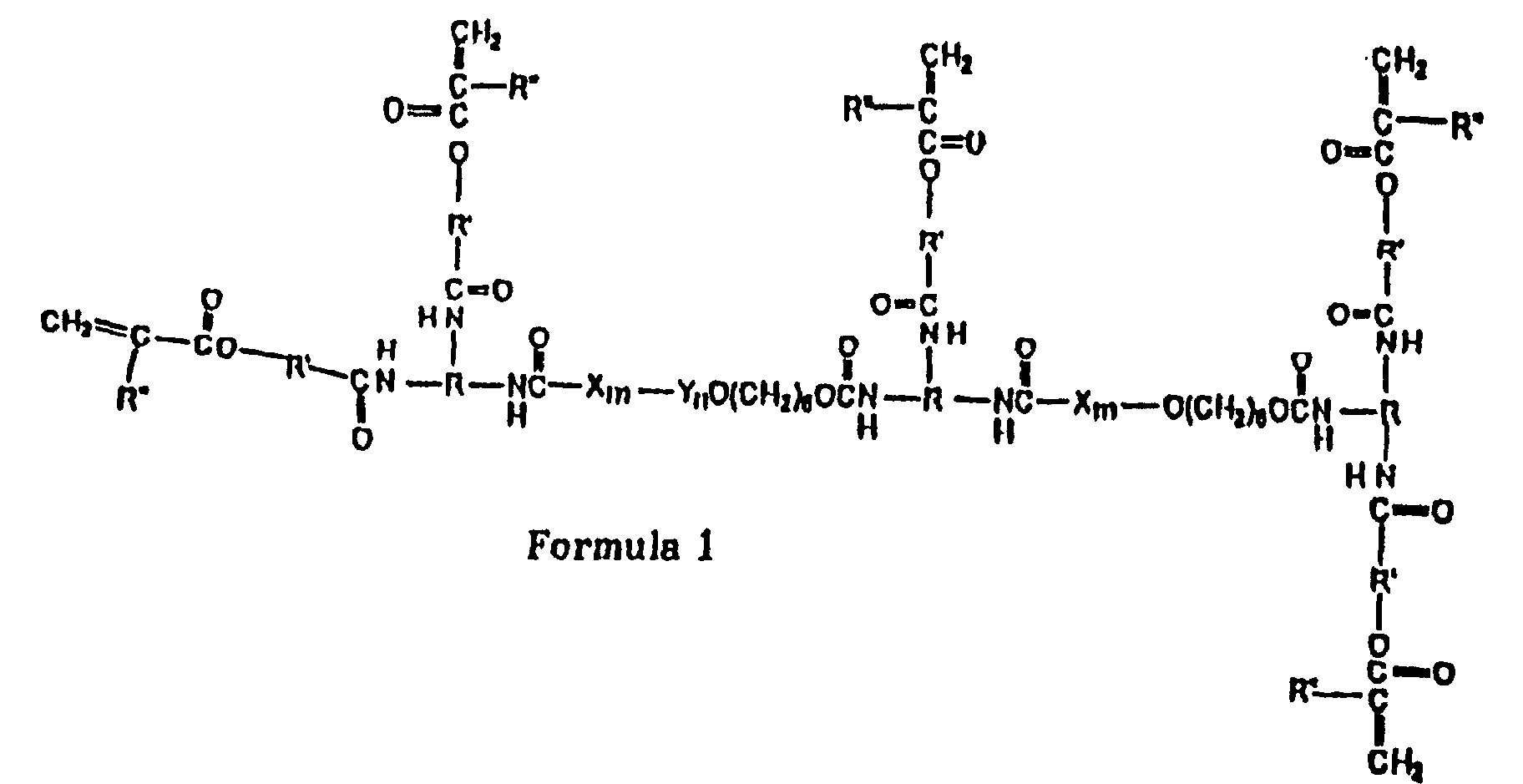
- m = 0, 1 or 2
- n = 1
- x =

- Y =

- R =

- R' =
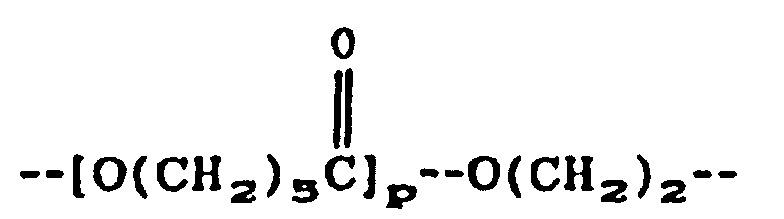
- p = 1, 2 or 3
- R" = H or CH3
- R''' =

-
- The isocyanurates, biurets and allophanates of the present invention can be aliphatic, cycloaliphatic or aromatic such as those prepared from 1,6 hexamethylene diisocyanate (Desmodur H); methylene-bis(4-cyclohexylisocyanate); 1-isocyanato-3-isocyanatomethyl-3,5,5-trimethylcyclohexane; 2,2,4-trimethylhexamethylene diisocyanate; 2,4,4-trimethylhexamethylene diisocyanate; toluene diisocyanate; methylenediphenyl diisocyanate; and tetra methylxylene diisocyanate. The preferred polyisocyanates are the trimer isocyanates represented by R in Formula 1 (isocyanurate, biuret and allophanate). The most preferred trimers are those derived from 1,6-hexamethylene diisocyanate which is commercially available as Desmodur N from Bayer Corporation.
- Suitable hydroxyalkyl(meth)acrylates are the polycaprolactone based hydroxy(meth)acrylate according to the skeletal structures in Formula 2:where

- R" = H or CH3, and
- p = 2 or 3. The polycaprolactone based hydroxy(meth)acrylates are supplied commercially by Union Carbide as Tone M-100 (molecular weight of about 344) and by San Esters Corporation as Placcel FA and FM series (molecular weights from about 230 to about 472).
-
- The preferred oligomer is prepared from Desmodur N-3300, Tone M-100 and a predominantly 1,6-hexylene phthalate polyester polyol. A predominantly 1,6-hexylene phthalate polyester polyol is defined as a phthalate polyester polyol wherein at least 50 equivalent percent of the <150 equivalent weight (eq. wt.) polyol is 1,6-hexanediol and wherein at least 50 equivalent percent of the polycarboxylic acid is phthalic acid or phthalic anhydride.
- Phthalate polyester polyols suitable for the present invention can be prepared by a procedure similar to example 1 of US Pat. No. 4,138,299 by reacting acids such as isophthalic, terephthalic, phthalic (or phthalic anhydride), adipic, azelaic, and/or sebacic with polyols such as 1,6-hexanediol; trimethylol propane; triethylene glycol; neopentyl glycol; cyclohexane dimethanol; 2-methyl-1,3-propanediol; trihydroxyethylisocyanurate; and glycerol in the presence of a catalyst such as dibutyltin bislauryl mercaptide or stannous oxalate.
- Suitable (meth)acrylate reactive diluents include, isodecyl (meth)acrylate, isobornyl (meth)acrylate, tetraethylene glycol (meth)acrylate, tripropylene glycol (meth)acrylate, hexanediol di(meth)acrylate, ethoxylate bisphenol-A di(meth)acrylate, ethoxylated neopentyl glycol di(meth)acrylate, propoxylated neopentyl glycol di(meth)acrylate, ethoxylated tripropylene glycol di(meth)acrylate, glyceryl propoxylated tri(meth)acrylate, tris (2-hydroxy ethyl) isocyanurate tri(meth)acrylate, pentaerythritol tri(meth)acrylate, pentaerythritol tetra(meth)acrylate, dimethylol propane tri(meth)acrylate dipentaerythritol monohydroxypenta(meth)acrylate, and trimethylol propane tri(meth)acrylate and its ethoxylated and propoxylated analogues of the skeletal structures in Formula 3:or
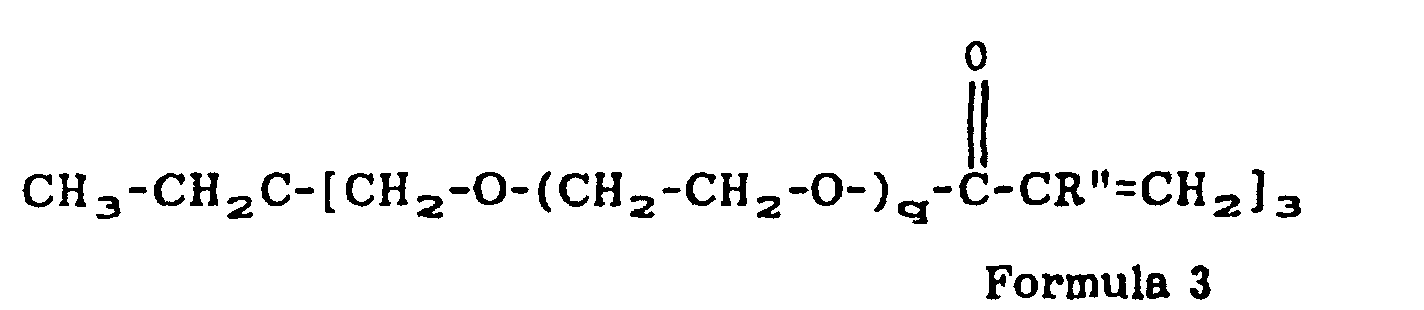 where
where
- R" = H, or CH3, and
- q = 0, 1, 2,..., 9 or 10.
-
- The preferred (meth)acrylate reactive diluents are the multifunctional acrylates with molecular weights of 200 to 2000. Examples of such are tetraethylene glycol diacrylate with a molecular weight of about 302, ethoxylated bisphenol-A diacrylate with a molecular weight of about 776 (SR602 from Sartomer Company), trihydroxyethyl isocyanurate triacrylate with molecular weight of about 423 (SR368 from Sartomer), trimethylol propane triacrylate with a molecular weight of about 296 (SR351 from Sartomer), and ethoxylated trimethylol propane triacrylates with molecular weights from 400 to 2000 (SR454, SR499, SR502, SR9035, and SR 415 from Sartomer Company and Photomer 4155 and Photomer 4158 from Henkel Corporation).
- To practice the present invention, it is preferred to employ photoinitiators by themselves or in combinations and/or in combination with photoactivators and photosensitizers. Suitable photoinitiators include benzophenone; 4-methylbenzophenone; benzyl dimethyl ketal; diethoxy acetophenone; benzoin ethers; thioxanthones; 1-hydroxycyclohexyl phenyl ketone (Irgacure 184 from Ciba Corp); 2-hydroxy-2-methyl-1-phenol-propane-1-one; 4-(2-hydroxyethoxy)phenyl-(2-hydroxy-2-methylpropyl) ketone; 2,4,6-trimethylbenzoyl diphenylphosphine oxide; bis (2,6-dimethoxybenzoyl)-2,4,4-trimethylpentyl phosphine oxide; 2,2-dimethoxy-2-phenyl acetophenone; 2-benzyl-2-N,N-dimethylamino-1-(4-morpholinophenyl)-1-butanone; and 2-methyl-1-[4-(methylthio)phenyl]-2-morpholino propan-1-one. A preferred photoinitiator is benzophenone, which may be used in conjunction with other photoinitiators, photoactivators and/or photosensitizers. A preferred combination is about two parts benzophenone per one part of 1-hydroxycyclohexyl phenyl ketone.
- In addition, other components which may be useful can also be included in the present invention. These include flow additives, free radical inhibitors, thermal stabilizers, light stabilizers, dyes, pigments, optical brighteners, flatting agents, plasticizers, and others as would be obvious to one skilled in the art.
- In preparing the oligomer of the present invention, a catalyst such as dibutyltin dilaurate may or may not be included to aid the urethane formation between the polyisocyanate and the hydroxy-containing components. However, it is advantageous to prepare the oligomer in a clean vessel free of moisture or water. The vessel is equipped with dry-air blanket and a heating jacket, and has continuous mixing. It is further advantageous to prepare the oligomer in the presence of substantial amounts of the reactive acrylate diluents to help control heat of reactions which may otherwise cause undesired side reactions. The reaction temperature is maintained at about 75°C to about 85°C. Higher temperatures can initiate undesired free radical polymerization. On the other hand, lower temperatures will retard or slow down the NCO/OH reaction.
- The compositions of the present invention can be applied by brushing, roller, gravure, spin, flow, or curtain coating at room temperature to an elevated temperature of up to about 75°C. The composition of the present invention has an excellent high temperature stability. Prolonged exposure to elevated temperature does not have any adverse effect on its superior properties. The radiation cure is achieved with ultraviolet or electron beam radiation. Although no photoinitiator is required when the composition is cured by electron beam, including a photoinitiator can further enhance the properties of the present invention.
- The present invention can be readily understood from the examples that follow. However, the following examples are provided to illustrate but not to limit the scope of the present invention.
Polyols Used in the Following Illustrative Examples Polyol 1 hydroxyl number = 185, acid number < 0.5 prepared from: 20.0 equivalents of phthalate anhydride 23.8 equivalents of 1,6-hexanediol 6.0 equivalents of glycerine Polyol 2 hydroxyl number = 115, acid number < 0.6 prepared from: 20.0 equivalents of phthalate anhydride 25.75 equivalents of 1,6- hexanediol Polyol 3 hydroxyl number = 315, acid number < 0.6 prepared from: 20.0 equivalents of adipic acid 16.0 equivalents of trimethyl propane 20.0 equivalents of neopentyl glycol -
1. SR351 reactive diluent 16 parts 2. SR499 reactive diluent 10 parts 3. SR502 reactive diluent 10 parts 4. Tone M-100, hydroxyacrylate from Union Carbide 32.58 parts 5. Polyol 1, hydroxyl equivalent weight (eq. wt.) of 303 8.87 parts 6. Desmodur N3300, Bayer's isocyanurate trimer eq. wt. of 195 22.55 parts 7. Irgacure 184 (from Ciba) 1.0 parts 8. Benzophenone 2.0 parts 9. Silwet L7604 0.2 parts - This composition had 64% oligomer and 36% reactive diluents, a NCO/OH of 0.933 and a hydroxyacrylate/polyol of 3.24. Viscosity at 25°C of the composition was 14,500 mPa.s (cps). Kept away from actinic light sources, it was stable at room temperature for more than 2 years. At 70°C, it remained in its liquid state for over a 6-month period.
- The above composition was curtain coated 3-mil thick on a rigid vinyl clad composite tile base. The coating was UV-cured 2 passes under a pair of 200-watt per inch medium pressure mercury lamps at a belt speed which resulted in a total UV dose of 2.32 J/sq cm.
- Two comparative compositions were prepared, curtain coated on a rigid vinyl clad composite tile base, and UV-cured with the same dose of energy as the composition of the present invention. The two comparative compositions are both used on commercial floor covering. Comparative Composition 1 was similar in composition to Example 1 of US Pat. No. 5,003,026. Comparative Composition 2 was similar in composition to Product B of US Pat. No. 4,421,782.
- The composition of Example 1 of the present invention and the two comparative compositions were subject to the following performance evaluations:
- (1) Stain Resistance: Sample specimens were exposed 24 hours to 6 household stains consist of ink, magic marker, hair dye, tincture of iodine, shoe polish, and driveway sealant. The specimens were then cleaned with isopropyl alcohol, soap and water. Stain areas were determined by a colorimeter for LAB color changes before and after exposure to the stains. Colorimeter reading results were reported in ΔE. Higher ΔE indicated poorer staining resistance properties.
- (2) Gloss Retention: This was an accelerated abrasion resistance test. Sample specimens were laid under a leather clad traffic wheel which traveled in a circular motion. The wheel itself rotated along its own axle. Abrasive soils were applied on top of the specimens while the wheel traveled in the circular motion on top of them. After 90 minute duration, the specimens were determined for their retention of gloss with a gloss meter. Higher gloss retention indicated better abrasion resistance. The results of this test coordinate well with actual gloss loss of the product in the field.
- (3) Deep Scratch and Gouge Resistance: This was an accelerated test. The test was similar to the gloss retention test except the rotation of the wheel along its axle is at a different speed from its travel in circular motion and a more abrasive mixture of soils was used. The outcomes of the test were rated against a control with known performance. A higher rating indicated a better scratch and gouge resistance property.
-
- The series of formulations in Table 3 were prepared, UV-cured, and tested as in Example 1. Example B is a comparative example. The results which are presented in the bottom of Table 3 showed that polyurethane acrylates, the reaction products of trifunctional isocyanates provided superior gloss retention, stain resistance, abrasion, scratch and gouge resistance.


- The series of formulations in Table 4 were prepared, UV-cured, and tested as in Example 1. Examples N and O are comparative examples. The results are presented at the bottom of Table 4. The results showed superior properties could be obtained from trifunctional isocyanate for the polyurethane acrylates for the present invention.
Example I J K L M N O Oligomer Reactants (in % by weight) Desmodur N100 22.25 -- -- -- -- -- -- Desmodur N3200 -- 21.47 -- -- -- -- -- Desmodur N3400 -- -- 23.73 -- -- -- -- Desmodur H -- -- -- -- -- 16.91 -- Desmodur W -- -- -- -- -- -- 31.30 Polyisocyanate A -- -- -- 25.43 -- -- -- Polyisocyanate B -- -- -- -- 23.57 -- -- Polyol 1 8.93 9.10 14.90 8.75 8.61 -- 16.42 Polyol 3 -- -- -- -- -- 11.94 -- Tone M100 32.82 33.43 25.37 29.82 31.82 46.15 37.28 Reactive Diluents (in % by weight) SR351 10.00 10.00 16.00 14.00 16.00 -- -- SR454 -- -- -- -- -- 25.00 -- SR499 13.00 13.00 10.00 10.00 10.00 -- -- SR502 13.00 13.00 10.00 12.00 10.00 -- 25.00 Photoinitiators (in phr) Benzophenone 2.00 2.00 2.00 2.00 2.00 2.00 2.00 Irgacure 184 1.00 1.00 1.00 1.00 1.00 1.00 1.00 Flow Aids (in phr) Silwet L7604 0.2 0.2 0.2 0.2 0.2 0.2 0.2 Oligomer Equivalent Ratio NCO/OH 0.933 0.934 1.000 1.000 1.091 1.000 1.000 Hydroxyacrylate /polyol 3.24 3.24 1.50 3.00 3.26 2.00 2.00 Comparative Properties Stain Resistance, ΔE 210 213 138 194 95 231 192 Gloss Retention, % 89 91 87 81 58 90 79 Gouge Resistance 4 4 7 6 6 3 3 Desmodur N100 is a biuret isocyanate derived from hexamethylene diisocyanate. It has an equivalent weight of 191. Desmodur N3200 is a biuret isocyanate derived from hexamethylene diisocyanate. It has an equivalent weight of 181. Desmodur N3400 is a uretidione isocyanate. It has an equivalent weight of 193. Polyisocyanate A is a mixture of polyisocyanates containing allophanate. It has an equivalent weight of 220. Polyisocyanate B is a partial timer of methyl-bis(4-cyclohexylisocyanate). It has an equivalent weight of 178.7.
| Example 1 | Comparative 1 | Comparative 2 | |
| Stain resistance | 110 | 260 | 210 |
| Gloss retention | 87 | 85 | 45 |
| Gouge resistance | 7 | 3 | 3 |
Claims (14)
- A coating composition comprising the reaction product of a polyisocyanate having 3 to 6 isocyanate functionalities per molecule, an aromatic polyester polyol and a hydroxyalkyl(meth)acrylate with an average molecular weight of 344 to 472 and a (meth)acrylate reactive diluent having a molecular weight of at least 200 and less than 2000.
- The coating composition of claim 1, wherein the (meth)acrylate diluent is selected from the group consisting of tetraethylene glycol diacrylate, ethoxylated bisphenol-A diacrylate, trihydroxyethyl isocyanurate triacrylate, trimethylol propane triacrylate, and ethoxylated trimethylol propane triacrylate.
- The coating composition of claim 1, further comprising a photoinitiator.
- The coating composition of claim 1, wherein the aromatic polyester polyol is a polyester polyol of acid number of less than 15 comprising the reaction product of an equivalent excess of one or more polyols of equivalent weight less than 150 with at least one of the group consisting of a polycarboxylic acid, a polycarboxylic anhydride, and an ester of a polycarboxylic acid, wherein at least 50 equivalent percent of the polycarboxylic acid, polycarboxylic anhydride or ester of a polycarboxylic acid is selected from the group consisting of an aromatic polycarboxylic acid, an aromatic polycarboxylic anhydride, an ester of an aromatic polycarboxylic acid, and mixtures thereof.
- The coating composition of claim 4 wherein the aromatic polycarboxylic acid, aromatic polycarboxylic anhydride or ester of an aromatic polycarboxylic acid is selected from the group consisting of isophthalic acid, phthalic acid, terephthalic acid, phthalic anhydride, and dimethyl terephthalate.
- The coating composition of claim 1 wherein the polyisocyanate is selected from the group consisting of an isocyanurate, a biuret and an allophanate.
- The coating composition of claim 1 wherein the polyisocyanate is selected from the group consisting of those prepared from 1,6 hexamethylene diisocyanate; methylene-bis(4-cyclohexylisocyanate); 1-isocyanato-3-isocyanatomethyl-3,5,5-trimethylcyclohexane; 2,2,4-trimethylhexamethylene diisocyanate; 2,4,4-trimethylhexamethylene diisocyanate; toluene diisocyanate; methylenediphenyl diisocyanate; and tetra methylxylene diisocyanate.
- The coating composition of claim 1 wherein the hydroxyalkyl(meth)acrylate is a polycaprolactone based hydroxy(meth)acrylate having the formula:where
 R" = H or CH3, andp = 2 or 3.
 - The coating composition of claim 1 wherein the polyisocyanate is an isocyanate derived from hexamethyl diisocyanate, the aromatic polyester polyol is a phthalate polyester polyol wherein at least 50 equivalent percent of the polyol is 1,6-hexanediol and at least 50 equivalent percent of the polycarboxylic acid is phthalic acid or phthalatic anhydride, and the hydroxyalkyl(meth)acrylate is a polycaprolactone based hydroxy(meth)acrylate having an average molecular weight of about 344, the isocyanate having an equivalent weight of about 195 and an average isocyanate functionality of about 3.5.
- The coating composition according to claim 1 comprising a multifunctional polyurethane (meth)acrylate and a (meth)acrylate reactive diluent having a molecular weight of 200 to 2000, the multifunctional polyurethane (meth)acrylate having the following structure:where
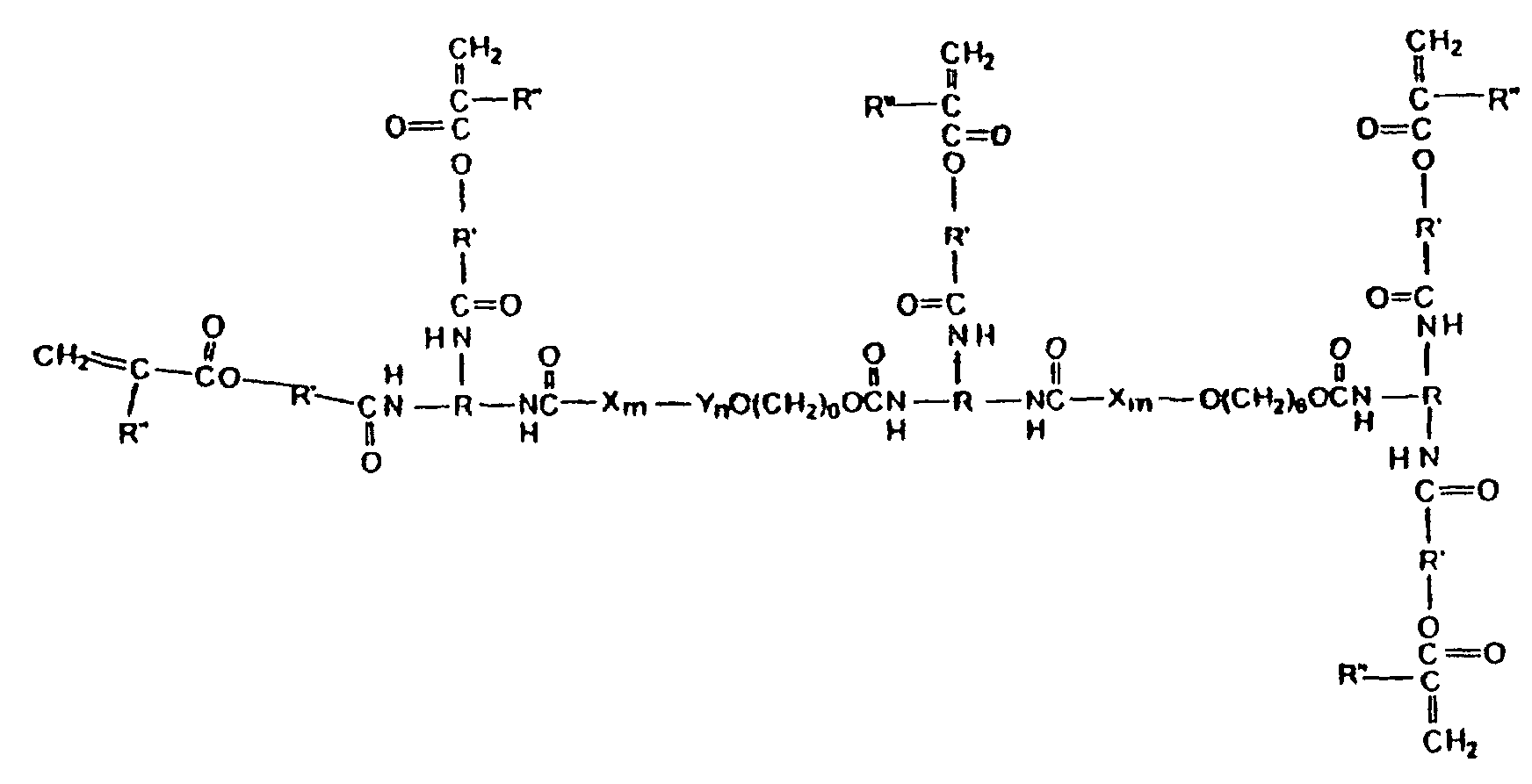 m = 0, 1 or 2n = 1x =
 Y =
Y = R =
R =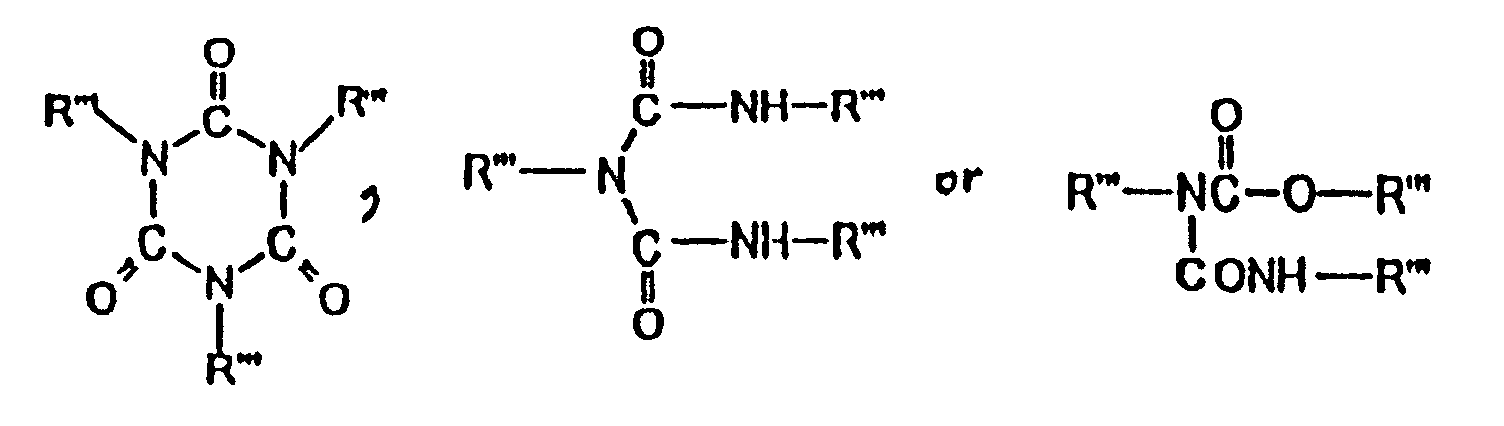 R' =
R' = p = 1, 2 or 3R" = H or CH3R''' =
- A floor covering comprising a base layer and wear layer adhered to the base layer, the wear layer comprising a cured coating composition, the coating composition comprising a (meth)acrylate reactive diluent having a molecular weight of 200 to 2000 and the reaction product of a polyisocyanate with a functionality of 3 to 6 isocyanate functionalities per molecule, an aromatic polyester polyol, and a hydroxyalkyl(meth)acrylate with a molecular weight of 344 to 472.
- The floor covering of claim 11, wherein the (meth)acrylate diluent is selected from the group consisting of, isodecyl (meth)acrylate, isobornyl (meth)acrylate, tetraethylene glycol (meth)acrylate, tripropylene glycol (meth)acrylate, hexanediol di(meth)acrylate, ethoxylate bisphenol-A di(meth)acrylate, ethoxylated neopentyl glycol di(meth)acrylate, propoxylated neopentyl glycol di(meth)acrylate, ethoxylated tripropylene glycol di(meth)acrylate, glyceryl propoxylated tri(meth)acrylate, tris (2-hydroxy ethyl) isocyanurate tri(meth)acrylate, pentaerythritol tri(meth)acrylate, pentaerythritol tetra(meth)acrylate, dimethylol propane tri(meth)acrylate dipentaerythritol monohydroxypenta(meth)acrylate, and trimethylol propane tri(meth)acrylate and its ethoxylated and propoxylated analogues of the skeletal structure selected from the group consisting ofand
 where
where R" = H or CH3, andq = 0, 1, 2,..., 9 or 10.
 - The floor covering of claim 12, wherein the (meth)acrylate diluent is selected from the group consisting of tetraethylene glycol diacrylate, ethoxylated bisphenol-A diacrylate, trihydroxyethyl isocyanurate triacrylate, trimethylol propane triacrylate, and ethoxylated trimethylol propane triacrylate.
- The floor covering of claim 11, wherein the coating composition further comprises a photoinitiator.
Applications Claiming Priority (2)
| Application Number | Priority Date | Filing Date | Title |
|---|---|---|---|
| US56654595A | 1995-12-04 | 1995-12-04 | |
| US566545 | 1995-12-04 |
Publications (3)
| Publication Number | Publication Date |
|---|---|
| EP0783008A2 EP0783008A2 (en) | 1997-07-09 |
| EP0783008A3 EP0783008A3 (en) | 1998-01-14 |
| EP0783008B1 true EP0783008B1 (en) | 2004-02-11 |
Family
ID=24263341
Family Applications (1)
| Application Number | Title | Priority Date | Filing Date |
|---|---|---|---|
| EP96118484A Expired - Lifetime EP0783008B1 (en) | 1995-12-04 | 1996-11-18 | Coating composition and floor covering including the composition |
Country Status (5)
| Country | Link |
|---|---|
| US (2) | US5719227A (en) |
| EP (1) | EP0783008B1 (en) |
| CA (1) | CA2189836C (en) |
| DE (1) | DE69631511T2 (en) |
| GB (1) | GB2307912B (en) |
Cited By (1)
| Publication number | Priority date | Publication date | Assignee | Title |
|---|---|---|---|---|
| CN103080252A (en) * | 2010-09-07 | 2013-05-01 | 3M创新有限公司 | Curable resin composition and multilayer laminate produced using it |
Families Citing this family (60)
| Publication number | Priority date | Publication date | Assignee | Title |
|---|---|---|---|---|
| US6197844B1 (en) * | 1996-09-13 | 2001-03-06 | 3M Innovative Properties Company | Floor finish compositions |
| US6291078B1 (en) | 1997-10-22 | 2001-09-18 | Mannington Mills, Inc. | Surface coverings containing aluminum oxide |
| US6228463B1 (en) | 1997-02-20 | 2001-05-08 | Mannington Mills, Inc. | Contrasting gloss surface coverings optionally containing dispersed wear-resistant particles and methods of making the same |
| US5767220A (en) * | 1997-08-25 | 1998-06-16 | Bayer Corporation | Low viscosity, ethylenically unsaturated polyurethanes containing allophanate groups |
| KR100362645B1 (en) * | 1997-12-16 | 2003-03-15 | 주식회사 포스코 | An uv radiation resin composition for coating iron and uv coating steel sheet having good hardness and process properties produced using it |
| DE19818312A1 (en) * | 1998-04-23 | 1999-10-28 | Bayer Ag | Aqueous coating system made from UV-curing urethane (meth) acrylate isocyanate groups |
| US6239209B1 (en) | 1999-02-23 | 2001-05-29 | Reichhold, Inc. | Air curable water-borne urethane-acrylic hybrids |
| US6316535B1 (en) | 1999-05-18 | 2001-11-13 | Armstrong World Industries, Inc. | Coating system and method of applying the same |
| US6635706B1 (en) | 1999-06-23 | 2003-10-21 | Reichhold, Inc. | Urethane-acrylic hybrid polymer dispersion |
| ATE279487T1 (en) | 1999-07-28 | 2004-10-15 | Armstrong World Ind Inc | COMPOSITION AND METHOD FOR A GLOSS-CONTROLLED, ABRASION-RESISTANT COATING ON PRODUCT SURFACES |
| US6333076B1 (en) * | 1999-07-28 | 2001-12-25 | Armstrong World Industries, Inc. | Composition and method for manufacturing a surface covering product having a controlled gloss surface coated wearlayer |
| DE19944156A1 (en) | 1999-09-15 | 2001-03-22 | Bayer Ag | Elastic coating system containing UV-curable, isocyanate-containing urethane (meth) acrylates and its use |
| US7763345B2 (en) | 1999-12-14 | 2010-07-27 | Mannington Mills, Inc. | Thermoplastic planks and methods for making the same |
| JP5072140B2 (en) * | 2000-06-15 | 2012-11-14 | 新中村化学工業株式会社 | Floor coating composition and coating coating thereof |
| CA2353025A1 (en) * | 2000-08-18 | 2002-02-18 | Craig W. Desantis | Three-dimensional laminate |
| US6908663B1 (en) * | 2000-11-15 | 2005-06-21 | Awi Licensing Company | Pigmented radiation cured wear layer |
| JP3676260B2 (en) * | 2000-12-28 | 2005-07-27 | ナトコ株式会社 | Active energy ray curable urethane (meth) acrylate, active energy ray curable composition and use thereof |
| US6890625B2 (en) | 2001-02-05 | 2005-05-10 | Awi Licensing Company | Surface covering having gloss in-register and method of making |
| EP1243606A1 (en) * | 2001-03-19 | 2002-09-25 | Four Trend, Inc. | A resin composition for forming a matte-finished surface and a method of forming a matte-finished surface |
| US7288289B2 (en) * | 2001-05-22 | 2007-10-30 | Awi Licensing Company | Method and apparatus for manufacturing sheet flooring by simultaneous multi-layer die coating |
| US20080063844A1 (en) * | 2001-06-29 | 2008-03-13 | Mannington Mills, Inc. | Surface coverings containing aluminum oxide |
| US8028486B2 (en) | 2001-07-27 | 2011-10-04 | Valinge Innovation Ab | Floor panel with sealing means |
| DE10140155A1 (en) | 2001-08-16 | 2003-03-06 | Basf Coatings Ag | Coating materials curable thermally and thermally and with actinic radiation and their use |
| DE10140156A1 (en) * | 2001-08-16 | 2003-03-20 | Basf Coatings Ag | Coating materials curable thermally and with actinic radiation and their use |
| US6844374B2 (en) * | 2001-10-03 | 2005-01-18 | Lord Corporation | Enhanced scratch resistant coatings using inorganic fillers |
| US6676799B2 (en) | 2002-01-29 | 2004-01-13 | Armstrong World Industries, Inc. | Method for making metallized decorative laminate |
| US6911263B2 (en) * | 2002-01-30 | 2005-06-28 | Awi Licensing Company | PET wear layer/sol gel top coat layer composites |
| TW200307733A (en) * | 2002-02-01 | 2003-12-16 | Natoco Co Ltd | Composition curable with actinic energy ray and use thereof |
| US6916547B2 (en) * | 2002-02-01 | 2005-07-12 | Awi Licensing Company | Multi-functional unsaturated polyester polyols |
| US7628917B2 (en) * | 2002-09-03 | 2009-12-08 | Whatman, Inc. | Porous composite membrane and method for making the same |
| WO2004035703A1 (en) * | 2002-10-18 | 2004-04-29 | Lg Cable Ltd. | Melt-flow controlling method for elastomer by uv irradiation |
| US20050079780A1 (en) * | 2003-10-14 | 2005-04-14 | Rowe Richard E. | Fiber wear layer for resilient flooring and other products |
| US7977430B2 (en) * | 2003-11-25 | 2011-07-12 | Novartis Ag | Crosslinkable polyurea prepolymers |
| US20050282945A1 (en) * | 2004-06-21 | 2005-12-22 | Vampire Optical Coatings, Inc. | Coating compositions |
| US20060047099A1 (en) * | 2004-08-25 | 2006-03-02 | Carmen Flosbach | Process for the production of polyurethane (meth)acrylates |
| DE102004043539A1 (en) * | 2004-09-09 | 2006-03-30 | Bayer Materialscience Ag | Low-viscosity allophanates with actinically curable groups |
| US7135505B2 (en) * | 2004-10-25 | 2006-11-14 | Bayer Materialscience Llc | Radiation curable coatings based on uretdione polyisocyanates |
| DE102004058193A1 (en) * | 2004-12-02 | 2006-06-08 | Wacker Chemie Ag | Crosslinkable siloxane-urea copolymers |
| US20060128923A1 (en) * | 2004-12-15 | 2006-06-15 | Bayer Materialscience Llc | Radiation curable compositions |
| US20060293484A1 (en) * | 2005-06-24 | 2006-12-28 | Bayer Materialscience Llc | Low viscosity, ethylenically-unsaturated polyurethanes |
| DE102005034344A1 (en) * | 2005-07-22 | 2007-01-25 | Umicore Ag & Co. Kg | Process for the reactivation of thermally aged nitrogen oxide storage catalysts |
| DE102005043179A1 (en) * | 2005-09-09 | 2007-03-15 | Johnson Controls Interiors Gmbh & Co. Kg | Decorated trim part |
| EP1780230A1 (en) * | 2005-10-25 | 2007-05-02 | Cytec Surface Specialties, S.A. | Polymer and compositions |
| SE530653C2 (en) | 2006-01-12 | 2008-07-29 | Vaelinge Innovation Ab | Moisture-proof floor board and floor with an elastic surface layer including a decorative groove |
| PL2004703T3 (en) * | 2006-04-19 | 2011-04-29 | Stepan Co | Radiation-curable compositions for improved weather resistance |
| US7732506B2 (en) * | 2006-04-19 | 2010-06-08 | Stepan Company | Radiation-curable compositions for improved weather resistance |
| US20080139775A1 (en) * | 2006-12-06 | 2008-06-12 | Xiaodong Wu | Abrasion resistant two-component waterborne polyurethane coatings |
| EP2008636A1 (en) * | 2007-06-29 | 2008-12-31 | 3M Innovative Properties Company | Dental composition containing a polyfunctional (meth)acrylate comprising urethane, urea or amide groups, method of production and use thereof |
| AU2009232369A1 (en) * | 2008-04-01 | 2009-10-08 | The Sherwin-Williams Company | Curable compositions |
| US20100276059A1 (en) | 2009-04-30 | 2010-11-04 | Dong Tian | UVV curable coating compositions and method for coating flooring and other substrates with same |
| NL2003019C2 (en) | 2009-06-12 | 2010-12-15 | 4Sight Innovation Bv | FLOOR PANEL AND FLOOR COVERAGE CONSISING OF MULTIPLE OF SUCH FLOOR PANELS. |
| US8808863B2 (en) | 2009-07-28 | 2014-08-19 | Photokinetic Coatings & Adhesives, Llc | UV-curable floor sealants |
| PL2686365T3 (en) | 2011-03-16 | 2017-09-29 | Stepan Company | Method for producing o-phthalate polyester polyols with low cyclic ester content |
| JP5892799B2 (en) * | 2012-02-03 | 2016-03-23 | 新中村化学工業株式会社 | Urethane (meth) acrylate that forms a cured product having elongation and excellent scratch resistance, and a photocurable resin composition containing the same |
| CN114030259A (en) | 2014-01-14 | 2022-02-11 | 扎伊罗技术股份公司 | Laminated construction panels for indoor and outdoor use |
| AU2017339964A1 (en) * | 2016-10-05 | 2019-05-09 | Afi Licensing Llc | Floor coatings comprising a resin, a cure system and diamond particles and methods of making the same |
| NL2018781B1 (en) | 2017-04-26 | 2018-11-05 | Innovations4Flooring Holding N V | Panel and covering |
| US10190021B2 (en) | 2017-05-15 | 2019-01-29 | Dexerials America Corporation | Floor coating compositions and flooring material |
| BR112021008609A2 (en) * | 2018-11-05 | 2021-08-03 | Universiteit Gent | urea- or urethane-based polymers capped with acrylate end caps |
| CN112680095B (en) * | 2020-12-18 | 2022-08-05 | 黎明化工研究设计院有限责任公司 | Ultraviolet-cured matte wear-resistant rubber floor paint |
Family Cites Families (18)
| Publication number | Priority date | Publication date | Assignee | Title |
|---|---|---|---|---|
| US4082634A (en) * | 1971-05-07 | 1978-04-04 | Ppg Industries, Inc. | Method of curing b-stage polyurethanes |
| US3929929A (en) * | 1973-05-29 | 1975-12-30 | Ici America Inc | Vinyl urethane resins |
| US4034017A (en) * | 1973-08-29 | 1977-07-05 | Ppg Industries, Inc. | Composition useful in making extensible films |
| US4342793A (en) * | 1977-01-14 | 1982-08-03 | Henkel Corporation | Interpenetrating dual cure resin compositions |
| US4138299A (en) * | 1977-12-23 | 1979-02-06 | Armstrong Cork Company | Process utilizing a photopolymerizable and moisture curable coating containing partially capped isocyanate prepolymers and acrylate monomers |
| US4198200A (en) * | 1978-05-18 | 1980-04-15 | Lord Corporation | Damage-preventive coatings |
| US4254230A (en) * | 1979-12-10 | 1981-03-03 | Lord Corporation | Actinic radiation-curable formulations of unsaturated polyetherester urethane |
| US4421782A (en) | 1981-10-26 | 1983-12-20 | Armstrong World Industries, Inc. | Process for providing improved radiation-curable surface coverings and products produced thereby |
| JPS63130611A (en) * | 1986-11-21 | 1988-06-02 | Nippon Kayaku Co Ltd | Polyurethane-(meth)acrylate mixture, resin composition and coating agent |
| DE3737244A1 (en) * | 1987-11-03 | 1989-05-18 | Bayer Ag | METHOD FOR PRODUCING GROUPS OF ISOCYANURATE AND COMPOUNDS HAVING DOUBLE OLEFINIC LINKS AND THEIR USE AS A BINDING AGENT |
| JPH02115213A (en) * | 1988-10-24 | 1990-04-27 | Nippon Polyurethane Ind Co Ltd | Manufacturing method of radiation-cured resin |
| DE69030981T2 (en) * | 1989-03-30 | 1997-10-23 | Toyo Boseki | Radiation curable resin and composition containing the same |
| US5003026A (en) | 1989-06-22 | 1991-03-26 | Armstrong World Industries, Inc. | UV curable no-wax coating |
| JPH04311714A (en) * | 1991-04-09 | 1992-11-04 | Nippon Paint Co Ltd | Photocurable resin composition |
| CA2118679C (en) * | 1993-03-29 | 2004-05-25 | David R. Kyle | Multiple curable composition and use thereof |
| US5290902A (en) * | 1993-06-22 | 1994-03-01 | Miles Inc. | Polyisocyanates containing allophanate and isocyanurate groups, a process for their production from cyclic diisocyanates and their use in two-component coating compositions |
| US5418112A (en) * | 1993-11-10 | 1995-05-23 | W. R. Grace & Co.-Conn. | Photosensitive compositions useful in three-dimensional part-building and having improved photospeed |
| US5521726A (en) * | 1994-08-26 | 1996-05-28 | Alliedsignal Inc. | Polarizer with an array of tapered waveguides |
-
1996
- 1996-11-07 CA CA002189836A patent/CA2189836C/en not_active Expired - Fee Related
- 1996-11-18 EP EP96118484A patent/EP0783008B1/en not_active Expired - Lifetime
- 1996-11-18 DE DE69631511T patent/DE69631511T2/en not_active Expired - Lifetime
- 1996-12-03 GB GB9625099A patent/GB2307912B/en not_active Expired - Fee Related
-
1997
- 1997-05-09 US US08/853,277 patent/US5719227A/en not_active Expired - Lifetime
- 1997-11-03 US US08/963,176 patent/US5843576A/en not_active Expired - Lifetime
Cited By (1)
| Publication number | Priority date | Publication date | Assignee | Title |
|---|---|---|---|---|
| CN103080252A (en) * | 2010-09-07 | 2013-05-01 | 3M创新有限公司 | Curable resin composition and multilayer laminate produced using it |
Also Published As
| Publication number | Publication date |
|---|---|
| GB2307912A (en) | 1997-06-11 |
| EP0783008A3 (en) | 1998-01-14 |
| GB9625099D0 (en) | 1997-01-22 |
| CA2189836C (en) | 2004-05-25 |
| DE69631511T2 (en) | 2004-12-23 |
| US5719227A (en) | 1998-02-17 |
| DE69631511D1 (en) | 2004-03-18 |
| US5843576A (en) | 1998-12-01 |
| GB2307912B (en) | 1999-12-08 |
| EP0783008A2 (en) | 1997-07-09 |
| CA2189836A1 (en) | 1997-06-05 |
Similar Documents
| Publication | Publication Date | Title |
|---|---|---|
| US5843576A (en) | Floor covering with coating composition | |
| JP5532287B2 (en) | Dual curable coating composition based on polyaspartate, polyisocyanate and acrylate containing compounds | |
| JP5466658B2 (en) | Compounds derived from polyisocyanates and alcohol A containing activated double bonds | |
| EP2665787B1 (en) | Non-aqueous polyurethane coating compositions | |
| TWI391417B (en) | Radiation-curing binders and a process for their preparation | |
| US5003026A (en) | UV curable no-wax coating | |
| CN108431066B (en) | Radiation-curable urethane (meth)acrylates with residual isocyanate groups | |
| JP2004502000A (en) | Curable aqueous polyurethane dispersion | |
| JPH08259883A (en) | Polyurethane coating material of extremely low voc content | |
| CN104822782B (en) | The method of coating base material and the base material being consequently formed | |
| CN103649248A (en) | Free radical curable waterborne glass coating compositions | |
| CA2414969A1 (en) | Radiation curable powder coating compositions and their use | |
| JPH0528241B2 (en) | ||
| US7022257B1 (en) | Coating composition and floor material coated with said composition | |
| JPH11166030A (en) | Production of radiation-curable urethane-functional prepolymer, prepolymer and treated material containing the same, use of the prepolymer, coating with the prepolymer, and base material coated with the same | |
| AU2022204621A1 (en) | Floor coatings comprising a resin, a cure system and diamond particles and methods of making the same | |
| US6790485B2 (en) | Process for coating substrates | |
| US8222312B2 (en) | Method for producing radiation curable formulations with increased corrosion protection on metal substrates, and formulations of this type | |
| CA2316528A1 (en) | Pulverent binders for powder coating compositions containing oligo- and polyurethanes having (meth) acryloyl groups | |
| CA2414801A1 (en) | Radiation curable powder coating compositions and their use | |
| JPH04226516A (en) | Ultraviolet-curing composition | |
| JP2008531757A (en) | Non-aqueous liquid coating composition curable by free radical polymerization of olefinic double bonds | |
| JPH0351753B2 (en) | ||
| JP2001098041A (en) | Resin composition and film-coated product | |
| JP3886600B2 (en) | Urethane (meth) acrylate oligomer-containing composition, varnish containing the same, photocurable coating composition, method for producing the oligomer-containing composition, and |
Legal Events
| Date | Code | Title | Description |
|---|---|---|---|
| PUAI | Public reference made under article 153(3) epc to a published international application that has entered the european phase |
Free format text: ORIGINAL CODE: 0009012 |
|
| AK | Designated contracting states |
Kind code of ref document: A2 Designated state(s): BE DE FR LU NL SE |
|
| PUAL | Search report despatched |
Free format text: ORIGINAL CODE: 0009013 |
|
| AK | Designated contracting states |
Kind code of ref document: A3 Designated state(s): BE DE FR LU NL SE |
|
| 17P | Request for examination filed |
Effective date: 19980206 |
|
| RAP1 | Party data changed (applicant data changed or rights of an application transferred) |
Owner name: ARMSTRONG WORLD INDUSTRIES, INC. |
|
| 17Q | First examination report despatched |
Effective date: 20011116 |
|
| GRAP | Despatch of communication of intention to grant a patent |
Free format text: ORIGINAL CODE: EPIDOSNIGR1 |
|
| GRAS | Grant fee paid |
Free format text: ORIGINAL CODE: EPIDOSNIGR3 |
|
| GRAA | (expected) grant |
Free format text: ORIGINAL CODE: 0009210 |
|
| AK | Designated contracting states |
Kind code of ref document: B1 Designated state(s): BE DE FR LU NL SE |
|
| REF | Corresponds to: |
Ref document number: 69631511 Country of ref document: DE Date of ref document: 20040318 Kind code of ref document: P |
|
| ET | Fr: translation filed | ||
| PLBE | No opposition filed within time limit |
Free format text: ORIGINAL CODE: 0009261 |
|
| STAA | Information on the status of an ep patent application or granted ep patent |
Free format text: STATUS: NO OPPOSITION FILED WITHIN TIME LIMIT |
|
| 26N | No opposition filed |
Effective date: 20041112 |
|
| PGFP | Annual fee paid to national office [announced via postgrant information from national office to epo] |
Ref country code: NL Payment date: 20051029 Year of fee payment: 10 |
|
| PGFP | Annual fee paid to national office [announced via postgrant information from national office to epo] |
Ref country code: BE Payment date: 20051208 Year of fee payment: 10 |
|
| PGFP | Annual fee paid to national office [announced via postgrant information from national office to epo] |
Ref country code: LU Payment date: 20051229 Year of fee payment: 10 |
|
| PGFP | Annual fee paid to national office [announced via postgrant information from national office to epo] |
Ref country code: FR Payment date: 20061117 Year of fee payment: 11 |
|
| PGFP | Annual fee paid to national office [announced via postgrant information from national office to epo] |
Ref country code: SE Payment date: 20061124 Year of fee payment: 11 |
|
| PG25 | Lapsed in a contracting state [announced via postgrant information from national office to epo] |
Ref country code: BE Free format text: LAPSE BECAUSE OF NON-PAYMENT OF DUE FEES Effective date: 20061130 |
|
| PG25 | Lapsed in a contracting state [announced via postgrant information from national office to epo] |
Ref country code: NL Free format text: LAPSE BECAUSE OF NON-PAYMENT OF DUE FEES Effective date: 20070601 |
|
| NLV4 | Nl: lapsed or anulled due to non-payment of the annual fee |
Effective date: 20070601 |
|
| BERE | Be: lapsed |
Owner name: *ARMSTRONG WORLD INDUSTRIES INC. Effective date: 20061130 |
|
| EUG | Se: european patent has lapsed | ||
| PG25 | Lapsed in a contracting state [announced via postgrant information from national office to epo] |
Ref country code: LU Free format text: LAPSE BECAUSE OF NON-PAYMENT OF DUE FEES Effective date: 20061118 |
|
| PG25 | Lapsed in a contracting state [announced via postgrant information from national office to epo] |
Ref country code: SE Free format text: LAPSE BECAUSE OF NON-PAYMENT OF DUE FEES Effective date: 20071119 |
|
| REG | Reference to a national code |
Ref country code: FR Ref legal event code: ST Effective date: 20080930 |
|
| PG25 | Lapsed in a contracting state [announced via postgrant information from national office to epo] |
Ref country code: FR Free format text: LAPSE BECAUSE OF NON-PAYMENT OF DUE FEES Effective date: 20071130 |
|
| PGFP | Annual fee paid to national office [announced via postgrant information from national office to epo] |
Ref country code: DE Payment date: 20101126 Year of fee payment: 15 |
|
| REG | Reference to a national code |
Ref country code: DE Ref legal event code: R119 Ref document number: 69631511 Country of ref document: DE Effective date: 20120601 |
|
| PG25 | Lapsed in a contracting state [announced via postgrant information from national office to epo] |
Ref country code: DE Free format text: LAPSE BECAUSE OF NON-PAYMENT OF DUE FEES Effective date: 20120601 |