EP0782504B1 - Microporous film/nonwoven composites - Google Patents
Microporous film/nonwoven composites Download PDFInfo
- Publication number
- EP0782504B1 EP0782504B1 EP95933152A EP95933152A EP0782504B1 EP 0782504 B1 EP0782504 B1 EP 0782504B1 EP 95933152 A EP95933152 A EP 95933152A EP 95933152 A EP95933152 A EP 95933152A EP 0782504 B1 EP0782504 B1 EP 0782504B1
- Authority
- EP
- European Patent Office
- Prior art keywords
- laminate
- layer
- web
- microporous film
- woven
- Prior art date
- Legal status (The legal status is an assumption and is not a legal conclusion. Google has not performed a legal analysis and makes no representation as to the accuracy of the status listed.)
- Expired - Lifetime
Links
Images
Classifications
-
- A—HUMAN NECESSITIES
- A61—MEDICAL OR VETERINARY SCIENCE; HYGIENE
- A61F—FILTERS IMPLANTABLE INTO BLOOD VESSELS; PROSTHESES; DEVICES PROVIDING PATENCY TO, OR PREVENTING COLLAPSING OF, TUBULAR STRUCTURES OF THE BODY, e.g. STENTS; ORTHOPAEDIC, NURSING OR CONTRACEPTIVE DEVICES; FOMENTATION; TREATMENT OR PROTECTION OF EYES OR EARS; BANDAGES, DRESSINGS OR ABSORBENT PADS; FIRST-AID KITS
- A61F13/00—Bandages or dressings; Absorbent pads
- A61F13/15—Absorbent pads, e.g. sanitary towels, swabs or tampons for external or internal application to the body; Supporting or fastening means therefor; Tampon applicators
- A61F13/51—Absorbent pads, e.g. sanitary towels, swabs or tampons for external or internal application to the body; Supporting or fastening means therefor; Tampon applicators characterised by the outer layers of the pads
- A61F13/514—Backsheet, i.e. the impermeable cover or layer furthest from the skin
- A61F13/51401—Backsheet, i.e. the impermeable cover or layer furthest from the skin characterised by the material
-
- A—HUMAN NECESSITIES
- A61—MEDICAL OR VETERINARY SCIENCE; HYGIENE
- A61B—DIAGNOSIS; SURGERY; IDENTIFICATION
- A61B46/00—Surgical drapes
- A61B46/40—Drape material, e.g. laminates; Manufacture thereof
-
- A—HUMAN NECESSITIES
- A61—MEDICAL OR VETERINARY SCIENCE; HYGIENE
- A61F—FILTERS IMPLANTABLE INTO BLOOD VESSELS; PROSTHESES; DEVICES PROVIDING PATENCY TO, OR PREVENTING COLLAPSING OF, TUBULAR STRUCTURES OF THE BODY, e.g. STENTS; ORTHOPAEDIC, NURSING OR CONTRACEPTIVE DEVICES; FOMENTATION; TREATMENT OR PROTECTION OF EYES OR EARS; BANDAGES, DRESSINGS OR ABSORBENT PADS; FIRST-AID KITS
- A61F13/00—Bandages or dressings; Absorbent pads
- A61F13/15—Absorbent pads, e.g. sanitary towels, swabs or tampons for external or internal application to the body; Supporting or fastening means therefor; Tampon applicators
- A61F13/51—Absorbent pads, e.g. sanitary towels, swabs or tampons for external or internal application to the body; Supporting or fastening means therefor; Tampon applicators characterised by the outer layers of the pads
- A61F13/514—Backsheet, i.e. the impermeable cover or layer furthest from the skin
- A61F13/51456—Backsheet, i.e. the impermeable cover or layer furthest from the skin characterised by its properties
- A61F13/51458—Backsheet, i.e. the impermeable cover or layer furthest from the skin characterised by its properties being air-pervious or breathable
-
- A—HUMAN NECESSITIES
- A61—MEDICAL OR VETERINARY SCIENCE; HYGIENE
- A61F—FILTERS IMPLANTABLE INTO BLOOD VESSELS; PROSTHESES; DEVICES PROVIDING PATENCY TO, OR PREVENTING COLLAPSING OF, TUBULAR STRUCTURES OF THE BODY, e.g. STENTS; ORTHOPAEDIC, NURSING OR CONTRACEPTIVE DEVICES; FOMENTATION; TREATMENT OR PROTECTION OF EYES OR EARS; BANDAGES, DRESSINGS OR ABSORBENT PADS; FIRST-AID KITS
- A61F13/00—Bandages or dressings; Absorbent pads
- A61F13/15—Absorbent pads, e.g. sanitary towels, swabs or tampons for external or internal application to the body; Supporting or fastening means therefor; Tampon applicators
- A61F13/51—Absorbent pads, e.g. sanitary towels, swabs or tampons for external or internal application to the body; Supporting or fastening means therefor; Tampon applicators characterised by the outer layers of the pads
- A61F13/514—Backsheet, i.e. the impermeable cover or layer furthest from the skin
- A61F13/51474—Backsheet, i.e. the impermeable cover or layer furthest from the skin characterised by its structure
- A61F13/51478—Backsheet, i.e. the impermeable cover or layer furthest from the skin characterised by its structure being a laminate, e.g. multi-layered or with several layers
-
- A—HUMAN NECESSITIES
- A61—MEDICAL OR VETERINARY SCIENCE; HYGIENE
- A61F—FILTERS IMPLANTABLE INTO BLOOD VESSELS; PROSTHESES; DEVICES PROVIDING PATENCY TO, OR PREVENTING COLLAPSING OF, TUBULAR STRUCTURES OF THE BODY, e.g. STENTS; ORTHOPAEDIC, NURSING OR CONTRACEPTIVE DEVICES; FOMENTATION; TREATMENT OR PROTECTION OF EYES OR EARS; BANDAGES, DRESSINGS OR ABSORBENT PADS; FIRST-AID KITS
- A61F13/00—Bandages or dressings; Absorbent pads
- A61F13/15—Absorbent pads, e.g. sanitary towels, swabs or tampons for external or internal application to the body; Supporting or fastening means therefor; Tampon applicators
- A61F13/51—Absorbent pads, e.g. sanitary towels, swabs or tampons for external or internal application to the body; Supporting or fastening means therefor; Tampon applicators characterised by the outer layers of the pads
- A61F13/514—Backsheet, i.e. the impermeable cover or layer furthest from the skin
- A61F13/51474—Backsheet, i.e. the impermeable cover or layer furthest from the skin characterised by its structure
- A61F13/51478—Backsheet, i.e. the impermeable cover or layer furthest from the skin characterised by its structure being a laminate, e.g. multi-layered or with several layers
- A61F13/5148—Backsheet, i.e. the impermeable cover or layer furthest from the skin characterised by its structure being a laminate, e.g. multi-layered or with several layers having an impervious inner layer and a cloth-like outer layer
-
- B—PERFORMING OPERATIONS; TRANSPORTING
- B32—LAYERED PRODUCTS
- B32B—LAYERED PRODUCTS, i.e. PRODUCTS BUILT-UP OF STRATA OF FLAT OR NON-FLAT, e.g. CELLULAR OR HONEYCOMB, FORM
- B32B27/00—Layered products comprising a layer of synthetic resin
- B32B27/12—Layered products comprising a layer of synthetic resin next to a fibrous or filamentary layer
Definitions
- This invention relates generally to microporous/nonwoven composites which exhibit breathability and good barrier properties. In one aspect it relates to a composite comprising a nonwoven layer, a microporous layer, and a staple fiber layer. In another aspect, the invention relates to a method of laminating webs comprising a nonwoven web, a microporous web, and a staple fiber web.
- Microporous films have long been used in applications requiring both breathability (or water vapor transmissibility) and barrier to liquids.
- Commercially available microporous films include Celgard 2400 polypropylene film, EXXAIRE polyethylene film produced by Exxon Chemical Company, and TetraTex, a microporous polytetrafluoroethylene film produced by TetraTek Corporation, and Gore-Tex produced by W. L. Gore & Associates.
- Other microporous films include those made from polyamides, polyesters, polyurethane, and polypropylene.
- Nonwoven webs because of their high porosity, are highly breathable but exhibit little or no barrier properties. Efforts have been made to combine nonwovens with microporous film to arrive at a composite which possesses a balance of breathable and barrier properties. Such a composite has uses in health care, protective apparel, footwear, etc.
- Patents which disclose microporous films and microporous film composites include the following:
- Nonwoven composites are described in the following U.S. Patents:
- the present invention relates to composite web structures which are breathable and possess good strength and barrier properties.
- the composite constructed according to the present invention exhibits desirable aesthetic and comfort properties.
- the composite of the present invention has a wide range of uses where breathability and barrier properties are necessary, it is particularly adapted for use as protective apparel.
- the composite of the present invention comprises, in its broadest embodiment, a three-layered structure having a core layer of staple fiber web, flanked by, and adhesively bonded to, a microporous film, and a nonwoven web.
- the composite comprises the following four layers:
- the structure combines the barrier properties of the microporous film, the breathability and strength of the non-woven webs, and the comfort and wicking properties of the staple fibers.
- the nonwoven webs also improve the aesthetics (appearance and soft hand) and add to the comfort for the user. Tests have also shown that the nonwoven webs, particularly meltblown webs, contribute to the barrier properties of the composite.
- the staple fiber web which exhibits hydrophilic characteristics, provides a wicking or reservoir layer for moisture and aqueous liquids.
- the preferred method of laminating the webs to form the composite involves the steps of (a) applying a thin coat of an adhesive onto the webs so that the adhesive is at the interface of each web to form a composite and (b) feeding the composite into the nip of calender rolls maintained at a low temperature (e.g. less than 100°C) to pressure bond the webs together.
- the method may be carried out in one pass through the calender wherein all four layers are pressure bonded together, or in two or more passes through the calender wherein two or three layers are bonded together in one pass followed by the addition of one or more layers in subsequent passes.
- a particularly surprising aspect of the present invention is that it produces composite structures that are capable of passing both the Blood and Viral Penetration Tests for protective clothing materials under ASTM Designations ES 21-92 and ES 22-92, respectively.
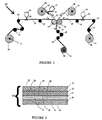
- Figure 1 is a schematic illustrating the lamination process for making the composite of the present invention.
- Figure 2 is an enlarged cross-section of a composite of the present invention.
- the composites of the present invention exhibit both breathability and resistance to liquids, and are useful in a variety of medical and/or hygiene applications such as protective apparel, wound dressings, sterile dressings, absorbents (e.g. diapers), face masks and the like.
- Composites used in many of these applications should have the following properties:
- the composite should in addition have absorbency for liquids.
- the composite constructed according to the present invention combines the barrier properties of microporous film, the breathability, appearance and strength of nonwovens, and the absorbency and comfort of cotton.
- the composite comprises a core web of staple fibers which exhibits hydrophilic wetting characteristics, and flanking layers of a microporous film and a nonwoven web.
- Each of the layers of the three-layered structure are adhesively bonded together by a low temperature, low pressure bonding process.
- the composite further includes a second web of a nonwoven adhesively bonded to the outer layer of the microporous film.
- Nonwoven webs are webs made of randomly oriented fibers or filaments of thermoplastic polymer by entangling the fibers or filaments through mechanical, thermal, or chemical means.
- Nonwovens exclude paper and products which are woven, knitted, tufted, or felted by wet milling.
- the preferred nonwoven webs for use in the present invention are the spunbonded and melt-blown webs.
- the spunbonded webs are formed by filaments that have been extruded, drawn, laid on a continuous belt, and then immediately thermally bonded by passing through a heated calender. These webs are continuous filament fiber structures having an average fiber diameter between 12 and 50 microns.
- meltblown webs are made by extruding a molten plastic through a row of die openings to form filaments and contacting the extruded filaments with high velocity sheets of converging hot air.
- the converging air contacts and attenuates or draws the filaments down, depositing them as fibers onto a collector in a random pattern, forming a meltblown web.
- the meltblown webs have average fiber size between 0.5 to 15 microns which is substantially smaller than the average fiber size of the spunbond web.
- meltblown webs are generally held together by fiber entanglement with some thermal bonding whereas the spunbond webs are generally thermal bonded by the calender, although spunbond webs are also bonded by chemical, adhesive, and needling processes.
- the nonwoven webs can be made of any synthetic thermoplastic polymer used in meltblowing or spunbond processes.
- these include the following: polyolefins, particularly ethylene and propylene homopolymers and copolymers (including EVA and EMA copolymers), nylon, polyamines, polyester, polystyrene, poly-4-methylpentene, polymethylmethacrylates, polytrifluorochloro-ethylene, polyurethanes, polycarbonates, silicones, polyphenylene sulfide, and polypropylene or polyethylene terephthalate.
- polyolefins particularly ethylene and propylene homopolymers and copolymers (including EVA and EMA copolymers)
- nylon polyamines
- polyester polystyrene
- poly-4-methylpentene polymethylmethacrylates
- polytrifluorochloro-ethylene polyurethanes
- polycarbonates silicones
- silicones polyphenylene sulfide
- the most common polymers used in spunbonded fabrics include polypropylene having a melt flow rate of 12-40. These polymers generally are extruded at temperatures ranging from 180° to 350°C.
- the most common polymers used in meltblown fabrics include polypropylene, having melt flow rates of 10-2500.
- These polymers are generally extruded at temperatures of between 180 to 350°C and contacted with high velocity air from 180 to 375°C.
- the preferred weight of the nonwoven web is from about 0.1 to about 2 oz. per square yard.
- the preferred weights are between about 0.25 to about 1.5 oz. per square yard for the spunbond webs.
- the nonwovens may include additives to impart desired properties to the webs.
- additives are wetting agents, fluorochemicals, antistatics, and anti-microbiotic agents.
- the nonwoven webs in a preferred embodiment comprise the outer two layers of the four layer structure. These webs impart strength to the structure, improve the hand (softness to the feel) and wearability, and improve the comfort and appearance giving the composite fabric a clothlike appearance and feel.
- microporous film means microporous membrane.
- film and membrane are used interchangeably herein.
- Microporous films are defined as having a narrow pore sized distribution in the submicron range, preferably from 1.0 to 10 microns.
- the microporous films can be made by a number of processes, which include (a) dissolving polymers in solution followed by extraction of the solvent by water vapor, (b) stretching of crystallizable polymers which results in microsized tears, and (c) stretching of a mineral filled polyolefin film.
- the polymers used in the microporous films include PTFE, polyolefins, polyurethanes, polyamides, and polyesters.
- the preferred microporous film used in the present invention is a polyolefin prepared by stretching a highly filled polyolefin film to impart permeability therein, in accordance with U.S. Patent 4,777,073, the disclosure of which is incorporated herein by reference.
- the microporous film prepared by this process exhibits excellent breathability, at least 3,000, and generally from 4,000 to 10,000 grams per square meter per day, and in comparison to other microporous film is inexpensive.
- Polyolefins used to make the film include polypropylene, copolymers of propylene, homopolymers, and copolymers of ethylene and blends thereof.
- a preferred polyolefin is a copolymer of polypropylene and low density polyethylene, particularly linear low density polyethylene (LLDPE) .
- the preferred filler at concentrations of from 30 to 70 wt% include inorganic fillers such as calcium carbonate, TiO2, talc, clay and silica diatomaceous earth, magnesium carbonate, barium carbonate, magnesium sulfate, and the other inorganic fillers listed in the above reference, U.S. Patent 4,777,073. Calcium carbonate is the preferred filler.
- the pore size of this film ranges from 0.1 to 0.5 microns.
- Staple Fibers as used herein includes natural or synthetic discrete fibers having a length from less than 1 inch to about 8 inches, preferably from about 0.5 inch to about 5 inches and most preferably from about 1 inch to about 3 inches.
- the staple fibers may include only one type of fibers or may include blends.
- the fibers must exhibit at least some hydrophilic properties.
- the preferred concentration of the hydrophilic fibers in the blend should be at least 25% and preferably more than 50%.
- the synthetic man-made fibers may be made from thermoplastics such as polyolefins (including polypropylene and polyethylene), polyesters, and polyamides which are extruded to the proper diameter (usually from 10 to 50 microns) and cut in the desired length, usually from 0.5 to 5.0 inhes.
- the staple or natural fibers may be any cellulosic base fibers, such as cotton, ramie, hemp, flax, jute, kenaf, bagasse, eucalyptus, rayon, and combinations thereof but do not include wood fiber.
- the staple fibers may be formed into a web by any of the presently known processes, including, but not limited to, thermal bonding, latex bonding, or carding, or needle-punching, or hydroentangling.
- the preferred web of staple fibers includes cotton fibers or cotton fibers blended with other staple fibers.
- the cotton fibers preferably have a fineness of between about 3 to 5 micronaire units to give the web flexibility.
- the cotton staple fibers have an average width of about 15 to 20 microns.
- the staple fibers which exhibit absorbency for aqueous based materials such as water and blood, act as a reservoir for any liquid or blood.
- the wicking property of the hydrophilic layer also absorbs water vapor.
- the staple fiber web improves the comfort property of the composite.
- any of the adhesives compatible with polyolefins and the staple fibers may be used.
- the preferred adhesives are the hot melt adhesives such as the polypropylene based adhesives, and EVA adhesive, (e.g. 20-40 wt% VA).
- Thermal bonding has a tendency to damage the microporous film by introducing pinholes.
- the preferred technique for applying the adhesive is by meltspraying or meltblowing of adhesives wherein an air/adhesive spray is deposited on one of the surfaces to be bonded. Both the meltblowing or meltspraying involve extruding a filament or filaments of a hot melt adhesive from a die and contacting the filament or filaments with air to either stretch or attenuate the filament or break it up into droplets which are deposited on the surface of the web.
- the amount of adhesive deposited on the web may vary within a wide range, but it should be sufficient to ensure good adhesion but not so much that substantial amounts of the pores of the web are plugged. Application from about 1 to 10 grams per square meter of the adhesive should be sufficient, with 1 to 5 grams per square meter being preferred.
- Nonthermal means the composite is formed by applying a bonding pressure at temperatures below melting point or softening temperature of the polymers used in the laminate. With polyolefins, this means that the temperatures are carried out below 100°C and preferably below 50°C, most preferably below 30°C. The lower limit of the laminating temperature will be ambient which, depending on the geographic location, may vary widely from 0°C to 50°C.
- a laminating apparatus 10 which may be used in laminating the composite of the present invention is schematically illustrated in Figure 1.
- the laminating assembly comprises a plurality of spindles 11, 12, 13, and 14 for receiving rolls of web and film, guide and tension rollers 15, meltblowing dies 16, 17, and 18, calender rolls 19 and 20, and take-up spindle 21.
- the various rolls may be mounted on the feed spindles 11-14 in the manner described below.
- a roll 22 of nonwoven web is mounted on spindle 11, with web 23 dispensed therefrom, trained around rollers 15, disposed under the die 16, and fed into the nip of calender rolls 19 and 20.
- a roll 24 of microporous film is mounted on spindle 12 with web 25 dispensed therefrom, disposed under die 17, and fed into the nip of calender rolls 19 and 20.
- a roll 26 of staple fiber is mounted on spindle 13 and web 27 dispensed therefrom and fed into the nip of calender rolls 19 and 20.
- a roll 28 of a nonwoven web is mounted on spindle 14 and web 29 dispensed therefrom.
- Web 29 is trained around rollers 15, passing under meltblowing die 18, and into the nip of calender rolls 19 and 20.
- the calender rolls may consist of the following combinations:
- the four webs 23, 25, 27, and 29 are fed in overlaying relation into the nip of the rolls 19 and 20 as shown in Figure 1 and driven or pulled therethrough around guide roll 15 and wound onto spindle 21 forming composite roll 34.
- the calender rolls 19 and 20 are maintained at a temperature well below the softening temperature of the polymers, preferably less than 100°C and the pressure at the nip is maintained between about 50 to 150 psi, preferably 75 to 125 psi, using the smooth rolls and about 150 to 250 pounds per linear inch using the combination smooth roll and embossed roll.
- a spray 30, 31, and 32 of adhesives is deposited on a surface of each web.
- the adhesive deposited on such webs forms a thin discontinuous layer thereon. Deposition of the adhesive in this manner ensures that adhesive will be at the interface of each of the webs as they are passed through the nip of the calender rolls 19 and 20.
- the speed at which the webs are processed through the nips may vary within relatively wide ranges, but speeds of 5 to 10 meters per minute are sufficient to ensure good bonding.
- the composite 34 comprises a first nonwoven web 23 having outer surface 35 and an inner surface 36 adhesively bonded to surface 37 of microporous film 25.
- the opposite surface 38 of microporous film 25 is adhesively bonded to surface 39 of staple fiber web 27.
- surface 40 of staple fiber web 27 is adhesively bonded to surface 41 of the second nonwoven web 29.
- Surface 42 of web 29 when used as protective apparel will be in contact with the wearer's body, and outer surface 35 of the composite 34 will be exposed to the environment.
- any blood or toxic liquid of the environment coming into contact with the apparel will first have to pass through the nonwoven web 23 and then through the barrier microporous film 25.
- the microporosity and the hydrophobic nature of these layers will act as a barrier for the liquid.
- any liquid that does pass these barrier layers will enter the hydrophilic staple fiber layer which will act as a reservoir or wicking layer for containing the blood or the liquid.
- the inner nonwoven layer 29 acts as a second barrier, though not nearly as effective as the microporous film 25.
- a variation of the lamination apparatus 10 used in the process includes basically the same apparatus without spindle 12 and die 17. In this assembly, one pass is required for three-layer laminates and two passes are required for four-layer laminates.
- the breathability of the composite 34 permits air and water vapor to pass sequentially through layers 29, 27, 25, 23, and into the environment, thus providing comfort for the wearer.
- the staple fiber layer 27 provides for the additional function of acting as a wicking material for any perspiration or liquid that might pass from the wearer outwardly.
- the composite 34 preferably has a thickness ranging from 0.2 to 1.5 mils, most preferably 0.3 to 1.0 mils, and an MVTR of at least 400 g/m 2 /24 hrs. and most preferably at least 500 g/m 2 /24 hrs. MVTR of 500-1000 g/m 2 /24 hrs. will be satisfactory for most composites.
- the composite has a bursting strength of at least 10 psi and preferably of at least 15 psi.
- the composite may be made in weight ranging from 2.00 to 6.00 oz/yd 2 , preferably 2.5 to 4.0 oz/yd 2 .
- the composite of the present invention exhibits a combination of properties making it ideally suited for a number of applications:
- a particularly useful application of the composite of the present invention is in medical protective apparel designed to protect the wearer from contact with external blood or toxic liquids, or to protect the environment from blood or liquid contamination emanating from the wearer.
- Other medical and hygiene uses include feminine hygiene absorbents, baby diapers, adult incontinents, industrial protective apparel, wound dressing, transdermal patches, and the like.
- Other uses include sportswear, rain gear, footwear, and the like.
- the combination of the microporous film and the nonwoven layers improve barrier properties and the staple fibers provide a hydrophilic reservoir or wicking layer for the blood or aqueous liquids.
- the smooth calender consisted of two rolls provided with smooth rubber covers.
- the embossed calender consisted of a raised diamond pattern steel roll and a smooth steel roll.
- the raised area of the diamond pattern represented about 14.7% roll area.
- the calender rolls were operated at a nip temperature of about 20°C, a nip pressure of about 80-90 psi and a speed of about 5-10 m/min.
- the point bonding with the embossed rolls was carried out at a nip temperature of 23°C, a nip pressure of 150 or 200 PLI, and a nip speed of 5-10 m/min.
- the smooth calendered composites (having four layers) were prepared by two passes through the calender nip. In the first pass, three layers were laminated with only minimal nip pressure. In the second pass, a fourth web was added and then passed through the calender nip at the conditions described above. In point bonding, the four layers were combined by the two-pass method described above except the nip pressure in both passes was minimal. These laminates were then bonded by passing through the nip of the embossed calender at conditions described above. Laminate Structures: Duplicate multilayered structures were made; the webs of one being adhesively bonded together by the smooth calender (SC) and the other by the embossed calender (EC) as described above.
- SC smooth calender
- EC embossed calender
- the SERIES I TESTS were carried out on composites comprising the following layers:
- the laminates were adhesively bonded by meltblowing an adhesive onto a surface of layers (a), (b), and (c).
- composites of the present invention have been described as comprising three or four layers adhesively bonded together, it is to be emphasized that this represents the preferred structure. Variations include adhesively bond-ing intermediate layers between two or more of the recited layers.
Landscapes
- Health & Medical Sciences (AREA)
- Life Sciences & Earth Sciences (AREA)
- Animal Behavior & Ethology (AREA)
- General Health & Medical Sciences (AREA)
- Biomedical Technology (AREA)
- Heart & Thoracic Surgery (AREA)
- Engineering & Computer Science (AREA)
- Veterinary Medicine (AREA)
- Public Health (AREA)
- Vascular Medicine (AREA)
- Dermatology (AREA)
- Epidemiology (AREA)
- Surgery (AREA)
- Medical Informatics (AREA)
- Molecular Biology (AREA)
- Laminated Bodies (AREA)
- Nonwoven Fabrics (AREA)
Description
Calcium carbonate is the preferred filler. The pore size of this film ranges from 0.1 to 0.5 microns.

Web Materials: The three layer and four layer laminates were made of the following materials:
- MB -
- a polypropylene meltblown nonwoven web having an average fiber diameter of between 3.8 to 4.3 microns;
- SB -
- a polypropylene spunbond web having an average fiber diameter of between 23.0 microns;
- MP -
- a polyethylene microporous film marketed by EXXON Chemicals Company as "EXXAIRE";
- Cotton -
- staple fiber cotton which has been carded (C), or thermally bonded (TC), or latex bonded (LC);
- Adh. -
- a PP based hot melt adhesive marketed by Finley Adhesive, Wauwatosa, Wisconsin, as H2279.
- a) Three layer composites were made by feeding into the nip of counterrotating calender rolls from three separate webs in overlaid relation. Prior to entering the nip the two outer webs were passed under a meltblowing die which meltblew a hot melt adhesive thereon at about 5.0 g/m2. The surface of each outer web thus was bonded to the middle web of the three layer structure and the three layer composite was wound into a roll.
- (b) The four layer composite was made by preparing the three layer composite as described above followed by the step of feeding into the nip of calender rolls the three layer composite as described above and a fourth web from a fourth web roll. Prior to entering the nip, the 3-layer composite and the fourth web were each passed under a meltblowing die where an adhesive (H2279) was applied at about 5.0 g/m2. The surfaces with the adhesive were fed into the nip to bond with each other. The four layer structure was bonded together and wound on a roll.
In calendering with the smooth rolls, the calender rolls were operated at a nip temperature of about 20°C, a nip pressure of about 80-90 psi and a speed of about 5-10 m/min. The point bonding with the embossed rolls (Kusters Two Roll) was carried out at a nip temperature of 23°C, a nip pressure of 150 or 200 PLI, and a nip speed of 5-10 m/min.
The smooth calendered composites (having four layers) were prepared by two passes through the calender nip. In the first pass, three layers were laminated with only minimal nip pressure. In the second pass, a fourth web was added and then passed through the calender nip at the conditions described above.
In point bonding, the four layers were combined by the two-pass method described above except the nip pressure in both passes was minimal. These laminates were then bonded by passing through the nip of the embossed calender at conditions described above.
Laminate Structures: Duplicate multilayered structures were made; the webs of one being adhesively bonded together by the smooth calender (SC) and the other by the embossed calender (EC) as described above.


| Bursting Strength | INDA Standard Test (INDA, Association of the Nonwoven Fabrics Industry) 1st 30.0 - 70 (R82) |
| MVTR (Moisture Vapor Transmsission Rate) | ASTM E96-80 |
| Resistance of Protective Clothing Materials to Synthetic Blood | (ASTM Designation: ES 21-92): This test method covers the determination of the resistance of protective clothing materials to penetration by biological liquids using synthetic blood under the condition of continuous liquid contact. Protective clothing material "pass/fail" determinations are based on visual detection of synthetic blood penetration. |
| Resistance of Protective Clothing Materials to Penetration by Blood-Borne Pathogens Using Viral Penetration as a Test System | (ASTM Designation: ES 22-92) This test method is used to measure the resistance of protective clothing materials to penetration to blood-borne pathogens by using a surrogate microbe under the condition of con-tinuous liquid contact. Protective clothing "pass/fail" determinations are based on detection of viral penetration. |


Claims (32)
- A laminate comprising:said layers being bonded together by adhesives placed at the layer interfaces.(a) a first inner layer of a microporous film;(b) a second inner layer overlaying the first inner layer and being composed of staple fibers, at least 25 vol% of which are hydrophilic staple fibers; and(c) first and second outer layers of thermoplastic non-woven webs positioned on opposite sides of the overlaid inner layers, said non-woven webs having an average fiber or filament size of 0.5 to 30 microns,
- A laminate as claimed in claim 1, wherein the second inner layer comprises at least 25 wt% of cotton fibers.
- A laminate as claimed in claim 2, wherein the cotton fibers are selected from the group consisting of carded fibers, latex bonded fibers and thermally bonded fibers.
- A laminate as claimed in claim 2 or 3, wherein the second inner layer comprises at least 50 wt% of cotton fibers.
- A laminate as claimed in claim 4, wherein the second inner layer comprises 100% of cotton fibers.
- A laminate as claimed in any one of the preceding claims, wherein the second non-woven layer is a meltblown layer having an average fiber size of 0.5 to 15 microns.
- A laminate as claimed in any one of the preceding claims, wherein both of the outer non-woven layers are composed of meltblown webs having an average fiber diameter of from 0.5 to 15 microns.
- A laminate as claimed in any one of the preceding claims, wherein the microporous film has an average pore size of 1.0 to 10 microns.
- A laminate as claimed in any one of the preceding claims, wherein the laminate has a thickness of from 0.2 to 1.5 mils and has the following properties: moisture vapor transmission rate of at least 400 g/m2 per 24 hrs, and a bursting strength of at least 15 psi.
- A laminate as claimed in any one of the preceding claims, wherein the laminate is capable of passing the Resistance to Blood Penetration Test of ASTM ES 21-92.
- A laminate as claimed in any one of the preceding claims, wherein the laminate is capable of passing the Resistance to Virus Test of ASTM ES 22-92.
- A laminate as claimed in any one of the preceding claims, wherein the microporous film is a particle filled polyolefin stretched to provide permeability therein.
- A laminate as claimed in any one of the preceding claims, wherein the microporous film represents at least 25 wt% of the laminate.
- A laminate as claimed in any one of the preceding claims, wherein the adhesive is hot melt adhesive.
- A laminate as claimed in claim 14, wherein the adhesive bonding the layers together is from 1 to 10 grams/m2.
- A laminate as claimed in claim 14 or 15, wherein the adhesive is in the form of layers which have been sprayed onto the laminate surfaces and thereafter pressure bonded at a temperature less than 100°C.
- A laminate suitable for medical uses which comprises:(a) a first non-woven web selected from the group consisting of thermoplastic spunbond and meltblown webs and having an outer surface and an inner surface;(b) a microporous film having an outer surface facing the first non-woven web and adhesively bonded thereto, and an inwardly facing surface;(c) a staple fiber web comprising at least 25 wt% of hydrophilic fibers, and having an outer surface adhesively bonded to the inwardly facing surface of the microporous film, and an inwardly facing surface;(d) a second non-woven web selected from the group consisting of thermoplastic meltblown web of spunbond and meltblown webs, and having an outer surface adhesively bonded to the inwardly facing surface of the staple fiber web.
- A laminate as claimed in claim 17, wherein the microporous film is composed of films selected from the group consisting of polyolefins, polyamides, polyurethanes, and PTFE.
- A laminate as claimed in claim 17 or 18, wherein the staple fiber web comprises more than 50 wt% of cotton fibers.
- A laminate as claimed in any one of claims 17 to 19, wherein the microporous film is prepared by stretching a polyolefin having inorganic filler dispersed thereon to impart sufficient porosity thereto to provide the film with breathability.
- A method of making a laminate comprising:(a) selecting a layer of a first non-woven web and a layer of microporous film;(b) melt spraying an adhesive to a surface of either the non-woven web or the microporous film;(c) overlaying the first non-woven web and the microporous film with the sprayed on adhesive disposed therebetween, the microporous film having an inner surface facing the first non-woven web and an outer surface;(d) selecting a layer of a second non-woven web and a staple fiber layer;(e) melt spraying an adhesive to either the surface of the second non-woven web or the staple fiber layer;(f) overlaying the second non-woven web and the staple fiber layer with the sprayed on adhesive disposed therebetween, said staple fiber layer having an inner surface facing the second non-woven web and an outer surface;(g) spraying an adhesive on either the outward surface of the microporous film or the second non-woven web;(h) feeding the four layers in overlaid relation through the nip of pressurized counterrotating calender rolls wherein adhesive is at the interface of each of the layers, whereby the layers are pressure bonded together by the adhesives.
- A method as claimed in claim 21, wherein the staple fibers comprise more than 50 wt% of cotton fibers.
- A method as claimed in claim 21 or 22, wherein the first non-woven web is selected from the group consisting of meltblown and spunbond webs and the second non-woven is a meltblown web.
- A method as claimed in any one of claims 21 to 23, wherein the pressure is from 10 to 200 psi.
- A method as claimed in any one of claims 21 to 24, wherein the surface of the nip rolls is made of smooth resilient material.
- A method as claimed in any one of claims 21 to 25, wherein the surface of both rolls is smooth.
- A method as claimed in any one of claims 21 to 26, wherein one of the calender roll surfaces is embossed.
- A method as claimed in any one of claims 21 to 27, wherein the adhesive is a hot melt adhesive.
- A method as claimed in any one of claims 21 to 28, wherein the temperature of the rolls is maintained at less than 100°C.
- A protective apparel for covering a body member to protect the body member from contact with blood or extraneous liquids which comprises(a) a first thermoplastic non-woven layer having an outer surface being disposed outwardly from the body member, and an inner surface facing the body member;(b) a staple fiber layer having an outer surface facing outwardly from the body member, and an inner surface facing the first non-woven layer and being adhesively bonded to the outer surface of the first non-woven layer;(c) a microporous film member having an outer surface facing outwardly from the body member and an inner surface facing the outer surface of the staple fiber layer and being adhesively bonded thereto;(d) a second thermoplastic non-woven layer having an outer surface facing outwardly from the body member and an inner surface adhesively bonded to the outer surface of the microporous film layer.
- An apparel as claimed in claim 30, wherein the staple fiber layer includes staple cotton fibers and the second non-woven layer comprises a meltblown web.
- A laminate comprising a core layer of staple cotton fibers and flanking layers of a microporous film and a non-woven layer selected from the group consisting of thermoplastic meltblown or spunbond fibers or filaments, said flanking layers being adhesively bonded to opposite surfaces of the core layer.
Applications Claiming Priority (3)
| Application Number | Priority Date | Filing Date | Title |
|---|---|---|---|
| US30984194A | 1994-09-20 | 1994-09-20 | |
| US309841 | 1994-09-20 | ||
| PCT/US1995/011865 WO1996009165A1 (en) | 1994-09-20 | 1995-09-20 | Microporous film/nonwoven composites |
Publications (2)
| Publication Number | Publication Date |
|---|---|
| EP0782504A1 EP0782504A1 (en) | 1997-07-09 |
| EP0782504B1 true EP0782504B1 (en) | 2000-01-19 |
Family
ID=23199898
Family Applications (1)
| Application Number | Title | Priority Date | Filing Date |
|---|---|---|---|
| EP95933152A Expired - Lifetime EP0782504B1 (en) | 1994-09-20 | 1995-09-20 | Microporous film/nonwoven composites |
Country Status (6)
| Country | Link |
|---|---|
| EP (1) | EP0782504B1 (en) |
| JP (1) | JPH10511318A (en) |
| CN (1) | CN1158104A (en) |
| CA (1) | CA2200493A1 (en) |
| DE (1) | DE69514669T2 (en) |
| WO (1) | WO1996009165A1 (en) |
Cited By (2)
| Publication number | Priority date | Publication date | Assignee | Title |
|---|---|---|---|---|
| CN104441916A (en) * | 2014-10-23 | 2015-03-25 | 浙江得伟纺织科技有限公司 | Processing technology for compounding high breathable material by using knitted goods and polyurethane film |
| CN105365291A (en) * | 2015-11-28 | 2016-03-02 | 周坤友 | Polymer functional nonwoven fabric |
Families Citing this family (49)
| Publication number | Priority date | Publication date | Assignee | Title |
|---|---|---|---|---|
| US5935370A (en) * | 1991-10-18 | 1999-08-10 | #M Innovative Properties Company Minnesota Mining And Manufacturing Co. | Method for laminating a viral barrier microporous membrane to a nonwoven web to prevent transmission of viral pathogens |
| US5690949A (en) * | 1991-10-18 | 1997-11-25 | Minnesota Mining And Manufacturing Company | Microporous membrane material for preventing transmission of viral pathogens |
| US5786058A (en) * | 1995-04-03 | 1998-07-28 | Minnesota Mining & Mfg | Thermally bonded viral barrier composite |
| US5593769A (en) * | 1995-06-14 | 1997-01-14 | Minnesota Mining And Manufacturing Company | Polyurethane pad covering for gel filled articles |
| US5843057A (en) * | 1996-07-15 | 1998-12-01 | Kimberly-Clark Worldwide, Inc. | Film-nonwoven laminate containing an adhesively-reinforced stretch-thinned film |
| JP3443256B2 (en) | 1996-10-08 | 2003-09-02 | 株式会社フコク | Method and apparatus for producing filler |
| US5901706A (en) | 1997-06-09 | 1999-05-11 | Kimberly-Clark Worldwide, Inc. | Absorbent surgical drape |
| US6041782A (en) * | 1997-06-24 | 2000-03-28 | 3M Innovative Properties Company | Respiratory mask having comfortable inner cover web |
| US6279578B1 (en) | 1998-01-20 | 2001-08-28 | Rexam Medical Packaging, Inc. | Medical drape |
| JP2000071371A (en) | 1998-08-28 | 2000-03-07 | Malden Mills Ind Inc | Windshield and water-resistant composite cloth |
| US7560399B2 (en) | 1998-08-28 | 2009-07-14 | Mmi-Ipco, Llc | Multi-layer composite fabric garment |
| JP2001105520A (en) * | 1999-01-22 | 2001-04-17 | Mitsui Chemicals Inc | Moisture permeable composite nonwoven fabric |
| US6177607B1 (en) * | 1999-06-25 | 2001-01-23 | Kimberly-Clark Worldwide, Inc. | Absorbent product with nonwoven dampness inhibitor |
| US6583331B1 (en) | 1999-06-25 | 2003-06-24 | Kimberly-Clark Worldwide, Inc. | Absorbent product with breathable dampness inhibitor |
| US6673980B1 (en) | 1999-07-16 | 2004-01-06 | Kimberly-Clark Worldwide, Inc. | Absorbent product with creped nonwoven dampness inhibitor |
| US7179951B2 (en) | 2000-06-21 | 2007-02-20 | The Procter & Gamble Company | Absorbent barrier structures having a high convective air flow rate and articles made therefrom |
| JP2003535648A (en) * | 2000-06-21 | 2003-12-02 | ザ、プロクター、エンド、ギャンブル、カンパニー | Absorbent articles with increased convective gas flow rates |
| DE10045462A1 (en) * | 2000-09-14 | 2002-03-28 | Beiersdorf Ag | Wound dressing and / or compress made from several layers of nonwoven |
| US6663584B2 (en) * | 2001-08-27 | 2003-12-16 | Kimberly-Clark Worldwide Inc. | Elastic bandage |
| US20030124324A1 (en) * | 2001-11-27 | 2003-07-03 | Kappler Safety Group | Breathable blood and viral barrier fabric |
| US6764566B1 (en) | 2001-12-12 | 2004-07-20 | Kimberly-Clark Worldwide, Inc. | Nonwoven filled film laminate with barrier properties |
| WO2003049937A1 (en) * | 2001-12-12 | 2003-06-19 | Kimberly-Clark Worldwide, Inc. | Nonwoven filler laminate with barrier properties |
| EP1501674A1 (en) * | 2002-05-09 | 2005-02-02 | Dow Global Technologies Inc. | Breathable articles |
| US6923182B2 (en) | 2002-07-18 | 2005-08-02 | 3M Innovative Properties Company | Crush resistant filtering face mask |
| DE10250275B4 (en) * | 2002-10-28 | 2014-08-21 | Paul Hartmann Ag | Disposable garment |
| US20050079379A1 (en) * | 2003-08-11 | 2005-04-14 | University Of Tennessee Research Foundation | Enhancement of barrier fabrics with breathable films and of face masks and filters with novel fluorochemical electret reinforcing treatment |
| WO2006055842A1 (en) * | 2004-11-18 | 2006-05-26 | Precision Fabrics Group, Inc. | Methods of finishing medical barrier fabrics |
| US8575044B2 (en) * | 2007-01-25 | 2013-11-05 | W. L. Gore & Associates, Inc. | Packable water resistant insulated articles |
| JP5710979B2 (en) * | 2007-11-13 | 2015-04-30 | イー・アイ・デュポン・ドウ・ヌムール・アンド・カンパニーE.I.Du Pont De Nemours And Company | Breathable water resistant clothing |
| MX2010005812A (en) * | 2007-11-28 | 2010-08-04 | Uni Charm Corp | Absorbent article to be worn. |
| CA2777458A1 (en) * | 2009-10-21 | 2011-04-28 | 3M Innovative Properties Company | Porous multilayer articles and methods of making |
| US8506749B1 (en) | 2010-01-27 | 2013-08-13 | Dartex Coatings, Inc. | Method of improving adhesive coverage to maximize waterproofness while maintaining breathability of adhesively laminated webs, and laminates produced thereby |
| EP2572019A2 (en) | 2010-05-21 | 2013-03-27 | Fiberweb Corovin GmbH | Extruded polymer product and method for use of rice hulls |
| DE202010008025U1 (en) * | 2010-07-09 | 2011-10-27 | Mcairlaid's Vliesstoffe Gmbh & Co. Kg | Absorbent body for application to wounds |
| CN102848617A (en) * | 2012-10-11 | 2013-01-02 | 王周 | Composite ventilating film with multilayered structure as well as production method and application thereof |
| DE102012022755A1 (en) * | 2012-11-22 | 2014-05-22 | Karl Werner Wilke | Tubular, antimicrobial composite material |
| CN103211328A (en) * | 2013-03-27 | 2013-07-24 | 蚌埠市惠鸿电子科技有限公司 | Medical protective suit |
| CN105105855A (en) * | 2015-07-20 | 2015-12-02 | 苏州百利医疗用品有限公司 | Medical sheet |
| CN106784550A (en) * | 2016-12-23 | 2017-05-31 | 合肥星源新能源材料有限公司 | A kind of polymer composite diaphragm of high-fire resistance and preparation method thereof |
| CN107662369B (en) * | 2017-03-21 | 2018-11-16 | 浙江龙呈计生用品有限公司 | A kind of disposable operation preparation method for spreading single two layers of composite material |
| CN107584854A (en) * | 2017-08-25 | 2018-01-16 | 谢东明 | Medical bed necessaries composite material based on poly tetrafluoroethylene and its preparation method and application |
| CN107489021B (en) * | 2017-09-29 | 2019-10-29 | 欣龙控股(集团)股份有限公司 | The anti-urine infiltration finishing fluid of non-woven material and anti-urine non-woven material of breathing freely |
| CN107738479A (en) * | 2017-10-13 | 2018-02-27 | 浙江金三发非织造布有限公司 | The ventilative water suction non-woven fabrics of one kind |
| CA3000716A1 (en) * | 2018-04-10 | 2019-10-10 | Sheng-Hung Huang | Multi-layer composite fabric |
| SG10201806497TA (en) * | 2018-07-30 | 2020-02-27 | Kisodo Pte Ltd | Absorbent material and method of manufacture thereof |
| CN111421904A (en) * | 2020-03-27 | 2020-07-17 | 嘉兴星越包装材料有限公司 | High-permeability back film for standing type dehumidifying bag and preparation method thereof |
| CN114474905A (en) * | 2020-11-13 | 2022-05-13 | 贝里国际公司 | Breathable Barrier Laminate |
| KR102383654B1 (en) * | 2021-10-13 | 2022-04-08 | 김형덕 | Functional mask including a kenaf nonwoven |
| CN116141802A (en) * | 2022-12-13 | 2023-05-23 | 厦门数字智造工业研究院有限公司 | A kind of antibacterial anti-mite material and its manufacturing process and application |
Family Cites Families (5)
| Publication number | Priority date | Publication date | Assignee | Title |
|---|---|---|---|---|
| US4196245A (en) * | 1978-06-16 | 1980-04-01 | Buckeye Cellulos Corporation | Composite nonwoven fabric comprising adjacent microfine fibers in layers |
| EP0045137A3 (en) * | 1980-07-15 | 1982-03-31 | Smith and Nephew Associated Companies p.l.c. | Surgical drape fabric |
| US4632860A (en) * | 1984-03-02 | 1986-12-30 | D'antonio | Waterproof breathable fabric |
| JPS62270639A (en) * | 1985-10-07 | 1987-11-25 | Tosoh Corp | Air-permeable composite film and its production |
| GB9121868D0 (en) * | 1991-10-15 | 1991-11-27 | Freudenberg Nonwovens Ltd | Protective material |
-
1995
- 1995-09-20 JP JP8511015A patent/JPH10511318A/en active Pending
- 1995-09-20 DE DE69514669T patent/DE69514669T2/en not_active Expired - Fee Related
- 1995-09-20 CA CA002200493A patent/CA2200493A1/en not_active Abandoned
- 1995-09-20 EP EP95933152A patent/EP0782504B1/en not_active Expired - Lifetime
- 1995-09-20 CN CN95195149A patent/CN1158104A/en active Pending
- 1995-09-20 WO PCT/US1995/011865 patent/WO1996009165A1/en not_active Ceased
Cited By (2)
| Publication number | Priority date | Publication date | Assignee | Title |
|---|---|---|---|---|
| CN104441916A (en) * | 2014-10-23 | 2015-03-25 | 浙江得伟纺织科技有限公司 | Processing technology for compounding high breathable material by using knitted goods and polyurethane film |
| CN105365291A (en) * | 2015-11-28 | 2016-03-02 | 周坤友 | Polymer functional nonwoven fabric |
Also Published As
| Publication number | Publication date |
|---|---|
| DE69514669T2 (en) | 2000-06-08 |
| EP0782504A1 (en) | 1997-07-09 |
| DE69514669D1 (en) | 2000-02-24 |
| CN1158104A (en) | 1997-08-27 |
| CA2200493A1 (en) | 1996-03-28 |
| MX9702073A (en) | 1997-11-29 |
| WO1996009165A1 (en) | 1996-03-28 |
| JPH10511318A (en) | 1998-11-04 |
Similar Documents
| Publication | Publication Date | Title |
|---|---|---|
| WO1996009165A1 (en) | Microporous film/nonwoven composites | |
| US4657804A (en) | Fusible fiber/microfine fiber laminate | |
| EP0722389B1 (en) | Controlled-porosity, calendered spunbonded/melt blown laminates | |
| US5229191A (en) | Composite nonwoven fabrics and method of making same | |
| US20060160453A1 (en) | Breathable composite sheet | |
| EP0505027B1 (en) | Breathable composite barrier fabric | |
| EP0755325B1 (en) | Nonwoven fabric laminate with enhanced barrier properties | |
| EP2473660B1 (en) | Two-sided hydrophilic/hydrophobic nonwoven and method of manufacturing thereof | |
| US4302495A (en) | Nonwoven fabric of netting and thermoplastic polymeric microfibers | |
| EP0370835B1 (en) | Nonwoven continuously-bonded trilaminate | |
| EP0986665B1 (en) | Breathable elastic film/nonwoven laminate | |
| EP0644962B1 (en) | Composite nonwoven fabric and method of making same | |
| US5688157A (en) | Nonwoven fabric laminate with enhanced barrier properties | |
| AU701796B2 (en) | Nonwoven protective laminate | |
| US20020106959A1 (en) | Composite sheet material | |
| WO1996038620A1 (en) | Flat elastomeric nonwoven laminates | |
| JPH0320507B2 (en) | ||
| WO1999025551A1 (en) | Microporous film/staple fiber composites | |
| EP4161769A1 (en) | Textile structure | |
| MXPA97002073A (en) | Composite materials of microporosa / no tej film | |
| CA2068491C (en) | Breathable composite barrier fabric | |
| HK1118255A (en) | Breathable composite sheet | |
| MXPA00006097A (en) | Fine fiber composite web laminates |
Legal Events
| Date | Code | Title | Description |
|---|---|---|---|
| PUAI | Public reference made under article 153(3) epc to a published international application that has entered the european phase |
Free format text: ORIGINAL CODE: 0009012 |
|
| 17P | Request for examination filed |
Effective date: 19970305 |
|
| AK | Designated contracting states |
Kind code of ref document: A1 Designated state(s): DE FR GB IT |
|
| 17Q | First examination report despatched |
Effective date: 19970701 |
|
| GRAG | Despatch of communication of intention to grant |
Free format text: ORIGINAL CODE: EPIDOS AGRA |
|
| RAP1 | Party data changed (applicant data changed or rights of an application transferred) |
Owner name: UNIVERSITY OF TENNESSEE RESEARCH CORPORATION |
|
| RAP1 | Party data changed (applicant data changed or rights of an application transferred) |
Owner name: THE UNIVERSITY OF TENNESSEE RESEARCH CORPORATION |
|
| GRAG | Despatch of communication of intention to grant |
Free format text: ORIGINAL CODE: EPIDOS AGRA |
|
| GRAG | Despatch of communication of intention to grant |
Free format text: ORIGINAL CODE: EPIDOS AGRA |
|
| GRAH | Despatch of communication of intention to grant a patent |
Free format text: ORIGINAL CODE: EPIDOS IGRA |
|
| RAP1 | Party data changed (applicant data changed or rights of an application transferred) |
Owner name: THE UNIVERSITY OF TENNESSEE RESEARCH CORPORATION |
|
| GRAH | Despatch of communication of intention to grant a patent |
Free format text: ORIGINAL CODE: EPIDOS IGRA |
|
| GRAA | (expected) grant |
Free format text: ORIGINAL CODE: 0009210 |
|
| AK | Designated contracting states |
Kind code of ref document: B1 Designated state(s): DE FR GB IT |
|
| REF | Corresponds to: |
Ref document number: 69514669 Country of ref document: DE Date of ref document: 20000224 |
|
| ITF | It: translation for a ep patent filed | ||
| ET | Fr: translation filed | ||
| PGFP | Annual fee paid to national office [announced via postgrant information from national office to epo] |
Ref country code: DE Payment date: 20000911 Year of fee payment: 6 |
|
| PGFP | Annual fee paid to national office [announced via postgrant information from national office to epo] |
Ref country code: FR Payment date: 20000912 Year of fee payment: 6 |
|
| PGFP | Annual fee paid to national office [announced via postgrant information from national office to epo] |
Ref country code: GB Payment date: 20000920 Year of fee payment: 6 |
|
| PLBE | No opposition filed within time limit |
Free format text: ORIGINAL CODE: 0009261 |
|
| STAA | Information on the status of an ep patent application or granted ep patent |
Free format text: STATUS: NO OPPOSITION FILED WITHIN TIME LIMIT |
|
| 26N | No opposition filed | ||
| PG25 | Lapsed in a contracting state [announced via postgrant information from national office to epo] |
Ref country code: GB Free format text: LAPSE BECAUSE OF NON-PAYMENT OF DUE FEES Effective date: 20010920 |
|
| REG | Reference to a national code |
Ref country code: GB Ref legal event code: IF02 |
|
| PG25 | Lapsed in a contracting state [announced via postgrant information from national office to epo] |
Ref country code: DE Free format text: LAPSE BECAUSE OF NON-PAYMENT OF DUE FEES Effective date: 20020501 |
|
| GBPC | Gb: european patent ceased through non-payment of renewal fee |
Effective date: 20010920 |
|
| PG25 | Lapsed in a contracting state [announced via postgrant information from national office to epo] |
Ref country code: FR Free format text: LAPSE BECAUSE OF NON-PAYMENT OF DUE FEES Effective date: 20020531 |
|
| REG | Reference to a national code |
Ref country code: FR Ref legal event code: ST |
|
| PG25 | Lapsed in a contracting state [announced via postgrant information from national office to epo] |
Ref country code: IT Free format text: LAPSE BECAUSE OF NON-PAYMENT OF DUE FEES Effective date: 20050920 |