EP0780830A2 - Spracherkennungssystem - Google Patents
Spracherkennungssystem Download PDFInfo
- Publication number
- EP0780830A2 EP0780830A2 EP96309258A EP96309258A EP0780830A2 EP 0780830 A2 EP0780830 A2 EP 0780830A2 EP 96309258 A EP96309258 A EP 96309258A EP 96309258 A EP96309258 A EP 96309258A EP 0780830 A2 EP0780830 A2 EP 0780830A2
- Authority
- EP
- European Patent Office
- Prior art keywords
- utterances
- speaker
- test
- utterance
- representing
- Prior art date
- Legal status (The legal status is an assumption and is not a legal conclusion. Google has not performed a legal analysis and makes no representation as to the accuracy of the status listed.)
- Withdrawn
Links
- 238000012795 verification Methods 0.000 title claims abstract description 16
- 238000000034 method Methods 0.000 claims abstract description 48
- 239000013598 vector Substances 0.000 claims abstract description 44
- 238000012360 testing method Methods 0.000 claims abstract description 36
- 239000011159 matrix material Substances 0.000 claims abstract description 20
- 230000002068 genetic effect Effects 0.000 claims abstract description 19
- 238000009826 distribution Methods 0.000 claims description 18
- 238000005259 measurement Methods 0.000 claims description 18
- 238000012935 Averaging Methods 0.000 claims 1
- 210000000349 chromosome Anatomy 0.000 description 9
- 238000010586 diagram Methods 0.000 description 5
- 238000012545 processing Methods 0.000 description 3
- 238000013459 approach Methods 0.000 description 2
- 238000010845 search algorithm Methods 0.000 description 2
- 238000010183 spectrum analysis Methods 0.000 description 2
- 230000009466 transformation Effects 0.000 description 2
- 230000000694 effects Effects 0.000 description 1
- 230000006870 function Effects 0.000 description 1
- 238000004519 manufacturing process Methods 0.000 description 1
- 230000035772 mutation Effects 0.000 description 1
- 238000002360 preparation method Methods 0.000 description 1
- 238000000926 separation method Methods 0.000 description 1
- 238000003860 storage Methods 0.000 description 1
- 230000004083 survival effect Effects 0.000 description 1
Images




Classifications
-
- G—PHYSICS
- G10—MUSICAL INSTRUMENTS; ACOUSTICS
- G10L—SPEECH ANALYSIS TECHNIQUES OR SPEECH SYNTHESIS; SPEECH RECOGNITION; SPEECH OR VOICE PROCESSING TECHNIQUES; SPEECH OR AUDIO CODING OR DECODING
- G10L17/00—Speaker identification or verification techniques
- G10L17/04—Training, enrolment or model building
-
- G—PHYSICS
- G10—MUSICAL INSTRUMENTS; ACOUSTICS
- G10L—SPEECH ANALYSIS TECHNIQUES OR SPEECH SYNTHESIS; SPEECH RECOGNITION; SPEECH OR VOICE PROCESSING TECHNIQUES; SPEECH OR AUDIO CODING OR DECODING
- G10L25/00—Speech or voice analysis techniques not restricted to a single one of groups G10L15/00 - G10L21/00
- G10L25/03—Speech or voice analysis techniques not restricted to a single one of groups G10L15/00 - G10L21/00 characterised by the type of extracted parameters
- G10L25/12—Speech or voice analysis techniques not restricted to a single one of groups G10L15/00 - G10L21/00 characterised by the type of extracted parameters the extracted parameters being prediction coefficients
-
- G—PHYSICS
- G10—MUSICAL INSTRUMENTS; ACOUSTICS
- G10L—SPEECH ANALYSIS TECHNIQUES OR SPEECH SYNTHESIS; SPEECH RECOGNITION; SPEECH OR VOICE PROCESSING TECHNIQUES; SPEECH OR AUDIO CODING OR DECODING
- G10L25/00—Speech or voice analysis techniques not restricted to a single one of groups G10L15/00 - G10L21/00
- G10L25/03—Speech or voice analysis techniques not restricted to a single one of groups G10L15/00 - G10L21/00 characterised by the type of extracted parameters
- G10L25/24—Speech or voice analysis techniques not restricted to a single one of groups G10L15/00 - G10L21/00 characterised by the type of extracted parameters the extracted parameters being the cepstrum
-
- G—PHYSICS
- G10—MUSICAL INSTRUMENTS; ACOUSTICS
- G10L—SPEECH ANALYSIS TECHNIQUES OR SPEECH SYNTHESIS; SPEECH RECOGNITION; SPEECH OR VOICE PROCESSING TECHNIQUES; SPEECH OR AUDIO CODING OR DECODING
- G10L25/00—Speech or voice analysis techniques not restricted to a single one of groups G10L15/00 - G10L21/00
- G10L25/27—Speech or voice analysis techniques not restricted to a single one of groups G10L15/00 - G10L21/00 characterised by the analysis technique
Definitions
- This invention relates to speaker verification systems.
- Speaker verification systems typically involve the preparation of reference data derived from repeated utterances of a password, for example, by a speaker who is to be enrolled in the system. This reference data is then recorded, for example on a user's card. Subsequently, when the user desires to initiate a transaction at a terminal, such as a cash dispensing transaction at an automated teller machine (ATM), for example, the user inserts his or her card into the terminal and then speaks the password, which is processed in the terminal to produce data in a form suitable for a comparison operation with the recorded reference data on the user's card. Depending on the result of the comparison, typically involving a relationship with a threshold value, the spoken password is verified, or not, as a true utterance of the user.
- ATM automated teller machine
- a method of generating reference data for use in a speaker verification system characterized by the steps of: analyzing a plurality of example utterances of a speaker to be enrolled in said speaker verification system to provide averaged utterance data representing said example utterances, analyzing a plurality of test utterances to provide test utterance data representing said test utterances, and utilizing a genetic algorithm to determine a weighting vector for use in calculating distance measurements between said test utterance data and said averaged utterance data.
- a method of verifying a speaker utilizing reference data generated by a method according to the immediately preceding paragraph, characterized by the steps of comparing a trial utterance data derived from a trial utterance of said speaker with said averaged utterance data, using said weighting vector derived by a genetic algorithm, thereby determining a trial distance measurement between said trial utterance and said averaged utterance data, and comparing said trial distance measurement with a predetermined threshold value.
- FIG. 1 there is shown a simplified block diagram of apparatus 10 for forming a template for a speaker.
- the apparatus 10 includes a microphone 12 connected to a low-pass filter 14 which is connected to an analog-to-digital converter 16.
- the analog-to-digital converter 16 is connected to a DSP (digital signal processor) microprocessor 18 which is connected to an interface circuit 20.
- DSP digital signal processor
- the blocks 14, 16, 18 and 20 are preferably implemented in an interface card 22, shown in dashed outline, which is mounted in a computer 24, which may be a personal computer.
- the computer 24 contains conventional components such as a keyboard, display, memory and processing devices (not shown) and is connected to a speech database 26 which may be provided on an external disk array (not shown) connected to the computer 24.
- the disk array could, as an alternative, be located at a remote location, and accessed over a network.
- the contents of the speech database will be described hereinafter.
- the computer 24 is adapted to produce an individual template 28 (to be described) for the individual speaker speaking into the microphone 12.
- the template 28, which constitutes reference data for the speaker may be initially formed on a floppy disk and can then be transferred to a standard size magnetic card or smart card, suitable for the user to carry in customary manner. Alternatively, such a card could contain an address at which the reference data is located in a storage device, if the reference data is too large for inclusion on the card.
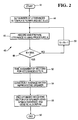
- the apparatus shown in Fig.1 is used for enrolment by a speaker, that is, a speaker who wishes to generate a template for embodying in a user's card, speaks a predetermined utterance a plurality of times, into the microphone 12. The resulting utterances are processed in the apparatus 10, to produce reference data in the form of a template. This procedure will now be described with reference to the flowchart 40 shown in Fig.2.
- the first utterance is stored in digital form and then processed according to an analysis procedure, referred to hereinafter as procedure A (to be described), see block 46.
- the result of procedure A is to produce a matrix of cepstral coefficients (to be explained).
- the N matrices for the utterances of the speaker are then time aligned by a known procedure, such as dynamic time warping (block 52), and averaged to produce an average matrix of cepstral coefficients, representative of the speaker (block 54). Then, the flowchart proceeds to block 56, where an optimised weighting vector is found (block 56) and the flowchart ends at block 58.
- the procedure for finding an opitimised weighting utilizes a genetic algorithm and will be described and explained hereinbelow.
- procedure A (block 46, Fig.2)
- procedure A (block 46, Fig.2)
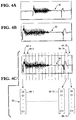
- Fig.3 and Figs.4A to 4C Referring to Fig.3, there is shown a flowchart 70 for procedure A.
- the procedure starts at block 72 and proceeds to block 74, where it is seen that the speaker's utterance is captured.
- This spoken utterance is illustrated by Fig.4A, it being appreciated that the captured utterance 76 has been converted to digital form in the analog-to-digital converter 16 (Fig.1). Processing of the utterance is carried out in the DSP microprocessor 18 (Fig.1).
- utterance 80 Referring to block 78 (Fig.3), the start and end points of the utterance are determined, the amplitude is normalized, and the utterance is translated as shown by utterance 80 in Fig.4B.
- This processed utterance 80 is then segmented into frames (block 82).
- frames 84 there are fifteen frames 84 extending across the utterance 80, and referenced as frames 84-1 to 84-15.
- this number of frames is not a limitation and a smaller or greater number of frames may be utilized.
- a spectral analysis operation is performed (block 86) to produce a vector of cepstral coefficients.
- the spectral analysis operation operates firstly on the frame data to provide a set of linear prediction (LP) coefficients and then by a further mathematical transformation derives a set of cepstral coefficients.
- LP linear prediction
- cepstral coefficients The concepts of deriving linear prediction coefficients and cepstral coefficients are known in the speech analysis art.
- a 12th order LPC (linear prediction coefficient) analysis is performed, resulting in a vector 88 of twelve cepstral coefficients (CO,C1,....,C11) for each frame 84, following the further mathematical transformation.
- the vectors are referenced individually as 88-1 to 88-15, and form a matrix 90. Other orders of LPC analysis may be performed, resulting in a different number of cepstral coefficients.
- Procedure A terminates, as shown, at block 92.
- the cepstral coefficients CO,C1??,C11 for the vectors 88 are generally of different value for the respective vectors, but are shown by the same symbols CO,C1, Vietnamese,C11 for convenience.
- cepstral coefficients may be derived by other procedures, for example Fourier transform derived cepstral coefficients may be formed.
- genetic algorithms are search algorithms for ascertaining values which produce an approach to desired results for a particular function. Genetic algorithms are based on analogies with the mechanics of biological natural selection and natural genetics. They combine a "survival of the fittest" approach with a structural yet randomised information interchange to form a search algorithm.
- the present procedure tests the template against a population of a plurality, P, of true utterances, and a plurality, Q, of impostor utterances, utilizing weighting vectors, whose values are progressively changed using a genetic algorithm.
- the true utterances can be recorded at the same session at which the matrix 90 (Fig.4C) of cepstral vector 88 was obtained as described above, or they can be recorded at a separate session.
- the impostor utterances are obtained from the speech database 26 (Fig.1).
- Fig.5 there is shown the template matrix 100, having a total of ml cepstral coefficient vectors, corresponding to the template matrix 80 of Fig.4C, where ml had the value fifteen. Also shown in Fig.5 is a test utterance, again in the form of a matrix 102 of m2 cepstral coefficient vectors. Furthermore Fig.5 shows a weighting vector 104 having twelve coefficients.
- a dynamic time warping (DTW) algorithm is performed.
- the DTW algorithm attempts to align frames in the test utterance with the correct frames in the template (each frame being a fixed time interval, and the speech content of the time interval being represented by a vector of cepstral coefficients), as explained hereinabove.
- the DTW algorithm calculates the expression where Cr are the cepstral coefficients representing the reference (template) frame and C t are the cepstral coefficients representing the test frame.
- the DTW algorithm calculates a distance measurement between a test frame and a number of template frames in the region of interest.
- the template frame giving the lowest distance measurement determines the centre point for the next test frame's region of interest. After repeating this process for all frames in the test utterance, a path through the utterance can be found which minimises the distances accumulated over the entire path. This path indicates the correct alignment.
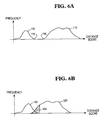
- Fig.6A there is shown an plot illustrating distance scores (x-axis) against frequency of occurrence (y-axis).
- the curve 110 represents a distribution of true speaker distance scores and the curve 112 represents a distribution of imposter speaker distance scores.
- the maximum distance score value 114 for the true speaker distribution 110 is designated Tmax and the minimum distance score value 116 for the impostor distribution 112 is designated Imin.
- Fig.6A it is assumed that the true distance scores and the imposter distribution scores are non-overlapping.
- Fig.6B there are shown a true speaker distribution curve 120 and an impostor speaker distribution curve 122 which overlap.
- These fitness values F have been found to give good results, but it should be understood that other measures of the separation of the distributions may be used.
- the value F for the weighting vector W currently being used is then determined, and stored.
- a genetic algorithm procedure is utilized in the determination of a "best" value for the weighting vector W, i.e. the twelve components w i of the weighting vector. A brief description of the genetic algorithm will now be presented.
- a random population of chromosomes is generated. In the preferred embodiment, being described, a total of 32 such chromosomes are generated.
- a fitness value F is calculated, using the procedure described hereinabove. A predetermined number of the best of these chromosomes, i.e. those producing the best fitness values F, is then selected, and used to generate a new generation of chromosomes.
- a "crossover” procedure wherein pairs of the selected chromosomes in the new generation are selected, and divided into two parts, head and tail, and combined randomly to form a "child" chromosome with a "head” from one parent and a “tail” from the other parent. Furthermore, the new child chromosomes are allowed to "mutate", e.g. one digit can be changed. In the preferred embodiment, a mutation probability of 0.2 was utilized. All the above procedures are standard for genetic algorithms, and are repeated for a predetermined number of generations. A total of 50 generations was used in the preferred embodiment. When this has been carried out, the best performing weighting vector is selected for use in the speaker's template.
- the speaker enrolment procedure has resulted in the production of a user's card, for example, which has stored therein an average matrix of cepstral coefficients, and the components of the speaker-specific weighting vector, determined using the genetic algorithm procedure just described.
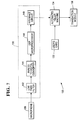
- FIG.7 there is shown in simplified block diagram for the hardware 130 utilized in a typical speaker verification procedure.
- the user inserts his or her card 132 into a transaction terminal, for example, shown as an automated teller machine (ATM) 134, which has a transaction module 136, such as a cash dispensing module, for example.
- ATM automated teller machine
- the user then speaks the predetermined utterance into a microphone 138 located at the ATM.
- the resulting analog signal is applied to a low-pass filter 142, which is connected to an analog-to-digital converter 144.
- the analog-to-digital converter 144 is connected to a DSP (digital signal processor) microprocessor 146 which is connected to an interface circuit 148.
- DSP digital signal processor
- the verification procedure for verifying that the user's utterance spoken into the microphone 138 corresponds with the recorded template reference data on the user's card 132, will now be described with reference to the flowchart 160 shown in Fig.8.
- the flowchart 160 starts at block 162 and proceeds to block 164.
- the maximum number of tries which the user is permitted e.g. three tries
- a counter value N is set to O; as shown in block 164.
- an utterance of the user, spoken into the microphone 138 (Fig.7) is recorded and processed by processing circuitry shown in Fig.7, using Procedure A, described hereinabove with reference to Fig.3.
- a time alignment procedure preferably the dynamic time warping (DTW) procedure described hereinabove is performed and a distance measurement is calculated between the template reference matrix and the just-calculated test matrix of cepstral coefficients.
- This distance measurement is then compared with a predetermined threshold value (block 170). If the distance measurement is less than a predetermined threshold value, the utterance is accepted, the user is deemed to be successfully verified and the ATM transaction is permitted to continue (block 172).
- the flowchart 160 then terminates as shown at block 174.
- decision block 170 if the distance measurement is greater than or equal to the predetermined threshold value, the speaker's trial utterance is not accepted.
- the flowchart 160 then proceeds to block 176, where a determination is made as to whether the number of tries permitted for the user has reached the maximum value MAX. If not, the count value N is increased by unity (block 178) and the flowchart returns to block 166. If the maximum permitted number of tries has been attained, the verification procedure is deemed to have failed, the attempted transaction is terminated, and the flowchart 160 is terminated as shown in block 174.
- the use of a genetic algorithm, as described hereinabove, for the determination of a weighting vector to be used in calculating a distance measurement in a speaker verification system achieves very efficient results when such weighting vector is used in a comparison operation, as described, for comparing a trial utterance to be verified against recorded reference parameters previously obtained, derived during a speaker enrolment procedure.
- An important feature is that the weighting vector is derived individually for each individual speaker being enrolled in the system, and therefore takes account of peculiarities individual to that speaker. For example, some speakers have voices which vary more than others. The system described herein in effect assesses the variability of the speaker's voice.
Landscapes
- Engineering & Computer Science (AREA)
- Health & Medical Sciences (AREA)
- Audiology, Speech & Language Pathology (AREA)
- Human Computer Interaction (AREA)
- Physics & Mathematics (AREA)
- Acoustics & Sound (AREA)
- Multimedia (AREA)
- Complex Calculations (AREA)
- Obtaining Desirable Characteristics In Audible-Bandwidth Transducers (AREA)
Applications Claiming Priority (2)
| Application Number | Priority Date | Filing Date | Title |
|---|---|---|---|
| GB9526334 | 1995-12-22 | ||
| GBGB9526334.9A GB9526334D0 (en) | 1995-12-22 | 1995-12-22 | Speaker verification system |
Publications (2)
| Publication Number | Publication Date |
|---|---|
| EP0780830A2 true EP0780830A2 (de) | 1997-06-25 |
| EP0780830A3 EP0780830A3 (de) | 1998-08-12 |
Family
ID=10785933
Family Applications (1)
| Application Number | Title | Priority Date | Filing Date |
|---|---|---|---|
| EP96309258A Withdrawn EP0780830A3 (de) | 1995-12-22 | 1996-12-18 | Spracherkennungssystem |
Country Status (4)
| Country | Link |
|---|---|
| EP (1) | EP0780830A3 (de) |
| JP (1) | JPH09218697A (de) |
| GB (1) | GB9526334D0 (de) |
| ZA (1) | ZA9610824B (de) |
Families Citing this family (2)
| Publication number | Priority date | Publication date | Assignee | Title |
|---|---|---|---|---|
| JPH11154253A (ja) * | 1997-11-20 | 1999-06-08 | Sanyo Electric Co Ltd | 紙葉類の真偽判定方法 |
| KR100488121B1 (ko) * | 2002-03-18 | 2005-05-06 | 정희석 | 화자간 변별력 향상을 위하여 개인별 켑스트럼 가중치를 적용한 화자 인증 장치 및 그 방법 |
Family Cites Families (3)
| Publication number | Priority date | Publication date | Assignee | Title |
|---|---|---|---|---|
| WO1995005656A1 (en) * | 1993-08-12 | 1995-02-23 | The University Of Queensland | A speaker verification system |
| US6081782A (en) * | 1993-12-29 | 2000-06-27 | Lucent Technologies Inc. | Voice command control and verification system |
| US5687287A (en) * | 1995-05-22 | 1997-11-11 | Lucent Technologies Inc. | Speaker verification method and apparatus using mixture decomposition discrimination |
-
1995
- 1995-12-22 GB GBGB9526334.9A patent/GB9526334D0/en active Pending
-
1996
- 1996-12-18 EP EP96309258A patent/EP0780830A3/de not_active Withdrawn
- 1996-12-20 ZA ZA9610824A patent/ZA9610824B/xx unknown
- 1996-12-20 JP JP8359704A patent/JPH09218697A/ja active Pending
Non-Patent Citations (1)
| Title |
|---|
| None |
Also Published As
| Publication number | Publication date |
|---|---|
| JPH09218697A (ja) | 1997-08-19 |
| GB9526334D0 (en) | 1996-02-21 |
| EP0780830A3 (de) | 1998-08-12 |
| ZA9610824B (en) | 1997-06-27 |
Similar Documents
| Publication | Publication Date | Title |
|---|---|---|
| JP3532346B2 (ja) | ミックスチャ分解識別による話者検証方法と装置 | |
| EP0501631B1 (de) | Zeitliche Dekorrelationsverfahren zur störsicheren Sprechererkennung | |
| US9646614B2 (en) | Fast, language-independent method for user authentication by voice | |
| EP0528990B1 (de) | Gleichzeitige sprecherunabhängige sprachererkennung und sprecherverifikation über einen fernsprechnetz | |
| US6760701B2 (en) | Subword-based speaker verification using multiple-classifier fusion, with channel, fusion, model and threshold adaptation | |
| US6519561B1 (en) | Model adaptation of neural tree networks and other fused models for speaker verification | |
| JPS6217240B2 (de) | ||
| US7502736B2 (en) | Voice registration method and system, and voice recognition method and system based on voice registration method and system | |
| US6697779B1 (en) | Combined dual spectral and temporal alignment method for user authentication by voice | |
| JPH11507443A (ja) | 話者確認システム | |
| EP0891618A1 (de) | Sprachverarbeitung | |
| EP0424071A2 (de) | Sprechererkennung | |
| Finan et al. | Impostor cohort selection for score normalisation in speaker verification | |
| WO1995005656A1 (en) | A speaker verification system | |
| JPS62502571A (ja) | 音声分析による個人の識別 | |
| EP0780830A2 (de) | Spracherkennungssystem | |
| Naik et al. | Evaluation of a high performance speaker verification system for access Control | |
| Thakur et al. | Speaker authentication using gmm-ubm | |
| Fette et al. | CipherVOX: scalable low-complexity speaker verification | |
| Mekyska et al. | Score fusion in text-dependent speaker recognition systems | |
| Feustel et al. | Voice-based security: identity verification over telephone lines | |
| Messina et al. | Learning vector quantization in text-independent automatic speaker recognition | |
| Soğanci et al. | Parallel implementation of a VQ-based text-independent speaker identification | |
| Pandit et al. | Selection of speaker independent feature for a speaker verification system | |
| WO1990008379A1 (en) | Speaker recognition |
Legal Events
| Date | Code | Title | Description |
|---|---|---|---|
| PUAI | Public reference made under article 153(3) epc to a published international application that has entered the european phase |
Free format text: ORIGINAL CODE: 0009012 |
|
| AK | Designated contracting states |
Kind code of ref document: A2 Designated state(s): DE ES FR GB IT |
|
| PUAL | Search report despatched |
Free format text: ORIGINAL CODE: 0009013 |
|
| RHK1 | Main classification (correction) |
Ipc: G10L 5/06 |
|
| AK | Designated contracting states |
Kind code of ref document: A3 Designated state(s): DE ES FR GB IT |
|
| STAA | Information on the status of an ep patent application or granted ep patent |
Free format text: STATUS: THE APPLICATION IS DEEMED TO BE WITHDRAWN |
|
| 18D | Application deemed to be withdrawn |
Effective date: 19990213 |