EP0780775B1 - Architektur eines Systems von Arrayprozessoren mit parallelen Mehrfachstrukturen - Google Patents
Architektur eines Systems von Arrayprozessoren mit parallelen Mehrfachstrukturen Download PDFInfo
- Publication number
- EP0780775B1 EP0780775B1 EP96402760A EP96402760A EP0780775B1 EP 0780775 B1 EP0780775 B1 EP 0780775B1 EP 96402760 A EP96402760 A EP 96402760A EP 96402760 A EP96402760 A EP 96402760A EP 0780775 B1 EP0780775 B1 EP 0780775B1
- Authority
- EP
- European Patent Office
- Prior art keywords
- elementary
- collision
- node
- processor
- processors
- Prior art date
- Legal status (The legal status is an assumption and is not a legal conclusion. Google has not performed a legal analysis and makes no representation as to the accuracy of the status listed.)
- Expired - Lifetime
Links
Images

Classifications
-
- G—PHYSICS
- G06—COMPUTING OR CALCULATING; COUNTING
- G06F—ELECTRIC DIGITAL DATA PROCESSING
- G06F15/00—Digital computers in general; Data processing equipment in general
- G06F15/16—Combinations of two or more digital computers each having at least an arithmetic unit, a program unit and a register, e.g. for a simultaneous processing of several programs
- G06F15/163—Interprocessor communication
- G06F15/173—Interprocessor communication using an interconnection network, e.g. matrix, shuffle, pyramid, star, snowflake
- G06F15/17337—Direct connection machines, e.g. completely connected computers, point to point communication networks
-
- G—PHYSICS
- G06—COMPUTING OR CALCULATING; COUNTING
- G06F—ELECTRIC DIGITAL DATA PROCESSING
- G06F15/00—Digital computers in general; Data processing equipment in general
- G06F15/76—Architectures of general purpose stored program computers
- G06F15/80—Architectures of general purpose stored program computers comprising an array of processing units with common control, e.g. single instruction multiple data processors
- G06F15/8007—Architectures of general purpose stored program computers comprising an array of processing units with common control, e.g. single instruction multiple data processors single instruction multiple data [SIMD] multiprocessors
- G06F15/8023—Two dimensional arrays, e.g. mesh, torus
Definitions
- the invention relates to a system architecture. array of processors with multiple parallel structures adapted, in particular, to numerical simulation fluid flows.
- the invention finds applications in the data processing, in particular for data relating to fluid flows (water, air, gases, molten metals ). It can be applied, by example, to geology for the study of the behavior of porous media, resistance of materials for study the resistance of parts to fluid flows, in aerodynamics for reentrancy problems atmospheric, in chemistry for the study of phenomena catalytic, or in metallurgy, for the study and design of filtering means for liquefied metals, etc.
- each site evolves by following a law simulating physical behavior of the flow considered using the values taken by the fields in its vicinity.
- This evolution of the sites can be conducted from several ways. Conventionally, this evolution is done by means of laws expressed in the form of equations to partial derivatives, such as the equations of NAVIER-STOCKES, using a finite element method, or of finite differences.
- gas-on-network methods which consist of simulate the macroscopic behavior of the fluid using of a mesoscopic space provided with type evolution laws "automaton”, determined so as to correspond to partial differential equations, such as equations from NAVIER-STOCKES.
- This gas-on-grid method allows thus to model on a microscopic scale, the behavior of a fluid by looking for the similarity between the macroscopic behavior of this gas and that of a real fluid.
- the spread over network links is done at speed one network step per time unit.
- This spread is synchronized, which means that at each step of time, all the particles animated with a speed not null moves simultaneously.
- This propagation phase is followed by a collision phase at each site, that is to say on each point of the grid, or network.
- the collision rules consist, for this method, in associate with each possible configuration representing a state of entry of particles to the site, another configuration which will represent the output state produced by the collision of particles on this site.
- This simulation of the behavior of the fluid is governed by collision rules which differ in depending on the model chosen.
- Such a gas-on-network type method boolean is implemented, usually by structured processor system architectures parallel who perform simultaneous processing on a large number of sites. It is known, in particular, to implant accelerator cards on workstations, such as the CAM machines described by T. TOFFOLI and M. MARGOLUS in "Cellular Automatamachines", MIT Press, Cambridge, Massachussetts, 1987, or the R.A.P machines described in particular by A. CLOUQUEUR and D. D'HUMIERES, "R. A. P., a family of cellular automaton machines for fluid dynamics ", in Proceedings of the 12th Gwatt workshop on complex systems, Gwatt, Switzerland, October 1988.
- This model gas-on-network method booleans is simple to implement due to the use of collision tables. For this reason, she is fast and can adapt to problems of different natures. In addition, the operations carried out do without loss of information, which makes this method digitally stable. On the other hand, this method presents a major drawback regarding the presence of a digital noise that can be found on the results obtained at the end of treatment, this digital noise being able to hinder the extraction of results.
- the gas-on-grid method can also use so-called BOLTZMANN models; the rule of collisions consists, in this case, of a local resolution of an equation of state. Contrary to the rules of collisions of boolean models, this collision rule based on BOLTZMANN models employs variables to real values that represent distributions of particles. This therefore requires carrying out calculations floating whose implementation is heavy and expensive. This method also requires solving equations to partial derivatives which is also heavy to put in action. In addition, this method allows good precision of the calculations, due to the quasi-continuous aspect of the distributions of particles that make up this model, which ensures reduced digital noise. However, these calculations are not very stable.
- the purpose of the present invention is to remedy these drawbacks. To this end, it offers a system architecture of elementary processors in table, allowing to implement a method of gas-on-network with boolean models, the results of which are not tainted with digital noise.
- This architecture therefore makes it possible to deal with data relating to the numerical simulation of flows fluids. It also allows, more generally, to process different types of inhomogeneous data.
- This system of elementary processors in table is characterized in that each processor elementary of each node is provided with a management module of its local memory ensuring independence of addressing this vis-à-vis the other elementary processors and in that each SIMD node is provided with a control linked to the control units of neighboring nodes to form an inter-node control network in which priority tokens circulate.
- each SIMD node is provided with a memory and addressing module that provides independent addressing of the node, each memory module and addressing of a SIMD node being connected to the module memory and addressing of neighboring SIMD nodes, so that form an inter-node data network.
- the processor system elementary table includes means of decomposition to decompose a collision of particles multiple fluid in a plurality of collisions elementary booleans able to be processed from SIMD nodes.
- these means of decomposition include maximum / minimum extraction means, means of pseudo-random drawing, as well as means automation of collision decomposition elementary.
- each processor elementary may further include means of recomposition to reconstruct, from collisions elementary processed, a resulting collision.
- the invention relates to a system architecture. in array of elementary processors with structures multiple parallels.
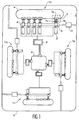
- This architecture is represented schematically in Figure 1.
- the system of the invention consists of a plurality of nodes 1 to SMID (Single Instruction Stream Multiple) operation Data Stream).
- the system is consisting of four SIMD nodes 1a, 1b, 1c, 1d. All these nodes are strictly identical. As a result, only one of these nodes will be described, for the sake of simplification of the description.
- the node that will be described will be the node referenced 1a.
- This node 1a comprises a plurality of elementary processors 3 which are connected to each other others so as to form a first ring 2, called “ring of elementary processors".
- Each processor elementary 3 is equipped with a memory management module local LMM (Local Memory Manager) ensuring independence addressing it vis-à-vis other processors elementary.
- this LMM memory is a device that implements the principles of organization of memory (helical organization) described in the patent FR-A-2 623 310 (pages 7, line 10, to page 10, line 35).
- Each elementary processor 3 of this SIMD node la is associated, on the one hand, with a memory 5 which is proper to it and, on the other hand, to an interconnection module 7.
- This module interconnection comprises a connection cell 7a which is connected to the connection cells of the processors neighboring elementaries, so as to form a second ring 4, called "ring network", in which tokens circulate priority.
- the cell 7a connection ensures reception of the first data of the message circulating in network 4 and which is intended to the elementary processor 3 to which the connection cell 7a is associated; the connection cell 7a ensures, on the other hand, issuing the message that the processor elementary 3 wants to send over network 4.
- This interconnection module also includes a message receiving module 7b which is connected between the connection cell 7a and the elementary processor 3 and which stores the entire messages received by connection cell 7a and intended for the processor elementary 3 with which this reception module 7b is associated.
- the interconnection module also includes a 7c transmission module which is connected between the processor elementary 3 and the connection cell 7a and which ensures memorizing whole messages that the processor elementary 3 wants to send over network 4.
- the SIMD node also includes a unit control unit (UC) 9 which is connected to the control units neighboring SIMD nodes 1b, 1d. So linked together, the control units 9 of each of the nodes of the system form a third ring 6, called “control network inter-nodes ".
- UC unit control unit
- the SIMD node also includes a module addressing and memory 11, which provides the node with a addressing independence.
- this memory module and 11 is connected to the memory module and addressing neighboring nodes 1b, 1d, so as to form a fourth ring 8, called "data network inter-nodes ".
- the set of SIMD nodes 1a - 1d of the structure are connected together in two different ways, and thus form two communication networks 6 and 8 which act at different levels of treatment.
- the inter-node control network 6 i.e. the ring connecting the control units between themselves, ensures the transfer of control information from execution and synchronization of tasks performed by each of the nodes 1a-1d.
- inter-node data network 8 i.e. the network which links each group of elementary processors between them, ensures the transfer of massive data blocks, not point-to-point, like other networks 2, 4 and 6, but globally, namely from knot to knot.
- each node acts independently of the node neighbor by following a program which is loaded in its control unit, while within each of these nodes, the elementary processors connected by the ring 2 act simultaneously by executing an identical program, led by the central unit associated with them.
- inter-node control network 6 is identical to that of second ring 4. This management is therefore done by means of a priority token circulating in the network, like this is explained in document FR-A-2 710 993.
- the inter-node data network 8 has a role totally different from the inter-node control network 6. Indeed, this inter-node data network 8 makes it possible to process data relating to the borders between two data areas to be processed by SIMD nodes. These areas the problem is usually the outlines of objects solids, particular injection zones or phases in multiphasic media, etc.
- This border processing thus allows improve the operating speed of the entire system and limit the cost of the system.
- the architecture of the invention may include two to about thirty-two knots, depending on the treatment to be performed, at know, that repetitive treatment requires a little number of nodes, while a more complex problem (such that atmospheric reentrance problems) require a large number of nodes.
- each node has a number of processors which can vary function of the treatment to be carried out; typically a knot has thirty-two to one thousand and twenty-four processors elementary.
- This system of processors with structures multiple parallels can therefore be used for many types of data.
- it can be used for the numerical simulation of flows of fluids.
- processors of the invention can handle collisions particles on a site, which is the microscopic behavior of the fluid.
- Some collisions between particles can be treated in a very simple way, in particular, collisions between two particles arriving face to face on the site, or between three particles arriving symmetrically one relative to the other on the site.
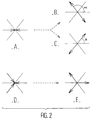
- FIG 2 these two examples of collisions between particles.
- Part A of this figure 2 represents an example of collision between two particles arriving face to face on the site; the parts B and C of this figure represent the two resulting collisions that can be obtained as a result of the collision.
- the resulting collision may be that the two particles after collision, each leave at an angle ⁇ with respect to their direction of arrival, as shown in B, or else with an angle ⁇ , as shown in C.
- ⁇ is approximately 120 ° and ⁇ approximately 60 °.
- a second is shown example of collision: it is a collision D between three particles arriving at the site in directions symmetrical to each other, i.e. in directions forming an angle of 120 ° with the other directions.
- the result of this collision, shown in E, is that each particle, after collision, leaves in the same direction as its arrival direction, but in reverse.
- the invention provides means for breaking down complex collisions, i.e. collisions multiples, in a plurality of elementary collisions, then to reconstruct the resulting collision obtained after that the particles concerned have collided.
- each elementary processor of a SIMD node intended to simulate the behavior of particles on at least one site of the network, is equipped with means of decomposition of multiple collisions.
- These means of decomposition 12 include separation means, means of maximum / minimum extraction and means of pseudo-random draw. These means will be described in a way more detailed in the following description.
- FIG 3 an example of decomposition of a multiple collision. It's about a collision of order 6 (i.e. in six directions between 42 particles. The six directions of arrival of the particles are referenced d1 to d6. The numbers noted at the end of each arrow represent the number of particles arriving in each direction. We thus sees that three particles arrive in the direction d1, seven particles arrive in the direction d2, eleven particles in the direction d3, eight particles in the direction d4, a particle in direction d5 and twelve particles in direction d6.
- the decomposition process of this collision multiple is to use a distributive model to integer values, within which we decompose, into levels successive, multiple Boolean collisions, depending on the maximum number of particles involved. So in the case shown in this figure 3 of a multiple collision cm at six speed vectors, we decompose this collision into, at most, six successive levels which each correspond to an integer multiple of an elementary collision.
- the level of order 6, C6 is trivial, since there is a particle on each direction dl to d6; this level of order 6 appears only once.
- the elementary collision C5 of level of order 5 appears twice, since there are at most two particles on each of the directions d1, d2, d3, d4 and d6.
- Elementary collision C4, of order level 4 appears four times, since there are at most four particles on each of the directions d2, d3, d4 and d6.
- the elementary collision C3 of level 3 has a single elementary collision on which a particle appears on each of the directions d3, d4 and d6.
- the elementary collision C2 of level 2 appears three times since there are at most three particles arriving on each of the directions d3 and d6.
- the collision elementary C1 of order level 1 i.e. the last order level, is a simple elementary collision on which a single particle arrives on the direction d6.
- the resulting collision cr comprises eight particles returning to the direction dl, five particles on the d2 direction, eight particles on the direction d3, three particles on direction d4, eleven particles on the d5 direction and seven particles on the direction d6.
- each elementary processor intended to simulate the behavior of a network site includes means of decomposition 12 and reconstruction means 14.
- the means of decomposition therefore include separation means 13 intended to automate the separation in elementary collisions of collisions multiple, operator extraction means of maximum / minimum 15 and pseudo-random drawing means 17 required for initialization and collision phases of the process.
- separation means 13 intended to automate the separation in elementary collisions of collisions multiple
- operator extraction means of maximum / minimum 15 and pseudo-random drawing means 17 required for initialization and collision phases of the process.
- pseudo-random drawing means 17 required for initialization and collision phases of the process.
- Data relating to the distributions of particles to be treated, stored in the memory of the CPU 9, are provided to the separation means 13 which ensure the management of the processing of these distributions.
- These means of separation 13, which will be described in more detail by the are connected to the extraction means of maximum / minimum 15 which help in the decomposition of the multiple collision cm in elementary collisions C1 to C6.
- the pseudo-random drawing means 17 are used, in particular, when collisions occur multiples, such as collision A represented on the Figure 2, which can provide several different results. These pseudo-random drawing means 17 are also useful during the initialization phases of the treatment for choose the processing order for distributions in memory.
- the separation means also provide the successive writing in memory of the distributions of boolean particles, so as to allow a SIMD optimum operation for areas using identical collision rules.
- a processor processes several sites sequentially during the same collision phase. he then it may be that on two sites treated by two different processors, breaking down into distributions booleans do not take the same number of cycles; the zero distribution (i.e. the last distribution when all elementary collisions have been found) can therefore be reached in fewer steps on one of the sites than on the other. In this case, a loss of time seems to be generated by waiting for the most processor long.
- the separation means 13 manage the read data from neighboring processors and the storage in contiguous memory of Boolean distributions, so as to ensure the possibility of overlap temporal processing of two different sites. The processor that finished processing the fastest site will then start processing a next site.
- each elementary processor further comprises recomposition means 14 for reconstruct the resulting collision cr, after each elementary collision C1 to C6 has been processed.
- recomposition means 14 for reconstruct the resulting collision cr, after each elementary collision C1 to C6 has been processed.
Landscapes
- Engineering & Computer Science (AREA)
- Computer Hardware Design (AREA)
- Theoretical Computer Science (AREA)
- Physics & Mathematics (AREA)
- General Engineering & Computer Science (AREA)
- General Physics & Mathematics (AREA)
- Mathematical Physics (AREA)
- Software Systems (AREA)
- Computing Systems (AREA)
- Multi Processors (AREA)
- Management, Administration, Business Operations System, And Electronic Commerce (AREA)
Claims (5)
- System von elementaren Arrayprozessoren, angeordnet zu mehreren SIMD-Betriebsknoten (1a-1d), wobei jeder eine Vielzahl Elementarprozessoren (3) umfasst, die derart miteinander verbunden sind, dass sie einen Ring (2) aus Elementarprozessoren bilden und jeder Elementarprozessor einerseits mit einem Speicher verbunden ist und andererseits mit einem Zwischenverbindungsmodul (7), wobei dieser letztere eine Anschlußzelle (7a), verbunden mit den Zellen der benachbarten Elementarprozessoren, um ein ringförmiges Netzwerk (4) zu bilden, in dem Prioritätsunterscheidungsmerkmale zirkulieren, einen Nachrichtenempfangsmodul (7b), eingeschaltet zwischen die Anschlußzelle und den Elementarprozessor, und einen Emissionsmodul (7c) umfasst, eingeschaltet zwischen den Elementarprozessor und die Anschlußzelle,
dadurch gekennzeichnet,
dass jeder Elementarprozessor jedes SIMD-Knotens mit einem Verwaltungsmodul seines lokalen Speichers ausgerüstet ist, der dessen Adressier-Unabhängigkeit gegenüber den anderen Elementarprozessoren sichert, und dadurch, dass jeder SIMD-Knoten mit einer Steuereinheit (9) ausgerüstet ist, die mit den Steuereinheiten der benachbarten Knoten verbunden ist, um ein knotenverbindendes Steuernetzwerk (6) zu bilden, in dem Prioritätsunterscheidungsmerkmale zirkulieren. - System von Arrayprozessoren nach Anspruch 1, dadurch gekennzeichnet, dass jeder SIMD-Betriebsknoten mit einem Speicher- und Adressiermodul (11) ausgerüstet ist, der eine Adressier-Unabhängigkeit des Knotens sichert, und dadurch, dass jeder Speicher- und Adressiermodul eines Knotens mit dem Speicher- und Adressiermodul der benachbarten Knoten verbunden ist, um ein knotenverbindendes Datennetz (8) zu bilden.
- System von Arrayprozessoren nach Anspruch 1 oder 2 zur digitalen Simulation der Strömung von Fluiden, dadurch gekennzeichnet, dass es Dekompositionseinrichtungen (12) umfasst, um eine multiple Kollision von Fluidpartikeln aufzulösen in eine Vielzahl logischer Elementarkollisionen, die mittels der SIMD-Knoten verarbeitet werden können.
- System von Arrayprozessoren nach Anspruch 3, dadurch gekennzeichnet, dass die Dekompositionseinrichtungen Maximum/Minimum-Extraktionseinrichtungen (15), pseudo-zufällige Ziehungseinrichtungen (17) sowie Trennungseinrichtungen (13) in Elementarkollisionen umfassen.
- System von Arrayprozessoren nach Anspruch 3 oder 4, dadurch gekennzeichnet, dass jeder Elementarprozessor außerdem Rekompositionseinrichtungen (14) umfasst, um aus verarbeiteten Elementarkollisionen eine resultierende Kollision zu rekonstruieren.
Applications Claiming Priority (2)
| Application Number | Priority Date | Filing Date | Title |
|---|---|---|---|
| FR9515049 | 1995-12-19 | ||
| FR9515049A FR2742560B1 (fr) | 1995-12-19 | 1995-12-19 | Architecture de systeme en tableau de processeurs a structures paralleles multiples |
Publications (2)
| Publication Number | Publication Date |
|---|---|
| EP0780775A1 EP0780775A1 (de) | 1997-06-25 |
| EP0780775B1 true EP0780775B1 (de) | 2000-03-08 |
Family
ID=9485643
Family Applications (1)
| Application Number | Title | Priority Date | Filing Date |
|---|---|---|---|
| EP96402760A Expired - Lifetime EP0780775B1 (de) | 1995-12-19 | 1996-12-17 | Architektur eines Systems von Arrayprozessoren mit parallelen Mehrfachstrukturen |
Country Status (6)
| Country | Link |
|---|---|
| US (1) | US5862397A (de) |
| EP (1) | EP0780775B1 (de) |
| JP (1) | JPH09185592A (de) |
| CA (1) | CA2192753A1 (de) |
| DE (1) | DE69606965T2 (de) |
| FR (1) | FR2742560B1 (de) |
Families Citing this family (8)
| Publication number | Priority date | Publication date | Assignee | Title |
|---|---|---|---|---|
| WO2004031981A2 (en) * | 2002-10-04 | 2004-04-15 | Koninklijke Philips Electronics N.V. | Multilevel hierarchical circuit |
| FR2849730A1 (fr) * | 2003-01-02 | 2004-07-09 | Thomson Licensing Sa | Methode pour reserver de la bande passante dans un reseau de type ethernet |
| EP1880327B1 (de) * | 2005-04-19 | 2021-09-08 | D.E. Shaw Research, LLC | Verfahren zur rechenlastverteilung in der berechnung von abstand-begrenzten wechselwirkungen zwischen teilchen |
| DE602006011931D1 (de) * | 2005-08-18 | 2010-03-11 | D E Shaw Res And Dev Llc | Parallele computerarchitektur zur berechnung der partikelinteraktion |
| JP2014170556A (ja) * | 2005-08-18 | 2014-09-18 | D.E. Shaw Research LLC | 粒子相互作用を計算するための並行計算アーキテクチャ |
| US20110202327A1 (en) * | 2010-02-18 | 2011-08-18 | Jiun-Der Yu | Finite Difference Particulate Fluid Flow Algorithm Based on the Level Set Projection Framework |
| US9055078B2 (en) * | 2013-01-10 | 2015-06-09 | International Business Machines Corporation | Token-based flow control of messages in a parallel computer |
| WO2019093352A1 (ja) * | 2017-11-10 | 2019-05-16 | 日本電気株式会社 | データ処理装置 |
Family Cites Families (5)
| Publication number | Priority date | Publication date | Assignee | Title |
|---|---|---|---|---|
| US4709365A (en) * | 1983-10-31 | 1987-11-24 | Beale International Technology Limited | Data transmission system and method |
| US4942517A (en) * | 1987-10-08 | 1990-07-17 | Eastman Kodak Company | Enhanced input/output architecture for toroidally-connected distributed-memory parallel computers |
| FR2623310B1 (fr) | 1987-11-16 | 1990-02-16 | Commissariat Energie Atomique | Dispositif de traitement de donnees relatives a des elements d'image |
| FR2680026B1 (fr) * | 1991-07-30 | 1996-12-20 | Commissariat Energie Atomique | Architecture de systeme en tableau de processeurs a structure parallele. |
| FR2710993B1 (fr) * | 1993-10-04 | 1995-11-24 | Commissariat Energie Atomique | Procédé et système d'interconnexion pour la gestion de messages dans un réseau de processeurs à structure parallèle. |
-
1995
- 1995-12-19 FR FR9515049A patent/FR2742560B1/fr not_active Expired - Lifetime
-
1996
- 1996-12-05 US US08/761,757 patent/US5862397A/en not_active Expired - Lifetime
- 1996-12-12 CA CA002192753A patent/CA2192753A1/en not_active Abandoned
- 1996-12-17 EP EP96402760A patent/EP0780775B1/de not_active Expired - Lifetime
- 1996-12-17 DE DE69606965T patent/DE69606965T2/de not_active Expired - Fee Related
- 1996-12-18 JP JP8353793A patent/JPH09185592A/ja not_active Withdrawn
Also Published As
| Publication number | Publication date |
|---|---|
| CA2192753A1 (en) | 1997-06-20 |
| DE69606965T2 (de) | 2000-10-05 |
| US5862397A (en) | 1999-01-19 |
| EP0780775A1 (de) | 1997-06-25 |
| FR2742560B1 (fr) | 1998-01-16 |
| JPH09185592A (ja) | 1997-07-15 |
| FR2742560A1 (fr) | 1997-06-20 |
| DE69606965D1 (de) | 2000-04-13 |
Similar Documents
| Publication | Publication Date | Title |
|---|---|---|
| EP0552074B1 (de) | Mehrfachprozessor-Datenverarbeitungssystem | |
| EP0597028B1 (de) | Vorrichtung mit paralleler prozessor matrix | |
| EP0558125B1 (de) | Neuronaler Prozessor mit verteilten synaptischen Zellen | |
| EP3084588B1 (de) | Signalverarbeitungsmodul, insbesondere für neuronales netzwerk und neuronale schaltung | |
| EP0780775B1 (de) | Architektur eines Systems von Arrayprozessoren mit parallelen Mehrfachstrukturen | |
| WO2010037570A1 (fr) | Dispositif de traitement en parallele d'un flux de donnees | |
| FR2713368A1 (fr) | Procédure et procédé de communication entre machines et procédé généralisé de préparation de programmes afférents. | |
| EP4193358A1 (de) | Rekonfigurierbares speichermodul zur implementierung von rechenoperationen | |
| EP0646875A1 (de) | Verfahren und System von Zwischenverbindungen zur Verwaltung von Meldungen in einem Prozessorennetzwerk mit paralleler Struktur | |
| EP4020475A1 (de) | Adaptierter speicherschaltkreis zur durchführung von rechenfunktionen | |
| EP1803061B1 (de) | Umkonfigurierbares, modulares, hierarchisches parallelprozessorsystem | |
| FR3131413A1 (fr) | Réseau de neurones avec génération à la volée des paramètres du réseau | |
| FR2800169A1 (fr) | Procede et dispositif d'analyse de defauts dans des circuits logiques numeriques | |
| FR2556902A1 (fr) | Procede et dispositif de filtrage de rang determine d'un signal numerique et application au filtrage median bidimensionnel separable | |
| WO2002050676A1 (fr) | Procede de placement d'applications multiprocesseurs | |
| FR2694430A1 (fr) | Dispositif électronique pour l'analyse d'image et la vision artificielle. | |
| EP4546150A1 (de) | Optimierung von datentransfers zwischen einem parallelverarbeitungsprozessor und einem speicher | |
| EP4670053A1 (de) | Elektronische multifunktionskomponente, zugehörige vorrichtung, verfahren und programme | |
| BE902987R (fr) | Calculateur associatif permettant une multiplication rapide | |
| EP3971785A1 (de) | Elektronischer rechner zur implementierung eines künstlichen neuronalen netzes mit rechenblöcken mehrerer typen | |
| FR2861481A1 (fr) | Atelier et procede de conception d'un reseau prediffuse programmable et support d'enregistrement pour leur mise en oeuvre | |
| FR2566938A1 (fr) | Memoire permettant de transformer un flot de mots de donnees en un autre flot de mots de donnees | |
| WO2001095231A2 (fr) | Systeme de traitement de donnees oriente objet a chargement progressif | |
| WO2003075188A1 (fr) | Procede d'extraction de la topologie d'un systeme a partir de sa description textuelle | |
| FR2752967A1 (fr) | Procede de developpement d'un circuit integre specifique d'une application (asic) et emulateur correspondant |
Legal Events
| Date | Code | Title | Description |
|---|---|---|---|
| PUAI | Public reference made under article 153(3) epc to a published international application that has entered the european phase |
Free format text: ORIGINAL CODE: 0009012 |
|
| AK | Designated contracting states |
Kind code of ref document: A1 Designated state(s): CH DE GB IT LI NL |
|
| 17P | Request for examination filed |
Effective date: 19971128 |
|
| GRAG | Despatch of communication of intention to grant |
Free format text: ORIGINAL CODE: EPIDOS AGRA |
|
| RIC1 | Information provided on ipc code assigned before grant |
Free format text: 6G 06F 15/80 A, 6G 06F 15/173 B |
|
| 17Q | First examination report despatched |
Effective date: 19990428 |
|
| GRAG | Despatch of communication of intention to grant |
Free format text: ORIGINAL CODE: EPIDOS AGRA |
|
| GRAH | Despatch of communication of intention to grant a patent |
Free format text: ORIGINAL CODE: EPIDOS IGRA |
|
| GRAH | Despatch of communication of intention to grant a patent |
Free format text: ORIGINAL CODE: EPIDOS IGRA |
|
| GRAH | Despatch of communication of intention to grant a patent |
Free format text: ORIGINAL CODE: EPIDOS IGRA |
|
| GRAA | (expected) grant |
Free format text: ORIGINAL CODE: 0009210 |
|
| AK | Designated contracting states |
Kind code of ref document: B1 Designated state(s): CH DE GB IT LI NL |
|
| PG25 | Lapsed in a contracting state [announced via postgrant information from national office to epo] |
Ref country code: NL Free format text: LAPSE BECAUSE OF FAILURE TO SUBMIT A TRANSLATION OF THE DESCRIPTION OR TO PAY THE FEE WITHIN THE PRESCRIBED TIME-LIMIT Effective date: 20000308 |
|
| REG | Reference to a national code |
Ref country code: CH Ref legal event code: EP |
|
| REF | Corresponds to: |
Ref document number: 69606965 Country of ref document: DE Date of ref document: 20000413 |
|
| ITF | It: translation for a ep patent filed | ||
| GBT | Gb: translation of ep patent filed (gb section 77(6)(a)/1977) |
Effective date: 20000515 |
|
| NLV1 | Nl: lapsed or annulled due to failure to fulfill the requirements of art. 29p and 29m of the patents act | ||
| PG25 | Lapsed in a contracting state [announced via postgrant information from national office to epo] |
Ref country code: LI Free format text: LAPSE BECAUSE OF NON-PAYMENT OF DUE FEES Effective date: 20001231 Ref country code: CH Free format text: LAPSE BECAUSE OF NON-PAYMENT OF DUE FEES Effective date: 20001231 |
|
| PLBE | No opposition filed within time limit |
Free format text: ORIGINAL CODE: 0009261 |
|
| STAA | Information on the status of an ep patent application or granted ep patent |
Free format text: STATUS: NO OPPOSITION FILED WITHIN TIME LIMIT |
|
| 26N | No opposition filed | ||
| REG | Reference to a national code |
Ref country code: CH Ref legal event code: PL |
|
| REG | Reference to a national code |
Ref country code: GB Ref legal event code: IF02 |
|
| PGFP | Annual fee paid to national office [announced via postgrant information from national office to epo] |
Ref country code: GB Payment date: 20021211 Year of fee payment: 7 |
|
| PGFP | Annual fee paid to national office [announced via postgrant information from national office to epo] |
Ref country code: DE Payment date: 20021213 Year of fee payment: 7 |
|
| PG25 | Lapsed in a contracting state [announced via postgrant information from national office to epo] |
Ref country code: GB Free format text: LAPSE BECAUSE OF NON-PAYMENT OF DUE FEES Effective date: 20031217 |
|
| PG25 | Lapsed in a contracting state [announced via postgrant information from national office to epo] |
Ref country code: DE Free format text: LAPSE BECAUSE OF NON-PAYMENT OF DUE FEES Effective date: 20040701 |
|
| GBPC | Gb: european patent ceased through non-payment of renewal fee |
Effective date: 20031217 |
|
| PG25 | Lapsed in a contracting state [announced via postgrant information from national office to epo] |
Ref country code: IT Free format text: LAPSE BECAUSE OF NON-PAYMENT OF DUE FEES Effective date: 20051217 |