EP0780732A2 - Polymer composition and resist material - Google Patents
Polymer composition and resist material Download PDFInfo
- Publication number
- EP0780732A2 EP0780732A2 EP96309142A EP96309142A EP0780732A2 EP 0780732 A2 EP0780732 A2 EP 0780732A2 EP 96309142 A EP96309142 A EP 96309142A EP 96309142 A EP96309142 A EP 96309142A EP 0780732 A2 EP0780732 A2 EP 0780732A2
- Authority
- EP
- European Patent Office
- Prior art keywords
- polymer
- group
- poly
- hydroxystyrene
- alkyl group
- Prior art date
- Legal status (The legal status is an assumption and is not a legal conclusion. Google has not performed a legal analysis and makes no representation as to the accuracy of the status listed.)
- Granted
Links
- 229920000642 polymer Polymers 0.000 title claims abstract description 339
- 239000000463 material Substances 0.000 title claims abstract description 125
- 239000000203 mixture Substances 0.000 title claims abstract description 82
- 239000000178 monomer Substances 0.000 claims abstract description 77
- 239000002253 acid Substances 0.000 claims abstract description 42
- 125000000524 functional group Chemical group 0.000 claims abstract description 42
- 238000010438 heat treatment Methods 0.000 claims abstract description 35
- 150000002989 phenols Chemical class 0.000 claims abstract description 28
- 125000000217 alkyl group Chemical group 0.000 claims description 117
- 125000004435 hydrogen atom Chemical group [H]* 0.000 claims description 64
- 239000000758 substrate Substances 0.000 claims description 56
- 125000004432 carbon atom Chemical group C* 0.000 claims description 52
- 238000000034 method Methods 0.000 claims description 40
- 125000001997 phenyl group Chemical group [H]C1=C([H])C([H])=C(*)C([H])=C1[H] 0.000 claims description 34
- 125000005843 halogen group Chemical group 0.000 claims description 20
- 125000003545 alkoxy group Chemical group 0.000 claims description 18
- 125000003710 aryl alkyl group Chemical group 0.000 claims description 18
- 230000005855 radiation Effects 0.000 claims description 18
- 239000000470 constituent Substances 0.000 claims description 17
- 239000000126 substance Substances 0.000 claims description 16
- 239000004065 semiconductor Substances 0.000 claims description 15
- 125000003178 carboxy group Chemical group [H]OC(*)=O 0.000 claims description 13
- 125000001424 substituent group Chemical group 0.000 claims description 13
- 230000008569 process Effects 0.000 claims description 12
- 125000004423 acyloxy group Chemical group 0.000 claims description 9
- 125000004093 cyano group Chemical group *C#N 0.000 claims description 9
- 125000000623 heterocyclic group Chemical group 0.000 claims description 8
- 125000001820 oxy group Chemical group [*:1]O[*:2] 0.000 claims description 8
- 239000011248 coating agent Substances 0.000 claims description 7
- 238000000576 coating method Methods 0.000 claims description 7
- 125000003903 2-propenyl group Chemical group [H]C([*])([H])C([H])=C([H])[H] 0.000 claims description 6
- 125000002947 alkylene group Chemical group 0.000 claims description 6
- 229910052799 carbon Inorganic materials 0.000 claims description 6
- 239000002250 absorbent Substances 0.000 claims description 5
- 230000002745 absorbent Effects 0.000 claims description 5
- IYKLQEMQEGWXOQ-UHFFFAOYSA-N 3-(7-amino-4-chloro-1-oxoisochromen-3-yl)oxypropyl carbamimidothioate Chemical compound NC1=CC=C2C(Cl)=C(OCCCSC(=N)N)OC(=O)C2=C1 IYKLQEMQEGWXOQ-UHFFFAOYSA-N 0.000 claims 1
- 230000035945 sensitivity Effects 0.000 abstract description 6
- FUGYGGDSWSUORM-UHFFFAOYSA-N 4-hydroxystyrene Chemical compound OC1=CC=C(C=C)C=C1 FUGYGGDSWSUORM-UHFFFAOYSA-N 0.000 description 325
- -1 poly(p-tert-butoxycarbonyloxystyrene) Polymers 0.000 description 216
- 238000002360 preparation method Methods 0.000 description 139
- VMOQKKFBYIBJOJ-UHFFFAOYSA-N 1-ethenyl-4-(2-ethoxyethoxy)benzene Chemical compound CCOCCOC1=CC=C(C=C)C=C1 VMOQKKFBYIBJOJ-UHFFFAOYSA-N 0.000 description 93
- PPBRXRYQALVLMV-UHFFFAOYSA-N Styrene Chemical compound C=CC1=CC=CC=C1 PPBRXRYQALVLMV-UHFFFAOYSA-N 0.000 description 88
- 239000013078 crystal Substances 0.000 description 67
- GRFNSWBVXHLTCI-UHFFFAOYSA-N 1-ethenyl-4-[(2-methylpropan-2-yl)oxy]benzene Chemical compound CC(C)(C)OC1=CC=C(C=C)C=C1 GRFNSWBVXHLTCI-UHFFFAOYSA-N 0.000 description 66
- 239000004793 Polystyrene Substances 0.000 description 57
- 229920002223 polystyrene Polymers 0.000 description 57
- 238000006243 chemical reaction Methods 0.000 description 53
- RLSSMJSEOOYNOY-UHFFFAOYSA-N m-cresol Chemical compound CC1=CC=CC(O)=C1 RLSSMJSEOOYNOY-UHFFFAOYSA-N 0.000 description 50
- GJWMYLFHBXEWNZ-UHFFFAOYSA-N tert-butyl (4-ethenylphenyl) carbonate Chemical compound CC(C)(C)OC(=O)OC1=CC=C(C=C)C=C1 GJWMYLFHBXEWNZ-UHFFFAOYSA-N 0.000 description 49
- IWDCLRJOBJJRNH-UHFFFAOYSA-N p-cresol Chemical compound CC1=CC=C(O)C=C1 IWDCLRJOBJJRNH-UHFFFAOYSA-N 0.000 description 48
- LLHKCFNBLRBOGN-UHFFFAOYSA-N propylene glycol methyl ether acetate Chemical compound COCC(C)OC(C)=O LLHKCFNBLRBOGN-UHFFFAOYSA-N 0.000 description 46
- 239000000243 solution Substances 0.000 description 43
- 230000000052 comparative effect Effects 0.000 description 39
- XLYOFNOQVPJJNP-UHFFFAOYSA-N water Substances O XLYOFNOQVPJJNP-UHFFFAOYSA-N 0.000 description 38
- OKKJLVBELUTLKV-UHFFFAOYSA-N Methanol Chemical compound OC OKKJLVBELUTLKV-UHFFFAOYSA-N 0.000 description 34
- CSCPPACGZOOCGX-UHFFFAOYSA-N Acetone Chemical compound CC(C)=O CSCPPACGZOOCGX-UHFFFAOYSA-N 0.000 description 33
- 238000011282 treatment Methods 0.000 description 33
- 125000002496 methyl group Chemical group [H]C([H])([H])* 0.000 description 30
- 238000005160 1H NMR spectroscopy Methods 0.000 description 29
- MGJHVJKUHCWETL-UHFFFAOYSA-N 1-ethenyl-4-(1-methoxyethoxy)benzene Chemical compound COC(C)OC1=CC=C(C=C)C=C1 MGJHVJKUHCWETL-UHFFFAOYSA-N 0.000 description 28
- 125000000999 tert-butyl group Chemical group [H]C([H])([H])C(*)(C([H])([H])[H])C([H])([H])[H] 0.000 description 28
- 230000015572 biosynthetic process Effects 0.000 description 27
- 125000001495 ethyl group Chemical group [H]C([H])([H])C([H])([H])* 0.000 description 27
- 238000003786 synthesis reaction Methods 0.000 description 27
- UAJRSHJHFRVGMG-UHFFFAOYSA-N 1-ethenyl-4-methoxybenzene Chemical compound COC1=CC=C(C=C)C=C1 UAJRSHJHFRVGMG-UHFFFAOYSA-N 0.000 description 22
- FJKIXWOMBXYWOQ-UHFFFAOYSA-N ethenoxyethane Chemical compound CCOC=C FJKIXWOMBXYWOQ-UHFFFAOYSA-N 0.000 description 22
- JLBJTVDPSNHSKJ-UHFFFAOYSA-N 4-Methylstyrene Chemical compound CC1=CC=C(C=C)C=C1 JLBJTVDPSNHSKJ-UHFFFAOYSA-N 0.000 description 21
- XEKOWRVHYACXOJ-UHFFFAOYSA-N Ethyl acetate Chemical compound CCOC(C)=O XEKOWRVHYACXOJ-UHFFFAOYSA-N 0.000 description 21
- OODGPKJPJBOZQL-UHFFFAOYSA-N 2-(4-ethenylphenoxy)oxane Chemical compound C1=CC(C=C)=CC=C1OC1OCCCC1 OODGPKJPJBOZQL-UHFFFAOYSA-N 0.000 description 20
- VEXZGXHMUGYJMC-UHFFFAOYSA-N Hydrochloric acid Chemical compound Cl VEXZGXHMUGYJMC-UHFFFAOYSA-N 0.000 description 20
- GLGXSTXZLFQYKJ-UHFFFAOYSA-N [cyclohexylsulfonyl(diazo)methyl]sulfonylcyclohexane Chemical compound C1CCCCC1S(=O)(=O)C(=[N+]=[N-])S(=O)(=O)C1CCCCC1 GLGXSTXZLFQYKJ-UHFFFAOYSA-N 0.000 description 20
- 125000000959 isobutyl group Chemical group [H]C([H])([H])C([H])(C([H])([H])[H])C([H])([H])* 0.000 description 20
- 125000001972 isopentyl group Chemical group [H]C([H])([H])C([H])(C([H])([H])[H])C([H])([H])C([H])([H])* 0.000 description 20
- 125000001449 isopropyl group Chemical group [H]C([H])([H])C([H])(*)C([H])([H])[H] 0.000 description 20
- 125000004108 n-butyl group Chemical group [H]C([H])([H])C([H])([H])C([H])([H])C([H])([H])* 0.000 description 19
- 125000004123 n-propyl group Chemical group [H]C([H])([H])C([H])([H])C([H])([H])* 0.000 description 19
- 125000002914 sec-butyl group Chemical group [H]C([H])([H])C([H])([H])C([H])(*)C([H])([H])[H] 0.000 description 19
- IJGRMHOSHXDMSA-UHFFFAOYSA-N Atomic nitrogen Chemical compound N#N IJGRMHOSHXDMSA-UHFFFAOYSA-N 0.000 description 18
- KFZMGEQAYNKOFK-UHFFFAOYSA-N Isopropanol Chemical compound CC(C)O KFZMGEQAYNKOFK-UHFFFAOYSA-N 0.000 description 18
- YXFVVABEGXRONW-UHFFFAOYSA-N Toluene Chemical compound CC1=CC=CC=C1 YXFVVABEGXRONW-UHFFFAOYSA-N 0.000 description 18
- 229910052731 fluorine Inorganic materials 0.000 description 18
- 125000000740 n-pentyl group Chemical group [H]C([H])([H])C([H])([H])C([H])([H])C([H])([H])C([H])([H])* 0.000 description 18
- JOXIMZWYDAKGHI-UHFFFAOYSA-N toluene-4-sulfonic acid Chemical compound CC1=CC=C(S(O)(=O)=O)C=C1 JOXIMZWYDAKGHI-UHFFFAOYSA-N 0.000 description 18
- YCKRFDGAMUMZLT-UHFFFAOYSA-N Fluorine atom Chemical compound [F] YCKRFDGAMUMZLT-UHFFFAOYSA-N 0.000 description 17
- 239000011737 fluorine Substances 0.000 description 17
- 125000001280 n-hexyl group Chemical group C(CCCCC)* 0.000 description 17
- GYQQFWWMZYBCIB-UHFFFAOYSA-N 1-[diazo-(4-methylphenyl)sulfonylmethyl]sulfonyl-4-methylbenzene Chemical compound C1=CC(C)=CC=C1S(=O)(=O)C(=[N+]=[N-])S(=O)(=O)C1=CC=C(C)C=C1 GYQQFWWMZYBCIB-UHFFFAOYSA-N 0.000 description 16
- WYURNTSHIVDZCO-UHFFFAOYSA-N Tetrahydrofuran Chemical compound C1CCOC1 WYURNTSHIVDZCO-UHFFFAOYSA-N 0.000 description 16
- 238000003756 stirring Methods 0.000 description 16
- RYHBNJHYFVUHQT-UHFFFAOYSA-N 1,4-Dioxane Chemical compound C1COCCO1 RYHBNJHYFVUHQT-UHFFFAOYSA-N 0.000 description 15
- ZWEHNKRNPOVVGH-UHFFFAOYSA-N 2-Butanone Chemical compound CCC(C)=O ZWEHNKRNPOVVGH-UHFFFAOYSA-N 0.000 description 15
- OESYNCIYSBWEQV-UHFFFAOYSA-N 1-[diazo-(2,4-dimethylphenyl)sulfonylmethyl]sulfonyl-2,4-dimethylbenzene Chemical compound CC1=CC(C)=CC=C1S(=O)(=O)C(=[N+]=[N-])S(=O)(=O)C1=CC=C(C)C=C1C OESYNCIYSBWEQV-UHFFFAOYSA-N 0.000 description 14
- VYPSYNLAJGMNEJ-UHFFFAOYSA-N Silicium dioxide Chemical compound O=[Si]=O VYPSYNLAJGMNEJ-UHFFFAOYSA-N 0.000 description 14
- QAOWNCQODCNURD-UHFFFAOYSA-N Sulfuric acid Chemical compound OS(O)(=O)=O QAOWNCQODCNURD-UHFFFAOYSA-N 0.000 description 14
- 229940118056 cresol / formaldehyde Drugs 0.000 description 14
- 125000001973 tert-pentyl group Chemical group [H]C([H])([H])C([H])([H])C(*)(C([H])([H])[H])C([H])([H])[H] 0.000 description 14
- SAFWZKVQMVOANB-UHFFFAOYSA-N 2-[tert-butylsulfonyl(diazo)methyl]sulfonyl-2-methylpropane Chemical compound CC(C)(C)S(=O)(=O)C(=[N+]=[N-])S(=O)(=O)C(C)(C)C SAFWZKVQMVOANB-UHFFFAOYSA-N 0.000 description 13
- 238000002425 crystallisation Methods 0.000 description 13
- 230000008025 crystallization Effects 0.000 description 13
- ISWSIDIOOBJBQZ-UHFFFAOYSA-N phenol group Chemical group C1(=CC=CC=C1)O ISWSIDIOOBJBQZ-UHFFFAOYSA-N 0.000 description 13
- LFQSCWFLJHTTHZ-UHFFFAOYSA-N Ethanol Chemical compound CCO LFQSCWFLJHTTHZ-UHFFFAOYSA-N 0.000 description 12
- MUBZPKHOEPUJKR-UHFFFAOYSA-N Oxalic acid Chemical compound OC(=O)C(O)=O MUBZPKHOEPUJKR-UHFFFAOYSA-N 0.000 description 12
- ZMANZCXQSJIPKH-UHFFFAOYSA-N Triethylamine Chemical compound CCN(CC)CC ZMANZCXQSJIPKH-UHFFFAOYSA-N 0.000 description 12
- 125000004122 cyclic group Chemical group 0.000 description 12
- 125000000113 cyclohexyl group Chemical group [H]C1([H])C([H])([H])C([H])([H])C([H])(*)C([H])([H])C1([H])[H] 0.000 description 12
- 125000001511 cyclopentyl group Chemical group [H]C1([H])C([H])([H])C([H])([H])C([H])(*)C1([H])[H] 0.000 description 12
- 238000011161 development Methods 0.000 description 12
- 230000018109 developmental process Effects 0.000 description 12
- 125000001188 haloalkyl group Chemical group 0.000 description 12
- 125000004491 isohexyl group Chemical group C(CCC(C)C)* 0.000 description 12
- 125000002347 octyl group Chemical group [H]C([*])([H])C([H])([H])C([H])([H])C([H])([H])C([H])([H])C([H])([H])C([H])([H])C([H])([H])[H] 0.000 description 12
- YGSDEFSMJLZEOE-UHFFFAOYSA-N salicylic acid Chemical compound OC(=O)C1=CC=CC=C1O YGSDEFSMJLZEOE-UHFFFAOYSA-N 0.000 description 12
- WGTYBPLFGIVFAS-UHFFFAOYSA-M tetramethylammonium hydroxide Chemical compound [OH-].C[N+](C)(C)C WGTYBPLFGIVFAS-UHFFFAOYSA-M 0.000 description 12
- 238000007796 conventional method Methods 0.000 description 11
- 230000002950 deficient Effects 0.000 description 11
- 125000003187 heptyl group Chemical group [H]C([*])([H])C([H])([H])C([H])([H])C([H])([H])C([H])([H])C([H])([H])C([H])([H])[H] 0.000 description 11
- WWGBHFOUGLNSOX-UHFFFAOYSA-N (4-ethenylphenyl) propan-2-yl carbonate Chemical compound CC(C)OC(=O)OC1=CC=C(C=C)C=C1 WWGBHFOUGLNSOX-UHFFFAOYSA-N 0.000 description 10
- KYPOHTVBFVELTG-OWOJBTEDSA-N (e)-but-2-enedinitrile Chemical compound N#C\C=C\C#N KYPOHTVBFVELTG-OWOJBTEDSA-N 0.000 description 10
- IKHGUXGNUITLKF-UHFFFAOYSA-N Acetaldehyde Chemical compound CC=O IKHGUXGNUITLKF-UHFFFAOYSA-N 0.000 description 10
- 230000003197 catalytic effect Effects 0.000 description 10
- 230000000694 effects Effects 0.000 description 10
- 230000006872 improvement Effects 0.000 description 10
- 239000002904 solvent Substances 0.000 description 10
- ZCYVEMRRCGMTRW-UHFFFAOYSA-N 7553-56-2 Chemical group [I] ZCYVEMRRCGMTRW-UHFFFAOYSA-N 0.000 description 9
- WKBOTKDWSSQWDR-UHFFFAOYSA-N Bromine atom Chemical compound [Br] WKBOTKDWSSQWDR-UHFFFAOYSA-N 0.000 description 9
- YMWUJEATGCHHMB-UHFFFAOYSA-N Dichloromethane Chemical compound ClCCl YMWUJEATGCHHMB-UHFFFAOYSA-N 0.000 description 9
- KWYUFKZDYYNOTN-UHFFFAOYSA-M Potassium hydroxide Chemical compound [OH-].[K+] KWYUFKZDYYNOTN-UHFFFAOYSA-M 0.000 description 9
- HEMHJVSKTPXQMS-UHFFFAOYSA-M Sodium hydroxide Chemical compound [OH-].[Na+] HEMHJVSKTPXQMS-UHFFFAOYSA-M 0.000 description 9
- 229910052801 chlorine Inorganic materials 0.000 description 9
- 125000001559 cyclopropyl group Chemical group [H]C1([H])C([H])([H])C1([H])* 0.000 description 9
- 125000003709 fluoroalkyl group Chemical group 0.000 description 9
- 229960004592 isopropanol Drugs 0.000 description 9
- 229910052757 nitrogen Inorganic materials 0.000 description 9
- 239000002736 nonionic surfactant Substances 0.000 description 9
- JAMNSIXSLVPNLC-UHFFFAOYSA-N (4-ethenylphenyl) acetate Chemical compound CC(=O)OC1=CC=C(C=C)C=C1 JAMNSIXSLVPNLC-UHFFFAOYSA-N 0.000 description 8
- HXAWPGQMVXSODC-UHFFFAOYSA-N (4-ethenylphenyl) ethyl carbonate Chemical compound CCOC(=O)OC1=CC=C(C=C)C=C1 HXAWPGQMVXSODC-UHFFFAOYSA-N 0.000 description 8
- LTGJSMARDKHZOY-UHFFFAOYSA-N 1-ethenyl-3-[(2-methylpropan-2-yl)oxy]benzene Chemical compound CC(C)(C)OC1=CC=CC(C=C)=C1 LTGJSMARDKHZOY-UHFFFAOYSA-N 0.000 description 8
- ZAMOUSCENKQFHK-UHFFFAOYSA-N Chlorine atom Chemical compound [Cl] ZAMOUSCENKQFHK-UHFFFAOYSA-N 0.000 description 8
- XTHFKEDIFFGKHM-UHFFFAOYSA-N Dimethoxyethane Chemical compound COCCOC XTHFKEDIFFGKHM-UHFFFAOYSA-N 0.000 description 8
- OFOBLEOULBTSOW-UHFFFAOYSA-N Malonic acid Chemical compound OC(=O)CC(O)=O OFOBLEOULBTSOW-UHFFFAOYSA-N 0.000 description 8
- LRHPLDYGYMQRHN-UHFFFAOYSA-N N-Butanol Chemical compound CCCCO LRHPLDYGYMQRHN-UHFFFAOYSA-N 0.000 description 8
- NBIIXXVUZAFLBC-UHFFFAOYSA-N Phosphoric acid Chemical compound OP(O)(O)=O NBIIXXVUZAFLBC-UHFFFAOYSA-N 0.000 description 8
- DKGAVHZHDRPRBM-UHFFFAOYSA-N Tert-Butanol Chemical compound CC(C)(C)O DKGAVHZHDRPRBM-UHFFFAOYSA-N 0.000 description 8
- HUMNYLRZRPPJDN-UHFFFAOYSA-N benzaldehyde Chemical compound O=CC1=CC=CC=C1 HUMNYLRZRPPJDN-UHFFFAOYSA-N 0.000 description 8
- GDTBXPJZTBHREO-UHFFFAOYSA-N bromine Substances BrBr GDTBXPJZTBHREO-UHFFFAOYSA-N 0.000 description 8
- 229910052794 bromium Inorganic materials 0.000 description 8
- BTANRVKWQNVYAZ-UHFFFAOYSA-N butan-2-ol Chemical compound CCC(C)O BTANRVKWQNVYAZ-UHFFFAOYSA-N 0.000 description 8
- 239000000460 chlorine Substances 0.000 description 8
- LZCLXQDLBQLTDK-UHFFFAOYSA-N ethyl 2-hydroxypropanoate Chemical compound CCOC(=O)C(C)O LZCLXQDLBQLTDK-UHFFFAOYSA-N 0.000 description 8
- 239000003960 organic solvent Substances 0.000 description 8
- FJKROLUGYXJWQN-UHFFFAOYSA-N papa-hydroxy-benzoic acid Natural products OC(=O)C1=CC=C(O)C=C1 FJKROLUGYXJWQN-UHFFFAOYSA-N 0.000 description 8
- BWHMMNNQKKPAPP-UHFFFAOYSA-L potassium carbonate Chemical compound [K+].[K+].[O-]C([O-])=O BWHMMNNQKKPAPP-UHFFFAOYSA-L 0.000 description 8
- BDERNNFJNOPAEC-UHFFFAOYSA-N propan-1-ol Chemical compound CCCO BDERNNFJNOPAEC-UHFFFAOYSA-N 0.000 description 8
- 230000007261 regionalization Effects 0.000 description 8
- DYHSDKLCOJIUFX-UHFFFAOYSA-N tert-butoxycarbonyl anhydride Chemical compound CC(C)(C)OC(=O)OC(=O)OC(C)(C)C DYHSDKLCOJIUFX-UHFFFAOYSA-N 0.000 description 8
- YLQBMQCUIZJEEH-UHFFFAOYSA-N tetrahydrofuran Natural products C=1C=COC=1 YLQBMQCUIZJEEH-UHFFFAOYSA-N 0.000 description 8
- 238000002834 transmittance Methods 0.000 description 8
- UACCGYZZLSIEQE-UHFFFAOYSA-N (4-ethenylphenyl) 2-methylpropyl carbonate Chemical compound CC(C)COC(=O)OC1=CC=C(C=C)C=C1 UACCGYZZLSIEQE-UHFFFAOYSA-N 0.000 description 7
- WNXJIVFYUVYPPR-UHFFFAOYSA-N 1,3-dioxolane Chemical compound C1COCO1 WNXJIVFYUVYPPR-UHFFFAOYSA-N 0.000 description 7
- 239000007795 chemical reaction product Substances 0.000 description 7
- 229910052681 coesite Inorganic materials 0.000 description 7
- 239000013065 commercial product Substances 0.000 description 7
- 150000001875 compounds Chemical class 0.000 description 7
- 229910052906 cristobalite Inorganic materials 0.000 description 7
- 125000002704 decyl group Chemical group [H]C([H])([H])C([H])([H])C([H])([H])C([H])([H])C([H])([H])C([H])([H])C([H])([H])C([H])([H])C([H])([H])C([H])([H])* 0.000 description 7
- 238000004090 dissolution Methods 0.000 description 7
- 229910052736 halogen Inorganic materials 0.000 description 7
- 150000002367 halogens Chemical class 0.000 description 7
- 125000001400 nonyl group Chemical group [H]C([*])([H])C([H])([H])C([H])([H])C([H])([H])C([H])([H])C([H])([H])C([H])([H])C([H])([H])C([H])([H])[H] 0.000 description 7
- 239000000377 silicon dioxide Substances 0.000 description 7
- 229910052682 stishovite Inorganic materials 0.000 description 7
- 238000003860 storage Methods 0.000 description 7
- 229910052905 tridymite Inorganic materials 0.000 description 7
- OBRYRJYZWVLVLF-UHFFFAOYSA-N 1-ethenyl-4-ethoxybenzene Chemical compound CCOC1=CC=C(C=C)C=C1 OBRYRJYZWVLVLF-UHFFFAOYSA-N 0.000 description 6
- TVJDPJGWJPLQJY-UHFFFAOYSA-N 2-(4-ethenylphenoxy)acetic acid Chemical compound OC(=O)COC1=CC=C(C=C)C=C1 TVJDPJGWJPLQJY-UHFFFAOYSA-N 0.000 description 6
- DRYBUHKBBRHEAE-UHFFFAOYSA-N 2-[diazo(propan-2-ylsulfonyl)methyl]sulfonylpropane Chemical compound CC(C)S(=O)(=O)C(=[N+]=[N-])S(=O)(=O)C(C)C DRYBUHKBBRHEAE-UHFFFAOYSA-N 0.000 description 6
- XLLIQLLCWZCATF-UHFFFAOYSA-N 2-methoxyethyl acetate Chemical compound COCCOC(C)=O XLLIQLLCWZCATF-UHFFFAOYSA-N 0.000 description 6
- RTZKZFJDLAIYFH-UHFFFAOYSA-N Diethyl ether Chemical compound CCOCC RTZKZFJDLAIYFH-UHFFFAOYSA-N 0.000 description 6
- WSFSSNUMVMOOMR-UHFFFAOYSA-N Formaldehyde Chemical compound O=C WSFSSNUMVMOOMR-UHFFFAOYSA-N 0.000 description 6
- VVQNEPGJFQJSBK-UHFFFAOYSA-N Methyl methacrylate Chemical compound COC(=O)C(C)=C VVQNEPGJFQJSBK-UHFFFAOYSA-N 0.000 description 6
- SECXISVLQFMRJM-UHFFFAOYSA-N N-Methylpyrrolidone Chemical compound CN1CCCC1=O SECXISVLQFMRJM-UHFFFAOYSA-N 0.000 description 6
- NBBJYMSMWIIQGU-UHFFFAOYSA-N Propionic aldehyde Chemical compound CCC=O NBBJYMSMWIIQGU-UHFFFAOYSA-N 0.000 description 6
- DNIAPMSPPWPWGF-UHFFFAOYSA-N Propylene glycol Chemical compound CC(O)CO DNIAPMSPPWPWGF-UHFFFAOYSA-N 0.000 description 6
- 125000001797 benzyl group Chemical group [H]C1=C([H])C([H])=C(C([H])=C1[H])C([H])([H])* 0.000 description 6
- 229920001519 homopolymer Polymers 0.000 description 6
- 229910052740 iodine Inorganic materials 0.000 description 6
- 125000006178 methyl benzyl group Chemical group 0.000 description 6
- 125000004344 phenylpropyl group Chemical group 0.000 description 6
- 238000006116 polymerization reaction Methods 0.000 description 6
- 229960004889 salicylic acid Drugs 0.000 description 6
- 125000003944 tolyl group Chemical group 0.000 description 6
- FAYMLNNRGCYLSR-UHFFFAOYSA-M triphenylsulfonium triflate Chemical compound [O-]S(=O)(=O)C(F)(F)F.C1=CC=CC=C1[S+](C=1C=CC=CC=1)C1=CC=CC=C1 FAYMLNNRGCYLSR-UHFFFAOYSA-M 0.000 description 6
- KTZVZZJJVJQZHV-UHFFFAOYSA-N 1-chloro-4-ethenylbenzene Chemical compound ClC1=CC=C(C=C)C=C1 KTZVZZJJVJQZHV-UHFFFAOYSA-N 0.000 description 5
- QEDJMOONZLUIMC-UHFFFAOYSA-N 1-tert-butyl-4-ethenylbenzene Chemical compound CC(C)(C)C1=CC=C(C=C)C=C1 QEDJMOONZLUIMC-UHFFFAOYSA-N 0.000 description 5
- JEPBDUIPTFKNRI-UHFFFAOYSA-N 2-(2-carboxybutan-2-yldiazenyl)-2-methylbutanoic acid Chemical compound CCC(C)(C(O)=O)N=NC(C)(CC)C(O)=O JEPBDUIPTFKNRI-UHFFFAOYSA-N 0.000 description 5
- XLLXMBCBJGATSP-UHFFFAOYSA-N 2-phenylethenol Chemical compound OC=CC1=CC=CC=C1 XLLXMBCBJGATSP-UHFFFAOYSA-N 0.000 description 5
- YNGIFMKMDRDNBQ-UHFFFAOYSA-N 3-ethenylphenol Chemical class OC1=CC=CC(C=C)=C1 YNGIFMKMDRDNBQ-UHFFFAOYSA-N 0.000 description 5
- FXHOOIRPVKKKFG-UHFFFAOYSA-N N,N-Dimethylacetamide Chemical compound CN(C)C(C)=O FXHOOIRPVKKKFG-UHFFFAOYSA-N 0.000 description 5
- 230000009471 action Effects 0.000 description 5
- FFBHFFJDDLITSX-UHFFFAOYSA-N benzyl N-[2-hydroxy-4-(3-oxomorpholin-4-yl)phenyl]carbamate Chemical compound OC1=C(NC(=O)OCC2=CC=CC=C2)C=CC(=C1)N1CCOCC1=O FFBHFFJDDLITSX-UHFFFAOYSA-N 0.000 description 5
- 230000008859 change Effects 0.000 description 5
- 229920001577 copolymer Polymers 0.000 description 5
- 125000001153 fluoro group Chemical group F* 0.000 description 5
- 239000011630 iodine Substances 0.000 description 5
- 229920000314 poly p-methyl styrene Polymers 0.000 description 5
- 230000002829 reductive effect Effects 0.000 description 5
- OAFSVNJTNNDLBG-UHFFFAOYSA-N 1-ethenyl-3-(2-ethoxyethoxy)benzene Chemical compound CCOCCOC1=CC=CC(C=C)=C1 OAFSVNJTNNDLBG-UHFFFAOYSA-N 0.000 description 4
- JZHGRUMIRATHIU-UHFFFAOYSA-N 1-ethenyl-3-methylbenzene Chemical compound CC1=CC=CC(C=C)=C1 JZHGRUMIRATHIU-UHFFFAOYSA-N 0.000 description 4
- OZAIFHULBGXAKX-UHFFFAOYSA-N 2-(2-cyanopropan-2-yldiazenyl)-2-methylpropanenitrile Chemical compound N#CC(C)(C)N=NC(C)(C)C#N OZAIFHULBGXAKX-UHFFFAOYSA-N 0.000 description 4
- HLVWZMABUDTFHB-UHFFFAOYSA-N 2-[4-[2-(1-methylcyclohexyl)ethenyl]phenoxy]acetic acid Chemical compound CC1(CCCCC1)C=CC2=CC=C(C=C2)OCC(=O)O HLVWZMABUDTFHB-UHFFFAOYSA-N 0.000 description 4
- GOIOEVOIKOUGQA-UHFFFAOYSA-N 9-(2-methoxyethoxymethyl)anthracene Chemical compound C1=CC=C2C(COCCOC)=C(C=CC=C3)C3=CC2=C1 GOIOEVOIKOUGQA-UHFFFAOYSA-N 0.000 description 4
- NLHHRLWOUZZQLW-UHFFFAOYSA-N Acrylonitrile Chemical compound C=CC#N NLHHRLWOUZZQLW-UHFFFAOYSA-N 0.000 description 4
- XKRFYHLGVUSROY-UHFFFAOYSA-N Argon Chemical compound [Ar] XKRFYHLGVUSROY-UHFFFAOYSA-N 0.000 description 4
- CIWBSHSKHKDKBQ-JLAZNSOCSA-N Ascorbic acid Chemical compound OC[C@H](O)[C@H]1OC(=O)C(O)=C1O CIWBSHSKHKDKBQ-JLAZNSOCSA-N 0.000 description 4
- NQRYJNQNLNOLGT-UHFFFAOYSA-N Piperidine Chemical compound C1CCNCC1 NQRYJNQNLNOLGT-UHFFFAOYSA-N 0.000 description 4
- 239000002202 Polyethylene glycol Substances 0.000 description 4
- JUJWROOIHBZHMG-UHFFFAOYSA-N Pyridine Chemical compound C1=CC=NC=C1 JUJWROOIHBZHMG-UHFFFAOYSA-N 0.000 description 4
- CDBYLPFSWZWCQE-UHFFFAOYSA-L Sodium Carbonate Chemical compound [Na+].[Na+].[O-]C([O-])=O CDBYLPFSWZWCQE-UHFFFAOYSA-L 0.000 description 4
- 239000007983 Tris buffer Substances 0.000 description 4
- 229910000147 aluminium phosphate Inorganic materials 0.000 description 4
- 125000000484 butyl group Chemical group [H]C([*])([H])C([H])([H])C([H])([H])C([H])([H])[H] 0.000 description 4
- 125000000068 chlorophenyl group Chemical group 0.000 description 4
- 125000006165 cyclic alkyl group Chemical group 0.000 description 4
- 230000006866 deterioration Effects 0.000 description 4
- 238000010894 electron beam technology Methods 0.000 description 4
- 229940116333 ethyl lactate Drugs 0.000 description 4
- 125000002887 hydroxy group Chemical group [H]O* 0.000 description 4
- 150000007524 organic acids Chemical class 0.000 description 4
- 235000006408 oxalic acid Nutrition 0.000 description 4
- FXLOVSHXALFLKQ-UHFFFAOYSA-N p-tolualdehyde Chemical compound CC1=CC=C(C=O)C=C1 FXLOVSHXALFLKQ-UHFFFAOYSA-N 0.000 description 4
- QNGNSVIICDLXHT-UHFFFAOYSA-N para-ethylbenzaldehyde Natural products CCC1=CC=C(C=O)C=C1 QNGNSVIICDLXHT-UHFFFAOYSA-N 0.000 description 4
- XHXFXVLFKHQFAL-UHFFFAOYSA-N phosphoryl trichloride Chemical compound ClP(Cl)(Cl)=O XHXFXVLFKHQFAL-UHFFFAOYSA-N 0.000 description 4
- 229920001223 polyethylene glycol Polymers 0.000 description 4
- 239000003505 polymerization initiator Substances 0.000 description 4
- 229910000027 potassium carbonate Inorganic materials 0.000 description 4
- 239000000843 powder Substances 0.000 description 4
- 239000000047 product Substances 0.000 description 4
- 150000003222 pyridines Chemical class 0.000 description 4
- 239000006228 supernatant Substances 0.000 description 4
- 239000004094 surface-active agent Substances 0.000 description 4
- 239000006097 ultraviolet radiation absorber Substances 0.000 description 4
- NKGOQFJODHBZMQ-UHFFFAOYSA-N (4-ethenylphenyl) 2-methylbutan-2-yl carbonate Chemical compound CCC(C)(C)OC(=O)OC1=CC=C(C=C)C=C1 NKGOQFJODHBZMQ-UHFFFAOYSA-N 0.000 description 3
- AXEKZSOQRVQXGV-UHFFFAOYSA-N (4-ethenylphenyl) 3-methylbutyl carbonate Chemical compound CC(C)CCOC(=O)OC1=CC=C(C=C)C=C1 AXEKZSOQRVQXGV-UHFFFAOYSA-N 0.000 description 3
- VHWMDPDYPIZKQS-UHFFFAOYSA-N (4-ethenylphenyl) methyl carbonate Chemical compound COC(=O)OC1=CC=C(C=C)C=C1 VHWMDPDYPIZKQS-UHFFFAOYSA-N 0.000 description 3
- ULGCVKBNCOLUAV-UHFFFAOYSA-N 1-chloro-4-[(4-chlorophenyl)sulfonyl-diazomethyl]sulfonylbenzene Chemical compound C1=CC(Cl)=CC=C1S(=O)(=O)C(=[N+]=[N-])S(=O)(=O)C1=CC=C(Cl)C=C1 ULGCVKBNCOLUAV-UHFFFAOYSA-N 0.000 description 3
- KJPDERSXMYGMBR-UHFFFAOYSA-N 1-cyclohexylsulfonyl-1-diazonio-3,3-dimethylbut-1-en-2-olate Chemical compound CC(C)(C)C(=O)C(=[N+]=[N-])S(=O)(=O)C1CCCCC1 KJPDERSXMYGMBR-UHFFFAOYSA-N 0.000 description 3
- WGMMWXBLGUAUGQ-UHFFFAOYSA-N 1-diazonio-1-methylsulfonyl-4-phenylbut-1-en-2-olate Chemical compound CS(=O)(=O)C(=[N+]=[N-])C(=O)CCC1=CC=CC=C1 WGMMWXBLGUAUGQ-UHFFFAOYSA-N 0.000 description 3
- DLVVNYRNTPABEQ-UHFFFAOYSA-N 1-diazonio-1-propan-2-ylsulfonylprop-1-en-2-olate Chemical compound CC(C)S(=O)(=O)C(=[N+]=[N-])C(C)=O DLVVNYRNTPABEQ-UHFFFAOYSA-N 0.000 description 3
- PECUPOXPPBBFLU-UHFFFAOYSA-N 1-ethenyl-3-methoxybenzene Chemical compound COC1=CC=CC(C=C)=C1 PECUPOXPPBBFLU-UHFFFAOYSA-N 0.000 description 3
- GEOQDCBHAVUVST-UHFFFAOYSA-N 10-diazoniophenanthren-9-olate Chemical compound C1=CC=C2C([O-])=C([N+]#N)C3=CC=CC=C3C2=C1 GEOQDCBHAVUVST-UHFFFAOYSA-N 0.000 description 3
- DXUMYHZTYVPBEZ-UHFFFAOYSA-N 2,4,6-tris(trichloromethyl)-1,3,5-triazine Chemical compound ClC(Cl)(Cl)C1=NC(C(Cl)(Cl)Cl)=NC(C(Cl)(Cl)Cl)=N1 DXUMYHZTYVPBEZ-UHFFFAOYSA-N 0.000 description 3
- ISDOUCZWKZTUOW-UHFFFAOYSA-N 2-(4-ethenylphenoxy)oxolane Chemical compound C1=CC(C=C)=CC=C1OC1OCCC1 ISDOUCZWKZTUOW-UHFFFAOYSA-N 0.000 description 3
- BMYNFMYTOJXKLE-UHFFFAOYSA-N 3-azaniumyl-2-hydroxypropanoate Chemical compound NCC(O)C(O)=O BMYNFMYTOJXKLE-UHFFFAOYSA-N 0.000 description 3
- REWLXMVGEZMKSG-UHFFFAOYSA-N 3-prop-1-en-2-ylphenol Chemical class CC(=C)C1=CC=CC(O)=C1 REWLXMVGEZMKSG-UHFFFAOYSA-N 0.000 description 3
- LOBSPZHDUJUOES-UHFFFAOYSA-N 9-diazofluorene Chemical compound C1=CC=C2C(=[N+]=[N-])C3=CC=CC=C3C2=C1 LOBSPZHDUJUOES-UHFFFAOYSA-N 0.000 description 3
- QTBSBXVTEAMEQO-UHFFFAOYSA-N Acetic acid Chemical compound CC(O)=O QTBSBXVTEAMEQO-UHFFFAOYSA-N 0.000 description 3
- RZWIRUISWGHCDY-UHFFFAOYSA-N C(C)OCCCOC=1C=C(C=C)C=CC1 Chemical compound C(C)OCCCOC=1C=C(C=C)C=CC1 RZWIRUISWGHCDY-UHFFFAOYSA-N 0.000 description 3
- BUDQDWGNQVEFAC-UHFFFAOYSA-N Dihydropyran Chemical compound C1COC=CC1 BUDQDWGNQVEFAC-UHFFFAOYSA-N 0.000 description 3
- 239000002841 Lewis acid Substances 0.000 description 3
- ZMXDDKWLCZADIW-UHFFFAOYSA-N N,N-Dimethylformamide Chemical compound CN(C)C=O ZMXDDKWLCZADIW-UHFFFAOYSA-N 0.000 description 3
- GSEJCLTVZPLZKY-UHFFFAOYSA-N Triethanolamine Chemical compound OCCN(CCO)CCO GSEJCLTVZPLZKY-UHFFFAOYSA-N 0.000 description 3
- BWVAOONFBYYRHY-UHFFFAOYSA-N [4-(hydroxymethyl)phenyl]methanol Chemical compound OCC1=CC=C(CO)C=C1 BWVAOONFBYYRHY-UHFFFAOYSA-N 0.000 description 3
- 125000002777 acetyl group Chemical group [H]C([H])([H])C(*)=O 0.000 description 3
- 150000007513 acids Chemical class 0.000 description 3
- XYLMUPLGERFSHI-UHFFFAOYSA-N alpha-Methylstyrene Chemical class CC(=C)C1=CC=CC=C1 XYLMUPLGERFSHI-UHFFFAOYSA-N 0.000 description 3
- 239000007864 aqueous solution Substances 0.000 description 3
- 239000002585 base Substances 0.000 description 3
- WXNRYSGJLQFHBR-UHFFFAOYSA-N bis(2,4-dihydroxyphenyl)methanone Chemical compound OC1=CC(O)=CC=C1C(=O)C1=CC=C(O)C=C1O WXNRYSGJLQFHBR-UHFFFAOYSA-N 0.000 description 3
- ZTQSAGDEMFDKMZ-UHFFFAOYSA-N butyric aldehyde Natural products CCCC=O ZTQSAGDEMFDKMZ-UHFFFAOYSA-N 0.000 description 3
- 238000005229 chemical vapour deposition Methods 0.000 description 3
- 238000001816 cooling Methods 0.000 description 3
- MTHSVFCYNBDYFN-UHFFFAOYSA-N diethylene glycol Chemical compound OCCOCCO MTHSVFCYNBDYFN-UHFFFAOYSA-N 0.000 description 3
- 125000003754 ethoxycarbonyl group Chemical group C(=O)(OCC)* 0.000 description 3
- 239000008098 formaldehyde solution Substances 0.000 description 3
- 229940093915 gynecological organic acid Drugs 0.000 description 3
- 150000007517 lewis acids Chemical class 0.000 description 3
- 238000012423 maintenance Methods 0.000 description 3
- BDJSOPWXYLFTNW-UHFFFAOYSA-N methyl 3-methoxypropanoate Chemical compound COCCC(=O)OC BDJSOPWXYLFTNW-UHFFFAOYSA-N 0.000 description 3
- 150000007522 mineralic acids Chemical class 0.000 description 3
- JESXATFQYMPTNL-UHFFFAOYSA-N mono-hydroxyphenyl-ethylene Natural products OC1=CC=CC=C1C=C JESXATFQYMPTNL-UHFFFAOYSA-N 0.000 description 3
- 235000005985 organic acids Nutrition 0.000 description 3
- 229920000259 polyoxyethylene lauryl ether Polymers 0.000 description 3
- 125000001436 propyl group Chemical group [H]C([*])([H])C([H])([H])C([H])([H])[H] 0.000 description 3
- 125000006239 protecting group Chemical group 0.000 description 3
- 125000003011 styrenyl group Chemical group [H]\C(*)=C(/[H])C1=C([H])C([H])=C([H])C([H])=C1[H] 0.000 description 3
- KUYMVWXKHQSIAS-UHFFFAOYSA-N tert-butyl 2-chloroacetate Chemical compound CC(C)(C)OC(=O)CCl KUYMVWXKHQSIAS-UHFFFAOYSA-N 0.000 description 3
- NAWXUBYGYWOOIX-SFHVURJKSA-N (2s)-2-[[4-[2-(2,4-diaminoquinazolin-6-yl)ethyl]benzoyl]amino]-4-methylidenepentanedioic acid Chemical compound C1=CC2=NC(N)=NC(N)=C2C=C1CCC1=CC=C(C(=O)N[C@@H](CC(=C)C(O)=O)C(O)=O)C=C1 NAWXUBYGYWOOIX-SFHVURJKSA-N 0.000 description 2
- LECIVMFJAWDWOL-UHFFFAOYSA-N (4-ethenylphenyl) cyclohexanecarboxylate Chemical compound C1=CC(C=C)=CC=C1OC(=O)C1CCCCC1 LECIVMFJAWDWOL-UHFFFAOYSA-N 0.000 description 2
- YFSUTJLHUFNCNZ-UHFFFAOYSA-M 1,1,2,2,3,3,4,4,5,5,6,6,7,7,8,8,8-heptadecafluorooctane-1-sulfonate Chemical compound [O-]S(=O)(=O)C(F)(F)C(F)(F)C(F)(F)C(F)(F)C(F)(F)C(F)(F)C(F)(F)C(F)(F)F YFSUTJLHUFNCNZ-UHFFFAOYSA-M 0.000 description 2
- OARVAKJLXVYWNN-UHFFFAOYSA-N 1-(2-butoxyethoxy)-3-ethenylbenzene Chemical compound C(CCC)OCCOC=1C=C(C=C)C=CC1 OARVAKJLXVYWNN-UHFFFAOYSA-N 0.000 description 2
- NVZWEEGUWXZOKI-UHFFFAOYSA-N 1-ethenyl-2-methylbenzene Chemical compound CC1=CC=CC=C1C=C NVZWEEGUWXZOKI-UHFFFAOYSA-N 0.000 description 2
- BZIPRSRMFTVPII-UHFFFAOYSA-N 1-ethenyl-3-(1-methoxybutoxy)benzene Chemical compound CCCC(OC)OC1=CC=CC(C=C)=C1 BZIPRSRMFTVPII-UHFFFAOYSA-N 0.000 description 2
- DPRALGAFYOTKRR-UHFFFAOYSA-N 1-ethenyl-3-(1-methoxyethoxy)benzene Chemical compound COC(C)OC1=CC=CC(C=C)=C1 DPRALGAFYOTKRR-UHFFFAOYSA-N 0.000 description 2
- MOKKJHZURAZNJZ-UHFFFAOYSA-N 1-ethenyl-3-[1-[(2-methylpropan-2-yl)oxy]ethoxy]benzene Chemical compound CC(C)(C)OC(C)OC1=CC=CC(C=C)=C1 MOKKJHZURAZNJZ-UHFFFAOYSA-N 0.000 description 2
- HBMNOLJEZZJAKB-UHFFFAOYSA-N 1-ethenyl-4-(1-methoxycyclohexyl)oxybenzene Chemical compound C=1C=C(C=C)C=CC=1OC1(OC)CCCCC1 HBMNOLJEZZJAKB-UHFFFAOYSA-N 0.000 description 2
- UQGBJZQGGLSMBJ-UHFFFAOYSA-N 1-ethenyl-4-(1-methylcyclohexyl)oxybenzene Chemical compound C=1C=C(C=C)C=CC=1OC1(C)CCCCC1 UQGBJZQGGLSMBJ-UHFFFAOYSA-N 0.000 description 2
- JQZIGCNKPGYSJW-UHFFFAOYSA-N 1-ethenyl-4-(1-methylcyclopentyl)oxybenzene Chemical compound C=1C=C(C=C)C=CC=1OC1(C)CCCC1 JQZIGCNKPGYSJW-UHFFFAOYSA-N 0.000 description 2
- MEPWMZKEADGNEO-UHFFFAOYSA-N 1-ethenyl-4-propan-2-yloxybenzene Chemical compound CC(C)OC1=CC=C(C=C)C=C1 MEPWMZKEADGNEO-UHFFFAOYSA-N 0.000 description 2
- DLYSFPMXXFJIFV-UHFFFAOYSA-N 1-ethoxy-3-(2-propan-2-yloxyethenyl)benzene Chemical compound CCOC1=CC=CC(C=COC(C)C)=C1 DLYSFPMXXFJIFV-UHFFFAOYSA-N 0.000 description 2
- QPVBOLIMQNOQOG-UHFFFAOYSA-N 2-(2-carboxypentan-2-yldiazenyl)-2-methylpentanoic acid Chemical compound CCCC(C)(C(O)=O)N=NC(C)(C(O)=O)CCC QPVBOLIMQNOQOG-UHFFFAOYSA-N 0.000 description 2
- SMZOUWXMTYCWNB-UHFFFAOYSA-N 2-(2-methoxy-5-methylphenyl)ethanamine Chemical compound COC1=CC=C(C)C=C1CCN SMZOUWXMTYCWNB-UHFFFAOYSA-N 0.000 description 2
- NIXOWILDQLNWCW-UHFFFAOYSA-N 2-Propenoic acid Natural products OC(=O)C=C NIXOWILDQLNWCW-UHFFFAOYSA-N 0.000 description 2
- PYZCOYROAJKRSK-UHFFFAOYSA-N 2-[(2-carboxy-3-methylbutan-2-yl)diazenyl]-2,3-dimethylbutanoic acid Chemical compound CC(C)C(C)(C(O)=O)N=NC(C)(C(C)C)C(O)=O PYZCOYROAJKRSK-UHFFFAOYSA-N 0.000 description 2
- WYGWHHGCAGTUCH-UHFFFAOYSA-N 2-[(2-cyano-4-methylpentan-2-yl)diazenyl]-2,4-dimethylpentanenitrile Chemical compound CC(C)CC(C)(C#N)N=NC(C)(C#N)CC(C)C WYGWHHGCAGTUCH-UHFFFAOYSA-N 0.000 description 2
- QDAWXRKTSATEOP-UHFFFAOYSA-N 2-acetylbenzoic acid Chemical compound CC(=O)C1=CC=CC=C1C(O)=O QDAWXRKTSATEOP-UHFFFAOYSA-N 0.000 description 2
- COUBRMLFRAHYOW-UHFFFAOYSA-N 2-cyclohexylsulfonyl-2-diazonio-1-phenylethenolate Chemical compound C=1C=CC=CC=1C([O-])=C([N+]#N)S(=O)(=O)C1CCCCC1 COUBRMLFRAHYOW-UHFFFAOYSA-N 0.000 description 2
- FZHNODDFDJBMAS-UHFFFAOYSA-N 2-ethoxyethenylbenzene Chemical compound CCOC=CC1=CC=CC=C1 FZHNODDFDJBMAS-UHFFFAOYSA-N 0.000 description 2
- SVONRAPFKPVNKG-UHFFFAOYSA-N 2-ethoxyethyl acetate Chemical compound CCOCCOC(C)=O SVONRAPFKPVNKG-UHFFFAOYSA-N 0.000 description 2
- DLFVBJFMPXGRIB-UHFFFAOYSA-N Acetamide Chemical compound CC(N)=O DLFVBJFMPXGRIB-UHFFFAOYSA-N 0.000 description 2
- QTBSBXVTEAMEQO-UHFFFAOYSA-M Acetate Chemical compound CC([O-])=O QTBSBXVTEAMEQO-UHFFFAOYSA-M 0.000 description 2
- NQWDLOJHRRRFSZ-UHFFFAOYSA-N C(C(C)C)OCCOC=1C=C(C=C)C=CC1 Chemical compound C(C(C)C)OCCOC=1C=C(C=C)C=CC1 NQWDLOJHRRRFSZ-UHFFFAOYSA-N 0.000 description 2
- WWKVHPPSCNVSSR-UHFFFAOYSA-N C(CC)OCCOC=1C=C(C=C)C=CC1 Chemical compound C(CC)OCCOC=1C=C(C=C)C=CC1 WWKVHPPSCNVSSR-UHFFFAOYSA-N 0.000 description 2
- PEDCQBHIVMGVHV-UHFFFAOYSA-N Glycerine Chemical compound OCC(O)CO PEDCQBHIVMGVHV-UHFFFAOYSA-N 0.000 description 2
- VQTUBCCKSQIDNK-UHFFFAOYSA-N Isobutene Chemical compound CC(C)=C VQTUBCCKSQIDNK-UHFFFAOYSA-N 0.000 description 2
- AFVFQIVMOAPDHO-UHFFFAOYSA-N Methanesulfonic acid Chemical compound CS(O)(=O)=O AFVFQIVMOAPDHO-UHFFFAOYSA-N 0.000 description 2
- MZRVEZGGRBJDDB-UHFFFAOYSA-N N-Butyllithium Chemical compound [Li]CCCC MZRVEZGGRBJDDB-UHFFFAOYSA-N 0.000 description 2
- REFJWTPEDVJJIY-UHFFFAOYSA-N Quercetin Chemical compound C=1C(O)=CC(O)=C(C(C=2O)=O)C=1OC=2C1=CC=C(O)C(O)=C1 REFJWTPEDVJJIY-UHFFFAOYSA-N 0.000 description 2
- 229910052581 Si3N4 Inorganic materials 0.000 description 2
- 239000006096 absorbing agent Substances 0.000 description 2
- 238000010521 absorption reaction Methods 0.000 description 2
- 125000002252 acyl group Chemical group 0.000 description 2
- 239000000654 additive Substances 0.000 description 2
- 239000012670 alkaline solution Substances 0.000 description 2
- XAGFODPZIPBFFR-UHFFFAOYSA-N aluminium Chemical compound [Al] XAGFODPZIPBFFR-UHFFFAOYSA-N 0.000 description 2
- 229910052782 aluminium Inorganic materials 0.000 description 2
- 230000003321 amplification Effects 0.000 description 2
- 239000003945 anionic surfactant Substances 0.000 description 2
- 229910052786 argon Inorganic materials 0.000 description 2
- 229960005070 ascorbic acid Drugs 0.000 description 2
- 235000010323 ascorbic acid Nutrition 0.000 description 2
- 239000011668 ascorbic acid Substances 0.000 description 2
- WPYMKLBDIGXBTP-UHFFFAOYSA-N benzoic acid Chemical compound OC(=O)C1=CC=CC=C1 WPYMKLBDIGXBTP-UHFFFAOYSA-N 0.000 description 2
- 239000012965 benzophenone Substances 0.000 description 2
- GJXCZMKASAKIFO-UHFFFAOYSA-N butan-2-yl (4-ethenylphenyl) carbonate Chemical compound CCC(C)OC(=O)OC1=CC=C(C=C)C=C1 GJXCZMKASAKIFO-UHFFFAOYSA-N 0.000 description 2
- 125000004744 butyloxycarbonyl group Chemical group 0.000 description 2
- 125000002915 carbonyl group Chemical group [*:2]C([*:1])=O 0.000 description 2
- 239000003054 catalyst Substances 0.000 description 2
- 239000003093 cationic surfactant Substances 0.000 description 2
- JHIVVAPYMSGYDF-UHFFFAOYSA-N cyclohexanone Chemical compound O=C1CCCCC1 JHIVVAPYMSGYDF-UHFFFAOYSA-N 0.000 description 2
- OIWOHHBRDFKZNC-UHFFFAOYSA-N cyclohexyl 2-methylprop-2-enoate Chemical compound CC(=C)C(=O)OC1CCCCC1 OIWOHHBRDFKZNC-UHFFFAOYSA-N 0.000 description 2
- NKLCHDQGUHMCGL-UHFFFAOYSA-N cyclohexylidenemethanone Chemical group O=C=C1CCCCC1 NKLCHDQGUHMCGL-UHFFFAOYSA-N 0.000 description 2
- 230000007547 defect Effects 0.000 description 2
- DOIRQSBPFJWKBE-UHFFFAOYSA-N dibutyl phthalate Chemical compound CCCCOC(=O)C1=CC=CC=C1C(=O)OCCCC DOIRQSBPFJWKBE-UHFFFAOYSA-N 0.000 description 2
- FLKPEMZONWLCSK-UHFFFAOYSA-N diethyl phthalate Chemical compound CCOC(=O)C1=CC=CC=C1C(=O)OCC FLKPEMZONWLCSK-UHFFFAOYSA-N 0.000 description 2
- SBZXBUIDTXKZTM-UHFFFAOYSA-N diglyme Chemical compound COCCOCCOC SBZXBUIDTXKZTM-UHFFFAOYSA-N 0.000 description 2
- OZLBDYMWFAHSOQ-UHFFFAOYSA-N diphenyliodanium Chemical class C=1C=CC=CC=1[I+]C1=CC=CC=C1 OZLBDYMWFAHSOQ-UHFFFAOYSA-N 0.000 description 2
- MQHNKCZKNAJROC-UHFFFAOYSA-N dipropyl phthalate Chemical compound CCCOC(=O)C1=CC=CC=C1C(=O)OCCC MQHNKCZKNAJROC-UHFFFAOYSA-N 0.000 description 2
- 239000006185 dispersion Substances 0.000 description 2
- 239000000706 filtrate Substances 0.000 description 2
- 239000007789 gas Substances 0.000 description 2
- CATSNJVOTSVZJV-UHFFFAOYSA-N heptan-2-one Chemical compound CCCCCC(C)=O CATSNJVOTSVZJV-UHFFFAOYSA-N 0.000 description 2
- 125000004051 hexyl group Chemical group [H]C([H])([H])C([H])([H])C([H])([H])C([H])([H])C([H])([H])C([H])([H])* 0.000 description 2
- 125000005935 hexyloxycarbonyl group Chemical group 0.000 description 2
- 230000002401 inhibitory effect Effects 0.000 description 2
- 125000000956 methoxy group Chemical group [H]C([H])([H])O* 0.000 description 2
- 125000001160 methoxycarbonyl group Chemical group [H]C([H])([H])OC(*)=O 0.000 description 2
- XJRBAMWJDBPFIM-UHFFFAOYSA-N methyl vinyl ether Chemical compound COC=C XJRBAMWJDBPFIM-UHFFFAOYSA-N 0.000 description 2
- 125000000449 nitro group Chemical group [O-][N+](*)=O 0.000 description 2
- 238000003199 nucleic acid amplification method Methods 0.000 description 2
- SFBTTWXNCQVIEC-UHFFFAOYSA-N o-Vinylanisole Chemical compound COC1=CC=CC=C1C=C SFBTTWXNCQVIEC-UHFFFAOYSA-N 0.000 description 2
- 125000001147 pentyl group Chemical group C(CCCC)* 0.000 description 2
- 125000001148 pentyloxycarbonyl group Chemical group 0.000 description 2
- XNGIFLGASWRNHJ-UHFFFAOYSA-N phthalic acid Chemical compound OC(=O)C1=CC=CC=C1C(O)=O XNGIFLGASWRNHJ-UHFFFAOYSA-N 0.000 description 2
- 229910021420 polycrystalline silicon Inorganic materials 0.000 description 2
- 229920001451 polypropylene glycol Polymers 0.000 description 2
- 229920005591 polysilicon Polymers 0.000 description 2
- 238000001556 precipitation Methods 0.000 description 2
- IVRIRQXJSNCSPQ-UHFFFAOYSA-N propan-2-yl carbonochloridate Chemical compound CC(C)OC(Cl)=O IVRIRQXJSNCSPQ-UHFFFAOYSA-N 0.000 description 2
- 125000001501 propionyl group Chemical group O=C([*])C([H])([H])C([H])([H])[H] 0.000 description 2
- 125000004742 propyloxycarbonyl group Chemical group 0.000 description 2
- CVHZOJJKTDOEJC-UHFFFAOYSA-N saccharin Chemical compound C1=CC=C2C(=O)NS(=O)(=O)C2=C1 CVHZOJJKTDOEJC-UHFFFAOYSA-N 0.000 description 2
- SMQUZDBALVYZAC-UHFFFAOYSA-N salicylaldehyde Chemical compound OC1=CC=CC=C1C=O SMQUZDBALVYZAC-UHFFFAOYSA-N 0.000 description 2
- 229920006395 saturated elastomer Polymers 0.000 description 2
- 229910000029 sodium carbonate Inorganic materials 0.000 description 2
- 238000004544 sputter deposition Methods 0.000 description 2
- 239000007858 starting material Substances 0.000 description 2
- 150000003440 styrenes Chemical class 0.000 description 2
- KZNICNPSHKQLFF-UHFFFAOYSA-N succinimide Chemical compound O=C1CCC(=O)N1 KZNICNPSHKQLFF-UHFFFAOYSA-N 0.000 description 2
- 125000000472 sulfonyl group Chemical group *S(*)(=O)=O 0.000 description 2
- SJMYWORNLPSJQO-UHFFFAOYSA-N tert-butyl 2-methylprop-2-enoate Chemical compound CC(=C)C(=O)OC(C)(C)C SJMYWORNLPSJQO-UHFFFAOYSA-N 0.000 description 2
- 150000005622 tetraalkylammonium hydroxides Chemical class 0.000 description 2
- 125000005270 trialkylamine group Chemical group 0.000 description 2
- ITMCEJHCFYSIIV-UHFFFAOYSA-M triflate Chemical compound [O-]S(=O)(=O)C(F)(F)F ITMCEJHCFYSIIV-UHFFFAOYSA-M 0.000 description 2
- WLOQLWBIJZDHET-UHFFFAOYSA-N triphenylsulfonium Chemical class C1=CC=CC=C1[S+](C=1C=CC=CC=1)C1=CC=CC=C1 WLOQLWBIJZDHET-UHFFFAOYSA-N 0.000 description 2
- JFJGNYUOSBSXHF-UHFFFAOYSA-N (1-methylcyclohexyl) 2-chloroacetate Chemical compound ClCC(=O)OC1(C)CCCCC1 JFJGNYUOSBSXHF-UHFFFAOYSA-N 0.000 description 1
- JNBRDOQHPXUXLY-UHFFFAOYSA-N (2,5-difluorophenyl)hydrazine Chemical compound NNC1=CC(F)=CC=C1F JNBRDOQHPXUXLY-UHFFFAOYSA-N 0.000 description 1
- NOIDOWNSDDMKNT-UHFFFAOYSA-N (2-butylsulfonyloxy-3-nitrophenyl) butane-1-sulfonate Chemical compound CCCCS(=O)(=O)OC1=CC=CC([N+]([O-])=O)=C1OS(=O)(=O)CCCC NOIDOWNSDDMKNT-UHFFFAOYSA-N 0.000 description 1
- BWNQOQZNOBEQAT-UHFFFAOYSA-N (2-methylsulfonyloxy-3-nitrophenyl) methanesulfonate Chemical compound CS(=O)(=O)OC1=CC=CC([N+]([O-])=O)=C1OS(C)(=O)=O BWNQOQZNOBEQAT-UHFFFAOYSA-N 0.000 description 1
- FNUPUYFWZXZMIE-LSDHHAIUSA-N (2r,3r)-2-(3,4-dihydroxyphenyl)-3,7-dihydroxy-2,3-dihydrochromen-4-one Chemical compound C1([C@@H]2[C@H](C(C3=CC=C(O)C=C3O2)=O)O)=CC=C(O)C(O)=C1 FNUPUYFWZXZMIE-LSDHHAIUSA-N 0.000 description 1
- JNOZRGKXICSMTC-UHFFFAOYSA-N (3-ethenylphenyl) 2-methylpropyl carbonate Chemical compound CC(C)COC(=O)OC1=CC=CC(C=C)=C1 JNOZRGKXICSMTC-UHFFFAOYSA-N 0.000 description 1
- UNCFDMLSNPDIMQ-UHFFFAOYSA-N (3-ethenylphenyl) 3-methylbutyl carbonate Chemical compound CC(C)CCOC(=O)OC1=CC=CC(C=C)=C1 UNCFDMLSNPDIMQ-UHFFFAOYSA-N 0.000 description 1
- GRFQQCOUTJEPGR-UHFFFAOYSA-N (3-hydroxy-2-methylsulfonyloxyphenyl) methanesulfonate Chemical compound CS(=O)(=O)OC1=CC=CC(O)=C1OS(C)(=O)=O GRFQQCOUTJEPGR-UHFFFAOYSA-N 0.000 description 1
- SLFTXWDOEOMQKT-UHFFFAOYSA-N (4-ethenylphenyl) 2-methylpropanoate Chemical compound CC(C)C(=O)OC1=CC=C(C=C)C=C1 SLFTXWDOEOMQKT-UHFFFAOYSA-N 0.000 description 1
- RCOCMILJXXUEHU-UHFFFAOYSA-N (4-methylphenyl)-diphenylsulfanium Chemical compound C1=CC(C)=CC=C1[S+](C=1C=CC=CC=1)C1=CC=CC=C1 RCOCMILJXXUEHU-UHFFFAOYSA-N 0.000 description 1
- NOBYOEQUFMGXBP-UHFFFAOYSA-N (4-tert-butylcyclohexyl) (4-tert-butylcyclohexyl)oxycarbonyloxy carbonate Chemical compound C1CC(C(C)(C)C)CCC1OC(=O)OOC(=O)OC1CCC(C(C)(C)C)CC1 NOBYOEQUFMGXBP-UHFFFAOYSA-N 0.000 description 1
- 125000004169 (C1-C6) alkyl group Chemical group 0.000 description 1
- MIOPJNTWMNEORI-GMSGAONNSA-N (S)-camphorsulfonic acid Chemical compound C1C[C@@]2(CS(O)(=O)=O)C(=O)C[C@@H]1C2(C)C MIOPJNTWMNEORI-GMSGAONNSA-N 0.000 description 1
- XSOLPICQFZYXPY-UHFFFAOYSA-M 1,1,2,2,3,3,4,4,5,5,6,6,7,7,8,8,8-heptadecafluorooctane-1-sulfonate;(4-methylphenyl)-diphenylsulfanium Chemical compound C1=CC(C)=CC=C1[S+](C=1C=CC=CC=1)C1=CC=CC=C1.[O-]S(=O)(=O)C(F)(F)C(F)(F)C(F)(F)C(F)(F)C(F)(F)C(F)(F)C(F)(F)C(F)(F)F XSOLPICQFZYXPY-UHFFFAOYSA-M 0.000 description 1
- SSDIHNAZJDCUQV-UHFFFAOYSA-M 1,1,2,2,3,3,4,4,5,5,6,6,7,7,8,8,8-heptadecafluorooctane-1-sulfonate;triphenylsulfanium Chemical compound C1=CC=CC=C1[S+](C=1C=CC=CC=1)C1=CC=CC=C1.[O-]S(=O)(=O)C(F)(F)C(F)(F)C(F)(F)C(F)(F)C(F)(F)C(F)(F)C(F)(F)C(F)(F)F SSDIHNAZJDCUQV-UHFFFAOYSA-M 0.000 description 1
- NALFRYPTRXKZPN-UHFFFAOYSA-N 1,1-bis(tert-butylperoxy)-3,3,5-trimethylcyclohexane Chemical compound CC1CC(C)(C)CC(OOC(C)(C)C)(OOC(C)(C)C)C1 NALFRYPTRXKZPN-UHFFFAOYSA-N 0.000 description 1
- KEQGZUUPPQEDPF-UHFFFAOYSA-N 1,3-dichloro-5,5-dimethylimidazolidine-2,4-dione Chemical compound CC1(C)N(Cl)C(=O)N(Cl)C1=O KEQGZUUPPQEDPF-UHFFFAOYSA-N 0.000 description 1
- YXUCKLDGMUBDBK-UHFFFAOYSA-N 1-(benzenesulfonyl)-1-diazonio-3,3-dimethylbut-1-en-2-olate Chemical compound CC(C)(C)C(=O)C(=[N+]=[N-])S(=O)(=O)C1=CC=CC=C1 YXUCKLDGMUBDBK-UHFFFAOYSA-N 0.000 description 1
- LQDGDDQWVWZDCS-UHFFFAOYSA-N 1-[(2-methylpropan-2-yl)oxy]-4-prop-1-en-2-ylbenzene Chemical compound CC(=C)C1=CC=C(OC(C)(C)C)C=C1 LQDGDDQWVWZDCS-UHFFFAOYSA-N 0.000 description 1
- GSQOONAGPLSPOB-UHFFFAOYSA-N 1-[(e)-cyclohexylsulfonyl(diazo)methyl]sulfonyl-4-methylbenzene Chemical compound C1=CC(C)=CC=C1S(=O)(=O)C(=[N+]=[N-])S(=O)(=O)C1CCCCC1 GSQOONAGPLSPOB-UHFFFAOYSA-N 0.000 description 1
- MAFJAAWVSSPGDE-UHFFFAOYSA-N 1-[1-(2-chloroethoxy)ethoxy]-3-ethenylbenzene Chemical compound ClCCOC(C)OC1=CC=CC(C=C)=C1 MAFJAAWVSSPGDE-UHFFFAOYSA-N 0.000 description 1
- DPOPGHCRRJYPMP-UHFFFAOYSA-N 1-[diazo(methylsulfonyl)methyl]sulfonyl-4-methylbenzene Chemical compound CC1=CC=C(S(=O)(=O)C(=[N+]=[N-])S(C)(=O)=O)C=C1 DPOPGHCRRJYPMP-UHFFFAOYSA-N 0.000 description 1
- QOVCUELHTLHMEN-UHFFFAOYSA-N 1-butyl-4-ethenylbenzene Chemical compound CCCCC1=CC=C(C=C)C=C1 QOVCUELHTLHMEN-UHFFFAOYSA-N 0.000 description 1
- OGYBTPYJHQSBBR-UHFFFAOYSA-N 1-chloro-1-methylcyclohexane Chemical compound CC1(Cl)CCCCC1 OGYBTPYJHQSBBR-UHFFFAOYSA-N 0.000 description 1
- VWJFWYXFPOARLW-UHFFFAOYSA-N 1-cyclohexyl-2-diazonio-2-(4-methylphenyl)sulfonylethenolate Chemical compound C1=CC(C)=CC=C1S(=O)(=O)C([N+]#N)=C([O-])C1CCCCC1 VWJFWYXFPOARLW-UHFFFAOYSA-N 0.000 description 1
- LPUQAYZTGJZNKF-UHFFFAOYSA-N 1-cyclohexyloxy-4-ethenylbenzene Chemical compound C1=CC(C=C)=CC=C1OC1CCCCC1 LPUQAYZTGJZNKF-UHFFFAOYSA-N 0.000 description 1
- AFMKLJCLBQEQTM-UHFFFAOYSA-N 1-diazonio-3,3-dimethyl-1-(4-methylphenyl)sulfonylbut-1-en-2-olate Chemical compound CC1=CC=C(S(=O)(=O)C(=[N+]=[N-])C(=O)C(C)(C)C)C=C1 AFMKLJCLBQEQTM-UHFFFAOYSA-N 0.000 description 1
- QJTLGMLTSDEXES-UHFFFAOYSA-N 1-diazonio-3,4-dihydronaphthalen-2-olate Chemical compound C1=CC=C2C(=[N+]=[N-])C(=O)CCC2=C1 QJTLGMLTSDEXES-UHFFFAOYSA-N 0.000 description 1
- BPDJYHYNEQRLLW-UHFFFAOYSA-N 1-diazonio-3-methyl-1-(4-methylphenyl)sulfonylbut-1-en-2-olate Chemical compound CC(C)C(=O)C(=[N+]=[N-])S(=O)(=O)C1=CC=C(C)C=C1 BPDJYHYNEQRLLW-UHFFFAOYSA-N 0.000 description 1
- UDEJXJLGDIWXSZ-UHFFFAOYSA-N 1-ethenyl-3-[1-(2-ethylhexoxy)ethoxy]benzene Chemical compound CCCCC(CC)COC(C)OC1=CC=CC(C=C)=C1 UDEJXJLGDIWXSZ-UHFFFAOYSA-N 0.000 description 1
- DTNCNFLLRLHPNJ-UHFFFAOYSA-N 1-ethenyl-4-(1-ethoxyethoxy)benzene Chemical compound CCOC(C)OC1=CC=C(C=C)C=C1 DTNCNFLLRLHPNJ-UHFFFAOYSA-N 0.000 description 1
- IVFRJBYERBXINH-UHFFFAOYSA-N 1-ethenyl-4-(1-methoxybutoxy)benzene Chemical compound CCCC(OC)OC1=CC=C(C=C)C=C1 IVFRJBYERBXINH-UHFFFAOYSA-N 0.000 description 1
- BHZJDLNIHJCZRF-UHFFFAOYSA-N 1-ethenyl-4-(2-propoxyethoxy)benzene Chemical compound CCCOCCOC1=CC=C(C=C)C=C1 BHZJDLNIHJCZRF-UHFFFAOYSA-N 0.000 description 1
- BOAQRYPEWHXDJB-UHFFFAOYSA-N 1-ethenyl-4-[2-(2-methylpropoxy)ethoxy]benzene Chemical compound CC(C)COCCOC1=CC=C(C=C)C=C1 BOAQRYPEWHXDJB-UHFFFAOYSA-N 0.000 description 1
- WHFHDVDXYKOSKI-UHFFFAOYSA-N 1-ethenyl-4-ethylbenzene Chemical compound CCC1=CC=C(C=C)C=C1 WHFHDVDXYKOSKI-UHFFFAOYSA-N 0.000 description 1
- LIPRQQHINVWJCH-UHFFFAOYSA-N 1-ethoxypropan-2-yl acetate Chemical compound CCOCC(C)OC(C)=O LIPRQQHINVWJCH-UHFFFAOYSA-N 0.000 description 1
- ARXJGSRGQADJSQ-UHFFFAOYSA-N 1-methoxypropan-2-ol Chemical compound COCC(C)O ARXJGSRGQADJSQ-UHFFFAOYSA-N 0.000 description 1
- LEKJMOCDKZUZLH-UHFFFAOYSA-N 1-phenylmethoxy-3-(2-propan-2-yloxyethenyl)benzene Chemical compound CC(C)OC=CC1=CC=CC(OCC=2C=CC=CC=2)=C1 LEKJMOCDKZUZLH-UHFFFAOYSA-N 0.000 description 1
- ZBZAGZCFEOTODC-UHFFFAOYSA-N 1-tert-butyl-4-[(4-tert-butylphenyl)sulfonyl-diazomethyl]sulfonylbenzene Chemical compound C1=CC(C(C)(C)C)=CC=C1S(=O)(=O)C(=[N+]=[N-])S(=O)(=O)C1=CC=C(C(C)(C)C)C=C1 ZBZAGZCFEOTODC-UHFFFAOYSA-N 0.000 description 1
- JPSDCHFODMCZCM-UHFFFAOYSA-N 1-tert-butylsulfonyl-1-diazonio-3,3-dimethylbut-1-en-2-olate Chemical compound CC(C)(C)C(=O)C(=[N+]=[N-])S(=O)(=O)C(C)(C)C JPSDCHFODMCZCM-UHFFFAOYSA-N 0.000 description 1
- YQTCQNIPQMJNTI-UHFFFAOYSA-N 2,2-dimethylpropan-1-one Chemical group CC(C)(C)[C]=O YQTCQNIPQMJNTI-UHFFFAOYSA-N 0.000 description 1
- BKXJDFIPTWMGEW-UHFFFAOYSA-N 2,3,3-trihydroxy-2-phenylchromen-4-one Chemical compound OC1(O)C(=O)C2=CC=CC=C2OC1(O)C1=CC=CC=C1 BKXJDFIPTWMGEW-UHFFFAOYSA-N 0.000 description 1
- JKTCBAGSMQIFNL-UHFFFAOYSA-N 2,3-dihydrofuran Chemical compound C1CC=CO1 JKTCBAGSMQIFNL-UHFFFAOYSA-N 0.000 description 1
- YKJSQORWFBUVBN-UHFFFAOYSA-N 2,3-dihydroxy-2-phenyl-3h-chromen-4-one Chemical compound OC1C(=O)C2=CC=CC=C2OC1(O)C1=CC=CC=C1 YKJSQORWFBUVBN-UHFFFAOYSA-N 0.000 description 1
- AVTLBBWTUPQRAY-UHFFFAOYSA-N 2-(2-cyanobutan-2-yldiazenyl)-2-methylbutanenitrile Chemical compound CCC(C)(C#N)N=NC(C)(CC)C#N AVTLBBWTUPQRAY-UHFFFAOYSA-N 0.000 description 1
- SBASXUCJHJRPEV-UHFFFAOYSA-N 2-(2-methoxyethoxy)ethanol Chemical compound COCCOCCO SBASXUCJHJRPEV-UHFFFAOYSA-N 0.000 description 1
- XIUHYXJWUMGXQC-UHFFFAOYSA-N 2-(3-ethenylphenoxy)oxane Chemical compound C=CC1=CC=CC(OC2OCCCC2)=C1 XIUHYXJWUMGXQC-UHFFFAOYSA-N 0.000 description 1
- YIHOJFNAXBGDSE-UHFFFAOYSA-N 2-(benzenesulfonyl)-2-diazonio-1-phenylethenolate Chemical compound C=1C=CC=CC=1S(=O)(=O)C(=[N+]=[N-])C(=O)C1=CC=CC=C1 YIHOJFNAXBGDSE-UHFFFAOYSA-N 0.000 description 1
- FRFPIUXEUZICHA-UHFFFAOYSA-N 2-[(2-cyano-3-methylbutan-2-yl)diazenyl]-2,3-dimethylbutanenitrile Chemical compound CC(C)C(C)(C#N)N=NC(C)(C#N)C(C)C FRFPIUXEUZICHA-UHFFFAOYSA-N 0.000 description 1
- BCECGMVVPMCQSA-UHFFFAOYSA-N 2-[4-(3,3-dimethylbut-1-enyl)phenoxy]acetic acid Chemical compound CC(C)(C)C=CC1=CC=C(OCC(O)=O)C=C1 BCECGMVVPMCQSA-UHFFFAOYSA-N 0.000 description 1
- DNUYOWCKBJFOGS-UHFFFAOYSA-N 2-[[10-(2,2-dicarboxyethyl)anthracen-9-yl]methyl]propanedioic acid Chemical compound C1=CC=C2C(CC(C(=O)O)C(O)=O)=C(C=CC=C3)C3=C(CC(C(O)=O)C(O)=O)C2=C1 DNUYOWCKBJFOGS-UHFFFAOYSA-N 0.000 description 1
- BDZGAPNZRQNDAK-UHFFFAOYSA-N 2-diazonio-3,4-dihydronaphthalen-1-olate Chemical compound C1=CC=C2C(=O)C(=[N+]=[N-])CCC2=C1 BDZGAPNZRQNDAK-UHFFFAOYSA-N 0.000 description 1
- ZVUNTIMPQCQCAQ-UHFFFAOYSA-N 2-dodecanoyloxyethyl dodecanoate Chemical compound CCCCCCCCCCCC(=O)OCCOC(=O)CCCCCCCCCCC ZVUNTIMPQCQCAQ-UHFFFAOYSA-N 0.000 description 1
- YTTFFPATQICAQN-UHFFFAOYSA-N 2-methoxypropan-1-ol Chemical compound COC(C)CO YTTFFPATQICAQN-UHFFFAOYSA-N 0.000 description 1
- YOWQWFMSQCOSBA-UHFFFAOYSA-N 2-methoxypropene Chemical compound COC(C)=C YOWQWFMSQCOSBA-UHFFFAOYSA-N 0.000 description 1
- AWQXHKHGNWUDDA-UHFFFAOYSA-N 2-methylpropoxycarbonyl 2-methylpropyl carbonate Chemical compound CC(C)COC(=O)OC(=O)OCC(C)C AWQXHKHGNWUDDA-UHFFFAOYSA-N 0.000 description 1
- YOETUEMZNOLGDB-UHFFFAOYSA-N 2-methylpropyl carbonochloridate Chemical compound CC(C)COC(Cl)=O YOETUEMZNOLGDB-UHFFFAOYSA-N 0.000 description 1
- SLAMLWHELXOEJZ-UHFFFAOYSA-N 2-nitrobenzoic acid Chemical compound OC(=O)C1=CC=CC=C1[N+]([O-])=O SLAMLWHELXOEJZ-UHFFFAOYSA-N 0.000 description 1
- HCGFUIQPSOCUHI-UHFFFAOYSA-N 2-propan-2-yloxyethanol Chemical compound CC(C)OCCO HCGFUIQPSOCUHI-UHFFFAOYSA-N 0.000 description 1
- KGIGUEBEKRSTEW-UHFFFAOYSA-N 2-vinylpyridine Chemical compound C=CC1=CC=CC=N1 KGIGUEBEKRSTEW-UHFFFAOYSA-N 0.000 description 1
- RXNYJUSEXLAVNQ-UHFFFAOYSA-N 4,4'-Dihydroxybenzophenone Chemical compound C1=CC(O)=CC=C1C(=O)C1=CC=C(O)C=C1 RXNYJUSEXLAVNQ-UHFFFAOYSA-N 0.000 description 1
- BRPSWMCDEYMRPE-UHFFFAOYSA-N 4-[1,1-bis(4-hydroxyphenyl)ethyl]phenol Chemical compound C=1C=C(O)C=CC=1C(C=1C=CC(O)=CC=1)(C)C1=CC=C(O)C=C1 BRPSWMCDEYMRPE-UHFFFAOYSA-N 0.000 description 1
- WXYSZTISEJBRHW-UHFFFAOYSA-N 4-[2-[4-[1,1-bis(4-hydroxyphenyl)ethyl]phenyl]propan-2-yl]phenol Chemical compound C=1C=C(C(C)(C=2C=CC(O)=CC=2)C=2C=CC(O)=CC=2)C=CC=1C(C)(C)C1=CC=C(O)C=C1 WXYSZTISEJBRHW-UHFFFAOYSA-N 0.000 description 1
- 229940090248 4-hydroxybenzoic acid Drugs 0.000 description 1
- JAGRUUPXPPLSRX-UHFFFAOYSA-N 4-prop-1-en-2-ylphenol Chemical compound CC(=C)C1=CC=C(O)C=C1 JAGRUUPXPPLSRX-UHFFFAOYSA-N 0.000 description 1
- LPEKGGXMPWTOCB-UHFFFAOYSA-N 8beta-(2,3-epoxy-2-methylbutyryloxy)-14-acetoxytithifolin Natural products COC(=O)C(C)O LPEKGGXMPWTOCB-UHFFFAOYSA-N 0.000 description 1
- LHHMQJIQUUNIPO-UHFFFAOYSA-N 9-(2-ethoxyethoxymethyl)anthracene Chemical compound C1=CC=C2C(COCCOCC)=C(C=CC=C3)C3=CC2=C1 LHHMQJIQUUNIPO-UHFFFAOYSA-N 0.000 description 1
- GJRSBGAWIJNSRY-UHFFFAOYSA-N 9-(4-methoxybutoxymethyl)anthracene Chemical compound C1=CC=C2C(COCCCCOC)=C(C=CC=C3)C3=CC2=C1 GJRSBGAWIJNSRY-UHFFFAOYSA-N 0.000 description 1
- VHUUQVKOLVNVRT-UHFFFAOYSA-N Ammonium hydroxide Chemical compound [NH4+].[OH-] VHUUQVKOLVNVRT-UHFFFAOYSA-N 0.000 description 1
- BSYNRYMUTXBXSQ-UHFFFAOYSA-N Aspirin Chemical compound CC(=O)OC1=CC=CC=C1C(O)=O BSYNRYMUTXBXSQ-UHFFFAOYSA-N 0.000 description 1
- 239000005711 Benzoic acid Substances 0.000 description 1
- 239000004342 Benzoyl peroxide Substances 0.000 description 1
- OMPJBNCRMGITSC-UHFFFAOYSA-N Benzoylperoxide Chemical compound C=1C=CC=CC=1C(=O)OOC(=O)C1=CC=CC=C1 OMPJBNCRMGITSC-UHFFFAOYSA-N 0.000 description 1
- ZUIIRWQOICNDLV-UHFFFAOYSA-N C(CCC)OCCOC1=CC=C(C=C)C=C1 Chemical compound C(CCC)OCCOC1=CC=C(C=C)C=C1 ZUIIRWQOICNDLV-UHFFFAOYSA-N 0.000 description 1
- YXHKONLOYHBTNS-UHFFFAOYSA-N Diazomethane Chemical compound C=[N+]=[N-] YXHKONLOYHBTNS-UHFFFAOYSA-N 0.000 description 1
- XBPCUCUWBYBCDP-UHFFFAOYSA-N Dicyclohexylamine Chemical compound C1CCCCC1NC1CCCCC1 XBPCUCUWBYBCDP-UHFFFAOYSA-N 0.000 description 1
- FPVVYTCTZKCSOJ-UHFFFAOYSA-N Ethylene glycol distearate Chemical compound CCCCCCCCCCCCCCCCCC(=O)OCCOC(=O)CCCCCCCCCCCCCCCCC FPVVYTCTZKCSOJ-UHFFFAOYSA-N 0.000 description 1
- AVXURJPOCDRRFD-UHFFFAOYSA-N Hydroxylamine Chemical compound ON AVXURJPOCDRRFD-UHFFFAOYSA-N 0.000 description 1
- YIVJZNGAASQVEM-UHFFFAOYSA-N Lauroyl peroxide Chemical compound CCCCCCCCCCCC(=O)OOC(=O)CCCCCCCCCCC YIVJZNGAASQVEM-UHFFFAOYSA-N 0.000 description 1
- CERQOIWHTDAKMF-UHFFFAOYSA-N Methacrylic acid Chemical compound CC(=C)C(O)=O CERQOIWHTDAKMF-UHFFFAOYSA-N 0.000 description 1
- 238000005481 NMR spectroscopy Methods 0.000 description 1
- ATUOYWHBWRKTHZ-UHFFFAOYSA-N Propane Chemical compound CCC ATUOYWHBWRKTHZ-UHFFFAOYSA-N 0.000 description 1
- ZVOLCUVKHLEPEV-UHFFFAOYSA-N Quercetagetin Natural products C1=C(O)C(O)=CC=C1C1=C(O)C(=O)C2=C(O)C(O)=C(O)C=C2O1 ZVOLCUVKHLEPEV-UHFFFAOYSA-N 0.000 description 1
- HWTZYBCRDDUBJY-UHFFFAOYSA-N Rhynchosin Natural products C1=C(O)C(O)=CC=C1C1=C(O)C(=O)C2=CC(O)=C(O)C=C2O1 HWTZYBCRDDUBJY-UHFFFAOYSA-N 0.000 description 1
- 206010070834 Sensitisation Diseases 0.000 description 1
- XUIMIQQOPSSXEZ-UHFFFAOYSA-N Silicon Chemical compound [Si] XUIMIQQOPSSXEZ-UHFFFAOYSA-N 0.000 description 1
- KDYFGRWQOYBRFD-UHFFFAOYSA-N Succinic acid Natural products OC(=O)CCC(O)=O KDYFGRWQOYBRFD-UHFFFAOYSA-N 0.000 description 1
- ATJFFYVFTNAWJD-UHFFFAOYSA-N Tin Chemical compound [Sn] ATJFFYVFTNAWJD-UHFFFAOYSA-N 0.000 description 1
- QYKIQEUNHZKYBP-UHFFFAOYSA-N Vinyl ether Chemical compound C=COC=C QYKIQEUNHZKYBP-UHFFFAOYSA-N 0.000 description 1
- VZHDMOJEODTCJE-UHFFFAOYSA-N [2,3-bis(cyclohexylsulfonyloxy)phenyl] cyclohexanesulfonate Chemical compound C1CCCCC1S(=O)(=O)OC(C=1OS(=O)(=O)C2CCCCC2)=CC=CC=1OS(=O)(=O)C1CCCCC1 VZHDMOJEODTCJE-UHFFFAOYSA-N 0.000 description 1
- YPPVLYIFEAESGO-UHFFFAOYSA-N [2,3-bis(methylsulfonyloxy)phenyl] methanesulfonate Chemical compound CS(=O)(=O)OC1=CC=CC(OS(C)(=O)=O)=C1OS(C)(=O)=O YPPVLYIFEAESGO-UHFFFAOYSA-N 0.000 description 1
- OIHCCWXZFYNOJS-UHFFFAOYSA-N [2,3-bis-(4-methylphenyl)sulfonyloxyphenyl] 4-methylbenzenesulfonate Chemical compound C1=CC(C)=CC=C1S(=O)(=O)OC1=CC=CC(OS(=O)(=O)C=2C=CC(C)=CC=2)=C1OS(=O)(=O)C1=CC=C(C)C=C1 OIHCCWXZFYNOJS-UHFFFAOYSA-N 0.000 description 1
- LVGFRJNVXPPMBM-UHFFFAOYSA-N [2,3-bis[(2,2,2-trifluoroacetyl)oxy]phenyl] 2,2,2-trifluoroacetate Chemical compound FC(F)(F)C(=O)OC1=CC=CC(OC(=O)C(F)(F)F)=C1OC(=O)C(F)(F)F LVGFRJNVXPPMBM-UHFFFAOYSA-N 0.000 description 1
- XMUZQOKACOLCSS-UHFFFAOYSA-N [2-(hydroxymethyl)phenyl]methanol Chemical compound OCC1=CC=CC=C1CO XMUZQOKACOLCSS-UHFFFAOYSA-N 0.000 description 1
- IWANLZJBAHUISE-UHFFFAOYSA-N [3,4-bis(cyclohexylsulfonyloxy)phenyl] cyclohexanesulfonate Chemical compound C1CCCCC1S(=O)(=O)OC(C=C1OS(=O)(=O)C2CCCCC2)=CC=C1OS(=O)(=O)C1CCCCC1 IWANLZJBAHUISE-UHFFFAOYSA-N 0.000 description 1
- XKLHYWFVMNOSKU-UHFFFAOYSA-N [3,4-bis(methylsulfonyloxy)phenyl] methanesulfonate Chemical compound CS(=O)(=O)OC1=CC=C(OS(C)(=O)=O)C(OS(C)(=O)=O)=C1 XKLHYWFVMNOSKU-UHFFFAOYSA-N 0.000 description 1
- XFNIFTDWBZHKHB-UHFFFAOYSA-N [3,4-bis-(4-methylphenyl)sulfonyloxyphenyl] 4-methylbenzenesulfonate Chemical compound C1=CC(C)=CC=C1S(=O)(=O)OC(C=C1OS(=O)(=O)C=2C=CC(C)=CC=2)=CC=C1OS(=O)(=O)C1=CC=C(C)C=C1 XFNIFTDWBZHKHB-UHFFFAOYSA-N 0.000 description 1
- HUQZDQRTOSJVKG-UHFFFAOYSA-N [3,4-bis[(2,2,2-trifluoroacetyl)oxy]phenyl] 2,2,2-trifluoroacetate Chemical compound FC(F)(F)C(=O)OC1=CC=C(OC(=O)C(F)(F)F)C(OC(=O)C(F)(F)F)=C1 HUQZDQRTOSJVKG-UHFFFAOYSA-N 0.000 description 1
- FEVJONIJUZTKGL-UHFFFAOYSA-N [tert-butylsulfonyl(diazo)methyl]sulfonylcyclohexane Chemical compound CC(C)(C)S(=O)(=O)C(=[N+]=[N-])S(=O)(=O)C1CCCCC1 FEVJONIJUZTKGL-UHFFFAOYSA-N 0.000 description 1
- 125000004036 acetal group Chemical group 0.000 description 1
- TUVYSBJZBYRDHP-UHFFFAOYSA-N acetic acid;methoxymethane Chemical compound COC.CC(O)=O TUVYSBJZBYRDHP-UHFFFAOYSA-N 0.000 description 1
- 150000001299 aldehydes Chemical class 0.000 description 1
- 239000003513 alkali Substances 0.000 description 1
- 125000005083 alkoxyalkoxy group Chemical group 0.000 description 1
- CSDREXVUYHZDNP-UHFFFAOYSA-N alumanylidynesilicon Chemical compound [Al].[Si] CSDREXVUYHZDNP-UHFFFAOYSA-N 0.000 description 1
- 150000001412 amines Chemical class 0.000 description 1
- 235000011114 ammonium hydroxide Nutrition 0.000 description 1
- 229910003481 amorphous carbon Inorganic materials 0.000 description 1
- 125000000129 anionic group Chemical group 0.000 description 1
- 150000001450 anions Chemical class 0.000 description 1
- 150000001454 anthracenes Chemical class 0.000 description 1
- 238000004380 ashing Methods 0.000 description 1
- 235000010233 benzoic acid Nutrition 0.000 description 1
- RWCCWEUUXYIKHB-UHFFFAOYSA-N benzophenone Chemical compound C=1C=CC=CC=1C(=O)C1=CC=CC=C1 RWCCWEUUXYIKHB-UHFFFAOYSA-N 0.000 description 1
- 125000003236 benzoyl group Chemical group [H]C1=C([H])C([H])=C(C([H])=C1[H])C(*)=O 0.000 description 1
- 235000019400 benzoyl peroxide Nutrition 0.000 description 1
- 239000005380 borophosphosilicate glass Substances 0.000 description 1
- 244000309464 bull Species 0.000 description 1
- KDYFGRWQOYBRFD-NUQCWPJISA-N butanedioic acid Chemical compound O[14C](=O)CC[14C](O)=O KDYFGRWQOYBRFD-NUQCWPJISA-N 0.000 description 1
- 150000001733 carboxylic acid esters Chemical class 0.000 description 1
- 239000003153 chemical reaction reagent Substances 0.000 description 1
- 125000001309 chloro group Chemical group Cl* 0.000 description 1
- MVPPADPHJFYWMZ-UHFFFAOYSA-N chlorobenzene Chemical compound ClC1=CC=CC=C1 MVPPADPHJFYWMZ-UHFFFAOYSA-N 0.000 description 1
- XTHPWXDJESJLNJ-UHFFFAOYSA-N chlorosulfonic acid Substances OS(Cl)(=O)=O XTHPWXDJESJLNJ-UHFFFAOYSA-N 0.000 description 1
- OEYIOHPDSNJKLS-UHFFFAOYSA-N choline Chemical compound C[N+](C)(C)CCO OEYIOHPDSNJKLS-UHFFFAOYSA-N 0.000 description 1
- 229960001231 choline Drugs 0.000 description 1
- 238000010908 decantation Methods 0.000 description 1
- LSXWFXONGKSEMY-UHFFFAOYSA-N di-tert-butyl peroxide Chemical compound CC(C)(C)OOC(C)(C)C LSXWFXONGKSEMY-UHFFFAOYSA-N 0.000 description 1
- ZFTFAPZRGNKQPU-UHFFFAOYSA-N dicarbonic acid Chemical class OC(=O)OC(O)=O ZFTFAPZRGNKQPU-UHFFFAOYSA-N 0.000 description 1
- QVQGTNFYPJQJNM-UHFFFAOYSA-N dicyclohexylmethanamine Chemical compound C1CCCCC1C(N)C1CCCCC1 QVQGTNFYPJQJNM-UHFFFAOYSA-N 0.000 description 1
- FFYPMLJYZAEMQB-UHFFFAOYSA-N diethyl pyrocarbonate Chemical compound CCOC(=O)OC(=O)OCC FFYPMLJYZAEMQB-UHFFFAOYSA-N 0.000 description 1
- 238000009792 diffusion process Methods 0.000 description 1
- VAYGXNSJCAHWJZ-UHFFFAOYSA-N dimethyl sulfate Chemical compound COS(=O)(=O)OC VAYGXNSJCAHWJZ-UHFFFAOYSA-N 0.000 description 1
- CYQUIWZGOBANMJ-UHFFFAOYSA-M dimethyl(phenyl)sulfanium;trifluoromethanesulfonate Chemical compound [O-]S(=O)(=O)C(F)(F)F.C[S+](C)C1=CC=CC=C1 CYQUIWZGOBANMJ-UHFFFAOYSA-M 0.000 description 1
- HMWKYNUJIAKBTR-UHFFFAOYSA-N dimethyl-(4-methylphenyl)sulfanium Chemical compound C[S+](C)C1=CC=C(C)C=C1 HMWKYNUJIAKBTR-UHFFFAOYSA-N 0.000 description 1
- VEEJTUOTTUJYMK-UHFFFAOYSA-M dimethyl-(4-methylphenyl)sulfanium;trifluoromethanesulfonate Chemical compound [O-]S(=O)(=O)C(F)(F)F.C[S+](C)C1=CC=C(C)C=C1 VEEJTUOTTUJYMK-UHFFFAOYSA-M 0.000 description 1
- 238000007598 dipping method Methods 0.000 description 1
- ODQWQRRAPPTVAG-GZTJUZNOSA-N doxepin Chemical compound C1OC2=CC=CC=C2C(=C/CCN(C)C)/C2=CC=CC=C21 ODQWQRRAPPTVAG-GZTJUZNOSA-N 0.000 description 1
- 238000001312 dry etching Methods 0.000 description 1
- 230000008030 elimination Effects 0.000 description 1
- 238000003379 elimination reaction Methods 0.000 description 1
- 238000010828 elution Methods 0.000 description 1
- 230000002708 enhancing effect Effects 0.000 description 1
- 238000005530 etching Methods 0.000 description 1
- LRMHFDNWKCSEQU-UHFFFAOYSA-N ethoxyethane;phenol Chemical compound CCOCC.OC1=CC=CC=C1 LRMHFDNWKCSEQU-UHFFFAOYSA-N 0.000 description 1
- IJUHLFUALMUWOM-UHFFFAOYSA-N ethyl 3-methoxypropanoate Chemical compound CCOC(=O)CCOC IJUHLFUALMUWOM-UHFFFAOYSA-N 0.000 description 1
- 238000011156 evaluation Methods 0.000 description 1
- 235000011187 glycerol Nutrition 0.000 description 1
- 229940100608 glycol distearate Drugs 0.000 description 1
- 230000010354 integration Effects 0.000 description 1
- INQOMBQAUSQDDS-UHFFFAOYSA-N iodomethane Chemical compound IC INQOMBQAUSQDDS-UHFFFAOYSA-N 0.000 description 1
- 125000005921 isopentoxy group Chemical group 0.000 description 1
- MWDZOUNAPSSOEL-UHFFFAOYSA-N kaempferol Natural products OC1=C(C(=O)c2cc(O)cc(O)c2O1)c3ccc(O)cc3 MWDZOUNAPSSOEL-UHFFFAOYSA-N 0.000 description 1
- 238000010550 living polymerization reaction Methods 0.000 description 1
- 238000004519 manufacturing process Methods 0.000 description 1
- IJFXRHURBJZNAO-UHFFFAOYSA-N meta--hydroxybenzoic acid Natural products OC(=O)C1=CC=CC(O)=C1 IJFXRHURBJZNAO-UHFFFAOYSA-N 0.000 description 1
- 229940098779 methanesulfonic acid Drugs 0.000 description 1
- XMJHPCRAQCTCFT-UHFFFAOYSA-N methyl chloroformate Chemical compound COC(Cl)=O XMJHPCRAQCTCFT-UHFFFAOYSA-N 0.000 description 1
- 229940057867 methyl lactate Drugs 0.000 description 1
- 239000011259 mixed solution Substances 0.000 description 1
- MXHTZQSKTCCMFG-UHFFFAOYSA-N n,n-dibenzyl-1-phenylmethanamine Chemical compound C=1C=CC=CC=1CN(CC=1C=CC=CC=1)CC1=CC=CC=C1 MXHTZQSKTCCMFG-UHFFFAOYSA-N 0.000 description 1
- XTAZYLNFDRKIHJ-UHFFFAOYSA-N n,n-dioctyloctan-1-amine Chemical compound CCCCCCCCN(CCCCCCCC)CCCCCCCC XTAZYLNFDRKIHJ-UHFFFAOYSA-N 0.000 description 1
- QYZFTMMPKCOTAN-UHFFFAOYSA-N n-[2-(2-hydroxyethylamino)ethyl]-2-[[1-[2-(2-hydroxyethylamino)ethylamino]-2-methyl-1-oxopropan-2-yl]diazenyl]-2-methylpropanamide Chemical compound OCCNCCNC(=O)C(C)(C)N=NC(C)(C)C(=O)NCCNCCO QYZFTMMPKCOTAN-UHFFFAOYSA-N 0.000 description 1
- IJJSYKQZFFGIEE-UHFFFAOYSA-N naphthalene;potassium Chemical compound [K].C1=CC=CC2=CC=CC=C21 IJJSYKQZFFGIEE-UHFFFAOYSA-N 0.000 description 1
- 150000002825 nitriles Chemical class 0.000 description 1
- 231100000989 no adverse effect Toxicity 0.000 description 1
- 229920002114 octoxynol-9 Polymers 0.000 description 1
- GEVPUGOOGXGPIO-UHFFFAOYSA-N oxalic acid;dihydrate Chemical compound O.O.OC(=O)C(O)=O GEVPUGOOGXGPIO-UHFFFAOYSA-N 0.000 description 1
- 150000002978 peroxides Chemical class 0.000 description 1
- JDYBNQBIKNATJB-UHFFFAOYSA-N phenacyl butane-1-sulfonate Chemical compound CCCCS(=O)(=O)OCC(=O)C1=CC=CC=C1 JDYBNQBIKNATJB-UHFFFAOYSA-N 0.000 description 1
- PGKMWTAFZUKYBD-UHFFFAOYSA-N phenacyl methanesulfonate Chemical compound CS(=O)(=O)OCC(=O)C1=CC=CC=C1 PGKMWTAFZUKYBD-UHFFFAOYSA-N 0.000 description 1
- LUXQYQRFOCNBKQ-UHFFFAOYSA-N phenacyl trifluoromethanesulfonate Chemical compound FC(F)(F)S(=O)(=O)OCC(=O)C1=CC=CC=C1 LUXQYQRFOCNBKQ-UHFFFAOYSA-N 0.000 description 1
- 239000005011 phenolic resin Substances 0.000 description 1
- 229920001568 phenolic resin Polymers 0.000 description 1
- 238000000206 photolithography Methods 0.000 description 1
- 229920002120 photoresistant polymer Polymers 0.000 description 1
- XKJCHHZQLQNZHY-UHFFFAOYSA-N phthalimide Chemical compound C1=CC=C2C(=O)NC(=O)C2=C1 XKJCHHZQLQNZHY-UHFFFAOYSA-N 0.000 description 1
- 239000004014 plasticizer Substances 0.000 description 1
- 229920000308 poly m-methyl styrene Polymers 0.000 description 1
- 235000013824 polyphenols Nutrition 0.000 description 1
- 229920001296 polysiloxane Polymers 0.000 description 1
- 229920002717 polyvinylpyridine Polymers 0.000 description 1
- 239000002244 precipitate Substances 0.000 description 1
- 238000000746 purification Methods 0.000 description 1
- UMJSCPRVCHMLSP-UHFFFAOYSA-N pyridine Natural products COC1=CC=CN=C1 UMJSCPRVCHMLSP-UHFFFAOYSA-N 0.000 description 1
- 229960001285 quercetin Drugs 0.000 description 1
- 235000005875 quercetin Nutrition 0.000 description 1
- 239000007870 radical polymerization initiator Substances 0.000 description 1
- 230000009467 reduction Effects 0.000 description 1
- 229920005989 resin Polymers 0.000 description 1
- 239000011347 resin Substances 0.000 description 1
- HBROZNQEVUILML-UHFFFAOYSA-N salicylhydroxamic acid Chemical compound ONC(=O)C1=CC=CC=C1O HBROZNQEVUILML-UHFFFAOYSA-N 0.000 description 1
- 150000003839 salts Chemical class 0.000 description 1
- 230000008313 sensitization Effects 0.000 description 1
- 238000000926 separation method Methods 0.000 description 1
- 238000004904 shortening Methods 0.000 description 1
- 229910052710 silicon Inorganic materials 0.000 description 1
- 239000010703 silicon Substances 0.000 description 1
- 235000012239 silicon dioxide Nutrition 0.000 description 1
- 229910052814 silicon oxide Inorganic materials 0.000 description 1
- 229920005573 silicon-containing polymer Polymers 0.000 description 1
- 238000005507 spraying Methods 0.000 description 1
- 229960002317 succinimide Drugs 0.000 description 1
- 150000003457 sulfones Chemical class 0.000 description 1
- RWSOTUBLDIXVET-UHFFFAOYSA-O sulfonium Chemical compound [SH3+] RWSOTUBLDIXVET-UHFFFAOYSA-O 0.000 description 1
- 125000004213 tert-butoxy group Chemical group [H]C([H])([H])C(O*)(C([H])([H])[H])C([H])([H])[H] 0.000 description 1
- HGPXXOYPYCIJMU-UHFFFAOYSA-N tert-butyl (3-ethenylphenyl) carbonate Chemical compound CC(C)(C)OC(=O)OC1=CC=CC(C=C)=C1 HGPXXOYPYCIJMU-UHFFFAOYSA-N 0.000 description 1
- WYKYCHHWIJXDAO-UHFFFAOYSA-N tert-butyl 2-ethylhexaneperoxoate Chemical compound CCCCC(CC)C(=O)OOC(C)(C)C WYKYCHHWIJXDAO-UHFFFAOYSA-N 0.000 description 1
- GJBRNHKUVLOCEB-UHFFFAOYSA-N tert-butyl benzenecarboperoxoate Chemical compound CC(C)(C)OOC(=O)C1=CC=CC=C1 GJBRNHKUVLOCEB-UHFFFAOYSA-N 0.000 description 1
- VDZOOKBUILJEDG-UHFFFAOYSA-M tetrabutylammonium hydroxide Chemical compound [OH-].CCCC[N+](CCCC)(CCCC)CCCC VDZOOKBUILJEDG-UHFFFAOYSA-M 0.000 description 1
- 229940073455 tetraethylammonium hydroxide Drugs 0.000 description 1
- LRGJRHZIDJQFCL-UHFFFAOYSA-M tetraethylazanium;hydroxide Chemical compound [OH-].CC[N+](CC)(CC)CC LRGJRHZIDJQFCL-UHFFFAOYSA-M 0.000 description 1
- LPSKDVINWQNWFE-UHFFFAOYSA-M tetrapropylazanium;hydroxide Chemical compound [OH-].CCC[N+](CCC)(CCC)CCC LPSKDVINWQNWFE-UHFFFAOYSA-M 0.000 description 1
- NBOMNTLFRHMDEZ-UHFFFAOYSA-N thiosalicylic acid Chemical compound OC(=O)C1=CC=CC=C1S NBOMNTLFRHMDEZ-UHFFFAOYSA-N 0.000 description 1
- 229940103494 thiosalicylic acid Drugs 0.000 description 1
- 230000001988 toxicity Effects 0.000 description 1
- 231100000419 toxicity Toxicity 0.000 description 1
- IMFACGCPASFAPR-UHFFFAOYSA-N tributylamine Chemical compound CCCCN(CCCC)CCCC IMFACGCPASFAPR-UHFFFAOYSA-N 0.000 description 1
- AANIRNIRVXARSN-UHFFFAOYSA-M trifluoromethanesulfonate;trimethylsulfanium Chemical compound C[S+](C)C.[O-]S(=O)(=O)C(F)(F)F AANIRNIRVXARSN-UHFFFAOYSA-M 0.000 description 1
- ZZJNLOGMYQURDL-UHFFFAOYSA-M trifluoromethanesulfonate;tris(4-methylphenyl)sulfanium Chemical compound [O-]S(=O)(=O)C(F)(F)F.C1=CC(C)=CC=C1[S+](C=1C=CC(C)=CC=1)C1=CC=C(C)C=C1 ZZJNLOGMYQURDL-UHFFFAOYSA-M 0.000 description 1
- 125000002023 trifluoromethyl group Chemical group FC(F)(F)* 0.000 description 1
- YFTHZRPMJXBUME-UHFFFAOYSA-N tripropylamine Chemical compound CCCN(CCC)CCC YFTHZRPMJXBUME-UHFFFAOYSA-N 0.000 description 1
- QKFJVDSYTSWPII-UHFFFAOYSA-N tris(4-methylphenyl)sulfanium Chemical compound C1=CC(C)=CC=C1[S+](C=1C=CC(C)=CC=1)C1=CC=C(C)C=C1 QKFJVDSYTSWPII-UHFFFAOYSA-N 0.000 description 1
- WQJQOUPTWCFRMM-UHFFFAOYSA-N tungsten disilicide Chemical compound [Si]#[W]#[Si] WQJQOUPTWCFRMM-UHFFFAOYSA-N 0.000 description 1
- 229910021342 tungsten silicide Inorganic materials 0.000 description 1
- 238000009736 wetting Methods 0.000 description 1
Images


Classifications
-
- G—PHYSICS
- G03—PHOTOGRAPHY; CINEMATOGRAPHY; ANALOGOUS TECHNIQUES USING WAVES OTHER THAN OPTICAL WAVES; ELECTROGRAPHY; HOLOGRAPHY
- G03F—PHOTOMECHANICAL PRODUCTION OF TEXTURED OR PATTERNED SURFACES, e.g. FOR PRINTING, FOR PROCESSING OF SEMICONDUCTOR DEVICES; MATERIALS THEREFOR; ORIGINALS THEREFOR; APPARATUS SPECIALLY ADAPTED THEREFOR
- G03F7/00—Photomechanical, e.g. photolithographic, production of textured or patterned surfaces, e.g. printing surfaces; Materials therefor, e.g. comprising photoresists; Apparatus specially adapted therefor
- G03F7/004—Photosensitive materials
- G03F7/0045—Photosensitive materials with organic non-macromolecular light-sensitive compounds not otherwise provided for, e.g. dissolution inhibitors
-
- G—PHYSICS
- G03—PHOTOGRAPHY; CINEMATOGRAPHY; ANALOGOUS TECHNIQUES USING WAVES OTHER THAN OPTICAL WAVES; ELECTROGRAPHY; HOLOGRAPHY
- G03F—PHOTOMECHANICAL PRODUCTION OF TEXTURED OR PATTERNED SURFACES, e.g. FOR PRINTING, FOR PROCESSING OF SEMICONDUCTOR DEVICES; MATERIALS THEREFOR; ORIGINALS THEREFOR; APPARATUS SPECIALLY ADAPTED THEREFOR
- G03F7/00—Photomechanical, e.g. photolithographic, production of textured or patterned surfaces, e.g. printing surfaces; Materials therefor, e.g. comprising photoresists; Apparatus specially adapted therefor
- G03F7/004—Photosensitive materials
- G03F7/039—Macromolecular compounds which are photodegradable, e.g. positive electron resists
-
- Y—GENERAL TAGGING OF NEW TECHNOLOGICAL DEVELOPMENTS; GENERAL TAGGING OF CROSS-SECTIONAL TECHNOLOGIES SPANNING OVER SEVERAL SECTIONS OF THE IPC; TECHNICAL SUBJECTS COVERED BY FORMER USPC CROSS-REFERENCE ART COLLECTIONS [XRACs] AND DIGESTS
- Y10—TECHNICAL SUBJECTS COVERED BY FORMER USPC
- Y10S—TECHNICAL SUBJECTS COVERED BY FORMER USPC CROSS-REFERENCE ART COLLECTIONS [XRACs] AND DIGESTS
- Y10S430/00—Radiation imagery chemistry: process, composition, or product thereof
- Y10S430/1053—Imaging affecting physical property or radiation sensitive material, or producing nonplanar or printing surface - process, composition, or product: radiation sensitive composition or product or process of making binder containing
- Y10S430/1055—Radiation sensitive composition or product or process of making
- Y10S430/106—Binder containing
-
- Y—GENERAL TAGGING OF NEW TECHNOLOGICAL DEVELOPMENTS; GENERAL TAGGING OF CROSS-SECTIONAL TECHNOLOGIES SPANNING OVER SEVERAL SECTIONS OF THE IPC; TECHNICAL SUBJECTS COVERED BY FORMER USPC CROSS-REFERENCE ART COLLECTIONS [XRACs] AND DIGESTS
- Y10—TECHNICAL SUBJECTS COVERED BY FORMER USPC
- Y10S—TECHNICAL SUBJECTS COVERED BY FORMER USPC CROSS-REFERENCE ART COLLECTIONS [XRACs] AND DIGESTS
- Y10S430/00—Radiation imagery chemistry: process, composition, or product thereof
- Y10S430/1053—Imaging affecting physical property or radiation sensitive material, or producing nonplanar or printing surface - process, composition, or product: radiation sensitive composition or product or process of making binder containing
- Y10S430/1055—Radiation sensitive composition or product or process of making
- Y10S430/106—Binder containing
- Y10S430/111—Polymer of unsaturated acid or ester
Definitions
- the present invention relates to a resist material used in the manufacture of semiconductor devices and a polymer composition used for such a resist material. More particularly the invention pertains to a resist material used for forming a positive pattern by applying ultraviolet light, especially deep ultraviolet light with a wavelength not greater than 300 nm, KrF eximer laser beams or the like as exposure energy source, and a polymer composition used for such a resist material.
- a resist material usable for pattern formation with KrF excimer laser beams or deep ultraviolet light as light source there have been known the dissolution-inhibiting type resist materials composed of a polymer having high transmittance of light near 248.4 nm and a photosensitive compound having a diazodiketo group (JP-A 1-80944; JP-A 1-154048; JP-A 1-155338; JP-A 1-155339; JP-A 1-188852; Y.Tani et al: Proc. SPIE, 1086 , 22 (1989), etc.).
- the resist materials comprising silicon-containing polymers have also been disclosed (JP-B-3-44290, etc.), but they involve difficulties in realizing their practical use because of problems such as low sensitivity and incapability of perfect removal by ashing due to inclusion of silicon in case of using, for instance, poly(p-trimethylsilyloxystyrene) or poly(p-tert-butyldimethylsilyloxystyrene).
- the resist materials comprising these polymers are incapable of offering a high resolution which is strongly required in this art in recent years, and also have their own problems in delay time (a problem of variation of pattern size with the lapse of time during the period from application of the resist to exposure to light, or from exposure to light to heat treatment (PEB), deterioration of pattern shape) which comes into question in practical use and a problem of substrate dependency (the problem that the pattern is formed or not formed depending on the kind of the material used as semiconductor substrate such as SiO 2 , Si 3 N 4 , Ti 3 N 4 , BPSG, polysilicon or the like).
- Resist materials comprising a polymer (such as poly(p-1-methoxyethoxystyrene/p-hydroxystyrene) into which an acetal group or a ketal group has been introduced as protective group) and a photoacid generator such as a triphenylsulfonium salt derivative or a diphenyliodonium salt (JP-A 2-161436, JP-A 4-219757, JP-A 5-281745, JP-A 3-282550, etc.) have also been disclosed. These resist materials, however, involve the problem of scum (a problem caused by generated scum which may be transferred to the substrate during etching) and/or the problems of substrate dependency and delay time.
- a photoacid generator such as a triphenylsulfonium salt derivative or a diphenyliodonium salt (JP-A 2-161436, JP-A 4-219757, JP-A 5-281745, JP-A 3-282
- JP-A 5- 249682 discloses a resist material comprising a combination of a polymer such as poly(p-1-ethoxyethoxystyrene/p-hydroxystyrene), poly(p-1-methoxy-l-methylethoxystyrene/p-hydroxystyrene), poly(p-1-ethoxyethoxystyrene/p-hydroxystyrene/methyl methacrylate)or poly(p-1-ethoxyethoxystyrene/p-hydroxystyrene/fumaronitrile) and a photoacid generator such as a diazodisulfone compound.
- a photoacid generator such as a diazodisulfone compound.
- JP-A 6-194842 discloses a resist material comprising a combination of a polymer such as poly(p-1-ethoxyethoxystyrene/p-hydroxystyrene/p-tert-butoxystyrene) and a photoacid generator such as a diazodisulfone compound.
- This material although excellent in such matters as resolution, mask linearity, heat resistance and delay time, is not free of the problems of substrate dependency and scum.
- EP-A 679,951 reports a resist material characterized by mixed use of two different polymers: poly(p-1-ethoxyethoxystyrene/p-hydroxystyrene) and poly(p-tert-butoxycarbonyloxystyrene/p-hydroxystyrene). This resist material, however, still involves the problems relating to the resolution and the delay time.
- the chemically amplified type resist materials are remarkably improved in sensitivity as compared with the conventional resist materials, but they still involve the problems such as poor heat resistance of the polymer used therefor, insufficient adhesiveness to the substrate, unsatisfactory transmittance of light with a wavelength of around 248.4 nm, unsatisfactory resolution, pattern size variation or deterioration of pattern shape with the lapse of time, low storage stability, insufficient focus margin, poor mask linearity, footing (broader bottom shape of the pattern), generation of scum and high substrate dependency, resulting in preventing these materials from practical use.
- the development of a practical high-sensitivity resist material free of the problems mentioned above has been keenly desired.
- the present invention is designed to provide a practically usable resist material having high transmittance of ultraviolet light, particularly deep ultraviolet light having a wavelength of 300 nm or less, KrF excimer laser beams and such, also having high sensitivity to exposure by such light sources or electron beams or soft X-ray irradiation, excellent in heat resistance and adhesion to the substrate, having high resolution, capable of forming a pattern with high precision without causing pattern size variation with the lapse of time, excellent in storage stability, having a wide focus margin, good mask linearity and no substrate dependency, and also capable of producing a rectangular pattern form without causing broader bottom shape of the pattern or generation of scum, and a polymer composition used for such a resist material.
- the present invention provides a polymer composition comprising:
- the present invention also provides a polymer composition comprising:
- the present invention further provides a polymer composition
- a polymer composition comprising a polymer (a) mentioned in (i) above, and a phenolic compound having a weight-average molecular weight of from 300 to 15,000 mentioned in (iii) above.
- the present invention also provides a resist material comprising said polymer composition and a photoacid generator.
- the present invention still further provides a pattern forming process which comprises applying said resist material on a semiconductor substrate, heating the resist material on the substrate, exposing it to actinic radiation through a mask, and if necessary with heating, and conducting development.
- FIGS. 1A to 1C are sectional illustrations of the steps in the process of forming a positive pattern using a resist material according to the present invention.
- FIG. 2 is a sectional illustration of failure to form a 0.30 ⁇ m L/S pattern observed in Comparative Examples 1-3, 10 and 17.
- FIG. 3 is a sectional illustration of a defective 0.30 ⁇ m L/S pattern form observed in Comparative Examples 4, 11, 13-14, 16 and 21.
- FIG. 4 is a sectional illustration of a defective 0.30 ⁇ m L/S pattern form observed in Comparative Examples 6-7 and 9.
- FIG. 5 is a sectional illustration of a defective 0.30 ⁇ m L/S pattern form observed in Comparative Examples 5, 8, 12, 15, 18 and 20.
- FIG. 6 is a sectional illustration of a pattern form with unsatisfactory heat resistance after 150-second baking and development observed in Comparative Examples 5, 8, 12 and 15.
- the monomer unit having the functional group A in the polymer (a) includes those represented by the formula [4]: wherein R is a hydrogen atom or a lower alkyl group; R 2 and R 3 are independently a hydrogen atom, an alkyl group which may be substituted with one or more halogen atoms, or an allyl group, or R 2 and R 3 can form an alkylene ring together with the interposing carbon atom, provided that R 2 and R 3 can not be hydrogen atoms at the same time; R 4 is an alkyl or aralkyl group which may be substituted with one or more halogen atoms or an aralkyl group.
- the monomer unit having the functional group B in the polymer (b) includes those represented by the formula [7]: wherein R 6 is a hydrogen atom or a lower alkyl group; and R 7 is a hydrogen atom, a lower alkyl group, a lower alkoxyl group, an acyloxy group, a saturated heterocyclic oxy group or R 8 O-CO-(CH 2 )-O-; R 8 is an alkyl group and z is 0 or an integer of 1 or more.
- the monomer unit that helps provide the polymer with heat resistance and adhesiveness to the substrate includes those represented by the formula [5]: wherein R is a hydrogen atom or a lower alkyl group.
- Polymer (a) in the present invention includes the polymers represented by the formula [1]: wherein R, R 2 , R 3 and R 4 are as defined above; R 1 is a hydrogen atom or a lower alkyl group; R 5 is a cyano group, a carboxyl group which may have been esterified or a phenyl group which may have one or more substituents; m and n are independently an integer of 1 or more; and k is 0 or an integer of 1 or more (but m>k).
- Polymer (b) in the present invention includes the polymers represented by the formula [2]: wherein R 6 and R 7 are as defined above; R 21 is a hydrogen atom or a lower alkyl group; R 22 is a cyano group, a carboxyl group which may be esterified or a phenyl group which may have one or more substituents; p and r are independently an integer of 1 or more; and f is 0 or a natural number (but p>f).
- the lower alkyl group represented by R in the formulae [1], [4] and [5], the lower alkyl group represented by R 1 in the formula [1], the lower alkyl group represented by R 6 in the formulae [2] and [7] and the lower alkyl group represented by R 21 in the formula [2] include respectively a straight or branched alkyl group preferably having 1 to 6 carbon atoms, for example, methyl, ethyl, propyl, butyl, pentyl and hexyl.
- the alkyl group optionally substituted with a halogen may be straight, branched or cyclic alkyl group having preferably 1 to 10 carbon atoms, for example, methyl, ethyl, n-propyl, isopropyl, cyclopropyl, n-butyl, isobutyl, tert-butyl, sec-butyl, n-pentyl, isopentyl, tert-pentyl, 1-methylpentyl, cyclopentyl, n-hexyl, isohexyl, cyclohexyl, heptyl, octyl, nonyl and decyl.
- a halogen represented by R 2 , R 3 and R 4 in the formulae [1] and [4]
- halogen atoms in the alkyl group which may be substituted with one or more halogen atoms and is represented by R 2 , R 3 and R 4 include chlorine, bromine, fluorine and iodine atoms.
- the aralkyl group represented by R 4 includes benzyl, phenetyl, phenylpropyl, methylbenzyl, methylphenetyl and ethylbenzyl.
- the carboxyl group which may have been esterified, represented by R 5 in the formula [1], includes carboxyl and those of the carboxyl groups in which the hydrogen atom has been substituted with, for instance, an alkyl group having 1-6 carbon atoms, such as methoxycarbonyl, ethoxycarbonyl, propoxycarbonyl, butoxycarbonyl, pentyloxycarbonyl and hexyloxycarbonyl.
- Examples of the substituent of the phenyl group which may have a substituent and is represented by R 5 include halogen atoms such as chlorine, bromine, fluorine and iodine atoms; straight, branched or cyclic alkyl groups having preferably 1-10 carbon atoms such as methyl, ethyl, n-propyl, isopropyl, cyclopropyl, n-butyl, isobutyl, tert-butyl, sec-butyl, n-pentyl, isopentyl, tert-pentyl, 1-methylpentyl, cyclopentyl, n-hexyl, isohexyl, cyclohexyl, heptyl, octyl, nonyl and decyl; straight or branched alkoxy groups having preferably 1-6 carbon atoms such as methoxy, ethoxy, n-propoxy, isopropoxy,
- Examples of the groups represented by R 25 O-CO-(CH 2 ) j O- include methoxycarbonyloxy, ethoxycarbonyloxy, isopropoxycarbonyloxy, tert-butoxycarbonyloxy, isobutoxycarbonyloxy, tert-pentyloxycarbonyloxy, ethoxycarbonylmethoxy, tert-butoxycarbonylmethoxy, 1-methylcyclopentyloxycarbonylmethoxy and 1-methylcyclohexyloxycarbonylmethoxy.
- the lower alkyl groups represented by R 7 in the formulae [2] and [7] are straight or branched alkyl groups having preferably 1-6 carbon atoms, such as isopropyl, isobutyl, tert-butyl, sec-butyl, isopentyl, tert-pentyl, 1-methylpentyl and isohexyl.
- the lower alkoxy groups represented by R 7 are straight or branched alkoxy groups having preferably 1-6 carbon atoms,such as methoxy, ethoxy, n-propoxy, isopropoxy, n-butoxy, isobutoxy, tert-butoxy, sec-butoxy, n-pentyloxy, isopentyloxy, n-hexyloxy and isohexyloxy.
- the acyloxy groups represented by R 7 are straight, branched or cyclic acyloxy groups having preferably 2-7 carbon atoms, such as acetyloxy, propionyloxy, n-butylyloxy, isobutylyloxy, n-pentanoyloxy, pivaroyloxy, isovaleryloxy and cyclohexanecarbonyloxy.
- the saturated heterocyclic oxy groups represented by R 7 are preferably 5- to 6-membered ones which include, for example, tetrahydrofuranyloxy and tetrahydropyranyloxy.
- R 8 in the formula R 8 O-CO-(CH 2 ) z -O- represented by R 7 is straight, branched or cyclic alkyl groups having 1-10 carbon atoms, including methyl, ethyl, n-propyl, isopropyl, cyclopropyl, n-butyl, isobutyl, tert-butyl, sec-butyl, n-pentyl, isopentyl, 1-methylcyclohenxyl, tert-pentyl, 1-methylpentyl, cyclopentyl, n-hexyl, isohexyl, cyclohexyl, heptyl, octyl, nonyl and decyl.
- R 8 O-CO-(CH 2 ) z -O- group examples include methoxycarbonyloxy, ethoxycarbonyloxy, isopropoxycarbonyloxy, isobutoxycarbonyloxy, tert-butoxycarbonyloxy, tert-pentyloxycarbonyloxy, 1-methylcyclohexyloxycarbonylmethyloxy, tert-butoxycarbonylmethyloxy and 1-methylcyclopentyloxycarbonylmethyloxy.
- the carboxyl group which may be esterified, represented by R 22 in the formula [2], includes carboxyl and substituted carboxyl groups in which the hydrogen atom is substituted with a C 1-6 alkyl group, such as methoxycarbonyl, ethoxycarbonyl, propoxycarbonyl, butoxycarbonyl, pentyloxycarbonyl and hexyloxycarbonyl.
- the substituent of the optionally substituted phenyl group, represented by R 22 includes halogen atoms such as chlorine, bromine, fluorine and iodine atoms; straight, branched or cyclic alkyl groups having preferably 1-10 carbon atoms, such as methyl, ethyl, n-propyl, isopropyl, cyclopropyl, n-butyl, isobutyl, tert-butyl, sec-butyl, n-pentyl, isopentyl, tert-pentyl, 1-methylpentyl, cyclopentyl, n-hexyl, isohexyl, cyclohexyl, heptyl, octyl, nonyl and decyl; straight or branched alkoxyl groups having preferably 1-6 carbon atoms such as methoxy, ethoxy, n-propoxy, isopropoxy, n-
- Examples of the group represented by R 25 O-CO-(CH 2 ) j O- include methoxycarbonyloxy, ethoxycarbonyloxy, isopropoxycarbonyloxy, tert-butoxycarbonyloxy, isobutoxycarbonyloxy, tert-pentyloxycarbonyloxy, ethoxycarbonylmethoxy, tert-butoxycarbonylmethoxy, 1-methylcyclopentyloxycarbonylmethoxy and 1-methylcyclohexyloxycarbonylmethoxy.
- the resist material of the present invention comprising the polymer composition of the present invention containing polymer (a) and polymer (b) according to the present invention is characterized by combined use of:
- the resist material of the present invention comprising the polymer composition of the present invention containing (i) said polymer (a), (ii) polymer (b) and if necessary (iii) a phenolic compound having a weight-average molecular weight of 300 - 15,000 is characterized in that a phenolic compound having a weight-average molecular weight of 300 - 15,000, which has a potency to control the rate of dissolution during development, is used in combination with a polymer of the formula [1] and a polymer of the formula [2].
- the polymer (b) is preferably used in an amount of 10 to 90 parts by weight, more preferably 10 to 50 parts by weight, per 100 parts by weight of the polymer (a).
- the polymer (b) is preferably used in an amount of 10 to 65 parts by weight, more preferably 10 to 50 parts by weight, and the phenolic compound is used preferably in an amount of 1 to 30 parts by weight, more preferably 1 to 20 parts by weight, per 100 parts by weight of the polymer (a).
- the resist material comprising the polymer composition of the present invention containing (i) said polymer (a) and (iii) a phenolic compound having a weight-average molecular weight of 300 - 15,000 is characterized by combined use of a polymer such as represented by the formula [1] and a phenolic compound having a weight-average molecular weight of 300 - 15,000 which serves for controlling the developing speed.
- the phenolic compound is preferably used in an amount of 1 to 50 parts by weight, more preferably 1 to 30 parts by weight, per 100 parts by weight of the polymer (a).
- a polymer represented by the formula [1] is very advantageous for the improvement of resolution and maintenance of pattern size (cf. delay time) due to the fact that the functional group represented by the formula [3] is far easies to elimination by the action of an acid than the conventional functional groups such as tert-butoxycarbonyloxy group, tert-butoxy group, tetrahydropyranyloxy group and tert-butoxycarbonylmethoxy group.
- the polymers of the formula [2] and the phenolic compounds having a weight-average molecular weight of 300 - 15,000 mentioned above are conducive to the improvement of focus margin, mask linearity and pattern side wall configuration, which is unachievable with the polymers of the formula [1], owing to their capability to control the rate of dissolution in the developer during development. They also contribute to the enhancement of heat resistance of the polymer composition.
- the polymer of the formula [2] used in the present invention is the one in which the number of the monomer units of the formula [9] is less than that of the monomer units of the formula [7] and its weight-average molecular weight is less than that of the polymer of the formula [1], or in case a phenolic compound having a molecular weight of 300 - 15,000 is used in combination with said polymers, the above-mentioned effects as well as solving the problem of substrate dependency can be attained most effectively.
- the monomer unit represented by the formula [4] includes, for example, the units of the such monomers as p- or m-hydroxystyrene derivatives and p-or m-hydroxy-a-methylstyrene derivatives. More specifically, these monomers include p- or m-1-methoxy-1-methylethoxystyrene, p- or m-1-benzyloxy-1-methylethoxystyrene, p- or m-1-ethoxyethoxystyrene, p- or m-1-methoxyethoxystyrene, p- or m-1-n-butoxyethoxystyrene, p- or m-1-isobutoxyethoxystyrene, p- or m-1-(1,1-dimethylethoxy)-l-methylethoxystyrene, p- or m-1-(1,1-dimethylethoxy)ethoxystyren
- the monomer unit represented by the formula [7] includes the units of the such monomers as styrene, m- or p-methoxystyrene, m- or p-isopropoxystyrene, m-or p-tert-butoxystyrene, m- or p-cyclohexyloxystyrene, m- or p-1-methylcyclohexyloxystyrene, m- or p-1-methylcyclopentyloxystyrene, m- or p-tetrahydropyranyloxystyrene, m- or p-tetrahydrofuranyloxystyrene, m- or p-acetyloxystyrene, m- or p-isobutylyloxystyrene, m- or p-pivaroyloxystyrene, m- or p-cyclohexane
- the monomer unit represented by the formula [6] includes the units of such monomers as styrene, ⁇ -methylstyrene, p-chlorostyrene, o-, m- or p-methylstyrene, o-, m- or p-methoxystyrene, p-n-butylstyrene, p-ethoxystyrene, m- or p-l-methylcyclohexyloxystyrene, m- or p-1-methylcyclopentyloxystyrene, m- or p-tert-butoxystyrene, m- or p-tetrahydropyranyloxystyrene,m-or p-tetrahydrofuranyloxystyrene, m- or p-methoxycarbonyloxystyrene, m- or p-ethoxycarbonyloxystyrene
- the monomer unit represented by the formula [9] includes the units of such monomers as p- or m-hydroxystyrene derivatives and p- or m-hydroxy- ⁇ -methylstyrene derivatives. More specifically, such monomers include p- or m-1-methoxy-1- methylethoxystyrene, p- or m-benzyloxy-l-methylethoxystyrene, p- or m-1-ethoxyethoxystyrene, p- or m-1-methoxyethoxystyrene, p- or m-1-n-butoxyethoxystyrene, p- or m-1-isobutoxyethoxystyrene, p- or m-1-(1,1-dimethylethoxy)-1-methylethoxystyrene, p- or m-1-(1,1-dimethylethoxy)ethoxystyrene, p-
- the monomer unit of the formula [5] constituting the polymer of the formula [1] and the monomer unit of the formula[8] constituting the polymer of the formula [2] are the monomers having phenolic hydroxyl groups. Examples of such monomers are p- or m-vinylphenol and p- or m-hydroxy- ⁇ -methylstyrene.
- the polymer of the formula [1] and the polymer of the formula [2] may, in some cases, be constituted by the same monomer units, but these polymers are actually different from each other since in the polymer (a) there are used a greater number of the monomer units [4] than the monomer units [6] for maximizing the difference in rate of dissolution in the developer between the exposed portion and the non-exposed portion to ensure a high resolution while in the polymer (b) the number of the monomer units [9] are less than the monomer units [7] for controlling the rate of development to improve side wall configuration and substrate dependency.
- the constitutional ratio of the total of the monomer units [4] and the monomer units [6] in the polymer [1] is usually 10 to 90 mol%, and any ratio within this range is applicable to the resist material of the present invention, but a ratio of from 20 to 50 mol% is preferred in terms of heat resistance of the polymer, substrate adhesion and mask linearity.
- the constitutional ratio of the monomer units [6] in the polymer [1] is usually 0 to 25%, but a ratio of from 0 to 15 mol% is preferred as the ratio in this range is conducive to the improvement of mask linearity without affecting resolution of the polymer. It is also desirable in terms of resolution, etc., that the monomer units [4] be contained in a greater number than the monomer units [6].
- the constitutional ratio of the monomer units [7] in the polymer [2] is usually 10 to 50 mol%, and any ratio within this range is applicable to the resist material of the present invention, but a ratio of from 15 to 40 mol% is preferred in view of its effect in improving polymer heat resistance and substrate adhesion and preventing the surface insoluble layer formed by delay time.
- the constitutional ratio of the monomer units [9] in the polymer [2] is usually 0 to 20 mol%, but a ratio of from 0 to 15 mol% is preferred for allowing improvement of side wall configuration while maintaining resolution. It is also desirable for the improvement of side wall configuration and substrate dependency that the monomer units [7] be contained in a greater number than the monomer units [9].
- preferable ones are those having repating units of the formula: wherein R 2 and R 3 are independently a hydrogen atom, a straight or branched alkyl group having 1 to 4 carbon atoms, provided that R 2 and R 3 cannot be hydrogen atoms at the same time; R 4 is a straight or branched alkyl group having 1 to 4 carbon atoms; R 5 is a unsubstituted or substituted phenyl group; m, n and k are independently an integer of 1 or more; and m > k.
- preferable ones are those having repeating units of the formula: wherein R 7 is a hydrogen atom, a straight or branched alkyl group having 1 to 4 carbon atoms or a group of the formula: R 8 -OCO(CH 2 ) z O-; R 8 is a straight or branched alkyl group having 1 to 4 carbon atoms; z is zero or an integer of 1; R 22 is an unsubstituted or substituted phenyl group; p, r and f are independently an integer of 1 or more; and p > f.
- polymers represented by the formula [1] poly[p-(1-methoxy-1-methylethoxy)styrene/p-hydroxystyrene], poly[p-(1-benzyloxy-1-methylethoxy)-styrene/p-hydroxystyrene], poly[p-(1-ethoxyethoxy)-styrene/p-hydroxystyrene], poly[p-(1-methoxyethoxystyrene)/p-hydroxystyrene], poly[p-1-n-butoxyethoxystyrene/p-hydroxystyrene], poly[p-(1,1-dimethylethoxy)-1-methylethoxystyrene/p-hydroxystyrene], poly[p-(1-methoxy-1-methylethoxy)styrene/p-hydroxystyrene], poly[p-(1-methoxy-1-methylethoxy)styrene/p-
- the polymers represented by the formula [1] or the formula [2] can be easily obtained according to any of the following processes (a)-(d).
- a monomer represented by the formula [10]: (wherein R is as defined above) and if necessary a monomer represented by the formula [11]: (wherein R 1 and R 5 are as defined above) are polymerized according to a conventional polymer preparation method in an organic solvent such as toluene, 1,4-dioxane, 1,2-dimethoxyethane, tetrahydrofuran, iso-propanol, 2-methoxypropanol, 1,3-dioxolane, ethyl acetate, methyl ethyl ketone or the like in the presence of a radical polymerization initiator [for example, an azo type polymerization initiator such as 2,2'-azobisisobutyronitrile, 2,2'-azobis(2-methylbutyronitrile), 2,2'-azobis(2,4-dimethylvaleonitrile), 2,2'-azobis(methyl 2-methylpropionate), 2,2'-azobis(ethyl 2-methyl
- polymerization initiator preferably a non-nitrile type such as 2,2'-azobis(methyl 2-methylpropionate), 2,2'-azobis(ethyl 2-methylpropionate), 2,2'-azobis(methyl 2-methylbutyrate) or the like is used as this type of polymerization initiator is suited for producing low-molecular weight polymers because of high solubility in organic solvents and also advantageous in terms of safety in treatment and toxicity.
- a dehydrated organic solvent such as ethyl ether, 1,2-dimethoxyethane, tetrahydrofuran, methyl ethyl ketone, 1,3-dioxolane, ethyl acetate, toluene or the like
- a catalyst such as n-butyl lithium, naphthalene potassium or the like n a nitrogen or argon gas stream at a low temperature below -50° for 1-20 hours.
- the reaction product is subjected to after-treatments according to a conventional method to isolate a polymer represented by the formula [12]: [wherein R, R 1 , R 5 and k are as defined above; e represents a natural number (but 0.75 ⁇ e/(k + e) ⁇ 0.99)].
- This polymer is then reacted with a suitable acid [preferably inorganic acids such as sulfuric acid, phosphoric acid, hydrochloric acid, hydrobromic acid, etc., other Lewis acids, or organic acids such as p-toluenesulfonic acid, malonic acid, oxalic acid, etc.]in an organic acid such as tetrahydrofuran, acetone, methanol, ethanol, iso-propanol, n-propanol, n-butanol, sec-butanol, tert-butanol, 1,4-dioxane, 1,3-dioxolane, etc., at 30-110° for 1-20 hours to perfectly eliminate the functional tert-butyl groups.
- a suitable acid preferably inorganic acids such as sulfuric acid, phosphoric acid, hydrochloric acid, hydrobromic acid, etc., other Lewis acids, or organic acids such as p-toluenesulfonic acid, malonic
- the reaction product is further subjected to after-treatments according to a conventional method to isolate a hydroxystyrene polymer represented by the formula [13]: (wherein R, R 1 , R 5 , e and k are as defined above).
- This polymer is further reacted with a vinyl ether or isopropenylether compound represented by the formula [14]: (wherein R 3 and R 4 are as defined above) in an organic solvent such as tetrahydrofuran, acetone, methyl ethyl ketone, 1,4-dioxane, 1,3-dioxolane, methylene chloride, 1,2-dimethoxyethane,ethyl ether, ethyl acetate, propylene glycol monomethyl ether or the like in the presence of a suitable catalyst [such as sulfuric acid, hydrochloric acid, phosphorus oxychloride, p-toluenesulfonic acid, camphorsulfonic acid
- a monomer [10] is polymerized in the same way as in the process 1 and subjected to after-treatments according to a conventional method to isolate a homopolymer represented by the formula [15]: (wherein R is as defined above and d is a natural number).
- This homopolymer is reacted with a suitable acid [for example, inorganic acids such as sulfuric acid, phosphoric acid, hydrochloric acid, hydrobromic acid, etc., and other Lewis acids, or organic acids such as p-toluenesulfonic acid, malonic acid, oxalic acid, etc.) in an organic solvent such as tetrahydrofuran, acetone, 1,4-dioxane, 1,3-dioxolane, methanol, ethanol, n-propanol, iso-propanol, n-butanol, sec-butanol, tert-butanol or the like at 30-100°C for 1-10 hours to eliminate tert-butyl groups at an appropriate rate.
- a suitable acid for example, inorganic acids such as sulfuric acid, phosphoric acid, hydrochloric acid, hydrobromic acid, etc., and other Lewis acids, or organic acids such as p-toluenes
- Into this copolymer is introduced a functional group of the formula [3] in the same way as in the process 1, followed by after-treatments according to a conventional method to isolate a polymer of the formula [1] (k ⁇ 0) or the formula [2] (f ⁇ 0).
- a monomer of the formula [10] or the formula [17]: (wherein R is as defined above) is polymerized in the same way as in the process 1 and subjected to after-treatments according to a conventional method to isolate a homopolymer represented by the above-shown formula [15] or the formula [18]: (wherein R and d are as defined above).
- This homopolymer is reacted in an organic solvent such as tetrahydrofuran, 1,4-dioxane, 1,3-dioxolane, ethyl acetate, methanol, ethanol, n-propanol, iso-propanol, n-butanol, sec-butanol, tert-butanol, water or the like, if necessary in a nitrogen stream, in the presence of a suitable base [preferably sodium hydroxide, potassium hydroxide, ammonia water, hydroxyamine, various tetraalkylammonium hydroxide solutions, various trialkylamines, various triaralkylamines or the like] or a suitble acid [preferably inorganic acids such as sulfuric acid, hydrochloric acid, phosphoric acid, hydrobromic acid, etc., Lewis acids, p-toluenesulfonic acid, malonic acid, oxalic acid or the like] at 10-70° for 0.5-10
- the reaction product is subjected to after-treatments according to a conventional polymer preparation method to isolate a hydroxystyrene polymer represented by the formula [19]: (wherein R and d are as defined above).
- a hydroxyl-protecting reagent for example, dialkyl dicarbonates such as di-tert-butyl dicarbonate, alkyl chlorocarbonates such as methyl chlorocarbonate, 2,3-dihydrofuran, 2,3-dihydropyran, tert-butyl monochloroacetate, 1-methylcyclohexyl monochloroacetate, isobutene, dimethylsulfuric acid, methyl iodide, 1-methylcyclohexyl chloride or the like in an organic solvent such as tetrahydrofuran, 1,4-dioxane, ethyl acetate, methyl ethyl ketone, acetone, methylene chloride, 1,3-dioxolane, methanol, ethanol, n-propanol, iso-propanol, n-butan
- dialkyl dicarbonates such as di-tert-butyl dicarbonate
- preferred examples of the polymers of the formula [1] for use in this invention are those of the formula [1] wherein R and R 1 are independently a hydrogen atom or a lower alkyl group, one of R 2 and R 3 is a hydrogen atom or a lower alkyl group and the other is a lower alkyl group, R 4 is a lower alkyl group, R 5 is a phenyl group substituted with a lower alkyl group, a lower alkoxyl group, an acyloxy group, a saturated heterocyclic oxy group or a group of the formula R 25 O-CO-(CH 2 ) j O- (wherein R 25 represents a lower alkyl group and j is 0 or 1), m and n are each a natural number, and k is 0 or a natural number (but 0.1 ⁇ (m + k)/(m + n + k) ⁇ 0.9, 0 ⁇ k
- Preferred examples of the polymers represented by the formula [2] are those of the formula [2] wherein R 6 and R 21 are independently a hydrogen atom, R 7 is a hydrogen atom, a lower alkyl group, a lower alkoxyl group, an acyloxy group, a saturated heterocyclic oxy group or a group of the formula R 8 O-CO-(CH 2 ) z -O- (wherein R 8 represents a lower alkyl group and z is 0 or 1), one of R 22 and R 23 is a hydrogen atom or a lower alkyl group, R 24 is a lower alkyl group, and p, r and f are each a natural number (but 0.1 ⁇ p/(p + r + f) ⁇ 0.5, 0 ⁇ f/(p + r + f) ⁇ 0.2, and f ⁇ p).
- the weight-average molecular weight of the polymers represented by the formula [1] or the formula [2] is not limited as far as the polymers are utilizable as components of a resist material, but generally the weight-average molecular weight [Mw] of these polymers as determined by GPC with polystyrene calibration usually falls in the range of about 5,000 to 50,000, preferably about 7,000 to 30,000 in the case of the polymers of the formula [1], and about 1,000 to 25,000, preferably about 2,000 to 15,000 in the case of the polymers of the formula [2].
- the weight-average molecular weight of the polymers of the formula [1] be greater than that of the polymers of the formula [2].
- the weight-average molecular weight of the polymers of the formula [1] is about 10% or more greater than that of the polymer [2].
- the degree of dispersion [Mw/Mn] of both polymers of the formula [1] and the formula [2] is preferably in the range from 1.0 to 2.0 since this degree of dispersion is most suited for equalizing the polymer elution rate in the developer at the exposed region, resulting in improved pattern side wall configuration.
- the weight ratio of the polymer (a) to the polymer (b) is usually 10 : 9 to 10 : 1, preferably 3 : 2 to 4 : 1, in view of heat resistance, mask linearity, proximity effect, delay time and resolution.
- the phenolic compound used in the present invention can be obtained by reacting a phenol represented by the formula [20]: (wherein R 26 is a hydrogen atom, a methyl group or an ethyl group) with a proper amount of an aldehyde represented by the formula [21]: (wherein R 27 is a hydrogen atom, a lower alkyl group or an optionally substituted phenyl group) or a proper amount of a dimethylol compound represented by the formula [22]: (wherein R 28 is a hydrogen atom, a methyl group or an ethyl group) in a solvent such as water, diethylene glycol, glycerin or the like, or a mixture of such solvents, or without solvent, in the presence of an acid (such as oxalic acid, sulfuric acid, phosphoric acid, p-toluenesulfonic acid or the like) at 50-180° for 0.5-20 hours with stirring.
- the reaction product is isolated by suitable means such as
- the lower alkyl group represented by R 27 in the formula [21] is preferably a linear or branched alkyl group having 1-3 carbon atoms, such as methyl, ethyl, n-propyl or isopropyl.
- the substituent of the optionally substituted phenyl group in the definition of R 27 in the formula [21] may be, for instance, a halogen atom such as chlorine atom, bromine atom, iodine atom or fluorine atom, an alkyl group such as methyl, ethyl, tert-butyl, etc., or an alkoxy group such as methoxy, ethoxy, etc.
- phenolic resins and polycondensates of phenols and methylol compounds there can be used, for instance, phenolic resins and polycondensates of phenols and methylol compounds. Specifically they include p-cresol/formaldehyde polycondensate, m-cresol/formaldehyde polycondensate, p-cresol/m-cresol/formaldehyde polycondensate, phenol/formaldehyde polycondensate, p-cresol/acetaldehyde polycondensate, p-cresol/acetaldehyde polycondensate, m-cresol/acetaldehyde polycondensate, p-cresol/m-cresol/acetaldehyde polycondensate, phenol/acetaldehyde polycondensate, p-cresol/propionaldehyde polycondensate, m-cresol/ propionaldehyde polyconden
- the phenolic compounds usable in the present invention also include 1,1,1-tris(4-hydroxyphenyl)ethane, ⁇ ', ⁇ , ⁇ '-tris(4-hydroxyphenyl)-1-ethyl-4-isopropylbenzene, and 3,4-dihydroxy-4-(2,4-dihydroxyphenyl)-7-hydroxy-2,2,4-trimethyl-2H-1-benzopyran.
- the weight-average molecular weight of the phenolic compound used in the present invention is not limited as far as the compound is utilizable as a component of a resist material, but usually the weight-average molecular weight [Mw] of the compound as determined by GPC with polystyrene calibration is around 300 to 15,000, preferably around 300 to 10,000, more preferably around 300 to 8,000 which provides improvement of side wall configuration or substrate dependency while maintaining high resolution and heat resistance.
- the ratio of the phenolic compound of the present invention to the polymer of the formula [1] or the sum of the polymer of the formula [1] and the polymer of the formula [2] is usually 3 : 7 to 1 : 99, preferably 2 : 8 to 1 : 49 as the latter is more advantageous for improving side wall configuration, substrate dependency and resolution.
- a substance which generates an acid on exposure to actinic radiation this substance being hereinafter referred to as "photoacid generator”
- photoacid generator a substance which generates an acid on exposure to actinic radiation
- the photoacid generator in the present invention there can be used any substance which is capable of generating an acid on exposure to actinic radiation and gives no adverse effect to resist pattern formation, but it is preferred to use a substance having high transmittance of light with a wavelength of near 248.4 nm and capable of maintaining high transparency of the resist material, or a substance capable of being enhanced in transmittance of light near 248.4 nm by exposure and maintaining high transparency of the resist material.
- the compounds of the following formulae [23], [24], [26], [27], [28] and [30] can be exemplified: ⁇ wherein R 9 and R 10 are independently an alkyl group or a haloalkyl group, and A is a sulfonyl group or a carbonyl group]; [wherein R 11 is a hydrogen atom, a halogen atom, an alkyl group, an alkoxyl group or a haloalkyl group, and R 12 is an alkyl group, a haloalkyl group or a group of the formula [25]: (wherein R 13 is a hydrogen atom, a halogen atom, an alkyl group, an alkoxyl group or a haloalkyl group, and q is 0 or an integer of 1 to 3 ⁇ ]; [wherein R 14 is a hydrogen atom, a halogen atom, an alky
- the alkyl groups represented by R 9 and R 10 in the formula [23] and the alkyl groups in the haloalkyl groups also represented by R 9 and R 10 may be straight, branched or cyclic and preferably have 1 to 10 carbon atoms.
- alkyl groups include methyl, ethyl, n-propyl,isopropyl, cyclopropyl, n-butyl, isobutyl, tert-butyl, sec-butyl, n-pentyl, isopentyl, tert-pentyl, 1-methylpentyl, cyclopentyl, n-hexyl, isohexyl, cyclohexyl, heptyl, octyl, nonyl and decyl.
- the halogen of the haloalkyl groups may be, for instance, chlorine, bromine, fluorine or iodine.
- the alkyl groups represented by R 11 in the formula [24] and the alkyl groups in the haloalkyl groups also represented by R 11 may be either straight or branched and preferably have 1 to 5 carbon atoms. Examples of these alkyl groups include methyl, ethyl, n-propyl, isopropyl, n-butyl, isobutyl, tert-butyl, sec-butyl, n-pentyl, isopentyl, tert-pentyl and 1-methylpentyl.
- the halogen of the haloalkyl groups in the definition of R 11 and the halogen may be, for instance, chlorine, bromine, fluorine or iodine.
- the alkoxyl groups represented by R 11 which may be straight or branched and preferably have 1 to 5 carbon atoms, include methoxy, ethoxy, n-propoxy, isopropoxy, n-butoxy, isobutoxy, tert-butoxy, sec-butoxy, n-pentyloxy and isopentyloxy.
- the alkyl groups represented by R 12 and the alkyl groups in the haloalkyl groups represented by R 12 which may be straight, branched or cyclic and preferably have 1 to 10 carbon atoms, include methyl, ethyl, n-propyl, isopropyl, cyclopropyl, n-butyl, isobutyl, tert-butyl, sec-butyl, n-pentyl, isopentyl, tert-pentyl, 1-methylpentyl, cyclopentyl, n-hexyl, isohexyl, cyclohexyl, heptyl, octyl, nonyl and decyl.
- the halogen of the haloalkyl groups may be, for instance, chlorine, bromine, fluorine or iodine.
- the alkyl groups represented by R 13 in the formula [25] and the alkyl groups in the haloalkyl groups also represented by R 13 may be straight or branched and preferably have 1 to 6 carbon atoms, examples thereof including methyl, ethyl, n-propyl, isopropyl, n-butyl, isobutyl, tert-butyl, sec-butyl, n-pentyl, isopentyl, tert-pentyl, 1-methylpentyl, n-hexyl and isohexyl.
- the alkoxyl groups represented by R 13 which may be either straight or branched and preferably have 1 to 5 carbon atoms, include methoxy, ethoxy, n-propoxy, isopropoxy, n-butoxy, isobutoxy, tert-butoxy, sec-butoxy, n-pentyloxy, isopentyloxy, n-hexyloxy and isohexyloxy.
- the halogen of the haloalkyl groups in the definition of R 13 may be, for instance, chlorine, bromine, fluorine or iodine.
- the alkyl groups represented by R 14 in the formula [26] may be straight or branched and preferably have 1 to 5 carbon atoms, such alkyl groups including methyl, ethyl, n-propyl, isopropyl, n-butyl, isobutyl, tert-butyl, sec-butyl, n-pentyl, isopentyl, tert-pentyl and 1-methylpentyl.
- the alkyl groups represented by R 15 may be straight, branched or cyclic, preferably have 1 to 10 carbon atoms, and include, for instance, methyl, ethyl, n-propyl, isopropyl, cyclopropyl, n-butyl, isobutyl, tert-butyl, sec-butyl, n-pentyl, isopentyl, tert-pentyl, 1-methylpentyl, cyclopentyl, n-hexyl, isohexyl, cyclohexyl, heptyl, octyl, nonyl and decyl.
- the halogen in the definition of R 14 may be, e.g. chlorine, bromine, fluorine or iodine.
- Examples of the aralkyl groups represented by R 15 include benzyl, phenetyl, phenylpropyl, methylbenzyl, methylphenetyl and ethylbenzyl.
- the alkoxyl groups of 1 to 6 carbon atoms represented by R 15 may be straight or branched and include, for instance, methoxy, ethoxy, n-propoxy, isopropoxy, n-butoxy, isobutoxy, tert-butoxy, sec-butoxy, n-pentyloxy, isopentyloxy, n-hexyloxy and isohexyloxy.
- the alkyl groups represented by R 16 , R 17 and R 18 in the formula [27] may be straight, branched or cyclic and preferably have 1 to 8 carbon atoms, examples thereof including methyl, ethyl, n-propyl, isopropyl, cyclopropyl, n-butyl, isobutyl, tert-butyl, sec-butyl, n-pentyl, isopentyl, tert-pentyl, 1-methylpentyl, cyclopentyl, n-hexyl, isohexyl, cyclohexyl, heptyl and octyl.
- Examples of the substituted phenyl groups represented by these R's include tolyl, ethylphenyl, tert-butylphenyl and chlorophenyl, and examples of the aralkyl groups represented by these R's include benzyl, phenetyl, phenylpropyl, methylbenzyl, methylphenetyl and ethylbenzyl.
- the alkyl groups in the fluoroalkyl groups represented by R 19 may be straight or branched and preferably have 1 to 8 carbon atoms, which include, for instance, methyl, ethyl, n-propyl, isopropyl, n-butyl, isobutyl, tert-butyl, sec-butyl, n-pentyl, isopentyl, tert-pentyl, 1-methylpentyl, n-hexyl, isohexyl, butyl and octyl.
- the total number of the substituted fluorine atoms in these groups is preferably 1 to 17.
- the alkyl groups represented by R 29 in the formula [28] may be straight, branched or cyclic, preferably have 1 to 6 carbon atoms, and include, for instance, methyl, ethyl, n-propyl, isopropyl, n-butyl, isobutyl, tert-butyl, sec-butyl,n-pentyl, isopentyl, cyclopentyl, n-hexyl and cyclohexyl.
- the substituted phenyl groups represented by R 29 include tolyl, ethylphenyl, tert-butylphenyl and chlorophenyl, and the aralkyl groups represented by R 29 include benzyl, phenetyl, phenylpropyl, methylbenzyl, methylphenetyl and ethylbenzyl.
- the alkyl groups in the fluoroalkyl groups represented by R 29 may be straight or branched and preferably have 1 to 8 carbon atoms, examples thereof including methyl, ethyl, n-propyl, isopropyl, n-butyl, isobutyl, tert-butyl, sec-butyl, n-pentyl, isopentyl, n-hexyl, heptyl and octyl, in which the total number of the substituted fluorine atoms is preferably 1 to 17.
- the alkyl groups represented by R 33 in the formula [29] may be straight, branched or cyclic, preferably have 1 to 6 carbon atoms, and include, for instance, methyl, ethyl, n-propyl, isopropyl, n-butyl, isobutyl, tert-butyl, sec-butyl, n-pentyl, isopentyl, cyclopentyl, n-hexyl and cyclohexyl.
- the substituted phenyl groups represented by R 33 include tolyl, ethylphenyl, tert-butylphenyl and chlorophenyl, and the aralkyl groups represented by R 33 include benzyl, phenetyl, phenylpropyl, methylbenzyl, methylphenetyl and ethylbenzyl.
- the alkyl groups in the fluoroalkyl groups represented by R 33 may be straight or branched, preferably have 1 to 8 carbon atoms, and include, for instance, ethyl, n-propyl, isopropyl, n-butyl, isobutyl, tert-butyl, sec-butyl, n-pentyl, isopentyl, n-hexyl, heptyl and octyl, in which the total number of the substituted fluorine atoms is preferably 1 to 17.
- the alkyl groups represented by R 34 in the formula [30] may be straight, branched or cyclic and preferably have 1 to 6 carbon atoms, examples thereof including methyl, ethyl, n-propyl, isopropyl, n-butyl, isobutyl, tert-butyl, sec-butyl, n-pentyl, isopentyl, cyclopentyl, n-hexyl and cyclohexyl.
- Examples of the substituted phenyl groups represented by R 34 include tolyl, ethylphenyl, tert-butylphenyl and chlorophenyl, and examples of the aralkyl groups represented by R 34 include benzyl, phenetyl, phenylpropyl, methylbenzyl, methylphenetyl and ethylbenzyl.
- the alkyl groups of the fluoroalkyl groups represented by R 34 and R 35 may be straight or branched, preferably have 1 to 8 carbon atoms, and include, for instance, methyl, ethyl, n-propyl, isopropyl, n-butyl, isobutyl, tert-butyl, sec-butyl, n-pentyl, isopentyl, n-hexyl, heptyl and octyl, in which the total number of the substituted fluorine atoms is preferably 1 to 17.
- the photoacid generators which can be favorably used in the present invention are listed below.
- the photoacid generators represented by the formula [23]: 1-cyclohexylsulfonyl-1-(1,1-dimethylethylsulfonyl)diazomethane, bis(1,1-dimethylethylsulfonyl)diazomethane, bis(1-methylethylsulfonyl)-diazomethane, bis(cyclohexylsulfonyl)diazomethane, l-cyclohexylsulfonyl-l-cyclohexylcarbonyldiazomethane, 1-diazo-1-cyclohexylsulfonyl-3,3-dimethylbutane-2-one, 1-diazo-1-methylsulfonyl-4-phenylbutane-2-one, 1-diazo-1-(1,1-dimethylethylsulfonyl)-3,3-dimethyl-2-butanone,
- the photoacid generators represented by the formula [24]: bis(p-toluenesulfonyl)diazomethane, bis(2,4-dimethylbenzenesulfonyl)diazomethane, methylsulfonyl-p-toluenesulfonyldiazomethane, bis(p-tert-butylphenylsulfonyl)diazomethane, bis(p-chlorobenzenesulfonyl)diazomethane, cyclohexylsulfonyl-p-toluenesulfonyldiazomethane, etc.
- the photoacid generators represented by the formula [26]: 1-p-toluenesulfonyl-1-cyclohexylcarbonyldiazomethane, 1-diazo-1-(p-toluenesulfonyl)-3,3-dimethylbutane-2-one, 1-diazo-1-benzenesulfonyl-3,3-dimethylbutane-2-one, 1-diazo-1-(p-toluenesulfonyl)-3-methylbutane-2-one, etc.
- the photoacid generators represented by the formula [30]: 1,2,3-tris-methanesulfonyloxybenzene, 1,2,3-tris-p-toluenesulfonyloxybenzene, 1,2,3-tris-trifluoroacetyloxybenzene, 1,2,3-tris-perfluorobutanesulfonyloxybenzene, 1,2,3-tris-cyclohexylsulfonyloxybenzene, 1,2-di-methanesulfonyloxy-3-nitrobenzene, 2,3-di-methanesulfonyloxyphenol, 1,2,4-tris-p-toluenesulfonyloxybenzene, 1,2,4-tris-methanesulfonyloxybenzene, 1,2,4-tris-trifluoroacetyloxybenzene, 1,2,4-tris-cyclohexylsulfonyloxy
- the resist material of the present invention preferably comprises a combination of (i) at least one polymer of the formula [1] and (ii) at least one polymer of the formula [2], or a combination of (i) at least one polymer of the formula [1], (ii) at least one polymer of the formula [2] and (iii) a phenolic compound having a molecular weight (Mw) of 300-15,000, or a combination of (i) at least one polymer of the formula [1], and (iii) a phenolic compound having a molecular weight (Mw) of 300-15,000, and at least one photoacid generator selected from those of the formulae [23], [24], [26], [27], [28] and [30].
- a preferred example of the combination is an photoacid generator of the formula [23], which has a good transmittance to light with a wavelength of around 248.4 nm and is capable of maintaining high transparency of the resist material, low in temperature dependency in heat treatment (PEB) after exposure and also capable of generating an acid on exposure.
- a photoacid generator of the formula [24], [26], [27], [28] or [30] which is high in acid generating efficiency at a given exposure dose or capable of generating a strong acid on exposure, as this combination is best suited for improving configuration of the pattern skirt portion and removing scum.
- the ratio of the photoacid generator of the formula [24], [26], [27], [28] or [30] to the photoacid generator of the formula [23] is 1-70 to 100, preferably 10-50 to 100 in parts by weight.
- the photoacid generators other than those particularly preferred in the present invention are also usable.
- various triphenylsulfonium salts and diphenyliodonium salts anions of these onium salts including PF 6 -, AsF 6 - and BF 4 -
- tris(trichloromethyl)-s-triazine/triethanolamine, tris(trichloromethyl)-s-triazine/acetamide and such are unusable singly as they are very susceptible to delay time, but they become effective when used in combination with an photoacid generator of the formula [23].
- the solvent used in preparation of the resist material of the present invention it is possible to use any type of solvent as far as it is capable of dissolving the polymer composition of the present invention, the photoacid generators and the optionally used additives such as ultraviolet absorber, acidic compound, surfactant, etc., but usually a solvent having good film forming properties and not showing absorption at around 220-400 nm is preferably used.
- solvents include, but not limited thereto, methyl Cellosolve acetate, ethyl Cellosolve acetate, propylene glycol monomethyl ether acetate, propylene glycol monoethyl ether acetate, methyl lactate, ethyl lactate, 2-ethoxyethyl acetate, methyl pulvinate, methyl 3-methoxypropionate, ethyl 3-methoxypropionate, N-methyl-2-pyrrolidone, N,N-dimethylformamide, N,N-dimethylacetamide, cyclohexanone, methyl ethyl ketone, 2-heptanone, 1,4-dioxane, diethylene glycol monomethyl ether, diethylene glycol dimethyl ether, and ethylene glycol monoisopropyl ether.
- the ratio of the photoacid generator to the polymer composition in the resist material according to the present invention is 1-30 to 100, preferably 1-20 to 100 in parts by weight.
- the amount of the solvent in the resist material is not limited as far as it gives no impediment when a positive resist material obtained by dissolving the polymers of this invention, a photoacid generator(s) and other additives is coated on a substrate, but usually the solvent is used in an amount of 1-20 parts by weight, preferably 1.5-10 parts by weight to one part by weight of the polymers.
- the resist material of the present invention basically comprises said three components (polymer composition of this invention, photoacid generator and solvent), but it may contain other substances such as ultraviolet absorber and acidic compound for the specific purposes such as improvement of side wall configuration or eliminating footing of the pattern or scumming between the substrate and the interface. Also, a surfactant may be contained for the purpose of improving film forming properties or improving wettability and striation resistance.
- Ultraviolet absorbers (or absorbents) usable in the resist material of the present invention include 9-diazofluorene and its derivatives, 1-diazo-2-tetralone, 2-diazo-1-tetralone, 9-diazo-10-phenanthrone, 2,2',4,4'-tetrakis(o-naphthoquinonediazido-4-sulfonyloxy)-benzophenone, 2,2',4,4'-tetrahydroxybenzophenone, 1,2,3-tris(o-naphthoquinonediazido-4-sulfonyloxy)propan e, 9-(2-methoxyethoxy)methylanthracene, 9-(2-ethoxyethoxy)methylanthracene, 9-(4-methoxybutoxy)methylanthracene, 9-anthracenemethyl acetate, dihydroxyflavanone, quercetin, trihydroxyflavanone,
- the alkyl groups represented by R 20 in the formula [32] may be linear, branched or cyclic and preferably have 1 to 6 carbon atoms, examples of such alkyl groups including methyl, ethyl, n-propyl, isopropyl, cyclopropyl, n-butyl, isobutyl, tert-butyl, sec-butyl, n-pentyl, isopentyl, tert-pentyl, 1-methylpentyl, cyclopentyl, n-hexyl, isohexyl and cyclohexyl.
- Examples of the acidic compound used optionally in the resist material of the present invention include organic acids such as phthalic acid, succinic acid, malonic acid, benzoic acid, salicylic acid, m-hydroxybenzoic acid, p-hydroxybenzoic acid, o-acetylbenzoic acid, o-acetyloxybenzoic acid, o-nitrobenzoic acid, thiosalicylic acid and thionicotinic acid, salicylaldehyde, salicylhydroxamic acid, succinimide, phthalimide, saccharine, and ascorbic acid.
- organic acids such as phthalic acid, succinic acid, malonic acid, benzoic acid, salicylic acid, m-hydroxybenzoic acid, p-hydroxybenzoic acid, o-acetylbenzoic acid, o-acetyloxybenzoic acid, o-nitrobenzoic acid, thiosalicylic acid and thionicotinic acid
- nonionic surfactant such as polyethylene glycol distearate, polyethylene glycol dilaurate, polyethylene glycol, polypropylene glycol, polyoxyethylene stearyl ether, polyoxyethylene lauryl ether, polyoxyethylene cetyl ether, polyoxyethylene nonyl ether and polyoxyethylene octyl phenyl ether as well as various other commercially available nonionic surfactant, fluorine-containing nonionic surfactants, fluorine-containing cationic surfactants, fluorine-containing anionic surfactants, cationic surfactant and anionic surfactant.
- nonionic surfactant such as polyethylene glycol distearate, polyethylene glycol dilaurate, polyethylene glycol, polypropylene glycol, polyoxyethylene stearyl ether, polyoxyethylene lauryl ether, polyoxyethylene cetyl ether, polyoxyethylene nonyl ether and polyoxyethylene octyl phenyl ether as well as various other commercially
- the fluorine-containing nonionic surfactant having good resist film forming properties such as Fluorad (a trade name, available from Sumitomo 3M, Ltd.), SURFLON (a trade name, available from Asahi Glass Co., Ltd.), UNIDYNE (a trade name, available from Daikin Industries, Ltd.), MEGAFAC (a trade name, available from Dainippon Ink & Chemicals, Incorp.) and EFTOP (a trade name, available from Tohken Products Corp.), are preferably used in the present invention.
- Fluorad a trade name, available from Sumitomo 3M, Ltd.
- SURFLON a trade name, available from Asahi Glass Co., Ltd.
- UNIDYNE a trade name, available from Daikin Industries, Ltd.
- MEGAFAC a trade name, available from Dainippon Ink & Chemicals, Incorp.
- EFTOP a trade name, available from Tohken Products Corp.
- a sensitivity adjustor commonly used in this field such as polyvinylpyridine, poly(vinylpyridine/methyl methacrylate), pyridine, piperidine, tri-n-propylamine, tri-n-butylamine, trioctylamine, tribenzylamine, dicyclohexylamine, dicyclohexylmethylamine, tetramethylammonium hydroxide, tetraethylammonium hydroxide, tetra-n-propylammonium hydroxide, tetra-n-butylammonium hydroxide, triethylamine and N-methyl-2-pyrrolidone, and a plasticizer such as diethyl phthalate, dibutyl phthalate and dipropyl phthalate.
- a plasticizer such as diethyl phthalate, dibutyl phthalate and dipropyl phthalate.
- the resist material of the present invention may be applied on either a semiconductor substrate or a semiconductor substrate having a radiation absorptive coating, the latter being preferred for the reason of greater effect.
- a radiation absorptive coating can be formed on such a semiconductor substrate by known methods such as chemical vapor deposition (CVD) or sputtering using a radiation absorptive film forming material such as Si 3 N 4 and Ti 3 N 4 , or an inorganic antireflection film forming material such as SiON, amorphous carbon, etc.
- CVD chemical vapor deposition
- sputtering using a radiation absorptive film forming material such as Si 3 N 4 and Ti 3 N 4 , or an inorganic antireflection film forming material such as SiON, amorphous carbon, etc.
- a resist material comprising the novel polymer composition according to the present invention is coated on a semiconductor substrate such as silicone wafer or a semiconductor substrate having a radiation absorptive film on its surface to a coating thickness of approximately 0.5 to 2.0 ⁇ m (approximately 0.1 to 0.5 ⁇ m in case the coating is used as the top layer of a three-layer structure) and prebaked in an oven at 70-130°C for 10-30 minutes or on a hot plate at 70-150°C for 1-2 minutes.
- a mask designed to form the desired pattern is placed over the resist film, and actinic radiation such as deep ultraviolet light with a wavelength of not greater than 300 nm is applied thereto at an exposure dose of about 1-100 mJ/cm 2 , followed by baking on a hot plate at 70-150°C for 1-2 minutes.
- development is carried out by a conventional method such as dipping, paddling, spraying, etc., using a suitable developer such as a 0.1-5% aqueous solution of tetramethylammonium hydroxide (TMAH) for a period of about 0.5-3 minutes to form the desired pattern on the substrate.
- TMAH tetramethylammonium hydroxide
- an alkaline solution of a suitable concentration usually in the range of 0.01-20%, which is capable of enlarging the difference in solubility between the exposed and unexposed portions, in consideration of the solubility of the resist material.
- the alkaline solution there can be used, for instance, an aqueous solution containing an organic amine such as TMAH, choline or triethanolamine, or an inorganic alkali such NaOH or KOH.
- the polymer composition of the present invention in use thereof for a resist material, is characterized in that it comprises a combination of a polymer of the formula [1] and a polymer of the formula [2] which is smaller in weight-average molecular weight than the polymer of the formula [1], or a combination of a polymer of the formula [1] and a phenolic compound having a molecular weight (Mw) of 300 to 15,000, or a combination of a polymer of the formula [1], a polymer of the formula [2] and a phenolic compound having a molecular weight (Mw) of 300 to 15,000.
- polymers of the formula [1] it is remarkable that as they contain in their structure the monomer units of the formula [4] having a functional group of the formula [3] as mentioned above, these polymers have a tendency to become alkali-soluble by eliminating the functional group more easily in the presence of an acid than other polymers used for the same purpose, and this is instrumental in providing higher resolution and allowing maintenance of the stabilized pattern dimensions during the period from exposure till heat treatment (baking). Further, as these polymers also contain the hydroxy styrene units of the formula [5] as another structural constituent, they have high heat resistance, adaptability to dry etching and high adhesiveness to the substrate.
- polymers of the formula [2] it is notable that as they comprise a combination of the monomer unit of the formula [7] and the monomer unit of the formula [9] in a properly adjusted molar ratio, these polymers serve for improving focus margin by controlling the developing speed at the exposed portion while improving mask linearity. They also have the effect of smoothening the pattern side wall.
- the monomer units of the formula [7] there are those which can eliminate the functional groups relatively easily in the presence of an acid to convert into a hydroxystyrene unit soluble in the alkaline developer (for example, the monomer units of the formula [7] wherein R 7 is tert-butyloxy group, tetrahydrofuranyloxy group, tetrahydropyranyloxy group, tert-butoxycarbonyloxy group, tert-butoxycarbonylmethyloxy group, 1-methylcyclohexylcarbonylmethyloxy group or such), but in the present invention, since the monomer unit of the formula [4] having a functional group of the formula [3] can far more fastly and easily eliminate the functional groups under the action of an acid to become a hydroxystyrene unit, the monomer units of the formula [7] take absolutely or substantially no part in chemical amplification.
- the remarkable effect of the present invention resides in the fact that by combining at least one polymer of the formula [1], at least one polymer of the formula [2] and/or at least one phenolic compound having a molecular weight (Mw) of 300 to 15,000, and further combining therewith a specific photoacid generator disclosed above, it was made possible to solve the various problems in conventional resist pattern formation using deep ultraviolet light, KrF excimer laser beams or such and to provide a resist material that can safely be worked with deep ultraviolet light or KrF excimer laser beams.
- the resist material according to the present invention can be chemically amplified by generating an acid not only by exposure to deep ultraviolet light or KrF excimer laser beams but also by i-line light, electron beams or soft X-ray irradiation.
- the resist material of the present invention is capable of forming a desired pattern by deep ultraviolet light, KrF excimer laser beams, i-line light, electron beams or soft X-ray irradiation methods by making use of the chemically amplified nature of the material.
- the present invention is further elucidated from its operational aspect.
- actinic radiation such as KrF excimer laser beams or deep ultraviolet light
- an acid is generated at the exposed region according to a light reaction scheme illustrated by the following formula 1, 2, 3, 4 or 5:
- Heat treatment follows the above exposure step to cause a reaction of the following formula 6: whereby the specific functional group (1-ethoxyethoxy group in the formula 6) of the polymer of this invention undergoes a chemical change under the action of an acid to become a hydroxyl group, with the result that this polymer becomes alkali-soluble and is eluted out in the developer in the developing step.
- Precipitated crystals were filtered out, washed with water and dried in vacuo to give 14.3 g of poly(p-1-methoxy-1-methylethoxystyrene/p-hydroxystyrene/p-tert-butoxystyrene) as white powdery crystal.
- the above resist material 3 was spin coated on a TiN 4 substrate 2 obtained by conducting CVD or sputtering on an aluminum base 1, and was prebaked on a hot plate at 90° for 90 seconds to form a 1.0 ⁇ m thick resist film (FIG. 1A).
- the obtained positive pattern was rectangular and had a 0.24 ⁇ m L/S resolution. Exposure dose was 28 mJ/cm 2 .
- the obtained resist pattern In order to determine heat resistance of the resist material of the present invention, the obtained resist pattern, after exposure, postbaking and development, was baked on a 130° hot plate for 150 seconds.
- the obtained pattern was rectangular and capable of 0.24 ⁇ m L/S resolution, which indicates high heat resistance of the resist film.
- the mask linearity was good until 0.25 ⁇ m.
- no deterioration of shape was admitted by 0.7 ⁇ m against the line/space of 0.25 ⁇ m. This means that a sufficient focus margin was obtained.
- the pattern sidewalls were smooth and no scum was observed.
- Photo-resist materials of the compositions shown in the following Tables 1-16 were prepared.
- Example 3 Poly(p-1-methoxy-1-methylethoxystyrene/p-hydroxystyrene/p-tert-butoxystyrene
- Example 2 As is clear from the results shown in Tables 17 - 20, the same positive type patterns as in Example 1 were formed in Examples 2 to 33, and the 0.24 ⁇ m L/S was resolved without any problem even after 4 hours of period from exposure to light on the TiaN, to heat treatment (post baking) as in Example 1. Further, there was obtained the focus margin of ⁇ 0.7 ⁇ m or more against the 0.30 ⁇ m L/S. Further, the resist material in any of Examples 2-23 showed good resolution on the SiO 2 and other substrates and had no substrate dependency. Moreover, all of the resist materials of Examples 2-33 showed good storage stability.
- Example 10 Comparing Example 10 and Examples 19-21, it was found that in the case of the polymers represented by the formula [2], there can be obtained generally a better resolution on a SiO 2 substrate by using a polymer having an ethoxycarbonyl group or an iso-propoxycarbonyloxy group which is hard to eliminate than when using a polymer having a tert-butoxycarbonyloxy group which is considered easily eliminatable by the action of an acid. This corroborates that the polymers represented by the formula [2] play substantially no part in chemical amplification reaction.
- the unresolvable 30 ⁇ m L/S pattern form in Comparative Examples 1, 2, 3, 10 and 17 is shown in FIG. 2, the pattern form (defective 0.30 ⁇ m pattern form) in Comparative Examples 14, 16 and 21 is shown in FIG. 3, the pattern form (defective 0.30 ⁇ m pattern form) in Comparative Examples 6, 7 and 9 is shown in FIG. 4, the pattern form (defective 0.30 ⁇ m pattern form) in Comparative Examples 5, 8, 12, 15, 18, 19 and 20 is shown in FIG. 5, and the pattern form with unsatisfactory heat resistance in Comparative Examples 5, 8, 12 and 15 is shown in FIG. 6.
- any of the resist materials of these Comparative Examples is inferior to the resist material of the present invention in resolution. Also, as is seen from FIG. 6, these resist materials are poor in heat resistance although capable of resolving 0.30 ⁇ m L/S.
- the weight-average molecular weight (Mw) of the polymer of the formula [2] should be smaller than that of the polymer of he formula [1], and that even in case Mw of the polymer of the formula [2] is smaller than that of the polymer of the formula [1], the amount of the polymer of the formula [2] should be less than that of the polymer of the formula [1].
- a pattern was formed in the same manner as in Example 1. Although 0.24 ⁇ m L/S pattern could be resolved at an exposure dose of 32 mJ/cm 2 , the pattern form was defective as shown in FIG. 4. When heat treatment was conducted after the lapse of 4 hours from exposure, there took place a dimensional change to 0.35 ⁇ m.
- the resist material produced by using the polymer composition of the present invention as polymer component is used as resist material for exposure with a light source of less than 300 nm such as deep ultraviolet light or KrF excimer laser beams on a Ti 3 N 4 substrate, there can be obtained a practical fine pattern of quater-micron order which has a good shape, shows an extremely high resolution as compared with the conventional resist materials, exhibits good mask linearity and is capable of maintaining stabilized pattern dimensions through the period from exposure till heat treatment (postbaking) with a large allowance for the depth of focus.
- a light source of less than 300 nm such as deep ultraviolet light or KrF excimer laser beams on a Ti 3 N 4 substrate
- the resist material according to the present invention shows excellent performance when used on other substrates as well and involves no problem of substrate dependency which has been seen in use of the conventional resist materials. Therefore, the present invention is of great utility in forming ultrafine patterns in the semiconductor devices.
- the resist material according to the present invention is particularly useful for pattern formation making use of deep ultraviolet light or KrF excimer laser beams, but it can as well be applied to pattern formation utilizing i-line light, electron beams, soft X-rays or the like.
Landscapes
- Physics & Mathematics (AREA)
- Spectroscopy & Molecular Physics (AREA)
- General Physics & Mathematics (AREA)
- Materials For Photolithography (AREA)
- Addition Polymer Or Copolymer, Post-Treatments, Or Chemical Modifications (AREA)
Abstract
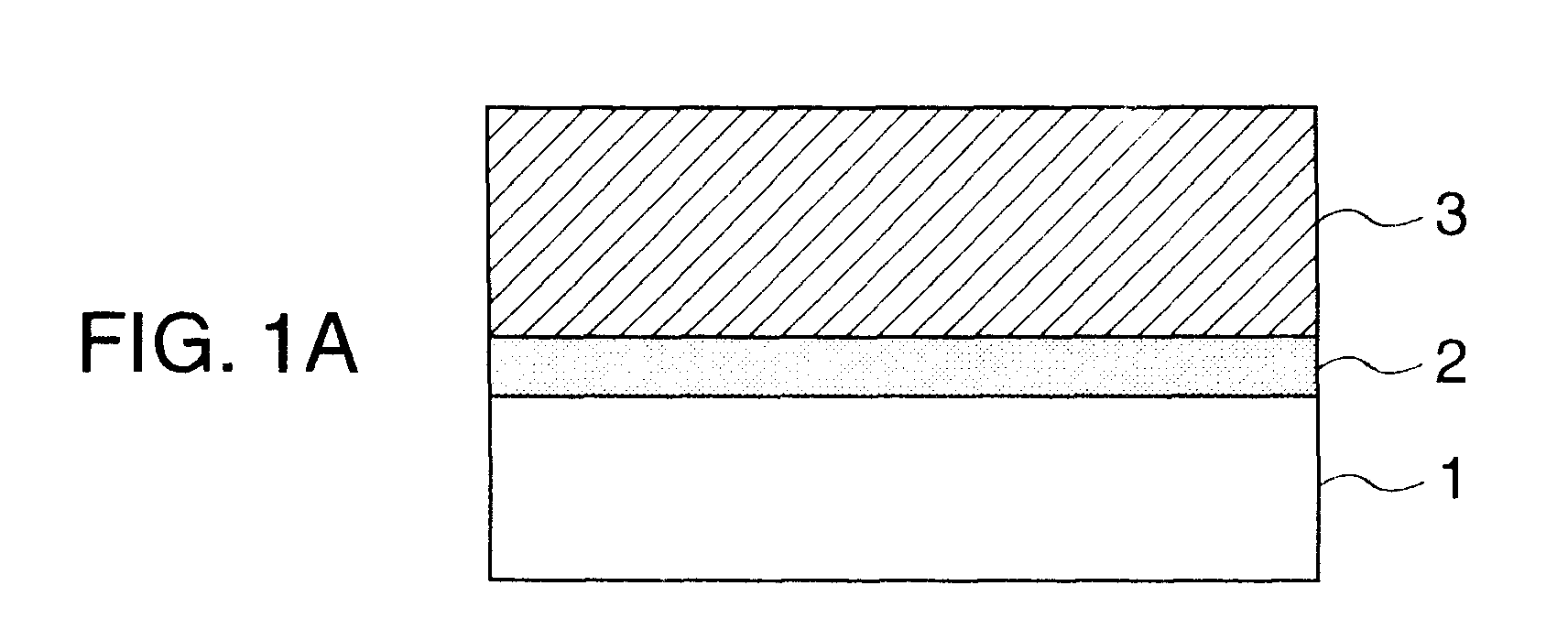

Description
- The present invention relates to a resist material used in the manufacture of semiconductor devices and a polymer composition used for such a resist material. More particularly the invention pertains to a resist material used for forming a positive pattern by applying ultraviolet light, especially deep ultraviolet light with a wavelength not greater than 300 nm, KrF eximer laser beams or the like as exposure energy source, and a polymer composition used for such a resist material.
- With a recent trend toward higher-density integration of semiconductor devices, necessity has been intensified for shortening of wavelength of the energy source of exposure means used for fine working, particularly in the art of photolithography, and now use of deep ultraviolet light (300nm or less in wavelength), KrF excimer laser beams (248.4 nm) and the like is seriously considered. However, there has yet been available no resist material applicable to practical use with such short-wavelength exposure light.
- As a resist material usable for pattern formation with KrF excimer laser beams or deep ultraviolet light as light source, there have been known the dissolution-inhibiting type resist materials composed of a polymer having high transmittance of light near 248.4 nm and a photosensitive compound having a diazodiketo group (JP-A 1-80944; JP-A 1-154048; JP-A 1-155338; JP-A 1-155339; JP-A 1-188852; Y.Tani et al: Proc. SPIE, 1086, 22 (1989), etc.). These dissolution-inhibiting type resist materials, however, are low in sensitivity and unapplicable to use with deep ultraviolet light or KrF excimer laser beams wherein use of a high-sensitivity resist material is required. Also, as means for reducing the energy required for exposure (high sensitization), the chemically amplified type resist materials making use of an acid generated on exposure as medium have been proposed (Ito et al: Polym. Eng. Sci., 23, 1012 (1983)), and many reports have been published on this type of resist materials (USP 4,491,628 (1985) to H. Ito el al (= JP-A 2-27660); USP 4,603,101 (1986) to J.C. Crivello et al (= JP-A 62-115440) W.R. Brunsvolt et al: Proc. SPIE, 1086, 357 (1989); T.X. Neenan et al: Proc. SPIE, 1086, 2 (1989); R.G. Tarascon et al: SPE Regional Conference Technical Papers, Ellenville, N.Y., 1988, p. 11; JP-A 2-25850; Y. Jian et al: Polym. Mater. Sci. & Eng., 66, 41 (1992), etc.). These conventional chemically amplified type resist materials, however, had disadvantages in that they were liable to cause peeling of the film during development due to poor adhesion to the substrate especially when the polymer used for the resist material is a phenol ether type polymer such as poly(p-tert-butoxycarbonyloxystyrene), poly(p-tert-butoxystyrene), poly(p-tert-butoxycarbonyloxy-α-methylstyrene), poly{p-tert-butoxy-α-methylstyrene), poly(p-tert-butylisopropenylphenoxyacetate), poly(p-tert-butoxycarbonyloxystyrene/ sulfone), poly(p-tetrahydropyranyloxystyrene), poly{p-(1-methoxyethoxy)styrene), poly(p-(1-phenoxyethoxy)styrene} or the like. They were also poor in heat resistance, and thus were unable to form a good pattern. Other problems of these resist materials included poor resolution due to poor light transmittance near 248.4 nm owing to the presence of benzoyl groups in the case of carboxylic acid-ester type polymers such as poly(p-tert-butylvinylbenzoate) and poly(p-tetrahydropyranylvinylbezoate) and poor heat resistance and poor dry etch resistance in the case of polymers such as poly(tert-butyl methacrylate).
- The resist materials comprising silicon-containing polymers have also been disclosed (JP-B-3-44290, etc.), but they involve difficulties in realizing their practical use because of problems such as low sensitivity and incapability of perfect removal by ashing due to inclusion of silicon in case of using, for instance, poly(p-trimethylsilyloxystyrene) or poly(p-tert-butyldimethylsilyloxystyrene).
- Lately, as the chemically amplified type resist materials improved in these defects, there have been disclosed the resist materials using poly(p-tert-butoxycarbonyloxystyrene/p-hydroxystyrene) (JP-A 2-209977 and JP-A 3-206458), the resist materials using poly(p-tetrahydropyranyloxystyrene/p-hydroxystyrene) (JP-A 2-19847, JP-A 2-161436 and JP-A 3-83063), and the resist materials using poly(p-tert-butoxystyrene/ p-hydroxystyrene) [JP-A 2-62544 and JP-A 4-211258 (USP 5,350,660)]. The resist materials comprising these polymers, however, are incapable of offering a high resolution which is strongly required in this art in recent years, and also have their own problems in delay time (a problem of variation of pattern size with the lapse of time during the period from application of the resist to exposure to light, or from exposure to light to heat treatment (PEB), deterioration of pattern shape) which comes into question in practical use and a problem of substrate dependency (the problem that the pattern is formed or not formed depending on the kind of the material used as semiconductor substrate such as SiO2, Si3N4, Ti3N4, BPSG, polysilicon or the like).
- Resist materials comprising a polymer (such as poly(p-1-methoxyethoxystyrene/p-hydroxystyrene) into which an acetal group or a ketal group has been introduced as protective group) and a photoacid generator such as a triphenylsulfonium salt derivative or a diphenyliodonium salt (JP-A 2-161436, JP-A 4-219757, JP-A 5-281745, JP-A 3-282550, etc.) have also been disclosed. These resist materials, however, involve the problem of scum (a problem caused by generated scum which may be transferred to the substrate during etching) and/or the problems of substrate dependency and delay time. JP-A 5- 249682 discloses a resist material comprising a combination of a polymer such as poly(p-1-ethoxyethoxystyrene/p-hydroxystyrene), poly(p-1-methoxy-l-methylethoxystyrene/p-hydroxystyrene), poly(p-1-ethoxyethoxystyrene/p-hydroxystyrene/methyl methacrylate)or poly(p-1-ethoxyethoxystyrene/p-hydroxystyrene/fumaronitrile) and a photoacid generator such as a diazodisulfone compound. These materials have many excellent qualities such as high resolution and minimized delay time, but they still have the problems of substrate dependency and generation of scums. JP-A 6-194842 discloses a resist material comprising a combination of a polymer such as poly(p-1-ethoxyethoxystyrene/p-hydroxystyrene/p-tert-butoxystyrene) and a photoacid generator such as a diazodisulfone compound. This material, although excellent in such matters as resolution, mask linearity, heat resistance and delay time, is not free of the problems of substrate dependency and scum. EP-A 679,951 reports a resist material characterized by mixed use of two different polymers: poly(p-1-ethoxyethoxystyrene/p-hydroxystyrene) and poly(p-tert-butoxycarbonyloxystyrene/p-hydroxystyrene). This resist material, however, still involves the problems relating to the resolution and the delay time.
- As described above, the chemically amplified type resist materials are remarkably improved in sensitivity as compared with the conventional resist materials, but they still involve the problems such as poor heat resistance of the polymer used therefor, insufficient adhesiveness to the substrate, unsatisfactory transmittance of light with a wavelength of around 248.4 nm, unsatisfactory resolution, pattern size variation or deterioration of pattern shape with the lapse of time, low storage stability, insufficient focus margin, poor mask linearity, footing (broader bottom shape of the pattern), generation of scum and high substrate dependency, resulting in preventing these materials from practical use. Thus, the development of a practical high-sensitivity resist material free of the problems mentioned above has been keenly desired.
- In view of the above circumstances, the present invention is designed to provide a practically usable resist material having high transmittance of ultraviolet light, particularly deep ultraviolet light having a wavelength of 300 nm or less, KrF excimer laser beams and such, also having high sensitivity to exposure by such light sources or electron beams or soft X-ray irradiation, excellent in heat resistance and adhesion to the substrate, having high resolution, capable of forming a pattern with high precision without causing pattern size variation with the lapse of time, excellent in storage stability, having a wide focus margin, good mask linearity and no substrate dependency, and also capable of producing a rectangular pattern form without causing broader bottom shape of the pattern or generation of scum, and a polymer composition used for such a resist material.
- The present invention provides a polymer composition comprising:
- (i) a polymer (a) containing as its structural constituent a monomer unit having a functional group (hereinafter referred to as functional group A) which becomes alkali-soluble by heating in the presence of an acid; and
- (ii) a polymer (b) containing as its structural constituent a monomer unit having a functional group (hereinafter referred to as functional group B) which becomes alkali-soluble, but less easily than the functional group A, by heating in the presence of an acid.
- The present invention also provides a polymer composition comprising:
- (i) a polymer (a) containing as its structural constituent a monomer unit having a functional group A which becomes alkali-soluble by heating in the presence of an acid;
- (ii) a polymer (b) containing as its structural constituent a monomer unit having a functional group B which becomes alkali-soluble, but less easily than the functional group A, by heating in the presence of an acid; and
- (iii) a phenolic compound having a weight-average molecular weight in the range from 300 to 15,000.
- The present invention further provides a polymer composition comprising a polymer (a) mentioned in (i) above, and a phenolic compound having a weight-average molecular weight of from 300 to 15,000 mentioned in (iii) above.
- The present invention also provides a resist material comprising said polymer composition and a photoacid generator.
- The present invention still further provides a pattern forming process which comprises applying said resist material on a semiconductor substrate, heating the resist material on the substrate, exposing it to actinic radiation through a mask, and if necessary with heating, and conducting development.
- FIGS. 1A to 1C are sectional illustrations of the steps in the process of forming a positive pattern using a resist material according to the present invention.
- FIG. 2 is a sectional illustration of failure to form a 0.30 µm L/S pattern observed in Comparative Examples 1-3, 10 and 17.
- FIG. 3 is a sectional illustration of a defective 0.30 µm L/S pattern form observed in Comparative Examples 4, 11, 13-14, 16 and 21.
- FIG. 4 is a sectional illustration of a defective 0.30 µm L/S pattern form observed in Comparative Examples 6-7 and 9.
- FIG. 5 is a sectional illustration of a defective 0.30 µm L/S pattern form observed in Comparative Examples 5, 8, 12, 15, 18 and 20.
- FIG. 6 is a sectional illustration of a pattern form with unsatisfactory heat resistance after 150-second baking and development observed in Comparative Examples 5, 8, 12 and 15.
- Exemplary embodiments of the present invention are set forth below.
- (1) A polymer composition comprising
- (i) a polymer (a) containing as its structural constituent a monomer unit having a functional group A which becomes alkali-soluble by heating in the presence of an acid; and
- (ii) a polymer (b) containing as its structural constituent a monomer unit having a functional group B which becomes alkali-soluble, but less easily than the functional group A, by heating in the presence of an acid.
- (2) A polymer composition set out in (1), wherein each of the polymer (a) and the polymer (b) contains as its structural constituent another monomer unit which can provide the polymer with heat resistance and adhesiveness to the substrate.
- (3) A polymer composition set out in (2), wherein at least one of the polymer (a) and the polymer (b) contains as its structural constituent a third monomer unit.
- (4) A polymer composition set out in any of (1) to (3), which further comprises (iii) a phenolic compound having a weight-average molecular weight from 300 to 15,000.
- (5) A polymer composition set out in any of (1) to (4), which further comprises a substance which generates an acid on exposure to actinic radiation.
- (6) A polymer composition set out in (5), which further comprises an ultraviolet absorber (or absorbent).
- (7) A polymer composition comprising (i) a polymer (a) and (iii) a phenolic compound having a weight-average molecular weight of 300 to 15,000.
- (8) A polymer composition set out in (7), which further comprises a substance which generates an acid on exposure to actinic radiation.
- (9) A polymer composition set out in (8), which further comprises an ultraviolet absorber.
- (10) A resist material comprising a polymer composition set out in any of (5) to (9).
- (11) A pattern forming process which comprises applying a resist material set out in (10) on a semiconductor substrate, heating the resist material on the substrate, exposing it to actinic radiation through a mask, further heating if necessary, and conducting development.
- In the present invention, the monomer unit having the functional group A in the polymer (a) includes those represented by the formula [4]:

- The monomer unit having the functional group B in the polymer (b) includes those represented by the formula [7]:

- In the present invention, the monomer unit that helps provide the polymer with heat resistance and adhesiveness to the substrate includes those represented by the formula [5]:

- Polymer (a) in the present invention includes the polymers represented by the formula [1]:

- Polymer (b) in the present invention includes the polymers represented by the formula [2]:

- The lower alkyl group represented by R in the formulae [1], [4] and [5], the lower alkyl group represented by R1 in the formula [1], the lower alkyl group represented by R6 in the formulae [2] and [7] and the lower alkyl group represented by R21 in the formula [2] include respectively a straight or branched alkyl group preferably having 1 to 6 carbon atoms, for example, methyl, ethyl, propyl, butyl, pentyl and hexyl.
- The alkyl group optionally substituted with a halogen, represented by R2, R3 and R4 in the formulae [1] and [4], may be straight, branched or cyclic alkyl group having preferably 1 to 10 carbon atoms, for example, methyl, ethyl, n-propyl, isopropyl, cyclopropyl, n-butyl, isobutyl, tert-butyl, sec-butyl, n-pentyl, isopentyl, tert-pentyl, 1-methylpentyl, cyclopentyl, n-hexyl, isohexyl, cyclohexyl, heptyl, octyl, nonyl and decyl.
- The halogen atoms in the alkyl group which may be substituted with one or more halogen atoms and is represented by R2, R3 and R4 include chlorine, bromine, fluorine and iodine atoms.
- The aralkyl group represented by R4 includes benzyl, phenetyl, phenylpropyl, methylbenzyl, methylphenetyl and ethylbenzyl.
- The carboxyl group which may have been esterified, represented by R5 in the formula [1], includes carboxyl and those of the carboxyl groups in which the hydrogen atom has been substituted with, for instance, an alkyl group having 1-6 carbon atoms, such as methoxycarbonyl, ethoxycarbonyl, propoxycarbonyl, butoxycarbonyl, pentyloxycarbonyl and hexyloxycarbonyl.
- Examples of the substituent of the phenyl group which may have a substituent and is represented by R5 include halogen atoms such as chlorine, bromine, fluorine and iodine atoms; straight, branched or cyclic alkyl groups having preferably 1-10 carbon atoms such as methyl, ethyl, n-propyl, isopropyl, cyclopropyl, n-butyl, isobutyl, tert-butyl, sec-butyl, n-pentyl, isopentyl, tert-pentyl, 1-methylpentyl, cyclopentyl, n-hexyl, isohexyl, cyclohexyl, heptyl, octyl, nonyl and decyl; straight or branched alkoxy groups having preferably 1-6 carbon atoms such as methoxy, ethoxy, n-propoxy, isopropoxy, n-butoxy, isobutoxy, tert-butoxy, sec-butoxy, n-pentyloxy, isopentyloxy, n-hexyloxy and isohexyloxy; straight, branched or cyclic acyl groups having 2-7 carbon atoms such as acetyl, propionyl, n-butyryl, isobutyryl, n-pentanoyl, pivaloyl, isovaleryl and cyclohexanecarbonyl; 5- to 6-membered saturated heterocyclicoxy groups such as tetrahydrofuranyloxy and tetrahydropyranyloxy; and the groups represented by R25O-CO-(CH2)jO- (wherein R25 represents a lower alkyl group having 1-6 carbon atoms such as methyl, ethyl, propyl, butyl, pentyl and hexyl, which may be straight, branched or cyclic; and j is 0 or 1. Examples of the groups represented by R25O-CO-(CH2)jO- include methoxycarbonyloxy, ethoxycarbonyloxy, isopropoxycarbonyloxy, tert-butoxycarbonyloxy, isobutoxycarbonyloxy, tert-pentyloxycarbonyloxy, ethoxycarbonylmethoxy, tert-butoxycarbonylmethoxy, 1-methylcyclopentyloxycarbonylmethoxy and 1-methylcyclohexyloxycarbonylmethoxy.
- The lower alkyl groups represented by R7 in the formulae [2] and [7] are straight or branched alkyl groups having preferably 1-6 carbon atoms, such as isopropyl, isobutyl, tert-butyl, sec-butyl, isopentyl, tert-pentyl, 1-methylpentyl and isohexyl.
- The lower alkoxy groups represented by R7 are straight or branched alkoxy groups having preferably 1-6 carbon atoms,such as methoxy, ethoxy, n-propoxy, isopropoxy, n-butoxy, isobutoxy, tert-butoxy, sec-butoxy, n-pentyloxy, isopentyloxy, n-hexyloxy and isohexyloxy.
- The acyloxy groups represented by R7 are straight, branched or cyclic acyloxy groups having preferably 2-7 carbon atoms, such as acetyloxy, propionyloxy, n-butylyloxy, isobutylyloxy, n-pentanoyloxy, pivaroyloxy, isovaleryloxy and cyclohexanecarbonyloxy.
- The saturated heterocyclic oxy groups represented by R7 are preferably 5- to 6-membered ones which include, for example, tetrahydrofuranyloxy and tetrahydropyranyloxy.
- R8 in the formula R8O-CO-(CH2)z-O- represented by R7 is straight, branched or cyclic alkyl groups having 1-10 carbon atoms, including methyl, ethyl, n-propyl, isopropyl, cyclopropyl, n-butyl, isobutyl, tert-butyl, sec-butyl, n-pentyl, isopentyl, 1-methylcyclohenxyl, tert-pentyl, 1-methylpentyl, cyclopentyl, n-hexyl, isohexyl, cyclohexyl, heptyl, octyl, nonyl and decyl. Examples of the R8O-CO-(CH2)z-O- group are methoxycarbonyloxy, ethoxycarbonyloxy, isopropoxycarbonyloxy, isobutoxycarbonyloxy, tert-butoxycarbonyloxy, tert-pentyloxycarbonyloxy, 1-methylcyclohexyloxycarbonylmethyloxy, tert-butoxycarbonylmethyloxy and 1-methylcyclopentyloxycarbonylmethyloxy.
- The carboxyl group which may be esterified, represented by R22 in the formula [2], includes carboxyl and substituted carboxyl groups in which the hydrogen atom is substituted with a C1-6 alkyl group, such as methoxycarbonyl, ethoxycarbonyl, propoxycarbonyl, butoxycarbonyl, pentyloxycarbonyl and hexyloxycarbonyl.
- The substituent of the optionally substituted phenyl group, represented by R22, includes halogen atoms such as chlorine, bromine, fluorine and iodine atoms; straight, branched or cyclic alkyl groups having preferably 1-10 carbon atoms, such as methyl, ethyl, n-propyl, isopropyl, cyclopropyl, n-butyl, isobutyl, tert-butyl, sec-butyl, n-pentyl, isopentyl, tert-pentyl, 1-methylpentyl, cyclopentyl, n-hexyl, isohexyl, cyclohexyl, heptyl, octyl, nonyl and decyl; straight or branched alkoxyl groups having preferably 1-6 carbon atoms such as methoxy, ethoxy, n-propoxy, isopropoxy, n-butoxy, isobutoxy,tert-butoxy, sec-butoxy, n-pentyloxy, isopentyloxy, n-hexyloxy, and isohexyloxy; linear, branched or cyclic acyl groups having 2-7 carbon atoms such as acetyl, propionyl, n-butyryl, isoburlyl, n-pentanoyl, pivaroyl, isovaleryl and cyclohexanecarbonyl; 5- to 6-membered saturated heterocyclicoxy groups such as tetrahydrofuranyloxy and tetrahydropyranyloxy; and the groups represented by R25O-CO(CH2)jO- (wherein R25 represents a lower alkyl group having 1-4 carbon atoms such as methyl, ethyl, propyl and butyl; and j is 0 or 1). Examples of the group represented by R25O-CO-(CH2)jO- include methoxycarbonyloxy, ethoxycarbonyloxy, isopropoxycarbonyloxy, tert-butoxycarbonyloxy, isobutoxycarbonyloxy, tert-pentyloxycarbonyloxy, ethoxycarbonylmethoxy, tert-butoxycarbonylmethoxy, 1-methylcyclopentyloxycarbonylmethoxy and 1-methylcyclohexyloxycarbonylmethoxy.
- The resist material of the present invention comprising the polymer composition of the present invention containing polymer (a) and polymer (b) according to the present invention is characterized by combined use of:
- polymer (a) has repeating units, for example, represented by the formula [1]:
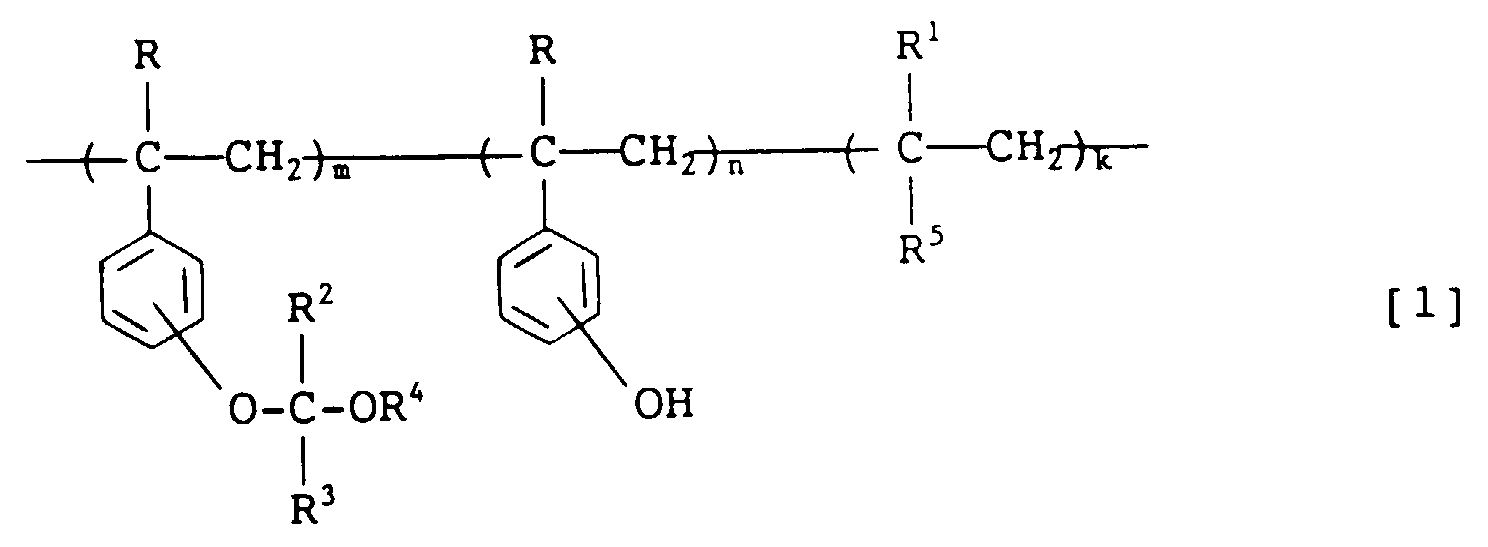
- a monomer unit having the functional group A which can be easily eliminated with a little amount of an acid, for example, the one represented by the formula [3]:


- a monomer unit which contributes to the improvement of adhesiveness to the substrate and heat resistance, for example, the one represented by the formula [5]:

- a monomer unit which is used optionally for the purpose of improving light transmittance of the portion to be exposed, controlling the developing speed of the exposed portion to better the side wall configuration or improving mask linearity, for example, the one represented by the formula [6]:
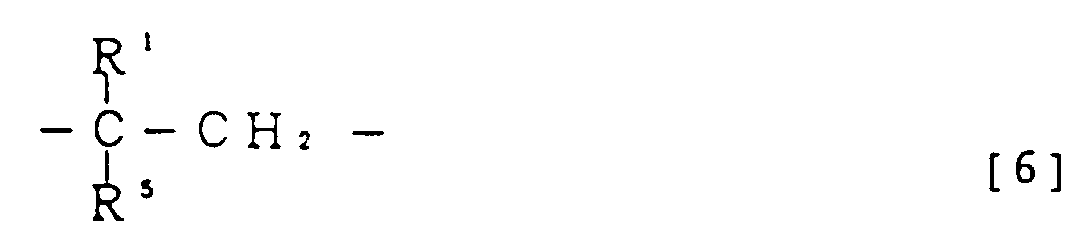
- polymer (b) has repeating units, for example, represented by the formula [2]:

- a monomer unit having an action to lower the rate of dissolution in the developer, for example, the one represented by the formula [7]:

- a monomer unit which can better substrate adhesion and heat resistance, for example, the one represented by the formula [8]:

- a monomer unit which is added optionally for the purpose of controlling the rate of dissolution during development, for example, the one represented by the formula [9]:
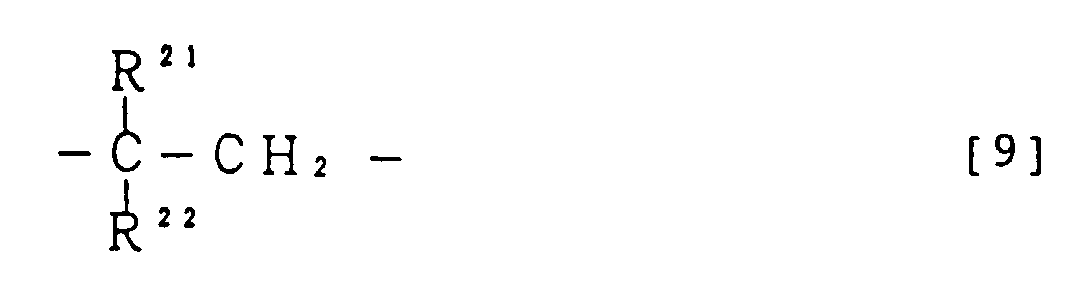
- Also, the resist material of the present invention comprising the polymer composition of the present invention containing (i) said polymer (a), (ii) polymer (b) and if necessary (iii) a phenolic compound having a weight-average molecular weight of 300 - 15,000 is characterized in that a phenolic compound having a weight-average molecular weight of 300 - 15,000, which has a potency to control the rate of dissolution during development, is used in combination with a polymer of the formula [1] and a polymer of the formula [2]. The polymer (b) is preferably used in an amount of 10 to 90 parts by weight, more preferably 10 to 50 parts by weight, per 100 parts by weight of the polymer (a). In the three-component composition, the polymer (b) is preferably used in an amount of 10 to 65 parts by weight, more preferably 10 to 50 parts by weight, and the phenolic compound is used preferably in an amount of 1 to 30 parts by weight, more preferably 1 to 20 parts by weight, per 100 parts by weight of the polymer (a).
- Further, the resist material comprising the polymer composition of the present invention containing (i) said polymer (a) and (iii) a phenolic compound having a weight-average molecular weight of 300 - 15,000 is characterized by combined use of a polymer such as represented by the formula [1] and a phenolic compound having a weight-average molecular weight of 300 - 15,000 which serves for controlling the developing speed. The phenolic compound is preferably used in an amount of 1 to 50 parts by weight, more preferably 1 to 30 parts by weight, per 100 parts by weight of the polymer (a).
- When the polymer composition of the present invention is used as a basic component of the resist material, use of a polymer represented by the formula [1] is very advantageous for the improvement of resolution and maintenance of pattern size (cf. delay time) due to the fact that the functional group represented by the formula [3] is far easies to elimination by the action of an acid than the conventional functional groups such as tert-butoxycarbonyloxy group, tert-butoxy group, tetrahydropyranyloxy group and tert-butoxycarbonylmethoxy group.
- The polymers of the formula [2] and the phenolic compounds having a weight-average molecular weight of 300 - 15,000 mentioned above are conducive to the improvement of focus margin, mask linearity and pattern side wall configuration, which is unachievable with the polymers of the formula [1], owing to their capability to control the rate of dissolution in the developer during development. They also contribute to the enhancement of heat resistance of the polymer composition. Combined use of at least one of the polymers of the formula [1], at least one of the polymers of the formula [2] and a phenolic compound having a weight-average molecular weight of 300 - 15,000 produces the effect of offsetting the defects of the respective polymers to enable attainment of the intended objects, that is, enhancement of resolution and substrate adhesion, maintenance of pattern size with the lapse of time, and improvements of mask linearity and focus margin. It is also notable that in case the polymer of the formula [2] used in the present invention is the one in which the number of the monomer units of the formula [9] is less than that of the monomer units of the formula [7] and its weight-average molecular weight is less than that of the polymer of the formula [1], or in case a phenolic compound having a molecular weight of 300 - 15,000 is used in combination with said polymers, the above-mentioned effects as well as solving the problem of substrate dependency can be attained most effectively.
- The monomer unit represented by the formula [4] includes, for example, the units of the such monomers as p- or m-hydroxystyrene derivatives and p-or m-hydroxy-a-methylstyrene derivatives. More specifically, these monomers include p- or m-1-methoxy-1-methylethoxystyrene, p- or m-1-benzyloxy-1-methylethoxystyrene, p- or m-1-ethoxyethoxystyrene, p- or m-1-methoxyethoxystyrene, p- or m-1-n-butoxyethoxystyrene, p- or m-1-isobutoxyethoxystyrene, p- or m-1-(1,1-dimethylethoxy)-l-methylethoxystyrene, p- or m-1-(1,1-dimethylethoxy)ethoxystyrene, p- or m-1-(2-chloroethoxy)ethoxystyrene, p- or m-1-(2-ethylhexyloxy)ethoxystyrene, p- or m-1-ethoxy-1-methylethoxystyrene, p- or m-1-n-propoxyethoxystyrene, p- or m-1-methyl-1-n-propoxyethoxystyrene, p- or m-1-ethoxypropoxystyrene, p- or m-1-methoxybutoxystyrene, m- or p-1-methoxycyclohexyloxystyrene, m- or p-1-acetyloxy-1-methylethoxystyrene, and p- or m-hydroxy- α-methylstyrene derivatives having the same protective group as the above-mentioned p- or m-hydroxystyrene derivatives.
- The monomer unit represented by the formula [7] includes the units of the such monomers as styrene, m- or p-methoxystyrene, m- or p-isopropoxystyrene, m-or p-tert-butoxystyrene, m- or p-cyclohexyloxystyrene, m- or p-1-methylcyclohexyloxystyrene, m- or p-1-methylcyclopentyloxystyrene, m- or p-tetrahydropyranyloxystyrene, m- or p-tetrahydrofuranyloxystyrene, m- or p-acetyloxystyrene, m- or p-isobutylyloxystyrene, m- or p-pivaroyloxystyrene, m- or p-cyclohexanecarbonyloxystyrene, m- or p-methoxycarbonyloxystyrene, m- or p-ethoxycarbonyoxystyrene, m- or p-isopropoxycarbonyloxystyrene, m- or p-isobutoxycarbonyloxystyrene, m- or p-sec-butoxycarbonyloxystyrene, m- or p-tert-butoxycarbonyloxystyrene, m- or p-isoamyloxycarbonyloxystyrene, m- or p-tert-amyloxycarbonyloxystyrene, 1-methylcyclopentyl m- or p-vinylphenoxyacetate, 1-methylcyclohexyl m- or p-vinylphenoxyacetate, and α-methylstyrene derivatives having the same substituent group as the above-mentioned styrene derivatives.
- The monomer unit represented by the formula [6] includes the units of such monomers as styrene, α-methylstyrene, p-chlorostyrene, o-, m- or p-methylstyrene, o-, m- or p-methoxystyrene, p-n-butylstyrene, p-ethoxystyrene, m- or p-l-methylcyclohexyloxystyrene, m- or p-1-methylcyclopentyloxystyrene, m- or p-tert-butoxystyrene, m- or p-tetrahydropyranyloxystyrene,m-or p-tetrahydrofuranyloxystyrene, m- or p-methoxycarbonyloxystyrene, m- or p-ethoxycarbonyloxystyrene, m- or p-isopropoxycarbonyloxystyrene, m- or p-isobutoxycarbonyloxystyrene, m- or p-tert-butoxycarbonyloxystyrene, m- or p-isoamyloxycarbonyloxystyrene, m- or p-tert-amyloxycarbonyloxystyrene, tert-butyl m- or p- vinylphenoxyacetate, 1-methylcyclopentyl m- or p-vinylphenoxyacetate, 1-methylcyclohexyl m- or p-vinylphenoxyacetate, and α-methylstyrene derivatives having the same substituent group as the above-mentioned styrene derivatives, and the units of such monomers as acrylonitrile, methacrylic acid, acrylic acid, methyl methacrylate, tert-butyl methacrylate, cyclohexylmethacrylate and the like.
- The monomer unit represented by the formula [9] includes the units of such monomers as p- or m-hydroxystyrene derivatives and p- or m-hydroxy-α-methylstyrene derivatives. More specifically, such monomers include p- or m-1-methoxy-1- methylethoxystyrene, p- or m-benzyloxy-l-methylethoxystyrene, p- or m-1-ethoxyethoxystyrene, p- or m-1-methoxyethoxystyrene, p- or m-1-n-butoxyethoxystyrene, p- or m-1-isobutoxyethoxystyrene, p- or m-1-(1,1-dimethylethoxy)-1-methylethoxystyrene, p- or m-1-(1,1-dimethylethoxy)ethoxystyrene, p- or m-1-ethoxy-1-methylethoxystyrene, p- or m-1-n-propoxyethoxystyrene, p- or m-1-methyl-1-n-propoxyethoxystyrene, p-or m-1-methoxybutoxystyrene, m- or p-1-methoxycyclohexyloxystyrene, m- or p-1-acetyloxy-1-methylethoxystyrene, and p- or m-hydroxy-α-methylstyrene-derivatives having the same protective group as the above-mentioned p- or m-hydroxystyrene derivatives.
- The monomer unit of the formula [5] constituting the polymer of the formula [1] and the monomer unit of the formula[8] constituting the polymer of the formula [2] are the monomers having phenolic hydroxyl groups. Examples of such monomers are p- or m-vinylphenol and p- or m-hydroxy-α-methylstyrene.
- The polymer of the formula [1] and the polymer of the formula [2] may, in some cases, be constituted by the same monomer units, but these polymers are actually different from each other since in the polymer (a) there are used a greater number of the monomer units [4] than the monomer units [6] for maximizing the difference in rate of dissolution in the developer between the exposed portion and the non-exposed portion to ensure a high resolution while in the polymer (b) the number of the monomer units [9] are less than the monomer units [7] for controlling the rate of development to improve side wall configuration and substrate dependency.
- The constitutional ratio of the total of the monomer units [4] and the monomer units [6] in the polymer [1] is usually 10 to 90 mol%, and any ratio within this range is applicable to the resist material of the present invention, but a ratio of from 20 to 50 mol% is preferred in terms of heat resistance of the polymer, substrate adhesion and mask linearity.
- The constitutional ratio of the monomer units [6] in the polymer [1] is usually 0 to 25%, but a ratio of from 0 to 15 mol% is preferred as the ratio in this range is conducive to the improvement of mask linearity without affecting resolution of the polymer. It is also desirable in terms of resolution, etc., that the monomer units [4] be contained in a greater number than the monomer units [6].
- The constitutional ratio of the monomer units [7] in the polymer [2] is usually 10 to 50 mol%, and any ratio within this range is applicable to the resist material of the present invention, but a ratio of from 15 to 40 mol% is preferred in view of its effect in improving polymer heat resistance and substrate adhesion and preventing the surface insoluble layer formed by delay time.
- The constitutional ratio of the monomer units [9] in the polymer [2] is usually 0 to 20 mol%, but a ratio of from 0 to 15 mol% is preferred for allowing improvement of side wall configuration while maintaining resolution. It is also desirable for the improvement of side wall configuration and substrate dependency that the monomer units [7] be contained in a greater number than the monomer units [9].
- Among the polymers (a), preferable ones are those having repating units of the formula:

- Among the polymers (b), preferable ones are those having repeating units of the formula:

- Listed below are the examples of the polymers represented by the formula [1]:
poly[p-(1-methoxy-1-methylethoxy)styrene/p-hydroxystyrene], poly[p-(1-benzyloxy-1-methylethoxy)-styrene/p-hydroxystyrene], poly[p-(1-ethoxyethoxy)-styrene/p-hydroxystyrene], poly[p-(1-methoxyethoxystyrene)/p-hydroxystyrene], poly[p-1-n-butoxyethoxystyrene/p-hydroxystyrene], poly[p-(1,1-dimethylethoxy)-1-methylethoxystyrene/p-hydroxystyrene], poly[p-(1-methoxy-1-methylethoxy)styrene/p-hydroxystyrene/styrene], poly[p-(1-methoxy-1-methylethoxy)-styrene/p-hydroxystyrene/p-chlorostyrene], poly[p-(1-methoxy-1-methylethoxy)styrene/p-hydroxystyrene/ p-methylstyrene], poly[p-(1-methoxy-l-methylethoxy)-styrene/p-hydroxystyrene/p-methoxystyrene], poly[p-(1-methoxy-1-methylethoxy)styrene/p-hydroxystyrene/ p-tert-butoxystyrene], poly[p-(1-methoxy-l-methylethoxy)styrene/p-hydroxystyrene/p-1-methylcyclohexyloxystyrene], poly[p-(1-methoxy-1-methylethoxy)styrene/p-hydroxystyrene/methyl methacrylate], poly[p-(1-methoxy-1-methylethoxy)styrene/p-hydroxystyrene/tert-butyl methacrylate], poly[p-(1-methoxy-1-methylethoxy)styrene/p-hydroxystyrene/acrylonitrile], poly[p-(1-benzyloxy-1-methylethoxy)styrene/p-hydroxystyrene/styrene], poly[p-(1-benzyloxy-1-methylethoxy)styrene/p-hydroxystyrene/p-chlorostyrene], poly[p-(1-benzyloxy-1-methylethoxy)styrene/p-hydroxysty rene/p-methylstyrene], poly[p-(-benzyloxy-1-methylethoxy)styrene/p-hydroxystyrene/p-ethoxystyrene], poly[p-(1-benzyloxy-1-methylethoxy)styrene/p-hydroxystyrene/p-tert-butoxystyrene], poly(poly-1-ethoxyethoxystyrene/p-hydroxystyrene/styrene), poly(p-1-ethoxyethoxystyrene/p-hydroxystyrene/p-chlorostyrene), poly(p-1-ethoxyethoxystyrene/p-hydroxystyrene/p-methylstyrene), poly(p-1-ethoxyethoxystyrene/p-hydroxystyrene/m-methylstyrene), poly(p-1-ethoxyethoxystyrene/p-hydroxystyrene/methyl methacrylate), poly(p-1-ethoxyethoxystyrene/p-hydroxystyrene/cyclohexylmethacrylate), poly(p-1-ethoxyethoxystyrene/p-hydroxystyrene/tert-butyl methacrylate), poly(p-1-ethoxyethoxystyrene/p-hydroxystyrene/acrylonitrile), poly(p-1-ethoxyethoxystyrene/p-hydroxystyrene/p-methoxystyrene), poly(p-1-ethoxyethoxystyrene/p-hydroxystyrene/p-ethoxystyrene), poly(p-1-ethoxyethoxystyrene/p-hydroxystyrene/p-tert-butoxystyrene), poly(p-1-ethoxyethoxystyrene/p-hydroxystyrene/acrylic acid), poly(p-1-ethoxyethoxystyrene/p-hydroxystyrene/p-methoxycarbonyloxystyrene), poly(p-1-ethoxyethoxystyrene/p-hydroxystyrene/p-ethoxycarbonyloxystyrene), poly(p-1-ethoxyethoxystyrene/p-hydroxystyrene/p-isopropoxycarbonyloxystyrene), poly(p-1-methoxyethoxystyrene/p-hydroxystyrene/p-isobutyloxycarbonyloxystyrene), poly(p-1-ethoxyethoxystyrene/p-hydroxystyrene/p-isobutoxycarbonyloxystyrene), poly(p-1-ethoxyethoxystyrene/p-hydroxystyrene/p-isoamyloxycarbonyloxystyrene), poly(p-1-ethoxyethoxystyrene/p-hydroxystyrene/p-1-methylcyclohexyloxy styrene), poly(p-1-methoxyethoxystyrene/p-hydroxystyrene/styrene), poly(p-1-methoxyethoxystyrene/p-hydroxystyrene/p-methylstyrene), poly(p-1-methoxyethoxystyrene/p-hydroxystyrene/ m-methylstyrene), poly(p-1-methoxyethoxystyrene/p-hydroxystyrene/p-chlorostyrene), poly(p-1-methoxyethoxystyrene/p-hydroxystyrene/p-methoxystyrene), poly(p-1-methoxyethoxystyrene/p-hydroxystyrene/p-ethoxystyrene), poly(p-1-methoxyethoxystyrene/p-hydroxystyrene/p-tert-butoxystyrene), poly(p-1-methoxyethoxystyrene/p-hydroxystyrene/p-1-methylcyclohexyloxystyrene),poly(p-1-methoxyethoxystyrene/p-hydroxystyrene/methylmethacrylate), poly(p-1-methoxyethoxystyrene/p-hydroxystyrene/tert-butylmethacrylate), poly(p-1-methoxyethoxystyrene/p-hydroxystyrene/acrylonitrile), poly(p-1-n-butoxyethoxystyrene/p-hydroxystyrene/p-n-butylstyrene), poly(p-1-isobutoxyethoxystyrene/p-hydroxystyrene/o-methoxystyrene), poly{p-[1,1-dimethylethoxy)-1-methylethoxy]styrene/p-hydroxystyrene/m-methoxystyrene), poly[p-(1,1-dimethylethoxy)-l-methylethoxystyrene/p-hydroxystyrene/o-methylstyrene), poly(p-1-ethoxyethoxystyrene/p-hydroxystyrene/p-acetoxystyrene), poly(p-1-ethoxyethoxystyrene/p-hydroxystyrene/p-pivarolyloxystyrene), poly(p-1-ethoxyethoxystyrene/p-hydroxystyrene/p-cyclohexanecarbonyloxystyrene), poly[m-1-(2-chloroethoxy)ethoxystyrene/m-hydroxystyrene/styrene], poly[m-1-(2-ethylhexyloxy)ethoxystyrene/m-hydroxystyrene/m-methylstyrene], poly[p-(1-methoxy-1-methylethoxy)-α-methylstyrene/p-hydroxy-α-methylstyrene/styrene], poly[p-(1-ethoxy-1-methylethoxy)-styrene/p-hydroxystyrene/p-methylstyrene], poly(p-1-n-propoxyethoxystyrene/p-hydroxystyrene/p-methoxystyrene), poly[p-(1-methyl-1-n-propoxyethoxy)-styrene/p-hydroxystyrene/p-methylstyrene], poly(m-1-ethoxypropoxystyrene/m-hydroxystyrene/m-tert-butoxystyrene), poly(m-1-ethoxypropoxystyrene/m-hydroxystyrene/p-methylstyrene), poly[m-(1-methoxy-1-methylethoxy)styrene/m-hydroxystyrene/m-tert-butoxystyrene], poly[p-1-ethoxyethoxystyrene/p-hydroxystyrene/p-tetrahydrofuranyloxystyrene], poly[p-1-ethoxyethoxystyrene/p-hydroxystyrene/p-tetrahydropyranyloxystyrene], poly[p-1-methoxyethoxystyrene/p-hydroxystyrene/p-tetrahydropyranyloxystyrene], poly[p-1-ethoxyethoxystyrene/p-hydroxystyrene/p-tert-butoxycarbonyloxystyrene], poly[p-1-methoxyethoxystyrene/p-hydroxystyrene/p-tert-butoxycarbonyloxystyrene], poly[p-(1-methoxy-1-methylethoxy)styrene/p-hydroxystyrene/p-tert-butoxycarbonyloxystyrene],
poly(p-1-ethoxyethoxystyrene/p-hydroxystyrene/tert-butyl p-vinylphenoxyacetate), poly(p-1-methoxyethoxystyrene/p-hydroxystyrene/tert-butyl p-vinylphenoxyacetate), poly(p-1-methoxyethoxystyrene/p-hydroxystyrene/1-methylcyclohexyl p-vinylphenoxyacetate), poly[m-1-ethoxyethoxystyrene/m-hydroxystyrene/m-tert-butoxycarbonyloxystyrene], poly(m-1-ethoxyethoxystyrene/m-hydroxystyrene/m-tert-butoxystyrene), poly(m-1-ethoxyethoxystyrene/m-hydroxystyrene/m-tert-butoxystyrene), poly(p-1-ethoxyethoxystyrene/m-1-ethoxyethoxystyrene/p-hydroxystyrene/m-hydroxystyrene/p-tert-butoxystyrene/m-tert-butoxystyrene), and poly (p-1-methoxybutoxystyrene/p-hydroxystyrene/ styrene). Of course, the polymers represented by the formula[1] are not limited to those shown above. - The following are the examples of the polymers represented by the formula [2]:
- poly(p-hydroxystyrene/styrene),
- poly(p-methylstyrene/p-hydroxystyrene),
- poly(p-methoxystyrene/p-hydroxystyrene),
- poly(p-ethylstyrene/p-hydroxystyrene),
- poly(p-ethoxystyrene/p-hydroxystyrene),
- poly(p-isopropoxystyrene/p-hydroxystyrene),
- poly(p-tert-butylstyrene/p-hydroxystyrene),
- poly(p-tert-butoxystyrene/p-hydroxystyrene),
- poly(l-methylcyclohexyloxystyrene/p-hydroxystyrene),
- poly(m-tert-butoxystyrene/m-hydroxystyrene),
- poly(p-methoxycarbonyloxystyrene/p-hydroxystyrene),
- poly(p-ethoxycarbonyloxystyrene/p-hydroxystyrene),
- poly(p-isopropoxycarbonyloxystyrene/p-hydroxystyrene),
- poly(p-isobutoxycarbonyloxystyrene/p-hydroxystyrene),
- poly(m-isobutoxycarbonyloxystyrene/m-hydroxystyrene),
- poly(p-tert-butoxycarbonyloxystyrene/p-hydroxystyrene),
- poly(m-tert-butoxycarbonyloxystyrene/p-hydroxystyrene),
- poly(p-isoamyloxycarbonyloxystyrene/p-hydroxystyrene),
- poly(m-isoamyloxycarbonyloxystyrene/m-hydroxystyrene),
- poly(p-tert-amyloxycarbonyloxystyrene/p-hydroxystyrene),
- poly(p-acetyloxystyrene/p-hydroxystyrene),
- poly(p-isobutyroyloxystyrene/p-hydroxystyrene),
- poly(p-pivaroyloxystyrene/p-hydroxystyrene),
- poly(p-cyclohexanecarbonyloxystyrene/p-hydroxystyrene),
- poly(p-sec-butoxycarbonyloxystyrene/p-hydroxystyrene),
- poly(p-tetrahydrofuranyloxystyrene/p-hydroxystyrene),
- poly(p-tetrahydropyranyloxystyrene/p-hydroxystyrene),
- poly(m-tetrahydropyranyloxystyrene/m-hydroxystyrene),
- poly(p-tert-butylvinylphenoxyacetate/p-hydroxystyrene),
- poly(p-1-methylcyclohexylvinylphenoxyacetate/p-hydroxystyrene),
- poly(styrene/p-hydroxystyrene/p-1-methoxyethoxystyrene),
- poly(p-methylstyrene/p-hydroxystyrene/p-1-methoxyethoxystyrene),
- poly(p-methoxystyrene/p-hydroxystyrene/p-1-methoxyethoxystyrene),
- poly(p-tert-butylstyrene/p-hydroxystyrene/p-1-methoxyethoxystyrene),
- poly(styrene/p-hydroxystyrene/p-1-ethoxyethoxystyrene),
- poly(p-methylstyrene/p-hydroxystyrene/p-1-ethoxyethoxystyrene),
- poly(m-methylstyrene/p-hydroxystyrene/p-1-ethoxyethoxystyrene),
- poly(p-methoxystyrene/p-hydroxystyrene/p-1-ethoxyethoxystyrene),
- poly(p-tert-butylstyrene/p-hydroxystyrene/p-1-ethoxyethoxystyrene),
- poly(p-tert-butoxystyrene/p-hydroxystyrene/p-1-ethoxyethoxystyrene),
- poly(styrene/p-hydroxystyrene/p-1-methoxy-1-methylethoxystyrene),
- poly(p-methylstyrene/p-hydroxystyrene/p-1-methoxy-1-methylethoxystyrene),
- poly(p-methoxystyrene/p-hydroxystyrene/p-methoxy-1-methylethoxystyrene),
- poly(p-tert-butylstyrene/p-hydroxystyrene/p-methoxy-1-methylethoxystyrene),
- poly(p-tert-butoxystyrene/p-hydroxystyrene/p-1-methoxy-1-methylethoxystyrene),
- poly(styrene/p-hydroxystyrene/p-1-benzyloxyethoxystyrene),
- poly(p-methylstyrene/p-hydroxystyrene/p-1-benzyloxyethoxystyrene),
- poly(p-methoxystyrene/p-hydroxystyrene/p-1-benzyloxyethoxystyrene),
- poly(p-tert-butylstyrene/p-hydroxystyrene/p-1-benzyloxyethoxystyrene),
- poly(p-tert-butoxystyrene/p-hydroxystyrene/p-1-benzyloxyethoxystyrene),
- poly(p-ethoxycarbonyloxystyrene/p-hydroxystyrene/p-1-methoxyethoxystyrene),
- poly(p-ethoxycarbonyloxystyerne/p-hydroxystyrene/p-1-ethoxyethoxystyrene),
- poly(p-ethoxycarbonyloxystyrene/p-hydroxystyrene/p-1-methoxy-1-methylethoxystyrene),
- poly(p-tert-butoxycarbonyloxystyrene/p-hydroxystyrene/ p-1-methoxyethoxystyrene),
- poly(p-tert-butoxycarbonyloxystyrene/p-hydroxystyrene/p-1-ethoxyethoxystyrene),
- poly(p-tert-butoxycarbonyloxystyrene/p-hydroxystyrene/p-1-methoxy-1-methylethoxystyrene,
- poly(p-tert-butoxycarbonyloxystyrene/p-hydroxystyrene/p-l-benzyloxyethoxystyrene),
- poly(p-acetyloxystyrene/p-hydroxystyrene/p-1-ethoxyethoxystyrene),
- poly(p-tetrahydropyranyloxystyrene/p-hydroxystyrene/p-1-methoxyethoxystyrene),
- poly(p-tetrahydropyranyloxystyrene/p-hydroxystyrene/p-1-ethoxyethoxystyrene),
- poly(p-tetrahydropyranyloxystyrene/p-hydroxystyrene/p-1-methoxy-1-methylethoxystyrene),
- poly(p-1-methylcyclohexylvinylphenoxyacetate/p-hydroxystyrene/p-1-methoxyethoxystyrene),
- poly(p-1-methylcyclohexylvinylphenoxyacetate/p-hydroxys tyrene/p-1-ethoxyethoxystyrene), and
- poly(p-1-methylcyclohexylvinylphenoxyacetate/p-hydroxystyrene/p-1-methoxy-1-methylethoxystyrene). Of course, the polymers represented by the formula [2] are not limited to those shown above.
- The polymers represented by the formula [1] or the formula [2] can be easily obtained according to any of the following processes (a)-(d).
- A monomer represented by the formula [10]:

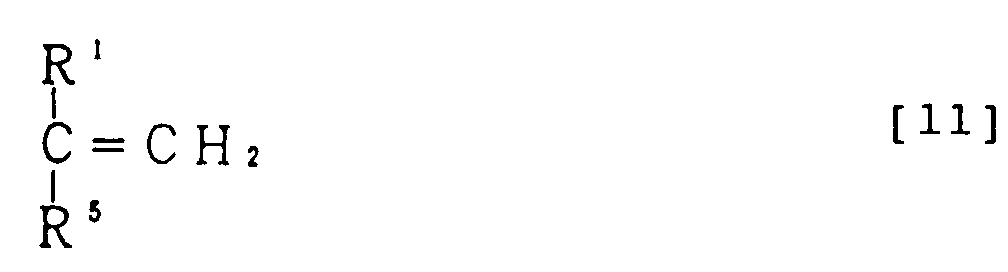


This polymer is further reacted with a vinyl ether or isopropenylether compound represented by the formula [14]:
- A monomer [10] is polymerized in the same way as in the
process 1 and subjected to after-treatments according to a conventional method to isolate a homopolymer represented by the formula [15]:

process 1, followed by after-treatments according to a conventional method to isolate a polymer of the formula [1] (k ≠ 0) or the formula [2] (f ≠ 0). - A monomer of the formula [10] or the formula [17]:

process 1 and subjected to after-treatments according to a conventional method to isolate a homopolymer represented by the above-shown formula [15] or the formula [18]:

- The homopolymer of the formula [19] obtained according to the
process 3 is reacted with a pertinent amount of a hydroxyl-protecting reagent, for example, dialkyl dicarbonates such as di-tert-butyl dicarbonate, alkyl chlorocarbonates such as methyl chlorocarbonate, 2,3-dihydrofuran, 2,3-dihydropyran, tert-butyl monochloroacetate, 1-methylcyclohexyl monochloroacetate, isobutene, dimethylsulfuric acid, methyl iodide, 1-methylcyclohexyl chloride or the like in an organic solvent such as tetrahydrofuran, 1,4-dioxane, ethyl acetate, methyl ethyl ketone, acetone, methylene chloride, 1,3-dioxolane, methanol, ethanol, n-propanol, iso-propanol, n-butanol, sec-butanol, tert-butanol, methylene chloride or the like in the presence of a suitable base [preferably potassium hydroxide, sodium hydroxide, sodium carbonate, potassium carbonate, triethylamine, N-methyl-2-pyrrolidone, piperidine, various tetraalkylammonium hydroxide solutions, various trialkylamines, various triaralkylamines or the like] at 10-100° for 0.5-30 hours,and the reaction product is subjected to after-treatments according to a conventional method to obtain a copolymer of the formula [13]. - Into this copolymer is introduced a functional group of the formula [3] in the same way as in the
process 1, followed by after-treatments according to a conventional method to give a polymer represented by the formula [1] (k ≠ 0) or the formula [2] (f ≠ 0). - In case the polymer composition of the present invention is used as a resist material, preferred examples of the polymers of the formula [1] for use in this invention are those of the formula [1] wherein R and R1 are independently a hydrogen atom or a lower alkyl group, one of R2 and R3 is a hydrogen atom or a lower alkyl group and the other is a lower alkyl group, R4 is a lower alkyl group, R5 is a phenyl group substituted with a lower alkyl group, a lower alkoxyl group, an acyloxy group, a saturated heterocyclic oxy group or a group of the formula R25O-CO-(CH2)jO- (wherein R25 represents a lower alkyl group and j is 0 or 1), m and n are each a natural number, and k is 0 or a natural number (but 0.1 ≤ (m + k)/(m + n + k) ≤ 0.9, 0 ≤ k/(m + n + k) ≤ 0.25, and m>k).
- Preferred examples of the polymers represented by the formula [2] are those of the formula [2] wherein R6 and R21 are independently a hydrogen atom, R7 is a hydrogen atom, a lower alkyl group, a lower alkoxyl group, an acyloxy group, a saturated heterocyclic oxy group or a group of the formula R8O-CO-(CH2)z-O- (wherein R8 represents a lower alkyl group and z is 0 or 1), one of R22 and R23 is a hydrogen atom or a lower alkyl group, R24 is a lower alkyl group, and p, r and f are each a natural number (but 0.1 ≤ p/(p + r + f) ≤ 0.5, 0 ≤ f/(p + r + f) ≤ 0.2, and f<p).
- The weight-average molecular weight of the polymers represented by the formula [1] or the formula [2] is not limited as far as the polymers are utilizable as components of a resist material, but generally the weight-average molecular weight [Mw] of these polymers as determined by GPC with polystyrene calibration usually falls in the range of about 5,000 to 50,000, preferably about 7,000 to 30,000 in the case of the polymers of the formula [1], and about 1,000 to 25,000, preferably about 2,000 to 15,000 in the case of the polymers of the formula [2]. It is important from the standpoints of resolution, dimensional change due to delay time and improvement of pattern side wall and substrate dependency that the weight-average molecular weight of the polymers of the formula [1] be greater than that of the polymers of the formula [2]. There is no specific limitation on such difference of molecular weight so far as the above effect can be achieved if the molecular weight of the polymer [1] is greater, even if only slightly, than that of the polymer [2], but it is usually desirable that the weight-average molecular weight of the polymer [1] is about 10% or more greater than that of the polymer [2]. The degree of dispersion [Mw/Mn] of both polymers of the formula [1] and the formula [2] is preferably in the range from 1.0 to 2.0 since this degree of dispersion is most suited for equalizing the polymer elution rate in the developer at the exposed region, resulting in improved pattern side wall configuration.
- The weight ratio of the polymer (a) to the polymer (b) is usually 10 : 9 to 10 : 1, preferably 3 : 2 to 4 : 1, in view of heat resistance, mask linearity, proximity effect, delay time and resolution.
- The phenolic compound used in the present invention can be obtained by reacting a phenol represented by the formula [20]:


- The lower alkyl group represented by R27 in the formula [21] is preferably a linear or branched alkyl group having 1-3 carbon atoms, such as methyl, ethyl, n-propyl or isopropyl. The substituent of the optionally substituted phenyl group in the definition of R27 in the formula [21] may be, for instance, a halogen atom such as chlorine atom, bromine atom, iodine atom or fluorine atom, an alkyl group such as methyl, ethyl, tert-butyl, etc., or an alkoxy group such as methoxy, ethoxy, etc.
- As the phenolic compound in the present invention, there can be used, for instance, phenolic resins and polycondensates of phenols and methylol compounds. Specifically they include p-cresol/formaldehyde polycondensate, m-cresol/formaldehyde polycondensate, p-cresol/m-cresol/formaldehyde polycondensate, phenol/formaldehyde polycondensate, p-cresol/acetaldehyde polycondensate, p-cresol/acetaldehyde polycondensate, m-cresol/acetaldehyde polycondensate, p-cresol/m-cresol/acetaldehyde polycondensate, phenol/acetaldehyde polycondensate, p-cresol/propionaldehyde polycondensate, m-cresol/ propionaldehyde polycondensate, phenol/propionaldehyde polycondensate, p-cresol/benzaldehyde polycondensate, m-cresol/benzaldehyde polycondensate, p-cresol/m-cresol/benzaldehyde polycondensate,phenol/benzaldehyde polycondensate, p-cresol/p-methylbenzaldehyde polycondensate, m-cresol/p-methylbenzaldehyde polycondensate, p-cresol/m-cresol/p-methylbenzaldehyde polycondensate, phenol/p-methylbenzaldehyde polycondensate, p-cresol/ 1,4-benzenedimethanol polycondensate, m-cresol/1,4-benzenedimethanol polycondensate, and p-cresol/m-cresol/1,4-benzenedimethanol polycondensate.
- The phenolic compounds usable in the present invention, besides the resins mentioned above, also include 1,1,1-tris(4-hydroxyphenyl)ethane, α',α,α'-tris(4-hydroxyphenyl)-1-ethyl-4-isopropylbenzene, and 3,4-dihydroxy-4-(2,4-dihydroxyphenyl)-7-hydroxy-2,2,4-trimethyl-2H-1-benzopyran.
- The weight-average molecular weight of the phenolic compound used in the present invention is not limited as far as the compound is utilizable as a component of a resist material, but usually the weight-average molecular weight [Mw] of the compound as determined by GPC with polystyrene calibration is around 300 to 15,000, preferably around 300 to 10,000, more preferably around 300 to 8,000 which provides improvement of side wall configuration or substrate dependency while maintaining high resolution and heat resistance.
- The ratio of the phenolic compound of the present invention to the polymer of the formula [1] or the sum of the polymer of the formula [1] and the polymer of the formula [2] is usually 3 : 7 to 1 : 99, preferably 2 : 8 to 1 : 49 as the latter is more advantageous for improving side wall configuration, substrate dependency and resolution.
- For producing a resist material with the polymer composition of the present invention, there is additionally used a substance which generates an acid on exposure to actinic radiation (this substance being hereinafter referred to as "photoacid generator"). These components are usually used in the form of a solution using preferably an organic solvent.
- As the photoacid generator in the present invention, there can be used any substance which is capable of generating an acid on exposure to actinic radiation and gives no adverse effect to resist pattern formation, but it is preferred to use a substance having high transmittance of light with a wavelength of near 248.4 nm and capable of maintaining high transparency of the resist material, or a substance capable of being enhanced in transmittance of light near 248.4 nm by exposure and maintaining high transparency of the resist material. As the especially preferred examples of such photoacid generator used in the present invention, the compounds of the following formulae [23], [24], [26], [27], [28] and [30] can be exemplified:
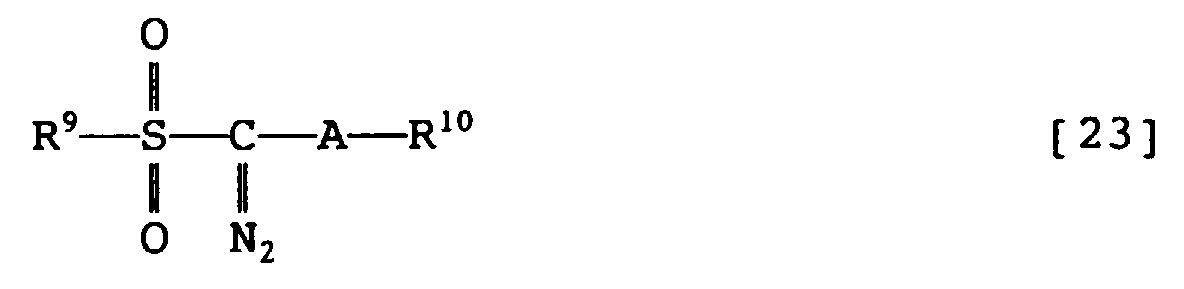


R33-B-O- [29]
(wherein R33 is an alkyl group, a fluoroalkyl group, a phenyl group, a substituted phenyl group or an aralkyl group, and B is a sulfonyl group or a carbonyl group), and R32 is a hydrogen atom, a methyl group or an ethyl group];
- The alkyl groups represented by R9 and R10 in the formula [23] and the alkyl groups in the haloalkyl groups also represented by R9 and R10 may be straight, branched or cyclic and preferably have 1 to 10 carbon atoms. Examples of such alkyl groups include methyl, ethyl, n-propyl,isopropyl, cyclopropyl, n-butyl, isobutyl, tert-butyl, sec-butyl, n-pentyl, isopentyl, tert-pentyl, 1-methylpentyl, cyclopentyl, n-hexyl, isohexyl, cyclohexyl, heptyl, octyl, nonyl and decyl.
- The halogen of the haloalkyl groups may be, for instance, chlorine, bromine, fluorine or iodine.
- The alkyl groups represented by R11 in the formula [24] and the alkyl groups in the haloalkyl groups also represented by R11 may be either straight or branched and preferably have 1 to 5 carbon atoms. Examples of these alkyl groups include methyl, ethyl, n-propyl, isopropyl, n-butyl, isobutyl, tert-butyl, sec-butyl, n-pentyl, isopentyl, tert-pentyl and 1-methylpentyl. The halogen of the haloalkyl groups in the definition of R11 and the halogen may be, for instance, chlorine, bromine, fluorine or iodine. The alkoxyl groups represented by R11, which may be straight or branched and preferably have 1 to 5 carbon atoms, include methoxy, ethoxy, n-propoxy, isopropoxy, n-butoxy, isobutoxy, tert-butoxy, sec-butoxy, n-pentyloxy and isopentyloxy. The alkyl groups represented by R12 and the alkyl groups in the haloalkyl groups represented by R12, which may be straight, branched or cyclic and preferably have 1 to 10 carbon atoms, include methyl, ethyl, n-propyl, isopropyl, cyclopropyl, n-butyl, isobutyl, tert-butyl, sec-butyl, n-pentyl, isopentyl, tert-pentyl, 1-methylpentyl, cyclopentyl, n-hexyl, isohexyl, cyclohexyl, heptyl, octyl, nonyl and decyl. The halogen of the haloalkyl groups may be, for instance, chlorine, bromine, fluorine or iodine.
- The alkyl groups represented by R13 in the formula [25] and the alkyl groups in the haloalkyl groups also represented by R13 may be straight or branched and preferably have 1 to 6 carbon atoms, examples thereof including methyl, ethyl, n-propyl, isopropyl, n-butyl, isobutyl, tert-butyl, sec-butyl, n-pentyl, isopentyl, tert-pentyl, 1-methylpentyl, n-hexyl and isohexyl. The alkoxyl groups represented by R13, which may be either straight or branched and preferably have 1 to 5 carbon atoms, include methoxy, ethoxy, n-propoxy, isopropoxy, n-butoxy, isobutoxy, tert-butoxy, sec-butoxy, n-pentyloxy, isopentyloxy, n-hexyloxy and isohexyloxy. The halogen of the haloalkyl groups in the definition of R13 may be, for instance, chlorine, bromine, fluorine or iodine.
- The alkyl groups represented by R14 in the formula [26] may be straight or branched and preferably have 1 to 5 carbon atoms, such alkyl groups including methyl, ethyl, n-propyl, isopropyl, n-butyl, isobutyl, tert-butyl, sec-butyl, n-pentyl, isopentyl, tert-pentyl and 1-methylpentyl. The alkyl groups represented by R15 may be straight, branched or cyclic, preferably have 1 to 10 carbon atoms, and include, for instance, methyl, ethyl, n-propyl, isopropyl, cyclopropyl, n-butyl, isobutyl, tert-butyl, sec-butyl, n-pentyl, isopentyl, tert-pentyl, 1-methylpentyl, cyclopentyl, n-hexyl, isohexyl, cyclohexyl, heptyl, octyl, nonyl and decyl. The halogen in the definition of R14 may be, e.g. chlorine, bromine, fluorine or iodine.
- Examples of the aralkyl groups represented by R15 include benzyl, phenetyl, phenylpropyl, methylbenzyl, methylphenetyl and ethylbenzyl. The alkoxyl groups of 1 to 6 carbon atoms represented by R15 may be straight or branched and include, for instance, methoxy, ethoxy, n-propoxy, isopropoxy, n-butoxy, isobutoxy, tert-butoxy, sec-butoxy, n-pentyloxy, isopentyloxy, n-hexyloxy and isohexyloxy.
- The alkyl groups represented by R16, R17 and R18 in the formula [27] may be straight, branched or cyclic and preferably have 1 to 8 carbon atoms, examples thereof including methyl, ethyl, n-propyl, isopropyl, cyclopropyl, n-butyl, isobutyl, tert-butyl, sec-butyl, n-pentyl, isopentyl, tert-pentyl, 1-methylpentyl, cyclopentyl, n-hexyl, isohexyl, cyclohexyl, heptyl and octyl. Examples of the substituted phenyl groups represented by these R's include tolyl, ethylphenyl, tert-butylphenyl and chlorophenyl, and examples of the aralkyl groups represented by these R's include benzyl, phenetyl, phenylpropyl, methylbenzyl, methylphenetyl and ethylbenzyl. The alkyl groups in the fluoroalkyl groups represented by R19 may be straight or branched and preferably have 1 to 8 carbon atoms, which include, for instance, methyl, ethyl, n-propyl, isopropyl, n-butyl, isobutyl, tert-butyl, sec-butyl, n-pentyl, isopentyl, tert-pentyl, 1-methylpentyl, n-hexyl, isohexyl, butyl and octyl. The total number of the substituted fluorine atoms in these groups is preferably 1 to 17.
- The alkyl groups represented by R29 in the formula [28] may be straight, branched or cyclic, preferably have 1 to 6 carbon atoms, and include, for instance, methyl, ethyl, n-propyl, isopropyl, n-butyl, isobutyl, tert-butyl, sec-butyl,n-pentyl, isopentyl, cyclopentyl, n-hexyl and cyclohexyl. The substituted phenyl groups represented by R29 include tolyl, ethylphenyl, tert-butylphenyl and chlorophenyl, and the aralkyl groups represented by R29 include benzyl, phenetyl, phenylpropyl, methylbenzyl, methylphenetyl and ethylbenzyl. The alkyl groups in the fluoroalkyl groups represented by R29 may be straight or branched and preferably have 1 to 8 carbon atoms, examples thereof including methyl, ethyl, n-propyl, isopropyl, n-butyl, isobutyl, tert-butyl, sec-butyl, n-pentyl, isopentyl, n-hexyl, heptyl and octyl, in which the total number of the substituted fluorine atoms is preferably 1 to 17.
- The alkyl groups represented by R33 in the formula [29] may be straight, branched or cyclic, preferably have 1 to 6 carbon atoms, and include, for instance, methyl, ethyl, n-propyl, isopropyl, n-butyl, isobutyl, tert-butyl, sec-butyl, n-pentyl, isopentyl, cyclopentyl, n-hexyl and cyclohexyl. The substituted phenyl groups represented by R33 include tolyl, ethylphenyl, tert-butylphenyl and chlorophenyl, and the aralkyl groups represented by R33 include benzyl, phenetyl, phenylpropyl, methylbenzyl, methylphenetyl and ethylbenzyl. The alkyl groups in the fluoroalkyl groups represented by R33 may be straight or branched, preferably have 1 to 8 carbon atoms, and include, for instance, ethyl, n-propyl, isopropyl, n-butyl, isobutyl, tert-butyl, sec-butyl, n-pentyl, isopentyl, n-hexyl, heptyl and octyl, in which the total number of the substituted fluorine atoms is preferably 1 to 17.
- The alkyl groups represented by R34 in the formula [30] may be straight, branched or cyclic and preferably have 1 to 6 carbon atoms, examples thereof including methyl, ethyl, n-propyl, isopropyl, n-butyl, isobutyl, tert-butyl, sec-butyl, n-pentyl, isopentyl, cyclopentyl, n-hexyl and cyclohexyl. Examples of the substituted phenyl groups represented by R34 include tolyl, ethylphenyl, tert-butylphenyl and chlorophenyl, and examples of the aralkyl groups represented by R34 include benzyl, phenetyl, phenylpropyl, methylbenzyl, methylphenetyl and ethylbenzyl. The alkyl groups of the fluoroalkyl groups represented by R34 and R35 may be straight or branched, preferably have 1 to 8 carbon atoms, and include, for instance, methyl, ethyl, n-propyl, isopropyl, n-butyl, isobutyl, tert-butyl, sec-butyl, n-pentyl, isopentyl, n-hexyl, heptyl and octyl, in which the total number of the substituted fluorine atoms is preferably 1 to 17.
- The photoacid generators which can be favorably used in the present invention are listed below.
- The photoacid generators represented by the formula [23]: 1-cyclohexylsulfonyl-1-(1,1-dimethylethylsulfonyl)diazomethane, bis(1,1-dimethylethylsulfonyl)diazomethane, bis(1-methylethylsulfonyl)-diazomethane, bis(cyclohexylsulfonyl)diazomethane, l-cyclohexylsulfonyl-l-cyclohexylcarbonyldiazomethane, 1-diazo-1-cyclohexylsulfonyl-3,3-dimethylbutane-2-one, 1-diazo-1-methylsulfonyl-4-phenylbutane-2-one, 1-diazo-1-(1,1-dimethylethylsulfonyl)-3,3-dimethyl-2-butanone, 1-acetyl-1-(1-methylethylsulfonyl)-diazomethane, etc.
- The photoacid generators represented by the formula [24]: bis(p-toluenesulfonyl)diazomethane, bis(2,4-dimethylbenzenesulfonyl)diazomethane, methylsulfonyl-p-toluenesulfonyldiazomethane, bis(p-tert-butylphenylsulfonyl)diazomethane, bis(p-chlorobenzenesulfonyl)diazomethane, cyclohexylsulfonyl-p-toluenesulfonyldiazomethane, etc.
- The photoacid generators represented by the formula [26]: 1-p-toluenesulfonyl-1-cyclohexylcarbonyldiazomethane,
1-diazo-1-(p-toluenesulfonyl)-3,3-dimethylbutane-2-one, 1-diazo-1-benzenesulfonyl-3,3-dimethylbutane-2-one, 1-diazo-1-(p-toluenesulfonyl)-3-methylbutane-2-one, etc. - The photoacid generators represented by the formula [27]: triphenylsulfonium trifluoromethanesulfonate, triphenylsulfonium perfluorooctanesulfonate, diphenyl-p-tolylsulfonium perfluorooctanesulfonate, tris(p-tolyl)sulfonium perfluorooctanesulfonate, tris(p-chlorobenzene)sulfonium trifluoromethanesulfonate, tris(p-tolyl)sulfonium trifluoromethanesulfonate, trimethylsulfonium trifluoromethanesulfonate, dimethylphenylsulfonium trifluoromethanesulfonate, dimethyl-p-tolylsulfonium trifluoromethanesulfonate, dimethyl-p-tolylsulfonium perfluorooctanesulfonate, etc.
- The photoacid generators represented by the formula [28]: 2,6-di-trifluoromethanesulfonyloxyacetophenone, 2,6-di-trifluoromethanesulfonyloxypropiophenone, 2,3,4-tris-trifluoromethanesulfonyloxyacetophenone, 2,6-di-methanesulfonyloxyacetophenone, 2,6-di-methanesulfonyloxypropiophenone, 2,3,4-tris-methanesulfonyloxyacetophenone, 2-trifluoromethanesulfonyloxyacetophenone, 2-methanesulfonyloxyacetophenone, 2-n-butanesulfonyloxyacetophenone, 2,6-di-n-butanesulfonyloxyacetophenone, 2,3,4-tris-n-butanesulfonyloxyacetophenone, 2,6-di-perfluoropropanecarboxyacetophenone, 2,3,4-tris-perfluoropropanecarboxyacetophenone, 2,6-di-p-toluenesulfonylacetophenone, 2,6-di-p-toluenesulfonylpropiophenone, 2,6-di-trifluoroacetyloxyacetophenone, 2-trifluoroacetyloxy-6-methoxyacetophenone, 6-hydroxy-2-perfluorobutanesulfonyloxyacetophenone, 2-trifluoroacetyloxy-6-nitroacetophenone, 2,3,4-tris-trifluoroacetyloxyacetophenone, 2,6-di-perfluoropropanoyloxyacetophenone, etc.
- The photoacid generators represented by the formula [30]: 1,2,3-tris-methanesulfonyloxybenzene, 1,2,3-tris-p-toluenesulfonyloxybenzene, 1,2,3-tris-trifluoroacetyloxybenzene, 1,2,3-tris-perfluorobutanesulfonyloxybenzene, 1,2,3-tris-cyclohexylsulfonyloxybenzene, 1,2-di-methanesulfonyloxy-3-nitrobenzene, 2,3-di-methanesulfonyloxyphenol, 1,2,4-tris-p-toluenesulfonyloxybenzene, 1,2,4-tris-methanesulfonyloxybenzene, 1,2,4-tris-trifluoroacetyloxybenzene, 1,2,4-tris-cyclohexylsulfonyloxybenzene, 1,2-di-n-butanesulfonyloxy-3-nitrobenzene, 1,2,3-tris-perfluorooctanesulfonyloxybenzene, 1,2-di-perfluorobutanesulfonyloxyphenol, etc.
- The resist material of the present invention preferably comprises a combination of (i) at least one polymer of the formula [1] and (ii) at least one polymer of the formula [2], or a combination of (i) at least one polymer of the formula [1], (ii) at least one polymer of the formula [2] and (iii) a phenolic compound having a molecular weight (Mw) of 300-15,000, or a combination of (i) at least one polymer of the formula [1], and (iii) a phenolic compound having a molecular weight (Mw) of 300-15,000, and at least one photoacid generator selected from those of the formulae [23], [24], [26], [27], [28] and [30]. In case two or more photoacid generators are used, a preferred example of the combination is an photoacid generator of the formula [23], which has a good transmittance to light with a wavelength of around 248.4 nm and is capable of maintaining high transparency of the resist material, low in temperature dependency in heat treatment (PEB) after exposure and also capable of generating an acid on exposure. Another example is a photoacid generator of the formula [24], [26], [27], [28] or [30] which is high in acid generating efficiency at a given exposure dose or capable of generating a strong acid on exposure, as this combination is best suited for improving configuration of the pattern skirt portion and removing scum.
- Thus, in case two or more photoacid generators are used in the resist material of the present invention, there can be obtained the effect of eliminating tailing of the skirt portion of the resist pattern and scum. This phenomenon maybe accounted for by the fact that an photoacid generator capable of generating a stronger acid or causing greater acid diffusion has a greater possibility of eliminating functional groups of the polymer evenly down to the bottom portion of the resist. In view of this, it is particularly recommended in this invention to use a combination of a photoacid generator of the formula [23] and a photoacid generator of the formula [24], [26], [27], [28] or [30].
- As for the proportions of the photoacid generators in case two or more photoacid generators are used, the ratio of the photoacid generator of the formula [24], [26], [27], [28] or [30] to the photoacid generator of the formula [23] is 1-70 to 100, preferably 10-50 to 100 in parts by weight.
- When using alone an photoacid generator of the formula [27] which is very effective against footing of the pattern or generation of scum, there could arise the problem of improper pattern formation or dimensional variation due to delay time, but such problem can be overcome by applying an overcoat.
- The photoacid generators other than those particularly preferred in the present invention are also usable. For example, various triphenylsulfonium salts and diphenyliodonium salts (anions of these onium salts including PF6-, AsF6- and BF4-), tris(trichloromethyl)-s-triazine/triethanolamine, tris(trichloromethyl)-s-triazine/acetamide and such are unusable singly as they are very susceptible to delay time, but they become effective when used in combination with an photoacid generator of the formula [23].
- As for the solvent used in preparation of the resist material of the present invention, it is possible to use any type of solvent as far as it is capable of dissolving the polymer composition of the present invention, the photoacid generators and the optionally used additives such as ultraviolet absorber, acidic compound, surfactant, etc., but usually a solvent having good film forming properties and not showing absorption at around 220-400 nm is preferably used. Examples of such solvents include, but not limited thereto, methyl Cellosolve acetate, ethyl Cellosolve acetate, propylene glycol monomethyl ether acetate, propylene glycol monoethyl ether acetate, methyl lactate, ethyl lactate, 2-ethoxyethyl acetate, methyl pulvinate, methyl 3-methoxypropionate, ethyl 3-methoxypropionate, N-methyl-2-pyrrolidone, N,N-dimethylformamide, N,N-dimethylacetamide, cyclohexanone, methyl ethyl ketone, 2-heptanone, 1,4-dioxane, diethylene glycol monomethyl ether, diethylene glycol dimethyl ether, and ethylene glycol monoisopropyl ether.
- The ratio of the photoacid generator to the polymer composition in the resist material according to the present invention is 1-30 to 100, preferably 1-20 to 100 in parts by weight. The amount of the solvent in the resist material is not limited as far as it gives no impediment when a positive resist material obtained by dissolving the polymers of this invention, a photoacid generator(s) and other additives is coated on a substrate, but usually the solvent is used in an amount of 1-20 parts by weight, preferably 1.5-10 parts by weight to one part by weight of the polymers.
- The resist material of the present invention basically comprises said three components (polymer composition of this invention, photoacid generator and solvent), but it may contain other substances such as ultraviolet absorber and acidic compound for the specific purposes such as improvement of side wall configuration or eliminating footing of the pattern or scumming between the substrate and the interface. Also, a surfactant may be contained for the purpose of improving film forming properties or improving wettability and striation resistance.
- Ultraviolet absorbers (or absorbents) usable in the resist material of the present invention include 9-diazofluorene and its derivatives, 1-diazo-2-tetralone, 2-diazo-1-tetralone, 9-diazo-10-phenanthrone, 2,2',4,4'-tetrakis(o-naphthoquinonediazido-4-sulfonyloxy)-benzophenone, 2,2',4,4'-tetrahydroxybenzophenone, 1,2,3-tris(o-naphthoquinonediazido-4-sulfonyloxy)propan e, 9-(2-methoxyethoxy)methylanthracene, 9-(2-ethoxyethoxy)methylanthracene, 9-(4-methoxybutoxy)methylanthracene, 9-anthracenemethyl acetate, dihydroxyflavanone, quercetin, trihydroxyflavanone, tetrahydroxyflavanone, 4,6-dihydroxy-2-naphthobenzophenone, 4,4'-dihydroxybenzophenone, 2,2',4,4'-tetrahydroxybenzophenone and the like, but it is preferred to use 9-diazo-l0-phenanthrone represented by the formula [31]:


- The alkyl groups represented by R20 in the formula [32] may be linear, branched or cyclic and preferably have 1 to 6 carbon atoms, examples of such alkyl groups including methyl, ethyl, n-propyl, isopropyl, cyclopropyl, n-butyl, isobutyl, tert-butyl, sec-butyl, n-pentyl, isopentyl, tert-pentyl, 1-methylpentyl, cyclopentyl, n-hexyl, isohexyl and cyclohexyl.
- Examples of the acidic compound used optionally in the resist material of the present invention include organic acids such as phthalic acid, succinic acid, malonic acid, benzoic acid, salicylic acid, m-hydroxybenzoic acid, p-hydroxybenzoic acid, o-acetylbenzoic acid, o-acetyloxybenzoic acid, o-nitrobenzoic acid, thiosalicylic acid and thionicotinic acid, salicylaldehyde, salicylhydroxamic acid, succinimide, phthalimide, saccharine, and ascorbic acid.
- As surfactant, there can be used nonionic surfactant such as polyethylene glycol distearate, polyethylene glycol dilaurate, polyethylene glycol, polypropylene glycol, polyoxyethylene stearyl ether, polyoxyethylene lauryl ether, polyoxyethylene cetyl ether, polyoxyethylene nonyl ether and polyoxyethylene octyl phenyl ether as well as various other commercially available nonionic surfactant, fluorine-containing nonionic surfactants, fluorine-containing cationic surfactants, fluorine-containing anionic surfactants, cationic surfactant and anionic surfactant. Of these surfactant, the fluorine-containing nonionic surfactant having good resist film forming properties, such as Fluorad (a trade name, available from Sumitomo 3M, Ltd.), SURFLON (a trade name, available from Asahi Glass Co., Ltd.), UNIDYNE (a trade name, available from Daikin Industries, Ltd.), MEGAFAC (a trade name, available from Dainippon Ink & Chemicals, Incorp.) and EFTOP (a trade name, available from Tohken Products Corp.), are preferably used in the present invention.
- In the resist material of the present invention may further be contained a sensitivity adjustor commonly used in this field, such as polyvinylpyridine, poly(vinylpyridine/methyl methacrylate), pyridine, piperidine, tri-n-propylamine, tri-n-butylamine, trioctylamine, tribenzylamine, dicyclohexylamine, dicyclohexylmethylamine, tetramethylammonium hydroxide, tetraethylammonium hydroxide, tetra-n-propylammonium hydroxide, tetra-n-butylammonium hydroxide, triethylamine and N-methyl-2-pyrrolidone, and a plasticizer such as diethyl phthalate, dibutyl phthalate and dipropyl phthalate.
- The resist material of the present invention may be applied on either a semiconductor substrate or a semiconductor substrate having a radiation absorptive coating, the latter being preferred for the reason of greater effect.
- Various materials such as aluminum, polysilicon, aluminum-silicon, tungsten silicide, etc., can be used for the semiconductor substrate. A radiation absorptive coating can be formed on such a semiconductor substrate by known methods such as chemical vapor deposition (CVD) or sputtering using a radiation absorptive film forming material such as Si3N4 and Ti3N4, or an inorganic antireflection film forming material such as SiON, amorphous carbon, etc.
- For forming a pattern by using a resist material comprising the novel polymer composition according to the present invention, the following process is suited.
- A resist material comprising the novel polymer composition according to the present invention is coated on a semiconductor substrate such as silicone wafer or a semiconductor substrate having a radiation absorptive film on its surface to a coating thickness of approximately 0.5 to 2.0 µm (approximately 0.1 to 0.5 µm in case the coating is used as the top layer of a three-layer structure) and prebaked in an oven at 70-130°C for 10-30 minutes or on a hot plate at 70-150°C for 1-2 minutes. Then a mask designed to form the desired pattern is placed over the resist film, and actinic radiation such as deep ultraviolet light with a wavelength of not greater than 300 nm is applied thereto at an exposure dose of about 1-100 mJ/cm2, followed by baking on a hot plate at 70-150°C for 1-2 minutes. Then development is carried out by a conventional method such as dipping, paddling, spraying, etc., using a suitable developer such as a 0.1-5% aqueous solution of tetramethylammonium hydroxide (TMAH) for a period of about 0.5-3 minutes to form the desired pattern on the substrate.
- As the developer, it is recommended to select an alkaline solution of a suitable concentration, usually in the range of 0.01-20%, which is capable of enlarging the difference in solubility between the exposed and unexposed portions, in consideration of the solubility of the resist material. As the alkaline solution, there can be used, for instance, an aqueous solution containing an organic amine such as TMAH, choline or triethanolamine, or an inorganic alkali such NaOH or KOH.
- The polymer composition of the present invention, in use thereof for a resist material, is characterized in that it comprises a combination of a polymer of the formula [1] and a polymer of the formula [2] which is smaller in weight-average molecular weight than the polymer of the formula [1], or a combination of a polymer of the formula [1] and a phenolic compound having a molecular weight (Mw) of 300 to 15,000, or a combination of a polymer of the formula [1], a polymer of the formula [2] and a phenolic compound having a molecular weight (Mw) of 300 to 15,000. Regarding the polymers of the formula [1], it is remarkable that as they contain in their structure the monomer units of the formula [4] having a functional group of the formula [3] as mentioned above, these polymers have a tendency to become alkali-soluble by eliminating the functional group more easily in the presence of an acid than other polymers used for the same purpose, and this is instrumental in providing higher resolution and allowing maintenance of the stabilized pattern dimensions during the period from exposure till heat treatment (baking). Further, as these polymers also contain the hydroxy styrene units of the formula [5] as another structural constituent, they have high heat resistance, adaptability to dry etching and high adhesiveness to the substrate. As for the polymers of the formula [2], it is notable that as they comprise a combination of the monomer unit of the formula [7] and the monomer unit of the formula [9] in a properly adjusted molar ratio, these polymers serve for improving focus margin by controlling the developing speed at the exposed portion while improving mask linearity. They also have the effect of smoothening the pattern side wall.
- Also, it is surprising that the combination of a polymer of the formula [1], a phenolic compound having a molecular weight (Mw) of 300-15,000 and/or a polymer of the formula [2] has made it possible to solve the problem of substrate dependency in addition to achievement of the above-described effects.
- Among the monomer units of the formula [7], there are those which can eliminate the functional groups relatively easily in the presence of an acid to convert into a hydroxystyrene unit soluble in the alkaline developer (for example, the monomer units of the formula [7] wherein R7 is tert-butyloxy group, tetrahydrofuranyloxy group, tetrahydropyranyloxy group, tert-butoxycarbonyloxy group, tert-butoxycarbonylmethyloxy group, 1-methylcyclohexylcarbonylmethyloxy group or such), but in the present invention, since the monomer unit of the formula [4] having a functional group of the formula [3] can far more fastly and easily eliminate the functional groups under the action of an acid to become a hydroxystyrene unit, the monomer units of the formula [7] take absolutely or substantially no part in chemical amplification.
- The remarkable effect of the present invention resides in the fact that by combining at least one polymer of the formula [1], at least one polymer of the formula [2] and/or at least one phenolic compound having a molecular weight (Mw) of 300 to 15,000, and further combining therewith a specific photoacid generator disclosed above, it was made possible to solve the various problems in conventional resist pattern formation using deep ultraviolet light, KrF excimer laser beams or such and to provide a resist material that can safely be worked with deep ultraviolet light or KrF excimer laser beams.
- It has been confirmed that the resist material according to the present invention can be chemically amplified by generating an acid not only by exposure to deep ultraviolet light or KrF excimer laser beams but also by i-line light, electron beams or soft X-ray irradiation. Thus, the resist material of the present invention is capable of forming a desired pattern by deep ultraviolet light, KrF excimer laser beams, i-line light, electron beams or soft X-ray irradiation methods by making use of the chemically amplified nature of the material.
- The present invention is further elucidated from its operational aspect. When the resist material of the present invention is exposed to actinic radiation such as KrF excimer laser beams or deep ultraviolet light, an acid is generated at the exposed region according to a light reaction scheme illustrated by the following
formula 


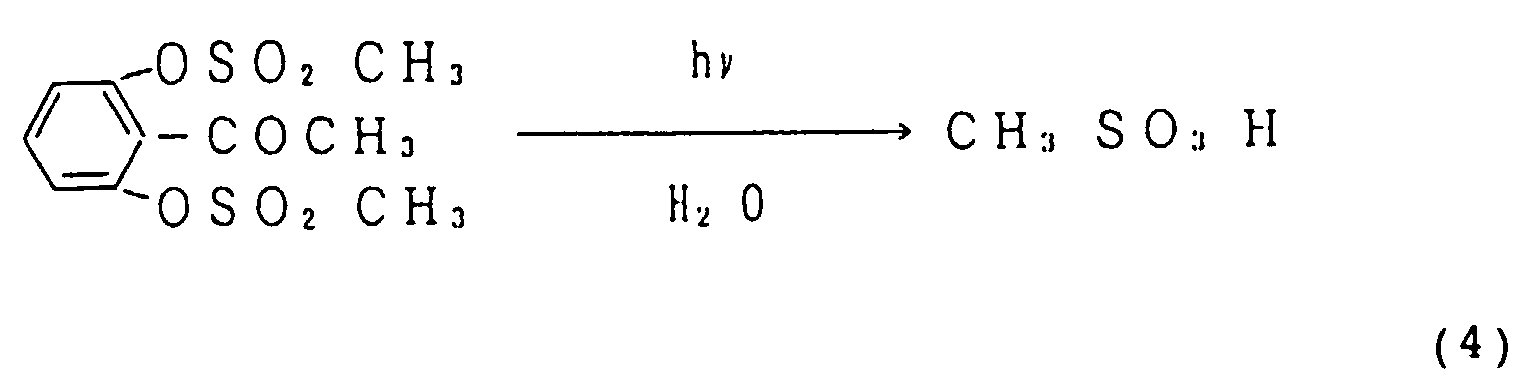

- Heat treatment follows the above exposure step to cause a reaction of the following formula 6:

- On the other hand, no chemical change takes place at the unexposed portion since no acid is generated in this area even when heat treatment is conducted. Further, the hydrophilic moiety of the polymer used for the purpose of enhancing substrate adhesiveness is rather protected by the photoacid generator from wetting by the alkaline developer. Thus, when pattern formation is carried out by using the resist material of the present invention, there is produced a large difference in alkaline developer solubility between the exposed and unexposed portions, and because of this coupled with the fact the polymer at the unexposed portion has strong adhesiveness to the substrate, there won't take place film peeling or delatimation during development and consequently a positive pattern having a good contrast can be obtained. Also, since the acid generated by exposure acts catalytically as illustrated in the formula 6,exposure dose can be limited to a degree only sufficient for generating a desired acid, allowing reduction of the amount of energy required for exposure.
- The present invention will be described in further detail by showing Examples, Preparation Examples, and Comparative Examples.
- Part of the polymers, photoacid generators and ultraviolet absorbers used in the Examples and Comparative Examples have been synthesized according to the methods disclosed in JP-A 4-210960 (USP 5,216,135); JP-A 4-211258 (USP 5,350,660; EP-A 0,440,374); JP-A 5-249682 (EP-A 0,520,642); JP-A 4-251259; Bull. Chim. Soc. France, Vol. 1974, p. 1956; C.D. Beard et al: J. Org. Chem., Vol. 38, p. 3673 (1973), etc., the disclosure of which is hereby incorporated by reference.
-
- (1) To a solution of 100 g (0.567 mol) of p-tert-butoxystyrene and 3.54 g (0.03 mol) of p-methylstyrene in 300 ml of 1,4-dioxane was added a catalytic amount of 2,2'-azobis(methyl 2-methylpropionate) to carry out reaction in a nitrogen stream at 80° for 6 hours. The reaction solution was cooled and poured into 5,000 ml of a methanol solution to cause crystallization. Precipitated crystals were filtered out, washed with methanol and dried in vacuo to give 92.3 g of poly(p-tert-butoxystyrene/p-methylstyrene)as white powder. The polymer was found to have p-tert-butoxystyrene unit and p-methylstyrene unit in a molar ratio of ca. 95:5 based on 1H NMR. The weight-average molecular weight (Mw) was determined to be about 20,000 by GPC with polystyrene calibration.
- (2) 70 g of poly(p-tert-butoxystyrene/p-methylstyrene) obtained according to (1) above was dissolved in 1,4-dioxane, then 100 ml of concentrated hydrochloric acid was added and the mixture was reacted with stirring at 70-80°C for 4 hours. The reaction solution, after cooled, was poured into 5,000 ml of water to cause crystallization. Produced crystals were filtered out, washed with water and dried in vacuo to give 4.6 g of poly(p-hydroxystyrene/p-methylstyrene) as white powder. P-hydroxystyrene unit/p-methylstyrene unit molar ratio in the produced polymer ≒ 95:5 (1H NMR). Mw ≒ 14,500 (GPC with polystyrene calibration).
- (3) To a solution of 15.0 g of poly(p-hydroxystyrene/p-methylstyrene) obtained according to (2) and 3.5 g of ethylvinyl ether in 150 ml of 1,4-dioxane was added a catalytic amount of pyridinium salt of p-toluenesulfonic acid to carry out reaction with stirring at room temperature for 24 hours. The reaction solution was poured into 5,000 ml of water and crystallized. Precipitated crystals were filtered out, washed with water and dried in vacuo to give 11.5 g of poly(p-1-ethoxyethoxystyrene/p-hydroxystyrene/p-methylstyrene)as white powder. The p-1-ethoxyethoxystyrene unit/p-hydroxystyrene unit/p-methylstyrene unit molar ratio in the polymer was ca. 35:60:5 based on 1H NMR. Mw ≒ 18,000; Mw/Mn = 1.86 (GPC with polystyrene calibration).
-
- (1) Using 81.1 g (0.46 mol) of p-tert-butoxystyrene and 4.6 g (0.04 mol) of styrene as starting materials, polymerization reaction and after-treatments were carried out according to the procedure of (1) of Preparation Example 1 to give 77.1 g of poly(p-tert-butoxystyrene/ styrene) as white powdery crystal. P-tert-butoxystyrene unit/styrene unit molar ratio in the polymer ≒ 92:8 (1H NMR). Mw ≒ 20,000 (GPC with polystyrene calibration).
- (2) Using 70 g of poly(p-tert-butoxystyrene/ styrene) obtained according to (1) above, the procedure of (2) of Preparation Example 1 was carried out for reaction and after-treatments to obtain 44.0 g of poly(p-hydroxystyrene/styrene) as white powdery crystal. P-hydroxystyrene unit/styrene unit molar ratio in the polymer ≒ 92:8 (1H NMR). Mw ≒ 15,00 (GPC with polystyrene calibration).
- (3) Using 15.0 g of poly(p-hydroxystyrene/ styrene) obtained according to (2) above and 3.2 g of vinylethyl ether, the procedure of (3) of Preparation Example 1 was carried out for reaction and after-treatments to give 14.1 g of poly(p-1-ethoxyethoxystyrene/p-hydroxystyrene/styrene) as white powdery crystals. P-1-ethoxyethoxystyrene unit/p-hydroxystyrene unit/styrene unit molar ratio in the polymer ≒ 32:60:8 (1H NMR). Mw ≒ 18,000; Mw/Mn = 1.85 (GPC with polystyrene calibration).
-
- (1) To a solution of 17.6 g of p-tert-butoxystyrene in 50 ml of iso-propanol was added a catalytic amount of 2,2'-azobis(methyl 2-methylpropionate) to carry out reaction in a nitrogen stream at 80°C for 6 hours. The reaction solution was cooled and poured into 1,000 ml of a methanol solution to cause crystallization. Produced crystals were filtered out, washed with methanol and dried in vacuo to give 16.7 g of poly(p-tert-butoxystyrene) as white powdery crystal. Mw ≒ 20,000 (GPC with polystyrene calibration).
- (2) 15.0 g of poly(p-tert-butoxystyrene) obtained according to (1) above was suspended in iso-propanol, then 15 ml of concentrated hydrochloric acid was added and the mixture wasreacted with stirring at 70-80°C for 4 hours. The reaction solution was cooled and poured into 1,000 ml of water for crystallization. Precipitated crystals were filtered out, washed with water and dried in vacuo to give 9.4 g of poly(p-hydroxystyrene/p-tert-butoxystyrene) as white powdery crystal. P-hydroxystyrene unit/p-tert-butoxystyrene unit molar ratio in the polymer ≒ 94:6 (1H NMR). Mw ≒ 15,000 (GPC with polystyrene calibration).
- (3) 15.7 g of poly(p-hydroxystyrene/p-tert-butoxystyrene) obtained according to (2) above and 3.2 g of ethylvinyl ether were dissolved in 140 ml of 1,4-dioxane, to which a catalytic amount of pyridinium salt of p-toluenesulfonic acid was added to perform reaction with stirring at room temperature for 24 hours. The reaction solution was poured into 3,000 ml of water and crystallized. Precipitated crystals were filtered out, washed with water and dried in vacuo to give 15.5 g of poly(p-l-ethoxyethoxystyrene/p-hydroxystyrene/p-tert-butoxystyrene) as white powdery crystal. P-1-ethoxyethoxystyrene unit/p-hydroxystyrene unit/p-tert-butoxystyrene unit molar ratio in the polymer ≒ 30:64:6 (1H NMR). Mw ≒ 18,000; Mw/Mn = 1.9 (GPC with polystyrene calibration).
- To a solution of 15.7 g of poly(p-1-methoxy-1-methylethoxystyrene/p-hydroxystyrene/p-tert-butoxystyrene obtained according to (2) above and 3.2 g of 2-methoxy-1-propene in 120 ml of tetrahydrofuran was added a catalytic amount of phosphorus oxychloride to carry out reaction with stirring at room temperature for 16 hours. The reaction solution was poured into 5,000 ml of water and crystallized. Precipitated crystals were filtered out, washed with water and dried in vacuo to give 14.3 g of poly(p-1-methoxy-1-methylethoxystyrene/p-hydroxystyrene/p-tert-butoxystyrene) as white powdery crystal. P-1-methoxy-1-methylethoxystyrene unit/p-hydroxystyrene unit/p-tert-butoxystyrene unit molar ratio in the polymer ≒ 34:60:6 (1H NMR). Mw ≒ 17,800; Mw/Mn = 1.90 (GPC with polystyrene calibration).
-
- (1) Using 32.4 g of p-acetyloxystyrene as starting material, polymerization reaction and after-treatments were carried out according to (1) of Preparation Example 3 to obtain 30.0 g of poly(p-acetyloxy)styrene as white powdery crystal. Mw ≒ 15,000 (GPC with polystyrene calibration).
- (2) To a 1,4-dioxane solution of 16.2 g of poly-(p-acetyloxystyrene) obtained according to (1) above was added 25 ml of concentrated hydrochloric acid and the mixture was refluxed with stirring for 4 hours. The reaction solution was cooled and poured into 1,000 ml of water to cause crystallization. Precipitated crystals were filtered out, washed with water and dried in vacuo to give 11.4 g of poly(p-hydroxystyrene) as white powder. Mw ≒ 12,000 (GPC with polystyrene calibration).
- (3) To a solution of 10.8 g of poly(p-hydroxystyrene) obtained according to (2) in 72 ml of 1,4-dioxane were added 1.2 g of 2,3-dihydropyran and 0.05 g of pyridine salt of p-toluenesulfonic acid to carry out reaction at 25-30°C for 15 hours. The reaction solution was poured into 1,000 ml of water and crystallized. Precipitated crystals were filtered out, washed with water and dried in vacuo to give 10.0 g of poly(p-hydroxystyrene/p-tetrahydropyranyloxystyrene) as white powdery crystal. P-hydroxystyrene unit/p-tetrahydropyranyloxystyrene unit molar ratio in the polymer ≒ 95:5 (1H NMR). Mw ≒ 13,000 (GPC with polystyrene calibration).
- (4) Using 9.5 g of poly(p-hydroxystyrene/ p-tetrahydropyranyloxystyrene) obtained according to (3) above and 2.7 g of ethylvinyl ether, reaction and after-treatments were carried out according to (3) of Preparation Example 3, and the produced crystals were filtered out, washed with water and dried in vacuo to give 9.9 g of poly(p-1-ethoxyethoxystyrene/p-hydroxystyrene/p-tetrahydropyranyloxystyrene) as white powdery crystal. P-l-ethoxyethoxystyrene unit/p-hydroxystyrene unit/p-tetrahydropyranyloxystyrene unit molar ratio in the polymer ≒ 35:60:5 (1H NMR). Mw ≒ 16,000; Mw/Mn = 1.78 (GPC with polystyrene calibration).
-
- (1) 35.3 g of poly(p-tert-butoxystyrene) obtained according to (1) of Preparation Example 3 was suspended in iso-propanol, then 50 ml of concentrated hydrochloric acid was added and the mixture was refluxed with stirring for 4 hours. The reaction solution was cooled and poured into 3,000 ml of water for crystallization. Precipitated crystals were filtered out, washed with water and dried in vacuo to give 22.1 g of poly(p-hydroxystyrene) as white powdery crystals. Mw ≒ 14,500 (GPC with polystyrene calibration).
- (2) To a solution of 16.2 g of poly(p-hydroxystyrene) obtained according to (1) above in 60 ml of ethyl acetate were added 3.0 g of di-tert-butyl dicarbonate and 2.7 g of triethylamine to carry out reaction at room temperature for 4 hours. After the end of the reaction, ethyl acetate was distilled away under reduced pressure and the residue was dissolved in 80 ml of acetone and poured into 1,000 ml of water to cause crystallization. Precipitated crystals were filtered out, washed with water and dried in vacuo to give 12.0 g of poly(p-hydroxystyrene/p-tert-butoxycarbonyloxystyrene) as white powdery crystal. P-hydroxystyrene unit/p-tert-butoxycarbonyloxystyrene unit molar ratio ≒ 94:6 (1H NMR). Mw ≒ 16,500 (GPC with polystyrene calibration).
- (3) Using 11.4 g of poly(p-hydroxystyrene/p-tert-butoxycarbonyloxystyrene) obtained according to (2) above and 2.5 g of ethylvinyl ether, the procedure of (3) of Preparation Example 1 was carried out for reaction and after-treatments to obtain 6.7 g of poly-(p-1-ethoxyethoxystyrene/p-hydroxystyrene/p-tert-butoxycarbonyloxystyrene) as white powdery crystal. P-1-ethoxyethoxystyrene unit/p-hydroxystyrene unit/p-tert-butoxycarbonyloxystyrene unit molar ratio in the polymer ≒ 30:64:6 (1H NMR). Mw ≒ 20,000;Mw/Mn = 1.90 (GPC with polystyrene calibration).
-
- (1) 16.2 g of poly(p-hydroxystyrene) obtained according to (1) of Preparation Example 6, 2.7 g of tert-butyl monochloroacetate and 2.5 g of anhydrous potassium carbonate were suspended in 200 ml of acetone and refluxed with stirring for 2 hours. After cooling, the insolubles were filtered out and the filtrate was poured into 3,000 ml of water and crystallized. Produced crystals were filtered out, washed with water and dried in vacuo to give 15.8 g of poly(p-hydroxystyrene)/p-tert-butyl vinylphenoxyacetate) as white powdery crystal. P-hydroxystyrene unit/p-tert-butyl vinylphenoxyacetate unit molar ratio in the polymer ≒ 93:7 (1H NMR). Mw ≒ 16,000 (GPC with polystyrene calibration).
- (2) Using 13.2 g of poly(p-hydroxystyrene/p-tert-butyl vinylphenoxyacetate) obtained according to (1) above and 2.0 g of methylvinyl ether, the procedure of (3) of Preparation Example 1 was carried out to obtain 10.6 g of poly(p-1-methoxyethoxystyrene/p-hydroxystyrene/p-tert-butyl vinylphenoxyacetate) as white powdery crystal. P-1-methoxyethoxystyrene unit/ p-hydroxystyrene unit/p-tert-butyl vinylphenoxyacetate unit molar ratio in the obtained polymer ≒ 33:60:7 (1H NMR). Mw ≒ 19,500; Mw/Mn = 1.88 (GPC with polystyrene calibration).
- Using 8 g of poly(p-hydroxystyrene) obtained according to (1) of Preparation Example 6 and 2.4 g of ethylvinyl ether, reaction and after-treatments were carried out according to (3) of Preparation Example 1 to give 9.2 g of poly(p-1-ethoxyethoxystyrene/p-hydroxystyrene) as faintly brown-tinted powdery crystal. P-1-ethoxyethoxystyrene unit/p-hydroxystyrene unit molar ratio in the polymer ≒ 38:62 (1H NMR). Mw ≒ 18,500; Mw/Mn = 1.88 (GPC with polystyrene calibration).
- Using 8 g of poly(p-hydroxystyrene) obtained according to (1) of Preparation Example 6 and 2.2 g of methylvinyl ether, the procedure of (3) of Preparation Example 1 was carried out for reaction and after-treatments to give 8.6 g of poly(p-1-methoxyethoxystyrene/p-hydroxystyrene) as faintly brown-tinted powdery crystal. P-1-methoxyethoxystyrene unit/p-hydroxystyrene unit molar ratio in the polymer ≒ 4:6 (1H NMR). Mw ≒ 18,000; Mw/Mn = 1.89 (GPC with polystyrene calibration).
-
- (1) To a solution of 17.6 g of p-tert-butoxystyrene in toluene was added a catalytic amount of 2,2'-azobisisobutyronitrile to carry out polymerization reaction in a nitrogen stream at 80°C for 6 hours. The reaction solution was cooled and poured into 1,000 ml of methanol to cause crystallization. Precipitated crystals were filtered out, washed with methanol and dried in vacuo to give 16.8 g of poly(p-tert-butoxystyrene) as white powdery crystal. Mw ≒ 1,000 (GPC with polystyrene calibration).
- (2) To a 1,4-dioxane solution of 15.0 g of poly(p-tert-butoxystyrene) obtained according to (1) above was added 10 ml of concentrated hydrochloric acid and the mixture was refluxed with stirring for 4 hours. The reaction solution was poured into 1,000 ml of water and crystallized. Precipitated crystals were filtered out, washed with water and dried in vacuo to give 9.7 g of poly(p-hydroxystyrene) as white powdery crystal. Mw ≒ 7,500 (GPC with polystyrene calibration).
- (3) To a solution of 9.0 g of poly(p-hydroxystyrene) obtained according to (2) above in 100 ml of 1,2-dimethoxyethane were added 12.6 g of 2,3-dihydropyran and 0.5 ml of sulfuric acid to carry out reaction with stirring at 30-40°C for 15 hours. The reaction solution was concentrated under reduced pressure and the residue was neutralized with sodium carbonate and poured into 1,000 ml of water to cause crystallization. Precipitated crystals were filtered out, washed with water and dried in vacuo to give 11.0 g of poly(p-tetrahydropyranloxystyrene/p-hydroxystyrene) as white powdery crystal. P-tetrahydropyranyloxystyrene unit/p-hydroxystyrene unit molar ratio in the polymer ≒ 3:7 (1H NMR). Mw ≒ 10,000; Mw/Mn = 1.60 (PGC with polystyrene calibration).
- Using 18.0 g of poly(p-hydroxystyrene) obtained according to (2) of Preparation Example 10, 10.6 g of di-tert-butyl dicarbonate and 18.0 g of triethylamine, the procedure of (2) of Preparation Example 6 was followed to obtain 18.2 g of poly(p-tert-butoxycarbonyloxystyrene/p-hydroxystyrene) as white powdery crystal. P-tert-butoxycarbonyloxystyrene unit/p-hydroxystyrene unit molar ratio in the polymer ≒ 3.7 (1H NMR). Mw ≒ 10,000; Mw/Mn = 1.65 (GPC with polystyrene calibration).
- To a 1,4-dioxane solution of 15.0 g of poly(p-tert-butoxystyrene) obtained according to (1) of Preparation Example 10 was added 10 ml of concentrated hydrochloric acid to carry out reaction with stirring at 80-85°C for 3 hours. The reaction solution was cooled and poured into water to cause crystallization. Precipitated crystals were filtered out, washed with water and dried in vacuo to give 9.8 g of poly(p-tert-butoxystyrene/p-hydroxystyrene) as white powdery crystal. P-tert-butoxystyrene unit/p-hydroxystyrene unit molar ratio in the polymer ≒ 3:7 (1H NMR). Mw ≒ 8,500; Mw/Mn = 1.65 (GPC with polystyrene calibration).
-
- (1) Using 17.6 g of p-tert-butoxystyrene, polymerization was carried out and the reaction solution was treated according to (1) of Preparation Example 10 to obtain 12.5 g of poly(p-tert-butoxystyrene) as white powdery crystal. Mw ≒ 3,500 (GPC with polystyrene calibration).
- (2) Using 12.0 g of poly(p-tert-butoxystyrene) obtained according to (1) above, the procedure of (2) of Preparation Example 10 was followed to obtain 8.2 g of poly(p-hydroxystyrene) as white powdery crystal. Mw ≒ 3,000 (GPC with polystyrene calibration).
- (3) Using 8.0 g of poly(p-hydroxystyrene) obtained according to (2) above, the procedure of (2) of Preparation Example 6 was carried out for reaction and after-treatments to give 7.6 g of poly(p-tert-butoxycarbonyloxystyrene/p-hydroxystyrene) as faintly brown-tinted powdery crystals. P-tert-butoxycarbonyloxystyrene unit/p-hydroxystyrene unit molar ratio in the polymer ≒ 3:7 (1H NMR). Mw ≒ 4,000; Mw/Mn = 1.60 (GPC with polystyrene calibration).
- 4.0 g of poly(p-hydroxystyrene) obtained according to (2) of Preparation Example 10, 2.5 g of tert-butyl monochloroacetate and 2.5 g of anhydrous potassium carbonate were suspended in 35 ml of acetone and refluxed with stirring for 2 hours. After cooling, the insolubles were filtered out and the filtrate was pouted into 1,000 ml of water to cause crystallization. Precipitated crystals were filtered out, washed with water and dried in vacuo to give 5.2 g of poly(p-tert-butyl vinylphenoxyacetate/p-hydroxystyrene) as white powdery crystal. P-tert-butyl phenoxyacetate unit/p-hydroxystyrene unit molar ratio in the polymer ≒ 35:65 (1H NMR). Mw ≒ 11,000; Mw/Mn= 1.65 (GPC with polystyrene calibration).
-
- (1) 33.4 g (0.19 mol) of p-tert-butoxystyrene and 0.8 g (0.01 mol) of fumaronitrile were polymerized in toluene in the presence of a catalytic amount of 2,2'-azobis(methyl 2-methylpropionate) in a nitrogen stream at 90°C for 2 hours. The reaction solution was poured into methanol to cause crystallization. Precipitated crystals were filtered out, washed and dried to give 23.5 g of poly(p-tert-butoxystyrene/ fumaronitrile) as white powdery crystal. Mw ≒ 24,500 (GPC with polystyrene calibration).
- (2) Using 20.0 g of poly(p-tert-butoxystyrene/ fumaronitrile) obtained according to (1) above, the procedure of (2) of Preparation Example 1 was carried out for reaction and after-treatments to obtain 10.9 g of poly(p-hydroxystyrene/fumaronitrile) as white powdery crystal. Mw ≒ 16,500 (GPC with polystyrene calibration).
- (3) Using 9.0 g of poly(p-hydroxystyrene/fumaronitrile) obtained according to (2) above and 2.8 g of ethylvinyl ether, the procedure of (3) of Preparation Example 1 was carried out for reaction and after-treatments to obtain 8.3 g of poly(p-1-ethoxyethoxystyrene/p-hydroxystyrene/fumaronitrile) as white powdery crystal. P-1-ethoxyethoxystyrene unit/p-hydroxystyrene unit molar ratio in the polymer ≒ 3:7 (1H NMR). Mw ≒ 20,000; Mw/Mn = 1.85 (GPC with polystyrene calibration).
-
- (1) Using 15.9 g of poly(p-tert-butoxystyrene) [Mw ≒ 20,000; Mw/Mn = 1.2 (GPC with polystyrene calibration); produced by Nippon Soda Co., Ltd.], the procedure of (1) of Preparation Example 6 was carried out for reaction and after-treatments to obtain 10.5 g of white powdered crystals of poly(p-hydroxystyrene) with Mw ≒ 14,000 (GPC method, polystyrene calibration).
- (2) Using 8 g of the monodisperse poly(p-hydroxystyrene) obtained in above (1) and 2.4 g of ethyl vinyl ether, the reaction and after-treatment were carried out in the same manner as described in Preparation Exaple 1 (3) to obtain 9.0 g of poly(p-1-ethoxyethoxystyrene/p-hydroxystyrene) as white powdery crystals. P-1-ethoxyethoxystyrene unit/ p-hydroxystyrene unit molar ratio in the polymer ≒ 35:65. Mw ≒ 17,500; Mw/Mn = 1.15 (GPC with polystyrene calibration).
- Using 18.0 g of poly(p-hydroxystyrene) [Mw ≒ 10,000; Mw/Mn = 1.1 (GPC with polystyrene calibration); produced by Nippon Soda Co., Ltd.], 10.6 g of diisobutyl dicarbonate synthesized from isobutyl chlorocarbonate and potassium carbonate, the procedure of (2) of Preparation Example 6 was carried out for reaction and after-treatments to give 16.5 g of poly(p-isobutoxycarbonyloxystyrene/p-hydroxystyrene) as faintly brown-tinted powdery crystals. P-isobutoxycarbonyloxystyrene unit/p-hydroxystyrene unit molar ratio in the polymer ≒ 28:72 (1H NMR). Mw ≒ 13,000; Mw/Mn = 1.05 (GPC with polystyrene calibration).
-
- (1) To a toluene solution of 17.6 g of p-tert-butoxystyrene was added a catalytic amount of 2,2'-azobis(2,4-dimethylvaleronitrile) to carry out polymerization reaction in a nitrogen stream at 70° for 6 hours. The reaction solution was treated according to (1) of Preparation Example 10 to obtain 16.5 g of poly(p-tert-butoxystyrene) as white powdery crystal. Mw ≒ 9,500 (GPC with polystyrene calibration).
- (2) Using 15.0 g of poly(p-tert-butoxystyrene) obtained according to (1) above, the procedure of (2) of Preparation Example 10 was carried out to obtain 9.0 g of poly(p-hydroxystyrene) as white powdery crystal. Mw ≒ 7,000 (GPC with polystyrene calibration).
- (3) Using 9.0 g of poly(p-hydroxystyrene) obtained according to (2) above and 4.0 g of diethyl pyrocarbonate, the procedure of (2) of Preparation Example 6 was followed to obtain 9.0 g of poly(p-ethoxycarbonyloxystyrene/p-hydroxystyrene) as white powdery crystal. P-ethoxycarbonyloxystyrene unit/p-hydroxystyrene unit molar ratio ≒ 3:7 (1H NMR). Mw ≒ 9,000; Mw/Mn = 1.60 (GPC with polystyrene calibration).
- Using 12.0 g of poly(p-hydroxystyrene) obtained according to (2) of Preparation Example 18 and 4.5 g of isopropyl chlorocarbonate, the procedure of (2) of Preparation Example 6 was carried out to obtain 11.7 g of poly(p-isopropoxycarbonyloxystyrene/p-hydroxystyrene) as white powdery crystals.
P-isopropoxycarbonyloxystyrene unit/p-hydroxystyrene unit molar ratio in the polymer ≒ 3:7 (1H NMR). Mw ≒ 9,000; Mw/Mn = 1.64 (GPC with polystyrene calibration). - Using 18.0 g of poly(p-hydroxystyrene) obtained according to (1) of Preparation Example 6 and 10.6 g of di-tert-butyl dicarbonate, the procedure of (2) of Preparation Example 6 was carried out to obtain 18.2 g of poly(p-tert-butoxycarbonyloxystyrene/p-hydroxystyrene) as white powdery crystals. P-tert-butoxycarbonyloxystyrene unit/p-hydroxystyrene unit molar ratio in the polymer ≒ 28:72. Mw ≒ 19,000; Mw/Mn = 1.85 (GPC with polystyrene calibration).
- Using 16.0 g of poly(p-hydroxystyrene) obtained according to (2) of Preparation Example 10 and 4.5 g of vinylethyl ether, the procedure of (3) of Preparation Example 1 was carried out to obtain 15.5 g of poly(p-1-ethoxyethoxystyrene/p-hydroxystyrene). P-1-ethoxyethoxystyrene unit/p-hydroxystyrene unit molar ratio in the polymer ≒ 38:62. Mw ≒ 9,500; Mw/Mn = 1.65 (GPC with polystyrene calibration).
-
- (1) Using 48.6 g (0.3 mol) of p-acetyloxystyrene, 17.6 g (0.1 mol) of p-tert-butoxystyrene and a catalytic amount of 2,2'-azobis(2-methylisovaleronitrile), the procedure of (1) of Preparation Example 3 was carried out for reaction and after-treatments to obtain 59.7 g of poly(p-tert-butoxystyrene/p-acetyloxystyrene) as white powdery crystal. P-acetyoxystyrene unit/p-tert-butoxystyrene unit molar ratio in the polymer ≒ 3:1 (1NMR). Mw ≒ 10,500; Mw/Mn = 1.32 (GPC with polystyrene calibration).
- (2) A mixture of 46.3 g of poly(p-acetyloxystyrene/p-tert-butoxystyrene) obtained according to (1) above and 100 ml of a 16% aqueous solution of tetramethylammonium hydroxide was refluxed with stirring in 300 ml of isopropanol for 4 hours. The reaction solution was neutralized with acetic acid and concentrated under reduced pressure, and the residue was dissolved in 150 ml of acetone and poured into 5,000 ml of water to cause crystallization. Precipitated crystals were filtered out, washed with water and dried in vacuo to give 33.8 g of poly(p-hydroxystyrene/p-tert-butoxystyrene). P-hydroxystyrene unit/p-tert-butoxystyrene unit molar ratio in the polymer ≒ 3:1 (1HNMR). Mw ≒ 8,540; Mw/Mn = 1.30 (GPC with polystyrene calibration).
- (3) Using 26.8 g of poly(p-hydroxystyrene/p-tert-butoxystyrene) obtained according to (2) above and 1.5 g of ethylvinyl ether, reaction and after-treatments were carried out according to (3) of Preparation Example 1 to obtain 25.0 g of poly(p-1-ethoxystyrene/p-hydroxystyrene/p-tert-butoxystyrene) as white powdery crystal. P-1-ethoxyethoxystyrene unit/p-hydroxystyrene unit/p-tert-butoxystyrene unit molar ratio in the polymer ≒ 10:65:25. Mw ≒ 9,200; Mw/Mn = 1.30 (GPC with polystyrene calibration).
- To a mixed solution of 60.0 g (0.55 mol) of p-cresol, 60.0 g (0.55 mol) of m-cresol and 2.4 g of oxalic acid dihydrate was added dropwise 33.7 g (0.42 mol) of a 37% formaldehyde solution with stirring at 100°C, and the mixture was reacted with stirring at 100 ± 5°C for 4 hours. After the end of the reaction, 2,000 ml of water was poured into the reaction solution to cause precipitation. After removing the supernatant by decantation, the precipitate was dissolved in 120 ml of acetone and 1,200 ml of water was poured into the solution to cause precipitation. After the supernatant has been decanted, the solution was evaporated to dryness under reduced pressure to give 74.5 g of residual p-cresol/m-cresol/formaldehyde polycondensate as faintly yellow-tinted waxy crystals. Mw ≒ 880; Mw/Mn = 2.07 (GPC with polystyrene calibration).
- Using 60.0 g (0.55 mol) of p-cresol, 60.0 g (0.55 mol) of m-cresol and 45.0 g (0.55 mol) of a 37% formaldehyde solution, the procedure of Preparation Example 23 was carried out for reaction and after-treatments to obtain 90.4 g of p-cresol/m-cresol/ formaldehyde polycondensate as faintly yellow-tinted waxy crystals. Mw ≒ 1,580; Mw/Mn = 2.49 (GPC with polystyrene calibration).
- Using 30.0 g (0.28 mol) of p-cresol, 30.0 g (0.28 mol) of m-cresol and 40.5 g (0.50 mol) of a 37% formaldehyde solution, the procedure of Preparation Example 23 was carried out for reaction and after-treatments to obtain 38.4 g of p-cresol/m-cresol/ formaldehyde polycondensate as slightly white waxy crystals. Mw ≒ 6,600; Mw/Mn = 6.82 (GPC with polystyrene calibration).
-
- (1) To a toluene solution of 17.6 g of p-tert-butoxystyrene was added a catalytic amount of 2,2'-azobis(2,4-dimethylvaleronitrile)to carry out polymerization reaction in a nitrogen stream at 70°C for 6 hours. The reaction product was treated according to (1) of Preparation Example 10 to give 16.5 g of poly(p-tert-butoxystyrene) as white powdery crystal. Mw ≒ 9,500 (GPC with polystyrene calibration).
- (2) Using 15.0 g of poly(p-tert-butoxystyrene) obtained according to (1) above, the procedure of (2) of Preparation Example 10 was carried out for reaction and after-treatments to obtain 9.0 g of poly(p-hydroxystyrene) as white powdery crystal. Mw ≒ 7,000 (GPC with polystyrene calibration).
- (3) Using 12.0 g of poly(p-hydroxystyrene) obtained according to (2) above and 3.0 g of isopropyl chlorocarbonate, reaction and after-treatments were carried out according to (2) of Preparation Example 6 to obtain 11.7 g of poly(p-isopropoxycarbonyloxystyrene/p-hydroxystyrene) as white powdery crystal. P-isopropoxycarbonyloxystyrene unit/p-hydorxystyrene unit molar ratio in the polymer ≒ 2:8 (1H NMR). Mw ≒ 8,000; Mw/Mn = 1.60 (GPC with polystyrene calibration).
- (4) Using 10.0 g of poly(p-isopropoxycarbonyloxystyrene/p-hydroxystyrene) according to (3) above and 0.8 g of ethylvinyl ether, reaction and after-treatments were carried out according to (3) of Preparation Example 1 to obtain 8.9 g of poly(p-1-ethoxyethoxystyrene/p-hydroxystyrene/p-isopropoxycarbonyloxystyrene) as white powdery crystal. P-1-ethoxyethoxystyrene unit/p-hydroxystyrene unit/p-isopropoxycarbonyloxystyrene unit molar ratio in the polymer ≒ 10:70:20 (1H NMR). Mw ≒ 8,300; Mw/Mn = 1.60 (GPC with polystyrene calibration).
- 38.4 g (0.36 mol) of p-cresol and 35.0 g (0.25 mol) of xylene-α,α'-diol were dissolved under heating, then 0.15 g of methanesulfonic acid was added thereto at 90-100°C and the mixture was stirred and reacted at the same temperature for 2 hours. After cooling, 100 ml of acetone was poured into and dissolved in the reaction solution and then the solution was poured into 2,000 ml of water, stirred and then allowed to stand, after which the supernatant was decanted and the residue was dissolved in 100 ml of acetone, poured into 2,000 ml of water and stirred. The solution was allowed to stand, the supernatant was decanted and the residue was evaporated to dryness under reduced pressure to give 65.0 g of p-cresol/1,4-dihydroxymethylbenzene polycondensate as faintly yellow-tinted powdery crystals. Mw ≒ 6,700; Mw/Mn = 3.50 (GPC with polystyrene calibration).
- A photoresist material of the following composition was prepared:
Poly(p-1-ethoxyethoxystyrene/p-hydroxystyrene/p-tert-butoxystyrene) [Mw = 18,000; Mw/Mn = 1.90; polymer of Preparation Example 3] 4.5 g Poly(p-tert-butoxycarbonyloxystyrene/p-hydroxystyrene) [Mw = 10,000; Mw/Mn = 1.65; polymer of Preparation Example 11] 1.5 g Bis(1,1-dimethylethylsulfonyl)diazomethane 0.2 g Bis(p-toluenesulfonyl)diazomethane 0.1 g Propylene glycol monomethyl ether acetate 22.7 g - A pattern formation method using the above resist is explained with reference to FIG. 1.
- The above resist
material 3 was spin coated on a TiN4 substrate 2 obtained by conducting CVD or sputtering on analuminum base 1, and was prebaked on a hot plate at 90° for 90 seconds to form a 1.0 µm thick resist film (FIG. 1A). This resist film was selectively exposed to KrF excimer laser (NA = 0.55) beams 4 of 248.4 nm through mask 5 (FIG. 1B), postbaked on a 100°C hot plate for 90 seconds and then developed with an alkaline developer (2.38% tetramethylammonium hydroxide solution) for 60 seconds, whereby the exposed portion alone of the resist material was dissolved away to form a positive pattern 3a (FIG. 1C). The obtained positive pattern was rectangular and had a 0.24 µm L/S resolution. Exposure dose was 28 mJ/cm2. - In order to determine heat resistance of the resist material of the present invention, the obtained resist pattern, after exposure, postbaking and development, was baked on a 130° hot plate for 150 seconds. The obtained pattern was rectangular and capable of 0.24 µm L/S resolution, which indicates high heat resistance of the resist film.
- Dimensional change with the lapse of time of the pattern formed by using the resist material of the present invention was measured during the period from exposure till heat treatment (postbaking). 0.24 µm L/S resolution was possible even after the lapse of 4 hours from exposure.
- Further, as shown in Fig. 2, when the resist material of the present invention was used, the mask linearity was good until 0.25 µm. In addition when exposed to light by defocus, no deterioration of shape was admitted by 0.7 µm against the line/space of 0.25 µm. This means that a sufficient focus margin was obtained. The pattern sidewalls were smooth and no scum was observed.
- When a pattern was formed on a SiO2 substrate by using the resist material of the present invention in the manner described above, 0.20 µm L/S rectangular pattern could be resolved at an exposure dose of 18 mJ/cm2. In addition when exposed to light by defocus, no deterioration of shape was admitted by 0.7 µm against the line/space of 0.25 µm. This means that a sufficient focus margin was obtained.
- Also, when a pattern was formed in the same manner as described above by using the resist material of the present invention which had been kept in storage at 23° for one month after preparation, 0.24 µm L/S positive pattern could be resolved at the same exposure dose, which confirmed good storage stability of the resist material of the present invention.
- Photo-resist materials of the compositions shown in the following Tables 1-16 were prepared.
Table 1 Example 2 Poly(p-1-ethoxyethoxystyrene/p-hydroxystyrene/p-methylstyrene) [Mw = 18,000; Mw/Mn = 1.86; polymer of Preparation Example 1] 4.8 g Poly(p-tetrahydropyranyloxystyrene/p-hydroxystyrene) [Mw = 10,000; Mw/Mn = 1.60; polymer of Preparation Example 10] 1.2 g Bis(1-methylethylsulfonyl)diazomethane 0.2 g Bisbenzenesulfonyldiazomethane 0.1 g Propylene glycol monomethyl ether acetate 22.7 g Example 3 Poly(p-1-methoxy-1-methylethoxystyrene/p-hydroxystyrene/p-tert-butoxystyrene) [Mw = 17,800; Mw/Mn = 1.90; polymer of Preparation Example 4] 4.5 g Poly(p-tert-butoxycarbonyloxystyrene/ p-hydroxystyrene) [Mw = 10,000; Mw/Mn = 1.65; polymer of Preparation Example 11] 1.5 g Bis(1-methyethylsulfonyl)diazomethane 0.2 g Benzoylbenzenesulfonyldiazomethane 0.1 g Propylene glycol monomethyl ether acetate 22.7 g Table 2 Example 4 Poly(p-1-ethoxyethoxystyrene/p-hydroxystyrene) [Mw = 18,500; Mw/Mn = 1.88; polymer of Preparation Example 8] 4.5 g Poly(p-tert-butoxystyrene/p- hydroxystyrene) [Mw/Mn = 1.65; polymer of Preparation Example 12] 1.5 g Bis(1,1-dimethylethylsulfonyl)diazomethane 0.2 g Benzoylcyclohexylsulfonyldiazomethane 0.1 g Propylene glycol monomethyl ether acetate 22.7 g Example 5 Poly-(p-1-methoxyethoxystyrene/p-hydroxystyrene) [Mw = 18,000; Mw/Mn = 1.89; Polymer of Preparation Example 9] 4.5 g Poly(p-tert-butoxycarbonyloxystyrene/ p-hydroxystyrene) [Mw = 10,000; Mw/Mn = 1.65] 1.5 g Biscyclohexylsulfonyldiazomethane 0.2 g Bis (p-toluenesulfonyl)diazomethane 0.1 g Propylene glycol monomethyl ether acetate 22.7 g Example 6 Poly(p-1-ethoxyethoxystyrene/p- hydroxystyrene) [Mw = 18,500; Mw/Mn = 1.88] 4.5 g Poly(p-tert-butoxycabonyloxystyrene/ p-hydroxystyrene) [Mw = 10,000; Mw/Mn = 1.65] 1.5 g Bis(cyclohexylsulfonyl)diazomethane 0.2 g Triphenylsulfonium trifluoromethane sulfonate 0.1 g 9-Diazo-10-phenanthrone 0.1 g Propylene glycol monomethyl ether acetate 22.6 g Table 3 Example 7 Poly(p-1-ethoxyethoxystyrene/p-hydroxystyrene/styrene) [Mw = 18,000; Mw/Mn = 1.85; polymer of Preparation Example 2] 4.8 g Poly(p-tetradhydropyranyloxystyrene/ p-hydroxystyrene) [Mw = 10,000; Mw/Mn = 1.60] 1.2 g 1-Diazo-1-cyclohexylsulfonyl-3,3-dimethyl-2-butanone 0.2 g Bis(p-chlorobenzenesulfonyl)-diazomethane 0.1 g Ethyl lactate 24.7 g Example 8 Poly(p-1-ethoxyethoxystyrene/p-hydroxystyrene/p-tetrahydropyranyloxystyrene) [Mw = 16,000; Mw/Mn = 1.78; polymer of Preparation Example 5] 4.5 g Poly(p-tert-butoxystyrene/p-hydroxystyrene) [Mw = 8,500; Mw/Mn - 1.65] 1.5 g Bis(cyclohexylsulfonyl)diazomethane 0.2 g Bis(1-methylethylsulfonyl)diazomethane 0.1 g Methyl 3-methoxypropionate 24.7 g Table 4 Example 9 Poly(p-1-methoxyethoxystyrene/p-hydroxystyrene/fumaronitrile) [Mw = 20,000; Mw/Mn = 1.85; polymer of Preparation Example 15] 4.8 g Poly(p-tert-butoxycarbonyloxystyrene/ p-hydroxystyrene) [Mw = 4,000; Mw/Mn = 1.60; polymer of Preparation Example 13] 1.2 g Bis(1,1-dimethylethylsulfonyl)diazomethane 0.2 g 1-Diazo-1-methylsulfonyl-4-phenylbutane-2-one 0.1 g Propylene glycol monomethyl ether acetate 22.7 g Example 10 Poly(p-1-ethoxyethoxystyrene/p-hydroxystyrene) [Mw = 18,500; Mw/Mn = 1.88] 4.5 g Poly(p-tert-butoxycarbonyloxystyrene/ p-hydroxystyrene) [Mw = 10,000; Mw/Mn = 1.65] 1.5 g Bis(cyclohexylsulfonyl)diazomethane 0.2 g Bis(2,4-dimethylbenzenesulfonyl)diazomethane 0.1 g Propylene glycol monomethyl ether acetate 24.7 g Table 5 Example 11 Poly(p-1-ethoxyethoxystyrene/p-hydroxystyrene/p-tert-butoxycarbonyloxystyrene [Mw = 20,000; Mw/Mn = 1.90; polymer of Preparation Example 6] 4.8 g Poly(p-tert-butoxycarbonyloxystyrene/p-hydroxystyrene) [Mw = 10,000; Mw/Mn = 1.65] 1.2 g Bis(cyclohexylsulfonyl)diazomethane 0.2 g Bisbenzenesulfonyldiazomethane 0.1 g 9-(2-Methoxyethoxy)methylanthracene 0.1 g Propylene glycol monomethyl ether acetate 14.2 g Example 12 Poly(p-1-ethoxyethoxystyrene/p-hydroxystyrene/p-tert-butyl vinylphenoxyacetate) [Mw = 19,500; Mw/Mn = 1.88; polymer of Preparation Example 7] 4.5 g Poly(p-tert-butoxystyrene/p-hydroxystyrene) [Mw = 8,500; Mw/Mn = 1.65] 1.5 g 1-Acetyl-1-(1-methylethylsulfonyl)diazomethane 0.2 g Bis(p-toluenesulfonyl)diazomethane 0.1 g 9-Diazo-10-phenanthrone 0.1 g Ethyl lactate 24.6 g Table 6 Example 13 Poly(p-1-ethoxyethoxystyrene/p-hydroxystyrne) [Mw = 18,500; Mw/Mn = 1.88] 4.5 g Poly(p-tert-butyl vinylphenoxyacetate/p-hydroxystyrene) {Mw = 11,000; Mw/Mn = 1.65; polymer of Preparation Example 14] 1.5 g Bis(1,1-dimethylethylsulfonyl)diazomethane 0.2 g P-tolyldiphenylsulfonium trifluoromethanesulfonate 0.1 g 9-(2-Methoxyethoxy)methylanthracene 0.1 g Propylene glycol monomethyl ether acetate 22.6 g Example 14 Poly(p-1-ethoxyethoxystyrene/p-hydroxystyrene) [Mw = 18,500; Mw/Mn = 1.88] 4.5 g Poly(p-tert-butoxycarbonyloxystyrene/p-hydroxystyrene) [Mw = 10,000; Mw/Mn = 1.65; polymer of Preparation Example 11] 1.2 g Poly(p-tert-butoxycarbonyloxystyrene/ p-hydroxystyrene) [Mw = 4,000; Mw/Mn = 1.60; polymer of Preparation Example 13] 0.3 g Bis(cyclohexylsulfonyl)diazomethane 0.2 g Bis(2,4-dimethylbenzenesulfonyl)diazomethane 0.1 g 9-(2-Methoxyethoxy)methylanthracene 0.1 g Propylene glycol monomethyl ether acetate 22.6 g Table 7 Example 15 Poly(p-1-methoxyethoxystyrene/p-hydroxystyrene) [Mw = 18,000; Mw/Mn = 1.89] 4.5 g Poly(p-tert-butoxycarbonyloxystyrene/p-hydroxystyrene) [Mw = 10,000; Mw/Mn = 1.65] 1.0 g Poly(p-tert-butoxycarbonyloxystyrene/p-hydroxystyrene) [Mw =40,000; Mw/Mn = 1.60] 0.5 g Bis(cyclohexylsulfonyl)diazomethane 0.2 g Bis(p-toluenesulfonyl)diazomethane 0.1 g 1,2,3-tris(o-naphthoquinonediazido-4-sulfonyloxypropane) 0.5 g Salicylic acid 0.2 g Propylene glycol monomethyl ether acetate 24.5 g Example 16 Poly(p-1-ethoxyethoxystyrene/p-hydroxystyrene) [Mw = 17,500; Mw/Mn = 1.15; polymer of Preparation Example 16] 4.5 g Poly(p-tert-butoxycarbonyloxystyrene/p-hydroxystyrene) [Mw = 10,000; Mw/Mn = 1.65] 1.5 g Bis(cyclohexylsulfonyl)diazomethane 0.3 g Bis(2,4-dimethylbenzenesulfonyl)diazomethane 0.1 g Propylene glycol monomethyl ether acetate 24.6 g Table 8 Example 17 Poly(p-1-methoxyethoxystyrene/p-hydroxystyrene) [Mw = 18,000; Mw/Mn = 1.89] 4.5 g Poly(p-isobutoxycarbonyloxystyrene/p-hydroxystyrene) [Mw = 18,000; Mw/Mn = 1.05; polymer of Preparation Example 17] 1.5 g Bis(1,1-dimethylethylsulfonyl)diazomethane 0.3 g Bis(p-toluenesulfonyl)diazomethane 0.1 g 9-Diazo-10-phethanthrone 0.2 g Propylene glycol monmethyl ether acetate 24.4 g Example 18 Poly(p-1-ethoxyethoxystyrene/p-hydroxystyrene) [Mw = 18,500; Mn/Mn = 1.88] 4.5 g Poly(p-isobutoxycarbonyloxystyrene/p-hydroxystyrene) [Mw = 13,000; Mw/Mn = 1.05] 1.5 g Bis(cyclohexylsulfonyl)diazomethane 0.3 g Bis(2,4-dimethylbenzenesulfonyl)diazomethane 0.1 g Propylene glycol monomethyl ether acetate 24.6 g Table 9 Example 19 Poly(p-1-ethoxyethoxystyrene/p-hydroxystyrene) [Mw = 18,500; Mw/Mn = 1.88] 4.5 g Poly(p-ethoxycarbonyloxystyrene/p-hydroxystyrene) [Mw = 9,000; Mw/Mn = 1,60; polymer of Preparation Example 18] 1.5 g P-cresol/m-cresol/formaldehyde polycondensate [Mw = 1,580; Mw/Mn = 2.49; Polycondensate of Preparation Example 24] 0.6 g Bis(cyclohexylsulfonyl)diazomethane 0.3 g Bis(p-toluenesulfonyl)diazomethane 0.1 g O-acetylbenzoic acid 0.1 g Fluorine-containing nonionic surfactant [commercial product] 0.1 g Propylene glycol monomethyl ether acetate 23.0 g Example 20 Poly(p-1-ethoxyethoxystyrene/p-hydroxystyrene) [Mw = 18,500; Mw/Mn = 1.88] 4.5 g Poly(p-isopropoxycarbonyloxystyrene/ p-hydroxystyrene) [Mw = 9,000; Mw/Mn = 1.64; polymer of Preparation Example 19] 1.5 g Bis(1,1-dimethylethylsulfonyl)diazomethane 0.3 g Bis(2,4-dimethylbenzenesulfonyl)diazomethane 0.1 g Propylene glycol monomethyl ether acetate 24.6 g Table 10 Example 21 Poly(p-1-ethoxyethoxystyrene/p-hydroxystyrene/p-tert-butoxystyrene) [Mw = 18,000; Mw/Mn = 1.90] 4.5 g Poly(p-ethoxycarbonyloxystyrene/p-hydroxystyrene) [Mw = 9,000; Mw/Mn = 1.60] 1.5 g P-cresl/m-cresol/formaldehyde polycondensate [Mw = 880; Mw/Mn = 2.07; polycondensate of Preparation Example 23] 0.6 g Bis(cyclohexylsulfonyl)diazomethane 0.3 g Bis(p-toluenesulfonyl)diazomethane 0.1 g 2,2',4,4'-tetra(o-naphthoquinone-diazidosulfonyloxy)benzophenone 0.2 g Propylene glycol monomethyl ether acetate 24.2 g Example 22 Poly(p-1-ethoxyethoxystyrene/p-hydroxystyrene/p-tert-butoxycarbonyloxystyrene) [Mw = 20,000; Mw/Mn = 1.90] 4.5 g Poly(p-isopropoxycarbonyloxystyrene/ p-hydroxystyrene) [Mw = 9,000; Mw/Mn = 1.64] 1.5 g Bis(cyclohexylsulfonyl)diazomethane 0.3 g Bis(p-toluenesulfonyl)diazomethane 0.1 g 9-Diazofluorene 0.4 g Propylene glycol monomethyl ether acetate 24.2 g Table 11 Example 23 Poly(p-1-ethoxyethoxystyrene/p-hydroxystyrene) [Mw = 18,000; Mw/Mn = 1.89] 5.0 g P-cresol/m-cresol/formaldehyde polycondensate [Mw = 6,600; Mw/Mn = 6.82; polycondensate of Preparation Example 25] 1.0 g Bis(1,1-dimethylethylsulfonyl)diazomethane 0.3 g Bis(2,4-dimethylbenzenesulfonyl)diazomethane 0.1 g Fluorine-containing nonionic surfactant [commercial product] 0.1 g Propylene glycol monomethyl ether acetate 24.6 g Example 24 Poly(p-1-ethoxyethoxystyrene/p-hydroxystyrene) [Mw = 17,500; Mw/Mn = 1.15] 5.5 g P-cresol/m-cresol/formaldehyde polycondensate [Mw = 1.580; Mw/Mn = 2.49] 0.5 g Bis(cyclohexylsulfonyl)diazomethane 0.3 g Salicylic acid 0.1 g Polyoxyethylene lauryl ether [commercial product] 0.1 g Propylene glycol monomethyl ether acetate 23.5 g Table 12 Example 25 Poly(p-1-ethoxyethoxystyrene/p-hydroxystyrene) [Mw = 17,500; Mw/Mn = 1.15] 5.5 g P-cresol/1,4-dihydroxymethylbenzene polycondensate [Mw = 6,700; Mw/Mn = 3.50; polycondensate of Preparation Example 27] 0.5 g Bis(cyclohexylsulfonyl)diazomethane 0.3 g Ascorbic acid 0.1 g Fluorine-containing nonionic surfactant [commercial product] 0.1 g Propylene glycol monomethyl ether acetate 23.5 g Example 26 Poly(p-1-ethoxyethoxystyrene/p-hydroxystyrene/p-tert-butoxystyrene [Mw = 18,000; Mw/Mn = 1.90] 4.5 g Poly(p-1-ethoxyethoxystyrene/p-hydroxystyrene/p-tert-butoxystyrene [Mw = 9,200; Mw/Mn = 1.30; polymer of Preparation Example 22] 1.5 g Bis(cyclohexylsulfonyl)diazomethane 0.3 g Triphenylsulfonium trifluoromethanesulfonate 0.1 g Propylene glycol monomethyl ether acetate 24.6 g Table 13 Example 27 Poly(p-1-ethoxyethoxystyrene/p-hydroxystyrene/styrene) [Mw = 18,000; Mw/Mn = 1.85; Polymer of Preparation Example 2] 4.8 g Poly(p-1-ethoxyethoxystyrene/p-hydroxystyrene/p-isopropoxycarbonyloxystyrene) [Mw = 8,300; Mw/Mn = 1.60; polymer of Preparation Example 23] 1.5 g Bis(cyclohexylsulfonyl)diazomethane 0.3 g Triphenylsulfonium trifluoromethanesulfonate 0.1 g Salicylic acid 0.1 g Fluorine-containing nonionic surfactant [commercial product] 0.1 g Propylene glycol monomethyl ether acetate 24.4 g Example 28 Poly(p-1-methoxyethoxystyrene/p-hydroxystyrene) [Mw = 18,000; Mw/Mn = 1.89; polymer of Preparation Example 9] 4.5 g Poly(p-1-ethoxyethoxystyrene/p-hydroxystyrene/p-tert-butoxystyrene) [Mw = 9,200; Mw/Mn = 1.30; polymer of Preparation Example 22] 1.5 g Bis(cyclohexylsulfonyl)diazomethane 0.3 g Bis(p-toluenesulfonyl)diazomethane 0.1 g N,N-dimethylacetamide 0.3 g Propylene glycol monomethyl ether acetate 24.3 g Table 14 Example 29 Poly(p-1-ethoxyethoxystyrene/p-hydroxystyrene/p-tert-butoxycarbonyloxystyrene) [Mw = 20,000; Mw/Mn = 1.90; polymer of Preparation Example 6] 4.8 g Poly(p-1-ethoxyethoxystyrene/p-hydroxystyrene/p-isopropoxycarbonyloxystyrene) [Mw = 8,300; Mw/Mn = 1.60; polymer of Preparation Example 23] 1.5 g P-cresol/m-cresol/formaldehyde polycondensate [Mw = 880; Mw/Mn = 2.07; polycondensate of Preparation Example 19] 0.5 g Bis(cyclohexylsulfonyl)diazomethane 0.3 g Triphenylsulfonium trifluoromethanesulfonate 0.1 g Saccharine 0.1 g Fluorine-containing nonionic surfactant [commercial product] 0.1 g Propylene glycol monomethyl ether acetate 24.0 g Example 30 Poly(p-1-ethoxyethoxystyrene/p-hydroxystyrene) [Mw = 18,500; Mw/Mn = 1.88] 4.5 g Poly(p-isopropoxycarbonyloxystyrene/p-hydroxystyrene) [Mw = 9,000; Mw/Mn = 1.64; polymer of Preparation Example 19] 1.5 g Bis(1,1-dimethylethylsulfonyl)diazomethane 0.3 g Bis(2,4-dimethylbenzenesulfonyl)diazomethane 0.1 g Salicylic acid 0.1 g Polyoxyethylene ethyl ether [commerical product] 0.2 g Propylene glycol monomethyl ether acetate 24.6 g Table 15 Example 31 Poly(p-1-ethoxyethoxystyrene/p-hydroxystyrene/p-tert-butoxycarbonyloxystyrene) [Mw = 20,000; Mw/Mn = 1.90] 4.5 g Poly(p-isopropoxycarbonyloxystyrene/p-hydroxystyrene) [Mw = 9,000; Mw/Mn = 1.64] 1.5 g Bis(cyclohexylsulfonyl)diazomethane 0.3 g 2,6-di-n-butanesulfonyloxyacetophenone 0.1 g 9-Diazofluorene 0.4 g Polypropylene glycol 0.2 g Propylene glycol monomethyl ether acetate 24.0 g Example 32 Poly(p-1-ethoxyethoxystyrene/p-hydroxystyrene/p-tert-butoxystyrene) [Mw = 18,000; Mw/Mn = 1.90; polymer of Preparation Example 3] 4.8 g Poly(p-1-ethoxyethoxystyrene/p-hydroxystyrene/p-tert-butoxystyrene) [Mw = 9,200; Mw/Mn = 1.30; polymer of Preparation Example 22] 1.2 g Bis(cyclohexylsulfonyl)diazomethane 0.3 g 1,2,3-tris-perfluorooctanesulfonyloxybenzene 0.1 g Salicylic acid 0.2 g 2,2',4,4'-Tetrahydroxybenzophenone 0.2 g Polyethylene glycol 0.2 g N,N-dimethylacetamide 3.5 g Propylene glycol monomethyl ether acetate 20.0 g Table 16 Example 33 Poly(p-1-ethoxyethoxystyrene/p-hydroxystyrene) [Mw = 18,500; Mw/Mn = 1.88] 4.6 g Poly(p-1-ethoxyethoxystyrene/ p-hydroxystyrene/p-isopropoxycarbonyloxystlyrene) [Mw = 8,300; Mw/Mn = 1.60; polymer of Preparation Example 26] 1.4 g α,α,α'-Tris(4-hydroxyphenyl)-1-ethyl-4-isopropylbenzene [commercial product] 0.2 g Bis(1,1-dimethylethylsulfonyl)diazomethane 0.3 g 2,6-Di-trifluoromethanesulfonyloxyacetophenone 0.1 g Polyoxyethylene lauryl ether 0.2 g N,N-dimethylacetamide 3.5 g Propylene glycol monomethyl ether acetate 20.0 g - Using the resist materials of the above compositions, patterns were formed according to the procedure of Example 1. The results of evaluations of these resist materials on the Ti3N4 substrate are shown in Tables 17 and 18 and those on the SiO2 substrate are shown in Tables 19 and 20.
Table 17 Example Exposure dose (mJ/cm2) Time from exposure till heat treatment and resolution Mask linearity Immediately after exposure 30 minutes 4 hours 2 38 0.24µm L/S 0.24µm L/S 0.24µm L/S Good 3 28 0.24µm L/S 0.24µm L/S 0.24µm L/S Good 4 28 0.24µm L/S 0.24µm L/S 0.24µm L/S Good 5 25 0.24µm L/S 0.24µm L/S 0.24µm L/S Good 6 26 0.24µm L/S 0.24µm L/S 0.24µm L/S Good 7 33 0.24µm L/S 0.24µm L/S 0.24µm L/S Good 8 35 0.24µm L/S 0.24µm L/S 0.24µm L/S Good 9 28 0.24µm L/S 0.24µm L/S 0.24µm L/S Good 10 25 0.24µm L/S 0.24µm L/S 0.24µm L/S Good 11 33 0.24µm L/S 0.24µm L/S 0.24µm L/S Good 12 30 0.24µm L/S 0.24µm L/S 0.24µm L/S Good 13 28 0.24µm L/S 0.24µm L/S 0.24µm L/S Good 14 25 0.24µm L/S 0.24µm L/S 0.24µm L/S Good 15 25 0.24µm L/S 0.24µm L/S 0.24µm L/S Good Table 18 Example Exposure dose (mJ/cm2) Time from exposure till heat treatment and resolution Mask linearity Immediately after exposure 30 minutes 4 hours 16 26 0.24µm L/S 0.24µm L/S 0.24µm L/S Good 17 35 0.24µm L/S 0.24µm L/S 0.24µm L/S Good 18 26 0.24µm L/S 0.24µm L/S 0.24µm L/S Good 19 28 0.24µm L/S 0.24µm L/S 0.24µm L/S Good 20 28 0.24µm L/S 0.24µm L/S 0.24µm L/S Good 21 34 0.24µm L/S 0.24µm L/S 0.24µm L/S Good 22 34 0.24µm L/S 0.24µm L/S 0.24µm L/S Good 23 28 0.24µm L/S 0.24µm L/S 0.24µm L/S Good 24 34 0.24µm L/S 0.24µm L/S 0.24µm L/S Good 25 30 0.24µm L/S 0.24µm L/S 0.24µm L/S Good 26 28 0.24µm L/S 0.24µm L/S 0.24µm L/S Good 27 28 0.24µm L/S 0.24µm L/S 0.24µm L/S Good 28 26 0.24µm L/S 0.24µm L/S 0.24µm L/S Good 29 28 0.24µm L/S 0.24µm L/S 0.24µm L/S Good 30 28 0.24µm L/S 0.24µm L/S 0.24µm L/S Good 31 34 0.24µm L/S 0.24µm L/S 0.24µm L/S Good 32 30 0.24µm L/S 0.24µm L/S 0.24µm L/S Good 33 30 0.24µm L/S 0.24µm L/S 0.24µm L/S Good Table 19 Example Exposure dose (mJ/cm2) Resolution (SiO2:1µm thick) Resist film heat resistance Storage stability 2 20 0.22 µm L/S Good Good 3 18 0.22 µm L/S Good Good 4 18 0.22 µm L/S Good Good 5 16 0.22 µm L/S Good Good 6 16 0.22 µm L/S Good Good 7 20 0.22 µm L/S Good Good 8 22 0.22 µm L/S Good Good 9 18 0.22 µm L/S Good Good 10 16 0.22 µm L/S Good Good 11 20 0.22 µm L/S Good Good 12 20 0.22 µm L/S Good Good 13 18 0.22 µm L/S Good Good 14 16 0.22 µm L/S Good Good 15 16 0.22 µm L/S Good Good Table 20 Example Exposure dose (mJ/cm2) Resolution (SiO2:1µm thick) Resist film heat resistance Storage stability 16 16 0.20 µm L/S Good Good 17 22 0.20 µm L/S Good Good 18 16 0.20 µm L/S Good Good 19 18 0.18 µm L/S Good Good 20 18 0.18 µm L/S Good Good 21 22 0.18 µm L/S Good Good 22 22 0.22 µm L/S Good Good 23 18 0.18 µm L/S Good Good 24 22 0.20 µm L/S Good Good 25 22 0.20 µm L/S Good Good 26 18 0.20 µm L/S Good Good 27 26 0.20 µm L/S Good Good 28 25 0.18 µm L/S Good Good 29 26 0.20 µm L/S Good Good 30 18 0.18 µm L/S Good Good 31 22 0.22 µm L/S Good Good 32 22 0.18 µm L/S Good Good 33 22 0.18 µm L/S Good Good - As is clear from the results shown in Tables 17 - 20, the same positive type patterns as in Example 1 were formed in Examples 2 to 33, and the 0.24 µm L/S was resolved without any problem even after 4 hours of period from exposure to light on the TiaN, to heat treatment (post baking) as in Example 1. Further, there was obtained the focus margin of ±0.7 µm or more against the 0.30 µm L/S. Further, the resist material in any of Examples 2-23 showed good resolution on the SiO2 and other substrates and had no substrate dependency. Moreover, all of the resist materials of Examples 2-33 showed good storage stability.
- Comparing Example 10 and Examples 19-21, it was found that in the case of the polymers represented by the formula [2], there can be obtained generally a better resolution on a SiO2 substrate by using a polymer having an ethoxycarbonyl group or an iso-propoxycarbonyloxy group which is hard to eliminate than when using a polymer having a tert-butoxycarbonyloxy group which is considered easily eliminatable by the action of an acid. This corroborates that the polymers represented by the formula [2] play substantially no part in chemical amplification reaction.
- A resist material of the following composition was prepared:
Poly(p-tert-butoxycarbonyloxystyrene/p-hydroxystyrene) [Mw = 10,000; Mw/Mn = 1.65; polymer of Preparation Example 11 6.0 g Biscyclohexylsulfonyldiazomethane 0.2 g Bis(p-toluenesulfonyl)diazomethane 0.1 g Propylene glycol monomethyl ether acetate 22.7 g - Using the resist material of the above composition, a pattern was formed in the same manner as in Example 1. It was impossible to resolve 0.30 µm L/S pattern even at an exposure dose of 80 mJ/cm2.
- By way of comparison, photo-resist materials of the compositions shown in the following Tables 21-27 were prepared.
Table 21 Comparative Example 2 Poly(p-tetrahydropyranyloxystyrene/p-hydroxystyrene [Mw = 10,000; Mw/Mn = 1.60; polymer of Preparation Example 10] 6.0 g Bis(1-methylethylsulfonyl)diazomethane 0.2 g Bisbenzenesulfonyldiazomethane 0.1 g Propylene glycol monomethyl ether acetate 22.7 g Comparative Example 3 Poly(p-tert-butoxystyrene/p-hydroxystyrene) [Mw = 8,500; Mw/Mn 1.65; polymer of Preparation Example 12] 6.0 g Bis(1,1-dimethylethylsulfonyl)diazomethane 0.2 g Benzoylcyclohexylsulfonyldiazomethane 0.1 g Propylene glycol monomethyl ether acetate 22.7 g Comparative Example 4 Poly(p-1-ethoxyethxystyrene/p-hydroxystyrene/p-tert-butoxycarbonyloxystyrene) [Mw = 20,000; Mw/Mn = 1.90; polymer of Preparation Example 6] 6.0 g Biscyclohexylsulfonyldiazomethane 0.2 g Bisbenzenesulfonyldiazomethane 0.1 g Propylene glycol monomethyl ether acetate 22.7 g Table 22 Comparative Example 5 Poly(p-1-ethoxyethoxystyrne/p-hydroxystyrene) [Mw = 18,500; Mw/Mn = 1.88; polymer of Preparation of Example 8] 6.0 g Biscyclohexylsulfonyldiazomethane 0.2 g Bis(2,4-dimethylbenzenesulfonyl)diazomethane 0.1 g Propylne glycol monomethyl ether acetate 22.7 g Comparative Example 6 Poly(p-1-ethoxyethoxystyrene/p-hydroxstyrene/styrene [Mw = 18,000; Mw/Mn = 1.85; polymer of Preparation Example 2] 6.0 g Diphenyliodonium hexafluorophosphate [commerical product] 0.3 g Diethylene glycol dimethyl ether 22.7 g Comparative Example 7 Poly(p-1-ethoxyethoxystyrene/p-hydroxystyrene/ p-methylstyrene [Mw = 18,000; Mw/Mn = 1.86; polymer of Preparation Exmaple 1] 6.0 g Triphenylsulfonium trifluoromethanesulfonate 0.3 g Propylene glycol monomethyl ether acetate 22.7 g Comparative Example 8 Poly(p-1-ethoxyethoxystyrene/p-hydroxstyrene/styrene {Mw = 18,000; Mw/Mn = 1.85; polymer of Preparation Example 2] 6.0 g 1-Diazo-1-cyclohexylsulfonyl-3,3-dimethyl-2-butanone 0.2 g Bis(p-chlorobenzenesulfonyl)diazomethane 0.1 g Propylene glycol monomethyl ether acetate 22.7 g Table 23 Comparative Example 9 Poly(p-1-ethoxyethoxystyrene/p-hydroxystyrene) [Mw = 18,500; Mw/Mn = 1.88; polymer of Preparation Example 8] 6.0 g Tris(trichloromethyl)-s-triazine 1.1 g Triethanolamine 0.1 g Propylene glycol monomethyl ether acetate 22.8 g Comparative Example 10 Poly(p-tert-butyl vinylphenoxyacetate/p-hydroxystyrene) [Mw = 11,000; Mw/Mn = 1.65; polymer of Preparation Example 14] 6.0 g Biscyclohexylsulfonyldiazomethane 0.2 g Bis(p-toluenesulfonyl)diazomethane 0.1 g Methyl 3-methoxypropionate 24.7 g Comparative Example 11 Poly(p-1-ethoxyethoxystyrene/p-hydroxystyrene/p-tert-butoxystyrene) [Mw = 18,000; Mw/Mn = 1.90; polymer of Preparation Example 3] 6.0 g Bis(1,1-dimethylethylsulfonyl)- diazomethane 0.2 g Bis(p-toluenesulfonyl)diazomethane 0.1 g Propylene glycol monomethyl ether acetate 22.7 g Comparative Example 12 Poly(p-1-ethoxyethoxystyrene/p-hydroxystyrene/p-methylstyrene) [Mw = 18,000; Mw/Mn = 1.86; polymer of Preparation of Example 1] 6.0 g Bis(1-methylethylsulfonyl)diazomethane 0.2 g Bisbenzenesulfonyldiazomethane 0.1 g Propylene glycol monomethyl ether acetate 22.7 g Table 24 Comparative Example 13 Poly(p-1-ethoxyethoxystyrene/p-hydroxystyrene/ fumaronitrile) [Mw = 20,000; Mw/Mn = 1.85; polymer of Preparation Example 15] 6.0 g Bis(1,1-dimethylethylsulfonyl)diazomethane 0.2 g 1-diazo-1-methylsulfonyl-4-phenylbutane-2-one 0.1 g Propylene glycol monomethyl ether acetate 22.7 g Comparative Example 14 Poly(p-1-ethoxyethoxystyrene/p-hydroxystyrene/ p-tetrahydropiranyloxystyrene) [Mw = 16,000; Mw/Mn = 1.78; polymer of Preparation Example 5] 6.0 g Biscyclohexylsulfonyldiazomethane 0.2 g Bis(1-methylethylsulfonyl)diazomethane 0.1 g Propylene glycol monomethyl ether acetate 14.7 g Comparative Examle 15 Poly(p-1-methoxyethoxystyrene/p-hydroxystyrene) [Mw = 18,000; Mw/Mn = 1.89; polymer of Preparation Example 9] 6.0 g Biscyclohexylsulfonyldiazomethane 0.2 g Bis(p-toluenesulfonyl)diazomethane 0.1 g Propylene glycol monomethyl ether acetate 22.7 g Table 25 Comparative Example 16 Poly(p-1-methoxyethoxystyrene/p-hydroxystyrene/ p-tert-butyl vinylphenoxyacetate) [Mw = 19,500; Mw/Mn = 1.88; polymer of Preparation Example 7] 6.0 g 1-Acetyl-1-(1-methylethylsulfonyl)diazomethane 0.2 g Bis(p-toluenesulfonyl)diazomethane 0.1 g Ethyl lactate 24.7 g Comparative Example 17 Poly(p-tert-butoxycarbonyloxystyrene/ p-hydroxystyrene) [Mw = 4,000; Mw/Mn = 1.60; polymer of Preparation of Example 13] 6.0 g Biscyclohexylsulfonyldiazomethane 0.2 g Bis(2,4-dimethylbenzenesulfonyl)diazomethane 0.1 g Propylene glycol monomethyl ether acetate 22.7 g Comparative Example 18 Poly(p-1-ethoxyethoxystyrene/p-hydroxystyrene) [Mw = 18,500; Mw/Mn = 1.88; polymer of Preparation Example 8] 4.5 g Poly(p-tert-butoxycarbonyloxystyrene/p-hydroxystyrene) [Mw = 19,000; Mw/Mn = 1.85; polymer of Preparation Example 20] 1.5 g Biscyclohexylsulfonyldiazomethane 0.3 g Bis(2,4-dimethylbenzenesulfonyl)diazomethane 0.1 g Propylene glycol monomethyl ether acetate 24.6 g Table 26 Comparative Example 19 Poly(p-1-ethoxyethoxystyrene/p-hydroxystyrene) [Mw = 9,500; Mw/Mn = 1.65; polymer of Preparation Example 21] 4.5 g Poly(p-tert-butoxycarbonyloxystyrene/p-hydroxystyrene) [Mw = 19,000; Mw/Mn = 1.85; polymer of Preparation Example 20] 1.5 g Biscyclohexylsulfonyldiazomethane 0.3 g Bis(2,4-dimethylbenzenesulfonyl)diazomethane 0.1 g Propylene glycol monomethyl ether acetate 24.6 g Comparative Example 20 Poly(p-1-ethoxyethoxystyrene/p-hydroxystyrene) [Mw = 9,500; Mw/Mn = 1.65; polymer of Preparation Example 21: 4.5 g Poly(p-tert-butoxycarbonyloxystyrene/p-hydroxystyrene) [Mw = 10,000; Mw/Mn = 1.65; polymer of Preparation Example 11] 1.5 g Biscyclohexylsulfonyldiazomethane 0.3 g Bis(2,4-dimethylbenzenesulfonyl)diazomethane 0.1 g Propylene glycol monomethyl ether acetate 24.6 g Table 27 Comparative Example 21 Poly(p-1-ethoxyethoxystyene/p-hydroxystyene) [Mw = 1,850; Mw/Mn = 1.88; polymer of Preparation Example 8] 2.0 g Poly(p-tert-utoxycarbonyloxystyrene/p-hydroxystyrene) [Mw = 10,000; Mw/Mn = 1.65; polymer or Preparation Example 11] 4.0 g Biscyclohexylsulfonyldiazomethane 0.3 g Bis(2,4-dimethylbenzenesulfonyl)diazomethane 0.1 g Popylene glycol monomethyl ether acetate 24.6 g - Using the resist materials of the above compositions, patterns were formed in the same way as in Example 1. Results are shown in Table 28.
Table 28 Comparative Example Exposure dose (mJ/cm2) Resolution Resist film heat resistance 0.30 µm L/S 0.24 µm L/ S 2 65 Unable to resolve - - 3 65 " - - 4 50 Unsatisfactory pattern form - - 5 40 Defective form Unable to resolve Bad 6 50 " " Bad 7 50 " " Bad 8 50 " " Bad 9 50 " " Bad 10 65 Unable to resolve - - 11 50 Unsatisfactory pattern form - - 12 40 Defective form Unable to resolve Bad 13 50 Unsatisfactory pattern form - - 14 50 " - - 15 40 Defective form Unable to resolve Bad 16 50 Unsatisfactory pattern form - - 17 65 Unable to resolve - - 18 34 Defective from Unsatisfactory pattern form Good 19 44 " Unale to resolve Bad 20 32 " " Bad 21 50 Unsatisfactory pattern form - Good - The unresolvable 30 µm L/S pattern form in Comparative Examples 1, 2, 3, 10 and 17 is shown in FIG. 2, the pattern form (defective 0.30 µm pattern form) in Comparative Examples 14, 16 and 21 is shown in FIG. 3, the pattern form (defective 0.30 µm pattern form) in Comparative Examples 6, 7 and 9 is shown in FIG. 4, the pattern form (defective 0.30 µm pattern form) in Comparative Examples 5, 8, 12, 15, 18, 19 and 20 is shown in FIG. 5, and the pattern form with unsatisfactory heat resistance in Comparative Examples 5, 8, 12 and 15 is shown in FIG. 6.
- As is apparent from Table 28 and FIGS. 2-5, any of the resist materials of these Comparative Examples is inferior to the resist material of the present invention in resolution. Also, as is seen from FIG. 6, these resist materials are poor in heat resistance although capable of resolving 0.30 µm L/S. Further, as is apparent from Example 10 and Comparative Examples 18-21, it is the essential conditions for achieving the purpose of the present invention that the weight-average molecular weight (Mw) of the polymer of the formula [2] should be smaller than that of the polymer of he formula [1], and that even in case Mw of the polymer of the formula [2] is smaller than that of the polymer of the formula [1], the amount of the polymer of the formula [2] should be less than that of the polymer of the formula [1].
- A resist material of the following composition was prepared:
Poly(p-1-methoxyethoxystyrene/p-hydroxystyrene) [Mw = 18,000; Mw/Mn = 1.89; polymer of Preparation Example 9] 1.5 g Poly(p-1-ethoxyethoxystyrene/ p-hydroxystyrene/p-tert-butoxystyrene) [Mw = 9,200; Mw/Mn] = 1.30; polymer of Preparation Example 22] 4.5 g Biscyclohexylsulfonyldiazomethane 0.3 g Bis(p-toluenesulfonyl)diazomethane 0.1 g N,N-dimethylacetamide 0.3 g Propylene glycol monomethyl ether acetate 24.3 g - Using the resist material of the above composition, a pattern was formed in the same manner as in Example 1. Although 0.24 µm L/S pattern could be resolved at an exposure dose of 32 mJ/cm2, the pattern form was defective as shown in FIG. 4. When heat treatment was conducted after the lapse of 4 hours from exposure, there took place a dimensional change to 0.35 µm.
- From the results of Example 28 and Comparative Example 22, it is obvious that use of a smaller amount of the polymer of the formula [2] than the polymer of the formula [1] is one of the conditions for achieving the purpose the present invention.
- As is apparent from the foregoing description, when the resist material produced by using the polymer composition of the present invention as polymer component is used as resist material for exposure with a light source of less than 300 nm such as deep ultraviolet light or KrF excimer laser beams on a Ti3N4 substrate, there can be obtained a practical fine pattern of quater-micron order which has a good shape, shows an extremely high resolution as compared with the conventional resist materials, exhibits good mask linearity and is capable of maintaining stabilized pattern dimensions through the period from exposure till heat treatment (postbaking) with a large allowance for the depth of focus. It has also been confirmed that the resist material according to the present invention shows excellent performance when used on other substrates as well and involves no problem of substrate dependency which has been seen in use of the conventional resist materials. Therefore, the present invention is of great utility in forming ultrafine patterns in the semiconductor devices.
- The resist material according to the present invention is particularly useful for pattern formation making use of deep ultraviolet light or KrF excimer laser beams, but it can as well be applied to pattern formation utilizing i-line light, electron beams, soft X-rays or the like.
Claims (33)
- A polymer composition comprising(i) a polymer (a) containing as its structural constituent a monomer unit having a functional group A which becomes alkali-soluble by heating in the presence of an acid, and(ii) a polymer (b) containing as its structural constituent a monomer unit having a functional group B which becomes alkali-soluble, but less easily than the functional group A, by heating in the presence of an acid.
- A polymer composition according to Claim 1, wherein each of the polymer (a) and the polymer (b) contains as its structural constituent an additional monomer unit which is able to impart heat resistance and adhesiveness to a substrate.
- A polymer composition according to Claim 2, wherein at least one of the polymer (a) and the polymer (b) contains as its structural constituent a third monomer unit.
- A polymer composition according to Claim 1, wherein the monomer unit having the functional group A is represented by the formula:

- A polymer composition according to Claim 1, wherein the monomer unit having the functional group B is represented by the formula:

- A polymer composition according to Claim 1, wherein the polymer (b) has a smaller weight-average molecular weight than that of the polymer (a).
- A polymer composition according to Claim 2, wherein the additional monomer is represented by the formula:
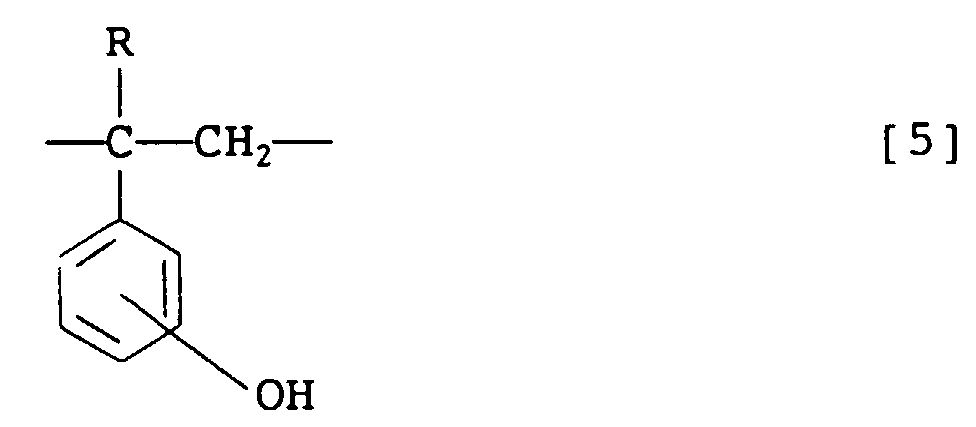
- A polymer composition according to Claim 2 or 3, wherein the polymer (a) has repeating units of the formula:
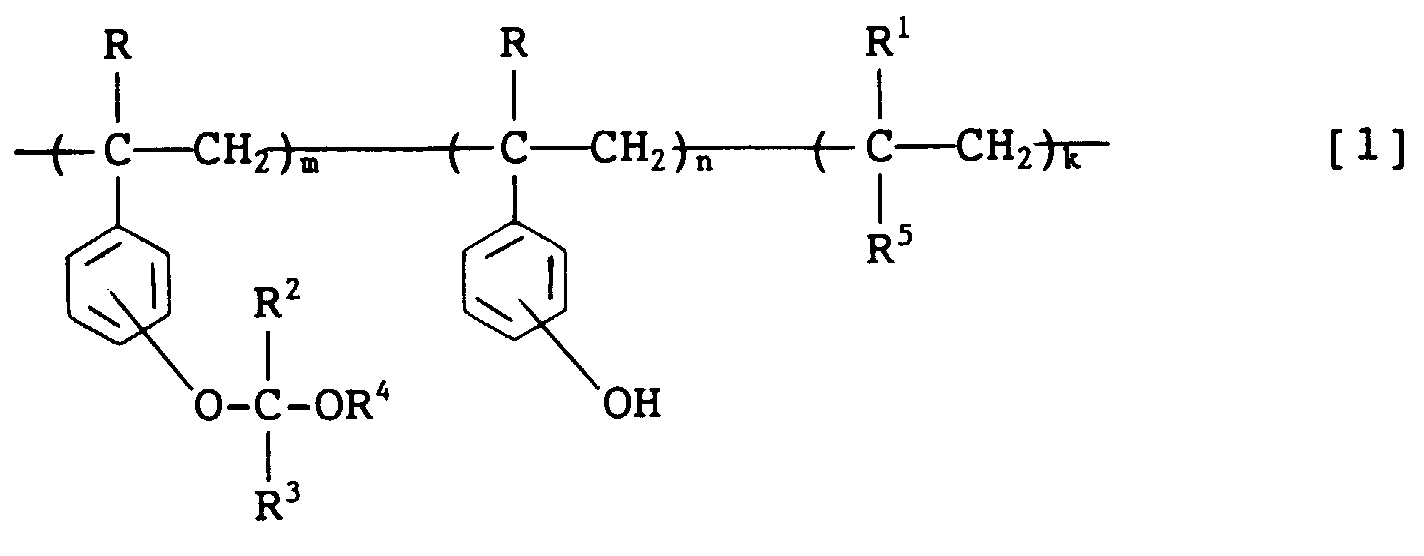

- A polymer composition according to Claim 8, wherein the polymer (a) has a weight-average molecular weight of 5,000 to 50,000 and the polymer (b) has a weight-average molecular weight of 1,000 to 25,000.
- A polymer composition according to Claim 8, wherein m, n, k, p, r and f are in the ranges as defined below: 0.1 ≤ (m+k)/(m+n+k) ≤ 0.9, 0 ≤ k/(m+n+k) ≤ 0.25, and m > k, and 0.1 ≤ p/(p+r+f) ≤ 0.5, 0 ≤ f/(p+r+f) ≤ 0.20 and p > f.
- A polymer composition comprising(i) a polymer (a) containing as its structural constituent a monomer unit having a functional group A which becomes alkali-soluble by heating in the presence of an acid,(ii) a polymer (b) containing as its structural constituent a monomer unit having a functional group B which becomes alkali-soluble, but less easily than the functional group A, by heating in the presence of an acid, and(iii) a phenolic compound having a weight-average molecular weight of 300 to 15,000.
- A polymer composition according to Claim 11, wherein each of the polymer (a) and the polymer (b) contains as its structural constutuent an additional monomer unit, which is able to impart heat resistance and adhesiveness to a substrate.
- A polymer composition according to Claim 12, wherein at least one of the polymer (a) and the polymer (b) contains as its strucvtural constituent a third monomer unit.
- A polymer composition according to Claim 11, wherein the monomer unit having the functional group A is represented by the formula:

- A polymer composition according to Claim 11, wherein the monomer unit having the functional group B is represented by the formula:

- A polymer composition according to Claim 11, wherein the polymer (b) has a smaller weight average molecular weight than that of the polymer (a).
- A polymer composition according to Claim 12, wherein the additional monomer unit is represented by the formula:

- A polymer composition according to Claim 12, or 13, wherein the polymer (a) has repeating units of the formula:

the polymer (b) has repeating units of the formula:
- A polymer composition according to Claim 18, wherein the polymer (a) has a weight-average molecular weight of 5,000 to 50,000 and the polymer (b) has a weight-average molecular weight of 1,000 to 25,000.
- A polymer composition according to Claim 18, wherein m, n, k, p, r, and f are in the ranges as defined below: 0.1 ≤ (m+k)/(m+n+k) ≤ 0.9, 0 ≤ k/(m+n+k) ≤ 0.25, and m > k, 0.1 ≤ p/(p+r+f) ≤ 0.5, 0 ≤ f/(p+r+f) ≤ 0.20 and p > f.
- A polymer composition according to Claim 8, which further comprises a substance which generates an acid when exposed to acitic radiation, and if necessary a ultraviolet absorbent.
- A polymer composition according to Claim 18, which further comprises a substance which generates an acid when exposed to actinic radiation, and if necessary a ultraviolet absorbent.
- A polymer composition comprising(i) a polymer (a) containing as its structural constituent a monomer unit having a functional group A which becomes alkali-soluble by heating in the presence of an acid, and(iii) a phenolic compound having a weight-average molecular weight of 300 to 15,000.
- A polymer composition according to Claim 23, wherein the polymer (a) has repeating units of the formula:

- A polymer composition according to Claim 24, which further comprises a substance which generates an acid when exposed to actinic radiation, and if necessary, a ultraviolet absorbent.
- A resist material comprising the polymer composition of Claim 21.
- A resist material comprising the polymer composition of Claim 22.
- A resist material comprising the polymer composition of Claim 25.
- A process for forming a pattern which comprisescoating the resist material of Claim 26 on a semiconductor substrate,heating the resist material,exposing the resist material to actinic radiation via a mask, if necessary, followed by heating, anddeveloping the resulting resist material.
- A process for forming a pattern which comprisescoating the resist material of Claim 27 on a semiconductor substrate,heating the resist material,exposing the resist material to actinic radiation via a mask, if necessary, followed by heating, anddeveloping the resulting resist material.
- A process for forming a pattern which comprisescoating the resist material of Claim 28 on a semiconductor substrate,heating the resist material,exposing the resist material to actinic radiation via a mask, if necessary, followed by heating, anddeveloping the resulting resist material.
- A polymer composition according to Claim 21, wherein the polymer (a) has repeating units of the formula:


- A polymer composition according to Claim 22, wherein the polymer (a) has repeating units of the formula:

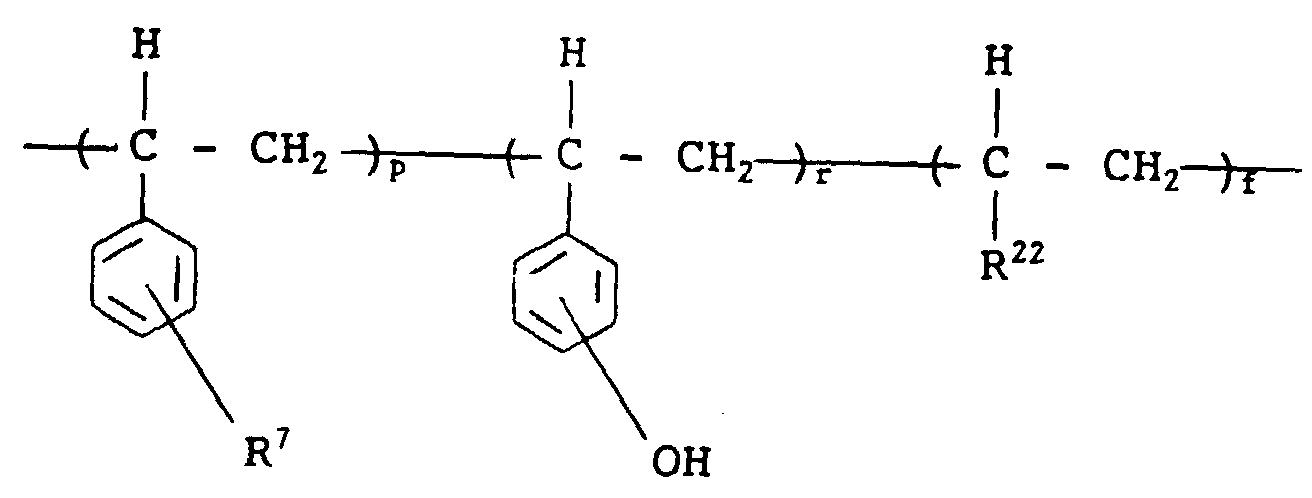
Applications Claiming Priority (9)
| Application Number | Priority Date | Filing Date | Title |
|---|---|---|---|
| JP34976895 | 1995-12-21 | ||
| JP34976895 | 1995-12-21 | ||
| JP349768/95 | 1995-12-21 | ||
| JP15623396 | 1996-05-28 | ||
| JP156233/96 | 1996-05-28 | ||
| JP15623396 | 1996-05-28 | ||
| JP160840/96 | 1996-05-31 | ||
| JP16084096 | 1996-05-31 | ||
| JP16084096 | 1996-05-31 |
Publications (3)
| Publication Number | Publication Date |
|---|---|
| EP0780732A2 true EP0780732A2 (en) | 1997-06-25 |
| EP0780732A3 EP0780732A3 (en) | 1997-12-29 |
| EP0780732B1 EP0780732B1 (en) | 2003-07-09 |
Family
ID=27320972
Family Applications (1)
| Application Number | Title | Priority Date | Filing Date |
|---|---|---|---|
| EP96309142A Expired - Lifetime EP0780732B1 (en) | 1995-12-21 | 1996-12-13 | Polymer composition and resist material |
Country Status (8)
| Country | Link |
|---|---|
| US (1) | US5976759A (en) |
| EP (1) | EP0780732B1 (en) |
| KR (1) | KR100253017B1 (en) |
| CN (1) | CN1097073C (en) |
| AT (1) | ATE244904T1 (en) |
| DE (1) | DE69628996T2 (en) |
| SG (1) | SG75110A1 (en) |
| TW (2) | TW412562B (en) |
Cited By (19)
| Publication number | Priority date | Publication date | Assignee | Title |
|---|---|---|---|---|
| EP0819982A1 (en) * | 1996-07-18 | 1998-01-21 | Olin Microelectronic Chemicals, Inc. | Radiation-sensitive composition |
| EP0875787A1 (en) * | 1997-04-30 | 1998-11-04 | Wako Pure Chemical Industries, Ltd. | Method for reducing the substrate dependence of resist |
| EP0887705A1 (en) * | 1997-06-26 | 1998-12-30 | Shin-Etsu Chemical Co., Ltd. | Resist compositions |
| EP0908783A1 (en) * | 1997-10-08 | 1999-04-14 | Shin-Etsu Chemical Co., Ltd. | Resist compositions, their preparation and use for patterning processes |
| WO1999053378A1 (en) | 1998-04-08 | 1999-10-21 | Clariant International Ltd. | Pattern forming method |
| EP0945764A3 (en) * | 1998-03-26 | 2000-04-19 | Sumitomo Chemical Company, Limited | Photoresist composition |
| EP1020768A1 (en) * | 1999-01-12 | 2000-07-19 | Shipley Company LLC | Hydroxystyrene copolymers and photoresists comprising same |
| EP1024406A1 (en) * | 1999-01-28 | 2000-08-02 | Wako Pure Chemical Industries Ltd | Resist composition |
| EP1030221A1 (en) * | 1999-02-20 | 2000-08-23 | Shipley Company LLC | Photoresist compositions comprising blends of photoacid generators |
| US6153349A (en) * | 1998-05-08 | 2000-11-28 | Sumitomo Chemical Company, Limited | Photo resist composition |
| EP1059563A1 (en) * | 1999-06-10 | 2000-12-13 | Wako Pure Chemical Industries, Ltd. | Agent for reducing substrate dependence of resist |
| EP1063567A1 (en) * | 1999-06-21 | 2000-12-27 | Matsushita Electric Industrial Co., Ltd. | Pattern formation method and pattern formation material |
| EP0989459A4 (en) * | 1998-04-08 | 2001-09-19 | Clariant Finance Bvi Ltd | Chemically amplified resist composition |
| WO2004001797A3 (en) * | 2002-05-23 | 2004-07-01 | Applied Materials Inc | Sensitized chemically amplified photoresist for use in photomask fabrication and semiconductor processing |
| EP1400853A4 (en) * | 2001-06-28 | 2007-09-12 | Tokyo Ohka Kogyo Co Ltd | Positive resist composition of chemical amplification type, resist coated material, method of forming resist pattern, and process for producing semiconductor device |
| WO2011104127A1 (en) | 2010-02-24 | 2011-09-01 | Basf Se | Latent acids and their use |
| EP2507669A4 (en) * | 2009-11-30 | 2014-03-05 | Fujifilm Corp | ACTINIC OR RADIATION SENSITIVE SENSITIVE RESIN COMPOSITION, FILM FORMED USING THE COMPOSITION, AND PATTERN FORMATION METHOD USING THE SAME |
| WO2016124493A1 (en) | 2015-02-02 | 2016-08-11 | Basf Se | Latent acids and their use |
| DE10015255B4 (en) | 1999-03-31 | 2020-06-04 | Ciba Holding Inc. | Process for the preparation of oxime derivatives and their use as latent acids in chemically amplified photoresist compositions, and process for the production of a photoresist |
Families Citing this family (29)
| Publication number | Priority date | Publication date | Assignee | Title |
|---|---|---|---|---|
| JP2998682B2 (en) * | 1997-03-13 | 2000-01-11 | 日本電気株式会社 | Chemical amplification resist |
| TW480370B (en) | 1997-10-08 | 2002-03-21 | Shinetsu Chemical Co | Polystyrene-based polymer compound, chemical amplification positive type resist material and pattern formation |
| US6159653A (en) * | 1998-04-14 | 2000-12-12 | Arch Specialty Chemicals, Inc. | Production of acetal derivatized hydroxyl aromatic polymers and their use in radiation sensitive formulations |
| JP3771739B2 (en) | 1999-03-18 | 2006-04-26 | 東京応化工業株式会社 | Positive resist composition |
| KR100308423B1 (en) * | 1999-09-07 | 2001-09-26 | 주식회사 동진쎄미켐 | Polymer for chemically amplified resist and resists using this polymer |
| US6682869B2 (en) * | 2000-03-07 | 2004-01-27 | Shin-Etu Chemical Co., Ltd. | Chemical amplification, positive resist compositions |
| KR100533362B1 (en) * | 2000-04-19 | 2005-12-06 | 주식회사 하이닉스반도체 | Photoresist composition for photoresist flow process and process for forming a contact hole using the same |
| JP4449176B2 (en) * | 2000-06-30 | 2010-04-14 | 住友化学株式会社 | Chemically amplified resist composition |
| TW538316B (en) * | 2001-01-19 | 2003-06-21 | Sumitomo Chemical Co | Chemical amplifying type positive resist composition |
| JP4177966B2 (en) * | 2001-01-25 | 2008-11-05 | 富士フイルム株式会社 | Positive photoresist composition |
| JP2004519734A (en) | 2001-04-04 | 2004-07-02 | アーチ・スペシャルティ・ケミカルズ・インコーポレイテッド | Silicon-containing acetal protective polymer and photoresist composition thereof |
| JP2003280198A (en) * | 2002-03-20 | 2003-10-02 | Sumitomo Chem Co Ltd | Chemically amplified positive resist composition |
| KR20050094828A (en) * | 2002-12-26 | 2005-09-28 | 도오꾜오까고오교 가부시끼가이샤 | Positive resist composition and method for forming resist pattern |
| JP4121396B2 (en) * | 2003-03-05 | 2008-07-23 | 富士フイルム株式会社 | Positive resist composition |
| JP3981830B2 (en) * | 2003-05-26 | 2007-09-26 | 信越化学工業株式会社 | Resist material and pattern forming method |
| JP4152810B2 (en) * | 2003-06-13 | 2008-09-17 | 東京応化工業株式会社 | Positive resist composition and resist pattern forming method |
| JP4494061B2 (en) * | 2004-03-30 | 2010-06-30 | 東京応化工業株式会社 | Positive resist composition |
| JP2005326491A (en) * | 2004-05-12 | 2005-11-24 | Tokyo Ohka Kogyo Co Ltd | Positive type resist composition and resist pattern forming method |
| KR100685582B1 (en) * | 2004-07-30 | 2007-02-22 | 주식회사 하이닉스반도체 | Photoresist Polymer and Photoresist Composition Containing the Same |
| KR100906598B1 (en) * | 2004-12-03 | 2009-07-09 | 도오꾜오까고오교 가부시끼가이샤 | Positive resist composition and method of forming resist pattern |
| JP4582331B2 (en) | 2005-11-08 | 2010-11-17 | 信越化学工業株式会社 | Resist material and pattern forming method |
| KR100876783B1 (en) * | 2007-01-05 | 2009-01-09 | 주식회사 하이닉스반도체 | Method of forming fine pattern of semiconductor device |
| US7951525B2 (en) * | 2008-09-08 | 2011-05-31 | International Business Machines Corporation | Low outgassing photoresist compositions |
| JP6292059B2 (en) | 2013-08-13 | 2018-03-14 | Jsr株式会社 | Substrate processing method |
| EP3232050B1 (en) | 2014-04-03 | 2021-03-17 | WindTree GmbH | A fluid turbine with rotor |
| TWI623814B (en) * | 2014-05-21 | 2018-05-11 | Asahi Kasei E Mat Corporation | Photosensitive resin composition and method for forming circuit pattern |
| JP6741427B2 (en) * | 2015-01-13 | 2020-08-19 | 東友ファインケム株式会社Dongwoo Fine−Chem Co., Ltd. | Self-luminous photosensitive resin composition, display device including color conversion layer produced therefrom |
| JPWO2021131845A1 (en) * | 2019-12-27 | 2021-07-01 | ||
| TWI837443B (en) | 2019-12-31 | 2024-04-01 | 南韓商羅門哈斯電子材料韓國公司 | Coating composition, coated substrate and method of forming electronic device |
Citations (25)
| Publication number | Priority date | Publication date | Assignee | Title |
|---|---|---|---|---|
| US4491628A (en) | 1982-08-23 | 1985-01-01 | International Business Machines Corporation | Positive- and negative-working resist compositions with acid generating photoinitiator and polymer with acid labile groups pendant from polymer backbone |
| US4603101A (en) | 1985-09-27 | 1986-07-29 | General Electric Company | Photoresist compositions containing t-substituted organomethyl vinylaryl ether materials |
| JPS6480944A (en) | 1987-09-24 | 1989-03-27 | Hitachi Ltd | Photosensitive resin composition |
| JPH01154048A (en) | 1987-12-10 | 1989-06-16 | Toshiba Corp | Photosensitive composition |
| JPH01155338A (en) | 1987-12-14 | 1989-06-19 | Hitachi Ltd | Photosensitive resin composition |
| JPH01155339A (en) | 1987-12-14 | 1989-06-19 | Hitachi Ltd | Photosensitive resin composition |
| JPH01188852A (en) | 1988-01-22 | 1989-07-28 | Matsushita Electric Ind Co Ltd | Resist using photosensitive compound |
| JPH0219847A (en) | 1988-05-19 | 1990-01-23 | Basf Ag | Positive and negatively treated radiation sensitive mixture and relief pattern |
| JPH0225850A (en) | 1988-07-15 | 1990-01-29 | Hitachi Ltd | Radiation sensitive composition and pattern forming method using same |
| JPH0262544A (en) | 1988-08-30 | 1990-03-02 | Tosoh Corp | Photoresist composition |
| JPH02161436A (en) | 1988-12-15 | 1990-06-21 | Oki Electric Ind Co Ltd | Photoresist composition and its usage |
| JPH02209977A (en) | 1988-10-28 | 1990-08-21 | Internatl Business Mach Corp <Ibm> | Positive photoresist composition having high sensitivity |
| JPH0383063A (en) | 1989-08-28 | 1991-04-09 | Kanto Chem Co Inc | Pattern forming method |
| JPH0344290B2 (en) | 1983-09-02 | 1991-07-05 | Japan Synthetic Rubber Co Ltd | |
| JPH03206458A (en) | 1989-03-14 | 1991-09-09 | Internatl Business Mach Corp <Ibm> | Chemically enlarged photoresist |
| JPH03282550A (en) | 1990-03-30 | 1991-12-12 | Oki Electric Ind Co Ltd | Photoresist composition |
| JPH04211258A (en) | 1990-01-30 | 1992-08-03 | Wako Pure Chem Ind Ltd | Chemical amplification type resist material |
| JPH04210960A (en) | 1990-01-30 | 1992-08-03 | Wako Pure Chem Ind Ltd | Novel diazodisulfone compound |
| JPH04219757A (en) | 1990-03-13 | 1992-08-10 | Basf Ag | Radiation sensitive mixture |
| JPH04251259A (en) | 1990-08-31 | 1992-09-07 | Wako Pure Chem Ind Ltd | Novel resist material and pattern forming method |
| JPH05249682A (en) | 1991-06-18 | 1993-09-28 | Wako Pure Chem Ind Ltd | Novel resist material and pattern forming method |
| JPH05281745A (en) | 1992-01-31 | 1993-10-29 | Basf Ag | Radiation sensitive mixture and production of relief structure |
| JPH06194842A (en) | 1992-09-14 | 1994-07-15 | Wako Pure Chem Ind Ltd | Fine pattern forming material and pattern forming method |
| US5350660A (en) | 1990-01-30 | 1994-09-27 | Wako Pure Chemical Industries, Ltd. | Chemical amplified resist material containing photosensitive compound capable of generating an acid and specific polystyrene copolymer having functional groups that become alkali-soluble under an acid atmosphere |
| EP0679951A1 (en) | 1994-04-25 | 1995-11-02 | Tokyo Ohka Kogyo Co., Ltd. | Positive resist composition |
Family Cites Families (5)
| Publication number | Priority date | Publication date | Assignee | Title |
|---|---|---|---|---|
| EP0588544A3 (en) * | 1992-09-14 | 1994-09-28 | Wako Pure Chem Ind Ltd | Fine pattern forming material and pattern formation process |
| JPH06161112A (en) * | 1992-11-19 | 1994-06-07 | Tokyo Ohka Kogyo Co Ltd | Positive resist composition |
| JP3297199B2 (en) * | 1993-09-14 | 2002-07-02 | 株式会社東芝 | Resist composition |
| EP0675410B1 (en) * | 1994-03-28 | 1999-08-04 | Wako Pure Chemical Industries Ltd | Resist composition for deep ultraviolet light |
| US5736296A (en) * | 1994-04-25 | 1998-04-07 | Tokyo Ohka Kogyo Co., Ltd. | Positive resist composition comprising a mixture of two polyhydroxystyrenes having different acid cleavable groups and an acid generating compound |
-
1996
- 1996-12-13 DE DE69628996T patent/DE69628996T2/en not_active Expired - Lifetime
- 1996-12-13 AT AT96309142T patent/ATE244904T1/en not_active IP Right Cessation
- 1996-12-13 EP EP96309142A patent/EP0780732B1/en not_active Expired - Lifetime
- 1996-12-17 SG SG1996011747A patent/SG75110A1/en unknown
- 1996-12-19 US US08/769,533 patent/US5976759A/en not_active Expired - Lifetime
- 1996-12-20 TW TW085115790A patent/TW412562B/en not_active IP Right Cessation
- 1996-12-20 CN CN96123158A patent/CN1097073C/en not_active Expired - Lifetime
- 1996-12-20 TW TW089115615A patent/TWI285660B/en not_active IP Right Cessation
- 1996-12-21 KR KR1019960069905A patent/KR100253017B1/en not_active Expired - Lifetime
Patent Citations (25)
| Publication number | Priority date | Publication date | Assignee | Title |
|---|---|---|---|---|
| US4491628A (en) | 1982-08-23 | 1985-01-01 | International Business Machines Corporation | Positive- and negative-working resist compositions with acid generating photoinitiator and polymer with acid labile groups pendant from polymer backbone |
| JPH0344290B2 (en) | 1983-09-02 | 1991-07-05 | Japan Synthetic Rubber Co Ltd | |
| US4603101A (en) | 1985-09-27 | 1986-07-29 | General Electric Company | Photoresist compositions containing t-substituted organomethyl vinylaryl ether materials |
| JPS6480944A (en) | 1987-09-24 | 1989-03-27 | Hitachi Ltd | Photosensitive resin composition |
| JPH01154048A (en) | 1987-12-10 | 1989-06-16 | Toshiba Corp | Photosensitive composition |
| JPH01155338A (en) | 1987-12-14 | 1989-06-19 | Hitachi Ltd | Photosensitive resin composition |
| JPH01155339A (en) | 1987-12-14 | 1989-06-19 | Hitachi Ltd | Photosensitive resin composition |
| JPH01188852A (en) | 1988-01-22 | 1989-07-28 | Matsushita Electric Ind Co Ltd | Resist using photosensitive compound |
| JPH0219847A (en) | 1988-05-19 | 1990-01-23 | Basf Ag | Positive and negatively treated radiation sensitive mixture and relief pattern |
| JPH0225850A (en) | 1988-07-15 | 1990-01-29 | Hitachi Ltd | Radiation sensitive composition and pattern forming method using same |
| JPH0262544A (en) | 1988-08-30 | 1990-03-02 | Tosoh Corp | Photoresist composition |
| JPH02209977A (en) | 1988-10-28 | 1990-08-21 | Internatl Business Mach Corp <Ibm> | Positive photoresist composition having high sensitivity |
| JPH02161436A (en) | 1988-12-15 | 1990-06-21 | Oki Electric Ind Co Ltd | Photoresist composition and its usage |
| JPH03206458A (en) | 1989-03-14 | 1991-09-09 | Internatl Business Mach Corp <Ibm> | Chemically enlarged photoresist |
| JPH0383063A (en) | 1989-08-28 | 1991-04-09 | Kanto Chem Co Inc | Pattern forming method |
| JPH04211258A (en) | 1990-01-30 | 1992-08-03 | Wako Pure Chem Ind Ltd | Chemical amplification type resist material |
| JPH04210960A (en) | 1990-01-30 | 1992-08-03 | Wako Pure Chem Ind Ltd | Novel diazodisulfone compound |
| US5350660A (en) | 1990-01-30 | 1994-09-27 | Wako Pure Chemical Industries, Ltd. | Chemical amplified resist material containing photosensitive compound capable of generating an acid and specific polystyrene copolymer having functional groups that become alkali-soluble under an acid atmosphere |
| JPH04219757A (en) | 1990-03-13 | 1992-08-10 | Basf Ag | Radiation sensitive mixture |
| JPH03282550A (en) | 1990-03-30 | 1991-12-12 | Oki Electric Ind Co Ltd | Photoresist composition |
| JPH04251259A (en) | 1990-08-31 | 1992-09-07 | Wako Pure Chem Ind Ltd | Novel resist material and pattern forming method |
| JPH05249682A (en) | 1991-06-18 | 1993-09-28 | Wako Pure Chem Ind Ltd | Novel resist material and pattern forming method |
| JPH05281745A (en) | 1992-01-31 | 1993-10-29 | Basf Ag | Radiation sensitive mixture and production of relief structure |
| JPH06194842A (en) | 1992-09-14 | 1994-07-15 | Wako Pure Chem Ind Ltd | Fine pattern forming material and pattern forming method |
| EP0679951A1 (en) | 1994-04-25 | 1995-11-02 | Tokyo Ohka Kogyo Co., Ltd. | Positive resist composition |
Non-Patent Citations (8)
| Title |
|---|
| BEARD C.D. ET AL., J. ORG. CHEM., vol. 38, 1973, pages 3673 |
| BRUNSVOLT W.R. ET AL., PROC. SPIE., vol. 1086, 1989, pages 357 |
| BULL. CHIM. SOC. FRANCE., vol. 1974, pages 1956 |
| ITO ET AL., POLYM. ENG. SCI., vol. 23, 1983, pages 1012 |
| JIAN Y. ET AL., POLYM. MATER. SCI. & ENG., vol. 66, 1992, pages 41 |
| NEENAN T.X. ET AL., PROC. SPIE., vol. 1086, 1989, pages 2 |
| TANI Y. ET AL., PROC. SPIE., vol. 1086, 1989, pages 22 |
| TARASCON R.G. ET AL., SPE REGIONAL CONFERENCE TECHNICAL PAPERS., 1988, ELLENVILLE, N.Y., pages 11 |
Cited By (36)
| Publication number | Priority date | Publication date | Assignee | Title |
|---|---|---|---|---|
| EP0819982A1 (en) * | 1996-07-18 | 1998-01-21 | Olin Microelectronic Chemicals, Inc. | Radiation-sensitive composition |
| EP0875787A1 (en) * | 1997-04-30 | 1998-11-04 | Wako Pure Chemical Industries, Ltd. | Method for reducing the substrate dependence of resist |
| US6303264B1 (en) | 1997-04-30 | 2001-10-16 | Wako Pure Chemical Industries, Ltd | Agent for reducing the substrate dependence of resist |
| EP0887705A1 (en) * | 1997-06-26 | 1998-12-30 | Shin-Etsu Chemical Co., Ltd. | Resist compositions |
| US6274286B1 (en) | 1997-06-26 | 2001-08-14 | Shin-Etsu Chemical Co., Ltd. | Resist compositions |
| US6136502A (en) * | 1997-10-08 | 2000-10-24 | Shin-Etsu Chemical Co., Ltd. | Resist composition and patterning process |
| EP0908783A1 (en) * | 1997-10-08 | 1999-04-14 | Shin-Etsu Chemical Co., Ltd. | Resist compositions, their preparation and use for patterning processes |
| US6258507B1 (en) | 1998-03-26 | 2001-07-10 | Sumitomo Chemical Company, Limited | Photoresist compositions |
| KR100665483B1 (en) * | 1998-03-26 | 2007-01-10 | 스미또모 가가꾸 가부시키가이샤 | Photoresist composition |
| EP0945764A3 (en) * | 1998-03-26 | 2000-04-19 | Sumitomo Chemical Company, Limited | Photoresist composition |
| EP0989460A4 (en) * | 1998-04-08 | 2001-10-24 | Clariant Finance Bvi Ltd | PATTERN FORMING PROCESS |
| EP0989459A4 (en) * | 1998-04-08 | 2001-09-19 | Clariant Finance Bvi Ltd | Chemically amplified resist composition |
| WO1999053378A1 (en) | 1998-04-08 | 1999-10-21 | Clariant International Ltd. | Pattern forming method |
| US6153349A (en) * | 1998-05-08 | 2000-11-28 | Sumitomo Chemical Company, Limited | Photo resist composition |
| US6770413B1 (en) | 1999-01-12 | 2004-08-03 | Shipley Company, L.L.C. | Hydroxyphenyl copolymers and photoresists comprising same |
| EP1020768A1 (en) * | 1999-01-12 | 2000-07-19 | Shipley Company LLC | Hydroxystyrene copolymers and photoresists comprising same |
| EP1024406A1 (en) * | 1999-01-28 | 2000-08-02 | Wako Pure Chemical Industries Ltd | Resist composition |
| US6656660B1 (en) | 1999-01-28 | 2003-12-02 | Sumitomo Chemical Company, Limited | Resist composition |
| US6203965B1 (en) * | 1999-02-20 | 2001-03-20 | Shipley Company, L.L.C. | Photoresist comprising blends of photoacid generators |
| US6200728B1 (en) | 1999-02-20 | 2001-03-13 | Shipley Company, L.L.C. | Photoresist compositions comprising blends of photoacid generators |
| EP1030221A1 (en) * | 1999-02-20 | 2000-08-23 | Shipley Company LLC | Photoresist compositions comprising blends of photoacid generators |
| US6803169B2 (en) | 1999-02-20 | 2004-10-12 | Shipley Company, L.L.C. | Photoresist compositions comprising blends of photoacid generators |
| DE10015255B4 (en) | 1999-03-31 | 2020-06-04 | Ciba Holding Inc. | Process for the preparation of oxime derivatives and their use as latent acids in chemically amplified photoresist compositions, and process for the production of a photoresist |
| EP1059563A1 (en) * | 1999-06-10 | 2000-12-13 | Wako Pure Chemical Industries, Ltd. | Agent for reducing substrate dependence of resist |
| US6586152B1 (en) | 1999-06-10 | 2003-07-01 | Wako Pure Chemical Industries, Ltd. | Agent for reducing substrate dependence |
| US6531259B1 (en) | 1999-06-21 | 2003-03-11 | Matsushita Electric Industrial Co., Ltd. | Pattern formation method and pattern formation material |
| EP1335246A1 (en) * | 1999-06-21 | 2003-08-13 | Matsushita Electric Industrial Co., Ltd. | Pattern formation method |
| EP1063567A1 (en) * | 1999-06-21 | 2000-12-27 | Matsushita Electric Industrial Co., Ltd. | Pattern formation method and pattern formation material |
| EP1400853A4 (en) * | 2001-06-28 | 2007-09-12 | Tokyo Ohka Kogyo Co Ltd | Positive resist composition of chemical amplification type, resist coated material, method of forming resist pattern, and process for producing semiconductor device |
| WO2004001797A3 (en) * | 2002-05-23 | 2004-07-01 | Applied Materials Inc | Sensitized chemically amplified photoresist for use in photomask fabrication and semiconductor processing |
| US7067227B2 (en) | 2002-05-23 | 2006-06-27 | Applied Materials, Inc. | Sensitized chemically amplified photoresist for use in photomask fabrication and semiconductor processing |
| EP2507669A4 (en) * | 2009-11-30 | 2014-03-05 | Fujifilm Corp | ACTINIC OR RADIATION SENSITIVE SENSITIVE RESIN COMPOSITION, FILM FORMED USING THE COMPOSITION, AND PATTERN FORMATION METHOD USING THE SAME |
| KR101386463B1 (en) | 2009-11-30 | 2014-04-18 | 후지필름 가부시키가이샤 | Actinic ray-sensitive or radiation-sensitive resin composition, film formed using the composition and pattern forming method using the same |
| US8741542B2 (en) | 2009-11-30 | 2014-06-03 | Fujifilm Corporation | Actinic ray-sensitive or radiation-sensitive resin composition, film formed using the composition and pattern forming method using the same |
| WO2011104127A1 (en) | 2010-02-24 | 2011-09-01 | Basf Se | Latent acids and their use |
| WO2016124493A1 (en) | 2015-02-02 | 2016-08-11 | Basf Se | Latent acids and their use |
Also Published As
| Publication number | Publication date |
|---|---|
| CN1097073C (en) | 2002-12-25 |
| EP0780732B1 (en) | 2003-07-09 |
| CN1159459A (en) | 1997-09-17 |
| SG75110A1 (en) | 2000-09-19 |
| TW412562B (en) | 2000-11-21 |
| DE69628996T2 (en) | 2004-04-22 |
| KR100253017B1 (en) | 2000-06-01 |
| TWI285660B (en) | 2007-08-21 |
| US5976759A (en) | 1999-11-02 |
| EP0780732A3 (en) | 1997-12-29 |
| ATE244904T1 (en) | 2003-07-15 |
| DE69628996D1 (en) | 2003-08-14 |
Similar Documents
| Publication | Publication Date | Title |
|---|---|---|
| EP0780732B1 (en) | Polymer composition and resist material | |
| KR100286960B1 (en) | Polymer and resist material | |
| EP0704762B1 (en) | Resist material and pattern formation | |
| EP0520642B1 (en) | Resist material and pattern formation process | |
| US6656660B1 (en) | Resist composition | |
| KR100795872B1 (en) | Positive photosensitive composition | |
| US6447980B1 (en) | Photoresist composition for deep UV and process thereof | |
| JP2002088124A (en) | Photosensitive polymer having protective group containing condensed aromatic ring and resist composition containing the same | |
| US6716573B2 (en) | Resist Composition | |
| US5595855A (en) | Radiation sensitive composition | |
| US6737217B2 (en) | Photoresist monomers containing fluorine-substituted benzylcarboxylate and photoresist polymers comprising the same | |
| EP0701171A1 (en) | Resist compositions | |
| JP3757731B2 (en) | Resist composition | |
| US6653047B2 (en) | Photoresist monomers containing fluorine-substituted benzylcarboxylate and photoresist polymers comprising the same | |
| JP3409619B2 (en) | Polymer composition and resist material comprising the same | |
| US6806025B2 (en) | Photoresist monomers, polymers thereof and photoresist compositons containing the same | |
| US20060008731A1 (en) | Novel photoresist monomers and polymers | |
| US6921622B2 (en) | Photoresist monomers, polymers thereof and photoresist compositions containing the same | |
| KR100557552B1 (en) | Photoresist monomers, polymers thereof and photoresist compositions containing them | |
| EP0819982A1 (en) | Radiation-sensitive composition | |
| KR100638957B1 (en) | Photoresist Polymer and Photoresist Composition Comprising the Same | |
| JP2001042530A (en) | Positive radiation-sensitive resin composition | |
| KR100680406B1 (en) | Photoresist Polymer and Photoresist Composition Comprising the Same | |
| US20060008730A1 (en) | Monomers for photoresists bearing acid-labile groups of reduced optical density | |
| KR20060002054A (en) | Photoresist Polymer and Photoresist Composition Comprising the Same |
Legal Events
| Date | Code | Title | Description |
|---|---|---|---|
| PUAI | Public reference made under article 153(3) epc to a published international application that has entered the european phase |
Free format text: ORIGINAL CODE: 0009012 |
|
| AK | Designated contracting states |
Kind code of ref document: A2 Designated state(s): AT BE CH DE DK ES FI FR GB GR IE IT LI LU MC NL PT SE |
|
| PUAL | Search report despatched |
Free format text: ORIGINAL CODE: 0009013 |
|
| AK | Designated contracting states |
Kind code of ref document: A3 Designated state(s): AT BE CH DE DK ES FI FR GB GR IE IT LI LU MC NL PT SE |
|
| 17P | Request for examination filed |
Effective date: 19980514 |
|
| 17Q | First examination report despatched |
Effective date: 19981026 |
|
| GRAH | Despatch of communication of intention to grant a patent |
Free format text: ORIGINAL CODE: EPIDOS IGRA |
|
| GRAH | Despatch of communication of intention to grant a patent |
Free format text: ORIGINAL CODE: EPIDOS IGRA |
|
| GRAA | (expected) grant |
Free format text: ORIGINAL CODE: 0009210 |
|
| AK | Designated contracting states |
Designated state(s): AT BE CH DE DK ES FI FR GB GR IE IT LI LU MC NL PT SE |
|
| PG25 | Lapsed in a contracting state [announced via postgrant information from national office to epo] |
Ref country code: NL Free format text: LAPSE BECAUSE OF FAILURE TO SUBMIT A TRANSLATION OF THE DESCRIPTION OR TO PAY THE FEE WITHIN THE PRESCRIBED TIME-LIMIT Effective date: 20030709 Ref country code: LI Free format text: LAPSE BECAUSE OF FAILURE TO SUBMIT A TRANSLATION OF THE DESCRIPTION OR TO PAY THE FEE WITHIN THE PRESCRIBED TIME-LIMIT Effective date: 20030709 Ref country code: FI Free format text: LAPSE BECAUSE OF FAILURE TO SUBMIT A TRANSLATION OF THE DESCRIPTION OR TO PAY THE FEE WITHIN THE PRESCRIBED TIME-LIMIT Effective date: 20030709 Ref country code: CH Free format text: LAPSE BECAUSE OF FAILURE TO SUBMIT A TRANSLATION OF THE DESCRIPTION OR TO PAY THE FEE WITHIN THE PRESCRIBED TIME-LIMIT Effective date: 20030709 Ref country code: BE Free format text: LAPSE BECAUSE OF FAILURE TO SUBMIT A TRANSLATION OF THE DESCRIPTION OR TO PAY THE FEE WITHIN THE PRESCRIBED TIME-LIMIT Effective date: 20030709 Ref country code: AT Free format text: LAPSE BECAUSE OF FAILURE TO SUBMIT A TRANSLATION OF THE DESCRIPTION OR TO PAY THE FEE WITHIN THE PRESCRIBED TIME-LIMIT Effective date: 20030709 |
|
| REG | Reference to a national code |
Ref country code: GB Ref legal event code: FG4D |
|
| REG | Reference to a national code |
Ref country code: CH Ref legal event code: EP |
|
| REF | Corresponds to: |
Ref document number: 69628996 Country of ref document: DE Date of ref document: 20030814 Kind code of ref document: P |
|
| REG | Reference to a national code |
Ref country code: IE Ref legal event code: FG4D |
|
| PG25 | Lapsed in a contracting state [announced via postgrant information from national office to epo] |
Ref country code: SE Free format text: LAPSE BECAUSE OF FAILURE TO SUBMIT A TRANSLATION OF THE DESCRIPTION OR TO PAY THE FEE WITHIN THE PRESCRIBED TIME-LIMIT Effective date: 20031009 Ref country code: GR Free format text: LAPSE BECAUSE OF FAILURE TO SUBMIT A TRANSLATION OF THE DESCRIPTION OR TO PAY THE FEE WITHIN THE PRESCRIBED TIME-LIMIT Effective date: 20031009 Ref country code: DK Free format text: LAPSE BECAUSE OF FAILURE TO SUBMIT A TRANSLATION OF THE DESCRIPTION OR TO PAY THE FEE WITHIN THE PRESCRIBED TIME-LIMIT Effective date: 20031009 |
|
| PG25 | Lapsed in a contracting state [announced via postgrant information from national office to epo] |
Ref country code: ES Free format text: LAPSE BECAUSE OF FAILURE TO SUBMIT A TRANSLATION OF THE DESCRIPTION OR TO PAY THE FEE WITHIN THE PRESCRIBED TIME-LIMIT Effective date: 20031020 |
|
| NLV1 | Nl: lapsed or annulled due to failure to fulfill the requirements of art. 29p and 29m of the patents act | ||
| PG25 | Lapsed in a contracting state [announced via postgrant information from national office to epo] |
Ref country code: PT Free format text: LAPSE BECAUSE OF FAILURE TO SUBMIT A TRANSLATION OF THE DESCRIPTION OR TO PAY THE FEE WITHIN THE PRESCRIBED TIME-LIMIT Effective date: 20031209 |
|
| PG25 | Lapsed in a contracting state [announced via postgrant information from national office to epo] |
Ref country code: LU Free format text: LAPSE BECAUSE OF NON-PAYMENT OF DUE FEES Effective date: 20031213 |
|
| PG25 | Lapsed in a contracting state [announced via postgrant information from national office to epo] |
Ref country code: IE Free format text: LAPSE BECAUSE OF NON-PAYMENT OF DUE FEES Effective date: 20031215 |
|
| PG25 | Lapsed in a contracting state [announced via postgrant information from national office to epo] |
Ref country code: MC Free format text: LAPSE BECAUSE OF NON-PAYMENT OF DUE FEES Effective date: 20031231 |
|
| REG | Reference to a national code |
Ref country code: CH Ref legal event code: PL |
|
| ET | Fr: translation filed | ||
| PLBE | No opposition filed within time limit |
Free format text: ORIGINAL CODE: 0009261 |
|
| STAA | Information on the status of an ep patent application or granted ep patent |
Free format text: STATUS: NO OPPOSITION FILED WITHIN TIME LIMIT |
|
| 26N | No opposition filed |
Effective date: 20040414 |
|
| REG | Reference to a national code |
Ref country code: IE Ref legal event code: MM4A |
|
| REG | Reference to a national code |
Ref country code: FR Ref legal event code: PLFP Year of fee payment: 20 |
|
| PGFP | Annual fee paid to national office [announced via postgrant information from national office to epo] |
Ref country code: GB Payment date: 20151209 Year of fee payment: 20 Ref country code: IT Payment date: 20151214 Year of fee payment: 20 |
|
| PGFP | Annual fee paid to national office [announced via postgrant information from national office to epo] |
Ref country code: FR Payment date: 20151027 Year of fee payment: 20 |
|
| PGFP | Annual fee paid to national office [announced via postgrant information from national office to epo] |
Ref country code: DE Payment date: 20160222 Year of fee payment: 20 |
|
| REG | Reference to a national code |
Ref country code: DE Ref legal event code: R071 Ref document number: 69628996 Country of ref document: DE |
|
| REG | Reference to a national code |
Ref country code: GB Ref legal event code: PE20 Expiry date: 20161212 |
|
| PG25 | Lapsed in a contracting state [announced via postgrant information from national office to epo] |
Ref country code: GB Free format text: LAPSE BECAUSE OF EXPIRATION OF PROTECTION Effective date: 20161212 |